Whew! What a week!

Politics

A key question for the quadrennium

What is the honorable way to oppose while hoping for the best, to oppose while being as quick to recognize progress as to see failure, to oppose while appreciating any outcomes that are healthy for and helpful to the United States of America? And without forgetting why you oppose? We’ll find out. This is our goal. History is long and our moment within it short. Play it straight and say what you see.

He is going to utterly dominate our brainspace. He is a neurological imperialist, he storms in and stays. In his public self, Joe Biden asked nothing and gave nothing. Mr. Trump demands and dominates: Attention must be paid. It was said years ago that Fox News viewers were so loyal that they never changed the channel and the Fox logo burned itself into the screens. Donald Trump won’t be happy until he’s burned himself into the nation’s corneas.

… let me tell you what happens when you pardon virtually everyone who did Jan. 6: You get more Jan. 6ths. When people who commit crimes see that their punishment will be minimal they are encouraged. It was a wicked act. Conservatives are tough on crime because of the pain and disorder it causes. In that case it pained an entire nation. Jan. 6 too shamed us in the eyes of the world. This pardon was not a patriotic act.

Peggy Noonan on Trump 2.0.

Our building-on-precedent President

The effect — and I believe purpose — of these pardons is to encourage vigilantes and militias loyal to the president, but unaccountable to the government. Illiberal democracies and outright dictatorships often rely on such militia groups, whose organization and seriousness can range widely, from the vigilantes who enforce Iran’s hijab dress code to the United Self-Defense Forces of Colombia that have killed government opponents.

Here in America, lynch mobs and the Ku Klux Klan bolstered a racial caste system with violence that state governments, for the most part, were unwilling to commit themselves. But for decades, we had little reason to fear that vigilantes or militias would enforce the will of the state.

Former Federal Prosecutor Brendan Ballou

The Biden administration enlisted the “whole of society” to suppress supposed misinformation on social media. In practice, that meant screaming, cussing and threatening social media owners to do what the government itself is not allowed to do.

Mafia Don, by pardoning or commuting the sentences of violent felons who support him, says “hold my beer.”

I fear we’re in for vigilante justice.

Moral equivalency? Not if you think threats of violence and death are worse than threats of regulatory harassment. But it’s not unprecedented.

The day I became politically homeless

Monday, inauguration day, was the 20th Anniversary of my declaring an end of my loyalty to the GOP.

George W. Bush, for whom I’d voted in 2000 because of his promise of a humbler foreign policy, announced a 180-degree reversal:

So it is the policy of the United States to seek and support the growth of democratic movements and institutions in every nation and culture, with the ultimate goal of ending tyranny in our world.

(Italics added) He immediately added “This is not primarily the task of arms,” but I knew that the policy was delusional and that arms would be required in the folly.

I was right.

I wish I could say I quit because I foresaw something like Donald Trump as the eventuality of, say, the GOP’s “southern strategy,” but that would be a big ole lie.

MAGA Granny repents

One of the January 6 rioters doesn’t want a pardon:

Ms. Hemphill, 71, who was called “MAGA Granny” in some news headlines, has said that she no longer supports Mr. Trump or believes his lie that the 2020 election was stolen. She said that a therapist had helped change her view of the attack by telling her she was “not a victim of Jan. 6; I was a volunteer.”

“I lost my critical thinking,” she said on Wednesday, reflecting on her involvement in the riot and the “Stop the Steal” movement. “Now I know it was a cult, and I was in a cult.”

Would that this were not a man-bites-dog story! Would that most of the rioters had come to their senses!

Over-interpreting

Episcopal Bishop Mariann E. Budde pointedly challenged President Trump from the pulpit this week:

So, she took a breath, and spoke.

President Trump, seated seven feet below and some 40 feet to her right, made eye contact. One representation of American Christianity began speaking to another, and the most powerful man in the world was arrested by the words of a silver-haired female bishop in the pulpit. Until he turned away.

“Let me make one final plea, Mr. President: Millions have put their trust in you. And as you told the nation yesterday, you have felt the providential hand of a loving God. In the name of our God, I ask you to have mercy upon the people in our country who are scared now. There are gay, lesbian and transgender children in Democratic, Republican and independent families, some who fear for their lives. And the people, the people who pick our crops and clean our office buildings, who labor in poultry farms and meatpacking plants, who wash the dishes after we eat in restaurants and work the night shifts in hospitals, they — they may not be citizens or have the proper documentation, but the vast majority of immigrants are not criminals. I ask you to have mercy, Mr. President, on those in our communities whose children fear that their parents will be taken away, and that you help those who are fleeing war zones and persecution in their own lands to find compassion and welcome here, Mr. President.” …

For everyone watching, the vastness of Washington National Cathedral compressed, in one stunning moment, into a sudden intimacy. And with it, all the existential fights not simply of politics, but of morality itself. In a flash, the war over spiritual authority in America burst into a rare public showdown.

The Canterbury Pulpit confronted the bully pulpit on the greatest possible stage.

For nearly a decade, American Christianity has been torn apart in every possible way. Christians have fought over whether women should be allowed to preach. Over the place of gay people. The definition of marriage. The separation of church and state. Black Lives Matter. And at the heart of much of it has been Mr. Trump’s rise as the de facto head of the modern American church, and the rise of right-wing Christian power declaring itself the one true voice of God.

Elizabeth Dias, New York Times (Emphasis added)

I deny that Donald Trump is any representative of American Christianity; I don’t even think his Christianish supporters any longer claim that he is a Christian of any sort. I deny that he is “the de facto head of the modern American church.” This is highly tendentious reporting, notwithstanding the author’s credentials.

I remain scandalized that Trump gets so much enthusiastic Christianish support, but I have come to understand, at least a little bit, why voters, Christianish or not, preferred him to the senile, corrupt, manipulative, gaslighting and extremist alternative.

Honey Badger

A fairly short paragraph that packs a big claim. Speaking of a panel at Davos:

[O]ne of the panelists said she has been talking to CEOs there, and they all promise that they are not going to roll back DEI, despite the criticism. I believe she’s telling the truth. Whether those CEOs were just telling her that to calm her down, or whether they really believe it — only time will tell. I would bet that most of them really believe it, because DEI is held to with religious fervor by that elite class. As I’ve written here before, it is impossible to overstate the conformist power among elites of being seen as a Good Person. This is why no Republican leader ever pushed back against this stuff prior to Trump. They were terrified of being seen as a Bad Person by the media and other elites. Trump is the Honey Badger of politics: he doesn’t care. (That’s a link to the megaviral Randall video from some years back; he drops some profanity in it, so be aware.)

Rod Dreher

Greatness

Literary greatness

Of life in the Soviet Union for writers:

the lesson I have learned from the writers of my father’s generation is that those who resisted the life of doublethink then are the one who keep influencing us now.

Natan Sharansky, The Doublethinkers

Musical greatness

Garth Hudson, the last surviving member of The Band, has died at age 87. Alan Jacobs mourns, and in doing so points out what was so special about The Band:

Robbie Robertson once said that — when they were all living in and around the house in West Saugerties, New York they called Big Pink — Dylan would play them songs he was working on and they couldn’t tell whether he had just written them or found them under a rock. The Band’s best music is like that: it feels old, time-worn and seasoned, and yet is also a brand new thing.

Yeah, that’s how it felt.

Healthy Society, Sickly Society

The quality that sets the true elites apart—that bestows authority on their actions and expressions—isn’t power, or wealth, or education, or even persuasiveness. It’s integrity in life and work. A healthy society is one in which such exemplary types draw the public toward them purely by the force of their example. Without compulsion, ordinary persons aspire to resemble the extraordinary, not superficially but fundamentally, because they wish to partake of superior models of being or doing. The good society, Ortega concluded, was an “engine of perfection.”

In a sickly society, the force of exemplarity is reversed. Elites seek to flatter and imitate the public. They make a display of popular tastes and attitudes, even as they retreat behind barricades of bodyguards and metal-detecting machines. This, of course, is what I meant by distance: a moral alienation felt even more keenly than the structural divide.

Martin Gurri, The Revolt of the Public and the Crisis of Authority in the New Millennium


I suffer more from the humiliations inflicted by my country than from those inflicted on her.

Simone Weil, from a letter to Georges Bernanos.

[N]one of the things that I care about most have ever proven susceptible to systematic exposition.

Alan Jacobs, Breaking Bread With the Dead

I don’t do any of the major social media, but I have two sub-domains of the domain you’re currently reading: (a) You can read most of my reflexive stuff, especially political here. (b) I also post some things on the only social medium I frequent, because people there are quirky, pleasant and real.

Sunday, 1/19/25

Here’s the thing about αμαρτία

This excerpt from the Orthodox Trisagion prayers (Thrice-Holy prayers) grabbed my attention 27+ years ago:

O Lord, cleanse us from our sins. O Master, pardon our transgressions. O Holy One, visit and heal our infirmities for Thy Name’s sake.

That left an impression that is still with me.

I learned fairly early in my catechesis that sin in Greek is αμαρτία, commonly rendered “hamartia” in English. It literally means “missing the mark.”

As an Evangelical, and then as a Calvinist (though to a lesser degree), I’d gotten the impression that “sin” was simply rebellion against God. But that wasn’t true to all that I saw in me that missed the mark. There was self-absorption feeding obliviousness to the concerns of others. I didn’t choose that to rebel against God. There was such limitation that I sometimes didn’t know what I should do and chose something that harmed others. I also didn’t choose that to rebel against God (I’d have preferred omniscience).

The three sentences from the Trisagion Prayers seemed a perceptive taxonomy where my Church and pastors saw only uniformity: rebellion. For some kinds of mark-missing we need cleansing, for others pardon, for still others, healing.

My soul said “Yes! They’ve got it!” And so the case for Orthodoxy grew weightier.

I don’t remember mentioning this before. Perhaps it will help someone with the same perception I had.

But now that I’ve got that down on paper (so to speak), connections occur to me. Maybe my Protestant mentors didn’t think about human failures that aren’t acts of rebellion toward God because the common Protestant theory of atonement (basically, God the Father already gave God the Son the punishment we deserve for our rebellion and so He won’t punish us as well) is an uncomfortable fit for non-rebellious mark-missing like self-absorption and lack of omniscience, for which we need something more than pardon.

To call that idea half-baked may be too generous, but now it’s on my mind.

How liberal theology works

I pay a lot of critical attention to American Evangelicalism because in important ways it was my religious world and we’re collectively still swimming in its latest iterations.

Also, I don’t think I ever understood the Protestant mainline. I recently got some help in that regard (recently because I’m gradually catching up with the podcast series from which this transcript comes):

Fr. Stephen: … I don’t think people fundamentally understand how liberal theology works, and this can give us a window into how liberal theology works. Liberal theology is in keeping with Hegel, the Hegel we’re rejecting on this show, just to be clear. Not promoting liberal theology, but we need to understand liberal theology and how it works.

The reason I’m just saying “liberal theology”— I’m not saying “liberal” as opposed to “conservative.” I’m saying “liberal” in the sense of post-Enlightenment, that doesn’t think the Enlightenment was a bad thing. I’m talking about post-Enlightenment theology; I’m talking about— Well, let’s get to brass tacks. …

But liberal theology essentially, like Hegel, takes whatever point in time they stand at as being the apex of history to that point. This means— And I’ve critiqued it this way on the show before, but I’m going to do it again. This means that liberal theology is always innately chauvinist, at least somewhat racist, colonial, because, again, you have to take your culture and civilization as being the apex, which means the other ones who might disagree with you are somehow primitive, backward, unenlightened, etc. So there’s always overtones of that, always overtones of that within liberal theology. But you take your point as being the apex of history to that point, and you ascribe the developments that have led to that apex as being the work of the Holy Spirit.

So if now we, European-derived Western culture, have a new understanding of gender or sexuality or biological sex or any other ethical, moral issue of who God is, whatever—whatever has developed historically, in this Western—dare I say often white—culture, whatever is developed in that culture, this is the work of the Holy Spirit that has brought us to this, and therefore it is endorsed, and we re-shape our theology based on this. So a new understanding of gender that arises within culture and society is, for them—the work of God has brought that about within society.

Fr. Andrew: Yeah… This is where you hear people use language like “the right side of history.”

Fr. Stephen: So it doesn’t matter if the person questioning that is from the same culture but who says, “Hey, I don’t this historical development—” they’re doing more like what we’re advocating for, which is saying, “Well, no, we have to sift through this and say what is from God and what isn’t”; or if it’s someone from another culture, who might have another skin color, might be from another continent. It doesn’t matter who’s questioning it: whoever’s questioning it is innately backwards, is innately rejecting the work of the Holy Spirit in the world.

Fr. Andrew: Yeah, this is also where you hear people say things like: “It’s 2023!” Like that’s an argument! “It’s current year!”

Fr. Stephen: Yeah, but you have to understand, this is their understanding. And this is why trying to take any kind of approach with them, of “well, but this previous understanding…” or “this thing from the past,” no matter what it is, fundamentally doesn’t work, because they have this underlying presupposition that their culture now at this point in time is the apex of all human cultures and civilization and that God has brought it there. This is why, when I— when you hear me critiquing liberal theology, it’s often from what sounds like a liberal perspective, like I’ll say to people who express these ideas— They’ll be attacking, for example, African bishops in their own church for not going along. What’s nice about me using that example is there are at least three different denominations I could be talking about.

When they, as white, bourgeois Americans or Europeans, attack African bishops and call them “backwards” and all of these things for not being on-board with their new liberal consensus, I will call them white supremacists, because that’s what that is.

Fr. Andrew: Colonialism.

Fr. Stephen: Right? That is colonialism. It’s: all the things they claim to hate, they’re actually doing. But that’s why I— If people hear me critique it that way, I know some people might get confused, but that’s why I critique it that way, because that’s the only critique that can function on their own presuppositions. That’s the only critique that’s valid from their— based on their own presuppositions. Any critique from tradition is going to fall flat on its face, because they’ve substituted—instead of our understanding of tradition, they have this alien understanding of history, so trying to talk tradition doesn’t work. That’s the only kind of critique—

And that’s because, ultimately, that line of thinking is an ouroboros. It’s a snake eating its own tail. It can’t— Its first principles are incoherent. That’s why you can critique their beliefs based on their beliefs, because they don’t fit together. But so, we add that at the end this is the deviant view of how the Spirit works and how Tradition works, that we need to be aware of, because I don’t think we can have productive dialogue with people who have imbibed liberal theology and who are coming at things from that perspective when we come at them from a completely alien perspective that shares none of their presuppositions. I don’t think there’s any way for that to be productive, other than, you know, maybe just saying, “You have to abandon everything you think you know. Change everything,” which may work sometimes, and maybe if you show them how self-refuting their own ideas are, maybe that’ll help that happen, but there’s a fundamental lack of communication between those who have fallen prey to that kind of liberal theology and the rest of us. That it would be good for their sakes if we could find a bridge to try to bring them back to the truth.

Fathers Andrew Stephen Damick and Stephen DeYoung on the Lord of Spirits podcast for December 29, 2023.

I share this because I found it helpful in understanding United Methodists and Episcopalians over my lifetime. They’re treating the Zeitgeist as the Heiliger Geist, and they contemn Africans in their communions whose Zeitgeist isn’t keeping up with the latest fashions.

Secularizations

After he had twice visited the United States in the 1930s, Dietrich Bonhoeffer wrote a perceptive essay contrasting Christian development in America with parallel developments in the parts of Europe most directly shaped by the Protestant Reformation. His assessment included an observation that was as shrewd in its comparative wisdom as it is relevant for the themes of this book: “The secularization of the church on the continent of Europe arises from the misinterpretation of the reformers’ distinction of the two realms [of church and society]; American secularization derives precisely from the imperfect distinction of the kingdoms and offices of church and state, from the enthusiastic claim of the church to universal influence in the world.” What Bonhoeffer saw has been described with other terms here: The key moves in the creation of evangelical America were also the key moves that created secular America.

Mark A. Noll, America’s God. This surely is relevant to my inquiry into Carlo Lancelotti’s Touchstone article.

Truth gets a rocky start

Schaff’s work in America got off to a rocky start. In his inaugural address at Mercersberg, The Principle of Protestantism, Schaff argued that American Protestantism needed to reject its antihistorical, sectarian tendencies and recognize its place within the historic church, which had organically developed through time.

Paul J. Gutacker, The Old Faith in a New Nation.

Schaff wasn’t wrong.

Religious versus Secular

Why accept the substantivist definition of religion as about belief in transcendence? Taylor thinks he needs such a definition in order to keep his subject matter properly delimited; if nationalism were a religion, then the whole religious/secular distinction would get thrown into confusion. But there might be good reasons to question this distinction. The distinction has come under increasing scrutiny from scholars who view the religious/secular distinction as both historically constructed and politically motivated.

William T. Cavanaugh, The Uses of Idolatry

Authenticity

The Reformation is the first great expression of the search for certainty in modern times. As Schleiermacher put it, the Reformation and the Enlightenment have this in common, that ‘everything mysterious and marvellous is proscribed. Imagination is not to be filled with [what are now thought of as] airy images.’ In their search for the one truth, both movements attempted to do away with the visual image, the vehicle par excellence of the right hemisphere, particularly in its mythical and metaphoric function, in favour of the word, the stronghold of the left hemisphere, in pursuit of unambiguous certainty. … What is so compelling here is that the motive force behind the Reformation was the urge to regain authenticity, with which one can only be profoundly sympathetic. The path it soon took was that of the destruction of all means whereby the authentic could have been recaptured.

Iain McGilchrist, The Master and His Emissary


Religious ideas have the fate of melodies, which, once set afloat in the world, are taken up by all sorts of instruments, some woefully coarse, feeble, or out of tune, until people are in danger of crying out that the melody itself is detestable.

George Elliot, Janet’s Repentance, via Alan Jacobs

[N]one of the things that I care about most have ever proven susceptible to systematic exposition.

Alan Jacobs, Breaking Bread With the Dead

You can read most of my more impromptu stuff here and here (both of them cathartic venting, especially political) and here (the only social medium I frequent, because people there are quirky, pleasant and real). All should work in your RSS aggregator, like Feedly or Reeder, should you want to make a habit of it.


Sunday, January 12, 2025

America’s Puritan-Lockean synthesis

A few months back, I decided once again to subscribe to Touchstone magazine, a subscription I had allowed to lapse for many years.

The first issue to arrive I found disappointing,, but the second included Carlo Lancelotti’s America verus Europe, which advances the idea that the:

notion of a “delayed” American secularization stands in contrast to the views of many prominent European thinkers of the last century. Curiously, they also thought that America was “special” but in the opposite sense. They deemed the United States to be far more advanced than Europe in terms of a scientistic, utilitarian, individualistic, and materialistic worldview. For example, as early as 1943, when Simone Weil returned from New York to London a few months before dying, she wrote that the great danger threatening European Christianity was “Americanization,” by which she meant detachment from the past, which was slowly killing people’s ability to perceive the supernatural. The “Western” spirit of the Enlightenment “is found in America in its pure state and to the second power, and we are in danger of being devoured by it. . . . the Americanization of Europe would lead to the Americanization of the whole world.”

This view rings true to me, as does the idea that this outcome was baked into our founding by a “Puritan-Lockean synthesis.” But I’m still chewing on it, especially the thought of that founding synthesis, which I’m unprepared to expound. The whole constellation of critique is likely to reappear here in the future. Meanwhile, it appears to me that the article already is unlocked for the curious.

Something to chew on

It is a strange yet incontrovertible fact that, when God did take flesh, He in many ways (though certainly not all) revealed himself to be closer in spirit to the Tao of Lao Tzu then to God as conceived by the Hebrews at that time, even though the Hebrews had the revelation of Moses. This might be difficult to accept by those who are accustomed to thinking of Christ as the fulfillment of the expectation specifically of the Hebrews. Ancient Christian tradition, however, holds that Christ satisfied the longing of all the nations.

Hieromonk Damascene, Christ the Eternal Tao

American Pharisaism

I have wondered much that Christianity is not practiced by the very people who vouch for that wonderful conception of exemplary living. It appears that they are anxious to pass on their religion to all other races, but keep little of it for themselves …

It is my personal belief, after thirty-five years experience of it, that there is no such thing as “Christian civilization.” I believe that Christianity and modern civilization are opposed and irreconcilable, and the spirit of Christianity and of our ancient religion is essentially the same.

Charles Alexander Eastman, whose American Indian name was Ohiyesa. Quoted by Paul Kingsnorth in his 2024 Erasmus Lecture.

More of Kingsnorth’s Lecture:

What, actually, is spiritually beneficial about this “Western civilization”—or any civilization? After all, Babylon and Babel, Sodom and Gomorrah, were as civilized as the ancient world got.

To find out, we might hold up the stated values of our civilization against the famous list of seven deadly sins. The list was compiled in the sixth century by Pope Gregory I. He based it on an earlier list of eight passions, compiled by the fourth-century monk Evagrius Ponticus, which is still current in the Eastern Church. How is Western civilization doing today at fending off these sins?

Pride is celebrated everywhere—pride in nation, status, wealth, ethnic group, identity, religion. We have a month-long festival named for it. Greed is the basis of our economy. Along with envy, it is the cornerstone of the idol of our time, the universally worshiped god known as “economic growth.” If we were neither greedy nor envious, the economy would collapse in five minutes. Wrath is the fuel beneath the culture wars and all of our political factions. As for lust—find me a billboard or a film or a song or a brand of shoes that doesn’t piggyback on this most primal human passion. It is perhaps behind only gluttony in its ubiquity. Even sloth has been monetized. How else could something as oxymoronic as a “leisure industry” even exist?

Macho-Man Orthodoxy

There seems to be a surge of interest in the secular and the heterodox press, blogosphere and podcast worlds in the distinctly masculine flavor of Orthodox Christianity’s growth in the USA.

I’m happy that my parish has seen a surge in attendance and people joining. Our growth does skew toward young men, but I have a God-daughter who came on her own, and we recently added a single mom with two kids. A godson, older than me, came with his wife at first from dissatisfaction with his United Methodist church coupled with the ethnic tag on our diocese, which matched his ancestry!

But one particular recent article, in “secular” press, about the male-skewed growth of Orthodox Christianity, rang false more often than it rang true.

False notes:

  • tougher form of Christianity (a Priest lamentably said that, so I can’t blame the author)
  • They must fast, too … (fast from many foods, but not from all food)
  • puts emphasis on denial and pushing yourself physically (superficial and misleading; a good priest likely would tell someone going to extremes to lighten up because they’re missing the point)
  • the strict church (nobody’s monitoring compliance)
  • pushes them physically and mentally
  • masculine

These snippets are not so much false factually as false to my experience of Orthodoxy.

It has been notable since I entered Orthodoxy (or earlier), long before the present growth surge, that converts skewed male, and that if a whole family came in, it likely was the dad who instigated and led the conversion. People puzzled over the reason for that, but the idea of men consciously motivated by “more masculine” wasn’t front and center.

I doubt that it should be so today, but I’m not positive about that. My experience of the Orthodoxy faith is largely confined to one parish, which I’ve served as a tonsured Reader and de facto Cantor/Psaltis from my earliest days in the Church. In other words, I don’t get out much, but I wouldn’t agree that I need to get out more. Sampling other parishes is likely to prove superficial, and as they say “the plural of anecdote is not data.”

In that vein, these are the only two paragraphs that didn’t feel a bit “cringe”:

Father Timothy Pavlatos, who leads St Katherine Greek Orthodox Church in Chandler, Arizona, agrees that the “challenge” of the Orthodox church appeals to many young men.

“Orthodoxy is challenging in the physical sense too, and it requires a lot… they live in a world where it’s instant gratification and just take what you want, what you feel you want, what you think you need, Orthodoxy is the opposite of that, it’s denying yourself.”

The article emphasizes the sentiments of recent male converts, but Orthodoxy is capacious and somewhat disorienting for someone new to it. We (thinking back to myself 27 years ago) ask dumb questions and utter dumber opinions. To the degree that men are interested in Orthodoxy as a kind of spiritual testosterone, promoting distinctly masculine growth, I foresee them dropping out when the reality dawns on them.

We all, converts from other Christianities or not, bring baggage into the Church, and the doors shouldn’t be closed to those kinds of baggage but open to my kind. The important thing is whether a convert wants to conform his (or her) life to Christ through the life of the Church, and is prepared to renounce and repent of un-Christlike opinions along the way.


Religious ideas have the fate of melodies, which, once set afloat in the world, are taken up by all sorts of instruments, some woefully coarse, feeble, or out of tune, until people are in danger of crying out that the melody itself is detestable.

George Elliot, Janet’s Repentance, via Alan Jacobs

[N]one of the things that I care about most have ever proven susceptible to systematic exposition.

Alan Jacobs, Breaking Bread With the Dead

You can read most of my more impromptu stuff here and here (both of them cathartic venting, especially political) and here (the only social medium I frequent, because people there are quirky, pleasant and real). All should work in your RSS aggregator, like Feedly or Reeder, should you want to make a habit of it.
Sunday before Nativity, 2024

David Brooks

I have long admired David Brooks, and a few years ago I heard fairly detailed rumors about his embrace of Christian faith — without ceasing to identify as Jewish.

This week, he wrote at some length about his pilgrimage (unlocked article). So far as I know, this is his public “coming out”:

When I was an agnostic, I thought faith was primarily about belief. Being religious was about having a settled conviction that God existed and knowing that the stories in the Bible were true. I looked for books and arguments that would convince me that God was either real or not real.

Some people are spiritual but not religious; during that time, you could say I was religious but not spiritual.

When faith finally tiptoed into my life it didn’t come through information or persuasion but, at least at first, through numinous experiences …

Sometimes people hear about my religious journey and ask me about my “conversion,” but that word is a relic from the rationalist mentality — as if I traded one belief system for another. The process felt more like an inspiration, like someone had breathed life into those old biblical stories so that they now appeared true.

Today, I feel more Jewish than ever, but as I once told some friends, I can’t unread Matthew. For me, the Beatitudes are the part of the Bible where the celestial grandeur most dazzlingly shines through. So these days I’m enchanted by both Judaism and Christianity. I assent to the whole shebang. My Jewish friends, who have been universally generous and forbearing, point out that when you believe in both the Old and New Testaments, you’ve crossed over to Team Christian, which is a fair point.

We religious people talk about virtue so much you’d think we’d behave better than nonreligious people. But that’s not been my experience. Over the past decade, especially in the American church, I’ve seen religious people behaving more viciously, more dishonestly and, in some ways, more tolerant of sexual abuse. I sometimes joke that entering the church in 2013 was like investing in the stock market in 1929. My timing could have been better.

Still, I’ve been grateful to live in an enchanted world, to live toward someone I can seek and serve. I’ve been grateful to have to learn and relearn yet another startling truth, that faith is about yearning but it’s not about striving. You can’t earn God’s love with good behavior and lofty thoughts, because he’s already given it to you as the lavish gift that you don’t deserve. “I prayed for wonders instead of happiness, Lord,” Abraham Joshua Heschel wrote, “and you gave them to me.”

Three decades ago, I might have snorted and said “this guy is no Christian!” Or maybe I wouldn’t have. It’s hard to remember all of my past attitudes, and tempting to caricature them. But I’m confident that I would at least have felt that this account was alien and challenging to my then-understanding of Christian faith. Today, I find his account quite sympathetic, as, I think, the late Bishop Kallistos Ware would have as well:

Faith is not the supposition that something might be true, but the assurance that someone is there.

And I have it on reasonably good authority that most uses of “faith” in English-language Bibles would better be rendered as “faithfulness,” which is especially salient this morning as the gospel reading (on the Orthodox “new calendar”) is much of Hebrews chapter 11.

Chistianities: thin, sharp, thick

Jonathan Rauch, in conversation with David French (unlocked), divides Christianity in the US into thin, sharp, and thick versions. It’s of concern to him — gay, atheist and Jewish — because he has come to see that Christianity is congruent with liberal democracy and our liberal democracy may need it for survival.

I’ve rejected untold times the idea that Christianity is only important in publicly instrumental ways, but that doesn’t mean it isn’t important in those ways. And I thought Rauch’s descriptions of thin and sharp Christianities are pretty well on target.

It seems to me, though, that Rauch’s example of what constitutes thick (i.e., useful) Christianity is off-base:

This is what’s been missing. Christians have a teaching about how individuals should relate to the world around them. If there’s a hurricane in Asheville, the stories of what the church is doing are fantastic. But they don’t have a teaching about how to engage politics as Christians. And that leads me to realize what the Church of Jesus Christ of Latter-day Saints is actually modeling is a whole civic theology, and that’s what Christianity needs more of: teachings about how would Jesus approach politics.

I think my concern arises because Rauch is seeing Christianity largely in instrumental terms. Or maybe it’s because I’m having trouble figuring out how a Church stays thick while diverting attention to thinning civics (“teaching about how to engage politics as Christians”). Or maybe I recoil at the thought that anything good could come out of Salt Lake City.

The inevitability of ritual

In England, the two kinds of churches I do still see filling appear rather different. In a local baptist church the pews are crammed with young families having powerful, intimate encounters with their faith. Something immediate is being accommodated. I remember seeing a guy fresh from a building site, dusty with a high viz jacket. Family with him, arms outstretched, tears on his cheeks. It would bring a lump to your throat.

Then I see my own parish, hushed and seemingly antique, but with more young people than ever before. In both I see people who look spiritually fed. Then out there in the wider audit of emptying churches there seems often to be a sense of weariness, or simple lack of oomph. There will be exceptions to this last sentence, I have no sneer in writing it. I sometimes go sit in those congregations simply out of love for the yards they’ve put in as parishioners. Solidarity, a hand held across the fence to a fellow worker bee.

It seems, from a distance, the two churches are very different, and I am well aware of the theological wrestles that create distance. What I don’t go along with is the notion that one is completely improvisational and unencumbered by tradition, and the other set-and-only-set in a kind of endless, ancient theatre or lifeless ceremony. Dame Mary Douglas, a cultural anthropologist, encapsulates something she calls the ‘anti-ritualist’ approach:

The confirmed anti-ritualist mistrusts external expression. He values a man’s inner convictions. Spontaneous speech that flows from the heart, unpremeditated, irregular in form, even somewhat incoherent, is good because it bears witness to the speaker’s real intentions.

I think actually, ritual is inevitable, even when tacit. We are ceremony people, no matter how spontaneous we think we may be. There will be a loved formula, a linguistic groove long established, a shared initiatory language in common for any community that lasts. It’s about the dynamic counterpoints of tradition and innovation. We may have done away with the candles, offerings and holy smoke, but simply to feel safe repetition will always have value.

Martin Shaw.

Don’t forget the Christian East

It is noteworthy that no institutional form of religious persecution was ever introduced in the Christian East. Because of Western historiographical ignorance of the Orthodox Church, however, the inquisition would come to represent, for secular intellectuals in modern times, the illegitimacy of any civilization grounded in Christianity, whether Western or Eastern.

John Strickland, The Age of Division

Fully God, fully man

And from this we draw a refutation of Eutyches: since Christ is declared to be the fruit of the womb. And all fruit is of the same nature as the parent plant: so it follows that the Virgin also was of the same nature as the Second Adam, Who takes away the sins of the world. And let those be ashamed at the true child-bearing of the Mother of God, who have invented some fantastic notion concerning Christ’s Body; for the fruit proceeds from the very substance of the tree. And what of those who say that Christ passed through Mary as water through a channel? Let them hearken to the words of Elizabeth, who was filled with the Holy Ghost; saying that Christ was the fruit of the womb.

Severus (of Antioch) via Jonah (of micro.blog). Emphasis added because I heard somebody on WMBI say exactly that (actually, she said “pipe” rather than “channel”).

If Christ passed through Mary as water through a pipe, where did He get His humanity, which all Christians now confess? How do you get to “fully God and fully man” if Mary was just a pipe?

Denying Christ’s humanity is a pretty high price to pay for dodging her whose “fiat mihi secundum verbum tuum” is a crucial element in the story of our salvation.

A terrible choice

Christians in Germany will face the terrible alternative of either willing the defeat of their nation in order that Christian civilization may survive, or willing the victory of their nation and thereby destroying our civilization.

Dietrich Bonhoeffer


Sometimes this whole 2000-year-old faith seems like a living koan. Chew on this until you are enlightened. Keep walking.

Paul Kingsnorth

You can read most of my more impromptu stuff here and here (both of them cathartic venting, especially political) and here (the only social medium I frequent, because people there are quirky, pleasant and real). All should work in your RSS aggregator, like Feedly or Reeder, should you want to make a habit of it.
Sunday, 12/15/24

Theology isn’t all deductive

Catholics find it impossible to theologize without deductive reasoning—a characteristic shared by virtually all Western Christians…

Dr. Eugenia Scarvelis Constantinou, Thinking Orthodox

Puritan Phobia

The Puritans quickly developed a phobia about ritual, going so far as to resist “rote” recitation of the Lord’s Prayer:

Henry’s Method culminates with his most fascinating phrase-collection of all, “A Paraphrase on the Lord’s Prayer, in Scripture Expressions.” Christ’s own form of prayer given to his disciples had long been a thorn in Puritans’ sides, to be plucked out by being understood as only a general guideline. Henry’s strategy is to neutralize the prayer’s form in a pages of verses elaborating on the one phrase “Our Father, who art in similar method; he provides, for instance, an amazing two and a half Heaven” (MP, 163-65), a general topos, he says, from which begins. Many editions of the Method were printed as Henry intended, interleaved with one blank page between each printed one, to enable the reader to pen in his own collection of phrases to supplement Henry’s own. Like Bunyan’s demand for scrupulous sincerity, Henry’s lists and blank pages, figures of accumulation and abstraction, combine literally to efface the Lord’s Prayer and erase it from Dissenting practice.

Between the ledgerlike pages of Henry’s collected phrases and the blank sheets for scribbled lists of readers’ personal prayer phrases, one senses of variety of fears: that without this careful accounting, the business might go bankrupt, that in the copious, nervous quoting from God’s word to talk and talk and talk to God, God might not listen or respond at all.

Lori Branch, Rituals of Spontaneity

Hyperpluralism’s roots

Moreover, Reformation scholars tend analytically and in their division of labor to hive off the magisterial Reformation-Lutheranism, Reformed Protestantism, and the Church of England-from the radical Reformation. Consequently, whether oriented primarily toward theology or toward social history, they have overlooked the significance of the principle of sola scripture for contemporary hyperpluralism.

Brad S. Gregory, The Unintended Reformation

A catholic vision of Christian faith

When I first opened A Severe Mercy nearly 20 years ago I had needed a vision of Christian faith that was unapologetically devoted to Christian doctrine without being materialistic, more American than Christian, and completely uprooted from history. Up to that point, the expressions of Christianity I had encountered were simply different forms of sectarian faith—a vapid progressivism or a parochial and narrow fundamentalism. Vanauken gave me catholicity ….

Jake Meador (hyperlink added)

Know-it-alls

In practical terms, the Reformed commitment to the theological significance of everyday life led to the development of something like Protestant metaphysics, Protestant epistemology, Protestant science, Protestant politics, Protestant social and economic theory, Protestant art, and Protestant poetics. The development of these Reformed spheres of intellectual and cultural activity never occurred without substantial influence from sources not specifically religious. In Switzerland, the southern German regions, Hungary, Holland, and the British Isles, the Reformed perspective could be used to mask economic or political aggression. More commonly, it emerged from a complicated mix of sacred and secular motives. Yet wherever sufficient Reformed strength existed, the assumption also existed that biblical Christianity had something fairly definite to say about everything.

Mark A. Noll, America’s God

Some of us have been glued to the BBC on a Sunday evening this autumn watching Mark Rylance return mesmerically as Thomas Cromwell in the second series of Wolf Hall. This all takes place in the era of the Reformation, and a particular scene has stayed with me. Surrounded by crosses lifted from churches, Cromwell says the following:

The English will discover God in daylight, not hidden in a cloud of incense. They will hear his word in their own language from a minister who faces them, not turning his back and muttering in some obscure, foreign tongue…no one will ever believe the poor once bowed and scraped to stocks of wood, and prayed to lumps of plaster.

I have such a mixed response to this brilliant bit of writing.

I went to such a daylight church and could not find God there. I didn’t find him in a cloud of incense either. I found him in a moonlit, midnight forest. I found him in a place with almost no human imprint. That was where he suddenly said NOW.

And I suppose I have become someone who ‘bows and scrapes’ to icons and prays to ‘lumps of plaster’. But, of course, to reduce them as Cromwell does is to misunderstand their function, what they do to the spirit and heart of the faithful. It’s not to the wood or plasterness of them I am praying. It’s just that I am not entirely just a brain on legs fed by sermons. These scorned ‘lumps’ of Cromwell become luminous by attention and repetition, by their physicality, by their evocation of tradition, what exudes through them. They gather and focus devotion, taking it from a lyric (entirely personal) into an epic (collective) encounter with the divine. Their materials are not the thing.

I have sympathies with all that want to hear gospel in their own language, and I’m glad that happened. Surely we all, really, want a profound sense of both tradition and innovation?

Maybe we long for a God of daylight and moonlight, of lyric and epic, of straight talking and unknowable mystery. I’d find it hard to imagine someone who didn’t. We stand on the Mount of Olives with our teacher and surely all is possible. Surely anything less than this is just silly.

But human history is human history and we make our choices. They are rarely ideal, but we chew, we rail, then we decide.

Martin Shaw

A personal favorite

I have three lists of Maxims or such that I review regularly. This one, which I think was originally embedded in a longer blog post by Father Stephen Freeman, seems more precious (in the good sense, not the snarky sense) every time I read it:

  1. First, live as though in the coming of Jesus Christ, the Kingdom of God has been inaugurated into the world and the outcome of history has already been determined. (Quit worrying)
  2. Second, love people as the very image of God and resist the temptation to improve them.
  3. Third, refuse to make economics the basis of your life. Your job is not even of secondary importance.
  4. Fourth, quit arguing about politics as though the political realm were the answer to the world’s problems. It gives it power that is not legitimate and enables a project that is anti-God.
  5. Fifth, learn to love your enemies. God did not place them in the world for us to fix or eliminate. If possible, refrain from violence.
  6. Sixth, raise the taking of human life to a matter of prime importance and refuse to accept violence as a means to peace. Every single life is a vast and irreplaceable treasure.
  7. Seventh, cultivate contentment rather than pleasure. It will help you consume less and free you from slavery to your economic masters.
  8. Eighth, as much as possible, think small. You are not in charge of the world. Love what is local, at hand, personal, intimate, unique, and natural. It’s a preference that matters.
  9. Ninth, learn another language. Very few things are better at teaching you about who you are not.
  10. Tenth, be thankful for everything, remembering that the world we live in and everything in it belongs to God.

Sometimes this whole 2000-year-old faith seems like a living koan. Chew on this until you are enlightened. Keep walking.

Paul Kingsnorth

You can read most of my more impromptu stuff here and here (both of them cathartic venting, especially political) and here (the only social medium I frequent, because people there are quirky, pleasant and real). All should work in your RSS aggregator, like Feedly or Reeder, should you want to make a habit of it.

Hal Lindsey, Nihilist Cathedral (and more)

Hal Lindsey

… it is appointed for men to die once, but after this the judgment …

Hebrews 9:27

Hal Lindsey’s appointed time came November 25.

Lindsey was the author of the notorious 1970 The Late Great Planet Earth.

Lindsey seemingly came by his kookery honestly, having studied at the feet of “Colonel” R.B. Thieme, Jr. (I once heard Thieme say that “the ovum is the only sinless cell in the human body”) and then pursuing a degree at Dallas Theological Seminary, a hotbed of dispensational premillenialism that was inordinately esteemed by Evangelicals back in the beforetimes.

Lindsey’s influence was such that his eschatology, or understanding of the Last Days, virtually became a part of accepted Christian orthodoxy for much of the church. Christians who did not understand the Trinity or know the Nicene Creed knew a lot about Lindsey’s End Times scenarios.

Mark Tooley, Juicy Ecumenism.

Tooley is correct — and though I had been heavily exposed to that genre of eschatological flakiness starting around 1964, Lindsey dialed it up to 11 in the Evangelical world.

By the end of the ’70s, having providentially discovered that dispensationalism was the worst and most novel of four basic Protestant eschatological schemes, I could bear its imposition as Evangelical dogma no longer. I left frank Evangelicalism for the Christian Reformed Church, which at least locally turned out to be Evangelical-adjacent in the pews because Lindseyist preoccupations were so contagious. It took even me a long time to realize that I, though born in 1948, was not particularly unlikely to celebrate my 40th birthday in the land of the living.

Well, apparently the novelty wore off while I wasn’t looking any more:

In the midst of his professional success, Lindsey’s personal life suffered. His first marriage failed around the time of his conversion. He got divorced and remarried to Jan Houghton, who worked alongside him at Campus Crusade and appeared with Lindsey in author photos until the mid-1980s, when an updated edition of Late Great Planet Earth used a different picture and removed her name from the dedication.

Lindsey’s second divorce—and subsequent third and fourth marriages—raised questions about his character for many evangelicals. But the biggest blow to his reputation was his failed predictions.

In his early books, Lindsey said all of the Bible’s prophecy would likely be fulfilled “within forty years or so of 1948,” when the nation of Israel was founded, based on his typological reading of Matthew 24. He qualified his prediction, giving himself an escape hatch with phrases like “or so.” But few readers came away with the impression that Lindsey was unsure whether Christ would return by 1988.

When 1988 came and went and the Soviet Union, one of the main objects of dispensational analyses, ultimately collapsed, Lindsey was forced to defend himself and his end times speculation. He directed his book The Road to Holocaust at evangelicals and fellow conservatives in 1989, making the case for the continued relevance of dispensationalist interpretations of Scripture and current events. 

While he was dismissed and marginalized by many evangelicals, Lindsey continued to see commercial success. Retooling his analysis for a post–Cold War geopolitics, he returned to bestseller lists with Planet Earth Two Thousand AD: Will Mankind Survive? in 1994.

That Hal Lindsey did not repent and shut up after 1988 came and went without a “Rapture” is one of life’s least vexing mysteries: he made beaucoups bucks off his spiritual thalidomide.

I hate dispensational premillenialism with a passion. I’d be more relieved at learning that it now is a bit passé were the Evangelical world in North American not running after political power instead now.

His appointed time having come, I strain to pray mercy on his soul at the judgment, but I do so anyway, as I would wish others to do for me.

One more thing

Here’s a suggestion about the influence of Hal Lindsey that had not occurred to me:

In retrospective (sic), Hal Lindsey’s popularity was a major harbinger of the decline of denominations. No longer were they the definitive teaching source for their flocks. Emerging new post denominational evangelicalism, with its own books, radio stations, television and entrepreneurial personalities displaced the old denominations and their traditional teachings.

The most favorable interpretation of Lindsey’s work is that hopefully many who read him or were influenced by him at least were drawn closer to God, even if amid much confusion and foreboding. It’s tempting to find in the Bible a direct explanation for disturbing events. It’s harder to live in the mystery of trusting God without knowing all His plans.

Mark Tooley, Juicy Ecumenism.

A place for perverse prayer

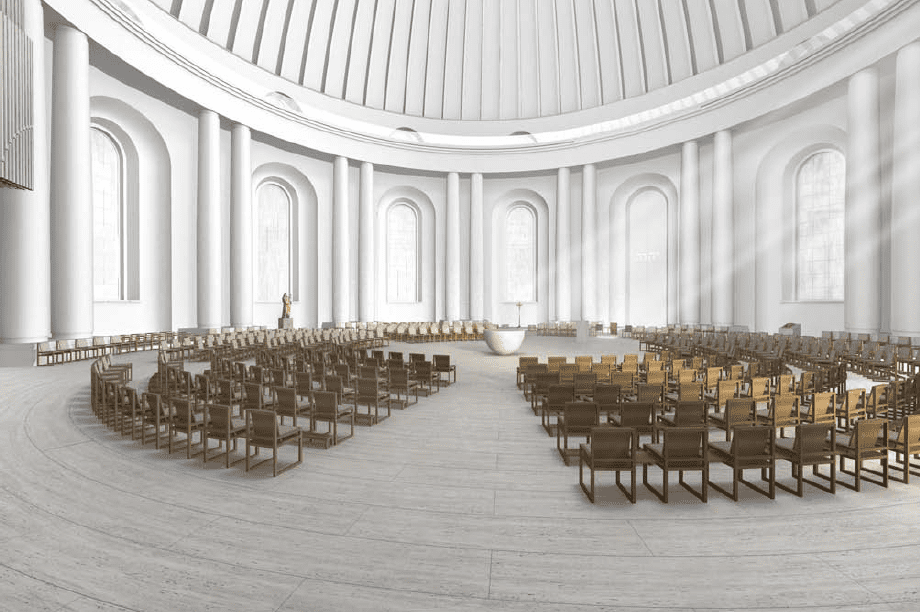
Continuing my drumbeat of dread and decline, the dead German Roman Catholic Church has a new Cathedral in Berlin — a whited sepulchre signaling fealty to something nihilistic:

Rod Dreher, writing for the European Conservative, is duly appalled:

There is scarcely anything visibly Christian about the space. Aesthetically and symbolically, it invites visitors to worship the sacred Nothing. It is a “clean, well-lighted place,” in the nihilistic sense of Ernest Hemingway’s 1933 short story of the same name. It is a hauntingly spare tale about an elderly, suicidal Spanish man who frequents a certain café, described in the story’s title, seeking refuge from nihilism. In the tale, an older waiter in the café reflects on why the clean, well-lighted café drew men like the suicidal customer:

What did he fear? It was not a fear or dread. It was a nothing that he knew too well. It was all a nothing and a man was a nothing too. It was only that and light was all it needed and a certain cleanness and order. Some lived in it and never felt it but he knew it all was nada y pues nada y nada y pues nada. Our nada who art in nada, nada be thy name thy kingdom nada thy will be nada in nada as it is in nada. Give us this nada our daily nada and nada us our nada as we nada our nadas and nada us not into nada but deliver us from nada; pues nada. Hail nothing full of nothing, nothing is with thee.

This is the perverse prayer one imagines visitors to the bleached-out St. Hedwig’s will pray, if they pray at all.

Devolution

It is not an exaggeration to claim that this nineteenth-century Protestant evangelicalism differed from the religion of the Protestant Reformation as much as sixteenth-century Reformation Protestantism differed from the Roman Catholic theology from which it emerged.

Mark A. Noll, America’s God

How many times can such devolutionary leaps happen before the result is not authentically Christian?

Spontaneity is the new requirement

Speaking of which:

I laughed out loud, paused the podcast where I heard the phrase, and wrote down Rituals of Spontaneity, which now sits in my book queue to complement America’s God and The Democratization of American Christianity. Although none of them writes as well as Kevin D. Williamson, I’m more interested in the religious aspects than in the prospect of President Dwayne Elizondo Mountain Dew Camacho in 2028.

Elastic “religion”

Taylor is not unaware that the term “religion” is fraught, but, as we have seen, he thinks the reason it defies definition is that its different manifestations are so diverse. But how do we know that these different manifestations are all “religion” to begin with? Taylor says “the phenomena we are tempted to call religious are so tremendously varied in human life.”175 But why are we “tempted” to call them all religious if they are so varied? More to the point, why do we want to call some things religious and some other, very similar things nonreligious? What makes nontheistic Buddhist rituals “religious,” by Taylor own reckoning, but rituals surrounding the proper treatment of the American flag—very precise rules for folding, displaying, venerating, and keeping it from touching the ground or being otherwise “desecrated”—are not? Taylor uses “religion” broadly when he wants to include Buddhism, but narrowly when he wants to exclude nationalism.

William T. Cavanaugh, The Uses of Idolatry

Migration of the Holy

After only a few years, America’s religious population, with Protestant evangelicals in the forefront, began in similar fashion to tailor their religious projects to fit the language of republicanism. The implications for both politics and religion from this tailoring were momentous. In the immediate context, the argument against Parliament acquired the emotive force of revival. In the longer term, religious values migrated along with religious terms into the political speech and so changed political values. But the migration also moved the other way: a religious language put to political use took on political values that altered the substance of religion.

Mark A. Noll, America’s God


Sometimes this whole 2000-year-old faith seems like a living koan. Chew on this until you are enlightened. Keep walking.

Paul Kingsnorth

You can read most of my more impromptu stuff here and here (both of them cathartic venting, especially political) and here (the only social medium I frequent, because people there are quirky, pleasant and real). All should work in your RSS aggregator, like Feedly or Reeder, should you want to make a habit of it.

Sunday, 11/24/24

Formatting things a bit differently today, without “headlines.”

  • After he had twice visited the United States in the 1930s, Dietrich Bonhoeffer wrote a perceptive essay contrasting Christian development in America with parallel developments in the parts of Europe most directly shaped by the Protestant Reformation. His assessment included an observation that was as shrewd in its comparative wisdom as it is relevant for the themes of this book: “The secularization of the church on the continent of Europe arises from the misinterpretation of the reformers’ distinction of the two realms [of church and society]; American secularization derives precisely from the imperfect distinction of the kingdoms and offices of church and state, from the enthusiastic claim of the church to universal influence in the world.” What Bonhoeffer saw has been described with other terms here: The key moves in the creation of evangelical America were also the key moves that created secular America.
  • It is a matter of great historical significance that American Protestants almost never cited biblical chapter and verse to defend their interpretive practices. Precisely as it worked on Scripture, the Reformed, literal hermeneutic revealed most clearly how it arose from the special circumstances of American life. Yet even if this hermeneutic itself was not necessarily rooted in a literal reading of Scripture, it was nonetheless the American norm for the generations between the writing of the Constitution and the end of the Civil War.

Mark Noll, America’s God. (You may need to chew on that a bit. Or read the book.)


Religions devised for a social purpose, like Roman emperor-worship or modern attempts to ‘sell Christianity as a means of saving civilisation’, do not come to much. The little knots of Friends who turn their backs on the ‘World’ are those who really transform it.

C.S. Lewis via Paul Kingsnorth, who situates Lewis’ insight in our age.


Brad East once pondered:

Why do people convert to Christianity? Why do intellectuals and other public figures convert so often to Catholicism (or Eastern Orthodoxy) and so rarely to Protestantism?

Conversions, Protestantism, and a new mainline. I suspect he’s still pondering, though I don’t think he’s addressed the topic as explicitly as in the quoted article.

I keep coming back to the article deliberately, feeling as if I haven’t exhausted it. Maybe you’d find it helpful, too.


The west, so it seems to them, tends to think of the Crucifixion in isolation, separating it too sharply from the Resurrection. As a result the vision of Christ as a suffering God is in practice replaced by the picture of Christ’s suffering humanity: the western worshipper, when he meditates upon the Cross, is encouraged all too often to feel an emotional sympathy with the Man of Sorrows, rather than to adore the victorious and triumphant king.

Timothy Ware, The Orthodox Church


No, St. Paul wasn’t a perv:

When teaching non-Jewish Christians, one of the most radical disjunctions with their former way of life was sexual morality. Sexual continence had simply not been a concern for most of them before, so it became Paul’s focus. Paul’s frequent emphasis on this area was not based on prurient interest but on the continuing education and reorientation of former pagans.

Fr. Stephen De Young, Saint Paul the Pharisee. Actually (I’m sure Fr. Stephen noted it elsewhere), fornication with temple prostitutes was the former practice of some of these non-Jewish Christians. That’s why Paul had to focus there.


“Man is what he eats.” With this statement the German materialistic philosopher Feuerbach thought he had put an end to all “idealistic” speculations about human nature. In fact, however, he was expressing, without knowing it, the most religious idea of man. For long before Feuerbach the same definition of man was given by the Bible.

Fr. Alexander Schmemann, For the Life of the World


“The clock,” [Lewis] Mumford has concluded, “is a piece of power machinery whose ‘product’ is seconds and minutes.” … [A]s Mumford points out, with the invention of the clock, Eternity ceased to serve as the measure and focus of human events.

Neil Postman, Amusing Ourselves to Death


It’s profoundly significant that of all the Christian groups, only the Orthodox include the babies at the Holy Chalice, completely recognizing and demon-strating their full incorporation into the Church, the Body of Christ. This alone, it seems to me, shows forth the truthfulness of our Church’s claim to be the One, Holy, Catholic, and Apostolic Church, alone preserving the fullness of the Christian Faith.

Frederica Mathewes-Green & Rod Dreher, Healing Humanity


  • Only a few peoples—the odd German tribe and, inevitably, the Jews—had stood aloof from the exposure of unwanted children. Pretty much everyone else had always taken it for granted. Until, that was, the emergence of a Christian people.
  • Islamic the Islamic State may have been; but it also stood in a line of descent from Anabaptist Münster. It was, perhaps, the most gruesome irony in the whole history of Protestantism.
  • When scholars in Europe sought to justify the Spanish conquest of the New World, they reached not for the Church Fathers, but for Aristotle. ‘As the Philosopher says, it is clear that some men are slaves by nature and others free by nature.’
  • The concept of secularism—for all that it was promoted by the editor who invented the word as an antidote to religion—testified not to Christianity’s decline, but to its seemingly infinite capacity for evolution.

Tom Holland, Dominion

Several narrower books linger more persistently in my mind, but Dominion has in a sense penetrated deeper than mere “mind.”


  • Even after His Resurrection, Christ instructed disciples on the road to Emmaus when “beginning with Moses and all the prophets, he interpreted to them in all the scriptures the things concerning himself” (Luke 24:27). The Christological key to unlock the Jewish Scriptures was given to the Church by Christ Himself…
  • Two centuries later, fundamental differences in phronema would again be an obstacle to union between the West and the East at the Council of Florence in 1439. Catholics presented rational arguments for their positions, and the Orthodox responded by citing apostolic Tradition. It was “the constant conviction of the Latins that they always won the disputation, and of the Greeks that no Latin argument ever touched the heart of the problem.”

Dr. Eugenia Scarvelis Constantinou, Thinking Orthodox


Sometimes this whole 2000-year-old faith seems like a living koan. Chew on this until you are enlightened. Keep walking.

Paul Kingsnorth

You can read most of my more impromptu stuff here and here (both of them cathartic venting, especially political) and here (the only social medium I frequent, because people there are quirky, pleasant and real). All should work in your RSS aggregator, like Feedly or Reeder, should you want to make a habit of it.

Sunday, 11/17/24

Permeable walls

Yesterday was the 27th anniversary of my formal entry into the Orthodox Christian Faith. Unlike my departure from frank evangelicalism for Calvinism two decades earlier, this felt like a conversion, not an incidental change of denomination.

Part of that feeling may have been that the evangelical-to-Calvinist transition was largely invisible to observers: I didn’t quit our Baptist church and go to the tiny PCA startup in town; instead I moved across the country to go back to school, so of course I had to find a new church; I graduated, moved, and began practicing law in my hometown, so again I had to find a new church.

That each of those steps was away from evangelicalism and toward Calvinism would have been apparent only to someone for whom the permeability of denominational walls in Protestantism seems odd, and I think there most Protestants who take that permeability for granted (if they even think about “denominations” in an age of tens of thousands of crypto-baptist nondenominational pastoral fiefdoms). Indeed, during this transition, I published a law journal note titled Church Property Disputes in an Age of Common-Core Protestantism, based on the premise that someone who became a Presbyterian or Methodist or Episcopalian was unlikely to be buying into denominational ownership or control of the local church’s temporalities that he (or she) now donated to maintaining.

But another part of the “conversion” sensation certainly was that I had to be catechized to enter Orthodoxy. Its walls are not permeable. I became an “ecclesial Christian” as Richard John Neuhaus described it: one for whom faith in Christ and faith in His Church is one act of faith, not two. I finally believed that the one holy, catholic and apostolic church is visible and distinct, not invisible and amorphous.

Today, I’m more interested in a question one could phrase in an article title as Church Discipline in an Age of Permeable-Wall Protestantism. Others have doubtless gone deeper into the topic of how there can be effective church discipline, how can flagrant sinners be brought to repentance, when they can just move to another church before the heat melts their hearts? Maybe he can even start and pastor his own church (or get nominated as Attorney General). In a largely Protestant nation, it’s hard for an ecclesial Christian convert not to at least dabble in other people’s business.

A bold claim

I’ve been reading Fr. Stephen De Young’s book St. Paul the Pharisee, which I hoped would focus on this bold claim:

Mostly it doesn’t, or it doesn’t do so explicitly except for that quote.

But Fr. Stephen’s “interpretive translation” of Paul’s epistles subtly undermines the tendency to view them as theological treatises rather than pastoral guidance.

Instrumentalist faith

In the last few years, there has been no shortage of political commentary—much of which I agree with—that has argued that Christianity is needed for Western civilization and its guiding principles to survive. Famously, the essay in which the writer and activist Ayaan Hirsi Ali spoke about her conversion—the authenticity of which I do not doubt —focused on the role that Christianity plays in Western civilization. But one should be clear-eyed about this matter. If the point of Christianity is the survival of the West, then Christianity may be treated as a useful fiction or a necessary evil alongside things like police forces and the military. The place of Jesus in such a Christianity is clear: he is a mascot, a long-dead victim of Roman imperialism and religious zealotry whom we invoke when we need a symbol, so that we may display him for all to see, pinned to the cross by our highest values and current political aspirations.

The outcome is not a secret. The churches that live as though Jesus is optional have been, despite their best verbal efforts, saying effectively and forcefully to their members and to the world that what the church uniquely has to offer is not needed, and that the church is here to serve those realities which already exist beyond the church’s baptismal boundaries.

I have become convinced that one of the primary challenges for Christians today is to come to terms with the overwhelming success of secularized Christianity. It is a great comfort to a Christian to say to himself or herself that secularized faith doesn’t actually work: it is how we tell ourselves that secularism will collapse under its own weight and that we’ll be here waiting when it happens, ready to welcome the world back into our arms. But of course, this is a fantasy about our own relevance. We are the secular culture’s ex-girlfriend, and telling ourselves that the new girlfriend isn’t pretty and that the culture will eventually see that it needs us is a pathetic expression of our need, not the world’s.

Matthew Burdette, Is the Church Obsolete? (H/T Brad East)

I honestly don’t think I’ve heard any Orthodox Christian talking about the importance of the Orthodox Church in secular instrumental terms. But to be honest, I sometimes think of the Catholic and Protestant churches as important to the survival of western civilization — and for some of its peculiarities.

Enculturation

Sometimes I have the unsettling sense that everyone possesses a spiritual secret but me. Other students speak of God as an intimate friend. They seem perfectly content studying the Bible all day, and unquestioningly accept whatever the professors say. More often, I conclude there is no secret, just a learned pattern of conformity, of mimicking others’ behavior and parroting the right words.

Philip Yancey, Where the Light Fell

Of this “learned pattern of conformity, of mimicking others’ behavior and parroting the right words,” I recently heard the sympathetic observation that people can believe absurd things, even contradictory things, because of where they are enculturated.

For anyone who thinks he (or she) has found the truth, and who can’t understand why others cannot see it, this is helpful to remember — in both directions. I don’t mean there’s no truth, only enculturation, but something about empathy and humility.

The American Hermeneutic

The problem with race and the Bible was far more profound than the interpretation of any one text. It was a problem brought about by the intuitive character of the reigning American hermeneutic. This hermeneutic merged three positions: (1) The Bible was a plain book whose meanings could be reliably ascertained through the exercise of an ordinary person’s intelligence; (2) a main reason for trusting the Bible as true was an intuitive sense, sealed by the Holy Spirit; (3) the same intelligence that through ordinary means and intuitions could trust the Bible as true also gained much additional truth about the world through intuitive processes that were also deliverances of universal common sense. The first position was a traditional Protestant teaching intensified by the American environment; the second was historically Protestant and Reformed; the third was simply a function of the American hermeneutic.

Mark A. Noll, America’s God

Of Nietzsche

Ironically, the fallen antichrist spent his long years of decline in the same female company that he claimed to have detested as a boy. He ended his life as the charge of his sister, but for many years after his collapse he was cared for by his mother. We know almost nothing about this quiet, pious woman, the widow of a Lutheran minister. But her act of taking the invalid into her home and enduring his catatonic silence, marked by occasional screaming fits, could only have been motivated by maternal love and Christian pity, two of the most debilitating values in what the philosopher had called the “slave morality.”

John Strickland, The Age of Nihilism

The flight into nondenominationalism

I’ve noticed Churches changing names to drop denominational identifiers. The Church I grew up in is considering dropping “Evangelical” from its name, not because it identifies the denomination but because of the debasement of the term into a political category.

Mites and motes

People who want to bring heaven upon earth have turned the earth into hell and made rivers run red with blood, because the first thing they must do is the one thing they cannot do, which is to cure themselves.

Anthony M. Esolen, Out of the Ashes

Complicit

The spectacle of [John] Lennon imagining a world without possessions while sitting in a huge mansion did nothing to put off his admirers. As Nietzsche spun furiously in his grave, ‘Imagine’ became the anthem of atheism.

Tom Holland, Dominion

Command performance

The logic of those prayers, if one was reading between the lines, was something like this:

“Dear Heavenly Father, in Your Word You say that when two or three are gathered together, You will be in the midst of them. Well, we’re gathered here, so do what we’re telling You to do because we have You over a barrel and can quote Your own book back at you! And in case You’re thinking of weaseling out of this deal, we claim Your promises, and because You can’t break any of those since You wrote it all in the Bible, You’ll do what we say, and You’ll do it NOW! Amen!”

Frank Schaeffer, Crazy for God

Any questions?

The early Church had no Scripture of its own, and the Jews had no defined canon of Scripture; therefore, sola scriptura as the foundation for what Christians believed was absolutely impossible.

Dr. Eugenia Scarvelis Constantinou, Thinking Orthodox


Religious ideas have the fate of melodies, which, once set afloat in the world, are taken up by all sorts of instruments, some woefully coarse, feeble, or out of tune, until people are in danger of crying out that the melody itself is detestable.

George Elliot, Janet’s Repentance, via Alan Jacobs

You can read most of my more impromptu stuff here and here (both of them cathartic venting, especially political) and here (the only social medium I frequent, because people there are quirky, pleasant and real). All should work in your RSS aggregator, like Feedly or Reeder, should you want to make a habit of it.

Sunday, November 10

On an American Orthodox Church

The beginning is context, analogy; just wait for the provocative “aside.”

Fr. Stephen: … [R]eligions that are separate things … didn’t exist in the ancient world. What it meant to be a Greek was not just to have grown up in Hellas or to have your people be from there for many generations; what it meant to be a Greek was also to worship the Greek gods and to participate in the ritual life of Greece that surrounded the gods, the public festivals, all of those things. That’s what it meant to be Greek.

So what does it mean to be a Greek Christian? Now we take that for granted, but for St. Paul that wasn’t something you could take for granted. And so you can understand why, in the early Church, you get the opponents of St. Paul in Galatians who were saying, “Well, okay, you can’t be pagans any more. So why don’t, uh, you be Jews? You can’t be a Greek any more. You have to have some culture. You have to be something. So you need to get circumcised, you need to keep Torah, you need to do all these things. You need to be Jewish. You can’t be Greeks any more, because being Greek is being a pagan.” And St. Paul is saying, “No! You’re not to become Jews, because you’re not Jews. You’re going to remain Greeks, but what it means to be Greek is going to change.” So a Greek Christian identity is forged, and that takes a couple centuries. St. Paul starts it, but you read all the problems he’s having, for example, in 1 and 2 Corinthians that we already referred to. This is a difficult process.

Fr. Andrew: And even while the concept and the way of life gets worked out, the terminology largely isn’t kept even, early on. By the time you get to the Cappadocians and so forth, “Greek” in terms of something other than language, “Greek” is used to refer to pagans. If you’re Christian, you’re a “Roman.”

Fr. Stephen: Right. Greeks are the ones still following that way of life.

Fr. Andrew: Right. I mean, the word “Greek” in various ways gets revived again in the 18th, 19th century for other reasons, but, yeah, that identification of “Greek” with “pagan” holds on for a long time, even while they’re kind of developing a Greek Christian life, just calling it something different

Fr. Stephen: Yeah. And so St. Paul is going to affirm… So he’s got those folks on the one side who want people to become Jewish; on the other side, he’s got the Jewish zealot tradition that wants to overthrow societal structures within Roman life. And St. Paul is going to want to keep those social structures. That’s the part of the Gentile identity that he can keep, sort of, you know: families! Marriage in general! We don’t need to get rid of marriage in general. All of these relationships, all of these structures we can keep, but they need to be re-infused. Paganism needs to be drawn out; they need to be re-infused with Christ. So that’s part of this transformation.

And as a kind of aside, when folks… One of many things I’m a pessimist about is there being an American Orthodox Church any time soon. The big reason is that we still have to do precisely this. Not figure out what it means to be American and Christian, because there’s an American Christianity, and the more American it gets, the less it looks like Christianity, frankly. But figuring out what it means to be American and Orthodox Christian: we can’t just take for granted that that’s just an easy sub.

In fact, the fact that America is deeply steeped in another form of Christianity—a sort of Puritan, Calvinist, Protestant Christianity—sometimes makes it harder for us to make the distinctions that we need to make in order to form an American Orthodox identity. If America was a Muslim country or a Hindu country, when we looked at cultural institutions, it would be a little easier for us to spot, in the Hinduism case, the paganism, in the Muslim case, the Islamic parts, but when it’s another form of Christianity, the distinctions get more subtle and more tricky, and that identity can be a little harder to form.

(Underlining added)

When an American Orthodox Christian steps to either side of the safe corridor cleared by the Church, she’s likely to hit a Puritan land mine or a Calvinist IED. When an American Orthodox Christian feels we’re missing out on something good in the larger society, what he wants us to import may well be a Puritan version of a Trojan Horse.

About that American brand of Christianity

William Craig Brownlee “contrasted the genuine religion that flourished in America with ‘the mixed Christianity that began its career at an early period in the history of the church’”.

Paul J. Gutacker, The Old Faith in a New Nation: American Protestants and the Christian Past.

To these Orthodox Christian eyes, that reads as perversely the opposite of reality. The religion that flourished in America, and of which we are still heirs, is the later, entropic version.

The starting point of Christian faith

To be Christian, to believe in Christ, means and has always meant this: to know in a transrational and yet absolutely certain way called faith, that Christ is the Life of all life, that He is Life itself and, therefore, my life. “In him was life; and the life was the light of men.” All Christian doctrines—those of the incarnation, redemption, atonement—are explanations, consequences, but not the “cause” of that faith. Only when we believe in Christ do all these affirmations become “valid” and “consistent.” But faith itself is the acceptance not of this or that “proposition” about Christ, but of Christ Himself as the Life and the light of life. “For the life was manifested and we have seen it, and bear witness, and show unto you that eternal life, which was with the Father, and was manifested unto us” (1 Jn. 1:2). In this sense Christian faith is radically different from “religious belief.” Its starting point is not “belief” but love.

Alexander Schmemann, For the Life of the World

When will they ever learn?

Only slightly tempered by a sense of their own limitations, these reformers espoused private judgment as the sure route to coherence and harmony. Unfortunately, the more confidently they attacked the traditional order and espoused individual autonomy, the more confusing their limitless world became. In one of the early republic’s severest ironies, the determination to quiet theological wrangling resulted in a proliferation of voices.

Nathan O. Hatch, The Democratization of American Christianity

Iconoclasm

God was understood to have physical form, but that form was to be described only verbally, not represented iconographically.

William T. Cavanaugh, The Uses of Idolatry

Purging

I am greatly looking forward to reading St. Paul the Pharisee by Fr. Stephen De Young. An ex-Calvinist Orthodox Priest with deep knowledge should be perfect for purging my involuntarily-retained Calvinist readings of St. Paul.

Mute

It is very difficult to make our contemporaries see that there are things which by their very nature cannot be discussed.

René Guénon Guénon, The Crisis of the Modern World


Religious ideas have the fate of melodies, which, once set afloat in the world, are taken up by all sorts of instruments, some woefully coarse, feeble, or out of tune, until people are in danger of crying out that the melody itself is detestable.

George Elliot, Janet’s Repentance, via Alan Jacobs

You can read most of my more impromptu stuff here and here (both of them cathartic venting, especially political) and here (the only social medium I frequent, because people there are quirky, pleasant and real). All should work in your RSS aggregator, like Feedly or Reeder, should you want to make a habit of it.

Sunday, October 27

Booknotes

From Mark A. Noll, America’s God from Jonathan Edwards to Abraham Lincoln.

The startling reversal in which America’s religious leaders took up the language of republicanism was the most important ideological development for the future of theology in the United States.

Mark A. Noll, America’s God from Jonathan Edwards to Abraham Lincoln.

[I wish I had a better handle on this very central thesis of Noll’s dense book. All I really can say is that American Christians were essentially alone in embracing republicanism; European Christians rejected it fairly vehemently.]

Although identifiably evangelical churches by 1860 made up the vast majority of American congregations (at least 85%), these churches did not present a homogeneous faith. In fact, evangelicals fought each other over a host of Streitpunkte—over how to interpret the Scriptures; over the definition of many Christian doctrines, including human free will, the atonement, eschatology, the meaning of the sacraments, and the nature of the church; over slavery and other social issues; over the ecclesiastical roles of women and laymen; over whether to sing hymns or psalms only; over whether churches should use creeds; over principles and practices of the market economy; and over every imaginable kind of personality conflict. … Evangelicals called people to acknowledge their sin before God, to look upon Jesus Christ (crucified—dead—resurrected) as God’s means of redemption, and to exercise faith in this Redeemer as the way of reconciliation with God and orientation for life in the world.

The most important conclusion that can be drawn from a survey of writings about money, markets, and the economy in this period is that Protestants regularly, consistently, and without sense of contradiction both enunciated traditional Christian exhortations about careful financial stewardship and simply took for granted the workings of the United States’ expanding commercial society.

Finney’s Lectures on Revivals of Religion (1835), which is discussed at greater length below in chapter 15, was important for summarizing a new approach toward reaching the lost. Since God had established reliable laws in the natural world and since humans were created with the ability to discern those laws, it was obvious that the spiritual world worked on the same basis. Thus, to activate the proper causes for revivals was to produce the proper effects: “The connection between the right use of means for a revival and a revival is as philosophically [i.e., scientifically] sure as between the right use of means to raise grain and a crop of wheat. I believe, in fact, it is more certain, and there are fewer instances of failure.” Because the world spiritual was analogous to the world natural, observable cause and effect must work in religion as well as in physics. The wine of revival—confidence in God’s supernatural ability to convert the sinner—may have looked the same in antebellum America as it had in earlier centuries, but the wineskin was of recent manufacture.

[Finney’s “scientific” revivalism strikes me as a terrible error, but a persistent one. However, this mechanistic approach has been instantiated in evangelistic crusades during my adolescence, and I assume since then as well. The rising and falling of the preaching voice; the shouting followed by the whisper; these are the rhetorical tricks (science) to get people to “make decisions for Jesus” – or Amway or Tupperware or just about anything else.]

On that score there was for Smith not a dime’s worth of difference between Samuel Miller and John Henry Hobart. Through a life of energetic peripateticism (from Lyme, Connecticut, to Vermont and then Portsmouth, New Hampshire, later to Boston, Philadelphia, Providence, and Portland, Maine), as well as frequent redirection of career (as minister—successively Baptist, “Christian,” Universalist, and “Christian” again—physician, dentist, publisher, and merchant), and in the midst of incessant polemical creativity, one thing remained constant for Elias Smith. His anchor was unshakable belief in a radically egalitarian biblicism. If the religion of formalist Presbyterians and Episcopalians was tinctured with American values, Smith’s religion represented a more complete assimilation. That religion was, in the words of a solid recent biography, “a specifically Christian republicanism growing out of a New Light evangelical heritage, conjoined with a rapidly evolving national political culture in a climate of strident partisan conflict.”46 Smith was especially important as a founder of New England’s “Christian” movement, a radically antielitist drive that sought a harmonious, unified church for all who wished to live according to the New Testament’s “perfect law of liberty.” To build such a church, however, it was necessary to clear away traditional biblical interpretations, traditional denominations, and traditional clerical authority.

“The Bible is to the theologian what nature is to the man of science. It is his store-house of facts; and his method of ascertaining what the Bible teaches, is the same as that which the natural philosopher adopts to ascertain what nature teaches…. The duty of the Christian theologian is to ascertain, collect, and combine all the facts which God has revealed concerning himself and our relation to Him. These facts are all in the Bible.” On the basis of these assertions, Hodge then went on to suggest that “the Theologian [is] to be guided by the same rules as the Man of Science.”

[I once admired Hodge, and would have been pleased, if not thrilled, by this declaration.]

[No longer. But this sort of approach was part of how “America’s God” became so unlike the true God.]

Selective resistance to secularity

In his book Fault Lines, Voddie Baucham argues that

The social sciences may be useful tools, but they are far from necessary. ‘All Scripture is breathed out by God and profitable for teaching, for reproof, for correction, and for training in righteousness, that the man of God may be complete, equipped for every good work’ (2 Timothy 3:16–17). In no area does God require me to walk in a level of righteousness for which the Scriptures do not equip me — including any and all aspects of justice.

The logic of Baucham’s argument, which permeates his book, is that the Bible is enough. It is enough to parse the complexity of race in the United States, and enough to provide a roadmap for justice. Let’s be clear: Baucham agrees that the gospel has social implications. He is also clear that the social sciences are simply unnecessary to illuminate what those social implications are, and how the gospel compels us to act.

This is, in fact, explicitly outlined in the Dallas Statement:

We deny that Christian belief, character, or conduct can be dictated by any other authority, and we deny that the postmodern ideologies derived from intersectionality, radical feminism, and critical race theory are consistent with biblical teaching. We further deny that competency to teach on any biblical issue comes from any qualification for spiritual people other than clear understanding and simple communication of what is revealed in Scripture.

According to Baucham and the signers of the Dallas Statement, the claim that secular scholarship is necessary to understand and address the contemporary racial landscape are violating the doctrine of sufficiency, and compromising their fidelity to Scripture. Despite passing affirmations that Christians ought to read broadly, insofar as it pertains to matters of race and justice, Baucham, et al., clearly view secular scholarship as suspect, and inessential to comprehending and shaping responses to the social problems we face.

Of course, in their view, not all secular sources are suspect. Many of the signers of the Dallas Statement happily employ the work of James Lindsay or Thomas Sowell in their analysis of our social realities. The real concern lies in a particular set of sources: “postmodern ideologies derived from intersectionality, radical feminism, and critical race theory.” It is these sources which consume massive amounts of energy expended by Owen Strachan, Voddie Baucham, Tom Ascol, and many others. Summarized by many under the slushy appellation “wokeness,” these writers are convinced that reliance on anything that smacks of woke is deleterious to the faith given once for all to the saints.

Josh Fenska, Thin Discipleship


Religious ideas have the fate of melodies, which, once set afloat in the world, are taken up by all sorts of instruments, some woefully coarse, feeble, or out of tune, until people are in danger of crying out that the melody itself is detestable.

George Elliot, Janet’s Repentance, via Alan Jacobs

You can read most of my more impromptu stuff here and here (both of them cathartic venting, especially political) and here (the only social medium I frequent, because people there are quirky, pleasant and real). All should work in your RSS aggregator, like Feedly or Reeder, should you want to make a habit of it.