Birth of John the Baptist

So far as I know, we have little or no evidence for when John the Forerunner/Baptist was born, but both Orthodox and Roman Catholics commemorate it on June 24. It’s a big enough deal that my parish had a liturgy for it.

The rest of this post has nothing to do with that.

At Stake in Harvard Grants

Harvard is unique both in the volume of its research output and the extent of these cuts — the government has threatened to end every research dollar to the university. The canceled grants accounted for here add up to about $2.6 billion in awarded federal funds, nearly half of which has already been spent according to government data.

“Even ‘grant’ is a problematic word, because people think they’re just sort of handing this money out for us to do what we want with,” said Marc Weisskopf, who directs a center for environmental health at Harvard that lost its funding from the National Institute of Environmental Health Sciences.

On the contrary, the government is much more explicit in competitive research applications and grant reviews: It wants more neuroscientists. It wants better opioid treatment. It wants to know how lightweight origami-inspired shelters and antennas can be unfurled in war zones.

The money the government sends to Harvard is, in effect, not a subsidy to advance the university’s mission. It’s a payment for the role Harvard plays in advancing the research mission of the United States.

This is the science model the U.S. has developed over 80 years: The government sets the agenda and funds the work; university scientists design the studies and find the answers. The president’s willingness to upend that model has revealed its fragility. There is no alternative in the U.S. to produce the kind of scientific advancements represented by these grants.

Emily Badger, Aatish Bhatia and Ethan Singer, Here Is All the Science at Risk in Trump’s Clash With Harvard

GOP 2012 redux

Many have made the point, but it’s nonetheless true: Presidents can now do pretty anything they want in foreign policy without seeking congressional authorization, provided it involves dropping bombs on other countries.

Five months into the second Trump administration, isn’t it astonishing that we have a Republican president: pushing for passage of a budget bill that cuts Medicaid and Medicare; pursuing an immigration policy focused on workplace enforcement, deportation of non-criminals, and the encouragement of “self-deportation”; and a happy John Bolton cheering the bombing of Iran? After a decade of debates about What Trump Means for the Right, we’ve ended up governed by the GOP circa 2012, as if the Trump administration were just the asshole version of the Romney/Ryan administration we were spared by Obama’s successful bid for re-election that year.

Damon Linker

Received financial wisdom

The longer I live, the more I appreciate that we can’t know everything, and that we live our lives mostly on the basis of trust. What we trust depends largely on our milieu (the polite term for “tribe” for present purposes), despite trying to avoid echo chambers.

Several of my social media cyberfriends (see footer) are living quite counterculturally, and one of them introduced me to the Dense Discovery newsletter. I probably give it awfully short shrift most weeks, but today caught my attention and led to something pretty thought-provoking, starting with a graph:
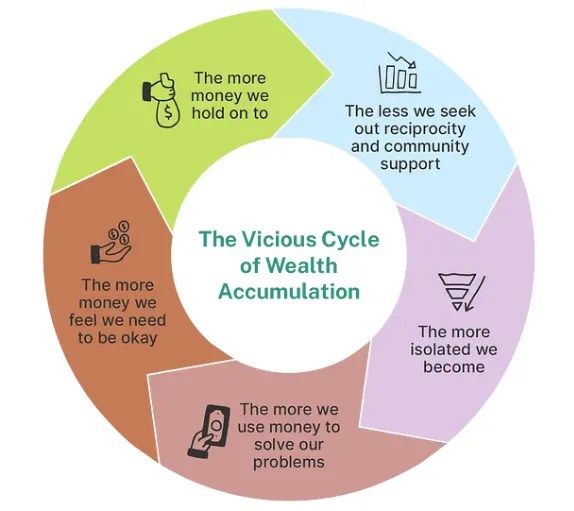
Okay, but let’s talk about the prescribed wealth hoarding model in the United States, otherwise known as prudent financial planning (supposedly). The conventional advice from financial planners is that people of my age are supposed to accumulate something like $1 million in order to retire. Or maybe $1.5 million.1 In case you’re not hip to the logic here – I wasn’t until I married a very specific kind of nerd – we’re supposed to amass so much wealth that we can live off the interest and dividends until we die. It’s not enough to save what we’ll need to make it to the end of our life; we need (ostensibly) way more than that. We need to accumulate so much wealth that we can live off the wealth that our wealth earns. We need – we are told – enough that we never have to touch the principal, and we can pass our wealth along to our next of kin, whoever they may be.2

Interdependence is My New Retirement Plan – by Lisa Sibbett

My father, a professional, seemed to live fairly consistently with the values Lisa Sibbett suggests. My widowed mother had enough and to spare, but their church saw a lot of money over the years, too, and his kids occasionally got gifts at the end of a bountiful year.

My father-in-law, a tradesman, lived the “conventional advice from financial planners,” and we are now benefitting from his success at that model.

I’ve lived somewhere in between those two models. Though I (credulously?) aspired to the “conventional advice” model, I just couldn’t resist living life along the way, and not waiting until I was properly fixed for life. Unlike my parents’ generation, I did not live through any Great Depression and didn’t feel that possibility in my bones. I don’t regret it.

One caveat with Sibbett’s approach is that it requires long-enduring personal bonds. You’ll need to sink roots somewhere, and that somewhere will need to be where others are sinking roots as well. It requires long-enduring personal bonds. It’s not for individualist nomads.

The unmentionable elephant in the room

I confess that I struggled with the reasoning of the Supreme Court in Skrmetti although I reluctantly welcomed the outcome.

I was not alone. Josh Blackman and Hadley Arkes (not a lawyer, but an Amherst professor of Jurisprudence) were in the same position as me, but Arkes in particular pointed to the root problem:

The truth that dares not speak its name here is that this wide array of gender-affirming therapies and surgeries is simply predicated on a falsehood. And yet those are the words that the conservative justices apparently see themselves as barred from speaking. Something in conservative jurisprudence holds them back from appealing to the inescapable and objective truth that lies at the heart of these cases. But without it, what were these accomplished jurists able to explain here? What was their ground of justification in overriding the judgments of those parents who were absorbed in the grief and confusion that seized their children? . . . .

The only “instruction” that would be relevant, Justice Thomas, is the unyielding fact that the child is in a state of confusion: he is not occupying some body apart from his own; his sex was not “assigned” at birth but marked inescapably in the organs of reproduction, in the arrangement of his body. His sex is immutable and printed plainly upon him.

Those were the words that Chief Justice Roberts and five colleagues could not move themselves to speak. Or they thought they were constrained from speaking by a jurisprudence that bars them from invoking truths beyond the text of the Constitution—even on the question of what is a human being, the bearer of rights, and when does that “human person” begin? . . .

Without those points in place, the judgment of the Court simply dissolves into a chain of ipse dixits. Why was it not legitimate for the parents of stricken youngsters to order the procedures that might relieve their “gender dysphoria?” Answer: The legislature of Tennessee did not think it a legitimate medical remedy to choose—even though the children and the parents did not share that judgment and were willing to take their risks. One judgment had to prevail, and it was the judgment backed by the power of the State. To put a high finish on it, that “power” represented the authority of a people to govern itself through elected representatives. But when the people speak through their representatives, and override the judgments of parents about their children, they are still obliged to say something more than “we have brute the power to impose this judgment through brute enactment of the law.”

Arkes singles out Justice Thomas, I suspect, because he said “so-called experts have no license to countermand the ‘wisdom, fairness, or logic of legislative choices.’” (Justice Thomas, concurring in U.S. v. Skrmetti, via Eugene Volokh.) Arkes’ re-formulation, I guess, is that the legislature can tell the experts “your elaborations are predicated on the falsehood that a person can be inhabiting a body of the wrong sex.”

That’s not the end of the story, but it’s a starting point for re-writing a story written up to now by activists hiding something only a few clicks less deranged than the whack-a-doodle Chase Strangio ideology:

Strangio disputed that a trans woman could be “born with a male body” or “born male”; in his view, a trans woman was born a woman just like any other woman. There was no such thing as a “male body,” Strangio told his colleagues: “A penis is not a male body part. It’s just an unusual body part for a woman.” Before the advertisement aired, Strangio elaborated on his critique in an article in Slate. “Many advocates defend the use of the ‘born male’ or ‘born with a male body’ narrative as being easier for nontransgender people to understand,” Strangio wrote. “Of course it is easier to understand, since it reinforces deeply entrenched views about what makes a man and what makes a woman. But it is precisely these views that we must change.”

My own position hasn’t changed in 39 months. I think we’re still seeing a cultural contagion of trans claims in adolescents and must be very cautious – which is a bit easier now that even Strangio has given up on the “live son or dead daughter” emotional blackmail.

Patience, Mercy, Tolerance

For defenders of political liberalism there is perhaps no more pressing problem than this: How do you make a compelling case for liberalism in an era of ascendant [illiberalism or] strong gods? The idea of “strong gods” comes from the book Return of the Strong Gods by R. R. Reno, editor of the conservative ecumenical journal First Things.

By “strong gods” Reno means the kind of visceral or agonistic forces that can compel political or social action through deeper existential or even guttural appeals. The strong gods work not by chiefly targeting the intellect, but the appetites.

Michael Reneau, Evan Spear, and Jake Meador, A Virtue-Centric Argument for Political Liberalism (shared link). This article was welcome in light of the ascendance of various illiberalisms.

With a little help from AI, I got this summary table:

VirtueRole Against Postliberalism & Strong GodsRoot/Source
PatienceProvides long-term perspective, allowing growth and changeChristian theology & history
MercyBreaks cycles of retribution, fosters trust and forgivenessScripture, Shakespeare
ToleranceIntellectual humility; suspends harsh judgment; enables coexistenceLiberal philosophy & Scripture (e.g., parable of wheat and tares)

Wordplay

I know every one of these carries political freight, but that’s the burden of many writers these days:

  • Glenn Thrush, Alan Feuer and Adam Goldman remarked on the right-wing ire confronting Patel and Pam Bondi, the attorney general, as they fail to substantiate the accusations that they hurled in their bid for power: “They are running what amounts to a conspiracy theory fulfillment center with unstocked shelves.” (Jeff Lebsack, Buffalo, and Marianne Painter, Tacoma, Wash., among others)
  • In The Financial Times, Edward Luce worried that certain scenes from the Los Angeles protests played into the president’s hands: “Every rock hurled lands like a penny in Trump’s wishing well.” (Todd Lowe, Simpsonville, Ky., and Al Gallo, Huntersville, N.C., among others)
  • In The Washington Post, Philip Bump expressed skepticism about the government’s claim that immigration officers must wear masks for self-protection: “We should not and cannot take ICE’s representations about the need for its officers to obscure their identities at face value.” (Patrick Bell, Carmichael, Calif.)
  • Also in The Post, Dana Milbank took in Trump’s pleasure at some sycophantic Republicans’ suggestion that the D.C. Metro be renamed the “Trump Train”: “It’s a great idea. Qatar will donate the subway cars, which will be powered by coal. Passengers will pay for fares with cryptocurrency after first showing proof of citizenship. And the trains will reverse themselves regularly and without warning — never quite reaching their original destination.” (Mary Ellen Maher-Harkins, Orwigsburg, Pa., and Stan Shatenstein, Montreal)

Via Frank Bruni

Ceci n’est pas un phone

Methaphone. Like Methadone. Get it?

In case you’ve been wondering …

No, you’re not imagining it. The main source of political violence in the USA in this century has been right-wing, not left. Jamelle Bouie, Right-Wing Violence Is Not a Fringe Issue:

It is simply a fact that the far right has been responsible for most of the political violence committed in the United States since the start of the 21st century.

I had been wondering, because there has been some leftwing violence against persons, and much against property.

Poor fit

If it seems that America’s colleges and universities are poorly suited to the average American eighteen-year-old, perhaps that’s because they were never designed to serve him.

Oren Cass, The Once and Future Worker


Your enemies are not demonic, and they are not all-powerful and the right hasn’t always lost and the left hasn’t always won. But if you convince yourself of that, you give yourselves all sorts of permission to do a lot of stupid and terrible things under the rubric of “Do you know what time it is?”

Jonah Goldberg.

Trumpism can be seen as a giant attempt to amputate the highest aspirations of the human spirit and to reduce us to our most primitive, atavistic tendencies.

David Brooks

I don’t do any of the major social media, but I have two sub-domains of the domain you’re currently reading: (a) You can read most of my reflexive stuff, especially political here. (b) I also post some things on my favorite social medium.

Fanatics and others

Fanaticism

The Minnesota Assassin

The Minnesota political assassin (who I won’t name) had some red flags in initial biographical information. From my perspective (Eastern Orthodox, formerly Evangelical and Calvinist, always active in my faith and never “charismatic”), the biggest one was his invocation of new apostles and prophets as what America needs spiritually — an indication of New Apostolic Reformation beliefs or something adjacent.

(Surprisingly few NAR advocates will own up to it; either it’s so loosely structured that adherence is ambiguous – which I suspect is the case – or they’re told to lie, or something.)

Now Stephanie McCrummen at the Atlantic has dug a little deeper and confirmed my suspicions.

Now comes the hard part: Assuming his guilt (which I’m allowed to do because I’m not a criminal court), dare we blame his assassinations, and the apparent intention to assassinate as many as 70 others, on his NAR ideas, or do we hold open the possibility of insanity or some other explanation?

Blaming NAR is tempting for me because I so detest it. But I have seen no information that NAR actually encourages physical violence, and not just vehement rhetoric. (Their “violent prayer” talk seems, preliminarily, to be a red herring.) The theory of stochastic terrorism has always struck me as plausible, but it’s hard to imagine any forcefully-expressed opinion that has zero chance of pushing some random person over some edge.

So I’m glad Stephanie McCrummen withheld judgment about causation. It’s still the extremely early days in the criminal proceedings, and more, if not all, will be revealed eventually.

Christianity is not an instrument of political power

David French comes closer than McCrummen to linking the assassination effect to the N.A.R. cause, and also had this observation:

Last election cycle I helped create a new Christian curriculum for political engagement …

As I talked about the curriculum in gatherings across the country, I was struck by the extent to which I was asked the same question time and again. “Sure,” people would say, “we need to be kind, but what if that doesn’t work?”

The implication was clear — victory was the imperative, and while kindness was desirable, it was the contingent value, to be discarded when it failed to deliver the desired political results.

David French

A “Christian” who thinks political victory is more important than living as Christ taught (let’s say, in the Beatitudes for instance) is a sorely confused Christian.

I’ve probably said it before, but I’ll say it again. One of the countless blessings I’ve received in Orthodox Christianity is the company of martyrs, many of whom died because they knew that gaining the world wasn’t worth losing one’s soul. If you’re in a “Christian” tradition where leaders or laity act as if that’s a good trade (none of them are wicked enough to actually teach it), get out before it’s too late.

Who are the fanatics?

We know now that the FBI’s infamous Richmond Memo, targeting traditional Catholics as potential terrorists and comparing them with Islamists, was not merely the product of a few rogues in a single field office, as the agency had claimed.  Multiple offices were involved in drafting it, and it was distributed to over a thousand employees.

This post is not going to be a rant against the Biden administration.  What interests me is what was going on in the analysts’ heads.  I credit them with sincerity.  But why did they think traditional Catholicism is comparable to the ideology of radical Islam?

The most generous interpretation which can be placed on the memo is that the analysts thought of fanaticism simply as strong belief, and assumed that any strong belief is potentially violent.

But a sensible definition of fanaticism would emphasize the content of belief, not its strength.  You aren’t a fanatic for believing very strongly that you should “Love your enemies and pray for those who persecute you, that you may be children of your Father in heaven.”  The more strongly you believe that, the less likely you are to be a terrorist.

On the other hand, you really are a fanatic for believing that you should “kill them wherever you find them,” meaning Jews and infidels.  The more strongly you believe that, the more likely you are to be a terrorist.

The content of belief did come into the analysts’ definition in one way.  They plainly believed strongly in their own ideology, yet it seems never to have occurred to them to view themselves as fanatics.  It seems, then, that in their view, the term “fanatic” must have meant not just “anyone who believes strongly,” but rather something like “Anyone who believes strongly enough in God, rather than in progressive dogma, for his belief to influence the rest of his life” – and the full force of the federal government must be used to surveil and suppress all such people.

So by their definition, yes, traditional Catholics are fanatics.  But by a more sensible definition, which ideology is a better candidate for being called by that label?

J Budziszewski

Evangelical Religion

I return to the subject of Evangelicalism so often, I think, because there is some stubborn something within me that believes, against so much journalistic “evidence” (thousands of profiles of self-identified Evangelicals doing bizarre things), that a significant number of Evangelicals are acting and believing in perfect good faith, and that I simply need to find the magic words to help them see what I can’t un-see.

There is some tenderness mixed with my frustration at 28 years of almost complete failure in that regard. And there is some perversity in my rejection of the wisdom of Orthodoxy, which really does not encourage trying to argue people into the Orthodox faith. “Acquire the Holy Spirit and thousands around you will be saved,” said Saint Seraphim of Sarov, but something there is about an American ex-Evangelical that still loves a short-cut.

Over the years, I have cast a lot of shade on the concept of “religion.” I’m starting to think I should have self-critically cast similar shade under the concept of “Evangelicalism.”

Here’s what I think I’ve been doing that’s sorely mistaken:

  1. The “good faith” Evangelicals I’m trying to persuade are basically wealthy white church-going Evangelicals in, or in orbit around, Wheaton, Illinois (and maybe Grand Rapids, Michigan). The former are the kind of people I hung out with for roughly 6 years of my life (five years in school plus one year in my young adulthood), the latter for 15 years. They are the kind of people I see at my Wheaton Academy homecomings every five years. I like them; no, I love them. We don’t talk politics when we get together. I fancy they’re not Trump fans, but I really don’t know and I fear I’d be disappointed if I found out.
  2. The evangelicals I’m yelling about are random self-identified Evangelicals or flakes identified as Evangelical by journalists in mainstream media, who may or may not attend church and who may have adopted the Evangelical label simply because they’re Trump supporters. I have little experience of them. The “good faith” Evangelicals may be as baffled by them as I am.

My impression, which I’ve had but suppressed for rather a long time, is that “Evangelicalism” isn’t coherent, though we seem not to be able to live without it. So when I shout at Evangelicals, it’s like shaking my fist and cursing at the clouds.

It has always been notoriously difficult to define what an Evangelical is. Probably the most widely-accepted attempt is the Bebbington Quadrilateral. But my favorite is from Ken Myers of Mars Hill Audio Journal. I’m not going to take the time to dig it up verbatim, but the gist was that Evangelicals recognize one another not by right doctrine, orthodoxy, but by “right feeling,” orthopathos. They sing the same songs, and pray similar extemporaneous prayers, supported Billy Graham Crusades, and so forth.

I don’t know whether that is even true today of the motley crew that journalists identify as Evangelical.

“Briefly stated, the Gell-Mann Amnesia effect is as follows: You open the newspaper to an article on some subject you know well … Often, the article is so wrong it actually presents the story backward—reversing cause and effect. I call these the ‘wet streets cause rain’ stories. Paper’s full of them.

In any case, you read with exasperation or amusement the multiple errors in a story—and then turn the page to national or international affairs, and read as if the rest of the newspaper was somehow more accurate about Palestine than the baloney you just read. You turn the page, and forget what you know.”

Michael Crichton (via ChatGPT because I couldn’t remember “Gell-Mann Amnesia effect”).

The press tends to garble Eastern Orthodoxy, so why should I believe them about Evangelicalism?

Many of them probably labeled the Minnesota assassin “evangelical.” Was he? Is the evidence that he wasn’t a No True Scotsman fallacy?

I know Orthodoxy; I just really don’t know Evangelicalism or its outer boundaries any more, if ever I did.

So you have my permission to go back to everything I’ve written about Evangelicals and Evangelicalism and say “he doesn’t know what he’s talking about,” because much of the time I’ve been Gell-Mann-ing it.

I’ll try to do better, but old habits die hard.

Sanity (a/k/a The Gospel for people battered by bad religion)

Having dwelt long on some pretty sorry stuff, a very long but infinitely more positive note:

I know that what I’m about to talk about is something I’ve talked about probably even fairly recently on the show, but I find myself in real life — meaning as a priest dealing with a group of parishioners, and trying to help them and guide them and just family members and everybody in general — I find myself having to say this over and over and over again, which tells me that probably if I say it over this microphone to people, there’s probably at least some folks out there who need to hear it again, even if I have talked about it recently.

The Christianity that those of us, at least in the United States — and I can only speak about that experience because I haven’t had any others — the Christianity we grew up around came from one of two categories largely. And people who want to defend those types of Christianity will call this a caricature. I don’t care anymore. But what I’m about to say, even if you think it’s a caricature of what they’re trying to teach, this is what a lot of the people within these traditions have actually received. Right? So it’s very easy to defend some tradition based on what’s in the books, and what we would mean to say, right? But I’m talking about what the people who I encounter, the people who talk to me about spiritual things. come to me and give confessions, what they’ve received from the Christianity they’ve grew up around, how that has shaped them, how they think because of it. And if people, representatives of those groups want to say that’s not what they meant to teach, cool, but maybe some introspection on why that’s not what people are receiving.

Anyway, what people have received comes in two categories. One is sort of the smilin’ Bob Shuler School of, “God loves you just the way you are and you don’t have to do anything. Just don’t worry about it. Just smile and be happy and listen to the hymns of your choice that you enjoy.” … That worked really well with boomers. That seemed to answer something they needed to hear. Maybe they’re a generation who grew up with very dissatisfied perfectionist parents, and so just hearing you’re fine just the way you are was what they needed, right? But that doesn’t work on subsequent generations, because subsequent generations are more realistic or nihilistic depending on your point of view, and know there’s something deeply wrong with themselves and with the world around them. So just telling them over again, “No, no, you’re fine, everything’s fine, it doesn’t work.” That’s why those kind of churches are all empty now.

The other school of thought is pretty much the exact opposite. It’s God doesn’t really love you. Right. In fact He’s pretty angry with you and He’s getting ready to send you to hell. Right? And the only way to avoid that is, depending on your tradition, right, is, for you to love him nonetheless, really sincerely — and there’s a rabbit hole to go down. How sincere am I ever really? — and do that plus live your life at a certain way and follow certain rules. Which will differ based on tradition, and which you will inevitably fail at.

That second one is most of the people who I interact with on spiritual matters, and it’s almost like they’ve been taught and they’ve internalized that. Their life in this world is this sort of really horrible reality show, almost like Squid Games, and like God is about weeding out contestants and narrowing it down to this faithful few and everybody else goes to hell, goes to eternal punishment except for this faithful few who, again, depending on your tradition, he may just pick. Or, you know, they’re the ones who really did it right. They’re the ones who really loved him sincerely, or they’re the ones who really lived their life the right way.

And any way you slice those things, most people again are realistic enough that when they look at their life, they don’t see a lot of evidence in their life and their actions that they’re one of the people God picked, or they don’t see a lot of evidence of their life that they’re really sincere about following God, or they don’t see a lot of evidence of their life that they’re really toeing the line and living the life they know they should be living, meaning most people are walking around — like religious people — walking around thinking they’re probably going to end up in hell. That God is probably mad at the most of the time, and that He’s looking for them to make some missteps so, boom!, they can get nailed.

Also most atheists are walking around doing the same thing they’re protesting constantly that there is no God because they can’t deal with that guilt and stuff that they’ve internalized. They can’t live like that. No one can live like that their route to trying to live like that and deal with the cognitive dissonance is just to deny that any of it’s true, over and over and over again publicly, loudly to everyone who will listen. Right.

Whereas the religious people are just in this kind of quiet desperation of how do I figure this out. Right.

So let me reiterate again, right, and Penal Substitution plays a big part in this. That’s why I’m bringing it up in this context:

God loves you. Jesus said so. St. John’s Gospel, the Father Himself loves you. He is not angry at you. He does not want to destroy you for your sins. There is no power of justice that commands him to do so. No one commands him to do anything. He loves you. He wants you to find salvation, but salvation is a thing you have to actually do. He wants you to do it. The Bible says so. God wills that all men be saved and come to the knowledge of the truth. But you have to do it. He empowers you to do it. He forgives you when you mess up trying to do it. He heals you when you damage yourself trying to do it and failing. He is entirely on your side. The God who created the universe is entirely on your side and the saints are on your side and the church is on your side. Everyone is on your side. Christ is advocating for you. Everything is set up for us.

When Saint Paul says to us, continue to work out your salvation with fear and trembling. You don’t stop them like Kierkegaard did. Read the next verse because it is God who is working in you to will and to do according to his pleasure. We continue on and we work out our salvation because we know that God is on our side and empowering us to do it and loving us and loving other people through us. We need to pray about that. We need to pray it. We need to repeat it. We need to kind of imitate what the atheists are doing. We need to say it out loud. We need to say it to each other. We need to say it to everyone who will listen right? That God loves you and wants you to find salvation, wants you to be healed, wants you to be set free from sin. He wants all these things for you. It doesn’t mean you have nothing to do. That doesn’t mean you’re fine just the way you are. You know you’re not fine just the way you are, right? But it means that He is there to help you to grow to be transformed into the person who you need to be and want to be. The person he created you to be for eternity. That’s the actual message of Christianity. Don’t accept any substitutes for that, ever at all for any reason.

Fr. Stephen De Young.

I probably will publish this from time to time for the rest of my blogging life.


Religious ideas have the fate of melodies, which, once set afloat in the world, are taken up by all sorts of instruments, some woefully coarse, feeble, or out of tune, until people are in danger of crying out that the melody itself is detestable.

George Elliot, Janet’s Repentance, via Alan Jacobs

[N]one of the things that I care about most have ever proven susceptible to systematic exposition.

Alan Jacobs, Breaking Bread With the Dead

You can read most of my more impromptu stuff here and here (both of them cathartic venting, especially political) and here (the only social medium I frequent, because people there are quirky, pleasant and real). All should work in your RSS aggregator, like Feedly or Reeder, should you want to make a habit of it.

Father’s Day 2025

Secularism

A modern secularist quite often accepts the idea of God. What, however, he emphatically negates is precisely the sacramentality of man and world.

Alexander Schmemann, For the Life of the World

The prophet Stanley speaks

Atheism slips into the church where God really does not matter, as we go about building bigger and better congregations (church administration), confirming people’s self-esteem (worship), enabling people to adjust to their anxieties brought on by their materialism (pastoral care), and making Christ a worthy subject for poetic reflection (preaching). At every turn the church must ask itself, Does it really make any difference, in our life together, in what we do, that in Jesus Christ God is reconciling the world to himself?

Stanley Hauerwas, Resident Aliens

Undermining Early Power

Israel seems to be the first instance in which the forgiveness of debt and the practice of Sabbatarian rest – for people, land, and animals, came to be written into the very fabric of life and given divine sanction. And, even in the non-Sabbath years, there was a prohibition against harvesting an entire field. A portion had to be left standing so that the poor could “glean” the fields for their needs. Maximum efficiency was forbidden. This way of life was not an effort to solidify earthly power, but to undermine it with a radical understanding of the purpose of human existence.

Fr. Stephen Freeman

Doing the next thing

I was very struck as a young man reading the fiction of Iris Murdoch, particularly her novel “The Bell.” At the end of that, you’re faced with a chapter about the experience of somebody who has been intensely involved in religious activity and has just had an absolutely traumatic shock to everything that he believes in and everything he holds dear.

He’s living next door to a convent, and all he can do is to go to Mass every morning. And I thought, “Yes, I see what’s going on there. He’s doing the next thing.” He’s treading water, you might say, but also he knows something can be done — not to keep the darkness at bay but to keep breathing, to keep moving, to keep open to something. I think that sense of wanting to keep open to something is probably quite near the center of what I believe about a spiritual life. You don’t pray or meditate or contemplate in order to get results, exactly.

Rowan Williams with Peter Wehner.

More:

I discovered Dostoyevsky as a teenager and read him fairly intensely as a student and as a graduate student. What struck me most was two things. One is he’s very good at depicting characters who are holy, who are in some sense transparent to the divine and also letting you see that they’re not going to have all the answers. They’re going to be the window that lets the light in. And I thought, “That tells me something about holiness. Don’t look for the leader, the controller, the problem solver. Look for where the light gets in.” In Leonard Cohen’s famous image, the persons who are part of the crack that lets the light in.

Hiding God’s word in our hearts

“Thy word have I hid in my heart, that I might not sin against Thee” (Ps. 119:11) does not, I think, mean “I’ve memorized a lot of proof-texts for my tribe’s view of things.” I even suspect that someone with very few proof-texts on the tip of their tongue may have more of God’s word hidden in their heart than, say, Jack Van Impe.

New Measures then, Standard Operating Procedure now

The most prominent evangelist of the [Second Great Awakening] was Charles Finney. Often painted as a religious salesman and professional revivalist, Finney believed that success as an evangelist was measured by the number of conversions one could elicit. When accused of using emotional manipulation to push people toward accepting Christ, Finney responded by saying,

“The results justify my methods. Thousands upon thousands of converts prove my methods are sound.”

What methods exactly did Finney utilize? In his evangelistic crusade, Finney implemented what he called the New Measures, which can more accurately be described as mood management. Finney often used hymns to emotionally prepare audiences for a religious experience, creating an atmosphere that was conducive to conversions. As the genesis of today’s altar call, Finney called unsaved men to come sit at the mourner’s bench, or mercy seat, in front of the crowd and receive a special prayer for salvation. Finney popularized the mourner’s bench, which led to it appearing more often in different churches. From the pulpit, Finney also occasionally called out non-Christians by name, increasing the pressure on them to make a conversion to Christianity. According to Finney, conversions would certainly occur if evangelists planned, advertised, utilized the emotional impact of music, and strategically managed emotions.

In many ways, it could be argued that modern evangelical megachurches operate in the same way as Finney’s SGA meetings.

Many megachurches seem to ascribe to Finney’s New Measures, using emotional music, lighting programs, and foggy haze to create an emotional atmosphere. Modern megachurch pastors rarely call out non-believers by name, but altar calls are common as an emotional culmination for a worship service.

Isaac Cullum, Megachurches: A Striking Resemblance to the Second Great Awakening? – Juicy Ecumenism (bold added).

I cannot vouch for altar calls being common in megachurches, but coincidentally, these techniques are another instance of the “man behind the curtain” I described last week.

On leaving a church

Yesterday I saw a man in his late thirties who recognized me, and approached to say he is a fellow convert to Orthodox Christianity. I asked him for his story. He said he was raised in a Protestant church (he didn’t specify which kind), but it left him cold. It was cold, formal, and devoid of any passion for the faith. He drifted away.

“When I attended my first Divine Liturgy, it was — I don’t know how to describe it,” he said, with tears coming to his eyes. “This was ten years ago, and I still get shivers. I didn’t understand the Old Church Slavonic language, but it didn’t matter. It was like I didn’t have to think of anything — God was so present.”

I mentioned to him a story of mine familiar to you readers: that during Covid, we began to see at my old parish an influx of younger people — married couples and single men, most of them from Evangelical megachurch backgrounds. They all had more or less the same stories: that Covid shook them to the core about the fragility of our civilization, and they concluded that their normie middle-class suburban churches were not forming them as Christians with the kind of spiritual depth that would allow them to endure a severe social crisis. They showed up seeking more.

He then said something profound: “In the old days, people left their churches because they didn’t believe in God. Now they leave them because they do.”

Rod Dreher (who I’m trying again after a sabbatical)

The guy can write every day more than I’m willing to read every day. I’ve got to learn to skim better.

Poetic Theodicy

The Knockdown Question

Why does God not spare the innocent?

The answer to that is not in
the same world as the question
so you would shrink from me
in terror if I could answer it.

(Les Murray, New Selected Poems)

Philistines

[T]rue Philistines are not people who are incapable of recognising beauty; they recognise it all too well; they detect its presence anywhere, immediately, and with a flair as infallible as that of the most sensitive aesthete—but for them, it is in order to be able better to pounce upon it at once and to destroy it before it can gain a foothold in their universal empire of ugliness. Ignorance is not simply the absence of knowledge, obscurantism does not result from a dearth of light, bad taste is not merely a lack of good taste, stupidity is not a simple want of intelligence: all these are fiercely active forces, that angrily assert themselves on every occasion; they tolerate no challenge to their omnipresent rule. In every department of human endeavour, inspired talent is an intolerable insult to mediocrity. If this is true in the realm of aesthetics, it is even more true in the world of ethics. More than artistic beauty, moral beauty seems to exasperate our sorry species. The need to bring down to our own wretched level, to deface, to deride and debunk any splendour that is towering above us, is probably the saddest urge of human nature.

Simon Leys, “An Empire of Ugliness,” which I gather is one essay in The Hall of Uselessness: Collected Essays (via Brad East)


Religious ideas have the fate of melodies, which, once set afloat in the world, are taken up by all sorts of instruments, some woefully coarse, feeble, or out of tune, until people are in danger of crying out that the melody itself is detestable.

George Elliot, Janet’s Repentance, via Alan Jacobs

[N]one of the things that I care about most have ever proven susceptible to systematic exposition.

Alan Jacobs, Breaking Bread With the Dead

You can read most of my more impromptu stuff here and here (both of them cathartic venting, especially political) and here (the only social medium I frequent, because people there are quirky, pleasant and real). All should work in your RSS aggregator, like Feedly or Reeder, should you want to make a habit of it.

Great and Holy Race Day

I’m situated geographically in a place so sports- and Indy500-obsessed that in my former Church, men would disappear en masse on “Race Day.” Granted, I lived away from here 20-ish years, but it’s still a point of sinful pride that I’ve never been. Not to the race, not to the trials, not to carburation day.

(I apologize for some funky formatting today. After all these years, I still have trouble dealing with numbered or bulleted lists within block quotes.)

Filioque

As a protestant, I had no idea that the filioque (the words “and from the Son” in the Nicean Creed concerning the procession of the Holy Spirit) was added to the Creed hundreds of years later, nor that it was rejected from the beginning by Christians outside the jurisdiction of the Roman Patriarch, nor even (very distinctly at least) that there were catholic Christians outside the jurisdiction of the Roman Patriarch.

Since becoming Orthodox, I have taken it as a matter of high importance to reject the filioque, but I don’t recall previously seeing all of these reasons for the rejection:

Eastern Europe was converted to Christianity by Byzantine missionaries, the most prominent of whom are Saint Cyril and Saint Methodius. These bonds of religion created a deep sympathy between Bulgar to Byzantine. The Franks attempted to sever these bonds by sending missionaries into Eastern Europe, claiming that the Byzantines had taught them a heterodox version of Christianity and encouraging them to use the filioque.

I know Catholics are tired of Orthodox apologists going on about the Franks. But this really is an important test-case, for the following reasons:

  1. The threat of Arianism was resolved 300 years before the Schism. So, adding the filioque served no pastoral function. On the contrary, it was deeply divisive.  
 2. The underlying theology of the filioque was hotly disputed, especially by the Eastern patriarchs. So, adding the filioque did not express the mind of the universal Church.  
 3. The original Creed had been drafted in Council for a reason: it was supposed to express the *consent* and *concensus* of the orthodox, catholic bishops. So, adding the filioque defeated the whole purpose of the Creed.  
 4. For about six hundred years, Popes had taught the dangers of inserting the filioque into the Creed. So, adding the filioque violated even Rome’s local customs.  
 5. The Ecumenical Councils had ruled that the Creed should not be modified. So, adding the filiioque violated the Holy Canons.  
 6. Rome was advancing the *filioque* for worldly reasons only. So, adding the filioque would have allowed a single bishop to advance his own political and economic interests at the whole Church’s expense.  

The Eastern Patriarchs had every reason to reject the insertion of the filioque, and no reason to accept it—none except, “The pope said so, and we have to do whatever the pope says.”

Michael Warren Davis, ‘Papal Minimalism’ Is Eastern Orthodoxy

Worship

To anyone who has had, be it only once, the true experience of worship, all this is revealed immediately as the ersatz it is. He knows that the secularist’s worship of relevance is simply incompatible with the true relevance of worship. And it is here, in this miserable liturgical failure, whose appalling results we are only beginning to see, that secularism reveals its ultimate religious emptiness and, I will not hesitate to say, its utterly anti-Christian essence.

Alexander Schmemann, For the Life of the World

Protestant, Catholic, Non-Denom

As my readers know, I’ve been an Orthodox Christian ever since I began blogging. The more attentive readers may know that before that I was Reformed (i.e., Calvinist, and specifically Christian Reformed) and before that, I was a generic Wheaton-College type evangelical.

Or maybe I should say “a generic Wheaton-College type evangelical as evangelicalism was configured in the 1950s through the mid-1970s.” Because it has come to my attention more forcefully, and in a way that more painfully implicates and pronounces doom on the kinds of Christian I once was, that things are changing. The evangelicalism I knew is not as powerful as it once was; evangelical denominations are shrinking and dying. So are Calvinist denominations. The Protestantism I knew most closely is increasingly nondenominational, and doesn’t care much about doctrine or sacraments, and increasingly doesn’t even want to be called “evangelical” or even “Protestant.”

This affects me closely because my wife remains Christian Reformed, and I consider it a pretty good penultimate tradition for an Orthodox Christian. And there is a very strong trend toward those denominational Churches dying out in favor of non-denoms.

And it worries me because those nondenominational Churches tend far too much to be personality cults and hotbeds of rampant sexual and other clergy abuse. And God only knows what they’re teaching, insofar as they’re teaching anything other than a mooshy-gooshy relationship with Jesus and a firm commitment to the GOP as a way of gaining power.

Yeah, this means I’ve gained some fresh respect even for the progressive Protestant denominations (which are also dying, even faster than the conservatives). At least there’s some accountability to hierarchies less likely than local parishioners to be mesmerized by Mr. Charisma. And some of them retain a liturgy that will expose worshippers to more scripture and doctrine than Joel Osteen can even imagine.

In any event, I say all that to introduce you to four of the thought-provoking articles (presented in the order in which I encountered them) that brought to my attention how much things are changing in my former haunts. A common thread is that denominational Protestantism is in deep, deep trouble; one goes so far as to suggest that nondenominational Churches are not really Protestant, but a whole new tradition:

  1. Goldilocks Protestantism – First Things
  2. LONG FORM: Does Traditional Protestantism Have a Future?
  3. How ‘Christian’ Overtook the ‘Protestant’ Label – Christianity Today
  4. Low Church in High Places: The Fate and Future of American Protestantism – Public Discourse

Religious ideas have the fate of melodies, which, once set afloat in the world, are taken up by all sorts of instruments, some woefully coarse, feeble, or out of tune, until people are in danger of crying out that the melody itself is detestable.

George Elliot, Janet’s Repentance, via Alan Jacobs

[N]one of the things that I care about most have ever proven susceptible to systematic exposition.

Alan Jacobs, Breaking Bread With the Dead

You can read most of my more impromptu stuff here and here (both of them cathartic venting, especially political) and here (the only social medium I frequent, because people there are quirky, pleasant and real). All should work in your RSS aggregator, like Feedly or Reeder, should you want to make a habit of it.

Sunday, May 11, 2025

Christians in politics

The lure of power

Cal Thomas and Ed Dobson, who had been Falwell’s chief lieutenants in the Moral Majority, published a book questioning not just the efficacy of political action but the righteousness of the enterprise. In Blinded by Might they argued that in the process of trying to win elections conservative Christians had been seduced by the lure of power. What had begun as an effort to restore Christian values to the nation had degenerated into an unbridled partisan struggle, creating an atmosphere in which it was assumed that Democrats could not be Christians and that Bill and Hillary Clinton were the Antichrist.

Frances Fitzgerald, The Evangelicals

So far as I can tell, this continues in full force except that the “Christian” bona fides of the Christian right are becoming ever more dubious.

The need for limits

Localism is modest … and in its modesty it is largely indifferent to the divisions that animate citizens who may hate each other but otherwise share the first premise of the modern age, which is that limits are there to be broken. When the success of the economy depends on perpetual growth fueled by boundless consumption, and the legitimacy of the state depends on a receding horizon of social progress fueled by an ever-expanding list of rights, “modest hopes” are obscene. Simply living as you should, without lending your energies to the machinery of progress, can be a mortal threat to the way things are.

… [I]f there is any such thing as an “ideal regime” it is the peasant village, “a gathering of human families for the sake of endurance across the harsh terrain of mortal life”. But many kinds of actually existing regimes have room for such gatherings, and our proper aim as citizens is not to transform the empires of progress into the Shire. Our business is not with ideals. We have a basic interest in existing institutions that support material life and in their competent management; beyond this realm of “normal politics,” we need not concern ourselves.

… Radner mentions the book of Ecclesiastes as the “scriptural ballast” for his political theory, and calls it “that most political book of the Bible.”

Adam Smith, reviewing Ephraim Radner, Mortal Goods. My copy of Mortal Goods was delivered yesterday and is near the top of the stack to read.

American Christianity

False binary

Christianity as we see it in eighteenth-century Britain or twenty-first-century America is not Christianity as it has always been, and the more fundamental changes may not be those that the received history of religion narrates. The cultural formations of western Christianity, growing as they do in good part from binary, Protestant-Catholic debates, can be thrown into stark relief, for instance, when studied in comparison to that much neglected third term in Christendom: the Eastern Orthodox churches from which Rome severed itself nearly half a millennium before the Reformation, charting a course for Western Christianity wed to rationalism and enamored of individual authority, whether papal or personal.

Lori Branch, Rituals of Spontaneity.

I don’t recall any other non-Orthodox (so far as I know) writer who doesn’t reflexively fall into the trap of treating the Eastern Orthodox as the schismatics, Rome as the orthodox continuation.

Cooties

“There never was a time when it was so much abused, when its simple narrations were so much perverted, and when its true and more important uses were so completely overlooked in following fanciful theories and false deductions; and such as seriously threaten the interests of Protestant Christianity.” [Professor David R. Kerr of the United Presbyterian Theological Seminary in Monmouth, Illinois] warned students to beware of two “fanciful theories”: the “Mercersburg theology” taught by Philip Schaff and John Williamson Nevin, which appeared to depart from traditional Reformed views of the sacraments and of church history, and the Oxford Movement, a group of High Church Anglicans whose writings in the 1830s and 1840s gave birth to Anglo-Catholicism. These errors could not be countered merely with scripture, Kerr argued, but required careful attention to church history, which alone could “correct the gross perversions and false glosses.”

Paul J. Gutacker, The Old Faith in a New Nation

As a Protestant Calvinist, I loved the Mercerburg theologians, who translated the Church Fathers, and was fascinated by the Oxford Movement. Considering where I’ve ended up, I guess it is no surprise that my favorite 19th century protestants, those of catholic leanings, had cooties in the eyes of evangelical sectarians.

Secularizations

After he had twice visited the United States in the 1930s, Dietrich Bonhoeffer wrote a perceptive essay contrasting Christian development in America with parallel developments in the parts of Europe most directly shaped by the Protestant Reformation. His assessment included an observation that was as shrewd in its comparative wisdom as it is relevant for the themes of this book: “The secularization of the church on the continent of Europe arises from the misinterpretation of the reformers’ distinction of the two realms [of church and society]; American secularization derives precisely from the imperfect distinction of the kingdoms and offices of church and state, from the enthusiastic claim of the church to universal influence in the world.” What Bonhoeffer saw has been described with other terms here: The key moves in the creation of evangelical America were also the key moves that created secular America.

Mark A. Noll, America’s God

Why smart atheists admit they’re cultural Christians

At the same time, you hold all sorts of Christian assumptions about the world, even if you do not believe in God. It is clear to you that there are such things as human rights, such that a certain level of dignity belongs to all people simply because they are members of the human race, and laws and customs should reflect this in practice. You reject polygamy. You believe in limitations on the power of the state and that the rule of law is essential to a healthy society, whereby the rex (king) is always subject to the lex (law). You think those with much should provide for those with little, whether this is expressed through a redistributive state, charitable giving, or both. You affirm the fundamental equality of all people before the law. You abhor slavery. You do not seek to justify inequalities in wealth or status seek to reduce them.

You think the central unit in human relations is the self, the sovereign individual, rather than the group to which the self belongs. You think all people are equally endowed with free will, reason, and moral agency. Humility in others is more attractive to you than pride. Love is more appealing to you than honor. You think colonialism is morally problematic, and that those who have benefited from it have obligations (however defined) to those who did not. You think of time as an arrow rather than a wheel: you believe that we are gradually making progress toward a better world rather than declining from a previous Golden Age or recurring in an endless series of cycles, and as such you would think “behind the times” is an insult and “ahead of her time” is a compliment. You admire people who forgive their enemies. You long for transcendence and are likely to describe yourself as spiritual, open to the supernatural, and even as praying sometimes. Even if the God of Abraham is dead to you, your language, legal framework, moral imagination, and sense of self are all haunted by his ghost.

Andrew Wilson, Remaking the World.

Penitence

The prayer of penitence leads us to reflect critically on our own lives. If it is uttered sincerely, it leads us to repent in humility, not just of particular wrongs we have done, but of our whole shameful and degraded state of being. The paradox is that, far from leading to lethargy or despair, such penitence brings a new kind of strength. Sexual sin is never merely sexual, but always has motives that are rooted in the passions—whether the need to be loved, or the lust for domination, or the desire to prove oneself attractive, or any of a dozen other motives that come readily to mind.

Healing Humanity

What fundamentalists and higher critics share

I’ve quoted this before, probably multiple times, but it’s so very perceptive:

Both the fundamentalist and the higher critic assume that it is possible to understand the biblical text without training, without moral transformation, without the confession and forgiveness that come about within the church. Unconsciously, both means of interpretation try to make everyone religious (that is, able to understand and appropriate scripture) without everyone’s being a member of the community for which the Bible is Scripture.

Stanley Hauerwas, Resident Aliens.

I’ve also echoed it when I’ve noted that people who don’t like Christianity cherry-pick hard passages, read them like fundamentalist literalists, and then object at how absurd the Scriptures are.

Cosmologies

The Copernican/Galilean worldview, that is the heliocentric worldview and its further development into our modern cosmology of galaxies and nebulas and black holes has two important aspects. It is an artificial vision and it is an alienating vision. It is artificial in the strictest sense of “art” or “techne”. It is a technical vision because we cannot experience this vision without technology, without telescopes and other apparatuses …

[T]he telescope and microscope are self-effacing artifices, they attempt to replace the eye, to convince us that they are not artificial but are more real than the eye. It is not only the physical gesture of looking at the world through a machine that demonstrates the radical change, though this is symbolic enough, but it is the very fact that people would do that and come to the conclusion that what they saw through these machines was truer than how they experienced the world without them. Yet the great revolution is not simply a technical rectification as it is presented by some today, it is not only that technically speaking we used to believe the earth to be a flat disk at the centre of the cosmos, and now we know the earth to be a big ball of water and dirt swirling around a giant nuclear reactor at the centre of our planetary system. The change happens in the very core of what Truth is, it is a change in the priority of knowledge, a change in what is important to us as human beings. That is the change. In a traditional world, all of reality is understood and expressed in an integrated manner. We describe phenomena in the manner we experience it because what is important is not so much the making of big mechanically precise machines that will increase our physical power, but rather the forming of human beings that have wisdom and virtue. The resistance to the heliocentric model was a desire to “save the phenomena”, the desire to express the world as we experience it because this expression must remain connected to how human beings live their lives and interact with God and their fellow men. So by projecting ourselves out through our machines into an physically augmented world, we “fall” into that materiality, we inevitably live in a more material and materialist world. And this is modern history itself.

What proceeds from this is my second point, which is that modern cosmology is not only artificial, but it is alienating, it moves Man away from himself. Once Man accepted that what he saw through his telescopes and microscopes is more real than his natural experience, he made inevitable the artificial world, he made inevitable as its end the plastic, synthetic, genetically modified, photoshopped, pornographic, social-networked reality we live in.

Jonathan Pageau, Most of The Time The Earth Is Flat.

I enjoyed re-reading this after eleven years and am enjoying (not quite as much) the three other articles Pageau wrote defending ancient cosmology (over “scientific” cosmology).

More:

In 1922 fr. Pavel Florensky wrote an article in his “Imaginary Values in Geometry” in which he attempted to use the general theory of relativity to show that considering the relativity of motion, one could develop a perfectly coherent mathematical model in which the Earth is the reference of motion. This model would in fact correspond to Ptolemy’s cosmological descriptions. This article was one of the reasons the Communist State gave for his trial and execution, a dark irony considering the usual “violent religion” vs. “enlightening science” rhetoric we are taught in primary school regarding Galileo’s censorship.

Jonathan Pageau, Where is Heaven?.

Ah! A kindred spirit! I long thought that Copernicus had the scientific advantage over Ptolemy because his scheme was more parsimonious, but that Ptolemy was coherent, too. The way it gets taught, though, is that Ptolemy was wrong and we know better now.


Religious ideas have the fate of melodies, which, once set afloat in the world, are taken up by all sorts of instruments, some woefully coarse, feeble, or out of tune, until people are in danger of crying out that the melody itself is detestable.

George Elliot, Janet’s Repentance, via Alan Jacobs

[N]one of the things that I care about most have ever proven susceptible to systematic exposition.

Alan Jacobs, Breaking Bread With the Dead

You can read most of my more impromptu stuff here and here (both of them cathartic venting, especially political) and here (the only social medium I frequent, because people there are quirky, pleasant and real). All should work in your RSS aggregator, like Feedly or Reeder, should you want to make a habit of it.

Pope Leo XIV

I didn’t anticipate blogging much about the new American Pope, but I’ve come across several surprisingly good and insightful (i.e., they fit my biases) commentaries.

Nick Catoggio

Nick Catoggio doesn’t entirely fall into the fallacy of reducing religion to crypto-politics (see Ross Douthat, below), but he does write for a politically-oriented Dispatch. So it’s no surprise to see him muse about political implications among other things:

The last thing Leo wants for his papacy, I’m sure, is to see it sucked into the sleazy reality show that is Trump-era American politics, a black hole of shame and nihilism from which no dignity can escape.

In fact, my guess is that he’s less likely to comment on policy in the United States than the other candidates to succeed Francis would have been. Doing so might tempt Catholics here to choose between their loyalty to an American-led church and their loyalty to Trumpism, and not all would choose the church. It would also demean the pontificate, as surely the Holy Father has more exalted business to attend to than serving as the president’s latest foil in America’s degenerate “politics as pro wrestling” populist spectacle.

Most of all, it would show a world that’s been dominated by the United States for 80 years that even the papacy can’t prevent an American from parochially and narcissistically prioritizing his own country’s affairs. In an age of “America First,” where Uncle Sam unapologetically cares only about himself, the so-called Ugly American has never looked uglier. If Leo really does mean to prove that he “cares about the entire world,” the easiest way to do it is to reject that narcissism by ignoring the United States as completely as possible.

Jonathan Last

Catoggio pointed me to another article that’s spicier than his summary:

I expected to see an African pope in my lifetime. I never expected to see an American pope.

Why?

Because the Vatican is dominated by Europeans and they are deeply suspicious of America and American Catholics. To them, we are toddlers with shotguns.

Earlier this week, Bishop Robert Barron explained to a reporter from CBS why the next pope wouldn’t be American:

Cardinal George of Chicago, of happy memory, was one of my great mentors, and he said: ‘Look, until America goes into political decline, there won’t be an American pope.’ And his point was, if America is kind of running the world politically, culturally, economically, they don’t want America running the world religiously. So, I think there’s some truth to that, that we’re such a superpower and so dominant, they don’t wanna give us, also, control over the church.

Barron is one of America’s MAGA priests, so naturally he could not imagine that anyone else in the world might view America as being in decline.

But we are and it’s obvious.

It’s obvious to the people of Canada, who just elected a prime minister exclusively on the grounds that the American century was over.

It’s obvious to the Chinese, who are planning to step into the vacuum and establish their own world order.

It’s obvious to our European allies, who are now making plans for a future in which America is toothless, lazy, and impotent.

And maybe—just maybe—this reality was obvious the College of Cardinals, too.

Maybe they looked at America and realized that it was no longer a colossus bestriding the globe. No longer exceptional. Not just in decline, but deluded about its reality.

Maybe Robert Prevost was elected pope because the Church realized they no longer needed to be concerned about America power.

Jonathan V. Last, MAGA and the American Pope

Ross Douthat

I hoped that someone who doesn’t focus on the crypto-politics of religions would write about Pope Leo.

Ross Douthat stepped up: What the World Needs From Pope Leo (shared link). If I could put it in a nutshell, I wouldn’t share the link, but this jumped out at me:

This is a much weirder landscape than the one in which liberal and conservative Catholics clashed over contraception or gay marriage, and it’s likely to get weirder still as we move deeper into a digital and virtual and artificial-intelligence-mediated existence.

Catholicism has had little of note to say thus far about what it means to be Christian and human under these conditions or how Catholics should think morally and spiritually about their relationships to these technologies. But if Leo XIV reigns as long as Leo XIII did, no issue may be more important to the faithful — or the world.

Why should I care?

My fascination with the Pope (and his precedessors since John Paul II) has a couple of sources:

  • He is seen as the very Vicar of Christ by 1.4 billion of my separated brethren.
  • He is one of a handful of distilled symbols of Christianity for my countrymen. (The MAGA response confirms that MAGA hates any remotely authentic Christianity because there’s too little hate in it. “Men loved darkness rather than light” and all that.)
  • UPDATE: Therefore, the only way to be an inconsequential Pope is to die quickly after elevation.
  • What he cannot yet undo are barriers to healing the Great Schism, but Popes can undermine (and have undermined) those barriers so that they may someday collapse.

Religious ideas have the fate of melodies, which, once set afloat in the world, are taken up by all sorts of instruments, some woefully coarse, feeble, or out of tune, until people are in danger of crying out that the melody itself is detestable.

George Elliot, Janet’s Repentance, via Alan Jacobs

[N]one of the things that I care about most have ever proven susceptible to systematic exposition.

Alan Jacobs, Breaking Bread With the Dead

You can read most of my more impromptu stuff here and here (both of them cathartic venting, especially political) and here (the only social medium I frequent, because people there are quirky, pleasant and real). All should work in your RSS aggregator, like Feedly or Reeder, should you want to make a habit of it.

Balm for Those Battered and Bruised by Bad Religion

From early adolescence to age forty-nine, my life as a Christian (which started when I was very young) was very American, in Evangelical and Calvinist modes. I got into it pretty deeply, as I have a compulsion to figure things out, and that involved reading lots of stern explanations (“theology”).

Then, twenty-eight or so years ago, I stumbled into an Orthodox Christian Church:

Having settled in for a few decades, what have I found uniquely true about the Orthodox Church?

It’s hard to put into words. That’s why Orthodox evangelism tends to consist of “come and see.”

Harder still for me personally, I need to find words for feelings and tendencies that an intellectualoid has trouble trusting — things that may be true but approach ineffability. I have a Dostoyevsky “Beauty Will Save the World” sticker on my office window, but long habit and self-image keep pulling me back toward “Spock-like logic … will save the world.”

(A life in a string of epiphanies)

Yesterday, though, I heard something that can serve as a decent summary that I suspect that a lot of American Christians need to hear:

God loves you. Jesus said so. St. John’s Gospel, the Father Himself loves you. He is not angry at you. He does not want to destroy you for your sins. There is no power of justice that commands Him to do so. No one commands Him to do anything. He loves you. He wants you to find salvation, but salvation is a thing you have to actually do. He wants you to do it. The Bible says so. God wills that all men be saved and come to the knowledge of the truth. But you have to do it. He empowers you to do it. He forgives you when you mess up trying to do it. He heals you when you damage yourself trying to do it and failing. He is entirely on your side. The God who created the universe is entirely on your side and the saints are on your side and the church is on your side. Everyone is on your side. Christ is advocating for you. Everything is set up for us.

When Saint Paul says to us, “continue to work out your salvation with fear and trembling,” you don’t stop there like Kierkegaard did. Read the next verse because it is God who is working in you to will and to do according to His pleasure. We continue on and we work out our salvation because we know that God is on our side and empowering us to do it and loving us and loving other people through us. We need to pray about that. We need to pray it. We need to repeat it. … We need to say it out loud. We need to say it to each other. We need to say it to everyone who will listen right? That God loves you and wants you to find salvation, wants you to be healed, wants you to be set free from sin. He wants all these things for you. It doesn’t mean you have nothing to do. That doesn’t mean you’re fine just the way you are. You know you’re not fine just the way you are, right? But it means that He is there to help you to grow to be transformed into the person who you need to be and want to be. The person He created you to be for eternity. That’s the actual message of Christianity. Don’t accept any substitutes for that, ever at all, for any reason.

Fr. Stephen De Young

This Great and Holy Friday, I would add that the Son loves us, too, and is entirely on our side. We die with Him, and are raised with Him.

Sunday April 6

Perennial favorite

I believe that I am not mistaken in saying that Christianity is a demanding and serious religion. When it is delivered as easy and amusing, it is another kind of religion altogether.

Neil Postman, Amusing Ourselves to Death

Religion I

In the pre-modern era in the West, as in much of the world today still, there was no such thing as ‘religion’. The Christian story was the basis of peoples’ understanding of reality itself: it was widely assumed that it represented the truth about existence, and that no part of life could therefore be outside of it. There was no ‘religion’, because there was no notion that this truth was somehow optional or partial, any more than we today might assume that gravity or the roundness of the Earth were facts we could choose to engage with only on Sunday mornings.

Paul Kingsnorth, The Migration of the Holy

Religion II

Another book, less exhaustive but both more enjoyable and more useful to me, is Before Religion: A History of a Modern Concept by Brent Nongbri. He begins by recounting a conversation with his father in India, asking what word in their own Khasi language corresponded to the English word “religion.” The answer was a loan-word from Bengali, meaning simply “customs.” They had no word of their own for the category of action English-speakers thought of as religion.

Father Silouan Thompson, Why I’m Religious, and Not Spiritual.

Morality

The nature of true morality does not consist in our sentiments – how we feel or imagine ourselves to think about right and wrong. It does not even consist in how we act. Rather, true morality consists in who we are. Another way of describing this is to understand true morality as the acquisition of virtue, the forming and shaping of our character in the image and likeness of Christ. Mere moral rules and norms in the hands of a person whose character is flawed is similar to a child with an AK-47. The outcome is always predictable.

Fr. Stephen Freeman

Is “Evangelical” a useful word?

I am still a newcomer to the world of Artificial Intelligence, but I’ve found that it’s kind of useful for giving me the broad contours of an issue.

This week, I posed the following question to three of the leading AI services:

Summarize, with hyperlinks, the discussions among American Evangelicals (and Evangelical-adjacent) on whether the label “evangelical” has any remaining utility.

I believe the following should be shareable links to the results:

What prompted my question was the seeming incoherence of using the same label to describe, for instance, prosperity gospel flake Paula White Kane and Tim Keller. Gemini was the only service that flagged the identity issue (the definition of “Evangelical”) explicitly.

Mind-bender

Our salvation doesn’t depend on our opinions. That’s hard to grasp. at least for someone formed as I was. I believe it, but don’t fully grasp it.

There have been orthodox Saints who spent their lives in heretical churches because the bishop in their area was a heretic. Today, I think “we” would tell them to leave and start an orthodox church. Their ecclesiology was stronger than ours.

I think this sort of thing ramifies more widely than I’ve yet grasped.

Grow up!

The man who denies his relationship with God, who refuses to be His son, is not a real man but a man stunted, the unfinished plan of a man.

Father Alexander Elchaninov, Diary of a Russian Priest


Religious ideas have the fate of melodies, which, once set afloat in the world, are taken up by all sorts of instruments, some woefully coarse, feeble, or out of tune, until people are in danger of crying out that the melody itself is detestable.

George Elliot, Janet’s Repentance, via Alan Jacobs

[N]one of the things that I care about most have ever proven susceptible to systematic exposition.

Alan Jacobs, Breaking Bread With the Dead

You can read most of my more impromptu stuff here and here (both of them cathartic venting, especially political) and here (the only social medium I frequent, because people there are quirky, pleasant and real). All should work in your RSS aggregator, like Feedly or Reeder, should you want to make a habit of it.

Belated thoughts on the Olympic opening ceremony kerfuffle

Since I finally decided that the content of the Lord of Spirits podcast outweighed the obscure pop-culture references and other drollery, I’ve been binge-listening, and I’m now within seven months of being current.

Seven months ago, the Summer Olympics were airing, and you may recall the calculated provocation of one Opening Ceremony tableau, reminiscent of Leonardo’s Last Supper:

So those people freaking out about this whole Olympics thing. It is if they’ve suddenly discovered that the Olympics are pagan. And if you’re one of those folks who just discovered this I have bad news for you because the Olympics have always been pagan. They started out pagan.

… Like the first one a guy sacrificed a baby. [He] committed an act of cannibalism to get demonic power to win the Olympics, okay? The Olympics are pagan.

Why am I pointing this out? Not just to say like, “yeah duh, why do you think the opening ceremonies look like that?” But I think this is emblematic of a larger thing, a larger cultural thing, that while it’s not germane to tonight’s topic, it’s very germane to the theme of our show, as a whole.

And that’s that we’ve been sold this bill of goods. since we were kids in our education. We’ve been taught about this thing that isn’t real, and it’s called Western civilization where they try to draw a historical throughline starting in like ancient Sumer and ending — depending on your vintage — either in like 19th century Germany, or 19th century British Empire, or if you’re more my age, ending in late 20th century United States of America. And this is the March of Civilization. This is all one thing, one stream.

And uh, religiously, what this does, is it tries to draw through line from Sumerian religion, a development line from there to 19th century German Lutheranism, the 19th century Church of England, or 20th century, late 20th century American evangelicalism, as the culmination not just of Christianity but is of human religion as a whole. Finally got it right, but everything along the way is part of this tapestry part of this one tradition, right? We all grew up thinking that cupids were cherubs; they’re not.

When this whole idea was concocted through the Renaissance and the Enlightenment, when the basically European pagan tradition was fusing itself to the Western Christian tradition, it was sort of a devil’s bargain from both sides, right? There were people who, didn’t much like the Western Christian tradition and were chafing at it, because they wanted to live their lives or exercise their intellects in other ways, and so they wanted the freedom that a revised and hollowed-out version of the Western pagan tradition offered them. And then on the other side, there were people who were still loyal to the Western Christian tradition, but who wanted to claim credit for the glories of Greece and Rome and all the pagan stuff and pagan art and culture. And so they came to this agreement we’ll just fuse all this together and call it Western culture and Western civilization.

And now very timely you can go all over YouTube — you know it’s in some of our own circles, so shall we say — people talking about the demise of the West, and the demise of Western civilization and Western culture — this thing that was phony and never existed, that we were all pretending to exist it.

It’s not that this thing was real and now it’s going away. It’s that those two things which are fundamentally incompatible, Christianity and paganism, are pulling themselves apart again. And guess what: The paganism side is rediscovering its antipathy toward Christianity faster than the opposite is happening.

Because the folks who are still on the Western Christian side still want to keep things like the Olympics. still want to keep a bunch of these things that ultimately are not germane to the Christian tradition that come out of the Renaissance and the Enlightenment and the pagan alt recovery they’re in — they want to cling to those they want to keep those right and just keep pretending that they’re Christian. But… the pagan side won’t accept that bargain anymore. They’re feeling their oats now right and they want to take the back (sic) and just be pagan, as pagan as they could be.

Now that’s going to lead to them to very dark places; hopefully some of them will yo-yo back to Christianity and realize what they’ve lost. But that’s what’s happening in our culture right now. That’s what everybody could observe in the opening ceremony of the Olympics was, oh, the Olympics are now just being openly pagan again. They’re not pretending anymore.

The nations worshiped demons, not God. Both the Torah and St. Paul say so, and we need to stop trying to fuse the city of God and the city of man and trying to hold those things together and pretend that they’re the same city.

Fr. Stephen De Young, August 1, 2024 (emphasis added)


I suffer more from the humiliations inflicted by my country than from those inflicted on her.

Simone Weil, from a letter to Georges Bernanos.

[N]one of the things that I care about most have ever proven susceptible to systematic exposition.

Alan Jacobs, Breaking Bread With the Dead

I don’t do any of the major social media, but I have two sub-domains of the domain you’re currently reading: (a) You can read most of my reflexive stuff, especially political here. (b) I also post some things on the only social medium I frequent, because people there are quirky, pleasant and real.

Sunday, 1/26/25

Musings from a funeral

I went to a funeral on MLK Day (when there were unrelated festivities going on in Washington DC as well). I hadn’t seen the deceased probably in more than a quarter century, but I always liked him.

Apart from being dead, Tom looked good. Apart from her hair haven’t gone white, his wife looked great. It was good to see them again, though it does eventually get tiresome when you only see your old friends at funerals, especially when one is the guest of honor.

His daughter’s Remembrance dwelt at some lengths on Tom’s piety, and deservedly so in my experience. We got acquainted at our former Reformed church. When our church split planted a sister church with guitars and drums and plexiglass and repetitive praise songs and such, I think he went with the sister church instead of staying with us stick-in-the-muds. Eventually, he moved out of state, to a warmer and trendier place, to start his own business in a field he knew from 30 or so years’ experience. He remained firmly in the Reformed tradition, though he switched in his new home to the Presbyterian side rather than the continental.

And soon enough, the Orthodox Christian faith caught my serious attention and I, too, left — in an opposite direction from Tom.

Which brings me to my topic. Why me? Why did I get lucky? Why don’t more people like me find the Orthodox Christian faith?

I don’t really have an answer, but I have largely gotten over my convert-itis, my urge to harangue people about looking into Orthodoxy. I’m just not prepared to say that the world would be a better place if every pious Protestant was forever wringing his hands and anxiously poring over books to see if maybe he hadn’t picked (or been born into, or married into, or whatever) the true/best Church. There’s something to be said for settling down and practicing your faith, especially since the alternative of searching, searching, searching just might be unhealthier than settling down in the wrong place.

Or so it seems to me. I don’t mean to be cavalier about extra Ecclesiam nulla salus or to fudge the borders of Ecclesiam, but if I can hope for the salvation of all, and can get out of my left brain about distinctions, surely I can hope for the salvation of heterodox Christians.

Settling is what I had done 30-plus years ago. As I can attest, God knows how to unsettle you when you need it. So if you are feeling unsettled in your Church, come and see what’s up in your nearest Orthodox Church. Otherwise, stay put and be the best [fill in the blank] you can be.

And may God have mercy on me if this is the advice of a squish.

Before we forget the stunt …

Of Bishop Mariann Edgar Budde’s National Cathedral sermon (which turned to direct admonition of Donald Trump):

I must be one of the only people other than those actually in the cathedral to have listened to the entire thing. It was dry, high-minded, and Christ-light, and it built on a theme of “unity” in which all people drop their political differences and embrace a generalized, feel-good, Esperanto-like uni-faith, with everyone directing their prayers to Whom It May Concern.

Caitlin Flanagan


Religious ideas have the fate of melodies, which, once set afloat in the world, are taken up by all sorts of instruments, some woefully coarse, feeble, or out of tune, until people are in danger of crying out that the melody itself is detestable.

George Elliot, Janet’s Repentance, via Alan Jacobs

[N]one of the things that I care about most have ever proven susceptible to systematic exposition.

Alan Jacobs, Breaking Bread With the Dead

You can read most of my more impromptu stuff here and here (both of them cathartic venting, especially political) and here (the only social medium I frequent, because people there are quirky, pleasant and real). All should work in your RSS aggregator, like Feedly or Reeder, should you want to make a habit of it.