No Kings Saturday, 10/18/25

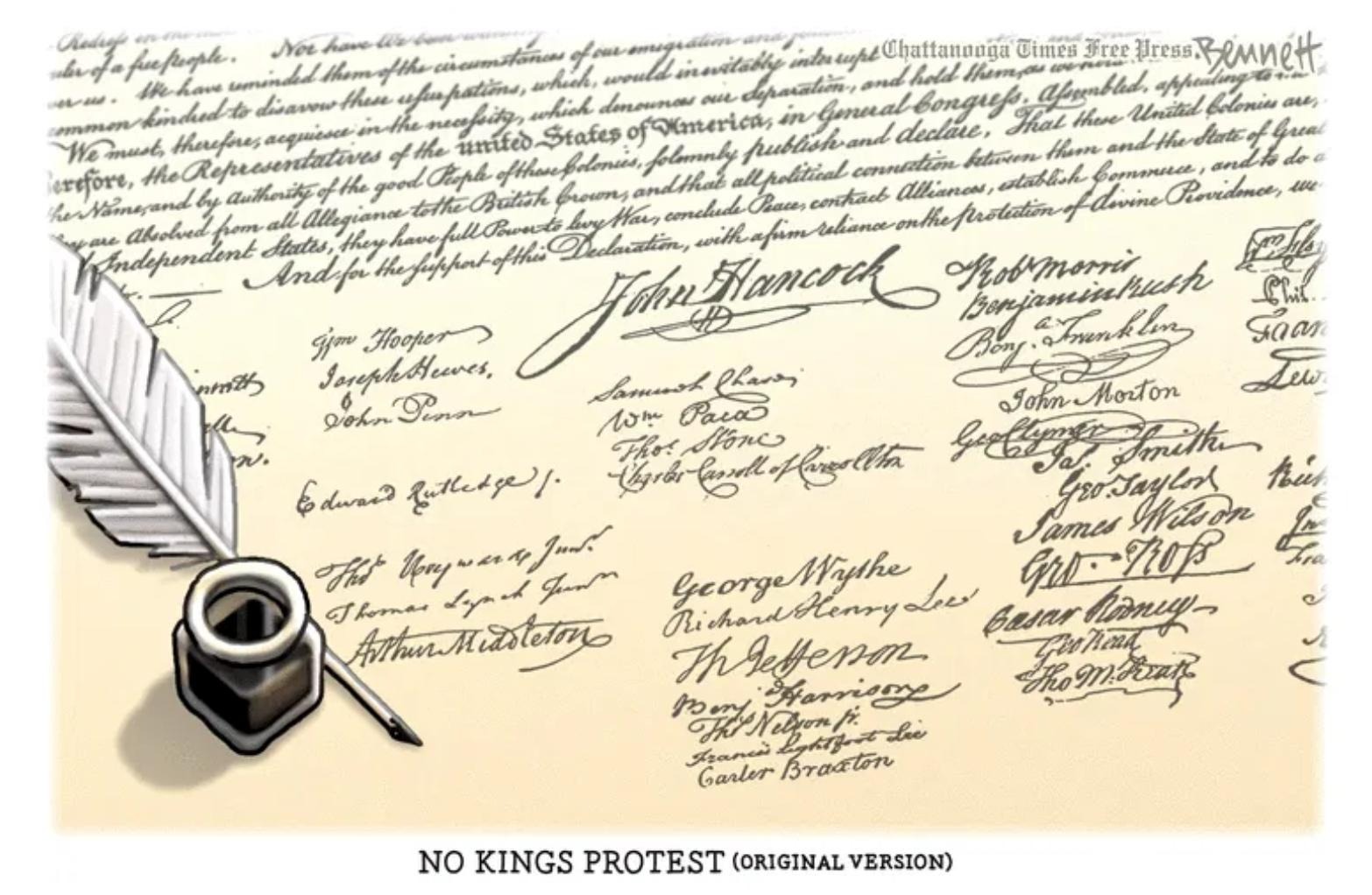
No kings!

Binding precedent

Protesters have protested at an ICE facility a few miles west of Chicago for the past 19 years—with somewhat more intensity recently following the announcement of Operation Midway Blitz. A month after the announcement, the president federalized the Illinois National Guard. District court: Enjoined. Seventh Circuit: Just so. Political opposition is not rebellion, and a protest doesn’t become a rebellion merely due to a few isolated incidents of violence. Without that, none of the statutory predicates for federalizing the National Guard have been met.

Institute for Justice, Short Circuits for 10/17/25 (bold added). This is now the law in the 7th U.S. Circuit – Indiana, Illinois and Wisconsin.

Look for the Administration to try to provoke a rebellion it can crush. Everyone who’s paying attention knows Trump wants to invoke the Insurrection Act (as he stuffs his pockets and those of his family).

Wanted: a viable counternarrative

Trump’s actions … are part of one project: creating a savage war of all against all and then using the presidency to profit and gain power from it. Trumpism can also be seen as a multipronged effort to amputate the higher elements of the human spirit—learning, compassion, science, the pursuit of justice—and supplant those virtues with greed, retribution, ego, appetite. Trumpism is an attempt to make the world a playground for the rich and ruthless, so it seeks to dissolve the sinews of moral and legal restraint that make civilization decent.

Trumpism, like populism, is more than a set of policies—it’s a culture. Trump offers people a sense of belonging, an identity, status, self-respect, and a comprehensive political ethic. Populists are not trying to pass this or that law; they are altering the climate of the age. And Democrats think they can fight that by offering some tax credits?

To beat a social movement, you must build a counter social movement. And to do that, you need a different narrative about where we are and where we should be heading, a different set of values dictating what is admirable and what is disgraceful. If we fail to build such a movement, authoritarian strongmen around the globe will dominate indefinitely.

David Brooks.

You can’t beat something with nothing. I can’t come up with a political counternarrative to Trumpism. The Democrats can’t come up with a political counternarrative, either. Brooks couldn’t come up with a strong political counternarrative.

I can only hope and pray that people will look for their compelling (counter-)narrative to the Gospel of Jesus Christ. (And that meantime there will be some legal counternarratives to prevent irretrievable damage, as in the preceding item.)

Music Reviews

There may be nothing better than old music reviews to let you know that it’s okay to like what you like, critics be damned.

I like Debussy’s La Mer, and I don’t care what the stupid early reviews said:

On today’s date in 1905, Claude Debussy’s orchestral suite La Mer or The Sea was performed for the first time in Paris. Today this music is regarded as an impressionistic masterpiece, but early audiences — especially those in America — found it rough sailing.

“We clung like a drowning man to a few fragments of the tonal wreck,” wrote a 1907 Boston critic, and suggested that instead of The Sea Debussy should have titled his piece Sea-Sickness.

“The Sea is persistently ugly,” wrote The New York Times that same year. “Debussy fails to give any impression of the sea … There is more of a barnyard cackle in it than anything else.”

And in 1909, this on La Mer from The Chicago Tribune: “It is safe to say that few understood what they heard and few heard anything they understood … There are no themes … There is nothing in the way of even a brief motif that can be grasped securely enough by the ear and brain to serve as a guiding line through the tonal maze. There is no end of queer and unusual effects, no end of harmonic complications and progressions that sound so hideously ugly.”

Ah, the perils of “modern music” in the early 20th century!

Giving the Devil his due, impressionism had to be a real mind-blower for critics attuned to, say, the sonata-allegro form.

Comprehensive tradition

We’re often not very aware of the “tradition” in which we live. A student in a classroom would readily agree that the words of a teacher or professor were a “traditioning” of sorts. But they will fail to notice that how the room is arranged, how the students sit, what the students wear (or don’t wear), how the professor is addressed, how students address one another, what questions are considered appropriate and what are not, and a whole world of unspoken, unwritten expectations are utterly required in the process. The modern world often imagines that “online” education is equivalent to classroom education since the goal is merely the transmission of information. But the transmission of information includes the process of acquiring the information and everything that surrounds it. Those receiving the “tradition” online will have perhaps similar information to those receiving it in a classroom – but they will not receive the same information.

Fr. Stephen Freeman, The Tradition of Being Human

Stages of life

Two questions:

  1. Do I want to read/watch/listen to this?
  2. Should I read/watch/listen to this?

When I was younger the second question often dominated my decision-making. Now that I am officially ancient that question has virtually disappeared and the first one is usually the only one I ask. That’s been the single most notable change in my personality in these my declining years.

Alan Jacobs

Alan is a decade or more younger than me, yet I only very recently seem to have arrived at this point, especially regarding political matters.

Note that he’s talking about a change in personality. This isn’t a life rule. There are things that younger people should read/watch/listen to, in order to become well-formed human beings.

Two ways

[R]evival begins with the people proclaiming, by word and deed, “I have sinned.”

MAGA Christianity has a different message. It looks at American culture and declares, “You have sinned.”

David French

Noteworthy

In the aftermath of Kirk’s murder, we witnessed young people at vigils rather than at “mostly peaceful” demonstrations.

R.R. Reno in First Things


We are all gatekeepers now.

Peggy Noonan

Your enemies are not demonic, and they are not all-powerful and the right hasn’t always lost and the left hasn’t always won. But if you convince yourself of that, you give yourselves all sorts of permission to do a lot of stupid and terrible things under the rubric of “Do you know what time it is?”

Jonah Goldberg.

[A] critical mass of the American people … no longer want[s] to govern themselves, … are sick of this republic and no longer want to keep it if it means sharing power with those they despise.

Nick Catoggio

I don’t do any of the major social media, but I have two sub-domains of the domain you’re currently reading: (a) You can read most of my reflexive stuff, especially political here. (b) I also post some things on my favorite no-algorithm social medium.

Sunday, 10/12/25

Total apostasy?

… Mormons claim that “total” apostasy overcame the church following apostolic times, and that the Mormon Church (founded in 1830) is the “restored church.” …

A bullet-point in an anti-Mormon tweet after the attack on a Michigan Mormon meeting place. (My source identified the tweeter as “fundamentalist.”) The bullet-points built to the conclusion that Mormons (Latter-Day Saints) are not Christian.

Fine. But the Evangelical and Evangelical-adjacent world in which I spent many decades believes something very much like that Mormon “total apostasy” story. They may think it started in the 4th century and ended in the 16th instead of the 19th, but a lot of them (including former-me) functionally think it ended in the 19th, with the revivals of the “Second Great Awakening,” when the distinctive style of Evangelicalism emerged. (BTW: Try to define “Evangelical.”)

Here, I submit, is a more accurate summary of Church history:

There’s no need of a restored church because Christ’s One Holy Catholic and Apostolic Church never went away.

And I stumbled onto it …

Speaking of which, I had occasion this week to reread an eight year-old blog constituting, my only published spiritual biography (it was reprinted elsewhere one time). There are a few things I’ve written over the years that stick in my mind as worthy efforts, not throw-away lines or curations, and that post is one of them.

Some things bear repeating, and so I shall:

Having settled in for a few decades, what have I found uniquely true about the Orthodox Church?

It’s hard to put into words. That’s why Orthodox evangelism tends to consist of “come and see.”

Harder still for me personally, I need to find words for feelings and tendencies that an intellectualoid has trouble trusting — things that may be true but approach ineffability. I have a Dostoyevsky “Beauty Will Save the World” sticker on my office window, but long habit and self-image keep pulling me back toward “Spock-like logic (think of that tidy, air-tight 5-Point Calvinism) will save the world.”

But here goes. Turn on your feeler.

I’ve found, again, the love of God. Over and over and over and over we hear liturgical exclamations “for You are a gracious God and love mankind.” There’s no contrary stream of wrath that I’ve noted. The steadfast love of the Lord endures forever.
I’ve found true worship of God, which was something I longed for and agitated for in my prior Evangelicalism and Calvinism, as best as I then understood worship. For instance, I wanted no “hymns” in worship that were addressed to encouraging one another rather than praising God. Yet somehow bathos kept cropping up, and emotionally manipulative gospel songs kept elbowing out too many hymns. I really had no idea what real worship looked like, but my longing was wholesome. I am very much a member of homo adorans.
I have found sobriety and balance. The Christian Reformed Church was on the right track when it aspired to “Catechism Preaching,” an effort to tie sermons to the prescribed portion of the Heidelburg Catechism appointed for that Sunday, rather than letting pastors riff on whatever they read in Saturday’s newspaper or National Review. But Catechism Preaching was a tradition honored more in the breach than in the observance. I have found the Orthodox liturgical cycles (very complex and overlapping) to produce sobriety and balance in homilies, but more, in the entire service (hymnody, Epistle and Gospel readings, etc.)
I have found a hard path which, if I faithfully walk it, will make me more Christlike — a nice Protestant way of referring to becoming a “partaker of the divine nature.”
I have found a Church that really is a hospital for sinners instead of a club for self-styled saints. Some patients have more embarrassing ailments than others, but we’re all chronic cases; sacramental confession helps to drive that home. Not one of us is a hopeless case: the lives of the Saints help drive that home. Some check out of the hospital against medical advice, but we don’t do involuntary discharges of anyone who knows (s)he’s sick and wants to get well.

Another’s conversion

She elaborates the point with more than a little self-deprecation: “I’d backed myself into a corner. There wasn’t anyone else in the world who talked about ‘the Platonic ideal of the Good as an active agent with a special care for humankind’ without shortening that whole cumbersome phrase to simply God.”

In short, although she resisted the conclusion (or was it a solution?) with all her strength, she finally welcomed its inevitability. “I had just enough love in me to be able to be warmly surprised to find out the rules I loved, loved me back.”

… If one can know what she thinks by reading the Catechism, what’s left to surprise?

Answer: not her background convictions, but how she applies them to concrete questions, especially questions about public policy and the modern household ….

Brad East, quoting Leah Libresco Sargeant’s conversion from atheism to Roman Catholicism. The occasion, of course, is that she has written a new book, The Dignity of Dependence: A Feminist Manifesto.

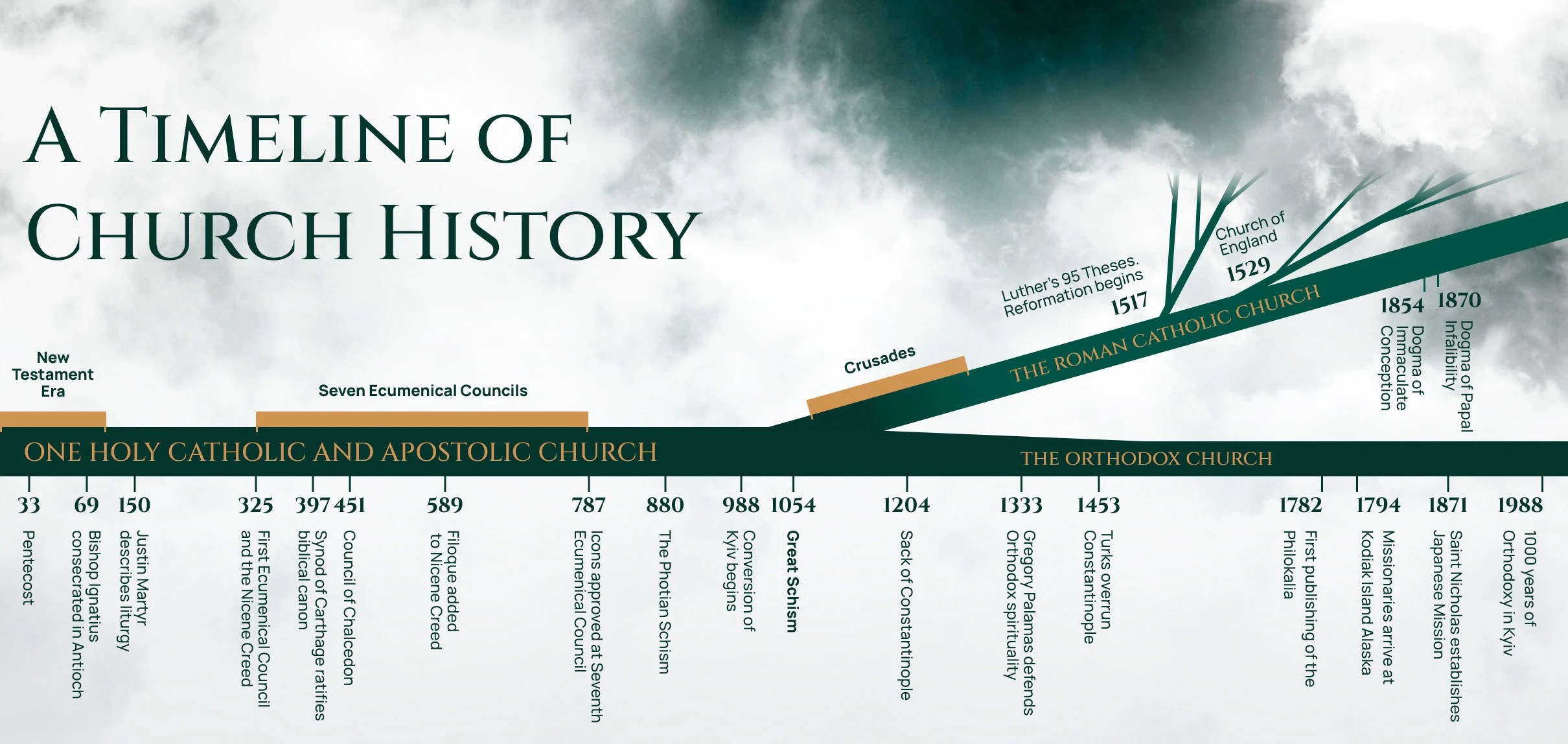
Orthodoxy and Roman Catholicism are not in communion with each other since, in the simplified version, the Great Schism of 1054 (see the timeline above). But a lot of people coming out of Protestant traditions have felt that those were the only two viable Christian alternatives, and I have never found it in me to criticize those who made the wrong-but-plausible choice, like Leah did.

Fallen

Of course, we speak of human beings as “fallen.” However, in Orthodox teaching, this does not refer to our nature itself. Rather, it refers to the fact that we have been made subject to death – we are mortal. It is “death at work in us” that we describe as “sin.” But the origin of sin is not found in our nature. Our nature is inherently good. Understanding this makes a huge difference when we think about human relationships and the character of our common life.

If you take the view (which is common in certain corners of Western Christianity) that human beings have a “sin nature” – that we are, in fact, essentially bad – then how we view one another and the character of our common life takes on a different caste. In an Orthodox understanding, a Bible verse such as, “Spare the rod and spoil the child,” can mean little more than “children need discipline in their lives to help them”. Whereas in a world in which human nature is held to be a “sin nature,” then “sparing the rod,” would be seen as letting evil run amok. It would hold that our nature not only needs to be restrained but requires a vigorous regime of reward and punishment. It has not been that long since the notion of “beating the evil out of a child” was common.

When we speak of our nature as “good,” we are not declaring that human beings are born as saints. Rather, we are saying that our nature (“what we are”) tends towards the good, desires the good. We desire beauty. We desire well-being. We desire truth. Even when we engage in evil actions, they are most often grounded in a misperception of the good. Dictators do not come to power by asking people to be evil – they come to power by distorting the image of the good.

Fr. Stephen Freeman, The Nature of Being Human


Religious ideas have the fate of melodies, which, once set afloat in the world, are taken up by all sorts of instruments, some woefully coarse, feeble, or out of tune, until people are in danger of crying out that the melody itself is detestable.

George Elliot, Janet’s Repentance, via Alan Jacobs

[N]one of the things that I care about most have ever proven susceptible to systematic exposition.

Alan Jacobs, Breaking Bread With the Dead

You can read most of my more impromptu stuff here and here (both of them cathartic venting, especially political) and here (the only social medium I frequent, because people there are quirky, pleasant and real and it has no-algorithms). All should work in your RSS aggregator, like Feedly or Reeder, should you want to make a habit of it.
Sunday 10/5/25

Fullness

Orthodoxy holds that the fullness of the Faith was revealed to the Church at Pentecost, once and for all. The Greek Fathers utilized their education in the service of the Church to explain doctrine, not to find new truths, since the fullness of the truth was received at Pentecost.

Dr. Eugenia Scarvelis Constantinou, Thinking Orthodox

Secularism

Secularism was not a neutral concept. The very word came trailing incense clouds of meaning that were irrevocably and venerably Christian.

Tom Holland, Dominion

Ring-lust

When people justify their voting choice by its outcome, I always think of The Lord of the Rings. Tolkien emphasizes repeatedly that we cannot make decisions based on the hoped-for result. We can only control the means. If we validate our choice of voting for someone that may not be a good person in the hopes that he or she will use his power to our advantage, we succumb to the fallacy of Boromir, who assumed he too would use the Ring of Power for good. Power cannot be controlled; it enslaves you. To act freely is to acknowledge your limits, to see the journey as a long road that includes dozens of future elections, and to fight against the temptation for power.

Jessica Hooten Wilson, What ‘The Lord of the Rings’ Can Teach Us About U.S. Politics, Christianity and Power.

In the US, we decided, twice, that if we gave Sauron the ring, he’d use it for good. How’s that workin’ out for ya?

Conversion and cosmology

There is no point in converting people to Christ if they do not convert their vision of the world and of life, since Christ then becomes merely a symbol for all that we love and want already – without Him. This kind of Christianity is more terrifying than agnosticism or hedonism.

Fr. Alexander Schmemann. Again:

A modern secularist quite often accepts the idea of God. What, however, he emphatically negates is precisely the sacramentality of man and world.

Fr. Alexander Schmemann (different source).

Climbing the elite ladder

Here’s one way to think about it. An evangelical who climbs the elite ladder is more or less required, by the nature of the case, to shed vital elements of her evangelical identity. But a Catholic is not. And a Catholic is not for the same reason that, once upon a time, a liberal Protestant was not.

Brad East, Conversions, Protestantism, and a New Mainline. I would add that an Orthodox Christian need not shed identity either.

East’s post is target-rich with suggestions about questions that fascinate me.

Politically homeless

According to the Public Religion Research Institute’s annual census last year, upward of 80 percent of Republicans described themselves as Christian …

Ryan Burge. It might surprise you that I’m unimpressed and un-encouraged by that. I don’t even know what “Christian” means in common parlance any more if 80% of Republicans think of themselves as Christians.

Ain’t. No. Way.

… But the Democratic coalition is a very different spiritual universe. It is made up of a big mix of faiths — Christians of various kinds, Jews, Muslims — as well as somewhere between 30 percent and 40 percent of nones, or people who describe their faith as atheist, agnostic or nothing in particular.

Ryan Burge again. These figures are a surprise, but they may be correlated to the Democrat party positions that keep me politically homeless instead of joining the Dems.

Chicago archbishop Blase Cardinal Cupich, who has stirred some controversy recently, said one true thing that made my heart leap when it was misattributed to the new Pope by a commentator: that Christians (Cupich said “Catholics”) are now politically homeless in the US.

I have recognized my political homelessness for twenty years now.

On reading the Bible

Most North American Christians assume that they have a right, if not an obligation, to read the Bible. I challenge that assumption. No task is more important than for the Church to take the Bible out of the hands of individual Christians in North America. Let us no longer give the Bible to all children when they enter the third grade or whenever their assumed rise to Christian maturity is marked, such as eighth-grade commencements. Let us rather tell them and their parents that they are possessed by habits far too corrupt for them to be encouraged to read the Bible on their own ….

Stanley Hauerwas. Hauerwas wrote the book this quote comes from 32 years ago. It seems to me that those corrupt habits haven’t been reformed.

Get ready

You may have heard these famous lines from Cardinal Francis George, the late archbishop of Chicago …:

I expect to die in bed. My successor will die in prison. And his successor will die a martyr in the public square. His successor will pick up the shards of a ruined society and slowly help rebuild civilization, as the church has done so often in human history.

Kevin D. Williamson, The Totalitarian Tendency and the Confessional, reflecting on a new Oregon law requiring that Catholic priests report certain sexual crimes that might be communicated to them in the confessional.

Starving the beast

In our last episode, I wrote “I don’t think I frequent any websites that use algorithms to target my inferred vulnerabilities.” It may be worth noting that I also have unsubscribed from some blogs and Substacks that I felt were grinding out agitprop aimed at people like me.

Go thou and do likewise.


Religious ideas have the fate of melodies, which, once set afloat in the world, are taken up by all sorts of instruments, some woefully coarse, feeble, or out of tune, until people are in danger of crying out that the melody itself is detestable.

George Elliot, Janet’s Repentance, via Alan Jacobs

[N]one of the things that I care about most have ever proven susceptible to systematic exposition.

Alan Jacobs, Breaking Bread With the Dead

You can read most of my more impromptu stuff here and here (both of them cathartic venting, especially political) and here (the only social medium I frequent, because people there are quirky, pleasant and real and it has no-algorithms). All should work in your RSS aggregator, like Feedly or Reeder, should you want to make a habit of it.
Leavetaking of the Elevation of the Cross

Thinking

What growing up fundamentalist helped me learn early on is how terribly wrong you can be while thinking very hard.

Phil Christman.

How do we become uncomplicated and unsophisticated? Can we simply unlearn all that we have learned?

No, we cannot, but what we can do is to separate ourselves from it in order to look at it with new eyes. For us Westerners to truly enter into the ancient Christian transmission and catch the essence of Christ’s teaching, it is necessary for us to crucify our rationalizing minds and arise above the level of thought and emo for a society founded on Descartes’ proposition “I think, therefore I am,” this of course means a kind of suicide; and it is to precisely such an ego-death that Christ calls us. Contemporary western Christianity trained us how to think and what to think; whereas Christ himself, as did Lao Tzu before Him, taught us how not to need to think.

Hieromonk Damascene, Christ the Eternal Tao.

Theology is offered to the glory of God, not ourselves. Since it is divine, it can never be based on human reasoning, ideas, speculation, or clever argumentation. Orthodox theology can never be disconnected from the spiritual life of the theologian or from the life of the Church. Authentic Orthodox theology is “liturgical, doxological and mystical.”

Dr. Eugenia Scarvelis Constantinou, Thinking Orthodox.

I did not unequivocally “grow up fundamentalist,” but I was at least adjacent. Then Calvinism, which I discovered in my late 20s, increased the “thinking very hard.” But I did not think my way out of all that and into Orthodox Christianity. It was more as if I worshipped and trusted my way across that chasm.

Mike-drop

Whenever a traditional Christian defends some point of traditional Christian morality, you’ll hear one of our lefty friends cry, “I thought Jesus ate with prostitutes and tax collectors!” Once again, the proper response is: Do you identify with Jesus in that parable?

This is where liberal Christianity becomes—ironically; hilariously—elitist. Sorry, folks, but God’s not saying you must condescend to eat with sinners. No: you are the sinner. He condescends to eat with you.

As for us recovering sinners (i.e., Christians) Saint Paul gives us a different rule: “But now I have written to you not to keep company with anyone named a brother, who is sexually immoral, or covetous, or an idolater, or a reviler, or a drunkard, or an extortioner—not even to eat with such a person” (1 Cor. 5:11). Why? Because, not being Jesus, you can’t trust yourself not to fall into their vice.

Michael Warren Davis, You’re Not Jesus


Religious ideas have the fate of melodies, which, once set afloat in the world, are taken up by all sorts of instruments, some woefully coarse, feeble, or out of tune, until people are in danger of crying out that the melody itself is detestable.

George Elliot, Janet’s Repentance, via Alan Jacobs

[N]one of the things that I care about most have ever proven susceptible to systematic exposition.

Alan Jacobs, Breaking Bread With the Dead

You can read most of my more impromptu stuff here and here (both of them cathartic venting, especially political) and here (the only social medium I frequent, because people there are quirky, pleasant and real). All should work in your RSS aggregator, like Feedly or Reeder, should you want to make a habit of it.
Sunday, 8/31/25

I enjoyed my Evangelical boarding school experience. I looked forward to the end of Summer Vacation and moving back into the dorm.

For that and a few other reasons, this has long been my favorite time of the year.

It began 62 years ago tomorrow, when my dad and I packed up the car and headed north. The day ended up being quite an adventure, involving fuel pump failures on both family vehicles. I’m not sure the story is worth retelling – except for the possibility that my dad was wondering “Is God trying to tell us this was a mistake?”

I don’t think it was, despite all the Evangelical problems I now can’t un-see. “Evangelical” is where my family was, and we couldn’t imagine wanting to be otherwise.

PSA

No, not prostate-specific antigen, nor public service announcement.

We’re talkin’ Penal Substitutionary Atonement. It is not the sine qua non that so many think it is.

Grace

I can think of few phrases in modern Christian speech that have been more abused through misuse and overuse than “we are saved by grace.” As a young Protestant, this was explained to me thus: “We are saved by God’s unmerited favor.” This has the unfortunate implication that, whatever salvation may be, it’s something that’s happening in the mind of God – His unmerited favor. It strikes me as somewhat empty.

Its emptiness belongs to that nefarious doctrine (as I would describe it) of the Penal Substitutionary Atonement (PSA), in which God’s justice demands our condemnation, while God’s mercy demands the blood of Jesus. All of which, it would seem, leaves us as bystanders in a cosmic court where the eternal disposition of our wretched souls is worked out.

In Orthodox understanding (which is the understanding of the early Church), grace is ever so much more. Indeed, grace is the Divine Energies, the very life of God. I have given this article the title, “Saved by the Stuff of Grace,” to draw attention to the ontological character of grace. Grace is not an aspect of a Divine psychology. Grace is the very life of God. We are saved by becoming partakers in the life of God: He becomes what we are that we might become what He is – i.e., that we might dwell in Him and He in us.

Fr. Stephen Freeman, Saved by the Stuff of Grace

Vladimir Lossky

The inadequacy of this theology was brilliantly deconstructed by Vladimir Lossky, whose analysis reveals why this opinion results in other problems that manifest themselves in Western Christian theology: Christian horizons are limited by the drama played between God, who is infinitely offended by sin, and man, who is unable to satisfy the impossible demands of vindictive justice. The drama finds its resolution in the death of Christ, the Son of God who has become man in order to substitute Himself for us and pay our debt to divine justice. What becomes of the dispensation of the Holy Spirit here? His part is reduced to that of an auxiliary, an assistant in redemption, causing us to receive Christ’s expiated merit. . . . The price of our redemption having been paid in the death of Christ, the resurrection and the ascension are only a glorious happy end of his work, a kind of apotheosis without direct relationship to our human destiny. This redemptionist theology, placing all the emphasis on the passion, seems to take no interest in the triumph of Christ over death. The very work of the Christ-Redeemer, to which this theology is confined, seems to be truncated, impoverished, reduced to a change of the divine attitude toward fallen men, unrelated to the nature of humanity.

Dr. Eugenia Scarvelis Constantinou, Thinking Orthodox

Taming the Church

There was a subtle repressiveness behind this seemingly innocuous pluralism. Niebuhr failed to describe the various historical or contemporary options for the church. He merely justified what was already there—a church that had ceased to ask the right questions as it went about congratulating itself for transforming the world, not noticing, that in fact the world had tamed the church.

Stanley Hauerwas, Resident Aliens

Work

No one should imagine that the work he does is an end in itself; it has the role of beautifying his nature, with the virtues of patience, of self-control, of love for his neighbor, of faith in God, and in turn of opening his eyes to the wise principles placed by God in all things.

Dumitru Staniloae, Orthodox Spirituality

A hundred fine names for the Sulks

Ye see it easily enough in a spoiled child that would sooner miss its play and its supper than say it was sorry and be friends. Ye call it the Sulks. But in adult life it has a hundred fine names—Achilles’ wrath and Coriolanus’ grandeur, Revenge and Injured Merit and Self-Respect and Tragic Greatness and Proper Pride.’

C.S. Lewis, The Great Divorce

The Creed

I have said elsewhere that I deliberately will never adopt any theological “ism” that isn’t clearly derived from the Creed. Far from being a cynically contrived statement or a politically motivated one, the Creed was formulated to be as dogmatically expansive as possible, without opening the doors to needless speculation on the one hand or to doctrinal reduction for the sake of accommodation on the other.

Addison Hodges Hart, “God concepts,” the “impersonal transcendent,” and “superstitious” babushkas

Bad Religion

Ross Douthat wrote a book a few years back titled “bad religion.” a book like that wouldn’t be much use unless there was some definition of his terminology:

bad religion: the slow-motion collapse of traditional Christianity and the rise of a variety of destructive pseudo-Christianities in its place.

[A] religious mistake has been to fret over the threat posed by explicitly anti-Christian forces, while ignoring or minimizing the influence that the apostles of pseudo-Christianity exercise over the American soul.

Question: how can you tell whether your church is pushing one of the varieties of destructive pseudo-Christianity? The answer is not “do they use the Bible as their source of authority?” The arch-heretics have always used the Bible, sometimes quite cunningly.

If you’re not Orthodox, I want this question to be a burr under your saddle, as it became under my saddle 34 or so years after I first headed off to Boarding School.


Religious ideas have the fate of melodies, which, once set afloat in the world, are taken up by all sorts of instruments, some woefully coarse, feeble, or out of tune, until people are in danger of crying out that the melody itself is detestable.

George Elliot, Janet’s Repentance, via Alan Jacobs

[N]one of the things that I care about most have ever proven susceptible to systematic exposition.

Alan Jacobs, Breaking Bread With the Dead

You can read most of my more impromptu stuff here and here (both of them cathartic venting, especially political) and here (the only social medium I frequent, because people there are quirky, pleasant and real). All should work in your RSS aggregator, like Feedly or Reeder, should you want to make a habit of it.
Sunday, 8/10/25

No nonsense

A veteran Orthodox Priest recalls some wedding planning:

Three occasions stand out in my memory.

In the first, the mother of the bride arrived for the wedding rehearsal fifty minutes late, carrying aloft one of those rather tedious middle-class books of wedding etiquette, exclaiming that she wanted the wedding to be just “like this.” It wasn’t.

On another occasion, I was telephoned by another bride’s mother, a woman I had never met. It was quite obvious that she regarded the church as a sort of wedding shop at which she simply ordered the things she wanted and skipped things that did not look attractive. She didn’t want crowns at her daughter’s wedding, though I cannot now remember why. We had crowns.

On a third occasion, a marriage consultant had been hired to look after the wedding. When we met in the church, she told me that she was going to put in a rose bower right over where the couple would stand, and that she wanted piped music from various show tunes to “set the mood.” She got neither wish.

One of the great blessings in the Orthodox Church is that we do not have to create occasions. The Orthodox wedding service is so powerful, so profound, that we do not have to dress it up, give it atmosphere, or otherwise make it other than it already is. This allows people to relax. They may have problems at the wedding reception—crowds and alcohol are always a bit risky, and banquet food is rarely worth the money—but the marriage service of the Orthodox Church is a glimpse of heaven without making any particular fuss or effort at all.

Fr. Meletios Webber, Bread & Water, Wine & Oil.

My wife and I were fortunate in the early 70s when my then-pastor, of New England Congregationalist stock, effectively decreed that we would follow the Book of Common prayer pretty closely. It wasn’t Orthodox, but it wasn’t kitsch, either.

Life in the monastery

All my bad habits, disinfected, it is true, of formal sin, had sneaked into the monastery with me and had received the religious vesture along with me: spiritual gluttony, spiritual sensuality, spiritual pride. . . .

Thomas Merton, The Seven-Story Mountain

The reprobate in heaven

I will venture to say more than this; – it is fearful, but it is right to say it; – that if we wished to imagine a punishment for an unholy, reprobate soul, we perhaps could not fancy a greater than to summon it to heaven. Heaven would be hell to an irreligious man… He would find no one like himself; he would see in every direction the marks of God’s holiness, and these would make him shudder. He would feel himself always in His presence. He could no longer turn his thoughts another way, as he does now, when conscience reproaches him. He would know that the Eternal Eye was ever upon him; and that Eye of holiness, which is joy and life to holy creatures, would seem to him an Eye of wrath and punishment. God cannot change His nature. Holy He must ever be. But while He is holy, no unholy soul can be happy in heaven.

John Henry Newman via Addison Hodges Hart.

It is common in Orthodox Christianity to suggest that the presence of God is light to the righteous, searing heat to the unrighteous. Neither that nor Newman’s sermon is systematic theology; both are analogies to address a question that people have about God’s justice, heaven and hell.

The opposite of war

The opposite of war is not peace, but liturgy – the cognitive, bodily, totalizing act that steadily increases communion, instead of cutting it. Liturgy is an act that purifies and knits the character together, whereas trauma unravels our character. In liturgy, I give my life for my brother and sister, I renounce retaliation, and I give my very body and blood for the life of the entire world.

Timothy Patitsas, The Ethics of Beauty

Not much of a stretch

If Christianity is the one, true religion, is it that much of a stretch to believe that there is one, true expression of Christianity?

Carlton, Clark, The Way, 1998 Edition

That one true expression builds on the one foundation with gold, silver and precious stones, not wood, hay and straw.

Well-being declining

Since the 1960s we have adopted values that are more secular, more individualistic and more oriented around self-expression than the values that prevail in the Eastern Orthodox European countries such as Serbia, the Confucian countries like South Korea and the mostly Catholic Latin countries like Mexico.

The countries that made this values shift are seeing their well-being decline, according to that Gallup thriving survey. The countries that resisted this shift are seeing their well-being improve. The master trend in recent Western culture has been to emancipate the individual from the group, and now we are paying the social and spiritual price.

David Brooks, Why More People in the World Are Feeling Hopeful (Except Us) (gift link).

The Culture Wars: cui bono?

While at Brookings, [Os Guinness] helped to draft a public document that could have had the domestic impact of a Universal Declaration of Human Rights if events had only unfolded differently. Aided by the likes of Richard John Neuhaus and George Weigel, Guinness led the drafting of the Williamsburg Charter for the bicentennial celebration of the First Amendment in 1988. The document called for a “reaffirmation and reappraisal of its vision and guiding principles.” Signed by a broad coalition of religious faiths and politicians across the aisle (including presidents, chief justices, and members of Congress), the charter spelled out the importance of the First Amendment’s twin guarantees of religious liberty: the No Establishment and the Free Exercise clauses. Both clauses work together to protect religious liberty, not limit it.

Enshrining these at the heart of the Constitution as America’s “first liberty” was necessary, as the document spells out, because

[our] form of government depends upon ultimate beliefs, for otherwise we have no right to the rights by which it thrives, yet rejects any official formulation of them… The result is neither a naked public square where all religion is excluded, nor a sacred public square with any religion established or semi-established. The result, rather, is a civil public square in which citizens of all religious faiths, or none, engage one another in the continuing democratic discourse. … The Framers’ intention is indisputably ignored when public policy debates can appeal to the theses of Adam Smith and Karl Marx, or Charles Darwin and Sigmund Freud but not to the Western religious tradition in general and the Hebrew and Christian Scriptures in particular.

The document was commemorated with a signing ceremony in the Hall of the House of Burgesses in Williamsburg, and many smaller events, including a conference that featured papers from intellectual luminaries like James Davison Hunter, Michael Sandel, Charles Taylor, and Peter Berger. Even still, it never made quite the impact it could have in reframing the conversation about the place of religion in society (a shame especially in light of recent controversies: e.g., Christian groups being kicked off campus, religious monuments being stripped from public locations, and the debated ‘failures’ of classical liberalism).

The Williamsburg Charter’s failure came down to the absence of a single signature: that of the sitting president, “whose backing was crucial to the practical rollout of the Charter.” At the end of the day, “strong opposition from the Religious Right blocked the participation of President Reagan.” “The culture wars are in the interests of Republicans so you will only get to the president over my dead body,” one of Reagan’s cabinet secretaries told Guinness. This destroyed any opportunity to articulate why Americans needed to bring their faith with them into the public square. While Guinness’ campaign has continued on in the work of John Inazu and that of others, the cultural capital it once had within arm’s reach is spent.

John Shelton, Os Guinness: The Christian Public Intellectual After Jacques Maritain (bold added).

Limits of redemptionist theology

The inadequacy of this theology was brilliantly deconstructed by Vladimir Lossky, whose analysis reveals why this opinion results in other problems that manifest themselves in Western Christian theology:

Christian horizons are limited by the drama played between God, who is infinitely offended by sin, and man, who is unable to satisfy the impossible demands of vindictive justice. The drama finds its resolution in the death of Christ, the Son of God who has become man in order to substitute Himself for us and pay our debt to divine justice. What becomes of the dispensation of the Holy Spirit here? His part is reduced to that of an auxiliary, an assistant in redemption, causing us to receive Christ’s expiated merit. . . . The price of our redemption having been paid in the death of Christ, the resurrection and the ascension are only a glorious happy end of his work, a kind of apotheosis without direct relationship to our human destiny. This redemptionist theology, placing all the emphasis on the passion, seems to take no interest in the triumph of Christ over death. The very work of the Christ-Redeemer, to which this theology is confined, seems to be truncated, impoverished, reduced to a change of the divine attitude toward fallen men, unrelated to the nature of humanity.

Dr. Eugenia Scarvelis Constantinou, Thinking Orthodox


Religious ideas have the fate of melodies, which, once set afloat in the world, are taken up by all sorts of instruments, some woefully coarse, feeble, or out of tune, until people are in danger of crying out that the melody itself is detestable.

George Elliot, Janet’s Repentance, via Alan Jacobs

[N]one of the things that I care about most have ever proven susceptible to systematic exposition.

Alan Jacobs, Breaking Bread With the Dead

You can read most of my more impromptu stuff here and here (both of them cathartic venting, especially political) and here (the only social medium I frequent, because people there are quirky, pleasant and real). All should work in your RSS aggregator, like Feedly or Reeder, should you want to make a habit of it.

Sunday, 7/20/25

Divorce, penance, annulment

Roman Catholic apologists have long cited their Church’s ban on divorce and remarriage as commending it and condemning other Churches’ approaches. I have occasionally wondered if they were right.

Such doubts diminished when I began acquiring an Orthodox Christian way of thinking. I heard the somewhat penitential tone of the service for a second marriage. I gained empathy for some of those whose marriages ended, even through their own fault, because we are broken and we do break things. And God doesn’t give up on us when we do.

I also knew that Roman Catholic annulment practice could easily be cast as a (hypocritical) workaround for wealthy Catholics who cared to pursue it (like one of my very attractive law school classmates). I came to prefer the Orthodox practice; briefly:

  • some sort of penance being connected to the Church’s recognition of divorce and,
  • as mentioned earlier, the very service for a second marriage reflecting soberly that a second marriage is a concession to human weakness — “better to marry than to burn with lust”

Then a day or two ago I heard an Orthodox podcast’s treatment of the difference, and decided to dig in a bit deeper.

The Orthodox Church doesn’t give divorces; it penances divorces. Its approach is pastoral. Before remarriage, one must repent of his or her fault in the destruction of the first marriage. This helps those hurt by divorce to be healed and re-integrated into the community and set on the right path again. Since marriage is ordered to the salvation of the spouses, a second marriage is sometimes necessary (“better to marry than to burn with lust”). For a specific, albeit typical, “procedure” for Orthodox second marriages, see here.

The Roman Catholic Church officially does not permit divorce, but has a legal process for declaring, retroactively, that there was never a valid marriage in the first place. Suspecting that the Orthodox podcaster’s characterization of that process and its effects went a bit overboard, I sought out reliable Catholic sources, like here, here, and here.

You can read and judge for yourself (they’re not long), but I find that process described a legal and apologetical dodge with no repentance and spiritual healing for anyone. There’s nothing pastoral about it. In the three sources I consulted, there was only one whiff of examination of conscience about the broken marriage, and even that was in the form of “some people find that simply writing out their testimony helps them to understand what went wrong and why,” not “you really should pause, reflect and repent for your role.”

If the point is to get people into the Kingdom of Heaven, I see a clear winner as between the Orthodox approach and the Roman Catholic. And I’m ready to give as good as I get the next time a Catholic apologist tries the play the divorce card.

Biblical rules

I never hear the [college] administration admit they’re wrong about anything, even though you and I both know they’ve made some bad decisions. Rules get changed every year, but the deans never acknowledge the previous rules were arbitrary—they’re couched in all this talk of biblical principles.

Philip Yancey, Where the Light Fell (Kindle location 3371)

Yancey is very much my contemporary, and I think he was writing professionally before we were 25. Where the Light Fell is autobiographical, and I’m astonished that he retained any sort of Christian faith considering the spiritually abusive environment he grew up in.

The pretense that Christian college policies were from “biblical principles” is one that I knew well and saw through quickly. But it’s a pretext that Biblicists almost have to adopt if they’re going to (a) make rules without (b) appearing arbitrary.

It’s very much with us still. Ross Douthat this week interviews a proponent, one Allie Beth Stuckey, host of an evangelical podcast called “Relatable,” which I guess is a big deal.

For the most part, Ms. Stuckey acquits herself well (Ross is not an interviewer who goes on the attack, like a cross-examiner), but there’s one thing that bothered me. She podcasts on theology, lifestyle, politics, the leftward drift of evangelical leaders and probably other topics. She claims clear guidance from “biblical principles” on all these, and on such things as Donald Trump’s policies on immigration and deportation (which biblical principles predictably support).

And next year, when she changes her mind, it will be from “biblical principles,” too.

It’s false clarity. But the pretext of biblical principles on everything is de rigueur in the Evangelical world.

Most of the time, the earth is flat

Multiple cosmologies should be able to coexist and play different functions, some more philosophical and human and others more technical and mathematical. But in our lives most of the time, the Earth is flat. Most of the time, the Heaven is up and the Earth is down, most of the time means in those instances when I am interacting with my family, my society and my enemies. And most of all, if we wish to understand religion and its symbolism, if we wish to understand the Bible or icons or church architecture we must anchor ourselves to the world of human experience, for that is where we can love our neighbor. We must force ourselves to believe that the sun rises every morning, or that the moon waxes and wanes and honestly it should not be so difficult, because despite Galileo and Newton and Einstein I’m pretty sure I will find some Truth in tomorrow’s rosy fingered dawn.

Jonathan Pageau

Ties that still bind, at least a little

Amid the hyperpluralism of divergent truth claims, metaphysical beliefs, moral values, and life priorities, ubiquitous practices of consumerism are more than anything else the cultural glue that holds Western societies together.

Brad Gregory, The Unintended Reformation

Quotable

I am a slow unlearner. But I love my unteachers.

Ursula K. Le Guin, Dancing at the Edge of the World, via Phil Yancey


Religious ideas have the fate of melodies, which, once set afloat in the world, are taken up by all sorts of instruments, some woefully coarse, feeble, or out of tune, until people are in danger of crying out that the melody itself is detestable.

George Elliot, Janet’s Repentance, via Alan Jacobs

[N]one of the things that I care about most have ever proven susceptible to systematic exposition.

Alan Jacobs, Breaking Bread With the Dead

You can read most of my more impromptu stuff here and here (both of them cathartic venting, especially political) and here (the only social medium I frequent, because people there are quirky, pleasant and real). All should work in your RSS aggregator, like Feedly or Reeder, should you want to make a habit of it.

Sunday, 7/13/25

Our unchurchy churchiness

The confusion of confessions at these revivals dismayed Joseph Smith (d. 1844), a recent settler in western New York. Caught up with his parents in the wildfire of emotions, he had a conversion experience in which all Christian confessions were revealed to be false. He then encountered a spiritual being who told him he would be the founder of the only true religion on earth. Like many Protestants since the time of Luther, Smith saw his work as an act of restoration.

John Strickland, The Age of Utopia (italics added).

I don’t remember whether I’ve said this out loud before, but the deeper I get into the Orthodox Christian faith, the more arbitrary do I find Protestant line-drawing that tries to distinguish “denominations” and the tens of thousands of non-denominational evangelical churches (including Joel Osteen) from “cults” like the Latter Day Saints — cults that came out of the selfsame time, places and democratic impulses.

Oh, I’ve read my Walter Martin back in the day, but it just doesn’t linger persuasively after one gets deeper into Christian history.

Chesterton was half-right: America is a “nation with the soul of a church.” The other half of the truth is that many of our churches lack basic features of historic churchiness: sacraments, liturgical forms, settled creeds, authority. Like America itself, the American church seems a novus ordo seclorum. Our churchy national soul weirdly inhabits a body of peculiar, borderline-heretical actual churches.

In some respects, our unchurchy churchiness is no surprise. We’re Protestant, and Protestants have always been, as Alec Ryrie writes, radicals, lovers, and fighters, restlessly carrying on a centuries-long “open-ended, ill-disciplined argument,” churning out new ideas and rehabilitating old ones with “a certain generic restlessness, an itchy instability.” A “self-perpetuating dynamo of dissatisfaction and yearning,” the Protestant churches have been “one of the engines driving modern history.”

America was founded as a post-Christendom Christian nation. Christian, yes, profoundly so, but never Christian in the way Europe was Christian. Europe became Christian century after plodding century. We started out Christian. The Reformation battered and splintered European Christendom. Colonists brought their European splits with them, and proceeded to split even more. The church was the unifying reality of medieval Europe; after the Reformation, most European nations established one or another variety of national church. Free church Christianity was a late development in Europe. Free church Christianity is American Christianity. States retained established churches into the early nineteenth century, but that was a long time ago. Our default ecclesiology is Lockean and Baptist.

Peter Leithart, The Genius of American Christianity. Leithart keenly recognizes the problem, but (IMHO) misapplies it:

Without revivalist Christianity, America would have rolled over and succumbed to secularism long ago.

But because we did have revivalism, we call “Churches” our “borderline-heretical”, crypto-secularist bacchanalia.

Heretics all

Alas, we are heretics all, and the one we subscribe to is not love any more than the kingdom for the sake of which we are fools is the kingdom of heaven.

R.S. Thomas, Collected Later Poems 1988-2000

I.R.S. Says Churches Can Endorse Candidates From the Pulpit

The agency said that if a house of worship endorsed a candidate to its congregants, the I.R.S. would view that not as campaigning but as a private matter, like “a family discussion concerning candidates.”

David A. Fahrenthold, I.R.S. Says Churches Can Endorse Candidates From the Pulpit.

I don’t consider this good news except insofar as it should clear away any chill on free speech when a pastor is preparing remarks on moral issues (i.e., “Can I say that from the pulpit? Could it be considered a violation of the 1950s’ ‘Johnson Rule’ and cost my church its tax exemption?”).

Even then, I’m not much enthused, because I’m mindful that “Christ did not come to make bad men good, but to make dead men live.” (Fr. Stephen Freeman, paraphrased from memory.) There is such a thing as too much preaching on “moral issues.”

Neither did he come to make Republicans out of Democrats or vice-versa.


Religious ideas have the fate of melodies, which, once set afloat in the world, are taken up by all sorts of instruments, some woefully coarse, feeble, or out of tune, until people are in danger of crying out that the melody itself is detestable.

George Elliot, Janet’s Repentance, via Alan Jacobs

[N]one of the things that I care about most have ever proven susceptible to systematic exposition.

Alan Jacobs, Breaking Bread With the Dead

You can read most of my more impromptu stuff here and here (both of them cathartic venting, especially political) and here (the only social medium I frequent, because people there are quirky, pleasant and real). All should work in your RSS aggregator, like Feedly or Reeder, should you want to make a habit of it.

Sunday, 7/6/25

Quest for certainty

The Reformation is the first great expression of the search for certainty in modern times. As Schleiermacher put it, the Reformation and the Enlightenment have this in common, that ‘everything mysterious and marvellous is proscribed. Imagination is not to be filled with [what are now thought of as] airy images.’ In their search for the one truth, both movements attempted to do away with the visual image, the vehicle par excellence of the right hemisphere, particularly in its mythical and metaphoric function, in favour of the word, the stronghold of the left hemisphere, in pursuit of unambiguous certainty. … What is so compelling here is that the motive force behind the Reformation was the urge to regain authenticity, with which one can only be profoundly sympathetic. The path it soon took was that of the destruction of all means whereby the authentic could have been recaptured.

Iain McGilchrist, The Master and His Emissary

If I were inclined to doubt this analysis, I’d only need to think of the ubiquitous Evangelical insistence that real Christians have assurance of salvation and “eternal security,” whereas I have fear and trembling as I work out my salvation.

Orestes Brownson on “Bible alone”

Orestes Brownson, who was on the verge of leaving behind a checkered career as Protestant, freethinker, and transcendentalist for the Roman Catholic Church, issued a challenge to American Bible-believers in his new role as a Catholic apologist: “We are … never in a condition to rely on the Bible alone. We never go to it wholly devoid of preliminary instructions, and therefore of prepossessions.” Given this circumstance, as Brownson saw the matter, “for the most part, when we do come to study the Bible, we find little else in it than the faith, we have brought to it, so that we may be said to put our faith into the Bible, not to obtain our faith from it.”

Mark A. Noll, America’s God

Brash Jimmy Swaggart

Swaggart’s empire, with receipts of over $150 million annually, fell suddenly in 1989 when he was found with a prostitute in a Baton Rouge motel, caught by a rival preacher whose adultery Swaggart had challenged. Swaggart’s denomination, the Assemblies of God, put him on a on disciplinary probation, which he initially accepted, admitting to decades of sexual struggles, but later rejected when it was prolonged. Instead, he effusively and tearfully on television admitted he had sinned, and then he resumed his ministry. But his church emptied, the dollars shrank, the television contracts ended. He was again discovered with a prostitute in 1991, after which he offered no public apologies. He was still doing the Lord’s work. Swaggart embodied the growing rejection of denominations by increasingly individualistic American Christians. Before the internet, there was television ministry, which made denominations, and even physical church, seem inconsequential to many.

Mark Tooley, Jimmy Swaggart & Brash USA Christianity (bold added)

Unlike some of my acquaintances, I was never a Swaggart devoteé. I was aware of him; he bought (or was given) air time on a Christian Radio station I listened to during a part-time desk job, but he wasn’t why I tuned in — more a bug than a feature (J. Vernon McGee was the feature).

My priors about southern charismatics left me unsurprised at his Fall, though his emotionalism was very skillful and even convincing at times, unlike, say, Jim and Tammy Fay.

God is, as always, merciful and loves humankind. Requiescat in pace, y’all.

Another take on Swaggart

Rod Dreher encountered Jimmy Swaggart after Swaggart’s first unmasking as a user of prostitutes:

I was there, at the Family Worship Center, for this electrifying sermon. I was a student at LSU, and a writer for the campus newspaper. Swaggart had been under fire, and word got out that he was going to make a big announcement on Sunday morning. I went to hear it. I was not a Christian then, in any real sense, though I was making my way towards the faith. I certainly had nothing but contempt for the man back then.

But a strange thing happened to me as I heard his sermon. I was sitting up in the rafters, and expected to feel a sense of Schadenfreude over the fire-and-brimstone televangelist’s downfall. In the moment, though, I looked around me, and saw a crowd of broken people. They were crying, or at least sitting there in shock and disbelief. I noticed that these were not well-dressed people, but men and women wearing the clothes of working-class and lower middle class folks. The kind of people that I came from. And they were in pain.

I didn’t stick around. I remember walking out to my car, feeling awful. I had no sympathy at all for Swaggart, but I felt bad for all those who had believed in him, and been conned. This surprised me. It’s one thing to see a man one regarded as a religious charlatan brought low, but to see the pain of simple people in the face of their spiritual leader’s unmasking? Well, it made my liberal triumphalism seem like a shameful, immature thing. I didn’t know what to do with that.

I’m not convinced that Swaggart was a charlatan insofar as that implies conscious deception at a pretty deep level. I’ve got too many incidents of my own I’d be mortified to have brought under bright lights. You probably do, too. But I don’t think that made me a charlatan. It just proved that I was spiritually immature and formed in part by what my particular Christian upbringing legalistically forbade – and what it thereby tacitly allowed. Imagine growing up with Jerry Lee Lewis and Mickey Gilley as cousins.

I’ll stop there lest I lapse into a confessional essay that would do nobody any good.

The oneness of God

One might say that while for the Greeks there is one God because there is one Father, for the Latins there is one God because there is one Essence, one divine and entirely simple Being.

It can now be seen how, as the presuppositions of the respective views of the Latins and Greeks differed, so did their ways of envisaging the ‘structure’ of the Trinity; and how, further, given the ‘absoluteness’ of these presuppositions, the rival representations of the Trinity which derived from them must also appear absolute. If the Greeks assumed as axiomatic, first, their understanding of the Essence; second, their understanding of the distinction between the Essence and the powers and energies of the Divinity, and hence between the Essence and hypostatic powers of each Person of the Trinity; and, third, their idea that the cause and principle of being in the Trinity is the hypostasis of the Father, it was impossible for them to admit that the Spirit proceeds from both Father and Son, for this would have implied a violation of their axioms. In the same way, if the Latins took as axiomatic the idea that Essence and Being and power form a single and entirely simple divine nature, it was impossible for them not to conclude that the Spirit proceeds from the Father and the Son.

Philip Sherrar, The Greek East and the Latin West, p. 70

American efficiency

What the Japanese Imperial government could not do in 250 years of persecution (destroy Japanese Christianity) American Christians did in 9 seconds.

Gary G. Kohls, MD, Unwelcome Truths for Church and State Concerning the Bombing of Nagasaki August 9, 1945

Discerning Christ in the Old Testament

What was the mind that could see Christ in the Passover Lamb? Indeed, what was the mind that could see Christ’s death and resurrection as a fulfillment of Passover itself? Beneath the letter of the Old Testament, beneath the surface of its poetry, its historical stories, its prophetic works, the primitive Church discerned Christ Himself and the shape of the story which we now know as the gospel.

The shape of the gospel story is not derived from the Old Testament. It is discerned within the Old Testament, after the resurrection of Christ and His subsequent teaching

For example, that “Christ died for our sins,” is not obvious. It can be discerned in the Old Testament if one comes to understand, for example, that the “Servant Songs” in Isaiah are actually referencing Christ. … When that tradition is accepted and “received” (more about this in a moment), then passages like the Servant Songs begin to open up and yield their deeper meaning.

When a gospel writer shares a story about Christ and adds, “This was done that the saying in Isaiah might be fulfilled…,” we are reading the tradition in its operation. But the passages in Isaiah do not themselves give a clue for their interpretation. …

The giving of this tradition is described in Luke 24:44-48:

Then He said to them, “These are the words which I spoke to you while I was still with you, that all things must be fulfilled which were written in the Law of Moses and the Prophets and the Psalms concerning Me.” And He opened their understanding [nous], that they might comprehend the Scriptures. Then He said to them, “Thus it is written, and thus it was necessary for the Christ to suffer and to rise from the dead the third day, “and that repentance and remission of sins should be preached in His name to all nations, beginning at Jerusalem. “And you are witnesses of these things. (Luke 24:44-48)

It is important to see that this new insight into the Scriptures is described as a noetic event. It is not described as technique or style of interpretation that is taught and learned. It is specifically referred to as a change of the nous. In the same manner, the continued understanding of the gospel is, properly, a noetic exercise.

That noetic perception is the common thread of the liturgical texts and hymns of the Orthodox faith. The liturgical life of the Church has a two-fold purpose: the worship of God and the spiritual formation of the people of God. As cited earlier, there must be a movement from “flesh and blood” to “spirit and life.” It is this spiritual transfiguration that is operative in the life of the Church.

This is the same reason that I have written against popular notions of morality. The Christian life does not consist of flesh and blood struggling to behave better. Rather, it is the transformation of flesh and blood into spirit and life. Only a “new creation” (2 Cor. 5:17) sees and understands and lives the new life of the resurrected Christ.

This spiritual ability to see beneath the letter and perceive the truth continues in the life of the Church, unabated. It is particularly evident in the dogmatic formulations of subsequent centuries. Only a nous, properly illumined, could learn to profess the Trinity in the fullness of its mystery. The same is true of Christ’s God/Manhood and the nature of our salvation through the Divine Union.

Fr. Stephen Freeman.

In the Orthodox Church, the story of Christ’s resurrection appearance on the road to Emmaus is a frequent reading. The thing that rivets me is that Christ had to walk through the Old Testament with his disciples, teaching them about the “things concerning Himself.” They weren’t all obvious, but they were precious. And oddly enough, they never were systematically enscripturated. But the Church knows them deep in its bones now.


Religious ideas have the fate of melodies, which, once set afloat in the world, are taken up by all sorts of instruments, some woefully coarse, feeble, or out of tune, until people are in danger of crying out that the melody itself is detestable.

George Elliot, Janet’s Repentance, via Alan Jacobs

[N]one of the things that I care about most have ever proven susceptible to systematic exposition.

Alan Jacobs, Breaking Bread With the Dead

You can read most of my more impromptu stuff here and here (both of them cathartic venting, especially political) and here (the only social medium I frequent, because people there are quirky, pleasant and real). All should work in your RSS aggregator, like Feedly or Reeder, should you want to make a habit of it.

Howl

My goodness, these people talk like cretins

Imagine being Pete Hegseth … a Princeton- and Harvard-educated … idiot—standing there insisting that the recent attack on Iranian nuclear facilities was “the most complex and secretive military operation in history.”

… “Midnight Hammer” … wasn’t the most complex or secretive military operation of the past ten months—surely that laurel goes to the Israelis and the “Grim Beeper” caper—much less the whole of human history. 

… my goodness, these people talk like cretins. Trump himself is, of course, all superlatives all the time, the sort of man who was born to sell fake Rolexes out of the trunk of a Nissan Altima and would be a tedious barstool blowhard if only he had the decency to drink. When a Defense Intelligence Agency analyst suggested that the Iran mission may have amounted to less than we all hoped, Karoline Leavitt—who is the White House press secretary in large part because she lacks the intellectual sophistication to turn the letters around on “Wheel of Fortune”—raged that the report was the work of a “loser.” Nobody bothered to ask her why it is that Donald Trump, supposedly an executive for the ages, has had so many losers working under him, often in senior security and intelligence roles: John Bolton, Rex Tillerson, Gen. John Kelly, Gen. Mark Milley, Gen. James Mattis, Gen. H.R. McMaster, Gen. Stanley McChrystal, etc. 

Trump is out there insisting that he is the greatest president since George Washington—and maybe greater than Washington, too. Eisenhower, who at the apex of his military career outranked George Washington (Washington died a three-star general; his posthumous promotion to his current statutorily unsurpassable rank came in 1976), knew that he would lie in state after his death and insisted that he did so in his regular army uniform, in an $80 standard-issue soldier’s coffin, with a minimum of decoration … (Specifically, only his Army and Navy distinguished-service medals and the Legion of Merit.) Who doubts that Donald Trump will be entombed in whatever Tutankhamun would have dreamed up if he’d had Liberace to consult? 

Kevin D. Williamson, at the top of his game.

Show me the man and I’ll show you the crime

The Trump administration found yesterday that Harvard University’s failure to address antisemitism on campus violated civil rights law. In a letter to Harvard’s president, Alan M. Garber, officials from four government agencies said the university’s “commitment to racial hierarchies” had “enabled antisemitism to fester.”

The Free Press

Does anybody doubt that if Harvard had suppressed anti-Zionist, anti-Israel or antisemitic sentiments, the Trump administration would have found that Harvard violated free speech rights?

This isn’t about antisemitism; Trump just wants to wound or destroy Harvard for the perverse pleasure of the sans-culottes.

Hocus-Pocus

Republicans are waving a $3.8 trillion magic wand over their tax-and-spending megabill, declaring that their extensions of expiring tax cuts have no effect on the federal budget. The unprecedented maneuver is a crucial part of the GOP plan to squeeze permanent tax cuts through Congress on a simple-majority vote in the coming days. Republicans are expected to endorse the accounting move in a procedural vote early Monday. (Source: wsj.com)

John Ellis News Items

Deporting those nasty Christians

Christianity Today reports that the Trump Administration is targeting Iranian Christian migrants for deportation:

If deported back to  their country of origin, Iranian Christians face severe persecution at the hands of Iran’s radical Islamist theocracy. That persecution has actually intensified in recent years, and includes criminalization of the promotion Christianity, and severe punishments for Christians considered to be “apostates” from Islam. This persecution makes Iranian Christians obvious candidates for asylum or refugee status (for which applicants are eligible based on persecution on the basis of religion, among other possible criteria). At the very least, those who have filed such applications must not be deported until those applications have gotten proper consideration.

I’m old enough to remember a time when conservative Republicans saw themselves as defending Christians against radical Islamism. Today, a GOP administration wants to deport Christians to persecution by a radical Islamist regime. The only people Trump considers worthy of refugee status  seem to be white Afrikaner South Africans. While they may have a plausible case (and I don’t oppose admitting them), that of Iranian Christians – and many other severely oppressed groups – is much stronger.

People who genuinely oppose socialism and radical Islamism would not close the doors against those regime’s victims. Doing so is both unjust and harmful to the US economy (to which these immigrants contribute) and to America’s struggle in the international war of ideas against these regimes. It’s hard to credibly tell people we are better than these brutal despots when we callously deport their victims back to them, thereby facilitating the very oppression we claim to oppose.

Ilya Somin (hyperlink added).

The entrepreneur’s new clothes

These days, Donald Trump (the man who “obliterated” Iran’s nuclear program) and Jeff Bezos (the man whose second nuptials raised the bar for vulgar displays of wealth and celebrity connection) are kindred spirits:

Bezos is a man of extraordinary, awe-inspiring accomplishment. He has changed the way many of us live. But what he seems to be after these days isn’t so much respect as its quicker, lesser cousin — envy. That’s the braggart’s quarry. That’s what Trump wants, too. And it’s pursued not through substantive works but through superficial theater (military parade, anyone?), which is another of the braggart’s tells.

Boasts aren’t deeds. They’re often TikTok-friendly, Instagram-ready substitutes. Somehow, we’ve cultivated a culture that invites such camouflage and elevates the people who don it most shamelessly, even if the less impressionable among us can see it as a sign that the emperor — or entrepreneur — has no clothes.

Frank Bruni

Well, when you put it that way …

“When a court concludes that the Executive Branch has acted unlawfully,” Justice Amy Coney Barrett, who authored the majority opinion, wrote, “the answer is not for the court to exceed its power, too.”

The Morning Dispatch


Your enemies are not demonic, and they are not all-powerful and the right hasn’t always lost and the left hasn’t always won. But if you convince yourself of that, you give yourselves all sorts of permission to do a lot of stupid and terrible things under the rubric of “Do you know what time it is?”

Jonah Goldberg.

Trumpism can be seen as a giant attempt to amputate the highest aspirations of the human spirit and to reduce us to our most primitive, atavistic tendencies.

David Brooks

I don’t do any of the major social media, but I have two sub-domains of the domain you’re currently reading: (a) You can read most of my reflexive stuff, especially political here. (b) I also post some things on my favorite social medium.