Trump, Claiming Weak Jobs Numbers Were ‘Rigged,’ Fires Labor Official Economists said ousting the head of the Bureau of Labor Statistics could undermine confidence in government economic data.
My net worth fluctuates, and it goes up and down with the markets and with attitudes and with feelings, even my own feelings … Yes, even my own feelings, as to where the world is, where the world is going, and that can change rapidly from day to day.
Some data, such as the number of votes he received at the polls in 2020, initially refused to budge. But with a little bit of threatening from some extra-patriotic patriots, the election turned out to have been a Trump blowout. Just ask any elected Republican; they’ll tell you!
…
Fumbling around in a fog of vibes and misinformation and things you saw on Fox News is good enough for the president; why should the rest of us ask for anything better? Soon, no one will know what is happening—what the problem is, or what remedies to apply. What sectors are booming and which are contracting, whether interest rates should be higher or lower, whether it’s hotter or colder than last year, whether mortality has gone up or gone down. It will be vibes all the way down. Soon we will all be bumping around helplessly in the dark.
In his 1970 Nobel lecture, Aleksandr Solzhenitsyn said, “You can resolve to live your life with integrity. Let your credo be this: Let the lie come into the world, let it even triumph. But not through me.” The problem presently before the United States is that the Trump administration will be staffed in its upper reaches by political appointees who, without exception, have failed this test.
To get their positions, these men and women have to be willing to declare, publicly if necessary, that Donald Trump won the 2020 election and that the insurrectionary riot of January 6, 2021, was not instigated by a president seeking to overturn that election.
Terminating BLS Commissioner Erika McEntarfer because her agency delivered bad news on the economy is the most cartoonishly banana republic move Trump has pulled in his second term so far (that is, apart from shipping people off to prison in an actual banana republic without due process to be abused).
…
His reaction to the latest jobs report isn’t much different, in fact, from his reaction to the early spread of COVID in the United States in 2020. “If we stop testing right now, we’d have very few cases, if any,” the president famously complained. Then, as now, when confronted with information that might create trouble for him, his instinct is to suppress it.
…
There’s a fourth way in which firing McEntarfer was stupid. Ironically, a weak jobs report combined with downward revisions of the May and June numbers greatly strengthens the president’s case to the Fed to lower interest rates. But Trump couldn’t seize the obvious opportunity here because his narcissism wouldn’t let him: He’d rather pretend that job growth is stronger than the BLS believes, undercutting his own argument for a rate cut, than allow that the economy is cooling off and needs some heat.
If the President can fire the head of BLS, an agency whose purpose is the nonpartisan and objective collection, distillation and publication of economic data, I may need to think the Unitary Executive theory. Donald Trump’s willfulness will do that to you.
Four (more) flavors of stupid
“If there’s anything more important than my ego around, I want it caught and shot now.”
…
One of the major difficulties Trillian experienced in her relationship with Zaphod was learning to distinguish between him pretending to be stupid just to get people off their guard, pretending to be stupid because he couldn’t be bothered to think and wanted someone else to do it for him, pretending to be outrageously stupid to hide the fact that he actually didn’t understand what was going on, and really being genuinely stupid.
Douglas Adams, The Hitchhiker’s Guide to the Galaxy, quoting Zaphod Beeblebrox.
Hegseth’s stewardship of our military
Secretary of Defense Pete Hegseth, surely suffering from imposter syndrome, is systematically stripping military education of humanizing and broadening elements. Hegseth’s Headlong Pursuit of Academic Mediocrity. (gift link)
Trumpism can be seen as a giant attempt to amputate the highest aspirations of the human spirit and to reduce us to our most primitive, atavistic tendencies.
Power is in the pain and humiliation
George Orwell is a useful guide to what we’re witnessing. He understood that it is possible for people to seek power without having any vision of the good. “The Party seeks power entirely for its own sake,” an apparatchik says in 1984. “We are not interested in the good of others; we are interested solely in power. Not wealth or luxury or long life or happiness: only power, pure power.” How is power demonstrated? By making others suffer. Orwell’s character continues: “Obedience is not enough. Unless he is suffering, how can you be sure that he is obeying your will and not his own? Power is in inflicting pain and humiliation.”
[N]ever forget this: Whenever you see a public attack on a judge, know that it is like a signal flare. It galvanizes some of the worst people in America to make threats, dox family members and harass public officials into a state of fear and misery.
David French on the explosion of death threats against Judges, their families, and their loved ones. (shared link)
Your enemies are not demonic, and they are not all-powerful and the right hasn’t always lost and the left hasn’t always won. But if you convince yourself of that, you give yourselves all sorts of permission to do a lot of stupid and terrible things under the rubric of “Do you know what time it is?”
I don’t do any of the major social media, but I have two sub-domains of the domain you’re currently reading: (a) You can read most of my reflexive stuff, especially political here. (b) I also post some things on my favorite social medium.
I try not to overdo on politics, but I consider my first two items today tacit moral admonitions. I don’t even think that their factual predicates are open to honest dispute.
Vibes all the way down
Trump, Claiming Weak Jobs Numbers Were ‘Rigged,’ Fires Labor Official Economists said ousting the head of the Bureau of Labor Statistics could undermine confidence in government economic data.
My net worth fluctuates, and it goes up and down with the markets and with attitudes and with feelings, even my own feelings … Yes, even my own feelings, as to where the world is, where the world is going, and that can change rapidly from day to day.
Some data, such as the number of votes he received at the polls in 2020, initially refused to budge. But with a little bit of threatening from some extra-patriotic patriots, the election turned out to have been a Trump blowout. Just ask any elected Republican; they’ll tell you!
…
Fumbling around in a fog of vibes and misinformation and things you saw on Fox News is good enough for the president; why should the rest of us ask for anything better? Soon, no one will know what is happening—what the problem is, or what remedies to apply. What sectors are booming and which are contracting, whether interest rates should be higher or lower, whether it’s hotter or colder than last year, whether mortality has gone up or gone down. It will be vibes all the way down. Soon we will all be bumping around helplessly in the dark.
In his 1970 Nobel lecture, Aleksandr Solzhenitsyn said, “You can resolve to live your life with integrity. Let your credo be this: Let the lie come into the world, let it even triumph. But not through me.” The problem presently before the United States is that the Trump administration will be staffed in its upper reaches by political appointees who, without exception, have failed this test.
To get their positions, these men and women have to be willing to declare, publicly if necessary, that Donald Trump won the 2020 election and that the insurrectionary riot of January 6, 2021, was not instigated by a president seeking to overturn that election.
[W]e’re well past canon wars at this point. The question isn’t what people are going to read on the other side of the bottleneck; it’s whether they’re going to read anything at all. If you want a perfect example of not getting it, consider the conservatives complaining about books assigned in K-12 schools, and the liberals complaining about book-bans. How can either side keep pretending that the problem is with what students are reading? The world in which that debate made sense no longer exists. Even at elite universities, nobody reads books anymore.
…
If we are indeed entering a “new dark age” – one full of “shining devices” and for that reason mostly empty of literate persons – then Christian institutions today may have a similar mission to fulfill: saving the best of the secular world from the new bottleneck of technological “progress.” Maybe in the future it will only be students at Christian universities who read Freud and Marx and Nietzche and all the other great anti-Christian thinkers, because it will only be students at Christian universities who still read anything at all.
When readers interact imaginatively with a book, they are still following the book’s lead, attempting to answer the book’s questions, responding to the book’s challenges and therefore putting their own convictions at risk.
When we interact with A.I., on the other hand, it is we who are driving the conversation. We formulate the questions, we drive the inquiry according to our own interests and we search, all too often, for answers that simply reinforce what we already think we know. In my own interactions with ChatGPT, it has often responded, with patently insincere flattery: “That’s a great question.” It has never responded: “That’s the wrong question.” It has never challenged my moral convictions or asked me to justify myself.
Your enemies are not demonic, and they are not all-powerful and the right hasn’t always lost and the left hasn’t always won. But if you convince yourself of that, you give yourselves all sorts of permission to do a lot of stupid and terrible things under the rubric of “Do you know what time it is?”
Trumpism can be seen as a giant attempt to amputate the highest aspirations of the human spirit and to reduce us to our most primitive, atavistic tendencies.
I don’t do any of the major social media, but I have two sub-domains of the domain you’re currently reading: (a) You can read most of my reflexive stuff, especially political here. (b) I also post some things on my favorite social medium.
The shift from church power to state power is not the victory of peaceable reason over irrational religious violence. The more we tell ourselves it is, the more we are capable of ignoring the violence we do in the name of reason and freedom.
I’ve always loved this quote, but it somehow seems even more salient these days.
Our cultural glue
Given the destructive fruitlessness of religio-political conflicts in the Reformation era, Catholics and Protestants alike built on trends that antedated the Reformation and decided to go shopping instead of continuing to fight about religion, thus permitting their self-colonization by capitalism in the industrious revolution. In combination with the exercise of power by hegemonic, liberal states, a symbiosis of capitalism and consumerism is today more than anything else the cultural glue that holds together the heterogeneity of Western hyperpluralism.
So many well-meaning Christians believe that the best way for the Church to influence American culture is by imitating as much as possible whatever way of life happens to be fashionable and popular, in the hopes that people will like us and listen to us.
The question with which to start my investigation is obviously this: Is there enough to go round? Immediately we encounter a serious difficulty: What is “enough”? Who can tell us? Certainly not the economist who pursues “economic growth” as the highest of all values, and therefore has no concept of “enough.” There are poor societies which have too little; but where is the rich society that says: “Halt! We have enough”? There is none.
E.F. Schumacher, Small Is Beautiful.
A reminder
I posted this scarcely sixteen months ago, but when I stumbled onto the source again, a was struck with how it addresses a real problem:
[I]t’s good to remind ourselves periodically of the first rule of Scriptural exegesis: You are not Jesus. Whenever you read a story about Jesus’s life, you should not identify with Jesus. You should identify with the sinner whom He is healing/converting/forgiving/upbraiding/flagellating/etc.
…
Whenever a traditional Christian defends some point of traditional Christian morality, you’ll hear one of our lefty friends cry, “I thought Jesus ate with prostitutes and tax collectors!” Once again, the proper response is: Do you identify with Jesus in that parable?
This is where liberal Christianity becomes—ironically; hilariously—elitist. Sorry, folks, but God’s not saying you must condescend to eat with sinners. No: you are the sinner. He condescends to eat with you.
As for us recovering sinners (i.e., Christians) Saint Paul gives us a different rule: “But now I have written to you not to keep company with anyone named a brother, who is sexually immoral, or covetous, or an idolater, or a reviler, or a drunkard, or an extortioner—not even to eat with such a person” (1 Cor. 5:11). Why? Because, not being Jesus, you can’t trust yourself not to fall into their vice.
He recognized that he couldn’t “convert me” to Orthodoxy; only Christ can do that. The Lord had to enter my heart and lead me into a deeper relationship with Him through His Body, the Orthodox Church. The Orthodox evangelist, then, isn’t a preacher or apologist. He’s more like a wingman.
Okay, I’m stealing this analogy from a Catholic podcast/YouTube channel, but I love it and it fits Orthodoxy, too:
Protestantism is like having some dumbells at home. Orthodoxy is like having a fully-equipped gym with a personal trainer.
A long and winding road
From a different episode of that Catholic podcast, Ridvan Ayedemir, a/k/a Apostate Prophet, talks of his spiritual journey:
out of Sunni Islam,
through agnosticism,
through atheism (of the “there’s-just-not-enough-evidence-for-god” variety, not the “theists are stupid” variety),
through adopting some Jewish practice and thinking of conversion,
through the Rosary and its mysteries (which he still prays), and
into the Orthodox Catechumenate.
It’s long, but fascinating. I figured with an adopted persona like “Apostate Prophet,” he would be very polemical and combative. He’s not, though the podcast features his very most polemical points as the teaser.
What I found most interesting is that he didn’t start really feeling attracted to Jesus Christ until he tried filling his “meaning” void with the Rosary! He liked it, started reading about the mysteries of the Rosary (which I’ve never read), and came to love Jesus through the Rosary meditations on His Crucifixion.
Most of us are so used to insisting on understanding and certainty before we take a religious step that taking a step, assessing its effects, and then coming to understanding (not always certainty) seems like a real man-bites-dog story.
I had already heard rumors that Ridvan/Apostate, who I’d never heard of until within the past two months or so, had become Orthodox. I was praying for him since he’s at least a minor celebrity and I don’t want him making shipwreck because of Christian limelight. Having now heard him for some 2.75 hours, my prayers will be more appreciative and fervent.
Religious ideas have the fate of melodies, which, once set afloat in the world, are taken up by all sorts of instruments, some woefully coarse, feeble, or out of tune, until people are in danger of crying out that the melody itself is detestable.
George Elliot, Janet’s Repentance, via Alan Jacobs
[N]one of the things that I care about most have ever proven susceptible to systematic exposition.
You can read most of my more impromptu stuff here and here (both of them cathartic venting, especially political) and here (the only social medium I frequent, because people there are quirky, pleasant and real). All should work in your RSS aggregator, like Feedly or Reeder, should you want to make a habit of it.
Ross Douthat starts about the trade deal between the US and the EU, but then surveys the wider landscape:
There is a hard lesson here, not just for observers hoping for a more muscular European trade policy, but also for anyone who has spent the early months of the second Trump administration imagining that a populist-governed United States might somehow end up isolated on the world stage.
…
Over the years I have known both left-wing and right-wing Americans who have decamped from our country for what seem like more politically congenial situations — escaping wokeness in Eastern Europe, escaping Trumpism in Canada or Britain.
My suggestion to these friends has been consistent: Whatever your ideals or fears, whatever your beliefs about the good society, the battles you care about will be won or lost in the United States.
The refuges are illusory, the alternatives are compromised or weak, and the future of freedom will be American or it will not be at all.
At my age, becoming an expat for refuge is pretty unlikely, but the thought crosses my mind a lot. Douthat’s critical eye is a needed cold slap in the face for my reveries, as was a recent comparison of our prosperity relative even to Europe, where lots of folks die from heat without air conditioning.
Homeschooling
Scott Salvato homeschooled his children until high school:
One of our most memorable interactions was with the local elementary school principal. When our eldest was 9 years old, we decided to register her for the state proficiency exam, just to see how she would do. It happened to be the year they were administering the first Common Core test, but before they had actually started teaching the curriculum. In their infinite wisdom, the state had decided they wanted to use the new test that year as a baseline to measure future test scores against. (It was also the beginning of the revolt against Common Core, as children predictably did miserably on the test.) Our daughter was thrilled to go to school, pack a lunch, put on a backpack, and see her friends—and she scored in the 85th percentile on a test that was largely a statewide catastrophe. The principal pulled us aside and said how great our daughter was to have at school—and could we, he wanted to know, bring her back for all standardized tests in the future? She boosted the student-achievement numbers for his district. A homeschoolers’ story for the ages.
We did also have to deal with the cohort of doubters who know very little about homeschooling. One of our favorites was an otherwise friendly and intelligent woman who, when she found out the delightful gaggle of children she had just complimented us on were homeschooled, asked, utterly bewildered, “Well, how are they going to learn to stand in line?” She could not have encouraged us more if she had awarded us Parents of the Year.
Stop the ICE Workplace Raids
I think it is important right now for hard-liners like me to say that while stopping illegal immigration is any nation’s right and duty, we also have to hold in our heads that if you look around—and I mean no offense—we have the best immigrants in the world. Our actions should reflect that.
We can’t let any of the political anomalies, Beltway melodramas, sweeping generalities and other chum for cable television news distract from what I’m increasingly convinced is the whole ballgame for America’s future: Democrats’ wresting control of at least one chamber of Congress.
The party faces brutal odds against flipping the four seats in the Senate necessary for a majority there, so I’m talking about the House. Anyone who appreciates the threat that an unbowed, unrestrained Trump poses must be relentlessly, obsessively focused on the rare congressional districts — maybe about 20 of them, maybe several more — that are truly up for grabs, and on the math and methods for Democratic victories in them.
I’m not saying that because the Democratic Party is in such fine fettle. Hardly. I’m saying that because Republicans — devoid of conscience and terrified of Trump — have shown an almost complete willingness to let him do whatever he wants and drag the country wherever he pleases, which is down into a sewer of despotism, corruption, cruelty and fiscal insanity.
…
We’re running out of bulwarks. If we don’t build one in Congress, Trump’s final two years in the presidency — if they even are his final two years in the presidency — may make the previous six look like a genteel garden party, and the country may never recover.
“Absolutely not,” Ms. Hemphill said in an interview on Wednesday. “It’s an insult to the Capitol Police, to the rule of law and to the nation. If I accept a pardon, I’m continuing their propaganda, their gaslighting and all their falsehoods they’re putting out there about Jan. 6.”
Ms. Hemphill, 71, who was called “MAGA Granny” in some news headlines, has said that she no longer supports Mr. Trump or believes his lie that the 2020 election was stolen. She said that a therapist had helped change her view of the attack by telling her she was “not a victim of Jan. 6; I was a volunteer.”
“I lost my critical thinking,” she said on Wednesday, reflecting on her involvement in the riot and the “Stop the Steal” movement. “Now I know it was a cult, and I was in a cult.”
I’ve probably posted this item before, but it arrested my attention when I ran across it again.
Loyalty tests
Kevin Carroll, a former C.I.A. officer who is now a lawyer representing intelligence officials fired by the Trump administration, said Ms. Loomer’s unfettered influence was dangerous.
“You have a person, from outside of the government of no national security experience and with extreme views, having de facto hire and fire authority over some of the most senior and important positions in the United States government,” Mr. Carroll said.
“Eventually, when all of the qualified people are driven out and only the people acceptable to Laura Loomer remain, there could be an extremely bad result for the United States in some international crisis,” he added.
Laura Loomer’s status is unique inasmuch as she’s from outside of government, but Kash Patel and Dan Bongino are degrading the FBI’s competence by driving out experienced agents and experts on loyalty grounds as thin as being friends with one of the agents who dissed Trump in 2016.
Trump judicial nominee forecast: more servile chumps
If you read this newsletter regularly and have somehow managed not to lose all faith in America, today’s the day to abandon ship.
You’re going to do it at some point before January 2029, I promise. Why delay the inevitable?
Today is an opportune moment because last night the Senate confirmed Emil Bove to fill an open seat on the 3rd Circuit Court of Appeals. The way to understand that is as a proof of concept: Is the (ahem) world’s greatest deliberative body willing to corrupt the upper ranks of the federal judiciary by filling it with unabashedly ruthless toadies of Donald Trump?
… [T]he so-called “conservatives” of the Senate GOP have now implicitly invited the president to nominate more judges in the Bove mold—just two months after he complained that the Federalist Society didn’t recommend enough servile chumps during his first term.
Once confirmed, [Deputy Attorney General Todd] Blanche became subject to department rules and procedures for complying with ethical standards. Under those procedures, DOJ employees “should” seek advice from a designated ethics official whenever asked to “participate in a matter that might cause a reasonable person to question his or her impartiality.” As the Office of Government Ethics has counseled, this impartiality rule “applies even when the employee is free of financial conflicts of interest.” It is designed to “breathe life” into a basic ethical principle: “that employees must avoid even the appearance of impropriety,” particularly “favoritism” or its appearance in “government decision-making.” Four attorney advisers and ethics specialists serve in Blanche’s office to assist him in meeting this and other ethical responsibilities.
It is hard to imagine that Blanche would take the position that there is no appearance of a conflict under the impartiality rule [in his two-day personal interview of convicted Epstein enabler Ghislaine Maxwell]. He was only months ago a personal counsel to the president to whom he owes his current high-level appointment, and the case in question is one in which Trump has clear personal and political interests. In fact, OGE guidance notes that the rule by its express terms applies when an employee has served an individual professionally “as an attorney…in the past year.” Blanche has represented Trump in the past year, apparently up to the time Trump nominated him for the DAG position in November 2024.
[Todd] Blanche, Trump’s own lawyer, is the only person allowed to meet with [Ghislaine] Maxwell. No FBI agents. No independent observers. Just Trump’s fixer, sitting alone with one of the most notorious figures in recent memory.
Your enemies are not demonic, and they are not all-powerful and the right hasn’t always lost and the left hasn’t always won. But if you convince yourself of that, you give yourselves all sorts of permission to do a lot of stupid and terrible things under the rubric of “Do you know what time it is?”
Trumpism can be seen as a giant attempt to amputate the highest aspirations of the human spirit and to reduce us to our most primitive, atavistic tendencies.
I don’t do any of the major social media, but I have two sub-domains of the domain you’re currently reading: (a) You can read most of my reflexive stuff, especially political here. (b) I also post some things on my favorite social medium.
My parish takes an important vote in a special meeting today. I think I know how I’ll vote, but it’s premature to write about it – and it may forever be premature, for that matter, depending on whether I see a larger application than just us.
Manly Orthodoxy
Speaking of sanity:
So there have been a few reports of late, including this most recent one currently making the rounds, about a number of young people converting to Orthodoxy, particularly young men, converting because they find in the Orthodox Church, according to these reports, an environment that preaches ‘masculinity’ and real ‘manhood’. And I want to say that if you’re here because you think that that’s what we are here to do, then you are a fool. This is stupidity. ‘Masculinity’, so far as I am aware, is not an Orthodox term. It is not a term that has any traditional place in Christianity. It is a term embraced by the secular world because this world has rejected normal concepts of humanity, in which of course there is male and there is female, there is child, there is adult. These are simply human beings. But because the world has lost sight of the basics of what it means to be human, it is forced to respond to the lack of clarity it has pushed on itself by fostering these concepts of ‘femininity’, ‘masculinity’, and so on.
…
Our only goal is that every single human being might become a living image of Christ Himself. That men might become Christ-like men; that women might become Christ-like women; that children might be true children of God; that the aged might find the real respect due to those who long live and struggle for Christ; that this world might come to understand what it means to be redeemed.
… [I]f any of us is here so that we can be reinforced in our cultural understandings, so that we can somehow have strengthened our own politics or our own social norms, if that’s what you want, go do that at home. Go do that by yourself, and come back to us when you’re ready to repent.
Love the quick profit, the annual raise, vacation with pay. Want more of everything ready-made. Be afraid to know your neighbors and to die. And you will have a window in your head. Not even your future will be a mystery any more. Your mind will be punched in a card and shut away in a little drawer. When they want you to buy something they will call you. When they want you to die for profit they will let you know. So, friends, every day do something that won’t compute. Love the Lord. Love the world. Work for nothing. Take all that you have and be poor. Love someone who does not deserve it. Denounce the government and embrace the flag. Hope to live in that free republic for which it stands. Give your approval to all you cannot understand. Praise ignorance, for what man has not encountered he has not destroyed. Ask the questions that have no answers. Invest in the millennium. Plant sequoias. Say that your main crop is the forest that you did not plant, that you will not live to harvest. Say that the leaves are harvested when they have rotted into the mold. Call that profit. Prophesy such returns. Put your faith in the two inches of humus that will build under the trees every thousand years. Listen to carrion — put your ear close, and hear the faint chattering of the songs that are to come. Expect the end of the world. Laugh. Laughter is immeasurable. Be joyful though you have considered all the facts. So long as women do not go cheap for power, please women more than men. Ask yourself: Will this satisfy a woman satisfied to bear a child? Will this disturb the sleep of a woman near to giving birth? Go with your love to the fields. Lie easy in the shade. Rest your head in her lap. Swear allegiance to what is nighest your thoughts. As soon as the generals and the politicos can predict the motions of your mind, lose it. Leave it as a sign to mark the false trail, the way you didn’t go. Be like the fox who makes more tracks than necessary, some in the wrong direction. Practice resurrection.
“Manifesto: The Mad Farmer Liberation Front”from The Country of Marriage, Harcourt Brace Jovanovich, Inc. 1973. Also published by Counterpoint Press in The Selected Poems of Wendell Berry, 1999; The Mad Farmer Poems_, 2008;_ New Collected Poems, 2012.
An insta-favorite
This seems to be a Sunday for posting favorites. Here’s a quite new favorite I’ve called “The Gospel for People Battered by Bad Religion”:
God loves you. Jesus said so. St. John’s Gospel, the Father Himself loves you. He is not angry at you. He does not want to destroy you for your sins. There is no power of justice that commands him to do so. No one commands him to do anything. He loves you. He wants you to find salvation, but salvation is a thing you have to actually do. He wants you to do it. The Bible says so. God wills that all men be saved and come to the knowledge of the truth. But you have to do it. He empowers you to do it. He forgives you when you mess up trying to do it. He heals you when you damage yourself trying to do it and failing. He is entirely on your side. The God who created the universe is entirely on your side and the saints are on your side and the church is on your side. Everyone is on your side. Christ is advocating for you. Everything is set up for us.
When Saint Paul says to us, continue to work out your salvation with fear and trembling. You don’t stop them like Kierkegaard did. Read the next verse because it is God who is working in you to will and to do according to his pleasure. We continue on and we work out our salvation because we know that God is on our side and empowering us to do it and loving us and loving other people through us. We need to pray about that. We need to pray it. We need to repeat it. We need to kind of imitate what the atheists are doing. We need to say it out loud. We need to say it to each other. We need to say it to everyone who will listen right? That God loves you and wants you to find salvation, wants you to be healed, wants you to be set free from sin. He wants all these things for you. It doesn’t mean you have nothing to do. That doesn’t mean you’re fine just the way you are. You know you’re not fine just the way you are, right? But it means that He is there to help you to grow to be transformed into the person who you need to be and want to be. The person he created you to be for eternity. That’s the actual message of Christianity. Don’t accept any substitutes for that, ever at all for any reason.
At my evangelical high school, there was a bit of social pressure to choose a “life verse.” I resisted, but if forced, it likely would have been these:
For this reason I bow my knees to the Father of our Lord Jesus Christ, from whom the whole family in heaven and earth is named, that He would grant you, according to the riches of His glory, to be strengthened with might through His Spirit in the inner man, that Christ may dwell in your hearts through faith; that you, being rooted and grounded in love, may be able to comprehend with all saints what is the width and length and depth and height—to know the love of Christ which passes knowledge; that you may be filled with all the fullness of God.
Their sensibility, their longing for something deeper than hell-avoidance, may explain why, after another 30 years or so, I embraced Orthodox Christianity so readily.
Orthodoxy also clarified Hebrews 6:1-3 for me.
Political wisdom through a shepherd who hasn’t been bought
I think it is a drastic mistake to think that the deadly influences of a leader come only through his policies and not also through his person.
This is true not only because flagrant boastfulness, vulgarity, immorality, and factiousness are self-incriminating, but also because they are nation-corrupting. They move out from centers of influence to infect whole cultures. [The years 2015-2020] bear vivid witness to this infection at almost every level of society.
…
I find it bewildering that Christians can be so sure that greater damage will be done by bad judges, bad laws, and bad policies than is being done by the culture-infecting spread of the gangrene of sinful self-exaltation, and boasting, and strife-stirring (eristikos) … And I think it is baffling and presumptuous to assume that pro-abortion policies kill more people than a culture-saturating, pro-self pride.
When a leader models self-absorbed, self-exalting boastfulness, he models the most deadly behavior in the world. He points his nation to destruction. Destruction of more kinds than we can imagine.
It is naive to think that a man can be effectively pro-life and manifest consistently the character traits that lead to death — temporal and eternal.
When I think all Evangelicals are nuts, I should read some John Piper (having lost my taste for Russell Moore for reasons other than his alleged selling out).
Chew, walk
Sometimes this whole 2000-year-old faith seems like a living koan. Chew on this until you are enlightened. Keep walking.
Religious ideas have the fate of melodies, which, once set afloat in the world, are taken up by all sorts of instruments, some woefully coarse, feeble, or out of tune, until people are in danger of crying out that the melody itself is detestable.
George Elliot, Janet’s Repentance, via Alan Jacobs
[N]one of the things that I care about most have ever proven susceptible to systematic exposition.
You can read most of my more impromptu stuff here and here (both of them cathartic venting, especially political) and here (the only social medium I frequent, because people there are quirky, pleasant and real). All should work in your RSS aggregator, like Feedly or Reeder, should you want to make a habit of it.
The Sleep Number bed is typical of smart home devices, as Harvard business school professor Shoshana Zuboff describes in The Age of Surveillance Capitalism. It comes with an app, of course, which you’ll need to install to get the full benefits. Benefits for whom? Well, to know that you would need to spend some time with the sixteen-page privacy policy that comes with the bed. There you’ll read about third-party sharing, analytics partners, targeted advertising, and much else. Meanwhile, the user agreement specifies that the company can share or exploit your personal information even “after you deactivate or cancel” your Sleep Number account. You are unilaterally informed that the firm does not honor “Do Not Track” notifications. By the way, its privacy policy once stated that the bed would also transmit “audio in your room.” (I am not making this up.)
The damages of our present agriculture all come from the determination to use the life of the soil as if it were an extractable resource like coal, to use living things as if they were machines, to impose scientific (that is, laboratory) exactitude upon living complexities that are ultimately mysterious.
Wendell Berry, The Unsettling of America
Touching politics
What’s remotely “risible” here?
Cyril Hovorun, a Ukrainian theologian … believes the Russian [Orthodox] church waded into Africa to spread propaganda and stoke hostility towards the West. The idea is less risible than it may at first seem. The Russian church’s favourite subject—“traditional values” and how the decadent West wants to pervert them—aligns with conservative religious views in Africa, where clerics tend to oppose homosexuality.
The idea did not at first seem risible to me, and it still does not.
Under the Biden administration, the U.S. had Ambassadors giving the middle finger to traditional lands by flying Pride flags at embassies and marching in gay rights parades (seehere and here). Are we so clueless that we don’t recognize that putting lightning-rod sexuality issues front-and-center in our foreign policy makes us vulnerable to adversary countries who aren’t yet out of their minds?
Money Quotes For The Week (excerpted from Andrew Sullivan)
“You know that scene in an action movie when the bad guy runs through the kitchen of a restaurant and pulls down all the pots and pans behind him to slow down his pursuers? We’re in that part of the Trump presidency,” – Jason Kander.
“So lemme get this straight: The Biden Admin (2021-2025) fabricated the Epstein Files before 2019 but did NOT release them before the 2024 election — instead expecting that Trump would demand their release only to do an about-face because Biden in fact made it all up. Got it,” – Daniel Goldman.
…
“People are mocking [Speaker Mike Johnson] but it’s important to realize the moral progress it represents for the GOP: less than 20 years ago the Republicans chose an actual pedophile, Denny Hastert, to be Speaker, whereas Johnson merely is running interference for pedophiles,” – Matt Sitman.
How it ends
The uproar over Jeffrey Epstein increasingly feels more like a simulacrum of a political scandal than an actual scandal.
…
[W]e all, and I do mean all, know how this will end.
Donald Trump is going to let Ghislaine Maxwell out of prison early in exchange for absolving him of wrongdoing related to Epstein.
For the record, I did not “know” that. I didn’t even suspect it. I’ve apparently been paying too little attention to the simulacrum.
But now that he mentions it, that denouement seems consistent with Trump’s overall shamelessness and abuse of the pardon power.
More:
I myself theorized four days ago that Team Maxwell had leaked the “bawdy” 2003 letter (allegedly) from Trump to the Wall Street Journal in the hopes of pressuring the president to make a deal with her. Lo and behold, today we find that the deputy attorney general wants to meet her. After six months of watching how postliberals operate, we’re all conspiracy theorists now. Take one look at this and try to imagine trusting this administration to behave on the up-and-up.
Events since Catoggio published this have swung me toward thinking he’s right about what’s it the works.
Despite it all, including my contempt for Trump, I would wager a moderate amount that Trump will not be shown to have partaken of Jeffrey Epstein’s adolescent delights. Do you really think the Biden DOJ wouldn’t have at least leaked it if he had (leaks could avoid unmasking Democrat ephebophiles)? (See Andrew Sullivan’s second quote of the week, above.)
I would not wager, though, that Trump didn’t know roughly what Epstein was up to.
Lest you think I’m being pedantic, by the way, I generally make it a point to distinguish ephebophilia from pedophilia because the latter always strikes me as more perverted, less understandable. Dennis Hastert, for instance, was an ephebophile, not a pedophile.
Apology accepted, sir.
I am writing to offer an apology. The short version is this: I severely underestimated the threat posed by a Donald Trump presidency. The never-Trumpers—who never seemed to stop issuing their warnings and critiques—struck me as psychologically and emotionally weak people with porcelain-fragile sensibilities. It turns out their instincts were significantly better attuned than my own.
… I, like many, took a transactional view of Trump. In the middle of a debate, he suddenly announced he had become pro-life (something Rudy Giuliani refused to do in 2008, which derailed his campaign). He also adopted a list of potential judicial nominees that accorded with constitutional conservatism. The author of The Art of the Deal drove the bargain that would take him to an unlikely presidency.
While some conservatives remained never-Trumpers, the rest, including me, made peace with Trump as the alternative to Hillary Clinton in a binary political system. Had we lived in a country with a multiparty system, we would have voted for the Christian Democrats and hoped for a part in a governing coalition, but that option didn’t exist.
I want to use this occasion to reiterate that I, a never-Trumper, have voted for America’s Christian Democrat party three quadrennia in a row. It is an option.
Unserious people governing an unserious people
Mediaite: Tulsi Gabbard Argues Obama Is Guilty of Treason Because ‘There Has to Be Peaceful Transition of Power’
On The Charlie Kirk Show, Kirk asked Gabbard to back up her “fighting words.”
“Can you make the case– can you present the arguments– the best bill you can with unclassified information and public information what makes you believe that this reaches that sort of threshold?” he asked.
Gabbard’s smoking gun? Obama — she claimed — disrupted the peaceful transfer of power.
“When we look at our Democratic Republic, Charlie, our system is built on the foundation of the American people casting their votes for who they want to be in office, to be our president and commander-in-chief.” said Gabbard. “In this system, there has to be a peaceful transfer of power.”
I’m pleasantly surprised that Charlie Kirk, himself something of a MAGA grifter, would challenge Gabbard on accusing Obama of treason.
I’m not surprised that Mediaite had to state the obvious because Kirk apparently didn’t pursue it:
Neither the Obama administration nor Obama himself ever claimed that Trump did not legitimately win the election. The former president never attempted to obstruct the certification of the election, he never told a news outlet that Clinton was the real winner, and he never encouraged supports to take matters into their own hands and attempt to stop the transition of power.
Gabbard’s boss, however, engaged in all of these actions repeatedly. President Trump claims, to this day, that he won the 2020 election. He actively fought against the certification of election results, and he was impeached for inciting an insurrection at the Capitol on Jan. 6.
Kirk, Gabbard and Mediaite all leave it to me, though, to point out that Trump “treasonously” interfered with Obama for eight freakin’ years through his birtherism BS. And that Obama has an airtight defense against treason.
And as long as I’m free-associating, what brainworm makes wing-nuts insist that the wives of politicians they don’t like are really men (not that the Macron marriage isn’t a little odd, mind you)?
A unified theory of Trump
Early the evening of the assassination attempt on candidate Trump, Peggy Noonan got a call from:
a friend … from California … He had been very close with Mr. Trump once, and was no longer. He asked my thoughts and I said wow, that was some kind of moment. He said that wasn’t spirit, it’s rage. I quote from memory: “He said ‘fight fight fight’ because he wants everyone fighting, because the game of dominance and defeat is everything to him.” That is him, my friend said, and the fight isn’t for something, it’s just what he likes.
…
In just the past week Mr. Trump accused one of his predecessors, Barack Obama, of treason. Not of a dereliction or mistake but actual treason—betraying his country and giving aid and comfort to its enemies. He told reporters in the Oval Office on Tuesday that, in National Intelligence Director Tulsi Gabbard’s recent report on Mr. Obama’s actions regarding Russia-gate, “It’s there, he’s guilty. This was treason.” “Obama was trying to lead a coup . . . This is the biggest scandal in the history of our country.”
You can say, “He’s just trying to distract from his Jeffrey Epstein problem” and yes, of course he is. But it’s also fight for the fight’s sake, and unthinkingly destructive. Is it good for young people, for instance, to hear one president accuse another of an act so wicked the penalty of conviction is death? It is not good for them.
Before the Journal last week broke the story of the Jeffrey Epstein bawdy birthday book with its letter bearing Mr. Trump’s signature, Mr. Trump threatened “I’m gonna sue the Wall Street Journal just like I sued everyone else.” He filed suit last Friday against the Journal and reporters Khadeeja Safdar and Joe Palazzolo.
An ardent Trump supporter might say, “Good, never let up.” Maybe Mr. Trump says that to himself. But it’s no good for the country for its president to attempt to muscle the press in this way, and it’s no good even for him. If and when the suit goes forward Mr. Trump will be forced to testify under oath on his history with Epstein. There is no way on earth that will be a net positive for him. Which surely he knows. He fights even when he will hurt himself, because the fight is all.
… He is like a strange general who can’t quietly establish camp or dig new fortifications. He shoots his cannon for no reason, just for the sound.
…
Of all his weaknesses that is one of his greatest, that he’d rather hurt himself than not fight. He’d rather hurt the country than not fight. The fight is all.
Your enemies are not demonic, and they are not all-powerful and the right hasn’t always lost and the left hasn’t always won. But if you convince yourself of that, you give yourselves all sorts of permission to do a lot of stupid and terrible things under the rubric of “Do you know what time it is?”
Trumpism can be seen as a giant attempt to amputate the highest aspirations of the human spirit and to reduce us to our most primitive, atavistic tendencies.
I don’t do any of the major social media, but I have two sub-domains of the domain you’re currently reading: (a) You can read most of my reflexive stuff, especially political here. (b) I also post some things on my favorite social medium.
If there’s a truly compelling reason not to normalize shaming as a global, always-on public spectator sport, it’s not that it degrades the humanity of the shamed; it’s not even the trite “who among us has not canoodled at a Coldplay concert with his sidepiece” justification. It’s simply this: When we take joy in the distress and ruination of other people, we make monsters of ourselves.
Apart from taking joy in distress and ruination, I have no reason to seek out the mêmes and other drollery about the ColdPlay kisscam. This, though, came to me unbidden:
Who’s killing the liberal arts?
An unpleasant truth has emerged in [the University of] Tulsa over the years. It’s not that traditional liberal learning is out of step with student demand. Instead, it’s out of step with the priorities, values and desires of a powerful board of trustees with no apparent commitment to liberal education, and an administrative class that won’t fight for the liberal arts even when it attracts both students and major financial gifts. The tragedy of the contemporary academy is that even when traditional liberal learning clearly wins with students and donors, it loses with those in power.
For those who do care to see liberal learning thrive on our campuses, the work my colleagues and I did at Tulsa should be a model. How did we do it? We created an intentional community where our students lived in the same dorm and studied the same texts. We shared wisdom, virtue and friendship as our goals. When a university education is truly rooted in the liberal arts, it can cultivate the interior habits of freedom that young people need to live well. Material success alone cannot help a person who lacks the ability to form a clear, informed vision of what is true, good and beautiful. But this vision is something our students both want and need.
When people justify their voting choice by its outcome, I always think of The Lord of the Rings. Tolkien emphasizes repeatedly that we cannot make decisions based on the hoped-for result. We can only control the means. If we validate our choice of voting for someone that may not be a good person in the hopes that he or she will use his power to our advantage, we succumb to the fallacy of Boromir, who assumed he too would use the Ring of Power for good. Power cannot be controlled; it enslaves you. To act freely is to acknowledge your limits, to see the journey as a long road that includes dozens of future elections, and to fight against the temptation for power.
I met Jessica some years ago at a conference where she was the Protestant keynoter. We spoke a bit because she was teaching at a University that I don’t even bother putting on my resumé despite spending three semesters there in the very late 60s. I dare say her scholarship was an order of magnitude higher than any of the mediocrities teaching when I was there.
Even the one prof to whom I owe a debt of gratitude earned that by a pretty banal observation that just happened to be what I needed at the moment — and I can’t even remember his name because at the time I didn’t realize how consequential that moment would prove to be.
Shorts
We’ve been telling kids for 15 years to code. Learn to code, we said. Yeah well, AI is coming for the coders. They’re not coming for the welders. (Mike Rowe)
I grew up in San Francisco, walking with my family by the Golden Gate Bridge. I still remember the thick and iconic chain railing that gave the place a sense of distinctiveness. Now the chains are gone, and they’ve been replaced by a soulless metal railing that’s colder than a hospital waiting room. … This is how a culture loses its charm: slowly, quietly. (David Perell).
The convoluted feelings behind the right to be killed
Let us first note that the demand for legal assisted suicide addresses not the legality of killing oneself, but the legality of assisting others to kill themselves. The suicidee (patient? victim?) is secondary. The primary object of the right-to-die movement is the living.
People may kill themselves at any time, without permission or even much pain. Even where it is not legally permitted, suicide, once accomplished, is beyond the reach of legal consequence.
… We must … focus on the desire for someone else to do the killing. Alongside fear of a botched attempt or leaving behind a mess for others, I suggest that the desire for assisted suicide is a perverse expression of the need for recognition. People who wish to kill themselves also want their choice to be socially approved.
… Its advocates say they wish to die with dignity, and then they ask to be euthanized like pets. … [T]he “right” to assisted suicide can only be the right not to be recognized as a human being.
When black Americans were struggling for civil and human rights—for the recognition of their humanity— they arrived at the profound conviction that it was dignified to risk death in that struggle. Assisted suicide represents a perverse inversion: a renunciation of dignity, the demand that one’s humanity go unrecognized. A society that honors that demand will not, in the end, recognize the humanity of anyone.
Earlier this month, 25-year-old George Retes was arriving for work at a Southern California marijuana farm when federal agents circled his vehicle, broke his window, and sprayed him with tear gas and pepper spray before taking him into custody. Retes, among the more than 360 people to be arrested in the large-scale immigration raid, went on to spend three days in a Los Angeles detention center.
The problem? Retes is a U.S. citizen and Army veteran, and was not charged with breaking any laws. “I want everyone to know what happened. This doesn’t just affect one person,” he told reporters following his release, sharing plans to sue for wrongful detention. “It doesn’t matter if you’re a veteran or you serve this country. They don’t care. They’re just there to fill a quota.”
…
It’s now been six months since President Donald Trump entered office with a promise to remove “the worst of the worst” from American soil. And indeed, arrests by Immigration and Customs Enforcement (ICE) have shot up as illegal border crossings—and, consequently, detentions by Customs and Border Protection—wane. Yet a significant portion of ICE detainees have no criminal record aside from being in the country illegally, with the Trump administration’s sweeping roundups seemingly targeting individuals on a more or less random basis.
I don’t particularly care if Trump deports everyone who is in the US illegally, though I doubt that any President will do that as long as we want people to do unattractive jobs for “dirt cheap” — including, I suspect, at Trump’s own Casinos and resorts. On the other hand, I’m not eager for him to do it.
What I definitely object to is the apparatus of terror, with masked ICE agents more-or-less indiscriminately grabbing and gassing people who just might help them meet quota. Or even doing that more discriminatingly, come to think of it.
Dreaming of Europe. And waking up.
Whenever I’m down; whenever I’m blue; whenever I think e.e. cummings retired the poet trophy with one poem; especially whenever I wonder whether it’s too late to become a naturalized Frenchman (or Italian, or …); I should by all means remember this: more Europeans die of heat death—largely due to lack of air-conditioning—than Americans die from gunshot wounds. (Factoid via Tyler Cowen)
I’m not so stupid as to think this is the ultimate answer to whether we’re the greatest country in the world. But even if it’s the best argument we’ve got, it’s not nothing.
It was and is ever so
You can take this to the bank: If the New York Times notices the Buddha, the enlightened one has already left town.
I thought at the time that he was uncharacteristically shrill, even if he was right. But I came across it again, and he was remarkably accurate.
The (In)Effective Executive
President Donald Trump has a couple of problems when it comes to being an effective executive, the top two being: 1) He is an ignoramus and 2) He insists on surrounding himself with yes-men who are too afraid to tell him that he is an ignoramus.
Your enemies are not demonic, and they are not all-powerful and the right hasn’t always lost and the left hasn’t always won. But if you convince yourself of that, you give yourselves all sorts of permission to do a lot of stupid and terrible things under the rubric of “Do you know what time it is?”
Trumpism can be seen as a giant attempt to amputate the highest aspirations of the human spirit and to reduce us to our most primitive, atavistic tendencies.
I don’t do any of the major social media, but I have two sub-domains of the domain you’re currently reading: (a) You can read most of my reflexive stuff, especially political here. (b) I also post some things on my favorite social medium.
This poster literally hung on a five-mile fence surrounding the festival! They had to build it so only the people who had paid to come in could enjoy the music. They even had an onsite jail for wall-breachers. But these UK leftists have zero self-awareness. They want the Third World to keep coming by hundreds daily across the Channel, and to be subsidized by British taxpayers. But if any of those illegal migrants wanted to get into the Glasto festival, well, NOOOOO! To jail with you!
Terminating the Fed chair would place him on thin legal ice and bring down an avalanche of criticism that he has destabilized U.S. monetary policy by politicizing the central bank. While hounding Powell out of office wouldn’t solve the second problem, it would solve the first, which is probably why the daily demagoguery is ramping up.
Do we really think Jerome Powell is prepared to endure 10 more months of it, given the sort of threats he and his family are likely receiving from hardcore MAGA cranks as a result? Even if he is, do we think Donald Trump has the patience to endure 10 more months of Powell ignoring his demands to cut rates if and when the economy slides into a tariff-driven slowdown?
It is hideous that one must factor hardcore MAGA goons into these calculations.
Demagoguery whiplash
Show us all the Epstein client list now!!! Why would anyone protect those scum bags? Ask yourselves this question daily and the answer becomes very apparent!! (Donald Trump Jr in July 2023)
Trump always reminded me of Lonesome Rhodes, the charismatic, populist entertainer whose “candid” patter with plain folks garners him enormous power in Elia Kazan’s 1957 movie “A Face in the Crowd.”
At the finale, Andy Griffith’s Rhodes — engorged by flattery and riches — has a narcissistic explosion. Not realizing the woman he betrayed flipped on his microphone, he calls his loyal fans “morons,” “miserable slobs” and “trained seals.”
“I can take chicken fertilizer and sell it to ’em for caviar,” he crows, grinning.
Trump’s Truth Social posts backing up Pam Bondi’s claim that the Epstein files were much ado about nothing showed that same brutal disregard for his devout fans. They had taken him seriously? What fools!
I heard an interesting anecdote and a conjecture about Trump from Michael Smerconish, interviewed by Jamie Weinstein on the Dispatch Podcast.
The anecdote: Trump was flying back to NYC from Florida, on a private jet of course. A model on the flight said “why don’t we stop at Atlantic City?” Someone replied “it’s full of white trash.” The first said “What’s white trash?” Trump jumped in: “It’s what I am only I have money.” (I find the anecdote plausible except for the premise that someone on a private jet with Trump didn’t know what “white trash” was.)
Conclusion: Donald Trump trades on being just a regular guy from Queens with lots and lots of money. People like regular guys.
The conjecture: The reason MAGA won’t let go of the Epstein story is that Trump clearly was connected to him and enjoyed his hospitality (to whatever extent, social or venereal), and that kind of hospitality was not extended to normal guys. The whole Epstein nexus (apart from any anti-semitic animus) marks Trump as not-so-normal after all.
Oh, the futility!
Is this really what I’ve chosen to do with my life? Provide running commentary on a conman-charlatan’s attempt to hock his bullshit to millions of morons? Hope that the country can be saved from authoritarianism by equally dishonest right-wing “influencers” stirring up indignation among the moronic masses against the man who more than anyone else taught them how demagoguery is done? Pretend that the Democrats trying their best to sound earnest as they barely contain their glee over Trump’s troubles really care about anything except making the president look as terrible as possible?
The thing that might be worst about trying to focus my attention on political life during the second Trump administration is the continual temptation to respond by a deranged embrace of misanthropy.
Your enemies are not demonic, and they are not all-powerful and the right hasn’t always lost and the left hasn’t always won. But if you convince yourself of that, you give yourselves all sorts of permission to do a lot of stupid and terrible things under the rubric of “Do you know what time it is?”
Trumpism can be seen as a giant attempt to amputate the highest aspirations of the human spirit and to reduce us to our most primitive, atavistic tendencies.
I don’t do any of the major social media, but I have two sub-domains of the domain you’re currently reading: (a) You can read most of my reflexive stuff, especially political here. (b) I also post some things on my favorite social medium.
Roman Catholic apologists have long cited their Church’s ban on divorce and remarriage as commending it and condemning other Churches’ approaches. I have occasionally wondered if they were right.
Such doubts diminished when I began acquiring an Orthodox Christian way of thinking. I heard the somewhat penitential tone of the service for a second marriage. I gained empathy for some of those whose marriages ended, even through their own fault, because we are broken and we do break things. And God doesn’t give up on us when we do.
I also knew that Roman Catholic annulment practice could easily be cast as a (hypocritical) workaround for wealthy Catholics who cared to pursue it (like one of my very attractive law school classmates). I came to prefer the Orthodox practice; briefly:
some sort of penance being connected to the Church’s recognition of divorce and,
as mentioned earlier, the very service for a second marriage reflecting soberly that a second marriage is a concession to human weakness — “better to marry than to burn with lust”
Then a day or two ago I heard an Orthodox podcast’s treatment of the difference, and decided to dig in a bit deeper.
The Orthodox Church doesn’t give divorces; it penances divorces. Its approach is pastoral. Before remarriage, one must repent of his or her fault in the destruction of the first marriage. This helps those hurt by divorce to be healed and re-integrated into the community and set on the right path again. Since marriage is ordered to the salvation of the spouses, a second marriage is sometimes necessary (“better to marry than to burn with lust”). For a specific, albeit typical, “procedure” for Orthodox second marriages, see here.
The Roman Catholic Church officially does not permit divorce, but has a legal process for declaring, retroactively, that there was never a valid marriage in the first place. Suspecting that the Orthodox podcaster’s characterization of that process and its effects went a bit overboard, I sought out reliable Catholic sources, like here, here, and here.
You can read and judge for yourself (they’re not long), but I find that process described a legal and apologetical dodge with no repentance and spiritual healing for anyone. There’s nothing pastoral about it. In the three sources I consulted, there was only one whiff of examination of conscience about the broken marriage, and even that was in the form of “some people find that simply writing out their testimony helps them to understand what went wrong and why,” not “you really should pause, reflect and repent for your role.”
If the point is to get people into the Kingdom of Heaven, I see a clear winner as between the Orthodox approach and the Roman Catholic. And I’m ready to give as good as I get the next time a Catholic apologist tries the play the divorce card.
Biblical rules
I never hear the [college] administration admit they’re wrong about anything, even though you and I both know they’ve made some bad decisions. Rules get changed every year, but the deans never acknowledge the previous rules were arbitrary—they’re couched in all this talk of biblical principles.
Philip Yancey, Where the Light Fell (Kindle location 3371)
Yancey is very much my contemporary, and I think he was writing professionally before we were 25. Where the Light Fell is autobiographical, and I’m astonished that he retained any sort of Christian faith considering the spiritually abusive environment he grew up in.
The pretense that Christian college policies were from “biblical principles” is one that I knew well and saw through quickly. But it’s a pretext that Biblicists almost have to adopt if they’re going to (a) make rules without (b) appearing arbitrary.
It’s very much with us still. Ross Douthat this week interviews a proponent, one Allie Beth Stuckey, host of an evangelical podcast called “Relatable,” which I guess is a big deal.
For the most part, Ms. Stuckey acquits herself well (Ross is not an interviewer who goes on the attack, like a cross-examiner), but there’s one thing that bothered me. She podcasts on theology, lifestyle, politics, the leftward drift of evangelical leaders and probably other topics. She claims clear guidance from “biblical principles” on all these, and on such things as Donald Trump’s policies on immigration and deportation (which biblical principles predictably support).
And next year, when she changes her mind, it will be from “biblical principles,” too.
It’s false clarity. But the pretext of biblical principles on everything is de rigueur in the Evangelical world.
Most of the time, the earth is flat
Multiple cosmologies should be able to coexist and play different functions, some more philosophical and human and others more technical and mathematical. But in our lives most of the time, the Earth is flat. Most of the time, the Heaven is up and the Earth is down, most of the time means in those instances when I am interacting with my family, my society and my enemies. And most of all, if we wish to understand religion and its symbolism, if we wish to understand the Bible or icons or church architecture we must anchor ourselves to the world of human experience, for that is where we can love our neighbor. We must force ourselves to believe that the sun rises every morning, or that the moon waxes and wanes and honestly it should not be so difficult, because despite Galileo and Newton and Einstein I’m pretty sure I will find some Truth in tomorrow’s rosy fingered dawn.
Amid the hyperpluralism of divergent truth claims, metaphysical beliefs, moral values, and life priorities, ubiquitous practices of consumerism are more than anything else the cultural glue that holds Western societies together.
Brad Gregory, The Unintended Reformation
Quotable
I am a slow unlearner. But I love my unteachers.
Ursula K. Le Guin, Dancing at the Edge of the World, via Phil Yancey
Religious ideas have the fate of melodies, which, once set afloat in the world, are taken up by all sorts of instruments, some woefully coarse, feeble, or out of tune, until people are in danger of crying out that the melody itself is detestable.
George Elliot, Janet’s Repentance, via Alan Jacobs
[N]one of the things that I care about most have ever proven susceptible to systematic exposition.
You can read most of my more impromptu stuff here and here (both of them cathartic venting, especially political) and here (the only social medium I frequent, because people there are quirky, pleasant and real). All should work in your RSS aggregator, like Feedly or Reeder, should you want to make a habit of it.
You’d have to be stupid not to specialize in generalizing
[C]olleges’ pre-professional bent — reflected, too, in some schools’ elimination of such unpopular humanities majors as classics and art history — can be as imprudent as it is unimaginative. The modern job market has a flux and furious metabolism that routinely make a mockery of the best laid plans. “The Computer Science Bubble Is Bursting,” read the headline on an article in The Atlantic by Rose Horowitch last month. It noted that while the number of computer science majors in the United States had quadrupled between 2005 and 2023, it was now on the decline because of “a grim job outlook for entry-level coders.” “Artificial intelligence has proved to be even more valuable as a writer of computer code than as a writer of words,” Horowitch wrote. “This means it is ideally suited to replacing the very type of person who built it.”
So, consulting is the ticket? Not so fast. “If consulting was a stock, I’d be shorting it right now,” the entrepreneur and venture capitalist Peter Thiel told Joe Nocera for an article in The Free Press last week. Its headline: “The Consulting Crash Is Coming.” Its subhead explained that consultants, like coders, are being “outpaced by A.I.”
The moral of those two stories is that the smartest approach to college may be precisely the one that its trajectory of late has conspired against: range widely across subject offerings and focus not on a skill that could become obsolete but on intellectual dexterity and powers of judgment with better odds of enduring relevance. “A liberal arts degree is a pre-professional degree — you just don’t know what the profession is,” said Zimmerman, who teaches a seminar for first-year students at U-Penn called “Why College?”
“Learn to code” seemed the veriest wisdom, until suddenly it wasn’t. It has been so my whole lifetime: “We have a shortage of X; therefore, the smart college major is X” has never been very good at assuring that X is a remunerative profession even in the short-term.
Correctionist history
We have a view of the war that emphasizes the decisive American involvement, and with Hollywood’s aid, has become part of our national myth. I do not discount that. My mother had a brother who fought in the Pacific, my dad had three brothers who saw active duty, my father-in-law served, and countless kinsmen of my wife saw combat. But our victory in the West was made possible by the Russians pulverizing the Germans in the East. It was a great victory to us, but to the Russians it was existential. We think that the October Revolution of 1917 defined Russia. It did not, as it did not ultimately “take,” and died the death of all imposed ideologies. But the Great Patriotic War does define modern Russia. Their struggle to protect the Motherland is perhaps one of the most important components that define their national identity.
… Use any metric you want, the Russians far exceeded any of the other Allies.
Terry Cowan. If you doubt Terry, read Anthony Beever’s Stalingrad.
Pronouns
When the poet Andrea Gibson learned two years ago that their ovarian cancer was incurable, the news marked a turning point; Gibson would often say it led to some of the most joyous moments of their life.
Before the terminal prognosis, they were always afraid. They had severe anxiety and chronic panic attacks; they were petrified of the ocean; they couldn’t bring themselves to eat nuts on a plane, in case they turned out to have developed a new allergy and might suffocate in flight. For years, they’d lived in constant fear that everything would come crashing down. Then, of course, it did. And just at the moment when patients are frequently pushed to start “battling” cancer, Gibson finally learned to stop fighting. In an interview last year with the website Freethink, they remembered telling themself: “I will allow this.”
I am, I guess, a troglodyte. I cannot help but consider a person with ovarian cancer a woman, whose pronouns therefore are “she” and “her.”
Had I known Faith Hill, I would have tried to use her preferred pronouns in speaking to her as a matter of courtesy. But she’s gone now, and the two quoted post-mortem paragraphs speak for themselves about how awkward and artificial the pronoun thing can be.
Politics
GOP: You Are Dead to Me
JAN. 6 RIOTERS ARE THE NEW HOT EVENT IN TOWN FOR REPUBLICANS County parties say they want to hear directly from people charged with storming the Capitol; former defendants are eager to recast the narrative
…
The Davis County Republican Party in the Salt Lake City suburbs held its annual Abraham Lincoln Day Dinner in March at $75 a plate. One marquee speaker was a pardoned defendant who federal prosecutors said knocked back a shot of Fireball whiskey in the conference room of then House Speaker Nancy Pelosi.
“This was not an insurrection,” the speaker, Treniss Evans, told the crowd. “This was Kent State. This was Tiananmen Square.”
I think what I need to do in response is the presume every Republican supports Trump and the insurrectionists unless they affirmatively show otherwise.
As always, this does not mean that I’ll begin default-voting for Democrats. They just get less of my bile because I had no high hopes that they have shattered.
Legalia – of my former profession and its practitioners
Thinking of the children
I think Skrmetti, Mahmoud, and Free Speech Coalition can be summed up in a meme: Won’t somebody please think of the Children? But more precisely, the Court was protecting children from misguided parents. https://www.youtube.com/embed/q3D8670smTI?feature=oembed
In Free Speech Coalition, the Court allowed the state to protect children from accessing pornography that their parents might wish to access. In Skrmetti, the Court allowed the state to protect children whose parents approved puberty blockers and cross-sex hormones. And in Mahmoud, the Court allowed parents to protect their children from the school board.
These three cases are not the same, but at bottom, they were all about protecting the children.
The U.S. Justice Department unit charged with defending against legal challenges to signature Trump administration policies – such as restricting birthright citizenship and slashing funding to Harvard University – has lost nearly two-thirds of its staff, according to a list seen by Reuters.
Sixty-nine of the roughly 110 lawyers in the Federal Programs Branch have voluntarily left the unit since President Donald Trump’s election in November 2024 or have announced plans to leave, according to the list compiled by former Justice Department lawyers and reviewed by Reuters.
… Reuters spoke to four former lawyers in the unit and three other people familiar with the departures who said some staffers had grown demoralized and exhausted defending an onslaught of lawsuits against Trump’s administration.
‘Many of these people came to work at Federal Programs to defend aspects of our constitutional system,’ said one lawyer who left the unit during Trump’s second term. ‘How could they participate in the project of tearing it down?’
I considered cutting these, especially the second, because everyone is talking about Jeffrey Epstein and MAGA bucking the Boss over his attempted denouement.
But I’m publishing the first largely because I share Kevin Williamson’s sense that a certain ink-stained wretch at the Daily Wire is particularly wretched, unreliable, and transgressive of the Ninth Commandment; the second because even on a subject as tired as Epstein’s ephibophilia, Freddie DeBoer is unlikely to write anything outworn; the third because it, too, is about l’affaire Epstein, and you might want to be spared it.
The high cost of low trust
There’s the obvious moral thing, of course, and the specifically religiousscandal of a bunch of people who invoke their Christian faith every third sentence publicly taking consecutive high-volume hippopotamus dumps on the Ninth Commandment (“Thou shalt not bear false witness”) in each of the other two sentences. Watching my conservative-leaning, Trump-supporting, Christian friends, from the Catholics to the evangelicals, try to explain that away, twisting themselves into metaphorical knots that Dante would have done something awful with, fills me with dread. J.D. Vance, who lies about immigrants with comprehensively amoral facility, may be thinking about his place in history, but he should be thinking about his place in eternity.
…
Which brings me to Megan Basham, a dim, boring liar who is nonetheless useful as an example of what politics on the right looks like in our time. Basham, who plays in the right-wing Christian sandbox (you can read my review of her excruciatingly stupid and dishonest Shepherds for Salehere, and I don’t know whose cornflakes I pissed in to keep getting these assignments) recently tweeted this carefully composed casserole of imbecility and insipidity: “We need a new red scare. And a new McCarthy.”
…
McCarthy’s low character did not make it easier to fight Moscow’s agents in the United States—his sodden stupidity and willful dishonesty made it much, much more difficult, a fact for which his enablers bore some responsibility. In our time, the United States needs immigration reform, and consistent enforcement is going to have to be a part of that—and Donald Trump is going to make it a lot harder to get that done. J.D. Vance is going to make it harder to get that done. The clutch of fools around them—Kash Patel, Dan Bongino, Pam Bondi, Pete Hegseth, Robert Kennedy Jr.—is going to make it harder, because they have the net effect of undermining trust in government, including those such as Kennedy who are not directly involved in immigration. They do not seem untrustworthy—they are untrustworthy. Cheerleaders and enablers and turd-polishers great and small, from big noises such as Sean Hannity and Robert Jeffress to little fish such as Megan Basham, are making the kinds of reform they purport to desire harder to achieve, too.
Speaking of Megan Basham, this needs to be said about her demonization of George Soros, and Kevin D. Williamson said it better than I could:
There isn’t any question that Soros and his Open Society project hope to influence prominent institutions, including conservative-leaning churches and religious associations. Soros is engaged in a social change project, and that is what social change projects do. His ends are not generally ends that I share, but that doesn’t make it nefarious.
The Epstein Conspiracy Theory
It’s an old saw, but for good reason – conspiracy theories tend to flourish because they are in some strange sense comforting. They create the appearance of order in a universe filled with chaos. If a lone nutcase can kill John F. Kennedy, then there’s a certain inextinguishable randomness to the violence that governs human affairs. But if it was all a conspiracy, one involving the CIA and the FBI and the KGB and the mafia and the Freemasons and the Knights Templar and Opus Dei and – if it’s all a vast and magisterial conspiracy, well, then in a deep sense the world is governed by rules. Cruel and unjust rules, maybe, the kind that rob the country of their telegenic leader. But still, there is a logic to that injustice, a cold sort of stepwise purpose. No wonder even a president can be killed, if the most powerful forces in the world were conspiring to end his life! And that’s a lot more comforting, isn’t it? If Lee Harvey Oswald was just some guy with a gun, well… who among us is safe?
… And that’s exactly what I think of when I see all of this fixation on Jeffrey Epstein; it’s a record of our desire to force the most disturbing crime of all to make sense.
Epstein was a true monster and I wish he had not successfully avoided jail, even though he did so through suicide. I’m glad Ghislaine Maxwell will likely die in prison. I don’t doubt that powerful people were involved in their systematic abuse of underage women, and in a perfect world we’d be able to name them, shame them, and prosecute them. I want whatever was true of his death to come to light, and if there was a coverup, I want whoever was involved to face consequences. (But this is the United States so lol.)
I haven’t been reading Michelle Goldberg, a progressive New York Times columnist, but recently read some praise for her writing. So despite my low interest in Jeffrey Epstein, I read her Monday musings (gift link) on the disappearance/nonexistence of Epstein’s client list.
I think she’s onto something, especially when she points out the curiosity that “Among those on the right who believe there’s an Epstein cover-up, few seem to be entertaining the idea that Trump is protecting himself.”
That he, Bondi and all are protecting him was my first thought when they sandbagged us. But not the QAnon-addled Trump-worshippers of MAGA. They thought he was secretly waging war on a cabal of child-molesting Democrat cannibals. (See Michelle Goldberg’s column on that.) That he, a serial-adulterer buddy of Epstein (who once non-judgmentally noted that Jeff “likes beautiful women as much as I do, and many of them are on the younger side”) might have enjoyed a bit of facilitated statutory rape himself never occurred to them.
Donald Trump’s ham-fisted reversal on his promise to release a secret list of Jeffrey Epstein’s clients has accomplished something long considered impossible by virtually everybody, including Trump himself: He has finally exceeded his followers’ credulity. The Epstein matter is so crucial to Trump’s base, and the excuse offered is so flimsy, that the about-face has raised questions within perhaps the most gullible movement in American history.
Bonus
Your enemies are not demonic, and they are not all-powerful and the right hasn’t always lost and the left hasn’t always won. But if you convince yourself of that, you give yourselves all sorts of permission to do a lot of stupid and terrible things under the rubric of “Do you know what time it is?”
Trumpism can be seen as a giant attempt to amputate the highest aspirations of the human spirit and to reduce us to our most primitive, atavistic tendencies.
I don’t do any of the major social media, but I have two sub-domains of the domain you’re currently reading: (a) You can read most of my reflexive stuff, especially political here. (b) I also post some things on my favorite social medium.

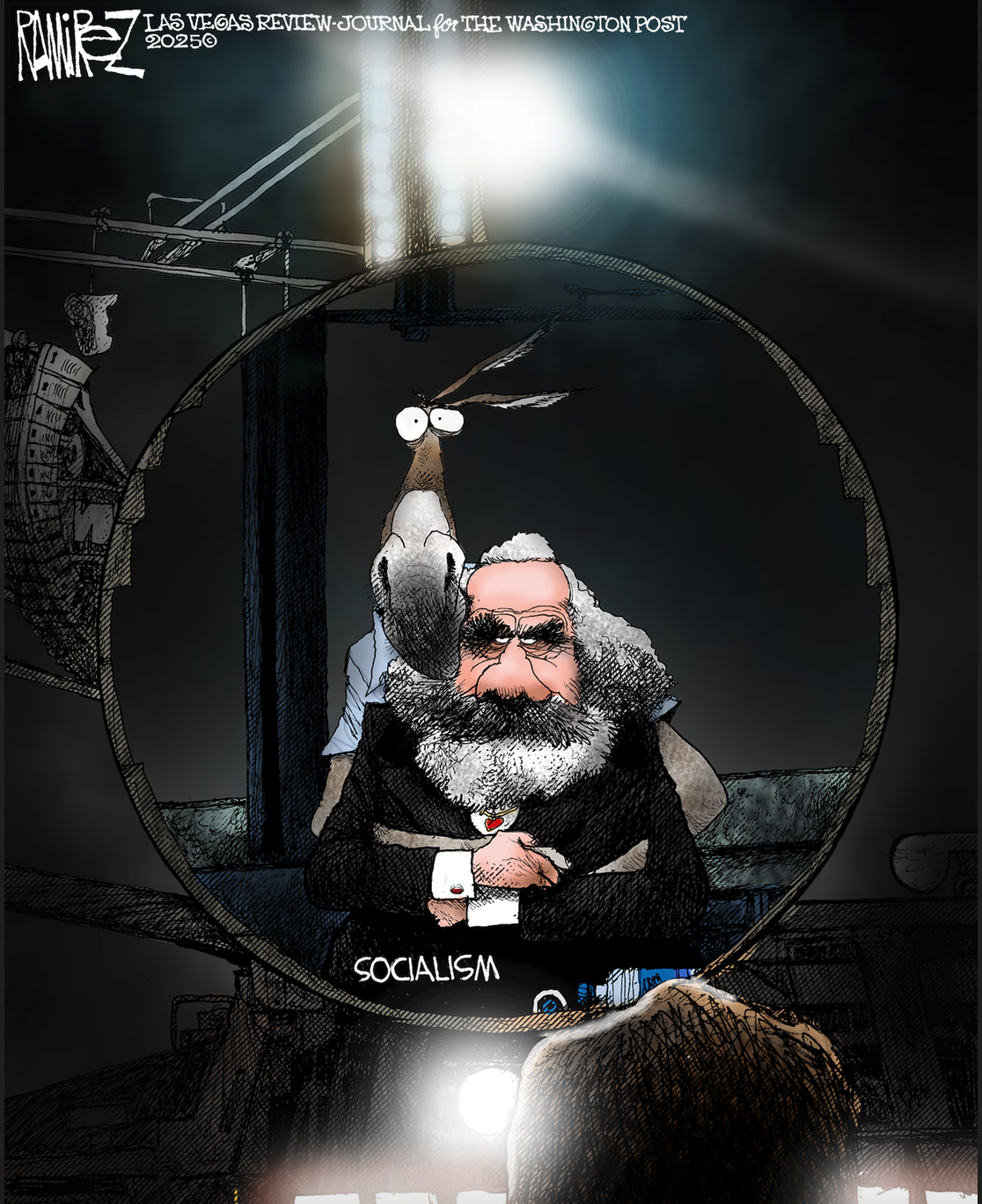


 Tipsy Teetotaler ن