Friday, 10/10/25

Nonpartisan

Levelers

Emily Ruddy was traveling the country with her new husband, Mike, when news reached them of Charlie Kirk’s shooting, then death:

Back in the car with Mike, approaching the Florida border, I’m looking at pictures of Charlie Kirk on my phone. He is staggeringly tall, taller than I ever realized, with a celebratory fist in the air. Reading his Wikipedia page, which has now been changed to past tense, I am reminded of a story I first read in middle school: Kurt Vonnegut’s “Harrison Bergeron.” The story is set in the late twenty-first century, in a dystopian America where the authorities have taken it upon themselves to ensure no person is better than another, be it in athleticism, intelligence, or beauty. The strong citizens get weighed down with bags of bird shot. The attentive citizens are intermittently bombarded with hideous sounds through tiny radios in their ears. The most beautiful faces are concealed by hideous masks.

But it’s the title character, Harrison Bergeron—exceptionally tall, handsome, brilliant and outspoken—who is shackled most heavily. At the end of the story he breaks through the shackles, and as punishment he is shot down on live TV: a warning to whoever tries to pull a similar stunt. Or at least, it would be a warning, if the viewers’ memories weren’t instantly blasted away by the ear radio’s next awful sound.

Emily Ruddy, Battle Above the Clouds.

If you haven’t read Harrison Bergeron, a (very) short story, by all means do. It’s freely available, like, for instance, here.

After Christian faith dies

The biggest confusion among my own students used to be rudderless moral relativism.  Although there is still a lot of that, it seems to be on the decline.  Now the problem is the explicit embrace of evil.  The suggestion that one must never do what is intrinsically evil for the sake of a good result is a hard sell.  Many of students are strongly attracted to “consequentialism,” the view that whether an act is right or wrong is determined only by the result.  To say that the ends do not justify the means puzzles them.

The decline of faith has also produced changes in character.  Young people who were raised in Christian homes, but then abandoned Christianity, often used to retain vestiges of their moral upbringing, and accepted such ideas as courtesy, love of neighbor, and the sacredness of innocent human life.  Today, having grown up in faithless homes, many seem to think that courtesy is for fools, that no one with whom they disagree is their neighbor, and that they should hate those they consider wrong instead of praying for their repentance and restoration.  As for the sacredness of innocent human life – for them, that idea went out when they embraced abortion.

I don’t spend much time asking what is going to happen, but I do ask what God would like me to do in my own place.  He sees the whole shape of things.  I can’t, but like a faithful bone, I can try to turn nimbly in the joint where I’m placed.

J Budziszewski, How Can I Think About the Assassination?

Budziszewski’s description of the decline of faith, as early as the second generation (the first generation of lapsed Christians lives on the vapors of the empty tank), is a description of devolution toward the “nasty, short and brutish” of pre-Christian antiquity.

If you think I’m just making a casual partisan slur, take a look at either of these two books, the first lengthy, the second shorter and more focused.

Wordplay

Frank Bruni’s back with recent favorite sentences. (Do not read this with beverages or food in your mouth.):

  • Also in The New Yorker, Jessica Winter read the infamous Jeffrey Epstein birthday book so that you and I don’t have to: “Sometimes it’s like you’ve discovered a rich man’s contract with the devil, and next to his signature, he’s drawn a little penis cartoon.” (Matthew Ferraro, East Providence, R.I.)
  • And Kelefa Sanneh, reporting from a recent Bad Bunny concert, described an ecstatic fan who “danced so vigorously with a decorative plant that he seemed to be trying to pollinate it.” (Bob Marino, Paris)
  • In The Los Angeles Times, Christopher Goffard tried to make sense of a former Los Angeles County sheriff’s rambling: “As he sat down to face questions from the feds, his sentences traveled winding paths through vague precincts to fog-filled destinations.” (Robin April Dubner, Oakland, Calif.)
  • In The Guardian, Bryan Armen Graham commiserated with the polite subgroup of American fans at an annual Europe-versus-United States golf tournament, who were too often “drowned out by the performative tough guys in flag suits and plastic chains who treat the Ryder Cup like a tailgate with better lawn care.” (John LeBaron, Acton, Mass.)
  • In The Dispatch, Nick Catoggio regarded the marks that President Trump and Defense Secretary Pete Hegseth made to military leaders last week as “a case of two men who radiate neurosis about their own toughness lecturing a roomful of actual tough guys about how to be tough. It had the feel of Pop Warner players scolding a group of N.F.L. linebackers about the importance of hustle.” (Glen T. Oxton, Mamaroneck, N.Y., and John Sabine, Dallas)
  • And John McWhorter analyzed the president’s loopy language: “Even Trump’s most positive-sounding coinages are acts of a certain kind of verbal aggression. I sometimes stop to marvel that the House passed something with the actual official title the One Big, Beautiful Bill Act. That goofy bark of a name is a boisterous clap back against opposing views, an attempt to drown out inconvenient facts with braggadocio. It is a linguistic snap of the locker room towel.” (Matt Masiero, Richmond, Mass., and Sue Hudson, Simi Valley, Calif., among many others)

Anarchism

[T]he essential practices of anarchism — negotiation and collaboration among equals — are ones utterly neglected and desperately needed in a society in which the one and only strategy seems to be Get Management To Take My Side.

Alan Jacobs, Should Christians be Anarchists?

Partisan

Transparent pretext

Trump’s remarks on the night of Kirk’s murder redefined violent incitement to include harsh criticism of judges. (“My administration will find each and every one of those who contributed to this atrocity and to other political violence, including the organizations that fund it and support it, as well as those who go after our judges, law-enforcement officials, and everyone else who brings order to our country.”) Now [aide Stephen] Miller himself is going after judges.

To call this “hypocrisy” is to engage Miller’s reasoning at a level upon which it does not operate. The essence of post-liberalism is the rejection of the notion that some neutral standards of conduct apply to all parties. Miller, like Trump, appears to believe his side stands for what is right and good, and his opponents stand for what is evil. Any methods used by Trump are ipso facto justified, and any methods used against him illegitimate.

A couple of weeks ago, Miller claimed that a disturbed gunman shooting Charlie Kirk impelled the government to crack down on the left. Now he says a handful of activists protesting ICE impel the government to crack down on the left.

Violence is not the cause of Trump and Miller’s desire to use state power to crush their opposition. It is the pretext for which they transparently long.

Jonathan Chait, Stephen Miller is Going for Broke

Bad faith

You can and should worry about American leaders at any level viewing their opponents as the enemy within, whether it’s the president of the United States or a random [Democratic] candidate for state AG. But if you’re more vocal about the latter than the former, forgive me for thinking you’re more interested in contriving a “both sides” equivalency to minimize what the White House is up to than you are about addressing the problem of incitement.

Two things are remarkable about [continuing troop deployments in “blue cities”]. One, which almost goes without saying, is that it’s another case of the Trump administration aiming to normalize unprecedented authoritarian shows of force. But the other is underappreciated: It’s all being done in bad faith, as a provocation, and quite plainly. There’s barely a pretense anymore of a colorable emergency like a riot that might justify the president deploying troops. He’s doing it unbidden and enthusiastically, looking for excuses to intimidate Democrats by symbolically occupying their cities with troops yanked from duty [and civilian jobs] in other states.

Needless to say, this is why the Trump White House didn’t get the benefit of the doubt from Judge Immergut on the Portland deployment, or from Judge Waverly Crenshaw on whether Kilmar Abrego Garcia was vindictively prosecuted. It’s also why the case against James Comey will end up in the toilet sooner rather than later. Courts have traditionally given the president and the Justice Department wide discretion in commanding the military and choosing whom to prosecute, but that’s because presidents traditionally haven’t given courts good reason to think they’re acting in bad faith.

Nick Catoggio, American versus American.

I look forward to the day when judges cease giving a “presumption of regularity,” of good faith, to the actions and legal arguments of this Administration. They have forfeited it because so much of what they do plainly is done in bad faith.

On keeping an impossible promise

Anyone with brown skin and the wrong kind of tattoo is therefore now at risk of being carted off to torture by the US government, with absolutely no safeguards that they have gotten the right people. Or do you think that an administration that confuses billions with millions, and puts classified intelligence on a Signal app, is incapable of making an error?

Andrew Sullivan, Two Perfect Months (March 2025)

I will give Trump “credit” for trying to keep his deportation campaign promise. The problems is, it’s impossible even for competent, non-malicious government workers to keep it (it included luridly-high numbers) without wholesale errors and ubiquitous denials of due process (i.e., in context, the process by which we assure that a person truly is subject to deportation under the law).

Your tax dollars at work

Short Circuits is a punchy weekly summary of notable Federal Court of Appeals decision, like this summary of activities by an ICE goon:

ICE agent escorting passenger from Dallas to Miami takes upskirt pictures and videos of flight attendant. He’s convicted of interfering with her flight-crew duties, sentenced to two years’ probation. Agent: I didn’t know that she was aware of my “clandestine video voyeurism,” and that’s an element of the crime. Eleventh Circuit (unpublished): It is not.

Divine retribution in Dallas

The covert operations of the Kennedys haunted Lyndon Johnson all his life. He said over and over that Dallas was divine retribution for Diem. “We all got together and got a goddamn bunch of thugs and we went in and assassinated him,” he lamented. In his first year in office, coup after coup wracked Saigon, a shadowy insurgency started killing Americans in Vietnam, and his fear that the CIA was an instrument of political murder festered and grew.

Tim Weiner, Legacy of Ashes

Rulebreaker

There are certain unwritten rules in American life, and one of them is that before your face is featured on the nation’s currency you are first obliged to die. There is no constitutional provision that mandates this, nor any law written tightly enough to guarantee it. But, as a general matter, we have shied away from putting living figures on our notes and coins, on the grounds that it is monarchical behavior and that the United States is not a monarchy. Unsurprisingly, this salutary tradition is not of great interest to the Trump administration, which intends to put an image of Trump on both sides of a commemorative $1 coin that will be produced for the 250th anniversary of the Declaration of Independence. On one side, Trump will appear in profile. On the other, he will appear pumping his fist, with the words “Fight Fight Fight” lining the coin’s perimeter. Answering questions about the plan, Trump’s press secretary, Karoline Leavitt, said that she was unsure if Trump had seen it, but that she was “sure he’ll love it.” He will. But that’s not really the important point, is it?

National Review week in review email.

Here’s a coin suggestion:


We are all gatekeepers now.

Peggy Noonan

Your enemies are not demonic, and they are not all-powerful and the right hasn’t always lost and the left hasn’t always won. But if you convince yourself of that, you give yourselves all sorts of permission to do a lot of stupid and terrible things under the rubric of “Do you know what time it is?”

Jonah Goldberg.

[A] critical mass of the American people … no longer want[s] to govern themselves, … are sick of this republic and no longer want to keep it if it means sharing power with those they despise.

Nick Catoggio

I don’t do any of the major social media, but I have two sub-domains of the domain you’re currently reading: (a) You can read most of my reflexive stuff, especially political here. (b) I also post some things on my favorite no-algorithm social medium.

New World Order

[H]ere’s the real takeaway: Tianjin is not just hosting another international gathering; it is hosting the embryonic headquarters of a new world order. When half of humanity convenes to discuss not how to obey the old hegemon, but how to craft sovereign industrial futures, the game has already shifted. The West, stuck in yesterday’s script of divide and rule, cannot grasp that the 21st century is already unfolding elsewhere – in Russian engines powering Chinese jets, in oil tankers sailing east, in Modi and Putin shaking hands against the backdrop of an Asia that is no longer waiting for permission. The SCO in Tianjin is Eurasia writing history, while the West scribbles in the margins of its own decline.

My cyberfriend Terry Cowan, commenting on Shangai Cooperation Organization (the SCO) meeting in Tianjin, China — without us. Here’s how a few of our mainstream media covered it (not that Terry thinks they’ve got much true to say):

Then, a day later, Trump exerted his charm:

Twenty-six heads of state joined Xi Jinping to watch a military parade in Beijing. They included many autocrats, including from Russia and North Korea, but no leaders of big Western democracies. Beforehand Mr Xi said mankind faced a choice between peace and war, and called China “unstoppable”. Donald Trump told China’s leader to “give my warmest regards to Vladimir Putin, and Kim Jong Un, as you conspire against The United States”.

The Economist World in Brief, Wednesday 9/3. Fuller Economist coverage here.

John Ellis channels the Financial Times:

Xi Jinping has capped a week of frenetic diplomacy by presiding over one of China’s biggest military parades, projecting his nation’s growing power in a show of solidarity with fellow strongmen Vladimir Putin and Kim Jong Un. A procession of China’s newest tanks, drones and missiles rolled past Tiananmen Square on Wednesday to mark the 80th anniversary of the second world war victory over Japan. The People’s Liberation Army showed off its latest weapons, including hypersonic missiles, with Xi hailing troops as a “heroic force” that should develop into a “world-class military” — implying a full equal to the US’s armed forces. The Chinese president said the PLA would “resolutely safeguard national sovereignty, unity and territorial integrity” — code for Beijing’s goal of gaining control over Taiwan. “The great rejuvenation of the Chinese nation is unstoppable,” Xi added. (Source: ft.com)

I’m not going to blame Donald Trump for all this. I have little doubt that his various tarrifs, trash-talking, vacillation and so forth accelerated it, but the American empire didn’t much rally under Joe Biden, either. We’re at an inflection point, and I expect us to be much closer to “bit player” than to “hegemon” when it’s over.


[A] critical mass of the American people … no longer want[s] to govern themselves, … are sick of this republic and no longer want to keep it if it means sharing power with those they despise.

Nick Catoggio

I don’t do any of the major social media, but I have two sub-domains of the domain you’re currently reading: (a) You can read most of my reflexive stuff, especially political here. (b) I also post some things on my favorite social medium.

Dateline, Weimar America, 8/28/25

CrackerBarrelGate

This story strikes me as stupid, stupid, stupid. Here, through the voices of others, is why.

The chain was founded in 1969 — not 1776. It adopted the country branding because down-home cooking and folksy kitsch were trendy back then, not because they were trying to restore America to the Good Ole Days. Now, the market has moved on, and Cracker Barrel has been trying to adapt …

We have confused brands with moral values, and we demand to see our politics reflected everywhere, even in restaurant signage. We have also confused social media with social lives. And alone with our screens, too many of us have become addicted to rage, mashing the refresh button for the dopamine that rushes through us every time we discover that someone, somewhere, is wrong on the internet.

The addiction is so consuming that when no ready source of rage is available, we start cooking up our own out of whatever we can find in the cupboard. But if the cupboard is really this bare, I suggest people put down the phone and head to Cracker Barrel, rock themselves to serenity in the chairs on the porch, then head inside for a delicious helping of hashbrown casserole.

Megan McArdle

This, too:

The Cracker Barrel farce … is the first case of “cancel culture” I’m aware of in which the accusers couldn’t articulate why the accused was being canceled. 

Which was to their advantage, I think. An offender charged with a particular thoughtcrime can answer the charge but an offender charged with nothing in particular has little choice but to surrender. Which is what the company did on Tuesday.

Christopher Rufo, probably the New Right’s most influential culture warrior, admitted that he’s never set foot in the restaurant but declared war on it nonetheless in the name of making an example of any business “considering any move that might appear to be ‘wokification.’”

“The Barrel must be broken,” he announced with no apparent irony. If a progressive culture warrior had said something as clownishly imperious, self-important, and Stalinist as that 10 years ago, right-wingers would still be making scornful jokes about it today.

Nick Catoggio.

In a Man-Bites-Dog story, Christopher Rufo recently wrote a little piece that was not knee-jerk shit-stirring! But this episode tells me he hasn’t really mended his ways.

I expect no better from Rufo, frankly, but Hillsdale College has no excuse — and no more respect from me, though I thought very highly of it ten years ago when it was, like I was and am, conservative, not Trumpist. (Two Hillsdale alums, who became expats for a while, were cool on their alma mater well before I was. I guess they read the signs: Hillsdale becoming a caricature of anti-woke education.)

Television rights, National rites

They will never do it, because it’s too tacky to bear, and they don’t need the money, but here’s an interesting thought exercise for media dorks: What would the price be if Swift and Kelce were to sell the live rights to their wedding for television? 

We know the NFL collects more than $110 million for a single playoff game—that’s what Peacock paid, and that was two whole years ago. Your standard live sports deal now hits 10 figures, easy. March Madness gets a billion annually to show college kids bricking 3-pointers. Paramount is set to pay more than $1 billion a year for humans pounding each other inside a steel cage.

A Swift-Kelce nuptial is bigger than all of that, mainly because of Swift, whose fame is vast and fierce, and if you don’t believe that, try criticizing one of her singles on Reddit sometime. There would be outrageous interest for both a live telecast and repeat viewing—you could do remixes, Taylor’s versions, on and on.

I think $500 million. That would be the absolute floor.

Jason Gay, Wall Street Journal

My better half wants a televised wedding opposite the State of the Union address, but that would reduce revenues quite a bit.

That is, I suppose it would reduce revenues. Who knows? I didn’t even know that Travis Kelce wasn’t a quarterback.

Nobel Laureate

FBI agents searched the Maryland home and Washington, D.C., office of former national security adviser John Bolton on Friday morning, reportedly as part of an investigation into his potential mishandling of classified documents. Bolton was not charged or detained during the operation. President Donald Trump—who revoked Bolton’s security clearance and Secret Service protection days into his second term—told reporters he had no prior knowledge of the searches but described Bolton, who has been a sharp critic of Trump in recent years, as “a real sort of a low life” and “not a smart guy.”

The Morning Dispatch

Congratulations, Mr. Bolton! Being described by Donald Trump as “a real sort of a low life” and “not a smart guy” is like winning a Nobel Prize for Integrity and Rectitude.

UPDATE: Even a blind pig finds the occasional acorn, or even a truffle: John Bolton Inquiry Eyes Emails Obtained by Foreign Government – The New York Times. So maybe Bolton actually, technically kinda broke a law. “Show me the man and I’ll show you the crime” (Lavrentiy Beria, Soviet secret police chief).

The most miserable habitation in the world

The fundamental structural problem of our government during the Trump administrations is this: our constitution assumed the George Washington was President. It assumed that our high officials would be men of high character, virtuous men. It assumed that of the American people as well.

So John Adams was dead right in this quote, the last sentences of which are fairly well-known:

While our country remains untainted with the principles and manners which are now producing desolation in so many parts of the world; while she continues sincere, and incapable of insidious and impious policy, we shall have the strongest reason to rejoice in the local destination assigned us by Providence. But should the people of America once become capable of that deep simulation towards one another, and towards foreign nations, which assumes the language of justice and moderation while it is practising iniquity and extravagance, and displays in the most captivating manner the charming pictures of candor, frankness, and sincerity, while it is rioting in rapine and insolence, this country will be the most miserable habitation in the world; because we have no government armed with power capable of contending with human passions unbridled by morality and religion. Avarice, ambition, revenge, or gallantry, would break the strongest cords of our Constitution as a whale goes through a net. Our Constitution was made only for a moral and religious people. It is wholly inadequate to the government of any other.

John Adams, October 11, 1798

This President of the United States is not a virtuous man, but a vicious one. Empowered by shrewd and evil advisors (no more “adults in the room”) and motivated by avarice, ambition, and revenge, he is the whale breaking through the net, pushing the “unitary executive theory” (which wouldn’t be a problem were George Washington President) to the breaking point, turning the Department of Justice into the Department of Revenge and now trying to take over the Federal Reserve System – the better to blow a bubble from the bursting of which we may never recover.

I’m not going to resume lamenting what else bothers me about this administration (David French has some of the receipts), but I thought the fundamental problem, though it is not my original insight, might be helpful to pass along.

Do we have any reason to hope that men and women of high virtue will fill the Oval Office and Congress come 2029?

To be a conservative in 2025 …

To be a conservative in 2025 is to be politically homeless—but perhaps not entirely politically friendless.

At home, the party of Donald Trump—the party of J.D. Vance and Ted Cruz and Marco Rubio and Tucker Carlson, not to mention supposed normies such as Mike Pence, et al.—currently is engaged in answering a question I hadn’t thought anyone was asking: “What would national socialism look like if antisemitism were less of a political priority?”

Kevin D. Williamson

Apropos of the first paragraph, the bulk of Williamson’s column is about how liberals-in-the-American-polarity-sense are starting to discover some timeless truths that just might allow conservatives to become allies if not intimates.

On that lone hopeful note, adieu!


Nick Catoggio:

[A] critical mass of the American people … no longer want[s] to govern themselves, … are sick of this republic and no longer want to keep it if it means sharing power with those they despise.

I don’t do any of the major social media, but I have two sub-domains of the domain you’re currently reading: (a) You can read most of my reflexive stuff, especially political here. (b) I also post some things on my favorite social medium.

TDS, 8/8/25

Vibes all the way down

Trump, Claiming Weak Jobs Numbers Were ‘Rigged,’ Fires Labor Official
Economists said ousting the head of the Bureau of Labor Statistics could undermine confidence in government economic data.

New York Times

As Trump testified once in court

My net worth fluctuates, and it goes up and down with the markets and with attitudes and with feelings, even my own feelings … Yes, even my own feelings, as to where the world is, where the world is going, and that can change rapidly from day to day.

Some data, such as the number of votes he received at the polls in 2020, initially refused to budge. But with a little bit of threatening from some extra-patriotic patriots, the election turned out to have been a Trump blowout. Just ask any elected Republican; they’ll tell you!

Fumbling around in a fog of vibes and misinformation and things you saw on Fox News is good enough for the president; why should the rest of us ask for anything better? Soon, no one will know what is happening—what the problem is, or what remedies to apply. What sectors are booming and which are contracting, whether interest rates should be higher or lower, whether it’s hotter or colder than last year, whether mortality has gone up or gone down. It will be vibes all the way down. Soon we will all be bumping around helplessly in the dark.

That’s a good thing …

Alexandra Petri

Comprehensively failing the Solzhenitsyn test

In his 1970 Nobel lecture, Aleksandr Solzhenitsyn said, “You can resolve to live your life with integrity. Let your credo be this: Let the lie come into the world, let it even triumph. But not through me.” The problem presently before the United States is that the Trump administration will be staffed in its upper reaches by political appointees who, without exception, have failed this test.

To get their positions, these men and women have to be willing to declare, publicly if necessary, that Donald Trump won the 2020 election and that the insurrectionary riot of January 6, 2021, was not instigated by a president seeking to overturn that election.

Eliot A. Cohen

I’ve wondered how Republicans lost their balls. Apparently Putin got them and added them to his own:

Trump Has Soured on Putin. Putin Couldn’t Care Less.

Killing the messengers

Terminating BLS Commissioner Erika McEntarfer because her agency delivered bad news on the economy is the most cartoonishly banana republic move Trump has pulled in his second term so far (that is, apart from shipping people off to prison in an actual banana republic without due process to be abused).

His reaction to the latest jobs report isn’t much different, in fact, from his reaction to the early spread of COVID in the United States in 2020. “If we stop testing right now, we’d have very few cases, if any,” the president famously complained. Then, as now, when confronted with information that might create trouble for him, his instinct is to suppress it.

There’s a fourth way in which firing McEntarfer was stupid. Ironically, a weak jobs report combined with downward revisions of the May and June numbers greatly strengthens the president’s case to the Fed to lower interest rates. But Trump couldn’t seize the obvious opportunity here because his narcissism wouldn’t let him: He’d rather pretend that job growth is stronger than the BLS believes, undercutting his own argument for a rate cut, than allow that the economy is cooling off and needs some heat.

Stupid, stupid, stupid, stupid.

Nick Catoggio

If the President can fire the head of BLS, an agency whose purpose is the nonpartisan and objective collection, distillation and publication of economic data, I may need to think the Unitary Executive theory. Donald Trump’s willfulness will do that to you.

Four (more) flavors of stupid

“If there’s anything more important than my ego around, I want it caught and shot now.”

One of the major difficulties Trillian experienced in her relationship with Zaphod was learning to distinguish between him pretending to be stupid just to get people off their guard, pretending to be stupid because he couldn’t be bothered to think and wanted someone else to do it for him, pretending to be outrageously stupid to hide the fact that he actually didn’t understand what was going on, and really being genuinely stupid.

Douglas Adams, The Hitchhiker’s Guide to the Galaxy, quoting Zaphod Beeblebrox.

Hegseth’s stewardship of our military

Secretary of Defense Pete Hegseth, surely suffering from imposter syndrome, is systematically stripping military education of humanizing and broadening elements. Hegseth’s Headlong Pursuit of Academic Mediocrity. (gift link)

Cohen is not exaggerating. What could better illustrate David Brooks’s unsurpassed distillation of Trumpism:

Trumpism can be seen as a giant attempt to amputate the highest aspirations of the human spirit and to reduce us to our most primitive, atavistic tendencies.

Power is in the pain and humiliation

George Orwell is a useful guide to what we’re witnessing. He understood that it is possible for people to seek power without having any vision of the good. “The Party seeks power entirely for its own sake,” an apparatchik says in 1984. “We are not interested in the good of others; we are interested solely in power. Not wealth or luxury or long life or happiness: only power, pure power.” How is power demonstrated? By making others suffer. Orwell’s character continues: “Obedience is not enough. Unless he is suffering, how can you be sure that he is obeying your will and not his own? Power is in inflicting pain and humiliation.”

David Brooks, I Should Have Seen This Coming

Attacks on Judges

[N]ever forget this: Whenever you see a public attack on a judge, know that it is like a signal flare. It galvanizes some of the worst people in America to make threats, dox family members and harass public officials into a state of fear and misery.

David French on the explosion of death threats against Judges, their families, and their loved ones. (shared link)


Your enemies are not demonic, and they are not all-powerful and the right hasn’t always lost and the left hasn’t always won. But if you convince yourself of that, you give yourselves all sorts of permission to do a lot of stupid and terrible things under the rubric of “Do you know what time it is?”

Jonah Goldberg.

I don’t do any of the major social media, but I have two sub-domains of the domain you’re currently reading: (a) You can read most of my reflexive stuff, especially political here. (b) I also post some things on my favorite social medium.

Tuesday Tasties, 8/5/25

Do better, Republicans

I try not to overdo on politics, but I consider my first two items today tacit moral admonitions. I don’t even think that their factual predicates are open to honest dispute.

Vibes all the way down

Trump, Claiming Weak Jobs Numbers Were ‘Rigged,’ Fires Labor Official
Economists said ousting the head of the Bureau of Labor Statistics could undermine confidence in government economic data.

New York Times

As Trump testified once in court

My net worth fluctuates, and it goes up and down with the markets and with attitudes and with feelings, even my own feelings … Yes, even my own feelings, as to where the world is, where the world is going, and that can change rapidly from day to day.

Some data, such as the number of votes he received at the polls in 2020, initially refused to budge. But with a little bit of threatening from some extra-patriotic patriots, the election turned out to have been a Trump blowout. Just ask any elected Republican; they’ll tell you!

Fumbling around in a fog of vibes and misinformation and things you saw on Fox News is good enough for the president; why should the rest of us ask for anything better? Soon, no one will know what is happening—what the problem is, or what remedies to apply. What sectors are booming and which are contracting, whether interest rates should be higher or lower, whether it’s hotter or colder than last year, whether mortality has gone up or gone down. It will be vibes all the way down. Soon we will all be bumping around helplessly in the dark.

That’s a good thing …

Alexandra Petri

Comprehensively failing the Solzhenitsyn test

In his 1970 Nobel lecture, Aleksandr Solzhenitsyn said, “You can resolve to live your life with integrity. Let your credo be this: Let the lie come into the world, let it even triumph. But not through me.” The problem presently before the United States is that the Trump administration will be staffed in its upper reaches by political appointees who, without exception, have failed this test.

To get their positions, these men and women have to be willing to declare, publicly if necessary, that Donald Trump won the 2020 election and that the insurrectionary riot of January 6, 2021, was not instigated by a president seeking to overturn that election.

Eliot A. Cohen

I’ve wondered how Republicans lost their balls. Apparently Putin got them and added them to his own:

Trump Has Soured on Putin. Putin Couldn’t Care Less.

Culture more broadly

Not “what” but “whether”

[W]e’re well past canon wars at this point. The question isn’t what people are going to read on the other side of the bottleneck; it’s whether they’re going to read anything at all. If you want a perfect example of not getting it, consider the conservatives complaining about books assigned in K-12 schools, and the liberals complaining about book-bans. How can either side keep pretending that the problem is with what students are reading? The world in which that debate made sense no longer exists. Even at elite universities, nobody reads books anymore.

If we are indeed entering a “new dark age” – one full of “shining devices” and for that reason mostly empty of literate persons – then Christian institutions today may have a similar mission to fulfill: saving the best of the secular world from the new bottleneck of technological “progress.” Maybe in the future it will only be students at Christian universities who read Freud and Marx and Nietzche and all the other great anti-Christian thinkers, because it will only be students at Christian universities who still read anything at all.

Adam Smith in Christian Scholars Review.

Shedding Enlightenment Values

When readers interact imaginatively with a book, they are still following the book’s lead, attempting to answer the book’s questions, responding to the book’s challenges and therefore putting their own convictions at risk.

When we interact with A.I., on the other hand, it is we who are driving the conversation. We formulate the questions, we drive the inquiry according to our own interests and we search, all too often, for answers that simply reinforce what we already think we know. In my own interactions with ChatGPT, it has often responded, with patently insincere flattery: “That’s a great question.” It has never responded: “That’s the wrong question.” It has never challenged my moral convictions or asked me to justify myself.

David A. Bell, A.I. Is Shedding Enlightenment Values


Your enemies are not demonic, and they are not all-powerful and the right hasn’t always lost and the left hasn’t always won. But if you convince yourself of that, you give yourselves all sorts of permission to do a lot of stupid and terrible things under the rubric of “Do you know what time it is?”

Jonah Goldberg.

Trumpism can be seen as a giant attempt to amputate the highest aspirations of the human spirit and to reduce us to our most primitive, atavistic tendencies.

David Brooks

I don’t do any of the major social media, but I have two sub-domains of the domain you’re currently reading: (a) You can read most of my reflexive stuff, especially political here. (b) I also post some things on my favorite social medium.

Pure politics, 6/5/25

The Courts

Petulant Trump disavows his signature success (1)

Mr. Trump lashed out at the Federalist Society, blaming it for bad advice on whom to appoint to judgeships. He singled out Leonard Leo, a former longtime leader of the Federalist Society who helped recommend his first-term nominees and who exemplifies the conservative legal movement.

“I was new to Washington, and it was suggested that I use the Federalist Society as a recommending source on judges,” the president wrote. “I did so, openly and freely, but then realized that they were under the thumb of a real ‘sleazebag’ named Leonard Leo, a bad person who, in his own way, probably hates America, and obviously has his own separate ambitions.”

Mr. Leo and Mr. Trump had a falling out in 2020, but the personal attack was a sharp escalation. In a statement, Mr. Leo said, “I’m very grateful for President Trump transforming the federal courts, and it was a privilege being involved.”

Still, Mr. Trump’s tirade strained an already uneasy relationship with traditional legal conservatives.

Many share the president’s goals of strengthening border security, curbing the administrative state and ending “diversity, equity and inclusion” programs, said John Yoo, a conservative law professor. But, he added, they dislike some of Mr. Trump’s methods, whether that is prolifically invoking emergency powers or insulting judges who rule against his administration.

And Professor Yoo, who wrote memos advancing sweeping theories of presidential power as a Bush administration lawyer, said Mr. Trump’s attacks on Mr. Leo were “outrageous.”

“Calling for the impeachment of judges, attacking Leonard Leo personally and basically calling him as traitor as far as I can tell — Trump is basically turning his back on one of his biggest achievements of his first term,” he added, referring to the reshaping of the federal judiciary.

Charlie Savage, Trump, Bashing the Federalist Society, Asserts Autonomy on Judge Picks

For what it’s worth, Trump’s pledge to appoint federal judges from a list compiled by Leonard Leo (not the Federalist Society, which doesn’t do endorsements) was pivotal to his 2016 Election victory, especially among abortion foes who understandably did not trust a twice-divorced narcissist playboy with gambling and porn connections. Charlie Savage hasn’t forgotten that, but I shouldn’t quote his whole article.

If the Senate has a couple of Republicans with integrity, hack appointees like Emil Bove will not be confirmed. C’mon, guys! Save him from himself!

Petulant Trump disavows his signature success (2)

There are many stories in literature about people making deals with the devil. Weirdly, in most of them the devil is a square dealer.

That is, he keeps up his end of the bargain. He offers the protagonist wealth or power in exchange for something ethereal, like their immortal soul, and when they agree he delivers. The Prince of Lies turns out not to be a swindler. Most of the drama happens after he makes good on his promise and comes to collect.

The moral of those stories isn’t that you’re a fool to trade with Beelzebub because you’ll be cheated. It’s that you’re a fool to sacrifice your noblest self for something as fleeting as worldly power.

Conservatives made a deal like that in 2016. Donald Trump offered to stock the federal judiciary with their favorite judges, beginning with the vacancy left by Antonin Scalia on the Supreme Court; in return they would set aside their moral, civic, and ideological objections to him and support him in virtually anything he wanted to do, even if it affronted their conservative beliefs. Or basic decency.

The bargain was struck—and he delivered. Three eminent conservative jurists were added to the Supreme Court. Hundreds more were confirmed to federal appellate and district courts. The great white whale of social conservatism, Roe v. Wade, was harpooned in 2022 after a 50-year chase. Many other landmark legal victories for the American right have accumulated since Trump took office in 2017.

Conservatives weren’t cheated. The devil made good.

Fast-forward to last night …

[Leonard] Leo spent many years as the Federalist Society’s sherpa on judicial nominees, advising Republican presidents on whom to appoint and helping to shepherd candidates through the confirmation process. With the exception of Mitch McConnell, no one has done more this century to build a federal bench of originalist judges. But Trump didn’t want originalists—he wanted flunkies—and so Leo’s influence, and the influence of the organization he serves, have gone up in smoke …

Conservatives got the judiciary they wanted in exchange for supporting a man who radiates contempt for the constitutional order. In doing so, they empowered a postliberal movement that despises judges who do their jobs conscientiously instead of dutifully midwifing a Trumpist autocracy. As the Republican Party proceeds further down the path to fascism that those conservatives enabled, eventually the federal judiciary will consist entirely of believers in the “living Constitution,” half authoritarian and half progressive. In the long run, as Reaganites age out and are replaced by younger Trumpists, conservative judges as we’ve known them will go mostly extinct.

That’s what conservatives got for their bargain. The devil has come to collect.

Nick Catoggio

Pardons

The concept of a pardon, of course, is extremely hard for Trump to understand. Traditionally, a pardon is due to someone who has completed (or nearly completed) their sentence, expressed remorse, and turned their life around — and thereby been the recipient of mercy. But remorse is a concept unknown to a pathological narcissist. Mercy is even stranger. After all, who wins and who loses in an act of mercy? It’s one of those acts defined by grace — another literally meaningless concept for Trump. For him, all human conduct is built on a zero-sum, winner-vs-loser foundation. So a pardon is always instrumental — a way to reward allies, win credits, and enlarge his power by announcing to the world that he alone is the ultimate rule of law, and can intervene at any point to ensure his version of justice is the dispositive one. A monarch, in other words.

But Trump is the real outlier (and Biden, in his defense, used Trump’s abuse as a justification for his own self-dealing). In recent times he’s out in front in numbers: more than 1,700 full pardons so far, and we have three-and-a-half years to go. Nixon’s 863, Carter’s 574, Clinton’s 396, W’s 189, and Obama’s 212 put it in perspective. But these previous presidents abused the power occasionally — it’s an absolute power after all — while largely respecting the contours of the rule of law.

Trump has dispensed with any pretense of that. He is an instinctual tyrant — see his immigration overreach and his unilateral tariff mania — and the pardon power was almost made for him. The weakness of any constitution is the virtue — or, more often, the lack of it — in its office-holders. And Trump has the civic virtue of Jeffrey Epstein. The pardon power was always going to be a loaded gun in his tiny, careless hands.

… [H]e is using the pardon power all the time, rather than waiting till the end of his term. It replaces the rule of law with monarchical discretion. That’s why he could not tolerate Jeff Sessions all those years ago. Because Sessions, for all his passionate partisanship, still understood the system he was operating in and still believed that the appearance of impartial justice was integral to liberal democracy’s survival. Sessions was an American.

A majority of the American electorate, mind you, endorsed this lawlessness last November. It’s hard to pity them, as they absorb or ignore all the corruption they voted for and are still content to tolerate. They love crypto-monarchy as long as their king is on the throne. They do not seem to understand that this version of monarchy is still an elected one, and that another king from the other tribe may wear the crown some day. They may miss the benefits of liberal democracy once they have succeeded in killing it.

Andrew Sullivan, Pardon The Death Of Liberal Democracy

TACO

I’m not an active investor. I tend to buy and hold Mutual Funds and ETFs. (That’s just me; you do you.) But it did not escape my notice, even before the term was coined, that what’s now dubbed “TACO trades” could be profitable.

Wall Street is all over the “TACO trade,” another instance of people realizing they shouldn’t take the president at face value. “TACO” is short for “Trump always chickens out.” Markets have tended to go down when Trump announces new tariffs, but investors have recognized that a lot of this is bluffing, so they’re buying the dip and then profiting off the inevitable rally.

A reporter asked Trump about the expression on Wednesday, and he was furious. “I chicken out? I’ve never heard that,” he said. “Don’t ever say what you said. That’s a nasty question. To me, that’s the nastiest question.” The reaction demonstrates that the traders are right, because—to mix zoological metaphors—a hit dog will holler. The White House keeps talking tough about levying new tariffs on friends and geopolitical rivals alike, but Trump has frequently gone on to lower the measures or delay them for weeks or months.

Foreign leaders had figured out that Trump was a pushover by May 2017, and a year later, I laid out in detail his pattern of nearly always folding. He’s a desirable negotiating foil, despite his unpredictable nature, because he doesn’t tend to know his material well, has a short attention span, and can be easily manipulated by flattery. The remarkable thing is that it’s taken this long for Wall Street to catch on.

David A. Graham, The TACO Presidency

Now that the cat’s out of the bag, the profitability will diminish and what’s left will mostly be the pleasure of annoying Velveeta Voldemort.

The most incompetent administration ever

A federal appeals panel ordered officials not to deport a 31-year-old to El Salvador. Minutes later, it happened anyway. The government blamed “administrative errors.”

Alan Feuer, NYT

Will Trump pay any price for this fishy string of “administrative errors”?

Among his voters, I doubt it. But with the courts, the toll is steep and rising. They just cannot believe anything Administration lawyers promise. And they shouldn’t.

DJT, the anti-conservative

[I]t’s hard to think of a more anti-conservative figure than President Donald Trump or a more anti-conservative movement than MAGA. Trump and his supporters evince a disdain for laws, procedures, and the Constitution. They want to empower the federal government in order to turn it into an instrument of brute force that can be used to reward allies and destroy opponents.

Trump and his administration have abolished agencies and imposed sweeping tariffs even when they don’t have the legal authority to do so. They are deporting people without due process. Top aides are floating the idea of suspending the writ of habeas corpus, one of the most important constitutional protections against unlawful detention. Judges, who are the target of threats from the president, fear for their safety. So do the very few Republicans who are willing to assert their independence from Trump.

In one of his first official acts, Trump granted clemency to more than 1,500 people charged in connection with the violent attack on the Capitol on January 6, 2021, including those convicted of seditious conspiracy. The president and his family are engaging in a level of corruption that was previously unfathomable. And he and his administration have shown no qualms about using the federal government to target private companies, law firms, and universities; suing news organizations for baseless reasons; and ordering criminal probes into former administration officials who criticized Trump.

The Trump administration is a thugocracy, and the Republican Party he controls supports him each step of the way. Almost every principle to which Republicans once professed fealty has been jettisoned. The party is now devoted to the abuse of power and to vengeance.

The significance of this shift can hardly be overstated. A party that formerly proclaimed allegiance to the Constitution and the rule of law, warned about the concentration and abuse of power, and championed virtue, restraint, and moral formation has been transmogrified. The Republican Party now stands for everything it once loathed.

Peter Wehner

Thugocracy update

And she has been frank about the dilemma faced by Republicans like her who are dismayed about the president’s policies and pronouncements but worried that speaking out about them could bring death threats or worse.

“We are all afraid,” she told constituents in April, adding: “I’m oftentimes very anxious myself about using my voice, because retaliation is real. And that’s not right.”

Catie Edmondson, Lisa Murkowski Isn’t Using ‘Nice Words’ About Life Under Trump

I do acknowledge threats against Trump’s life, too. Several isolated nuts have been arrested and charged. But it seems to me that a President and his supporters holding Congress hostage for fear of their lives is an order of magnitude worse.

No laughing matter

Next month will be the first anniversary of Tim Walz’s branding of Donald Trump, JD Vance and, by implication, some of their political associates as “weird,” and it’s obvious now that Walz spoke too soon, before Trump won in November and his administration turned weirdness into a credential and an operating principle, before weirdness started afflicting Trump allies who seemed a little less weird in the past, before episodes of Trump-adjacent weirdness proliferated.

… [T]his pageant of peculiarity isn’t a laughing matter. It reflects Trump’s confusion of nonconformity with boldness. It speaks to his love of performance, even if it’s the fruit of a loopy performer. It demonstrates his desire to rattle, no matter how infantile the rattling.

Frank Bruni

Same column, change of topic:

If I’m subjected to one more lamentation, one more rant, about how lost and pitiable and shameful the Democratic Party is, my head is going to explode. Not because the Democratic Party is in good shape — it isn’t. Not because it can make do with only minor adjustments — it can’t. It’s guilty of the arrogance and incompetence of which it’s accused. And the country’s future as a reasonably healthy and prosperous democracy depends on Democrats’ recognition and remedy of that.

But some of the extravagant lashing of the party carries the implicit suggestion that Republicans, by contrast, have their act together. Excuse me? If success at the polls is the only metric for that, then sure, yes, they’re in an enviable spot. But it’s a wretched (and, I have to believe, vulnerable) one. Republican lawmakers who rightly gaped in horror at the events of Jan. 6, 2021, later developed collective amnesia, putting power several light-years above principle. They then indulged or outright applauded Trump’s laughable cabinet picks and his adoration of Musk and his cockamamie tariffs and his abandonment of due process and his swag from Qatar and his sadistic humiliation of President Volodymyr Zelensky of Ukraine and so many other cruelties and outrages that this sentence could go on forever. I struggle to admire Republicans’ political chops. I’m too distracted by their moral rot.

For love of sentences

In Esquire, Dave Holmes marveled at Senator Lindsey Graham’s suggestion, in a social media post before the conclave, that cardinals consider the idea of Trump as the next pope: “I guess he had not yet closed the day’s humiliation ring on his Apple Watch.” Holmes added that while Graham was probably joking, “You can’t be tongue-in-cheek when you are actively licking the boot. There is just not enough tongue for both jobs.” (Susan Fitzgerald, Las Cruces, N.M.)

Frank Bruni (a prior week)

Dissing the Dems

I confess that my laser-focus on Trump can sound like excusing the Democrats’ problems. It really isn’t. I’m just madder at my former party than at the I party whose Presidential nominee I voted for only once, 53 years ago.

An Andrew Sullivan podcast this week with the authors of Original Sin reminded me of just how screwed we are in the other of our major-party choices, the Dems, and how Joe Biden fooled me with his “nice guy” schtick. Though I didn’t vote for him, I would have done so if my fair state hadn’t been a lock for Trump.

Hypocrisy

Hypocrisy is the tribute paid to virtue by vice.

I will give Trump 2.0 credit for not adding hypocrisy to its countless other sins.

On second thought, his attacks on Ivy League universities for suffering antisemites gladly may qualify.

The best jokes

It has been said that the best jokes are dangerous because they are in some way truthful.

On Wednesday, a dangerous joke was told in the Oval Office. The South African president turned to the American president and said: “I’m sorry I don’t have a plane to give you.”

NYT

FWIW

  • Trump lost 96% of federal court cases in May. Even GOP-appointed judges ruled against him 72% of the time,” – Jack Hopkins.
  • “The Washington Post has now confirmed that it was Trump who asked the Qataris to gift him the plane for free (rather than the Qataris offering it), and that Qatar is demanding a written memo from the White House to this effect before the deal is finalized,” – Tom Malinowski.

Andrew Sullivan, Pardon The Death Of Liberal Democracy

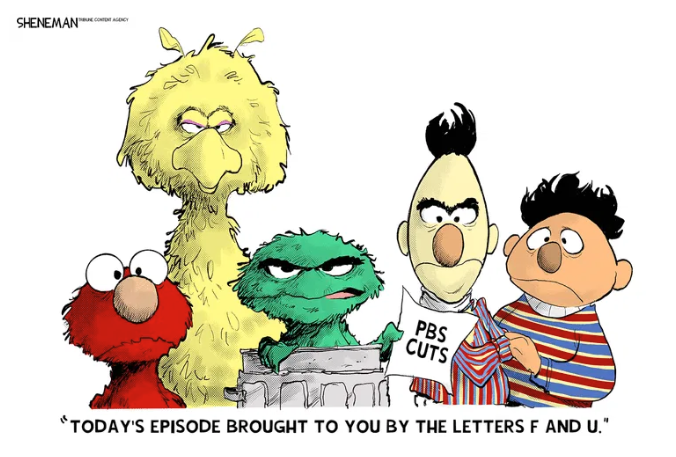
PBS

… and by the numbers 86 and 47.


Your enemies are not demonic, and they are not all-powerful and the right hasn’t always lost and the left hasn’t always won. But if you convince yourself of that, you give yourselves all sorts of permission to do a lot of stupid and terrible things under the rubric of “Do you know what time it is?”

Jonah Goldberg.

Trumpism can be seen as a giant attempt to amputate the highest aspirations of the human spirit and to reduce us to our most primitive, atavistic tendencies.

David Brooks)

I don’t do any of the major social media, but I have two sub-domains of the domain you’re currently reading: (a) You can read most of my reflexive stuff, especially political here. (b) I also post some things on my favorite social medium. I am now exploring Radiopaper.com as well.


Political 5/30/25

What it takes to tick off David Brooks

Last Monday afternoon, I was communing with my phone when I came across a Memorial Day essay that the Notre Dame political scientist Patrick Deneen wrote back in 2009. In that essay, Deneen argued that soldiers aren’t motivated to risk their lives in combat by their ideals. He wrote, “They die not for abstractions — ideas, ideals, natural right, the American way of life, rights, or even their fellow citizens — so much as they are willing to brave all for the men and women of their unit.”

This may seem like a strange thing to get angry about. After all, fighting for your buddies is a noble thing to do. But Deneen is the Lawrence Welk of postliberalism, the popularizer of the closest thing the Trump administration has to a guiding philosophy. He’s a central figure in the national conservatism movement, the place where a lot of Trump acolytes cut their teeth.

In fact, in his acceptance speech at the Republican National Convention, JD Vance used his precious time to make a point similar to Deneen’s. Vance said, “People will not fight for abstractions, but they will fight for their home.”

Elite snobbery has a tendency to set me off, and here are two guys with advanced degrees telling us that regular soldiers never fight partly out of some sense of moral purpose, some commitment to a larger cause — the men who froze at Valley Forge, the men who stormed the beaches at Normandy and Guadalcanal.

But that’s not what really made me angry. It was that these little statements point to the moral rot at the core of Trumpism, which every day disgraces our country, which we are proud of and love. Trumpism can be seen as a giant attempt to amputate the highest aspirations of the human spirit and to reduce us to our most primitive, atavistic tendencies.

Mild-mannered David Brooks, popping a vein (shared link, bold added).

The rest of the column was quite good, but the idea that a primitive, atavistic President would deploy his “throne-sniffing sycophants” (H/T Kevin D. Williamson, below) to reduce the nation to primitive atavism struck me as (a) too sophisticated conceptually, but perfect temperamentally, for Trump (a “stupid, lazy and angry” man — Kevin D. Williamson again); (b) exactly what his smart and unprincipled intimates would realize is necessary for their success; and (c) the kind of radical moral rot that Brooks sniffs out and exposes to us all.

And for his ability to distill evils to their essence, I am grateful.

Stupid, lazy and angry

We’ve been here before, of course. Donald Trump and his team have been three weeks away from announcing a groundbreaking new health care plan for … what, just about a decade now? Donald Trump’s confidence in addressing a complex subject has a linear relationship to his ignorance regarding that subject, and so we have got gems like this presidential declaration of ineptitude: “Nobody knew that health care could be so complicated.” It isn’t the case that nobody knew—lots of people knew. Some of those people had good ideas, some had terrible ideas, but they knew it was complicated. The guy who didn’t know? The one who spent most of his life as a Manhattan gadfly, a game-show host with side hustles in pro wrestling and porn. That guy didn’t know.

There are no conspiracies. There are no secrets. Everything is more or less what it seems. … [T]he obvious explanation for Trump’s eccentricity (or most anything else) is almost always the correct explanation. Which is why I have been writing for all these years that the key to understanding the Trump administration is that its central figure, Donald Trump, is stupid, lazy, and angry …

There are people around Trump, such as Marco Rubio and J.D. Vance, who are not stupid or lazy (though both are distinctly angry men) but are functionally indistinguishable from the stupid and the lazy because they are throne-sniffing sycophants who dread a return to the private sector more than almost anything else in this life.

It’s all right there to see: Trump, the supposed master negotiator, is as a matter of practical fact able to effectively negotiate exclusively in situations in which no substantial negotiation is required: with people he can fire, for example, or with utterly dependent parties. He calls this “negotiating from a position of strength” instead of “bossing around your cowering flunkies.”

Kevin D. Williamson

It didn’t take long for the courts to figure this out

The Abrego Garcia ruling and the Alien Enemies Act litigation have left legal scholars warning of a constitutional crisis. But a more tangible effect, attorneys told me, has been the erosion of the “presumption of regularity”—the benefit of the doubt given to the government in court proceedings. It’s based on the idea that federal officers and attorneys are operating in good faith, and not trying to achieve political goals through acts of subterfuge.

As judges see the administration saying one thing in public and another in court, they have started to treat the government’s claims with more skepticism and, sometimes, with outright suspicion of criminal contempt. A recent Bloomberg analysis found that the Trump administration has been losing the majority of its immigration-related motions and claims, regardless of whether the judges overseeing their cases were appointed by Democrats or Republicans.

Nick Miroff, In Trump Immigration Cases, It’s One Thing in Public, Another in Court

I’m not by any means certain that it will all be alright, i.e., that the courts can protect us from Trump’s lawlessness. But denying his administration the presumption of regularity is an important and needed step.

Note well that when a government lawyer tried to address the court honestly, the Attorney General fired and defamed him:

When a senior ICE official said in sworn testimony in March that Abrego Garcia had been deported to El Salvador because of an “administrative error,” the Justice Department attorney who initially represented the Trump administration, Erez Reuveni, relayed that characterization to the court. When asked why the administration hadn’t taken steps to correct the error and bring Abrego Garcia back, Reuveni said his client—the Trump administration—hadn’t provided him with answers.

The top Trump aide Stephen Miller soon began insisting publicly that Abrego Garcia’s deportation was not, in fact, an error—the opposite of what the government admitted in court. Vice President J. D. Vance claimed that Abrego Garcia is a “convicted MS-13 gang member with no legal right to be here,” even though he has no criminal convictions in the United States or El Salvador. Attorney General Pam Bondi cast the error as missing “an extra step in paperwork” and said that Abrego Garcia should not be returned.

Reuveni was fired. Bondi said he had failed to “zealously advocate” for the government. “Any attorney who fails to abide by this direction will face consequences,” she told reporters.

Nick Miroff

It’s a good time to be a retired attorney or, failing that, to practice outside a Department of Justice that requires you to lie (the normal term for Bondi’s “zealously advocate”) in court.

Marks of dystopia

Speaking of lying to court and losing in court:

I offer you the most dystopian thing I’ve read about the state of the federal government this year—so far:

Amid rising tensions between the Trump administration and the judiciary, some federal judges are beginning to discuss the idea of managing their own armed security force.

The Supreme Court has its own dedicated police force, but other federal judges are protected by the U.S. Marshals Service, which reports to Attorney General Pam Bondi. Security committee members worried that Trump could order the marshals to stand down in retaliation for a decision that didn’t go his way.

A country where judges need their own bodyguards because they no longer trust the president to guarantee their safety if they rule against him (and understandably so) is a country waaaaay too far down the slope of banana republicanism to chastise anyone else about failing to live up to Western “virtue ethics.”

[Trump named Ed Martin acting U.S. attorney in Washington] earlier this year despite the fact that he hadn’t worked a day in his life as a prosecutor. The president later nominated him to fill the position permanently, but that required Senate confirmation. And although Senate Republicans have set the bar for confirming Trump cronies on the floor, somehow Martin still failed to clear it. You need to be awfully sketchy—like, Matt Gaetz levels of sketchy—for John Thune’s conference to bork you.

From time to time I think back to what Sen. Susan Collins said when she was asked during Trump’s first impeachment trial whether she’d vote to convict him for demanding a quid pro quo of Ukraine. No, she answered, there’s no need. “I believe that the president has learned from this case,” she told CBS News. “The president has been impeached. That’s a pretty big lesson.”

He did learn a lesson. What he learned was that Senate Republicans would never hold him accountable for blatantly abusing his power.

Nick Catoggio

Whole-of-Government Gaslighting

[W]hy is the Justice Department not only settling the lawsuit that [Ashli] Babbitt’s relatives filed but also mulling an apology in the millions? Because Trump’s alternate reality demands it. Because that is how you turn truth entirely on its head.

You don’t simply challenge what really happened at the Capitol, which is that lawless hooligans in thrall to Trump’s delusions attempted a kind of coup. You chip-chip-chip away at it in so many ways over so much time and with such unflagging frequency that many people who thought they understood what they were seeing aren’t wholly sure anymore — or give up trying to make sense of it.

Trump recast a day of shame as a “day of love.” The rioters became “patriots” and Babbitt a martyr. As soon as Trump returned to the Oval Office, he pardoned nearly all of the roughly 1,600 people criminally charged in connection with the rioting. He even floated the idea of a compensation fund for them. Everybody gets a prize!

To live in fiction, commit to it. That’s the moral not merely of Trump and Jan. 6 but of Trump, period. Yesteryear’s hand-wringing about whether to label his individual falsehoods “lies” and those periodic tallies of his misstatements now seem quaint; they don’t do justice to the scope and audacity of what he’s up to. Nor does the occasional current chatter about “propaganda.” Trump is engaged in a multifront, multipronged attack on any and every version of events that impedes his goals and impugns his glory. It makes the spin control of presidents past look like child’s play.

Frank Bruni (shared link) This is so good I probably would have shared one of my ten monthly links even if it weren’t the end of the month.

86ing the important stuff

Kash Patel Says He’s Prioritizing Social Media Mocking Trump Over ‘Child Sex Predators, Fentanyl Traffickers, Terrorists’ – Above the Law

He didn’t say that in so many words, but his meaning was clear:

FBI Director Kash Patel took a break from his busy schedule of hanging out in Las Vegas instead of actually running the FBI, to go on Fox News last night to rant a bit about James Comey. After Comey posted his beachside “8647” insta, Patel quickly took to social media — where all professional law enforcement vents about its investigation priorities — to pretend that “86,” a century old term for bouncing unruly customers or canceling food orders, actually amounted to an assassination threat directed at Donald Trump.

This was, to use the technical term, f ****** stupid. Though against all odds, it was not nearly as stupid as Patel’s next move. Per the Daily Beast:

“Do you know how many copycats we’ve had to investigate as a result of that beachside venture from a former director?” he asked Baier. “Do you know how many agents I’ve had to take offline from chasing down child sex predators, fentanyl traffickers, terrorists?”

Hopefully some career law enforcement professional within the FBI intervened to make sure the answer to both questions is close to zero.

First of all, since threats to the president are the jurisdiction of the Secret Service — something Patel publicly acknowledged at the time — why the hell is he pulling agents off ANYTHING to run down a soccer mom who took a picture of her bottomless mimosa brunch bill having tipped to make sure the total was 8647?

So our President’s ego is more important protecting us from child sex predators, fentanyl traffickers, and terrorists. Keep that in mind. It’s barely 19 months to Retribution Day 2026.

That’s assuming the Democrats can serve up something palatable. But they’re convened in luxury hotels to do some

soul-searching after November’s defeat. “Democratic donors and strategists,” Goldmacher writes, “have been gathering at luxury hotels to discuss how to win back working-class voters, commissioning new projects that can read like anthropological studies of people from faraway places.”

One of those proposals is a $20 million effort “to reverse the erosion of Democratic support among young men, especially online.” The goal is to “study the syntax, language and content that gains attention and virality in these spaces.”

David French.

This is a reprise of this era’s Democrat delusion: “We just aren’t communicating our message right.” Au contraire, mon frere: your message is your problem.

86 both major parties.

Woke Right

Richard Hanania is a longtime critic of DEI, but has a few bones to pick with Trump 2.0 fake demolition of it:

Unfortunately, it is now clear that, rather than sticking to the principles of colour blindness, merit and individual liberty that I believe in, the Trump administration seeks to implement its own version of thought control and federal-government overreach.

This can be seen most clearly in the letter of demands the administration sent to Harvard on April 11th and its announcement that it was cutting off research funds to the university. The letter stated that Harvard must cease all DEI and affirmative-action policies in hiring, promotions and admissions.

So far, so good …

… [T]here is a direct contradiction between the goal of viewpoint diversity and the principle of merit, which the administration is claiming to defend. We all have an interest in our top institutions selecting students and faculty based on intelligence, competence and their fit within a programme. Having ideological litmus tests for professors and scientists would do more damage to the principle of merit than race and sex preferences ever have, given how few individuals with advanced degrees identify as conservatives …

… Harvard may never be an institution where MAGA has a large constituency. Accepting that is necessary for being at peace with the idea of America as a pluralistic society.

An influential voice from the right laments Trump’s attack on universities

When the rhetoric comes home to roost

“I voted for Donald Trump, and so did practically everyone here,” said Vanessa Cowart, a friend of Ms. Hui from church. “But no one voted to deport moms. We were all under the impression we were just getting rid of the gangs, the people who came here in droves.”

She paused. “This is Carol.”

A Missouri Town Was Solidly Behind Trump. Then Carol Was Detained. – The New York Times (shared link)

Prelude to a pissing contest

Elon Musk said he would step down as a “special government employee” with the Trump administration. The billionaire has led a radical effort to overhaul the American state through the Department of Government Efficiency. He has been critical of Mr Trump’s budget bill, which would add trillions to debt. He recently said he wanted to spend more time on his businesses—which have themselves suffered a backlash.

The Economist

Neither Trump nor Musk can keep his mouth shut. The Bromance is over. The divorce oughta be good — “good television” as Trump likes to say.


Your enemies are not demonic, and they are not all-powerful and the right hasn’t always lost and the left hasn’t always won. But if you convince yourself of that, you give yourselves all sorts of permission to do a lot of stupid and terrible things under the rubric of “Do you know what time it is?”

Jonah Goldberg.

Regarding said “lot of stupid and terrible things,” my failure to call out anything about the current regime does not mean I approve. There’s just too much, and on some of the apparent illegalities I don’t want to abuse my rusty credentials without thinking it through.

I don’t do any of the major social media, but I have two sub-domains of the domain you’re currently reading: (a) You can read most of my reflexive stuff, especially political here. (b) I also post some things on my favorite social medium. I am now exploring Radiopaper.com as well.
Trump rants 3/19/25

The stripping away of illusions

President Trump does not seem to notice or care that if you betray people, or jerk them around, they will revile you. Over the last few weeks, the Europeans have gone from shock to bewilderment to revulsion. This period was for them what 9/11 was for us — the stripping away of illusions, the exposure of an existential threat. The Europeans have realized that America, the nation they thought was their friend, is actually a rogue superpower.

In Canada and Mexico you now win popularity by treating America as your foe. Over the next few years, I predict, Trump will cut a deal with China, doing to Taiwan some version of what he has already done to Ukraine — betray the little guy to suck up to the big guy. Nations across Asia will come to the same conclusion the Europeans have already reached: America is a Judas.

This is not just a Trump problem; America’s whole reputation is shot. I don’t care if Abraham Lincoln himself walked into the White House in 2029, no foreign leader can responsibly trust a nation that is perpetually four years away from electing another authoritarian nihilist.

David Brooks

Anti-Constitutional

An anti-constitutional act is one that rejects the basic premises of constitutionalism. It rejects the premise that sovereignty lies with the people, that ours is a government of limited and enumerated powers and that the officers of that government are bound by law.

The new president has, in just the first two months of his second term, performed a number of illegal and unconstitutional acts. But the defining attribute of his administration thus far is its anti-constitutional orientation. Both of its most aggressive and far-reaching efforts — the impoundment of billions of dollars in congressionally authorized spending and the attempt to realize the president’s promise of mass deportation — rest on fundamentally anti-constitutional assertions of executive authority.

There is much to say about the administration’s decision to seemingly ignore a court order to halt or reroute deportation flights for these people and return them to United States. For now, let’s focus on the Justice Department’s initial defense of the president’s order, in which government lawyers argued the following: “Beyond the statute, the President’s inherent Article II authority is plainly violated by the district court’s order. As a function of his inherent Article II authority to protect the nation, the President may determine that [Tren de Aragua, a criminal gang] represents a significant risk to the United States … and that its members should be summarily removed from this country as part of that threat.”

In other words, according to the Justice Department, the president of the United States has an “inherent” power to summarily deport any accused member of Tren de Aragua (and presumably, any foreign national accused of membership in any gang) without so much as a hearing. What’s more, under this logic, the president can then direct his administration to send that person, without due process, to prison in a foreign country.

This is a claim of sovereign authority. This is a claim that the president has the power to declare a state of exception around a group of people and expel them from the nation — no questions asked. It is anti-constitutional — a negation of the right to be free, in Locke’s words, of “the inconstant, uncertain, unknown, arbitrary will of another man.”

There is nothing in this vision of presidential power that limits it to foreign nationals. Who is to say, under the logic of the Department of Justice, that the president could not do the same to a citizen?

Jamelle Bouie, Trump Has Gone From Unconstitutional to Anti-Constitutional (shared article).

If Congressional Republicans took their oaths of office seriously, they’d be impeaching Trump and removing him from office. He has already destroyed many of our most important international relationships (see David Brooks, above), and by “destroyed,” I mean that we face a long period of repair even if he were removed this afternoon.

Dems and Damon in the same headspace?

[M]y assumptions and style of analysis bring me back again and again to a feeling of fatalism rooted in the conviction that the time to stop Trump was in November 2016, in the immediate aftermath of the January 6 insurrection (via conviction in his second impeachment trial), or in November 2024. I don’t want to succumb to the feeling that it’s already too late to stop him. It’s just that I’m still trying to figure out how to break out of that cul-de-sac.

Damon Linker

How to create a legal banana republic

To collapse the structure of American justice and replace it with a proper banana republic, each pillar holding it up needs to be weakened.

The president spent most of his first two months in office focused on a single pillar: law enforcement. He purged officials at the Justice Department and FBI and replaced them with clownish toadies like Pam Bondi, Kash Patel, and Dan Bongino. That was a sensible way for an authoritarian to prioritize: Of the institutional players I’ve mentioned, corrupt cops and prosecutors can do the most damage. As long as the DOJ is willing to behave like a secret police force, Donald Trump doesn’t need to send Liz Cheney or Mark Milley to prison to make their lives miserable. Investigations are punishment enough.

His Castro-esque speech on Friday to Justice Department officials reflected his priorities. The president labeled political enemies like former special counsel Jack Smith “scum,” claimed that CNN and MSNBC are behaving “illegally” somehow, babbled about the supposedly rigged 2020 election, and insisted that the January 6 defendants he pardoned were “grossly mistreated.” The speech ended with the song “YMCA,” as you might hear at one of his political rallies.

Watching it felt like watching a dog mark his territory.

Nick Catoggio

Trying not to try

I may not have said this before: Trump’s shock and awe assault on norms, perceived enemies, constitutional limitations and the independence of “independent agencies” are so comprehensive, and so blur together in news coverage, that I couldn’t keep up, and couldn’t cogently predict which actions will ultimately be found unlawful, even if I tried.

And I’m trying not to try.

Oh, I still listen to legal podcasts, and they typically cover some of the cases brewing. If you get an opinion from me on a case, I’ll probably be regurgitating some of them, lightly post-processed.

I don’t feel responsible for Trump. He’s something I’m suffering along with everyone else — and my situation means I’m not personally suffering all that much except anxiety for my living descendants.

I don’t think Trump is the eventuality of true conservatism, though he may be the eventuality of the Moral Majority and other Religious Right activism starting in the 70s. I was never on board with them; I’m even less on board with them since becoming an Orthodox Christian; and I’m pleased to contemplate a knife fight between the New, Improved Religious Right (The New Apostolic Reformation! All you loved about the Moral Majority, but now with added Charismatic flakery!) and the Catholic Integralist “Common Good Constitutionalism.”

(Thoughts prompted by my deciding not to read a Wall Street Journal article on a Federal District court ruling against the demolition of USAID.)

Inflicting trauma

Russell Vought, a graduate of Wheaton College, now describes himself as a “Christian nationalist.” He also says:

“We want the bureaucrats to be traumatically affected,” he said. “When they wake up in the morning, we want them to not want to go to work because they are increasingly viewed as the villains. We want their funding to be shut down so that the EPA can’t do all of the rules against our energy industry because they have no bandwidth financially to do so.

“We want to put them in trauma.”

He may be a nationalist, but he puts his Christianity open to serious question by such hateful intentions. (Mark 8:36.) He’s rather unpopular at Wheaton, too, which is much to its credit.

Free speech lies

The president brags about ‘ending censorship’ while describing negative coverage about him as ‘illegal.’

Jonah Goldberg’s subheadline to his recent The Trump Administration’s Free Speech Hypocrisy. The whole (relatively short) thing is worth reading.

Weaponizing government

War is Peace. Freedom is Slavery. Ignorance is Strength. And Donald Trump is “Ending the Weaponization of Government”

David Post, Paul, Weiss Next on the Chopping Block


I suffer more from the humiliations inflicted by my country than from those inflicted on her.

Simone Weil, from a letter to Georges Bernanos.

[N]one of the things that I care about most have ever proven susceptible to systematic exposition.

Alan Jacobs, Breaking Bread With the Dead

I don’t do any of the major social media, but I have two sub-domains of the domain you’re currently reading: (a) You can read most of my reflexive stuff, especially political here. (b) I also post some things on the only social medium I frequent, because people there are quirky, pleasant and real.

Can this be happening here?

Denial at its most alluring

My Experience of Trump 2.0 so far

Some Zen Buddhists hold that the entirety of human suffering can be boiled down to this effort to resist paying full attention to the way things are going, because we wish they were going differently (“This shouldn’t be happening!”), or because we wish we felt more in control of the process.

Oliver Burkeman, Four Thousand Weeks

See also On Minding What Happens (Or Not)

Phase-shift

I realized suddenly on Wednesday morning that I could not bear listening to Trump — not even short sound clips from his address to Congress as part of a critical story.

Every other word Trump utters is a lie, and the words come in Tsunami waves. Some people apparently don’t care about the lies because letting those waves roll over them feels good.

They don’t make me feel good, and I don’t have the bandwidth or patience to filter out the lies. Hate-listening is spiritually sick even outside of Lent, so better not to listen at all.

It can’t be happening here

The extent to which the United States is embroiled in a major political crisis would be obvious and apparent if these events were unfolding in another country. Unfortunately, the sheer depth of American exceptionalism is such that this country’s political, media and economic elites have a difficult time believing that anything can fundamentally change for the worse. But that, in fact, is what’s happening right now.

Jamelle Bouie, There Is No Going Back

Antichrist

It’s typical political rhetoric to say you “stand with Israel” or that you “stand with Jewish Americans against antisemitism.” Trump offers a different claim: If you fail to support him, you hate your own religion. Trump wants to judge religion in light of his political interest, but detests a religious judgment on him or his politics. Politicians have long appealed to religious voters, but Trump wants religious voters to appeal to and accommodate him.

Have you noticed that the term “values voters” is essentially absent from national political discourse since Trump solidified his hold on the GOP? It’s not because the media is more progressive or antagonistic toward social conservatives now than they were pre-Trump. It’s because Trump’s case was not based on shared values. George W. Bush said at a presidential debate that his favorite philosopher was Jesus Christ. Donald Trump told a crowd of Christian conservatives that he does not need God’s forgiveness. He rejected Jesus’ teaching to love your enemies at the National Prayer Breakfast. He does and says these things all while insisting on his audience’s religious obligation to support him. In so doing, Trump fundamentally disrupted the typical understanding of what large, influential swaths of religious voters were looking for in a politician, and how a politician must approach them. It’s hard to sustain the moniker “values voters” when the candidate receiving the support of those voters regularly disregards, or even flagrantly undermines, those values.

… It took an extra four years, but with Trump’s second administration underway, the leader of GOP—the party that has been viewed as more “friendly to religion”—is casting aspersions on the very idea of religious organizations receiving federal money, and openly attacking the credibility and sincerity of the Catholic Church regarding work it has done for centuries.

Not even the pope provokes magnanimity or respect from Trump and his White House. When asked about Pope Francis’ letter to American bishops regarding God’s care for migrants and the dignity of the human person, Trump’s border czar, Tom Homan, responded: “I got harsh words for the pope: the pope ought to fix the Catholic Church … and focus on his work, and leave border enforcement to us.”

Trump’s new paradigm doesn’t have to be what replaces the old one. The paradigm Trump offers requires a set of circumstances, real and perceived, that make it plausible. To seek a protector, you must feel you need—and therefore prioritize—protection. To cut a deal, you must feel sufficient anxiety about the future without one. To seek refuge with someone who will make light of what you believe, you must feel that discomfort to be more desirable than the alternatives on offer.

What Trump promises is a future for Christianity, while claiming that the future he is promising is the only one on offer. Eric Trump claimed his father “literally saved Christianity.” During the last presidential campaign, Donald Trump told a gathering of Christians that “in four years, you don’t have to vote again. We’ll have it fixed so good, you’re not going to have to vote.”

Michael Reneau and Michael Wear, The New Era of Religion and Politics

To borrow from Josh Barro (about the Democrat base, below), “These people don’t have good intentions; they have a worldview that is wrong, and they need to be stopped.” I’m feeling very affirmed in rejecting both major parties in the last three election cycles. And I’m blessed not to be in a cult that cheerfully votes en masse for an Antichrist.

TDS is dead (because it’s now totally rational)

Trump 2.0 is what you get when you take Trump 1.0 and subtract nearly every element of accountability. Since his first term in office, the president has gained a considerable degree of legal impunity from the Supreme Court, almost limitless political impunity from his supporters and the cowards in Congress who represent them, absolute administrative impunity from the slavish cronies with whom he’s staffed his government, and electoral impunity from the fact that, one way or another, he’ll never face voters again.

If there ever were such a thing as irrational “Trump Derangement Syndrome,” it died in the Oval Office on Friday.

Nick Catoggio

Sometimes Buttegieg is spot-on

At the University of Chicago’s Institute of Politics last week, former Transportation Secretary Pete Buttigieg was nearly apoplectic about the diversity spectacles at the recent Democratic National Committee meeting

Yet Buttigieg pulled his punches, emphasizing the good “intentions” of the people who have led Democrats down this road of being off-putting and unpopular.

These people don’t have good intentions; they have a worldview that is wrong, and they need to be stopped.

Josh Barro, Democrats Need to Clean House


I suffer more from the humiliations inflicted by my country than from those inflicted on her.

Simone Weil, from a letter to Georges Bernanos.

[N]one of the things that I care about most have ever proven susceptible to systematic exposition.

Alan Jacobs, Breaking Bread With the Dead

I don’t do any of the major social media, but I have two sub-domains of the domain you’re currently reading: (a) You can read most of my reflexive stuff, especially political here. (b) I also post some things on the only social medium I frequent, because people there are quirky, pleasant and real.

Saturday, 2/15/25

Conservatives versus Nihilists

Trump really seems not to give a crap about the working class. Trump is not a populist. He campaigns as a populist, but once he has power, he is the betrayer of populism.

What’s going on here is not a working-class revolt against the elites. All I see is one section of the educated elite going after another section of the educated elite. This is like a civil war in a fancy prep school in which the sleazy kids are going after the pretentious kids.

Conservatives believe in constant and incremental change. Nihilists believe in sudden and chaotic disruption. Conservatism came into being opposing the arrogant radicalism of the French Revolution. The Trump people are basically the French revolutionaries in red hats — there are the same crude distinctions between good and evil, the same contempt for existing arrangements, the same descent into fanaticism, the same tendency to let the revolution devour its own.

David Brooks (emphasis added; unlocked).

The evils of revolutions almost invariably outweigh the goods. We’re getting what we voted for good and hard.

What’s radical about Trump?

[Trump]’s simply not as radical a departure from his predecessors’ worst policy instincts as we’d like to believe. But he is a radical departure in cultivating fear as a tool of leverage, right out in the open. And not just fear of political repercussions either.

In his earliest days as a Republican candidate for president, he half-joked with fans that he’d pay their legal bills if they punched protesters at his rallies. As he moved toward the GOP nomination in 2016, he warned there’d be riots if conservatives tried to block him at the convention. … It flatters his ego to know that his fans might be willing to kill for him and it pleases him to have an extra lever most politicians lack to pressure others into giving him what he wants. His amoral willingness and charismatic ability to intimidate is the molten core of his strongman persona.

January 6 is the supreme illustration … More than one Republican member of Congress has claimed that fear of rabid Trump supporters harming their families led some of their GOP colleagues to oppose his impeachment and removal after the insurrection. 

Encouraging unrest if he doesn’t get his way isn’t the only tool he uses to intimidate opponents, though.

He yanked federal protection details from John Bolton, Mike Pompeo, Mark Milley, and Anthony Fauci, placing them in danger for no better reason than that they criticized him in the past.

If you cross the president, you should expect your career, your finances, or even your life to be imperiled if it’s within his power to facilitate that. And rather than obscure that horrifying fact, Trump seems eager to advertise it: Freeing the thugs who broke into the Capitol on January 6 hoping to hang Mike Pence was his way of showing opponents that there’s no sin he won’t countenance if it’s committed in service to him.

Nick Catoggio (emphasis added)

Trump will never forgive Ukraine

Trump is no friend of Ukraine. Earlier this week he dipped into his stream of consciousness to pronounce that Ukraine “might be Russian someday” as J.D. Vance, the poor man’s Tucker Carlson, prepared to meet with Ukrainian leader Volodymyr Zelensky. He is surrounded by people who derive some weird kind of jollies from smearing and vilifying the Ukrainians—the vice president and other so-called nationalists who are all too happy to see a nationality exterminated if that pleases Vladimir Putin—as well as by people such as Kash Patel, the Kremlin stooge (on the cheap, no less) whom Trump has nominated to run the FBI. Trump will simply never forgive Ukraine for its government’s failure to help him manufacture a phony scandal (entirely superfluous, given the real ones) involving corrupt business practices and the Biden family.

Kevin D. Williamson

Softening, a little, on Trump

[Howard] Kurtz: It’s been reported, and feel free to push back on this, that when Trump won in 2016, you were at The Wall Street Journal and you were sobbing at your desk. . . . Has your view of him evolved since then?

[Bari] Weiss: It’s a good question. I mean, look, I’m the first to admit that I was a sufferer of what conservatives at the time would have called TDS, Trump Derangement Syndrome. . . . I’m someone that believes, call me old-fashioned, that everything is sort of downstream of character. And the kinds of things that he had said, and the way that he talked, and the way I felt he would coarsen our public discourse, those are all real. . . .

There were two things, I think, that I didn’t know in that moment when I was crying at my desk. One would be the sort of overzealous, out-of-touch, hysterical reaction to him, and the kind of illiberalism that was born out of the reaction to him that calls itself democratic, that calls itself progressive, but is actually extraordinarily authoritarian and totalitarian in its impulses. . . .

The other thing that I didn’t see was that Trump was going to do a lot of policies that I agreed with. I thought the Abraham Accords were historic and excellent. I thought his policy vis-à-vis Iran was excellent. The economy was better.

Howard Kurtz interviewing Bari Weiss of the Free Press on Fox News Channel’s “Media Buzz,” Feb. 9, via Wall Street Journal.

That’s a fair summary of longer comments, which you can view in less than 5 minutes via the “interviewing” link. The character issue remains.

J.D. Vance

A Trump presidency would have been completely unbelievable to me when I wrote my book about the G.O.P. and younger voters, so I approach political prediction with humility. Republicans do not have a robust modern record of vice presidents becoming their party’s presidential nominee — just ask Dan Quayle, Dick Cheney and Mike Pence. And those working under Mr. Trump do not always emerge from the experience unscathed. Four years is an eternity in politics, and if America ultimately concludes that the Trump-Vance administration was a failure, the Republican Party could look to turn the page.

But so far a good many voters like the direction this administration is going in, and Mr. Vance is finding his own moments, as at the A.I. conference, to show how he’s different from our recent generation of presidents. Mr. Trump may think it’s too soon to anoint successors, but he finds himself with a vice president who is better aligned with the spirit of what he is trying to achieve than virtually any other Republican.

Kristen Soltis Anderson. a Republican pollster

Clarity achieved

Imagine what they might have done. Trump could have announced that Musk and his minions were going in to audit the federal government. Within a few months, they’d bring a report, outlining every insane piece of waste or DEI excess or fraud they could find. Trump would then urge Congress to vote on these reforms. Win, win, win. It’s a great idea to shake up the joint with an outsider! But nah. They are busy ensuring that any cuts they make are brutal, dumb, and destined to expire.

Last year, a ton of readers who agreed with me on immigration, DEI, the transing of children, and the need for a more restrained foreign policy asked, in frustration, why I still couldn’t endorse Trump.

I hope that’s clearer now.

Andrew Sullivan.

I fear that for tribalist Trump-supporters, anything that owns the libs is just fine; they will not see more clearly now.

I shoulda listened

A binary system dictates binary choices. The Democrats were out for me. Donald Trump was the alternative.

Hunter Baker, When Pragmatic Politics Goes Bad: An Apology to the Never-Trumpers

Unlike Andrew Sullivan, Baker did vote for Trump and regrets it.

Ordo Amoris

I’m not personally going to enter into the little debate that has been going on about J.D. Vance’s characterization of Ordo Amoris, the ordering of loves, in Christian ethics. Here’s where the debate seems to stand:

Last month in a Fox News interview Vice President JD Vance articulated a … vision of a Catholic doctrine, ordo amoris. He said, “You love your family, and then you love your neighbor, and then you love your community, and then you love your fellow citizens in your own country. And then after that, you can focus and prioritize the rest of the world.”

While there were Catholics who agreed with Vance and defended his argument, Pope Francis was not among them.

On Tuesday the pope published a letter attacking Trump’s policy of mass deportations that appeared to directly address Vance’s argument. “Christian love is not a concentric expansion of interests that little by little extend to other persons and groups,” Francis wrote.

“The true ordo amoris that must be promoted,” he said, is “love that builds a fraternity open to all, without exception.”

David French

Make of that what you will, but don’t make too much of it because it’s a red herring:

Even if you agree with Vance’s formulation of ordo amoris, it strains credulity to argue that the United States isn’t prioritizing its own citizens when it spends such a small fraction of its budget on foreign aid — and when that aid provides concrete strategic benefits to the United States.

It’s also just bizarre to argue that describing the consequences of a policy is somehow emotionally manipulative when avoiding those consequences was the purpose of the program that’s being frozen or cut.

So, yes, you say that children might die without a certain program when the very purpose of the program is to prevent children from dying. That’s not manipulation. It’s confronting individuals with facts. It’s making them understand exactly what they are choosing to do.

There are few things more symbolic of the decline of the Republican Party than this radical turn against humanitarian aid ….

David French again (bold added).

I got a real punch-in-the-face reminder just days ago of how out of touch I am on today’s Evangelicalism. So all I’ll say on French’s perception that “Trump is influencing the evangelical church more than the church is influencing him” is that:

  1. It’s plausible: American evangelicalism has always been “plastic” (H/T Mark Noll, America’s God).
  2. I appreciate French’s tacit acknowledgement that there’s more to the Church than its distorted-but-prominent evangelical presentation.

The waning of family

“Like the waning of Christianity, the waning of the traditional family means that all of us in the modern West lead lives our ancestors could not have imagined. We are less fettered than they in innumerable ways; we are perhaps the freest people in the history of all humanity. At the same time, we are also more deprived of the consolations of tight bonds of family and faith known to most of the men and women coming before us—and this fact, it will be argued, has had wider repercussions than have yet been understood.”

Mary Eberstadt, How the West Really Lost God (Disclaimer: This book has long been in my queue because of quotes like this, but I have not read it.)

Colluding on the narrative

When, on a single day in 2018, more than 300 newspapers ran synchronized editorials against the president’s claim that the news media were the enemy of the American people, they sent a message about journalism’s independence.

Jonathan Rauch, The Constitution of Knowledge

I like Jonathan Rauch, but it seems to me that the message was that the media collude to set the narrative.

Most of the time, it’s not so patent.

A new form of ideological aggression

Dugin is extremely critical of modern Western society, and has written that “the entirety of Russian history is a dialectical argument with the West and against Western culture, the struggle for upholding our own (often only intuitively grasped) Russian truth.” But he also says: I am not anti-Western. I am anti-liberal. In fact, I love the West.… … I simply cannot accept the West in its current condition, at the end of modernity.… … He complains that “spiritually, globalization is the creation of a grand parody, the kingdom of the Antichrist.… American values pretend to be ‘universal’ ones. In reality, they are a new form of ideological aggression against the multiplicity of cultures and traditions still existing in the rest of the world.”

Paul Robinson, Russian Conservatism

This is one respect in which Trump may well be better than the Democrats.


I suffer more from the humiliations inflicted by my country than from those inflicted on her.

Simone Weil, from a letter to Georges Bernanos.

[N]one of the things that I care about most have ever proven susceptible to systematic exposition.

Alan Jacobs, Breaking Bread With the Dead

I don’t do any of the major social media, but I have two sub-domains of the domain you’re currently reading: (a) You can read most of my reflexive stuff, especially political here. (b) I also post some things on the only social medium I frequent, because people there are quirky, pleasant and real.