Mostly abortion-related

David French, Cassandra

I follow David French in podcasts and blogs because:

  • He’s a seasoned litigator aligned with me on abortion, free speech, and religious freedom; and
  • I have to put up with hearing him to hear the amazing Sarah Isgur.

But Sunday, I think his reflexive religious provincialism got the better of him in Roe Is Reversed, and the Right Isn’t Ready.

He starts off well enough:

I’ve been a pro-life advocate and activist for more than 30 years …

Through it all, I was guided by two burning convictions—that Roe represented a grave moral and constitutional wrong and that I belonged to a national Christian community that loved its fellow citizens, believed in a holistic ethic of life, and was ready, willing, and able to rise to the challenge of creating a truly pro-life culture.

I believe only one of those things today.

My feelings about Roe are unchanged. …

But then he paints a very bleak picture of the right generally and more specifically his corner of the religious right, which he reflexively equates with "the Church" (it’s one of his most annoying verbal tics, another is hyperbolicic use of "tremendous, tremendous"):

The two sides of the great American divide are now staring at each other and asking, “Now what?” The answer from pro-life America should be clear and resounding—the commitment to life carries with it a commitment to love, to care for the most vulnerable members of society, both mother and child.

But life and love are countercultural on too many parts of the right. In a time of hate and death, too many members of pro-life America are contributing to both phenomena. Is that too much to say? Is that too strong? I don’t think so.

In deep-red America, a wave of performative and punitive legislation is sweeping the land. …

… The vicissitudes of politics haven’t just linked the anti-abortion cause to various toxic forces on the right, they’ve transformed parts of the anti-abortion movement, making many of its members as toxic as their “libertine and hyperindividualist” allies.

In the meantime, the Republican branch of the American church is adopting the political culture of the secular right. With a few notable exceptions, it not only didn’t resist the hatred and fury of the MAGA movement, it was the MAGA movement.

(Emphasis added)

Now I suppose there are at least three possibilities here:

  1. He’s right about pro-life America, period, full stop.
  2. He’s right about Evangelicalism.
  3. He’s engaged in hyperbole to get Evangelicals to to better than settling for liberal tears.

I reject the first possibility. I’ve been pro-life a decade longer than French (mostly because I’m two decades older). I broke markedly, if not completely, with Evangelicism shortly before I became actively pro-life, and left Protestantism entirely a about a decade-and-a-half later.

I do not believe that lib-trolling and vindictiveness is any significant part of Orthodox Christianity, though Orthodoxy is anti-abortion (as the historic church always has been — i.e., before American Evangelicals got recruited to the cause by C. Everett Koop, Francis Schaeffer, and less principled actors).

I also don’t believe that it is a significant factor among observant Roman Catholics, "observant" being measured by adherence to Catholic Social Teaching as well as participation in their Church’s sacramental life. Indeed, Catholic Social Teaching (Christian Democracy) is the North Star of the American Solidarity Party, which party alone I support these days.

Bottom line: I believe French is wrong about the Church because his provincialism blinds him to the bigger picture. I certainly hope he’s wrong.

And French’s turn to anti-vaxx sentiment a red prolife America seems like totally gratuitous grievance-airing.

I suggest to David French that if he’s all that down on Calvinist-tinged Evangelicalism, he step out for a breath of incense-tinged air at one of the Anglophone Orthodox Churches in his area.

Come and see, David. Give it a month or two of Sundays.

Douthat on the risk of toxic response

Observant Catholic (see above) Ross Douthat puts French’s point less apocalyptically (I’m being very selective; read the whole column if you can):

While the pro-life movement has won the right to legislate against abortion, it has not yet proven that it can do so in a way that can command durable majority support … [T]he vicissitudes of politics and its own compromises have linked the anti-abortion cause to various toxic forces on the right — some libertine and hyperindividualist, others simply hostile to synthesis, conciliation and majoritarian politics.

… But among its own writers and activists, the movement has understood itself to also be carrying on the best of America’s tradition of social reform, including causes associated with liberalism and progressivism.

To win the long-term battle, to persuade the country’s vast disquieted middle, abortion opponents … need to show how abortion restrictions are compatible with … the health of the poorest women, the flourishing of their children, the dignity of motherhood even when it comes unexpectedly or amid great difficulty.

These issues … are essential to the holistic aspects of political and ideological debate. In any great controversy, people are swayed to one side or another not just by the rightness of a particular position, but by whether that position is embedded in a social vision that seems generally attractive, desirable, worth siding with and fighting for.

Here some of the pathologies of right-wing governance could pave a path to failure for the pro-life movement. You can imagine a future in which anti-abortion laws are permanently linked to a punitive and stingy politics, in which women in difficulties can face police scrutiny for a suspicious miscarriage but receive little in the way of prenatal guidance or postnatal support. In that world, serious abortion restrictions would be sustainable in the most conservative parts of the country, but probably nowhere else, and the long-term prospects for national abortion rights legislation would be bright.

In a part of French’s column, he quoted this Douthat column but said it didn’t go far enough. I think it does — because Douthat’s vision is more Catholic (and more catholic).

Making abortion unthinkable

Even in the Evangelical world, there are sane people wanting actually to make things better:

Roe was an unjust ruling. I have always believed it would be overturned, as other unjust decisions by the court were, although I thought it would take longer. I rejoice that it did not. But of course it will take longer for abortion to become unthinkable, which is the real goal of the pro-life movement.

Karen Swallow Prior

Prior continues:

Still, I was, like my fellow evangelicals, a Johnny-come-lately in a long line of people who have opposed abortion and infanticide and tried to defend vulnerable life.

Members of the early Christian church within the ancient Roman world rescued abandoned infants (often those who were female or otherwise deemed inferior) from certain death ….

I always appreciate it when Evangelicals admit, even if tacitly, that Evangelicalism is so unlike the earliest church that it cannot claim vicarious credit for what the earliest church did.

Orthodoxy (and even Catholicism) can.

Still more:

The judicial fiat of Roe v. Wade jump-started the culture wars that have poisoned our political process and brought us to a place of polarization and unbridgeable division. Indeed, this division has been capitalized on by far too many pundits and politicians, for whom a position on abortion does not appear to be a sincerely held belief, but merely an issue they can (and do) leverage for votes or monetize for financial gain. Such betrayal casts a shadow on the overturning of Roe, which has been for me and many others a long-awaited event.

Even so, making abortion unthinkable might start with the law, but it won’t end there. For it is not only the supply of abortion that matters but also the demand. I lament the impoverishment of a social imagination that cannot conceive of a world in which women can flourish without abortion.

Nat Henthoff

On this day, I remember with fondness the late Nat Hentoff, a Jewish atheist who nevertheless believed in the right to life of the unborn, and said so in a time and place where that cost him something. Here is a column Hentoff wrote after he hosted pro-life liberal Pennsylvania Democratic Gov. Bob Casey at Cooper Union in downtown Manhattan.

Rod Dreher.

Henthoff was a fierce member of the ACLU back when the ACLU was actually about civil liberties, and was one of the preeminent jazz critics of his age.

I wish he had lived to see last Friday.

He really didn’t need the Committee’s help …

This just seems to make Donald Trump look awful, just awful."

Neil Cavuto, Fox News, on the latest revelations from the January 6 Committee.

You’re surprised that Trump is awful, Neil?

Terrorist wishcasting

I note, with raised eyebrow, the terrorist plans underway to set about attacking Catholic churches and pregnancy resource centers. As someone put it in a dark joke-tweet, this is the state of the discourse in 2022: “You don’t care about pregnant women!” “Well no, we have numerous buildings and institutions expressly set up for that purpose actually, how can we help you?” “Oh really, where? Let’s go firebomb them!”

Bethel McGrew


If people have always said it, it is probably true; it is the distilled wisdom of the ages. If people have not always said it, but everybody is saying it now, it is probably a lie; it is the concentrated madness of the moment.

Anthony Esolen, Out of the Ashes

You can read most of my more impromptu stuff here (cathartic venting) and here (the only social medium I frequent, because people there are quirky, pleasant and real). Both should work in your RSS aggregator, like Feedly or Reeder, should you want to make a habit of it.
At last, after 49 years …

Dobbs

The case and my feelings

After some 40 years as consciously pro-life, most of those years being actively pro-life as well, I feel a strange let-down and foreboding:

  • Dobbs means pro-abortion terrorism for a while;
  • Dobbs means prolonged political debate in many of the 50 states, some of which will swerve performatively too far left or right;
  • Dobbs is messier procedurally than I remembered; and
  • I have friends who are beside themselves with grief and rage (I hope they appreciate that I was constitutionally outraged by Roe for 40 years).
  • UPDATE: Of course! Duh! The leak made this anticlimactic all by itself! (H/T Advisory Opinions podcast)

Yes, I’m satisfied with the outcome: Roe was wrongly decided, and Casey may have been even worse. It’s important for the structural integrity of our constitutional system that political issues not be hijacked by the courts under constitutional pretexts.

On what becomes of birth control, inter-racial marriage, same-sex marriage, anti-sodomy laws, and any remaining liberal groin pieties, I suggest that the most important observation in Alito’s opinion is this:

… even putting aside that these cases are distinguishable, there is a further point that the dissent ignores: Each precedent is subject to its own stare decisis analysis, and the factors that our doctrine instructs us to consider like reliance and workability are different for these cases than for our abortion jurisprudence.

(Opinion at 71-72)

Homework: using the factors for upholding or overruling precedent outlined by Alito, do your own stare decisis analysis on each. I’ll get you started: not one of the four is deeply rooted in our history and traditions, but that’s only the beginning of the analysis. From there, it gets more interesting.

Night of Rage

In a recent video essay, my friend James Wood has suggested that in this day and age, thinking Christians should work to recover a theology of the demonic. I don’t assume this suggestion will be equally meaningful to all my readers. But I submit that you can’t contemplate what drives men to organize a “Night of Rage” against Christian charities whose sole purpose is aiding pregnant women, and not wonder if there is a dark something or other lurking back of it all.

Bethel McGrew, Morning in America. I quote it because I was thinking exactly the same thing. There is no logic to vandalizing or even firebombing pro-life pregnancy centers unless the motivation is consciously pro-abortion, not pro-choice, or else one is demonically confused.

Other Legalia

Principled

We could not abandon ongoing representations just because a client’s position is unpopular in some circles.

Former Solicitor General Paul Clement on leaving Chicago’s Kirkland & Ellis when they decided to abandon second amendment litigation. He is forming his own firm with another Kirkland partner.

Best wishes. Even though I’m at best lukewarm about guns, this stand is principled, and nobody’s going to have to pass the hat so Paul Clement can pay for his lunch.

Correct facts, dubious conclusion

One of the reasons I think the Supreme Court got it right in Carson v. Makin is the poor quality of the dissents. Justice Sotomayor actually invoked the "wall of separation," an extraconstitutional metaphor that probably has never actually fit our nation’s polity (starting with the little-known fact that we had state-established churches into the 1830s).

But an odder one is Justice Breyer’s:

This potential for religious strife is still with us. We are today a Nation with well over 100 different religious groups, from Free Will Baptist to African Methodist, Buddhist to Humanist. See Pew Research Center, America’s Changing Religious Landscape 21 (May 12, 2015). People in our country adhere to a vast array of beliefs, ideals, and philosophies. And with greater religious diversity comes greater risk of religiously based strife, conflict, and social division. The Religion Clauses were written in part to help avoid that disunion. As Thomas Jefferson, one of the leading drafters and proponents of those Clauses, wrote, “ ‘to compel a man to furnish contributions of money for the propagation of opinions which he disbelieves, is sinful and tyrannical.’ ” Everson, 330 U. S., at 13. And as James Madison, another drafter and proponent, said, compelled taxpayer sponsorship of religion “is itself a signal of persecution,” which “will destroy that moderation and harmony which the forbearance of our laws to intermeddle with Religion, has produced amongst its several sects.” Id., at 68–69 (appendix to dissenting opinion of Rutledge, J.). To interpret the Clauses with these concerns in mind may help to further their original purpose of avoiding religious-based division.

Is there any evidence whatever that increased religious diversity leads to greater strife? Doesn’t Western history’s putatively religious strife generally involve Protestants versus Catholics in a society where almost everyone was one or the other? Doesn’t our present reality belie Breyer’s logic, i.e., doesn’t our lack of strife despite "well over 100 different religious groups" tend all by itself to disprove Breyer’s prophecy?

Let’s end the end-runs now

Anticipating this week’s school funding decision, Maine lawmakers enacted a crucial amendment to the state’s anti-discrimination law last year in order to counteract the expected ruling. The revised law forbids discrimination based on gender identity and sexual orientation, and it applies to every private school that chooses to accept public funds, without regard to religious affiliation.

Aaron Tang in the New York Times

It would be interesting to learn whether the debate over S.P. 544 (the Bill in question) included any invidiously discriminatory snark about religion.

But the legislature avoided one other potential infirmity.

Previously, Maine law allowed sexual discrimination in education (some of the private schools receiving aid while religious schools did not were either all-male or all-female) while forbidding sexual orientation discrimination (with an exception for religious schools). That seems exceedingly odd, as bans on sexual discrimination are generally older than those based on sexual orientation.

The revision adds a prohibition on sex discrimination as well as sexual orientation discrimination, and thus will put those other private schools to the choice of going co-ed or forfeiting aid.

I can’t think of a legal theory I’d want to see recognized by courts that would allow Maine private schools to do an end-run around the legislature’s end-run. It’s always been the case that state money comes with strings attached.

The challenge for private schools now is the get parents to care enough about their children’s longterm wellbeing to reject the economic values society promotes, notably including consumerism, and to redirect some dollars to tuition in schools that won’t perpetuate those ultimately-immiserating values. Sad to say, most "Christian" schools are consumerist with a religious veneer.

January 6

Liz Cheney, kamikaze pilot

[Florida Governor Ron] DeSantis … is capturing the Republican imagination as tough and committed but not unstable or criminal.

Peggy Noonan.

"Not unstable or criminal" is an improvement for the post-2015 GOP.

But I, a former Republican and still reflexively concerned about that party, am not enthusiastic about DeSantis for more than maybe 30 seconds at a time. His appearance, unfortunately, is kind of Mafia. He is quite smart but too often "politically savvy" in crudely manipulative way.

More Noonan:

Mr. Trump’s national polling numbers continue underwater, but the real test will be to see those numbers after the Jan. 6 hearings are over. I believe we’ll see Rep. Liz Cheney’s kamikaze mission hit its target, and the SS Trump will list.

This is one of the great stories. Mr. Trump won’t recover from it.

I think Republicans, including plenty of Trump people, are slowly but surely solving their party’s Trump problem.

Liz Cheney, or Providence through her, has turned the January 6 Committee into a nothingburger for the Democrats and a boost for sane, non-criminal Republicans. Some day, maybe, a renewed GOP will issue her a posthumous pardon and even lionize her as a self-sacrificial heroine in our nation’s hour of need — no less than Mike Pence’s steadfastness on January 6 itself, and equally "kamikaze."

Still, I’ll be voting American Solidarity Party again in 2024, I think, and don’t expect ever to declare myself Republican again. And I don’t expect politics from any perspective, to really accomplish much of lasting importance.

The January 6 Committee, a liberal view

The decision by the House minority leader, Kevin McCarthy, to keep pro-Trump Republicans off the Jan. 6 committee has eliminated the back-and-forth bloviating that typically plague congressional inquiries, allowing investigators to present their findings with the narrative cohesion of a good true-crime series. Trump, who understands television, appears to be aware of how bad the hearings are for him; The Washington Post reported that he’s watching all of them and is furious at McCarthy for not putting anyone on the dais to defend him.

Dustin Stockton helped organize the pro-Trump bus tour that culminated in the Jan. 6 rally at the Ellipse in front of the White House. Politico once called him and his fiancée, Jennifer Lawrence, the “Bonnie and Clyde of MAGA world.” On Tuesday, after a hearing that included testimony by Rusty Bowers, the speaker of the Arizona House, and the Georgia election workers Ruby Freeman and Shaye Moss, Stockton tweeted, “This has been the most impactful of the January 6th Committee hearings. Embarrassed that I was fooled by the Fulton County ‘suitcases of ballots’ hoax.”

He was referring to the conspiracy theory, pushed by Trump and his allies, that election workers smuggled fraudulent ballots into the State Farm Arena in Atlanta and ran them through the voting machines multiple times. Tuesday, he said, was the first time he realized the tale was a complete fabrication.

… The hearing on Tuesday … got to him, especially the testimony from Freeman and Moss about how their lives were upended by the lie Stockton helped spread.

“To see the just absolute turmoil it caused in her life, and the human impact of that accusation, especially, was incredibly jarring,” Stockton said of Freeman.

… Elite conservatives mostly understood that Trump’s stories about a stolen election were absurd; as one senior Republican official asked The Washington Post, “What is the downside for humoring him for this little bit of time?” But his rank-and-file devotees weren’t all in on the con. Instead, they were the marks.

Michelle Goldberg.

I think we know now what the downside was of humoring Trump.

Politics Generally

Biden’s incoherence on LGBT

In no area has the Biden administration been more appallingly misled by extremists than in "LGBT" issues. His ignorance of what constitutes "conversion therapy" has led to a particularly perverse result — as shown in the last sentence below:

Some therapists who work with children with gender dysphoria worry that [a June 15 Biden executive order “advancing equality for lgbtqi+ Individuals”] could be interpreted to mean therapists should not investigate why someone feels distressed about their biological sex. … It has long been held that people with gender dysphoria should have therapy before drugs.

Increasingly, however, such talking therapy has clashed with “gender-affirmative” care, which accepts patients’ self-diagnosis that they are trans. That is now considered best practice in America’s booming trans health-care field. Therapy has been dismissed as “gatekeeping”, even when applied to trans-identifying minors for whom gender-affirming drugs can be particularly harmful. … Finland and Sweden have mostly stopped prescribing blockers to under-18s in favour of talking therapy, because the evidence base for them is thin. Mr Biden’s order, by contrast, asks federal departments to expand access to “gender-affirming care”.

The order does not impose an outright ban on therapy for gender-dysphoric youth. But it will have a “chilling effect”, says Lisa Marchiano, a Jungian therapist and a co-founder of the Gender Exploratory Therapy Association. Most decent therapists should be able to help people with gender dysphoria, she says. Yet America’s focus on affirmation means many are wary of doing so. Instead, they refer children to gender therapists, who are likely to affirm a trans identity and suggest drugs. Some gay adults who struggled with gender nonconformity in adolescence say they believe that encouraging children with gender dysphoria to consider themselves trans is in effect conversion therapy.

The Economist (emphasis added)

If there is any grain of truth in the conservative charge of "grooming" or "recruitment," it’s that foreclosing or chilling pre-transition psychological assessment delivers gender-dysphoric kids to the tender mercies of people who don’t make real money unless the kid transitions.

What liberals can learn from conservatives

By and large, I’ve been underwhelmed by Damon Linker’s new Substack. It’s a big commitment to write and some length many times per week, and Linker seems, ummmm, out of the habit.

But Friday he hit a home run, especially for anyone who has read and pondered Jonathan Haidt’s The Righteous Mind..

  • He tacitly challenges Haidt to "do better" on measuring the moral values of liberals;
  • He explains why he thinks liberals profess disinterest in the values of sanctity, authority and loyalty;
  • He suggests that liberals are missing out on a full appreciation of moral pluralism by discounting sanctity, authority and loyalty; and
  • Bonus for me who wasn’t familiar at all with Isaiah Berlin (beyond knowing that he was an important intellectual of some sort), he summarizes Isaiah Berlin’s thoughts on moral pluralism along the way.

I have reason to think that this link will get you Linker’s full piece even if you’re not a subscriber.

Face-plant

Lauren Boebert apparently thinks that if Jesus and da boyz had them some AR-15s, He wouldn’t have had to die that yucky ole death.

She made this remark to a gathering at some "Christian Center."

To be fair, the response to her was tepid at best.

They never should have invited her, but it’s weird what some "Christians" will do to raise money.

I attended a Christian college once (not Wheaton) that honored archaeologist and oil multi-millionaire Wendell Phillips (back when "millionaire" meant something) with an honorary doctorate. After he used his acceptance speech to contradict things the university considered part of the faith, they barred faculty from later rebutting him from that same pulpit.

I do not name it because I have some reason to think it’s doing better now.

Unclassifiable (unless the class is "Bless Their Hearts")

This NYT item would have me tearing my hair out if I had any hair.

In short, it’s about some Christianish or Christianist business that are hawking guns for Jesus, and they wear their faith (such as it is) on their sleeves, or gunstocks, or anywhere else they can put it to be noticed.

I’m a fallible interpreter of scripture, but doesn’t "put not your trust in princes, in sons of men in whom there is no salvation" include putting trust in the arms you keep and bear, as in declarations like the "Second Amendment to our Constitution is the cornerstone of the freedom we enjoy as American citizens"?

(Reminds me, by the way, of an actual quote from an Oklahoma legislator in the mid-70s: "The first thing the communists do when they take over is outlaw cockfighting." Bet you thought it was going to be "take away all the guns," didn’t you.)


If people have always said it, it is probably true; it is the distilled wisdom of the ages. If people have not always said it, but everybody is saying it now, it is probably a lie; it is the concentrated madness of the moment.

Anthony Esolen, Out of the Ashes

You can read most of my more impromptu stuff here (cathartic venting) and here (the only social medium I frequent, because people there are quirky, pleasant and real). Both should work in your RSS aggregator, like Feedly or Reeder, should you want to make a habit of it.

A wee bit

The last-of-its-kind abides

[A]fter a runoff and a recount, Rep. Henry Cuellar—the last pro-life Democrat in the House—narrowly edged out progressive attorney Jessica Cisneros to win the Democratic primary in Texas’ 28th District.

TMD

What’s the January 5 Committee up to?

Four hearings in, the overall purpose of the public hearings of the House January 6 Committee is clear: to remind you how much more outrageous and unforgivable former President Donald Trump’s brazen attempt to steal the 2020 election was than how you remember it. In that respect, Tuesday’s hearing, featuring the testimony of state and local officials the president’s team tried to malign or manipulate, might have been the most successful one yet.

TMD

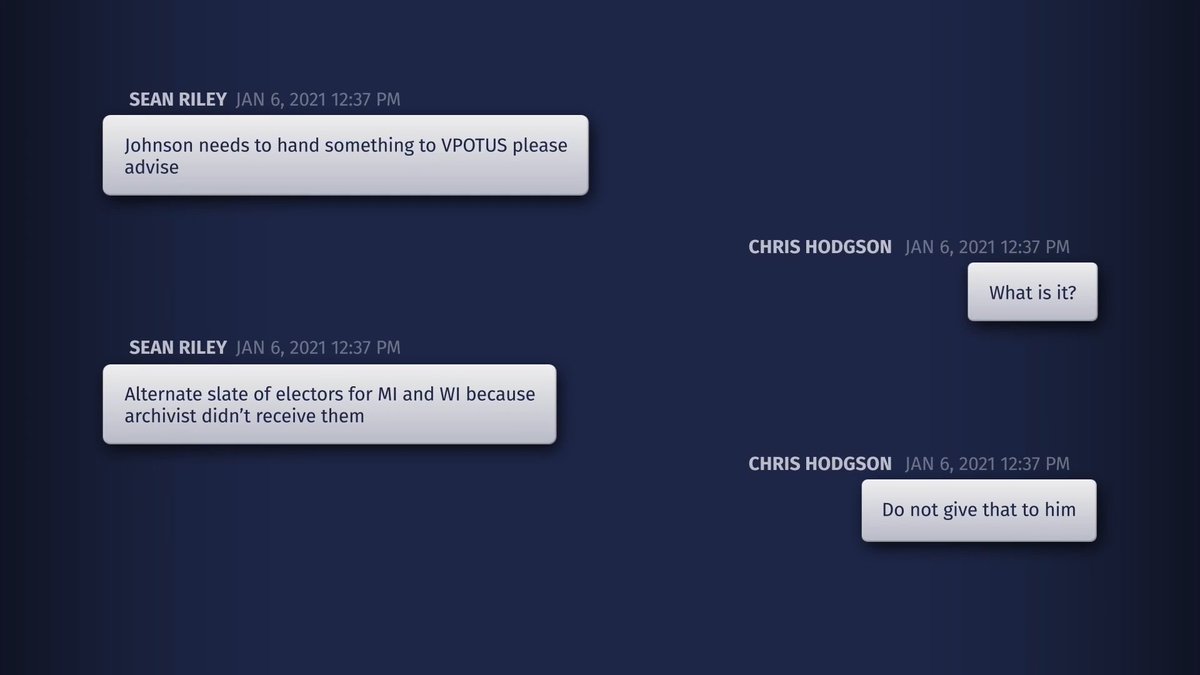
Here are the texts the Jan 6 Cmte just showed of @RonJohnsonWI’s chief of staff asking how he can give VP Pence alternate slates of electors for WI and MI on Jan 6th —>

Frank Thorp V via TMD

What are they afraid of?

As the January 6 hearings restarted today after the long weekend, I was thinking about the weird, psychotic fear that has overtaken millions of Americans. I include in those millions people who are near and dear to me, friends I have known for years who now seem to speak a different language …

Arizona House Speaker Rusty Bowers and others, describ[ed] the threats and harassment they have received for doing their duty to the Constitution.

And the threats don’t stop with political figures; families are now in the crosshairs. Representative Adam Kinzinger, for example, tweeted Monday about a letter he received in which the writer threatened not only to kill him, but to kill his wife and infant son.

I think the Trump superfans are terrified of being wrong. I suspect they know that for many years they’ve made a terrible mistake—that Trump and his coterie took them to the cleaners and the cognitive dissonance is now rising to ear-splitting, chest-constricting levels. And so they will literally threaten to kill people like Kinzinger (among others) if that’s what it takes to silence the last feeble voice of reason inside themselves.

We know from studies (and from experience as human beings) that being wrong makes us feel uncomfortable. It’s an actual physiological sensation, and when compounded by humiliation, it becomes intolerable. The ego cries out for either silence or assent. In the modern media environment, this fear expresses itself as a demand for the comfort of massive doses of self-justifying rage delivered through the Fox or Newsmax or OAN electronic EpiPen that stills the allergic reaction to truth and reason.

These outlets are eager to oblige. It’s not you, the hosts assure the viewers. It’s them. You made the right decisions years ago and no matter how much it now seems that you were fooled and conned, you are on the side of right and justice.

Tom Nichols, What Are Trump Supporters So Afraid Of?

R.I.P.

Former Purdue basketball star Caleb Swanigan has died at age 25. May he rest in peace; he didn’t have much of that as he lived.


If people have always said it, it is probably true; it is the distilled wisdom of the ages. If people have not always said it, but everybody is saying it now, it is probably a lie; it is the concentrated madness of the moment.

Anthony Esolen, Out of the Ashes

You can read most of my more impromptu stuff here (cathartic venting) and here (the only social medium I frequent, because people there are quirky, pleasant and real). Both should work in your RSS aggregator, like Feedly or Reeder, should you want to make a habit of it.

Curated just for you, whoever you are

Legalia

Why would a conservative want to serve on SCOTUS?

I can’t fathom why anyone would want to serve on the Supreme Court. To be more precise, I can’t fathom why any conservative would want to serve on the Supreme Court. Liberal jurists are feted with honors at every juncture. But conservative jurists are excoriated and personally attacked. I wonder, in hindsight, if Kavanaugh still would have pursued a position on the Supreme Court, knowing what we know now: the first confirmation hearing, baseball tickets, Spartacus, Christine Blasey Ford, Michael Avenatti, Ronan Farrow, the second confirmation hearing, yearbook, beer, Klobuchar, Saturday Night Live, Matt Damon, the Dobbs leak, and now an assassination attempt outside of his home. During this time, Kavanaugh and his family have been dragged through such painful experiences, one after the other. Was it all worth it? And to what end?

Eugene Volokh

303 Creative

Creative professionals routinely express their politics in their art—through the art they choose or refuse to create. Famously, for example, shortly after the election of Donald Trump, a number of fashion designers (artists, to be sure) declared that they would, under no circumstances, “dress” Melania or Ivanka Trump –this despite the fact that dresses themselves rarely (if ever) contain a political or cultural message as explicit as the words or image a web designer creates. Merely doing business with the Trumps was an intolerable notion to creative professionals who abhorred the Trump family’s political methods and messages.

In an open letter rejecting the idea of working with the Trumps, designer Sophie Theallet said, “We value our artistic freedom, and always humbly seek to contribute to a more humane, conscious, and ethical way to create in this world.” She said, “As an independent fashion brand, we consider our voice an expression of our artistic and philosophical ideas.” And another designer, Naeem Khan, asserted: “A designer is an artist, and should have the choice of who they want to dress or not.”

In reporting on the designer choices, the Washington Post’s Robin Givhan explained well how artists view their work:

Like other creative individuals, Theallet sees fashion as a way of expressing her views about beauty and the way women are perceived in society. Fashion is her tool for communicating her world vision. In the same way that a poet’s words or a musician’s lyrics are a deeply personal reflection of the person who wrote them, a fashion designer’s work can be equally as intimate. In many ways, it’s why we are drawn to them. We feel a one-to one connection.

A web designer’s work is similarly intimate ….

Brief of 15 Family Policy Organizations as Amici Curiae in Support of Petitioners in the 303 Creative case (internal citations omitted).

If you don’t know the case, you should get to know it.

Colorado, with the help of the 10th U.S. Circuit Court of Appealsl, has mounted the worst, and most explicit, attack on freedom from compelled speech since West Virginia v. Barnette in World War II (when West Virginia required recitation of the Pledge of Allegiance by schoolchildren on pain of expulsion).

Colorado claimed that even though 303 Creative was engaged in pure speech (a key legal category; Masterpiece Cakehop, in contrast, had a creative element but in the end produced not speech, but cake), it could be compelled to create a website for a same-sex wedding because none of the other wedding website creators had exactly the talents of 303 Creative, so 303 was effectively a monopoly and could be forced to create the desired site:

In its decision below, the 10th circuit noted that the petitioners’ artistry created something like a “monopoly,” a market where only the petitioners exist.

Id. Only madness-induced blindness could distinguish the relevant facts of this case from those in West Virginia v. Barnette to the detriment of 303 Creative. Read and enjoy the whole Amicus brief.

Understated

The problem is a reflection of a badly broken political culture and it won’t be easily fixed. But, in the meantime, the House should probably go ahead and pass that SCOTUS protection bill.

The Morning Dispatch on increasing political violence, prompted specifically by the plot against Justice Kavanaugh.

More generally, the Morning Dispatch’s coverage of the successful recall of San Francisco Prosecuting Attorney Chesa Boudin confirms its trustworthiness as a news source: It has more points in Boudin’s favor than I’ve noticed anywhere else, and they aren’t insubstantial.

Sexualia

Incoherent Pride

[I]t is interesting that the American Embassy to the Vatican is flying the rainbow flag for Pride month. Commentators have pointed out the obvious intent to cause offense to the Catholic Church. But the embassy’s decision also sends a message to the American people: Another flag has government endorsement. The message of “inclusion” that it represents signals to those Americans who might dissent from the LGBTQ+ movement that in these interesting times their membership in the republic for which the real national flag stands is more a matter of tolerance than full-blooded affirmation.

The problems with LGBTQ+ inclusion are, of course, manifold. First, there is the logical problem that any movement deploying the rhetoric of inclusion has to face: If everyone is included and nobody is excluded, then the movement is meaningless. Thus, the language of “inclusion” here is really a code word for precisely the opposite: It actually means exclusion and the delegitimizing of any person or group that dissents from what the movement’s movers and shakers deem to be acceptable opinion. Acceptable thought will typically tend toward a view of reality that regards such dissenters as mentally deficient, sub-human, or simply evil.

Carl R. Trueman

Succinct

There are masculine girls. There are feminine boys. What are we going to do? Carve them up?

Jordan Peterson on the Official Trailer for the Matt Walsh documentary (prank-a-thon?) What is a Woman?.

Politics

Relatively successful

Purdue University president Mitch Daniels is retiring at the end of the year. Consistent with his maverick ways over the last 10 years, his successor was announced concurrently with his retirement announcement. There was no public Presidential search, and we will doubtless be treated to days of complaints, petty and serious, about that.

His successor will be the professor and Dean, Dr. Mung Chiang, who served as his Executive Vice President for Strategic Initiatives, of which Purdue has formed a great many over the last 10 years, with some of the biggest corporate names in the world.

I’m very proud of Purdue, my neighbor just across the Wabash, but I would prefer that my loved ones not attend there.

First, like most major universities today, the streets of the campus flow with alcohol, which endangers students of both sexes with the ambiguities of sexual interactions between drunks.

Second, I prefer undergraduate liberal arts education to enlisting in the Technocracy fresh out of high school.

But it seems to me that Mitch Daniels has been a tremendously successful Ginormous Research University President, and I wish him well.

"A Crucial Element of Fascism"

The American militia movement is small, but in the early days of 2021, it nonetheless came to the aid of a lawless president seeking to use force to keep himself in power. It did so by attacking the national legislature and threatening to kill elected representatives of the American people. And when this happened, the president himself stood back and stood by, watching expectantly, refusing to call off the armed mob, hoping the violence might empower him to remain in the White House despite losing the election two months earlier. In doing so, Trump ended up injecting a crucial element of fascism into the country’s political system.

I don’t use the F-word lightly. Trump winning the presidency while losing the popular vote by three million isn’t fascism. Trump appointing a record number of judges and three Supreme Court justices who appear poised to overturn Roe v. Wade isn’t fascism. Trump attempting to close the southern border to immigrants and refugees isn’t fascism. Trump’s verbal attacks on the media aren’t fascism (though they could be said to lay the groundwork for it by stoking popular rage against a free press). Trump engaging in the politics of bullshit by lying constantly to the American people isn’t fascism (though it, too, can prepare the way for it by leading voters to despair of firmly distinguishing between fact and falsehood).

But groups of organized, armed thugs allied with the president acting at his request to prevent the peaceful and lawful transfer of power to his successor is absolutely a fascist act. We’ve seen nothing remotely like it elsewhere in the democratic world, no matter how bad the illiberal policies and rhetoric of newly emboldened right-wing populists in other countries have been.

Damon Linker

Holding up that hateful mirror

Republicans are the co-creators of Trump’s corrupt and unconstitutional enterprise. The great majority of them are still afraid to break fully with him. They consider those who have, like Liz Cheney, to be traitors to the party. They hate Cheney because she continues to hold up a mirror to them. They want to look away. She won’t let them.

Peter Wehner

Is racism a public health crisis?

My fair city has approved a resolution declaring racism a public health crisis.

The statistics on racial disparities are stark. But unless the reporting is botched — a very real possibility considering that our Gannett paper hovers near death — the response is one of those "OMG! WE’VE GOT TO DO SOMETHING!" responses, and implicitly accepts the dogma that all racial disparities are caused by racism.

My point would be mere pedantry were it not for the likelihood that a vague diagnosis of "racism" as the cause is likely to lead to errant treatment.

Stochastic Terrorism

I’m kind of a sucker for portentous names given to commonsense observations. My new one is "stochastic terrorism," introduced by David French with a link to Todd Morley.

As French puts the commonsensical translation:

The concept is both common-sense and controversial. The common-sense element is easy to explain. If you’re a normal person and five people hate you, what are the odds you’ll face targeted violence? Unless you’re engaged in criminal activity yourself (and the five people who hate you are other criminals), then the odds are almost impossibly low.

But what if 50,000 people hate you? Or five million? Then the odds change considerably, until they reach a virtual certainty that you’ll face a threat of some kind.

Why did the Californian last week go after Justice Kavanaugh instead of Justice Alito? How many million people hate Brett Kavanaugh? How did there come to be so many who hate him? D’ya think it might have something to do with the over-the-top attacks during his confirmation hearings?

That’s how you build a frenzy from which someone emerges to exact just retribution on some putative fiend. Todd Morely names a few names.

(FWIW: I cooled about 20 degrees on Kavanaugh as soon as it emerged that he has been a heavy recreational beer-drinker since years before he could drink legally. Call me extreme — and on this topic, I clearly am far out of the American mainstream — but I think a Supreme Court Justice should have a history of abiding even by annoying little laws like minimum drinking age, and of sobriety both literal and figurative. Drunken frat boys are a turnoff even when they don’t grope co-eds.)

Well, anyway, back to stochastic terrorism. French again:

Of course the ultimate recent example of hatred and fury spawning violence is the attack on the Capitol on January 6. It was perhaps the most predictable spasm of violence in recent American history. One cannot tell tens of millions of Americans that an election is stolen and that the very fate of the country hangs in the balance without some of those people actually acting like the election was stolen and the nation is at stake.

But if the concept of stochastic terrorism is so obviously connected to human experience, why is it controversial? In part because it aims responsibility upward, and it places at least some degree of moral responsibility for violent acts on passionate nonviolent people. While criminal responsibility may rest exclusively with the person who carries the gun (or his close conspirators), moral responsibility is not so easy to escape.

(Emphasis added).

Too long I have blithely and exclusively "blamed the person who carries the gun", discounting (if not ignoring) incitements that stop short of criminality. I remain a free speech advocate, and I detest the idea that any truth is too dangerous to be uttered lawfully. But it is becoming too, too obvious politicians and pundits who make careers of vilifying specific opponents, and internet jackasses who doxx the scapegoat du jour, are playing with fire, and at the very least should face political, social and commercial* sanctions.

And to the extent that I have dehumanizingly vilified Donald Trump over the last three years, mea culpa, mea culpa, mea maxima culpa!

(* I have in mind commercial sanctions like boycotting Tucker Carlson’s advertisers, but I don’t want to watch him to find out who they are.)

UPDATE: Jonah Goldberg alludes to who Tucker’s advertisers are:

Seb Gorka dron[ing] on about Relief Factor (a fish oil supplement that all super-patriots take before they put their heads on Mike Lindell’s pillows)

No chance for boycotting there.

Religion

Normally, I’d consider putting Religion in first position, but the following are not the kinds of dogma or dogma-adjacent things that cry out for that.

Here’s to you, Mrs. Robinson

In David & Bathsheba, we see a man in the act of either removing—or replacing—a jacket from a woman’s shoulders. Is this the moment before or after King David has committed adultery with the wife of his general? Mrs. Potiphar presents us not with a cartoonish harridan panting after the biblical Joseph, but an attractive, middle-aged woman staring pensively at her reflection in a mirror. McCleary treats the incident not in terms of mere lust, but in a larger psychological and spiritual context of loneliness and fear of death.

Gregory Wolfe, Beauty Will Save the World.

The "Mrs. Potiphar" Wolfe refers to is presumably this:

Mrs. Potiphar

If you don’t know the allusion, read Genesis 39. If you don’t know what Genesis 39 is, may God have mercy on your ignorant soul.

A Dangerous Inversion

To justify Christianity because it provides a foundation of morality, instead of showing the necessity of Christian morality from the truth of Christianity, is a very dangerous inversion; and we may reflect, that a good deal of the attention of totalitarian states has been devoted, with a steadiness of purpose not always found in democracies, to providing their national life with a foundation of morality — the wrong kind perhaps, but a good deal more of it. It is not enthusiasm, but dogma, that differentiates a Christian from a pagan society.

T.S. Eliot via Kevin D. Williamson, who continues:

Eliot’s “dangerous inversion” is very much the model for the intersection of religion with politics in our time: Religion is, and is almost universally assumed to be, the junior partner.

American Evangelicals as Cultural Christians

What has happened is that the Christian sense of collective identity has persisted even among those hollowed-out Christians who have abandoned Christian orthodoxy, reducing the Christian confession to a demographic box to check, one of many constituent parts of an American “national identity.” Never mind, for the moment, that one of the hallmarks of the authentic American identity is approaching Christian orthodoxy and Christian observance with a seriousness that brushes up against fanaticism: The story of the United States does not begin with the arrival of the first slave, as the 1619 Project would argue, but with the arrival of the first Separatist.

For a century or so, Americans have had friends and countrymen who are “culturally Jewish.” We know what that means: a Jewish sense of communal identity bound to that vague American religious sensibility that sits somewhere between Protestant and agnostic — not atheistic, but operatively secular. I have not heard many Catholics call themselves “culturally Catholic” — Catholics who have given up Catholicism mostly just continue to call themselves “Catholic,” with the “cultural” qualifier being understood. In the case of Catholics, the communal identity is not in the end religious at all but is instead only the detritus of immigrant ethnic identities that have been dissolved in the hot soup of modernity. Conservatives used to be the ones who preferred the “melting pot” model of communal life to ethnic and religious particularism, but the rightist element Hochman writes about has, to some considerable degree, abandoned that. And so we have that new thing, the “cultural Christian.” I believe the first time I ever heard the term used was by Richard Spencer, the white nationalist, who found his parents’ Episcopalianism insufficiently invigorating.

Evangelicals, particularly white Evangelicals, are an important part of the new coalition that was formed around the campaign and cult of Donald Trump, but Christian thinking per se plays almost no role in that cult. Indeed, it would be very difficult for these Christians if it were otherwise: Donald Trump is an idolator and a heretic, a blasphemer and a perpetrator of sacrilege, and much more ….

Kevin D. Williamson


You can read most of my more impromptu stuff here (cathartic venting) and here (the only social medium I frequent, because people there are quirky, pleasant and real). Both should work in your RSS aggregator, like Feedly or Reeder, should you want to make a habit of it.

Monday collation

Politics

The Irreligious Right

I used to say "If you don’t like the Religious Right, just wait till you see the nonreligious Right." The nonreligious Right is here, and now dominates the grassroots GOP.

Frankly, it’s not (yet) as bad as we feared for varying reasons (but it’s trending worse, I think).

A fantastically good overview, ‌Republicans Are Now the Party of the Nonreligious Right appeared Thursday in, of all places, the New York Times, written by one Nate Hochman of National Review. It is long and deep, and I’m going to need to read it again to sort out what this means for me personally; Hochman already brilliantly identified why the GOP now gives me the willies (as do the Democrats, but then they always have).

I don’t know if I picked up the moniker in the Hochman article, but it appears to me that what he describes may be closely related to what others have calle "Barstool conservatism":

What could unite free-market libertarians, revanchist Catholics, Southern evangelicals, and working-class Reagan Democrats but their shared hatred of… actual Democrats?

Derek Robertson, How Republicans Became the ‘Barstool’ Party.

Drain those brains

In the Washington Post, Josh Rogin argues some congressional Republicans are forgetting one of the key takeaways from the Cold War: that exploiting brain drain from autocratic societies is a “smart and righteous” strategy. “The whole world is competing for the talents of those who are fleeing from Hong Kong and Putin’s Russia,” Rogin writes, noting Republicans have blocked efforts to ease visa restrictions for high-skilled workers from those regions. “Cruz claimed that accepting Hong Kongers was the first step to opening our borders and that the Chinese Communist Party could exploit the program to send spies to the United States. This ignores the fact that China has much easier ways to get spies into our country and that the CCP is trying to stop Hong Kongers from leaving because Beijing knows the brain-drain risk for China is real. … Republicans’ excessive fear of immigration should not waste a strategic opportunity for the United States to strengthen itself and weaken its rivals at the same time. Congress should work to ensure that China’s and Russia’s losses are America’s gains.”

The Morning Dispatch.

Surely Rogin is right, right?

Justin Trudeau

One of the oddities of Canadian politics is that its Liberal Party politicians so often sound like they’re running for office in the U.S. And, right on time this week, Canadian Prime Minister Justin Trudeau has announced that he wants to ban the sale of handguns and confiscate so-called assault weapons via a mandatory buyback.

The timing is no coincidence, as Mr. Trudeau is responding to the U.S. debate over guns and mass shootings. Apparently Canadian politics is too boring, or parochial, or something, because he also vowed to defend abortion rights after the draft Supreme Court opinion overturning Roe v. Wade was leaked. He even made a show of kneeling at a Black Lives Matter rally in June 2020.

Wall Street Journal Editorial Board. I generally avoid Editorial Board offerings on the basis that the King James Bible is the only work of art ever created by a committee, but the title "Justin Trudeau Runs for Congress" was powerful bait.

Answer me this …

This battle has been lost, and I see no hope of reversal. I even suspect, as do others, that reversal would be worse than letting it be. But I don’t think questions like this were ever answered:

Assuming a general policy of recognizing committed dyads, should the benefits that Oscar and Alfred [applicants for a hypothetical marriage license] receive depend on whether their relationship is or can be presumed to be sexual?

Sherif Girgis, Ryan T. Anderson and Robert P. George, What Is Marriage?, Kindle Location 295.

If the benefits received depend on whether the relationship is presumed sexual, then aren’t we leaving a lot of lifelong friends out of the more Platonic benefits that were thrust front and center in rationalizing same-sex marriage?

Damon Linker

Another bright light moves to Substack from legacy media: Damon Linker leaving The Week. His focus, reflected in the Substack title, is the Right.

I’m a Linker fan, but his first three postings seemed a bit underwhelming.

Legalia

Yes, I’m going to (gag!) say something (retch!) about THAT case

The jury in The Case That Kept Gossipy Television Gossiping has decide that she defamed him $15 millionsworth while he only defamed her $2 millionsworth.

It kind of has the feel of a suicide pact from what I could tell in the glimpses I got on TV.

Apparently, the jury verdict identified the three Heard statements they considered defamatory:

The jury was forced to examine three separate statements from the editorial, starting with the headline: “I spoke up against sexual violence—and faced our culture’s wrath. That has to change.”

The second involved Heard’s description of herself as a public figure representing domestic abuse, and the last statement at issue involved the public’s response: “I had the rare vantage point of seeing, in real time, how institutions protect men accused of abuse.”

(Johnny Depp Wins U.S. Defamation Lawsuit Against Amber Heard)

I could easily imagine an appeals court ruling as a matter of law that the second and third were not defamatory. Note, too, that the first technically doesn’t say that she was herself a victim of sexual violence, only that she spoke up against it.

Stay tuned. I don’t think this is over yet, though appeals won’t be blanket-covered like the trial was.

An open letter to SCOTUS Clerks

Very smart blogger David Lat has an open letter to the current Supreme Court clerks — the guilty and the innocent. I think it’s of interest even if you’re not a retired lawyer who still follows Indiana and Federal Courts.

So who’s stupid now?

Man pleads guilty to felony charge in riot at US Capitol

PHILADELPHIA – A suburban Philadelphia man charged in the January 2021 riot at the U.S. Capitol after he was turned in by an ex-girlfriend after reportedly insulting her intelligence for not believing the election had been stolen has pleaded guilty to a felony count. Richard Michetti, 29, of Ridley Park pleaded guilty Tuesday in federal court in Washington to a charge of aiding and abetting obstruction of an official proceeding. Officials said photos showed him inside the Capitol Rotunda. He is to be sentenced Sept. 1.

Wire Service Reports (emphasis added)

Sexual fad du jour

The author provides a high-point estimate of an 11-point increase in LGBT identity between 2008 and 2021 among Americans under 30. Of that, around 4 points can be explained by an increase in same-sex behavior. The majority of the increase in LGBT identity can be traced to how those who only engage in heterosexual behavior describe themselves.

Born This Way? The Rise of LGBT as a Social and Political Identity – CSPI Center (H/T Nellie Bowles)

Meanwhile, it’s hard to overestimate the goofiness and downright offensiveness of U.S. efforts to promote Pride Month.

Abortion

An odd, but telling, tid-bit: When the draft Dobbs opinion leaked, the Washington Post opined that reversing Roe would put us out of step with Western Europe. This myopic bit of mythology was so patently wrong that they had to retract or amend: reversing Roe almost certainly would bring us into better alignment with Europe, where legal abortion is more limited than in the U.S. under our juristocracy.

(Sorry I can’t give a link:

  • I heard it on a reliable podcast, but …
  • I’m persona non grata at WaPo; I suspect that never-subscribers can see more free stuff than former-subscribers.)

Guns

For the Record: 10 Cases in Past Year Where Law-Abiding Defenders "Have Stopped Likely Mass Public Shootings" With Guns

Wordplay

the rainforests of the ocean

The Economist’s poetic description of coral reefs.


When you skip the news, life is a lot more like Anne of Green Gables or The House at Pooh Corner.

Garrison Keillor


They were powerful until they were powerless. They lived on probation their entire lives.

Andrew Sullivan on gay life in Washington, DC for about 2/3 of the last century.

I sometimes second-guess my support (Caution: Ancient history ahead! Youngsters may be shocked!) for decriminalizing consensual adult sodomy in the late 60s and thereafter, since the ensuing 50+ years have brought more dubious demands. It’s good to be reminded of why a decision was right, even if it may have, in some sense, "set a bad precedent."


You can read most of my more impromptu stuff here (cathartic venting) and here (the only social medium I frequent, because people there are quirky, pleasant and real). Both should work in your RSS aggregator, like Feedly or Reeder, should you want to make a habit of it.

So much sadness

I have nothing to say about mass shootings. Maybe some other day.

Faith Matters

Woe!

The Southern Baptist Convention, single-minded champions of “evangelism” and defenders of “church autonomy,” didn’t want to be distracted from its evangelistic mission by widespread credible reports of clergy sexual abuse within the convention.

As I read their evangelistic rationalizations, I couldn’t help but think of a worthy epitaph:

Woe unto you, scribes and Pharisees, hypocrites! for ye compass sea and land to make one proselyte, and when he is made, ye make him twofold more the child of hell than yourselves.

(Matthew 23:15)

A church that doesn’t follow its “evangelism” with disciple-making (including churches where every sermon is predominately evangelistic), and that doesn’t hold its clergy accountable for bad behavior, is a spiritual Ponzi scheme. People get hurt when Ponzi schemes collapse.

Pas d’ennemis à droight?

[T]he next time you’re tempted to say that American Christians today experience hostility unprecedented in our nation’s history, and can escape condemnation only if they bow their knee to the dominant cultural norms; that it didn’t used to be like that, that decades ago no American Christian had to be hesitant about affirming the most elementary truths of the Christian faith — the next time you’re tempted to say all that, please, before you speak, remember Julius Scott.

Alan Jacobs, A Story.

Cultural illiteracy at NPR

Cordileone notified members of the archdiocese in a letter on Friday that Pelosi must publicly repudiate her support for abortion rights in order to take Holy Communion — a ritual practiced in Catholic churches to memorialize the death of Christ, in part by consuming a symbolic meal of bread and wine.

GetReligion passed along that NPR groaner.

Church of the Stilted Euphemism

Is it a sign of bad faith when your local Episcopal Priestx publish a joint open letter that refers to “reproductive healthcare” when they clearly mean “abortion”?

Culture more generally

Adrift

Our pursuit of understanding is often an uneasy admixture of the desire to know and the desire to be known as one who knows by those we admire.

The enchanted world, in Taylor’s view, yielded the experience of a porous, and thus vulnerable self. The disenchanted world yielded an experience of a buffered self, which was sealed off, as the term implies, from beneficent and malignant forces beyond its ken.

If we are, in fact, inhabiting a media ecosystem that, through sheer scale and ubiquity, heightens our awareness of all that is wrong with the world and overwhelms pre-digital habits of sense-making and crisis-management, then meta-positioning might be more charitably framed as a survival mechanism.

There is a picture that is informing my thinking here. It is the picture of being adrift in the middle of the ocean with no way to get our bearings. Under these circumstances the best we can ever do is navigate away from some imminent danger, but we can never purposefully aim at a destination.

L. M. Sacasas, ‌The Meta-Positioning Habit of Mind. Sacasas (a pseudonym, as I recall) is not the originator of all this text, but distinguishing his sources was beyond my scope.

This is an article I’ve flagged to re-read.

Visiting Russia

I woke up on Saturday to the news that my name was on a list of 963 Americans barred for life by the Russian Foreign Ministry from visiting Mother Russia. Which is about as upsetting as waking up to a call from your doctor who says, “It isn’t cancer” or a message from an ex that reads, “I was wrong about everything.”

Bret Stephens.

Up until about, oh, February 23, I hoped to visit Russia some day. Although I’m not a persona non grata, I very much doubt it (not despair of it, mind you).

Now they tell me

When she was an editor at Basic Books, a publishing house, in the 1970s, a manuscript came in. It was a fancy-pants work of high intellectual argle-bargle, and her boss at the time was inclined to reject it. “Don’t you dare,” she said. “It’s utter nonsense and it will sell a billion copies.” That book was called Godel Escher Bach: The Eternal Golden Braid. It won the Pulitzer. It is still in print 43 years later. It is utter nonsense. It has sold, if not a billion copies, then a million copies or more.

John Podhoretz, in his eulogy for his mother, Midge Decter.

Now they tell me. The book was acclaimed. The book proved impenetrable. I blamed my own inadequacies and chalked up the effort as part of my program of self-improvement (I always felt a bit guilty about abandoning a liberal arts degree, especially since I ended up breaking up with the young woman I intended to support through a more “practical” degree). Apparently it was a waste of both time and money.

Maybe someone, some day, will admit the same about David Bentley Hart’s The Beauty of the Infinite. Mr. Hart: Je t’accuse!

Controversy

Let’s get real

A progressive law professor explains how the logic of the draft opinion could be extended to withdraw a right to contraception from constitutional precedent.

Assuming she’s theoretically right (at least in what she says if not in her ignoring of countervailing arguments), so what? Or “let’s get real.”

In 2022, does access to contraception depend on a constitutional right to contraception? Is there any state in the union with a political movement to outlaw contraception? Can anyone (Margaret Atwood and her acolytes excluded) even imagine such a movement arising? Assuming that someone ginned up legislation against IUDs and the morning-after pill on the ground that they’re abortifacient, do you really think it could pass? Or that they’d include other contraceptives? Without such legislation, who could even bring a lawsuit challenging Griswold v. Connecticut‘s contraception conclusions, or even Eisenstadt v. Baird‘s?

Straight talk

Do not miss Bill Maher channeling Abigail Shrier when you have 9:21 to spare.

Primaries

I kinda like Texas, but it saddens me that Texas Republicans chose crooked grifter Ken Paxton in the primary election for Attorney General.

And I categorically wouldn’t want to live in any Congressional District that thinks Marjorie Taylor Green is a keeper.


You can read most of my more impromptu stuff here (cathartic venting) and here (the only social medium I frequent, because people there are quirky, pleasant and real). Both should work in your RSS aggregator, like Feedly or Reeder, should you want to make a habit of it.

“Pro-Abortion” is now official (more)

Blogging the ineffable

It occurred to me recently that my blog is an odd project because, increasingly, the things that matter most to me are ineffable.

I’ve read at least one book that “effed the ineffable” by going on and on, shifting to reflect from varying angles. I actually thought it was pretty effective, but you had to be keenly interested in the topic to wade through so much overlapping, kaleidescopic quasi-repetition. (I did find that 24 years of immersing myself in Orthodox Christian worship, as my Parish’s cantor — and not just the Sunday Liturgy — had “communicated” the same things.)

I’ve taken a stab at poetry occasionally, but rarely have thought it remotely successful. Anyway, I once heard it said that the person who becomes a poet to say something is less poetic than someone who becomes a poet because he/she likes messing around with words.

I guess the reason I keep blogging may be that I, too, am going on and on, in prose, shifting to reflect from varying angles — just not between the covers of a single book and without an explicit Master Goal. But in a lot of ways, my blog is a very large commonplace book, but an online friend (we’ve narrowly missed meeting IRL) already took that in his blog (now Substack) title.

Anyway, I actually looked briefly at what WordPress says about my blog (something I rarely do since I’m not writing to be popular), and apparently it’s emailed to 350 addresses, and I assume that some others get the RSS feed. I’m pretty sure that some of the emails are bogus, created for god-knows-what purpose. But a heartening number probably are real people, and to them I say thank you for your indulgence.

A partisan scold as arbiter of “Disinformation”

The preoccupation with “misinformation” and “disinformation” on the part of America’s enlightened influencers last month reached the level of comedy. The Department of Homeland Security chose a partisan scold, Nina Jankowicz, to head its new Disinformation Governance Board despite her history of promoting false stories and repudiating valid ones—the sort of scenario only a team of bumblers or a gifted satirist could produce.

Barton Swaim, How Disagreement Became ‘Disinformation’ (Wall Street Journal)

Janus-faces

There is something so disingenuous about critical theorists both arguing that they are revealing the real truth about the world in order to change it, and then claiming that they’re just offering an alternative take of history within a liberal context. You can see this intellectually dishonest bait-and-switch in the 1619 Project. It claims something truly radical — that the real founding of America was in 1619 because the core meaning of America is white supremacy, not liberal democracy — and then, when called on it, turns around and says no, silly, we’re just engaging in a thought-experiment to explain how racism has affected all of us, and to provoke debate. Well: which is it? In theory, they tell you it is all compatible with liberalism; in practice, they prove and believe the opposite.

Andrew Sullivan, Don’t Fight CRT. Expose It.

Dobbsian thoughts

Well, then: I’ll be glad to say “pro-abortion”

From an official Planned Parenthood website, an about-face that reveals a lot:

Well-meaning folks often contrast “pro-choice” with “pro-abortion,” as in, I’m pro-choice, not pro-abortion. But that’s hurtful to people who’ve had abortions. It implies that abortion isn’t a good thing, that legal abortion is important but somehow bad, undesirable. That’s deeply stigmatizing, and contributes to the shame and silence around abortion, making people who’ve had abortions feel isolated and ashamed. At least one in four people who can get pregnant will have an abortion during their lives, and they should be supported and celebrated. It’s time to retire the phrase “pro-choice, not pro-abortion” for good.

Maia Baker, What’s wrong with choice?: Why we need to go beyond choice language when we’re talking about abortion.

I heard a youngish woman recently describe her long-ago long bus trip to a D.C. “pro-choice” rally. Older women were talking of abortion as if it were good, not a lesser evil. One even bragged that she’d had 6 abortions, and it was her primary birth control.

The youngish woman emerged from the bus pro-life.

Amnesiac même advocacy

From a supplemental Andrew Sullivan substack May 13:

[Sullivan’s critic1]: You’re conveniently forgetting that five of the nine justices (Roberts, Alito, Gorsuch, Kavanaugh, Barrett) were nominated by presidents who lost the popular vote.
[Sullivan’s rejoinder]: That is completely irrelevant. But even it it weren’t, both of Bush’s appointees were picked during his second term, after he won the popular vote against Kerry.

[Sullivan’s critic2]: Currently, several state legislatures have big GOP majorities that in no way reflect the number of votes each party received in the preceding election. My guess is that one or more of these legislatures will act quickly this summer, after Roe is overturned, to outlaw abortion. Will that be an instance of democracy working well?
[Sullivan’s rejoinder]: Yes, it absolutely will. And voters can vote again in November. Again: is it the pro-choice position that no states be allowed to legislate on abortion because gerrymandering exists? What else are they barred from voting on?

[Sullivan’s critic3]: While I am certain there are women who would never have an abortion — and they cannot imagine allowing any other woman to have an abortion — the majority you refer to as “pro-life” is deeply affected by another condition: religion. The majority of the pro-life women you speak of, through their faith, surrendered any sense of having power that isn’t subjected to the approval of the church or their husbands! They have no distinct awareness or appreciation of the fullness of their own free will — their liberty — or their innate freedom to make decisions on their own, entirely independent of their faith. 
[Sullivan’s rejoinder]: I’m afraid this completely misunderstands Catholic teaching on this. Women are not supposed to submit their moral views to their husbands’ approval. And the thinly veiled contempt for religious people — they don’t have any autonomy or agency — is a form of bigotry, in my view.

On that last point, see Eugene Volokh’s contemptuous response to that kind of motivated reasoning, which he no doubt hears a couple of times each week if not each day.

Talk less, Smile more.

Now when Chief Justice Roberts speaks of the Court as an “institution,” he approaches that concept from a PR perspective–5-4 decisions are bad, incoherent 9-0 decisions are good. Thomas could not care what final votes are. Rather, he worries about attacks on the Court by the political branches, and more recently, from within.

Unlike Justice Ginsburg, no one knows where Chief Justice Roberts is. To quote Aaron Burr, “Talk less, Smile more, Don’t let them know what you’re against or what you’re for.” NFIB v. Sebelius may have saved the ACA, but the controlling opinion destroyed the Supreme Court as we know it. The anonymous conservative told Politico:

“There is a price to be paid for what he did. Everybody remembers it,”

Roberts won the battle, but lost the war. Now Thomas is making this point explicitly.

Josh Blackman (emphasis added)

Selective non-enforcement

Of the laxity of law enforcement in protests at Justices’ homes:

When it comes to the contrast to Jan. 6, what stands out to me is actually a similarity: a large protest gathered on Capitol Hill and authorities responded with much too little force to disperse it — including after it got way out of hand. Where things differ has been the aftermath, with federal prosecutors now aggressively prosecuting people who merely wandered into the building after the most violent and aggressive perpetrators had pushed their way inside. That seems like overreach in the opposite direction — discretion erring on the side of undue harshness. We should absolutely be throwing the book at everyone who ransacked the building and sought to commit acts of violence against members of Congress or the vice president in order to overturn the election. But that likely doesn’t describe everyone, or even most of the people, present at the protests that day.

Damon Linker (who, should it not be clear, favors discretionary non-prosecution of smallish, non-menacing demonstrations at the Justices’ homes).

I’m acquainted with someone who “merely wandered into the building after the most violent and aggressive perpetrators had pushed their way inside” the capitol on 1/6/21, but is being prosecuted nonetheless. The Feds have lost at least one such case at trial, and I’m hoping they’ll now relent on the others.

Point is: I’m willing to extend the same grace I want for him to wrong-headed people who peacefully protest at justices’ homes – even if there’s a federal law that facially makes that illegal.

Overturning nature

[T]he lawn signs in university towns announce, “Hate has no home here.” This sentiment amounts to reversing the fall of man and proclaiming the kingdom of God. And as I have argued, today’s progressive cultural politics seeks to overturn the authority of nature. Thus we have at once widespread resignation—and God-like ambition.

It’s really very strange. One hundred thousand people die of opioid overdoses in a single year, and elites throw up their hands and do nothing. Meanwhile, they put untold millions into transgender activism and insist that the fullest resources of the medical-industrial complex must be employed to attain its goals.

R.R. Reno.

I generally don’t like arguments in the form of “Why are you writing/worrying about X?! You should be writing/worrying about Y!” But I can’t help but suspect that elites have noticed that the people dying of opioid overdoses are mostly deplorables, not real people.

Oh: And that the trans cause is stylishly pseudo-transgressive.

Words to live by

We must always tell what we see. Above all, and this is more difficult, we must always see what we see.

French writer Charles Péguy via R.R. Reno. I’m not sure that Reno is seeing what he’s seeing, but he’s seeing one of the right problems.


You can read most of my more impromptu stuff here (cathartic venting) and here (the only social medium I frequent, because people there are quirky, pleasant and real). Both should work in your RSS aggregator, like Feedly or Reeder, should you want to make a habit of it.

Compelled to write

The barbarians are at the gates (again), so this old man feels a compulsion to write.

Nuance on abortion law

It’s probably obvious to regular readers that I’m the kind of guy who would be highly sympathetic to the reasoning of Justice Alito in the leaked abortion opinion overturning Roe v. Wade. But I think my reasons are out of the pro-life mainstream.

Take Roe as shorthand for "the basic Supreme Court abortion framework constructed by Roe v. Wade and Planned Parenthood v. Casey." I want Roe reversed because it’s bad law.

It’s bad law, first, because it’s poorly reasoned. If you doubt that, read Alito’s draft (as I have not, though I’ve read and heard about it), where he cites liberal scholar after liberal scholar who admit that the original Roe is poorly reasoned. Side note: Many liberal scholars tried to remedy that deficiency in law journal articles, Laurence Tribe multiple times with different rationales. Then SCOTUS, concerned that overturning the original Roe would reflect poorly on the court, came up with it’s own alternative rationale, including the risible "mystery passage":

At the heart of liberty is the right to define one’s own concept of existence, of meaning, of the universe, and of the mystery of human life.

It’s bad law, second, because among the rights protected by the constitution is a democratic form of government, so when the court declares democratically-enacted laws out-of-bounds, it shrinks the realm of our right to govern ourselves through democratically-elected legislatures.

That’s the court’s duty when the constitution requires it. But it’s the court’s duty not to overrule the democratic outcome when the constitution does not require it, elite opinion be damned.

That has been my primary concern with Roe ever since, during law school, I got conservative-woke on the abortion issue. And I think it’s out of the pro-life mainstream, especially as it ramifies below.

As has been noted by sentient reports of this week’s kerfuffle (not all reports have been sentient), the result of Justice Alito’s draft, if it indeed becomes the court’s Opinion in the case, will be to return the abortion issue to the legislative processes, mostly within the states.

If and when that happens, I will support quite strict restrictions on abortion legislatively. But even if I lose, and my state (astonishingly) mirrors the abortion enthusiasm of California and some other blue states, those laws will have a constitutional legitimacy that that Roe lacks.

I’m confident that this concession will make me look monstrous to some pro-lifers. But I’m also confident that it’s right. (And I’m moderately confident that pro-choicers are whistling past the cemetery when they talk about Alito’s draft in terms of its defying popular opinion on abortion; they wouldn’t be so worked up if all that was happening was a move of permissive abortion law from SCOTUS to Bismark.)

I’m aware of the argument of (most recently) John Finnis that the 14th Amendment requires that abortion be banned. I wasn’t persuaded of that basic argument 30-40 years ago when it was first floated, though it was clever and thought-provoking, and Finnis’ resurrected version didn’t persuade me, either.

But if you give me 2-to-1 odds, I’ll bet a modest amount that Clarence Thomas is going to demur from any Alito-like opinion to argue that Finnis was right. (I owe that intriguing speculation to David French, who stunned and silenced Sarah Isgur with it.)

Singing Truth, Screaming Lies

I am an enthusiastic and fairly skilled chorister, in addition be being Cantor in my parish. My longest non-church choral relationship is with a pretty good community chorus, with admission by audition and some paid staff including the Artistic Director.

Not surprisingly, most of our concerts are from the canon of western sacred music, almost exclusively Christian — masses, oratorios, Lessons & Carols, and such. It’s far and away the largest body of first-rate choral music in Western Christendom. We’ve even sung Russian Orthodox masterpieces twice.

The audience for that kind of music is aging and dying, which you’d probably guess if you thought about it.

So we occasionally shake things up with a pop concert (e.g., Bernstein’s Candide), some in collaboration with the local professional symphony, or even show tunes á la "show choir" under a guest conductor.

We did one of the latter quite recently. Reflecting on it afterward, two things hit me.

First, the show was too heavy on loud band accompaniment and loud songs and it really took a toll on my vocal chords — and my nervous system.

More important, I’ve been reflecting on the themes of some of the songs we sang (excluding consideration of what our guest soloist from Broadway sang, most of the words of which I couldn’t even understand; not that she mumbled, but the amplification is directed toward the audience, not toward the stage).

The themes are, in my considered judgment from 70+ years on planet earth, lies:

Come alive, come alive! Go and light your light Let it burn so bright! Reachin’ up to the sky, And it’s open wide You’re electrified!

And the world becomes a fantasy ‘Cuz you’re more than you could ever be … And you know you can’t go back again to the world that you were livin’ in ‘Cuz you’re living with your eyes wide open.

I’m flying high! I’m defying gravity! … And soon I’ll pass them in renown. And nobody in all of Oz, No wizard that there is or was Is ever gonna bring me down!

There’s nothing wrong with positivity (though it’s not my thing), but those lyrics are delusional. The first one even contradicts itself by promising that coming alive will make the world a fantasy, but you can’t go back because your eyes are now wide open. Huh?!

I don’t think such songs of limitless options and rejection of authority are wholesome. They may get the adrenaline going and may become an ear worm, but they set people up for disappointment — even emotional and spiritual shipwreck.

The contrast with our general repertoire is stark. Most of the sacred canon we sing is fundamentally true. This stuff, though, is toxic once you get under the glittery surface. How that toxicity feeds current cultural toxicity is beyond my scope, at least today.

I don’t think I can do this pop stuff any more.

Mourning

Beyond the confines of party politics, the broader left is mourning a narrative: a story about the once and forever conquest of good over evil. It is most visible in the elite hysterics that are derided as ‘woke’. …

… A story about the inevitable triumph of socially liberal values has been deeply entrenched in the minds of the comfortable classes since at least the 1960’s, a simple story about the victory of good over evil. Everyone now knows it was only a story. It never was prophesy. It was, though, a story that helped to structure many middle-class lives, and its passing is genuinely felt, with all the attendant denial and rage. I don’t mourn it. It was never my story. But those that oppose ‘wokery’ without seeing it is a grief-reaction are making the same mistake as those they think are their enemies. They’re clinging on to the wrong story. We are not living through a cinematic battle between good and evil. We are living through a tragedy. Scene by scene, hubris takes from us the very things that we define ourselves by.

The political right at its best, the right of Oakeshott or Chesterton, understood mourning. It had a wistful reverence for what was lost. The right is no longer at its best, and has not been for a long time. The tragedy of our era takes from every player the very thing that they clutch closest to their heart. While it took from the left their faith in the future, it took from the right their faith in the past.

And so we have a Tory party that believes only in Thatcherism; but dare not say so, in case the voters hear. They do not remember that Thatcherism was a betrayal of their party and country. They dare not remember anything at all. They are the very epitome of mourning as denial; and so, amnesiac, they no longer know the land they rule. Their sense of England is no deeper than a photoshoot with a pint glass, and the rest of the Union seldom troubles what is left of their flickering consciousness at all.

Every era is a time of mourning, but this era is a time of senseless mourning. The political mourning I have been describing is not the same as the mourning that is quietly embedded in place names and dry stone walls. It is uprooted and lost ….

‌This is a time of senseless mourning, from my favorite new Substack.

The Boromir Fallacy

When people justify their voting choice by its outcome, I always think of The Lord of the Rings. Tolkien emphasizes repeatedly that we cannot make decisions based on the hoped-for result. We can only control the means. If we validate our choice of voting for someone that may not be a good person in the hopes that he or she will use his power to our advantage, we succumb to the fallacy of Boromir, who assumed he too would use the Ring of Power for good. Power cannot be controlled; it enslaves you. To act freely is to acknowledge your limits, to see the journey as a long road that includes dozens of future elections, and to fight against the temptation for power.

Jessica Hooten Wilson, What ‘The Lord of the Rings’ Can Teach Us About U.S. Politics, Christianity and Power

A little sympathy

I have little sympathy for Derek Chauvin, but it seems to me that his cumulative sentences (styling his murder as a federal civil rights offense, too, is likely to add years served) are much higher than would be expected in comparable cases.

Is he being punished more not because of his depravity, but because his murder of George Floyd provoked widespread rioting and exposed the hypocrisy of the government’s selective Covid policies (in effect "Church bad, Riots good", say government epidemiologists)?


You can read most of my more impromptu stuff here (cathartic venting) and here (the only social medium I frequent, because people there are quirky, pleasant and real). Both should work in your RSS aggregator, like Feedly or Reeder, should you want to make a habit of it.

The impending reversal of Roe (and more)

On the impending reversal of Roe

Will Congress enshrine abortion in federal law?

Democrats are talking about using the nuclear option (abolishing the filibuster) to enshrine Roe into federal law over Republican objections. I’m not sure they’ll hold Joe Manchin either on abolishing the filibuster or on abortion if they do, but let’s set that aside.

If they succeed, I suspect the law will meet the fate of RFRA, the Religious Freedom Restoration Act: held unconstitutional as a restriction on states’ “police powers.”

A similar outcome on abortion would leave abortion enshrined on military bases, federal women’s uterus-havers prisons and some other federal domains, but at the very political high cost of turning the Senate into a more democratic and less deliberative institution.

What a contrast!

I made it a point to listen to a top liberal legal podcast on the leaked SCOTUS opinion.

As I suspected would be the case, these three law professors offered no substantive defense of Roe v. Wade or Planned Parenthood v. Casey. None. Because they’re too smart to think it’s defensible in any terms of conventional constitutional reasoning. It was all mockery (Justices Alito and Thomas, Thomas’s wife, etc.), F-bombs and other vulgarities, unintelligible in-group code, posturing and dark speculation about what other “rights” the conservative majority wants to destroy.

It heightens my appreciation for the excellence and sophistication of Advisory Opinions — where I learned, by the way, of the existence of the other legal podcast.

Delegitimizing the Court

Speculating on possible reasons for the leak:

[F]inally, to the extent that a leak like this has some delegitimizing effect no matter what, that might be an end unto itself: If the court is going to be conservative, then let it have no mystique whatsoever.

This last place is where most liberals will end up, I’m sure, should the draft ruling turn out to be the final one. But there is an irony here, of course, because a key implication of Alito’s draft — and of arguments marshaled for generations by Roe’s critics — is that treating the judiciary as the main arbiter of our gravest moral debates was always a mistake, one that could lead only to exactly the kind of delegitimization that we see before us now.

Regardless of whether the draft becomes the final decision, then, its leak has already vindicated one of its key premises: that trying to remove an issue like abortion from normal democratic politics was always likely to end very badly for the court.

Ross Douthat. I’m glad Douthat pointed that out. I hadn’t thought how the delegitimization of the court started 49 years ago with Roe.

Roll out the protest signs!

Meanwhile, Substacker Rhyd Wildermuth envisions the less-than-punchy woke protest signs that should, for woke consistency’s sake, be forthcoming:

  • Protect a pregnant uterus-haver’s right to choose
  • Trans-women, cis-men, and assigned-male-at-birth non-binary people should not be allowed to make decisions on what trans-men, assigned-female-at-birth non-binary people, and cis-women do with their bodies.

Everything else

Doom’n’gloom

[T]hough I will never condemn those ‘dead white men’, neither can I stand up and ‘defend the West’ in some uncomplicated fashion. The West is my home – but the West has also eaten my home. Should I stand up to save it from itself? How would that happen? What would I be fighting for?

The French esoteric philosopher René Guénon, who dedicated his life to studying the metaphysical decay of the West, called this the ‘crisis of the modern world’, and he saw it as an explicitly spiritual matter. In his 1945 book The Reign of Quantity and the Signs of the Times, Guénon, a French convert to Sufi Islam who lived much of his life in Egypt, argued that the modern West’s decisive turn away from the spiritual life towards the purely material realm had plunged us into an era he called the ‘Reign of Quantity’. He referred to this turn as ‘the modern deviation’, or sometimes ‘the Western deviation.’

Guénon believed that the world’s old religious traditions all contained the same ‘universal character’ and could lead towards the same truth. The modern West, however, had unilaterally turned away from the pursuit of any higher truth, and the result had been the Reign of Quantity, which was now overcoming the world at Western hands. ‘Western domination’, he wrote, ‘is itself no more than an expression of the “reign of quantity.”’

All of this brings us back to where we began – the culture wars of the age of hyperreality. Guénon concluded his dense and sometimes difficult study by suggesting that we are living in a ‘great parody’: an age of ‘inverted spirituality’ and ‘counter-tradition’ in which even institutions which claimed to be transmitting the spiritual traditions – most churches, for example – were shells of the real thing. To Guenon, this was a manifestation of an actual spiritual war. He agreed with St Paul that ‘we wrestle not against flesh and blood, but against principalities, against powers, against the rulers of the darkness of this world.’ Some dark spiritual force was inhabiting the shell of our culture, he said, and driving us ever downwards.

Paul Kingsnorth

How Not To Write An Obituary

Terry Cowan gives some overdue advice on writing an obituary. I hope it was as cathartic for him to write it as it was for me to read it, because (I predict, for no better reason than general pessimism about humanity) that it won’t change a thing.

Setting aside “soulmate” and “love-of-her/his-life,” this advice is my favorite:

Finally, do not try to preach your loved one into Heaven by way of their obituary. There is no need to go on and on about what a fine Christian Gloria Kay was, or expanding on how much she “loved the Lord.” Frankly, it is not as if the Office of Admissions in Heaven is keeping a file of clippings, and this obituary will be one more document in your favor. Just say “Gloria Kay was a faithful Christian, a member of fill-in-the-blank Church.” Also, go-slow on stating what your loved one will be doing in Heaven now. That is always just so much broad evangelical wishful thinking. It is important to remember that we are actually not in control here, and it may be presumptuous to assert that Homer is now face to face with his Lord and Savior Jesus Christ. When I see an obituary that says something like “Wilma adored her precious children and grandchildren but her greatest joy was telling others about Jesus,” well, that just describes the type of person you would duck down another aisle if you saw them across the way in the grocery store.

The only missing thing I can think of “earned his angel wings.”

Sen. J.D. Vance

In the Fall of 2016, I traveled from Indiana to St. Gregory Palamas Monastery in eastern Ohio for a brief personal retreat. Running low on gas, I pulled off the four-lane road and traveled a few miles to a small town gas station.

That small town almost certainly had more Trump signs than homes, with at least one sign in every yard and not a single Hillary Clinton sign.

I don’t think of myself as especially insular, but I was shocked.

Over almost six subsequent years since, I’ve begun (or perhaps more than begun) to understand why (for what reasons or interests other than perverse nihilism or lib-trolling) people like rural Ohioans voted for Trump. They’ve been passed over, and they’re not accepting the idea that they deserve it because they’re of less value than coastal Americans.

Fair point. Weighty, even.

I still detest Trump personally (for reasons I summarize as “toxic narcissism” because writing a Bill of Particulars could consume my whole remaining life), and I regret that a Republican populist must kiss his hind-parts and get his endorsement to win a primary.

So Tuesday’s Ohio primary victory of J.D. Vance Tuesday, after he finally got Trump’s endorsement, isn’t much of a surprise, nor will his victory in the Fall be a surprise.

I hope he can become his own man again after the abasement of his campaign. He’s a bright guy who could elevate the debate if he wants to.


You can read most of my more impromptu stuff here (cathartic venting) and here (the only social medium I frequent, because people there are quirky, pleasant and real). Both should work in your RSS aggregator, like Feedly or Reeder, should you want to make a habit of it.

Roe, Twitter and more

Roe

After the Politico leak of a draft SCOTUS opinion "overturning Roe":

Where the public stands is tricky to divine. Polls consistently show that a majority of Americans would object to the court overturning Roe. But others show that most people want limits on abortions that Roe does not permit.

The Economist, Why abortion rights are under threat in America.

Neither the people nor most of the press understands Roe, which (by the way) was substantially overruled in and replaced by Planned Parenthood v. Casey 30 years ago. The Economist is to be commended for at least contextualizing the myth of popular support for "Roe."

I was for a time an anti-abortion activist and third-string litigator. I still remain an anti-abortion voter (though the multiplication of supposedly pro-life politicians who are fundamentally jackasses has disabused me of single-issue voting) and a supporter of a local pregnancy resource center that provides women alternatives to abortion.

But I don’t expect to read the leaked draft opinion. Que sera sera.

Neither do I intend to try to explain yet again that "overturning Roe" is not the same as banning abortion.

Where to go when you have nowhere left to go

British author Paul Kingsnorth describes his becoming an Orthodox Christian from, most recently, Wicca (from The Symbolic World episode 158, starting at about the 17-minute mark, paraphrased by me except for quotations):

He definitely was led to Christianity, because he didn’t want it. He didn’t like Christianity or Christians and he didn’t want to be a Christian. He was an eco-Pagan.

Many environmentalists recognize that matters of the spirit are fundamental to the problem of environmental degradation, so they go looking for a spiritual path — of which there are almost none left in the western world.

He tried Zen starting about ten years ago, and there was a lot to like, but it was missing something (which turned out to be God). He tried other mythical paths, including Wicca, but it’s an ersatz assembly of old pieces that doesn’t quite work. Father Seraphim Rose is popular with Orthodox converts, perhaps, because he, too, tried all kinds of different things.

A lot of that wandering around and trying exotic things is from a feeling that "we have nowhere to go," which in turn is a result of the Western Church being for so long tied up with power, tied up with the institutions that were crushing people and destroying the earth, and from the Genesis command to " Be fruitful, and multiply, and replenish the earth, and subdue it" being interpreted as a command for domination. It’s just not attractive, especially since the 60s re-ordered what we value.

But he began having dreams, and visions. Christians started popping out of the woodwork left and right, emailing and talking about his books for no apparent reason. Finally couldn’t ignore it. And the more he read about Christianity, especially Eastern Christianity, the more he thought:

This isn’t the story I thought it was. I thought Christianity was a bunch or moral lessons. I thought it was a bunch of things you were supposed to do so you went to heaven instead of hell, and you have to be good and do certain things, and I thought "Well why would I need a guy from two thousand years ago to tell me that?" And I don’t believe it anyway.

But the more I realized what was actually going on, the more I realized that this is a mystical path. It’s a path to God. It’s a path of stripping back and renunciation. And the more I found Orthodoxy — I had a couple of friends who turned out to be Orthodox Christians, which I hadn’t really known before — and then I started reading the Desert Fathers and the Philokalia and I thought "Wow! This is really powerful stuff! This beats anything that the Buddhists have got to offer." Or at least it’s actually very similar in some ways in terms of the depth of the mystery.

And I thought "Yeah, this Church thing (that I thought I knew about) is not what I thought it was. And here’s a powerful path."

And then of course you start reading the Gospels and you think … there is nothing that’s more radical, actually, than the teaching of Christ.

And then once you start separating it out from the many hideous things people have done with it over the centuries, you think "Well this is just as relevant as it ever was … This is radical humility, and if we had practiced this, we wouldn’t be in this situation."

I would not disagree with any of his description, though I never wandered around in Zen, Wicca or other exotic territory and cannot affirm from personal experience that people detest Western Christianity for the reasons he gives, though those reasons ring true to me.

Brooks nails it

David Brooks offers Seven Lessons Democrats Need to Learn — Fast:

  • It is possible to overstimulate the economy
  • Law and order is not just a racist dog whistle
  • Don’t politicize everything
  • Border security is not just a Republican talking point
  • “People of color” is not a thing
  • Deficits do matter
  • The New Deal happened once

Such a simple idea, so well-executed.

Wise excerpts

  • Your growth as a conscious being is measured by the number of uncomfortable conversations you are willing to have.
  • Half the skill of being educated is learning what you can ignore.
  • 90% of everything is crap. If you think you don’t like opera, romance novels, TikTok, country music, vegan food, NFTs, keep trying to see if you can find the 10% that is not crap.
  • You cant reason someone out of a notion that they didn’t reason themselves into.
  • Dont believe everything you think you believe.

Kevin Kelly, 103 Bits of Advice I wish I’d known.

(I doubt that any NFTs are not crap.)

Social media

Are you virtuous enough for Twitter?

Twitter is the only social media platform I use, and I’ve long characterized my use of it as a devil’s bargain. The platform has benefitted me in certain ways, but this has come at a cost. The benefits and costs are what you would expect. I’ve made good connections through the platform, my writing has garnered a bit more of an audience, and I’ve encountered the good work of others. On the other hand, I’ve given it too much of my time and energy, and I’m pretty sure my thinking and my writing have, on the whole, suffered as a consequence. Assuming I’m right in my self-assessment, that’s too high of a price, is it not? The problem, as I’ve suggested before, is that the machine requires too much virtue to operate, and, frankly, I’m not always up to the task.

During the fidget spinner craze a few years back, a thought came to mind: “Social media are the fidget spinners of the soul.” Maybe this is one of the so-called darlings I’d do best to kill, but, I don’t know, I still think it works. It’s another way of capturing the relationship between social media and sloth or acedia. The self is in disarray, agitated, unsettled, directionless, and the best it can do is fidget with the platforms to keep the unease at bay.

L.M. Sacasas (emphasis added). All-in-all, a stimulating set of brief reflections injected into what has been a stultifying feeding frenzy of coverage and hand-wringing.

A truly social medium

Alan Jacobs posts a brief introduction to micro.blog for the benefit of the millions (just kidding) of refugees fleeing thence from Twitter since Elon’s invasion.

He concludes with the centralmost distinction:

On micro.blog, you have absolutely no incentive to flex, shitpost, self-promote, or troll. You’re there to post interesting things and/or chat with people. Nothing else makes sense.

And that’s why it’s great.

So if you’re coming over from Twitter, please try to leave your Twitter habits and reflexes behind. They won’t help you at micro.blog. ### Hall of Shame nominee:

The Biden Administration’s Orwellian new Disinformation Governance Board (DGB), whose mission, sensible people fear, will creep beyond its initial modest mandate of “countering misinformation related to homeland security, focused specifically on irregular migration and Russia.”

Epistemic status

One of the lessons I still need to learn in life, in my 74th year, is that warranted absolute certainty is vanishingly rare. I am reminded of that in many ways, but one of the nicest is when Scott Alexander starts a blog post with "Epistemic status" of what follows, as here.

Shorts

You have to be educated into cant; it is a kind of stupidity that surpasses the capacity of unaided Nature to confer.

Anthony Esolen, Out of the Ashes

The Washington Post put more effort into exposing @libsoftiktok’s name and address than they did investigating Hunter Biden’s laptop.

Greg Price, via Andrew Sullivan

People believe Twitter is the real world. They therefore believe that Elon Musk is buying the world.

Abe Greenwald at Commentary via The Morning Dispatch

“Disinformation” just means anything that the Left doesn’t want you to say out loud.

James Howard Kunstler

Wordplay

"Parochial cosmopolitan."

A Cosmopolitan who cannot imagine any reason for more conservative opinions. Used in a sentence: "You may believe that the Hungarian law went too far, but only a parochial cosmopolitan can believe that the only reason people wouldn’t want their children propagandized to embrace transgressive sexual and gender roles is plain bigotry." (Rod Dreher, DeSantis, Magyar Of The Sunshine State?)


You can read most of my more impromptu stuff here (cathartic venting) and here (the only social medium I frequent, because people there are quirky, pleasant and real). Both should work in your RSS aggregator, like Feedly or Reeder, should you want to make a habit of it.