Compelled to write

The barbarians are at the gates (again), so this old man feels a compulsion to write.

Nuance on abortion law

It’s probably obvious to regular readers that I’m the kind of guy who would be highly sympathetic to the reasoning of Justice Alito in the leaked abortion opinion overturning Roe v. Wade. But I think my reasons are out of the pro-life mainstream.

Take Roe as shorthand for "the basic Supreme Court abortion framework constructed by Roe v. Wade and Planned Parenthood v. Casey." I want Roe reversed because it’s bad law.

It’s bad law, first, because it’s poorly reasoned. If you doubt that, read Alito’s draft (as I have not, though I’ve read and heard about it), where he cites liberal scholar after liberal scholar who admit that the original Roe is poorly reasoned. Side note: Many liberal scholars tried to remedy that deficiency in law journal articles, Laurence Tribe multiple times with different rationales. Then SCOTUS, concerned that overturning the original Roe would reflect poorly on the court, came up with it’s own alternative rationale, including the risible "mystery passage":

At the heart of liberty is the right to define one’s own concept of existence, of meaning, of the universe, and of the mystery of human life.

It’s bad law, second, because among the rights protected by the constitution is a democratic form of government, so when the court declares democratically-enacted laws out-of-bounds, it shrinks the realm of our right to govern ourselves through democratically-elected legislatures.

That’s the court’s duty when the constitution requires it. But it’s the court’s duty not to overrule the democratic outcome when the constitution does not require it, elite opinion be damned.

That has been my primary concern with Roe ever since, during law school, I got conservative-woke on the abortion issue. And I think it’s out of the pro-life mainstream, especially as it ramifies below.

As has been noted by sentient reports of this week’s kerfuffle (not all reports have been sentient), the result of Justice Alito’s draft, if it indeed becomes the court’s Opinion in the case, will be to return the abortion issue to the legislative processes, mostly within the states.

If and when that happens, I will support quite strict restrictions on abortion legislatively. But even if I lose, and my state (astonishingly) mirrors the abortion enthusiasm of California and some other blue states, those laws will have a constitutional legitimacy that that Roe lacks.

I’m confident that this concession will make me look monstrous to some pro-lifers. But I’m also confident that it’s right. (And I’m moderately confident that pro-choicers are whistling past the cemetery when they talk about Alito’s draft in terms of its defying popular opinion on abortion; they wouldn’t be so worked up if all that was happening was a move of permissive abortion law from SCOTUS to Bismark.)

I’m aware of the argument of (most recently) John Finnis that the 14th Amendment requires that abortion be banned. I wasn’t persuaded of that basic argument 30-40 years ago when it was first floated, though it was clever and thought-provoking, and Finnis’ resurrected version didn’t persuade me, either.

But if you give me 2-to-1 odds, I’ll bet a modest amount that Clarence Thomas is going to demur from any Alito-like opinion to argue that Finnis was right. (I owe that intriguing speculation to David French, who stunned and silenced Sarah Isgur with it.)

Singing Truth, Screaming Lies

I am an enthusiastic and fairly skilled chorister, in addition be being Cantor in my parish. My longest non-church choral relationship is with a pretty good community chorus, with admission by audition and some paid staff including the Artistic Director.

Not surprisingly, most of our concerts are from the canon of western sacred music, almost exclusively Christian — masses, oratorios, Lessons & Carols, and such. It’s far and away the largest body of first-rate choral music in Western Christendom. We’ve even sung Russian Orthodox masterpieces twice.

The audience for that kind of music is aging and dying, which you’d probably guess if you thought about it.

So we occasionally shake things up with a pop concert (e.g., Bernstein’s Candide), some in collaboration with the local professional symphony, or even show tunes á la "show choir" under a guest conductor.

We did one of the latter quite recently. Reflecting on it afterward, two things hit me.

First, the show was too heavy on loud band accompaniment and loud songs and it really took a toll on my vocal chords — and my nervous system.

More important, I’ve been reflecting on the themes of some of the songs we sang (excluding consideration of what our guest soloist from Broadway sang, most of the words of which I couldn’t even understand; not that she mumbled, but the amplification is directed toward the audience, not toward the stage).

The themes are, in my considered judgment from 70+ years on planet earth, lies:

Come alive, come alive! Go and light your light Let it burn so bright! Reachin’ up to the sky, And it’s open wide You’re electrified!

And the world becomes a fantasy ‘Cuz you’re more than you could ever be … And you know you can’t go back again to the world that you were livin’ in ‘Cuz you’re living with your eyes wide open.

I’m flying high! I’m defying gravity! … And soon I’ll pass them in renown. And nobody in all of Oz, No wizard that there is or was Is ever gonna bring me down!

There’s nothing wrong with positivity (though it’s not my thing), but those lyrics are delusional. The first one even contradicts itself by promising that coming alive will make the world a fantasy, but you can’t go back because your eyes are now wide open. Huh?!

I don’t think such songs of limitless options and rejection of authority are wholesome. They may get the adrenaline going and may become an ear worm, but they set people up for disappointment — even emotional and spiritual shipwreck.

The contrast with our general repertoire is stark. Most of the sacred canon we sing is fundamentally true. This stuff, though, is toxic once you get under the glittery surface. How that toxicity feeds current cultural toxicity is beyond my scope, at least today.

I don’t think I can do this pop stuff any more.

Mourning

Beyond the confines of party politics, the broader left is mourning a narrative: a story about the once and forever conquest of good over evil. It is most visible in the elite hysterics that are derided as ‘woke’. …

… A story about the inevitable triumph of socially liberal values has been deeply entrenched in the minds of the comfortable classes since at least the 1960’s, a simple story about the victory of good over evil. Everyone now knows it was only a story. It never was prophesy. It was, though, a story that helped to structure many middle-class lives, and its passing is genuinely felt, with all the attendant denial and rage. I don’t mourn it. It was never my story. But those that oppose ‘wokery’ without seeing it is a grief-reaction are making the same mistake as those they think are their enemies. They’re clinging on to the wrong story. We are not living through a cinematic battle between good and evil. We are living through a tragedy. Scene by scene, hubris takes from us the very things that we define ourselves by.

The political right at its best, the right of Oakeshott or Chesterton, understood mourning. It had a wistful reverence for what was lost. The right is no longer at its best, and has not been for a long time. The tragedy of our era takes from every player the very thing that they clutch closest to their heart. While it took from the left their faith in the future, it took from the right their faith in the past.

And so we have a Tory party that believes only in Thatcherism; but dare not say so, in case the voters hear. They do not remember that Thatcherism was a betrayal of their party and country. They dare not remember anything at all. They are the very epitome of mourning as denial; and so, amnesiac, they no longer know the land they rule. Their sense of England is no deeper than a photoshoot with a pint glass, and the rest of the Union seldom troubles what is left of their flickering consciousness at all.

Every era is a time of mourning, but this era is a time of senseless mourning. The political mourning I have been describing is not the same as the mourning that is quietly embedded in place names and dry stone walls. It is uprooted and lost ….

‌This is a time of senseless mourning, from my favorite new Substack.

The Boromir Fallacy

When people justify their voting choice by its outcome, I always think of The Lord of the Rings. Tolkien emphasizes repeatedly that we cannot make decisions based on the hoped-for result. We can only control the means. If we validate our choice of voting for someone that may not be a good person in the hopes that he or she will use his power to our advantage, we succumb to the fallacy of Boromir, who assumed he too would use the Ring of Power for good. Power cannot be controlled; it enslaves you. To act freely is to acknowledge your limits, to see the journey as a long road that includes dozens of future elections, and to fight against the temptation for power.

Jessica Hooten Wilson, What ‘The Lord of the Rings’ Can Teach Us About U.S. Politics, Christianity and Power

A little sympathy

I have little sympathy for Derek Chauvin, but it seems to me that his cumulative sentences (styling his murder as a federal civil rights offense, too, is likely to add years served) are much higher than would be expected in comparable cases.

Is he being punished more not because of his depravity, but because his murder of George Floyd provoked widespread rioting and exposed the hypocrisy of the government’s selective Covid policies (in effect "Church bad, Riots good", say government epidemiologists)?


You can read most of my more impromptu stuff here (cathartic venting) and here (the only social medium I frequent, because people there are quirky, pleasant and real). Both should work in your RSS aggregator, like Feedly or Reeder, should you want to make a habit of it.
The impending reversal of Roe (and more)

On the impending reversal of Roe

Will Congress enshrine abortion in federal law?

Democrats are talking about using the nuclear option (abolishing the filibuster) to enshrine Roe into federal law over Republican objections. I’m not sure they’ll hold Joe Manchin either on abolishing the filibuster or on abortion if they do, but let’s set that aside.

If they succeed, I suspect the law will meet the fate of RFRA, the Religious Freedom Restoration Act: held unconstitutional as a restriction on states’ “police powers.”

A similar outcome on abortion would leave abortion enshrined on military bases, federal women’s uterus-havers prisons and some other federal domains, but at the very political high cost of turning the Senate into a more democratic and less deliberative institution.

What a contrast!

I made it a point to listen to a top liberal legal podcast on the leaked SCOTUS opinion.

As I suspected would be the case, these three law professors offered no substantive defense of Roe v. Wade or Planned Parenthood v. Casey. None. Because they’re too smart to think it’s defensible in any terms of conventional constitutional reasoning. It was all mockery (Justices Alito and Thomas, Thomas’s wife, etc.), F-bombs and other vulgarities, unintelligible in-group code, posturing and dark speculation about what other “rights” the conservative majority wants to destroy.

It heightens my appreciation for the excellence and sophistication of Advisory Opinions — where I learned, by the way, of the existence of the other legal podcast.

Delegitimizing the Court

Speculating on possible reasons for the leak:

[F]inally, to the extent that a leak like this has some delegitimizing effect no matter what, that might be an end unto itself: If the court is going to be conservative, then let it have no mystique whatsoever.

This last place is where most liberals will end up, I’m sure, should the draft ruling turn out to be the final one. But there is an irony here, of course, because a key implication of Alito’s draft — and of arguments marshaled for generations by Roe’s critics — is that treating the judiciary as the main arbiter of our gravest moral debates was always a mistake, one that could lead only to exactly the kind of delegitimization that we see before us now.

Regardless of whether the draft becomes the final decision, then, its leak has already vindicated one of its key premises: that trying to remove an issue like abortion from normal democratic politics was always likely to end very badly for the court.

Ross Douthat. I’m glad Douthat pointed that out. I hadn’t thought how the delegitimization of the court started 49 years ago with Roe.

Roll out the protest signs!

Meanwhile, Substacker Rhyd Wildermuth envisions the less-than-punchy woke protest signs that should, for woke consistency’s sake, be forthcoming:

  • Protect a pregnant uterus-haver’s right to choose
  • Trans-women, cis-men, and assigned-male-at-birth non-binary people should not be allowed to make decisions on what trans-men, assigned-female-at-birth non-binary people, and cis-women do with their bodies.

Everything else

Doom’n’gloom

[T]hough I will never condemn those ‘dead white men’, neither can I stand up and ‘defend the West’ in some uncomplicated fashion. The West is my home – but the West has also eaten my home. Should I stand up to save it from itself? How would that happen? What would I be fighting for?

The French esoteric philosopher René Guénon, who dedicated his life to studying the metaphysical decay of the West, called this the ‘crisis of the modern world’, and he saw it as an explicitly spiritual matter. In his 1945 book The Reign of Quantity and the Signs of the Times, Guénon, a French convert to Sufi Islam who lived much of his life in Egypt, argued that the modern West’s decisive turn away from the spiritual life towards the purely material realm had plunged us into an era he called the ‘Reign of Quantity’. He referred to this turn as ‘the modern deviation’, or sometimes ‘the Western deviation.’

Guénon believed that the world’s old religious traditions all contained the same ‘universal character’ and could lead towards the same truth. The modern West, however, had unilaterally turned away from the pursuit of any higher truth, and the result had been the Reign of Quantity, which was now overcoming the world at Western hands. ‘Western domination’, he wrote, ‘is itself no more than an expression of the “reign of quantity.”’

All of this brings us back to where we began – the culture wars of the age of hyperreality. Guénon concluded his dense and sometimes difficult study by suggesting that we are living in a ‘great parody’: an age of ‘inverted spirituality’ and ‘counter-tradition’ in which even institutions which claimed to be transmitting the spiritual traditions – most churches, for example – were shells of the real thing. To Guenon, this was a manifestation of an actual spiritual war. He agreed with St Paul that ‘we wrestle not against flesh and blood, but against principalities, against powers, against the rulers of the darkness of this world.’ Some dark spiritual force was inhabiting the shell of our culture, he said, and driving us ever downwards.

Paul Kingsnorth

How Not To Write An Obituary

Terry Cowan gives some overdue advice on writing an obituary. I hope it was as cathartic for him to write it as it was for me to read it, because (I predict, for no better reason than general pessimism about humanity) that it won’t change a thing.

Setting aside “soulmate” and “love-of-her/his-life,” this advice is my favorite:

Finally, do not try to preach your loved one into Heaven by way of their obituary. There is no need to go on and on about what a fine Christian Gloria Kay was, or expanding on how much she “loved the Lord.” Frankly, it is not as if the Office of Admissions in Heaven is keeping a file of clippings, and this obituary will be one more document in your favor. Just say “Gloria Kay was a faithful Christian, a member of fill-in-the-blank Church.” Also, go-slow on stating what your loved one will be doing in Heaven now. That is always just so much broad evangelical wishful thinking. It is important to remember that we are actually not in control here, and it may be presumptuous to assert that Homer is now face to face with his Lord and Savior Jesus Christ. When I see an obituary that says something like “Wilma adored her precious children and grandchildren but her greatest joy was telling others about Jesus,” well, that just describes the type of person you would duck down another aisle if you saw them across the way in the grocery store.

The only missing thing I can think of “earned his angel wings.”

Sen. J.D. Vance

In the Fall of 2016, I traveled from Indiana to St. Gregory Palamas Monastery in eastern Ohio for a brief personal retreat. Running low on gas, I pulled off the four-lane road and traveled a few miles to a small town gas station.

That small town almost certainly had more Trump signs than homes, with at least one sign in every yard and not a single Hillary Clinton sign.

I don’t think of myself as especially insular, but I was shocked.

Over almost six subsequent years since, I’ve begun (or perhaps more than begun) to understand why (for what reasons or interests other than perverse nihilism or lib-trolling) people like rural Ohioans voted for Trump. They’ve been passed over, and they’re not accepting the idea that they deserve it because they’re of less value than coastal Americans.

Fair point. Weighty, even.

I still detest Trump personally (for reasons I summarize as “toxic narcissism” because writing a Bill of Particulars could consume my whole remaining life), and I regret that a Republican populist must kiss his hind-parts and get his endorsement to win a primary.

So Tuesday’s Ohio primary victory of J.D. Vance Tuesday, after he finally got Trump’s endorsement, isn’t much of a surprise, nor will his victory in the Fall be a surprise.

I hope he can become his own man again after the abasement of his campaign. He’s a bright guy who could elevate the debate if he wants to.


You can read most of my more impromptu stuff here (cathartic venting) and here (the only social medium I frequent, because people there are quirky, pleasant and real). Both should work in your RSS aggregator, like Feedly or Reeder, should you want to make a habit of it.

Roe, Twitter and more

Roe

After the Politico leak of a draft SCOTUS opinion "overturning Roe":

Where the public stands is tricky to divine. Polls consistently show that a majority of Americans would object to the court overturning Roe. But others show that most people want limits on abortions that Roe does not permit.

The Economist, Why abortion rights are under threat in America.

Neither the people nor most of the press understands Roe, which (by the way) was substantially overruled in and replaced by Planned Parenthood v. Casey 30 years ago. The Economist is to be commended for at least contextualizing the myth of popular support for "Roe."

I was for a time an anti-abortion activist and third-string litigator. I still remain an anti-abortion voter (though the multiplication of supposedly pro-life politicians who are fundamentally jackasses has disabused me of single-issue voting) and a supporter of a local pregnancy resource center that provides women alternatives to abortion.

But I don’t expect to read the leaked draft opinion. Que sera sera.

Neither do I intend to try to explain yet again that "overturning Roe" is not the same as banning abortion.

Where to go when you have nowhere left to go

British author Paul Kingsnorth describes his becoming an Orthodox Christian from, most recently, Wicca (from The Symbolic World episode 158, starting at about the 17-minute mark, paraphrased by me except for quotations):

He definitely was led to Christianity, because he didn’t want it. He didn’t like Christianity or Christians and he didn’t want to be a Christian. He was an eco-Pagan.

Many environmentalists recognize that matters of the spirit are fundamental to the problem of environmental degradation, so they go looking for a spiritual path — of which there are almost none left in the western world.

He tried Zen starting about ten years ago, and there was a lot to like, but it was missing something (which turned out to be God). He tried other mythical paths, including Wicca, but it’s an ersatz assembly of old pieces that doesn’t quite work. Father Seraphim Rose is popular with Orthodox converts, perhaps, because he, too, tried all kinds of different things.

A lot of that wandering around and trying exotic things is from a feeling that "we have nowhere to go," which in turn is a result of the Western Church being for so long tied up with power, tied up with the institutions that were crushing people and destroying the earth, and from the Genesis command to " Be fruitful, and multiply, and replenish the earth, and subdue it" being interpreted as a command for domination. It’s just not attractive, especially since the 60s re-ordered what we value.

But he began having dreams, and visions. Christians started popping out of the woodwork left and right, emailing and talking about his books for no apparent reason. Finally couldn’t ignore it. And the more he read about Christianity, especially Eastern Christianity, the more he thought:

This isn’t the story I thought it was. I thought Christianity was a bunch or moral lessons. I thought it was a bunch of things you were supposed to do so you went to heaven instead of hell, and you have to be good and do certain things, and I thought "Well why would I need a guy from two thousand years ago to tell me that?" And I don’t believe it anyway.

But the more I realized what was actually going on, the more I realized that this is a mystical path. It’s a path to God. It’s a path of stripping back and renunciation. And the more I found Orthodoxy — I had a couple of friends who turned out to be Orthodox Christians, which I hadn’t really known before — and then I started reading the Desert Fathers and the Philokalia and I thought "Wow! This is really powerful stuff! This beats anything that the Buddhists have got to offer." Or at least it’s actually very similar in some ways in terms of the depth of the mystery.

And I thought "Yeah, this Church thing (that I thought I knew about) is not what I thought it was. And here’s a powerful path."

And then of course you start reading the Gospels and you think … there is nothing that’s more radical, actually, than the teaching of Christ.

And then once you start separating it out from the many hideous things people have done with it over the centuries, you think "Well this is just as relevant as it ever was … This is radical humility, and if we had practiced this, we wouldn’t be in this situation."

I would not disagree with any of his description, though I never wandered around in Zen, Wicca or other exotic territory and cannot affirm from personal experience that people detest Western Christianity for the reasons he gives, though those reasons ring true to me.

Brooks nails it

David Brooks offers Seven Lessons Democrats Need to Learn — Fast:

  • It is possible to overstimulate the economy
  • Law and order is not just a racist dog whistle
  • Don’t politicize everything
  • Border security is not just a Republican talking point
  • “People of color” is not a thing
  • Deficits do matter
  • The New Deal happened once

Such a simple idea, so well-executed.

Wise excerpts

  • Your growth as a conscious being is measured by the number of uncomfortable conversations you are willing to have.
  • Half the skill of being educated is learning what you can ignore.
  • 90% of everything is crap. If you think you don’t like opera, romance novels, TikTok, country music, vegan food, NFTs, keep trying to see if you can find the 10% that is not crap.
  • You cant reason someone out of a notion that they didn’t reason themselves into.
  • Dont believe everything you think you believe.

Kevin Kelly, 103 Bits of Advice I wish I’d known.

(I doubt that any NFTs are not crap.)

Social media

Are you virtuous enough for Twitter?

Twitter is the only social media platform I use, and I’ve long characterized my use of it as a devil’s bargain. The platform has benefitted me in certain ways, but this has come at a cost. The benefits and costs are what you would expect. I’ve made good connections through the platform, my writing has garnered a bit more of an audience, and I’ve encountered the good work of others. On the other hand, I’ve given it too much of my time and energy, and I’m pretty sure my thinking and my writing have, on the whole, suffered as a consequence. Assuming I’m right in my self-assessment, that’s too high of a price, is it not? The problem, as I’ve suggested before, is that the machine requires too much virtue to operate, and, frankly, I’m not always up to the task.

During the fidget spinner craze a few years back, a thought came to mind: “Social media are the fidget spinners of the soul.” Maybe this is one of the so-called darlings I’d do best to kill, but, I don’t know, I still think it works. It’s another way of capturing the relationship between social media and sloth or acedia. The self is in disarray, agitated, unsettled, directionless, and the best it can do is fidget with the platforms to keep the unease at bay.

L.M. Sacasas (emphasis added). All-in-all, a stimulating set of brief reflections injected into what has been a stultifying feeding frenzy of coverage and hand-wringing.

A truly social medium

Alan Jacobs posts a brief introduction to micro.blog for the benefit of the millions (just kidding) of refugees fleeing thence from Twitter since Elon’s invasion.

He concludes with the centralmost distinction:

On micro.blog, you have absolutely no incentive to flex, shitpost, self-promote, or troll. You’re there to post interesting things and/or chat with people. Nothing else makes sense.

And that’s why it’s great.

So if you’re coming over from Twitter, please try to leave your Twitter habits and reflexes behind. They won’t help you at micro.blog. ### Hall of Shame nominee:

The Biden Administration’s Orwellian new Disinformation Governance Board (DGB), whose mission, sensible people fear, will creep beyond its initial modest mandate of “countering misinformation related to homeland security, focused specifically on irregular migration and Russia.”

Epistemic status

One of the lessons I still need to learn in life, in my 74th year, is that warranted absolute certainty is vanishingly rare. I am reminded of that in many ways, but one of the nicest is when Scott Alexander starts a blog post with "Epistemic status" of what follows, as here.

Shorts

You have to be educated into cant; it is a kind of stupidity that surpasses the capacity of unaided Nature to confer.

Anthony Esolen, Out of the Ashes

The Washington Post put more effort into exposing @libsoftiktok’s name and address than they did investigating Hunter Biden’s laptop.

Greg Price, via Andrew Sullivan

People believe Twitter is the real world. They therefore believe that Elon Musk is buying the world.

Abe Greenwald at Commentary via The Morning Dispatch

“Disinformation” just means anything that the Left doesn’t want you to say out loud.

James Howard Kunstler

Wordplay

"Parochial cosmopolitan."

A Cosmopolitan who cannot imagine any reason for more conservative opinions. Used in a sentence: "You may believe that the Hungarian law went too far, but only a parochial cosmopolitan can believe that the only reason people wouldn’t want their children propagandized to embrace transgressive sexual and gender roles is plain bigotry." (Rod Dreher, DeSantis, Magyar Of The Sunshine State?)


You can read most of my more impromptu stuff here (cathartic venting) and here (the only social medium I frequent, because people there are quirky, pleasant and real). Both should work in your RSS aggregator, like Feedly or Reeder, should you want to make a habit of it.

Cantakerousness (and more)

Errata

Just because I’m infallible shouldn’t mean I don’t get to correct things. I’ll just correct other people.

Just about everyone on rube book-banners

To the best of my knowledge, Maus hasn’t been banned anywhere. I believe it was removed from the curriculum (not from the library even) of just one school district in Tennessee, for dubious or petty reasons (although there were pretty good ones, such as "graphic novels are comic books puttin’ on airs"). The "controversy" is mostly the prestige press and progressive trolls who just can’t get enough of mocking people in flyover country, with an assist from the author hinting that folks in McMinn County probably are Nazis ("I moved past total bafflement to try to be tolerant of people who may possibly not be Nazis, maybe ….")

I checked my memory with a DuckDuckGo search "What really happened in Tennessee with Maus?" and found that CNN (the top hit, actually) accurately reported the curricular nexus even in its headline while every other top hit save one (a pro-Trump "there go the libs hatin’ on normal folks again" gloat) falsely referred to "ban" in the headlines.

Doomsayers on civil war

I don’t really follow Jamelle Bouie, a young, black, progressive opinion columnist at the New York Times, but Tuesday’s column decidedly caught my eye: Why We Are Not Facing the Prospect of a Second Civil War‌. Like many in his introduction, I’ve been worrying that we are facing civil war (a prospect that renews my near-pacifism).

He describes "the inexorable syllogism of King Cotton", and how the 1850s and the election of Lincoln threatened it all:

[T]he American South produced nearly all the world’s usable raw cotton; this cotton fueled the industrial development of the North Atlantic; therefore, the advanced economies of France, the northern United States, and Great Britain were ruled, in effect, by southern planters.” The backlash to slavery — the effort to restrain its growth and contain its spread — was an existential threat to the Southern elite.

That people fervently hate each other today matters little. The key question is

whether that hate results from the irreconcilable social and economic interests of opposing groups within the society. If it must be one way or the other, then you might have a conflict on your hands.

All of our conflicts can be compromised. There are no existential threats to anyone — only LARPing about "the end of America as we know it." We can still split differences or agree to co-exist while disagreeing.

Glad I read it, and I recommend it. It’s too abbreviated to be overwhelmingly convincing, but the arguments that we are headed for civil war have mostly been abbreviated as well. For three other "no civil war" opinions, see here, here and here

Journalistic Credulity

It should be clear to any reporter that a national security source who whispers not only the alleged date of a coming invasion, but the number of days of aerial bombardment and the war’s expected level of horror and bloodiness, is either yanking your chain with a fairy tale, or using you, or both. Reporters on this beat nonetheless repeated this tale over and over, as if it were patriotic duty.

Matt Taibbi (my subscription to whom soon ends)

Is Putin Winning?

What Russia got by holding a gun to the head of Ukraine for the sake of raising its security concerns to top of mind among Western interlocutors was recognition from the United States as a major military force to be reckoned with in conventional as well as nuclear arms. And there were indications in the written U.S. response to the Russian draft treaties that significant agreements could be reached on limiting war games in Europe, on controlling or banning intermediate range nuclear capable missiles in Europe, on maintaining normal channels of communication open between the military and civilian leaders on both sides. The policy of isolation, denigration of Russia and dismissal of its security interests that dated from the Bush and Obama administrations, and in which Biden himself had participated as formulator and implementer, was now abandoned so long as Russia did not in fact invade Ukraine.

Gilbert Doctorow

Push-back

Reality+?

Reality Minus. It’s a bit rich for David Bentley Hart to note that someone else’s book is “a much, much longer book than it has any business being” and that its author fails to be “a concise expositor of ideas.” But Hart’s critique of David Chalmers’s arguments in Reality+—arguments that lead Chalmers to deem it sensible to want to “emigrate” from the physical world to some future virtual realm—is spot on: “To prefer the comfortable shelter of a simulated environment to the mysterious, wild, prodigal beauty and sublimity of life and mind — of psychē — that exist in vital nature, or even to be able calmly to contemplate absconding to the former in the aftermath of the latter’s eclipse, seems to me worse than pitiable.

Front Porch Republic (emphasis added)

It’s my strong feeling that the Metaverse is a dystopian horror, and it would be even if Mark Zuckerberg wasn’t into it commercially. But then I was shocked a few years ago to learn that a lot of college students thought (think?) Brave New World is a utopian novel.

Our foolish consistencies

A foolish consistency is the hobgoblin of little minds, adored by little statesmen and philosophers and divines. With consistency a great soul has simply nothing to do. He may as well concern himself with his shadow on the wall. Speak what you think now in hard words, and to-morrow speak what to-morrow thinks in hard words again, though it contradict every thing you said to-day. — ‘Ah, so you shall be sure to be misunderstood.’ — Is it so bad, then, to be misunderstood? Pythagoras was misunderstood, and Socrates, and Jesus, and Luther, and Copernicus, and Galileo, and Newton, and every pure and wise spirit that ever took flesh. To be great is to be misunderstood.

Ralph Waldo Emerson, brought to my mind Sunday by Ross Douthat, whose brief is more limited than Emerson’s: the foolish consistency that repeatedly plagues American law (and debases American culture), most recently in the explosion of commercial gambling and open storefront marijuana dealing.

No heart, no problem

The deep thinkers have figured a way around the unique Texas abortion law. Since it forbids abortion after a heartbeat is detected, it only applies if there’s a heart, whereas a six-week preborn child has only "a primitive tube of cardiac cells that emit electric pulses and pump blood."

So glad they explained that.

Pardon me or I’ll kill you, too

A Pakistani man sentenced to life in prison in 2019 for strangling his sister, a model on social media, was acquitted of murder Monday after his parents pardoned him under Islamic law. Waseem Azeem was arrested in 2016 after he confessed to killing Qandeel Baloch, 26, for posting what he called “shameful” pictures on Facebook. He was convicted of murder and sentenced to life in prison but his parents had sought his release. Islamic law in Pakistan allows a murder victim’s family to pardon a convicted killer.

Wire Report, page B1 of the Lafayette Journal & Courier, 2/15/22

Newsworthiness

According to mass communications theorists Maxwell McCombs and Donald Shaw, the mass media is no good at telling people what to think but is stunningly good at telling them what to think about.

Alisa Miller, Media Makeover.

Arguably (I’m tempted to say "probably") the worst media bias is in what the media choose to report, not how they choose to report it.

No good reason to oppose this one

The only members in Congress who might not want to reform [the Electoral Count Act] are those planning its imminent exploitation to overturn the next presidential election.

J. Michael Luttig, retired U.S. Circuit Court of Appeals judge.

Miscellany

Cultural Relativity

I married very young.

Spoken by British philosopher Kathleen Stock, of her marriage at age 25 to a man she met at 19.

I guess I’m living on the wrong side of the tracks, where we marry insanely young, like 23 (me) and 21 (my wife). It seems to have worked out fairly well, though.

Self-reliance

The Census Bureau’s latest Business Formation Report found Americans are founding companies at an unprecedented rate, with the number of applications to start new businesses jumping 53 percent in 2021 from pre-pandemic levels.

The Morning Dispatch, 2/16/22.

Sympathetic to Distributist economics, I love capitalists so much that I want to see millions more of them.

Many of these new businesses will fail, no doubt, as new businesses tend to do. But I will count it as a silver lining if Covid disenthralled people of the idea that wage slavery is their only option.

R.I.P., P.J. O’Rourke

As soon as children discover that the world isn’t nice, they want to make it nicer. And wouldn’t a world where everybody shares everything be nice? Aw … kids are so tender-hearted.

"But kids are broke — so they want to make the world nicer with your money. And kids don’t have much control over things — so they want to make the world nicer through your effort. And kids are very busy being young — so it’s your time that has to be spent making the world nicer. For them. The greedy little bastards.

The late P.J. O’Rourke

How matters as much as what

Joining in the widespread hope that Roe v. Wade will be reversed this year, Hadley Arkes argues that how, and with what tropes, SCOTUS reverses will be quite important:

Imagine if the justices to were to uphold the Mississippi law and say something like the following:

The case has been amply made by now, in the settled findings of embryology, that the child in the womb has been human from its first moments, a distinct life, not merely a part of the mother’s body. The legislature in Mississippi is amply justified in extending the protections of the law over this small human being, residing for a long moment in her mother’s womb. It falls to the states to weigh the question of when it would be justified to take this human life, with the same standards of judgment that enter into gauging the justification for the taking of any other human life. And so this matter should be returned to the domain in which citizens and their legislatures are free to deliberate again on the question of how the taking of life here will be measured in their standing laws on homicide.

That reasoning is straightforward and simple. It is also strikingly different from sending the matter back to the states with these words of guidance:

The question of when human life begins, or what is to be regarded as a human life in any stage, has been a controversial matter, heatedly debated, eluding consensus, and inflaming our politics. The judges who form this Court have no clearer answer to those questions than the answers that may be supplied by the first nine names in any telephone directory. And as the locale shifts to cities and states, so too will the temper and “values” borne by those first nine names. We therefore send this matter back for people in the states to deliberate upon again—to make their own “value judgments” on when human life begins, and on when that developing life commands the obligation of the law to protect it.

Surely, these divergent approaches mark the most notable difference. The first approach invites the American people to deliberate seriously again on the question of what justifies the taking of an undeniably human life. The latter steers around any serious deliberation, for it is framed with the premise that there is no truth by which to gauge our judgments …

… The dictum “equal protection of the law” is built then into any rule of law, even if not made explicit. Some judges at the state level will construe the “equal protection of the laws” as a clear challenge to laws that place limits on abortion. For as the line will surely go: It is the most patent discrimination on the basis of sex to forbid this surgery, performed solely on women, and in certain cases desperately wanted by women.

We have seen the signs already that judges in the states will find this “right to abortion” to be implicit in their state constitutions. But the seed for a resistance may be planted if the Court sends the matter back to the states with this simple point recalled and put in place: The child in the womb has been nothing less than a human life from its first moments, and it has never been merely a part of its mother ….

I can only begin to imagine how the Blue Stack* would react to moral clarity, not procedural arcana, coming from the highest court in the land.

[* Zaid Jilani describes the "Blue Stack" thus: "The institutions successfully driving this push for ideological conformity across American life—progressive nonprofits, large portions of the news media, woke corporations, Democrats in government—can collectively be called the “blue stack,” which represents an enforcement mechanism for the ruling ideology to express hegemony over American democracy."]

The San Francisco precedent

As a matter of governance, Tuesday’s [San Francisco School Board] recall was an example of local citizens asserting local control.

As a matter of precedent, however, the recall had a greater meaning. It represented the triumph of reason over radicalism. It provided an example not of how the right can beat the left, but rather of how the left can regulate and reform the left—an example that can and should be emulated on the right.

David French

Blue Collar and White? That Changes Everything

Damon Linker penetrates to at least a somewhat deeper meaning of the Canadian truckers’ convoy. (When protests aren’t progressive‌)


You can read most of my more impromptu stuff here (cathartic venting) and here (the only social medium I frequent, because people there are quirky, pleasant and real). Both should work in your RSS aggregator, like Feedly or Reeder, should you want to make a habit of it.

Sunday before Nativity, 2021

I have no particular Advent or Nativity content, should the title have drawn you in looking for some such.

Rights? Shouldn’t it be truths and obligations?

Modern society, no longer looking to churches and communities to detail what is and what ought to be, relies on the social contract to parcel out what is owed and not owed—we speak of “rights” more than truths and obligations. Language of a child’s “right to life” only fits insofar as life has become a political and legal concept.

Sarah Soltis, ‌Membership in Grace: Reflecting on Dobbs and Gifts


Making friends with "the modern world"

For Barth, and for us, Nazi Germany was the supreme test for modern theology. There we experienced the “modern world,” which we had so labored to understand and to become credible to, as the world, not only of the Copernican world view, computers, and the dynamo, but also of the Nazis.

Stanley Hauerwas, Resident Aliens

See today’s last item, too.


Baggage

[H]uman beings never enter this world without baggage. The baggage is an inheritance, both cultural and biological that shapes the ground we walk on and the challenges we will inevitably confront. Fr. Alexander Schmemann is reported to have said that the spiritual life consists in “how we deal with what we’ve been dealt.” In some families, it seems that no matter how many times the deck is shuffled, the same hand (or close to it) appears.

Fr. Stephen Freeman, ‌Mary: The Blessing of All Generations


"Religious" news

The New York Times (1) has very little religious news (though there’s a religion "ghost" in many of its stories) and (2) has some odd ideas on what qualifies as religious news.

On the second point, consider Linda Greenhouse, Trump Weaponized the Supreme Court, apparently thinking there’s no explanation for the opinions of Trump’s three SCOTUS nominees except … religion, I guess.

This reminds me of a quote that unfortunately doesn’t qualify as aphoristic:

[T]he noun religion is an unhelpful reification of what does not as such exist.

William T. Cavanaugh, The Myth of Religious Violence


Reminder to intellectualoids like me

We were created for communion with God—it is our very life. Thinking about communion with God is not a substitute for that communion. Theology as abstraction has no life within it.

Fr. Stephen Freeman, Everywhere Present


You can read most of my more impromptu stuff at here. It should work in your RSS aggregator, like Feedly, should you want to make a habit of it.

Thursday Tidbits 12/16/21 (remember that date)

Brevity is the soul of opacity

Although the parties’ briefs, the record on appeal, our caselaw, and even IDEA itself contain an alphabet soup of administrative acronyms, we will spell things out for the sake of clarity. E.g., 20 U.S.C. § 1414(d)(1)(A)(i) (referring to an “individualized education program” as an “IEP”); Appellants’ Br. (using no fewer than twenty-two unique initialisms); Appellee’s Br. (similar). Given their frequency and intelligibility, we nonetheless will continue to abbreviate IDEA and RISD.

For those who prefer acronymic efficiency, however, our holding is roughly as follows: RISD did not violate IDEA with respect to K.S. because, as the SEHOs correctly found at the DPHs: (1) the ARDC’s IEPs for K.S., which included PLAAFP statements, TEKS goals for K.S.’s grade level, various accommodations, and a transition plan, were appropriately individualized in light of K.S.’s SLD; and (2) no actionable violation resulted from wrongly excluding K.S. from the Sept. MDR, which reviewed K.S.’s prior FIEs, FBA consultations, his IIE, Ms. H.’s reports of K.S.’s ADHD (an OHI), TBI, and mood disorders, and concluded that K.S.’s SLD did not cause him to commit the assault for which he was assigned to DAEP. And, in sum, the D. Ct. did not err in holding that K.S. received a FAPE in the LRE in compliance with IDEA.

Footnote 2, Leigh v. Riesel Independent School District, 5th U.S. Circuit Court of Appeals, November 22, 2021. H/T Advisory Opinions podcast

Cloning S.B. 8

California Governor Gavin Newsom may need to wash some egg off his face after his preening announcement that he’s going to imitate Texas S.B. 8 but in the context of chilling gun sales:

In oral arguments last month, Justice Brett Kavanaugh asked Texas’ solicitor general if allowing S.B. 8 to stand would incentivize states to pass similar laws infringing upon other protected liberties. “It could be free speech rights, it could be free exercise of religion rights, it could be Second Amendment rights,” he said. “If this position is accepted here, the theory of the amicus brief is that it can be easily replicated in other states that disfavor other constitutional rights.”

That’s the theory that Newsom is now hoping to put to the test in California, but constitutional scholars warn that his proposed gun control legislation may not be analogous to what Texas did with abortion.

“I think the Court would treat similar legislation dealing with guns or free exercise or what have you the same way. … So there’s nothing about this unique to abortion,” said Will Baude, faculty director of the Constitutional Law Institute at the University of Chicago Law School. “That said, I don’t think Gavin Newsom … fully understands what S.B. 8 is and how it works. For it to work—at a minimum, for instance—he would have to eliminate the ability of the state to prosecute people for those assault weapons or ghost weapons and things like that. I don’t know that he really means that. My guess is nobody will actually try to replicate this law’s particulars because it’s pretty complicated how it works.”

“To replicate this law and its effects in other contexts, you’ve got to pretty much do almost everything the law does,” added Jonathan Adler, professor at Case Western Reserve University School of Law. “It’s not merely private enforcement, and it’s not merely retroactivity. You have to, for example, divest state officials of any authority to enforce the same law. There are a whole bunch of other things you’ve got to do. Is California willing to do all of those things with regard to guns or with regard to assault weapons or whatever? Maybe, maybe not.”

‌The Morning Dispatch: Newsom Vows to Model Gun Legislation on Texas Abortion law

The dumbest audience in America

Sean Hannity, radio host and off-the-books Donald Trump adviser, demands to know. After all, Hannity points out, there have been scores of riots, some of them deadly, over the past couple of years. Why fixate on that one?

Sean Hannity apparently believes that he has the dumbest audience in America.

The sacking of the Capitol on January 6 by a gang of enraged Trump acolytes acting on the president’s complaint that the election had been stolen from him is different from other riots because of its particular political character. Stealing Nikes is one thing, and stealing the presidency is another. Hannity knows this. Most of you know this.

But, apparently, some people need to have it explained to them.

Kevin D. Williamson

The Morning Dispatch is favorably impressed by both Williamson and Michael Brendan Dougherty:

There are a pair of pieces up at National Review about the recent January 6 Select Committee disclosures. First, Kevin Williamson makes the case that comparing January’s Capitol riot with the riots that subsumed American cities in the summer of 2020 is a false equivalence. “There were 21,570 homicides in the United States in 2020. If one of the victims had been the president of the United States, we would have made a pretty big deal about it,” he writes. “What has been clear to some of us for a long time—and what is becoming more difficult to deny every day—is that the events of January 6 were part of an attempted coup d’état. … A riot that is part of a coup d’état is not very much like a riot that is part of a coup de Target.” Second, Michael Brendan Dougherty looks at how right-wing narratives about that day have shifted over the past year. “In the months after January 6, the politically correct move for Trump’s cable-news apologists has been to ignore the fact that the people who set about ‘investigating’ the supposed vote fraud have turned up nothing of consequence or merit,” he writes. “But the riot at the Capitol happened because President Donald Trump simply lied, and lied, and lied. … Treating Trump like a baby whose feelings had to be coddled at the end resulted in Ashli Babbitt’s getting shot as she tried to break into Congress against a lawful order to desist. He could no more Stop the Steal than make Mexico pay for the wall. But, pay for his actions? Some people did.”

And Jonah Goldberg, recently resigned from Fox, lays it on:

A "law and order" conservatism that says, "As long as liberals fail to condemn thuggish violence for their side, we feel no obligation to condemn thuggish violence on our side," cares neither about law and order nor conservatism.

Desperate times call for desperate nonsense

The left’s argument this week is that adoption is so traumatic for a child, who bonds in utero with the mother, that abortion is a mercy. The idea that the fetus can bond with the mother in utero seems to make the implicit case against legal abortion but no matter. Last week, a New York Times piece written by an adoptee argued this: “Babies bond with their mothers in utero and become familiar with their behaviors. When their first caretaker is not the biological mother, they register the difference and the stress of it has lasting effects.” Interracial adoption is apparently especially problematic: smells of white colonization.

The other issue is that good progressives are having a hard time talking about abortion as a women’s rights issue, since men can and do become pregnant (remember, the phrase now is “pregnant people”). …

Nellie Bowles, ‌Abortion, Guns, and Other Polite Topics of Conversation

Bowles also mentions:

This week, Lia Thomas, who competed for years on the men’s swimming team before joining the women’s team, has broken several women’s swimming records and finished one race a full 38 seconds before her nearest rival.

The Turn(s)

[A]fter 225 long and fruitful years of this terminology, “right” and “left” are now empty categories, meaning little more than “the blue team” and “the green team” in your summer camp’s color war. You don’t get to be “against the rich” if the richest people in the country fund your party in order to preserve their government-sponsored monopolies. You are not “a supporter of free speech” if you oppose free speech for people who disagree with you. You are not “for the people” if you pit most of them against each other based on the color of their skin, or force them out of their jobs because of personal choices related to their bodies. You are not “serious about economic inequality” when you happily order from Amazon without caring much for the devastating impact your purchases have on the small businesses that increasingly are either subjugated by Jeff Bezos’ behemoth or crushed by it altogether. You are not “for science” if you refuse to consider hypotheses that don’t conform to your political convictions and then try to ban critical thought and inquiry from the internet. You are not an “anti-racist” if you label—and sort!—people by race. You are not “against conformism” when you scare people out of voicing dissenting opinions.

When “the left” becomes the party of wealthy elites and state security agencies who preach racial division, state censorship, contempt for ordinary citizens and for the U.S. Constitution, and telling people what to do and think at every turn, then that’s the side you are on, if you are “on the left”—those are the policies and beliefs you stand for and have to defend.

So look at the list of things supported by the left and ask yourself: Is that me? If the answer is yes, great. You’ve found a home. If the answer is no, don’t let yourself be defined by an empty word. Get out. And once you’re out, don’t let anyone else define you, either. Not being a left-wing racist or police state fan doesn’t make you a white supremacist or a Trump worshipper, either. Only small children, machines, and religious fanatics think in binaries.

Liel Leibovitz, ‌The Turn

We need people to abandon the right as well for its betrayal of conservative principle, and the Trump era has produced a bumper crop of them.

Now we need to figure out how to build a home for the politically homeless from both ends of the political spectrum.

(For what it’s worth, I keep stumbling onto good stuff at Tablet magazine. I may feel honor-bound to contribute if this keeps up.)

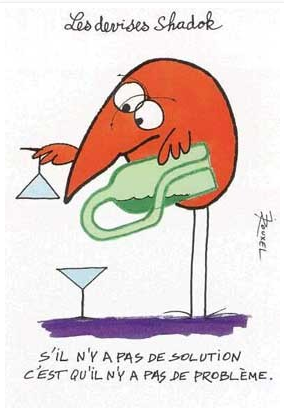
S’il n’y a pas de solution, c’est qu’il n’y pas de problèm

Two choristers tested positive between Monday’s Lessons and Carols rehearsal and Wednesday’s. Rehearsal cancelled.

Sunday’s performances? Who knows. Brings to mind this oldy:

(If there’s no solution, there’s no problem.)

The decade of ideological fantasy

The years 1991 and 2001 are commonly treated as breakpoints, markers that inaugurate distinctive chapters of history, the first labeled “Post-Cold War,” the second “Post-9/11.” Yet there is a strong case to be made for amalgamating the two decades into a single period: call it the “era of ideological fantasy,” when U.S. self-regard and Washington’s confidence in its ability to remake the world in America’s image reached unprecedented heights.

Bacevich, Weyrich, Lind et al, The Essence of Conservatism

Not at all sure I agree (but then I wouldn’t be, would I?)

The characteristic feature of the loser is to bemoan, in general terms, mankind’s flaws, biases, contradictions, and irrationality-without exploiting them for fun and profit.

Nassim Nicholas Taleb, The Bed of Procrustes.

How would I monetize flaws, biases, contradictions, and irrationality? Rupert Murdoch already founded Fox, back around 1988 (I remember where I was when I heard, and scoffed, that he was starting a fourth network).

Mythbusters

Second, Amar explains how the Chief Justice and Justice Sotomayor misread Marbury.

And what does Marbury v. Madison really mean? Marbury got invoked today by the United States Supreme Court. They don’t actually cite Marbury v. Madison in every single case. So they ratcheted up the stakes today, they meaning John Roberts and Sonia Sotomayor, and this is what I teach Marbury vs. Madison isn’t just ConLaw, it’s FedCourts, you know, 101, and this is what I was hired actually at the law school to teach so so I want to actually go through it with just a little bit of care here. Here’s what Marbury does not say, quote, "The Supreme Court is the ultimate interpret the Constitution" unquote. It doesn’t say that at all. Our audience will put the will put the case up on our website, so they can do a word search, they will not find that they will find if they go online, the Supreme Court at least half a dozen times in the 20th and 21st century, citing Marbury for that proposition, but never with a page cite. The Supreme Court, the ultimate interpreter of the Constitution. Marbury actually didn’t say that. It actually didn’t say much at all about the Supreme Court as such. It actually talked about courts in General, the judicial department which includes, at a minimum, all federal courts, maybe state courts as well, which which Ed invoked.

Amar is 100% correct. This mythical account of judicial supremacy comes from Cooper v. Aaron, and not from Marbury v. Madison. I explain this history in my article, The Irrepressible Myth of Cooper v. Aaron.

Josh Blackman (based on an Otter transcription of a podcast)

Misplaced sentimentality

Americans are a little sentimental about revolutions, because we had one of the very few good ones. But the revolutionary family tree gets pretty ugly pretty quickly: The American Revolution helps to inspire the French Revolution, with its purges and terror; the French Revolution provides a model for Lenin and his gang; the Russian Revolution informs the Iranian revolution. The line from the Boston Tea Party to the Iran hostage crisis is not a bold, straight one, but it can be seen, if you want to see it. Revolutions are dangerous, often in ways that are not obvious at the time and become understood only decades later.

Kevin D. Williamson, March of the New American Leninists

The January 6 insurrectionists vigilantes

The problem with treating every Republican more supportive of Trump than token GOP committee members Liz Cheney (Wyo.) and Adam Kinzinger (Ill.) as an existential threat to the republic is twofold. One, the reason the more serious legal efforts to overturn the election failed is because there were people with fidelity to the Constitution working for Trump. Sidney Powell wasn’t White House counsel. The second is that strengthening Capitol security — the riots were quashed the moment they were met with an appropriate level of response — is probably a better deterrent than trying to marginalize eccentric but widely held political views.

Republicans should take Jan. 6 more seriously, but they are also correct to resist treating ordinary members of their party as horn-wearing, violent extremists.

Damon Linker, The dangerous vigilantism that fueled Jan. 6

Rain Man

I thought Dustin Hoffman was brilliant in Rain Man, but then I’m a sucker for autism spectrum movies (Mozart & The Whale is another). Particularly effective was the bit about him memorizing the phone book — and then card-counting.

This came to mind as I overheard a 59-year-old Aspie of my close acquaintance recounting some trivial event that occurred when he was 7, on December 16, 1969 (see the post title, above).

The human mind is a marvel.


You can read most of my more impromptu stuff at here. It should work in your RSS aggregator, like Feedly, should you want to make a habit of it.

Abortion law, the Performative Jackass Caucus, Race, and more

Abortion Law

Politicization of the Supreme Court

In an exchange with Scott Stewart, the Mississippi solicitor general defending the state’s ban on most abortions after 15 weeks of pregnancy, Justice Sotomayor had this to say:

Will this institution survive the stench that this creates in the public perception that the Constitution and its reading are just political acts? I don’t see how it is possible.

Here’s what one reader of mine had to say about Justice Sotomayor’s “stench” comment:

Whoever smelt it, dealt it. Sotomayor and Alito are the two most partisan, results-oriented members of the Court. It’s pretty rich of her, of all the justices, to be complaining about politics stinking up SCOTUS—in a soundbite that was clearly crafted to fire up the left.

David Lat, Original Jurisdiction

Abortion and adoption

The last thing we should take from our nation’s debates about abortion is that adoption is a problem.

… the very idea that poverty—in this nation, of all places—could be the factor that causes a mother to part with her child is and should be a clarion call for action, both private and public, designed to facilitate family formation.

David French, Don’t Denigrate Adoption to Defend Roe

Politics, briefly

A guy can dream, can’t he?

GOP Rep. Devin Nunes of California is resigning from Congress at the end of the month to become CEO of former President Trump’s new social media company, Trump Media & Technology Group. First elected in 2002, Nunes served as chair of the House Intelligence Committee from 2015 to 2019, and would have been a contender to lead the House Ways and Means Committee if Republicans recapture the chamber next year.

The Morning Dispatch

This seems like an epic bad career move, but given my opinion of Devin Nunes, he’s certainly welcome to it.

I wonder if Trump can get Matt Gaetz, Paul Gosar, Marjorie Taylor Greene and the rest of the GOP Performative Jackass Caucus to come work for him, too?

When the only meaningful correlation involves racial ambivalence

After January 6, a team led by Robert A. Pape, head of the University of Chicago Project on Security and Threats, scoured the profiles of the capital insurgents:

Only one meaningful correlation emerged. Other things being equal, insurgents were much more likely to come from a county where the white share of the population was in decline. For every one-point drop in a county’s percentage of non-Hispanic whites from 2015 to 2019, the likelihood of an insurgent hailing from that county increased by 25 percent. This was a strong link, and it held up in every state.

Trump and some of his most vocal allies, Tucker Carlson of Fox News notably among them, had taught supporters to fear that Black and brown people were coming to replace them. According to the latest census projections, white Americans will become a minority, nationally, in 2045. The insurgents could see their majority status slipping before their eyes.

Barton Gelman, January 6 Was Practice.

This is a (the?) major article in a brand-new issue of the Atlantic largely devoted to the threat posed by the Trumpist Republican party. Recommended.

I apparently lead a sheltered life. I genuinely thought that frank racism (white people are better than darker people) had faded close to extinction, though I thought it likely that stereotypes remained (e.g., that black English did its speakers no favors in the job and other "markets").

Then came Barack Obama, and with it, birtherism and other unreasoning opposition.

Now, the "replacement theory" and the terrors it incites.

I’ve got to think this stuff was latent all along — just not obviously among my usual circle of mostly-Christian acquaintances.

Other

Root causes

Mark Bauerlein and Tim Perry discuss the deterioration of Christian burial practices, for which Perry finds startling roots:

Bauerlein: You link this deterioration to a bigger conceptual trend, and that is what happened with eschatology in the 20th Century. What went on there?
Perry: I think it’s a twofold story and it’s a little bit ironic. On the one hand, the Church lost its eschatological vocabulary. In the mainstream Protestant Churches and perhaps in the Catholic Church, more immediate concerns came to the fore: keeping the machine going in the days of decreasing revenues, decreasing membership rolls. In the churches that I’ve been shaped in as a child, I think we became a little bit embarrassed at our eschatological excesses, where we stopped talking about the traditional last things — death, judgment, hell and heaven — and started talking instead about secret rapture, great tribulation, who’s the antichrist, what’s the mark of the beast. I think evangelicals have, perhaps rightly, become a little embarrassed at that kind of speech. But instead of going back to the far richer and far more important language of the traditional last things, we’ve just stopped talking about eschatology altogether.

First Things Podcast, A Proper Christian Burial.

Well, I guess if you’re coy about death, judgment, hell and heaven, and allergic to orderly "liturgies," you’ve got little but novelties and pabulum to preach at funerals.

God will never forsake chosen America

This occurs to me so rarely, but seems so fitting when it does, that I thought I should capture it this time: a lot of support for Donald Trump, particularly but not exclusively among Evangelicals, results from fear that Democrats are an existential threat to the country, so they should vote Republican because God would never so forsake (or judge) America that we are left with shitty and unsuitable candidates in both major parties. That simply is unthinkable, since America supposedly is some kind of new chosen people.

I disagree — so much that I’m tempted to cease voting for Democrats or Republicans. That would mean I sit out many individual races. It should send at least a teensie-weensie signal of discontent that some voter in my precinct voted American Solidarity Party in the Presidential race, Libertarian or some other third party where ASP has no candidate, and not a single D or R.

Verbal tics

“Look, I’m an up-front guy,” Bear Hobart said. “I have to be honest with you—” Here it comes, Dylan thought. He was pretty convinced that you didn’t ever have to be honest with someone; maybe you should, and maybe you wanted to, but “I have to be honest with you” was a self-defeating sentence, since it was never true.

Eve Tushnet, Amends

There’s a kindred verbal tic: "Do you realize that you just [e.g., accused all the teachers in this school district of being sexual perverts]?", addressed to one who asks unwelcome questions. The italicized portion is a signal that the speaker is going to twist words beyond recognition in order to paint the initial speaker as some kind of crazy.

Modernity’s faith

“[F]aith in progress is just as basic to modernity as the Second Coming was to Christianity.”

Rod Dreher, Live Not by Lies

Recently-acquired aphorisms

  • A memory is what is left when something happens and does not completely unhappen. —Edward de Bono, The Mechanism of Mind
  • I am a slow unlearner. But I love my unteachers. —Ursula K. Le Guin, Dancing at the Edge of the World

Via Philip Yancey’s Where the Light Fell.

I recommend this memoir (about which I wrote earlier), but read it to understand Yancey’s inner life, not to lay out a timeline of events in U.S. and American church history, which Yancey confuses or conflates at times.


You can read most of my more impromptu stuff at here. It should work in your RSS aggregator, like Feedly, should you want to make a habit of it.

Mostly from news and commentary

Chickens coming home to roost

U.S. District Judge Linda Parker on Thursday ordered nine attorneys—including Sidney Powell and Lin Wood—to pay $175,250 to the state of Michigan and city of Detroit in response to their participation in the frivolous “Kraken” lawsuits seeking to overturn the results of the 2020 election.

The Morning Dispatch

U.S. Sportsball vs. Chinese Communist Party

In an interview on The Lead With Jake Tapper yesterday,  veteran sports broadcaster Bob Costas offered a measured, but forceful, condemnation of the coddling of China by some international institutions and prominent athletes. Tapper asked about the Peng Shuai situation and why the Women’s Tennis Association and International Olympic Committee have taken such different approaches to it. “The IOC is in bed with China,” Costas said. “It’s very troubling, their affinity for authoritarian regimes. … Meanwhile, you’ve got not just the IOC, you’ve got the NBA, and you’ve got Nike, and various individual sports stars in the United States who have significant investments in China, where the sports market is huge. And some of those people are very outspoken—as they have a right to be, and maybe in general you and I would agree with their viewpoints—very outspoken and sometimes offer sweeping condemnations of their own admittedly imperfect country, the United States. But when it comes to China—perhaps the world’s leading human rights abuser given its size and its wherewithal—they’re mum. Very, very few have anything to say.”

The Morning Dispatch

The Families Roe

We can’t shake the picture of the wholesome 1950s and ’60s as a time of American innocence. But no country is “innocent,” and so many of the central players in the [American abortion] drama came from some kind of deep dysfunction—sadness, family chaos, sirens in the night. Norma McCorvey, the Roe in the case, was a remorseless, compulsive liar who variously claimed to have been raped, gang-raped, beaten, shot at, preyed on by lesbian nuns. As I read her she was a sometimes charming, often funny sociopath, always uninterested in the effect on others of her decisions.

There is the brilliant lawyer who brought the first case and wound up destitute in a heatless house in East Texas; the prickly, eloquent pro-life leader who wound up unappreciated, alone and a hoarder. There is the writing of the Roe decision itself. And there is the idealism of many on both sides who were actually trying to make life more just.

Peggy Noonan, source from Joshua Prager’s book The Families Roe

Getting and spending

It is something of a cliché to suggest that the world outside is preoccupied with getting and spending. We have to put a lot of time and energy into those activities here on the island. I think the difference is that it would not occur to us to think of such activities as the main, let alone the sole, reason for our existence.

Peter France, A Place of Healing for the Soul: Patmos

Without comment

What a fast swimmer: A University of Pennsylvania swimmer who competed for three seasons at the college level as a man is now absolutely dominating the sport as a woman, breaking record after record in women’s swimming. “Being trans has not affected my ability to do this sport and being able to continue is very rewarding,” Lia Thomas said.

Nellie Bowles via the Bari Weiss Substack

Ray Bradbury, prophet

Give the people contests they win by remembering the words to more popular songs or the names of state capitals or how much corn Iowa grew last year. Cram them full of noncombustible data, chock them so damned full of ‘facts’ they feel stuffed, but absolutely ‘brilliant’ with information.

Ray Bradbury, Farenheit 451

Projection

We always have to remember that how we see the world about us is but a reflection of the state of our own inner world. Ultimately, it is because we see ourselves as existing apart from God that we also see nature as existing apart from God.

Philip Sherrard, The Rape of Man and Nature


You can read most of my more impromptu stuff at here. It should work in your RSS aggregator, like Feedly, should you want to make a habit of it.

December already?

I continue, with surprisingly little effort, to cease wallowing my mornings away with doomscrolling the news. It makes for less frequent blogging, but I hope it’s a bit more interesting.

Did your November fly past as quickly as mine?

Foretaste

Maybe you should sit down to read this and then mark your calendar in anticipation: on Sunday, I’m posting something nice about the Evangelicalism of my youth.

It may have boogered-up formatting, as WordPress seems incompetent at handling markdown other than paste-it-and-publish; save it and go back for edits and it incorrigibly inserts literal > before every blockquote.

Realism

People who discuss lowering the voting age – not only those for it but also those against – assume that it would mean a transfer of political influence to the young.

That is absurd. It would mean no such thing.

… It would only mean increasing the political clout of those who have influence through the young.

Pop stars. Sports coaches. Schoolteachers. Writers and editors of media aimed at teens. Especially people in such groups who have no children of their own to take up their time and attention.

… So one could expect further politicization of entertainment, primary and secondary education, youth athletics, children’s and “young adults” books, and teen magazines and media.

J Budziszewski

Ascetic abstention

Sondheim’s work was at its strongest when it lingered in the pain of the dawning realization that no ever after ever lasted long. His music and lyrics looked squarely at life and insisted, gently and eloquently, that of course it was never going to be exactly how we wanted it to be, that messiness and ambiguity were to be expected, and could even be part of the beauty.

Amy Weiss-Meyer, ‌What Stephen Sondheim Knew About Endings

I’ve pretty much stopped reading about Sondheim — though every new article is a temptation. An especially lovely surprise was John McWhorter’s heartfelt tribute.

"Earth Alienation"

“Should the emancipation and secularization of the modern age,” [Hanna] Arendt wondered, “which began with a turning-away, not necessarily from God, but from a god who was the Father of men in heaven, end with an even more fateful repudiation of an Earth who was the Mother of all living creatures under the sky?”

I thought about Arendt as I listened to Jeff Bezos talk about space exploration at a recent event held at the National Cathedral, a setting that will strike those of you familiar with the late David Noble’s work in The Religion of Technology as altogether apropos. The thesis of Noble’s book was that “modern technology and religion have evolved together and that, as a result, the technological enterprise has been and remains suffused with religious belief.” In this light, a cathedral is an altogether appropriate setting for the annunciation of a not-so-novel message of technologically mediated salvation and transcendence.

To be sure, Bezos makes a number of statements about how special and unique the earth is and about how we must preserve it at all costs. Indeed, this is central to Bezos’s pitch. In his view, humanity must colonize space, in part, so that resource extraction, heavy industry, and a sizable percentage of future humans can be moved off the planet. It is sustainability turned on its head: a plan to sustain the present trajectories of production and consumption.

L. M. Sacasas, Earth Alienation As A Service

This merits full reading, as the infatuation with space travel and colonization is not the only way in which our technological advances correlate to alienation from our actual situation.

In a related vein:

I kept thinking about Jesus’s admonition that it is easier for a camel to go through the eye of a needle than for a rich man to enter heaven. The point is not that rich people are wicked. The point is that if you have money, it is much easier to believe that you can control things, that your money and the technology it can afford (as well as living in a relatively wealthy society) buffers you from contingencies. We forget our dependence on God, but more to the point, we forget to cultivate awareness of Him.

Experience of the natural world does not generate faith. (Christianity is not a so-called Nature religion.) But surely it can encourage a certain psychological orientation favorable to some brands of religious faith; and this suggests the correlative possibility that reduced experience of the natural world might do just the opposite.

It is probable that no one has yet created a cataphatic theology grounded in technological analogies because it cannot be done. Technological artifacts point us to the wrong creator — to the human race, not God; so they seem bereft of real signals of transcendence. Further, as they become our environment, they imprint in the collective subconscious the message that things exist in order to serve us. That is the very last thing we need to intuit.

despite its undeniable defects, asceticism was "positive, not negative" because it "fundamentally aspired to liberate the highest powers of personality from obstruction by the automatism of the lower drives."

Rod Dreher, ‌‘The Luminous Dusk’

Call me a bigot, but everyone who expresses enthusiasm about space colonization (or Zuckerberg’s Metaverse) as a solution to some problem sinks in my estimation (unless they were alread rock-bottom).

RSVP Hall of Fame

Late in life, during the Second Vatican Council’s alleged golden dawn, Waugh received an invitation to a book launch by self-consciously “progressive” Catholics. He shot back by postcard his unforgettable RSVP: while he would not attend a social meal in the progressives’ company, “I would gladly attend an auto da fé at which your guests were incinerated.”

Bacevich et. al., The Essence of Conservatism

Pro-life feminism

As humor writer Dave Barry put it, “Critics allege that [Amy Coney] Barrett belongs to a harmful non-secular cult that subjugates ladies by forcing them to turn into Supreme Court justices.”

We need to broaden the tent of feminism. If, in order to be a feminist, one cannot simply be against the oppression of women but also must affirm abortion or other left-of-center causes, then feminism does not actually exist as a movement. It is merely pro-choice progressivism marketed for ladies.

And that ultimately weakens the cause of feminism because it excludes a lot of women, especially young women ….

Tish Harrison Warren, ‌Why the Feminist Movement Needs Pro-Life People

Fox-No-More

Fox broadcasts Seth Rich conspiracies? Memory-holed. Fox gave airtime to Kraken lawyers? Well, they were just asking questions. Its streaming platform airs a deranged Patriot Purge documentary that re-imagines the reality of January 6? Nobody watches Fox Nation anyway.

The cultural and political consequences in the right-wing grassroots are considerable. Politically engaged citizens can cite to you chapter and verse of (very real!) mainstream media scandals, yet they’re often completely shocked at the idea that the alternative institutions they follow are often substantially less reliable than the MSM they despise.

But honestly, how would they know? They’re inoculated against criticism of the right by the left, and how many voices on the right are reliably independent and free of Fox’s influence?

Mainstream media is still often plagued with groupthink and intolerance. Unfortunately, the right surveyed years of problems with legacy outlets and then built a media industry that was somehow even worse.

David French.

Despite Fox’s dominance, The Dispatch’s Jonah Goldberg and Steve Hayes resigned as contributors after Tucker Carlson’s Patriot Purge insanity,

Consider supporting The Dispatch. And getting off Fox News. All network news stultifies, but some stultifies more than others.

Unintended consequences

I don’t know why we don’t think more deeply and consistently of consequences of public policies and programs:

[T]he intentions behind a given policy tell us little about its likely effects ….

Tyler Cowen, commenting on a paper by Boaz Abramson in When Lawyers Make Things Worse.

Some meat:

Policies that make it harder to evict delinquent tenants, for example by providing tax-funded legal counsel in eviction cases ("Right-to-Counsel") or by instating eviction moratoria, protect renters from eviction in bad times. However, higher default costs to landlords lead to higher equilibrium rents and lower housing supply, implying homelessness might increase.

Early to bed, early to rise

My early jobs as a dishwasher and parking lot attendant began at 6 a.m. and I remember this dimness well. It changed my life. I stayed home at night and went to bed early and postponed debauchery to my mid-twenties and then, at the age of 27, I got a job on the 5 a.m. shift and postponed it again. A dear friend of mine, whose parents subsidized her fully, went out late one night and fell in with some fascinating strangers who introduced her to hashish and some other substance and she fell into a psychotic state and had to be hospitalized and spent some time in a drug program where she met more fascinating troubled people and it changed her life. She never found a vocation. Instead, she became fascinated by her own disability and made a career of being troubled, married a troubled man who abused her, and today she’s in a nursing home somewhere, a faint replica of the witty woman she once was, and I am waiting for the coffee to brew so I can get back to work on a novel. Early to bed and early to rise makes for a life that, if not wealthy and wise, is at least pleasant and sensible.

Garrison Keillor

Lies the Atlantic told me

Ending legal abortion in America, though, has long been the main goal of the conservative legal movement.

Adam Serwer.

Serwer is wrong if he means that literally, sloppy if he doesn’t.

Ending the pretext that the Constitution mandates legal abortion has been the goal. It remains after that to persuade legislatures of the appropriate restrictions on abortion.

I will be surprised if more than 5 states fly their progressive flags by legislating abortion on demand throughout pregnancy; if more than 10 states ban all abortions initially; if more than 5 states that initially banned all abortions continue to do so 5 years after Supreme Court success; if a majority of states don’t allow abortions in the first trimester.

A lot of politicians have gotten by with feigning pro- or anti-abortion purity on the cheap for almost 50 years now. We’ll see how much dross the legislative crucible throws off.

(There was another Atlantic item even worse than Serwer’s.)

Why I don’t rush to give 5 stars to new podcasts

Can anything good come out of the now-Trumpified Claremont Institute?

I’ll leave it for you to judge, but my hopes for Spencer Klaven’s Young Heretics podcast (held out as classical education for adults who weren’t classically educated) turned, for my tastes, into propaganda as the young, bright podcaster would "apply" the lessons of antiquity to modern U.S.A.

Sad. But at least it’s one less podcast I feel obliged to audit.

And it confirms the wisdom of ignoring pleas of new podcasts to "visit Apple podcasts and give us a 5-Star rating." Give me a dozen or so episodes, folks; I’m not your Junior Marketing Assistant.

Afterthought

I would be remiss if I failed to ask — How ’bout them Boilermakers?!

The Purdue Men’s basketball team bodes well to get a number 1 ranking if it can win its next road game. It’s 7-0, averaging over 90 points per game, and (if you hadn’t heard) 10-men deep. A lot of good teams will drop to Purdue, as Villanova did, simple because Purdue wears them out by rotating in fresh legs all game long, and getting solid production off the bench.

I hope the NBA knows how to reward team play — but that they don’t get Jaden Ivy to bolt after just two years. His mom, a WNBA veteran and Notre Dame coach may be able to steel him against the blandishments.


You can read most of my more impromptu stuff at here. It should work in your RSS aggregator, like Feedly, should you want to make a habit of it.

Still recovering from politics

Not political

Hygiene Theater

[I]f detractors mock these measures—temperature checks before concerts, QR codes instead of paper menus at restaurants, outdoor mask wearing—for being useless and performative, it’s worth remembering that not everything we do need necessarily have a use, and that not everything performative is without merit.

Colin Dickey, In Defense of COVID Hygiene Theater

Science Today

Highly recommended: Matthew Crawford, How science has been corrupted. H/T @ayjay

I have no axe to grind except to wipe the smugness and censoriousness off some politicized "follow the science" faces.

Abortion polling

Most abortion polling is meaningless because most people have no idea what the abortion status quo is, what Roe held, or how Casey effectively replaced Roe. Witness this.

An apparent exception: How Americans Understand Abortion: A Comprehensive Interview Study of Abortion Attitudes in the U.S. (PDF)

NFTs

Gotta say this massaged my smug nerve (though I had been thinking more in terms of tulip mania): NFTs are the new Beanie Babies H/T @Cheri on micro.blog

People went batshit for these things. They would scour the internet to try and guess which Beanies would be discontinued when, and which ones would likely shoot up in value a little bit later. Demand for these "collectables" sky-rocketed because, well, demand sky-rocketed.

Yes, this

To believe in medicine would be utter madness, were it not still a greater madness not to believe in it.

Marcel Proust, quoted in a letter to the Wall Street Journal

Ivermectin

Scott Alexander of Astral Codex Ten offers up Ivermectin: Much More Than You Wanted To Know — a very accurate title for a very long Substack posting.

The Summary (Alexander’s own words)

  • Ivermectin doesn’t reduce mortality in COVID a significant amount (let’s say d > 0.3) in the absence of comorbid parasites: 85-90% confidence
  • Parasitic worms are a significant confounder in some ivermectin studies, such that they made them get a positive result even when honest and methodologically sound: 50% confidence
  • Fraud and data processing errors are of similar magnitude to p-hacking and methodological problems in explaining bad studies (95% confidence interval for fraud: between >1% and 5% as important as methodological problems; 95% confidence interval for data processing errors: between 5% and 100% as important)
  • Probably “Trust Science” is not the right way to reach proponents of pseudoscientific medicine: ???% confidence

I believe these conclusions not because I read the whole article but because this is the kind of thing Scott Alexander writes and he is pretty trustworthy.

You got a problem with that? Maybe you should think about how much you (and everyone else in the world) believe based on trustworthy sources.

"Independent journalism"

Substack says it has more than 1 million paid subscriptions – Axios

When Substack appeared and had a run of success, news executives treated it as something traitorous and horrifying, being sure now the independents were to blame for their audience crop failures …

They were making the same mistake they nearly all made with Trump, confusing symptom with cause. Yes, a few independents have done well, but that’s mainly because the overall quality level of mainstream news plunged so low so long ago, audiences were starved for anything that wasn’t rancidly, insultingly dishonest.

… If they really wanted to wipe us out, of course, they could just put out a New York Times that sucked less. In a million years, that won’t occur to them. Which, God forgive me, I still find funny, even if there are surely more important things to worry about today.

Matt Taibbi

What do you expect?

When police are ineffectual in riots, what’s a neighborhood, or a property owner, to do? David Bernstein, ‌A Reality Check for Progressives on the Rittenhouse Case is very good and pointed.

Uneducated

When conservatives complain about the state of higher education, they typically point the finger at the deterioration of the social sciences and humanities into critical theory, identity politics, and “grievance studies.” I sympathize with the complaint, but the number of students actually majoring in those areas is tiny compared to the army marching through business, communications, engineering, and medicine. The university is being taken over by future accountants and lawyers more than social justice warriors.

Paul Miller, ‌We Are Less Educated Than We Think

Miller is not trying to reassure us with future rule by accountants and lawyers. They’re no better educated than the lefties who spend their 6-8 years of college nurturing identities and identity-based grievances,

Political — National Conservative Conference

In Wednesday’s G-File, Jonah responds to a Christopher DeMuth op-ed from last week making a “Flight 93”-style case for national conservatism. “Things are complicated,” he writes. “But what is obvious to me is that the threat to the country is not lessened when conservatives think the answer to that threat is to emulate progressive tactics and categories of thought.”

The Morning Dispatch

Another voice:

Listening to Hawley talk populist is like listening to a white progressive Upper West Sider in the 1970s try to talk jive. The words are there, but he’s trying so hard it sounds ridiculous.

The NatCons are wrong to think there is a unified thing called “the left” that hates America. This is just the apocalyptic menace many of them had to invent in order to justify their decision to vote for Donald Trump.

They are wrong, too, to think there is a wokeist Anschluss taking over all the institutions of American life. For people who spend so much time railing about the evils of social media, they sure seem to spend an awful lot of their lives on Twitter. Ninety percent of their discourse is about the discourse. Anecdotalism was also rampant at the conference—generalizing from three anecdotes about people who got canceled to conclude that all of American life is a woke hellscape. They need to get out more.

Sitting in that Orlando hotel, I found myself thinking of what I was seeing as some kind of new theme park: NatCon World, a hermetically sealed dystopian universe with its own confected thrills and chills, its own illiberal rides. I tried to console myself by noting that this NatCon theme park is the brainchild of a few isolated intellectuals with a screwy view of American politics and history. But the disconcerting reality is that America’s rarified NatCon World is just one piece of a larger illiberal populist revolt that is strong and rising.

David Brooks on the National Conservatism Conference. It’s foreboding.

One figure in National Conservatism is Rod Dreher, who I’ve followed since his first book, Crunchy Cons. Brooks’ quote from Rod ("We need to unapologetically embrace the use of state power") corroborates the opinion of another friend, Orthodox Christian as are Rod and I, who says Rod has started putting his "trust in princes, in sons of men in whom there is no salvation." Psalm 145:3 (146:3 in Western Bibles). That verse, of course, starts off "Put not your …."

Here’s my fear, evoked by Brooks’ take-down of Amanda Milius:

Another speaker, Amanda Milius, is the daughter of John Milius, who was the screenwriter for the first two Dirty Harry films and Apocalypse Now. She grew up in L.A. and wound up in the Trump administration. She argued that America needs to get back to making self-confident movies like The Searchers, the 1956 John Ford Western. This was an unapologetic movie, she asserted, about how Americans tamed the West and how Christian values got brought to “savage, undeveloped land.”

This is about as dumb a reading of The Searchers as it’s possible to imagine. The movie is actually the modern analogue to the Oresteia, by Aeschylus. The complex lead figure, played by John Wayne, is rendered barbaric and racist while fighting on behalf of westward pioneers. By the end, he is unfit to live in civilized society.

But we don’t exactly live in an age that acknowledges nuance. Milius distorts the movie into a brave manifesto of anti-woke truths—and that sort of distortion has a lot of buyers among this crowd.

(Emphasis added) It’s not at all hard for me to envision these NatCon crusaders being "rendered barbaric and racist while fighting … [b]y the end, … unfit to live in civilized society."

So the remarkable realignment of the major parties — who really thinks the Democrats are still the "party of the working man? — leave me no political home outside my dear, so-far-ineffectual, American Solidarity Party.


You can read most of my more impromptu stuff at here. It should work in your RSS aggregator, like Feedly, should you want to make a habit of it.