Zaccheus Sunday 2026

Explanation of the title.

History

Theology the authorities can work with

Predictably, secular authorities convinced by the reformers’ truth claims liked the distinction drawn between the necessity of obedience to them and of disobedience to Rome. They liked hearing “the Gospel” accompanied by such “good news”—it would allow them, for starters, to appropriate for themselves all ecclesiastical property, including the many buildings and lands that belonged to religious orders, and to use it or the money from its sale in whatever ways they saw fit. In two stages during the late 1530s, seizing for himself the vast holdings of all the hundreds of English monasteries and friaries, Henry VIII would demonstrate how thoroughly a ruler could learn this lesson without even having to accept Lutheran or Reformed Protestant doctrines about grace, faith, salvation, or worship.

Brad S. Gregory, The Unintended Reformation

The long shadow of Puritanism

Long after Puritans had become Yankees, and Yankee Trinitarians had become New England Unitarians (whom Whitehead defined as believers in one God at most) the long shadow of Puritan belief still lingered over the folkways of an American region.

David Hackett Fischer, Albion’s Seed

Human Rights

Most menacing of all was the United Nations. Established in the aftermath of the Second World War, its delegates had proclaimed a Universal Declaration of Human Rights. To be a Muslim, though, was to know that humans did not have rights. There was no natural law in Islam. There were only laws authored by God.

Tom Holland, Dominion.

That’s pretty terrifying if Holland is correct and if a lot of Muslims are still faithful to that command ethic.

Salvation (“Soteriology”)

Hacking Eternity

I’m glad the authors or editors at Dispatch Faith came up with that “Hacking Eternity” title for a little bit of musing on Scott Adams’ (creator of Dilbert) self-reported deathbed conversion. It’s perfect:

For whatever reason, Adams delayed his conversion … In that January 4 X post, only nine days before his death, Adams said, “So I still have time, but my understanding is you’re never too late.” His final message, read by his first wife after his death, confirmed his plans: “I accept Jesus Christ as my Lord and Savior … I have to admit, the risk-reward calculation for doing so looks so attractive to me. So here I go.”

I cannot categorically rule out the sincerity of Scott Adams’ “conversion,” but with all the Pascal’s wager trappings, and delaying claiming Christ as Lord until the very last minute (when the formulaic Lordship carried no practical meaning, no period of following Christ’s example or commandments) I can’t not put conversion in precatory quotes, either.

I recall one classmate in my Evangelical boarding school who declared his intent to become a Christian some day, but not before he’d whooped it up as much as possible. Last I knew, he was whooping it up at age 50+ with pneumatic wife #2. His declaration was so consistent with the logic of evangelical soteriology (study of salvation) pervasive in that time and place that the only refutations I can recall were:

  1. That he might be murdered, or have a fatal car collision, or otherwise die too suddenly to effectuate his last minute “conversion.”
  2. That refusing salvation for too long risked “hardening of the heart” to where could not repent.

Better would be this, I think, though it would probably be dismissed as “works righteousness”:

Be not deceived; God is not mocked: for whatsoever a man soweth, that shall he also reap. For he that soweth to his flesh shall of the flesh reap corruption; but he that soweth to the Spirit shall of the Spirit reap life everlasting.

Galatians 6:7-8.

Yeah, that’s a proof-text, taken without context. But I’d still say it fits.

The current milieu

The denominations

A new era of martyrdom

The Episcopal Church of New Hampshire is ready for frickin’ war. The Episcopalians are amped up. Bishop Rob’s reflection from earlier this month: “We are now, I believe, entering a time, a new era of martyrdom.” Of his priests: “And I’ve asked them to get their affairs in order—to make sure they have their wills written, because it may be that now is no longer the time for statements, but for us with our bodies to stand between the powers of this world and the most vulnerable.” These guys are not kidding around anymore. They are ready to die. And there will be cookies after the sermon.

Nellie Bowles. Bishop Rob’s letter has to be seen to be disbelieved. It features an ecclesiology straight from the lowest-church fever swamps:

As soon as the Christian church became linked to the empire by Constantine in the year 325 or so, the church immediately became corrupt.

(Italics added)

Ummmm, that’s just not credible. I don’t even think that educated clergy of low-church persuasion would defend that if pressed. To hear it from a Bishop of a high church is shocking but evocative. After all, what authority does a corrupt church have to tell Bishop Rob,

a man of profound historical privilege, … one who has made statements that, [he has] to say, have been really good and eloquent,

that he can’t innovate like mad to drive out that millenia-long corruption?

I’m still trying to figure out if “Rob” is his last name or if it’s an aw-shucks affectation. (Googles the question) Of course: it’s affectation.

Ostensibly Protestant; functionally, what?

There is another obvious fact that few denominational Protestants in the SBC or PCA seem willing to admit: The growth in these ostensibly traditional denominations stems almost entirely from the work of the Non-Denom churches. As already mentioned, pan- or pseudo-denominational organizations now own the church planting space. All church plants, to a great extent, utilize the methods and mores of Non-Denom Church. Most no longer even have their host denomination in their names. Therefore, I wager that whatever growth exists in the SBC and PCA is almost entirely the result of the Non-Denom churches growing within the husk of the world of traditional Protestantism.

Casey Spinks, Does Traditional Protestantism Have a Future?

Christianity and nationalism

Christianity does not simply fade away with the rise of nationalism; the process is more one of the reconfiguration of Christian elements to fit within a nationalist framework. When the holy migrates from the church to the nation-state, the church does not disappear but generally takes a supporting role to the creation of national identities.

William T. Cavanaugh, The Uses of Idolatry

The nondenominations

Nondenominational Protestantism

Douthat: Right. But I’m going to ask you to generalize. … For people who aren’t familiar with that world, what is nondenominational Protestantism right now?

Burge: They’re evangelical. Not all of them, but the vast, vast majority are evangelical in their orientation and theology and practice and all the things that we would call evangelical.

One thing is, they’re anti-institutional. They’re anti-authority in a lot of ways. Where does your money go when you put it on the plate? Well, it goes right here. It stays right here in these four walls. So what we’re going to have is a very fragmented Protestant Christianity, where you’ve got a little fiefdom here of 15,000 people in this church, and 20,000 people in this church.

I think the problem is, it’s going to be harder to conceptualize, to measure, to really understand what these groups look like, because now you’ve got these little pockets. You’ve got Joel Osteen in Houston, Texas. He’s an evangelical, but he doesn’t interface with most other evangelicals. You got Paula White down in Florida, whom Trump loves, but she’s Pentecostal and believes in the gifts of the spirit. And other evangelicals, like Franklin Graham, would never talk to Paula White.

You’ve got all these little pockets, and they don’t add up to a cohesive “What is evangelicalism?” In 30 years, that question is going to be almost impossible to answer. Not that it’s easy now, but it’s going to be 10 times harder because of this amorphous nature of nondenominationalism.

Ross Douthat and Ryan Burge (shared link). Ryan Burge is the most interesting social scientist focused on religion that I know. The transcript of his podcast is worth reading in full; I both listened and then read, highlighting heavily.

For my money, “amorphous” and “fiefdom” are the keys to nondenominational evangelicalism, and the two are related. The substantive religious content of the nondenominational religious landscape is amorphous, despite the shared term “evangelical,” because they are individual fiefdoms. The pastors may well be untutored and unorthodox, and they certainly are unaccountable to any higher authority.

But be careful: Burge leaves the impression, inadvertently I think, that these nondenominational churches typically number in the thousands. I’d be surprised if the median number of members or attenders was as high as 200. Burge no doubt would know the numbers on that if asked directly.

Orthopathos

Because of the divorce from the historic Church, Evangelicalism has sought for a new way to satisfy the need for materiality. This is why such believers have welcomed pop music and rock-n-roll into their churches. It is why emotion is mistaken for spirituality. It is why sentiment is substituted for holiness. Sincere feeling is the authenticator. Instead of icons of Christ, whose piercing stare calls you to repentance, the Evangelical can go to a Christian bookstore and buy a soft-focus, long-haired picture of Jesus. He’s a “nice” Jesus, but it is hard to believe that He is God.

Fr. Andrew Stephen Damick, Orthodoxy and Heterodoxy

I bang on a lot about Evangelicalism, my former affiliation, and specifically about the difficulty of defining it so as to be able to say “no, that’s not evangelical.” Ken Myer, founder of Mars Hill Audio Journal, once offered the possibility that while evangelicals don’t really share a coherent common doctrine, an orthodoxy, that they do share a common feeling or sentiment, an “orthopathos.”

Christianity Today

Sometime within the past year, I subscribed to Christianity Today. It is a magazine whose founding described it as “A fortnightly journal of evangelical persuasion” or something very like that.

I thought very highly of it. Just as I was an Intervarsity Christian Fellowship guy instead of a Campus Crusade for Christ guy, so I was a CT guy instead of a Moody Monthly guy. I even wrote a very cringe item they published. (I’ll give you no further hints whereby to unearth it.)

By and large, CT today has been a big disappointment, and I do not intend to renew.

The main part of the disappointment has been less the content of their articles (which certainly need a critical filter for evangelical bias), but the banality (it seems to me) of the topics of their articles. We’re just not remotely on the same wavelength any more. This “dumbing down” began nearly 50 years ago, and even then I took that as a sign that the evangelical appetite for chewing on meaty topics was waning.

But Thursday past, they finally floated on their RSS feed a story the topic and timeliness of which got my attention: How to Know If You’re Growing in Patience—or Just Giving Up.

Yes, it should be “whether” instead of “if,” but I’ll not dwell on that. It just seems to me as we, to whatever degree, watch the ICE terrorism and murders in Minneapolis, powerless to do anything, the spiritual line between patience (with prayer and trust in God’s providence) and giving up is an important one.

Jaw-dropping nadir

Majorities of white evangelicals favor deporting undocumented immigrants to foreign prisons in El Salvador, Rwanda, or Libya without allowing them to challenge their deportation in court (57 percent), and approve of placing immigrants who have entered the country illegally in internment camps (53 percent).

“It has become virtually impossible to write a survey question about immigration policy that is too harsh for white evangelicals to support,” Robert P. Jones, the president of the Public Religion Research Institute, recently wrote.

Tobias Cremer is a member of the European Parliament. His book The Godless Crusade argues that the rise of right-wing populism in the West and its references to religion are driven less by a resurgence of religious fervor than by the emergence of a new secular identity politics. Right-wing populists don’t view Christianity as a faith; rather, Cremer suggests, they use Christianity as a cultural identity marker of the “pure people” against external “others,” while in many cases remaining disconnected from Christian values, beliefs, and institutions.

The Trump administration has gone one step further, inverting authentic Christian faith by selling in a dozen different ways cruelty and the will to power in the name of Jesus. It has welcomed Christians into a theological twilight zone, where the beatitudes are invoked on behalf of a political movement with authoritarian tendencies. This isn’t the first time in history such things have happened.

Huge numbers of American fundamentalists and evangelicalsnot just cultural Christians, but also those who faithfully attend church and Bible-study sessions and prayer gatherings—prefer the MAGA Jesus to the real Jesus. Few of them would say so explicitly, though, because the cognitive dissonance would be too unsettling. And so they have worked hard to construct rationalizations. It’s rather remarkable, really, to see tens of millions of Christians validate, to themselves and to one another, a political movement led by a malignant narcissist—who is driven by hate and bent on revenge, who mocks the dead, and who delights in inflicting pain on the powerless. The wreckage to the Christian faith is incalculable, yet most evangelicals will never break with him. They have invested too much of themselves and their identity in Trump and what he stands for.

Peter Wehner

Sacraments or notions?

Christianity that has purged the Church of the sacraments, and of the sacramental, has only ideas to substitute in their place. The result is the eradication of God from the world in all ways other than the theoretical.

Fr. Stephen Freeman, Everywhere Present

Orthodoxy

Rescue

He is Jesus, the name chosen before his birth. The angel spoke separately to Mary and Joseph, and told them that the baby’s name would be Jesus, “because he will save his people from their sins” (Matthew 1:21). The name Jesus means, in Hebrew, “God will save.” When Gabriel says “he will save his people” the Greek verb sozo means “save” as in rescue, like “saved you from drowning.” That kind of “saved,” not “intervened and paid your debt.”

I had been a Christian decades before it occurred to me that this means Jesus can rescue us from our sins, not merely from the penalty for our sins. He can free us from the sins themselves. We will still fail over and over to take his outstretched hand and be lifted from the mire. We like mire. But he can do it, and make us not merely debt-free in his Father’s sight, but transformed and filled with his light.

Frederica Matthewes-Green

Repentance

Repentance is everything you do to get sin, those inborn passions, out of you. It’s reading, thinking, praying, weeding out disruptive influences in your life, sharing time with fellow Christians, following the guidance of the saints. Repentance is the renunciation of what harms us and the acquisition of what is beneficial to us, writes a holy counselor.

Dee Pennock, God’s Path to Sanity

A glimpse into an Orthodox mind

The Protoevangelium of James is not a text that itself holds a position of authority in the life of the Church. Indeed, the West formally rejected it well before the Great Schism. Nevertheless, the Church preserved the text through centuries of copying and recopying. It stands as the earliest written witness to the antiquity of a number of important traditions related to the New Testament Scriptures regarding the lives of the Theotokos, St. James, and their family. The Protoevangelium of James did not originate these traditions, nor does it provide their authority. Their authoritative form exists in the liturgical life of the Church, in hymnography and iconography.

Fr. Stephen DeYoung, Apocrypha (bold added).

All the well-educated Orthodox teachers agree on this. If you hear an Orthodox layman answer “How do you know that?” with “We get it from the Protoevangelium of James,” know that s/he’s got that backwards.

Darkness and Light

As Stephen Wormtongue Miller pronounces from the White House that the way the world works is by force, I’m very glad to be in a church where every Sunday we sing the Beatitudes, which tell us the way blessedness works.


Religious ideas have the fate of melodies, which, once set afloat in the world, are taken up by all sorts of instruments, some woefully coarse, feeble, or out of tune, until people are in danger of crying out that the melody itself is detestable.

George Elliot, Janet’s Repentance, via Alan Jacobs

[N]one of the things that I care about most have ever proven susceptible to systematic exposition.

Alan Jacobs, Breaking Bread With the Dead

You can read most of my more impromptu stuff here and here (both of them cathartic venting, especially political) and here (the only social medium I frequent, because people there are quirky, pleasant and real and it has no-algorithms). All should work in your RSS aggregator, like Feedly or Reeder, should you want to make a habit of it.

Sunday June 2

Reformation

An indifferent history student in my youth, I now enjoy it very much.

Pandora’s box

…in the wake of [Luther’s] defiant appearance at Worms, he found himself impotent to control the explosions that he had done so much to set in train. Nor was he alone. Every claim by a reformer to an authority over his fellow Christians might be met by appeals to the Spirit; every appeal to the Spirit by a claim to authority. The consequence, detonating across entire reaches of Christendom, was a veritable chain reaction of protest.

Tom Holland, Dominion

Seizing Church properties

Predictably, secular authorities convinced by the reformers’ truth claims liked the distinction drawn between the necessity of obedience to them and of disobedience to Rome. They liked hearing “the Gospel” accompanied by such “good news”—it would allow them, for starters, to appropriate for themselves all ecclesiastical property, including the many buildings and lands that belonged to religious orders, and to use it or the money from its sale in whatever ways they saw fit. In two stages during the late 1530s, seizing for himself the vast holdings of all the hundreds of English monasteries and friaries, Henry VIII would demonstrate how thoroughly a ruler could learn this lesson without even having to accept Lutheran or Reformed Protestant doctrines about grace, faith, salvation, or worship.

Brad S. Gregory, The Unintended Reformation

Beauty

Conversion

The prevailing image of religious conversion today is one that is individualistic—conversion is in some sense experienced within the self—and sentimental—one is transported by emotions—which then cause one to affirm a certain set of religious dogmas. Such things do happen and to be absolutely clear they are great, but this individualistic and pietistic model is also of modern, recent vintage. Such experiences have always happened but they were not thought to be the majority, even less the default or only case.

“The best argument for the Catholic faith, in the end, is the beauty of her art, and the life of her saints,” once said none other than Benedict XVI, and the argument presented there is really a different version of Ali’s: look at what Christian civilization has produced, look at how uniquely beautiful and praiseworthy it is; the fact that a civilization animated by such ideas produced such unique and surpassing greatness must be an indication that these ideas are in a profound way true.

This is a perfectly rational train of thought, a perfectly legitimate thing to believe, and a perfectly legitimate route to the Church!

I have seen many people stumble on the path of faith because they have an expectation that religious belief or practice must, of necessity, produce some sort of deep personal or emotional effect, and therefore feel that they’re “doing it wrong” or that it’s “not for them” or that they just “haven’t been touched” or “called”. No! These people have also been called and touched, just in a different way. In the meantime, this pietistic understanding of faith has done a lot of damage.

Pascal-Emmanuel Gobry, In Defense Of Ayaan Hirsi Ali’s Conversion

I perhaps should note that while Gobry is of the Roman Catholic faith, “Catholic” is also an appropriate adjective for the Orthodox Church.

Divine and counterfeit beauty

During his American tour in 2011, Archimandrite Vasileios of Iveron spent considerable time teaching Americans how to reorder their affections toward divine beauty. Speaking to Americans, who are known for their love of pleasure and their worship of the body, the Athonite monk warned his audience not to mistake the call of divine beauty by settling their affections on lesser objects that lure us with a counterfeit beauty.

Robin Phillips and Stephen De Young, Rediscovering the Goodness of Creation

One of the huge confusions in our time is to mistake glamour for beauty.

Poet John O’Donohue, interviewed by Krista Tippett.

The sects

Achieving our country

For all its notional secularity, much of today’s liberalism is still informed by the essentially messianic assumption that “achieving our country,” in the words of Richard Rorty, the post-Christian grandson of the great Social Gospel theologian Walter Rauschenbusch, can be a substitute for the consolations of traditional religious faith.

Ross Douthat, Bad Religion

The Force

When I was studying systematics, one of our seminars required us to read about a dozen different, so-called, systematic theologies, from across a very broad spectrum. I recall someone presenting a paper on the doctrine of God in the writings of the radical feminist Catholic, Rosemary Radford Ruether. When the student finished reading the paper, there was a dead, stunned silence in the room. Finally, a sheepish voice piped up, “Isn’t that the Force in Star Wars?” We broke out in laughter because it was precisely what she had articulated. It might make for interesting reading, but it certainly could not be called “Christian.”

Fr. Stephen Freeman

Ties that bind

The reality is that while many in the evangelical movement thought their bonds were primarily (or exclusively) theological or missional, many of those bonds were actually political, cultural, and socioeconomic.

Michael Graham, The Six Way Fracturing of Evangelicalism

Or, as Ken Myers had it decades ago, binding by feelings manifested in a common sensibility.

Christology

There is a cooperation of the divine and the human, the uncreated and the created. Christ is the perfect man, the complete man, the whole man. But Christ is also God. That is to say, paradox as it may sound, it is God alone who is the perfect man. Only God is completely and utterly human. As we said, in so far as man fails to realize the divine in himself, to that extent he falls short of being completely human. He remains less than human … It is not accidental or a cause of surprised that man’s attempts to be only human — to fulfill the ideals of the non-religious humanism of the last centuries — results in the dehumanization both of man and of the forms of the society which he has fabricated around himself.

Philip Sherrard, The Rape of Man and Nature

Miscellany

Benedict Option

Socialized to believe that their culture was the majority, it seems Christians have invested much less than Orthodox Jews in four key elements of faithful living required to thrive as a minority: educating children separately from the broader society, marking space and time to bolster community cohesion, strengthening local institutions, and reducing the influence of secular media.

A Christian reader may counter that Jewish rules seem legalistic. Yes, Jewish rules are indeed commands. This is a key difference in our faiths, and Christians seem to enjoy a liberty that Jews do not. I wonder, though, if community-held “constraints” would bring Christians greater freedom. Could they leave you unhindered by the burden of trying to change the majority culture and free instead to pursue joy as a flourishing minority?

Seth Kaplan, How to Flourish as a Creative Minority

It’s true that a Christianish civil religion lulled a Christianish people into complacency. That possibility if over for the foreseeable future; neither wokeism (all is allowed, nothing forgiven) nor MAGA is bringing it back. Kaplan’s advice is good, though I don’t really see more than a tiny minority (e.g., the Bruderhof) re-arranging life to live in close physical proximity to other Christians.

In a manner of speaking …

Nancy French talks about David French’s return from war (he enlisted gratuitously and served in a war zone as a J.A.G.):

Before he left, he’d been patient, slow to anger. But now my formerly carefree husband was foul tempered and anxious. Many of his friends had been killed, but war did not provide him time to process the trauma. After someone was killed, he had to focus on the next thing and the next and the next. But now he was swallowed up by grief. Plus, his faith had taken a hit. And since he was the one who’d introduced me to Christianity, it was unnerving.

Nancy French, Ghosted (emphasis added).

Nancy French grew up in the Church of Christ denomination. She attended (albeit resentfully) a Church of Christ college. That she should say so casually that David introduced her to Christianity is quite telling.

  1. Was the Church of Christ devoid of Christianity?
  2. Were her ears stopped, her heart embittered, by something she experienced in the Church of Christ (she was sexually abused in early adolescence by a youth pastor)?
  3. Is she fibbing a bit to zip up her book a bit?

I have heard things like this so many, many times. I heard a nationally famous figure say he’d “never heard the gospel” in the Church my wife and I were attending; I found that an indefensible swipe at a very sound Church (as Protestant Churches go), but it’s kind of the way Evangelicals tell their stories.

From my current perch, I can’t defend the adequacy of any Protestant Church. But it’s jarring to hear a Baptist or PCA Presbyterian or nondenominational Evangelical say that they never heard the heard the gospel (or never encountered Christianity) in the Baptist or PCA Presbyterian or nondenominational Evangelical church they left in favor of some other Baptist or PCA Presbyterian or nondenominational Evangelical Church.

I’m just not really buying it.


… that Christ may dwell in your hearts through faith; that you, being rooted and grounded in love, may be able to comprehend with all the saints what is the width and length and depth and height — to know the love of Christ which passes knowledge; that you may be filled with all the fullness of God.

Ephesians 3:17-19 (NKJV)

You can read most of my more impromptu stuff here and here (both of them cathartic venting, especially political) and here (the only social medium I frequent, because people there are quirky, pleasant and real). All should work in your RSS aggregator, like Feedly or Reeder, should you want to make a habit of it.
Thought Dump

This changes everything

I’ve been encountering, again and again, claims that this or that event or epoch changed everything.

Here’s one:

Capitalism commodifies and exploits all life, I conclude from my life and all I can learn.

Charles G. Sellers, a consequential American historian who died Thursday at age 98. More:

In Dr. Sellers’s best-known book, he argued that the rapid expansion of capital and industry in the 19th century did more than just create a new economy; it altered everything, including the way people worshiped, slept and even had sex.

And an implied change:

Even if we admit that material development does have certain advantages—though, indeed, from a very relative point of view—the sight of consequences such as those just mentioned leads one to question whether they are not far outweighed by the inconveniences. We say this without referring to the many things of incomparably greater value that have been sacrificed to this one form of development—we do not speak of the higher knowledge that has been forgotten, the intellectuality that has been overthrown, and the spirituality that has disappeared. Simply taking modern civilization on its merits, we affirm that, if the advantages and inconveniences of what has been brought about were set against each other, the result might well on balance prove to be negative.

René Guénon, The Crisis of the Modern World

And, implicitly, yet another (though it doesn’t identify what, between Dante and now, so radically altered our metaphysics):

What’s the bare minimum you need to know about Dante’s metaphysics to get the Commedia, and especially Paradiso. [Christian] Moevs tells us that these metaphysics are not specifically Christian, that they derive from Plato and Aristotle, and “undergird much of the Western philosophical-theological tradition to his time and frame all later medieval Christian thought.” Here, in Moevs’ words, are the five principles you need to know:

1. The world of space and time does not itself exist in space and time: it exists in Intellect (the Empyrean, pure conscious being).

2. Matter, in medieval hylomorphism [the matter-form analysis of reality], is not something “material”: it is a principle of unintelligibility, of alienation from conscious being.

3. All finite form, that is, all creation, is a self-qualification of Intellect or Being, and only exists insofar as it participates in it.

4. Creator and creation are not two, since the latter has no existence independent of the former; but of course creator and creation are not the same.

5. God, as the ultimate subject of all experience, cannot be an object of experience: to know God is to know oneself as God, or (if the expression seems troubling) as one “with” God or “in God.”

I put up with a lot of unsettling hand-wringing and apocalyptic blogs from Rod Dreher because he (so far) eventually settles down, synthesizes, and comes forward with something worthwhile and conversation-altering. He’s currently working on a promising book that, from various viewpoints, is an aid to:

We probably cannot un-change everything by act of will, individually or collectively, but I intend to try to escape its straight-jacket.

Self-discovery

Sometimes it takes a litmus test to reveal myself to myself.

I’ve been skeptical that there is any such thing as a bona fide religious objection to the Covid vaccine. The Roman Catholic Church, for instance, has evaluated the role of fetal stem cells in Covid vaccine development and given the vaccines a green light. But I know that the law gives a lot of leeway to even totally solipsistic and bat-shit crazy "religious" convictions (so long as they don’t hurt the tender feelings of some member of a "sexual minority").

The litmus test came a few mornings ago with a brief news item, ‌Suit Says Trader Joe’s Failed To Accommodate Religious Objection To COVID Vaccination. I instantly sided with Trader Joe’s — and when I say "instantly," I mean I felt no need to read beyond that headline.

I’m not saying I’m right to discount such "religious" objections, but three weeks ago, I didn’t go to the E.R. with some worrisome abdominal sensations (it’s under control now) because I knew the E.R. would already be overwhelmed with jackasses who lost their games of Covid Chicken.

Dehumanization

A pastor praying aloud, holding a dying man’s hand, would bring too much flesh, too much humanity, into the thing. Execution theater is all about maintaining the illusion of mechanism.

Elizabeth Breunig (native Texan) on Texas’ refusal of John Henry Ramirez’s request for his pastor to "lay hands on and pray over him in the execution chamber."

Breunig here, I think, cuts to the heart of the issue from Texas’ point of view. The issue cannot plausibly be that there’s no Biblical or historical support for Ramirez’s request. A lot of criminal justice and the media theater around it is, I believe, calculated to dehumanize criminals (and to give families of victims a "closure" that I doubt exists).

1619 Project drives the conversation … by its wrongness

“As I would later confirm with the foremost scholars of the subject who know far more about the Revolution than I, there is no evidence of a single colonist expressing support for independence in order to protect slavery. The 1619 Project’s claims were based not on historical sources but on imputation and inventive mindreading,” – Sean Wilentz, one of the foremost historians on the Revolution, writing for a Czech journal.

Via Andrew Sullivan‌.

Bowdlerizing the Notorious RBG

This week the organization that once defended freedom of speech [the ACLU] tweeted out a famous quote from Ruth Bader Ginsburg, with some, er, editing:

The decision whether or not to bear a child is central to a [person’s] life, to [their] wellbeing and dignity… When the government controls that decision for [people], [they are] being treated as less than a fully adult human responsible for [their] own choices.

RBG never wrote or meant the words in parentheses. She wrote “woman” and “her.” In fact, she was explicit in her view, often repeated, that “the one thing that conspicuously distinguishes women from men is that only women become pregnant.” This was central to her argument for sex equality. The reformulation by the ACLU is meaningless without that distinction.

Their argument, of course, is that this wording excludes trans men, who have uteruses and thereby can have abortions, while identifying as men.

Let’s first stipulate that an infinitesimal fraction of abortions may indeed be linked to uteruses whose owner has a male gender identity. But that doesn’t mean his biological sex is male, or that his reproductive system is male. Gender identity is not sex, and cannot erase its reality. And in so far as a trans man is pregnant, it is as a biological woman. And the term “woman” in RBG’s quote would therefore include him in this physiological context.

The reason the ACLU cannot accept this sane form of inclusion is because they insist that gender identity trumps biological sex. That is why the woke insist not just that someone biologically female is male in every respect but that every physiological part is male as well: that’s why a “clitoris,” for example, is actually a “lady-dick,” and gay men who are not into “lady-dicks” are not truly gay, but anti-trans bigots. Very few things express the insanity of gender theory than this simple denial of basic biology, a denial now echoed by every major American institution, even hospitals, and yet rejected by science and over 99 percent of human beings who have ever lived or ever will.

One more thing: the fanatical insistence on this “inclusion” for the woke is non-negotiable, a near-religious imperative. That’s why it merits even correcting the past, by altering the historical record. The ACLU put anachronistic words in RBG’s mouth, because her actual quote they seriously regard as a “form of violence” against trans people. Therefore religious censorship — even of RBG — is one of the ACLU’s core values now. One of their new tenets is quashing blasphemy.

If you want to understand why a monster like Trump has such traction you only have to take a tiny glimpse at this performative left absurdism and realize just how far gone our elites now are.

Andrew Sullivan‌ (emphasis added).

I can’t imagine the ACLU quoting an anti-trans bigot like RBG. 😉

Black Lives Matter

The slogan "Black Lives Matter" is a form of persuasion that seeks to be as anodyne in its tone and minimal in its assertion as possible, (indeed, almost self-parodically so) and therefore impossible to dispute. Its exponents then pack in as much sectarian content, much of it disputed, and much of it distant from the issue of police brutality that the slogan ostensibly addressed, as possible into that otherwise unimpeachable assertion.

Wesley Yang. That’s about as good a distillation as I can imagine for why I affirm that black lives matter without affirming Black Lives Matter.

The paragraph concludes:

Do the black inner-city males between 18-30 who are the primary targets of policing and its associated abuses really believe that no one is free unless Palestine or LGBTQ people are free? Do they agree that we must "dismantle the nuclear family requirement" and all the other left-wing shibboleths written into the manifesto for the Movement of Black Lives? Is it possible to dispute any of these shibboleths without thereby disputing the core assertion with which no one disagrees, and thereby placing oneself beyond the pale of civilized society?

Staying in one’s land

Especially during these divided days when feelings (and tempers) are running high, it is easy for us clergy to combine the timeless Gospel with the challenges of the current crisis, and think that we are preaching the Gospel when we are in fact simply picking a side in a complex debate. It is easy for us to believe that part of our task as clergy is to call our country back to God, as if each of us were the prophet Jeremiah. Let us remember that: 1. We are not Jeremiah, and that 2. Jeremiah functioned in a nation which was under solemn covenant with God in a way that no other nation was or is.

It is sadly true that Canada, America, and the West generally are immorally departing from God and are going down the tubes. But it is not the Church’s job to prevent that. It is the Church’s job to say to the world, “The Kingdom of heaven is at hand; repent and believe the Gospel”. The job of trying to impede the West’s slide into secularism belongs to individual Christians, not to the Church as Church.

This does not mean that the Church as Church should not address moral issues in society. The Church may still declare to the State that abortion is murderous, that marriage is only between a man and a woman, and that racial discrimination is sinful and wrong. These issues are clear, simple, and unambiguous, unlike many political issues. These are moral issues, not political ones, even though they have political ramifications, and the Church should not shrink from speaking to society about them. A moral issue is not the same as a political one.

Fr. Lawrence Farley

Heretics

I’m old enough to remember when heresy was understood to be deviation from long-establish beliefs and practices. But in a social-media environment that issues new commandments every fortnight or so, the heretics now are the ones who don’t deviate when told to do so. And they are hated with particular intensity because they are a living, breathing reproach to their colleagues’ complete lack of ethical standards.

Alan Jacobs

Crazy person update:

A man walks a slackline attached to the Eiffel tower

French slackliner Nathan Paulin performs on a 70-meter-high slackline between the Eiffel Tower and the Chaillot Theater, across the Seine River, in Paris on September 19, 2021. # Francois Mori / AP

(Via the Atlantic)

Partisan Political

The rest of this post is rather partisanly political. Like a dog to its vomit, I keep returning to this second-order stuff — less to feed my anger than to see why others are so angry.

You have been warned.

Relitigating 2020

This was a good week for anyone enthused about relitigating the 2020 election. First there was new evidence, reported in a new book about the Biden family from the Politico writer Ben Schreckinger and in an Insider story on an abortive Libya-related influence operation, suggesting the famous Hunter Biden emails were real and indicating how much Hunter’s influence-peddling depended on proximity to his father. The Twitter and Facebook decisions to censor The New York Post’s election-season version of the Hunter Biden story looked partisan and illiberal at the time; now they look worse.

Then along with that spur to conservative frustration there was a new revelation for Trump-fearers: the exposure of the entirely insane memo that the conservative legal scholar John Eastman wrote explaining how Mike Pence could supposedly invalidate Joe Biden’s election. This was presumably the basis for Donald Trump’s futile demand that Pence do exactly that, and it’s understandably grist for the “coup next time” fears that already attend Trump’s likely return to presidential politics.

Along with any worries about Trump stealing the next presidential election, then, Democrats should recognize the possibility that he might simply win it.

Here it would be really helpful if Biden had a vice president who balanced his weaknesses and reaffirmed his strengths — who seemed more energetically engaged with policy and congressional politicking while also extending his normalcy-and-moderation brand should she be required to inherit it.

I will leave it to the reader to decide whether that describes the Kamala Harris vice presidency to date — or whether Harris offers more reasons for Democrats looking toward 2024 to fear not just chaos but defeat.

Ross Douthat, Can Biden Recover

Ignoring the base

Up until the 1960s, those active in liberal and progressive politics were drawn largely from the working class or farm communities, and were formed in local political clubs or on shop floors. That world is gone. Today’s activists and leaders are formed almost exclusively in our colleges and universities, as are members of the mainly liberal professions of law, journalism, and education. Liberal political education now takes place, if it takes place at all, on campuses that are largely detached socially and geographically from the rest of the country—and in particular from the sorts of people who once were the foundation of the Democratic Party.

Mark Lilla, The Once and Future Liberal.

What use are political labels? Those "liberal and progressive" figures from before the 1960s would today be called populists, and would fall in with the social conservatives on issues like family and sexuality — and above all, that we live in a world of limits. Meanwhile, a mark of "conservatives" today is support of modern capitalism and with the ideology of unlimited economic growth.

I this regard, read Christopher Lasch’s essay Conservatism Against Itself in a very early edition of the journal First Things. He even holds up for consideration the alternatives of syndicalism and guild socialism!

I wouldn’t want any one person to have that authority

And here is a chilling part of the conversation where Trump tried to pressure Pence into submission. Pence said he had no authority to send the election to the House:

“Well, what if these people say you do?” Trump asked, gesturing beyond the White House to the crowds outside. Raucous cheering and blasting bullhorns could be heard through the Oval Office windows. “If these people say you had the power, wouldn’t you want to?” Trump asked.

“I wouldn’t want any one person to have that authority,” Pence said.

“But wouldn’t it almost be cool to have that power?” Trump asked … “Mike, you can do this. I’m counting on you to do it.”

This is a president using the threat and thrill of a violent mob to pressure his vice-president into subverting the Constitution. If that doesn’t capture the essence of fascism, what does? If that wouldn’t put someone beyond the pale of democratic politics for ever, what would?

Andrew Sullivan, ‌The Deepening Menace Of Trump.

I believe this exchange is from the new Woodward & Costas book Peril, and thus is meant to make vivid the gist of Trump’s pressuring Pence.

I had no problems with Pence as my governor and was puzzled, almost baffled, by the yard signs against him when we were nowhere near an election. But I have no sympathy with him now: "Lie down with dogs, rise up with fleas" is the story of almost all public servants who tried to be a bit of leaven in an administration that was doomed from the beginning to domination by the unprecedented narcissist in the Oval Office.

Rational Ignorance

One of the Volokh Conspiracy bloggers blogged repeatedly about voters’ "rational ignorance" a few years ago. I now suspect it was Ilya Somin, author of a book and an article on Voting with Our Feet. In the article, Somin also posits that voter irrationality can be rational ("rationally irrational"), which made me think, of course, of how we got to the nadir of "45" a/k/a Orange Man.

But even if voter irrationality can be rational, I can barely begin to understand any desire, however irrational, to put Donald Trump in the White House. Back when there wasn’t a whiff of politics about him (that I knew of), I was baffled by an aspiring lawyer who eagerly rushed to get a copy of The Art of the Deal the first day it was available. I have just never found anything admirable about him, and I paid him no substantial heed until his freakish political success forced him into my life.

This week, the Dispatch surveyed the landscape of 45’s increasing fecklessness on Congressional votes, but his influence on voters and his (sigh!) apparent intent to run for President again in 2024. (Kamala Harris versus Donald Trump will be a choice more hellish than Hillary versus Trump — and I wrote that before Ross Douthat’s Sunday column, above).

I hope (and even suspect) that what’s going on in the Republican part of Congress is a bit like the parable of the two sons, the second of whom said "’I go, sir’, but went not." Lip service to narcissist Orange Man ("I go") may be all it takes to keep him from manufacturing a primary challenger, regardless of what you do (short of saying anything critical of Trump).

A guy can hope, can’t he?


You can read most of my more impromptu stuff at here. It should work in your RSS aggregator, like Feedly, should you want to make a habit of it.

What’s wrong with this picture?

More dramatic than I imagined:

Screen Shot 2020-08-01 at 3.39.29 PM

(link) and

Screen Shot 2020-08-01 at 3.39.55 PM

(link).

Those are stunning contrasts. So why do I not feel tribal loyalty to the GOP?

A superficial answer would be that for a conservative, I rate shocking low on loyalty in Jonathan Haidt’s Moral Foundations Theory. But I’m almost positive there’s something more important than that.

First, a distinction.

Dissatisfied with my superficial reading habits, I am currently reading Mortimer Adler’s classic How to Read a Book (revised and updated 1972). Chapter 8 is titled “Coming to Terms with an Author”:

[I]n the analytical reading of a book, coming to terms is the first step beyond the outline. Unless the reader comes to terms with the author, the communication of knowledge from one to the other does not take place. For a term is the basic element of communicable knowledge.

A term is not a word–at least, not just a word without further qualifications … [A] word can have many meanings, especially an important word. If the author uses a word in one meaning, and the reader reads it in another, words have passed between them, but they have not come to terms.

Second, a story, which may be apocryphal, but I did not make it up.

A conservative returned to his alma mater for a commencement address and opened thusly:

By a strange coincidence, I am a graduate of a vastly different institution which occupied this very site 40 years ago and even bore the same name …

For some 23 years now, I’ve been an adherent of a religion called “Christianity,” based on the incarnation, life, death, resurrection, ascension and glorious second coming of Jesus Christ, who is both fully God and fully man. It was once, under the necessity of distinguishing it from a particular heresy, partially summarized in a Creed. To distinguish it from other versions, it’s called “Orthodox,” with a capital-O.

Meanwhile, my country is breathing the last few whiffs of an empty bottle labeled, by a strange coincidence, “Christianity,” which apparently is based on the intuition that God wants us to be nice and happy or, in its robust “Evangelical” versions, that Jesus Christ was very special and died a horrible death so that God would get over his anger issues with us and we could get on with being nice and happy.

Its proper name is Moralistic Therapeutic Deism. Although we share a mostly-overlapping vocabulary of words, I cannot come to terms with it, except in relatively brief and exhausting bursts of attempted empathy.

I remember from some 55 years ago an even more rigorous version, to which I then and for several more decades adhered, but it lives on today mostly notionally, in the scribblings of über-fissiparous “discernment bloggers.” I stay as far from them (and it) as I can, because I’m recovering from a mild-to-moderate case of that mindset and I’ve seen the harm it can cause, including when someone brings that mindset into Orthodox Christianity.

There were and are some other versions of “Christianity,” with some of which I have more or less come to terms, but they are not all that easily pigeon-holed politically.

So back to the question:  “why do I not feel tribal loyalty to the GOP?”

First, because it forfeited any claim to my loyalty:

In 2000 and 2004, it was Dubya. He was, we were told, a good Evangelical Christian. He cited Jesus as his favorite philosopher. He talked about America walking humbly in the foreign policy world.

Then 9-11 came, and he turned into a fierce Commander In Chief …

And then came, too, the second inaugural, when he declared as U.S. policy the eradication of tyranny from the world and the planting of democracy. If you don’t understand how delusional that is, read it again: eradicating tyranny from the world. As national policy.

(Conscientious Objector to the Culture Wars | War Correspondence ن)

Second, I have no confidence that was a blip, a lapse. In fact, the ensuing years have confirmed that endless war truly is the position of the party insiders (even though party voters chose a putatively antiwar mad, toxic and incompetent man for President in 2016).

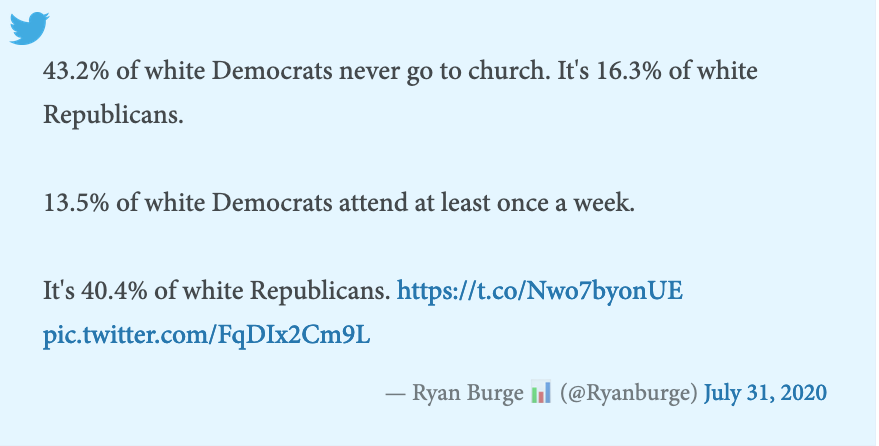
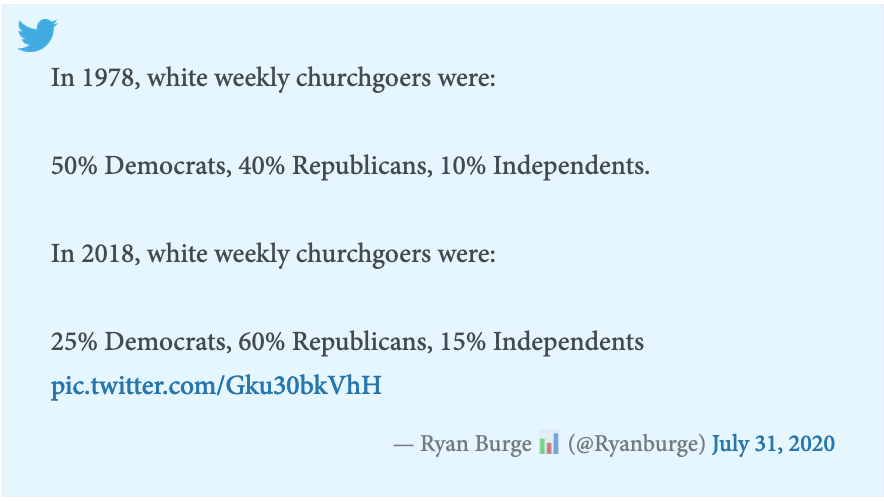
Third, the Churches these Republicans so assiduously attend engage in worship that’s pure glucose and teach religion(s) with which I cannot come to terms sufficiently to form any kind of alliance. That Republicans are so much likelier to attend Church weekly is not all that interesting considering the Churches they attend.

I knew that 10 years ago (if not earlier, but I drove a stake in the ground then — a blog that’s held up surprisingly well) and they drove a stake though whatever remained of “Republican” in my heart on November 8, 2016.

That’s why.

* * *

Perhaps some day I’ll post a more nuanced version of why it’s difficult for a former-Evangelical, former-Calvinist, now-Orthodox, to “come to terms” with typical versions of contemporary American “Christianity.” I acknowledge painting here with a broad brush, but if there’s no glimmer of recognition, then you may to inattentive, gentle reader.

* * * * *

Put not your trust in princes,
in a son of man, in whom there is no salvation.

Psalm 146:3

* * * * *

You can read most of my more impromptu stuff at here. It should work in your RSS aggregator, like Feedly, should you want to make a habit of it.

The times, they are a changin’

1

The history of greed, venality, stupidity, cruelty and violence is long because that part of human nature is ineradicable. As the 20th century demonstrated, it is better to bet on a liberal society’s capacity to temper these flaws and iniquities than on a utopia’s false promise to eradicate them. Those promises end being written in blood.

… [C]ycles of history run their course. By 2008 it was clear that the world economic system was seriously skewed. Bailed out, it staggered on until now, accompanied by growing anger in Western societies.

… All the grotesque needed, to be revealed as such, was for time to stop.

Roger Cohen, No Return to the ‘Old Dispensation’. The grotesque did stop, but has it been recognized sufficiently for us to actually change entrenched behavior when some kind of normalcy is again permitted?

I loved this whole column, by the way. So sorry if you can’t get to it — I don’t know how much, if anything, a non-subscriber can see.

2

Are we inherently gullible? Research says no: Most adults have well-functioning machinery for detecting baloney, but there’s a common bug in the machine. Faced with a novel idea or new circumstances, we gravitate to information that fits our already existing beliefs. As Sherlock Holmes put the problem: “Insensibly one begins to twist facts to suit theories, instead of theories to suit facts.” This bug has always been exploited by people seeking money, power — or both. But with the rise of social media, the world’s propagandists, con artists and grifters find their search for suckers easier than ever.

Witness the grubby exercise known as “#Plandemic.” [A conspiracy theory video now banned from social media — after infecting 8 million brains.] …

People believe in a “#Plandemic” because it fits into existing convictions. A lot of people already believe — not without reason — that pharmaceutical companies cash in on suffering. Many people have heard that government labs do research on biological weapons. All true. Government has hemorrhaged credibility in recent years — even with regard to veteran public servants such as Fauci. All of these mind-sets are potential vectors for the viral #plandemic.

Americans need to understand that they are being actively targeted for disinformation campaigns by people and forces pursuing their own agendas. Conspiracy-monger Alex Jones wants to sell them overpriced nutritional supplements. Anti-vaxxers are hawking books and miracle cures. Vladimir Putin and the mandarins of Beijing are pushing the decline of the United States and the death of the Western alliance.

Some want your money. Some want your mind. Citizenship in the Internet era demands a heightened commitment to mental hygiene and skepticism. We have to learn that the information that fits neatly into our preconceptions is precisely the information we must be wary of. And even in these wild times, we must heed the late Carl Sagan, who preached that“extraordinary claims” — like grand conspiracies and healing microbes — “require extraordinary proof.”

David Von Drehle, Why people believe in a ‘plandemic’.

Take a look at the next-to-last paragraph. Someone’s missing: Steve Bannon, who pledged to “flood the zone with shit” to neutralize truth-telling about Trump.

3

Fourteen years ago, Rod Dreher introduced us to Crunchy Cons. Now his friend Tara Isablla Burton, with a degree in theology but a fairly short history of personally “faithing,” thinks Christianity Gets Weird, and wants New York Times readers to know about it.

Because of her audience, or perhaps via her editors, I find a lot of her wording and characterizations weirdly “off” and off-putting. I’m familiar with the sort of phenomenon she’s talking about, and I’d have to say that although she’s in the right ballpark, she’s not just “way out in left field” but somewhere in the bleacher seats much of the time. For instance.

  1. I would not affirm either half of “old-school forms of worship as a way of escaping” anything. “Escaping” is an unduly negative spin on something fundamentally sane.
  2. Her characterization of “mainline Protestant denominations like Episcopalianism and Lutheranism” was painted with a mighty broad brush.
  3. What is “weekly membership” (emphasis added) in reference to Roman Catholic churches with Latin Mass?

But the teaser is great:

Modern life is ugly, brutal and barren. Maybe you should try a Latin Mass.

And near the conclusion, she gives a characterization I can endorse:

Like the hipster obsession with ‘authenticity’ that marked the mid-2010s, the rise of Weird Christianity reflects America’s unfulfilled desire for, well, something real.

That “something real” is, in the best cases (and I suspect they are many), God.

Flaws aside, I welcome anyone using a prominent platform like the New York Times Magazine to shout out that “the fusion of ethnonationalism, unfettered capitalism and Republican Party politics that has come to define the modern white evangelical movement” is not the whole of American Christianity. Not even close.

UPDATE:

Rod Dreher on Sunday published the full text of Tara Isabella Burton’s interview of him. She got in a couple of well-formed, open-ended questions, and he really ran with thim. For my money, that interview is better than TIB’s NYT story, but TIB was casting the net wider than Catholic and Orthodox converts.

This, for me, was Rod’s best point in the interview:

The phrase “Christian values” has been worn as smooth as an old penny by overuse, especially in the mouths of political preachers. Look, I’m a theological, cultural, and political conservative, but I admit that it has become hard, almost impossible, to find the language to talk meaningfully about what it means to believe and act as a Christian. This is not a Trump-era thing; Walker Percy was lamenting the same thing forty years ago, at least. I think the term “Christian values” has become meaningless. It is taken as shorthand for opposing the Sexual Revolution, and all it entails — abortion, sexual permissiveness, gay marriage, and so forth. Don’t get me wrong, I believe that to be a faithful Christian does require one to oppose the Sexual Revolution, primarily because the Sexual Revolution offers a radically anti-Christian anthropology. But then, so does modernity — and this is an anti-Christian anthropology that clashes with the historic faith in all kinds of ways. I’m thinking of the way we relate to technology and to the economy.

You want to clear a room of Christians, both liberal and conservative? Tell them that giving smartphones with Internet access to their kids is one of the worst things you can do from the standpoint of living by Christian values. Oh, nobody wants to hear that! But it’s true — and it’s not true because this or that verse in the Bible says so. It’s true because of the narrative that comes embedded in that particular technology. It’s not an easy thing to explain, which is why so many Christians, both of the left and the right, think that “Christian values” means whatever their preferred political party’s preferred program is.

[Philip Rieff wrote that] “Barbarism is not some primitive technology and naive cosmologies, but a sophisticated cutting off of the inhibiting authority of the past.” This is perfectly true. This is why the dominant form of religion today is, to use sociologist Christian Smith’s phrase, “Moralistic Therapeutic Deism.” It’s crap. It’s what people believe when they want the psychological comfort of believing in God, but without having to sacrifice anything. It’s the final step before total apostasy. In another generation, America is going to be like Europe in this way.

But something might change. The problem with the phrase “Christian values” is that it reinforces the belief that Christianity is nothing more than a moral code. If that’s all Christianity is, then to hell with it. The great thing about ancient, weird, traditional Christianity is that it is a lifeline to the premodern world. It reminds us of what really exists behind this veil of modern selfishness and banality and evil.

Weird Christianity: The Rod Dreher Interview.

That’s about as deep as I’ve ever read Rod going. Good stuff.

* * * * *

You can read most of my more impromptu stuff at here. It should work in your RSS aggregator, like Feedly, should you want to make a habit of it.

I highly recommend blot.im as a crazy-easy alternative to Twitter (if you’re just looking to get your stuff “out there” and not pick fights).

An anniversary and a testimonial

Today is the 52nd anniversary of my high school graduation.

It might sound odd to remember that, but high school was formative for me because, almost impetuously, my parents and I agreed that I should go to a Christian (specifically Evangelical) boarding school. So off I went at age 14 (specifically, Labor Day 1963) to forge a life somewhat separate from my parents — an experience most of my contemporaries postponed for another four years. By that point in my life, living in dormitories was “old hat,” college “same old, same old.”

I should qualify the preceding paragraph by noting that only 40% of my school was boarding students. The other 60% was commuters from the nearby Evangelical Jerusalem: Wheaton, Illinois. I suspect that Wheaton Academy itself was “old hat” for my commuter classmates, many of whom had attended Wheaton Christian Grammar School, whereas I had attended public schools to that point in my life (with my parents requesting some exemptions to let me observe Evangelical taboos about, say, dancing — public schools were not yet required to teach fornication).

We Evangelicals, of course, were very focused on the Scriptures (which we received from the historic Church pretty much unacknowledged) because they, in theory, were our final authority. But those Scriptures are many (66 by Evangelical count, more than that historically) and varied. The inability to fully harmonize them, or to credibly discern the science of cosmic creation therein, leads some Evangelicals to the shipwreck of faith.

There is a different and much more historic way to approach Scripture, and it always amuses me when the New Atheists and their ilk presume that the Evangelical (shared closely with Fundamentalists) approach is the exclusively correct one — before using it to rip such Christian faith to shreds — a presumption betraying an ignorance so profound that they really should just shut up.

* * *

As I write, early in the morning, I’m still re-orienting from a very intense weekend wherein my Orthodox Christian parish Church was consecrated by our Bishop with the assistance of multiple priests and with me leading the singing of unfamiliar hymns proper to a consecration. My Christian pilgrimage has taken me there, deep into the historic roots of Christianity and thus a long way from Evangelicalism, for Evangelicalism is rooted mostly in the frontier revivalist vein of the Second Great Awakening of some 200 years ago.

Over my intense weekend, I made the acquaintance of a professional who joined his son, a recent Purdue graduate who was active in our parish, for the consecration and following Liturgy and banquet. His professional specialty is the same as one of my Wheaton Academy classmates, whose practice has grown large and, by what reputation I knew, very prominent.

I asked our guest if he knew of it, and it turned out he knew it, thought very highly of it, and almost joined it after interviewing with my classmate, his son and his daughter-in-law, all professionals in that field. He confirmed the practice’s excellence, and confirmed my impression that my classmate is still “very tightly wound” (my characterization) — adding some praise of the family’s Evangelical and charitable involvement as well, for it sounds as if the large practice is still owned and controlled largely or entirely by my classmate’s family and presumably has yielded considerable wealth.

Such thoughts of my classmate, and of my different Christian path, brought back to mind our different “life verses” (an ironically extrabiblical bit of Evangelical youth piety). Any time I say “life verse” from now on, you may gloss it as “important Bible verses favored by or associated with this person.”

My classmate’s life verse at the time seemed to be II Timothy 1:7: “For God hath not given us the spirit of fear; but of power, and of love, and of a sound mind.” That always seemed to me (though I don’t know my classmate’s mind) like the outward-looking verse of a doer, and my classmate has done a lot — enough that I felt like a slacker in comparison until I went back to school at age 30 for some graduate work of my own. He himself uttered that verse as a life verse (or close to it); the association isn’t my projection.

I’m pretty sure I never declared any “life verse,” but I believe I wrote by my signature in schoolmates’ yearbooks “Ephesians 3:17-19” which reads (in the King James Version):

That Christ may dwell in your hearts by faith; that ye, being rooted and grounded in love, May be able to comprehend with all saints what is the breadth, and length, and depth, and height; And to know the love of Christ, which passeth knowledge, that ye might be filled with all the fulness of God.

That always seemed to be to contrast with my classmate’s verse — in my favor, of course, or I could have changed.

I was also quite taken by Hebrews 5:12 – 6:3:

For when for the time ye ought to be teachers, ye have need that one teach you again which be the first principles of the oracles of God; and are become such as have need of milk, and not of strong meat. For every one that useth milk is unskilful in the word of righteousness: for he is a babe. But strong meat belongeth to them that are of full age, even those who by reason of use have their senses exercised to discern both good and evil.

Therefore leaving the principles of the doctrine of Christ, let us go on unto perfection; not laying again the foundation of repentance from dead works, and of faith toward God, Of the doctrine of baptisms, and of laying on of hands, and of resurrection of the dead, and of eternal judgment. And this will we do, if God permit.

This puzzled and challenged me, as “laying again (and again, and again, and again) the foundation of repentance from dead works, and of faith toward God” seemed rather the whole point of our revivalist (remember: Second Great Awakening) “altar calls,” and I thought “the doctrine of baptisms, and of laying on of hands, and of resurrection of the dead, and of eternal judgment” were very deep — meaty, not milky.

Finally, although it may (though I think not) have first obsessed me somewhat later than high school, Romans 12:2: “And be not conformed to this world: but be ye transformed by the renewing of your mind, that ye may prove what is that good, and acceptable, and perfect, will of God.” What makes me think it may have grabbed me later than high school is that I pretty much translated that to “thinking Christianly” (which “mind” justifies better than does the untranslatable Greek nous), and I think that “translation” came in college or even a bit later still.

All three of my passages/”life verses” seem to me introspective, or at least relatively so — “figuring stuff out” more than “doing,” and sinking roots more than (to use the modern barbarianism) “moving fast and breaking things.”

* * *

I don’t know if the best way to characterize our different verses, mine and my classmates, is as acorns, as in “mighty oaks from tiny acorns grow.” That metaphor seems like the idea that encouraged us Evangelical lads and lasses, very wet behind the ears, presumptuously to grasp the nettle by picking a life verse anyway.

I tend to think a better organic metaphor is “as the twig is bent, so grows the tree,” or even Immanuel Kant‘s “out of the crooked timber of humanity no straight thing was ever made.”

Scriptures are many and varied. There’s no scriptural reason why one should be guided primarily by II Timothy 1, another by Ephesians 3, Romans 12, and Hebrews 5 and 6. I suspect we latch onto verses because of how our twigs were bent by our DNA, our upbringing and such — even our our gut flora, as science seems to be finding. But I don’t think relativisticly that Evangelicalism is the “right” Christian tradition for my classmate, Orthodoxy for me, because of such things.

I believe there is a deeper human nature to which Orthodoxy responds fully and of which Evangelicalism at its rare best only dreams of. Orthodox Christianity is what I was dreaming of unawares as I dreamed of  being rooted and grounded in love, filled with all the fullness of God, going onto perfection, renewing my nous.

That’s my story and I’m stickin’ to it.

* * * * *

You can read most of my more impromptu stuff at here. It should work in your RSS aggregator, like Feedly, should you want to make a habit of it.

I highly recommend blot.im as a crazy-easy alternative to Twitter (if you’re just

* * * * *

You can read most of my more impromptu stuff at here. It should work in your RSS aggregator, like Feedly, should you want to make a habit of it.

I highly recommend blot.im as a crazy-easy alternative to Twitter (if you’re just looking to get your stuff “out there” and not pick fights).

Sunday, 12/2/18

Why boastest thou thyself in thy wickedness, O man of power? the loving-kindness of God endureth daily. Thy tongue imagineth mischief, and is like a sharp razor, that cutteth deceitfully. Thou dost love evil more than good, and lies more than to speak the truth. Selah. Thou lovest all words that may destroy: O deceitful tongue! So shall God destroy thee forever: he shall take thee and pluck thee out of thy tabernacle, and root thee out of the land of the living. Selah.

Psalm 52:1-5 (1599 Geneva Bible, because I just don’t trust those wishy-washy modern version from 1611)


I became restless. I was looking for more depth in my faith, longed for worship not compromised by pop culture, and sought deep roots.

Dave Bugbee, who found it all in Orthodox Christianity.

* * * * *

Follow me on Micro.blog Follow me on Micro.blog, too, where I blog tweet-like shorter items and … well, it’s evolving. Or, if you prefer, those micro.blog items also appear now at microblog.intellectualoid.com.

A distinctly American counterfeit

There’s some commentary in the New York Times Sunday that requires more than just a Facebook share with an open-ended comment like “a cautionary tale.”

It’s not that I disagree with the author’s interpretation of How America’s Jews Learned to Be Liberal. It’s not that I object to America’s Jews becoming liberal, politically or religiously though I identify as conservative in both realms (guarded locution because both liberal and conservative are highly contested and equivocal, and there no doubt are some, starting with one of my nephews, who would scoff at the very notion of a Never Trump Conservative).

What merits comment is this:

Judaism became a distinctively American religion, substantially changed from what it had been for more than two millenniums.

One factor in the rise of an American Judaism was practical. To assimilate and work in their adopted land, many Jews abandoned some of their ancient practices, from observing the Sabbath to keeping kosher and wearing distinctive clothing. Discarding these practices forced Jews to turn their faith into a devotion to core beliefs, rather than customs and practices.

More broadly, Jews sought to “Americanize” their rituals, making them look more like the church ceremonies of their neighbors. The largely German immigrants of the 19th century started Sunday schools, mixed men and women in family pews and incorporated choirs, organ music and sermons in their services while rejecting or shortening some obscure prayers. These changes provoked debates, division and lawsuits. But they took hold, even among traditionalists, and continued even after the influx of two million Jews from Russia at the turn of the 20th century.

The most significant change to Judaism was its untethering from the ancient tradition of praying for an altogether human messiah to deliver the Jews back to Jerusalem, restore the ancient temple destroyed in the year A.D. 70 and re-establish the House of David to rule over Jews in their ancient land of Zion, as prophesied in the Bible. These were among the enduring 13 principles codified as central to Judaism by Maimonides in the 12th century.

(Emphasis added)

I grieve that American seduced many of its Jews to abandon their ancestral religion for what arguably is a counterfeit.

I caution those Americans whose Christian tradition has some “ancient practices,” especially in your liturgy/order of worship,  not to relinquish even one of them just because it makes you odd. As Flannery O’Connor once quipped, “You shall know the truth and the truth shall make you odd.”

Those Americans whose Christian traditions have no “ancient practices” I would caution differently: Have you already substantially changed historic Christianity into a distinctly American counterfeit? (I’m looking at you, Evangelicals who not just tolerate Trump but enthuse over him because he promises to “MAGA”.)

* * * * *

Our lives were meant to be written in code, indecipherable to onlookers except through the cipher of Jesus.

Greg Coles.

Follow me on Micro.blog Follow me on Micro.blog, too, where I blog tweet-like shorter items and … well, it’s evolving. Or, if you prefer, those micro.blog items also appear now at microblog.intellectualoid.com.

Evangelicalism at its best

Evangelicalism is a motley mess greatly varied. A substantial proportion having beslimed themselves by worship of 45, a few others soldier on as serious thinkers.

The lads (I can say that: they’re young, terribly young, in comparison to me) at Mere Orthodoxy and the related Mere Fidelity podcast are, for my money, among Evangelicalism’s finest.

For example, last year some “complementarian” Evangelicals brought forth the Nashville Statement under the auspices of the The Council on Biblical Manhood and Womanhood. At the time, I was forced to confront the oddness of the claim that the matters of sexuality discussed therein were “at the core of the Christian faith,” or words to that effect. (That concept did not come directly from the Statement, so far as I can recall, but from discussion surrounding it.)

“At the core” seemed not quite right, yet not quite wrong, either.

It must have felt the same to the Mere Orthodoxy lads because they brought forth a podcast on the topic of Orthodoxy and Sexual Ethics last September, which I audited for the first time Wednesday afternoon. It was quite good and clarified my impression the we lack the vocabulary for the importance of topics like sexuality to the Christian faith.

Some of my take-aways:

  • When someone like James K.A. Smith approaches this subject, in close proximity to the Nashville Statement, the context of the questions and answers matters a great deal.
  • If anything fits the Vincentian Canon, the kinds of propositions about sexuality affirmed by the Nashville Statement do (at least most of them). They are not adiaphora.
  • There were Christians who supported slavery, and had a hermeneutic to back them up. Was opposition to slavery therefore not a “core tenet”?
  • “Entailed by orthodoxy” does not mean “entailed by the creeds.” Orthodoxy is more capacious than the creeds.
  • The “arc” and anthropology of Christianity makes sexuality if not core, then entailed by the core.
  • “Part of the Catholicity of the Church” is an alternate formulation of “core.”

I was also reminded of some of the calculations that go into individual decisions to subscribe or not subscribe something like the Nashville Statement:

  • One’s own tradition may have already spoken on the topic to an extent that makes signing another statement superfluous.
  • Some of the featured signers of the Nashville Statement are heretical in their view of the Holy Trinity. Is this Statement so clearly right, timely and groundbreaking as to make subscription morally obligatory despite such disreputable company?
  • Subscription of a Statement under the auspices of the complementarian CBMW associates one with views one may not hold, and the tacit buttressing of those broader views is part of the context of a decision to sign or not to sign. Is this Statement so clearly right, timely and groundbreaking as to make subscription morally obligatory despite the aid and comfort it gives a disputed view of proper gender relations in Christianity?
  • Oddly, the Englishmen on the Mere Fidelity podcast had signed while the Americans had not. I think the Americans were more aware of the preceding questions of context.

Of course, it’s also the case that the Nashville Statement had nothing to say about the scandalous rates of divorce among self-identified Evangelicals. Could it be that “speaking the truth in love” is something one does only to gay Christians? (Then it’s not the least courageous, by criteria of C.S. Lewis.)

It absolutely is not the case that I’d still choose Evangelicalism were Evangelicals all like these Mere Orthodoxy lads. The reasons why are beyond my scope today. But I respect those youngsters very much, and occasionally put a few shekels where my mouth is.

* * * * *

Reality is that which, when you stop believing in it, doesn’t go away.

(Philip K. Dick)

The waters are out and no human force can turn them back, but I do not see why as we go with the stream we need sing Hallelujah to the river god.

(Sir James Fitzjames Stephen)

Place. Limits. Liberty.

Some succinct standing advice on recurring themes.

Where I glean stuff.

3 things, 12 rules, 1 prayer

[P]rophets are neither new nor controversial. To a first approximation, they only ever say three things:

First, good and evil are definitely real. You know they’re real. You can talk in philosophy class about how subtle and complicated they are, but this is bullshit and you know it. Good and evil are the realest and most obvious things you will ever see, and you recognize them on sight.

Second, you are kind of crap. You know what good is, but you don’t do it. You know what evil is, but you do it anyway. You avoid the straight and narrow path in favor of the easy and comfortable one. You make excuses for yourself and you blame your problems on other people. You can say otherwise, and maybe other people will believe you, but you and I both know you’re lying.

Third, it’s not too late to change. You say you’re too far gone, but that’s another lie you tell yourself. If you repented, you would be forgiven. If you take one step towards God, He will take twenty toward you. Though your sins be like scarlet, they shall be white as snow.

This is the General Prophetic Method. It’s easy, it’s old as dirt, and it works.

Scott Alexander at Slate Star Codex, reviewing Jordan Peterson’s Twelve Rules for Life.

For whatever reason, I’ve become pretty fierce about the obligations of lie-resisting and truth-telling. I’ll leave that sentence as a bit of a Rorschach test, but I’ll tell you that it includes resisting lies from sources Left and Right.

With that, and with Jordan Peterson particularly in mind, I added to my morning list of people to ask God’s blessing on “all truth-tellers, Christian or not, in this age enamored of lies” (that’s the reminder I wrote to myself).

Then an old friend — and by “old” I mean I met him in 1963 — who has remained fiercely Evangelical and activist, pricked my conscience with a video, shared on Facebook, pointing out that the United States was in a terrible spiritual state in the late 18th century — maybe worse than that of the late 20th century — but then,  voilà!, what should up and happen but the Second Great Awakening, with enormous and lasting change in its wake.

So I decided I should pray for something like a Third Great Awakening, and that’s how I wrote down a second reminder.

But it’s no secret that I’m an ecclesial and liturgical Christian. Among other things, that implies that if I’m going to pray for something every morning, I’d really like to do a bit better than “Father God, we just ask you Father to just Father bless all the truth-tellers Father and coudja just send us Father another Great Awakening Father if it’s not to much trouble — Father?”

So I was pleased Thursday night to notice, in the Prayer Book I was using, a succinct petition that, with minor adaptation, effectively rolls my truth-teller and Great Awakening prayers into one, leaving the executive details up to He Who Is At An Infinitely Higher Pay Grade:

O, Most Holy Trinity, who lovest mankind and willest not that any should perish, look, I beseech Thee, on all my countrymen that are led astray by the devil; that rejecting all errors, the hearts of those who err may be converted and return to the unity of Thy truth.

“Led astray.” “Error.” “Converted.” “Unity of Thy truth.” That seems to cover it.

Feel utterly free to make it your own, remembering that it could apply to you, too.

But if you try to type it, watch out for those dadburned modern auto-correct features. They don’t like the King’s English.

* * * * *

Reality is that which, when you stop believing in it, doesn’t go away.

(Philip K. Dick)

The waters are out and no human force can turn them back, but I do not see why as we go with the stream we need sing Hallelujah to the river god.

(Sir James Fitzjames Stephen)

Some succinct standing advice on recurring themes.

Where I glean stuff.