Sunday, 10/20/24

Good news for Kings and Princes

Predictably, secular authorities convinced by the reformers’ truth claims liked the distinction drawn between the necessity of obedience to them and of disobedience to Rome. They liked hearing “the Gospel” accompanied by such “good news”—it would allow them, for starters, to appropriate for themselves all ecclesiastical property, including the many buildings and lands that belonged to religious orders, and to use it or the money from its sale in whatever ways they saw fit. In two stages during the late 1530s, seizing for himself the vast holdings of all the hundreds of English monasteries and friaries, Henry VIII would demonstrate how thoroughly a ruler could learn this lesson without even having to accept Lutheran or Reformed Protestant doctrines about grace, faith, salvation, or worship.

Brad S. Gregory, The Unintended Reformation

Repentance in a nutshell

Repentance is everything you do to get sin, those inborn passions, out of you. It’s reading, thinking, praying, weeding out disruptive influences in your life, sharing time with fellow Christians, following the guidance of the saints. Repentance is the renunciation of what harms us and the acquisition of what is beneficial to us, writes a holy counselor.

Dee Pennock, God’s Path to Sanity

Prayer of Penitence

The prayer of penitence leads us to reflect critically on our own lives. If it is uttered sincerely, it leads us to repent in humility, not just of particular wrongs we have done, but of our whole shameful and degraded state of being. The paradox is that, far from leading to lethargy or despair, such penitence brings a new kind of strength. Sexual sin is never merely sexual, but always has motives that are rooted in the passions—whether the need to be loved, or the lust for domination, or the desire to prove oneself attractive, or any of a dozen other motives that come readily to mind.

Frederica Mathewes-Green & Rod Dreher, Healing Humanity

The worth of a man

… to believe that wealth is the only significant measure of the worth of an individual, a family, or a community is to reject the teaching of nearly every religion and wisdom tradition that ever was.

Mark Mitchell and Nathan Schlueter, The Humane Vision of Wendell Berry

Option preclusion

[T]he move from taking God for granted to disputing God’s existence is a move from naïve to reflective, from a position where one set of options is precluded to a position where that set of options is fully available. Underlying that move, however, is the move from porous to buffered selves, and that is a move from naïve to naïve. It is, in other words, a move from a position where one set of options is precluded to a position where another set of options is precluded.

William T. Cavanaugh, The Uses of Idolatry

Perdition

Miles Smith, Perdition. Potent.

Caveat: This touches on American electoral politics.

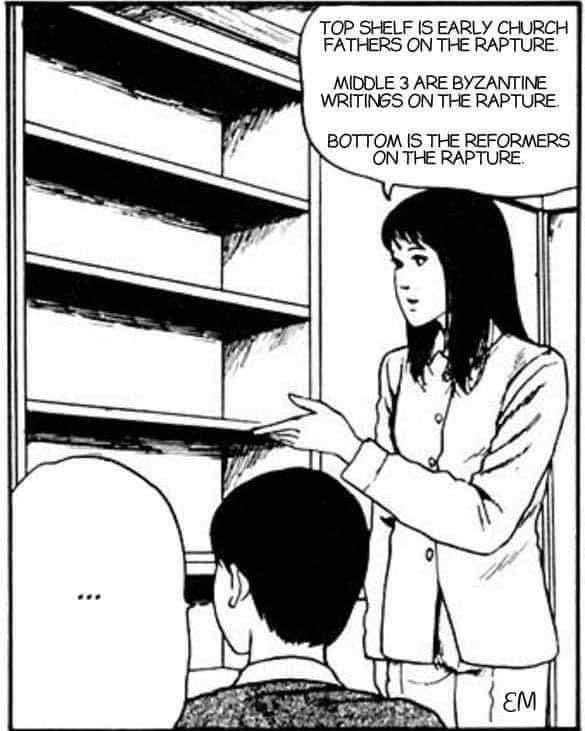
Historical views of the Rapture
Do you want to be like Tim?

If you are a writer or pastor who wants to preach like [the late Tim] Keller, you won’t get there if your strategy is “listen to Keller and copy him.” Keller himself would tell you that that’s a terrible idea.

Instead, do what Tim did: Go to seminary. After seminary, read everything George Whitefield wrote. Read Calvin’s Institutes and his sermons. Read The Lord of the Rings over and over and over. Read everything C. S. Lewis ever wrote. Read every Puritan paperback from Banner of Truth. Read sociology. Read social theory. Read Bavinck. Read current events books and a steady line up of journalists. Do all of that within the context of a family alongside your spouse and while talking to people facing ordinary life problems who are in need of counsel and aid and think about how to explain what you’re learning to them in ways that are sensible to them. Lewis had a rule that if he couldn’t say something in a way an ordinary British person could understand it meant that he wasn’t ready to say that thing yet. Follow that rule.

That is how you become a good missionary.

Jake Meador.

Heh, heh, heh! You had me going there for a minute, Jake. What’s the quick way to preaching like Tim Keller? I don’t want to be faithful for decades and decades with no assurance that I’ll ever become famous; I want a surefire to fame by next year.

East versus West

The thing is the cultural habit of rationalizing and abstracting has also made serious inroads into Catholic life and practice in the West. The crisis, Kingsnorth concluded, is not so much one of Catholic versus Protestant as it is of Eastern Christianity versus Western Christianity. It is a conclusion I arrived at not long after I left Catholicism for Orthodoxy in 2006, the result of a great spiritual trauma. I had thought of Catholicism as a mystic-friendly form of Christianity—which it is, but only by comparison to Protestantism. When seen from the East, both Catholicism and Protestantism—in the West, at least—are marooned primarily in the head and are futilely trying to think their way out of the civilizational shipwreck of the modern West.

Though Orthodoxy shares with Catholicism a fundamentally sacramental metaphysics, in practice Orthodoxy is far more mystical, emphasizing that the conversion of the heart must precede the conversion of the intellect. It does not deny the intellect, only orders it within an anthropological hierarchy.

One aspect of Orthodoxy that particularly appealed to Kingsnorth is its panentheism—the principle that God is, as the Orthodox prayer says, “everywhere present and filling all things.” It’s not the same as pantheism, which says that the material universe is God. Orthodoxy teaches that God is separate from his creation but also interpenetrates it with his energies, or his force. Consider how the warmth and pleasant glow of an English hillside on an August afternoon occur because the faraway sun penetrates the grass, the flowers, and the earth with its energies. The hillside is not the sun, but it testifies to the presence of the sun in its material being.

“The earth is not God, but God is there, present in nature, not in some far-off heaven,” Kingsnorth says. He goes on: “He’s deeply entwined in everything. Creation is the book of God, as Augustine said, I think. That is explicitly recognized in Orthodoxy. So what I was finding, weirdly enough, was a sort of ancestral Christianity that my ancestors in England would have had access to, and that the early Celtic saints certainly had access to. When I became Orthodox, a lot of people said to me, ‘Welcome home,’ and, strangely, it did feel like I was coming home. It felt like there’s something here that we had, that we lost.”

Rod Dreher.

I’ve been a fan of most of Rod Dreher’s books since Crunchy Cons. I want to distinguish his books from his columns, which I have frequently disagreed with. I also concede that one of his books was too raw, too transparent, too kiss-and-tell for my tastes.

Rod has been through a lot — openly for the last two years or so, quietly for a decade before that. Oh, heck: he’s been through a lot his whole life, much at the hands of family who lived in Louisiana at an extreme end of insularity. It’s hard to imagine a family that felt no pride in a member making it fairly big in New York City publishing because he dared to leave home, a family that affirmatively poisoned the minds of the next generation with refrains that Uncle Rod was uppity and no damn good.

I think he’s coming out of it, but he thought he had come out of it when he wrote How Dante Can Save Your Life. He’s voting for Donald Trump because Trump is the enemy of his enemies.. I cannot. I’m more with Miles Smith: “don’t tell me it is anything other than tragic that either of the two leading candidates for the presidency will eventually govern the American republic.”

Rod has a new book coming out tomorrow. It may be his most important; I’ve had it on pre-order for months.

This rave review struck me as capturing what’s special about Rod:

Dreher has an uncanny ability to articulate how religious conservatives feel, even to pre-empt it. Previous books gave us the Crunchy Cons (2006), whose eponymous conservatives want to turn the clock back; The Benedict Option (2017), which meant opting out of liberal culture; and Live Not By Lies (2020), which drew a line between “Marxist” and “woke”.

I can attest, spending much time among devout Christians, that Dreher has done it again, capturing our present mood: we’re trapped between wanting to throw ourselves into movement politics to defeat The Beast, or looking inwards in the hopes of becoming the change one wants to see in the world. Many of us are asking whether the best service we could do to Christianity is simply to become better Christians.

(Boldface added.) If you doubt that he has pre-empted conversations, ask yourself how often you’ve encountered the term “the Benedict Option,” which is literally his coinage.

These are a few of my favorite things

[N]one of the things that I care about most have ever proven susceptible to systematic exposition.

Alan Jacobs, Breaking Bread with the Dead

Christian fruits

“My people have been oppressed for nearly 2000 years. For 1200 years they endured Dhimmitude, a system of oppression made for the sole purpose of humiliating & breaking them. Today they face persecution in their homeland. And yet I don’t know of a single Coptic terrorist. Do you?”

Samuel Tadros.

Preaching the Gospel

“How do I get saved?” is not the gospel. And “So, would you like to get saved?” is not preaching the gospel.

Fr. Andrew Stephen Damick, Arise, O God

Pride

If you hide the gifts you have been given in order to appear humble, then you are very proud indeed. Wishing to appear humble is the worst form of pride.

Vassilios Papavassiliou, Thirty Steps to Heaven


Religious ideas have the fate of melodies, which, once set afloat in the world, are taken up by all sorts of instruments, some woefully coarse, feeble, or out of tune, until people are in danger of crying out that the melody itself is detestable.

George Elliot, Janet’s Repentance, via Alan Jacobs

You can read most of my more impromptu stuff here and here (both of them cathartic venting, especially political) and here (the only social medium I frequent, because people there are quirky, pleasant and real). All should work in your RSS aggregator, like Feedly or Reeder, should you want to make a habit of it.

Sundays are joyful days, but there’s a little cloud on this one: 26 years ago, my father died, quite unexpectedly.

His was a quick and apparently painless death — what we think of as a good death these days. But I’m not so sure. Meeting God face-to-face is a serious business. I’m inclined to think a slow and painful death, with lots of time to face the reality and to set aright things that are our of kilter, has its own advantages.

We brought nothing into this world

Modernity equates liberty with the freedom to decide and choose, to define ourselves and the world around us. In the words of Justice Anthony Kennedy (Planned Parenthood vs. Casey, 1992):

At the heart of liberty is the right to define one’s own concept of existence, of meaning, of the universe, and of the mystery of human life.

We relish this concept of unfettered freedom. But, of course, it is absurd, even for a secularist. For whether we choose to admit it or not, we “brought nothing into this world” (1 Tim. 6:7). Everything in our lives is derived and gifted. We are not the inventors of the world nor of our lives. And though we struggle to understand and even master our own DNA, it remains a primary component of our destiny, a genetic memory of the history of our coming into being across the ages. To be told that we have some portion of DNA contributed by Neanderthals reminds us that even such obscure ancestors are “selves we have received” through our genetically traditioned existence.

Fr. Stephen Freeman

There has never been a “Positive World”

I was a casual follower of Aaron Renn until Alan Jacobs demolished Renn’s famous February 2022 piece, The Three Worlds of Evangelicalism.

Without defining Christianity, Renn says the world used to be positive toward it. You can read Renn for yourself, and Jacobs, too (and you really should read Jacobs if you think Renn is onto something important), but here’s the gist (via Jacobs) of why there was never a “positive world” for thoroughgoing Christianity:

Professing Christianity is what Renn calls a “status-enhancer” when and only when the Christianity one professes is in step with what your society already and without reference to Christian teaching describes as “being an upstanding citizen.” If you don’t believe me, try getting up on stage in an evangelical megachurch and reckoning seriously with Jesus’s teaching on wealth and poverty. Even a sermon on loving your enemies, like Ruby Bridges, and blessing those who curse you, can be a hard sell — as many pastors since 2016 have discovered. News flash: if you make a point of never saying anything that would make people doubt your commitment to their preferred social order, they’ll probably think you an upstanding citizen. (Who knew?)

There are pretty much always some elements of Christian teaching that you can get away with publicly affirming; but you can never get away with affirming them all. If American Christians sixty years ago felt fully at home in their social world, that’s because they quietly set aside, or simply managed to avoid thinking about, all the biblical commandments that would render them no longer at ease in the American dispensation. Any Christians who have ever felt completely comfortable in their culture have already edited out of their lives the elements of Christianity that would generate social friction. And no culture that exists, or has ever existed, or ever will exist, is receptive to the whole Gospel. 

Renn is Evangelical or Evangelical-adjacent (PCA Presbyterian). I was once very friendly toward the PCA, so I think I can say that it’s not a church that rocked the social order (at least until Orgasms for All! became the unofficially established religion of the USA).

The bloom is entirely off my Renn Rose. I deeply discount articles that take his “three worlds” model as their premise.

A Christian Is An Outlaw

Apropos of “negative world”:

It would be honour in modernity for a Christian to be called such an outlaw, for surely they do not conform to the laws of this world.

Martin Shaw, A Christian Is An Outlaw

God in a box

There’s a brilliant episode of King of the Hill where Bobby, the thirteen-year-old boy, gets really into Christian rock. At the end of the episode his dad, Hank, shows him a box where he keeps tokens from all the different phases he has gone through. There’s a Beanie Baby, a Tamagotchi, a Teenage Mutant Ninja Turtle… Bobby cringes—and that’s the point. “I know you think the stuff you’re doing now is cool,” says Hank to his son, “but in a few years, you’re going to think it’s lame. And I don’t want the Lord to end up in this box.”

Theophan Davis, How Not to Be a Saint

This Orthodox novice’s section on prayer (“Play to your weakness”) was also very good.

Sufficiently Rawlsian?

I might appeal to the second chapter of Genesis when speaking about the fundamental importance of male–female complementarity. But I do so because the biblical witness so succinctly and powerful states a fundamental truth that every civilization has honored.

R. R. Reno, responding to a transcribed speech of Oren Cass on how to construct a secular conservatism.

Would John Rawls accept this as public reasoning?

Sola Scriptura

Even as they claimed to rely on the Bible alone, antebellum Protestants frequently turned to Christian saints, exegetical traditions, the practices of Christians past, and official church teachings, employing these sources to complement or clarify what they took the Bible to mean. Perhaps this betrays a deeper sense that the Bible was not as self-interpreting as many Protestants hoped. At the very least, it shows the inescapability of tradition. American Protestants never read, or argued over, the Bible alone.

Paul J. Gutacker, The Old Faith in a New Nation

What the heck is a Carpatho-Rusyn?

In the last decades of the nineteenth century, Byzantine Rite Christians from the Carpathian mountain region began to arrive in America. It is difficult to label these people: they came from an area that today is divided among Poland, Slovakia, Hungary, Moldova, Belarus, and Ukraine, and they were known by a great variety of names, including Carpatho-Russians, Rusyns, Ruthenians, Galicians, and others. Their ancestors were originally Orthodox Christians, but in the sixteenth and seventeenth centuries they submitted to the pope of Rome through a series of “unions,” which is why they have long been known to the Orthodox as “Uniates.” Despite their subordination to the pope, they retained most of the external forms of Orthodox worship and practice, including allowing married men to become priests.

Matthew Namee, Lost Histories.

These people are the historic core of my diocese. And my parish’s Patron Saint, Alexis Toth, led multitudes back to the Orthodox faith, after he was spurned by Archbishop John Ireland.


Religious ideas have the fate of melodies, which, once set afloat in the world, are taken up by all sorts of instruments, some woefully coarse, feeble, or out of tune, until people are in danger of crying out that the melody itself is detestable.

George Elliot, Janet’s Repentance, via Alan Jacobs

You can read most of my more impromptu stuff here and here (both of them cathartic venting, especially political) and here (the only social medium I frequent, because people there are quirky, pleasant and real). All should work in your RSS aggregator, like Feedly or Reeder, should you want to make a habit of it.

Elevation of the Holy Cross 2024

I’m on vacation, so I’m not going to take the time to sort these into topics.

Also, it’s a major Feast day in the Eastern Church. The Orthodox Church at my vacation destination appears to be postponing observance to tomorrow — an Orthodox oddity in my limited experience.

Selling hoi polloi a delusion

Those with a material interest in doing so have learned to speak autonomy talk, and to tap into the deep psychology of autonomy in ways that lead to its opposite.

Matthew Crawford, The World Beyond Your Head

Purposeful to a fault

Himmler quite aptly defined the SS member as the new type of man who under no circumstances will ever do “a thing for its own sake.”

Hannah Arendt, The Origins of Totalitarianism

Sit quietly with that one for a minute. Then consider Josef Pieper, Leisure, The Basis of Culture.

“Televangelists”

Fugitive Televangelist Wanted by F.B.I. Is Caught in the Philippines
Weeks of tense standoff in the Philippines have ended in the capture of a pastor accused of leading an international ring of sex abuse and trafficking of young women and girls.

New York Times

I don’t believe it would be fair to saddle any Christian tradition or denomination with this guy. From what the Times says about the idolatrous adulation he cultivated, he was plainly some kind of one-off cultist.

But I have no idea how many one-off cultists are abroad in the world, when this admonition currently being featured at the end of my Sunday blog posts:

Religious ideas have the fate of melodies, which, once set afloat in the world, are taken up by all sorts of instruments, some woefully coarse, feeble, or out of tune, until people are in danger of crying out that the melody itself is detestable.

George Elliot, Janet’s Repentance, via Alan Jacobs

Huge (if true)

Donald Trump runs no risk of going to prison in the middle of his campaign, thanks to Judge Juan Merchan’s decision Friday to postpone sentencing until Nov. 26. The delay gives his lawyers more time to prepare an appeal. Fortunately for Mr. Trump, his trial was overwhelmingly flawed, and a well-constructed appeal would ensure its ultimate reversal.

A central problem for the prosecution and Judge Merchan lies in Article VI of the U.S. Constitution, which makes federal law the “supreme law of the land.” That pre-empts state law when it conflicts with federal law, including by asserting jurisdiction over areas in which the federal government has exclusive authority.

Mr. Trump’s conviction violates this principle because it hinges on alleged violations of state election law governing campaign spending and contributions. The Federal Election Campaign Act pre-empts these laws as applied to federal campaigns. If it didn’t, there would be chaos. Partisan state and local prosecutors could interfere in federal elections by entangling candidates in litigation, devouring precious time and resources.

That hasn’t happened except in the Trump case, because the Justice Department has always guarded its exclusive jurisdiction even when states have pushed back, as has happened in recent decades over immigration enforcement.

The normal approach would have been for the Justice Department to inform District Attorney Alvin Bragg, who was contemplating charges against Mr. Trump, of the FECA pre-emption issue. If Mr. Bragg didn’t follow the department’s guidance, it would have intervened at the start of the case to have it dismissed. Instead the department allowed a state prosecutor to interfere with the electoral prospects of the chief political rival of President Biden, the attorney general’s boss.

David B. Rivkin Jr. and Elizabeth Price Foley, Why Trump’s Conviction Can’t Stand

They evolved

In the summer of 2015, back when he was still talking to traitorous reporters like me, I spent extended stretches with Donald Trump. He was in the early phase of his first campaign for president, though he had quickly made himself the inescapable figure of that race—as he would in pretty much every Republican contest since. We would hop around his various clubs, buildings, holding rooms, limos, planes, golf carts, and mob scenes, Trump disgorging his usual bluster, slander, flattery, and obvious lies. The diatribes were exhausting and disjointed.

But I was struck by one theme that Trump kept pounding on over and over: that he was used to dealing with “brutal, vicious killers”—by which he meant his fellow ruthless operators in showbiz, real estate, casinos, and other big-boy industries. In contrast, he told me, politicians are saps and weaklings.

“I will roll over them,” he boasted, referring to the flaccid field of Republican challengers he was about to debate at the Ronald Reagan Presidential Library that September. They were “puppets,” “not strong people.” He welcomed their contempt, he told me, because that would make his turning them into supplicants all the more humiliating.

“They might speak badly about me now, but they won’t later,” Trump said. They like to say they are “public servants,” he added, his voice dripping with derision at the word servant. But they would eventually submit to him and fear him. They would “evolve,” as they say in politics. “It will be very easy; I can make them evolve,” Trump told me. “They will evolve.”

Like most people who’d been around politics for a while, I was dubious. And wrong. They evolved.

Mark Leibovich, Hypocrisy, Spinelessness, and the Triumph of Donald Trump

Change of perspective or sign of deline?

The eighteenth-century Humean slave of the passions is thus indistinguishable from the liberated, twentieth-century Sartrean individual living authentically.

Brad S. Gregory, The Unintended Reformation

All that matters is strength

Part of the reason Trump is less constrained on [the abortion] issue than his predecessors is that he’s transformed the Christian right just as he has the broader conservative movement, dethroning serious-seeming figures while promoting those once regarded as flamboyant cranks. In Republican politics, Steve Bannon and Alex Jones now have far more influence than erstwhile conservative stalwarts like Paul Ryan and Dick Cheney. Similarly, in the religious realm, the ex-president has elevated a class of faith healers, prosperity gospel preachers and roadshow revivalists over the kind of respectable evangelicals who clustered around George W. Bush. “Independent charismatic leaders, who 20 years ago would have been mocked by mainstream religious right leaders, are now frontline captains in the American culture wars,” writes the scholar Matthew D. Taylor in his fascinating new book, “The Violent Take It by Force: The Christian Movement That Is Threatening Our Democracy.”

The churches Taylor is writing about exist outside the structures and doctrines of denominations like the Southern Baptists. They’re led by flashy spiritual entrepreneurs who fashion themselves as modern apostles and prophets with supernatural spiritual gifts, and they represent one of the fastest-growing movements in American Christianity. Among many of these churches, Trump remains the anointed one, chosen by God to restore Christian rule to the United States. These Christians care a great deal about abortion, but they appear to care at least as much about Trump. Many of them see him as a modern-day version of the Persian emperor Cyrus, a heathen who, in the sixth century B.C.E., rescued God’s chosen people from Babylonian captivity. In this framework, Trump’s piety is irrelevant; all that matters is his strength.

Michelle Goldberg

I think Goldberg, no Christian, is right. And that means that it’s hard to say that MAGA and I share the Christian tradition; their religion seems from a darker source.

Ted Cruz is no dummie

Liz Cheney famously endorsed Kamala Harris over Donald Trump, and less famously endorsed Democratic U.S. Representative Colin Allred over Ted Cruz for Cruz’s Texas Senate seat.

So has she abandoned the GOP?

I can’t speak for Cheney, but I can tell you why I’m voting for Allred over Cruz—and it has nothing to do with policy or burning anything down.

Since January 6, the threshold question I ask when considering whether to vote for a Republican is how that candidate responded to Trump’s coup attempt. There’s a spectrum of behavior on that point, with Cheney and Kinzinger on one end, Trump himself on the other, and the mass of congressional Republicans somewhere in between.

At the two extremes of the spectrum, policy doesn’t matter to me. Policy debates are things you get to have when everyone agrees on the rules of the game. Rewarding those who defended democratic norms and punishing those who undermined them is more important.

I would vote for Cheney and every other Republican who voted to impeach or convict Trump following the insurrection in hopes that their victories would embolden others in the party to resist his power grabs in a second term. And I would vote against Trump and all of his co-conspirators for the opposite reason, in hopes that their defeats would convince others that civic crime, like trying to overturn an election on false pretenses, doesn’t pay.

Ted Cruz was Trump’s chief co-conspirator in the Senate after the 2020 election, initially agreeing to argue before the Supreme Court that the electoral votes of swing states won by Joe Biden should be thrown out. When the court declined to hear that case, Cruz switched to Plan B and ring-led a scheme on January 6 to stop Congress from certifying Biden’s victory by objecting to those swing-state electoral votes. Had he gotten his way, some sort of chaotic ad hoc election “commission” would have been thrown together before Inauguration Day to decide who the next president should be.

He did all of this knowing full well that Trump was and is a loon and that egging on Americans to doubt the fairness of their own elections will destabilize the country long-term. But he was willing to pay that price because he thought making himself useful to the coup would give him a leg up with Trump’s base when he runs for president again someday.

You don’t need to agree with Colin Allred on a single policy issue to grasp that a person like Ted Cruz cannot be trusted to defend the constitutional order. He was tested and failed grievously. If you believe that a second Trump presidency would create a “unique threat” to American government, as Liz Cheney and I do, it’s urgent that Trump’s most unethical enablers in Congress be replaced by people who won’t rubber-stamp anything he does.

Republicans in Texas had their chance to replace Cruz with a candidate like that in this year’s primary, just as Republicans nationally had their chance to replace Trump. They made their choice. Cheney and I have made ours.

It’s frankly amazing to me that so many conservatives have been left struggling to understand Cheney’s endorsement of Allred. To a certain sort of partisan, it seems, Trump is the only elected Republican who bears meaningful responsibility for the attempt to overturn the 2020 election. Ted Cruz, Mike Lee, the scores of House GOPers who voted to object on January 6—they’re all off the hook because, well, there are just too many of them to punish. Beating them at the polls would wipe out the party, and partisans won’t tolerate that. Even for just one election cycle, to teach their representatives a hard lesson about authoritarian bootlicking.

If you feel obliged to excuse Ted Cruz for his role in a coup plot because that’s what hating Democrats requires of you, you do you. But let’s please stop memory-holing his part in it by feigning confusion as to why Liz Cheney might want to drive him from politics. It’s pathetic.

Nick Catoggio

Ted Cruz is no dummie. He’s whip-smart and cunning. He also is a contemptible human being with no core. His mentor, Princeton’s Robert P. George, must be deeply grieved.

Shanghaied

  • Few cities in Asia match Shanghai’s level of economic development. In the fanciest shopping streets in the city center you can go miles without leaving the realm of luxury stores, with a Hermes outlet abutting a Louis Vuitton outlet, which in turn abuts a Rolex outlet. At times, the city reminded me of an acquaintance’s semi-humorous observation that, in a hundred years, luxury brands may be all that remains of Europe’s once enormous influence on the world.
  • In Postwar, Tony Judt argues that in the 1960s, the restive mood of Europe’s young was in part fueled by the ugliness of the homes in which they had been raised and the new universities in which they were being educated. Comparisons between Europe sixty years ago and China today are certain to be wrong for any number of reasons, but my mind kept going back to Judt’s observation every time I drove past another island of identical, unadorned housing blocks.
  • Preferences about the next American president seem to be nearly as divided among Chinese intellectuals as they are among the American electorate. A senior scholar of international relations told me that Donald Trump would likely be more willing to cut deals with China but that he preferred Kamala Harris because of her greater predictability on the international stage. A senior economist told me that Kamala Harris might prove softer on tariffs but that she would prefer Donald Trump because of his greater predictability on economic policy. The only consistent refrain was the preference for perceived predictability: Chinese elites seem as discombobulated by the sense that it’s impossible to predict what Washington might do as they are by any specific action the next president might take.

Yasha Mounk, 3 of 21 Observations About China

The All-Volunteer Navy at Play

The chief petty officers aboard the USS Manchester (LCS-14) were caught illicitly placing and using a Starlink satellite-internet antenna while the ship was under way. The conspiracy, involving all senior enlisted sailors attached to the littoral combat ship, came to light after months of use, when a civilian contractor came aboard and stumbled upon the bootleg setup. The ship’s command senior chief and ringleader of the operation was convicted at court-martial and reduced in rank from E-8 to E-7: an outrageously light penalty considering her repeated lies to her commanding officer, her background in Navy IT that ensures she was absolutely aware of her transgression, and the cover-up campaign that involved the intimidation and silencing of those below her. This betrayal of the ship’s whereabouts in service to movie-streaming, texting, and other forms of personal entertainment is especially egregious because of the role that chiefs have in preserving good order and discipline among the ranks while upholding Navy traditions. A bad chief is the ruin of a ship and its crew, and the legal equivalent of keelhauling the only correct recourse.

National Review’s The Week Friday email. See also the Navy Times.

Donald Trump after the debate

The Hill: Trump Floats Punishment For ABC After Debate

I mean, to be honest, they’re a news organization. They have to be licensed to do it. They ought to take away their license for the way they did that.

Via The Dispatch

This response is fractally wrong. ABC doesn’t need a license to be a news organization (thank God and the First Amendment).

If they did have a license, it would be dictatorial to revoke it for displeasing the President or anyone else.

Trump once again exhibits his anti-democratic impulses, though once again it probably will deter no fans.

Lesser evils

“Sending migrants away, not allowing them to grow, not letting them have life is something wrong; it is cruelty,” Francis said in a news conference on the plane as he returned to Rome after his long trip to Southeast Asia and Oceania. “Sending a child away from the womb of the mother is murder because there is life. And we must speak clearly about these things.”

But when asked whether it would be morally admissible to vote for someone who favored the right to abortion, he responded: “One must vote. And one must choose the lesser evil. Which is the lesser evil? That lady or that gentleman? I don’t know. Each person must think and decide according to his or her own conscience.”

Pope Says Both Trump and Harris Are ‘Against Life’.

Donald Trump seemingly is Teflon-coated, but explicit Papal permission to vote for the (more) pro-abortion candidate could logically be a factor in this election.

Even WSJ is appalled

Ms. Loomer is usually described in the press as “far right,” but that’s unfair to the fever swamps. On Sunday she posted on X that if Ms. Harris wins the election, “the White House will smell like curry,” a gibe against Ms. Harris’s Indian heritage.

She added that Ms. Harris’s speeches “will be facilitated via a call center.” U.S. companies often farm out their information lines to Indian firms, get it? We wonder if JD Vance’s Indian-American wife thinks that’s funny.

In 2018 Ms. Loomer chained herself to Twitter’s New York headquarters after the platform banned her. She suggested that Casey DeSantis, the wife of Florida Gov. Ron DeSantis, might have lied about having breast cancer: “I’ve never seen the medical records.” This week she smeared Sen. Lindsey Graham after he criticized her association with Mr. Trump.

All of this would be ignorable, except that others close to Mr. Trump say he is listening to Ms. Loomer’s advice. People in the Trump campaign are trying to get her out of the former President’s entourage, to no avail. Even Rep. Marjorie Taylor Greene thinks Ms. Loomer is damaging the former President’s election chances.

As North Carolina Sen. Thom Tillis put it on Friday: “Laura Loomer is a crazy conspiracy theorist who regularly utters disgusting garbage intended to divide Republicans. A DNC plant couldn’t do a better job than she is doing to hurt President Trump’s chances of winning re-election. Enough.”

Wall Street Journal Editorial Board

On the other hand …

If anyone is looking for facts to support a vote for Trump despite loony Loomer (and everything else), these two graphs may be just the ticket. The Biden administration has not covered itself in glory on illegal immigration.

The yellow bar is illegal immigrants and those awaiting adjudication of asylum claims or other claims to remain.

See the Wall Street Journal story.

Where customer service and stalking overlap

Delta wants to know what I thought of my flight. Honda wants to know what I thought of my oil change. The company that inspects my HVAC system twice yearly wants to know what I thought of … the air filter replacements? The technician’s demeanor? I’m not sure because I’ve read only the subject lines of the emails, which keep coming, imploring me to reflect on the experience and charting some strange new territory where customer service and stalking overlap. It may be time for a restraining order. Or, minimally, a different kind of filter, the one that consigns certain senders’ electronic missives to the Spam or Trash folders.

Frank Bruni

Life goes on

O when the world’s at peace and every man is free
then will I go down unto my love.
O and I may go down several times before that.

Wendell Berry


I suffer more from the humiliations inflicted by my country than from those inflicted on her.

Simone Weil, from a letter to Georges Bernanos.

I don’t do any of the major social media, but I have two sub-domains of the domain you’re currently reading: (a) You can read most of my reflexive stuff, especially political here. (b) I also post some things on the only social medium I frequent, because people there are quirky, pleasant and real.

Sunday potpourri

Western Civ

The Russian philosopher Vladimir Solovyov expressed the non sequitur at the heart of Western civilization with a deliciously sarcastic aphorism: “Man descended from apes, therefore we must love one another.”

Andrew Wilson, Remaking The World

Irony

You can spend forty years teaching people to be awake to the fact of mystery and then some fellow with no more theological sense than a jackrabbit gets himself a radio ministry and all your work is forgotten. I don’t know where it will end.

Rev. John Ames via @dswanson and @KyleEssary on micro.blog.

I follow @dswanson and @KyleEssary on micro.blog. They seem like very nice guys and pretty well-educated and sensible (I wouldn’t follow them otherwise; if I want outrage, I can visit my disused X account or rejoin Facebook).

But I gotta say (the preface to many a gratuitous and unnecessary comment) that Orthodox Christianity often has a similar gripe against Protestantism, and its incorrigible devotion to novel doctrines that kept it from returning to Orthodox Christianity as it failed to reform schismatic Latin Christianity.

Orthodox, Catholic, Protestant

In my experience, really committed Protestants tend to think of themselves as “saved” because they have accepted Jesus; Roman Catholics, on the other hand, see themselves as “sinners” in need of weekly absolution. Orthodox just think themselves lucky.

Peter France, A Place of Healing for the Soul

Inquisition

In 1184, bishops who previously might have been content to let sleeping heretics lie had been instructed actively to sniff them out. Then, in 1215, at the great Lateran Council presided over by Innocent III, sanctions explicitly targeting heresy had provided the Church with an entire machinery of persecution.

Tom Holland, Dominion

Ethics

[T]he recent (as in, since the nineteenth century) evangelical Protestant practice of building ethics on proof texts is remarkably limited in our day and age. Proof texts work when the moral intuitions of the culture track with the broad shape of biblical teaching. That is no longer the case. Further, advances in technology now raise all kinds of questions about what it even means to be human—which in turn raises questions not only about fertility, but about other issues, from end-of-life care to the use of AI. The broader biblical account of human nature, not isolated proof texts, must now factor into Christian discussions of the most pressing ethical issues that we face.

Carl R. Trueman, We Need Good Protestant Ethicists

Identitarianism is anti-Christian

Fr. Andrew: The human identity, as we were made to be, is something that is always in the future. Because we, being finite, will never arrive at being God.

Fr. Stephen: Right, our identity is always in the future, my existence is what I am today … There’s this gap, there’s this lack between me and it … even when we’re in the life of the world to come, we are not going to be in a static state.

Fr. Andrew: Right, which also implies that if our progress is always this point in the future—future for us—which is the fullness of the stature of Christ, to use St. Paul’s language, then that means that this modern thing that we see now, identitarianism, where people take these labels and apply them to themselves and that becomes the end-all … of how they conceive of themselves, looking for their identity either in something in the past or something at this moment … [i]t’s really an anti-Christian philosophy, and it’s really kind of an unhopeful philosophy, because it means I’ve arrived, I am this thing, and this is what I am and who I am, period. The becoming is not on the plate, on the table. It’s a distortion, really.

Fr. Stephen: Right, and one way, one devastatingly destructive way in which we are faithful to something other than Christ is when we’re faithful to some version of ourselves. We have this idea that we’re not allowed to break character, that whoever I was yesterday I have to be someone consistent with that today, even if who I was yesterday was wretched and miserable.

Fr. Andrew: [Laughter] “This is just who I am!” No, you can be better!

Fr. Stephen: Right, “I can’t make a break…” And this is something I say to people over and over and over again in confession, is that the devil doesn’t spend his time trying to get us to sin; we do that on our own. The devil spends his time, when we fall, telling us not to get up, telling us that this is where we belong, this is who we are, don’t bother trying to do better, to be better, to make any progress …

Fr. Andrew: I can’t remember—didn’t one of the saints say something to the effect of the demons always whisper two lies? One is: “You’re doing great!” And the other is: “There’s no hope for you!” And, I mean, those are the roots of… I don’t know, I’ve heard confessions for well over a decade and a half now; I’m pretty sure those are the roots of basically most sins.

Fall of Man Part 1: Garments of Skin | Ancient Faith Ministries

The Gospels are not a software license

The four Gospels are not a software user license — do not skip to the end and click “I agree.”

Read them. Realize the implications. Count the cost. Commit to live this life under the laws of this Kingdom, and set your feet on the road of repentance.

If more people wrestled with the difficult commands and expectations of Christ, then there might be fewer people called Christians — but they would be more ready for life in Christ.

Fr. Silouan Thompson


Religious ideas have the fate of melodies, which, once set afloat in the world, are taken up by all sorts of instruments, some woefully coarse, feeble, or out of tune, until people are in danger of crying out that the melody itself is detestable.

George Elliot, Janet’s Repentance, via Alan Jacobs

You can read most of my more impromptu stuff here and here (both of them cathartic venting, especially political) and here (the only social medium I frequent, because people there are quirky, pleasant and real). All should work in your RSS aggregator, like Feedly or Reeder, should you want to make a habit of it.

Sunday, 8/25/24

Reminder

The early Church had no Scripture of its own, and the Jews had no defined canon of Scripture; therefore, sola scriptura as the foundation for what Christians believed was absolutely impossible.

Dr. Eugenia Scarvelis Constantinou, Thinking Orthodox

Any questions?

And so, sola scriptura got glossed

[I]n American religion, both scholars and rank-and-file evangelicals contend, sola scriptura has morphed from theological principle to exegetical method. Particularly in the nineteenth century, evangelical Protestants rejected other religious authorities and relied instead on a plain reading of scripture. After clearing away the rubble of history and abandoning the old wineskins of tradition, one was left with everything needed to do theology: common sense and the Bible. The effects of this sort of biblicism on the shape of American religion—and, indeed, American history writ large—are difficult to overstate. Or so the standard story goes. Claims of relying on “the Bible alone” become harder to sustain when biblicists find themselves disagreeing on the meaning of Christian scripture. … As it turns out, evangelical Protestants do not avoid tradition as much as the ideal of biblicism makes it seem. … Wylie was a “Covenanter,” who believed governments that did not support Reformed religion necessarily rejected divine authority. In 1800, Wylie became the first Covenanter ordained in the United States. Findley, in contrast, came from a long line of “Old Dissenting” Presbyterians, who generally opposed the state establishment of churches.

Paul J. Gutacker, The Old Faith in a New Nation (emphasis added). It bears repeating that I came upon this book via a podcast recommendation by a Southern Baptist luminary. Gutacker is no hack, but I soon will be reading Mark Noll’s, America’s God: From Jonathan Edwards to Abraham Lincoln to enrich my understanding.

The right way to read the Bible

I am very, very enthusiastic about How (and How Not) to Read the Bible, a podcast (transcript available) I’d been waiting for, unawares. I’ve long (but not always; I remember my unwarranted elation at cracking, I thought, some theological nuts) had a vague feeling that the kinds of Bible study I knew sought information about God when what we need is God.

I’m elated again. I was pointed in the right direction, but uncertain that it was right, or why it was right. This podcast bodes to be a key epiphany in my life (or maybe an apocalypse).

The podcast and transcript are long, and the podcasters are far too digressive for my tastes. I edited out their digressions as I read the transcript.

I’m too new to this insight to write about the ramifications, but I think I see in the Fathers of the Church, sermonizing on a pericope of scripture, an avoidance of “this is the point the Apostle was making” or anything equivalent to that. Stay tuned.


Religious ideas have the fate of melodies, which, once set afloat in the world, are taken up by all sorts of instruments, some woefully coarse, feeble, or out of tune, until people are in danger of crying out that the melody itself is detestable.

George Elliot, Janet’s Repentance, via Alan Jacobs

You can read most of my more impromptu stuff here and here (both of them cathartic venting, especially political) and here (the only social medium I frequent, because people there are quirky, pleasant and real). All should work in your RSS aggregator, like Feedly or Reeder, should you want to make a habit of it.

Sunday, 8/11/24

The Psychedelic Path

I’ve been enjoying the excellent podcast The Surprising Rebirth of Belief in God. I was especially interested in Episode 26 on psychedelics.

I came of age in the sixties. I was intrigued by LSD to the point that a roommate and I imagined tripping one at a time (so the one who wasn’t tripping could prevent leaps out of upper-story windows and such).

I never did it. I had no idea where to get LSD and was too little motivated to find out.

I never even did marijuana. Not once. Not even without inhaling. Through the grapevine, I understand that that roommate did. I only saw him twice in later years, once at my wedding, once at a reunion (to which he came only after much cajoling). His life pretty clearly was not a happy one, but it’s over now.

I do vacation, though, in a state that has legalized weed, and let’s just say a thought has crossed my mind a time or two. But I have categorically ruled out weed, let alone more potent hallucinogens.

I’m aware of a number of risks with psychedelics, including that any spirits encountered are demons. But risk-benefit analysis isn’t why I’ve ruled out drugs.

The Orthodox Church forms me in everything I need for salvation. I’ve been at it for a while now, and not once have I caught of whiff of “why not do a Rosie Ruiz with plants or chemicals?” It’s pretty clear that I’m supposed to run the full race, fair and square.

Regrets, Repairs, Restoration — and Faces

Steve Robinson posts again, on “On Regrets, Repairs, and Restoration.” The following is not representative of the whole post, but struck me as perceptive and lovely.

I guess you never really have an “ex”, you just have a person who lives in the basement of your soul and keeps you honest about who you are and what you’ve done and on a good day, might even give you some hope that you are someone different, or even better than the person they once knew and tried to love.

Then along comes Father Stephen Freeman, with something that resonates with Robinson:

As we grow older, we never again gaze into the eyes of a person as we once did with our mothers. Lovers are often drawn to the eyes of the beloved, and find a measure of communion, but wounds and injuries eventually interrupt the initial innocence of such eyes …

The Fr. Stephen goes deeper:

… The same is at least as true with regard to God.

Regarding the face of God, there is this very telling passage in Revelation:

 And the kings of the earth, the great men, the rich men, the commanders, the mighty men, every slave and every free man, hid themselves in the caves and in the rocks of the mountains, and said to the mountains and rocks, “Fall on us and hide us from the face of Him who sits on the throne and from the wrath of the Lamb! (Rev. 6:16)

It is of note that Revelation does not simply speak of the wrath of the Lamb, nor merely of His presence. It is specifically a fear of His face. Our experience of the face is an experience of nakedness and vulnerability. On the positive side, the result is identification, communion and oneness. On the negative side, it is the pain of shame and the felt need to hide. I can think of nothing else in nature that so closely parallels and reveals the fundamental character of our relationship with God. Salvation is communion. Sin is an enduring shame.

Fr. Stephen Freeman, To See Him Face to Face

Popularity and power

If you really care about the outward forms of religious devotion; if you miss a time when politicians felt the need to pay lip service to Christian piety even when they didn’t believe a word of it; if you wish that your church had the same kind of pull in the corridors of power that it had 40 years ago; if you really care whether the signs at the White House say “Merry Christmas” instead of “Happy Holidays” — then of course the Republican Party will seem inseparable from Christianity. But if you care that much about popularity and power, you probably shouldn’t have picked a poor, despised, crucified man to be the object of your religious devotion.

Put Not Your Trust in Princes

Idolatry

[P]erhaps the most common title for our times is secular. Ours is, so the story goes, a secular age. In its usual telling, it goes something like this: Once upon a time we were young and naïve and religious. The world was enchanted, back then, and the sacred was near at hand. But now, for good or ill—because the story can be told with glee or lament in the voice—now we live in a universe, not a cosmos; we believe not in a deity but in ourselves. Now we inhabit an immanent frame and have no need for the hypothesis of God.

Whether told in one tone or another, this is a familiar story, and we know where we fit in it. Are we on the side of tradition or of progress, of immanence or transcendence? Are we for disenchantment or re-enchantment? Whichever part we play in this theater of argument, it seems, the positions come premade; the script is already written, all we have to do is act it out.

The aim of political theologian William T. Cavanaugh’s new book is to shatter this stained-glass drama by introducing what he takes to be a better term for describing our age: idolatrous. In The Uses of Idolatry, he argues that we ought not think of ourselves as disenchanted but mis-enchanted, and in so doing he not only critiques the old secularization narrative, but begins to write us a new story through which we might better understand ourselves and our times.

… “What has declined in the modern West is not belief in transcendence,” Cavanaugh contends, “what has declined is belief in God.” What is different is that the sacred is no longer “confined to gods but applies to all sorts of realities commonly labeled ‘political’ or ‘economic’.” The holy has not fled through the wardrobe into Narnia, in other words; it has fragmented. And this means that the problem with secularization stories is that worship remains as prevalent as ever—it’s just that what (or who) is being worshiped has changed.

Patrick Gilger, S.J., reviewing William T. Cavanaugh’s The Uses of Idolatry.

I really liked the author’s 2009 The Myth of Religious Violence, and this too is now on my Kindle.


Religious ideas have the fate of melodies, which, once set afloat in the world, are taken up by all sorts of instruments, some woefully coarse, feeble, or out of tune, until people are in danger of crying out that the melody itself is detestable.

George Elliot, Janet’s Repentance, via Alan Jacobs

You can read most of my more impromptu stuff here and here (both of them cathartic venting, especially political) and here (the only social medium I frequent, because people there are quirky, pleasant and real). All should work in your RSS aggregator, like Feedly or Reeder, should you want to make a habit of it.

August 4, 2024

August in Indiana is making itself felt in pretty nasty heat index numbers.

Orthodoxy proper

Catholic polemicist swims the Bosphorus

Theophan Davis, f/k/a Michael Warren Davis, has become Orthodox.

I had encountered Davis at his Theologumena blog, where he engaged in Roman Catholic polemics, and perhaps at Crisis and/or American Conservative. I have no idea why and how a post from his new Substack, YankeeAthonite, was sent to me, but the subject, Why I Became Orthodox, definitely got my attention.

On Sunday, June 23—the Feast of Pentecost—I was received into the Orthodox Church. I had announced my conversion a few weeks earlier, on May 17, via my old Substack. Then I deleted my account.

I did this for three reasons.

Firstly, the conversion process made me painfully aware of my own ignorance. For years, I worked as a Catholic journalist. I trumpeted my Catholic opinions so confidently all over the internet. In becoming Orthodox, I had to admit that I’d been wrong on some pretty big questions. Shutting up for a while seemed like the appropriate response.

Secondly, I assumed folks wouldn’t care what I have to say anymore. I’m not sure how much credibility I have left. If the answer is “none whatsoever,” I’d understand.

Thirdly, as we said, folks just aren’t terribly interested in other people’s conversion stories—not unless they’re extremely dramatic, which mine wasn’t. It destroyed my career. It ruined many of my friendships with Roman Catholics and caused a terrible strain on many others. And I will say, there were some dramatic moments: the weeping icon, etc. But if you’d been a fly on the wall, watching me for the last two years, all you would have seen was me reading, talking, praying, and sitting quietly in front of my icon corner.

“The conversion process made me painfully aware of my own ignorance” definitely resonates. For me, it was 47+ years as a fairly sophisticated Protestant layman pretty much all down the drain. It reminds me of Moody Bible Institute’s program for training missionary pilots: the first thing they tell (told?) licensed pilots entering the program is “forget everything you think you know about flying.” Ouch!

Davis continues:

What’s odd is that everyone seems to agree that my conversion was, ultimately, a rejection of Pope Francis. Let me be absolutely clear on this point: it wasn’t …

So, let me give you the cliffnotes version.

I joined the Orthodox Church because I came to believe that it’s the one, true Church founded by Jesus Christ. I became Orthodox because I believe Orthodoxy is the one, true Faith handed down by Christ to His Apostles, and by the Apostles to the Fathers of the Church.

I believe the four Eastern patriarchs were right to resist those novelties which the Western Church embraced in the centuries leading up to the Great Schism 1054. I believe they were right to reject the insertion of the filioque into the Nicene Creed. I believe they were right to condemn the popes’ efforts to expand their own ecclesial and temporal power. I also believe they were right to reject innovations such as the celibate priesthood and the use of unleavened bread during the Holy Mass/Divine Liturgy, though these are of lesser significance.

So far, so typical. Then the surprising turn:

As an aside: it’s true, the current pope did influence my conversion, though not in the way you might expect. Since Francis took office, the Vatican has issued a steady stream of ecumenical statements conceding virtually every point to the Orthodox. Then came the recent “study document” on papal primacy, which calls for a “rereading” and “reinterpretation” of the First Vatican Council.

Now, Catholic apologists are quick to point out that these texts aren’t magisterial. But that’s not the point. The point is that the Catholic Church’s greatest scholars have basically admitted that Rome bears the lion’s share of blame for the Great Schism, and that Vatican I is historically and theologically indefensible, and that the Catholic Church must return to a more Orthodox understanding of ecclesial and magisterial authority. But, then, why not just… become Orthodox?

… [B]oth Catholics and Protestants are slowly groping towards the Orthodox consensus.

Those are pretty solid reasons for leaving Rome.

I have been decidedly negative about Pope Francis — not that I should have an opinion at all. Not my circus, not my monkeys. What Theophan sees as a “steady stream of ecumenical statements conceding virtually every point to the Orthodox” merits some more attention, though I’m not sure when I’ll find the time.

Only in Orthodoxy …

But how could we ever relate to God or, even more challenging, truly unite with Him? Of all religions, only Orthodox theology emphasizes union with God—in a real and actual sense—as the goal and purpose of all human life. We rarely speak of “going to heaven,” as though it were a destination. We do not speak of experiencing a “beatific vision” of God, as though God could be viewed but remained at some distance from us. Rather, Orthodox Christianity speaks of theosis, the divinization of the human person. We expect, hope, and strive for actual union with the perfect, infinite, eternal, omnipresent, and changeless God. But we are flawed, limited, and come into existence for a brief time; we are confined to one place at one time, and we are constantly changing. So how is union with God possible? The Incarnation, the enfleshment of the Son of God, gave us the ability to truly connect to God and become united with Him, transformed and illumined by Him, not simply because He died for us but because of the way He lived among us.

Eugenia Scarvelis Constantinou, Thinking Orthodox.

This is a major difference — perhaps the most significant difference in overall mindset — between Eastern and Western Christianity.

Was it always so? No …

Anselm the Watershed

Theologians beginning with Anselm of Canterbury (d. 1109)—known as “the last of the fathers and the first of the scholastics”—presented human salvation not as the process of deification, of becoming ever more filled with the life of God, but as a one-time release from an impending punishment at the hands of an offended God who demanded satisfaction for man’s offenses.

John Strickland, The Age of Utopia

Other

A vivid (and important) image

Religious ideas have the fate of melodies, which, once set afloat in the world, are taken up by all sorts of instruments, some woefully coarse, feeble, or out of tune, until people are in danger of crying out that the melody itself is detestable.

George Elliot, Janet’s Repentance, via Alan Jacobs

Archetypes

”How has it come about,” C. S. Lewis once asked, “that we use the highly emotive word ‘stagnation,’ with all its malodorous and malarial overtones, for what other ages would have called ‘permanence’?” It is, Lewis suggests, because the dominance of the machine in our culture altered our imagination. It gave us a “new archetypal image.”

Ken Myers, All God’s Children and Blue Suede Shoes

“Religious” but unaffiliated

Both the fundamentalist and the higher critic assume that it is possible to understand the biblical text without training, without moral transformation, without the confession and forgiveness that come about within the church. Unconsciously, both means of interpretation try to make everyone religious (that is, able to understand and appropriate scripture) without everyone’s being a member of the community for which the Bible is Scripture.

Stanley Hauerwas, Resident Aliens.

For several decades now, I’ve watched this assumption play out as sundry atheists and provocateurs read the Bible as fundamentalists (and many Evangelicals) do, and then (with some justification) condemn it as absurd. Oftener than not, the response is a tortured just-so story of how that reading is not absurd at all.

That’s why this has become a favorite quote.

Nationalism

More ominous were the demands of nationalists. Since the fiascos of 1848, they had infiltrated every corner of political life. After the unification of Germany, ethnic nationalism appeared to be the genius of secularization. Deviating completely from traditional Christianity—which, as we have seen, declared the unity of all nations and races in Christ—it divided Christendom like no other force since the Great Division.

John Strickland, The Age of Utopia


… that Christ may dwell in your hearts through faith; that you, being rooted and grounded in love, may be able to comprehend with all the saints what is the width and length and depth and height — to know the love of Christ which passes knowledge; that you may be filled with all the fullness of God.

Ephesians 3:17-19 (NKJV)

You can read most of my more impromptu stuff here and here (both of them cathartic venting, especially political) and here (the only social medium I frequent, because people there are quirky, pleasant and real). All should work in your RSS aggregator, like Feedly or Reeder, should you want to make a habit of it.

Sunday July 7

Why classical education? Why ecclesial Christianity?

(Sorry if this item feels a bit stream-of-consciousness. If you can’t get into my stream, it’s probably my fault. Skip to the next item if you get lost.)

A cyberfriend, who is both an Anglican rector and a classical school headmaster, posted this as an audio file, which I have (with a little help from VR) transcribed:

I occasionally find myself talking to folks who know that I moved into the classical Christian tradition from other educational models and they’re curious what the draw was into the classical Christian world.

Similarly, I find myself talking to many people who know that I moved into the Anglican tradition from the beginning of the century. from other Christian traditions and they have similar questions. What was it that drew you into the Anglican tradition?

Every once in a while, I also encounter people who are curious about both at the same time. Kind of what moved you into the classical Christian world while you were being moved into the Anglican world as it were, and in conversations with folks like that, I’ve begun to pinpoint some movements, some understandings of who God is, that moved me along in both of those worlds, the worlds of education and the world of Anglicanism.

Here’s one example. Seeing God as infinitely grand was one of those movement moments for me. Once I saw God as infinitely grand, I realized he could no longer be contained to a religion class or a Bible class, and all other disciplines just carry on as usual.

If God is infinitely grand, he must appear pretty thoroughly and visibly and noticeably across all disciplines, and that’s something that the classical Christian movement has focused on for some time. Seeing God in all disciplines.

Similarly, if God is infinitely grand, then he cannot be contained by words alone. We can’t worship him with just words if he’s infinitely grand. Our worship must capture more of the human person than just our words. We can’t fully grasp him, though we can sometimes helpfully describe him with words, but we can’t fully grasp him through doctrine alone. There has to be an element of mystery involved, and when we capture God in some ways through words, we do our best to be as broad as possible with those words. So a preference, for example, for something as broad and ancient as and as ecumenical as the Nicene Creed as a statement of faith, as opposed to some later post-enlightenment, more detailed statements of faith.

… Once I saw God as infinitely grand, that vision moved me both into the world of classical Christian education, where God is throughout all disciplines. It moved me more into a Catholic or Anglican tradition that is going to describe and understand and participate in worship of that infinitely grand God in ways that go beyond mere cognition and mere words.

Things like this make me feel much closer to Anglicans than I do to most Western Christian traditions — some of which I’ve been having trouble seeing even as authentically Christian, so far down Nathan Hatch’s Democratization road have they gone. (But then I go to the website of a Mount Pleasant, South Carolina Anglican parish, pastored by the newly-elected Anglican Presiding Bishop for North America, and find what looks like a cringey megachurch. If I had no Orthodox option, I personally would prefer a dignified Episcopal liturgy to any plexiglas-podium, praise-band “Anglican” operation.)

I don’t remember how far I’d gone along the road into Orthodox Christianity before I internalized that it didn’t have anything equivalent to, say, the massive and detailed Catechism of the Catholic Church, and that wasn’t just because they were too lazy to prepare one.

That was a surprise. I’d previous identified “orthodoxy” as detailed doctrinal rectitude. Now I was finding that it was like a high plateau, with dangerous cliffs all around it. The Nicene Creed was a fence to keep people from careening unwittingly over any of the cliffs; but the plateau was large, and diverse. The residents were not clones. Our priests and confessors may prescribe individual conduct on the plateau, but that can vary from person to person according to the discernment of priests and confessors.

Fr. Jon hints at why this is proper: God’s infinity makes Him apprehendable, but incomprehensible. We can’t fully define Him or cabin him, although doing so would make Him ever so more convenient and comforting. And it’s a fearful responsibility to be a spiritual guide who needs discernment, not just a rulebook with a good table of contents.

In fact, Orthodox (and orthodox) Christianity can feel kind of wild. Coincidentally, or likelier providentially, I’ve been getting a lot of exposure to that wildness lately in ways that I’m not (yet?) ready to articulate.

[John] Moriarty spoke of himself as a singing Christian. I would also suggest we may need to be grieving Christians, earthy Christians, happy Christians, and yes, on occasion, troublesome Christians. How did this Middle-Eastern mystery religion get so corralled?

Martin Shaw

Democratized heresies

Despite the variety of Christian idioms that flowered in the early republic, most seemed to spring from the common conception that Christian tradition since the time of the apostles was a tale of sordid corruption in which kingcraft and priestcraft wielded orthodoxy to enslave the minds of the people. Ties with Catholic and Protestant traditions were severed, with a heady sense that a restoration of the primitive church was at hand.

Nathan O. Hatch, The Democratization of American Christianity

21st Century Rabbinic Judaism isn’t New Testament Judaism

As explained at the outset of this chapter, scholars today commonly presume that a form of Rabbinic Judaism that uniformly promoted a form of unitarian monotheism predated Christianity. New Testament scholars who have accepted this incorrect presupposition and marginalized the Old Testament evidence to the contrary have produced all manner of conjectures to explain how a supposed “transition” to belief in the Holy Trinity must have come about.

Fr. Stephen DeYoung, Religion of the Apostles.

At least two things gave rise to Rabbinic Judaism in the centuries after Christ:

  1. Christ and Christians. From a controversial sect within the worship of the first century synagogue and temple, to the casting out of Christians therefrom, to the growth of Christianity and its eventual embrace by the emperor, Christ and Christianity haunted and bedeviled the Scribes and Pharisees and Rabbis.
  2. The final destruction of the Jerusalem temple in A.D. 70. No temple means no sacrifice. So what do we do now? That, along with “how do we repudiate these Christians?”, led to a refashioning along the lines we see today (though not in final form).

I am told that well-educated modern Rabbis will readily admit this, but cannot confirm it.

Not the only, or last, amnesiac

He was a pure product of the postwar period; his heroes were the post-Left French who suffered for their apostasies, like Aron and Furet and Revel. He was right to honor them.

Right, I say, in what he honored, but wrong in what he ignored. Even on his own terms, [Clive] James should have read, memorialized, and found profit in Dostoevsky, Kierkegaard, Maritain, Eliot, Belloc, Knox, Greene, Undset, Bonhoeffer, Barth, Weil, Mauriac, Bernanos, de Lubac, Auden, Lewis, Tolkien, Fermor, Solzhenitsyn, Ratzinger, Percy, Illich, Berry, MacIntyre, Taylor, Levertov, and so many others. Instead, it’s as if religion in any form except the severely private disappears from the world by the end of the long nineteenth century. You certainly wouldn’t know that theists of any kind put pen to page in the twentieth, much less that it was good, sometimes, and that their words and deeds regularly made a difference on the public stage.

A writer like James, for all his erudition, has amnesia of his own, both in the immediate past and in the distant past. It’s a deficit common to most of his peers: highbrow journalists and elite critics who can’t bother to glance in the direction of the pious (at least, not without cringing). The deficit may be understandable, but it’s not defensible. It renders all that they write incomplete from the outset, by definition. Not just their knowledge but their love is circumscribed artificially by choice, and this alienates them from every human culture of which we have evidence.

Brad East. I’ve quoted most of it, but it would be worth your time to read the rest. Clive James wasn’t the only, or the last, amnesiac.

IVF reconsidered

If you are uneasy about IVF, as am I, you may benefit from reading this brief against it on Christian grounds. I hope I’m not just being contrarian, pushing against a pro-IVF consensus whose “arguments” I find unpersuasive.

Miracles and science

Given the assumptions and endeavor of the modern natural sciences, the profound irony is that science precludes any possible verification of the claim that miracles worked by a transcendent God are impossible. Only a transgression of science understood as an empirical investigation of the natural world could rule out the possibility of miracles. The philosophical belief that natural laws are necessarily exceptionless is not empirically verifiable in our own or any conceivable configuration of human knowledge, because verification would require the observation of all natural events in all times and places.

Brad S. Gregory, The Unintended Reformation

America’s Puritanism

America’s Puritan …, while possessed of many virtues, also brought about deformations of central Christian themes and ideas. The danger of Puritanism lay not just in the incipient utopianism of the “city on a hill” metaphor, but in an excessively low view of nature and creation.

Gregory S. Wolfe, Beauty Will Save the World


… that Christ may dwell in your hearts through faith; that you, being rooted and grounded in love, may be able to comprehend with all the saints what is the width and length and depth and height — to know the love of Christ which passes knowledge; that you may be filled with all the fullness of God.

Ephesians 3:17-19 (NKJV)

You can read most of my more impromptu stuff here and here (both of them cathartic venting, especially political) and here (the only social medium I frequent, because people there are quirky, pleasant and real). All should work in your RSS aggregator, like Feedly or Reeder, should you want to make a habit of it.

Pentecost …

(at least in the Eastern Church)

For the very first time, I vetted this post with AI. I didn’t change so much as a jot or a tittle.

Evangelicals

Overlooking the obvious

In the past year I have visited the Middle East, India, Africa, Latin America, and Europe as the guest of churches and ministries. In each place, evangelicals exude life and energy. While staid churches change slowly, evangelicals tend to be light on their feet, adapting quickly to cultural trends.

The Jesus movement, the house-church movement, seeker-friendly churches, emergent churches—evangelicals have spawned all of these. In their wake, worship bands have replaced organs and choirs, PowerPoint slides and movie clips now enliven sermons, and espresso bars keep congregants awake. If a technique doesn’t work, find one that does.

Although I admire the innovation, I would caution that mimicking cultural trends has a downside …

Perhaps we should present an alternative to the prevailing culture rather than simply adopt it. What would a church look like that created space for quietness, that bucked the celebrity trend and unplugged from surrounding media, that actively resisted consumerist culture? What would worship look like if it were directed more toward God than toward our entertainment preferences?

While writing a book about prayer, I learned more from Catholics than from any other group. They have, after all, devoted entire orders to the practice. I learn mystery and reverence from the Eastern Orthodox. In music, in worship, in theology, they teach me of the mysterium tremendum involved when we puny human beings approach the God of the universe.

As I survey evangelicalism I see much good, but also much room for improvement. Our history includes disunity—how many different denominations do this magazine’s readers represent?—and a past that includes lapses in ethics and judgment.

Phil Yancey’s 2009 farewell column for Christianity Today (illustration added). I don’t understand why the farewell wasn’t because he was going somewhere more conducive to prayer or reverence. Does it not occur to him that one decision for Christ plus good works does not a complete Christian make, that emotion is not the same as the Holy Spirit?

Biblicist Guruism

Reflecting on a story about exvangelicals:

So how do you help address the problem that Miles is describing in his review, a culture of biblicist guruism in which the churches do not even look recognizably Protestant in any real way? How do you address the massive gaps and holes in a person’s Christian discipleship that result from sustained exposure to such churches?

If the Gospel was not clear or was not preached, then what you had was more a religious assembly than a church. If the sacramental life of the church was non-existent, you had a religious assembly, not a church. And if there was no aid in Christian discipline… well, you know the drill.

When I came to Grace Chapel in 2007, a small PCA church that was at the time located in central Lincoln, I didn’t know that I’d not really been part of a church before, at least as the church was traditionally understood. What I found at Grace was something I hadn’t even known to look for because I didn’t know it existed. I found something obviously and unapologetically Christian—the Gospel was clear in every sermon, and clear in a way I’d never heard it from a pulpit before, the Eucharist was celebrated regularly, and the pastor at the church actually seemed to know the people in his church and to think it was his job to care for them and aid them in their discipleship. I’d never seen anything like it before.

And the services themselves helped to reenforce the basics of Christian belief and practice: We prayed the Lord’s Prayer corporately. We confessed our sins corporately. We sang old hymns. Every week we received a benediction. The grammar and vocabulary of Christianity pervaded the liturgy; it wasn’t just a guy in a pulpit pontificating, loudly proclaiming his own loosely assorted thoughts about life and expecting you to take him seriously because he attempted to root them in scripture.

Jake Meador (italics added).

The non-church “church” Jake came from may have been an example of what he calls “biblicist guruism.”

Second Great Awakening

While Methodists, Disciples, and Mormons disagreed radically on what constituted belief in the gospel, they all shared an intense hostility to the passive quality of Calvinist religious experience, and they all made salvation imminently accessible and immediately available.

Nathan O. Hatch, The Democratization of American Christianity

I have alluded to this antipathy toward Calvinism previously, having first encountered it in Hatch’s book (I’m pretty sure). When I moved from frank Evangelicalism to Calvinism, it felt as if I was moving to a much different worldview, and I guess my intuitions were sound.

Protestants

… [Luther] had been wrestling with an unsettling conundrum: the failure of the Spirit to illumine all those inspired by his teachings as he himself had been illumined.

Tom Holland, Dominion

It seems fair to distinguish Protestants from Evangelicals, contrary to lifelong habit. I’m not positive that Evangelicals circa 2024 AD are no longer Protestant, but along with Jake Meador, I’m entertaining that possibility quite a lot lately. If they’ve left Protestantism, it strikes me as a continuing outworking of Luther’s conundrum.

Catholics

According to Catholic doctrine, sin offends God, disrupts the moral order, and deprives God of His glory and majesty. Punishment for the sin restores order and the glory of God.

Dr. Eugenia Scarvelis Constantinou, Thinking Orthodox

When I first read that, it made me a bit nauseous. The Orthodox mind is quite different from that.

Orthodoxen

Start with the Psalms

It came to me a few days ago, during morning devotions, that it would be very easy for a 21st century convert to Orthodox Christianity, from Protestantism or Evangelicalism, to overlook one very important and durable tradition of the church.

Perhaps because the Anglophone church has gained so many converts, and because those converts were accustomed to regular preaching from a wide range of scripture, we have available to us, notably on Ancient Faith “Radio,” an array of Orthodox versions of Bible studies. One of them even bears the title “The Whole Counsel of God,” and has progressed through all books of the Old and New Testaments and started over again.

In my mind, those podcasts risk obscuring from the view of converts that the basic scripture for Orthodox Christians is the Psalter — the book of Psalms. As Father Jonathan Tobias emphasized,

Chant the Psalms every morning and every evening. Two kathismata in the morning, one in the evening as appointed. This will form your mind into prayer and life.

There’s nothing wrong with going beyond that, and I should do more of general Bible study than I do, but start with the Psalms. Always start with the Psalms.

(Weird historic fact: Back in the day, Evangelicals would do some Evangelistic spadework by distributing inexpensive copies of the Gospel According to John — not the whole New Testament, but just that one Gospel account. In contrast, the Orthodox Church didn’t expose converts to the Gospel According to John, the most profoundly theological of the four Gospels, until after significant preliminary catechesis and baptism. See text at fns. 2 & 3.)

Thanks but No Thanks

Without entering into particulars, we say that as long as the Church of the Saviour shall stand upon earth, we cannot admit that there is in her bosom a Bishop Supreme other than our Lord Himself; or that there exists an infallible Patriarch, who can speak, ex cathedra, superior to Ecumenical Councils – to which Councils alone belongs infallibility, because they have always conformed to the Sacred Scriptures and apostolical tradition. Nor can we admit that the Apostles were unequal, inasmuch as they were all illuminated by the Holy Ghost up to the same measure; or that to this or that Patriarch a precedence has been given, not by any synodal or human resolution, but by right Divine, as you assert.

Ecumenical Patriarch Gregory VI, firmly refusing to attend Vatican I, which was poised to declare papal infallibility at the behest of Pope Pius IX. Via Matthew Namee. The Orthodox Patriarch of Alexandria was no less firm, but pointed out (though the Pope surely knew it) what the Pope needed to do:

But not to prolong this discussion let me repeat once, and for all, that as this new attempt on the part of his Holiness the Pope has miscarried, it is necessary, if he sincerely desires the unity of the Universal Church that he should write to the patriarchs individually, and acting in concert, endeavor to come to an understanding with them respecting the course to be adopted – renouncing every dogma on which opinions may clash in the church. By so doing his efforts might perchance be crowned with some degree of success.

Involuntary sin

According to Scripture, the cause of all sin that is involuntary lies in what is voluntary.

Dee Pennock, God’s Path to Sanity


… that Christ may dwell in your hearts through faith; that you, being rooted and grounded in love, may be able to comprehend with all the saints what is the width and length and depth and height — to know the love of Christ which passes knowledge; that you may be filled with all the fullness of God.

Ephesians 3:17-19 (NKJV)

You can read most of my more impromptu stuff here and here (both of them cathartic venting, especially political) and here (the only social medium I frequent, because people there are quirky, pleasant and real). All should work in your RSS aggregator, like Feedly or Reeder, should you want to make a habit of it.

Juneteenth

I have nothing to say about Juneteenth except that emancipation was a legitimately huge landmark in our nation’s history and worthy of annual commemoration.

Public affairs

Indiana’s GOP Lieutenant Governor nominee

Indiana over last weekend nominated as its Lieutenant Governor candidate, Micah Beckwith, a pastor of some sort who:

  • Thinks that the “progressive left has taken over the Republican Party in Indiana,” and that some Republicans today are “champions of Communism.”
  • Said on a Christian(ish) podcast “We are in a season of war right now … People need to wake up, or else this mental and heart battle that we find ourselves in culturally, it will lead to bullets and bombs. It’s just a matter of time.”
  • Said God had told him, on January 7, 2021: “Micah, I sent those riots to Washington. What you saw yesterday was my hand at work.” (This is what every story on him seems to pick up.)

Those quotes are from Michelle Goldberg at the New York Times. Goldberg also says, sans quote, that he’s a “self-described Christian Nationalist.”

Beckwith was forced onto the ticket against the wishes of the Gubernatorial nominee, retiring U.S. Senator Mike Braun.

Yeah, I guess it’s national news.

I didn’t support Braun for Governor. I was unenthusiastic about him when he ran for Senate in a GOP primary whose theme was “Mirror, mirror on the wall, who’s the Trumpiest of them all?” (but I preferred him to Todd Rokita, now our Attorney General and a truly loathsome person). I’m not certain I’ll vote for him in the General Election.

My decision will hinge to some degree on how effective he is at keeping a reassuring distance from Beckwith without, of course, repudiating him so firmly as to hand the election to Democrats. So far, his pointed message “I’m in charge” seems about right.

I’ve noted repeatedly that I repudiated any loyalty to the Republican Party on Inauguration Day 2005. But I still have a reflex to vote Republican over Democrat, and to mourn what already has become of the Republican party, and what one likely future holds.

On Christian Nationalism

Having noted Micah Beckwith’s purported Christian Nationalism, I’m reminded that I may not have staked out my own position openly.

First, I define it narrowly. There have been ridiculous accusations of Christian Nationalism based on undisclosed or untenable definitions. Real Christian Nationalists are still pretty rare, I think (but what do I, a contrarian, know?).

I’m not unaware that American pluralism is an experiment. I’m not sure whether it will succeed or fail. I’m familiar with and friendly toward the phrase “worst form of government except for all the others.” I’m not ready to abandon it.

At the risk of ad hominem, I don’t trust the “Christians” who expressly advocate for Christian Nationalism. One of my older blogs, on what we then called “culture wars,” remains relevant, but I’ll paraphrase excerpts rather than do direct quotes.

My distrust of Christian Nationalists stems fairly directly from my disagreements with their form of our putatively shared faith — disagreements that lead me to chronic use of scare-quotes around the word Christian or the use of “Christianish.”

The pious Protestants among them tend functionally believe that God’s only presence in the world is His rules, so they “honor” Him by keeping his rules. But the age of Trump has brought many to profess that they’re Evangelicals even if, in the extreme case, they’re Muslims or even atheists, because of something they like about the politics now associated with that label.

The most coherent, maybe the only, Protestant theorists of Christian Nationalism are theonomists, or more specifically Reconstructionists. If these Calvinist intellectuals had their way, there would be 18 Old Testament Capital Crimes in our law books – including sassing parents. They’d shut down my Church and desecrate its icons. They might, for all I know, execute me for idolatry for the icons in my home prayer corner.

Ummmm, no thanks.

The Catholic theorists of Christian Nationalism (Integralism, they call it) are much better — not okay, but less bad. But I don’t think their side would get the levers of power anyway.

There is no remotely viable Orthodox version of Christian Nationalism, Byzantium being long-gone. And we’d lack the numbers to staff government if there were.

So I think “Christian Nationalism” in America would be, in ascending order of likelihood:

  1. Catholic Integralism
  2. Calvinistic Reconstructionism
  3. A blasphemous mish-mash of right wingnuttery in the name of God. (Like Indiana’s GOP Lietenant Governor nominee or the yard sign “Make Faith Great Again: Trump 2020.”)

I reject them all. I think all of them would be hostile to Orthodox Christianity. I prefer to continue our flawed experiment with pluralism. But I suspect I’ll live to see one of them.

We Orthodox have survived similar or worse circumstances before.

America’s enemies

American leaders have a great need to identify an enemy or group of enemies that the U.S. can define itself against in order to justify the dominant position that they want the U.S. to have. It doesn’t occur to these leaders that the pursuit of dominance itself is what creates so many enemies or that the U.S. would be far more secure by renouncing the pursuit.

Losing the Soviets as an enemy created a hole in U.S. foreign policy that Washington desperately tried to fill with anything our leaders could find, but the substitute villains (Saddam Hussein, Milosevic, etc.) were so weak by comparison that the threats had to be massively inflated.

Daniel Larison (who had fallen off my radar)

We seem hellbent on creating intractible enemies in at least three corners of the world. Depending on their political stripe, American politicians speak as if Russia, China, and/or Iran pose existential threats to us. Yes, we do have substantive differences with all, but I can make a case for all three that they simply wish to live their lives in their own ways in their part of the world without our interference. Look at the flash points with each: Ukraine, Israel, Taiwan. All are American dependencies; all are projections of our hegemony into the very heart of their respective spheres. Regardless of your sentiments, the fate of none of those areas have any existential meaning to the U.S.; and yes, I am including Israel in that. They do, however, have existential meaning to our supposed adversaries.

Terry Cowan

J.D. Vance

I commented on June 13 about Ross Douthat’s interview with J.D. Vance.

There doubtless have been many commentators weighing in on the interview, but I’ve read only one so far: Andrew Sullivan. He made some excellent observations about places where Vance was tap-dancing around the unvarnished truth (to stay in Trump’s good graces?) or omitting crucial facts that eviscerate his argument.

Of the changes in voting rules to deal with Covid?:

The new pandemic rules, moreover, were endorsed by the Congress, which passed $400 million in the CARES Act for the election’s unique challenges, which Trump himself signed into law. If the rules were rigged, Trump helped rig them!

Vance’s case is completely undermined by Trump himself. Trump, after all, did not say after the election that the Covid rules were why he’d lost. He said he’d lost because votes were stolen, stuffed, and hidden, and the voting machines had been rigged. He’s saying the same things today. And the reason for all of it was not some genuine concern about easier mail-in and absentee voting (he endorsed absentee voting, after all), but Trump’s basic, characterological inability to function in a system that doesn’t guarantee him victory every single time.

That is not the system’s fault. It’s the fault of the party that nominated a malignant, delusional loon.

Putin

This week in Budapest, I met with an American academic active in the struggle for international religious freedom. We spoke about the Russia-Ukraine war, and established that we both believe Russia ought not to have invaded its neighbor. I added that as an Orthodox Christian, it grieves me how Putin has instrumentalized the Church to advance his war aims.

Then the American, a conservative Christian, posed a provocative question, that went something like this: For all his thuggishness, do you think that Vladimir Putin is on the right side of broad civilizational trends? My interlocutor brought up Putin’s harsh criticism of Western secularism and its emptiness, contrasting it to a Russia built on traditional values, including religion. Yes, Russia is in deep social and demographic trouble, and yes, Putin might be a colossal hypocrite, but, said the American, on the deep civilizational questions, isn’t Putin, you know … right?

I knew the answer, but as a man of the West, was too depressed by the question to admit it ….

Rod Dreher in the European Conservative

Degrowth

The case for degrowth is not about martyred self-denial or constraining human potential; it is about reorienting socioeconomies to support collaborative and creative construction of lives that are pleasurable, healthy, satisfying, and sustainable for more people and more places. End goals of degrowth – dignified work, less selfish competition, more equitable relationships, identities not ranked by individual achievement, solidary communities, humane rhythms of life, respect for natural environments – are also the means through which people exercise and embody, day by day, the lifestyles, institutions, and politics of degrowth worlds to come.

The Cauldron of Degrowth – Front Porch Republic

Euro-skepticism

The European Union began as a trading bloc, but by the early 1990s, it had evolved into a moral project fueled by elite distaste for (even revulsion against) the nationalistic sentiments these elites had become convinced were the source of all the crimes of the European past, including imperialism, racism, fascism, and genocide. What Europe needed was an inoculation against these sentiments, and the EU would be the vaccine, giving the continent a collective goal of striving to overcome particularistic attachments and the cruelty, suffering, and oppression they supposedly implant and encourage. Nationalistic sentiments would be sublimated into the transnational idea of the EU, with the EU itself eventually expanding without limit as the leading edge of a world without borders or walls impeding trade, the free movement of people, products, capital, and labor.

Damon Linker

I am enthusiastically European; no informed person could seriously wish to return to the embattled, mutually antagonistic circle of suspicious and introverted nations that was the European continent in the quite recent past. But it is one thing to think an outcome desirable, quite another to suppose it is possible. It is my contention that a truly united Europe is sufficiently unlikely for it to be unwise and self-defeating to insist upon it. I am thus, I suppose, a Euro-pessimist.

Tony Judt

Matters of Opinion

The continuing siege of Samuel Alito

I’m a journalist. We’re journalists. There are certain things we do. When we interview somebody, we make it clear that I work for the New York Times, the “NewsHour,” the Washington Post. Like, we make it clear who we are. We don’t lie. We don’t misrepresent ourselves. We don’t hide a tape recorder somewhere, and we don’t lead people on with a bunch of ideological rants. And this person did all that. It’s a complete breach of any—the basic form of journalistic ethics. And I was, frankly, stunned that all of us in our business just reported on it, just like straight up. And to me, this information is so doctored by her attitudes, the way she’s leading on Alito and his wife. It’s just—it’s unfair to them, frankly, to treat this as some major news story. We should be treating it as somebody, a prankster. And there’s a right-wing version of this called Project Veritas, where they lie too—as some prankster who’s creating distorted information.

David Brooks, on the Journalist who plied Justice Alito with a red-meat rant and got only a very anodyne response.

I found myself hoping that she will forever be known as the journalist who engaged in sleaze and then made it worse by publishing the nothingburger results. And then I remembered an incident in my past, when I may have been older than she is now, when I broke the rules to get the true story — not as a journalist, but as a lawyer. I, too, came up dry — and exposed for my wrongdoing.

I’m glad that did not follow me the rest of my life. I hope she has learned her lesson as I learned mine.

Worst Matter of Opinion podcast ever?

With Ross Douthat on vacation, Michelle Cottle, Carlos Lozada and Lydia Polgreen invited their hardcore colleague Jesse Wegman to join them.

Synopsis: Some justices blame the press for distrust of the U.S. Supreme Court. But that’s not it. It’s really Justice Alito’s [first exaggeration about Justice Alito] and [generalization built on exaggeration] and Clarence Thomas [Oh, hell, let’s just lump him with Alito] and dismissing Alito’s version of flag-gate and laughing out loud at Justice Alito saying [garbled version of he has a duty to deliberate if he’s not required to recuse, which is true] and Mitch McConnell, who played unprecedented political hardball to defeat Merrick Garland (by delay) and confirm Justice Barrett (by contrasting haste), so that Trump’s two appointees have cooties-by-association.

I will give Carlos Lozada credit for pushing back. The bias, dishonesty, and inexcusable ignorance of the other three make me want to cancel my Times subscription.

Intuition

“I have the feeling that I understand it.” But then he adds, “In fact, it is not ‘understanding,’ and it is not ‘knowledge.’ It is a direct awareness, or intuition. It’s not the kind of thing you ‘understand.’ It’s like I said before to you: one grain of rice, and the whole earth, they are the same. You can’t learn that from a book.”

Andy Couturier, The Abundance of Less

Mordant observation

The more people came to know gay people and understand the aims of the movement for gay marriage, the more accepting they became of it. The more people come to know trans people and understand the aims of the transgender moment, the more skeptical they become of its claims.

Wesley Yang on new polling. (Via Andrew Sullivan)

Books

There are 10,000 books in my library, and it will keep growing until I die. This has exasperated my daughters, amused my friends and baffled my accountant. If I had not picked up this habit in the library long ago, I would have more money in the bank today; I would not be richer.

Pete Hamill via Robert Breen on micro.blog.

I know what Hamill means.


So: where did all my mockery of Trump go? Well, first, I resolved to stop harping on it. But then, I just moved it off to my reflexive blog, trying to keep this one relatively reflective.

I suffer more from the humiliations inflicted by my country than from those inflicted on her.

Simone Weil, from a letter to Georges Bernanos.

I don’t do any of the major social media, but I have two sub-domains of the domain you’re currently reading: (a) You can read most of my reflexive stuff, especially political here. (b) I also post some things on the only social medium I frequent, because people there are quirky, pleasant and real.