
Category: Evangelicalism
With doctrine and church attendance.
Sunday, 7/6/14
The mask becomes the face
I’ve mused about Mormons many times, and particularly about their recent “nobody here but us Christians” posture.
The Mormons are relentlessly nice people. I once lived and worked in the southwest, where they are particularly prominent. It’s not as idyllic as it sometimes appears, but they’re pretty “good people” as far as anyone is “good people.”
But the “nobody here but us Christians” posture? I’m not buying it. “Christian” has some objective content, and a group that cannot affirm the Nicene Creed, as can’t the Mormons, fails to make the cut. But they’re nice. Really.
http://en.wikipedia.org/wiki/Shmoo
Scott McCullough surprised me today, though, by suggesting both promise and peril in the doctrinal flexibility of a Mormonism, born in the most sectarian “God told me you’re all wrong and we’re right” mentality, that now wants to wear a mere Christian mask:
[A] group with this degree of flexibility in doctrinal development, one that feels the pressure to adapt to a certain kind of American mainstream, represents a tremendous opportunity for traditional Christians. To put the point from the evangelical side: The mask eventually becomes the face, and if evangelicals can induce them more and more to mask themselves in the trappings of traditional Christianity, they might more and more become traditional Christians. To put it from the Mormon side: Who is to say that God does not act in the ambient culture, that the church could not learn from those around it—provided of course that God ratifies any new teaching through the prophets?
That’s the hope. I recall that the Worldwide Church of God (i.e., Herbert W. Armstrong and Garner Ted Armstrong‘s baby) split into factions after Herbert’s death, one faction becoming essentially Evangelical Protestants, the other doubling down on all the really wrong stuff. So sects and what Evangelicals used to call “cults” aren’t necessarily stable.
The peril is summarized in a synechdoche: “In the parking lot afterwards, the conservative Catholics I was with wondered: What will the Mormons think about gay marriage in thirty years? ”
I penned this, coincidentally, on the second anniversary of one of my most pointed prior posts.
* * * * *
“The remarks made in this essay do not represent scholarly research. They are intended as topical stimulations for conversation among intelligent and informed people.” (Gerhart Niemeyer)
Is Orthodoxy a cult?
At the risk of revealing how oddly my synapses fire at times, a story (see here, here and above all here) about Daniel Harper, a Cameron University (Oklahoma) student started me thinking: how would young Harper assess Orthodox Christianity by his criteria for identifying a cult? Does that tell us something bad about Orthodoxy, something bad about Harper, or something deficient in his criteria?
My point is not to beat up Harper, and I won’t beat him up. I hope and (with Eugene Volokh fully expect) that he will trounce his university in his lawsuit. My point is to reflect on how Orthodoxy differs from Evangelicalism so much that an Evangelical might mistake it for a cult – as some of them certainly have.
To start off with, and based on my own experience, I think an evangelical superficially acquainted with Orthodoxy might indict us for (from Harper’s criteria):
- “They say they have the ‘truth,’ which can only be found through their group.”
- “Group claims special or elite status.”
- “They hide their core teachings.”
- “They encourage meetings to ‘study,’ rather than telling you things up-front.”
- Real Religions
- “Information offered up front.”
- “Works within society. “
- Cults (Destructive Organizations)
- “Exploits/ manipulates its members with mind control techniques.”
- “Discourages autonomy and pushes for conformity to the group.”
First, I note that this (and much of Harper’s other criteria) mashes up religious and sociological meanings of “cult,” leaning toward the latter. When I was a young Evangelical, the focus of the term among “my people” was mostly on religious error, not secretiveness or “cultic” mind control. I recall from my parents’ bookshelves, for instance, a tome titled The Chaos of the Cults (full text here). Its list of “cults” was very politically incorrect by today’s standards, leaning toward the abberant Protestantisms (i.e., <snark>those whose foundational interpretations of scripture were more recent than the 17th Century</snark>):
- Spiritism Thesophy (And The Liberal Catholic Church)
- Rosicrucianism
- Christian Science
- The Unity School Of Christianity
- Baha’ism
- Mormonism
- Destiny Of America (Anglo-Israelism)
- Seventh-Day Adventism
- Jehovah’s Witnesses
- Buchmanism (Moral Re-Armament)
- Unitarianism Modernism
- Swedenborgianism
I was in college when the emphasis started shifting, with families “intervening” and “deprogramming” their kids who’d gotten into, say, Hare Krishna or the Unification Church, both of which seemed (and probably were) sinister. The meaning of “cult” now generally leans toward the sociological use, the old usage, which really didn’t have much more substance than “any religion newer than mine is bogus,” having died a well-deserved death.
But that point aside, let’s look at the criteria. Bear in mind now, that Harper self-identifies as an Evangelical, yet tacitly endorses relativism by criticizing believing that your group is really right (his point 1, of which I suspect point 2 is duplicative). If you don’t think your group “has the truth,” why are you in it? Because it’s comfy? Well, in any event, Orthodoxy qualifies under his criterion 1. We don’t think we’re perfect, but we think the true light, the true faith, has been traditioned (passed on) to us. And Harper might think that unjustifiably makes us feel special or elite.
Point 6.1: incense, chant, candles, icons – pretty mind-blowing for a Protestant, let alone an Evangelical.
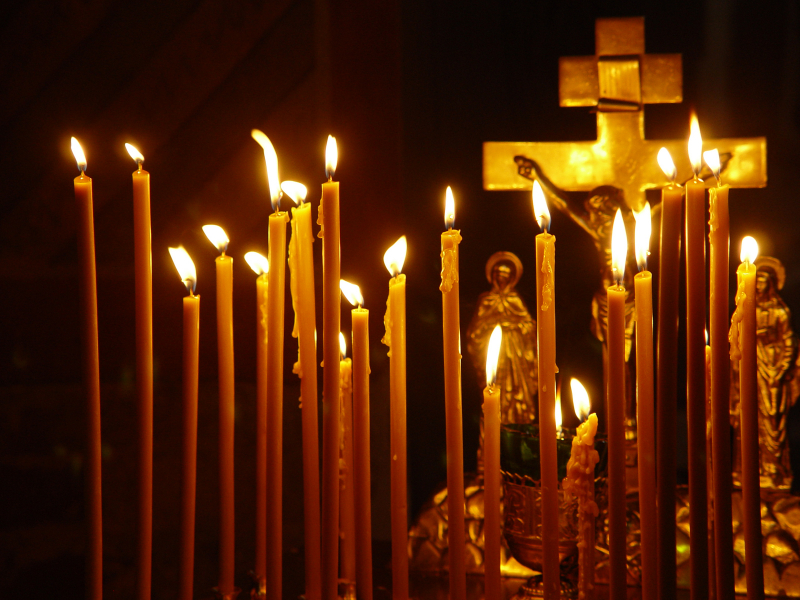
6.2: Orthodoxy puts high emphasis on humility and obedience to legitimate authority, particularly that of your Spiritual Father (though you typically find your own Spiritual Father if you’re diligent; I don’t know of them being appointed). 5.2? We’re kind of counter-cultural. Lots of home-schoolers, folk music fans, and otherwise dissidents, especially among the converts I know.
Above all, Point 4: we encourage people to come and see rather than trying to tell them. That also makes us suspect under points 3 and 5.1. Surely that’s a reliable marker of a cult, right?
Wrong. It’s just that some of Orthodoxy is ineffable. You have to see it to believe (or really to disbelieve) it. Yeah, we can point to the Nicene Creed as what we believe, but so can many others. That’s not a complete description of what we believe, or tend to believe, though. It’s a fence set up by Ecumenical Councils when people were falling off particular cliffs.
We don’t treat the Creed as “the essentials” and all else as optional. We have no “fundamentals” or “core beliefs” to be fundamentalist about. We have no “minimum necessary” beliefs, nor anything I’d call “least common denominators.”
We are a maximalist faith. We want to know/practice the fullness of the Christian faith. And some of that just isn’t cognitive or propositional. Some of it, you eat.
This is a great blessing, but as I was approaching Orthodoxy it was a great frustration.
I wanted to line up my Calvinist beliefs in Column A, what I took to be Roman Catholic beliefs in Column B, and Orthodox beliefs in Column C, so I could compare and contrast across the lines, sitting as judge. I jumped on the title “An Exact Exposition of the Orthodox Faith,” and then was disappointed that it didn’t really seem to deliver – not in the categories I wanted it to deliver in. Just look at those chapter titles. Sheesh!
- That the Deity is incomprehensible, and that we ought not to pry into and meddle with tire (sic) things which have not been delivered to us by the holy Prophets, and Apostles, and Evangelists.
- Concerning things utterable and things unutterable, and things knowable and thinks unknowable.
- Concerning the nature of Deity: that it is incomprehensible.
- Concerning the place of God: and that the Deity alone is uncircumscribed.
(Emphasis added) Which leads to this: much of Orthodox theology is apophatic:
Apophatic theology — also known as negative theology — is a theology that attempts to describe God by negation, to speak of God only in absolutely certain terms and to avoid what may not be said. In Orthodox Christianity, apophatic theology is based on the assumption that God’s essence is unknowable or ineffable and on the recognition of the inadequacy of human language to describe God.
It has been said, roughly, that if you really want to know what Orthodoxy is, you need to take a year, attend every single service that’s appointed (this probably means spending the year at a Monastery, since you’re not going to find a parish that serves everything appointed), pay perfect attention, make the prescribe prostrations, metanias, and other physical gestures, commune, be annointed, etc. and then you’ll know what Orthodoxy is. Because much – most? – of what we believe is in the hymns we sing, the prayers and litanies we pray, the acts we do, the acts that are done to us, and the entire multi-volume set of books with those services.
Yet you cannot become Orthodox by reading those or any other books. I was drawn to Orthodoxy by books. There came a point where I could have populated “Column C” somewhat. But that couldn’t and didn’t make me Orthodox. I had to “come and see.” And I count it a blessing that my role at the Parish requires me to be in more of those services than anybody except the Priest and maybe our Subdeacon.
And if “come and see” sounds like “we’re not going to tell you until we’ve trapped you,” I’m sorry but you’re hearing it wrong. We can’t (not mustn’t) tell you.
The old Evangelical saw was “Christianity isn’t a religion; it’s a way of life.” Think of it in those terms and maybe you’ll see why we couldn’t tell you if we tried.
* * * * *
“The remarks made in this essay do not represent scholarly research. They are intended as topical stimulations for conversation among intelligent and informed people.” (Gerhart Niemeyer)
Friday, 5/23/14
Saturday, 5/3/14
Wednesday, 4/30/14
Tuesday 4/29/14
Gradually the veil lifts
Mars Hill Audio Journal Volume 121 just arrived, and I had a chance to listen Friday.
A high school acquaintance, Walter Hansen (Senior when I was a Freshman, but it was a small school and he was not standoffish) has become patron of painter Bruce Herman, and they were interviewed about their joint book, Seeing Through Your Eyes.
They talked with host Ken Myers about meaning in art – a meaning that is nonverbal and not reducible to words, though talking about it can enhance appreciation in what the painter describes as a “dance.” They even dabble at the periphery of the theology of icons, from a Protestant perspective, it appears, as the artist is in regular dialog with an Orthodox Priest, Fr. Spiridon, who tells him his portraits are dangerous.
The prior track was an interview of Calvin College philosophy professor James K. A. Smith, who has shaken up the Evangelical/Calvinist world by two books under the rubric “Cultural Liturgies:” Desiring the Kingdom: Worship, Worldview, and Cultural Formation and Imagining the Kingdom: How Worship Works.
I wouldn’t say the Evangelical/Calvinist world is overreacting. These books are light years away in their sensibility from the Calvinist ne plu ultra of 4 bare walls and a 4 point sermon addressed to the left hemisphere of a wet computer.
“Smith seeks to re-vision education through the process and practice of worship” (Amazon book description)! He uses the word “liturgy”! He actually thinks that embodiedness has practical consequences, and isn’t just an interesting thought experiment from which to spin out philosophies! He even thinks that the body may have something to do with what the mind loves and therefore finds plausible!
Those are very challenging ideas for Calvinist especially, as they intrinsically challenge one to go beyond mere ideation, on which Calvinism tends to be strong, into praxis, on which it tends to be weak (and tended to be legalistic when praxis was strong).
Worship “works” by leveraging our bodies to transform our imagination, and it does this through stories we understand on a register that is closer to body than mind. This has critical implications for how we think about Christian formation.
(Amazon book description of Smith’s second of three “Cultural Liturgy” books) Well do tell!
“Emergent Church” strikes me as an unintelligible mish-mash, but it bespeaks a longing for something more, and that something more often involves raids on traditional Christianity to borrow (they can’t steal it) bits of liturgy.
I cherish signs that my former Evangelical and Calvinist co-religionists are waking up to things that Orthodoxy has tacitly known all along, as both items 6 and 7 on Mars Hill Audio Journal Volume 121 seem to me to signal. I keep thinking “the coin will drop” for Mars Hill muse and host Ken Myers soon, and he’ll frankly become the Orthodox Christian that seems to be emerging – but he may be three cars ahead of me on that train of thought.
It’s just not the sort of thing you blurt out while emerging if you want to “work in this town again.”
* * * * *
“The remarks made in this essay do not represent scholarly research. They are intended as topical stimulations for conversation among intelligent and informed people.” (Gerhart Niemeyer)
Great and Holy Saturday
I have a soft spot for the hymn, from the Liturgy of St. James, Let All Mortal Flesh Keep Silence.
Although I grew up in a fairly “low Protestant” Evangelical Church (by which I mean, whatever others might mean, a Church in which there was little respect or regard for history, liturgy, lectionaries, or Church calendars), we had that hymn in our hymnals and sang it on occasion, though at this point, I couldn’t tell you whether the occasion was Good Friday (I’m certain we had no service on Great and Holy Saturday) or just whenever the Pastor or “worship committtee” wanted a solemn note. It might have been Christmas Eve, for the text would be appropriate there, too.
Here’s the version we sang, at least the tune (Picardy) and first verse.
And here is the versified hymn text:
Let all mortal flesh keep silence,
and with fear and trembling stand;
ponder nothing earthly-minded,
for with blessing in his hand,
Christ our God to earth descendeth,
our full homage to demand.King of kings, yet born of Mary,
as of old on earth he stood,
Lord of lords, in human vesture,
in the body and the blood;
he will give to all the faithful
his own self for heavenly food.Rank on rank the host of heaven
spreads its vanguard on the way,
as the Light of light descendeth
from the realms of endless day,
that the powers of hell may vanish
as the darkness clears away.At his feet the six-winged seraph,
cherubim, with sleepless eye,
veil their faces to the presence,
as with ceaseless voice they cry:
Alleluia, Alleluia,
Alleluia, Lord Most High!
In the Anglophone Eastern Orthodox tradition, versified hymns with rhyme like this are vanishingly rare. I’m neither musicologist nor poet enough to appreciate fully whetever “poetry,” like Dante’s internal rhymes and wordplay, our hymns contain. I suspect that Western Rite Orthodoxy is full of rhymed and versified hymns.
No Eastern Orthodox Church I know of still uses the Liturgy of St. James, though Wikipedia says a few do. But I sing this versified form of the hymn, which is appointed just once a year on Great and Holy Saturday (it carried over into our Liturgy of St. Basil for this day), and I’ll be doing so two hours after I’m typing this as this hits Facebook and Twitter. It’s the only thing I ever sing now in Church that I once sang in a Protestant service.
I have had no Lent and Holy Week as an Orthodox Christian when it more aptly could be said that I was “running on fumes.” In addition to professional obligations, I have a home remodeling actively ongoing and am watching (sort of a quasi-Chair of a building committee – it’s complicated) the construction of my Parish’s permanent, properly-Orthodox new home. And last weekend, I sang (in a concert I also sponsored) a different version of Let All Mortal Flesh.
Yet never have I felt such joy and anticipation of Pascha.
If I had a really skilled choir of 40 voices or so (and if I did, I’d be singing and someone with actual conducting competence would be conducting, so it wouldn’t be “my choir” any more), I’d be tempted to use Grechaninov’s setting from his Opus 58 Holy Week Meditations, where the Alleluias of six-winged “seraph, cherubim, with sleepless eye” are just glorious. I described it as somehow suspenseful or portentous; the conductor under whom I sang it pointed out that the effect is of a big Paschal Church bell ringing out beneath the Alleluias. The sequence I’m thinking of starts here at 6:22, but for full effect, back up to 5:12.
And buy the CD. The one I sang in won’t be commercially available. (Insert Paschal smiley-face here.)
* * * * *
“The remarks made in this essay do not represent scholarly research. They are intended as topical stimulations for conversation among intelligent and informed people.” (Gerhart Niemeyer)
Some succinct standing advice on recurring themes.
e

