Catch-up collation, 11/22/20

She deserves to be confirmed—not least because of the ugly campaign against her.

Judy Shelton’s Heresy – WSJ

Sorry, guys, but this is the kind of dumbass argument that would have resulted in Trump’s re-election because he, too, vile though he be, suffered ugly, delusional and obsessive Resistance.

“Owning the Libs” isn’t a good enough reason to confirm her if she is a flake.


With the country’s polarization deepening and Congress likely gridlocked, presidents on both sides of the aisle have relied on executive orders (EOs) to push key parts of their agendas. According to the American Presidency Project, President Bill Clinton averaged 46 executive orders per year during his term. President George W. Bush averaged 36, Obama 35, and Trump 51. (All of these figures are down dramatically from the mid-20th century, when President Herbert Hoover averaged 242 EOs per year and President Franklin Delano Roosevelt averaged 307.)

The Morning Dispatch

That Presidents are using fewer Executive Orders than in the past surprises me quite a lot.


As of Tuesday night, the Trump campaign and its allies were—by Democratic election lawyer Marc Elias’ count—1 for 26 in their post-election lawsuits; the vast, vast majority of their claims of widespread voting irregularities or fraud have been rejected or dismissed by judges across the country.

The president’s main problem? He’s got his order of operations backward. Typically in litigation, plaintiffs will carefully and thoroughly collect evidence and build a compelling narrative that supports their case. Trump, conversely, started with the conclusion—that the election was stolen from him—and now his (dwindling supply of) lawyers are scrambling to backfill that claim with evidence that, thus far, does not exist.

One Pennsylvania lawsuit looking to stop the certification of results in the state, for example, was filed with only the promise of unearthing evidence of massive amounts of voter fraud at some point in the future. “Voters are currently compiling analytical evidence of illegal voting from data they already have and are in the process of obtaining,” the plaintiffs write. “They intend to produce this evidence at the evidentiary hearing to establish that sufficient illegal ballots were included in the results to change or place in doubt the November 3 presidential election results.”

Because Trump and his allies are working backward from his “stolen election” claim, no amount of evidence to the contrary will shake them. On November 12, Trump asserted that, once Georgia underwent a recount, he would win the state. Well, Georgia election officials ordered a recount, and Biden is still going to win the state. So now Trump is adamant that the “Fake recount going on in Georgia means nothing” and the real problem is a consent decree about ballot signatures that both parties agreed to back in March. Once that inevitably fizzles, it’ll be something else.

At some level, Trump’s self-deception is both entirely expected and entirely meaningless. Joe Biden will be sworn in on January 20 and the world will move on.

But the president’s refusal to budge from his conspiratorial alternate reality is wreaking havoc in its wake—and not just by grinding the transition process to a halt. Philadelphia City Commissioner Al Schmidt, a Republican, said on November 8 that his office has received death threats for not buying into widespread election fraud conspiracies. Trump targeted him on Twitter three days later. After Trump—and GOP Sens. Kelly Loeffler and David Perdue—went after Georgia’s Republican Secretary of State Brad Raffensperger, he and his wife have been dealing with death threats, too.

And on Tuesday night, one of the most widely respected members of the Trump administration—CISA Director Chris Krebs—got the axe for doing his job: Protecting the integrity of the election and debunking misinformation about the electoral process, both foreign and domestic. The “Rumor Control” and “#Protect2020” websites his agency spearheaded have, by all accounts, been nothing but successful. “The November 3rd election was the most secure in American history,” a joint statement from the Election Infrastructure Government Coordinating Council Executive Committee read last week.

Krebs’ reward? “Effective immediately, Chris Krebs has been terminated as Director of the Cybersecurity and Infrastructure Security Agency,” Trump tweeted just after 7 p.m. Tuesday. Krebs’ deputy reportedly resigned after the move as well, leaving Brandon Wales—a Krebs ally—as likely acting director.

The Morning Dispatch


[C]anceling student loan debt would be a massive unforced error for the newly minted Biden administration. It would show that one of the new Democratic president’s highest priorities during a pandemic and a destabilizing economic shock is to provide a bailout to people who are overwhelmingly likely to end up as members of the upper-middle class. It would amount to a transfer payment from contractors and service workers to high-earning knowledge workers and other white-collar employees. As such, it would also accelerate trends in the Democratic Party that would leave it vulnerable to a Republican Party increasingly trying to rebrand itself as a champion of the working class.

As economist Thomas Piketty and others have pointed out in recent years, center-left political parties suffer at the ballot-box when they come to represent the interests of the upper-middle class at the expense of the working class, allowing the nationalist-populist right to make inroads with the latter. This has happened in a series of European countries in recent years, and it’s happening in the U.S. as well, with the Democrats enjoying surging support in inner-ring suburbs but losing ground in working-class, exurban, and rural areas.

Damon Linker, The class folly of canceling student loans

I cannot endorse Linker’s view heartily enough. The Democrats need not only to avoid too hard a swerve leftward, but they need to avoid clamorous calls like this that will more securely lock workers into an increasingly insane GOP. But considering how little of the progrressive left is “POC”, how much white college grads, I may be repeating myself.


The fact that such a proposal would disproportionately benefit high-earning professionals does not make it a bad one. But it should be expanded into a debt jubilee that would cancel all obligations up to the same five-figure sum proposed by Schumer: credit cards, auto loans, remaining mortgage balances, and, especially, medical debts, which should be discharged without any limit.

Matthew Walther, America needs a real debt jubilee

I haven’t kept score, but it seems to me that, like Babe Ruth, Walther always swings for the fence and thus whiffs a lot.


It would take a heart of stone not to laugh as Trump finally turns on the real Judas in his eyes: Fox News (where I’m a contributor). The network, Trump tweeted, “forgot what made them successful, what got them there. They forgot the Golden Goose. The biggest difference between the 2016 Election, and 2020, was @FoxNews!”

Never mind that Fox was No. 1 in every time slot more than a decade before Trump descended that escalator in 2015. Never mind that for four years, Trump began his day with his Presidential Daily Brief—Fox and Friends—and ended it with the primetime gang. And never mind that Trump and the opinion side of the network remain in a deeply codependent relationship.

Trump didn’t get the unwavering, full-throated praise he needed, so now he’s thinking about creating a competing network, one without all the obvious anti-Trump bias!

[T]he one thing we won’t ever feel about the Trump presidency is nostalgia—not least because he won’t really be gone. Even after he leaves the White House, he’ll be fighting for himself—and making sure we hear him—for the rest of his days.

Jonah Goldberg, Donald Trump Will Never Stop Fighting—For Himself – The Dispatch (emphasis added)


Since 2016, America’s international reputation has been transformed. No longer the world’s most admired democracy, our political system is more often perceived as uniquely dysfunctional, and our leaders as notably dangerous. Poll after poll shows that respect for America is not just plummeting, but also turning into something very different. Some 70 percent of South Koreans and more than 60 percent of Japanese—two nations whose friendship America needs in order to push back against Chinese influence in Asia—view the U.S. as a “major threat.” In Germany, our key ally in Europe, far more people fear Trump than fear Russia’s Vladimir Putin, China’s Xi Jinping, or North Korea’s Kim Jong Un.

Anne Applebaum, The Post-Trump World Will Never Go Back to Normal – The Atlantic

How sad is that.

Related topic: As we once surpassed Great Britain, so China appears destined to surpass us economically. What are we going to do to maintain leadership in other realms?


I keep forgetting to acknowledge that the “Evangelicals” who deeply drank the Trump Kool-Aid would not even have been considered Evangelicals in my youth. They are Prosperity Gospel pentecostals, arguably heretics, the closest analogy in my youth being Oral Roberts — who we did not then consider Evangelical in my circles.

This is not, of course, an endorsement of what I consider true Evangelicals. American Evangelicalism at its very, very best — far better than I experienced growing up — was described by the late Tom Howard in his spiritual biography, Evangelical is Not Enough: Worship of God in Liturgy and Sacrament. Though Howard walked the Roman road, I  to Constantinople (Orthodoxy), the arguments for either are almost indistinguishable when it comes to the superiority of liturgy and sacrament over Evangelical worship variations.


I have been an engaged Christian for over half my life now, but I have never once tried to evangelize directly. Some people have that gift; I do not. I have not ever been offended when someone tried to share their faith with me, but I have also resisted those conversations. Why? Because fair or not, I have always regarded them as people trying to befriend me for instrumental reasons. They’re not interested in me as I am; they are only interested in me as a potential convert. It’s like they’re trying to secure my vote for Jesus, or something.

Again, I have never held it against them; how else would you evangelize if you didn’t take the risk of coming off that way? But I was also not the slightest bit interested in what they had to say. Had we become friends first, and I had come to trust in their care for me, then I might have been open to hearing them out. Not before, though.

A reader e-mailed the other day to say he is not a Christian, but asked why I became one … I seem to recall that he wasn’t asking me to tell my conversion story …, but rather to say why I think he should become a Christian.

I don’t want to make an apologetic argument. There are many of those, done by people far better at that than I am. The reader’s query has bobbed to the surface in my mind over the past few days, and made me think more deeply about what it was that made me feel that if I was going to live in truth, I had to become a Christian — and not just a Christian, but the kind of Christian I became. What I’ll say here is not intended to be an apologetic, but just some musing on what seized my imagination, and compelled me to convert. I’m not interested in offering propositions and syllogisms. I only want to talk about the core experience that opened my eyes, and then my heart, to God.

It begins in awe. That is the primordial experience of religion: becoming intensely aware of the numinous realm, and one’s need to establish a relationship to it …

“When I saw God, as religions seemed to want me to see God, as an all-seeing supernatural entity with a great personal interest in my life and behaviour, laying down laws, demanding worship and promising me an afterlife in return, I had no interest, and still don’t. I don’t believe it. But when, later, I began to see that perhaps this was a common human interpretation of an experience of something greater than the individual ego – when I began to understand that all religions and all spiritual traditions have their mystics who had interpreted this great spirit, this Dao, this experience of the divine, very differently – then I began to see that perhaps it was something I could understand after all. I began to see that perhaps what some people call God, or the sacred, or the divine, was what I experienced as some power, some strange greatness, immanent in the wild world around me.

“In other words, perhaps I do after all understand the perpetual human search for the sacred, whether I can adequately explain it or not, and I think I may know why it still matters, despite my culture’s frantic attempts to convince me otherwise. I have experienced the feelings that charge the concept with so much electricity. It’s just that I have never experienced them in places that people designate as holy.”

The Rose Window & The Labyrinth – Daily Dreher (embedded quote by Paul Kingsnorth)

I addressed Evangelicalism above, but it now occurs to me that it rarely “begins in awe … the primordial experience of religion: becoming intensely aware of the numinous realm, and one’s need to establish a relationship to it.” Evangelical conversions are almost always directed more toward eternal self-preservation, since there’s little awesome or numinous in Evangelical life.


When I speak to former colleagues of mine who are—or were—in the Republican sphere that includes Graham, the conversation about “what happened to Lindsey Graham?” usually ends with the conclusion that he is scared to death of what life would be like if he wasn’t a U.S. senator.

In an interview in February 2019, Graham was asked why he had such a dramatic shift of allegiance towards Donald Trump. His answer: “From my point of view, if you know anything about me, it’d be odd not to do this.” When asked what “this ” meant, he said “try to be relevant.”

It seems that for Graham, changing one’s operational code to fit the political climate so as to stay close to power is not just acceptable—it’s part of his inherent identity ….

Nicholas Connors, Lindsey Graham Is the Worst – The Bulwark


The true threat for the Church … comes … from the universal dictatorship of apparently humanistic ideologies. Anyone who contradicts this dictatorship is excluded from the basic consensus of society. One hundred years ago, anyone would have thought it absurd to speak of homosexual matrimony. Today those who oppose it are socially excommunicated. The same holds true for abortion and the production of human beings in the laboratory ….

Antonio Socci, Benedict XVI Warns of a New Totalitarianism (OnePeterFive)


What we are witnessing is a power grab carried out chiefly by some white Americans against other white Americans. The goal of the new woke national establishment, the successor to the old Northeastern mainline Protestant establishment that was temporarily displaced by the neo-Jacksonian New Deal Democratic coalition, is to stigmatize, humiliate and disempower recalcitrant Southern, Catholic, and Jewish whites, along with members of ethnic and racial minorities who refuse to be assimilated into the new national orthodoxy disseminated from New York, San Francisco, Washington, D.C., and the prestigious private universities of New England. Properly understood, the Great Awokening is the revenge of the Yankees.

Michael Lind, The Revenge of the Yankees – Tablet Magazine


Another claim Mr. Giuliani referenced related to the delivery, in the middle of the night after Election Day, of boxes of ballots to the counting headquarters—several affidavits in the state lawsuit claimed these boxes were unmarked and unsealed. Judge Kenny dismissed those allegations as “generalized speculation.”

Mr. Giuliani was joined at the news conference by Sidney Powell, an attorney who has represented Michael Flynn, the former Trump administration national security adviser who pleaded guilty to lying to the FBI and is now trying to reverse the plea.

Ms. Powell aired accusations of foreign interference in the election, which she also claimed had been rigged by “communist money” from Cuba and China and through a plot concocted by Hugo Chávez, the Venezuelan leader who died in 2013, and the financier George Soros.

Mr. Giuliani said he had viewed hundreds of affidavits in Michigan and Pennsylvania that proved fraud, though he said he couldn’t reveal most of them because the accusers wanted to remain anonymous.

Trump Legal Team Claims Broad Conspiracy to Manipulate Election – WSJ


No hard evidence of widespread fraud, no success in the courts or prospect of it. You can have a theory that a bad thing was done, but only facts will establish it. You need to do more than what Rudy Giuliani did at his news conference Thursday, which was throw out huge, barely comprehensible allegations and call people “crooks.” You need to do more than Sidney Powell, who, at the same news conference, charged that “communist money” is behind an international conspiracy to rig the U.S. election. There was drama, hyperbole, perhaps madness. But the wilder the charges, the more insubstantial the case appeared.

More than two weeks after the election, it’s clear where this is going. The winner will be certified and acknowledged; Joe Biden will be inaugurated. But it’s right to worry about the damage being done on the journey.

What would have happened if the John Birch Society had been online, if it had existed in the internet age when accusations, dark warnings and violent talk can rip through a country in a millisecond and anonymous voices can whip things up for profit or pleasure?

It wouldn’t have faded. It would have prospered.

Peggy Noonan, A Bogus Dispute Is Doing Real Damage – WSJ


Thursday morning, President Trump teased an “Important News Conference” happening later in the afternoon in which his lawyers would lay out a “clear and viable path to victory” because the “pieces are very nicely falling into place.” The only accurate part of the tweet was that a news conference did, indeed, occur. It was just under two hours, and the Trump administration’s recently fired CISA Director Chris Krebs called it “the most dangerous 1hr 45 minutes of television in American history.”

In a statement provided to The Dispatch, Sen. Ben Sasse said that “based on what I’ve read in their filings, when Trump campaign lawyers have stood before courts …, they have repeatedly refused to actually allege grand fraud—because there are legal consequences for lying to judges.”

The Morning Dispatch: Farcical (But Dangerous) Conspiracies From Trump’s Legal Team – The Morning Dispatch


The substitution of the word pendentem for ascendentem occurs only in the later medieval devotional texts of the prayer, and it transforms its whole theological resonance. The Crucifixion is now something which happens to Christ, rather than his triumphal act: he does not ascend the cross, he hangs upon it ….

Eamon Duffy, The Stripping of the Altars


I strongly believe that George W. Bush was a worse president than Donald Trump, even if we restrict our analysis to his first term. While Trump is more chaotic, Bush was more ideological, was better able to surround himself with staffers competent enough to carry out his worst policy wishes, and simply did considerably more harm to considerably more people.

Many, many people I respect and care about disagree with me about this, quite strongly. In my view, they have a tendency to overweight the importance of mean words and breaches of etiquette relative to actual policy. And surely Bush is better than Trump if the metric is rudeness.

On Donald Trump, George W. Bush, And Moral Luck – Singal-Minded

Count me among those who disagree, though it was Bush’s conversion from “walk humbly” conservatism to hawkish and utopian democracy-spending that led to my leaving the GOP.


We may think that we prefer that the royals can be more informal, more human, what we may get is someone as vulgar as Prince Andrew, with his womanizing and gallivanting with the odious Jeffrey Epstein. Or, to switch to another monarchy, consider Pope Francis, who brought marked informality to the papacy, which, if you ask me, was doing just fine with the papal pomp.

[H]aving made unwise vows, ought [Charles and Diana] both have kept them, at the expense of their happiness[?] I think yes. It is more important that they live out their duty to be what they promised to be, rather than to be what they wanted to be. What if that meant they were miserable together? No one wants a couple to suffer, and certainly no spouse should suffer abuse, including repeated and unrepentant infidelity. But following Dante’s wisdom, if people are not willing to suffer to be faithful to their vows (marital and otherwise), society will disintegrate.

One of the most stunning things anyone ever said to me came a few years ago when I traveled to a Christian college to give a talk about one of my books. I was talking over a meal with some professors, and asked, as is my habit, what are the greatest challenges they see facing their students. I’ll never forget what the professor sitting on my left said: that he did not think many of his students would be able to form stable families.

“Why on earth not?” I asked.

“Because they have never seen one,” he replied. Nods all around the table.

That floored me. These were students at an Evangelical Christian college, yet most of them, according to their teachers, came from broken families. The professors went on to explain that most of the students they talk to about it want to marry and have children, but they are filled with radical doubt about their ability to sustain marriage and family. And why not? Most of the adults in their lives have failed to live up to their marriage vows. They did not believe it was possible.

Rod Dreher, The Pity Of The Royal Marriage – Daily Dreher (commenting on the new season of The Crown on Netflix).


In his interview with Dreher, Vance warned — prophetically — that while Trumpism offered a cheap thrill, the man himself offered nothing to treat the root causes of American despair. He’s the OxyContin of Presidents. At best, he made people understand that their pain was economic as much as cultural. But Vance’s real disappointment with Trump — “the tragedy of his presidency” — is that he encouraged white working class voters to blame others for their problems … But the fact that Vance only made it out by the skin of his teeth — and hillbilly [venture capitalists] remain a rare breed — suggests that merely exhorting the people of Middletown, Ohio, to make better choices isn’t going to do much. As his book makes clear, a poor kid only needs to make a handful of bad choices to fail and 100 good choices to become a success. The opposite is true for rich kids: three of four decent choices all-but guarantee success; you need to continually mess up to truly mess up.

Hillbilly Elegy resents ‘white trash’ – UnHerd


Many readers outside of California will not have heard of Governor Gavin Newsom. But if you need to summon up a mental image, imagine Marie Antoinette without that late Queen’s sense of self-awareness.

That Douglas Murray sure knows how to write an opening paragraph.


the CIA’s “most endangered employee for much of the past year” was the whistleblower who helped launch the impeachment proceedings against the president.

I’ve … never seen anything like the atmosphere of fear and intimidation that’s reigned on the right from the moment that Donald Trump seized the commanding heights of the GOP. I strongly believe this reality explains a great deal of public Republican silence and compliance in the face of even obvious and egregious Trump deceptions, incompetence, and misdeeds. The Trumpist wing of the GOP wields a big stick even as it also offers a rather tasty carrot … if you yield.

… “only cowards don’t conform” is an odd way to define bravery.

Let’s Talk About Fear – The French Press


What I see, and Muñoz seems not to see is that the threat to fundamental American values is not an exclusively radical-left enterprise. A right captured by cruelty and illiberalism is not building a better America, and it’s certainly not building a governing majority. Moreover, it is curious to see Muñoz blithely assert that the radical left is overtaking the Democratic party when large segments of the Democratic party are not only in open revolt against the radical left, the moderate faction soundly defeated the radicals in the Democratic presidential primary—and the radicals know it.

Who represents the greater departure from American political norms? Joe Biden or Donald Trump?

Let’s Talk About Fear – The French Press


I’ve enjoyed the NYT The Argument podcast for a couple of years, but it seems to me that Michelle Goldberg is getting loonier and loonier since Frank Bruni left.


Similarly, Jim Wallis, a patriarch of the Religious Left, was cancelled this year because he declined to publish in Sojourners a hysterical piece accusing the Catholic Church of white supremacy. All of Wallis’s work meant nothing to these zealots. He’s just another old white male who is insufficiently woke.

‘Triumph Of The Hillbilly’ | The American Conservative

Jim Wallis not woke enough for Sojourners?! We are doomed.


The most surprising thing about Liberty’s dream season, however, may be the string of scandals that form the foundation for the school’s success. McCaw resigned from his last job at Baylor amid allegations that his department mishandled sexual-assault allegations involving football players. Head coach Hugh Freeze came to Liberty after resigning at Mississippi over “conduct in his personal life” involving escort services.

Both men were brought to Lynchburg, Va., by Jerry Falwell Jr., the former Liberty president who resigned earlier this year amid a series of scandals that included allegations, which Falwell denied, that he for years watched his wife have sex with another man.

College Football’s Biggest Upset: Liberty University Is Undefeated – WSJ

And fundamentalist parents pay money to send their kids to this fundamentalist school! Any resemblance between postmodern Protestant fundamentalism and “the faith once delivered” is purely coincidental.


Sorry, Jonathan Rausch. You’re a good writer, but Trump’s Firehose of Falsehood is just Steve Bannon’s “flood the zone with shit” cleaned up for family consumption.


One nice thing about the current situation is that it’s making the difference between extremely partisan but fundamentally honest folks like Dreher and Erickson and utter hacks like Metaxas extra clear.

Andrew Egger on Twitter, after Rod Dreher called out Eric Metaxas for breathlessly Tweeting a link to an “actual newspaper” with details of the “election fraud” — a newspaper Dreher knew to be a grocery-store-giveaway from a GOP hack.

There’s a lot, by the way, I don’t like about many of Dreher’s postings at his American Conservative blog, but I don’t think he qualifies as “extremely partisan.” He has worn his ambivalence about the GOP on his sleeve for more than a decade. In the back-and-forth on this Tweet, Egger eventually concedes that.

I also don’t think he’s “far right,” but as (1) that’s the zeitgeist and (2) it’s almost as meaningless as “poopy-head,” I’m not going to die on that hill.


A week ago, we got a complementary copy of an unfamiliar newspaper, the Epoch Times. It seemed conservative in orientation, a bit eccentric in story selection, and anachronistically anti-Communist. I was considering a 3-month subscription as a trial.

Googled it and found that it’s a Falun Gong operation.

I have nothing in particular against Falun Gong, but I refuse to fall into the thought-pattern that the dissidents within an adversary are ipso facto friends. I also don’t seek out the Christian Science Monitor or trust the Washington Times, an operation of the Unification Church.


Republicans are united in the idea that it’s intolerant to attempt to exclude traditional conservative Christians from public office because of their religious beliefs—or even to condemn them as extremists or immoral. To turn around a demand that a Christian pastor of a different church with different beliefs withdraw from politics because of his theology and his sermons are outside of the mainstream in a way that favors the GOP is indeed hypocritical.

But that’s not the end of the inquiry. There still remains the rather important reality that religious beliefs can drive both policy and conduct in office. We all ground our policies and conduct in a particular world view, whether it’s located in a secular philosophy or a religious theology. So if there are unfair ways of evaluating a person’s faith, there are also fair questions we can ask.

So yes, ask Pastor Warnock about American military spending, American military policy or about support for veterans. Ask him if his beliefs would require him to vote against military intervention no matter the stakes. But don’t assume you know the answer to those questions based on 26 seconds of a single sermon—especially when those 26 seconds easily match with conventional Christian beliefs.

It’s a simple reality that religious beliefs often seem strange or inexplicable to those outside the faith (or even outside a specific denomination). And when you’re not steeped in a specific theology, you often have no idea how it will play out in political philosophy. I’m a Christian in the Calvinist reformed tradition, for example, yet I have vigorous public policy disagreements with many of my Calvinist friends.

David French, ‘America, Nobody Can Serve God and the Military’, calling out Republican bullshit like this contemptible Marco Rubio tweet.


Dog bites man isn’t news. Man bites dog is news.

University gets free speech right, even when it’s speech of Republicans, is also news.


The worst judge of all is the man now most ready with his judgements; the ill-educated Christian turning gradually into the ill-tempered agnostic, entangled in the end of a feud of which he never understood the beginning, blighted with a sort of hereditary boredom with he knows not what, and already weary of hearing what he has never heard.

G.K. Chesterton, The Everlasting Man

You can read most of my more impromptu stuff here or join me and others on micro.blog. You won’t find me on Facebook any more, and I don’t post on Twitter (though I do have an account for occasional gawking).


Miscellany 11/17/20

It is nothing short of horrifying, but sadly also completely unsurprising, to see an ACLU lawyer proclaim his devotion to “stopping the circulation of [a] book” because he regards its ideas as wrong and dangerous. There are, always have been, and always will be people who want to stop books from being circulated: by banning them, burning them, pressuring publishing houses to rescind publishing contracts or demanding corporations refuse to sell them. But why would someone with such censorious attitudes, with a goal of suppressing ideas with which they disagree, choose to go to work for the ACLU of all places?

Glenn Greenwald, The Ongoing Death of Free Speech: Prominent ACLU Lawyer Cheers Suppression of a New Book – Glenn Greenwald


Again, I don’t blame anybody for being put off of Christianity because their church has become preoccupied with politics (liberal or conservative). But to turn away from Christianity because of contemporary politics is like deciding you will never listen to music again because what’s on the radio is trite and offensive. What does Bach or Count Basie have to do with Cardi B? I imagine that some young people who do this think they are striking a blow for cosmopolitan broad-mindedness, but in fact they may well be just as narrow and parochial as those they criticize.

Christianity Beyond Here & Now – Daily Dreher (emphasis added)

I have lamented many times that thee avatars of Christianity in the U.S. are Evangelicalism and Roman Catholicism, neither of which accurately represents my faith. But Dreher has a point: mainstream Protestantism and Orthodoxy are not secret, and leaving Christianity because of priests buggering boys or Evangelical MAGA is lazy and parochial.


I knew that Bari [Weiss] and I could be friends and allies when I read her resignation letter from The New York Times opinion page. As a professional journalist of over 30 years, I can tell you that nobody quits The New York Times. It is the pinnacle of the profession, and Bari Weiss had reached it at a shockingly young age. But she told them to go to hell because she couldn’t stand the culture of lynch-mob leftism within the newspaper, and the way her fellow liberals were capitulating to it. To make that kind of sacrifice — leaving the Times for an uncertain future — is an act of courage and principle. I wrote her to tell her so, and how proud I was of her. And so we became allies.

You find that moral courage does not follow ideological or religious lines. On the Zoom call, I told a story about how I learned this lesson at the start of the Catholic abuse scandal, in early 2002, when the story broke big out of Boston. I spoke at a Catholic journalism conference in Washington, and argued that Catholic journalists had a responsibility as Catholics to tell the truth about what was happening in the Church.

At that same conference, though, a Catholic priest who was publisher of a major Catholic newspaper congratulated himself for running a paper that was not going to descend to the gutter to write about such filth. Imagine that: a newspaper publisher who thinks of himself as morally virtuous for having no curiosity about certain truths. A well-known Catholic journalist accused me publicly of airing the Church’s dirty laundry to advance my career in the secular world. I respected him greatly before that statement, but after it, I knew the kind of man he was.

Rod Dreher, Coffee, Kristin, Courage – Daily Dreher


These people, these leftists in charge of journalistic institutions, are so sold out to their narrow vision of the world that they make it impossible for anyone who doesn’t share their ideology to work in a newsroom — and then they fault the talented writers who can make a go of it on their own for doing so, because it’s racist?!

I read The New York Times and The Washington Post for the same reason a Kremlinologist would have read Pravda and Izvestia: for insights into how the ruling class thinks. I don’t read them for accurate and insightful information about the way the world is.

Rod Dreher, The Substack Threat | The American Conservative


[T]he Danish mink episode is just one more proof that factory farms are ticking time-bombs of zoonotic disease — those which leap from animals to humans — and petri-dishes of bacterial infections.

Humans are meant to be wise — indeed, so wise that we called ourselves sapiens twice — but you do wonder. We elevate ourselves over animals, consider them as Other, when biologically the species barrier between us is thin. Even non-existent. Take the common-or-garden pink pig, for instance: the pig so physiologically resembles humans that it has been used in medical research for over 30 years as a translational model. That is, if it works in a pig it is likely to work in humans.

John Lewis-Stempel, Factory farming will kill us all – UnHerd.

Corollary: If it makes pig sick …


Think of the Philip Reiff quote – “men used to go to church to have their misery explained to them. Now they go to church to be made happy”.

These kids have inherited their parents’ anxieties about comfort and status. They were also told by their parents that the most important thing in life was to Go To College and Get A Good Job. Well guess what? Both of those things offer comfort and status but are hostile to traditional Christianity. So guess what gets left behind?

A reader to Rod Dreher, explaining the Evangelical Crisis (that many think arrived November 3-7, roughly).


I don’t blame them at all for being alienated from a church that is essentially MAGA At Prayer, but the idea that white conservative American Evangelicalism represents the fullness of Christianity is simply bizarre — so strange that I find it hard to accept that MAGA is why they have left the faith.

Rod Dreher, The Evangelical Crisis | The American Conservative.

Lie down with dogs, rise up with fleas — and expect people to give you a wide berth.


Another Bulwark writer said that although the prospect of Biden losing Pennsylvania was not what “we wanted,” the Democratic nominee could still win the presidency if he won Arizona, plus two electoral votes in Maine and two in Nebraska. At that point, Charen lost the rest of her chill.

“Right now, we are facing the possibility of not only not getting that, but having that fucker in office for four years!” Charen cried …

I went to Charen’s house on Election Night because she once considered herself too conservative for George H. W. Bush, yet she committed herself so wholeheartedly to booting Trump out of office that she even voted for Democrats in down-ballot races this year.

“I want the Republican Party to feel spanked, so that it reforms and makes a U-turn,” she told me. She struggled to name the one thing that most disgusts her about Trump and his Republican enablers. It came down to “Are you a decent human being? Do you mostly tell the truth instead of mostly not?”

In 2018, she appeared on a panel at the Conservative Political Action Conference. When asked about feminism, she attacked her own tribe, saying, “I’m disappointed in people on our side for being hypocrites on sexual harassers and abusers of women who are in our party, who are in the White House, who brag about their extramarital affairs, who brag about mistreating women. And because he happens to have an R after his name, we look the other way; we don’t complain.”

The crowd erupted in jeers and shouts of “Not true!” Charen had been a speechwriter for Nancy Reagan! This was CPAC, Republican prom! Security guards escorted her out for her own protection.

The incident didn’t seem to shake her. “There is nothing more freeing than telling the truth,” Charen later wrote in a New York Times op-ed.

Bill Kristol, The Bulwark, and Republicans for Biden – The Atlantic

I have admired Mona Charen for many decades. I never imagined I’d still be admiring her after we’d both come to despise the GOP, our former party.


“These men and women sign up to take a bullet for the president if necessary and he won’t even wear a mask to protect them,” said Senator Tammy Duckworth (D-Ill).

Knowhere News

Covid aside, I wonder how Secret Service agents feel about “taking a bullet” for Trump if necessary.


Out of the crooked timber of humanity no straight thing was ever made.

You shall love your crooked neighbour
With your crooked heart.

W.H. Auden

The worst judge of all is the man now most ready with his judgements; the ill-educated Christian turning gradually into the ill-tempered agnostic, entangled in the end of a feud of which he never understood the beginning, blighted with a sort of hereditary boredom with he knows not what, and already weary of hearing what he has never heard.

G.K. Chesterton, The Everlasting Man

You can read most of my more impromptu stuff here or join me and others on micro.blog. You won’t find me on Facebook any more, and I don’t post on Twitter (though I do have an account for occasional gawking).

Election, Justices and Sanity

The Election

From “Our choice is Joe Biden*,” an editorial in the New Hampshire Union Leader, Oct. 25:

> Our endorsement for President of these United States goes to Joe Biden.
>
> While Joe Biden is the clear choice for president, it would be a disservice to the country to send him to the White House without a backstop. We suggest splitting the ballot and electing a healthy dose of GOP senators and representatives. The best governance often comes through compromise. The civility of the Biden administration will help foster such compromise, but a blue wave would be nearly as disastrous for this country as four more years of Trump. It would result in a quagmire of big government programs that will take decades to overcome.

Notable & Quotable: A Footnote to a Biden Endorsement – WSJ

Yes, I agree, but I don’t think for a moment that’s what will happen next Tuesday.


For the people closest to me in terms of education (graduate degree), socioeconomic status (upper-middle-class suburban), region (the northeastern megalopolis stretching from Washington to Boston), and race (white), Donald Trump is an appalling human being in just about every respect. He’s corrupt. He’s cruel. He’s a bigot. He’s ignorant. He’s mendacious. He’s a narcissist. And he’s a jerk. Unlike many previous presidents, there is nothing admirable about him at all. He’s a kind anti-role-model, showing how a person shouldn’t behave in the world — the kind of person about whom you might say to your children, “Whatever you do, don’t be like him.”

But for people who write angry responses to my most critical columns about the president — most of them men, many of them from other parts of the country, quite often with military backgrounds — he looks very different. For them, Trump is a man of strength, of courage. He’s a fighter and a patriot. Even if he’s not particularly admirable as a person overall, he has qualities that we should want to have in a leader, and that are under threat in our country. They are qualities that Americans, and especially boys, should be raised to look up to and emulate, including a refusal to back down, a toughness and tenacity, and a willingness to insist that masculine strength be revered and inculcated.

I suspect this difference is a source of many of our political disputes, and the sense that we now reside in very different countries. That’s because the dispute has to do with an important and deeply significant disagreement about what type of human being, oriented to certain kinds of ideals and rooted in a certain kind of emotional life, we want our country to produce.

As a pundit, I usually shy away from issuing armchair psychological diagnoses of public figures, including our president. Unlike some columnists, I’ve never written that Trump is mentally “unwell.” Yet I have nonetheless become convinced by those who speculate that a good part of his worst behavior — the cruelty, the neediness, the craving for approval, the distinctive combination of comic bravado and paralyzing insecurity — could well be a function of him trying to make up or compensate for a childhood almost totally lacking in parental, and especially paternal, love.

Damon Linker, The very different emotional lives of Trump and Biden voters


[The] fears that religious conservatives feel are real and ought not be brushed off lightly. Losing our shaping and beloved institutions is a grievous loss. But I do not think our fears can ultimately be answered politically … Laws and policies that protect religious liberty are important, but we, as a Christian community, cannot seek those laws at any cost. If we do, we will lose our own souls in the process of preserving our freedoms.

If shoring up religious freedom requires us to champion someone whose administration is responsible for making more than 545 children orphans, someone who in Sen. Ben Sasse’s words “flirts with White supremacy,” who bullies and denigrates others and constantly engages in misogyny, arrogance and divisiveness, then we cannot preserve religious liberty while remaining faithful to the ethical call of Jesus. Self-protectiveness on the part of religious people is understandable, but … [t]he church exists to glorify God by loving and serving our neighbor. If our own institutional preservation trumps all other ethical commitments, then we have already lost what is most dear.

Given the Trump administration’s shutdown of the asylum system and so-called “Muslim ban,” it is debatable if his presidency has actually benefitted the cause of religious liberty … The root of religious freedom amid pluralism is love for our neighbors, especially our ideological or political enemies. We cannot spend eight years supporting a president whose basic modus operandi is meanness and cruelty– who vocally disagrees with the call to love one’s enemy–and then expect anyone to take us seriously when we ask them to respect our religious freedom.

“But wait!” I can hear traditional religious people cry, “Even if we are kind, respectful and honoring of our neighbor’s dignity, they will not be respectful of ours. We can be as ‘winsome’ as can be, and we will still be marginalized as bigots.” I think this may be true, but this objection assumes that kindness, respectfulness and the self-giving love of Jesus is useful [only – implied, I think] insofar as it is a successful cultural strategy. Christian discipleship calls us to radical love for our neighbor and to honor the dignity of those around us. We are called to work for the common good. We are called to witness to a different kind of King and a different kind of Kingdom. These ethical mandates are not contingent upon—nor a guarantee of—any particular outcome. They are a means to no other end other than to know and glorify God.

Tish Harrison Warren, Don’t vote Trump for religious liberty (emphasis added)


“The chief value proposition of Donald Trump’s presidency is appointees,” Noah Rothman, an editor at Commentary, told me. Barrett’s confirmation may be “the last act of this presidency,” and if Trump loses next week, “Republicans will look back on [it] fondly.”

Emma Green, Republicans Confirm Amy Coney Barrett to Supreme Court – The Atlantic

“Chief value proposition”: Nice phrase, which being interpreted is “otherwise, he was and is pretty worthless.”


Reading The American Conservative 2020 Presidential Symposium, I’m disappointed how many are voting for Trump, but heartened that three are voting for the American Solidarity Party candidate Brian Carroll.


Amy Coney Barrett

“In a less political time than we find ourselves today, I suspect [Amy Coney Barrett] would have the unanimous support of this body,” said Senator Thom Tillis (R-N.C.)

Knowhere News


[T]here is no precedent for judges or justices recusing because a case implicates the interests of the President who nominated them. Justices Gorsuch and Kavanaugh did not recuse in Trump v. Vance and Trump v. Mazars, and Justices Ginsburg and Breyer did not recuse in Clinton v. Jones. Likewise, the only one of President Nixon’s appointees to recuse in United v. Nixon was William Rehnquist, who recused because of his work in the Office of Legal Counsel, not because he was a Nixon appointee.

Jonathan A. Adler, * Should Justice Barrett Recuse from 2020 Election Litigation?*


A fine irony: after spending ~150 years proving that Roman Catholics are good liberal democratic Americans, we get yet another Catholic Justice just as Catholic scholars Deneen, Vermeule, Pappin argue against liberalism.


General Sanity

According to Michael Casey’s description, lectio divina has four stages—lectio, meditatio, oratio, and contemplatio—that roughly correspond to the different senses of Scripture—literal, Christological, behavioral, and mystical. Though you need not move through these four stages chronologically, one could move through them in the following way. First, in the lectio stage, read and re-read the text, marking key passages where the author’s argument is clearest. Write in your own words the key ideas, concepts, and arguments. In the meditatio stage, think about the context in which the text was written. What was happening in the world or the author’s life when the book was written? What was the author’s motivation, and to whom does the author write? Third, in the oratio stage, pay attention to how these ideas speak to your conscience and make you reflect on your behavior, habits, and dispositions. Fourth, in the contemplatio stage, think about what these texts say about your relationship with God, either directly or indirectly.

Lectio divina helps us slow down.

Margarita A. Mooney, Lectio Divina and Online Learning | First Things


Yet another pet peeve: consequentialist arguments for Christianity (or “religion” if you must). See Tish Harrison Warren above for repudiation of one such bad argument: “that kindness, respectfulness and the self-giving love of Jesus is useful [only] insofar as it is a successful cultural strategy.”


I was leaning toward Supreme Court Term Limits (18-year term, one justice out every two years) until I read this from the son of my late Constitutional Law prof (and himself a ConLaw heavy-hitter). Too many big problems even if you assume a Constitutional Amendment would pass.


Words I hope never to hear in an Orthodox Church: Director of Paintball Ministry. (David French, bless his heart, filled this role at his heterodox church).


I believe we are far advanced down and past the destruction of the republic … [but] maybe Frodo and Sam are, even now, on their way to Mordor to throw the ring of power into Mount Doom.

Andrew Kern, Why We Couldn’t Keep it (I) | Circe Institute

Georgia May 2019

In May 2019, I spent a bit over a week in Georgia, in the Caucasus, east of the Black Sea and bordering Russia, Turkey and Armenia. I went under the auspices of First Things Foundation, an Orthodox economic development charity, which raises a little money taking people to places where they have (or in this case, were placing) field workers.

I had to wait until after the Spring Concert of a group I sing in, but then off to Chicago, on to Lufthansa, and Tbilisi about 16 hours later after a Frankfurt transfer. Most of my mates had already been knocking around a few days.

First Things Foundation isn’t a travel agency or tour guide and it was not a fancy tour. We stayed in no proper hotels, and one of our places was up four flights, no elevator.

2019 05 11 19 38 11+0400

May 11, overlooking ‎⁨Tbilisi⁩, ⁨Georgia⁩, from Turtle Lake Ascent, where we …

2019 05 11 19 41 24+0400

2019 05 11 19 41 30+0400

2019 05 11 19 41 35+0400

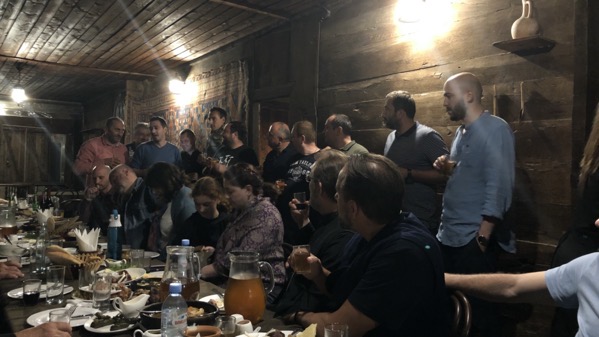
… feasted at our first “Supra,” where tradition calls for 16 (I think) toasts. I was fewer than 4 hours on the ground at this point, after a long flight, and am not a big drinker anyway. But I survived pretty well.

2019 05 11 22 06 05+0400 1

These Kool-Aid pitchers are wine. There were many of them …

2019 05 11 22 36 31+0400

2019 05 11 22 59 47+0400

… and they lasted into the night — but not too late to keep me from Church on Metekhi ascent, where (alas!) I have only a video which won’t embed, apparently.

Later, we made our way toward Stepantsminda, but stopped, too close to Tbilisi for the geotagging to specify, for this old church:

IMG 0801 IMG 0805

IMG 0806

IMG 0808 IMG 0811

IMG 0812 IMG 0814

It’s a long, long way to Stepandsminda, on the Russian border, but for one thing we didn’t need our guides, as it sported the World’s Best Ideogram (zoom in if necessary):

IMG 0834

Spring in this region comes late.

IMG 0835

Our destination was Qazbegi, which I think is probably a regional name, which includes Stepantsminda (named for St. Stephen). Georgia is northern neighbor of Armenia, the oldest Christian nation, and became Christian soon after Armenia – in the early 4th Century. It is reportedly (but you know how those Chambers of Commerce are) the birthplace of wine. We have it on greater authority that it is the birthplace of Stalin, but never mind.

We were in Stepantsminda two nights, to attend a wedding and reception for one of the First Things Foundation fieldworkers. He was marrying a Russian doctor, who he met in Central America, and they chose Georgia to minimize visas and other hassles for Russian and American friends and family.

The wedding was in a monastic church, up the mountain, a mere stone’s throw from Russia.

IMG 0848 IMG 0850 IMG 0852 IMG 0854 IMG 0857 IMG 0858

The bride was late, coming from Tbilisi in bad weather, with the vocal ensemble that sang sacred Georgia Chant for the wedding, popular songs (even Hotel California) at the reception, so we had ample chance to look around, and the breaking weather made for a spectacular photo of the couple.

IMG 0861 IMG 0864

Area scenery. The monastery church is visible near the top of the near mountain in the first photo:

IMG 0841 IMG 0844
IMG 0865 IMG 0867

IMG 0870

IMG 0879

That was my boarding house to the right in the last photo.

Breakfast place (Shorena’s Bar in Stepantsminda) and company, I’m on the right.

IMG 0881

IMG 0846

The day after the wedding, we made our way to Svetitskhoveli in Mtskheta, the old capital of Georgia. Our Boarding house was a durn siight nicer than the one in Stepantsminda …

IMG 0903 IMG 0905 IMG 0939 IMG 0941

… but the highlight for me —not just of Mtskheta but of the whole trip — was the old cathedral (where I believe Patriarch Ilya still resides on the grounds) and making the acquaintance of St. Gabriel, a Fool for Christ, who reposed in Christ in 1995.

Saint first (I couldn’t resist buying this icon), Cathedral photos follow. There are many more I didn’t publish here and many more on the web, some better than any of mine.

:IMG 1016IMG 0885IMG 0889 IMG 0891

IMG 0887

IMG 0906 IMG 0908 IMG 0909 IMG 0910 IMG 0915 IMG 0916

Two very Georgian-style icons:

IMG 0923 IMG 0924

IMG 0934

We hung around Mtskheta and environs for much of a day, including a nice alfresco lunch.

IMG 0984

IMG 0985

Georgia seems to have churches everywhere you turn, many of them a thousand or fifteen hundred years old. I could not keep track and geotagging isn’t very specific in rural Georgia. So here’s a little scenery and a lot of church from later in the trip.

IMG 0989 IMG 0990 IMG 0992 IMG 0994 IMG 0995 IMG 0996 IMG 0998 IMG 1004 IMG 1006

IMG 1038 IMG 1046

IMG 1047

IMG 1048

IMG 1050

IMG 1052

St. Nino, a woman, is virtually the founder of Georgia’s Church, and is venerated quite highly. Her distinctive cross is a Georgian marker:

IMG 1078

Back in Tbilisi, more sightseeing, including a Georgian Family Day celebration on the plaza of the new Cathedral.

A haberdashery for monks and clergy.

IMG 1185

IMG 1214

IMG 1231IMG 1233

Family Day festivities:

IMG 1240 IMG 1241 IMG 1242 IMG 1247 IMG 1249

Careful color-coordination:

IMG 1257

A luscious dish we should cook here: “Madame Bovary.”

IMG 1236

I was plenty ready for home after almost 8 days in Georgia, mostly passively going where I was driven, but getting some solo Tbilisi walking in at the end. (By the way: I recommend Lufthansa very highly.)

I was raised Evangelical by parents who got their adult-convert Christian formation in a fundamentalist baptist church. In the 50s and 60s, our kind of Evangelicals followed the fundamentalist taboos: smoking, drinking, dancing, playing cards, and secret societies.

I say that to put in perspective my discomfort with Georgian-level drinking — not just the wines but a sort of moonshine brandy they call Cha-cha. A lot of my pleasure in this trip was attenuated by that discomfort, which involves some collateral stories best left untold.

My overall impression of Georgia and the Georgians is an ancient people and culture, deeply and historically Christian, but in a manner that confounds Church and nation to an extent unknown in the U.S. Similar confounding is found in Greece and Russia. Oh: they don’t do Fundamentalist/Evangelical taboos — for better or worse.

It’s above my pay grade to judge whether the Christianity suffers in the amalgam, but it certainly is different from being in a minority Christian tradition in the U.S.

You can’t fill a God-shaped hole with information

When I was a student at Liberty University, from 2012 to 2016, I had to take two semesters of a “Christian worldview” class. It consisted essentially of bullet-point lists of ethical issues, with quizzes to make sure we knew the right answers: How did we feel about abortion? What about gay marriage? We were required to take two Bible classes and two theology classes, which included plenty of information about sexual ethics and basic Christian beliefs about caring for the poor and marginalized.

Yet the more powerful education we received was through thrice-weekly “convocations” — gatherings that frequently featured Republican pundits and politicians. In place of what many Christian schools call “chapel,” all on-campus students were required to attend an hourlong meeting that included worship and a guest speaker. We sang songs about the power of the gospel, often followed by moving speeches about saving our country from socialists or protecting our borders from invading masses.

There is a long history in Christian education that focuses on the formation of the affections, alongside the training of the intellect …

… Yet evangelicals — and Liberty, in particular — have often neglected this focus, falsely believing that if we know the right information, we will act rightly …

At Liberty, our minds may have been receiving correct content, but our hearts were being trained to love wrongly: to love political power, physical security and economic prosperity as higher goods than they are. The leaders of the university may have believed that we could be immersed in the stories and values of the Republican Party while maintaining any theological truths incompatible with them, but the power of our affective education was stronger. The ethics we learned in a classroom were not nearly as powerful as the emotion and desire created in a stadium full of people singing, praying and hearing stirring messages about making America great again.

Kaitlyn Schiess, Opinion | What Jerry Falwell Jr. Taught Me at Liberty University – The New York Times

This strikes me as true, so far as it goes. But Ms. Schiess is not likely to fill her longings anywhere in the Evangelical world.

* * * * * * * * * *

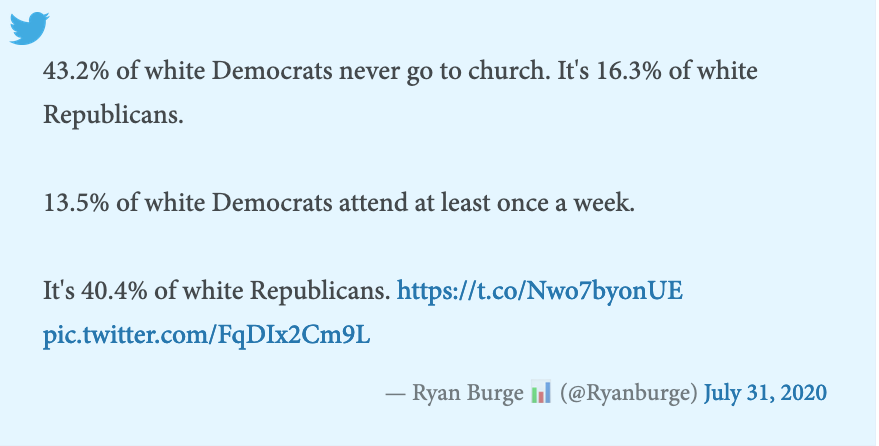
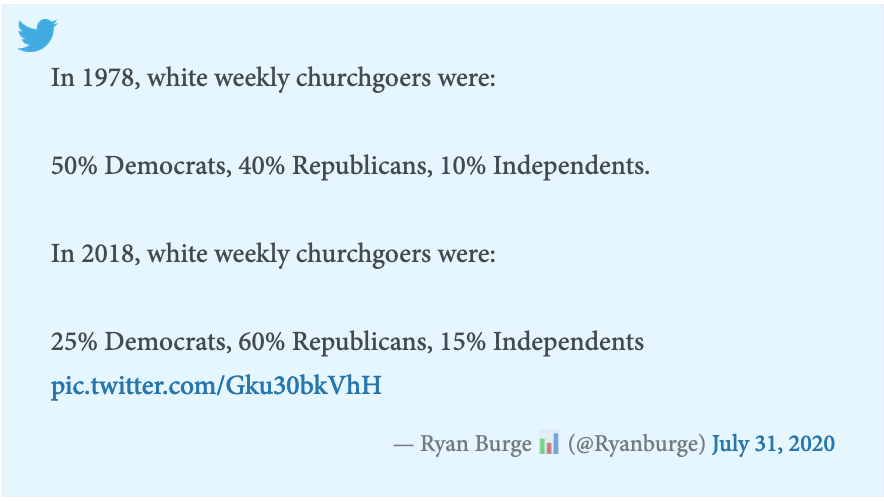
What’s wrong with this picture?

More dramatic than I imagined:

Screen Shot 2020-08-01 at 3.39.29 PM

(link) and

Screen Shot 2020-08-01 at 3.39.55 PM

(link).

Those are stunning contrasts. So why do I not feel tribal loyalty to the GOP?

A superficial answer would be that for a conservative, I rate shocking low on loyalty in Jonathan Haidt’s Moral Foundations Theory. But I’m almost positive there’s something more important than that.

First, a distinction.

Dissatisfied with my superficial reading habits, I am currently reading Mortimer Adler’s classic How to Read a Book (revised and updated 1972). Chapter 8 is titled “Coming to Terms with an Author”:

[I]n the analytical reading of a book, coming to terms is the first step beyond the outline. Unless the reader comes to terms with the author, the communication of knowledge from one to the other does not take place. For a term is the basic element of communicable knowledge.

A term is not a word–at least, not just a word without further qualifications … [A] word can have many meanings, especially an important word. If the author uses a word in one meaning, and the reader reads it in another, words have passed between them, but they have not come to terms.

Second, a story, which may be apocryphal, but I did not make it up.

A conservative returned to his alma mater for a commencement address and opened thusly:

By a strange coincidence, I am a graduate of a vastly different institution which occupied this very site 40 years ago and even bore the same name …

For some 23 years now, I’ve been an adherent of a religion called “Christianity,” based on the incarnation, life, death, resurrection, ascension and glorious second coming of Jesus Christ, who is both fully God and fully man. It was once, under the necessity of distinguishing it from a particular heresy, partially summarized in a Creed. To distinguish it from other versions, it’s called “Orthodox,” with a capital-O.

Meanwhile, my country is breathing the last few whiffs of an empty bottle labeled, by a strange coincidence, “Christianity,” which apparently is based on the intuition that God wants us to be nice and happy or, in its robust “Evangelical” versions, that Jesus Christ was very special and died a horrible death so that God would get over his anger issues with us and we could get on with being nice and happy.

Its proper name is Moralistic Therapeutic Deism. Although we share a mostly-overlapping vocabulary of words, I cannot come to terms with it, except in relatively brief and exhausting bursts of attempted empathy.

I remember from some 55 years ago an even more rigorous version, to which I then and for several more decades adhered, but it lives on today mostly notionally, in the scribblings of über-fissiparous “discernment bloggers.” I stay as far from them (and it) as I can, because I’m recovering from a mild-to-moderate case of that mindset and I’ve seen the harm it can cause, including when someone brings that mindset into Orthodox Christianity.

There were and are some other versions of “Christianity,” with some of which I have more or less come to terms, but they are not all that easily pigeon-holed politically.

So back to the question:  “why do I not feel tribal loyalty to the GOP?”

First, because it forfeited any claim to my loyalty:

In 2000 and 2004, it was Dubya. He was, we were told, a good Evangelical Christian. He cited Jesus as his favorite philosopher. He talked about America walking humbly in the foreign policy world.

Then 9-11 came, and he turned into a fierce Commander In Chief …

And then came, too, the second inaugural, when he declared as U.S. policy the eradication of tyranny from the world and the planting of democracy. If you don’t understand how delusional that is, read it again: eradicating tyranny from the world. As national policy.

(Conscientious Objector to the Culture Wars | War Correspondence ن)

Second, I have no confidence that was a blip, a lapse. In fact, the ensuing years have confirmed that endless war truly is the position of the party insiders (even though party voters chose a putatively antiwar mad, toxic and incompetent man for President in 2016).

Third, the Churches these Republicans so assiduously attend engage in worship that’s pure glucose and teach religion(s) with which I cannot come to terms sufficiently to form any kind of alliance. That Republicans are so much likelier to attend Church weekly is not all that interesting considering the Churches they attend.

I knew that 10 years ago (if not earlier, but I drove a stake in the ground then — a blog that’s held up surprisingly well) and they drove a stake though whatever remained of “Republican” in my heart on November 8, 2016.

That’s why.

* * *

Perhaps some day I’ll post a more nuanced version of why it’s difficult for a former-Evangelical, former-Calvinist, now-Orthodox, to “come to terms” with typical versions of contemporary American “Christianity.” I acknowledge painting here with a broad brush, but if there’s no glimmer of recognition, then you may to inattentive, gentle reader.

* * * * *

Put not your trust in princes,
in a son of man, in whom there is no salvation.

Psalm 146:3

* * * * *

You can read most of my more impromptu stuff at here. It should work in your RSS aggregator, like Feedly, should you want to make a habit of it.

Chickens coming home to roost

Every single goal the gay-rights movement set out to achieve in my lifetime has now been won. Gays can marry; we can serve our country openly with pride; we are categorically protected from discrimination in employment and public accommodations in every state. Many once thought it would happen in reverse order, with employment discrimination barred before civil marriage was extended to gays and lesbians, but history has its surprises. Nonetheless, it’s done. Finished. Accomplished.

The Equality Act, the key piece of Democratic legislation designed to update the 1964 Act to include gays and transgender people, is therefore moot. The core goals have been accomplished without Congress needing to pass any new laws. What Gorsuch has achieved is exactly what that bill purports to legislate — except for the Act’s attempt to gut religious freedom, by exempting its provisions from the Religious Freedom Restoration Act of 1993. And that, surely, will be the remaining business: a battle between religious freedom and gay and transgender equality.

Andrew Sullivan, When Is It Time to Claim Victory in the Gay Rights Struggle?

Thus does it become salient that Evangelical fealty to Donald Trump and the GOP, flavored with Christian Nationalism, has given religion and religious freedom a particularly bad odor, and not just to the secularists of the ascendant Left.

* * * * *

Out of the crooked timber of humanity no straight thing was ever made.

* * * * *

You can read most of my more impromptu stuff at here. It should work in your RSS aggregator, like Feedly, should you want to make a habit of it.

“Because of … Sex”

I’ve tried to let go of my anxieties about things beyond my control, and I’m not doing too badly in my effort.

Part of my calm comes, ironically, from some political realism (call it fatalism if you must): my side lost the culture wars, at least for now and the near future, so there will be adverse legal and political consequences.

Those consequences likely will be worse because so many of the noisesome avatars of American Christianism have been humping Trump’s leg for 42 months, evoking disgust from normal and Left-abnormal alike.

That I wasn’t among them will give no impunity, partly because, God willing, if a knock comes in the night I’ll not say “No! Not me! I’m not that kind of Christian!” Like ’em or not, the leg-humpers are my distant spiritual kin, so to deny them in time of great peril is like denying Christ.

Another bit of calm comes from the realization that, consequences or not, for now and the near future cultural conservatives, mostly Christian, will almost certainly have it incomparably better than most Christians in the past. (This also means that “knock in the night” is pretty unlikely.)

By “past,” I do not mean “since the birth of Evangelicalism in the 18th and 19th century Great Awakenings.” I mean 2000 years of Christianity. Commemorating the Martyrs and Confessors in Matins each week has taught me that. Real believers will survive and perhaps thrive — although things could get worse than I imagaine so they’ll thrive by departing to be with Christ;  “winsome” don’t always feed the devil-dawg’s bloodlust.

But “not anxious” doesn’t mean “disinterested,” and I’m pretty keenly interested in yesterday’s Title VII  decision (hereafter “Bostock“).

“Not anxious” also doesn’t mean “oblivious” to ramifications that are going to roil the nation for a while. The ones that most get my attention are not the ramifications under Title VII, which deals with discrimination in employment in details I’m unfamiliar with, but ramifications on what sex discrimination prohibitions will mean, by exactly the same Bostock logic, in Title IX and elsewhere. Title IX, for instance, is where the “biological males in women’s locker rooms” specter arises, as not many employers have people getting naked in locker rooms, but most educational institutions do.

Nevertheless, I’m going to pretty much set aside such sequelae to focus on the decision, it’s logic, illogic, dissents and hints about the current court going forward. Sequelae may get comments when they come.

You can get a skillfully pared-down version (from 120 pages to 30) of the Bostock decision here, by the way. If you don’t at least skim it, don’t you dare make snarky remarks about any of the authors.


First observation: I see no sign of bad faith by any of the three authors. Cases don’t get to SCOTUS unless they’re difficult legally. Specifically, I repudiate demagoguery that Gorsuch was just being true to his elite class (What other class do we want on the court? Anyone who makes it onto any Federal Court is ipso facto subject to the “elitist” charge.) or sucking up to the NYT Editorial Board.

Indeed:

The decision was a remarkably clear illustration of several fault lines that persist within the conservative movement. First, there is the friction between textualism and originalism, two judicial philosophies that are often lumped together but that found themselves squarely opposed in this case.

Speaking for the textualists—those who eschew a law’s authorial intent to focus only on its explicit wording—Gorsuch’s argument was simple: Title VII forbids any and all discrimination on the basis of sex, and “an employer who fires an individual for being homosexual or transgender fires that person for traits or actions it would not have questioned in members of a different sex.” In short: If you are a business owner, and your female employees are allowed to date men, but you fire a male employee for dating a man, it’s hard to argue his sex was not a determining factor in your decision.

Speaking for the originalists—those who attempt to determine what the intent of a law was at the time it was passed—Justice Samuel Alito fervently disagreed: It was staggeringly plain, he argued, that not a single legislator who voted to codify Title VII would have considered discrimination “on the basis of sex” to include sexual orientation and gender identity. The very concepts would have been foreign to them.

That friction was nothing, however, compared with what became evident between the conservatives who praised Gorsuch’s decision as quality textualism and those who argued that it amounted to a betrayal of the whole point of getting Trump justices on the court: to get the right some policy wins.

… Tweeted Jon Schweppe of the social conservative American Principles Project: “I was told there would be winning.”

The Morning Dispatch: The Supreme Court Expands Discrimination Protections.

Left and Right seem agreed that SCOTUS is a political legislative body in disguise. Left and Right are wrong.


Commentary on the oral argument in Bostock last November:

The argument is this: If an employer would never fire Ginger for taking a romantic interest in men, but does fire George when it learns that he does so, it has treated him differently because of his sex. Similar arguments can reach the case of an employee’s gender identity.

You might call the phenomenon “surprise plain meaning”—a meaning of the text that the drafters did not intend or notice at the time. Every law student learns about this early on, as with the question of whether a “No Vehicles in the Park” rule covers bicycles, skateboards, or a statue of the general in his Jeep.

Of the five conservative Justices, Neil Gorsuch showed himself the most hospitable toward the plaintiffs’ case on Tuesday [i.e., oral arguments], and no wonder: as the most committed textualist, he’s the likeliest to see surprise plain meaning as beating legislative history.

The Supreme Court Is Not Debating Your “Humanity”. The comments on Gorsuch were prophetic, but certainly not unique.

I thought that the dissent by Justice Alito, who faulted Justice Gorsuch’s adoption of the Ginger and George logic, was quite persuasive. Take a deep breath for an argument that’s nothing like television smack-talk:

At oral argument, the attorney representing the employees, [Pam Karlan] a prominent professor of constitutional law, was asked if there would be discrimination because of sex if an employer with a blanket policy against hiring gays, lesbians, and transgender individuals implemented that policy without knowing the biological sex of any job applicants. Her candid answer was that this would “not” be sex discrimination. And she was right.

The attorney’s concession was necessary, but it is fatal to the Court’s interpretation, for if an employer discriminates against individual applicants or employees without even knowing whether they are male or female, it is impossible to argue that the employer intentionally discriminated because of sex. An employer cannot intentionally discriminate on the basis of a characteristic of which the employer has no knowledge. And if an employer does not violate Title VII by discriminating on the basis of sexual orientation or gender identity without knowing the sex of the affected individuals, there is no reason why the same employer could not lawfully implement the same policy even if it knows the sex of these individuals. If an employer takes an adverse employment action for a perfectly legitimate reason—for example, because an employee stole company property—that action is not converted into sex discrimination simply because the employer knows the employee’s sex. As explained, a disparate treatment case requires proof of intent—i.e., that the employee’s sex motivated the firing. In short, what this example shows is that discrimination because of sexual orientation or gender identity does not inherently or necessarily entail discrimination because of sex, and for that reason, the Court’s chief argument collapses….

I would paraphrase: “If an employer takes an adverse employment action for any reason that he considers legitimate in his sole discretion so long as it is not otherwise forbidden by law—that action is not converted into forbidden sex discrimination simply because the employer knows the employee’s sex.”


Legal experts who watched the arguments unfold weren’t entirely shocked that Gorsuch ruled as he did. The justice is well known as a textualist, someone who holds that the meaning of a law turns on the text alone, not the intentions of its drafters.

“What I saw in the argument [i.e., last November) was Gorsuch really struggling with the fact that the textual argument seemed really powerful to him,” Samuel Bagenstos, a University of Michigan law professor, told me. “There’s no way to think about sexual orientation discrimination without sex being part of it.”

Michelle Goldberg, Surprise! Justice on L.G.B.T. Rights From a Trump Judge


This is not a narrow ruling that just means you can’t fire a person for being gay. Extending civil rights law to protect a whole new category carries with it a host of ancillary protections.

… [T]he Bostock ruling won’t stay confined to employment law. The majority opinion protests, disingenuously, that “sex-segregated bathrooms, locker rooms, and dress codes” are “questions for future cases.” But federal law is full of prohibitions on sex discrimination (Justice Alito’s dissent lists over 100 such statutes), and every one of those will have to be reconsidered in light of today’s ruling.

Justice Gorsuch Just Opened Pandora’s Box


[L]et’s be honest: there was no leadership among the national Republicans. At least President Trump was willing to take the heat for a transgender military ban. But even he, and Republican politicians who supported him, did not articulate why they believe what they do.

If they can’t or won’t talk about these things substantively, it’s no wonder that people think it must be what Justice Anthony Kennedy once called “irrational animus.”

Again, I ask you: what, from a social conservative viewpoint, is the function of the Republican Party? Maybe:

  • to separate conservative Christians from their money and their votes
  • to dose Deplorables anxious about cultural decline with the Pill of Murti-Bing, a drug that induces a sense of happiness and blind obedience

What else?

Rod Dreher, Religious Conservatism’s Potemkin Power (emphasis added).

The problem is not just that your run-of-the-mill Congressional hack can’t talk about these things substantively, but that even the good arguments of people like Ryan T. Anderson are greeted with slack-jawed refusals of comprehension and then dismissed as lipstick on an irrational animus pig. (That this treatment is the real irrational animus is, of course, a posssibility that must not be uttered.)


Some conservative Evangelicals who work at Evangelical institutions (they told me their names and affiliations) have reached out to me tonight after reading this. Their collective view: [Bostock] is a real moment in which we can see the slow-motion collapse of conservative Evangelicalism.

Dreher, supra. Tacit admission that “Evangelical” is now a political label, not religious?


This decision hands LGBT activists the coercive machinery of civil rights law.

R. R. Reno


Interesting point about Bostock: It assumes that the original public meaning of “sex” in Title VII was “status as either male or female [as] determined by reproductive biology.”

In other words, it assumes the “gender binary” that some idiots pretend to find problematic. That assumption is not incidental, but central, though I’ve only heard one comment on it so far. From such subtle acorns mighty legal oaks may grow.

So the gender identitarians may have won a legal battle while losing a philosophical war (with future legal consequences to be determined).


Bostock‘s “textualist” (whether is is sound textualism is contested by the dissenters) decision on the meaning of “because of … sex” vindicates Phyllis Shlafly’s opposition to ERA on the basis of what the cognate “on account of sex” would come to mean.


Finally, I remember the rent garments, weeping, and gnashing of teeth among religious liberty advocates (including me) when Scalia in Employment Division v. Smith overruled Wisconsin v. Yoder (he pretended to be drawing out its real meaning, but nobody was fooled).

But it turned out that — well, let’s just say that for a couple of decades Employment Division v. Smith changed legal strategies and theories, but not many outcomes. Then Scalia’s imagination met its match in categorical bans on discrimination that cleared his “neutral law, general applicability” threshold.

Similarly, some people claim to see signs that Catholic Gorsuch has enhanced protections of religious liberty concealed in his coat pocket, ready for an appropriate case to apply them. Basically, they’re saying that he’s ready to create a judicial version of the rarely-successful “Fairness for All” legislative approach to the long struggle between sexual liberation and religious freedom.

Since the religious liberty cause has fared poorly in courts and commissions, obsessed as they seem to be with vindicating a right of sexual minoritiess to live life unaware that anyone disapproves for any reason,  I would like that more than a little.

UPDATE: Here’s David French talking, among other things, about the potential “Fairness for All” jurisprudential coup.

* * * * *

Out of the crooked timber of humanity no straight thing was ever made.

* * * * *

You can read most of my more impromptu stuff at here. It should work in your RSS aggregator, like Feedly, should you want to make a habit of it.

The times, they are a changin’

1

The history of greed, venality, stupidity, cruelty and violence is long because that part of human nature is ineradicable. As the 20th century demonstrated, it is better to bet on a liberal society’s capacity to temper these flaws and iniquities than on a utopia’s false promise to eradicate them. Those promises end being written in blood.

… [C]ycles of history run their course. By 2008 it was clear that the world economic system was seriously skewed. Bailed out, it staggered on until now, accompanied by growing anger in Western societies.

… All the grotesque needed, to be revealed as such, was for time to stop.

Roger Cohen, No Return to the ‘Old Dispensation’. The grotesque did stop, but has it been recognized sufficiently for us to actually change entrenched behavior when some kind of normalcy is again permitted?

I loved this whole column, by the way. So sorry if you can’t get to it — I don’t know how much, if anything, a non-subscriber can see.

2

Are we inherently gullible? Research says no: Most adults have well-functioning machinery for detecting baloney, but there’s a common bug in the machine. Faced with a novel idea or new circumstances, we gravitate to information that fits our already existing beliefs. As Sherlock Holmes put the problem: “Insensibly one begins to twist facts to suit theories, instead of theories to suit facts.” This bug has always been exploited by people seeking money, power — or both. But with the rise of social media, the world’s propagandists, con artists and grifters find their search for suckers easier than ever.

Witness the grubby exercise known as “#Plandemic.” [A conspiracy theory video now banned from social media — after infecting 8 million brains.] …

People believe in a “#Plandemic” because it fits into existing convictions. A lot of people already believe — not without reason — that pharmaceutical companies cash in on suffering. Many people have heard that government labs do research on biological weapons. All true. Government has hemorrhaged credibility in recent years — even with regard to veteran public servants such as Fauci. All of these mind-sets are potential vectors for the viral #plandemic.

Americans need to understand that they are being actively targeted for disinformation campaigns by people and forces pursuing their own agendas. Conspiracy-monger Alex Jones wants to sell them overpriced nutritional supplements. Anti-vaxxers are hawking books and miracle cures. Vladimir Putin and the mandarins of Beijing are pushing the decline of the United States and the death of the Western alliance.

Some want your money. Some want your mind. Citizenship in the Internet era demands a heightened commitment to mental hygiene and skepticism. We have to learn that the information that fits neatly into our preconceptions is precisely the information we must be wary of. And even in these wild times, we must heed the late Carl Sagan, who preached that“extraordinary claims” — like grand conspiracies and healing microbes — “require extraordinary proof.”

David Von Drehle, Why people believe in a ‘plandemic’.

Take a look at the next-to-last paragraph. Someone’s missing: Steve Bannon, who pledged to “flood the zone with shit” to neutralize truth-telling about Trump.

3

Fourteen years ago, Rod Dreher introduced us to Crunchy Cons. Now his friend Tara Isablla Burton, with a degree in theology but a fairly short history of personally “faithing,” thinks Christianity Gets Weird, and wants New York Times readers to know about it.

Because of her audience, or perhaps via her editors, I find a lot of her wording and characterizations weirdly “off” and off-putting. I’m familiar with the sort of phenomenon she’s talking about, and I’d have to say that although she’s in the right ballpark, she’s not just “way out in left field” but somewhere in the bleacher seats much of the time. For instance.

  1. I would not affirm either half of “old-school forms of worship as a way of escaping” anything. “Escaping” is an unduly negative spin on something fundamentally sane.
  2. Her characterization of “mainline Protestant denominations like Episcopalianism and Lutheranism” was painted with a mighty broad brush.
  3. What is “weekly membership” (emphasis added) in reference to Roman Catholic churches with Latin Mass?

But the teaser is great:

Modern life is ugly, brutal and barren. Maybe you should try a Latin Mass.

And near the conclusion, she gives a characterization I can endorse:

Like the hipster obsession with ‘authenticity’ that marked the mid-2010s, the rise of Weird Christianity reflects America’s unfulfilled desire for, well, something real.

That “something real” is, in the best cases (and I suspect they are many), God.

Flaws aside, I welcome anyone using a prominent platform like the New York Times Magazine to shout out that “the fusion of ethnonationalism, unfettered capitalism and Republican Party politics that has come to define the modern white evangelical movement” is not the whole of American Christianity. Not even close.

UPDATE:

Rod Dreher on Sunday published the full text of Tara Isabella Burton’s interview of him. She got in a couple of well-formed, open-ended questions, and he really ran with thim. For my money, that interview is better than TIB’s NYT story, but TIB was casting the net wider than Catholic and Orthodox converts.

This, for me, was Rod’s best point in the interview:

The phrase “Christian values” has been worn as smooth as an old penny by overuse, especially in the mouths of political preachers. Look, I’m a theological, cultural, and political conservative, but I admit that it has become hard, almost impossible, to find the language to talk meaningfully about what it means to believe and act as a Christian. This is not a Trump-era thing; Walker Percy was lamenting the same thing forty years ago, at least. I think the term “Christian values” has become meaningless. It is taken as shorthand for opposing the Sexual Revolution, and all it entails — abortion, sexual permissiveness, gay marriage, and so forth. Don’t get me wrong, I believe that to be a faithful Christian does require one to oppose the Sexual Revolution, primarily because the Sexual Revolution offers a radically anti-Christian anthropology. But then, so does modernity — and this is an anti-Christian anthropology that clashes with the historic faith in all kinds of ways. I’m thinking of the way we relate to technology and to the economy.

You want to clear a room of Christians, both liberal and conservative? Tell them that giving smartphones with Internet access to their kids is one of the worst things you can do from the standpoint of living by Christian values. Oh, nobody wants to hear that! But it’s true — and it’s not true because this or that verse in the Bible says so. It’s true because of the narrative that comes embedded in that particular technology. It’s not an easy thing to explain, which is why so many Christians, both of the left and the right, think that “Christian values” means whatever their preferred political party’s preferred program is.

[Philip Rieff wrote that] “Barbarism is not some primitive technology and naive cosmologies, but a sophisticated cutting off of the inhibiting authority of the past.” This is perfectly true. This is why the dominant form of religion today is, to use sociologist Christian Smith’s phrase, “Moralistic Therapeutic Deism.” It’s crap. It’s what people believe when they want the psychological comfort of believing in God, but without having to sacrifice anything. It’s the final step before total apostasy. In another generation, America is going to be like Europe in this way.

But something might change. The problem with the phrase “Christian values” is that it reinforces the belief that Christianity is nothing more than a moral code. If that’s all Christianity is, then to hell with it. The great thing about ancient, weird, traditional Christianity is that it is a lifeline to the premodern world. It reminds us of what really exists behind this veil of modern selfishness and banality and evil.

Weird Christianity: The Rod Dreher Interview.

That’s about as deep as I’ve ever read Rod going. Good stuff.

* * * * *

You can read most of my more impromptu stuff at here. It should work in your RSS aggregator, like Feedly, should you want to make a habit of it.

I highly recommend blot.im as a crazy-easy alternative to Twitter (if you’re just looking to get your stuff “out there” and not pick fights).

Eric Metaxas

Eric Metaxas has bothered me a lot in the age of Trump.

He was supposed to be a really bright guy, who wrote biographies of Martin Luther and Dietrich Bonhoeffer, both of which were acclaimed at least in the parts of the virtual world I visit. But then he got an eponymous radio talk show, and started supporting Trump, for support of whom I had not heard and could not imagine any “really bright” defenses.

Was really bright Metaxas seeing something I was missing? Or had he just decided it was time to cash in on his “bright guy” reputation, seeing how even acclaimed books don’t pay that much in royalties? That doesn’t seem to fit: I’ve looked at the podcast version of his radio show, and two other podcasts Metaxas does, and they look a bit too high-toned, and even non-political, frankly, to be cash cows. (I’m not subscribing, but they’re apparently not the cesspools I feared, either.)

Then came a recent “debate” over Trump between him and David French. In my opinion, Metaxas did not produce even semi-bright arguments for Trump. It’s hard to identify Metaxas’ argument beyond that because it’s a “thought salad” (he’s too smooth for word salads), a fusillade of arguments lame and lamer.

I will not say that Metaxas makes evangelical-friendly arguments that he does not believe, whatever I may suspect about that. But he clearly is making fear-based arguments about the horrors that will come if Democrats are elected. (If Democrats gain the Presidency and the Senate, it could indeed get ugly because (a) they’ve been terrible on religious freedom since, oh, roughly, when Bill Clinton signed RFRA and RLUIPA and (b) now some of them are out for explicit revenge against at least Evangelicals, and it’s hard to punish Evangelical Trumpists without mucho collateral damage.)

So: Gotcha! You’re voting/inciting votes based on fear, Metaxas!

But so what? I’m voting against Trump because I fear that his malignant narcissism will tragically misapprehend the world in a future crisis — a fear his January-February misapprehension of the novel coronavirus threat justifies in spades.

I think, though, that “fear” is an equivocal word in this context. My fear for the country isn’t exactly the same genus and species as the fear Metaxas is engendering toward the prospect of Democrats controlling the political agenda again — fear of “socialism” and, of course, increased abortion (which has actually been decreasing, including under Democrats, for a long time now).

So no, I wasn’t missing anything, but it seems that stupid pro-Trump arguments are kind of an inexplicable quirk of Metaxas, who may indeed be a really bright guy in other contexts — though the way he wielded Luther and Bonhoeffer in the debate with French disinclines me to buy either of their bios.

(H/T John Fea, The French-Metaxas Debate: Some Commentary, who first got the debate transcribed and then in later commentary confirmed my impression that Metaxas was fear-mongering and, for good measure, dog-whistling.)

* * * * *

Secularism, I submit, is above all a negation of worship. I stress:—not of God’s existence, not of some kind of transcendence and therefore of some kind of religion. If secularism in theological terms is a heresy, it is primarily a heresy about man. It is the negation of man as a worshiping being, as homo adorans: the one for whom worship is the essential act which both “posits” his humanity and fulfills it.

Alexander Schmemann, For the Life of the World, Appendix 1

[O]nce you say you are ashamed,
reading the page they hold out to you,
then such light as you have made
in your history will leave you.
They will no longer need to pursue you.
You will pursue them, begging forgiveness,
And they will not forgive you.
There is no power against them.
It is only candor that is aloof from them,
only an inward clarity, unashamed,
that they cannot reach ….

Wendell Berry, Do Not Be Ashamed

You can read most of my more impromptu stuff at here. It should work in your RSS aggregator, like Feedly, should you want to make a habit of it.