1

Holy Smokes! Tucker Carlson lit a long fuse and Michael Brendan Dougherty just ignited!

Carlson pointed to the real molten fissure that is burbling sulfur on the American right. By doing so without ever mentioning the name, the character, or the political fortunes of Donald Trump, he allowed everyone to be more frank than usual. Carlson’s case is that elite-driven economic and social policy has destroyed the material basis for the family life, that our technocratic elite has the wrong measures of national health. Further, he argues, if the American Right doesn’t give up on its absentminded idolatry of “the market,” the country will quickly move toward socialism.

My colleagues David French and David Bahnsen, along with Ben Shapiro, argued forcefully against him. The themes are remarkably similar. Carlson says true things about the state of family life, they admit. But he is encouraging a victim mentality …

While French, Bahnsen, and Shapiro all variously object to Carlson’s jeremiads about elites, and his iconoclasm when it comes to the “free market,” nobody disputed that, as Carlson said, sometimes private-equity outfits do take advantage of our laws to extract value from existing companies for shareholders, charging fees while passing on pension burdens to the public. Also, nobody argued against Carlson’s contention that, absent a dramatic effort to change the conditions for America’s middle and working class, the country will turn to socialism. I found these omissions curious.

Bahnsen writes: “Carlson wrongly chooses to assign blame for the decisions people make to macroeconomic forces, instead of focusing on the decisions people make and the microeconomic consequences people absorb.”

To those who object to Carlson along these lines I would ask: At what point can we actually move on from the subject of personal responsibility and onto governance? Or, to put it another way, are there any political conditions in which the advice to be virtuous and responsible aren’t the best counsel you could give an individual?

It seems that it would be just as true to say these things in Russia during the post-Communist period, which saw soaring substance-abuse problems and plunging life expectancies. Then as now, the best advice you could give an individual Russian man was not to drink until his liver failed and he died. You could advise Russian women not to abort so many of their children. You could advise people to go back to church. All that would be salutary and more practically useful than having them wallow in elite failure. But none of that advice is inconsistent with political reflection and action for building a more flourishing society.

And our jobs at National Review and the Daily Wire include writing about and reflecting on political conditions. We are, all of us in this debate, dedicated to causes in which political effort and coordination is difficult. Would any of us really conclude that because the Russian state wasn’t forcing men at gunpoint to drink, Russia’s mortality rate had nothing to do with the corruption, venality, and misgovernance of the era? I doubt it.

*     *     *

I agree that a victim mentality isn’t helpful. A victim mentality doesn’t even help most actual victims. It wouldn’t help most political prisoners held unjustly. They, too, benefit spiritually from self-control (and religion)! My fear is that we are now so self-conscious about legitimizing a victim mentality that we have decided that justice is hardly worth pursuing. We trust an invisible hand so thoroughly that we don’t ask whether the laws and policies that govern trade, employment, and markets are prudent. We are becoming as glib as those who say “Don’t like abortion? Then don’t have one.”

(Bold added)

Kudos to Carlson for starting this intra-conservative fight. Kudos to Dougherty for the cojones to point out that his colleagues, most or all of them senior to him, are selling buck-naked, Emperor’s-New-Clothes nostrums that few are still buying. And Kudos to National Review for allowing Dougherty to deviate from the conservative party line.

2

I do think Trump will declare a bogus national emergency because it provides a similacrum of accomplishing something.

So: Which is the worse precedent?

  1. A President declaring a bogus national emergency to gesture at fulfilling a key campaign promise?
  2. Federal Courts ruling that a declaration of national emergency is bogus?

Note that I’ve kept personalities out of it because the question is precedent.

The President claims that his lawyers have given a legal green light to the proposed declaration of national emergency. His oath to uphold the laws and constitution oblige him to satisfy himself of that.

  1. Has the Department of Justice really vetted this proposal for conformity with what the law has in mind by “national emergency” (rather than just “can I get away with it”) and said “Yes. This is a classic national emergency”? Or …
  2. Will there be principled resignations of lawyers whose opinions are being misrepresented?

3

Are there enough millstones left in the world to appropriately bedeck the necks of Fordham faculty, staff and counselors?

4

… I no longer recognize my country and I don’t feel welcome here anymore. That is why I’m leaving America, for the same reason my ancestors came here, to find home.

… Last month, Secretary of State Mike Pompeo phoned the new breakaway Ukrainian patriarch to offer the US Government’s support. I can’t expect the US Government to have a theological care about the destruction of the Russian Orthodox Church, but I hate that my government is exploiting this rift to gain advantage against Russia.

It gets worse. In 2016, the Trump State Department put out a $300,000 bid to hire culture-war mercenaries to go into Macedonia with the express purpose of fighting Orthodox Christian teaching on homosexuality. The American taxpayer paid money to export the destruction of Macedonia’s Christian culture.

… Personally, I don’t know what it would mean to “give up” on America. That said, I find our country to be an increasingly hostile, alien place, in terms of the direction of the culture, and the lack of a sense that there’s anything left to restrain its descent.

Rod Dreher, An Expatriate Of The Heart, initially quoting a reader from Atlanta.

I’m thinking of “the … closing lines in Alasdair MacIntyre’s … After Virtue, in which MacIntyre concludes:

A crucial turning point in that earlier history occurred when men and women of good will turned aside from the task of shoring up the Roman imperium and ceased to identify the continuation of civility and moral community with the maintenance of that imperium. What they set themselves to achieve instead . . . was the construction of new forms of community within which the moral life could be sustained so that both morality and civility might survive the coming ages of barbarism and darkness.

Patrick J. Deneen

Unlike Rod’s reader in Atlanta, my wife has not left me for another woman. I have a son, his wife, and two grandchildren. I serve my parish as Cantor.

These loyalties, not any attachment to the nation writ large (let alone to the government, a true force for evil in the world), keep me here (along with frank recognition that my language skills aren’t supple enough to make emigration to any Orthodox land feasible).

I’m of a generation and personal temperament that come to such conclusions relatively easily, I suspect. But I was a bit surprised to find myself agreeing so thoroughly with Rod’s reader.

I strongly suspect we’re at such the kind of “crucial turning point” MacIntyre described in the U.S., too. The comments to Dreher’s blog confirm that I’m not alone.

* * * * *

Follow me on Micro.blog Follow me on Micro.blog, too, where I blog tweet-like shorter items and … well, it’s evolving. Or, if you prefer, those micro.blog items also appear now at microblog.intellectualoid.com.
Catching up with Kunstler

For a while, I tired of James Howard Kunstler’s blog and stopped following it. Maybe it was because he focused so much on Democrat wrongdoing against Donald Trump, which seemed very odd — and which has not ceased.

But I was reminded that he is one of the day’s great rhetoricians, who can be read with pleasure even when he’s wrong. So I resumed following him and gleaned these:

The shale oil “miracle” was an impressive stunt. For a while, it goosed US production way above the former all-time production peak of 1970, and it achieved that with astounding speed — about a decade. But this is oil that is very expensive and complex to produce. It was made possible by massive borrowing at artificial low interest rates, which are now rising. Something like three-quarters of the shale operators never made a red cent in net profit, and many of these companies will find it hard or impossible to roll over their existing debt, especially with oil under $50-a-barrel. But the price is a deceptive metric. If it zoomed up to $100-a-barrel tomorrow, the effect would only be to crush economic activity, because industry requires cheaper oil to pencil out its operations and citizens can barely afford to drive when gasoline hits $4-a-gallon at the pump. At the lower $45-a-barrel, the price crushes the oil producers. Take your pick. There’s no “Goldilocks” price.

James Howard Kunstler

It’s Nancy Pelosi’s smile that gets me … oh, and not in a good way. It’s a smile that is actually the opposite of what a smile is supposed to do: signal good will and good faith. Nancy’s smile is full of malice and bad faith, like the smiles on representations of Shiva-the-Destroyer and Huitzilopochtli, the Aztec sun god who demanded thousands of human hearts to eat, lest he bring on the end of the world.

James Howard Kunstler

Financialization of the economy was the last ploy to keep this boat floating. It allowed political and business leaders to pretend that asset-stripping the interior of the country — so that coastal moralizers could enjoy micro-green lunches and sex-change surgery — would promote the general welfare.

James Howard Kunstler

* * * * *

Follow me on Micro.blog Follow me on Micro.blog, too, where I blog tweet-like shorter items and … well, it’s evolving. Or, if you prefer, those micro.blog items also appear now at microblog.intellectualoid.com.

Potpourri, 12/22/18

1

Senate Unanimously Passes Bill Making Lynching a Federal Crime” says the headline. A photo caption describes the pressing need:

“More than 4,700 people were lynched in the U.S. from 1882 to 1968, according to one estimate, and over 70 percent of the victims were black.”

Am I wrong to think “A day late, a dollar short”? Tell me more:

“For over a century, members of Congress have attempted to pass some version of a bill that would recognize lynching for what it is: a bias-motivated act of terror,” Senator Cory Booker, a New Jersey Democrat who introduced the bill, said in a statement. “Today, we have righted that wrong and taken corrective action that recognizes this stain on our country’s history.”

Okay. I had been lying awake at night worried that people weren’t recognizing that lynching is a stain on our country’s history. But then I’m WEIRD.

That addition is largely symbolic, said Brian Levin, director at the Center for the Study of Hate and Extremism at California State University, San Bernardino.

Yeah, I had kind of figured that out.

Frank Pezzella, a professor at the John Jay College of Criminal Justice, said the bill’s passage also carries a message of deterrence …

So, while they’re at it, could they please pass a law deterring elephants from invading my living room?

“It was taken for granted in the South that whites could use force against any African-Americans who became overbearing,” he said. “How do we connect that with hate crimes in the present? Hate offenders really want to kind of go back to that place.”

“Hate offenders really want to kind of go back to that place”? Seriously? That‘s how we connect an evil history to this present virtue signalling? Well, he sounds like he knows what he’s talking about, I guess. Will we pass a law against the Senate’s own progressive McCarthyism in 2068?

Just about the only thing they got right was a definition of “lynching” that limits it to killing someone because of their race or religion, which at least arguably brings it into the legitimate constitutional powers of the national government.

But note that it was unanimous. I must be missing something about the pressing need for banning lynching as a government shutdown loomed.

2

Jerry Taylor, of the relatively new Niskanen Center:

Reason, as David Hume famously noted, is a slave of the passions, and libertarian passions point in one direction and one direction only: hostility to government. This passion is a powerful engine of motivated cognition, which invariably leads to weak policy analysis and dogmatism.

That was not at the top of my list of reasons for keeping libertarianism at arms’ length, but it’s a valid point. More:

  • Wherever we look around the world, when we see inconsequential governments with limited power, as libertarians would prefer, we see “failed states.” How much liberty and human dignity can be found there? Very little.
  • [A]ll libertarians agree that there are exceptions to their ethically-driven opposition to the use of government coercion and force. If there were not, there would be no libertarians; there would only be anarchists. But what are the scale and scope of those exceptions?
  • Factionalism within the libertarian world is rife and irresolvable because the principles themselves say less than you might think about what public policy ought to be (a point made with great force by my colleague Will Wilkinson).
  • Without some means of sorting through the reams of information coming at us every day, we would be overwhelmed and incapable of considered thought or action … Yet any set of beliefs, if they are coherent, are the wet clay of ideology. Hence, the best we can do is to police our inner ideologue with a studied, skeptical outlook, a mindful appreciation of our own fallibility, and an open, inquisitive mind.

3

Unable to make the case for his own virtues, Trump must aver that his vices are commonplace and inconsequential … When all this evidence is stitched together in a narrative — as Mueller’s report will certainly do — the sum will be greater than the sleaze of its parts. Russian intelligence officials invested in an innovative strategy to support the election of a corrupt U.S. businessman with suspicious ties to Russian oligarchs. The candidate and his campaign welcomed that intervention in public and private. And the whole scheme seems to have paid off for both sides … The United States seems to have gone from zero to banana republic in no seconds flat. But whether this transformation has been illegal, it must be impeachable — or else impeachment has no meaning.

Michael Gerson

4

In fact, over the years, as the locations for duels became more picturesque and the pistols more finely manufactured, the best-bred men proved willing to defend their honor over lesser and lesser offenses. So while dueling may have begun as a response to high crimes—to treachery, treason, and adultery—by 1900 it had tiptoed down the stairs of reason, until they were being fought over the tilt of a hat, the duration of a glance, or the placement of a comma.

In the old and well-established code of dueling, it is understood that the number of paces the offender and offended take before shooting should be in inverse proportion to the magnitude of the insult. That is, the most reprehensible affront should be resolved by a duel of the fewest paces, to ensure that one of the two men will not leave the field of honor alive. Well, if that was the case, concluded the Count, then in the new era, the duels should have been fought at no less than ten thousand paces. In fact, having thrown down the gauntlet, appointed seconds, and chosen weapons, the offender should board a steamer bound for America as the offended boards another for Japan where, upon arrival, the two men could don their finest coats, descend their gangplanks, turn on the docks, and fire.

Amor Towles, A Gentleman in Moscow, Kindle locations 750-53.

5

Planned Parenthood Is Accused of Mistreating Pregnant Employees, says the headline.

In interviews and legal documents, women at Planned Parenthood and other organizations with a feminist bent described discrimination that violated federal or state laws — managers considering pregnancy in hiring decisions, for example, or denying rest breaks recommended by a doctor.

In other cases, the bias was more subtle. Many women said they were afraid to announce a pregnancy at work, sensing they would be seen as abandoning their colleagues.

Some of those employers saw accommodating expecting mothers as expensive and inconvenient. Others were unsympathetic to workers seeking special treatment.

At Mehri & Skalet, a progressive law firm suing Walmart for pregnancy discrimination, three lawyers have accused a founding partner, Cyrus Mehri, of mistreatment. Heidi Burakiewicz said Mr. Mehri pressured her to return early from maternity leave. Sandi Farrell was told to participate in a performance review during her leave, and when she asked to postpone it she was fired. Taryn Wilgus Null said Mr. Mehri questioned her child care arrangements in a performance review after she returned from leave.

And at Planned Parenthood, the country’s leading provider of reproductive services, managers in some locations declined to hire pregnant job candidates, refused requests by expecting mothers to take breaks and in some cases pushed them out of their jobs after they gave birth, according to current and former employees in California, Texas, North Carolina and New York.

My antipathy toward Planned Parenthood is probably in the middle of the pro-life pack, but I’ll just let the story speak for itself, pausing only to congratulate the New York Times, which has zero antipathy toward PP, for reporting it.

6

In an even marginally sane world, the fact that a nation’s armed forces are engaged in daily military violence would be cause for shock and alarm, and pulling those forces out of that situation would be viewed as a return to normalcy. Instead we are seeing the exact opposite. In an even marginally sane world, congressional oversight would be required to send the US military to invade countries and commit acts of war, because that act, not withdrawing them, is what’s abnormal. Instead we are seeing the exact opposite.

Caitlin Johnstone

7


Though I’m now a retired attorney, it’s unlikely that I’ll ever serve on a jury, partly because one of the two contending attorneys won’t want someone highly skeptical of bloodstain analysis and other pseudo-scientific tricks of the sophists’ trade.

* * * * *

Follow me on Micro.blog Follow me on Micro.blog, too, where I blog tweet-like shorter items and … well, it’s evolving. Or, if you prefer, those micro.blog items also appear now at microblog.intellectualoid.com.

Potpourri, Solstice 2018

1

Recent budgets show that the federal government spends around $160 billion in loans, tax credits, and grants that help pay for college—the province of the top third of ­society—while allocating $20 billion for vocational and job training. The supposedly progressive idea of “free college for all” is a give-away to that top third of society. This epitomizes our problem. Andrew Carnegie built libraries in small towns throughout the country. Today’s billionaires shovel their wealth into colleges and universities that serve those at the top. Whether measured in moral prestige, cultural status, or economic rewards, over the last two generations there has been a perverse fulfillment of Jesus’s words: To them that have, more shall be given.

A few years ago, I reviewed Our Kids, Robert Putnam’s book about the fraying social contract in America (“Success Is Not Dignity,” May 2015). I noted that our ruling class fixates on upward mobility, as if the deepest problem in our society is that a few super-talented kids from difficult backgrounds are being denied opportunities to go to places like Harvard ….

R.R. Reno This is a very good “Public Square” contribution, which should be free of the paywall at least by January 20 or so.

Bit by bit I’m starting to understand how we wound up with President Donald J. Trump, and how I’m so much a part of that top third that it’s hard, in this political way, to relate to those who aren’t.

2

More:

Diversity is a shibboleth that shifts attention from the substantive question of whether our elites serve the nation’s interests to the cosmetic question of whether or not the rich and powerful “look like America.”

R.R. Reno. Chew on that one a while.

3

They know better:

Highly paid software engineers and tech executives aren’t stupid. Although they may not have read Patricia Snow’s profound analysis of the spiritual damage done by our addiction to smart phones (“Look At Me,” May 2016), they know that what they’re delivering to the world is harmful. For the last thirty years, educators have foolishly pressed for computers in classrooms and laptops or tablets for all children. Techno-activists call for high-speed Internet access for everyone. Meanwhile, those captaining the technology juggernaut send their kids to expensive private schools that have “no screen” policies. In Silicon Valley, it’s common for the rich to have nannies sign “no screen” clauses in their employment contracts. This is meant to prevent them from using their phones in front of the kids. Chamath Palihapitiya made hundreds of ­millions of dollars as an early Facebook executive. He has imposed a “no screen time whatsoever” rule on his three children, ages six through ten. By the way, Facebook recently launched the Messenger Kids app to increase usage by children.

R.R. Reno.

4

Heather Mac Donald has been an indispensable voice of sanity in the frenzied debates about sex on campus. She recently commented on the hysterical reaction of feminist organizations to Education Secretary Betsy DeVos’s revisions of the Obama-era rule for campus tribunals adjudicating charges of rape and sexual abuse (“Feminists’ Undue Process”). The new guidelines tilt in the direction of a stronger commitment to due process. Mac Donald notes that a fierce regulatory approach to sex among college students is not at odds with sexual liberation. It is in fact a predictable concomitant.

The solution to what is called campus rape is a change of culture from one of entitled promiscuity to one of personal responsibility. In the absence of such norms as prudence, restraint, and respect, the bureaucracy, extending all the way up to the federal government, has happily rushed in to fill the void. The weirdest aspect of the campus sex scene is this bureaucratization of coitus, which once nominally rebellious students now self-righteously demand.

Mac Donald describes what Alexis de Tocqueville feared might become the trajectory of the democratic age. Shorn of traditional cultural norms, atomized men and women are unable to organize their lives in sustainable ways. In their vulnerability, they beg for interventions by “an immense and tutelary power, which takes upon itself alone to secure their gratifications and to watch over their fate.”

R.R. Reno

5

In the United States, for example, some 40 percent of children are today born outside of marriage. The overall fertility rate has fallen to 1.76 children per woman. American children for the most part receive twelve years of public schooling that is scrubbed clean of God and Scripture. And it is now possible to lose one’s livelihood or even to be prosecuted for maintaining traditional Christian or Jewish views on various subjects.

Add to this the fact that the principal project of European and American political elites for decades now has been the establishment of a “liberal international order” whose aim is to export American norms and values to other nations, and you have a stunning picture of what the United States has become—a picture that in certain respects resembles that of Napoleonic France: an ideologically anti-religious, anti-traditionalist universalist power seeking to bring its version of the Enlightenment to the nations of the world, if necessary by force.

Yoram Hazony, Conservative Democracy (emphasis added)

6

[T]he essential fact of Russian tinkering with 2016 is that it represents an attempt to undermine democracy by manipulating and subverting what voters think about their choices. Russia, of course, had no right to engage in that kind of subterfuge — and neither does anyone else. Unfortunately, U.S. elections are already rife with similar efforts made on behalf of powerful domestic interests with their own hostility toward fair and free democracy.

… [I]t’s important to see Russia’s electoral tampering as part of a broader landscape of American democracy in decline — one that won’t be solved even if every member of the Trump campaign eventually winds up in a prison cell. American elections haven’t been fair for a very long time. Now is as good a time as any to start trying to reverse that.

Elizabeth Breunig. I’m not quite sure how we start trying to reverse Citizens United, the focus of Breunig’s wrath, but I’ve got a soft spot for the young lefty, and we, from Donald Trump to Elizabeth Warren, do seem to have a lot of distrust of the system.

7

The underlying story isn’t brand new, but it’s my favorite recent news (in the sense that ya’ gotta laugh or you’ll cry) from the gang that couldn’t shoot straight:

“Twitter allowed someone to invade my text with a disgusting anti-President message,” an alarmed Giuliani tweeted a few weeks ago, calling Twitter “card-carrying anti-Trumpers.” In fact, Giuliani had accidentally sabotaged his own tweet with a punctuation error — “G-20.In” — that automatically created a hyperlink to an Indian Web address. A clever observer quickly bought the domain and created a page that said “Donald Trump is a traitor.” Giuliani’s errant accusation was all the funnier because he’s also Trump’s “cybersecurity adviser.”

I had the fairly strong impression that Giuliani was quite a good mayor of New York City, but do not underestimate The Peter Principle.

G-20.in now has a list of links to anti-Trump news since Giuliani’s original SNAFU.

8

Syria is not a “gift” that can be “given” to Putin, despite the blinkered American political climate which places everything in that asinine context. It’s a country over which the United States has no legal authority, and never did, despite years of casualties and billions spent

Michael Tracey

9

I am an adjunct Lecturer in the Department of Epidemiology and Biostatistics at the University of California, San Francisco (UCSF). I’m an expert in clinical epidemiology, particularly in systematic review methods, epidemiologic bias and evidence quality assessment. As a researcher at UCSF, I managed the Cochrane HIV/AIDS Group for over a decade and on several occasions served as a consultant to the World Health Organization (WHO) in their HIV guideline development processes.

For about 13 years, I also masqueraded “as a woman,” taking medical measures which suggest, shall we say, that I was completely committed to that lifestyle. Most men would have recoiled from this, but in my estrogen-drug-soaked stupor it seemed like a good idea. In 2013 I stopped taking estrogen for health reasons and very rapidly came back to my senses. I ceased all effort to convey the impression that I was a woman and carried on with life.

As you may imagine, I have a lot of anger at transgenderism and its enablers, as well as an “inward bruise” (as Melville called it). I am not a happy camper. I have been badly harmed ….

Hacsi Horváth, The Theatre of the Body: A detransitioned epidemiologist examines suicidality, affirmation, and transgender identity. This is a long piece, and I’ll admit finding it too depressingly familiar to read in full.

10

OMG! If Trump has lost Ann Coulter, then he’s lost … er, I dunno. Something.

* * * * *

Follow me on Micro.blog Follow me on Micro.blog, too, where I blog tweet-like shorter items and … well, it’s evolving. Or, if you prefer, those micro.blog items also appear now at microblog.intellectualoid.com.

Clippings, 12/3/18

1

[T]he whole Trump operation, now lying exposed on Mueller’s table — the shady business empire, the constant practice of deceit, the dim-bulb hangers-on — screams corruption in a way that few politicians’ circles do. With Trump there is no pretense of respectability or rectitude. There is only the open, shrugging grift.

This shrug makes it hard for his critics to fathom how the Trump campaign ever persuaded anyone that its candidate would actually “drain the swamp.” Some of the liberal fixation with fake news reflects an attempt to explain Trump’s anti-corruption pitch as just a fraud that voters swallowed (or were force-fed by the Russians). And indeed, a portion of Trump’s supporters choose to live the fantasy worlds of Pizzagate and QAnon, where the most impeachable of presidents is as a white knight taking on a fictive ring of pedophiles.

… [T]here is one odd way in which Trump’s supporters have gotten what they wanted. Trump isn’t draining the swamp himself, but the shock of his ascent has created swamp-draining conditions — in which other corruptions have suddenly been exposed, and there have been many deserved falls from grace.

… [I]n many cases the newly-exposed scandals were open secrets, known to those in the know, and in some cases they were as baroquely grotesque as any Reddit fantasy. (Like, what if Harvey Weinstein’s whole movie empire was just a procurement agency, and what if he hired ex-Mossad agents to stalk one of the stars of “Charmed” … ?)

The story of rich-guy pedophile Jeffrey Epstein, just written up in exhaustive detail by The Miami Herald, is a perfect example — a pedophilia scandal hidden in plain sight, in which a wealthy abuser got off with a slap on the wrist because he had a bipartisan group of allies and there was an incentive not to embarrass the powerful people who might have frequented his parties or taken rides on his plane. A crucial player, the prosecutor who let Epstein slide, is now the Trump administration’s labor secretary — but instead of being a seedy Trumpworld figure, Alexander Acosta is an eminently respectable, big-law figure. Not a grifter; just an exemplar of the American elite.

As, of course, is Epstein’s pal Bill Clinton, who hasn’t been exposed in the Trump era so much as finally acknowledged, by a growing number of liberals, as a sexual predator who survived impeachment because the establishment went into a panic about the specter of puritanism and either smeared or ignored the women credibly accusing him. Not a grifter, the ex-president; just a pillar of the establishment who happened to have a plausible rape accusation lying there in plain sight all the time.

In fact our elite is rotten and deserves judgment, yet Trump’s mix of kleptocracy and kakistocracy is worse. So the question of how you replace a bad elite with a better one, not just with something more corrupt, is what both left and right should be pondering while this particular purgation runs its course.

Ross Douthat

2

“What scares me the most is Hillary’s smug certainty of her own virtue as she has become greedy and how typical that is of so many chic liberals who seem unaware of their own greed,” Charlie Peters, the legendary liberal former editor of The Washington Monthly, told me. “They don’t really face the complicity of what’s happened to the world, how selfish we’ve become and the horrible damage of screwing the workers and causing this resentment that the Republicans found a way of tapping into.” He ruefully worries about the Obamas in this regard, too.

Indeed, in the era of Trump, greed is not only good. It’s grand. The stock market is our highest value. Mammonism rules.

But watching the Clintons hash over their well-worn tale of falling in love at Yale Law School, I realize that it’s not only about the money.

Some in Clintonworld say Hillary fully intends to be the nominee ….

Maureen Dowd. Hillary and Bill can’t fill an auditorium any more. They’re toast.

3

In talking about the death of Christianity in Europe, Murray — an atheist who calls himself a “cultural Christian” — says that Christianity was Europe’s “founding myth,” and that without it, Europe doesn’t know what it believes or what it’s for. “Human rights” is weak tea without some sort of transcendent source. Murray also talks about how difficult it is for Europeans to believe in anything, having lost their religion and made a ruin of themselves with political substitutes. And, on the immigration question — which is truly an existential one for Europe — the continent’s elites have across the board lied for decades to the people. I was somewhat aware of this prior to coming to Murray’s book, but to read the details gathered in one place like this was genuinely shocking. The startling thing is not that there are riots in the streets of Paris, but that it took them so long.

Rod Dreher, What Happens When Trump Falls?. I had read the Douthat and Dowd columns nearly 12 hours before I saw this blog commenting on them, but I was unaware of Douglas Murray or his book The Strange Death of Europe: Immigration, Identity, Islam.

Dreher suggests that “America is not (yet) Europe in terms of losing our religion,” but just yesterday he aptly noted that the residuum of Christianity in Europe tends to be far more thoughtful than that of the U.S.:

Lilla talks about the meaning of the massive La Manif pour Tousmovement to block same-sex marriage, on the grounds that every child needs a father and a mother. Though we American Christians are supposed to be so much more religious than Europeans, nothing remotely like La Manif happened in America.

Maybe you can understand why I feel so much more at home when I’m in Europe with Christian intellectuals like these people than I do anywhere among American conservatives ….

See this, too.

I, too, think I’d prefer French-style Christian Nationalism over naïve “America is a Christian nation” chest-thumping, thank you, in part because the chest-thumpers are disconnected from authentic, historic (versus notional, post-enlightenment) Christian roots.

Dreher concludes:

What I’m getting at is asking what comes politically when most Americans lose faith in the ability of our elites to make things better? I fear that on the Right, we’re going to have to deal with the myth that Trump would have succeeded had the swamp not stabbed him in the back.

Oh, dear! That sounds all too plausible!

Do you see a path to expanding the subjects on which there’s a working majority about the common good when we split over stuff like this?

4

Writing in the New York Times, Parker Malloy offers the pristinely Orwellian argument that the prohibition of speech is a necessary condition for free speech: “Things like deadnaming, or purposely referring to a trans person by their former name, and misgendering — calling someone by a pronoun they don’t use — are used to express disagreement with the legitimacy of trans lives and identities.” I am not quite sure those sentences mean what Malloy means (reject the legitimacy, I think), and things get worse from there. Deadnaming and misgendering, Malloy writes, are a way to force the trans advocate into “a debate over my own existence. I know many trans people who feel the same. If this isn’t harassment, I don’t know what is. Aside from the harm it does to trans people, it also impedes the free flow of ideas and debate, in the same way that conservatives often accuse student protesters of shutting down speech on college campuses.”

If we could for a moment tighten up and focus on the question of what words actually mean, this is a group of common English words put into an order that doesn’t add up to anything sensible: Nobody is denying that Parker Malloy exists. Nobody, to my knowledge, is denying that trans people exist. We are once again ill served by an excess of metaphor and a refusal to look at the thing itself.

“I’d like to henceforth be known as Chelsea rather than Bradley, and to be socially accepted as a woman,” is a sentiment that demands universal tolerance; “I’m not so sure about that,” is a crime against humanity. That is not a sentiment that deserves to be taken seriously. It is not, I suspect, one that is taken seriously: But people can be terrorized into accepting it as a matter of social self-defense.

Kevin D. Williamson (hyperlink and boldface added).

A wretched “excess of metaphor” is at work every single time a person with gender dysphoria poisons the well with an accusation that “looking at the thing itself” denies their existence. My immediate reaction to that sort if thing is that I’m dealing with an hysteric and had best walk away (but not capitulate).

5

On a recent episode of the Geek’s Guide to the Galaxy podcast, sci-fi author Andrew Duncan argued that the depiction of the orcs in Lord of the Rings is racist and will have “dire consequences . . . for society.”

“It’s hard to miss the repeated notion in Tolkien that some races are just worse than others, or that some peoples are just worse than others,” Duncan said. “And this seems to me — in the long term, if you embrace this too much — it has dire consequences for yourself and for society.”

First of all, I think that it is important to point out that orcs are A) not people and B) not real, so starting some sort of social-justice movement over their treatment is probably the biggest, most idiotic waste of time that I’ve ever seen — and this is coming from an adult woman who spends time playing a game called “Pet Shop” on her phone.

Katherine Timpf. You can’t make this stuff up.

6

It used to be that people would marry across party lines – people with very different political views – but would almost always marry someone who shared their faith. Now, almost 40 percent of marriages are to someone of a different faith tradition, but only around 23 percent of people who are getting married, or even cohabiting with someone, are doing so with someone of a different political party. In many ways, political affiliation is now seen as somehow more intrinsic to our identities than our faith commitments.

Baker, Harder, & Wear, The New Morality Dilemma (H/T Alan Jacobs). This insanity is becoming common knowledge.

7

For what it’s worth. My confirmation bias is so strong that I dasn’t say a word more.

* * * * *

Follow me on Micro.blog Follow me on Micro.blog, too, where I blog tweet-like shorter items and … well, it’s evolving. Or, if you prefer, those micro.blog items also appear now at microblog.intellectualoid.com.

Wisdom from (or via) R.R. Reno

The December First Things has arrived, and R.R. Reno is worth the cost again after a few months left me wondering if I would renew.


Back in the day, we had race hucksters like Jesse Jackson, monetizing their internships as activists or community organizers.

Nowadays, we have rage hucksters, from Steve Bannon on the fairly far right to Sarah Jeong and one Alexis Grenell on the fairly far left:

In the aftermath of Brett Kavanaugh’s confirmation to the Supreme Court, the New York Times published an opinion essay that was strangely crude and sophisticated at the same time: “White Women, Come Get Your People.” On the surface it runs on raw invective. The author, Alexis ­Grenell, denounces the female Republican senators who voted to confirm Kavanaugh as gender traitors …

Alexis Grenell is a white woman who received her BA from the University of Chicago and her master’s degree from ­Columbia University’s School of International and ­Public Affairs. She worked on progressive campaigns and recently established a public relations firm, Pythia Public. This is the standard path for political activists, campaign operatives, and media personalities, on both the left and the right. They throw themselves into politics, and then, after gaining experience, they “monetize” their influence and contacts by working for a public relations or lobbying firm. Grenell shows herself a real go-getter, having founded a firm of her own.

As Andrew Breitbart demonstrated, the rage trade is where real money can be made these days …

Rage on the right tends to be satisfied with attacks on liberals as inconsistent, stupid, or hypocritical. It often seems sated when ostentatious violations of political correctness arouse liberal responses. The tone of right-leaning flamethrowers turns more toward mockery than indignation. Progressive rage is more earnest, more serious. Attacking others as racists and “gender traitors” amounts to an assassination attempt—not in a literal sense of trying to kill them, but of killing their social standing and ruining their careers. Accusations of this sort are meant to disqualify someone from public life. A racist is not to be argued with. He needs to be cleansed from our body politic.

A thirty-something progressive activist like Alexis Grenell is climbing the ladder in the political-media-corporate complex. As she does so, she can be confident that her rhetorical extremism will not cost her anything among the elite-educated people who call the shots, which is why the New York Times could publish her furious invective without worrying that a line was being crossed …

Alexis Grenell has incentives that will draw her into the progressive political-corporate establishment, neutering anything genuinely radical about her projects. Her rage will be marketed and consumed. She’ll play a scripted role as a “progressive voice” who gives legitimacy to the rich and powerful who “listen.”

R.R. Reno


From the beginning I adopted a skeptical attitude toward the elite outrage over our crude and demotic president. The Great and the Good deride him as beneath the office and unworthy of the role for which they imagine one of their rank better suited. The warm embrace [the American Enterprise Institute] has given to the newly born Giselle Donnelly, transgender exhibitionist with a taste for BDSM sex, shows how ridiculous that line has always been. Our leadership class accommodates itself to mental illness and allows itself to be conscripted into private fantasies. They’re the ones unfit to rule.

R.R. Reno.

He has a point.


Robert Mariani makes an astute observation about political correctness as a marker of social class. “We learn at college that ‘people of color’ is the proper designation for non-whites and that ‘LGBTQA+’ is the proper acronym for the broader gay community. This is the twenty-first-­century version of knowing which fork to use when navigating a multi-course meal.” He continues, “Pride Month, which comes every June, is a new sort of Eastertide, complete with passion-plays about LGBT history. Trillion-­dollar corporations trip over each other to indicate adherence to the queer, borderless creed. Their otherwise shameful power is sanitized.”

R.R. Reno.

* * * * *

Follow me on Micro.blog Follow me on Micro.blog, too, where I blog tweet-like shorter items and … well, it’s evolving. Or, if you prefer, those micro.blog items also appear now at microblog.intellectualoid.com.

Ready to move on?

1

We seem to be at the end of a process that is legitimately important but has been hyped, manipulated and sullied to even greater prominence. I have no doubt that Brett Kavanaugh will forever carry the metaphorical “asterisk next to his name” in the minds of many until the day he leaves the court.

But I’m sure ready to move on now.

2

Adam Gopnik displays some world-class non-sequitur and false confidence:

[Brett Kavanaugh] became disqualified for the Supreme Court the moment that he accepted the offer from Donald Trump. At this stage in his Presidency, Trump, already described in reports from his own aides as unfit for the office, implicated by his former lawyer as an unindicted co-conspirator in a felony, and now alleged, according to the Times, to have benefitted from tax schemes that in some instances amounted to “outright fraud”—not to mention being a liar and a con artist—should not be allowed to appoint Justices for lifetime appointments.

Whatever the effect of this truth on vote-counting congressional Realpolitik, it is the moral ground upon which all subsequent argument has to begin. Trump’s purpose in appointing Kavanaugh to the Court was clearly to provide himself with a protective vote for whenever one issue or another arising from his misbehavior makes its way there ….

I don’t particularly disagree with anything Gopnik said about Trump, but his conclusions do not remotely follow, and to my mind they are the deranged fury of a liberal who thinks conservative justices are as outcome-oriented as progressive justices.

Be it noted, however, that not all spittle-flecked un-thought come from the left.

Most of us are relatively naïve, ready to believe what our news outlets put forth. We have open minds and were ready and willing to listen to Ford’s testimony and consider for ourselves if it was believable. It was not. Her testimony was obviously scripted, practiced, massaged, and fabricated out of whole cloth.

Patricial McCarthy at The American Thinker (which consistently fails to live up to its name).

I think a case could be made that McCarthy’s article actually gets worse from there.

3

I’ve faulted Rod Dreher’s recent preoccupations, mildly because I like him, but here he could be said to read my mind on the omens for Kavanaugh’s confirmation:

Of course I am relieved by this outcome — not so much that Brett Kavanaugh is going to the Supreme Court, but that a nominee was not brought down by unsubstantiated, last-minute accusations, and media bullying, and that logic, evidence, and due process won the day. Even so, I don’t feel triumphalistic …

I don’t think our country is going to be better off because of any of this, though. We will only be less worse off than we would have been had the Left won this clash by using these malicious tactics.

(“Here” in my lead-in excludes the matters I elided. That’s why I elided them.)

4

The U.S. Chamber is running political ads against Joe Donnelly’s re-election.

Oh! No! How could I have been so wrong!? They’re running educational ads asking us to call him and tell him to stop siding with Bernie Sanders and Elizabeth Warren by voting against middle-class tax cuts for Indiana’s “hard-working employers and families” and to support the the Permanent Tax Cuts for Americans Act (break out the band for a chorus of God Bless America).

I’m so ashamed of my mistake.

(Yes. That’s how the game is played. A lot of advocacy groups have decided that tendentious “education” is less hassle and more lucrative than maintaining a PAC, a Political Action Committee, for the purpose of explicit endorsements and financial support of candidates.)

5

Trump supporters who imagine that they’ve found a straight-talking champion who will drain the swamp while using his business acumen to make America great again have been suckered, bigly.

Paul Krugman, who I rarely quote (or even read, but who accurately summarizes the major New Yok Times exposé here, executive summary of sorts here, and podcast discussion here).

The Times does not, so far as I’ve seen or heard, dispute Trump’s boast of $10 billion net worth, but I frankly doubt that. To paraphrase Mary McCarthy’s characterization of Lillian Hellman, “Every word he utters is a lie, including ‘and’ and ‘the’.”

Were Trump not the boss of the boss of the IRS, he and his siblings might soon be paying tens or hundreds of millions of dollars in taxes and penalties on wealth swelled by tax fraud.

Grant me to accept with serenity the things I can’t change, Lord.


6

[I]f you apologize to a manipulator for something they will never, ever let you forget it and will bring it up any time you step out of line. For normal, empathetic people, apologies are a way to improve relations with each other and avoid hurting one another in the future; they’re a way of saying “I understand that I did a thing that hurt you, and I’ll try really hard not to do it again in the future.” Narcissists, sociopaths, psychopaths and other chronic manipulators don’t see them that way, since they don’t care if they hurt other people and only care about getting what they want. For a manipulator, an apology is a weapon to use against the person making it, which is why you never see them making apologies of their own.

Caitlin Johnstone.


7

I cannot recall the last time I so thoroughly agreed with Peter Leithart (it’s probably more than 22 years ago):

God has given the United States over to divisive blindness and stupidity.

This is the way the world ends
Not with a bang but a soap opera.

As my friend Mike Bull said, the Spirit has departed, and we’re back to Babel, where no one can speak to his neighbor. God has delivered us to divisive blindness and stupidity, to the force René Girard identified as “Satan.”

It’s not as if he didn’t warn us. Paul writes that ungrateful idolaters become “futile in their speculations, and their foolish heart was darkened.” Isaiah saw it happening in Judah: Idolaters “do not know, nor do they understand, for He has smeared over their eyes so that they cannot see and their hearts so that they cannot comprehend” (Isa 44).

This doesn’t mean we’re helpless. Or, better, our helplessness can drive us to seek justice in a higher court. We can shatter the idols that bind and blind us, and turn to God in prayer ….

Deride it as “thoughts’n’prayers in its Sunday best” if you like, but I think you’re deluded if you fancy that only one of the major parties is at fault and we need only vote them out.

* * * * *

Follow me on Micro.blog Follow me on Micro.blog, too, where I blog tweet-like shorter items and … well, it’s evolving. Or, if you prefer, those micro.blog items also appear now at microblog.intellectualoid.com.

The redder pill

Every so often, someone comes along and says something sufficiently arresting that it makes all the usual commentary on the events of the day seems as superficial as I occasionally suspect on my own, unbidden.

No, it’s not Rod Dreher. He says he took the Red Pill, but I think he’s still in The Matrix. (I really need to watch that movie some day instead of just alluding to it randomly.)

Ladies and gentlemen, I give you Caitlin Johnstone:

A think tank is an organization wherein highly-paid academics pour their collective brainpower into coming up with convincing arguments that it would be good and smart to do something evil and stupid.

(Medea Benjamin Shows America What Real Resistance Looks Like)

In reality, the US political system is like the unplugged video game remote that kids give their baby brother so he stops whining that he wants a turn to play. No matter who they vote for they get an Orwellian warmongering government which exists solely to advance the agendas of a plutocratic class which has no loyalties to any nation; the only difference is sometimes that government is pretending to care about women and minorities and sometimes it’s pretending to care about white men. In reality, all the jewelers work for the same plutocrat, and that video game remote won’t impact the outcome of the game no matter how many buttons you push.

(Trump’s “Opposition” Supports All His Evil Agendas While Attacking Fake Nonsense)

I’ve encountered the latter theme in Fredrik deBoer, but Caitlin brings her views to life with things like free verse, not just vivid prose. I consider them complements, and Caitlin is more prolific as Fredrik battles some thorny personal issues.

I thank Eric Mader of Clay Testament for “introducing” us.

* * * * *

Follow me on Micro.blog Follow me on Micro.blog, too, where I blog tweet-like shorter items and … well, it’s evolving. Or, if you prefer, those micro.blog items also appear now at microblog.intellectualoid.com.

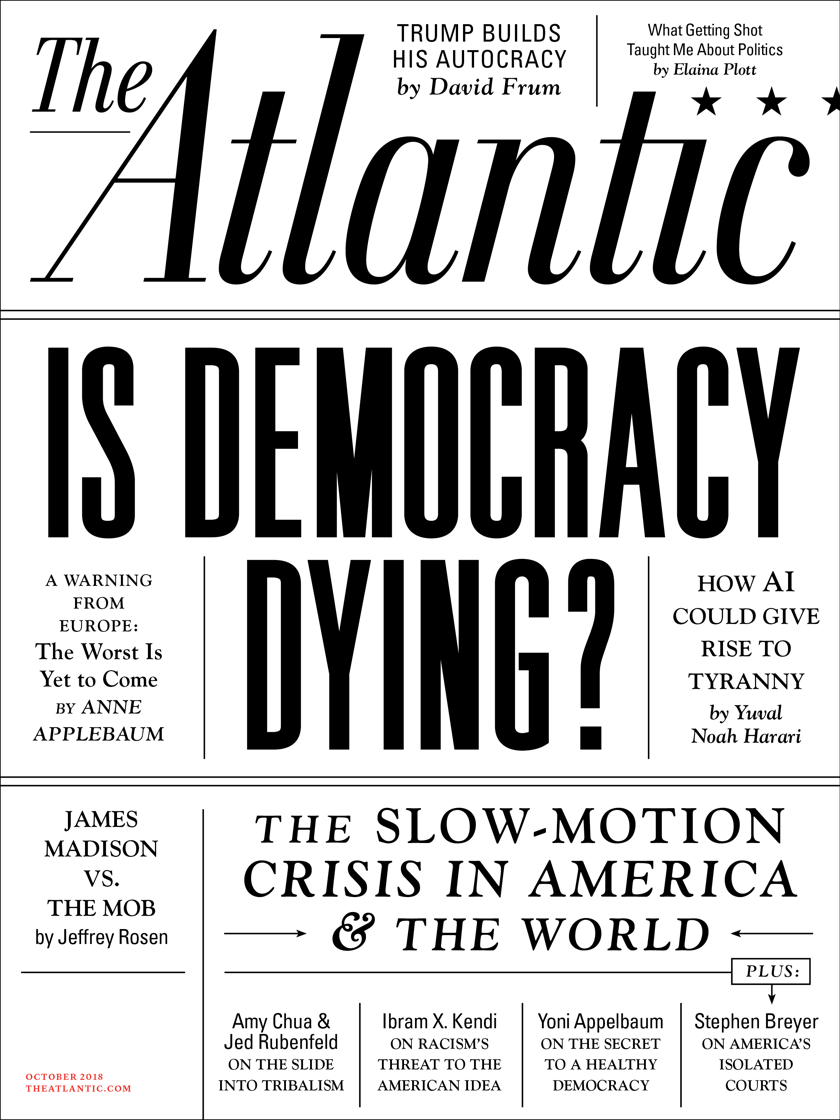
Is (Liberal) Democracy Dying?

The Atlantic for October is a theme issue:

840

I can’t provide URLs because it’s still subscriber-only, but you get get to your favorite bookstore and pick up a copy. All of the following are from that issue, as was Anne Applebaum, A Warning From Europe: The Worst Is Yet to Come, about which I blogged earlier.

1

It is much harder to struggle against irrelevance than against exploitation.

Yuval Noah Harari, Why Technology Favors Tyranny.

And a stunning microcosm:

On December 6, 2017, another crucial milestone was reached when Google’s AlphaZero program defeated the Stockfish 8 program. Stockfish 8 had won a world computer chess championship in 2016. It had access to centuries of accumulated human experience in chess, as well as decades of computer experience. By contrast, AlphaZero had not been taught any chess strategies by its human creators — not even standard openings. Rather, it used the latest machine-learning principles to teach itself chess by playing against itself. Nevertheless, out of 100 games that the novice AlphaZero played against Stockfish 8, AlphaZero won 28 and tied 72 — it didn’t lose once. Since AlphaZero had learned nothing from any human, many of its winning moves and strategies seemed unconventional to the human eye. They could be described as creative, if not downright genius.

Can you guess how long AlphaZero spent learning chess from scratch, preparing for the match against Stockfish 8, and developing its genius instincts? Four hours.

(Emphasis added)

2

Many progressives, particularly young ones, have turned against what were once sacrosanct American principles. Freedom of speech is an instrument of the dehumanization of women and minorities. Religious liberty is an engine of discrimination. Property rights are a shield for structural injustice and white supremacy. In a recent poll, two-thirds of college-age Democrats said that “a diverse and inclusive society” is more important than “protecting free speech rights.” Only 30 percent of Americans born in the 1980s believe that living in a democracy is “essential,” compared with 72 percent of Americans born in the 1930s.

… One of our students told us: “I don’t know any lefty people my age who aren’t seriously questioning whether the First Amendment is still on balance a good thing.”

Amy Chua and Jed Rubenfeld, The Threat of Tribalism.

But wait! There’s more! It’s not tribalist without at least two tribes!

In a 2017 survey by the Pew Research Center, less than half of Republicans said that the freedom of the press “to criticize politicians” was “very important” to maintaining a strong democracy in the United States. In other 2017 surveys, more than half of Trump supporters said the president “should be able to overturn decisions by judges that he disagrees with,” and more than half of Republicans said they would support postponing the 2020 presidential election if Trump proposed delaying it “until the country can make sure that only eligible American citizens can vote.”

I can’t pick which side is worse. Can you?

3

Jeffrey Rosen incited in me kindly feelings toward California:

Voters in several states are experimenting with alternative primary systems that might elect more moderate representatives. California and Washington State have adopted a “top two” system, in which candidates from both parties compete in a nonpartisan primary, and the two candidates who get the most votes run against each other in the general election — even if they’re from the same party. States, which Louis Brandeis called “laboratories of democracy,” are proving to be the most effective way to encourage deliberation at a time when Congress acts only along party lines.

Madison and the Mob.

4

This author was shot, randomly, with a 22:

Knee-jerk calls for gun control didn’t resonate with me. Yet a reverence toward guns no longer felt right either.

I found my ambivalence unsettling. Everyone else seemed so sure about how to feel about guns—people on campus, on the internet, back home. Unlike most of them, I had made intimate acquaintance with gun violence. I should have had some special insight. If what had happened to me wasn’t fodder for clarity, I feared nothing ever would be.

As we drove, he asked me to remind him what I was writing about. I said some- thing lazy, offhanded: “What it was like getting shot in a place that loves guns.”

“It’s not love,” he said. We pulled into the parking lot of his store, which sits high on a hill. You can see almost all of Tuscaloosa from there. “It’s about necessity.” He mentioned rattlesnakes and coyotes. For people in rural areas — that’s more than 40 percent of Alabamians — guns are still a day-to-day defense against such animals. Yes, there is ample love for guns in Alabama. But to forget that they’re tools is to miss an important point.

Elaina Plott, The Bullet in My Arm.

Perhaps, but they’re not the kind of tools Our People use now, are they dear?

5

A 2018 U.S. Magazine asking whether democracy is dying might be suspected of a hit on 45, but it really was not. He did get more than passing mention in David Frum’s contribution, though:

[A] Donald Trump with impulse control would not be Donald Trump …

When Trump refers to “my” generals or “my” intelligence agencies, he is teaching his supporters to rethink how the presidency should function. We are a long way from Ronald Reagan’s remark that he and his wife were but “the latest tenants in the People’s House.”

In 2016, Trump supporters openly brandished firearms near polling places. Since then, they’ve learned to rationalize clandestine election assistance from a hostile foreign government. The president pardoned former Sheriff Joe Arpaio, convicted of contempt of court for violating civil rights in Maricopa County, Arizona, and Dinesh D’Souza, convicted of violating election-finance laws—sending an unmistakable message of support for attacks on the legal order. Where President Trump has led, millions of people who regard themselves as loyal Americans, believers in the Constitution, have ominously followed.

Building an Autocracy.

6

To stop the rot afflicting American government, Americans are going to have to get back in the habit of democracy.

[In the 19th Century] From churches to mutual insurers to fraternities to volunteer fire companies, America’s civic institutions were run not by aristocratic elites who inherited their offices, nor by centrally appointed administrators, but by democratically elected representatives.

Civic participation was thus the norm, not the exception.

Democracy had become the shared civic religion of a people who otherwise had little in common.

But the United States is no longer a nation of joiners. As the political scientist Robert Putnam famously demonstrated in Bowling Alone, participation in civic groups and organizations of all kinds declined precipitously in the last decades of the 20th century.

Trump turned the long-standing veneration of civic procedure on its head. He proclaimed that America is “rigged”; that “the insiders wrote the rules of the game to keep themselves in power and in the money.” The norms and practices of democratic governance, he insisted, had allowed elites to entrench themselves.

Trump secured the Republican nomination by speaking directly to those voters who had the least experience with democratic institutions. In April 2016, when the Republican field had narrowed from 17 candidates to three, a PRRI/The Atlantic survey found Trump enjoying a narrow lead over second-place Ted Cruz among Republican-leaning voters, 37 to 31 percent. But among those who seldom or never participated in community activities such as sports teams, book clubs, parent-teacher associations, or neighborhood associations, Trump led 50 to 24 percent. In fact, such civically disengaged voters accounted for a majority of his support.

Yoni Applebaum, Americans Aren’t Practicing Democracy Any More.

7

And finally:

The cardinal fact always is the loss of contact with objective information. Public as well as private reason depends upon it. Not what somebody says, not what somebody wishes were true, but what is so beyond all our opining, constitutes the touchstone of our sanity. And a society which lives at second-hand will commit incredible follies and countenance inconceivable brutalities if that contact is intermittent and untrustworthy. Demagoguery is a parasite that flourishes where discrimination fails, and only those who are at grips with things themselves are impervious to it. For … the demagogue, whether of the Right or the Left, is, consciously or unconsciously an undetected liar.

Walter Lippman, November 1919 (before my father was born), quoted in a side-bar.

I’m venturing a guess that nobody born since 1970 will understand his use of “discrimination” unless they have a liberal arts college education.

* * * * *

Follow me on Micro.blog Follow me on Micro.blog, too, where I blog tweet-like shorter items and … well, it’s evolving. Or, if you prefer, those micro.blog items also appear now at microblog.intellectualoid.com.

Brief collection 9/13/18

1

Pope Francis has called a global meeting of Catholic bishops to discuss how to prevent sex abuse …

The Vatican statement said the topic of the gathering, scheduled for Feb. 21-24, would be the “prevention of abuse of minors and vulnerable adults.” It wasn’t clear whether the agenda would also include the disciplining of abusive clergy and of bishops who cover up or neglect abuse by priests under their authority.

Wall Street Journal

I think the Roman Church has had a fairly good idea how to reduce pedophilic child abuse since the report 14 years ago in the wake on the 2002 scandal.

But I don’t see much sign that it has made progress on homosexual predation on adolescents, seminarians and priests, or any progress at all at dropping the hammer on high-ranking enablers.


2

What will the Supreme Court look like when neither side has to walk on eggs to win the favor of the one in the middle? It will be a more conservative court, for sure, and maybe a more honest one. Justices may feel more free to say what they really think, and the public will ultimately judge the result by expressing itself in electoral politics. History does not stop in 2018.

Linda Greenhouse

Greenhouse is often outrageously biased even in her news reporting, not just in opinion pieces, but this one’s worth reading — with a grain of salt.


3

Public health experts dismiss [Critical Reviews in Toxicology, and Regulatory Toxicology and Pharmacology] as unreliable vanity journals. “These two journals exist to manufacture and disseminate scientific doubt,” says David Michaels, a professor at the George Washington University School of Public Health and the author of “Doubt Is Their Product,” a book about product defense science. “They provide the appearance of peer review and credibility to ‘product defense’ science — mercenary studies not designed to contribute to the scientific enterprise but to forestall public health and environmental protections and to defeat litigation. Corporations opposing public health or environmental regulations enter the rigged studies and questionable analyses published in these mercenary journals into regulatory proceedings or lawsuits to manufacture scientific uncertainty.”

Then, Michaels says, companies can say, “Look, the studies have conflicting conclusions, so there is too much scientific uncertainty to issue regulations to protect the public or to compensate victims.” ….

Paul D. Thacker, Scientists know plastics are dangerous. Why won’t the government say so?

I had no idea. The industry didn’t want me to have any idea. The “forensic” scientists (as in “‘forensic dating’ is the world’s oldest profession”) did their dirty duty.

 * * * * *

Follow me on Micro.blog Follow me on Micro.blog, too, where I blog tweet-like shorter items and … well, it’s evolving. Or, if you prefer, those micro.blog items also appear now at microblog.intellectualoid.com.