More scrapbooking

Larry Kudlow

Now that Donald Trump’s former economic adviser Larry Kudlow has taken his words of wisdom from the White House to Fox News, he wants the nation to know that President Joe Biden is plotting to force Americans to drink “plant-based beer.”(Befuddled Larry Kudlow Rails That Biden Will Force Americans To Guzzle ‘Plant-Based Beer’)

Now to be fair to Kudlow (who, be it remembered, was supposed to be one of the super-smart guys on Team [45]) also said "this kind of thinking is stupid." Since he’s super-smart, I assume he was referring to his own thinking.

Or something.

Liz Cheney

I assume you have heard by now that Liz Cheney is in imminent danger of being ousted from GOP leadership because of her keen bullshit detector and the loud sirens attached to it:

If Cheney is ousted, McCarthy will be the feckless House Republican leader who acted as the toady enforcer of [45]’s dangerous election lies. Every Democrat can say, with a straight face, that in Kevin’s House, lying is a litmus test for leadership.

Amanda Carpenter, Kevin McCarthy: Master of Strategery

I’m in danger of getting back in and wallowing too much in politics, but I found Jonah Goldberg’s analysis of what Cheney’s up to pretty persuasive:

The media and the Democrats understandably want to make this all about her brave truth-telling about “the Big Lie” and the “insurrection.” But the real issue for Cheney—I believe—is only incidentally about all of that. Again, I’m not saying she doesn’t believe what she’s saying, but her real goal is to free the GOP from the Trumpian captivity and the ideological and political corruptions that stem from it. And she’s losing that effort, at least in the short run.

It says a lot, and none of it good, that Liz Cheney and Mitt Romney are unwelcome in today’s GOP while Marjorie Taylor Greene and Matt Gaetz are in good standing.

Education versus Job Skills

Whole universities are now devoted to churning out skilled laborers—even if that means cutting entire humanity departments. Job skills and upward mobility seem to be more important than profound people, able to feel and think well about the mysteries of life.

A major problem, though, is that the liberal arts themselves have been instrumentalized toward the market. They are pitched primarily as leading to employment. Why the liberal arts? For more effective communication. Writing skills for memos. Teamwork and collaboration. Critical thinking, etc. The liberal arts are good because they make students marketable to industry.

Alex Sosler, The Liberal Arts for Loss and Lament

I’m on the Board of a very small Classical Christian School, which really should be bigger. I’d like to attribute our struggles to a spirit (among potential patrons) akin to the instrumentalizing of liberal arts in colleges and universities: "It’s not enough to produce great souls, who love truth, beauty and virtue. No. You’ve got to show us how greatness of soul, and loving truth, beauty and virtue ‘cash out’."

And as a product of postwar 20th-Century America, I cannot deny that I’m tempted to tell them how I think it cashes out, though you shouldn’t justify primary goods by how they facilitate secondary goods.

Twitter-Truth

Twitter Truth is now an actual criterion for newsworthiness that many journalists live by. If they didn’t, how do you explain an article like this? Or all the other instances of Twitter nonsense getting written up as though it means anything or has inherent value, without any fact-checking? If something is Twitter True, it now warrants coverage and credulous amplification. And this from a tribe — my tribe — that endlessly, and rightfully, mocked Donald Trump for his “people are saying” innuendo.

Jesse Singal. I love the coinage Twitter-Truth.

Kevin McCarthy’s Big Reveal

I couldn’t figure out how to embed a tweet in Markdown, which is what I use to write my blogs until the last phases. Here is the link. It is visual.

The Point of Life

I remain baffled at how many adults seem to think that the point of life is to enjoy the meaningless mild approval of armies of strangers rather than to build a tight little network of friends and family who are passionately invested in you. But even if you don’t share my values, perhaps you can admit that treating personal animus like it’s politically meaningful is unhelpful. If you think I’m an a**hole, just say I’m an a**hole. If you don’t like someone, just say so. That doesn’t mean you don’t write about politics. You just drop the phony f**king holier-than-thou routine and acknowledge that you’re motivated by animal spirits more than anything else, like everyone else. For years I have played a simple game: when I meet someone in person who says they don’t like my writing, I challenge them to name an issue on which we disagree. They fail over and over again. Like literally they can’t name anything. The truth is they don’t like me, who I am, as a person, but for whatever reason they feel compelled to pretend that it’s deeper than that. It isn’t and that’s fine. If we can’t actually grow up, maybe we can be mature enough to admit that we are immature, and that all of this is a child’s game.

Freddie deBoer (lightly expurgated).

I disagree with Freddie on the point of life, but prefer his version to the alternative that baffles him.

Learned Helplessness

To donors, business leaders, trade association heads, operatives, commentators, and other powers-that-be in GOP circles:

Don’t just call me to commiserate and lament.

Call them. Call the Republican members of Congress you’ve supported. Call the National Republican Congressional Committee. Call your fellow donors.

And tell them: “No. No more support. If you’re going to purge Liz, we’re gone. Really. For this entire cycle. A party that purges a truth-teller isn’t one I will support. And I’ll say this publicly and I’ll rally my fellow donors to follow my lead.”

And I’d add, to GOP-supporting conservative writers: No more angst.

Say the truth loudly and clearly. Say that the behavior of Republicans is a danger and a disgrace. If all you can muster is concern about how purging Cheney for telling the truth might “diminish” the GOP and hurt its chances with swing voters—if you lack the fortitude to do anything other than play for triple bank shots with an eye toward preserving your place—well, better not to write anything at all.

So, to GOP donors and conservative elites: Enough with the comfortable posture of learned helplessness. Enough with the ineffectual finger wagging. Just Say No.

Alas, the Republican donors and the conservative elites are unlikely to say No. Learned helplessness is a balm for people who would rather avoid taking an uncomfortable stance.

And so they stand athwart history, clucking their tongues and wringing their hands.

William Kristol, The Learned Helplessness of Republican Elites

The refrigerator-magnet-poetry word-jumble method of inquiry

Abigail Shrier, author of Irreversible Damage, continues defending her book against hysteria. She asks "Has Censorship Become Our Baseline Expectation?" and recites several incidents of news stories implying that Amazon is an intransigent bad-actor for not banning her book as it earlier banned Ryan Anderson’s provocatively-titled When Harry Became Sally.

“Amazon won’t stop selling book questioning transgender youth” noted a surprised New York Daily News on Tuesday. “Amazon overrules employees’ calls to stop selling book questioning mainstream treatment for transgender youth,” declared The Seattle Times. “Amazon Refuses to Stop Selling Anti-Trans Book,” reported an apparently disappointed Edge Media. And yesterday’s NBCNews.com: “Amazon will not remove book advocates say endangers transgender youth.

For every one of these publications, the baseline assumption is censorship. It is Amazon that “won’t stop selling,” or “overrules employees” or “refuses to stop selling” or “will not remove”—Amazon whose actions strike today’s journalists as significant and surprising.  Amazon the intransigent bookseller, stubbornly insisting on continuing to sell books. Standing up to the calls for censorship is now what surprises us. The numberless calls for book banning no longer do.

I told Ms. Long that the book contains not a word of hate—almost verbatim what the Economist wrote when it named mine a Best Book of 2020:  “Predictably controversial—yet there is not a drop of animosity in the book.” Though the book discusses “gender dysphoria,” a diagnosis recognized in the DSM-5, it never equates transgender status with a mental illness because, put simply, I don’t believe that it is.

Well, she replied, I see ‘contagion,’ ‘epidemic,’ don’t you think that tends to diagnose?

“Are you seriously going to pull out random words from my book?” I asked her.

“They aren’t random,” she said. “They’re from chapter headings.”

I explained that the words “contagion” and “epidemic” often refer to social phenomena, like peer-to-peer fads or trends, as the dictionary bears out and is obviously the case in Irreversible Damage. But in all of this explaining, I was the witness in the hot seat, under cross-examination. I was the one who had to explain myself before this refrigerator-magnet-poetry word-jumble method of inquiry.

I would oppose banning this book (and almost all others) even if it did ineffably "endanger transgender youth" because it does far, far more to protect them from ill-considered irreversible bodily mutilation at the hands of ideologues or medical profiteers.

I would point out, however, that there is not really a baseline expectation of censorship — except in the case of books that in some sense take a conservative or traditional stance on matters of sexuality and gender, especially the transgender social contagion.


You can read most of my more impromptu stuff at here. It should work in your RSS aggregator, like Feedly, should you want to make a habit of it.

Seven shorts

Front Page News Today

Front page of my local newspaper, above the fold, is the news that "Racist post on County GOP Facebook elicits backlash."

The post was genuinely and frankly racist — no mere dog-whistle. And my former party is entirely too hospitable toward yahoos and atavists. But the County was Brown County, in Southern Indiana, roughly two hours from us. And it was a Facebook page, fer cryin’ out loud, where presumably any jackass, including enemies, can post.

This story’s placement was partly a function of the steep decline of my local paper and its increasing reliance on stories from other Gannett newspapers in Indiana (and from Gannett Corporate HQ). But we form our impression of the world from, well, glimpses and impressions left by things we generally have no time to analyze and blog about.

Do better, Journal & Courier.

I’m not sure EWTN sees what I see in this swag:

That’s all I’m going to say. (Source)

More Rules for Life

Politics can make people crazy, especially these days. For the latest evidence, consider its insidious spread to “Jeopardy!,” the game show heretofore loved by millions.

Last week Jeopardy! contestant Kelly Donohue put his index finger and thumb together in an “OK” sign, with three fingers extended, during the show’s introduction. Uh oh.

It seems some progressives are on constant watch for this gesture as a signal of white supremacy because it has allegedly been adopted by some extremist groups. Within a few days, hundreds of former Jeopardy! contestants signed an open letter explaining that Mr. Donohue’s gesture, “whether intentional or not, resembled very closely a gesture that has been coopted by white power groups.”

Mr. Donohue said he had signaled the number three because he had won the show three days in a row. He clarified his meaning in a Facebook post, but he apparently didn’t abase himself sufficiently in the view of the concerned game-show participants. “Most problematic to us as a contestant community,” they wrote, “is the fact that Kelly has not publicly apologized for the ramifications of the gesture he made.”

Mr. Donohue then posted a statement “regret[ting] this terrible misunderstanding” and condemning racism in all its forms. We hope, for his sake, that the latter declaration appeases the troubled sensibilities of the, uh, contestant community.

Mass Hysteria for $2,000

I have read that one of Jordan Peterson’s maxims in his new book is "Don’t apologize if you’ve done nothing wrong."

Keep em’ guessing

I have purchased a copy of Saul Alinsky’s Rules for Radicals in the full expectation that I’ll find much worthwhile in it (anyone who got an acknowledgment from Jane Jacobs in The Death and Life of Great American Cities can’t be all bad), despite the book’s bugbear status, alongside "George Soros," among the Right.

A line in the sand

I understand that language evolves. I reluctantly admit that usage (eventually) makes proper.

Generally.

But—usage be damned—I will never, ever, accept that "literally" means "I’m about to engage in wild hyperbole because I feel strongly about this."

Thank you.

Cancel culture and the GOP

There are huge divides within the GOP over whether or not cancel culture is a problem government has any role in solving.

J.D. Vance—the author and venture capitalist who is likely to enter Ohio’s U.S. Senate race in the coming weeks—urged Republicans to retaliate against businesses whose leaders met to coordinate responses to Republican-led efforts to change voting laws in states across the country. “Raise their taxes and do whatever else is necessary to fight these goons. We can have an American Republic or a global oligarchy, and it’s time for choosing,” said Vance, who declined to be interviewed for Declan’s story. “At this very moment there are companies (big and small) paying good wages to American workers, investing in their communities, and making it easier for American families. Cut their taxes. No more subsidies to the anti-American business class.”

Rep. Peter Meijer, a freshman Republican from Michigan, grew animated when presented with Vance’s comments. “How is that conservative? Where is there a fidelity to an underlying set of beliefs or principles other than just taking cues from the left and being inherently reactive?” he scoffed. “If you’re using the government to compel something you like, you’re setting the precedent for the government to be compelling something you don’t like. And the non-hypocritical approach is to just not have the government be a coercive entity towards those ends.”

Meijer agreed that Republicans have work to do on this issue, but not necessarily in statehouses or the Capitol. “The Overton window has kind of shifted to where the narrative that ‘Republicans are evil’ is not just unquestioned in many elements on the left, but in corporate America, too. And to me the broader challenge is how do we regain that credibility,” he said. “We’ve lost some credibility to be viewed as serious participants in larger cultural clashes. And if all we’re doing is talking to a Newsmax and OANN crowd, we’re not flexing those persuasive muscles to be able to win over voters in the center.

Declan Garvey, ‘How is that Conservative?’.

I have been consistently impressed by Peter Meijer so far a worthy successor to Justin Amash (and that’s saying a lot), while J.D. Vance sinks ever-lower in my estimation (he started mildly positive, because of Hillbilly Elegy). If the Republicans can come up with any effective, popular, constitutional legislation on cancel culture, you literally can knock me over with a feather I will be astonished.

Certified bleak — in a hopeful sort of way

We take it as our great privilege to enter an age wherein no stone remains on another. There is much to be gained amidst the dark ruins of a shattered word: Brokenness and desolation, so hopeless in the eyes of some, are invisibly pregnant with promise in the eyes of others. As we kick the opiate of material comforts, exit the temple of broken idols, and come to acknowledge that our culture is one of loud and benumbing noise, we finally stand on the threshold of encountering Truth. If one is not seduced back to numbness by the influence of contemporary life, this threshold positions one to apprehend truly (and even transcend almost completely) our dying world’s scaffolding – its logic, appearances, gross phenomena – and come to know by experience the spiritual, otherworldly life. Thus, when one loses all that is of apparent worth and modern society’s ugly face is unmasked, a search for the new, authentic life begins.

2020 Vision: From Blindness to Sight in the Age of Collapse, via Paul Kingsnorth.


You can read most of my more impromptu stuff at here. It should work in your RSS aggregator, like Feedly, should you want to make a habit of it.

Mostly political

The Sorry state of the GOP

[D]espite the happy talk in front of the cameras, some members of the conference say behind closed doors that [45]’s chokehold over the conference is poisoning the GOP from within. “[45] talked a big game about unifying the party so we can win the majority back, and all he’s done is divide the party,” said one House GOP member who did not vote to impeach the former president, and who spoke to The Dispatch anonymously in fear of retribution from House leadership. “And what he’s doing by attacking Republicans who don’t think and act like him is going to ensure that we lose the majority. … The fight is not in here—should not be in here within our conference—it’s out there with people that want to reshape our nation into socialist countries. In order to get the majority back, we have to win blue districts, we have to win purple seats.”

The Morning Dispatch: House GOP, Live from Orlando

That the GOP is badly divided as Congressman Anonymous says seems more accurate than the smiley-face picture Liz Cheney, bless her, is painting.

As I’ve said many times before, I left the GOP in January of 2005. After the Presidency of 45 (who shall not be named), I’m not even sure I "lean Republican" any more.

Nevertheless, I’m incredulous at the repeated claim that 70% of Republicans believe Joe Biden was not legitimately elected. If true, my former party is in frighteningly bad shape, but I think the truth is more like "lying trolls".


Speaking of which:

I served in Congress with Kevin McCarthy. He’s a very weak, unprincipled person. He’s perfect for today’s Republican Party.

Joe Walsh via Charlie Sykes


Of Biden’s speech and the GOP response:

[I]f I were a Republican, I’d be terrified by the incoherence of the response. Yes, Tim Scott is appealing and effectively disarms the white supremacist image the GOP has become associated with (as well it might). But there was no real theme in his speech, no discernible strategy, no credible opposition to massive new spending. You could see what happens when a party becomes a vehicle for a personality cult, provided no platform in its recent convention, and lives off the fumes of cable television’s clown car.

Andrew Sullivan, The Strange Fate Of Joe Biden

Bucking our Betters

Montana’s economy must be independent of the Megacorp Overlords, who told Indiana there’d be hell to pay if it passed RFRA. Or maybe its legislators and governor have guts. (It recently became a "sanctuary state" for gun owners, too.)

(Unintended?) Consequences

“Any prohibition on menthol and flavored tobacco products promises continued over-criminalization and mass incarceration of people of color,” the American Civil Liberties Union warned last year. “Banning menthol is now pitched as a social justice issue,” Jacob Grier argues in Reason. “But if we take the stated preferences of menthol smokers seriously, the racial politics cut the other way. White smokers would remain free to purchase the unflavored cigarettes that most of them currently consume, while black smokers would be paternalistically forbidden from exercising their own desires and subjected to policing of illicit markets if they try to fulfill them.”

The Morning Dispatch.

Laws being turned on black people from their intended targets? Nah! Never happened here, never will.

Chameleons

I’ve taken to working on computer mostly in Markdown, including a plugin that downloads web pages as Markdown — which plugin showed me a bit of how to use metadata in Markdown files.

Some publications, I discover, tags their own web pages in metadata. The Wall Street Journal‘s tags are voluminous and essentially useless to me; The Atlantic is a little bit better. But the amusing thing to me is that The Week tags the same commentator, Damon Linker, as conservative or liberal according, I guess, to how the guy (or gal) doing the tagging feels about the treatment of the column’s topic, or even the topic itself.

Another curiosity: nobody tags in a way I can use in Obsidian (no spaces within a tag but only as delimiters) without first editing.

Easy Virtue

The pandemic provided the perfect opportunity for the Amazon Prime elite. It allowed people to feel virtuous for staying home. Watching Netflix was noble. Being anti-social was virtuous. Ordering DoorDash was saving the world. The pandemic ending takes away that easy virtue.

And people like being able to shame others. Catching people unmasked at the beach, spreading their photos, and talking about how bad that is — well that was a satisfying hobby for many this year. This group doesn’t want to go back to offices. They don’t seem to care if synagogue and church come back. That’s fine — they prefer to live mediated by screens, and they can live that life. But don’t let them force it on you.

There is no virtue in being permanently masked. There is no virtue in demanding zero risk. If there is, we wouldn’t never jump in a swimming pool or get into a car. Get vaccinated, and then get used to wearing hard pants, brushing your hair (and teeth) and meeting friends outside of Zoom.

Bari Weiss, ‌Believe Science: Get Vaccinated. Then Relax

[M]any millions of Americans spent the [45] era deeply loyal to [45] not because of policy arguments or political debate, but in large part because “prophets” told them he was specifically and specially anointed by God for this moment. These Americans were resistant to the election outcome because they were told—again and again—by voices they trusted that God promised [45] would win.

David French, ‌Making Prophecy Great Again. Unfortunately, French seems to think that "prophetic standards" promulgated by a couple of guys will rein in the "prophetic" charlatans and grifters.

Good luck with that, David. You’ve got roughly the odds placekicker Charlie Brown has of Lucy VanPelt holding the ball properly.


You can read most of my more impromptu stuff at here. It should work in your RSS aggregator, like Feedly, should you want to make a habit of it.

Some thoughts 5/1/21

What the wrath of God looks like

I was nurtured on stories as a child that contrasted Christ’s “non-judging” (“Jesus, meek and mild”) with Christ the coming Judge (at His dread Second Coming). I was told that His second coming would be very unlike His first. There was a sense that Jesus, meek and mild, was something of a pretender, revealing His true and eternal character only later as the avenging Judge.

This, of course, is both distortion and heresy. The judgment of God is revealed in Holy Week. The crucified Christ is the fullness of the revelation of God. There is no further revelation to be made known, no unveiling of a wrath to come. The crucified Christ is what the wrath of God looks like.

Fr. Stephen Freeman, The Bridegroom and Judgment

Why Jordan Peterson thrives

Contempt for the “working class” by North America’s “liberal educated elite,” is a major reason for his popularity, he says. “There aren’t very many people with an encouraging voice,”[Jordan] Peterson says. “Most of the things you read by intellectuals—not all, but it’s a failing of intellectuals—most of it is criticism. Look what you’re doing to the planet. What a detestable bunch of wretches you are, with your rapacious structures and your endless appetite and your desire for power. . . . Look at what your ambition has done to the planet. How dare you!”

Mr. Peterson doesn’t directly challenge the substance of these dreary criticisms. Rather he protests that they’re unnatural and unhealthy. “The proper attitude toward young people is encouragement,” he says—“their ambitions, their strivings, their desire to be competent, their deep wish for a trustworthy guiding hand. I think our culture is so cynical that it’s impossible, especially for the established intellectual chattering critics, to even imagine that encouragement is possible.”

When I ask what he thinks is driving the effort to destroy him and others who hold heterodox views, he diagnoses his persecutors as though they’re exactly the sort of young people who wander into his lectures or buy his books looking for structure and purpose. His admirers and his fiercest detractors are, in his mind, not so different from each other.

Barton Swaim, The Man They Couldn’t Cancel

From an essay on atheism with lots of insights:

I can’t tell you how often … commenters on liberal blogs would preface a denunciation of Richard Dawkins by reassuring everyone that they themselves were agnostic or otherwise unaffiliated. “Of course Christianity isn’t literally true,” they would always say before excoriating arrogant atheists. What they never seemed to understand is that the “of course” was a more grievous insult to sincere Christians than Christopher Hitchens could ever come up with. What the atheists felt they needed to prove, the anti-atheists simply assumed away. They took as given that traditionally religious claims about the world were so ridiculous that they could dismiss them with a footnote. The difference is stark. Angry atheists think religion is wrong. Anti-angry atheist liberals think religion is not even wrong.

Since I begin writing about this topic – that is, since the very beginning, as the first thing I wrote online that more than a dozen people read was about being a certain kind of atheist – I have been known by religious people as a nice atheist, a respectful atheist. I am never sure how to feel about this condition. I still define my orientation the same way: that to come to atheism honestly and constructively you must come to it in loss and pain. You don’t accept atheism, when it is genuine. You surrender to it. Either way, I am an atheist. I think all metaphysical claims of religious are false. I think religion on balance has been a detriment to human life and human flourishing. And I think the gradual attrition of believers into nonbelievers, through apathy and distraction more than anything else, would be good for the world.

Freddie deBoer, ‌What Became of Atheism, Part One

"I think all metaphysical claims of religious are false" is a sentence that may be worth my returning to some day, as the metaphysical content deBoer describes elsewhere in his essay is not true of all religion, and not (very) true of Orthodox Christianity. If I were being flippant, I could say "well, I don’t believe in that God, either."

Stake in the ground: Two sexes

Here’s what the science says: there are only two human sexes. That’s because there are only two types of gamete (the sex cells — egg and sperm). Humans (like all mammals) can develop along one of two pathways: towards making eggs (female) and towards making sperm (male). If anyone ever finds a third sex it would be a discovery on a par with finding a new continent — with a guaranteed Nobel prize. Until you see those headlines, you can rest assured there are exactly two sexes.

Biological sex exists and it matters — most obviously because the existence of the human race depends on it. You can’t make a human baby without a male and a female — yet the sex-denialists hardly ever mention reproduction. Which is odd since that’s precisely why sex exists.

Nathan Williams, Sex deniers are the new flat earthers

How our press covers Hungary

“You are sitting next to the Fifth Avenue of Budapest,” he said, referring to nearby Andrassy Avenue. “The only people Western journalists ever seem to talk to live within a two-mile radius of this street.”

Later, as I was headed home from work, I thought about how someone could stand on Andrassy holding a sign saying, “Viktor Orban, Go To Hell,” and nothing would happen to them. What do you think would happen to someone standing on the corner of Fifth and 45th in Manhattan, holding up a sign saying, “Black Lives Matter Sucks,” or “Homosexuality Is A Sin”? …

But remember your catechism: countries like Hungary are the real illiberal democracies.

Rod Dreher

Surprise Orthodox Anglicans

There has been talk in my neck of the internet about Prince Philip having reconnected with his Orthodox Christian roots, and here’s a sign, which I’m surprised hadn’t surfaced earlier, that he had:

There was one clear sign of this complex heritage during the funeral. Prince Philip had requested that, just before his body was lowered into the Royal Vault, the choir sing the famous Kiev setting of the Orthodox Kontakion of the Departed.

"Give rest, O Christ, to thy servant with thy saints: where sorrow and pain are no more; neither sighing but life everlasting," the singers chanted. "Thou only art immortal, the creator and maker of man: and we are mortal formed from the dust of the earth. … All we go down to the dust; and weeping o’er the grave we make our song: Alleluia, alleluia, alleluia."

Terry Mattingly, Wish for the ‘Orthodox Kontakion of the Departed’ — A Hint at Prince Philip’s Complex Faith History

Note, too, this:

Prince Charles also has frequented Mount Athos. One Athonite monk told The Guardian newspaper that there is "no question" that Charles is "Orthodox in his heart. Sadly, he is very constrained by his position." The Prince of Wales has maintained ties to the Vatopedi Monastery and, like his father, to the Friends of Mount Athos.

Id.

Western civilization

The older I get, and the more I learn about history, the more convinced I am that Western civilization committed suicide with World War I. The rubble is still bouncing from that unparalleled catastrophe.

Rod Dreher

Contrariness

The function that herbivores play, for example, in stimulating biomass accumulation is both powerful and real. Chickens have historically converted kitchen scraps into eggs. Pigs have historically scavenged domestic waste products as varied as whey, offal, forest mast, and spoiled grain. That a large percentage of landfilled material is animal-edible food waste should strike us as criminal. Rather than showering landfill administrators with greenie awards for injecting pipes into the anaerobic swill to collect biogas, we should be cycling all that edible waste through chickens and pigs so that it never goes to the landfill in the first place.

Joel Salatin, Folks, This Ain’t Normal


Food safety is completely subjective. I don’t think for a minute that most of what’s in the supermarket is safe. But it’s been deemed safe because it only kills you slowly. While thousands of people die due to unnatural food and nutrient-deprived food, the food police go after a cottage-industry cheesemaker because two people got diarrhea.

Joel Salatin, Folks, This Ain’t Normal

Why I (sorta) miss the New York Times

Chauvin Was Convicted. Something Is Still Very Wrong reminds me that I not only miss much of what Ross Douthat and David Brooks write these days by dropping the New York Times, but I also miss Elizabeth Bruenig (and Frank Bruni).

It’s tough when an institution is the pinnacle of professional ambition in a field yet has become boycottably corrupt.


You can read most of my more impromptu stuff at here. It should work in your RSS aggregator, like Feedly, should you want to make a habit of it.

Calling spades “spades”

Four snippets over the past few days (several of the articles are months old, though) from people who were taking no guff.

From New York Magazine last November, on turmoil at the New York Times:

Twitter presented innumerable headaches, with reporters having to be chastised for being overtly political, or simply for sounding un-Timesian in their pursuit of likes and retweets. “There’s a very sad need for validation,” one Times journalist who has tweeted tens of thousands of times told me.

Some of the trickiest jounalistic questions have centered on what the Times is or isn’t willing to say. After [James] Bennet’s ouster, [A.G.] Sulzberger met with a columnist for the “Opinion” section who had expressed consternation about the decision. Sulzberger promised the columnist that the Times would not shy away from publishing pieces to which the Times’ core audience might object. “We haven’t lost our nerve,” Sulzberger said.

“Yes, you have,” the columnist told Sulzberger. “You lost your nerve in the most explicit way I’ve ever seen anyone lose their nerve. You can say people are still gonna be able to do controversial work, but I’m not gonna be the first to try. You don’t know what you’ll be able to do, because you are not in charge of this publication — Twitter is. As long as Twitter is editing this bitch, you cannot promise me anything.”

Reeves Wiedeman, Inside the New York Times’ Heated Reckoning With Itself


I had forgotten this prophesy:

Let us not hedge about one thing. Donald Trump may win or lose, but he will never concede. Not under any circumstance. Not during the Interregnum and not afterward. If compelled in the end to vacate his office, Trump will insist from exile, as long as he draws breath, that the contest was rigged.

Trump’s invincible commitment to this stance will be the most important fact about the coming Interregnum. It will deform the proceedings from beginning to end. We have not experienced anything like it before.

Maybe you hesitate. Is it a fact that if Trump loses, he will reject defeat, come what may? Do we know that? Technically, you feel obliged to point out, the proposition is framed in the future conditional, and prophecy is no man’s gift, and so forth. With all due respect, that is pettifoggery. We know this man. We cannot afford to pretend.

Barton Gellman, What if Trump Refuses to Concede?, September 23, 2020.


Successful Substack writers continues to evoke envy, which tends to get expressed (in writing inferior to the Substack average) as addlepated moral outrage. Marxist blogger-turned-Substacker Freddie de Boer has had lots of thoughts about that, culminating most recently in this:

I write tens of thousands of words on topics ranging from why everyone is actually exhausted to The Giving Tree to the Nation of Islam to Instagram feminism to the charter school scam to atheism after the New Atheists (coming Monday!). Don’t like it? Write better shit, man. Or get mad online. It’s up to you. My people will support me, and I earned that.

What are you, 12? There’s no “deserves”


I hadn’t thought about the implications of some prominent Federalist Society members being implicated in the January 6 insurrection. But David Lat had thought about it quite a lot in the two weeks after:

The Federalist Society is a nonpartisan organization that does not — and cannot, as a 501(c)(3) nonprofit — endorse candidates for elective public office. It therefore has no official relationship with Donald Trump …

Unfortunately — and quite reprehensibly — several prominent FedSoc figures played roles in Trump’s baseless challenge to the 2020 election results, and therefore bear significant blame for the Capitol attack. Law professor John Eastman — chair of FedSoc’s Federalism and Separation of Powers practice group, and a frequent participant in Society events over the years — represented Trump in his (meritless and unsuccessful) attempt to get the Supreme Court to intervene in the election, urged Vice President Mike Pence to overturn the election results, and had a prominent speaking role at the rally that was the precursor to the riots. Senator Josh Hawley (R-Mo.) and Senator Ted Cruz (R-Tex.), two members of what conservative law professor John O. McGinnis once dubbed “the Federalist Society caucus” … led the charge in the Senate against certification of the election results, just hours after the horrific Capitol attack. In light of all this, a reckoning at the Federalist Society is in order.

So what should FedSoc do in the wake of the Capitol riots? …

First, and most obviously, the Society should no longer allow John Eastman, a prominent promoter of poisonous conspiracy theories about the election, to remain in leadership, as chair of the Federalism and Separation of Powers practice group …

Second, the Society should no longer host events with Eastman, Hawley, and Cruz …

Third, as a more general matter, the Federalist Society should try harder to steer clear of partisan politics. It should be non-partisan not just in name, but in spirit.

Of course, the larger and longer-term issue, not just for the Federalist Society but for conservatives, libertarians, and Republicans, is how much of their principles they are willing to sacrifice for power.  Allying themselves with Donald Trump for four years got them tax reform, three Supreme Court seats, more than 200 lower-court judgeships, and all sorts of other goodies. But was it worth it?

… I am the last person to underestimate the importance of judges, but if you will allow me to close by paraphrasing Meatloaf, here is my bottom line:

“I would do anything for judges — but I won’t do that.”

David Lat, The Federalist Society And The Capitol Attack: What Is To Be Done?


You can read most of my more impromptu stuff at here. It should work in your RSS aggregator, like Feedly, should you want to make a habit of it.

Miscellany, 4/23/21

For many years now it has been crystal clear to me that the shape of reality is the shape of a myth, not a hard drive, and that the path back to understanding it – the way out of the cul de sac of Machine modernity – is a spiritual one.

Paul Kingsnorth, Intermission: The Empty Throne (The Abbey of Misrule)


First, I’d like to say I’m not surprised by much today, but I was taken aback by the rage in some parts of the right at the conviction of Derek Chauvin …

I could fill an entire newsletter with strange and dangerous reactions from prominent right-wing voices after the Chauvin verdict. The pathologies of right-wing infotainment are one reason why I have so little patience for most of the right’s relentless criticism of the mainstream media. Somehow, in all their rage and fury, they’ve created a competing media ecosystem that’s actually worse than the institutions they hate. Take the log out of your own eye.

But then, over in Ohio, many of the biggest public figures and news outlets in America got busy reminding us exactly why so many in the right feel such deep frustration. They reminded us why it’s often accurate to critique left-wing media narratives, especially when it’s obvious that those narratives will force people to deny or to ignore the witness of their eyes just as thoroughly as the far-right ignored the witness of their own eyes in the Chauvin trial.

The police shooting of 15-year-old Ma’Khia Bryant was tragic and deeply, deeply sad. It was also nothing like the police murder of George Floyd. Yet immediately important voices tied the deaths together ….

David French, Don’t Create False Villains To Serve a Greater Good. I boldfaced the part that made me want to stand up and cheer, but felt obliged to provide the context, too.


… the Politician’s Fallacy: we need to do something; this is something; therefore we need to do this. There’s lots of racism in the workplace, no doubt. So the answer is to… pay businesses millions of dollars to come and preemptively scold bored employees who are only attending these workshops out of coercion? That’s the solution? Seems like a great way for a few people to get rich, but sure doesn’t seem like it’ll do jack shit to actually reduce workplace racism. Also… you get that employers pay for these things purely because they can use them as evidence that they have not created a racially discriminatory workplace in the event that they get sued, right? So Robin Diangelo’s business is literally making it harder for employees of color to get financial compensation for being the victims of discrimination. Cool, cool, cool. Anti-racism!

Ah, but I’m questioning a progressive and anti-racist and her worldview (and hustle), so I am surely just a classic Substack guy. When you can’t object to anything at all, lest you be consigned to the list of “anti-cancel culture guys,” you can’t ask if things make sense, if the tactics people in the social justice world endorse actually do what they’re meant to do. The point is to build an actually-more just world, right? So we have to figure out what actually works. I don’t begrudge people who are casting around for solutions to entrenched problems. But it’s not enough for a solution to have good intentions. It has to actually be a solution. To figure out if something actually is a solution you have to have an internal debate. You have to ask tough questions – not “just asking questions” but actual hard questions that stem from the world being a complicated place. But you can’t do that if you insist that any internal criticism is a con or a way to show allegiance to the alt-right.

This is the culture that liberals have created: asking “is this really going to make the world more just?” is itself impermissible. You aren’t allowed to ask if tactics work anymore! Ask David Shor. Do riots help Black people? We’ll never know. Racist even to ask, I’m told. Hard questions are not permitted ….

Freddie deBoer, Cynical Motives for a Cynical Time.


The Maxine Waters Problem
When America’s officials desert any standards for public or personal behavior, expect violence.

Those were the un-ironic headline and sub headline for a Daniel Heninger editorial in the Wall Street Journal on April 22. There was no mention in the editorial of Donald Trump or the violent storming of the U.S. Capital on January 6.

A strange thing has happened: I no longer enjoy the Wall Street Journal Opinion page. I still enjoy the Journal, though, for straight reporting — just about the straightest major newspaper reporting available today.

I only regret that WSJ mostly finds "newsworthy" stories about business and finance.

No, that’s not true. I even more regret that it dare not notice the signs that we’re headed for another bubble burst. Irrational optimism is more marketable.


Republican politicians who don’t toe the Trump line are speaking of death threats and menacing verbal attacks.

It’s as if the Trump base felt some security when their man was at the top, and that’s now gone. Maybe Trump was the restraining force.

What’s happening can only be called a venomous panic attack. Since the election, large swathes of the Trumpian right have decided America is facing a crisis like never before and they are the small army of warriors fighting with Alamo-level desperation to ensure the survival of the country as they conceive it.

The first important survey data to understand this moment is the one pollster Kristen Soltis Anderson discussed with my colleague Ezra Klein. When asked in late January if politics is more about “enacting good public policy” or “ensuring the survival of the country as we know it,” 51 percent of Trump Republicans said survival; only 19 percent said policy.

The level of Republican pessimism is off the charts. A February Economist-YouGov poll asked Americans which statement is closest to their view: “It’s a big, beautiful world, mostly full of good people, and we must find a way to embrace each other and not allow ourselves to become isolated” or “Our lives are threatened by terrorists, criminals and illegal immigrants, and our priority should be to protect ourselves.”

Over 75 percent of Biden voters chose “a big, beautiful world.” Two-thirds of Trump voters chose “our lives are threatened.”

The fact that Donald Trump was no kind of realistic solution does not mean that the conditions that led to his rise are false, or that the Republicans who see things apocalyptically are wrong. I too would have been one of the 51 percent of conservatives in that poll who said that politics is primarily about “ensuring the survival of the country,” though I emphatically do not believe the threat to us comes from terrorists, criminals, and illegal immigrants. The threat to us comes primarily from the elite leadership class in government, academia, corporate America, media, and other institutions.

Rod Dreher, after long block-quote of David Brooks


Providing poor and minority families the same choice of schools that their wealthier neighbors enjoy is the purest example of ‘social justice’ in our society today.

Former Indiana Governor Mitch Daniels, quoted by the Wall Street Journal Editorial Board.


When I was a Calvinist, I had a young friend who was working on his PhD and then went on to become an academic in a well-regarded Christian college. So even though I had become Orthodox in the meantime, I eagerly bought a book he co-authored — a book about "Church."

What a revelation! It was difficult to find any common ground with this, for instance:

There is no single correct way of doing and being church. Trying not to be like other churches is, of course, just another conception and idealization, albeit a pathological one. While our prophetic visions of church should help us see where churches are not boasting solely in Jesus, they too often boast in themselves, and they justify their “correctness” by letting others know how they are not like “incorrect” models of church.

Thinking one has a "prophetic vision[] of church" according to which the church should be re-fashioned is just not on my radar any more — not as friendly forces, at least.


Luther once declared from the pulpit that he could commit adultery one hundred times in a day and it would not affect his justification before God.

Kimberly Hahn and Scott Hahn, Rome Sweet Home


I do not need another computer. I do not need another computer. I do not need another computer.

Darn, that new iMac looks awesome! Darn, that new iMac looks awesome! Darn, that new iMac looks awesome!


You can read most of my more impromptu stuff at here. It should work in your RSS aggregator, like Feedly, should you want to make a habit of it.


I do not need another computer. I do not need another computer. I do not need another computer.

Darn, that new iMac looks awesome! Darn, that new iMac looks awesome! Darn, that new iMac looks awesome!


You can read most of my more impromptu stuff at here. It should work in your RSS aggregator, like Feedly, should you want to make a habit of it.

Three shorts

Our society has attached a meaning to greatness that is not as far away from Hitler’s as it would like to believe, despite our cant about democracy and freedom. Our idols today are economic conquest, unending ‘growth’ built on turning all life into ‘resources’ for human consumption, scientism disguised as objective inquiry, manic forward-motion, and the same old quest for perfectability.

We in the West invented this thing called ‘modernity’, and then we took it out into the world, whether the world wanted it or not. Once we called this process ‘the white man’s burden’ and exported it with dreadnoughts. Now we call it ‘development’ and export it via the World Bank. But – and here is the point so often missed, especially by the ‘progressives’ currently leading the charge in the culture wars – before we could eat the world, we first had to eat ourselves. Or rather: our states, our elites, our ideologues and power-mongers, had to dispossess their own people before they could venture out to dispossess others. We were the prototype; the guinea pigs in a giant global experiment. Now we find ourselves rootless, rudderless, unmoored in a great sea of chaos; angry, confused, shouting at the world and each other. We have made of our world a nihil. We are both perpetrators and victims of a Great Unsettling.

[P]eople don’t tend to talk much about their ‘identity’ unless it is under threat. The louder you have to talk about it, the more you have lost. Once an entire country is talking about nothing else, that’s a pretty good sign that the Machine has sprayed the roots of its people with Roundup and ploughed the remains into the field.

Paul Kingsnorth, The Great Unsettling (The Abbey of Misrule)


[T]he most remarkable thing about Great Hearts’ college-admissions culture is its lack of emphasis on elite universities. Kathryn LeTrent, a drama and poetry teacher at Glendale Prep, reflects: “We ask our students to reflect and write on the connection between virtue and happiness. If we emphasized that they needed to attend an elite college, that would be very hypocritical.”

Max Eden, Great Hearts Academies Charter School Network Gets Results


Nobody is going to cancel a Christian for his or her traditional beliefs and practices regarding luxury, avarice, gluttony, or any of the other so-called “deadly sins”. But resist the world’s view on lust, and you find yourself in a world of trouble.

… [T]he fundamental materialism of our consumerist, hedonistic society is profoundly anti-Christian. This challenge to fidelity would exist even if the Sexual Revolution had never happened.

The ugly truth is that far too many of us conservatives — Christian and otherwise — are not really conservatives, but anti-liberals.

Rod Dreher, What’s The Source Of The Church’s Problems

I enjoy David French quite a lot on legal analysis, but the more he writes about religion, the more I recognize a gulf between his version of Calvinism and Orthodox Christianity. Rod Dreher apparently noticed something like that, too.

If I were to summarize, I’d make up a quote and put it in French’s mouth: "Original sin! Total depravity! Now what’s your question?"

(Inspired by this misfire).


You can read most of my more impromptu stuff at here. It should work in your RSS aggregator, like Feedly, should you want to make a habit of it.

What a normal human being looks like

The monasticism of the desert fathers is a major influence in Orthodoxy, and the Apophthegmata Patrum—the sayings of the fathers (and mothers) of the desert—range from remarkably practical advice to a startling sense of participation in the divine. Take these two selections, from Benedicta Ward’s translation in The Sayings of the Desert Fathers (Cistercian Publications):

Abba Pambo asked Abba Anthony, “What ought I to do?” and the old man said to him, “Do not trust in your own righteousness, do not worry about the past, but control your tongue and your stomach.”

Abba Lot went to Abba Joseph and said to him, “Abba, as far as I can I say my little office, I fast a little, I pray and meditate, I live in peace as far as I can, I purify my thoughts. What else can I do?” Then the old man stood up and stretched his hands toward heaven. His fingers became like ten lamps of fire and he said to him, “If you will, you can become all flame.”

Note the words, “the old man.” The idea is preserved in the Greek word for “an elder”—geron—still used of wise monks and spiritual directors, the idea being that it takes time and patience to get there.

At one moment, my friend pointed to where a group of young converts were sitting — all men and women in their twenties — and said to me, “Do you know why they are all here?”

“No,” I said, mindful that he had spent a lot more time talking to them than I had.

“They’re here because they came and found something deep, and real. They all came from Protestantism, which is falling apart. They were looking for something that they could stand firm on, that wasn’t going to collapse. They found it here.

“Look at me,” he went on. “Why do you think I’m here? Well, my wife and I came because you invited us, but we kept coming because we saw the same thing that they saw. That’s why we’re Orthodox. It’s real, more real than anything we had ever seen before.”

Rod Dreher, Abba Joseph’s Fingers (paywall likely)

Note: Abba Joseph is extraordinary only by the low standards fallen humanity has set. Sub specie aeternitatis, he’s normal — what God intended humans to be. It’s just that the rest of us are severely disabled.


The real irony of this past century of innovation is that the modern innovators are perplexed by the outcome which they themselves conditioned. The global pandemic has exposed the irony. COVID is surging and the conditioners cannot understand why people will not simply listen to the experts. Of course, they have ignored the simple question: which experts ought we to listen and why ought we to listen? You cannot derive an ought from an is. The entire foundation of their worldview is instinct, and they have built an entire ethic upon it. However, instincts are the “is” and they desperately want for us to derive from instinct their desired “ought.” Their answer to the question, why, is the paternalistic response, “because I said so.”

We decry the rise of QAnon and wonder aloud why people can no longer think critically. The conditioners built a system which rendered useless the very critical thinking for which they now plead. If there is no universal objective value, then by what measure do we think critically? We have access to endless facts and no mind with which to critique them. How can a student solve a math problem if conditioned to believe that 2+2 has no solution which is transcendent of and objectively discoverable by the pupil’s mind? Universal subjectivity of all truth has no limiting principle. In Lewis’ day, the conditioners came for language. The deconstructionists finished in the 70’s the work begun by Lewis’ contemporaries decades before. Now, the conditioners have come for everything. Subjectivity in biology. Subjectivity in mathematics. Each man is to follow his instincts. Each man has become his own epistemological center. Perception is reality.

Lewis foresaw this inevitability nearly 80 years ago. Now, in the midst of political polarization, rampant conspiracy theorizing, a global pandemic, racial injustice, and economic uncertainty, our conditioners make demands of the polis which they themselves have made impossible. “Follow the science!” “Trust the election officials!” “Do not fall prey to conspiracy theories circulating on social media!” C.S. Lewis provides the response to such demands, “In a sort of ghastly simplicity, we remove the organ and demand the function. We make men without chests and expect of them virtue and enterprise. We laugh at honour and are shocked to find traitors in our midst. We castrate and bid the geldings be fruitful.”

James Ranieri, The Restoration of a Thinking Polis Has but One Solution: Classical Education, Part One


Similar agencies of deceit, militarism and imperialism now robustly use this same branding tactic. The CIA — in between military coups, domestic disinformation campaigns, planting false stories with their journalist-partners, and drone-assassinating U.S. citizens without due process — joyously celebrates Women’s Day, promotes what it calls The Agency Network of Gay, Lesbian, Bisexual, and Transgender Officers (ANGLE), hosts activities for Pride Month, and organizes events to commemorate Black History Month. The FBI does the same.

It’s so sweet that one is tempted to forget about, or at least be more understanding of, all the bombing campaigns and all the dictatorships they install and prop up that repress and kill the very people that they purport to honor and cherish. Like the GCHQ, how menacing can an intelligence agency be when it is so deeply and sincerely supportive of the rights of the people they routinely spy on, repress and kill?

Again, this does not make the CIA perfect — sure, they make some mistakes and engage in some actions that are worthy of criticism — but to combat real evil, you do not go protest at Langley. They are engaged in important work combating homophobia, racism and misogyny. Thus, real warriors against evil look not to them but instead go searching online for the Boogaloo Boys and boomers on Facebook who post Q-Anon and other problematic memes. That is where your focus should remain if you want to root out the real threats.

Large corporations have obviously witnessed the success of this tactic — to prettify the face of militarism and imperialism with the costumes of social justice — and are now weaponizing it for themselves.

Glenn Greenwald has quickly become one of my indispensible Substack subscriptions. He’s got a fabulous crap detector (sometimes it almost seems like a death wish), and you can’t even distract him by playing “woke” on liberal groin pieties.

Greenwald puts all the big-name media to shame with their lazy facilitation of diversionary tactics by woke capital and governmental power centers. They’re too busy chasing stick figures and, increasingly, simply making stuff up, to really speak truth to power.


What a piece or work Andrew Cuomo is! Revisiting Governor Cuomo’s Hostility Towards Orthodox Jews In Light of His “Fucking Tree Houses” Comment – Reason.com.

I wish the difference between him and me was one of kind rather than of degree. That’s all I’m going to say about that.


You can read most of my more impromptu stuff at here. It should work in your RSS aggregator, like Feedly, should you want to make a habit of it.

Fragmentary oppositions

Forty years ago, a group of Situationists, building on their original 1968 manifesto, wrote of the progress of the ‘spectacle’, the name that Guy Debord had given to the bread-and-circuses face of modern Machine capitalism. They maintained that ongoing, surface-level conflict – what we would today call a culture war – was not a manifestation of rebellion against the Machine, but an necessary part of its functioning:

Fragmentary oppositions are like the teeth on cogwheels: they mesh with each other and make the machine go round — the machine of the spectacle, the machine of power.

Unlike many of their fellow travellers on the left, the Situationists had identified the true tenor of the times: no longer a clarifying class war over the means of production, but a fog of constructed and managed lies, consumer images, competing media narratives and fomented cultural divisions, all of it serving the interests of those who run the show. Fragmentary oppositions, the machine of the spectacle, the machine of power: it’s a description of our time. There are a lot of people out there who benefit daily from us all being at each others’ throats: arguing furiously over surface trivia while the money and the power funnel upwards, as they ever did.

Paul Kingsnorth, Under the spreading walnut tree, the introduction to his new Substack, The Abbey of Misrule.


Based on the conversations I hear these days among the New Urbanists, there is a division now in the movement between those on-board with a techno-utopian vision of an alt-energy economy that allows us to maintain the current standard of living, with all its comforts and conveniences, and another faction who recognize that something quite different and rather ominous is underway—a combination of economic de-growth, vanishing capital resources, political disorder, and environmental crises. The first group tends to get the most attention, because “green optimism” has such palliative appeal, just as the purity of modernism was so appealing after the gigantic mess of World War II. But the second faction, the adaptationists, have a better grip on reality.

I’m for the adaptationists because they are more in tune with the way circumstances actually roll out, that is, emergently. Societies are organisms that respond to the forces that reality brings to bear at a particular time. They self-organize and reorganize as reality compels them to. The signals now say: get smaller, get simpler, get less technocratic, get finer, and get more local. Despite all the portentous chatter about a “great reset” or a coming global government, centralized authority (in the U.S., anyway) only becomes increasingly impotent and ineffectual. Don’t make the mistake of thinking they will “solve” the problems at hand. The real trend is not to greater concentrations of power but dispersed autarky, or local self-reliance. We’re on our own.

James Howard Kunstler, The Next New Urbanism


For our reading group, we decided to go through N.T. Wright’s 2008 publication Surprised by Hope: Rethinking Heaven, the Resurrection, and the Mission of the Church. This work expanded on many of the concerns Wright had raised when I heard him speak in 2006. He shared a body of evidence which suggested that there has been widespread compromise with the heresy of Gnosticism. “A good many Christian hymns and poems,” he warned, “wander off unthinkingly in the direction of Gnosticism.” Wright used the doctrine of physical resurrection as the linchpin to refute this implicit Gnosticism, as well as to undermine a type of evangelical pietism that is so heavenly minded that it ceases to be of any earthly good. Using scriptural exegesis, Wright showed that although going to heaven is important, it is only one part of the Christian hope. The early Christians, he pointed out, actually believed that heaven is more like a waiting room where we will anticipate the final resurrection. In the final resurrection, the faithful will be given new bodies to enjoy in the renewed heaven and earth. This scriptural hope, Wright suggested, has implications in the here-and-now, transforming how we view the earth and the mission of the church …

I did not expect Surprised by Hope to be particularly controversial, as it simply articulates the historic Christian hope. Nevertheless, much of the public reaction to Wright’s book treated his teaching as something of a novelty. In February 26, 2008, ABC news ran a story claiming that Wright’s idea that “God will literally remake our physical bodies” was “a radical departure from traditional belief.” Although the Nicene Creed contains the statement “We look for the resurrection of the dead and the life of the world to come”, and although the Apostles’ Creed professed belief in “the resurrection of the body”, the wider public appeared to assume that this is no longer part of traditional Christian belief. The widespread assumption seemed to be that eternal disembodiment is the orthodox Christian hope. For example, in his compendium of information about what happens after death, Biochemical researcher Brian Innes observed that “current orthodox Christianity no longer holds to the belief in physical resurrection, preferring the concept of the eternal existence of the soul, although some creeds still cling to the old ideas.”

The fact that the media treated Bishop Wright as a novelty for simply articulating the doctrine of physical resurrection, convinced me that I needed to take another look at the phenomenon of implicit Gnosticism ….

Robin Mark Phillips, Confessions of a Recovering Gnostic.

It is astonishing that orthodox, historic, credal Christianity should be flagged by media as a novelty, but I think Robin Phillips was onto something when he proposed that the West’s implicit theology is gnostic.


I just (as I’m writing, undecided when to publish) finished listening to a Vox Conversations podcast about George Soros (Who is the real George Soros?), of whom I have an unfashionably neutral-tending-positive opinion.

There came a point in the podcast, though, where I yelled bad words at the participants. They had just set up a trick bag to the effect that one cannot criticize the "open society" idea because it’s antisemitic to do so because the open society idea is associated with Jews and criticism of it is always, and by definition, implicitly antisemitic.

If that sounds confusing and circular, it’s because it was. And I have enough sympathy for the case against the open society (and especially some of what have become its corollaries, like open borders) that it infuriates me to hear it insouciantly dismissed out of hand as tainted.


Speaking of open societies:

Because [Karl] Popper did not anticipate threats to open societies outside of grand historical narratives, he did not imagine that the source of fanatical certitude would one day be individuals, who would fashion it out of a veritable flood of discordant facts and suspicions … Americans have increasingly come to see themselves as capable of sifting through all the available evidence to discover unerring truths that their political opponents are too biased, ignorant, or corrupt to see.

The Danger of Fact-ist Politics


You can read most of my more impromptu stuff at here. It should work in your RSS aggregator, like Feedly, should you want to make a habit of it.

Meanderings 4/8/21

I did an interview today with someone in London whose final question contained within it a statement. He said that he is a “cultural Christian” — he doesn’t believe, but he considers himself an ally of the church, and wants to see it thrive. He told me that more and more, he’s having conversations with people who aren’t believers, but who “are saying things now that they never would have said.” He explained that they are saying that the insanity overtaking our civilization has them thinking maybe they should look closer at the Church, and be more than fellow travelers.

I was taken aback by that remark … I [brought] up Auden’s return to Christianity after going to the movie in Manhattan … The English poet was living in New York when the Germans invaded Poland in 1939. He went to see a movie at a theater in the Yorkville neighborhood of Manhattan, which was heavily German at the time. As a newsreel showed images of German troops brutalizing the Poles, members of the audience stood and began screaming bloody murder, demanding the slaughter of Germany’s enemies.

Auden left shaken, and resolved to return to the faith. Only the Christian faith could muster the force to defeat evil so pure, he reckoned.

Maybe that’s what’s going on with people like my interviewer. Maybe they see that things are falling apart quite rapidly, and are feeling in their bones that they can no longer be free riders on what Christianity has built. I told the man that he could not believe because it seemed like a good thing to do, or because it supported the right things. Jesus is either Lord, or he’s not. But I told him that Christ stands at the door of his heart, and knocks.

Social Credit Bunnies – Daily Dreher

I have no particular bone to pick with Dreher’s response to this remark, but I think I would have been less taken aback by it. In fact, my reflex would probably be "what an opportunity for the Church!"

That would be my reflex because I spent nearly 50 years in Christian traditions that were obsessed with numerical growth, and we were always tempted to generate it with gimmicks. In other words, my response would be perverse.

Every church loves to get new members, of course, and I would be thrilled if American turned en masse toward Christian Orthodoxy.

But if it were up to me, I would try to structure Orthodox Christian catechesis in a way that would flush out real versus notional (or even ulterior) conversions to the Orthodox Christian faith.

Here’s the sort of thing I’m concerned about.

  • In 2016, Matthew Heimbach was excommunicated from the Orthodox Church, which he apparently had joined because of what he thought was an ideological traditionalism. Matthew Heimbach is a pretty nasty piece of work.. In fairness to the Southern Indiana parish that received him into the Church, I don’t think they remotely saw such a thing coming, and he wasn’t even nominally Orthodox for very long before they found out and took care of it.
  • Any number of people who (understandably) have problems with developments in the Episcopal Church (or other Protestant Churches) express interest in the Orthodox Church, when what they really want is a nostalgic, early 20th-century version of the tradition they’re pissed off at. Maybe Orthodoxy would work out for them in the end (i.e., they’d be drawn into something they never imagined when they switched), but even our Western Rite Liturgies are expressing a much different faith than anything in Western Christendom.
  • Joining a Church because of concern over "the insanity overtaking our civilization" could work out, as it apparently did for Auden, but I fear it would further politicize the Church rather than making solid Christians of the new members.

I had a client once, a genteel Episcopalian Republican, who was disgusted with the political liberalism in the Episcopal Church, and kept expressing, on her own behalf and that of a like-minded friend, interest in my Orthodox Church. In my notional catechesis, anyone like that who came and sought catechesis would be kept in catechesis until they reached the point where they wanted to be Orthodox because that’s where they find Christ. That’s the only valid reason for an adult conversion.


Words cannot convey how chilling and authoritarian this all is: watching government officials, hour after hour, demand censorship of political speech and threaten punishment for failures to obey. As I detailed last month, the U.S. Supreme Court has repeatedly ruled that the state violates the First Amendment’s free speech guarantee when they coerce private actors to censor for them — exactly the tyrannical goal to which these hearings are singularly devoted.

There are genuine problems posed by Silicon Valley monopoly power. Monopolies are a threat to both political freedom and competition, which is why economists of most ideological persuasions have long urged the need to prevent them. There is some encouraging legislation pending in Congress with bipartisan support (including in the House Antitrust Subcommittee before which I testified several weeks ago) that would make meaningful and productive strides toward diluting the unaccountable and undemocratic power these monopolies wield over our political and cultural lives. If these hearings were about substantively considering those antitrust measures, they would be meritorious.

But that is hard and difficult work and that is not what these hearings are about. They want the worst of all worlds: to maintain Silicon Valley monopoly power but transfer the immense, menacing power to police our discourse from those companies into the hands of the Democratic-controlled Congress and Executive Branch.

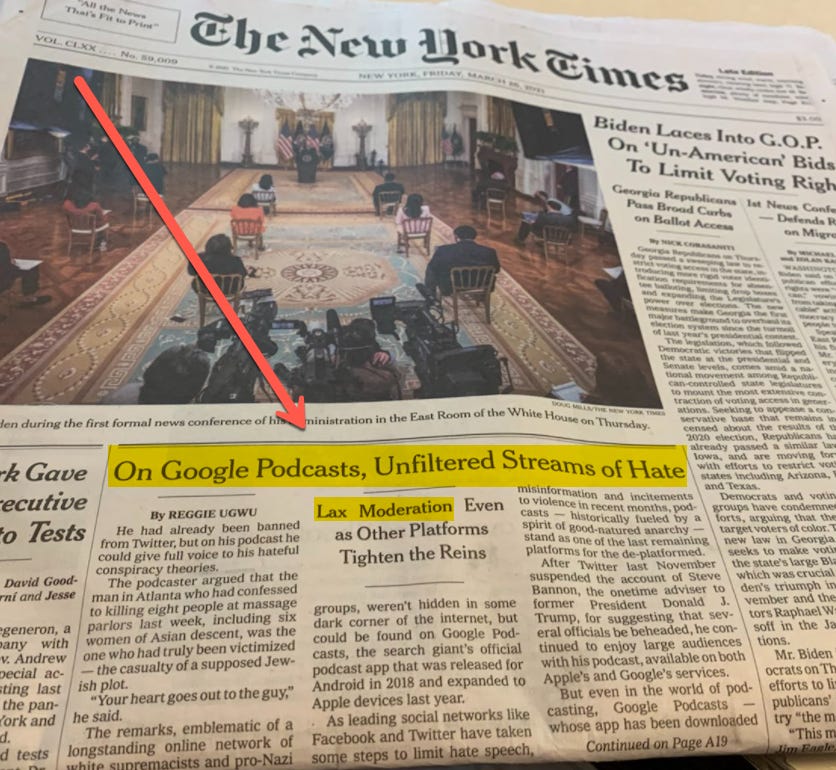
And as I have repeatedly documented, it is not just Democratic politicians agitating for greater political censorship but also their liberal journalistic allies, who cannot tolerate that there may be any places on the internet that they cannot control. That is the petty wannabe-despot mentality that has driven them to police the “unfettered” discussions on the relatively new conversation app Clubhouse, and escalate their attempts to have writers they dislike removed from Substack. Just today, The New York Times warns, on its front page, that there are “unfiltered” discussions taking place on Google-enabled podcasts:

New York Times front page, Mar. 26, 2021

We are taught from childhood that a defining hallmark of repressive regimes is that political officials wield power to silence ideas and people they dislike, and that, conversely, what makes the U.S. a “free” society is the guarantee that American leaders are barred from doing so. It is impossible to reconcile that claim with what happened in that House hearing room over the course of five hours on Thursday.

Glenn Greenwald. This is the conclusion to the latest of Greenwald’s very, very good work on the specter of government-coerced "private" censorship on the internet.


3. Real creativity will die out. Instead, we shall get a multitude of mediocre pseudo-thinkers and vulgar groups and organizations. Our belief systems will turn into a strange chaotic stew of science, philosophy, and magical beliefs.  “Quantitative colossalism will substitute for qualitative refinement.” What is biggest will be regarded as best. Instead of classics, we shall have best-sellers. Instead of genius, technique. Instead of real thought, Information. Instead of inner value, glittering externality.  Instead of sages, smart alecs. The great cultural values of the past will be degraded; “Michelangelos and Rembrandts will be decorating soap and razor blades, washing machines and whiskey bottles.”

Morris Berman, discussing Pitirim Sorokin’s predictions on the collapse of our sensate culture, in 2012.

For more on Sorokin, a fascinating figure, see:


You can read most of my more impromptu stuff at here. It should work in your RSS aggregator, like Feedly, should you want to make a habit of it.