My Grudges

Lafayette Journal & Courier in high dudgeon, January 11, 1997

Predators at Work

Sexual abuse at group home prompts questions about oversight

by Jason Shepard

January 18, 2007RSS

In 1998, when Walden Homes hired Gregory Ledbetter as a counselor for troubled boys at Spring House, a group foster home funded by Dane County taxpayers, he was already an experienced sexual predator.

Ledbetter had moved to Madison less than a year before, after escaping 43 charges of sexually molesting boys at a group home in Indiana. His new job afforded him fresh opportunities, and he took prompt advantage of them, as ‘Henry’ would soon find out.

Henry (a pseudonym, like all names of juveniles in this article) was 15 when he ended up at Spring House, on Madison’s near east side, in 1999. ‘Almost every night,’ Henry later told police, he went to Ledbetter’s apartment, where they would ‘smoke marijuana, play videogames and watch porno movies.’

Ledbetter manipulated Henry into sexual acts, as he had with many other boys before and after, according to hundreds of pages of police and court records reviewed by Isthmus. Sometimes Ledbetter would perform oral sex on the boys; other times it was anal sex. A camcorder next to Ledbetter’s bed recorded the encounters.

Then Ledbetter would return his victims to Spring House, where he was paid to make meals, lead group discussions and serve as a role model for boys who’d been abandoned and suffered from emotional and behavioral problems.

Ledbetter, 39, was convicted last year of molesting several Spring House residents, among other victims. His crimes were so heinous that a Dane County judge sentenced him to life in prison, rejecting Ledbetter’s offer to be castrated.

Strikingly, Ledbetter is not the only sexual predator hired in recent years by Walden Homes to support and nurture some of Dane County’s most vulnerable teenagers. Angela Kalscheur, 26, faces more than 40 years in prison on charges related to sexual acts with four boys at Spring House. She has admitted to the crimes and will likely strike a plea bargain to avoid trial, now set for Feb. 7.

Both cases highlight breakdowns in a system that is supposed to provide care for kids in government custody. Background checks obviously failed, since Walden hired Ledbetter despite a dangerous and troubled past. And staff supervision was so poor that both counselors were able to prey on multiple youths over many months.

The cases also reveal insufficient oversight of private facilities that operate with public money. Even after the fact, county and state officials failed to aggressively investigate how such crimes could have happened. County and state officials operated in isolation so extreme that county officials praise Walden for its oversight efforts while the state accuses Walden of malfeasance. And elected officials with oversight responsibilities were kept in the dark.

County officials stress the assurances they’ve received from state regulators that Walden is in compliance with licensing rules.

‘We have nothing to hide,’ says Lynn Green, Dane County’s director of human services. ‘I am going to stand behind the work we’ve done in this situation 100 percent.’

Adds Bob Lee, administrator for Dane County’s division of children, youth and family services: ‘We feel as badly or more badly than anyone that some kids did not have good experiences there. But the totality of the agency’s experiences with Walden Homes is what’s most important to us.’

That may not be good enough for local elected officials. County Supv. David Worzala, chair of the county’s Health and Human Needs Committee, was ‘astounded’ to learn of the abuse from Isthmus last week. County Supv. Barb Vedder, the committee’s vice chair, also professed ignorance: ‘I am surprised we weren’t told about this.’ (Charges in both cases drew media attention, but some accounts did not mention Spring House by name.)

This week Worzala launched an investigation into oversight of Walden Homes, which continues to annually receive about a million dollars in county funding.

‘My conclusion is it’s outrageous that this has occurred in group homes in Dane County,’ says Worzala. ‘These kids are in our care. They’re vulnerable, and we need to provide a safe environment.’

Where is the oversight?

Worzala, a member of the Dane County Board since 2004, doesn’t like to criticize county government. He uses the word ‘we’ when referring to it, and says he’s a ‘big fan’ of Green and her department.

But Worzala is at a loss to explain why he first learned of these incidents from a reporter: ‘I don’t know what to say. However, I will say this: Now I know about it, and it will be addressed.’

Next Tuesday, Worzala plans to call officials from Dane County and the state Department of Health and Family Services to account for their actions before his committee.

‘These are horrific cases,’ he says. ‘The system’s broken. We need to look at it. Clearly county and state oversight needs to be reviewed and discussed. We need to do something to make sure this never happens again.’

Walden Homes Ltd. is a nonprofit corporation that continues to run three group homes in Dane County: Coventry Group Home on the north side, and Horizon House and Thoreau House on the isthmus.

Dane County taxpayers have paid Walden $4.7 million over the past five years to care for children ordered into its group foster homes. A tax filing for 2004 shows county taxpayers, at $910,882 that year, were by far Walden’s largest source of income; next in line was the state Department of Corrections, at $44,550. The money went in part to Walden’s longtime director, George Nestler, who received a salary of about $90,000.

Nestler did not return repeated calls seeking comment on this article.

According to the tax filing, Walden Homes aims to provide ‘a stable, highly supervised group foster home environment’ for adolescents. But that’s hardly what it did for nearly a dozen of Dane County’s most troubled teens, who were victimized by these two counselors.

Indeed, records suggest that Spring House, 511 S. Ingersoll St., was a deeply troubled operation. Police have been called to the group home 151 times since 2000, often in response to neighbor concerns. Police logs reviewed by Isthmus show complaints about disturbances, thefts, damaged property, liquor law violations and general juvenile complaints. Other calls involved battery, drugs and an overdose.

‘There were police over there all the time,’ says Scott Thornton, who lives nearby. Neighbors also complained to state regulators about lax supervision. (Walden’s corporate office is located at 1102 Spaight St., just around the corner from Spring House.)

But the decision to close Spring House in June 2006 purportedly had nothing to do with child molestation or complaints from neighbors. Rather, Walden told the state it wanted ‘to make better use of our resources.’ Agrees Dane County’s Green, ‘It was purely a financial decision on their need to fill beds.’

From Indiana to Wisconsin

On Oct. 15, 2005, after being tipped off by a neighbor that Ledbetter, then 38, was having sex with a 16-year-old boy, Madison police executed a search warrant on his apartment. They discovered a jackpot of evidence in his bedroom: 150 videotapes stashed in a locked dresser drawer and a safe. The tapes, spanning more than a decade, were meticulously labeled with the boys’ names, ages and dates.

In letters and testimony to Dane County Judge Dan Moeser, Ledbetter and his parents traced his predatory pedophilia to his troubled childhood. They said Ledbetter had a sexual relationship with an older man when he was a teen. And, when he was around 17, his best friend committed suicide with Ledbetter’s shotgun after announcing that he was gay and being rejected by his family.

‘He gave me an ultimatum about him killing himself, and I didn’t stop him,’ Ledbetter wrote. ‘I carry that guilt with me for the rest of my life.’

‘Greg was never the same after that,’ his parents wrote. Following his own suicide attempt around this time, Ledbetter was committed to a mental hospital in Washington, D.C., where his sister lived, but was released after a few months when the insurance money ran out. ‘We regret to this day not keeping him institutionalized.’

Court records say Ledbetter graduated from Purdue University with an education and fine arts degree and worked as a student teacher in an elementary school. At about age 26, he began working at the Cary Home for Children in Lafayette, Ind. He was there for two years.

In January 1996, prosecutors charged Ledbetter with 43 counts of child seduction based on allegations from two group home residents.

According to Indiana police reports obtained by Isthmus, one boy said he had dozens of sexual encounters with Ledbetter between December 1993 and May 1995, when he was 16 and 17. It began with oral sex at Ledbetter’s parents’ house and escalated to anal intercourse, with the use of marijuana almost always preceding the sex. A second group home boy, 17 at the time, reported having at least 35 sexual encounters with Ledbetter.

Indiana newspapers reported that the allegations against Ledbetter were the second sexual allegations against Cary Home staffers in two years, and local politicians called for the firing of the home’s director.

The arrest also captured local headlines because Jerry Ledbetter, Greg’s father, was a city councilman who supported a local ordinance banning discrimination based on sexual orientation. The family said Ledbetter was arrested in retaliation for his father’s progressive politics, and spent $19,000 in legal fees fighting the charges.

In January 1997, prosecutors dropped the charges after Ledbetter’s defense attorney secured an affidavit from one of the boys, saying he made up the allegations.

Eight years later, Madison police would discover what Indiana police did not: videotapes of Ledbetter having sex with at least three boys from the Indiana group home.

From Spring House to prison

By 1998, Ledbetter had moved to Madison and was looking for a job. The Spring House group home had just opened, and it was hiring. Ledbetter’s first day was April 20, 1998.

Ledbetter had already spent at least five years preying on vulnerable boys in Indiana. Over the next 22 months, he was given regular access to troubled boys in Dane County’s care. He made the most of it.

Police reports and a detailed criminal complaint relate the accounts of several group home victims, including ‘Billy,’ who was 14 when the abuse began.

‘The situation has made things hard for me,’ he told a detective. ‘You know, it was hard to go on with my life.’

Henry, mentioned above, told police he once complained that Ledbetter would openly tell the boys in his care that he ‘loved to suck cock.’ Henry said Ledbetter let the residents ‘smoke dope and go wherever they wanted,’ for which he ‘expected something in return.’ Henry also said Ledbetter once showed him a .45 caliber handgun.

‘Jeff,’ who was 16 when he engaged in sexual encounters with Ledbetter at Spring House, told police he ‘felt obliged to do this with the defendant since the defendant was making their life at the group home fun.’

In February 2000, Ledbetter left Spring House. Over the next five years, records show he met other boys through his jobs at a Walgreen’s, a Blockbuster video store, a Marcus movie theater and a store in South Towne Mall.

One of these was a 16-year-old who, his mother told police, had brain damage stemming from childhood abuse and suffered from learning disabilities, cancer and cerebral palsy. Court documents offer a particularly disturbing summary of one videotaped encounter. The boy, who appeared to ‘act more like an 8-year-old than his own age,’ expressed ‘random thoughts regarding eating at Old Country Buffet and videogames and his mother and his curly hair’ during unprotected anal intercourse with Ledbetter.

Yet another boy told police that Ledbetter handcuffed him and used duct tape on his mouth before anally penetrating him.

It’s not clear from court documents and police reports how many boys Ledbetter molested during his eight years in Madison. Ultimately, Dane County prosecutors charged him with 92 felony counts of child sexual assault, enticement and sexploitation, relating to 10 boys.

In July 2006, Ledbetter was convicted following a plea agreement; he received a 90-year prison sentence. Under the state’s truth-in-sentencing law, he won’t be eligible for parole until he is 129 years old.

‘I am viewed more as someone who was over-punished and denied the right of rehabilitation as a sex offender,’ Ledbetter wrote to Judge Moeser in October from prison in Waupun. He now spends his days playing classical music on a piano, painting and drawing in his cell, and attending Alcoholics Anonymous meetings.

‘There’s things I need’

Angela Kalscheur graduated from Mankato State University in Minnesota in 2004 with a degree in criminal justice, records show. She interned at a center for juvenile sex offenders before Walden Homes hired her in November 2004 to work at Spring House.

Like Ledbetter, Kalscheur worked the 3 to 11 p.m. shift as an assistant counselor at Spring House. Her duties included preparing meals, supervising homework and leading group talks. And while she and Ledbetter likely never met, Kalscheur used many of the same strategies to entice boys into satisfying her sexual desires.

According to a criminal complaint, ‘Nick,’ then 15, arrived at the group home in March 2005 and quickly learned that Kalscheur was having sex with several boys; he later told police this was ‘common knowledge.’ Nick said he didn’t report Kalscheur because he used this information as leverage to extend his curfew and get an allowance without doing work. Once he walked in on Kalscheur having intercourse with ‘Joe,’ and was invited to participate.

Joe told police that within a week of arriving at Spring House in the spring of 2005, when he was 17, Kalscheur told him something to the effect of, ‘There’s things I need,’ then hugged him and put his hand down her pants. Joe estimated that he and Kalscheur had sexual contact about 35 times, including twice at her house.

A third boy, ‘Damon,’ told police that Kalscheur performed oral sex on him about five times, starting on his 16th birthday. He said he knew other residents were having sex with Kalscheur, and that she asked him not to tell because she could lose her job.

‘Just keep giving me head,’ Damon said he told her, ‘and you won’t need to worry about it.’

Kalscheur, the complaint says, regularly gave the boys alcohol and cigarettes. She also drove them to a location on the south side, where they bought marijuana. The boys would get high as Kalscheur returned to the group home.

In June 2005, another Spring House counselor had a chance meeting with a former resident, who told of sexual encounters with Kalscheur when he was at the home. The counselor reported the allegations to Walden Homes’ director Nestler, who, as required by law, reported the allegation to Dane County officials.

Kalscheur continued to work at Spring House for the next month, and was fired on July 27 on a matter unrelated to sexual abuse, county officials say.

On May 25, 2006, Madison police detective Dave Gouran spoke with Kalscheur at her home. After initially denying any wrongdoing, Kalscheur eventually admitted to having sexual contact with Joe, Nick and Damon, as well as other boys from the group home.

Kalscheur’s attorney, Eric Schulenburg, expects to reach a plea agreement in the near future, and will argue at sentencing that her crimes don’t merit prison.

‘To send her to prison is a crime, and there’s no need to make this two crimes,’ says Schulenburg, adding that he has trouble viewing the 16- and 17-year-old boys in this case as victims.

Appropriate action?

The unprecedented abuse at Spring House ‘ going back decades, county officials can’t remember another substantiated molestation case at a juvenile group home ‘ has local politicians worried.

‘Clearly, two makes a pattern,’ says Supv. Worzala. ‘The Ledbetter case is frightening. You’re talking about border hopping of predators. It’s unacceptable.’

But Dane County’s Bob Lee says that after learning of misconduct, local officials ‘did what was required’ and took ‘appropriate action.’ These actions included interviewing group home residents and attending Spring House staff meetings.

Regulating group homes, county officials stress, is the state’s responsibility. ‘The state is required to license and monitor. The onus is on them,’ says Marykay Wills, the county’s mental health and alternative care manager. ‘The state assured us that Walden did what they were supposed to do.’

But state officials and records provided to Isthmus undercut many of these claims and suggest that county officials either aren’t being forthcoming or remain uninformed as to the state’s apparently grave concerns about Walden Homes, both before and after these molestation cases came to light.

‘It is very likely that we would have taken the steps to revoke the license at Spring House if they had not voluntarily closed,’ says Stephanie Marquis, spokeswoman for the Department of Health and Family Services.

State officials accused Walden Homes of a ‘lack of cooperation with the department in its attempt to thoroughly investigate the allegations,’ according to a letter sent to Walden dated Oct. 25, 2006, written after Isthmus began making inquiries into the state and county’s handling of the matter.

That letter, and a follow-up (click HERE), allege that Walden staff members were told by a Walden supervisor and in a written memo not to cooperate with investigators. The letters criticized Walden’s management and accused Walden supervisors of overlooking complaints from other staff about Kalscheur’s behavior.

County officials are also apparently clueless as to the rules regarding background checks. Lee explains Ledbetter’s hire by saying ‘the state does not require out-of-state background checks. Now should they? Maybe. But they don’t.’

Marquis contradicts this, saying state law does indeed require out-of-state criminal background checks for any state in which an applicant may have lived in the past three years, information he or she is required to provide.

How Ledbetter passed his background check after being charged with 43 counts of child molestation at his last group home job may never be known. When state regulators sought to review Walden’s records, they discovered that ‘all terminated staff files and discharged resident files’ from Spring House had been destroyed by Walden’s director in December 2005. The destruction of these files occurred in the middle of police investigations into both the Ledbetter and Kalscheur cases.

State officials fined Walden $1,000 in the Kalscheur case, which Walden initially appealed. Walden dropped its appeal after it closed Spring House and moved its residents to Thoreau House, located around the corner in the same building as Walden Homes’ Spaight Street headquarters.

Walden Homes continues to reap county contracts for its three other group foster homes, into which troubled teens are regularly ordered. In 2006, Walden received $986,766 in county funding. Lynn Green, the county’s human services director, thinks the relationship is working well.

‘Walden has a long history of providing very good group home services in Dane County,’ she says. ‘They were one of the early group homes, and George Nestler has been with them 20-plus years. Hundreds if not thousands of Dane County kids have received excellent services from the Walden Homes system.’

(From Isthmus, a publication in Madison, Wisconsin)


I don’t hold a lot of grudges, but I hold a few related to this sorry case.

It’s not that “everyone knew” the Lafayette charges were true and that the local scribes were ignoring what everybody knew. I had spoken to one of the accusers professionally, and I wasn’t certain. One seldom is.

When the boys withdrew their accusations, I considered possible both that the charges had been false and that Defense counsel for Ledbetter had “gotten to” the accusers somehow. I wasn’t sure which.

My grudge is that the Journal & Courier didn’t know, either. Yet it wagged its corporate finger at everyone who believed (or dutifully investigated) the adolescent boys who accused Ledbetter, and turned a secret abuser into a martyred saint. Everyone should have had the Journal & Courier’s confidence that the charges were false, though the confidence was unwarranted and turned out to be false. I was at the very least adjacent to those the santimonious ink-stained wretches were excoriating.

My grudge also is that hiring an “out” homosexual to have unmonitored supervisory access to troubled adolescents (that’s the kind of facility that employed Ledbetter) of the same sex, whatever the written rules may have said, was recklessly in defiance of common sense — as it would have been reckless to hire a heterosexual to have unmonitored supervisory access to troubled adolescents of the opposite sex. This was not, in other words, a “freak accident.” It was completely foreseeable. More heads should have rolled than did (though Commissioner Nola Gentry’s replacement was a Marjorie Taylor Greene type, far inferior to Nola).

So my grudge, finally, is that not all “discrimination” is invidious (some is utterly sensible), and thus not all discrimination should be legally forbidden, as it increasingly is — and as the Journal & Courier supports.


You can read most of my more impromptu stuff at here. It should work in your RSS aggregator, like Feedly, should you want to make a habit of it.

Visual content for a change

From this week’s Economist.

Love how they go with “birthing people” and “pregnant persons” but then just call it the MOMMIES Act. https://t.co/OIvNXqHNcX— Robert Tracinski (@Tracinski) May 6, 2021

Don’t miss the people who responded by pretending to not understand his point.


One reason why we spend so much time thinking and talking about elites is that we often hope and pray that a better elite can bring significant, rapid change—to yank the right out of its current malaise sooner rather than later. At present, however, there is no obvious path for speedy, top-down change. There simply isn’t an active market for the necessary message.

David French, Make No Mistake: The GOP Has a Grassroots Problem.

If you follow this blog, you likely have noticed a lot of content from the Dispatch (including essentially anything I quote from David French). Although I’m starting to figure out that David’s entertainment tastes are, um, not at all like mine, I think the Dispatch is doing a very good job at delivering on what they say they’re about, and is worth the price for any non-destitute conservative (or liberal who wants to avoid captivity to a bubble).


The Soviet occupiers subdued religious hierarchies, he said, making sure that the senior leaders — bishops and such — were collaborators. Bishop Istvan remarked that what he sees happening in liberalizing Protestant churches in the West reminds him of this process. The idea, he explained, is that they have been colonized by utopian idealists who believe they have found the truth. Said the bishop, “The Bolsheviks imposed this in a harsh, brutal way, but in the Western countries today, it is happening in a soft way.”

… The bishop went on to say that every society needs an enemy in mind. After the end of the Cold War, the West lacked for an obvious enemy. Now, he said, the elites have decided that the enemy is traditional Christians.

“It’s not a Cold War, but a Cold Civil War, happening in the US, in Germany, everywhere,” he said.

Rod Dreher, My Afternoon With A Calvinist Bishop – Daily Dreher

I suspect, based on my observations of how societies behave, that the Bishop is right: every society needs an enemy in mind. Even if he’s not,

  1. It gives us an idea why Viktor Orban demonizes George Soros; and
  2. It should make us reflect on why we demonize Putin, Orban and others.

“We are not good survivors of Communism,” said Bishop Istvan, of his generation. “If you read the Book of Exodus, you will see that it took forty years of wandering in the desert for the Israelites to prepare to enter the Promised Land. Many of them wanted to go back to Egypt, where they were slaves, but at least they could have a few material things guaranteed for them. I feel like my generation has been told by God that we can’t enter the Promised Land.

“But I ask myself,” he continued, “which Promised Land should I want to enter? Should it be the West? The problem is, there is no fruit there. There is no milk, there is no honey.”

That resonated deeply with me, this point of Bishop Istvan’s. Something similar has been front to mind for me since I first arrived here three weeks ago. There is something about putting distance between oneself and America, and looking at America from a non-woke country, that highlights the true insanity of what’s happening in our nation.

Rod Dreher, My Afternoon With A Calvinist Bishop – Daily Dreher, quoting Istvan Szábo.


“Believing that everything will be better if only we gather more information,” blogger Michael Sacasas recently wrote, “commits us to endless searching and casting about, to one more swipe of the screen in the hope that the elusive bit of data, which will make everything clear, will suddenly present itself.” …

… There is nothing of real import happening in the world for which Tucker Carlson or Rachel Maddow is the best source of information.

Joseph M. Keegin, Be Not Afraid


In the old Dark Ages, it was impossible to persuade the feudal chiefs that it was more worth while to grow medicinal herbs in a small garden than to lay waste the province of an empire; that it was better to decorate the corner of a manuscript with gold-leaf than to heap up treasuries and wear crowns of gold. These men were men of action; they were hustlers; they were full of vim and pep and snap and zip. In other words, they were deaf and blind and partly mad, and rather like American millionaires. And because they were men of action, and men of the moment, all that they did has vanished from the earth like a vapour; and nothing remains out of all that period but the little pictures and the little gardens made by the pottering little monks.

G.K. Chesterton, The New Dark Ages

Seven shorts

Front Page News Today

Front page of my local newspaper, above the fold, is the news that "Racist post on County GOP Facebook elicits backlash."

The post was genuinely and frankly racist — no mere dog-whistle. And my former party is entirely too hospitable toward yahoos and atavists. But the County was Brown County, in Southern Indiana, roughly two hours from us. And it was a Facebook page, fer cryin’ out loud, where presumably any jackass, including enemies, can post.

This story’s placement was partly a function of the steep decline of my local paper and its increasing reliance on stories from other Gannett newspapers in Indiana (and from Gannett Corporate HQ). But we form our impression of the world from, well, glimpses and impressions left by things we generally have no time to analyze and blog about.

Do better, Journal & Courier.

I’m not sure EWTN sees what I see in this swag:

That’s all I’m going to say. (Source)

More Rules for Life

Politics can make people crazy, especially these days. For the latest evidence, consider its insidious spread to “Jeopardy!,” the game show heretofore loved by millions.

Last week Jeopardy! contestant Kelly Donohue put his index finger and thumb together in an “OK” sign, with three fingers extended, during the show’s introduction. Uh oh.

It seems some progressives are on constant watch for this gesture as a signal of white supremacy because it has allegedly been adopted by some extremist groups. Within a few days, hundreds of former Jeopardy! contestants signed an open letter explaining that Mr. Donohue’s gesture, “whether intentional or not, resembled very closely a gesture that has been coopted by white power groups.”

Mr. Donohue said he had signaled the number three because he had won the show three days in a row. He clarified his meaning in a Facebook post, but he apparently didn’t abase himself sufficiently in the view of the concerned game-show participants. “Most problematic to us as a contestant community,” they wrote, “is the fact that Kelly has not publicly apologized for the ramifications of the gesture he made.”

Mr. Donohue then posted a statement “regret[ting] this terrible misunderstanding” and condemning racism in all its forms. We hope, for his sake, that the latter declaration appeases the troubled sensibilities of the, uh, contestant community.

Mass Hysteria for $2,000

I have read that one of Jordan Peterson’s maxims in his new book is "Don’t apologize if you’ve done nothing wrong."

Keep em’ guessing

I have purchased a copy of Saul Alinsky’s Rules for Radicals in the full expectation that I’ll find much worthwhile in it (anyone who got an acknowledgment from Jane Jacobs in The Death and Life of Great American Cities can’t be all bad), despite the book’s bugbear status, alongside "George Soros," among the Right.

A line in the sand

I understand that language evolves. I reluctantly admit that usage (eventually) makes proper.

Generally.

But—usage be damned—I will never, ever, accept that "literally" means "I’m about to engage in wild hyperbole because I feel strongly about this."

Thank you.

Cancel culture and the GOP

There are huge divides within the GOP over whether or not cancel culture is a problem government has any role in solving.

J.D. Vance—the author and venture capitalist who is likely to enter Ohio’s U.S. Senate race in the coming weeks—urged Republicans to retaliate against businesses whose leaders met to coordinate responses to Republican-led efforts to change voting laws in states across the country. “Raise their taxes and do whatever else is necessary to fight these goons. We can have an American Republic or a global oligarchy, and it’s time for choosing,” said Vance, who declined to be interviewed for Declan’s story. “At this very moment there are companies (big and small) paying good wages to American workers, investing in their communities, and making it easier for American families. Cut their taxes. No more subsidies to the anti-American business class.”

Rep. Peter Meijer, a freshman Republican from Michigan, grew animated when presented with Vance’s comments. “How is that conservative? Where is there a fidelity to an underlying set of beliefs or principles other than just taking cues from the left and being inherently reactive?” he scoffed. “If you’re using the government to compel something you like, you’re setting the precedent for the government to be compelling something you don’t like. And the non-hypocritical approach is to just not have the government be a coercive entity towards those ends.”

Meijer agreed that Republicans have work to do on this issue, but not necessarily in statehouses or the Capitol. “The Overton window has kind of shifted to where the narrative that ‘Republicans are evil’ is not just unquestioned in many elements on the left, but in corporate America, too. And to me the broader challenge is how do we regain that credibility,” he said. “We’ve lost some credibility to be viewed as serious participants in larger cultural clashes. And if all we’re doing is talking to a Newsmax and OANN crowd, we’re not flexing those persuasive muscles to be able to win over voters in the center.

Declan Garvey, ‘How is that Conservative?’.

I have been consistently impressed by Peter Meijer so far a worthy successor to Justin Amash (and that’s saying a lot), while J.D. Vance sinks ever-lower in my estimation (he started mildly positive, because of Hillbilly Elegy). If the Republicans can come up with any effective, popular, constitutional legislation on cancel culture, you literally can knock me over with a feather I will be astonished.

Certified bleak — in a hopeful sort of way

We take it as our great privilege to enter an age wherein no stone remains on another. There is much to be gained amidst the dark ruins of a shattered word: Brokenness and desolation, so hopeless in the eyes of some, are invisibly pregnant with promise in the eyes of others. As we kick the opiate of material comforts, exit the temple of broken idols, and come to acknowledge that our culture is one of loud and benumbing noise, we finally stand on the threshold of encountering Truth. If one is not seduced back to numbness by the influence of contemporary life, this threshold positions one to apprehend truly (and even transcend almost completely) our dying world’s scaffolding – its logic, appearances, gross phenomena – and come to know by experience the spiritual, otherworldly life. Thus, when one loses all that is of apparent worth and modern society’s ugly face is unmasked, a search for the new, authentic life begins.

2020 Vision: From Blindness to Sight in the Age of Collapse, via Paul Kingsnorth.


You can read most of my more impromptu stuff at here. It should work in your RSS aggregator, like Feedly, should you want to make a habit of it.


Some thoughts 5/1/21

What the wrath of God looks like

I was nurtured on stories as a child that contrasted Christ’s “non-judging” (“Jesus, meek and mild”) with Christ the coming Judge (at His dread Second Coming). I was told that His second coming would be very unlike His first. There was a sense that Jesus, meek and mild, was something of a pretender, revealing His true and eternal character only later as the avenging Judge.

This, of course, is both distortion and heresy. The judgment of God is revealed in Holy Week. The crucified Christ is the fullness of the revelation of God. There is no further revelation to be made known, no unveiling of a wrath to come. The crucified Christ is what the wrath of God looks like.

Fr. Stephen Freeman, The Bridegroom and Judgment

Why Jordan Peterson thrives

Contempt for the “working class” by North America’s “liberal educated elite,” is a major reason for his popularity, he says. “There aren’t very many people with an encouraging voice,”[Jordan] Peterson says. “Most of the things you read by intellectuals—not all, but it’s a failing of intellectuals—most of it is criticism. Look what you’re doing to the planet. What a detestable bunch of wretches you are, with your rapacious structures and your endless appetite and your desire for power. . . . Look at what your ambition has done to the planet. How dare you!”

Mr. Peterson doesn’t directly challenge the substance of these dreary criticisms. Rather he protests that they’re unnatural and unhealthy. “The proper attitude toward young people is encouragement,” he says—“their ambitions, their strivings, their desire to be competent, their deep wish for a trustworthy guiding hand. I think our culture is so cynical that it’s impossible, especially for the established intellectual chattering critics, to even imagine that encouragement is possible.”

When I ask what he thinks is driving the effort to destroy him and others who hold heterodox views, he diagnoses his persecutors as though they’re exactly the sort of young people who wander into his lectures or buy his books looking for structure and purpose. His admirers and his fiercest detractors are, in his mind, not so different from each other.

Barton Swaim, The Man They Couldn’t Cancel

From an essay on atheism with lots of insights:

I can’t tell you how often … commenters on liberal blogs would preface a denunciation of Richard Dawkins by reassuring everyone that they themselves were agnostic or otherwise unaffiliated. “Of course Christianity isn’t literally true,” they would always say before excoriating arrogant atheists. What they never seemed to understand is that the “of course” was a more grievous insult to sincere Christians than Christopher Hitchens could ever come up with. What the atheists felt they needed to prove, the anti-atheists simply assumed away. They took as given that traditionally religious claims about the world were so ridiculous that they could dismiss them with a footnote. The difference is stark. Angry atheists think religion is wrong. Anti-angry atheist liberals think religion is not even wrong.

Since I begin writing about this topic – that is, since the very beginning, as the first thing I wrote online that more than a dozen people read was about being a certain kind of atheist – I have been known by religious people as a nice atheist, a respectful atheist. I am never sure how to feel about this condition. I still define my orientation the same way: that to come to atheism honestly and constructively you must come to it in loss and pain. You don’t accept atheism, when it is genuine. You surrender to it. Either way, I am an atheist. I think all metaphysical claims of religious are false. I think religion on balance has been a detriment to human life and human flourishing. And I think the gradual attrition of believers into nonbelievers, through apathy and distraction more than anything else, would be good for the world.

Freddie deBoer, ‌What Became of Atheism, Part One

"I think all metaphysical claims of religious are false" is a sentence that may be worth my returning to some day, as the metaphysical content deBoer describes elsewhere in his essay is not true of all religion, and not (very) true of Orthodox Christianity. If I were being flippant, I could say "well, I don’t believe in that God, either."

Stake in the ground: Two sexes

Here’s what the science says: there are only two human sexes. That’s because there are only two types of gamete (the sex cells — egg and sperm). Humans (like all mammals) can develop along one of two pathways: towards making eggs (female) and towards making sperm (male). If anyone ever finds a third sex it would be a discovery on a par with finding a new continent — with a guaranteed Nobel prize. Until you see those headlines, you can rest assured there are exactly two sexes.

Biological sex exists and it matters — most obviously because the existence of the human race depends on it. You can’t make a human baby without a male and a female — yet the sex-denialists hardly ever mention reproduction. Which is odd since that’s precisely why sex exists.

Nathan Williams, Sex deniers are the new flat earthers

How our press covers Hungary

“You are sitting next to the Fifth Avenue of Budapest,” he said, referring to nearby Andrassy Avenue. “The only people Western journalists ever seem to talk to live within a two-mile radius of this street.”

Later, as I was headed home from work, I thought about how someone could stand on Andrassy holding a sign saying, “Viktor Orban, Go To Hell,” and nothing would happen to them. What do you think would happen to someone standing on the corner of Fifth and 45th in Manhattan, holding up a sign saying, “Black Lives Matter Sucks,” or “Homosexuality Is A Sin”? …

But remember your catechism: countries like Hungary are the real illiberal democracies.

Rod Dreher

Surprise Orthodox Anglicans

There has been talk in my neck of the internet about Prince Philip having reconnected with his Orthodox Christian roots, and here’s a sign, which I’m surprised hadn’t surfaced earlier, that he had:

There was one clear sign of this complex heritage during the funeral. Prince Philip had requested that, just before his body was lowered into the Royal Vault, the choir sing the famous Kiev setting of the Orthodox Kontakion of the Departed.

"Give rest, O Christ, to thy servant with thy saints: where sorrow and pain are no more; neither sighing but life everlasting," the singers chanted. "Thou only art immortal, the creator and maker of man: and we are mortal formed from the dust of the earth. … All we go down to the dust; and weeping o’er the grave we make our song: Alleluia, alleluia, alleluia."

Terry Mattingly, Wish for the ‘Orthodox Kontakion of the Departed’ — A Hint at Prince Philip’s Complex Faith History

Note, too, this:

Prince Charles also has frequented Mount Athos. One Athonite monk told The Guardian newspaper that there is "no question" that Charles is "Orthodox in his heart. Sadly, he is very constrained by his position." The Prince of Wales has maintained ties to the Vatopedi Monastery and, like his father, to the Friends of Mount Athos.

Id.

Western civilization

The older I get, and the more I learn about history, the more convinced I am that Western civilization committed suicide with World War I. The rubble is still bouncing from that unparalleled catastrophe.

Rod Dreher

Contrariness

The function that herbivores play, for example, in stimulating biomass accumulation is both powerful and real. Chickens have historically converted kitchen scraps into eggs. Pigs have historically scavenged domestic waste products as varied as whey, offal, forest mast, and spoiled grain. That a large percentage of landfilled material is animal-edible food waste should strike us as criminal. Rather than showering landfill administrators with greenie awards for injecting pipes into the anaerobic swill to collect biogas, we should be cycling all that edible waste through chickens and pigs so that it never goes to the landfill in the first place.

Joel Salatin, Folks, This Ain’t Normal


Food safety is completely subjective. I don’t think for a minute that most of what’s in the supermarket is safe. But it’s been deemed safe because it only kills you slowly. While thousands of people die due to unnatural food and nutrient-deprived food, the food police go after a cottage-industry cheesemaker because two people got diarrhea.

Joel Salatin, Folks, This Ain’t Normal

Why I (sorta) miss the New York Times

Chauvin Was Convicted. Something Is Still Very Wrong reminds me that I not only miss much of what Ross Douthat and David Brooks write these days by dropping the New York Times, but I also miss Elizabeth Bruenig (and Frank Bruni).

It’s tough when an institution is the pinnacle of professional ambition in a field yet has become boycottably corrupt.


You can read most of my more impromptu stuff at here. It should work in your RSS aggregator, like Feedly, should you want to make a habit of it.

Calling spades “spades”

Four snippets over the past few days (several of the articles are months old, though) from people who were taking no guff.

From New York Magazine last November, on turmoil at the New York Times:

Twitter presented innumerable headaches, with reporters having to be chastised for being overtly political, or simply for sounding un-Timesian in their pursuit of likes and retweets. “There’s a very sad need for validation,” one Times journalist who has tweeted tens of thousands of times told me.

Some of the trickiest jounalistic questions have centered on what the Times is or isn’t willing to say. After [James] Bennet’s ouster, [A.G.] Sulzberger met with a columnist for the “Opinion” section who had expressed consternation about the decision. Sulzberger promised the columnist that the Times would not shy away from publishing pieces to which the Times’ core audience might object. “We haven’t lost our nerve,” Sulzberger said.

“Yes, you have,” the columnist told Sulzberger. “You lost your nerve in the most explicit way I’ve ever seen anyone lose their nerve. You can say people are still gonna be able to do controversial work, but I’m not gonna be the first to try. You don’t know what you’ll be able to do, because you are not in charge of this publication — Twitter is. As long as Twitter is editing this bitch, you cannot promise me anything.”

Reeves Wiedeman, Inside the New York Times’ Heated Reckoning With Itself


I had forgotten this prophesy:

Let us not hedge about one thing. Donald Trump may win or lose, but he will never concede. Not under any circumstance. Not during the Interregnum and not afterward. If compelled in the end to vacate his office, Trump will insist from exile, as long as he draws breath, that the contest was rigged.

Trump’s invincible commitment to this stance will be the most important fact about the coming Interregnum. It will deform the proceedings from beginning to end. We have not experienced anything like it before.

Maybe you hesitate. Is it a fact that if Trump loses, he will reject defeat, come what may? Do we know that? Technically, you feel obliged to point out, the proposition is framed in the future conditional, and prophecy is no man’s gift, and so forth. With all due respect, that is pettifoggery. We know this man. We cannot afford to pretend.

Barton Gellman, What if Trump Refuses to Concede?, September 23, 2020.


Successful Substack writers continues to evoke envy, which tends to get expressed (in writing inferior to the Substack average) as addlepated moral outrage. Marxist blogger-turned-Substacker Freddie de Boer has had lots of thoughts about that, culminating most recently in this:

I write tens of thousands of words on topics ranging from why everyone is actually exhausted to The Giving Tree to the Nation of Islam to Instagram feminism to the charter school scam to atheism after the New Atheists (coming Monday!). Don’t like it? Write better shit, man. Or get mad online. It’s up to you. My people will support me, and I earned that.

What are you, 12? There’s no “deserves”


I hadn’t thought about the implications of some prominent Federalist Society members being implicated in the January 6 insurrection. But David Lat had thought about it quite a lot in the two weeks after:

The Federalist Society is a nonpartisan organization that does not — and cannot, as a 501(c)(3) nonprofit — endorse candidates for elective public office. It therefore has no official relationship with Donald Trump …

Unfortunately — and quite reprehensibly — several prominent FedSoc figures played roles in Trump’s baseless challenge to the 2020 election results, and therefore bear significant blame for the Capitol attack. Law professor John Eastman — chair of FedSoc’s Federalism and Separation of Powers practice group, and a frequent participant in Society events over the years — represented Trump in his (meritless and unsuccessful) attempt to get the Supreme Court to intervene in the election, urged Vice President Mike Pence to overturn the election results, and had a prominent speaking role at the rally that was the precursor to the riots. Senator Josh Hawley (R-Mo.) and Senator Ted Cruz (R-Tex.), two members of what conservative law professor John O. McGinnis once dubbed “the Federalist Society caucus” … led the charge in the Senate against certification of the election results, just hours after the horrific Capitol attack. In light of all this, a reckoning at the Federalist Society is in order.

So what should FedSoc do in the wake of the Capitol riots? …

First, and most obviously, the Society should no longer allow John Eastman, a prominent promoter of poisonous conspiracy theories about the election, to remain in leadership, as chair of the Federalism and Separation of Powers practice group …

Second, the Society should no longer host events with Eastman, Hawley, and Cruz …

Third, as a more general matter, the Federalist Society should try harder to steer clear of partisan politics. It should be non-partisan not just in name, but in spirit.

Of course, the larger and longer-term issue, not just for the Federalist Society but for conservatives, libertarians, and Republicans, is how much of their principles they are willing to sacrifice for power.  Allying themselves with Donald Trump for four years got them tax reform, three Supreme Court seats, more than 200 lower-court judgeships, and all sorts of other goodies. But was it worth it?

… I am the last person to underestimate the importance of judges, but if you will allow me to close by paraphrasing Meatloaf, here is my bottom line:

“I would do anything for judges — but I won’t do that.”

David Lat, The Federalist Society And The Capitol Attack: What Is To Be Done?


You can read most of my more impromptu stuff at here. It should work in your RSS aggregator, like Feedly, should you want to make a habit of it.

Miscellany, 4/23/21

For many years now it has been crystal clear to me that the shape of reality is the shape of a myth, not a hard drive, and that the path back to understanding it – the way out of the cul de sac of Machine modernity – is a spiritual one.

Paul Kingsnorth, Intermission: The Empty Throne (The Abbey of Misrule)


First, I’d like to say I’m not surprised by much today, but I was taken aback by the rage in some parts of the right at the conviction of Derek Chauvin …

I could fill an entire newsletter with strange and dangerous reactions from prominent right-wing voices after the Chauvin verdict. The pathologies of right-wing infotainment are one reason why I have so little patience for most of the right’s relentless criticism of the mainstream media. Somehow, in all their rage and fury, they’ve created a competing media ecosystem that’s actually worse than the institutions they hate. Take the log out of your own eye.

But then, over in Ohio, many of the biggest public figures and news outlets in America got busy reminding us exactly why so many in the right feel such deep frustration. They reminded us why it’s often accurate to critique left-wing media narratives, especially when it’s obvious that those narratives will force people to deny or to ignore the witness of their eyes just as thoroughly as the far-right ignored the witness of their own eyes in the Chauvin trial.

The police shooting of 15-year-old Ma’Khia Bryant was tragic and deeply, deeply sad. It was also nothing like the police murder of George Floyd. Yet immediately important voices tied the deaths together ….

David French, Don’t Create False Villains To Serve a Greater Good. I boldfaced the part that made me want to stand up and cheer, but felt obliged to provide the context, too.


… the Politician’s Fallacy: we need to do something; this is something; therefore we need to do this. There’s lots of racism in the workplace, no doubt. So the answer is to… pay businesses millions of dollars to come and preemptively scold bored employees who are only attending these workshops out of coercion? That’s the solution? Seems like a great way for a few people to get rich, but sure doesn’t seem like it’ll do jack shit to actually reduce workplace racism. Also… you get that employers pay for these things purely because they can use them as evidence that they have not created a racially discriminatory workplace in the event that they get sued, right? So Robin Diangelo’s business is literally making it harder for employees of color to get financial compensation for being the victims of discrimination. Cool, cool, cool. Anti-racism!

Ah, but I’m questioning a progressive and anti-racist and her worldview (and hustle), so I am surely just a classic Substack guy. When you can’t object to anything at all, lest you be consigned to the list of “anti-cancel culture guys,” you can’t ask if things make sense, if the tactics people in the social justice world endorse actually do what they’re meant to do. The point is to build an actually-more just world, right? So we have to figure out what actually works. I don’t begrudge people who are casting around for solutions to entrenched problems. But it’s not enough for a solution to have good intentions. It has to actually be a solution. To figure out if something actually is a solution you have to have an internal debate. You have to ask tough questions – not “just asking questions” but actual hard questions that stem from the world being a complicated place. But you can’t do that if you insist that any internal criticism is a con or a way to show allegiance to the alt-right.

This is the culture that liberals have created: asking “is this really going to make the world more just?” is itself impermissible. You aren’t allowed to ask if tactics work anymore! Ask David Shor. Do riots help Black people? We’ll never know. Racist even to ask, I’m told. Hard questions are not permitted ….

Freddie deBoer, Cynical Motives for a Cynical Time.


The Maxine Waters Problem
When America’s officials desert any standards for public or personal behavior, expect violence.

Those were the un-ironic headline and sub headline for a Daniel Heninger editorial in the Wall Street Journal on April 22. There was no mention in the editorial of Donald Trump or the violent storming of the U.S. Capital on January 6.

A strange thing has happened: I no longer enjoy the Wall Street Journal Opinion page. I still enjoy the Journal, though, for straight reporting — just about the straightest major newspaper reporting available today.

I only regret that WSJ mostly finds "newsworthy" stories about business and finance.

No, that’s not true. I even more regret that it dare not notice the signs that we’re headed for another bubble burst. Irrational optimism is more marketable.


Republican politicians who don’t toe the Trump line are speaking of death threats and menacing verbal attacks.

It’s as if the Trump base felt some security when their man was at the top, and that’s now gone. Maybe Trump was the restraining force.

What’s happening can only be called a venomous panic attack. Since the election, large swathes of the Trumpian right have decided America is facing a crisis like never before and they are the small army of warriors fighting with Alamo-level desperation to ensure the survival of the country as they conceive it.

The first important survey data to understand this moment is the one pollster Kristen Soltis Anderson discussed with my colleague Ezra Klein. When asked in late January if politics is more about “enacting good public policy” or “ensuring the survival of the country as we know it,” 51 percent of Trump Republicans said survival; only 19 percent said policy.

The level of Republican pessimism is off the charts. A February Economist-YouGov poll asked Americans which statement is closest to their view: “It’s a big, beautiful world, mostly full of good people, and we must find a way to embrace each other and not allow ourselves to become isolated” or “Our lives are threatened by terrorists, criminals and illegal immigrants, and our priority should be to protect ourselves.”

Over 75 percent of Biden voters chose “a big, beautiful world.” Two-thirds of Trump voters chose “our lives are threatened.”

The fact that Donald Trump was no kind of realistic solution does not mean that the conditions that led to his rise are false, or that the Republicans who see things apocalyptically are wrong. I too would have been one of the 51 percent of conservatives in that poll who said that politics is primarily about “ensuring the survival of the country,” though I emphatically do not believe the threat to us comes from terrorists, criminals, and illegal immigrants. The threat to us comes primarily from the elite leadership class in government, academia, corporate America, media, and other institutions.

Rod Dreher, after long block-quote of David Brooks


Providing poor and minority families the same choice of schools that their wealthier neighbors enjoy is the purest example of ‘social justice’ in our society today.

Former Indiana Governor Mitch Daniels, quoted by the Wall Street Journal Editorial Board.


When I was a Calvinist, I had a young friend who was working on his PhD and then went on to become an academic in a well-regarded Christian college. So even though I had become Orthodox in the meantime, I eagerly bought a book he co-authored — a book about "Church."

What a revelation! It was difficult to find any common ground with this, for instance:

There is no single correct way of doing and being church. Trying not to be like other churches is, of course, just another conception and idealization, albeit a pathological one. While our prophetic visions of church should help us see where churches are not boasting solely in Jesus, they too often boast in themselves, and they justify their “correctness” by letting others know how they are not like “incorrect” models of church.

Thinking one has a "prophetic vision[] of church" according to which the church should be re-fashioned is just not on my radar any more — not as friendly forces, at least.


Luther once declared from the pulpit that he could commit adultery one hundred times in a day and it would not affect his justification before God.

Kimberly Hahn and Scott Hahn, Rome Sweet Home


I do not need another computer. I do not need another computer. I do not need another computer.

Darn, that new iMac looks awesome! Darn, that new iMac looks awesome! Darn, that new iMac looks awesome!


You can read most of my more impromptu stuff at here. It should work in your RSS aggregator, like Feedly, should you want to make a habit of it.


I do not need another computer. I do not need another computer. I do not need another computer.

Darn, that new iMac looks awesome! Darn, that new iMac looks awesome! Darn, that new iMac looks awesome!


You can read most of my more impromptu stuff at here. It should work in your RSS aggregator, like Feedly, should you want to make a habit of it.

Meanderings 4/8/21

I did an interview today with someone in London whose final question contained within it a statement. He said that he is a “cultural Christian” — he doesn’t believe, but he considers himself an ally of the church, and wants to see it thrive. He told me that more and more, he’s having conversations with people who aren’t believers, but who “are saying things now that they never would have said.” He explained that they are saying that the insanity overtaking our civilization has them thinking maybe they should look closer at the Church, and be more than fellow travelers.

I was taken aback by that remark … I [brought] up Auden’s return to Christianity after going to the movie in Manhattan … The English poet was living in New York when the Germans invaded Poland in 1939. He went to see a movie at a theater in the Yorkville neighborhood of Manhattan, which was heavily German at the time. As a newsreel showed images of German troops brutalizing the Poles, members of the audience stood and began screaming bloody murder, demanding the slaughter of Germany’s enemies.

Auden left shaken, and resolved to return to the faith. Only the Christian faith could muster the force to defeat evil so pure, he reckoned.

Maybe that’s what’s going on with people like my interviewer. Maybe they see that things are falling apart quite rapidly, and are feeling in their bones that they can no longer be free riders on what Christianity has built. I told the man that he could not believe because it seemed like a good thing to do, or because it supported the right things. Jesus is either Lord, or he’s not. But I told him that Christ stands at the door of his heart, and knocks.

Social Credit Bunnies – Daily Dreher

I have no particular bone to pick with Dreher’s response to this remark, but I think I would have been less taken aback by it. In fact, my reflex would probably be "what an opportunity for the Church!"

That would be my reflex because I spent nearly 50 years in Christian traditions that were obsessed with numerical growth, and we were always tempted to generate it with gimmicks. In other words, my response would be perverse.

Every church loves to get new members, of course, and I would be thrilled if American turned en masse toward Christian Orthodoxy.

But if it were up to me, I would try to structure Orthodox Christian catechesis in a way that would flush out real versus notional (or even ulterior) conversions to the Orthodox Christian faith.

Here’s the sort of thing I’m concerned about.

  • In 2016, Matthew Heimbach was excommunicated from the Orthodox Church, which he apparently had joined because of what he thought was an ideological traditionalism. Matthew Heimbach is a pretty nasty piece of work.. In fairness to the Southern Indiana parish that received him into the Church, I don’t think they remotely saw such a thing coming, and he wasn’t even nominally Orthodox for very long before they found out and took care of it.
  • Any number of people who (understandably) have problems with developments in the Episcopal Church (or other Protestant Churches) express interest in the Orthodox Church, when what they really want is a nostalgic, early 20th-century version of the tradition they’re pissed off at. Maybe Orthodoxy would work out for them in the end (i.e., they’d be drawn into something they never imagined when they switched), but even our Western Rite Liturgies are expressing a much different faith than anything in Western Christendom.
  • Joining a Church because of concern over "the insanity overtaking our civilization" could work out, as it apparently did for Auden, but I fear it would further politicize the Church rather than making solid Christians of the new members.

I had a client once, a genteel Episcopalian Republican, who was disgusted with the political liberalism in the Episcopal Church, and kept expressing, on her own behalf and that of a like-minded friend, interest in my Orthodox Church. In my notional catechesis, anyone like that who came and sought catechesis would be kept in catechesis until they reached the point where they wanted to be Orthodox because that’s where they find Christ. That’s the only valid reason for an adult conversion.


Words cannot convey how chilling and authoritarian this all is: watching government officials, hour after hour, demand censorship of political speech and threaten punishment for failures to obey. As I detailed last month, the U.S. Supreme Court has repeatedly ruled that the state violates the First Amendment’s free speech guarantee when they coerce private actors to censor for them — exactly the tyrannical goal to which these hearings are singularly devoted.

There are genuine problems posed by Silicon Valley monopoly power. Monopolies are a threat to both political freedom and competition, which is why economists of most ideological persuasions have long urged the need to prevent them. There is some encouraging legislation pending in Congress with bipartisan support (including in the House Antitrust Subcommittee before which I testified several weeks ago) that would make meaningful and productive strides toward diluting the unaccountable and undemocratic power these monopolies wield over our political and cultural lives. If these hearings were about substantively considering those antitrust measures, they would be meritorious.

But that is hard and difficult work and that is not what these hearings are about. They want the worst of all worlds: to maintain Silicon Valley monopoly power but transfer the immense, menacing power to police our discourse from those companies into the hands of the Democratic-controlled Congress and Executive Branch.

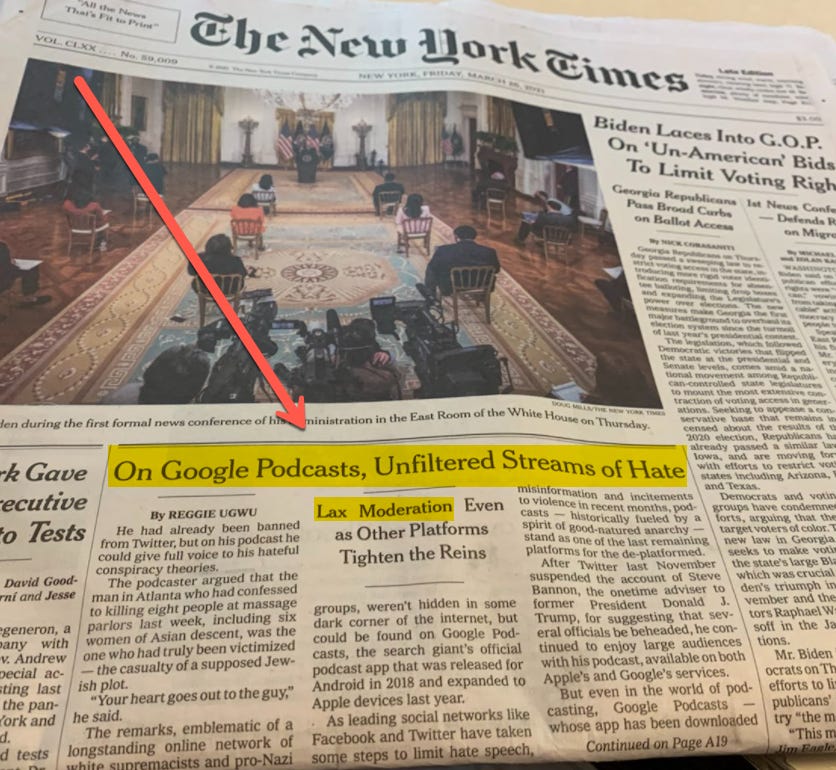
And as I have repeatedly documented, it is not just Democratic politicians agitating for greater political censorship but also their liberal journalistic allies, who cannot tolerate that there may be any places on the internet that they cannot control. That is the petty wannabe-despot mentality that has driven them to police the “unfettered” discussions on the relatively new conversation app Clubhouse, and escalate their attempts to have writers they dislike removed from Substack. Just today, The New York Times warns, on its front page, that there are “unfiltered” discussions taking place on Google-enabled podcasts:

New York Times front page, Mar. 26, 2021

We are taught from childhood that a defining hallmark of repressive regimes is that political officials wield power to silence ideas and people they dislike, and that, conversely, what makes the U.S. a “free” society is the guarantee that American leaders are barred from doing so. It is impossible to reconcile that claim with what happened in that House hearing room over the course of five hours on Thursday.

Glenn Greenwald. This is the conclusion to the latest of Greenwald’s very, very good work on the specter of government-coerced "private" censorship on the internet.


3. Real creativity will die out. Instead, we shall get a multitude of mediocre pseudo-thinkers and vulgar groups and organizations. Our belief systems will turn into a strange chaotic stew of science, philosophy, and magical beliefs.  “Quantitative colossalism will substitute for qualitative refinement.” What is biggest will be regarded as best. Instead of classics, we shall have best-sellers. Instead of genius, technique. Instead of real thought, Information. Instead of inner value, glittering externality.  Instead of sages, smart alecs. The great cultural values of the past will be degraded; “Michelangelos and Rembrandts will be decorating soap and razor blades, washing machines and whiskey bottles.”

Morris Berman, discussing Pitirim Sorokin’s predictions on the collapse of our sensate culture, in 2012.

For more on Sorokin, a fascinating figure, see:


You can read most of my more impromptu stuff at here. It should work in your RSS aggregator, like Feedly, should you want to make a habit of it.

Catching up …

I’ve been, as previously mentioned, focusing on a fun personal project, which entails lots of rabbit-trails and techie learning. But I’ve noticed a few things that seem worth sharing.


The longer Trump is out of office, and the more the press treatment of Biden so starkly contrasts to that of Trump when they take identical substantive positions (e.g., no action against Saudi Arabia for the killing of Jamal Khashogi), the more I understand (not to say “agree with”) the Trump revolution. I don’t expect to be backtracking after reading Christopher Lasch’s Revolt of the Elites and Martin Gurri’s Revolt of the Public, both on my bookshelf awaiting me.


We are a sick country when Netflix has a show top 10 show, Marriage or Mortgage, featuring couples agonizing over whether to have a vulgarly lavish wedding or whether to buy a vulgarly lavish house and postpone any wedding.

Does nobody ever think of a modest wedding and a modest starter home?


America has gone through four Great Awakenings. The first (1730–1755) and second (1790–1840) were rooted in the conviction that Christ reigns victorious over the invisible economy, that the debts incurred by human transgression have been offset by divine innocence. Christ the Scapegoat, through his unmerited death on the Cross, did what we could not: He paid our debts. He took on the stain of sin in order to wipe it clean. These awakenings had a political significance. By preaching the universality of sin and the wideness of God’s mercy, they helped shape the disparate colonies, and later states, into a nation. One could say something similar about America’s third awakening (1855–1930), which was fired by the social gospel. It sought to employ the universality of divine solicitude to unify the country beyond the divisions of economic class.

We are now undergoing a fourth awakening, and matters are very different. The previous awakenings took place under the firm hand of American Protestantism. But today, Mitchell observes, “we are living in the midst of an American Awakening, without God and without forgiveness.” In the century that separates us from the outburst of the social gospel, our society lost its hope in the Cross but not its sense of guilt. The panic over righting wrongs remains, but gone is the promise of redemption. Without the Cross of Christ, the transactions of the invisible realm must be set to balance wholly within the power dynamics of the visible world.

Mitchell sees the rise of identity politics as a crisis of the invisible economy erupting into the visible. No longer guided by the Christian insight that the universality of sin means its resolution must be a divine act, identity politics apportions guilt and innocence according to a person’s race, ethnicity, gender, and sexual orientation, each weighed according to intersectional theory. Guilt and innocence no longer attach to one’s freely chosen actions over the course of a life but are imputed on the basis of one’s inherited and immutable characteristics, skin color above all. The idea of original sin abides but is tragically twisted. It is still something one is born with, but it is no longer universal. Rather, like the Angel of Death, it passes over some and lands upon others.

James F. Keating, Woke Religion, reviewing Joshua Mitchell, American Awakening: Identity Politics and Other Afflictions of Our Time.


I grew up fundamentalist and we avoided rhythm for fear it would lead to dancing and copulation so we praised God in slow mournful voices, like a fishing village whose men had been lost in a storm. We never learned to play a musical instrument for fear we might have talent and this would lead to employment in places where people drink liquor.

What it’s like to be old, if you want to know | Garrison Keillor


When I hear descendants of the Magisterial Reformation saying that sola scriptura isn’t what I think it is, I’m reminded of the perennial excuse of die-hard Communists that “real Communism hasn’t been tried.”

Protestantism was fissiparous (schism-prone) even during Luther’s lifetime. And if one glosses sola scriptura to require heedfulness to the interpretations of one’s clergy, then what you’re left with is simply scriptura, with no the sola. And adherence to scriptura is not at all uniquely Protestant if one insists on proper and not private interpretation.


The coverage of the Atlanta massage parlor murders this week may have destroyed any vestige of respect for media and elite opinion. I was thinking along those lines, but Andrew Sullivan says it better:

Here’s the truth: We don’t yet know why this man did these horrible things. It’s probably complicated, or, as my therapist used to say, “multi-determined.” That’s why we have thorough investigations and trials in America. We only have one solid piece of information as to motive, which is the confession by the mass killer to law enforcement: that he was a religious fundamentalist who was determined to live up to chastity and repeatedly failed, as is often the case. Like the 9/11 bombers or the mass murderer at the Pulse nightclub, he took out his angst on the source of what he saw as his temptation, and committed mass murder. This is evil in the classic fundamentalist sense: a perversion of religion and sexual repression into violence.

We should not take the killer’s confession as definitive, of course. But we can probe it — and indeed, his story is backed up by acquaintances and friends and family. The New York Times originally ran one piece reporting this out. The Washington Post also followed up, with one piece citing contemporaneous evidence of the man’s “religious mania” and sexual compulsion. It appears that the man frequented at least two of the spas he attacked. He chose the spas, his ex roommates said, because he thought they were safer than other ways to get easy sex. Just this morning, the NYT ran a second piece which confirms that the killer had indeed been in rehab for sexual impulses, was a religious fanatic, and his next target was going to be “a business tied to the pornography industry.”

We have yet to find any credible evidence of anti-Asian hatred or bigotry in this man’s history. Maybe we will. We can’t rule it out. But we do know that his roommates say they once asked him if he picked the spas for sex because the women were Asian. And they say he denied it, saying he thought those spas were just the safest way to have quick sex. That needs to be checked out more. But the only piece of evidence about possible anti-Asian bias points away, not toward it.

And yet. Well, you know what’s coming. Accompanying one original piece on the known facts, the NYT ran ninenine! — separate stories about the incident as part of the narrative that this was an anti-Asian hate crime, fueled by white supremacy and/or misogyny. Not to be outdone, the WaPo ran sixteen separate stories on the incident as an antiAsian white supremacist hate crime. Sixteen! One story for the facts; sixteen stories on how critical race theory would interpret the event regardless of the facts. For good measure, one of their columnists denounced reporting of law enforcement’s version of events in the newspaper, because it distracted attention from the “real” motives. Today, the NYT ran yet another full-on critical theory piece disguised as news on how these murders are proof of structural racism and sexism — because some activists say they are.

When The Narrative Replaces The News – The Weekly Dish. There’s more than that:

  • Harvard sent out a note to students premised on this being an anti-Asian crime.
  • Nikole Hannah-Jones wove it into her narrative of “racism and White Supremacist domestic terror.”
  • The Root ominously prophesied that “White supremacy is a virus that, like other viruses, will not die until there are no bodies left for it to infect ….”
  • Trevor Noah insisted that the killer’s confession was self-evidently false (direct quote from Sullivan).

All of that, on the currently-available evidence, is false and absurd. Sullivan again:

But notice how CRT operates. The only evidence it needs it already has. Check out the identity of the victim or victims, check out the identity of the culprit, and it’s all you need to know. If the victims are white, they don’t really count. Everything in America is driven by white supremacist hate of some sort or other. You can jam any fact, any phenomenon, into this rubric in order to explain it. 

The only complexity the CRT crowd will admit is multiple, “intersectional” forms of oppression: so this case is about misogyny and white supremacy. The one thing they cannot see are unique individual human beings, driven by a vast range of human emotions, committing crimes with distinctive psychological profiles, from a variety of motives, including prejudices, but far, far more complicated than that.

The longer Trump is out of office, and the more the press treatment of Biden so starkly contrasts to that of Trump when they take identical substantive positions (e.g., no action against Saudi Arabia for the killing of Jamal Khashogi), the more I understand (not to say “agree with”) the Trump revolution. I don’t expect to be backtracking after reading Christopher Lasch’s Revolt of the Elites and Martin Gurri’s Revolt of the Public, both on my bookshelf awaiting me.


We are a sick country when Netflix has a show top 10 show, Marriage or Mortgage, featuring couples agonizing over whether to have a vulgarly lavish wedding or whether to buy a vulgarly lavish house and postpone any wedding.

Does nobody ever think of a modest wedding and a modest starter home?


America has gone through four Great Awakenings. The first (1730–1755) and second (1790–1840) were rooted in the conviction that Christ reigns victorious over the invisible economy, that the debts incurred by human transgression have been offset by divine innocence. Christ the Scapegoat, through his unmerited death on the Cross, did what we could not: He paid our debts. He took on the stain of sin in order to wipe it clean. These awakenings had a political significance. By preaching the universality of sin and the wideness of God’s mercy, they helped shape the disparate colonies, and later states, into a nation. One could say something similar about America’s third awakening (1855–1930), which was fired by the social gospel. It sought to employ the universality of divine solicitude to unify the country beyond the divisions of economic class.

We are now undergoing a fourth awakening, and matters are very different. The previous awakenings took place under the firm hand of American Protestantism. But today, Mitchell observes, “we are living in the midst of an American Awakening, without God and without forgiveness.” In the century that separates us from the outburst of the social gospel, our society lost its hope in the Cross but not its sense of guilt. The panic over righting wrongs remains, but gone is the promise of redemption. Without the Cross of Christ, the transactions of the invisible realm must be set to balance wholly within the power dynamics of the visible world.

Mitchell sees the rise of identity politics as a crisis of the invisible economy erupting into the visible. No longer guided by the Christian insight that the universality of sin means its resolution must be a divine act, identity politics apportions guilt and innocence according to a person’s race, ethnicity, gender, and sexual orientation, each weighed according to intersectional theory. Guilt and innocence no longer attach to one’s freely chosen actions over the course of a life but are imputed on the basis of one’s inherited and immutable characteristics, skin color above all. The idea of original sin abides but is tragically twisted. It is still something one is born with, but it is no longer universal. Rather, like the Angel of Death, it passes over some and lands upon others.

James F. Keating, Woke Religion, reviewing Joshua Mitchell, American Awakening: Identity Politics and Other Afflictions of Our Time.


I grew up fundamentalist and we avoided rhythm for fear it would lead to dancing and copulation so we praised God in slow mournful voices, like a fishing village whose men had been lost in a storm. We never learned to play a musical instrument for fear we might have talent and this would lead to employment in places where people drink liquor.

What it’s like to be old, if you want to know | Garrison Keillor


When I hear descendants of the Magisterial Reformation saying that sola scriptura isn’t what I think it is, I’m reminded of the perennial excuse of die-hard Communists that “real Communism hasn’t been tried.”

Protestantism was fissiparous (schism-prone) even during Luther’s lifetime. And if one glosses sola scriptura to require heedfulness to the interpretations of one’s clergy, then what you’re left with is simply scriptura, with no the sola. And adherence to scriptura is not at all uniquely Protestant if one insists on proper and not private interpretation.


The coverage of the Atlanta massage parlor murders this week may have destroyed any vestige of respect for media and elite opinion. I was thinking along those lines, but Andrew Sullivan says it better:

Here’s the truth: We don’t yet know why this man did these horrible things. It’s probably complicated, or, as my therapist used to say, “multi-determined.” That’s why we have thorough investigations and trials in America. We only have one solid piece of information as to motive, which is the confession by the mass killer to law enforcement: that he was a religious fundamentalist who was determined to live up to chastity and repeatedly failed, as is often the case. Like the 9/11 bombers or the mass murderer at the Pulse nightclub, he took out his angst on the source of what he saw as his temptation, and committed mass murder. This is evil in the classic fundamentalist sense: a perversion of religion and sexual repression into violence.

We should not take the killer’s confession as definitive, of course. But we can probe it — and indeed, his story is backed up by acquaintances and friends and family. The New York Times originally ran one piece reporting this out. The Washington Post also followed up, with one piece citing contemporaneous evidence of the man’s “religious mania” and sexual compulsion. It appears that the man frequented at least two of the spas he attacked. He chose the spas, his ex roommates said, because he thought they were safer than other ways to get easy sex. Just this morning, the NYT ran a second piece which confirms that the killer had indeed been in rehab for sexual impulses, was a religious fanatic, and his next target was going to be “a business tied to the pornography industry.”

We have yet to find any credible evidence of anti-Asian hatred or bigotry in this man’s history. Maybe we will. We can’t rule it out. But we do know that his roommates say they once asked him if he picked the spas for sex because the women were Asian. And they say he denied it, saying he thought those spas were just the safest way to have quick sex. That needs to be checked out more. But the only piece of evidence about possible anti-Asian bias points away, not toward it.

And yet. Well, you know what’s coming. Accompanying one original piece on the known facts, the NYT ran ninenine! — separate stories about the incident as part of the narrative that this was an anti-Asian hate crime, fueled by white supremacy and/or misogyny. Not to be outdone, the WaPo ran sixteen separate stories on the incident as an antiAsian white supremacist hate crime. Sixteen! One story for the facts; sixteen stories on how critical race theory would interpret the event regardless of the facts. For good measure, one of their columnists denounced reporting of law enforcement’s version of events in the newspaper, because it distracted attention from the “real” motives. Today, the NYT ran yet another full-on critical theory piece disguised as news on how these murders are proof of structural racism and sexism — because some activists say they are.

When The Narrative Replaces The News – The Weekly Dish. There’s more than that:

  • Harvard sent out a note to students premised on this being an anti-Asian crime.
  • Nikole Hannah-Jones wove it into her narrative of “racism and White Supremacist domestic terror.”
  • The Root ominously prophesied that “White supremacy is a virus that, like other viruses, will not die until there are no bodies left for it to infect ….”
  • Trevor Noah insisted that the killer’s confession was self-evidently false (direct quote from Sullivan).

All of that, on the currently-available evidence, is false and absurd. Sullivan again:

But notice how CRT operates. The only evidence it needs it already has. Check out the identity of the victim or victims, check out the identity of the culprit, and it’s all you need to know. If the victims are white, they don’t really count. Everything in America is driven by white supremacist hate of some sort or other. You can jam any fact, any phenomenon, into this rubric in order to explain it. 

The only complexity the CRT crowd will admit is multiple, “intersectional” forms of oppression: so this case is about misogyny and white supremacy. The one thing they cannot see are unique individual human beings, driven by a vast range of human emotions, committing crimes with distinctive psychological profiles, from a variety of motives, including prejudices, but far, far more complicated than that.

The media is supposed to subject easy, convenient rush-to-judgment narratives to ruthless empirical testing. Now, for purely ideological reasons, they are rushing to promote ready-made narratives, which actually point away from the empirical facts. To run sixteen separate pieces on anti-Asian white supremacist misogynist hate based on one possibly completely unrelated incident is not journalism. It’s fanning irrational fear in the cause of ideological indoctrination. And it appears to be where all elite media is headed.

Others reached that conclusion about media and elite opinion ahead of me. Just because they jumped the gun doesn’t mean they were wrong.

That’s it for now.


You can read most of my more impromptu stuff at here. It should work in your RSS aggregator, like Feedly, should you want to make a habit of it.

The Equality Act

When I listen to news, I listen to NPR. I’m aware of its liberal bias, which manifests in how it covers news but also — and this is too rarely appreciated — what it considers "newsworthy" in the first place.

But NPR really dropped the ball on the Equality Act, which comes up for vote in the U.S. House today. Its story doesn’t even mention opposition based on the certain (not speculative) effect of requiring that male-to-female transgender persons be permitted to compete in athletic events against biological women.

A guest opinion piece in the Wall Street Journal identifies other problems besides the Act’s adverse effect on religious and conscience rights:

The Equality Act would threaten the existence of women’s prisons, public-school girls’ locker rooms, and women’s and girls’ sports teams. It would limit freedom of speech, freedom of association, accurate data collection, and scientific inquiry. It would threaten the rights of physicians who doubt the wisdom of performing life-changing, reproduction-limiting procedures, and parents who seek to protect their minor children from such treatment.

This isn’t hyperbole. Similar state laws have already resulted in such harm. In California, Catholic hospitals have faced lawsuits for declining to perform life-altering “gender affirmation” surgery in September 2016. In Connecticut, two biologically male athletes won a combined 15 girls state championship races, allegedly taking opportunities for further competition and scholarships from female runners in June 2019. Alaska’s Equal Rights Commission opened an investigation into a women’s shelter after it turned away a biological male in September 2019. H.R. 5 would impose the most extreme form of these laws on the whole country.

The bill is so broad that even some who support the measure in principle have called for Congress to carve out exceptions. Writing in the Washington Post in 2019, tennis legend and activist Martina Navratilova asked Congress to exempt athletic competitions. “The reality,” Ms. Navratilova wrote, “is that putting male- and female-bodied athletes together is co-ed or open sport. And in open sport, females lose.”

Women forced to compete against male athletes risk not only losing competitions, but also serious injury. Ask Tamikka Brents, whose orbital bone was fractured by transgender MMA fighter Fallon Fox in the latter’s first professional fight as a woman. Ms. Brents said she felt “overwhelmed” by the fight.

The reason that some contexts require separation of the sexes is obvious: Women have unique physical vulnerabilities. Female inmates are kept separate from male inmates for just this reason. How can we possibly reduce the number of sex crimes against women if the law refuses to recognize such basic differences?

Under the guise of fairness, the Equality Act would forbid policy makers from ever taking into consideration the differences between men and women that are necessary in order to guarantee safety and equality of the sexes.

The Equality Act isn’t about protecting people from discrimination; it’s about compelling adherence to gender ideology. Don’t let its name fool you.

The Equality Act Makes Women Unequal – WSJ

Religious freedom was once held in such high esteem that Congress was almost unanimous on the Religious Freedom Restoration Act less than 30 years ago, and Bill Clinton supported it and signed it. Today, it generally appears in scare quotes, often with intensifiers (e.g., "so-called ‘religious freedom’"), and is to the cultural left a bugaboo like saying "George Soros" to the cultural right.

NPR mis-reported the primary objections to The Equality Act, a bit of liberal groin piety analogous to tax cuts on the right, and I can’t help but suspect that they did so to "poison the well." Selma envy is alive and well as a prime motivation of today’s progressivism.

Valentines Hodge-Podge

Trigger Alert: This blog says nothing about any current front page political news. If you’re looking for a fix, you’re not going to get it here today.

What it does say is a hodge-podge of stuff collected since I last blogged here.


Rod Dreher, on a new Andrei Konchalovsky film Dear Comrades!:

At one point, after the evidence of the Party’s monstrousness nearly consumes her, she admits to the kindly KGB agent helping her search for her daughter that if Communism is false, then she has nothing to believe in. This is a universally human moment: so many of us are committed to a religion, a politics, an organization, a tribe, etc., that give us a sense of meaning and purpose. We dismiss evidence that discredits the thing we worship because we would not know what to do with ourselves if the thing is false … Lyuda is a diehard believer. Earlier in the film, we hear her chastising ordinary people, including her daughter, who complain about shortages and injustice in the system. For Lyuda, this is a kind of blasphemy.

What kept me awake for hours after finishing Dear Comrades! was reflecting on how damned difficult it is to live in truth — not only to have the courage to act on truth, but even more basically, to have the ability to see with clear eyes. What am I blind to? What injustices do I tolerate because to recognize them would mean slaying some sacred cows? How much evil and suffering continue in the world because people would rather live with a lie that comforts than with a truth that shatters?


Alasdair MacIntyre once called the New York Times “the parish magazine of self-congratulatory liberal Enlightenment.” Now, despite having some of the best columnists in America, the paper’s reporting side is just the Fox News of the semi-literate left.

Alan Jacobs


The only reason this kind of food mileage and disconnection can occur is because cheap energy masks the costs. If the true cost of fuel, including the cost of maintaining Middle Eastern stability, were actually added to transportation costs, food-miles would not look efficient. If energy were as dear as it was before the petroleum age, refrigerated warehouses, climate control, and shipping mesclun mix from California to Boston would be prohibitively expensive.

Joel Salatin, Folks, This Ain’t Normal: A Farmer’s Advice for Happier Hens, Healthier People, and a Better World


Fusionism, properly understood, is not a marriage of two groups. It’s a marriage of two value sets. A fusionist is someone who sees both liberty (in the classical sense of freedom from aggression, coercion, and fraud) and virtue (in the Judeo-Christian sense of submission to God’s commands) as important. Fusionism is therefore a distinct philosophical orientation unto itself. What’s more, it has historically been the dominant orientation on the American right.

Today’s post-liberal conservatives appear to think they’re distinguished by the belief that virtue matters. They behave as if their core disagreement with fusionists is about whether human beings have moral obligations that go beyond leaving others alone to do as they please. This could hardly be more wrong. Anyone who holds to the Judeo-Christian tradition—as fusionists by definition do—accepts that we have manifold duties to one another. The disagreement is about whether it’s the state’s job to enforce those moral obligations.

Stephanie Slade, Is There a Future for Fusionism? – Reason.com


Manent recognizes that face coverings are not neutral symbols. Their use is an “ongoing aggression against human sociability.” Like self-isolation and other methods of minimizing social contact, masks impede the face-to-face encounters that renew sociability and restore the baseline of trust that every civic order needs in order to sustain itself during times of stress and conflict.

R. R. Reno


Reparations politics is the humble-brag mirror image of white supremacy.

R. R. Reno


I urge readers to purchase print subscriptions. The censorship of recent months indicates that we could at any time be shut down on the internet and kicked off Amazon’s Kindle or Apple’s iPad. At this juncture, print journalism still has the protection of the United States Constitution. Unlike Big Tech, the U.S. Postal Service is not allowed to choose whose ideas and opinions it will deliver.

R. R. Reno, speaking of First Things

That seems a bit overwrought, but if I were running a orthodox Catholic neocon journal, and said snarky things about reparations like the preceding item, I’d probably be obliged to think about such things, too.


On Andrea Mitchell, Jennifer Rubin — the only two people in the world currently who can make Ted Cruz look good:

If you really were a person who reads and understands literature, you would know that — in the world of novels — a character who corrects other people curtly in that pedantic “No, that’s Faulkner” manner is an icky prig. I’ve read a lot of novels, and characters who talk like that are up to no good. That snootiness, even when there’s no mistake, marks a character toward whom you know instinctively you are not supposed to feel sympathetic. And let me just add that when the novelist makes a character utter words like “it says volumes about his lack of soul,” the competent reader knows immediately that it is the speaker of those words who lacks soul.

Ann Althouse, Andrea, Jennifer, and The 2 Williams


The Word of the LORD came unto me, saying:
O miserable cities of designing men,
O wretched generation of enlightened men,
Betrayed in the mazes of your ingenuities,
Sold by the proceeds of your proper inventions:
I have given you hands which you turn from worship,
I have given you speech, for endless palaver,
I have given you my Law, and you set up commissions,
I have given you lips, to express friendly sentiments,
I have given you hearts, for reciprocal distrust.
I have given you power of choice, and you only alternate
Between futile speculation and unconsidered action.
Many are engaged in writing books and printing them,
Many desire to see their names in print,
Many read nothing but the race reports.
Much is your reading, but not the Word of GOD,
Much is your building, but not the House of GOD.
Will you build me a house of plaster, with corrugated roofing,
To be filled with a litter of Sunday newspapers?

Poem: Choruses from ” The Rock ” by T. S. Eliot

I don’t know that I’d ever read this poem before. I’ve got to get more systematic.


“We are more sure to arise out of our graves than out of our beds. “ —Thomas Watson via Christopher P. Chelka on micro.blog.


You can read most of my more impromptu stuff at this little liteweight blog that’s sort of like Twitter without the toxicity from anyone other than me, or join me and others on micro.blog. You won’t find me on Facebook any more, and I don’t post on Twitter (though I do have an account for occasional gawking).