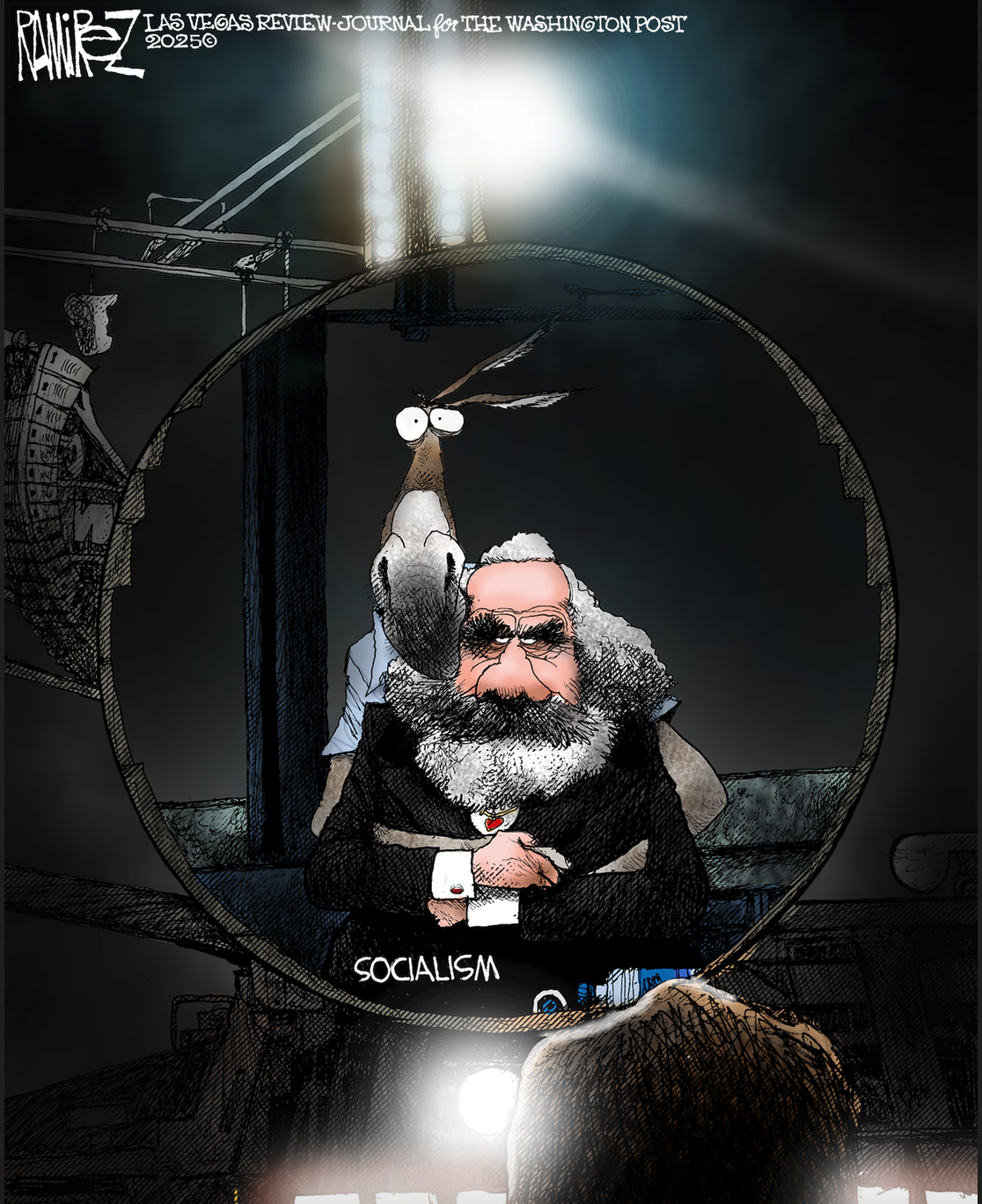
Friday, 1/30/26

David Brooks bids the Gray Lady farewell

I’ve long believed that there is a weird market failure in American culture. There are a lot of shows on politics, business and technology, but there are not enough on the fundamental questions of life that get addressed as part of a great liberal arts education: How do you become a better person? How do you find meaning in retirement? Does America still have a unifying national narrative? How do great nations recover from tyranny?

We have become a sadder, meaner and more pessimistic country. One recent historical study of American newspapers finds that public discourse is more negative now than at any time since the 1850s. Large majorities say our country is in decline, that experts are not to be trusted, that elites don’t care about regular people. Only 13 percent of young adults believe America is heading in the right direction. Sixty-nine percent of Americans say they do not believe in the American dream.

Loss of faith produces a belief in nothing. …

Nihilism is the mind-set that says that whatever is lower is more real … Disillusioned by life, the cynic gives himself permission to embrace brutality, saying: We won’t get fooled again. It’s dog eat dog. If we’re going to survive, we need to elect bullies to high places …

Multiple generations of students and their parents fled from the humanities and the liberal arts, driven by the belief that the prime purpose of education is to learn how to make money.

We’re abandoning our humanistic core. … As a result of technological progress and humanistic decay, life has become objectively better but subjectively worse. We have widened personal freedom but utterly failed to help people answer the question of what that freedom is for.

The most grievous cultural wound has been the loss of a shared moral order. We told multiple generations to come up with their own individual values. This privatization of morality burdened people with a task they could not possibly do, leaving them morally inarticulate and unformed. It created a naked public square where there was no broad agreement about what was true, beautiful and good. Without shared standards of right and wrong, it’s impossible to settle disputes; it’s impossible to maintain social cohesion and trust. Every healthy society rests on some shared conception of the sacred — sacred heroes, sacred texts, sacred ideals — and when that goes away, anxiety, atomization and a slow descent toward barbarism are the natural results.

It shouldn’t surprise us that, according to one Harvard survey, 58 percent of college students say they experienced no sense of “purpose or meaning” in their life in the month before being polled. It shouldn’t surprise us that people are so distrusting and demoralized. I’m haunted by an observation that Albert Camus made about his own continent 75 years ago: The men of Europe “no longer believe in the things that exist in the world and in living man; the secret of Europe is that it no longer loves life.”

David Brooks’ farewell column for the New York Times (gift link) reprises the concerns about which he has been writing of late, which writing made him my favorite at the Times. (See below for an example.) I hope he won’t just disappear into some Yale classroom, never again to share his wisdom with the wider world.

The idea that “the prime purpose of education is to learn how to make money” has outraged me for as long as I can remember — perhaps because I succumbed to it for what seemed like an adequate personal reason (an engagement to be married in a year when I was 19), but then never got back formally to the humanities when that reason vanished. I’ve been an autodidact ever since, envious of those who studied the humanities more formally, in the give-and-take of a well-run classroom.

Devouring “the news”

Something I still aspire to

One journalist I knew (who worked for a far bigger outlet as a political correspondent) once told me that the news was the first thing she read when she opened her eyes, and the last thing she saw before falling asleep.

Perhaps this is how some journalists need to live their lives. If reporting the daily news is their calling, they must be deeply aware of what is going on. Even if it means watching and reading all the time.

But it is not for you and me, friends. This sort of news consumption will reign your emotions: it will drive you to anger, terror, annoyance, and despair. It will make you feel helpless. It will divorce you from the daily, real things happening in your own home. Take it from someone who’s lived it: knowing absolutely everything that is happening right now—whether in Iran, or Ukraine, or Washington, D.C., or Minnesota—is not your calling. It can actually serve as a dangerous distraction from the vocations of your own life, neighborhood, and community.

Here are some boundaries I’ve set in place for my news consumption since 2020. They have been very helpful. I pray they are helpful to you.

  • Check one site, and check it once every couple days at most. If you can, check it once a week. That’s it. Find a reliable source that you trust—preferably a site that tries not to follow a party line. It is more likely to give you the nuance partisan news outlets neglect. If the events of the hour are truly and lastingly important, they will still be talked about a week later. If a credible news outlet, one you find trustworthy and careful, isn’t talking about it, there’s a good chance you should not worry about it. This filters out a lot of momentary “noise,” and allows you to attend to what truly matters.

Gracy Olmstead.

Olmstead is the second person who tacitly or explicitly recommends what strikes me, at the gut level, as excessive disengagement: once-weekly news exposure. Alan Jacobs, who only reads the Economist, and that only when it arrives at his home, is the other.

I was raised in such a way that, by precept or example (I don’t remember the precept being vocalized), I absorbed the message that “good citizens stay on top of the news.” I don’t know that it was ever right. Maybe it was in the 1950s. But “the news” is far vaster today than it was then, and more polarized, and frequently (especially if you get social media news) insane.

All that aside, I sense that I’m spending too much time on the news because, well, I sit down for morning devotions and news around 5:30 am and often am still sitting there at 10 am. Like today, for instance, he typed at 10:00 am.

I’m retired, so it’s not like I’m robbing from my employer. God, maybe, but not, god forbid, my employer.

I’m aware of this. I think I’m making progress.

Re-orientation

Alan Jacobs sympathizes with people who are tempted to give up reading the news because it’s too depressing. But that:

is an inadequate response; it has a tendency to leave you fretful and at loose ends. 

What helps is to read works from the past that deal with questions and challenges that are structurally similar to the ones we’re facing but that emerged in a wholly different context. Right now I am reading the Psalms, especially those that deal with questions of justice and injustice, and the Hebrew prophets. Though comparisons of the current moment to the rise of Nazism often strike me as overblown, they seem increasingly apt these days, so I am returning to Bonhoeffer’s Letters and Papers from Prison. I am also reading, perhaps surprisingly but quite appropriately and illuminatingly, Machiavelli’s Discourses. Machiavelli himself was breaking bread with the dead: reading Roman history as a way of understanding the challenges of 16th-century Florentine politics. 

This practice offers a threefold reorientation: 

  • Emotional, because it gives you a break from people who are continually trying to stoke your feelings of anger and hatred; 
  • Intellectual, because in comparing past situations with ours you get an increasingly clear sense of what about our current situation is familiar (and therefore subject to familiar remedies) and what unusual or even unique (and therefore in need of new strategies); 
  • Moral, because, as Aragorn says to Éomer, “Good and ill have not changed since yesteryear; nor are they one thing among Elves and Dwarves and another among Men. It is a man’s part to discern them, as much in the Golden Wood as in his own house.”

Radicalization

Ambition versus lust for domination

The 18th-century English historian Edward Wortley Montagu distinguished between ambition and the lust for domination. Ambition can be a laudable trait, since it can drive people to serve the community in order to win public admiration. The lust for domination, he wrote, is a different passion, a form of selfishness that causes us to “draw every thing to center in ourselves, which we think will enable us to gratify every other passion.”

The insatiable lust for domination, he continues “banishes all the social virtues.” The selfish tyrant attaches himself only to those others who share his selfishness, who are eager to wear the mask of perpetual lying. “His friendship and his enmity will be alike unreal, and easily convertible, if the change will serve his interest.”

Tacitus was especially good at describing the effect the tyrant has on the people around him. When the tyrant first takes power, there is a “rush into servitude” as great swarms of sycophants suck up to the great man. The flattery must forever escalate and grow more fawning, until every follower’s dignity is shorn away. Then comes what you might call the disappearance of the good, as morally healthy people lie low in order to survive. Meanwhile, the whole society tends to be anesthetized. The relentless flow of appalling events eventually overloads the nervous system; the rising tide of brutality, which once seemed shocking, comes to seem unremarkable.

David Brooks

History based on reality

I have suspected that part of the reason for a rightward swing in young people [blood-and-soil nationalism,, though] may be that the holocaust is not seared into their worldview and identity as it is in my generation. I was born after the war, but was acutely aware of its horrors. I specifically recall Life’s Picture History of World War II in my childhood home. A child who viewed that repeatedly, as I did, isn’t likely to forget.

When I think about the distortion of history, I remember when I was updating my history of Jerusalem and a friend rang me and said she had an “indispensable history of the Jewish people that you have to read.” She sent it over, all wrapped up. When I opened it, I was surprised to find it was The Protocols of the Elders of Zion, the antisemitic forgery created by the czar’s secret police. History matters, but more than ever, we need to assert that it be based on real events.

Simon Sebag Montefiore, How Holocaust Denial Became Mainstream

No natural immunity

As Harvard professor Stephen Pinker once said:

A way in which I do agree with my fellow panelist that political correctness has done an enormous amount of harm in the sliver of the population whose affiliation might be up for grabs comes from the often highly literate, highly intelligent people that gravitate to the alt-right – internet savvy, media savvy – who often are radicalized in that way – who “swallow the red pill” as the saying goes from the Matrix – when they are exposed for the first time to true statements that have never been voiced in college campuses or in the New York Times or in respectable media. It’s almost like a bacillus to which they have no immunity, and they are immediately infected with both an outrage that these truths are unsayable, and no defense against taking them to what we might consider rather repellent conclusions.

Aaron Renn, The Manosphere and the Church (September 2020)

Presumption of Regularity Redux

Early in Trump’s second administration, handwriting appeared on the walls of the Department of Justice and the offices Federal District Attorneys:

Integrity will not be tolerated if it requires candor to the court about weaknesses in the Administration’s position.

If you’ve ever been even a mediocre lawyer, you know that intransigence toward a judge who has figured out your case’s weakness is not wise even in the short term. In the longer term, it tells the court you can’t be trusted to be honest.

In Federal Courts, there was a longstanding “presumption of regularity” in the doings of government lawyers. That has been lost so completely that it’s no longer even talked about in the news, especially when there are new Administration theatrics to talk about.

But I’m going to talk about something related. Minneapolis is a “sanctuary city” of a fairly rigorous sort. It won’t cooperate with DHS/ICE even so modestly as to let them know when they have illegal immigrants convicted of violent crimes in their custody. That’s part of Trump’s rationale, at least after-the-fact, for sending in 3000 ICE agents ostensibly to deal with welfare fraud that didn’t involve illegal immigrants but US Citizens who were once immigrants. So something smells fishy.

Those ICE agents are wearing masks. They’re behaving provocatively. The news has stories about them grabbing brown kids as they leave school, then returning them hours later because they’re here legally, and about American citizens of foreign origin being snatched and sent to hellhole foreign prisons.

The new guy in charge of ICE in Minneapolis says he’ll draw down his troops if Minneapolis will start cooperating on the transfer of immigrant prisoners to ICE control.

Can you, Minneapolis official, entertain any presumption of regularity on the part of ICE? Can you presume that American Citizens won’t be manhandled, tortured, deported by these masked goons?

iPhone, the Kleenex for wiping up ICE

The iPhone [note iPhone standing in for all smartphones, like Kleenex=facial tissue] seems to be the only serious threat to ICE’s violence. We know they feel emboldened to do virtually anything to anybody and have been granted a rhetorical “absolute immunity.” We also know that the federal government will tell big, beautiful, massive lies to justify any and all ICE abuses — before any investigations.

So Renee Good was a “deranged lunatic,” Karoline Leavitt declared. Good didn’t just try to run over an ICE officer; she did run him over, and it was unclear if he would survive his injuries, said the president. She was engaged in “domestic terrorism,” according to Stephen Miller. Equally, Alex Pretti was another “would-be assassin” who walked up to ICE officers “brandishing” a gun, trying “to murder federal agents” who, fearing a “massacre,” fired solely in self-defense. He was an “insurrectionist” rightly “put down,” in the words of one MAGA congressman. Last night, Trump repeated his description of Pretti as an “insurrectionist” and “agitator.”

We’ve become worried — with very good reason — about the damage phones have done to our brains, our attention span, and our democracy. But without them, the Trump lies about Minneapolis might well have prevailed.

In a country with a fascistic government that disseminates massive lies — ours — iPhone videos become essential to keep democracy and objective truth on life support. There are dangers, of course. Lack of context can deceive; AI has made every video’s authenticity suspect; people can subjectively interpret things any way they want. But what happened this past week in America was that, even with all those caveats, a big majority of sane Americans emerged out of the woodwork, looked at the videos, rejected tribalism, and said: Nah, ICE is lying. And ICE had to retreat.

Andrew Sullivan, Can the iPhone Save Our Democracy?

Civic hygiene: another reason to hold onto my phone while many around me are (vocally) giving up theirs. I don’t struggle with compulsive smartphone use; if you do, your mileage may vary.

Really, the only qualms I have about my phone are about the Chinese factory workers who make them — and that’s always a tough call because some jobs just are hard or boring, and the line between that and metaphorical slavery is indistinct.

The death of the magazine

But a magazine I always thought of as a relatively small group of identifiable writers, connected with some broad themes. They could disagree with each other. They had some broad agreements, creating this little thing that would have a variety of their views.

The Atlantic is now just now a machine. I mean, it has hundreds of staffers. It has hundreds of writers. … The magazine itself, of course, was directly challenged by the internet in ways that probably impossible to recreate. The fact that you had to have these writers stapled together with paper really did create a particular cultural product that cannot be done anymore.

Kevin D. Williamson

It’s not easy being a lawyer in this DoJ

Throughout the extensive litigation over the [Alien Enemies Act], in this case and others, the Trump Administration has claimed the president deserves absolute deference when he claims that an “invasion” exists. The absurd implications of this position were highlighted in yesterday’s argument, when Fifth Circuit Chief Judge Jennifer Elrod (appointed by George W. Bush) asked whether the president could invoke the AEA in response to the “British Invasion” of rock stars, like the Beatles. “What if,” she asked “the [President’s] proclamation said ‘we’re having a British invasion.’ They’re sending all these musicians over to corrupt young minds…. They’re coming over and they’re taking over all kinds of establishments.” Could courts then rule the president’s invocation of the AEA was illegal? In response, Justice Department lawyer Drew Ensign admitted the government’s position would require courts to still defer to the president, and allow him to wield the extraordinary emergency powers that can only be triggered by an actual “invasion.”

Ilya Somin, Could the President Invoke the Alien Enemies Act in Response to the “British Invasion” of Rock Stars Like the Beatles?

Felicitous sentences

  • Rachel Louise Snyder appraised the Immigration and Customs Enforcement agent who killed Renee Good: “The man, with his face covering, his tactical vest, his handgun and his shorn hair, was kitted up to playact in a war against unarmed everybodies. He was frailty wrapped in fatigues.” (Karla Holomon, Cary, N.C., and Molly Gaffga, Sanatoga, Pa., among many others)
  • Maureen Dowd parsed this cursed second term of Trump’s: “Trump Redux is infatuated with drone strikes and airstrikes, tumescent with the power of the world’s greatest military, hungry to devour the hemisphere in one imperialistic gulp.” (Ellen Casey, Hope, R.I., and Kate Kavanagh, Concord, Mass.)

Via Frank Bruni.

Shorts

  • I’ve always been kind of anti-populist because I know people. And the more people you know, the less of a populist you are, I think. (Kevin D. Williamson)
  • From the perspective of political theory, my argument falls within the category of “political indifferentism”–that is, the notion that politics is mostly a matter “indifferent” to core human interests. (Ephraim Radner, Mortal Goods)
  • [T]he world is controlled by forces against which reason can do nothing …. [from Dietrich Bonhoeffer, in aid of the aforementioned re-orientation].
  • There are many who do not know they are Fascists, but will find it out when the time comes. (Ernest Hemingway via Kevin D. Williamson)
  • Of all his weaknesses that is one of his greatest, that he’d rather hurt himself than not fight. He’d rather hurt the country than not fight. The fight is all. (Peggy Noonan)
  • Creation is the gift that invents its recipient. (Andrew Davison, likely channeling Henri de Lubac)
  • “Today,” says de Lubac, “when the essential doctrine of the unity of the human race is attacked, mocked by racism,” we should feel anguish that it is so weakly defended by Christian leaders. (James R. Wood)
  • Nihilism is the mind-set that says that whatever is lower is more real. (David Brooks in his farewell NYT column)

Elsewhere in Tipsyworld


I don’t do any of the major social media, but I have two sub-domains of the domain you’re currently reading: (a) You can read most of my reflexive stuff, especially political here. (b) I also post some things on my favorite no-algorithm social medium.

Thursday, 12/4/25

Luxury Beliefs

There are all kinds of ideas and policies that would have bad effects if implemented. But there is a special class of bad ideas and policies that proliferate in good part because those who hold them, being insulated from their effects, have never seriously thought about the consequences that would ensue from their implementation. The reason why the concept of luxury beliefs has resonated so widely is that it gives a name to people who treat as a parlor game questions that potentially have very serious consequences—just not for themselves.

Yasha Mounk, Luxury Beliefs Are Real.

We owe a debt of gratitude to the young man who coined this phrase. It strikes me as analogous to the whoring and wenching of the rich and famous which does not, shall we say, translate well to kids in The Projects (but is more like a transgressive raised-middle-finger than a “belief”).

The Hive Mind

Consider this ominous anecdote from Steven Mintz, a history professor at the University of Texas at Austin:

I require substantial writing in my 400-person U.S. history survey course—but now I largely receive 400 variations on the same essay. The wording, structure, transitions, tone, even the closing sentences are largely identical.

This is eerily like the zombie-ish characters in Pluribus, who all say the exact same thing.

But in Mintz’s case, this is real behavior from real students. They have voluntarily abandoned their individual opinions and embraced the hive mind.

And the hive mind is available to all of them via Chat GPT.

I actually take some solace in TV series such as Pluribus and Severance. They show how anxious we are about this threat. At some deep level in our souls, we know that the destruction of our autonomy and selfhood is not a good thing.

It isn’t progress. It isn’t utopia. It isn’t liberation.

And that is the first step in escaping the ant hill. The next step is to bring others along with us.

This is why I keep talking about a New Romanticism (see here and here). That is our counter-offensive, and it’s already starting.

Ted Gioia, The New Anxiety of Our Time Is Now on TV (bold added)

Fundamental law

Ultimately, however, constitutionalism means that society must accept an unpopular policy that respects constitutional limits over a popular policy that violates them. The very foundation of constitutionalism is that certain fundamental protections—whether for free speech or the separation of powers—must be beyond the reach of popular majorities. There will almost always be some policy that is popular but unconstitutional.

Andrew O’Donohue on “court-baiting.”

The Reality of Irreligious Violence

The shift from church power to state power is not the victory of peaceable reason over irrational religious violence. The more we tell ourselves it is, the more we are capable of ignoring the violence we do in the name of reason and freedom.

William T. Cavanaugh, The Myth of Religious Violence.

I have published this on several Sundays over the years, I’m sure, but with our POTUS and ever-so-manly-and-full-of-lethality “Secretary of War” gleefully murdering supposed drug dealers in the Caribbean in the name of fighting “narco-terrorism,” it seems like a worthy weekday reminder now.

As a Chosen People with what Niebuhr refers to as a “Messianic consciousness,” Americans came to see themselves as set apart, their motives irreproachable, their actions not to be judged by standards applied to others.

Andrew Bacevich in his Introduction to a 2008 University of Chicago Edition of Rheihold Niebuhr’s The Irony of American History.

Shorts

  • What’s important to notice is that it isn’t, and never was, “Orthodoxy is masculine.” It only felt masculine, in comparison with the general run of American churches. (Frederica Matthewes-Green)
  • Put someone with a complex about not being respected in charge of an agency with guns and you’re asking for trouble. (Nick Catoggio, A Few Bad Men)
  • The problem is not so much that public policy has failed as that it has succeeded at the wrong things. (Oren Cass, The Once and Future Worker)

Elsewhere in Tipsyworld

Tuesday, 11/18/25

Tucker the Marcionite Heretic

Jason Willick’s Tucker Carlson, Nick Fuentes and the targeting of Judeo-Christian tradition was deeply disappointing in many ways, but it levels a charge against Tucker Carlson that I’m going to assume arguendo is substantially true (I assume that because I’m not going to wallow in audit Carlson’s entire logorrheic output to synthesize my own opinion on it):

The former Fox News host is targeting a distinctively American, 20th-century concept: The Judeo-Christian consensus … A recent theme of the podcaster is that the Old Testament (the part of the Bible subscribed to by both Jews and Christians) is dark and tribal, while the New Testament (the part subscribed to only by Christians) is the fount of enlightened Western values …

Carlson explained in an August podcast that on a recent reading of the Old Testament, he “was pretty shocked by — as I think many people who read it are — shocked by the violence in it, and shocked by the revenge in it, the genocide in it.” By contrast, he explained this month as the Fuentes controversy raged, “Western civilization is derived from the New Testament.” …

Carlson is trying to heighten what he sees as contradictions between the Old and New testaments — and by implication between Judaism and Christianity.

I’m not going to pause to defend the Old Testament’s “violence,” “revenge” and “genocide.” There’s a whole lot of theology behind any such defense and I no longer delude myself into thinking I’m a pretty good “lay theologian.”

But I am going to point out that Carlson’s belief about the contradiction between Judaism and Christianity rhymes with an ancient heresy, Marcionism:

Marcion preached that the benevolent God of the Gospel who sent Jesus into the world as the savior was the true Supreme Being, different and opposed to the malevolent deity, the Demiurge or creator deity, identified with Yahweh in the Hebrew Bible … Marcionism was denounced by its opponents as heresy and written against by the Church Fathers – notably by Tertullian in his five-book treatise Adversus Marcionem (Against Marcion), in about 208 … The premise of Marcionism is that the ministry of Jesus is incompatible with the actions of God in the Old Testament … Marcionites held that the God of the Hebrew Bible was inconsistent, jealous, wrathful and genocidal, and that the material world he created was defective, a place of suffering ….

Wikipedia (hyperlinks omitted).

For me, at least, identifying Tucker as Marcionite or Marcionite-adjacent is more potent than the vaguer charge of “Christian identity politics.”

(For purposes of politics in 2025, moreover, it seems prima facie relevant that the destruction of the Jerusalem Temple in 70 A.D. and the expulsion of Jews from Judea destroyed “Second Temple Judaism,” forcing the formation over subsequent centuries of today’s “Rabbinic Judaism, which rests on more than the Old Testament.” So it’s not as simple as “Judeo-Christian” in 2025 amounting to a discordant and untenable mashup of a blood-stained Old Testament with a sublime New Testament. This is part of what Willick omits that makes his piece a disappointment.)

MTG Repents?

It is very late in the game for Marjorie Taylor Greene to suddenly be waking up to this, particularly given the occasional harassment and intimidation to which she stooped in her not-very-long-ago activist days. “I would like to say humbly I’m sorry for taking part in the toxic politics,” she told CNN in an interview when asked about that on Sunday. “It’s very bad for our country, and it’s been something I’ve thought about a lot, especially since Charlie Kirk was assassinated … I’m committed, and I’ve been working on this a lot lately, to put down the knives in politics. I really just want to see people be kind to one another.”

Nick Catoggio, who’s having none of it:

I don’t believe a word of it. Her conscience was never bothered before (publicly, at least) when Trump put a Democrat or centrist Republican in MAGA’s crosshairs, which he does routinely. No one with earnest qualms about leopards eating people’s faces would wait until their own face was devoured to articulate them.

But the fact that she’s insincere shouldn’t blind us to the significance of her pretending otherwise.

I have no need to decide whether she’s sincere and, unless you’re in her Congressional District, you probably don’t either. That doesn’t stop Kevin D. Williamson, though.

James Comey walks

Well, not yet, technically, but I’d bet a modest amount that he will walk, without a trial, especially after this:

It is extremely unusual for judges to examine how prosecutors act in front of grand juries, let alone to openly criticize their conduct. But that is exactly what Judge Fitzpatrick did to Ms. Halligan.

He noted that during her grand jury presentation she appears to have misrepresented a basic tenet of the law by suggesting that Mr. Comey did not have the right, under the Fifth Amendment, to avoid testifying at his own trial.

She also appears to have made another astonishing error, Judge Fitzpatrick said. In his ruling, he pointed out that she told grand jurors that they did not have to rely solely “on the record before them” to return an indictment against Mr. Comey, but instead “could be assured the government had more evidence — perhaps better evidence — that would be presented at trial.”

Alan Feuer, Judge Says Justice Dept. May Have Committed Misconduct in Comey Case

Between the Lines: The Trump Department of Justice deservedly has lost the “presumption of regularity” in this court, and is busily losing it in others.

Shorts

  • Oh, look, it’s a road sign saying, “Lame Duck-ville, next three exits.” (Jim Geraghty, The first glimpse of post-Trump MAGA has arrived)
  • To be honest, I’ve expected a primary ever since I came out against mid-cycle gerrymandering. But I ran on not becoming a politician, and I’m trying to teach my kids to do what’s right, no matter the consequences — so there was never really another option. (Indiana State Senator Spencer Deery, on his unwillingness to approve mid-decade gerrymandering of Indiana’s Congressional districts, via Based In Lafayette)
  • None of this is presidential, any more than it’s precedented. It is, instead, pestilential. (Jill Lepore via Frank Bruni).
  • The American university system is the envy of the world, and we are burning it down because there’s a couple of nonbinary gender studies professors at Bryn Mawr who say crazy stuff from time to time and there is a brain-dead gaggle of Jew-hating weirdos at Columbia. Of course, there is room for reform. But you don’t have to love every feather on the goose when it is laying golden eggs. (Kevin D. Williamson via Frank Bruni.)

Elsewhere in the Tipsysphere

Imagine that!

Speaking at an event over the weekend about tensions with the United States, Venezuelan dictator Nicolás Maduro broke out into song with John Lennon’s “Imagine.” And with that, TMD officially endorses regime change in Venezuela.

The Morning Dispatch November 17


We are all gatekeepers now.

Peggy Noonan

Your enemies are not demonic, and they are not all-powerful and the right hasn’t always lost and the left hasn’t always won. But if you convince yourself of that, you give yourselves all sorts of permission to do a lot of stupid and terrible things under the rubric of “Do you know what time it is?”

Jonah Goldberg.

[A] critical mass of the American people … no longer want[s] to govern themselves, … are sick of this republic and no longer want to keep it if it means sharing power with those they despise.

Nick Catoggio

I don’t do any of the major social media, but I have two sub-domains of the domain you’re currently reading: (a) You can read most of my reflexive stuff, especially political here. (b) I also post some things on my favorite no-algorithm social medium.
Friday, 10/24/25

Against the Machine?

I’ve paid closer attention (plus Substack subscription fees and book purchases) to Paul Kingsnorth since his conversion to Christianity and specifically to Orthodox Christianity. (No, he did not convert to “Romanian Orthodoxy,” though his regular parish is predominately Romanian. There is no substantial difference between Romanian, Serbian, Greek, Russian, Georgian, Syrian or other Orthodox ethnic identifiers.)

I’ve also paid closer attention (plus Substack subscription fees and a book purchase) to Martin Shaw since his reversion to Christianity, this time as Orthodox.

But I’ve been trying to keep in mind the scriptural cautions against putting novices on a pedestal Cf. I Timothy 3:6. Neither novice, Kingsnorth or Shaw, is a Christian authority – yet.

Mercifully, neither is claiming the prophet’s mantle, but careless readers can cloak them with it anyway.

I’m happy for Kingsnorth that his new polemic, Against the Machine, is selling well, and that he is getting blogged and podcasted by everyone and his brother. I’ve read the book, which was more than a stitching together of old internet posts. But if you read it, do also read some critiques, such as ‘Unnatural’ Doesn’t Mean ‘Wicked’, by non-Orthodox Christian Tara Isabella Burton.

Elites failing to reproduce

PhDs are falling: At Harvard, PhD programs are collapsing amid budget woes. The Faculty of Arts and Sciences just slashed the number of PhD student admissions slots by more than 75 percent in the Science division and 60 percent in the Arts & Humanities division for the next two years.

The PhD racket was always a weird one. These schools pushed their smartest, most annoyingly ambitious kids to get a PhD (there but for the grace of god go I). During that PhD, these guys do all the work of being a professor—teaching courses, grading papers. But they’re paid next to nothing. And then the clincher is that at the end, there are no jobs available. Maybe one English department job in Idaho for a group of 300 of them to battle to the death over. So I support this belt-tightening. We will have about 5,000 fewer antifa soldiers produced each year. They might even spend their 20s making money.

Nellie Bowles

Claiming a privileged position

Over the past decade a new, and very revealing, locution has drifted from our universities into the media mainstream: Speaking as an X . . . This is not an anodyne phrase. It tells the listener that I am speaking from a privileged position on this matter. (One never says, Speaking as a gay Asian, I feel incompetent to judge this matter.) It sets up a wall against questions, which by definition come from a non-X perspective. And it turns the encounter into a power relation: the winner of the argument will be whoever has invoked the morally superior identity and expressed the most outrage at being questioned.

Mark Lilla, The Once and Future Liberal.

Legal realism

A new analysis of insurance data finds that more than one in ten of the women who take the abortion pill experience sepsis, infection, hemorrhaging, or another “serious adverse event.”  The only reason regulators tolerate such a high level of danger to the mother is that the ability to kill her baby cheaply and conveniently trumps all considerations.

J Budziszewski (bold added).

High tide recedes

Wow, it really was a social contagion: As the great vibe shift sweeps our country, it turns out that the rise in transgender identities really was a fad—between 2022 and 2024, the number of trans-identifying young people has dropped in half. Last week, another study hinted at the same conclusion, but it was widely criticized due to its failure to distinguish between trans and nonbinary identities, which are obviously very different, you ignoramus. This week’s data from writer and psychology professor Jean Twenge proved that both identities are in free fall among the youth. …

This is good for a lot of reasons—but in particular, it’s good for trans people! Why? Because there have always been a small number of people who feel truly dysphoric in their sex. And the last thing you want is a horde of depressed teen girls latching on to your situation as a way to rage against their bodies, a stand-in for anorexia or cutting. I’ve never been more worried about my rights as a gay person than when all the angry youth started announcing they were gay or trans or queer because then I just knew backlash was coming. Anything funky they did, they called it gay. They wore a weird jacket and got creative with their haircuts and all of a sudden, they’re claiming my identity. I say, scram, kids! Get out of here! I’m putting up a border around Gay Territory and saying No more may enter. It’s me, it’s everyone in Provincetown, and it’s my dykes in the Midwest, and that’s it. We’re full up. Go see if the Mormons are taking applications.

Nellie Bowles

Politics

The next two items are the most pointedly political in this post – and that’s not very pointed. I just don’t have it in me to spit into the wind recently.

A new presumption of bad faith

I was reminded by a New York Times guest editorial on the dangers of the Insurrection Act that our laws almost all assume that the law enforcer will be sane and will act in good faith. As a consequence of electing an insane and vengeful President, we now “enjoy” the full American expression of Joseph Stalin’s “show me the man and I’ll show you the crime.” My reflex is to disbelieve every word Trump says and to suspect invidious discrimination in all his Orders.

It might behoove our legislators to consider, before passing a law, what injustices could be wrought by bad actors wielding the proposed law.

Bring back hypocrisy

The Wall Street Journal has somehow decided to position its Editorial Page just slightly “left” (whatever those terms mean any more) of the Falun Gong’s Epoch Times. Thursday, it was Barton Swaim’s both-sides demi-defense of Trump’s lawfare against his perceived enemies.

I counter with “Yes, but Trump truly is worse because he does it right out in the open, shamelessly.” If hypocrisy is the tribute vice pays to virtue, it joins smoking and drinking on the very short list of vices Trump doesn’t practice. Otherwise, his brazenness coarsens every thing he touches and everyone who cheers him. For a guy so enamored of gold leaf, he’s oddly opposite King Midas.

I never thought I would lament the loss of hypocrisy.

Conservatives in Academia

Writing in the magazine of the American Association of University Professors (AAUP), Lisa Sirangian, a Johns Hopkins literature professor, offers seven reasons why “viewpoint diversity” — that is, making room for conservatives on campus — is wrong. I’ll summarize it for you: “Because conservatives are wrong and don’t care about truth; ‘viewpoint diversity’ is a MAGA plot.”

The WaPo’s Megan McArdle isn’t having it. Excerpt:

In the wider world, asking whether academia really skews left makes you look like an idiot or, slightly more charitably, like someone so encased in a bubble that they don’t even know what they’re missing. As for insisting on your right to complete self-governance, free from “secondary, external aims,” as Siraganian puts it … well, if you expect someone else to pay you to pursue truth, at some point, you must accept some secondary, external aims.

Academics tend to recoil from such a crass and mercenary idea, and fair enough, but the world is a crass and mercenary place. We talk about pursuing truth for its own sake, but most academics are pursuing it in exchange for money they can use to satisfy their many less elevated needs. The people who provide that money want something in return. Many will not be content to know that somewhere the global stock of Truth is increasing. Especially if one of the Truths you insist on is that they are dim-witted bigots.

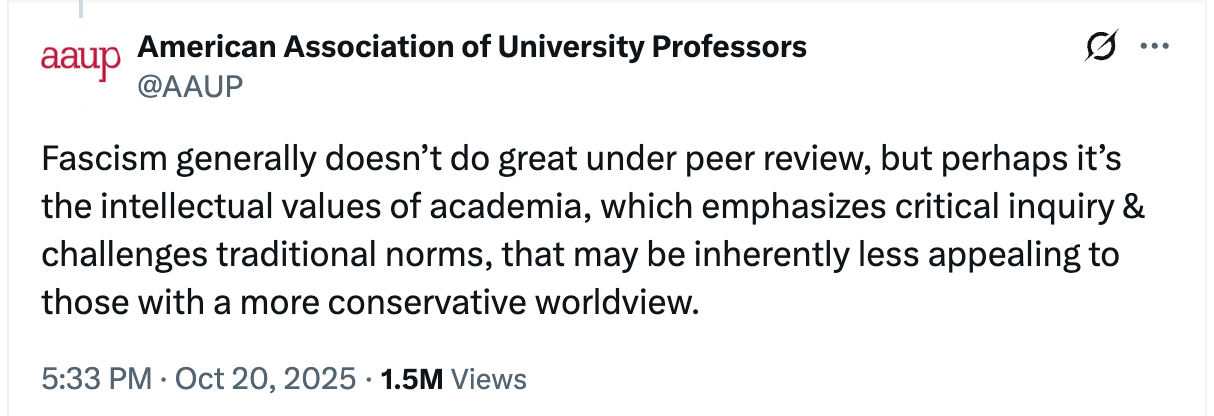
Anyway, this is how the AAUP responds to the conversation on X:

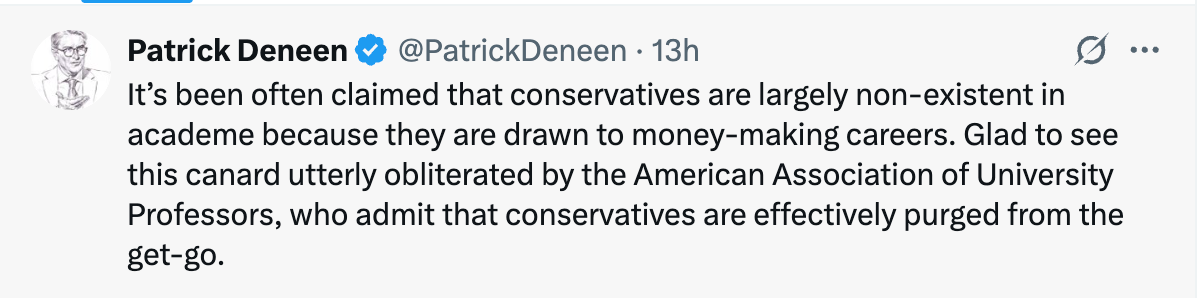
Well, there it is. Conservatives are FASCISTS! Patrick Deneen responds to that tweet:

The more I see institutional elites, in government and the private sector, the more I realize these people are like the pre-revolutionary Tsarist circles. They had no idea why so many people hated them, and what kind of precarious situation they were in.

Rod Dreher

Google

They always invest in businesses that put them in the ‘trade routes’—controlling the linkages, and never getting involved in the creation of tangible value.

Ted Gioia, Google Is Now the East India Company of the Internet

Today in History

Kagi News, a new and useful aggregator, offers “Today in History as one of its tabs, with events at the top, people at the bottom.

For some reason, I find that a lot of composers and poets I had place mentally in the late-19th century were actually in early-19th century. Edgar Allen Poe never even saw the late-19th. Who knew?

Snippets

  • … the Conservative Political Action Conference, a kind of movable rent-a-troll event … (Anne Appelbaum via Frank Bruni)
  • The old Saudi brand was ‘austere theocracy,’ but the new one is ‘fun, fun, fun, but still with beheading.’” (Helen Lewis via Frank Bruni)
  • We live the given life and not the planned. (Wendell Berry, Sabbath poems 1994 number 3)
  • I love her more than evolution requires. (Charles Murray’s wife, reflecting on their first child. Attributed to others as well. The insight doubtless matters more than the source.)
  • Mad Ireland hurt you into poetry. (W. H. Auden, in memory of W. B. Yeats)
  • Music is a conspiracy to commit beauty. (Linda Ronstadt)
  • States, particularly liberal democracies, are heavily dependent on wars for moral coherence. (Stanley Hauerwas, Resident Aliens). Looking at the last 62 years of American history seems to confirm this.

We are all gatekeepers now.

Peggy Noonan

Your enemies are not demonic, and they are not all-powerful and the right hasn’t always lost and the left hasn’t always won. But if you convince yourself of that, you give yourselves all sorts of permission to do a lot of stupid and terrible things under the rubric of “Do you know what time it is?”

Jonah Goldberg.

[A] critical mass of the American people … no longer want[s] to govern themselves, … are sick of this republic and no longer want to keep it if it means sharing power with those they despise.

Nick Catoggio

I don’t do any of the major social media, but I have two sub-domains of the domain you’re currently reading: (a) You can read most of my reflexive stuff, especially political here. (b) I also post some things on my favorite no-algorithm social medium.

Saturday, 8/23/25

Public Affairs

Ted Cruz knows better

[Ted] Cruz was an intellectually serious politician of the kind who would quote Hayek and reference Milton Friedman off-the-cuff in private conversation until he discovered—and this is a thing with Texas politicians—that there was more juice to be had from pretending to be the good ol’ boy that he is not than in simply being the Ivy League lawyer he is. Cruz’s current position in American public life is that of a piteous and contemptible figure. … [F]or the moment, he is still a senator caught between the fringeward push of his radicalizing party and the centerward pull of his state’s urbanizing electorate. 

Cruz is (or should be) smart enough to have figured out by now that he is never going to be president, and he ought to allow himself to be liberated by this and take on a new role—one that the genuine Ted Cruz, if there is anything left of him inside the chrysalis of grotesque opportunism and self-degradation in which he has enveloped himself, would be well-suited to undertake: defending the Constitution and the American order from a sustained assault that is coming from within his own party.

It would not take very much: “No, Mr. President, you may not willy-nilly create a new national sales-tax regime with rates based on how you’re feeling that day, even if you call it a tariff; no, you may not federalize the Philadelphia police department or deploy troops in U.S. cities based on whatever phony emergency pretext occurs to you in between social media posts; no, the states are not your ‘agents,’ and they most certainly do not have to do ‘whatever the president of the United States tells them’ to do, even if you put ‘FOR THE GOOD OF OUR COUNTRY’ in capital letters. And if you refuse to honor the constitutional limits on your office, then you can be removed from that office—with my vote, if necessary, though I would regret it and would probably lose my Senate seat as a result. But there are things more important than winning the next election.” 

No, I do not think Cruz has it in him. 

But he is starting to reach the stage of life when, to borrow David Brooks’ formulation, it is time to stop thinking about one’s résumé and start thinking about one’s eulogy.

Kevin D. Williamson, Ted Cruz Knows Better.

In which I reveal an unpopular opinion

Almost everything I knew about him, and particularly his professional accomplishments and opinions, made me think that Brett Kavanagh would be a good Supreme Court justice, and I haven’t been disappointed.

Why “almost”? It wasn’t really the Christine Ford Blasey accusations, but it was related to them: Brett Kavanaugh was an underage, binge-drinking party boy.

That was never in dispute. And I hate that. From him, there wasn’t so much as a “when I was young and foolish, I was young and foolish” acknowledgment. I don’t care if his parents winked at it or even bought the beer.

Now I don’t recall anyone else who was bothered enough even to shrug it off with “boys will be boys.” I seemingly stood alone in thinking underage binge drinking a blot on his character and fitness to uphold the law — all of it, including the parts that inconvenience him.

It’s not okay, and if that makes me a prig, so be it.

There is no possible religious neutrality in schools. So there!

J Budziszewski wants to make Catholic education more widely available without the governmental “strings attached” of Charter School (or presumably vouchers):

Please let’s not blather about religious “neutrality.”  So called secular education is not neutral, but reflects a bias against faith in favor of irreligion.

In fact, even that way of putting it is not precisely accurate. It isn’t that public schools have no god; in fact they place many gods before God. Superficial thinkers suppose that unconditional loyalties – whether of the “woke” or another variety — don’t count as religion just because they don’t use the word “god” for their gods. But the crux of the matter does not lie in the words they use.

I take a different minor issue with the first paragraph quoted than Budziszewski himself does. What “secular education” does is inculcate indifference. Purporting to teach children what they need to know without telling them anything about religion tacitly tells them that they need not know anything about it.

And this is not a straw man. The two-hundred-page course guide for Advanced Placement (AP) course in U.S. government and politics “doesn’t mention Christianity or the Bible—not once, even though it professes to cover ‘the intellectual traditions that animated our founding.’” (Mark Bauerlein)

But that’s not the same as teaching hostility toward religion (“irreligion”).

On the point about unconditional loyalties I couldn’t agree more. I just don’t know what we do about it. Deschooling Society?

DOGE

I have had a faint hope that we would discover that DOGE has begun modernization of software and strategic use of AI in the agencies they blitzkrieged immediately after our latest Presidential inauguration.

But they appears at this point to have been engaged in pure, nihilistic destruction — a style that, along with vengeance-destruction, appears to be what this 47th Presidency is all about.

Capitalist Economy

Pay no heed to the man in the management handcuffs

Ted Gioia was writing a book and looking for a publisher:

This person ran a legendary publishing house, and was also a jazz lover. He was a fan of my writing. We exchanged some emails, and then had a phone conversation.

“Ted, I love the book you’re writing,” he told me. “The sample chapters you sent are outstanding. You’re a special writer, and I’d love to sign you a contract. But…”

My head was already spinning. These people typically pay out big advances. I could finish the book and pay all my bills—no sweat! But before I could pursue these daydreams any further, this famous editor went on:

“I’d love to sign you to a contract. But I can’t.”

“Why not?” I asked—and even I could hear the plaintive note in my voice.

“Well, I’m sure your book would sell. But we evaluate books on their projected sales during the three years following release. If a book doesn’t have a three-year payback, we don’t do it.”

“I don’t think I understand this,” I whimpered in reply. “What are you saying?”

“It’s simple. Your book will probably sell for the next ten years or more. But I can only consider the first three years in making an offer—that’s why I have to turn you down.”

Okay, I understood discounted cash flow even better than this editor. I could give you a lecture on the Capital Asset Pricing Model in my sleep. In my early days, I made a living doing this kind of analysis.

But this way of thinking is wrong in the world of arts and culture.

When I tell editors that my books demonstrably sell for 25-50 years and longer, this is a turn-off. They actually hate it when I say it.

They won’t be around that long—editors constantly change jobs. They don’t give a hoot what sales will be like in the year 2050. They want something with cocktail party buzz for the six weeks following publication.

That’s the world they live in. But I don’t—and I refuse to move there.

How I Learned to Stop Worrying About Short-Term Results in My Career (bold added)

There’s a lot more where that came from because Ted Gioia is a freakin’ polymath. His has become (probably) my favorite Substack that doesn’t focus on religious subjects.

Work-life balance

I’m 22 and I’ve built two companies that together are valued at more than $20 million. I’ve signed up my alma mater as a client, connected with billionaire mentors and secured deferred admission to Stanford’s M.B.A. program. When people ask how I did it, the answer isn’t what they expect—or want—to hear. I eliminated work-life balance entirely and just worked. When you front-load success early, you buy the luxury of choice for the rest of your life.

… I averaged 3½ hours of sleep a night and had about 12½ hours every day to focus on business. The physical and mental toll was brutal: I gained 80 pounds, lived on Red Bull and struggled with anxiety. But this level of intensity was the only way to build a multimillion-dollar company.

Emil Barr, ‘Work-Life Balance’ Will Keep You Mediocre

So that’s the world he lives in. I don’t, never have, and I refuse to move there — or to recommend it to anyone I care about.

Culture

Gay race communism

Now, Cracker Barrel is updating its décor and branding—slightly. The bulk of the update is a brighter, less cluttered interior design, but the “controversial” decision is to change its logo. The company removed the old white guy in overalls sitting by a barrel, and now just has a text-only sign that reads “Cracker Barrel.” 

And people are losing their minds, claiming that it has gone “woke.” What seems to have sparked this brouhaha is a tweet saying that the store has “scrapped a beloved American aesthetic and replaced it with sterile, soulless branding.” 

This prompted an outraged “WTF is wrong with @CrackerBarrel??!” tweet from Donald Trump Jr., that loyal guardian of all that is homey and traditional in American life. The very popular End Wokeness Twitter account proclaimed: “Cracker Barrel CEO Julie Masino should face charges for this crime against humanity.”

Chris Rufo then came out with a Cracker Barrel delenda Est pronunciamiento:

Alright, I’m hearing chatter from behind the scenes about the Cracker Barrel campaign and, on second thought: we must break the Barrel. It’s not about this particular restaurant chain—who cares—but about creating massive pressure against companies that are considering any move that might appear to be “wokification.” The implicit promise: Go woke, watch your stock price drop 20 percent, which is exactly what is happening now. I was wrong. The Barrel must be broken.

Now, it’s true that Cracker Barrel has done some LGBT marketing stuff, probably as a result of being criticized for alleged discriminatory policies in the 1990s. But maybe also because gay people—and people who aren’t particularly horrified by gay people—might like good, affordable breakfasts, too. They’ve also tried to cultivate Hispanic customers. I’m not sure this means they’ve been taken over by the Latinx reconquista

I am also, shall we say, skeptical that a few old website screenshots of these efforts are proof that, in the words of Federalist co-founder Sean Davis, “Cracker Barrel’s CEO and leadership clearly hate the company’s customers and see their mission as re-educating them with the principles of gay race communism.”

Jonah Goldberg. It’s enough to make me want to try to remember that I keep forgetting to eat at Cracker Barrel.

What nihilists can’t believe

It’s hard enough to get people to believe something, but it’s really hard to get people to believe in belief — to persuade a nihilist that some things are true, beautiful and good.

David Brooks, The Rise of Right-Wing Nihilism (gift link)

I just can’t root for a guy who looks like Caligula

My libertarian and anti-state impulses incline me to be favorable toward Julian Assange, but I’ve never been able to shake how much he looks like John Hurt’s Caligula.

Technology

The technologies we use to try to “get on top of everything” always fail us, in the end, because they increase the size of the “everything” of which we’re trying to get on top.

Oliver Burkeman, Four Thousand Weeks

Brought to you by the letter “D”

Dust and decay,
ditherers upon the doorstep
of death itself; dried-
up ghosts of daisy-chain
days that were once dappled
with dew and delight.

R.S. Thomas, Anybody’s Alphabet, Collected Later Poems 1988-2000.

The Los Alamos Sin

As Freeman Dyson put it, the “sin” of the scientists at Los Alamos was not that they made the bomb but that they enjoyed it so much.

Walker Percy, Lost in the Cosmos


I don’t do any of the major social media, but I have two sub-domains of the domain you’re currently reading: (a) You can read most of my reflexive stuff, especially political here. (b) I also post some things on my favorite social medium.

And now for something more edifying

Having vented all my political bile a few hours ago, I give you, as David French puts it at the end of a column, “what else I did.”

Not “what” but “whether”

[W]e’re well past canon wars at this point. The question isn’t what people are going to read on the other side of the bottleneck; it’s whether they’re going to read anything at all. If you want a perfect example of not getting it, consider the conservatives complaining about books assigned in K-12 schools, and the liberals complaining about book-bans. How can either side keep pretending that the problem is with what students are reading? The world in which that debate made sense no longer exists. Even at elite universities, nobody reads books anymore.

If we are indeed entering a “new dark age” – one full of “shining devices” and for that reason mostly empty of literate persons – then Christian institutions today may have a similar mission to fulfill: saving the best of the secular world from the new bottleneck of technological “progress.” Maybe in the future it will only be students at Christian universities who read Freud and Marx and Nietzche and all the other great anti-Christian thinkers, because it will only be students at Christian universities who still read anything at all.

Adam Smith in Christian Scholars Review.

Shedding Enlightenment Values

When readers interact imaginatively with a book, they are still following the book’s lead, attempting to answer the book’s questions, responding to the book’s challenges and therefore putting their own convictions at risk.

When we interact with A.I., on the other hand, it is we who are driving the conversation. We formulate the questions, we drive the inquiry according to our own interests and we search, all too often, for answers that simply reinforce what we already think we know. In my own interactions with ChatGPT, it has often responded, with patently insincere flattery: “That’s a great question.” It has never responded: “That’s the wrong question.” It has never challenged my moral convictions or asked me to justify myself.

David A. Bell, A.I. Is Shedding Enlightenment Values.

Speaking of AI, it seems that the new ChatGPT 5 adds to its error-proneness a new feature: incorrigibility. It no longer flatters and apologizes for errors and corrects them — at least, not consistently.

To update an old aphorism, any lawyer who relies on AI has a client who has a fool for a lawyer.

Judeo-Christian anthropology

I’ve learned a lot from reading some serious religious thinkers down through the years: Augustine, Pascal, Franz Rosenzweig, Reinhold Niebuhr, TS Eliot, Walker Percy, the encyclicals of Pope John Paul II, Stanley Hauerwas, Peter Lawler, Alan Jacobs, David Bentley Hart …

The thing I most appreciate about the authors I’ve listed is how they expand my understanding of human nature. Judeo-Christian anthropology really does have a different shape than ancient Greek philosophical accounts of it, no less than modern scientific-reductionistic construals.

Damon Linker, Ask Me Anything

More:

The country is more secular than it was 20 years ago; the Republican coalition is more secular than it was then, too; and the parts of that coalition that describe themselves as evangelicals are, on average, less likely to attend church and read the Bible regularly than their counterparts a generation ago. Their faith has evolved into an identity marker: They call themselves Christians or evangelicals because those labels convey that they’re the good Americans, as opposed to those bad Americans on the other side of the partisan and culture-war divide.

We’re Babylon

I don’t feel “patriotic” if patriotism means expressing confidence in the country as it is today. Living overseas for the past two years, in a conservative country that’s in America’s ideological crosshairs, has taught me a painful lesson about what my country stands for today, and how it uses its power in the world. “We’re Babylon,” a visiting US pastor said to me recently. He’s right. … Seriously, you have to get out of America for some time to grasp how much cultural influence we have in the world, and how bad that is.

Rod Dreher.

The idea that America is “Babylon” has intrigued me for more than 50 years, after I first read Edward Tracy’s book The United States in Prophecy.

I do not recommend that book, written as it was by some manner of Evangelical or Dispensationalist. But I bought it at a time when I was Evangelical and the Evangelical Book market was flooded with crap like The Late, Great Planet Earth, which fed Evangelicals Americanism and cold war Russophobia (which differed from today’s Russophobia). The idea that the United States might be an equivocal, or even a negative, player in Bible prophecy was just irresistibly transgressive to me.

I thoroughly enjoyed the irony of using Hal Lindseyish exegesis to reach Jim Wallisish conclusions.

Still, the possibility of Tracy being at least adjacent to the truth lingered and lingers, partly because I have a much different view of Bible prophecy these days. I don’t use it to predict the future (I never really did), but I think that figures like “Babylon” can echo typologically down through the ages. In that sense “We’re Babylon” fits Edward Tracy’s exegesis awfully well (see Jeremiah 51:7-8, Revelation 14:8).

Note that “the United States as Babylon” in the constellation of my thinking antedates Trumpism by four decades or more. This is one thing I don’t blame on our current President. Indeed, events of the last 7 months or so have so debased us that it’s hard to imagine the world uniformly mourning if our instantiation of Babylon fell.

Erotica

Much later, Playboy magazine came along, in which girls removed their underwear and a boy could drive to a drugstore in a part of town where he was not known and tuck a copy into a Wall Street Journal and peruse it And later came Tropic of Cancer and Portnoy’s Complaint and now porn is freely available online though to me it has all the erotic allure of watching oil well pumps pumping in North Dakota.

Garrison Keillor

Gerrymander boomerang

Those who draw gerrymanders can get too greedy. They maximize seats by cutting their party’s margins in each seat. If 2026 is a particularly bad year for Republicans in Texas, they could lose ground from this gerrymander.

E.J. Dionne.

From your mouth to God’s ear, E.J.


I don’t do any of the major social media, but I have two sub-domains of the domain you’re currently reading: (a) You can read most of my reflexive stuff, especially political here. (b) I also post some things on my favorite social medium.

Tuesday Tasties, 8/5/25

Do better, Republicans

I try not to overdo on politics, but I consider my first two items today tacit moral admonitions. I don’t even think that their factual predicates are open to honest dispute.

Vibes all the way down

Trump, Claiming Weak Jobs Numbers Were ‘Rigged,’ Fires Labor Official
Economists said ousting the head of the Bureau of Labor Statistics could undermine confidence in government economic data.

New York Times

As Trump testified once in court

My net worth fluctuates, and it goes up and down with the markets and with attitudes and with feelings, even my own feelings … Yes, even my own feelings, as to where the world is, where the world is going, and that can change rapidly from day to day.

Some data, such as the number of votes he received at the polls in 2020, initially refused to budge. But with a little bit of threatening from some extra-patriotic patriots, the election turned out to have been a Trump blowout. Just ask any elected Republican; they’ll tell you!

Fumbling around in a fog of vibes and misinformation and things you saw on Fox News is good enough for the president; why should the rest of us ask for anything better? Soon, no one will know what is happening—what the problem is, or what remedies to apply. What sectors are booming and which are contracting, whether interest rates should be higher or lower, whether it’s hotter or colder than last year, whether mortality has gone up or gone down. It will be vibes all the way down. Soon we will all be bumping around helplessly in the dark.

That’s a good thing …

Alexandra Petri

Comprehensively failing the Solzhenitsyn test

In his 1970 Nobel lecture, Aleksandr Solzhenitsyn said, “You can resolve to live your life with integrity. Let your credo be this: Let the lie come into the world, let it even triumph. But not through me.” The problem presently before the United States is that the Trump administration will be staffed in its upper reaches by political appointees who, without exception, have failed this test.

To get their positions, these men and women have to be willing to declare, publicly if necessary, that Donald Trump won the 2020 election and that the insurrectionary riot of January 6, 2021, was not instigated by a president seeking to overturn that election.

Eliot A. Cohen

I’ve wondered how Republicans lost their balls. Apparently Putin got them and added them to his own:

Trump Has Soured on Putin. Putin Couldn’t Care Less.

Culture more broadly

Not “what” but “whether”

[W]e’re well past canon wars at this point. The question isn’t what people are going to read on the other side of the bottleneck; it’s whether they’re going to read anything at all. If you want a perfect example of not getting it, consider the conservatives complaining about books assigned in K-12 schools, and the liberals complaining about book-bans. How can either side keep pretending that the problem is with what students are reading? The world in which that debate made sense no longer exists. Even at elite universities, nobody reads books anymore.

If we are indeed entering a “new dark age” – one full of “shining devices” and for that reason mostly empty of literate persons – then Christian institutions today may have a similar mission to fulfill: saving the best of the secular world from the new bottleneck of technological “progress.” Maybe in the future it will only be students at Christian universities who read Freud and Marx and Nietzche and all the other great anti-Christian thinkers, because it will only be students at Christian universities who still read anything at all.

Adam Smith in Christian Scholars Review.

Shedding Enlightenment Values

When readers interact imaginatively with a book, they are still following the book’s lead, attempting to answer the book’s questions, responding to the book’s challenges and therefore putting their own convictions at risk.

When we interact with A.I., on the other hand, it is we who are driving the conversation. We formulate the questions, we drive the inquiry according to our own interests and we search, all too often, for answers that simply reinforce what we already think we know. In my own interactions with ChatGPT, it has often responded, with patently insincere flattery: “That’s a great question.” It has never responded: “That’s the wrong question.” It has never challenged my moral convictions or asked me to justify myself.

David A. Bell, A.I. Is Shedding Enlightenment Values


Your enemies are not demonic, and they are not all-powerful and the right hasn’t always lost and the left hasn’t always won. But if you convince yourself of that, you give yourselves all sorts of permission to do a lot of stupid and terrible things under the rubric of “Do you know what time it is?”

Jonah Goldberg.

Trumpism can be seen as a giant attempt to amputate the highest aspirations of the human spirit and to reduce us to our most primitive, atavistic tendencies.

David Brooks

I don’t do any of the major social media, but I have two sub-domains of the domain you’re currently reading: (a) You can read most of my reflexive stuff, especially political here. (b) I also post some things on my favorite social medium.

Tuesday, 7/22/25

L’affaire Coldplay

If there’s a truly compelling reason not to normalize shaming as a global, always-on public spectator sport, it’s not that it degrades the humanity of the shamed; it’s not even the trite “who among us has not canoodled at a Coldplay concert with his sidepiece” justification. It’s simply this: When we take joy in the distress and ruination of other people, we make monsters of ourselves.

Kat Rosenfield

Apart from taking joy in distress and ruination, I have no reason to seek out the mêmes and other drollery about the ColdPlay kisscam. This, though, came to me unbidden:

Who’s killing the liberal arts?

An unpleasant truth has emerged in [the University of] Tulsa over the years. It’s not that traditional liberal learning is out of step with student demand. Instead, it’s out of step with the priorities, values and desires of a powerful board of trustees with no apparent commitment to liberal education, and an administrative class that won’t fight for the liberal arts even when it attracts both students and major financial gifts. The tragedy of the contemporary academy is that even when traditional liberal learning clearly wins with students and donors, it loses with those in power.

For those who do care to see liberal learning thrive on our campuses, the work my colleagues and I did at Tulsa should be a model. How did we do it? We created an intentional community where our students lived in the same dorm and studied the same texts. We shared wisdom, virtue and friendship as our goals. When a university education is truly rooted in the liberal arts, it can cultivate the interior habits of freedom that young people need to live well. Material success alone cannot help a person who lacks the ability to form a clear, informed vision of what is true, good and beautiful. But this vision is something our students both want and need.

Jennifer Frey, This Is Who’s Really Driving the Decline in Interest in Liberal Arts Education

Voting consequentially

When people justify their voting choice by its outcome, I always think of The Lord of the Rings. Tolkien emphasizes repeatedly that we cannot make decisions based on the hoped-for result. We can only control the means. If we validate our choice of voting for someone that may not be a good person in the hopes that he or she will use his power to our advantage, we succumb to the fallacy of Boromir, who assumed he too would use the Ring of Power for good. Power cannot be controlled; it enslaves you. To act freely is to acknowledge your limits, to see the journey as a long road that includes dozens of future elections, and to fight against the temptation for power.

Jessica Hooten Wilson, What ‘The Lord of the Rings’ can teach us about U.S. politics, Christianity and power

I met Jessica some years ago at a conference where she was the Protestant keynoter. We spoke a bit because she was teaching at a University that I don’t even bother putting on my resumé despite spending three semesters there in the very late 60s. I dare say her scholarship was an order of magnitude higher than any of the mediocrities teaching when I was there.

Even the one prof to whom I owe a debt of gratitude earned that by a pretty banal observation that just happened to be what I needed at the moment — and I can’t even remember his name because at the time I didn’t realize how consequential that moment would prove to be.

Shorts

  • We’ve been telling kids for 15 years to code. Learn to code, we said. Yeah well, AI is coming for the coders. They’re not coming for the welders. (Mike Rowe)
  • I grew up in San Francisco, walking with my family by the Golden Gate Bridge. I still remember the thick and iconic chain railing that gave the place a sense of distinctiveness. Now the chains are gone, and they’ve been replaced by a soulless metal railing that’s colder than a hospital waiting room. … This is how a culture loses its charm: slowly, quietly. (David Perell).

Quotes via Andrew Sullivan

The convoluted feelings behind the right to be killed

Let us first note that the demand for legal assisted suicide addresses not the legality of killing oneself, but the legality of assisting others to kill themselves. The suicidee (patient? victim?) is secondary. The primary object of the right-to-die movement is the living.

People may kill themselves at any time, without permission or even much pain. Even where it is not legally permitted, suicide, once accomplished, is beyond the reach of legal consequence.

… We must … focus on the desire for someone else to do the killing. Alongside fear of a botched attempt or leaving behind a mess for others, I suggest that the desire for assisted suicide is a perverse expression of the need for recognition. People who wish to kill themselves also want their choice to be socially approved.

… Its advocates say they wish to die with dignity, and then they ask to be euthanized like pets. … [T]he “right” to assisted suicide can only be the right not to be recognized as a human being.

When black Americans were struggling for civil and human rights—for the recognition of their humanity— they arrived at the profound conviction that it was dignified to risk death in that struggle. Assisted suicide represents a perverse inversion: a renunciation of dignity, the demand that one’s humanity go unrecognized. A society that honors that demand will not, in the end, recognize the humanity of anyone.

Matthew Burdette, The Right to Be Killed

From “worst of the worst” to “anybody will do”

Earlier this month, 25-year-old George Retes was arriving for work at a Southern California marijuana farm when federal agents circled his vehicle, broke his window, and sprayed him with tear gas and pepper spray before taking him into custody. Retes, among the more than 360 people to be arrested in the large-scale immigration raid, went on to spend three days in a Los Angeles detention center. 

The problem? Retes is a U.S. citizen and Army veteran, and was not charged with breaking any laws. “I want everyone to know what happened. This doesn’t just affect one person,” he told reporters following his release, sharing plans to sue for wrongful detention. “It doesn’t matter if you’re a veteran or you serve this country. They don’t care. They’re just there to fill a quota.”

It’s now been six months since President Donald Trump entered office with a promise to remove “the worst of the worst” from American soil. And indeed, arrests by Immigration and Customs Enforcement (ICE) have shot up as illegal border crossings—and, consequently, detentions by Customs and Border Protection—wane. Yet a significant portion of ICE detainees have no criminal record aside from being in the country illegally, with the Trump administration’s sweeping roundups seemingly targeting individuals on a more or less random basis.

The Morning Dispatch

I don’t particularly care if Trump deports everyone who is in the US illegally, though I doubt that any President will do that as long as we want people to do unattractive jobs for “dirt cheap” — including, I suspect, at Trump’s own Casinos and resorts. On the other hand, I’m not eager for him to do it.

What I definitely object to is the apparatus of terror, with masked ICE agents more-or-less indiscriminately grabbing and gassing people who just might help them meet quota. Or even doing that more discriminatingly, come to think of it.

Dreaming of Europe. And waking up.

Whenever I’m down; whenever I’m blue; whenever I think e.e. cummings retired the poet trophy with one poem; especially whenever I wonder whether it’s too late to become a naturalized Frenchman (or Italian, or …); I should by all means remember this: more Europeans die of heat death—largely due to lack of air-conditioning—than Americans die from gunshot wounds. (Factoid via Tyler Cowen)

I’m not so stupid as to think this is the ultimate answer to whether we’re the greatest country in the world. But even if it’s the best argument we’ve got, it’s not nothing.

It was and is ever so

You can take this to the bank: If the New York Times notices the Buddha, the enlightened one has already left town.

Ted Gioia, The Ten Warning Signs

Two political items

Jonathan Rauch had Trump 2.0 pegged years in advance

In August, 2022, Jonathan Rauch delineated what would happen if America elected Trump again: We Don’t Have to Speculate About Trump’s Next Term

I thought at the time that he was uncharacteristically shrill, even if he was right. But I came across it again, and he was remarkably accurate.

The (In)Effective Executive

President Donald Trump has a couple of problems when it comes to being an effective executive, the top two being: 1) He is an ignoramus and 2) He insists on surrounding himself with yes-men who are too afraid to tell him that he is an ignoramus.

Kevin D. Williamson


Your enemies are not demonic, and they are not all-powerful and the right hasn’t always lost and the left hasn’t always won. But if you convince yourself of that, you give yourselves all sorts of permission to do a lot of stupid and terrible things under the rubric of “Do you know what time it is?”

Jonah Goldberg.

Trumpism can be seen as a giant attempt to amputate the highest aspirations of the human spirit and to reduce us to our most primitive, atavistic tendencies.

David Brooks

I don’t do any of the major social media, but I have two sub-domains of the domain you’re currently reading: (a) You can read most of my reflexive stuff, especially political here. (b) I also post some things on my favorite social medium.

Thursday, 7/17/25

The Main Event

Culture

You’d have to be stupid not to specialize in generalizing

[C]olleges’ pre-professional bent — reflected, too, in some schools’ elimination of such unpopular humanities majors as classics and art history — can be as imprudent as it is unimaginative. The modern job market has a flux and furious metabolism that routinely make a mockery of the best laid plans. “The Computer Science Bubble Is Bursting,” read the headline on an article in The Atlantic by Rose Horowitch last month. It noted that while the number of computer science majors in the United States had quadrupled between 2005 and 2023, it was now on the decline because of “a grim job outlook for entry-level coders.” “Artificial intelligence has proved to be even more valuable as a writer of computer code than as a writer of words,” Horowitch wrote. “This means it is ideally suited to replacing the very type of person who built it.”

So, consulting is the ticket? Not so fast. “If consulting was a stock, I’d be shorting it right now,” the entrepreneur and venture capitalist Peter Thiel told Joe Nocera for an article in The Free Press last week. Its headline: “The Consulting Crash Is Coming.” Its subhead explained that consultants, like coders, are being “outpaced by A.I.”

The moral of those two stories is that the smartest approach to college may be precisely the one that its trajectory of late has conspired against: range widely across subject offerings and focus not on a skill that could become obsolete but on intellectual dexterity and powers of judgment with better odds of enduring relevance. “A liberal arts degree is a pre-professional degree — you just don’t know what the profession is,” said Zimmerman, who teaches a seminar for first-year students at U-Penn called “Why College?”

Frank Bruni

“Learn to code” seemed the veriest wisdom, until suddenly it wasn’t. It has been so my whole lifetime: “We have a shortage of X; therefore, the smart college major is X” has never been very good at assuring that X is a remunerative profession even in the short-term.

Correctionist history

We have a view of the war that emphasizes the decisive American involvement, and with Hollywood’s aid, has become part of our national myth. I do not discount that. My mother had a brother who fought in the Pacific, my dad had three brothers who saw active duty, my father-in-law served, and countless kinsmen of my wife saw combat. But our victory in the West was made possible by the Russians pulverizing the Germans in the East. It was a great victory to us, but to the Russians it was existential. We think that the October Revolution of 1917 defined Russia. It did not, as it did not ultimately “take,” and died the death of all imposed ideologies. But the Great Patriotic War does define modern Russia. Their struggle to protect the Motherland is perhaps one of the most important components that define their national identity.

… Use any metric you want, the Russians far exceeded any of the other Allies.

Terry Cowan. If you doubt Terry, read Anthony Beever’s Stalingrad.

Pronouns

When the poet Andrea Gibson learned two years ago that their ovarian cancer was incurable, the news marked a turning point; Gibson would often say it led to some of the most joyous moments of their life.

Before the terminal prognosis, they were always afraid. They had severe anxiety and chronic panic attacks; they were petrified of the ocean; they couldn’t bring themselves to eat nuts on a plane, in case they turned out to have developed a new allergy and might suffocate in flight. For years, they’d lived in constant fear that everything would come crashing down. Then, of course, it did. And just at the moment when patients are frequently pushed to start “battling” cancer, Gibson finally learned to stop fighting. In an interview last year with the website Freethink, they remembered telling themself: “I will allow this.”

Faith Hill, Andrea Gibson Refused to ‘Battle’ Cancer

I am, I guess, a troglodyte. I cannot help but consider a person with ovarian cancer a woman, whose pronouns therefore are “she” and “her.”

Had I known Faith Hill, I would have tried to use her preferred pronouns in speaking to her as a matter of courtesy. But she’s gone now, and the two quoted post-mortem paragraphs speak for themselves about how awkward and artificial the pronoun thing can be.

Politics

GOP: You Are Dead to Me

JAN. 6 RIOTERS ARE THE NEW HOT EVENT IN TOWN FOR REPUBLICANS
County parties say they want to hear directly from people charged with storming the Capitol; former defendants are eager to recast the narrative

The Davis County Republican Party in the Salt Lake City suburbs held its annual Abraham Lincoln Day Dinner in March at $75 a plate. One marquee speaker was a pardoned defendant who federal prosecutors said knocked back a shot of Fireball whiskey in the conference room of then House Speaker Nancy Pelosi.

“This was not an insurrection,” the speaker, Treniss Evans, told the crowd. “This was Kent State. This was Tiananmen Square.”

Wall Street Journal

See Mona Charen, Why I’m a Single-Issue Voter, too.

I think what I need to do in response is the presume every Republican supports Trump and the insurrectionists unless they affirmatively show otherwise.

As always, this does not mean that I’ll begin default-voting for Democrats. They just get less of my bile because I had no high hopes that they have shattered.

Legalia – of my former profession and its practitioners

Thinking of the children

I think SkrmettiMahmoud, and Free Speech Coalition can be summed up in a meme: Won’t somebody please think of the Children? But more precisely, the Court was protecting children from misguided parents. https://www.youtube.com/embed/q3D8670smTI?feature=oembed

In Free Speech Coalition, the Court allowed the state to protect children from accessing pornography that their parents might wish to access. In Skrmetti, the Court allowed the state to protect children whose parents approved puberty blockers and cross-sex hormones. And in Mahmoud, the Court allowed parents to protect their children from the school board.

These three cases are not the same, but at bottom, they were all about protecting the children.

Josh Blackman

Integrity

The U.S. Justice Department unit charged with defending against legal challenges to signature Trump administration policies – such as restricting birthright citizenship and slashing funding to Harvard University – has lost nearly two-thirds of its staff, according to a list seen by Reuters.

Sixty-nine of the roughly 110 lawyers in the Federal Programs Branch have voluntarily left the unit since President Donald Trump’s election in November 2024 or have announced plans to leave, according to the list compiled by former Justice Department lawyers and reviewed by Reuters.

… Reuters spoke to four former lawyers in the unit and three other people familiar with the departures who said some staffers had grown demoralized and exhausted defending an onslaught of lawsuits against Trump’s administration.

‘Many of these people came to work at Federal Programs to defend aspects of our constitutional system,’ said one lawyer who left the unit during Trump’s second term. ‘How could they participate in the project of tearing it down?’

Reuters report via Lafayette Journal & Courier.

Adiaphora

I considered cutting these, especially the second, because everyone is talking about Jeffrey Epstein and MAGA bucking the Boss over his attempted denouement.

But I’m publishing the first largely because I share Kevin Williamson’s sense that a certain ink-stained wretch at the Daily Wire is particularly wretched, unreliable, and transgressive of the Ninth Commandment; the second because even on a subject as tired as Epstein’s ephibophilia, Freddie DeBoer is unlikely to write anything outworn; the third because it, too, is about l’affaire Epstein, and you might want to be spared it.

The high cost of low trust

There’s the obvious moral thing, of course, and the specifically religious scandal of a bunch of people who invoke their Christian faith every third sentence publicly taking consecutive high-volume hippopotamus dumps on the Ninth Commandment (“Thou shalt not bear false witness”) in each of the other two sentences. Watching my conservative-leaning, Trump-supporting, Christian friends, from the Catholics to the evangelicals, try to explain that away, twisting themselves into metaphorical knots that Dante would have done something awful with, fills me with dread. J.D. Vance, who lies about immigrants with comprehensively amoral facility, may be thinking about his place in history, but he should be thinking about his place in eternity.

Which brings me to Megan Basham, a dim, boring liar who is nonetheless useful as an example of what politics on the right looks like in our time. Basham, who plays in the right-wing Christian sandbox (you can read my review of her excruciatingly stupid and dishonest Shepherds for Sale here, and I don’t know whose cornflakes I pissed in to keep getting these assignments) recently tweeted this carefully composed casserole of imbecility and insipidity: “We need a new red scare. And a new McCarthy.”

McCarthy’s low character did not make it easier to fight Moscow’s agents in the United States—his sodden stupidity and willful dishonesty made it much, much more difficult, a fact for which his enablers bore some responsibility. In our time, the United States needs immigration reform, and consistent enforcement is going to have to be a part of that—and Donald Trump is going to make it a lot harder to get that done. J.D. Vance is going to make it harder to get that done. The clutch of fools around them—Kash Patel, Dan Bongino, Pam Bondi, Pete Hegseth, Robert Kennedy Jr.—is going to make it harder, because they have the net effect of undermining trust in government, including those such as Kennedy who are not directly involved in immigration. They do not seem untrustworthy—they are untrustworthy.  Cheerleaders and enablers and turd-polishers great and small, from big noises such as Sean Hannity and Robert Jeffress to little fish such as Megan Basham, are making the kinds of reform they purport to desire harder to achieve, too.

Kevin D. Williamson, The High Cost of Low Trust

Speaking of Megan Basham, this needs to be said about her demonization of George Soros, and Kevin D. Williamson said it better than I could:

There isn’t any question that Soros and his Open Society project hope to influence prominent institutions, including conservative-leaning churches and religious associations. Soros is engaged in a social change project, and that is what social change projects do. His ends are not generally ends that I share, but that doesn’t make it nefarious.

The Epstein Conspiracy Theory

It’s an old saw, but for good reason – conspiracy theories tend to flourish because they are in some strange sense comforting. They create the appearance of order in a universe filled with chaos. If a lone nutcase can kill John F. Kennedy, then there’s a certain inextinguishable randomness to the violence that governs human affairs. But if it was all a conspiracy, one involving the CIA and the FBI and the KGB and the mafia and the Freemasons and the Knights Templar and Opus Dei and – if it’s all a vast and magisterial conspiracy, well, then in a deep sense the world is governed by rules. Cruel and unjust rules, maybe, the kind that rob the country of their telegenic leader. But still, there is a logic to that injustice, a cold sort of stepwise purpose. No wonder even a president can be killed, if the most powerful forces in the world were conspiring to end his life! And that’s a lot more comforting, isn’t it? If Lee Harvey Oswald was just some guy with a gun, well… who among us is safe?

… And that’s exactly what I think of when I see all of this fixation on Jeffrey Epstein; it’s a record of our desire to force the most disturbing crime of all to make sense.

Epstein was a true monster and I wish he had not successfully avoided jail, even though he did so through suicide. I’m glad Ghislaine Maxwell will likely die in prison. I don’t doubt that powerful people were involved in their systematic abuse of underage women, and in a perfect world we’d be able to name them, shame them, and prosecute them. I want whatever was true of his death to come to light, and if there was a coverup, I want whoever was involved to face consequences. (But this is the United States so lol.)

Freddie DeBoer

Cui bono?

I haven’t been reading Michelle Goldberg, a progressive New York Times columnist, but recently read some praise for her writing. So despite my low interest in Jeffrey Epstein, I read her Monday musings (gift link) on the disappearance/nonexistence of Epstein’s client list.

I think she’s onto something, especially when she points out the curiosity that “Among those on the right who believe there’s an Epstein cover-up, few seem to be entertaining the idea that Trump is protecting himself.”

That he, Bondi and all are protecting him was my first thought when they sandbagged us. But not the QAnon-addled Trump-worshippers of MAGA. They thought he was secretly waging war on a cabal of child-molesting Democrat cannibals. (See Michelle Goldberg’s column on that.) That he, a serial-adulterer buddy of Epstein (who once non-judgmentally noted that Jeff “likes beautiful women as much as I do, and many of them are on the younger side”) might have enjoyed a bit of facilitated statutory rape himself never occurred to them.

On the same sorry topic, Jonathan Chait has an interesting opener:

Donald Trump’s ham-fisted reversal on his promise to release a secret list of Jeffrey Epstein’s clients has accomplished something long considered impossible by virtually everybody, including Trump himself: He has finally exceeded his followers’ credulity. The Epstein matter is so crucial to Trump’s base, and the excuse offered is so flimsy, that the about-face has raised questions within perhaps the most gullible movement in American history.

Bonus


Your enemies are not demonic, and they are not all-powerful and the right hasn’t always lost and the left hasn’t always won. But if you convince yourself of that, you give yourselves all sorts of permission to do a lot of stupid and terrible things under the rubric of “Do you know what time it is?”

Jonah Goldberg.

Trumpism can be seen as a giant attempt to amputate the highest aspirations of the human spirit and to reduce us to our most primitive, atavistic tendencies.

David Brooks

I don’t do any of the major social media, but I have two sub-domains of the domain you’re currently reading: (a) You can read most of my reflexive stuff, especially political here. (b) I also post some things on my favorite social medium.

Birth of John the Baptist

So far as I know, we have little or no evidence for when John the Forerunner/Baptist was born, but both Orthodox and Roman Catholics commemorate it on June 24. It’s a big enough deal that my parish had a liturgy for it.

The rest of this post has nothing to do with that.

At Stake in Harvard Grants

Harvard is unique both in the volume of its research output and the extent of these cuts — the government has threatened to end every research dollar to the university. The canceled grants accounted for here add up to about $2.6 billion in awarded federal funds, nearly half of which has already been spent according to government data.

“Even ‘grant’ is a problematic word, because people think they’re just sort of handing this money out for us to do what we want with,” said Marc Weisskopf, who directs a center for environmental health at Harvard that lost its funding from the National Institute of Environmental Health Sciences.

On the contrary, the government is much more explicit in competitive research applications and grant reviews: It wants more neuroscientists. It wants better opioid treatment. It wants to know how lightweight origami-inspired shelters and antennas can be unfurled in war zones.

The money the government sends to Harvard is, in effect, not a subsidy to advance the university’s mission. It’s a payment for the role Harvard plays in advancing the research mission of the United States.

This is the science model the U.S. has developed over 80 years: The government sets the agenda and funds the work; university scientists design the studies and find the answers. The president’s willingness to upend that model has revealed its fragility. There is no alternative in the U.S. to produce the kind of scientific advancements represented by these grants.

Emily Badger, Aatish Bhatia and Ethan Singer, Here Is All the Science at Risk in Trump’s Clash With Harvard

GOP 2012 redux

Many have made the point, but it’s nonetheless true: Presidents can now do pretty anything they want in foreign policy without seeking congressional authorization, provided it involves dropping bombs on other countries.

Five months into the second Trump administration, isn’t it astonishing that we have a Republican president: pushing for passage of a budget bill that cuts Medicaid and Medicare; pursuing an immigration policy focused on workplace enforcement, deportation of non-criminals, and the encouragement of “self-deportation”; and a happy John Bolton cheering the bombing of Iran? After a decade of debates about What Trump Means for the Right, we’ve ended up governed by the GOP circa 2012, as if the Trump administration were just the asshole version of the Romney/Ryan administration we were spared by Obama’s successful bid for re-election that year.

Damon Linker

Received financial wisdom

The longer I live, the more I appreciate that we can’t know everything, and that we live our lives mostly on the basis of trust. What we trust depends largely on our milieu (the polite term for “tribe” for present purposes), despite trying to avoid echo chambers.

Several of my social media cyberfriends (see footer) are living quite counterculturally, and one of them introduced me to the Dense Discovery newsletter. I probably give it awfully short shrift most weeks, but today caught my attention and led to something pretty thought-provoking, starting with a graph:

Okay, but let’s talk about the prescribed wealth hoarding model in the United States, otherwise known as prudent financial planning (supposedly). The conventional advice from financial planners is that people of my age are supposed to accumulate something like $1 million in order to retire. Or maybe $1.5 million.1 In case you’re not hip to the logic here – I wasn’t until I married a very specific kind of nerd – we’re supposed to amass so much wealth that we can live off the interest and dividends until we die. It’s not enough to save what we’ll need to make it to the end of our life; we need (ostensibly) way more than that. We need to accumulate so much wealth that we can live off the wealth that our wealth earns. We need – we are told – enough that we never have to touch the principal, and we can pass our wealth along to our next of kin, whoever they may be.2

Interdependence is My New Retirement Plan – by Lisa Sibbett

My father, a professional, seemed to live fairly consistently with the values Lisa Sibbett suggests. My widowed mother had enough and to spare, but their church saw a lot of money over the years, too, and his kids occasionally got gifts at the end of a bountiful year.

My father-in-law, a tradesman, lived the “conventional advice from financial planners,” and we are now benefitting from his success at that model.

I’ve lived somewhere in between those two models. Though I (credulously?) aspired to the “conventional advice” model, I just couldn’t resist living life along the way, and not waiting until I was properly fixed for life. Unlike my parents’ generation, I did not live through any Great Depression and didn’t feel that possibility in my bones. I don’t regret it.

One caveat with Sibbett’s approach is that it requires long-enduring personal bonds. You’ll need to sink roots somewhere, and that somewhere will need to be where others are sinking roots as well. It requires long-enduring personal bonds. It’s not for individualist nomads.

The unmentionable elephant in the room

I confess that I struggled with the reasoning of the Supreme Court in Skrmetti although I reluctantly welcomed the outcome.

I was not alone. Josh Blackman and Hadley Arkes (not a lawyer, but an Amherst professor of Jurisprudence) were in the same position as me, but Arkes in particular pointed to the root problem:

The truth that dares not speak its name here is that this wide array of gender-affirming therapies and surgeries is simply predicated on a falsehood. And yet those are the words that the conservative justices apparently see themselves as barred from speaking. Something in conservative jurisprudence holds them back from appealing to the inescapable and objective truth that lies at the heart of these cases. But without it, what were these accomplished jurists able to explain here? What was their ground of justification in overriding the judgments of those parents who were absorbed in the grief and confusion that seized their children? . . . .

The only “instruction” that would be relevant, Justice Thomas, is the unyielding fact that the child is in a state of confusion: he is not occupying some body apart from his own; his sex was not “assigned” at birth but marked inescapably in the organs of reproduction, in the arrangement of his body. His sex is immutable and printed plainly upon him.

Those were the words that Chief Justice Roberts and five colleagues could not move themselves to speak. Or they thought they were constrained from speaking by a jurisprudence that bars them from invoking truths beyond the text of the Constitution—even on the question of what is a human being, the bearer of rights, and when does that “human person” begin? . . .

Without those points in place, the judgment of the Court simply dissolves into a chain of ipse dixits. Why was it not legitimate for the parents of stricken youngsters to order the procedures that might relieve their “gender dysphoria?” Answer: The legislature of Tennessee did not think it a legitimate medical remedy to choose—even though the children and the parents did not share that judgment and were willing to take their risks. One judgment had to prevail, and it was the judgment backed by the power of the State. To put a high finish on it, that “power” represented the authority of a people to govern itself through elected representatives. But when the people speak through their representatives, and override the judgments of parents about their children, they are still obliged to say something more than “we have brute the power to impose this judgment through brute enactment of the law.”

Arkes singles out Justice Thomas, I suspect, because he said “so-called experts have no license to countermand the ‘wisdom, fairness, or logic of legislative choices.’” (Justice Thomas, concurring in U.S. v. Skrmetti, via Eugene Volokh.) Arkes’ re-formulation, I guess, is that the legislature can tell the experts “your elaborations are predicated on the falsehood that a person can be inhabiting a body of the wrong sex.”

That’s not the end of the story, but it’s a starting point for re-writing a story written up to now by activists hiding something only a few clicks less deranged than the whack-a-doodle Chase Strangio ideology:

Strangio disputed that a trans woman could be “born with a male body” or “born male”; in his view, a trans woman was born a woman just like any other woman. There was no such thing as a “male body,” Strangio told his colleagues: “A penis is not a male body part. It’s just an unusual body part for a woman.” Before the advertisement aired, Strangio elaborated on his critique in an article in Slate. “Many advocates defend the use of the ‘born male’ or ‘born with a male body’ narrative as being easier for nontransgender people to understand,” Strangio wrote. “Of course it is easier to understand, since it reinforces deeply entrenched views about what makes a man and what makes a woman. But it is precisely these views that we must change.”

My own position hasn’t changed in 39 months. I think we’re still seeing a cultural contagion of trans claims in adolescents and must be very cautious – which is a bit easier now that even Strangio has given up on the “live son or dead daughter” emotional blackmail.

Patience, Mercy, Tolerance

For defenders of political liberalism there is perhaps no more pressing problem than this: How do you make a compelling case for liberalism in an era of ascendant [illiberalism or] strong gods? The idea of “strong gods” comes from the book Return of the Strong Gods by R. R. Reno, editor of the conservative ecumenical journal First Things.

By “strong gods” Reno means the kind of visceral or agonistic forces that can compel political or social action through deeper existential or even guttural appeals. The strong gods work not by chiefly targeting the intellect, but the appetites.

Michael Reneau, Evan Spear, and Jake Meador, A Virtue-Centric Argument for Political Liberalism (shared link). This article was welcome in light of the ascendance of various illiberalisms.

With a little help from AI, I got this summary table:

VirtueRole Against Postliberalism & Strong GodsRoot/Source
PatienceProvides long-term perspective, allowing growth and changeChristian theology & history
MercyBreaks cycles of retribution, fosters trust and forgivenessScripture, Shakespeare
ToleranceIntellectual humility; suspends harsh judgment; enables coexistenceLiberal philosophy & Scripture (e.g., parable of wheat and tares)

Wordplay

I know every one of these carries political freight, but that’s the burden of many writers these days:

  • Glenn Thrush, Alan Feuer and Adam Goldman remarked on the right-wing ire confronting Patel and Pam Bondi, the attorney general, as they fail to substantiate the accusations that they hurled in their bid for power: “They are running what amounts to a conspiracy theory fulfillment center with unstocked shelves.” (Jeff Lebsack, Buffalo, and Marianne Painter, Tacoma, Wash., among others)
  • In The Financial Times, Edward Luce worried that certain scenes from the Los Angeles protests played into the president’s hands: “Every rock hurled lands like a penny in Trump’s wishing well.” (Todd Lowe, Simpsonville, Ky., and Al Gallo, Huntersville, N.C., among others)
  • In The Washington Post, Philip Bump expressed skepticism about the government’s claim that immigration officers must wear masks for self-protection: “We should not and cannot take ICE’s representations about the need for its officers to obscure their identities at face value.” (Patrick Bell, Carmichael, Calif.)
  • Also in The Post, Dana Milbank took in Trump’s pleasure at some sycophantic Republicans’ suggestion that the D.C. Metro be renamed the “Trump Train”: “It’s a great idea. Qatar will donate the subway cars, which will be powered by coal. Passengers will pay for fares with cryptocurrency after first showing proof of citizenship. And the trains will reverse themselves regularly and without warning — never quite reaching their original destination.” (Mary Ellen Maher-Harkins, Orwigsburg, Pa., and Stan Shatenstein, Montreal)

Via Frank Bruni

Ceci n’est pas un phone

Methaphone. Like Methadone. Get it?

In case you’ve been wondering …

No, you’re not imagining it. The main source of political violence in the USA in this century has been right-wing, not left. Jamelle Bouie, Right-Wing Violence Is Not a Fringe Issue:

It is simply a fact that the far right has been responsible for most of the political violence committed in the United States since the start of the 21st century.

I had been wondering, because there has been some leftwing violence against persons, and much against property.

Poor fit

If it seems that America’s colleges and universities are poorly suited to the average American eighteen-year-old, perhaps that’s because they were never designed to serve him.

Oren Cass, The Once and Future Worker


Your enemies are not demonic, and they are not all-powerful and the right hasn’t always lost and the left hasn’t always won. But if you convince yourself of that, you give yourselves all sorts of permission to do a lot of stupid and terrible things under the rubric of “Do you know what time it is?”

Jonah Goldberg.

Trumpism can be seen as a giant attempt to amputate the highest aspirations of the human spirit and to reduce us to our most primitive, atavistic tendencies.

David Brooks

I don’t do any of the major social media, but I have two sub-domains of the domain you’re currently reading: (a) You can read most of my reflexive stuff, especially political here. (b) I also post some things on my favorite social medium.