Friday, 10/10/25

Nonpartisan

Levelers

Emily Ruddy was traveling the country with her new husband, Mike, when news reached them of Charlie Kirk’s shooting, then death:

Back in the car with Mike, approaching the Florida border, I’m looking at pictures of Charlie Kirk on my phone. He is staggeringly tall, taller than I ever realized, with a celebratory fist in the air. Reading his Wikipedia page, which has now been changed to past tense, I am reminded of a story I first read in middle school: Kurt Vonnegut’s “Harrison Bergeron.” The story is set in the late twenty-first century, in a dystopian America where the authorities have taken it upon themselves to ensure no person is better than another, be it in athleticism, intelligence, or beauty. The strong citizens get weighed down with bags of bird shot. The attentive citizens are intermittently bombarded with hideous sounds through tiny radios in their ears. The most beautiful faces are concealed by hideous masks.

But it’s the title character, Harrison Bergeron—exceptionally tall, handsome, brilliant and outspoken—who is shackled most heavily. At the end of the story he breaks through the shackles, and as punishment he is shot down on live TV: a warning to whoever tries to pull a similar stunt. Or at least, it would be a warning, if the viewers’ memories weren’t instantly blasted away by the ear radio’s next awful sound.

Emily Ruddy, Battle Above the Clouds.

If you haven’t read Harrison Bergeron, a (very) short story, by all means do. It’s freely available, like, for instance, here.

After Christian faith dies

The biggest confusion among my own students used to be rudderless moral relativism.  Although there is still a lot of that, it seems to be on the decline.  Now the problem is the explicit embrace of evil.  The suggestion that one must never do what is intrinsically evil for the sake of a good result is a hard sell.  Many of students are strongly attracted to “consequentialism,” the view that whether an act is right or wrong is determined only by the result.  To say that the ends do not justify the means puzzles them.

The decline of faith has also produced changes in character.  Young people who were raised in Christian homes, but then abandoned Christianity, often used to retain vestiges of their moral upbringing, and accepted such ideas as courtesy, love of neighbor, and the sacredness of innocent human life.  Today, having grown up in faithless homes, many seem to think that courtesy is for fools, that no one with whom they disagree is their neighbor, and that they should hate those they consider wrong instead of praying for their repentance and restoration.  As for the sacredness of innocent human life – for them, that idea went out when they embraced abortion.

I don’t spend much time asking what is going to happen, but I do ask what God would like me to do in my own place.  He sees the whole shape of things.  I can’t, but like a faithful bone, I can try to turn nimbly in the joint where I’m placed.

J Budziszewski, How Can I Think About the Assassination?

Budziszewski’s description of the decline of faith, as early as the second generation (the first generation of lapsed Christians lives on the vapors of the empty tank), is a description of devolution toward the “nasty, short and brutish” of pre-Christian antiquity.

If you think I’m just making a casual partisan slur, take a look at either of these two books, the first lengthy, the second shorter and more focused.

Wordplay

Frank Bruni’s back with recent favorite sentences. (Do not read this with beverages or food in your mouth.):

  • Also in The New Yorker, Jessica Winter read the infamous Jeffrey Epstein birthday book so that you and I don’t have to: “Sometimes it’s like you’ve discovered a rich man’s contract with the devil, and next to his signature, he’s drawn a little penis cartoon.” (Matthew Ferraro, East Providence, R.I.)
  • And Kelefa Sanneh, reporting from a recent Bad Bunny concert, described an ecstatic fan who “danced so vigorously with a decorative plant that he seemed to be trying to pollinate it.” (Bob Marino, Paris)
  • In The Los Angeles Times, Christopher Goffard tried to make sense of a former Los Angeles County sheriff’s rambling: “As he sat down to face questions from the feds, his sentences traveled winding paths through vague precincts to fog-filled destinations.” (Robin April Dubner, Oakland, Calif.)
  • In The Guardian, Bryan Armen Graham commiserated with the polite subgroup of American fans at an annual Europe-versus-United States golf tournament, who were too often “drowned out by the performative tough guys in flag suits and plastic chains who treat the Ryder Cup like a tailgate with better lawn care.” (John LeBaron, Acton, Mass.)
  • In The Dispatch, Nick Catoggio regarded the marks that President Trump and Defense Secretary Pete Hegseth made to military leaders last week as “a case of two men who radiate neurosis about their own toughness lecturing a roomful of actual tough guys about how to be tough. It had the feel of Pop Warner players scolding a group of N.F.L. linebackers about the importance of hustle.” (Glen T. Oxton, Mamaroneck, N.Y., and John Sabine, Dallas)
  • And John McWhorter analyzed the president’s loopy language: “Even Trump’s most positive-sounding coinages are acts of a certain kind of verbal aggression. I sometimes stop to marvel that the House passed something with the actual official title the One Big, Beautiful Bill Act. That goofy bark of a name is a boisterous clap back against opposing views, an attempt to drown out inconvenient facts with braggadocio. It is a linguistic snap of the locker room towel.” (Matt Masiero, Richmond, Mass., and Sue Hudson, Simi Valley, Calif., among many others)

Anarchism

[T]he essential practices of anarchism — negotiation and collaboration among equals — are ones utterly neglected and desperately needed in a society in which the one and only strategy seems to be Get Management To Take My Side.

Alan Jacobs, Should Christians be Anarchists?

Partisan

Transparent pretext

Trump’s remarks on the night of Kirk’s murder redefined violent incitement to include harsh criticism of judges. (“My administration will find each and every one of those who contributed to this atrocity and to other political violence, including the organizations that fund it and support it, as well as those who go after our judges, law-enforcement officials, and everyone else who brings order to our country.”) Now [aide Stephen] Miller himself is going after judges.

To call this “hypocrisy” is to engage Miller’s reasoning at a level upon which it does not operate. The essence of post-liberalism is the rejection of the notion that some neutral standards of conduct apply to all parties. Miller, like Trump, appears to believe his side stands for what is right and good, and his opponents stand for what is evil. Any methods used by Trump are ipso facto justified, and any methods used against him illegitimate.

A couple of weeks ago, Miller claimed that a disturbed gunman shooting Charlie Kirk impelled the government to crack down on the left. Now he says a handful of activists protesting ICE impel the government to crack down on the left.

Violence is not the cause of Trump and Miller’s desire to use state power to crush their opposition. It is the pretext for which they transparently long.

Jonathan Chait, Stephen Miller is Going for Broke

Bad faith

You can and should worry about American leaders at any level viewing their opponents as the enemy within, whether it’s the president of the United States or a random [Democratic] candidate for state AG. But if you’re more vocal about the latter than the former, forgive me for thinking you’re more interested in contriving a “both sides” equivalency to minimize what the White House is up to than you are about addressing the problem of incitement.

Two things are remarkable about [continuing troop deployments in “blue cities”]. One, which almost goes without saying, is that it’s another case of the Trump administration aiming to normalize unprecedented authoritarian shows of force. But the other is underappreciated: It’s all being done in bad faith, as a provocation, and quite plainly. There’s barely a pretense anymore of a colorable emergency like a riot that might justify the president deploying troops. He’s doing it unbidden and enthusiastically, looking for excuses to intimidate Democrats by symbolically occupying their cities with troops yanked from duty [and civilian jobs] in other states.

Needless to say, this is why the Trump White House didn’t get the benefit of the doubt from Judge Immergut on the Portland deployment, or from Judge Waverly Crenshaw on whether Kilmar Abrego Garcia was vindictively prosecuted. It’s also why the case against James Comey will end up in the toilet sooner rather than later. Courts have traditionally given the president and the Justice Department wide discretion in commanding the military and choosing whom to prosecute, but that’s because presidents traditionally haven’t given courts good reason to think they’re acting in bad faith.

Nick Catoggio, American versus American.

I look forward to the day when judges cease giving a “presumption of regularity,” of good faith, to the actions and legal arguments of this Administration. They have forfeited it because so much of what they do plainly is done in bad faith.

On keeping an impossible promise

Anyone with brown skin and the wrong kind of tattoo is therefore now at risk of being carted off to torture by the US government, with absolutely no safeguards that they have gotten the right people. Or do you think that an administration that confuses billions with millions, and puts classified intelligence on a Signal app, is incapable of making an error?

Andrew Sullivan, Two Perfect Months (March 2025)

I will give Trump “credit” for trying to keep his deportation campaign promise. The problems is, it’s impossible even for competent, non-malicious government workers to keep it (it included luridly-high numbers) without wholesale errors and ubiquitous denials of due process (i.e., in context, the process by which we assure that a person truly is subject to deportation under the law).

Your tax dollars at work

Short Circuits is a punchy weekly summary of notable Federal Court of Appeals decision, like this summary of activities by an ICE goon:

ICE agent escorting passenger from Dallas to Miami takes upskirt pictures and videos of flight attendant. He’s convicted of interfering with her flight-crew duties, sentenced to two years’ probation. Agent: I didn’t know that she was aware of my “clandestine video voyeurism,” and that’s an element of the crime. Eleventh Circuit (unpublished): It is not.

Divine retribution in Dallas

The covert operations of the Kennedys haunted Lyndon Johnson all his life. He said over and over that Dallas was divine retribution for Diem. “We all got together and got a goddamn bunch of thugs and we went in and assassinated him,” he lamented. In his first year in office, coup after coup wracked Saigon, a shadowy insurgency started killing Americans in Vietnam, and his fear that the CIA was an instrument of political murder festered and grew.

Tim Weiner, Legacy of Ashes

Rulebreaker

There are certain unwritten rules in American life, and one of them is that before your face is featured on the nation’s currency you are first obliged to die. There is no constitutional provision that mandates this, nor any law written tightly enough to guarantee it. But, as a general matter, we have shied away from putting living figures on our notes and coins, on the grounds that it is monarchical behavior and that the United States is not a monarchy. Unsurprisingly, this salutary tradition is not of great interest to the Trump administration, which intends to put an image of Trump on both sides of a commemorative $1 coin that will be produced for the 250th anniversary of the Declaration of Independence. On one side, Trump will appear in profile. On the other, he will appear pumping his fist, with the words “Fight Fight Fight” lining the coin’s perimeter. Answering questions about the plan, Trump’s press secretary, Karoline Leavitt, said that she was unsure if Trump had seen it, but that she was “sure he’ll love it.” He will. But that’s not really the important point, is it?

National Review week in review email.

Here’s a coin suggestion:


We are all gatekeepers now.

Peggy Noonan

Your enemies are not demonic, and they are not all-powerful and the right hasn’t always lost and the left hasn’t always won. But if you convince yourself of that, you give yourselves all sorts of permission to do a lot of stupid and terrible things under the rubric of “Do you know what time it is?”

Jonah Goldberg.

[A] critical mass of the American people … no longer want[s] to govern themselves, … are sick of this republic and no longer want to keep it if it means sharing power with those they despise.

Nick Catoggio

I don’t do any of the major social media, but I have two sub-domains of the domain you’re currently reading: (a) You can read most of my reflexive stuff, especially political here. (b) I also post some things on my favorite no-algorithm social medium.

Sunday, 8/17/25

More on monasticism

In the same spirit as last Sunday’s Thomas Merton quote, this:

In reading the Desert Fathers, one is warned to be careful what one brings into the desert with them. It is better, they say, to remain in the world longing for the desert than to be in the desert longing for the world.

Jack Leahy

On bishops and language-butchery

On the new lesbian Bishop of the Church in Wales:

The irony is that the more inclusive the church is in theory, the less people it includes in real life.

Carl R. Trueman.

Irony appreciatively noted, but it should be “the fewer people it includes in real life.”

English is full of words, meaningful words, words with history and subtlety. The substitution of “less” for “fewer,” and a few related linguistic outrages, are among the things that bring out my inner priss.

The Meaning of Life

In August 1869, at 40, Tolstoy traveled to view an estate he might buy. At the inn where he stayed the night, he wrote to his wife, “something extraordinary happened to me. It was two o’clock in the morning, I was terribly tired . . . and I felt perfectly well. But suddenly I was overcome by despair, fear and terror, the like of which I have never experienced before.”

[W]hen he didn’t focus on the questions that drove him to despair but simply lived, “it seemed as though he knew both what he was and why he was living, for he acted resolutely.” He took care of his family, interested himself in the welfare of his peasant employees, and managed his sister’s property, not because of some “general principles” but because these actions were “incontestably necessary.” It was as impossible not to care for those dependent on him “as to fling down a child one is carrying in his arms.”

Tolstoy wanted readers to ask, as he asked himself: What would you think of someone who needed some “general principle” to decide whether to fling down a child in one’s arms? Levin’s problem is that he assumes, as intellectuals often do, that truth is a matter of theory that one applies to particular circumstances. That is how mathematics works, but questions of meaning and ethics are different.

One directly senses the meaning of existence by living rightly. It isn’t a proposition or philosophy that can be taught. All one can do is indicate the sort of thing meaning is by showing how someone found it—exactly what Tolstoy’s great novels do.

Gary Saul Moroson, Leo Tolstoy’s Search for the Meaning of Life – WSJ


Religious ideas have the fate of melodies, which, once set afloat in the world, are taken up by all sorts of instruments, some woefully coarse, feeble, or out of tune, until people are in danger of crying out that the melody itself is detestable.

George Elliot, Janet’s Repentance, via Alan Jacobs

[N]one of the things that I care about most have ever proven susceptible to systematic exposition.

Alan Jacobs, Breaking Bread With the Dead

You can read most of my more impromptu stuff here and here (both of them cathartic venting, especially political) and here (the only social medium I frequent, because people there are quirky, pleasant and real). All should work in your RSS aggregator, like Feedly or Reeder, should you want to make a habit of it.

Birth of John the Baptist

So far as I know, we have little or no evidence for when John the Forerunner/Baptist was born, but both Orthodox and Roman Catholics commemorate it on June 24. It’s a big enough deal that my parish had a liturgy for it.

The rest of this post has nothing to do with that.

At Stake in Harvard Grants

Harvard is unique both in the volume of its research output and the extent of these cuts — the government has threatened to end every research dollar to the university. The canceled grants accounted for here add up to about $2.6 billion in awarded federal funds, nearly half of which has already been spent according to government data.

“Even ‘grant’ is a problematic word, because people think they’re just sort of handing this money out for us to do what we want with,” said Marc Weisskopf, who directs a center for environmental health at Harvard that lost its funding from the National Institute of Environmental Health Sciences.

On the contrary, the government is much more explicit in competitive research applications and grant reviews: It wants more neuroscientists. It wants better opioid treatment. It wants to know how lightweight origami-inspired shelters and antennas can be unfurled in war zones.

The money the government sends to Harvard is, in effect, not a subsidy to advance the university’s mission. It’s a payment for the role Harvard plays in advancing the research mission of the United States.

This is the science model the U.S. has developed over 80 years: The government sets the agenda and funds the work; university scientists design the studies and find the answers. The president’s willingness to upend that model has revealed its fragility. There is no alternative in the U.S. to produce the kind of scientific advancements represented by these grants.

Emily Badger, Aatish Bhatia and Ethan Singer, Here Is All the Science at Risk in Trump’s Clash With Harvard

GOP 2012 redux

Many have made the point, but it’s nonetheless true: Presidents can now do pretty anything they want in foreign policy without seeking congressional authorization, provided it involves dropping bombs on other countries.

Five months into the second Trump administration, isn’t it astonishing that we have a Republican president: pushing for passage of a budget bill that cuts Medicaid and Medicare; pursuing an immigration policy focused on workplace enforcement, deportation of non-criminals, and the encouragement of “self-deportation”; and a happy John Bolton cheering the bombing of Iran? After a decade of debates about What Trump Means for the Right, we’ve ended up governed by the GOP circa 2012, as if the Trump administration were just the asshole version of the Romney/Ryan administration we were spared by Obama’s successful bid for re-election that year.

Damon Linker

Received financial wisdom

The longer I live, the more I appreciate that we can’t know everything, and that we live our lives mostly on the basis of trust. What we trust depends largely on our milieu (the polite term for “tribe” for present purposes), despite trying to avoid echo chambers.

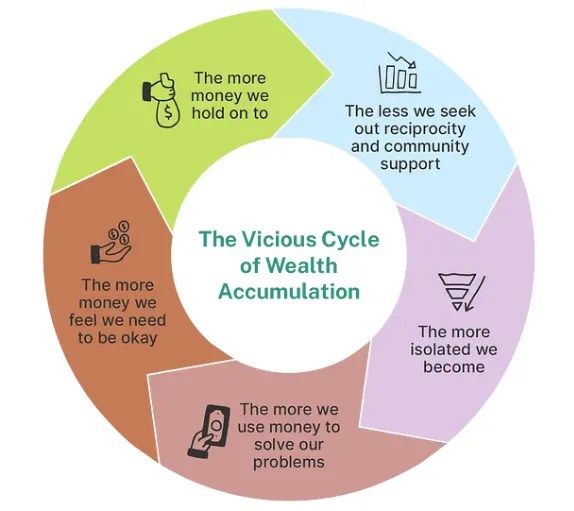
Several of my social media cyberfriends (see footer) are living quite counterculturally, and one of them introduced me to the Dense Discovery newsletter. I probably give it awfully short shrift most weeks, but today caught my attention and led to something pretty thought-provoking, starting with a graph:

Okay, but let’s talk about the prescribed wealth hoarding model in the United States, otherwise known as prudent financial planning (supposedly). The conventional advice from financial planners is that people of my age are supposed to accumulate something like $1 million in order to retire. Or maybe $1.5 million.1 In case you’re not hip to the logic here – I wasn’t until I married a very specific kind of nerd – we’re supposed to amass so much wealth that we can live off the interest and dividends until we die. It’s not enough to save what we’ll need to make it to the end of our life; we need (ostensibly) way more than that. We need to accumulate so much wealth that we can live off the wealth that our wealth earns. We need – we are told – enough that we never have to touch the principal, and we can pass our wealth along to our next of kin, whoever they may be.2

Interdependence is My New Retirement Plan – by Lisa Sibbett

My father, a professional, seemed to live fairly consistently with the values Lisa Sibbett suggests. My widowed mother had enough and to spare, but their church saw a lot of money over the years, too, and his kids occasionally got gifts at the end of a bountiful year.

My father-in-law, a tradesman, lived the “conventional advice from financial planners,” and we are now benefitting from his success at that model.

I’ve lived somewhere in between those two models. Though I (credulously?) aspired to the “conventional advice” model, I just couldn’t resist living life along the way, and not waiting until I was properly fixed for life. Unlike my parents’ generation, I did not live through any Great Depression and didn’t feel that possibility in my bones. I don’t regret it.

One caveat with Sibbett’s approach is that it requires long-enduring personal bonds. You’ll need to sink roots somewhere, and that somewhere will need to be where others are sinking roots as well. It requires long-enduring personal bonds. It’s not for individualist nomads.

The unmentionable elephant in the room

I confess that I struggled with the reasoning of the Supreme Court in Skrmetti although I reluctantly welcomed the outcome.

I was not alone. Josh Blackman and Hadley Arkes (not a lawyer, but an Amherst professor of Jurisprudence) were in the same position as me, but Arkes in particular pointed to the root problem:

The truth that dares not speak its name here is that this wide array of gender-affirming therapies and surgeries is simply predicated on a falsehood. And yet those are the words that the conservative justices apparently see themselves as barred from speaking. Something in conservative jurisprudence holds them back from appealing to the inescapable and objective truth that lies at the heart of these cases. But without it, what were these accomplished jurists able to explain here? What was their ground of justification in overriding the judgments of those parents who were absorbed in the grief and confusion that seized their children? . . . .

The only “instruction” that would be relevant, Justice Thomas, is the unyielding fact that the child is in a state of confusion: he is not occupying some body apart from his own; his sex was not “assigned” at birth but marked inescapably in the organs of reproduction, in the arrangement of his body. His sex is immutable and printed plainly upon him.

Those were the words that Chief Justice Roberts and five colleagues could not move themselves to speak. Or they thought they were constrained from speaking by a jurisprudence that bars them from invoking truths beyond the text of the Constitution—even on the question of what is a human being, the bearer of rights, and when does that “human person” begin? . . .

Without those points in place, the judgment of the Court simply dissolves into a chain of ipse dixits. Why was it not legitimate for the parents of stricken youngsters to order the procedures that might relieve their “gender dysphoria?” Answer: The legislature of Tennessee did not think it a legitimate medical remedy to choose—even though the children and the parents did not share that judgment and were willing to take their risks. One judgment had to prevail, and it was the judgment backed by the power of the State. To put a high finish on it, that “power” represented the authority of a people to govern itself through elected representatives. But when the people speak through their representatives, and override the judgments of parents about their children, they are still obliged to say something more than “we have brute the power to impose this judgment through brute enactment of the law.”

Arkes singles out Justice Thomas, I suspect, because he said “so-called experts have no license to countermand the ‘wisdom, fairness, or logic of legislative choices.’” (Justice Thomas, concurring in U.S. v. Skrmetti, via Eugene Volokh.) Arkes’ re-formulation, I guess, is that the legislature can tell the experts “your elaborations are predicated on the falsehood that a person can be inhabiting a body of the wrong sex.”

That’s not the end of the story, but it’s a starting point for re-writing a story written up to now by activists hiding something only a few clicks less deranged than the whack-a-doodle Chase Strangio ideology:

Strangio disputed that a trans woman could be “born with a male body” or “born male”; in his view, a trans woman was born a woman just like any other woman. There was no such thing as a “male body,” Strangio told his colleagues: “A penis is not a male body part. It’s just an unusual body part for a woman.” Before the advertisement aired, Strangio elaborated on his critique in an article in Slate. “Many advocates defend the use of the ‘born male’ or ‘born with a male body’ narrative as being easier for nontransgender people to understand,” Strangio wrote. “Of course it is easier to understand, since it reinforces deeply entrenched views about what makes a man and what makes a woman. But it is precisely these views that we must change.”

My own position hasn’t changed in 39 months. I think we’re still seeing a cultural contagion of trans claims in adolescents and must be very cautious – which is a bit easier now that even Strangio has given up on the “live son or dead daughter” emotional blackmail.

Patience, Mercy, Tolerance

For defenders of political liberalism there is perhaps no more pressing problem than this: How do you make a compelling case for liberalism in an era of ascendant [illiberalism or] strong gods? The idea of “strong gods” comes from the book Return of the Strong Gods by R. R. Reno, editor of the conservative ecumenical journal First Things.

By “strong gods” Reno means the kind of visceral or agonistic forces that can compel political or social action through deeper existential or even guttural appeals. The strong gods work not by chiefly targeting the intellect, but the appetites.

Michael Reneau, Evan Spear, and Jake Meador, A Virtue-Centric Argument for Political Liberalism (shared link). This article was welcome in light of the ascendance of various illiberalisms.

With a little help from AI, I got this summary table:

VirtueRole Against Postliberalism & Strong GodsRoot/Source
PatienceProvides long-term perspective, allowing growth and changeChristian theology & history
MercyBreaks cycles of retribution, fosters trust and forgivenessScripture, Shakespeare
ToleranceIntellectual humility; suspends harsh judgment; enables coexistenceLiberal philosophy & Scripture (e.g., parable of wheat and tares)

Wordplay

I know every one of these carries political freight, but that’s the burden of many writers these days:

  • Glenn Thrush, Alan Feuer and Adam Goldman remarked on the right-wing ire confronting Patel and Pam Bondi, the attorney general, as they fail to substantiate the accusations that they hurled in their bid for power: “They are running what amounts to a conspiracy theory fulfillment center with unstocked shelves.” (Jeff Lebsack, Buffalo, and Marianne Painter, Tacoma, Wash., among others)
  • In The Financial Times, Edward Luce worried that certain scenes from the Los Angeles protests played into the president’s hands: “Every rock hurled lands like a penny in Trump’s wishing well.” (Todd Lowe, Simpsonville, Ky., and Al Gallo, Huntersville, N.C., among others)
  • In The Washington Post, Philip Bump expressed skepticism about the government’s claim that immigration officers must wear masks for self-protection: “We should not and cannot take ICE’s representations about the need for its officers to obscure their identities at face value.” (Patrick Bell, Carmichael, Calif.)
  • Also in The Post, Dana Milbank took in Trump’s pleasure at some sycophantic Republicans’ suggestion that the D.C. Metro be renamed the “Trump Train”: “It’s a great idea. Qatar will donate the subway cars, which will be powered by coal. Passengers will pay for fares with cryptocurrency after first showing proof of citizenship. And the trains will reverse themselves regularly and without warning — never quite reaching their original destination.” (Mary Ellen Maher-Harkins, Orwigsburg, Pa., and Stan Shatenstein, Montreal)

Via Frank Bruni

Ceci n’est pas un phone

Methaphone. Like Methadone. Get it?

In case you’ve been wondering …

No, you’re not imagining it. The main source of political violence in the USA in this century has been right-wing, not left. Jamelle Bouie, Right-Wing Violence Is Not a Fringe Issue:

It is simply a fact that the far right has been responsible for most of the political violence committed in the United States since the start of the 21st century.

I had been wondering, because there has been some leftwing violence against persons, and much against property.

Poor fit

If it seems that America’s colleges and universities are poorly suited to the average American eighteen-year-old, perhaps that’s because they were never designed to serve him.

Oren Cass, The Once and Future Worker


Your enemies are not demonic, and they are not all-powerful and the right hasn’t always lost and the left hasn’t always won. But if you convince yourself of that, you give yourselves all sorts of permission to do a lot of stupid and terrible things under the rubric of “Do you know what time it is?”

Jonah Goldberg.

Trumpism can be seen as a giant attempt to amputate the highest aspirations of the human spirit and to reduce us to our most primitive, atavistic tendencies.

David Brooks

I don’t do any of the major social media, but I have two sub-domains of the domain you’re currently reading: (a) You can read most of my reflexive stuff, especially political here. (b) I also post some things on my favorite social medium.

Saturday, 5/31/25

AI doomsday?

[Jaron] Lanier agreed that it’s up to humans to protect the truth in the age of AI, but was less optimistic that we will do so: “The issue with AI is not the AI. It’s not the large language model. It’s the concentration of power and wealth around who owns it,” he said. “You have to look at the big system, including the people, the money, the business, the society, the psychology, the mythmaking, the politics.”

A Free Press Debate on Artificial Intelligence in San Francisco

Jaron Lanier had fallen off my radar for a few years. I’ll forever be interested in his take on anything regarding computers and humanity (together, not separately).

Bon mots

Codgers and technology go together like peanut butter and sardines.

Frank Bruni. Then this, merely via Frank Bruni, not from him:

In the quarterly journal Sapir, Bret Stephens made a kind of peace with the heavily partisan slant of so much cable television news: “To demand scrupulous impartiality on their broadcasts is like expecting fancy linens at a Motel 6.” (Naomi Lerner, West Orange, N.J.)

A non-tribal Democrat

Some of my subscribers dislike when I throw elbows to my left. They share my disdain for Donald Trump and his party, and my commitment to understanding them in light of political theory and history, but they are also devoted Democrats who have warm feelings for Joe Biden, were thrilled by the campaign of Kamala Harris and Tim Walz, and still seethe about Hillary Clinton’s loss in 2016.

That isn’t me. I vote for Democrats. I directionally agree with them on most issues. And I consider the Republican alternative thoroughly unacceptable. Yet I am not a devoted Democrat. A big part of the reason is that I’m not a joiner—of anything. I value my own independence too much and temperamentally resist deploying my talents to advance a cause—any cause, even a worthy one, and even one wrapped up, at this moment, with the fate of liberal democratic self-government in the United States.

But this way of thinking presumes that working to help the Democrats should take the form of deferring to and falling in line behind party leadership and elected officials, taking marching orders, rallying around candidates and nominees endorsed by the party bigwigs, and then maintaining message discipline to get them elected. That’s what I resist. But there’s another kind of devotion—one that expresses itself as tough love and a willingness to speak candidly, and even harshly, about faults.

… a Democratic researcher is quoted as saying that when she asks swing voters to liken the two parties to animals, they consistently describe Republicans as lions, tigers, and sharks—“apex predators” that “take what they want when they want”—but Democrats as tortoises, slugs, or sloths, creatures typically considered “slow, plodding, [and] passive.”

Damon Linker, A Party of Sloths

Substance, process

One of this crazy-making aspects of life in Trump 2.0 is that the media coverage of the administration’s antics focuses, mostly on the substance of what they are doing, ignoring the process, and the question of whether they have the authority to do it at all.

Such, I feared, was the infirmity of NPR and PBS Aren’t Entitled to Your Tax Dollars, a Free Press article by a serious Ivy league constitutional law professor. I slogged my way through it, agreeing with the author again and again, but frustrated that he was ignoring the elephant in the room. Finally, in literally the last paragraph, he mentioned the elephant almost as a throwaway line:

NPR also alleges in its complaint that the federal statute creating the Corporation for Public Broadcasting prohibits Trump from making this defunding decision. That’s a very different argument, which I’m not addressing here ….

I would venture a guess that nine out of ten people who read this column will come away with the impression that NPR and PBS are suffering from a liberal sense of entitlement to tax dollars, and miss the point about there being some limits to executive power.

In the end, it may not matter because this Congress is sufficiently servile that if Trump asks Congress to defund CPB, PBS and NPR (a longtime GOP talking point), it almost certainly will oblige him.

But process does matter, tremendously. Where the power to do something resides also matters.

Dissing Adoption

The New York Times … has never found a basic human good it couldn’t ponderously criticize with the shuffling-foot smarm of the ideas festival class. There’s “I Was Adopted From China as a Baby. I’m Still Coming to Terms With That. There’s “World’s Largest ‘Baby Exporter’ Admits to Adoption Fraud.” There’s “Given Away: Korean Adoptees Share Their Stories.” (In easily-digestible video format!) There’s “I Was Adopted. I Know the Trauma It Can Inflict.” (Subtle.) The New Yorker, a $12,000 espresso machine transformed into a magazine by a mischievous wizard, has “How an Adoption Broker Cashed In on Prospective Parents’ Dreams,” “Living in Adoption’s Emotional Aftermath,” and “Where is your Mother?” (The answer is that she has been separated from her child by a cruel and fickle child welfare system despite being perfectly fit, which I’m sure is how it usually goes.) The Atlantic has “No One’s Children: America’s long history of secret adoption.” (Would you be shocked to learn that said history isn’t a good one?) They’ve got “The New Question Haunting Adoption,” the question being whether adoption is really a secretly selfish act, you know, the selfish act of taking a severely-disabled toddler into your home to provide them with support and love after their birth parents smoked meth throughout pregnancy. They also have, incredibly, “What Adoption ‘Salvation’ Narratives Get Wrong,” “Adoption Is Not a Fairy-Tale Ending,” “The Dark, Sad Side of Domestic Adoption”…. I could go on, and that’s just three prestigious publications. There’s a whole world out of this out there.

This is all, for the record, a really excellent example of what we used to mean when we used the word ideology. Once upon a time, one wouldn’t say “My ideology is…” because ideology referred to the hidden, unexplored, unconscious politics that lay beneath the public, open, explicit politics. An ideology was those pre-political assumptions and beliefs which conditioned and limited political thought, which made the conscious political philosophy of any individual what it was. Ideology is the skeleton that hides unseen within the animal of politics but nevertheless determines the structure of that which is seen. Ideology exists in both the macro and the micro; this bizarre upper-caste antipathy towards ideology is a good example. If you asked leadership at these publications if they had any particular interest in leading a charge against the practice of adoption, they’d say no, of course not, what a weird question! If you were to show them just how repetitively this particular set of critiques and questions and hrm hrm hrm noises gets published in their pages, they’d swear to you that it reflects no underlying party line. And yet there it is, the evidence, in black and white. Something about the current constitution of the anxious educated urbanite liberal soul cries out inside of them: the real problem is adoption.

Freddie deBoer, Adoption is Good

If the shoe fits

A well-regarded Evangelical pastor published this weeks before the 2020 Election.

[T]his is a long-overdue article attempting to explain why I remain baffled that so many Christians consider the sins of unrepentant sexual immorality (porneia), unrepentant boastfulness (alazoneia), unrepentant vulgarity (aischrologia), unrepentant factiousness (dichostasiai), and the like, to be only toxic for our nation, while policies that endorse baby-killing, sex-switching, freedom-limiting, and socialistic overreach are viewed as deadly.

I think it is a drastic mistake to think that the deadly influences of a leader come only through his policies and not also through his person.

This is true not only because flagrant boastfulness, vulgarity, immorality, and factiousness are self-incriminating, but also because they are nation-corrupting. They move out from centers of influence to infect whole cultures. The last five years bear vivid witness to this infection at almost every level of society.

Christians communicate a falsehood to unbelievers (who are also baffled!) when we act as if policies and laws that protect life and freedom are more precious than being a certain kind of person. The church is paying dearly, and will continue to pay, for our communicating this falsehood year after year.

The justifications for ranking the destructive effects of persons below the destructive effects of policies ring hollow.

I find it bewildering that Christians can be so sure that greater damage will be done by bad judges, bad laws, and bad policies than is being done by the culture-infecting spread of the gangrene of sinful self-exaltation, and boasting, and strife-stirring (eristikos).

I think it is baffling and presumptuous to assume that pro-abortion policies kill more people than a culture-saturating, pro-self pride.

When a leader models self-absorbed, self-exalting boastfulness, he models the most deadly behavior in the world. He points his nation to destruction. Destruction of more kinds than we can imagine.

It is naive to think that a man can be effectively pro-life and manifest consistently the character traits that lead to death — temporal and eternal.

John Piper, Policies, Persons, and Paths to Ruin: Pondering the Implications of the 2020 Election

Piper did not say who he was voting for. He did not name names. For that reason, I’m blogging this separately from pointed political material.

But I’m not going to deny that my heart soared to see that our current President had not captured and reduced to servility the entirety of one of America’s most prominent Christian traditions.

The right to know isn’t the whole story

To further clarify our situation, consider W. H. Auden’s discussion, which I’ve cited before, of the idea that, as he put it, “the right to know is absolute and unlimited.” “We are quite prepared,” Auden wrote,

“to admit that, while food and sex are good in themselves, an uncontrolled pursuit of either is not, but it is difficult for us to believe that intellectual curiosity is a desire like any other, and to recognize that correct knowledge and truth are not identical. To apply a categorical imperative to knowing, so that, instead of asking, ‘What can I know?’ we ask, ‘What, at this moment, am I meant to know?’ — to entertain the possibility that the only knowledge which can be true for us is the knowledge that we can live up to — that seems to all of us crazy and almost immoral.”

L.M. Sacasas, Structurally Induced Acedia (The Convivial Society)

Harvard and the Trump administration

Harvard and the Trump administration have each finally met an adversary too big to push around. America’s richest university never really considered how much it depends on government policy, including lavish federal research funding, federal student aid, and a permissive immigration regime for the foreign students—who make up a third of the university’s student body and often subsidize the rest by paying more. Progressives also never thought through how the many tools they devised for using government leverage against private institutions—including threatening tax exemptions, as the Supreme Court allowed on dubious grounds in Bob Jones University v. United States (1983)—could be used against universities that engage in race discrimination for the “right” reasons, cultivate a political monoculture among the faculty, and permit campus mobs to terrorize minority groups who are out of progressive favor (Jews). Now, Trump is trying to strip Harvard of everything—tax exemption, federal funding, and visas for foreign students already enrolled. While the comeuppance for Harvard is admittedly delicious, the president is abusing powers he ought not to have, and Harvard has deep enough pockets to fight him in court.

National Review Weekly email.

Some cases don’t have valid arguments on both sides. That I find nothing “delicious” about Harvard’s “comeuppance” is an example of why I ignore National Review’s regular email invitations to resubscribe.

Can a car have a “catfish smile”?

“Behind that catfish smile, the company’s twin-turbo 4.0-liter DOHC V8 now discharges a drama-drenched 656 hp and 590 lb-ft—153 hp and 85 lb-ft more than the previous Vantage Roadster—thanks to larger turbochargers, revised camshaft profiles, optimized compression ratio and upgraded fueling and cooling.”

Kudos to Dan Neil for the spot-on “catfish smile.”

The car, by the way, is a 2025 Aston Martin Vantage Roadster, which will set you back $300,000 as equipped (this week’s ephemeral tariffs not included).

Credentials, good times, and genuine learning

Most young people today feel, with considerable justification, that they live in an economically precarious time. They therefore want the credential that will open doors that lead to a good job, either directly or (by getting them into good graduate programs) indirectly …

But those same young people also want to have a good time in college, a period of social experience and experimentation that they (rightly) think will be harder to come by when they enter that working world …

… Yes, students understand — they understand quite well, and vocally regret — that when they use chatbots they are not learning much, if anything. But the acquisition of knowledge is a third competing good, and if they pursue that one seriously they may well have to sacrifice one of the other two, or even both. Right now they can have two out of three, and as Meat Loaf taught us all long ago, two out of three ain’t bad.

Alan Jacobs, responding to Ted Gioia on the topic of ending AI cheating.

Potpourri

  • After Trump held a crypto dinner last Thursday night, crypto moguls who paid to be there felt scammed that the president didn’t even stick around at the event they’d hoped to do their own scams at. I saw someone describe him as the apex scammer. Our Scammander in Chief.
  • In other Russia news, a new statue of Joseph Stalin in a Moscow metro station was unveiled this month. President Putin has called Stalin an “effective manager,” and has said that enemies of Russia use the “excessive demonization” of Stalin to attack “the Soviet Union and Russia.” Stalin is back, big time. Interesting that “effective manager” is being used here to describe a man who facilitated the death of millions—and not efficiently. But I’m not a businessman.
  • The continued reckoning: A postmortem on Kamala Harris’s campaign cited a “perception gap” as one of the reasons she lost, saying voters believed she held positions that she didn’t. “Over 80% of swing voters who chose Trump believed Harris held positions she didn’t campaign on in 2024, including supporting taxpayer funding for transgender surgeries for undocumented immigrants (83%), mandatory electric vehicles by 2035 (82%), decriminalizing border crossings (77%), and defunding the police (72%).” But Harris had, in fact, supported all of these positions. Like, she is on record supporting each of those positions (here, here, here, and here). So it’s not really a perception problem so much as a reception problem, like these ideas are not popular even though I support them. There’s a sense among Dems that people should simply ignore the things that are unpopular and that referencing them is fake news. Like, how dare you talk about the surge of migrants coming through our new open borders thanks to swift changes from the Biden admin. Yes, it’s technically true, but it’s disinformation-coded.
  • Leave Bruce alone: A bar in New Jersey canceled a performance by a Bruce Springsteen tribute band after the real Springsteen called Trump “corrupt, incompetent, and treasonous” while on tour in England. Citing the bar’s MAGA clientele, the bar owner said that a Springsteen cover band would be “too risky at the moment.” And: “Whenever the national anthem plays, my bar stands and is in total silence, that’s our clientele. Toms River is red and won’t stand for his bull—.” [But MAGA doesn’t have a violent streak. No way. That’s fake news.]
  • Things that are not antisemitism: The Democratic Socialists of America “Liberation Caucus” has announced its support for Elias Rodriguez, the suspect arrested for slaughtering two Israeli Embassy staffers outside D.C.’s Capital Jewish Museum last week. Here’s the statement signed by the DSA Liberation folks and a bunch of others: “As imperialism has made the entire world its battlefield, it is justified to fight it, by any means necessary, without regard for geography.” And: “[T]here must be consequences for genocidal [Z]ionist imperialism, and those consequences are righteous.”

Nellie Bowles

Fake my …

The latest fitness craze is surely going to be Fake My Run. It fits perfectly with the national ethos whereby university students are already doing Fake My Education.


Your enemies are not demonic, and they are not all-powerful and the right hasn’t always lost and the left hasn’t always won. But if you convince yourself of that, you give yourselves all sorts of permission to do a lot of stupid and terrible things under the rubric of “Do you know what time it is?”

Jonah Goldberg.

Trumpism can be seen as a giant attempt to amputate the highest aspirations of the human spirit and to reduce us to our most primitive, atavistic tendencies.

David Brooks)

I don’t do any of the major social media, but I have two sub-domains of the domain you’re currently reading: (a) You can read most of my reflexive stuff, especially political here. (b) I also post some things on my favorite social medium. I am now exploring Radiopaper.com as well.

Thursday, 12/19/24

Huzzah for the new Tory leader!

The thing that drove me crazy was seeing how the lives of young gay, sometimes autistic, children were being destroyed on the altar of trans activism … and meeting young people who had effectively been sterilized. It’s horrific,” –

Kemi Badenoch, the new British Tory leader, on child sex reassignment. Via Andrew Sullivan.

Long-term forecast: deja vu

The resentment over the expulsion of Stephen Kappes as chief of the clandestine service was ferocious. Kappes, an ex-marine and former station chief in Moscow, represented the very best of the CIA. In partnership with the British intelligence service, he had only recently played a leading role in a triumph of intelligence and diplomacy by persuading Libya to abandon its long-running program to develop weapons of mass destruction. When he questioned Goss’s judgment, he was shown the door. The new director surrounded himself with a team of political hacks he had imported from Capitol Hill.

Tim Weiner, Legacy of Ashes

If you think Team Trump values competence over sycophancy, you haven’t been paying attention.

Destruction — creative or not

On the other side of the Channel, the mass protests of the London taxi drivers both expressed and contributed to the Brexit mood. This was a fight for economic sovereignty by highly trained professionals against the threat posed by foreign ride-hailing firms that rely on map software, U.S. military satellites, and the subsistence drivers of the gig economy. Essentially, Uber created a system of labor arbitrage to sidestep and nullify local control.

Matthew B. Crawford, Why We Drive

(Crawford is talking about Uber/GPS displacing London Cabbies, who take years learning every street in London by heart in order to be licensed.)

Shorts and Wordplay

The inability of some critics to connect the dots doesn’t make pointillism pointless.

Georges Seurat

Notes to self: Don’t take criticism from someone you wouldn’t take advice from.

Steve Brady on micro.blog, though I doubt that it’s original with him.

If people never did silly things nothing intelligent would ever get done.

Ludwig Wittgenstein (Sounds like the Lord of Spirits guiding principle.)

… the eerie, vaguely-writing-flavored products that programs like ChatGPT generate ….

Phil Christman, Does Teaching Literature and Writing Have a Future?

Trump is history in a golfcart

Ross Douthat (who’s pretty sure he stole it but can’t remember from whom)

There is nothing that I may decently hope for that I cannot reach by patience as well as by anxiety.

Wendell Berry

Trump’s super power has always been to get his opponents to bust norms in the name of shutting him down.

Nick Gillespie

Your life is not about you.

Bp. Robert Barron, quoted by Molly Worthen

It was a pleasure to have dinner the other night with Governor Justin Trudeau of the Great State of Canada.

Donald Trump.

Trump Tells Trudeau He Won’t Annex Canada if They Admit Their Bacon Is Just Ham.

The Babylon Bee

[T]he idea that Russia always wins wars of attrition may have exceeded its expiration date.

Andrew Sullivan


I suffer more from the humiliations inflicted by my country than from those inflicted on her.

Simone Weil, from a letter to Georges Bernanos.

I don’t do any of the major social media, but I have two sub-domains of the domain you’re currently reading: (a) You can read most of my reflexive stuff, especially political here. (b) I also post some things on the only social medium I frequent, because people there are quirky, pleasant and real.

Potpourri

Not (especially) political

Wisdom from the third world

We had a lot of trouble with western mental health workers who came here immediately after the genocide and we had to ask some of them to leave. They came and their practice did not involve being outside in the sun where you begin to feel better, there was no music or drumming to get your blood flowing again, there was no sense that everyone had taken the day off so that the entire community could come together to try to lift you up and bring you back to joy, there was no acknowledgement of the depression as something invasive and external that could actually be cast out again. Instead they would take people one at a time into these dingy little rooms and have them sit around for an hour or so and talk about bad things that had happened to them. We had to ask them to leave.

A Rwandan talking to a western writer, Andrew Solomon, about his experience with western mental health and depression. I regret losing the URL, but offer the following in complement:

Serenity in leisure

There is a certain serenity in leisure. That serenity springs precisely from our inability to understand, from a recognition of the mysterious nature of the universe; it springs from the courage of deep confidence, so that we are content to let things take their course; and there is something about it which Konrad Weiss, the poet, called “confidence in the fragmentariness of life and history.”

Josef Pieper, Leisure the Basis of Culture, page 47.

What do you do for a living?

Visit a graveyard; you will search in vain for a tombstone inscribed with the words “steam-fitter,” “executive vice president,” “park ranger,” or “clerk.” In death, the essence of a soul’s being on earth is seen as marked by the love they felt for, and received from, their husbands, wives, and children, or sometimes also by what military unit they served with in time of war. These are all things which involve both intense emotional commitment, and the giving and taking of life. While alive, in contrast, the first question anyone was likely to have asked on meeting any of those people was, “What do you do for a living?”

David Graeber, Bullshit Jobs

… but liars can figure

I saw an item in the Wall Street Journal very recently:

Here’s a statistic to remember next year, as Congress debates extending President Trump’s 2017 tax cuts: The top 1% of income-tax filers provided 40.4% of the revenue in 2022, according to recently released IRS data. The top 10% of filers carried 72% of the tax burden. Self-styled progressives will never admit it, but U.S. income taxes are already highly progressive ….

Then I saw a Politico item lamenting how little income tax the super-wealth pay on their increase wealth.

So, is someone lying?

Yeah, pretty much. Increased wealth doesn’t imply taxable income. I’m confident that the increased wealth figures Politico cited were mostly unrealized capital gains, which we don’t tax for a number of very good (if not ironclad) reasons.

Infrastructure century

Because the highways were gold-plated with our national wealth, all other forms of public building were impoverished. This is the reason why every town hall built after 1950 is a concrete-block shed full of cheap paneling and plastic furniture, why public schools look like overgrown gas stations, why courthouses, firehouses, halls of records, libraries, museums, post offices, and other civic monuments are indistinguishable from bottling plants and cold-storage warehouses. The dogmas of Modernism only helped rationalize what the car economy demanded: bare bones buildings that served their basic functions without symbolically expressing any aspirations or civic virtues.

James Howard Kunstler, The Geography of Nowhere

How long will this hold?

Most Americans say media criticism helps hold politicians accountable | Pew Research Center

One of the things I worry about is unaccountable local officials now that the internet has killed smaller local media. The Lafayette Journal & Courier is a wraith, all but invisible were it not for stories fed from other Gannett papers. WLFI has been gutted with departures as its owner, Allen Media Group, bids billions for new acquisitions but doesn’t pay its bills. Only national politics is really covered any more, and that in only a selective way:

Trans teen health

In oral arguments at the Supreme Court Wednesday, ACLU lawyer and transgender ideologue Chase Strangio was forced to admit that gender realignment surgery for children does not prevent suicide—a core claim of many trans activists, notoriously communicated to parents by doctors as “do you want a live girl or a dead boy?” (Source: The Free Press)

What’s left of the trans argument against Tennessee law, in my view, boils down to “it’s sex discrimination to allow estrogen for girls, testosterone for boys, but not vice versa” — an argument that begs the question of whether the brute fact of sexual binary has any implications for law and medicine.

Wordplay

as man became disenchanted with regards to God and the cosmos, he became enchanted instead with himself and his own potential

Jake Meador

Just as clean air makes it possible to breathe, silence makes it possible to think.

Matthew Crawford

All that is not eternal is eternally out of date.

C.S. Lewis

[T]he forces that are destroying the things I cherish most in the world — faith, family, nation, tradition — all originate in the United States.

A Catholic expat friend of Rod Dreher

Two from Dreher’s latest book

Politics

Thankfulness

The Free Press has its people weigh in on what they’re thankful for at Thanksgiving. Martin Gurri responds:

This year, the petty little man in me is thankful that I won’t have to listen to Joe Biden’s double-dribbling sentences or Kamala Harris’s sitcom canned laughter ever again. The greedy analyst in me is thankful that Donald Trump is coming to burn Washington, D.C., to the ground, so Bari Weiss can keep telling people that I’m the only human on Earth who understands this dread pirate. The lonesome immigrant in me is thankful for my wife, and children, and grandchildren, my country and my street, my plans and my memories—because they make high politics feel like a trivial dream that I wake up from, when I step away from my laptop.

Pete Hegseth

I don’t trust Trump, and it seems to me as if he’s deliberately staffing up with sexual predators — as if that was proof of a decisive “get-things-done” manliness.

Moreover, I distrust pretty boys like Pete Heseth, Gavin Newsom, etc. (Yeah. Maybe there’s a little envy there.)

Nevertheless, I’m withholding my final judgment on Hegseth’s suitability for DoD because his accusers are hiding behind anonymity.

Pardon power

[T]he President is only accountable to the electorate so long as he or his party are up for election. Once the election is over, there’s no one for voters to punish. That’s why Biden waited until after the election to pardon Hunter; why Trump did the same for Steve Bannon and Roger Stone; why Obama did the same when commuting the sentences of Chelsea Manning and the terrorist Oscar López Rivera. And, most notoriously, that’s why Bill Clinton waited until his last full day in office to pardon the fugitive Marc Rich, who had fled to Switzerland to avoid prosecution and whose ex-wife donated $450,000 to the Clinton Library.

Stephen E. Sachs, How To Ban Lame-Duck Pardons

Feather pillows

It is true that in some matters, including a considerable swath of policy issues that he neither understands nor cares about, Trump can be like Lord Derby, who, “like the feather pillow, bears the marks of the last person who has sat on him”—which is no small thing given the assortment of asses we are talking about. But Trump makes a big impression of his own on the feather pillows he encounters.

Kevin D. Williamson


I suffer more from the humiliations inflicted by my country than from those inflicted on her.

Simone Weil, from a letter to Georges Bernanos.

I don’t do any of the major social media, but I have two sub-domains of the domain you’re currently reading: (a) You can read most of my reflexive stuff, especially political here. (b) I also post some things on the only social medium I frequent, because people there are quirky, pleasant and real.

Nominees, Essential Workers and Half-Truths

Trump’s nominees

In The Washington Post, Catherine Rampell evaluated the naming of Musk and Vivek Ramaswamy as heads of a new government agency: “How can you tell Donald Trump’s plan to improve ‘government efficiency’ is off to a promising start? Because his first step was appointing two people to do the same job.” (Gerard Farrell, Summit, N.J., and Bruno Momont, Manhattan)

Also in The Post, Ruth Marcus took in Trump’s galling choice for attorney general: “No mother says to her son, ‘Why can’t you be more like Matt Gaetz.’” (David Sherman, Arlington, Va.) Her Post colleague George F. Will called Gaetz “an arrested-development adolescent with the swagger of a sequined guitarist in a low-rent casino.” (Korleen Kraft, Portland, Ore., and Bill Tanski, Stratford, Conn., among many others)

Via Frank Bruni

Manly men

What’s with all the sociopaths, serial adulterers and accused rapists Trump wants in high office?

Is RFK Jr. a manly man while Mitt Romney is a soy boy?

Noah Millman has an hypothesis about what’s up, and I think it’s a good start on figuring out yet another division in how Americans view the world.

By the way: Trump is throwing out a lot of names that haven’t been vetted by the FBI. Is the Senate going to let him get away with that?

Three lessons from the Gaetz débâcle

Kimberly Strassel draws three lessons from the Matt Gaetz débâcle:

And so, Lesson No 1: Not all allegations against Republicans are partisan shams. That’s surely hard for Republicans to swallow …

The Trump transition team might have also read the insider room. Republicans are well versed in defending their brethren against nonsense attacks—even their unpopular brethren. There was a reason few if any Republican members rushed to Mr. Gaetz’s defense: They know him. Congress is a close space, and most all members had seen or heard something unpleasant enough to make them suspect fire accompanied the smoke. Ergo, Lesson No. 2: Take your lead from people who know, not MAGA Twitter insurgents.

The name of the Trump nominations game is clearly “shakeup”—and that’s to be applauded. Few doubt that Washington is in desperate need of some rattling. But note Lesson No. 3: The Gaetz fiasco is a reminder that there remains a bright line between a candidate who is aggressive, committed and professional and one who is unthinking, partisan and a liability … Mr. Gaetz was always clearly the latter—big on bravado, short on ideas and temperament. While not as discussed as the ethics question, it’s also an important reason his nomination was destined to fail.

(Bold added)

Essential workers

Another vulnerability that the novel coronavirus has exposed is the paradoxical notion of “essential” workers who are grossly underpaid and whose lives are treated as disposable.

Michael Pollan, The Sickness in Our Food Supply

Too good not to be true

Sometimes they lie to you because a story’s too good not to be true. (I hope I’m not doing that.)


[H]istory is well and truly back. Even Francis Fukuyama agrees.

Mary Harrington at UnHerd

I suffer more from the humiliations inflicted by my country than from those inflicted on her.

Simone Weil, from a letter to Georges Bernanos.

I don’t do any of the major social media, but I have two sub-domains of the domain you’re currently reading: (a) You can read most of my reflexive stuff, especially political here. (b) I also post some things on the only social medium I frequent, because people there are quirky, pleasant and real.

Saturday Truth in Advertising

Not really politics

Res ipsa loquitur

It is satisfying to manifest oneself concretely in the world, through manual competence; it has been known to make a person quiet and easy. It seems to relieve him of the need to offer chattering interpretations of himself, to vindicate his worth. He can remain quiet and simply point: The building stands, the lights are on, the car now runs.

Matthew Crawford, What School Didn’t Teach Us: Your Place in the World

I tend to forget how strange was the childhood of the brilliant and quirky Matthew Crawford. Read the item to see what I mean.

Bon mots

  • In The Washington Post, Amanda Katz noted that Kennedy had terminated his presidential campaign and endorsed Trump, “ending a dilemma for voters torn between their love of deportation camps and their love of measles.”
  • In The New Yorker, Helen Rosner sampled the classic fare at a nearly 90-year-old French restaurant in Manhattan that received a recent sprucing-up: “You can hardly go wrong, though it would be the height of tragedy if not one person at the table ordered the frogs’ legs persillade, a cancan line of amphibian gams in an audibly sizzling bath of butter and garlic that a server oomphs up, upon presentation, with a squeeze of lemon.”

Via Frank Bruni

  • “I don’t know if Democrats fully realize how damaging the image of the possible first woman president being incapable of giving an interview alone without the presence of a man to help her is,” – Meghan McCain.
  • “It’s disappointing to say — but perhaps he personally lacks principle on this issue,” – Lila Rose, anti-abortion activist, on Trump’s latest pivot. (D’ya think?)

Via Andrew Sullivan

Politics generally

A Thrill for Nerds

Political highlight of 2024: The Democrats selecting a successor to feeble President Joe Biden without panic about needing to re-do the primary elections.

I wasn’t politically sophisticated when the parties decided to turn over the selection of their Presidential candidates to whoever deigned to show up at a primary election (run at government expense, with government’s thumb on the scales to maintain the present two parties), but I was alive and aware. Because I was a snot-nosed kid, I probably thought it was a great idea.

It wasn’t. It took the selection from pros who wanted to win the election and turned it over to “the base”, which eventually would want maximalist trolling of the other duopoly party. Therein is a major source of our notorious “polarization,” at least among the noisier members of the parties.

If I haven’t said it before, I’m in favor of “smoke-filled rooms” or whatever other technique the parties choose to select candidates at their own expense. I heard one where they suggested non-binding primaries — a way to create a presumptive nominee, but giving the party a opportunity to bail out if the people’s choice is an idiot or semi-comatose.

(This rant inspired by Thursday’s Advisory Opinions podcast with the fabulous Yuval Levin.)

One picture, many words

Two things about the image stood out. One is the preposterous idea that “America” is accurately represented by five populist edgelords, all of whom live in close proximity at the ends of the proverbial horseshoe. But that’s in keeping with modern Republican mythology about Trump’s movement reflecting a supposed silent majority: If the only people who count as “real Americans” are those on Team MAGA, then sure, a coalition that runs the gamut from left-leaning Putin apologists to right-leaning Putin apologists is a fair portrait of America.

The other thing that struck me was that Republicans evidently believe this image benefits them politically. Somehow we’ve arrived at a place as a country where Donald Trump is no longer weird enough in his own right to lock down “the weird vote” this fall and needs cover on his weirdo flank from the likes of Kennedy and Gabbard. Worse, he and his party seem to think there are more votes to be had by appealing to that weirdo bloc than there are to be lost among normie voters by doing so.

Nick Cattogio

The Dumb Crank Party

The partisan shifts of both Trump and RFK Jr. are part of a long term cycle in which educated professionals have gravitated toward the Democratic Party coalition and a generic suspicion of institutions and the people who run them has come to be associated with conservative politics. … The problem is that this hasn’t actually changed the fact that lots of people are dumb cranks; it’s simply created a Dumb Crank Party. And on balance, I think that has eroded the epistemic quality of both coalitions.

Matt Yglesias via The Morning Dispatch

Snare

My worry is that liberals will get so caught up in countering his every move, essentially playing his game, that they will fail to seize—or even recognize—the opportunity he has given them. Now that he has destroyed conventional Republicanism and what was left of principled conservatism, the playing field is empty. For the first time in living memory, we liberals have no ideological adversary worthy of the name. So it is crucial that we look beyond Trump.

Mark Lilla, The Once and Future Liberal

CPAC

CPAC was still a depressing place to be, a revival meeting for political fanatics. Only, instead of selling hope, the speakers were preaching anger and resentment.

Jon Ward, Testimony

Trump

Railing against the unpersuadables

A wise man once said that the business of punditry is persuasion. Assuming that’s true, we won’t be conducting any business today.

That’s because the subject of Donald Trump’s toothy thumbs-up photo op amid the fallen at Arlington National Cemetery is persuasion-proof. There are already a thousand reasons to despise him; either you came around to doing so long ago or you’ve managed to rationalize away each of them, in which case this latest one won’t pose any problem.

Years ago, it was possible to believe there might be something he could do to alienate his apologists. Callousness toward the military was an obvious one: The right prides itself on being patriotic, and patriots rightly celebrate service members for the sacrifices they’ve made to defend America. If Trump were to stoop to his usual boorishness in attacking an opponent’s military record, it was thought, he might at last discover a line he’s not allowed to cross.

How naive we were. The rest of this column could be spent revisiting his various affronts to military honor over the years: goofing on John McCain for being captured in Vietnam; “feuding” with a Muslim Gold Star family in 2016; confiding in aides that he didn’t want wounded veterans in a parade because it “doesn’t look good for me;” declining to visit an American military cemetery outside Paris in 2018 for fear, allegedly, that his hair would get wet in the rain; saying on the same trip, according to four separate sources cited by The Atlantic, that the cemetery was “filled with losers” and that the Marines at Belleau Wood were “suckers” for having sacrificed their lives.

John Kelly, a four-star Marine general who went on to become Trump’s chief of staff, confirmed all of it on the record to CNN last October. According to The Atlantic, when Trump accompanied Kelly in 2017 on a visit to the grave of the general’s son Robert, who was himself killed in Afghanistan years earlier, he turned to Kelly and said of the fallen, “I don’t get it. What was in it for them?”

In a test of credibility between a man with a dubious record of draft deferments on the one hand and a highly decorated officer who lost his son in combat on the other, it’s no contest: The right chooses to believe that Kelly, not Trump, is the liar. That’s what being “persuasion-proof” means …

All of this feels familiar, no?

Not the setting, that is, but Trump’s M.O. It’s the classified documents fiasco all over again. He wanted something he couldn’t have; that something was minor enough that he calculated the relevant authorities wouldn’t go to war with him to block him from getting it; so he simply ignored the rules and dared them to do something about it.

He succeeded at Arlington and might yet succeed in the other matter. That’s what happens when a gangster by temperament leads a gang that includes millions of people: In nearly every dispute, the personal cost of litigating that dispute will be greater for his opponents than it will be for him. Not coincidentally, according to military sources who spoke to the New York Times, the reason the cemetery employee chose not to press charges over the alleged altercation is that “she feared Mr. Trump’s supporters pursuing retaliation,” an entirely reasonable concern.

Law simply shouldn’t matter here. The way you deter Trump and other sociopathic politicians from treating gravesites as stage sets is by shaming them and punishing them politically for their callousness. But … how you do that when the people in the best position to inflict that punishment, right-wing voters, refuse to do so?

Nick Catoggio, Mourning in America

Transactional Trump

Trump was never on the social conservatives’ side. He courted them and sought their approval as a function of his desire for status, power, and his own aggrandizement. If they had achieved political results that could benefit him, he would still be seeking their support, but now he sees them as an obstacle and an embarrassment. If you are seeking to manipulate, influence, or transact business with Trump by all means flatter him, but always understand that he was never your friend and will always turn on you the moment you pose an obstacle to his ambitions.

Analysis of an anonymous friend of Rod Dreher

No Pro-Life Case for Trump

When you announce that one can be pro-life and support a philandering womanizer and twice divorced serial adulterer who has been credibly accused of rape, you discredit the cause and tell people you aren’t really serious.

When you announce that one can be pro-life and support a man who was closely associated with Jeffrey Epstein and even joked about Epstein’s alleged pedophiliac assaults of children, you discredit the cause and tell people you aren’t really serious.

When you announce that one can be pro-life and support a man who refused to straightforwardly answer when asked if he has ever paid for an abortion, you discredit the cause and tell people you aren’t really serious.

Jake Meador, There Never Was a Pro-Life Case for Trump


I suffer more from the humiliations inflicted by my country than from those inflicted on her.

Simone Weil, from a letter to Georges Bernanos.

I don’t do any of the major social media, but I have two sub-domains of the domain you’re currently reading: (a) You can read most of my reflexive stuff, especially political here. (b) I also post some things on the only social medium I frequent, because people there are quirky, pleasant and real.

4/30/24

The Surprising Truth About Handmaids

The heart of Gilead is not religious extremism, but social engineering.

Nowhere is this more apparent than in the Handmaids themselves, and the Ceremony that defines their role. The idea that women can be used outside of the confines of marriage as incubators for strongly desired children would be abhorrent to the vast majority of religious conservatives who seem to be The Handmaid’s Tale‘s targets. But it is all the rage in certain secular and progressive circles—and by no means is it limited to the fringes. It has become especially popular among homosexual couples, many of whom pay top dollar for Handmaids who serve a purpose they cannot fulfill themselves.

Not original with me, but I’ve lost the original source.

Schrödinger persons

On a related note:

When the industry makes promises to prospective parents about in vitro fertilization, it leans on images of cherub-cheeked babies. And when it pitches to egg donors, it speaks the language of altruism: You can help make a family. But when something goes wrong, the liability-shy industry is quick to retreat to the language of cells and property. IVF relies on treating the embryos it creates, freezes, and often discards as Schrödinger’s persons: we cannot make a moral pronouncement about what they are until we know whether they’re intended for life or death.

Leah Libresco Sargeant

A cautionary tale

Argentina, for all it’s faults, is a Democracy, and the people keep electing very flawed politicians. They keep electing tumult, and choosing short term satisfaction. They keep voting for the candidate that promises to give them the most things, while also taking stuff away from others. They keep doing that because now, after a century of disarray, part of their national identity is a cynicism that’s reached nihilistic levels.

Chris Arnade

That sounds like the trajectory of another country I know well. I noticed a report this morning that Trump is 6 points ahead in (some) polls.

I can relax but I’m not going to enjoy it.

Aaron Burr = DJT

Charlie Sykes, The choice Republicans face is too good for me to just pull excerpts. I didn’t know what kind of low, narcissistic character Aaron Burr was, and how close he came to being President. We need some Alexander Hamiltons in the GOP (but I fear the GOP is too far gone).

David Frum painstakingly explains why Even Bill Barr Should Prefer Joe Biden by gaming out what’s likely to happen if Trump is elected. Maybe that will prove persuasive to a handful of Trump voters, but it suffices for me that Trump, like Aaron Burr, is a “dangerous, narcissistic mountebank and ‘a man of extreme & irregular ambition.’”

POTUS candidate age disparity

At the White House Correspondents Dinner on Saturday, Joe Biden joked that age is an issue in the election, because “I’m a grown man running against a six-year-old.” (New York Post)

The Free Press

Presidential immunity

Hungry for coverage of last Thursday’s SCOTUS arguments on Presidential criminal immunity, I was nauseous as most of my sources were doing the usual “we know this Court is corrupt; let us now find proof in the hypothetical questions they ask on this case we’re afraid might not go our way.”

Then finally I found sanity:

As several of the justices pointed out, they aren’t making a rule for Donald Trump. They’re making “a rule for the ages,” as Justice Neil Gorsuch put it—one that has to apply to good presidents and bad ones, Republicans and Democrats, high-minded prosecutors and partisan ones. It can be easy to focus on “the needs of the moment,” as Justice Brett Kavanaugh said.

And here’s the fear. If the high court gives presidents too much immunity, the White House could turn into a “crime center,” as Justice Ketanji Brown Jackson said. Too little immunity, and there’s an endless cycle of prosecutions. The ability to find some vague statute will “be used against the current president or the next president,” Kavanaugh said, “and the next president and the next president after that.”

So how will this all shake out? I can’t say for sure, of course. And oral arguments—even a two-hour and 40-minute session—can tell you only so much. But I predict this will be a unanimous ruling instructing the district court to determine which of the charged acts were clearly outside the authority of the president, whether it was an official act or not.

Sarah Isgur

Nellie’s miscellany

  • Every time you see the word disinformation, remember that The New York Times said it was “a conspiracy theory” that Covid came from a lab.
  • In Santa Monica, a new 122-unit homeless housing project is moving ahead; it’s projected to cost $1 million per unit to build. That’s the optimistic projection! And in San Francisco, the city built special housing just for the middle class. The result: 80 percent of units in some of these buildings are empty. Why? “A city bureaucracy so convoluted that qualifying for an apartment involves a tortured and time-consuming process,” according to a great San Francisco Chronicle story. I promise that if you let capitalism work, supply will meet demand. Alternatively, we can keep trying these government scams, raise taxes to 70 percent, and build more empty construction and overpriced pot shops and Sombritas and a single charging station.

Nellie Bowles

(See comment below, which puts )

Wordplay

  • the Daily Stormer of gender woo
  • ostracism by every desirable dinner-party hostess in medialand
  • the chattering-class two-step of moral groupthink masquerading as science
  • people who care less about being right than looking virtuous
  • “communicators” … whose job is to make consensus look sciency

Mary Harrington, Why the centrists changed their trans tune – UnHerd

dire normalization

David Frum’s odd characterization of a televised Biden-Trump Presidential debate: “The networks want their show, but to give the challenger equal status on a TV stage would be a dire normalization of his attempted coup.

Xitter

Someone’s (Charlie Sykes? coinage for X, formerly known as Twitter. I like it for the rich possibilities of how to pronounce it.

Could a child ever dream about a Lucid or Rivian? These are generically good-looking, low-emissions vehicles that only a cyborg could lust over. They are songs sung through Auto-Tune, with clever and forgettable lyrics composed by ChatGPT.

Thomas Chatterton Williams, Touch Screens Are Ruining Cars – The Atlantic


I suffer more from the humiliations inflicted by my country than from those inflicted on her.

Simone Weil, from a letter to Georges Bernanos.

You can read most of my more impromptu stuff here and here (both of them cathartic venting, especially political) and here (the only social medium I frequent, because people there are quirky, pleasant and real). All should work in your RSS aggregator, like Feedly or Reeder, should you want to make a habit of it.

Thursday, 4/11/24

Permanence

“How has it come about,” C. S. Lewis once asked, “that we use the highly emotive word ‘stagnation,’ with all its malodorous and malarial overtones, for what other ages would have called ‘permanence’?” It is, Lewis suggests, because the dominance of the machine in our culture altered our imagination. It gave us a “new archetypal image.”

Ken Myers, All God’s Children and Blue Suede Shoes

Considering how excellent an interviewer Ken Myers is, I’m surprised I don’t have more highlights from this oldish book by him. But this one surfaces just often enough to seem ever green. It’s especially dear to me because one of the common lazy criticisms of Orthodox Christianity is that it’s “stagnant.”

Feckless Diktator

Tens of thousands of people marched in Budapest, Hungary, on Saturday to protest Hungarian Prime Minister Viktor Orbán’s government. Péter Magyar, a former diplomat who was once a senior member of Orbán’s Fidesz party, organized the demonstration and has presented himself as a changemaker with plans to challenge Orbán in upcoming European parliament elections this summer. The rising opposition figure has promised to root out corruption and repair ties with the European Union—of which Hungary is a member—if elected.

The Morning Dispatch

What kind of authoritarian would allow such a thing? Could it be that our press has giving him a bum rap? Surely not!

NCAA wrap-up: Defense always travels

“We’ve played against athletes, played against some really good defensive guys this year in the tournament,” Painter said. “But not the collection of defensive players like UConn has. We play against somebody, they would have a lock-down defender. These guys are bringing lock-down defenders off the bench. Defense always travels. Tip of the hat to them. They were great.”

Kyle Neddenriep

I’ve said without embarrassment that I’m a “fair weather fan.” I think I’ve learned enough about basketball, and about Purdue Coach Matt Painter’s approach to coaching, to change that to “Purdue Men’s basketball fan.”

Caitlin Clark helped the generalized fandom, too.

Where’s a pro-lifer to go in 2024?

I am conflicted. It is tempting to join the pro-life chorus proclaiming that Donald Trump is not a pro-life candidate (because it’s true). But I don’t agree that his not-so-new abortion federalism is the proof that he’s not pro-life.

Abortion federalism is what the law should be. It’s what I said for darn near 50 years that the law would be after the reversal of Roe, and I’m not going to do a bait-and-switch.

So I guess I’m stuck with my fundamental objection that Donald Trump is a toxic narcissist, incapable of reckoning with facts that are inconvenient to him (like “You lost the election, sir”), yet capable of poisoning the culture.

For maybe a decade, from the earlyish eighties forward, I really was a single-issue anti-abortion voter (anti-abortion and pro-life aren’t the same thing, but seamless-garment-of-life candidates were rare). I became disenthralled of single-issue voting when NRLC and its affiliates endorsed nasty people who unconvincingly claimed they were pro-life — like maybe Trump in 2016 (I don’t recall whether they endorsed him; I wouldn’t have paid attention if they had.)

Trump’s pledge to appoint Supreme Court Justices from Leonard Leo’s list, which I only half believed, was not enough to gain my vote in 2016, and nothing he could say about “life issues” in 2024 would outweigh his baneful influence on everything he touches.

A devil is no less a devil if the lie he tells flatters you and stands to help you defeat your enemies and achieve power.

Rod Dreher, Something Demonic Is in the Air (2021)

Other disaffected seamless-garment pro-lifers should join me in voting for this party.

Gaining Perspective

A man who has lived in many places is not likely to be deceived by the local errors of his native village; the scholar has lived in many times and is therefore in some degree immune from the great cataract of nonsense that pours from the press and the microphone of his own age.

C.S. Lewis, The Weight of Glory

Can we afford the rich?

While we talk a lot about the private jet emissions of the rich, the biggest environmental impacts of inequality are actually ‘psychosocial’:

“The well-publicized lifestyles of the rich promote standards and ways of living that others seek to emulate, triggering cascades of expenditure for holiday homes, swimming pools, travel, clothes and expensive cars. Studies show that people who live in more-unequal societies spend more on status goods. … Inequality also makes it harder to implement environmental policies. Changes are resisted if people feel that the burden is not being shared fairly.”

Fierce competition for social status not only turbocharges consumerism, it also reduces social cohesion, worsens mental health and increases crime:

“By accentuating differences in status and social class – for example, through the type of car someone drives, their clothing or where they live – inequality increases feelings of superiority and of inferiority. … Even affluent people would enjoy a better quality of life if they lived in a country with a more equal distribution of wealth, similar to a Scandinavian nation. They might see improvements in their mental health and have a reduced chance of becoming victims of violence; their children might do better at school and be less likely to take dangerous drugs.”

Dense Discovery, quoting Why the world cannot afford the rich

Trump aims at the FBI, kills FISA; gee, thanks Mr. Revenge!

Donald Trump has a special talent for creating chaos that benefits no one except Donald Trump, and doesn’t even do that in the end. That’s the only way to understand his destructive intervention Wednesday on the reauthorization of the Foreign Intelligence Surveillance Act in Congress. “Kill FISA,” he wrote on Truth Social, and the House Republican dunce caucus obliged.

On Tuesday evening the House Rules Committee voted out a rule that would have allowed lawmakers to vote on renewing FISA along with substantive reforms. The proposed bill, a consensus project between the House Intelligence and Judiciary committees, was written to improve safeguards for Americans in Section 702’s surveillance database, which lets intelligence agencies eavesdrop on the communications of foreigners overseas.

Mr. Trump instructed Republicans to kill FISA because “IT WAS ILLEGALLY USED AGAINST ME, AND MANY OTHERS. THEY SPIED ON MY CAMPAIGN!!!” Nice to know that the man who wants to become Commander in Chief again has his eye on his own revenge, rather than public safety.

Trump Blows Up Anti-Terror Surveillance – WSJ

Modernists losing copyright protection

For those of a certain age — who hear the word “modernist” as modern — it’s an astonishment that a good portion of William Carlos Williams’s poetry is out of copyright. After noticing how often the Internet routinely violates poetry copyrights (currently protecting works after 1928), we decided early on here at Poems Ancient and Modern that we would try to be vigilant about copyright, which prevents us (in our current poverty) from running anything from W.H. Auden, Silvia Plath, Delmore Schwartz, Philip Larkin, and many others. But not only is the first modernist generation, with the likes of T.S. Eliot and Ezra Pound, coming into the public domain, but so increasingly is the second generation of such modernists as William Carlos Williams and Wallace Stevens. It’s been a hundred years since the high modernists were the cutting edge of the modern.

Poems Ancient and Modern

Back home in Indiana

The Indiana Court of Appeals rejects a demand that a third “gender” designation be available on drivers licenses:

BMV asserts its binary-only policy for state credentials is designed to accurately, consistently, and efficiently identify licensees. The agency indicates that recording an individual’s objective characteristic of sex better advances the state interest in accurate identification than would recording a person’s subjective non-binary identity. Additionally, identifying an individual’s sex on their state credentials promotes consistency within the system as other statutes require the licensee’s sex to be identified and recorded. Finally, BMV suggests that issuing credentials identifying an individual’s sex better serves to further administrative efficiency than reporting a subjective status with innumerable designations.

Indiana Court Rejects Claim That Driver’s Licenses Must Include Third Gender Option

I appreciate living in a state that isn’t “way out there” to either extreme.

Wordplay

1

… umbraphilia — the love of eclipses …

Where You Can See the Next Total Solar Eclipse, in 2026 – The New York Times

2

You cannot make a competitive selection process a tool for equality, as the entire point of competitive selection is to identify inequality.

Freddie deBoer

3

Quango: a Quasi-NGO; an organisation to which a government has devolved power, but which is still partly controlled and/or financed by government bodies.

4

Sodcasting: a term coined in Britain for playing music on your phone in public — after “sod” for “sodomite”, i.e. something that only a total ASSHOLE would do. H/T Andrew Sullivan, who adds:

It’s not as if there isn’t an obvious win-win solution for both those who want to listen to music and those who don’t. Let me explain something that seems completely unimaginable to the Bluetoothers: If you can afford an iPhone, you can afford AirPods, or a headset, or the like. Put them in your ears, and you will hear music of far, far higher quality than from a distant Bluetooth, and no one else will be forced to hear anything at all! What’s not to like? It follows, it seems to me, that those who continue to refuse to do so, who insist that they are still going to make you listen as well, just because fuck-you they can, are waging a meretricious assault on their fellow humans.

5

fundamentalist, n. Anyone who is more serious about religion than I am, especially if he owns a gun.

Fr. Andrew Stephen Damick], Una Sancta: Fundamentalism, Ecumenism and the One True Church

6

… the Netherlands, a country so flat it feels it’s been ironed into submission.

Chris Arnade

7

I look up from my book,
from the unreality of language,
and stare at the sea’s surface
that says nothing and means it.

R.S. Thomas, Collected Later Poems 1988-2000


So: where did all my mockery of Trump go?

I suffer more from the humiliations inflicted by my country than from those inflicted on her.

Simone Weil, from a letter to Georges Bernanos.

You can read most of my more impromptu stuff here and here (both of them cathartic venting, especially political) and here (the only social medium I frequent, because people there are quirky, pleasant and real). All should work in your RSS aggregator, like Feedly or Reeder, should you want to make a habit of it.