Thursday, 12/4/25

Luxury Beliefs

There are all kinds of ideas and policies that would have bad effects if implemented. But there is a special class of bad ideas and policies that proliferate in good part because those who hold them, being insulated from their effects, have never seriously thought about the consequences that would ensue from their implementation. The reason why the concept of luxury beliefs has resonated so widely is that it gives a name to people who treat as a parlor game questions that potentially have very serious consequences—just not for themselves.

Yasha Mounk, Luxury Beliefs Are Real.

We owe a debt of gratitude to the young man who coined this phrase. It strikes me as analogous to the whoring and wenching of the rich and famous which does not, shall we say, translate well to kids in The Projects (but is more like a transgressive raised-middle-finger than a “belief”).

The Hive Mind

Consider this ominous anecdote from Steven Mintz, a history professor at the University of Texas at Austin:

I require substantial writing in my 400-person U.S. history survey course—but now I largely receive 400 variations on the same essay. The wording, structure, transitions, tone, even the closing sentences are largely identical.

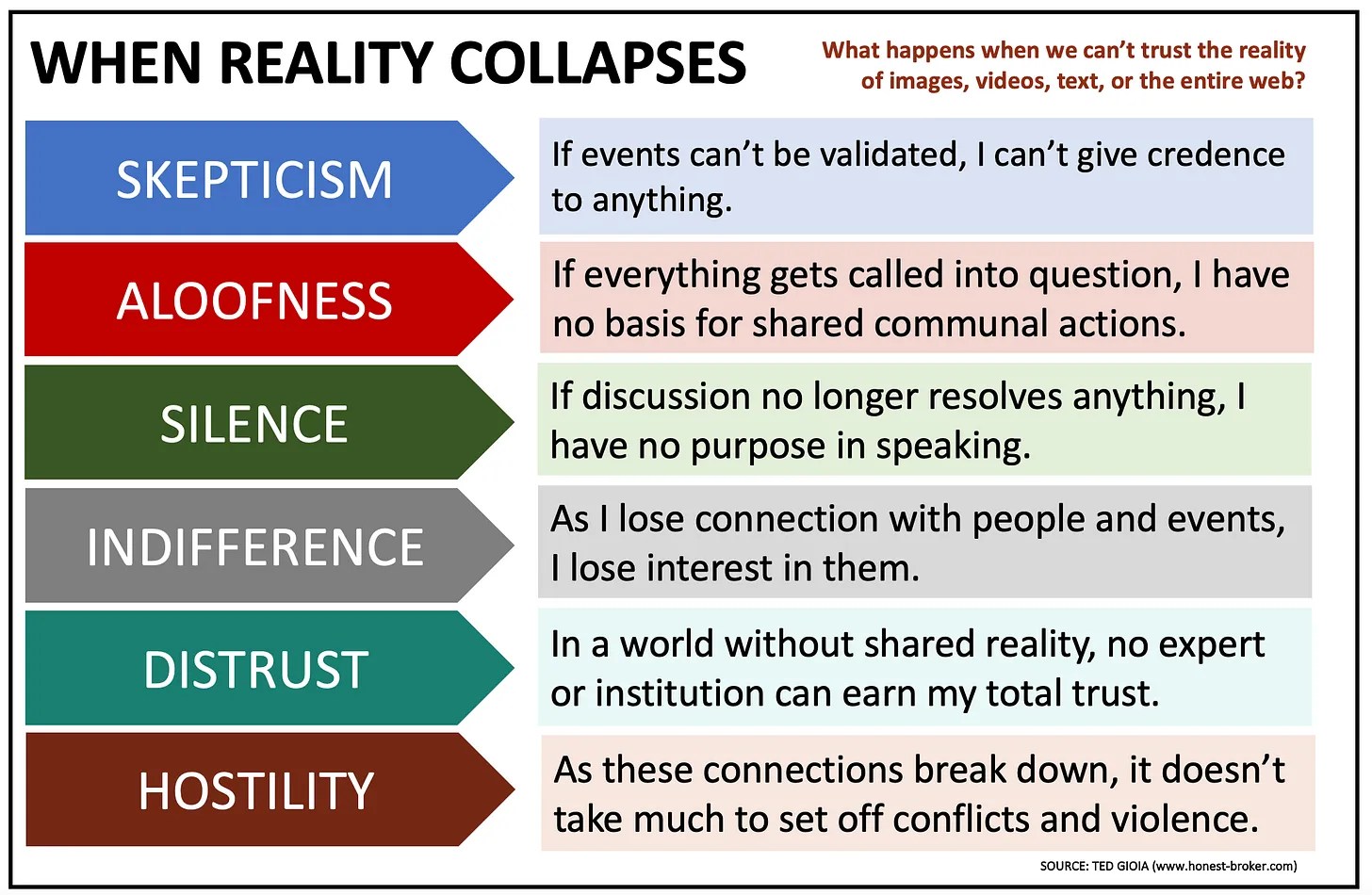
This is eerily like the zombie-ish characters in Pluribus, who all say the exact same thing.

But in Mintz’s case, this is real behavior from real students. They have voluntarily abandoned their individual opinions and embraced the hive mind.

And the hive mind is available to all of them via Chat GPT.

I actually take some solace in TV series such as Pluribus and Severance. They show how anxious we are about this threat. At some deep level in our souls, we know that the destruction of our autonomy and selfhood is not a good thing.

It isn’t progress. It isn’t utopia. It isn’t liberation.

And that is the first step in escaping the ant hill. The next step is to bring others along with us.

This is why I keep talking about a New Romanticism (see here and here). That is our counter-offensive, and it’s already starting.

Ted Gioia, The New Anxiety of Our Time Is Now on TV (bold added)

Fundamental law

Ultimately, however, constitutionalism means that society must accept an unpopular policy that respects constitutional limits over a popular policy that violates them. The very foundation of constitutionalism is that certain fundamental protections—whether for free speech or the separation of powers—must be beyond the reach of popular majorities. There will almost always be some policy that is popular but unconstitutional.

Andrew O’Donohue on “court-baiting.”

The Reality of Irreligious Violence

The shift from church power to state power is not the victory of peaceable reason over irrational religious violence. The more we tell ourselves it is, the more we are capable of ignoring the violence we do in the name of reason and freedom.

William T. Cavanaugh, The Myth of Religious Violence.

I have published this on several Sundays over the years, I’m sure, but with our POTUS and ever-so-manly-and-full-of-lethality “Secretary of War” gleefully murdering supposed drug dealers in the Caribbean in the name of fighting “narco-terrorism,” it seems like a worthy weekday reminder now.

As a Chosen People with what Niebuhr refers to as a “Messianic consciousness,” Americans came to see themselves as set apart, their motives irreproachable, their actions not to be judged by standards applied to others.

Andrew Bacevich in his Introduction to a 2008 University of Chicago Edition of Rheihold Niebuhr’s The Irony of American History.

Shorts

  • What’s important to notice is that it isn’t, and never was, “Orthodoxy is masculine.” It only felt masculine, in comparison with the general run of American churches. (Frederica Matthewes-Green)
  • Put someone with a complex about not being respected in charge of an agency with guns and you’re asking for trouble. (Nick Catoggio, A Few Bad Men)
  • The problem is not so much that public policy has failed as that it has succeeded at the wrong things. (Oren Cass, The Once and Future Worker)

Elsewhere in Tipsyworld

Saturday, 11/29/25

As December impends, we have our first substantial snowfall of the year in my fair city. I am belatedly thankful for snow blowers.

Right Relativism

Jonah Goldberg, who I don’t read that often, grabbed my attention with the title of his Thanksgiving Day post: The Truth, the Whole Truth, Everything but the Truth. It was good enough for promotion to my lead item today.

Just one little snip:

It’s amazing to me how many people on the right can (rightly!) denounce the 1619 Project … but yawn at the … tendentious denunciations of the American regime by conservative intellectuals and various “influencers.” As shoddy as the 1619 Project was, it was vastly more serious and grounded in facts than “the Jews did Pearl Harbor” or the idea peddled on Carlson’s show that the Holocaust was an accident of poor planning by the Nazis.

When I was in university, Saul Alinsky didn’t come to my attention (neither did Foucault, Derrida and other figures now widely blamed for various ills). But some on the right, tired of losing and convinced that the Left’s tactics were giving them victories, have now embraced Alinsky for their own purposes. For instance:

We have successfully frozen their brand—”critical race theory”—into the public conversation and are steadily driving up negative perceptions. We will eventually turn it toxic, as we put all of the various cultural insanities under that brand category.

That’s “national conservative” Alinskyite Christopher Rufo, boasting in 2021. He’s my personal “Exhibit A” in indicting the Right. Compare Alinsky (via Goldberg):

“Pick the target, freeze it, personalize it, and polarize it,” and “Ridicule is man’s most potent weapon. It is almost impossible to counterattack ridicule. Also it infuriates the opposition, who then react to your advantage.”

I didn’t recognize the echo of Alinsky when I first read Rufo’s Tweet back in ’21, but I knew immediately that Rufo was being dishonest and thus was not my idea of a conservative. (Yeah, I guess I’m one of those “beautiful losers.”) He still isn’t my idea of a conservative, and remains one of my top two or three least favorite “respectable” conservatives. (I will grant that he’s “consequential”—my favorite way of damning with pseudo-praise.)

It may not be pas d’ennemis à droite, but I don’t recall any other conservatives condemning him. So I will: Lines must be drawn somewhere, and Rufo belongs on the same side of the respectability line as Tucker2025.

Rant over.

Goldberg (without citing Rufo, though I absolutely couldn’t help going there) explains some of the bad metaphysics of it. I recommend his piece to everyone, but I implore people who think of themselves as American conservatives (a habit I can’t shake) to read it carefully, because it hit bullseye after bullseye on the intellectual defeat of what passes for conservatism in the U.S. these days. Would that Rufo were one of his targets.

The American Right

Even apart from the widespread dishonesty on the American Right, I don’t hold out much hope for it to cohere rather than falling into civil war with one another.

Damon Linker made that point, outlining the multiple factions:

FactionPersonalitiesCore Beliefs
National ConservativesYoram Hazony, Josh Hammer, Christopher Rufo, Kevin Roberts, R.R. Reno, Viktor Orbán, JD Vance (honorary)Nationalism modeled on Israeli Zionism; view liberalism as imperialist and neo-Marxist; anti-wokeness; hawkish realism or restrained foreign policy.
PostliberalsSohrab Ahmari, Patrick Deneen, Adrian Vermeule, Gladden Pappin, JD VancePolitics oriented toward a theological “Highest Good”; critical of U.S. liberal founding; push for social conservatism combined with pro-family/worker policies; skeptical of foreign military aid.
ClaremonstersMichael Anton, Thomas Klingenstein, John Eastman, Charles Kesler, Larry Arnn, JD VanceStrongly defensive of a traditionalist interpretation of the American founding; view modern progressive changes as heretical; advocate aggressive opposition to “leftist” forces.
Hard Right UnderbellyCurtis Yarvin, Costin Alamariu (Bronze Age Pervert), Charles Cornish-Dale (Raw Egg Nationalist), Darren Beattie, Nick Fuentes, Steve Bannon, Tucker Carlson.Reactionary extremism; engage with fascist and anti-establishment conspiracy theories often ironically.
Silicon Valley Tech BrosPeter Thiel, Elon Musk, Marc AndreessenWealth-driven influence on right-wing politics; skepticism about democracy; interest in economic monopolies and authoritarian tendencies; cultural dynamism and natalism.
Foreign Policy RestrainersStaff of The American Conservative, Quincy Institute, Tucker Carlson (partially), JD Vance (occasionally)Oppose hawkish neoconservative foreign policy; skeptical of U.S. support for Ukraine and Israel in current conflicts.
Make America Healthy AgainRobert Kennedy Jr., writers linked to Tablet magazine and The Free Press, novelist Walter Kirn.Anti-vaccine skepticism; anti-establishment public health stance arising from pandemic distrust.
Zombie ReaganitesChristopher Long, Thomas Lynch (former ISI leaders)Opposition to federal government expansion since the New Deal; radical libertarian Old Right ideas

In addition to the inconsistent core beliefs, there are temperamental tendencies to further complicate things.

If you noticed one name over and over again, though, you’re right. JD Vance is enough of a chameleon (my characterization) that he might be capable of unifying most of the larger factions.

On avoiding information bubbles

I wrote some time previously (probably years ago) about my catholic reading habits, spanning a very wide spectrum of Left, Right and Center. I realized recently that I’ve narrowed my reading since then.

I haven’t narrowed my Overton Window—my conception of what opinions are admissible in a good society—but I’ve lost interest in reading some admissible opinions.

This narrowing is partly from a rather recent forsaking of political controversy. If I can barely be roused to rail against Donald Trump (from a truly conservative, not populist or progressive, promontory), then what else should rouse me?

But I think a bigger part is that I’m getting old and I have a fairly fixed vision of the world—a constrained vision, in the distinction made by Thomas Sowell.

For my reading habits, the constrained vision leaves me viewing writings from an unconstrained vision as at best tending toward delusion. For my politics, the constrained vision led me to repudiate my identification with the GOP when George W. Bush declared in his second inaugural an American goal of ending tyranny in the world, an unconstrained vision.

I’m just not interested any more in reading things that are incompatible with my vision of the world. Nothing has fundamentally shaken my vision during my long adult lifetime, and I don’t reasonably expect that anything ever will. I don’t (necessarily) hate opinions from a unconstrained vision, but I think there are better things to do with what time remains to me than to read them just to avoid the charge of living in an information bubble.

Call that “hydebound” if you must, but I prefer to think of it as stopping the search for the truth now that I think I’ve found that. C.S. Lewis and G.K. Chesterton would approve.

An Open Note to My Congressmen

To: Jim Baird, Todd Young, Jim Banks

I only joined AARP to get discounts on stuff. I’ll let you know when I really care about you supporting an AARP position. Don’t assume it.

Very truly yours,
Your cantakerous constituent
(who just got a letter asking him to lobby you along the AARP party line)

Shorts

  • As Bette Midler once said: “When it’s 3 o’clock in New York, it’s still 1938 in London.” (Keith McNally)
  • Silence, remember, is violence — perhaps the most profoundly anti-liberal slogan ever invented. (Andrew Sullivan)

Elsewhere in Tipsyworld


We are all gatekeepers now.

Peggy Noonan

Your enemies are not demonic, and they are not all-powerful and the right hasn’t always lost and the left hasn’t always won. But if you convince yourself of that, you give yourselves all sorts of permission to do a lot of stupid and terrible things under the rubric of “Do you know what time it is?”

Jonah Goldberg.

[A] critical mass of the American people … no longer want[s] to govern themselves, … are sick of this republic and no longer want to keep it if it means sharing power with those they despise.

Nick Catoggio

I don’t do any of the major social media, but I have two sub-domains of the domain you’re currently reading: (a) You can read most of my reflexive stuff, especially political here. (b) I also post some things on my favorite no-algorithm social medium.

Saturday, 11/8/25

Public affairs

Give me that old, boring gummint

An aspect of the modern conservative disposition is that we like the arts, culture and technology to be interesting and exciting, but we prefer government be boring, a stabilizing force while we act up in other areas. But it’s never boring now and likely won’t be in this century. Too bad.

Peggy Noonan

Nancy Pelosi

[F]or the anti-Trump right (insofar as such a thing exists outside the Dispatch break room), Pelosi’s departure is a grim symbol of the Duma-fication of Congress. It’s fitting that the most formidable Democratic legislator in modern U.S. history will leave office in 2027 on the same day as the most formidable Republican legislator in modern U.S. history. Serious institutionalists like Pelosi and Mitch McConnell have no business in a branch of government that no longer exists as a serious institution.

Nick Catoggio

Sorry, Senator Young

Sorry, Senator, but I won’t answer.

I could probably rank this list, but I fear I’d see it misrepresented as “my constituents’ most important issue is …”, whereas my real most important issue is the impeachment and conviction of Donald J. Trump, who defiles everything he touches.

Remember: the theory behind Presidential immunity from criminal prosecution was “that’s what impeachment is for.” Well, put on your big-boy pants and take out the trash.

(I was reminded yesterday that my sanctimony toward sleazy politicians is a persistent feature. I voted for McGovern because Nixon was a crook, McGovern an honorable guy I disagreed with on just about everything. I don’t vote for Democrats often, but I’ve found creative ways not to vote for Trump’s corruption and rapacity nonetheless.)

Clueless

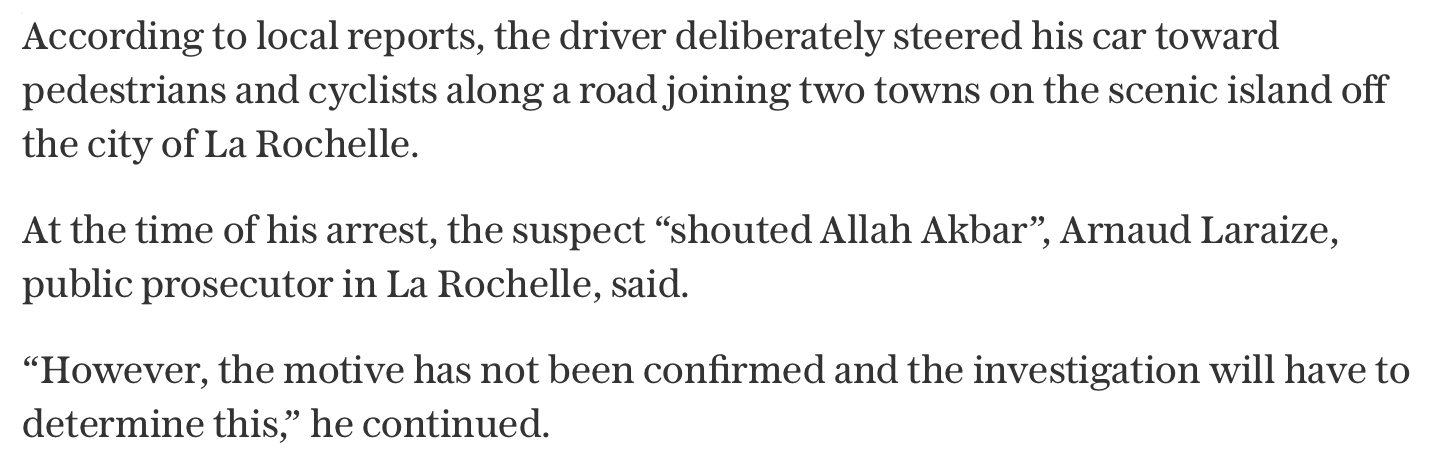
A driver smashed into pedestrians and bikers on the beautiful French island of Île d’Oléron.

I’m so excited for the investigation to reveal the motive behind someone driving their car into random French cyclists and screaming “Allahu Akbar.” I don’t know about you, but he sounds like a Christian nationalist to me. Anyone else smell a fresh pine and cinnamon Bath & Body Works candle? This guy is all in on Replacement Theory, I just know it.

Nellie Bowles

Culture

Grief

Grief turns out to be a place none of us know until we reach it. We anticipate (we know) that someone close to us could die, but we do not look beyond the few days or weeks that immediately follow such an imagined death. We misconstrue the nature of even those few days or weeks. We might expect if the death is sudden to feel shock. We do not expect this shock to be obliterative, dislocating to both body and mind. We might expect that we will be prostrate, inconsolable, crazy with loss. We do not expect to be literally crazy, cool customers who believe that their husband is about to return and need his shoes. In the version of grief we imagine, the model will be “healing.” A certain forward movement will prevail. The worst days will be the earliest days. We imagine that the moment to most severely test us will be the funeral, after which this hypothetical healing will take place.

Joan Didion, The Year of Magical Thinking.

This is the first Joan Didion I’ve read. I’m told that it’s not her best, but it was plenty good enough for me.

Me, too

(Yes, I know it’s more than a little absurd that I’m writing a post about a TV show that ended its run eight years in the past. The thing is, I almost never watch series when they first appear. I usually turn to them, instead, years later, after I’ve heard enough praise that I feel like their quality has been adequately verified to justify my time and attention. This way of proceeding has never let me down. And anyway, in an era of streaming, there’s nothing to keep a decade-old show from becoming someone’s big new discovery years after it drops.)

Damon Linker, winding up for a glowing post about an HBO Series, The Leftovers.

I’m with him on not rushing to watch a new series. Most of them are trash – precisely as most of all art, music and literature are trash. It was ever so. What’s good will endure.

Words of the Day

The words of the day are pareidolia and apophenia.

Well, I didn’t know them, and much as I love big words this may be the last time I ever use them.

Snippets

  • Mystery is a great embarrassment to the modern mind. (Flannery O’Connor)
  • Foul is fair and fair is foul. (Shakespeare, though I was thinking of John Maynard Keynes’ distillation of his case for temporary rapacity.)
  • What Stephen A. Smith is to sports talk, Tucker Carlson is to obsessive anti-Zionism. Rich Lowry
  • All civilizations are as transitory as the people now in cemeteries. And just as we must die, so too must we accept that there is no return to a civilization whose time has come and gone. (Abdülhak Şinasi Hisar via Orhan Pamuk, Istanbul)
  • The people [Trump] picks tend to be a grab bag of personality disorders who squabble and fight for power, he tends to screw them over when they annoy him, and they’re all quite annoying. (Ken White, Refuge in Kakistocracy, Popehat)
  • The problem with pornography is not that it shows too much of a person, but that it shows far too little. Pope John Paul II via Isabel Hogben
  • Populism is fundamentally a form of suspicion. Yuval Levin on the Remnant podcast.
  • We need to be a big tent so as to include neo-Nazi and Nazi-adjacent people, [and] if you have a problem with that, you need to get out of the tent. Jonah Golberg on the Remnant podcast criticizing the “popular front mind” on the Right.
  • Dick Cheney couldn’t get over Jan. 6. Ramesh Ponnuru (That’s got to be among the most understated things I’ve seen this week.)

We are all gatekeepers now.

Peggy Noonan

Your enemies are not demonic, and they are not all-powerful and the right hasn’t always lost and the left hasn’t always won. But if you convince yourself of that, you give yourselves all sorts of permission to do a lot of stupid and terrible things under the rubric of “Do you know what time it is?”

Jonah Goldberg.

[A] critical mass of the American people … no longer want[s] to govern themselves, … are sick of this republic and no longer want to keep it if it means sharing power with those they despise.

Nick Catoggio

I don’t do any of the major social media, but I have two sub-domains of the domain you’re currently reading: (a) You can read most of my reflexive stuff, especially political here. (b) I also post some things on my favorite no-algorithm social medium.

No Kings Saturday, 10/18/25

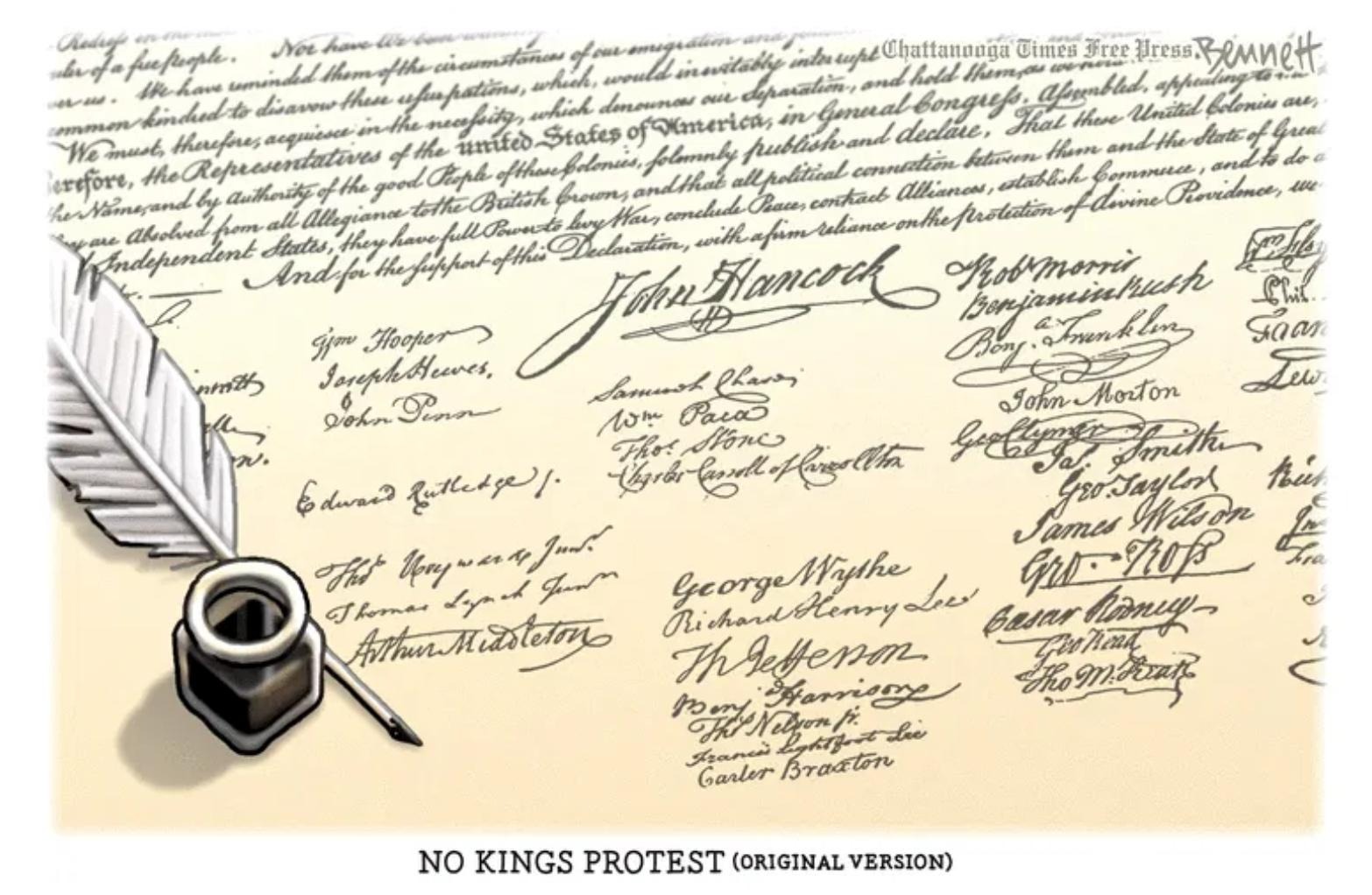
No kings!

Binding precedent

Protesters have protested at an ICE facility a few miles west of Chicago for the past 19 years—with somewhat more intensity recently following the announcement of Operation Midway Blitz. A month after the announcement, the president federalized the Illinois National Guard. District court: Enjoined. Seventh Circuit: Just so. Political opposition is not rebellion, and a protest doesn’t become a rebellion merely due to a few isolated incidents of violence. Without that, none of the statutory predicates for federalizing the National Guard have been met.

Institute for Justice, Short Circuits for 10/17/25 (bold added). This is now the law in the 7th U.S. Circuit – Indiana, Illinois and Wisconsin.

Look for the Administration to try to provoke a rebellion it can crush. Everyone who’s paying attention knows Trump wants to invoke the Insurrection Act (as he stuffs his pockets and those of his family).

Wanted: a viable counternarrative

Trump’s actions … are part of one project: creating a savage war of all against all and then using the presidency to profit and gain power from it. Trumpism can also be seen as a multipronged effort to amputate the higher elements of the human spirit—learning, compassion, science, the pursuit of justice—and supplant those virtues with greed, retribution, ego, appetite. Trumpism is an attempt to make the world a playground for the rich and ruthless, so it seeks to dissolve the sinews of moral and legal restraint that make civilization decent.

Trumpism, like populism, is more than a set of policies—it’s a culture. Trump offers people a sense of belonging, an identity, status, self-respect, and a comprehensive political ethic. Populists are not trying to pass this or that law; they are altering the climate of the age. And Democrats think they can fight that by offering some tax credits?

To beat a social movement, you must build a counter social movement. And to do that, you need a different narrative about where we are and where we should be heading, a different set of values dictating what is admirable and what is disgraceful. If we fail to build such a movement, authoritarian strongmen around the globe will dominate indefinitely.

David Brooks.

You can’t beat something with nothing. I can’t come up with a political counternarrative to Trumpism. The Democrats can’t come up with a political counternarrative, either. Brooks couldn’t come up with a strong political counternarrative.

I can only hope and pray that people will look for their compelling (counter-)narrative to the Gospel of Jesus Christ. (And that meantime there will be some legal counternarratives to prevent irretrievable damage, as in the preceding item.)

Music Reviews

There may be nothing better than old music reviews to let you know that it’s okay to like what you like, critics be damned.

I like Debussy’s La Mer, and I don’t care what the stupid early reviews said:

On today’s date in 1905, Claude Debussy’s orchestral suite La Mer or The Sea was performed for the first time in Paris. Today this music is regarded as an impressionistic masterpiece, but early audiences — especially those in America — found it rough sailing.

“We clung like a drowning man to a few fragments of the tonal wreck,” wrote a 1907 Boston critic, and suggested that instead of The Sea Debussy should have titled his piece Sea-Sickness.

“The Sea is persistently ugly,” wrote The New York Times that same year. “Debussy fails to give any impression of the sea … There is more of a barnyard cackle in it than anything else.”

And in 1909, this on La Mer from The Chicago Tribune: “It is safe to say that few understood what they heard and few heard anything they understood … There are no themes … There is nothing in the way of even a brief motif that can be grasped securely enough by the ear and brain to serve as a guiding line through the tonal maze. There is no end of queer and unusual effects, no end of harmonic complications and progressions that sound so hideously ugly.”

Ah, the perils of “modern music” in the early 20th century!

Giving the Devil his due, impressionism had to be a real mind-blower for critics attuned to, say, the sonata-allegro form.

Comprehensive tradition

We’re often not very aware of the “tradition” in which we live. A student in a classroom would readily agree that the words of a teacher or professor were a “traditioning” of sorts. But they will fail to notice that how the room is arranged, how the students sit, what the students wear (or don’t wear), how the professor is addressed, how students address one another, what questions are considered appropriate and what are not, and a whole world of unspoken, unwritten expectations are utterly required in the process. The modern world often imagines that “online” education is equivalent to classroom education since the goal is merely the transmission of information. But the transmission of information includes the process of acquiring the information and everything that surrounds it. Those receiving the “tradition” online will have perhaps similar information to those receiving it in a classroom – but they will not receive the same information.

Fr. Stephen Freeman, The Tradition of Being Human

Stages of life

Two questions:

  1. Do I want to read/watch/listen to this?
  2. Should I read/watch/listen to this?

When I was younger the second question often dominated my decision-making. Now that I am officially ancient that question has virtually disappeared and the first one is usually the only one I ask. That’s been the single most notable change in my personality in these my declining years.

Alan Jacobs

Alan is a decade or more younger than me, yet I only very recently seem to have arrived at this point, especially regarding political matters.

Note that he’s talking about a change in personality. This isn’t a life rule. There are things that younger people should read/watch/listen to, in order to become well-formed human beings.

Two ways

[R]evival begins with the people proclaiming, by word and deed, “I have sinned.”

MAGA Christianity has a different message. It looks at American culture and declares, “You have sinned.”

David French

Noteworthy

In the aftermath of Kirk’s murder, we witnessed young people at vigils rather than at “mostly peaceful” demonstrations.

R.R. Reno in First Things


We are all gatekeepers now.

Peggy Noonan

Your enemies are not demonic, and they are not all-powerful and the right hasn’t always lost and the left hasn’t always won. But if you convince yourself of that, you give yourselves all sorts of permission to do a lot of stupid and terrible things under the rubric of “Do you know what time it is?”

Jonah Goldberg.

[A] critical mass of the American people … no longer want[s] to govern themselves, … are sick of this republic and no longer want to keep it if it means sharing power with those they despise.

Nick Catoggio

I don’t do any of the major social media, but I have two sub-domains of the domain you’re currently reading: (a) You can read most of my reflexive stuff, especially political here. (b) I also post some things on my favorite no-algorithm social medium.
Wednesday, 10/15/35

Vagrant metaphors

Supreme Court Justice Sonia Sotomayor cut straight to the heart of Chiles v. Salazar [Tennessee’s ban on medical transitioning of gender dysphoric minors] with one hypothetical: If a dietitian decides to help anorexics starve themselves, can the government stop them?

This was clarifying in more ways than one, illuminating not just the legal dispute, but deeper problems with how our country is handling LGBT issues.

Sotomayor’s analogy was apt, but it was also a little startling coming from her, because in these debates comparisons to anorexia usually come from skeptics of pediatric medical transition. When an anorexic feels at odds with their body, the skeptics argue, we use therapy to alter their feelings. So how come when gender dysphoric kids feel that way, we use hormones and puberty blockers to alter their bodies?

It’s an obvious question, but I doubt that Sotomayor meant to bring it up, since she is hardly critical of pediatric medical transition …

… We spend a lot of energy on analogies and hypotheticals and semantics, instead of analyzing the issues more systematically. That’s why these cases keep ending up in court.

That’s all very interesting for the lawyers. But for most people the semantics are irrelevant, and both cases involve the same key question, though not the one that was actually before the court: Should gender dysphoric kids be encouraged to transition, or encouraged to embrace their biological sex?

The rest is strategic word games, which is how a metaphor favored by one side can so easily slip its moorings and turn up bobbing around on the other side of the harbor.

Megan McArdle. I really like that idea of a metaphor “slipping its moorings.”

Nobel Peace Prize

Disney World used to have a bust of [Bill] Cosby at its Hollywood Studios theme park but removed it in 2015 because of, well, you know. Them’s the breaks sometimes when bestowing a grand honor on a living person. Said person might yet live to disgrace himself, or be disgraced by old skeletons tumbling out of his closet, before he’s passed on and history’s verdict has settled.

Cosby came to mind after the Norwegian Nobel Committee chose not to award the Nobel Peace Prize to the one person in the world who wanted it more than anyone else. The lazy explanation for that snub was “liberal bias,” but I suspect that declining to give it to Donald Trump had more to do with fears of a potential Cosby problem. The committee has been burned before—badly—in prematurely celebrating a warmonger as a peacemaker, after all. Imagine if it had honored the president and he turned around next week and bombed Venezuela. Or invaded Greenland. Or declared martial law in the United States.

The peace prize is a totem of the rules-based international order that governed the world for 80 years until Trump returned to office in January. Handing it to the man who’s overseeing that order’s destruction would be a bit like awarding the Nobel Prize in medicine to Robert F. Kennedy Jr.

Nick Catoggio

Sometimes a pundit puts eloquently what I’ve thought clumsily. Catoggio here goes one better, responding to something I never articulated at all until now: “Of course, giving the Peace Prize to Trump would be deeply absurd despite any superficial plausibility, but I’m darned if I can can put the reason in words.”

I also like his explanation of Trump’s diplomatic success in the Middle East:

If you’re looking to broker peace in the Middle East and are stuck negotiating with a bunch of tribalist, kleptocratic, authoritarian cultural imperialists, who’s more likely to get through to them? Condoleezza Rice or a tribalist, kleptocratic, authoritarian cultural imperialist?

He cares about getting rich, persecuting his enemies, and eliminating threats to his own power—just like his Middle Eastern counterparts do. He knows what to say and what to offer to get them to work with him.

Redistricting

I hate the GOP’s new-found disregard of norms. Therefore, I hope that the norm-breaking mid-decade redistricting is punished swiftly and poetically:

  • Trying to squeeze out another Republican district means spreading a state’s Republican voters more widely but thinly.
  • Thus if public sentiment turns less favorable toward Republicans, they stand to lose more seats than if they settled for one or two fewer but safer districts.
  • Therefore, I’m hoping for a shift of public sentiment away from Republicans before the 2026 elections and for Republicans to lose at least two seats in every state where they tried to gerrymander one more seat.

Not that Congress has been doing anything anyway, but it feels important to take Congress away from the GOP for so long as Chairman Donnie remains in office pushing his Great Leap Forward. It will probably happen in any event, but it would sure be swell if it happened this way.

Kinky loons

Not long ago, when people still listened to the radio in their cars, you could tune into some freaky talk late at night. “We know a third of us are star children, implanted by the visitors,” the anchor might drawl matter-of-factly. “What we’re learning now is, there’s two groups of star children — two tribes of visitors — and they’re butting heads. And we’re in the middle of it, y’know? Iraq, Obama, recession, it all goes back to the star children …”

Writer Abe Greenwald dubs this genre of late-night crankery “star-child radio.” These days, you don’t need to take a long drive through the middle of nowhere to catch it. It is everywhere online. Indeed, much of right-wing media now resembles star-child radio: a vast chamber of oft-malignant fantasies, where even once-reasonable minds go to get euthanized.

I have spent much of my career pointing out the ideological blind spots of center-left outlets: their near-total alienation from the Bible-believing sectors of society; their tendency to select and present stories in the light least likely to help the right.

But ultimately, the Times and NPR are not star-child radio. There is a difference between a progressive (or conservative) worldview coloring the framing of stories and the quest to “prove,” as the some on the right have, that the president of France’s wife is a man.

Sohrab Ahmari.

Before “Bridget Macron is a guy,” there was “Michelle Obama is a guy.” These aren’t just loons; they’re kinky loons.

Now he’s normal, now he’s not

Time and again, the pattern repeats. When Trump is on offense, he’s celebrated as a president like no other. But when he has to answer for his actions in court, he demands that he be treated as a president like any other.

[W]hen Trump faces lawsuits, he defends his [National Guard] deployments by leaning on the deference earned by other presidents through their responsible use of power. Because other presidents were deemed trustworthy, his representatives argue, the courts should trust Trump, too.

David French, explaining judicial recognition that Trump has forfeited his claim to any Presidential presumption of regularity. French’s column is lucid and comprehensive enough, and the loss of the presumption of regularity (if that loss withstands appeal) is so consequential, that the preceding link gifts his column to my readers.

Ada the Algorithm

Elites today have no idea how to speak to the public or what to say to it. They have shown little interest in trying. The hyper-educated individuals who ran the Clinton campaign were utterly indifferent to public opinion: they believed in big data. An algorithm nicknamed “Ada” delivered “simulations” of opinion to the campaign staff. Ada was the public as elites wish it would be: safe, clean, and speaking only when spoken to. The voter in the flesh was clearly perceived by this group as an alien and frightening brute. His very existence was deplorable. The shock of Election Day followed naturally from such distortions of distance.

Martin Gurri, The Revolt of the Public and the Crisis of Authority in the New Millennium

Losing student visas then and now

I remember when I was a Canadian citizen in the United States on a student visa, we were warned if you got into a bar fight, you could theoretically lose your student visa. Now, in those days, that meant that you’d have to go back to Canada and go to school in Canada, which is not the end of the world. In today’s America, that could mean you could lose your student visa and be accused of terrorism, and a bag put over your head and be put into a car and sent to a prison in El Salvador for the rest of your life.

David Frum

From the current GOP Hymnal

Do you remember January 6, 2021? It was the day of a Great Patriotic Rally after the re-election of Donald Trump to a second consecutive term. But the real reason it’s memorable is that the nefarious Democrats used that Great Patriotic Rally as an excuse to tap the phones of Republican Senators and Congressmen!

Poems

Reclaim the Sites

We are spared the Avenues of Liberation
and the water-cannoned Fifths of May
but I tire of cities clogged with salutes
to other cities: York, Liverpool, Oxford Streets
and memorial royalty: Elizabeth, Albert, William, unnumbered George.
Give me Sallie Huckstepp Road, ahead of
sepia Sussex, or Argyle, or Yankee numbering
– and why not a whole metropolis
street-signed for its own life and ours:
Childsplay Park and First Bra Avenue,
Unsecured Loan, the Boulevard Kiss,
Radar Strip, Bread-Fragrance Corner,
Fumbletrouser, Delight Bridge, Timeless Square?

Les Murray, Reclaim the Sites, from New Selected Poems

Terra Firma

Yes, you’re right. I’m sure Armageddon’s coming:
wars, tsunamis, hurricanes, earthquakes, locusts,
killer flus, et cetera. Yes, I’m awed by
all the destruction.

I concede your point that the world might end, and
all your puny labors will be as nothing.
Still, you can’t go out with your friends until you’ve
folded the laundry.

Julie Steiner


We are all gatekeepers now.

Peggy Noonan

Your enemies are not demonic, and they are not all-powerful and the right hasn’t always lost and the left hasn’t always won. But if you convince yourself of that, you give yourselves all sorts of permission to do a lot of stupid and terrible things under the rubric of “Do you know what time it is?”

Jonah Goldberg.

[A] critical mass of the American people … no longer want[s] to govern themselves, … are sick of this republic and no longer want to keep it if it means sharing power with those they despise.

Nick Catoggio

I don’t do any of the major social media, but I have two sub-domains of the domain you’re currently reading: (a) You can read most of my reflexive stuff, especially political here. (b) I also post some things on my favorite no-algorithm social medium.
Friday, 10/10/25

Nonpartisan

Levelers

Emily Ruddy was traveling the country with her new husband, Mike, when news reached them of Charlie Kirk’s shooting, then death:

Back in the car with Mike, approaching the Florida border, I’m looking at pictures of Charlie Kirk on my phone. He is staggeringly tall, taller than I ever realized, with a celebratory fist in the air. Reading his Wikipedia page, which has now been changed to past tense, I am reminded of a story I first read in middle school: Kurt Vonnegut’s “Harrison Bergeron.” The story is set in the late twenty-first century, in a dystopian America where the authorities have taken it upon themselves to ensure no person is better than another, be it in athleticism, intelligence, or beauty. The strong citizens get weighed down with bags of bird shot. The attentive citizens are intermittently bombarded with hideous sounds through tiny radios in their ears. The most beautiful faces are concealed by hideous masks.

But it’s the title character, Harrison Bergeron—exceptionally tall, handsome, brilliant and outspoken—who is shackled most heavily. At the end of the story he breaks through the shackles, and as punishment he is shot down on live TV: a warning to whoever tries to pull a similar stunt. Or at least, it would be a warning, if the viewers’ memories weren’t instantly blasted away by the ear radio’s next awful sound.

Emily Ruddy, Battle Above the Clouds.

If you haven’t read Harrison Bergeron, a (very) short story, by all means do. It’s freely available, like, for instance, here.

After Christian faith dies

The biggest confusion among my own students used to be rudderless moral relativism.  Although there is still a lot of that, it seems to be on the decline.  Now the problem is the explicit embrace of evil.  The suggestion that one must never do what is intrinsically evil for the sake of a good result is a hard sell.  Many of students are strongly attracted to “consequentialism,” the view that whether an act is right or wrong is determined only by the result.  To say that the ends do not justify the means puzzles them.

The decline of faith has also produced changes in character.  Young people who were raised in Christian homes, but then abandoned Christianity, often used to retain vestiges of their moral upbringing, and accepted such ideas as courtesy, love of neighbor, and the sacredness of innocent human life.  Today, having grown up in faithless homes, many seem to think that courtesy is for fools, that no one with whom they disagree is their neighbor, and that they should hate those they consider wrong instead of praying for their repentance and restoration.  As for the sacredness of innocent human life – for them, that idea went out when they embraced abortion.

I don’t spend much time asking what is going to happen, but I do ask what God would like me to do in my own place.  He sees the whole shape of things.  I can’t, but like a faithful bone, I can try to turn nimbly in the joint where I’m placed.

J Budziszewski, How Can I Think About the Assassination?

Budziszewski’s description of the decline of faith, as early as the second generation (the first generation of lapsed Christians lives on the vapors of the empty tank), is a description of devolution toward the “nasty, short and brutish” of pre-Christian antiquity.

If you think I’m just making a casual partisan slur, take a look at either of these two books, the first lengthy, the second shorter and more focused.

Wordplay

Frank Bruni’s back with recent favorite sentences. (Do not read this with beverages or food in your mouth.):

  • Also in The New Yorker, Jessica Winter read the infamous Jeffrey Epstein birthday book so that you and I don’t have to: “Sometimes it’s like you’ve discovered a rich man’s contract with the devil, and next to his signature, he’s drawn a little penis cartoon.” (Matthew Ferraro, East Providence, R.I.)
  • And Kelefa Sanneh, reporting from a recent Bad Bunny concert, described an ecstatic fan who “danced so vigorously with a decorative plant that he seemed to be trying to pollinate it.” (Bob Marino, Paris)
  • In The Los Angeles Times, Christopher Goffard tried to make sense of a former Los Angeles County sheriff’s rambling: “As he sat down to face questions from the feds, his sentences traveled winding paths through vague precincts to fog-filled destinations.” (Robin April Dubner, Oakland, Calif.)
  • In The Guardian, Bryan Armen Graham commiserated with the polite subgroup of American fans at an annual Europe-versus-United States golf tournament, who were too often “drowned out by the performative tough guys in flag suits and plastic chains who treat the Ryder Cup like a tailgate with better lawn care.” (John LeBaron, Acton, Mass.)
  • In The Dispatch, Nick Catoggio regarded the marks that President Trump and Defense Secretary Pete Hegseth made to military leaders last week as “a case of two men who radiate neurosis about their own toughness lecturing a roomful of actual tough guys about how to be tough. It had the feel of Pop Warner players scolding a group of N.F.L. linebackers about the importance of hustle.” (Glen T. Oxton, Mamaroneck, N.Y., and John Sabine, Dallas)
  • And John McWhorter analyzed the president’s loopy language: “Even Trump’s most positive-sounding coinages are acts of a certain kind of verbal aggression. I sometimes stop to marvel that the House passed something with the actual official title the One Big, Beautiful Bill Act. That goofy bark of a name is a boisterous clap back against opposing views, an attempt to drown out inconvenient facts with braggadocio. It is a linguistic snap of the locker room towel.” (Matt Masiero, Richmond, Mass., and Sue Hudson, Simi Valley, Calif., among many others)

Anarchism

[T]he essential practices of anarchism — negotiation and collaboration among equals — are ones utterly neglected and desperately needed in a society in which the one and only strategy seems to be Get Management To Take My Side.

Alan Jacobs, Should Christians be Anarchists?

Partisan

Transparent pretext

Trump’s remarks on the night of Kirk’s murder redefined violent incitement to include harsh criticism of judges. (“My administration will find each and every one of those who contributed to this atrocity and to other political violence, including the organizations that fund it and support it, as well as those who go after our judges, law-enforcement officials, and everyone else who brings order to our country.”) Now [aide Stephen] Miller himself is going after judges.

To call this “hypocrisy” is to engage Miller’s reasoning at a level upon which it does not operate. The essence of post-liberalism is the rejection of the notion that some neutral standards of conduct apply to all parties. Miller, like Trump, appears to believe his side stands for what is right and good, and his opponents stand for what is evil. Any methods used by Trump are ipso facto justified, and any methods used against him illegitimate.

A couple of weeks ago, Miller claimed that a disturbed gunman shooting Charlie Kirk impelled the government to crack down on the left. Now he says a handful of activists protesting ICE impel the government to crack down on the left.

Violence is not the cause of Trump and Miller’s desire to use state power to crush their opposition. It is the pretext for which they transparently long.

Jonathan Chait, Stephen Miller is Going for Broke

Bad faith

You can and should worry about American leaders at any level viewing their opponents as the enemy within, whether it’s the president of the United States or a random [Democratic] candidate for state AG. But if you’re more vocal about the latter than the former, forgive me for thinking you’re more interested in contriving a “both sides” equivalency to minimize what the White House is up to than you are about addressing the problem of incitement.

Two things are remarkable about [continuing troop deployments in “blue cities”]. One, which almost goes without saying, is that it’s another case of the Trump administration aiming to normalize unprecedented authoritarian shows of force. But the other is underappreciated: It’s all being done in bad faith, as a provocation, and quite plainly. There’s barely a pretense anymore of a colorable emergency like a riot that might justify the president deploying troops. He’s doing it unbidden and enthusiastically, looking for excuses to intimidate Democrats by symbolically occupying their cities with troops yanked from duty [and civilian jobs] in other states.

Needless to say, this is why the Trump White House didn’t get the benefit of the doubt from Judge Immergut on the Portland deployment, or from Judge Waverly Crenshaw on whether Kilmar Abrego Garcia was vindictively prosecuted. It’s also why the case against James Comey will end up in the toilet sooner rather than later. Courts have traditionally given the president and the Justice Department wide discretion in commanding the military and choosing whom to prosecute, but that’s because presidents traditionally haven’t given courts good reason to think they’re acting in bad faith.

Nick Catoggio, American versus American.

I look forward to the day when judges cease giving a “presumption of regularity,” of good faith, to the actions and legal arguments of this Administration. They have forfeited it because so much of what they do plainly is done in bad faith.

On keeping an impossible promise

Anyone with brown skin and the wrong kind of tattoo is therefore now at risk of being carted off to torture by the US government, with absolutely no safeguards that they have gotten the right people. Or do you think that an administration that confuses billions with millions, and puts classified intelligence on a Signal app, is incapable of making an error?

Andrew Sullivan, Two Perfect Months (March 2025)

I will give Trump “credit” for trying to keep his deportation campaign promise. The problems is, it’s impossible even for competent, non-malicious government workers to keep it (it included luridly-high numbers) without wholesale errors and ubiquitous denials of due process (i.e., in context, the process by which we assure that a person truly is subject to deportation under the law).

Your tax dollars at work

Short Circuits is a punchy weekly summary of notable Federal Court of Appeals decision, like this summary of activities by an ICE goon:

ICE agent escorting passenger from Dallas to Miami takes upskirt pictures and videos of flight attendant. He’s convicted of interfering with her flight-crew duties, sentenced to two years’ probation. Agent: I didn’t know that she was aware of my “clandestine video voyeurism,” and that’s an element of the crime. Eleventh Circuit (unpublished): It is not.

Divine retribution in Dallas

The covert operations of the Kennedys haunted Lyndon Johnson all his life. He said over and over that Dallas was divine retribution for Diem. “We all got together and got a goddamn bunch of thugs and we went in and assassinated him,” he lamented. In his first year in office, coup after coup wracked Saigon, a shadowy insurgency started killing Americans in Vietnam, and his fear that the CIA was an instrument of political murder festered and grew.

Tim Weiner, Legacy of Ashes

Rulebreaker

There are certain unwritten rules in American life, and one of them is that before your face is featured on the nation’s currency you are first obliged to die. There is no constitutional provision that mandates this, nor any law written tightly enough to guarantee it. But, as a general matter, we have shied away from putting living figures on our notes and coins, on the grounds that it is monarchical behavior and that the United States is not a monarchy. Unsurprisingly, this salutary tradition is not of great interest to the Trump administration, which intends to put an image of Trump on both sides of a commemorative $1 coin that will be produced for the 250th anniversary of the Declaration of Independence. On one side, Trump will appear in profile. On the other, he will appear pumping his fist, with the words “Fight Fight Fight” lining the coin’s perimeter. Answering questions about the plan, Trump’s press secretary, Karoline Leavitt, said that she was unsure if Trump had seen it, but that she was “sure he’ll love it.” He will. But that’s not really the important point, is it?

National Review week in review email.

Here’s a coin suggestion:


We are all gatekeepers now.

Peggy Noonan

Your enemies are not demonic, and they are not all-powerful and the right hasn’t always lost and the left hasn’t always won. But if you convince yourself of that, you give yourselves all sorts of permission to do a lot of stupid and terrible things under the rubric of “Do you know what time it is?”

Jonah Goldberg.

[A] critical mass of the American people … no longer want[s] to govern themselves, … are sick of this republic and no longer want to keep it if it means sharing power with those they despise.

Nick Catoggio

I don’t do any of the major social media, but I have two sub-domains of the domain you’re currently reading: (a) You can read most of my reflexive stuff, especially political here. (b) I also post some things on my favorite no-algorithm social medium.

Tuesday, 10/7/25

Epigrams

Dig in obituaries long enough and you may hit pay-dirt. Ashleigh Brilliant, Prolific ‘Pot-Shots’ Phrasemaker, Dies at 91. (Gift link)

Brilliant wrote such gems as “I may not be perfect, but parts of me are excellent.”

He wrote epigrams full-time. The most his business ever made was $100,000 per year.

We owe him.

Legal unethics

The strike suit is a pernicious business practice: It is deployed to extract cash, not to resolve a dispute. Its target must decide whether to pay the costs of legal defense or the costs of settlement. Essentially, the defendant must play a hand of poker against an opponent who pushes out a large and menacing raise: The options are to match the bet—and face the prospect of even more raises in the future—or fold. The settlements produced by strike suits are of little social value—they’re just one of the costs of doing business. 

Such a tactic is even more pernicious when the litigant is the president of the United States, because its target now faces even weightier reasons to settle: presidential control over federal bureaucracies with immense regulatory power. This new business model is lawfare on steroids.

Earlier this year, Paramount Global agreed to cut a settlement check for roughly $16 million to Trump’s future presidential library and his lawyers. That payment was the culmination of Trump’s suit last year accusing CBS News, a Paramount subsidiary, of broadcasting a deceptively edited interview of then-Vice President Kamala Harris. Trump’s complaint alleged that the edits were designed to “tip the scales in favor of the Democratic Party” in last year’s election. The theory was questionable: Trump argued that the broadcast edits had violated a Texas consumer protection statute and had caused him personal financial harm. 

The ultimate settlement was also questionable, and not just because of the cramped view of the First Amendment that Trump’s argument implied. Paramount’s sale to Skydance Media was on the horizon—a sale that the Federal Communications Commission (dominated by Trump-friendly Republicans) could either approve or scuttle. The pending merger made the specter of litigation significantly more costly for Paramount; a $16 million payoff is a small price to ensure an $8 billion sale.

Dan Greenburg.

I quote this not, for a change, to berate the President directly, but to ask a different question: Why has no lawyer been disbarred (or merely sanctioned) for filing these frivolous lawsuits?

There is a rule being breached:

(b) Representations to the Court. By presenting to the court a pleading, written motion, or other paper—whether by signing, filing, submitting, or later advocating it—an attorney or unrepresented party certifies that to the best of the person’s knowledge, information, and belief, formed after an inquiry reasonable under the circumstances:

(1) it is not being presented for any improper purpose, such as to harass, cause unnecessary delay, or needlessly increase the cost of litigation;

(2) the claims, defenses, and other legal contentions are warranted by existing law or by a nonfrivolous argument for extending, modifying, or reversing existing law or for establishing new law;

(3) the factual contentions have evidentiary support or, if specifically so identified, will likely have evidentiary support after a reasonable opportunity for further investigation or discovery; and

(4) the denials of factual contentions are warranted on the evidence or, if specifically so identified, are reasonably based on belief or a lack of information.

Federal Rule of Civil Procedure 11(b). Most state court rules mirror this Federal rule.

Trump’s strike suits are designed to harass and impose cost of litigation. They are frequently unwarranted by law or good faith arguments for changing the law.

So again: Why has no lawyer been punished for filing them? Why are the rules so toothless?

Please don’t tell my I’m majoring in minors. I’ve had plenty about the majors, and I’m a retired lawyer, son of a lawyer, and father of a lawyer, who oddly enough cares about the devolution of the legal profession. So sue humor me.

Progressive illiberalism, populist illiberalism

Progressivism in the last 10 years has pursued increasingly radical measures through complex, indirect and bureaucratic means, using state power subtly to reshape private institutions and creating systems that feel repressive without necessarily having an identifiable repressor in chief — McCarthyisms without McCarthy, you might say.

Over the same period, populism has consistently rallied around charismatic outsider politicians who attack the existing political class as hopelessly compromised and claim to have a mandate to sweep away any rule or norm that impedes their agenda.

There are exceptions to this pattern, but it’s pretty consistent across Western countries. Whether with Trump or Nigel Farage in Britain or Marine Le Pen in France or Viktor Orban in Hungary or Giorgia Meloni in Italy, the drama of postliberal populism is intensely personal, serving up figures who become the focus of profound loyalty and intense opposition, who present themselves as champions of the forgotten man while they’re attacked as strongmen in the making.

The drama of postliberal progressivism, in contrast, is a drama of ideological influence and institutional power, in which activists and elites effect dramatic change outside the democratic process and then try to survive or sidestep backlash from the voters. It’s a drama where sudden changes seem to just happen — unprecedented waves of immigration on both continents, a radical shift in official American norms around race or sex, a new regime of euthanasia in Canada — without having a singular progressive leader who claims responsibility and provides the policy with a charismatic face.

Ross Douthat, Can Left and Right Understand the Other Side’s Fears?. This is not an adequate summary, so I’m providing a gift link for you to get the rest.

Birthright citizenship

[Friday], the US Court of Appeals for the First Circuit issued a decision that Donald Trump’s executive order denying birthright citizenship to children of undocumented immigrants and non-citizens present on temporary visas is unconstitutional. It also ruled that it violates a 1952 law granting naturalization to children born in the United States, and upheld a nationwide injunction against implementation of the order. This is the second appellate court decision ruling against Trump’s order, following an earlier Ninth Circuit decision. Multiple district court judges (including both Democratic and Republican appointees) have also ruled that the order is illegal, and so far not a single judge has voted to uphold it.

Judge David Barron’s opinion for the First Circuit runs to 100 pages. But he emphasizes that this length is the product of the large number of issues (including several procedural ones) that had to be considered, and does not mean the case is a close one:

The analysis that follows is necessarily lengthy, as we must address the parties’ numerous arguments in each of the cases involved. But the length of our analysis should not be mistaken for a sign that the fundamental question that these cases raise about the scope of birthright citizenship is a difficult one. It is not, which may explain why it has been more than a century since a branch of our government has made as concerted an effort as the Executive Branch now makes to deny Americans their birthright.

I won’t try go to through all the points in the decision in detail. But I think Judge Barron’s reasoning is compelling and persuasive, particularly when it comes to explaining why this result is required under the Supreme Court’s ruling in the 1898 Wong Kim Ark case, and why the 1952 naturalization statute provides an independent ground for rejecting Trump’s order.

Ilya Somin, First Circuit Rules Trump’s Birthright Citizenship Executive Order is Unconstitutional

Giving the Devil his due

If I keep my perspective through this Administration’s deliberate sowing of chaos, its flooding of my zone with B.S., I will from time to time acknowledge something they’ve gotten more or less right. I’ll especially look for things that don’t require a parenthetical caveat along the lines of “but of course they should have done it this other way.”

Entry Number 1, not because it’s necessarily the most important: The purpose of our Armed Forces is to defend us through an obvious ability to win wars. It is not to conduct sociological experiments or to redress internal structural injustices.

I could indeed elaborate on that or insert caveats, but I’ll let it stand.

Oh, heck, I do need one caveat: I was (and believe I remain) a conscientious objector, so I don’t like it that nations keep stocks of sabers and rattle them menacingly at each other. But it’s futile to tell them to stop, and we’re still at a place where I’m not waiting for the barbarians.

Prediction

There is no serious doubt in my mind that Donald J. Trump fully intends to make his deportation efforts so odious that they will provoke mass protests (which probably will include some violence by the protestors – and there will be undercover provocateurs to assure that they do), to give himself an excuse for imposing martial law in many blue cities.

I’m not sure of his endgame, but utter corruption of the 2026 Election (a signature of authoritarianism) and suspension of 2028 no longer seems like a leftist fever-dream.

Deadening the creative spark

Loathing is hard to make interesting or readable. It’s one of the flattest emotions, and it deadens the creative spark.

Gareth Roberts. Fortunately for me, I’m generally satisfied with letting others express our shared loathing.


We are all gatekeepers now.

Peggy Noonan

Your enemies are not demonic, and they are not all-powerful and the right hasn’t always lost and the left hasn’t always won. But if you convince yourself of that, you give yourselves all sorts of permission to do a lot of stupid and terrible things under the rubric of “Do you know what time it is?”

Jonah Goldberg.

[A] critical mass of the American people … no longer want[s] to govern themselves, … are sick of this republic and no longer want to keep it if it means sharing power with those they despise.

Nick Catoggio

I don’t do any of the major social media, but I have two sub-domains of the domain you’re currently reading: (a) You can read most of my reflexive stuff, especially political here. (b) I also post some things on my favorite no-algorithm social medium.

Authoritarianism in the 21st century

My father died 27 years ago today. It was too early, but I wouldn’t have wanted to see him at the age he’d be now.

This just might be faintly relevant

There isn’t a single instance of a fentanyl seizure in the Caribbean:

Last month, the U.S. cutter Hamilton returned to Florida with what the agency called “the largest quantity of drugs offloaded in Coast Guard history”: 61,740 pounds of cocaine and 14,400 pounds of marijuana (that’s the weight of about three city buses). The haul, gathered by multiple federal agencies during 19 seizure incidents in the Caribbean as well as the Pacific, had an estimated street value of $473 million. But there wasn’t any fentanyl on the boat.

(Nick Miroff)

Authoritarianism in the 21st century

We are living in an authoritarian state.

It didn’t feel that way this morning, when I took my dog for his usual walk in the park and dew from the grass glittered on my boots in the rising sunlight. It doesn’t feel that way when you’re ordering an iced mocha latte at Starbucks or watching the Patriots lose to the Steelers. The persistent normality of daily life is disorienting, even paralyzing. Yet it’s true.

We have in our heads specific images of authoritarianism that come from the 20th century: uniformed men goose-stepping in jackboots, masses of people chanting party slogans, streets lined with giant portraits of the leader, secret opposition meetings in basements, interrogations under naked light bulbs, executions by firing squad … I’d be surprised if this essay got me hauled off to prison in America. Authoritarianism in the 21st century looks different, because it is different. Political scientists have tried to find a new term for it: illiberal democracy, competitive authoritarianism, right-wing populism …

… To keep their jobs, civil servants have to prove not their competence but their personal loyalty to the leader. Independent government officers—prosecutors, inspectors general, federal commissioners, central bankers—are fired and their positions handed to flunkies. The legislature, in the hands of the ruling party, becomes a rubber stamp for the executive. Courts still hear cases, but judges are appointed for their political views, not their expertise … There are no meaningful checks on the leader’s power.

Today’s authoritarianism doesn’t move people to heroic feats on behalf of the Fatherland. The leader and his cronies, in and out of government, use their positions to hold on to power and enrich themselves. Corruption becomes so routine that it’s expected; the public grows desensitized, and violations of ethical norms that would have caused outrage in any other time go barely noticed. … At important political moments it mobilizes its core supporters with frenzies of hatred, but its overriding goal is to render most citizens passive. If the leader’s speech gets boring, you can even leave early (no one left Nuremberg early). Twenty-first-century authoritarianism keeps the public content with abundant calories and dazzling entertainment. Its dominant emotions aren’t euphoria and rage, but indifference and cynicism. Because most people still expect to have certain rights respected, blatant totalitarian mechanisms of repression are avoided. The most effective tools of control are distraction, confusion, and division.

“If everybody always lies to you, the consequence is not that you believe the lies, but rather that nobody believes anything any longer,” the political philosopher Hannah Arendt said near the end of her life. “And a people that no longer can believe anything cannot make up its mind. It is deprived not only of its capacity to act but also of its capacity to think and to judge. And with such a people you can then do what you please.”

These are the features of the modern authoritarian state. Every one of them exists today in this country …

… It sometimes seems as if the only check on Trump’s power is his own attention span.

George Packer, America’s Zombie Democracy.

Railway to the Moon

Imagine if you were trying to write intelligently about the socioeconomic impact of the railroad in the middle of the 19th century, and half the people investing in trains were convinced that the next step after transcontinental railways would be a railway to the moon, a skeptical minority was sure that the investors in the Union Pacific would all go bankrupt, many analysts were convinced that trains were developing their own form of consciousness, reasonable-seeming observers pegged the likelihood of a train-driven apocalypse at 20 or 30 percent, and peculiar cults of engine worship were developing on the fringes of the industry.

What would you reasonably say about this world? The prime minister of Denmark already gave the only possible answer: Raise your alert levels, and prepare for various scenarios.

Ross Douthat, Drones, Denmark and Dark Magic

PK snippets

  • “I’m not proposing a political program,” he told me. “This isn’t some Christian civilizational vision. It’s much more personal.” You decide how and where to wage battle: at a community garden, on the Appalachian Trail, in a mosque.
  • He was struck by how commonplace legal cannabis had become. “It’s a really, really useful drug for the state to be legalizing,” he said. “Because it’s not like alcohol. It doesn’t get you violent. And maybe life is a bit less crappy. It’s the best antidote to revolution that you could possibly have.”
  • “When you’re sitting in your living room with your Punjabi wife reading a bunch of stuff about how you’re a white nationalist, it makes you want to punch people in the face,” he said. “Luckily, I’m a Christian, so I don’t do that.”

Paul Kingsnorth via Alexander Nazaryan in the New York Times


We are all gatekeepers now.

Peggy Noonan

Your enemies are not demonic, and they are not all-powerful and the right hasn’t always lost and the left hasn’t always won. But if you convince yourself of that, you give yourselves all sorts of permission to do a lot of stupid and terrible things under the rubric of “Do you know what time it is?”

Jonah Goldberg.

[A] critical mass of the American people … no longer want[s] to govern themselves, … are sick of this republic and no longer want to keep it if it means sharing power with those they despise.

Nick Catoggio

I don’t do any of the major social media, but I have two sub-domains of the domain you’re currently reading: (a) You can read most of my reflexive stuff, especially political here. (b) I also post some things on my favorite social medium.

Saturday, 9/6/25

A question to keep you up tonight

The Uniform Code of Military Justice (UCMJ), particularly Article 92, mandates obedience to lawful orders but distinguishes that unlawful orders—those that require criminal acts or violate the Constitution, U.S. federal law, or international law—must not be followed. Military personnel are legally required to refuse unlawful orders, with the understanding that obeying illegal orders does not absolve one from responsibility under both U.S. military law and international law. This principle was firmly established by precedents such as the Nuremberg Trials, which rejected “just following orders” as a defense for war crimes. (Via Perplexity AI, but confirmed)

If you believe or suspect, as I do, that Donald Trump plans a series of provocations toward the end of declaring martial law and remaining in office, UCMJ Article 92 might come as at least a small comfort. “If they order troops to fire on peaceful civilian demonstrators, the troops should refuse, right?”

Well, “should” is doing a lot of work there. An incident last week gives great pause:

I ran across this dystopian sentence in the New York Times: “Pentagon officials were still working Wednesday on what legal authority they would tell the public was used to back up the extraordinary strike in international waters.”

The vice president was asked yesterday to specify the legal authority that entitled Trump to blow up a bunch of people in the Caribbean. The authority, he replied, is that there are “literal terrorists who are bringing deadly drugs into our country and the president of the United States ran on a promise of stopping this poison from coming into our country.”

He and I happened to attend the same law school, so from one alumnus to another: That’s not the correct answer, J.D. The president’s campaign pledges don’t magically acquire the force of law because a plurality of the electorate decided he’d be marginally preferable to his opponent.

[So w]here is that authorization? Since 2001, presidents from both parties have strained the logic of the post-9/11 AUMFs against al-Qaeda and Iraq by citing them to justify attacks on adjacent jihadist threats like ISIS. No one seriously believes they can be stretched so far as to encompass drug trafficking in the Caribbean, though. Absent any new approval from Congress, letting Trump mark people for death based on an assessment of “terrorism” by his own State Department amounts to granting him the power to kill anyone whom he deems a threat.

That’s how we ended up with Pentagon lawyers poring over law books on Wednesday, desperately trying to find some statute that might retroactively justify blowing up 11 Venezuelans.

The answer to the question posed to J.D. Vance is that there is no obvious legal authority for what the president did. There’s only what we might call post-legal authority, the idea that—as Trump himself once put it—“He who saves his Country does not violate any Law.” Which, I think, cuts to the heart of the difference between conservatives and postliberals.

To ask which legal authority gives Trump the power to kill Venezuelans on mere suspicion of drug trafficking is to engage in non sequitur. The president said he would save the country by preventing drugs from entering the U.S. and he’s going to do that. What does law have to do with anything?

On that note, here’s a question to keep you up tonight: If the Times is correct that the Pentagon couldn’t identify a legal justification for Trump’s order to kill a bunch of people, why did it obey his order?

To ask that question is to invite demagoguery about not taking crime seriously or knowing “what time it is,” blah blah, but I know exactly what time it is and it’s exactly the right question for the hour. Our new government fundamentally believes that law is an obstacle to American greatness—that law, normally just a nuisance, has itself become a major problem bedeviling the country—and it intends to solve this problem too. One way is to normalize shooting first and asking questions later. That’s the significance of what just happened to that Venezuelan ship.

Nick Cattogio (bold added)

Mind-boggling

I suspect you haven’t heard more about this because the ramifications boggle the mind:

3. China may have hacked data from every single American in one of the largest-ever cyberattacks, experts fear. Hackers backed by Beijing targeted more than 80 countries, stealing information on telecoms, transport and military infrastructure in a year-long campaign, investigators concluded in a report released last week. Since 2021, the group, known as Salt Typhoon, has accessed data that could enable the Chinese intelligence services to monitor global communication networks and track targets including politicians, spies and activists. Even the telephone conversations of Donald Trump and JD Vance were compromised, according to the FBI. Hackers sponsored by the Chinese government “are targeting networks globally, including, but not limited to, telecommunications, government, transportation, lodging, and military infrastructure networks”, the joint statement, from agencies including the National Security Agency, Cybersecurity and Infrastructure Security Agency (CISA) and FBI, said. (Source: telegraph.co.uk)

John Ellis News Items

Noted


[A] critical mass of the American people … no longer want[s] to govern themselves, … are sick of this republic and no longer want to keep it if it means sharing power with those they despise.

Nick Catoggio

I don’t do any of the major social media, but I have two sub-domains of the domain you’re currently reading: (a) You can read most of my reflexive stuff, especially political here. (b) I also post some things on my favorite social medium.

New World Order

[H]ere’s the real takeaway: Tianjin is not just hosting another international gathering; it is hosting the embryonic headquarters of a new world order. When half of humanity convenes to discuss not how to obey the old hegemon, but how to craft sovereign industrial futures, the game has already shifted. The West, stuck in yesterday’s script of divide and rule, cannot grasp that the 21st century is already unfolding elsewhere – in Russian engines powering Chinese jets, in oil tankers sailing east, in Modi and Putin shaking hands against the backdrop of an Asia that is no longer waiting for permission. The SCO in Tianjin is Eurasia writing history, while the West scribbles in the margins of its own decline.

My cyberfriend Terry Cowan, commenting on Shangai Cooperation Organization (the SCO) meeting in Tianjin, China — without us. Here’s how a few of our mainstream media covered it (not that Terry thinks they’ve got much true to say):

Then, a day later, Trump exerted his charm:

Twenty-six heads of state joined Xi Jinping to watch a military parade in Beijing. They included many autocrats, including from Russia and North Korea, but no leaders of big Western democracies. Beforehand Mr Xi said mankind faced a choice between peace and war, and called China “unstoppable”. Donald Trump told China’s leader to “give my warmest regards to Vladimir Putin, and Kim Jong Un, as you conspire against The United States”.

The Economist World in Brief, Wednesday 9/3. Fuller Economist coverage here.

John Ellis channels the Financial Times:

Xi Jinping has capped a week of frenetic diplomacy by presiding over one of China’s biggest military parades, projecting his nation’s growing power in a show of solidarity with fellow strongmen Vladimir Putin and Kim Jong Un. A procession of China’s newest tanks, drones and missiles rolled past Tiananmen Square on Wednesday to mark the 80th anniversary of the second world war victory over Japan. The People’s Liberation Army showed off its latest weapons, including hypersonic missiles, with Xi hailing troops as a “heroic force” that should develop into a “world-class military” — implying a full equal to the US’s armed forces. The Chinese president said the PLA would “resolutely safeguard national sovereignty, unity and territorial integrity” — code for Beijing’s goal of gaining control over Taiwan. “The great rejuvenation of the Chinese nation is unstoppable,” Xi added. (Source: ft.com)

I’m not going to blame Donald Trump for all this. I have little doubt that his various tarrifs, trash-talking, vacillation and so forth accelerated it, but the American empire didn’t much rally under Joe Biden, either. We’re at an inflection point, and I expect us to be much closer to “bit player” than to “hegemon” when it’s over.


[A] critical mass of the American people … no longer want[s] to govern themselves, … are sick of this republic and no longer want to keep it if it means sharing power with those they despise.

Nick Catoggio

I don’t do any of the major social media, but I have two sub-domains of the domain you’re currently reading: (a) You can read most of my reflexive stuff, especially political here. (b) I also post some things on my favorite social medium.