(Sigh!) Politics, 10/30/25

General

History rhyming

In the 1991 Louisiana governor’s race, voters were faced with two revolting choices: David Duke, a neo-Nazi and former grand wizard of the Ku Klux Klan, and Edwin Edwards, a former three-term Democratic governor who had been indicted and acquitted on corruption charges.

Edwards’ supporters printed bumper stickers with what became an unofficial slogan of his campaign: “Vote for the Crook: It’s Important.”

Well, today, New Yorkers face an equally unpalatable choice between the Marxist Zohran Mamdani and Andrew M. Cuomo, the sleazy former three-term Democratic governor who was forced to resign in a sexual harassment scandal and whom many New Yorkers blame for the deaths of their grandparents during the covid pandemic.

Well, to those New Yorkers I say: “Vote for the Sleazeball: It’s important.”

Mark A. Thiessen.

I’m inclined to think the national press is paying too much attention to the NYC mayoral race, but maybe Mamdani really is the Democrats’ future, not just a lefty press reverie. But I always chuckle at the old “Vote for the Crook” story from Huey Longistan.

Not even subtle

They say” that some guy named Jack Posobiec is the heir apparent of Charlie Kirk as top MAGA influencer. Among other things, he’s author of a book titled Unhuman, which is a polemic against progressives.

The working title for the German translation surely is “Untermensch.”

National

Incorrigibly ignorant

[V]arious right-wingers feigned confusion earlier this month about the “No Kings” rallies across the country. What exactly were the protesters protesting, they wondered? Where did they get the idea that Donald Trump presumes himself a king?

Well, in the nine days since those protests were held, the president slapped a new 10 percent tax on Americans for no better reason than that he’s mad about a TV commercial; he’s preparing to go to war with Venezuela without authorization or even meaningful input from Congress; he’s told people privately that he’s effectively the speaker of the House now, insofar as the House still exists after being out for about a month; he’s pardoned a corrupt Chinese crypto mogul who helped enrich him and the Trump family; he’s thinking of looting nearly a quarter billion dollars from the U.S. Treasury to reward himself for beating the rap on various crimes he almost certainly committed; and he demolished part of the White House so that he could build himself a ballroom worthy of a proper palace.

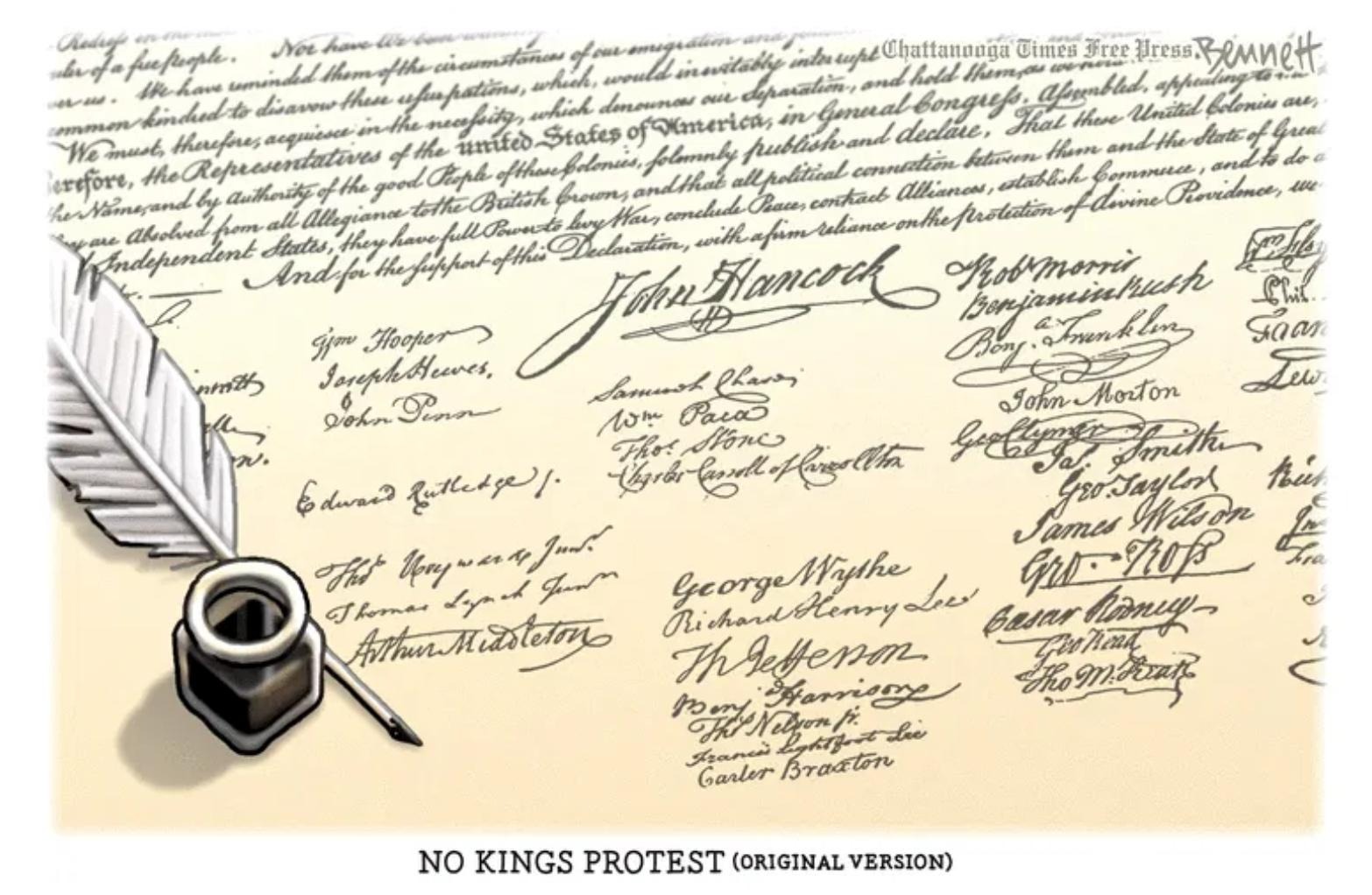
As others have noted, some of Trump’s sins against democracy are so quintessentially monarchical that they appear in the bill of particulars against George III in the Declaration of Independence. If you can digest all of that and still end up scratching your head at what the “No Kings” demonstrators were on about, it’s not because you don’t understand. It’s because you won’t understand. You’ve resolved psychologically not to take Trump’s autocratic desires seriously because doing so would force you to choose between loyalty to your tribe and loyalty to the Founders’ vision.

Nick Catoggio

Small favors

Kudos to Republicans for passive-aggressively monkey-wrenching, at least as to the Federal District courts, Trump’s effort to pack the federal courts with political cronies rather than qualified judges.

Senate Republicans are holding firm against President Donald Trump’s pressure to scrap a longtime tradition in Congress’ upper chamber, issuing a substantive rebuke to his desires and openly disagreeing with him on the issue.

Trump has repeatedly called on the Senate GOP to eliminate its blue slip practice, which allows senators from the minority party to block judicial appointments such as lower court nominees and U.S. attorneys who hail from their states. The president has argued that Democratic senators are obstructing his nominees, but Senate Judiciary Committee Chairman Sen. Chuck Grassley of Iowa is staunch in his resolve not to take away the century-old tradition.

“After a hundred years, why would you do away with it?” he told The Dispatch. “It’s supported by a hundred members of the United States Senate.”

Senate Republicans’ defiance of Trump here is perhaps the most substantive stand they have taken since they stonewalled the nomination of former Rep. Matt Gaetz to be his attorney general after last year’s election. To this point, members of the congressional GOP have often raised concerns or pushed for more information about Trump’s actions, but rarely have they obstructed his agenda. This time, however, they are refusing to sacrifice one of the Senate’s time-honored traditions, one that guards Congress’ power in an age where the legislative branch is often happy to cede authority to the executive.

Charles Hilu, Senate Republicans Are Actually Defying Donald Trump.

Passive-aggression is probably all we can hope for from Republican Senators who often appear emasculated by Trump.

But continuing the blue slip tradition is only part of it. Unusually high numbers of nominees to various offices have been withdrawn after back-channel communication:

[T]he Trump administration has faced some very significant resistance more privately to a large number of nominees, and that this has led a surprising number of them to be withdrawn. So far this year, the White House has withdrawn 49 nominations for Senate-confirmed positions. As Gabe Fleisher pointed out earlier this week, that is a (much) larger number of nominees than any modern president has had to withdraw from consideration in any year of his presidency.

And it is a particularly large number of withdrawn nominees in the first year of a new presidency. Ronald Reagan withdrew five nominations in his first year; for George H.W. Bush it was three; for Bill Clinton six; for George W. Bush seven; for Barack Obama twelve; for both Donald Trump in his first term and for Joe Biden the number was 13. The year is not even over and Trump has had to withdraw 49 nominations.

This is surely in part because it is in no one’s interest to draw attention to it. The administration wants to always look triumphant, regardless of reality. Republican senators want to appear to be firmly backing the president, which they mostly are ….

Yuval Levin

Your tax dollars at work

Who says government can’t do anything right? ICE is advertising for thuggish goons and it’s getting them.

In today’s hiring binge, ICE recruiting ads ask: “Which way, American man?” Testosterone is the not-very-sub subtext. Recruits will “defend the homeland,” “recapture our national identity,” stymie an “invasion,” halt “cultural decline” and even save “civilization.”

Something uncivilized is indeed happening. What jobs, if any, are recruits leaving for the glory of donning battle gear and masks (hiding what from whom?) and roaming U.S. communities, throwing their weight around and throwing unarmed people to the ground?

Says who? Says mild-mannered true conservative octagenarian George Will (When ICE came for a U.S. citizen and Army veteran).

And just like that, bribes are a normal business expense in Trumpistan

To bribe or not to bribe: When voters turn their country into a banana republic by making a gangster president, kickbacks become part of the cost of doing business. If I were a CFO in 2025 in need of government approval for some new project, I’d feel obliged to allot a certain amount of the budget for a “donation” to the Donald J. Trump Presidential Library and Casino.

Nick Catoggio, To Bribe or Not to Bribe

The kid with the Golden Shield

This kid (who supposedly has a law degree already) can magically provide a “Golden Shield” of immunity from prosecution for assassination, murder, torture and other governmental passtimes by writing a secret opinion that they’re legally A-Okay. Jack Goldsmith tells us all about it.

Not that the President needs it, mind you.

I wonder where the snowflakes are?

Any writer these days, who hasn’t been radicalized or redpilled, can tell you who the snowflakes are now. The people who were not long ago the loudest in preaching free speech are today the quickest to silence anyone who uses it to disagree with them. The people who railed against cancel culture are now trying to use the machinery of the state to try to destroy anyone who dares to posthumously criticize Charlie Kirk and the stances he took—which, it should be continually pointed out, included proudly sending buses to the Capitol on January 6, 2021.

It’s the people who love to dish out jokes and criticisms, but are not only outraged at Jimmy Kimmel’s distasteful jokes about Kirk, but fine with overt government pressure to take him off the air.

Ryan Holiday.

50 days after assassination, I think de mortuis nil nisi bonum passes its freshness date.

A real downer

Charles de Gaulle began his war memoirs with this sentence: “All my life I have had a certain idea about France.” Well, all my life I have had a certain idea about America. I have thought of America as a deeply flawed nation that is nonetheless a force for tremendous good in the world. From Abraham Lincoln to Franklin D. Roosevelt to Ronald Reagan and beyond, Americans fought for freedom and human dignity and against tyranny; we promoted democracy, funded the Marshall Plan, and saved millions of people across Africa from HIV and AIDS. When we caused harm—Vietnam, Iraq—it was because of our overconfidence and naivete, not evil intentions.

Until January 20, 2025, I didn’t realize how much of my very identity was built on this faith in my country’s goodness—on the idea that we Americans are partners in a grand and heroic enterprise, that our daily lives are ennobled by service to that cause. Since January 20, as I have watched America behave vilely—toward our friends in Canada and Mexico, toward our friends in Europe, toward the heroes in Ukraine and President Volodymyr Zelensky in the Oval Office—I’ve had trouble describing the anguish I’ve experienced. Grief? Shock? Like I’m living through some sort of hallucination? Maybe the best description for what I’m feeling is moral shame: To watch the loss of your nation’s honor is embarrassing and painful.

[I]f Trumpism has a central tenet, it is untrammeled lust for worldly power. In Trumpian circles, many people ostentatiously identify as Christians but don’t talk about Jesus very much; they have crosses on their chest but Nietzsche in their heart—or, to be more precise, a high-school sophomore’s version of Nietzsche.

To Nietzsche, all of those Christian pieties about justice, peace, love, and civility are constraints that the weak erect to emasculate the strong. In this view, Nietzscheanism is a morality for winners. It worships the pagan virtues: power, courage, glory, will, self-assertion. The Nietzschean Übermenschen—which Trump and Musk clearly believe themselves to be—offer the promise of domination over those sick sentimentalists who practice compassion.

As the conference went on, I noticed a contest of metaphors. The true conservatives used metaphors of growth or spiritual recovery. Society is an organism that needs healing, or it is a social fabric that needs to be rewoven. A poet named Joshua Luke Smith said we needed to be the seeds of regrowth, to plant the trees for future generations. His incantation was beatitudinal: “Remember the poor. Remember the poor.”

But others relied on military metaphors. We are in the midst of civilizational war. “They”—the wokesters, the radical Muslims, the left—are destroying our culture. There were allusions to the final epochal battles in The Lord of the Rings. The implication was that Sauron is leading his Orc hordes to destroy us. We are the heroic remnant. We must crush or be crushed.

David Brooks, I Should Have Seen This Coming.

I got over naïve American exceptionalism a very long time ago — or so I like to imagine. The speed of our descent astonished (astonishes? do we have further to go?) me; that America was capable of deep descent does not.

And I don’t know how to climb out of the hole in an America where thinking outside the tribe will draw death threats for both the politician and his or her family.


We are all gatekeepers now.

Peggy Noonan

Your enemies are not demonic, and they are not all-powerful and the right hasn’t always lost and the left hasn’t always won. But if you convince yourself of that, you give yourselves all sorts of permission to do a lot of stupid and terrible things under the rubric of “Do you know what time it is?”

Jonah Goldberg.

[A] critical mass of the American people … no longer want[s] to govern themselves, … are sick of this republic and no longer want to keep it if it means sharing power with those they despise.

Nick Catoggio

I don’t do any of the major social media, but I have two sub-domains of the domain you’re currently reading: (a) You can read most of my reflexive stuff, especially political here. (b) I also post some things on my favorite no-algorithm social medium.
Thursday, 10/30/25, politics-free

Radical autonomy is a delusion

In partial response Seven Theses Against Viewpoint Diversity” just published by Lisa Siraganian in Academe, a healthy dose of realism versus sanctimony:

As for insisting on your right to complete self-governance, free from “secondary, external aims,” as Siraganian puts it … well, if you expect someone else to pay you to pursue truth, at some point, you must accept some secondary, external aims.

Academics tend to recoil from such a crass and mercenary idea, and fair enough, but the world is a crass and mercenary place. We talk about pursuing truth for its own sake, but most academics are pursuing it in exchange for money they can use to satisfy their many less elevated needs. The people who provide that money want something in return. Many will not be content to know that somewhere the global stock of Truth is increasing. Especially if one of the Truths you insist on is that they are dim-witted bigots.

Megan McArdle

Not victimless

Last week, OpenAI CEO Sam Altman made an announcement. “In December, as we roll out age-gating more fully and as part of our ‘treat adult users like adults’ principle, we will allow even more, like erotica for verified adults,” he wrote on X.

…  

It is odd to treat adult spaces as though the marker of maturity is simply abundant pornography. In response to Altman’s post, one user asked: “Why do age-gates always have to lead to erotica? Like, I just want to be able to be treated like an adult and not a toddler, that doesn’t mean I want perv-mode activated.” Altman ducked the question, replying simply, “You won’t get it unless you ask for it.” 

But the cultural impact of increasingly violent pornography makes it obvious he is wrong. Women who have never watched pornography will still meet men in their dating pool who are disgusted by pubic hair, since those men’s appetites have been formed to desire pre-pubescent-appearing women. Women will meet men who assume women commonly enjoy anal sex. And increasingly, women meet men who assume choking is a natural part of sex.

Leah Libresco Sargeant, You Can’t Opt Out of Sam Altman’s Erotica.

(And seemingly everybody takes for granted that “dating” means some kind of sex, notes Tipsy.)

Incorrigibly ignorant

All those nice scientists from 1970 to 2000 sitting in their Presbyterian and Lutheran church pews on Sunday telling the world that feeding dead cows to cows was a wonderful way to feed everyone because their parts-and-pieces worldview said so. Eventually, they were jolted out of their self-assured righteousness when mad cow raised its ugly head. But they didn’t repent in sackcloth and ashes, like they should have. Oh no, they went about their Western thought processes with nary a break in stride.

Joel Salatin, Folks, This Ain’t Normal

USSR and Russia

Epilogue

The USSR is not quite dead in Russia. It has just shrunk to the size of Russia proper.
VITALY TRETYAKOV, July 1992

Not a single reform effort in Russia has ever been completed.
BORIS YELTSIN

An unreformed Russia will not have the strength for empire. A reformed Russia will not have the will.
JACK F. MATLOCK, JR., 1995

Jack F. Matlock , Autopsy on an Empire

Snippet

We do not obtain the most precious gifts by going in search of them but by waiting for them.

Simone Weil, Love in the Void


We are all gatekeepers now.

Peggy Noonan

Your enemies are not demonic, and they are not all-powerful and the right hasn’t always lost and the left hasn’t always won. But if you convince yourself of that, you give yourselves all sorts of permission to do a lot of stupid and terrible things under the rubric of “Do you know what time it is?”

Jonah Goldberg.

[A] critical mass of the American people … no longer want[s] to govern themselves, … are sick of this republic and no longer want to keep it if it means sharing power with those they despise.

Nick Catoggio

I don’t do any of the major social media, but I have two sub-domains of the domain you’re currently reading: (a) You can read most of my reflexive stuff, especially political here. (b) I also post some things on my favorite no-algorithm social medium.
25 years

Early Sunday posting.

Sunday is the 25th ordination anniversary of our Priest, Fr. Gregory. He was getting close to retirement age already, but he has worked tirelessly well beyond normal retirement age, and we have seen huge numerical growth and, I think, growth in our sense of community. I’m not leaving out spiritual growth; I just don’t know if I’m a competent judge of that or have any right to try. By the criterion of “what you convert them with is what you convert them to,” we should be doing fine.

Thoughts on Pope Leo XIV

  • A man of significant ecclesiastical responsibility who gets to age sixty-nine without attracting attention to his thinking has made a deliberate choice.
  • Growing up in the Chicago suburbs, he saw what Catholic immigration to the United States could accomplish—and how the lack of deep adherence, interior conversion, and evangelization led it to unravel in only a few generations.

Fr. Raymond J. de Souza, Two Takes on Pope Leo

The Fissiparous Principle

A similar, but more sophisticated, complaint of monograph length came from John W. Nevin in 1849 when he rounded on what he called the sect system. According to Nevin, “This professed regard for the Bible” was what “distinguishes the sects in general.” But to Nevin the difficulty in that profession was as manifest as it was stupendous: “If the Bible be at once so clear and full as a formulary of Christian doctrine and practice, how does it come to pass that where men are left most free to use it in this way…they are flung asunder so perpetually…instead of being brought together?” This anomaly showed that the principle of “no creed but the Bible” was “absurd and impracticable”; it breathed “the spirit of hypocrisy and sham.”

Mark A. Noll, America’s God.

Union with God

But how could we ever relate to God or, even more challenging, truly unite with Him? Of all religions, only Orthodox theology emphasizes union with God—in a real and actual sense—as the goal and purpose of all human life. We rarely speak of “going to heaven,” as though it were a destination. We do not speak of experiencing a “beatific vision” of God, as though God could be viewed but remained at some distance from us. Rather, Orthodox Christianity speaks of theosis, the divinization of the human person. We expect, hope, and strive for actual union with the perfect, infinite, eternal, omnipresent, and changeless God. But we are flawed, limited, and come into existence for a brief time; we are confined to one place at one time, and we are constantly changing. So how is union with God possible? The Incarnation, the enfleshment of the Son of God, gave us the ability to truly connect to God and become united with Him, transformed and illumined by Him, not simply because He died for us but because of the way He lived among us.

Dr. Eugenia Scarvelis Constantinou, Thinking Orthodox.

This idea lingers

This dual idea of the depravity of infants and the perversity of their natural will led Puritans to the conclusion that the first and most urgent purpose of child rearing was what they called the “breaking of the will.” This was a determined effort to destroy a spirit of autonomy in a small child—a purpose which lay near the center of child rearing in Massachusetts. The idea of “will-breaking” was not invented in New England. It also appeared among Puritan clergy in the east of England, and among Calvinist writers from the Netherlands to Hungary.

David Hackett Fischer, Albion’s Seed

A surprising figure

Nearly half of the congregations that recently exited United Methodism have not affiliated with the new Global Methodist Church or any other denomination or network. They understandably feel burned by their previous denomination and see these outside connections as only a hindrance, sometimes expensive. But can they survive long term if suffering scandal or deep division among themselves? Absent denominational ties, what will keep them together long-term institutionally?  Perhaps the future of American Christianity is even more Protestant, with constant schisms and new creations, with most Christians not staying anywhere for very long. Congregations will survive only so long as they can command a customer base, like a grocery store. This arrangement has some merit.  Dull or dysfunctional churches quickly die, while more vital ones quickly take their place. Such a cycle seems unstable, with a somewhat low view of the institutional church. But at least it is dynamic.

Mark Tooley at Juicy Ecumenism


Religious ideas have the fate of melodies, which, once set afloat in the world, are taken up by all sorts of instruments, some woefully coarse, feeble, or out of tune, until people are in danger of crying out that the melody itself is detestable.

George Elliot, Janet’s Repentance, via Alan Jacobs

[N]one of the things that I care about most have ever proven susceptible to systematic exposition.

Alan Jacobs, Breaking Bread With the Dead

You can read most of my more impromptu stuff here and here (both of them cathartic venting, especially political) and here (the only social medium I frequent, because people there are quirky, pleasant and real and it has no-algorithms). All should work in your RSS aggregator, like Feedly or Reeder, should you want to make a habit of it.

Friday, 10/24/25

Against the Machine?

I’ve paid closer attention (plus Substack subscription fees and book purchases) to Paul Kingsnorth since his conversion to Christianity and specifically to Orthodox Christianity. (No, he did not convert to “Romanian Orthodoxy,” though his regular parish is predominately Romanian. There is no substantial difference between Romanian, Serbian, Greek, Russian, Georgian, Syrian or other Orthodox ethnic identifiers.)

I’ve also paid closer attention (plus Substack subscription fees and a book purchase) to Martin Shaw since his reversion to Christianity, this time as Orthodox.

But I’ve been trying to keep in mind the scriptural cautions against putting novices on a pedestal Cf. I Timothy 3:6. Neither novice, Kingsnorth or Shaw, is a Christian authority – yet.

Mercifully, neither is claiming the prophet’s mantle, but careless readers can cloak them with it anyway.

I’m happy for Kingsnorth that his new polemic, Against the Machine, is selling well, and that he is getting blogged and podcasted by everyone and his brother. I’ve read the book, which was more than a stitching together of old internet posts. But if you read it, do also read some critiques, such as ‘Unnatural’ Doesn’t Mean ‘Wicked’, by non-Orthodox Christian Tara Isabella Burton.

Elites failing to reproduce

PhDs are falling: At Harvard, PhD programs are collapsing amid budget woes. The Faculty of Arts and Sciences just slashed the number of PhD student admissions slots by more than 75 percent in the Science division and 60 percent in the Arts & Humanities division for the next two years.

The PhD racket was always a weird one. These schools pushed their smartest, most annoyingly ambitious kids to get a PhD (there but for the grace of god go I). During that PhD, these guys do all the work of being a professor—teaching courses, grading papers. But they’re paid next to nothing. And then the clincher is that at the end, there are no jobs available. Maybe one English department job in Idaho for a group of 300 of them to battle to the death over. So I support this belt-tightening. We will have about 5,000 fewer antifa soldiers produced each year. They might even spend their 20s making money.

Nellie Bowles

Claiming a privileged position

Over the past decade a new, and very revealing, locution has drifted from our universities into the media mainstream: Speaking as an X . . . This is not an anodyne phrase. It tells the listener that I am speaking from a privileged position on this matter. (One never says, Speaking as a gay Asian, I feel incompetent to judge this matter.) It sets up a wall against questions, which by definition come from a non-X perspective. And it turns the encounter into a power relation: the winner of the argument will be whoever has invoked the morally superior identity and expressed the most outrage at being questioned.

Mark Lilla, The Once and Future Liberal.

Legal realism

A new analysis of insurance data finds that more than one in ten of the women who take the abortion pill experience sepsis, infection, hemorrhaging, or another “serious adverse event.”  The only reason regulators tolerate such a high level of danger to the mother is that the ability to kill her baby cheaply and conveniently trumps all considerations.

J Budziszewski (bold added).

High tide recedes

Wow, it really was a social contagion: As the great vibe shift sweeps our country, it turns out that the rise in transgender identities really was a fad—between 2022 and 2024, the number of trans-identifying young people has dropped in half. Last week, another study hinted at the same conclusion, but it was widely criticized due to its failure to distinguish between trans and nonbinary identities, which are obviously very different, you ignoramus. This week’s data from writer and psychology professor Jean Twenge proved that both identities are in free fall among the youth. …

This is good for a lot of reasons—but in particular, it’s good for trans people! Why? Because there have always been a small number of people who feel truly dysphoric in their sex. And the last thing you want is a horde of depressed teen girls latching on to your situation as a way to rage against their bodies, a stand-in for anorexia or cutting. I’ve never been more worried about my rights as a gay person than when all the angry youth started announcing they were gay or trans or queer because then I just knew backlash was coming. Anything funky they did, they called it gay. They wore a weird jacket and got creative with their haircuts and all of a sudden, they’re claiming my identity. I say, scram, kids! Get out of here! I’m putting up a border around Gay Territory and saying No more may enter. It’s me, it’s everyone in Provincetown, and it’s my dykes in the Midwest, and that’s it. We’re full up. Go see if the Mormons are taking applications.

Nellie Bowles

Politics

The next two items are the most pointedly political in this post – and that’s not very pointed. I just don’t have it in me to spit into the wind recently.

A new presumption of bad faith

I was reminded by a New York Times guest editorial on the dangers of the Insurrection Act that our laws almost all assume that the law enforcer will be sane and will act in good faith. As a consequence of electing an insane and vengeful President, we now “enjoy” the full American expression of Joseph Stalin’s “show me the man and I’ll show you the crime.” My reflex is to disbelieve every word Trump says and to suspect invidious discrimination in all his Orders.

It might behoove our legislators to consider, before passing a law, what injustices could be wrought by bad actors wielding the proposed law.

Bring back hypocrisy

The Wall Street Journal has somehow decided to position its Editorial Page just slightly “left” (whatever those terms mean any more) of the Falun Gong’s Epoch Times. Thursday, it was Barton Swaim’s both-sides demi-defense of Trump’s lawfare against his perceived enemies.

I counter with “Yes, but Trump truly is worse because he does it right out in the open, shamelessly.” If hypocrisy is the tribute vice pays to virtue, it joins smoking and drinking on the very short list of vices Trump doesn’t practice. Otherwise, his brazenness coarsens every thing he touches and everyone who cheers him. For a guy so enamored of gold leaf, he’s oddly opposite King Midas.

I never thought I would lament the loss of hypocrisy.

Conservatives in Academia

Writing in the magazine of the American Association of University Professors (AAUP), Lisa Sirangian, a Johns Hopkins literature professor, offers seven reasons why “viewpoint diversity” — that is, making room for conservatives on campus — is wrong. I’ll summarize it for you: “Because conservatives are wrong and don’t care about truth; ‘viewpoint diversity’ is a MAGA plot.”

The WaPo’s Megan McArdle isn’t having it. Excerpt:

In the wider world, asking whether academia really skews left makes you look like an idiot or, slightly more charitably, like someone so encased in a bubble that they don’t even know what they’re missing. As for insisting on your right to complete self-governance, free from “secondary, external aims,” as Siraganian puts it … well, if you expect someone else to pay you to pursue truth, at some point, you must accept some secondary, external aims.

Academics tend to recoil from such a crass and mercenary idea, and fair enough, but the world is a crass and mercenary place. We talk about pursuing truth for its own sake, but most academics are pursuing it in exchange for money they can use to satisfy their many less elevated needs. The people who provide that money want something in return. Many will not be content to know that somewhere the global stock of Truth is increasing. Especially if one of the Truths you insist on is that they are dim-witted bigots.

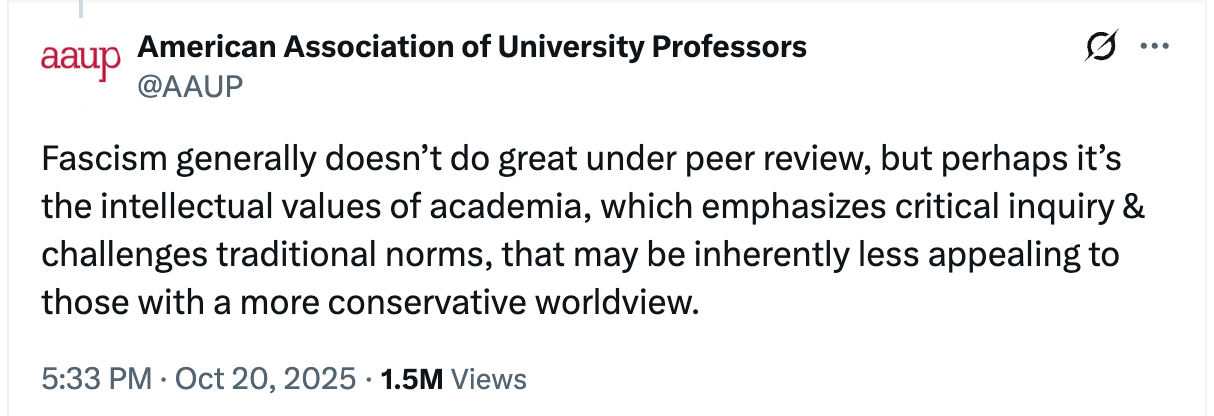
Anyway, this is how the AAUP responds to the conversation on X:

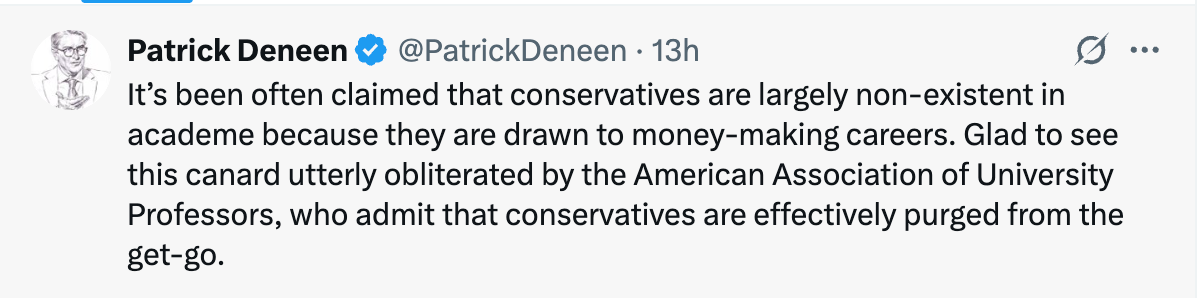
Well, there it is. Conservatives are FASCISTS! Patrick Deneen responds to that tweet:

The more I see institutional elites, in government and the private sector, the more I realize these people are like the pre-revolutionary Tsarist circles. They had no idea why so many people hated them, and what kind of precarious situation they were in.

Rod Dreher

Google

They always invest in businesses that put them in the ‘trade routes’—controlling the linkages, and never getting involved in the creation of tangible value.

Ted Gioia, Google Is Now the East India Company of the Internet

Today in History

Kagi News, a new and useful aggregator, offers “Today in History as one of its tabs, with events at the top, people at the bottom.

For some reason, I find that a lot of composers and poets I had place mentally in the late-19th century were actually in early-19th century. Edgar Allen Poe never even saw the late-19th. Who knew?

Snippets

  • … the Conservative Political Action Conference, a kind of movable rent-a-troll event … (Anne Appelbaum via Frank Bruni)
  • The old Saudi brand was ‘austere theocracy,’ but the new one is ‘fun, fun, fun, but still with beheading.’” (Helen Lewis via Frank Bruni)
  • We live the given life and not the planned. (Wendell Berry, Sabbath poems 1994 number 3)
  • I love her more than evolution requires. (Charles Murray’s wife, reflecting on their first child. Attributed to others as well. The insight doubtless matters more than the source.)
  • Mad Ireland hurt you into poetry. (W. H. Auden, in memory of W. B. Yeats)
  • Music is a conspiracy to commit beauty. (Linda Ronstadt)
  • States, particularly liberal democracies, are heavily dependent on wars for moral coherence. (Stanley Hauerwas, Resident Aliens). Looking at the last 62 years of American history seems to confirm this.

We are all gatekeepers now.

Peggy Noonan

Your enemies are not demonic, and they are not all-powerful and the right hasn’t always lost and the left hasn’t always won. But if you convince yourself of that, you give yourselves all sorts of permission to do a lot of stupid and terrible things under the rubric of “Do you know what time it is?”

Jonah Goldberg.

[A] critical mass of the American people … no longer want[s] to govern themselves, … are sick of this republic and no longer want to keep it if it means sharing power with those they despise.

Nick Catoggio

I don’t do any of the major social media, but I have two sub-domains of the domain you’re currently reading: (a) You can read most of my reflexive stuff, especially political here. (b) I also post some things on my favorite no-algorithm social medium.
Sunday, 10/19/25

The cultural formations of western Christianity

Christianity as we see it in eighteenth-century Britain or twenty-first-century America is not Christianity as it has always been, and the more fundamental changes may not be those that the received history of religion narrates. The cultural formations of western Christianity, growing as they do in good part from binary, Protestant-Catholic debates, can be thrown into stark relief, for instance, when studied in comparison to that much neglected third term in Christendom: the Eastern Orthodox churches from which Rome severed itself nearly half a millennium before the Reformation, charting a course for Western Christianity wed to rationalism and enamored of individual authority, whether papal or personal.

Lori Branch, Rituals of Spontaneity (italics added).

The italicized phrase warms my heart because almost every non-Orthodox writer in the West, including anti-Catholic polemicists, inverts it to Orthodox Churches severing themselves from Rome.

A well I keep returning to

It’s mind-bending in a good way to consider the possibility that Protestantism is effectively dead because the nondenominational megachurchy world is something, or some things, else:

Imagine a world without Protestantism.

I don’t mean a world without Christians who are neither Catholic nor Orthodox. I mean a world in which there are only two groups of Christians. The first group encompasses believers who belong to ancient fellowships led by bishops and ordained priests, who confess the Creed and their sins and celebrate the Eucharist in a traditional liturgy of word and sacrament. These believers hand on tradition, petition the saints, venerate icons, and baptize their babies. Call them “catholic.”

Call the other group “evangelicals.” They have no creed but the Bible. They have no bishops or priests; instead, they have ministers and elders, who are rarely ordained. They baptize not infants but adults, who can make a public declaration of faith. They reject the interposition of anyone or anything between the individual and Jesus, who is known immediately in the soul and clearly through the Scriptures.

Imagine a world in which every Christian is either catholic or evangelical, with nothing in between. It is a world without Protestantism—for the religion of the magisterial Reformers in the sixteenth century did not desire, commend, or practice either of these options. Theirs was a via media. They baptized babies, recited the Creed, ordained pastors to the service of word and sacrament, practiced baptism and communion as sacraments (not as symbols), and insisted on the validity of the early councils.

The world I invite you to imagine, then, is one in which this middle way—neither Roman nor Anabaptist, both traditional and reformed—has vanished. Is such a world possible? It is. In fact, we are living in it right now. Ours is a world without Protestantism.

Brad East, Goldilocks Protestantism, First Things.

Stumbled onto this …

As a 14-year-old I had embraced Jesus as my Savior but had confused the abundant Christian life with the great American dream: I was a Christian and would lose weight, get good grades, get voted captain of the hockey team, go to college, marry a wonderful man who made $250,000 a year, and we’d have 2.5 children. It was me-focused: What can God do for me? I almost thought I had done God a great big favor by accepting Jesus ….

Joni Eareckson Tada.

I recently got a digital subscription to Christianity Today, a magazine I’ve known all my life, in order to keep up a little with doings in the non-Orthodox Christian world. Eareckson Tada was a big deal in the Evangelical tradition decades ago and apparently has remained so, living a remarkably long life for a quadriplegic – perhaps because she has kept so busy with her talents.

Related: Frederika Matthewes-Green reported in one of her books the comment of a first-time visitor to an Orthodox Church: “Wow! That was soooo not about me!”

Duly Noted

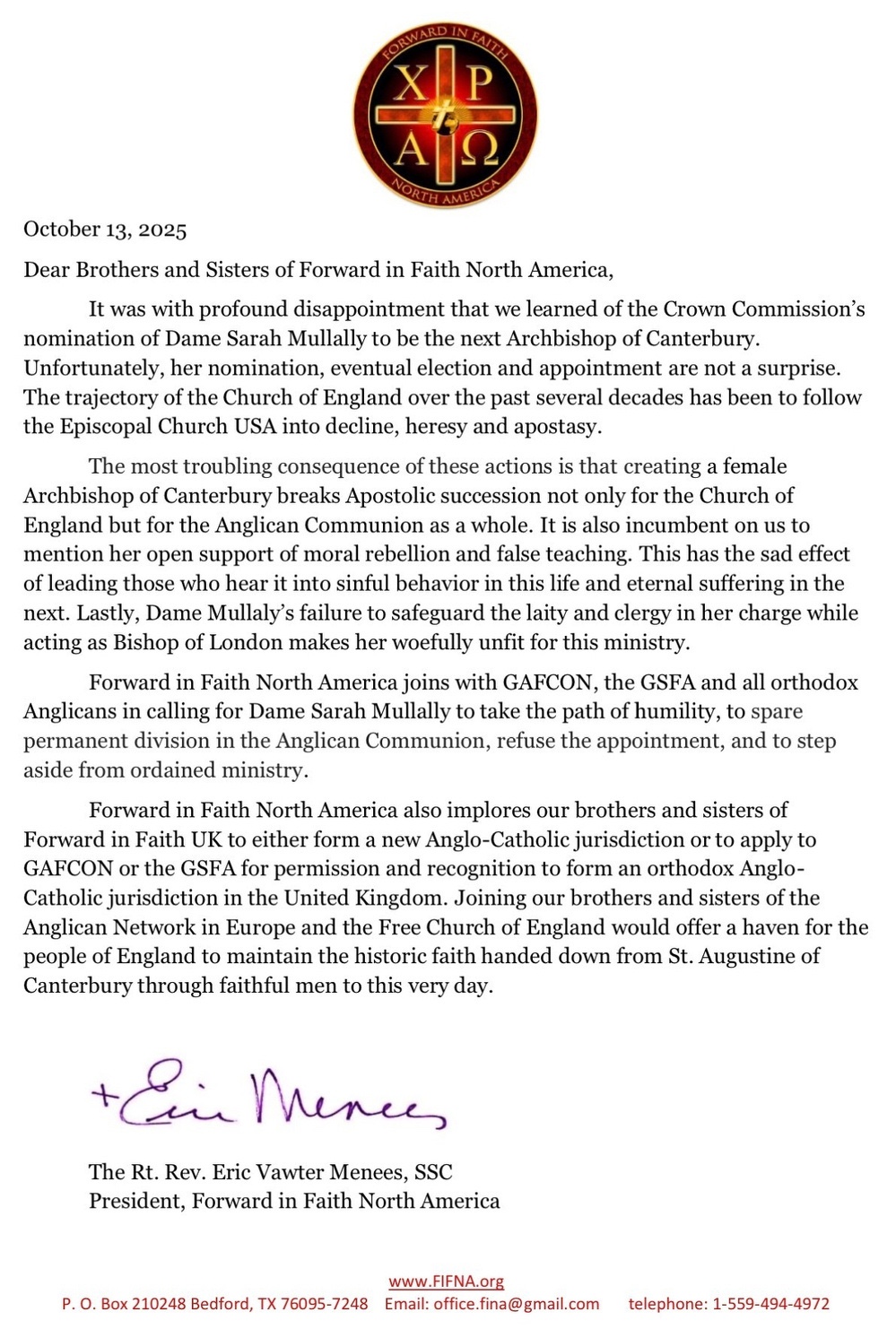
A line is being crossed in Canterbury. I share a communication published by a priest who received it:

Almost inevitably, these “Forward in Faith” and other GAFCON Anglicans will be painted in the popular press as schismatic for not going along with a radical provocation. I hope, but faintly, that the popular press will report their claim (encountered elsewhere) that they are the Anglican Church.

I make no facile prediction that “history will vindicate them,” but I’d rather be among them than the innovators when, at the end of history, Christ comes from heaven to judge the living and the dead.

Not every wound is PTSD

Therapists themselves are noting that if every time a soldier confesses his soul wound from combat we then label him with PTSD, that we will find ourselves recommending psychological therapies and prescribing psychiatric medications when what is needed is something like a religious ritual of purification and forgiveness.

Timothy Patitsas, The Ethics of Beauty.

Note to Peter Thiel

In the Lateran, at a council held in 1513, a formal prohibition had been issued against preaching the imminence of Antichrist.

Tom Holland, Dominion

Evangelicals and Calvinists

A lot of the evangelical world leaves the dirty work to the Calvinists.

Derek Rishmawi, Calvinist.

Caveat: Political Application is Patent

On Sundays, I rarely post things with pointed political applications. For that matter, I rarely post political items with explicit Christian underpinnings on Mondays through Saturdays. Today marks an exception where I judged that these fit Sunday better than weekdays because my target readers are specifically Christians.

Salt & Light

Christians who vote for Republicans are called to be salt and light within the Republican Party. That means being a voice calling the Republican Party to obey the rule of law. Yours should be the loudest voice condemning Trump’s pardon for January 6 rioters and pushing against his challenge to the checks and balances that are supposed to constrain the executive . You should speak up in favor of the poor and powerless and against the culture of cruelty, spite, and vengefulness Trump cultivates. It corrodes our public square and demeans our shared citizenship even as it poses more specific dangers to those targeted by Trump’s weaponization of federal law enforcement. If you do not speak up, you are both credulous and culpable, complicit with the party’s sins—including those yet to come.

Paul D. Miller, A Confessing Church for America’s Weimar Moment

MAGA Christianity

In last Sunday’s “Dispatch Faith” Column, Paul D. Miller asks Is MAGA Christianity True Christianity?, and essentially answers “no”: MAGA Christianity often mixes Christian symbols and Scripture with partisan rhetoric and calls to fight enemies, producing superficially Christian religion that departs on key theological and ethical points.

Commenting on The Charle Kirk Moment, Nijay Gupta resurrected a saying I’m pretty sure I last heard decades ago:

What you win them with is what you win them to.

Gupta’s role in this podcast was that of a more progressive Christian, relatively skeptical of the work of Charlie Kirk, and this comment had in view Kirk’s interweaving of conservative politics and evangelism.

I repeat from prior posts: I knew very, very little about Kirk until he was killed. From what I’ve learned since, I suspect he’d have insisted that conservative politics is such a concomitant of Christian faith that it is meet and right to interweave them from the podium/pulpit. (He said repeatedly that one cannot be a Christian and vote for Democrats.)

That is a message I’ve heard (though almost always tacitly) most of my life, and have resisted for almost as long. Despite my impression that most conservative Christians in North America lean right, and acknowledging that I, too, do so (though the meaning of “right” grows ever fuzzier), I nevertheless endorse the shared thrust of Miller and of Gupta.

And that’s why I consciously avoid political talk at Church coffee hour. All are welcome, regardless of politics, though some politics will prove to be baggage that must eventually be shed, as I’ve had to shed some of my own baggage.


Religious ideas have the fate of melodies, which, once set afloat in the world, are taken up by all sorts of instruments, some woefully coarse, feeble, or out of tune, until people are in danger of crying out that the melody itself is detestable.

George Elliot, Janet’s Repentance, via Alan Jacobs

[N]one of the things that I care about most have ever proven susceptible to systematic exposition.

Alan Jacobs, Breaking Bread With the Dead

You can read most of my more impromptu stuff here and here (both of them cathartic venting, especially political) and here (the only social medium I frequent, because people there are quirky, pleasant and real and it has no-algorithms). All should work in your RSS aggregator, like Feedly or Reeder, should you want to make a habit of it.

No Kings Saturday, 10/18/25

No kings!

Binding precedent

Protesters have protested at an ICE facility a few miles west of Chicago for the past 19 years—with somewhat more intensity recently following the announcement of Operation Midway Blitz. A month after the announcement, the president federalized the Illinois National Guard. District court: Enjoined. Seventh Circuit: Just so. Political opposition is not rebellion, and a protest doesn’t become a rebellion merely due to a few isolated incidents of violence. Without that, none of the statutory predicates for federalizing the National Guard have been met.

Institute for Justice, Short Circuits for 10/17/25 (bold added). This is now the law in the 7th U.S. Circuit – Indiana, Illinois and Wisconsin.

Look for the Administration to try to provoke a rebellion it can crush. Everyone who’s paying attention knows Trump wants to invoke the Insurrection Act (as he stuffs his pockets and those of his family).

Wanted: a viable counternarrative

Trump’s actions … are part of one project: creating a savage war of all against all and then using the presidency to profit and gain power from it. Trumpism can also be seen as a multipronged effort to amputate the higher elements of the human spirit—learning, compassion, science, the pursuit of justice—and supplant those virtues with greed, retribution, ego, appetite. Trumpism is an attempt to make the world a playground for the rich and ruthless, so it seeks to dissolve the sinews of moral and legal restraint that make civilization decent.

Trumpism, like populism, is more than a set of policies—it’s a culture. Trump offers people a sense of belonging, an identity, status, self-respect, and a comprehensive political ethic. Populists are not trying to pass this or that law; they are altering the climate of the age. And Democrats think they can fight that by offering some tax credits?

To beat a social movement, you must build a counter social movement. And to do that, you need a different narrative about where we are and where we should be heading, a different set of values dictating what is admirable and what is disgraceful. If we fail to build such a movement, authoritarian strongmen around the globe will dominate indefinitely.

David Brooks.

You can’t beat something with nothing. I can’t come up with a political counternarrative to Trumpism. The Democrats can’t come up with a political counternarrative, either. Brooks couldn’t come up with a strong political counternarrative.

I can only hope and pray that people will look for their compelling (counter-)narrative to the Gospel of Jesus Christ. (And that meantime there will be some legal counternarratives to prevent irretrievable damage, as in the preceding item.)

Music Reviews

There may be nothing better than old music reviews to let you know that it’s okay to like what you like, critics be damned.

I like Debussy’s La Mer, and I don’t care what the stupid early reviews said:

On today’s date in 1905, Claude Debussy’s orchestral suite La Mer or The Sea was performed for the first time in Paris. Today this music is regarded as an impressionistic masterpiece, but early audiences — especially those in America — found it rough sailing.

“We clung like a drowning man to a few fragments of the tonal wreck,” wrote a 1907 Boston critic, and suggested that instead of The Sea Debussy should have titled his piece Sea-Sickness.

“The Sea is persistently ugly,” wrote The New York Times that same year. “Debussy fails to give any impression of the sea … There is more of a barnyard cackle in it than anything else.”

And in 1909, this on La Mer from The Chicago Tribune: “It is safe to say that few understood what they heard and few heard anything they understood … There are no themes … There is nothing in the way of even a brief motif that can be grasped securely enough by the ear and brain to serve as a guiding line through the tonal maze. There is no end of queer and unusual effects, no end of harmonic complications and progressions that sound so hideously ugly.”

Ah, the perils of “modern music” in the early 20th century!

Giving the Devil his due, impressionism had to be a real mind-blower for critics attuned to, say, the sonata-allegro form.

Comprehensive tradition

We’re often not very aware of the “tradition” in which we live. A student in a classroom would readily agree that the words of a teacher or professor were a “traditioning” of sorts. But they will fail to notice that how the room is arranged, how the students sit, what the students wear (or don’t wear), how the professor is addressed, how students address one another, what questions are considered appropriate and what are not, and a whole world of unspoken, unwritten expectations are utterly required in the process. The modern world often imagines that “online” education is equivalent to classroom education since the goal is merely the transmission of information. But the transmission of information includes the process of acquiring the information and everything that surrounds it. Those receiving the “tradition” online will have perhaps similar information to those receiving it in a classroom – but they will not receive the same information.

Fr. Stephen Freeman, The Tradition of Being Human

Stages of life

Two questions:

  1. Do I want to read/watch/listen to this?
  2. Should I read/watch/listen to this?

When I was younger the second question often dominated my decision-making. Now that I am officially ancient that question has virtually disappeared and the first one is usually the only one I ask. That’s been the single most notable change in my personality in these my declining years.

Alan Jacobs

Alan is a decade or more younger than me, yet I only very recently seem to have arrived at this point, especially regarding political matters.

Note that he’s talking about a change in personality. This isn’t a life rule. There are things that younger people should read/watch/listen to, in order to become well-formed human beings.

Two ways

[R]evival begins with the people proclaiming, by word and deed, “I have sinned.”

MAGA Christianity has a different message. It looks at American culture and declares, “You have sinned.”

David French

Noteworthy

In the aftermath of Kirk’s murder, we witnessed young people at vigils rather than at “mostly peaceful” demonstrations.

R.R. Reno in First Things


We are all gatekeepers now.

Peggy Noonan

Your enemies are not demonic, and they are not all-powerful and the right hasn’t always lost and the left hasn’t always won. But if you convince yourself of that, you give yourselves all sorts of permission to do a lot of stupid and terrible things under the rubric of “Do you know what time it is?”

Jonah Goldberg.

[A] critical mass of the American people … no longer want[s] to govern themselves, … are sick of this republic and no longer want to keep it if it means sharing power with those they despise.

Nick Catoggio

I don’t do any of the major social media, but I have two sub-domains of the domain you’re currently reading: (a) You can read most of my reflexive stuff, especially political here. (b) I also post some things on my favorite no-algorithm social medium.
Wednesday, 10/15/35

Vagrant metaphors

Supreme Court Justice Sonia Sotomayor cut straight to the heart of Chiles v. Salazar [Tennessee’s ban on medical transitioning of gender dysphoric minors] with one hypothetical: If a dietitian decides to help anorexics starve themselves, can the government stop them?

This was clarifying in more ways than one, illuminating not just the legal dispute, but deeper problems with how our country is handling LGBT issues.

Sotomayor’s analogy was apt, but it was also a little startling coming from her, because in these debates comparisons to anorexia usually come from skeptics of pediatric medical transition. When an anorexic feels at odds with their body, the skeptics argue, we use therapy to alter their feelings. So how come when gender dysphoric kids feel that way, we use hormones and puberty blockers to alter their bodies?

It’s an obvious question, but I doubt that Sotomayor meant to bring it up, since she is hardly critical of pediatric medical transition …

… We spend a lot of energy on analogies and hypotheticals and semantics, instead of analyzing the issues more systematically. That’s why these cases keep ending up in court.

That’s all very interesting for the lawyers. But for most people the semantics are irrelevant, and both cases involve the same key question, though not the one that was actually before the court: Should gender dysphoric kids be encouraged to transition, or encouraged to embrace their biological sex?

The rest is strategic word games, which is how a metaphor favored by one side can so easily slip its moorings and turn up bobbing around on the other side of the harbor.

Megan McArdle. I really like that idea of a metaphor “slipping its moorings.”

Nobel Peace Prize

Disney World used to have a bust of [Bill] Cosby at its Hollywood Studios theme park but removed it in 2015 because of, well, you know. Them’s the breaks sometimes when bestowing a grand honor on a living person. Said person might yet live to disgrace himself, or be disgraced by old skeletons tumbling out of his closet, before he’s passed on and history’s verdict has settled.

Cosby came to mind after the Norwegian Nobel Committee chose not to award the Nobel Peace Prize to the one person in the world who wanted it more than anyone else. The lazy explanation for that snub was “liberal bias,” but I suspect that declining to give it to Donald Trump had more to do with fears of a potential Cosby problem. The committee has been burned before—badly—in prematurely celebrating a warmonger as a peacemaker, after all. Imagine if it had honored the president and he turned around next week and bombed Venezuela. Or invaded Greenland. Or declared martial law in the United States.

The peace prize is a totem of the rules-based international order that governed the world for 80 years until Trump returned to office in January. Handing it to the man who’s overseeing that order’s destruction would be a bit like awarding the Nobel Prize in medicine to Robert F. Kennedy Jr.

Nick Catoggio

Sometimes a pundit puts eloquently what I’ve thought clumsily. Catoggio here goes one better, responding to something I never articulated at all until now: “Of course, giving the Peace Prize to Trump would be deeply absurd despite any superficial plausibility, but I’m darned if I can can put the reason in words.”

I also like his explanation of Trump’s diplomatic success in the Middle East:

If you’re looking to broker peace in the Middle East and are stuck negotiating with a bunch of tribalist, kleptocratic, authoritarian cultural imperialists, who’s more likely to get through to them? Condoleezza Rice or a tribalist, kleptocratic, authoritarian cultural imperialist?

He cares about getting rich, persecuting his enemies, and eliminating threats to his own power—just like his Middle Eastern counterparts do. He knows what to say and what to offer to get them to work with him.

Redistricting

I hate the GOP’s new-found disregard of norms. Therefore, I hope that the norm-breaking mid-decade redistricting is punished swiftly and poetically:

  • Trying to squeeze out another Republican district means spreading a state’s Republican voters more widely but thinly.
  • Thus if public sentiment turns less favorable toward Republicans, they stand to lose more seats than if they settled for one or two fewer but safer districts.
  • Therefore, I’m hoping for a shift of public sentiment away from Republicans before the 2026 elections and for Republicans to lose at least two seats in every state where they tried to gerrymander one more seat.

Not that Congress has been doing anything anyway, but it feels important to take Congress away from the GOP for so long as Chairman Donnie remains in office pushing his Great Leap Forward. It will probably happen in any event, but it would sure be swell if it happened this way.

Kinky loons

Not long ago, when people still listened to the radio in their cars, you could tune into some freaky talk late at night. “We know a third of us are star children, implanted by the visitors,” the anchor might drawl matter-of-factly. “What we’re learning now is, there’s two groups of star children — two tribes of visitors — and they’re butting heads. And we’re in the middle of it, y’know? Iraq, Obama, recession, it all goes back to the star children …”

Writer Abe Greenwald dubs this genre of late-night crankery “star-child radio.” These days, you don’t need to take a long drive through the middle of nowhere to catch it. It is everywhere online. Indeed, much of right-wing media now resembles star-child radio: a vast chamber of oft-malignant fantasies, where even once-reasonable minds go to get euthanized.

I have spent much of my career pointing out the ideological blind spots of center-left outlets: their near-total alienation from the Bible-believing sectors of society; their tendency to select and present stories in the light least likely to help the right.

But ultimately, the Times and NPR are not star-child radio. There is a difference between a progressive (or conservative) worldview coloring the framing of stories and the quest to “prove,” as the some on the right have, that the president of France’s wife is a man.

Sohrab Ahmari.

Before “Bridget Macron is a guy,” there was “Michelle Obama is a guy.” These aren’t just loons; they’re kinky loons.

Now he’s normal, now he’s not

Time and again, the pattern repeats. When Trump is on offense, he’s celebrated as a president like no other. But when he has to answer for his actions in court, he demands that he be treated as a president like any other.

[W]hen Trump faces lawsuits, he defends his [National Guard] deployments by leaning on the deference earned by other presidents through their responsible use of power. Because other presidents were deemed trustworthy, his representatives argue, the courts should trust Trump, too.

David French, explaining judicial recognition that Trump has forfeited his claim to any Presidential presumption of regularity. French’s column is lucid and comprehensive enough, and the loss of the presumption of regularity (if that loss withstands appeal) is so consequential, that the preceding link gifts his column to my readers.

Ada the Algorithm

Elites today have no idea how to speak to the public or what to say to it. They have shown little interest in trying. The hyper-educated individuals who ran the Clinton campaign were utterly indifferent to public opinion: they believed in big data. An algorithm nicknamed “Ada” delivered “simulations” of opinion to the campaign staff. Ada was the public as elites wish it would be: safe, clean, and speaking only when spoken to. The voter in the flesh was clearly perceived by this group as an alien and frightening brute. His very existence was deplorable. The shock of Election Day followed naturally from such distortions of distance.

Martin Gurri, The Revolt of the Public and the Crisis of Authority in the New Millennium

Losing student visas then and now

I remember when I was a Canadian citizen in the United States on a student visa, we were warned if you got into a bar fight, you could theoretically lose your student visa. Now, in those days, that meant that you’d have to go back to Canada and go to school in Canada, which is not the end of the world. In today’s America, that could mean you could lose your student visa and be accused of terrorism, and a bag put over your head and be put into a car and sent to a prison in El Salvador for the rest of your life.

David Frum

From the current GOP Hymnal

Do you remember January 6, 2021? It was the day of a Great Patriotic Rally after the re-election of Donald Trump to a second consecutive term. But the real reason it’s memorable is that the nefarious Democrats used that Great Patriotic Rally as an excuse to tap the phones of Republican Senators and Congressmen!

Poems

Reclaim the Sites

We are spared the Avenues of Liberation
and the water-cannoned Fifths of May
but I tire of cities clogged with salutes
to other cities: York, Liverpool, Oxford Streets
and memorial royalty: Elizabeth, Albert, William, unnumbered George.
Give me Sallie Huckstepp Road, ahead of
sepia Sussex, or Argyle, or Yankee numbering
– and why not a whole metropolis
street-signed for its own life and ours:
Childsplay Park and First Bra Avenue,
Unsecured Loan, the Boulevard Kiss,
Radar Strip, Bread-Fragrance Corner,
Fumbletrouser, Delight Bridge, Timeless Square?

Les Murray, Reclaim the Sites, from New Selected Poems

Terra Firma

Yes, you’re right. I’m sure Armageddon’s coming:
wars, tsunamis, hurricanes, earthquakes, locusts,
killer flus, et cetera. Yes, I’m awed by
all the destruction.

I concede your point that the world might end, and
all your puny labors will be as nothing.
Still, you can’t go out with your friends until you’ve
folded the laundry.

Julie Steiner


We are all gatekeepers now.

Peggy Noonan

Your enemies are not demonic, and they are not all-powerful and the right hasn’t always lost and the left hasn’t always won. But if you convince yourself of that, you give yourselves all sorts of permission to do a lot of stupid and terrible things under the rubric of “Do you know what time it is?”

Jonah Goldberg.

[A] critical mass of the American people … no longer want[s] to govern themselves, … are sick of this republic and no longer want to keep it if it means sharing power with those they despise.

Nick Catoggio

I don’t do any of the major social media, but I have two sub-domains of the domain you’re currently reading: (a) You can read most of my reflexive stuff, especially political here. (b) I also post some things on my favorite no-algorithm social medium.

Sunday evening

“We took the freedom of speech away …”

At the round table … he diverted to a tangent about flag burning, saying he had instituted a “one-year penalty for inciting riots.”

“We took the freedom of speech away because that’s been through the courts and the courts said, you have freedom of speech,” Mr. Trump said. “But what has happened is when they burn a flag, it agitates and irritates crowds.”

Charlie Savage, Trump Baselessly Claims He ‘Took the Freedom of Speech Away’ From Flag Burners.

Trump’s word salads are incoherent, but I think he’s saying that he recognizes a heckler’s veto on flag-burning, like the one he tried on Colin Kaepernick for kneeling.

Sorry, Donnie: Street v. New York (1969).

Quick, easy, and stupid pigeon-holing

Using the old Left-Right duality distorts our political thinking. Consider what counts as “Leftist” today: Open immigration, transgenderism, antiracism, gay marriage, opposition to Israel’s incursion in Gaza, violence against conservatives and Christians, unbending support for Ukraine, pro-choice, anti-Trumpism.

Once these positions are grouped as “Left,” anyone who holds one “Left” position is labeled a “Leftist.” If you have reservations about Trump (as I do), question Trump’s immigration policies, believe African Americans have suffered and still suffer injustices, or express sympathy for Palestinians in Gaza, you’ll get lumped in with transgenders and homosexuals, rioters and assassins.

Everybody but everybody condemns “third way” Christian political agendas. That condemnation is childish, first because it’s utterly unhistorical. The specific contours of the American Left and Right are entirely contingent, constantly shifting political outlooks and moods. They don’t exhaust our political options.

Peter Leithart

Losing the real storyline

Ross Douthat is definitely one of my favorite journalists these days, but, bless his heart, whenever I see a column about Donald Trump’s “policies,” I get the feeling that the author is trying too hard to make him a normal President.

Setting the record straight on “sanctuary cities”

I have very high regard for professor J Budziszewski, who writes on natural law and blogs at the Underground Thomist. But his latest post blows it, not because of illogic, but because of a badly mistaken premises. I write because his mistake is very wide-spread.

The topic is so-called “sanctuary cities.” Here’s Budziszewski’s false premise:

So called sanctuary cities … claim … that … any locality may invalidate federal laws within its territory. This isn’t about the form of the federal union. It is a rejection of federal union.

Sanctuary cities claim no power to invalidate federal law. What they claim is the power to refuse cooperation in the enforcement of federal laws (typically involving immigration) that they don’t like (or even, during the reign of terror of Trump 2.0, if they don’t like the way the feds are enforcing the law via jack-booted, masked goons).

I don’t want to get into the weeds too far, but:

  • States are not obliged to cooperate with the federal government in enforcing federal law. “Commandeering” is the term frequently used to describe federal efforts to force cooperation.
  • Cities, as subdivisions of the state and as entities that normally have a degree of home rule to determine their financial priorities, are not necessarily obliged to cooperate with the federal government in enforcing federal law. This only becomes controversial when cities engage in grandstanding like “sanctuary city” declarations.
  • Non-cooperation isn’t the same as interference, which would be dubious at best.
  • States may forbid cities to withhold cooperation with the feds because cities are not in themselves sovereigns. Some states have purportedly done so, though laws forbidding sanctuary cities could easily stumble over their own sort of grandstanding.
  • Feds probably can retaliate by denying some or all federal aid to sanctuary cities.

I have not been a fan of sanctuary cities because they made a big, virtue-signaling deal out of what could be done quietly. The tactics of ICE under Trump is unlikely to change my mind, though even then I’m inclined to favor quiet non-cooperation. Trump, after all, is itching to declare insurrection and to impose martial law, and virtue-signaling declarations of non-cooperation provide a readier excuse than passive-aggression.


We are all gatekeepers now.

Peggy Noonan

Your enemies are not demonic, and they are not all-powerful and the right hasn’t always lost and the left hasn’t always won. But if you convince yourself of that, you give yourselves all sorts of permission to do a lot of stupid and terrible things under the rubric of “Do you know what time it is?”

Jonah Goldberg.

[A] critical mass of the American people … no longer want[s] to govern themselves, … are sick of this republic and no longer want to keep it if it means sharing power with those they despise.

Nick Catoggio

I don’t do any of the major social media, but I have two sub-domains of the domain you’re currently reading: (a) You can read most of my reflexive stuff, especially political here. (b) I also post some things on my favorite no-algorithm social medium.

Sunday, 10/12/25

Total apostasy?

… Mormons claim that “total” apostasy overcame the church following apostolic times, and that the Mormon Church (founded in 1830) is the “restored church.” …

A bullet-point in an anti-Mormon tweet after the attack on a Michigan Mormon meeting place. (My source identified the tweeter as “fundamentalist.”) The bullet-points built to the conclusion that Mormons (Latter-Day Saints) are not Christian.

Fine. But the Evangelical and Evangelical-adjacent world in which I spent many decades believes something very much like that Mormon “total apostasy” story. They may think it started in the 4th century and ended in the 16th instead of the 19th, but a lot of them (including former-me) functionally think it ended in the 19th, with the revivals of the “Second Great Awakening,” when the distinctive style of Evangelicalism emerged. (BTW: Try to define “Evangelical.”)

Here, I submit, is a more accurate summary of Church history:

There’s no need of a restored church because Christ’s One Holy Catholic and Apostolic Church never went away.

And I stumbled onto it …

Speaking of which, I had occasion this week to reread an eight year-old blog constituting, my only published spiritual biography (it was reprinted elsewhere one time). There are a few things I’ve written over the years that stick in my mind as worthy efforts, not throw-away lines or curations, and that post is one of them.

Some things bear repeating, and so I shall:

Having settled in for a few decades, what have I found uniquely true about the Orthodox Church?

It’s hard to put into words. That’s why Orthodox evangelism tends to consist of “come and see.”

Harder still for me personally, I need to find words for feelings and tendencies that an intellectualoid has trouble trusting — things that may be true but approach ineffability. I have a Dostoyevsky “Beauty Will Save the World” sticker on my office window, but long habit and self-image keep pulling me back toward “Spock-like logic (think of that tidy, air-tight 5-Point Calvinism) will save the world.”

But here goes. Turn on your feeler.

I’ve found, again, the love of God. Over and over and over and over we hear liturgical exclamations “for You are a gracious God and love mankind.” There’s no contrary stream of wrath that I’ve noted. The steadfast love of the Lord endures forever.
I’ve found true worship of God, which was something I longed for and agitated for in my prior Evangelicalism and Calvinism, as best as I then understood worship. For instance, I wanted no “hymns” in worship that were addressed to encouraging one another rather than praising God. Yet somehow bathos kept cropping up, and emotionally manipulative gospel songs kept elbowing out too many hymns. I really had no idea what real worship looked like, but my longing was wholesome. I am very much a member of homo adorans.
I have found sobriety and balance. The Christian Reformed Church was on the right track when it aspired to “Catechism Preaching,” an effort to tie sermons to the prescribed portion of the Heidelburg Catechism appointed for that Sunday, rather than letting pastors riff on whatever they read in Saturday’s newspaper or National Review. But Catechism Preaching was a tradition honored more in the breach than in the observance. I have found the Orthodox liturgical cycles (very complex and overlapping) to produce sobriety and balance in homilies, but more, in the entire service (hymnody, Epistle and Gospel readings, etc.)
I have found a hard path which, if I faithfully walk it, will make me more Christlike — a nice Protestant way of referring to becoming a “partaker of the divine nature.”
I have found a Church that really is a hospital for sinners instead of a club for self-styled saints. Some patients have more embarrassing ailments than others, but we’re all chronic cases; sacramental confession helps to drive that home. Not one of us is a hopeless case: the lives of the Saints help drive that home. Some check out of the hospital against medical advice, but we don’t do involuntary discharges of anyone who knows (s)he’s sick and wants to get well.

Another’s conversion

She elaborates the point with more than a little self-deprecation: “I’d backed myself into a corner. There wasn’t anyone else in the world who talked about ‘the Platonic ideal of the Good as an active agent with a special care for humankind’ without shortening that whole cumbersome phrase to simply God.”

In short, although she resisted the conclusion (or was it a solution?) with all her strength, she finally welcomed its inevitability. “I had just enough love in me to be able to be warmly surprised to find out the rules I loved, loved me back.”

… If one can know what she thinks by reading the Catechism, what’s left to surprise?

Answer: not her background convictions, but how she applies them to concrete questions, especially questions about public policy and the modern household ….

Brad East, quoting Leah Libresco Sargeant’s conversion from atheism to Roman Catholicism. The occasion, of course, is that she has written a new book, The Dignity of Dependence: A Feminist Manifesto.

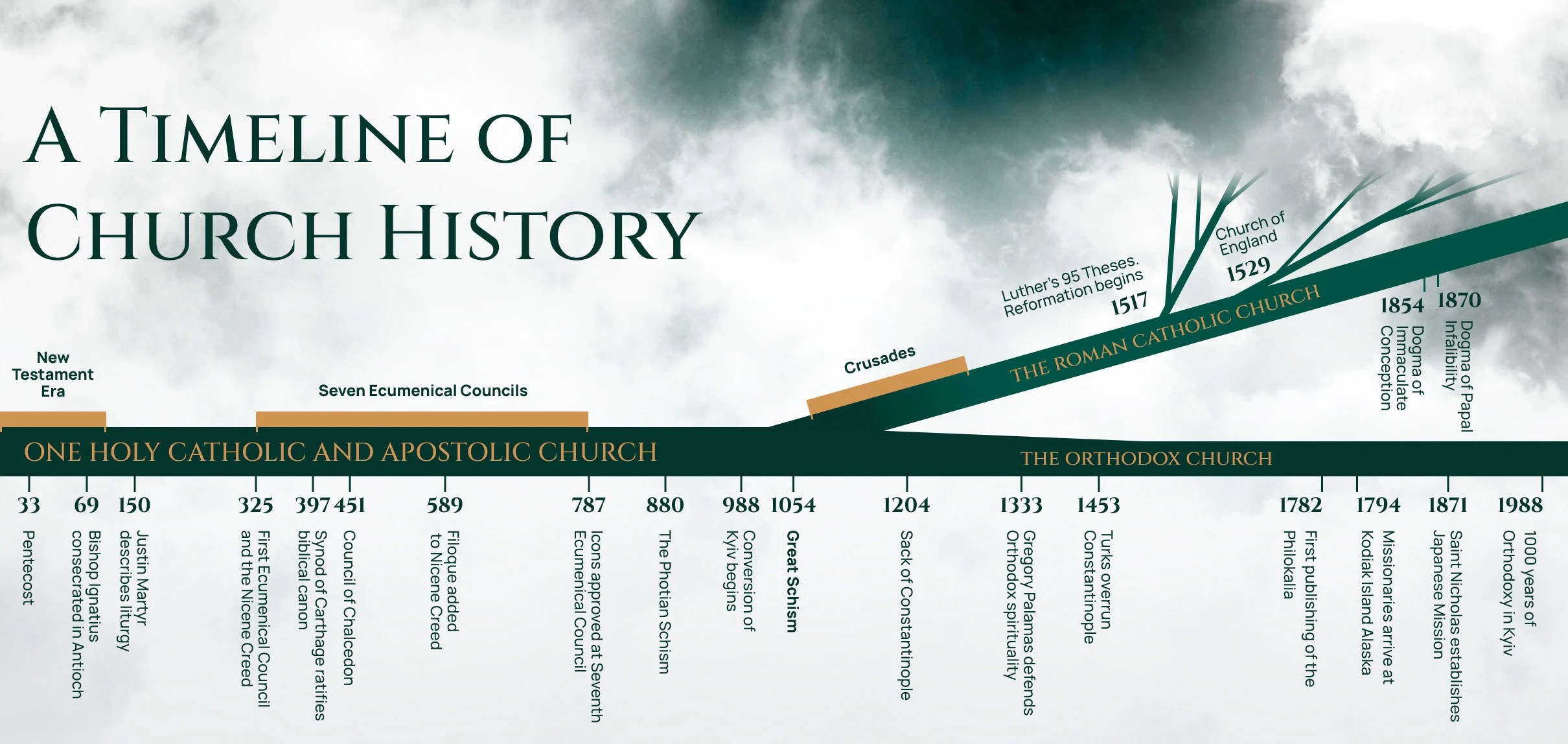
Orthodoxy and Roman Catholicism are not in communion with each other since, in the simplified version, the Great Schism of 1054 (see the timeline above). But a lot of people coming out of Protestant traditions have felt that those were the only two viable Christian alternatives, and I have never found it in me to criticize those who made the wrong-but-plausible choice, like Leah did.

Fallen

Of course, we speak of human beings as “fallen.” However, in Orthodox teaching, this does not refer to our nature itself. Rather, it refers to the fact that we have been made subject to death – we are mortal. It is “death at work in us” that we describe as “sin.” But the origin of sin is not found in our nature. Our nature is inherently good. Understanding this makes a huge difference when we think about human relationships and the character of our common life.

If you take the view (which is common in certain corners of Western Christianity) that human beings have a “sin nature” – that we are, in fact, essentially bad – then how we view one another and the character of our common life takes on a different caste. In an Orthodox understanding, a Bible verse such as, “Spare the rod and spoil the child,” can mean little more than “children need discipline in their lives to help them”. Whereas in a world in which human nature is held to be a “sin nature,” then “sparing the rod,” would be seen as letting evil run amok. It would hold that our nature not only needs to be restrained but requires a vigorous regime of reward and punishment. It has not been that long since the notion of “beating the evil out of a child” was common.

When we speak of our nature as “good,” we are not declaring that human beings are born as saints. Rather, we are saying that our nature (“what we are”) tends towards the good, desires the good. We desire beauty. We desire well-being. We desire truth. Even when we engage in evil actions, they are most often grounded in a misperception of the good. Dictators do not come to power by asking people to be evil – they come to power by distorting the image of the good.

Fr. Stephen Freeman, The Nature of Being Human


Religious ideas have the fate of melodies, which, once set afloat in the world, are taken up by all sorts of instruments, some woefully coarse, feeble, or out of tune, until people are in danger of crying out that the melody itself is detestable.

George Elliot, Janet’s Repentance, via Alan Jacobs

[N]one of the things that I care about most have ever proven susceptible to systematic exposition.

Alan Jacobs, Breaking Bread With the Dead

You can read most of my more impromptu stuff here and here (both of them cathartic venting, especially political) and here (the only social medium I frequent, because people there are quirky, pleasant and real and it has no-algorithms). All should work in your RSS aggregator, like Feedly or Reeder, should you want to make a habit of it.

Friday, 10/10/25

Nonpartisan

Levelers

Emily Ruddy was traveling the country with her new husband, Mike, when news reached them of Charlie Kirk’s shooting, then death:

Back in the car with Mike, approaching the Florida border, I’m looking at pictures of Charlie Kirk on my phone. He is staggeringly tall, taller than I ever realized, with a celebratory fist in the air. Reading his Wikipedia page, which has now been changed to past tense, I am reminded of a story I first read in middle school: Kurt Vonnegut’s “Harrison Bergeron.” The story is set in the late twenty-first century, in a dystopian America where the authorities have taken it upon themselves to ensure no person is better than another, be it in athleticism, intelligence, or beauty. The strong citizens get weighed down with bags of bird shot. The attentive citizens are intermittently bombarded with hideous sounds through tiny radios in their ears. The most beautiful faces are concealed by hideous masks.

But it’s the title character, Harrison Bergeron—exceptionally tall, handsome, brilliant and outspoken—who is shackled most heavily. At the end of the story he breaks through the shackles, and as punishment he is shot down on live TV: a warning to whoever tries to pull a similar stunt. Or at least, it would be a warning, if the viewers’ memories weren’t instantly blasted away by the ear radio’s next awful sound.

Emily Ruddy, Battle Above the Clouds.

If you haven’t read Harrison Bergeron, a (very) short story, by all means do. It’s freely available, like, for instance, here.

After Christian faith dies

The biggest confusion among my own students used to be rudderless moral relativism.  Although there is still a lot of that, it seems to be on the decline.  Now the problem is the explicit embrace of evil.  The suggestion that one must never do what is intrinsically evil for the sake of a good result is a hard sell.  Many of students are strongly attracted to “consequentialism,” the view that whether an act is right or wrong is determined only by the result.  To say that the ends do not justify the means puzzles them.

The decline of faith has also produced changes in character.  Young people who were raised in Christian homes, but then abandoned Christianity, often used to retain vestiges of their moral upbringing, and accepted such ideas as courtesy, love of neighbor, and the sacredness of innocent human life.  Today, having grown up in faithless homes, many seem to think that courtesy is for fools, that no one with whom they disagree is their neighbor, and that they should hate those they consider wrong instead of praying for their repentance and restoration.  As for the sacredness of innocent human life – for them, that idea went out when they embraced abortion.

I don’t spend much time asking what is going to happen, but I do ask what God would like me to do in my own place.  He sees the whole shape of things.  I can’t, but like a faithful bone, I can try to turn nimbly in the joint where I’m placed.

J Budziszewski, How Can I Think About the Assassination?

Budziszewski’s description of the decline of faith, as early as the second generation (the first generation of lapsed Christians lives on the vapors of the empty tank), is a description of devolution toward the “nasty, short and brutish” of pre-Christian antiquity.

If you think I’m just making a casual partisan slur, take a look at either of these two books, the first lengthy, the second shorter and more focused.

Wordplay

Frank Bruni’s back with recent favorite sentences. (Do not read this with beverages or food in your mouth.):

  • Also in The New Yorker, Jessica Winter read the infamous Jeffrey Epstein birthday book so that you and I don’t have to: “Sometimes it’s like you’ve discovered a rich man’s contract with the devil, and next to his signature, he’s drawn a little penis cartoon.” (Matthew Ferraro, East Providence, R.I.)
  • And Kelefa Sanneh, reporting from a recent Bad Bunny concert, described an ecstatic fan who “danced so vigorously with a decorative plant that he seemed to be trying to pollinate it.” (Bob Marino, Paris)
  • In The Los Angeles Times, Christopher Goffard tried to make sense of a former Los Angeles County sheriff’s rambling: “As he sat down to face questions from the feds, his sentences traveled winding paths through vague precincts to fog-filled destinations.” (Robin April Dubner, Oakland, Calif.)
  • In The Guardian, Bryan Armen Graham commiserated with the polite subgroup of American fans at an annual Europe-versus-United States golf tournament, who were too often “drowned out by the performative tough guys in flag suits and plastic chains who treat the Ryder Cup like a tailgate with better lawn care.” (John LeBaron, Acton, Mass.)
  • In The Dispatch, Nick Catoggio regarded the marks that President Trump and Defense Secretary Pete Hegseth made to military leaders last week as “a case of two men who radiate neurosis about their own toughness lecturing a roomful of actual tough guys about how to be tough. It had the feel of Pop Warner players scolding a group of N.F.L. linebackers about the importance of hustle.” (Glen T. Oxton, Mamaroneck, N.Y., and John Sabine, Dallas)
  • And John McWhorter analyzed the president’s loopy language: “Even Trump’s most positive-sounding coinages are acts of a certain kind of verbal aggression. I sometimes stop to marvel that the House passed something with the actual official title the One Big, Beautiful Bill Act. That goofy bark of a name is a boisterous clap back against opposing views, an attempt to drown out inconvenient facts with braggadocio. It is a linguistic snap of the locker room towel.” (Matt Masiero, Richmond, Mass., and Sue Hudson, Simi Valley, Calif., among many others)

Anarchism

[T]he essential practices of anarchism — negotiation and collaboration among equals — are ones utterly neglected and desperately needed in a society in which the one and only strategy seems to be Get Management To Take My Side.

Alan Jacobs, Should Christians be Anarchists?

Partisan

Transparent pretext

Trump’s remarks on the night of Kirk’s murder redefined violent incitement to include harsh criticism of judges. (“My administration will find each and every one of those who contributed to this atrocity and to other political violence, including the organizations that fund it and support it, as well as those who go after our judges, law-enforcement officials, and everyone else who brings order to our country.”) Now [aide Stephen] Miller himself is going after judges.

To call this “hypocrisy” is to engage Miller’s reasoning at a level upon which it does not operate. The essence of post-liberalism is the rejection of the notion that some neutral standards of conduct apply to all parties. Miller, like Trump, appears to believe his side stands for what is right and good, and his opponents stand for what is evil. Any methods used by Trump are ipso facto justified, and any methods used against him illegitimate.

A couple of weeks ago, Miller claimed that a disturbed gunman shooting Charlie Kirk impelled the government to crack down on the left. Now he says a handful of activists protesting ICE impel the government to crack down on the left.

Violence is not the cause of Trump and Miller’s desire to use state power to crush their opposition. It is the pretext for which they transparently long.

Jonathan Chait, Stephen Miller is Going for Broke

Bad faith

You can and should worry about American leaders at any level viewing their opponents as the enemy within, whether it’s the president of the United States or a random [Democratic] candidate for state AG. But if you’re more vocal about the latter than the former, forgive me for thinking you’re more interested in contriving a “both sides” equivalency to minimize what the White House is up to than you are about addressing the problem of incitement.

Two things are remarkable about [continuing troop deployments in “blue cities”]. One, which almost goes without saying, is that it’s another case of the Trump administration aiming to normalize unprecedented authoritarian shows of force. But the other is underappreciated: It’s all being done in bad faith, as a provocation, and quite plainly. There’s barely a pretense anymore of a colorable emergency like a riot that might justify the president deploying troops. He’s doing it unbidden and enthusiastically, looking for excuses to intimidate Democrats by symbolically occupying their cities with troops yanked from duty [and civilian jobs] in other states.

Needless to say, this is why the Trump White House didn’t get the benefit of the doubt from Judge Immergut on the Portland deployment, or from Judge Waverly Crenshaw on whether Kilmar Abrego Garcia was vindictively prosecuted. It’s also why the case against James Comey will end up in the toilet sooner rather than later. Courts have traditionally given the president and the Justice Department wide discretion in commanding the military and choosing whom to prosecute, but that’s because presidents traditionally haven’t given courts good reason to think they’re acting in bad faith.

Nick Catoggio, American versus American.

I look forward to the day when judges cease giving a “presumption of regularity,” of good faith, to the actions and legal arguments of this Administration. They have forfeited it because so much of what they do plainly is done in bad faith.

On keeping an impossible promise

Anyone with brown skin and the wrong kind of tattoo is therefore now at risk of being carted off to torture by the US government, with absolutely no safeguards that they have gotten the right people. Or do you think that an administration that confuses billions with millions, and puts classified intelligence on a Signal app, is incapable of making an error?

Andrew Sullivan, Two Perfect Months (March 2025)

I will give Trump “credit” for trying to keep his deportation campaign promise. The problems is, it’s impossible even for competent, non-malicious government workers to keep it (it included luridly-high numbers) without wholesale errors and ubiquitous denials of due process (i.e., in context, the process by which we assure that a person truly is subject to deportation under the law).

Your tax dollars at work

Short Circuits is a punchy weekly summary of notable Federal Court of Appeals decision, like this summary of activities by an ICE goon:

ICE agent escorting passenger from Dallas to Miami takes upskirt pictures and videos of flight attendant. He’s convicted of interfering with her flight-crew duties, sentenced to two years’ probation. Agent: I didn’t know that she was aware of my “clandestine video voyeurism,” and that’s an element of the crime. Eleventh Circuit (unpublished): It is not.

Divine retribution in Dallas

The covert operations of the Kennedys haunted Lyndon Johnson all his life. He said over and over that Dallas was divine retribution for Diem. “We all got together and got a goddamn bunch of thugs and we went in and assassinated him,” he lamented. In his first year in office, coup after coup wracked Saigon, a shadowy insurgency started killing Americans in Vietnam, and his fear that the CIA was an instrument of political murder festered and grew.

Tim Weiner, Legacy of Ashes

Rulebreaker

There are certain unwritten rules in American life, and one of them is that before your face is featured on the nation’s currency you are first obliged to die. There is no constitutional provision that mandates this, nor any law written tightly enough to guarantee it. But, as a general matter, we have shied away from putting living figures on our notes and coins, on the grounds that it is monarchical behavior and that the United States is not a monarchy. Unsurprisingly, this salutary tradition is not of great interest to the Trump administration, which intends to put an image of Trump on both sides of a commemorative $1 coin that will be produced for the 250th anniversary of the Declaration of Independence. On one side, Trump will appear in profile. On the other, he will appear pumping his fist, with the words “Fight Fight Fight” lining the coin’s perimeter. Answering questions about the plan, Trump’s press secretary, Karoline Leavitt, said that she was unsure if Trump had seen it, but that she was “sure he’ll love it.” He will. But that’s not really the important point, is it?

National Review week in review email.

Here’s a coin suggestion:


We are all gatekeepers now.

Peggy Noonan

Your enemies are not demonic, and they are not all-powerful and the right hasn’t always lost and the left hasn’t always won. But if you convince yourself of that, you give yourselves all sorts of permission to do a lot of stupid and terrible things under the rubric of “Do you know what time it is?”

Jonah Goldberg.

[A] critical mass of the American people … no longer want[s] to govern themselves, … are sick of this republic and no longer want to keep it if it means sharing power with those they despise.

Nick Catoggio

I don’t do any of the major social media, but I have two sub-domains of the domain you’re currently reading: (a) You can read most of my reflexive stuff, especially political here. (b) I also post some things on my favorite no-algorithm social medium.