Lil’ Nicky & The Groypers

Much ink has been spilled on the softball interview of Groyper-in-Chief Nick Fuentes by what-the-hell-do-you-call-him-these-days Tucker Carlson.

This post is entirely about that from various perspectives. If you’ve had enough of that, wait for my next post, coming soon.

Grifter?

I find it impossible to defend [him] against the charge that what he did and said during the period under examination amounted to anti-Semitism, whatever it was that drove him to say and do it: most probably, an iconoclastic temperament.

William F. Buckley, said or written about Pat Buchanan.

Buckley was perhaps the foremost foe of antisemitism in conservative ranks from the 60s until his death.

There’s unfortunately a fresh need today for some policing of the ranks, but by whom, and how? Kevin D. Williamson sees the problem:

The times being what they are—and what they are is poisoned by social media, which has taken down all of the fences that once stood around mass imbecility—there is now another kind of antisemitism to take into account: digital, entrepreneurial antisemitism. There is a market for antisemitism, and there are careers to be had servicing that market. Nick Fuentes, who has recently been in the news, is an entrepreneurial antisemite. Tucker Carlson is another.

(Kevin Roberts of the Heritage Foundation is a fool and a coward who wants to bank the profits of that antisemitism without taking any moral responsibility for it. With apologies to my friends who will be hurt by this: It is impossible for any self-respecting person to be associated with his Heritage Foundation.)

Kevin D. Williamson, The Antisemitism Grift.

“But isn’t that cancel culture?”, I seem to hear. Not according to a workable definition that I’m pretty sure comes from Williamson or his colleague Nick Catoggio. Paraphrasing, “Cancel culture” is an attempt to enforce a not-yet-existent consensus, to narrow the Overton Window; enforcing an existing consensus, like those against the Nazis and, yes, antisemitism, doesn’t qualify.

Charlie Kirk’s Successor?

I was disinclined to believe that Fuentes Is Becoming Charlie Kirk’s Successor, the explicit thesis of Michelle Goldberg’s Wednesday opinion piece at the New York Times.

Goldberg got my attention. As I suggested, it’s uncertain that anyone on the Right today has the stature and the will to decree a cordon sanitaire against the likes of Fuentes. This is no substitute for reading her whole piece, but I thought it framed the problem well:

Kirk, who came of age in the pre-Trump conservative movement, was still sometimes willing to police boundaries. But in the wake of his killing, there’s surprisingly little sense on the right that that part of his legacy should be upheld. Rather, prominent voices insist that Kirk’s murder necessitates the final loosening of all remaining restraints. “I cannot ‘unite’ with the left because they want me dead,” the influential podcaster Matt Walsh posted after Kirk’s death. “But I will unite with anyone on the right.”

Adrian Vermeule, the Harvard law professor who has helped create the intellectual foundation for the post-liberal right, put it more elegantly this weekend, as the fight over Carlson, Fuentes and Roberts roiled conservatives. “History records many cases in which cities fell to siege because, even with the enemy at the very gates, factions within the city could not put aside their mutual struggle for domination,” he wrote on social media. Lest there be any doubt about which factions he was scolding, he made it clear in a subsequent post: “I’ll be resolutely ignoring the views of those who profess a certain ‘conservatism’ but who have never actually challenged the liberal consensus on anything that might endanger their careers.”

Vermeule is a cultivated man who, as Field writes, is part of a movement that “thinks it has a monopoly on things like ‘the true, the good and the beautiful.’” Yet however lofty his rhetoric, its moral logic leads inexorably to Groyperism, and the elevation of Fuentes, Kirk’s foe, into his successor.

(Italics added)

Elsewhere in the Times, Ross Douthat chimes in on how to gatekeep against antisemitism in a digital age, with the case of Fuentes front and center. That’s an important question, but it feels to me as if Ross is a little more than a helpful start. For now, I can only heartily endorse two partial solutions:

  • Whatever share of Capitol Hill interns or think tank employees are actually Fuentes sympathizers, the institutional right must not permit radicalized junior staffers to steamroll or puppeteer their nominal superiors.
  • Create a zone where normal criticism of Israeli strategy is possible but clearly distinguish those normal debates from paranoid and antisemitic criticism.

Heritage Foundation (and the “intellectual energy” on the Right)

As for Kevin Roberts, can you guess how eager he’s been to have a hard conversation about January 6? I bet you can.

His tenure at Heritage mirrors the wider right’s hostility to dissent. A few days ago, Jonah Goldberg reminded us that Roberts’ organization is unusual among think tanks in insisting on a “one voice” policy that requires staff to “always publicly advocate for a single, unified position.” That is, not coincidentally, also how Donald Trump runs the GOP, ruthlessly “canceling” any party official who challenges his policies by threatening to fire them or primary them out of their job. But message discipline in a political party, particularly a highly authoritarian one, is to be expected.

In a think tank, whose experts should be having all sorts of interesting disagreements over law and policy, it’s downright weird. It should welcome illuminating “hard conversations” among its employees, and usually think tanks do—except for the Heritage Foundation, whose highest purpose under Roberts appears to be supplying ideological cover for Republicans’ drift toward Peronism.

Nick Catoggio.

Catoggio continues on the Right more generally:

[I]t’s no longer the Buckleyites who supply the right’s intellectual energy, such as it is. It’s postliberals like Adrian Vermeule, Curtis Yarvin, and Patrick Deneen. Carl Schmitt, not Antonin Scalia, is in vogue among new right legal thinkers. That’s what I meant when I said that Roberts’ quote is preposterous for more than one reason: When he calls on the conservative movement to have hard conversations about its direction, he’s implying that a “conservative” movement still meaningfully exists and that it retains the power to cancel postliberals if it so chooses.

It doesn’t. Rather the opposite: As Mike Pence, Mitt Romney, Liz Cheney, Jeff Flake, and a gajillion other Reaganites might tell you, all of the canceling being done in the modern GOP is of conservatives by ascendant postliberals.

Finally, the “one voice” of Heritage Foundation checks in at the Wall Street Journal:

Your editorial “The New Right’s New Antisemites” (Nov. 3) gives the impression that the Heritage Foundation’s president, Kevin Roberts, is an apologist for anti-Jewish hate or, worse, a promoter of it. That couldn’t be further from the truth.

In the days after Hamas’s Oct. 7, 2023, attack on Israel, Heritage hosted one of the first public events to condemn the terrorism and the blatant antisemitism it unleashed. Shortly thereafter we created the National Task Force to Combat Antisemitism to help coordinate the efforts of like-minded organizations.

In October 2024, we launched Project Esther, an initiative to combat antisemitism in the U.S. through legal and legislative remedies. This effort has found allies across the political spectrum and raised awareness among the general public and the Trump administration of the immediate threat that left-wing antisemitism poses to America’s Jews and the U.S.

Months later I published my book, “The Battle for the Jewish State: How Israel and America Can Win,” a large portion of which is dedicated to this issue. Our three nonresident fellows live in Israel. The Davis Institute for National Security, which I lead, focuses on defeating antisemitism, as do our colleagues in the domestic-policy and legal departments.

Your editorial ignores this record, none of which would have been possible without the direct and enthusiastic support of Mr. Roberts. Many who have criticized him in recent days, moreover, have ignored his admission that his video supporting Tucker Carlson was a mistake that didn’t clearly articulate the institution’s rebuke of Holocaust deniers and antisemitism. Mr. Roberts has always given us the necessary resources to fulfil our mission and has participated in the work himself.

He isn’t antisemitic; nor does he tolerate anyone who is. Mr. Roberts is instead leading the conservative charge against this ancient bigotry: an insidious cancer that has degraded once-great societies and can’t be allowed to spread in America. All of us at Heritage look forward to continuing this fight under his direction.

Victoria Coates
Heritage Foundation

(Bold added)

UPDATE: The National Task Force to Combat Antisemitism has severed its ties to Heritage Foundation.

My thoughts

The absence of anyone with the stature to read Fuentes and/or Carlson out of the “conservative movement” suggests that Catoggio is right: the intellectual energy on the Right is now (currently?) postliberal, and if anyone is cancelled, it’s the “conservative movement” itself. Adrian Vermeule, for instance, has contemned any “conservative” who isn’t sufficiently bloody-minded:

History records many cases in which cities fell to siege because, even with the enemy at the very gates, factions within the city could not put aside their mutual struggle for domination,” he wrote on social media. Lest there be any doubt about which factions he was scolding, he made it clear in a subsequent post: “I’ll be resolutely ignoring the views of those who profess a certain ‘conservatism’ but who have never actually challenged the liberal consensus on anything that might endanger their careers.

That is very grim. I remain with the true conservatives, though I’ve finally, I think, gotten a handle on the grievances that gave rise to Trump and MAGA. Grievances generally don’t build anything worthwhile.


We are all gatekeepers now.

Peggy Noonan

Your enemies are not demonic, and they are not all-powerful and the right hasn’t always lost and the left hasn’t always won. But if you convince yourself of that, you give yourselves all sorts of permission to do a lot of stupid and terrible things under the rubric of “Do you know what time it is?”

Jonah Goldberg.

[A] critical mass of the American people … no longer want[s] to govern themselves, … are sick of this republic and no longer want to keep it if it means sharing power with those they despise.

Nick Catoggio

I don’t do any of the major social media, but I have two sub-domains of the domain you’re currently reading: (a) You can read most of my reflexive stuff, especially political here. (b) I also post some things on my favorite no-algorithm social medium.
November 1

MAGA nihilists

Sometime in 1985 I had lunch with Sam Francis in the cafeteria of The Washington Times, where we both worked. You may never have heard of Sam Francis, but MAGA people (at least the more intellectual ones) know him as one of the seminal thinkers of their movement.

The lunch was awkward because I found him dark and creepy (and he probably found me naïve). Back then I didn’t understand that his way of thinking would triumph in conservative circles and my way of thinking would be vanquished. I don’t think he won because he was a flat-out racist, though he was. (He was later fired for writing a column arguing that “neither ‘slavery’ nor ‘racism’ as an institution is a sin.”) I think he won because he was a revolutionary, while I was a conservative. I wanted to reform things; he wanted to burn it all down.

Sam Francis (who died in 2005) explicitly cited Gramsci as his role model as he waged his culture war struggles. Christopher Rufo does the same today. This is why Trump is going after the universities, public broadcasting and the Kennedy Center. Francis once wrote, “The main focus should be the reclamation of cultural power, the patient elaboration of an alternative culture within but against the regime — within the belly of the beast but indigestible by it.”

David Brooks, Hey, Lefties! Trump Has Stolen Your Game (Gift link)

I was reading Sam Francis at roughly the time Brooks had lunch with him and for some years thereafter. He was brilliant (which is little assurance of a sound mind). He also was purged by more respectable conservatives—my kind of conservatives—for his increasingly explicit antisemitism.

Joseph Sobran followed a similar trajectory. He, too, was brilliant, but less radical than Francis (and thus less consequential). He was a devout Catholic, and his antisemitism was never explicit, but William F. Buckley wouldn’t tolerate even a whiff of it.

I viscerally detested Christopher Rufo almost from my first notice of him, which involved his gloating over making the term “Critical Race Theory” toxic while leaving it vague enough that it could beslime anyone he cared to beslime. I doubt that Rufo will be as consequential as Francis or even Sobran in the long run, but we’re in an era of pas d’ennemis á Droite, and there’s no magisterial authority trying to purge him.

Sentient and respectable conservatives like me necessarily ask ourselves if MAGA was always the eventuality of our political preferences, if we were all embryonic Sam Fracises and Joe Sobrans all along.

I don’t think so, but I’m increasingly appreciating that some truths simply need not be uttered—because of how very, very foreseeably they can be abused. To deny them would be sin, to utter them, imprudent. I save them for my private journal now when I recognize that.

Pardon me?

On Tuesday morning, the Republican-led House Oversight Committee released a report on former President Joe Biden’s use of autopen signatures on the many pardons and commutations he handed out during his term, and particularly near its end. Many of these were scandalous enough taken on their own terms, but what made them particularly outrageous was the suspicion that the bulk of these acts were the work of Biden’s staff, not the senescent president himself. One might reasonably understand how Biden found the time to preemptively pardon his family members, breaking frequent promises never to do so, but it was harder to believe that he was setting aside personal time to commute the sentences of people like Maryland’s thrice-murdering “Black Widow” killer. The House report confirms what voters long suspected: Biden’s inner circle hid the extent of his mental decline from the American people and, after he dropped out of the race, used his autopen as part of their campaign to set a new record for presidential clemency.

The GOP argument that Biden abused his pardon power in an unacceptable way is undermined, however, by Trump’s nonchalant, even gleeful pardoning of absolute sleazeballs who have ties to his own family business. There aren’t a lot of large financial institutions that are willing to simultaneously do work with al-Qaeda, ISIS, Hamas, ransomware hackers, and kiddie-porn enthusiasts, but the crypto firm Binance did so. Back in November 2023, Binance founder Changpeng Zhao pleaded guilty to failing to maintain an effective anti-money-laundering program. In a court filing, U.S. Attorney Tessa Gorman said Zhao caused “significant harm to U.S national security” through his criminal acts and “violated U.S. law on an unprecedented scale.” But not only did Trump pardon him earlier this month, he claimed Zhao was in fact persecuted by the Biden administration. It gets worse. The Wall Street Journal reported in August: “The Trump family’s crypto venture has generated more wealth since the election—some $4.5 billion—than any other part of the president’s business empire.” Trump’s crypto fortune is of course facilitated by a partnership with “an under-the-radar trading platform quietly administered by Binance, the world’s largest crypto exchange.” It’s an egregious decision that is unlikely to generate more than a peep of objection from congressional Republicans.

National Review email.

Who damaged the nation more: Biden with his autopen pardons or Trump with his blanket pardon of the January 6 rioters and targeted pardons of lucrative cronies? (That’s a rhetorical question, of course.)

Indictment

Let us not belabor the obvious truth that what the Western world calls an “energy” crisis ineptly disguises what happens when you can no longer control markets, are chained to your colonies (instead of vice versa), are running out of slaves (and can’t trust those you think you still have), can’t, upon rigorously sober reflection, really send the Marines, or the Royal Navy, anywhere, or risk a global war, have no allies only business partners, or “satellites” and have broken every promise you ever made, anywhere, to anyone. I know what I am talking about: my grandfather never got the promised “forty acres, and a mule,” the Indians who survived that holocaust are either on reservations or dying in the streets, and not a single treaty between the United States and the Indian was ever honored. That is quite a record.

James Baldwin, Open Letter to the Born Again, p. 785.

My name is Ozymandias, King of Kings

The problem is that Trump, perhaps owing to his nouveau riche background and the carefully wrought deformity of his soul, has a taste for the trappings of aristocracy—a princely estate as imagined by a trust-fund dork from Queens. You can see it in his enthusiasm for ghastly imperial furnishings, in his love of monarchical pomp, and even in his sometimes evident desire to pass something of his political position along to the sons he obviously despises. … But what is most objectionably kingly about Trump is not his Caligula-by-way-of-Liberace bad taste but his personalist posture, e.g., treating the White House as though it were his personal property, to be knocked down and rebuilt at his whim, treating the Department of Justice as though it were his personal goon squad, treating judges as though they were his personal servants and factota, etc. Trump talks about “my generals” and unilaterally raised tariffs on Canadian goods because someone in Ontario hurt his personal feelings.

L’État, c’est moi—it is not only gilt moldings that Trump has taken from Louis XIV.

The king spoke, and said, “Is not this great Babylon, that I have built for the house of the kingdom by the might of my power, and for the honor of my majesty?”

While the word was in the king’s mouth, there fell a voice from heaven, saying, Oh, king Nebuchadnezzar, to thee it is spoken; The kingdom is departed from thee.

Nebuchadnezzar had to learn things the hard way. Julius Caesar, too. Why should Americans be any different?

Kevin D. Williamson

Pas d’ennemis à Droite, Heritage Foundation Edition

[A] video of Kevin Roberts, head of the Heritage Foundation, went viral. “There has been speculation that Heritage is distancing itself from Tucker Carlson over the past 24 hours,” Roberts tweeted, reacting to the uproar over Carlson’s notorious interview with head groyper Nick Fuentes. “I want to put that to rest right now.”

And that’s what he did. “We will always defend our friends against the slander of bad actors who serve someone else’s agenda,” he said in the clip, declining to explain why criticism of Carlson is “slander” and who that “someone else” whose agenda is being served might be. “That includes Tucker Carlson, who remains—and, as I have said before, always will be—a close friend of the Heritage Foundation. The venomous coalition attacking him are sowing division. Their attempt to cancel him will fail.”

Nick Catoggio

Stagnation

Today’s suburbs are different. Highways and zoning have broken the feedback loop between location and value. These developments are typically built to a fixed, finished state and then locked down through zoning codes that discourage or prohibit change. There’s no natural process of maturing or intensification. No organic evolution. Just a one-time buildout, followed by stagnation and decline.

America Should Sprawl? Not if We Want Strong Towns

Snippets

  • “Quantity is a quality of its own.” (Shyam Sankar, CTO of Palantir, on the United States advantage in WW II. German stuff was engineered better, but we made up for it with more stuff, much more stuff. Via Ross Douthat’s Interesting Times podcast (Gift link))
  • “[E]very good earnings report further entrenches Nvidia as a precariously placed, load-bearing piece of the global economy … What if AI’s promise for American business proves to be a mirage? What happens then?” (Matteo Wong, Charlie Warzel, Here’s How the AI Crash Happens)

I don’t do any of the major social media, but I have two sub-domains of the domain you’re currently reading: (a) You can read most of my reflexive stuff, especially political here. (b) I also post some things on my favorite no-algorithm social medium.
Friday, 10/24/25

Against the Machine?

I’ve paid closer attention (plus Substack subscription fees and book purchases) to Paul Kingsnorth since his conversion to Christianity and specifically to Orthodox Christianity. (No, he did not convert to “Romanian Orthodoxy,” though his regular parish is predominately Romanian. There is no substantial difference between Romanian, Serbian, Greek, Russian, Georgian, Syrian or other Orthodox ethnic identifiers.)

I’ve also paid closer attention (plus Substack subscription fees and a book purchase) to Martin Shaw since his reversion to Christianity, this time as Orthodox.

But I’ve been trying to keep in mind the scriptural cautions against putting novices on a pedestal Cf. I Timothy 3:6. Neither novice, Kingsnorth or Shaw, is a Christian authority – yet.

Mercifully, neither is claiming the prophet’s mantle, but careless readers can cloak them with it anyway.

I’m happy for Kingsnorth that his new polemic, Against the Machine, is selling well, and that he is getting blogged and podcasted by everyone and his brother. I’ve read the book, which was more than a stitching together of old internet posts. But if you read it, do also read some critiques, such as ‘Unnatural’ Doesn’t Mean ‘Wicked’, by non-Orthodox Christian Tara Isabella Burton.

Elites failing to reproduce

PhDs are falling: At Harvard, PhD programs are collapsing amid budget woes. The Faculty of Arts and Sciences just slashed the number of PhD student admissions slots by more than 75 percent in the Science division and 60 percent in the Arts & Humanities division for the next two years.

The PhD racket was always a weird one. These schools pushed their smartest, most annoyingly ambitious kids to get a PhD (there but for the grace of god go I). During that PhD, these guys do all the work of being a professor—teaching courses, grading papers. But they’re paid next to nothing. And then the clincher is that at the end, there are no jobs available. Maybe one English department job in Idaho for a group of 300 of them to battle to the death over. So I support this belt-tightening. We will have about 5,000 fewer antifa soldiers produced each year. They might even spend their 20s making money.

Nellie Bowles

Claiming a privileged position

Over the past decade a new, and very revealing, locution has drifted from our universities into the media mainstream: Speaking as an X . . . This is not an anodyne phrase. It tells the listener that I am speaking from a privileged position on this matter. (One never says, Speaking as a gay Asian, I feel incompetent to judge this matter.) It sets up a wall against questions, which by definition come from a non-X perspective. And it turns the encounter into a power relation: the winner of the argument will be whoever has invoked the morally superior identity and expressed the most outrage at being questioned.

Mark Lilla, The Once and Future Liberal.

Legal realism

A new analysis of insurance data finds that more than one in ten of the women who take the abortion pill experience sepsis, infection, hemorrhaging, or another “serious adverse event.”  The only reason regulators tolerate such a high level of danger to the mother is that the ability to kill her baby cheaply and conveniently trumps all considerations.

J Budziszewski (bold added).

High tide recedes

Wow, it really was a social contagion: As the great vibe shift sweeps our country, it turns out that the rise in transgender identities really was a fad—between 2022 and 2024, the number of trans-identifying young people has dropped in half. Last week, another study hinted at the same conclusion, but it was widely criticized due to its failure to distinguish between trans and nonbinary identities, which are obviously very different, you ignoramus. This week’s data from writer and psychology professor Jean Twenge proved that both identities are in free fall among the youth. …

This is good for a lot of reasons—but in particular, it’s good for trans people! Why? Because there have always been a small number of people who feel truly dysphoric in their sex. And the last thing you want is a horde of depressed teen girls latching on to your situation as a way to rage against their bodies, a stand-in for anorexia or cutting. I’ve never been more worried about my rights as a gay person than when all the angry youth started announcing they were gay or trans or queer because then I just knew backlash was coming. Anything funky they did, they called it gay. They wore a weird jacket and got creative with their haircuts and all of a sudden, they’re claiming my identity. I say, scram, kids! Get out of here! I’m putting up a border around Gay Territory and saying No more may enter. It’s me, it’s everyone in Provincetown, and it’s my dykes in the Midwest, and that’s it. We’re full up. Go see if the Mormons are taking applications.

Nellie Bowles

Politics

The next two items are the most pointedly political in this post – and that’s not very pointed. I just don’t have it in me to spit into the wind recently.

A new presumption of bad faith

I was reminded by a New York Times guest editorial on the dangers of the Insurrection Act that our laws almost all assume that the law enforcer will be sane and will act in good faith. As a consequence of electing an insane and vengeful President, we now “enjoy” the full American expression of Joseph Stalin’s “show me the man and I’ll show you the crime.” My reflex is to disbelieve every word Trump says and to suspect invidious discrimination in all his Orders.

It might behoove our legislators to consider, before passing a law, what injustices could be wrought by bad actors wielding the proposed law.

Bring back hypocrisy

The Wall Street Journal has somehow decided to position its Editorial Page just slightly “left” (whatever those terms mean any more) of the Falun Gong’s Epoch Times. Thursday, it was Barton Swaim’s both-sides demi-defense of Trump’s lawfare against his perceived enemies.

I counter with “Yes, but Trump truly is worse because he does it right out in the open, shamelessly.” If hypocrisy is the tribute vice pays to virtue, it joins smoking and drinking on the very short list of vices Trump doesn’t practice. Otherwise, his brazenness coarsens every thing he touches and everyone who cheers him. For a guy so enamored of gold leaf, he’s oddly opposite King Midas.

I never thought I would lament the loss of hypocrisy.

Conservatives in Academia

Writing in the magazine of the American Association of University Professors (AAUP), Lisa Sirangian, a Johns Hopkins literature professor, offers seven reasons why “viewpoint diversity” — that is, making room for conservatives on campus — is wrong. I’ll summarize it for you: “Because conservatives are wrong and don’t care about truth; ‘viewpoint diversity’ is a MAGA plot.”

The WaPo’s Megan McArdle isn’t having it. Excerpt:

In the wider world, asking whether academia really skews left makes you look like an idiot or, slightly more charitably, like someone so encased in a bubble that they don’t even know what they’re missing. As for insisting on your right to complete self-governance, free from “secondary, external aims,” as Siraganian puts it … well, if you expect someone else to pay you to pursue truth, at some point, you must accept some secondary, external aims.

Academics tend to recoil from such a crass and mercenary idea, and fair enough, but the world is a crass and mercenary place. We talk about pursuing truth for its own sake, but most academics are pursuing it in exchange for money they can use to satisfy their many less elevated needs. The people who provide that money want something in return. Many will not be content to know that somewhere the global stock of Truth is increasing. Especially if one of the Truths you insist on is that they are dim-witted bigots.

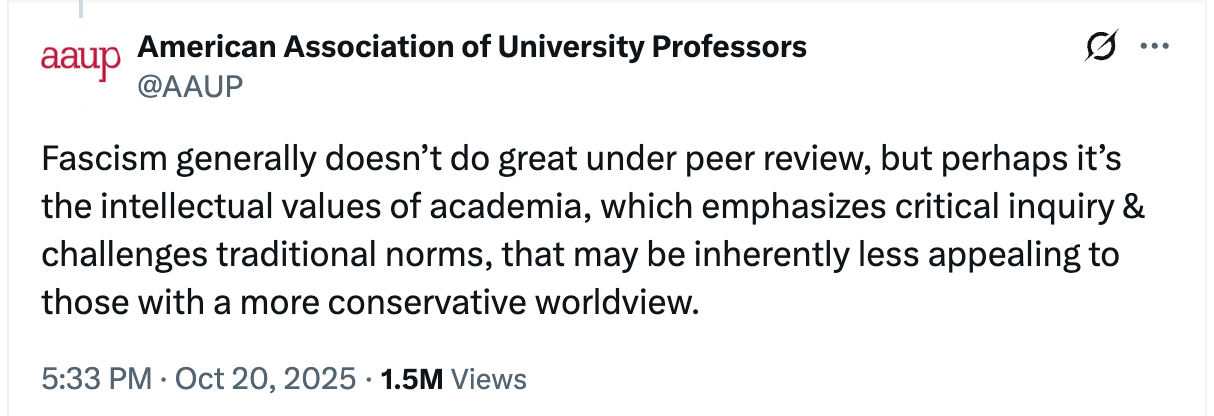
Anyway, this is how the AAUP responds to the conversation on X:

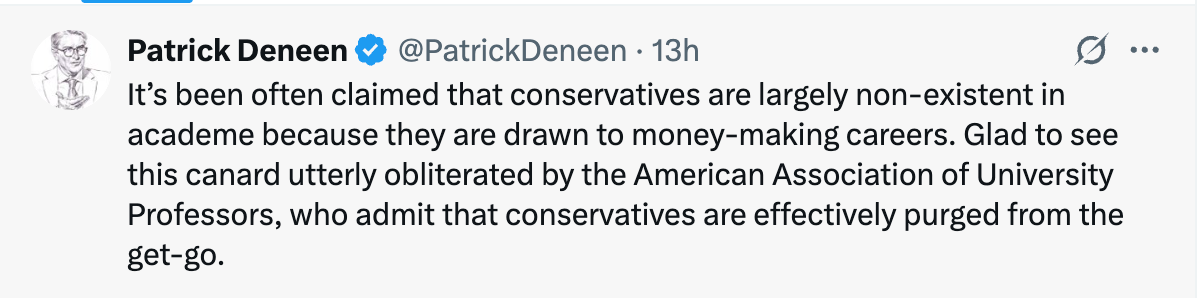
Well, there it is. Conservatives are FASCISTS! Patrick Deneen responds to that tweet:

The more I see institutional elites, in government and the private sector, the more I realize these people are like the pre-revolutionary Tsarist circles. They had no idea why so many people hated them, and what kind of precarious situation they were in.

Rod Dreher

Google

They always invest in businesses that put them in the ‘trade routes’—controlling the linkages, and never getting involved in the creation of tangible value.

Ted Gioia, Google Is Now the East India Company of the Internet

Today in History

Kagi News, a new and useful aggregator, offers “Today in History as one of its tabs, with events at the top, people at the bottom.

For some reason, I find that a lot of composers and poets I had place mentally in the late-19th century were actually in early-19th century. Edgar Allen Poe never even saw the late-19th. Who knew?

Snippets

  • … the Conservative Political Action Conference, a kind of movable rent-a-troll event … (Anne Appelbaum via Frank Bruni)
  • The old Saudi brand was ‘austere theocracy,’ but the new one is ‘fun, fun, fun, but still with beheading.’” (Helen Lewis via Frank Bruni)
  • We live the given life and not the planned. (Wendell Berry, Sabbath poems 1994 number 3)
  • I love her more than evolution requires. (Charles Murray’s wife, reflecting on their first child. Attributed to others as well. The insight doubtless matters more than the source.)
  • Mad Ireland hurt you into poetry. (W. H. Auden, in memory of W. B. Yeats)
  • Music is a conspiracy to commit beauty. (Linda Ronstadt)
  • States, particularly liberal democracies, are heavily dependent on wars for moral coherence. (Stanley Hauerwas, Resident Aliens). Looking at the last 62 years of American history seems to confirm this.

We are all gatekeepers now.

Peggy Noonan

Your enemies are not demonic, and they are not all-powerful and the right hasn’t always lost and the left hasn’t always won. But if you convince yourself of that, you give yourselves all sorts of permission to do a lot of stupid and terrible things under the rubric of “Do you know what time it is?”

Jonah Goldberg.

[A] critical mass of the American people … no longer want[s] to govern themselves, … are sick of this republic and no longer want to keep it if it means sharing power with those they despise.

Nick Catoggio

I don’t do any of the major social media, but I have two sub-domains of the domain you’re currently reading: (a) You can read most of my reflexive stuff, especially political here. (b) I also post some things on my favorite no-algorithm social medium.

No Kings Saturday, 10/18/25

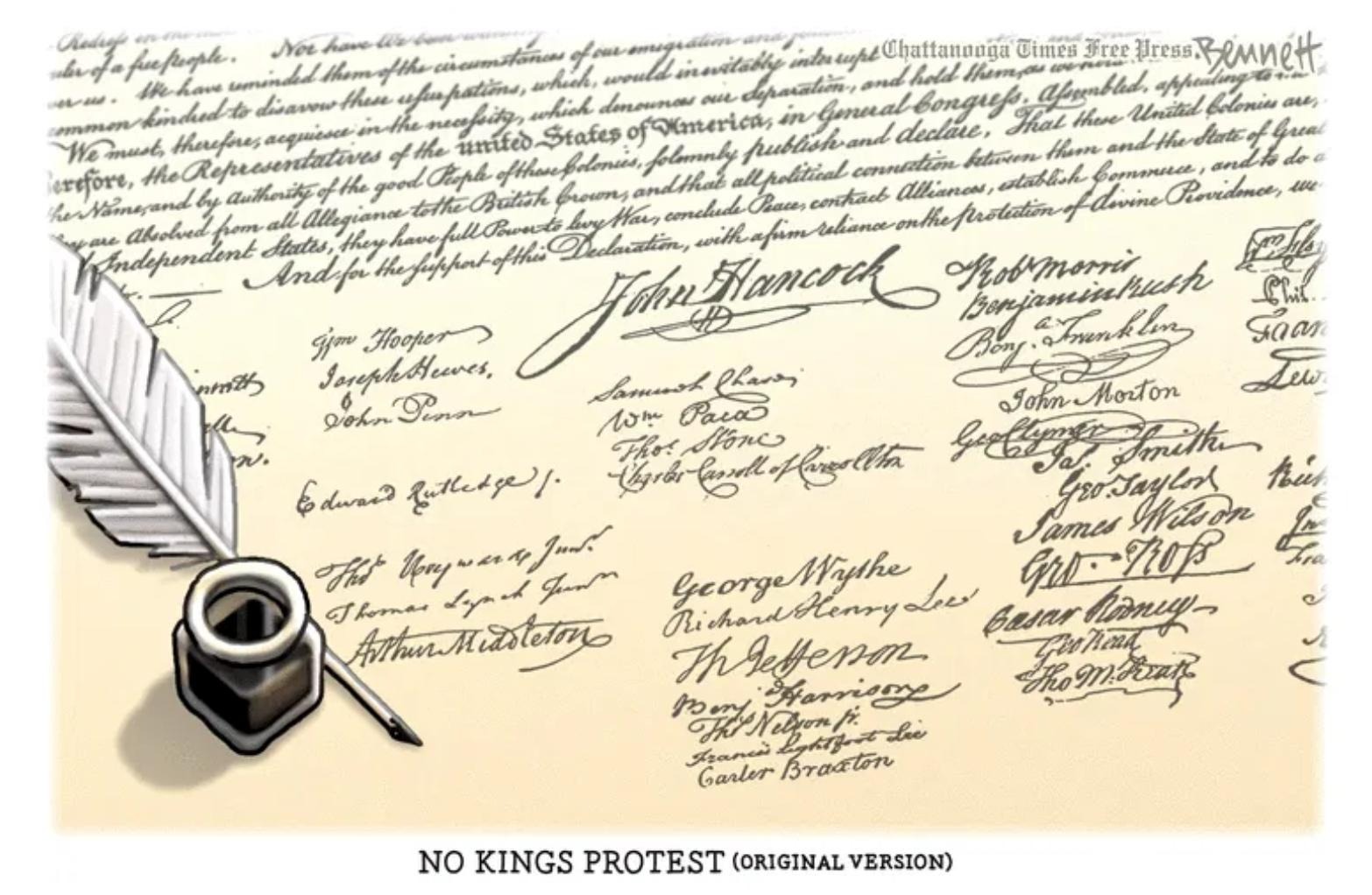
No kings!

Binding precedent

Protesters have protested at an ICE facility a few miles west of Chicago for the past 19 years—with somewhat more intensity recently following the announcement of Operation Midway Blitz. A month after the announcement, the president federalized the Illinois National Guard. District court: Enjoined. Seventh Circuit: Just so. Political opposition is not rebellion, and a protest doesn’t become a rebellion merely due to a few isolated incidents of violence. Without that, none of the statutory predicates for federalizing the National Guard have been met.

Institute for Justice, Short Circuits for 10/17/25 (bold added). This is now the law in the 7th U.S. Circuit – Indiana, Illinois and Wisconsin.

Look for the Administration to try to provoke a rebellion it can crush. Everyone who’s paying attention knows Trump wants to invoke the Insurrection Act (as he stuffs his pockets and those of his family).

Wanted: a viable counternarrative

Trump’s actions … are part of one project: creating a savage war of all against all and then using the presidency to profit and gain power from it. Trumpism can also be seen as a multipronged effort to amputate the higher elements of the human spirit—learning, compassion, science, the pursuit of justice—and supplant those virtues with greed, retribution, ego, appetite. Trumpism is an attempt to make the world a playground for the rich and ruthless, so it seeks to dissolve the sinews of moral and legal restraint that make civilization decent.

Trumpism, like populism, is more than a set of policies—it’s a culture. Trump offers people a sense of belonging, an identity, status, self-respect, and a comprehensive political ethic. Populists are not trying to pass this or that law; they are altering the climate of the age. And Democrats think they can fight that by offering some tax credits?

To beat a social movement, you must build a counter social movement. And to do that, you need a different narrative about where we are and where we should be heading, a different set of values dictating what is admirable and what is disgraceful. If we fail to build such a movement, authoritarian strongmen around the globe will dominate indefinitely.

David Brooks.

You can’t beat something with nothing. I can’t come up with a political counternarrative to Trumpism. The Democrats can’t come up with a political counternarrative, either. Brooks couldn’t come up with a strong political counternarrative.

I can only hope and pray that people will look for their compelling (counter-)narrative to the Gospel of Jesus Christ. (And that meantime there will be some legal counternarratives to prevent irretrievable damage, as in the preceding item.)

Music Reviews

There may be nothing better than old music reviews to let you know that it’s okay to like what you like, critics be damned.

I like Debussy’s La Mer, and I don’t care what the stupid early reviews said:

On today’s date in 1905, Claude Debussy’s orchestral suite La Mer or The Sea was performed for the first time in Paris. Today this music is regarded as an impressionistic masterpiece, but early audiences — especially those in America — found it rough sailing.

“We clung like a drowning man to a few fragments of the tonal wreck,” wrote a 1907 Boston critic, and suggested that instead of The Sea Debussy should have titled his piece Sea-Sickness.

“The Sea is persistently ugly,” wrote The New York Times that same year. “Debussy fails to give any impression of the sea … There is more of a barnyard cackle in it than anything else.”

And in 1909, this on La Mer from The Chicago Tribune: “It is safe to say that few understood what they heard and few heard anything they understood … There are no themes … There is nothing in the way of even a brief motif that can be grasped securely enough by the ear and brain to serve as a guiding line through the tonal maze. There is no end of queer and unusual effects, no end of harmonic complications and progressions that sound so hideously ugly.”

Ah, the perils of “modern music” in the early 20th century!

Giving the Devil his due, impressionism had to be a real mind-blower for critics attuned to, say, the sonata-allegro form.

Comprehensive tradition

We’re often not very aware of the “tradition” in which we live. A student in a classroom would readily agree that the words of a teacher or professor were a “traditioning” of sorts. But they will fail to notice that how the room is arranged, how the students sit, what the students wear (or don’t wear), how the professor is addressed, how students address one another, what questions are considered appropriate and what are not, and a whole world of unspoken, unwritten expectations are utterly required in the process. The modern world often imagines that “online” education is equivalent to classroom education since the goal is merely the transmission of information. But the transmission of information includes the process of acquiring the information and everything that surrounds it. Those receiving the “tradition” online will have perhaps similar information to those receiving it in a classroom – but they will not receive the same information.

Fr. Stephen Freeman, The Tradition of Being Human

Stages of life

Two questions:

  1. Do I want to read/watch/listen to this?
  2. Should I read/watch/listen to this?

When I was younger the second question often dominated my decision-making. Now that I am officially ancient that question has virtually disappeared and the first one is usually the only one I ask. That’s been the single most notable change in my personality in these my declining years.

Alan Jacobs

Alan is a decade or more younger than me, yet I only very recently seem to have arrived at this point, especially regarding political matters.

Note that he’s talking about a change in personality. This isn’t a life rule. There are things that younger people should read/watch/listen to, in order to become well-formed human beings.

Two ways

[R]evival begins with the people proclaiming, by word and deed, “I have sinned.”

MAGA Christianity has a different message. It looks at American culture and declares, “You have sinned.”

David French

Noteworthy

In the aftermath of Kirk’s murder, we witnessed young people at vigils rather than at “mostly peaceful” demonstrations.

R.R. Reno in First Things


We are all gatekeepers now.

Peggy Noonan

Your enemies are not demonic, and they are not all-powerful and the right hasn’t always lost and the left hasn’t always won. But if you convince yourself of that, you give yourselves all sorts of permission to do a lot of stupid and terrible things under the rubric of “Do you know what time it is?”

Jonah Goldberg.

[A] critical mass of the American people … no longer want[s] to govern themselves, … are sick of this republic and no longer want to keep it if it means sharing power with those they despise.

Nick Catoggio

I don’t do any of the major social media, but I have two sub-domains of the domain you’re currently reading: (a) You can read most of my reflexive stuff, especially political here. (b) I also post some things on my favorite no-algorithm social medium.

Sunday evening

“We took the freedom of speech away …”

At the round table … he diverted to a tangent about flag burning, saying he had instituted a “one-year penalty for inciting riots.”

“We took the freedom of speech away because that’s been through the courts and the courts said, you have freedom of speech,” Mr. Trump said. “But what has happened is when they burn a flag, it agitates and irritates crowds.”

Charlie Savage, Trump Baselessly Claims He ‘Took the Freedom of Speech Away’ From Flag Burners.

Trump’s word salads are incoherent, but I think he’s saying that he recognizes a heckler’s veto on flag-burning, like the one he tried on Colin Kaepernick for kneeling.

Sorry, Donnie: Street v. New York (1969).

Quick, easy, and stupid pigeon-holing

Using the old Left-Right duality distorts our political thinking. Consider what counts as “Leftist” today: Open immigration, transgenderism, antiracism, gay marriage, opposition to Israel’s incursion in Gaza, violence against conservatives and Christians, unbending support for Ukraine, pro-choice, anti-Trumpism.

Once these positions are grouped as “Left,” anyone who holds one “Left” position is labeled a “Leftist.” If you have reservations about Trump (as I do), question Trump’s immigration policies, believe African Americans have suffered and still suffer injustices, or express sympathy for Palestinians in Gaza, you’ll get lumped in with transgenders and homosexuals, rioters and assassins.

Everybody but everybody condemns “third way” Christian political agendas. That condemnation is childish, first because it’s utterly unhistorical. The specific contours of the American Left and Right are entirely contingent, constantly shifting political outlooks and moods. They don’t exhaust our political options.

Peter Leithart

Losing the real storyline

Ross Douthat is definitely one of my favorite journalists these days, but, bless his heart, whenever I see a column about Donald Trump’s “policies,” I get the feeling that the author is trying too hard to make him a normal President.

Setting the record straight on “sanctuary cities”

I have very high regard for professor J Budziszewski, who writes on natural law and blogs at the Underground Thomist. But his latest post blows it, not because of illogic, but because of a badly mistaken premises. I write because his mistake is very wide-spread.

The topic is so-called “sanctuary cities.” Here’s Budziszewski’s false premise:

So called sanctuary cities … claim … that … any locality may invalidate federal laws within its territory. This isn’t about the form of the federal union. It is a rejection of federal union.

Sanctuary cities claim no power to invalidate federal law. What they claim is the power to refuse cooperation in the enforcement of federal laws (typically involving immigration) that they don’t like (or even, during the reign of terror of Trump 2.0, if they don’t like the way the feds are enforcing the law via jack-booted, masked goons).

I don’t want to get into the weeds too far, but:

  • States are not obliged to cooperate with the federal government in enforcing federal law. “Commandeering” is the term frequently used to describe federal efforts to force cooperation.
  • Cities, as subdivisions of the state and as entities that normally have a degree of home rule to determine their financial priorities, are not necessarily obliged to cooperate with the federal government in enforcing federal law. This only becomes controversial when cities engage in grandstanding like “sanctuary city” declarations.
  • Non-cooperation isn’t the same as interference, which would be dubious at best.
  • States may forbid cities to withhold cooperation with the feds because cities are not in themselves sovereigns. Some states have purportedly done so, though laws forbidding sanctuary cities could easily stumble over their own sort of grandstanding.
  • Feds probably can retaliate by denying some or all federal aid to sanctuary cities.

I have not been a fan of sanctuary cities because they made a big, virtue-signaling deal out of what could be done quietly. The tactics of ICE under Trump is unlikely to change my mind, though even then I’m inclined to favor quiet non-cooperation. Trump, after all, is itching to declare insurrection and to impose martial law, and virtue-signaling declarations of non-cooperation provide a readier excuse than passive-aggression.


We are all gatekeepers now.

Peggy Noonan

Your enemies are not demonic, and they are not all-powerful and the right hasn’t always lost and the left hasn’t always won. But if you convince yourself of that, you give yourselves all sorts of permission to do a lot of stupid and terrible things under the rubric of “Do you know what time it is?”

Jonah Goldberg.

[A] critical mass of the American people … no longer want[s] to govern themselves, … are sick of this republic and no longer want to keep it if it means sharing power with those they despise.

Nick Catoggio

I don’t do any of the major social media, but I have two sub-domains of the domain you’re currently reading: (a) You can read most of my reflexive stuff, especially political here. (b) I also post some things on my favorite no-algorithm social medium.

Friday, 10/10/25

Nonpartisan

Levelers

Emily Ruddy was traveling the country with her new husband, Mike, when news reached them of Charlie Kirk’s shooting, then death:

Back in the car with Mike, approaching the Florida border, I’m looking at pictures of Charlie Kirk on my phone. He is staggeringly tall, taller than I ever realized, with a celebratory fist in the air. Reading his Wikipedia page, which has now been changed to past tense, I am reminded of a story I first read in middle school: Kurt Vonnegut’s “Harrison Bergeron.” The story is set in the late twenty-first century, in a dystopian America where the authorities have taken it upon themselves to ensure no person is better than another, be it in athleticism, intelligence, or beauty. The strong citizens get weighed down with bags of bird shot. The attentive citizens are intermittently bombarded with hideous sounds through tiny radios in their ears. The most beautiful faces are concealed by hideous masks.

But it’s the title character, Harrison Bergeron—exceptionally tall, handsome, brilliant and outspoken—who is shackled most heavily. At the end of the story he breaks through the shackles, and as punishment he is shot down on live TV: a warning to whoever tries to pull a similar stunt. Or at least, it would be a warning, if the viewers’ memories weren’t instantly blasted away by the ear radio’s next awful sound.

Emily Ruddy, Battle Above the Clouds.

If you haven’t read Harrison Bergeron, a (very) short story, by all means do. It’s freely available, like, for instance, here.

After Christian faith dies

The biggest confusion among my own students used to be rudderless moral relativism.  Although there is still a lot of that, it seems to be on the decline.  Now the problem is the explicit embrace of evil.  The suggestion that one must never do what is intrinsically evil for the sake of a good result is a hard sell.  Many of students are strongly attracted to “consequentialism,” the view that whether an act is right or wrong is determined only by the result.  To say that the ends do not justify the means puzzles them.

The decline of faith has also produced changes in character.  Young people who were raised in Christian homes, but then abandoned Christianity, often used to retain vestiges of their moral upbringing, and accepted such ideas as courtesy, love of neighbor, and the sacredness of innocent human life.  Today, having grown up in faithless homes, many seem to think that courtesy is for fools, that no one with whom they disagree is their neighbor, and that they should hate those they consider wrong instead of praying for their repentance and restoration.  As for the sacredness of innocent human life – for them, that idea went out when they embraced abortion.

I don’t spend much time asking what is going to happen, but I do ask what God would like me to do in my own place.  He sees the whole shape of things.  I can’t, but like a faithful bone, I can try to turn nimbly in the joint where I’m placed.

J Budziszewski, How Can I Think About the Assassination?

Budziszewski’s description of the decline of faith, as early as the second generation (the first generation of lapsed Christians lives on the vapors of the empty tank), is a description of devolution toward the “nasty, short and brutish” of pre-Christian antiquity.

If you think I’m just making a casual partisan slur, take a look at either of these two books, the first lengthy, the second shorter and more focused.

Wordplay

Frank Bruni’s back with recent favorite sentences. (Do not read this with beverages or food in your mouth.):

  • Also in The New Yorker, Jessica Winter read the infamous Jeffrey Epstein birthday book so that you and I don’t have to: “Sometimes it’s like you’ve discovered a rich man’s contract with the devil, and next to his signature, he’s drawn a little penis cartoon.” (Matthew Ferraro, East Providence, R.I.)
  • And Kelefa Sanneh, reporting from a recent Bad Bunny concert, described an ecstatic fan who “danced so vigorously with a decorative plant that he seemed to be trying to pollinate it.” (Bob Marino, Paris)
  • In The Los Angeles Times, Christopher Goffard tried to make sense of a former Los Angeles County sheriff’s rambling: “As he sat down to face questions from the feds, his sentences traveled winding paths through vague precincts to fog-filled destinations.” (Robin April Dubner, Oakland, Calif.)
  • In The Guardian, Bryan Armen Graham commiserated with the polite subgroup of American fans at an annual Europe-versus-United States golf tournament, who were too often “drowned out by the performative tough guys in flag suits and plastic chains who treat the Ryder Cup like a tailgate with better lawn care.” (John LeBaron, Acton, Mass.)
  • In The Dispatch, Nick Catoggio regarded the marks that President Trump and Defense Secretary Pete Hegseth made to military leaders last week as “a case of two men who radiate neurosis about their own toughness lecturing a roomful of actual tough guys about how to be tough. It had the feel of Pop Warner players scolding a group of N.F.L. linebackers about the importance of hustle.” (Glen T. Oxton, Mamaroneck, N.Y., and John Sabine, Dallas)
  • And John McWhorter analyzed the president’s loopy language: “Even Trump’s most positive-sounding coinages are acts of a certain kind of verbal aggression. I sometimes stop to marvel that the House passed something with the actual official title the One Big, Beautiful Bill Act. That goofy bark of a name is a boisterous clap back against opposing views, an attempt to drown out inconvenient facts with braggadocio. It is a linguistic snap of the locker room towel.” (Matt Masiero, Richmond, Mass., and Sue Hudson, Simi Valley, Calif., among many others)

Anarchism

[T]he essential practices of anarchism — negotiation and collaboration among equals — are ones utterly neglected and desperately needed in a society in which the one and only strategy seems to be Get Management To Take My Side.

Alan Jacobs, Should Christians be Anarchists?

Partisan

Transparent pretext

Trump’s remarks on the night of Kirk’s murder redefined violent incitement to include harsh criticism of judges. (“My administration will find each and every one of those who contributed to this atrocity and to other political violence, including the organizations that fund it and support it, as well as those who go after our judges, law-enforcement officials, and everyone else who brings order to our country.”) Now [aide Stephen] Miller himself is going after judges.

To call this “hypocrisy” is to engage Miller’s reasoning at a level upon which it does not operate. The essence of post-liberalism is the rejection of the notion that some neutral standards of conduct apply to all parties. Miller, like Trump, appears to believe his side stands for what is right and good, and his opponents stand for what is evil. Any methods used by Trump are ipso facto justified, and any methods used against him illegitimate.

A couple of weeks ago, Miller claimed that a disturbed gunman shooting Charlie Kirk impelled the government to crack down on the left. Now he says a handful of activists protesting ICE impel the government to crack down on the left.

Violence is not the cause of Trump and Miller’s desire to use state power to crush their opposition. It is the pretext for which they transparently long.

Jonathan Chait, Stephen Miller is Going for Broke

Bad faith

You can and should worry about American leaders at any level viewing their opponents as the enemy within, whether it’s the president of the United States or a random [Democratic] candidate for state AG. But if you’re more vocal about the latter than the former, forgive me for thinking you’re more interested in contriving a “both sides” equivalency to minimize what the White House is up to than you are about addressing the problem of incitement.

Two things are remarkable about [continuing troop deployments in “blue cities”]. One, which almost goes without saying, is that it’s another case of the Trump administration aiming to normalize unprecedented authoritarian shows of force. But the other is underappreciated: It’s all being done in bad faith, as a provocation, and quite plainly. There’s barely a pretense anymore of a colorable emergency like a riot that might justify the president deploying troops. He’s doing it unbidden and enthusiastically, looking for excuses to intimidate Democrats by symbolically occupying their cities with troops yanked from duty [and civilian jobs] in other states.

Needless to say, this is why the Trump White House didn’t get the benefit of the doubt from Judge Immergut on the Portland deployment, or from Judge Waverly Crenshaw on whether Kilmar Abrego Garcia was vindictively prosecuted. It’s also why the case against James Comey will end up in the toilet sooner rather than later. Courts have traditionally given the president and the Justice Department wide discretion in commanding the military and choosing whom to prosecute, but that’s because presidents traditionally haven’t given courts good reason to think they’re acting in bad faith.

Nick Catoggio, American versus American.

I look forward to the day when judges cease giving a “presumption of regularity,” of good faith, to the actions and legal arguments of this Administration. They have forfeited it because so much of what they do plainly is done in bad faith.

On keeping an impossible promise

Anyone with brown skin and the wrong kind of tattoo is therefore now at risk of being carted off to torture by the US government, with absolutely no safeguards that they have gotten the right people. Or do you think that an administration that confuses billions with millions, and puts classified intelligence on a Signal app, is incapable of making an error?

Andrew Sullivan, Two Perfect Months (March 2025)

I will give Trump “credit” for trying to keep his deportation campaign promise. The problems is, it’s impossible even for competent, non-malicious government workers to keep it (it included luridly-high numbers) without wholesale errors and ubiquitous denials of due process (i.e., in context, the process by which we assure that a person truly is subject to deportation under the law).

Your tax dollars at work

Short Circuits is a punchy weekly summary of notable Federal Court of Appeals decision, like this summary of activities by an ICE goon:

ICE agent escorting passenger from Dallas to Miami takes upskirt pictures and videos of flight attendant. He’s convicted of interfering with her flight-crew duties, sentenced to two years’ probation. Agent: I didn’t know that she was aware of my “clandestine video voyeurism,” and that’s an element of the crime. Eleventh Circuit (unpublished): It is not.

Divine retribution in Dallas

The covert operations of the Kennedys haunted Lyndon Johnson all his life. He said over and over that Dallas was divine retribution for Diem. “We all got together and got a goddamn bunch of thugs and we went in and assassinated him,” he lamented. In his first year in office, coup after coup wracked Saigon, a shadowy insurgency started killing Americans in Vietnam, and his fear that the CIA was an instrument of political murder festered and grew.

Tim Weiner, Legacy of Ashes

Rulebreaker

There are certain unwritten rules in American life, and one of them is that before your face is featured on the nation’s currency you are first obliged to die. There is no constitutional provision that mandates this, nor any law written tightly enough to guarantee it. But, as a general matter, we have shied away from putting living figures on our notes and coins, on the grounds that it is monarchical behavior and that the United States is not a monarchy. Unsurprisingly, this salutary tradition is not of great interest to the Trump administration, which intends to put an image of Trump on both sides of a commemorative $1 coin that will be produced for the 250th anniversary of the Declaration of Independence. On one side, Trump will appear in profile. On the other, he will appear pumping his fist, with the words “Fight Fight Fight” lining the coin’s perimeter. Answering questions about the plan, Trump’s press secretary, Karoline Leavitt, said that she was unsure if Trump had seen it, but that she was “sure he’ll love it.” He will. But that’s not really the important point, is it?

National Review week in review email.

Here’s a coin suggestion:


We are all gatekeepers now.

Peggy Noonan

Your enemies are not demonic, and they are not all-powerful and the right hasn’t always lost and the left hasn’t always won. But if you convince yourself of that, you give yourselves all sorts of permission to do a lot of stupid and terrible things under the rubric of “Do you know what time it is?”

Jonah Goldberg.

[A] critical mass of the American people … no longer want[s] to govern themselves, … are sick of this republic and no longer want to keep it if it means sharing power with those they despise.

Nick Catoggio

I don’t do any of the major social media, but I have two sub-domains of the domain you’re currently reading: (a) You can read most of my reflexive stuff, especially political here. (b) I also post some things on my favorite no-algorithm social medium.

Never say Never

I never imagined that I would recommend listening to an accordion player. But the YouTube channel Sergei Teleshev Accordion is astonishing. I’ve never (that I can recall) seen accordions like that (they’re called button accordions, I guess) or heard them making serious, even thrilling, music, like this father and daughter do. (The daughter is 16, by the way.)

Trigger warning: The remainder of this post is (more or less) political

The Calvinball Presidency

I like arguments about ideas. The only way to have a good argument about ideas is if the person or people you’re arguing with have some degree of sincerity about what they are arguing for—or against. Being a political commentator in the Trump era is like being a sportscaster covering a game of Calvinball. The rules change all the time, so arguing about them is an exhausting waste of time.

Jonah Goldberg, The Boredom of Writing in the Trump Era – The Dispatch

Inspectors General

When hoodlums start disabling security cameras, you can bet they’ve got nothing good in mind.

The Trump administration on Wednesday withdrew funding for the Council of Inspectors General, a federal watchdog group, and the entity’s website was disabled. The group oversaw a network of 72 inspectors general. According to the Washington Post, the Trump administration had decided last week to pull the group’s funding.

The Morning Dispatch

Algorithms

[W]e are a nation divided by algorithms. If your algorithm knows you as conservative and interested in military matters, you got a lot of videos of young soldiers and sailors acting out the past few years, and of service branches tweeting out showy political sentiments. You felt understandable alarm. If your algorithm knows you as liberal and not interested in military affairs, you haven’t seen that content, and will have been surprised by Mr. Hegseth’s reference to “dudes in dresses.” We are all getting different versions of reality every time we look at a screen, and it’s hurting us.

Peggy Noonan, The Embarrassing Pete Hegseth.

As if on cue, some folks known to the algorithm as conservative and interested in military matters let it be known that they thought Hegseth’s show was just fine:

Much depends on the details and execution, but if implemented with both verve and prudence, Hegseth’s commonsense reforms will profit the American profession of arms.

As noted in my standard footer for blog posts, I am a participant on something called micro.blog: I follow people I’ve found interesting and some of them follow me. Yet I sensed it wasn’t like Facebook or Twitter/X. It was pleasant. It was sane.

I think Noonan has put her finger on why it is so: it has no algorithms.

In fact, I don’t think I frequent any websites that use algorithms to target my inferred vulnerabilities.

Grooming codes and Flag Codes

Speaking of The Embarrassing Pete Hegseth, Kevin D. Williamson has a few choice words:

I will believe that Hegseth is serious about this stuff when Hegseth starts acting like he is serious about it. As a few observers have pointed out, Hegseth’s Beverly Hills, 90210-style sideburns often extend to a length that would be prohibited under military grooming standards. But there is another area of dress convention that Hegseth violates in practically every public appearance, one that is in fact relevant to his current position: the Flag Code.

The Flag Code is written into federal law, though there is no penalty for violating it. It forbids wearing the flag as an article of clothing, a rule Hegseth routinely flouts with his dopey flag-lined suits. It specifically forbids using the flag as a handkerchief, which Hegseth does habitually, tucking it into his chest pocket as a decorative pocket square—and surely, surely not because doing so makes it look like he is wearing some kind of military decoration. Hegseth, Donald Trump, and the members of the movement they represent are habitual violators of the Flag Code, which is not merely an aesthetic concern. 

Part of the point of the Flag Code is the notion that the flag is not to be treated as though it were merely an item of personal property. It is not to be used for tawdry, tacky, or self-interested purposes such as advertising. Hegseth has obvious contempt for rules of this kind, and Trump has equally obvious contempt for any kind of rule that would put any kind of limitation on his self-aggrandizement and vanity. You can be sure that if Hegseth or Trump preferred to wear a beard, then beards would be mandatory in the military, possibly even for women.

The allure of delusional self-adoration can be powerful. When a junior high vice principal made me cut my hair (picture your obedient correspondent at 15 with a blond Robert Smith-circa-Kiss Me, Kiss Me, Kiss Me rats’ nest), I was much offended. I believed, in the sincerest possible way, that I was a unique, very special, possibly heroic 15-year-old, one destined for great things, and, above all, one whose autonomy and personal sense of self had to be respected at all times, damn the rules. It all seemed incontrovertible at the time. But I am not in junior high school anymore. Pete Hegseth somehow is. Princeton owes him a refund. 

Mau-mauing the NFL

I’d bet a modest amount that our Censor-in-Chief will figure out some threat to the NFL sufficient to motivate a change of the Superbowl Halftime Show from Bad Bunny to someone markedly more WASPish.

In any event, I’ll miss the game and the show. I’m expecting an emergency call then.


We are all gatekeepers now.

Peggy Noonan

Your enemies are not demonic, and they are not all-powerful and the right hasn’t always lost and the left hasn’t always won. But if you convince yourself of that, you give yourselves all sorts of permission to do a lot of stupid and terrible things under the rubric of “Do you know what time it is?”

Jonah Goldberg.

[A] critical mass of the American people … no longer want[s] to govern themselves, … are sick of this republic and no longer want to keep it if it means sharing power with those they despise.

Nick Catoggio

I don’t do any of the major social media, but I have two sub-domains of the domain you’re currently reading: (a) You can read most of my reflexive stuff, especially political here. (b) I also post some things on my favorite no-algorithm social medium.

Authoritarianism in the 21st century

My father died 27 years ago today. It was too early, but I wouldn’t have wanted to see him at the age he’d be now.

This just might be faintly relevant

There isn’t a single instance of a fentanyl seizure in the Caribbean:

Last month, the U.S. cutter Hamilton returned to Florida with what the agency called “the largest quantity of drugs offloaded in Coast Guard history”: 61,740 pounds of cocaine and 14,400 pounds of marijuana (that’s the weight of about three city buses). The haul, gathered by multiple federal agencies during 19 seizure incidents in the Caribbean as well as the Pacific, had an estimated street value of $473 million. But there wasn’t any fentanyl on the boat.

(Nick Miroff)

Authoritarianism in the 21st century

We are living in an authoritarian state.

It didn’t feel that way this morning, when I took my dog for his usual walk in the park and dew from the grass glittered on my boots in the rising sunlight. It doesn’t feel that way when you’re ordering an iced mocha latte at Starbucks or watching the Patriots lose to the Steelers. The persistent normality of daily life is disorienting, even paralyzing. Yet it’s true.

We have in our heads specific images of authoritarianism that come from the 20th century: uniformed men goose-stepping in jackboots, masses of people chanting party slogans, streets lined with giant portraits of the leader, secret opposition meetings in basements, interrogations under naked light bulbs, executions by firing squad … I’d be surprised if this essay got me hauled off to prison in America. Authoritarianism in the 21st century looks different, because it is different. Political scientists have tried to find a new term for it: illiberal democracy, competitive authoritarianism, right-wing populism …

… To keep their jobs, civil servants have to prove not their competence but their personal loyalty to the leader. Independent government officers—prosecutors, inspectors general, federal commissioners, central bankers—are fired and their positions handed to flunkies. The legislature, in the hands of the ruling party, becomes a rubber stamp for the executive. Courts still hear cases, but judges are appointed for their political views, not their expertise … There are no meaningful checks on the leader’s power.

Today’s authoritarianism doesn’t move people to heroic feats on behalf of the Fatherland. The leader and his cronies, in and out of government, use their positions to hold on to power and enrich themselves. Corruption becomes so routine that it’s expected; the public grows desensitized, and violations of ethical norms that would have caused outrage in any other time go barely noticed. … At important political moments it mobilizes its core supporters with frenzies of hatred, but its overriding goal is to render most citizens passive. If the leader’s speech gets boring, you can even leave early (no one left Nuremberg early). Twenty-first-century authoritarianism keeps the public content with abundant calories and dazzling entertainment. Its dominant emotions aren’t euphoria and rage, but indifference and cynicism. Because most people still expect to have certain rights respected, blatant totalitarian mechanisms of repression are avoided. The most effective tools of control are distraction, confusion, and division.

“If everybody always lies to you, the consequence is not that you believe the lies, but rather that nobody believes anything any longer,” the political philosopher Hannah Arendt said near the end of her life. “And a people that no longer can believe anything cannot make up its mind. It is deprived not only of its capacity to act but also of its capacity to think and to judge. And with such a people you can then do what you please.”

These are the features of the modern authoritarian state. Every one of them exists today in this country …

… It sometimes seems as if the only check on Trump’s power is his own attention span.

George Packer, America’s Zombie Democracy.

Railway to the Moon

Imagine if you were trying to write intelligently about the socioeconomic impact of the railroad in the middle of the 19th century, and half the people investing in trains were convinced that the next step after transcontinental railways would be a railway to the moon, a skeptical minority was sure that the investors in the Union Pacific would all go bankrupt, many analysts were convinced that trains were developing their own form of consciousness, reasonable-seeming observers pegged the likelihood of a train-driven apocalypse at 20 or 30 percent, and peculiar cults of engine worship were developing on the fringes of the industry.

What would you reasonably say about this world? The prime minister of Denmark already gave the only possible answer: Raise your alert levels, and prepare for various scenarios.

Ross Douthat, Drones, Denmark and Dark Magic

PK snippets

  • “I’m not proposing a political program,” he told me. “This isn’t some Christian civilizational vision. It’s much more personal.” You decide how and where to wage battle: at a community garden, on the Appalachian Trail, in a mosque.
  • He was struck by how commonplace legal cannabis had become. “It’s a really, really useful drug for the state to be legalizing,” he said. “Because it’s not like alcohol. It doesn’t get you violent. And maybe life is a bit less crappy. It’s the best antidote to revolution that you could possibly have.”
  • “When you’re sitting in your living room with your Punjabi wife reading a bunch of stuff about how you’re a white nationalist, it makes you want to punch people in the face,” he said. “Luckily, I’m a Christian, so I don’t do that.”

Paul Kingsnorth via Alexander Nazaryan in the New York Times


We are all gatekeepers now.

Peggy Noonan

Your enemies are not demonic, and they are not all-powerful and the right hasn’t always lost and the left hasn’t always won. But if you convince yourself of that, you give yourselves all sorts of permission to do a lot of stupid and terrible things under the rubric of “Do you know what time it is?”

Jonah Goldberg.

[A] critical mass of the American people … no longer want[s] to govern themselves, … are sick of this republic and no longer want to keep it if it means sharing power with those they despise.

Nick Catoggio

I don’t do any of the major social media, but I have two sub-domains of the domain you’re currently reading: (a) You can read most of my reflexive stuff, especially political here. (b) I also post some things on my favorite social medium.

Saturday, 9/27/25

Addled religio-politics

David Brooks isn’t a practitioner of zingers or even aphorisms. He is a penetrating thinker and writer on a lot of our public life in the US:

What happens when people operate without any coherent theory of how religion should relate to politics?

First, people treat electoral politics as if it were a form of spiritual warfare. A battlefield mentality prevails between the forces of Jesus and the forces of Satan. Fear replaces the traditional Christian virtue, hope: We’re under attack, and we have to destroy our enemies! That’s the easiest way to mobilize people.

Second, the process of moral formation is perverted. Instead of discipling people in the Christian virtues of faith, hope and charity, people get discipled in the political passions — enmity, conquest and the urge to dominate.

Third, people develop an addiction to rapture. You’ve probably heard the sort of Christian worship music that preceded and punctuated Sunday’s ceremony. Traditional hymns from centuries gone by covered a range of experiences, but modern worship music tends to hit the same emotional chord over and over again: rapture and praise. Its job is to drive your arms heavenward or to knock you to your knees. It can be a delicious and transforming experience.

The problem is that politics is prosaic. Deliberation and negotiation work best in a mood of moderation and equipoise. If you want to practice politics in the mood best suited for the altar call, you’re going to practice politics in a way that sends prudence out the window.

Fourth, a destructive kind of syncretism prevails. Syncretism is an ancient religious problem. It occurs when believers try to merge different kinds of faith. These days, it’s faith in Jesus and the faith in MAGA all cocktailed together. Syncretism politicizes and degrades faith and totalizes politics.

Fifth, it kicks up a lot of hypocrisy. It’s nice to hear Carlson say he practices a religion of love, harmony and peace, but is that actually the way he lives his life?

Finally, it causes people to underestimate the power of sin. The civil rights movement had a well-crafted theory of the relationship between religion and politics. The movement’s theology taught its members that they were themselves sinful and that they had to put restraints on their political action in order to guard against the sins of hatred, self-righteousness and the love of power. Without any such theory, MAGA imposes no restraints, and sin roams free.

The critics of Christian nationalism sometimes argue that it is a political movement using the language and symbols of religion in order to win elections. But the events of the past week have proved that this is a genuinely religious movement and Charlie Kirk was a genuinely religious man. The problem is that unrestrained faith and unrestrained partisanship are an incredibly combustible mixture. I am one of those who fear that the powerful emotions kicked up by the martyrdom of Kirk will lead many Republicans to conclude that their opponents are irredeemably evil and that anything that causes them suffering is permissible. It’s possible for faithful people to wander a long way from the cross.

David Brooks, We Need to Think Straight About God and Politics (gift link because I’ve quoted so much). I bolded the paragraph about syncretism because that’s my own strong conviction about American MAGA politics. See, for instance, the Jonah Goldberg quote in the footer.

Ya gotta love markets

Wall Street investors are buying up claims to potential tariff refunds, betting that the Supreme Court will strike down President Donald Trump’s signature economic policy and require the government to disgorge tens of billions of dollars that companies have paid this year in import taxes. A handful of hedge funds and specialized investment firms are offering importers around 20 cents for every dollar they paid in Trump’s “reciprocal” tariffs and roughly 5 cents per dollar for levies on Canadian, Mexican or Chinese goods stemming from the president’s ire over fentanyl trafficking, according to Salvatore Stile, founder of Alba Wheels Up International, a New York-based customs broker. The antidrug tariff claims are worth less because they are seen as more likely to survive legal challenges and thus less likely to produce refunds. The deals offer immediate cash for importers that have been absorbing most of the cost of Trump’s tariffs. Investors, meanwhile, hope to profit by collecting the rest of the refund if the Supreme Court invalidates Trump’s tariffs. (Source: washingtonpost.com)

John Ellis. Ingenious, but you’ve got to have gigabucks already even to get into this game.

Against the Machine

I’ve read just about everything Paul Kingsnorth has written since I learned of his conversion to Orthodoxy. So I questioned my need to buy his new book, Against the Machine, released Tuesday.

Upon reading a few favorable comments by a trusted friend, I did buy it — for reading on my reading machine (Kindle). Such ironies are not lost on Kingsnorth.

I’m 24% into it and I do recommend it

Farewell to a friend, with an apologia

I lost a valued early subscriber to this blog Wednesday. He had his fill of my “Trump Derangement,” and also thought I was negative toward Charlie Kirk. I know I lost him not because I pay attention to who reads the blog, but because he offered a comment asking that I unsubscribe him. (Neither of us knew how to do that, but I figured it out. I didn’t post his comment because it read more like a personal letter.)

About Charlie Kirk, my subscriber, a skilled wordsmith, nevertheless misread what I wrote, attributing my exceedingly mild criticism of Kirk to Kirk’s support of Trump. Let me say to all you what I said to him:

I regret leaving the impression of a more unfavorable view of Charlie Kirk than I feel. I’ve read a lot about him in the past two weeks because I knew so little about him before September 10. I came to see him as a young man who made fewer mistakes than I did at his age and was maturing before he was cut down. I barely thought about him supporting Trump.

And I’ll add, as justification for criticism that too many conservatives seemed amnesiac about the blemishes on Kirk’s record, eager to declare him a martyr-saint. Treating me as a member of a presumed tribe that must speak thus-and-so is a good way to get my back up.

I’ll add further add: I’m praying for the repose of Charlie’s soul as (and for as long as) I pray for most friends who have died (a few I pray for with no end anticipated). But I am decidedly not asking Charlie to intercede with God for my salvation because I don’t buy the insta-beatification.

If pouring cold water on excessive praise equals condemnation, then I’d plead guilty — but it doesn’t.

As for my Trump Derangement, I’ll quote Jonah Goldberg:

[T]he fact is that the GOP controls the White House and Congress and Trump controls his party in ways no president in living memory has. Moreover, he’s coloring outside the lines. He’s testing the system. He’s redefining conservatism in real time. He does everything he can to be the center of attention constantly. In short, he’s making news. He’s driving events. When people yell at me for writing too much about Trump, what many of them—not all—really mean is “Why do you have to criticize him so much?” Part of this response stems from the idea that conservative commentators are supposed to be partisan Republican commentators. But in ways that have never been truer in my lifetime, Republican and conservative are not synonymous terms.

It’s true, though: I don’t have to criticize him. But I do have to tell the truth as I see it. And I’m sorry to tell you this, but believing what I believe, telling the truth about Trump and criticizing him are pretty close to the same thing.

But nothing I write is likely to dissuade a Trump supporter, just as I have been unmoved by all the “but-look-at-his-policies” rationalizations over the past 8 years. The reader I lost probably isn’t the only one to find it all rather tedious. I should know that by now.

I even understand why people voted for Trump in preference to the Democrat candidates of the last three cycles (I voted for a third party each time in a state that was a polling lock for Trump).

What I don’t understand is those Christians who hold Trump up as a great President instead of “a terrible man, but a better choice than Clinton, Biden or Harris.” Especially when they tell me that I should believe that, too.

That’s my story and I’m sticking to it, while intending to waste fewer obsessive words about it — because I, unlike Jonah Goldberg, don’t charge a subscription that obliges me to endure The Boredom of Writing in the Trump Era.


We are all gatekeepers now.

Peggy Noonan

Your enemies are not demonic, and they are not all-powerful and the right hasn’t always lost and the left hasn’t always won. But if you convince yourself of that, you give yourselves all sorts of permission to do a lot of stupid and terrible things under the rubric of “Do you know what time it is?”

Jonah Goldberg.

[A] critical mass of the American people … no longer want[s] to govern themselves, … are sick of this republic and no longer want to keep it if it means sharing power with those they despise.

Nick Catoggio

I don’t do any of the major social media, but I have two sub-domains of the domain you’re currently reading: (a) You can read most of my reflexive stuff, especially political here. (b) I also post some things on my favorite social medium.

Charlie Kirk

Charlie Kirk and his memorial service

I don’t want to keep banging on about this, because two weeks ago all I consciously knew about Charlie Kirk was that he was affiliated with Jerry Falwell Jr. around the time Falwell made spiritual shipwreck. My impression of him is more favorable now (mama was right: you’re known by the company you keep).

I suspect that Charlie will stop occupying our mind-space relatively soon. Meanwhile, here are some observations I think trenchant.

False note

Some “Evangelicals” are reportedly are starting to style Charlie Kirk as a Christian martyr. Rachel Roth Aldhizer gives examples and cautions that they’re playing with fire.

I have a more fundamental objection: the hagiography should stop not because of dangerous eventualities, but because it’s false.

Not every Christian who is murdered is a Christian martyr, and a Christian martyr is not a murdered Christian who is liked by lot of people, even a lot a people who are good at wordcraft.

Rather, a martyr must be murdered because of his Christian faith. The “tell” in this “Christian martyr” tale is the pronoun “they.” “They killed Charlie because ….“

No, “they” did not, and so far as we know at this point, based on very sketchy information, “he” didn’t either. What little we know points toward the lone shooter perceiving Kirk’s politics as hate-filled.

Plus ça change …

In most secular colleges and universities the largest evangelical organization was Campus Crusade for Christ, founded in 1951 by Bill Bright, a conventionally right-wing Presbyterian, to evangelize students and instruct them in conservative religion and politics.

Frances Fitzgerald, The Evangelicals. Is Turning Point USA the new Campus Crusade?

Erika Kirk

Erika Kirk set a stellar moral example yesterday despite immense emotional and political temptation to be vindictive. All but uniquely for a MAGA Republican, her country is better today for her public influence.

Then the president spoke.

“He did not hate his opponents. He wanted the best for them,” Donald Trump said of Charlie Kirk, seemingly praising the dead. Then he veered off-script: “That’s where I disagreed with Charlie. I hate my opponents, and I don’t want the best for them. I’m sorry. I am sorry, Erika.”

He joked that maybe she could convince him that hating one’s enemies isn’t right, which turned her moving statement of Christian witness into a set-up for a punch line. The crowd laughed. When it was over, Mrs. Kirk embraced him.

I’ve heard of political “big tents,” but I’ve never heard of one big enough to accommodate two moral systems that aren’t just contradictory but irreconcilable. “Christ’s message, followed by its very antithesis,” philosophy professor Edward Feser wrote of the contrast between Kirk’s and Trump’s remarks. “It’s almost as if the audience is being put to a test.”

Almost, yeah.

It’s been many years since I read the gospels, but I do remember Matthew 6:24: “No one can serve two masters. He will either hate one and love the other, or be devoted to one and despise the other.” That’s the test. Many American Christians, possibly including Erika Kirk, seem to reject the premise.

Nick Catoggio

The audience failed the test. They cheered Erika Kirk, but also cheered Trump, who logically they should have booed.

MAGA theology laid bare

Many people who saw or read about the rally were puzzled by what they perceived as a contradiction. How can you cheer love and hate at the same time? How can you worship Jesus and cheer such a base and gross description of other human beings, people who are created in the image of God?

My reaction was different. Finally, I thought, curious Americans who tuned in got to see MAGA theology more completely — and what they witnessed was the best and worst of MAGA Christianity.

The objection to Trump isn’t so much that he’s aggressive — Abraham Lincoln was aggressive against the Confederacy, just as Franklin D. Roosevelt was aggressive against the Axis powers — but that he’s malicious and unjust. And when Trump says that he hates his political enemies, it’s a confession that he’s governing through his basest desires.

David French

The attack on free speech

Our fundamental bargain

Every generation of Americans must come to terms with the fundamental bargain of free speech: we agree that we won’t use the mechanism of the state to punish speech we don’t like and will talk back instead … Every generation has to accept the deal that they’re going to refrain from censorship to protect their own right to speak. Plenty of us still don’t accept that bargain, but if a critical mass of people don’t accept it, then it stops working. Free speech is Tinker Bell; if enough kids don’t clap, she dies. Or as Learned Hand put it more poetically: “liberty lies in the hearts of men and women; when it dies there, no constitution, no law, no court can even do much to help it.”

Popehat

That was then, this is then plus a few months and an opening to act more fashy

Then there’s the Big Guy. In his inauguration speech this year: “I will also sign an executive order to immediately stop all government censorship and bring back free speech to America. Never again will the immense power of the state be weaponized to persecute political opponents.” Trump now: “The [networks] give me only bad publicity, press. I mean, they’re getting a license. I would think maybe their license should be taken away.” And this: “That leaves Jimmy and Seth, two total losers, on Fake News NBC. Their ratings are also horrible. Do it NBC!!!”

Andrew Sullivan.

Plutocrats in the C-Suite

One of the lesser-noted disturbing developments (because of all the higher-profile more “urgent” news) is the takeover of a vast swath of our media by family of billionaire Trump supporter Larry Ellison.

As Thomas Edsall notes in the linked article, this sort of thing is one of the ways Hungary’s Viktor Orbán built an illiberal democracy. They still have elections; they still have free speech; but anti-Orbán speech faces hurdles because Hungarian media are controlled by Orbán supporters.

Donald Trump is a much nastier man than Viktor Orbán. His instincts, unchecked by Congress as they are, are likely to take us to a place that makes Hungary look like paradise.

Chew on this

[T]he most trenchant point about the Kimmel saga was made by civil-rights lawyer Matthew Segal. “In my opinion, when companies or institutions cave to Trump despite the law being on their side, they are not misunderstanding the law,” he wrote. “They are making educated guesses that the U.S. is heading in a direction where, in practice, the law won’t matter.”

Go to court, one might say. Okay—but court is expensive, takes a long time, and risks winning the battle but losing the war. That’s Segal’s point: Even if Disney had prevailed in a legal battle with the FCC, our vindictive president would have looked for other levers of federal power to pull to damage the company. Keeping Jimmy Kimmel on the air and then turning around to find that the FCC has canceled your multibillion-dollar merger out of spite is the definition of a pyrrhic victory.

Nick Catoggio. I can’t say that’s entirely wrong, but this may be a better explanation. As to Jimmy Kimmel in particular, this too is relevant:

If CBS and ABC, two networks that have lately bowed to the president, gave half a hoot, they would easily have prevailed on First Amendment grounds if they put up a fight.

That is, if they prized their network TV businesses sufficiently as businesses, as opportunities to display stewardship, or even as instruments of influence. But they don’t.

Their network news and late-night talk shows are money-losing artifacts of an industry model their parent companies have no intention of investing in or taking risks for.

Holman W. Jenkins, Jr.

Miscellany

A well/ill (choose one) founded fear of persecution

Hannah Kreager, a “trans woman,” fled Tucson for Calgary, Alberta, Canada, and promptly filed for asylum. Kreager had discerned which way the wind was blowing, and it was not propitious:

“If this had been just George Bush or some run-of-the-mill Republican president, I wouldn’t have left,” Kreager said. “I’d have stayed, written to my legislators, and protested because that’s what you do in a democracy. But this feels like an authoritarian regime.”

Rupa Subramanya, The Americans Seeking Refuge from Trump in Canada.

I don’t think Donald Trump feels any personal animus against transgender people, but he knows that quite a few in his base do feel such animus, and he panders to them periodically. Moreover, he is busily demolishing the rule of law in America, and one doesn’t know where he’ll turn next. I can’t say a fear of persecution is less than well-founded, although the Canadian government may, for diplomatic reasons, have trouble admitting that.

Trump lied, children died

The Trump administration has claimed that no one has died because of its cuts to humanitarian aid, and it is now trying to cancel an additional $4.9 billion in aid that Congress already approved. Yet what I find here in desperate villages in southwestern Uganda is that not only are aid cuts killing children every day, but that the death toll is accelerating.

Stockpiles of food and medicine are running out here. Village health workers who used to provide inexpensive preventive care have been laid off. Public health initiatives like deworming and vitamin A distribution have collapsed. Immunizations are being missed. Contraception is harder to get. Ordinary people are growing weaker, hungrier and more fragile. So as months pass, the crisis is not easing but growing increasingly lethal — and because children are particularly vulnerable, they are often the first to starve and the first to die.

It’s difficult to know how many children are dying worldwide as a result of the Trump aid cuts, but credible estimates by experts suggest that the child death toll may be in the hundreds of thousands this year alone — and likely an even higher number next year. In short, President Trump’s cuts appear to be by far the most lethal policy step he has taken.

Let me introduce Trump to the mothers of children that his cost-cutting has killed.

Nicholas Kristoff (Gift Link)

We are all gatekeepers now.

Comparing the top-down “gatekeeper” suppression of the full Zapruder film of JFK’s assassination to the easy access to videos of Charlie Kirk’s assassination:

The gatekeepers are long gone and will never return, but we can’t live as a healthy society without them. We prove this every day.

So you have to be the gatekeeper for your family. You have to be the gatekeeper for yourself. You have to hit delete as the stain tries constantly to creep in, you have to look away and guide others to look away. The school has to be a gatekeeper (removing smartphones from class is a gatekeeping action).

We are all gatekeepers now.

Peggy Noonan.


Your enemies are not demonic, and they are not all-powerful and the right hasn’t always lost and the left hasn’t always won. But if you convince yourself of that, you give yourselves all sorts of permission to do a lot of stupid and terrible things under the rubric of “Do you know what time it is?”

Jonah Goldberg.

[A] critical mass of the American people … no longer want[s] to govern themselves, … are sick of this republic and no longer want to keep it if it means sharing power with those they despise.

Nick Catoggio

I don’t do any of the major social media, but I have two sub-domains of the domain you’re currently reading: (a) You can read most of my reflexive stuff, especially political here. (b) I also post some things on my favorite social medium.