David French had a powerful New York Times column (shared link) detailing how much the constant threat of violence, principally from MAGA sources, is warping American politics. “If you wonder why so few people in red America seem to stand up directly against the MAGA movement, are you aware of the price they might pay if they did?”
I’m sufficiently fed up with almost all things MAGA that I’m disinclined to engage in any whataboutism in its defense. But this bit from French seemed a little too facile:
And no, threats of ideological violence do not come exclusively from the right. We saw too much destruction accompanying the George Floyd protests to believe that. We’ve seen left-wing attacks and threats against Republicans and conservatives. The surge in antisemitic incidents since Oct. 7 is a sobering reminder that hatred lives on the right and the left alike.
But the tsunami of MAGA threats is different. The intimidation is systemic and ubiquitous, an acknowledged tactic in the playbook of the Trump right that flows all the way down from the violent fantasies of Donald Trump himself. It is rare to encounter a public-facing Trump critic who hasn’t faced threats and intimidation.
There’s a lot of play in the joints of “an acknowledged tactic in the playbook of the Trump right” — I wish he had corroborated that —but even apart from that it seems too facile not because the Left is engaged in systemic and ubiquitous threats of death to officials and their families, but because the Left’s less violent version of cancel culture does have some pretty deep systemic effects of its own, starting with epistemology:
When comes to science—whether something like vaccines, or climate change (which I use as examples in my book)—there’s a fear of going against the grain. It’s the same with things like conversations around gender, diversity, and geopolitics. The problem is that as a society, we do not know if we are making the right decisions on these fronts, or are even presented with all the relevant information because there’s this silencing culture where the moderate voices are too often afraid to speak due to the heavy consequences for doing so, and those on either extreme of an issue have a monopoly on the discourse, because they are loud and aggressive.
There’s no need for overt state enforcement if people voluntarily conform to oppressive ideologies and behaviors, policing themselves—often defined by those in power, even if not directly. And like we discussed earlier, power isn’t always about the state—it’s also those on the fringes who are willing to, essentially, bully others into submission. They don’t necessarily need to use force. We are social creatures, so social ostracism, condemnation, and shaming are all really powerful tools when it comes to suppressing dissenting views that might goes against a seemingly prevailing ideology.
What kind of person demands or feels entitled to an apology for something that wasn’t even done to them? By answering that question, you’ll begin to understand who you’re really dealing with. It’s not about accountability, redemption, self-reflection, or protecting society. It’s about power.
Katherine Brodsky, a liberal who has experienced the Left’s version a lot.
Yes, one could say that you resist the Left be growing some balls, whereas resisting the Right could put spouse and children at risk of death, but the Left version ain’t nothing.
Our first amendment has held fairly well as a legal matter, but we need a more robust culture of free speech.
You can read most of my more impromptu stuff here and here (both of them cathartic venting, especially political) and here (the only social medium I frequent, because people there are quirky, pleasant and real). All should work in your RSS aggregator, like Feedly or Reeder, should you want to make a habit of it.
When people wonder or worry about AI, and how it might one day eclipse the human brain, I think of poetry, the arts. The computer brain may be able to store an infinite amount of information, but it cannot have the sense of memory that we humans can. It will not refine its translations of Byron in the Gulag or write poems on a scaffold. It will not be able to leave a few lines that say: “I was here, too.”
So long as we do these things, and remember these things, the beating human heart will never be burned up utterly.
The inevitability of choice
I think I’ve mentioned dropping Rod Dreher’s Substack, though I’ve been a fan of his since Crunchy Cons. I probably used phrases like logorrhea and low signal-to-noise ratio. The first would come as no surprise to Dreher; the latter may just mean that I’ve read much of his signal multiple times over 18 years and it’s not worth the effort to filter out the noise to read it once more.
But I’ll say this for him: he’s still capable of good writing that’s not overly-larded with catastrophism, as witness this column in the European Conservative, by the reading of which I feel less alone (see preceding item):
[A]ll traditionalism in our wretched age is a bit fake. How could it not be? The fundamental experience of modernity is the shattering of all authoritative traditions and narratives. We can’t escape that. As Charles Taylor, pre-eminently among many others, has observed, even when we affirm tradition today, we do so with the knowledge that we could do otherwise.
I saw this play out in my own family, when as a young man I told my father that I was going to convert to Catholicism. He was dumbstruck by the thought. “But the Drehers have always been Methodist!” he protested. In fact, the first Drehers to move to North America were Lutherans, and not too many generations before that, were Catholics. And for that matter, my dad rarely went to church, which sent a signal to me about how lightly he took his Methodism.
Decades later, having left Catholicism for Orthodoxy in part because I was seeking even deeper roots in tradition, I had to face the fact that my father had a more traditional mindset, and I was, paradoxically, the modernist. That is, my father may not have had much belief in Methodist Christianity, but he accepted that Methodism was part of our collective identity. The Drehers rarely go to church, and the church they rarely go to is the Methodist church, because that’s how it has always been.
What my late father, who was born in 1934, failed to understand is that his children were born into a world that takes almost nothing for granted. His son, in his mid-twenties, was becoming Catholic because he had become more serious about the Christian faith, and had come to believe that the pursuit of truth led him in this direction. Yet when I took up the practice of the Catholic faith, for a long time I felt like an impostor, performing rituals that did not come naturally to me, though they would in time.
It was even more radical when I lost my Catholic faith, and was rescued by Orthodoxy, a form of Christianity that is alien to the West. A well-known Orthodox theologian once, in my presence, called us converts fake—as if Orthodoxy was something that you had to be born into. This is an absurd position for a theologian of a universalist religion that spreads by evangelism to take.
… it’s the LARPers, the eccentrics, and all others willing to be criticized as ‘fake’ are the very people whose devotion to tradition, however skewed and silly, will carry us through the darkness and confusion of the present moment.
(Emphasis added)
An earlier draft included my interjection after the first paragraph, but on second thought, Dreher makes my point better in his remaining paragraphs. The European Conservative brings out the better in him.
Can’t or Won’t?
We live in comforts that the richest of aristocrats not very long ago could never have dreamed of, and yet we claim that we are too poor to have more than a child or two. The truth is the reverse: we are too rich to have more than a child or two, too committed to work for work’s sake and to the purchase of prestige, mansions, the “best” schools, and toys for grown-ups.
Anthony M. Esolen, Out of the Ashes
Scamify
I’ve griped a lot about the fake artists problem at Spotify. It’s like a stone in my shoe, and just gets worse and worse.
I’m supposed to be a jazz expert. So why haven’t I heard of these artists? And why is it so hard to find photos of these musicians online?
I’m supposed to be a jazz expert. So why haven’t I heard of these artists? And why is it so hard to find photos of these musicians online?
I listened to twenty different tracks. There’s some superficial variety in the music, but each track I heard had the same piano tone and touch. Even the reverb sounds the same.
I did the math. The numbers told me that you simply can’t offer unlimited music for $9.99 per month. Somebody would get squeezed—probably the musicians (for a start).
And now?
I note that Spotify has sharply increased its subscription price and recently laid off 1,500 employees.
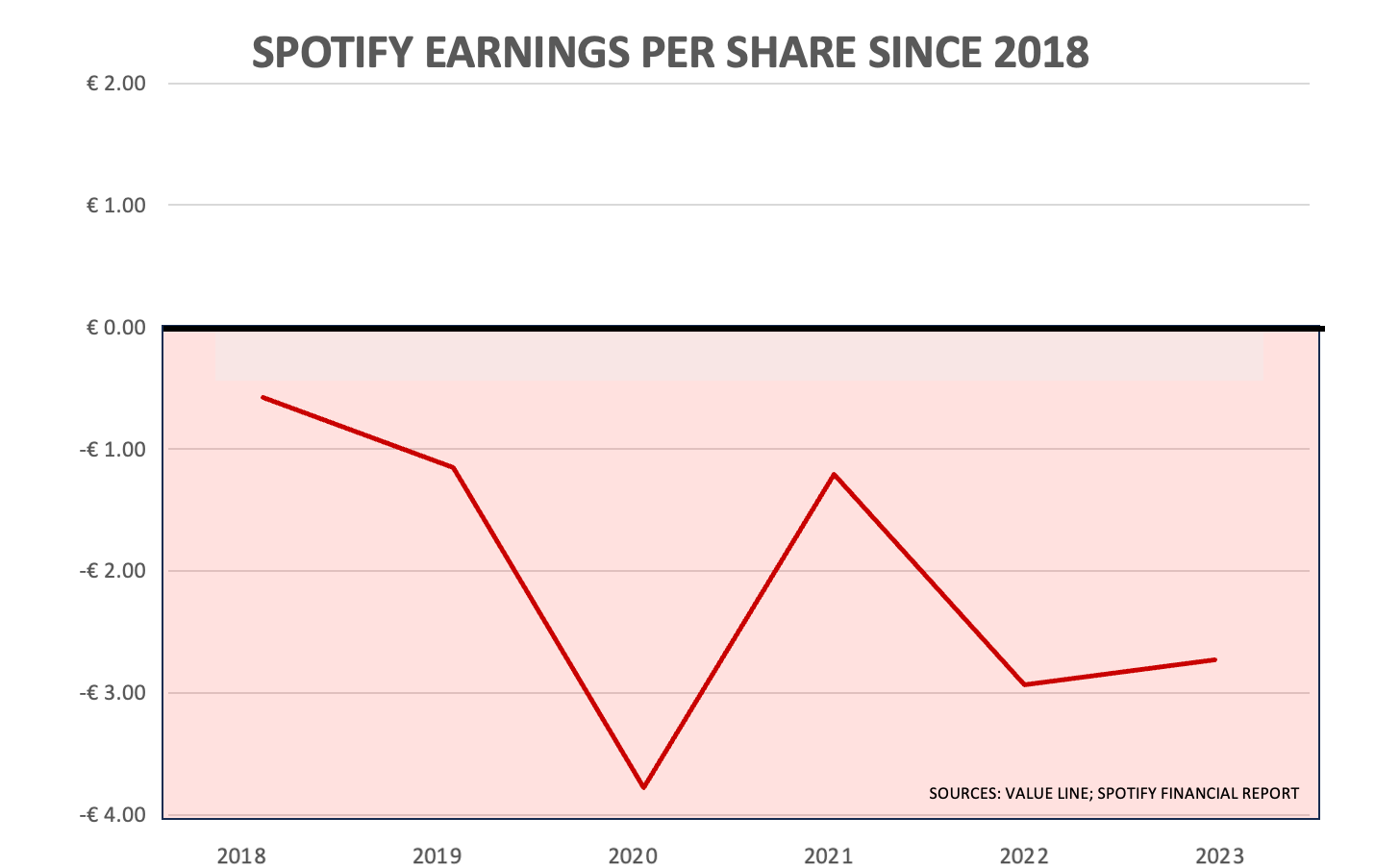
But the company released quarterly earnings this week—and it is still losing money!
Let me put this into perspective: Spotify was founded in 2006, and has now been operating for almost 18 years. It has 236 million subscribers in 184 countries. But the business still isn’t profitable.
Maybe one path to profitability is to pass off royalty-free AI Muzak as easy-listening jazz. It used to be a mild insult to call any work of art “derivative,” but with AI, it’s turtles all the way down.
Civilization
To realize the relative validity of one’s convictions and yet stand for them unflinchingly is what distinguishes a civilized man from a barbarian.
From the same Damon Linker post that quotes Schumpeter:
Niebuhr rightly remarked that Americans nearly always mean well when they act in the world. Our moral perils are thus “not those of conscious malice or the explicit lust for power.” Yet the rules of the world are such that good intentions—even our own—often lead to unintended bad consequences. This is a lesson we seem incapable of learning, or remembering, so eager are we to deny that the actions of even “the best men and nations” are “curious compounds of good and evil.”
…
The danger of crafting policy and acting in the world on the basis of an overly exalted view of our ourselves isn’t just that we’ll make foolish decisions that lead to immense suffering and harmful setbacks to our broader strategic aims. It’s also that in raising and dashing lofty expectations, we run the risk of inadvertently inspiring the cynicism to which Niebuhr also thought we were prone, as the inverse of our over-confident moralism.
This happened on the left during the 1970s, in the wake of the Vietnam debacle, with George McGovern’s call for America to “come home” after its ruinous misadventure in southeast Asia. And it’s happening in our own time on the right, after George W. Bush displayed hubris in deciding to topple the regime of Saddam Hussein and then adopted an unmodulated form of theologically infused American exceptionalism to justify the policy once its original rationale (ridding Iraq of weapons of mass destruction it didn’t possess) crumbled to dust. (If you’ve forgotten its details, I urge you to read Bush’s 2005 Inaugural Address, with its 50-odd invocations of “freedom” or “liberty,” and jaw-dropping declaration that the ultimate goal of American foreign policy is nothing less than “ending tyranny in our world.”)
The instant before that “jaw-dropping declaration” was my last as a Republican, as I’ve written about before.
World Affairs
Made in America
Only naive arrogance can lead Westerners to assume that non-Westerners will become “Westernized” by acquiring Western goods. What, indeed, does it tell the world about the West when Westerners identify their civilization with fizzy liquids, faded pants, and fatty foods?
It pains me to channel this, but Dreher’s right, at least up to the break:
Whatever you think of Vladimir Putin, who is ten years younger than Biden, he is vigorous, sharp, and combative. He gave his American interlocutor a coherent lesson on the past thousand years of Russian history, and hesitated only to tell the Yank to hush, and let him finish. Meanwhile, in Washington yesterday, Joe Biden confused President Sisi of Egypt with the leader of Mexico.
Toggling back and forth online from the Carlson interview to the Biden press conference, staged to address the humiliating Special Counsel’s report, was like moving out on a frail, narrow footbridge over a chasm. It is truly terrifying to consider that the feeble, senile old man desperately trying to rebut charges of dementia is what the U.S. sends to “battle” against a man like Putin.
Even worse, nobody doubts that Putin, for better or for worse, governs Russia. Who is governing America from the White House? Because it is not Joe Biden, that’s for sure.
…
It is hard for many Europeans to understand, but Americans scarcely know what happened in our country more than five minutes ago. And we only seem to care about it insofar as we can cite history as a reason to justify whatever it is that we want to do now. This is why Americans are living through the catastrophic, indeed totalitarian, leftist stripping of significant historical figures from public life—taking down their monuments, expelling a considered, nuanced treatment of them from history books—without protest. Too few Americans understand why this matters, and why they should care.
Isn’t Vladimir Putin doing the same thing—putting history to use to justify his attack on Ukraine? Yes, but there’s a difference. Russia really does have this incredibly long, dense, and difficult history with the territory we now call Ukraine. One does not have to accept Putin’s conclusion at the end of the story—‘therefore, Russia had to invade’—or accept his version of historical events to grasp that history matters to him in ways that many Americans will fail to appreciate.
National Affairs
Now and then
Is the New York Times suffering cognitive decline?
As I frequently remind readers, I’m a former conservative who hasn’t voted for the GOP since 2002. Why?
Because I think the Republican Party and its right-wing media allies intentionally spew demagogic toxins into the civic atmosphere of the nation for the sake of political gain. Because that isn’t going to change. (Like a three-pack-a-day smoker waiving away the possibility of lung cancer even after symptoms of serious illness have appeared, Republican voters have become addicted to the poison and demand more of it with each new election.) And most of all, because, like a highly skilled conman/drug pusher, Donald Trump deepens the deadly addiction every day, along with posing a potentially fatal threat to the country’s democratic institutions.
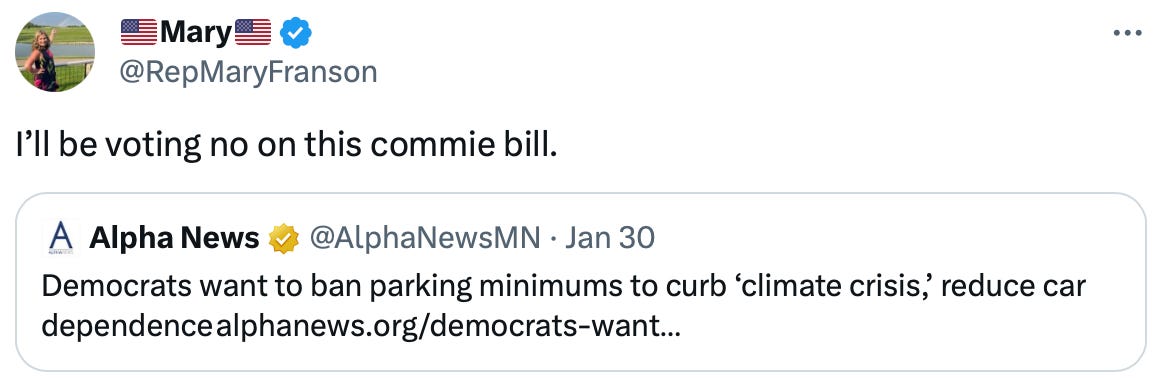
Republicans vs. property rights: Democrats in Minnesota, including Ilhan Omar, are supporting a new bill that would ban something called parking minimums. Parking minimums require property owners and developers to include a certain number of parking spots per apartment or business, and it was useful in the 1950s construction boom but it’s now one of the ways the government forces everyone into sprawling, low-density communities that rely on cars. Left to the free market, people often freely choose to live close together. They like it. I like it! Ever wonder why Paris and London are so charming? Anyway, I’m for freedom and so I err on the side of people being able to do more of what they want with their land, especially when parking lots are genuinely ugly. So oddly enough, when it comes to parking minimums, I’m with Ilhan Omar. The Republican opposition to the bill—again, which would limit the power of government and give property owners more rights to do what they want—goes something like this:
Apart from the knee-jerk response of “freedom,” which ought to resonate with a Republican (at least as I remember the party), removing that impediments to higher-density living arrangements is the right policy because it promotes more sustainable living.
Another good one steps away from DC
Another respected Republican, Rep. Cathy McMorris Rodgers, also revealed she will retire at the year’s end, despite being the chair of the influential House Energy and Commerce Committee. The 54-year-old lawmaker from Washington state has served in Congress since 2005. McMorris Rodgers and Gallagher join a growing exodus of members of both parties who are leaving Congress frustrated that political infighting has made legislating harder than usual.
Rep. Rodgers is one of a few candidates I supported financially (1) because she was endorsed by the pro-life Susan B. Anthony List and (2) then-35 year-old Rodgers looked electable. I am grateful that she has never engaged in the kind of jackassery that would make me regret my support.
Too many other SBA List endorsees who got elected have turned into embarrassments. One of them was foregrounded at new Speaker Mike Johnson’s coming out party snarling “SHUT UP!” at a reporter for asking an obvious and appropriate question.
I don’t look at SBA List endorsements any more.
Separating the man from the movement
Trigger Warning: If you don’t want to see anything about DJT here, stop. I’m quoting this because the mention of him is incidental to a more important point about how to heal our politics:
I think I detest Donald Trump as much as the next guy, but Trumpian populism does represent some very legitimate values: the fear of imperial overreach; the need to preserve social cohesion amid mass migration; the need to protect working-class wages from the pressures of globalization.
The struggle against Trump the man is a good-versus-bad struggle between democracy and narcissistic authoritarianism, but the struggle between liberalism and Trumpian populism is a wrestling match over how to balance legitimate concerns.
Yes, I suppose this is another insouciant assumption that there can be Trumpism without Trump. But we ignore populism’s legitimate values, we’ll see other demagogues arise to exploit them when Trump’s gone.
Resolute yet humble
Isaiah Berlin, concluded one of his most famous essays by quoting an observation by political economist Joseph Schumpeter: “To realize the relative validity of one’s convictions and yet stand for them unflinchingly is what distinguishes a civilized man from a barbarian.” This is also what distinguished postwar liberals such as Berlin and literary critic Lionel Trilling (the subject of this series’ second post) from just about everyone writing and thinking about politics today.
ICMY, I think he called “just about everyone writing and thinking about politics today” barbarian, and I won’t disagree if one allows for a bit of hyperbole in “just about everyone.”
You can read most of my more impromptu stuff here and here (both of them cathartic venting, especially political) and here (the only social medium I frequent, because people there are quirky, pleasant and real). All should work in your RSS aggregator, like Feedly or Reeder, should you want to make a habit of it.
I never promised to blog something every day but I’ve gotten this odd idea that I should. I almost let the cosmos down this morning by failing.
I inadvertently bought the hardback version of the book, but by page 3 or 4, I had already marked so much that I immediately bought the Kindle version, too, which better fits how I “process” non-fiction. (Passages highlighted in Kindle are saved to “My Kindle Highlights” at Amazon, from which I clip them into Evernote.)
The Demon in Democracy is an unlikely candidate for reading over a “lovely weekend,” but if you’ve read this blog for long, you’ll know I’m pretty bearish about most of what’s going on around me. Any help in figuring out “How did this happen?” is welcome.
I saw two related news items this morning that finally gave me something blogworthy:
It’s not enough, I guess, to oppose Trump and point out his flaws. One must oppose, vilify and shame those who for whatever reason support him, howsoever unenthusiastically.
The liberals adopted a similar Leninist practice, though probably they would not find the adjective pleasing. When faced with a statement, or an opinion, or an idea, the first and most important question they ask is whether any of these may be dangerous: that is, whether they may potentially contradict liberal assumptions … This kind of argument—outrageous, let us admit it—is considered by the liberals to be decisive, and it serves them to disparage opponents by suggesting that by making seemingly harmless theoretical statements they open the gates to totalitarianism, fascism, inquisition, torture, Hitler, and various other horrors.
One is an enemy of the regime if one doesn’t hate those who don’t hate one who threatens the regime. Four legs good, two legs bad.
* * * * *
“In learning as in traveling and, of course, in lovemaking, all the charm lies in not coming too quickly to the point, but in meandering around for a while.” (Eva Brann)
Not too long ago, I encountered an item reminding me of a little-remarked feature of our national polity: the immense dilution of the meaningful individual voice in governance.
At our nation’s founding, each Congressman represented few people – 50,000 or something. Today he or she represents roughly 700,000. This historic figure may be wrong, but the difference is by orders of magnitude.
And even at that, with 435 members, Congress is pretty unruly. We really can’t grow Congress back to where a Congressman represents something like the relatively few of yesteryear. It would be totally unworkable.
This leaves voters alienated from the national government.
In contrast, I have for a number of years, on and off, participated in my local Chamber of Commerce’s “Third House” program. Every Saturday or two during the Indiana legislative session, the “Third House” meets to eat an excessively large breakfast, hear reports from our representatives and to give them feedback on Bills that affect us. They sit at table and break hash browns with us, sharing a common cup of orange juice. Thus there’s informal chatter as well as formal reports from them to us and votes by us to inform them. It’s not uncommon for as many as 5 State Senators and Representatives to be present, nor for our input to influence their votes.
So what if we broke up government and devolved power back to the states so as once again to empower and dis-alienate voters? We’d still need, I think, a national assembly to provide for the national defense and a few other limited functions, but there would be multiple more regional assemblies. Like, maybe, fifty of them. Doing meaningful things independently of what happens in Washington, DC.
This ought to appeal to the Left counterculture and to the Right as well. Indeed, although I still very much consider myself a conservative, I’m finding plenty of kindred spirits on the Left, courtesy of this wonderful gathering place of cyberspace.
But I just described (except for the cyberspace thingy) Federalism, the intent of the Founders. Somehow, some centripetal force has driven the real power toward Washington, DC contrary to the original design. We can argue about why (I have some half-baked theories, riffing off the trope “nation with the soul of a Church” the dogmas of that Church being “democracy” and “American Exceptionalism” and the undermining of Federalism’s political safeguards by the direct election of Senators), but it’s hard to argue that the effect has been entirely healthy (or so it seems to me).
This gives me great appreciation for the wisdom of the Founders, who gave us a Republic, if only we’d kept it.
If coverage of the California Proposition 8 litigation hasn’t left you a little crazed, you’re either (a) a space alien or (b) not paying attention. Or maybe (c) the “bloodless lobotomy” of law school truly has left me unlike other humans (i.e., I’m the space alien). Continue reading “Legislation by Litigation”→
Them that’s got shall get
Them that’s not shall lose
So the Bible said and it still is news
Mama may have, Papa may have
But God bless the child that’s got his own
That’s got his own
Yes, the strong gets more
While the weak ones fade
Empty pockets don’t ever make the grade
Mama may have, Papa may have
But God bless the child that’s got his own
That’s got his own
Money, you’ve got lots of friends
Crowding round the door
When you’re gone, spending ends
They don’t come no more
Rich relations give
Crust of bread and such
You can help yourself
But don’t take too much
Mama may have, Papa may have
But God bless the child that’s got his own
That’s got his own
Mama may have, Papa may have
But God bless the child that’s got his own
That’s got his own
He just worry ’bout nothin’
Cause he’s got his own
Nothing much has changed, has it? Ross Douthat’s Monday column at the New York Times, “The Great Consolidation,” surveys the events of the past few years and concludes:
This is the perverse logic of meritocracy. Once a system grows sufficiently complex, it doesn’t matter how badly our best and brightest foul things up. Every crisis increases their authority, because they seem to be the only ones who understand the system well enough to fix it.
But their fixes tend to make the system even more complex and centralized, and more vulnerable to the next national-security surprise, the next natural disaster, the next economic crisis. Which is why, despite all the populist backlash and all the promises from Washington, this isn’t the end of the “too big to fail” era. It’s the beginning.
If it doesn’t ring true to you, I’m surprised you’re reading this blog at all.
Is this the result of a conspiracy? Are there some bastards we can shoot to end it? I rather think of it as tragedy, not conspiracy. And, having grown up as I did, I sometimes think of it as misadventure (looks sorta like tragedy, but the reversal of fortune is brought about by an external cause, says Aristotle).
Even in tragedy, there can be comic moments, as when POTUS (President of the United States) rationalizes a Supreme Court Appointment:
In the past week, I’ve read two news stories about Kagan in my local paper that featured absurd language. The first was an AP story by Ben Feller on May 10. The second was an AP story by Julie Hirschfeld Davis on May 12.
The second story quotes Harry Reid as saying Kagan “has fresh ideas” because she’s been “out in the real world recently.” Reid is trying to turn a negative into a positive. Kagan’s lack of judicial experience means she has been doing other things instead of being cloistered among black robes. But are the other things she’s been doing part of “the real world”? For the past decade, she has been professor and then dean of Harvard Law School, followed by a year as U.S. solicitor general. That’s pretty rarefied living. In the ‘90s, she was a White House counsel and policy advisor. Is there anything “fresh” about a retread from the corrupt and sleazy Clinton years?
The first story reports, “The president has grown vocal in his concern that the conservative-tilting court is giving too little voice to average people.” Obama—he of the famed analysis regarding bitterness and clinging—has now condescended to express a tender regard for the vox populi. In between his policy talks with Bernanke, Geithner, and Blankfein; his strategy sessions with Chicago machine cogs; and his social visits with the Beverly Hills and Martha’s Vineyard set. Somehow he finds time to worry about the little guys and gals and then express that worry while the press dutifully notes the expression.
We are told that Kagan is a manifestation of Obama’s concern that the common people are not being heard by the Supreme Court. So he appoints a person who attended an exclusive high school, then Princeton, then Oxford, and then Harvard. Just the sort of person who is most likely to be in touch with the struggles and aspirations, the stances and aims of We the People. Ain’t democracy grand?

 Tipsy Teetotaler ن