No Kings Saturday, 10/18/25

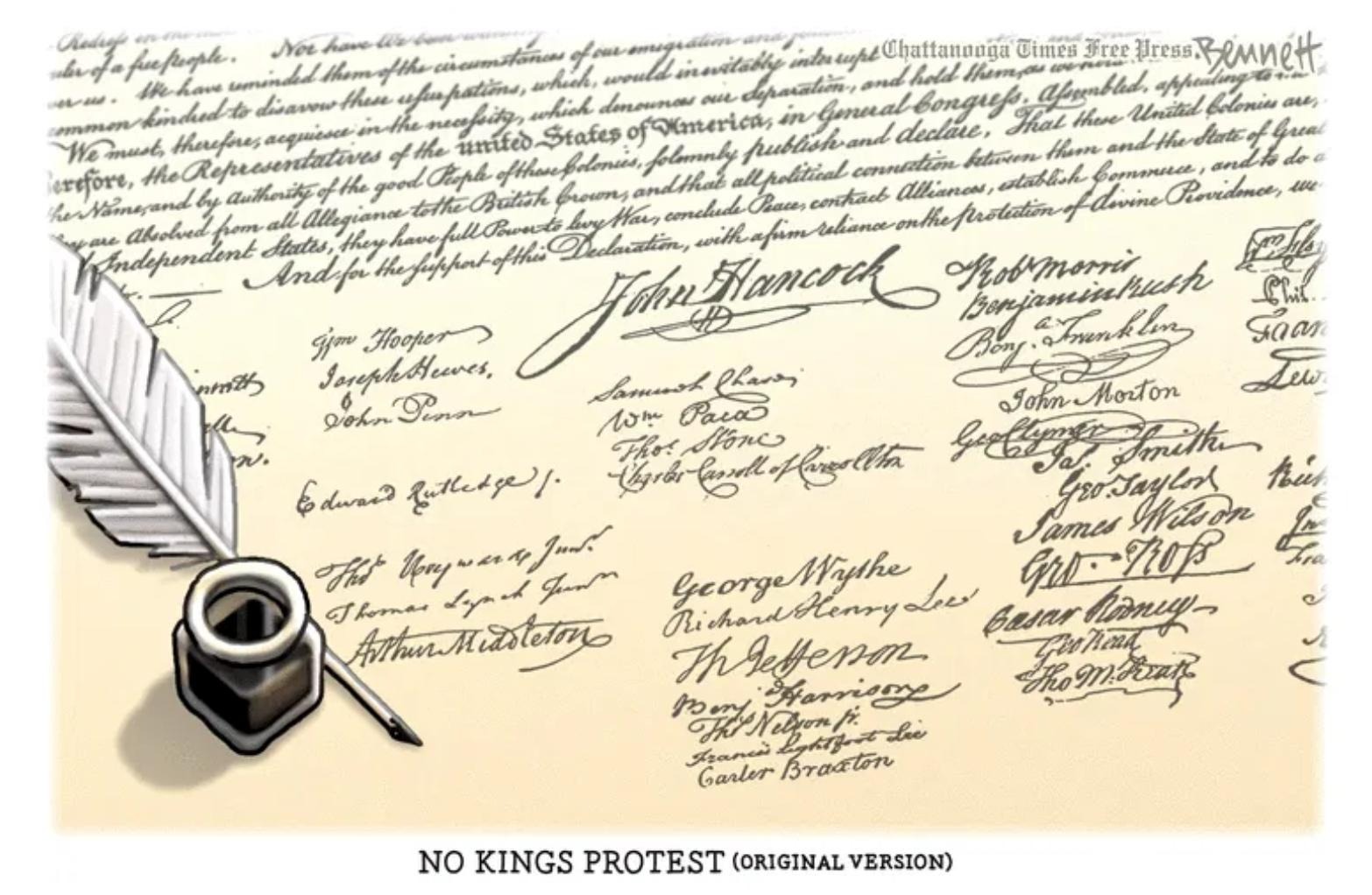
No kings!

Binding precedent

Protesters have protested at an ICE facility a few miles west of Chicago for the past 19 years—with somewhat more intensity recently following the announcement of Operation Midway Blitz. A month after the announcement, the president federalized the Illinois National Guard. District court: Enjoined. Seventh Circuit: Just so. Political opposition is not rebellion, and a protest doesn’t become a rebellion merely due to a few isolated incidents of violence. Without that, none of the statutory predicates for federalizing the National Guard have been met.

Institute for Justice, Short Circuits for 10/17/25 (bold added). This is now the law in the 7th U.S. Circuit – Indiana, Illinois and Wisconsin.

Look for the Administration to try to provoke a rebellion it can crush. Everyone who’s paying attention knows Trump wants to invoke the Insurrection Act (as he stuffs his pockets and those of his family).

Wanted: a viable counternarrative

Trump’s actions … are part of one project: creating a savage war of all against all and then using the presidency to profit and gain power from it. Trumpism can also be seen as a multipronged effort to amputate the higher elements of the human spirit—learning, compassion, science, the pursuit of justice—and supplant those virtues with greed, retribution, ego, appetite. Trumpism is an attempt to make the world a playground for the rich and ruthless, so it seeks to dissolve the sinews of moral and legal restraint that make civilization decent.

Trumpism, like populism, is more than a set of policies—it’s a culture. Trump offers people a sense of belonging, an identity, status, self-respect, and a comprehensive political ethic. Populists are not trying to pass this or that law; they are altering the climate of the age. And Democrats think they can fight that by offering some tax credits?

To beat a social movement, you must build a counter social movement. And to do that, you need a different narrative about where we are and where we should be heading, a different set of values dictating what is admirable and what is disgraceful. If we fail to build such a movement, authoritarian strongmen around the globe will dominate indefinitely.

David Brooks.

You can’t beat something with nothing. I can’t come up with a political counternarrative to Trumpism. The Democrats can’t come up with a political counternarrative, either. Brooks couldn’t come up with a strong political counternarrative.

I can only hope and pray that people will look for their compelling (counter-)narrative to the Gospel of Jesus Christ. (And that meantime there will be some legal counternarratives to prevent irretrievable damage, as in the preceding item.)

Music Reviews

There may be nothing better than old music reviews to let you know that it’s okay to like what you like, critics be damned.

I like Debussy’s La Mer, and I don’t care what the stupid early reviews said:

On today’s date in 1905, Claude Debussy’s orchestral suite La Mer or The Sea was performed for the first time in Paris. Today this music is regarded as an impressionistic masterpiece, but early audiences — especially those in America — found it rough sailing.

“We clung like a drowning man to a few fragments of the tonal wreck,” wrote a 1907 Boston critic, and suggested that instead of The Sea Debussy should have titled his piece Sea-Sickness.

“The Sea is persistently ugly,” wrote The New York Times that same year. “Debussy fails to give any impression of the sea … There is more of a barnyard cackle in it than anything else.”

And in 1909, this on La Mer from The Chicago Tribune: “It is safe to say that few understood what they heard and few heard anything they understood … There are no themes … There is nothing in the way of even a brief motif that can be grasped securely enough by the ear and brain to serve as a guiding line through the tonal maze. There is no end of queer and unusual effects, no end of harmonic complications and progressions that sound so hideously ugly.”

Ah, the perils of “modern music” in the early 20th century!

Giving the Devil his due, impressionism had to be a real mind-blower for critics attuned to, say, the sonata-allegro form.

Comprehensive tradition

We’re often not very aware of the “tradition” in which we live. A student in a classroom would readily agree that the words of a teacher or professor were a “traditioning” of sorts. But they will fail to notice that how the room is arranged, how the students sit, what the students wear (or don’t wear), how the professor is addressed, how students address one another, what questions are considered appropriate and what are not, and a whole world of unspoken, unwritten expectations are utterly required in the process. The modern world often imagines that “online” education is equivalent to classroom education since the goal is merely the transmission of information. But the transmission of information includes the process of acquiring the information and everything that surrounds it. Those receiving the “tradition” online will have perhaps similar information to those receiving it in a classroom – but they will not receive the same information.

Fr. Stephen Freeman, The Tradition of Being Human

Stages of life

Two questions:

  1. Do I want to read/watch/listen to this?
  2. Should I read/watch/listen to this?

When I was younger the second question often dominated my decision-making. Now that I am officially ancient that question has virtually disappeared and the first one is usually the only one I ask. That’s been the single most notable change in my personality in these my declining years.

Alan Jacobs

Alan is a decade or more younger than me, yet I only very recently seem to have arrived at this point, especially regarding political matters.

Note that he’s talking about a change in personality. This isn’t a life rule. There are things that younger people should read/watch/listen to, in order to become well-formed human beings.

Two ways

[R]evival begins with the people proclaiming, by word and deed, “I have sinned.”

MAGA Christianity has a different message. It looks at American culture and declares, “You have sinned.”

David French

Noteworthy

In the aftermath of Kirk’s murder, we witnessed young people at vigils rather than at “mostly peaceful” demonstrations.

R.R. Reno in First Things


We are all gatekeepers now.

Peggy Noonan

Your enemies are not demonic, and they are not all-powerful and the right hasn’t always lost and the left hasn’t always won. But if you convince yourself of that, you give yourselves all sorts of permission to do a lot of stupid and terrible things under the rubric of “Do you know what time it is?”

Jonah Goldberg.

[A] critical mass of the American people … no longer want[s] to govern themselves, … are sick of this republic and no longer want to keep it if it means sharing power with those they despise.

Nick Catoggio

I don’t do any of the major social media, but I have two sub-domains of the domain you’re currently reading: (a) You can read most of my reflexive stuff, especially political here. (b) I also post some things on my favorite no-algorithm social medium.

Authoritarianism in the 21st century

My father died 27 years ago today. It was too early, but I wouldn’t have wanted to see him at the age he’d be now.

This just might be faintly relevant

There isn’t a single instance of a fentanyl seizure in the Caribbean:

Last month, the U.S. cutter Hamilton returned to Florida with what the agency called “the largest quantity of drugs offloaded in Coast Guard history”: 61,740 pounds of cocaine and 14,400 pounds of marijuana (that’s the weight of about three city buses). The haul, gathered by multiple federal agencies during 19 seizure incidents in the Caribbean as well as the Pacific, had an estimated street value of $473 million. But there wasn’t any fentanyl on the boat.

(Nick Miroff)

Authoritarianism in the 21st century

We are living in an authoritarian state.

It didn’t feel that way this morning, when I took my dog for his usual walk in the park and dew from the grass glittered on my boots in the rising sunlight. It doesn’t feel that way when you’re ordering an iced mocha latte at Starbucks or watching the Patriots lose to the Steelers. The persistent normality of daily life is disorienting, even paralyzing. Yet it’s true.

We have in our heads specific images of authoritarianism that come from the 20th century: uniformed men goose-stepping in jackboots, masses of people chanting party slogans, streets lined with giant portraits of the leader, secret opposition meetings in basements, interrogations under naked light bulbs, executions by firing squad … I’d be surprised if this essay got me hauled off to prison in America. Authoritarianism in the 21st century looks different, because it is different. Political scientists have tried to find a new term for it: illiberal democracy, competitive authoritarianism, right-wing populism …

… To keep their jobs, civil servants have to prove not their competence but their personal loyalty to the leader. Independent government officers—prosecutors, inspectors general, federal commissioners, central bankers—are fired and their positions handed to flunkies. The legislature, in the hands of the ruling party, becomes a rubber stamp for the executive. Courts still hear cases, but judges are appointed for their political views, not their expertise … There are no meaningful checks on the leader’s power.

Today’s authoritarianism doesn’t move people to heroic feats on behalf of the Fatherland. The leader and his cronies, in and out of government, use their positions to hold on to power and enrich themselves. Corruption becomes so routine that it’s expected; the public grows desensitized, and violations of ethical norms that would have caused outrage in any other time go barely noticed. … At important political moments it mobilizes its core supporters with frenzies of hatred, but its overriding goal is to render most citizens passive. If the leader’s speech gets boring, you can even leave early (no one left Nuremberg early). Twenty-first-century authoritarianism keeps the public content with abundant calories and dazzling entertainment. Its dominant emotions aren’t euphoria and rage, but indifference and cynicism. Because most people still expect to have certain rights respected, blatant totalitarian mechanisms of repression are avoided. The most effective tools of control are distraction, confusion, and division.

“If everybody always lies to you, the consequence is not that you believe the lies, but rather that nobody believes anything any longer,” the political philosopher Hannah Arendt said near the end of her life. “And a people that no longer can believe anything cannot make up its mind. It is deprived not only of its capacity to act but also of its capacity to think and to judge. And with such a people you can then do what you please.”

These are the features of the modern authoritarian state. Every one of them exists today in this country …

… It sometimes seems as if the only check on Trump’s power is his own attention span.

George Packer, America’s Zombie Democracy.

Railway to the Moon

Imagine if you were trying to write intelligently about the socioeconomic impact of the railroad in the middle of the 19th century, and half the people investing in trains were convinced that the next step after transcontinental railways would be a railway to the moon, a skeptical minority was sure that the investors in the Union Pacific would all go bankrupt, many analysts were convinced that trains were developing their own form of consciousness, reasonable-seeming observers pegged the likelihood of a train-driven apocalypse at 20 or 30 percent, and peculiar cults of engine worship were developing on the fringes of the industry.

What would you reasonably say about this world? The prime minister of Denmark already gave the only possible answer: Raise your alert levels, and prepare for various scenarios.

Ross Douthat, Drones, Denmark and Dark Magic

PK snippets

  • “I’m not proposing a political program,” he told me. “This isn’t some Christian civilizational vision. It’s much more personal.” You decide how and where to wage battle: at a community garden, on the Appalachian Trail, in a mosque.
  • He was struck by how commonplace legal cannabis had become. “It’s a really, really useful drug for the state to be legalizing,” he said. “Because it’s not like alcohol. It doesn’t get you violent. And maybe life is a bit less crappy. It’s the best antidote to revolution that you could possibly have.”
  • “When you’re sitting in your living room with your Punjabi wife reading a bunch of stuff about how you’re a white nationalist, it makes you want to punch people in the face,” he said. “Luckily, I’m a Christian, so I don’t do that.”

Paul Kingsnorth via Alexander Nazaryan in the New York Times


We are all gatekeepers now.

Peggy Noonan

Your enemies are not demonic, and they are not all-powerful and the right hasn’t always lost and the left hasn’t always won. But if you convince yourself of that, you give yourselves all sorts of permission to do a lot of stupid and terrible things under the rubric of “Do you know what time it is?”

Jonah Goldberg.

[A] critical mass of the American people … no longer want[s] to govern themselves, … are sick of this republic and no longer want to keep it if it means sharing power with those they despise.

Nick Catoggio

I don’t do any of the major social media, but I have two sub-domains of the domain you’re currently reading: (a) You can read most of my reflexive stuff, especially political here. (b) I also post some things on my favorite social medium.

From grim to grimmer

Bummer

I could have filled this post with many clippings colorfully describing how bad things are. I’ve done it before and I’ll probably do it again. That’s just the kind of guy I am: melancholic.

But it just seems too much this week. I’m having trouble identifying anything going right in the USA.

I came of age in the 60s, and although I’ve been expecting our collapse for a long time, the manner and speed of the seeming collapse are a surprise.

I’ll summarize what’s a bit unsettling, even for me, thus:

  • We are moving rapidly from American hegemony to a multipolar world.
  • The very best President imaginable couldn’t stop, but could at best slow, our relative decline.
  • The very best President imaginable wouldn’t even run because of the politics of personal destruction.
  • But a toxic narcissist, jilted by voters in 2020, would run again in 2024 on a platform of vengeance. “Vengeance” turned out to mean turning America into a “shithole country.” (That will teach us!)
  • The Mainstream media are whistling past the cemetery as all this goes down.
  • UPDATE: Charlie Kirk, who it seems was more consequential than I had realized, gunned down Wednesday. I wrote everything in this post, other than this bullet point, before the murder of young Kirk. I knew little about him. My first impression was unfavorable because he was associated with Jerry Falwell, Jr. at the time that Falwell’s Potemkin Piety was collapsing. Thereafter? Well, I’m about 50 years older than his target demographic. (My wife didn’t even know who he was.) I’ve read a lot about him this morning, but the most interesting observation I read was too frank for this raw moment, so I’ll let you ferret out your own information if you care to.

With that off my chest, I’ll try to edify y’all for a while.

Repelled by conservatism, but not a liberal

Conservatism, as you know, is a complete mess in America right now. But reading conservative authors like Edmund Burke, Samuel Johnson, Fyodor Dostoyevsky, Gertrude Himmelfarb and James Q. Wilson does give you an adequate appreciation for the power of nonmaterial forces — culture, moral norms, traditions, religious ideals, personal responsibility and community cohesion.

I’ve been driven away from the right over the past decade, but I can’t join the left because I just don’t think that tradition of thought grasps reality in all its fullness. I wish both right and left could embrace the more complex truth that the neocon Democrat Daniel Patrick Moynihan expressed in his famous maxim: “The central conservative truth is that it is culture, not politics, that determines the success of a society. The central liberal truth is that politics can change culture and save it from itself.”

David Brooks, Why I Am Not a Liberal. This pretty clearly was one of the ten best things I’ll see in the New York Times this month, so that’s one of my gift links.

Breakneck: what you get in an engineered society

Publishers have figured out how to get limelight for their new titles, and one new title that’s deservedly getting a lot is Dan Wang’s Breakneck, about the astonishing ascendancy of China.

For a solid interview with Dan Wang (interviewer Ross Douthat), click this shared link: This Is Why America Is Losing to China.

Wang attributes this in substantial part to the relative influence of engineers in China versus that of lawyers in the USA. Engineers build; lawyers obstruct.

I find that somewhat plausible. But I write this precis not as an uncritical defense of my former profession, but to call attention to where engineered China went off the rails: trying to engineer China’s demographics led to over 300,000,000 abortions, over 100,000,000 sterilizations, and a population that’s skewed toward males.

That is, in my experience of engineers, classic engineering myopia. China could have benefitted from a bit more rule of law, less engineering “logic.”

What’s “fair” got to do with it?

There are people who get outraged when a court — especially the Supreme Court — impose or affirm what seems like an “unfair” result.

The scare-quote is not because fairness is a fantasy. It’s there because courts’ “unfair” decisions are mostly decisions to follow the law despite any countervailing sense of fairness.

And I approve of that approach. Consider: what is truly “fair” about denying a win to a guy who followed all the legal rules and then got sued by a guy who ignored the rules but somehow feels cheated (and has a good lawyer to sell his sob story)?

Liberalism without illusions

William A. Galston, a blast from the Clintonian past, has a wonderful article in Democracy Journal. I summarize, but I fully intend to read it several more times.

My summary:

Liberal democracy (a/k/a classical liberalism) has some inherent weaknesses:

  1. Because liberal democracy restrains majorities and gives even small minorities a say, it slows the achievement of goals that majorities support. In other words, it requires more patience than many possess.
  2. Liberal democracy requires tolerance for minority views and ways of life to which many citizens are deeply opposed.
  3. Liberal democracy requires a distinction between civic identity and personal or group identity.
  4. Liberal democracy requires compromise.

Liberals (left-liberals, or “liberals” in the modern pejorative sense) complicate these weaknesses with characteristic illusions:

  1. Myopic materialism: the belief, especially pervasive among elites, that economic issues are the real issues and that cultural issues are diversionary, deliberately heightened by unscrupulous leaders to gain support for their anti-liberal agendas.
  2. Parochialism. Yes, transnationalism is the parochialism of elites, because most people in advanced democracies as well as “developing” nations value particular attachments—to local communities and to the nation, to friends and family and compatriots.
  3. Naivete about the course of human events and the possibilities of human nature.

Credit for my discovery of this article goes to Rod Dreher.

Broken Windows

Okay, everyone is writing about it, and Trump’s vehement denials and $10 Billion lawsuit against Dow Jones makes it newsworthy that there’s now potent corroboration of Dow Jones’ (via the Wall Street Journal) claim about Trump’s hand-rendered birthday card for ephebophile Jeffrey Epstein’s 50th birthday. But I can’t say anything smarter than this:

From what I can tell, in fact, there’s no actual theory underlying the impromptu new conspiracy theory that the letter was forged. No one can explain how or why a birthday message purporting to be from Trump to one of his close associates would have been doctored for a privately published book compiled in 2003. Did time-travelers from the present day fake the letter and plant it knowing that it would come out someday and damage him—after he’d already been elected president twice?

If so, their plot failed. This isn’t going to damage him. It’s just another broken window in a neighborhood that’s full of them.

Andrew Egger explains at The Bulwark:

In a way, Donald Trump and his allies have spent their entire political lives preparing for this moment. The whole miserable decade of “alternative facts,” of witch hunts, of flooding the zone with sh-t—it all amounted to a long, powerful education for his base. It’s a training in a certain kind of zen meditation, in which stories damaging to Trump pass from the eyes and ears directly out of the body without ever intersecting the brain. By now, the base has gotten in their 10,000 hours. They’ve become masters of the craft. They can perform all sorts of remarkable feats—the media-cope equivalent of lying on beds of nails while cinderblocks are smashed on their chests. These cinderblocks, they whisper serenely, are just a liberal plot. If I pay attention, the Democrats win.

The Epstein scandal is the “final boss” of Trump scandals, the supreme test of reality-defying propaganda skills that MAGA has acquired over the course of 10 years. The crime involved, pedophilia, is one of their obsessions; the villain, Jeffrey Epstein, is a lead character in their hysteria about an elite child-abuse cabal; yet the evidence continues to mount that their own messiah, Donald Trump, knew what was happening as it happened and—at best—did nothing to stop it. It’s like the Access Hollywood scandal but with the spin difficulty dialed up by a factor of 10. 

Think of American government as a big neighborhood. The neighborhood has started to go to hell. Its residents are adjusting their expectations for it accordingly.

Bad things happen when neighborhoods start to go to hell. As public evidence of minor disorder and neglect rises, crime gets worse. That’s the “broken windows” theory of criminology—the idea that letting lesser offenses like window-breaking go unpunished signals to good guys and bad guys alike that laws won’t be enforced. Criminals respond by escalating to more serious offenses and law-abiding locals become fatalistic or apathetic.

Trump has broken a lot of windows in our government. How can we expect Americans to maintain the same expectations for civic order that they used to have as the proverbial neighborhood falls into disrepair?

Nick Catoggio.


Somehow, this seemed like the time to resurrect an item I only recently deleted from my footer:

Your enemies are not demonic, and they are not all-powerful and the right hasn’t always lost and the left hasn’t always won. But if you convince yourself of that, you give yourselves all sorts of permission to do a lot of stupid and terrible things under the rubric of “Do you know what time it is?”

Jonah Goldberg.

[A] critical mass of the American people … no longer want[s] to govern themselves, … are sick of this republic and no longer want to keep it if it means sharing power with those they despise.

Nick Catoggio

I don’t do any of the major social media, but I have two sub-domains of the domain you’re currently reading: (a) You can read most of my reflexive stuff, especially political here. (b) I also post some things on my favorite social mediu

Political (5/27/25)

Shooting us in the foot

Defunding Science

I don’t think I elevate science unduly, and I even try to burst the bubbles of those who do. I think we’ve neglected the humanities in worshiping the almight STEM.

But Steven Pincker has a long and passionate defense of Harvard in the New York Times opinion section. Remembering that Trump’s attack is largely based on alleged antisemitism at Harvard, this in particular struck me as key:

Just as clear is what won’t work: the Trump administration’s punitive defunding of science at Harvard. Contrary to a widespread misunderstanding, a federal grant is not alms to the university, nor may the executive branch dangle it to force grantees to do whatever it wants. It is a fee for a service — namely, a research project that the government decides (after fierce competitive review) would benefit the country. The grant pays for the people and equipment needed to carry out that research, which would not be done otherwise.

Mr. Trump’s strangling of this support will harm Jews more than any president in my lifetime. Many practicing and aspiring scientists are Jewish, and his funding embargo has them watching in horror as they are laid off, their labs are shut down or their dreams of a career in science go up in smoke. This is immensely more harmful than walking past a “Globalize the Intifada” sign. Worse still is the effect on the far larger number of gentiles in science, who are being told that their labs and careers are being snuffed out to advance Jewish interests. Likewise for the current patients whose experimental treatments will be halted, and the future patients who may be deprived of cures. None of this is good for the Jews.

The concern for Jews is patently disingenuous, given Mr. Trump’s sympathy for Holocaust deniers and Hitler fans. The obvious motivation is to cripple civil society institutions that serve as loci of influence outside the executive branch. As JD Vance put it in the title of a 2021 speech: “The Universities Are the Enemy.”

Steven Pinker, Harvard Derangement Syndrome (shared link)

Leave them all alone

A German concept used to validate the society-saturating politics infecting Europe 90 years ago was Gleichschaltung. It denoted totalistic government: the “coordinating” or “harmonizing” of all important social institutions. A foreign word, but no longer a foreign practice.

As a candidate in 2023, Donald Trump vowed to “choke off the money” to schools assaulting “Western civilization itself.” As he defines this, and as he defines “assaulting” it. What could go wrong?

America’s research universities are sources of U.S. economic dynamism and vital to technology-dependent national security. It is folly (and unlawful) to punish entire institutions for the foolishness of a few departments. When English departments are “decolonized” — dead White men purged from the curriculum — the only victims are students deprived of Shakespeare. Ideological indoctrination is rarer in engineering departments, where knowing the right facts rather than having the right feelings matters, otherwise bridges crumble and skyscrapers tumble. Leave all departments alone, some because their silliness does not matter much, others because their excellence matters greatly. (Source: washingtonpost.com)

George Will via John Ellis

Keeping score

SCOTUS and the “Shadow Docket”

We have plenty of things to worry about in constitutional law today. But those worried about how the court will confront the unprecedented and sometimes unlawful actions of the Trump administration should save their outrage for other cases.

In the two cases here, the court held that the president was likely to prevail in his unitary executive claim, that the administration was unduly harmed by allowing the officials to keep their offices while the case was pending, and that this reasoning would not imperil the independence of the Federal Reserve. It did all of this in an emergency order, rather than waiting for the issues to arrive on the court’s regular docket.

The president’s ruinous tariffs, purported cancellation of birthright citizenship, renditions to foreign prisons and retaliations against his political opponents all raise far graver constitutional problems than the court’s ultimately unsurprising order in these cases. We should focus our concern there.

Will Baude in the New York Times.

I had Will’s father, Pat Baude, for several Constitutional Law classes, and he, too, was brilliant. I only wish he had lived long enough to bust his buttons at his son’s brilliance and esteem in the legal community.

The Big Picture: A Hostage Crisis

This newsletter concerns itself with the great patriotic project to turn America into a banana republic, but something gets lost by doing that episodically. Each day we study some crooked new tree that Donald Trump’s administration has planted; rarely do we step back and consider how large the forest has already become.

Here’s Andy Craig at The UnPopulist, stepping back:

Since Jan. 20, the United States has been in a state of rapid constitutional collapse. Congress’ power of the purse, its most fundamental prerogative, has been usurped; statutory laws have been suspended by claimed “emergency” powers; the requirement for Senate confirmation has been made irrelevant; a transparently political purge of both the civil service and the armed forces has been launched; the president has threatened aggressive military force against longtime allies; a decree was issued to strip constitutional citizenship rights; our treaty obligations have been blown up with a self-sabotaging trade war; mass pardons have been used to gleefully sanction political violence; courts have been defied to send innocent people to a Central American torture camp; the world’s richest man has deployed a gaggle of racist hackers to shut down government agencies on a whim; and, just as we were going to press, news broke that Harvard University has been barred from enrolling foreign students because of its refusal to hew to the president’s ideological demands.

What Craig is describing is essentially a hostage crisis.

An authoritarian state is a national hostage crisis … Most hostage crises aren’t orchestrated by coolly ingenious master-planners. They’re what happens when someone who’s ruthless, audacious, volatile, and cunning but not very bright makes a mess of his caper, like a bank robber whose hold-up takes longer than expected. He turns to leave and finds cop cars pulling up outside, causing him to panic and to start taking hostages instead.

There’s no “plan.” He just doesn’t know what else to do now that a wildly reckless, dangerous course of action like robbing a bank has suddenly gone sideways.

That was also the theme of yesterday’s newsletter, not coincidentally. The One Big Beautiful Bill that passed the House on Thursday is incomprehensible as a plan to strengthen America fiscally. It makes sense only as a desperate act in the midst of a dangerous caper gone bad: Having decided long ago that making Trump happy is more important than protecting the country, House Republicans acted accordingly when forced to choose.

Nick Catoggio

Amnesiac Nation

The background fact of this second Trump impeachment trial was how broadly popular it was. In January, a Monmouth survey found that 56 percent of Americans wanted Trump convicted. Quinnipiac reported that 59 percent regard him as responsible for inciting violence against the U.S. government. According to ABC/The Washington Post, 66 percent believe that Trump acted irresponsibly during the post-election period. According to polls, fewer than a quarter believed that Trump did “nothing wrong” on January 6.

Those are not the numbers on which to base a Grover Cleveland–style comeback tour—especially not when the majority of Americans also believe that Donald Trump did a bad job handling the COVID-19 pandemic and that President Joe Biden is doing a good job.

David Frum.

There came a time when “President Joe Biden” became a legal fiction, and that boosted Trump’s stock.

Abundance Agenda

Jonathan Chait writes about the civil war in the Democrat party over a proposed “abundance agenda” for the party.

Here are the pieces of that agenda, according to Chait:

[T]he canonical abundance agenda consists of three primary domains.

The first, and most familiar, is the need to expand the supply of housing by removing zoning rules and other legal barriers that prevent supply from meeting demand …

The second focus of abundance is to cut back the web of laws and regulations that turns any attempt to build public infrastructure into an expensive, agonizing nightmare …

The third domain, and the one that has received the least attention from commentators, is freeing up the government, especially the federal government, to be able to function. Policy wonks call this issue “state capacity.” The government itself is hamstrung by a thicket of rules that makes taking action difficult and makes tying up the government in lawsuits easy. The abundance agenda wants to deregulate the government itself, in order to enable it to do things.

The problem is that there’s a bloc of progressive special interests within the party (“the groups,” per the abundance agenda proponents), and the groups are large and unified (or at least in alliance):

The progressive movement seeks to maintain solidarity among its component groups, expecting each to endorse the positions taken by the others.

Much of the most vociferous opposition to the abundance agenda has zeroed in on its betrayal of this principle. The Roosevelt Institute’s Todd Tucker attacked Ezra Klein on X for his “survivor island approach to coalitions—first unions and Dems team up to vote enviros off the island, and then Dems turn on labor.” David Sirota, a left-wing journalist, complained, “Abundance Libs are insisting the big problem isn’t corporate power & oligarchs, it’s zoning laws & The Groups? Come on.” Austin Ahlman, a researcher at the Open Markets Institute, an anti-monopoly advocacy organization, mused, “You have to wonder whether the Abundance faction stuff would have landed better if the proponents had not laid the groundwork for it by first broadsiding every other organized constituency in the democratic tent.”

This angry response is not merely a knee-jerk reaction to criticism, but the logical outgrowth of a well-developed belief system. Since the Obama era, many of the component groups in the progressive coalition have drifted further left on their core demands. (Single-issue lobbies are naturally incentivized to grow more extreme over time—what organization is going to decide its pet cause is too unpopular or costly to merit a strident defense?)

At the same time, they have grown more purposeful about their belief that each group must stand behind all the positions outlined by the others. That is why civil-rights groups will demand student-debt relief, abortion-rights groups endorse abolishing the police, or trans-rights groups insist that Palestine should be liberated. Leah Hunt-Hendrix, an heir to the Hunt oil fortune who became a full-time progressive organizer, and who has raised and donated millions to causes such as the Sunrise Movement, the Debt Collective, and Black Lives Matter, articulated the principle of cross-endorsements in her book, Solidarity. She argues for “the necessity of working in coalition with progressive social movements,” and of resisting the opposition’s efforts “to weaponize a movement’s fault lines.”

Such progressives are not wrong to see the abundance agenda as a broader attack on their movement.

The Coming Democratic Civil War – The Atlantic

I have long believed that “the groups” impede Democrat success by alienating Democrats in the cultural mainstream. And as I’ve long said, whatever else Trump’s triumph means, it means major political realignment. The Democrat party’s travails over the abundance agenda, and controlling the toxic “groups,” could further advance that realignment, but I’m not sure it will benefit the Democrats all that much.

But then what do I know? I’m almost completely alienated from a country that can elect Velveeta Voldemort.


Your enemies are not demonic, and they are not all-powerful and the right hasn’t always lost and the left hasn’t always won. But if you convince yourself of that, you give yourselves all sorts of permission to do a lot of stupid and terrible things under the rubric of “Do you know what time it is?”

Jonah Goldberg.

Regarding said “lot of stupid and terrible things,” my failure to call out anything about the current regime does not mean I approve. There’s just too much, and on some of the apparent illegalities I don’t want to abuse my rusty credentials without thinking it through.

I don’t do any of the major social media, but I have two sub-domains of the domain you’re currently reading: (a) You can read most of my reflexive stuff, especially political here. (b) I also post some things on my favorite social medium. I am now exploring Radiopaper.com as well.

100% Political. Sorry.

“Lawfare” in a nutshell

What the federal courts are facing from the Trump administration is trolling, outright defiance, administration attorneys making representations to the court with the administration refusing to follow through, and in general, a double game:

(1) Trump 2.0 says “The establishment is broken. We need to come in and wreck the place. We need to up-end everything.. We need to start throwing tables. Everything’s got to change. We are an administration unlike any other.”
(2) The legal system responds as if Trump 2.0 is an administration unlike any other.
(3) Trump 2.0 complains that they are being treated differently.

David French on the Advisory Opinions podcast (lightly paraphrased).

I hesitate to distill it further, all the way down to “Trump is a hard case, and hard cases make bad law,” because I want to give fair-minded MAGA people (if any there be) a chance to see why he’s a hard case.

Another alternative is “this administration has forfeited the ‘presumption of regularity’ normally afforded the Executive branch,” but that’s a bit too in-the-weeds and also doesn’t explain the “why” of the forfeiture.

The One Big Beautiful Bill

As regular readers know, I try to keep things upbeat in this newsletter. So let me tell you what I like about The One Big Beautiful Bill that passed the House (barely) several hours ago.

I like the fact that it reflects the degree of seriousness with which Americans now govern themselves.

That’s satisfying. In a democracy, representatives are supposed to vote in accordance with the will of the people. If the people demand the policy equivalent of eating out of garbage cans, Congress should deliver. And it has.

The salient fact about this legislation isn’t that it’s “bad,” although it is, for reasons we’ll get into. Bad legislation isn’t noteworthy. We all expect it.

What’s striking about The One Big Beautiful Bill is that it makes no pretense of trying to grapple seriously with America’s problems, even though it’s the centerpiece of the president’s agenda.

House Republicans have given up on trying to improve the country. All they wanted was to pass the class, which they did this morning by a single vote on the House floor. The One Big Beautiful Bill is to legislation what an AI-generated essay is to education.

Meditate on this: When I call it “The One Big Beautiful Bill,” I’m not mocking the president by mimicking his habit of speaking in dopey Trump-ese. I’m using the official name given to the bill by House Republicans. American government has become so self-consciously unserious that it’s now advertising that unseriousness in how it refers to its own policies.

Nick Catoggio

Jeffrey Epstein

Say what you will about notorious sex trafficker and financier Jeffrey Epstein, at least he killed Jeffrey Epstein. That was the conclusion of the FBI and the U.S. Department of Justice’s inspector general back in 2019, but many Americans—including more than a few in the ranks of the MAGA movement—insisted that some sinister conspiracy, likely connected to powerful Democratic officials, killed Epstein before he could destroy more reputations and implicate others in his sordid deeds. Now, FBI Director Kash Patel and Deputy Director Dan Bongino have weighed in after reviewing the evidence, concluding that Epstein committed suicide. The pair made the declaration in an interview with Fox News’s Maria Bartiromo, and it’s hard to begrudge the handful of MAGA social-media types who reacted with surprise and a sense of betrayal. In fact, as recently as February 7, Bongino was talking up Epstein’s connections to the Clintons on his podcast and declaring, “It’s time to start overturning that rock, and seeing what’s underneath.” Apparently, sometimes when you turn over a rock, all you find is the bottom of a rock.

National Review Weekly email.

I’m shocked that Patel and Bongino passed up an opportunity to stir the pot. Will they be fired now for not following the game plan?


Your enemies are not demonic, and they are not all-powerful and the right hasn’t always lost and the left hasn’t always won. But if you convince yourself of that, you give yourselves all sorts of permission to do a lot of stupid and terrible things under the rubric of “Do you know what time it is?”

Jonah Goldberg.

Regarding said “lot of stupid and terrible things,” my failure to call out anything about the current regime does not mean I approve. There’s just too much, and on some of the apparent illegalities I don’t want to abuse my rusty legal credentials without thinking it through.

I don’t do any of the major social media, but I have two sub-domains of the domain you’re currently reading: (a) You can read most of my reflexive stuff, especially political here. (b) I also post some things on my favorite social medium. I am now exploring Radiopaper.com.

Forest and Tree

Forest and trees revisited

[I’ve already quoted a very pungent Nick Catoggio distillation, but I keep returning to it.]

Insofar as I thought Trump marked mostly a populist realignment of partisan political boundaries, I think I was wrong — or at least that Trump 2.0 is a bigger deal than Trump 1.0. I think he’s now leading us into a post-liberal/illiberal world (that may be inevitable).

Nick Catoggio nails my feelings:

2015 me would have gazed around at the first nine days of Trump’s term, taking each policy in isolation, and concluded that the individual trees look pretty good. 2025 me stares around at the forest Trump is planting and shudders.

Many are freaking out about this.

The post-liberal/illiberal world is ominous for a lot of reasons:

  1. Liberal democracy has been very good materially to me, and mine, and most of the U.S. (But some have been left behind relatively because they didn’t register as Important People.)
  2. There’s a decent case to be made that liberal democracy represents our best chance to live together peacefully despite deep differences. Trump’s zero-sum mentality requires winners, losers and chaos, not co-existence.
  3. Postliberalism/Illiberalism in America feels alien, and how tolerably it’s implemented will depend on those implementing it. Trump, a toxic narcissist with authoritarian impulses and a taste for lethal retribution, is a terrible person to implement it. I’d be more comfortable with an Orbán than with Trump, but I cannot identify any American Orbán.
  4. Donald Trump has millions or tens of millions of supporters for who lethal retribution is a feature, not a bug, and they’ll turn on anyone he turns on. He’s an antichrist heading a new toxic religious cult, and since the failed assassination attempt, he may actually believe that he’s anointed (in contrast to his former cynicism toward his Christian enthusiasts).

Bottom line: it’s probably the end of a world, but not the end of the world. And I can’t do much about it except, possibly, take personal and familial protective measures. Some of those are in place; others we’ve ruled out as a matter of principle.

Good People

[I]t is impossible to overstate the conformist power among elites of being seen as a Good Person. This is why no Republican leader ever pushed back against this stuff prior to Trump. They were terrified of being seen as a Bad Person by the media and other elites. Trump is the Honey Badger of politics: he doesn’t care. (That’s a link to the megaviral Randall video from some years back; he drops some profanity in it, so be aware.)

Rod Dreher

Niall Ferguson on the bipartisan assault on the rule of law

Let me add two more big drops of rain on the Promenade parade. Since Adam Smith, economists have mostly seen free trade and the rule of law as beneficial for growth. Not only have we now entered a period of extreme uncertainty about the future path of U.S. trade policy (does Trump really mean to jack up tariffs on Canada, Mexico, and China on February 1, or are the threats just a negotiating tactic?), but we also appear to have jettisoned the rule of law in the euphoria of the monarchical moment.

It is not just Trump’s executive order suspending a law to ban TikTok that was passed by Congress, signed by his predecessor, and upheld by the Supreme Court. Trump has also issued a blanket pardon to all those convicted of crimes—including assaults on police officers—committed on January 6, 2021. And he has issued an executive order overturning the birthright citizenship most people had long assumed was enshrined in the Fourteenth Amendment.

But the truly disturbing thing to my eyes is that the assault on the rule of law has been bipartisan. And it is at least arguable that the Democrats began the process. It all started with their hounding of Trump in the courts, at least some of which was politically motivated, and continued in the final days of Biden’s presidency with his preemptive pardons of family members and political figures (they’re all here, including the one for his son Hunter), and a wild attempt to declare a constitutional amendment ratified (the Equal Rights Amendment) that hadn’t been.

“I believe in the rule of law, and I am optimistic that the strength of our legal institutions will ultimately prevail over politics,” Biden said in a statement justifying his actions. “But . . . ” You can stop reading right there. Because if you believe in the rule of law, “but,” then you don’t believe in the rule of law at all. It’s the same as those people who say they believe in free speech, but . . .

To be clear, I begin to fear we may be living through the death of the republic—the transition to empire that historical experience has led us to expect—but it’s not all Trump. It’s a truly bipartisan effort.

I am just fine with a vibe shift that gets us away from ESG, DEI, and the strangling regulation and ideologically motivated incompetence that lies behind the Los Angeles inferno, not to mention Chicago’s less spectacular descent into insolvency and criminality. If Davos Man needed Trump’s reelection to point out that if Europe went woke, it would go broke, then fine.

But trashing the rule of law is another matter.

And note how perfectly the phenomena coincide: the erosion of the laws and the imperial aspirations—Greenland; the Panama Canal; Canada (just kidding); the “Gulf of America;” and Mount McKinley ….

Niall Ferguson, Always Bet Against the Davos Man

Fascism?

Take the word fascism, properly applied to Franco’s Spain or Mussolini’s Italy, and to some extent beyond. The fasces were the bundles of rods carried by Roman lictors: symbols of punishment and magisterial authority, but in modern times also of a tightly unified society controlled from above, and organized in corporate form. The desire of totalitarians everywhere is to achieve harmonization, with all of society marching in military cadence under the guidance of an omnipresent government.

But the Trump administration is more interested in blowing up the state than in extending its power. Its ideologues, such as they are, are reacting to what they think of as government overreach. They will abuse executive power to do it, but they want to eliminate bureaucracy, not grow it.

Trump himself is not Mussolini, or Hitler, or Orbán—two of them soldiers with creditable war records, the third an activist against a dying Communist regime. Trump was a draft dodger by choice and a grifter by trade, and more important, he does not read. Unlike others in his orbit, he does not have ideas so much as impulses, whims, and resentments. He is, to be sure, cruel and malicious, but unlike the others, has no real governing vision.

Eliot A. Cohen, America Needs a Mirror, Not a Window

Too much

My simple thought: that in our politics now we consistently go too far and ask too much. It has become a major dynamic in the past 20 years or so. It manifests in a kind of ideological maximalism. You must get everything you want and grant your foe nothing. In terms of the issue above, you don’t ask society to give you something you deserve—good and just treatment of all transgender folk. Instead you insist that others see reality exactly as you do—that if a man experiences himself as a woman, then you must agree that he is a woman, and this new insight must be incorporated into all human activity, such as sports.

Reaction to the Trump executive order from those who disagree with it has been curiously absent. The reason is that they know they went too far.

The biggest and most politically consequential example of going too far, in the past generation, has been the Democratic Party and illegal immigration. Everyone knows this so I’ll say it quickly. If you deliberately allow many millions to cross the southern border illegally, thus deliberately provoking those who came here legally or were born here, Americans will become a people comfortable with—supportive of—their forced removal, certainly of those who are criminals.

Jump to what has been going on the past few weeks in Washington, with the unelected Elon Musk reorganizing, if that’s the word, the federal agencies. Here I pick on him, in part to show fairness. He is surely a genius, a visionary, a titan, but there is something childish and primitive about him. He has wild confidence in his ability to engineer desired outcomes, but unstable elements have a way of exploding in the beaker, and like everyone else from Silicon Valley he lacks a sense of the tragic. They think human life can be rationally shaped and perfected, that every problem just needs the right wrench, and in any case they all think they’re God.

My fear, here we switch metaphors, is that Mr. Musk and his young staffers and acolytes are mad doctors who’ll put 30 chemo ports in the sick body. They’ll not only kill the cancer, they’ll kill the patient.

But they are up against, or trying to reform, a government whose agencies themselves were often maximalist and went too far.

Of all the agencies being batted about the one we will remember first when we recall this period in history is the U.S. Agency for International Development, so much of whose line-item spending was devoted to cultural imperialism. You have seen the lists. USAID produced a DEI musical in Ireland, funded LGBT activism in Guatemala. It spent $426,000 to help Indonesian coffee companies become more climate- and gender-friendly, $447,000 to promote the expansion of atheism in Nepal, and on and on.

When you look at what they were pushing on the world you think: They’re not fighting anti-American feeling, they are causing anti-American feeling.

Who is defending these USAID programs? Nobody. Obviously not Republicans, but not Democrats either. Everyone knows the agency went too far.

Peggy Noonan

Journalism’s horrible bind

[O]n Wednesday afternoon, when I visited the essential Live Updates feed at The New York Times to check in on the latest barrage of Trump administration hyperactivity, I found literally the entire feed devoted to Trump’s bullshit “plan” for the U.S. takeover of Gaza. Breaking news stories. Reactions from around the world. Chin-scratching analysis from experts. All taking the suggestion, which Trump’s own senior staff hadn’t been expecting prior to its announcement during his press conference with Israeli Prime Minister Benjamin Netanyahu, with utmost seriousness. As if it was a real proposal that could conceivably become a reality.

I admit, this made me want to throw my laptop at the wall. Can’t you see he just fucking with us? But that’s unfair to the hardworking journalists at the Times. The American president’s words matter. They have to cover it as if it’s real. Which, of course, takes attention away from the things happening that are real. That illustrates quite vividly the horrible bind in which journalists, reporters, and news organizations find themselves at this maximally harrowing moment.

Damon Linker, Three Observations from the Midst of the Maelstrom

Starting your seventh-string QB

Thank god for James Carville: While the entire Dem establishment seems committed to losing at every opportunity they have, one James Carville is screaming into the void. “We ran a presidential election. If we were playing the Super Bowl, we started our seventh-string quarterback. . . . You can’t address a problem unless you’re honest about a problem.”

When the glowing orb of Carville pops up on the TV, you know you’re about to be yelled at. You know there’ll be spit on that table. Carville said people would be shocked to know that there are Dem candidates that “can actually complete a sentence, that actually know how to frame a message, that actually have a sense of accomplishment, of doing something.” Where are they hiding? Maybe in Governor Phil Murphy’s attic. Maybe somewhere in South Bend. But it’s time, guys: We need a complete-your-sentence–level politician, and we need one ba (sic)

Nellie Bowles

Born Against

Source, which is very worth reading.

Offshore politics

Obviously, there’s a lot going on, but I have limited my political comments in this post. Here are still more from my least-filtered blog:


I suffer more from the humiliations inflicted by my country than from those inflicted on her.

Simone Weil, from a letter to Georges Bernanos.

[N]one of the things that I care about most have ever proven susceptible to systematic exposition.

Alan Jacobs, Breaking Bread With the Dead

I don’t do any of the major social media, but I have two sub-domains of the domain you’re currently reading: (a) You can read most of my reflexive stuff, especially political here. (b) I also post some things on the only social medium I frequent, because people there are quirky, pleasant and real.

Friday the 13th

More political

From TGIF

Unfortunately, America’s liberal pundits weren’t clued in to the game [the Hunter Biden pardon], and they used Biden’s supposed restraint as an example of his beautiful righteousness. Their gullibility is almost sweet. They really think Biden is so pure of heart.

Anyway, the official policy of the UCLA Cultural Affairs Commission is: “We reserve the right to remove any staff member who dispels antiBlackness [sic], colorism, racism, white supremacy, zionism, xenophobia, homophobia, transphobia, sexism, misogyny, ableism, and any/all other hateful/bigoted ideologies.” I don’t know that it’s legal to ban “Zionists” at a state-funded school. But it’s the word dispel that kills me. It’s so cute and tells you everything. Groping around, trying to use big-ish words but not knowing what they mean, propped up by government funding, the new movement can’t articulate and yet the point comes across. Because the inability to articulate is a sign of the movement’s success. Words, after all, are violence.

Take this story about San Francisco this week. Public school enrollment has fallen as parents pull kids out, and so the decision was made to shut down a school or two with “equity” as the primary decider of which school goes, and the one that was chosen: the highest-performing elementary school, which happens to be 75 percent Asian. Basically: If a school effectively teaches kids what the word dispel means, that’s sus.

Nellie Bowles

Endless litmus tests

Populism under Donald Trump is an endless series of litmus tests designed to separate the holy Us from the heathen Them. No matter how many tests a Republican has passed, he or she is forever one failure away from becoming a heretic.

The new litmus test has to do with the career prospects of a former host of Fox & Friends Weekend.

“Pete Hegseth is the hill to die on,” David Limbaugh tweeted on Thursday of Trump’s flailing nominee to lead the Pentagon. “We must be fierce, loud, relentless, united and engaged.” Similar sentiments echoed across MAGA media, with special venom aimed at GOP Sen. Joni Ernst of Iowa for her heresy in announcing that she wasn’t yet sold on confirming Hegseth after meeting with him privately.

“Pete Hegseth is the hill to die on.” What would possess any human being not related to him to write that sequence of words?

Nick Catoggio

Scandal yet again

Trump, preparing for his second term as president, has decided to replace the FBI director again. The figure he picked to replace Comey—the lifelong Republican Christopher Wray—proved unable to meet Trump’s expectations for the position, which are (1) to permit Trump and his allies to violate the law with impunity, and (2) to investigate anybody who interferes with (1). Wray, wrestling with the problem of Trump’s desire to separate him from a job he apparently liked, chose to step down on his own. This raises the likelihood that the media will treat the replacement of Wray as normal administrative turnover rather than as a scandal.

But a scandal it most certainly is.

Jonathan Chait

Trump’s obvious intent to weaponize the FBI (and DOJ) against his enemies is the most nauseating prospect of the next four years — though my decades in the legal system may be skewing my perceptions.

Less political

Chew ‘em up, spit ‘em out

Another TGIF:

Poor Rudy: Lest we forget what Trump does to people after he tires of them or gets what he needs, let’s check in on former New York City mayor Rudy Giuliani. “I have no cash,” Giuliani said in a press conference. “Right now, if I wanted to call a taxicab, I can’t do it. I don’t have a credit card. I don’t have a checking account.” Yikes.

See, Giuliani led the campaign to claim that Trump won Georgia in 2020. And in doing so, he defamed some Georgia election workers and owes them a huge sum ($148 million). Rudy, you served your purpose. Now you’re broke and probably going to jail. Do we think Trump cares? Trump does not care. Trump is selling perfume this week. Trump says if you don’t have money for a cab, it’s called use your feet and walk. Trump says, “Did you say Ruby? I don’t know a Ruby.”

Democracy is what I say it is: Barack Obama came out again this week to scold American voters for voting but doing it badly, which means doing anti-democracy. Here’s Barack: “The election proved that democracy is pretty far down on people’s priority list.” Everyone knows that democracy is when there is one good party and you vote for that one. One idea for Democrats is they could try to have policies and make arguments for why they’re better (I will literally write these for you, just call me). In other signs that Democrats are learning deep, important lessons from the shellacking in this past election, they are still beginning meetings with land acknowledgments.

I swear to god, Republicans are going to funnel our Social Security money to President Tiffany Trump’s new shoe line, and Dems will still complain that Joe Rogan once made a joke about lesbians. Republicans will be gearing up to elect a Trump steak as the next president, and Dems will be like, please, Latinxs, join us while we lie in the street to stop fracking. Republicans will start deporting people who still use seed oils, and Dems will just attack them for not being body positive enough.

Nellie Bowles

What do you call fungible humans?

If you think cultures can be added to and subtracted from human populations over time, without changing anything substantial about their communities, then what do you think human beings actually are? [Renaud] Camus has the answer: resources.

To resolve the tension between many cultures and one people, the presupposition of multiculturalism is that a people is not defined by a shared culture, but as a productive material unit. People are defined not by culture, but by economic output.

For Camus, the Great Replacement—mass immigration—may be the political issue of our times, but it is not the issue. The issue is the managerial, mechanical, technological revolution that substitutes us out for machines. We have learned that our humanity is replaceable.

Nathan Pinkowski, The Humanism of Renaud Camus

Our founders were geniuses

The genius of the authors of the United States constitution was to garb in the robes of the Enlightenment the radical Protestantism that was the prime religious inheritance of their fledgling nation.

Tom Holland, Dominion

CAFO math

… our fuel costs per dollar in gross sales are only 10 percent of an industrial farm’s fuel costs as a percentage of gross sales. That’s a lot less energy used per dollar in sales. Make no mistake, the efficiencies ascribed to CAFOs can last only as long as energy is cheap. The day energy costs return to normalcy, CAFOs will no longer enjoy “economies of scale.” They will instead be obsolete.

Joel Salatin , Folks, This Ain’t Normal

Sometimes we’re the baddies

[B]y far the most worrisome Syrian weapons of mass destruction are the ones that simply disappeared.

Washington Post via John Ellis

Hypothesis: They never existed outside our propaganda organs.

It’s a terrible thing to realize that sometimes we’re the baddies (for example), because sometimes we’re not, and I don’t always feel I can sort out which is which.

The U.S. legacy in the Middle East

My concern for Syria comes from some associations I made there at the time, and from dear friends here with family remaining in Aleppo and Damascus. Bashir al-Assad was an Alawite, an off-beat offshoot of Islam. As a minority, he ensured the rights of the other minorities—Christian and Druze. I expect what will happen next to the 2,000 year-old Christian presence in Syria will mirror what happed to the equally ancient Christian community in Iraq. They will be roughly and summarily squeezed out. That, my friends, is the real legacy of U.S. involvement in the Middle East, and of course, Greater Israel. We forget that Christianity is an Eastern religion, and its extinction here in its birthplace will be a great tragedy.

Terry Cowan


I suffer more from the humiliations inflicted by my country than from those inflicted on her.

Simone Weil, from a letter to Georges Bernanos.

I don’t do any of the major social media, but I have two sub-domains of the domain you’re currently reading: (a) You can read most of my reflexive stuff, especially political here. (b) I also post some things on the only social medium I frequent, because people there are quirky, pleasant and real.

Friday, 6/7/24

Legalia

Musical rackets

Copyright law is just a big steaming mess. Whenever you think it can’t get crazier, it always does.

YouTube is the ultimate battlefield for copyright claims gone wild. Even when I do a short YouTube video about music, I can never play examples from actual recordings. (That’s why I’ve never given an online course on music history. Corporate lawyers would shut me down in a New York minute.)

Consider the case of the YouTuber whose video got demonetized because his “Samsung washing machine randomly chimed to signal a laundry cycle had finished while he was streaming.”

How is that even possible? But it gets even stranger.

Ashley Belanger reports in Ars Technica:

Apparently, YouTube had automatically scanned Albino’s video and detected the washing machine chime as a song called “Done”…[but it] actually comes from the song “Die Forelle” (“The Trout”) from Austrian composer Franz Schubert.

The song was composed in 1817 and is in the public domain. Samsung has used it to signal the end of a wash cycle for years.

I’m not sure what Schubert would make of all this. But I can assure you that none of his heirs will get a penny from this. That’s not the purpose of song copyrights anymore.

Ted Gioia, in a thoroughly disheartening chronicle of where AI appears to be taking us.

See also James O’Malley, Music Just Changed Forever

One crime with 34 cooties

I have added a P.S. to my recent post “34 Counts!”:

I don’t think I’ll dwell on the 34 counts any more, and regret having done so. The 34 counts were 34 bookkeeping entries. In most courts — and in best practice — this would have been charged as one crime, or so I’m told.

Politics

Sheep

Most Church leaders—conscious that to condemn Nazis for blasphemous kitsch might prove risky—opted to bite their tongues. Some, though, actively lent it their imprimatur. In 1933, the year that Hitler was appointed chancellor, Protestant churches across Germany marked the annual celebration of the Reformation by singing Wessel’s battle hymn. In Berlin Cathedral, a pastor shamelessly aped Goebbels. Wessel, he preached, had died just as Jesus had died. Then, just for good measure, he added that Hitler was ‘a man sent by God’.

Tom Holland, Dominion

I heard David French tell a story about masculinity today that was very David Frenchy in that it was based on a movie, American Assassin:

This is the story of Chris Kyle. And it was — I remember seeing it here in Tennessee. And you couldn’t find a parking spot in our theater. That movie was an absolute sensation.

And one of the most memorable parts of that movie is when Chris Kyle is involved in a playground fight, and his father goes through this sheepdog, sheep, wolf analogy. And that is there’s three kinds of people in this world. There’s the sheep, there are the wolves who prey on the sheep, and the sheepdogs who protect the sheep from the wolf.

And he says, I’m not raising any sheep in this household. So what are you? And at that point, Chris Kyle identifies himself as a sheep dog, as somebody who protects the weak against the wolf. OK? And so it’s a very anti-bullying sort of vision of male courage.

And then here comes Donald Trump, who fits to a T the definition of a wolf, of a bully. The story the right told about itself was that they would be inoculated against the wolf, against the bully, because they have this ethos of the sheepdog.

But then when the wolf arose and the bully arose, they went with the bully, the very person that a generation of young right-wing men were warned about. And so that’s what makes this, in many ways, so much more deeply disturbing even than it otherwise been (sic), because it called into question kind of the cultural enterprise that was happening before Trump.

On that same podcast, Jamelle Bouie, riffing on Trump’s first post-conviction public appearance being UFC (Universal Fight Club), quipped that “Professional wrestling is camp for straight men..”

Not a referendum on Trump?!

I believe I recently passed on an opinion that both Trump and Biden want this election to be a referendum on Trump. Now I pass along the opinion that it’s a referendum on Biden:

[Y]ou can just look at the polls in the US: 51 percent of Americans now support mass deportations of the kind Trump is proposing; including 42 percent of Democrats, and 45 percent of Hispanics. That was unthinkable four years ago — and it’s entirely on Biden. The revolt against this basic failure of governance is now strong even in big cities, run by Democrats, and among non-whites, who are moving toward Trump.

Joe Biden’s main campaign theme seems to be that he alone can defend liberal democracy from Donald Trump. What Biden has never understood is that restricting immigration is absolutely critical to defending liberal democracy. Everything else is just words, condescending words. If Trump triumphs in November, Biden will be responsible for simply ignoring basic political reality, alienating the very people he needs.

One person was responsible for Trump’s first term: Hillary Clinton. And one will be responsible for his second: Joe Biden.

I guess it’s worth reiterating at this point that I’m not anti-immigration. It remains the lifeblood of America, and immigration is vital for our future fiscal balance. I’m a proud immigrant myself — and America will always be able to integrate newcomers in ways European countries simply cannot. But, like a huge majority of Americans, I’m in favor of legal, orderly, controlled immigration — and not the chaos we now see everywhere in the West. This is not racism or xenophobia; it’s a recognition that borders and the rule of law matter; and that without secure borders, we risk losing the core reality of a nation-state; and without a better-paced influx, we risk delegitimizing immigration altogether, and balkanizing our societies.

Andrew Sullivan

Loser Trump

Trump’s base does not win elections outside of party primaries. It did not win the midterms for the Republican Party in 2018, it did not win re-election for the Trump in 2020, and it did not win a red wave for Republicans in 2022. The signature Republican victory of the last four years, the election of Glenn Youngkin over Terry McAuliffe in the 2021 Virginia race for governor, rested on an effort to marginalize the Trump base so that party leaders could engineer a nominee with the ability to distance himself from the former president and his movement.

Jamelle Bouie.

And true to form, the RNC’s Lara Trump has issued a fatwa against Larry Hogan, Republican candidate from U.S. Senate from Maryland, for saying the public should respect the process and the verdict in the Trump felony trial. Kiss that seat goodbye, GOP.

Chicken Littles of the Left

Some people reportedly (I haven’t met one outside of click-bait stories) are worked up that some Trump supporters want to ban IVF, contraception, and recreational sex. Though I know some arguments against each of those sacred cows, this strikes me as a reverse mirror-image of QAnon.

I would welcome more careful thought about IVF, but I’m an outlier. Anyone who thinks that a lame duck Donald Trump is going to pander to a very small group of ideologues who are seriously out of step with 90%+ of their countrymen needs to take a deep breath. Anyone who thinks that Donald Trump (who probably has frequent sperm donor perks at the fertility clinics of Manhattan) is personally opposed to IVF, contraception and recreational sex (“I never did anything that needed forgiveness” or something like that, he said) needs inpatient psych care.

Culture

Defining deviancy down … and up

When and why did American life become so coarse, amoral and ungovernable? In his classic 1993 essay, “Defining Deviancy Down”, the late Senator Daniel Patrick Moynihan offered a semantic explanation. He concluded that, as the amount of deviant behaviour increased beyond the levels the community can “afford to recognise”, we have been redefining deviancy so as to exempt conduct we used to stigmatise, while also quietly raising the “normal” level in categories where behaviour is now abnormal by any earlier standard. The reasons behind this, he said, were altruism, opportunism and denial — but the result was the same: an acceptance of mental pathology, broken families and crime as a fact of life.

In that same summer, Charles Krauthammer responded to Senator Moynihan with a speech at the American Enterprise Institute. He acknowledged Senator Moynihan’s point but said it was only one side of the story. Deviancy was defined down for one category of society: the lower classes and black communities. For the middle classes, who are overwhelmingly white and Christian, the opposite was true. Deviancy was in fact defined up, stigmatising and criminalising behaviour that was previously regarded as normal. In other words, there was a double standard at work.

Ayaan Hirsi Ali

Presented without express comment

A new poll from Ipsos has found that support for same-sex marriage among Americans has fallen to just 51% approval.

Following a years-long rise in support for gay marriage, a groundswell of anti-woke sentiment emerged around 2021, much of it directed at LGBT activism as parents gained a new window into their children’s curriculum when schooling went remote during the Covid-19 pandemic …

Gay rights have since been lumped in with trans rights in the popular imagination, which may have chipped away some public support for gay marriage at the margins. …

Bev Jackson, co-founder of the LGB Alliance, said the decline in support for same-sex marriage had causes on both the Left and the Right. “Blame for the fall in US support for gay marriage lies partly with the homophobic religious Right. But equally to blame are treacherous organisations like GLAAD and the ACLU which promote insane, deeply unpopular concepts such as gender self-ID and child ‘transition’,” she said. “Gender identity ideologues have been riding on LGB’s coattails for too long, and they’re helping to destroy support for the rights we fought for decades to win.”

Laurel Duggan

Junk info

Junk info is often false info, but it isn’t junk because it’s false. It’s junk because it has no practical use; it doesn’t make your life better, and it doesn’t improve your understanding. Even lies can be nourishing; the works of Dostoevsky are fiction, yet can teach you more about humans than any psychology textbook. Meanwhile, most verified facts do nothing to improve your life or understanding, and are, to paraphrase Nietzsche, as useful as knowledge of the chemical composition of water to someone who is drowning.

Gurwinder

Privileging victims, real and imagined

The intuitive moral structure of our modern social imaginary prioritizes victimhood, sees selfhood in psychological terms, regards traditional sexual codes as oppressive and life denying, and places a premium on the individual’s right to define his or her own existence.

Carl R. Trueman and Rod Dreher, The Rise and Triumph of the Modern Self

Safetyism today

They want revolutionary ends, but they want to hide behind establishment credibility.

Jonah Goldberg, describing the successor ideology, which has famously “march[ed] through the institutions.”

Tipsy the squish

I finally had to replace the color toner cartridges on my laser printer. I opened the red-and-white Canon box I’d ordered months ago. I found unfamiliar packaging of the cartridges and unfamiliar cartridge configuration. I figured out how to install them and then looked for the instructions on recycling them (back to Canon). It was nowhere to be found.

Having seen the word “compatible” a few times, I looked more closely at the box. Where the word Canon should have been, the word “Cartridge” appeared.

I remembered when I purchased them my shock at the low price, but I double- and triple-checked. I thought I was getting an inexplicable price on Canon goods. They still conned me with the Canon-looking box.

Now I’ve got three laser cartridges I can’t recycle, and it bothers me more than such a thing is supposed to bother a conservative.

Which reminds me again of how close “conservative” today is to “barbarian.” My gut-identification today remains “conservative,” but my considered identification is center-right.

Progress

Progress should be about improving the quality of life and human flourishing. We make a grave error when we assume this is the same as new tech and economic cost-squeezing.

Ted Gioia, I Ask Seven Heretical Questions About Progress

GD Misinformation

Mainstream coverage of this issue is a buffet of sanctimonious overclaiming. It says authoritatively that kids in the US can’t go on blockers or hormones prior to lengthy, in-depth assessment (false). That no one under 18 is getting surgery (false). That the worldwide rise in referrals to youth GD clinics is almost entirely the result of reduced stigmatization (no one knows). That GD, or the perception that one has GD, can’t spread through adolescent social networks (almost certainly false on the basis of anecdotal evidence and any familiarity with developmental psychology). That it’s a ‘myth’ that significant number of kids who believe themselves to be trans will later feel differently (false, according to all the existing data). That only a tiny percentage of people detransition (we have no data at all on this in the context of youth gender care in the States).

What the Media Gets Wrong on Gender Reassignment. This is from 2021 when the elites were uniformly purveying lies about Covid, gender dysphoria and who knows what all else. Things have gotten markedly better in recent months on adolescent gender dysphoria.

Capitalistic algorithmic ideological hairball

For many of our applicants—and this, of course, is what the program is about, what the humanities are about—learning has, or ought to have, an existential weight. Beneath their talk of education, of unplugging from technology, of having time for creativity and solitude, I detected a desire to be free of forces and agendas: the university’s agenda of ‘relevance,’ the professoriate’s agenda of political mobilization, the market’s agenda of productivity, the internet’s agenda of surveillance and addiction. In short, the whole capitalistic algorithmic ideological hairball of coerced homogeneity. The desire is to not be recruited, to not be instrumentalized, to remain (or become) an individual, to resist regression toward the mean, or meme.

William Deresiewicz, Deep Reading Will Save Your Soul H/T Frank Bruni (who led me to actually read a piece I’d only skimmed). Ted Gioia, My Lifetime Reading Plan, practiced it before Deresiewicz preached it.

Losers

The characteristic feature of the loser is to bemoan, in general terms, mankind’s flaws, biases, contradictions, and irrationality-without exploiting them for fun and profit.

Nassim Nicholas Taleb, The Bed of Procrustes


So: where did all my mockery of Trump go? Well, first, I resolved to stop harping on it. But then, I just moved it off to my reflexive blog, trying to keep this one relatively reflective.

I suffer more from the humiliations inflicted by my country than from those inflicted on her.

Simone Weil, from a letter to Georges Bernanos.

I don’t do any of the major social media, but I have two sub-domains of the domain you’re currently reading: (a) You can read most of my reflexive stuff, especially political here. (b) I also post some things on the only social medium I frequent, because people there are quirky, pleasant and real.

420 2024

I have to be reminded every year that “420” is a winky feast for weed afficianados.

Trans in the news

MSM largely ignores the voice of sanity on teen trans

A short note on the MSM coverage of last week’s publication of the Cass Report — the most comprehensive review of all the scientific evidence around the sex reassignment of children. There was barely any. Nada at CNN. Zippo by the Washington Post. NPR — surprise! — ignored it. So did NBC, which covers trans issues obsessively, and CBS.

The transqueer groups who’ve backed transing children with gender dysphoria — primarily HRC and GLAAD — have also said nothing on their websites. GLAAD was the group that brought a van with the words “The Science Is Settled” to intimidate the NYT into not covering the issue. You might think they’d say something, now that a definitive study has shown the science is anything but settled. But nah.

The New York Times ran a real story; so did the WSJ; David Brooks has a piece today praising the fairness and compassion of the Cass Repot; and the Washington Post, despite its news division, published a remarkable op-ed by a gay detransitioner, reflecting on how his own internalized homophobia had led him astray under the guidance of the trans industry. That’s the first time I’ve read in the MSM how transing children is putting countless gay kids at terrible risk — a vital point, deliberately obscured by formerly gay rights groups that have now gone fully trans. So there’s hope in the wilderness. But not much.

Andrew Sullivan (bold added)

“Protecting trans kids”

Being in favour of the sterilisation of autistic and gay children — or “protecting trans kids”, as it’s been known — has long been a way to advertise one’s right-side-of-history credentials.

Victoria Smith, Puberty blocker ruling won’t cure Scotland’s gender problem

If that quote makes no sense to you, have you considered

  • the prevalence of autism in gender dysphoric kids (a “co-morbidity”) and
  • the prevalence of homosexuality among kids who, once gender dysphoric, grow out of it?

(Surely you know that sterility is a side-effect of medical interventions via surgery or even just hormones.)

Culture

René Girard, call your office

Pierre Valentin … who authored the first French study of the woke phenomenon, described wokeness as “a spirit of sheer negation.” He insightfully observed that wokeness is an inversion of the traditional scapegoat mechanism. The scapegoat mechanism sacrifices the exception, the outsider, for the sake of preserving the whole. But in the woke paradigm, you sacrifice the whole to coddle the exception.

Rod Dreher, reporting from the National Conservatism Conference that Brussels’ mayor tried to cancel three times. A midnight court hearing turned back those efforts.

Liberalism’s trajectory

I’m kind of with those who say there’s a trajectory within classical liberalism toward where we are now because, you’ve got to just keep finding new groups to liberate, and new forms of oppression, and then the ever-increasing focus on the self and the sovereignty of choice. But that’s such a desert landscape.

… [W]e’re beginning to see some really frightening instances: people are so tired of wokeism and the exaggerated forms of liberalism that they want the absolute contrary as you take solace or consolation in something that’s a violent overthrow of that.

Catholic Bishop Robert Barron via Juicy Ecumenism

Meatspace

The greater the social value produced by a job, the less one is likely to be paid to do it.

David Graeber, Bullshit Jobs

These are the jobs done in meatspace, which jobs manifested their importance during the Covid pandemic.

Sleepwalking despite it all

Even after the terrorist attacks of September 11, 2001, that collapsed the twin towers of the World Trade Center and sliced through the Pentagon, America is are still sleepwalking into the future.

James Howard Kunstler, The Long Emergency

NPR

Wokeness is illiberal

The point I have been trying to make for years now is that wokeness is not some racier version of liberalism, merely seeking to be kinder and more inclusive. It is, in fact, directly hostile to liberal values; it subordinates truth to ideology; it judges people not by their ability but by their identity; and it regards ideological diversity as a mere dog-whistle for bigotry. [NPR CEO Katherine] Maher has publicly and repeatedly avowed support for this very illiberalism. If people with these views run liberal institutions, the institutions will not — cannot — remain liberal for very long. And they haven’t. Elite universities are turning into madrassas, and media is turning into propaganda.

Yes, Fox News is worse. The right-leaning media, apart from the WSJ, is woefully lacking in solid reporting and sober argument. But that’s why it matters that the big fish remain liberal. And it’s one thing when propaganda pervades private institutions, but at NPR, you and I are also subsidizing it with our tax dollars. I fail to see how that is in any way fair or sustainable — for its listeners or donors.

NPR’s biggest staff cuts since the Great Recession and its rapid decline in listenership — while radio and podcasts are booming everywhere else — are telling us something. It’s just something that the smug fanatics now running the place don’t want to hear.

Andrew Sullivan, Katherine Maher is not a Liberal

Relativist on facts, absolutist on morals

For [NPR CEO Katherine] Maher, authoritative platforms have a duty to control knowledge production and police the boundaries of speech, imposing formal relativism while writing the Good People’s moral precepts into the parameters of what is sayable and knowable. Meanwhile, the counter-melody of NPR’s staffers contesting [Uri] Berliner’s article reminds us that while we may not like Maher’s moral framework, she’s right about the politicisation of truth.

Maher would never put it so bluntly, but the difference between the free circulation of information in the print and the digital eras is gatekeeping, effectively on the basis of intelligence and wealth (via the proxies of reading ability and leisure to write).

Mary Harrington

Politics

Why Biden shouldn’t debate Trump

A consortium of television networks yesterday released a joint statement inviting President Joe Biden and his presumptive opponent, Donald Trump, to debate on their platforms: “There is simply no substitute for the candidates debating with each other, and before the American people, their visions for the future of our nation.”

President Biden’s spokesperson should answer like this: “The Constitution is not debatable. The president does not participate in forums with a person under criminal indictment for his attempt to overthrow the Constitution.”

Until tried and convicted, Trump must be regarded as innocent in the eyes of the law.

But the political system has eyes of its own. No doubt exists about what Trump did, or why, or what his actions meant. Trump lost an election, then incited a violent mob to attack the Capitol. He hoped that the insurrectionists would terrorize, kidnap, or even kill his own vice president in order to stop the ceremony to formalize the victory of Biden and his vice president, Kamala Harris. By disrupting the ceremony, Trump schemed to cast the election’s result to the House of Representatives, where Republican voting strength might proclaim him president in place of the lawful winner. Many people were badly injured by Trump’s violent plan, and some died as a result.

Imagine watching the debate with the sound off—what would you see? Two men, both identified as “president,” standing side by side, receiving equal deference from some of the most famous hosts and anchors on American television. The message: Violence to overthrow an election is not such a big deal. Some Americans disapprove of it; others have different opinions—that’s why we have debates. Coup d’état: tip of the hat? Or wag of the finger?

For Biden to refuse to rub elbows with Trump won’t make Trump go away, of course. The Confederacy did not go away when Abraham Lincoln refused to concede the title of president to Jefferson Davis. That’s not why Lincoln consistently denied Davis that title. Lincoln understood how demoralizing it would be to Union-loyal Americans if he accepted the claim that Davis was a president rather than a rebel and an insurrectionist. Biden should understand how demoralizing it would be to democracy-loyal Americans if he accepted the claim that Trump is more than a January 6 defendant.

David Frum

Ornamenting Orange Man

[H]is life with his family — his feelings about his family — are something we can’t see. And that blind spot is a significant part of what can make him seem so inhuman.

His predecessors in the White House had their own family dramas. Can we talk about Bill and Hill? But in President Clinton’s voice and eyes — when he spoke of Hillary, when he looked at Chelsea — there were genuine sorrow for the screw-ups and a whole riot of raw emotions. His lack of discipline wasn’t a lack of heart.

George W. Bush’s and Barack Obama’s interactions with their wives and daughters were suffused with a palpable tenderness.

But when Trump talks about Melania, Ivanka, Donald Jr.? Even as he praises them, he seems really to be complimenting himself. And he uses the same stock phrases, the same braggart’s diction, the same isn’t-my-life-enviable boilerplate with which he discusses his foreign policy, his economic record, his golf resorts, his crowds. It could be A.I.-generated: ChatDJT.

Are his family members’ meanings to him more ornamental than sentimental? … And Melania? How much does she matter to him, and vice versa?

Frank Bruni

Is this the understatement of the decade?

After Jan. 6, 2021, any future election involving Donald Trump was going to make a sizable bloc of Americans anxious about the state of U.S. democracy.

Thomas Shull

Erick’s got some ‘splainin’ to do

“There was no insurrection. That is a left/media talking point. It was a riot, yes. It was not an insurrection. Those who believe this don’t actually care about the truth though,” – Erick Erickson this week.

“This was insurrectionist, and it was inspired by the President of the United States — I don’t care about your damn feelings this morning. … [Trump] encouraged people to storm the United States Capitol to stop a democratic election after lying [about it] for two months” – Erickson on January 7, 2021.

Via Andrew Sullivan

Neville Chamberlain

Irritated by Rep. Marjorie Taylor Greene’s tireless dedication to serving Moscow’s interests, Democratic Rep. Jared Moskowitz offered an amendment to the Ukraine aid bill that would have renamed her office the “Neville Chamberlain Room.” It was an ugly, stupid, juvenile insult.

Say what you will about Marjorie Taylor Greene, she is no Neville Chamberlain.

Neville Chamberlain was an honorable and decent man …

What was Winston Churchill’s judgment? He eulogized his former rival in Parliament: 

It fell to Neville Chamberlain in one of the supreme crises of the world to be contradicted by events, to be disappointed in his hopes, and to be deceived and cheated by a wicked man. But what were these hopes in which he was disappointed? What were these wishes in which he was frustrated? What was that faith that was abused? They were surely among the most noble and benevolent instincts of the human heart—the love of peace, the toil for peace, the strife for peace, the pursuit of peace, even at great peril, and certainly to the utter disdain of popularity or clamour.

Neville Chamberlain made the wrong decision at the most important juncture of his public life. But he was an authentic statesman who put service over self, even at the cost of his reputation, personal fortune, and health. For most of the world—and particularly for Americans, who care so little for history—all that remains of Neville Chamberlain is his worst mistake. But he did what he thought was right, received very little thanks for it in the end, and never stopped working for his country until the last few weeks of his life, when he was physically unable to continue. He died, as he wished, plain Mr. Chamberlain.

Marjorie Taylor Greene is no Neville Chamberlain. Not on her best day.

Kevin D. Williamson.

I share this in equal parts to contemn MJT and to marvel at the rhetorical gifts of Winston Churchill, of whom and of which gifts I stand in awe.

Tell us what you really think, Kevin

The winner of the Democratic primary on April 23 will have the honor of almost certainly losing the R+8 district to House Freedom Caucus Chairman Scott Perry, the sycophantic cretin and half-assed QAnon cultist who helped to execute the legislative leg of Donald Trump’s failed coup d’état in early 2021. There must be something in the water down in Dillsburg.

Kevin D. Williamson


I suffer more from the humiliations inflicted by my country than from those inflicted on her.

Simone Weil, from a letter to Georges Bernanos.

You can read most of my more impromptu stuff here and here (both of them cathartic venting, especially political) and here (the only social medium I frequent, because people there are quirky, pleasant and real). All should work in your RSS aggregator, like Feedly or Reeder, should you want to make a habit of it.

Tuesday, March 12, 2024

Why I read Damon Linker

But several of the comments said much the same thing—and others left similar remarks in response some statements I (and others) made about Biden on to the “Beg to Differ” podcast last week (which was recorded before the SOTU). I’m going to quote one of those comments, anonymously, because it so nicely distills the criticism I keep hearing in both places.

Damon [and others on the podcast] are so completely negative and pessimistic that they are contributing to the downfall of our Democracy. … It is past time to put aside your trepidation about Biden’s candidacy and policies and do everything you can to get him elected. Hopelessness and apathy are friends to authoritarians. They lead to people staying home. You can offer suggestions for changes in policy without gloom and doom and trashing Biden.

The message here is admirably clear: The critic wants me to write and say things that will contribute to Biden winning and stop saying things that will supposedly demoralize voters, leading them to give up hope for victory and so possibly skip voting on Election Day. Which means the critic wants me to suppress my critical intellect or otherwise bring it into alignment with the kind of talking points that might be released by the Biden campaign’s communications office.

I very much want Trump to lose—and by the widest possible margin. But nothing I write can make that happen. So instead of writing things with an eye to contributing to Biden’s campaign, I devote my time and talents (such as they are) to trying to understand what is happening—above all: Why has Trump succeeded in taking over the Republican Party? And how does this manifestly unfit, seditious, and corrupt bullshit artist manage to command enough support in the electorate that he will be seriously competitive for the presidency for the third election in a row?

Democracy is being threatened democratically, in other words, which means, as the old horror-movie tag line has it, the call is coming from inside the house. It’s important to remember that. Trump isn’t some foreign agent. He’s as American as can be, and so are those who have voted for him in the past and will vote for him in November. They are our fellow citizens. This is their country, too—as much theirs as it is ours. If we outnumber them, we will win and America will remain a liberal democracy for another four years. If they outnumber us, they will prevail and our liberalism will be tested, again—and, I fear, more severely than the last time.

But that won’t be the end of the story, because the story never ends ….

Damon Linker

This is why I expect to continue reading Damon Linker even as I cut away political reading that tends merely to inflame the reader.

As for that last paragraph, remember that neither party’s win in November is “the end of the world.” It is at worst “the end of a world.”

There is no “labor shortage”

I’m a libertarian, let-markets-work kind of guy, and some of my lefty or populist friends sometimes act like they’ve pulled a dispositive rabbit out of the rhetorical hat when they point out that there exist—angels and ministers of grace, defend us!—badly run businesses, dysfunctional markets, dishonest businessmen, etc. They don’t seem to understand that the choice is between stupid, greedy men and stupid, greedy men with an army and a police force. One of these groups of stupid, greedy men has to compete for your business, and you can say “no” to them; the other kind doesn’t have to take “no” for an answer. That’s the whole enchilada, really: I want more decisions affecting my life made in the context of negotiations I can walk away from and fewer of them made at the point of a bayonet.

… when it comes to immigration, I keep coming back to one thing: We have enough poor people in our country, and we don’t need to import more of them. There’s a lot more to citizenship than economic calculation, but if it’s just green cards or the equivalent we’re talking about, then I’m all for opening the national door to people who have offers for jobs at, say, $200,000 a year, or people with seven-to-10-figure sums to invest in businesses and projects. But unskilled and low-wage workers? We have plenty. And if I have to pay more for an avocado to get control of our runaway illegal (literally illegal, Mr. President—literally) immigration problem—fine.

Kevin D. Williamson

Not a strong draw

We’ve reached the stage of American decline in which smashing the constitutional order is just another issue in the upcoming election, something to be weighed alongside the candidates’ respective positions on taxes, say.

It’s not clear anymore that Trump even has a firm position on most policy issues.

He fights! his fans insist. But what, at this point, is he fighting for?

Trump’s policy preferences can usually be explained straightforwardly by ignorance, selfishness, or, in rarer cases, ideological nationalism.

None of which is a strong draw for conservative voters, I hope you’ll agree.

Nick Catoggio

Personality profiles

“We are unknown to ourselves, we knowers…and there is good reason for this. We have never looked for ourselves—so how are we ever supposed to find ourselves?” Much has changed since the late nineteenth century, when Nietzsche wrote those words. We now look obsessively for ourselves, and we find ourselves in myriad ways. Then we find more ways of finding ourselves. One involves a tool, around which grew a science, from which bloomed a faith, and from which fell the fruits of dogma. That tool is the questionnaire. The science is psychometrics. And the faith is a devotion to self-codification, of which the revelation of personality is the fruit.

[T]he self has never been more securely an object of classification than it is today, thanks to the century-long ascendence of behavioral analysis and scientific psychology, sociometry, taxonomic personology, and personality theory. Add to these the assorted psychodiagnostic instruments drawing on refinements of multiple regression analysis, and multivariate and circumplex modeling, trait determination and battery-based assessments, and the ebbs and flows of psychoanalytic theory. Not to be overlooked, of course, is the popularizing power of evidence-based objective and predictive personality profiling inside and outside the laboratory and therapy chambers since Katherine Briggs began envisioning what would become the fabled person-sorting Myers-Briggs Type Indicator (MBTI) in 1919. A handful of phone calls, psychological referrals, job applications, and free or modestly priced hyperlinked platforms will place before you (and the eighty million or more other Americans who take these tests annually) more than two thousand personality assessments promising to crack your code. Their efficacy has become an object of our collective speculation. And by many accounts, their revelations make us not only known but also more empowered to live healthy and fulfilling lives. Nietzsche had many things, but he did not have PersonalityMax.com or PersonalityAssessor.com.

Christopher Yates, Sorting the Self

I must confess that I read no further. Spritely writing just could not overcome my indifference to the topic (relative to other topics). Your mileage may vary.

A picture worth how many words

This map has kind of bothered me since I first saw it:

Look at tiny Ukraine, 1654, the orange mass in the middle, before Russia expanded it.

I can’t put it in words, but this somehow seems relevant to current travails. The heart of it, I suspect, is the question “just what is a nation-state?”

I’m sure smart people have pondered that a lot, though I don’t hear it spoken of very often. I have no illusions that I have anything to add.

Wordplay

Sexual creationism

The narrow progressive stance on gender ideology. (Pamela Paul, discussing John B. Judis and Ruy Teixeira’s Where Have All the Democrats Gone?)

Thermostatic voting

Used by a New York Times pundit to describe voters’ preference for moderate candidates.

Bafflegab

A good alternative to gobbledygook if you fear you’ve overused it.

Dirigiste

relating to a system in which a government has a lot of control over a country’s economy

Egregious

The etymology is the fun part here, via Merriam-Webster:

Some words originally used for animals that gather in flocks have been herded into use for people, too. The Latin word grex means “flock,” “herd,” or “group,” and is the root of several English words. Gregarious originally meant “tending to live in a flock, herd, or community rather than alone” but has become a synonym for “sociable.” Egregious literally meant “out of the herd” in Latin — something that stands apart. Its first meaning in English was consequently “outstanding” or “remarkable for good quality,” but over time that changed to become “very bad and easily noticed” or “flagrant.”

Interpellate/Interpolate

Stolpersteine

Literally stumbling-stones: brass plates, embedded in concrete, in the streets where victims of the Nazi Holocaust lived. 100,000 Stopersteines have now been laid.

Fluffers

Tech bros like Thiel, Musk and Andreesen are the fluffers in the global authoritarian circle jerk.

Maria, Silicon Valley’s worldview is not just an ideology; it’s a personality disorder (Crooked Timber) (hyperlink added)

Bon mots

Politicians and diapers must be changed often, and for the same reason.

Not Mark Twain

… a strangulated piety which was little more than a mask ….

Martin Shaw, The Problem With Peace

Weeds are flowers, too, once you get to know them.

A.A. Milne

Imagine a double-masked bureaucrat running a white-privilege workshop, forever.

Ross Douthat

You can make a throne of bayonets, but you can’t sit on it for long.

Boris Yeltsin

Paranoia is the opiate of those who fear they may be insignificant.

David Brooks

[T]o be human is to long for constancy, to crave the touchingly impossible assurance that what we have and cherish will be ours to hold forever, just as it is now. We build homes — fragile haikus of concrete and glass to be unwritten by the first earthquake or flood. We make vows — fragile promises to be upheld by selves we haven’t met in a future we can’t predict.

Maria Popova

Ill fares the land, to hast’ning ills a prey,
Where wealth accumulates and men decay.

Oliver Goldsmith, The Deserted Village (1770)


So: where did all my mockery of Trump go?

I suffer more from the humiliations inflicted by my country than from those inflicted on her.

Simone Weil, from a letter to Georges Bernanos.

You can read most of my more impromptu stuff here and here (both of them cathartic venting, especially political) and here (the only social medium I frequent, because people there are quirky, pleasant and real). All should work in your RSS aggregator, like Feedly or Reeder, should you want to make a habit of it.