No Kings Saturday, 10/18/25

No kings!

Binding precedent

Protesters have protested at an ICE facility a few miles west of Chicago for the past 19 years—with somewhat more intensity recently following the announcement of Operation Midway Blitz. A month after the announcement, the president federalized the Illinois National Guard. District court: Enjoined. Seventh Circuit: Just so. Political opposition is not rebellion, and a protest doesn’t become a rebellion merely due to a few isolated incidents of violence. Without that, none of the statutory predicates for federalizing the National Guard have been met.

Institute for Justice, Short Circuits for 10/17/25 (bold added). This is now the law in the 7th U.S. Circuit – Indiana, Illinois and Wisconsin.

Look for the Administration to try to provoke a rebellion it can crush. Everyone who’s paying attention knows Trump wants to invoke the Insurrection Act (as he stuffs his pockets and those of his family).

Wanted: a viable counternarrative

Trump’s actions … are part of one project: creating a savage war of all against all and then using the presidency to profit and gain power from it. Trumpism can also be seen as a multipronged effort to amputate the higher elements of the human spirit—learning, compassion, science, the pursuit of justice—and supplant those virtues with greed, retribution, ego, appetite. Trumpism is an attempt to make the world a playground for the rich and ruthless, so it seeks to dissolve the sinews of moral and legal restraint that make civilization decent.

Trumpism, like populism, is more than a set of policies—it’s a culture. Trump offers people a sense of belonging, an identity, status, self-respect, and a comprehensive political ethic. Populists are not trying to pass this or that law; they are altering the climate of the age. And Democrats think they can fight that by offering some tax credits?

To beat a social movement, you must build a counter social movement. And to do that, you need a different narrative about where we are and where we should be heading, a different set of values dictating what is admirable and what is disgraceful. If we fail to build such a movement, authoritarian strongmen around the globe will dominate indefinitely.

David Brooks.

You can’t beat something with nothing. I can’t come up with a political counternarrative to Trumpism. The Democrats can’t come up with a political counternarrative, either. Brooks couldn’t come up with a strong political counternarrative.

I can only hope and pray that people will look for their compelling (counter-)narrative to the Gospel of Jesus Christ. (And that meantime there will be some legal counternarratives to prevent irretrievable damage, as in the preceding item.)

Music Reviews

There may be nothing better than old music reviews to let you know that it’s okay to like what you like, critics be damned.

I like Debussy’s La Mer, and I don’t care what the stupid early reviews said:

On today’s date in 1905, Claude Debussy’s orchestral suite La Mer or The Sea was performed for the first time in Paris. Today this music is regarded as an impressionistic masterpiece, but early audiences — especially those in America — found it rough sailing.

“We clung like a drowning man to a few fragments of the tonal wreck,” wrote a 1907 Boston critic, and suggested that instead of The Sea Debussy should have titled his piece Sea-Sickness.

“The Sea is persistently ugly,” wrote The New York Times that same year. “Debussy fails to give any impression of the sea … There is more of a barnyard cackle in it than anything else.”

And in 1909, this on La Mer from The Chicago Tribune: “It is safe to say that few understood what they heard and few heard anything they understood … There are no themes … There is nothing in the way of even a brief motif that can be grasped securely enough by the ear and brain to serve as a guiding line through the tonal maze. There is no end of queer and unusual effects, no end of harmonic complications and progressions that sound so hideously ugly.”

Ah, the perils of “modern music” in the early 20th century!

Giving the Devil his due, impressionism had to be a real mind-blower for critics attuned to, say, the sonata-allegro form.

Comprehensive tradition

We’re often not very aware of the “tradition” in which we live. A student in a classroom would readily agree that the words of a teacher or professor were a “traditioning” of sorts. But they will fail to notice that how the room is arranged, how the students sit, what the students wear (or don’t wear), how the professor is addressed, how students address one another, what questions are considered appropriate and what are not, and a whole world of unspoken, unwritten expectations are utterly required in the process. The modern world often imagines that “online” education is equivalent to classroom education since the goal is merely the transmission of information. But the transmission of information includes the process of acquiring the information and everything that surrounds it. Those receiving the “tradition” online will have perhaps similar information to those receiving it in a classroom – but they will not receive the same information.

Fr. Stephen Freeman, The Tradition of Being Human

Stages of life

Two questions:

  1. Do I want to read/watch/listen to this?
  2. Should I read/watch/listen to this?

When I was younger the second question often dominated my decision-making. Now that I am officially ancient that question has virtually disappeared and the first one is usually the only one I ask. That’s been the single most notable change in my personality in these my declining years.

Alan Jacobs

Alan is a decade or more younger than me, yet I only very recently seem to have arrived at this point, especially regarding political matters.

Note that he’s talking about a change in personality. This isn’t a life rule. There are things that younger people should read/watch/listen to, in order to become well-formed human beings.

Two ways

[R]evival begins with the people proclaiming, by word and deed, “I have sinned.”

MAGA Christianity has a different message. It looks at American culture and declares, “You have sinned.”

David French

Noteworthy

In the aftermath of Kirk’s murder, we witnessed young people at vigils rather than at “mostly peaceful” demonstrations.

R.R. Reno in First Things


We are all gatekeepers now.

Peggy Noonan

Your enemies are not demonic, and they are not all-powerful and the right hasn’t always lost and the left hasn’t always won. But if you convince yourself of that, you give yourselves all sorts of permission to do a lot of stupid and terrible things under the rubric of “Do you know what time it is?”

Jonah Goldberg.

[A] critical mass of the American people … no longer want[s] to govern themselves, … are sick of this republic and no longer want to keep it if it means sharing power with those they despise.

Nick Catoggio

I don’t do any of the major social media, but I have two sub-domains of the domain you’re currently reading: (a) You can read most of my reflexive stuff, especially political here. (b) I also post some things on my favorite no-algorithm social medium.

Friday, 10/10/25

Nonpartisan

Levelers

Emily Ruddy was traveling the country with her new husband, Mike, when news reached them of Charlie Kirk’s shooting, then death:

Back in the car with Mike, approaching the Florida border, I’m looking at pictures of Charlie Kirk on my phone. He is staggeringly tall, taller than I ever realized, with a celebratory fist in the air. Reading his Wikipedia page, which has now been changed to past tense, I am reminded of a story I first read in middle school: Kurt Vonnegut’s “Harrison Bergeron.” The story is set in the late twenty-first century, in a dystopian America where the authorities have taken it upon themselves to ensure no person is better than another, be it in athleticism, intelligence, or beauty. The strong citizens get weighed down with bags of bird shot. The attentive citizens are intermittently bombarded with hideous sounds through tiny radios in their ears. The most beautiful faces are concealed by hideous masks.

But it’s the title character, Harrison Bergeron—exceptionally tall, handsome, brilliant and outspoken—who is shackled most heavily. At the end of the story he breaks through the shackles, and as punishment he is shot down on live TV: a warning to whoever tries to pull a similar stunt. Or at least, it would be a warning, if the viewers’ memories weren’t instantly blasted away by the ear radio’s next awful sound.

Emily Ruddy, Battle Above the Clouds.

If you haven’t read Harrison Bergeron, a (very) short story, by all means do. It’s freely available, like, for instance, here.

After Christian faith dies

The biggest confusion among my own students used to be rudderless moral relativism.  Although there is still a lot of that, it seems to be on the decline.  Now the problem is the explicit embrace of evil.  The suggestion that one must never do what is intrinsically evil for the sake of a good result is a hard sell.  Many of students are strongly attracted to “consequentialism,” the view that whether an act is right or wrong is determined only by the result.  To say that the ends do not justify the means puzzles them.

The decline of faith has also produced changes in character.  Young people who were raised in Christian homes, but then abandoned Christianity, often used to retain vestiges of their moral upbringing, and accepted such ideas as courtesy, love of neighbor, and the sacredness of innocent human life.  Today, having grown up in faithless homes, many seem to think that courtesy is for fools, that no one with whom they disagree is their neighbor, and that they should hate those they consider wrong instead of praying for their repentance and restoration.  As for the sacredness of innocent human life – for them, that idea went out when they embraced abortion.

I don’t spend much time asking what is going to happen, but I do ask what God would like me to do in my own place.  He sees the whole shape of things.  I can’t, but like a faithful bone, I can try to turn nimbly in the joint where I’m placed.

J Budziszewski, How Can I Think About the Assassination?

Budziszewski’s description of the decline of faith, as early as the second generation (the first generation of lapsed Christians lives on the vapors of the empty tank), is a description of devolution toward the “nasty, short and brutish” of pre-Christian antiquity.

If you think I’m just making a casual partisan slur, take a look at either of these two books, the first lengthy, the second shorter and more focused.

Wordplay

Frank Bruni’s back with recent favorite sentences. (Do not read this with beverages or food in your mouth.):

  • Also in The New Yorker, Jessica Winter read the infamous Jeffrey Epstein birthday book so that you and I don’t have to: “Sometimes it’s like you’ve discovered a rich man’s contract with the devil, and next to his signature, he’s drawn a little penis cartoon.” (Matthew Ferraro, East Providence, R.I.)
  • And Kelefa Sanneh, reporting from a recent Bad Bunny concert, described an ecstatic fan who “danced so vigorously with a decorative plant that he seemed to be trying to pollinate it.” (Bob Marino, Paris)
  • In The Los Angeles Times, Christopher Goffard tried to make sense of a former Los Angeles County sheriff’s rambling: “As he sat down to face questions from the feds, his sentences traveled winding paths through vague precincts to fog-filled destinations.” (Robin April Dubner, Oakland, Calif.)
  • In The Guardian, Bryan Armen Graham commiserated with the polite subgroup of American fans at an annual Europe-versus-United States golf tournament, who were too often “drowned out by the performative tough guys in flag suits and plastic chains who treat the Ryder Cup like a tailgate with better lawn care.” (John LeBaron, Acton, Mass.)
  • In The Dispatch, Nick Catoggio regarded the marks that President Trump and Defense Secretary Pete Hegseth made to military leaders last week as “a case of two men who radiate neurosis about their own toughness lecturing a roomful of actual tough guys about how to be tough. It had the feel of Pop Warner players scolding a group of N.F.L. linebackers about the importance of hustle.” (Glen T. Oxton, Mamaroneck, N.Y., and John Sabine, Dallas)
  • And John McWhorter analyzed the president’s loopy language: “Even Trump’s most positive-sounding coinages are acts of a certain kind of verbal aggression. I sometimes stop to marvel that the House passed something with the actual official title the One Big, Beautiful Bill Act. That goofy bark of a name is a boisterous clap back against opposing views, an attempt to drown out inconvenient facts with braggadocio. It is a linguistic snap of the locker room towel.” (Matt Masiero, Richmond, Mass., and Sue Hudson, Simi Valley, Calif., among many others)

Anarchism

[T]he essential practices of anarchism — negotiation and collaboration among equals — are ones utterly neglected and desperately needed in a society in which the one and only strategy seems to be Get Management To Take My Side.

Alan Jacobs, Should Christians be Anarchists?

Partisan

Transparent pretext

Trump’s remarks on the night of Kirk’s murder redefined violent incitement to include harsh criticism of judges. (“My administration will find each and every one of those who contributed to this atrocity and to other political violence, including the organizations that fund it and support it, as well as those who go after our judges, law-enforcement officials, and everyone else who brings order to our country.”) Now [aide Stephen] Miller himself is going after judges.

To call this “hypocrisy” is to engage Miller’s reasoning at a level upon which it does not operate. The essence of post-liberalism is the rejection of the notion that some neutral standards of conduct apply to all parties. Miller, like Trump, appears to believe his side stands for what is right and good, and his opponents stand for what is evil. Any methods used by Trump are ipso facto justified, and any methods used against him illegitimate.

A couple of weeks ago, Miller claimed that a disturbed gunman shooting Charlie Kirk impelled the government to crack down on the left. Now he says a handful of activists protesting ICE impel the government to crack down on the left.

Violence is not the cause of Trump and Miller’s desire to use state power to crush their opposition. It is the pretext for which they transparently long.

Jonathan Chait, Stephen Miller is Going for Broke

Bad faith

You can and should worry about American leaders at any level viewing their opponents as the enemy within, whether it’s the president of the United States or a random [Democratic] candidate for state AG. But if you’re more vocal about the latter than the former, forgive me for thinking you’re more interested in contriving a “both sides” equivalency to minimize what the White House is up to than you are about addressing the problem of incitement.

Two things are remarkable about [continuing troop deployments in “blue cities”]. One, which almost goes without saying, is that it’s another case of the Trump administration aiming to normalize unprecedented authoritarian shows of force. But the other is underappreciated: It’s all being done in bad faith, as a provocation, and quite plainly. There’s barely a pretense anymore of a colorable emergency like a riot that might justify the president deploying troops. He’s doing it unbidden and enthusiastically, looking for excuses to intimidate Democrats by symbolically occupying their cities with troops yanked from duty [and civilian jobs] in other states.

Needless to say, this is why the Trump White House didn’t get the benefit of the doubt from Judge Immergut on the Portland deployment, or from Judge Waverly Crenshaw on whether Kilmar Abrego Garcia was vindictively prosecuted. It’s also why the case against James Comey will end up in the toilet sooner rather than later. Courts have traditionally given the president and the Justice Department wide discretion in commanding the military and choosing whom to prosecute, but that’s because presidents traditionally haven’t given courts good reason to think they’re acting in bad faith.

Nick Catoggio, American versus American.

I look forward to the day when judges cease giving a “presumption of regularity,” of good faith, to the actions and legal arguments of this Administration. They have forfeited it because so much of what they do plainly is done in bad faith.

On keeping an impossible promise

Anyone with brown skin and the wrong kind of tattoo is therefore now at risk of being carted off to torture by the US government, with absolutely no safeguards that they have gotten the right people. Or do you think that an administration that confuses billions with millions, and puts classified intelligence on a Signal app, is incapable of making an error?

Andrew Sullivan, Two Perfect Months (March 2025)

I will give Trump “credit” for trying to keep his deportation campaign promise. The problems is, it’s impossible even for competent, non-malicious government workers to keep it (it included luridly-high numbers) without wholesale errors and ubiquitous denials of due process (i.e., in context, the process by which we assure that a person truly is subject to deportation under the law).

Your tax dollars at work

Short Circuits is a punchy weekly summary of notable Federal Court of Appeals decision, like this summary of activities by an ICE goon:

ICE agent escorting passenger from Dallas to Miami takes upskirt pictures and videos of flight attendant. He’s convicted of interfering with her flight-crew duties, sentenced to two years’ probation. Agent: I didn’t know that she was aware of my “clandestine video voyeurism,” and that’s an element of the crime. Eleventh Circuit (unpublished): It is not.

Divine retribution in Dallas

The covert operations of the Kennedys haunted Lyndon Johnson all his life. He said over and over that Dallas was divine retribution for Diem. “We all got together and got a goddamn bunch of thugs and we went in and assassinated him,” he lamented. In his first year in office, coup after coup wracked Saigon, a shadowy insurgency started killing Americans in Vietnam, and his fear that the CIA was an instrument of political murder festered and grew.

Tim Weiner, Legacy of Ashes

Rulebreaker

There are certain unwritten rules in American life, and one of them is that before your face is featured on the nation’s currency you are first obliged to die. There is no constitutional provision that mandates this, nor any law written tightly enough to guarantee it. But, as a general matter, we have shied away from putting living figures on our notes and coins, on the grounds that it is monarchical behavior and that the United States is not a monarchy. Unsurprisingly, this salutary tradition is not of great interest to the Trump administration, which intends to put an image of Trump on both sides of a commemorative $1 coin that will be produced for the 250th anniversary of the Declaration of Independence. On one side, Trump will appear in profile. On the other, he will appear pumping his fist, with the words “Fight Fight Fight” lining the coin’s perimeter. Answering questions about the plan, Trump’s press secretary, Karoline Leavitt, said that she was unsure if Trump had seen it, but that she was “sure he’ll love it.” He will. But that’s not really the important point, is it?

National Review week in review email.

Here’s a coin suggestion:


We are all gatekeepers now.

Peggy Noonan

Your enemies are not demonic, and they are not all-powerful and the right hasn’t always lost and the left hasn’t always won. But if you convince yourself of that, you give yourselves all sorts of permission to do a lot of stupid and terrible things under the rubric of “Do you know what time it is?”

Jonah Goldberg.

[A] critical mass of the American people … no longer want[s] to govern themselves, … are sick of this republic and no longer want to keep it if it means sharing power with those they despise.

Nick Catoggio

I don’t do any of the major social media, but I have two sub-domains of the domain you’re currently reading: (a) You can read most of my reflexive stuff, especially political here. (b) I also post some things on my favorite no-algorithm social medium.

Charlie Kirk

Charlie Kirk and his memorial service

I don’t want to keep banging on about this, because two weeks ago all I consciously knew about Charlie Kirk was that he was affiliated with Jerry Falwell Jr. around the time Falwell made spiritual shipwreck. My impression of him is more favorable now (mama was right: you’re known by the company you keep).

I suspect that Charlie will stop occupying our mind-space relatively soon. Meanwhile, here are some observations I think trenchant.

False note

Some “Evangelicals” are reportedly are starting to style Charlie Kirk as a Christian martyr. Rachel Roth Aldhizer gives examples and cautions that they’re playing with fire.

I have a more fundamental objection: the hagiography should stop not because of dangerous eventualities, but because it’s false.

Not every Christian who is murdered is a Christian martyr, and a Christian martyr is not a murdered Christian who is liked by lot of people, even a lot a people who are good at wordcraft.

Rather, a martyr must be murdered because of his Christian faith. The “tell” in this “Christian martyr” tale is the pronoun “they.” “They killed Charlie because ….“

No, “they” did not, and so far as we know at this point, based on very sketchy information, “he” didn’t either. What little we know points toward the lone shooter perceiving Kirk’s politics as hate-filled.

Plus ça change …

In most secular colleges and universities the largest evangelical organization was Campus Crusade for Christ, founded in 1951 by Bill Bright, a conventionally right-wing Presbyterian, to evangelize students and instruct them in conservative religion and politics.

Frances Fitzgerald, The Evangelicals. Is Turning Point USA the new Campus Crusade?

Erika Kirk

Erika Kirk set a stellar moral example yesterday despite immense emotional and political temptation to be vindictive. All but uniquely for a MAGA Republican, her country is better today for her public influence.

Then the president spoke.

“He did not hate his opponents. He wanted the best for them,” Donald Trump said of Charlie Kirk, seemingly praising the dead. Then he veered off-script: “That’s where I disagreed with Charlie. I hate my opponents, and I don’t want the best for them. I’m sorry. I am sorry, Erika.”

He joked that maybe she could convince him that hating one’s enemies isn’t right, which turned her moving statement of Christian witness into a set-up for a punch line. The crowd laughed. When it was over, Mrs. Kirk embraced him.

I’ve heard of political “big tents,” but I’ve never heard of one big enough to accommodate two moral systems that aren’t just contradictory but irreconcilable. “Christ’s message, followed by its very antithesis,” philosophy professor Edward Feser wrote of the contrast between Kirk’s and Trump’s remarks. “It’s almost as if the audience is being put to a test.”

Almost, yeah.

It’s been many years since I read the gospels, but I do remember Matthew 6:24: “No one can serve two masters. He will either hate one and love the other, or be devoted to one and despise the other.” That’s the test. Many American Christians, possibly including Erika Kirk, seem to reject the premise.

Nick Catoggio

The audience failed the test. They cheered Erika Kirk, but also cheered Trump, who logically they should have booed.

MAGA theology laid bare

Many people who saw or read about the rally were puzzled by what they perceived as a contradiction. How can you cheer love and hate at the same time? How can you worship Jesus and cheer such a base and gross description of other human beings, people who are created in the image of God?

My reaction was different. Finally, I thought, curious Americans who tuned in got to see MAGA theology more completely — and what they witnessed was the best and worst of MAGA Christianity.

The objection to Trump isn’t so much that he’s aggressive — Abraham Lincoln was aggressive against the Confederacy, just as Franklin D. Roosevelt was aggressive against the Axis powers — but that he’s malicious and unjust. And when Trump says that he hates his political enemies, it’s a confession that he’s governing through his basest desires.

David French

The attack on free speech

Our fundamental bargain

Every generation of Americans must come to terms with the fundamental bargain of free speech: we agree that we won’t use the mechanism of the state to punish speech we don’t like and will talk back instead … Every generation has to accept the deal that they’re going to refrain from censorship to protect their own right to speak. Plenty of us still don’t accept that bargain, but if a critical mass of people don’t accept it, then it stops working. Free speech is Tinker Bell; if enough kids don’t clap, she dies. Or as Learned Hand put it more poetically: “liberty lies in the hearts of men and women; when it dies there, no constitution, no law, no court can even do much to help it.”

Popehat

That was then, this is then plus a few months and an opening to act more fashy

Then there’s the Big Guy. In his inauguration speech this year: “I will also sign an executive order to immediately stop all government censorship and bring back free speech to America. Never again will the immense power of the state be weaponized to persecute political opponents.” Trump now: “The [networks] give me only bad publicity, press. I mean, they’re getting a license. I would think maybe their license should be taken away.” And this: “That leaves Jimmy and Seth, two total losers, on Fake News NBC. Their ratings are also horrible. Do it NBC!!!”

Andrew Sullivan.

Plutocrats in the C-Suite

One of the lesser-noted disturbing developments (because of all the higher-profile more “urgent” news) is the takeover of a vast swath of our media by family of billionaire Trump supporter Larry Ellison.

As Thomas Edsall notes in the linked article, this sort of thing is one of the ways Hungary’s Viktor Orbán built an illiberal democracy. They still have elections; they still have free speech; but anti-Orbán speech faces hurdles because Hungarian media are controlled by Orbán supporters.

Donald Trump is a much nastier man than Viktor Orbán. His instincts, unchecked by Congress as they are, are likely to take us to a place that makes Hungary look like paradise.

Chew on this

[T]he most trenchant point about the Kimmel saga was made by civil-rights lawyer Matthew Segal. “In my opinion, when companies or institutions cave to Trump despite the law being on their side, they are not misunderstanding the law,” he wrote. “They are making educated guesses that the U.S. is heading in a direction where, in practice, the law won’t matter.”

Go to court, one might say. Okay—but court is expensive, takes a long time, and risks winning the battle but losing the war. That’s Segal’s point: Even if Disney had prevailed in a legal battle with the FCC, our vindictive president would have looked for other levers of federal power to pull to damage the company. Keeping Jimmy Kimmel on the air and then turning around to find that the FCC has canceled your multibillion-dollar merger out of spite is the definition of a pyrrhic victory.

Nick Catoggio. I can’t say that’s entirely wrong, but this may be a better explanation. As to Jimmy Kimmel in particular, this too is relevant:

If CBS and ABC, two networks that have lately bowed to the president, gave half a hoot, they would easily have prevailed on First Amendment grounds if they put up a fight.

That is, if they prized their network TV businesses sufficiently as businesses, as opportunities to display stewardship, or even as instruments of influence. But they don’t.

Their network news and late-night talk shows are money-losing artifacts of an industry model their parent companies have no intention of investing in or taking risks for.

Holman W. Jenkins, Jr.

Miscellany

A well/ill (choose one) founded fear of persecution

Hannah Kreager, a “trans woman,” fled Tucson for Calgary, Alberta, Canada, and promptly filed for asylum. Kreager had discerned which way the wind was blowing, and it was not propitious:

“If this had been just George Bush or some run-of-the-mill Republican president, I wouldn’t have left,” Kreager said. “I’d have stayed, written to my legislators, and protested because that’s what you do in a democracy. But this feels like an authoritarian regime.”

Rupa Subramanya, The Americans Seeking Refuge from Trump in Canada.

I don’t think Donald Trump feels any personal animus against transgender people, but he knows that quite a few in his base do feel such animus, and he panders to them periodically. Moreover, he is busily demolishing the rule of law in America, and one doesn’t know where he’ll turn next. I can’t say a fear of persecution is less than well-founded, although the Canadian government may, for diplomatic reasons, have trouble admitting that.

Trump lied, children died

The Trump administration has claimed that no one has died because of its cuts to humanitarian aid, and it is now trying to cancel an additional $4.9 billion in aid that Congress already approved. Yet what I find here in desperate villages in southwestern Uganda is that not only are aid cuts killing children every day, but that the death toll is accelerating.

Stockpiles of food and medicine are running out here. Village health workers who used to provide inexpensive preventive care have been laid off. Public health initiatives like deworming and vitamin A distribution have collapsed. Immunizations are being missed. Contraception is harder to get. Ordinary people are growing weaker, hungrier and more fragile. So as months pass, the crisis is not easing but growing increasingly lethal — and because children are particularly vulnerable, they are often the first to starve and the first to die.

It’s difficult to know how many children are dying worldwide as a result of the Trump aid cuts, but credible estimates by experts suggest that the child death toll may be in the hundreds of thousands this year alone — and likely an even higher number next year. In short, President Trump’s cuts appear to be by far the most lethal policy step he has taken.

Let me introduce Trump to the mothers of children that his cost-cutting has killed.

Nicholas Kristoff (Gift Link)

We are all gatekeepers now.

Comparing the top-down “gatekeeper” suppression of the full Zapruder film of JFK’s assassination to the easy access to videos of Charlie Kirk’s assassination:

The gatekeepers are long gone and will never return, but we can’t live as a healthy society without them. We prove this every day.

So you have to be the gatekeeper for your family. You have to be the gatekeeper for yourself. You have to hit delete as the stain tries constantly to creep in, you have to look away and guide others to look away. The school has to be a gatekeeper (removing smartphones from class is a gatekeeping action).

We are all gatekeepers now.

Peggy Noonan.


Your enemies are not demonic, and they are not all-powerful and the right hasn’t always lost and the left hasn’t always won. But if you convince yourself of that, you give yourselves all sorts of permission to do a lot of stupid and terrible things under the rubric of “Do you know what time it is?”

Jonah Goldberg.

[A] critical mass of the American people … no longer want[s] to govern themselves, … are sick of this republic and no longer want to keep it if it means sharing power with those they despise.

Nick Catoggio

I don’t do any of the major social media, but I have two sub-domains of the domain you’re currently reading: (a) You can read most of my reflexive stuff, especially political here. (b) I also post some things on my favorite social medium.


Wenesday evening

Poking the Bear

Many sober voices warned that an expansion of NATO to Russia’s border would poke the Bear, leading to an inevitable war. As long ago as 1998, following the U.S. decision to expand NATO eastwards, George Kennan said the following to Thomas Friedman:

I think it is the beginning of a new cold war. I think the Russians will gradually react quite adversely and it will affect their policies. I think it is a tragic mistake. There was no reason for this whatsoever. No one was threatening anybody else. This expansion would make the founding fathers of this country turn over in their graves.

Patrick Deneen. (Link may be inaccurate; I don’t think it was on Substack when I read it.)

Unless we’re prepared to drop our Monroe Doctrine, we ought to be able to understand Russia’s prickliness about Ukraine’s loving glances at the West and the West sidling up to Russia’s “near abroad.”

Spencer Cox

If you had asked me last week to handicap Utah Gov. Spencer Cox’s chances of winning the 2028 Republican presidential primary, I’d have said 1 percent. But after watching him demonstrate impressive moral leadership in calling on Americans to unite after Charlie Kirk’s murder, I’ve changed my mind. It’s zero percent.

The governor is a good man in a party that’s led by hideous people and backed by voters who consider being a hideous person a political virtue

Nick Catoggio

Catoggio continues, pivoting to an important distinction I hadn’t made and that few others seem to have made, either:

Cancel culture, properly understood, is an attempt to bully institutions like businesses into enforcing one faction’s cultural preferences in the absence of moral consensus around those preferences. It doesn’t involve subjects about which we’re all in broad moral agreement, like whether pedophilia should be a crime. It involves subjects about which we disagree, like whether trans women are women. As Thomas Chatterton Williams put it in The Atlantic, “Cancel culture is more fundamentally about solidifying norms that haven’t yet been established.”

That seems like a very sensible way to distinguish “cancellation” of those who celebrate Kirk’s murder from cancellation of those who pointed out that Kirk was no saint (e.g., me, humanizing him) or even demonized him (tastelessly, given the timing).

Is this possible, circular-firing-squad style?

Vacationing in Michigan, I’m struck by all the Marijuana stores. People have spent a lot of money to build or remodel stylish stores in densities that boggle the mind (at least along major roads).

I hate it. So I was heartened by the account of a native Michigander who tells me that competition is so fierce that prices have dropped 91%. That’s one of those facts that’s too good to check. I hope every last one of them is driven out of business by every last one of them.

I’ll spare you catching up on commentary

I’ve been wading through a backlog of reading as my vacation permits. A lot of it, from guttersnipes to established journalists at major publications, comes down to arguing that the other guys are more prone to lethal political violence.

I have concluded (actually, had concluded before Charlie Kirk’s murder) that lethal political violence is bad. I’ve also concluded that the argument about which side is guiltier of it is stupid and likely to be forever inconclusive.

You’re welcome.

Loyalty over competence

Word on the street is that the attorney general is a moron.

Could be. I’m open to the possibility.

Accusing the head of the Justice Department of being an idiot would seem like a lazy smear during any other administration, but Pam Bondi wasn’t selected for her legal acumen. She was picked for the same reason that Kash Patel and Pete Hegseth were, because the president wants the most dangerous arms of the federal government led by people whom he knows will choose him over the law.

When you select for loyalty instead of competence in staffing your government, you’re guaranteeing yourself a higher than usual quotient of morons ….

[Bondi’s moronic comments about “hate speech” and “discrimination” omitted.]

We’re left with two explanations, then. One is that Pam Bondi truly is a moron, irresponsibly BS-ing her way through questions on what can and can’t legally be said in the United States like a 1L who hasn’t done the reading. The other is that Pam Bondi knows what time it is.

In a government distinguished by extreme malevolence and extreme incompetence, it’s hard to tell.

Postliberals don’t worry about what Democrats will do when they return to power because they have the ability right now, or so they believe, to make sure that Democrats never do.

That’s the alternate explanation for Pam Bondi’s “hate speech” comments. She’s not stupid. She just “knows what time it is” and is proceeding accordingly.

Nick Catoggio, riffing off Pam Bondi’s unironic rant and declaration of war against “hate speech.”

Why Tyler Robinson shot Charlie Kirk

I submit that we don’t really know why, and that Nick Cattogio raced just a bit ahead of the evidence here:

Unless the indictment omitted something important, though, the motive was straightforward: Like practically every progressive in this country, he abhorred Kirk’s condemnations of transgenderism. That’s legibly leftist.

Nick Catoggio.

I find that very plausible, but I don’t think we’re to the point where the official allegations or known evidence compel it.

In point of fact, Catoggio and I, as inactive and retired lawyers respectively, probably should be saying “it’s not looking good for him, but Robinson is innocent until proven guilty.”


Your enemies are not demonic, and they are not all-powerful and the right hasn’t always lost and the left hasn’t always won. But if you convince yourself of that, you give yourselves all sorts of permission to do a lot of stupid and terrible things under the rubric of “Do you know what time it is?”

Jonah Goldberg.

[A] critical mass of the American people … no longer want[s] to govern themselves, … are sick of this republic and no longer want to keep it if it means sharing power with those they despise.

Nick Catoggio

I don’t do any of the major social media, but I have two sub-domains of the domain you’re currently reading: (a) You can read most of my reflexive stuff, especially political here. (b) I also post some things on my favorite social medium.
Howl

My goodness, these people talk like cretins

Imagine being Pete Hegseth … a Princeton- and Harvard-educated … idiot—standing there insisting that the recent attack on Iranian nuclear facilities was “the most complex and secretive military operation in history.”

… “Midnight Hammer” … wasn’t the most complex or secretive military operation of the past ten months—surely that laurel goes to the Israelis and the “Grim Beeper” caper—much less the whole of human history. 

… my goodness, these people talk like cretins. Trump himself is, of course, all superlatives all the time, the sort of man who was born to sell fake Rolexes out of the trunk of a Nissan Altima and would be a tedious barstool blowhard if only he had the decency to drink. When a Defense Intelligence Agency analyst suggested that the Iran mission may have amounted to less than we all hoped, Karoline Leavitt—who is the White House press secretary in large part because she lacks the intellectual sophistication to turn the letters around on “Wheel of Fortune”—raged that the report was the work of a “loser.” Nobody bothered to ask her why it is that Donald Trump, supposedly an executive for the ages, has had so many losers working under him, often in senior security and intelligence roles: John Bolton, Rex Tillerson, Gen. John Kelly, Gen. Mark Milley, Gen. James Mattis, Gen. H.R. McMaster, Gen. Stanley McChrystal, etc. 

Trump is out there insisting that he is the greatest president since George Washington—and maybe greater than Washington, too. Eisenhower, who at the apex of his military career outranked George Washington (Washington died a three-star general; his posthumous promotion to his current statutorily unsurpassable rank came in 1976), knew that he would lie in state after his death and insisted that he did so in his regular army uniform, in an $80 standard-issue soldier’s coffin, with a minimum of decoration … (Specifically, only his Army and Navy distinguished-service medals and the Legion of Merit.) Who doubts that Donald Trump will be entombed in whatever Tutankhamun would have dreamed up if he’d had Liberace to consult? 

Kevin D. Williamson, at the top of his game.

Show me the man and I’ll show you the crime

The Trump administration found yesterday that Harvard University’s failure to address antisemitism on campus violated civil rights law. In a letter to Harvard’s president, Alan M. Garber, officials from four government agencies said the university’s “commitment to racial hierarchies” had “enabled antisemitism to fester.”

The Free Press

Does anybody doubt that if Harvard had suppressed anti-Zionist, anti-Israel or antisemitic sentiments, the Trump administration would have found that Harvard violated free speech rights?

This isn’t about antisemitism; Trump just wants to wound or destroy Harvard for the perverse pleasure of the sans-culottes.

Hocus-Pocus

Republicans are waving a $3.8 trillion magic wand over their tax-and-spending megabill, declaring that their extensions of expiring tax cuts have no effect on the federal budget. The unprecedented maneuver is a crucial part of the GOP plan to squeeze permanent tax cuts through Congress on a simple-majority vote in the coming days. Republicans are expected to endorse the accounting move in a procedural vote early Monday. (Source: wsj.com)

John Ellis News Items

Deporting those nasty Christians

Christianity Today reports that the Trump Administration is targeting Iranian Christian migrants for deportation:

If deported back to  their country of origin, Iranian Christians face severe persecution at the hands of Iran’s radical Islamist theocracy. That persecution has actually intensified in recent years, and includes criminalization of the promotion Christianity, and severe punishments for Christians considered to be “apostates” from Islam. This persecution makes Iranian Christians obvious candidates for asylum or refugee status (for which applicants are eligible based on persecution on the basis of religion, among other possible criteria). At the very least, those who have filed such applications must not be deported until those applications have gotten proper consideration.

I’m old enough to remember a time when conservative Republicans saw themselves as defending Christians against radical Islamism. Today, a GOP administration wants to deport Christians to persecution by a radical Islamist regime. The only people Trump considers worthy of refugee status  seem to be white Afrikaner South Africans. While they may have a plausible case (and I don’t oppose admitting them), that of Iranian Christians – and many other severely oppressed groups – is much stronger.

People who genuinely oppose socialism and radical Islamism would not close the doors against those regime’s victims. Doing so is both unjust and harmful to the US economy (to which these immigrants contribute) and to America’s struggle in the international war of ideas against these regimes. It’s hard to credibly tell people we are better than these brutal despots when we callously deport their victims back to them, thereby facilitating the very oppression we claim to oppose.

Ilya Somin (hyperlink added).

The entrepreneur’s new clothes

These days, Donald Trump (the man who “obliterated” Iran’s nuclear program) and Jeff Bezos (the man whose second nuptials raised the bar for vulgar displays of wealth and celebrity connection) are kindred spirits:

Bezos is a man of extraordinary, awe-inspiring accomplishment. He has changed the way many of us live. But what he seems to be after these days isn’t so much respect as its quicker, lesser cousin — envy. That’s the braggart’s quarry. That’s what Trump wants, too. And it’s pursued not through substantive works but through superficial theater (military parade, anyone?), which is another of the braggart’s tells.

Boasts aren’t deeds. They’re often TikTok-friendly, Instagram-ready substitutes. Somehow, we’ve cultivated a culture that invites such camouflage and elevates the people who don it most shamelessly, even if the less impressionable among us can see it as a sign that the emperor — or entrepreneur — has no clothes.

Frank Bruni

Well, when you put it that way …

“When a court concludes that the Executive Branch has acted unlawfully,” Justice Amy Coney Barrett, who authored the majority opinion, wrote, “the answer is not for the court to exceed its power, too.”

The Morning Dispatch


Your enemies are not demonic, and they are not all-powerful and the right hasn’t always lost and the left hasn’t always won. But if you convince yourself of that, you give yourselves all sorts of permission to do a lot of stupid and terrible things under the rubric of “Do you know what time it is?”

Jonah Goldberg.

Trumpism can be seen as a giant attempt to amputate the highest aspirations of the human spirit and to reduce us to our most primitive, atavistic tendencies.

David Brooks

I don’t do any of the major social media, but I have two sub-domains of the domain you’re currently reading: (a) You can read most of my reflexive stuff, especially political here. (b) I also post some things on my favorite social medium.

Bright Thursday

I don’t know about your Inbox, but mine tends to fill up especially on Friday. So I’m posting this now rather than in the wee hours tomorrow.

Trump 2.0

I haven’t been able to eliminate sharp criticism of Trump from today’s post because there are too many issues and I’ve read too much that isn’t just “same old same old.” As has become my habit, I’ve posted most of my anti-Trump stuff here.

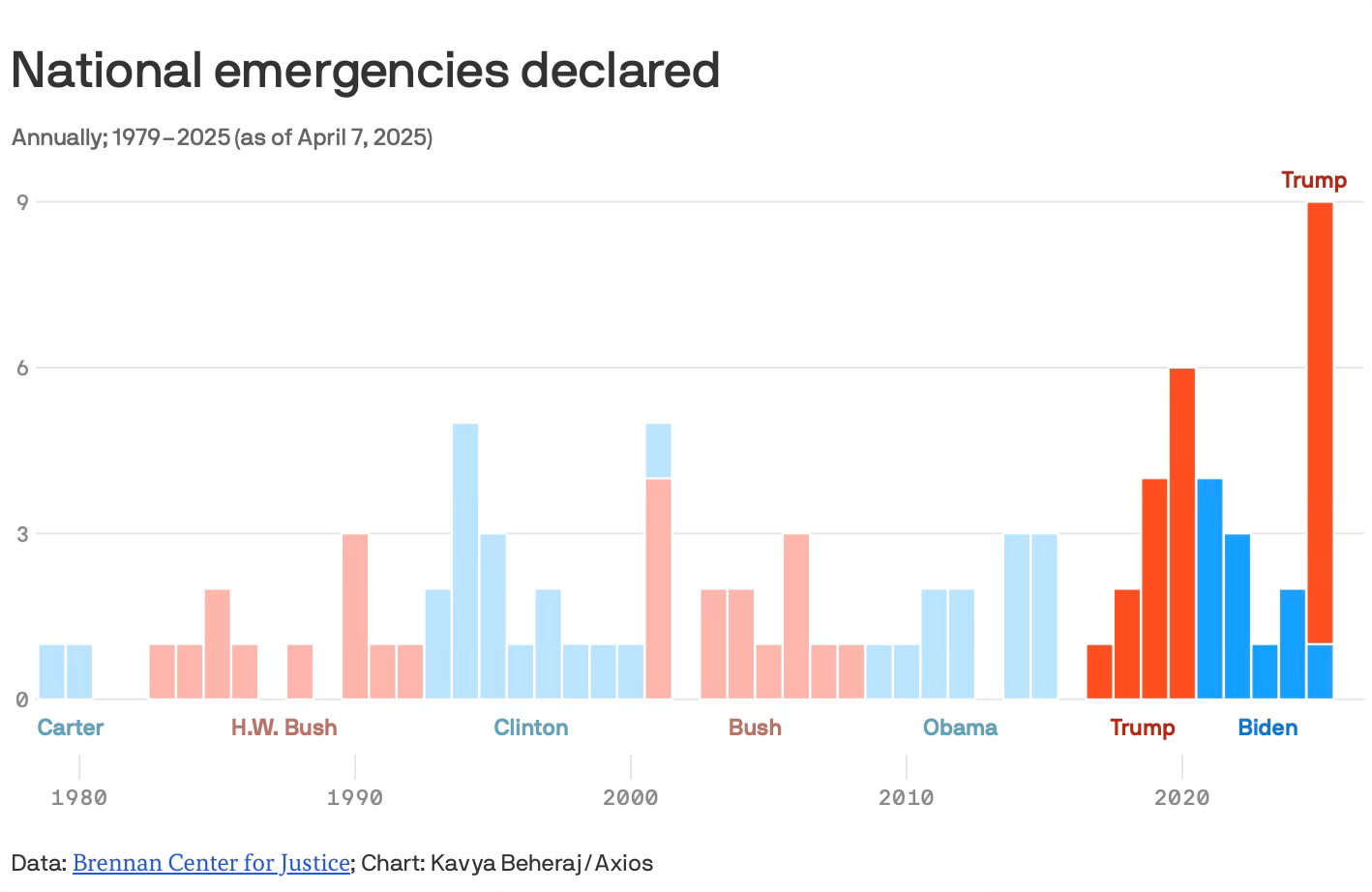
National “Emergencies”

Source: Andrew Sullivan

The Meta-Concern about summary deportation

United States law allows for a quite expedited process to remove people from the country, to deport them. You don’t get a big trial. You don’t get a jury trial. You are moved rapidly because the theory of the case is: First, you don’t have a right to immigrate to the United States, so you have not been deprived of your rights. And secondly, once you’re removed from the United States, you remain a free person. You are sent back to the place you came from or some other place to which you have some connection, and then you’re free to go about your business. You’re not sent to a prison—not sent to a prison for life.

But as I talk about this, the thing that has most gripped my mind with worry and anxiety is not only the effect on the individuals themselves, some of whom may be genuinely innocent, but the effect on those who are sending human beings to a prison without a hearing.

You know, the United States government is now building an apparatus of lawyers, of officials of all kinds, who plan and think every day, How can we apprehend people on American soil and bundle them to a prison without giving them any show of a hearing? They’re building skills and competencies at non-due-process forms of arrest and incarceration that are going to be very hard to limit.

… I remember when I was a Canadian citizen in the United States on a student visa, we were warned if you got into a bar fight, you could theoretically lose your student visa. Now, in those days, that meant that you’d have to go back to Canada and go to school in Canada, which is not the end of the world. In today’s America, that could mean you could lose your student visa and be accused of terrorism, and a bag put over your head and be put into a car and sent to a prison in El Salvador for the rest of your life.

Now, maybe that doesn’t happen in every case. Maybe that doesn’t happen in many cases. But there are people in the employ of the United States government, paid by taxpayers to think about how can we daily broaden the category of people who can be arrested and detained and imprisoned without any showing to any authority at all, without any opportunity to make themselves heard, without any evaluation by an independent fact finder—by any of the things we call due process.

David Frum, introducing a terrific conversation about The Crisis of Due Process with Peter Keisler. (bold added)

Do we really believe in free speech?

Trump 2.0 has been deporting foreign students and others for constitutionally protected speech, using as its current go-to bad-faith excuse that the speech is antisemitic.

The late British-American journalist Christopher Hitchens is a more recent testament to the long tolerance of America toward foreign dissent. Before becoming a U.S. citizen in 2007, Hitchens spent decades as a legal resident—and as one of America’s most acerbic public intellectuals. He accused Ronald Reagan of being “a liar and trickster,” called Israel America’s “chosen surrogate” for “dirty work” and “terrorism,” lambasted Bill Clinton as “almost psychopathically deceitful,” and accused the George W. Bush administration of torture and illegal surveillance. If a student can be deported for writing a campus op-ed critical of Israel, any of Hitchens’ views could have been used to justify deporting him.

Jacob Mchangama, A New McCarthyism

Law and its limits

This isn’t how our system is supposed to work. When a president does the kinds of things Donald Trump is doing, his popularity should sink so low that Congress will feel empowered to stand up to him. Ideally, they would impeach and remove him from office for attempting to govern like an absolute monarch. Short of that, Congress and the courts would be working in tandem to impose and enforce constraints on the wayward executive until the next election strengthens their hand against him.

But none of this is happening—because our system has broken down. The parties are ideologically sorted, with almost no remaining overlap. And Trump has transformed the GOP into a cult of personality more loyal to him personally than to the Republican Party, the other institutions of American democracy, the law, or the Constitution.

In a situation like this, the only thing preventing the president from transforming himself into a tyrant is his own willingness to do it. The courts can tell him to stop. But will he? If he does, democracy survives, at least for the time being. If he doesn’t, democracy is over, at least until it can be reconstituted at some point in the future.

One should never hope to live through a moment of great political precarity like our own. But one tiny compensation is that such moments bring clarity about certain fundamental matters. How has the United States managed to survive for nearly 250 years without evolving into a dictatorship? The answer really may be this simple: By never electing a man willing to do what it takes to effectuate the change.

Until now.

Damon Linker

It’s not clear that the courts will suffice, but the courts — having already, and deservedly, come to treat the Administration as bad-faith, untrustworthy actors — will provide partial deterrence and may help sway public opinion by the cogency (and sometimes, the tartness) of their reasoning.

[I]f you want a really extraordinary example of that, you would look at the order that the Court issued at 1 a.m. on Saturday morning this last weekend, because even though they had held that everybody has to be given meaningful notice before they could be removed in this way, there was credible evidence that the administration was loading people onto buses without giving them anything like the notice that was required. And the ACLU went to the Supreme Court and said, you know, Please, as you listen to the rest of this case and get briefing, stop this from happening.

And if the administration were a normal administration and had compiled a record so far of being a normal administration, the Court would’ve said, Well, I can be confident they’re not going to do this while we are hearing your petition, so let’s give the government a chance to respond. Let’s see what they say, and then we’ll decide what to do. Because, of course, the government wouldn’t spirit these people away while we are actually in the process of deciding whether it can do so on this emergency application you filed. But they knew that the government had done exactly that with the first 200 or so people they had sent away.

The case was before a district judge, and they rushed to secretly get the people out before he could issue an order. And they didn’t quite succeed on that, which is why you have these issues of contempt floating around now. But at 1 a.m., the Court by a 7–2 vote said, Don’t remove anybody in the class represented by these lawyers until you hear otherwise from us.

And that shows that there is a cost to the administration of acting the way it’s acting towards the courts, because if you squander the reputation that governments of both parties have had for credibility and fair dealing and honest brokering with the Court, then they’re going to treat you different because they know they can’t quite trust you.

Peter Keisler with David Frum

Miscellany

The new Republican coalition

Thus we have arrived at a new Republican coalition that looks like this:

  • The tech right, which is essentially a weirder and more evil upgrade of the pro-business libertarians
  • The barstool right, which is a genuinely new constituency made up of hedonistic anti-woke libertarians that has replaced the Christian conservatives
  • The neo-conservative foreign policy hawks, who are the weakest member of the coalition, but can still get what they want on certain issues, as seen with the attacks on the Houthis as well as the saber rattling regarding Greenland

In other words, the Christian influence on actual Republican policy items and their political vision is going to be exceedingly negligible going forward. Sure, Vice President Vance will make an appearance at the March for Life. President Trump will show up to the National Prayer Breakfast. But even when he does acknowledge a Christian event, it often will come loaded with hatred and vile self-aggrandizement, as seen yesterday:

And ultimately when push comes to shove on the policy level, Christian concerns will always be backgrounded or eliminated relative to the priorities of the three above groups, as we have already seen on abortion, marriage, and PEPFAR.

Jake Meador

I originally thought to post this on a Sunday, when my focus is narrower, but it didn’t fit there because I don’t value “religion” for its instrumental partisan-political value.

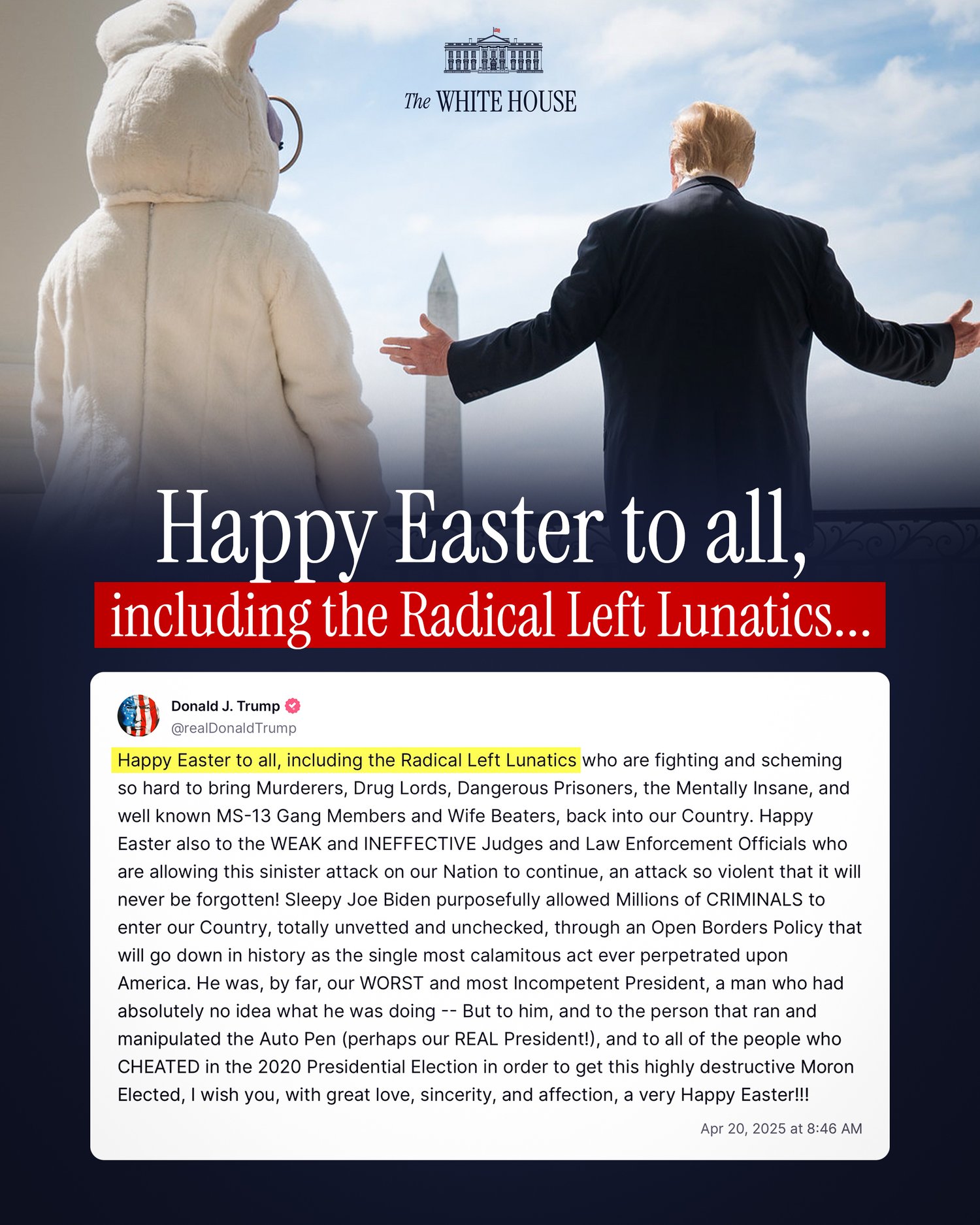
It was a very few years ago when I warned (as had others) “If you don’t like the Religious Right, just wait ‘till you see the irreligious Right.” Well you’ve been seeing them in power for three months now.

Beta-testing tyranny in the Sunshine State

Ron DeSantis walked so that Donald Trump could run. When the time came to formulate a policy response to the woke left, no one mattered more than the governor of Florida.

He tried to ban critical race theory in education. He sharply limited discussion of gender and sexuality in public schools. He tried to limit the free speech of university professors. He retaliated against Disney when it had the audacity to exercise its freedom of speech to criticize the governor’s policies.

And through it all, DeSantis declared that Florida was the place where “woke goes to die.”

In his second term, Trump is a scaled-up version of DeSantis. Every element of the DeSantis model has been deployed against Trump’s ideological enemies …

At first I was optimistic about the anti-woke right. Their free speech argument resonated with me. I’d spent decades litigating free speech cases, after all, and I’d never really seen anything like a mass movement for free expression.

But my optimism quickly faded. In 2021, the anti-woke right embraced a series of state laws that were designed to ban critical race theory. Rather than meet critical race theorists in the marketplace of ideas, the right chose to try to suppress their expression.

A movement that had spent decades fighting speech codes on college campuses was now enacting speech codes of its own. States that once passed laws meant to protect free speech on campus were now passing laws suppressing the discussion of so-called divisive concepts about race.

By this time I was familiar with the right’s authoritarian turn — and getting very worried about it. In 2019, parts of the intellectual right were consumed with a fight over liberalism itself, with the new right arguing that liberal values — freedom of speech and free trade, for example — were hollowing out American culture, creating a nation of atomized individuals who were consumed with self-actualization (and consumption itself) at the expense of family and community.

David French, The Anti-Woke Right and the Free Speech Con

Context

Ironically, the left, now alarmed by the federal government’s intrusive reach [into, say, Harvard], bears direct responsibility for crafting the very legal weapons wielded against the universities it dominates. Almost four decades ago, progressive legislators demanded sweeping amendments to civil rights law, expanding federal oversight over higher education. The sequence of events reveals a cautionary tale of political hubris: progressive confidence that state power would reliably serve their ends overlooked the reality that governmental authority, once unleashed, recognizes no ideological master. Today’s circumstances starkly illustrate how expansive federal control over civil society, originally celebrated by progressives, returns to haunt its architects. The left’s outrage ought to focus not on this particular administration but on its own reckless empowerment of the state.

Yet for all its courage, Harvard’s response stopped short of making the argument that would best protect the values for which it was fighting. It defended the university’s independence without explaining why that independence deserves protection. It invoked values like “pluralism” and “inquiry,” but it did not fully explain why those values are essential to a liberal democratic society. The letter therefore missed an opportunity to articulate what a university is for — not just to students or donors, but to the country. And this matters, because Trump’s attack against this and other universities is not only about the balance of power between universities and the government. It is, at bottom, about the legitimacy of higher education as a public good.

Alan Jacobs, quoting, respectively, John O. McGinnis and Edward Frame

Dangers of debunking

The danger of being a professional exposer of the bogus is that, encountering it so often, one may come in time to cease to believe in the reality it counterfeits.

Alan Jacobs, The Year of Our Lord 1943


Your enemies are not demonic, and they are not all-powerful and the right hasn’t always lost and the left hasn’t always won. But if you convince yourself of that, you give yourselves all sorts of permission to do a lot of stupid and terrible things under the rubric of “Do you know what time it is?”

Jonah Goldberg.

Regarding said “lot of stupid and terrible things,” my failure to call out anything about the current regime does not mean I approve. There’s just too much, and on some of the apparent illegalities I don’t want to abuse my credentials without thinking it through.

I don’t do any of the major social media, but I have two sub-domains of the domain you’re currently reading: (a) You can read most of my reflexive stuff, especially political here. (b) I also post some things on the only social medium I frequent, because people there are quirky, pleasant and real.

Trump rants 3/19/25

The stripping away of illusions

President Trump does not seem to notice or care that if you betray people, or jerk them around, they will revile you. Over the last few weeks, the Europeans have gone from shock to bewilderment to revulsion. This period was for them what 9/11 was for us — the stripping away of illusions, the exposure of an existential threat. The Europeans have realized that America, the nation they thought was their friend, is actually a rogue superpower.

In Canada and Mexico you now win popularity by treating America as your foe. Over the next few years, I predict, Trump will cut a deal with China, doing to Taiwan some version of what he has already done to Ukraine — betray the little guy to suck up to the big guy. Nations across Asia will come to the same conclusion the Europeans have already reached: America is a Judas.

This is not just a Trump problem; America’s whole reputation is shot. I don’t care if Abraham Lincoln himself walked into the White House in 2029, no foreign leader can responsibly trust a nation that is perpetually four years away from electing another authoritarian nihilist.

David Brooks

Anti-Constitutional

An anti-constitutional act is one that rejects the basic premises of constitutionalism. It rejects the premise that sovereignty lies with the people, that ours is a government of limited and enumerated powers and that the officers of that government are bound by law.

The new president has, in just the first two months of his second term, performed a number of illegal and unconstitutional acts. But the defining attribute of his administration thus far is its anti-constitutional orientation. Both of its most aggressive and far-reaching efforts — the impoundment of billions of dollars in congressionally authorized spending and the attempt to realize the president’s promise of mass deportation — rest on fundamentally anti-constitutional assertions of executive authority.

There is much to say about the administration’s decision to seemingly ignore a court order to halt or reroute deportation flights for these people and return them to United States. For now, let’s focus on the Justice Department’s initial defense of the president’s order, in which government lawyers argued the following: “Beyond the statute, the President’s inherent Article II authority is plainly violated by the district court’s order. As a function of his inherent Article II authority to protect the nation, the President may determine that [Tren de Aragua, a criminal gang] represents a significant risk to the United States … and that its members should be summarily removed from this country as part of that threat.”

In other words, according to the Justice Department, the president of the United States has an “inherent” power to summarily deport any accused member of Tren de Aragua (and presumably, any foreign national accused of membership in any gang) without so much as a hearing. What’s more, under this logic, the president can then direct his administration to send that person, without due process, to prison in a foreign country.

This is a claim of sovereign authority. This is a claim that the president has the power to declare a state of exception around a group of people and expel them from the nation — no questions asked. It is anti-constitutional — a negation of the right to be free, in Locke’s words, of “the inconstant, uncertain, unknown, arbitrary will of another man.”

There is nothing in this vision of presidential power that limits it to foreign nationals. Who is to say, under the logic of the Department of Justice, that the president could not do the same to a citizen?

Jamelle Bouie, Trump Has Gone From Unconstitutional to Anti-Constitutional (shared article).

If Congressional Republicans took their oaths of office seriously, they’d be impeaching Trump and removing him from office. He has already destroyed many of our most important international relationships (see David Brooks, above), and by “destroyed,” I mean that we face a long period of repair even if he were removed this afternoon.

Dems and Damon in the same headspace?

[M]y assumptions and style of analysis bring me back again and again to a feeling of fatalism rooted in the conviction that the time to stop Trump was in November 2016, in the immediate aftermath of the January 6 insurrection (via conviction in his second impeachment trial), or in November 2024. I don’t want to succumb to the feeling that it’s already too late to stop him. It’s just that I’m still trying to figure out how to break out of that cul-de-sac.

Damon Linker

How to create a legal banana republic

To collapse the structure of American justice and replace it with a proper banana republic, each pillar holding it up needs to be weakened.

The president spent most of his first two months in office focused on a single pillar: law enforcement. He purged officials at the Justice Department and FBI and replaced them with clownish toadies like Pam Bondi, Kash Patel, and Dan Bongino. That was a sensible way for an authoritarian to prioritize: Of the institutional players I’ve mentioned, corrupt cops and prosecutors can do the most damage. As long as the DOJ is willing to behave like a secret police force, Donald Trump doesn’t need to send Liz Cheney or Mark Milley to prison to make their lives miserable. Investigations are punishment enough.

His Castro-esque speech on Friday to Justice Department officials reflected his priorities. The president labeled political enemies like former special counsel Jack Smith “scum,” claimed that CNN and MSNBC are behaving “illegally” somehow, babbled about the supposedly rigged 2020 election, and insisted that the January 6 defendants he pardoned were “grossly mistreated.” The speech ended with the song “YMCA,” as you might hear at one of his political rallies.

Watching it felt like watching a dog mark his territory.

Nick Catoggio

Trying not to try

I may not have said this before: Trump’s shock and awe assault on norms, perceived enemies, constitutional limitations and the independence of “independent agencies” are so comprehensive, and so blur together in news coverage, that I couldn’t keep up, and couldn’t cogently predict which actions will ultimately be found unlawful, even if I tried.

And I’m trying not to try.

Oh, I still listen to legal podcasts, and they typically cover some of the cases brewing. If you get an opinion from me on a case, I’ll probably be regurgitating some of them, lightly post-processed.

I don’t feel responsible for Trump. He’s something I’m suffering along with everyone else — and my situation means I’m not personally suffering all that much except anxiety for my living descendants.

I don’t think Trump is the eventuality of true conservatism, though he may be the eventuality of the Moral Majority and other Religious Right activism starting in the 70s. I was never on board with them; I’m even less on board with them since becoming an Orthodox Christian; and I’m pleased to contemplate a knife fight between the New, Improved Religious Right (The New Apostolic Reformation! All you loved about the Moral Majority, but now with added Charismatic flakery!) and the Catholic Integralist “Common Good Constitutionalism.”

(Thoughts prompted by my deciding not to read a Wall Street Journal article on a Federal District court ruling against the demolition of USAID.)

Inflicting trauma

Russell Vought, a graduate of Wheaton College, now describes himself as a “Christian nationalist.” He also says:

“We want the bureaucrats to be traumatically affected,” he said. “When they wake up in the morning, we want them to not want to go to work because they are increasingly viewed as the villains. We want their funding to be shut down so that the EPA can’t do all of the rules against our energy industry because they have no bandwidth financially to do so.

“We want to put them in trauma.”

He may be a nationalist, but he puts his Christianity open to serious question by such hateful intentions. (Mark 8:36.) He’s rather unpopular at Wheaton, too, which is much to its credit.

Free speech lies

The president brags about ‘ending censorship’ while describing negative coverage about him as ‘illegal.’

Jonah Goldberg’s subheadline to his recent The Trump Administration’s Free Speech Hypocrisy. The whole (relatively short) thing is worth reading.

Weaponizing government

War is Peace. Freedom is Slavery. Ignorance is Strength. And Donald Trump is “Ending the Weaponization of Government”

David Post, Paul, Weiss Next on the Chopping Block


I suffer more from the humiliations inflicted by my country than from those inflicted on her.

Simone Weil, from a letter to Georges Bernanos.

[N]one of the things that I care about most have ever proven susceptible to systematic exposition.

Alan Jacobs, Breaking Bread With the Dead

I don’t do any of the major social media, but I have two sub-domains of the domain you’re currently reading: (a) You can read most of my reflexive stuff, especially political here. (b) I also post some things on the only social medium I frequent, because people there are quirky, pleasant and real.

Ides of March

Simile of the week

[I] n The New Yorker, Ruth Marcus, who recently resigned from The Washington Post, explained that she and other columnists were confused by the Post owner Jeff Bezos’ new edict that the Opinions section write only in favor of “personal liberties and free markets”: “Without further clarification, we were like dogs that had been fitted with shock collars but had no clue where the invisible fence was.” (Susan Casey, Palm City, Fla.)

Via Frank Bruni

Justice Barrett

After a federal judge blocked the Trump administration’s effort to stop $2 billion in foreign-aid spending, Justice Amy Coney Barrett joined with Chief Justice John Roberts and all three Democratic-appointed justices to leave that order in place. The decision provoked a fiery and warranted dissent from Justice Samuel Alito, as well as some bitter complaints about Barrett from the right-leaning commentariat. It is understandable that conservatives might be nervous about the Supreme Court. For good reason, the names “Stevens,” “Souter,” “Kennedy,” and “O’Connor” echo eerily in the originalist mind. But while she was wrong in this particular case, there is no evidence that Barrett is at risk of joining their ranks. She concurred in Dobbs, the case that overturned Roe; in Students for Fair Admissions, Inc., the case that barred affirmative action; and in Bruen, the case that expanded the protections of the Second Amendment. More important than those outcomes is how she did so. Unlike the judicial nomads of the past, Barrett has a transparent and well-considered approach to the law that explains her actions even when she disappoints. In the case that prompted the criticisms, she was likely motivated by her mistrust of the shadow docket and her dislike of big cases built atop disputed facts. To conclude from this that Barrett was “a mistake”—or, worse, “a DEI hire”—is absurd. Judges are not supposed to play for a team.

National Review email for 3/14/25

Meritocracy is the death of noblesse oblige

In some ways, we’ve just reestablished the old hierarchy rooted in wealth and social status—only the new elites possess greater hubris, because they believe that their status has been won by hard work and talent rather than by birth. The sense that they “deserve” their success for having earned it can make them feel more entitled to the fruits of it, and less called to the spirit of noblesse oblige.

David Brooks, How the Ivy League Broke America

Gold and Bitcoin

I’ve shunned Bitcoin as an investment because it’s useless other than for criming and speculation.

I’ve always shunned gold for similar reasons. Its industrial and jewelry uses are not the reason for it rising to more than $3,000 per troy ounce.

Regarding this Presidency

Trump censorship worse than cancel culture

I’ve been relegating most of my bile toward Trump and his goons to another blog, referenced in the footer below, but this is so patently un-American that it needs the widest exposure I can give it:

[T]his is not about protection from woke professors or ideologically captured deans. It’s protection from direct surveillance by the federal government. The Trump administration has launched a massive, all-of-government, AI-assisted program called “Catch and Revoke,” which will scan every social media comment and anything online they can use to flush out any noncitizen who might be seen as anti-Semitic or anti-Zionist or anti-Israel or indeed just getting on Marco Rubio’s wrong side.

Mahmoud Khalil, a green card holder, has not been accused of a crime. And that is the point. …

JD Vance — who lectured Europeans on free speech online, while his own administration was using AI to police the web for dissent! — said on Fox that a green card holder “doesn’t have an indefinite right to stay in America.”

Andrew Sullivan

In a Feb. 6 editorial, [Purdue] Exponent editors wrote: “And don’t get it twisted: When letters of visa revocation arrive in these students’ mailboxes and federal agents come to Purdue’s campus, no distinction will be made between ‘pro-jihadist’ and pro-Palestinian. Pro-ceasefire will continue to be conflated with ‘antisemitic.’ Anti-war can only now mean ‘pro-Hamas.’ Such twisting of language to be used as a weapon is contrary to the First Amendment, which gives the Exponent its right to exist just as much as it gives the right to students to protest as they see fit. It is the opinion of the Exponent that standing back while our website is potentially used to identify the state’s enemies would be directly against those principles.”

Based in Lafayette, Indiana

The statute cited by the Trump administration for expelling Khalil is very broad — and vague. I don’t think it will be struck down in its entirety, but surely permanent residents are entitled to know with some clarity what behaviors could get them kicked out of the country.

So I think the likeliest outcome is “unconstitutional as applied” to Khalil.

Living in fear

I spoke on Thursday to a university president who told me he was just advised to hire a bodyguard. He said he’d never seen so much fear in the world of higher education that many college presidents are “scared to death” about the Trump administration cutting their funding, Elon Musk unleashing Twitter mobs on them, ICE agents coming on campus, angry email flooding their inboxes, student protests over Gaza and Israel, and worries about being targeted for violence. I was a higher education reporter two decades ago, when universities were widely admired in America, and so I asked this president — what went wrong?

He said presidents and professors had taken too many things for granted — they thought they’d always be seen as a “public good” benefiting society, but came to be seen as elitist and condescending toward regular Americans. And Americans hate a lot of things, but they really hate elites condescending to them. Now we are seeing a big reckoning for higher education — ideological, cultural, financial — driven by Donald Trump and the right.

Patrick Healy, introducing a conversation with M. Gessen, Tressie McMillan Cottom and Bret Stephens.

Just sayin’

Narcissism has a very high correlation with conspicuous consumption in an effort to boost social status and self-esteem. Narcissists are focused on the symbolic, rather than functional, importance of commodities, and the symbolism of the products they purchase is often used to compensate for fragile egos and fluctuating self-esteem.

William T. Cavanaugh, The Uses of Idolatry

Re-assessing

As I have said any number of times, I have voted for the American Solidarity Party in each of the last three election cycles. But in the 2024 election, I was beginning to feel some sympathy for the people who thought Trump was less bad than Kamala Harris in the forced binary choice too many voters feel.

I no longer have any sympathy for that position, although I’m obviously working with the benefit of hindsight: Ready, Fire, Aim — over and over again ad infinitum. This is no way to run anything, quite apart from the autocracy.


I suffer more from the humiliations inflicted by my country than from those inflicted on her.

Simone Weil, from a letter to Georges Bernanos.

[N]one of the things that I care about most have ever proven susceptible to systematic exposition.

Alan Jacobs, Breaking Bread With the Dead

I don’t do any of the major social media, but I have two sub-domains of the domain you’re currently reading: (a) You can read most of my reflexive stuff, especially political here. (b) I also post some things on the only social medium I frequent, because people there are quirky, pleasant and real.

Thursday, 1/16/25

American Meritocracy

For most of my professional career, I’ve been a skeptic of the American meritocracy. Not a skeptic of the basic idea that competent and intelligent people should fill positions requiring competence and intelligence, but a skeptic of the idea that a system of frantic adolescent hoop-jumping and résumé-building, designed to skim the smartest kids from every region and segregate them from the rest of society for college and beyond, has actually created an elite that’s more responsible, effective, morally grounded and genuinely cosmopolitan than the more quasi-aristocratic upper class that it displaced.

Ross Douthat

NAR

I’ve spent most of my life thinking that I was well-informed on the American religious scene — especially Evangelicalism. For a long time, that self-regard may have been warranted.

No more. I recently passed the 27th anniversary of my reception into the Orthodox Christian faith. And it may be time to admit that I’ve lost track of what’s going on in the American Evangelical world.

Stephanie McCrummen of the Atlantic has recently published two articles on the New Apostolic Reformation (NAR) and those who share its outlook with or without conscious acknowledgement of NAR.

I’ve had my eyes on NAR for a few years, but here’s where McCrummen floored me:

What was happening in the barn in Lancaster County did not represent some fringe of American Christianity, but rather what much of the faith is becoming. A shift is under way, one that scholars have been tracking for years and that has become startlingly visible with the rise of Trumpism. At this point, tens of millions of believers—about 40 percent of American Christians, including Catholics, according to a recent Denison University survey—are embracing an alluring, charismatic movement that has little use for religious pluralism, individual rights, or constitutional democracy.

What she’s describing in NAR That 40% figure got my back up as absurd until I realized that I was basing it on the typical doctrinal commitments of Evangelicalism more than 27 years ago. In fact, it’s been 45 years since I unequivocally identified as Evangelical, being for 18 subsequent years (before my Orthodox reception) only Evangelical-adjacent.

So I can’t say she’s wrong. I also can’t say she’s right, but if she’s right, it would go fairly far in explaining the great Evangelical murmuration from “character matters” (Bill Clinton) to, in effect, “he may be a rapist sonofabitch but he’s our rapist sonofabitch.” So the NAR “prophets” have spoken.

Metaphors: Choose Wisely

Metaphors matter. They can elucidate, but they can also elide and confuse. For a long time, the conservative metaphor for the Left’s tactics has been “slippery slope.” It’s a bad metaphor. It suggests that radical efforts to harm American families are all just the result of the gravitational pull of the earth, or the inevitability of logical progression. That isn’t the case. The tactics used against American families are far more clever. And they invariably involve a “Bait and Switch.” Sell the American people on a principle we can all agree on: “inclusivity,” “tolerance” and “anti-bullying.” Then, smuggle in an entirely different program under its name. That is how gender ideology ended up part of the mandatory “anti-bullying” curriculum, as opposed to the “sex education curriculum,” which is subject to parental opt out.

Abigail Shrier

Greenland, Canada and the Canal

When an authoritarian-minded leader poised to control the world’s most powerful military begins overt saber-rattling against neighbors, the most obvious and important question to ask is whether he intends to follow through. That question, unfortunately, is difficult to answer. On the one hand, Trump almost certainly has no plan, or even concepts of a plan, to launch a hemispheric war. Seizing the uncontrolled edges of the North American continent makes sense in the board game Risk, but it has very little logic in any real-world scenario.

On the other hand, Trump constantly generated wild ideas during his first term, only for the traditional Republicans in his orbit to distract or foil him, with the result that the world never found out how serious he was about them. This time around, one of his highest priorities has been to make sure his incoming administration is free of officials whose professionalism or loyalty to the Constitution would put them at risk of violating their loyalty to Trump. We cannot simply assume that Trump’s most harebrained schemes will fizzle.

An easier question to answer is why Trump keeps uttering these threats. One reason is that he seems to sincerely believe that strong countries have the right to bully weaker ones. Trump has long insisted that the United States should seize smaller countries’ natural resources, and that American allies should be paying us protection money, as if they were shopkeepers and America were a mob boss.

Jonathan Chait, Donald Trump’s Performative Imperialism

We’ll know he’s a Christian by his blasphemy

So let’s run the race marked out for us. Let’s fix our eyes on Old Glory and all she represents. Let’s fix our eyes on this land of heroes and let their courage inspire. And let’s fix our eyes on the author and perfecter of our faith and our freedom and never forget that where the spirit of the Lord is, there is freedom. That means freedom always wins.

Mike Pence, at the 2020 Republican National Convention, via William T. Cavanaugh, The Uses of Idolatry. Compare this the Hebrews 12:1-2 and ask yourself “just how low is the bar for being considered a devout Christian Republican?”

Cui bono?

Cui bono? Whom did this new story serve? Who benefits from a world of consequence-free sex, weak ties, the putting off of childbearing and family? Today, the pharmaceutical and medical industries benefit, by selling decades-long prescriptions for contraceptives, and then various attempts at ART [Assisted Reproductive Technology] later on. Corporations and employers benefit: they gain a new labor force unsaddled by commitments to family, place, or other less-than-profitable concerns.

Christine Emba quoted by Alan Jacobs

Pathetic wankers get their day at SCOTUS

On Wednesday America’s Supreme Court examined a Texas law mandating age verification for websites where a third or more of the material is “sexual” and “harmful to minors”. A district judge blocked the law, which is similar to measures recently passed by 18 other states, but an appeals court reinstated it last year.

A trade association of adult entertainers, known as the Free Speech Coalition, is arguing that the law restricts adult Texans’ access to protected speech and violates the First Amendment. The Supreme Court struck down a similar law (the federal Child Online Protection Act) in 2004, the plaintiffs point out. Texas’s defence relies on a high-court ruling from 1968 that upheld a law banning erotic bookstores from selling their wares to children. But online commerce, the plaintiffs retort, is a world apart: adults may be reluctant to reveal their identities to porn sites because they worry about “identity thieves and extortionists”.

Economist World News in Brief for 1/15/25.

That last sentence should be a real eye-opener. Paraphrasing: “We’re such pathetic wankers that we do business with identity thieves and extortionists. We have a right to be pathetic wankers, so to hell with the kids who get exposed.”

That’s not the whole case the “Free Speech Coalition” could make against the Texas law (and about the logic of the 5th U.S. Circuit Court of Appeals) but it’s got to be among the most risible.

Glimmers

Woke retreat

Recently, [Mark] Zuckerberg ordered tampon machines to be taken out of men’s bathrooms in all of Meta’s offices. Commenter Richard Hanania said,

This is like pulling down the statue of Saddam. Now you know wokeness is dead.

… Nobody could have imagined that a vulgar, orange billionaire from New York and an anti-woke South African immigrant in Silicon Valley might be the champions Europe needs to find its own courage and Make Europe Great Again. But then again, despite the false faith of the left-wing ideologues and their bureaucracies, the march of history follows no predictable path.

Rod Dreher

Cabinet of the Cancelled

[F]or those of us who have run afoul of the Left’s dogma, particularly in public, it’s harder to worry over the Trump cabinet’s failure to harmonize with the views of credentialed bureaucrats.

Abigail Shrier, Trump’s ‘Cabinet of the Cancelled’

Devouring one another

Look no further than MAGA mega-toady Steve Bannon declaring war on MAGA mega-toady Elon Musk.

Bannon has had a bee in his bonnet about Musk for the better part of a month, ever since Elon went to the mat in support of H-1B visas for highly skilled immigrants. “He is a truly evil guy, a very bad guy. I made it my personal thing to take this guy down,” he told an Italian newspaper recently, vowing to have Musk “run out of here by Inauguration Day.” Turning to Silicon Valley’s habit of hiring migrants instead of Americans, Bannon took the gloves off—and sounded a little, well, woke in the process:

“No blacks or Hispanics have any of these jobs or any access to these jobs,” Bannon said.

“Peter Thiel, David Sachs, Elon Musk, are all white South Africans,” Bannon observed. “He should go back to South Africa. Why do we have South Africans, the most racist people on earth, white South Africans, we have them making any comments at all on what goes on in the United States?”

Well then.

Pity poor Elon, who spent Christmas week defending Indian engineers from Groypers calling them sewage-drinking subhumans only to have Groyper-adjacent nationalist Steve Bannon turn around and accuse him of being racist. The rift over immigration policy developing between red-pilled tech bros, color-blind nativist ideologues, and gutter white supremacists will be a fun one to follow over the next four years.

But it won’t be the only one. There are numerous rifts opening on the right as Donald Trump prepares to take office. The GOP caught the proverbial car on Election Day and now each of its factions wants to drive; watching them tear each other apart will be one of the small silver linings of a second Trump presidency.

Nick Catoggio


I suffer more from the humiliations inflicted by my country than from those inflicted on her.

Simone Weil, from a letter to Georges Bernanos.

[N]one of the things that I care about most have ever proven susceptible to systematic exposition.

Alan Jacobs, Breaking Bread With the Dead

I don’t do any of the major social media, but I have two sub-domains of the domain you’re currently reading: (a) You can read most of my reflexive stuff, especially political here. (b) I also post some things on the only social medium I frequent, because people there are quirky, pleasant and real.

Black Friday?

For how much longer will “Black Friday” remain a thing when its sales started at least over the last weekend?

Miscellany

Nellie Bowles gives thanks

  • After watching a funny short video that shows Joe Biden seeming to wander into an Amazon rainforest, I realized to my shock that Joe Biden is still there. He’s still standing at podiums looking translucent and confused, but technically upright. When I see him, every fiber in my body wants to put a blanket over his shoulders. And so this year, I’m thankful for our presumed president: Dr. Jill Biden.
  • I’m thankful for Kamala Harris’s campaign. First of all, they raised $1.5 billion dollars and spent it in 15 weeks. It sounds wasteful. But in fact, taking $1.5 billion dollars from some of America’s silliest people and then giving it away to hardworking ones is what I call distributive justice. Just think of the caterers who had to work around literally dozens of Kamala staff’s allergies and gluten intolerances. They deserved that cash. Think of the event planners, young women who want to save up for their own extravagant eco resort weddings. Kamala gave them a shot at Hawaii instead of the Dominican Republic. Think of the driver of that abortion van clocking overtime during the DNC who just told himself “eyes ahead, not your problem, eyes ahead.” So many worthy Americans.
  • I’m thankful this year for the First Amendment. I never understood how precious it was, or how rare, but watching European countries send cops to people’s houses for barely controversial Facebook posts has shocked me. I know we have European readers and writers, so please know I stand with you, and I hope you don’t take it personally when I say I’m so glad our forefathers fled your lands and burned the boats. We’ll do our best now to save you through a process that I can only describe as colonialism (Free Press expansion into Europe). God bless America. And Little America, as we’ll call England!

TGIF

How the Ivy League Broke America

James Conant and his colleagues dreamed of building a world with a lot of class-mixing and relative social comity; we ended up with a world of rigid caste lines and pervasive cultural and political war. Conant dreamed of a nation ruled by brilliant leaders. We ended up with President Trump.

David Brooks, How the Ivy League Broke America

Let’s blame Occam’s nominalism

Ideas, he said, was not a work of philosophy but “an intuition of a situation,” namely, a situation in which the “world . . . has lost its center.” Weaver traced that loss back to the rise of nominalism in the twelfth century, a familiar pedigree that is both accurate and comical. It is accurate because the modern world—a world deeply shaped by a commitment to scientific rationality—does have a root in the disabusing speculations of nominalism. It is comical because to locate the source of our present difficulties on so distant and so elevated a plane is simply to underscore our impotence. If William of Occam is responsible for what’s wrong with the world, there’s not much we can do about it.

Richard M. Weaver, Ideas Have Consequences

Understanding Russia (a little better)

Finding a way in which Russia could make a genuine contribution to the “common good of mankind” was a key objective of Russian intellectuals at this time. Some concluded that the only way of doing so was by deepening the process of Westernization. Others felt that Russia could never contribute original ideas to humanity if all it did was copy the West. Thus was born the split between the Westernizers and the Slavophiles. It is necessary to bear in mind, however, that the Westernizers and the Slavophiles had the same objective—to enable Russia to contribute to universal progress.

Paul Robinson, Russian Conservatism

Politics

Perfidious political coin

Challenged by a letter to the editor for his former column, Liel Leibovitz gives nary an inch:

Never do I argue that the perfidy which is our political coin emanates exclusively from one side of the political aisle. But any dispassionate student of American history, observing the chaos of the previous decade, will emerge with a rather clear picture and a rather clear culprit.

It was the omnivorous machine, controlled by Barack Obama’s Democratic Party but now incorporating everything from our newsrooms to our classrooms to our boardrooms, that spread the wild conspiracy that America’s forty-fifth president was a Russian asset. It was the same machine that refused to repudiate this story, even when the facts were available and clear. It was the same machine that harnessed law enforcement agencies to harass and intimidate public servants, and that pursued the flimsiest of legal pretexts to pursue political enemies.

This sordid history doesn’t lack documentation. Nor is it, sadly, history: When fifty-one former heads of our intelligence community, including several retired heads of the Central Intelligence Agency, vow that the “rumor” concerning Hunter Biden’s laptop is misinformation peddled by Moscow, only to remain completely silent when said laptop appears in court and confirms precisely what anyone willing to listen and think had known all along—namely, that Hunter Biden Jr., and most likely his father as well, have had some questionable dealings for fun and profit with Ukrainian magnates and other shady characters—then you know we’re in Screwtape territory.

None of this is to suggest that the only morally commendable solution is a vote for Donald J. Trump come November, or, for that matter, that the Republican candidate is an unblemished moralist worthy of the priesthood. That, of course, is equally untrue. But, as a great American once said, the bastards changed the rules and they didn’t tell us. Now that we know, though, we’ve but one obligation: Fight back, fight hard, and win.

I don’t agree with his conclusion about our “obligation” (my convictions are with Paul Kingsnorth’s Moses Option on that), but his premises seem sound — which is why, in the end, I endure the Election of Donald Trump with substantial equanimity.

On the oddly disparate cabinet picks

Ross Douthat, Three Theories of the Trump Cabinet (unlocked). Douthat seldom disappoints me, and this wasn’t one of those occasions.

Destruction in the wake

It has long been clear that the rise of Donald J. Trump meant the end of the Republican Party as we once knew it.

It has belatedly become clear that his rise may have meant the end of the Democratic Party as we knew it as well.

After three Trump elections, almost every traditional Democratic constituency has swung to the right. In fact, Mr. Trump has made larger gains among Black, Hispanic, Asian American and young voters in his three campaigns since 2016 than he has among white voters without a college degree, according to New York Times estimates. In each case, Mr. Trump fared better than any Republican in decades.

Nate Cohn, How Democrats Lost Their Base and Their Message

If you have any appreciation at all for silver linings, surely you should appreciate that Trump was not, relatively speaking, elected along racial lines.

The Very Online Culture Wars

Whether it calls itself the Right or the Left, the real content of all online politics is the internet itself, and the arc of online politics always bends towards a bunch of strangers who spend their entire lives on the computer demanding that you publicly denounce your friends.

… To pun on Wilde, it would take a heart of stone not to laugh at the ritual outrage performed by the [Very Online Left] in the wake of the 2024 election.

Insofar as the election was an affirmation of the [Very Online Right], I find much less to applaud …

Pretending to ourselves that Trump II represents a culture war victory threatens to render traditionalist accounts of the true, the good, and the beautiful incoherent …

Is there anything truly conservative about Trump II? Can a party whose convention platforms an unrepentant stripper with a face tattoo be conservative? Can a party that valorizes a techno narcissist who has proudly fathered twelve children, one of whom is named X Æ A-Xii and another of whom is named Techno Mechanicus, with three different mothers still pretend to be conservative? And this is not even to mention Trump himself, whose public persona is built on violations of nearly every verse from Proverbs and the Sermon on the Mount. The VOR represents the Silicon Valley mantra “move fast and break things” with more enthusiasm than it does any of the principles articulated by Kirk.

There is no place in the [Very Online Right] for Kirk’s elaboration of the conservative principle “that there exists an enduring moral order” and that this order “is made for man, and man is made for it: human nature is a constant, and moral truths are permanent”.

Matt Stewart, The Very Online Culture Wars

Kudos to Seth Moulton, truth-teller

Here we are calling Republicans weird, and we’re the party that makes people put pronouns in their email signature

Rep. Seth Moulton, (D. Mass) via this Times article (paywall)

Now is the FIRE’s hour

Trump’s team has announced an aggressive agenda to do exactly what his critics called for: use the power of government to attach expression they think is false, misleading, disloyal, or otherwise bad. The Trumpists want the FCC to assert more power over cable and the internet and use that power to punish enemies. They want the government to use its power to attack journalists they hate. They want to protect protestors they agree with, however violent they were, but use state force and authority and deportation to suppress protests they don’t agree with. The Trumpists have a long record of abuse of defamation lawsuits and are aligned with Federalist Society luminaries who want to make it easier for the rich and powerful to sue for defamation. Trumpists want to impose ideological requirement for vast numbers of civil servants and to investigate government employees for disloyalty. In short, they want to flex government power to punish speech they don’t like.

… Private actors, emboldened, may escalate violence and abusive litigation. Norms and traditions and values, we’ve seen, can fail.

Popehat


[H]istory is well and truly back. Even Francis Fukuyama agrees.

Mary Harrington at UnHerd

I suffer more from the humiliations inflicted by my country than from those inflicted on her.

Simone Weil, from a letter to Georges Bernanos.

I don’t do any of the major social media, but I have two sub-domains of the domain you’re currently reading: (a) You can read most of my reflexive stuff, especially political here. (b) I also post some things on the only social medium I frequent, because people there are quirky, pleasant and real.