Sunday 12/8/24

Yesterday was the 10th anniversary of my parish’s first Divine Liturgy in our purpose-built building. I have a handy way of remembering the date.

Two living churches

In England, the two kinds of churches I do still see filling appear rather different. In a local baptist church the pews are crammed with young families having powerful, intimate encounters with their faith. Something immediate is being accommodated. I remember seeing a guy fresh from a building site, dusty with a high viz jacket. Family with him, arms outstretched, tears on his cheeks. It would bring a lump to your throat.

Then I see my own parish, hushed and seemingly antique, but with more young people than ever before. In both I see people who look spiritually fed. Then out there in the wider audit of emptying churches there seems often to be a sense of weariness, or simple lack of oomph. There will be exceptions to this last sentence, I have no sneer in writing it. I sometimes go sit in those congregations simply out of love for the yards they’ve put in as parishioners. Solidarity, a hand held across the fence to a fellow worker bee.

It seems, from a distance, the two churches are very different, and I am well aware of the theological wrestles that create distance. What I don’t go along with is the notion that one is completely improvisational and unencumbered by tradition, and the other set-and-only-set in a kind of endless, ancient theatre or lifeless ceremony. Dame Mary Douglas, a cultural anthropologist, encapsulates something she calls the ‘anti-ritualist’ approach:

The confirmed anti-ritualist mistrusts external expression. He values a man’s inner convictions. Spontaneous speech that flows from the heart, unpremeditated, irregular in form, even somewhat incoherent, is good because it bears witness to the speaker’s real intentions.

I think actually, ritual is inevitable, even when tacit. We are ceremony people, no matter how spontaneous we think we may be. There will be a loved formula, a linguistic groove long established, a shared initiatory language in common for any community that lasts. It’s about the dynamic counterpoints of tradition and innovation. We may have done away with the candles, offerings and holy smoke, but simply to feel safe repetition will always have value.

Martin Shaw. I finally was able to begin reading Rituals of Spontaneity, which (if I’m not sorely mistaken) elaborates the folly of Christians dispensing with ritual.

Puritan Phobia

The Puritans quickly developed a phobia about ritual, going so far as to resist “rote” recitation of the Lord’s Prayer:

Henry’s Method culminates with his most fascinating phrase-collection of all, “A Paraphrase on the Lord’s Prayer, in Scripture Expressions.” Christ’s own form of prayer given to his disciples had long been a thorn in Puritans’ sides, to be plucked out by being understood as only a general guideline. Henry’s strategy is to neutralize the prayer’s form in a pages of verses elaborating on the one phrase “Our Father, who art in similar method; he provides, for instance, an amazing two and a half Heaven” (MP, 163-65), a general topos, he says, from which begins. Many editions of the Method were printed as Henry intended, interleaved with one blank page between each printed one, to enable the reader to pen in his own collection of phrases to supplement Henry’s own. Like Bunyan’s demand for scrupulous sincerity, Henry’s lists and blank pages, figures of accumulation and abstraction, combine literally to efface the Lord’s Prayer and erase it from Dissenting practice.

Between the ledgerlike pages of Henry’s collected phrases and the blank sheets for scribbled lists of readers’ personal prayer phrases, one senses of variety of fears: that without this careful accounting, the business might go bankrupt, that in the copious, nervous quoting from God’s word to talk and talk and talk to God, God might not listen or respond at all.

Lori Branch, Rituals of Spontaneity

Best listicle ever?

I have three lists of Maxims or such that I review regularly. This one, which I think was embedded in a longer blog post, seems more precious (in the good sense, not the snarky sense) every time I read it:

  1. First, live as though in the coming of Jesus Christ, the Kingdom of God has been inaugurated into the world and the outcome of history has already been determined. (Quit worrying)
  2. Second, love people as the very image of God and resist the temptation to improve them.
  3. Third, refuse to make economics the basis of your life. Your job is not even of secondary importance.
  4. Fourth, quit arguing about politics as though the political realm were the answer to the world’s problems. It gives it power that is not legitimate and enables a project that is anti-God.
  5. Fifth, learn to love your enemies. God did not place them in the world for us to fix or eliminate. If possible, refrain from violence.
  6. Sixth, raise the taking of human life to a matter of prime importance and refuse to accept violence as a means to peace. Every single life is a vast and irreplaceable treasure.
  7. Seventh, cultivate contentment rather than pleasure. It will help you consume less and free you from slavery to your economic masters.
  8. Eighth, as much as possible, think small. You are not in charge of the world. Love what is local, at hand, personal, intimate, unique, and natural. It’s a preference that matters.
  9. Ninth, learn another language. Very few things are better at teaching you about who you are not.
  10. Tenth, be thankful for everything, remembering that the world we live in and everything in it belongs to God.

A catholic vision of Christian faith

When I first opened A Severe Mercy nearly 20 years ago I had needed a vision of Christian faith that was unapologetically devoted to Christian doctrine without being materialistic, more American than Christian, and completely uprooted from history. Up to that point, the expressions of Christianity I had encountered were simply different forms of sectarian faith—a vapid progressivism or a parochial and narrow fundamentalism. Vanauken gave me catholicity ….

Jake Meador (hyperlink added)

Delusion

Christians can give their bodies over to the nation-state while continuing to express in textual terms that worship belongs to God alone.

William T. Cavanaugh, The Uses of Idolatry

Flipping the Script

On regular Christian campuses, there “are higher expectations for presidents than members of the faculty, and members of the faculty live with greater expectations than students,” noted religious-liberty activist David French, writing at The Dispatch. “Liberty flipped this script. The president lived life with greater freedom than his students or his faculty. The message sent was distinctly unbiblical – that some Christian leaders can discard integrity provided their other qualifications, from family name to fund-raising prowess, provided sufficient additional benefit.”

Terry Mattingly, What Next for Liberty University? Press Should Watch Future Campus Worship Services (September 2020)

Know-it-alls

In practical terms, the Reformed commitment to the theological significance of everyday life led to the development of something like Protestant metaphysics, Protestant epistemology, Protestant science, Protestant politics, Protestant social and economic theory, Protestant art, and Protestant poetics.19 The development of these Reformed spheres of intellectual and cultural activity never occurred without substantial influence from sources not specifically religious. In Switzerland, the southern German regions, Hungary, Holland, and the British Isles, the Reformed perspective could be used to mask economic or political aggression. More commonly, it emerged from a complicated mix of sacred and secular motives. Yet wherever sufficient Reformed strength existed, the assumption also existed that biblical Christianity had something fairly definite to say about everything.

Mark A. Noll, America’s God

Theology isn’t all deductive

Catholics find it impossible to theologize without deductive reasoning—a characteristic shared by virtually all Western Christians…

Dr. Eugenia Scarvelis Constantinou, Thinking Orthodox


Sometimes this whole 2000-year-old faith seems like a living koan. Chew on this until you are enlightened. Keep walking.

Paul Kingsnorth

You can read most of my more impromptu stuff here and here (both of them cathartic venting, especially political) and here (the only social medium I frequent, because people there are quirky, pleasant and real). All should work in your RSS aggregator, like Feedly or Reeder, should you want to make a habit of it.

Hal Lindsey, Nihilist Cathedral (and more)

Hal Lindsey

… it is appointed for men to die once, but after this the judgment …

Hebrews 9:27

Hal Lindsey’s appointed time came November 25.

Lindsey was the author of the notorious 1970 The Late Great Planet Earth.

Lindsey seemingly came by his kookery honestly, having studied at the feet of “Colonel” R.B. Thieme, Jr. (I once heard Thieme say that “the ovum is the only sinless cell in the human body”) and then pursuing a degree at Dallas Theological Seminary, a hotbed of dispensational premillenialism that was inordinately esteemed by Evangelicals back in the beforetimes.

Lindsey’s influence was such that his eschatology, or understanding of the Last Days, virtually became a part of accepted Christian orthodoxy for much of the church. Christians who did not understand the Trinity or know the Nicene Creed knew a lot about Lindsey’s End Times scenarios.

Mark Tooley, Juicy Ecumenism.

Tooley is correct — and though I had been heavily exposed to that genre of eschatological flakiness starting around 1964, Lindsey dialed it up to 11 in the Evangelical world.

By the end of the ’70s, having providentially discovered that dispensationalism was the worst and most novel of four basic Protestant eschatological schemes, I could bear its imposition as Evangelical dogma no longer. I left frank Evangelicalism for the Christian Reformed Church, which at least locally turned out to be Evangelical-adjacent in the pews because Lindseyist preoccupations were so contagious. It took even me a long time to realize that I, though born in 1948, was not particularly unlikely to celebrate my 40th birthday in the land of the living.

Well, apparently the novelty wore off while I wasn’t looking any more:

In the midst of his professional success, Lindsey’s personal life suffered. His first marriage failed around the time of his conversion. He got divorced and remarried to Jan Houghton, who worked alongside him at Campus Crusade and appeared with Lindsey in author photos until the mid-1980s, when an updated edition of Late Great Planet Earth used a different picture and removed her name from the dedication.

Lindsey’s second divorce—and subsequent third and fourth marriages—raised questions about his character for many evangelicals. But the biggest blow to his reputation was his failed predictions.

In his early books, Lindsey said all of the Bible’s prophecy would likely be fulfilled “within forty years or so of 1948,” when the nation of Israel was founded, based on his typological reading of Matthew 24. He qualified his prediction, giving himself an escape hatch with phrases like “or so.” But few readers came away with the impression that Lindsey was unsure whether Christ would return by 1988.

When 1988 came and went and the Soviet Union, one of the main objects of dispensational analyses, ultimately collapsed, Lindsey was forced to defend himself and his end times speculation. He directed his book The Road to Holocaust at evangelicals and fellow conservatives in 1989, making the case for the continued relevance of dispensationalist interpretations of Scripture and current events. 

While he was dismissed and marginalized by many evangelicals, Lindsey continued to see commercial success. Retooling his analysis for a post–Cold War geopolitics, he returned to bestseller lists with Planet Earth Two Thousand AD: Will Mankind Survive? in 1994.

That Hal Lindsey did not repent and shut up after 1988 came and went without a “Rapture” is one of life’s least vexing mysteries: he made beaucoups bucks off his spiritual thalidomide.

I hate dispensational premillenialism with a passion. I’d be more relieved at learning that it now is a bit passé were the Evangelical world in North American not running after political power instead now.

His appointed time having come, I strain to pray mercy on his soul at the judgment, but I do so anyway, as I would wish others to do for me.

One more thing

Here’s a suggestion about the influence of Hal Lindsey that had not occurred to me:

In retrospective (sic), Hal Lindsey’s popularity was a major harbinger of the decline of denominations. No longer were they the definitive teaching source for their flocks. Emerging new post denominational evangelicalism, with its own books, radio stations, television and entrepreneurial personalities displaced the old denominations and their traditional teachings.

The most favorable interpretation of Lindsey’s work is that hopefully many who read him or were influenced by him at least were drawn closer to God, even if amid much confusion and foreboding. It’s tempting to find in the Bible a direct explanation for disturbing events. It’s harder to live in the mystery of trusting God without knowing all His plans.

Mark Tooley, Juicy Ecumenism.

A place for perverse prayer

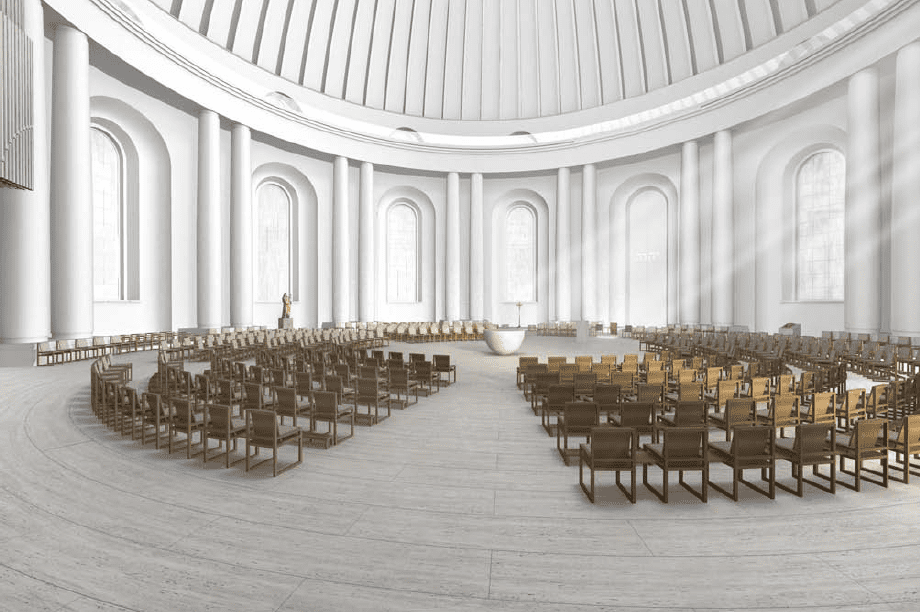
Continuing my drumbeat of dread and decline, the dead German Roman Catholic Church has a new Cathedral in Berlin — a whited sepulchre signaling fealty to something nihilistic:

Rod Dreher, writing for the European Conservative, is duly appalled:

There is scarcely anything visibly Christian about the space. Aesthetically and symbolically, it invites visitors to worship the sacred Nothing. It is a “clean, well-lighted place,” in the nihilistic sense of Ernest Hemingway’s 1933 short story of the same name. It is a hauntingly spare tale about an elderly, suicidal Spanish man who frequents a certain café, described in the story’s title, seeking refuge from nihilism. In the tale, an older waiter in the café reflects on why the clean, well-lighted café drew men like the suicidal customer:

What did he fear? It was not a fear or dread. It was a nothing that he knew too well. It was all a nothing and a man was a nothing too. It was only that and light was all it needed and a certain cleanness and order. Some lived in it and never felt it but he knew it all was nada y pues nada y nada y pues nada. Our nada who art in nada, nada be thy name thy kingdom nada thy will be nada in nada as it is in nada. Give us this nada our daily nada and nada us our nada as we nada our nadas and nada us not into nada but deliver us from nada; pues nada. Hail nothing full of nothing, nothing is with thee.

This is the perverse prayer one imagines visitors to the bleached-out St. Hedwig’s will pray, if they pray at all.

Devolution

It is not an exaggeration to claim that this nineteenth-century Protestant evangelicalism differed from the religion of the Protestant Reformation as much as sixteenth-century Reformation Protestantism differed from the Roman Catholic theology from which it emerged.

Mark A. Noll, America’s God

How many times can such devolutionary leaps happen before the result is not authentically Christian?

Spontaneity is the new requirement

Speaking of which:

I laughed out loud, paused the podcast where I heard the phrase, and wrote down Rituals of Spontaneity, which now sits in my book queue to complement America’s God and The Democratization of American Christianity. Although none of them writes as well as Kevin D. Williamson, I’m more interested in the religious aspects than in the prospect of President Dwayne Elizondo Mountain Dew Camacho in 2028.

Elastic “religion”

Taylor is not unaware that the term “religion” is fraught, but, as we have seen, he thinks the reason it defies definition is that its different manifestations are so diverse. But how do we know that these different manifestations are all “religion” to begin with? Taylor says “the phenomena we are tempted to call religious are so tremendously varied in human life.”175 But why are we “tempted” to call them all religious if they are so varied? More to the point, why do we want to call some things religious and some other, very similar things nonreligious? What makes nontheistic Buddhist rituals “religious,” by Taylor own reckoning, but rituals surrounding the proper treatment of the American flag—very precise rules for folding, displaying, venerating, and keeping it from touching the ground or being otherwise “desecrated”—are not? Taylor uses “religion” broadly when he wants to include Buddhism, but narrowly when he wants to exclude nationalism.

William T. Cavanaugh, The Uses of Idolatry

Migration of the Holy

After only a few years, America’s religious population, with Protestant evangelicals in the forefront, began in similar fashion to tailor their religious projects to fit the language of republicanism. The implications for both politics and religion from this tailoring were momentous. In the immediate context, the argument against Parliament acquired the emotive force of revival. In the longer term, religious values migrated along with religious terms into the political speech and so changed political values. But the migration also moved the other way: a religious language put to political use took on political values that altered the substance of religion.

Mark A. Noll, America’s God


Sometimes this whole 2000-year-old faith seems like a living koan. Chew on this until you are enlightened. Keep walking.

Paul Kingsnorth

You can read most of my more impromptu stuff here and here (both of them cathartic venting, especially political) and here (the only social medium I frequent, because people there are quirky, pleasant and real). All should work in your RSS aggregator, like Feedly or Reeder, should you want to make a habit of it.

Sunday, 6/9/24

Ayan Hirsi Ali update

Sorry if the headline is misleading; I really don’t know more about Ayan Hirsi Ali’s conversion from “New Atheist” to some kind of Christian. But I have been thinking about what I do know.

I listened this week to a predictably futile, moderated public discussion between New Atheist Richard Dawkins and his friend, lapsed New Atheist Ayaan Hirsi Ali. If you, too, want to waste some time on something that seems like the sort of thing that smart people should listen to, break a leg.

Ali said one thing in the discussion that I thought was worth preserving. When she was one of the elite New Atheists, the author of Infidel, probably the leading vocal apostate from Islam in the democratic West, and a despiser of Christianity as well, she travelled with 8 bodyguards. They were not there to protect her from angry Christians. Instead, she recalls Christians contacting her to say “we think you’re mistaken and we’re praying for you.”

Some of Ali’s answers in the discussion bothered me. They are not the answers of a well-formed Western Christian, let alone of an Orthodox Christian. But then (duh!) she hasn’t really been at this long enough to be a well-formed Christian of any sort, and they were things Dawkins pressed her on — not prideful heresies she blurted out to ingratiate herself with someone. Moreover, her conversion, like many (most?) seems to be kind of a “right-brain” thing, not as easily articulated as syllogisms.

“Why don’t you just say ‘I trust the Church on some things I haven’t personally grokked yet’,” I wanted to say. But I’m not even certain that she has settled in any church yet; I just don’t know.

Further, her path into the faith from atheism surely is vastly different from my path within the faith (very broadly construed) from a Protestant tradition to Orthodoxy. Of that path I wrote almost two decades later:

I had my qualms about some specifics, like the Theotokos, who is a hangup or blind spot for many low-church Protestants. But I had reached the point where I trusted the Church’s dogma (the title “Theotokos” is a dogma of an Ecumenical Council) more than I trusted my own, likely-skewed, judgment.

(Hyperlink added) I don’t think that paragraph distorts the reality of my 1997 formal conversion. I was becoming for the first time an “ecclesial Christian,” which the late Richard John Neuhaus described:

An ecclesial Christian is one who understands with mind and heart, and even feels with his fingertips, that Christ and his Church, head and body, are inseparable. For the ecclesial Christian, the act of faith in Christ and the act of faith in the Church are not two acts of faith but one. In the words of the third century St. Cyprian, martyr bishop of Carthage, “He who would have God as his Father must have the Church as his mother.”

And I indeed have come to agree with the Church, not just to trust it while holding my doubts in abeyance.

But for now, I think Ali is sorting through the good she sees in Western Christendom (and post-Christendom) and the doctrinal and ecclesial specifics of the faith that gave birth to it. That’s not a quick or easy task — or so I imagine, having not walked that particular path myself.

I’m praying for her to grow up into her new faith, to shun limelight as much as she can for a while, and to preface her doubts, if she must voice them at all, with something like “I’m still learning and settling in, but for now, no, I don’t quite believe [X]. Maybe I will later.”

I have little doubt that if she doesn’t apostatize, she will wind up Episcopalian/Anglican, Roman Catholic, or Orthodox.

Christian Nationalists for real

I am skeptical of press alarmism about “Christian Nationalism” in the U.S. It’s generally a cheap trick to marginalize some conservative-ish folks without getting into the weeds on what they actually believe and teach.

But I believe there are two Christian Nationalist movements worth a wary and sustained eye:

  1. Douglas Wilson’s hard-core Calvinist confessional Christian nationalists, based in Moscow, Idaho.
  2. C. Peter Wagner and his merry Seven Mountain Mandate heretics. I hate to cite Wikipedia on this, but the other information I have is too scattered. If you want to go the the source, search Amazon books for “Seven Mountain Mandate” focusing on books by Johnny Enlow and Lance Wallnau, two figures who I know are mandate fans.

I rather doubt that these two groups could make common cause. Wilson’s folks are Calvinists, Wagner’s spawn charismatic flakes who claim to have prophetic apostles. That’s oil and water, folks.

Wagner’s group probably is a bigger threat because its following is excitable and flaky; Wilson’s young, intellectual Calvinists are unlikely to match their volatility (American Evangelicalism was pretty much born in anti-Calvinism 200-ish years ago).

Proto-Jihad

Of the Crusades:

Daringly, he offered his listeners an electrifying new formula for salvation. Listed as an official decree of the council held at Clermont, it promised warriors a means by which their trade of arms, rather than offending Christ and requiring penance to be forgiven, might itself serve to cleanse them of their sin. ‘For, if any man sets out from devotion, not for reputation or monetary gain, to liberate the Church of God at Jerusalem, his journey shall be reckoned in place of all penance.’

Tom Holland, Dominion

Secularist concessions

A modern secularist quite often accepts the idea of God. What, however, he emphatically negates is precisely the sacramentality of man and world.

Alexander Schmemann, For the Life of the World

Irony

In our consumption, we are consumed.

L.M. Sacasas, What You Get Is the World


… that Christ may dwell in your hearts through faith; that you, being rooted and grounded in love, may be able to comprehend with all the saints what is the width and length and depth and height — to know the love of Christ which passes knowledge; that you may be filled with all the fullness of God.

Ephesians 3:17-19 (NKJV)

You can read most of my more impromptu stuff here and here (both of them cathartic venting, especially political) and here (the only social medium I frequent, because people there are quirky, pleasant and real). All should work in your RSS aggregator, like Feedly or Reeder, should you want to make a habit of it.

Superbowl Sunday 2024

Of course, that’s not on the Liturgical Calendar. And FWIW, I won’t be partaking. I. Am. So. Over. American football.

Sins, transgressions, infirmities

“If only I had known…”

These are, not infrequently, the words of an apology. They are also an explanation of why we are sometimes the way we are. Ignorance is, in the mind of the Fathers, a major cause of sin. Of course, if sin is understood in a legal/forensic framework, then ignorance would be nothing more than a form of innocence. Not knowing is excusable in most cases. But the teaching of the Church does not describe the world in legal/forensic terms. The world is not about who and what is right or wrong. It’s about what truly exists and what does not. Existence and being (ontology) are what matter, not what is legally correct. …

The door to true knowledge is repentance. Of course, for most people, repentance itself belongs to the category of legal and forensic things. It means not doing bad things, promising not to repeat the ones I have done, and, perhaps, feeling sorry. This is both inadequate and misleading. The Greek word used for repentance is metanoia, literally a “change of mind (nous).” It can be described as a movement from one form of knowledge to another (true knowledge).

The path to such knowledge passes through humility. And the path to humility involves shame (yes, I’m writing again about shame). Shame is more than a significant emotion (painful at best). It is described by the Elder Sophrony as “the Way of the Lord.” It is at the very heart of repentance. Shame has to do with “who we are.” Guilt is about “what I have done.” It is important to understand the distinction.

Fr. Stephen Freeman, Knowing the Knowledge that Transforms (emphasis added).

For some time before I became Orthodox, I was aware that most of the harm I caused, most of the chaos I cast onto those around me, was not the result of malice or a desire to harm, but of ignorance, of epistemic insufficiency if you will. I knew that my finitude often made me an agent of mischief in the world even when I thought I was doing the right thing.

But I was in a Christian tradition that understood sin in a legal/forensic framework, a framework focused on deliberate malfeasance. In this framework, to at least a degree, the proverbial Bull In The China Shop isn’t really a problem because he meant no harm. That was not true to the whole of my experience; I couldn’t help but feel responsible somehow for all the broken china around me (and, worse, the crushing knowledge that there doubtless was more, elsewhere, that I wasn’t even aware of).

When I stumbled into Orthodoxy, I immediately noticed, from the ubiquitous Trisagion (Thrice-Holy) prayers, pretty solid proof that Orthodoxy gets that:

Lord, cleanse us of our sins. Master, pardon our transgressions. Holy One, visit and heal our infirmities.

There are apparently (at least) three problematic categories, and only one of them calls for “pardon.” The others need “cleansing” or “healing.” (Prayers for forgiveness from sins committed “in knowledge or in ignorance” reinforced that.)

Now that was true to the whole of my experience.

Positive World, Neutral World, Negative World

I apparently was too gullible in accepting Aaron Renn’s tidy positive world, neutral world, negative world taxonomy as a very useful insight. Patrick Miller, whose church figured in Renn’s account, has now written a very helpful corrective (not really a rebuttal) to Renn: What Happened When My Church Encountered Negative World:

[T]he negativity of the post-2015 negative world is most keenly felt by those who, in the pre-2014 world, had easier access to power and influence: middle class, college-educated, non-coastal evangelicals. I’m not doing identity politics, I’m just observing that if you lived on the coasts as an evangelical before 2014, you didn’t feel like you lived in a “neutral world.” You were an outsider who spent the last few decades with divergent views on sex/sexuality. But middle class, midwestern and southern evangelicals enjoyed a sense of being normal. Many were insiders who had access to power denied to those of lower social strata, and (often) different skin color.

For example, it’s hard to imagine black or white Christians teaching orthodox views of race in Selma, Alabama in 1964 calling it a “positive world.” So-called “Christian” segregation academies, like Bob Jones University, didn’t desegregate until 1971, and didn’t lift their ban on interracial dating until 2000. They were reflective of the negative world of the south throughout the so-called “positive world” era.

We experience today as a particularly negative world—as compared to 10 years ago—for the same reasons non-evangelicals like Andrew Sullivan and J.K. Rowling do.

This is why former enemies of evangelicalism, like the new atheists, have become co-belligerents. Sam Harris, James Lindsay, and Peter Boghossian all live in a negative world, too. Likewise, non-evangelical free speech advocates who once coded left, like Johnathan Haidt, Bari Weiss, and Greg Lukianoff, also find themselves in a negative world.

Evangelicals experience the negativity as resistance to their faith, the New Atheists as resistance to reason, and the free speech advocates as resistance to the First Amendment. In many ways it’s all of these things and none of them in particular. The negative world that Renn describes results from the recent ascension of an imperialistic ideology—the successor ideology, the identity synthesis, wokeism—that has taken control of major American institutions, and is unafraid to forcefully remove and shame anyone and everyone who resists assimilation.

So let me be clear: We do live in a negative world and we are not alone.

While our story, certainly fits with [Renn’s] narrow thesis, it also shows what his framework ignores: 1) The negativity non-coastal evangelicals experience today does not come exclusively from progressives, but just as forcefully from far-right idealogues. 2) The pre-2014 era wasn’t neutral. It, too, was a negative world. Put differently, Renn’s framework doesn’t actually make sense of the church that, in his introduction, epitomized it.

[As an example of negativity from both sides, I’ve had] many strange experiences. In a single day, someone publicly called me a CRT cultural marxist and someone else called me a white supremacist. In a single week, one family left the church because we weren’t pro-BLM and a different family life because they said we supported CRT. We took hard hits publicly for critiquing the January 6 rioters and critiquing our school district for bringing children to a drag performance without parental permission.

I had people whom I counseled through marital distress, catastrophic loss, and awful sickness who turned against me because I wouldn’t affirm a right-wing conspiracy theory or stop teaching about ethnic reconciliation (which is hard to do if you teach through Ephesians, Galatians, Romans, Luke, Revelation, etc.).

When you strip away all the globalizing abstractions—like journalism, Hollywood, government, and big business—and focus instead on the on-the-ground experience of local institutional leaders, you will discover that their “negative world” is caused both by a left-wing progressive movement and a right-wing populist movement.

There are some things in life of which it’s apt to say “I can’t un-see this.” I hope this gentle take-down of a taxonomy I’d bought into will be one of them.

The starkest of contrasts

An American legacy that lingers:

Taking seriously the mandate of liberty and equality, the Christians espoused reform in three areas. First, they called for a revolution within the church to place laity and clergy on an equal footing and to exalt the conscience of the individual over the collective will of any congregation or church organization. Second, they rejected the traditions of learned theology altogether and called for a new view of history that welcomed inquiry and innovation. Finally, they called for a populist hermeneutic premised on the inalienable right of every person to understand the New Testament for him- or herself.

Nathan O. Hatch, The Democratization of American Christianity

A deeper historic legacy that swims against the modern American stream:

For this reason, attempting to interpret the New Testament apart from the Church and Tradition is quite unnatural and will fail to uncover the true purpose and meaning of the text. Christ did not establish Scriptures, but a Church. The Church existed before the New Testament, and the apostolic Tradition, preserved by Orthodoxy as a sacred treasure, is the only context in which the Scriptures are correctly understood.

Dr. Eugenia Scarvelis Constantinou, Thinking Orthodox

Evangelical polity

I worry that there is some sense in which “evangelicalism” is a) mostly a sociological identifier devoid of theological content, and b) mostly a vague network of conferences, podcasts, and other online platforms.

In both cases, there simply isn’t any mechanism for handling theological error well, let alone the often far more arduous task of determining when a theological error has been made.

What worries me is that these controversies are effectively tried via social media, which as Blake Callens noted, is often more of an industry than a ministry. So the primary rules of the game are inherently the rules of media public relations rather than anything discernibly Christian. This means that even when a controversy works itself out in mostly unobjectionable ways, there isn’t really any institutional or procedural factor accounting for that. It’s merely the broken clock that is right twice a day. But the larger issue is the lack of rootedness in local churches which are governed by confessions, procedural norms, and so on.

Jake Meador, American Evangelicalism as a Controversy Generator Machine. Concern about the unaccountability of nondenominational “evangelical” figures has been an emerging theme in Meador’s writing.

Born-again evangelical Muslims?!

Does a Muslim checking the box next to “born-again or evangelical” actually tell us something about how their view themselves in social, political, and religious space? I think the answer to that question is “yes” and I don’t just believe it’s an issue of measurement error or poor survey design. Instead, it also tells us something deeply profound about what terms like “evangelical” mean to a Muslim (or really any non-Protestant identifier) over the last decade.

Ryan P. Burge, What’s Up With Born-Again Muslims? And What Does That Tells Us About American Religion?(Religion in Public blog)

A vignette

Looking for a church in [City], [State] that loves Jesus, has Holy Communion every week, has at least a few other young families, and isn’t infected with white Christian nationalism. Not interested in “concert and a TED talk.” Any recommendations?

An Anglican cyber-friend reaching out on our shared social medium.

I of course offered a link to an Orthodox Cathedral in [City], [State]. It clearly fit the bill.

But it seems there was an additional, initially unspoken, desiderata: he wanted the Anglican practice of open communion — “offering Holy Communion to all baptized followers of Jesus.”

To that I had nothing to say for fear of (1) starting an argument on (2) a topic where I was out of my depth. Theological arguments on the internet are near the top of the futility heap even when both sides are well-equipped — a fortiori when one side really has no more to say that “sorry, that’s not how we do it” but then augments that with ersatz rationales.


… that Christ may dwell in your hearts through faith; that you, being rooted and grounded in love, may be able to comprehend with all the saints what is the width and length and depth and height — to know the love of Christ which passes knowledge; that you may be filled with all the fullness of God.

Ephesians 3:17-19 (NKJV)

You can read most of my more impromptu stuff here (cathartic venting) and here (the only social medium I frequent, because people there are quirky, pleasant and real). Both should work in your RSS aggregator, like Feedly or Reeder, should you want to make a habit of it.

Sunday, 1/21/24

Re-enchantment

The secularist’s cosmology

A modern secularist quite often accepts the idea of God. What, however, he emphatically negates is precisely the sacramentality of man and world.

Alexander Schmemann, For the Life of the World

I sometimes fear that tantalizing quotes like this will make a reader think “I ought to read that book.” What I really intend is that the reader think “Maybe I ought to become an Orthodox Christian.”

Iconoclasm

At the time of the Reformation, the effigies of saints had sometimes been dragged to the public square and there decapitated by the town’s executioner. This not only in itself prefigures the French Revolution, and emphasises the continuity between regicide and the abolition of the sacramental, but also powerfully enacts two other left-hemisphere tendencies that characterise both the Reformation and the Enlightenment, to which we now might turn.

Iain McGilchrist, The Master and His Emissary

Hubris

Zwingli’s work also repudiated the entire patristic and medieval theology of the sacrament: “I can conclude nothing else but that all the doctors have greatly erred [vil geirret habend] from the time of the apostles. . . . Therefore we want to see what baptism actually is, at many points indeed taking a different path against that which ancient, more recent, and contemporary authors have taken, not according to our own whim [nitt mit unserem tandt] but rather according to God’s word.” Just like his Anabaptist opponents, Zwingli was following God’s word.

Brad S. Gregory, The Unintended Reformation.

On a European Tour with the Wheaton College Men’s Glee Club, long ago and far away, I was thrilled to sing at Grossmünster Church in Zurich, where “Huldrych Zwingli initiated the Swiss-German Reformation in Switzerland from his pastoral office …, starting in 1520.” (Wikipedia)

That thrill is a mark of my delusion. I now think Zwingli a particularly fiendish Reformer, and as regards the sacraments, the true father of the kind of gnostic Evangelicalism I inhabited for 30 years, more or less. Neither Calvin nor Luther was so thoroughly iconoclastic.

And if you think “iconoclastic” is eulogistic, may God have mercy on your soul.

Imagine there’s no religion

In the the pre-modern West, as in much of the world today, there was no such thing as “religion”. The Christian story was the basis of peoples’ understanding of reality itself. There was no “religion”, because there was no notion that this truth was somehow optional or partial, any more than we today might assume that gravity or the roundness of the Earth are facts we could choose to engage with only on Sunday mornings.

Paul Kingsnorth, Is There Anything Left to Conserve?

The public effects of private matters

About a third of the way through the discussion, Douthat asks Ahmari to explain a couple of chapters in his recent book, The Unbroken Thread. The second chapter Ahmari discusses is entitled “Is Sex a Private Matter?” In that chapter, Ahmari turns to a surprising authority: Andrea Dworkin. Ahmari appeals to Dworkin to argue that sex is never purely private: what is done in the bedroom or viewed on a screen has inevitable public consequences …

Onsi Kamel, The Power of the Catholic Intellectual Ecosystem

Anthropogenic comological consequences

The plausibility of anthropogenic climate change ought to be abundantly evident to Christians; scripture is full of admonitions on how the sinfulness of man has cosmological consequences. See also Prayers by the Lake number 39. (H/T Fr. Steven DeYoung)

Do you know, my child …

Rod Dreher has a book coming out on re-enchantment of our world. This “prayer” may be all the re-enchantment I need:

Do you know, my child, why the clouds are closed when the fields are thirsty for rain, and why they open, when the fields have no desire for rain?
Nature has been confused by the wickedness of men, and has abandoned its order.
Do you know, my child, why the fields produce heavy fruit in the springtime, and yield a barren harvest in the summer?
Because the daughters of men have hated the fruit of their womb, and kill it while it is still in blossom.
Do you know, my child, why the springs have gone dry, and why the fruits of the earth no longer have the sweetness that they used to have?
Because of the sin of man, from which infirmity has invaded all of nature.
Do you know, my child, why a victorious nation suffers defeats as a result of its own disunity and discord, and eats bread made bitter by tears and malice?
Because it conquered the bloodthirsty enemies around it-self, but failed to conquer those within itself.
Do you know, my child, how a mother can feed her children without nourishing them?
By not singing a song of love to them while nursing them, but a song of hatred towards a neighbor.
Do you know, my child, why people have become ugly and have lost the beauty of their ancestors?
Because they have cast away the image of God, which fashions the beauty of that image out of the soul within, and removes the mask of earth.
Do you know, my child, why diseases and dreadful epidemics have multiplied?
Because men have begun to look upon good health as an abduction of nature and not as a gift from God. And what is abducted with difficulty must with double difficulty be protected.
Do you know, my child, why people fight over earthly territory, and are not ashamed to be on the same level as moles?
Because the world has sprouted through their heart, and their eyes see only what is growing in the heart; and because, my child, their sin has made them too weak to struggle for heaven.
Do not cry, my child, the Lord will soon return and set everything right.

(St. Nikolai Velimirovich, Prayers by the Lake, XXXIX)

Miscellany

Is silence violence?

There are more evil things going on in the world than any one person can respond to. You could spend all day every day on social media just declaring that you denounce X or Y or Z and never get to the end of what deserves to be denounced. If my silence about Gaza is complicit in the violence being done there, what about my silence regarding the Chinese government’s persecution of the Uighurs? Or the government of Myanmar’s persecution of the Rohingya? Or what Boko Haram has done in Nigeria? Or what multinational corporations do to destroy our environment? Or dogfighting rings? Or racism in the workplace? Or sexism in the workplace?

[P]ick your spots and pick them unapologetically. It’s perfectly fine for people to have their own causes, the causes that for whatever reason touch their hearts. We all have them, we are all moved more by some injustices than by others; not one of us is consistently concerned with all injustices, all acts of violence, nor do we have a clear system of weighting the various sufferings of the world on a scale and portioning out our attention and concern in accordance with a utilitarian calculus.

The silence-is-violence crowd, to their credit, don’t think that money is the only commodity we have to spend: they think we can and must spend our words also. And they always believe they know what, in a given moment, we must spend our words on. What they never seen to realize, though, is that some words are a debased currency. As the Lord says to Job, “Who is this that darkeneth counsel by words without knowledge?” To speak “words without knowledge” is to “darken counsel,” that is, confuse the issue, mislead or confuse one’s hearers. The purpose of counsel is to illuminate a situation; one does not illuminate anything by speaking out of ignorance or mere rage. 

Alan Jacobs, Silence, Violence, and the Human Condition

Pointed question

In 2024, do priests and pastors have influence on their people anywhere near as that of random internet influencers?

You can’t fight something with nothing

You can’t fight something with nothing. If the French don’t like the Islamification of French public life, then they aren’t going to stop it by doubling down on laïcisme.

Rod Dreher in the European Conservative (where he reins in his catastrophism)

Confessing others’ sins

Anthony Lusvardi, S.J., teaches sacramental theology at the Pontifical Gregorian University in Rome. In “Confessing Other People’s Sins” (The Lamp, Issue 19), he takes issue with the practice of apologizing for historic wrongs. In his experience, there’s a certain type who enters the confessional only to launch into complaints about other people’s misdeeds, which amounts to a spiritual evasion of his own sins. Is something like that happening when a city council or college president issues statements that repent of past harms? “The problem with historical apologies is that they never involve taking responsibility for one’s own actions but necessarily mean confessing sins committed by others.” And it is in the faux penitents’ interest to exaggerate those sins. “The more heinous the crimes of others, the more venial our own offenses seem. We can get off the hook for our smaller sins by spotlighting the graver sins of others.”

R. R. Reno at First Things.

Talking out of class

Christians are often tempted, particularly in this time called modern, to say more than we know. We are so tempted because we fear we do not believe what we say we believe. So we try to assure ourselves that we believe what we say we believe by convincing those who do not believe what we believe that they really believe what we believe once what we believe is properly explained.

Stanley Hauerwas via Jake Meador

Christian atheists

I believe there’s a rational way to begin sketching what people like Murray, Ali, Tom Holland, and other “Christian atheists” in this space are attempting to articulate. On Twitter, my friend Jay Richards proposes a sort of first inference to the best explanation. It goes something like this:

(1) I’m far more certain of the truth of my moral convictions A, B, and C than I am certain that atheism is true. So, let’s take A, B, and C as given.

(2) A, B, and C don’t make a lot of sense given atheism.

(3) A, B, and C are consistent with and seem to follow from the truth claims of Christianity.

(4) A, B, and C historically emerged from a broadly Christian culture.

(5) Given (1) through (4), the truth of Christianity seems more likely than the truth of materialism/atheism.

Bethel McGrew

Fine and good. I’ve heard far stranger ways that people began their Christian lives. But that’s only a beginning. Rationality is not the telos of the Logos.

However human reason is construed or understood, it cannot fathom what is by definition unfathomable, and so despite traditional Christian theology’s pervasive and variegated use of reason it can never finally grasp directly that with which it is chiefly concerned. This makes it a sort of intellectual endeavor different from any other.

Brad S. Gregory, The Unintended Reformation

Why true Christianity can’t be a political faith

Philip Sherrard has further noted that Christianity is uniquely ill-suited to function as a political religion because, alone among the Abrahamic faiths, it has no body of legislation intended to function as civil law. The Christian Church is set up to facilitate communion between the human and the divine. This is obviously a process from which the coercive sanction of positive law and coercive violence is excluded. If the Church is conceived of as a voluntary assembly of believers in communion with God, then no political party can claim to be a part of either its successes or its failures; politics is, after all, nothing more the organized use of violence.

Put Not Your Trust in Princes, an article I no longer can access at nationalreview.com, though I retain the URL. The title is from Psalm 146.

Incense

If you think there’s something fishy about incense in Christian worship, read Fr. Stephen Freeman, The Sweet Smoke of Prayer

Dogma

Dogmas are important, but not as the building blocks of some comprehensive account of the Divine Mysteries, but rather a series of decisions, arrived at by the Church, that are there to prevent ways of thinking that might obscure or bypass the mystery of God before which we stand in awe.

Andrew Louth via Martin Shaw, What We Don’t Know, We Don’t Know

This is a very Orthodox attitude toward dogma. I don’t know if there are any other Christian traditions that so view it. My former traditions definitely did not.

Reductionism

One of the oddest thoughts to have crept its way into the Christian mind is the notion of what is “necessary to salvation.” The simple questions within the New Testament, “What must we do to be saved?” quickly become the stuff of bumper-stickers and a reduced version of Christianity unable to sustain a genuine spiritual life.

In my seminary years (Anglican), I had a professor who stated that he did not believe in angels. I was puzzled and asked him why. “Because they are not necessary. Anything an angel can do can be done by the Holy Spirit.” And there you have it. Only things that are necessary need to be posited as existing …

Fr. Stephen Freeman, * An Unnecessary Salvation*, who disagrees.


… that Christ may dwell in your hearts through faith; that you, being rooted and grounded in love, may be able to comprehend with all the saints what is the width and length and depth and height — to know the love of Christ which passes knowledge; that you may be filled with all the fullness of God.

Ephesians 3:17-19 (NKJV)

You can read most of my more impromptu stuff here (cathartic venting) and here (the only social medium I frequent, because people there are quirky, pleasant and real). Both should work in your RSS aggregator, like Feedly or Reeder, should you want to make a habit of it.

Sunday, 12/3/23

Personal Status Report

I’ve recently been challenged to think again through how the raw reality of divided Christianity should cash out in my life. I don’t think I’ve been getting that right, and I’m working on it (without for one second doubting the claims of Orthodox Christianity).

For one thing, viewed from the 30,000-foot level, my convictions combined with a propensity for polemics, may have led me to sin against Christian charity. I’ll leave it enigmatically there for now.

As I work through this, the tone of my posts may change.

Crypto-casuistry

Ken Myers: … Until the middle of the 20th century, Catholic moral theology and pastoral guidance were dominated by a series of moral manuals, which approached ethical decisions casuistically, lists of rules and authoritative citations. One of the mid-twentieth century critics of these manuals, a French Jesuit, judged that they were “far too negative and concerned chiefly with minimal obligations. Virtues were passed over in favor of commandments and law.” When I talk with Matthew Levering about his book. I asked whether he agreed with the judgment that the approach of these manuals was too minimalistic.

Matthew Levering: In terms of today’s morality, you wouldn’t call the moral manuals minimalist, but what you would do though is you would say they sort of encourage a minimalist perspective because because the idea was to exercise your… freedom up to the very limit of what was permissible and then allow law to have its place. So in other words, you could be constantly trying to figure out, you know, what’s the limit that I can get away with? Yeah. You know, that kind of thing. Like, what can I get away with while still acting as a Christian? And so you would be then always going up to the line and testing the line and trying to find different authorities that would give you permission to exceed the line. The moral life then becomes not this glorious thing of being in Christ and of charity and sort of this expansive sense of charity and then all the other virtues. But instead what happens is the more life becomes about trying to identify the minimum and trying to make sure you’re not crossing the line You know, but still getting it’s having as much freedom as you you can possibly get without crossing the line You know these type of these type of things you can see how in practice it led to a certain minimalism.

Matthew Levering on the role of conscience in moral life, Mars Hill Audio Journal volume 158, track 7.

My Evangelical boarding school experience was casuistic in this sense, including bright lines to be pushed against and neglect of positive virtues. The term we used was “legalism,” but it was not easy to entirely escape that mind-set. It left its mark on me. I particularly wish there had been an emphasis on chastity and not just on abstention from sex, which is a pale imitation of chastity.

Calvinball Christianity

I don’t join the local basketball league hoping to convert it to pickleball. That’s what pickleball leagues are for. Although at least switching from one sport to another would be intelligible. More often, the [biblicist] objection to [catholic] Christianity’s immutability assumes the only good sports league would be one that changed constantly, randomly, and according to no rhyme or reason. Such an objection does not actually like sports. Or rather, it likes one sport only: Calvinball. And every league should be Calvinball or be shut down.

Brad East, The great Christian divide

Community

… a concrete human community-not merely a de facto “society” of autonomous individuals who kept their private views to themselves and lived as they pleased within the state’s laws-was not only the social product but also the social producer of embodied Christian faith. It always had been. Without it, beyond the micro-social context of one’s family, it is unclear how one might learn to live as a Christian, as opposed simply to learning what to believe and how one should spend an hour or two each Sunday.

Brad S. Gregory, The Unintended Reformation

To restore and preserve the faith in robust form, there must be community. I think even the biblicists understand this in practice, if not in theory.

Televangelists

Two or three of the ladies had pronounced views on points of doctrine, particularly sin and damnation, which they never learned from me. I blame the radio for sowing a good deal of confusion where theology is concerned. And television is worse. You can spend forty years teaching people to be awake to the fact of mystery and then some fellow with no more theological sense than a jackrabbit gets himself a radio ministry and all your work is forgotten. I do wonder where it will end.

John Ames, the protagonist pastor/narrator in Marilynne Robinson’s Gilead.

Losing savor

Liberal Christians no longer need theology to make their case. They can couch their argument entirely in terms of secular political rights … In fact, arguments based on rights were probably more convincing than theological arguments even to them. The mainline remains as committed as ever to the social causes of our day—to gay rights, immigration reform, and a stronger social safety net. They still decry racism and economic exploitation, too. They’ve hardly remained silent, but there’s a reason you can’t hear them anymore. They sound just like everybody else.

I suspect the twin movements of anti-intellectualism and anti-populism in the United States cannot adequately be told without reflecting on the split of mainline Protestantism into, on the one hand, de-institutionalized fundamentalist and evangelical movements and, on the other, a culturally elite yet increasingly faithless institutionalism.

Evangelicalism is a populist movement in that it was founded on patterns of mass consumption; it’s a movement within which a person like Joel Osteen thrives, yet a publication like Books & Culture perishes.

Great art, culture, and learning has generally depended on the support of elite patrons and institutions, not least the church and the state (perhaps especially monarchies). In mass, populist, or highly democratic movements, such excellence receives much less support. The existence of a thriving “high culture” or academic elite requires non-democratic structures that are harder to develop in a mass society. Where mass culture prevails, there’s often a pressure to cater to less cultivated tastes or, alternatively, to rebel against them in dysfunctional ways that signal an elite status.

All this is one of the underlying reasons, seldom mentioned, why so many formerly conservative Protestant scholars and writers have gone in the direction of Rome. Conservative Protestantism has an impoverished elite, an unimpressive scholarly culture, and is poorly networked. With the rank apostasy of mainline Protestantism and the exodus of conservatives from such institutions, conservative Christian thinkers feel as though they have no intellectual home. What’s more, they operate in a culture that is more populist in orientation, which can stifle excellence rather than empower it.

Evangelicalism doesn’t produce intellectual and cultural elites like Rome and the mainline traditionally have. Nor do we have strong academic and higher cultural networks. Granting this, it’s no surprise Rome attracts some conservative scholars and writers who wish to make an difference.

Paul Gleason, quoted by Alastair Roberts

Remarriage in Orthodoxy

Q: I’ve heard that the Orthodox Church permits remarriage. Isn’t this a departure from the Lord’s teaching in scripture?

We should start by countering a common misconception that remarriage is allowed. It would be logical to ask the same question with a small variation: Why does the Orthodox Church allow robbery, rape, or murder? Each of these sins, with repentance and a period of separation from the sacraments, can be forgiven and the person restored to full Communion. That does not imply that the Church winks at these sins; rather it acknowledges that a person who makes harmful choices is not a lost cause; he is capable of restoration, and our goal is his repentance and healing, not his exclusion in order to maintain our imagined purity ….

Fr. Silouan Thompson


The human voice: That we can sing seems basis for conjecture that, despite our stupidities and our sinfulness, we might be the reason the universe exists.

Alexander Riley

You can read most of my more impromptu stuff here (cathartic venting) and here (the only social medium I frequent, because people there are quirky, pleasant and real). Both should work in your RSS aggregator, like Feedly or Reeder, should you want to make a habit of it.

Sunday, 9/3/23

Three ways

Buddy Jesus

“We have effectively communicated to young people that sincerely following Jesus is synonymous with being ‘fired up’ for Jesus, with being excited for Jesus, as if discipleship were synonymous with fostering an exuberant, perky, cheerful, hurray-for-Jesus disposition like what we might find in the glee club or at a pep rally,” Smith wrote. “For those young people who are either scared or suspicious of happy-clappy versions of youth group Christianity, ancient Christian disciplines and historic Christian worship can be received as a life-giving gift. When you have only seen forms of piety that value spontaneous expression and clichéd sincerity, to be given the cadences and rhythms of the Book of Common Prayer can be like receiving the gift of tongues.”

Jon Ward, Testimony, quoting James K.A. Smith, You Are What You Love

For some reason, this way of being Christian never appealed to me, though it was in many ways my millieu for a long time in my formative years. I never took the Book of Common Prayer (Episcopalian/Anglican) route, but took a twenty-some-year detour through a Calvinism that, God be thanked, wasn’t very friendly to the second option:

The Hate Option

I’d never heard of the book The Boniface Option, and with any luck I’ll never hear of it again. Its premise (mediated to me by the reviewer) seems to be that following Jesus is synonymous with being pissed off at all the bad people and ideas around us.

But Rod Dreher fears it will fall into the hands of angry, Christianish young men who’ll take it as gospel. He also knows, from his own life experience and continuing propensities, how dangerous it is:

The Boniface Option is a strange book. I’d say eighty percent of it already appeared in The Benedict Option (I’m certainly not accusing author Andrew Isker of plagiarism; I’m simply saying that the ideas are not new). But this book is just over half as long, and the ideas have been re-imagined here as pugnacious and resentful. If you had ever wondered how The Benedict Option would have been if its author were a late-millennial Calvinist Memelord Of Moscow, Idaho, well, now you have your answer.

[I]f you aren’t angry at what this world has become, you aren’t paying attention. Who can live on that, though? Who should want to live on it? I’ve noticed over the years, watching how disciples of Douglas Wilson operate rhetorically, that they typically lead with a quarrelsome overstatement, and take strong negative reaction to it as a sign that they’ve really hit the mark with their criticism. Sometime that’s true, I suppose, but more often than not, it’s because they have been nasty for the sake of being nasty, or petulant because they think that shows strength. I once knew a nice young man who had been trained by Wilson, who leaned into being verbally obnoxious in public discussions, because he genuinely believed this was how one advanced the Kingdom. He truly thought that this was manly. He ended up mostly making people feel sorry for him, if they didn’t outright dislike him for what they took to be his arrogance.

Another Protestant pastor, of an earlier generation, wrote:

There’s another reason why you should love your enemies, and that is because hate distorts the personality of the hater. We usually think of what hate does for the individual hated or the individuals hated or the groups hated. But it is even more tragic, it is even more ruinous and injurious to the individual who hates…. For the person who hates, the true becomes false and the false becomes true. That’s what hate does.

Those are the words of Martin Luther King, Jr., commenting on the command of Our Lord to love those who hate us, and to pray for those who persecute us.

As a conservative Catholic in 2002, I took the Boniface Option in tearing into the corrupt clerics, rotten institutions, and hideous complacency in the Catholic Church, as revealed by the abuse scandal. I hated half-measures, and scorned fellow Catholics who hemmed and hawed about how it wasn’t as bad as all that. And you know what? To this day, seventeen years after I burned out and lost my Catholic faith, I believe I was far more right than wrong. Many of those people really were cowards. Some of those who encouraged me from behind to keep flailing away with my axe against the crooks and the cretins in the Church, while taking no risks themselves to do the same, were also among the first to criticize me when, spiritually exhausted, my faith collapsed.

My error was thinking I was strong enough to take down a tree as formidable as the evil one that had grown within the garden of the Catholic Church. I believed then that the only brave option was taking on the idol with the axe that was my pen, and chopping like a berserker. I lacked prudence, but more to the point, I did not have the internal spiritual resources necessary to see me through the fight. You readers know my story about how Father Tom Doyle warned me early on that I would be going to places darker than I could imagine, and that I would need to be ready for it. He was right — and I wasn’t ready.

This is the risk that Isker and his followers face.

Rod Dreher.

This is the sort of Christianity that says “Yeah, yeah, yeah! ‘Turn the other cheek.’ Look at what that‘s got us!”

Bible Jesus Option

Bruce Cockburn was once an angry young man, but age may be softening him:

The just, the merciful, the cruel
The stumbling well-intentioned fool
The deft, the oaf, the witless pawn
The golden one life smiles upon
The squalling infant in mid-squall
The neighbors fighting down the hall
The list is long – as I recall
Our orders said to love them all

The cynic and the crooked priest
The woman wise, the sullen beast
The enemy outside the gate
The friend who leaves it all to fate
The drunk who tags the bathroom stall
The proud boy headed to his fall,
The list is long – as I recall
Our orders said to love them all

The pastor preaching shades of hate
The self-inflating head of state
The black and blue, the starved for bread
The dread, the red, the better dead
The sweet, the vile, the small, the tall
The one who rises to the call
The list is long – as I recall
Our orders said to love them all

The one who lets his demons win
The one we think we’re better than
A challenge great – as I recall
Our orders said to love them all

Orders, from Bruce Cockburn’s recent album O Sun O Moon

What secularism rejects

A modern secularist quite often accepts the idea of God. What, however, he emphatically negates is precisely the sacramentality of man and world.

Alexander Schmemann, For the Life of the World

Hypocrisy

Then, throughout the entirety of Matthew 23, Jesus launched into a series of “Woes” and denunciations. He explained to one and all and to the Scribes and Pharisees to their face exactly why they were unable to understand the Kingdom, why they couldn’t recognize the Truth of it even though that Truth was standing and speaking and miraculously working right in front of them, just like He did with the Roman procurator in John 18.37, although Pilate was probably much more amenable.

The problem was simply hypocrisy. In the New Testament, hypocrisy is not inconsistency. That is a modern misunderstanding of the term.

Hypocrisy, rather, is existential schizophrenia. There is an exterior claim of piety, religiosity, and a prideful (but false) confidence of knowing the Kingdom. But on the inside, it’s all lies. There is a complete failure to love. There is a putrid cesspool of avarice and lust, pride and anger. And there is a demonic willingness to engage in domination, power, and violence, an enthusiasm for putting people in bondage and daring, horribly, to dress up their wickedness in religious clothing.

Second Terrace: the last judgment and the problem of goathood

Taking stock

I was (am?) a culture warring evangelical. But, like so many, I’ve seen what that has gotten us. And I’ve seen what we’ve lost, too. So as much as I still very much identify as evangelical and want to recover whatever in it that is good, I also lament what we have gotten wrong.

Karen Swallow Prior

When progress isn’t really progress

That was then, …

Pope Leo III ordered his northern allies and erstwhile protectors to desist immediately from using the filioque in the Creed. The fact that they had been doing so for generations, he observed, was irrelevant insofar as it was a violation of universal church order. Then, to teach the Franks a lesson and make his continued allegiance to the Byzantine East clear, the very pope who had crowned Charlemagne in Saint Peter’s Basilica commissioned an elaborate pair of silver shields to be forged. He ordered engraved upon their faces—in Latin and in Greek—the Nicene Creed without the filioque. Leo then had these “shields of faith” mounted inside Saint Peter’s Basilica, the most prominent church in Rome, on the tomb of the Apostle Peter—the most prominent place in that church ….

John Strickland, The Age of Paradise.

I believe the silver shields are still there, but the Western Church continues to violate universal church order by reciting the creed with the filioque.

Anselm’s atonement

The broad acceptance of Anselm’s logic speaks to the extreme legalism and the radical departure from apostolic Tradition that had developed in the medieval West. It is ironic that Anselm’s conclusion was so readily accepted in the West. The Catholic Church affirms the development of doctrine and holds that medieval and scholastic theologians understood the faith and expressed its concepts in a manner superior to that of the Fathers. And yet Anselm’s theology is crude, faulty, shallow, simplistic, and manifestly inferior to the understanding of salvation among the Church Fathers. It can hardly be considered superior to or an improvement on their work.

Dr. Eugenia Scarvelis Constantinou, Thinking Orthodox. I’m pretty sure that she had Anselm of Canterbury’s Cur Deus Homo in mind.

Chastity

And what about chastity? It’s a basic truth of Christian discipleship. And it does not mean, “Sorry, no sex for you.” Rather, God asks us to live our sexuality virtuously according to our calling. For some this means celibacy, setting aside marriage for love of the larger family of the Church and a different form of fertility in service. For most people, though, in most times, it means sexual intimacy within marriage.

Charles J. Chaput, Strangers in a Strange Land (italics added)


A fundamental reality of human existence is that vice often leaves virtue with few good options. Evil men can attach catastrophic risks to virtually any course of action, however admirable.

David French

You can read most of my more impromptu stuff here (cathartic venting) and here (the only social medium I frequent, because people there are quirky, pleasant and real). Both should work in your RSS aggregator, like Feedly or Reeder, should you want to make a habit of it.

Sunday, 7/30/23

Sad if true

I am hard-pressed to think of one [evangelical] congregation that is not divided—or in an adrenal stance of tension about the imminence of division—over the turmoil of the political moment.

Russell Moore. If true, that points to some fundamental flaw in Evangelicalism, doesn’t it?

I commend to anyone who cares Frances FitzGerald’s The Evangelicals, which includes this pointer toward the fundamental flaw:

In their eagerness to save souls, the revivalists introduced vernacular preaching styles, de-emphasized religious instruction, and brought a populist, anti-intellectual strain into American Protestantism.

Though I left Evangelicalism more than half a lifetime ago, I can’t feel good about its humiliating behavior because America looks at Evangelicalism (decreasingly at Roman Catholicism, in my impression) and thinks “that’s what Christianity is, and ain’t nobody got time for ‘dat.”

That’s not what Christianity is, but nobody seems willing to listen.

The eventuality of anti-intellectualism

Speaking of anti-intellectualism:

If evangelicals do not take seriously the larger world of the intellect, we say, in effect, that we want our minds to be shaped by the conventions of our modern universities and the assumptions of Madison Avenue, instead of by God and the servants of God.

Mark A. Noll, The Scandal of the Evangelical Mind (quote is from first edition; link is to the 2022 second edition)

For what it’s worth …

Mainliners have “less deference toward and trust for clergy” and for church governance than evangelicals do. “Mainliners are typically not intimidated by clergy or distorted ideas about pastoral authority.” Their pastors are more like “hired help.” An evangelical pastor’s authority is exacerbated when he (almost always a he) is the founder or built up the ministry or has served a long span of years, or his governing board is laden with his pals. Such pastors “become nearly unassailable.”

Richard Ostling, Mainline Protestants and Sexual Abuse Scandals

He who has seen me …

[T]he disciples ask Jesus to show them the Father. Utilitarian. You’re the tool that can do this job. But Jesus says, “If you have seen me, you have seen the Father.” Jesus is not the “tool” but the Goal itself. Everyone who comes to Me sees the Father. It is only Christ who IS the image of the Father, no one sees the Father except in the person of Christ.

So then “no one comes to the Father except by Me” is not a threat, but a fact. What remains now is “what does it mean to know Christ, and how does one do that?”

Steve Robinson

Defending the West?

A lot of people who talk about “defending the West” these days are either trying to defend red in tooth and claw capitalism — the system which has done more to destroy culture and eternal values in the West than anything else — or they’re trying to defend free speech, individualism and the right to be rude on the internet. I would suggest that these things in themselves were the results of a settlement designed, in the process now known as “the Enlightenment” to replace the West’s original sacred story with a new, human-centred version.

Paul Kingsnorth, Is There Anything Left to Conserve

Sentimentality

Sentimentality is the subjecting of the church year to “Mother’s Day” and “Thanksgiving.” Sentimentality is the necessity of the church to side with the Sandinistas against the Contras. Sentimentality is “the family that prays together stays together.”

Stanley Hauerwas, Resident Aliens

Confessions and Creeds

Today we confess that we have not done enough to protect our planet. We confess that we have failed to insist that our government set standards based on precaution. We confess that we, as consumers, have allowed companies to release dangerous toxins that destroy fragile ecosystems and harm human beings, especially those among us who are most vulnerable. God of justice, help us understand the need and send a clear signal to our political leaders about making the crucial choice between the present path of “destructiveness”—or the morally responsible path of compassion and respect for life, acknowledging our dependence upon you and our interconnectedness with all creation. Not much danger of this being described as “poetic.” It is driven by a pure fixation on content, aims to be primarily didactic, and would be very difficult for a congregation to recite together precisely because it has no rhythm or cadence that makes it sing.

James K.A. Smith, dissecting a very unlovable confession in his book You Are What You Love

I would be inclined to argue that it’s also superficial — avoiding the root causes of the “sins” it so ploddingly and unconvincingly describes.

Compare the Sparkle Creed:

I believe in the nonbinary God, whose pronouns are plural. I believe in Jesus Christ, their child, who wore a fabulous tunic, and had two dads and saw everyone as a sibling child of God.
I believe in the rainbow spirit who shatters our image of one white light and refracts it into a rainbow of gorgeous diversity. I believe in the church of everyday saints, as numerous, creative and resilient as patches on the … quilt, whose feet are grounded in mud and whose eyes gaze at the stars in wonder. I believe in the calling to each of us that love is love is love, so beloved let us love.
I believe, glorious God, help my unbelief, Amen.

Here, at least, is a stab at something poetic, something that sings, but larded with fatuities and tropes that will not age well.

In a way — maybe several ways — I’m glad when heretics write faddish and foolish new creeds instead of mouthing historic creeds they no longer really believe.

Skipping Church

The No. 1 reason American churchgoers skip a worship service is bad weather.

The No. 2 reason is good weather.

(6 Reasons Bedside Baptist and Church of the Holy Comforter Are So Popular)


We are in the grip of a grim, despairing rebellion against reality that imagines itself to be the engine of moral progress.

R.R. Reno

The end of the world as we know it is not the end of the world.

You can read most of my more impromptu stuff here (cathartic venting) and here (the only social medium I frequent, because people there are quirky, pleasant and real). Both should work in your RSS aggregator, like Feedly or Reeder, should you want to make a habit of it. I’m even playing around a bit here, but uncertain whether I’ll persist.

Sunday, 7/16/23

Imagine there’s no Rapture …

Orthodox Holy Tradition says clearly that the Second Coming, the General Resurrection, and the Last Judgment are three facets of one single, overwhelming event. There is no divide (which is the meaning of the heresy of chiliasm, which was rejected in the Second Ecumenical Council, and the reason why we say “and His Kingdom shall have no end” in the Creed). There is no Rapture. There is no Seven Year Tribulation. There is no single human individual who is the Antichrist or the Beast — the Antichrist is not a Jew, not a Muslim, not a Communist, nor is he the Pope or any one of the many theories that have been published over the centuries.

There is no literal thousand-year-long Millennium. There is no reappearance of Satan setting off the last Armageddon.

There will indeed come the Great Universal Transfiguration that overwhelms time and space and all Creation.

This is the Kingdom if its infinite, almost terrifying fullness and glory.

Fr. Jonathan Tobias, the last judgment and the problem of goathood

This I believe.

I will not say that the Orthodox Church is the only church that rejects all the rapture crap, because I don’t believe it is. But it’s also true that not every church that rejects all the rapture crap still believes in the Second Coming, the General Resurrection, and the Last Judgment. That kind of narrows things down a lot.

A periodic reminder

I’ve no doubt posted this quote before:

The shift from church power to state power is not the victory of peaceable reason over irrational religious violence. The more we tell ourselves it is, the more we are capable of ignoring the violence we do in the name of reason and freedom.

William T. Cavanaugh, The Myth of Religious Violence

Liturgy

In a culture that values spontaneity, liturgy grounds us in something enduring. In a culture that assumes truth is a product of the mind, liturgy helps us experience truth in mind, body, and spirit.

Book blurb for Mark Galli’s Beyond Smells and Bells: The Wonder and Power of Christian Liturgy

Modern worship

On a related note:

[A]ny attempt to “modernise” liturgy in terms of making it more acceptable to modern society (i.e. “pastoral respectability”) should be undertaken with extreme caution; the warning of Charles Davis is paramount here:

My thesis is that there is no modern form of worship, because worship itself is outdated in the modern world and Christian Faith a state of deviancy from contemporary culture.

Bryan D. Spinks, “Christian Worship or Cultural Incantations?”, Studia Liturgical, vol. 12 (1977), 1, 12-13 (quoting Charles Davis, “Ghetto or Desert: Liturgy in a Cultural Dilemma” in Worship and Secularization (1970), pp. 10-27, p. 12).

Thanks to @letters on micro.blog who appears to read such things voraciously.

The teleological void

My college students have worked hard getting impressive credentials since at least middle school and will continue to do so long after college. When I ask them where this is all going, they are befuddled. “This is just what you do,” they often answer. Anything else is impractical, unrealistic, and useless. They have been going their whole lives without asking or being asked “where to?” Asking such a question means stopping, thinking, and perhaps changing direction, all things that religion and humanities have us do. But our society has no interest in silence or pausing.

Terence Sweeney, Why Religion and the Humanities Are in Decline

The evangelical soul

This baffling essay proves that although Mere Orthodoxy is consistently good, it’s not unvaryingly good. The author lost me at the construct “the evangelical soul.”

(Mere Orthodoxy, by the way and once again, is not a Orthodox website; it is a Reformed-leaning Protestant website that considers itself orthodox and “leans young.” It’s usually pretty good; I don’t subscribe to anything for the sole purpose of dissing it.)

What if?

Our professor asked a hypothetical question: “If the bones of Jesus were discovered, and if there were some way to absolutely confirm that they were the bones of Jesus, would you still be a Christian?”
Every other member of the class confirmed that he or she would remain a Christian, making statements such as “I would not lose my faith,” or “Jesus was a great teacher and philosopher.”

I was dumbfounded and utterly dismayed. How was it possible that such intelligent, committed, and educated Catholics could give such responses? Did they not realize the fundamental importance of the Resurrection of Christ? If not, why not? My response was, “If the bones of Jesus were discovered, I would be outta here! I would no longer be a Christian!” I explained that the Resurrection is an absolute necessity to the Christian faith. The class listened politely, but no one seemed at all impressed or influenced by my answer.

Dr. Eugenia Scarvelis Constantinou, Thinking Orthodox


We are in the grip of a grim, despairing rebellion against reality that imagines itself to be the engine of moral progress.

R.R. Reno

The end of the world as we know it is not the end of the world.

You can read most of my more impromptu stuff here (cathartic venting) and here (the only social medium I frequent, because people there are quirky, pleasant and real). Both should work in your RSS aggregator, like Feedly or Reeder, should you want to make a habit of it. I’m even playing around a bit here, but uncertain whether I’ll persist.

Theme, restatement, and variation

We’re Electing Idiots

Liz Cheney On What’s Wrong With Politics via TMD.

There will always be people whose ambition is greater than their pride and they will always curry favour with anyone closer to power than they are.

Jacob T Levy via DenseDiscovery.

Last week two of Trump’s most slavish cronies in the caucus introduced resolutions that aim to undo his two impeachments. Marjorie Taylor Greene’s legislation, targeting the first one, is short and sweet; Elise Stefanik’s counterpart, targeting the second, is more elaborate. The resolutions don’t purport to “repeal” or “overturn” the House impeachment votes held in 2019 and 2021, notably, but to banish them from official existence entirely. If enacted, each would have the effect of expunging the record “as if such … Articles had never passed the full House of Representatives.”

In theory, at least. Per Charlie Sykes, legal experts find the idea of the House retroactively disappearing an impeachment to be cockamamie, including the normally Trump-friendly Jonathan Turley. “It is not like a constitutional DUI. Once you are impeached, you are impeached,” he told one news outlet. Even if the resolutions pass, there’s nothing stopping a future Democratic House majority from expunging the GOP’s expungement—an un-un-impeachment, as it were.

Of course, a subsequent Republican House majority could expunge that expungement, amounting to an un-un-un-impeachment. And then a later Democratic House majority could—you get the idea.

Perhaps, centuries from now, it’ll be a House tradition whenever the out-party wins control of the chamber that they undertake to un-impeach or re-impeach Donald Trump, as the case may be, on their first day in power.

Nick Cattogio


We are in the grip of a grim, despairing rebellion against reality that imagines itself to be the engine of moral progress.

R.R. Reno

The end of the world as we know it is not the end of the world.

You can read most of my more impromptu stuff here (cathartic venting) and here (the only social medium I frequent, because people there are quirky, pleasant and real). Both should work in your RSS aggregator, like Feedly or Reeder, should you want to make a habit of it. I’m even playing around a bit here, but uncertain whether I’ll persist.