What do the two major parties really stand for?

There have been so very many arguments along the lines of the title of Politics Is More Than Abortion vs Character that I quickly abandoned it as unpromising.

Specifically, I stopped right after this:

The root problem is not that Trump is mean. The problem is that he is a nationalist, a problem that infects much of the right and thus will outlast Trump himself. Much of his meanness is not a character flaw so much as an ideological choice. Trump is mean because of what he believes about the world, about American identity, and about his fellow citizens.

I tend to disagree with that. I wouldn’t call it Trump’s meanness, but I think the “root problem” of the last four years has been Trump’s character, more specifically his toxic narcissism, which put us at risk of his fundamentally misunderstanding existential threats to the nation — understanding them in terms of how they make him look.

But then Winston Hottman, a thoughtful Baptist I’ve been following on micro.blog, quoted the conclusion:

The most urgent and most moral necessity in American politics is to dismantle the two-party system that artificially forces us into an impossible choice between two immoral options, neither of which represents a majority of Americans, embodies the aspirations of the American experiment, or articulates a vision of ordered liberty and human dignity. The American experiment is a miracle of political order, a miracle that is increasingly fragile and has no champions, no defenders, and no partisans in our contemporary political landscape except for the large and growing number of voters who reject the two parties who claim to govern in their name.

As an early recruit to the American Solidarity Party, I found that arresting enough to revisit the article.

The author, Paul D. Miller of the Ethics and Religious Liberty Commission elaborates his problems with nationalism, and makes plausible his belief that

[t]he political right has been prone to nationalism for decades; Trump only brought it out into the open. Trump’s bizarre and outsized personality make it seem like he is wholly unique and therefore that the nativism, xenophobia, and footsie-with-racism that has characterized his administration will go away when he leaves office …

Nothing in American history suggests that nationalism will simply go away. Racism, nativism, and xenophobia are persistent and strong tendencies in American political culture.

That’s more plausible than I anticipated when I stopped reading the first time. I will add to his comments four of my own:

  • The GOP has been mostly wandering, directionless, since the fall of European communism — trying to find some schtick that will stick with voters.
  • Where did birtherism come from if not from racism — Trump’s own or at least what he assumed about much of America?
  • Why did Trump malign a Hoosier-born judge of Mexican ancestry as ipso facto biased if not from xenophobia — his own or at least what he assumed about much of America?
  • What are the most prominent and vehement Trumpist Congressmen and Senators touting as they vie to become Trump’s successors? Josh Hawley, for instance (what a bitter disappointment he has been!)? Nationalism, that’s what.

As for the Left, its problem is

progressivism. Progressivism, like nationalism, is a totalistic political religion that is fundamentally inconsistent with the ideals of a free and open society.

Progressivism is best understood as a philosophy of history, a belief that history unfolds in the direction of progressive policy preferences. Today’s progressive elites act like a self-appointed vanguard commissioned by history to open up the next chapter in our story. Such a self-congratulatory, self-aggrandizing narrative has no moral horizon or framework and no way to justify what its policy preferences are, other than vague appeals to “the children,” “the future,” and “the right side of history,” which means whatever they want those empty phrases to mean on any given day.

Shorn of any fixed moral commitments, the goals of progressivism deteriorate into the lowest common denominator available within the rhetoric of freedom: individual autonomy, personal discovery, self-expression, fulfillment, and empowerment. Progressivism is an endless pursuit of ever-greater liberation, freedom, autonomy, and self-discovery.

That indictment is familiar and comfortable to me, but Miller goes on to elaborate its fundamental problems (just as he did with nationalism — a critique much less familiar and comfortable).

I commend Miller’s article, which you can read in twelve minutes (if Instapaper is right). It further solidified my “none of the above” stance in the last two Presidential cycles (including the one that ends today).

Yes, friends, the two major parties, as avatars of nationalism and progressivism respectively, have served us up a shit sandwich yet again as we vote today with each pretending to represent something other than what Miller identifies and warning of the destruction of America or even the whole world if the other is elected.

I said in 2016, after Trump’s election and probably after his coronation as GOP nominee, that a big political realignment was under way. At the time, I was thinking of what was happening between and within the two major parties, but I see hopeful signs that more and more people are fed up with them both, ready to entertain third parties.

At the same time, I have become increasingly convinced that the Libertarian party is little if any better — and maybe the worst of both. Its laissez faire economics (it seems to me, but perhaps “Libertarian” now is a term of art that designations something miles and miles from Murray Rothbard) will further gut the middle class while its lifestyle liberalism further immiserates the poor by making family formation even harder (with all that entails).

I have too little knowledge, current or semi-recent, to speak of other third parties except my beloved American Solidarity Party, which has made great strides in four years. It was actually on the ballot today in eight states, and certified for write-in votes in twenty-four more. 20 years ago, I couldn’t have imagined supporting some of its positions, had it existed then, but what we’ve got is broken in more ways than I can count, and ADP points the way to something more humane.


Out of the crooked timber of humanity no straight thing was ever made.

You shall love your crooked neighbour
With your crooked heart.

W.H. Auden


You can read most of my more impromptu stuff here or join me and others on micro.blog. You won’t find me on Facebook any more, and I don’t post on Twitter (though I do have an account for occasional gawking).


Election, Justices and Sanity

The Election

From “Our choice is Joe Biden*,” an editorial in the New Hampshire Union Leader, Oct. 25:

> Our endorsement for President of these United States goes to Joe Biden.
>
> While Joe Biden is the clear choice for president, it would be a disservice to the country to send him to the White House without a backstop. We suggest splitting the ballot and electing a healthy dose of GOP senators and representatives. The best governance often comes through compromise. The civility of the Biden administration will help foster such compromise, but a blue wave would be nearly as disastrous for this country as four more years of Trump. It would result in a quagmire of big government programs that will take decades to overcome.

Notable & Quotable: A Footnote to a Biden Endorsement – WSJ

Yes, I agree, but I don’t think for a moment that’s what will happen next Tuesday.


For the people closest to me in terms of education (graduate degree), socioeconomic status (upper-middle-class suburban), region (the northeastern megalopolis stretching from Washington to Boston), and race (white), Donald Trump is an appalling human being in just about every respect. He’s corrupt. He’s cruel. He’s a bigot. He’s ignorant. He’s mendacious. He’s a narcissist. And he’s a jerk. Unlike many previous presidents, there is nothing admirable about him at all. He’s a kind anti-role-model, showing how a person shouldn’t behave in the world — the kind of person about whom you might say to your children, “Whatever you do, don’t be like him.”

But for people who write angry responses to my most critical columns about the president — most of them men, many of them from other parts of the country, quite often with military backgrounds — he looks very different. For them, Trump is a man of strength, of courage. He’s a fighter and a patriot. Even if he’s not particularly admirable as a person overall, he has qualities that we should want to have in a leader, and that are under threat in our country. They are qualities that Americans, and especially boys, should be raised to look up to and emulate, including a refusal to back down, a toughness and tenacity, and a willingness to insist that masculine strength be revered and inculcated.

I suspect this difference is a source of many of our political disputes, and the sense that we now reside in very different countries. That’s because the dispute has to do with an important and deeply significant disagreement about what type of human being, oriented to certain kinds of ideals and rooted in a certain kind of emotional life, we want our country to produce.

As a pundit, I usually shy away from issuing armchair psychological diagnoses of public figures, including our president. Unlike some columnists, I’ve never written that Trump is mentally “unwell.” Yet I have nonetheless become convinced by those who speculate that a good part of his worst behavior — the cruelty, the neediness, the craving for approval, the distinctive combination of comic bravado and paralyzing insecurity — could well be a function of him trying to make up or compensate for a childhood almost totally lacking in parental, and especially paternal, love.

Damon Linker, The very different emotional lives of Trump and Biden voters


[The] fears that religious conservatives feel are real and ought not be brushed off lightly. Losing our shaping and beloved institutions is a grievous loss. But I do not think our fears can ultimately be answered politically … Laws and policies that protect religious liberty are important, but we, as a Christian community, cannot seek those laws at any cost. If we do, we will lose our own souls in the process of preserving our freedoms.

If shoring up religious freedom requires us to champion someone whose administration is responsible for making more than 545 children orphans, someone who in Sen. Ben Sasse’s words “flirts with White supremacy,” who bullies and denigrates others and constantly engages in misogyny, arrogance and divisiveness, then we cannot preserve religious liberty while remaining faithful to the ethical call of Jesus. Self-protectiveness on the part of religious people is understandable, but … [t]he church exists to glorify God by loving and serving our neighbor. If our own institutional preservation trumps all other ethical commitments, then we have already lost what is most dear.

Given the Trump administration’s shutdown of the asylum system and so-called “Muslim ban,” it is debatable if his presidency has actually benefitted the cause of religious liberty … The root of religious freedom amid pluralism is love for our neighbors, especially our ideological or political enemies. We cannot spend eight years supporting a president whose basic modus operandi is meanness and cruelty– who vocally disagrees with the call to love one’s enemy–and then expect anyone to take us seriously when we ask them to respect our religious freedom.

“But wait!” I can hear traditional religious people cry, “Even if we are kind, respectful and honoring of our neighbor’s dignity, they will not be respectful of ours. We can be as ‘winsome’ as can be, and we will still be marginalized as bigots.” I think this may be true, but this objection assumes that kindness, respectfulness and the self-giving love of Jesus is useful [only – implied, I think] insofar as it is a successful cultural strategy. Christian discipleship calls us to radical love for our neighbor and to honor the dignity of those around us. We are called to work for the common good. We are called to witness to a different kind of King and a different kind of Kingdom. These ethical mandates are not contingent upon—nor a guarantee of—any particular outcome. They are a means to no other end other than to know and glorify God.

Tish Harrison Warren, Don’t vote Trump for religious liberty (emphasis added)


“The chief value proposition of Donald Trump’s presidency is appointees,” Noah Rothman, an editor at Commentary, told me. Barrett’s confirmation may be “the last act of this presidency,” and if Trump loses next week, “Republicans will look back on [it] fondly.”

Emma Green, Republicans Confirm Amy Coney Barrett to Supreme Court – The Atlantic

“Chief value proposition”: Nice phrase, which being interpreted is “otherwise, he was and is pretty worthless.”


Reading The American Conservative 2020 Presidential Symposium, I’m disappointed how many are voting for Trump, but heartened that three are voting for the American Solidarity Party candidate Brian Carroll.


Amy Coney Barrett

“In a less political time than we find ourselves today, I suspect [Amy Coney Barrett] would have the unanimous support of this body,” said Senator Thom Tillis (R-N.C.)

Knowhere News


[T]here is no precedent for judges or justices recusing because a case implicates the interests of the President who nominated them. Justices Gorsuch and Kavanaugh did not recuse in Trump v. Vance and Trump v. Mazars, and Justices Ginsburg and Breyer did not recuse in Clinton v. Jones. Likewise, the only one of President Nixon’s appointees to recuse in United v. Nixon was William Rehnquist, who recused because of his work in the Office of Legal Counsel, not because he was a Nixon appointee.

Jonathan A. Adler, * Should Justice Barrett Recuse from 2020 Election Litigation?*


A fine irony: after spending ~150 years proving that Roman Catholics are good liberal democratic Americans, we get yet another Catholic Justice just as Catholic scholars Deneen, Vermeule, Pappin argue against liberalism.


General Sanity

According to Michael Casey’s description, lectio divina has four stages—lectio, meditatio, oratio, and contemplatio—that roughly correspond to the different senses of Scripture—literal, Christological, behavioral, and mystical. Though you need not move through these four stages chronologically, one could move through them in the following way. First, in the lectio stage, read and re-read the text, marking key passages where the author’s argument is clearest. Write in your own words the key ideas, concepts, and arguments. In the meditatio stage, think about the context in which the text was written. What was happening in the world or the author’s life when the book was written? What was the author’s motivation, and to whom does the author write? Third, in the oratio stage, pay attention to how these ideas speak to your conscience and make you reflect on your behavior, habits, and dispositions. Fourth, in the contemplatio stage, think about what these texts say about your relationship with God, either directly or indirectly.

Lectio divina helps us slow down.

Margarita A. Mooney, Lectio Divina and Online Learning | First Things


Yet another pet peeve: consequentialist arguments for Christianity (or “religion” if you must). See Tish Harrison Warren above for repudiation of one such bad argument: “that kindness, respectfulness and the self-giving love of Jesus is useful [only] insofar as it is a successful cultural strategy.”


I was leaning toward Supreme Court Term Limits (18-year term, one justice out every two years) until I read this from the son of my late Constitutional Law prof (and himself a ConLaw heavy-hitter). Too many big problems even if you assume a Constitutional Amendment would pass.


Words I hope never to hear in an Orthodox Church: Director of Paintball Ministry. (David French, bless his heart, filled this role at his heterodox church).


I believe we are far advanced down and past the destruction of the republic … [but] maybe Frodo and Sam are, even now, on their way to Mordor to throw the ring of power into Mount Doom.

Andrew Kern, Why We Couldn’t Keep it (I) | Circe Institute

A good religious reason for opposing Trump

I actually don’t think Trump’s almost unfathomably toxic personality and decades of indecency on every level should tip the scales in the other direction if you [support his policies]. Policy is bigger than any one person’s dysfunctions. On some hard-nosed realist level, it doesn’t make sense to mortgage all your policy preferences for the sake of choosing someone who is nicer and more decent. You can hold your nose to vote for the guy because of what he can deliver you in terms of right and far-right policies, if that’s your thing. A 6-3 Supreme Court majority is a 6-3 Supreme Court majority, and the ramifications will long outlive Trump.

Jesse Singal, Even If You Are, For Some Reason, A Liberal, Single-Issue Anti-Wokeness Voter, You Still Shouldn’t Vote For Trump – Singal-Minded (likely pay wall).

Singal is a progressive, and isn’t giving away much here because of how tendentiously he characterizes Trump’s policies. Nobody who supports the policies as Singal describes them is even going to think about voting against Trump on character grounds.

But I actually do think Trump’s almost unfathomably toxic personality … should tip the scales in the other direction even if you prefer his policies.

[W]e’re no longer in a position (especially in parts of the American Christian community) where one can point out a political leader’s serious moral defects and expect believers to think there is any serious problem with those defects—unless and until one can tie those defects to specific poor policy choices. The leader, in this conception, is essentially a producer of specific laws and policies, and it’s the laws and policies that then shape the nation, not the character of the man or woman in power.

Interestingly, I’ve never really seen this principle applied outside of politics—and I never heard it strongly argued before the age of Trump. In the world of business, for example, we see even CEOs or managers who run profitable enterprises fired and even disgraced for personal scandals that are completely unrelated, say, to their plans for a new product line.

Moreover, outside of politics, we don’t even think twice about these character tests. Why? Because their necessity is self-evident. In a company, in a church, in a military unit—everywhere, really—leaders are culture-makers. They’re culture-shapers. And they have an immense impact on the institutions they lead, the people they lead, and the communities they influence.

David French, A Christian Leader Reminds Believers of the Power of Character – The French Press.

I find it bewildering that Christians can be so sure that greater damage will be done by bad judges, bad laws, and bad policies than is being done by the culture-infecting spread of the gangrene of sinful self-exaltation, and boasting, and strife-stirring (eristikos).

John Piper, Policies, Persons, and Paths to Ruin | Desiring God

Explaining myself

I posted last night some clippings from commentary on the U.S. Presidential debate of September 29, after almost four weeks’ absence and talk of ending the blog.

Problem 1 is that Wordpess, my platform, has been making “improvements” again. I’ve generally used its native editor, and they’ve replaced it with a monstrosity called a “block editor,” which is perfectly indecipherable. It wasn’t worth the effort to learn it since it’s a patently absurd way of writing essay-like things for people to read. [UPDDATE: As I subsequently tried to find a lighter graphic theme than War Correspondence had affected, it appeared that WordPress, or bloggery in general, is focused on commerce, photomontage, and other non-essay activities.] 

Problem 2 is not really a problem at all: even at my advanced age (500 dog years), I’m learning new tricks far more rewarding that mastering a stupid editor, such as not wallowing so much in news and commentary. This was made possible by spiritual adjustments which are best summarized by the advice of Fr. Stephen Freeman (for years, and especially here) and the late Fr. Thomas Hopcko. I’ve said for years that my epitaph should be “Darn! Just when I almost had it figured all out!” — a pathetic joke for a Christian, but an accurate reflection of how I was living. This annus horribilus has been a good one for taking stock of things and changing them as needed, and I can finally consider a better epitaph because that old one doesn’t fit any more.

If you think that’s too much information or a digression, it’s not: It means I’ve had less to say because I’m less “well-informed” and less in need of “venting” about things.

There may be more, but the third factor, the one facilitating my return to blogging, is the realization that I need not use WordPress’s stupid editor. I’ve acquired MarsEdit, on which I composed last night’s blog and am composing this one. It’s worth learning for me.

So I have the blogging tools I need but less to vent about. For that reason, I’ll almost certainly not return to daily blogging, and the conceit of warring against the deathworks already is feeling stale. I may return to the Tipsy Teetotaler name and a brighter graphic theme.

Finally, I commend to you Rod Dreher’s new book, Live Not by Lies, which I got on the Tuesday release date and finished yesterday — a relatively ferocious pace for me (facilitated by not wasting time on ephemeral news — see, it all connects). I think Dreher is fundamentally right about the future for cultural conservatives, but I’m partial to a Christian (Lutheran) reviewer who suggested that we may be heading for more open and literal warfare between Social Justice Warriors on the Left and “Traditionalst” atavists on the Alt-Right, with sane Christians mostly suffering collateral damage rather than being the targets of the SJWs.

* * * * *

Out of the crooked timber of humanity no straight thing was ever made.

and

You shall love your crooked neighbour

“With your crooked heart.

W.H. Auden

* * * * *

You can read most of my more impromptu stuff at here. It should work in your RSS aggregator, like Feedly, should you want to make a habit of it.

Georgia May 2019

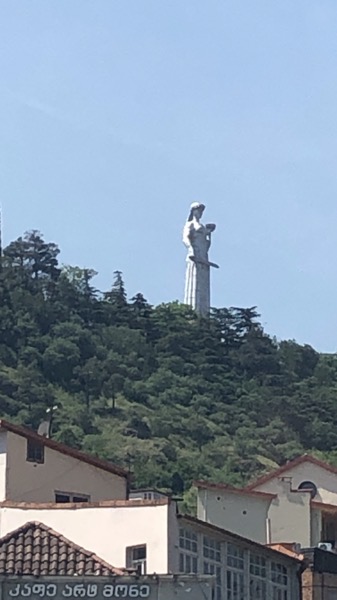
In May 2019, I spent a bit over a week in Georgia, in the Caucasus, east of the Black Sea and bordering Russia, Turkey and Armenia. I went under the auspices of First Things Foundation, an Orthodox economic development charity, which raises a little money taking people to places where they have (or in this case, were placing) field workers.

I had to wait until after the Spring Concert of a group I sing in, but then off to Chicago, on to Lufthansa, and Tbilisi about 16 hours later after a Frankfurt transfer. Most of my mates had already been knocking around a few days.

First Things Foundation isn’t a travel agency or tour guide and it was not a fancy tour. We stayed in no proper hotels, and one of our places was up four flights, no elevator.

2019 05 11 19 38 11+0400

May 11, overlooking ‎⁨Tbilisi⁩, ⁨Georgia⁩, from Turtle Lake Ascent, where we …

2019 05 11 19 41 24+0400

2019 05 11 19 41 30+0400

2019 05 11 19 41 35+0400

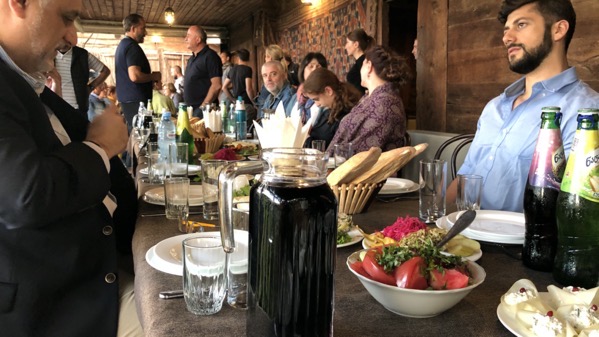
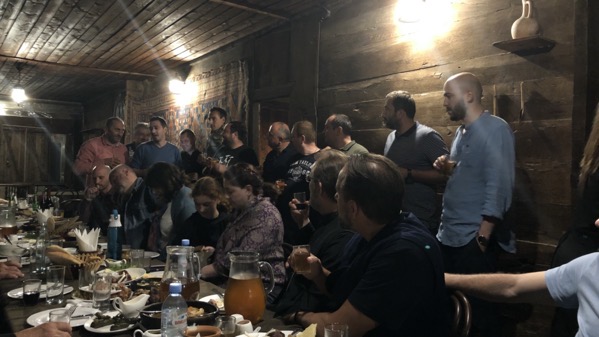
… feasted at our first “Supra,” where tradition calls for 16 (I think) toasts. I was fewer than 4 hours on the ground at this point, after a long flight, and am not a big drinker anyway. But I survived pretty well.

2019 05 11 22 06 05+0400 1

These Kool-Aid pitchers are wine. There were many of them …

2019 05 11 22 36 31+0400

2019 05 11 22 59 47+0400

… and they lasted into the night — but not too late to keep me from Church on Metekhi ascent, where (alas!) I have only a video which won’t embed, apparently.

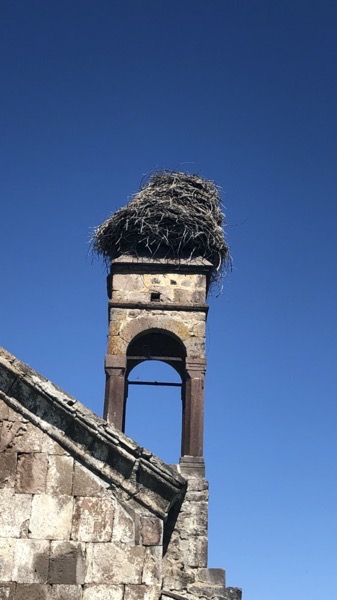
Later, we made our way toward Stepantsminda, but stopped, too close to Tbilisi for the geotagging to specify, for this old church:

IMG 0801 IMG 0805

IMG 0806

IMG 0808 IMG 0811

IMG 0812 IMG 0814

It’s a long, long way to Stepandsminda, on the Russian border, but for one thing we didn’t need our guides, as it sported the World’s Best Ideogram (zoom in if necessary):

IMG 0834

Spring in this region comes late.

IMG 0835

Our destination was Qazbegi, which I think is probably a regional name, which includes Stepantsminda (named for St. Stephen). Georgia is northern neighbor of Armenia, the oldest Christian nation, and became Christian soon after Armenia – in the early 4th Century. It is reportedly (but you know how those Chambers of Commerce are) the birthplace of wine. We have it on greater authority that it is the birthplace of Stalin, but never mind.

We were in Stepantsminda two nights, to attend a wedding and reception for one of the First Things Foundation fieldworkers. He was marrying a Russian doctor, who he met in Central America, and they chose Georgia to minimize visas and other hassles for Russian and American friends and family.

The wedding was in a monastic church, up the mountain, a mere stone’s throw from Russia.

IMG 0848 IMG 0850 IMG 0852 IMG 0854 IMG 0857 IMG 0858

The bride was late, coming from Tbilisi in bad weather, with the vocal ensemble that sang sacred Georgia Chant for the wedding, popular songs (even Hotel California) at the reception, so we had ample chance to look around, and the breaking weather made for a spectacular photo of the couple.

IMG 0861 IMG 0864

Area scenery. The monastery church is visible near the top of the near mountain in the first photo:

IMG 0841 IMG 0844
IMG 0865 IMG 0867

IMG 0870

IMG 0879

That was my boarding house to the right in the last photo.

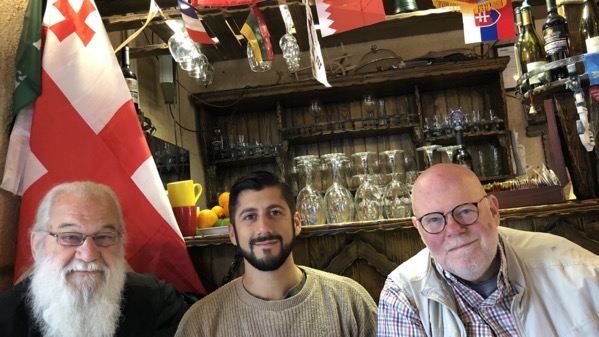
Breakfast place (Shorena’s Bar in Stepantsminda) and company, I’m on the right.

IMG 0881

IMG 0846

The day after the wedding, we made our way to Svetitskhoveli in Mtskheta, the old capital of Georgia. Our Boarding house was a durn siight nicer than the one in Stepantsminda …

IMG 0903 IMG 0905 IMG 0939 IMG 0941

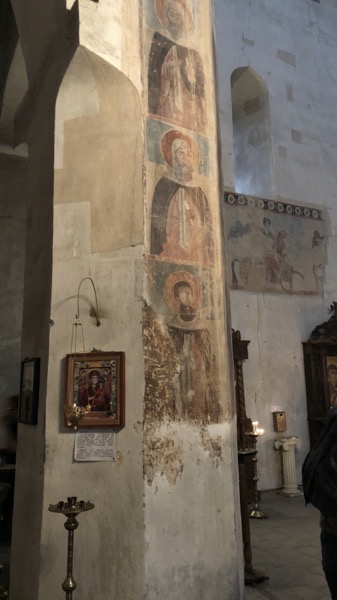
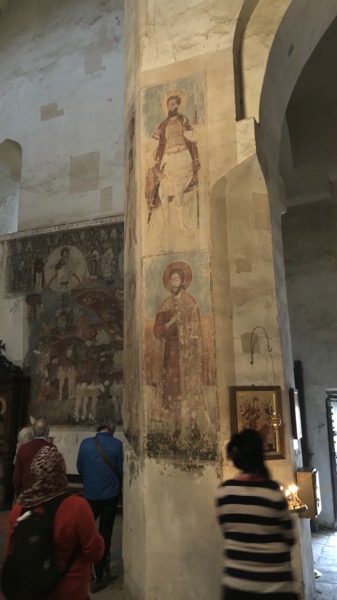
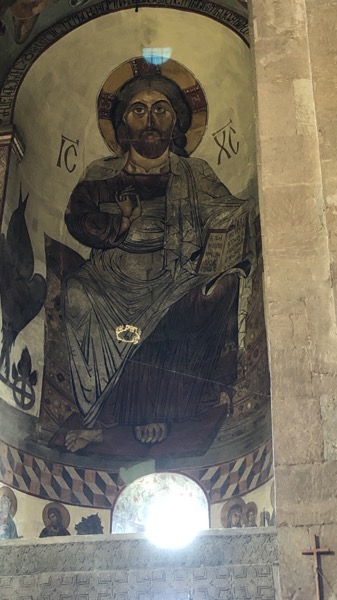
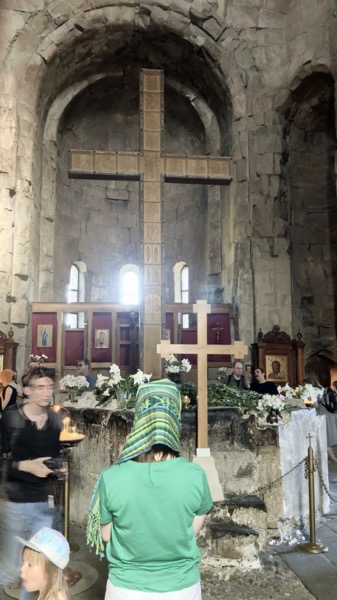
… but the highlight for me —not just of Mtskheta but of the whole trip — was the old cathedral (where I believe Patriarch Ilya still resides on the grounds) and making the acquaintance of St. Gabriel, a Fool for Christ, who reposed in Christ in 1995.

Saint first (I couldn’t resist buying this icon), Cathedral photos follow. There are many more I didn’t publish here and many more on the web, some better than any of mine.

:IMG 1016IMG 0885IMG 0889 IMG 0891

IMG 0887

IMG 0906 IMG 0908 IMG 0909 IMG 0910 IMG 0915 IMG 0916

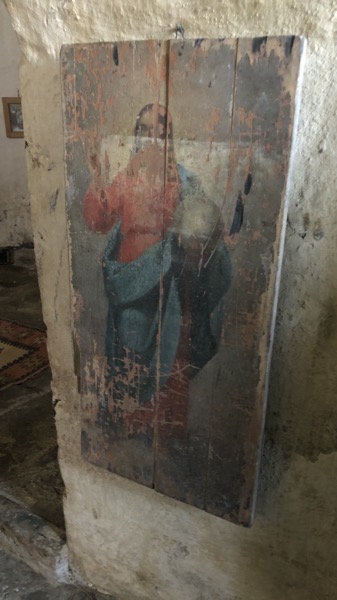
Two very Georgian-style icons:

IMG 0923 IMG 0924

IMG 0934

We hung around Mtskheta and environs for much of a day, including a nice alfresco lunch.

IMG 0984

IMG 0985

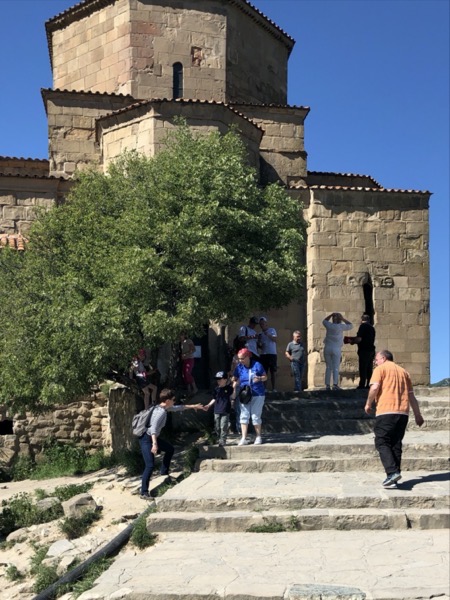
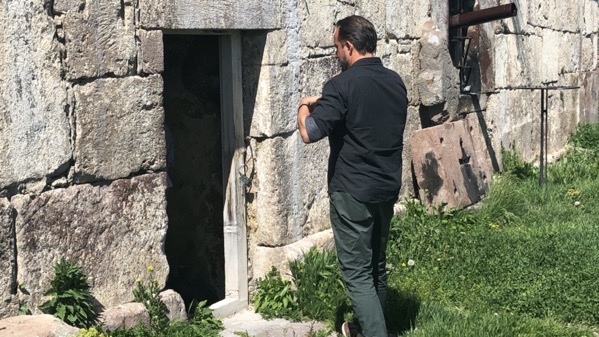
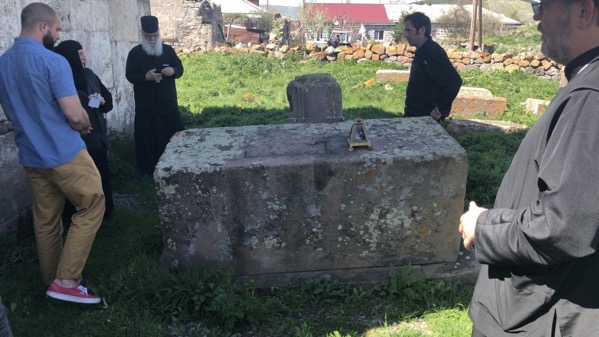
Georgia seems to have churches everywhere you turn, many of them a thousand or fifteen hundred years old. I could not keep track and geotagging isn’t very specific in rural Georgia. So here’s a little scenery and a lot of church from later in the trip.

IMG 0989 IMG 0990 IMG 0992 IMG 0994 IMG 0995 IMG 0996 IMG 0998 IMG 1004 IMG 1006

IMG 1038 IMG 1046

IMG 1047

IMG 1048

IMG 1050

IMG 1052

St. Nino, a woman, is virtually the founder of Georgia’s Church, and is venerated quite highly. Her distinctive cross is a Georgian marker:

IMG 1078

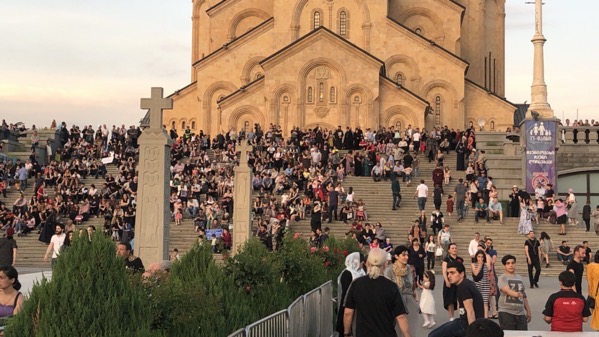
Back in Tbilisi, more sightseeing, including a Georgian Family Day celebration on the plaza of the new Cathedral.

A haberdashery for monks and clergy.

IMG 1185

IMG 1214

IMG 1231IMG 1233

Family Day festivities:

IMG 1240 IMG 1241 IMG 1242 IMG 1247 IMG 1249

Careful color-coordination:

IMG 1257

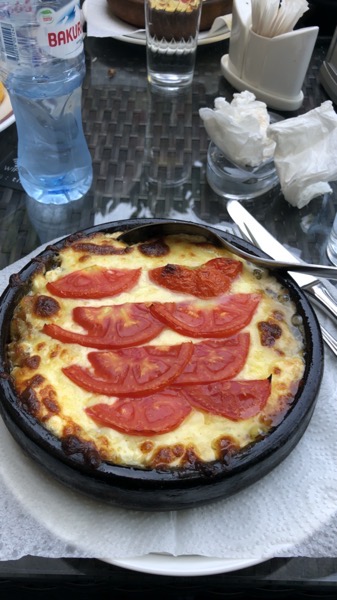
A luscious dish we should cook here: “Madame Bovary.”

IMG 1236

I was plenty ready for home after almost 8 days in Georgia, mostly passively going where I was driven, but getting some solo Tbilisi walking in at the end. (By the way: I recommend Lufthansa very highly.)

I was raised Evangelical by parents who got their adult-convert Christian formation in a fundamentalist baptist church. In the 50s and 60s, our kind of Evangelicals followed the fundamentalist taboos: smoking, drinking, dancing, playing cards, and secret societies.

I say that to put in perspective my discomfort with Georgian-level drinking — not just the wines but a sort of moonshine brandy they call Cha-cha. A lot of my pleasure in this trip was attenuated by that discomfort, which involves some collateral stories best left untold.

My overall impression of Georgia and the Georgians is an ancient people and culture, deeply and historically Christian, but in a manner that confounds Church and nation to an extent unknown in the U.S. Similar confounding is found in Greece and Russia. Oh: they don’t do Fundamentalist/Evangelical taboos — for better or worse.

It’s above my pay grade to judge whether the Christianity suffers in the amalgam, but it certainly is different from being in a minority Christian tradition in the U.S.

Potpourri 9/3/20

Kyrie
Because we cannot be clever and honest
and are inventors of things more intricate
than the snowflake—Lord have mercy. 

Because we are full of pride
in our humility, and because we believe
in our disbelief—Lord have mercy. 

Because we will protect ourselves
from ourselves to the point
of destroying ourselves—Lord have mercy. 

And because on the slope to perfection,
when we should be half-way up,
we are half-way down—Lord have mercy. 

R.S. Thomas, Mass for Hard Times

Thomas has not been on my radar as a poet. This one blew me away (there’s a great deal more to it), as did Tell Us.

* * *

The shift from church power to state power is not the victory of peaceable reason over irrational religious violence. The more we tell ourselves it is, the more we are capable of ignoring the violence we do in the name of reason and freedom.

William T. Cavanaugh, The Myth of Religious Violence

* * *


“The universities now offer only one serious major: upward mobility,” Jackson writes. “Little attention is paid to educating the young to return home, or to go some other place, and dig in. There is no such thing as a ‘homecoming’ major.

Wes Jackson via Wendell Berry via Mark Mitchell and Nathan Schlueter, The Humane Vision of Wendell Berry.

* * *


In Pittsburgh on Monday, the Democratic presidential nominee responded forcefully to President Trump’s charge that “no one will be safe in Biden’s America.” … “Does anyone believe there will be less violence in America if Donald Trump is re-elected?” Mr. Biden asked. “He can’t stop the violence—because for years he has fomented it.”

Trump’s 1980 Strategy for 2020 – WSJ

* * *


… Christopher Lasch is someone you cite a lot in this book, and in his work there’s a real sensitivity to the importance of these cultural issues. For educated people, the conflicts over busing or religion or sexuality or whatever reinforce the sense that working people are not really worthy of our concern because they’re authoritarian, behind the times. And then for the working class, it really drives home this perception that they are held in contempt. And Lasch seemed to believe that this tension was baked in because the values of the managerial elite were precisely the values of liberal-capitalist meritocracy: individual autonomy, self-development, personal liberation, etc., the flip side of which is a suspicion of working-class values like solidarity and thick ties like family and religion and neighborhood. The working-class view is more conservative, in a sense, but it’s also a product of a real class difference in how people see their place in the world.

Well, yes, I totally agree with that. I thought you said you were pushing back.

What I’m trying to get at is: There’s a sense in which this is a very real dividing line between more affluent, college-educated Democrats and members of the white working class and even sections of the non-white working class, where the former are often socially liberal and economically conservative/centrist and the latter are often economically liberal but more conservative on issues like abortion, immigration, crime, etc. How do you think Democrats or the left more broadly should try to navigate this divide? Do you think that open conflict over these issues can be avoided if you just focus on economics? Or does something eventually have to give — working-class whites moving left on culture or educated liberals deciding that they need to accept people with more conservative social views — say, a pro-life, gun-owning Catholic — as a part of the coalition?

This is a problem, of course, but I also think it is possible for people to come together on a common cause without agreeing on everything. The problem is getting the Democrats to acknowledge that common cause. Up until now, the Democrats have spent all their resources reaching out to those affluent white-collar people in rich suburbs. Those are the only “swing voters” they’re interested in. This bunch gets everything. It’s all crafted to please this group — economic policies, culture-war stances, everything. I happen to think a really robust program for reclaiming middle-class America from the forces that have wrecked so many people’s cities and lives and health would be immensely popular. It would be so popular that lots of people would be willing to overlook, say, one’s views on gun control in order to get behind it.

What’s the Matter With Populism? Nothing. (metered paywall – New York Magazine)

* * *


Baron Trump looks like the world’s most miserable child.

* * *


[A]nother narrow Trump victory, especially one in which the popular vote goes for Biden, is going to kick off civil unrest that will make this summer look tame. Trump’s opponents will ping-pong even harder between the two fever dreams of the first term. The first, that Trump is a foreign pawn and opposed to everything that makes American great. This charge comes with a complimentary retweet of James Comey standing near the Liberty Bell. The second, that Trump is the final, rotten fruit of a rotten American tree that must be uprooted altogether. This one comes with a retweet of 1619 Project impresario Nikole Hannah Jones explaining that arson isn’t violence.

My assumption, however, is that Trump’s second term may prove to be more difficult than the first for him. While some progressives are trying to moralize themselves for the November election by predicting a second term flowing with dictatorial power aimed at undermining democracy forever, I predict more slapstick incompetence.

Instead of hiring the best people, Trump has relied on whoever is nearby. This cast of characters has included people with their own firm agendas (such as John Bolton) or people who just seemed to have the Trump vibe (such as Anthony Scaramucci). Many of these people have had short careers in Trumpville — and leave it quickly to write scathing memoirs of their time within. About a dozen former White House officials or other flunkies have left Team Trump to write hair-raising tell-alls.

Trump already had problems with hiring enough people to fully staff the Executive Branch. His inability to do so is part of what allows the “deep state” to undermine, dodge, or contravene his authority as president. His reputation for administrative neglect, sudden reversals, and micromanaging has dissuaded qualified people from joining the administration. It leaves the presidency weakened.

Michael Brendan Dougherty, Donald Trump Second Term: What to Expect | National Review

* * *


Reporters standing in front of scenes of arson, flames billowing behind them, not very far from scenes of shooting and murder, insist that the protests are “mostly peaceful.” National Public Radio and a multi-billion-dollar global media conglomerate team up to bring you an illiterate “defense of looting.” The president comes to the defense of a dangerously stupid teenager who went looking for trouble illegally armed with a rifle in his hands and, to no one’s great surprise, found the trouble he was looking for.

But if there is a case to be made for looting, how about we start with NPR and its affiliates? The NPR Foundation reported holding $342 million in assets in 2018, and NPR’s management and on-air talent are splendidly compensated, many of them in excess of a half-million dollars a year. You can commission a shipload of lectures on income inequality and the salubrious effects of looting for that kind of “just property.” NPR’s headquarters on North Capitol Street in Washington, D.C., is “just property,” too — property NPR isn’t even much using at the moment, because of the epidemic. Would NPR object to someone burning it down to make a political point? Would looting NPR’s property be defensible? Yes? No? Why or why not?

… The same people burning down grocery stores today will be complaining about “food deserts” in 18 months.

… the petulant children in Portland want only to play-act at being Jacobins, and the petulant child in the White House requires a full-time culture war lest he be forced to run for reelection on his record of spotless administrative excellence and confidence-inspiring leadership. If ever two clutches of fools deserved one another, these are they.

Michael Brendan Dougherty, A Clutch of Fools | National Review

* * *


Peter Viereck: American Conservatism’s Road Not Traveled | Front Porch Republic was very good.

* * * * *

Out of the crooked timber of humanity no straight thing was ever made.

You shall love your crooked neighbour with your crooked heart.

W.H. Auden

* * * * *

You can read most of my more impromptu stuff at here. It should work in your RSS aggregator, like Feedly, should you want to make a habit of it.

You can’t fill a God-shaped hole with information

When I was a student at Liberty University, from 2012 to 2016, I had to take two semesters of a “Christian worldview” class. It consisted essentially of bullet-point lists of ethical issues, with quizzes to make sure we knew the right answers: How did we feel about abortion? What about gay marriage? We were required to take two Bible classes and two theology classes, which included plenty of information about sexual ethics and basic Christian beliefs about caring for the poor and marginalized.

Yet the more powerful education we received was through thrice-weekly “convocations” — gatherings that frequently featured Republican pundits and politicians. In place of what many Christian schools call “chapel,” all on-campus students were required to attend an hourlong meeting that included worship and a guest speaker. We sang songs about the power of the gospel, often followed by moving speeches about saving our country from socialists or protecting our borders from invading masses.

There is a long history in Christian education that focuses on the formation of the affections, alongside the training of the intellect …

… Yet evangelicals — and Liberty, in particular — have often neglected this focus, falsely believing that if we know the right information, we will act rightly …

At Liberty, our minds may have been receiving correct content, but our hearts were being trained to love wrongly: to love political power, physical security and economic prosperity as higher goods than they are. The leaders of the university may have believed that we could be immersed in the stories and values of the Republican Party while maintaining any theological truths incompatible with them, but the power of our affective education was stronger. The ethics we learned in a classroom were not nearly as powerful as the emotion and desire created in a stadium full of people singing, praying and hearing stirring messages about making America great again.

Kaitlyn Schiess, Opinion | What Jerry Falwell Jr. Taught Me at Liberty University – The New York Times

This strikes me as true, so far as it goes. But Ms. Schiess is not likely to fill her longings anywhere in the Evangelical world.

* * * * * * * * * *

Miscellany – August 24, 2020

President Donald Trump tweeted “Happy Sunday! We want GOD!“ as part of a string of religious-themed tweets on Sunday morning …

Also Sunday morning, the president headed to the Trump National Golf Club in Potomac Falls, Va., to play golf.

‘Happy Sunday! We want GOD!’ – POLITICO


I had grown up in a very conservative home. I’d been taught Christian values. I’d been taught that America was this exceptional country. And we’d never had somebody at the head of our party who was just completely morally bankrupt.

In fact, the moment I knew that I had a problem with Trump being our nominee was when there was a question asked in one of the debates when someone said, “You filed bankruptcy four times,” and his response was something to the effect of, “Well, yeah, I used the law to my advantage.” In my household, you would never file bankruptcy, or if you had to, it was because something devastating happened to you. You would never go out and think that you were going to use that to your advantage, because there’s somebody on the other end of that that was being harmed. You’d never swing your arm with the purpose of hitting somebody.

And it seems as though that’s what conservatism had all of a sudden become. At one point in time, conservatism was this idea of liberty, of rugged individualism. But at the same time, there was this deep sense about responsibility. It was both liberty and responsibility. You could swing your arm, but you certainly weren’t going to swing your arm to where it was going to connect with somebody else’s nose. What we’ve gotten to today is: I’m going to swing my arm. You got in the way. That’s bad on you, not on me. That’s not what conservatism always was, but it’s what it’s become.

Chad Mayes, former Republican leader in the California State Assembly, in Why California Republican Chad Mayes Left the Party (The Atlantic).

That really resonates.


There’s not going to be a Republican platform this year. This is just saying, “Whatever Trump does, we support.” They wouldn’t have needed to all be in the same room to hammer this out. They know perfectly well that there’s no point in doing so. This astonishing document appears to confirm that the Republican Party exists now as a personality cult. Did you see that Trump is now going to speak on each of the four nights of the Republican convention? Why not? If he’s the only thing the party stands for, it stands to reason.

Rod Dreher, Trump Team Chaos

UPDATE: Ferrret-Brain has outlined his agenda, which is bereft of things like “constitution” or “limited” or “life” or “judges” or “religion” or “faith” or “liberty.”


The day after the Steve Bannon indictment, I read a post claiming that:

  1. The We Build the Wall GoFundMe site didn’t meet its goal, so funds were promised to be returned.
  2. The defendants offered donors an “opt-in” transfer to a new We Build the Wall 501(c)(4) entity, and refunded to those who didn’t opt in.
  3. The new We Build the Wall 501(c)(4) entity didn’t promise that there would be no compensation for those running it.

According to the indictment, at least the third point is false:

To get the GoFundMe contributions transferred to We Build the Wall, it was essentially necessary to do a second fundraising campaign because donors would have to “opt in” — i.e., they would have to agree to the transfer.

To persuade donors to do that, the accused schemers solemnly vowed in corporate by-laws, GoFundMe website announcements, social-messaging posts, and other assertions that 100 percent of the contributions would go to wall construction. Contributors were assured that Kolfage would “not take a penny of compensation from these donations,” and would “take no salary.” Bannon is said to have publicly guaranteed, on several occasions, “I did this kind of as a volunteer” and “we’re a volunteer organization.”

Nevertheless, the indictment alleges that the defendants planned to and did divert funds for their own benefit …

Steve Bannon Indictment: If There Are Convictions, Potential Penalties Are Severe | National Review


Has Ellen DeGeneres passed her sell-by date?.

We tend to develop blind spots. There’s thinly-veiled cruelty in some of Ellen’s kindness schtick.

* * * * *

You can read most of my more impromptu stuff at here. It should work in your RSS aggregator, like Feedly, should you want to make a habit of it.

I highly recommend blot.im as a crazy-easy alternative to Twitter (if you’re just looking to get your stuff “out there” and not pick fights).

Return of the potpourri

1

Yet another unanswerable survey:

Do you think voting by mail is more or less likely to be accurate than in-person?

Axios-SurveyMonkey poll

What do they mean by “accurate”? E.g., reflecting (1) each actual voter’s choice, or (2) aggregate registered voters’ overall preference?

2

Are we really going to waste time listening to theme and variations on whether Kamala Harris is “really an African American“?

3

  • [T]here’s never been a great American political novel. The average French streetwalker in a novel by Zola knows more about politics than the heroes of the greatest American novels.
  • In the 1970s, the old Mainline Protestantism starts to break down. A question of what might replace its centrality in American culture emerges. There is a period in the 1990s and 2000s when it seems that Catholicism might provide the moral language that Mainline Protestantism no longer did. In the event, that project failed, primarily because liberal Protestantism did not disappear – it just shifted into post-Protestantism.
  • Walter Rauschenbusch [an American theologian and a key figure in the Social Gospel movement of the late 19th and early 20th centuries] lists six species of social sin. If you go through the list, they are exactly what radicals are objecting to now: bigotry, the ignorance of the uneducated, power, corruption, militarism and oppression. It lines up so perfectly with today’s agitation.
  • It is an intense spiritual hunger that is manifesting itself more violently. Because to the post-Protestants, the world is an outrage and we are all sinners.
  • The trouble is that, unlike Original Sin, there’s no salvation from white guilt. But the formal structure of white guilt and Original Sin is the same. How do you come to understand that you need salvation? By deeper and deeper appreciation of your sinfulness.
  • The line that I use is that, if you believe that your ordinary political opponents are not merely mistaken, but are evil, you have ceased to do politics and begun to do religion.
  • [T]he young members of the Elect are winning against the old elite. Young staffers at the New York Times forced James Bennett, the editorial page editor, to resign. And that’s incredible. Every old newspaper editor I knew – in generations before mine – would have looked at a letter signed by hundreds of junior staffers criticising an editorial decision, and said ‘I’m sorry that you’re quitting’.

Collins: You refer to the post-Protestants who promote these ideas as the ‘Elect’. From a sociological perspective, why do you prefer to use the term ‘Elect’ rather than say the ‘elite’ or another designation?

Bottum: Ross Douthat, in a column in the New York Times, said that one of the things we need to take from An Anxious Age is the distinction between the elite and the Elect. I chose the term Elect because those people who are part of it are not elite in the sense of having a hundred billion dollars. They are not the elite in the sense of being political figures with lengthy careers, like Bill and Hillary Clinton, or Joe Biden for that matter. They are not elite in the sense they control things in terms of ownership. So we need another term for them. They certainly have elite educations, but that elite education is not translated into the enormous wealth and power that the true elite has. I could have gone with a class analysis, and I do talk about Milovan Djilas’ analysis in The New Class, which is a fundamental book from the 1950s. There’s also the managerial class analysis that dominated American sociology for many years, and is still really informative. But I wanted to push in a slightly different direction.

Race is the problem that we have never solved in this country. After the Reconstruction era, in the aftermath of the Civil War, we lost the national will for solving the problem of race. Segregation was evil, second only to slavery, but not by much. And the Great Society welfare state of the 1960s has manifestly proven a failure. So, we have never solved this problem.

What I object to is the idea that deep feeling is going to solve the race problem. Or that absurdly utopian ideas like abolishing the police are going to solve the problem. We don’t live in a utopia, and those ideas are only going to cause more problems. The Elect has not been called upon to be responsible. Its members are simply objecting, and they are objecting for reasons that are at least half, and probably more, emotional. Which is to say, they are only objecting to feel good about themselves. To look at that in any objective way, it’s so irresponsible. All it does is create more unhappiness in the name of your own self-righteousness. This is what I call the self-love of self-hatred. It’s ‘I’m such a sinner and aren’t I wonderful for knowing that I’m a sinner’. The irresponsibility comes because they aren’t governing.

Collins: I’ve also noticed a tendency to avoid detailed analysis of economic and social conditions, or concrete policy reforms. Instead, the issue of race after George Floyd is a simple moral denunciation, or a vague reference to ‘systemic racism’. You hear ‘Why do I have to keep explaining this?’, ‘I’m so exhausted’, and so on, as if the issue was beyond debate.

Bottum: Right. But also it’s defining the Church. It’s a way of saying you either have this feeling or you don’t. And if you don’t, you’re evil, and if you do, you’re good. Christian theology, and Christian spiritual practice, has dealt with this for millennia. This is the distinction Calvin would make between justification and sanctification. The idea here is that we no longer need to argue it, because any argument of it is engaging with people beyond the pale. They are outside the Church, they are the profane. They are just wrong. What are they wrong about? They are wrong in the central feeling of moral goodness. This is the attempt to get others to shut up.

We are living in the age of the ad hominem. The fundamental way to answer a claim is to say something about the person who said it. Whether it’s a tu quoque, or an abusive ad hominem, or poisoning the well – the ad hominem is a whole genus of different species of fallacy. How do we know others are wrong? They are wrong because some bad people have said it too. Bari Weiss [the former New York Times op-ed editor] must be wrong [about the illiberal environment at the Times], because Ted Cruz forwarded her tweet. That’s a wonderful ad hominem – guilt by association. It’s not about the content of what is said, it’s about the people who said it.

Wokeness: old religion in a new bottle – spiked (Joseph Bottum interview)

My old friend Jody Bottum thinks that the various Woke movements amount to a kind of post-Protestantism. I think this is wholly wrong. Wokeness is aspirationally Roman Catholic in its structure. It already has:

  • magisterial teaching that one must hold de fide in order to belong
  • the pronouncing of anathemas upon those who dissent from that magisterial teaching
  • a distributed Inquisition devoted to unearthing and prosecuting heresy
  • an ever-growing Index of Prohibited Books

Wokeness despises the fissiparousness of Protestantism and wants to replace it with Real, Substantial, and Visible Unity under its banner. It’s basically a secularized Counter-Reformation.

Alan Jacobs, wokeness as Counter-Reformation – Snakes and Ladders

On wokeness as religion, see also Postmodern Religion and the Faith of Social Justice – Areo (long read – I skimmed)

4

The trouble with Evangelicals is that too often we’ve been wise as doves and innocent as serpents.

Alan Jacobs, paraphrasing Mark Noll, author of The Scandal of the Evangelical Mind. Noll’s book is 25 years old, but somehow this aphorism seems truer than ever.

5

Are these trustworthy people to think with?

Alan Jacobs, suggesting a key life question (shortly after reflecting on C.S. Lewis’s Mark Studdock and his wife, Jane). If you know That Hideous Strength, that should resonate.

6

Incompetent narcissist is a really hard sell.

The Remnant, on the 2020 election as a referendum on President Trump, who is neither a competent narcissist nor a lovable bumbler.

7

Nobody wants to be on Team Lesser Evil. You want to feel like you’re on Team Good. (David French, guest-hosting on The Remnant. When you vote Lesser Evil, you’re emotionally joining the team.

8

[O]n June 22nd, the president suspended the arrival of new au pairs … Wealthier families … have begun poaching au pairs from households with lower incomes.

Au-pair wars – America’s au-pair programme is under assault from Donald Trump and the left | United States | The Economist

9

Recommended: The end of secularism is nigh – UnHerd. I thought the Atlantic’s article on the topic (or should I say on the same two foreign developments?) was inferior.

* * * * *

You can read most of my more impromptu stuff at here. It should work in your RSS aggregator, like Feedly, should you want to make a habit of it.

I highly recommend blot.im as a crazy-easy alternative to Twitter (if you’re just looking to get your stuff “out there” and not pick fights).

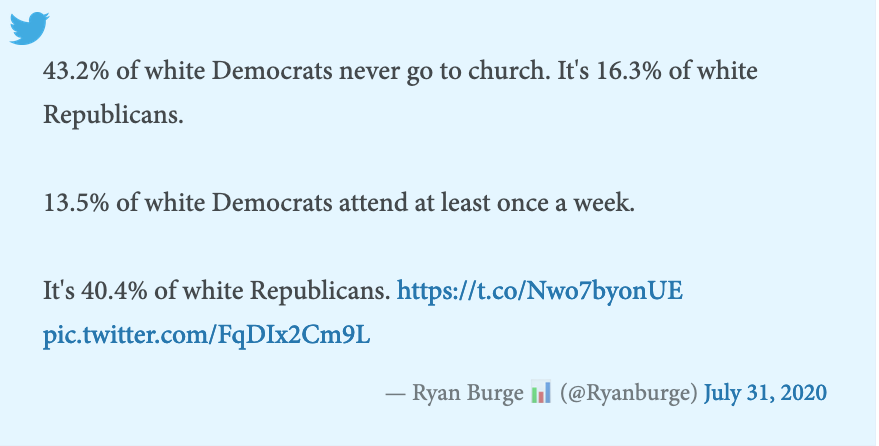
What’s wrong with this picture?

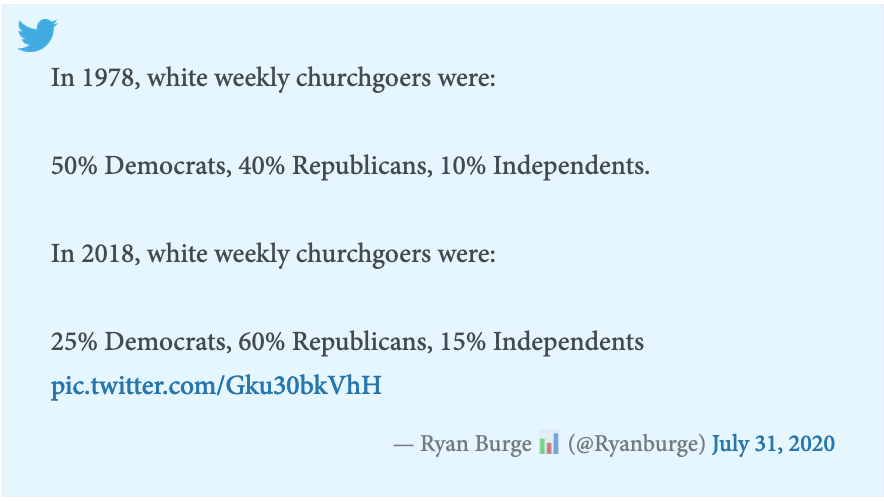
More dramatic than I imagined:

Screen Shot 2020-08-01 at 3.39.29 PM

(link) and

Screen Shot 2020-08-01 at 3.39.55 PM

(link).

Those are stunning contrasts. So why do I not feel tribal loyalty to the GOP?

A superficial answer would be that for a conservative, I rate shocking low on loyalty in Jonathan Haidt’s Moral Foundations Theory. But I’m almost positive there’s something more important than that.

First, a distinction.

Dissatisfied with my superficial reading habits, I am currently reading Mortimer Adler’s classic How to Read a Book (revised and updated 1972). Chapter 8 is titled “Coming to Terms with an Author”:

[I]n the analytical reading of a book, coming to terms is the first step beyond the outline. Unless the reader comes to terms with the author, the communication of knowledge from one to the other does not take place. For a term is the basic element of communicable knowledge.

A term is not a word–at least, not just a word without further qualifications … [A] word can have many meanings, especially an important word. If the author uses a word in one meaning, and the reader reads it in another, words have passed between them, but they have not come to terms.

Second, a story, which may be apocryphal, but I did not make it up.

A conservative returned to his alma mater for a commencement address and opened thusly:

By a strange coincidence, I am a graduate of a vastly different institution which occupied this very site 40 years ago and even bore the same name …

For some 23 years now, I’ve been an adherent of a religion called “Christianity,” based on the incarnation, life, death, resurrection, ascension and glorious second coming of Jesus Christ, who is both fully God and fully man. It was once, under the necessity of distinguishing it from a particular heresy, partially summarized in a Creed. To distinguish it from other versions, it’s called “Orthodox,” with a capital-O.

Meanwhile, my country is breathing the last few whiffs of an empty bottle labeled, by a strange coincidence, “Christianity,” which apparently is based on the intuition that God wants us to be nice and happy or, in its robust “Evangelical” versions, that Jesus Christ was very special and died a horrible death so that God would get over his anger issues with us and we could get on with being nice and happy.

Its proper name is Moralistic Therapeutic Deism. Although we share a mostly-overlapping vocabulary of words, I cannot come to terms with it, except in relatively brief and exhausting bursts of attempted empathy.

I remember from some 55 years ago an even more rigorous version, to which I then and for several more decades adhered, but it lives on today mostly notionally, in the scribblings of über-fissiparous “discernment bloggers.” I stay as far from them (and it) as I can, because I’m recovering from a mild-to-moderate case of that mindset and I’ve seen the harm it can cause, including when someone brings that mindset into Orthodox Christianity.

There were and are some other versions of “Christianity,” with some of which I have more or less come to terms, but they are not all that easily pigeon-holed politically.

So back to the question:  “why do I not feel tribal loyalty to the GOP?”

First, because it forfeited any claim to my loyalty:

In 2000 and 2004, it was Dubya. He was, we were told, a good Evangelical Christian. He cited Jesus as his favorite philosopher. He talked about America walking humbly in the foreign policy world.

Then 9-11 came, and he turned into a fierce Commander In Chief …

And then came, too, the second inaugural, when he declared as U.S. policy the eradication of tyranny from the world and the planting of democracy. If you don’t understand how delusional that is, read it again: eradicating tyranny from the world. As national policy.

(Conscientious Objector to the Culture Wars | War Correspondence ن)

Second, I have no confidence that was a blip, a lapse. In fact, the ensuing years have confirmed that endless war truly is the position of the party insiders (even though party voters chose a putatively antiwar mad, toxic and incompetent man for President in 2016).

Third, the Churches these Republicans so assiduously attend engage in worship that’s pure glucose and teach religion(s) with which I cannot come to terms sufficiently to form any kind of alliance. That Republicans are so much likelier to attend Church weekly is not all that interesting considering the Churches they attend.

I knew that 10 years ago (if not earlier, but I drove a stake in the ground then — a blog that’s held up surprisingly well) and they drove a stake though whatever remained of “Republican” in my heart on November 8, 2016.

That’s why.

* * *

Perhaps some day I’ll post a more nuanced version of why it’s difficult for a former-Evangelical, former-Calvinist, now-Orthodox, to “come to terms” with typical versions of contemporary American “Christianity.” I acknowledge painting here with a broad brush, but if there’s no glimmer of recognition, then you may to inattentive, gentle reader.

* * * * *

Put not your trust in princes,
in a son of man, in whom there is no salvation.

Psalm 146:3

* * * * *

You can read most of my more impromptu stuff at here. It should work in your RSS aggregator, like Feedly, should you want to make a habit of it.