Sunday, April 30

Expressive or Formative?

When you have only seen forms of piety that value spontaneous expression and clichéd sincerity, to be given the cadences and rhythms of the Book of Common Prayer can be like receiving the gift of tongues.

James K.A. Smith, You Are What You Love, via Jon Ward, Testimony: Inside the Evangelical Movement That Failed a Generation.

This quote was what finally persuaded me to buy a highly-touted book by a Protestant academic. There is at least one other Protestant religious academic, Hans Boersma (author of Heavenly Participation), for whom I have high respect.

Having raced (considering my usual book-reading pace) through the book, I pronounce Smith not quite as good as Boersma, at least for my interests, but he has his moments, and there are quite a few of them:

[W]orship is formative, not merely expressive, … When you unhook worship from mere expression, it also completely retools your understanding of repetition. If you think of worship as a bottom-up, expressive endeavor, repetition will seem insincere and inauthentic. But when you see worship as an invitation to a top-down encounter in which God is refashioning your deepest habits, then repetition looks very different: it’s how God rehabituates us. In a formational paradigm, repetition isn’t insincere, because you’re not showing, you’re submitting. This is crucial because there is no formation without repetition. … If the sovereign Lord has created us as creatures of habit, why should we think repetition is inimical to our spiritual growth?

James K.A. Smith, You Are What You Love: The Spiritual Power of Habit

The distinction between worship as expression and worship as formation pervades most of the first two-thirds or so of the book, which strikes me as very congenial to Orthodox Christianity (as Smith is at least partially aware).

Right-Brain Christianity

Orthodoxy theology defines only what is necessary and always leaves unspoken that which cannot be explained. This approach was part of the Christian faith from the beginning. But the Western phronema often suppresses, dismisses, minimizes, or ignores this stance. The Western mind is compelled to define and explain everything, since without a rational explanation a concept or fact cannot be considered true, or, conversely, all truth can be proven rationally.

Eugenia Scarvelis Constantinou, Thinking Orthodox: Understanding and Acquiring the Orthodox Christian Mind

Just-So Stories, conversion edition

Years ago, when I converted to Orthodox Christianity, I heard a common explanation that passed a number of folks. They said that “Stephen could not deal with modern uncertainty and has run away to hide inside Orthodoxy.” On the one hand, nothing was more “certain” among them than the platitudes of modernity. My rejection needed an explanation. The reality was that I was abandoning the false certitudes of mainline American Protestantism for the frightening journey of the soul into the mystery of Christ that lies at the heart of the Orthodox faith. Orthodoxy is not a bastion of answered questions. Rather, it is a way of life, whose teachings are the abiding testimony of those who have walked that path and borne witness to what they found. Indeed, apophatic theology, the preferred manner of Orthodox thought, draws us towards the nakedness of our ignorance and dares to stand in that state before the wonder of God.

I am not suggesting that we elevate ignorance to the exalted position it holds in the panoply of anti-Christian rhetoric (for our adversaries hide from their own ignorance). Indeed, I do not suggest beginning with our ignorance at all. Rather, I suggest that we begin with what we know and move towards its depths.

Fr. Stephen Freeman

When I converted to Orthodox Christianity, I initially expected great doctrinal certainty, in the left-brain sense of certainty that had earlier drawn me to Calvinism. What I found instead was the Nicene Creed without the filioque and seven ecumenical councils that posted warning signs to keep me from falling over Christological cliffs. That left a remarkably capacious plateau in which to move without losing the right to be called “Orthodox.”

I think that field is part of the concept of “catholicity,” which concept I fear I’ll never grasp due to 50 years of sectarian baggage.

Oh, heck! Let’s Just Go Shopping

Given the destructive fruitlessness of religio-political conflicts in the Reformation era, Catholics and Protestants alike built on trends that antedated the Reformation and decided to go shopping instead of continuing to fight about religion, thus permitting their self-colonization by capitalism in the industrious revolution. In combination with the exercise of power by hegemonic, liberal states, a symbiosis of capitalism and consumerism is today more than anything else the cultural glue that holds together the heterogeneity of Western hyperpluralism.

Bradford Gregory, The Unintended Reformation: How a Religious Revolution Secularized Society

Stage props

You see, the Anglicans in the Global Anglican Future Conference (GAFCON) represent the growing (in some cases booming) churches of Africa, Asia and the Third World. They do not, however, represent the zip codes in which the major newsrooms of the Western world are located. They also do not represent the world’s richest Anglicans. Thus, to be blunt, what these “lesser” Anglicans say is NEWS is not news until the New York Times says that it’s news. Right?

Terry Mattingly.

Anglicans in Africa, Asia and the Third World need to know their place. They’re supposed to be stage props, diverse tokens to make First-World Anglicans feel virtuous. They’re not supposed to contend for the faith when the First-Worlders are fleeing it.

Who qualifies as “Christian”?

[J. Gresham] Machen, for his part, published numerous articles insisting that modernists were not Christians because, no matter how much of the Christian doctrine they affirmed, they affirmed it as a matter of inner experience and not as a fact.

Frances FitzGeraldThe Evangelicals: The Struggle to Shape America.

I had quite forgotten that little tidbit, which intrigues me more than it probably should if I’m to honor the admonition “judge not.”


For all its piety and fervor, today’s United States needs to be recognized for what it really is: not a Christian country, but a nation of heretics.

Ross Douthat, Bad Religion

You can read most of my more impromptu stuff here (cathartic venting) and here (the only social medium I frequent, because people there are quirky, pleasant and real). Both should work in your RSS aggregator, like Feedly or Reeder, should you want to make a habit of it.
Sunday, 4/16/23

It’s Pascha (Easter) in Orthodoxy. Our Vigil was wonderful, but you had to be there to enjoy it, so I’ll not say any more.

Latins vs. Greeks

  • Two centuries later, fundamental differences in phronema [mindset] would again be an obstacle to union between the West and the East at the Council of Florence in 1439. Catholics presented rational arguments for their positions, and the Orthodox responded by citing apostolic Tradition. It was “the constant conviction of the Latins that they always won the disputation, and of the Greeks that no Latin argument ever touched the heart of the problem.”
  • Orthodoxy theology defines only what is necessary and always leaves unspoken that which cannot be explained. This approach was part of the Christian faith from the beginning. But the Western phronema often suppresses, dismisses, minimizes, or ignores this stance. The Western mind is compelled to define and explain everything, since without a rational explanation a concept or fact cannot be considered true, or, conversely, all truth can be proven rationally.

Eugenia Scarvelis Constantinou, Thinking Orthodox: Understanding and Acquiring the Orthodox Christian Mind

Ireland vs. America

Ireland is a palimpsest, a manuscript scraped imperfectly clean and reused, the old text bleeding through the new. A landscape with a long memory. As an American, I grieve the mnemonic emptiness of the New World. I long for ruins.

Justin Lee, Rewilding American Christianity

What the wrath of God looks like

I was nurtured on stories as a child that contrasted Christ’s “non-judging” (“Jesus, meek and mild”) with Christ the coming Judge (at His dread Second Coming). I was told that His second coming would be very unlike His first. There was a sense that Jesus, meek and mild, was something of a pretender, revealing His true and eternal character only later as the avenging Judge.

This, of course, is both distortion and heresy. The judgment of God is revealed in Holy Week. The crucified Christ is the fullness of the revelation of God. There is no further revelation to be made known, no unveiling of a wrath to come. The crucified Christ is what the wrath of God looks like.

Fr. Stephen Freeman, The Bridegroom and Judgment

This rings very true, although in my case “nurtured” refers mostly to my Christian high school and 2.5 years of Christian colleges. I do not recall my parents nurturing such a view.

But in your pondering whether you, too, were so nurtured, don’t fail to ponder the second paragraph.

Conservative Christian Europeans

The European experiment with trying to keep the Church alive amid dechristianization by making it more like the world has been a decisive failure. Christianity has to be different, and not be ashamed of that difference. In my European travels, the believers with whom I have spent time would be counted as conservative in moral and theological terms, but that, of course, does not track neatly with political conservatism.

Rod Dreher, Reconciling With The Really Real

Wild Christianity

“Wild Christianity” seems to have achieved almost (shudder!) même status, and predictably if being used in conflicting senses. But here’s a notable observer:

I have read an obscenely large number of articles and books on the decline of Christendom and the West, and even rushed in to write one myself, where angels fear to tread. But I have read absolutely nothing as close to the bull’s eye and as far from the bull’s opposite end as “A Wild Christianity” by Paul Kingsnorth, who, being a true poet, is not merely a singer but also a seer. Thank you, Gandalf.

Peter Kreeft, Boston College

I don’t disagree with Kreeft, who I have admired for more than 50 years. Read the worthy Kingnorth article.

Souls

[O]nce I was at an academic conference in Balamand, Lebanon, and I got a message that the Patriarch of Antioch, Ignatios IV at that time, wanted to meet me and another young theologian, who was from Greece, privately. What could this be about? We were ushered into a private drawing room, stood as His Beatitude entered, came forward to kiss his hand, and then sat down after he did. Well, he looks at us, and in perfect English exclaims, “The problem with you Greeks is that you are all dualists! Even a rock has a soul!!!” And that was it. He’d spoken his peace, he got up and left, and we were ushered back out.

‘Beauty First’ With Timothy Patitsas

Spiritual success

For those not fitting the NAR emotional profile (see below), there’s another option.

I have wondered how the “success” of the spiritual life would be measured? I could imagine that the number of persons baptized might be compared to the number of the baptized who fall short of salvation—but there is no way to discover such a thing. In lieu of that, we often set up our own way of measuring—some expectation of “success” that we use to judge the spiritual life. “I tried Christianity,” the now self-described agnostic relates, “and found that it did not live up to its claims.” [Laughter] I’ve seen things like that.

To my mind, the entire question is a little like complaining about your hammer because it doesn’t work well as a screw-driver. The problem is that the spiritual life doesn’t “work,” and it was never supposed to. It is not something that “works”; it is something that “lives.” And this is an extremely important distinction.

Fr. Stephen Freeman, The Slow Road to Heaven

It occurred to me within the last week or two that there’s at least one thing in America that’s immeasurably better than my childhood and adolescent status quo: there are Orthodox Christian Churches all over the place, and Orthodoxy has become a live option for Christians in other traditions they’re finding empty.

The Slow Road to Heaven

  • Despite every atheist protestation, religion abides – and if there is not one that is inherited, then a culture will invent new ones.
  • Power is an ever-present temptation in this world. It offers the notion that we can, by force (of arms or law), achieve our desired ends. That was true under emperors and tsars, and remains true within modern democracies. When Pilate questioned Jesus regarding the nature of His kingdom, Christ was very clear that His kingdom “is not of this world.” He adds that were His kingdom of this world – then His disciples would arm themselves and fight. That many Christians through the ages have imagined armed struggle to be an important element of the Christian life is a testament to our confidence in the weapons of this world and our lip-service to the Kingdom of God.
  • The crucified life is seen most clearly when it stands out against a background of worldliness.

Fr. Stephen Freeman, The Slow Road to Heaven

Safety check

“People aren’t asking whether Christianity is true, Abe. They aren’t even asking if it is good. My friends are wondering if Christianity is even safe.”

Jake Meador, quoting a friend of Abe Cho

I too readily accepted Cho’s quote as a valid indictment of (much) American Christianity. Meador does some helpful disambiguation of “safe.”

False mysticism

There’s a hymn that they used to sing at my childhood church that goes, “Turn your eyes upon Jesus, look full in his wonderful face, and the things of earth will grow strangely dim in the light of his glory and grace.” I get the point it’s trying to make: that encountering true hope, beauty and holiness puts pettier things in perspective. Still, my experience of faith is nearly the opposite of what the hymn describes. The more I have tried to seek God — the more I reach for truth, beauty and mystery that I know exceeds my grasp — the more bright, vivid and vital the things of earth become.

Tish Harrison Warren

New Apostolic Reformation

I usually park this provocative quote in the ending material of my blogs:

For all its piety and fervor, today’s United States needs to be recognized for what it really is: not a Christian country, but a nation of heretics.

Ross Douthat, Bad Religion

I had that point driven home powerfully in the last week, for I somehow stumbled upon an intriguing series within a podcast I almost certainly would never have visited otherwise.

The series was on the New Apostolic Reformation (NAR), about which I knew only three things fairly firmly:

  1. It emerged during my middle-age years.
  2. A formerly mainstream evangelical, C. Peter Wagner, who has been obsessed with “church growth” as long as I’ve known of him, was a prominent proponent.
  3. NAR believes it has Apostles leading the Church.

I now know much, much more, and it ain’t pretty.

The podcast was named “Straight White American Jesus.” With a title like that, it’s not the sort of place I frequent, just as I don’t dumpster-dive for my food. But despite the semiotics of that name, the podcast series, titled “Charismatic Revival Fury,” was delivered soberly and in scholarly fashion until the presenter got worked up for a while at the hypocrisy of NAR “Apostles” and “Prophets” backpedaling from the January 6 rioters, so many of whom they had inspired and whipped into frenzy. These were the rioters who apparently considered themselves Christian but who fit no pigeon-hole I knew — because their pigeon-hole was NAR.

I now realize that the NAR novelties have extended quite far, perhaps because C. Peter Wagner, even before his NAR days, would resort to just about anything in the name of “Church growth,” and NAR follows his example, thus keeping things at fever pitch with a stream of new “prophesies” and unchristian promises of political power (dominion).

Overall, the series was focused on the political ramifications of NAR. Usually, I think the press stupidly considers religion merely notional and fundamentally unreal until it eventuates in something political. And there was a bit of that sense here. I don’t think Straight White American Jesus would have been interested in exposing the heresies of NAR apart from its political ramifications. But when I went looking for analysis of NAR’s religious beliefs, the top hits were not from sources I think are reliable.

I’m not prepared to try to make sense of NAR here except that

  • it seems almost designed to be elusive, like nailing jello to the wall; and
  • it seems from the 30,000-foot level like an emotionalistic tradition led by a mixture of narcissistic “Apostles” and “Prophets.”

For all its piety and fervor, today’s United States needs to be recognized for what it really is: not a Christian country, but a nation of heretics.

Ross Douthat, Bad Religion

You can read most of my more impromptu stuff here (cathartic venting) and here (the only social medium I frequent, because people there are quirky, pleasant and real). Both should work in your RSS aggregator, like Feedly or Reeder, should you want to make a habit of it.

Annunciation 2023

Do the math. If we observe the birth of Christ on December 25, what prerequisite of birth might a Church want to observe, and when should they observe it?

I will post separately today on accumulated stuff about a certain notoriously toxic narcissist who’s been in the news. None of that here, save this paragraph.

Civil War

As recently as 40 years ago, and probably more like 30 years, I flirted with (and probably played devil’s advocate for) the idea that the Civil War was about states’ rights.

History had not been a strong academic interest, but even if it had, I was wrestling around then with the realization that in some very important ways, we are no longer living under that Constitution of 1787; that’s just how radical (in a neutral, not pejorative, sense) the Civil War Amendments were, both initially and as they ramified over the next century or more.

But I was clearly mistaken — and I say that not as a dog who’s tired of being whipped, but as someone who just today (March 21) encountered Alexander H. Stevens’ “Cornerstone Speech.”

Stephens was a high-ranking Confederate figure:

The new [Confederate] constitution has put at rest, forever, all the agitating questions relating to our peculiar institution, African slavery as it exists amongst us – the proper status of the negro in our form of civilization. This was the immediate cause of the late rupture and present revolution. Jefferson in his forecast, had anticipated this, as the “rock upon which the old Union would split.” He was right. What was conjecture with him, is now a realized fact. But whether he fully comprehended the great truth upon which that rock stood and stands, may be doubted. The prevailing ideas entertained by him and most of the leading statesmen at the time of the formation of the old constitution, were that the enslavement of the African was in violation of the laws of nature; that it was wrong in principle, socially, morally, and politically. It was an evil they knew not well how to deal with, but the general opinion of the men of that day was that, somehow or other in the order of Providence, the institution would be evanescent and pass away. This idea, though not incorporated in the constitution, was the prevailing idea at that time. The constitution, it is true, secured every essential guarantee to the institution while it should last, and hence no argument can be justly urged against the constitutional guarantees thus secured, because of the common sentiment of the day. Those ideas, however, were fundamentally wrong. They rested upon the assumption of the equality of races. This was an error. It was a sandy foundation, and the government built upon it fell when the “storm came and the wind blew.”

Our new government is founded upon exactly the opposite idea; its foundations are laid, its corner-stone rests, upon the great truth that the negro is not equal to the white man; that slavery subordination to the superior race is his natural and normal condition. This, our new government, is the first, in the history of the world, based upon this great physical, philosophical, and moral truth. This truth has been slow in the process of its development, like all other truths in the various departments of science. It has been so even amongst us. Many who hear me, perhaps, can recollect well, that this truth was not generally admitted, even within their day. The errors of the past generation still clung to many as late as twenty years ago. Those at the North, who still cling to these errors, with a zeal above knowledge, we justly denominate fanatics. All fanaticism springs from an aberration of the mind from a defect in reasoning. It is a species of insanity. One of the most striking characteristics of insanity, in many instances, is forming correct conclusions from fancied or erroneous premises; so with the anti-slavery fanatics. Their conclusions are right if their premises were. They assume that the negro is equal, and hence conclude that he is entitled to equal privileges and rights with the white man. If their premises were correct, their conclusions would be logical and just but their premise being wrong, their whole argument fails. . . .

As I have stated, the truth of this principle may be slow in development, as all truths are and ever have been, in the various branches of science. . . . May we not, therefore, look with confidence to the ultimate universal acknowledgment of the truths upon which our system rests? It is the first government ever instituted upon the principles in strict conformity to nature, and the ordination of Providence, in furnishing the materials of human society. Many governments have been founded upon the principle of the subordination and serfdom of certain classes of the same race; such were and are in violation of the laws of nature. Our system commits no such violation of nature’s laws. With us, all of the white race, however high or low, rich or poor, are equal in the eye of the law. Not so with the negro. Subordination is his place. He, by nature, or by the curse against Canaan, is fitted for that condition which he occupies in our system. The architect, in the construction of buildings, lays the foundation with the proper material – the granite; then comes the brick or the marble. The substratum of our society is made of the material fitted by nature for it, and by experience we know that it is best, not only for the superior, but for the inferior race, that it should be so. It is, indeed, in conformity with the ordinance of the Creator. It is not for us to inquire into the wisdom of His ordinances, or to question them. For His own purposes, He has made one race to differ from another, as He has made “one star to differ from another star in glory.” The great objects of humanity are best attained when there is conformity to His laws and decrees, in the formation of governments as well as in all things else. Our confederacy is founded upon principles in strict conformity with these laws. This stone which was rejected by the first builders “is become the chief of the corner” – the real “corner-stone” in our new edifice.

(Emphasis added, footnotes omitted. Source.)

As we face talk of “civil war” or “national divorce” again today, what ugly realities lie behind that talk?

Big, meddlesome, micro-managing government at its best

The Federal Trade Commission proposed a rule on Thursday that would make it easier for consumers to cancel recurring subscriptions. The so-called “click-to-cancel” provision would require companies to allow customers to cancel a subscription in the same mode they originally signed up—online, rather than on the phone or in person, for instance. The proposal is now subject to public comment.

The Morning Dispatch. My public comment: Huzzah!

Circular criticism

It is certainly possible that my pessimistic outlook on Christianity in the West [in The Benedict Option] may be wrong. But most of the criticism I’ve seen has been based on the idea that Dreher cannot be right. What is so frustrating to me about this is not that I might be wrong — I hope I am wrong! — but that most of the opposition to my thesis has been in bad faith. I mean, it has been based not on an objective analysis of my claims and my logic, but on the general idea that Dreher must be wrong because he’s defeatist, or guilty of some other moral fault.

Rod Dreher

Wokeness

“Weird to have a Twitter debate about the definition of ‘wokeness,’ when everyone knows it just means treating everybody with kindness and decency and respect, except of course for liberals one standard deviation to your right, who must be burned,” – Ross Douthat.

H/T Andrew Sullivan

Orwellian obfuscation from our government

How corrosive our undeclared wars are to our language!

It was during the war in Iraq that Orwell’s insistence on clear language first came roaring back. This time, the newspeak was coming from the neocon right. We heard the term “enhanced interrogation techniques” to describe what any sane person would instantly call “torture.” Or “extraordinary rendition” — which meant kidnapping in order to torture. There was “environmental manipulation” — freezing naked human beings to near-death and back again. All the terms followed Orwell’s rules for new words “needed if one wants to name things without calling up mental pictures of them.” All the new terms were opaque and longer than the original.

“[Gitmo detainees] would wage jihad any way they can. … [T]hey would do hunger strikes. And you actually had three detainees that committed suicide with hunger strikes,” – Ron DeSantis. There is a deep kind of sickness in believing that human beings completely under your control are still some kind of threat — and that suicide is an act of aggression.

Andrew Sullivan

Incorrigible Nature

Political Science

Shock study: endorsing a political candidate seems political: The stately science and health journal Nature endorsed Joe Biden in 2020. That must have swayed a lot of Trump voters, right? Nature looked into that this week: “A survey finds that viewing the endorsement did not change people’s views of the candidates, but caused some to lose confidence in Nature and in US scientists generally.” And: “Viewing Nature’s political endorsement reduced Trump supporters’ willingness to obtain information about COVID-19 from Nature by 38%.” 

Okay, so it had the opposite intended effect. Now, of course Nature is going to learn from this very smart survey it did? They considered that—and decided on a hard no. Here’s Nature doubling down on taking sides in elections, despite the evidence: “Political endorsements might not always win hearts and minds, but when candidates threaten a retreat from reason, science must speak out.”

Nellie Bowles. Gosh, suddenly I feel some hesitancy to “follow the science.” D’ya think?\

Follow the scientists? Nah!

Ahead of the 2020 presidential election, several top scientific publications backed Joe Biden for president. In Politico, media writer Jack Shafer questions the value of such endorsements, which a recent study concluded not only failed to shape the election’s outcome but also undermined trust in the publications. “If Nature’s Biden endorsement had little or no effect on readers except to make some Trump supporters disdain Nature in specific and the scientific establishment in general, why did the publication endorse any candidate?” Shafer asks. “The question is there for the taking by all publications, not just Nature. In many cases, editorials—especially editorials of endorsement—exist not to persuade readers of a viewpoint or a candidate’s soundness, but to feather the nest of the editorialist (or his publisher) for a moment or two with the illusion that he has struck a blow for all that is right. Why bother editorializing? Doesn’t seem very scientific.”

The Morning Dispatch

Food, Inc.

Night cereal: It’s hard that food corporations have only three meals a day to shovel corn and vegetable oil down our gullets. To solve for this, they have invented a new meal: bedtime cereal. “Post Consumer Brands is looking to help make your sleep dreams come true with Sweet Dreams—the first ready-to-eat cereal designed to be part of a healthy sleep routine,” the marketing copy reads. At 10 p.m., when you are watching YouTube, slack-jawed and looking like the peak of sleep hygiene, you might as well complete the scene with some Sweet Dreams Honey Moonglow

In what can only be described as a hate crime against millennial women, they call the night cereal “self-care.” From that same press release: “ ‘More than ever, consumers are looking to embrace acts of self-care, particularly as it relates to bedtime routines and we believe a relaxing bedtime routine is key to a good night’s sleep,’ said Logan Sohn, Senior Brand Manager.” The worst part is that I ordered some.

Nellie Bowles aga

Lockdown Consequences

[I]f I’d have stayed closed, I had a 95% chance of losing everything I’ve ever worked for. But if I open, I only had a 5% chance of getting Covid.

A Georgia barber, expressing appreciation for Gov. Kemp allowing businesses to reopen in April, 2020.

Destroying the Family

It cannot be too often repeated that what destroyed Family in the modern world was Capitalism. No doubt it might have been Communism, if Communism had ever had a chance, outside the semi-Mongolian wilderness where it actually flourishes. But, so far as we are concerned, what has broken up households, and encourages divorces, and treated the old domestic virtues with more and more open contempt, is the epoch and power of Capitalism. It is Capitalism that has forced a moral feud and a commercial competition between the sexes; that has destroyed the influence of the parent in favor of the influence of the employer; that has driven men from their homes to look for jobs; that has forced them to live near their factories or their firms instead of near their families; and, above all, that has encouraged, for commercial reasons, a parade of publicity and garish novelty, which is in its nature the death of all that was called dignity and modesty by our mothers and fathers.

G.K. Chesterton

J.K. Rowling

I am glad that I decided to listen to The Witch Trials of J.K. Rowling.

The main thing I’ve gained is from “Chapter 6,” Natalie and Noah. Natalie and Noah are, respectively, a “trans woman” and a young “trans man,” both of whom were able to critique Rowling without resorting to thoughtless insults and threats.

I did not find either critique persuasive; I do not think the things for which she is condemned are contemptible. But the critiques were the first attempts at reasonable and temperate critiques I had heard or read, and I think it is almost always a good idea to hear an adversary’s best case (and to keep very low-key about an issue if it’s not important enough to you to take that step).

Noah was particularly interesting because he was an example of Sudden-Onset Gender Dysphoria (SOGD), having passed childhood fairly happily as a girl, looking forward to becoming a woman. Butshe developed dysphoria pretty rapidly with her changing body at puberty around age 12. She was not rushed into sex-change surgery; she didn’t even start using a new name (“social transitioning”) for two years and didn’t get her breasts removed until shortly before her 17th birthday.

I instinctively used different pronouns for Noah in the prior paragraph. Having noticed that, I’m going to leave it. His voice was the voice of a thoughtful, not-very-masculine boy. But sex is real; he’s really a she. You can look it up in her chromosomes — and in countless rhetorical tell-tales.

But there are cases of gender dysphoria severe and persistent enough to warrant sex-change surgery, and we must respect the humanity of the people who have undergone it, even as we reject grand categorical pronouncements about the ontology of GD and the evil of those who won’t mouth lies about it.


For all its piety and fervor, today’s United States needs to be recognized for what it really is: not a Christian country, but a nation of heretics.

Ross Douthat, Bad Religion

You can read most of my more impromptu stuff here (cathartic venting) and here (the only social medium I frequent, because people there are quirky, pleasant and real). Both should work in your RSS aggregator, like Feedly or Reeder, should you want to make a habit of it.

Traditional Vernal Equinox 2023

Some gaslighters are claiming that Spring began yesterday, but I distinctly remember that it starts March 21. That’s my story and I’m stickin’ to it.

Culture

The World Beyond Your Head

Matthew Crawford, who does not know me nor I him, nonetheless describes a very strong tendency in my life:

I can take a virtual tour of the Forbidden City in Beijing, or of the deepest underwater caverns, nearly as easily as I glance across the room. Every foreign wonder, hidden place, and obscure subculture is immediately available to my idle curiosity; they are lumped together into a uniform distancelessness that revolves around me. But where am I? There doesn’t seem to be any nonarbitrary basis on which I can draw a horizon around myself—a zone of relevance—by which I might take my bearings and get oriented. When the axis of closer-to-me and farther-from-me is collapsed, I can be anywhere, and find that I am rarely in any place in particular.

The World Beyond Your Head: On Becoming an Individual in an Age of Distraction

I suspect that this is why I like to travel: it forces on me that particularity of places.

My Man Mitch

Mitch Daniels, former Purdue president, didn’t hold back about the state of today’s athlete in his latest Washington Post column. The headline was about women’s sports, but Daniels really laid into what he considered “sports figures who embody self-absorption over collective commitment, who cultivate their personal ‘brands’ at the expense of collective success.” An example: “A top athlete can consort with criminals, brandish guns in public and litter the landscape with illegitimate children in whose lives he has no intention of playing a father’s role, seldom with career consequences.” Read the rest here: “In a me-first era, my appreciation of women’s sports just keeps growing.”

Dave Bangert

Shame on the Met

The Metropolitan Opera has been ordered by an arbitrator to pay the Russian soprano Anna Netrebko more than $200,000 for performances it canceled last year after she declined to denounce President Vladimir V. Putin of Russia following the invasion of Ukraine.

New York Times

I wish the Met had been hit harder than that, but as a private company, it has some latitude to indulge its oppressive impulses. (Netrebko lost claims for performances where she and the Met had not yet inked the deal.)

Colonialism

  • “We must find new lands from which we can easily obtain raw materials and at the same time exploit the cheap slave labour that is available from the natives of the colonies. The colonies would also provide a dumping ground for the surplus goods produced in our factories.” (Cecil Rhodes)
  • In general terms aid cannot be of use to the poor of the Third World for the critical reason that they necessarily depend on the local economy for their sustenance, and the local economy does not require the extensive highways, big dams, or for that matter hybrid seeds, fertilisers and pesticides of the Green Revolution, any more than it does the fleet of helicopters that the British government imposed on India. These are only of use to the global economy, which can only expand at the expense of the local economy, whose environment it degrades, whose communities it destroys and whose resources (land, forest, water and labour) it systematically appropriates for its own use.

Edward Goldsmith, Development As Colonialism

March Madness

[D]espite having NCAA eligibility remaining, the Ivy League hasn’t budged from its position to limit its athletes a four-year window to compete. It’s something that Princeton, as an institution, also believes in, according to coach Mitch Henderson.

"We have [two] other seniors that have eligibility. Each one of these guys has an extra year," Henderson said. "It doesn’t change anything for us. We’re very much about the four-year process.

"Princeton, we’re about the growth of the student-athlete over the four-year process. I hope that’s not saying we’re a stick in the mud. It’s very much who we are. We expect them after senior year to be able to kind of go out and make pretty serious contributions in their communities."

ESPN story on Princeton men making the Sweet 16.

Princeton just became my emotional favorite in the tournament. Much as I like college basketball, I love colleges and universities that are about education.

Academic theology (and apologetics)

It has been roughly 25 years since it dawned on me that a secular person can never do truly Christian theology, which is more than an academic pursuit.

There’s no one more dangerous than the man who knows the steps but hasn’t walked them.

Steven Christoforou, Why Christian Apologetics Miss the Mark

Despite that epigram, Christoforou was not writing about Ravi Zacharias. He wrote something better than that would have been.

The pornified campus

1-in-3 collegiate women report being choked during most recent sex.

Brad Wilcox on Twitter via Aaron Renn

My presumption — rebuttable but strong — is that their sexual partners learned this frightening twist on love-making from watching hardcore porn (of a sort I never encountered).

Men are not guarding their imaginations. Women, too, are setting themselves up for divorce, with all its ramifications:

Calling a spade a spade

“Conversion therapy” bans pressure therapists to never help any patient try to feel comfortable in her body. That’s not some unintended consequence; it’s the essence of these bans. As Jack Turban has put it, it’s "unethical" to try to make a child "cisgender."

Leor Sapir on the 20 states and DC with such bans, via Andrew Sullivan

On Wokeness

Diversity and inclusion today

The thinking class, meanwhile, squanders its waking hours on a quixotic campaign to destroy every remnant of an American common culture and, by extension, a reviled Western civilization they blame for the failure to establish a heaven on earth of rainbows and unicorns. By the logic of the day, “inclusion” and “diversity” are achieved by forbidding the transmission of ideas, shutting down debate, and creating new racially segregated college dorms.

James Howard Kunstler, Living in the Long Emergency

The vice that dare not assume a name

Damon Linker again weighs in on wokeness:

The activists … appear deliberately to avoid giving their efforts a name, and they will likely object to anything that might be more descriptively accurate—like my preferred “antiliberal progressivism”—on the grounds that it carries negative connotations … I do think there’s a good reason to opt for “antiliberal progressivism” instead of “woke” or “wokeness”: doing so connects current trends to historical antecedents that, it’s now possible to see, were earlier chapters in a single, episodic story of intrafactional conflict on the left.

[T]here’s [a] reason [besides fearful capitulation] why liberals, especially over the last few years, have been so quick to fold in the face of antiliberal demands by militant progressives. It’s because liberals get caught in the either/or dynamics of polarized politics, thinking that any expression of criticism about their ostensible allies on the left invariably amounts to an in-kind contribution to advancing the political aims of their enemies on the right. This thinking runs something like this:

Yes, some of what the left-wing activists want is bad, defies liberal norms, and pushes pretty far into radical territory when it comes to race and gender. But the right is responding to this stuff by doing even worse things (including banning books, gutting academic freedom, and restricting free speech and other liberties). For that reason, it’s important we not criticize the left—because doing so empowers the right. Just look at what’s happened to Freddie deBoer this past week: He wrote a powerful Substack post criticizing the activists in the name of the left, and now he’s being quoted by right-wingers. We need to choose sides, and it’s not a hard call. We must stand with our somewhat wayward allies on the left for fear of empowering the fascism that’s making inroads all the time in the Republican Party.

I think the truth is pretty close to the opposite of this view: If the liberal center-left doesn’t stand up to antiliberal progressivism and refuse to capitulate to its demands within institutions, then those who disdain its influence will have nowhere to turn besides the right. That’s why liberals ought to do more to defend liberal ideals and norms where they hold power in civil society—because it will demonstrate that one needn’t embrace the right’s own antiliberalism in order to combat antiliberalism on the left.

I find this heartening, and I see Linker as an ally. I think “antiliberal progressivism” perfectly captures what is objectionable about wokeism. I reflexively recoil from progressive excesses, but have been unable to make peace with opportunistic and heavy-handed “conservative” responses — a sort of reverse mirror-image of what Linker is advocating for his side.

I can’t omit a bit more Linker, though:

Liberalism itself is more than capable of defending itself from opponents in either direction, as long as liberals summon the courage and rise to the challenge of doing so. It can do this most effectively by drawing crucial distinctions that comport more fully with the complex truth of things than the edifying homilies preferred by the right or the furious craving for moral purity that so often prevails on the left.

  • Yes, transgender adults should enjoy the same legal protections as other vulnerable minorities. But that doesn’t mean “gender-affirming care” (which can include radical pharmaceutical and surgical interventions) is the proper path forward for the rapidly growing numbers of teenagers who express discomfort with their sexuality and gender identity. Neither does it imply that the rest of us need to embrace the philosophically and biologically dubious assertions of many transgender activists about the thoroughgoing fluidity of sex and gender.

Linker is very much on the same wavelength as leftist philosopher Susan Neiman, (The true Left is not woke):

[T]he fact that politicians ranging from Ron DeSantis to Rishi Sunak deploy “woke” as a battle cry should not prevent us from examining its assumptions. For not only liberals, but many Leftists and socialists like me are increasingly uneasy with the form it has taken.

What concerns me most here are the ways in which contemporary voices considered to be progressive have abandoned the philosophical ideas that are central to any liberal or Left-wing standpoint: a commitment to universalism over tribalism, a firm distinction between justice and power, and a belief in the possibility of progress.

A preemptive barrier to productive disagreement

Before you can attempt to define what “wokeness” is, you should acknowledge this basic fact. Going further, you should acknowledge that as with cancel culture, critical race theory, and even structural racism, the contested nature of the term imposes a preemptive barrier to productive disagreement.

The constellation of social-justice concerns and discursive lenses that have powerfully influenced institutional decision making does work to sort individuals into abstract identity groups arranged on spectrums of privilege and marginalization. To paraphrase James Baldwin, it proceeds from the insistence that one’s categorization alone is real and cannot be transcended. The idea that patriarchy, white supremacy, transphobia, homophobia, Islamophobia, and other ills inexorably saturate our lived realities and that the highest good is to uncover and oppose them is, I think, a central component of “wokeness” as both its proponents and critics understand it.

[P]erhaps we can all agree, at bare minimum, to set ourselves the task of limiting our reliance on in-group shorthand, and embracing clear, honest, precise, and original thought and communication. If we want to persuade anyone not already convinced of what we believe, we are going to have to figure out how to say what we really mean.

Thomas Chatterton Williams

I try to avoid “you should have written about X instead of about Y” critiques, but how in heaven’s name could Williams note the wokesters’ obsessive use of “patriarchy, white supremacy, transphobia, homophobia, [and] Islamophobia” without commenting on how ill-defined those slurs are? His only hint at “both sides” is his last paragraph.

To the list of ill-defined or undefined put-downs of people not on the Left, I would certainly add “white Christian nationalism.”

A substitute religion?

[M]embership in houses of worship sank to 47% – below the 50% mark for the first time. In 1999, that number was 70%.

It’s possible, said [former Congressman Daniel] Lipinski, that many citizens are now searching for "for meaning, or a mission, or truth, somewhere else," which only raises the stakes in public life.

"Partisanship has become not just a social identity, but a primary identity considered to be more important than any other," he said. "We all identify ourselves as belonging to different groups – our families, our religions, our favorite sports teams, our professions. But more and more Americans are defining who they are by the political parties that they choose."

At this point, said Lipinksi, political dogmas have become so powerful that they now appear to be shaping the religious, class and sexual identities of many Americans – instead of the other way around. The teachings of competing politicos. preachers and pundits define the boundary lines in this war zone.

The bottom line: The "partisan virtue-signaling" that became so obvious in the Donald Trump era now dominates political discourse and news coverage about America’s most divisive religious and moral issues.

Politics

Reality candidates

In case you were wondering: He’s in.

I mean, of course, newly announced 2024 presidential contender Joseph Allen Maldonado, a.k.a. Joe Exotic, a.k.a. the Tiger King, a.k.a. the reality-television grotesque who actually had the No. 1 show in the nation, with truly unbelievable ratings: Tiger King had more than 34 million viewers in its first 10 days, nearly five times the average viewership of Celebrity Apprentice in its 2014-15 season. If ratings are what matters, then Joe Exotic is surely the best-qualified presidential candidate since Dwight Eisenhower: D-Day got great ratings.

No? Okay, then.

Why not Joe Exotic?

Isn’t being a reality-television star a presidential qualification? There are enough Americans who believe that to elect a president, are there not? Are we doing the democracy thing or aren’t we?

Let’s not be snobs about it. Sure, he looks like a guy you’d see walking south alongside the northbound lanes of I-35 just past the Lake Murray State Park exit in skull-print hoodie pushing a baby stroller with a missing wheel—but we are done, done, done with those fancy elites condescending to Real Americans™ from behind the safety of their Audi windshields as they speed down the road to the Harvard Club or Trader Joe’s or a job or wherever. If having a ridiculous mullet means you can’t be president, then the current guy is disqualified; if a ridiculous bleach-and-dye job means you can’t be president, then somebody explain the last guy.

(Really. Somebody explain the last guy. I tried my best.)

Kevin D. Williamson

Just can’t shake these DTs.

On the supposed impending arrest of Florida Man:

There are two things we know for certain about Donald Trump: The first is that he is the sort of irritating New York neurotic who believes that he ceases to exist when attention is not being paid to him, and the second is that he is constitutionally incapable of producing three consecutive sentences without a lie in one of them. A lie that brings him attention must be as irresistible as a well-seasoned hunk of porn-star jerky who pays him postcoital hush money rather than his usual arrangement, which goes the other way around. If you cannot see the hand of divine judgment at work in the prospect of this ailing republic being convulsed over an episode that, by the account of one of the intimately involved parties, had all of the impact of a Vienna sausage landing in a catcher’s mitt, then you have no religious imagination at all.

A federal prison is not the only kind of facility one can imagine Donald Trump locked up in. I don’t know whether he is mentally ill in a medical sense any more than I know whether Joe Biden is cognitively impaired in a medical sense, but I do know that, in the colloquial sense of the word crazy, he is as crazy as a sack of ferrets.

What is remarkable to me is that, all these years after the fact, the Trump admirers are still complaining that Hillary Rodham Clinton called them “deplorables.” The Clintons are awful and embarrassing and gross—Roger Stone has been known to plagiarize my line about the Clintons’ being “the penicillin-resistant syphilis of American politics”—but, if all this isn’t deplorable, what is?

Kevin D. Williamson. Williamson closes with delicious irony:

If you really want entitlement reform, don’t send an American conservative to do the job—what you want is a slightly rehabilitated French socialist.


For all its piety and fervor, today’s United States needs to be recognized for what it really is: not a Christian country, but a nation of heretics.

Ross Douthat, Bad Religion

You can read most of my more impromptu stuff here (cathartic venting) and here (the only social medium I frequent, because people there are quirky, pleasant and real). Both should work in your RSS aggregator, like Feedly or Reeder, should you want to make a habit of it.

Veneration of the Cross, 3/19/23

The sacking of Troy

A scene from Wendell Berry’s Jayber Crow, narrated by the titular character, in which a man gets angry about the then-current protests against the Vietnam War:

One Saturday evening, while Troy was waiting his turn in the chair, the subject was started and Troy said — it was about the third thing said — “They ought to round up every one of them sons of bitches and put them right in front of the damned communists, and then whoever killed who, it would be all to the good.” […]

It was hard to do, but I quit cutting hair and looked at Troy. I said, “Love your enemies, bless them that curse you, do good to them that hate you.”

Troy jerked his head up and widened his eyes at me. “Where did you get that crap?”

I said, “Jesus Christ.”

And Troy said, “Oh.”

It would have been a great moment in the history of Christianity, except that I did not love Troy.

Via Alan Jacobs

Not a bad reminder during Lent. It almost certainly has salience in the political realm of American 2023 as well.

I’ve heard several real-life variations on this anecdote. American Christianity is a mile wide and an inch deep.

Desperate Christians?

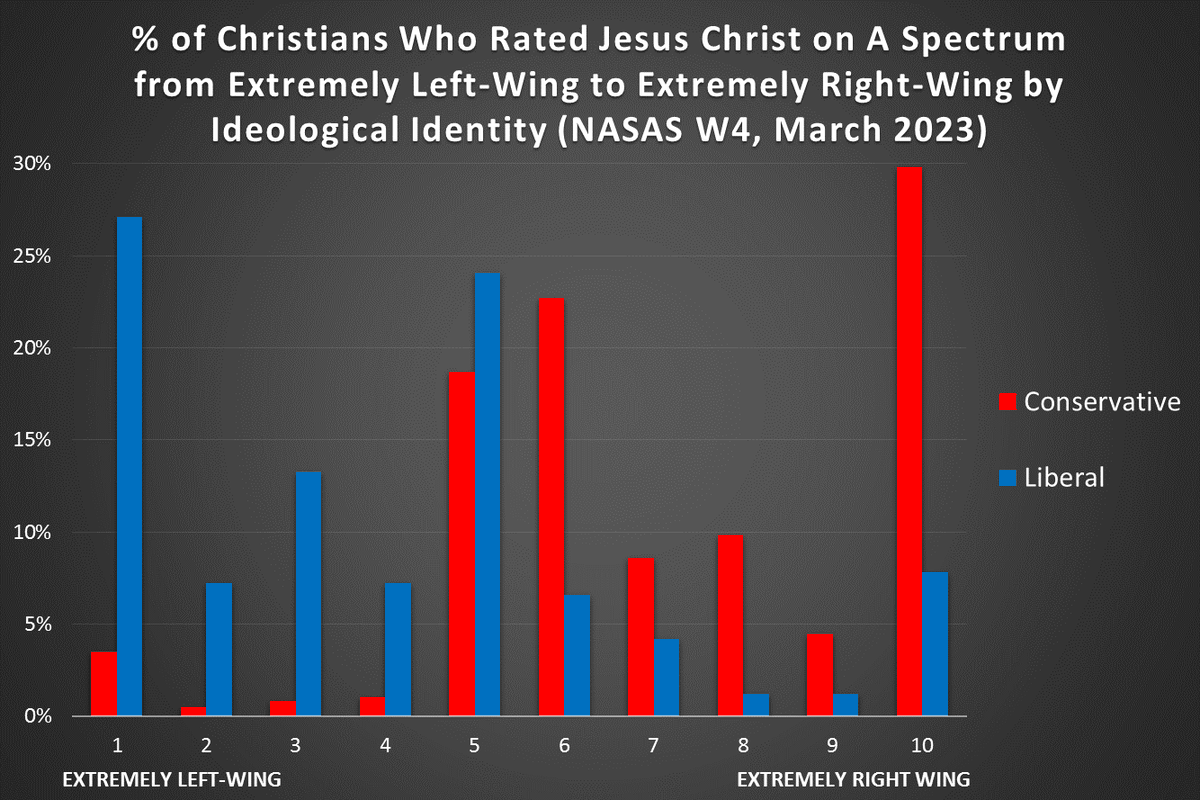
My antennae were up at the headline: Five charts that explain the desperate turn to MAGA among conservative white Christians. Any variation on “desperate Christians” tells me I’m reading something sensational or that the “Christians” are adherents of some Christianish ideology rather than sound Christian faith.

… [U]nless I’ve been gravely misinformed, if it throws in for nothing else, surely Christianity is bullish on hope. Americans should take note. Stateside, hope is in short supply.

Liel Leibovitz

Reading the Five Charts article, I was inclined to think the headline was sensationalist more than substantive — a religious variation on “The GOP is all White Christian Nationalists now.”

Rigor, whether you like it or not

Rod Dreher watched The Paper Chase and was smitten by The Majesty Of Professor Kingsfield, whose approach to matters once was spiritually helpful for Rod:

Back in the summer of 1991, when at age 24 I had made a decision to enter the Catholic Church, I went to the university Catholic chapel, thinking — oh, sweet summer child that I was — that a college ministry would offer a more intellectually serious approach to Catholicism. After months of therapeutic, sentimental navel-gazing in which I had been invited over and over to get in touch with my okayness, I left in disgust.

I was sent to an inner-city parish, and there met with old Father Dermot Moloney, an Irishman who dyed his hair shoe-polish black, and who had a Kingsfieldian crust to him. He heard my story, and agreed to instruct me in the faith. He said, in his porridge-thick accent, “By da time I get troo with ye, ye might not want to be a Catlick, but ye’ll know what a Catlick is.” I was so grateful that Father Moloney, gruff though he was, respected the faith, the tradition, and me enough to present it that way.

German Catholicism

Germany already has a Protestant church [and] we don’t need two.

Pope Francis’ remark to Bishop George Bätzing, president of the German Bishops’ Conference, via George Weigel, Apostasy in Germany’s Catholic Church. More from Weigel:

As the Synodal Way, which some in Rome call the “Suicidal Way,” drew the attention of Catholics world-wide, many said that German Catholicism was heading into “schism”—an institutional rupture with Rome. That isn’t quite right. Schisms typically are caused by issues of church order. Thus the Catholic Church believes the Orthodox churches of the Christian East are “schismatic” because they don’t accept the pope’s primacy and universal authority. What is unfolding in Germany is different—akin to the 16th-century Lutheran Reformation: apostasy.

Rome jumps the shark on war and killing

Bernard [of Clairveaux] did not stop with the [Knights] Templar Rule. He went as far as writing a treatise entitled In Praise of the New Knighthood. In it he declared without hesitation that “the knights of Christ may safely do battle in the battles of their Lord, fearing neither the sin of smiting the enemy nor the danger of their own downfall, inasmuch as death for Christ, inflicted or endured, bears no taint of sin, but deserves abundant glory.” Perfectly aligned with the new papal doctrine of indulgences, such a claim encouraged Christians to do what traditional Christianity had always taught them never to do: to kill their enemies, with an assurance that doing so would open to them the kingdom of heaven.

Fr. John Strickland, The Age of Division


For all its piety and fervor, today’s United States needs to be recognized for what it really is: not a Christian country, but a nation of heretics.

Ross Douthat, Bad Religion

You can read most of my more impromptu stuff here (cathartic venting) and here (the only social medium I frequent, because people there are quirky, pleasant and real). Both should work in your RSS aggregator, like Feedly or Reeder, should you want to make a habit of it.

Thursday, 2/16/23

Culture

Don’t say we weren’t told

Many sober voices warned that an expansion of NATO to Russia’s border would poke the Bear, leading to an inevitable war. As long ago as 1998, following the U.S. decision to expand NATO eastwards, George Kennan said the following to Thomas Friedman:

“I think it is the beginning of a new cold war. I think the Russians will gradually react quite adversely and it will affect their policies. I think it is a tragic mistake. There was no reason for this whatsoever. No one was threatening anybody else. This expansion would make the founding fathers of this country turn over in their graves.

Patrick Deneen, Russia, America, and the Danger of Political Gnosticism.

Self-critical thinking

Super-smart people, as Haidt notes in The Righteous Mind, are more skilled than others at finding arguments to justify their own points of view. But when they are asked to find arguments on the opposite side of a question, they do no better than anyone else. Brainpower makes people better press secretaries, but not necessarily better at open-minded, self-critical thinking.

Jonathan Rauch, The Constitution of Knowledge

Alarmist medical news feed

There must be an alarmist news feed, because my local TV station’s noon news always clocks in around 12:20 with some new medical study that shows I should give up yet another pleasure.

I offer in response Study Shows You’re Nobody Until Somebody Loves You.

Distraction is deliberate

“Distraction” will become the formal currency that drives the economy because in a nation where people (especially young men) can no longer count on full-time employment, the state will have every incentive to support and defend every hedonistic, narcissistic, distractive behavior in order to keep attention off themselves and their failed policies.

James Howard Kunstler, Living in the Long Emergency

UBI provocation

What Basic Income ultimately proposes is to detach livelihood from work. Its immediate effect would be to massively reduce the amount of bureaucracy in any country that implemented it. As Leslie’s case shows, an enormous amount of the machinery of government, and that half-government corporate NGO penumbra that surrounds it in most wealthy societies, is just there to make poor people feel bad about themselves. It’s an extraordinarily expensive moral game played to prop up a largely useless global work machine.

David Graeber, Bullshit Jobs

FBI

(An FBI field-office report lumped some “traditionalist” Catholics with “violent extremists” and called for government investigation:)

The document’s “open source” reporting comes from the Southern Poverty Law Center, which has spent years branding mainstream conservative groups as “hate” organizations and has no credibility outside progressive circles. The FBI gumshoes also point to articles in Salon and The Atlantic, which shows they need to expand their reading lists.

No wonder the FBI retreated once the document was made public. It hastened to say the report didn’t meet its “exacting standards” and was being removed from its system. It also promised the FBI “will never conduct investigative activities or open an investigation based solely on First Amendment protected activity.”

FBI Director Christopher Wray’s problem is that millions of Americans no longer believe this ….

Wall Street Journal

An even bigger problem is that millions of Americans justifiably no longer believe anything the federal government says.

WFYI has ruined WBAA

I just need to say this for the benefit of search engines.

WFYI, public radio Indianapolis, purchased WBAA, Indiana’s oldest radio station and the voice of Purdue, in one of a handful of Mitch Daniels moves that have really pissed me off.

At the time of the purchase, WBAA was a better-run station than WFYI, but I had no idea how terribly-run the buyer would make its new acquisition. Monday morning, I listening (because my wife prompted me) to a news segment that ran unintelligibly at half- or quarter-speed. Broadcasts from WBAA are routinely jumping back and repeating 5-10 seconds or material. As I typed this, they played three things (live stream and two pre-recorded announcements, one of them an inaccurate announcement of the time) simultaneously.

Very sad, though it saves me a $X in annual support.

Politics

I want to be a headline-writer when I grow up

I’m cutting back, both by design and lessening interest, on reading about politics. But the headline on an NYT Opinion piece amused me: Nikki Haley Has a Great Future Behind Her.

Top issues of the day

Damon Linker explains why anti-woke isn’t his top voting issue:

Here, meanwhile, are some of the things I consider to be significantly more important than the president and party I vote for coming down against wokeness:

Will the president and party abide by the rule of law, including the peaceful and orderly transfer of power based on the lawful and accurate counting of ballots?

Will the president and party treat mendacity like a virtue, knowingly spreading lies in order to discredit ideological opponents, undermine trust in federal law enforcement, and whip up insurrectionary rage in the hopes of using it to overturn constitutional checks on power?

Will the president and party fight to preserve government programs on which tens of millions of Americans rely? Or will they act, instead, to fulfill the wishes of plutocratic donors who care most of all about cutting their own taxes?

Will the president and party make wise, level-headed decisions in foreign policy? Or will they react on the basis of personal pique and very narrowly defined notions of national interest (and even on the basis of the president’s pursuit of self-enrichment and the party’s desire to score cheap political points)?

If the president and party do make a move against wokeness, will they do so in a way that’s compatible with individual freedom? Or will the goal be achieved by enhancing government power and curtailing various rights, including the freedom of association?

I would add to Linker the reality that the GOP has seized upon “woke” like Christopher Rufo seized upon “critical race theory”, stretching them beyond recognition and crudely weaponizing the stretched misrepresentations.

Chris Christie ain’t afraid of Florida Man

“I’ve known him for 23 years, and so I’m not the least bit afraid of him,” Christie told The Dispatch during an interview last week, while in Washington for meetings with Republican governors. “The presence of Donald Trump [in the primary] still makes a difference to a lot of people. He didn’t do what the normal one-term president does, which is go away in shame because they’ve lost. He has no shame.”

“If I get in, I get in because I want to win,” Christie said. “I’m going to be a truth-teller in this race. I think that the American people are hungry for the truth, and they don’t even know what it is anymore.”

Chris Christie of Donald Trump


Tradition is a bulwark against the power of commerce and the dissolving acid of money, and by removing these, all revolutions in the modern period have ended up accelerating the commercial and technological shift towards the Machine.

Paul Kingsnorth

You can read most of my more impromptu stuff here (cathartic venting) and here (the only social medium I frequent, because people there are quirky, pleasant and real). Both should work in your RSS aggregator, like Feedly or Reeder, should you want to make a habit of it.

Sunday, 1/22/23

I (Still) Don’t Mind Singing in an Empty Church

I am well aware that over my almost 13 years of blogging, I’ve more or less exhausted many of my ideas, and have become something of an aggregator or curator instead of someone expressing his own thoughts.

So I’ve begun — tentatively, at least — going back to my early blogging days for inspiration. In so doing, I found this from March of 2010. The title was I Don’t Mind Singing in an Empty Church. It still holds true:

Well, technically, I’m not sure the Church is ever really empty. There’s always that great cloud of witnesses.

But apart from them, the Church is sometimes empty except for Priest and Cantor (me). We rarely have more than the “clergy” (Priest, Deacon, Cantor and maybe another Reader) at the very beginning  of Matins. Occasionally that will happen in a weekday service, too. Usually one or two will arrive soon after the start, though. The inspired doodle above is (from Steve Robinson at Pithless Thoughts, shall we say, reality-based.

But it doesn’t bother me, at least not in the sense of “why do I bother?” I may regret that many who could be present don’t bother, and miss out (missing out on what is the point of this posting – read on). But many really can’t come, and that’s okay. We’re a small Parish, with lots of young families with children. I’d think there was something seriously wrong if those families dragged their young ones to Matins, which combined with Liturgy routinely runs almost 3 hours. Others commute as much as an hour each way. So I don’t expect them to come.

But by coming and singing, I myself – hard of hearing and heart – steep in the teaching and mind of the Church. Slowly, I’m absorbing it. That counts for quite a lot since I’m serious about my faith but have nearly 5 decades of baggage from other Christian traditions, each misguided about many things, to unload.

One of those pieces of baggage is how to approach scripture. I had already begun to write this when Father Stephen posted on “the hearing of the word.” It illustrates beautifully how the Church approaches scripture:

I am convinced after years of preaching and listening to preaching that the bulk of Scripture has become lost to our ears. We hear it, but fail to “hear” it ….

Much of my conviction on this matter has come in the last 12 years or more and my immersion into the services of the Orthodox Church. These services, long and with ample “hymnography” that is but a poetic commentary on the Scriptures and doctrines that surround any particular feast, are probably the richest surviving engagement with the Word of God to be found in a 21st century Church. Here no Reformation has occurred and reduced all Scripture to a “riff” on Justification by Faith, or a subset of Calvin’s paradigms. Here no Enlightenment has shown with its darkness of doubt and obfuscation.

Instead, there is a constant wonderment at the Scriptures themselves, as if the hymnographer were discovering something for the first time or had found a rare gem to share to any willing to listen – and all in the form of praise and thanksgiving to God.

It is true to say that in Orthodoxy, “Theology sings.” ….

…In our modern context most people have either been shaped by fundamentalist literalism; by modernist historical criticism; or by nearly nothing at all. In each case the Scriptures will not sing – they will not yield up their treasures.

I was struck by a particular case this evening – at the Vigil for  Palm Sunday. The gospel account in question was the Matthean version of Christ’s entry into Jerusalem:

“And when they drew near to Jerusalem and came to Bethphage, to the Mount of Olives, then Jesus sent two disciples, saying to them, “Go into the village opposite you, and immediately you will find an ass tied, and a colt with her; untie them and bring them to me. If any one says anything to you, you shall say, `The Lord has need of them,’ and he will send them immediately.” This took place to fulfil what was spoken by the prophet, saying, “Tell the daughter of Zion, Behold, your king is coming to you, humble, and mounted on an ass, and on a colt, the foal of an ass.” The disciples went and did as Jesus had directed them; they brought the ass and the colt, and put their garments on them, and he sat thereon.”

Modern historical criticism hears in this only the “foolishness” of Matthew. Matthew has cited the prophecy in Zechariah that “your king is coming to you…mounted on an ass, and on a colt, the foal of an ass,” and has crafted his story in precisely that manner, placing Jesus astride two animals. The same critics will note that in other gospel accounts Christ is only on a “foal of an ass,” i.e., one animal. Historical Critics have a field day with such problems (I was first confronted with this “discrepancy” in my sophomore year of college – it was presented as if the professor had noticed something no one had ever seen before). Modern fundamentalists will rush to defend the integrity of the gospel accounts, “Two different eye-witnesses reported on the same thing and one emphasized one thing and the other emphasized another.”

Both explanations lack imagination and are precisely the sort of blindness that afflicts so much modern reading of Scripture. Listening to the hymnody for the Vigil of Palm Sunday, the hymnographer, without apology for the discrepancy, races to it and declares:

“O gracious Lord, who ridest upon the cherubim, who art praised by the seraphim, now Thou dost ride like David on the foal of an ass, The children sing hymns worthy of God, while the priests and scribes blaspheme against Thee. By riding an untamed colt, Thou hast prefigured the salvation of the Gentiles, those wild beasts, who will be brought from unbelief to faith! Glory to Thee, O merciful Christ. Our King and the Lover of man!”

the ancient hymnographer has come closer to the heart of Scripture than either the modern sceptic or the modern literalist will ever know.

… The writers of the New Testament believed that everything in the Old, when read rightly would yield insight into the Messiah and the mystery of our salvation. But their creative insight (again, I believe it is inspired) is far removed from the flat-footed nonsense that we hear out of modern fundamentalist “prophetic” scholars, whose reading of the Old Testament is almost as poorly constructed as the 19th century false prophecies of the book of Mormon! Neither bear any resemblance to the treatment of prophecy found in the New Testament.

And thus I return to my original point. We have become deaf. We listen with ears either hardened by modernist scepticism, or by a false literalism that has substituted Darbyite nonsense for the Apostolic faith, or reduced Scripture to delicate harmonizations. None of them have the boldness and audacity of the patristic hymnographers who stood in the proper line of succession, proclaiming the faith as it had been taught and received and continuing to expound its mysteries. Thank God that somewhere in this modern world, you can still stand and listen to the wonders of our salvation, sung and unraveled before the unbelieving heart of man. Glory to God who has so loved mankind!

So, whether there’s a single soul besides me in church, I’m singing theology. I’m singing poetry. I’m expounding the mysteries of the faith. I’m unraveling the wonders of our salvation before my own unbelieving heart, made dull by 48 years of desperate harmonizations – “flat-footed nonsense.”

[If this sampling from Father Stephen has whetted your appetite, probably the most target-rich zone of audacious expounding of the Old Testament is the Great Canon of St. Andrew of Crete, sung in segments during the first week of Lent and then sung in its entirety Thursday of the 5th week. Download and savor.]

And in a sense that I’m slowly and dimly beginning to apprehend, we are doing the reconciling work of God. This gets into a sacramental view of the world, which I am unqualified to address and would surely botch if I tried. Perhaps another day.

Although I’m occasionally bone-weary when I go to sing, it’s always a very great privilege, and I benefit as much as anyone.

Published March 27, 2010

This recent post from Father Stephen expands on why I benefit from singing even in an empty church, particularly when I wrote that I “steep in the teaching and mind of the Church”:

What is often experienced at first as “boredom” (the sameness of the liturgy or the interminable character of the Psalms or Canon in some services) is nothing more than a description of something that exists for the nurture of the nous rather than the emotions and reasoning. Imagine walking with someone through a Redwood forest, or along a quiet beach and being told, “I’m bored.” In truth, the forest and the beach are quite common examples of noetic experiences that have yet to be eradicated or destroyed by our culture. It is not surprising that many people report an awareness of God in such settings.

The One Mediator – And the Sacraments (emphasis added).

I really should at least provide a hyperlink for nous, which is more than the first person plural French pronoun.

The Desire of the Nations

It is a strange yet incontrovertible fact that, when God did take flesh, He in many ways (though certainly not all) revealed himself to be closer in spirit to the Tao of Lao Tzu then to God as conceived by the Hebrews at that time, even though the Hebrews had the revelation of Moses. This might be difficult to accept by those who are accustomed to thinking of Christ as the fulfillment of the expectation specifically of the Hebrews. Ancient Christian tradition, however, holds that Christ satisfied the longing of all the nations.

Hieromonk Damascene, Christ the Eternal Tao

The whiff of an empty bottle

Alasdair MacIntyre famously suggested that modernity is like the late Roman Empire, living on fragments of old ideas and practices that made sense only within a context that is now largely lost. Christian institutions, such as parishes, schools, hospitals, and aged-care and welfare agencies, might seem quite healthy. But they can easily lose their souls and become Christian “zombies” indistinguishable from secular NGOs.

As a young man, backpacking around Europe while deciding my vocation, I spent a fortnight in Florence. Two young guys from Seattle arrived at my youth hostel with only a day for Florence and asked me whether there was much to see! Though no expert, I offered to take them around. Engraved in my memory is an incident in the Uffizi Gallery. One of them turned to me and asked, “Who is the woman with the baby in so many of the pictures?”

Anthony Fisher, The West: Post- or Pre-Christian?

Peace in our time

[I]t came as something of a surprise that the Anglican bishops voted this week to stand firm on gay marriage. The result is somewhat qualified—the bishops also voted to permit blessings and prayers for same-sex civil partnerships and to issue a forthcoming apology about past sins against LGBTQ+ people. Archbishop of Canterbury Justin Welby, however, is apparently delighted:

This response reflects the diversity of views in the Church of England on questions of sexuality, relationships and marriage. I rejoice in that diversity and I welcome this way of reflecting it in the life of our church. I hope it can offer a way for the Church of England, publicly and unequivocally, to say to all Christians and especially LGBTQI+ people, that you are welcome and a valued and precious part of the body of Christ.

Or, to put it more concisely in the words of Neville Chamberlain, “Peace in our time.”

Carl Trueman

Half-Converted Christians

There is no point in converting people to Christ if they do not convert their vision of the world and of life, since Christ then becomes merely a symbol for all that we love and want already – without Him. This kind of Christianity is more terrifying than agnosticism or hedonism.

Rod Dreher, Schmemann and Social Justice. I suspect that Dreher was quoting or closely paraphrasing Fr. Schmemann, a towering figure in American Orthodoxy.

I don’t want my Sunday posts to turn political, but it seems to me that this may be relevant to the Donald Trump supporters who began calling themselves “Evangelical” without darkening the door of even the Trumpiest “church.”

Steve Robinson returns!

To my delight, I stumbled onto one of my favorite sporadic podcasters and doodlers, who apparently disappeared partly because of cancer, but it now back with the Pithless Thoughts II.

(2023 Resolutions)

It appears that “sporadic” no longer fits, which is a good thing if I’m going to pay-to-read.

Do not subscribe expecting any political commentary.

More from Steve:

The internet gives us an omniscience about, and a platform to address the world in ways that were previously available only to God.

The problem is, we are not equipped to be God. Adam and Eve had one thing to control and could not deal with the temptation attached to it. They failed as “gods” in a near-perfect world in which only one thing in their world demanded a consequential choice. One thing. In one small place. With one clear instruction. No other people. No “big picture”. No big deal. Their world was as limited as their humanity. And yet they failed to be even as human as they could have been.

I don’t know if the world is bigger and more complicated because of the Fall, or if we have just not been able to keep up with it because of the Fall. Either way, we are not created with the capacity to deal with omniscience. Our finite humanness is created to obey God and let God be God and judge and control all things (to not “be God”). It is not created to “be God” and judge, control and respond to the entire world’s issues. Because we are not God and we live in a fallen world, we can only take in so much pain, evil and dissolution (on top of what is already in our own hearts and lives) before we break.

I’ve watched the internet for over 20 years now and I see the same thing happening. We are in a cultural and personal “psychotic break”.

The “break” is this: We are overwhelmed with an ungodly amount of information, we are tempted and called on to be “gods”, but we, by nature, incapable of omniscience. The world is big, out of control, gray and complex. We, on the other hand are small, relatively powerless and simple. At the intersection of the vast world and our limited humanity is the potential for “psychosis”. And it is ultimately a spiritual issue.

The hardest spiritual discipline, from the beginning, is to “stay in our human lane” and not fall for the First Temptation to “be like God, knowing good from evil”. All the evils in the world were brought about by that simple appeal to our human ego and the news of the world, no matter how intimate or global that news is, has tempted humanity since.

You Will Be Like God

Mystery

Her mysteries are but the expressions in human language of truths to which the human mind is unequal.

John Henry Newman, Apologia Pro Vita Sua

Wednesday, 1/18/23

“Science”

Follow the scien(tists’ secret agendas)

Few areas of medicine have become as politically heated, and in need of cool-headed research, as treatment of transgender children. Neither side seems to be engaging in good faith. Some Democrats have misrepresented the medical consensus on how best to help children with gender-related distress, presenting this as a closed matter when there is no global scientific consensus. The cherry-picking of evidence by medical bodies such as the American Academy of Paediatrics helps explain why Republicans have become twice as likely as Democrats to believe scientists have agendas beyond the pursuit of scientific fact.

The Economist, 1/14/123

The Über-Agenda

More drugs and surgery for kids: The American Academy of Pediatrics this week came out with new recommendations: Obese children should be given weight loss drugs and surgery at ages as young as 12 and 13, respectively. Now, that is probably the right thing to do for severely obese children. But also: The new recommendations argue that “obesity is a chronic disease.” Obesity, in the new mindset, can never be about choices. It is not a lifestyle problem. 

The message is: body positivity and junk food are a-ok (can’t be shaming anyone!) until the American medical establishment can profit, and then it’s a sharp pivot to  hardcore drugs and surgery. It’s cheap, government-subsidized corn products shoveled into school lunches, then a series of expensive drugs for chemically imbalanced adolescents. There is no middle ground. 

One thing I noticed in the new pediatric guideline is they use the word overweight in a way I’d never seen. It goes: “youth with overweight and obesity.” As in: “This is the AAP’s first clinical practice guideline (CPG) outlining evidence-based evaluation and treatment of children and adolescents with overweight and obesity.” Obesity and “overweight” is a disease you catch.

Nellie Bowles

Has anyone devised and deployed an effective incentive for doctors to learn about, and prescribe, good nutrition — patient-tailored if necessary?

Legalia

Notably off-narraative

Some LGBetc students sued to circumvent or invalidate exemptions for certain religious schools from certain nondiscrimination rules:

To recap, a coalition of students sued the Biden Department of Education, seeking to roll back religious liberty and place a high price on the autonomy of religious organizations, the Biden administration defended religious liberty, and a Clinton-appointed judge dismissed the case, relying in part on unanimous Supreme Court precedent decided by both Republican and Democratic-appointed justices.

This is not exactly the culture war narrative you hear on cable news.

David French, trying to inject a little anti-inflammatory into the culture war narrative.

(H/T Get Religion, critiquing the pathetic coverage of the story by RNS).

Covenants not to compete

For the record, I viscerally and strongly support the Biden FTC’s move to abolish Covenants Not to Compete. I do so because I have seen their abuse over and over again.

My state, Indiana, always greets lawsuits over these covenants with ritual incantations that they are viewed with disfavor. Then it always upholds them, no matter how ludicrous and unreasonable.

What I most hate about the Indiana approach is the perversity of this reasoning:

  1. Unless otherwise agreed, all employees are “at will.”
  2. It’s sad that you uprooted your family and moved X miles for a job with an employer who didn’t mention covenants not to compete, but when your new employer thrust the covenant before you on your first day and said “sign,” it was supported by adequate consideration because employer didn’t fire you then and there.
  3. Yes, the employer could still fire you without cause tomorrow. What is it about “at will” you don’t understand, dummy?

I suppose if you checked, you might find one or two covenants rejected by an Indiana appellate court, though I don’t recall one. So sue me.

And I suppose that the FTC probably lacks lawful power to abolish them. So sue it. I know someone will.

Politics

The difference between conservatives and Freedom Caucus

Some people have asked me, “How has the Trump era changed you?” For one thing, it has made me a lot more conservative — not in the Fox-and-talk sense, but in an older, Burkean one. Most of the radicalism in me has been snuffed out.

One of the GOP’s new congressmen, Madison Cawthorn, said, “I want a new generation of Americans to be radicals.”

Well, to hell with that.

Jay Nordlinger, Lies, Patriotism, and Consequences, January 11, 2021.

The populism that the press keeps styling as some sort of conservatism is still radical two year later, as shown by legislation that proposes wholesale to tear down systems and replace them with untried “conservative” alternatives. Florida Governor DeSantis is not exempt from this observation, as he loads up the Board of New College of Florida with populists like Christopher Rufo, who are in a hurry to demolish and rebuild.

One Simpson’s episode worth ten thousand words

As we approach the 30th anniversary of The Simpsonslegendary Monorail episode, Alan Siegel caught up with Conan O’Brien—a former writer for the show—on what it was like to pitch what is now considered one of the most timeless bits in sitcom history. “[“Marge vs. the Monorail”] warned the world about charismatic men selling foolishly grandiose solutions to problems that don’t need fixing,” Siegel writes for The Ringer. “References to the episode will never cease making O’Brien happy. While browsing the Rose Bowl flea market, his friend once noticed a framed travel poster showcasing Homer and the monorail. ‘It says, “Glides as smoothly as a cloud,’’’ O’Brien says. ‘I was like, “You have to buy that for me.” It wasn’t even that much. That’s hanging in my house, and I kind of smile every time I see it.’ Still, the fact that ‘Marge vs. the Monorail’ is seemingly brought up whenever a grifter dupes the public surprises O’Brien. After all, it was an idea that started very, very small.”

The Morning Dispatch

Gun control as culture war

[A]ttempts to ban ordinary weapons such as semiautomatic rifles and handguns are plainly unconstitutional, that they would be unlikely to do much to deter violent crime, and that they are at root intellectually dishonest: They are more genuinely a culture-war assault by progressive-leaning urbanites and suburbanites on gun owners as a demographic, one that is perceived (not entirely accurately) as being socially retrograde, white, male, rural, Southern, middle-aged—everything that communicates “Trump voter” to people living in Greenwich, Connecticut.

Kevin D. Williamson

Face the GOP Facts

[I]t’s long past time for well-meaning conservatives writing in good faith to face up to the facts: The GOP is not an economically populist party and shows no signs at all of becoming one. It’s a culturally populist party with a plutocratic economic agenda.

Damon Linker, The Right’s Economic Populism is Stillborn

Realistic Expectations

“The only reason for a Republican hopeful to put their own aspirations aside and back DeSantis in 2024 is because it would be good for the country for the GOP to finally rid itself of Trump,” Nick writes in Tuesday’s Boiling Frogs. “I doubt a single one will pass on the race for that reason.”

The Morning Dispatch

January 6

The Stanford historian David M. Kennedy has spent a career as an authority on American society and politics; winner of a Pulitzer Prize, he wrote one of the most popular textbooks on American history and has delved into a number of controversies and political movements. But he has struggled to come up with any analogue from the past for what he describes as the “insurrection” at the U.S. Capitol on January 6. “This is a unique moment,” he says, “where a degree of insanity and irrationality has infected a large enough sector of our body politic that we’re really sick. I think we are politically sick, and I use that word advisedly.”

Ruairí Arrieta-Kenna and Emily Cadei, The Education of Josh Hawley – POLITICO

Nonpartisan Gmail filters

The Federal Election Commission decided last week to dismiss a complaint brought by the Republican National Committee and other GOP campaign groups that alleged Gmail’s spam filter constituted “illegal, corporate in-kind contributions to the Biden campaign and Democrat[ic] candidates across the country.” Republicans cited a North Carolina State University study that found GOP campaign emails were sent to spam at a significantly higher rate than Democratic ones, but FEC officials found no evidence any disproportionate results were intentional and held that Google had “credibly supported its claim” that the spam filter exists for commercial purposes. As Sarah noted last year, Republican campaigns have a long history of overusing and sharing email lists, resulting in spam filters being triggered at a higher rate.

The Morning Dispatch

Quoted without concurrence

I doubtless suffer from Trump Derangement Syndrome, even after having watched with bemusement people with Bush or Obama derangements. By admitting this, I’m saying that I simply have never understood how Donald J. Trump could appeal to any upright adult human, let alone appeal as POTUS.

I know he does appeal to some such people, though, and is at least tolerable to many more. So I need periodically to let one of his defenders make the case:

When it comes to Donald J. Trump, people see what they wish to see. Much like with the audio debate a few years ago “Do you hear ‘Laurel’ or ‘Yanny’?,” what some perceive as an abrasive, scornful man bent on despotism, others see as a candid, resolute leader unflinchingly committed to America’s interests.

Kellyanne Conway, The Cases for and Against Trump

(Another thing I can’t understand is how vocal NeverTrumper George Conway and Kellyanne kept their marriage intact 2015-2020.)

Cited without any conviction that it really matters

Renato Mariatti makes the case that Biden’s retention of classified documents is nothing like Trump’s:

Based on what we know now, Biden’s sloppy retention of a smattering of classified documents looks more like former Secretary of State Hillary Clinton’s inadvertent retention of classified material on a private email server than former President Donald Trump’s stubborn refusal to return hundreds of classified documents to the DOJ despite repeated demands from federal officials.

Trump is under investigation for willful retention of classified records because he ignored direct requests from national archives officials, a grand jury subpoena and even a personal visit from DOJ’s top counterintelligence official. The FBI seized the documents pursuant to a search warrant only after they discovered that Trump’s attorneys lied to them and that documents had been moved inside Mar-a-Lago after their visit.

While the Biden investigation is at an early stage, and there may be key facts that are not yet public, Biden’s actions appear to have been sloppy and inadvertent rather than willful and obstructive. Most of the statutes that Trump is under investigation for violating wouldn’t apply to Biden’s conduct. The only statute that Hur would likely investigate is 18 U.S.C. 793(f)(1), which punishes the loss or removal of national defense information resulting from “gross negligence.”

Culture

Woke schoolmarms

[W]hy does wokeness … drive me crazy?

The beginning of an answer can be found in the fact that wokeness makes me feel like I’m attending Sunday school in a denomination and parish I never chose to join. I just turn on the radio or open the paper or scroll through Twitter — and the next thing I know, a finger-wagging do-gooder with institutional power behind him is delivering a sermon, showing me The Way, calling on me to repent, encouraging me to be born again in the moral light.

Damon Linker, Why does wokeness drive me crazy?

Too much of a good thing?

To minimize suffering and to maximize security were natural and proper ends of society and Caesar. But then they became the only ends, somehow, and the only basis of law—a perversion. Inevitably, then, in seeking only them, we found only their opposites: maximum suffering and minimum security.

Walter M. Miller Jr. [A Canticle for Leibowitz]()

Faces and heels

Aaron Renn has a fascinating account of “heels” and “faces,” a dichotomy from the argot of professional wrestling that I’d not heard before, including this interesting take on the Trump phenomenon:

Playing the heel is not always a strategic failure. Some people can succeed in both using heel mode to benefit themselves, and having some strategic success as well.

The big example is Donald Trump. The party system, political finance structure, and media apparatus made it essentially impossible for any fundamental changes to or questioning of the system to gain traction. Trump, in a judo type move, was able to use the media’s desire for a conservative heel to draw immense media attention that catapulted him to the presidency. Most of the time, he was able to successfully parry media attacks using some variation of heel tactics.

Not only that, his candidacy and presidency shook up the system in a way that I don’t recall ever happening since the Reagan era. While ultimately it might be completely suppressed – every major institution in society, including the Republican Party establishment, is aligned with making that suppression happen – he certainly made an impact. And that would not have happened without using heel tactics.

Unsurprisingly, Donald Trump has not only spent decades in the media spotlight, he’s also in the pro wrestling hall of fame. He has a deep understanding of how these dynamics work and how to deploy them successfully.


Tradition is a bulwark against the power of commerce and the dissolving acid of money, and by removing these, all revolutions in the modern period have ended up accelerating the commercial and technological shift towards the Machine.

Paul Kingsnorth

You can read most of my more impromptu stuff here (cathartic venting) and here (the only social medium I frequent, because people there are quirky, pleasant and real). Both should work in your RSS aggregator, like Feedly or Reeder, should you want to make a habit of it.

Sunday, 1/15/23

Assembly by False Hearts

In our digitalized, printed world, we have access to almost everything. The vast discourse of the saints, the details of the canons, the deeds and records of empires, are all available to almost everyone. Someone wants to make a point and assembles a long list of quotes drawn from the saints. Every word written is true, and yet the presentation is not true.  It is impossible to argue with such things – you are resisting the saints! And it is equally impossible to help someone whose heart is in delusion to understand that such a collection can be false – primarily because it was assembled by a false heart.

The Scriptures are abused in the same manner. It is terribly frustrating to be confronted with a vast collection of verses gathered in the service of a false teaching. The same thing was confronted by the fathers early on. Fr. Georges Florovsky gives this summary of an account by St. Irenaeus:

Denouncing the Gnostic mishandling of Scriptures, St. Irenaeus introduced a picturesque simile. A skillful artist has made a beautiful image of a king, composed of many precious jewels. Now, another man takes this mosaic image apart, re-arranges the stones in another pattern so as to produce the image of a dog or of a fox. Then he starts claiming that this was the original picture, by the first master, under the pretext that the gems … were authentic. In fact, however, the original design had been destroyed …. This is precisely what the heretics do with the Scripture. They disregard and disrupt “the order and connection” of the Holy Writ and “dismember the truth” — …. Words, expressions, and images — … —are genuine, indeed, but the design, the … hypothesis, is arbitrary and false (adv. haeres., 1. 8. 1).

Fr. Stephen Freeman, Goodness and a Word in Due Season. (Ellipses replace Greek text that wouldn’t render on WordPress)

St. Irenaeus’s analogy always grabs me, and it’s as applicable to today’s heretics as to gnostics two millennia ago.

Midhir’s Invitation to the Far Laned

Irish, author, unknown, ninth century

Fair woman, will you go with me to the high land
where sweet music is? There your hair is like the primrose
And people stroll with snow-white skin.

In the high land, there is neither yours nor mine.
The women’s teeth are white; the men’s eyes are black and clear.

Every cheek is the pink of foxglove.

The meadows of Ireland are fair to see –
But they are like a desert when you have seen the high land;

Irish ale is fine to drink – but in the high land
the wine they serve will turn your head into a cloud.

In the place, I speak of, the young do not die before their time;
They serve the old ones, who are wise
and shield the young in turn.

Sweet dreams flow always through the fair land
and the minds of the people are clear

as skin with no blemish,
as a child’s face in the virgin morning.

When we walk together there, you will see
these men and ladies,

you will see them on all sides, tall, and fair and kind.
But they will not see us.

For Adam’s transgression is a dark cloak around us,
and it means we cannot be seen, or counted among them.

(Martin Shaw & Tony Hoagland, Cinderbiter)

The missus almost immediately picked up that C.S. Lewis, consciously or unconsciously, echoed this old Irish poem in The Great Divorce.

A compulsion as common as the air we breath

Orthodoxy theology defines only what is necessary and always leaves unspoken that which cannot be explained. This approach was part of the Christian faith from the beginning. But the Western phronema often suppresses, dismisses, minimizes, or ignores this stance. The Western mind is compelled to define and explain everything, since without a rational explanation a concept or fact cannot be considered true, or, conversely, all truth can be proven rationally.

Eugenia Scarvelis Constantinou, Thinking Orthodox: Understanding and Acquiring the Orthodox Christian Mind

Me, too

[N]one of the things that I care about most have ever proven susceptible to systematic exposition.

Alan Jacobs, Breaking Bread With the Dead

The Spiritual Life Doesn’t Work

I have wondered how the “success” of the spiritual life would be measured? I could imagine that the number of persons baptized might be compared to the number of the baptized who fall short of salvation—but there is no way to discover such a thing. In lieu of that, we often set up our own way of measuring—some expectation of “success” that we use to judge the spiritual life. “I tried Christianity,” the now self-described agnostic relates, “and found that it did not live up to its claims.” I’ve seen things like that.

To my mind, the entire question is a little like complaining about your hammer because it doesn’t work well as a screw-driver. The problem is that the spiritual life doesn’t “work,” and it was never supposed to. It is not something that “works”; it is something that “lives.” And this is an extremely important distinction.

We today look to our faith to solve problems. Whether we suffer from psychological wounds, or simple poverty and failure, we look to God for help. The spiritual life, and the “techniques” we imagine to be associated with it, are the means by which we “help ourselves”—and then God will do the rest.

Well, this narrative is simply not part of the Christian faith …

The lives of the saints are filled with information of an opposite sort. For example:

  • [St.] Mary of Egypt is directed into the desert by the voice of the Mother of God. She lives miraculously on very little food. But she tells of 17 years—17 years!—of virtual torture as she battled the temptations that had governed her previously sinful life. Our daily trials would seem as nothing in comparison.
  • St. Silouan the Athonite told about a period of 15 years in which he had no sense of the presence of God, but was instead tortured by demons.
  • St. Seraphim of Sarov spent years in prayer and fasting, was beaten, robbed and left like a cripple.

Fr. Stephen Freeman, The Slow Road to Heaven


Tradition is a bulwark against the power of commerce and the dissolving acid of money, and by removing these, all revolutions in the modern period have ended up accelerating the commercial and technological shift towards the Machine.

Paul Kingsnorth

You can read most of my more impromptu stuff here (cathartic venting) and here (the only social medium I frequent, because people there are quirky, pleasant and real). Both should work in your RSS aggregator, like Feedly or Reeder, should you want to make a habit of it.

Sunday, 1/8/23

Orthodoxy

Two from Constantinou

  • Orthodoxy holds that the fullness of the Faith was revealed to the Church at Pentecost, once and for all. The Greek Fathers utilized their education in the service of the Church to explain doctrine, not to find new truths, since the fullness of the truth was received at Pentecost.
  • Ultimately, theology is not a set of definitions or theories. Theology is mystery since it transcends the rational mind and attempts to express the inexpressible. In schools of theology and seminaries, theology is indeed an academic subject and, as such, it requires accuracy and embraces a certain “intellectual rigour,” as Met. Kallistos remarks. This does not conflict with Orthodoxy, since “we do not serve the Kingdom of God through vagueness, muddle and lazy thinking.” But he also notes that in other sciences or areas of investigation, the personal sanctity of the scientist or inquirer is irrelevant. This is not the case with theology, which requires metanoia (repentance), catharsis (purification), and askesis (spiritual struggle).

Eugenia Scarvelis Constantinou, Thinking Orthodox: Understanding and Acquiring the Orthodox Christian Mind (emphasis added)

Both of these observations point out true Orthodox distinctives in comparison to Western Christendom, don’t they?

How to Live (temporally)

Within this longer blog post is a priceless bullet-list on “how to live.” I review it regularly.

Though I blog a lot about politics, it’s been a long time since I argued politics. The difference in outcomes between policy A and policy B are usually less important to me than the potential for personal alienation. So my political blogs are mixtures of “this is my opinion; yours may vary” and “here’s something thought-provoking or very well written.”

I guess that confirms that I’m temperamentally in David French’s “hope and freedom” camp versus the camp of “anger and power.”

Other

A Reminder of Where We Were Two Years Ago

Certainly, the bulk of Pentecostal-charismatics who follow the prophets are in for a shock when Biden gets inaugurated Jan. 20. Rather than admit their error, Brown says some prophets have already concocted a scenario where Trump will be inaugurated “in heaven” and that God will replace Biden with Trump sometime this spring.

Julia Duin, Charismatics are at war with each other over failed prophecies of Trump victory

The whole story is well worth reading, Julia Duin being a “Religion Beat” pro in the press.

Homeless

I am thinking of a Black Southern Baptist–trained pastor who could not stomach taking his kids to church within his denomination anymore because of his fellow church members’ reluctance to talk about racism. A longtime staffer at a major American archdiocese who feels daily rage at the Catholic Church’s inability to address the clergy sexual-abuse crisis. A young woman fired from her job at a conservative Christian advocacy organization because she spoke out against President Trump. A Catholic professor who bitterly wishes the Democratic Party had room for his pro-life views. These are all examples from the world of religion and politics, but they speak to a deep and expansive truth: In many parts of American life, people feel the institutions that were supposed to guide their lives have failed, and that there is no space for people like them.

Emma Green, The American ‘way of life’ is unsustainable for so many. Is it time to build radical forms of community?

Seeing this excerpt surface in Readwise, I’m reminded that I haven’t seem much from Emma Green lately, and I miss her.

A baffling, frustrating, near-Saint

Did the 20th century produce anyone more baffling than Simone Weil? Christ at the Assembly Line

Russia and Ukraine

It’s a useful skill to be able to hold two truths in mind at the same time.

Truth #1 is that Russia is unjustified in invading Ukraine.

Truth #2 is that, discounting all the bullshit about “de-Nazification” or “Russki Mir,” Russia is right that the West is decadent, particularly in the area of sex and gender (with the U.S. leading the way), and that Ukraine is worrisomely trending westward in many areas of culture.

I literally pray every day that God will thwart our meddling in traditional cultures, and I generally have sexual perversity in mind as the distinctive way we meddle these days. I also pray that God will turn back all manner of attacks on Ukraine. So I’m rooting for Ukraine to win against Russia in the hot war, but also that it will reject some of our ways as it grows closer to the West.

Nota Bene

No Orthodox Christians observe Christmas on January 6 or 7. All Orthodox Christians observe Christmas on December 25.

You read that right.

The thing is, December 25 on the Julian calendar (which much of world Orthodoxy follows liturgically) is January 7 on the Gregorian Calendar, the “civil calendar,” which some Orthodox (including my parish) follow for every Christian feast except Easter/Pascha.

Religion News Service summarizes plausibly enough, given its Gregorian Calendar premises:

While the Orthodox Christian churches in Greece, Bulgaria and Romania celebrate [Epiphany/Theophany] on Jan. 6, Orthodox Churches in Russia, Ukraine and Serbia follow the Julian calendar, according to which Epiphany is celebrated on Jan. 19, as their Christmas falls on Jan. 7.

It is not disputed that the Gregorian Calendar is more accurate astronomically.

I won’t get into the intra-Orthodox disputes over the “calendar issue,” which I personally shunted aside decades ago. Those arguments do nothing to edify.


You can read most of my more impromptu stuff here (cathartic venting) and here (the only social medium I frequent, because people there are quirky, pleasant and real). Both should work in your RSS aggregator, like Feedly or Reeder, should you want to make a habit of it.