Is Orthodoxy a cult?

At the risk of revealing how oddly my synapses fire at times, a story (see here, here and above all here) about Daniel Harper, a Cameron University (Oklahoma) student started me thinking: how would young Harper assess Orthodox Christianity by his criteria for identifying a cult? Does that tell us something bad about Orthodoxy, something bad about Harper, or something deficient in his criteria?

My point is not to beat up Harper, and I won’t beat him up. I hope and (with Eugene Volokh fully expect) that he will trounce his university in his lawsuit. My point is to reflect on how Orthodoxy differs from Evangelicalism so much that an Evangelical might mistake it for a cult – as some of them certainly have.

To start off with, and based on my own experience, I think an evangelical superficially acquainted with Orthodoxy might indict us for (from Harper’s criteria):

  1. “They say they have the ‘truth,’ which can only be found through their group.”
  2. “Group claims special or elite status.”
  3. “They hide their core teachings.”
  4. “They encourage meetings to ‘study,’ rather than telling you things up-front.”
  5. Real Religions
    1. “Information offered up front.”
    2. “Works within society. “
  6. Cults (Destructive Organizations)
    1. “Exploits/ manipulates its members with mind control techniques.”
    2. “Discourages autonomy and pushes for conformity to the group.”

First, I note that this (and much of Harper’s other criteria) mashes up religious and sociological meanings of “cult,” leaning toward the latter. When I was a young Evangelical, the focus of the term among “my people” was mostly on religious error, not secretiveness or “cultic” mind control. I recall from my parents’ bookshelves, for instance, a tome titled The Chaos of the Cults (full text here). Its list of “cults” was very politically incorrect by today’s standards, leaning toward the abberant Protestantisms (i.e., <snark>those whose foundational interpretations of scripture were more recent than the 17th Century</snark>):

  • Spiritism Thesophy (And The Liberal Catholic Church)
  • Rosicrucianism
  • Christian Science
  • The Unity School Of Christianity
  • Baha’ism
  • Mormonism
  • Destiny Of America (Anglo-Israelism)
  • Seventh-Day Adventism
  • Jehovah’s Witnesses
  • Buchmanism (Moral Re-Armament)
  • Unitarianism Modernism
  • Swedenborgianism

I was in college when the emphasis started shifting, with families “intervening” and “deprogramming” their kids who’d gotten into, say, Hare Krishna or the Unification Church, both of which seemed (and probably were) sinister. The meaning of “cult” now generally leans toward the sociological use, the old usage, which really didn’t have much more substance than “any religion newer than mine is bogus,” having died a well-deserved death.

But that point aside, let’s look at the criteria. Bear in mind now, that Harper self-identifies as an Evangelical, yet tacitly endorses relativism by criticizing believing that your group is really right (his point 1, of which I suspect point 2 is duplicative). If you don’t think your group “has the truth,” why are you in it? Because it’s comfy? Well, in any event, Orthodoxy qualifies under his criterion 1. We don’t think we’re perfect, but we think the true light, the true faith, has been traditioned (passed on) to us. And Harper might think that unjustifiably makes us feel special or elite.

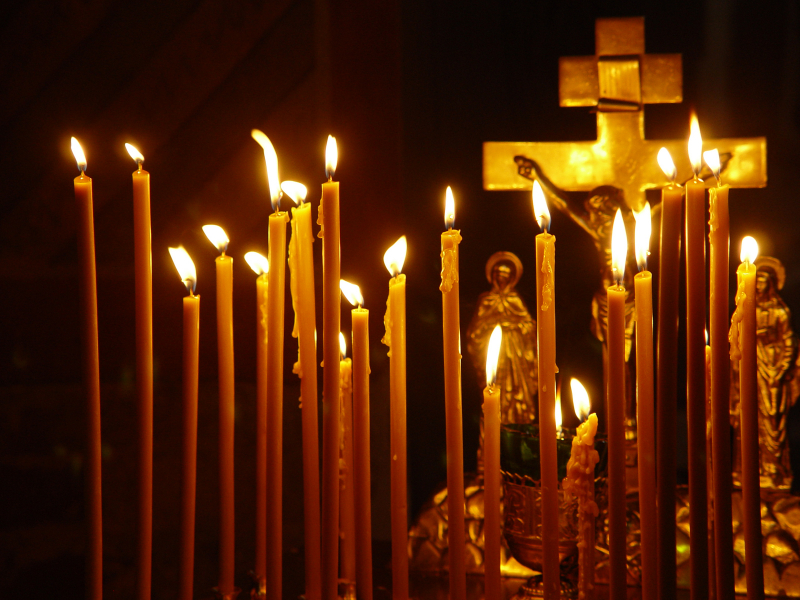
Point 6.1: incense, chant, candles, icons – pretty mind-blowing for a Protestant, let alone an Evangelical.
iStock_000002849105Small

6.2: Orthodoxy puts high emphasis on humility and obedience to legitimate authority, particularly that of your Spiritual Father (though you typically find your own Spiritual Father if you’re diligent; I don’t know of them being appointed). 5.2? We’re kind of counter-cultural. Lots of home-schoolers, folk music fans, and otherwise dissidents, especially among the converts I know.

Above all, Point 4: we encourage people to come and see rather than trying to tell them. That also makes us suspect under points 3 and 5.1. Surely that’s a reliable marker of a cult, right?

Wrong. It’s just that some of Orthodoxy is ineffable. You have to see it to believe (or really to disbelieve) it. Yeah, we can point to the Nicene Creed as what we believe, but so can many others. That’s not a complete description of what we believe, or tend to believe, though. It’s a fence set up by Ecumenical Councils when people were falling off particular cliffs.

We don’t treat the Creed as “the essentials” and all else as optional. We have no “fundamentals” or “core beliefs” to be fundamentalist about. We have no “minimum necessary” beliefs, nor anything I’d call “least common denominators.”

We are a maximalist faith. We want to know/practice the fullness of the Christian faith. And some of that just isn’t cognitive or propositional. Some of it, you eat.

This is a great blessing, but as I was approaching Orthodoxy it was a great frustration.

I wanted to line up my Calvinist beliefs in Column A, what I took to be Roman Catholic beliefs in Column B, and Orthodox beliefs in Column C, so I could compare and contrast across the lines, sitting as judge. I jumped on the title “An Exact Exposition of the Orthodox Faith,” and then was disappointed that it didn’t really seem to deliver – not in the categories I wanted it to deliver in. Just look at those chapter titles. Sheesh!

  • That the Deity is incomprehensible, and that we ought not to pry into and meddle with tire (sic) things which have not been delivered to us by the holy Prophets, and Apostles, and Evangelists.
  • Concerning things utterable and things unutterable, and things knowable and thinks unknowable.
  • Concerning the nature of Deity: that it is incomprehensible.
  • Concerning the place of God: and that the Deity alone is uncircumscribed.

(Emphasis added) Which leads to this: much of Orthodox theology is apophatic:

Apophatic theology — also known as negative theology — is a theology that attempts to describe God by negation, to speak of God only in absolutely certain terms and to avoid what may not be said. In Orthodox Christianity, apophatic theology is based on the assumption that God’s essence is unknowable or ineffable and on the recognition of the inadequacy of human language to describe God.

It has been said, roughly, that if you really want to know what Orthodoxy is, you need to take a year, attend every single service that’s appointed (this probably means spending the year at a Monastery, since you’re not going to find a parish that serves everything appointed), pay perfect attention, make the prescribe prostrations, metanias, and other physical gestures, commune, be annointed, etc. and then you’ll know what Orthodoxy is. Because much – most? – of what we believe is in the hymns we sing, the prayers and litanies we pray, the acts we do, the acts that are done to us, and the entire multi-volume set of books with those services.

Yet you cannot become Orthodox by reading those or any other books. I was drawn to Orthodoxy by books. There came a point where I could have populated “Column C” somewhat. But that couldn’t and didn’t make me Orthodox. I had to “come and see.” And I count it a blessing that my role at the Parish requires me to be in more of those services than anybody except the Priest and maybe our Subdeacon.

And if “come and see” sounds like “we’re not going to tell you until we’ve trapped you,” I’m sorry but you’re hearing it wrong. We can’t (not mustn’t) tell you.

The old Evangelical saw was “Christianity isn’t a religion; it’s a way of life.” Think of it in those terms and maybe you’ll see why we couldn’t tell you if we tried.

* * * * *

“The remarks made in this essay do not represent scholarly research. They are intended as topical stimulations for conversation among intelligent and informed people.” (Gerhart Niemeyer)
Some succinct standing advice on recurring themes.

How Orthodox don’t (and do) read scripture

All literalisms seek to rid Scripture of its mystery. The “plain sense” in the hands of a modern reader is simply the “modern sense.” And though such literalisms may yield readings that are deeply opposed to certain modern conclusions (such as those common in modern science, etc.), they are not therefore ancient and traditional. Such conclusions yield nothing more than a modern man with odd opinions. They do not transform or transfigure anyone or anything.

The debate about the interpretation of Scripture, particularly on the level of most argumentation, is a strikingly modern debate. At stake are modern issues born of the modern era. But they are not the issues of salvation.

Whether evolution is true or not, whether the earth is young or not, and whether the Scriptures lend any clue to such questions is, frankly, beside the point… No saints will emerge from the debate.

But consider this short hymn (typical of the Orthodox understanding of Scripture):

O noble Virgin, truly you are greater than any other greatness. For who is your equal in greatness, O dwelling place of God the Word? To whom among all creatures shall I compare you, O Virgin? You are greater than them all, O Ark of the Covenant, clothed with purity instead of gold! You are the Ark in which is found the golden vessel containing the true manna, that is, the flesh in which Divinity resides (Homily of the Papyrus of Turin).

That Mary is the true Ark, containing the true Manna, is more than a mental exercise in theological exegesis. If truly and rightly perceived, it is the utterance of a heart that is being pierced by the mystery of the gospel. For the gospel is made known to us in a mystery – it is hidden.

(Fr. Stephen Freeman, Making Known the Mystery, emphasis added)

Another Example:

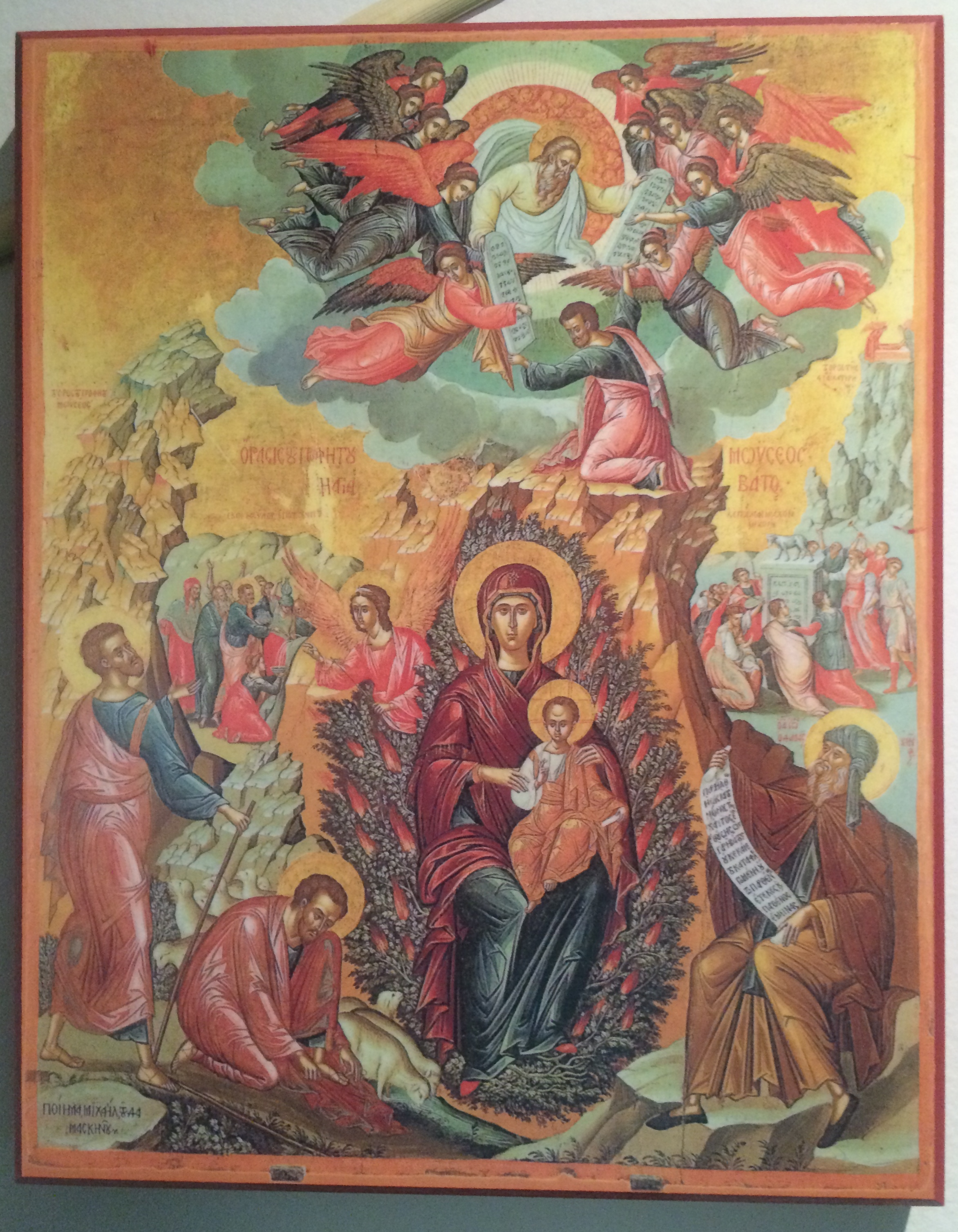
Mother of God of the Unburnt Bush

As I sat on my bed staring down at the image, the first sight that caught my eye was the Mother of God, surrounded by green leaves and red flames. I realized that this icon was a representation of Moses and the Unburnt Bush from The Book of Exodus. I recalled that Exodus describes the bush as burning, yet unconsumed. Gears turned in my head, and it clicked that the Unburnt Bush was a prefiguring of the Mother of God in the paradox of her virgin motherhood. At that time, I found myself focused on the primary images of the icon rather than those in the background. I noticed Moses, removing his sandals, kneeling below the Mother of God as she holds her infant Son …

(Sarah)

Do I contradict myself? Does the Church contradict itself? Which is Mary: Ark or Burning Bush? Stop the double-talk and give an answer!

Very well then: Yes. Ark and Burning Bush and more:

  • Joseph is a Christ figure.
  • Moses in a basket on the Nile is baptism.
  • The sacrifice of Isaac? Christ again.
  • Jonah? Take a guess.
  • Manna? The Eucharist.

And, yes, Sarah (whatever her undisclosed Christian tradition may be) is right about the burning bush and the icon pictured.

Ought not Christ to have suffered these things, and to enter into his glory? And beginning at Moses and all the prophets, he expounded unto them in all the scriptures the things concerning himself.

(Luke 24: 26-27)

This is not an optional alternative to literalism. Literalism is mistaken. The New Testament doesn’t take the Old “literally” in its countless “that it might be fulfilled that was written by the prophet” asides. The path of literalism is the way to become “a modern man with odd opinions.” 

Indidualism and “soul competency” are mistaken, too:

The trouble with reading Scripture is that almost everybody thinks they can do it … The concept of any intervening authority is anathema to the Protestant project. It is equally unsuitable to the assumptions of the modern world. For the modern world, born in the Protestant milieu, is inherently democratic. The individual, unaided, unbridled, and unsubmitted, is the ultimate authority.

A book that could not have been owned by an individual prior to the printing press in the 15th century (by reason of cost) cannot be used philosophically to support the autonomy of the individual right and competency to read and interpret. With the sole exception of Philemon, the letters of the New Testament are not written to individuals (Timothy and Titus receive letters only by virtue of their position as leaders of a community). They are letters to the Church and the individual is not a Church. The practice of the reading of Scripture for nearly 1400 years was largely that of listening to its being read within the assembly of the Church – and this continued for quite some time even after the printing press’ advent. The doctrine of “soul competency” is a modern invention, contrary to the New Testament itself and the practice of primitive and early Christianity. The Kingdom of God is not a democracy. Every pretender to its throne is a usurper.

(Fr. Stephen, whose Making Known the Mystery and Again – The Sin of Democracy I’ve conflated)

Typology is not an Orthodox exclusive. Some Old Testament types are so obvious, you can’t miss them, and few do. But Orthodox typology runs deeper and broader. And it’s our predominant approach to the Old Testament.

* * * * *

“The remarks made in this essay do not represent scholarly research. They are intended as topical stimulations for conversation among intelligent and informed people.” (Gerhart Niemeyer)

Some succinct standing advice on recurring themes.

Gradually the veil lifts

Mars Hill Audio Journal Volume 121 just arrived, and I had a chance to listen Friday.

A high school acquaintance, Walter Hansen (Senior when I was a Freshman, but it was a small school and he was not standoffish) has become patron of painter Bruce Herman, and they were interviewed about their joint book, Seeing Through Your Eyes.

They talked with host Ken Myers about meaning in art – a meaning that is nonverbal and not reducible to words, though talking about it can enhance appreciation in what the painter describes as a “dance.” They even dabble at the periphery of the theology of icons, from a Protestant perspective, it appears, as the artist is in regular dialog with an Orthodox Priest, Fr. Spiridon, who tells him his portraits are dangerous.

The prior track was an interview of Calvin College philosophy professor James K. A. Smith, who has shaken up the Evangelical/Calvinist world by two books under the rubric “Cultural Liturgies:” Desiring the Kingdom: Worship, Worldview, and Cultural Formation and Imagining the Kingdom: How Worship Works.

I wouldn’t say the Evangelical/Calvinist world is overreacting. These books are light years away in their sensibility from the Calvinist ne plu ultra of 4 bare walls and a 4 point sermon addressed to the left hemisphere of a wet computer.

“Smith seeks to re-vision education through the process and practice of worship” (Amazon book description)! He uses the word “liturgy”! He actually thinks that embodiedness has practical consequences, and isn’t just an interesting thought experiment from which to spin out philosophies! He even thinks that the body may have something to do with what the mind loves and therefore finds plausible!

Those are very challenging ideas for Calvinist especially, as they intrinsically challenge one to go beyond mere ideation, on which Calvinism tends to be strong, into praxis, on which it tends to be weak (and tended to be legalistic when praxis was strong).

Worship “works” by leveraging our bodies to transform our imagination, and it does this through stories we understand on a register that is closer to body than mind. This has critical implications for how we think about Christian formation.

(Amazon book description of Smith’s second of three “Cultural Liturgy” books) Well do tell!

“Emergent Church” strikes me as an unintelligible mish-mash, but it bespeaks a longing for something more, and that something more often involves raids on traditional Christianity to borrow (they can’t steal it) bits of liturgy.

I cherish signs that my former Evangelical and Calvinist co-religionists are waking up to things that Orthodoxy has tacitly known all along, as both items 6 and 7 on Mars Hill Audio Journal Volume 121 seem to me to signal. I keep thinking “the coin will drop” for Mars Hill muse and host Ken Myers soon, and he’ll frankly become the Orthodox Christian that seems to be emerging – but he may be three cars ahead of me on that train of thought.

It’s just not the sort of thing you blurt out while emerging if you want to “work in this town again.”

* * * * *

“The remarks made in this essay do not represent scholarly research. They are intended as topical stimulations for conversation among intelligent and informed people.” (Gerhart Niemeyer)

Some succinct standing advice on recurring themes.

Pascha 2014

  1. Christian life in Israel
  2. Media Lenten sniping misfires
  3. Putin’s Game: One serious telling
  4. “Long weekend”?
  5. Another spinoff benefit from endless war
  6. The Media, PA burglary
  7. 1054, 1204
  8. Worst. Idea. Ever.

Christ is Risen from the dead, trampling down death by death, and upon those in the tombs bestowing life!

Continue reading “Pascha 2014” →