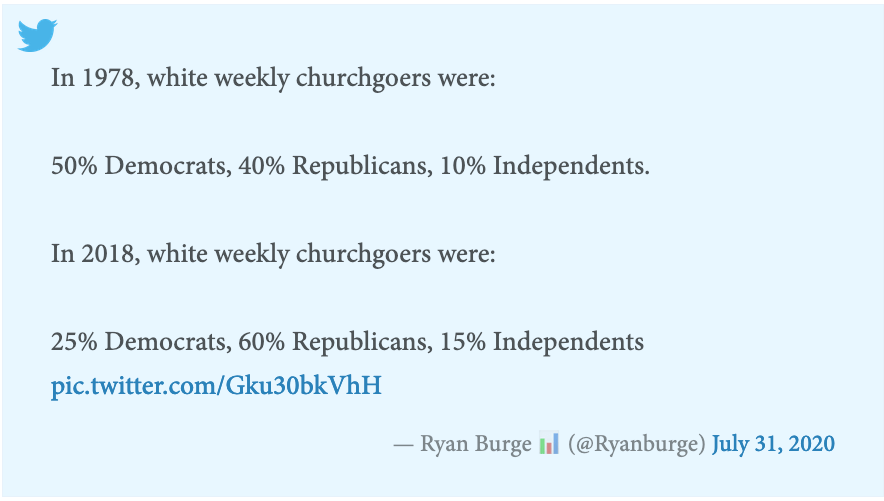
What’s wrong with this picture?

More dramatic than I imagined:
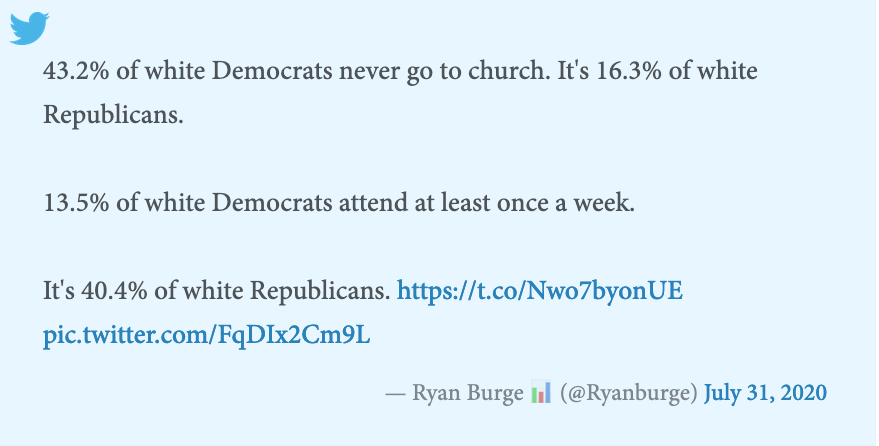
Screen Shot 2020-08-01 at 3.39.29 PM

(link) and

Screen Shot 2020-08-01 at 3.39.55 PM

(link).

Those are stunning contrasts. So why do I not feel tribal loyalty to the GOP?

A superficial answer would be that for a conservative, I rate shocking low on loyalty in Jonathan Haidt’s Moral Foundations Theory. But I’m almost positive there’s something more important than that.

First, a distinction.

Dissatisfied with my superficial reading habits, I am currently reading Mortimer Adler’s classic How to Read a Book (revised and updated 1972). Chapter 8 is titled “Coming to Terms with an Author”:

[I]n the analytical reading of a book, coming to terms is the first step beyond the outline. Unless the reader comes to terms with the author, the communication of knowledge from one to the other does not take place. For a term is the basic element of communicable knowledge.

A term is not a word–at least, not just a word without further qualifications … [A] word can have many meanings, especially an important word. If the author uses a word in one meaning, and the reader reads it in another, words have passed between them, but they have not come to terms.

Second, a story, which may be apocryphal, but I did not make it up.

A conservative returned to his alma mater for a commencement address and opened thusly:

By a strange coincidence, I am a graduate of a vastly different institution which occupied this very site 40 years ago and even bore the same name …

For some 23 years now, I’ve been an adherent of a religion called “Christianity,” based on the incarnation, life, death, resurrection, ascension and glorious second coming of Jesus Christ, who is both fully God and fully man. It was once, under the necessity of distinguishing it from a particular heresy, partially summarized in a Creed. To distinguish it from other versions, it’s called “Orthodox,” with a capital-O.

Meanwhile, my country is breathing the last few whiffs of an empty bottle labeled, by a strange coincidence, “Christianity,” which apparently is based on the intuition that God wants us to be nice and happy or, in its robust “Evangelical” versions, that Jesus Christ was very special and died a horrible death so that God would get over his anger issues with us and we could get on with being nice and happy.

Its proper name is Moralistic Therapeutic Deism. Although we share a mostly-overlapping vocabulary of words, I cannot come to terms with it, except in relatively brief and exhausting bursts of attempted empathy.

I remember from some 55 years ago an even more rigorous version, to which I then and for several more decades adhered, but it lives on today mostly notionally, in the scribblings of über-fissiparous “discernment bloggers.” I stay as far from them (and it) as I can, because I’m recovering from a mild-to-moderate case of that mindset and I’ve seen the harm it can cause, including when someone brings that mindset into Orthodox Christianity.

There were and are some other versions of “Christianity,” with some of which I have more or less come to terms, but they are not all that easily pigeon-holed politically.

So back to the question:  “why do I not feel tribal loyalty to the GOP?”

First, because it forfeited any claim to my loyalty:

In 2000 and 2004, it was Dubya. He was, we were told, a good Evangelical Christian. He cited Jesus as his favorite philosopher. He talked about America walking humbly in the foreign policy world.

Then 9-11 came, and he turned into a fierce Commander In Chief …

And then came, too, the second inaugural, when he declared as U.S. policy the eradication of tyranny from the world and the planting of democracy. If you don’t understand how delusional that is, read it again: eradicating tyranny from the world. As national policy.

(Conscientious Objector to the Culture Wars | War Correspondence ن)

Second, I have no confidence that was a blip, a lapse. In fact, the ensuing years have confirmed that endless war truly is the position of the party insiders (even though party voters chose a putatively antiwar mad, toxic and incompetent man for President in 2016).

Third, the Churches these Republicans so assiduously attend engage in worship that’s pure glucose and teach religion(s) with which I cannot come to terms sufficiently to form any kind of alliance. That Republicans are so much likelier to attend Church weekly is not all that interesting considering the Churches they attend.

I knew that 10 years ago (if not earlier, but I drove a stake in the ground then — a blog that’s held up surprisingly well) and they drove a stake though whatever remained of “Republican” in my heart on November 8, 2016.

That’s why.

* * *

Perhaps some day I’ll post a more nuanced version of why it’s difficult for a former-Evangelical, former-Calvinist, now-Orthodox, to “come to terms” with typical versions of contemporary American “Christianity.” I acknowledge painting here with a broad brush, but if there’s no glimmer of recognition, then you may to inattentive, gentle reader.

* * * * *

Put not your trust in princes,
in a son of man, in whom there is no salvation.

Psalm 146:3

* * * * *

You can read most of my more impromptu stuff at here. It should work in your RSS aggregator, like Feedly, should you want to make a habit of it.
Same God?

Hang on here. I purposefully meander a bit today, which is a fitting way of sharing a little epiphany I had while reading un-Christmassy stuff (Thomas S. Kuhn and Ian Hacking, The Structure of Scientific Revolutions: 50th Anniversary Edition) on Christmas Eve.

Do we, however, really need to describe what separates Galileo from Aristotle, or Lavoisier from Priestley, as a transformation of vision? Did these men really see different things when looking at the same sorts of objects? Is there any legitimate sense in which we can say that they pursued their research in different worlds? Those questions can no longer be postponed, for there is obviously another and far more usual way to describe all of the historical examples outlined above. Many readers will surely want to say that what changes with a paradigm is only the scientist’s interpretation of observations that themselves are fixed once and for all by the nature of the environment and of the perceptual apparatus. On this view, Priestley and Lavoisier both saw oxygen, but they interpreted their observations differently; Aristotle and Galileo both saw pendulums, but they differed in their interpretations of what they both had seen.

(Page 120, Kindle edition)

These sorts of questions could be extended to other areas, which was why Stanley Fish so insistently schooled Nico Perrino, on one So to Speak podcast:

[Stanley]: Do you believe in the distinction between faith on the one hand and reason or empirical investigation on the other?

Nico: Yes.

Stanley: Yes, I thought you would.

Nico: Of course, I do. So, I’ve fallen into your trap.

Stanley: Because I don’t. I taught a course yesterday on Inherit the Wind. It’s a movie about the Scopes Trial in the early part of the 20th century.

Nico: Yeah, Scopes Trial.

Stanley: That’s a movie produced and directed by Stanley Kramer who is a stalwart First Amendment liberal. The entire dramatic rhetoric of the movie depends on the distinction between faith on the one hand and reason, especially reason associated with scientific experiments, on the other hand. That distinction doesn’t hold up for a second. That distinction doesn’t hold up. What’s you’re dealing with in science as opposed to let’s say orthodox Christianity or something else are two different faiths.

Two different kinds of faiths undergirded by radically opposed assumptions and presuppositions. But it’s presupposition and assumptions which are generating the evidence and facts on both sides. Again, you have – I can tell and say this with all the generosity – you are deeply mired in the basic assumptions and presuppositions of classical liberalism. Anything else that is brought to you, anything that is brought to you by some kind of retrograde sinner like me sounds outlandish and obviously perverse.

Nico: No, not necessarily. Because otherwise, I wouldn’t be having this conversation with you.

Stanley: Good point.

Nico: But, you know, we’re at the corner of what? 5th and 12th Avenue. Are you telling me it’s not a fact that we’re at the corner of 5th and 12th Avenue?

Stanley: Oh, come on. Come on. Look, have you ever read The Structure of Scientific Revolution?

Nico: I have not.

Stanley: Okay. Do you know what it is?

Nico: No.

Stanley: Okay. It’s a book that is probably the most influential book in the social sciences and humanities for the past 75 years. That’s not an understatement. That is not an overstatement. Kuhn, his project, is the history of science as his title suggests. What he does is challenge the picture that I’ve already referred to where he says that science is not an activity in which one generation because of using its powers of observation and experiment adds to the details of the description of nature that was begun by previous generations.

What he’s saying is that scientific knowledge is not cumulative in the way that the usual picture of science suggests. Instead, scientific knowledge, that is the establishment of scientific fact, depends on what he calls paradigms. What’s a paradigm? A paradigm is the set of in place assumptions and authorized methodologies that govern and are in fact the content of scientific investigation at any moment. Paradigms rather than any direct confrontation between the observer and the world. Paradigms are what produces evidence and interpretations.

Finally, interpretations that are persuasive and successful for a while until that paradigm, for reasons that he details, is dislodged by another. When that happens, when the paradigm within which scientific observers work Kuhn says changes. One might say without exaggeration that without the world in which the scientific practitioner works has itself changed.

Nico: See, I don’t buy it though because there are things that scientist do maybe through this paradigm that produce a tangible result that only come as a result of. Changing the paradigm won’t change the result.

Stanley: Tangible result is itself along with other talismanic phrases like that – tangible result will be recognized as one depending on what pragmatic point of view you are situated. What Kuhn would say, he’s not the only one and I’m not the only one, is that any conclusion that you might reach and be confident in is not supported by some correspondents between your methodological, descriptive protocol and the world. Rather it’s produced by the paradigm within which you are ensconced and of which you are in some sense an extension.

I really urge to read this book because he considers – he’s not debunking science. He’s not debunking scientific achievement. He’s just giving a different picture of it which challenges what he thinks of as the over simplified picture, again, of a world out there waiting to be correctly described. We, as rational observers, having the task to describe it.

Having now read a bit more than half of Kuhn, I understand what Stanley was saying, and I’m less inclined to agree with with Nico.

Anyway, one extension of the “paradigm” (or “gestalt,” as Kuhn so often has it) is the continually vexed question of “whether Christians and Muslims worship the same God,” which I have visited several times in the past (here, here, and even here in passing).

My paradigm, which led me to say “of course they do“ is monotheism strictly and literally speaking: There is only one God, howsoever He may be misunderstood. Those who say they do not worship the same God strike me as tacitly embracing henotheism, usually with some vehement tribal pride thrown in about the superiority of our God.

But in fairness, the paradigm of the “different God” folks is perhaps doctrine, and “common parlance” rather than strict and literal monotheism. A sufficiently different understanding of God (as the Islamic understanding differs from the orthodox Christian) is, figuratively, “another God,” much as scientists after a gestalt shift are figuratively in “a different world,” according to Kuhn (and Fish?).

Further, my paradigm is apparently flexible. I sometimes ruminate on how the “loving God” I met in bedtime Bible stories as a child, and in childhood Sunday School, got displaced by an “angry God,” prickly, even furious, at how our screwups besmirch His dignity, as if He were a feudal lord. They do indeed feel like different Gods. (I found the loving God again, once and for all, in Orthodox Christianity, but that story is too tangential today.)

Likewise, a “progressive Christian” profession that Matthew 25 is the “heart of the Gospel” arises from a different hermeneutic than mine and, I suspect, is a convenient way of making Christ’s incarnate deity an optional doctrine and doing away with “the scandal of the Cross.” In their paradigm/gestalt, Matthew 25 being the heart of the Gospel is almost axiomatic, and the stupendous paradox we celebrated yesterday is at best tangential, likelier credulous or even incomprehensible. They and I are divided by our nominally common (“Christian”) faith. (It also makes Christian sexual morality, which rivals the Cross for scandal-giving these days, optional.)

And then there are the Jews. I and they, too, worship different Gods if you want to be very figurative about it, though their non-Trinitarian God is pre-Christian rather than anti-Christian. I wonder, though, how many of the “Muslims-worship-a-different-God” folks even think about the Jews when blasting the Muslims?

So what? So can we, on this second day of Christmas (indeed, on all days) be less hasty with expressions that needlessly divide us with intimations that The Other believes as he believes because he’s pure evil rather than out of a very different, good faith, perspective?

That doesn’t mean we all unequivocally worship the same God, for God’s sake, but might our divisions can produce yearning instead of angry denunciations?

* * * * *

Sailing on the sea of this present life, I think of the ocean of my many offenses; and not having a pilot for my thoughts, I call to Thee with the cry of Peter, save me, O Christ! Save me, O God! For Thou art the lover of mankind.

(From A Psalter for Prayer)

You can read most of my more impromptu stuff at here. It should work in your RSS aggregator, like Feedly, should you want to make a habit of it.

Job’s Comforters

I’ve never recoiled from Job’s Comforters. At least they were “there for him” after a fashion, right?

Maybe I’m on the Autism Spectrum, or haven’t shaken off the last of my “former delusion,” repudiated when I entered Orthodoxy.

But the promised blessings and cursings in Deuteronomy were not sui generis in the Old Testament henotheistic millieu. That gods reward their followers and punish deviants was hardly an outrageous or (if I may wax anachronistic) Pharisaical worldview before Christ.

Some of the Psalms presented a more equivocal view, and we’ve learned from the highest of authorities, through pericopes like the man born blind, that into each life some rain must fall.

But the lessons that grief is not the time for theodicy, and that “I’m so sorry” is generally the best thing we can say when we’re tempted to something more “pious,” are not learned and remembered easily.

I’ve even heard dubieties coming from the mouths of the putatively grieving, trying to comfort their comforters. I’m thinking especially of a Calvinist father whose young adult son wrapped his car around a tree while home on leave. “We prayed that God would keep him from apostasy, and this apparently was the answer.”

That seemed very pious at the time. Now it seems reptilian. Another of his children did apostatize, and wrote a kiss-and-tell book about growing up in that household. I couldn’t bear to read it, but it sounded all too plausible from the reviews.

I guess Job wouldn’t have been much of a story if three guys showed up and just kept saying “we’re so sorry, Job.”

And we can always be grateful for Bildad the Shuhite as the punchline for “Who’s the shorted man in the Bible?”

* * * * *

You can read most of my more impromptu stuff at here. It should work in your RSS aggregator, like Feedly, should you want to make a habit of it.

I highly recommend blot.im as a crazy-easy alternative to Twitter (if you’re just looking to get your stuff “out there” and not pick fights).

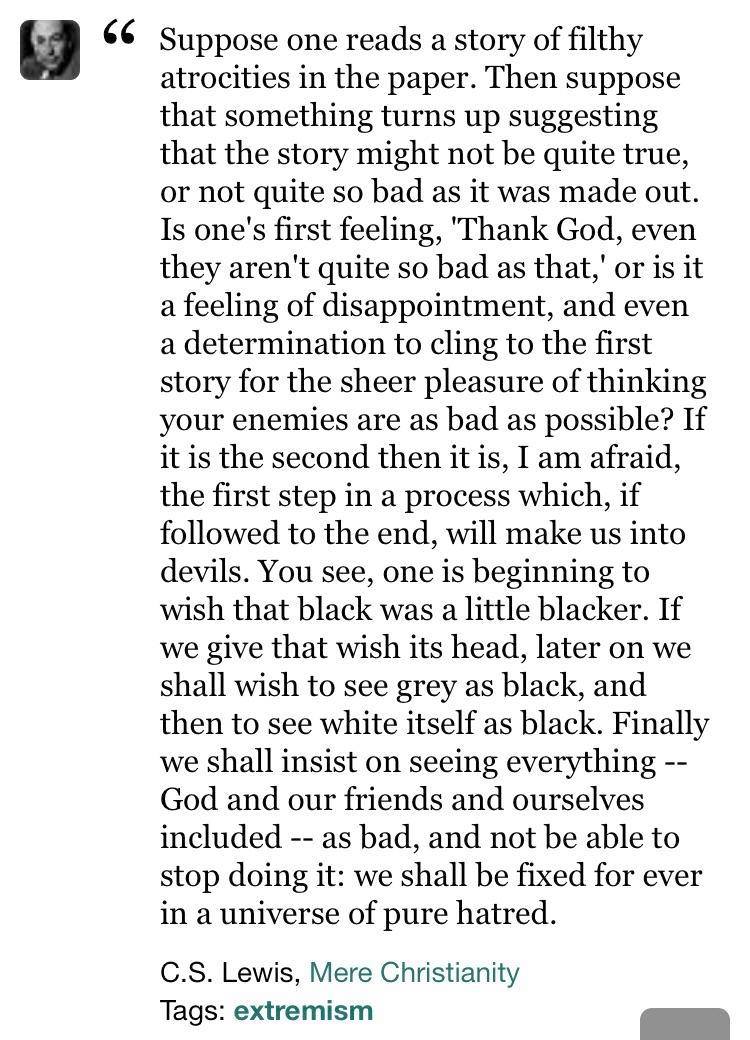
C.S. Lewis: Forever relevant

Lewis on the Manichean temptation

I trust that at least one  very contemporary example of this comes readily to mind.

But if that’s the only example you can think of — if you’ve forgotten Pizzagate and birtherism and Obama’s-a-Muslim — or if you think those are materially different, then you, too, may be a hell-bound Manichean.

* * * * *

You can read my more impromptu stuff at Micro.blog (mirrored at microblog.intellectualoid.com) and, as of February 20, 2019, at blot.im. Both should work in your RSS aggregator, like Feedly, should you want to make a habit of it.

Mene, mene tekel upharsin

In a short piece on the conservative Reformed blog The Aquila Report, Dan Winiarski reports from a meeting of All One Body, an activist lobby within the Christian Reformed Church in North America (Dutch Calvinists) that is trying to convince the conservative denomination to affirm homosexuality and transgenderism …

The meeting’s leaders advised those gathered on strategies to undermine and replace the church’s biblically orthodox stance. Excerpt:

… one of the board members of A1B gave the audience a piece of advice: Do not use Scripture to convince your fellow CRC members of the beauty of full inclusion. Instead, rely on personal stories. “Everyone has a story,” she said. “We can argue back and forth all day about Scripture, but we’re never going to win that way. Nobody can argue with your story.”

Another member of the panel shared the focal point of this “personal story” strategy. He said it is all about convincing people, through stories about real people who have embraced the gay/lesbian/bisexual/transgender lifestyle, that such people bear healthier fruit than those who are non-inclusive. Whereas the panel referred to “the old teachings of the church” as “toxic,” A1B wants the CRC as a whole to accept the new teachings of full-inclusion, yielding good fruit.

… [T]he A1B activists understand well that in our bourgeois society, well being, wealth, and conformity to middle-class norms — and above all, avoiding suffering — are the marks of the church. It’s a false church, one that has turned from the Holy Spirit to the Zeitgeist, but this is how many ecclesial communities roll in post-Christian America.

In the early 1990s, when I was considering converting from non-practicing Moralistic Therapeutic Deism to Catholicism, I went through a period when I tried to reconcile sexual liberty with the Christian faith … It was so clear to me from the very beginning of our courtship that the three years (four, if you count our courtship) that I lived chastely, out of obedience, had been a period of profound purification and maturation. I did not know what was happening to me when I was in the middle of it. I just trudged onward … The thing is, the ascetic desert also prepared me for living within marriage …

These are harder stories to tell in our culture, because they are so countercultural. But we orthodox Christians had better get good at telling them. The other side is good at “narrative theology,” and they have the mass media on their side. Our culture, even the culture within many of our churches, presents the faith as an electric blanket, when in fact it is the Cross (said Flannery O’Connor). Nobody wants to hear that today, but it’s the truth — a truth that saves lives, both here and in eternity.

Rod Dreher, emphasis added.

The Aquila Report is worth reading beyond Dreher’s excerpts because the innovators have a second strategy, beyond storytelling, and that is the “judicial option””

… the panel revealed their preference for a strategy of using “judicial” rulings similar to the way the secular activists won their case at the United States Supreme Court with Obergefell.

A1B’s plan to transform the CRC will proceed as follows. They will identify a current CRC pastor who is sympathetic to their cause, who is willing to perform a homosexual “wedding” ceremony. Or taking another route, they will find a CRC congregation that is willing to elect an elder or deacon who is openly and proudly living in a homosexual partnership. Inevitably, this will cause a firestorm of protest in the CRC. Complaints will be filed. Debate will ensue. The Banner will publish articles both for and against. The great brouhaha will eventually make its way to Synod.

And the hope on the part of A1B is that Synodical delegates will embrace the path of least resistance and rule in favor of the pastor, or the church, or the office bearer. Synod might decide, as it has done with other controversial topics, that the LGBTQ+ question is a matter for each local church council to decide. Or, if the personal story of the individual involved is especially powerful, Synod may embrace empathy as the path toward inclusion. Perhaps a desire to prove the CRC’s relevancy credentials will convince Synod to “get with the times.”

Whatever reasoning Synod uses, the panel members representing A1B were in agreement (and the audience was too) that the “judicial” plan presented their best path to victory.

I’ve seen that strategy at work in many other denominations. The dissident pastor, after all, will have a touching story to tell of how s/he came in good faith to transvalue values, so it would be mean to do anything orthodox in response.

The Christian Reformed Church was my Church for nearly two decades before I entered Orthodoxy. After I left, a member came to me addled about what Orthodoxy was but thinking I’d be a sympathetic ear for his private religious opinions—which were decidedly sub-Christian. He’s still there as has served as an officer in the Church.

The heated debates of my years in the CRC all resolved in favor of the innovators. I have no doubt, barring divine intervention (which I do not expect; mene mene tekel upharsin), that they’ll win again.

The CRC’s professed adherence to Scripture Alone (sola scriptura) is delusional. As Dreher says:

[I]n our bourgeois society, well being, wealth, and conformity to middle-class norms — and above all, avoiding suffering — are the marks of the church.

* * * * *

Follow me on Micro.blog Follow me on Micro.blog, too, where I blog tweet-like shorter items and … well, it’s evolving. Or, if you prefer, those micro.blog items also appear now at microblog.intellectualoid.com.

Detour & Frolic

We interrupt sporadic attempts at serious commentary to laugh scornfully at Jerry Falwell, Jr. (here), and to wonder just what the hell kind of educational institutions (both founded by Jerry Falwell, Sr.) could turn out such a clown.

We now return to our irregularly scheduled blogging.

* * * * *

“While saints are engaged in introspection, burly sinners run the world.” (John Dewey) Be a saint anyway. (Tipsy)

Some succinct standing advice on recurring themes.

Where I glean stuff.

Let’s get small!

Largely by coincidence, I encountered these congruent thoughts from two ecclesial Christians within a few hours on Saturday:

Liberalism … of course has robust substantive commitments, much as it might pretend otherwise. The “tradition” of liberalism, really an anti-tradition, is founded on that substantive creed … Put differently, as I have argued elsewhere, the main “tradition” of liberalism is in fact a liturgy, centred on a sacramental celebration of the progressive overcoming of the darkness of bigotry and unreason.

(Adrian Vermeule, As secular liberalism attacks the Church, Catholics can’t afford to be nostalgic)

Ronald Reagan loved to quote the 1945 Johnny Mercer hit:

You’ve got to accentuate the positive
Eliminate the negative
Latch on to the affirmative
Don’t mess with Mister In-Between

We sing the songs of progress in the gospel of an ever-improving world. Today, this is the purpose that motivates almost every undertaking, both public and private. However, the cult of progress is the repudiation of grace.

“Progress,” as a word with its present meaning, only goes back to the 19th century. It describes a sort of eschatology … The 19th century notion … was that the Kingdom was something given to humanity to build. Guided by the blueprint of justice described in the Scriptures, it was for us to bring forth the Kingdom in this world as we eliminated poverty and injustice. Beyond all theory, the American Christians of the 19th century not only embraced this new idea, they believed they could already see it happening. “From sea to shining sea,” God’s grace was increasingly manifest in the unfolding destiny of the American century.

This initially Christian belief has long since shed its outward religious trappings and assumed the shape of modern secularism. However, we should not underestimate the religious nature of modernity. No religion has ever felt more certain of its correctness nor its applicability for all people everywhere and at all times than the adherents and practitioners of modern progress. Indeed, that progress assumes that all religions everywhere should quietly agree to find their place in the roll call of those who place their shoulder to the wheel in the building of a better world. Within the rules of secular progress, there is room for all.

The adherents of modernity not only feel certain of the correctness of their worldview; they believe that it should be utterly obvious to any reasonable person. Resistance is reactionary, the product of ignorance or evil intent. But from within classical Christianity, this is pure heresy, and perhaps the most dangerous threat that humanity has ever faced ….

(Fr. Stephen Freeman, I’ll Be Small for Christmas—emphasis added)

But don’t let these two concurrences that our ubiquitous liberal democracy (the liberalism of Ronald Reagan and Saul Alinsky alike) is fundamentally religious to distract from an important and personal challenge that Fr. Stephen made:

It is worth considering that our real day is almost completely populated with “small things.” Very few of us act on a global stage, or even a stage much greater than a handful of people and things. Our interactions are often repeated many times over, breeding a sort of familiarity that can numb our attention. We are enculturated into the world of “important” things. We read about important things of the past (and call it history); we are exposed to “important” things throughout the day (and call it news). We learn to have very strong opinions about things of which we know little and about people we have never met.

We have imbibed an ethic of the important – a form of valuing sentiment above all else. We are frequently told in various and sundry ways that if we care about certain things, if we like certain people and dislike others, if we understand certain facts – we are good persons. And we are good because we are part of the greater force that is making the world a better place. All of this is largely make-believe, a by-product of the false religion of modernity. For many people, it has even become the content of their Christianity.

The commandments of Christ always point towards the particular and the small. It is not that the aggregate, the “larger picture,” has no standing, but that we do not live in the “larger picture.” That picture is the product of modern practices of surveys, measurements, forecasts and statistics. The assumptions behind that practice are not those of the Christian faith. They offer (or pretend to offer) a “God’s eye-view” of the world and suggest that we can manage the world towards a desired end … All of this is a drive towards Man/Godhood.

The drive of God Himself, however, is towards the small and the particular, the “insignificant” and the forgotten. In the incarnate work of Christ, God enters our world in weakness and in a constant action of self-emptying. He identifies people by name and engages them as persons. Obviously, Christ could have raised a finger and healed every ailment in Israel in a single moment. He doesn’t. That fact alone should give us pause – for it is the very thing that we would consider “important” (it is also the sort of thing that constituted the Three Temptations in the Wilderness). Everyone would be healed, but no one would be saved. Those healed would only become sick and die later. This is also the reason that we cannot speak in universal terms about salvation. For though Christ has acted on behalf of all and for all, that action can only be manifested and realized in unique and particular ways by each.

This Divine “drive” is also the proper direction for our own lives. Our proper attention is towards the small, the immediate, the particular, and the present. Saying this creates an anxiety for many, a fear that not paying attention to the greater and the “important” will somehow make things worse. We can be sure that our attention does not make things better in the aggregate, while, most assuredly ignoring the particular things at hand is a true failure. Our spiritual life depends on the concrete and the particular – it is there that the heart is engaged and encounters God. In the “greater” matters, our sentiments are engaged rather than our hearts. You cannot love “world peace,” or “social justice.” These are vagaries that allow us to ignore peace with those around us and justice to those at hand. God does not want “noble” souls – He wants real souls, doing real things, loving real people, dying real deaths.

Follow the path of Christ and become small for Christmas.

(Emphasis added)

* * * * *

“No man hath a velvet cross.” (Samuel Rutherford, 17th century Scotland)

Some succinct standing advice on recurring themes.

Where I glean stuff.

Saturday Potpourri 2

  1. The Spirit of Peace
  2. Pray without ceasing and see the doctor
  3. Almost she persuades me, a skeptic
  4. Always a corrupting enterprise
  5. I do remember — don’t you?
  6. SF passes the law of unintended consequences
  7. The ever-morphing political dinner name game
  8. PROBABLY

Continue reading “Saturday Potpourri 2”