Making a virtue of necessity

I just finished reading The Old Faith in a New Nation, a 2023 book by one Paul J. Gutacker. I can write no better summary of the author’s purpose than the publisher’s:

Conventional wisdom holds that tradition and history meant little to nineteenth-century American Protestants, who relied on common sense and “the Bible alone.” The Old Faith in a New Nation challenges this portrayal by recovering evangelical engagement with the Christian past. Even when they appeared to be most scornful toward tradition, most optimistic and forward-looking, and most confident in their grasp of the Bible, evangelicals found themselves returning, time and again, to Christian history. They studied religious historiography, reinterpreted the history of the church, and argued over its implications for the present. Between the Revolution and the Civil War, American Protestants were deeply interested in the meaning of the Christian past.

The book

I concur with the 4-star rating at Amazon, mostly because the sympathetic academic author obviously spent a lot of time researching a narrow topic, off-the-beaten track. When I stumbled across it, I knew that I needed it to challenge the “conventional wisdom” resident in my own imagination.

It would be churlish to complain of faults in a book that did what I wanted it to do, and was passably readable to boot. I now have a better idea of how nineteenth-century American Evangelicals (and a few mainstream Protestants and Unitarians) treated Christian history.

Generally, the Evangelicals settled for tendentious 18th-Century historiography. It’s hard to blame them — the laymen, at least. There are only 24 hours in a day, and the 8-hour workday didn’t exist. We’re still that way:

The instinctual shortcut that we take when we have “too much information” is to engage with it selectively, picking out the parts we like and ignoring the remainder, making allies with those who have made the same choices and enemies of the rest.

Nate Silver, The Signal and the Noise

Mnemohistory

A lover of obscure mots justes, I was pleased to meet the word mnemohistory, which to my disappointment isn’t even in the online Merriam-Webster. It is “the history of memory … The past is not only remembered by later generations, it also exerts by itself an influence on later times.” A near-equivalent, I guess, is “cultural history.”

The 19th-century American Evangelical mnemohistory was fiercely anti-Catholic — especially, and oddly, anti-celibacy, though the anti-Catholicism was comprehensive.

Somewhat to my surprise (I had already read in Frances Fitzgerald that it was anti-Calvinist), it was quite contemptuous of the Protestant Reformation as well — largely because the Reformation wasn’t adequately anti-Catholic. The Reformers baptized infants? Mumbled vague nothings about Christ’s presence in the Eucharistic elements? Damnable papacy!

Though the Magisterial Reformation opened Pandora’s box with its sola scriptura même, I’m newly-appreciative of its merits, at least compared to what followed. The Magisterial Reformers didn’t intend the whirlwind, and Rome did need reform.

That the best-laid plans chronically go astray is enough to make one suspect all is not right in the pre-eschaton world. (It’s also an imaginative buttress for temperamental conservatism.)

The acid test

The acid test of American Evangelical mnemohistory came in the debates over slavery, when there arose an urgent need to shuffle the deck chairs. Gutacker summarizes:

This was only one of many ironies in the debates over slavery, which saw Catholics ignoring or reinterpreting papal decrees, Episcopalians celebrating early American Puritans, Presbyterians defending medieval society while criticizing the Reformation, Baptists treating patristic exegesis as authoritative, and anticlerical abolitionists praising the pope. Not all of this irony was lost on contemporaries. As has been discussed, African American historians, in particular, took pleasure in pointing out the hypocrisy of proslavery authors who cited North African church fathers in their arguments for white supremacy.

Antebellum 19th-century American Evangelicals didn’t so much revere history as to use it to confirm their priors. They rejected tradition and precedent, those inconvenient facts, in favor of congenial theories they called “history” — again, a relatable vice, but it’s how we got Baptists and Southern Baptists, Methodists and Southern Methodists, and even Presbyterians and Southern Presbyterians (a division that leaves fewer contemporary traces than the Baptist and Methodist schisms).

Oh, yeah, almost forgot: It’s also a substantial explanation of how we got a Civil War.

I think that qualifies as failing the acid test.

Bless their hearts!

I’m fond of the expression “making a virtue of necessity.” 19th-century schisms over slavery were lamented at the time. Today’s more mercenary schisms pass without much objection as “isn’t-it-nice-that-there’s-a-church-for-all-preferences?” nondenominationalism. All hail the religiopreneur! (Bless their hearts!)

Christians were until recently (and in ecclesial Christianity, still are) horrified by schism. But what to make of the continued fissiparousness of movements themselves born in conscious schism, as was post-Second Great Awakening evangelicalism? Is it all that bad when badness can’t cohere?*

I confess a bit of schadenfreude, mitigated morally by faint hope for the epiphany “this isn’t working; our first principles must be wrong” — and for return to the Church that remained, albeit centered outside the West, when the Roman Church went into schism from it. There, Holy Tradition is preserved and transmitted as the warp and woof of liturgies, hymns, prayers, scripture, and all that goes into a lived faith.

* (An aside about coherence: Ken Myers, muse of Mars Hill Audio Journal, once suggested that today’s evangelicalism coheres, is united, not by orthodoxy but by orthpathos — not right shared doctrine but right shared feeling. Insofar as it does loosely cohere, I have no better explanation, and if I did it would be a topic for another day.)


… that Christ may dwell in your hearts through faith; that you, being rooted and grounded in love, may be able to comprehend with all the saints what is the width and length and depth and height — to know the love of Christ which passes knowledge; that you may be filled with all the fullness of God.

Ephesians 3:17-19 (NKJV)

You can read most of my more impromptu stuff here and here (both of them cathartic venting, especially political) and here (the only social medium I frequent, because people there are quirky, pleasant and real). All should work in your RSS aggregator, like Feedly or Reeder, should you want to make a habit of it.
Sunday of the Paralytic, 2024

No sectarians in post-Christian foxholes

… churches centered on the Bible, evangelism, and personal faith in Jesus; often but not necessarily nondenominational, with moderate to minimal emphasis on sacraments, liturgy, and ecclesiastical authority; and marked by a revivalist style as well as conservative beliefs about sex, marriage, and other social issues. Historically, … white and middle- to lower-class …

Brad East, describing the sorts of churches in which he has noticed a loosening of social taboos (and in some cases, abandonment of prior understandings of scripture), and some putting on of liturgical airs, in The Loosening of American Evangelicalism.

East describes a lot of the changes he sees, and then speculates on the reasons for them. His fourth suggested reason got my attention as a plausible “silver lining” to secularization:

Fourth and finally, there are no sectarians in post-Christian foxholes. As counterintuitive as it may seem, the same forces leading evangelicals to start drinking, getting tattoos, and watching HBO are also leading them to say the creeds, receive ashes on their forehead, and read Pope Benedict XVI. When the world feels arrayed against faithfulness to Christ, you need all the friends you can get. Doctrinal differences that aren’t relevant to current cultural battles—think infant baptism, not theologies of sex and gender—can be overlooked in a pinch.

What intellectuals are searching for

[S]uppose you are an atheist or agnostic exposed, over time, to the desert fathers, or to the pro-Nicene fathers of the fourth and fifth centuries, or to Saint Maximus Confessor or Saint John of Damascus, or to Benedictine monks, or to Saint Thérèse of Lisieux, or to Julian of Norwich, or to Saint Francis or Saint Bernard or Saint Anselm. It would simply never occur to you that what you find in these authors is what you’d find in the Methodist congregation on the corner, or the Baptist church around the block, or the non-denom start-up across town. Not only do the devotional and liturgical, spiritual and theological worlds conjured by these writers and texts not exist in such spaces. The traditions themselves do not claim the figures in question. You go, therefore, to the people and the places who are bold enough to say, “Those names are our names; those saints are our saints; those books are our books. We nurture and preserve and pass them on. Come learn them from us; indeed, come learn from us what they learned themselves, in their own time.”

In sum: What intellectuals, especially agnostic intellectuals in midlife, are restlessly searching for is something not man-made, but divine; not provisional, but final; not a question, but an answer. They are looking for rest, however penultimate in this life, not more open-ended restlessness. Something that lasts. Something that can plausibly make a claim both to antiquity and to permanency. A bulwark that will not fail. Something to defer to, submit to, bow one’s head in surrender to; something to embrace and be embraced by: a teacher but also a mother. And the truth is that Rome plausibly presents itself as both mater et magistra, the pillar and bulwark of the truth. Orthodoxy does as well. The plausibility explains why so many intellectuals find port of harbor with each of them. The reverse, in turn, explains why so few of those sorts of people convert from rudderless adult atheism to Protestantism with a capital-p.

Brad East, musing on why intellectuals and other public figures convert to Christianity in Catholic, Orthodox (or perhaps Anglican) traditions.

A life-giving gift

I’m almost certain I’ve shared this before, but I share it again not only because it seems wise, but because I lived it — with a big caveat: happy-clappy is not confined to youth groups, and I wasn’t young when I discovered ancient Christianity.

For those young people who are either scared or suspicious of happy-clappy versions of youth group Christianity, ancient Christian disciplines and historic Christian worship can be received as a life-giving gift. When you have only seen forms of piety that value spontaneous expression and clichéd sincerity, to be given the cadences and rhythms of the Book of Common Prayer can be like receiving the gift of tongues. In my experience, many young people are intensely ritual animals without realizing it. And when they are introduced to habit-forming practices of Christian faith, invited into ways of following Jesus that are ancient and tested, their faith is given a second life.

James K.A. Smith, You Are What You Love

Context is broader than the text itself

Context includes not only the historical and cultural setting and textual elements such as literary arrangement and relationship of the words. Context includes the original setting in which the Scriptures were written—the Church. The author belonged to the community of faith, as did his anticipated audience…

Dr. Eugenia Scarvelis Constantinou, Thinking Orthodox

The democratic spirit at prayer

Much of what today passes for Protestantism is nothing of the sort. Rather, it is a thinly veiled cloak for the democratic spirit at “prayer.”  “Salvation by grace through faith” is a slogan for individualism, a Christianity “by right.” There are no works, no requirements, only a “grace-filled” entitlement. For the ultimate form of democracy is the person who needs no one else: no Church, no priest, no sacrament, only the God of my understanding who saves me by grace and guarantees that I can do it alone.

Fr. Stephen Freeman

If you think that’s a cheap shot, you need to read Nathan Hatch, The Democratization of American Christianity.

Nine paths of complicity

I returned to following the Mere Fidelity podcast after a year or two absence (when I was more preoccupied with other things). One back episode I manually downloaded was Moral Complicity, which took as its springboard a controversy over one Alistair Begg’s faux pas.

It was an interesting episode, part of which lamented Evangelicalism’s lack of tools and training in moral reasoning, leaving Evangelicals to live in ambiguous situations based on shibboleths.

I was surprised at my own inability to justify my reaction to the particular question posed. Then I remembered that even my tiniest prayer book has some resources:

NINE WAYS OF PARTICIPATING IN ANOTHER’S SIN

  • By counsel.
  • By command.
  • By consent.
  • By provocation.
  • By praise or flattery.
  • By concealment.
  • By partaking.
  • By silence.
  • By defense of the sin committed.

THE CHIEF SPIRITUAL WORKS OF MERCY

  • To admonish sinners.
  • To instruct the ignorant.
  • To counsel the doubtful.
  • To comfort the sorrowful.
  • To suffer wrongs patiently.
  • To forgive injuries.
  • To pray for the living and the dead.

Wise eunuch

Then the Spirit said to Philip, “Go near and overtake this chariot.” So Philip ran to him, and heard him reading the prophet Isaiah, and said, “Do you understand what you are reading?” And he said, “How can I, unless someone guides me?” And he asked Philip to come up and sit with him.

Acts 8:29-31.

I was rather old when I learned (as I understood it) that reading silently, sola mentes, was unknown in the ancient world.

I wasn’t quite as old when I realized that “How can I, unless someone guides me?” was a wise answer, not a pathetic one.

Col. R.B. Thieme, Jr.

“Well-nigh 50 years ago,” wrote the geezer, “I heard a guy who in retrospect was the weirdest, but most mainstream, preacher I ever heard.”

I’m the geezer. The guy I heard was “Col. R.B. Thieme, Jr..” See also R. B. Thieme, Jr., Bible Ministries | Home

Thieme was not outside the Evangelical Overton Window, but I recall two really weird things he said during the week or so of meetings I attended in Prescott, Arizona (I have a vague idea that I listened to him on the radio even longer):

  1. Nothing pleases God more than doctrine in the frontal lobe. It is fair to say that this was an obsessive theme of Thieme, if you’ll pardon the wordplay.
  2. The human ovum is the only sinless cell in the human body. Were it not sinless, Christ would have inherited sin from Mary.

I immediately thought the first thing quoted (almost verbatim) was weird and off-key. Now I’m quite sure it was wrong to the point of heresy. God desires several things more than storing up doctrine in one’s wetware. It is spiritually perilous not to value them as He does.

But the idea that mastery of doctrine was paramount was mainstream western Christianity. Since Thomas Acquinas, over-intellectualizing the Christian life has been (dare I say it?) a major way of avoiding actual encounter with God. In that sense, he was mainstream. And his website doesn’t put this idea front and center, portraying instead an extraordinarily hard-working dispensational premillennial evangelical pastor — adherent to a doctrinal scheme that led me to distance myself from evangelicalism around the time I encountered Thieme, though I don’t recall any cause-and-effect relationship.

The ovum remark was not an obsession, in my limited experience. The idea of inheriting sin and guilt is ubiquitous in Western Christianity (and repudiated in Eastern Christianity, which recalls that the wages of sin is death, not guilt — but that’s a longer story, and one that I’m probably not qualified to tell). Nevertheless, I don’t recall any other teacher ever making anything like Thieme’s weird remark.

Wedding rites

Contrast the vision of family carried in these cultural liturgies—and played out in television dramas and romantic comedies—with the countercultural, biblical vision that is carried in an Orthodox wedding rite. The rite has two “movements” or stages. The first is the Service of Betrothal. In the entrance or vestibule of the church, the priest asks both the groom and the bride a question. To the groom: “Have you, Nicholas, a good, free, and unconstrained will and a firm intention to take unto yourself to wife this woman, Elizabeth, whom you see before you?” And to the bride: “Have you, Elizabeth, a good, free, and unconstrained will and a firm intention to take unto yourself to husband this man, Nicholas, whom you see before you?” Each in turn replies, “I have,” and these are the only words they will speak in the ceremony. This won’t be an expressive opportunity for them to “show their love.” There’s no fixation on novelty in the idiosyncratic writing of their own vows. The actor and agent here is the Lord, the church’s Bridegroom, and their lives as husband and wife (and as mother- and father-to-be) are here being taken up into that life. The Triune God is the center of this ceremony, exhibiting a vision of marriage in which this is also true. This is beautifully signaled in vows that echo their baptism “in the name of the Father, and of the Son, and of the Holy Spirit.”

James K. A. Smith, You Are What You Love: The Spiritual Power of Habit

It occurred to me as I was posting this that Smith’s book is one of extremely few contemporary Protestant-written books I can commend — not that I read all that many, mind you. It’s one of a few (along with books by Hans Boersma) that leave me wondering “why haven’t these guys shed their obviously uncomfortable Protestantism for Orthodoxy?”

When I heard the learn’d theologian …

When I heard the learn’d astronomer,
When the proofs, the figures, were ranged in columns before me,
When I was shown the charts and diagrams, to add, divide, and measure them,
When I sitting heard the astronomer where he lectured with much applause in the lecture-room,
How soon unaccountable I became tired and sick,
Till rising and gliding out I wander’d off by myself,
In the mystical moist night-air, and from time to time,
Look’d up in perfect silence at the stars.

Walt Whitman

Do American Evangelicals despise history?

Last night, I began reading Paul Gutacker, The Old Faith in a New Nation: American Protestants and the Christian Past. Gutacker doesn’t buy the standard narrative that bibicist American Evangelicalism has no interest in Church history and traditions. It sounded promising enough that I bought it without any personal recommendations from trusted sources.

I’m especially interested to see whether it will call into question anything I’ve internalized from Nathan Hatch, The Democratization of American Christianity. So far, it seems to accept Hatch’s work.


… that Christ may dwell in your hearts through faith; that you, being rooted and grounded in love, may be able to comprehend with all the saints what is the width and length and depth and height — to know the love of Christ which passes knowledge; that you may be filled with all the fullness of God.

Ephesians 3:17-19 (NKJV)

You can read most of my more impromptu stuff here and here (both of them cathartic venting, especially political) and here (the only social medium I frequent, because people there are quirky, pleasant and real). All should work in your RSS aggregator, like Feedly or Reeder, should you want to make a habit of it.

St. Thomas Sunday 2024

Creed

The theologian William Placher defends the importance of creeds by citing Lionel Trilling: “It is probably true that when the dogmatic principle in religion is slighted, religion goes along for awhile on generalized emotion and ethical intention—morality touched by emotion—[but] then it loses the force of Its impulse and even the essence of Its Being.” Placher elaborates: Even if I have a warm personal relationship with Jesus, I also need an account of what’s so special about Jesus to understand why my relationship with him is so important. If I think about dedicating my life to following him, I need an idea about why he’s worth following. Without such accounts and ideas, Christian feeling and Christian behavior start to fade to generalized warm fuzziness and social conventions.

Kendra Creasy Dean, Almost Christian

Protestants

Then

The truth is that, while St David’s is a beautiful place, full of history, it feels somehow … dead. Maybe I’m being unfair. I only visited for a day. But I’ve seen enough living religious sites to know what they look – and feel – like. In Ireland, and even more so in places like Romania or Greece, a site like this would not only be hung with offerings, but would often be full of pilgrims lighting candles or kneeling in prayer. Here? Just tourists like me with hiking boots and cameras.

This is not an observation unique to St David’s: it’s the norm throughout Britain. I’ve only realised the depth of the problem since I moved out of the country and began to understand what others still had – and what we once had here.

Britain, almost uniquely amongst the many countries I have visited in my life – at least those in the ‘old world’ – feels spiritually dead, and this in turn feels like the root cause of the many problems that plague the land today. I don’t say this with any relish: this is my homeland, and I wish it were different. But since I have become a Christian, in particular, I have come to see just what has been lost there. Much of this is the legacy of the inaptly-named ‘Reformation’, which in Britain led to a frenzy of iconoclasm and sacrilegious violence. The ransacking of the monasteries, along with the centuries of spiritual tradition they held, the destruction of shrines like that of St David, the beheading of statues, the whitewashing of churches, the banning of festivals, the filling-in of holy wells: the wonder of medieval British Christianity will never be regained. And this was all done by Christians. It’s hard not to resent it sometimes.

Paul Kingsnorth, The God-Shaped Hole.

To be deep in history is to cease being Protestant.

Cardinal Newman

Now

Much of the Republican Party, including white evangelicals and fundamentalists, would line up in support of Trump even if he did order the assassination of a political opponent. If you don’t think so, you’re simply not familiar enough with the MAGA mind. You’re not listening closely enough to what Trump is saying to his supporters, and what they’re saying to one another.

It’s easy to anticipate just how their argument would unfold: first, deny that any amount of evidence could be amassed to prove that Trump tried to assassinate anyone; second, dismiss the allegations because they are being made by “haters” who suffer from Trump Derangement Syndrome; third, point the finger at the “Biden crime family,” whose corruptions far exceed what we see from Trump and his kin; and fourth, insist that even if the former president did order the assassination of a political opponent, it’s essential that Trump retain the presidency, because his absence would lead to dystopia. Unfortunately, for the sake of America, some people must perish. Or so Trump supporters would say.

Peter Wehner

Sacred covenants

True, the Methodist church adopted a statement about marriage. It affirms “marriage as a sacred, lifelong covenant that brings two people of faith (adult man and adult woman of consenting age or two adult persons of consenting age) into a union of one another and into deeper relationship with God and the religious community.” But what does “sacred” mean when divorced from the traditional theological and ethical beliefs that underpin Christianity? The description is nothing more than an aesthetic gloss to conceal what’s transpiring: the reduction of marriage to an emotional bond rather than the mysterious union of a man and woman that would normatively lead to the most sacred and godlike of events, the creation of new life.

Carl Trueman in the Wall Street Journal Opinion pages

A very big deal

Normalizing homosexuality is a very, very big deal, no matter which side you are on. Some progressives have a habit of accusing conservatives of making too big a deal of it. But this is hypocritical. If it weren’t a big deal, then progressives wouldn’t wreck whole denominations over it. To be fair, if I believed about homosexuality and the human person what progressives believe, I would probably be doing exactly what they’re doing, as a matter of justice. I would hope, though, that I would have the humility to recognize that what I was asking of my fellow churchmen was to accept and affirm a massive theological and historical change within Christianity, one that overturns the clear and unambiguous testimony of Scripture and Tradition. But they don’t. Those people typically act like it’s no big deal, except to the bigots who resist Progress.

… [A]ll ecclesial bodies have to have within them an agreed-upon method of authoritatively determining moral and theological truth. Simply as a sociological claim, if a church body cannot agree on an authoritative means of resolving these questions, what holds it together, except some combination of sentiment and historical inertia?

… It is an interesting psychological question as to why the leadership class within churches believes that the future of their church requires liberalizing … even though the evidence that liberalization doesn’t stop decline, but if anything increases it, is overwhelming. I believe it was Schumpeter who said that every institution, over time, will be led by people who mistake what’s good for them personally with what’s good for the institution.

[F]or the orthodox (theological conservatives), religion is in part a means through which we discover the structure of reality and conform ourselves to it. For the modernists (theological liberals), religion is a means by which we make ourselves at home in this world. It’s not that the orthodox don’t want to make a home in this world, or that the modernists don’t want to live in reality. Rather, it’s that the orthodox believe that all of reality is undergirded, and founded, in a sacred order of which we are a part. We can’t make it up as we go along; we must instead be open to divine revelation, and organize our lives from what has been revealed from God, because it tells us what is really Real. The modernists, by contrast, more or less disbelieve that the material world has a telos (end purpose), and that things have a logos (rational purpose) intrinsic to themselves.

Rod Dreher, When Is It Time To Schism?, quoting Mircea Eliade, The Sacred And The Profane.

This was an unusually good piece by Rod, who has become hard to read much of the time. I recommend all of it.

Protest is who the West is

Thomas Aquinas is often held responsible by Eastern Orthodox theologians for some of the key theological errors which led the Roman branch of the Church astray. Those errors in turn, they say, led to the internal Western schism known as the ‘Reformation’, whose ‘protestant’ rebels were themselves reacting against the impact of those errors. Catholic Christians naturally disagree. What we can say with certainty is that since Luther et al began their protest, the protest has never stopped. Protest, now, is what the West does. There has been so much protesting against the Church, in fact, that Christianity itself has died as the foundation of our moral order, and we are only now dimly becoming aware of what a catastrophe this is.

Paul Kingsnorth

Ecclesial Christianity

One man’s move to ecclesial Christianity

One thing I like about both Orthodoxy and Catholicism is that you have to do these things, whether you like it or not, whether you’re in the mood or not, sometimes whether you believe or not. You just have to plow ahead. I want that. If it’s left up to me, I am one lazy son-of-a-bitch. I will not do anything unless someone comes along and says, “You need to do this. This is really important. This will shape your life. Come on, Galli. Get off your butt.”

Yonat Shimron, Mark Galli, former Christianity Today editor and Trump critic, to be confirmed a Catholic (Religion News Service, September 10, 2020)

Stones to bread

I have heard various naive Orthodox opine that we need jurisdictional unity in the United States so that we can have a stronger voice and a more visible presence. It would seem that they have yet to renounce the world and are still thinking about the stones/bread problem. Unity is good because the Church is One (as is affirmed in the Creed). But it is not good because it is “useful.” Indeed, I suspect that God has allowed our disunity for His own purposes – including saving us from ourselves.

Our modern world, it would seem, has won the debate concerning turning stones into bread. We imagine that Christianity’s superiority lies in the fact that it would somehow make better bread ….

Fr. Stephen Freeman

Where’s the problem?

Archbishop Chaput’s brief critique of the theology of Cardinal Fernández in “Cardinal Fernández Misleads” (April 2024) seems to capture what many of us outside the Roman Catholic Church see as the real character of the Francis papacy: It is a form of liberal Protestantism in papal vestments …

Yet as an orthodox Protestant, I take no pleasure in the theological disaster that has been unfolding in Rome over the last decade. Rome has status, money, and power that could, if her leadership so desires, be used to hold the line on key social and political issues. And all Christians potentially benefit from that. But to act with conviction, one must believe with conviction. And there lies the problem, as the archbishop has so helpfully indicated.

Carl R. Trueman

A favorite prayer

LORD our God, Who art rich in mercy and Who hast no equal with respect to Thy compassion, Who alone art sinless by nature and becamest man, though without sin, for our sakes, Hearken at this hour unto this, my painful entreaty, for I am poor and bereft of good works, and my heart is troubled within me. For Thou knowest, O King most high, Lord of heaven and earth, that I have wasted all my youth in sins and, following after the lusts of my flesh, have become wholly an object of scorn to the demons. Continually have I followed wholly after the Devil, wallowing in the mire of the passions; for darkened in mind from my childhood, and even unto the present time, I have never desired to do Thy holy will; but, held wholly captive by the passions which assail me, I am become the butt of the mockery and scorn of the demons, being in no way mindful of the threat of Thine unendurable wrath against sinners and the fiery Gehenna which awaiteth. As one who hath thus fallen into despair and is in no way capable of conversion, I am become empty and naked of Thy friendship. For what manner of sin have I not committed? What demonic work have I not done? In what shameful and prodigal activity have I not indulged with relish and zeal? I have polluted my mind with lustful thoughts; I have sullied my body with intercourse; I have defiled my spirit by entertaining; every member of my wretched flesh have I loved to serve and enslave to sin. And who now will not lament me, wretch that I am? Who will not bewail me who am condemned? For I alone, I, O Master, have stirred up Thy wrath; I alone have kindled Thine anger against me; I alone have done that which is evil in Thy sight, having surpassed and outdone all the sinners of ages past, having sinned without rival and unforgivably. Yet, because Thou art most merciful and compassionate, 0 Lover of mankind, and awaitest the conversion of man, Lo! I throw myself before Thy dread and unendurable judgment seat, and, as it were, clutching Thy most pure feet, cry out from the depths of my soul: Cleanse me, O Lord! Forgive me, O Thou Who art readily reconciled! Have mercy upon my weakness; condescend unto my perplexity; hearken unto my supplication; and receive not my tears in silence. Accept me who repenteth, and turn me back who am gone astray; embrace me who am returning, and forgive me who prayeth. For Thou hast not appointed repentance for the righteous, nor hast Thou appointed forgiveness for them that have not sinned; but it is for me, a sinner, that Thou hast appointed repentance for those things wherein I have caused Thee displeasure, and I stand before Thee, naked and stripped bare, O Lord, Who knowest the hearts of men, confessing my sins; for I am unable to lift up mine eyes to gaze upon the height of heaven, being weighed down by the heavy burden of my sins. Enlighten, therefore, the eyes of my heart, and grant me remorse unto repentance, and contrition unto amendment of life, that, with good hope and true confidence, I may proceed to the world beyond, continually praising and blessing Thy most holy name: of the Father, and of the Son, and of the Holy Spirit; now, and ever, and unto the ages of ages. Amen.

Prayers After Reading the Tenth Kathisma, A Psalter for Prayer: An Adaptation of the Classic Miles Coverdale Translation


… that Christ may dwell in your hearts through faith; that you, being rooted and grounded in love, may be able to comprehend with all the saints what is the width and length and depth and height — to know the love of Christ which passes knowledge; that you may be filled with all the fullness of God.

Ephesians 3:17-19 (NKJV)

You can read most of my more impromptu stuff here and here (both of them cathartic venting, especially political) and here (the only social medium I frequent, because people there are quirky, pleasant and real). All should work in your RSS aggregator, like Feedly or Reeder, should you want to make a habit of it.
Pascha 2024

I was nurtured on stories as a child that contrasted Christ’s “non-judging” (“Jesus, meek and mild”) with Christ the coming Judge (at His dread Second Coming). I was told that His second coming would be very unlike His first. There was a sense that Jesus, meek and mild, was something of a pretender, revealing His true and eternal character only later as the avenging Judge.

This, of course, is both distortion and heresy. The judgment of God is revealed in Holy Week. The crucified Christ is the fullness of the revelation of God. There is no further revelation to be made known, no unveiling of a wrath to come. The crucified Christ is what the wrath of God looks like.

Fr. Stephen Freeman


The Incarnation, Crucifixion, and Resurrection reconcile man to God, not God to man. The difference in outlook is immense. God never departs from us. It is we who depart from Him. It is we who become spiritually ill through sin. It is we who need to be cured and restored. The Orthodox view is that “by his sacrifice on the Cross Christ did not propitiate his Father, but he cured the ailing nature of man.”

Dr. Eugenia Scarvelis Constantinou, Thinking Orthodox

That is a good segué to my “what I learned during Lent this year” report.

I learned, at a deeper-than-usual level, the grace of God. That doesn’t mean He’s fine with us as we are; it means that He doesn’t forsake us, and that that nothing we’ve done is too bad for Him to forgive if we repent.


Repentance, though, is a constant, daily need, and doubly so when even religion and Christian education can be off the mark and unhelpful, even toxic.

Alexander Schmemann in For the Life of the World described America as a place “where the religious ‘boom’ is due primarily to the secularization of religion.”

Father Schmemann has been gone for decades now, but his observation still seems true. Most religion in the US is secular because the media and the society teach nonstop that secular and political concerns are real, religion ephemeral. Shallow Christianity, in response, secularizes itself because it wants to be considered real.

Politics is one obvious secularization in North America (I thank Thee, O Lord, that I am not like other man, especially those icky evangelicals who’ve been taken in by an orange con man, let alone an integralist or a Seven Mountain Mandate flake), but if politicization of faith were to end overnight, all would not be well. No, it wouldn’t:

Finding a (Real) Christian College.” For college decision day, I wrote for Christianity Today about what students should look for when deciding on what college to attend: “the most overlooked and therefore most insidious threat to Christian education in America right now [is] not progressive theology. It’s a pervasive consumerist anthropology. Theological anthropology concerns our assumptions about the nature and purpose of humanity. And by ‘consumerist anthropology’ I mean the belief—often subconsciously held—that people are essentially consumers who should maximize their earning potential so they can consume as many entertaining experiences and products as possible.

Jeffrey Bilbro

“Consumerist anthropology” is the new water.


… that Christ may dwell in your hearts through faith; that you, being rooted and grounded in love, may be able to comprehend with all the saints what is the width and length and depth and height — to know the love of Christ which passes knowledge; that you may be filled with all the fullness of God.

Ephesians 3:17-19 (NKJV)

You can read most of my more impromptu stuff here and here (both of them cathartic venting, especially political) and here (the only social medium I frequent, because people there are quirky, pleasant and real). All should work in your RSS aggregator, like Feedly or Reeder, should you want to make a habit of it.

Sunday of Palms

Yes, we’re that much later than the West this year.

This wild Christ

We are living in a time where we need more imagination, more courage, and a deeper understanding of freedom. We are told we are free than ever; then why do we feel so? so tyrannized.

I went out into a forest to be wedded to the wild and came out wedded to the Galilee Druid. There is no easy way to talk about what happened.

So, I’m going to go to the forest and see what happened.

The God of the Christians is a scandal from the beginning, born a fugitive, dies an outlaw is butchered on a hill and has the audacity to return. Jesus of the slaves, Jesus of the desert, Jesus of love, Jesus of hard and troubling ideas. This mystical egalitarian, this burning wheel, this one who kneels and drinks the darkness of the world. He is the fundamental poetic event, and he is nothing at all like what I thought he was.

But this wild Christ may be the strangest God of all.

Martin Shaw, in the narration of the embedded film clip here (italics added).

Zwingli

I attended a socially obligatory reception and dinner recently, where I was seated with an Evangelical couple of my acquaintance. Discussion turned to European travels (there was a reason for that turn), and it developed that both of us had visited, indeed sung in, Grossmunster Church in Zurich.

I commented that I had been particularly thrilled at singing there, but now consider its most famous pastor, Zwingli, an arch-villain of the Reformation. The husband was clearly puzzled. I answered him, but his puzzlement remained. I think we now occupy different religious worlds, divided by our common “Christianity.”

Here’s an expression of my side:

The memorialism of certain Reformation groups, in which the presence of Christ in the Eucharist is reduced to a simple remembrance on the part of believers, is among the most egregious examples of the triumph of linearity. Here, the Eucharist is celebrated, but the presence of Christ is reduced to historical memory, the weakest possible interpretation of His words and commandments and a deep distortion of the role of anamnesis (memory).

Fr. Stephen Freeman, Everywhere Present

Nutshell

  • Believing in papal supremacy is the sina qua non of Roman Catholicism.
  • Sola scriptura is the sina qua non of Protestantism.
  • Preserving and transmitting the apostolic tradition unaltered is the sina qua non of Orthodoxy.

Paraphrasing Presb. Jeannie Constantinou.

What words suffice?

The Orthodox Tradition, which is often described by many as “mystical,” is not “mystical” in any sense of “esoteric” or “strange.” Such adjectives for the faith are simply a reaching for words to describe a reality that is richer than any merely rational scheme or metaphysical explanation. It is the largeness of a Kingdom that cannot be described or circumscribed, and yet is found in the very heart of the believer. What words do we use to describe something which dwarfs the universe and yet dwells within us?

It is for such reasons that I always find myself repelled by efforts to reduce doctrine to simplified formulas. Doctrine – the teaching of the faith should not reduce our understanding but enlarge it – to the very point of silence – and beyond. It is why it is so frustrating to try and explain icons. No one has an argument with the presence of words in the Church – the icons do the same things words do – only with color and in the language of silence. I can enter the Church, remain in silence and yet see (and hear!) something other than the incessant chatter of my own mind. The icons speak with the texture of the Kingdom – opening windows and doors that transcend every height and depth, things present and things to come.

Fr. Stephen Freeman, The Texture of Life and the Kingdom

Hell

“… We first need to understand what hell means.“

“I thought it is a state of being cut off from God.“

“It is that, of course. It is ignorance of God, but it is not only that. According to the Holy Elders, hell is the experience of God, not as light and eternal grace, but as eternal fire instead. God, however, is not eternal fire. It is human beings who create the distortions, not God. It is therefore the souls of human beings that need to be healed so that they may be able to have the version of God as light and not as fire that torments.”

Kyriakos C. Markides, The Mountain of Silence

Sometimes (and this is one of those times), I feel as if I need to say You don’t need to read this book; rather, you need an Orthodox Christian Church.

Settling for everything

[I]t is in fact impossible to combine Christian virtues, for example meekness or the search for spiritual salvation, with a satisfactory, stable, vigorous, strong society on earth. Consequently a man must choose. To choose to lead a Christian life is to condemn oneself to political impotence: to being used and crushed by powerful, ambitious, clever, unscrupulous men; if one wishes to build a glorious community like those of Athens or Rome at their best, then one must abandon Christian education and substitute one better suited to the purpose.

The whole argument illustrates Berlin’s one great theme: the incompatibility of certain “Great Goods” with one another. The more I think about it, the more convinced I am that the inability to grasp this point is one of the greatest causes of personal unhappiness and social unrest. Millions of American Christians don’t see how it might be impossible to reconcile (a) being a disciple of Jesus Christ with (b) ruling over their fellow citizens and seeking retribution against them …

Everybody wants everything, that’s all. They’re willing to settle for everything.

Alan Jacobs, ruminating on Machiavelli via Isaiah Berlin.


… that Christ may dwell in your hearts through faith; that you, being rooted and grounded in love, may be able to comprehend with all the saints what is the width and length and depth and height — to know the love of Christ which passes knowledge; that you may be filled with all the fullness of God.

Ephesians 3:17-19 (NKJV)

You can read most of my more impromptu stuff here and here (both of them cathartic venting, especially political) and here (the only social medium I frequent, because people there are quirky, pleasant and real). All should work in your RSS aggregator, like Feedly or Reeder, should you want to make a habit of it.

Gregory Palamas Sunday

Evangelicals

Evangelical Subculture according to Russell Moore

I hesitate to share this, but not knowing who my readers are, I can’t know that somebody doesn’t need this as a wake-up call:

Writing for Christianity Today, Russell Moore unpacked how the evangelical subculture rejected virtue, “driven specifically by the very same white evangelical subculture that once insisted that personal character—virtue, to use a now distant-sounding word the American founders knew well—matters.” He continued: “Part of the vulgarization of the Right is due to the Barstool Sports/Joe Rogan secularization of the base, in which Kid Rock is an avatar more than Lee Greenwood or Michael W. Smith. But much more alarmingly, the coarsening and character-debasing is happening among politicized professing Christians. The member of Congress joking at a prayer breakfast about turning her fiancé down for sex to get there was there to talk about her faith and the importance of religious faith and values for America. The member of Congress telling a reporter to ‘f— off’ is a self-described ‘Christian nationalist.’ We’ve seen ‘Let’s Go Brandon’—a euphemism for a profanity that once would have resulted in church discipline—chanted in churches. If we are hated for attempted Christlikeness, let’s count it all joy. But if we are hated for our cruelty, our sexual hypocrisy, our quarrelsomeness, our hatefulness, and our vulgarity, then maybe we should ask what happened to our witness. Character matters. It is not the only thing that matters. But without character, nothing matters.”

The Morning Dispatch

Moore also wrote:

[W]ere he to emerge today, [Ned] Flanders would face withering mockery for his moral scruples—but more likely by his white evangelical co-religionists than by his beer-swilling secular cartoon neighbors.

On the other hand …

This makes sense to me. Evangelical Christianity emphasizes the personal relationship with Christ. It puts more emphasis on what Kierkegaard said was the core Christian way of responding to the Gospel: as something to be lived out actively, requiring personal conversion, not just a social habit.

Rod Dreher, Kierkegaard on Easter

It is, as they say, ironic. Evangelical theology is almost antinomian in terms of salvation having anything to do with what you do, versus the notions in your head (what you “believe”).

But there they are, bless their hearts, in Church oftener than not.

Reformational Protestants

Putting it bluntly

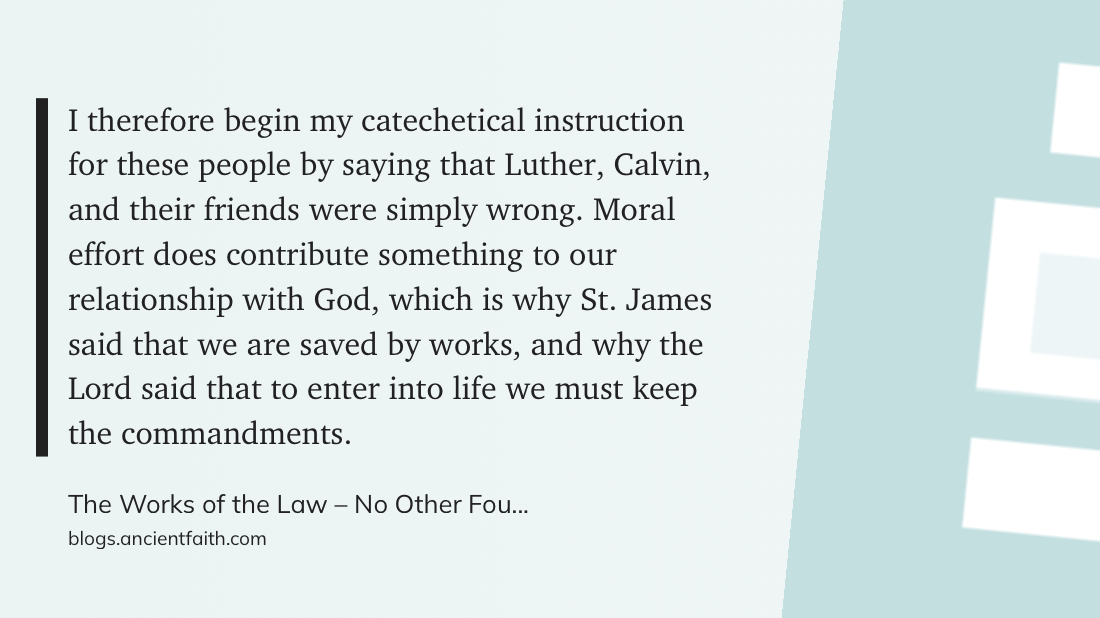
If you want the full posting: The Works of the Law

Every man a Pope

I frequently quote Nathan Hatch’s masterful The Democratization of American Christianity in my posts. It explains so much.

But I just discovered that one of my favorite Orthodox bloggers, Fr. Stephen Freeman, has noticed the same democratizing theme:

[I]n contemporary Christianity, it is said that “every man is a Pope.” Whereas a few generations ago, people asserted that the Bible alone had authority, today, that, too, has been overthrown. Each person is his own authority. And I will add, that if every person is his own authority, then there is no authority.

I am fully sympathetic with the political place of democracy …

I am, however, deeply interested in the spiritual disease that accompanies the interiorizing of the democratic project. We have not only structured our political world in a “democratic” manner, we have spiritualized the concept and made of it a description for how the world truly is and how it should be. The assumptions of democracy have become the assumptions of modern morality and the matrix of our worldview …

Much of what today passes for Protestantism is nothing of the sort. Rather, it is a thinly veiled cloak for the democratic spirit at “prayer.”  “Salvation by grace through faith” is a slogan for individualism, a Christianity “by right.” There are no works, no requirements, only a “grace-filled” entitlement. For the ultimate form of democracy is the person who needs no one else: no Church, no priest, no sacrament, only the God of my understanding who saves me by grace and guarantees that I can do it alone.

It is a great spiritual accomplishment to not be “conformed to this world.” The ideas and assumptions of modern consumer democracies permeate almost every aspect of our culture. They become an unavoidable part of our inner landscape. Only by examining such assumptions in the light of the larger Christian tradition can we hope to remain faithful to Christ in the truth. Those who insist on the absence of spiritual authority, or demand that nothing mediate grace will discover that their lives serve the most cruel master of all – the spirit of the age.

Fr. Stephen Freeman, The Madness of Democracy – A Spiritual Disease

The common feature of American religion

Nevin and Schaff also discerned certain common intellectual patterns and reflexes beneath the rampant pluralism of American Protestantism. They attributed the breakdown of theological coherence to attitudes that American Christians had assumed. These two felt that a radical Bible-centeredness was the reigning theory among Protestant sects. After surveying the statements of belief of fifty-three American denominations, Nevin surmised that the principle “no creed but the Bible” was the distinctive feature of American religion.

Nathan O. Hatch, The Democratization of American Christianity

Fifty-three denominations that just follow the Bible but cannot agree on what it means. What’s wrong with this picture?

Christianity generally

A constant temptation

Christianity in this instance is no longer even a worldview—or what John Rawls calls a “fully comprehensive doctrine”—much less an institutionalized worldview. It is conceived as one wedge in the pie of an individual life, a matter not of shared obedience to the Word incarnate with eternal life in the balance, but of preferred inclination toward the “company or conversation of those whose Customs and Humours, whose Talk and Disposition they like best.”

Brad S. Gregory, The Unintended Reformation

An article I keep coming back to

This is an article I’ve been revisiting and wrestling with regularly:

There is a reason why so many evangelical and Protestant graduate students in theology move toward “higher church” traditions. Intellectually, they discover thinkers and writings their own “lower church” traditions either ignore or lack; liturgically, they discover practices handed down century after century that function like a lifeline in a storm. Reading Saint Ignatius or Saint Justin or Saint Irenaeus or Saint Augustine, it occurs to them that they don’t have to imagine what the church’s ancient liturgy looked and felt like; they can simply visit a church down the street.

It isn’t strange to learn that Prestigious Scholar X on the law/econ/poli-sci faculty at Ivy League School Y is Roman Catholic. It is a bit of a surprise to learn that he’s an evangelical. The moment you hear it, though, you wonder (or ask) whether he’s an evangelical Anglican or some such.

Brad East, Conversions, Protestantism, and a new mainline

A cartoon for the rest of Election 2024

For those whose churches don’t have formal confession, understand that we confess our sins without suggesting that they were justified by our neighbor’s provocation. It sounds so easy, but not being able to self-justify, not even a eensy-weensy bit, can be surprisingly hard.

East and West

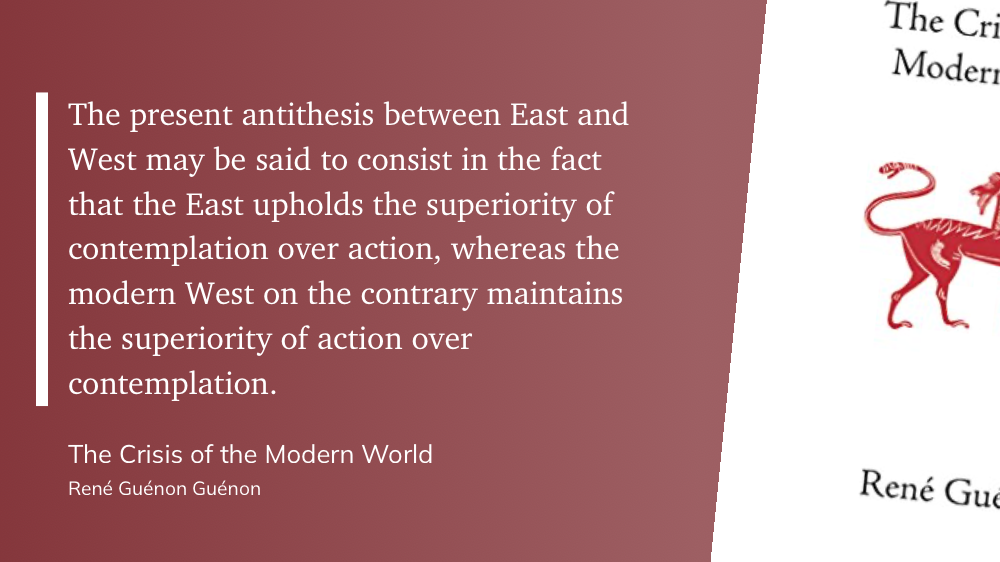
I don’t think his focus was Christianity, but Guenon was (inadvertently?) not wrong about the relative emphasis in Western versus Eastern Christianity.


… that Christ may dwell in your hearts through faith; that you, being rooted and grounded in love, may be able to comprehend with all the saints what is the width and length and depth and height — to know the love of Christ which passes knowledge; that you may be filled with all the fullness of God.

Ephesians 3:17-19 (NKJV)

You can read most of my more impromptu stuff here and here (both of them cathartic venting, especially political) and here (the only social medium I frequent, because people there are quirky, pleasant and real). All should work in your RSS aggregator, like Feedly or Reeder, should you want to make a habit of it.

Sunday, March 10, 2024

Grushenka and the Grumbler

Grushenka, a character in Dostoevsky’s The Brothers Karamazov, relates a now-famous fable about an old woman:

Once upon a time there was a woman, and she was wicked as wicked could be, and she died. And not one good deed was left behind her. The devils took her and threw her into the lake of fire. And her guardian angel stood thinking: what good deed of hers can I remember to tell God? Then he remembered and said to God: once she pulled up an onion and gave it to a beggar woman. And God answered: now take that same onion, hold it out to her in the lake, let her take hold of it, and pull, and if you pull her out of the lake, she can go to paradise, but if the onion breaks, she can stay where she is. The angel ran to the woman and held out the onion to her: here, woman, he said, take hold of it and I’ll pull. And he began pulling carefully, and had almost pulled her all the way out, when other sinners in the lake saw her being pulled out and all began holding on to her so as to be pulled out with her. But the woman was wicked as wicked could be, and she began to kick them with her feet: ‘It’s me who’s getting pulled out, not you; it’s my onion, not yours.’ No sooner did she say it than the onion broke. And the woman fell back into the lake and is burning there to this day. And the angel wept and went away.

It reminds me of a small scene in CS Lewis’ The Great Divorce. Angels are trying to help a soul make the journey from hell to heaven. One, a woman, seems mostly to a grumbler. Lewis’ soul has this conversation with his own guide:

‘I am troubled, Sir,’ said I, ‘because that unhappy creature doesn’t seem to me to be the sort of soul that ought to be even in danger of damnation. She isn’t wicked: she’s only a silly, garrulous old woman who has got into a habit of grumbling, and feels that a little kindness, and rest, and change would due her all right.’ ‘That is what she once was. That is maybe what she still is. If so, she certainly will be cured. But the whole question is whether she is now a grumbler.’ ‘I should have thought there was no doubt about that!’ ‘Aye, but ye misunderstand me. The question is whether she is a grumbler, or only a grumble. If there is a real woman— even the least trace of one— still there inside the grumbling, it can be brought to life again. If there’s one wee spark under all those ashes, we’ll blow it till the whole pile is red and clear. But if there’s nothing but ashes we’ll not go on blowing them in our own eyes forever. They must be swept up.’

Both stories have in common a tiny, insignificant thing: an onion, a grumble. There is in Scripture a similar “tiny thing,” a single moment that serves as a hinge in a human life. The exchange between the “Good Thief” and Christ on the Cross is hymned during Holy Week with the words, “The Wise Thief entered Paradise in a single moment…” It is a remembrance of the extreme measure of God’s grace.

Father Stephen Freeman, bringing together two of my favorites. Then there’s this:

The story of the Old Woman and the Onion is a parable stated in the extreme manner of absurdity. I was first drawn to it by the simple fact of its willingness to ascribe such mercy to God. A single, rotten onion, given as charity would be sufficient to get you out of hell! It was the imaginative force of such a thing that shook my soul when I first read it. In my childhood, there could never have been such a Christian mercy. Hell is hell is hell.

He’s not wrong about that, and I now think that the Grushenka story is truer than “hell is hell is hell.”

Ecclesial Christians

I’m pretty sure it was the late Richard John Neuhaus who described “ecclesial Christians” as “Christians for whom faith in Christ and faith in His Church is one act of faith, not two.”

I like that very much and my experience as a former non-ecclesial Christian who became ecclesial 26+ years ago, it rings true.

IYKYK, as the kids say

A distinction that may be of interest

For the Roman Catholic prayer, said by the priest after the penitent confesses, states, “I absolve you,” whereas in the Orthodox Church the wording reflects the original understanding: “May God forgive you, through me, a sinner.”

Michael Shanbour, Know the Faith

Entertainment

The Divine Liturgy is rightly understood as a theophany – an appearance of God (Christ) in our midst. We stand in the place of Moses, and wrestle in the place of Jacob. We gaze with Ezekiel and the fiery wheels with the Son of Man in their midst. We stand with St. John the Theologian and the vast crowds of heaven before the Lamb-slain-from-the-foundation upon the altar with the four beasts and angels surrounding Him.

This is profoundly significant. Our culture has trained people to become an audience. A theater performance, a concert, and a Church service are all of a piece. Worse than this, we are trained to be an audience that expects to be entertained ….

Fr. Stephen Freeman

Getting priorities straight

Photographers have long had an uneasy relationship with the sacred. There is the age-old anxiety that a photograph can steal a soul. And last week, more than 900 wedding photographers signed a petition complaining that “problematic vicars” can be “rude, humiliating, aggressive and abusive”. The fact is, the sacred has a deep and visceral distrust of the whole business of taking photos, which — in our Instagram-addled age — has resulted in a colossal culture clash.

One photographer, Rachel Roberts, who launched the petition, took a pop at problematic vicars. “They basically forget the fact that two people are getting married, and it’s the most important day of their lives. They put their own objectives and their own rules first and forget the reason why we’re all actually here.” Talk about getting things the wrong way round. The reason we are all there is for two people to enter into holy matrimony, not for wandering photographers to get the best angle for the album.

The problem is that photographs don’t just record reality — they change it. Quantum physicists talk of the observer effect: the very act of observing reality causes a disturbance within it, and thus changes it. Something similar is true of wedding photography. We pose for photographs. We behave differently when we are being captured on film …

So when the photographer turns up 10 minutes before the service and tells me how it’s going to be, that this is how the bride wants it, it makes little difference. They will stay behind the pillar and take photographs from the back, and not follow the bride down the aisle as if this were some catwalk show. They hate it, of course. But you don’t just walk into the house of God and expect the place to bend to your needs. The fact that this space is different, reflects different values, is precisely why people choose to be married here.

Giles Fraser, The narcissism of wedding photographers

Others

A seed was planted today in my head, and I don’t know where it will go. It is the possibility, even the likelihood, that a lot of people we call “Protestants” are not unequivocally Protestant because they’re not rooted in or in continuity with the classical Protestantism of the Reformation.

That’s all the speaker said, but already I’m thinking about the many denominations that grew out of the American revivalism of the late 18th and early 19th centuries, much of which was explicitly in rebellion against the Reformed/Calvinist stream of Reformation thought.

We probably call them “Protestants” because we don’t have a term for “not Roman Catholic, not Orthodox, not unequivocally Protestant, but calling themselves Christians.”

“Protecting” God, stripping away all meaning

[Jonathan] Edwards sought to intensify God’s control of creation. Yet ironically, Edwards ended up colluding with the Gnostic denigration of the material world to the degree that his entire philosophical project aimed at guarding God from the perceived threat posed by materiality. For God to truly be glorified, things in the world cannot have distinct natures or identities; rather, God must impose all meaning externally through will-acts that remain, in the final analysis, purely arbitrary. There is no actual meaning within the realm of space and time because the cosmos is simply a passive instrument of divine control.

Robin Phillips, Recovering the Goodness of Creation

Be it remembered

Margaret Sanger specifically drove the Evangelical Protestants into the pro-birth control column. She used the ever-reliable anti-Catholic sentiment of this group to overcome their natural aversion to birth control and to the Progressive Social Gospel Mainline. Thanks to Sanger’s efforts, by the time of the Griswold v. Connecticut decision, the entire country considered opposition to birth control to be a uniquely Catholic position.

Jennifer Roback Morse, The Sexual State


… that Christ may dwell in your hearts through faith; that you, being rooted and grounded in love, may be able to comprehend with all the saints what is the width and length and depth and height — to know the love of Christ which passes knowledge; that you may be filled with all the fullness of God.

Ephesians 3:17-19 (NKJV)

You can read most of my more impromptu stuff here and here (both of them cathartic venting, especially political) and here (the only social medium I frequent, because people there are quirky, pleasant and real). All should work in your RSS aggregator, like Feedly or Reeder, should you want to make a habit of it.

Superbowl Sunday 2024

Of course, that’s not on the Liturgical Calendar. And FWIW, I won’t be partaking. I. Am. So. Over. American football.

Sins, transgressions, infirmities

“If only I had known…”

These are, not infrequently, the words of an apology. They are also an explanation of why we are sometimes the way we are. Ignorance is, in the mind of the Fathers, a major cause of sin. Of course, if sin is understood in a legal/forensic framework, then ignorance would be nothing more than a form of innocence. Not knowing is excusable in most cases. But the teaching of the Church does not describe the world in legal/forensic terms. The world is not about who and what is right or wrong. It’s about what truly exists and what does not. Existence and being (ontology) are what matter, not what is legally correct. …

The door to true knowledge is repentance. Of course, for most people, repentance itself belongs to the category of legal and forensic things. It means not doing bad things, promising not to repeat the ones I have done, and, perhaps, feeling sorry. This is both inadequate and misleading. The Greek word used for repentance is metanoia, literally a “change of mind (nous).” It can be described as a movement from one form of knowledge to another (true knowledge).

The path to such knowledge passes through humility. And the path to humility involves shame (yes, I’m writing again about shame). Shame is more than a significant emotion (painful at best). It is described by the Elder Sophrony as “the Way of the Lord.” It is at the very heart of repentance. Shame has to do with “who we are.” Guilt is about “what I have done.” It is important to understand the distinction.

Fr. Stephen Freeman, Knowing the Knowledge that Transforms (emphasis added).

For some time before I became Orthodox, I was aware that most of the harm I caused, most of the chaos I cast onto those around me, was not the result of malice or a desire to harm, but of ignorance, of epistemic insufficiency if you will. I knew that my finitude often made me an agent of mischief in the world even when I thought I was doing the right thing.

But I was in a Christian tradition that understood sin in a legal/forensic framework, a framework focused on deliberate malfeasance. In this framework, to at least a degree, the proverbial Bull In The China Shop isn’t really a problem because he meant no harm. That was not true to the whole of my experience; I couldn’t help but feel responsible somehow for all the broken china around me (and, worse, the crushing knowledge that there doubtless was more, elsewhere, that I wasn’t even aware of).

When I stumbled into Orthodoxy, I immediately noticed, from the ubiquitous Trisagion (Thrice-Holy) prayers, pretty solid proof that Orthodoxy gets that:

Lord, cleanse us of our sins. Master, pardon our transgressions. Holy One, visit and heal our infirmities.

There are apparently (at least) three problematic categories, and only one of them calls for “pardon.” The others need “cleansing” or “healing.” (Prayers for forgiveness from sins committed “in knowledge or in ignorance” reinforced that.)

Now that was true to the whole of my experience.

Positive World, Neutral World, Negative World

I apparently was too gullible in accepting Aaron Renn’s tidy positive world, neutral world, negative world taxonomy as a very useful insight. Patrick Miller, whose church figured in Renn’s account, has now written a very helpful corrective (not really a rebuttal) to Renn: What Happened When My Church Encountered Negative World:

[T]he negativity of the post-2015 negative world is most keenly felt by those who, in the pre-2014 world, had easier access to power and influence: middle class, college-educated, non-coastal evangelicals. I’m not doing identity politics, I’m just observing that if you lived on the coasts as an evangelical before 2014, you didn’t feel like you lived in a “neutral world.” You were an outsider who spent the last few decades with divergent views on sex/sexuality. But middle class, midwestern and southern evangelicals enjoyed a sense of being normal. Many were insiders who had access to power denied to those of lower social strata, and (often) different skin color.

For example, it’s hard to imagine black or white Christians teaching orthodox views of race in Selma, Alabama in 1964 calling it a “positive world.” So-called “Christian” segregation academies, like Bob Jones University, didn’t desegregate until 1971, and didn’t lift their ban on interracial dating until 2000. They were reflective of the negative world of the south throughout the so-called “positive world” era.

We experience today as a particularly negative world—as compared to 10 years ago—for the same reasons non-evangelicals like Andrew Sullivan and J.K. Rowling do.

This is why former enemies of evangelicalism, like the new atheists, have become co-belligerents. Sam Harris, James Lindsay, and Peter Boghossian all live in a negative world, too. Likewise, non-evangelical free speech advocates who once coded left, like Johnathan Haidt, Bari Weiss, and Greg Lukianoff, also find themselves in a negative world.

Evangelicals experience the negativity as resistance to their faith, the New Atheists as resistance to reason, and the free speech advocates as resistance to the First Amendment. In many ways it’s all of these things and none of them in particular. The negative world that Renn describes results from the recent ascension of an imperialistic ideology—the successor ideology, the identity synthesis, wokeism—that has taken control of major American institutions, and is unafraid to forcefully remove and shame anyone and everyone who resists assimilation.

So let me be clear: We do live in a negative world and we are not alone.

While our story, certainly fits with [Renn’s] narrow thesis, it also shows what his framework ignores: 1) The negativity non-coastal evangelicals experience today does not come exclusively from progressives, but just as forcefully from far-right idealogues. 2) The pre-2014 era wasn’t neutral. It, too, was a negative world. Put differently, Renn’s framework doesn’t actually make sense of the church that, in his introduction, epitomized it.

[As an example of negativity from both sides, I’ve had] many strange experiences. In a single day, someone publicly called me a CRT cultural marxist and someone else called me a white supremacist. In a single week, one family left the church because we weren’t pro-BLM and a different family life because they said we supported CRT. We took hard hits publicly for critiquing the January 6 rioters and critiquing our school district for bringing children to a drag performance without parental permission.

I had people whom I counseled through marital distress, catastrophic loss, and awful sickness who turned against me because I wouldn’t affirm a right-wing conspiracy theory or stop teaching about ethnic reconciliation (which is hard to do if you teach through Ephesians, Galatians, Romans, Luke, Revelation, etc.).

When you strip away all the globalizing abstractions—like journalism, Hollywood, government, and big business—and focus instead on the on-the-ground experience of local institutional leaders, you will discover that their “negative world” is caused both by a left-wing progressive movement and a right-wing populist movement.

There are some things in life of which it’s apt to say “I can’t un-see this.” I hope this gentle take-down of a taxonomy I’d bought into will be one of them.

The starkest of contrasts

An American legacy that lingers:

Taking seriously the mandate of liberty and equality, the Christians espoused reform in three areas. First, they called for a revolution within the church to place laity and clergy on an equal footing and to exalt the conscience of the individual over the collective will of any congregation or church organization. Second, they rejected the traditions of learned theology altogether and called for a new view of history that welcomed inquiry and innovation. Finally, they called for a populist hermeneutic premised on the inalienable right of every person to understand the New Testament for him- or herself.

Nathan O. Hatch, The Democratization of American Christianity

A deeper historic legacy that swims against the modern American stream:

For this reason, attempting to interpret the New Testament apart from the Church and Tradition is quite unnatural and will fail to uncover the true purpose and meaning of the text. Christ did not establish Scriptures, but a Church. The Church existed before the New Testament, and the apostolic Tradition, preserved by Orthodoxy as a sacred treasure, is the only context in which the Scriptures are correctly understood.

Dr. Eugenia Scarvelis Constantinou, Thinking Orthodox

Evangelical polity

I worry that there is some sense in which “evangelicalism” is a) mostly a sociological identifier devoid of theological content, and b) mostly a vague network of conferences, podcasts, and other online platforms.

In both cases, there simply isn’t any mechanism for handling theological error well, let alone the often far more arduous task of determining when a theological error has been made.

What worries me is that these controversies are effectively tried via social media, which as Blake Callens noted, is often more of an industry than a ministry. So the primary rules of the game are inherently the rules of media public relations rather than anything discernibly Christian. This means that even when a controversy works itself out in mostly unobjectionable ways, there isn’t really any institutional or procedural factor accounting for that. It’s merely the broken clock that is right twice a day. But the larger issue is the lack of rootedness in local churches which are governed by confessions, procedural norms, and so on.

Jake Meador, American Evangelicalism as a Controversy Generator Machine. Concern about the unaccountability of nondenominational “evangelical” figures has been an emerging theme in Meador’s writing.

Born-again evangelical Muslims?!

Does a Muslim checking the box next to “born-again or evangelical” actually tell us something about how their view themselves in social, political, and religious space? I think the answer to that question is “yes” and I don’t just believe it’s an issue of measurement error or poor survey design. Instead, it also tells us something deeply profound about what terms like “evangelical” mean to a Muslim (or really any non-Protestant identifier) over the last decade.

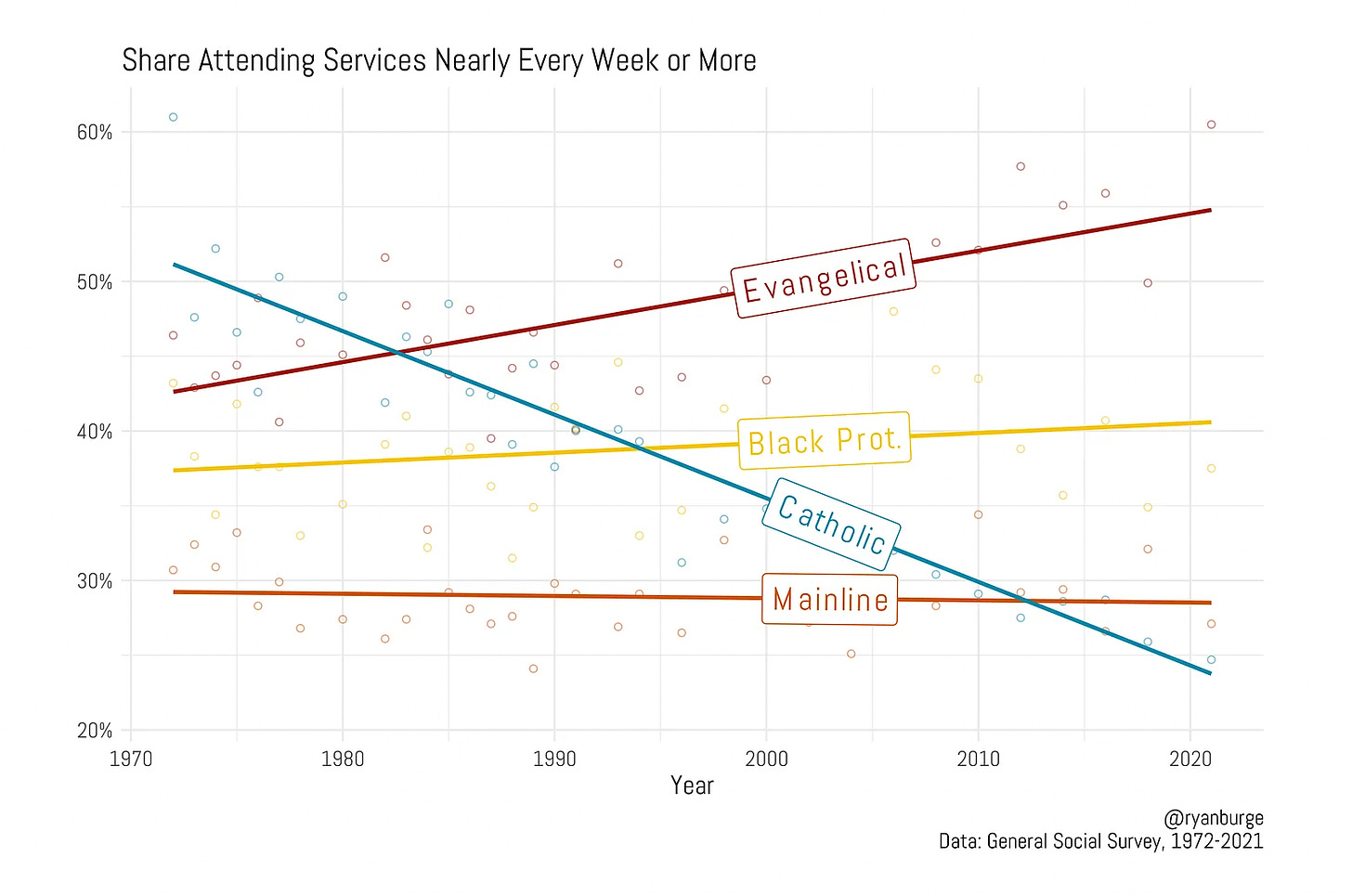
Ryan P. Burge, What’s Up With Born-Again Muslims? And What Does That Tells Us About American Religion?(Religion in Public blog)

A vignette

Looking for a church in [City], [State] that loves Jesus, has Holy Communion every week, has at least a few other young families, and isn’t infected with white Christian nationalism. Not interested in “concert and a TED talk.” Any recommendations?

An Anglican cyber-friend reaching out on our shared social medium.

I of course offered a link to an Orthodox Cathedral in [City], [State]. It clearly fit the bill.

But it seems there was an additional, initially unspoken, desiderata: he wanted the Anglican practice of open communion — “offering Holy Communion to all baptized followers of Jesus.”

To that I had nothing to say for fear of (1) starting an argument on (2) a topic where I was out of my depth. Theological arguments on the internet are near the top of the futility heap even when both sides are well-equipped — a fortiori when one side really has no more to say that “sorry, that’s not how we do it” but then augments that with ersatz rationales.


… that Christ may dwell in your hearts through faith; that you, being rooted and grounded in love, may be able to comprehend with all the saints what is the width and length and depth and height — to know the love of Christ which passes knowledge; that you may be filled with all the fullness of God.

Ephesians 3:17-19 (NKJV)

You can read most of my more impromptu stuff here (cathartic venting) and here (the only social medium I frequent, because people there are quirky, pleasant and real). Both should work in your RSS aggregator, like Feedly or Reeder, should you want to make a habit of it.

Sunday, 12/10/23

Prelude

This item follows on my enigmatic first item on December 3.

I’ve very frequently been quite harsh toward Evangelical Christians — “Why can’t you stupid people see that you need to be Orthodox!!!” has been the gist. So to anyone who has felt hectored, I apologize. If you’re still here, forgive me — and thanks for bearing with me in my chronic (26 year) convertitis.

I should know from my own experience that it’s not illegitimate to settle into a religious tradition and not be looking for the location of the exits immediately; that was my demeanor toward Calvinism for 20 years or so, and toward Evangelicalism for nearly 30 years before that. Both times, I was sort of blind-sided into recognizing the need to change.

Further, phenomenology and theology sometimes co-exist awkwardly. For instance, I now thoroughly believe that Baptism is not just a symbol, but is one’s initiation in the Church — a very important matter (theology). But I can’t help but feel that my Christian life began, in a non-trivial sense, 12 or so years before my Baptism when I realized (after being caught in flagrante delicto) that beating up on my brother to take away a toy was disappointing to Jesus and I needed Him to forgive me — and to “come into my heart,” as my then-tribe put it (phenomenology).

Bereft though they were of sacrament, Liturgy, incense, Church Fathers, icons, beauty and so forth, that realization and my response were important. But I’ve concluded that Evangelical Is Not Enough.

But I’ve tried to hector others into recognizing that it’s not enough. I wouldn’t have put it that way, but that’s what it amounted to.

I could say more about why I felt driven to hectoring people, but for reasons I need not share, I won’t.

Anyway: I need to reconcile myself to the reality of divided Christianity — that not all sincere Christians have entered the Ark, the one holy catholic and apostolic church of the Nicene Creed, and almost certainly some never will. The most I can do under my own power is to produce discontent with where they are — unholy discontent, which could lead them out of Christianity entirely. I don’t intend that.

But if you ever do feel any holy discontent, be sure to give Orthodoxy a look.

And I’ll probably be unable to completely eliminate critiques because Orthodoxy and Evangelicalism differ in important regards (more about that below), and where they do differ, I believe Orthodoxly.

The Main Act

Two kinds of believers

I sometimes think that the modern world’s true cultural divide is not between believers and unbelievers but between those who think life is a puzzle that is capable of being solved and those who believe it’s a mystery that ought to be approached by way of silence and humility. I am a problem solver by disposition, but in my heart I am strongly on the side of the mysterians.

It’s a mistake to treat [the tradition of Meister Eckhart, Teresa of Avila, John of the Cross, and Karl Rahner] as a watered-down version of the more certain expressions of faith typically associated with organized religion. The most sincere believers I’ve known have also been the most humble, the most perplexed. It may be that those who feel most powerfully the presence of God in their lives likewise feel most powerfully the impossibility of adequately capturing that presence in words. And it may be that those for whom God is not a symbol or a cudgel but a lived reality find this reality most mysterious.

Christopher Beha, Jon Fosse and the Power of Faith at 1 a.m.

I’m with Beha: “I am a problem solver by disposition, but in my heart I am strongly on the side of the mysterians.” I’ve been trying to solve the puzzle for many decades now, and I probably see more open questions than when I started.

So I now plan, after some fear that it was being over-hyped, to read Jon Fosse’s Septology.

This is not unrelated to the preceding item.

Why intellectuals don’t convert to Evangelical Christianity

My social medium friend Kyle Essary engages Brad East’s speculation about why intellectuals who become Christian tend to become Roman Catholic or Orthodox rather than Evangelical:

But there’s one area that Brad doesn’t mention. And I think this reason keeps many intellectuals away from many Protestant traditions. Catholicism and Orthodoxy don’t have crazies. There may be a few here or there, but when you hear about a Christian group making fools of themselves publicly, you can be fairly certain that they are Protestant—and probably evangelical. Our low-church, anti-institutional biases breed these types. If you are an intellectual considering Christianity, you will not naturally move toward Christian groups that oppose science or higher education. But evangelical Protestants have groups that oppose both.

Kyle has distilled this aspect better than I ever had.

Certainty, Ferocity and Solidarity

[T]he true distinction between fundamentalism and mainstream beliefs isn’t what fundamentalists believe but how fundamentalists believe. As Richard Land, a former president of the Southern Baptist Convention’s Ethics & Religious Liberty Commission, once told me, “Fundamentalism is far more a psychology than a theology.”

I’ve never encountered a fundamentalist culture that didn’t combine three key traits: certainty, ferocity and solidarity.

Certainty is the key building block. The fundamentalist mind isn’t clouded by doubt. In fact, when people are fully captured by the fundamentalist mind-set, they often can’t even conceive of good-faith disagreement …

That certainty breeds ferocity. Indeed, ferocity — not piety — is a principal trait of every truly fundamentalist movement I’ve ever encountered. Ferocity is so valuable to fundamentalism that it can cover a multitude of conventional Christian sins. Defending Trump in 2016, Robert Jeffress, the pastor of First Baptist Dallas, an evangelical megachurch, explained, “Frankly, I want the meanest, toughest son of a gun I can find. And I think that’s the feeling of a lot of evangelicals.”

Yet certainty and ferocity are nothing without solidarity … I’m reminded of an infamous quote by Mike Huckabee, a former Baptist pastor, regarding the necessity of loyalty. Explaining Trump’s hostility toward Ron DeSantis, Huckabee said, “I think there are two virtues — loyalty and confidentiality. Be loyal to the people who helped you and learn how to keep your mouth shut.”

Again, that’s not piety. It’s solidarity.

David French, Why Fundamentalists Love Trump

I appreciate this dissection of what makes “fundamentalism” fundamentalist, and it rings true to my 75 years’ experience. That’s even more interesting to me than why fundamentalists love Florida Man.

Note three things, though:

  1. So described, fundamentalism is not merely distinct from “mainstream” beliefs, if by mainstream one means the Seven Sisters of American Protestantism, but also distinguishes it from non-fundamentalist evangelicalism. Indeed, there’s no major difference between Christian evangelicals and fundamentalists in theology (see J.I. Packer, ”Fundamentalism” and the Word of God), but there are evangelicals who are blessedly low on certainty, ferocity and solidarity.
  2. So described, it becomes clearer how there can be Islamic as well as Christian fundamentalists — even Orthodox Christian fundamentalists (though I strongly believe that such Orthodox fundamentalism is not very good Orthodoxy).
  3. [Fundamentalists] “can have a steamrolling effect in institutions because their opponents — almost by definition — have less certainty, less ferocity and less solidarity” (French again).

Not a Freudian slip

Victor I. Masters, the head of Home Missions from 1909 to 1921, reflected and influenced denominational thinking when he argued that the North had lost its religion to Romanism and rationalism, and that the SBC’s divine mission was to spread “the Anglo-Saxon evangelical faith.”

Frances FitzGerald, The Evangelicals

Interlude

Quanta

Quantum physics: Electrons moving, but photographing them affects path and speed. Why? How? Quantum theology: God’s mind doesn’t change, but he tells us to pray, and somehow our prayers affect the outcome.

Marvin Olasky, The Wonder of the Universe’s Weirdness

Theology

The classic Orthodox definition of a theologian is well known and frequently repeated in Orthodox circles: “A true theologian is one who prays,” or “One who prays is a true theologian.” This legendary saying reflects the Orthodox phronema and stands in stark contrast to the Western Christian phronema, which strongly emphasizes use of the mind for comprehension of theological truths and rational deduction as a theological method.

Dr. Eugenia Scarvelis Constantinou, Thinking Orthodox

Gratitude

I am a millionaire.
My bedroom is full of gold
light, of the sun’s jewellery.
What shall I do with this wealth?
Buy happiness, buy gladness,
the wisdom that grows with the giving of thanks?

R.S. Thomas, Collected Later Poems 1988-2000

Postlude

Orthodox Teaching does not merely differ from Western Christianity in content, but the reason for the difference is equally important. After reading this book, Western Christians still may not understand our mentality, but perhaps they will begin to realize that the difference between Orthodoxy and Western Christianity is significant and more far-reaching than a few doctrines, ancient rituals, and a refusal to submit to the pope. The variance is deeper than appears on the surface, extending to how theology is conceived, conceptualized, taught, and approached. To complicate matters, often the same terminology is used in East and West, but basic terms or concepts do not have the same meaning at all. What is sin? What is salvation? What is forgiveness?

Dr. Eugenia Scarvelis Constantinou, Thinking Orthodox


So walk on air against your better judgement

(Seamus Heaney)

You can read most of my more impromptu stuff here (cathartic venting) and here (the only social medium I frequent, because people there are quirky, pleasant and real). Both should work in your RSS aggregator, like Feedly or Reeder, should you want to make a habit of it.

Sunday, 11/26/23

Prescient if not prophetic

  • Shortly after …, Cal Thomas and Ed Dobson, who had been Falwell’s chief lieutenants in the Moral Majority, published a book questioning not just the efficacy of political action but the righteousness of the enterprise. In Blinded by Might they argued that in the process of trying to win elections conservative Christians had been seduced by the lure of power. What had begun as an effort to restore Christian values to the nation had degenerated into an unbridled partisan struggle, creating an atmosphere in which it was assumed that Democrats could not be Christians and that Bill and Hillary Clinton were the Antichrist.

Frances FitzGerald, The Evangelicals (hyperlink added)

That feels prescient, doesn’t it? Things feel exactly like that today, and Jerry Falwell and Paul Weyrich may have shoved us down that slippery slope.

I also sense a parallel between Simon Magus and those who used the name of Christ as if it was a magic incantation, only to be mocked by the demons they were trying to cast out.

There’s always a temptation to try to use some variety of magic to make god(s) do what one wants, and it’s healthy for me to remember that at least two Evangelicals recognized what was happening.

In a similar vein, but with a historic perspective:

Even when Fundamentalists set out to defend the truth, their temptation was to rally large constituencies to the cause rather than to prepare for scholarly exchange.

Nathan O. Hatch, The Democratization of American Christianity

Undefined

Orthodoxy theology defines only what is necessary and always leaves unspoken that which cannot be explained. This approach was part of the Christian faith from the beginning. But the Western phronema often suppresses, dismisses, minimizes, or ignores this stance. The Western mind is compelled to define and explain everything, since without a rational explanation a concept or fact cannot be considered true, or, conversely, all truth can be proven rationally.

Dr. Eugenia Scarvelis Constantinou, Thinking Orthodox

Rebel energy

With this in mind, as a storyteller, I think of Christianity remembering its own myths. Digging into the dark wonder of it all.

Not the stuff of empire and conquest, not the mega-churches and donation box, but the sheer radical eccentricity of its stories, the quiet devastation of love that circles the Beatitudes. The call to adventure. The voluntary abdication of consumer-friendly outcomes. Not building a shopping mall around a Grail. The unfashionable weight of such a thought. The five fathoms depth of it. That’s a rebel energy these days, a whispered thing.

Martin Shaw

Distinctions

On my one-and-only active social medium, I happened upon a religious/antireligious discussion, chimed in with my 2-centsworth, and watched the discussion shift.

The odd thing was that the antireligious side was reacting to evangelicals/fundamentalists, “and by extension all Christians.” That was odd because this medium is chock-full of sane Christians, including some sane evangelicals.

I for one detest the assumption that my cosmology and demeanor toward the world is identical with that of any self-styled Christian who ever offended the one making the assumption about me. There’s more to Christianity than superficially ticking off “yes” to a bunch of checklist affirmations, and anyone who can’t tell the difference between, say, Mother Theresa and Jerry Falwell, Jr., because “both believe a myth,” is an idiot.

(Yes, that makes me guilty of “but I’m not that kind of Christian” — because Christianity in North American is manifest in tens of thousands of clumpings, quite apart from they tens of millions who try to go it solo. I do hope, though, that if a day comes when the idiots decide to actively persecute all Christians without distinction, I’ll not betray my embarrassing brothers and sisters.)

Thanksgiving morning, one participant came up with the mike-drop quote, from Marilynne Robinson, who also “isn’t that kind”:

“Over the years many a good soul has let me know by one means or another that this living out of the religious/ethical/aesthetic/intellectual tradition that is so essentially compelling to me is not, shall we say, cool. There are little jokes about being born again. There are little lectures about religion as a cheap cure for existential anxiety. …

“Am I the last one to get the news that this religion that has so profoundly influenced world civilization over centuries has been ceded to the clods and the obscurantists? Don’t I know that J. S. Bach and Martin Luther King have been entirely eclipsed by Jerry Falwell? The question has been put to me very directly: Am I not afraid to be associated with religious people? These nudges would have their coercive effect precisely because those who want to put me right know that I am not a fundamentalist. That is, I am to avoid association with religion completely or else be embarrassed by punitive association with beliefs I do not hold. What sense does that make? What good does it serve? I suspect it demonstrates the existence of a human herding instinct. After all, “egregious” means at root “outside the flock.” There are always a great many people who are confident that they recognize deviation from group mores, and so they police the boundaries and round up the strays.”

Yes! This!

My Lord is the One who resurrects. He resurrects the dead from morning until dusk, and from dusk until dawn.”
What the morning buries, the Lord brings to life in the evening; and what the evening buries, the Lord brings to life in the morning.
What work is more fitting for the living God than to resurrect the dead into life?
Let others believe in the God who brings men to trial and judges them.
I shall cling to the God who resurrects the dead.

St. Nikolai of Zhicha, Prayers by the Lake

In a slightly less poetic vein, Fr. Stephen Freeman used to say “God didn’t come to make bad men good. He came to make dead men live.”

Whether to swim the Tiber or the Bosphorus

[T]here seems to be a shift [in the evangelical world] away from the attractiveness of Catholicism toward Orthodoxy, especially for those who don’t have career ambitions within movement conservatism.

Aaron Renn (italics added; H/T Rod Dreher)

That “ambition” distinction between who converts to Catholicism and who to Orthodoxy hadn’t occurred to me. I’m not sure I agree (if only because, in Renn’s context, the alternative to ambitions in “movement conservatism” may be something like involvement in more extreme “dissident conservatism”).

I found the comments to Renn’s posting interesting, especially insofar as they identified the Eastern-ness of Orthodoxy as an impediment. It’s always interesting to see ourselves as other see us.

Mainlining

Bear with me here for two paragraphs of necessary context before the heart of the item:

In terms of political ideology, only 23% of all mainline white American churchgoers identify as liberal, while 55% of their clergy leaders do so. Thirty-two percent of white mainline churchgoers consider themselves moderates and 43% conservative. In contrast, among the clergy who serve these conservative mainliners, 22% consider themselves moderate and only 22% conservative.

Half of mainline clergy identify as Democrats and only 14% as Republican (those who identify as “moderate” make up the rest). Among United Methodists, 60% of laity say they are Republican and 40% Democrat. While UM clergy are far more apt to be Democrat than Republican, among bishops and board and agency staff the percentage may be as high as 80% to 20%.

This, of course, is hardly news to many. I knew a United Methodist ministerial candidate who graduated from one of our premier United Methodist-related universities and then from one of the most highly regarded (liberal) seminaries in the nation. After all of this preparation he received his first appointment, to a circuit in a rural area in a midwestern state. After two months he not only resigned from his church but dropped out of the ministry.

“This has been a terrible mistake,” he explained.

The best ministerial education possible, at least from an institutional perspective, failed to equip him to minister to ordinary people in an ordinary American setting.

I became keenly aware that a number of churches were asking for  “conservative” pastors. I do not recall a single instance where a church requested a “more liberal” pastor …

Riley B. Case

Christendom?

I sometimes wonder if Christians claim too much credit for Western culture. But Ayaan Hirsi Ali apparently believes that credit is deserved, as her appreciation of the culture factored prominently into her recently-announced conversion.

And then there’s this:

“The international human rights regime of 1945,” an American human rights supporter remarked, “is no more. American hegemony has eroded. Europe, even with the events of 1992, is little more than a peninsula. The world is now as Arab, Asian, and African, as it is Western. Today the Universal Declaration of Human Rights and the International Covenants are less relevant to much of the planet than during the immediate post-World War II era.” An Asian critic of the West had similar views: “For the first time since the Universal Declaration was adopted in 1948, countries not thoroughly steeped in the Judeo-Christian and natural law traditions are in the first rank. That unprecedented situation will define the new international politics of human rights. It will also multiply the occasions for conflict.”

Samuel P. Huntington, The Clash of Civilizations and the Remaking of World Order

It seems to me that the waning of the Universal Declaration of Human Rights due to the rise of “countries not thoroughly steeped in the Judeo-Christian and natural law traditions” testifies, too, that credit is not undue.

The question remains, though, whether the vices of Western culture were baked into the Protestant Reformation, the emergence of a particular kind of Christianity.

Humility

Don’t overdramatize either your sins or your virtues. Frankly, chances are good that neither are spectacular.

Peter Bouteneff, How to Be a Sinner

Noted

I have definitely tended for decades toward catastrophism. I hope I haven’t overburdened this blog with that.

But I’m taking heart recently. Paul Kingsnorth and Martin Shaw becoming not just Christians, but Orthodox Christians, bringing some enchantment with them. Ayaan Hirsi Ali becoming a Christian of some sort. Now, within the past 24 hours, I’ve learned that Matthew B. Crawford, author of Shop Class as Soulcraft and The World Outside Your Head has become Christian (I had no idea he’d been raised by left coast flakes and lived in an Ashram from roughly ages 10 to 15). He declined to expand on that conversion in an Andrew Sullivan podcast, aware that he’s a novice.

Bearing in mind that the plural of anecdote is data, emotionally if not scientifically, I’m growing in confidence that God is up to something good, and I was sure ready for it.


The human voice: That we can sing seems basis for conjecture that, despite our stupidities and our sinfulness, we might be the reason the universe exists.

Alexander Riley

You can read most of my more impromptu stuff here (cathartic venting) and here (the only social medium I frequent, because people there are quirky, pleasant and real). Both should work in your RSS aggregator, like Feedly or Reeder, should you want to make a habit of it.