Friday, 10/10/25

Nonpartisan

Levelers

Emily Ruddy was traveling the country with her new husband, Mike, when news reached them of Charlie Kirk’s shooting, then death:

Back in the car with Mike, approaching the Florida border, I’m looking at pictures of Charlie Kirk on my phone. He is staggeringly tall, taller than I ever realized, with a celebratory fist in the air. Reading his Wikipedia page, which has now been changed to past tense, I am reminded of a story I first read in middle school: Kurt Vonnegut’s “Harrison Bergeron.” The story is set in the late twenty-first century, in a dystopian America where the authorities have taken it upon themselves to ensure no person is better than another, be it in athleticism, intelligence, or beauty. The strong citizens get weighed down with bags of bird shot. The attentive citizens are intermittently bombarded with hideous sounds through tiny radios in their ears. The most beautiful faces are concealed by hideous masks.

But it’s the title character, Harrison Bergeron—exceptionally tall, handsome, brilliant and outspoken—who is shackled most heavily. At the end of the story he breaks through the shackles, and as punishment he is shot down on live TV: a warning to whoever tries to pull a similar stunt. Or at least, it would be a warning, if the viewers’ memories weren’t instantly blasted away by the ear radio’s next awful sound.

Emily Ruddy, Battle Above the Clouds.

If you haven’t read Harrison Bergeron, a (very) short story, by all means do. It’s freely available, like, for instance, here.

After Christian faith dies

The biggest confusion among my own students used to be rudderless moral relativism.  Although there is still a lot of that, it seems to be on the decline.  Now the problem is the explicit embrace of evil.  The suggestion that one must never do what is intrinsically evil for the sake of a good result is a hard sell.  Many of students are strongly attracted to “consequentialism,” the view that whether an act is right or wrong is determined only by the result.  To say that the ends do not justify the means puzzles them.

The decline of faith has also produced changes in character.  Young people who were raised in Christian homes, but then abandoned Christianity, often used to retain vestiges of their moral upbringing, and accepted such ideas as courtesy, love of neighbor, and the sacredness of innocent human life.  Today, having grown up in faithless homes, many seem to think that courtesy is for fools, that no one with whom they disagree is their neighbor, and that they should hate those they consider wrong instead of praying for their repentance and restoration.  As for the sacredness of innocent human life – for them, that idea went out when they embraced abortion.

I don’t spend much time asking what is going to happen, but I do ask what God would like me to do in my own place.  He sees the whole shape of things.  I can’t, but like a faithful bone, I can try to turn nimbly in the joint where I’m placed.

J Budziszewski, How Can I Think About the Assassination?

Budziszewski’s description of the decline of faith, as early as the second generation (the first generation of lapsed Christians lives on the vapors of the empty tank), is a description of devolution toward the “nasty, short and brutish” of pre-Christian antiquity.

If you think I’m just making a casual partisan slur, take a look at either of these two books, the first lengthy, the second shorter and more focused.

Wordplay

Frank Bruni’s back with recent favorite sentences. (Do not read this with beverages or food in your mouth.):

  • Also in The New Yorker, Jessica Winter read the infamous Jeffrey Epstein birthday book so that you and I don’t have to: “Sometimes it’s like you’ve discovered a rich man’s contract with the devil, and next to his signature, he’s drawn a little penis cartoon.” (Matthew Ferraro, East Providence, R.I.)
  • And Kelefa Sanneh, reporting from a recent Bad Bunny concert, described an ecstatic fan who “danced so vigorously with a decorative plant that he seemed to be trying to pollinate it.” (Bob Marino, Paris)
  • In The Los Angeles Times, Christopher Goffard tried to make sense of a former Los Angeles County sheriff’s rambling: “As he sat down to face questions from the feds, his sentences traveled winding paths through vague precincts to fog-filled destinations.” (Robin April Dubner, Oakland, Calif.)
  • In The Guardian, Bryan Armen Graham commiserated with the polite subgroup of American fans at an annual Europe-versus-United States golf tournament, who were too often “drowned out by the performative tough guys in flag suits and plastic chains who treat the Ryder Cup like a tailgate with better lawn care.” (John LeBaron, Acton, Mass.)
  • In The Dispatch, Nick Catoggio regarded the marks that President Trump and Defense Secretary Pete Hegseth made to military leaders last week as “a case of two men who radiate neurosis about their own toughness lecturing a roomful of actual tough guys about how to be tough. It had the feel of Pop Warner players scolding a group of N.F.L. linebackers about the importance of hustle.” (Glen T. Oxton, Mamaroneck, N.Y., and John Sabine, Dallas)
  • And John McWhorter analyzed the president’s loopy language: “Even Trump’s most positive-sounding coinages are acts of a certain kind of verbal aggression. I sometimes stop to marvel that the House passed something with the actual official title the One Big, Beautiful Bill Act. That goofy bark of a name is a boisterous clap back against opposing views, an attempt to drown out inconvenient facts with braggadocio. It is a linguistic snap of the locker room towel.” (Matt Masiero, Richmond, Mass., and Sue Hudson, Simi Valley, Calif., among many others)

Anarchism

[T]he essential practices of anarchism — negotiation and collaboration among equals — are ones utterly neglected and desperately needed in a society in which the one and only strategy seems to be Get Management To Take My Side.

Alan Jacobs, Should Christians be Anarchists?

Partisan

Transparent pretext

Trump’s remarks on the night of Kirk’s murder redefined violent incitement to include harsh criticism of judges. (“My administration will find each and every one of those who contributed to this atrocity and to other political violence, including the organizations that fund it and support it, as well as those who go after our judges, law-enforcement officials, and everyone else who brings order to our country.”) Now [aide Stephen] Miller himself is going after judges.

To call this “hypocrisy” is to engage Miller’s reasoning at a level upon which it does not operate. The essence of post-liberalism is the rejection of the notion that some neutral standards of conduct apply to all parties. Miller, like Trump, appears to believe his side stands for what is right and good, and his opponents stand for what is evil. Any methods used by Trump are ipso facto justified, and any methods used against him illegitimate.

A couple of weeks ago, Miller claimed that a disturbed gunman shooting Charlie Kirk impelled the government to crack down on the left. Now he says a handful of activists protesting ICE impel the government to crack down on the left.

Violence is not the cause of Trump and Miller’s desire to use state power to crush their opposition. It is the pretext for which they transparently long.

Jonathan Chait, Stephen Miller is Going for Broke

Bad faith

You can and should worry about American leaders at any level viewing their opponents as the enemy within, whether it’s the president of the United States or a random [Democratic] candidate for state AG. But if you’re more vocal about the latter than the former, forgive me for thinking you’re more interested in contriving a “both sides” equivalency to minimize what the White House is up to than you are about addressing the problem of incitement.

Two things are remarkable about [continuing troop deployments in “blue cities”]. One, which almost goes without saying, is that it’s another case of the Trump administration aiming to normalize unprecedented authoritarian shows of force. But the other is underappreciated: It’s all being done in bad faith, as a provocation, and quite plainly. There’s barely a pretense anymore of a colorable emergency like a riot that might justify the president deploying troops. He’s doing it unbidden and enthusiastically, looking for excuses to intimidate Democrats by symbolically occupying their cities with troops yanked from duty [and civilian jobs] in other states.

Needless to say, this is why the Trump White House didn’t get the benefit of the doubt from Judge Immergut on the Portland deployment, or from Judge Waverly Crenshaw on whether Kilmar Abrego Garcia was vindictively prosecuted. It’s also why the case against James Comey will end up in the toilet sooner rather than later. Courts have traditionally given the president and the Justice Department wide discretion in commanding the military and choosing whom to prosecute, but that’s because presidents traditionally haven’t given courts good reason to think they’re acting in bad faith.

Nick Catoggio, American versus American.

I look forward to the day when judges cease giving a “presumption of regularity,” of good faith, to the actions and legal arguments of this Administration. They have forfeited it because so much of what they do plainly is done in bad faith.

On keeping an impossible promise

Anyone with brown skin and the wrong kind of tattoo is therefore now at risk of being carted off to torture by the US government, with absolutely no safeguards that they have gotten the right people. Or do you think that an administration that confuses billions with millions, and puts classified intelligence on a Signal app, is incapable of making an error?

Andrew Sullivan, Two Perfect Months (March 2025)

I will give Trump “credit” for trying to keep his deportation campaign promise. The problems is, it’s impossible even for competent, non-malicious government workers to keep it (it included luridly-high numbers) without wholesale errors and ubiquitous denials of due process (i.e., in context, the process by which we assure that a person truly is subject to deportation under the law).

Your tax dollars at work

Short Circuits is a punchy weekly summary of notable Federal Court of Appeals decision, like this summary of activities by an ICE goon:

ICE agent escorting passenger from Dallas to Miami takes upskirt pictures and videos of flight attendant. He’s convicted of interfering with her flight-crew duties, sentenced to two years’ probation. Agent: I didn’t know that she was aware of my “clandestine video voyeurism,” and that’s an element of the crime. Eleventh Circuit (unpublished): It is not.

Divine retribution in Dallas

The covert operations of the Kennedys haunted Lyndon Johnson all his life. He said over and over that Dallas was divine retribution for Diem. “We all got together and got a goddamn bunch of thugs and we went in and assassinated him,” he lamented. In his first year in office, coup after coup wracked Saigon, a shadowy insurgency started killing Americans in Vietnam, and his fear that the CIA was an instrument of political murder festered and grew.

Tim Weiner, Legacy of Ashes

Rulebreaker

There are certain unwritten rules in American life, and one of them is that before your face is featured on the nation’s currency you are first obliged to die. There is no constitutional provision that mandates this, nor any law written tightly enough to guarantee it. But, as a general matter, we have shied away from putting living figures on our notes and coins, on the grounds that it is monarchical behavior and that the United States is not a monarchy. Unsurprisingly, this salutary tradition is not of great interest to the Trump administration, which intends to put an image of Trump on both sides of a commemorative $1 coin that will be produced for the 250th anniversary of the Declaration of Independence. On one side, Trump will appear in profile. On the other, he will appear pumping his fist, with the words “Fight Fight Fight” lining the coin’s perimeter. Answering questions about the plan, Trump’s press secretary, Karoline Leavitt, said that she was unsure if Trump had seen it, but that she was “sure he’ll love it.” He will. But that’s not really the important point, is it?

National Review week in review email.

Here’s a coin suggestion:


We are all gatekeepers now.

Peggy Noonan

Your enemies are not demonic, and they are not all-powerful and the right hasn’t always lost and the left hasn’t always won. But if you convince yourself of that, you give yourselves all sorts of permission to do a lot of stupid and terrible things under the rubric of “Do you know what time it is?”

Jonah Goldberg.

[A] critical mass of the American people … no longer want[s] to govern themselves, … are sick of this republic and no longer want to keep it if it means sharing power with those they despise.

Nick Catoggio

I don’t do any of the major social media, but I have two sub-domains of the domain you’re currently reading: (a) You can read most of my reflexive stuff, especially political here. (b) I also post some things on my favorite no-algorithm social medium.

Authoritarianism in the 21st century

My father died 27 years ago today. It was too early, but I wouldn’t have wanted to see him at the age he’d be now.

This just might be faintly relevant

There isn’t a single instance of a fentanyl seizure in the Caribbean:

Last month, the U.S. cutter Hamilton returned to Florida with what the agency called “the largest quantity of drugs offloaded in Coast Guard history”: 61,740 pounds of cocaine and 14,400 pounds of marijuana (that’s the weight of about three city buses). The haul, gathered by multiple federal agencies during 19 seizure incidents in the Caribbean as well as the Pacific, had an estimated street value of $473 million. But there wasn’t any fentanyl on the boat.

(Nick Miroff)

Authoritarianism in the 21st century

We are living in an authoritarian state.

It didn’t feel that way this morning, when I took my dog for his usual walk in the park and dew from the grass glittered on my boots in the rising sunlight. It doesn’t feel that way when you’re ordering an iced mocha latte at Starbucks or watching the Patriots lose to the Steelers. The persistent normality of daily life is disorienting, even paralyzing. Yet it’s true.

We have in our heads specific images of authoritarianism that come from the 20th century: uniformed men goose-stepping in jackboots, masses of people chanting party slogans, streets lined with giant portraits of the leader, secret opposition meetings in basements, interrogations under naked light bulbs, executions by firing squad … I’d be surprised if this essay got me hauled off to prison in America. Authoritarianism in the 21st century looks different, because it is different. Political scientists have tried to find a new term for it: illiberal democracy, competitive authoritarianism, right-wing populism …

… To keep their jobs, civil servants have to prove not their competence but their personal loyalty to the leader. Independent government officers—prosecutors, inspectors general, federal commissioners, central bankers—are fired and their positions handed to flunkies. The legislature, in the hands of the ruling party, becomes a rubber stamp for the executive. Courts still hear cases, but judges are appointed for their political views, not their expertise … There are no meaningful checks on the leader’s power.

Today’s authoritarianism doesn’t move people to heroic feats on behalf of the Fatherland. The leader and his cronies, in and out of government, use their positions to hold on to power and enrich themselves. Corruption becomes so routine that it’s expected; the public grows desensitized, and violations of ethical norms that would have caused outrage in any other time go barely noticed. … At important political moments it mobilizes its core supporters with frenzies of hatred, but its overriding goal is to render most citizens passive. If the leader’s speech gets boring, you can even leave early (no one left Nuremberg early). Twenty-first-century authoritarianism keeps the public content with abundant calories and dazzling entertainment. Its dominant emotions aren’t euphoria and rage, but indifference and cynicism. Because most people still expect to have certain rights respected, blatant totalitarian mechanisms of repression are avoided. The most effective tools of control are distraction, confusion, and division.

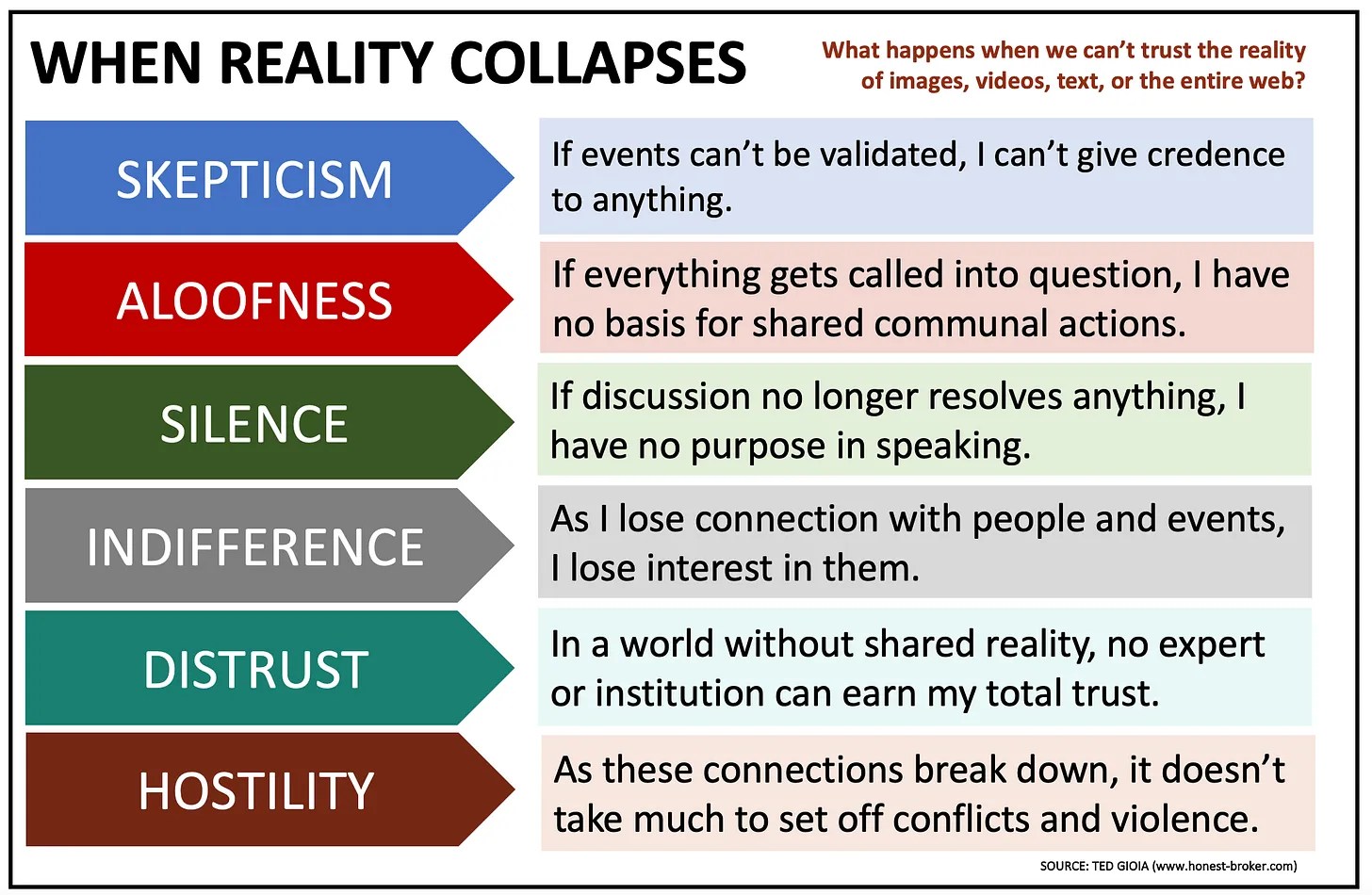
“If everybody always lies to you, the consequence is not that you believe the lies, but rather that nobody believes anything any longer,” the political philosopher Hannah Arendt said near the end of her life. “And a people that no longer can believe anything cannot make up its mind. It is deprived not only of its capacity to act but also of its capacity to think and to judge. And with such a people you can then do what you please.”

These are the features of the modern authoritarian state. Every one of them exists today in this country …

… It sometimes seems as if the only check on Trump’s power is his own attention span.

George Packer, America’s Zombie Democracy.

Railway to the Moon

Imagine if you were trying to write intelligently about the socioeconomic impact of the railroad in the middle of the 19th century, and half the people investing in trains were convinced that the next step after transcontinental railways would be a railway to the moon, a skeptical minority was sure that the investors in the Union Pacific would all go bankrupt, many analysts were convinced that trains were developing their own form of consciousness, reasonable-seeming observers pegged the likelihood of a train-driven apocalypse at 20 or 30 percent, and peculiar cults of engine worship were developing on the fringes of the industry.

What would you reasonably say about this world? The prime minister of Denmark already gave the only possible answer: Raise your alert levels, and prepare for various scenarios.

Ross Douthat, Drones, Denmark and Dark Magic

PK snippets

  • “I’m not proposing a political program,” he told me. “This isn’t some Christian civilizational vision. It’s much more personal.” You decide how and where to wage battle: at a community garden, on the Appalachian Trail, in a mosque.
  • He was struck by how commonplace legal cannabis had become. “It’s a really, really useful drug for the state to be legalizing,” he said. “Because it’s not like alcohol. It doesn’t get you violent. And maybe life is a bit less crappy. It’s the best antidote to revolution that you could possibly have.”
  • “When you’re sitting in your living room with your Punjabi wife reading a bunch of stuff about how you’re a white nationalist, it makes you want to punch people in the face,” he said. “Luckily, I’m a Christian, so I don’t do that.”

Paul Kingsnorth via Alexander Nazaryan in the New York Times


We are all gatekeepers now.

Peggy Noonan

Your enemies are not demonic, and they are not all-powerful and the right hasn’t always lost and the left hasn’t always won. But if you convince yourself of that, you give yourselves all sorts of permission to do a lot of stupid and terrible things under the rubric of “Do you know what time it is?”

Jonah Goldberg.

[A] critical mass of the American people … no longer want[s] to govern themselves, … are sick of this republic and no longer want to keep it if it means sharing power with those they despise.

Nick Catoggio

I don’t do any of the major social media, but I have two sub-domains of the domain you’re currently reading: (a) You can read most of my reflexive stuff, especially political here. (b) I also post some things on my favorite social medium.

From grim to grimmer

Bummer

I could have filled this post with many clippings colorfully describing how bad things are. I’ve done it before and I’ll probably do it again. That’s just the kind of guy I am: melancholic.

But it just seems too much this week. I’m having trouble identifying anything going right in the USA.

I came of age in the 60s, and although I’ve been expecting our collapse for a long time, the manner and speed of the seeming collapse are a surprise.

I’ll summarize what’s a bit unsettling, even for me, thus:

  • We are moving rapidly from American hegemony to a multipolar world.
  • The very best President imaginable couldn’t stop, but could at best slow, our relative decline.
  • The very best President imaginable wouldn’t even run because of the politics of personal destruction.
  • But a toxic narcissist, jilted by voters in 2020, would run again in 2024 on a platform of vengeance. “Vengeance” turned out to mean turning America into a “shithole country.” (That will teach us!)
  • The Mainstream media are whistling past the cemetery as all this goes down.
  • UPDATE: Charlie Kirk, who it seems was more consequential than I had realized, gunned down Wednesday. I wrote everything in this post, other than this bullet point, before the murder of young Kirk. I knew little about him. My first impression was unfavorable because he was associated with Jerry Falwell, Jr. at the time that Falwell’s Potemkin Piety was collapsing. Thereafter? Well, I’m about 50 years older than his target demographic. (My wife didn’t even know who he was.) I’ve read a lot about him this morning, but the most interesting observation I read was too frank for this raw moment, so I’ll let you ferret out your own information if you care to.

With that off my chest, I’ll try to edify y’all for a while.

Repelled by conservatism, but not a liberal

Conservatism, as you know, is a complete mess in America right now. But reading conservative authors like Edmund Burke, Samuel Johnson, Fyodor Dostoyevsky, Gertrude Himmelfarb and James Q. Wilson does give you an adequate appreciation for the power of nonmaterial forces — culture, moral norms, traditions, religious ideals, personal responsibility and community cohesion.

I’ve been driven away from the right over the past decade, but I can’t join the left because I just don’t think that tradition of thought grasps reality in all its fullness. I wish both right and left could embrace the more complex truth that the neocon Democrat Daniel Patrick Moynihan expressed in his famous maxim: “The central conservative truth is that it is culture, not politics, that determines the success of a society. The central liberal truth is that politics can change culture and save it from itself.”

David Brooks, Why I Am Not a Liberal. This pretty clearly was one of the ten best things I’ll see in the New York Times this month, so that’s one of my gift links.

Breakneck: what you get in an engineered society

Publishers have figured out how to get limelight for their new titles, and one new title that’s deservedly getting a lot is Dan Wang’s Breakneck, about the astonishing ascendancy of China.

For a solid interview with Dan Wang (interviewer Ross Douthat), click this shared link: This Is Why America Is Losing to China.

Wang attributes this in substantial part to the relative influence of engineers in China versus that of lawyers in the USA. Engineers build; lawyers obstruct.

I find that somewhat plausible. But I write this precis not as an uncritical defense of my former profession, but to call attention to where engineered China went off the rails: trying to engineer China’s demographics led to over 300,000,000 abortions, over 100,000,000 sterilizations, and a population that’s skewed toward males.

That is, in my experience of engineers, classic engineering myopia. China could have benefitted from a bit more rule of law, less engineering “logic.”

What’s “fair” got to do with it?

There are people who get outraged when a court — especially the Supreme Court — impose or affirm what seems like an “unfair” result.

The scare-quote is not because fairness is a fantasy. It’s there because courts’ “unfair” decisions are mostly decisions to follow the law despite any countervailing sense of fairness.

And I approve of that approach. Consider: what is truly “fair” about denying a win to a guy who followed all the legal rules and then got sued by a guy who ignored the rules but somehow feels cheated (and has a good lawyer to sell his sob story)?

Liberalism without illusions

William A. Galston, a blast from the Clintonian past, has a wonderful article in Democracy Journal. I summarize, but I fully intend to read it several more times.

My summary:

Liberal democracy (a/k/a classical liberalism) has some inherent weaknesses:

  1. Because liberal democracy restrains majorities and gives even small minorities a say, it slows the achievement of goals that majorities support. In other words, it requires more patience than many possess.
  2. Liberal democracy requires tolerance for minority views and ways of life to which many citizens are deeply opposed.
  3. Liberal democracy requires a distinction between civic identity and personal or group identity.
  4. Liberal democracy requires compromise.

Liberals (left-liberals, or “liberals” in the modern pejorative sense) complicate these weaknesses with characteristic illusions:

  1. Myopic materialism: the belief, especially pervasive among elites, that economic issues are the real issues and that cultural issues are diversionary, deliberately heightened by unscrupulous leaders to gain support for their anti-liberal agendas.
  2. Parochialism. Yes, transnationalism is the parochialism of elites, because most people in advanced democracies as well as “developing” nations value particular attachments—to local communities and to the nation, to friends and family and compatriots.
  3. Naivete about the course of human events and the possibilities of human nature.

Credit for my discovery of this article goes to Rod Dreher.

Broken Windows

Okay, everyone is writing about it, and Trump’s vehement denials and $10 Billion lawsuit against Dow Jones makes it newsworthy that there’s now potent corroboration of Dow Jones’ (via the Wall Street Journal) claim about Trump’s hand-rendered birthday card for ephebophile Jeffrey Epstein’s 50th birthday. But I can’t say anything smarter than this:

From what I can tell, in fact, there’s no actual theory underlying the impromptu new conspiracy theory that the letter was forged. No one can explain how or why a birthday message purporting to be from Trump to one of his close associates would have been doctored for a privately published book compiled in 2003. Did time-travelers from the present day fake the letter and plant it knowing that it would come out someday and damage him—after he’d already been elected president twice?

If so, their plot failed. This isn’t going to damage him. It’s just another broken window in a neighborhood that’s full of them.

Andrew Egger explains at The Bulwark:

In a way, Donald Trump and his allies have spent their entire political lives preparing for this moment. The whole miserable decade of “alternative facts,” of witch hunts, of flooding the zone with sh-t—it all amounted to a long, powerful education for his base. It’s a training in a certain kind of zen meditation, in which stories damaging to Trump pass from the eyes and ears directly out of the body without ever intersecting the brain. By now, the base has gotten in their 10,000 hours. They’ve become masters of the craft. They can perform all sorts of remarkable feats—the media-cope equivalent of lying on beds of nails while cinderblocks are smashed on their chests. These cinderblocks, they whisper serenely, are just a liberal plot. If I pay attention, the Democrats win.

The Epstein scandal is the “final boss” of Trump scandals, the supreme test of reality-defying propaganda skills that MAGA has acquired over the course of 10 years. The crime involved, pedophilia, is one of their obsessions; the villain, Jeffrey Epstein, is a lead character in their hysteria about an elite child-abuse cabal; yet the evidence continues to mount that their own messiah, Donald Trump, knew what was happening as it happened and—at best—did nothing to stop it. It’s like the Access Hollywood scandal but with the spin difficulty dialed up by a factor of 10. 

Think of American government as a big neighborhood. The neighborhood has started to go to hell. Its residents are adjusting their expectations for it accordingly.

Bad things happen when neighborhoods start to go to hell. As public evidence of minor disorder and neglect rises, crime gets worse. That’s the “broken windows” theory of criminology—the idea that letting lesser offenses like window-breaking go unpunished signals to good guys and bad guys alike that laws won’t be enforced. Criminals respond by escalating to more serious offenses and law-abiding locals become fatalistic or apathetic.

Trump has broken a lot of windows in our government. How can we expect Americans to maintain the same expectations for civic order that they used to have as the proverbial neighborhood falls into disrepair?

Nick Catoggio.


Somehow, this seemed like the time to resurrect an item I only recently deleted from my footer:

Your enemies are not demonic, and they are not all-powerful and the right hasn’t always lost and the left hasn’t always won. But if you convince yourself of that, you give yourselves all sorts of permission to do a lot of stupid and terrible things under the rubric of “Do you know what time it is?”

Jonah Goldberg.

[A] critical mass of the American people … no longer want[s] to govern themselves, … are sick of this republic and no longer want to keep it if it means sharing power with those they despise.

Nick Catoggio

I don’t do any of the major social media, but I have two sub-domains of the domain you’re currently reading: (a) You can read most of my reflexive stuff, especially political here. (b) I also post some things on my favorite social mediu

Saturday, 9/6/25

A question to keep you up tonight

The Uniform Code of Military Justice (UCMJ), particularly Article 92, mandates obedience to lawful orders but distinguishes that unlawful orders—those that require criminal acts or violate the Constitution, U.S. federal law, or international law—must not be followed. Military personnel are legally required to refuse unlawful orders, with the understanding that obeying illegal orders does not absolve one from responsibility under both U.S. military law and international law. This principle was firmly established by precedents such as the Nuremberg Trials, which rejected “just following orders” as a defense for war crimes. (Via Perplexity AI, but confirmed)

If you believe or suspect, as I do, that Donald Trump plans a series of provocations toward the end of declaring martial law and remaining in office, UCMJ Article 92 might come as at least a small comfort. “If they order troops to fire on peaceful civilian demonstrators, the troops should refuse, right?”

Well, “should” is doing a lot of work there. An incident last week gives great pause:

I ran across this dystopian sentence in the New York Times: “Pentagon officials were still working Wednesday on what legal authority they would tell the public was used to back up the extraordinary strike in international waters.”

The vice president was asked yesterday to specify the legal authority that entitled Trump to blow up a bunch of people in the Caribbean. The authority, he replied, is that there are “literal terrorists who are bringing deadly drugs into our country and the president of the United States ran on a promise of stopping this poison from coming into our country.”

He and I happened to attend the same law school, so from one alumnus to another: That’s not the correct answer, J.D. The president’s campaign pledges don’t magically acquire the force of law because a plurality of the electorate decided he’d be marginally preferable to his opponent.

[So w]here is that authorization? Since 2001, presidents from both parties have strained the logic of the post-9/11 AUMFs against al-Qaeda and Iraq by citing them to justify attacks on adjacent jihadist threats like ISIS. No one seriously believes they can be stretched so far as to encompass drug trafficking in the Caribbean, though. Absent any new approval from Congress, letting Trump mark people for death based on an assessment of “terrorism” by his own State Department amounts to granting him the power to kill anyone whom he deems a threat.

That’s how we ended up with Pentagon lawyers poring over law books on Wednesday, desperately trying to find some statute that might retroactively justify blowing up 11 Venezuelans.

The answer to the question posed to J.D. Vance is that there is no obvious legal authority for what the president did. There’s only what we might call post-legal authority, the idea that—as Trump himself once put it—“He who saves his Country does not violate any Law.” Which, I think, cuts to the heart of the difference between conservatives and postliberals.

To ask which legal authority gives Trump the power to kill Venezuelans on mere suspicion of drug trafficking is to engage in non sequitur. The president said he would save the country by preventing drugs from entering the U.S. and he’s going to do that. What does law have to do with anything?

On that note, here’s a question to keep you up tonight: If the Times is correct that the Pentagon couldn’t identify a legal justification for Trump’s order to kill a bunch of people, why did it obey his order?

To ask that question is to invite demagoguery about not taking crime seriously or knowing “what time it is,” blah blah, but I know exactly what time it is and it’s exactly the right question for the hour. Our new government fundamentally believes that law is an obstacle to American greatness—that law, normally just a nuisance, has itself become a major problem bedeviling the country—and it intends to solve this problem too. One way is to normalize shooting first and asking questions later. That’s the significance of what just happened to that Venezuelan ship.

Nick Cattogio (bold added)

Mind-boggling

I suspect you haven’t heard more about this because the ramifications boggle the mind:

3. China may have hacked data from every single American in one of the largest-ever cyberattacks, experts fear. Hackers backed by Beijing targeted more than 80 countries, stealing information on telecoms, transport and military infrastructure in a year-long campaign, investigators concluded in a report released last week. Since 2021, the group, known as Salt Typhoon, has accessed data that could enable the Chinese intelligence services to monitor global communication networks and track targets including politicians, spies and activists. Even the telephone conversations of Donald Trump and JD Vance were compromised, according to the FBI. Hackers sponsored by the Chinese government “are targeting networks globally, including, but not limited to, telecommunications, government, transportation, lodging, and military infrastructure networks”, the joint statement, from agencies including the National Security Agency, Cybersecurity and Infrastructure Security Agency (CISA) and FBI, said. (Source: telegraph.co.uk)

John Ellis News Items

Noted


[A] critical mass of the American people … no longer want[s] to govern themselves, … are sick of this republic and no longer want to keep it if it means sharing power with those they despise.

Nick Catoggio

I don’t do any of the major social media, but I have two sub-domains of the domain you’re currently reading: (a) You can read most of my reflexive stuff, especially political here. (b) I also post some things on my favorite social medium.

Howl

My goodness, these people talk like cretins

Imagine being Pete Hegseth … a Princeton- and Harvard-educated … idiot—standing there insisting that the recent attack on Iranian nuclear facilities was “the most complex and secretive military operation in history.”

… “Midnight Hammer” … wasn’t the most complex or secretive military operation of the past ten months—surely that laurel goes to the Israelis and the “Grim Beeper” caper—much less the whole of human history. 

… my goodness, these people talk like cretins. Trump himself is, of course, all superlatives all the time, the sort of man who was born to sell fake Rolexes out of the trunk of a Nissan Altima and would be a tedious barstool blowhard if only he had the decency to drink. When a Defense Intelligence Agency analyst suggested that the Iran mission may have amounted to less than we all hoped, Karoline Leavitt—who is the White House press secretary in large part because she lacks the intellectual sophistication to turn the letters around on “Wheel of Fortune”—raged that the report was the work of a “loser.” Nobody bothered to ask her why it is that Donald Trump, supposedly an executive for the ages, has had so many losers working under him, often in senior security and intelligence roles: John Bolton, Rex Tillerson, Gen. John Kelly, Gen. Mark Milley, Gen. James Mattis, Gen. H.R. McMaster, Gen. Stanley McChrystal, etc. 

Trump is out there insisting that he is the greatest president since George Washington—and maybe greater than Washington, too. Eisenhower, who at the apex of his military career outranked George Washington (Washington died a three-star general; his posthumous promotion to his current statutorily unsurpassable rank came in 1976), knew that he would lie in state after his death and insisted that he did so in his regular army uniform, in an $80 standard-issue soldier’s coffin, with a minimum of decoration … (Specifically, only his Army and Navy distinguished-service medals and the Legion of Merit.) Who doubts that Donald Trump will be entombed in whatever Tutankhamun would have dreamed up if he’d had Liberace to consult? 

Kevin D. Williamson, at the top of his game.

Show me the man and I’ll show you the crime

The Trump administration found yesterday that Harvard University’s failure to address antisemitism on campus violated civil rights law. In a letter to Harvard’s president, Alan M. Garber, officials from four government agencies said the university’s “commitment to racial hierarchies” had “enabled antisemitism to fester.”

The Free Press

Does anybody doubt that if Harvard had suppressed anti-Zionist, anti-Israel or antisemitic sentiments, the Trump administration would have found that Harvard violated free speech rights?

This isn’t about antisemitism; Trump just wants to wound or destroy Harvard for the perverse pleasure of the sans-culottes.

Hocus-Pocus

Republicans are waving a $3.8 trillion magic wand over their tax-and-spending megabill, declaring that their extensions of expiring tax cuts have no effect on the federal budget. The unprecedented maneuver is a crucial part of the GOP plan to squeeze permanent tax cuts through Congress on a simple-majority vote in the coming days. Republicans are expected to endorse the accounting move in a procedural vote early Monday. (Source: wsj.com)

John Ellis News Items

Deporting those nasty Christians

Christianity Today reports that the Trump Administration is targeting Iranian Christian migrants for deportation:

If deported back to  their country of origin, Iranian Christians face severe persecution at the hands of Iran’s radical Islamist theocracy. That persecution has actually intensified in recent years, and includes criminalization of the promotion Christianity, and severe punishments for Christians considered to be “apostates” from Islam. This persecution makes Iranian Christians obvious candidates for asylum or refugee status (for which applicants are eligible based on persecution on the basis of religion, among other possible criteria). At the very least, those who have filed such applications must not be deported until those applications have gotten proper consideration.

I’m old enough to remember a time when conservative Republicans saw themselves as defending Christians against radical Islamism. Today, a GOP administration wants to deport Christians to persecution by a radical Islamist regime. The only people Trump considers worthy of refugee status  seem to be white Afrikaner South Africans. While they may have a plausible case (and I don’t oppose admitting them), that of Iranian Christians – and many other severely oppressed groups – is much stronger.

People who genuinely oppose socialism and radical Islamism would not close the doors against those regime’s victims. Doing so is both unjust and harmful to the US economy (to which these immigrants contribute) and to America’s struggle in the international war of ideas against these regimes. It’s hard to credibly tell people we are better than these brutal despots when we callously deport their victims back to them, thereby facilitating the very oppression we claim to oppose.

Ilya Somin (hyperlink added).

The entrepreneur’s new clothes

These days, Donald Trump (the man who “obliterated” Iran’s nuclear program) and Jeff Bezos (the man whose second nuptials raised the bar for vulgar displays of wealth and celebrity connection) are kindred spirits:

Bezos is a man of extraordinary, awe-inspiring accomplishment. He has changed the way many of us live. But what he seems to be after these days isn’t so much respect as its quicker, lesser cousin — envy. That’s the braggart’s quarry. That’s what Trump wants, too. And it’s pursued not through substantive works but through superficial theater (military parade, anyone?), which is another of the braggart’s tells.

Boasts aren’t deeds. They’re often TikTok-friendly, Instagram-ready substitutes. Somehow, we’ve cultivated a culture that invites such camouflage and elevates the people who don it most shamelessly, even if the less impressionable among us can see it as a sign that the emperor — or entrepreneur — has no clothes.

Frank Bruni

Well, when you put it that way …

“When a court concludes that the Executive Branch has acted unlawfully,” Justice Amy Coney Barrett, who authored the majority opinion, wrote, “the answer is not for the court to exceed its power, too.”

The Morning Dispatch


Your enemies are not demonic, and they are not all-powerful and the right hasn’t always lost and the left hasn’t always won. But if you convince yourself of that, you give yourselves all sorts of permission to do a lot of stupid and terrible things under the rubric of “Do you know what time it is?”

Jonah Goldberg.

Trumpism can be seen as a giant attempt to amputate the highest aspirations of the human spirit and to reduce us to our most primitive, atavistic tendencies.

David Brooks

I don’t do any of the major social media, but I have two sub-domains of the domain you’re currently reading: (a) You can read most of my reflexive stuff, especially political here. (b) I also post some things on my favorite social medium.

Trump rants 3/19/25

The stripping away of illusions

President Trump does not seem to notice or care that if you betray people, or jerk them around, they will revile you. Over the last few weeks, the Europeans have gone from shock to bewilderment to revulsion. This period was for them what 9/11 was for us — the stripping away of illusions, the exposure of an existential threat. The Europeans have realized that America, the nation they thought was their friend, is actually a rogue superpower.

In Canada and Mexico you now win popularity by treating America as your foe. Over the next few years, I predict, Trump will cut a deal with China, doing to Taiwan some version of what he has already done to Ukraine — betray the little guy to suck up to the big guy. Nations across Asia will come to the same conclusion the Europeans have already reached: America is a Judas.

This is not just a Trump problem; America’s whole reputation is shot. I don’t care if Abraham Lincoln himself walked into the White House in 2029, no foreign leader can responsibly trust a nation that is perpetually four years away from electing another authoritarian nihilist.

David Brooks

Anti-Constitutional

An anti-constitutional act is one that rejects the basic premises of constitutionalism. It rejects the premise that sovereignty lies with the people, that ours is a government of limited and enumerated powers and that the officers of that government are bound by law.

The new president has, in just the first two months of his second term, performed a number of illegal and unconstitutional acts. But the defining attribute of his administration thus far is its anti-constitutional orientation. Both of its most aggressive and far-reaching efforts — the impoundment of billions of dollars in congressionally authorized spending and the attempt to realize the president’s promise of mass deportation — rest on fundamentally anti-constitutional assertions of executive authority.

There is much to say about the administration’s decision to seemingly ignore a court order to halt or reroute deportation flights for these people and return them to United States. For now, let’s focus on the Justice Department’s initial defense of the president’s order, in which government lawyers argued the following: “Beyond the statute, the President’s inherent Article II authority is plainly violated by the district court’s order. As a function of his inherent Article II authority to protect the nation, the President may determine that [Tren de Aragua, a criminal gang] represents a significant risk to the United States … and that its members should be summarily removed from this country as part of that threat.”

In other words, according to the Justice Department, the president of the United States has an “inherent” power to summarily deport any accused member of Tren de Aragua (and presumably, any foreign national accused of membership in any gang) without so much as a hearing. What’s more, under this logic, the president can then direct his administration to send that person, without due process, to prison in a foreign country.

This is a claim of sovereign authority. This is a claim that the president has the power to declare a state of exception around a group of people and expel them from the nation — no questions asked. It is anti-constitutional — a negation of the right to be free, in Locke’s words, of “the inconstant, uncertain, unknown, arbitrary will of another man.”

There is nothing in this vision of presidential power that limits it to foreign nationals. Who is to say, under the logic of the Department of Justice, that the president could not do the same to a citizen?

Jamelle Bouie, Trump Has Gone From Unconstitutional to Anti-Constitutional (shared article).

If Congressional Republicans took their oaths of office seriously, they’d be impeaching Trump and removing him from office. He has already destroyed many of our most important international relationships (see David Brooks, above), and by “destroyed,” I mean that we face a long period of repair even if he were removed this afternoon.

Dems and Damon in the same headspace?

[M]y assumptions and style of analysis bring me back again and again to a feeling of fatalism rooted in the conviction that the time to stop Trump was in November 2016, in the immediate aftermath of the January 6 insurrection (via conviction in his second impeachment trial), or in November 2024. I don’t want to succumb to the feeling that it’s already too late to stop him. It’s just that I’m still trying to figure out how to break out of that cul-de-sac.

Damon Linker

How to create a legal banana republic

To collapse the structure of American justice and replace it with a proper banana republic, each pillar holding it up needs to be weakened.

The president spent most of his first two months in office focused on a single pillar: law enforcement. He purged officials at the Justice Department and FBI and replaced them with clownish toadies like Pam Bondi, Kash Patel, and Dan Bongino. That was a sensible way for an authoritarian to prioritize: Of the institutional players I’ve mentioned, corrupt cops and prosecutors can do the most damage. As long as the DOJ is willing to behave like a secret police force, Donald Trump doesn’t need to send Liz Cheney or Mark Milley to prison to make their lives miserable. Investigations are punishment enough.

His Castro-esque speech on Friday to Justice Department officials reflected his priorities. The president labeled political enemies like former special counsel Jack Smith “scum,” claimed that CNN and MSNBC are behaving “illegally” somehow, babbled about the supposedly rigged 2020 election, and insisted that the January 6 defendants he pardoned were “grossly mistreated.” The speech ended with the song “YMCA,” as you might hear at one of his political rallies.

Watching it felt like watching a dog mark his territory.

Nick Catoggio

Trying not to try

I may not have said this before: Trump’s shock and awe assault on norms, perceived enemies, constitutional limitations and the independence of “independent agencies” are so comprehensive, and so blur together in news coverage, that I couldn’t keep up, and couldn’t cogently predict which actions will ultimately be found unlawful, even if I tried.

And I’m trying not to try.

Oh, I still listen to legal podcasts, and they typically cover some of the cases brewing. If you get an opinion from me on a case, I’ll probably be regurgitating some of them, lightly post-processed.

I don’t feel responsible for Trump. He’s something I’m suffering along with everyone else — and my situation means I’m not personally suffering all that much except anxiety for my living descendants.

I don’t think Trump is the eventuality of true conservatism, though he may be the eventuality of the Moral Majority and other Religious Right activism starting in the 70s. I was never on board with them; I’m even less on board with them since becoming an Orthodox Christian; and I’m pleased to contemplate a knife fight between the New, Improved Religious Right (The New Apostolic Reformation! All you loved about the Moral Majority, but now with added Charismatic flakery!) and the Catholic Integralist “Common Good Constitutionalism.”

(Thoughts prompted by my deciding not to read a Wall Street Journal article on a Federal District court ruling against the demolition of USAID.)

Inflicting trauma

Russell Vought, a graduate of Wheaton College, now describes himself as a “Christian nationalist.” He also says:

“We want the bureaucrats to be traumatically affected,” he said. “When they wake up in the morning, we want them to not want to go to work because they are increasingly viewed as the villains. We want their funding to be shut down so that the EPA can’t do all of the rules against our energy industry because they have no bandwidth financially to do so.

“We want to put them in trauma.”

He may be a nationalist, but he puts his Christianity open to serious question by such hateful intentions. (Mark 8:36.) He’s rather unpopular at Wheaton, too, which is much to its credit.

Free speech lies

The president brags about ‘ending censorship’ while describing negative coverage about him as ‘illegal.’

Jonah Goldberg’s subheadline to his recent The Trump Administration’s Free Speech Hypocrisy. The whole (relatively short) thing is worth reading.

Weaponizing government

War is Peace. Freedom is Slavery. Ignorance is Strength. And Donald Trump is “Ending the Weaponization of Government”

David Post, Paul, Weiss Next on the Chopping Block


I suffer more from the humiliations inflicted by my country than from those inflicted on her.

Simone Weil, from a letter to Georges Bernanos.

[N]one of the things that I care about most have ever proven susceptible to systematic exposition.

Alan Jacobs, Breaking Bread With the Dead

I don’t do any of the major social media, but I have two sub-domains of the domain you’re currently reading: (a) You can read most of my reflexive stuff, especially political here. (b) I also post some things on the only social medium I frequent, because people there are quirky, pleasant and real.

Saturday, 2/15/25

Conservatives versus Nihilists

Trump really seems not to give a crap about the working class. Trump is not a populist. He campaigns as a populist, but once he has power, he is the betrayer of populism.

What’s going on here is not a working-class revolt against the elites. All I see is one section of the educated elite going after another section of the educated elite. This is like a civil war in a fancy prep school in which the sleazy kids are going after the pretentious kids.

Conservatives believe in constant and incremental change. Nihilists believe in sudden and chaotic disruption. Conservatism came into being opposing the arrogant radicalism of the French Revolution. The Trump people are basically the French revolutionaries in red hats — there are the same crude distinctions between good and evil, the same contempt for existing arrangements, the same descent into fanaticism, the same tendency to let the revolution devour its own.

David Brooks (emphasis added; unlocked).

The evils of revolutions almost invariably outweigh the goods. We’re getting what we voted for good and hard.

What’s radical about Trump?

[Trump]’s simply not as radical a departure from his predecessors’ worst policy instincts as we’d like to believe. But he is a radical departure in cultivating fear as a tool of leverage, right out in the open. And not just fear of political repercussions either.

In his earliest days as a Republican candidate for president, he half-joked with fans that he’d pay their legal bills if they punched protesters at his rallies. As he moved toward the GOP nomination in 2016, he warned there’d be riots if conservatives tried to block him at the convention. … It flatters his ego to know that his fans might be willing to kill for him and it pleases him to have an extra lever most politicians lack to pressure others into giving him what he wants. His amoral willingness and charismatic ability to intimidate is the molten core of his strongman persona.

January 6 is the supreme illustration … More than one Republican member of Congress has claimed that fear of rabid Trump supporters harming their families led some of their GOP colleagues to oppose his impeachment and removal after the insurrection. 

Encouraging unrest if he doesn’t get his way isn’t the only tool he uses to intimidate opponents, though.

He yanked federal protection details from John Bolton, Mike Pompeo, Mark Milley, and Anthony Fauci, placing them in danger for no better reason than that they criticized him in the past.

If you cross the president, you should expect your career, your finances, or even your life to be imperiled if it’s within his power to facilitate that. And rather than obscure that horrifying fact, Trump seems eager to advertise it: Freeing the thugs who broke into the Capitol on January 6 hoping to hang Mike Pence was his way of showing opponents that there’s no sin he won’t countenance if it’s committed in service to him.

Nick Catoggio (emphasis added)

Trump will never forgive Ukraine

Trump is no friend of Ukraine. Earlier this week he dipped into his stream of consciousness to pronounce that Ukraine “might be Russian someday” as J.D. Vance, the poor man’s Tucker Carlson, prepared to meet with Ukrainian leader Volodymyr Zelensky. He is surrounded by people who derive some weird kind of jollies from smearing and vilifying the Ukrainians—the vice president and other so-called nationalists who are all too happy to see a nationality exterminated if that pleases Vladimir Putin—as well as by people such as Kash Patel, the Kremlin stooge (on the cheap, no less) whom Trump has nominated to run the FBI. Trump will simply never forgive Ukraine for its government’s failure to help him manufacture a phony scandal (entirely superfluous, given the real ones) involving corrupt business practices and the Biden family.

Kevin D. Williamson

Softening, a little, on Trump

[Howard] Kurtz: It’s been reported, and feel free to push back on this, that when Trump won in 2016, you were at The Wall Street Journal and you were sobbing at your desk. . . . Has your view of him evolved since then?

[Bari] Weiss: It’s a good question. I mean, look, I’m the first to admit that I was a sufferer of what conservatives at the time would have called TDS, Trump Derangement Syndrome. . . . I’m someone that believes, call me old-fashioned, that everything is sort of downstream of character. And the kinds of things that he had said, and the way that he talked, and the way I felt he would coarsen our public discourse, those are all real. . . .

There were two things, I think, that I didn’t know in that moment when I was crying at my desk. One would be the sort of overzealous, out-of-touch, hysterical reaction to him, and the kind of illiberalism that was born out of the reaction to him that calls itself democratic, that calls itself progressive, but is actually extraordinarily authoritarian and totalitarian in its impulses. . . .

The other thing that I didn’t see was that Trump was going to do a lot of policies that I agreed with. I thought the Abraham Accords were historic and excellent. I thought his policy vis-à-vis Iran was excellent. The economy was better.

Howard Kurtz interviewing Bari Weiss of the Free Press on Fox News Channel’s “Media Buzz,” Feb. 9, via Wall Street Journal.

That’s a fair summary of longer comments, which you can view in less than 5 minutes via the “interviewing” link. The character issue remains.

J.D. Vance

A Trump presidency would have been completely unbelievable to me when I wrote my book about the G.O.P. and younger voters, so I approach political prediction with humility. Republicans do not have a robust modern record of vice presidents becoming their party’s presidential nominee — just ask Dan Quayle, Dick Cheney and Mike Pence. And those working under Mr. Trump do not always emerge from the experience unscathed. Four years is an eternity in politics, and if America ultimately concludes that the Trump-Vance administration was a failure, the Republican Party could look to turn the page.

But so far a good many voters like the direction this administration is going in, and Mr. Vance is finding his own moments, as at the A.I. conference, to show how he’s different from our recent generation of presidents. Mr. Trump may think it’s too soon to anoint successors, but he finds himself with a vice president who is better aligned with the spirit of what he is trying to achieve than virtually any other Republican.

Kristen Soltis Anderson. a Republican pollster

Clarity achieved

Imagine what they might have done. Trump could have announced that Musk and his minions were going in to audit the federal government. Within a few months, they’d bring a report, outlining every insane piece of waste or DEI excess or fraud they could find. Trump would then urge Congress to vote on these reforms. Win, win, win. It’s a great idea to shake up the joint with an outsider! But nah. They are busy ensuring that any cuts they make are brutal, dumb, and destined to expire.

Last year, a ton of readers who agreed with me on immigration, DEI, the transing of children, and the need for a more restrained foreign policy asked, in frustration, why I still couldn’t endorse Trump.

I hope that’s clearer now.

Andrew Sullivan.

I fear that for tribalist Trump-supporters, anything that owns the libs is just fine; they will not see more clearly now.

I shoulda listened

A binary system dictates binary choices. The Democrats were out for me. Donald Trump was the alternative.

Hunter Baker, When Pragmatic Politics Goes Bad: An Apology to the Never-Trumpers

Unlike Andrew Sullivan, Baker did vote for Trump and regrets it.

Ordo Amoris

I’m not personally going to enter into the little debate that has been going on about J.D. Vance’s characterization of Ordo Amoris, the ordering of loves, in Christian ethics. Here’s where the debate seems to stand:

Last month in a Fox News interview Vice President JD Vance articulated a … vision of a Catholic doctrine, ordo amoris. He said, “You love your family, and then you love your neighbor, and then you love your community, and then you love your fellow citizens in your own country. And then after that, you can focus and prioritize the rest of the world.”

While there were Catholics who agreed with Vance and defended his argument, Pope Francis was not among them.

On Tuesday the pope published a letter attacking Trump’s policy of mass deportations that appeared to directly address Vance’s argument. “Christian love is not a concentric expansion of interests that little by little extend to other persons and groups,” Francis wrote.

“The true ordo amoris that must be promoted,” he said, is “love that builds a fraternity open to all, without exception.”

David French

Make of that what you will, but don’t make too much of it because it’s a red herring:

Even if you agree with Vance’s formulation of ordo amoris, it strains credulity to argue that the United States isn’t prioritizing its own citizens when it spends such a small fraction of its budget on foreign aid — and when that aid provides concrete strategic benefits to the United States.

It’s also just bizarre to argue that describing the consequences of a policy is somehow emotionally manipulative when avoiding those consequences was the purpose of the program that’s being frozen or cut.

So, yes, you say that children might die without a certain program when the very purpose of the program is to prevent children from dying. That’s not manipulation. It’s confronting individuals with facts. It’s making them understand exactly what they are choosing to do.

There are few things more symbolic of the decline of the Republican Party than this radical turn against humanitarian aid ….

David French again (bold added).

I got a real punch-in-the-face reminder just days ago of how out of touch I am on today’s Evangelicalism. So all I’ll say on French’s perception that “Trump is influencing the evangelical church more than the church is influencing him” is that:

  1. It’s plausible: American evangelicalism has always been “plastic” (H/T Mark Noll, America’s God).
  2. I appreciate French’s tacit acknowledgement that there’s more to the Church than its distorted-but-prominent evangelical presentation.

The waning of family

“Like the waning of Christianity, the waning of the traditional family means that all of us in the modern West lead lives our ancestors could not have imagined. We are less fettered than they in innumerable ways; we are perhaps the freest people in the history of all humanity. At the same time, we are also more deprived of the consolations of tight bonds of family and faith known to most of the men and women coming before us—and this fact, it will be argued, has had wider repercussions than have yet been understood.”

Mary Eberstadt, How the West Really Lost God (Disclaimer: This book has long been in my queue because of quotes like this, but I have not read it.)

Colluding on the narrative

When, on a single day in 2018, more than 300 newspapers ran synchronized editorials against the president’s claim that the news media were the enemy of the American people, they sent a message about journalism’s independence.

Jonathan Rauch, The Constitution of Knowledge

I like Jonathan Rauch, but it seems to me that the message was that the media collude to set the narrative.

Most of the time, it’s not so patent.

A new form of ideological aggression

Dugin is extremely critical of modern Western society, and has written that “the entirety of Russian history is a dialectical argument with the West and against Western culture, the struggle for upholding our own (often only intuitively grasped) Russian truth.” But he also says: I am not anti-Western. I am anti-liberal. In fact, I love the West.… … I simply cannot accept the West in its current condition, at the end of modernity.… … He complains that “spiritually, globalization is the creation of a grand parody, the kingdom of the Antichrist.… American values pretend to be ‘universal’ ones. In reality, they are a new form of ideological aggression against the multiplicity of cultures and traditions still existing in the rest of the world.”

Paul Robinson, Russian Conservatism

This is one respect in which Trump may well be better than the Democrats.


I suffer more from the humiliations inflicted by my country than from those inflicted on her.

Simone Weil, from a letter to Georges Bernanos.

[N]one of the things that I care about most have ever proven susceptible to systematic exposition.

Alan Jacobs, Breaking Bread With the Dead

I don’t do any of the major social media, but I have two sub-domains of the domain you’re currently reading: (a) You can read most of my reflexive stuff, especially political here. (b) I also post some things on the only social medium I frequent, because people there are quirky, pleasant and real.

Inauguration Day

Inauguration Day thoughts

A favorite poem, revised and reprised

“And what rough beast, its hour come round at last,

Slouches towards Washington to be born?”

Andrew Sullivan

Farewell, you fools!

I was confident that Biden’s farewell address would be a sufficient for several days’ minimum requirement of laughs, and I was right:

Biden says goodbye: President Joe Biden gave his farewell address Wednesday night, leaving with ominous warnings about dark forces (billionaires) exerting too much influence on American politics. “Today, an oligarchy is taking shape in America of extreme wealth, power, and influence that literally threatens our entire democracy, our basic rights and freedoms, and a fair shot for everyone to get ahead.”

I agree there is a new oligarchy of rich people who manipulate our political landscape, and I, for one, am glad that our president finally sees the danger of MacKenzie Scott and George Soros, billionaire political donors propping up untold numbers of causes. He’s never criticized MacKenzie Scott (formerly Bezos), but I’m sure he was thinking of her, the woman who has thrown $19 billion at activist nonprofits to sway American politics. I’m sure when he just recently gave the Presidential Medal of Freedom to George Soros, he was thinking this is the dangerous oligarch I will speak of soon.

No, I’m being silly. Obviously he means the other side’s dangerous oligarchs! When a billionaire oligarch is throwing money at your own team, they’re just a concerned citizen doing what they can with what they have. Me, I’m balanced, moderate: I love all our oligarchs, on both sides. I want more oligarchs and less democracy. I want our political battles to be fought on warring yachts off the coast of Croatia. See, California lets voters vote on everything, and I’ve seen what too much democracy looks like, and I think that Penny Pritzker and Peter Thiel could sit with each other and come up with something better for us.

Nellie Bowles

Joe Biden bade farewell Wednesday night to a nation that is already done with him. The final CNN poll of his presidency shows that nearly two-thirds of Americans disapprove of the job he did. He drearily recited fictitious accomplishments such as an expansion of broadband access that never actually happened. He took credit for Israel striking a peace deal that it obtained by resolutely ignoring his advice for over a year. He called for tax hikes on the rich, a mantra he has been repeating since the mid-1970s regardless of tax rates or economic conditions. He praised “our system of separation of powers” as if he hadn’t spent four years assaulting it. He could have offered some self-reflection or hard-earned wisdom, but instead—less than two weeks after giving the Presidential Medal of Freedom to billionaire megadonor George Soros—he whined about “an oligarchy” supposedly taking over the country. Where Eisenhower once warned against an unholy alliance of industry and government, what irks Biden is that social-media giants stopped taking marching orders from 1600 Pennsylvania Avenue on what speech may be heard. At least we’ll hear no more of Biden’s.

National Review, The Week, 1/17/25

They didn’t really vote for Trump

  1. As Inauguration Day approaches, President-elect Trump receives his highest favorable rating and half of registered voters approve of his handling of the presidential transition. Still, a majority does not view his election win as a mandate, and more think it was a rejection of the outgoing administration rather than an endorsement of Trump. The latest Fox News Poll, released Wednesday, finds that by a 13-point margin, more voters view Trump’s victory as a referendum on President Biden and Vice President Kamala Harris’ policies and performance (54%) than a validation of Trump’s (41%). That includes 71% of Democrats, 64% of independents and 34% of Republicans saying it was more of a rejection. Overall, 52% approve of Trump’s handling of the transition, while 46% disapprove, a reversal from 2017 when just 37% approved and 54% disapproved. (Source: foxnews.com)

John Ellis News Items

Part of what the voters rejected

Here’s the simplest definition: “Individuals, civil society and companies shape interactions in society, and their actions can harm or foster integrity in their communities. A whole-of-society approach asserts that as these actors interact with public officials and play a critical role in setting the public agenda and influencing public decisions, they also have a responsibility to promote public integrity.”

In other words, the government enacts policies and then “enlists” corporations, NGOs and even individual citizens to enforce them—creating a 360-degree police force made up of the companies you do business with, the civic organizations that you think make up your communal safety net, even your neighbors.

Jacob Siegel, Learn This Term: ‘Whole of Society’

Silicon Valley switcheroo

It’s not just ordinary voters who were queasy about the Democrats’ proclivities. Our tech overloads had a bellyfull, too.

My first shared New York Times link of 2025: Ross Douthat, How Democrats Drove Silicon Valley Into Trump’s Arms: Marc Andreessen explains the newest faction of conservatism.

I thought all the oligarchs were being hypocrites chipping in their milion-per-oligarch contributions to the inauguration, but I now suspect they’re actually pro-Trump because of the alternative. The strong-arm censorship tactics of the Biden administration were really awful (as now has been his lawless final days — declaring the ERA ratified, refusing to shut down TikTok though he signed that law that requires it, a farewell address that’s comedy gold, etc.)

I don’t know that these Techies are now conservatives, but they’ve had their fill of how senescent Joe’s controllers have run things.

What could possibly go wrong?

My biggest fear [for Trump 47] is that another four years with Mr. Trump will lead the Democrats to embrace even more self-destructively the policies that lost them the 2024 election. So come 2029, Mr. Trump will leave a GOP rudderless without its cultic leader and a Democratic Party more awful than ever.

Tunku Varadarajan in Journal Writers Look Ahead to Trump 47

Other stuff

Whataboutism is nothing new

In the view of the Virginian George Fitzhugh, one of the more influential of the proslavery apologists in the 1850s, the paternalism of slavery was far preferable to the “wage slavery” of northern industrial society, in which greedy, profit-oriented capitalists took no responsibility for the comprehensive well-being of their workers but instead exploited them freely and then cast them aside like used tissues when their labor was no longer useful.

Wilfred M. McClay, Land of Hope

The thing about whataboutism is that it generally points to a real problem. Literal slavery has gone away now in the US; wage slavery, not so much.

Government failure elicits self-help

If your first thoughts during a catastrophe are political then maybe something in you has gotten too tight and reflexive, but if your thoughts don’t come to include the political then maybe something in you has gotten too unreflective and rote. All disasters have political reverberations. I suspect for California this will in a general way involve a new shift, a reorientation toward reality.

The current facts of California were memorably reported this week by Sean McLain, Dan Frosch and Joe Flint of this newspaper. In Altadena, where the lemons hanging from trees look like lumps of coal, where almost 3,000 structures were lost, scores of residents “have defied orders to evacuate, staying behind to protect what is left of their properties from looters and more fires after losing faith in authorities.”

They have lost faith because they are realists: State and local government have proved unequal to the crisis. Residents patrol the streets and question strangers while living in “a Hobbesian world without electricity or clean drinking water.” Some are armed. The authorities may not let them return if they leave, so they arranged for friends to bring them food at checkpoints. Authorities then ordered supplies not be let through.

Nothing speaks of a failure of government like this: that citizens are forced to function as police, and when officials find out someone is doing what they’ve failed to do, they shut it down. It is an unbelievable breakdown in the right order of things.

Peggy Noonan

Perspective

JPMorgan Chase, a bank, estimates that the bill for the damage will exceed $50bn, making these fires the costliest in American history .

The Economist.

Oddly, that number struck me as kind of low, so I did a little search and here’s what AI offered as an answer to my query:

As of January 2025, the wealth of the top billionaires is as follows:

Elon Musk: $439 billion
Jeff Bezos: $240 billion
Mark Zuckerberg: $216 billion
Bernard Arnault: $190 billion
Larry Ellison: $187 billion

The combined net worth of these five individuals is approximately $1.272 trillion.

Media

It’s interesting that “mainstream media” are now called “legacy media,” which implies that significant parts of new media are already “mainstream.”

Online nihilism

Cal Newport—the anti-social media computer science professor and author of books like Deep Work and Digital Minimalism—detailed his experience of joining TikTok in an essay for the New Yorker. “A decade ago, I viewed social media as Manichaean: these platforms could distract and mislead their users, but they could also topple dictators and enable free expression,” he wrote. “But much of the content on TikTok, and on comparable services like Instagram Reels and YouTube Shorts, borders on nihilism. It seems to revel in meaninglessness, sometimes even poking fun at the idea that a video should be useful. The most popular platforms are saying the quiet part out loud—that there is no deeply meaningful justification for their digital wares—and their users seem to understand and accept this new agreement.”

The Morning Dispatch

ADD

I open a book of Aristotle and try to read a page of his choppy, gnomic Greek. After a few lines I start to shift my weight in the chair and drum my fingers on the table. It is Tuesday night, after all. I turn on Sons of Anarchy, and share the experience with 4.6 million of my closest friends. The next day, I have some basis for chitchat with others. I am not a freak. If I had gotten absorbed in the Nicomachean Ethics, my head would still be turning in a spiral of untimely meditations that could only sound strange to my acquaintances.

Matthew Crawford, The World Beyond Your Head. (I’ve sounded strange to my acquaintances many times, but I can’t blame Aristotle.)

FWIW: SeamlessM4T

1. Meta has released a new AI model that can translate speech from 101 different languages. It represents a step toward real-time, simultaneous interpretation, where words are translated as soon as they come out of someone’s mouth. Typically, translation models for speech use a multistep approach. First they translate speech into text. Then they translate that text into text in another language. Finally, that translated text is turned into speech in the new language. This method can be inefficient, and at each step, errors and mistranslations can creep in. But Meta’s new model, called SeamlessM4T, enables more direct translation from speech in one language to speech in another. The model is described in a paper published today in Nature. Seamless can translate text with 23% more accuracy than the top existing models. (Source: technologyreview.com, nature.com)

John Ellis News Item. This is impressive, but I’ve got a bone to pick, probably petty, over “words are translated as soon as they come out of someone’s mouth.” Language doesn’t work word-by-word. If SeamlessM4T really achieves higher levels of accuracy, it surely must wait for the context of words, at least for full phrases.

I’d love to hear John McWhorter weigh in on this, though I suspect that he’d need to get deep into the linguistic weeds to define how much context an AI translator needs around a word before translating.


I suffer more from the humiliations inflicted by my country than from those inflicted on her.

Simone Weil, from a letter to Georges Bernanos.

[N]one of the things that I care about most have ever proven susceptible to systematic exposition.

Alan Jacobs, Breaking Bread With the Dead

I don’t do any of the major social media, but I have two sub-domains of the domain you’re currently reading: (a) You can read most of my reflexive stuff, especially political here. (b) I also post some things on the only social medium I frequent, because people there are quirky, pleasant and real.

Of adolescent “gender medicine”

A few years ago (confirmation hearings, I suspect):

[U.S. Surgeon General nominee Rachel] Levine refused to answer, choosing merely to say that “transgender medicine is a very complex and nuanced field with robust research and standards of care that have been developed.” Paul hit back that “the specific question was about minors,” and accused Levine of having “evaded the question.” Paul continued: Do you support the government intervening to override the parent’s consent to give a child puberty blockers, cross-sex hormones, and/or amputation surgery of breasts and genitalia? You have said that you’re willing to accelerate the protocols for street kids. I’m alarmed that poor kids with no parents, who are homeless and distraught, you would just go through this and allow that to happen to a minor.

Rand Paul Demands Answers on Puberty Blockers for Minors (February 2021)

That “robust research and standards of care” is essentially a incestuous echo chamber. In that echo chamber, “everybody knows” some things that aren’t true. But gradually, clarity intrudes, first in the Cass Report from Great Britain, most recently on Thursday just passed:

There were a couple of moments in the oral arguments in US vs. Skrmetti this week that were truly clarifying, I think. The first was about suicides among children and teens with gender dysphoria. They are — as the ACLU lawyer, Chase Strangio, finally conceded when questioned by Justice Alito — “thankfully and admittedly rare.”

That’s a big deal. It’s a big deal because the most common argument used by doctors and activists for child sex-changes for years is that if the kids do not transition, they will kill themselves. “Do you want a dead son or a live daughter?” is the question that has been repeatedly, routinely, posed to freaked-out parents with a dysphoric child. That’s why the Biden administration routinely refers to life-saving “gender-affirming care.” It’s transition or death. In every discussion I have ever had on this topic with someone who supports sex changes for kids, this has always been the first point raised.

We sometimes think of this trans controversy as a debate about civil rights and medicine. But it is useful at times to step back and truly grasp the radicalism of the ideology fueling the “LGBTQIA+” movement, to see what its vision of humanity is. We are socially constructed abstractions, not bodies. We have no core sex. The core goal of critical gender and queer theory — which is what is behind the child sex change craze — is to end the sex binary entirely as an organizing principle for our society. It is to remove nature from our understanding of what it means to be human. It is as extreme in its epistemological gnosticism as in its philosophical nihilism.

It is not about helping the few, and never has been. It’s about revolutionizing us all.

Andrew Sullivan

He’s not wrong. But M. Gessen seems more wrong than right:

Trans and gender-nonconforming people have existed as long as humans have used gender to organize themselves — think Joan of Arc; think Yentl; think many, many real and fictional people in-between — but in Western culture, it’s only in the last half-century that trans people have asserted ourselves as a group. It was only when we became more visible that the onslaught of new discriminatory laws began.

M. Gessen (f/k/a Masha Gessen) at the New York Times.

Two observations:

  1. “Trans and gender-nonconforming people” don’t belong together as a category. Lumping them together feeds the fad Andrew Sullivan calls “transing away the gay,” whereby gender-nonconforming adolescents are told “Maybe you’re a boy in a woman’s body” (or vice-versa), which isn’t a real thing.
  2. It’s nothing new for subterranean activity to be ignored by the law until it surfaces (“asserts itself”). Then, sometimes, the law decides it’s bad and disfavors it in various ways. There’s even a maxim for it: the law isn’t made until first it’s broken. An assertive movement based on the fantasy of women in men’s bodies and vice-versa is likely to be rejected fairly decisively.

Finally, Nellie Bowles may have the best response to the nonsense — mockery:

Chase Strangio is on the wrong side of the vibe shift: The Supreme Court this week heard arguments over whether to strike down Tennessee’s ban on medical gender transitions for minors (i.e., no puberty blockers, cross-sex hormones, or surgeries till 18). The ACLU sent their most famous lawyer and the face of the organization, Chase Strangio, to argue the case. Before things started, Chase laid out the stakes to CNN’s Jake Tapper: “These are young people who may have known since they were two years old exactly who they are, who suffered for six, seven years before they had any relief.” So: a two-year-old. When I say to my two-year-old that she’s a funny bunny, she says, “No, kitty cat.” Which to me indicates an extremely advanced and gifted conception of herself. Anyway. Surgery for her tail is next week. She has been consistent that she’s a “kitty cat” for months now. She wears kitty cat ears, a woeful stand-in for the real thing that I’m sure some excellent doctors can arrange.

Justice Ketanji Brown Jackson compared banning medical transitions for minors to bans on interracial marriage. I’m no legal scholar, but it honestly must be fun for your job to just come up with crazy analogies and throw them back at terrified lawyers. I’m just not sure I see the connection she’s making, but I also sometimes throw spaghetti at the wall when nothing’s working. It’s my “why not” business strategy. It’s the “you know what else was illegal once? Interracial marriage” approach.

Nellie Bowles

The reality as it comes to me is that many kids with gender dysphoria are working through a growing awareness of attraction to their own sex. We know how tumultuous modern adolescence is, and confusion about sexuality adds yet another layer of tumult.

Given time, and denied “affirmation” that the real them is trapped in the wrong body (though not denied love and “watchful waiting” medical and psychological care), they emerge as fairly well-adjusted homosexuals. Affirmed, too many of them only later realize that they and they enablers were too hasty, and they de-transition insofar as the changes wrought are reversible.

Maybe that’s just something I picked up in my echo chamber, but I haven’t heard anyone deny the part about “watchful waiting” leading to resolution without transition — or, rather, the only denial I’ve heard is the bogus “live daughter or dead son” trope.


I suffer more from the humiliations inflicted by my country than from those inflicted on her.

Simone Weil, from a letter to Georges Bernanos.

I don’t do any of the major social media, but I have two sub-domains of the domain you’re currently reading: (a) You can read most of my reflexive stuff, especially political here. (b) I also post some things on the only social medium I frequent, because people there are quirky, pleasant and real.

Elections and consequences

The Election Generally

Finally grokking Trump — as a repudiation of Democrat attitudes and positions

I don’t recall how much, or even whether, I have written about my little epiphany in the last two weeks or so before November election.

I was “never Trump” since I first realized that his candidacy was serious in 2015 or 2016. I confess that I could not imagine anything other than a “tear it all down!” mentality motivating Trump voters. The way I avoided contemning them was to assume that there was some nobler reason that was invisible to me for some mysterious reason.

My little epiphany in the weeks before the election was that the evils of the Democrat party could make it plausible to vote against them, even if doing so meant voting for Trump.

I considered writing about this in last Thursday’s post, but I thought it would be tedious to try to name all the Democrat evils that could repel a voter. After I posted on Thursday, though, Mary Eberstadt kindly posted an item at First Things that listed many of them for me. As does this:

Although Eberstadt specifically refers to Democrat antipathy toward Roman Catholics and Catholic teaching, I’m in the same target zone, just as when I was a conservative Protestant in my beforetimes.

Were my vote determined solely by which party is likelier to persecute me and mine over the next four years, I could imagine voting for Trump, pretty darned confident that he’ll leave me and mine alone. (Even though this little blog has dissed him for 8 years, I don’t flatter myself that he’s noticed.) But my vote tends less toward short-term self-protection and more toward fiat justitia ruat caelum.

Still: the people have spoken, and what they said means I’m likely to be left alone at least until 2029. There’s some small comfort in that.

Is identitarianism a dying delusion?

David Brooks looks at many of the ways the pre-election expectations (of how groups would vote) were dashed.

Why were so many of our expectations wrong? Well, we all walk around with mental models of reality in our heads. Our mental models help us make sense of the buzzing, blooming confusion of the world. Our mental models help us anticipate what’s about to happen. Our mental models guide us as we make decisions about how to get the results we want.

Many of us are walking around with broken mental models. Many of us go through life with false assumptions about how the world works.

Where did we get our current models? Well, we get models from our experience, our peers, the educational system, the media and popular culture. Over the past few generations, a certain worldview that emphasizes racial, gender and ethnic identity has been prevalent in the circles where highly educated people congregate …

The crucial assertion of the identitarian mind-set is that all politics and all history can be seen through the lens of liberation movements. Society is divided between the privileged (straight white males) and the marginalized (pretty much everyone else). History and politics are the struggle between oppressors and oppressed groups.

In this model, people are seen as members of a group before they are seen as individuals …

In this model, society is seen as an agglomeration of different communities. Democrats thus produce separate agendas designed to mobilize Black men, women and so on. The goal of Democratic politics is to link all the oppressed and marginalized groups into one majority coalition.

But this mind-set has just crashed against the rocks of reality. This model assumes that people are primarily motivated by identity group solidarity. This model assumes that the struggle against oppressive systems and groups is the central subject of politics. This model has no room for what just happened.

It turns out a lot of people don’t behave like ambassadors from this or that group. They think for themselves in unexpected ways.

Why We Got It So Wrong (unlocked article)

Liberal democracy vs. populism

For those bewildered by why so many Americans apparently voted against the values of liberal democracy, Balint Magyar has a useful formulation. “Liberal democracy,” he says, “offers moral constraints without problem-solving” — a lot of rules, not a lot of change — while “populism offers problem-solving without moral constraints.” Magyar, a scholar of autocracy, isn’t interested in calling Donald Trump a fascist. He sees the president-elect’s appeal in terms of something more primal: “Trump promises that you don’t have to think about other people.”

Around the world, populist autocrats have leveraged the thrilling power of that promise to transform their countries into vehicles for their own singular will … What they delivered was permission to abandon societal inhibitions, to amplify the grievances of one’s own group and heap hate on assorted others, particularly on groups that cannot speak up for themselves. Magyar calls this “morally unconstrained collective egoism.”

M. Gessen in the New York Times

Go stick your head in a cold Bulwark

A reader did not like Andrew Sullivan’s first post-election post:

When I opened your Dish email last Friday, I fully expected a big serving of both-sides-y handwringing — as in, “Trump is bad, but Harris is also bad, because wokeness/inflation/illegal immigrants … poor voters, what were they to do?” But I was also hoping for an acknowledgement of how terribly painful it is that the lawless kakistocrat has been reelected, more resoundingly than the first time. 

Instead, I got a celebration of the multiracial, multiethnic coalition that brought us Clown Car Horror Show 2: Electric Boogaloo. 

Not a single solitary goddamn word about all the reasons why Agent Orange deserved to lose. Attempting to overturn a free election in 2020? Inciting a mob to attack the Capitol? Running on “retribution” and promising to deploy the justice system against his political opponents? Routine use of crass, ugly insults and normalizing his surrogates’ use of same? Musing about how he wants to be “dictator for a day”? Wanting to fire government workers and replace them with incompetent sycophants? Never heard of it.

Sullivan responded: 

In the immediate wake of the Trump victory, did we really need another account of why I didn’t vote for him? Especially when those arguments failed to work in the campaign yet again? Go read The Bulwark.

The Clown-Car Nominations

A sober lament

On Trump’s choice of Matt Gaetz as Attorney General:

The choice obviously isn’t meant to reassure anyone outside the MAGA base—or even those within it who are intelligent. It is an insolent appointment, guaranteed to cause trouble and meant to cause friction.

We are back to the Island of Misfit Toys. What a mistake. Mr. Trump often confuses his own antic malice for daring, his own unseriousness for boldness. How amazing that in the rosy glow of election, he will spend so much political capital and goodwill on confirmation fights he may well, and certainly deserves to, lose.

Peggy Noonan

Shambolic Kakistocracy

[H]ere is a glimmer of hope: Team Trump’s most human failings may thwart some of their most evil plans.

Take, for instance, appointing Representative Matt Gaetz to be the Attorney General of the United States. If this is a sincere appointment — in other words, if it isn’t a head-fake to get the Senate to accept another candidate later, or a ruse to let Gaetz resign from Congress and avoid a damaging ethics report — it’s an example of self-indulgence thwarting malign intent. Gaetz is a buffoon. He has absolutely no qualifications to run the Department of Justice. Can he wander around firing everyone? Yes. Does he understand how the Department of Justice works in a way that would allow him to maximize its potential for abuse? No. Is he smart enough to figure it out? Also no. Is he charismatic enough to persuade insiders to help him use it effectively? Very much no. Gaetz as Attorney General will do petty, flamboyant, stupid things in clumsy ways. Some of those things will be very bad. But clown shoes are preferable to jackboots. We’d be in much more trouble if someone evil in a smart and competent way who understands how the machine works — say, Jeff Clark or Ken Paxton — took over. That would be terrifying.

Trump’s decision shows his tendency to vent his spleen. Appointing Gaetz owns the libs, humiliates the hated Justice Department, elevates someone who is a vulgar elbow-thrower like him, and is a thumb in the eye to the Republicans who hate Gaetz. It’s not a decision reflecting self-control; it’s a decision reflecting unconstrained anger and resentment. It’s like making your horse a Senator. The point isn’t that the horse will vote the way you want it to. The point is to humiliate the senate and show them you can do what you want. It’s bad, but it’s not smart bad.

[P]erhaps they will not be as bad as they could be because God, in His wisdom, has chosen to make these people weird freaks along the way to letting them run the place. This is a time to cherish every hope and embrace every ally. Trump and Trumpists are dysfunctional weirdos and that fact is our ally. Cold comfort is still comfort.

Popehat, Refuge in Kakistocracy

A vital pardon

Pardon Trump’s Critics Now
President Biden has a moral obligation to do what he can for patriotic Americans who have risked it all.

Paul Rosenzweig


[H]istory is well and truly back. Even Francis Fukuyama agrees.

Mary Harrington at UnHerd

I suffer more from the humiliations inflicted by my country than from those inflicted on her.

Simone Weil, from a letter to Georges Bernanos.

I don’t do any of the major social media, but I have two sub-domains of the domain you’re currently reading: (a) You can read most of my reflexive stuff, especially political here. (b) I also post some things on the only social medium I frequent, because people there are quirky, pleasant and real.