How Conservatives are deviant

1

Conservatives React Differently to Disgusting Pictures

Differently that who? Differently than normal people? Isn’t “normalcy” an invidiously discriminatory concept?

No! That kink of question brands me an enemy of the people — not Donald Trump’s people, but the ones who really matter:

In social science and popular writing about social science, liberal views are always the norm and conservative views are always deviations from that norm, deviations in need of explanation. Liberal views don’t need to be explained — after all, they’re so obviously correct.

Alan Jacobs.

2

They aren’t smearing Tulsi Gabbard as a Kremlin asset because they don’t want her to be president … [T]hey fear … allowing her anti-interventionist ideas to take hold within the mainstream consciousness of a nation whose nonstop military interventionism is the glue that holds the empire together.

Let’s stop allowing the mass psychosis of these paranoid cold war feeding frenzies to be the new normal, please. If we keep going this way it’s only going to get worse for everyone.

Caitlyn Johnstone. I don’t know whether there really is a concerted effort to brand Gabbard a Kremlin asset or if this is just a tempest in blogger Johnstone’s teapot. But I love her illustrations:
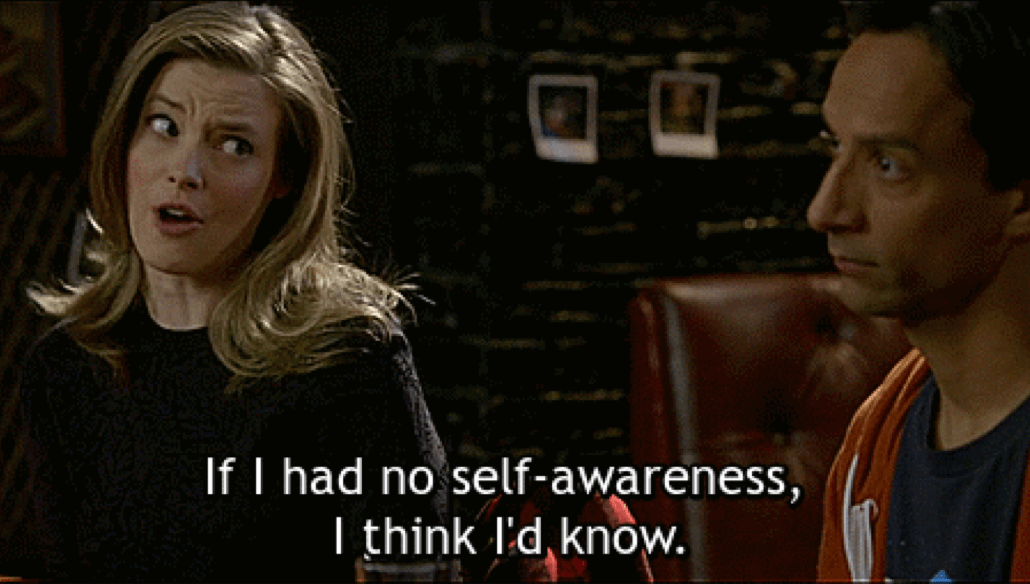
Screen Shot 2019-02-05 at 8.54.44 AM

That one was an animated GIF. This one really captures the mentality of some of these people:
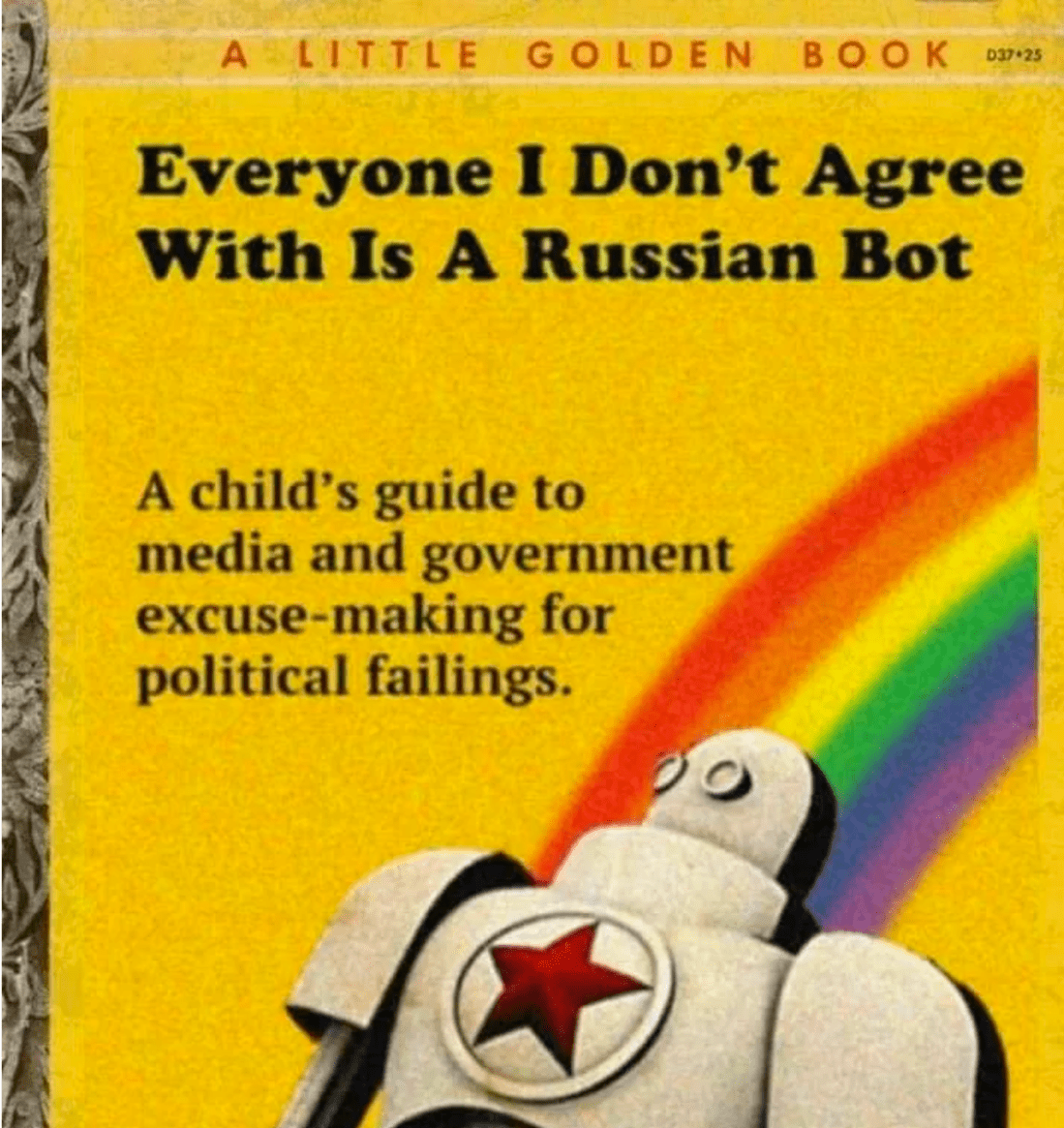
Screen Shot 2019-02-05 at 8.50.36 AM

3

Our politicians reliably fetishize two constituents of American life: the middle class and small business. The Democrats used to talk a bit more about the poor before they became the Harvard party — poor people are lousy donors, as it turns out — and the Republicans used to be a lot warmer toward Big Business before the GOP became a right-wing farmer-labor party and Big Business came to mean Howard Schultz, Mark Zuckerberg, and Lloyd Blankfein.

Kevin D. Williamson. That’s a pretty good snapshot of our current stage of political realignment.

The rest of the column is in praise of Big Business, debunking Small Is Beautiful mythology.

I can’t deny Williamson’s numbers, but I deny that numbers tell a plausibly “whole story”. The reflexive premise that they do is part of what is deeply wrong with movement conservatism (for lack of a better term; “conservatism” without adjectival modifiers is totally useless). Here’s another part of the story: a community that works to live (and pray) rather than living to work.

4

As the Epiphany season draws to a close, one is forced to conclude that the “woke” Episcopal Church of 2019 stands firmly with Team Herod.

Kari Jenson Gold

5

If bigotry is repugnant, why not demand the resignation of Vice President Pence for his ugly views on homosexuality? And while they’re at it, why not insist that Pence’s wife Karen resign her position at a school that discriminates against gays and lesbians?

Pence has long been criticized as being hostile toward LGBTQ issues. He has linked same-sex couples to a “societal collapse” and even once seemed to support conversion therapy, which is a form of torture.

Richard Cohen.

The second paragraph is the entirety of Cohen’s evidence that Pence has ugly views on homosexuality. Read it slowly and shudder.

Cohen needs no evidence, as all the bien pensants agree with him.

I was not thinking of this sort of thing — at least not consciously — when I signaled several days in a row my incredulity at the calls for Virginia’s Governor to resign over a 35-year-old yearbook picture. Perhaps it was in the back of my mind, though: The callout culture is really toxic, and orthodox Christianity is now worse than faux pas.

Further, although I though I do not consider Cohen’s question bona fide, a sufficient answer were it bona fide would be that the voters knew when voting for him that Mike Pence triggers people like Cohen, and that his alleged sexual atavism is the ostensible reason, whereas the Governor’s secret was, well, secret.

* * * * *

Follow me on Micro.blog Follow me on Micro.blog, too, where I blog tweet-like shorter items. Frankly, it’s kind of becoming my main blog. If you prefer, those micro.blog items also appear now at microblog.intellectualoid.com. Both should work in your RSS aggregator, like Feedly.

Plus ça change …

Plus ça change, plus c’est la même chose:

A recent story about Leonard Leo, who advises the President on judicial nominees and is connected to the ascent of judges such as Kavanaugh, was even more hysterical. The author worried about a “secretive network of extremely conservative Catholic activists” who are stacking the federal courts with conservative jurists. Leo’s membership in the Knights of Malta, his public work in defense of religious freedom around the world, and his connection to Catholic-educated nominees such as Kavanaugh and Neil Gorsuch, all caused the author to fret that Leo is “shaping the federal judiciary according to his beliefs, with very clear ideological consequences.” The article asserts that the conviction that human life begins at conception is a religious belief. And it laughably attributes to Catholics the view that natural law “trumps any secular law that humans (or legislatures) might dream up.”

The American tradition of constitutionalism abhors inquiries into the particular creeds espoused by candidates and nominees for public office. The Constitution of the United States prohibits religious tests. And anyway, religion is not the issue. Fidelity to the rule of law is what matters. Anyone can determine to follow the law, even Senators Feinstein and Durbin.

There is no reason to think that someone who accepts on faith the teachings of the Bible or the Roman Catholic Church is any less capable of correctly interpreting and applying the law than someone who accepts on faith what scientists tell us about global warming. Faith in something must precede reason—at the very least, faith in reason itself—else we could never know anything.

Adam J. MacLeod, Why Judge Kavanaugh’s Religion Should Be an Issue.

The other liberal complaint is that since the Catholic position on abortion is religiously derived, if it ultimately becomes law, that constitutes an imposition of religion. This argument is nonsense, too. Under American concepts of political pluralism, it makes no difference from where a belief comes. Whether it comes from church teaching, inner conviction or some trash novel, the legitimacy of any belief rests ultimately on its content, not on its origin. It is absurd to hold that a pro-abortion position derived from, say, Paul Ehrlich’s overpopulation doomsday scenario is legitimate but an anti-abortion position derived from scripture is a violation of the First Amendment.

Charles Krauthammer, Washington Post, March 23, 1990 (part of his collection Things That Matter).

* * * * *

The waters are out and no human force can turn them back, but I do not see why as we go with the stream we need sing Hallelujah to the river god.

(Sir James Fitzjames Stephen)

Reality is that which, when you stop believing in it, doesn’t go away.

(Philip K. Dick)

Some succinct standing advice on recurring themes. Where I glean stuff.

Follow me on Micro.blog Follow me on Micro.blog, too, where I blog tweet-like shorter items and … well, it’s evolving. Or, if you prefer, those micro.blog items also appear now at microblog.intellectualoid.com.

Simpler than “as simple as possible”

We are back to Paul Valéry’s maxim: “Everything simple is false. Everything complex is unusable.” In the world of computer modeling, this is known as Bonini’s paradox: The more realistic a model is, the more it becomes as complex and difficult to understand as the real world; the simpler and more user-friendly a model becomes, the less accurately it represents the underlying system. Mass democracy and mass media on the American model work to impose on the complex reality of American public life the simplest possible model of politics, aggregating all of political reality into two variables: Us and Them.

Another way of putting this is that the unstated task of cable-news journalism on the Fox/MSNBC model — along with practically all political talk radio, 99.44 percent of social media, and a great deal of inferior writing about politics — is transmuting intellectual complexity into moral simplicity. Even that isn’t quite right: The moral simplicity offered by the “Everybody Who Disagrees with Me Is Hitler” school of analysis is a false simplicity — simplicity for the truly simple, as opposed to what Oliver Wendell Holmes Jr. described as “the simplicity on the far side of complexity.”

(Kevin D. Williamson)

Of course, Williamson has examples, including from “inferior writing about politics” from two of our premier national newspapers.

UPDATE: Immediately after writing the above, I turned to another article which, if true, is rather terrifying in light of the more obvious truths Williamson notes.

The leader of the free world still begins his day by binge-watching cable news until 11 a.m.; still spends official meetings nattering on about anything other than the subject at hand (even when said subject is how to ensure that this year’s hurricane season does not result in mass death this time around); and, most critically, still cannot be bothered to learn the pertinent facts about a given situation, before dictating a policy response to it.

One of the president’s chief complaints about H.R. McMaster was (reportedly) that the former national security adviser had the temerity to brief him with “a PowerPoint deck dozens of pages long, filled with text” — rather than “simple, short bullets, or a graphic or timeline.” White House aides have grown so desperate to get the commander-in-chief to ingest the most remedial information about the geopolitical affairs he’s mindlessly disrupting, they’ve whittled the bullet points in his briefing book down to “basically slogans,” one administration source told Axios.

(Eric Levitz, Trump’s Briefing Book Includes ‘Screen Grabs of Cable-News Chyrons’, New Yorker)

* * * * *

I also blog short items at Micro.blog.

Some succinct standing advice on recurring themes.

Where I glean stuff.

Phobias coming all-too-soon

Occasionally, someone writes something very good, but with deep flaws. Such, it seems to me, is Joseph Pearce’s Does Love Have No Boundaries? at the Imaginative Conservative.

I listened to Pearce for several hours in January at the Eighth Day Symposium, and he rose considerably in my previously neutral estimation as a result.

But having provided a link to the original, and having given Pearce his props, I’m going to be presumptuous enough now to bowdlerize him to elide both the flaws I perceive and the parts that intrigue me without yet convincing me, leaving only that with which I agree.

Caveat emptor. Pearce is smarter and/or more mentally disciplined than I.

There are liars; there are damned liars; and there are those who peach evil in the name of love. Take, for instance, the mantra that love has no boundaries, which is one of the soundbites of the homosexist lobby. As with John Lennon’s mantra that all we need is love, it is difficult to argue with a sentiment that seems to make so much sense. Of course we all need love. We wither and decay in its absence. And, at first glance, it’s difficult to argue with the claim that love has no boundaries. …

The irony is, however, that the homosexists are neither liars, nor indeed damned liars, when they claim that love has no boundaries. They really believe that it is true. They are, however, preaching evil in the name of love because the “love” of which they speak is not really love at all. It is something entirely different. What they call “love” is … sexual attraction. It might indeed be true that sexual attraction has no boundaries. It is entirely possible that one’s passions and feelings can become so corrupt that we can be sexually attracted to all sorts of people and things … [I]f we’re going to be true to the mantra that love has no boundaries, why should we accept the boundaries imposed by age or species? If it’s all about sexual attraction and the gratification of our sexual desires, why should we temper those desires on the grounds of ancient taboos against sex with children or animals? If we recoil in horror at the thought of such things, aren’t we guilty of bigotry? Worse still, are we not guilty of some sort of psychological pathology? Are we not “pedophobic” or “bestophobic”? Should we not be getting in touch with the pedophile or the bestial within ourselves so that we can be liberated from our hang-ups?

Although this line of reasoning will no doubt be dismissed by some as going too far, being nothing more than the rhetorical use of the reductio ad absurdum to make a point, we should be aware of where the logic of the “no boundaries” philosophy actually leads. Previous generations would have thought it unthinkable that the demand for sexual “liberation” would lead to the legalization of infanticide. It would have been inconceivable to our grandparents that governments would condone the killing of babies so that people could fornicate freely. It would have been inconceivable to our parents that governments would destroy the very institution of marriage so that homosexuals could have equal rights. One day, if the “no boundaries” tyranny is not resisted, our own children will live with the reality of legalized pedophilia which we might find inconceivable.

….

(Emphasis added)

For the proposition “love knows no boundaries,” Pearce’s reductio is 100% apt, and screams of “he just compared gays to child molesters and sheep-sleepers!” are either hysterical or deliberate efforts to change the subject.

* * * * *

Reality is that which, when you stop believing in it, doesn’t go away.

(Philip K. Dick)

The waters are out and no human force can turn them back, but I do not see why as we go with the stream we need sing Hallelujah to the river god.

(Sir James Fitzjames Stephen)

Place. Limits. Liberty.

Some succinct standing advice on recurring themes.

Where I glean stuff.

Rhetorical Alchemy #Fail

With astounding cynicism, Democrats rushed to capitalize on dead teens, while ineffectually dragging out the same fatigued arguments they’ve been making since the Clinton era.

(Kimberly Strassel, The GOP’s Gun Temptation, Wall Street Journal)

Braun’s ad was a shock to the Uber driver’s widow, Deb Monroe. She told The Washington Post in a phone interview on Thursday that Braun did not seek permission to use her husband’s photo or politicize his death.
“I would never let anybody use my husband’s name that way,” she said. Regarding the accused man, she added: “I don’t think his immigration status had anything to do with my husband’s death.”

(Samantha Schmidt, Widow says Republican candidate’s immigration ad politicizes her husband’s death, Washington Post)

The parallel is imperfect. Deb Monroe presumably is not a pro-immigration crusader. But the take-homes are the same:

  • People exploit tragedies to promote their goals.
  • Proximity to tragedy doesn’t transform a leaden argument into gold.

* * * * *

Some succinct standing advice on recurring themes.

Where I glean stuff.

Courtland Sykes, Republican “conservative”

[O]ne of his opponents for the Republican nomination, Courtland Sykes, … criticized feminists and career-focused women as “nail-biting manophobic hellbent feminist she-devils” and said he expected his fiancee to make dinner for him every night.

A shameless alpha-male fornicator wants Republicans to vote for him because he expects his live-in girlfriend to make him dinner. That’s Republican conservatism today, folks: inadvertent parody of tradition.

The main focus of the WaPo story, though, was candidate Josh Hawley’s theory that there’s a connection between the sexual revolution and human trafficking:

“We’re living now with the terrible aftereffects of this so-called revolution,” said Hawley, according to audio of the event. “We have a human-trafficking crisis in our state and in this city and in our country because people are willing to purchase women, young women, and treat them like commodities. There is a market for it. Why is there? Because our culture has completely lost its way. The sexual revolution has led to exploitation of women on a scale that we would never have imagined.”

The Post, doing its journalistic due diligence while pearl-clutching, found a sort of countervailing voice:

Kimberly Mehlman-Orozco, a human-trafficking expert, told the Star that there is “absolutely no empirical evidence or research to suggest there was any uptick in human trafficking in the 1960s or ’70s, or that that’s when it started.”

Note that the countervailing voice doesn’t refute Hawley’s claim since Hawley neither claimed empirical evidence nor engaged in a simple post hoc fallacy.

* * * * *

We develop heart and mind in parallel, that the mind will protect us from the wolfs, and the heart will keep us from becoming wolves ourselves. (Attributed to Serbian Patriarch Pavle)

Some succinct standing advice on recurring themes.

Where I glean stuff.

How to get what you want

[I]n a world of fluid, flexible rules, the people who get what they want are the ones who possess the aptitude and education that allow them to manipulate concepts and talk in nuanced ways. [Karl] Barth bullied his wife and some of his concerned friends with his intelligence [into giving him a free pass on his open adultery with his “research assistant and theological muse”].

Barth [wrote]:

It might be possible that it is from here that an element of experience can be found in my theology, or, to put it a better way, an element of lived life. I have been forbidden in a very concrete manner to become the legalist that under different circumstances I might have become.

This silver-lining exculpation amounts to an appeal to divine providence. God led him into persistent adultery in order to make him faithful to the gospel proclamation of salvation by grace alone!

(R.R. Reno, First Things, January 2018, whose paywall crumbles over the course of a month)

* * * * *

Some succinct standing advice on recurring themes.

Where I glean stuff.