Sunday, 10/29/23

A chorus cries out

“All the prophets have from the beginning cried out to my soul, imploring her to make herself a virgin and prepare herself to receive the Divine Son into her immaculate womb;

Imploring her to become a ladder, down which God will descend into the world, and up which man will ascend to God.

Imploring her to drain the red sea of sanguinary passions within herself, so that man the slave can cross over to the promised land, the land of freedom.

The wise man of China admonishes my soul to be peaceful and still, and to wait for Tao to act within her. Glory be the memory of Lao-tse, the teacher and prophet of his people!

The wise man of India teaches my soul not to be afraid of suffering, but through the arduous and relentless drilling in purification and prayer to elevate herself to the One on high, who will come out to greet her and manifest to her His face and His power. Glorious be the memory of Krishna, the teacher and prophet of his people!

The royal son of India teaches my soul to empty herself completely of every seed and crop of the world, to abandon all the serpentine allurements of frail and shadowy matter, and then–in vacuity, tranquility, purity and bliss–to await nirvana. Blessed be the memory of Buddha, the royal son and inexorable teacher of his people!

The thunderous wise man of Persia tells my soul that there is nothing in the world except light and darkness, and that the soul must break free from the darkness as the day does from the night. For the sons of light are conceived from the light, and the sons of darkness are conceived from darkness. Glorious be the memory of Zoroaster, the great prophet of his people!

The prophet of Israel cries out to my soul: Behold, the virgin will conceive and bear a son, whose name will be — the God~man. Glorious be the memory of Isaiah, the clairvoyant prophet of my soul!

O heavenly Lord, open the hearing of my soul, lest she become deaf to the counsels of Your messenger.“

Saint Nikolai Velimirovic in his Prayers by the Lake, via Steve Robinson.

A horrible scandal and its roots

After I moved back to East Texas from college, my sister’s husband invited me to hear their “new preacher,” which was always their evangelical hook—”Wait till you hear our new preacher!” Cornered, without an excuse at the ready, I accompanied them one night to their revival. It was a stem-winder lesson on the “End Times,” the “Rapture,” and the assorted framework of beliefs that held that construction together.  This was a long time ago, so long ago that it was back when he was still speaking to me. I think I must have been twenty-two years old at the time, and the sermon was certainly effective, just not in the way he expected it to be. The Baptist church was everything I remembered it to be, and I have, except for the occasional funeral or wedding, never been back.

Instead, I joined up with the Restorationist church of my dad’s people, at least on his mother’s side.  I met my wife there and spent a little over twenty-five years with them.  We claimed not to be nondenominational, but rather _un_denominational.  This was believed to be true because: 1) our hermeneutic was the correct one; 2) we “went just by the Bible,” and of course, nobody in Protestant history had ever thought of that before; and 3) we said so. I never bought into this foundational underpinning, but largely kept my mouth shut as long as I could.  In my observation, we still quacked and waddled just like the other waterfowl in the Protestant pond.  But I will have to hand it to my old church:  we were decidedly not Pre-millennial. Charles Darby meant nothing to us. We avoided Scofield Reference Bibles. The words “rapture,” and “Great Tribulation,” and “Thousand-year reign,” were not in our vocabulary.

The Orthodox Church has a 2,000 year old stake in the [Middle East]. The people who suffer under the yoke of Zionist policy–Palestinian Arabs–can just as easily be Orthodox (or Catholic) Christians as Muslims. True, the percentages are small, and due to the persecution, continuing to shrink. But when Israelis look at them, they do not see a Christian, but rather a Palestinian. I have always been amazed that American Christian Zionism is such a one-way street: it is all about Evangelicals bending over backwards to accommodate the Israeli state, whereas there is no reciprocal behavior on their part towards Christians.

Terry Cowan

Terry and I are cyber-friends of what seems like more than a decade now. I quote the first two paragraphs because they’re roughly parallel to my experience over my lifetime, the last because indifference to Christians in the Middle East, especially if Israel is in the mix, is a horrible scandal, rooted in the prophecy-porn devolution of dispensationalist heresy, for which scandal (and heresy) evangelicals must one day give an account.

Truth about the End Times

Orthodox Holy Tradition says clearly that the Second Coming, the General Resurrection, and the Last Judgment are three facets of one single, overwhelming event. There is no divide (which is the meaning of the heresy of chiliasm, which was rejected in the Second Ecumenical Council, and the reason why we say “and His Kingdom shall have no end” in the Creed). There is no Rapture. There is no Seven Year Tribulation. There is no single human individual who is the Antichrist or the Beast — the Antichrist is not a Jew, not a Muslim, not a Communist, nor is he the Pope or any one of the many theories that have been published over the centuries.

There is no literal thousand-year-long Millennium. There is no reappearance of Satan setting off the last Armageddon.

There will indeed come the Great Universal Transfiguration that overwhelms time and space and all Creation.

This is the Kingdom i[n] its infinite, almost terrifying fullness and glory.

Fr. Jonathan Tobias, The Last Judgment and the Problem of Goathood

Throwing down the gauntlet

[A]t the outset I will state:

  1. The Bible is not the Christian Holy Book.
  2. Christians (and Jews) are not People of the Book.
  3. Submission to God is not a proper way to describe the Christian faith.

Further, any and all of these claims, once accepted, lead to fundamental distortions of Christianity. An extreme way of saying this is that much of modern Christianity has been “Islamified.” Thinking critically about this is important – particularly in an era of renewed contact with Islam.

Fr. Stephen Freeman, Has Your Bible Become A Quran?

If you’re so godly, why ain’t you rich?

I frequently think about our technical prowess and material prosperity in The Thing That Used to Be Western Christendom, in contrast to Eastern Christendom.

The west has developed technically in direct relationship to the decline of the Christian consciousness, for the simple reason that the “secularization“ of nature that permits it to be regarded as an object and so to be exploited technically, is in direct contradiction to the sacramental spirit of Christianity, wherever and whenever this is properly understood, as it was at least to some extent in the medieval world.

Philip Sherrard, The Rape of Man and Nature


You can read most of my more impromptu stuff here (cathartic venting) and here (the only social medium I frequent, because people there are quirky, pleasant and real). Both should work in your RSS aggregator, like Feedly or Reeder, should you want to make a habit of it.

Friday 9/29/23

This is the 25th anniversary of my dad’s death. Alan Jacobs reminds me that it’s also the 50th anniversary of W.H. Auden’s death. I am twice bereaved (though I knew not Auden 50 years ago).

Migration

Orban’s Hungary

I’m not saying that Trump was all bad as president. But even the good things that Trump did were accompanied by a narcissism, a gratuitous aggression and not often with[] a lot of intellectual substance, while Orbán has got about the business of being a successful centre-right leader with a lot more grace and a lot more intellectual heft.

… governments have a duty to their own citizens to maintain the character of the country and not to have the character of the country changed forcibly by outsiders.

… no one has a right to turn up in someone else’s country and demand residency. Now, if they are immediately fleeing serious risks to their lives, yes, they can claim sanctuary. But for them to be genuine refugees, as opposed to would-be illegal migrants, they’ve got to seek sanctuary in the first available place. And the vast majority of those coming into Europe are not seeking sanctuary in the first available place. They aren’t even seeking sanctuary at all, most of them, they’re seeking a better life.

Former Australian PM Tony Abbott

EU

The problem with the migration package is its underlying philosophy; a philosophy of open borders complete with letters of invitation. The message that needs to be sent is that there is no allocation possible; please don’t come. If a country needs a workforce, it must be done through legal channels: embassies, consulates, and cooperation programmes with third countries.

The current policy of burdening countries that do not have any link, current or historical, to the third world is unfair and must stop. We were never part of those decisions, so why should we have any responsibility for it? This is a Central European and a Hungarian position. The EU has enough assets at its disposal to handle this problem, such as the financial instruments, to make agreements with countries outside the EU to stop, not to manage, migration. The attitude towards migration has to change completely. Policy makers must say: No, don’t come here. Everything else is hot air.

European voters must be told that economic migration is not a human right; asylum from a war zone is. A country neighboring a war zone should take in refugees, as Hungary has done with Ukraine (1.2 million asylum seekers have already been received since the start of the war). However, it is absurd, legally and morally, to make the same allowance for economic migrants who come from far away lands and have passed through many safe countries.

Judit Varga

Culture

Attempted aphorism

Up until now, we have had more questions than answers. What we’d like is more answers than questions.

A spokesperson for a group suspicious of a government proposal. (The details of the proposal and of the suspicious group aren’t really relevant, are they? The silliness of the attempted aphorism is the real point.)

“Religion” as a tool of oppression

It’s outside the usual narrative of repression by religion, but it’s possibly more pervasive: marginalizing something by assigning it to the category “religion.”

In reality, the amorphous nature of Hinduism is due to the fact that Hinduism originally included all that it means to be Indian, including what modern Westerners divided into religion, politics, economics, and so on. But if Hinduism is what it means to be Indian, then by identifying and isolating a religion called Hinduism, the British were able to marginalize what it means to be Indian. Under British colonization, to be British was to be public; to be Indian was to be private. The very conception of religion was a tool in removing native Indian culture and Indians themselves from the exercise of public power.

William T. Cavanaugh, The Myth of Religious Violence

Artificial Intelligence is still really dumb

Thanks to Jacob Mchangama, I learned that Bing Chat and ChatGPT-4 (which use the same underlying software) refuse to answer queries that contain the words “nigger,” “faggot,” “kike,” and likely others as well. This leads to the refusal to talk about Kike Hernandez (might he have been secretly born in Scunthorpe?), but of course it also blocks queries that ask, for instance, about the origin of the word “faggot,” about reviews for my coauthor Randall Kennedy’s book Nigger, and much more. (Queries that use the version with the accent symbol, “Kiké Hernández,” do yield results, and for that matter the query “What is the origin of the slur ‘Kiké’?” explains the origin of the accent-free “kike.” But I take it that few searchers would actually include such diacritical marks in their search.)

Eugene Volokh

I’ll believe that AI is “intelligent” when it can answer serious questions about contentious topics rather than imposing a blanket ban on naughty words.

Censorship from the anti-censors

The master’s tools will never dismantle the master’s house.

Audre Lorde, quoted against the tactics of Christopher Rufo: Nico Perrino, Right-Wing Activist Christopher Rufo Became the One Thing He Claims to Hate

This led me to review my clippings on Rufo, who set my presumption to “distrust” when he spoke about “freezing the brand” of critical race theory and what he intended to do next. It turns out that some decent people think he’s mostly positive. I’m still not convinced. I feel like he’s a ticking time-bomb harboring some terrible secret.

Conspiracy theories

When should one believe a conspiracy theory?

The bottom line is that citizens should believe accounts from properly constituted epistemic authorities rather than theories that either (1) directly conflict with the epistemic authorities or (2) assert knowledge that has yet to be deemed authoritative by the epistemic authorities. A conspiracy theory may be true, but people are not justified in believing it until the appropriate epistemological authorities deem it true. Therefore, well-evidenced conspiracy theories may—should they reach a certain evidentiary bar—provide the grounds for investigation, appeal, and reassessment, but they should not be believed outright.

Joseph Uscinski and Joseph Parent, in American Conspiracy Theories (2014), quoted by Paul Christmann, The Monster Discloses Himself, 25.1 Hedgehog Review.

This would work great if only conspiracy theories didn’t so often start with axiomatic distrust of “properly constituted epistemic authorities.”

A specific conspiracy theory

Right-wing activist Charlie Kirk on Friday accused the Department of Justice of trying to cover up its biases by indicting a Democratic senator.

New Jersey Senator Bob Menendez was indicted on federal bribery charges Friday. The indictment accuses Menendez and his wife of accepting hundreds of thousands of dollars in cash, gold bars, and “luxury vehicle and home furnishings.”

But rather than accept the indictment shows that the Justice Department is actually a neutral entity, Kirk unveiled some convoluted logic to supposedly prove his original belief.

“The way that the fourth branch of government operates is with intentionality. There are no mistakes,” he said on his podcast.

“They’re doing this to create the appearance of impartiality so that they can continue their jihad against Donald Trump.”

Tori Otten, Right-Wingers Already Have a Wild Conspiracy Theory About Senator Menendez

I note that despite multiple Right-Wingers in the headline, Otten only cited the hack Charlie Kirk, good enough to affiliate with Liberty University but compared to whom Christopher Rufo is a Nobel Laureate.

Preening propagandists

danah boyd: “Over the last two years, I’ve been intentionally purchasing and reading books that are banned.” The problem here is that none, literally not one, of the books on the list boyd links to have been banned. Neither have they been “censored,” which is what the article linked to says. That’s why boyd can buy and read them: because they’ve been neither banned nor censored.

I sometimes wonder whether this kerfuffle isn’t something of a smokescreen, intended to distract our attention from more serious and troubling attempts at what George Orwell called “the prevention of literature” … You can buy books that some parents have protested; you can’t buy books that, because of political pressure, have never seen the light of day ….

Alan Jacobs

On the supposed superiority of empathy versus sympathy

Etymologically speaking, sympathy was here first. In use since the 16th century, when the Greek syn- (with) combined with pathos (experience, misfortune, emotion, condition) to mean “having common feelings,” sympathy preceded empathy by a good four centuries. Empathy (the “em” means “into”) barged in from the German in the 20th century and gained popularity through its usage in fields like philosophy, aesthetics and psychology. According to my benighted 1989 edition of Webster’s Unabridged, empathy was the more self-centered emotion, “the intellectual identification with or vicarious experiencing of the feelings, thoughts or attitudes of another.”

But in more updated lexicons, it’s as if the two words had reversed. Sympathy now implies a hierarchy whereas empathy is the more egalitarian sentiment. Empathy, per Dictionary.com, is “the psychological identification with or vicarious experiencing of the emotions, thoughts or attitudes of another” while sympathy stands at a haughty, “you poor dear” remove: “the act or state of feeling sorrow or compassion for another.”

Still, it’s hard to square the new emphasis on empathy — you must feel what others feel — with another element of the current discourse. According to what’s known as “standpoint theory,” your view necessarily depends on your own experience: You can’t possibly know what others feel.

Pamela Paul, Have Some Sympathy

Imposter syndrome

Imposter syndrome is a formidable revanchist.

I’ve found that reminding myself that other people also experience imposter syndrome has never been comforting or at all helpful.

Instead, the closest I’ve come to a “cure” is by taking the spotlight off me and trying to focus on the work. This isn’t about who I am, but about something I’m doing. I tell myself: Okay fine, maybe I am a fraud, but the work is real. I have an index card pinned to the wall that says, “The work speaks for itself.”

Robert van Vliet on micro.blog as @rnv.

Domestic Politics

DJT, MoF

What do we mean exactly by “person of faith”? Trump has had a few very good polls this week, and one deeply perplexing one. The majority of Republican voters see Donald J. Trump as a “person of faith,” according to a poll by HarrisX for the Deseret News. In fact, they see him as more religious than Mitt Romney, who definitely wears the Mormon underwear, and Mike Pence, whose faith is so strong it disallows him from looking female baristas in the eye. Trump. . . more faithful. . . than Mitt Romney and Mike Pence. I don’t even mean this as a pro-Pence take (sick), since for me personally, the one thing I like about Trump is how absolutely godless he is. My walnut-sized brain simply cannot grok the idea of Trump as your top Republican of faith. If Trump’s a man of faith, I am a pastor. My only takeaway is that I am deeply, criminally out of touch with Evangelical America. 

Nellie Bowles (or one of her acknowledged helpers)

I was going to comment on this myself, but Bowles beat me to it with something more adequate than “WTF?!” Is this not a genuine proof that much American religion is nuts?

Strive to resist numbness

Some percentage of you surely rolled your eyes when you realized what this newsletter would be about. Another Trump column?

Strive to resist numbness. Because despite all the blather about Biden and Trump being the two most known “known quantities” in politics, we actually don’t know how dangerous and destabilizing Trump might prove to be as his mind bends under the strain of an election and four indictments. Or whether it’ll break entirely once he’s back in power and surrounded by the most obsequious fascist toadies he can find.

I think he’s getting worse.

Nick Cattagio

Intellectuals and Officeholders

This points, I think, to a certain unreality on the American right. The intellectuals (or at least some of them) are nuanced in their thinking, humane in their sensibilities, keen to avoid cruelty and alleviate suffering, and willing to use government (at least sometimes) to attain that end. But the party’s officeholders and the rank-and-file voters who put them there are prone to extremism, indifferent to (and sometimes appear actively to delight in) cruelty and suffering, and unwilling to use government to make anyone’s life any easier.

The fact is that GOP voters chose Trump—and they keep choosing him. They liked his coarseness and selfishness, his rage and fear, and his demands for personal fealty and deference. It’s therefore more accurate to say that his own exemplification and affirmation of these qualities have given Republican voters permission to exemplify and affirm these pre-existing qualities in themselves. Trump lets them off the hook. Instead of Michelle Obama exhorting them to go high when their political opponents go low, Trump assures Republican voters that the smart thing (the guarantor of political victory) is always to go as low as possible—which means indulging a temptation toward viciousness that was already there.

This has had the effect of transforming expressions of callousness and aversion to charity from selectively indulged vices into demonstrations of virtue widely admired for their toughness and ruthlessness.

Damon Linker, The Agony of the Pro-Life Intellectual

As I have noted repeatedly, I mentally checked out of the GOP (my state doesn’t register voters by party) in January 2005, but not because I found the party coarse and selfish. I began to suspect that something was more deeply wrong only during Obama administration, when Republican obsessions with bullshit like birth certificates made me suspect racism more overt than I had thought still existed. Then Trump blew the whole thing open when he moved from Birther-in-Chief to Commander-in-Chief.

As I also have noted (or at least implied) repeatedly, I haven’t checked into the Democrat party. My weak and notional party affiliation is with the American Solidarity Party.

And if you think affiliation with a third party is foolish, I’ll note that it’s no more foolish than expecting either of our major parties to embody the values that lead me to the ASP.


If out of the crooked timber of humanity no straight thing was ever made, then if a thing is made straight it will be because humanity has been stripped out of it.

L. M. Sacasas, Embrace Your Crookedness

You can read most of my more impromptu stuff here (cathartic venting) and here (the only social medium I frequent, because people there are quirky, pleasant and real). Both should work in your RSS aggregator, like Feedly or Reeder, should you want to make a habit of it.

Thursday, 9/14/23

Culture

Building new kinds of stability

In a world where absolutely everything is unstable, from geopolitics to money and even the climate, some far-sighted younger millennials and Gen Z-ers are already pioneering a new model. Willow, a twenty-five-year-old writer based in rural Canada, married at twenty-three and is cocreating a domestic economy with her husband, Phil, one that is clearly an update of the premodern “productive household.” In addition to her writing projects, she does carpentry with Phil, roughly dividing the work into “first fix” (which requires more strength, and which Phil does) and finishing (which requires more patience and manual dexterity, at which Willow excels). Because they have a small baby, Willow cannot do much carpentry at present, but she is active in finding Phil clients and sometimes apprentices. Willow also tends a small farm on her and Phil’s property.

From an industrial-feminist perspective, Willow’s approach is unacceptably in thrall to patriarchy: She married young, views childcare as largely her domain, and is not the main money earner. Yet Willow is sincerely pursuing her interests as an embodied woman, in her relational context, rather than as an atomized, abstract “human” in an inconveniently female body.

Mary Harrington, Is There Hope for Marriage?

Thought about poetry

Free verse was all the rage at the time, with the Beat poets like Allen Ginsberg also experimenting with the same pharmaceuticals and literary devices. Personally, I remain uncertain about the value of these creative detours. Poetry is meant to be the most distilled way to communicate. Does anyone think Ginsberg and the other Beats were able to distill their thought, or even put their fingers on it? To me, those fellows slowed thought down.

Constraints in poetry do a number of things. They discipline the writer—no small thing. They help the reader, and also, the rememberer. 

It is hard to memorize chunks of free verse, just as it is hard to remember large chunks of prose. There is a reason that almost nobody can say, “Do you know my favorite paragraph from my favorite novel?”—and then recite it.

Douglas Murray

Those grimy white cliffs

Chaplins Restaurant and Carvery in Dover, despite all the visible unhappiness is a happy place. Everyone that came in knew everyone else, including lying Jon, and understood them. They knew where they were coming from and what they were going through.

Because England, even the “worst” parts, still has a real community built around a shared history and culture. Even if it sometimes gets turned into tourism board silliness, it very much matters.

That’s essential, and at a deep level Wall Street me didn’t understand. The English know who they are, and are ok with it.

Chris Arnade, Walking England’s Coast Part 1: From Dover to New Romney

Confusing comfort for civilization

The European talks of progress because by the aid of a few scientific discoveries he has established a society which has mistaken comfort for civilisation.

Benjamin Disraeli, 1st Earl of Beaconsfield, British statesman, Conservative politician, writer, Prime Minister of the United Kingdom, via Life on Dover Beach

AI in medicine

AI without the ballast of intuition represents the tyranny of pure analysis. Unleashed, and without intuition to give it a more profound understanding of humanity, AI stands ready to extend the power of reductive and often dangerously misleading concepts.

Ronald W. Dworkin, Paging Dr. Bot

Subscribing to flatness

Most consumers don’t know that by using internet-based (or -generated) platforms—by buying from Amazon, by staying in an Airbnb, by ordering on Grubhub, by friending people on Facebook—that they are subscribing to a life of flatness, one that can lead directly into certain politics. But they are. Seduced by convenience, we end up paying for the flattening of our own lives. It is not an accident that progressive ideas spread faster on the internet. The internet is a car that runs on flatness; progressive politics—unlike either conservatism or liberalism—are flatness.

Alana Newhouse, Everything Is Broken

Gut-punch

There’s a very short and very brutal poem by the Scottish poet Hollie McNish, written in 2019 and titled “Conversation with an archaeologist”:

he said they’d found a brothel
on the dig he did last night
I asked him how they know
he sighed:
a pit of babies’ bones
a pit of newborn babies’ bones was how to spot a brothel

“It’s true, you know,” said the writer and lawyer Helen Dale when we had lunch in London last year and I mentioned this poem, which I chose as one of the epigraphs to my book The Case Against the Sexual Revolution. Helen was a classicist before she was a lawyer, and as a younger woman she had taken part in archaeological excavations of ancient Roman sites. “First you find the erotic statuary,” she went on, “and then you dig a bit more and you find the male infant skeletons.” Male, of course, because the males were of no use to the keepers of Roman brothels, whereas the female infants born to prostituted women were raised into prostitution themselves.

Louise Perry, We Are Repaganizing

Inflation and privilege

Both being retired persons now, my wife and I are taking our annual week in Traverse City, Michigan next week rather than June, as we used to. A friend who we’ll join up there gives a scouting report that our breakfast favorite (French Omelettes) is closed; they couldn’t afford to pay what staff needed to earn in a quite expensive city.

I peeked at the online menu of a surviving “fine dining” restaurant; this is going to be a fairly expensive vacation. That I can afford it is a privilege. That servers, cooks, busboys, dishwashers and such cannot means that my deliberately high level of tipping hasn’t been enough to make those jobs attractive.

Politics

Social imperialism

Austin Ruse of the Center for Family and Human Rights (C-FAM) sends out weekly missives detailing the machinations of activists at the UN to get abortion and LGBT-supporting language in treaties and formal documents of every kind; Marguerite Peeters described the phenomenon of how institutions were infiltrated and colonized in The Globalization of the Western Sexual Revolution (2012); sociologist Gabrielle Kuby did the same in The Global Sexual Revolution: Destruction of Freedom in the Name of Freedom.

Nigerian human rights activist Obianuju Ekeocha described what the West has been perpetrating on Africa in her essential 2018 book Target Africa: Ideological Neo-Colonialism in the Twenty-First Century as well as the 2019 documentary Strings Attached. So-called humanitarian aid, she writes, nearly always comes with strings attached—contraceptives, demands for the legalization of abortion, perverse Western-style sex education, and the replacement of traditional African values with post-modern Western ones. The desperate need of many African countries for Western foreign aid is exploited to push for the imposition of a top-down sexual revolution.
 

But the Guardian would have us believe that a few Christian groups are imposing their views on unwilling African populations, and that this is also serving as a testing ground for laws in Hungary and American red states. The brazenness of this level of gaslighting is almost impressive—but it needs to be called out. The truth is that rich Western countries are pushing the LGBT agenda and abortion in developing countries, promising them cash in exchange for their souls—but you won’t read that in the mainstream press.

Jonathon Van Maren, The Left’s Colonial Mission (The European Conservative)

As someone said, if a third-world country asks for a bridge, China will build them a bridge; the US will force some aspect of the sexual revolution on them and only then build a bridge.

Who do you think wins more hearts?

Newly-conservative?

Our unabashed dictionary calls a conservative a liberal who’s been mugged:

  • “We are going to dismantle the Minneapolis Police Department. Say it with me. DISMANTLE The Minneapolis Police Department. If you’re still disagreeing with that BASIC FACT, I’m not sure what to say to you,” – Shivanthi Sathanandan, Minnesota DFL’s Second Vice Chair, in June 2020.
  • “Look at my face. REMEMBER ME when you are thinking about supporting letting juveniles and young people out of custody to roam our streets instead of HOLDING THEM ACCOUNTABLE FOR THEIR ACTIONS,” – Sathanandan, this week, after being violently car-jacked and beaten bloody in front of her children in Minneapolis.

(Via Andrew Sullivan)

What if Biden bowed out?

More from Sullivan (see Newly-Conservative, above), begging Biden to bow out of POTUS24:

A new candidate would immediately shift the dynamic of the race. The Democrat would represent the future; and Trump the polarized past. A younger candidate would instantly reverse the age argument in the Democrats’ favor. The news cycles would be full of Dem debates, fights, campaigns and energy — and not dictated by the defensive torpor of a frail octogenarian, or the unending narrative of Trump against the corrupt elites.

Biden was elected as a means to check Trump; the logic of his presidency was always that the old man would get us back to normal; and that argument makes much more sense for a one-term presidency … there could be no worse legacy than handing the country back to the monster you rescued us from.

I agree. Trump’s secret weapon, maybe his margin of victory, is Biden’s manifest infirmity.

But any other Democrat is likely to be even more extreme on sexuality.

Superiority

Democrats who indulge in hubris are liable to assume and sometimes proclaim their innate superiority through their education or their modern morality. Republicans do it by exalting two particular types as superior: the businessman and the pious man.

Henry Olsen, The Three Deadly Sins of the Right (American Compass)

You’re not likely to get American Compass quotes here very often, but this seemed accurate and illuminating.

My problem with Theocracy

[I]n the Christian nation that Wilson and his allies want to bring about, there wouldn’t be much space for Christians like me to operate. He told the Washington Post that

while leaders would strive to ‘maximize religious liberty for everyone,’ Catholics are unlikely to feel welcome — ‘I think it has to be a pan-Protestant project,’ he said — nor would Christians who disagree with his stridently patriarchal social norms. … Asked to explain where liberal Christians fit into his theoretical Christian society, Wilson said they would be excluded from holding office, later noting similar prohibitions in early American Colonial settlements such as the Massachusetts Bay Colony. When it was pointed out that Puritans executed Boston Quakers, Wilson said he would not “defend” the hanging of Quakers, but then argued it was important to understand the context of the time.

It’s gonna be fun to watch these old boys and the Catholic integralists go at each other, if either side can tear themselves away from their keyboards long enough to find their way to the field of battle.

Rod Dreher. That neither Douglas Wilson nor the Catholic Integralists have in mind a world hospitable to Orthodoxy keeps me at arms’-length from them. If I cared to, I could probably impugn their ability to govern wisely even by their own lights.


A fundamental reality of human existence is that vice often leaves virtue with few good options. Evil men can attach catastrophic risks to virtually any course of action, however admirable.

David French

You can read most of my more impromptu stuff here (cathartic venting) and here (the only social medium I frequent, because people there are quirky, pleasant and real). Both should work in your RSS aggregator, like Feedly or Reeder, should you want to make a habit of it.
Wednesday, 8/23/23

Culture

The collectivist-individualist dichotomy

The collectivist-individualist dichotomy is a clear example of the modern mind opposing ideas that are only in opposition once abstracted from reality. What is this collectivism? What is this individualism? I have never encountered a society that was not composed of individuals, and I have never met an individual who did not belong to a society. 

Take anyone you know, and try to imagine the pre-societal self that exists there free from all the social influences that have made him. If I try to imagine myself independent of where I was born, the family that brought me forth, the schools I attended, the language in which I think and speak, the books I’ve read, the friends I’ve made, I simply cannot do it, and if I were to achieve some imagining of such a pre-social self, it wouldn’t be me in any case.

So, what ought the conservative response to be in the face of people living in a way they find reprehensible, if it is not that of doubling-down on individualism? The true conservative response is: we live in a society, and there are some things we will accept and some things we will not, and where the line lies is worked out circumstantially by prudential deliberation and negotiation. We will tolerate certain behaviours which we dislike and be intolerant of others. But if you want to mutilate yourself, we will aim to prevent you from doing so, for we have to live in a community with you, and we think that such behaviour is impermissible in our community ….

Sebastian Morello, Libertarian ‘Conservatism’: A Trojan Horse

Countering the Zeitgeist

I don’t often recommend poetry, but Famous, by Naomi Shihab Nye, caught my ear in a podcast reading, and is notable in the context of Illich for its call to humbler ambitions.

Segregated sports

I had no idea that chess routinely holds separate men’s and women’s competitions, and that the women overall are objectively worse than men. See Frank Haviland, Chess: Checkmate for the Egalitarians for a fascinating and possibly illuminating treatment. I’m still scratching my head.

Striking

General Carrera Lake, Chile, via Prufrock

Legalia

Neutral laws of general applicability

Since Employment Division v. Smith in the early 1990s, we’ve been living under a constitutional regime which, viewed from a galloping horse, looks quite a bit less favorable than prior law for religious exemptions from some laws. So long as a law is neutral and generally applicable, one isn’t entitled to a religious exemption however strong one’s beliefs or weak the governmental interest in making the law.

But when you slow down and look closer, the concept of “neutral laws of general applicability” keeps tripping up rulemakers, as they keep creating loopholes for some but not for none. Sometimes, the loophole is as big as “we can make exceptions case-by-case.” In others, it’s gerrymandering the law to target a disfavored religious practice, as when Hialeah Florida tried to hobble the animal sacrifices of Santeria while permitting Kosher slaughter.

So I was gratified to see the religion-friendly ending to a case I’ve watched, on and off, since its 2017 beginning, Country Mill Farms, LLC. V. City of East Lansing, where the City of East Lansing excluded Country Mill Farms from its farmers market because it refused, at its own facility, to host same-sex weddings. Click the link for Euguene Volokh’s fuller description.

Politics

My Man Mitch strikes again

We’re mired in a hot-dog, look-at-me, dance-in-the-end-zone world. Success in public capacities seems reliant not on the quality of officeholders’ ideas or effectiveness, but on their cleverness and audacity in sound bites, tweeting and the other ‘performative’ arts.

Mitch Daniels in the Washington Post via TMD

“Vote fraud” was pre-baked into Trump’s cake

The most interesting act out of the 126 acts laid out in the indictment is the first one. It reads:

On or about the 4th day of November 2020, DONALD JOHN TRUMP made a nationally televised speech falsely declaring victory in the 2020 presidential election. Approximately four days earlier, on or about October 31, 2020, DONALD JOHN TRUMP discussed a draft speech with unindicted co-conspirator Individual 1, whose identity is known to the Grand Jury, that falsely declared victory and falsely claimed voter fraud. The speech was an overt act in furtherance of the conspiracy.

The most significant claim here is that Trump always planned to cry, “Fraud!” if he lost regardless of the evidence. This is not a shocking revelation, given that he has a long history of preemptively saying that the only way he might lose anything is if his opponents cheated or rigged the game.

Jonah Goldberg, Trump’s Unconstitutional Enterprise

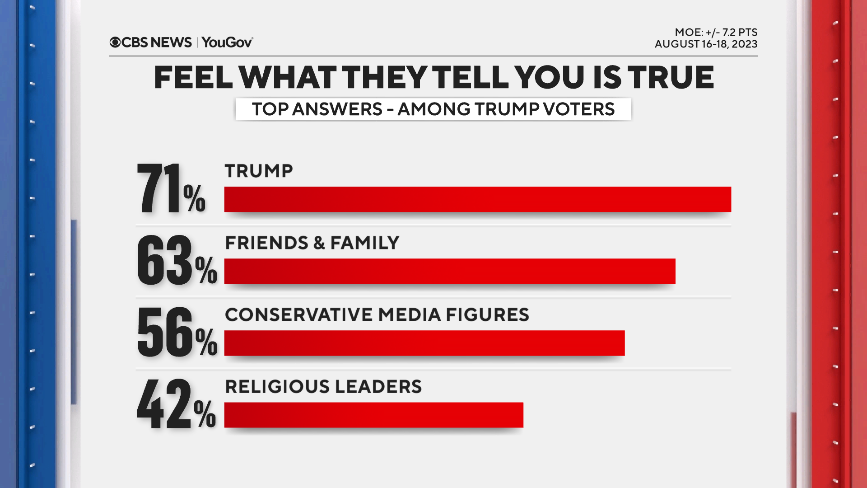
The Truthiness of Trump

More generally, Trump’s voters hold him as a source of true information, even more so than other sources, including conservative media figures, religious leaders, and even their own friends and family.

(CBS News, Emphasis added). “True information”! Words have lost all meaning!


We are in the grip of a grim, despairing rebellion against reality that imagines itself to be the engine of moral progress.

R.R. Reno

The end of the world as we know it is not the end of the world.

You can read most of my more impromptu stuff here (cathartic venting) and here (the only social medium I frequent, because people there are quirky, pleasant and real). Both should work in your RSS aggregator, like Feedly or Reeder, should you want to make a habit of it. I’m even playing around a bit here, but uncertain whether I’ll persist.

Wednesday, 8/9/23

Dumbest idea of the week

Reading more poetry? That’s a great thing. Reading a book of poetry a day? That’s a 100% guarantee that you will get almost nothing from your reading. Better: Read one lyric poem a day, but read it five times.

Alan Jacobs

It is a marker of impending doom that anyone could start a movement like reading a book of poetry per day as a tool of self-improvement. I guess being able to Tweet that or post a Facebook brag now passes for self-improvement.

Frankly, poetry bored me when I was young. Now that I know better, any tutoring I got in how to read poetry is long forgotten.

I now read poetry amateurishly almost every day, but I rarely read more than three pages in a row unless a single poem is longer than that. (Currently reading my first Geoffrey Hill, by the way.)

Nominal state, parastate redux

Related to my Tuesday post on “The nominal state and the parastate” is an extremely long post by N.S. Lyons at The Upheaval on how the U.S. and China are traveling separate paths to the common end of managerial totalitarianism. (H/T Rod Dreher). Unherd published a much-shortened version on the 9th.

It always hits me extra hard when two thinkers I respect spend hours and hours and hours writing long, thoughtful pieces, in much different ways, about a situation I’ve paid little attention to. Such are N.S. Lyons today and Matthew Crawford yesterday (as I write).

We need a law against debanking for thought crimes, and a constitutional right to use cash rather than digital short-cuts. I say that as one who uses those shortcuts a lot. But frictionless efficiency isn’t worth the downsides.

Put on your big boy pants and live with it

Yeah, sometimes you have imposter syndrome. And sometimes you feel like an imposter because you actually do suck at what you’re trying to do. Sometimes she’s not a narcissist, she just doesn’t love you the way you want her to, and she never will. Sometimes you don’t have ADHD, you just hate your job. Sometimes your boss isn’t a sociopath, he’s just correctly identified you as unqualified for a leadership position. Sometimes you really do have schizophrenia, only there’s nothing glamorous or exciting or romantic about it, and now you’re fat from meds and trying to hold down a steady job and going to support group to drink grainy coffee and hear people tell the same stories over and over again. And sometimes you’re just in pain because the world didn’t turn out the way you wanted it to, and you’re trying to scratch out a life you can live with, and you get overwhelmed with your mundane unhappiness on the subway home from work, and you think to yourself that it must be true that your suffering is something grander, something that calls out for medical attention and reasonable accommodation, something more that makes it easier. But it isn’t and it doesn’t and there isn’t and you’re just another good, deserving human being filled with the pain of being alive. I’m sorry. I am genuinely so sorry. You wanted things, and you didn’t get them, and it hurts. You wanted to be something else, and you’re what you are, and it hurts. You thought life would be more than it is, and it isn’t, and it hurts. Me too. All of it hurts. So let it hurt.

Freddie deBoer, concluding what Alan Jacobs considers one of his best columns ever.

I re-read C.S. Lewis’ The Great Divorce yesterday, and I’m struck by how closely many of Lewis’s “ghosts” fit the assumptions of Freddie’s “therapeutic/affirmational mode.”

The pander bear comes to NR

Andrew C. McCarthy of National Review has now twice published bullshitty misrepresentations of the latest Trump federal indictment. So says Ken White, a/k/a Popehat. I’ve haD to take Popehat’s word for it because my NR subscription lapsed and they won’t let me view diddly-squat there now. But now Johah Goldberg is having him on The Remnant podcast, so I can hear from the horse’s mouth.

So why might McCarthy, a former federal prosecutor like White, be doing a bad thing that looks like carrying water for Trump? Per White:

He’s not pro-Trump. But he’s anti-anti-Trump. He’s anti-Biden, anti-the-Department-of-Justice-pursuing-Republicans, anti-”deep state”) (well sort of), anti any application of the rule of law that might benefit Democrats. Plus, he’s very pro-the National Review being kept alive and relevant. The National Review is under siege from a frothingly crazy pro-Trump right, and if it’s not entirely willing to join the crowd, it’s certainly willing to indulge in deceitful critiques of anyone criticizing Trump.

Every word of that rings true. (Be it noted that I didn’t drop NR the better to pursue “frothingly crazy pro-Trump right” stuff, but rather to exit a kaleidescope of mostly-mediocre writing with no theme except pandering a little bit to every kind of conservative they recognize.)

Anthropologists in flyover country

[Walter] Kirn, for different reasons, worked the … territory for Time, GQ, and Esquire. “Knowing that I had grown up in Minnesota and then moved to Montana, my editors decided I would be their American correspondent,” he says. “I kept being asked to do these stories, which I started to feel were setups, in which I was supposed to make the safari into deepest, darkest America and come back with tales of how bizarre and ridiculous people were. And often they were bizarre and ridiculous, but not for the reason my editors thought.” Now, he says, “I don’t have to be defensive anymore, and I can actually, probably with a good clear conscience, show how bizarre everything is because I don’t feel I’m being asked to.”

Ash Carter, David Samuels and Walter Kirn Talk “County Highway,” Their New Magazine

Slitting our throats with Occam’s Razor

It is no accident, says [Iain] McGilchrist, that the Reformation and the Scientific Revolution came along at more or less the same time. These are manifestations of a more disembodied, left-brain way of seeing the world. The entire modern history of Western culture—through the Enlightenment, the Industrial Revolution, and all that has followed—is what you get from an intellect that values quantity over quality, that knows the price of everything, but the value of nothing.

It is hard to summarize a book as complex as The Matter With Things, a book of popular science and cultural analysis that is intimidatingly long … The argument goes like this: the picture of reality taken as objectively true by the modern mind, under the tyranny of the left brain, is, in fact, seriously distorted—and is killing us. This is something we all feel.

… The book is a powerful refutation of ‘nothing-buttery’—of the idea that reality is nothing but the sum total of its parts. It contends brilliantly that Occam’s Razor—the claim that the simplest explanation of a phenomenon is probably the best one—is a cognitive tool with which the modern world is slitting its throat.

Rod Dreher, praising Dr. McGilchrist in the European Conservative

Wordplay

Democracy

Forgive my sarcasm, but it seems U.S. leaders just ignore the will of the people when they are so busy spreading democracy.

Hal Freeman, who I always take with a grain of salt, but who seems on-the-nose here about aspects of our involvement in Ukraine.

Augment

“These are not additional forces,” said Lt. Gen. Douglas Sims, the director of operations for the Joint Staff. “These are forces that will augment what we already have there.”

TMD

transitive verb
1: to make greater, more numerous, larger, or more intense
The impact of the report was augmented by its timing.
2: supplement
She took a second job to augment her income

(Merriam-Webster)

Beautiful minds

Dot-connectors and beautiful minds will use the deep state as a conceptual crutch to explain great national traumas.

Eli Lake, Hunter Biden and the ‘Deep State’.

I watched the movie A Beautiful Mind completely unaware of the plot arc, so it left a big impression when, shall we say, the plot turned. So “beautiful minds” strikes me as a great deprecatory coinage.

Jeremiah 5:19

Because you served foreign gods in your land, so you shall serve foreigners in a land not yours.

Jeremiah 5:19 (Orthodox Study Bible)

Luxury beliefs

I cannot help but feel grateful to Rob Henderson for his 2019 ’Luxury beliefs’ are latest status symbol for rich Americans.

Groomers

Rightwing commentators seem to have realized that they won’t have George Soros to demonize forever, so they’ve started grooming Bill Gates to take his place.

Political ethics

[The Dispatch is] one of the last few right-wing media outlets in America that doesn’t celebrate ruthlessness as a political ethic.

Nick Cattogio

Seeking continuity and stability

[M]an was not made to tread water endlessly in a liquid world.

R.R. Reno

On behalf of my Catholic friends, I object!

Out of the two dozen homesteaders I spoke with, most were religious—either Catholic or Christian ….

Home Is Where the Revolution Is | The Free Press.

Crooked

You shall love your crooked neighbor
With your crooked heart.

W.H. Auden

out of the crooked timber of humanity, no straight thing was ever made

Kant

Both quotes via L. M. Sacasas

Phubbing

Ignoring a partner in favor of your smartphone,

What Is ‘Phubbing,’ and How May It Hurt Your Relationship? – The New York Times

Peremalyvat

“To grind through”. The Russian verb is being invoked by forces on both sides of the war in Ukraine.

(Via The Economist)

Believing blue, living red

Yes, on a number of fronts Americans have more culturally progressive beliefs than they did, say, in 1990, yet by the tens of millions, they have more culturally conservative lifestyles than the generation before. It’s a phenomenon somewhat clumsily called “believing blue and living red.”

David French.

This clearly is related to the phenomenon of “luxury beliefs.”

Conspiracy shit beamed down from the mothership

… it’s tough to own any of this when it’s all just conspiracy shit beamed down from the mothership.

A Senior Trump Campaign Advisor explaining why they were 0-32 on court challenges of state presidential tallies. (Paragraph 25 of the August 1 indictment.)

Enormity

Before the 2020 Election, I thought Trump would leave the White House voluntarily if he lost. Anything else would be an enormity.

Caste privilege

History is a graveyard of classes which have preferred caste privileges to leadership.

Sociologist E. Digby Baltzell, writing decades ago, via David Brooks.


We are in the grip of a grim, despairing rebellion against reality that imagines itself to be the engine of moral progress.

R.R. Reno

The end of the world as we know it is not the end of the world.

You can read most of my more impromptu stuff here (cathartic venting) and here (the only social medium I frequent, because people there are quirky, pleasant and real). Both should work in your RSS aggregator, like Feedly or Reeder, should you want to make a habit of it. I’m even playing around a bit here, but uncertain whether I’ll persist.

Sunday, 6/25/23

What if we thought Christianity was about reality?

If it were seriously imagined that the teachings of Christianity or other religions constituted a vital and irreplaceable knowledge of reality, there would be no more talk of the separation of church and state than there is of the separation of chemistry or economics and state.

Dallas Willard (1935–2013) via Francis Beckwith, Taking Rites Seriously.

That word “irreplaceable” is a key; it challenges me in my approach to public affairs, which tends toward Rawlsian public reason even though I’ve read no Rawls.

Maybe I tend that direction because I’ve so rarely heard Christian voices in the public square seasoning the discussion subtly, like salt in a recipe, rather than waving the Bible (sometimes literally) and declaiming what they perceive as God’s “rules” rather than persuading about “reality.”

Or put more philosophically, most of the putatively Christian voices seem to be think that something is good because God commanded it rather than God commanding it because it’s good.

Simile of the week

If we can see that the pre-Christian philosophers did seek the truth, and that they did catch glimpses of it, it only stands to reason that their teachings should bear some similarities, like a broken reflection of the moon in water, to the fullness of truth in Jesus Christ. Therefore, these similarities need not appear as a threat to Christianity; instead, they offer one more proof of Christ as universal truth.

Hieromonk Damascene, Christ the Eternal Tao

I love that “like a broken reflection of the moon in water.”

Parable of the week

A certain man went down from Athens to Atlanta and fell among thieves, which stripped him of his raiment and wounded him and departed, leaving him half dead. And by chance there came down a certain conservative megachurch head pastor that way. Now, this pastor had 14,000 sheep, and 6,000 camels, and a thousand yoke of oxen, and a thousand she-asses, and a 10,000-person auditorium, and much gyms. He had also seven sons and three daughters, for unto him was a smokin’ hot wife named Cyndi. She did teach yoga, but she sinned not for she called the class Stretching Our Faith and never used Sanskrit words.

And when he saw the man, he passed by on the other side and he said unto himself, “This is what comes with woke politicians, slimy, dirty people everywhere. A decent person can’t even ride the bus. The Uber drivers always want a tip.” And he passed by on the other side.

And came then two Duke Divinity School post-liberals, for there was in those days in that city a theology conference. And they saw him and were moved to pity. And one went to help him. But his friend said unto him, “Ho, consider and be sure. Art thou moved by the charity that is from the Lord? Or doth thou proceed from the superficial liberal humanitarianism of the Enlightenment?”

And the other paused and did bethink himself, for he did not want to proceed from the superficial liberal humanitarianism of the Enlightenment lest the Lord wax wroth with him. And at last, he did say to his friend, “Look, this man suffereth! and would thou be treated thus? Consider that if thou were this man, thou would swap the most of for the least of these.” And his friend replied, “Whoa, buddy, thou soundeth like Rawls.” And they did argue, and growing distracted, did pass by on the other side.

But a certain disenchanted liberal technocrat, as he journeyed, came to where he was. And when he saw him, he had compassion on him and went to him and bound up his wounds, pouring in oil and wine and set him on his own beast and brought him to an inn and took care of him and did exchange with him Reddit handles.

And on the morrow when he departed, he took out two pence and gave them to the host and said unto him, “Take care of him. And whatsoever thou spendest more, when I come again, I will repay thee.” And the host did say, “The doctors say he needeth a new kidney.” And the man was sore afraid, but he was an effective altruist. And he said, “Lo, I have an extra one that I’m not using. And hoarding it would be irrational under the circumstances.” And he gave the man his kidney. And being recovered, he went back to his job as a consultant and great was his reward in the kingdom of God, if he would allow himself to know it.

Phil Christman, The Effective Samaritan, quoted here.

Religious liberalism

Ross Douthat has a fine column on why he’s not a liberal Catholic. With a little effort, you can translate it to liberal versus conservative in other churches, too.

Excerpt:

If liberal forms of Catholicism claimed to be comfortable as a remnant out of step with the spirit of the age, then diminished numbers wouldn’t necessarily demand a self-critique. But again, liberals are the ones most likely to insist that the signs of the times should compel the church to shift in their direction, as an alternative to marginalization or extinction. And there is just no serious or compelling proof of concept here, after so many decades of experiments. “Join or die” is just not a compelling argument if your own movement seems to be dying even faster.

A Christendom vision

Accessing things that are extremely bad for you, like marijuana, gambling, and porn, should be harder than it is. Being able to get married, buy a house (or just afford good housing), and have children should be easier than it is. A great many of our problems, I think, exist because we’ve made a world in which it is desperately difficult to be good, far more difficult than it needs to be. When I envision a Christian society, the ideas near the forefront of my mind mostly have to do with protecting and preserving family life, promoting organized labor so that workers can command better wages and more easily build and form families, and taking some reasonable steps to limit access to some especially dangerous vices, such as gambling and porn, for starters.

Jake Meador’s vision of Christendom.

Baptizing sin

What the Fathers decried as schism is now regarded as normal church growth. So long as the new church does not make a point of denying the Trinity, it remains a part of the una sancta.

Fr. Lawrence Farley, The Necessary Revolution

Christian Anthropologies contrasted

Basil, a consistent witness to the Eastern principle of deification, wrote about free will in a way that contrasted sharply with that of Augustine: “Good action arising from free choice,” he insisted, “is . . . present in us by nature.”

Fr. John Strickland, The Age of Paradise

The clash of cultures

Several scholars distinguish a separate Orthodox civilization, centered in Russia and separate from Western Christendom as a result of its Byzantine parentage, distinct religion, 200 years of Tatar rule, bureaucratic despotism, and limited exposure to the Renaissance, Reformation, Enlightenment, and other central Western experiences.

Samuel P. Huntington, The Clash of Civilizations.

Short of constituting a separate civilization, it seems to me that American Orthodox converts are building at least a distinct subculture.

One hundred years of platitudes

Then Almata cried, Why is he called The Prophet? And Gibran spoke, It is a misprint for The Profit. For that is what I have made of the Gullible’s insatiable desire for Platitudes.

John Crace quoted by Giles Fraser, One hundred years of platitudes

The late ‘60s and early ’70s felt like Peak Gibran, but I managed to avoid both Gibran and weed.

Lucky me.

Why do I read anything but poetry …?

Where is the Life we have lost in living?
Where is the wisdom we have lost in knowledge?
Where is the knowledge we have lost in information?
The cycles of Heaven in twenty centuries
Bring us farther from God and nearer to the Dust.

T.S. Eliot, Choruses from “The Rock”


We are in the grip of a grim, despairing rebellion against reality that imagines itself to be the engine of moral progress.

R.R. Reno

The end of the world as we know it is not the end of the world.

You can read most of my more impromptu stuff here (cathartic venting) and here (the only social medium I frequent, because people there are quirky, pleasant and real). Both should work in your RSS aggregator, like Feedly or Reeder, should you want to make a habit of it. I’m even playing around a bit here, but uncertain whether I’ll persist.

Late Sunday fare

Bad Tipy! Bad bad Tipsy! I should have posted this about 10 hours ago.

Faith versus Ideology

She came from rough people but she had a natural love for poetry, history, and politics. She wasn’t ideological—ardent Catholics don’t need an ideology, they’ve already got the essential facts.

Peggy Noonan’s Thanksgiving Day reminiscence.

The tainting of Christian (perhaps others, too) faith with ideology seems to be a persistent risk, even if Peggy Noonan’s great-aunt escaped it. The relationship between religion and ideology is one I’ve been pondering for around 25 years now, and I’m not certain I’m any closer to an answer I can articulate. If only I were a fiction writer, maybe I could put it in a story! (I’ll bet others have.)

Not even half-converted

There is no point in converting people to Christ if they do not convert their vision of the world and of life, since Christ then becomes merely a symbol for all that we love and want already –without Him. This kind of Christianity is more terrifying than agnosticism or hedonism.

The Journals of Father Alexander Schmemann (quoted elsewhere).

This is more or less what I always thought St. Paul had in mind in Romans 12:1-2.

Amuse-bouche

A couple years ago, my daughters and I found an online recipe for a raspberry swirl pound cake. Wishing to surprise my wife, we decided to bake one for her. We failed miserably. The inedible monstrosity that emerged from the oven bore no resemblance whatsoever to the cake photographed on the recipe’s webpage. What went wrong? After all, I found a recipe that was profitable for instruction on how to bake the cake in order that I would be complete and thoroughly prepared for this good work.

As sufficient as the recipe was, I had very little experience with baking, and no one with the necessary experience was around to guide me so that I would be able to apply these instructions correctly.

Dr. Amir Azarvan, How to Test the Protestant Doctrine of Sola Scriptura

Reading a different critique of sola scriptura was an eye-opener on my unexpected journey to Orthodox Christianity a quarter-century ago. But I found in this short piece several more very good points — beyond this appetite-whetter — points that make it worth reading even though it is not very well-written.

On my wish list

His Grace has taken theology … out of the[] hands of sterile systematic dogmaticians, and returned it to its proper artistic home. And as Mr. Gleason noted about the music of his day, this also “has begged to be done for generations”. This book is a work of theological art.

By “art” I mean the work of those who see a vision of beauty, truth, and insight, who are filled with wonder at what they have experienced, and who strive to communicate it to others.

Father Lawrence Farley, on Wonder as the Beginning of Faith by Bishop Maxim Vasiljevic.

You better believe it’s on my wish-list.

“Let me keep my distance, always, from those
who think they have the answers.

Let me keep company always with those who say
"Look!" and laugh in astonishment,
and bow their heads.”

Mary Oliver

Wordplay

Thought and speech I used
as weapons.  My words are now
judges at my trial

To teach us union
and separation: this is
what bodies are for

Joshua Alen Sturgill, Eighteen Death Haiku


“The Hubriscene Age.” Substacker Caroline Ross’s characterization of our times.


We must believe in free will—we have no choice.

Isaac Singer via the Economist


[S]ubordinating truth to politics is a game which tyrants and bullies always win.

Jonathan Rauch, The Constitution of Knowledge

To believe that wealth is the only significant measure of the worth of an individual, a family, or a community is to reject the teaching of nearly every religion and wisdom tradition that ever was.

Mark Mitchell and Nathan Schlueter, The Humane Vision of Wendell Berry

The Orthodox "phronema" [roughly, mind-set] cannot be programmitized or reduced to shibboleths.

Fr. Jonathan Tobias

You can read most of my more impromptu stuff here (cathartic venting) and here (the only social medium I frequent, because people there are quirky, pleasant and real). Both should work in your RSS aggregator, like Feedly or Reeder, should you want to make a habit of it.

Thursday, 7/28/22

Polarized Politics

What would Archie say?

For all his faults, Archie [Bunker] loved his country and he loved his family, even when they called him out on his ignorance and bigotries. If Archie had been around 50 years later, he probably would have watched Fox News. He probably would have been a Trump voter. But I think that the sight of the American flag being used to attack Capitol Police would have sickened him. I hope that the resolve shown by Representatives Liz Cheney and Adam Kinzinger, and their commitment to exposing the truth, would have won his respect.

Norman Lear, in the New York Times on Wednesday, his hundredth birthday.

Perverse polarization

Republican presidential campaigns in 2024 are going to look a whole lot different than they did in 2016: They (think they) have no use for the mainstream press. “I just don’t even see what the point is anymore,’ an adviser to one likely GOP presidential aspirant told New York Magazine’s David Freedlander. “We know reporters always disagreed with the Republican Party, but it used to be you thought you could get a fair shake. Now every reporter, and every outlet, is just chasing resistance rage-clicks.” The result? “Sitting down with the mainstream press has come to be seen by Republican primary voters as consorting with the enemy, and approval by the enemy is the political kiss of death,” Freedlander writes. “Dave Carney, a longtime GOP strategist, said that, according to his team’s research, getting endorsed by a newspaper editorial board, even a local one, hurts Republicans in primaries rather than helps them. ‘No one gives a f— what the New York Times writes,’ he said. ‘In fact, it would be good if you criticize us so that we can say that even the liberal New York Times hates us.’”

The Morning Dispatch, 7/27/22

These are the kinds of Republicans who benefit from false-flag Democrat support attacking them as too extreme, too cozy with Orange Man, in order to boost them in the primaries.

Un-Disappearing Act

Adjust your picture of press corruption. It’s not so much the lies they tell as the truths they withhold. Let Mr. Biden threaten to become an albatross to progressive and Democratic hopes in 2024, and the Hunter story will un-disappear in a hurry.

Holman W. Jenkins, Jr., Hunter and Joe Biden Need Trump

A bit cynical, but only a bit.

Felix culpa

Speaking of Hunter’s laptop and grifting, it sickens me to think that the electoral margin of Joe Biden over Donald Trump could have been lost if American intelligence authorities hadn’t lyingly called Hunter Biden’s laptop “Russian disinformation.”

According to one survey, one out of six Biden voters said that had they known about Hunter’s laptop in time, they wouldn’t have voted for his father.

Lee Smith, The National Tragedy of Hunter Biden’s Laptop.

45’s authoritarian tendencies

[T]he 45th president had numerous authoritarian tendencies and instincts. He believed in personal loyalty, not loyalty to the office he held or to the Constitution. He despised the free press and encouraged popular hatred toward journalists. He treated as a traitor any American who didn’t support him. And then, of course, there were his words and deeds after the 2020 election, which incited an insurrectionary assault on the national legislature in order to keep himself in power despite his failure to win the electoral contest. If that isn’t a tyrannical act, it’s hard to imagine what would be.

Both the frequency of Trump’s lies and exaggerations and the obviousness of their mendacity are what make them fasc-ish. There’s a reason why the term “gaslighting” came into regular usage during the Trump administration: Living in the United States through those years often felt like enduring a sadistic psychological experiment in which we were constantly challenged about whether we would believe our own eyes and minds or the would-be dictator in the Oval Office spouting transparent nonsense. The fascist playbook often involves using precisely this kind of epistemic confusion—a thoroughly polluted information space—as an occasion or opportunity to seize or secure power.

Then there was Trump’s enthusiasm for any extremist group that gave him support. This led him to express ambivalence about the neo-Nazis who marched through and provoked violence in Charlottesville, Virginia in August 2017. And to offer periodic kind words for far-right groups and figures, including the Proud Boys, Oath Keepers, and various heavily armed militias.

Damon Linker, Thinking About Fascism—Part 2.

This is one of the best collections I can recall of the outward manifestations of Trump’s narcissism and worse.

Electoral Count Act Reform

Watch your Step!

“Somehow they’ve come out of the kitchen with something that actually looks as if it is correctly prepared in almost every respect,” said Walter Olsen, senior fellow at the Cato Institute’s Robert A. Levy Center for Constitutional Studies. “Now I’m just holding my breath that someone doesn’t trip and spill the tray.”

Morning Dispatch, Bipartisan Senate Group Unveils Electoral Count Act Reform. See also William A. Galston, Surprise: A Divided Congress Is Making Bipartisan Progress.

The bad news is that some Democrats want to turn this urgently-needed Bill into a Christmas Tree. The good news is that they seem to want it half-heartedly.

Stop Screwing Around

I want to begin with a question I’ve asked before. What if Mike Pence had said yes? What if the history of January 6 was very different, Pence had agreed with the John Eastman memos arguing that he enjoyed a tremendous amount of discretion in counting electoral college votes, and he either declared Trump the winner outright, throwing the election into the House of Representatives, or sent it back to the states for the state legislatures to decide which electors were valid?

America probably would have survived that moment, but the key word there is probably. Does Trump leave the White House? If the Supreme Court intervenes, does he care? Do we see a situation in which Chief Justice Roberts swears in Joe Biden while a MAGA judge swears in Trump for his “second term”? What do state governors do? Does federal law enforcement intervene? What about the military?

Mike Pence saved us from all this chaos, and he deserves our gratitude. But he never should have been put in that position, and we have an opportunity to fix the prime legal reason why he was. The primary blame, of course, rests with the depraved corruption of Donald Trump and his cadre of loyalists. The secondary blame, however, rests with the Electoral Count Act, an absolute mess of a statute.

David French, Stop Screwing Around and Pass the Electoral Count Reform Act

In my opinion, reforming the Electoral Count Act has been Job #1 since January 6, 2021. It’s quite a bit more important than the January 6 Committee, which has been more potent than I foresaw but clearly has not dissuade all Trump supporters.

But I was reminded very recently that we should be looking for, and closing, other loopholes that could be exploited to “elect” someone the voters (yes, allowing for the Electoral College’s “electoral majorities” that differ from the raw national vote majority) rejected. And I don’t think the Democrats’ absurd allegations that, for instance, requiring Voter ID is “worse than Jim Crow” comes anywhere close to meeting the need.

What do you call this?

Voters in Tunisia affirmed a new constitution for their country that would roll back many of the reforms that once made it look like the Arab Spring’s sole survivor. Some 95% of voters opted for the new constitution, but less than one-third of eligible voters turned out. The opposition, which boycotted the poll, said the results were “not credible”. Kais Saied, the president, had pressed for the referendum to transform the young democracy into another strongman system.

The world in brief | The Economist

It seems somehow facile or crypto-imperialist to suggest that a 95% vote for something is not democratic.

Other stuff

Martyrdom and Suicide

Drawing on G. K. Chesterton, we might say that martyrdom and suicide, however similar they might seem on the surface, are diametrically opposed to each other: martyrdom occurs in the recognition of a goodness that is greater than the self, a goodness that is at the source of all things, so that one gives up one’s self in the ecstasy of affirmation; suicide is the absolute negation of all things through the negation of the self: “A martyr is a man who cares so much for something outside him, that he forgets his own personal life. A suicide is a man who cares so little for anything outside him, that he wants to see the last of everything. One wants something to begin: the other wants everything to end.”

D.C. Schindler, Social Media Is Hate Speech: A Platonic Reflection on Contemporary Misology

A little sensible perspective on CRT

The CRT debate is just the latest squall in a tempest brewing and building for five years or so. And, yes, some of the liberal critiques of a Fox News hyped campaign are well taken. Is this a wedge issue for the GOP? Of course it is. Are they using the term “critical race theory” as a cynical, marketing boogeyman? Of course they are. Are some dog whistles involved? A few. Are crude bans on public servants’ speech dangerous? Absolutely. Do many of the alarmists know who Derrick Bell was? Of course not.

But does that mean there isn’t a real issue here? Of course it doesn’t.

Andrew Sullivan, What Happened To You? The radicalization of the American elite against liberalism

It will be a long time, if ever, before I’ll trust Christopher Rufo precisely because of his cynical comment about “freezing the brand” of CRT and then loading it up with extraneous things conservatives don’t like.

Title IX Run Amok

The provisions of Title IX of the Education Amendments Act of 1972 which bar sex discrimination apply to “any education program or activity receiving federal financial assistance”. In Buettner-Hartsoe v. Baltimore Lutheran High School Association, (D MD, July 21, 2022), a Maryland federal district court held that a §501(c)(3) tax exemption for a religiously-affiliated high school constitutes federal financial assistance so that the school is subject to Title IX. The court added that also in its view, schools that discriminate on the basis of sex, just like those that discriminate on the basis of race, are not entitled to federal tax exemptions. The court’s opinion applies to cases brought by 5 women who are former students at the high school who allege sexual assault and verbal sexual harassment by male students at the school. JDSupra reports on the decision.

Religion Clause Blog (emphasis added).

I don’t have deep expertise on this, but I don’t think the District Court decision will (or should) survive appellate review. If tax exemption is federal financial assistance, things are going to get pretty ugly pretty fast.

We need an apocalypse

In modern terms, “apocalypse” has come to mean “the cataclysmic end of everything”. But this is a long way from the ancient Greek understanding: to uncover, to disclose or lay bare. From this perspective, apocalypse isn’t the end of the world. Or at least, not just the end of the world. Rather, it’s the end of a worldview: discoveries that mean a previous way of looking at things is no longer tenable.

In our case, it’s no longer just cranks and prophets coming to the reluctant realisation that our current way of life can’t continue. This suspicion is percolating into the mainstream — along with a raft of increasingly unhinged responses ….

Mary Harrington, Why we need the apocalypse

Unintended second-order effects

I jokingly asked my wife to go back to work.

It’s not the money. It’s that her retirement in May has left me, for the first time in my adult life, unable readily to identify what day of the week it is.

Written May 12, 1944

So Many Blood-Lakes
(written May 12, 1944)

We have now won two world-wars, neither of which concerned us, we were
slipped in. We have levelled the powers
Of Europe, that were the powers of the world, into rubble and
dependence. We have won two wars and a third is coming.

This one–will not be so easy. We were at ease while the powers of the
world were split into factions: we’ve changed that.
We have enjoyed fine dreams; we have dreamed of unifying the world; we
are unifying it–against us.

Two wars, and they breed a third. Now guard the beaches, watch the
north, trust not the dawns. Probe every cloud.
Build power. Fortress America may yet for a long time stand, between the
east and the west, like Byzantium.

–As for me: laugh at me. I agree with you. It is a foolish business to
see the future and screech at it.
One should watch and not speak. And patriotism has run the world through
so many blood-lakes: and we always fall in.

(Robinson Jeffers)


“The Frenchman works until he can play. The American works until he can’t play; and then thanks the devil, his master, that he is donkey enough to die in harness ….” (G.K. Chesterton)

You can read most of my more impromptu stuff here (cathartic venting) and here (the only social medium I frequent, because people there are quirky, pleasant and real). Both should work in your RSS aggregator, like Feedly or Reeder, should you want to make a habit of it.

Sunday, 7/17/22

Poetry and Myth

Christianity and Poetry

The Incarnation requires an ode, not an email.

Poet Dana Gioia, Christianity and Poetry commenting on the poetry of the Magnificat.

More:

  • For most believers, the truths of their faith have become platitudes taught in catechism or Sunday school. The mysteries of faith—those strange events such as the Incarnation, Transfiguration, and Resurrection—have lost their awe and wonder and become replaced by sensible morality and proper reverence. There is nothing wrong with morality or reverence, but pious propriety is a starvation diet for the soul. Modern versions of the Bible, which translate verse passages into prosaic language for the supposed sake of clarity, are mistranslations, since they change the effect of the text.
  • When Jesus preached, he told stories, spoke poems, and offered proverbs. The Beatitudes are a poem about the merciful Kingdom of God in contrast to the selfish world of mankind. Jesus was not much concerned with theology. He left that to posterity. He did not ask his listeners to think their way to salvation; he wanted them to taste and see the goodness of God. He told them stories in which they could see themselves. He spoke to people as creatures with both a body and soul. He addressed them in the fullness of their fallen humanity, driven by contradictory appetites, emotions, and imagination.
  • When the Second Vatican Council dropped these sequences from the Catholic missal, it demonstrated how remote the Church had become from its own traditions. The new Church wanted to reengage the broader world and get rid of the musty traditions of the past. Vatican II wanted to be practical, positive, and modern; its motto was aggiornamento, Italian for “bringing things up to date.” The poetic sequences, which had seemed so splendid to the old Church—rapturous artistic vehicles for the contemplation of divine mysteries—felt too pious, formal, and elaborate for modern worship.
  • William Wordsworth was a religious man who saw the poet’s role as prophetic, but his Christianity expressed itself most eloquently in pantheistic Deism. He grew more devout and conventional in middle age, to the detriment of his verse. His pious Ecclesiastical Sonnets (1822) marked the lowest point of his career. Read any page of it outdoors—the stupefied bees will stop buzzing and the birds fall senseless from the trees.
  • Minor poets with major minds, Chesterton and Belloc were smart, brash, and wickedly funny. Unintimidated by their intellectual foes, they swaggered when others would have taken cover. For the first time since the Elizabethan Age, there was an outspoken Catholic presence in English verse.

And then, in conclusion:

Christianity has survived into the twenty-first century, but it has not come through unscathed. It has kept its head and its heart—the clarity of its beliefs and its compassionate mission. The problem is that it has lost its senses, all five of them. Great is the harvest, and greater still the hunger it must feed, but its call into the world has become faint and abstract. Contemporary Christianity speaks mostly in ideas. Potent ideas, to be sure, but colorless and hackneyed in their expression …

A major challenge of Christianity today is to recover the language of the senses and to recapture faith’s natural relationship with beauty. There is much conversation nowadays about beauty among theologians and clergy. They seem to consider it a philosophical problem to be solved by analysis and apologetics. Those are the tools they have. Their relation to beauty is passive rather than creative. Even the clearest thinking can’t close the gap between how people experience their existence—a holistic mix of sensory data, emotions, memories, ideas, and imagination—and how the Church explains it—moral and spiritual concepts organized in a rational system. The theology isn’t wrong; it’s just not right for most occasions. It offers a laser when a lamp is what’s needed.

These things matter because we are incarnate beings. We see the shape and feel the texture of things. We instinctively know that the form of a thing is part of its meaning. We are drawn to beauty, not logic. Our experience of the divine is not primarily intellectual. We feel it with our bodies. We picture it in our imaginations. We hear it as a voice inside us. We are grateful for an explanation, but we crave inspiration, communion, rapture, epiphany.

It probably will come as no surprise to you that I do not think that Orthodoxy has "lost its senses."

But I am one man, formed in the West, which has lost its senses, so I face extra hurdles acquiring the mind of the Church.

(A "brilliant and substantive new essay" like this pops up just often enough that I still subscribe to First Things.)

Deep magic

I read more on Saturday of his first book, A Branch from the Lightning Tree, and it was so overwhelming that despite having had two giant cups of coffee, I had to come back to the room to sleep. There is deep magic in his words. I see now why Guite, an Anglican priest, told me that only Orthodox Christianity will be able to contain the immensity that is Martin Shaw’s imagination and sensibility.

Rod Dreher.

I’m experiencing Martin Shaw that way, too, though I’ve only caught snippets and haven’t yet read the book I bought.

C.S. Lewis, reacting to the claim that society was returning to paganism, said something to the effect of "Would that it were so! The pagan is an eminently convertible man." Paul Kingsnorth and Martin Shaw may be the first fruits that add "prophet" to Lewis’ encomiums.

What Athos has on offer

Why have western scholars virtually ignored this experiential form of mystical Christianity at a time when numerous Westerners have turned their gaze toward Hinduism and Buddhism? What does Mount Athos have to offer to the Western world today that is not available within the mainstream churches?

Kyriacos C. Markides, The Mountain of Silence

What myths mean

However nonrational myths were, they betrayed man’s urge to explain what he found in himself and in the world, as well as his belief that explanation was somehow possible.

David V. Hicks, Norms and Nobility

Analysis

Hypocrisy or Mimesis?

Remember that old saw "hypocrisy is the tribute vice pays to virtue"?

Gilbert Meilander, with help from C.S. Lewis throughout, reminds me that a charge of "hypocrisy" ought to be used very sparingly. Excerpt from the introduction:

Discussing his experience as a soldier in the Great War, he writes of a fellow soldier who was not only (like Lewis) a scholar from Oxford, but also—alarmingly to Lewis—“a man of conscience,” committed to adhering to taken-for-granted moral principles.

Embarrassed by the contrast with his own life, Lewis did his best to conceal the fact that he himself had not taken moral obligations so seriously. “If this is hypocrisy,” Lewis writes:

then I must conclude that hypocrisy can do a man good. To be ashamed of what you were about to say, to pretend that something which you had meant seriously was only a joke—this is an ignoble part. But it is better than not to be ashamed at all. And the distinction between pretending you are better than you are and beginning to be better in reality is finer than moral sleuthhounds conceive. . . . When a boor first enters the society of courteous people what can he do, for a while, except imitate the motions? How can he learn except by imitation?

Belonging, truthing

For human beings, the ability to belong is more [evolutionarily] adaptive than the ability to see what’s true.

Alan Jacobs citing Jonathan Haidt.

I’m thinking of an American-made religion with (1) what strikes me as an unusually implausible founding story, but (2) a very strong sense of community. That religion was still growing rapidly last time I looked at the stats (though that has been a while). Score one datapoint for Haidt and Jacobs.

Tonic

You’re churches, for God’s sake. Quit fighting for social justice. Quit saving the bloody planet. Attend to some souls. That’s what you are supposed to do. That’s your holy duty. Do it. Now. Before it’s too late. And the hour is nigh.

Jordan Peterson via Aaron Renn

Well, that’s bracing — unless your church was already doing that.


If people have always said it, it is probably true; it is the distilled wisdom of the ages. If people have not always said it, but everybody is saying it now, it is probably a lie; it is the concentrated madness of the moment.

Anthony Esolen, Out of the Ashes

You can read most of my more impromptu stuff here (cathartic venting) and here (the only social medium I frequent, because people there are quirky, pleasant and real). Both should work in your RSS aggregator, like Feedly or Reeder, should you want to make a habit of it.

Saturday, 7/16/22

Bankrupt

[Herschel] Walker’s personal flaws have made him an outlier: The Daily Beast last week reported that the former football great fathered several secret children and lied to his campaign staff about it — with the story quoting Walker’s own aides calling the candidate a "serious liability."

Axios (emphasis added).

Pardon me, but when the candidate himself is a "serious liability," what possible assets would suffice to make the campaign solvent?

Proof, I guess, that Campaign Aide is not a job requiring high levels of introspection or even basic love of country.

Axios lists four more states (Pennsylvania, Missouri, Ohio, Arizona) where the GOP nominated such bozos or scandal-magnets that regaining the Senate looks iffy. Imagine that: 5 very winnable Senate seats imperiled by extremist primary voters.

To win today, you should look relatively sane, and in a lot of races, only the Democrats are passing that test. That’s a real shame, because the Democrats are going to do some ugly things if they’re in control of Congress and the White House, and if SCOTUS rules even one of them ultra vires, let alone substantively unconstitutional, the slanders will intensify.

From Friday’s Morning Dispatch

Hate crime

The Department of Justice announced Thursday that a federal grand jury has indicted the man accused of murdering 10 black people in a Buffalo grocery store in May on hate crimes and firearms violations. If convicted, he could face life in prison or the death penalty. “The Justice Department fully recognizes the threat that white supremacist violence poses to the safety of the American people and American democracy,” Attorney General Merrick Garland said in a statement. The supermarket is set to reopen today.

If ever a crime was a "hate crime," it was this one. But after 30 or more years of intermittent reflection, I’m still not convinced that hate crime laws are an improvement in criminal justice.

A pox on both houses

Texas Attorney General Ken Paxton on Thursday sued to block enforcement of the Biden administration’s recent guidance telling health providers that life- or health-saving abortions are protected by the Emergency Medical Treatment and Active Labor Act, regardless of state abortion restrictions. The lawsuit alleges the guidance “flagrantly disregard[s] the legislative and democratic process,” and seeks to “transform every emergency room in the country into a walk-in abortion clinic.”

Ken Paxton is a cowboy, with very plausible allegations of corruption against him (See Timeline: 6 times Texas AG Ken Paxton faced allegations of malfeasance and pending criminal charges.

On abortion, Joe Biden has become a cowboy, who cares less about constitutional limits than about virtue-signaling. (He’s also more corrupt than I realized in the 2020 election, though I still didn’t vote for him — I threw my vote away for principles I care about, not for the lesser evil who inevitably was going to lose to the greater evil in my state).

So I’m glad Paxton is challenging some of Biden’s moves. I wish his Solicitor General well, while wishing total disgrace for him personally. (And I don’t predict 100% success for Texas.)

Internet delight

The internet can be a pretty mean and nasty place, but it still has the ability to delight you every once in a while. Enter the Northwoods Baseball Radio Network, a podcast feed produced by a mysterious “Mr. King” that features nothing other than two-hour-long fictional baseball broadcasts designed to help insomniacs get to sleep. “No yelling, no loud commercials, no weird volume spikes,” the tagline reads. “Fans call it ‘baseball radio ASMR.’” Katy Waldman was entranced. “Time—how it’s apportioned, and the inner experience of it—seems to be the show’s main character. The series could be a sendup of Americana, the aesthetic’s essential boringness, or a love note to memory, with the hazy, preserved glow of a scene unburied from childhood,” she writes in The New Yorker. “The show’s best feature remains the pure sonic contentment it delivers. Real or fantastical, baseball commentary unfolds as metered poetry: ‘IN there for a called STRIKE,’ goes the rising question. ‘It’s OH and ONE,’ goes the falling answer.”

Lost, Not Stolen

Eight prominent conservatives released a report on Thursday examining “every claim of fraud and miscount put forward by former President Trump and his advocates” following the 2020 presidential election and reached an “unequivocal” conclusion: “Joe Biden was the choice of a majority of the Electors, who themselves were the choice of the majority of voters in their states.”

“The idea is that it’s written by conservatives, for conservatives,” Griffith said. “We recognize the people who are watching [Morning Joe and CNN] are probably not the people we’re primarily interested in. I mean, we’re happy to tell our message to anyone, but it’s really the folks who are conservatives who think the election was stolen.”

In the report’s executive summary, the eight men take pains to emphasize their conservative bona fides. “Every member of this informal group has worked in Republican politics, been appointed to office by Republicans, or is otherwise associated with the Party,” they write. “None have shifted loyalties to the Democratic Party, and none bear any ill will toward Trump and especially not toward his sincere supporters.”

Price St. Clair, A 2020 Election Report ‘By Conservatives, For Conservatives’.

My only concern about these high-level investigators is why they don’t "none bear any ill will toward Trump" after he lied, denied his own Justice Department’s conclusions, and precipitated a constitutional crisis to try to steal the election.

Temporary truce

I’m declaring a 15-minute pause in my bitter Jihad against Sen. Josh Hawley (who seemed like the real deal until he decided the future was populist, not conservative):

Meanwhile, high profile pro-choice advocates remain unconvincing. If you haven’t seen it, here’s the viral video of UC Berkeley School of Law professor Khiara Bridges sparring with Senator Josh Hawley. She insisted on using the phrase “people with the capacity for pregnancy,” rather than the verboten word women. When Hawley said, well then, “this isn’t really a women’s rights issue,” the Berkeley professor balked.

Nellie Bowles

Actually, Hawley’s point was cute, but deflected without hesitation, so it wasn’t any kind of mike-drop moment. Speaking presumptuously for the normie community, I’d say Hawley won handily. The whole relevant exchange, via Conor Friedersdorf:

Senator Hawley: Professor Bridges, you said several times––you’ve used a phrase, I want to make sure I understand what you mean by it. You’ve referred to “people with a capacity for pregnancy.” Would that be women?

Professor Bridges: Many women, cis women, have the capacity for pregnancy. Many cis women do not have the capacity for pregnancy. There are also trans men who are capable of pregnancy, as well as nonbinary people who are capable of pregnancy.

Hawley: So this isn’t really a women’s-rights issue, it’s a––

Bridges: We can recognize that this impacts women while also recognizing that it impacts other groups. Those things are not mutually exclusive, Senator Hawley.

Hawley: Alright, so your view is that the core of this right, then, is about what?

Bridges: So, um, I want to recognize that your line of questioning is transphobic and it opens up trans people to violence by not recognizing them.

Hawley: Wow, you’re saying that I’m opening up people to violence by asking whether or not women are the folks who can have pregnancies?

Bridges: So I want to note that one out of five transgender persons have attempted sucide, so I think it’s important––

Hawley: Because of my line of questioning? So we can’t talk about it?

Bridges: Because denying that trans people exist and pretending not to know that they exist––

Hawley: I’m denying that trans people exist by asking you––

Bridges: Are you? Are you?

Hawley: ––if you’re talking about women having pregnancies?

Bridges: Do you believe that men can get pregnant?

Hawley: No, I don’t think men can get pregnant.

Bridges: So you’re denying that trans people exist!

Hawley: And that leads to violence? Is this how you run your classroom? Are students allowed to question you or are they also treated like this, where they’re told that they’re opening up people to violence––

Bridges: We have a good time in my class. You should join. You might learn a lot.

Hawley: I would learn a lot. I’ve learned a lot just in this exchange. Extraordinary.

(Pro-tip to the "men can get pregnant" set: if only you would phrase it as "trans men," I might play along. Lose the "trans men are men and trans women are women" dogma if you want any normie support whatever.)

Against aspiration

Wow!:

Let me try to illustrate what I mean. At one point, I was a commuter. It didn’t last, but I did find watching other rush-hour drivers fascinating. Like a rubbish modern version of a nineteenth century naturalist, I used to classify them based on observable features. One particular type of driver usually drove a German luxury car. They would drive fast and close, exhibit visible frustration if the car in front of them had a large gap in front of it; and would shift lanes frequently, jostling for position among the other commuters. …

I came to see their behaviour as reflecting a deep[] confusion. My theory is that they were not emotionally differentiating between getting to work faster and going faster than the people around them. In other words, they failed to distinguish between their longer-term goals and interpersonal competition, even when the interpersonal competition was more or less fruitless. In this, they helped me to understand another group that had puzzled me: the British upper-middle classes, who seemed to me to be similarly focused on markers of interpersonal status that were completely divorced from their own overall flourishing, even in contexts where they had a negligible degree of control over the outcome.

… Its measures are intrapersonal: how well the person is doing on a scale against the rest of society, not how well they are flourishing as an organic being.

… I am not arguing for better aspirations here. I am arguing against aspiration.

This might seem harsh, but that is because the language of aspiration has debased our political language. I am not arguing against individual success. I am arguing that a society whose only measure of success is doing better than other people has no true concept of success at all. …

I have no aspiration for Yorkshire because Yorkshire is older, bigger, and better than the language of aspiration and than our entire degenerate post-war political class. I have no aspiration for Yorkshire because I have hope for it, and hope is a different kind of thing. I do not want Yorkshire to do well in the race to the bottom that now passes for civilisation. I want Yorkshire to survive it.

Leaving behind aspiration – by FFatalism

The Machine speaks

‘The body is mine and the soul is mine’
says the machine. ‘I am at the dark source
where the good is indistinguishable
from evil. I fill my tanks up
and there is war. I empty them
and there is not peace. I am the sound,
not of the world breathing, but
of the catch rather in the world’s breath.’

Is there a contraceptive
for the machine, that we may enjoy
intercourse with it without being overrun
by vocabulary? We go up
into the temple of ourselves
and give thanks that we are not
as the machine is. But it waits
for us outside, knowing that when
we emerge it is into the noise
of its hand beating on the breast’s
iron as Pharisaically as ourselves.

R.S. Thomas, Collected Later Poems


If people have always said it, it is probably true; it is the distilled wisdom of the ages. If people have not always said it, but everybody is saying it now, it is probably a lie; it is the concentrated madness of the moment.

Anthony Esolen, Out of the Ashes

You can read most of my more impromptu stuff here (cathartic venting) and here (the only social medium I frequent, because people there are quirky, pleasant and real). Both should work in your RSS aggregator, like Feedly or Reeder, should you want to make a habit of it.