Saturday, 6/28/25

The Blind Men and the Iranian Elephant

SourceAssessment
Leaked DIA ReportStrikes delayed Iran’s bomb development only “a few months”; facilities not fully destroyed; 400 kg of highly enriched uranium still intact.
President Trump & OfficialsInsist on “total obliteration” of targets; intelligence from Israeli operatives on the ground confirms destruction.
CIA StatementConfirms “severe damage” to Iran’s nuclear program, requiring years to rebuild.
David Albright (Independent)Satellite images show ventilation shafts and tunnels hit; centrifuge enrichment effectively destroyed; rebuilding will take a long time.
IAEA Director General“Very significant damage” expected; key question remains about location of enriched uranium.
Olli Heinonen (IAEA former chief inspector)Possibility remains for a small secret enrichment facility; threat persists.

(Summary of Was Iran’s Nuclear Program ‘Obliterated’—or Just Set Back a Few Months?).

To some extent, this feels like the parable of the blind men and the elephant. Some of the experts are describing impediments to Iran’s bomb development, others how long it would take to rebuild the damaged facilities. Those are not the same question.

Pete Hegseth on the Iran Mission

Everyone with eyes knows this mission was a success! And if you doubt, here are a number of quotes from people brave enough to see what was REALLY there and not just what so-called INTELLIGENCE shows. This is also what I’m like when my loved ones come out of surgery. I don’t need to see the patient. I just want to hear statements from True Patriots about how he’s probably doing. That’s enough for me. If you weren’t FAKE NEWS, it would be enough for you.

Now, thanks to Donald Trump, we are on the historic, unprecedented verge of a thing that we used to have before he tore up the treaty! Where’s the praise? Where’s the adulation?

Alexandra Petri’s Fake News satire of Pete Hegseth’s presser with the fake news after the Iran bombing (bold and hyperlink added).

It seems to me that there’s been too little coverage of (a) the efficacy of the 2015 JCPOA until (b) Trump pulled us out of it in 2018 and the Iran nuclear program shot back up again. Kudos to Petri for alluding to it.

What Bibi got right

Especially over the past 10 months, Netanyahu has impressively followed through on his aim to remake the face of the Middle East. He’s degraded Hamas and Hezbollah, two of the vilest terror regimes on the planet. He has made the Iranian theocracy look pathetic and decrepit. Israel has demonstrated its vast military and intelligence supremacy over its enemies, establishing total freedom of the skies over much of Iran. It has shown that its agents can penetrate enemy organizations and find and kill their militant leaders. Netanyahu’s actions have contributed to the toppling of the Assad regime in Syria and have helped the legitimate Lebanese government regain control of its own territory. The Axis of Terror is in shambles.

This includes the Israeli-U.S. assault on Iran’ s nuclear program. We don’t yet know how much damage that assault has done. An early Pentagon report found that the attacks set the Iranian project back only a few months, which was picked up big-time on one side of the internet. But several other reports, including one from the Institute for Science and International Security, found that the attack “effectively destroyed” Iran’s enrichment program.

We may know in time what the bombings accomplished. In the meantime, we do know that Israel and the United States have the will and capacity to attack Iran anytime and anyplace. We do know that if Iran reconstitutes its nuclear program, Israel and America have the capacity to deliver a much more devastating and regime-threatening blow. We also know that Iran and its proxies have made some insanely self-destructive miscalculations since Oct. 7, 2023, and they must know that, too. These are ominous omens for the theocrats in Tehran.

For decades, both Israel and the United States were willing to tolerate the noose [i.e., the growing threat from Iran]. Dismantling it seemed too hard and risky. That changed on Oct. 7. Israel learned, to its shock and dismay, that it lacked the capacity to anticipate and prevent murderous attacks. Suddenly the looming noose began to appear intolerable. Netanyahu, and the Israeli public generally, decided to respond to Oct. 7 not with the limited retribution campaign that many of us outside observers were supporting, but by attempting to dismantle the whole noose, including Hezbollah and the future possibility of Iranian nukes, and that now looks like the right call.

David Brooks, not a Netanyahu fan. (bold added, shared link)

The Trump Doctrine

The closest I ever came to a clear understanding of his contradictory and sometimes incoherent policies was in 2018, at a lunch in the White House with one of his closest aides. We were discussing an article I had published a few years earlier in this magazine, about Obama’s foreign policy, and I said that I thought it might be premature to discern a Trump equivalent. The official responded, “There’s definitely a Trump Doctrine.”

I asked him to describe it. He said, “The Trump Doctrine is ‘We’re America, Bitch.’ That’s the Trump Doctrine.”

The official continued, “Obama apologized to everyone for everything. He felt bad about everything.” Trump, he said, “doesn’t feel like he has to apologize for anything America does.” Another White House official explained it this way: “The president believes that we’re America, and people can take it or leave it.”

Jeffrey Goldberg

This comes as no surprise to me

I have a theory of why Trump bombed Iran’s nuclear facilities. I had it even before he bombed them. I even wrote a very brief description of the theory.

But Carlos Lozada scooped me:

There’s a question President Trump likes to ask people around him when he’s facing a major challenge or considering a big decision. It’s not “Why did this happen?” or “What are my options?” or anything so straightforward as “How does this affect American interests?” It’s a more impressionistic question; any answer might sound equally authoritative, even if only one answer is preferred.

“How’s it playing?”

Trump posed it soon after Israel launched its first attacks against Iran. The president “asked an ally how the Israeli strikes were ‘playing,’” The Times reported. “He said that ‘everyone’ was telling him he needed to get more involved.”

Carlos Lozada

Good populism, vicious populism

The Republican Party, rather than embracing the best aspects of populism, has taken on its vices: anti-intellectualism, anti-institutionalism and anti-elitism; feeding off negative emotions like anger, grievances and vengeance; and a propensity to believe and to spread conspiracy theories. Populism often looks for scapegoats, frequently blaming immigrants and those who are ethnically and culturally different. Populists are also historically attracted to demagogues and authoritarian personalities.

Peter Wehner, What Has Happened to My Party Haunts Me

We seem to have turned a corner

Dishheads know I’ve been trying to get a grip on the queer and trans extremists who have run amok with the remnants of the gay rights movement these past few years. But as I watched the transqueers respond to the resounding election defeat with unreconstructed defiance, doubling down on gender extremism, and hurting acceptance of gay men, lesbians, and sane trans people, I felt I had no choice but to try to make a noise that could reach further than Substack, and get through the wall of disinformation that the MSM and queer and trans groups have been perpetrating.

I sent the essay to the NYT as a formality, never expecting it to be accepted. But they did. I expected the editing process to be like the woke-checking at New York Magazine, and I’d have to fight for every sentence. But the process, while it certainly wasn’t without its moments (they did try to water it down a lot), and took a good while to get into the paper, was fine. Even better: they allowed me to say my piece and write at length.

So I spent yesterday in a defensive crouch expecting an avalanche of hate and outrage.

Surprise! I’ve been inundated with thanks and encouragement from my fellow gays and lesbians. NYT readers’ comments were overwhelmingly positive — especially the reader-selected ones. I was stopped in the street in Ptown and congratulated, not yelled at. Old friends, major gay donors, mere acquaintances clogged my mailbox to say things along the lines of: THANK GOD SOMEONE SAID THIS AT LAST. Here’s a text I got from a friend:

I’ve had conversations with a dozen friends today about the trans movement and our unquestioning obedience to it, many of whom had never really considered it before at all and were various degrees of horrified. Thank you for helping make this a conversation we can have, it’s helping.

And that is really the goal: to get a conversation started that should have been happening years ago; to tell gay men and lesbians that something truly dangerous is going on they may not know about; to encourage them to look at it more deeply; and to distinguish clearly between these gender extremists and the gay and lesbian rights movement — so we don’t all get tarnished with the intolerance and incoherence of the gender nutters.

It’s a start. All of which is to say: please speak up if you are hesitating. There is far less support for these crazy experiments on kids and ideological extremism than might appear. Face down the bullies. And face up to the facts. And rescue our cause from those who will otherwise destroy it with overreach.

Andrew Sullivan on Substack

Nobody is above the law

No one disputes that the Executive has a duty to follow the law. But the Judiciary does not have unbridled authority to enforce this obligation—in fact, sometimes the law prohibits the Judiciary from doing so. . . . Observing the limits on judicial authority . . . is required by a judge’s oath to follow the law.

Justice [Ketanji Brown] Jackson [in dissent] skips over that part. Because analyzing the governing statute involves boring “legalese,” she seeks to answer “a far more basic question of enormous practical significance: May a federal court in the United States of America order the Executive to follow the law?” In other words, it is unnecessary to consider whether Congress has constrained the Judiciary; what matters is how the Judiciary may constrain the Executive. Justice Jackson would do well to heed her own admonition: “[E]veryone, from the President on down, is bound by law.” That goes for judges too.

Justice Amy Coney Barrett


Your enemies are not demonic, and they are not all-powerful and the right hasn’t always lost and the left hasn’t always won. But if you convince yourself of that, you give yourselves all sorts of permission to do a lot of stupid and terrible things under the rubric of “Do you know what time it is?”

Jonah Goldberg.

Trumpism can be seen as a giant attempt to amputate the highest aspirations of the human spirit and to reduce us to our most primitive, atavistic tendencies.

David Brooks

I don’t do any of the major social media, but I have two sub-domains of the domain you’re currently reading: (a) You can read most of my reflexive stuff, especially political here. (b) I also post some things on my favorite social medium.


Birth of John the Baptist

So far as I know, we have little or no evidence for when John the Forerunner/Baptist was born, but both Orthodox and Roman Catholics commemorate it on June 24. It’s a big enough deal that my parish had a liturgy for it.

The rest of this post has nothing to do with that.

At Stake in Harvard Grants

Harvard is unique both in the volume of its research output and the extent of these cuts — the government has threatened to end every research dollar to the university. The canceled grants accounted for here add up to about $2.6 billion in awarded federal funds, nearly half of which has already been spent according to government data.

“Even ‘grant’ is a problematic word, because people think they’re just sort of handing this money out for us to do what we want with,” said Marc Weisskopf, who directs a center for environmental health at Harvard that lost its funding from the National Institute of Environmental Health Sciences.

On the contrary, the government is much more explicit in competitive research applications and grant reviews: It wants more neuroscientists. It wants better opioid treatment. It wants to know how lightweight origami-inspired shelters and antennas can be unfurled in war zones.

The money the government sends to Harvard is, in effect, not a subsidy to advance the university’s mission. It’s a payment for the role Harvard plays in advancing the research mission of the United States.

This is the science model the U.S. has developed over 80 years: The government sets the agenda and funds the work; university scientists design the studies and find the answers. The president’s willingness to upend that model has revealed its fragility. There is no alternative in the U.S. to produce the kind of scientific advancements represented by these grants.

Emily Badger, Aatish Bhatia and Ethan Singer, Here Is All the Science at Risk in Trump’s Clash With Harvard

GOP 2012 redux

Many have made the point, but it’s nonetheless true: Presidents can now do pretty anything they want in foreign policy without seeking congressional authorization, provided it involves dropping bombs on other countries.

Five months into the second Trump administration, isn’t it astonishing that we have a Republican president: pushing for passage of a budget bill that cuts Medicaid and Medicare; pursuing an immigration policy focused on workplace enforcement, deportation of non-criminals, and the encouragement of “self-deportation”; and a happy John Bolton cheering the bombing of Iran? After a decade of debates about What Trump Means for the Right, we’ve ended up governed by the GOP circa 2012, as if the Trump administration were just the asshole version of the Romney/Ryan administration we were spared by Obama’s successful bid for re-election that year.

Damon Linker

Received financial wisdom

The longer I live, the more I appreciate that we can’t know everything, and that we live our lives mostly on the basis of trust. What we trust depends largely on our milieu (the polite term for “tribe” for present purposes), despite trying to avoid echo chambers.

Several of my social media cyberfriends (see footer) are living quite counterculturally, and one of them introduced me to the Dense Discovery newsletter. I probably give it awfully short shrift most weeks, but today caught my attention and led to something pretty thought-provoking, starting with a graph:

Okay, but let’s talk about the prescribed wealth hoarding model in the United States, otherwise known as prudent financial planning (supposedly). The conventional advice from financial planners is that people of my age are supposed to accumulate something like $1 million in order to retire. Or maybe $1.5 million.1 In case you’re not hip to the logic here – I wasn’t until I married a very specific kind of nerd – we’re supposed to amass so much wealth that we can live off the interest and dividends until we die. It’s not enough to save what we’ll need to make it to the end of our life; we need (ostensibly) way more than that. We need to accumulate so much wealth that we can live off the wealth that our wealth earns. We need – we are told – enough that we never have to touch the principal, and we can pass our wealth along to our next of kin, whoever they may be.2

Interdependence is My New Retirement Plan – by Lisa Sibbett

My father, a professional, seemed to live fairly consistently with the values Lisa Sibbett suggests. My widowed mother had enough and to spare, but their church saw a lot of money over the years, too, and his kids occasionally got gifts at the end of a bountiful year.

My father-in-law, a tradesman, lived the “conventional advice from financial planners,” and we are now benefitting from his success at that model.

I’ve lived somewhere in between those two models. Though I (credulously?) aspired to the “conventional advice” model, I just couldn’t resist living life along the way, and not waiting until I was properly fixed for life. Unlike my parents’ generation, I did not live through any Great Depression and didn’t feel that possibility in my bones. I don’t regret it.

One caveat with Sibbett’s approach is that it requires long-enduring personal bonds. You’ll need to sink roots somewhere, and that somewhere will need to be where others are sinking roots as well. It requires long-enduring personal bonds. It’s not for individualist nomads.

The unmentionable elephant in the room

I confess that I struggled with the reasoning of the Supreme Court in Skrmetti although I reluctantly welcomed the outcome.

I was not alone. Josh Blackman and Hadley Arkes (not a lawyer, but an Amherst professor of Jurisprudence) were in the same position as me, but Arkes in particular pointed to the root problem:

The truth that dares not speak its name here is that this wide array of gender-affirming therapies and surgeries is simply predicated on a falsehood. And yet those are the words that the conservative justices apparently see themselves as barred from speaking. Something in conservative jurisprudence holds them back from appealing to the inescapable and objective truth that lies at the heart of these cases. But without it, what were these accomplished jurists able to explain here? What was their ground of justification in overriding the judgments of those parents who were absorbed in the grief and confusion that seized their children? . . . .

The only “instruction” that would be relevant, Justice Thomas, is the unyielding fact that the child is in a state of confusion: he is not occupying some body apart from his own; his sex was not “assigned” at birth but marked inescapably in the organs of reproduction, in the arrangement of his body. His sex is immutable and printed plainly upon him.

Those were the words that Chief Justice Roberts and five colleagues could not move themselves to speak. Or they thought they were constrained from speaking by a jurisprudence that bars them from invoking truths beyond the text of the Constitution—even on the question of what is a human being, the bearer of rights, and when does that “human person” begin? . . .

Without those points in place, the judgment of the Court simply dissolves into a chain of ipse dixits. Why was it not legitimate for the parents of stricken youngsters to order the procedures that might relieve their “gender dysphoria?” Answer: The legislature of Tennessee did not think it a legitimate medical remedy to choose—even though the children and the parents did not share that judgment and were willing to take their risks. One judgment had to prevail, and it was the judgment backed by the power of the State. To put a high finish on it, that “power” represented the authority of a people to govern itself through elected representatives. But when the people speak through their representatives, and override the judgments of parents about their children, they are still obliged to say something more than “we have brute the power to impose this judgment through brute enactment of the law.”

Arkes singles out Justice Thomas, I suspect, because he said “so-called experts have no license to countermand the ‘wisdom, fairness, or logic of legislative choices.’” (Justice Thomas, concurring in U.S. v. Skrmetti, via Eugene Volokh.) Arkes’ re-formulation, I guess, is that the legislature can tell the experts “your elaborations are predicated on the falsehood that a person can be inhabiting a body of the wrong sex.”

That’s not the end of the story, but it’s a starting point for re-writing a story written up to now by activists hiding something only a few clicks less deranged than the whack-a-doodle Chase Strangio ideology:

Strangio disputed that a trans woman could be “born with a male body” or “born male”; in his view, a trans woman was born a woman just like any other woman. There was no such thing as a “male body,” Strangio told his colleagues: “A penis is not a male body part. It’s just an unusual body part for a woman.” Before the advertisement aired, Strangio elaborated on his critique in an article in Slate. “Many advocates defend the use of the ‘born male’ or ‘born with a male body’ narrative as being easier for nontransgender people to understand,” Strangio wrote. “Of course it is easier to understand, since it reinforces deeply entrenched views about what makes a man and what makes a woman. But it is precisely these views that we must change.”

My own position hasn’t changed in 39 months. I think we’re still seeing a cultural contagion of trans claims in adolescents and must be very cautious – which is a bit easier now that even Strangio has given up on the “live son or dead daughter” emotional blackmail.

Patience, Mercy, Tolerance

For defenders of political liberalism there is perhaps no more pressing problem than this: How do you make a compelling case for liberalism in an era of ascendant [illiberalism or] strong gods? The idea of “strong gods” comes from the book Return of the Strong Gods by R. R. Reno, editor of the conservative ecumenical journal First Things.

By “strong gods” Reno means the kind of visceral or agonistic forces that can compel political or social action through deeper existential or even guttural appeals. The strong gods work not by chiefly targeting the intellect, but the appetites.

Michael Reneau, Evan Spear, and Jake Meador, A Virtue-Centric Argument for Political Liberalism (shared link). This article was welcome in light of the ascendance of various illiberalisms.

With a little help from AI, I got this summary table:

VirtueRole Against Postliberalism & Strong GodsRoot/Source
PatienceProvides long-term perspective, allowing growth and changeChristian theology & history
MercyBreaks cycles of retribution, fosters trust and forgivenessScripture, Shakespeare
ToleranceIntellectual humility; suspends harsh judgment; enables coexistenceLiberal philosophy & Scripture (e.g., parable of wheat and tares)

Wordplay

I know every one of these carries political freight, but that’s the burden of many writers these days:

  • Glenn Thrush, Alan Feuer and Adam Goldman remarked on the right-wing ire confronting Patel and Pam Bondi, the attorney general, as they fail to substantiate the accusations that they hurled in their bid for power: “They are running what amounts to a conspiracy theory fulfillment center with unstocked shelves.” (Jeff Lebsack, Buffalo, and Marianne Painter, Tacoma, Wash., among others)
  • In The Financial Times, Edward Luce worried that certain scenes from the Los Angeles protests played into the president’s hands: “Every rock hurled lands like a penny in Trump’s wishing well.” (Todd Lowe, Simpsonville, Ky., and Al Gallo, Huntersville, N.C., among others)
  • In The Washington Post, Philip Bump expressed skepticism about the government’s claim that immigration officers must wear masks for self-protection: “We should not and cannot take ICE’s representations about the need for its officers to obscure their identities at face value.” (Patrick Bell, Carmichael, Calif.)
  • Also in The Post, Dana Milbank took in Trump’s pleasure at some sycophantic Republicans’ suggestion that the D.C. Metro be renamed the “Trump Train”: “It’s a great idea. Qatar will donate the subway cars, which will be powered by coal. Passengers will pay for fares with cryptocurrency after first showing proof of citizenship. And the trains will reverse themselves regularly and without warning — never quite reaching their original destination.” (Mary Ellen Maher-Harkins, Orwigsburg, Pa., and Stan Shatenstein, Montreal)

Via Frank Bruni

Ceci n’est pas un phone

Methaphone. Like Methadone. Get it?

In case you’ve been wondering …

No, you’re not imagining it. The main source of political violence in the USA in this century has been right-wing, not left. Jamelle Bouie, Right-Wing Violence Is Not a Fringe Issue:

It is simply a fact that the far right has been responsible for most of the political violence committed in the United States since the start of the 21st century.

I had been wondering, because there has been some leftwing violence against persons, and much against property.

Poor fit

If it seems that America’s colleges and universities are poorly suited to the average American eighteen-year-old, perhaps that’s because they were never designed to serve him.

Oren Cass, The Once and Future Worker


Your enemies are not demonic, and they are not all-powerful and the right hasn’t always lost and the left hasn’t always won. But if you convince yourself of that, you give yourselves all sorts of permission to do a lot of stupid and terrible things under the rubric of “Do you know what time it is?”

Jonah Goldberg.

Trumpism can be seen as a giant attempt to amputate the highest aspirations of the human spirit and to reduce us to our most primitive, atavistic tendencies.

David Brooks

I don’t do any of the major social media, but I have two sub-domains of the domain you’re currently reading: (a) You can read most of my reflexive stuff, especially political here. (b) I also post some things on my favorite social medium.

Summer Solstice

Israeli ingenuity

As news circulated about the stupendous success of Israel’s attack on Iran, my first thought was that if you told me Mossad had figured out a way to part the Red Sea, at this point I’d believe you. The feats of intelligence and ingenuity that Israel has managed over the past year at the expense of Iran and its proxies would seem far-fetched as fiction, but here we are. It’s reassuring to see a Western nation demonstrate such competence as the United States descends into malevolent dark-age populist anarchy.

Nick Catoggio

Speed-reading

60 or so years ago, I took “Evelyn Woods Reading Dynamics” (a current version here) to increase my reading speed. After teaching us a technique for dragging our eyes down a page via a hand movement, they said “Resolve that from now on you’ll never read without this.”

I said to myself “The day I speed-read the Psalms that way would be a very sad day.”

I recently installed a browser extension to generate AI summaries of the current browser tab. It is saving me quite a bit of time on humdrum news and opinion.

But the day I settle for a structured outline of Nick Catoggio (or Kevin D. Williamson) instead of reading their own sprightly writing will be pretty sad, too.

Skrmetti

Experts

The Court rightly rejects efforts by the United States and the private plaintiffs to accord outsized credit to claims about medical consensus and expertise. The United States asserted that “the medical community and the nation’s leading hospitals overwhelmingly agree” with the Government’s position that the treatments outlawed by SB1 can be medically necessary. … The implication of these arguments is that courts should defer to so-called expert consensus.

There are several problems with appealing and deferring to the authority of the expert class. First, so-called experts have no license to countermand the “wisdom, fairness, or logic of legislative choices.” … Second, contrary to the representations of the United States and the private plaintiffs, there is no medical consensus on how best to treat gender dysphoria in children. Third, notwithstanding the alleged experts’ view that young children can provide informed consent to irreversible sex-transition treatments, whether such consent is possible is a question of medical ethics that States must decide for themselves. Fourth, there are particularly good reasons to question the expert class here, as recent revelations suggest that leading voices in this area have relied on questionable evidence, and have allowed ideology to influence their medical guidance.

Taken together, this case serves as a useful reminder that the American people and their representatives are entitled to disagree with those who hold themselves out as experts, and that courts may not “sit as a super-legislature to weigh the wisdom of legislation.” … By correctly concluding that SB1 warrants the “paradigm of judicial restraint,” … the Court reserves to the people of Tennessee the right to decide for themselves.

Justice Clarence Thomas, concurring in U.S. v. Skrmetti, via Eugene Volokh (citations omitted).

Strategic error

Representative Sarah (formerly Tim) McBride (D., Del.), the first transgender member of Congress, has admitted that the Democratic Party moved too quickly on pushing transgender issues. The lawmaker believes the left “went to Trans 201, Trans 301, when people were still at a very much Trans 101 stage.” Yet the representative still fails to understand the root of the problem: The left’s strategy on transgenderism failed because the left is wrong on transgenderism. Men cannot become women. Pretending like accepting the most outré claims of transgenderism is achievable through taking higher-level classes won’t change that. Besides, Americans are increasingly uninterested in enrolling in such courses. Polls show that support for so-called gender-transition procedures for children has declined, and Americans believe that trans people should use the bathroom that matches their sex, not their “gender identity.” The activists’ problem isn’t that they have failed to finesse their message; it’s that they have failed biology.

National Review Weekly email

The Barbarian Right

For many of the conservatives who embraced it—myself included—the Trumpian moment promised a more populist, pro-worker GOP. Yet the latest iteration of Donald Trump has dashed these hopes, playing down the themes that propelled his 2016 campaign, and sounding more and more like a conventional Republican nominee—only more erratic.

In the realm of right-wing ideas, meanwhile, something far grimmer is afoot: the rise of a cohort of writers, pseudo-scholars, and shitposters dedicated to reviving some of the darkest tendencies in the history of thought, including the idolatry of strength (as cartoonishly personified by the likes of Andrew Tate); the notion of supposedly “natural” hierarchies; IQ-based eugenics; overt racism and antisemitism.

Call them the Barbarian Right: The master subject of this worldview is the Nietzschean barbarian or “aristocrat of the spirit” who overthrows the egalitarian—and essentially feminine—structures that have long shackled him, restraining his yearning for adventure and excellence. Nazi apologia is par for the course.

Sohrab Ahmari

Christian Nationalist crackup

“Political idolatry,” he observes, “assumes worship, and worship assumes some kind of confidence in the thing being worshiped,” but few of the people obsessively following politics have much real faith in it anymore. It has become for many a kind of spectator sport, or live-action role-playing, far easier to participate through digital media, yet harder to take seriously. There is a performativity to our culture wars now that I suspect was not there in the 90s.

Over the past six months, I have observed two communities of discourse. One, which I’ve observed as a bemused spectator, is the increasingly inane conversation of Very Online Christian Nationalism. Much of this discourse had long since descended into self-parody, but the loss of a clear and present common enemy after Trump’s victory swiftly accelerated the splintering of the movement. At time of writing, many of the movements principles were publicly devouring one another over whether, and to what extent, one should blame the Jews for the moral rot of modernity.

Brad Littlejohn, The Resilience of America’s Hybrid-Enlightenment, Mere Orthodoxy (magazine) Winter 2025.

I’m reminded of how the New Atheists, having gathered around the non-existence of God, found that they had nothing else in common and dispersed again. I suspect the MAGA Right has nothing in common beyond worship of our Orange Sun King.

Golden Age

Kevin Roberts (Heritage Foundation, Project 2025) and Kellyanne Conway went north to Canada to take the affirmative on the debate question “Is this America’s Golden Age?.” It was shared with permission on the Ezra Klein show because Ezra was one of the debaters taking the negative.

Roberts and Conway beclowned themselves and offended the audience (e.g., mentioning Canada’s possible status as a 51st state) and then complained that the debate was rigged when they drew audible disapproval and contempt.

In my estimation, the negative side “chewed them up and spit them out,” but I grew too impatient and mortified at our national debasement to wait for the audience’s verdict.

Whence innovation?

Musical innovation tends to happen at crossroads and port cities. It’s spurred by outsiders not insiders. It rises from centers of multiculturalism and diversity—where different ideas come together.

The ruling class recognizes this, but it takes about 40 or 50 years. So fifty years elapse from Bob Dylan emerging as a rebel critic of the system, to becoming a Nobel Prize laureate. Almost fifty years elapse between Mick Jagger getting censored and becoming Sir Mick Jagger, an honored knight.

You eventually have this process of legitimization but the new style always starts on the outskirts—in the port cities and border cities.

Because of the internet, every place is now a port city.

Ted Gioia. So Ted thinks the venture capitalists in entertainment are at a dead end with sequels, prequels, and every other “do-it-again-and-again” strategy.

The slippery euthanasia slope

[A] justification for suicide that emphasizes the cry for help that medicine can’t answer, the need for control over the uncontrollable, the desire to cure suffering that doctors can’t relieve, will struggle to maintain terminal illness as a special category. There are just too many people in this exceptional position but with no endpoint to their pain.

Ross Douthat, Why the Euthanasia Slope is Slippery

Nellie snippets

  • Meanwhile, in the U.S. of A., Whoopi Goldberg says that being black in America is worse than being a woman in Iran. Here was The View co-host Alyssa Farah Griffin: “I think it’s very different to live in the United States in 2025 than it is to live in Iran.” Whoopi retorted: “Not if you’re black.” Alyssa, have you possibly considered sitting your ass down and letting Whoopi speak her truth? The only place worse than Iran to be a woman might well be the panel on The View. I’ll take the veil over fighting with Joy Behar about DEI any day of the week.
  • Asked about Tulsi’s earlier testimony on Iran, Trump said simply: “I don’t care what she said.” All jobs under Trump are fake. All titles are fake. He makes decisions alone, meditating in the comforting glow of Fox News, turned up to the highest volume. He gets vibes off Truth Social. He asks an empty Diet Coke can if she ever heard the wolf cry to the blue corn moon. He throws a groundhog in the air and sees if it lands on the bunker buster button. He shakes Marco Rubio and turns him upside down, and if the coins that fall out of his pockets land on heads, we’re going in.
  • Fascinating new scams: The Trump Organization announced it plans to sell a $499 smartphone, with a gold-colored, T-engraved case, set to be released this year. Trump Mobile will also offer a phone plan for $47.45 per month. The 47 Plan. What will the Golden Trump phone do? How bad will reception be? Who will it call? Will it automatically block my lib friends (Bari)? When it comes out, we’ll do an unboxing just for TGIF. In some ways, the Trump family are artists, true creatives. Week after week they come up with scams I’ve never imagined.
  • Obsessed with this mysterious Trump aide: Sergio Gor, director of presidential personnel, is one of the most powerful figures in the White House, responsible for vetting all potential employees—around 4,000 executive branch staff. But a recent report found that he himself was never vetted. Gor has not submitted Standard Form 86, or SF-86, a set of questions required of all those government employees who, like him, need security clearances. The form inquires into foreign connections and birth countries—and Gor, who claims to be from Malta (though Maltese officials could not confirm this), has mysterious origins and declined to provide his birthplace when the New York Post asked, which is apparently something people working in government can do. He also advocated to end the use of the SF-86 when hiring government employees. The man in charge of vetting new Trump admin employees is not vetted (poetic, isn’t it?). And he’s in the job now, specifically campaigning against vetting government employees. I desperately need to know more about Sergio. I need a movie about Sergio (which is absolutely not his real name).

Nellie Bowles, TGIF

Miscellany

Prerequisite

In order for a boy to believe he is a girl, he must first be taught that there is a wrong way to be a boy.

Sam Morgan via Andrew Sullivan

Schooling

In a schooled world the road to happiness is paved with a consumer’s index.

Ivan Illich, Deschooling Society

Obsessives

Henry Longfellow, who made a return visit to Paris in 1836, loved the crowds as much as anything about the city. When a friend from home, accompanying him on a walk, showed no interest in the passing parade, but insisted on talking about predestination and the depravity of human nature, it was more than Longfellow could bear.

David McCullough, The Greater Journey


Your enemies are not demonic, and they are not all-powerful and the right hasn’t always lost and the left hasn’t always won. But if you convince yourself of that, you give yourselves all sorts of permission to do a lot of stupid and terrible things under the rubric of “Do you know what time it is?”

Jonah Goldberg.

Trumpism can be seen as a giant attempt to amputate the highest aspirations of the human spirit and to reduce us to our most primitive, atavistic tendencies.

David Brooks

I don’t do any of the major social media, but I have two sub-domains of the domain you’re currently reading: (a) You can read most of my reflexive stuff, especially political here. (b) I also post some things on my favorite social medium.
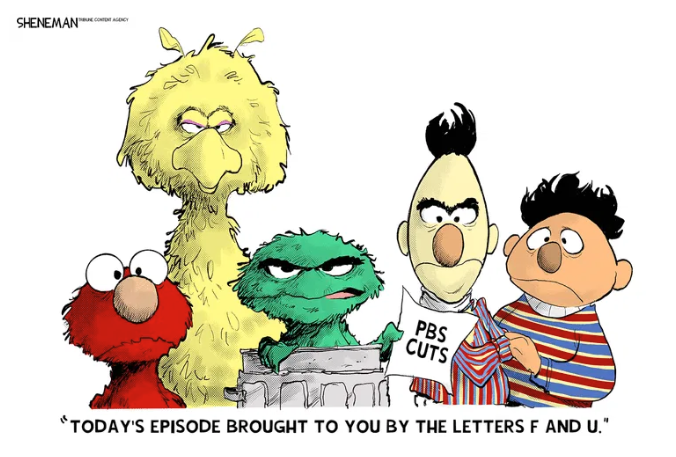
Fanatics and others

Fanaticism

The Minnesota Assassin

The Minnesota political assassin (who I won’t name) had some red flags in initial biographical information. From my perspective (Eastern Orthodox, formerly Evangelical and Calvinist, always active in my faith and never “charismatic”), the biggest one was his invocation of new apostles and prophets as what America needs spiritually — an indication of New Apostolic Reformation beliefs or something adjacent.

(Surprisingly few NAR advocates will own up to it; either it’s so loosely structured that adherence is ambiguous – which I suspect is the case – or they’re told to lie, or something.)

Now Stephanie McCrummen at the Atlantic has dug a little deeper and confirmed my suspicions.

Now comes the hard part: Assuming his guilt (which I’m allowed to do because I’m not a criminal court), dare we blame his assassinations, and the apparent intention to assassinate as many as 70 others, on his NAR ideas, or do we hold open the possibility of insanity or some other explanation?

Blaming NAR is tempting for me because I so detest it. But I have seen no information that NAR actually encourages physical violence, and not just vehement rhetoric. (Their “violent prayer” talk seems, preliminarily, to be a red herring.) The theory of stochastic terrorism has always struck me as plausible, but it’s hard to imagine any forcefully-expressed opinion that has zero chance of pushing some random person over some edge.

So I’m glad Stephanie McCrummen withheld judgment about causation. It’s still the extremely early days in the criminal proceedings, and more, if not all, will be revealed eventually.

Christianity is not an instrument of political power

David French comes closer than McCrummen to linking the assassination effect to the N.A.R. cause, and also had this observation:

Last election cycle I helped create a new Christian curriculum for political engagement …

As I talked about the curriculum in gatherings across the country, I was struck by the extent to which I was asked the same question time and again. “Sure,” people would say, “we need to be kind, but what if that doesn’t work?”

The implication was clear — victory was the imperative, and while kindness was desirable, it was the contingent value, to be discarded when it failed to deliver the desired political results.

David French

A “Christian” who thinks political victory is more important than living as Christ taught (let’s say, in the Beatitudes for instance) is a sorely confused Christian.

I’ve probably said it before, but I’ll say it again. One of the countless blessings I’ve received in Orthodox Christianity is the company of martyrs, many of whom died because they knew that gaining the world wasn’t worth losing one’s soul. If you’re in a “Christian” tradition where leaders or laity act as if that’s a good trade (none of them are wicked enough to actually teach it), get out before it’s too late.

Who are the fanatics?

We know now that the FBI’s infamous Richmond Memo, targeting traditional Catholics as potential terrorists and comparing them with Islamists, was not merely the product of a few rogues in a single field office, as the agency had claimed.  Multiple offices were involved in drafting it, and it was distributed to over a thousand employees.

This post is not going to be a rant against the Biden administration.  What interests me is what was going on in the analysts’ heads.  I credit them with sincerity.  But why did they think traditional Catholicism is comparable to the ideology of radical Islam?

The most generous interpretation which can be placed on the memo is that the analysts thought of fanaticism simply as strong belief, and assumed that any strong belief is potentially violent.

But a sensible definition of fanaticism would emphasize the content of belief, not its strength.  You aren’t a fanatic for believing very strongly that you should “Love your enemies and pray for those who persecute you, that you may be children of your Father in heaven.”  The more strongly you believe that, the less likely you are to be a terrorist.

On the other hand, you really are a fanatic for believing that you should “kill them wherever you find them,” meaning Jews and infidels.  The more strongly you believe that, the more likely you are to be a terrorist.

The content of belief did come into the analysts’ definition in one way.  They plainly believed strongly in their own ideology, yet it seems never to have occurred to them to view themselves as fanatics.  It seems, then, that in their view, the term “fanatic” must have meant not just “anyone who believes strongly,” but rather something like “Anyone who believes strongly enough in God, rather than in progressive dogma, for his belief to influence the rest of his life” – and the full force of the federal government must be used to surveil and suppress all such people.

So by their definition, yes, traditional Catholics are fanatics.  But by a more sensible definition, which ideology is a better candidate for being called by that label?

J Budziszewski

Evangelical Religion

I return to the subject of Evangelicalism so often, I think, because there is some stubborn something within me that believes, against so much journalistic “evidence” (thousands of profiles of self-identified Evangelicals doing bizarre things), that a significant number of Evangelicals are acting and believing in perfect good faith, and that I simply need to find the magic words to help them see what I can’t un-see.

There is some tenderness mixed with my frustration at 28 years of almost complete failure in that regard. And there is some perversity in my rejection of the wisdom of Orthodoxy, which really does not encourage trying to argue people into the Orthodox faith. “Acquire the Holy Spirit and thousands around you will be saved,” said Saint Seraphim of Sarov, but something there is about an American ex-Evangelical that still loves a short-cut.

Over the years, I have cast a lot of shade on the concept of “religion.” I’m starting to think I should have self-critically cast similar shade under the concept of “Evangelicalism.”

Here’s what I think I’ve been doing that’s sorely mistaken:

  1. The “good faith” Evangelicals I’m trying to persuade are basically wealthy white church-going Evangelicals in, or in orbit around, Wheaton, Illinois (and maybe Grand Rapids, Michigan). The former are the kind of people I hung out with for roughly 6 years of my life (five years in school plus one year in my young adulthood), the latter for 15 years. They are the kind of people I see at my Wheaton Academy homecomings every five years. I like them; no, I love them. We don’t talk politics when we get together. I fancy they’re not Trump fans, but I really don’t know and I fear I’d be disappointed if I found out.
  2. The evangelicals I’m yelling about are random self-identified Evangelicals or flakes identified as Evangelical by journalists in mainstream media, who may or may not attend church and who may have adopted the Evangelical label simply because they’re Trump supporters. I have little experience of them. The “good faith” Evangelicals may be as baffled by them as I am.

My impression, which I’ve had but suppressed for rather a long time, is that “Evangelicalism” isn’t coherent, though we seem not to be able to live without it. So when I shout at Evangelicals, it’s like shaking my fist and cursing at the clouds.

It has always been notoriously difficult to define what an Evangelical is. Probably the most widely-accepted attempt is the Bebbington Quadrilateral. But my favorite is from Ken Myers of Mars Hill Audio Journal. I’m not going to take the time to dig it up verbatim, but the gist was that Evangelicals recognize one another not by right doctrine, orthodoxy, but by “right feeling,” orthopathos. They sing the same songs, and pray similar extemporaneous prayers, supported Billy Graham Crusades, and so forth.

I don’t know whether that is even true today of the motley crew that journalists identify as Evangelical.

“Briefly stated, the Gell-Mann Amnesia effect is as follows: You open the newspaper to an article on some subject you know well … Often, the article is so wrong it actually presents the story backward—reversing cause and effect. I call these the ‘wet streets cause rain’ stories. Paper’s full of them.

In any case, you read with exasperation or amusement the multiple errors in a story—and then turn the page to national or international affairs, and read as if the rest of the newspaper was somehow more accurate about Palestine than the baloney you just read. You turn the page, and forget what you know.”

Michael Crichton (via ChatGPT because I couldn’t remember “Gell-Mann Amnesia effect”).

The press tends to garble Eastern Orthodoxy, so why should I believe them about Evangelicalism?

Many of them probably labeled the Minnesota assassin “evangelical.” Was he? Is the evidence that he wasn’t a No True Scotsman fallacy?

I know Orthodoxy; I just really don’t know Evangelicalism or its outer boundaries any more, if ever I did.

So you have my permission to go back to everything I’ve written about Evangelicals and Evangelicalism and say “he doesn’t know what he’s talking about,” because much of the time I’ve been Gell-Mann-ing it.

I’ll try to do better, but old habits die hard.

Sanity (a/k/a The Gospel for people battered by bad religion)

Having dwelt long on some pretty sorry stuff, a very long but infinitely more positive note:

I know that what I’m about to talk about is something I’ve talked about probably even fairly recently on the show, but I find myself in real life — meaning as a priest dealing with a group of parishioners, and trying to help them and guide them and just family members and everybody in general — I find myself having to say this over and over and over again, which tells me that probably if I say it over this microphone to people, there’s probably at least some folks out there who need to hear it again, even if I have talked about it recently.

The Christianity that those of us, at least in the United States — and I can only speak about that experience because I haven’t had any others — the Christianity we grew up around came from one of two categories largely. And people who want to defend those types of Christianity will call this a caricature. I don’t care anymore. But what I’m about to say, even if you think it’s a caricature of what they’re trying to teach, this is what a lot of the people within these traditions have actually received. Right? So it’s very easy to defend some tradition based on what’s in the books, and what we would mean to say, right? But I’m talking about what the people who I encounter, the people who talk to me about spiritual things. come to me and give confessions, what they’ve received from the Christianity they’ve grew up around, how that has shaped them, how they think because of it. And if people, representatives of those groups want to say that’s not what they meant to teach, cool, but maybe some introspection on why that’s not what people are receiving.

Anyway, what people have received comes in two categories. One is sort of the smilin’ Bob Shuler School of, “God loves you just the way you are and you don’t have to do anything. Just don’t worry about it. Just smile and be happy and listen to the hymns of your choice that you enjoy.” … That worked really well with boomers. That seemed to answer something they needed to hear. Maybe they’re a generation who grew up with very dissatisfied perfectionist parents, and so just hearing you’re fine just the way you are was what they needed, right? But that doesn’t work on subsequent generations, because subsequent generations are more realistic or nihilistic depending on your point of view, and know there’s something deeply wrong with themselves and with the world around them. So just telling them over again, “No, no, you’re fine, everything’s fine, it doesn’t work.” That’s why those kind of churches are all empty now.

The other school of thought is pretty much the exact opposite. It’s God doesn’t really love you. Right. In fact He’s pretty angry with you and He’s getting ready to send you to hell. Right? And the only way to avoid that is, depending on your tradition, right, is, for you to love him nonetheless, really sincerely — and there’s a rabbit hole to go down. How sincere am I ever really? — and do that plus live your life at a certain way and follow certain rules. Which will differ based on tradition, and which you will inevitably fail at.

That second one is most of the people who I interact with on spiritual matters, and it’s almost like they’ve been taught and they’ve internalized that. Their life in this world is this sort of really horrible reality show, almost like Squid Games, and like God is about weeding out contestants and narrowing it down to this faithful few and everybody else goes to hell, goes to eternal punishment except for this faithful few who, again, depending on your tradition, he may just pick. Or, you know, they’re the ones who really did it right. They’re the ones who really loved him sincerely, or they’re the ones who really lived their life the right way.

And any way you slice those things, most people again are realistic enough that when they look at their life, they don’t see a lot of evidence in their life and their actions that they’re one of the people God picked, or they don’t see a lot of evidence of their life that they’re really sincere about following God, or they don’t see a lot of evidence of their life that they’re really toeing the line and living the life they know they should be living, meaning most people are walking around — like religious people — walking around thinking they’re probably going to end up in hell. That God is probably mad at the most of the time, and that He’s looking for them to make some missteps so, boom!, they can get nailed.

Also most atheists are walking around doing the same thing they’re protesting constantly that there is no God because they can’t deal with that guilt and stuff that they’ve internalized. They can’t live like that. No one can live like that their route to trying to live like that and deal with the cognitive dissonance is just to deny that any of it’s true, over and over and over again publicly, loudly to everyone who will listen. Right.

Whereas the religious people are just in this kind of quiet desperation of how do I figure this out. Right.

So let me reiterate again, right, and Penal Substitution plays a big part in this. That’s why I’m bringing it up in this context:

God loves you. Jesus said so. St. John’s Gospel, the Father Himself loves you. He is not angry at you. He does not want to destroy you for your sins. There is no power of justice that commands him to do so. No one commands him to do anything. He loves you. He wants you to find salvation, but salvation is a thing you have to actually do. He wants you to do it. The Bible says so. God wills that all men be saved and come to the knowledge of the truth. But you have to do it. He empowers you to do it. He forgives you when you mess up trying to do it. He heals you when you damage yourself trying to do it and failing. He is entirely on your side. The God who created the universe is entirely on your side and the saints are on your side and the church is on your side. Everyone is on your side. Christ is advocating for you. Everything is set up for us.

When Saint Paul says to us, continue to work out your salvation with fear and trembling. You don’t stop them like Kierkegaard did. Read the next verse because it is God who is working in you to will and to do according to his pleasure. We continue on and we work out our salvation because we know that God is on our side and empowering us to do it and loving us and loving other people through us. We need to pray about that. We need to pray it. We need to repeat it. We need to kind of imitate what the atheists are doing. We need to say it out loud. We need to say it to each other. We need to say it to everyone who will listen right? That God loves you and wants you to find salvation, wants you to be healed, wants you to be set free from sin. He wants all these things for you. It doesn’t mean you have nothing to do. That doesn’t mean you’re fine just the way you are. You know you’re not fine just the way you are, right? But it means that He is there to help you to grow to be transformed into the person who you need to be and want to be. The person he created you to be for eternity. That’s the actual message of Christianity. Don’t accept any substitutes for that, ever at all for any reason.

Fr. Stephen De Young.

I probably will publish this from time to time for the rest of my blogging life.


Religious ideas have the fate of melodies, which, once set afloat in the world, are taken up by all sorts of instruments, some woefully coarse, feeble, or out of tune, until people are in danger of crying out that the melody itself is detestable.

George Elliot, Janet’s Repentance, via Alan Jacobs

[N]one of the things that I care about most have ever proven susceptible to systematic exposition.

Alan Jacobs, Breaking Bread With the Dead

You can read most of my more impromptu stuff here and here (both of them cathartic venting, especially political) and here (the only social medium I frequent, because people there are quirky, pleasant and real). All should work in your RSS aggregator, like Feedly or Reeder, should you want to make a habit of it.

June 11, 2025

Culture

Beauty

Many catholic young people should have arrived at Chartres Tuesday or Wenesday, having averaged about 20 miles a day in pilgrimage since leaving St. Sulpice in Paris on Sunday:

I spoke with a 32-year-old American priest who was there with a group of teenage boys from his local high school. He talked about the appeal of the old mass, and Catholic tradition, to kids today. They had been earlier on a retreat at the traditionalist Benedictine abbey of Fontgombault, and he said these American boys had been blown away by what they had seen and done there. The priest predicted that they were going to be overwhelmed by the beauty of Chartres. He said that most American boys their age have already seen the worst of humanity in hardcore porn, before they have ever seen real beauty. So Chartres is going to be a revelation for them.

Rod Dreher, Surprising Hope in the Streets of Paris (bold added)

What a thought! There is precious little “real beauty” around us in the USA, especially real manmade beauty. But there’s plenty of rot.

A part of the American ethic

Take, for instance, when the doctors were asked whether they would go to court to override the parents’ wishes if the child did not have Down Syndrome. They responded unanimously that they would, and they gave the following rationale: “When a retarded (sic) child presents us with the same problem, a different value system comes in; and not only does the staff acquiesce in the parent’s decision to let the child die, but it’s probable that the courts would also. That is, there is a different standard. . . . There is this tendency to value life on the basis of intelligence. . . . [It’s] a part of the American ethic.”

Justin Hawkins, Dignity Beyond Accomplishment – Mere Orthodoxy (bold added)

Sexual stereotypes

Popular sites like What to Expect verify that some aspects of child development differ by gender, yet even such sites advise parents to try to equalize or neutralize the differences. We’re so influenced by the Gender Ideology that we don’t seem to consider the possibility of embracing the children’s own preferences for activities that are “stereotypically” male or female.

Jennifer Roback Morse, The Sexual State

I do not recommend this book. How little did I like it? Enough that having read it when considering a conference where the author was a keynote speaker, I forewent the conference.

But it’s hard to write a whole book without an observation or two that’s both accurate and temperately made.

I am also adamant that breaking sexual stereotypes is not a sign that one is “in the wrong body.”

Marriage today

… marriage American-style, an obligation easier to walk away from than student loans or credit card debt …

Kevin D. Williamson, Husbandry Matters

Custom

I’ve been watching enough BritBox to reflexively view Elon as in the driver’s seat.

AI

Yeah, everybody’s got to prattle about AI as the topic du jour for countless jours now. I’ll try not to be anodyne or banal.

The rule of Nobody

What with expectations that AI will become our new deity, coupled with the profit motive and AI hallucinations, Matthew Crawford returns to a variation on the theme that first made him famous 16 years ago:

In the year of our Lord 2025, getting things done often requires finding, not the recent hire who just reads through the prompts on his screen and is trapped in the same hall of mirrors as you, but the guy or the gal with enough institutional knowledge to be able to thwart the system.

AI will get rid of those people. What then? The dystopia I fear is not one in which superintelligent machines achieve self-awareness and wipe out the human race, it is the prospect of a tightening grid of dysfunction and paralysis, achieved through the final victory of “the rule of Nobody,” to borrow a phrase from Hannah Arendt. The Nobody cannot be addressed.

Oh sure, there will probably still be a counter you can walk up to, with a very charming robot-lady behind it. Detecting the emotional register of your voice, she will express empathy for your plight. “I understand this can be frustrating. Let me see what I can do.” But this will turn out to be just a creepier version of “your call is important to us,” which is Business English for “fuck off, we don’t want to talk to you.”

Your call is important to us…. This post was remarkably persuasive to me, with a dandy analogy from “work-to-rule slowdowns” in labor disputes.

Language no longer implies thinking

LLMs (the so-called AI process) are impressive probability gadgets that have been fed nearly the entire internet, and produce writing not by thinking but by making statistically informed guesses about which lexical item is likely to follow another …

People have trouble wrapping their heads around the nature of a machine that produces language and regurgitates knowledge without having humanlike intelligence. The authors observe that large language models take advantage of the brain’s tendency to associate language with thinking: “We encounter text that looks just like something a person might have said and reflexively interpret it, through our usual process of imagining a mind behind the text. But there is no mind there, and we need to be conscientious to let go of that imaginary mind we have constructed.”

Witness, too, how seamlessly Mark Zuckerberg went from selling the idea that Facebook would lead to a flourishing of human friendship to, now, selling the notion that Meta will provide you with AI friends to replace the human pals you have lost in our alienated social-media age.

Tyler Austin Harper, What Happens When People Don’t Understand How AI Works

Enough

The question with which to start my investigation is obviously this: Is there enough to go round? Immediately we encounter a serious difficulty: What is “enough”? Who can tell us? Certainly not the economist who pursues “economic growth” as the highest of all values, and therefore has no concept of “enough.” There are poor societies which have too little; but where is the rich society that says: “Halt! We have enough”? There is none.

E.F. Schumacher, Small Is Beautiful

Denying our Civil Religion

America has a civil religion that is the equal of any other religion. “Why something so obvious should have escaped serious analytical attention is in itself an interesting problem.” If American nationalism is so obviously a religion, in other words, why do we deny it? Bellah posits that conservative religious groups deny it because they believe that Christianity is, in fact, the national religion. As recently as the 1950s they proposed a constitutional amendment recognizing the sovereignty of Jesus Christ. Secularists deny that America has a civil religion because they do not believe the nation-state does or should have anything to do with religion.

William T. Cavanaugh, The Uses of Idolatry

Short-form social media

[W]hether on Twitter or Bluesky, there are five major varieties of short-form social-media post:

  • “Here is some information”
  • “Look at how funny I am”
  • “Look at how stupid my enemies are”
  • “Look at how smart my allies are for pointing out how stupid my enemies are”
  • “Hello total stranger! You’re an idiot”

Obviously, posts in the first category are useful; posts in the second can be enjoyable when the poster actually is funny; and the remaining three are poisonous.

(Alan Jacobs)

Sorta political

Henry and Thomas

Each of Henry II and Henry VIII had a Thomas, Becket and More respectively, who were martyred for their resistance to totalitarian pretentions:

Washington has passed a law requiring that Catholic [also Orthodox, I’m sure, though with progressives one never knows] priests report certain sexual crimes that might be communicated to them in the confessional …

What Henry II and Henry VIII could not live with was the idea that there were centers of power independent of the state—that the power of the king was limited. Americans supposedly cherish the notion of limited government and insist that we would abide no king, but we are in most things perfectly happy to let presidents behave as though they were Louis XIV—as long as they are doing what we want them to do, or at least as long as they are irritating and discomfiting those we regard as our rivals and enemies.

If you cleave to a political philosophy holding that there is nothing outside of the state, then you are a partisan, however well-meaning, of absolutism and totalitarianism. Not every totalitarian temptation indulged leads directly to 1984. … There are many stops, many way stations, and (one prays) many off-ramps along the road to serfdom. But allowing the state to shove its stupid snout into the confessional is a big step in the wrong direction. It is one that should be resisted not only by litigation but also through civil disobedience, if necessary.

You may have heard these famous lines from Cardinal Francis George, the late archbishop of Chicago, envisioning life under such totalitarian assumptions:

I expect to die in bed. My successor will die in prison. And his successor will die a martyr in the public square. His successor will pick up the shards of a ruined society and slowly help rebuild civilization, as the church has done so often in human history.

The cardinal’s words had more impact than he intended: “I was responding to a question and I never wrote down what I said,” he later said about his famous statement, “but the words were captured on somebody’s smartphone and have now gone viral.” But his views were no less dramatic when expressed in less dramatic language: “The greatest threat to world peace and international justice is the nation state gone bad, claiming an absolute power, deciding questions and making ‘laws’ beyond its competence,” he later wrote. And his actions bore out his convictions: When the state of Illinois insisted that funding for adoption and foster care providers would be restricted to those that agreed to provide services to same-sex couples, the cardinal, with regret, instructed Catholic Charities to refuse to comply, and the archdiocese eventually discontinued those services. That is the totalitarian tendency at work: The question wasn’t whether there would be 500 adoption agencies that serve same-sex couples but whether the 12.7 million people of Illinois could tolerate one that did not.

Kevin D. Williamson, The Totalitarian Tendency and the Confessional

For what it’s worth: How do the bien pensants of Washington expect that a violation of this law will ever be discovered?

Department of Justice crashes

The Administration’s bad faith comes home to roost already.

Can’t be bothered to learn

Elon Musk’s disinterest in learning the first thing about government, combined with his enthusiasm for performatively cutting the parts of it that irked him politically (in at least some cases because he has become a deranged conspiracy theorist), led him to eviscerate USAID, and to brag about it on Twitter:

We spent the weekend feeding USAID into the wood chipper.

Could gone [sic] to some great parties.

Did that instead.

This decision led and will continue to lead to a heartbreaking amount of suffering and death — to children and babies dying because they were cut off from access to, for example, U.S.-provided peanut paste (cost: $1 a day). One statistical model published by a Boston University public health researcher projects that Musk’s cuts will cause hundreds of thousands of child deaths. I have not looked closely into that model, but let’s say its estimate of 300,000 is off by a massive amount and Musk’s actions only led to 75,000 deaths. Was it worth it?

I don’t think Elon Musk woke up one day and decided to starve some Yemeni children to death. Rather, I think he couldn’t be arsed to learn the details of what he was doing, and instead succumbed to conspiracy theories about USAID (the drug use can’t have helped here), until he really did convince himself USAID was “a criminal organization” that needed to “die.”

Jesse Singal

Bro, you gave up a podcast. And you’re not divorced. Or separated.

It is easy to make fun of Dan Bongino, the emotionally incontinent former cop turned podcaster appointed for some inexplicable reason by Donald Trump to serve as deputy director of the FBI as a subordinate to Kash Patel, whose main qualification for the job was having been the author of … a children’s book about the Steele dossier, a fact that sounds totally made-up but that is totally not made-up.

And it is a good week for making fun of Bongino, who recently had a public emotional breakdown on Fox News—where else?—about how he “gave up everything” to take on a thankless job in public service. About which: Bro, you gave up a podcast. Bongino went on to say that the job was so hard that he was now divorced from his wife, only to realize that he didn’t exactly mean what he said. The bombastic mode of speech that is apparently obligatory in Trump’s orbit had served him poorly, and so he corrected himself: “separated.” But he didn’t mean “separated” the way it sounds when it is used in conjunction with “divorce.” He just meant that he’s spending a lot of time at the office away from his family.

Kevin D. Williamson


Your enemies are not demonic, and they are not all-powerful and the right hasn’t always lost and the left hasn’t always won. But if you convince yourself of that, you give yourselves all sorts of permission to do a lot of stupid and terrible things under the rubric of “Do you know what time it is?”

Jonah Goldberg.

Trumpism can be seen as a giant attempt to amputate the highest aspirations of the human spirit and to reduce us to our most primitive, atavistic tendencies.

David Brooks)

I don’t do any of the major social media, but I have two sub-domains of the domain you’re currently reading: (a) You can read most of my reflexive stuff, especially political here. (b) I also post some things on my favorite social medium. I am now exploring Radiopaper.com as well.

Pure politics, 6/5/25

The Courts

Petulant Trump disavows his signature success (1)

Mr. Trump lashed out at the Federalist Society, blaming it for bad advice on whom to appoint to judgeships. He singled out Leonard Leo, a former longtime leader of the Federalist Society who helped recommend his first-term nominees and who exemplifies the conservative legal movement.

“I was new to Washington, and it was suggested that I use the Federalist Society as a recommending source on judges,” the president wrote. “I did so, openly and freely, but then realized that they were under the thumb of a real ‘sleazebag’ named Leonard Leo, a bad person who, in his own way, probably hates America, and obviously has his own separate ambitions.”

Mr. Leo and Mr. Trump had a falling out in 2020, but the personal attack was a sharp escalation. In a statement, Mr. Leo said, “I’m very grateful for President Trump transforming the federal courts, and it was a privilege being involved.”

Still, Mr. Trump’s tirade strained an already uneasy relationship with traditional legal conservatives.

Many share the president’s goals of strengthening border security, curbing the administrative state and ending “diversity, equity and inclusion” programs, said John Yoo, a conservative law professor. But, he added, they dislike some of Mr. Trump’s methods, whether that is prolifically invoking emergency powers or insulting judges who rule against his administration.

And Professor Yoo, who wrote memos advancing sweeping theories of presidential power as a Bush administration lawyer, said Mr. Trump’s attacks on Mr. Leo were “outrageous.”

“Calling for the impeachment of judges, attacking Leonard Leo personally and basically calling him as traitor as far as I can tell — Trump is basically turning his back on one of his biggest achievements of his first term,” he added, referring to the reshaping of the federal judiciary.

Charlie Savage, Trump, Bashing the Federalist Society, Asserts Autonomy on Judge Picks

For what it’s worth, Trump’s pledge to appoint federal judges from a list compiled by Leonard Leo (not the Federalist Society, which doesn’t do endorsements) was pivotal to his 2016 Election victory, especially among abortion foes who understandably did not trust a twice-divorced narcissist playboy with gambling and porn connections. Charlie Savage hasn’t forgotten that, but I shouldn’t quote his whole article.

If the Senate has a couple of Republicans with integrity, hack appointees like Emil Bove will not be confirmed. C’mon, guys! Save him from himself!

Petulant Trump disavows his signature success (2)

There are many stories in literature about people making deals with the devil. Weirdly, in most of them the devil is a square dealer.

That is, he keeps up his end of the bargain. He offers the protagonist wealth or power in exchange for something ethereal, like their immortal soul, and when they agree he delivers. The Prince of Lies turns out not to be a swindler. Most of the drama happens after he makes good on his promise and comes to collect.

The moral of those stories isn’t that you’re a fool to trade with Beelzebub because you’ll be cheated. It’s that you’re a fool to sacrifice your noblest self for something as fleeting as worldly power.

Conservatives made a deal like that in 2016. Donald Trump offered to stock the federal judiciary with their favorite judges, beginning with the vacancy left by Antonin Scalia on the Supreme Court; in return they would set aside their moral, civic, and ideological objections to him and support him in virtually anything he wanted to do, even if it affronted their conservative beliefs. Or basic decency.

The bargain was struck—and he delivered. Three eminent conservative jurists were added to the Supreme Court. Hundreds more were confirmed to federal appellate and district courts. The great white whale of social conservatism, Roe v. Wade, was harpooned in 2022 after a 50-year chase. Many other landmark legal victories for the American right have accumulated since Trump took office in 2017.

Conservatives weren’t cheated. The devil made good.

Fast-forward to last night …

[Leonard] Leo spent many years as the Federalist Society’s sherpa on judicial nominees, advising Republican presidents on whom to appoint and helping to shepherd candidates through the confirmation process. With the exception of Mitch McConnell, no one has done more this century to build a federal bench of originalist judges. But Trump didn’t want originalists—he wanted flunkies—and so Leo’s influence, and the influence of the organization he serves, have gone up in smoke …

Conservatives got the judiciary they wanted in exchange for supporting a man who radiates contempt for the constitutional order. In doing so, they empowered a postliberal movement that despises judges who do their jobs conscientiously instead of dutifully midwifing a Trumpist autocracy. As the Republican Party proceeds further down the path to fascism that those conservatives enabled, eventually the federal judiciary will consist entirely of believers in the “living Constitution,” half authoritarian and half progressive. In the long run, as Reaganites age out and are replaced by younger Trumpists, conservative judges as we’ve known them will go mostly extinct.

That’s what conservatives got for their bargain. The devil has come to collect.

Nick Catoggio

Pardons

The concept of a pardon, of course, is extremely hard for Trump to understand. Traditionally, a pardon is due to someone who has completed (or nearly completed) their sentence, expressed remorse, and turned their life around — and thereby been the recipient of mercy. But remorse is a concept unknown to a pathological narcissist. Mercy is even stranger. After all, who wins and who loses in an act of mercy? It’s one of those acts defined by grace — another literally meaningless concept for Trump. For him, all human conduct is built on a zero-sum, winner-vs-loser foundation. So a pardon is always instrumental — a way to reward allies, win credits, and enlarge his power by announcing to the world that he alone is the ultimate rule of law, and can intervene at any point to ensure his version of justice is the dispositive one. A monarch, in other words.

But Trump is the real outlier (and Biden, in his defense, used Trump’s abuse as a justification for his own self-dealing). In recent times he’s out in front in numbers: more than 1,700 full pardons so far, and we have three-and-a-half years to go. Nixon’s 863, Carter’s 574, Clinton’s 396, W’s 189, and Obama’s 212 put it in perspective. But these previous presidents abused the power occasionally — it’s an absolute power after all — while largely respecting the contours of the rule of law.

Trump has dispensed with any pretense of that. He is an instinctual tyrant — see his immigration overreach and his unilateral tariff mania — and the pardon power was almost made for him. The weakness of any constitution is the virtue — or, more often, the lack of it — in its office-holders. And Trump has the civic virtue of Jeffrey Epstein. The pardon power was always going to be a loaded gun in his tiny, careless hands.

… [H]e is using the pardon power all the time, rather than waiting till the end of his term. It replaces the rule of law with monarchical discretion. That’s why he could not tolerate Jeff Sessions all those years ago. Because Sessions, for all his passionate partisanship, still understood the system he was operating in and still believed that the appearance of impartial justice was integral to liberal democracy’s survival. Sessions was an American.

A majority of the American electorate, mind you, endorsed this lawlessness last November. It’s hard to pity them, as they absorb or ignore all the corruption they voted for and are still content to tolerate. They love crypto-monarchy as long as their king is on the throne. They do not seem to understand that this version of monarchy is still an elected one, and that another king from the other tribe may wear the crown some day. They may miss the benefits of liberal democracy once they have succeeded in killing it.

Andrew Sullivan, Pardon The Death Of Liberal Democracy

TACO

I’m not an active investor. I tend to buy and hold Mutual Funds and ETFs. (That’s just me; you do you.) But it did not escape my notice, even before the term was coined, that what’s now dubbed “TACO trades” could be profitable.

Wall Street is all over the “TACO trade,” another instance of people realizing they shouldn’t take the president at face value. “TACO” is short for “Trump always chickens out.” Markets have tended to go down when Trump announces new tariffs, but investors have recognized that a lot of this is bluffing, so they’re buying the dip and then profiting off the inevitable rally.

A reporter asked Trump about the expression on Wednesday, and he was furious. “I chicken out? I’ve never heard that,” he said. “Don’t ever say what you said. That’s a nasty question. To me, that’s the nastiest question.” The reaction demonstrates that the traders are right, because—to mix zoological metaphors—a hit dog will holler. The White House keeps talking tough about levying new tariffs on friends and geopolitical rivals alike, but Trump has frequently gone on to lower the measures or delay them for weeks or months.

Foreign leaders had figured out that Trump was a pushover by May 2017, and a year later, I laid out in detail his pattern of nearly always folding. He’s a desirable negotiating foil, despite his unpredictable nature, because he doesn’t tend to know his material well, has a short attention span, and can be easily manipulated by flattery. The remarkable thing is that it’s taken this long for Wall Street to catch on.

David A. Graham, The TACO Presidency

Now that the cat’s out of the bag, the profitability will diminish and what’s left will mostly be the pleasure of annoying Velveeta Voldemort.

The most incompetent administration ever

A federal appeals panel ordered officials not to deport a 31-year-old to El Salvador. Minutes later, it happened anyway. The government blamed “administrative errors.”

Alan Feuer, NYT

Will Trump pay any price for this fishy string of “administrative errors”?

Among his voters, I doubt it. But with the courts, the toll is steep and rising. They just cannot believe anything Administration lawyers promise. And they shouldn’t.

DJT, the anti-conservative

[I]t’s hard to think of a more anti-conservative figure than President Donald Trump or a more anti-conservative movement than MAGA. Trump and his supporters evince a disdain for laws, procedures, and the Constitution. They want to empower the federal government in order to turn it into an instrument of brute force that can be used to reward allies and destroy opponents.

Trump and his administration have abolished agencies and imposed sweeping tariffs even when they don’t have the legal authority to do so. They are deporting people without due process. Top aides are floating the idea of suspending the writ of habeas corpus, one of the most important constitutional protections against unlawful detention. Judges, who are the target of threats from the president, fear for their safety. So do the very few Republicans who are willing to assert their independence from Trump.

In one of his first official acts, Trump granted clemency to more than 1,500 people charged in connection with the violent attack on the Capitol on January 6, 2021, including those convicted of seditious conspiracy. The president and his family are engaging in a level of corruption that was previously unfathomable. And he and his administration have shown no qualms about using the federal government to target private companies, law firms, and universities; suing news organizations for baseless reasons; and ordering criminal probes into former administration officials who criticized Trump.

The Trump administration is a thugocracy, and the Republican Party he controls supports him each step of the way. Almost every principle to which Republicans once professed fealty has been jettisoned. The party is now devoted to the abuse of power and to vengeance.

The significance of this shift can hardly be overstated. A party that formerly proclaimed allegiance to the Constitution and the rule of law, warned about the concentration and abuse of power, and championed virtue, restraint, and moral formation has been transmogrified. The Republican Party now stands for everything it once loathed.

Peter Wehner

Thugocracy update

And she has been frank about the dilemma faced by Republicans like her who are dismayed about the president’s policies and pronouncements but worried that speaking out about them could bring death threats or worse.

“We are all afraid,” she told constituents in April, adding: “I’m oftentimes very anxious myself about using my voice, because retaliation is real. And that’s not right.”

Catie Edmondson, Lisa Murkowski Isn’t Using ‘Nice Words’ About Life Under Trump

I do acknowledge threats against Trump’s life, too. Several isolated nuts have been arrested and charged. But it seems to me that a President and his supporters holding Congress hostage for fear of their lives is an order of magnitude worse.

No laughing matter

Next month will be the first anniversary of Tim Walz’s branding of Donald Trump, JD Vance and, by implication, some of their political associates as “weird,” and it’s obvious now that Walz spoke too soon, before Trump won in November and his administration turned weirdness into a credential and an operating principle, before weirdness started afflicting Trump allies who seemed a little less weird in the past, before episodes of Trump-adjacent weirdness proliferated.

… [T]his pageant of peculiarity isn’t a laughing matter. It reflects Trump’s confusion of nonconformity with boldness. It speaks to his love of performance, even if it’s the fruit of a loopy performer. It demonstrates his desire to rattle, no matter how infantile the rattling.

Frank Bruni

Same column, change of topic:

If I’m subjected to one more lamentation, one more rant, about how lost and pitiable and shameful the Democratic Party is, my head is going to explode. Not because the Democratic Party is in good shape — it isn’t. Not because it can make do with only minor adjustments — it can’t. It’s guilty of the arrogance and incompetence of which it’s accused. And the country’s future as a reasonably healthy and prosperous democracy depends on Democrats’ recognition and remedy of that.

But some of the extravagant lashing of the party carries the implicit suggestion that Republicans, by contrast, have their act together. Excuse me? If success at the polls is the only metric for that, then sure, yes, they’re in an enviable spot. But it’s a wretched (and, I have to believe, vulnerable) one. Republican lawmakers who rightly gaped in horror at the events of Jan. 6, 2021, later developed collective amnesia, putting power several light-years above principle. They then indulged or outright applauded Trump’s laughable cabinet picks and his adoration of Musk and his cockamamie tariffs and his abandonment of due process and his swag from Qatar and his sadistic humiliation of President Volodymyr Zelensky of Ukraine and so many other cruelties and outrages that this sentence could go on forever. I struggle to admire Republicans’ political chops. I’m too distracted by their moral rot.

For love of sentences

In Esquire, Dave Holmes marveled at Senator Lindsey Graham’s suggestion, in a social media post before the conclave, that cardinals consider the idea of Trump as the next pope: “I guess he had not yet closed the day’s humiliation ring on his Apple Watch.” Holmes added that while Graham was probably joking, “You can’t be tongue-in-cheek when you are actively licking the boot. There is just not enough tongue for both jobs.” (Susan Fitzgerald, Las Cruces, N.M.)

Frank Bruni (a prior week)

Dissing the Dems

I confess that my laser-focus on Trump can sound like excusing the Democrats’ problems. It really isn’t. I’m just madder at my former party than at the I party whose Presidential nominee I voted for only once, 53 years ago.

An Andrew Sullivan podcast this week with the authors of Original Sin reminded me of just how screwed we are in the other of our major-party choices, the Dems, and how Joe Biden fooled me with his “nice guy” schtick. Though I didn’t vote for him, I would have done so if my fair state hadn’t been a lock for Trump.

Hypocrisy

Hypocrisy is the tribute paid to virtue by vice.

I will give Trump 2.0 credit for not adding hypocrisy to its countless other sins.

On second thought, his attacks on Ivy League universities for suffering antisemites gladly may qualify.

The best jokes

It has been said that the best jokes are dangerous because they are in some way truthful.

On Wednesday, a dangerous joke was told in the Oval Office. The South African president turned to the American president and said: “I’m sorry I don’t have a plane to give you.”

NYT

FWIW

  • Trump lost 96% of federal court cases in May. Even GOP-appointed judges ruled against him 72% of the time,” – Jack Hopkins.
  • “The Washington Post has now confirmed that it was Trump who asked the Qataris to gift him the plane for free (rather than the Qataris offering it), and that Qatar is demanding a written memo from the White House to this effect before the deal is finalized,” – Tom Malinowski.

Andrew Sullivan, Pardon The Death Of Liberal Democracy

PBS

… and by the numbers 86 and 47.


Your enemies are not demonic, and they are not all-powerful and the right hasn’t always lost and the left hasn’t always won. But if you convince yourself of that, you give yourselves all sorts of permission to do a lot of stupid and terrible things under the rubric of “Do you know what time it is?”

Jonah Goldberg.

Trumpism can be seen as a giant attempt to amputate the highest aspirations of the human spirit and to reduce us to our most primitive, atavistic tendencies.

David Brooks)

I don’t do any of the major social media, but I have two sub-domains of the domain you’re currently reading: (a) You can read most of my reflexive stuff, especially political here. (b) I also post some things on my favorite social medium. I am now exploring Radiopaper.com as well.

Saturday, 5/31/25

AI doomsday?

[Jaron] Lanier agreed that it’s up to humans to protect the truth in the age of AI, but was less optimistic that we will do so: “The issue with AI is not the AI. It’s not the large language model. It’s the concentration of power and wealth around who owns it,” he said. “You have to look at the big system, including the people, the money, the business, the society, the psychology, the mythmaking, the politics.”

A Free Press Debate on Artificial Intelligence in San Francisco

Jaron Lanier had fallen off my radar for a few years. I’ll forever be interested in his take on anything regarding computers and humanity (together, not separately).

Bon mots

Codgers and technology go together like peanut butter and sardines.

Frank Bruni. Then this, merely via Frank Bruni, not from him:

In the quarterly journal Sapir, Bret Stephens made a kind of peace with the heavily partisan slant of so much cable television news: “To demand scrupulous impartiality on their broadcasts is like expecting fancy linens at a Motel 6.” (Naomi Lerner, West Orange, N.J.)

A non-tribal Democrat

Some of my subscribers dislike when I throw elbows to my left. They share my disdain for Donald Trump and his party, and my commitment to understanding them in light of political theory and history, but they are also devoted Democrats who have warm feelings for Joe Biden, were thrilled by the campaign of Kamala Harris and Tim Walz, and still seethe about Hillary Clinton’s loss in 2016.

That isn’t me. I vote for Democrats. I directionally agree with them on most issues. And I consider the Republican alternative thoroughly unacceptable. Yet I am not a devoted Democrat. A big part of the reason is that I’m not a joiner—of anything. I value my own independence too much and temperamentally resist deploying my talents to advance a cause—any cause, even a worthy one, and even one wrapped up, at this moment, with the fate of liberal democratic self-government in the United States.

But this way of thinking presumes that working to help the Democrats should take the form of deferring to and falling in line behind party leadership and elected officials, taking marching orders, rallying around candidates and nominees endorsed by the party bigwigs, and then maintaining message discipline to get them elected. That’s what I resist. But there’s another kind of devotion—one that expresses itself as tough love and a willingness to speak candidly, and even harshly, about faults.

… a Democratic researcher is quoted as saying that when she asks swing voters to liken the two parties to animals, they consistently describe Republicans as lions, tigers, and sharks—“apex predators” that “take what they want when they want”—but Democrats as tortoises, slugs, or sloths, creatures typically considered “slow, plodding, [and] passive.”

Damon Linker, A Party of Sloths

Substance, process

One of this crazy-making aspects of life in Trump 2.0 is that the media coverage of the administration’s antics focuses, mostly on the substance of what they are doing, ignoring the process, and the question of whether they have the authority to do it at all.

Such, I feared, was the infirmity of NPR and PBS Aren’t Entitled to Your Tax Dollars, a Free Press article by a serious Ivy league constitutional law professor. I slogged my way through it, agreeing with the author again and again, but frustrated that he was ignoring the elephant in the room. Finally, in literally the last paragraph, he mentioned the elephant almost as a throwaway line:

NPR also alleges in its complaint that the federal statute creating the Corporation for Public Broadcasting prohibits Trump from making this defunding decision. That’s a very different argument, which I’m not addressing here ….

I would venture a guess that nine out of ten people who read this column will come away with the impression that NPR and PBS are suffering from a liberal sense of entitlement to tax dollars, and miss the point about there being some limits to executive power.

In the end, it may not matter because this Congress is sufficiently servile that if Trump asks Congress to defund CPB, PBS and NPR (a longtime GOP talking point), it almost certainly will oblige him.

But process does matter, tremendously. Where the power to do something resides also matters.

Dissing Adoption

The New York Times … has never found a basic human good it couldn’t ponderously criticize with the shuffling-foot smarm of the ideas festival class. There’s “I Was Adopted From China as a Baby. I’m Still Coming to Terms With That. There’s “World’s Largest ‘Baby Exporter’ Admits to Adoption Fraud.” There’s “Given Away: Korean Adoptees Share Their Stories.” (In easily-digestible video format!) There’s “I Was Adopted. I Know the Trauma It Can Inflict.” (Subtle.) The New Yorker, a $12,000 espresso machine transformed into a magazine by a mischievous wizard, has “How an Adoption Broker Cashed In on Prospective Parents’ Dreams,” “Living in Adoption’s Emotional Aftermath,” and “Where is your Mother?” (The answer is that she has been separated from her child by a cruel and fickle child welfare system despite being perfectly fit, which I’m sure is how it usually goes.) The Atlantic has “No One’s Children: America’s long history of secret adoption.” (Would you be shocked to learn that said history isn’t a good one?) They’ve got “The New Question Haunting Adoption,” the question being whether adoption is really a secretly selfish act, you know, the selfish act of taking a severely-disabled toddler into your home to provide them with support and love after their birth parents smoked meth throughout pregnancy. They also have, incredibly, “What Adoption ‘Salvation’ Narratives Get Wrong,” “Adoption Is Not a Fairy-Tale Ending,” “The Dark, Sad Side of Domestic Adoption”…. I could go on, and that’s just three prestigious publications. There’s a whole world out of this out there.

This is all, for the record, a really excellent example of what we used to mean when we used the word ideology. Once upon a time, one wouldn’t say “My ideology is…” because ideology referred to the hidden, unexplored, unconscious politics that lay beneath the public, open, explicit politics. An ideology was those pre-political assumptions and beliefs which conditioned and limited political thought, which made the conscious political philosophy of any individual what it was. Ideology is the skeleton that hides unseen within the animal of politics but nevertheless determines the structure of that which is seen. Ideology exists in both the macro and the micro; this bizarre upper-caste antipathy towards ideology is a good example. If you asked leadership at these publications if they had any particular interest in leading a charge against the practice of adoption, they’d say no, of course not, what a weird question! If you were to show them just how repetitively this particular set of critiques and questions and hrm hrm hrm noises gets published in their pages, they’d swear to you that it reflects no underlying party line. And yet there it is, the evidence, in black and white. Something about the current constitution of the anxious educated urbanite liberal soul cries out inside of them: the real problem is adoption.

Freddie deBoer, Adoption is Good

If the shoe fits

A well-regarded Evangelical pastor published this weeks before the 2020 Election.

[T]his is a long-overdue article attempting to explain why I remain baffled that so many Christians consider the sins of unrepentant sexual immorality (porneia), unrepentant boastfulness (alazoneia), unrepentant vulgarity (aischrologia), unrepentant factiousness (dichostasiai), and the like, to be only toxic for our nation, while policies that endorse baby-killing, sex-switching, freedom-limiting, and socialistic overreach are viewed as deadly.

I think it is a drastic mistake to think that the deadly influences of a leader come only through his policies and not also through his person.

This is true not only because flagrant boastfulness, vulgarity, immorality, and factiousness are self-incriminating, but also because they are nation-corrupting. They move out from centers of influence to infect whole cultures. The last five years bear vivid witness to this infection at almost every level of society.

Christians communicate a falsehood to unbelievers (who are also baffled!) when we act as if policies and laws that protect life and freedom are more precious than being a certain kind of person. The church is paying dearly, and will continue to pay, for our communicating this falsehood year after year.

The justifications for ranking the destructive effects of persons below the destructive effects of policies ring hollow.

I find it bewildering that Christians can be so sure that greater damage will be done by bad judges, bad laws, and bad policies than is being done by the culture-infecting spread of the gangrene of sinful self-exaltation, and boasting, and strife-stirring (eristikos).

I think it is baffling and presumptuous to assume that pro-abortion policies kill more people than a culture-saturating, pro-self pride.

When a leader models self-absorbed, self-exalting boastfulness, he models the most deadly behavior in the world. He points his nation to destruction. Destruction of more kinds than we can imagine.

It is naive to think that a man can be effectively pro-life and manifest consistently the character traits that lead to death — temporal and eternal.

John Piper, Policies, Persons, and Paths to Ruin: Pondering the Implications of the 2020 Election

Piper did not say who he was voting for. He did not name names. For that reason, I’m blogging this separately from pointed political material.

But I’m not going to deny that my heart soared to see that our current President had not captured and reduced to servility the entirety of one of America’s most prominent Christian traditions.

The right to know isn’t the whole story

To further clarify our situation, consider W. H. Auden’s discussion, which I’ve cited before, of the idea that, as he put it, “the right to know is absolute and unlimited.” “We are quite prepared,” Auden wrote,

“to admit that, while food and sex are good in themselves, an uncontrolled pursuit of either is not, but it is difficult for us to believe that intellectual curiosity is a desire like any other, and to recognize that correct knowledge and truth are not identical. To apply a categorical imperative to knowing, so that, instead of asking, ‘What can I know?’ we ask, ‘What, at this moment, am I meant to know?’ — to entertain the possibility that the only knowledge which can be true for us is the knowledge that we can live up to — that seems to all of us crazy and almost immoral.”

L.M. Sacasas, Structurally Induced Acedia (The Convivial Society)

Harvard and the Trump administration

Harvard and the Trump administration have each finally met an adversary too big to push around. America’s richest university never really considered how much it depends on government policy, including lavish federal research funding, federal student aid, and a permissive immigration regime for the foreign students—who make up a third of the university’s student body and often subsidize the rest by paying more. Progressives also never thought through how the many tools they devised for using government leverage against private institutions—including threatening tax exemptions, as the Supreme Court allowed on dubious grounds in Bob Jones University v. United States (1983)—could be used against universities that engage in race discrimination for the “right” reasons, cultivate a political monoculture among the faculty, and permit campus mobs to terrorize minority groups who are out of progressive favor (Jews). Now, Trump is trying to strip Harvard of everything—tax exemption, federal funding, and visas for foreign students already enrolled. While the comeuppance for Harvard is admittedly delicious, the president is abusing powers he ought not to have, and Harvard has deep enough pockets to fight him in court.

National Review Weekly email.

Some cases don’t have valid arguments on both sides. That I find nothing “delicious” about Harvard’s “comeuppance” is an example of why I ignore National Review’s regular email invitations to resubscribe.

Can a car have a “catfish smile”?

“Behind that catfish smile, the company’s twin-turbo 4.0-liter DOHC V8 now discharges a drama-drenched 656 hp and 590 lb-ft—153 hp and 85 lb-ft more than the previous Vantage Roadster—thanks to larger turbochargers, revised camshaft profiles, optimized compression ratio and upgraded fueling and cooling.”

Kudos to Dan Neil for the spot-on “catfish smile.”

The car, by the way, is a 2025 Aston Martin Vantage Roadster, which will set you back $300,000 as equipped (this week’s ephemeral tariffs not included).

Credentials, good times, and genuine learning

Most young people today feel, with considerable justification, that they live in an economically precarious time. They therefore want the credential that will open doors that lead to a good job, either directly or (by getting them into good graduate programs) indirectly …

But those same young people also want to have a good time in college, a period of social experience and experimentation that they (rightly) think will be harder to come by when they enter that working world …

… Yes, students understand — they understand quite well, and vocally regret — that when they use chatbots they are not learning much, if anything. But the acquisition of knowledge is a third competing good, and if they pursue that one seriously they may well have to sacrifice one of the other two, or even both. Right now they can have two out of three, and as Meat Loaf taught us all long ago, two out of three ain’t bad.

Alan Jacobs, responding to Ted Gioia on the topic of ending AI cheating.

Potpourri

  • After Trump held a crypto dinner last Thursday night, crypto moguls who paid to be there felt scammed that the president didn’t even stick around at the event they’d hoped to do their own scams at. I saw someone describe him as the apex scammer. Our Scammander in Chief.
  • In other Russia news, a new statue of Joseph Stalin in a Moscow metro station was unveiled this month. President Putin has called Stalin an “effective manager,” and has said that enemies of Russia use the “excessive demonization” of Stalin to attack “the Soviet Union and Russia.” Stalin is back, big time. Interesting that “effective manager” is being used here to describe a man who facilitated the death of millions—and not efficiently. But I’m not a businessman.
  • The continued reckoning: A postmortem on Kamala Harris’s campaign cited a “perception gap” as one of the reasons she lost, saying voters believed she held positions that she didn’t. “Over 80% of swing voters who chose Trump believed Harris held positions she didn’t campaign on in 2024, including supporting taxpayer funding for transgender surgeries for undocumented immigrants (83%), mandatory electric vehicles by 2035 (82%), decriminalizing border crossings (77%), and defunding the police (72%).” But Harris had, in fact, supported all of these positions. Like, she is on record supporting each of those positions (here, here, here, and here). So it’s not really a perception problem so much as a reception problem, like these ideas are not popular even though I support them. There’s a sense among Dems that people should simply ignore the things that are unpopular and that referencing them is fake news. Like, how dare you talk about the surge of migrants coming through our new open borders thanks to swift changes from the Biden admin. Yes, it’s technically true, but it’s disinformation-coded.
  • Leave Bruce alone: A bar in New Jersey canceled a performance by a Bruce Springsteen tribute band after the real Springsteen called Trump “corrupt, incompetent, and treasonous” while on tour in England. Citing the bar’s MAGA clientele, the bar owner said that a Springsteen cover band would be “too risky at the moment.” And: “Whenever the national anthem plays, my bar stands and is in total silence, that’s our clientele. Toms River is red and won’t stand for his bull—.” [But MAGA doesn’t have a violent streak. No way. That’s fake news.]
  • Things that are not antisemitism: The Democratic Socialists of America “Liberation Caucus” has announced its support for Elias Rodriguez, the suspect arrested for slaughtering two Israeli Embassy staffers outside D.C.’s Capital Jewish Museum last week. Here’s the statement signed by the DSA Liberation folks and a bunch of others: “As imperialism has made the entire world its battlefield, it is justified to fight it, by any means necessary, without regard for geography.” And: “[T]here must be consequences for genocidal [Z]ionist imperialism, and those consequences are righteous.”

Nellie Bowles

Fake my …

The latest fitness craze is surely going to be Fake My Run. It fits perfectly with the national ethos whereby university students are already doing Fake My Education.


Your enemies are not demonic, and they are not all-powerful and the right hasn’t always lost and the left hasn’t always won. But if you convince yourself of that, you give yourselves all sorts of permission to do a lot of stupid and terrible things under the rubric of “Do you know what time it is?”

Jonah Goldberg.

Trumpism can be seen as a giant attempt to amputate the highest aspirations of the human spirit and to reduce us to our most primitive, atavistic tendencies.

David Brooks)

I don’t do any of the major social media, but I have two sub-domains of the domain you’re currently reading: (a) You can read most of my reflexive stuff, especially political here. (b) I also post some things on my favorite social medium. I am now exploring Radiopaper.com as well.

Political (5/27/25)

Shooting us in the foot

Defunding Science

I don’t think I elevate science unduly, and I even try to burst the bubbles of those who do. I think we’ve neglected the humanities in worshiping the almight STEM.

But Steven Pincker has a long and passionate defense of Harvard in the New York Times opinion section. Remembering that Trump’s attack is largely based on alleged antisemitism at Harvard, this in particular struck me as key:

Just as clear is what won’t work: the Trump administration’s punitive defunding of science at Harvard. Contrary to a widespread misunderstanding, a federal grant is not alms to the university, nor may the executive branch dangle it to force grantees to do whatever it wants. It is a fee for a service — namely, a research project that the government decides (after fierce competitive review) would benefit the country. The grant pays for the people and equipment needed to carry out that research, which would not be done otherwise.

Mr. Trump’s strangling of this support will harm Jews more than any president in my lifetime. Many practicing and aspiring scientists are Jewish, and his funding embargo has them watching in horror as they are laid off, their labs are shut down or their dreams of a career in science go up in smoke. This is immensely more harmful than walking past a “Globalize the Intifada” sign. Worse still is the effect on the far larger number of gentiles in science, who are being told that their labs and careers are being snuffed out to advance Jewish interests. Likewise for the current patients whose experimental treatments will be halted, and the future patients who may be deprived of cures. None of this is good for the Jews.

The concern for Jews is patently disingenuous, given Mr. Trump’s sympathy for Holocaust deniers and Hitler fans. The obvious motivation is to cripple civil society institutions that serve as loci of influence outside the executive branch. As JD Vance put it in the title of a 2021 speech: “The Universities Are the Enemy.”

Steven Pinker, Harvard Derangement Syndrome (shared link)

Leave them all alone

A German concept used to validate the society-saturating politics infecting Europe 90 years ago was Gleichschaltung. It denoted totalistic government: the “coordinating” or “harmonizing” of all important social institutions. A foreign word, but no longer a foreign practice.

As a candidate in 2023, Donald Trump vowed to “choke off the money” to schools assaulting “Western civilization itself.” As he defines this, and as he defines “assaulting” it. What could go wrong?

America’s research universities are sources of U.S. economic dynamism and vital to technology-dependent national security. It is folly (and unlawful) to punish entire institutions for the foolishness of a few departments. When English departments are “decolonized” — dead White men purged from the curriculum — the only victims are students deprived of Shakespeare. Ideological indoctrination is rarer in engineering departments, where knowing the right facts rather than having the right feelings matters, otherwise bridges crumble and skyscrapers tumble. Leave all departments alone, some because their silliness does not matter much, others because their excellence matters greatly. (Source: washingtonpost.com)

George Will via John Ellis

Keeping score

SCOTUS and the “Shadow Docket”

We have plenty of things to worry about in constitutional law today. But those worried about how the court will confront the unprecedented and sometimes unlawful actions of the Trump administration should save their outrage for other cases.

In the two cases here, the court held that the president was likely to prevail in his unitary executive claim, that the administration was unduly harmed by allowing the officials to keep their offices while the case was pending, and that this reasoning would not imperil the independence of the Federal Reserve. It did all of this in an emergency order, rather than waiting for the issues to arrive on the court’s regular docket.

The president’s ruinous tariffs, purported cancellation of birthright citizenship, renditions to foreign prisons and retaliations against his political opponents all raise far graver constitutional problems than the court’s ultimately unsurprising order in these cases. We should focus our concern there.

Will Baude in the New York Times.

I had Will’s father, Pat Baude, for several Constitutional Law classes, and he, too, was brilliant. I only wish he had lived long enough to bust his buttons at his son’s brilliance and esteem in the legal community.

The Big Picture: A Hostage Crisis

This newsletter concerns itself with the great patriotic project to turn America into a banana republic, but something gets lost by doing that episodically. Each day we study some crooked new tree that Donald Trump’s administration has planted; rarely do we step back and consider how large the forest has already become.

Here’s Andy Craig at The UnPopulist, stepping back:

Since Jan. 20, the United States has been in a state of rapid constitutional collapse. Congress’ power of the purse, its most fundamental prerogative, has been usurped; statutory laws have been suspended by claimed “emergency” powers; the requirement for Senate confirmation has been made irrelevant; a transparently political purge of both the civil service and the armed forces has been launched; the president has threatened aggressive military force against longtime allies; a decree was issued to strip constitutional citizenship rights; our treaty obligations have been blown up with a self-sabotaging trade war; mass pardons have been used to gleefully sanction political violence; courts have been defied to send innocent people to a Central American torture camp; the world’s richest man has deployed a gaggle of racist hackers to shut down government agencies on a whim; and, just as we were going to press, news broke that Harvard University has been barred from enrolling foreign students because of its refusal to hew to the president’s ideological demands.

What Craig is describing is essentially a hostage crisis.

An authoritarian state is a national hostage crisis … Most hostage crises aren’t orchestrated by coolly ingenious master-planners. They’re what happens when someone who’s ruthless, audacious, volatile, and cunning but not very bright makes a mess of his caper, like a bank robber whose hold-up takes longer than expected. He turns to leave and finds cop cars pulling up outside, causing him to panic and to start taking hostages instead.

There’s no “plan.” He just doesn’t know what else to do now that a wildly reckless, dangerous course of action like robbing a bank has suddenly gone sideways.

That was also the theme of yesterday’s newsletter, not coincidentally. The One Big Beautiful Bill that passed the House on Thursday is incomprehensible as a plan to strengthen America fiscally. It makes sense only as a desperate act in the midst of a dangerous caper gone bad: Having decided long ago that making Trump happy is more important than protecting the country, House Republicans acted accordingly when forced to choose.

Nick Catoggio

Amnesiac Nation

The background fact of this second Trump impeachment trial was how broadly popular it was. In January, a Monmouth survey found that 56 percent of Americans wanted Trump convicted. Quinnipiac reported that 59 percent regard him as responsible for inciting violence against the U.S. government. According to ABC/The Washington Post, 66 percent believe that Trump acted irresponsibly during the post-election period. According to polls, fewer than a quarter believed that Trump did “nothing wrong” on January 6.

Those are not the numbers on which to base a Grover Cleveland–style comeback tour—especially not when the majority of Americans also believe that Donald Trump did a bad job handling the COVID-19 pandemic and that President Joe Biden is doing a good job.

David Frum.

There came a time when “President Joe Biden” became a legal fiction, and that boosted Trump’s stock.

Abundance Agenda

Jonathan Chait writes about the civil war in the Democrat party over a proposed “abundance agenda” for the party.

Here are the pieces of that agenda, according to Chait:

[T]he canonical abundance agenda consists of three primary domains.

The first, and most familiar, is the need to expand the supply of housing by removing zoning rules and other legal barriers that prevent supply from meeting demand …

The second focus of abundance is to cut back the web of laws and regulations that turns any attempt to build public infrastructure into an expensive, agonizing nightmare …

The third domain, and the one that has received the least attention from commentators, is freeing up the government, especially the federal government, to be able to function. Policy wonks call this issue “state capacity.” The government itself is hamstrung by a thicket of rules that makes taking action difficult and makes tying up the government in lawsuits easy. The abundance agenda wants to deregulate the government itself, in order to enable it to do things.

The problem is that there’s a bloc of progressive special interests within the party (“the groups,” per the abundance agenda proponents), and the groups are large and unified (or at least in alliance):

The progressive movement seeks to maintain solidarity among its component groups, expecting each to endorse the positions taken by the others.

Much of the most vociferous opposition to the abundance agenda has zeroed in on its betrayal of this principle. The Roosevelt Institute’s Todd Tucker attacked Ezra Klein on X for his “survivor island approach to coalitions—first unions and Dems team up to vote enviros off the island, and then Dems turn on labor.” David Sirota, a left-wing journalist, complained, “Abundance Libs are insisting the big problem isn’t corporate power & oligarchs, it’s zoning laws & The Groups? Come on.” Austin Ahlman, a researcher at the Open Markets Institute, an anti-monopoly advocacy organization, mused, “You have to wonder whether the Abundance faction stuff would have landed better if the proponents had not laid the groundwork for it by first broadsiding every other organized constituency in the democratic tent.”

This angry response is not merely a knee-jerk reaction to criticism, but the logical outgrowth of a well-developed belief system. Since the Obama era, many of the component groups in the progressive coalition have drifted further left on their core demands. (Single-issue lobbies are naturally incentivized to grow more extreme over time—what organization is going to decide its pet cause is too unpopular or costly to merit a strident defense?)

At the same time, they have grown more purposeful about their belief that each group must stand behind all the positions outlined by the others. That is why civil-rights groups will demand student-debt relief, abortion-rights groups endorse abolishing the police, or trans-rights groups insist that Palestine should be liberated. Leah Hunt-Hendrix, an heir to the Hunt oil fortune who became a full-time progressive organizer, and who has raised and donated millions to causes such as the Sunrise Movement, the Debt Collective, and Black Lives Matter, articulated the principle of cross-endorsements in her book, Solidarity. She argues for “the necessity of working in coalition with progressive social movements,” and of resisting the opposition’s efforts “to weaponize a movement’s fault lines.”

Such progressives are not wrong to see the abundance agenda as a broader attack on their movement.

The Coming Democratic Civil War – The Atlantic

I have long believed that “the groups” impede Democrat success by alienating Democrats in the cultural mainstream. And as I’ve long said, whatever else Trump’s triumph means, it means major political realignment. The Democrat party’s travails over the abundance agenda, and controlling the toxic “groups,” could further advance that realignment, but I’m not sure it will benefit the Democrats all that much.

But then what do I know? I’m almost completely alienated from a country that can elect Velveeta Voldemort.


Your enemies are not demonic, and they are not all-powerful and the right hasn’t always lost and the left hasn’t always won. But if you convince yourself of that, you give yourselves all sorts of permission to do a lot of stupid and terrible things under the rubric of “Do you know what time it is?”

Jonah Goldberg.

Regarding said “lot of stupid and terrible things,” my failure to call out anything about the current regime does not mean I approve. There’s just too much, and on some of the apparent illegalities I don’t want to abuse my rusty credentials without thinking it through.

I don’t do any of the major social media, but I have two sub-domains of the domain you’re currently reading: (a) You can read most of my reflexive stuff, especially political here. (b) I also post some things on my favorite social medium. I am now exploring Radiopaper.com as well.

Sunday of the Samaritan Woman

Sorry to be so much later than usual with this. I had a very busy Saturday and Sunday.

Beauty First

Let me commend to any artistic sorts reading this the video embedded in Beauty First: Envisioning a Civilization Worth Restoring. Jonathan Pageau’s introduction should tell you whether it merits your further attention.

Live the life of the Church

Having largely lost our religion(s), modernity has seen fit to create new ones. If we wonder what constitutes a modern religion (or efforts to create one) we need look no further than our public liturgies. Various months of the year are now designated as holy seasons set-aside to honor various oppressed groups or causes. It is an effort to liturgize the nation as the bringer and guardian of justice in the world, an effort that seeks to renew our sense of mission and to portray our nation as something that we believe in. It must be noted that as a nation, we have not been content to be one among many. We have found it necessary to “believe” in our country. It is a symptom of religious bankruptcy. As often as not, major sports events (Super Bowls) are pressed into duty as bearers of significance and meaning. The pious liturgies that surround them have become pathetic as they try ever-harder to say things that simply are not true or do not matter. This game is not important – it’s just a game.

I am often asked, when writing on this topic, what response Christians should make. What do we do about the state? How do we respond to modernity? For the state – quit “believing” in it. We are commanded in Scripture to pray for those in authority. We are not commanded to make the state better or participate in its projects. We are commanded to serve our neighbors as we fulfill the law of God. However, I think it is important to work at “clearing the fog” of modern propaganda regarding the place of the nation state in the scheme of things. I would frame a response to modernity in this manner: we are not responsible for foreign religions. Though Christian language and carefully selected ideas are often employed in the selling of modernity’s many projects, it is a mistake to honor its false claims. Make no mistake, modernity will offer no credit, in the end, to Christ, the Church, or to people of faith. Its interests lie elsewhere.

The proper response to these things will seem modest. Live the life of the Church. The cure of modernity’s neurasthenia is found not in yet one more successful project, but in the long work of salvation set in our midst in Christ’s death and resurrection. Our faith is not a chaplaincy to the culture, or a mere artifact of an older world. The Church is the Body of Christ into which all things will be gathered, both in heaven and on earth. It is the Way of Life as well as a way of life. It is not given to us to control how we are seen by the world, or whether the world thinks us useful. It is for us to be swallowed up by Christ and to manifest His salvation to the world. We were told from the very beginning that we should be patient, just as we were promised from the beginning that we would suffer with Christ.

I think the sickness that haunts our culture is that we fail to know and see what is good and to give thanks for the grace that permeates all things. When that is forgotten, nothing will satisfy, nothing will transcend. There is no better world to be built, nor are there great wars to be won. There is today, and that is enough.

Fr. Stephen Freeman, When America Got Sick

Astronomical accuracy

I don’t think I’d ever read the tart Orthodox response (from one Patriarch at least) when Pope Gregory invite the Orthodox to adopt his new, more astronomically-accurate calendar:

By the 16th century, concerns about secular or humanistic trends in Catholic theology had become a major theme in Orthodox apologetics. For instance, the dating of Easter was fixed by the First Ecumenical Council imn A.D. 325. At the time, their calculation was made using the Julian Calendar. However, in 1582, Pope Gregory XIII issued his new liturgical calendar—now known as the Gregorian Calendar, which he held to be more scientifically accurate. Gregory wrote to the Orthodox patriarchs inviting them to adopt his new calendar. Patriarch Joachim V of Antioch commissioned a reply from his disciple Metropolitan Athanasius al-Marmariti ibn-al Mujalla, who wrote to Pope Gregory:

Our community, our bishops, our kings and all our people, scattered in the four cardinal directions—Greeks, Russians, Georgians, Vlachs, Serbs, Moldovans, Turks, Arabs, and others . . . from the time of the Holy Apostles and God-bearing fathers of the Seven Ecumenical Councils down to this day recognize one faith, one confession, one Church, and one baptism . . . and all our nations agree in the four corners of the inhabited world with one word and one affair . . . and we did not receive the confession and the holy tradition which is in our hands . . . from unknown people, like other, foreign communities.

But we pray with the Holy Apostles and the 318 fathers [of the Council of Nicaea] whose signs and miracles shine forth from them manifestly. And so how can we change the tradition of such holy fathers and follow after unknown people who have no other trade but to observe the stars and examine the sky?

As with the filioque, we see that there are really two complaints here. (1) The dating of Easter—like the text of the Creed—had been established by an Ecumenical Council. How, then, could it be modified unilaterally by the Pope? (2) Why should the Church prefer “scientific accuracy” to the longstanding custom of the Apostolic Church?

Michael Warren Davis, The Primacy of God.

Eventually, many Orthodox Churches in the West — including my own — adopted the Gregorian Calendar — except for Pascha/Easter and the preceding Lent and following Pentecost. For those, we stuck with the dating from the Ecumenical Council.

Departure from tradition

…as Nathan Hatch, Mark Noll, and E. Brooks Holifield argue, departure from tradition explains much of the growth, influence, and shortcomings of American Christianity—including the failure of the nation’s theologians and churches to resolve the question of slavery.

Paul J. Gutacker, The Old Faith in a New Nation

Spontaneity is not authenticity

In our desire to be real we start thinking that authenticity is another word for spontaneity, as if everything we say at the spur of the moment is more true, more sincere than words we craft carefully. For many, the Freudian slip is considered more authentic than the measured reply. Indeed, sometimes what we blurt out thoughtlessly is actually what we mean and feel. But more often than not, what we blurt out is ill-considered and something we either need to qualify or apologize for.

Mark Galli, Beyond Smells and Bells. I have not read this book, but appreciate Readwise suggesting it.

Homo liturgicus

[I]n Augustine’s view; we are homo liturgicus, and the basic human need to worship God can be diverted and misdirected, but it cannot be eliminated.

William T. Cavanaugh, The Uses of Idolatry

Miscellany

Religion’s closest cousin is not rigid logic but art.

David Tracy, who died April 29. I like that, but from what I read in his obituary, there’s a lot I would dislike.

The biblical significance of the modern state of Israel is exactly the same as the biblical significance of Finland.

Fr. Andrew Stephen Damick

  • Really great art should have a secret in it that the artist knows nothing about.
  • In each experience of beauty, we’re being prepared for eternity.

Martin Shaw


Religious ideas have the fate of melodies, which, once set afloat in the world, are taken up by all sorts of instruments, some woefully coarse, feeble, or out of tune, until people are in danger of crying out that the melody itself is detestable.

George Elliot, Janet’s Repentance, via Alan Jacobs

[N]one of the things that I care about most have ever proven susceptible to systematic exposition.

Alan Jacobs, Breaking Bread With the Dead

You can read most of my more impromptu stuff here and here (both of them cathartic venting, especially political) and here (the only social medium I frequent, because people there are quirky, pleasant and real). All should work in your RSS aggregator, like Feedly or Reeder, should you want to make a habit of it.

Saturday, May 17, 2025

Education

Liberation from vulgarity

Liberal education, which consists in the constant intercourse with the greatest minds, is a training in the highest form of modesty, not to say of humility. It is at the same time a training in boldness: it demands from us a complete break with the noise, the rush, the thoughtlessness, the cheapness of the Vanity Fair of the intellectuals as well as of their enemies. It demands from us the boldness implied in the resolve to regard the accepted views as mere opinions, or to regard the average opinions as extreme opinions which are at least as likely to be wrong as the most strange or the least popular opinions.

Liberal education is liberation from vulgarity. The Greeks had a beautiful word for “vulgarity”; they called it apeirokalia, lack of experience in things beautiful. Liberal education supplies us with experience in things beautiful.

Leo Strauss, Liberalism Ancient and Modern, via Damon Linker

Passport to privilege or sacred obligation?

I think it was the Chinese, before World War II, who calculated that it took the work of thirty peasants to keep one man or woman at a university. If that person at the university took a five-year course, by the time he had finished he would have consumed 150 peasant-work-years. How can this be justified? Who has the right to appropriate 150 years of peasant work to keep one person at university for five years, and what do the peasants get back for it? These questions lead us to the parting of the ways: is education to be a “passport to privilege” or is it something which people take upon themselves almost like a monastic vow, a sacred obligation to serve the people? The first road takes the educated young person into a fashionable district of Bombay, where a lot of other highly educated people have already gone and where he can join a mutual admiration society, a “trade union of the privileged,” to see to it that his privileges are not eroded by the great masses of his contemporaries who have not been educated. This is one way. The other way would be embarked upon in a different spirit and would lead to a different destination. It would take him back to the people who, after all, directly or indirectly, had paid for his education by 150 peasant-work-years; having consumed the fruits of their work, he would feel in honour bound to return something to them.

E.F. Schumacher, Small Is Beautiful

Don’t think for one moment that this is only an issue for India.

Stultification

I do wonder whether we spend too much time worrying about whether this moment is one characterized by creativity or stagnation. It is not as though the New is all that matters …

The proper worry, I think, is this: What if we’re making generations of people who can’t genuinely discover the Beatles or Dante? If they can’t read anything longer than a tweet, if they can’t grok music that doesn’t start with its chorus and last 90 seconds max? If we can form young people in such a way that they’re capable of apprehending the non-algorithmic, non-digital world of art and culture, then the problem of stagnation will eventually resolve itself. But if we can’t … well, then, we can focus on helping those adults who come to doubt the wisdom and good will of their algorithmic overlords. There will be plenty such; never a majority, of course, but plenty. As Larkin says, “someone will forever be surprising / A hunger in himself to be more serious.”

Alan Jacobs

Slavery

Compassion has its limits

“I sit on a man’s back, choking him, and making him carry me, and yet assure myself and others that I am very sorry for him and wish to ease his lot by any means possible, except getting off his back.”

E.F. Schumacher, Small Is Beautiful, quoting Leo Tolstoy.

Quelle drôle

David French and Sarah Isgur of the Advisory Opinions podcast very recently went to Gettysburg with a group from the 6th US Circuit Court of Appeals. They viewed and got lectures on battlegrounds. But the following really caught my attention.

Confederate apologists continue to claim that the Civil War was not about slavery, but about States’ Rights. But one of the presenters gave us a scholarly paper, comparing the US Constitution to the Confederate Constitution, and found that the federalism provisions of the Confederate Constitution — that is, the balance of powers between the national government and the seceding states — was identical to the United States constitution.

I think we should put a QED after that.

The culture generally

Well, duh!

Yasha Mounk, who I no longer confuse with Yuval Levin, brings a boatload of data that proves that “The average American,” having single-mindedly pursued financial wealth, “is now vastly more affluent than the average European.”

My breast does not swell with pride, especially since I just yesterday paid some virtual visits to Europe with Chris Arnade and some YouTube videos. Your mileage may vary, especially if you’re American. “What the hell is water?,” after all.

This is why:

  1. I love to travel in European cities.
  2. I seldom bother reading Yasha Mounk.

Mostly peaceful in Portlandia

In law, it’s long been established that the defense of property is not worth a human life. This notion has been twisted over the past year from valuing the sanctity of human life to justifying the destruction of property. It’s not big deal. It’s not “violence.” It’s just stuff. So what? The “so what” is that its destruction is being used to coerce political decision making.

Commissioner Dan Ryan said Wednesday that his home has been vandalized seven times since late October, when the North Portland dwelling he shares with his fiance was first targeted by protesters who wanted him to support cutting millions of dollars from the city’s police budget.

No, it’s not as bad as the insurrection of storming the Capitol, and it’s nearly impossible to avert one’s eyes from the most outrageous and significant car wreck in modern political history. And no, it’s not as if terrorists kidnapped a loved one and held him hostage, only to be released minus the cut-off ear for emphasis, upon a vote as the terrorists demand. It’s just vandalism, which is a nice way of saying that “mostly peaceful” protesters have gone to an elected Portland public officials home and committed acts of destruction. Seven times. Because they want to influence his official decision-making.

Should we be parsing the vandalism for the extent of destruction? The cost of repairs? Should we contrast it with the passion of that group of “reformers” who believe their cause so just, so important, that they get to engage in acts of destruction to force an elected official to bend to their will?

Anywhere else in the universe, these criminal acts of destruction might be seen as terrorism, the use of violence to influence politics. But this is Portlandia, and while Dan Ryan’s recalcitrance to sufficiently defund police is seen as right-wing heresy. Elsewhere, Ryan would likely be deemed far too radically progressive to be elected dog catcher.

Relativity In Portland: The Other Insurrection | Simple Justice

Illiberalism in unusual light

Seldom do I read a sympathetic defense of illiberalism. I suspect you seldom see one, either. So let’s cure that, if only to give the devil his due.

No man or woman is an island, and no one should aspire to be one, either. That, at the core, is the claim of illiberalism, post-liberalism, or any of the other names given to the movement that pushes back against individualism as an ideal. The liberalism of Locke, deeply woven into American culture and political philosophy, takes the individual as the basic unit of society, while an illiberal view looks to traditions, family, and other institutions whose demands define who we are.

It always confuses me that illiberalism is taken as a belligerent ideology – both by its detractors and some of its proponents – as though it were rooted in strength and prepared to wield that power against others. It is con­temporary liberalism that begins from an anthropology of independence, and presumes a strength and self-ownership we do not in fact possess.

Leah Libresco Sargeant, Dependence – Toward an Illiberalism of the Weak

Trump and cronies

Then why is Trump still “Trump”?

There’s a reason why the billionaires running X, Alphabet, and Meta all changed the names of their companies recently. That always happens when you’re ashamed of what you’re doing—you hope that a new name will wipe away the stain.

Ted Gioia, The New Romanticism Just Found an Unexpected Spokesperson. (The unexpected spokesperson is Pope Leo XIV.)

Vaporware

Musk came in claiming his people could cut $2 trillion out of the budget, or nearly a quarter of federal spending. He brushed off questions about just how that could be achieved with vague intimations of immense secret pots of corrupt and wasteful spending. At first, he could sustain this by pointing to various ridiculous uses of public dollars in assorted agencies, but none of it added up to anything like the savings he had promised.

By March 27, when Musk and several DOGE leaders sat down with Fox News’ Bret Baier to talk about their work, his ambition had been cut in half. “Our goal is to reduce the deficit by a trillion dollars,” he told Baier,

So from a nominal deficit of $2 trillion to try to cut the deficit in half to $1 trillion, or looked at in total federal spending, to drop federal spending from $7 trillion to $6 trillion. We want to reduce the spending, by eliminating waste and fraud, to reduce spending by 15 percent, which seems really quite achievable. The government is not efficient, and there is a lot of waste and fraud, so we feel confident that a 15 percent reduction can be done without affecting any of the critical government services.

Just two weeks later, Musk had scaled down his expectations dramatically, announcing at a Cabinet meeting that he expected DOGE to reduce federal spending by $150 billion this year.

But even having reduced his projection of potential savings by more than 90 percent, Musk still appears to be exaggerating what DOGE has achieved. As of early May, about $70 billion in cuts have been itemized on DOGE’s website, and even some of those will not actually reduce federal spending unless Congress rescinds them from this year’s appropriations statutes. That figure also does not account for the costs involved in firing and rehiring workers, providing severance and paid leave, lost productivity, diminished tax enforcement, and other implications of DOGE’s personnel moves.

Yuval Levin, writing in the Dispatch.

It’s a deal! (Or is it?)

On CNN.com, Allison Morrow processed Trump’s announcement last week about progress in trade talks with Britain: “OK, so it’s more of a concept of a deal. If a trade deal is, like, Michelangelo’s David, this is more like a block of marble. Or really it’s like a receipt from the marble guy that says we’ve placed an order for a block of marble.” (Thanks to Daniel Levinson of Montreal for nominating this.)

Via Frank Bruni


Your enemies are not demonic, and they are not all-powerful and the right hasn’t always lost and the left hasn’t always won. But if you convince yourself of that, you give yourselves all sorts of permission to do a lot of stupid and terrible things under the rubric of “Do you know what time it is?”

Jonah Goldberg.

Regarding said “lot of stupid and terrible things,” my failure to call out anything about the current regime does not mean I approve. There’s just too much, and on some of the apparent illegalities I don’t want to abuse my credentials without thinking it through.

I don’t do any of the major social media, but I have two sub-domains of the domain you’re currently reading: (a) You can read most of my reflexive stuff, especially political here. (b) I also post some things on the only social medium I frequent, because people there are quirky, pleasant and real.