Return of the potpourri

1

Yet another unanswerable survey:

Do you think voting by mail is more or less likely to be accurate than in-person?

Axios-SurveyMonkey poll

What do they mean by “accurate”? E.g., reflecting (1) each actual voter’s choice, or (2) aggregate registered voters’ overall preference?

2

Are we really going to waste time listening to theme and variations on whether Kamala Harris is “really an African American“?

3

  • [T]here’s never been a great American political novel. The average French streetwalker in a novel by Zola knows more about politics than the heroes of the greatest American novels.
  • In the 1970s, the old Mainline Protestantism starts to break down. A question of what might replace its centrality in American culture emerges. There is a period in the 1990s and 2000s when it seems that Catholicism might provide the moral language that Mainline Protestantism no longer did. In the event, that project failed, primarily because liberal Protestantism did not disappear – it just shifted into post-Protestantism.
  • Walter Rauschenbusch [an American theologian and a key figure in the Social Gospel movement of the late 19th and early 20th centuries] lists six species of social sin. If you go through the list, they are exactly what radicals are objecting to now: bigotry, the ignorance of the uneducated, power, corruption, militarism and oppression. It lines up so perfectly with today’s agitation.
  • It is an intense spiritual hunger that is manifesting itself more violently. Because to the post-Protestants, the world is an outrage and we are all sinners.
  • The trouble is that, unlike Original Sin, there’s no salvation from white guilt. But the formal structure of white guilt and Original Sin is the same. How do you come to understand that you need salvation? By deeper and deeper appreciation of your sinfulness.
  • The line that I use is that, if you believe that your ordinary political opponents are not merely mistaken, but are evil, you have ceased to do politics and begun to do religion.
  • [T]he young members of the Elect are winning against the old elite. Young staffers at the New York Times forced James Bennett, the editorial page editor, to resign. And that’s incredible. Every old newspaper editor I knew – in generations before mine – would have looked at a letter signed by hundreds of junior staffers criticising an editorial decision, and said ‘I’m sorry that you’re quitting’.

Collins: You refer to the post-Protestants who promote these ideas as the ‘Elect’. From a sociological perspective, why do you prefer to use the term ‘Elect’ rather than say the ‘elite’ or another designation?

Bottum: Ross Douthat, in a column in the New York Times, said that one of the things we need to take from An Anxious Age is the distinction between the elite and the Elect. I chose the term Elect because those people who are part of it are not elite in the sense of having a hundred billion dollars. They are not the elite in the sense of being political figures with lengthy careers, like Bill and Hillary Clinton, or Joe Biden for that matter. They are not elite in the sense they control things in terms of ownership. So we need another term for them. They certainly have elite educations, but that elite education is not translated into the enormous wealth and power that the true elite has. I could have gone with a class analysis, and I do talk about Milovan Djilas’ analysis in The New Class, which is a fundamental book from the 1950s. There’s also the managerial class analysis that dominated American sociology for many years, and is still really informative. But I wanted to push in a slightly different direction.

Race is the problem that we have never solved in this country. After the Reconstruction era, in the aftermath of the Civil War, we lost the national will for solving the problem of race. Segregation was evil, second only to slavery, but not by much. And the Great Society welfare state of the 1960s has manifestly proven a failure. So, we have never solved this problem.

What I object to is the idea that deep feeling is going to solve the race problem. Or that absurdly utopian ideas like abolishing the police are going to solve the problem. We don’t live in a utopia, and those ideas are only going to cause more problems. The Elect has not been called upon to be responsible. Its members are simply objecting, and they are objecting for reasons that are at least half, and probably more, emotional. Which is to say, they are only objecting to feel good about themselves. To look at that in any objective way, it’s so irresponsible. All it does is create more unhappiness in the name of your own self-righteousness. This is what I call the self-love of self-hatred. It’s ‘I’m such a sinner and aren’t I wonderful for knowing that I’m a sinner’. The irresponsibility comes because they aren’t governing.

Collins: I’ve also noticed a tendency to avoid detailed analysis of economic and social conditions, or concrete policy reforms. Instead, the issue of race after George Floyd is a simple moral denunciation, or a vague reference to ‘systemic racism’. You hear ‘Why do I have to keep explaining this?’, ‘I’m so exhausted’, and so on, as if the issue was beyond debate.

Bottum: Right. But also it’s defining the Church. It’s a way of saying you either have this feeling or you don’t. And if you don’t, you’re evil, and if you do, you’re good. Christian theology, and Christian spiritual practice, has dealt with this for millennia. This is the distinction Calvin would make between justification and sanctification. The idea here is that we no longer need to argue it, because any argument of it is engaging with people beyond the pale. They are outside the Church, they are the profane. They are just wrong. What are they wrong about? They are wrong in the central feeling of moral goodness. This is the attempt to get others to shut up.

We are living in the age of the ad hominem. The fundamental way to answer a claim is to say something about the person who said it. Whether it’s a tu quoque, or an abusive ad hominem, or poisoning the well – the ad hominem is a whole genus of different species of fallacy. How do we know others are wrong? They are wrong because some bad people have said it too. Bari Weiss [the former New York Times op-ed editor] must be wrong [about the illiberal environment at the Times], because Ted Cruz forwarded her tweet. That’s a wonderful ad hominem – guilt by association. It’s not about the content of what is said, it’s about the people who said it.

Wokeness: old religion in a new bottle – spiked (Joseph Bottum interview)

My old friend Jody Bottum thinks that the various Woke movements amount to a kind of post-Protestantism. I think this is wholly wrong. Wokeness is aspirationally Roman Catholic in its structure. It already has:

  • magisterial teaching that one must hold de fide in order to belong
  • the pronouncing of anathemas upon those who dissent from that magisterial teaching
  • a distributed Inquisition devoted to unearthing and prosecuting heresy
  • an ever-growing Index of Prohibited Books

Wokeness despises the fissiparousness of Protestantism and wants to replace it with Real, Substantial, and Visible Unity under its banner. It’s basically a secularized Counter-Reformation.

Alan Jacobs, wokeness as Counter-Reformation – Snakes and Ladders

On wokeness as religion, see also Postmodern Religion and the Faith of Social Justice – Areo (long read – I skimmed)

4

The trouble with Evangelicals is that too often we’ve been wise as doves and innocent as serpents.

Alan Jacobs, paraphrasing Mark Noll, author of The Scandal of the Evangelical Mind. Noll’s book is 25 years old, but somehow this aphorism seems truer than ever.

5

Are these trustworthy people to think with?

Alan Jacobs, suggesting a key life question (shortly after reflecting on C.S. Lewis’s Mark Studdock and his wife, Jane). If you know That Hideous Strength, that should resonate.

6

Incompetent narcissist is a really hard sell.

The Remnant, on the 2020 election as a referendum on President Trump, who is neither a competent narcissist nor a lovable bumbler.

7

Nobody wants to be on Team Lesser Evil. You want to feel like you’re on Team Good. (David French, guest-hosting on The Remnant. When you vote Lesser Evil, you’re emotionally joining the team.

8

[O]n June 22nd, the president suspended the arrival of new au pairs … Wealthier families … have begun poaching au pairs from households with lower incomes.

Au-pair wars – America’s au-pair programme is under assault from Donald Trump and the left | United States | The Economist

9

Recommended: The end of secularism is nigh – UnHerd. I thought the Atlantic’s article on the topic (or should I say on the same two foreign developments?) was inferior.

* * * * *

You can read most of my more impromptu stuff at here. It should work in your RSS aggregator, like Feedly, should you want to make a habit of it.

I highly recommend blot.im as a crazy-easy alternative to Twitter (if you’re just looking to get your stuff “out there” and not pick fights).
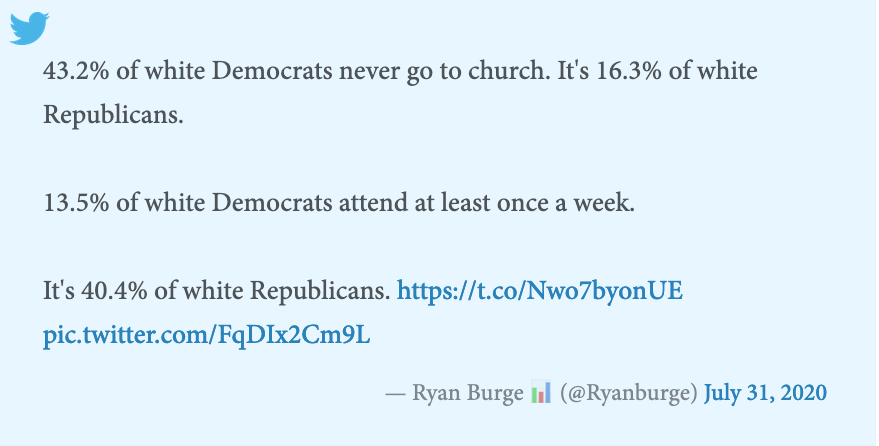
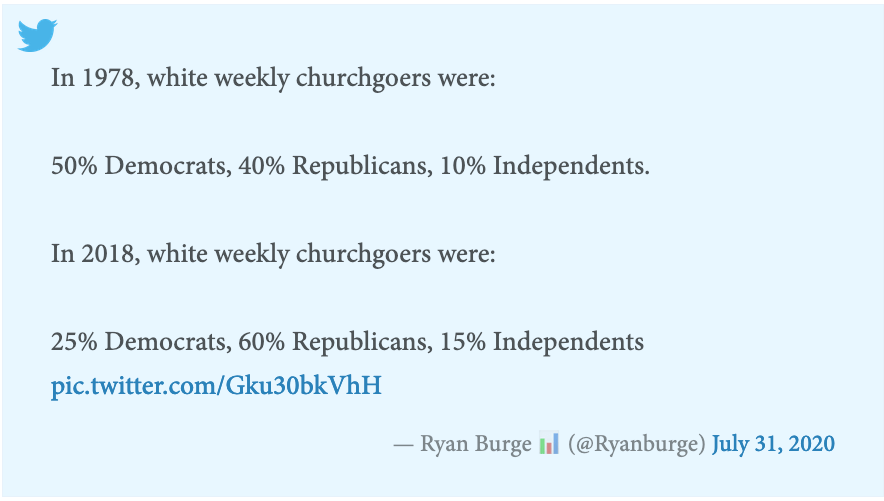
What’s wrong with this picture?

More dramatic than I imagined:

Screen Shot 2020-08-01 at 3.39.29 PM

(link) and

Screen Shot 2020-08-01 at 3.39.55 PM

(link).

Those are stunning contrasts. So why do I not feel tribal loyalty to the GOP?

A superficial answer would be that for a conservative, I rate shocking low on loyalty in Jonathan Haidt’s Moral Foundations Theory. But I’m almost positive there’s something more important than that.

First, a distinction.

Dissatisfied with my superficial reading habits, I am currently reading Mortimer Adler’s classic How to Read a Book (revised and updated 1972). Chapter 8 is titled “Coming to Terms with an Author”:

[I]n the analytical reading of a book, coming to terms is the first step beyond the outline. Unless the reader comes to terms with the author, the communication of knowledge from one to the other does not take place. For a term is the basic element of communicable knowledge.

A term is not a word–at least, not just a word without further qualifications … [A] word can have many meanings, especially an important word. If the author uses a word in one meaning, and the reader reads it in another, words have passed between them, but they have not come to terms.

Second, a story, which may be apocryphal, but I did not make it up.

A conservative returned to his alma mater for a commencement address and opened thusly:

By a strange coincidence, I am a graduate of a vastly different institution which occupied this very site 40 years ago and even bore the same name …

For some 23 years now, I’ve been an adherent of a religion called “Christianity,” based on the incarnation, life, death, resurrection, ascension and glorious second coming of Jesus Christ, who is both fully God and fully man. It was once, under the necessity of distinguishing it from a particular heresy, partially summarized in a Creed. To distinguish it from other versions, it’s called “Orthodox,” with a capital-O.

Meanwhile, my country is breathing the last few whiffs of an empty bottle labeled, by a strange coincidence, “Christianity,” which apparently is based on the intuition that God wants us to be nice and happy or, in its robust “Evangelical” versions, that Jesus Christ was very special and died a horrible death so that God would get over his anger issues with us and we could get on with being nice and happy.

Its proper name is Moralistic Therapeutic Deism. Although we share a mostly-overlapping vocabulary of words, I cannot come to terms with it, except in relatively brief and exhausting bursts of attempted empathy.

I remember from some 55 years ago an even more rigorous version, to which I then and for several more decades adhered, but it lives on today mostly notionally, in the scribblings of über-fissiparous “discernment bloggers.” I stay as far from them (and it) as I can, because I’m recovering from a mild-to-moderate case of that mindset and I’ve seen the harm it can cause, including when someone brings that mindset into Orthodox Christianity.

There were and are some other versions of “Christianity,” with some of which I have more or less come to terms, but they are not all that easily pigeon-holed politically.

So back to the question:  “why do I not feel tribal loyalty to the GOP?”

First, because it forfeited any claim to my loyalty:

In 2000 and 2004, it was Dubya. He was, we were told, a good Evangelical Christian. He cited Jesus as his favorite philosopher. He talked about America walking humbly in the foreign policy world.

Then 9-11 came, and he turned into a fierce Commander In Chief …

And then came, too, the second inaugural, when he declared as U.S. policy the eradication of tyranny from the world and the planting of democracy. If you don’t understand how delusional that is, read it again: eradicating tyranny from the world. As national policy.

(Conscientious Objector to the Culture Wars | War Correspondence ن)

Second, I have no confidence that was a blip, a lapse. In fact, the ensuing years have confirmed that endless war truly is the position of the party insiders (even though party voters chose a putatively antiwar mad, toxic and incompetent man for President in 2016).

Third, the Churches these Republicans so assiduously attend engage in worship that’s pure glucose and teach religion(s) with which I cannot come to terms sufficiently to form any kind of alliance. That Republicans are so much likelier to attend Church weekly is not all that interesting considering the Churches they attend.

I knew that 10 years ago (if not earlier, but I drove a stake in the ground then — a blog that’s held up surprisingly well) and they drove a stake though whatever remained of “Republican” in my heart on November 8, 2016.

That’s why.

* * *

Perhaps some day I’ll post a more nuanced version of why it’s difficult for a former-Evangelical, former-Calvinist, now-Orthodox, to “come to terms” with typical versions of contemporary American “Christianity.” I acknowledge painting here with a broad brush, but if there’s no glimmer of recognition, then you may to inattentive, gentle reader.

* * * * *

Put not your trust in princes,
in a son of man, in whom there is no salvation.

Psalm 146:3

* * * * *

You can read most of my more impromptu stuff at here. It should work in your RSS aggregator, like Feedly, should you want to make a habit of it.

“Because of … Sex”

I’ve tried to let go of my anxieties about things beyond my control, and I’m not doing too badly in my effort.

Part of my calm comes, ironically, from some political realism (call it fatalism if you must): my side lost the culture wars, at least for now and the near future, so there will be adverse legal and political consequences.

Those consequences likely will be worse because so many of the noisesome avatars of American Christianism have been humping Trump’s leg for 42 months, evoking disgust from normal and Left-abnormal alike.

That I wasn’t among them will give no impunity, partly because, God willing, if a knock comes in the night I’ll not say “No! Not me! I’m not that kind of Christian!” Like ’em or not, the leg-humpers are my distant spiritual kin, so to deny them in time of great peril is like denying Christ.

Another bit of calm comes from the realization that, consequences or not, for now and the near future cultural conservatives, mostly Christian, will almost certainly have it incomparably better than most Christians in the past. (This also means that “knock in the night” is pretty unlikely.)

By “past,” I do not mean “since the birth of Evangelicalism in the 18th and 19th century Great Awakenings.” I mean 2000 years of Christianity. Commemorating the Martyrs and Confessors in Matins each week has taught me that. Real believers will survive and perhaps thrive — although things could get worse than I imagaine so they’ll thrive by departing to be with Christ;  “winsome” don’t always feed the devil-dawg’s bloodlust.

But “not anxious” doesn’t mean “disinterested,” and I’m pretty keenly interested in yesterday’s Title VII  decision (hereafter “Bostock“).

“Not anxious” also doesn’t mean “oblivious” to ramifications that are going to roil the nation for a while. The ones that most get my attention are not the ramifications under Title VII, which deals with discrimination in employment in details I’m unfamiliar with, but ramifications on what sex discrimination prohibitions will mean, by exactly the same Bostock logic, in Title IX and elsewhere. Title IX, for instance, is where the “biological males in women’s locker rooms” specter arises, as not many employers have people getting naked in locker rooms, but most educational institutions do.

Nevertheless, I’m going to pretty much set aside such sequelae to focus on the decision, it’s logic, illogic, dissents and hints about the current court going forward. Sequelae may get comments when they come.

You can get a skillfully pared-down version (from 120 pages to 30) of the Bostock decision here, by the way. If you don’t at least skim it, don’t you dare make snarky remarks about any of the authors.


First observation: I see no sign of bad faith by any of the three authors. Cases don’t get to SCOTUS unless they’re difficult legally. Specifically, I repudiate demagoguery that Gorsuch was just being true to his elite class (What other class do we want on the court? Anyone who makes it onto any Federal Court is ipso facto subject to the “elitist” charge.) or sucking up to the NYT Editorial Board.

Indeed:

The decision was a remarkably clear illustration of several fault lines that persist within the conservative movement. First, there is the friction between textualism and originalism, two judicial philosophies that are often lumped together but that found themselves squarely opposed in this case.

Speaking for the textualists—those who eschew a law’s authorial intent to focus only on its explicit wording—Gorsuch’s argument was simple: Title VII forbids any and all discrimination on the basis of sex, and “an employer who fires an individual for being homosexual or transgender fires that person for traits or actions it would not have questioned in members of a different sex.” In short: If you are a business owner, and your female employees are allowed to date men, but you fire a male employee for dating a man, it’s hard to argue his sex was not a determining factor in your decision.

Speaking for the originalists—those who attempt to determine what the intent of a law was at the time it was passed—Justice Samuel Alito fervently disagreed: It was staggeringly plain, he argued, that not a single legislator who voted to codify Title VII would have considered discrimination “on the basis of sex” to include sexual orientation and gender identity. The very concepts would have been foreign to them.

That friction was nothing, however, compared with what became evident between the conservatives who praised Gorsuch’s decision as quality textualism and those who argued that it amounted to a betrayal of the whole point of getting Trump justices on the court: to get the right some policy wins.

… Tweeted Jon Schweppe of the social conservative American Principles Project: “I was told there would be winning.”

The Morning Dispatch: The Supreme Court Expands Discrimination Protections.

Left and Right seem agreed that SCOTUS is a political legislative body in disguise. Left and Right are wrong.


Commentary on the oral argument in Bostock last November:

The argument is this: If an employer would never fire Ginger for taking a romantic interest in men, but does fire George when it learns that he does so, it has treated him differently because of his sex. Similar arguments can reach the case of an employee’s gender identity.

You might call the phenomenon “surprise plain meaning”—a meaning of the text that the drafters did not intend or notice at the time. Every law student learns about this early on, as with the question of whether a “No Vehicles in the Park” rule covers bicycles, skateboards, or a statue of the general in his Jeep.

Of the five conservative Justices, Neil Gorsuch showed himself the most hospitable toward the plaintiffs’ case on Tuesday [i.e., oral arguments], and no wonder: as the most committed textualist, he’s the likeliest to see surprise plain meaning as beating legislative history.

The Supreme Court Is Not Debating Your “Humanity”. The comments on Gorsuch were prophetic, but certainly not unique.

I thought that the dissent by Justice Alito, who faulted Justice Gorsuch’s adoption of the Ginger and George logic, was quite persuasive. Take a deep breath for an argument that’s nothing like television smack-talk:

At oral argument, the attorney representing the employees, [Pam Karlan] a prominent professor of constitutional law, was asked if there would be discrimination because of sex if an employer with a blanket policy against hiring gays, lesbians, and transgender individuals implemented that policy without knowing the biological sex of any job applicants. Her candid answer was that this would “not” be sex discrimination. And she was right.

The attorney’s concession was necessary, but it is fatal to the Court’s interpretation, for if an employer discriminates against individual applicants or employees without even knowing whether they are male or female, it is impossible to argue that the employer intentionally discriminated because of sex. An employer cannot intentionally discriminate on the basis of a characteristic of which the employer has no knowledge. And if an employer does not violate Title VII by discriminating on the basis of sexual orientation or gender identity without knowing the sex of the affected individuals, there is no reason why the same employer could not lawfully implement the same policy even if it knows the sex of these individuals. If an employer takes an adverse employment action for a perfectly legitimate reason—for example, because an employee stole company property—that action is not converted into sex discrimination simply because the employer knows the employee’s sex. As explained, a disparate treatment case requires proof of intent—i.e., that the employee’s sex motivated the firing. In short, what this example shows is that discrimination because of sexual orientation or gender identity does not inherently or necessarily entail discrimination because of sex, and for that reason, the Court’s chief argument collapses….

I would paraphrase: “If an employer takes an adverse employment action for any reason that he considers legitimate in his sole discretion so long as it is not otherwise forbidden by law—that action is not converted into forbidden sex discrimination simply because the employer knows the employee’s sex.”


Legal experts who watched the arguments unfold weren’t entirely shocked that Gorsuch ruled as he did. The justice is well known as a textualist, someone who holds that the meaning of a law turns on the text alone, not the intentions of its drafters.

“What I saw in the argument [i.e., last November) was Gorsuch really struggling with the fact that the textual argument seemed really powerful to him,” Samuel Bagenstos, a University of Michigan law professor, told me. “There’s no way to think about sexual orientation discrimination without sex being part of it.”

Michelle Goldberg, Surprise! Justice on L.G.B.T. Rights From a Trump Judge


This is not a narrow ruling that just means you can’t fire a person for being gay. Extending civil rights law to protect a whole new category carries with it a host of ancillary protections.

… [T]he Bostock ruling won’t stay confined to employment law. The majority opinion protests, disingenuously, that “sex-segregated bathrooms, locker rooms, and dress codes” are “questions for future cases.” But federal law is full of prohibitions on sex discrimination (Justice Alito’s dissent lists over 100 such statutes), and every one of those will have to be reconsidered in light of today’s ruling.

Justice Gorsuch Just Opened Pandora’s Box


[L]et’s be honest: there was no leadership among the national Republicans. At least President Trump was willing to take the heat for a transgender military ban. But even he, and Republican politicians who supported him, did not articulate why they believe what they do.

If they can’t or won’t talk about these things substantively, it’s no wonder that people think it must be what Justice Anthony Kennedy once called “irrational animus.”

Again, I ask you: what, from a social conservative viewpoint, is the function of the Republican Party? Maybe:

  • to separate conservative Christians from their money and their votes
  • to dose Deplorables anxious about cultural decline with the Pill of Murti-Bing, a drug that induces a sense of happiness and blind obedience

What else?

Rod Dreher, Religious Conservatism’s Potemkin Power (emphasis added).

The problem is not just that your run-of-the-mill Congressional hack can’t talk about these things substantively, but that even the good arguments of people like Ryan T. Anderson are greeted with slack-jawed refusals of comprehension and then dismissed as lipstick on an irrational animus pig. (That this treatment is the real irrational animus is, of course, a posssibility that must not be uttered.)


Some conservative Evangelicals who work at Evangelical institutions (they told me their names and affiliations) have reached out to me tonight after reading this. Their collective view: [Bostock] is a real moment in which we can see the slow-motion collapse of conservative Evangelicalism.

Dreher, supra. Tacit admission that “Evangelical” is now a political label, not religious?


This decision hands LGBT activists the coercive machinery of civil rights law.

R. R. Reno


Interesting point about Bostock: It assumes that the original public meaning of “sex” in Title VII was “status as either male or female [as] determined by reproductive biology.”

In other words, it assumes the “gender binary” that some idiots pretend to find problematic. That assumption is not incidental, but central, though I’ve only heard one comment on it so far. From such subtle acorns mighty legal oaks may grow.

So the gender identitarians may have won a legal battle while losing a philosophical war (with future legal consequences to be determined).


Bostock‘s “textualist” (whether is is sound textualism is contested by the dissenters) decision on the meaning of “because of … sex” vindicates Phyllis Shlafly’s opposition to ERA on the basis of what the cognate “on account of sex” would come to mean.


Finally, I remember the rent garments, weeping, and gnashing of teeth among religious liberty advocates (including me) when Scalia in Employment Division v. Smith overruled Wisconsin v. Yoder (he pretended to be drawing out its real meaning, but nobody was fooled).

But it turned out that — well, let’s just say that for a couple of decades Employment Division v. Smith changed legal strategies and theories, but not many outcomes. Then Scalia’s imagination met its match in categorical bans on discrimination that cleared his “neutral law, general applicability” threshold.

Similarly, some people claim to see signs that Catholic Gorsuch has enhanced protections of religious liberty concealed in his coat pocket, ready for an appropriate case to apply them. Basically, they’re saying that he’s ready to create a judicial version of the rarely-successful “Fairness for All” legislative approach to the long struggle between sexual liberation and religious freedom.

Since the religious liberty cause has fared poorly in courts and commissions, obsessed as they seem to be with vindicating a right of sexual minoritiess to live life unaware that anyone disapproves for any reason,  I would like that more than a little.

UPDATE: Here’s David French talking, among other things, about the potential “Fairness for All” jurisprudential coup.

* * * * *

Out of the crooked timber of humanity no straight thing was ever made.

* * * * *

You can read most of my more impromptu stuff at here. It should work in your RSS aggregator, like Feedly, should you want to make a habit of it.

Glimmers of light at the end

Of course, nobody other than the Illuminati who created this fake pandemic knows what our future holds, but a couple of people have some lovely ideas that “resonate” with me:

It has been a dramatic time. We have stopped and thoughtabout our lives, and our society’s arrangements. We have applauded together, for the first time, those whose jobs kept our towns up and operating, from nurses to truckers. We’ve rethought not only what is “essential” but who is important. All this will change you as a nation.

Here is what I am certain of. We will emerge a plainer people in a plainer country, and maybe a deeper one. Something big inside us shifted.

Peggy Noonan, A Plainer People In a Plainer Time (not paywalled).

[In a sense, coronavirus] is the first invasion of America. This is the first time that a menace has crossed our borders, upended the daily lives of every American and rocked our ancient sense of safety. Welcome to life in the rest of the world.

Aside from a few protesters and a depraved president, most of us have understood we need to suspend the old individualistic American creed. In the midst of a complex epidemiological disaster, to be anti-authority is to be ignorant. In the midst of a contagion, to act as if you are self-sufficient is just selfish.

But something more profound is going on. We are undergoing a more permanent shift in national consciousness, a reconstruction of meanings, symbols, values and narratives. If the old American creed grew up in an atmosphere of assumed security and liberty, the new one is growing up in an atmosphere of vulnerability and precariousness.

David Brooks, The First Invasion of America (The New York Times)

I’m not sure whether this is Brrooks’ analysis or his prayer. It’s my prayer.

We’ve got more troubles ahead, I’m confident, and not all that far ahead as far as I can tell. Getting a little plainer and being aware of vulnerability may help us deal with that — but I’m very aware that tens of millions would like to get their piece of the American Dream first. But that will always be true until the American Dream is pretty clearly dead.

(And yes, the Illuminati crack was a joke, inspired by Atlantic’s reporting on conspiracy theories.)

* * * * *

You can read most of my more impromptu stuff at here. It should work in your RSS aggregator, like Feedly, should you want to make a habit of it.

Disillusioned

This has been rattling around my soul, inchoate. Today, it came together. It’s nothing much, but maybe others will find it helpful.

I was a single-issue voter for a while in the 80’s, but then I notice some fools and rogues checking the “Pro-Life” box, and that most Republican “Pro-Lifers” were insincere and/or utterly tone-deaf to all overtones or undertones. So I now vote pro-life, but with more discernment.

I will not vote for Donald Trump just because he checks the “Pro-Life” box (and “Religious Freedom” box), especially since all he really means is “anti-abortion” (and “suck up to Evangelicals”). Same goes for Republicans more generally.

The Trump Party has destroyed even my presumption in favor of The Thing That Used To Be The GOP.

* * * * *

You can read most of my more impromptu stuff at here. It should work in your RSS aggregator, like Feedly, should you want to make a habit of it.

The times, they are a changin’

1

The history of greed, venality, stupidity, cruelty and violence is long because that part of human nature is ineradicable. As the 20th century demonstrated, it is better to bet on a liberal society’s capacity to temper these flaws and iniquities than on a utopia’s false promise to eradicate them. Those promises end being written in blood.

… [C]ycles of history run their course. By 2008 it was clear that the world economic system was seriously skewed. Bailed out, it staggered on until now, accompanied by growing anger in Western societies.

… All the grotesque needed, to be revealed as such, was for time to stop.

Roger Cohen, No Return to the ‘Old Dispensation’. The grotesque did stop, but has it been recognized sufficiently for us to actually change entrenched behavior when some kind of normalcy is again permitted?

I loved this whole column, by the way. So sorry if you can’t get to it — I don’t know how much, if anything, a non-subscriber can see.

2

Are we inherently gullible? Research says no: Most adults have well-functioning machinery for detecting baloney, but there’s a common bug in the machine. Faced with a novel idea or new circumstances, we gravitate to information that fits our already existing beliefs. As Sherlock Holmes put the problem: “Insensibly one begins to twist facts to suit theories, instead of theories to suit facts.” This bug has always been exploited by people seeking money, power — or both. But with the rise of social media, the world’s propagandists, con artists and grifters find their search for suckers easier than ever.

Witness the grubby exercise known as “#Plandemic.” [A conspiracy theory video now banned from social media — after infecting 8 million brains.] …

People believe in a “#Plandemic” because it fits into existing convictions. A lot of people already believe — not without reason — that pharmaceutical companies cash in on suffering. Many people have heard that government labs do research on biological weapons. All true. Government has hemorrhaged credibility in recent years — even with regard to veteran public servants such as Fauci. All of these mind-sets are potential vectors for the viral #plandemic.

Americans need to understand that they are being actively targeted for disinformation campaigns by people and forces pursuing their own agendas. Conspiracy-monger Alex Jones wants to sell them overpriced nutritional supplements. Anti-vaxxers are hawking books and miracle cures. Vladimir Putin and the mandarins of Beijing are pushing the decline of the United States and the death of the Western alliance.

Some want your money. Some want your mind. Citizenship in the Internet era demands a heightened commitment to mental hygiene and skepticism. We have to learn that the information that fits neatly into our preconceptions is precisely the information we must be wary of. And even in these wild times, we must heed the late Carl Sagan, who preached that“extraordinary claims” — like grand conspiracies and healing microbes — “require extraordinary proof.”

David Von Drehle, Why people believe in a ‘plandemic’.

Take a look at the next-to-last paragraph. Someone’s missing: Steve Bannon, who pledged to “flood the zone with shit” to neutralize truth-telling about Trump.

3

Fourteen years ago, Rod Dreher introduced us to Crunchy Cons. Now his friend Tara Isablla Burton, with a degree in theology but a fairly short history of personally “faithing,” thinks Christianity Gets Weird, and wants New York Times readers to know about it.

Because of her audience, or perhaps via her editors, I find a lot of her wording and characterizations weirdly “off” and off-putting. I’m familiar with the sort of phenomenon she’s talking about, and I’d have to say that although she’s in the right ballpark, she’s not just “way out in left field” but somewhere in the bleacher seats much of the time. For instance.

  1. I would not affirm either half of “old-school forms of worship as a way of escaping” anything. “Escaping” is an unduly negative spin on something fundamentally sane.
  2. Her characterization of “mainline Protestant denominations like Episcopalianism and Lutheranism” was painted with a mighty broad brush.
  3. What is “weekly membership” (emphasis added) in reference to Roman Catholic churches with Latin Mass?

But the teaser is great:

Modern life is ugly, brutal and barren. Maybe you should try a Latin Mass.

And near the conclusion, she gives a characterization I can endorse:

Like the hipster obsession with ‘authenticity’ that marked the mid-2010s, the rise of Weird Christianity reflects America’s unfulfilled desire for, well, something real.

That “something real” is, in the best cases (and I suspect they are many), God.

Flaws aside, I welcome anyone using a prominent platform like the New York Times Magazine to shout out that “the fusion of ethnonationalism, unfettered capitalism and Republican Party politics that has come to define the modern white evangelical movement” is not the whole of American Christianity. Not even close.

UPDATE:

Rod Dreher on Sunday published the full text of Tara Isabella Burton’s interview of him. She got in a couple of well-formed, open-ended questions, and he really ran with thim. For my money, that interview is better than TIB’s NYT story, but TIB was casting the net wider than Catholic and Orthodox converts.

This, for me, was Rod’s best point in the interview:

The phrase “Christian values” has been worn as smooth as an old penny by overuse, especially in the mouths of political preachers. Look, I’m a theological, cultural, and political conservative, but I admit that it has become hard, almost impossible, to find the language to talk meaningfully about what it means to believe and act as a Christian. This is not a Trump-era thing; Walker Percy was lamenting the same thing forty years ago, at least. I think the term “Christian values” has become meaningless. It is taken as shorthand for opposing the Sexual Revolution, and all it entails — abortion, sexual permissiveness, gay marriage, and so forth. Don’t get me wrong, I believe that to be a faithful Christian does require one to oppose the Sexual Revolution, primarily because the Sexual Revolution offers a radically anti-Christian anthropology. But then, so does modernity — and this is an anti-Christian anthropology that clashes with the historic faith in all kinds of ways. I’m thinking of the way we relate to technology and to the economy.

You want to clear a room of Christians, both liberal and conservative? Tell them that giving smartphones with Internet access to their kids is one of the worst things you can do from the standpoint of living by Christian values. Oh, nobody wants to hear that! But it’s true — and it’s not true because this or that verse in the Bible says so. It’s true because of the narrative that comes embedded in that particular technology. It’s not an easy thing to explain, which is why so many Christians, both of the left and the right, think that “Christian values” means whatever their preferred political party’s preferred program is.

[Philip Rieff wrote that] “Barbarism is not some primitive technology and naive cosmologies, but a sophisticated cutting off of the inhibiting authority of the past.” This is perfectly true. This is why the dominant form of religion today is, to use sociologist Christian Smith’s phrase, “Moralistic Therapeutic Deism.” It’s crap. It’s what people believe when they want the psychological comfort of believing in God, but without having to sacrifice anything. It’s the final step before total apostasy. In another generation, America is going to be like Europe in this way.

But something might change. The problem with the phrase “Christian values” is that it reinforces the belief that Christianity is nothing more than a moral code. If that’s all Christianity is, then to hell with it. The great thing about ancient, weird, traditional Christianity is that it is a lifeline to the premodern world. It reminds us of what really exists behind this veil of modern selfishness and banality and evil.

Weird Christianity: The Rod Dreher Interview.

That’s about as deep as I’ve ever read Rod going. Good stuff.

* * * * *

You can read most of my more impromptu stuff at here. It should work in your RSS aggregator, like Feedly, should you want to make a habit of it.

I highly recommend blot.im as a crazy-easy alternative to Twitter (if you’re just looking to get your stuff “out there” and not pick fights).

Organized Chaos


L’affaire Reno

My friend Damon Linker has posted a column that denounces me as a toady for Randian libertarianism. But Linker’s reasoning (which is widespread these days) fails to recognize the distinction between killing and letting die. A woman choosing an abortion and the doctor performing it directly intend the death of the child, and they adopt lethal means to realize that intention. The same is true for euthanasia, when the doctor intends and causes the death of the ill or suffering person. As the literature in medical ethics makes clear, killing is very different from refraining from heroic interventions to save a life.

In the Catholic tradition of medical ethics, heroic efforts to save lives must meet two tests. They must have a good probability of success, and they must not be excessively burdensome. In my estimation, we have embarked on a society-wide, heroic effort that fails not just the second test, but the first as well.

At the present moment, we are compelling millions of hourly wage earners to give up their livelihoods. And we are on a trajectory that may have unknown political, social, and spiritual costs. Where will our political system end up? I’m anguished by the fear that so many feel, most unnecessarily.

This is not an argument against the present “shelter in place” policies. Perhaps they are the wisest course of action. But it is not morally serious to suggest that our present policies are obligatory—and that if one dissents, one is a moral monster.

R.R. Reno (emphasis added)

The more I read, the more I think Linker was right. Reno’s treatment of heroic efforts is shockingly superficial — mere hand-waving.


Rod Dreher, like many of my friends, has adopted the view that pro-life Christians are obligated to preserve life at any cost. This requires one to hold, as a matter of principle, that physical death is the greatest evil, since preventing death is the highest good. No ancient philosophers held such a view. Nor did the Old Testament prophets. Jesus certainly didn’t.

R.R. Reno, who has no answer for his critics and thus is reduced to lying about them.

Rod is not impeccable, but this simply wasn’t and isn’t his position.

In his own rejoinder to Reno, Dreher pointedly skewers Reno:

Look at what’s happening to New York City’s hospitals now, and try to maintain with a straight face that being told you can’t have a small dinner party amounts to the state making geldings of magazine editors. It’s just perverse.

But he still calls Reno a friend and professes fondness for contrarians.


When the facts get in the way of the narrative, print the narrative.

Alan Jacobs, criticizing, not exhorting.


Some will protest that there won’t be hundreds of thousands of deaths, and anyone who says so is a fear-monger. My hope too is that the death toll will be relatively low, but if so, it will only be because we listened to the so-called “fear-mongers” or because we got incredibly lucky. The vast majority of the epidemiological data points to a grim scenario in the absence of dramatic intervention. To be sure, models are sometimes wrong and experts are not omniscient, but we rarely hesitate to cut our beach vacations short when a major hurricane—something far less predictable than an epidemic curve—is on its way, so it’s hard to see the rational ground for blithely ignoring the threats of this other force of nature—infinitesimally smaller, perhaps, but far more deadly.

Traditionally, Christians have taught that the sixth commandment imposes on us not merely an obligation not to kill but to do whatever we reasonably can to preserve life: “The duties required in the sixth commandment are, all careful studies, and lawful endeavors, to preserve the life of ourselves and others…” (Westminster Larger Catechism, Q. 135)

Among … non-negotiables, it seems to me, should be honor and respect for the aged. Utilitarianism says that these people have the least time left to live anyway, so they are the most expendable. The Judeo-Christian heritage says that the aged are priceless repositories of wisdom, that they gave us life and wealth and left us forever in their debt, that they demand our honor and respect. They do not deserve to die alone at home or in an overflowing hospital hallway, gasping for breath.

At the root of our protest that “the cure is worse than the disease,” I suspect, is a fear that our own way of life may have to change. Comforts that we once took for granted might turn out to be luxuries. Luxuries that we once aspired to may have to be shelved for another decade or two. Freedoms that we thought were our birthright, we will be forced to realize, were in fact simply the lucky blessing of having been born at the right time. For every generation in human history before those now living, “the economy” lived in a state of constant fragility, subject to forces of nature large and small. Epidemics and quarantines were facts of life. The freedom to live under your own vine and fig tree without interference was an eschatological hope rather than a political given.

Bradford Littlejohn, “No Wealth but Life”: Moral Reasoning in a Pandemic at Mere Orthodoxy (which, be it remembered, is Reformed, not Orthodox; that’s why he cites Westminster).

I’m very glad for that last paragraph, which gives voice to something I’ve been thinking. Yeah, it’s fairly easy for me to think that way, which is part of why I hadn’t said it, but that’s no reason to dismiss it with a wave of the hand or a derisive snort.

This is the best thing I’ve read yet about some of the rash, performative “faith” or “hard-headedness” I’ve been seeing.

Those whose usurious and avaricious dealings lead to the hunger and death of their brethren in the human family indirectly commit homicide, which is imputable to them.

Unintentional killing is not morally imputable. But one is not exonerated from grave offense if, without proportionate reasons, he has acted in a way that brings about someone’s death, even without the intention to do so.

Catechism of the Catholic Church 2269, interjected by me because Reno is conspicuously Roman Catholic.


Coronavirus

Trump is not making an argument that the DPA would be counterproductive. Tonight on Hannity, Trump said that he doesn’t believe there’s a need for all those ventilators!

Rod Dreher

And Donald “No Quid Pro Quo” Trump demands a quid pro quo for saving, e.g., New Yorkers’ lives.


To be sacrilegious requires some recognition of what is actually sacred — a type of knowledge Trump has never displayed. To him, choosing Easter must have been like selecting Independence Day or Arbor Day or Groundhog Day — a useful date on which to hang a ploy.

… At a time when American cities remain on the rising side of the coronavirus infection curve, Trump is preaching recklessness and selling the idea that coronavirus pessimists are engaged in a plot against him. This is not normal partisanship. It is not normal, period. Trump is not only proposing a celebration of the Resurrection that would fill graves. He is implying that one way to “own the libs” is by further exposing the elderly to a cruel illness. He is urging his “pro-life” followers to increase their tolerance for death.

This represents a different kind of sickness — a moral sickness that took hold in Trump long ago. His immediate, selfish interest is the cause — the only cause — to which he has dedicated his life.

Michael Gerson. Gerson, a Protestant (for so I consider Anglicans), does not share a very Orthodox view of Easter, but this is mostly very solid.


I guess one of the reasons I’m so furious about Donald Trump’s bungling of the coronavirus pandemic (and it’s still bungled; many who get tested don’t get timely test results, like both Ross Douthat and Peggy Noonan) is that I first learned of the virus from Rod Dreher morre than two months ago and he had the gist of its rapid spread and mortality rates, which both bode pandemic.

Rod freakin’ Dreher, of Baton Rouge, LA. Blogger and author on social matters, not scientific. But the Trump administration couldn’t figure out that we needed to get ready?!

This is not Fauci’s faullt. It’s not the fault of our “intelligence community” in their national security work.

It’s pig-headed Donald Trump’s fault, and history will not judge him kindly.


This particular plague hits us at exactly the spots where we are weakest and exposes exactly those ills we had lazily come to tolerate. We’re already a divided nation, and the plague makes us distance from one another. We define ourselves too much by our careers, and the plague threatens to sweep them away. We’re a morally inarticulate culture, and now the fundamental moral questions apply.

In this way the plague demands that we address our problems in ways we weren’t forced to before. The plague brings forth our creativity. It’s during economic and social depressions that the great organizations of the future are spawned.

David Brooks


Eight days in I entered the living hell of attempting to find my results through websites and patient portals. I downloaded unnavigable apps, was pressed for passwords I’d not been given, followed dead-end prompts. The whole system is built to winnow out the weak, to make you stop bothering them. This is what it’s like, in a robot voice: “How to get out of the forest: There will be trees. If you aren’t rescued in three to seven days, please try screaming into the void.”

Peggy Noonan, who still doesn’t have her March 17 coronavirus test results. Her fever, though, seems to have broken after 21 days.


One reason many people are deeply skeptical of climate change is that a lot of the stuff progressives propose to fight it are things they want to do anyway. And often, the stuff they want to do in the name of fighting climate change has nothing to do with climate change. Representative Alexandria Ocasio-Cortez’s original proposal for a Green New Deal includes trillions in funding for Medicare for All but nothing for nuclear power. The former would do zilch to reduce CO2 emissions; the latter would do a lot.

During the debate over the economic-rescue package last week, House Majority Whip James Clyburn said this crisis offers a “tremendous opportunity to restructure things to fit our vision.” The House version of the bill was full of gratuitous nonessentials such as regulations for forced diversity hiring. (The bill included 32 instances of the word “diversity.”) The final version has $25 million in funding for the Kennedy Center.

If you want to persuade normal Americans to take a crisis seriously, you have a moral obligation to act as if you take it seriously, too. Using it as an opportunity to get things you couldn’t successfully argue for before the crisis tells people you’re not as serious as you expect them to be. And that is a sure-fire way to sow precisely the sort of partisan distrust you decry.

Jonah Goldberg


Mistaken identities

Katherine Stewart apparently has decided that the term “evangelical” should be usd indiscriminately, as “fundamentalist” has been used for decades. Most of the people she names in The Road to Coronavirus Hell Was Paved by Evangelicals, insofar as I recognized them or tracked them down, are dubious candidates for the Evangelical label. They’re Presbyterians, Reformed, Charismatic, Seventh Day Adventist — not unequivocally evangelical.

It’s not my fight to fight. Evangelicals can mount their own defense if and as they like. But if they say “these guys aren’t ours,” I’ll be inclined to believe them.


Max Boot angrily left the GOP during the Trump era, and it’s easy for me to understand why he did. He’s taken a lot of shots at the party since then.

But today’s column takes a counterproductive shot at “the ‘pro-life’ movement” which, in Boot’s evil eye, is too willing to sacrifice born lives to the virus to spare the economy.

There’s just one problem: few of the examples he cites are plausibly from the pro-life movement. They are conservative officials, pundits, celebrities and provocateurs:

  • Ann Coulter
  • Laura Ingraham
  • Texas Lt. Gov. Dan Patrick
  • Brit Hume
  • Dennis Prager
  • Glenn Beck
  • R.R. Reno
  • The Federalist

Of that list, I think Reno and probably Prager have been reliably pro-life, though franky I so rarely read Prager that I’m not sure.

The others have used abortion as a wedge issue, and to secure an important part of the Republican base, but they have never exhibited the seamless-web tendencies of actual movement pro-lifers.

Instead of preaching to the liberal choir, Boot should have said “Dear Movement Pro-Lifers: Look at the creeps you’ve idolized and elected. Care to reconsider your knee-jerk fealty to the GOP?”


Inessentials  & Miscellany

In Chicago, Cardinal Blase Cupich has decreed that priests may not perform emergency baptisms without permission, despite the fact that canon law gives every Catholic—even a layman—the right to baptize in case of emergency.

Because of coronavirus, my wife and I baptized our infant son with only the godparents and the clergyman present. The parish at which it would have been logical to baptize him turned us away. But another said it would accommodate us. Hand sanitizer had been placed at the entrance. We refrained from shaking the cleric’s hand. The only audience for the ceremony was a man at the far end of the church, kneeling alone in a pew. I was grateful that the church showed concern for us physically. And more grateful still that it did not abandon us spiritually.

Matthew Schmitz


We have to learn to love our crooked neighbors, with our crooked hearts. What else is there?

Rod Dreher

* * * * *

You can read most of my more impromptu stuff at here. It should work in your RSS aggregator, like Feedly, should you want to make a habit of it.

Coronavirus (and the corruption of the pro-life movement)

Clipped from my reading today, but with a common theme — or very close to one.

Through this period, people often noted that the polarization of American political life had become corrosive and unhealthy. Everyone in Washington knew this, but no matter; it became an addiction. Every issue now defaults to the same petty level.

The greatest damage has been to the Democratic Party. Here a distinction is in order. By and large, the states are being capably led in their response to the coronavirus crisis by both Democratic and Republican governors. Apparently working below the radar of the national media is the antidote to political insanity.

Daniel Henninger


Seattle NPR member station KUOW has issued a statement to explain its editorial decision to refrain from broadcasting live daily briefings hosted by President Trump and including members of the White House coronavirus task force. “After airing the White House briefings live for two weeks, a pattern of false information and exaggeration increasingly had many at KUOW questioning whether these briefings were in the best service of our mission — to create and serve a more informed public,” notes the statement, posted Wednesday afternoon. “Of even greater concern was the potential impact of false information on the health and safety of our community.”

Eric Wemple


When you are poor—and when keeping yourself, your family, and your home clean is a matter of urgency—a laundromat is not a dispensable business. I live in Pennsylvania, one of the states taking strict measures to enforce social distancing and self-quarantining. Last week, the governor’s office released a list detailing which businesses were considered “life sustaining” and which would be subject to mandatory closure. Astonishingly, laundromats were on the shutdown list, at least at first. This was yet another reminder of how the coronavirus pandemic is widening the divide between the haves and have-nots.

Bobbi Dempsey, What’s Essential Depends on How Much Money You Have


[U]ntil at least Inauguration Day of January 2021, Donald Trump is the president we have. That’s just a fact. I’m thinking now of a conversation I had earlier this year, before the crisis, with a prominent journalist who is a total Trump hater. I don’t begrudge him his anger. I share a lot of it. But what was so strange about it was how consumed this man was with his spite for Trump. It seemed like a kind of black hole that warped the man’s perception of everything else. I recalled that conversation when I read Kyle Smith’s exhortation to the media to stop baiting Trump, and making him worse than he is. Smith writes:

… As far as I know, every member of the Washington press corps, even Jim Acosta, is a resident of Planet Earth. Why are they all acting as if they’re looking down from the Nebulon-235 system and not subject to everything that is happening?

We know that the president is unusually thin-skinned and capricious, that he is keenly and perhaps unhealthily focused on what the media are saying about him at any given nanosecond, that he has a short temper and a quick fuse. He goes through cabinet secretaries like a newborn goes through diapers. And pointing out his errors is the legitimate business of CNN, NBC, ABC, MSNBC, the Washington Post, etc. But the way the media are trying to gin up a feud between Trump and Dr. Anthony Fauci is disgraceful and disgusting.

Folks, and by “folks” I mean you absolute freaking Muppets, are you trying to get Fauci fired? Do we really want to start over with a new specialist in infectious diseases in the White House? Would you be happy if Omarosa were Trump’s chief adviser on epidemiology? Would you be more secure if Jared were the last man standing during the medical briefings?

Rod Dreher, Trump’s Eggshell Minefield

Yeah. I that’s right. I’ve been screaming about how Trump’s narcissism prevents his seeing the world accurately, but hatred of him can prevent accurate perception, too. This is, frankly, a risk for me personally, and I can see it, for instance, in yesterday’s NPR email: “One of the more unsettling byproducts of the growing COVID-19 pandemic in the United States is the rampant harassment of Asians and Asian Americans.”

“Rampant.” Really? (And of course it’s all because Trump trolled the press and the libs by calling it “Chinese virus” until someone got through to him.)

Dreher:

Be clear on what Smith is saying: not “don’t report critically on Trump” but rather “don’t exploit Trump’s weakness to make things worse for all of us.” … Do they really believe that Trump is going to resign, or be removed from office between now and the election? As Smith argues, it is in the interest of all of us that Trump do the best job of which he is capable. A big part of Trump’s problem in handling this crisis is that he treats it like it’s a reality show. But so do the media, when they try to blow things up between him and Fauci.

Along the same lines, this from Clarissa, a polyglot Ukrainian immigrant academic somewhere in Illinois:

The journalists at the virus press briefings make Pence, Fauci, Brix and even Trump look like serious, competent adults trying to pacify a roomful of pouty toddlers.

“How many deaths are acceptable?” asks one journalist. The question clearly isn’t trying to elicit any information that would be valuable to the public at such a difficult moment. The whole point of the question is to get a “gotcha, Trump” moment and garner a few thousand retweets.

Almost every journalist at the briefings is only interested in building a personal brand and is completely indifferent to the task of informing the public.


When things were going relatively well, the nation could more easily absorb the costs of Trump’s psychological and moral distortions and disfigurements. But those days are behind us. The coronavirus pandemic has created the conditions that can catalyze a destructive set of responses from an individual with Trump’s characterological defects and disordered personality.

The qualities we most need in a president during this crisis are calmness, wisdom, and reassurance; a command of the facts and the ability to communicate them well; and the capacity to think about the medium and long term while carefully weighing competing options and conflicting needs. We need a leader who can persuade the public to act in ways that are difficult but necessary, who can focus like a laser beam on a problem for a sustained period of time, and who will listen to—and, when necessary, defer to—experts who know far more than he does. We need a president who can draw the nation together rather than drive it apart, who excels at the intricate work of governing, and who works well with elected officials at every level. We need a chief executive whose judgment is not just sound, but exceptional.

There are some 325 million people in America, and it’s hard to think of more than a handful who are more lacking in these qualities than Donald Trump.

… He can’t easily create another narrative, because he is often sharing the stage with scientists who will not lie on his behalf.

America will make it to the other side of this crisis, as it has after every other crisis. But the struggle will be a good deal harder, and the human cost a good deal higher, because we elected as president a man who is so damaged and so broken in so many ways.

Peter Wehner, The President is Trapped. I left out the most depressing parts.


Jonah Goldberg was on an absolute tear in yesterday’s Dispatch podcast about how horribly Donald Trump has led the coronavirus effort, particularly as regards his colleage David French’s opinion that TV really should cover the daily press briefings because if you really focus and pay attention you can get a lot of true and useful information from the people surrounding Trump, including gentle corrections of Trump’s misinformation from moments before.

On this one, I’m with Goldberg and the media who are refusing to let the President abuse free airtime for crypto-campaign speeches.

Also mentioned in passing, though it caught my ear as a former pro-life activist and one appalled by R.R. Reno’s recent blog, was Jonathan Last’s January 24 prediction that Trump would corrupt the pro-life movement. Because it was on The Bulwark, which I don’t visit regularly, I missed its excellence:

One of the ways the pro-life movement has changed people’s minds over the last 20 years is by having science on their side. Another way is that they were more than just anti-abortion.

Pro-lifers made smart, principled arguments about stem-cell research …

Pro-lifers led the opposition to euthanasia and physician-assisted suicide.

Pro-lifers are the first people to speak up for the rights of the disabled and the inherent dignity of all persons.

They spread the gospel of the seamless garment of life and that’s how they attracted new people to their cause.

The more the pro-life movement narrows its focus to nothing but abortion, the less effective it will be at changing people’s minds on abortion. … Lasting progress comes from changing the culture.

Donald Trump is a recent convert on the cause of abortion … [but] Trump is one of the rare converts who came to oppose abortion without really having much truck with ideas about inherent human dignity.

Donald Trump may be opposed to abortion—and again, that’s great—but he clearly does not believe in any consistent life ethic. Which means that he is functionally opposed to much of the pro-life movement’s beliefs.

Should the pro-life movement be welcoming Trump at the March for Life? I don’t know. I’m not the boss of them.

But I would note that it is not uncommon for conservatives to dismiss entire causes or ideologies because of the presence of a bad actor. For instance, you may recall conservatives dismissing the Women’s March in 2017 because of the involvement of Linda Sarsour and Tamika Mallory.

Why would outside observers not take the same attitude about the March for Life because of Trump?

Trumpism has corrupted every ideology and institution it has come into contact with. There is no reason to think that the pro-life movement will be excepted.

This is even better than Damon Linker’s column that same day (Trump’s scheduled appearance at the March for Life prompted both of them). Last more than Linker puts his finger on what I think was bothering me about Trump’s appearance, though I didn’t take time to sort through my thoughts and distill them (so far as I can recall).

The irony is that even before we could gauge how Trump’s appearance had hardened pro-abortion people in their position, and pushed fence-straddlers over to the pro-abortion side, Trump got supporters like Reno to take positions that undermine the principle of the sanctity of all human life.

Truly, Trumpism corrupts everything it touches.


There is, by the way, literally a playbook for pandemics, but Donald Trump wouldn’t follow it.

* * * * *

Secularism, I submit, is above all a negation of worship. I stress:—not of God’s existence, not of some kind of transcendence and therefore of some kind of religion. If secularism in theological terms is a heresy, it is primarily a heresy about man. It is the negation of man as a worshiping being, as homo adorans: the one for whom worship is the essential act which both “posits” his humanity and fulfills it.

Alexander Schmemann, For the Life of the World, Appendix 1

[O]nce you say you are ashamed,
reading the page they hold out to you,
then such light as you have made
in your history will leave you.
They will no longer need to pursue you.
You will pursue them, begging forgiveness,
And they will not forgive you.
There is no power against them.
It is only candor that is aloof from them,
only an inward clarity, unashamed,
that they cannot reach ….

Wendell Berry, Do Not Be Ashamed

You can read most of my more impromptu stuff at here. It should work in your RSS aggregator, like Feedly, should you want to make a habit of it.

Trade-offs of pluralism

I’m still bereft of worthy, fresh ideas for blogging since blogging for me is part of an iterative search for truth and I don’t have a good enough handle on coronavirus to say a whole lot confidently and truthily.

Except maybe this: If you think the coronavirus is a hoax and not very serious, pull your head out of those nether-regions where the sun don’t shine (i.e., shut off Limbaugh, Hannity and their ilk), get a few basic facts, and think about how many Chinese, Italian and Spanish people died, how many international organizations sounded alarms, in this elaborate hoax to dethrone King Donald. Does that sound plausible?

Lacking something fresh, I found another incomplete draft, from September 9, took it and dusted it off. Enjoy!

* * *

Sohrab Ahmari and David French finally faced off live at Catholic University of America Thursday evening [September 5?], moderated by Ross Douthat.

In debating terms, it was no contest: French cleaned up. In fairness to Ahmari, his wife had a child on Wednesday, so he had things on his mind more important than a mere livestreamed national debate of sorts.

But again and again, French, in good Evangelical style, spoke of the freedom to preach the Gospel in a content-neutral public square, to lead drag queens to Jesus, and such. That’s pretty consistent with the forward-facing values of ADF, the Evangelical-leaning public-interest law firm for or with whom he formerly worked.

It started to sound as obsessive as Ahmari’s concern over Drag Queen Story Hour. So I was glad to see Jake Meador at Mere Orthodoxy argue for something a bit thicker than mere neutrality:

For most of the … campus ministries at Nebraska, …universities were convenient social institutions because they rounded up a large number of demographically similar young people into a single place where they would have broadly identical routines, all of which made it very easy to evangelize them. Many of these groups did not think anything of taking their students away from campus regularly on retreats, heavily programming their weeks (thereby cutting into their time to give to their studies), and even sometimes suggesting that their academic work was of mostly incidental importance. The real life happened in Bible studies and when you prayed and over coffee with your discipler or disciplee. College, much like one’s eventual career, was mostly a necessary evil that simply secured material goods for you.

While watching the French-Ahmari debate last night it occurred to me that French seems to have a fairly similar vision of the nation—it’s an incidental good that is useful for advancing certain strictly material goods but it pales in significance when set next to the work of the church …

The point is not necessarily that French should endorse some species of integralism, although it is worth noting that in his handling of rights and the nature of religious doctrine as it relates to public life French is far closer to the Baptists than he is the traditional views of the reformed tradition to which he belongs. But that point aside, French could preserve many of the rights he cares about preserving while anchoring his account of the political in something more real than the pragmatic adjudication of disputes within a pluralistic society.

… That the government could be something more than a mere arbiter who threatens to hit you in the head with a brick if you don’t play nicely with your neighbor seems to be unimaginable ….

There’s much more Jake wrote, but you can go read it yourself readily enough.

By lifelong mental habit and eventual initiation into the solemn mysteries of “thinking like a lawyer,” I don’t suppose I’ll ever be able to leave the camp of classical procedural liberalism, but the Ahmaris and Meadors of the world at least drive home that there are trade-offs in our pluralistic experiment.

One of the trade-offs is the risky one of declaring, a priori, that we must never agree on just what is the “common good” because we know that there’s no such thing as human nature, just humans with various and sundry natures, each, probably, as unique as a snowflake. I disagree with both dogmas, but for the foreseeable future, I’m a loser. It will take some undeniable anthropological catastrophe, the equivalent of COVID-19, to turn those tables.

* * * * *

[O]nce you say you are ashamed,
reading the page they hold out to you,
then such light as you have made
in your history will leave you.
They will no longer need to pursue you.
You will pursue them, begging forgiveness,
And they will not forgive you.
There is no power against them.
It is only candor that is aloof from them,
only an inward clarity, unashamed,
that they cannot reach ….

Wendell Berry, Do Not Be Ashamed

* * * * *

You can read most of my more impromptu stuff at here. It should work in your RSS aggregator, like Feedly, should you want to make a habit of it.

I highly recommend blot.im as a crazy-easy alternative to Twitter (if you’re just looking to get your stuff “out there” and not pick fights).

Anytown Ecumenical High

It’s been a while since I blogged, but I found an old draft, never completed, and dusted it off.

Back in my Calvinist days, and when I had a child of school-age, I thought how wonderful it would be for there to be an ecumenical Christian high school in town as we had some hesitancy about sending our son to a Catholic High School (particularly since the local Catholic High School had a reputation for binge drinking with parental connivance).

Even apart from the existence of that Catholic High School, I had no idea how impossible or unacceptably minimalist the Christian standards of such a high school would be if it attempted to take in every Christian tradition (with or without Roman Catholicism). Even excluding merely cultural Christians, there’s not much in common.

Here’s a playful stab at the statement of beliefs:

  1. Human life began better than it is now. Human disobedience is what made things worse. Go ask your respective clergy whether “better” and “worse” are predominately moral, mortal, ontological or something else.
  2. There followed maybe four millennia, maybe more. A people called Jews emerged and were called God’s chosen people. Go ask your respective clergy what continuing relevance they have, if any, to the Christian story.
  3. There was a man, who also was God, named Jesus, who came from the Jews to fix our problem. Go ask your respective clergy how His coming had something to do with saving us from our problem.
  4. Jesus’ mother was a virgin. Go ask your respective clergy whether she remained a virgin or whether that would be creepy and subversive of the sexiness we so dearly love.
  5. Without having sinned or committed any capital offense, Jesus nevertheless was crucified some 2000 years ago. We all agree that this was very important, but we can’t entirely agree why. Go ask your respective clergy what Jesus’ crucifixion has to do with saving us from our problem.
  6. Early Sunday after His Crucifixion, this Jesus came back to life, not just a little but totally.We all agree that this was very important. It foreshadows that we won’t stay dead forever, at least if we’re Christians. Go ask your respective clergy whether, beyond that foreshadowing, that just proved Jesus really was God or whether it had something more to do with saving us from our problem.
  7. 40 days later, Jesus left us in something called Ascension in churches that care about things like that. Go ask your respective clergy whether that’s important in saving us from our problem. Extra credit: Ask your clergy why you don’t commemorate it if it’s important but you don’t commemorate it.
  8. After he went away, somebody sent something or someone called the Holy Spirit. Go ask your respective clergy whether it was God the Father from whom He/it proceeded or whether it was from both from the Father and the Son.
  9. While we’re on this Father and Son and Holy Spirit business, go ask your respective clergy to explain the Trinity to you. Watch this video first and you can have fun playing “Name That Heresy” with most clergy.
  10. After that the Church grew. Go ask your respective clergy whether it grew on the basis of the Old Testament, the teaching of the Apostles (written and oral), the guidance of the Holy Spirit, the New Testament  that hadn’t been written yet, none of the above, all of the above, or what?
  11. The early Church worshiped rather formally as did the Jews of the Synagogue. Or they sat around on the floor, strumming harps and spontaneously bursting into choruses like Kum-Ba-Ya or “Our God is an Awesome God” in Aeolian mode and Aramaic language. Go ask your respective clergy how the early church worshiped.
  12. The Church had and has somewhere between one and seven or more ordinances, sacraments, mysteries, or whatever you call them. Go ask your respective clergy how many, what you call them, why that particular number.
  13. The Church soon had or didn’t have Bishops and a structure that extended beyond individual congregations. Go ask your respective clergy how the early Church was governed.
  14. One becomes a “Christian” (an encomium) by asking Jesus into his or her heart. Or one becomes a “Christian” (a fact that has little or nothing to do with being nice and middle class or even acting like a Christian) by baptism. Yeah, go ask your Clergy. Sheesh!
  15. Around the time of Emperor Constantine in the 4th Century, God dropped the ball, the Church got seduced by secular power, and nothing more good happened until Martin Luther. Or there were always true Christians, who basically were Baptists, but history and fake Christians have suppressed that fact. Or the Church was one and not corrupt until the Bishop of Rome started putting on airs and eventually tore the Church. Or the Church was one and not corrupt until the other four Patriarchs decided to rebel against the Pope in Rome, who everybody knew was the penultimate boss of the whole Church (second only to Christ, whose vicar the Pope was), and thus those rebellious Patriarchs eventually tore the Church. Or something. Go ask your respective clergy.
  16. Someday, Jesus is coming back one or more times. Go ask your respective clergy why He’s coming back and whether He’s coming back once, twice, or multiple times, and whether any of those will be a secret (except for the tantalizingly suspicious disappearance of every Fundamental, King-James-Bible-Believing Baptist in the world).

I think you’ve got the idea by now. And I haven’t even touched on what the school’s sports teams pious nickname would be, whether and what Christian symbols would be allowed, or other thorny issues.

Jesus’ desire that we all may be one is not faring all that well. Go ask your pastor how it can possibly be God’s will that His Church fall into such cacophony.

Or maybe the Church is faring just fine, but “we” is narrower than everybody who says “Jesus” with a little fervor.

* * * * *

“In learning as in traveling and, of course, in lovemaking, all the charm lies in not coming too quickly to the point, but in meandering around for a while.” (Eva Brann)

Some succinct standing advice on recurring themes.