This is the 50th anniversary of one of the times I quit smoking. The last time I quit was maybe 7 to 9 years later (of that time, I lost track) – long enough ago that, as I understand it, my history of smoking is no longer medically relevant. Some of my medical records even say, incorrigibly as history but perhaps accurately as a medical term of art, “never smoked.”
The cultural shift against smoking in my lifetime has been remarkable.
Punked
[Poet Rolfe] Humphries may be best known, these days for a literary joke. He had received an assignment from Poetry magazine for a “Draft Ode for a Phi Beta Kappa Occasion,” in which, the editors asked, there needed to be one classical reference per line. Humphries sent in the requested poem, which appeared in the June 1939 issue, and began: “Niobe’s daughters yearn to the womb again, / Ionians bright and fair, to the chill stone.”
But the poet nursed a hated of Nicholas Murray Butler, the long-time president of Columbia University (who, it must be said, had no editorial role at the Chicago-based Poetry magazine), and so Humphries built the poem as an acrostic, the initial letters of each line spelling out “Nicholas Murray Butler is a horses ass.”
“Not being accustomed to hold manuscripts up to the mirror or to test them for cryptograms, the editors recently accepted and printed a poem containing a concealed scurrilous phrase aimed at a well-known person,” the magazine apologized later that summer, and I have to say that while I appreciate snide poetry, my sympathies are with the editors who got used in the incident.
Joseph Bottum, commenting on the poet and his poem A Song for Mardi Gras.
Perspective
When it’s the most powerful nation on earth conducting a decades-long campaign of retaliative obliteration against multiple countries (one of which had precisely nothing to do with the inciting incident), leaving upward of a million civilians dead, revenge becomes a temporarily useful virtue. When it’s a herder on the other side of the planet burning an American flag after a drone operator in an Idaho strip mall mistook his children for terrorists, revenge becomes grotesque, the irredeemable realm of savages.
A New Version of Woke Is Coming. Conservatives Aren’t Going to Like It.
Why a Floppy-Haired 27-Year-Old Olympic Skier Is Making Conservatives So Very, Very Angry
Conservatives Are Terrified That People Like Me Are Buying Guns Now.
Do you see the theme there?
… In the current era, when right-wing rhetoric amounts to very little more than sneering and bullying—“liberal tears,” “cry more,” etc.—it should be no surprise to see our friends on the left arguing that if x discomfits or hurts conservatives, then x must be good, which is the subtext of those Slate headlines. But I do not think that this sort of thing is really a reaction to the Trumpist style, inasmuch as it precedes the emergence of that style as the dominant form of expression on the right. “Your uptight Christian parents are going to hate this!” is a very, very old marketing ploy, one part “Banned in Boston!” and one part “Republicans pounce!” Incidentally, I spent a lot of time with right-wing gun nuts, and I have yet to meet one who is upset that nice suburban liberals are buying firearms—and the Slate report has not convinced me that these fearful conservatives actually exist beyond the anecdotal level.
I graduated from Chicago in 1983, and at about the same time a group of people graduated from Dartmouth. We all moved to Washington about the same time. I knew them, and some of them have become famous, like Laura Ingraham and Dinesh D’Souza. I didn’t appreciate it at the time, but I came out of Chicago earnestly reading Edmund Burke and Adam Smith and all that, and my friends and I became pro-conservative. But the Dartmouth Review folks were not pro-conservative, they were anti-left. So in retrospect, I can see how big and vast a difference there was between people that I thought were part of the same movement. The sad news is that they now dominate conservatism and the Republican Party. Whereas my friends became Never Trumpers.
I spent most of my adult life thinking ill of [Jesse] Jackson, probably because of his infamous “Hymietown” remark in the 1984 presidential race … Then, about seven years ago, I met him for breakfast in New York. The man I spent an hour with was gracious, reflective, engaged, knowledgeable and more than a touch sad, probably because he was aware of his Parkinson’s diagnosis. It reminded me that people are never the caricature that others make of them, and that there can be a lot to like and learn from people with whom we often disagree.
It is not easy being transgressive in an era when there are few norms remaining to transgress. Undaunted, he tries. (George Will of VP JD Vance)
After cancer, I feel like a connection to God, whatever that is, is kind of the whole point of this exercise on this planet. (James Van Der Beek)
Attention without feeling is only a report. (Poet Mary Oliver)
I’m at peace, and I’m excited, but my Oura Ring will tell you I’m not sleeping well. (David Brooks on his departure from the New York Times to take an interesting new position at Yale.)
The problem is that he overreacts. It’s like going to a doctor with acne and the doctor says, “You know what will fix acne? Decapitation.” That’s Trump. What he’s doing with scientific research is horrific. (David Brooks again.)
The problem with socialism is that eventually you run out of other people’s money. (Margaret Thatcher via Bret Stephens)
President Trump — who’d dip himself in gold if he were confident that it wouldn’t seal his mouth shut and prevent him from yammering. (Frank Bruni)
Someone who had been a Catholic longer than five minutes would perhaps grasp the irony of claiming a minority group had dual loyalty. (Sarah Stewart on the antisemitism of Carol Prejean Boller, washed-up beauty queen, “influencer,” and recent Catholic convert.)
My job is to turn out students who are acceptable at a dance, invaluable at a shipwreck. (A headmaster at the Stowe School, quoted by David Brooks.)
Vigilence is metabolically expensive. (Lisa Feldman Barrett)
I don’t do any of the major social media, but I have two sub-domains of the domain you’re currently reading: (a) You can read most of my reflexive stuff, especially political here. (b) I also post some things on my favorite no-algorithm social medium.
If you’re a reader of Tolkien’s Lord of the Rings (or just a movie-goer), then you know that the central, heroic character, the young Mr. Frodo, ring-bearer, fails to throw the Ring into the fires of Mt. Doom at the end of his arduous journey. Everything he loved, his home, his friends, every scrap of goodness, depended on the Ring being tossed into those fires, and, when it came down to it, he was unable to let it go. Fortunately for Middle Earth, the wraith-like, pitiable creature, Gollum, bit Frodo’s finger off in order to have the Ring again for his own, and accidentally slipped and fell into the fires, saving Middle Earth in the bargain. All of that drama resolved by an accident?
Imagine a culinary school that teaches its students how to use HelloFresh: “Sure, we could teach you how to cook from scratch the way we used to — how to shop for ingredients, how to combine them, how to prepare them, how to present them — but let’s be serious, resources like HelloFresh aren’t going away, so you just need to learn to use them properly.” The proper response from students would be: “Why should we pay you for that? We can do that on our own.”
If I decided to teach my students how to use ChatGPT appropriately, and one of them asked me why they should pay me for that, I don’t think I would have a good answer. But if they asked me why I insist that they not use ChatGPT in reading and writing for me, I do have a response: I want you to learn how to read carefully, to sift and consider what you’ve read, to formulate and then give structure your ideas, to discern whom to think with, and finally to present your thoughts in a clear and cogent way. And I want you to learn to do all these things because they make you more free — the arts we study are liberal, that is to say liberating, arts.
If you take up this challenge you will learn not to “think for yourself” but to think in the company of well-chosen companions, and not to have your thoughts dictated to you by the transnational entity some call surveillance capitalism, which sees you as a resource to exploit and could care less if your personal integrity and independence are destroyed. The technocratic world to which I would be handing you over, if I were to encourage the use of ChatGPT, is driven by the “occupational psychosis” of sociopathy. And I don’t want you to be owned and operated by those Powers.
If out of the crooked timber of humanity no straight thing was ever made, then if a thing is made straight it will be because humanity has been stripped out of it.
L.M. Sacasas, Embrace Your Crookedness. This is a very worthwhile reflection on the human condition.
Don’t assume that “they” will be stripping humanity. Some people strip their own humanity. Rebecca West (Black Lamb and Grey Falcon) embeds the story of one who did so:
So with his money he could follow his mania, which was for the new thing, for Science, for the machine, for the artificial, the modern. You may not remember it, for I think it came earlier with you than with us, but there was some time ago a rage for such things. It was partly due to your H. G. Wells and his imitators, and it was partly due to our ideas about America, which we then believed to be entirely covered with sky-scrapers and factories.
…
I went on so, telling more and more absurd stories, until I said, “And of course I was forgetting, there is the artificial woman that was invented by the celebrated surgeon Dr. Martel. That is quite wonderful.” And my old friend said to me, “An artificial woman? What is that? A woman that is artificial! For God’s sake! Tell us all about it!”
…
I saw that she was getting very fond of me, like a mother for her son, and I grieved, for I did not like to have brought this sorrow to her by [the silly joke on her husband about the artificial woman]. I felt very ashamed when she came to see me at a time when the cold wind had made me bad with my lungs, and it was as if I should go like my sister, who had died when she was sixteen, and I said to her, “Aunt, you are too good to me. I have done nothing for you,” and she answered with tears in her eyes, “But you have been as good to me as a son. Do you think I am so simple that I do not know the artificial woman must long ago be finished, with such a clever man as you say working on it? You tell my husband that it is not so only because you know that I could not bear to have such a creature in my house.” There was nothing at all that I could say. I could not confess to her that I had been a monkey without making it plain to her that her husband had been an ass.
…
It came to this poor silly old man and he learned that the most modern thing to do was to kill yourself, and so he did it. He became very melancholy for a time, working at it as other old men work at learning chess, and then went into his stable and hanged himself, to be modern, to have an artificial death instead of a natural. I think he was probably sure that there was immortality, for though he believed he was a freethinker I do not believe it ever crossed his mind that he would not live after death. And soon after his wife also hanged herself, but I do not think there was anything modern about her reasons, they could not have been more ancient.
Whence our delight at athletes?
Gladwell, like many of us, seems to have unwittingly internalized the idea that when professional athletes do the thing they’re paid to do, they’re not acting according to the workaday necessity (like the rest of us) but rather are expressing with grace and energy their inmost competitive instincts, and doing so in a way that gives them delight. We need to believe that because much of our delight in watching them derives from our belief in their delight.
[I]f the right has overcorrected to an old-fashioned (and somewhat hostile) vision of masculinity, many progressives have ignored the opportunity to sell men on a better vision of what they can be. … To the extent that any vision of “nontoxic” masculinity is proposed, it ends up sounding more like stereotypical femininity than anything else: Guys should learn to be more sensitive, quiet and socially apt, seemingly overnight. It’s the equivalent of “learn to code!” as a solution for those struggling to adjust to a new economy: simultaneously hectoring, dismissive and jejune.
My cyberfriend Patrick Rhone shares a worthy comment on Sinead O’Connor: some Kris Kristofersson song lyrics in her honor after she was booed off a stage.
Musicians are sometimes prophets, and prophets often get stoned.
Political
Muslim discomfort with Democrat extremists
Asma Uddin, in her book “When Islam Is Not a Religion,” describes “a tacit agreement that Muslims, as religious believers, will never challenge any of the rights championed by the Left, such as a progressive vision of gender or sexual equality.” Muslims became an integral part of the party not as a faith community with distinct theological commitments but as a “marginalized” group requiring protection from Republican bigotry.
…
But during the Trump years, the Democratic Party veered sharply to the left on social and cultural issues. The Republican Party lost interest in Muslims, with Mr. Trump neglecting to antagonize them during his 2020 re-election bid. The new enemy was “wokeness,” and a growing number of Muslims found themselves on the GOP side of that divide. According to the AP VoteCast Survey, as many as 35% of Muslims voted for Mr. Trump in 2020, compared with 8% to 13% in 2016.
…
It’s easy enough for the left to dismiss white evangelical Trump supporters. But when the party does the same to Muslims, who for years had been loyal Democrats, it demonstrates its disrespect for actual cultural diversity.
When writers at The Bulwark or The Dispatch, or the presidential campaigns of Asa Hutchinson, Chris Christie, and Will Hurd, criticize Trump, they highlight (at least in part) his breaks from longstanding norms, traditions, and expectations of elected officials. Trump shouldn’t have lied about the results of the 2020 election. He shouldn’t have provoked an insurrection and haplessly sought to foment a self-coup to remain in power after losing the vote. He shouldn’t have disregarded laws restricting access to classified documents. And so forth. Those are the kinds of objections one would expect to hear from conservatives.
But DeSantis has nothing critical to say about any of the above. When he goes after Trump, it’s for his failure to break more radically from longstanding norms, traditions, and expectation. Trump was too willing to defer to public-health officials during the COVID-19 pandemic, too quick to believe vaccines could protect people from becoming ill, too inclined to seek support from LGBT voters, too moderate on abortion, too cautious in dealing with the administrative state. In all of these ways, Trump was too conservative. He maintained too many continuities with the past. He should have broken more fully with it in favor of an alternative future that would be more congenial to the right.
I don’t want Joe Biden to be President for four more years. I’d gladly vote for most conservative alternatives to him — if there were any. Trump is a reactionary and populist (as well as a narcissist and/or a fine illustration of “oppositional defiant disorder”); DeSantis is trying to outdo him on both counts. And I don’t intend to pull punches about that sad reality.
“Spreading democracy”
My nation pretends it’s spreading democracy, and I’ve never (within ready memory) believed that.
Democratization conflicts with Westernization, and democracy is inherently a parochializing not a cosmopolitanizing process. Politicians in non-Western societies do not win elections by demonstrating how Western they are. Electoral competition instead stimulates them to fashion what they believe will be the most popular appeals, and those are usually ethnic, nationalist, and religious in character.
On twitter Stephen Wolfe, author of “The Case for Christian Nationalism,” claimed he didn’t know who Emmett Till was until he recently googled his name. He then commented: “Yea I’m supposed to care about some 1955 event that all the libs care about. Their minds are captured.”
…
Stephen Wolfe’s book The Case for Christian Nationalism extolls a fantasy Calvinist confessional state in which the elect rule over the lost and reprobate. God’s reputed people have the power, and the people less favored are their subjects, living under their rules. Its vision of power over service isn’t very Christian. And its subjugation of some people over others based on their religion isn’t very nationalist. It certainly isn’t at all American.
But disdaining Emmett Till’s murder, and the civil rights revolution it helped unleash, as part of the wider ongoing, 2000-year-old Christian revolution of equality and dignity for all, is helpfully clarifying.
I can’t think of anyone I consider actually Christian who advocates “Christian Nationalism.” Maybe I need to get out more. Maybe some Christians involuntarily drawn to the notion have conscience-pangs and reservations so they don’t talk about it.
One of the reasons why I oppose “Christian Nationalism” in the USA is that notionally-Christian barbarians would almost certainly grab the reins of power, and there’s nobody more remorseless than someone who thinks he has a mandate from heaven to rule righteously.
Tough love
Congratulations to Colombian President Gustavo Petro, who over the weekend set a standard for good governance to which political leaders throughout the Americas can aspire.
“I wish him luck and strength,” he tweeted after his son Nicolás was hit with charges related to money laundering and drug trafficking. “May these events strengthen his character and let him reflect on his own errors.”
The reason most public transportation is seen as ‘losing’ money is precisely because it charges for trips. If you don’t charge fares, suddenly it can’t ‘lose’ money. It just costs money, the same as the roads. @dx@social.ridetrans.it
Via DenseDiscovery. I confess that I had to read that twice to see the brilliance.
Unwelcome contrast
I myself am a secret monarchist, as were my relatives in Rhode Island and Connecticut in 1775 except they weren’t secret about it. I miss Elizabeth II, the perfect modest model of a modern English monarch, tramping in the rain with her corgis. When Her Majesty met President Schlump and he opened his big yap and hee-hawed at her, we saw a contrast that was not favorable to our side.
The end of the world as we know it is not the end of the world.
You can read most of my more impromptu stuff here (cathartic venting) and here (the only social medium I frequent, because people there are quirky, pleasant and real). Both should work in your RSS aggregator, like Feedly or Reeder, should you want to make a habit of it. I’m even playing around a bit here, but uncertain whether I’ll persist.
What we are experiencing isn’t truly thankfulness, but only something like delight over good fortune. In this case, I wonder why we even call it thankfulness. Perhaps we should be celebrating a Gee We’ve Been Lucky Day, or, if times have been hard, maybe an It Could Have Been Worse Day. If a shorter name is needed, we could call it Okayness Day. I guess it would be something like Happy Hour.
J Budziszewski, wrested from context (i.e., this is not his position)
Mike [Gerson] was appalled at those who disfigured Jesus and used their faith for the purposes of dehumanization. It is one of the reasons why he was so thankful to publish an extraordinary essay in the Post before his death, lamenting Christians whose view of politics “is closer to ‘Game of Thrones’ than to the Beatitudes.”
…
Very few people knew the full scope of the health challenges Mike faced. He suffered a heart attack in 2004, when he was 40. Kidney cancer in 2013. Debilitating leg pain, probably the result of surgical nerve damage. The kidney cancer spread to his lungs. Then Parkinson’s disease and metastatic adrenal cancer. And finally, metastatic bone cancer in multiple locations, intensely painful. At one point he told me he was on 20 different medications. Mike and I joked that of all the figures in the Bible he could model himself after, he chose Job.
I am among those who had no idea of Gerson’s health problems. I admired his opinion pieces, but not quite enough to keep my Washington Post digital subscription.
Buying off the bloodhounds
[Y]ou don’t have to have a granular understanding of blockchain to understand [Sam Bankman-Fried] was a fraud. I think there are a lot of reasons he got away with it for as long as he did. Buying political cover from politicians with donations (Bankman-Fried was the Dems’ second biggest donor in the last cycle) and purchasing political cover from the media with woke gobbledygook about philanthropy is not a bad strategy. Also, hiding your malfeasance in the squid ink of technical jargon few people understand is pretty savvy as well.
But I think he had something else going for him. Democrats and the left love having billionaires in their corner. It’s a great way to blunt charges of “Marxism” and whatnot, and it’s also a fun way to advance the argument that there’s no real tension between progressive policies and profit. Having token billionaires is even better when those billionaires seem like they’ve broken the old paradigms of heavy industry and are on the cutting edge of innovation. Having dinosaurs who made their money the old-fashioned way—especially the ones who made their money from liquified dinosaurs—can trigger psychological or ideological second thoughts. Peddling ones-and-zeros just sounds so cutting edge.
One lesson from this is that new ideas and new technologies—not to mention getting rich off them—can blind you to the importance of due diligence. Say what you will about old-fashioned accountants and lawyers from prestigious firms—they at least have a vested interest in protecting their reputations and brands. Thinking that the rules of the past don’t apply to you is a great way to give yourself permission to break rules that definitely do apply to you.
My least-favorite series in the New York Times travel section is “36 Hours in [major city].” I would not enjoy dashing around and bar-hopping at night as they invariably describe.
Let me settle into a city for a bit, and give me time to catch my breath without liquor.
Is Orbán a Cosplayer?
There has always been a whiff of the fake about Mr. Orbán’s war on Brussels. That he never proposed the obvious solution to this impasse—Hungary’s exit from the European Union—exposed the limit of his gamesmanship. More fool the American conservatives who didn’t notice this sooner.
I don’t fully agree with Sternberg, but I welcome his pushback against Orbán if only because it doesn’t follow the usual script of name-calling and “everybody knows.”
Epistemic humility
Appealing to a higher, theological standard of judgment above politics can, in theory, act as a moderating influence that inspires humility, restraint, and even wisdom. But it often does the opposite—inspiring imprudent acts and judgments …
Of course, the religiously devout aren’t the only people who are prone to act in a way that fails to exemplify the spirit of liberality or civic generosity …
Liberalism is better off when these tendencies are tamed. The best way to accomplish that goal is to rely on civic education that instills lessons in epistemic humility and mutual respect for fellow citizens. But of course, such education will only receive political support if our fellow Americans already want to produce humble and respectful citizens in the first place.
I have a nit-picky disagreement with Linker. I doubt that we can maintain liberalism at all without the epistemic humility he commends, not just that “liberalism is better off when these tendencies are tamed.” Indeed, liberalism almost seems definitionally a polity of epistemic humility, a recognition that the other guy just might be right, and therefore can be worth close attention.
Florida Man and the Pro-life cause
The ethos of the Trumpist-dominated G.O.P. is fundamentally incompatible with the ethos of a healthy pro-life movement. The reason is simple: Trumpism is centered around animosity. The pro-life movement has to be centered around love, including love for its most bitter political opponents.
[W]e need to replace fanciful dreams of endless energy from renewables with full-cost accounting, which an increasing number of experts are taking seriously. There are destructive environmental and social consequences to constructing the infrastructure for that energy production.
That’s the right strategy if you’re a conservative whose goal is to maximize the GOP’s chances of nominating a superior candidate, but it’s eye-roll material if you’re an ambitious Republican politician who looks in the mirror and sees a president staring back.
…
That’s a great irony of the next cycle, incidentally. As selfish as Trump is in routinely placing his own interests above the GOP’s, the Chris Christies and Nikki Haleys who’ll end up piling into the 2024 field and splintering the anti-Trump vote will be guilty of having done the same.
Yet the gains here are not negligible, either, and what is lost is—well, the answer to that depends on how realistic it is to think that Obergefell will be overturned within the next 10 years.
Matthew Lee Anderson, regarding the Respect for Marriage Act, quoted at The Dispatch (italics added)
I don’t think there’s a significant chance that Obergefell gets overruled for a long time. (Eventually, it probably will be overruled because it’s contrary to the nature of marriage and came about through an ideological mania. We’ll come to our senses eventually.) So, we (those concerned to preserve religious liberty) are getting something for essentially nothing.
Sounds like a presumptively good deal. Tell me how I’m wrong.
David French endorses RFMA, and has caught a lot of crap for it. Even Kristen Waggoner has misrepresented RFMA, but she’s now head of ADF, which may explain her factual flexibility.
Have I mentioned lately that my pen always totally dries up if I think of writing a check to ADF, but always works just fine for checks to Becket Fund?
[S]ubordinating truth to politics is a game which tyrants and bullies always win.
You can read most of my more impromptu stuff here (cathartic venting) and here (the only social medium I frequent, because people there are quirky, pleasant and real). Both should work in your RSS aggregator, like Feedly or Reeder, should you want to make a habit of it.
William Jon Gray, undoubtedly the best Choral Conductor I ever sang under, has died at his home in New York state at age 66. I have the impression (from someone saying “You sung under him?!”) that he was widely known in American choral music circles.
That’s all I know about his death at this point, the news having just come to me Thursday through the (reliable) grapevine.
Bill was Artistic Director of the Bach Chorale Singers from 1994 to 2010. I re-joined the Chorale, after a very brief prior experience in the 1980s, in 1997. In addition to his formal education, Bill learned from the Master, Robert Shaw, having sung with him for some period of time. He forever followed what I understand was “Mr. Shaw’s” practice of meticulously marking scores before distributing them to his singers and, heaven help us, count-singing. His other accomplishments can be seen at the first link, above.
The pinnacles of my experience with Bill were, in no particular order:
performance of Rachmaninoff’s Vespers,
a professional recording of the Latin Organ and Choral Music of Zoltan Kodaly, with Organist Marilyn Keiser, on the Pro Organo label. One track unfailingly brings tears to my eyes, and
in retrospect, sitting a couple of feet from our Guest Tenor Soloist, Lawrence Brownlee, days after he had won the Metropolitan Opera Auditions. (Bill said “Enjoy him. We’ll never be able to afford him again.”)
Signs of the Times
A handful of former Democratic and Republican officials announced Wednesday they are forming a new national political party—Forward—that they believe will appeal to voters frustrated with the United States’ current two-party system. The centrist party will be chaired by former Democratic presidential candidate Andrew Yang and former Republican New Jersey Gov. Christine Todd Whitman, and plans to gain ballot access in all 50 states in time for the 2024 presidential and congressional elections.
A new FBI search warrant claims the man who allegedly attempted to assassinate Justice Brett Kavanaugh last month was also planning to kill two other Supreme Court justices. The FBI alleges the man searched “assassin skills,” “most effective place to stab someone,” and “quietest semi auto rifle” online before he was arrested, and that he messaged unnamed users on Discord that he was going to “stop Roe v. Wade from being overturned” and that he would “remove some people from the Supreme Court.”
I conducted dozens of focus groups of Trump 2020 voters in the 17 months between the storming of the Capitol on January 6 and when the hearings began in June. One measure was consistent: At least half of the respondents in each group wanted Trump to run again in 2024. The prevailing belief was that the 2020 election was stolen—or at least unfair in some way—and Trump should get another shot.
But since June, I’ve observed a shift. I’ve conducted nine focus groups during this period, and found that only 14 percent of Trump 2020 voters wanted him to run in 2024, with a few others on the fence. In four of the groups, zero people wanted Trump to run again. Their reasoning is clear: They’re now uncertain that Trump can win again.
…
[U]nlike the impeachment hearings, which in some ways made GOP voters more defensive of Trump, the accumulating drama of the January 6 hearings—which they can’t avoid in social-media feeds—seems to be facilitating not a wholesale collapse of support, but a soft permission to move on.
In [Peter Thiel’s] view, much of what passes for “progress” is in truth more like “distraction”. As he puts it, “the iPhone that distracts us from our environment also distracts us from the ways our environment is unchanging and static.” And in this culture, economy and politics of chronic self-deception, as Thiel sees it, we tell ourselves that we’re advancing because “grandma gets an iPhone with a smooth surface,” but meanwhile she “gets to eat cat food because food prices have gone up.”
One of many provocative observations in this long piece.
And yes, I’ve read accusations that he’s a fascist. I’m just saying he’s smart, not that he’s good.
Nothing pointless
Speaking of fascists …
Himmler quite aptly defined the SS member as the new type of man who under no circumstances will ever do “a thing for its own sake.”
Hannah Arendt, The Origins of Totalitarianism
Church/State
Lifeway research suggests that as many as 2/3 of American churches incorporate patriotic music into their liturgy for public worship during the time around the 4th of July holiday.
So this is one piece of the problem: For many of our nation’s white evangelicals, their patriotic commitments as Americans are so intertwined with their Christian faith that it is very hard for them to imagine a scenario where Christian fidelity actually requires them to reject standard American ideas about identity, wealth, success, and so on.
Martin Luther King Jr.’s most famous speech would not meet Kendi’s definition of anti-racism, nor would the one Barack Obama made about there being too many fatherless Black families. Indeed, nearly everything that Americans have been taught about how to be anti-racist for the past several decades is, according to Kendi’s explicit definition, racist.
This just in: With Russia at war in Ukraine, and Putin’s stench in American nostrils increasing, our 45th POTUS has declared himself an acolyte of Shiite cleric Muqtada al-Sadr now. al-Sadr’s followers are very special people.
(Pass it on.)
Note to Readers
I will be traveling for more than a week. I may or may not get a post scheduled for tomorrow or intermittently during travel, but I should be back sometime the week of August 7.
And I just realized that today is the 57th anniversary of my most serious accident, on a motorcycle at age 16.
“The Frenchman works until he can play. The American works until he can’t play; and then thanks the devil, his master, that he is donkey enough to die in harness ….” (G.K. Chesterton)
You can read most of my more impromptu stuff here (cathartic venting) and here (the only social medium I frequent, because people there are quirky, pleasant and real). Both should work in your RSS aggregator, like Feedly or Reeder, should you want to make a habit of it.
… yet, oddly, that seems to be how some of the light got in.
Even while living it all out, Cohen felt—and documented—the emptiness of the sexual revolution. His most apocalyptic, almost Ginsberg-like commentary on the world he and his fellow revolutionaries had created was the 1992 song and album, The Future, which ended with these verses:
Give me back the Berlin wall Give me Stalin and St. Paul Give me Christ or give me Hiroshima Destroy another fetus now We don’t like children anyhow I’ve seen the future, baby It is murder
Leonard Cohen lived long enough to see the freedom of the sixties turn into something else—something that, despite his enthusiastic personal participation, was poisonous, especially for the vulnerable.
I discovered Leonard Cohen quite late in my life (and his). I enjoyed his lyrics so much that I bought a volume of his poetry, only to find that volume full of adolescent sexual obsessions and hints (or more) of promiscuity. I won’t again make the mistake of straying beyond his music.
Punish the hated standards!
A lesbian law student in Idaho, offended by the sexual standards of the Christian Legal Society chapter and its sponsor, got the university to issue no-contact orders against them. The targets of those orders sued and, it should go without saying, won:
In a footnote, commenting on a faculty member’s statement that religious beliefs are not an excuse to deprive others of their rights, the court said:
Phrases such as this have taken root in recent years and paint an overtly negative picture of religious liberty. The assumption such phrases implicate is that people use their religion to mask discriminatory conduct and then try to “hide” from any legal consequences by invoking religious protection. The Court will not dissect why this assumption is a shallow look at religion, and fails to provide any substance to numerous individual constitutional rights. Suffice it to say, in a pluralistic society, people should honor differing viewpoints and build bridges of understanding instead of arguing that opposing viewpoints are inherently discriminatory and must be punished or excluded from the public square.
If you could do it, I suppose, it would be a good idea to live your life in a straight line – starting, say, in the Dark Wood of Error, and proceeding by logical steps through Hell and Purgatory and into Heaven. Or you could take the King’s Highway past the appropriately named dangers, toils, and snares, and finally cross the River of Death and enter the Celestial City. But that is not the way I have done it, so far. I am a pilgrim, but my pilgrimage has been wandering and unmarked. Often what has looked like a straight line to me has been a circling or a doubling back. I have been in the Dark Wood of Error any number of times. I have known something of Hell, Purgatory, and Heaven, but not always in that order. The names of many snares and dangers have been made known to me, but I have seen them only in looking back. Often I have not known where I was going until I was already there. I have had my share of desires and goals, but my life has come to me or I have gone to it mainly by way of mistakes and surprises. Often I have received better than I deserved. Often my fairest hopes have rested on bad mistakes. I am an ignorant pilgrim, crossing a dark valley. And yet for a long time, looking back, I have been unable to shake off the feeling that I have been led — make of that what you will.
I’ve got to read about my doppelgänger, Jayber Crow, sooner rather than later.
Pax Anglo-Saxonica
For European officials and politicians, a great fear gnaws at the back of their minds when they look at the ongoing war in Ukraine: What happens if the United States loses interest?
Despite the war being in Europe, involving European powers, with largely European consequences, America remains the essential partner for Ukraine. For most of Eastern Europe, Scandinavia, and Britain, in particular, the reality that Ukraine would likely already be lost were it not for American military support has only proved the intrinsic value of living in an American world order. For others, including the French, such dependence is now a source not only of shame, but of long-term vulnerability. America might care enough to supply Ukraine today, but with Donald Trump limbering up for his second shot at the presidency, it doesn’t take a huge leap of imagination to picture a time when this is no longer the case.
And as French President Emmanuel Macron has warned, whichever American president is in office when this is finally all over, Russia will remain, its preoccupations, fears, interests, and myths the same as before.
I feel that I have one foot in in Orthodox civilization. (I don’t know a metaphor for less than the half implied by "one foot." If I did, I’d use it.) I have read enough about Russia that I was starting to think I understood it.
Then Putin ordered the attack on Ukraine, and my conceit went away.
But McTague is writing about us, not Russia, and this is clearly his central point:
The great paradox in the world today is that the “dumb simplicity” of America’s self-perception, as one senior European government adviser put it to me, is both obviously bogus and fundamentally true. The story that America tells about itself is both the source of many of its foreign-policy disasters and the necessary myth without which much of the world would be a more brutal place.
…
[As a] government adviser put it to me, “show me a foreign minister in the West who really wants less America.”
…
The dumb simplicity of America’s interventions is often infuriating and obtuse, or even disastrously naive and destructive. It exists in people like Neal and Holbrooke, Bush and Biden. And yet if America stops believing in its myth, if it scurries back into the safety of its continental bunker, having decided it is now just another normal nation, then a cold wind might start to blow in places that have become complacent in their security. When the dumb simplicity is removed, the complexities of the world start growing back.
This is what Ukraine fears and others in Europe expect. In the end, though, what really matters is which story America believes, and for how long.
I wish we had enough internal stability that our allies could feel confident that the next President wasn’t just going to repudiate all foreign alliances, and in fact would do nothing that was both substantial and abrupt.
If people have always said it, it is probably true; it is the distilled wisdom of the ages. If people have not always said it, but everybody is saying it now, it is probably a lie; it is the concentrated madness of the moment.
You can read most of my more impromptu stuff here (cathartic venting) and here (the only social medium I frequent, because people there are quirky, pleasant and real). Both should work in your RSS aggregator, like Feedly or Reeder, should you want to make a habit of it.
As I know the lay of the land uncommonly well, I am trying to say some genuinely useful things, that are not being said very commonly, on the reversal of Roe and Casey. I’m also trying to avoid worsening tensions. I even exited social media for a few days (maybe more than necessary — I’ve been peeking) when a discussion started getting unproductively heated.
Face-saving failure
Confirmation hearing vignettes:
Here’s Justice Gorsuch: “Roe v. Wade, decided in 1973, is a precedent of the U.S. Supreme Court. It has been reaffirmed. . . . So a good judge will consider it as precedent of the U.S. Supreme Court worthy as treatment of precedent like any other.”
He added that “If I were to start telling you which are my favorite precedents or which are my least favorite precedents, or if I viewed precedent in that fashion, I would be tipping my hand and suggesting to litigants that I have already made up my mind about their cases.”
And here’s Justice Kavanaugh: “Roe v. Wade is an important precedent of the Supreme Court. It has been reaffirmed many times. It was reaffirmed in Planned Parenthood v. Casey in 1992. . . . So that precedent on precedent is quite important as you think about stare decisis in this context.” He made no specific pledge about either case that we have seen. Justice Amy Coney Barrett expressly rejected the idea that Roe was a super precedent.
Sens. Susan Collins and Joe Manchin said Friday they feel Justices Brett Kavanaugh and Neil Gorsuch deceived them on the precedent point in testimony and in their private meetings with the Justices. We weren’t in those meetings, but we’d be stunned if either Justice came close to making a pledge about Roe.
The reason is that the first rule of judging is that you can’t pre-judge a case. Judges are limited under Article III of the Constitution to hearing cases and controversies, and that means ruling on facts and law that are specific to those cases.
No judge can know what those facts might be in advance of a case, and judges owe it to the parties to consider those facts impartially. A judge who can’t be impartial, or who has already reached a conclusion or has a bias about a case, is obliged to recuse himself. This is judicial ethics 101.
An authority on this point is no less than the late progressive Justice Ruth Bader Ginsburg, as she explained in 1993. “It would be wrong for me to say or preview in this legislative chamber how I would cast my vote on questions the Supreme Court may be called upon to decide,” she said. “A judge sworn to decide impartially can offer no forecasts, no hints, for that would show not only disregard for the specifics of the particular case, it would display disdain for the entire judicial process.”
Frankly, no nominee should ever pledge their vote on any issue at confirmation hearings. That alone would be a disqualifier. Any Senator worth his or her seat should understand that, and since I respect them as senateworthy, I suggest that both Collins and Manchin do understand it. Their face-saving isn’t convincing.
Now flooding the zone shamelessly
As I scan the New York Times Opinion page since Friday morning, it’s apparent that "flooding the zone with sh*t" is not a MAGAworld exclusive.
Do not trust the Grey Lady for reliable interpretation of Dobbs overruling Roe or for prognostications about what a supposedly agenda-driven court is going to do next. (Exception: Ross Douthat wrote one of the wisest things I’ve read in the aftermath, and they did publish it.)
Is the court going to ban contraception? Ban sodomy? Ban same-sex marriage? Overrule the precedents that dogmatized rights to each into existence?
Just remember: courts decide cases. They don’t go out and make mischief on their own. So how would SCOTUS even get a chance to rescind these other "unenumerated rights"?
Damon Linker (After Roe: The Reversals to Come), who I respect enough to read when it’s obvious we disagree, imputes a nefarious agenda to the court but skips any suggestion of how it would get the opportunity to realize that agenda.
I can think of no obvious way other than some jurisdiction banning contraception, sodomy or same-sex marriage, resulting in a fresh round of litigation.
What do you think of the life expectancy of a legislator, even in Texas, who proposed to outlaw contraception? Outlawing sodomy would be a hard sell in 2021 even in red states. I could imagine a performative bill to define marriage as sexually binary, but have trouble imagining it getting very far.
If it did, the lower Federal courts would almost certainly strike such a law down under Griswold, Lawrence or Obergefell. Then SCOTUS could just decline to grant certiorari.
If it granted "cert," the stare decisis analysis on those precedents would include factoring in some very, very concrete reliance on Obergefell in the SSM context.
I’m no prophet, and I’m not close enough to the political poles to be incapably of suffering rude surprises, but I just don’t see those other precedents falling until there’s I’m long in the grave and there have been some major wake-up calls from realities we’ve had on call-blocking for a while.
Heartening
After weeks of incendiary rhetoric, attacks on crisis pregnancy centers, and a foiled attempt on Justice Brett Kavanaugh’s life, Planned Parenthood and other pro-abortion groups formally disavowed violence in the name of their cause. Those who use “destruction and violence” do not speak for them or the movement, the groups said in a statement.
On a related note, one of my favorite Substackers, Freddie deBoer, scared me by opening that it’s time for the Left to engage in extralegal resistance. Fortunately, it turned out that he meant things like helping abortion-minded women get to states where abortion is legal, or even to help them find clandestine abortions in their own states.
I don’t even think the former could be criminalized; the latter, perhaps.
Victor Rosenblum
As I was writing yesterday that I wish Nat Henthoff had lived to see Friday’s Dobbs decision, I was wracking my brain for the name of his "country cousin" (also a prolife liberal Jewish Democrat) at Northwestern University Law School. I finally gave up. Of course, it finally came to me this morning. So: I also wish Victor Rosenblum had lived to see this day.
Advice for the despondent
After stylishly signaling his pro-choice virtue, Garrison Keillor shows some sympathy for the 6 justices who are now pariahs, and then turns to some good advice for his own tribe:
Meanwhile, remind yourself that other people have thrived under wretched governors so don’t be discouraged. The Duke of Saxe-Weimar threw Bach in jail for daring to think he had individual rights. Dante was sent into exile and he wrote the Inferno so he could put the politician Argenti into the Fifth Circle of Hell. Dostoevsky joined a liberal study group for which, in 1849, he was thrown into prison and sentenced to death by firing squad, and was third in line to be executed when a pardon arrived. He lit out for Paris, London, Berlin, and figured out how to survive, writing Crime and Punishment in serial installments for magazines, avoiding politics. While cruelty is in power, do what Mozart did. Exercise your gifts. Create beautiful things. Wolfgang stayed clear of emperors and did his work and he lives on today and the emperors are just moldy names on marble slabs covered with pigeon droppings. If you can’t write The Marriage of Figaro, write your own marriage and make it a work of art.
That’s kind of what I’ve been trying to do, in my very limited way, for more than a decade. I like to think of myself as that proverbial butterfly in the Amazon, very subtly changing the weather in Indiana.
Not Dobbs
Still flooding the zone
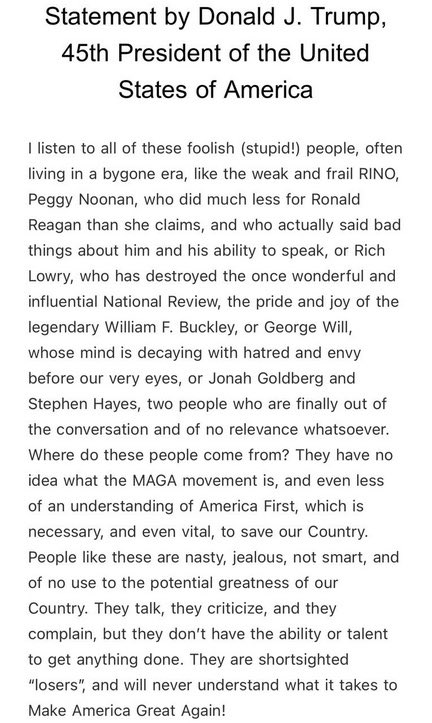
The Donald reads conservatives out of MAGAworld
Bozos on the bus
What we need as a nation, more than anything else I can think of, is a recommitment to basic competence, and, especially, a refusal to accept ideological justifications for plain old ineptitude. Too often Americans give a free pass to bunglers and bozos who belong to their tribe.
When a clown moves into a palace, he doesn’t become a king. The palace becomes a circus.
Turkish Proverb (reportedly)
A little levity
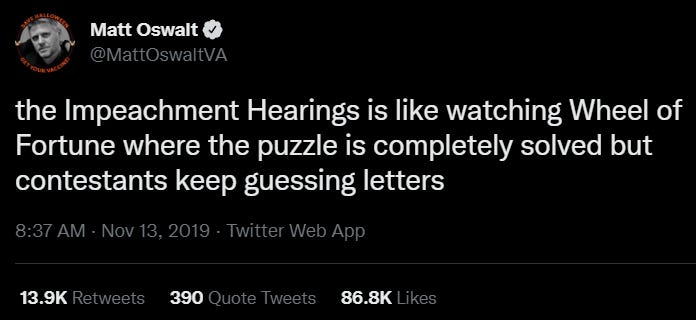
I probably have given too short shrift to the January 6 Committee hearings because … well, I didn’t think anything they said would change my life or my vote. But I sure got a chuckle out of this:
If people have always said it, it is probably true; it is the distilled wisdom of the ages. If people have not always said it, but everybody is saying it now, it is probably a lie; it is the concentrated madness of the moment.
You can read most of my more impromptu stuff here (cathartic venting) and here (the only social medium I frequent, because people there are quirky, pleasant and real). Both should work in your RSS aggregator, like Feedly or Reeder, should you want to make a habit of it.
Ten years ago, let’s say fifteen to be safe, if you saw an essay titled “Consequences are Good, Actually,” you might naturally assume that it came from the political right. Conservatives, after all, believe in law and order, retributive justice, and the God of the Old Testament. But nowadays, it’s liberals who constantly call for consequences, liberals who sneer at the concept of forgiveness, liberals who stand for a Manichean worldview that permits no deviation from white-hat/black-hat morality …
We’ve spent the past two years with the left-of-center world debating, and largely endorsing, quite radical ideas about ending policing and prisons. This would seem to suggest a certain predisposition to forgiveness and equanimity in human affairs, a communal understanding that life is complicated, all of us are sinners, and there but for the grace of God go we. But as the various groans about the New York piece show, the urge to defund the police etc. is really much less about a particular ethic of caring and much more about simply nominating a communally-approved target for progressive anger. It happens that the abstract category “the cops” is a good thing for people to target, but the broader point is that most liberal criminal justice reform energy isn’t derived at all from a desire to be more compassionate and understanding but simply to have a new designated hate object ….
1.9 million people incarcerated in a nation of (roughly) 340 million. This is an extremely high rate in comparison to other nations.
What the heck is wrong with us? Are we more lawless? More punitive? Both?
Mencken Memorializes Machen
I’d never seen this before — an excerpt from H.L. Mencken’s obituary for J. Gresham Machen:
There was a time, two or three centuries ago, when the overwhelming majority of educated men were believers, but that is apparently true no longer. Indeed, it is my impression that at least two-thirds of them are now frank skeptics. But it is one thing to reject religion altogether, and quite another thing to try to save it by pumping out of it all its essential substance, leaving it in the equivocal position of a sort of pseudo-science, comparable to graphology, “education,” or osteopathy.
That, it seems to me, is what the Modernists have done, no doubt with the best intentions in the world. They have tried to get rid of all the logical difficulties of religion, and yet preserve a generally pious cast of mind. It is a vain enterprise. What they have left, once they have achieved their imprudent scavenging, is hardly more than a row of hollow platitudes, as empty as [of] psychological force and effect as so many nursery rhymes. They may be good people and they may even be contented and happy, but they are no more religious than Dr. Einstein. Religion is something else again — in Henrik Ibsen’s phrase, something far more deep-down-diving and mudupbringing, Dr. Machen tried to impress that obvious fact upon his fellow adherents of the Geneva Mohammed. He failed — but he was undoubtedly right.
The only thing worse, for a community, than what Radley Balko has famously called the “warrior cop” is a bunch of people who are cosplaying warrior cops.
Alan Jacobs. The whole thing is brief and worth reading.
Wordplay
Providence-washing
My very own coinage for baffling, bad or wicked decisions being justified, post hoc, by some good thing coming from it. Example: "Why did prissy Mike Pence ever agree to run with Donald Trump?" Answer: "Maybe God had January 6 in mind."
Phrase of the era: Gish-Galloping
The term “Gish Gallop” was coined by Eugenie Scott of the National Center for Science Education. The phrase refers to a debate tactic that was a favorite of Duane Gish, a young-Earth creationist who was also a highly skilled debater.
The Gish Gallop is the tactic of snowing your opponent under a mountain of supposed “pieces of evidence” or “problem cases” and claiming that the opponent’s inability to respond to this pile of evidence shows that your side is right. This tactic counts as a fallacy because its effectiveness doesn’t depend on presenting arguments that are right or even well-supported. Quantity is offered as a substitute for quality.
As the January 6 hearings restarted today after the long weekend, I was thinking about the weird, psychotic fear that has overtaken millions of Americans. I include in those millions people who are near and dear to me, friends I have known for years who now seem to speak a different language, a kind of Fox-infused, Gish Galloping, “what-about” patois that makes no sense even if you slow it down or add punctuation.
High marks to Nichols for applying "Gish Galloping" to the Trumpian patois. I was getting weary of "flooding the zone with shit," which really should be in the Urban Dictionary as a synonym for Gish-Galloping.
Conundrum of the week
May a baptismal regnerationist who never had a "born again experience" represent that he or she is born again for purposes of an Evangelical School requirement that teachers be "Born Again Christians"? (See, e.g., Carson v. Malkin, Breyer, J, dissenting) After all, the very essence of baptismal regnerationism is the belief that a proper baptism is how one actually gets born again.
I’m inclined to say "no" in both cases because, bless their hearts, those schools just don’t really know how one gets regenerate, and they’re using "born again" as a term of Evangelical art.
Had I remained in Dallas, I would have become a PCA Presbyterian because our "Independent Presbyterian" church (dear to us even though "Independent Presbyterian" is an oxymoron) was in the process of affiliating when we left.
If people have always said it, it is probably true; it is the distilled wisdom of the ages. If people have not always said it, but everybody is saying it now, it is probably a lie; it is the concentrated madness of the moment.
You can read most of my more impromptu stuff here (cathartic venting) and here (the only social medium I frequent, because people there are quirky, pleasant and real). Both should work in your RSS aggregator, like Feedly or Reeder, should you want to make a habit of it.
Yesterday and today brought two obituaries in the local newspaper, one for my 6th-grade teacher, the other for another 6th-grade teacher in our large school, who was my basketball coach. Both died last Saturday, both at age 90.
To say that the coach was a huge influence on my life would be hyperbole of political magnitude (I wasn’t even on the starting basketball team), but my 6th-grade teacher took more concern for me, as recounted later by my parents, than I knew. Plus his wife taught my son late in her career.
I honor them now by reproducing their obituaries. Memory eternal!
LAFAYETTE – Charles F. “Chuck” Williamson passed into eternal life on September 25, 2021.
He was born in North Vernon (IN), the seventh child of Russell H. and Beulah (Myers) Williamson. This summer, he celebrated his 90th birthday enjoying a family picnic at Fabyan Forest Preserve (Batavia, IL) and a private organ recital at his church.
Chuck was committed to lifelong learning. He graduated from New Albany Senior High School; earned his bachelor’s degree in elementary education from Ball State University; and earned master’s degrees in educational administration and counseling from Purdue University. He was a teacher and principal at Edgelea, Glen Acres, and Durgan Elementary Schools. He was especially proud to have brought computers into classrooms despite his superintendent’s skepticism that kids could learn to use them. Even into his late 80s, Chuck read 3-4 books per week on theology, history, and current issues. He attended multiple lectures on particle physics at Fermi National Accelerator Laboratory.
He met the love of his life, Patricia Brooks, in church choir during college. She completed her degree in the spring of 1956. They married later that summer. Their love for one another expanded to embrace two daughters, Elyse and Sue. Then sons-in-law, Ron and Ed; grandchildren, Grace, Ben, and Betsie; and great-grandsons, Josef and Benjamin. They cultivated a love of nature, zest for travel, and deep joy in kisses from their Cairn Terriers. Chuck and Patty shared daily life together for 55 years until her death in 2011.
Creative expression was one of his greatest passions and joys, especially creating music to touch the hearts of others. He served as a church organist for more than 65 years. He joined organ tours in Europe, playing historic instruments in 7 different countries.
He will be missed by all of us for his love of life: watching IU basketball and Cubs baseball. sharing “Kitchen Sink” ice cream sundaes; warming his toes in front of a campfire; his witty sense of humor; his pursuit of excellence; and his fiercely loving hugs.
Immediate family will gather for a private graveside service at Meadow View Cemetery. Our public celebration of his life will be arranged in 2022 at his church in Illinois.
In honor of his deeply reverent Christian faith, memorial gifts in his name may be sent to: Organ Fund, Baker Memorial United Methodist Church, 307 Cedar Avenue, St Charles, IL 60174; Benevolent Care Fund, Covenant Living at the Holmstad, 700 West Fabyan Parkway, Batavia, IL 60510; or online https://www.doctorswithoutborders.org.
LAFAYETTE – Donald L. Taylor, age 90, of Lafayette, died at home surrounded by loved ones on Saturday, September 25, 2021.
Born on January 10, 1931 in Lafayette to Alta (Wagoner) Taylor and David R. Taylor. He attended Klondike High School and graduated in 1949. He then enrolled into the School of Education at Purdue University. Don graduated from Purdue in 1953 with a BS degree in Education. During this time, Don met and married Betty Richardson of Lafayette. They were married for 68 years.
Upon graduation from Purdue, Don served in the U.S. Army as a PFC during the Korean War. When his service was complete, he returned to Lafayette and began his teaching career as a 5th Grade teacher in Flora, IN. Two years later and two children later, he accepted an offer to teach and coach at Edgelea Elementary School in Lafayette. For 15 years he enjoyed teaching and reaching many students. Back to Purdue he went and received a Master’s Degree in Administration. For many years to follow, he gladly served the Lafayette School Corporation at Edgelea Elementary, Vinton Elementary, and Miami Elementary as an administrator. Don remained as a Principal until his retirement in1993.
Don and Betty belonged to Immanuel United Church of Christ for 30+years and also to the Community Reformed Church in later years. He was also a member of the American Legion Post #11, was a life member of the Elks Country Club, was a long time member of the John Purdue Club, was past president of Phi Delta Kappa, and was also a past president of the Jefferson High School Booster Club.
In his spare time, you could find Don on the golf course, traveling to Florida, woodworking with grandchildren in his shop, or tutoring students. In 1993, he was presented a membership to the Sagamore of the Wabash Council for his outstanding leadership and citizenship.
Surviving are his Wife: Betty Taylor, Children: Lance Taylor (Kim) of Indianapolis, Kathy Sagorsky (Joe) of Goodyear, AZ, and David Taylor (Ann) of Indianapolis, Grandchildren: Emily Taylor (Emily Larimer), Ben Taylor (Amber Taylor), Kurt Sagorsky (Sarah Sagorsky), Nick Sagorsky (Alyssa Sagorsky), Lauren Taylor, Alex Taylor, and Max Taylor, and Great Grandchildren Finn Taylor, Graham Sagorsky, Henry Sagorsky, Cai Larimer- Taylor, and Charlotte Larimer-Taylor. Don was preceded in death by his parents and his brother Raymond H. Taylor.
A Celebration of Life with military honors will be held on Friday, October 1 at 2:00 at Community Reformed Church, 2501 South 18th St. Lafayette, IN. A link to the livestream of the service will be posted on the church’s website at http://www.crclaf.org A reception will be held before the service from 12:30 -2:00. If you plan to attend, masks are encouraged. Arrangements are being made with Indiana Funeral Care and Crematory in Indianapolis. Final interment will be in Tippecanoe Memorial Gardens. In lieu of flowers, donations may be made to the American Legion Post #11 in Don’s name.
You can read most of my more impromptu stuff at here. It should work in your RSS aggregator, like Feedly, should you want to make a habit of it.
What happened to our Arcadia? We stopped listening to it. We stopped dancing, we moved away, we started listening to the chant of the Machine instead. It is debt we chase now, not the moon. We are individuals, not parts in a wider whole. In a broken time, it is taboo to remember what was lost, and that fact alone makes Arcadia a revolutionary document. Look, it says. This is how it was. This is what was broken. At night, when you lie awake with your phone flashing under your pillow – do you miss it?
I thought that was lovely, so I’m exposed as a monster:
…
This is where landscape writing sheds its leafy cloak and lets you glimpse its colder face – sounding like Steve Bannon, quoting Steve Bannon, black notebooks in hand, gazing from its bench at the little woodland of little England and trying to decide if “benevolent green nationalism” sounds too much like “…well, a nice kind of Hitler.”
For these critics of Kingsnorth, is there any legitimate way to praise, and to seek to conserve, old rituals and practices? Can you love harvest festivals or Morris dancing or Druidic rites or for that matter Ember Days without being a racist, a fascist, a Nazi? Or is urban cosmopolitanism the only ethically acceptable ideal of human life?
And if you can love and practice those old ways without being a racist — How? What would distinguish morally legitimate attitudes from the ones that Kingsnorth is being pilloried for?
This inquiring mind would really like to know.
“Broken times” indeed.
* * * * *
You can read most of my more impromptu stuff at here. It should work in your RSS aggregator, like Feedly, should you want to make a habit of it.
I highly recommend blot.im as a crazy-easy alternative to Twitter (if you’re just looking to get your stuff “out there” and not pick fights).
More blogging on stuff I’ve been reminded of, again from something I wrote privately almost 5 years ago:
I attended a Wake Thursday, only we don’t call them that any more.
In the coffin was a 32-year-old man-boy. In line as one approached mother and step-father, were scrapbook pictures of his younger versions, beaming with delight at 4th of July sparklers and other such simple pleasures. He “enjoyed listening to music, watching movies, and sharing his contagious joy. He fought the good fight and is awaiting his crown of glory.”
In the coffin was a bearer of the image of God, knees pulled up, wrists permanently bent, teeth crooked, face oddly shaped. Oh, my! I’d forgotten in the years since I last saw him.
He was born on April Fools Day. His syndrome has a dozen sufferers, maybe, world-wide. I don’t know the name. I couldn’t look it up on Google if I did, probably. Who writes about a disease that afflicts only a dozen people or so in the world at a time?
If I want to know about it, we’d better take mom and step-dad to dinner; she’s the world expert. The life expectancy from birth is two years. Did I mention that the man-boy in the coffin was 32?
Step-dad married mom 20 years ago, eyes wide open. She’d have it no other way. Her first husband, her son’s father, headed for divorce court, then “for the hills,” about 31 years, 364 days ago. May God have mercy on him anyway.
Caring for her son was the dominant feature of their lives. Step-dad’s grieving with mom.
Mom’s a teacher. The Middle Schoolers from her school came and sang at the funeral. They returned to school shaken. Some of them had never been to a funeral. Many of them, probably, had never met teacher’s son. If the image of God, twisted and angular, shocked this jaded old curmudgeon, I reckon it was a real eye-opener for them.
Mom and step-dad can’t sleep. The house is too quiet. The life-supporting machinery is off. This respiratory infection, starting like all the others, ended quickly in death despite treatment.
God bless and comfort them. May they have, for their remaining lives and into eternity, all the blessings none of us deserve, but some of us don’t deserve a lot less than others.



 Tipsy Teetotaler ن