Sunday, 1/21/24

Re-enchantment

The secularist’s cosmology

A modern secularist quite often accepts the idea of God. What, however, he emphatically negates is precisely the sacramentality of man and world.

Alexander Schmemann, For the Life of the World

I sometimes fear that tantalizing quotes like this will make a reader think “I ought to read that book.” What I really intend is that the reader think “Maybe I ought to become an Orthodox Christian.”

Iconoclasm

At the time of the Reformation, the effigies of saints had sometimes been dragged to the public square and there decapitated by the town’s executioner. This not only in itself prefigures the French Revolution, and emphasises the continuity between regicide and the abolition of the sacramental, but also powerfully enacts two other left-hemisphere tendencies that characterise both the Reformation and the Enlightenment, to which we now might turn.

Iain McGilchrist, The Master and His Emissary

Hubris

Zwingli’s work also repudiated the entire patristic and medieval theology of the sacrament: “I can conclude nothing else but that all the doctors have greatly erred [vil geirret habend] from the time of the apostles. . . . Therefore we want to see what baptism actually is, at many points indeed taking a different path against that which ancient, more recent, and contemporary authors have taken, not according to our own whim [nitt mit unserem tandt] but rather according to God’s word.” Just like his Anabaptist opponents, Zwingli was following God’s word.

Brad S. Gregory, The Unintended Reformation.

On a European Tour with the Wheaton College Men’s Glee Club, long ago and far away, I was thrilled to sing at Grossmünster Church in Zurich, where “Huldrych Zwingli initiated the Swiss-German Reformation in Switzerland from his pastoral office …, starting in 1520.” (Wikipedia)

That thrill is a mark of my delusion. I now think Zwingli a particularly fiendish Reformer, and as regards the sacraments, the true father of the kind of gnostic Evangelicalism I inhabited for 30 years, more or less. Neither Calvin nor Luther was so thoroughly iconoclastic.

And if you think “iconoclastic” is eulogistic, may God have mercy on your soul.

Imagine there’s no religion

In the the pre-modern West, as in much of the world today, there was no such thing as “religion”. The Christian story was the basis of peoples’ understanding of reality itself. There was no “religion”, because there was no notion that this truth was somehow optional or partial, any more than we today might assume that gravity or the roundness of the Earth are facts we could choose to engage with only on Sunday mornings.

Paul Kingsnorth, Is There Anything Left to Conserve?

The public effects of private matters

About a third of the way through the discussion, Douthat asks Ahmari to explain a couple of chapters in his recent book, The Unbroken Thread. The second chapter Ahmari discusses is entitled “Is Sex a Private Matter?” In that chapter, Ahmari turns to a surprising authority: Andrea Dworkin. Ahmari appeals to Dworkin to argue that sex is never purely private: what is done in the bedroom or viewed on a screen has inevitable public consequences …

Onsi Kamel, The Power of the Catholic Intellectual Ecosystem

Anthropogenic comological consequences

The plausibility of anthropogenic climate change ought to be abundantly evident to Christians; scripture is full of admonitions on how the sinfulness of man has cosmological consequences. See also Prayers by the Lake number 39. (H/T Fr. Steven DeYoung)

Do you know, my child …

Rod Dreher has a book coming out on re-enchantment of our world. This “prayer” may be all the re-enchantment I need:

Do you know, my child, why the clouds are closed when the fields are thirsty for rain, and why they open, when the fields have no desire for rain?
Nature has been confused by the wickedness of men, and has abandoned its order.
Do you know, my child, why the fields produce heavy fruit in the springtime, and yield a barren harvest in the summer?
Because the daughters of men have hated the fruit of their womb, and kill it while it is still in blossom.
Do you know, my child, why the springs have gone dry, and why the fruits of the earth no longer have the sweetness that they used to have?
Because of the sin of man, from which infirmity has invaded all of nature.
Do you know, my child, why a victorious nation suffers defeats as a result of its own disunity and discord, and eats bread made bitter by tears and malice?
Because it conquered the bloodthirsty enemies around it-self, but failed to conquer those within itself.
Do you know, my child, how a mother can feed her children without nourishing them?
By not singing a song of love to them while nursing them, but a song of hatred towards a neighbor.
Do you know, my child, why people have become ugly and have lost the beauty of their ancestors?
Because they have cast away the image of God, which fashions the beauty of that image out of the soul within, and removes the mask of earth.
Do you know, my child, why diseases and dreadful epidemics have multiplied?
Because men have begun to look upon good health as an abduction of nature and not as a gift from God. And what is abducted with difficulty must with double difficulty be protected.
Do you know, my child, why people fight over earthly territory, and are not ashamed to be on the same level as moles?
Because the world has sprouted through their heart, and their eyes see only what is growing in the heart; and because, my child, their sin has made them too weak to struggle for heaven.
Do not cry, my child, the Lord will soon return and set everything right.

(St. Nikolai Velimirovich, Prayers by the Lake, XXXIX)

Miscellany

Is silence violence?

There are more evil things going on in the world than any one person can respond to. You could spend all day every day on social media just declaring that you denounce X or Y or Z and never get to the end of what deserves to be denounced. If my silence about Gaza is complicit in the violence being done there, what about my silence regarding the Chinese government’s persecution of the Uighurs? Or the government of Myanmar’s persecution of the Rohingya? Or what Boko Haram has done in Nigeria? Or what multinational corporations do to destroy our environment? Or dogfighting rings? Or racism in the workplace? Or sexism in the workplace?

[P]ick your spots and pick them unapologetically. It’s perfectly fine for people to have their own causes, the causes that for whatever reason touch their hearts. We all have them, we are all moved more by some injustices than by others; not one of us is consistently concerned with all injustices, all acts of violence, nor do we have a clear system of weighting the various sufferings of the world on a scale and portioning out our attention and concern in accordance with a utilitarian calculus.

The silence-is-violence crowd, to their credit, don’t think that money is the only commodity we have to spend: they think we can and must spend our words also. And they always believe they know what, in a given moment, we must spend our words on. What they never seen to realize, though, is that some words are a debased currency. As the Lord says to Job, “Who is this that darkeneth counsel by words without knowledge?” To speak “words without knowledge” is to “darken counsel,” that is, confuse the issue, mislead or confuse one’s hearers. The purpose of counsel is to illuminate a situation; one does not illuminate anything by speaking out of ignorance or mere rage. 

Alan Jacobs, Silence, Violence, and the Human Condition

Pointed question

In 2024, do priests and pastors have influence on their people anywhere near as that of random internet influencers?

You can’t fight something with nothing

You can’t fight something with nothing. If the French don’t like the Islamification of French public life, then they aren’t going to stop it by doubling down on laïcisme.

Rod Dreher in the European Conservative (where he reins in his catastrophism)

Confessing others’ sins

Anthony Lusvardi, S.J., teaches sacramental theology at the Pontifical Gregorian University in Rome. In “Confessing Other People’s Sins” (The Lamp, Issue 19), he takes issue with the practice of apologizing for historic wrongs. In his experience, there’s a certain type who enters the confessional only to launch into complaints about other people’s misdeeds, which amounts to a spiritual evasion of his own sins. Is something like that happening when a city council or college president issues statements that repent of past harms? “The problem with historical apologies is that they never involve taking responsibility for one’s own actions but necessarily mean confessing sins committed by others.” And it is in the faux penitents’ interest to exaggerate those sins. “The more heinous the crimes of others, the more venial our own offenses seem. We can get off the hook for our smaller sins by spotlighting the graver sins of others.”

R. R. Reno at First Things.

Talking out of class

Christians are often tempted, particularly in this time called modern, to say more than we know. We are so tempted because we fear we do not believe what we say we believe. So we try to assure ourselves that we believe what we say we believe by convincing those who do not believe what we believe that they really believe what we believe once what we believe is properly explained.

Stanley Hauerwas via Jake Meador

Christian atheists

I believe there’s a rational way to begin sketching what people like Murray, Ali, Tom Holland, and other “Christian atheists” in this space are attempting to articulate. On Twitter, my friend Jay Richards proposes a sort of first inference to the best explanation. It goes something like this:

(1) I’m far more certain of the truth of my moral convictions A, B, and C than I am certain that atheism is true. So, let’s take A, B, and C as given.

(2) A, B, and C don’t make a lot of sense given atheism.

(3) A, B, and C are consistent with and seem to follow from the truth claims of Christianity.

(4) A, B, and C historically emerged from a broadly Christian culture.

(5) Given (1) through (4), the truth of Christianity seems more likely than the truth of materialism/atheism.

Bethel McGrew

Fine and good. I’ve heard far stranger ways that people began their Christian lives. But that’s only a beginning. Rationality is not the telos of the Logos.

However human reason is construed or understood, it cannot fathom what is by definition unfathomable, and so despite traditional Christian theology’s pervasive and variegated use of reason it can never finally grasp directly that with which it is chiefly concerned. This makes it a sort of intellectual endeavor different from any other.

Brad S. Gregory, The Unintended Reformation

Why true Christianity can’t be a political faith

Philip Sherrard has further noted that Christianity is uniquely ill-suited to function as a political religion because, alone among the Abrahamic faiths, it has no body of legislation intended to function as civil law. The Christian Church is set up to facilitate communion between the human and the divine. This is obviously a process from which the coercive sanction of positive law and coercive violence is excluded. If the Church is conceived of as a voluntary assembly of believers in communion with God, then no political party can claim to be a part of either its successes or its failures; politics is, after all, nothing more the organized use of violence.

Put Not Your Trust in Princes, an article I no longer can access at nationalreview.com, though I retain the URL. The title is from Psalm 146.

Incense

If you think there’s something fishy about incense in Christian worship, read Fr. Stephen Freeman, The Sweet Smoke of Prayer

Dogma

Dogmas are important, but not as the building blocks of some comprehensive account of the Divine Mysteries, but rather a series of decisions, arrived at by the Church, that are there to prevent ways of thinking that might obscure or bypass the mystery of God before which we stand in awe.

Andrew Louth via Martin Shaw, What We Don’t Know, We Don’t Know

This is a very Orthodox attitude toward dogma. I don’t know if there are any other Christian traditions that so view it. My former traditions definitely did not.

Reductionism

One of the oddest thoughts to have crept its way into the Christian mind is the notion of what is “necessary to salvation.” The simple questions within the New Testament, “What must we do to be saved?” quickly become the stuff of bumper-stickers and a reduced version of Christianity unable to sustain a genuine spiritual life.

In my seminary years (Anglican), I had a professor who stated that he did not believe in angels. I was puzzled and asked him why. “Because they are not necessary. Anything an angel can do can be done by the Holy Spirit.” And there you have it. Only things that are necessary need to be posited as existing …

Fr. Stephen Freeman, * An Unnecessary Salvation*, who disagrees.


… that Christ may dwell in your hearts through faith; that you, being rooted and grounded in love, may be able to comprehend with all the saints what is the width and length and depth and height — to know the love of Christ which passes knowledge; that you may be filled with all the fullness of God.

Ephesians 3:17-19 (NKJV)

You can read most of my more impromptu stuff here (cathartic venting) and here (the only social medium I frequent, because people there are quirky, pleasant and real). Both should work in your RSS aggregator, like Feedly or Reeder, should you want to make a habit of it.

Conservatisms

I’m a David Brooks kind of conservative …

Every once in a while, David Brooks writes something that makes me want to say “I’m a David Brooks kind of conservative.” This was one of those times:

How do you stay mentally healthy and spiritually whole in brutalizing times? How do you prevent yourself from becoming embittered, hate-filled, calloused over, suspicious and desensitized?

Ancient wisdom has a formula to help us, which you might call skepticism of the head and audacity of the heart.

The ancient Greeks knew about violent times. They lived with frequent wars between city-states, with massacres and mass rape. In response, they adopted a tragic sensibility. This sensibility begins with the awareness that the crust of civilization is thin. Breakdowns into barbarism are the historic norm. Don’t fool yourself into believing that you’re living in some modern age, too enlightened for hatred to take over.

In these circumstances, everybody has a choice. You can try to avoid thinking about the dark realities of life and naïvely wish that bad things won’t happen. Or you can confront these realities and develop a tragic mentality to help you thrive among them. As Ralph Waldo Emerson would write centuries later, “Great men, great nations have not been boasters and buffoons, but perceivers of the terror of life, and have manned themselves to face it.” And that goes for great women, too.

This tragic sensibility prepares you for the rigors of life in concrete ways. First, it teaches a sense of humility …

Second, the tragic sensibility nurtures a prudent approach to life. It encourages people to focus on the downsides of their actions and work to head them off …

Third, this tragic mentality encourages caution. …

Fourth, the tragic mentality teaches people to be suspicious of their own rage. …

Fifth, tragedies thrust the harsh realities of individual suffering in our faces, and in them we find our common humanity. …

So far, I’ve been describing the cool, prudent and humble mentality we learn from the Athenians. Now I turn to a different mentality, a mentality that emerged among the great Abrahamic faiths, and in their sacred city, Jerusalem. This mentality celebrates an audacious act: the act of leading with love in harsh times.

… During a recent Zoom call, someone asked me: Isn’t it dangerous to be vulnerable toward others when there is so much bitterness, betrayal and pain all around? My answer to that good question is: Yes, it is dangerous. But it is also dangerous to be hardened and calloused over by hard times. It is also dangerous, as C.S. Lewis put it, to guard your heart so thoroughly that you make it “unbreakable, impenetrable, irredeemable.”

David Brooks, Love in Harsh Times and Other Coping Mechanisms.

… but I’m not deaf to Wendell Berry conservatism

I believe I have given a fair representation of the plight of rural America, a land of worsening problems that it did not cause and cannot solve, from which urban America derives its food, clothing, and shelter, plus “raw materials.” For these necessary things rural America receives prices set in urban America. For the manufactured goods returned to it, rural America pays prices set in urban America.

This rural America Mr. Burns treats as an enemy country, “rural and white,” inhabited by voters for Trump who are “animated most intensely by feelings of racial resentment or male self-pity,” and by “working-class voters who feel victimized by a distant and dysfunctional government, by wealthy elites, by nefarious foreign regimes, and all-powerful multinational corporations.” Mr. Burns is a political expert, who writes from a posture of authority, but his authority comes from no close acquaintance with rural places or with Trump voters or with people of the working class. He identifies only two reasons rural people might have had for voting for Trump, without asking, for instance, why they might have voted against Clinton or Biden. And he says that working-class voters “feel” victimized, apparently without considering that they may “feel” so because they know so. He might have added that many of them know also that they are disregarded or disdained by another set of elites who think them ignorant because they have not been to college. This is a prejudice, resting upon a cruel and extremely destructive falsehood of the same kind as white supremacy. To be fair, or at least more complete, Mr. Burns might have added to his collection of deplorables the rural voters who vote for Democrats only because the Democrats are not Republicans.

Because I have watched for half a century and more the decline of my own community and others like it everywhere in rural America, along with the increasing ecological and cultural damages of industrial agriculture, I have made a practice of reading newspaper and magazine articles by Democratic or leftward experts of politics and economics, hoping that I would see an acknowledgement, first of the economic importance of the natural world, and then of the importance of the land-use economies of agriculture, forestry, and mining, by which the goods of the natural world are made available for human use. I have not made a “survey,” but I have read enough to know that Alexander Burns’s article is conventional. Like his fellow experts, he appears to assume the inexhaustibility of the non-human world, and likewise the forever availability of the rural and working-class humans who do, well or poorly, the fundamental work of every economy. Like most of his fellow experts, he consents to and takes for granted the corporate destruction of the land and the human communities of rural America.

My impression is that the writers of the articles I have read have never ventured into rural America to ask in good faith what the problems are and what might be the remedies. And so I have made a sort of practice also of inviting writers and editors to come here where I live to allow me (and some younger people) to show them what we are up against. So far, nobody has showed up.

Wendell Berry

Trump officials against Trump

The fact of the matter is he is a consummate narcissist and he constantly engages in reckless conduct that puts his political followers at risk and the conservative and Republican agenda at risk. … He will always put his own interest and gratifying his own ego ahead of everything else, including the country’s interest. There’s no question about it. … He’s like a 9-year-old, a defiant 9-year-old kid, who’s always pushing the glass toward the edge of the table defying his parents to stop him from doing it.

William Barr, who together with a few other former high officials in Trump’s administration have ruled out voting for him in 2024:

  • Nikki Haley
  • Mike Pence
  • Mike Pompeo
  • John Bolton
  • William Barr
  • Mick Mulvaney
  • Betsy DeVos
  • Dan Coats
  • Rex Tillerson
  • Alex Azar
  • Elaine Chao
  • John Kelly
  • Mark Esper
  • James Mattis
  • H.R. McMaster
  • Richard Spencer
  • Mark Milley

The ubiquitous machine

The body is mine and the soul is mine’
says the machine. ‘I am at the dark source
where the good is indistinguishable
from evil. I fill my tanks up
and there is war. I empty them
and there is not peace. I am the sound,
not of the world breathing, but
of the catch rather in the world’s breath.’

Is there a contraceptive
for the machine, that we may enjoy
intercourse with it without being overrun
by vocabulary? We go up
into the temple of ourselves
and give thanks that we are not
as the machine is. But it waits
for us outside, knowing that when
we emerge it is into the noise
of its hand beating on the breast’s
iron as Pharisaically as ourselves.”

R.S. Thomas, Collected Later Poems 1988-2000

Sleazy but legal?

Remember this?

I had mixed, but mostly negative, feelings about it at the time. (The positive feelings boiled down to “anyone who doesn’t know you can’t vote by text message is someone I’d prefer not vote anyway.”)

But UCLA libertarian law professor Eugene Volokh opposes the criminal prosecution of the guy who perpetrated this hoax.

Poetry needs to vibrate the air

Reading in silence is the source of half the misconceptions that have caused the public to distrust poetry. Without the sound, the reader looks at the lines as he looks at prose, seeking a meaning. Prose exists to convey meaning, and no meaning such as prose conveys can be expressed as well in poetry. That is not poetry’s business.

Basil Bunting, “The Poet’s Point of View” via Christian Wiman, Zero at the Bone

The attention economy rewards shamelessness

In subsequent obscure journal articles, Mr. Goldhaber warned of the attention economy’s destabilizing effects, including how it has disproportionate benefits for the most shameless among us. “Our abilities to pay attention are limited. Not so our abilities to receive it,” he wrote in the journal First Monday. “The value of true modesty or humility is hard to sustain in an attention economy.”

Charlie Warzel, Michael Goldhaber, the Cassandra of the Internet Age – The New York Times

The perfect candidate for the attention economy

Former President Donald Trump in a post on Truth Social:

“A PRESIDENT OF THE UNITED STATES MUST HAVE FULL IMMUNITY, WITHOUT WHICH IT WOULD BE IMPOSSIBLE FOR HIM/HER TO PROPERLY FUNCTION. ANY MISTAKE, EVEN IF WELL INTENDED, WOULD BE MET WITH ALMOST CERTAIN INDICTMENT BY THE OPPOSING PARTY AT TERM END. EVEN EVENTS THAT ‘CROSS THE LINE’ MUST FALL UNDER TOTAL IMMUNITY, OR IT WILL BE YEARS OF TRAUMA TRYING TO DETERMINE GOOD FROM BAD. THERE MUST BE CERTAINTY. EXAMPLE: YOU CAN’T STOP POLICE FROM DOING THE JOB OF STRONG & EFFECTIVE CRIME PREVENTION BECAUSE YOU WANT TO GUARD AGAINST THE OCCASIONAL ‘ROGUE COP’ OR ‘BAD APPLE.’ SOMETIMES YOU JUST HAVE TO LIVE WITH ‘GREAT BUT SLIGHTLY IMPERFECT.’ ALL PRESIDENTS MUST HAVE COMPLETE & TOTAL PRESIDENTIAL IMMUNITY, OR THE AUTHORITY & DECISIVENESS OF A PRESIDENT OF THE UNITED STATES WILL BE STRIPPED & GONE FOREVER. HOPEFULLY THIS WILL BE AN EASY DECISION. GOD BLESS THE SUPREME COURT!”

TMD

“People do these elaborate takes about Trump’s authoritarian aspirations and then he just comes out and says the president should be allowed to do infinite crimes,” Matt Yglesias marveled.

Nick Catoggio

Your government scamming you

When carmakers test gasoline-powered vehicles for compliance with the Transportation Department’s fuel-efficiency rules, they must use real values measured in a laboratory. By contrast, under an Energy Department rule, carmakers can arbitrarily multiply the efficiency of electric cars by 6.67. This means that although a 2022 Tesla Model Y tests at the equivalent of about 65 miles per gallon in a laboratory (roughly the same as a hybrid), it is counted as having an absurdly high compliance value of 430 mpg. That number has no basis in reality or law.

For exaggerating electric-car efficiency, the government rewards carmakers with compliance credits they can trade for cash. Economists estimate these credits could be worth billions: a vast cross-subsidy invented by bureaucrats and paid for by every person who buys a new gasoline-powered car.

Until recently, this subsidy was a Washington secret. Carmakers and regulators liked it that way. Regulators could announce what sounded like stringent targets, and carmakers would nod along, knowing they could comply by making electric cars with arbitrarily boosted compliance values. Consumers would unknowingly foot the bill.

The secret is out. After environmental groups pointed out the illegality of this charade, the Energy Department proposed eliminating the 6.67 multiplier for electric cars, recognizing that the number “lacks legal support” and has “no basis.”

Carmakers have panicked and asked the Biden administration to delay any return to legal or engineering reality. That is understandable. Without the multiplier, the Transportation Department’s proposed rules are completely unattainable. But workable rules don’t require government-created cheat codes. Carmakers should confront that problem head on.

Michael Buschbacher and James Conde, The Electric-Vehicle Cheating Scandal – WSJ


You can read most of my more impromptu stuff here (cathartic venting) and here (the only social medium I frequent, because people there are quirky, pleasant and real). Both should work in your RSS aggregator, like Feedly or Reeder, should you want to make a habit of it.

Two days post-caucus

Staying Sane in an Election Year

Matt and I are both fond of quoting Oliver O’Donovan here who once said that sometimes the sternest form of political judgment imaginable is to simply talk about something else.

There will be many, many attempts made this year to colonize your imagination. Cable news and political podcasts and morning radio and social media reactionaries will all be there, demanding your attention. Indeed, they will at times suggest that if you fail to attend to them then you will yourself somehow become complicit in the evils they are decrying.

Ignore them.

I am not saying to ignore politics, ignore public life, or adopt an above-it-all indifferentism to any of these things. We have already talked about how politics matter and how they provide one arena through which we can love our neighbors. Rather, I am telling you to refuse to participate in the sensationalizing spectacle of political discourse in an election year.

Instead, recall the advice of St Paul, who tells us to rejoice in all things and to pray without ceasing.

If you find that your heart is cold to the things of God but agitated and aggressive in response to political or cultural events, then it is probably a very good time for you to begin judging politics not by listening to news and forming opinions (which you then share loudly on social media) but rather by tuning out much of that news and spending time with God in prayer.

Indeed, we should remember that there are times where extreme action is required for the sake of our own soul: If Christ could tell his followers that there are menaces so great that plucking out your own eye is not to extreme a reaction, then I dare suggest that deleting social media apps from your phone or simply tossing your phone in the trash is, likewise, not too extreme an act.

Jake Meador, * Notes on Staying Sane in an Election Year*. This is most of just one note. There are several others.

And for many of us, myself included, this is terribly difficult advice to follow. I had to delete four items from this post to comply; I’m not sure how they got there since I keep reminding myself not to read about this stuff.

Stating the obvious

“In clinical diagnoses of gender dysphoria, on the other hand, psychosomatic complexity is acknowledged and followed by the recognition, initially upsetting though it may be, that someone who has a “deeply held sense” of alienation from their sexual biology is likely afflicted by a treatable form of mental illness.

To presume that the act of affirming forms of mental illness as normal is a legitimate form of treatment is not only incoherent; it also does more harm than good. Yet such normalization is how the ideology of progressivism, for better or ill, responds to social pathologies—it embraces them as expressions of individual volition, and pretends there is no harm done.

Frederica Mathewes-Green & Rod Dreher, Healing Humanity (italics added)

Paideia

As Plato, Thucydides, and [] Toquerville have all observed, democracies prefer to look for material solutions to their spiritual problems. They never despair of making up the difference between the citizens desires and personal fulfillment with greater production or with a more equitable distribution of goods. Indeed, this is the reason for democracy’s basic optimism. But by the mid-1950s, it became clear that plenty was not solving the problem of inequality … Again, U.S. society turned to its schools … But because equal opportunity was viewed in terms of getting ahead or getting a job or “getting mine“ and not in terms of giving every person his due to an education that would enable him to reach his fullest human potential, the result was the lowering of academic standards to accommodate the week, indolent, or unmotivated students and the dismantling of the remaining paideia in favor of training for “marketable“ skills …

Putting aside our misgivings asked of the sagacity of imposing political objectives on the school, are we not still entitled to ask whether modern education has accomplished its utilitarian goals? Has it significantly added to American plenty and equality? I would argue at the secondary school level: no. Whatever gross additions it has made, they are neither significant in achieving the political objectives nor are they worth the infinite cost of depriving future generations of their rightful and necessary paideia. Our plenty — perhaps because we cannot imagine life without it — means nothing to us, while hiding from us the lavishly wasteful and destructive consequences of its production.

David V. Hicks, Norms and Nobility

Why silence isn’t violence

There are more evil things going on in the world than any one person can respond to. You could spend all day every day on social media just declaring that you denounce X or Y or Z and never get to the end of what deserves to be denounced. If my silence about Gaza is complicit in the violence being done there, what about my silence regarding the Chinese government’s persecution of the Uighurs? Or the government of Myanmar’s persecution of the Rohingya? Or what Boko Haram has done in Nigeria? Or what multinational corporations do to destroy our environment? Or dogfighting rings? Or racism in the workplace? Or sexism in the workplace?

[P]ick your spots and pick them unapologetically. It’s perfectly fine for people to have their own causes, the causes that for whatever reason touch their hearts. We all have them, we are all moved more by some injustices than by others; not one of us is consistently concerned with all injustices, all acts of violence, nor do we have a clear system of weighting the various sufferings of the world on a scale and portioning out our attention and concern in accordance with a utilitarian calculus.

The silence-is-violence crowd, to their credit, don’t think that money is the only commodity we have to spend: they think we can and must spend our words also. And they always believe they know what, in a given moment, we must spend our words on. What they never seen to realize, though, is that some words are a debased currency. As the Lord says to Job, “Who is this that darkeneth counsel by words without knowledge?” To speak “words without knowledge” is to “darken counsel,” that is, confuse the issue, mislead or confuse one’s hearers. The purpose of counsel is to illuminate a situation; one does not illuminate anything by speaking out of ignorance or mere rage. 

Alan Jacobs, Silence, Violence, and the Human Condition

Why the “far right” keeps moving

As Jon Askonas has recently argued in his essay “Why Conservatism Failed” (in Compact), the right has tended to embrace the forward march of technology, even while lamenting its solvent effects on everything one might wish to conserve. Conservatives have decried such phenomena as egalitarianism, feminism, or mass politics as though they were the wellsprings of social change, while downplaying the dependence of such ideologies on certain technological developments.

By the time Maistre wrote his polemics against science, democracy, and egalitarianism, the material transformations that enabled those moral shifts were well under way. Manufacturing was weakening feudal aristocracies in favor of a mercantile bourgeoisie with far more tenuous allegiances to land and tradition. Innovation replaced peasant workers with machines, undermining ancient powerbases in the process, and impelled millions to abandon rural life for the emerging industrial hubs. And this trajectory continued over the century that followed, notwithstanding Maistre’s tirades.

The right—by which I mean the constantly renewed rearguard action against the solvent effects of modernity—habitually defends large-scale political values whose moral force the technological revolution has already rendered insubstantial and abstract.

The directional quality of this endless revolution explains why it is so difficult to define the “far right.” A view is denoted as “far-right” relative to a revolutionary vanguard that is in constant forward motion, meaning that what is common sense today may read as right-wing extremism tomorrow. Thus do left-leaning feminists who defend embodied sex differences now find themselves accused of being “Nazis.” From the perspective of the technological revolutionary, any defense of immutable difference may be dismissed as, in Leidig’s phrasing, a “far-right narrative regarding essentialist gender roles.”

Mary Harrington, Reactionary Hope

Stolen valor

Delicious!

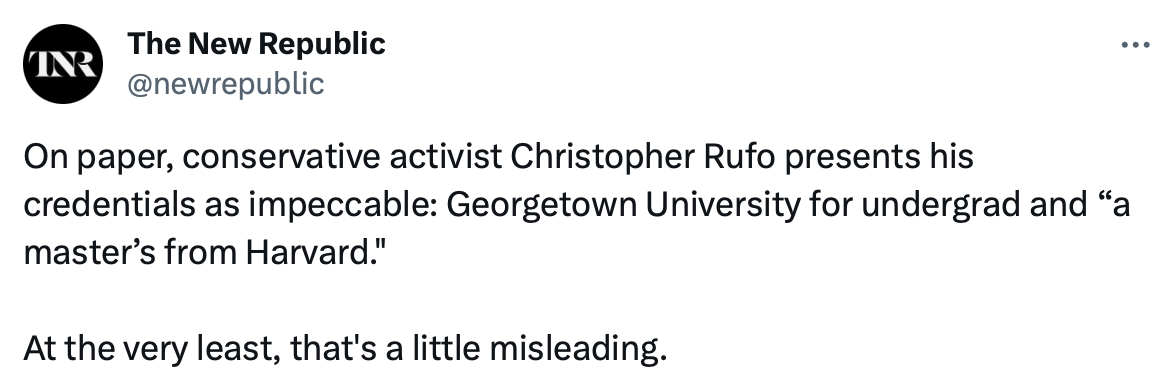
Harvard Extension School disavowed by its own professors: There’s a big problem. The conservative activist Chris Rufo went to night classes at Harvard’s Extension School, where he earned himself a master’s degree. And now he says he has a master’s degree from Harvard. Yikes. The New Republic writers—a group of Ivy League students with family money and also rage (I salute you, comrades!)—are upset. 

The Bat Signal was up. No stolen Harvard valor allowed at TNR. In order to jab Chris Rufo, Harvard Extension School professor Jennifer Hochschild decided to call her students idiots and say the school where she teaches is fake. She wrote: “Those students are great—I teach them—but they are not the same as what we normally think of as Harvard graduate students.” Tom Nichols, a Resistance celebrity who also teaches at Harvard’s Extension School, added simply: “Amen.” 

Indeed, the extension school is designed for nontraditional students; Columbia has a similar program, and it brought military veterans and older students into my college classes, which was wonderful. Anyway, Harvard Extension professor Hochschild has written books with titles like Facing Up to the American Dream and Bringing Outsiders In. What she really meant is that Bringing Outsiders In is bad and that “the hot chocolate bar is only for undergrads who pay full tuition.” I guess you didn’t read the book. 

Don’t be surprised if Harvard Extension School suddenly changes its website. Right now it says We Are Harvard and that you become a Harvard alum like any other. But with a little Chris Rufo Derangement Syndrome in the bloodstream, soon it will read: We are trash, and our alums are freaks. Georgetown University, where Rufo was an undergraduate, will soon announce that it is lighting its dorms on fire. It’s horrible what Chris Rufo makes us do.

Nellie Bowles

Recommended

Recommended, on Substack Nazis and other diversions: Shalom Auslander, The Jewish N-Word (Tablet Magazine).

Many naughty words. Tiny sample:

[M]y two ultra-Orthodox brothers-in-law have, between them, three times as many children as Substack has Nazis. It’s not even a [*******] minyan.

Miscellany

  • Nations have their ego, just like individuals (James Joyce via The Economist)
  • Polls are the reality TV of journalism. Drama draws eyeballs. Never trust them. Do the math. (Patrick Rhone, one of my most interesting social medium acquaintances.)
  • Hey sorry I missed your text, I am processing a non-stop 24/7 onslaught of information with a brain designed to eat berries in a cave. (@verybadllama via Dense Discovery)
  • The joke is on you. I had a stroke. I can’t fully understand what you are saying. (Democratic Sen. John Fetterman responding to anti-Israel protester)
  • Pro-life is the ‘defund the police’ of the GOP. (Ann Coulter via Nellie Bowles)
  • Universities are to Republicans what guns are to Democrats. (The Rise of the Sectarian University)
  • Misogynoir: woke-speak for the double-whammy intersectional plight of black women.
  • This was their chance not only to burn a witch but to torch a coven … Conservatives would be the sun to Gay’s Icarus, demonstrating just how hot they could make things for her. (Charles Blow, in an otherwise predictably tone-deaf column about “the persecution of Harvard’s Claudine Gay.” My ideological adversaries can write very well on occasion.)
  • Sarah Palin was like John the Baptist to Donald Trump’s orange Jesus. (Carlos Lozado)

You can read most of my more impromptu stuff here (cathartic venting) and here (the only social medium I frequent, because people there are quirky, pleasant and real). Both should work in your RSS aggregator, like Feedly or Reeder, should you want to make a habit of it.

Leavetaking of Theophany

Virtue by excision

After recounting two anecdotes, Alan Jacobs asks:

What do [these actors in these two anecdotes] have in common? The belief that one can achieve virtue through omission and excision. This is the belief shared by all forms of purity culture — and purity culture always leads to katharsis culture, that is, the practice of cleansing yourself, restoring your purity, by casting out the unclean thing. 

But what if that’s not how virtue works? What if after having cast out every unclean thing you can find you just end up in the foul rag and bone shop of your own heart? What then? 

That’s why these periods of desperate and manic katharsis always burn themselves out — why Robespierre ends by executing the executioner. And when they’ve done all they can do, they are succeeded by a bacchanal, an era of pseudo-festive delight in transgression. Our culture oscillates between “cast out the unclean thing” and “let us sin the more that grace may abound” — that is, between legalism and antinomianism, the very pairing that St. Paul in his letters is always trying to subvert.

Paul is the greatest of psychologists: he knows that human beings perfectly well understand legalism, which they rename “justice,” and perfectly well understand antinomianism, which they rename “freedom.” What we can’t understand is the grace of God

Alan Jacobs, The Next Turn of the Wheel

Alan is an Anglican, teaching at a baptist university (Baylor), but he’s awfully sharp. You could do worse than reading a few of his books.

Mutual incomprehension

It is easier for Protestants and Catholics to understand each other, even if they fundamentally disagree on their conclusions, than for Orthodox and Catholics to understand each other, even though they share many similar outward characteristics—liturgy, priesthood, hierarchy, sacraments, and so forth.

Not only the content but the approach to theology differs. The Orthodox Church has almost no “official” teachings or statements, and it purposely avoids making them. So how do we explain ourselves to Western Christians, who are accustomed to exact definitions and official statements?

Dr. Eugenia Scarvelis Constantinou, Thinking Orthodox

Wesley was an odd bird

Wesley found inspiration in the writings of Makarios of Egypt, whose early practice of monasticism was directed toward the experience of deification. This set Wesley apart from earlier Protestant fathers, who inherited a forensic understanding of salvation from their Roman Catholic predecessors.

John Strickland, The Age of Utopia

That’s not how I used to understand Methodism; rather, it was shoved in the “yes, one can lose one’s salvation” pigeonhole (versus the “once saved, always saved” Calvinist pigeonhole; I was a Calvinist). Although Dr. Constantinou in the preceding item is correct, I think it’s pretty safe to say that Orthodox Christianity rejects the “forensic understanding of salvation,” and finds its origins in Western Christendom after Rome went into schism from the Christian East.

Tocqueville on American popular piety

The notebooks de Tocqueville kept during his travels contain decidedly pessimistic observations about the quality of popular piety. As a Roman Catholic with Jansenist tendencies, he looked aghast at untamed evangelicalism.

John Strickland, The Age of Utopia

Two confessions

(1) I have been insufficiently appreciative of the benefits of living in the place that used to be Christendom, partly because I’m so aware of where Western Christianity has gone wrong in so many ways.

My denseness has come to my attention as people are becoming Christians (or at least turning favorable towards Christianity) because of its social benefits (see Holland, Tom, Dominion).

(2) I also have insufficiently appreciated how mere cultural Christians, who can’t recite the Creed without lying, nevertheless contribute to a better civilization for all of us. They may be living on the whiff of (as they imagine) an empty bottle, but for the sake of all the rest of us, they could do much worse.

Cringemaxxing

There is no way in the world to make going to church cool, and the most cringe thing of all is trying. Here’s the thing though: data consistently show that the happiest people – those who feel that their lives are most filled with purpose and fulfilment – are not necessarily those with kids – it’s those who go to church. Those, in other words, who are not just to be indifferent to cool, but actively anti-cool. The first step to a happy and fulfilled life, it appears, is cringemaxxing.

There are, no doubt, a great many reasons for this. But I am convinced that whatever your relationship to religious worship, a central reason why religious attendance is associated with happiness is that in order to make that commitment you need already to have abandoned the pursuit of cool.

Mary Harrington, You Need to be Cringemaxxing


… that Christ may dwell in your hearts through faith; that you, being rooted and grounded in love, may be able to comprehend with all the saints what is the width and length and depth and height — to know the love of Christ which passes knowledge; that you may be filled with all the fullness of God.

Ephesians 3:17-19 (NKJV)

You can read most of my more impromptu stuff here (cathartic venting) and here (the only social medium I frequent, because people there are quirky, pleasant and real). Both should work in your RSS aggregator, like Feedly or Reeder, should you want to make a habit of it.

On Claudine Gay’s plagiarism

A question at the back of my mind for a week or two has been “how serious was Claudine Gay’s plagiarism?” I brought it to front of mind within the past day or two, and I now have, serendipitously, a partial answer, which I now hasten to share.

My question arose from how her plagiarism was identified in the media, typically “verbatim copying” or “missing citations.” Someone even picked on her for “plagiarizing” acknowledgments.

Well, I’m no academic, so I won’t contest the consensus that what she did fits the academic concept of plagiarism. But what I did not read was any accusation that Gay was stealing other scholars’ ideas (not mere words, peripheral to the plagiarized articles’ scholarly thrust) and passing them off as her own.

And I now am presuming that she did not do so.

The turning point was a New Yorker interview by the estimable Emma Green, Why Some Academics Are Reluctant to Call Claudine Gay a Plagiarist.

Let’s be frank: some academics are reluctant to call her a plagiarist because of tribalism, the firestorm of accusations having come from a hostile and deplorable tribe (I’m still delighting in the insight — not my own — that education is the Right’s bugaboo as guns are the Left’s).

D. Stephen Voss, an associate professor of political science at the University of Kentucky, acknowledges that tribalism, but is quite chill about Gay’s appropriation of some of his own academic words:

Was what Claudine Gay did plagiarism?

… yes, that’s technically plagiarism.

Why do you append “technically” to the front of “plagiarism”?

I use the analogy of speeding. If you’re driving fifty-seven miles per hour on a fifty-five-mile-per-hour highway, that’s technically speeding. But we don’t expect law enforcement to crack down any time behavior crosses over the line. The plagiarism in question here did not take an idea of any significance from my work. It didn’t steal my thunder. It didn’t stop me from publishing. And the bit she used from us was not in any way a major component of what made her research important or valuable.

So how serious a violation of academic integrity was this?

From my perspective, what she did was trivial—wholly inconsequential. That’s the reason I’ve so actively tried to defend her.

When I first was told that Claudine may have committed academic dishonesty at my expense, I took it seriously. I’ve had my work stolen before. So I didn’t rule it out. I immediately investigated what she used.

But the difference between plagiarism among academics and plagiarism in journalism or undergraduate papers is that what matters is less a few words or phrases and more the bigger scholarly ideas. Somebody could steal good ideas I had, write them up differently, and they’d have done serious damage to me. Whereas, if Claudine had borrowed three times as many words, but it was all in an unimportant part of the paper, that would have done me no harm. I’ve been stolen from in serious ways. What Claudine did was not it.

I’ve seen a number of academics trying to describe what Gay did as something other than plagiarism. A few weeks ago, for example, before Gay resigned, Harvard itself described her actions as using “duplicative language without appropriate attribution.” Why is it controversial to call what she did plagiarism?

It shouldn’t be controversial to call what Claudine did plagiarism. We teach students that it’s plagiarism all the time. But the problem with using language that’s customary within academic institutions in a public setting is that outsiders will warp what we say. The one phrase I’ve intentionally avoided using is “academic dishonesty.” Within an academic setting, plagiarism is an example of academic dishonesty. But if I’d said she committed academic dishonesty, that would have been warped and manipulated quite deceptively. So I avoided the term.

But why do you think that people don’t want to say the P-word? Why don’t they want to say “plagiarism”?

What happened to me in this controversy is the perfect illustration of why others have been avoiding the word “plagiarism.” My initial response was entirely supportive of Claudine. Yes, it was technically plagiarism, but this is no big deal. And then the right-wing activist Christopher Rufo plucks out the beginning of that sentence and says, Another scholar accuses Claudine Gay of plagiarism. Now, he didn’t lie. I did call it “plagiarism.” I hadn’t framed it as an accusation, but I guess the verb sort of fits. But he was able to get leverage out of something I said, taken out of context, that I then spent two days on Twitter rebutting. So, yeah, in retrospect, do I regret using the word “plagiarism,” given how it was exploited? Maybe.

Really? So you wouldn’t still call it “plagiarism”?

I’m calling it “plagiarism.” That doesn’t mean I didn’t regret it.

I’ve seen a lot of academics resisting the use of the word “plagiarism” because they say that the people who surfaced the allegations against Gay are part of a right-wing machine that wants nothing more than to take her down—allegedly because of her race or because they hate academia or because they want to undermine liberal institutions. What do you make of the argument that it’s worth resisting the frames that someone like Christopher Rufo comes up with to talk about what she did?

If the only way academia can fend off the Christopher Rufos of the world is by shifting their standards in an ad-hominem fashion based on who’s offering the attack, then academia has already lost the cultural battle. The clearer our standards, the more sure we are in what we believe in, the less it matters where a complaint or an attack is originating from. I reject the idea that an accusation that otherwise would have been taken seriously ought to be fended off because the bad guys are using it.

(Underlining added) Kudos to Emma Green for addressing my question rather than lazily focusing on Rufo’s chum along with the other sharks.

(Now, even more than before, I’m going to put an asterisk next to any accusation from Christopher Rufo, the asterisk signifying that it’s probably not an outright lie, but it’s highly likely to be tendentiously twisted.)


You can read most of my more impromptu stuff here (cathartic venting) and here (the only social medium I frequent, because people there are quirky, pleasant and real). Both should work in your RSS aggregator, like Feedly or Reeder, should you want to make a habit of it.

Sunday after Theophany

Mythbusting I

Despite sociological evidence to the contrary, it remains to all appearances virtually axiomatic that the acquisition of consumer goods is the presumptive means to human happiness-and the more and better the goods, the better one’s life and the happier one will be.

Brad S. Gregory, The Unintended Reformation

Paradox

The quest for unity that drove people to discard formal theology for the Scriptures drove them further asunder.

Nathan O. Hatch, The Democratization of American Christianity

“Every theological vagabond and peddler may drive here his bungling trade, without passport or license, and sell his false ware at pleasure.”

Frances FitzGerald, The Evangelicals, quoting Nathan O. Hatch, The Democratization of American Christianity, who in turn is quoting a mainstream Protestant pastor’s lament about the new sects.

Conversion

“There is no point in converting people to Christ if they do not convert their vision of the world and of life, since Christ then becomes merely a symbol for all that we love and want already –without Him. This kind of Christianity is more terrifying than agnosticism or hedonism.”

Rod Dreher, Schmemann and Social Justice (quoting Fr. Alexander Schmemann)

Listening to that other voice

[T]he real problem of the Christian life comes where people do not usually look for it. It comes the very moment you wake up each morning. All your wishes and hopes for the day rush at you like wild animals. And the first job each morning consists simply in shoving them all back; in listening to that other voice, taking that other point of view, letting that other larger, stronger, quieter life come flowing in. And so on, all day.  Standing back from all your natural fussings and frettings; coming in out of the wind.

We can only do it for moments at first.  But from those moments the new sort of life will be spreading through our system: because now we are letting Him work at the right part of us.  It is the difference between paint, which is merely laid on the surface, and a dye or stain which soaks right through.  He never talked vague, idealistic gas.  When he said, “Be perfect,” He meant it.  He meant that we must go in for the full treatment.

C. S. Lewis, Mere Christianity, via J Budziszewski

Sin or regrettable failure

In Orthodoxy, you won’t commit mortal sin for missing liturgy. There is no concept of “mortal sin”. That’s just not how the Orthodox “model” works. You are supposed to be at liturgy, not because you fear punishment, but because being present at liturgy is an aid to theosis. It draws you closer and closer to unity with God. On the occasion I miss liturgy, I regret it, and if I don’t have a good reason (traveling, or sick), I confess it when I next go to confession. But I don’t lie there fearing for my everlasting soul.

Rod Dreher

The power of repentance

The demons are still with us, but they have lost. They and their chief, the devil, are still trying to draw us into damnation with them, but they will never again wield the power they once did. All they have left to them is deception. Against their deceptions we have humility in repentance, and the reason that weapon is so powerful is because by humbling ourselves we join ourselves to Jesus Christ, who in His humility threw down that great dragon and banished him forever at the point of the swords of the archangels, angels, and all the saints.

Andrew Stephen Damick and Stephen De Young, The Lord of Spirits (book, not podcast)

Without comment

It’s dangerous to try analyzing a Christian tradition that’s not, and never has been, one’s own — though I’ve probably done so repeatedly. This time, I’ll leave Catholic commentary to a card-carrying Catholic, author of the authorized biography of John Paul II:

To make matters worse from a journalistic standpoint, the only witnesses cited in defense of today’s papal autocracy were such acolytes of the pontificate as Austen Ivereigh, David Gibson, and Massimo Faggioli—the functional equivalent of Tucker Carlson writing a piece entitled, “Donald Trump takes on unprecedented attacks from his opponents” and sourcing it with quotes from Marjorie Taylor Greene, Matt Gaetz, and Lauren Boebert. This isn’t journalism; it’s blatant advocacy. And it should be named as such.

George Weigel, The MAD Magazine Caricature of U.S. Catholicism

Father or Fathers?

Western Christian theology is founded on the phronema of Augustine. The East did not acquire the mind of one Father, but the mind of the Fathers.

Dr. Eugenia Scarvelis Constantinou, Thinking Orthodox

There’s a tremendous amount distilled there. You can’t read Augustine’s Confessions and easily deny that he was a saint. But he was peerless in the West and was not in serious dialog with the many Greek-speaking Fathers in the East, so he went awry in ways that have ramified mightily in the West and that accordingly lead us in the East to keep him at arm’s length.

Seems about right

The collapse of U.S. Mainline Protestantism also included a collapse in Protestant confidence, intellectual life, and public influence. Modern Evangelicalism lacked the institutions and traditions of centuries-old Mainline groups. They typically could not compete directly with vigorous Catholic intellectual life. And so rising Evangelicalism often relied on Catholic intellectual resources to make needed public arguments.

Mark Tooley

Mythbusting II

Looking for a news hook? Duke’s latest report in 2021 (.pdf here) showed evangelicals to be the nation’s least politicized Christian grouping. Only 43% of local evangelical congregations participated in even one of the 12 types of political involvements that were surveyed, compared with the more liberal “mainline” Protestants (at 52%), Catholics (81%) and Black Protestants (82%) or (not part of this study) the well-known activism at Jewish synagogues and Muslim mosques.

The Guy takes the savvy author to task on one detail, the tic of applying words like “Christian” or “church” while referring only to white evangelicals. We’re told that these past few years the radicals “seemed poised to capture the controls inside of the American Church.” True for Catholicism? For Black Protestantism? How about for mainstream evangelical denominations and parachurch groups?

Latest dissection of Trump-Era evangelicalism offers one dose of insider savvy — GetReligion.

“Tic.” I like that and should remember it.


… that Christ may dwell in your hearts through faith; that you, being rooted and grounded in love, may be able to comprehend with all the saints what is the width and length and depth and height — to know the love of Christ which passes knowledge; that you may be filled with all the fullness of God.

Ephesians 3:17-19 (NKJV)

You can read most of my more impromptu stuff here (cathartic venting) and here (the only social medium I frequent, because people there are quirky, pleasant and real). Both should work in your RSS aggregator, like Feedly or Reeder, should you want to make a habit of it.

Theophany 2024

Metapolitics

Zero-sum or positive-sum?

I start here because I really think the author had distilled a major temperamental difference between MAGA populists and wokesters on the one hand, traditional conservatives (and classical liberals generally) on the other. I plan to revisit this to see how well it stands up to repeated critical engagement.

Populism thrives on a zero-sum mind-set. The central story that populists tell is: They are out to destroy us. Populist leaders invariably inflame ethnic bigotry to mobilize their own supporters.

America’s populist in chief, Donald Trump, exemplifies this mentality. Trump grew up in a zero-sum world. In the world of New York real estate, there’s a fixed amount of land. Trump didn’t have to invent a new concept, just screw the other side. In 2017, the Vox writer Dylan Matthews and his colleagues read all of Trump’s books on business and politics, and concluded that zero-sum thinking is the core of his mind-set. “You hear lots of people say that a great deal is when both sides win,” Trump and his co-author wrote in “Think Big and Kick Ass.” “That is a bunch of crap. In a great deal you win — not the other side. You crush the opponent and come away with something better for yourself.”

MAGA is the zero-sum concept in political form. What’s good for immigrants is bad for the American-born. What’s good for Black people is bad for whites. Trade deals are exploitation. Our NATO allies are out to screw us. Every day for Trump is an Us/Them dominance game.

Zero-sum thinking is surging on the left as well. A generation of college students has been raised on the dogma that life is a contest between groups — oppressor versus oppressed, colonizers versus colonized.

This thinking is rising across the globe …

We all have complaints about the age of go-go globalization, but what’s followed is far worse — global economic competition being replaced by political and military confrontation. And the thugs are winning. Russia now has the momentum in Ukraine. China is growing increasingly aggressive in the waters around Taiwan. Trump is leading in many polls.

Many of us greet 2024 with a sense of foreboding. We need Joe Biden to be as big as this year demands. We need a leader who shows that he grasps the scope of global crisis and has a vision for how to return to a positive-sum world of growth, innovation and peace.

David Brooks

Grubbier politics

“Plagiarism” is just another weapon for the deplorables

→ Who came up with this plagiarism idea? The Associated Press set the tone for how this would be covered. Plagiarism being bad is a monstrous and deceitful new concept, developed in a lab by right-wing activists and unleashed on unsuspecting academics. 

As my favorite, Nate Silver, put it: “Pretty worried about this new chronoweapon that can force you to go back as many as 27 years in time and commit plagiarism.”

Nellie Bowles

Misogynoir?

If you are black and in the fourth lowest decile of SATs and GPAs among Harvard applicants, you have a higher chance of getting into Harvard (12.8 percent admitted) than an Asian-American in the very top decile (12.7 admitted). It’s rigged, which is why it was shut down by SCOTUS. When you look at these cold, hard stats — which Harvard, of course, did all it could to conceal — there is no debate. There’s a trade-off. But once you make identity a core qualification, you’re opening up a whole world of racist anti-racism.

The response to all this from the CRT crowd has been to insist — ever more strongly — that Gay is simply and only a victim of racism, or, in woke terminology, a victim of misogynoir. The fact that a white female university president at those same hearings lost her job before Gay did — and without any plagiarism questions — doesn’t count. The fact that a male, white university president also recently stepped down for academic misconduct, also doesn’t count. The fact that the president of Harvard violated rules that a Harvard undergraduate would be disciplined for doesn’t count. Nothing counts, in the end, except her race and sex and ideology. The defenses of her make this explicit. Which is why they have been salutary.

Andrew Sullivan

Trump ballot disqualification

Everything is on the table

Significantly, the Court has not limited the questions presented. That means the justices could potentially consider the full range of issues raised by the case, including whether the January 6 attack on the Capitol qualifies as an “insurrection,” whether Trump’s actions amount to “engaging” in insurrection, whether the president is an “officer of the United States” covered by Section 3, whether Section 3 is “self-executing,” whether it is a “political question,” and whether Trump got adequate due process in the state court.

I think many are underrating the likelihood that the justices will affirm the Colorado ruling. The latter is based on strong reasoning, including from an originalist point of view. And to the extent the justices may be motivated by reputational considerations, disqualifying Trump is the perfect opportunity for them to show once and for all that they are not adjuncts of the GOP and especially not the “MAGA Court.” In my view, much of the left-wing criticism of the Court is wrong or over overblown; but my opinion is not what’s decisive for the Court’s public and elite standing.

Ilya Somin

French’s flawed but evocative case against Trump ballot access

This is where we are, and have now been for years: The Trump movement commits threats, violence and lies. And then it tries to escape accountability for those acts through more threats, more violence and more lies. At the heart of the “but the consequences” argument against disqualification is a confession that if we hold Trump accountable for his fomenting violence on Jan. 6, he might foment additional violence now.

David French, The Case for Disqualifying Trump Is Strong.

The counterpart to “but the consequences” is “we’ll show them we can’t be intimidated.” Both reactive approaches can color our interpretation of the law.

It’s dangerous to read minds, but I think David is so fed up with “but the consequences” that he’s fallen into the opposite error.

I’m convinced by the history of the 14th Amendment’s drafting that the framers didn’t intend for the President to be covered. Given that history, the Supreme Court can easily and legitimately reverse the Colorado decision.

But there has been a tendency on the court to follow the “plain meaning” of legislative texts without worrying about what legislators intended. That’s how, for example, homosexuals and transgendered people gained coverage, under a broad reading of “on account of sex” in some of our 20th century civil rights laws, even though everyone was thinking “male and female” at the time.

If SCOTUS looks to legislative history, it will be abandoning its recent more textualist approach. I think there are enough conundrums presented by the textualist approach — above all, why would the 14th Amendment’s framers hide the presidential elephant in the “any office” mouse-hole, after enumerating Senators, Representatives and electors — that looking beyond the text, all the way back to legislative history, is well warranted.

Damon Linker spends more time eviscerating French’s uncharacteristically flawed argument just from a logic standpoint.

Other legalia

Unlawful discrimination

Some civil libertarians have attempted to finesse the issue by redefining civil liberties to include protection from the discriminatory behavior of private parties. Under this view, conflicts between freedom of expression and antidiscrimination laws could be construed as clashes between competing civil liberties. For purposes of this book, however, civil liberties retains its traditional definition, referring to constitutional rights protected by the First Amendment and related constitutional provisions.”

David Bernstein, You Can’t Say That!

Asylum

Western Europe and the U.S. are still largely governed by a 1951 Convention Relating to the Status of Refugees, which was expanded in 1967 to cover anyone living in what can be considered a “dangerous” place. That definition allows potentially hundreds of millions of people worldwide to qualify as refugees. The U.N, High Commission on Refugees estimates that there were 26 million likely candidates for resettlement at the end of 2019. All that is needed is to arrive in a hospitable country and claim asylum.

Ayaan Hirsi Ali, To Even Debate Immigration, We Must Use the Right Language. If she’s right, we may need to break the law.

A curmudgeon looks at our moon landing

… Hybris comes to
        an ugly finish, Irreverence
        is a greater oaf than Superstition.

Our apparatniks will continue making
    the usual squalid mess called History:
        all we can pray for is that artists,
        chefs and saints may still appear to blithe it.

From W.H. Auden, Moon Landing, via Douglas Murray

When men landed on the moon, I was too young and too techy to have developed full-blown case of faux Ludditism, but I don’t recall being swept up in elation at the accomplishment, either.

These days, I love the whole poem (a few obscure words or allusions aside).


… that Christ may dwell in your hearts through faith; that you, being rooted and grounded in love, may be able to comprehend with all the saints what is the width and length and depth and height — to know the love of Christ which passes knowledge; that you may be filled with all the fullness of God.

Ephesians 3:17-19 (NKJV)

You can read most of my more impromptu stuff here (cathartic venting) and here (the only social medium I frequent, because people there are quirky, pleasant and real). Both should work in your RSS aggregator, like Feedly or Reeder, should you want to make a habit of it.

Harvard (as synecdoche)

What we agree about

You have been educated in a wide variety of subjects that make very little difference to your day-to-day life. For at least ten years, and probably longer, it is likely that the state paid for you to be taught various subjects (like history, chemistry, literature, and so on) that are of no vocational value to the vast majority of its citizens. The state saw education as a public good in itself, a basic privilege that we expect all children to receive. So did your teachers. So do you. You might believe that state-funded education should become entirely skills-based at age sixteen. You might believe that taxpayers should fund doctoral studies for arts graduates. But you almost certainly believe that some measure of vocational irrelevance—learning things simply because they interest us and expand our horizons—is important to our intellectual and personal development and that we should all pay taxes in order to fund it.

This point is made powerfully in Tara Westover’s bestselling memoir, Educated. Born into a family of Mormon survivalists, she develops plenty of technical skills in her father’s junkyard but receives no formal schooling no formal schooling and arrives at university aged seventeen knowing nothing of Western art, and without having heard of the Holocaust. Her classmates, and we as readers, regard her as both inexplicable and tragically impoverished for her ignorance, and root for her to become educated, which she eventually does. In the process, we come to realize just how important we think education is, and how far we see learning for its own sake as integral to human flourishing.

Andrew Wilson, Remaking the World (hyperlink added)

The fatal mis-step

Issues of academic misconduct aside, I’d question the judgment of any university president who answers an invitation to argue with the likes of Stefanik. But Stefanik and Rufo did not write Gay’s dissertation, and they did not co-author her scholarly articles. Feel free to deplore the messengers, their vulturine creepiness, and their gleeful opportunism. Their own failings still do not make what they found any less true. In the real world, truth sometimes comes from terrible people with dishonorable motives; if we were to purity-test the motives of every defector who handed us documents during the Cold War, we’d have had to shred incredibly valuable information on the silly grounds that the people who gave it to us weren’t very nice.

Gay is not the first person whose scholarly work got another look because of sudden political notoriety. Back in 2001, for example, a professor at the University of Colorado named Ward Churchill wrote some ghastly things about the people who died in 9/11, including comparing the victims in the World Trade Center to the Nazi leader Adolf Eichmann. After this bravura jerkitude came to light, Churchill’s critics pushed for investigation into his published works, and in 2006, the university found that he had engaged in misconduct, including plagiarism and fabrication. It dismissed him the next year.

Tom Nichols at the Atlantic

Jackals descend

When Romanian dictator Nicolae Ceaușescu fell, everyone wanted to claim credit. It may be a mark of our decline that the poseurs are now claiming credit for the Gay resignation from Harvard.

Yes, that bad people make an argument from bad motives doesn’t mean they’re wrong. But this kind of posturing and preening turns my stomach anyway:

Rep. Elise Stefanik, taking a victory lap after the announcement of the resignation of Harvard President Claudine Gay, boasted that this is “just the beginning of what will be the greatest scandal of any college or university in history.” That is true if by “any college or university” you mean the 20 most famous institutions in the United States and if by “in history” you mean the past six months—if not, then surely Martin Heidegger’s Sieg-heil!-ing his way to the top at Freiburg University in the 1930s limbos right under the admittedly low bar set by Claudine Gay and her enablers at Harvard. But that is how Republicans talk—and think, if I may abuse the word—these days, “the fierce urgency of now” as seen from whatever is three flights of stairs down from the lowest gutter in Palm Beach.

Kevin D. Williamson

Rep. Stefaniak’s trolling question to the Ivy Presidents may have started the ball rolling, but that’s all the credit she gets. Christopher Rufo and Aaron Sibarium get far more — and like him, loathe him, or somewhere in between, Rufo’s a man with some plans.

Discernment needed

This entire saga may establish a new incentive structure for university decision-makers going forward. If you hire someone who does not meet the highest standards of academic rigor or who applies double standards on things like free speech and DEI, you know that they will be under tremendous scrutiny. You know that if the dirt exists, it will surface. So you have an incentive to be a little more discerning about who you elevate.

And if you are a university president, you certainly have an incentive to be more careful about political bias. Do you really want half the country rooting for your downfall? Do you really want that target on your back? In the shadow of Claudine Gay’s resignation, institutional neutrality may come to be seen as a safe harbor.

Aaron Sibarium, Free Beacon reporter who broke some of the news that broke Claudine Gay’s Harvard Presidency.

The Wicked Witch spins her demise

As I depart, I must offer a few words of warning. The campaign against me was about more than one university and one leader. This was merely a single skirmish in a broader war to unravel public faith in pillars of American society. Campaigns of this kind often start with attacks on education and expertise, because these are the tools that best equip communities to see through propaganda. But such campaigns don’t end there. Trusted institutions of all types — from public health agencies to news organizations — will continue to fall victim to coordinated attempts to undermine their legitimacy and ruin their leaders’ credibility.

Say whatever else you will about recently-resigned Claudine Gay, but don’t say she doesn’t read (and twist) Christopher Rufo.

Rufo would, indeed does , characterize his project at breaking up the Left’s hegemony in so very many of the nation’s cultural and educational institutions — decolonizing them, if you will — in order to restore public faith in them, not to “unravel” it.

Why Harvard did what it did

From watching the debate over Gay’s resignation, it’s clear that many academics would much prefer to be members of a sectarian institution than a national one — at least if the price of national standing is regarding conservative Americans in any way as critics worth engaging, let alone as stakeholders in their institutions. A sect can hold firmly to uncompromised and unsullied truths, after all, whereas a nation can be wrong or racist or corrupt.

It’s to forestall that potential future [when elites will no longer see the Ivies as the default for their kids], not to reward the muckraking of conservatives, that Harvard presumably decided to sacrifice its plagiarist president. The Ivy League believes in its progressive doctrines, but not as much as it believes in its own indispensability, its permanent role as an incubator of privilege and influence. And Harvard’s critics can probably force more change the more that centuries-old power seems to be at risk.

Ross Douthat

How to get ahead in ed

The way to get ahead in economics, Robert Solow quipped, is to provide a “brilliant argument in favor of an absurd conclusion.” Has anything changed?… more »

Arts & Letters Daily, ~ 1/2/24

Yawn! That’s the way to get a PhD in almost any field any more. My personal experience with this was writing a law journal “Note,” which was to be an original contribution to legal thought, rather like a doctoral thesis. I glommed onto a church-state issue that was particularly on my mind in those days and, based on a dubious and thinly-supported premise, concluded … well, something I now think was foolish.

I frequently think that people with earned doctorates, over-invested in defending their indefensible theses, are a source of much evil in the world — particularly when those doctorates are in “theology.”


You can read most of my more impromptu stuff here (cathartic venting) and here (the only social medium I frequent, because people there are quirky, pleasant and real). Both should work in your RSS aggregator, like Feedly or Reeder, should you want to make a habit of it.

New Year’s Day 2024

I have come to care very little about a writer’s politics. I only care whether the writer appears to be sane and a truth-teller. There are many truth-tellers on the Left and there are many deranged and vile liars on the Right (where my reflexive sympathies lie).

You could call that my epigram today.

Rejecting bitterness

Why is a bitter “I told you so” so much more gratifying than finding agreement? Abigail Shrier’s Three New Year’s Resolutions for Americans is a challenging start to the year:

Like those who opposed the lockdowns, the masking of children, vaccine mandates, our southern border and immigration policy, or Woke racial intolerance, those of us who applied reasonable skepticism to pediatric gender transition were treated shabbily. The coercive tools of social ostracism and censorship were wielded against us with smug pride. Then, in 2023, our positions became conventional wisdom, but we were still unacceptable. It was all so obvious, suddenly, even to members of the MSM. They’d arrived where we’d long been, but seemed to think they’d discovered the land by dint of their own wisdom, preferring to ignore the grotesque inhabitants.

The transparently reckless progressive policy vision should have been a nonstarter with centrists and liberals. It didn’t take a PhD to know that cutting the breasts off teen girls in mental distress was a disastrous failure of psychology and medicine.

Here is a humbling truth, which all conservatives must face: If you have been shouting anything from the rooftops for years, it is not to your credit that no one listened. That you did not change minds. That you did not form a winning alliance. That you instead earned attaboys online from the same crew who pledged you loyalty from the start. Bitterness is deeply unattractive; that may have been one reason the more rational side sometimes fails to win enough support.

(Emphasis added). I plan to re-read this at least once after it rests a while.

Chastity belts of ideology

Rather than dwelling in their own thoughts, being a human being, living and experiencing things and gaining wisdom, people restrain all of their wisdom faculties with these chastity belts of ideology. If ideology becomes one’s identity, having impure thoughts is not thinking, it is a blow to your sense of self and therefore dangerous.

Simon Sarris, Are We Still Thinking?

Listening to our betters

A new consensus has emerged in the press, but perhaps especially at this paper: that truth isn’t a process of collective discovery, but an orthodoxy already known to an enlightened few whose job is to inform everyone else.

Bari Weiss, in her resignation letter to the New York Times. (Source)

The scourge that dare not speak its name

The brief annual preoccupation of Western societies with the so-called homeless (more accurately described as the family-less) is a good deal better than nothing … But why are there destitute people at all in our great 21st-century cities? The consequences of a society that has simultaneously licensed the dismantling of lifelong marriage and the widespread use of mind-altering drugs might have something to do with that. But who will put this right? Nobody, so far as I can see. These are causes so lost as to be almost unmentionable among the polite.

Peter Hitchens, The Christmas Spirit Rests on Fear

How many regiments does the Truth have?

Even when Fundamentalists set out to defend the truth, their temptation was to rally large constituencies to the cause rather than to prepare for scholarly exchange.

Nathan O. Hatch, The Democratization of American Christianity


… that Christ may dwell in your hearts through faith; that you, being rooted and grounded in love, may be able to comprehend with all the saints what is the width and length and depth and height — to know the love of Christ which passes knowledge; that you may be filled with all the fullness of God.

Ephesians 3:17-19 (NKJV)

You can read most of my more impromptu stuff here (cathartic venting) and here (the only social medium I frequent, because people there are quirky, pleasant and real). Both should work in your RSS aggregator, like Feedly or Reeder, should you want to make a habit of it.

New Year’s Eve

A New Year’s Wish

A cyber-friend asked If you could wave a magic wand and have Christians in the USA instantly and deeply understand a concept, mental model, biblical theme, theological topic, etc. etc., what would it be?

My reply: That the Church did not begin at Azusa Street, in a Second Great Awakening tent revival, during the First Great Awakening, or with Henry VIII, Menno Simons, John Calvin, Martin Luther, Johannes Gutenberg, Augustine of Hippo or even the first New Testament codex.

Pragmatic Xianity

Bryan assumed the truth of Christianity, but his defense of it was essentially pragmatic. Rather than arguing for its factuality, as Machen did, he argued the good it did for humankind. “There has not been a great reform in a thousand years that was not built about [Christ’s] teachings,” he proclaimed, and “there will not be in all the ages to come.”

Frances FitzGerald, The Evangelicals

I doubt that Bryan’s faith, as described, is “saving faith.” On the other hand, Christendom can always use allies.

The American Sense of Scripture

When Vice President Mike Pence delivered his speech at the Republican National Convention, it was like witnessing a Walker Percy satire. Pence remixed Hebrews 12:1-2 and 2 Corinthians 3:17, by replacing “Jesus” with “Old Glory,” the “saints” with “this land of heroes,” and even interjected his own biblical gloss—“that means freedom always wins.”

People rightly recoiled from Pence’s failed attempt at civic religion. How could the Vice President replace Jesus “the author and perfecter of our faith” with the American flag? Why would he substitute American heroes for the saints? And, what definition of freedom could Pence be using to conclude that “freedom always wins”? After all, the American sense of Scripture is not one of the classic senses of Scripture. Those would be the literal, allegoricalmoral, and anagogical senses.  

If you have read Percy’s Love in the Ruins, which is about—as the subtitle tells you—“The Adventures of a Bad Catholic at a Time Near the End of the World,” then Pence’s speech would sound strangely familiar ….

Jessica Hooten Wilson, Percy and Pence and the American Sense of Scripture

I never understood the hatred of Hoosier liberals for Governor Mike Pence. But I cringed when he agreed to run as Trump’s Vice President, and I’ve never found his Christianish faith a great reassurance.

It’s harder than a camel passing through the eye of a needle

L’Oréal heiress Françoise Bettencourt Meyers’ fortune passed $100 billion this year. But here’s what I found intriguing (besides her black hair at age 70 — after all, she’s worth it):

Ms Bettencourt Meyers is said to favour privacy over attending social events frequented by many of the world’s wealthy.

She is known to play the piano for several hours a day and has written two books – a five-volume study of the Bible and a genealogy of the Greek gods.

“She really lives inside her own cocoon. She lives mainly within the confines of her own family,” said Tom Sancton, who authored the book The Bettencourt Affair.

BBC

Now, we do it to ourselves (or do we?)

“But all the same,” insisted the Savage, “it is natural to believe in God when you’re alone—quite alone, in the night, thinking about death . . .” “But people never are alone now,” said Mustapha Mond. “We make them hate solitude; and we arrange their lives so that it’s almost impossible for them ever to have it.”

Aldous Huxley, Brave New World

My sorta kinda “life verse”

In my Evangelical boarding school, there was a little bit of pressure to identify your “life verse” — one snippet of Scripture that was your very own guiding light.

That’s asking a lot of immature kids, and I don’t recommend it.

But as a matter of fact, one verse did kind of grab me, and looking back 56+ years, I could even see it as my unexpected guiding light:

… that Christ may dwell in your hearts through faith; that you, being rooted and grounded in love, may be able to comprehend with all the saints what is the width and length and depth and height — to know the love of Christ which passes knowledge; that you may be filled with all the fullness of God.

Ephesians 3:17-19 (NKJV)

That’s my other New Year’s Wish for my readers, though it’s more closely related to the first than you might think.


You can read most of my more impromptu stuff here (cathartic venting) and here (the only social medium I frequent, because people there are quirky, pleasant and real). Both should work in your RSS aggregator, like Feedly or Reeder, should you want to make a habit of it.