
Intellectual converts
The Free Press yesterday published a longish item, How Intellectuals Found God by Peter Savodnik.
I was familiar with all the intellectuals named except Jordan Hall, and they all seem to fit Brad East’s year-old Conversions, Protestantism, and a new mainline commenting on the rarity of intellectual conversions to Protestantism as opposed to catholic traditions. Add to Brad East’s exploratory hypotheses about that phenomenon those of Fergus McCullough, Why don’t intellectuals convert to Protestantism?.
Tyler Cowen chimes in, in a somethat different key:
Not too long ago, I was telling Ezra Klein that I had noticed a relatively new development in classical liberalism. If a meet an intellectual non-Leftist, increasingly they are Nietzschean, compared to days of yore. But if they are classical liberal instead, typically they are religious as well. That could be Catholic or Jewish or LDS or Eastern Orthodox, with some Protestant thrown into the mix, but Protestants coming in last.
As an Orthodox Christian, I take no offense at intellectual converts gravitating in a catholic direction, but for a number of reasons, I’m not doing an end-zone dance about it, either, unlike one (Roman) Catholic bishop in Texas:
Catholicism will be nihilism’s last competitor on the dance floor of history, and Catholicism will see it drop from exhaustion as the orchestra plays on. The music itself will testify.
Bishop Daniel E. Flores of Brownsville, Texas
But so what?
Men are apt to prefer prosperous error to an afflicted truth.
Jeremy Taylor
Both quotes via R.R. Reno
Those evangelicals of intellectual bent should be wrestling with this question, though.
Carefully Rehearsed Spontaneity
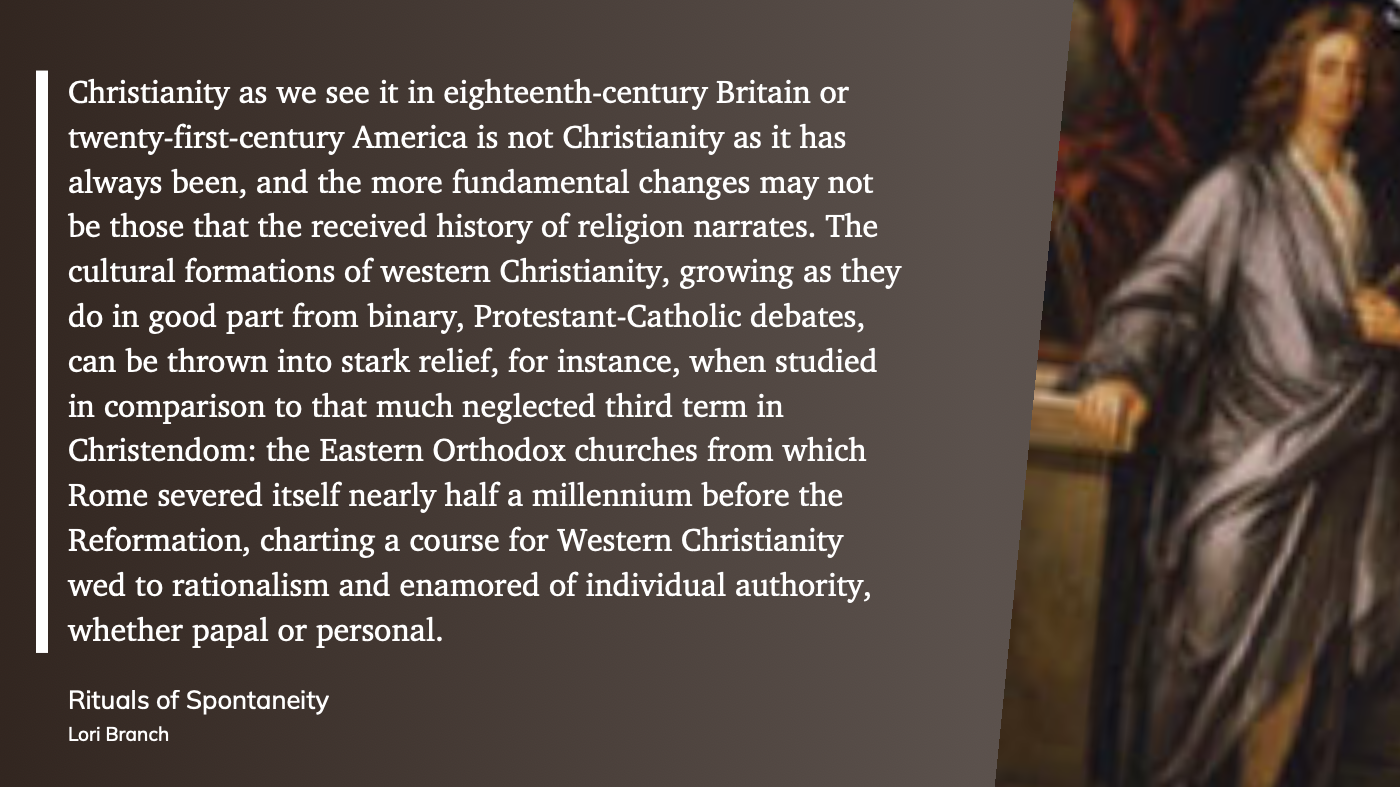
The framers of the Directory [for the Publique Worship of God] were not unaware of its paradoxical stance vis-à-vis ritual, either. Its preface obliquely acknowledged the oddity of institutionalizing a prescribed means of praying when Puritan teaching held that converted people would pray aright by the Spirit, but offered it as “some help and furniture” to the minister, so that he might “furnish his heart and tongue with Materials of Prayer and Exhortation, as shall be needful” (7-8). The careful, italicized language of the Directory, meant to be paraphrased but not displaced altogether, embodies a sort of anxious, secret checking of spontaneity that is in fact part and parcel of its logic. In spite of the selection of a man who appeared a trustworthy minister of God’s word, not only might his prayers stray from sound doctrine, but more than that, they might not flow freely, spontaneously, and affectively at all. In referring to the guide as “help and furniture,” the Directory portrays what it believes should be a modern, rational, self-transparent, and spontaneous self, operating under what it figures as deformities, weaknesses, and handicaps: seeking to authenticate its goodness and wholeness, yet perennially afraid of its inner divisions, the demand of its repeated performance, and perhaps most of all of its silences.
In this way, the Directory also looks toward the spiraling anxiety. That is one of the enduring legacies of Protestant and English dissenting spirituality in the restoration and enlightenment. More paradoxically than the writers of the Directory, Dissenters later wrote a vast literature to instruct those within their camp in the art of praying spontaneously. This literature too begs the question of why free prayer needed coaching, a query many dealt with directly. But it also sets forth as its most common recommendation for achieving true prayer the collection of lists of phrases, usually from Scripture, which once memorized would roll off the tongue and be easily assembled into prayer on the spur of the moment. Where the Directory‘s very form expresses the implicit knowledge that spontaneity is no real guarantor of (doctrinal or spiritual) truth, these free-prayer guides murmur with the fear that spontaneity may not come at all. While they seek to fill the mind with scriptural phrases, constructing, in Matthew Henry’s words, a “Storehouse of Materials for Prayer,” they also speak another truth. Besides being furnished with nonorthodox materials, the self that flees performativity and ritual, looking inward for authentic substance, finds itself fluctuating and, in the face of the demands of performance and empirical, experimental repetition, often silent and empty.
…
[Matthew] Henry’s Method culminates with his most fascinating phrase-collection of all, “A Paraphrase on the Lord’s Prayer, in Scripture Expressions.” Christ’s own form of prayer given to his disciples had long been a thorn in Puritans’ sides, to be plucked out by being understood as only a general guideline. Henry’s strategy is to neutralize the prayer’s form in a similar method; he provides, for instance, and amazing two and a half pages of verses elaborating on the one phrase “Our Father, who art Heaven” (MP, 163-65), a general topos, he says, from which prayer begins. Many editions of the Method were printed as Henry intended, interleaved with one blank page between each printed one, to enable the reader to pen in his own collection of phrases to supplement Henry’s own. Like Bunyan’s demand for scrupulous sincerity, Henry’s lists and blank pages, figures of accumulation and abstraction, combine literally to efface the Lord’s Prayer and erase it from Dissenting practice.
…
The more individualized these spiritual practices became, like the personalized collections of scriptural phrases, the more readily their constructedness-their nonspontaneity-was apparent, opening the believer to a sense of isolation and perpetual, nearly neurotic self-critique …
Lori Branch, Rituals of Spontaneity, pp. 55-57, 60.
This fake spontaneity persists in verbal tics like “Father God, we just” this, that, or the other thing. It’s like refrigerator magnet poetry only less creative.
The sober prayers of the Book of Common Prayer always secretly guided me when, as a Calvinist Elder, I was to lead congregational prayer, and those of the Orthodox Prayer books had an outsized influence on my eventual embrace of Orthodoxy.
Watch what they do, not what they say
Paradoxically, therefore, the structures necessary for the Reformers to extend the sacred into all of life included a whole constellation of structures and practices that they undermined. For if everything is sacred, then in another sense, nothing is sacred. This struck me in a particularly visceral way one Sunday morning at the Calvinist church in Idaho. After the service, I went to use the restroom and found leftovers of Communion bread in the bathroom garbage. The clergy routinely gave leftover bread and wine to the children to consume as a snack, which the children could then take wherever they wished.
Robin Phillips, Rediscovering the Goodness of Creation
Sometimes this whole 2000-year-old faith seems like a living koan. Chew on this until you are enlightened. Keep walking.
You can read most of my more impromptu stuff here and here (both of them cathartic venting, especially political) and here (the only social medium I frequent, because people there are quirky, pleasant and real). All should work in your RSS aggregator, like Feedly or Reeder, should you want to make a habit of it.
 Tipsy Teetotaler ن