Birth of John the Baptist

So far as I know, we have little or no evidence for when John the Forerunner/Baptist was born, but both Orthodox and Roman Catholics commemorate it on June 24. It’s a big enough deal that my parish had a liturgy for it.

The rest of this post has nothing to do with that.

At Stake in Harvard Grants

Harvard is unique both in the volume of its research output and the extent of these cuts — the government has threatened to end every research dollar to the university. The canceled grants accounted for here add up to about $2.6 billion in awarded federal funds, nearly half of which has already been spent according to government data.

“Even ‘grant’ is a problematic word, because people think they’re just sort of handing this money out for us to do what we want with,” said Marc Weisskopf, who directs a center for environmental health at Harvard that lost its funding from the National Institute of Environmental Health Sciences.

On the contrary, the government is much more explicit in competitive research applications and grant reviews: It wants more neuroscientists. It wants better opioid treatment. It wants to know how lightweight origami-inspired shelters and antennas can be unfurled in war zones.

The money the government sends to Harvard is, in effect, not a subsidy to advance the university’s mission. It’s a payment for the role Harvard plays in advancing the research mission of the United States.

This is the science model the U.S. has developed over 80 years: The government sets the agenda and funds the work; university scientists design the studies and find the answers. The president’s willingness to upend that model has revealed its fragility. There is no alternative in the U.S. to produce the kind of scientific advancements represented by these grants.

Emily Badger, Aatish Bhatia and Ethan Singer, Here Is All the Science at Risk in Trump’s Clash With Harvard

GOP 2012 redux

Many have made the point, but it’s nonetheless true: Presidents can now do pretty anything they want in foreign policy without seeking congressional authorization, provided it involves dropping bombs on other countries.

Five months into the second Trump administration, isn’t it astonishing that we have a Republican president: pushing for passage of a budget bill that cuts Medicaid and Medicare; pursuing an immigration policy focused on workplace enforcement, deportation of non-criminals, and the encouragement of “self-deportation”; and a happy John Bolton cheering the bombing of Iran? After a decade of debates about What Trump Means for the Right, we’ve ended up governed by the GOP circa 2012, as if the Trump administration were just the asshole version of the Romney/Ryan administration we were spared by Obama’s successful bid for re-election that year.

Damon Linker

Received financial wisdom

The longer I live, the more I appreciate that we can’t know everything, and that we live our lives mostly on the basis of trust. What we trust depends largely on our milieu (the polite term for “tribe” for present purposes), despite trying to avoid echo chambers.

Several of my social media cyberfriends (see footer) are living quite counterculturally, and one of them introduced me to the Dense Discovery newsletter. I probably give it awfully short shrift most weeks, but today caught my attention and led to something pretty thought-provoking, starting with a graph:
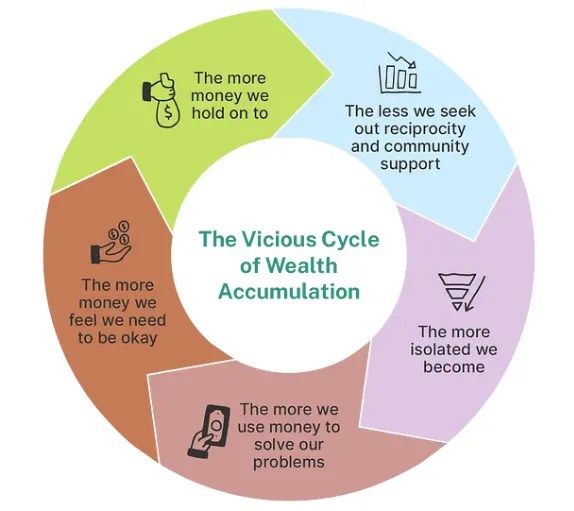
Okay, but let’s talk about the prescribed wealth hoarding model in the United States, otherwise known as prudent financial planning (supposedly). The conventional advice from financial planners is that people of my age are supposed to accumulate something like $1 million in order to retire. Or maybe $1.5 million.1 In case you’re not hip to the logic here – I wasn’t until I married a very specific kind of nerd – we’re supposed to amass so much wealth that we can live off the interest and dividends until we die. It’s not enough to save what we’ll need to make it to the end of our life; we need (ostensibly) way more than that. We need to accumulate so much wealth that we can live off the wealth that our wealth earns. We need – we are told – enough that we never have to touch the principal, and we can pass our wealth along to our next of kin, whoever they may be.2

Interdependence is My New Retirement Plan – by Lisa Sibbett

My father, a professional, seemed to live fairly consistently with the values Lisa Sibbett suggests. My widowed mother had enough and to spare, but their church saw a lot of money over the years, too, and his kids occasionally got gifts at the end of a bountiful year.

My father-in-law, a tradesman, lived the “conventional advice from financial planners,” and we are now benefitting from his success at that model.

I’ve lived somewhere in between those two models. Though I (credulously?) aspired to the “conventional advice” model, I just couldn’t resist living life along the way, and not waiting until I was properly fixed for life. Unlike my parents’ generation, I did not live through any Great Depression and didn’t feel that possibility in my bones. I don’t regret it.

One caveat with Sibbett’s approach is that it requires long-enduring personal bonds. You’ll need to sink roots somewhere, and that somewhere will need to be where others are sinking roots as well. It requires long-enduring personal bonds. It’s not for individualist nomads.

The unmentionable elephant in the room

I confess that I struggled with the reasoning of the Supreme Court in Skrmetti although I reluctantly welcomed the outcome.

I was not alone. Josh Blackman and Hadley Arkes (not a lawyer, but an Amherst professor of Jurisprudence) were in the same position as me, but Arkes in particular pointed to the root problem:

The truth that dares not speak its name here is that this wide array of gender-affirming therapies and surgeries is simply predicated on a falsehood. And yet those are the words that the conservative justices apparently see themselves as barred from speaking. Something in conservative jurisprudence holds them back from appealing to the inescapable and objective truth that lies at the heart of these cases. But without it, what were these accomplished jurists able to explain here? What was their ground of justification in overriding the judgments of those parents who were absorbed in the grief and confusion that seized their children? . . . .

The only “instruction” that would be relevant, Justice Thomas, is the unyielding fact that the child is in a state of confusion: he is not occupying some body apart from his own; his sex was not “assigned” at birth but marked inescapably in the organs of reproduction, in the arrangement of his body. His sex is immutable and printed plainly upon him.

Those were the words that Chief Justice Roberts and five colleagues could not move themselves to speak. Or they thought they were constrained from speaking by a jurisprudence that bars them from invoking truths beyond the text of the Constitution—even on the question of what is a human being, the bearer of rights, and when does that “human person” begin? . . .

Without those points in place, the judgment of the Court simply dissolves into a chain of ipse dixits. Why was it not legitimate for the parents of stricken youngsters to order the procedures that might relieve their “gender dysphoria?” Answer: The legislature of Tennessee did not think it a legitimate medical remedy to choose—even though the children and the parents did not share that judgment and were willing to take their risks. One judgment had to prevail, and it was the judgment backed by the power of the State. To put a high finish on it, that “power” represented the authority of a people to govern itself through elected representatives. But when the people speak through their representatives, and override the judgments of parents about their children, they are still obliged to say something more than “we have brute the power to impose this judgment through brute enactment of the law.”

Arkes singles out Justice Thomas, I suspect, because he said “so-called experts have no license to countermand the ‘wisdom, fairness, or logic of legislative choices.’” (Justice Thomas, concurring in U.S. v. Skrmetti, via Eugene Volokh.) Arkes’ re-formulation, I guess, is that the legislature can tell the experts “your elaborations are predicated on the falsehood that a person can be inhabiting a body of the wrong sex.”

That’s not the end of the story, but it’s a starting point for re-writing a story written up to now by activists hiding something only a few clicks less deranged than the whack-a-doodle Chase Strangio ideology:

Strangio disputed that a trans woman could be “born with a male body” or “born male”; in his view, a trans woman was born a woman just like any other woman. There was no such thing as a “male body,” Strangio told his colleagues: “A penis is not a male body part. It’s just an unusual body part for a woman.” Before the advertisement aired, Strangio elaborated on his critique in an article in Slate. “Many advocates defend the use of the ‘born male’ or ‘born with a male body’ narrative as being easier for nontransgender people to understand,” Strangio wrote. “Of course it is easier to understand, since it reinforces deeply entrenched views about what makes a man and what makes a woman. But it is precisely these views that we must change.”

My own position hasn’t changed in 39 months. I think we’re still seeing a cultural contagion of trans claims in adolescents and must be very cautious – which is a bit easier now that even Strangio has given up on the “live son or dead daughter” emotional blackmail.

Patience, Mercy, Tolerance

For defenders of political liberalism there is perhaps no more pressing problem than this: How do you make a compelling case for liberalism in an era of ascendant [illiberalism or] strong gods? The idea of “strong gods” comes from the book Return of the Strong Gods by R. R. Reno, editor of the conservative ecumenical journal First Things.

By “strong gods” Reno means the kind of visceral or agonistic forces that can compel political or social action through deeper existential or even guttural appeals. The strong gods work not by chiefly targeting the intellect, but the appetites.

Michael Reneau, Evan Spear, and Jake Meador, A Virtue-Centric Argument for Political Liberalism (shared link). This article was welcome in light of the ascendance of various illiberalisms.

With a little help from AI, I got this summary table:

VirtueRole Against Postliberalism & Strong GodsRoot/Source
PatienceProvides long-term perspective, allowing growth and changeChristian theology & history
MercyBreaks cycles of retribution, fosters trust and forgivenessScripture, Shakespeare
ToleranceIntellectual humility; suspends harsh judgment; enables coexistenceLiberal philosophy & Scripture (e.g., parable of wheat and tares)

Wordplay

I know every one of these carries political freight, but that’s the burden of many writers these days:

  • Glenn Thrush, Alan Feuer and Adam Goldman remarked on the right-wing ire confronting Patel and Pam Bondi, the attorney general, as they fail to substantiate the accusations that they hurled in their bid for power: “They are running what amounts to a conspiracy theory fulfillment center with unstocked shelves.” (Jeff Lebsack, Buffalo, and Marianne Painter, Tacoma, Wash., among others)
  • In The Financial Times, Edward Luce worried that certain scenes from the Los Angeles protests played into the president’s hands: “Every rock hurled lands like a penny in Trump’s wishing well.” (Todd Lowe, Simpsonville, Ky., and Al Gallo, Huntersville, N.C., among others)
  • In The Washington Post, Philip Bump expressed skepticism about the government’s claim that immigration officers must wear masks for self-protection: “We should not and cannot take ICE’s representations about the need for its officers to obscure their identities at face value.” (Patrick Bell, Carmichael, Calif.)
  • Also in The Post, Dana Milbank took in Trump’s pleasure at some sycophantic Republicans’ suggestion that the D.C. Metro be renamed the “Trump Train”: “It’s a great idea. Qatar will donate the subway cars, which will be powered by coal. Passengers will pay for fares with cryptocurrency after first showing proof of citizenship. And the trains will reverse themselves regularly and without warning — never quite reaching their original destination.” (Mary Ellen Maher-Harkins, Orwigsburg, Pa., and Stan Shatenstein, Montreal)

Via Frank Bruni

Ceci n’est pas un phone

Methaphone. Like Methadone. Get it?

In case you’ve been wondering …

No, you’re not imagining it. The main source of political violence in the USA in this century has been right-wing, not left. Jamelle Bouie, Right-Wing Violence Is Not a Fringe Issue:

It is simply a fact that the far right has been responsible for most of the political violence committed in the United States since the start of the 21st century.

I had been wondering, because there has been some leftwing violence against persons, and much against property.

Poor fit

If it seems that America’s colleges and universities are poorly suited to the average American eighteen-year-old, perhaps that’s because they were never designed to serve him.

Oren Cass, The Once and Future Worker


Your enemies are not demonic, and they are not all-powerful and the right hasn’t always lost and the left hasn’t always won. But if you convince yourself of that, you give yourselves all sorts of permission to do a lot of stupid and terrible things under the rubric of “Do you know what time it is?”

Jonah Goldberg.

Trumpism can be seen as a giant attempt to amputate the highest aspirations of the human spirit and to reduce us to our most primitive, atavistic tendencies.

David Brooks

I don’t do any of the major social media, but I have two sub-domains of the domain you’re currently reading: (a) You can read most of my reflexive stuff, especially political here. (b) I also post some things on my favorite social medium.


Saturday 9/28/24

This is Purdue’s Homecoming weekend. They’re playing football — or pretending to. I’m looking forward to basketball season.

Miscellany

An odd job title, if you think about it

“Content Creator” is a title that inadvertently tells on itself. It’s a tacit admission that the nature of the “content“ is meaningless and it exists to fill space. Might as well call yourself “Stuff Maker” or “Thing Doer.”

Dominic Armato via Alan Jacobs

As wrong as possible

“Poverty just doesn’t happen,” Rep. [Barbara] Lee, a California Democrat, declared at the launch of the “Children’s Budget,” a kind of progressive wish list, last week. “It’s a policy choice.” Rep. Lee has run up against a kind of metaphysical limit there: She is as wrong as it is possible for a human being to be. 

As practically every serious thinker about the issue has understood for a few thousand years at least, poverty does just happen—it is, in fact, one of the few things that does just happen. Poverty is the natural state of the human animal. Do nothing, and you will have poverty. Thomas Hobbes knew it. Aristotle knew it 2,000 years before Hobbes. Hesiod knew it centuries before Aristotle. The authors of the Upanishads knew it centuries before Hesiod. “Throughout history, poverty is the normal condition of man,” the American sci-fi writer Robert Heinlein observed. Or, as Thomas Sowell spent a lifetime explaining to an apparently impenetrable public, poverty has no causes—the absence of poverty has causes. Rep. Lee’s error is not novel. Her mistake repeats—nearly verbatim—the error of Rep. Ayanna Pressley: “Poverty is not naturally occurring; it is a policy choice.”

Kevin D. Williamson

Nothing more freeing

Of The Bulwark’s Mona Charen:

In 2018, she appeared on a panel at the Conservative Political Action Conference. When asked about feminism, she attacked her own tribe, saying, “I’m disappointed in people on our side for being hypocrites on sexual harassers and abusers of women who are in our party, who are in the White House, who brag about their extramarital affairs, who brag about mistreating women. And because he happens to have an R after his name, we look the other way; we don’t complain.”

The crowd erupted in jeers and shouts of “Not true!” Charen had been a speechwriter for Nancy Reagan! This was CPAC, Republican prom! Security guards escorted her out for her own protection.

The incident didn’t seem to shake her. “There is nothing more freeing than telling the truth,” Charen later wrote in a New York Times op-ed.

Olga Khazan, Never Trump, Forever

Decades ago, Mona Charen was one of my favorite conservative columnists. I rarely read her these days because, in the anti-Trump cosmos, I’m on planet Dispatch and find planet Bulwark a bit weird tedious. Thus has the black hole of Donald Trump disrupted the cosmos.

What unites us

Americans are less divided politically than the media likes to pretend.

Yes, it’s a big, diverse electorate, but there are certain opinions we all share. Like this one: I can’t believe the party I hate isn’t getting clobbered in the polls.

From the Liz Cheney left to the Robert F. Kennedy Jr. right, ask any voter at random whether they’re surprised at how close this race is, and my guess is they’ll talk your ear off in exasperation.

Nick Catoggio

Banned Books Week

The Orwellian Evolution of Banned Books Week

Vice and Virtue

Neither fear nor courage saves us. Unnatural vices
Are fathered by our heroism. Virtues
Are forced upon us by our impudent crimes.
These tears are shaken from the wrath-bearing tree.

T.S. Eliot, Gerontion, via J. Bottum

The gay guy pundits agree

Harris’ Context

I can’t say what Vice President Kamala Harris’s favorite word is — the one time I met with her, I didn’t ask — but I’d put a big stack of chips on “context.” She said it not once, not twice, but three times in her signature May 2023 “coconut tree” riff, and I’ve heard it tumble from her lips on other occasions as well. It’s like some oratorical caftan, warming and comforting her.

That turns out to be apt. Her bid for the presidency is all about context.

Any realistic response to it hinges not on the policy details that she has or hasn’t provided, not on the fine points of her record over time, not on her interview with Stephanie Ruhle of MSNBC on Wednesday, not on her previous sit-down with CNN’s Dana Bash. It hinges on context. She cannot be sized up outside of or apart from the alternative, a man of such reprehensible character, limitless rage, disregard for truth, contempt for democracy, monumental selfishness and incoherent thinking that even discussing Harris’s virtues and vices feels ever so slightly beside the point. She’s not Donald Trump.

Frank Bruni

The words are different but the melody’s the same

In the culture war, we know exactly what she is: an equity leftist, a strong believer in race and sex discrimination today to make up for past race and sex discrimination yesterday, and a politician who favors redefining womanhood to include biological men, and conducting medical experiments on gay, autistic and trans children, based entirely on self-diagnosis. These are her values, they are the values of every Dem special interest group, and she assures us they have not changed. I believe her.

I have yet to hear her say a single interesting or memorable thing in her entire career. Have you?

If a serious Republican candidate were up against her — even Nikki Haley — this election would not be even faintly close.

But we do not have a serious Republican candidate.

We have the most shameless charlatan in American political history — and there are plenty of competitors. He is unfit in every respect to be president of the United States …

Trump does not merely break norms. He has broken the norm, the indispensable norm for the continuation of the republic, the norm first set by George Washington when he retired from office, the norm that changed the entire world for the better: accepting the results of an election … I do not think this is even within his personal control. He is so genuinely psychologically warped that he has never and will never agree to the most basic requirement of public office: that you quit when you lose; and that the system is more important than any individual in it.

He is not lying when he insists that he won in 2016 and 2020 by massive landslides in the popular vote. He believes it. He believes he will win by a landslide in November, and there is no empirical evidence that could convince him otherwise. If he loses the election, he will call it a massive fraud one more time, and foment violence to protest it. We know this more certainly than we know anything about Kamala Harris. He tried to leverage mob violence to disrupt our democracy once. If that was not disqualifying, nothing is …

So I will vote for Harris, despite my profound reservations about her. Because I have no profound reservations about him. I know who he is and what he is. I know what forces he is conjuring and the extremes to which he will gladly take his own personal crusade. To abstain, though temptingly pure, is a cop-out. I vote not for Harris as such, but for a conservatism that can emerge once the demon is exorcized.

And exorcize it we must. Now, while we still can.

Andrew Sullivan

Other thoughts on POTUS Election 2024

Uninteresting and unmemorable

We have to guard that spirit. Let it always inspire us. Let it always be the source of our optimism, which is that spirit that is uniquely American. Let that then inspire us by helping us to be inspired to solve the problems.

Kamala Harris. I hate to belittle her, because her context is him, and he is everything that Bruni and Sullivan said. If Indiana is in play, I’ll vote for the sane-but-empty suit who’ll leave office in 2028 if defeated, leaving our political system intact.

Suttons Bay, MI, last week

Donald Trump According to Those Who Know Him

My last NYT “gift article” for September, and one of the most important. Donald Trump According to Those Who Know Him

Even when he’s right, he’s wrong

Somebody apparently told Trump about, say, ProPublica attacking the Dobbs decision (substantially reversing Roe v. Wade). His over-the-top response, directionally right, was this:

When speaking to supporters from the swing state, where both Trump and Vice President Kamala Harris have doubled efforts to capture the election count in November, Trump lamented the criticism aimed at the Supreme Court‘s conservative supermajority and said it should be “illegal.”

“They were very brave, the Supreme Court. Very brave. And they take a lot of hits because of it,” said the former president. “It should be illegal, what happens. You know, you have these guys like playing the ref, like the great Bobby Knight. These people should be put in jail the way they talk about our judges and our justices, trying to … sway their vote, sway their decision”

Trump Says People Criticizing Supreme Court Justices Should Be Jailed

So he also is profoundly ignorant of our most fundamental rights, including the right to say stupid things about any branch of government we care to kvetch about.

Some Nationalist, this

Donald Trump is a funny kind of patriot. 

He loves America—except for the cities, the people who live in the cities, about half of the states, the universities, professional sports leagues, Hollywood, Silicon Valley, Wall Street, the legal system, immigrants, the culture. He thinks the Capitol Police are murderers and that the FBI is a gestapo, that the government is an illegitimate junta maintained through election fraud, that the January 6 rioters are political prisoners, that the nation is a ruin, that it is “failed.” And when it fell to him to explain to [a] debate audience why he should be president, he spent most of his time repeating the praise of Hungarian autocrat Viktor Orbán.

Trump’s enemies are all Americans, his friends are all foreign dictators, and his money lives in Dubai and Indonesia. Some nationalist. 

Trump lives in a very strange little bubble: His world is Palm Beach, a handful of golf courses and hotels, and Fox News. The smallness of his frame of reference is a problem for him ….

Kevin D. Williamson

Trump’s victims

Depending on how you count them, 19 or 26 or 67 women have accused Mr. Trump of sexual misconduct. Women who have said he “squeezed my butt,” “eyed me like a piece of meat,” “stuck his hand up my skirt,” “thrust his genitals,” “forced his tongue in my mouth,” was “rummaging around my vagina,” and so on.

Mr. Trump has denied any misconduct. He, in turn, has accused the women of being “political operatives,” plotting a “conspiracy against you, the American people,” looking for their “10 minutes of fame” and not being his “type.”

“It couldn’t have happened, it didn’t happen,” Mr. Trump sneered during a recent news conference, referring to Ms. Leeds, the one who accused him of assaulting her on an airplane. “And she would not have been the chosen one.”

Jessica Bennett, Trump’s Female Accusers Are Begging You Not to Forget Them

He can’t even deny his sexual assaults without:

  1. Sneering at how homely his accuser is and
  2. Tacitly admitting that he assaults women lucky enough to be “chosen.”

I suffer more from the humiliations inflicted by my country than from those inflicted on her.

Simone Weil, from a letter to Georges Bernanos.

I don’t do any of the major social media, but I have two sub-domains of the domain you’re currently reading: (a) You can read most of my reflexive stuff, especially political here. (b) I also post some things on the only social medium I frequent, because people there are quirky, pleasant and real.

New Year’s Day 2024

I have come to care very little about a writer’s politics. I only care whether the writer appears to be sane and a truth-teller. There are many truth-tellers on the Left and there are many deranged and vile liars on the Right (where my reflexive sympathies lie).

You could call that my epigram today.

Rejecting bitterness

Why is a bitter “I told you so” so much more gratifying than finding agreement? Abigail Shrier’s Three New Year’s Resolutions for Americans is a challenging start to the year:

Like those who opposed the lockdowns, the masking of children, vaccine mandates, our southern border and immigration policy, or Woke racial intolerance, those of us who applied reasonable skepticism to pediatric gender transition were treated shabbily. The coercive tools of social ostracism and censorship were wielded against us with smug pride. Then, in 2023, our positions became conventional wisdom, but we were still unacceptable. It was all so obvious, suddenly, even to members of the MSM. They’d arrived where we’d long been, but seemed to think they’d discovered the land by dint of their own wisdom, preferring to ignore the grotesque inhabitants.

The transparently reckless progressive policy vision should have been a nonstarter with centrists and liberals. It didn’t take a PhD to know that cutting the breasts off teen girls in mental distress was a disastrous failure of psychology and medicine.

Here is a humbling truth, which all conservatives must face: If you have been shouting anything from the rooftops for years, it is not to your credit that no one listened. That you did not change minds. That you did not form a winning alliance. That you instead earned attaboys online from the same crew who pledged you loyalty from the start. Bitterness is deeply unattractive; that may have been one reason the more rational side sometimes fails to win enough support.

(Emphasis added). I plan to re-read this at least once after it rests a while.

Chastity belts of ideology

Rather than dwelling in their own thoughts, being a human being, living and experiencing things and gaining wisdom, people restrain all of their wisdom faculties with these chastity belts of ideology. If ideology becomes one’s identity, having impure thoughts is not thinking, it is a blow to your sense of self and therefore dangerous.

Simon Sarris, Are We Still Thinking?

Listening to our betters

A new consensus has emerged in the press, but perhaps especially at this paper: that truth isn’t a process of collective discovery, but an orthodoxy already known to an enlightened few whose job is to inform everyone else.

Bari Weiss, in her resignation letter to the New York Times. (Source)

The scourge that dare not speak its name

The brief annual preoccupation of Western societies with the so-called homeless (more accurately described as the family-less) is a good deal better than nothing … But why are there destitute people at all in our great 21st-century cities? The consequences of a society that has simultaneously licensed the dismantling of lifelong marriage and the widespread use of mind-altering drugs might have something to do with that. But who will put this right? Nobody, so far as I can see. These are causes so lost as to be almost unmentionable among the polite.

Peter Hitchens, The Christmas Spirit Rests on Fear

How many regiments does the Truth have?

Even when Fundamentalists set out to defend the truth, their temptation was to rally large constituencies to the cause rather than to prepare for scholarly exchange.

Nathan O. Hatch, The Democratization of American Christianity


… that Christ may dwell in your hearts through faith; that you, being rooted and grounded in love, may be able to comprehend with all the saints what is the width and length and depth and height — to know the love of Christ which passes knowledge; that you may be filled with all the fullness of God.

Ephesians 3:17-19 (NKJV)

You can read most of my more impromptu stuff here (cathartic venting) and here (the only social medium I frequent, because people there are quirky, pleasant and real). Both should work in your RSS aggregator, like Feedly or Reeder, should you want to make a habit of it.

Beginning and ending with hope

Pierre Blaché via Wikimedia Commons

Just because I can’t get enough of Paris.

Truth

Staying for the Truth

“What is truth?” said jesting Pilate, and would not stay for an answer. [Francis Bacon]

In 1990, soon after the Ayatollah Khomeini pronounced his fatwa against Salman Rushdie, the novelist was interviewed by Mike Wallace for 60 Minutes. At one point Wallace asks Rushdie why he would write a story (The Satanic Verses) in which the wives of the Prophet are prostitutes in brothels.

Rushdie: Well, it’s, of course, not his wives in brothels. I mean, let’s be accurate about this. It’s not his wives in brothels.

Wallace (skeptically): What is it?

Rushdie: There is a brothel in the imaginary city in which the prostitutes take the names of the prophets’ wives. Meanwhile, it is quite clearly stated the prophets’ wives are somewhere else being perfectly well behaved.

Wallace: Yes. But it’s in the eye of the reader. It’s in eye of the beholder. And
if you are a faithful Muslim…

Wallace is quite committed to this “eye of the beholder” take. The author sees it one way, the readers another—who are we to judge? When Rushdie persists in trying to correct the lie about his book, Wallace tries to frame it as a matter of the author’s “intention.” But Rushdie responds, “If I’m accused of calling the prophets’ wives whores, I didn’t do it.” At which point Wallace simply changes the subject, never deigning to acknowledge that truth and falsehood are at stake here—and that the truth is easily ascertained, if one can be bothered to seek it. Journalistic bothsidesism can be a kind of jesting, too.

Alan Jacobs, Staying for the Truth Hedgehog Review 24.3, p. 9

A half-truth that functions as a lie

I knew not to try to quantify key aspects other than climate change in my research because it would dilute the story that prestigious journals like Nature and its rival, Science, want to tell. 

This matters because it is critically important for scientists to be published in high-profile journals; in many ways, they are the gatekeepers for career success in academia. And the editors of these journals have made it abundantly clear, both by what they publish and what they reject, that they want climate papers that support certain preapproved narratives—even when those narratives come at the expense of broader knowledge for society. 

To put it bluntly, climate science has become less about understanding the complexities of the world and more about serving as a kind of Cassandra, urgently warning the public about the dangers of climate change. However understandable this instinct may be, it distorts a great deal of climate science research, misinforms the public, and most importantly, makes practical solutions more difficult to achieve. 

In theory, scientific research should prize curiosity, dispassionate objectivity, and a commitment to uncovering the truth. Surely those are the qualities that editors of scientific journals should value. 

In reality, though, the biases of the editors (and the reviewers they call upon to evaluate submissions) exert a major influence on the collective output of entire fields.

Patrick T Brown, I Left Out the Full Truth to Get My Climate Change Paper Published

Check before clicking

Instead of slowing down information by reviewing and testing it before passing it along, digital media rewarded instantaneity and impulsivity. The Constitution of Knowledge checks before transmitting. It squelches bad information by filtering it out and slowing it down. By contrast, digital networks disseminate information at the speed of light and without regard to quality. They have given new substance to the old saying that a lie circles the world before truth gets its boots on.

Jonathan Rauch, The Constitution of Knowledge

Education, narrowly and loosely contrued

Meat computers

The ecomodernist approach of Regenesis relies on a mechanistic understanding of humanity. The presumption is that humans are merely fleshy machines that can adapt to flourish in any environment as long as their basic material needs are met. That doesn’t match with most people’s experience of life.

Andrew J. Spencer, Hope for a Humane Agricultural Future: A Review of Saying NO to a Farm-Free Future

If this is accurate, then the ecomodernists are, um, not the kind of people I want in charge of things.

“Learning outcomes”

In a nutshell, the two learning outcomes for our homeschool are to pursue the joy of learning and to cultivate human flourishing. When is the last time you saw these goals listed as learning outcomes in your local public school?

There is more. Until recently walking away from academia, I worked as a professor of History and Classics for fifteen years, teaching undergraduate and graduate students. Repeatedly, some of the best students I have taught have been homeschooled. What set them apart was precisely the spirit of bold curiosity that I see in my own kids: that bright light in their eyes, an interest in asking questions and in pursuing rabbit trails independently.

Public school curricula, with their strictly set state standards and increased emphasis on standardized testing, simply cannot allow this sort of flexibility. As a result, no matter how amazing the teachers are (and, believe me, many are truly amazing!), students do not get the opportunity to cultivate curiosity, wonder, and a genuine love of learning. More control and oversight is not helping American public schools, and it certainly would not help homeschoolers.

Nadya Williams, Homeschooling and Red Herrings

BIG/small

My near neighbor, Purdue University, now has both the World’s Largest Drum and its smallest, clocking in at 50 microns and manufactured on campus in the nanotechnology center.

Nellie Bowles rocks again

Nellie’s wrap-up for September 8:

Is the congressional elder abuse hotline disconnected?

Someone help Mitch McConnell. He has experienced a couple of freezing episodes on camera, with the most recent lasting about 30 seconds. I’m not a doctor. I don’t know what these are. But I know that America’s elders are being abused right before our eyes. I know that Dianne Feinstein, whose daughter has power of attorney over her legal affairs, should not be a sitting senator. Joe Biden’s speech in Maui, when he finally showed up, was bizarre. There are 115 confirmed dead with more than 100 still missing, a tragedy compounded by disastrous local politicians, and Biden compared it all to his small kitchen fire: “I don’t want to compare difficulties, but we have a little sense, Jill and I, of what it was like to lose a home. Years ago—now 15 years—I was in Washington doing Meet the Press. . . . [L]ightning struck at home on a little lake that’s outside of our home—not a lake, a big pond—and hit a wire and came up underneath our home into the. . . air conditioning ducts. To make a long story short, I almost lost my wife, my ’67 Corvette, and my cat.”

“Not the ’Vette!” shouted the people who lost homes and loved ones. 

If our parents or grandparents acted this way, we would take away the car. Let alone the country.

Talk is cheap, caring costly

The American left has never come up with a solution to the very basic conundrum that they want open borders but also robust social services. Up until now, the conflict has never come to a head because folks could just point at Trump or at Southern politicians and talk about how racist those Republicans are to enforce the border. But now it’s Biden. And now immigrants are coming en masse to New York City, asking about those robust social services. And now someone actually has to do the math.

As a capitalist monster, I have a solution: fully open borders but no social services, just survival of the fittest, America as the world’s Thunderdome. VIP boxes for the tech titans and popcorn stands to your left. No? Why is everyone hissing?

In school gender wars news

An education minister in Ontario, Canada, has made a U-turn and now says indeed, parents should be told when a child starts using a new name and pronouns at school. Meanwhile, in Jefferson County, Colorado, we’re seeing the opposite: the teachers union is coaching educators on how to hide evidence about collecting information on student sexuality and gender identity.

From CBS: “An email from Jefferson County Education Association (JCEA) to teachers says, ‘if you do a questionnaire, please make it a paper and pencil activity—any digital records are more permanent and may be requested under federal law.’ The union also encouraged teachers to ‘make your notations about students and not hold on to the documents.’ ”

If you see the Amazon guy delivering books on homeschooling to my house, no you didn’t.

Culture generally

Culture war

War and culture go together like a gore and vulture, right?

The discussions over woke and anti-woke and culture wars are soul-sucking to me. I think it’s good to have specific debates over affirmative action in college admissions, the problems with boys, the way we teach history — and that’s terrific; and we’ve had that on this podcast and we should continue to have it — but when we talk about the culture war, that’s not about debating issues. The culture war is about joining a side. It is about picking a team. And the problem with picking a team in the culture wars is that you inevitably end up with lunatics on your team, right, and the craziest ones are often the captains of the team. And they might want to go much further than you might want to go, but y’know, you’re on the team, and you don’t want the other side to win, so, y’know, you end up supporting what[ever] the team is defending.

Carlos Lozado on the Matter of Opinion podcast.

Boy, does that ever nail my feelings. If you cared to, you could find several people who would say (if you asked it subtly) that I’m a lousy team player, or even that I’m a Judas. Despite the fact that I’d never even joined their team, I was a lawyer, and articulate, so they claimed me.

Easily the stupidest position the “team” ever took was to demand that the local rag drop the For Better of Worse comic strip (after it introduced as a very minor character a gay middle-schooler), with misleading statistics to show that the rag was out of step for not dropping it. I happened to be the paper’s attorney at the time. I wrote a letter to the editor supporting this most insightful and humane strip. That’s when I got a semi-anonymous call that mentioned 30 pieces of silver (semi-anonymous because it was the captain’s mother, and I knew the captain’s maiden name).

Restoring souls

Garrison Keillor almost went all season without taking in a ball game, but he’s got tickets (game and flight from New York) to a Twins game Wednesday:

I’ll sit behind the visitors’ dugout at the ballpark and my sense of order will be restored, same as when I recite the Twenty-third Psalm, it still says that the Lord restoreth my soul and my cup runneth over, it doesn’t say He awakens my consciousness or that I resonate with authenticity.

Garrison Keillor

Faux bravery lionized

[T]o read reviews and thinkpieces and social media, you’d think that [the new movie] Bottoms was emerging into a culture industry where the Moral Majority runs the show. One of the totally bizarre things about contemporary pop culture coverage is that the “lesbian Letterboxd crowd” and subcultures like them – proud and open and loud champions of “diversity” in the HR sense – are prevalent, influential, and powerful, and yet we are constantly to pretend that they don’t exist. To think of Bottoms as inherently subversive, you have to pretend that the cohort that Handler refers to here has no voice, even as its voice is loud enough to influence a New York magazine cover story. This basic dynamic really hasn’t changed in the culture business in a decade, and that’s because the people who make up the profession prefer to think of their artistic and political tastes as permanently marginal even as they write our collective culture.

Essentially the entire world of for-pay movie criticism and news is made up of the kind of people who will stand up and applaud for a movie with that premise regardless of how good the actual movie is. And I suspect that Rachel Handler, the author of that piece, and its editors at New York, and the PR people for the film, and the women who made it, and most of the piece’s readers know that it isn’t brave to release that movie, in this culture, now …

“Anything involving LQBTQ characters or themes is still something that’s inherently risky and daring in the world of entertainment and media, in the year of our lord 2023” is both transparently horseshit and yet socially mandated, in industries in which most people are just trying to hold on and don’t need the hassle.

[F]or 15 years as a professional writer I’ve watched people write things that were in fact incredibly safe, then get lionized by their peers for their bravery. Again and again and again. I’ve always thought the petty hypocrisy was plain; if you’re getting celebrated by a huge number of your peers for a piece you wrote, how could it have been brave? These pieces might have been good, true, correct, necessary, sharp, funny, or wise, and that’s enough. Brave isn’t everything.

Freddie deBoer

Instant Joy

Politico asked the 2024 presidential candidates to make a list of 20 songs that “stir their soul” and give them “instant joy.”

Most obvious? Chris Christie picking Bruce Springsteen and Bon Jovi. Least obvious? Asa Hutchinson listing a song by P!nk.

TMD

My answer would be Lyle Lovett, That’s Right, You’re Not From Texas. I wouldn’t bother with 19 more. I obviously am unworthy of the Presidency.

Tennis balls

Some former high-profile [tennis] players have traded in a racket for a gun, including Sergiy Stahovsky, a Ukrainian who famously beat Roger Federer in 2013. “Stakhovsky is a member of special operations for the Security Service of Ukraine. His unit, he says, is heavily involved in the fighting and deploys a range of weapons—mortars, javelin and stinger missiles, drones. He told me that he was vacationing in Dubai with his family when the war started. The city was hosting a men’s tournament that week. Stakhovsky had not lived in Ukraine since he was 12. But with his country under attack, he felt obliged to join the war effort. He left Dubai and arrived in Kyiv on Feb. 28, four days after the Russians invaded. “I did not have any other option,” he said. “I could not imagine sitting outside of Ukraine and screaming for other people to help Ukraine.”

TMD

Burning Man

Marie Antoinette probably never said “Let them eat cake”. But she did provoke popular fury by building a model peasant village at Versailles, where she would retire to escape the pressures and opulence of court life, and even sometimes dress up as a milkmaid for picnics or parties.

If the 21st century has an aristocracy on a par with that of Versailles, it is surely the Silicon Valley tech elite. And their equivalent of Marie Antoinette’s toy farm is Burning Man: a utopian week-long summer festival in the Nevada Desert, whose culture captures a distinctive West Coast liberal ideal — and which is, in the modern context, every bit as artificial and tone-deaf as le hameau de la Reine.

… sustaining Black Rock City requires considerable material effort under the bonnet … Sometimes described as an experiment in “radical self-sufficiency”, Burning Man is perhaps more accurately an experiment in creating a radical post-scarcity society by having done all your shopping ahead of time.

The “playa” where the event takes place has no shelter, no water, and no greenery. Nothing is left there between festivals, meaning all infrastructure a temporary, hauled in and assembled for the purpose. Depending on your actual bank balance, this means after the $575 ticket price you must buy or rent everything you need for an encampment, band together with friends, or at minimum raise the funds needed for membership in one of the annual larger pre-existing themed camps. You must pre-load with food, water and shelter. Plus you’ll have more fun if you also take trinkets and treats for barter, fun costumes to wear, drugs, and perhaps a bicycle to get around. All this is then hauled out onto the ring-fenced blank slate of a dry Nevada lake-bed, so festival-goers can enjoy a magical, week-long experience of life without buying or selling.

In other words: all this gift-economy joy is enabled by participation in the regular cut-throat capitalist one. And enjoying it at all is predicated on having enough surplus resource in your life that you can afford to blow at least a few grand on contributing to a colossal, ephemeral simulacrum of no longer needing money at all.

Mary Harrington, Burning Man is a capitalist lie

I thought I wasn’t interested in burning man, but then Alan Jacobs deftly pointed out that Harrington is really writing about self-delusion and simulacra.

Intuition

AI without the ballast of intuition represents the tyranny of pure analysis. Unleashed, and without intuition to give it a more profound understanding of humanity, AI stands ready to extend the power of reductive and often dangerously misleading concepts.

Ronald W. Dworkin in Hedgehog Review, H/T Alan Jacobs on micro.blog

It could happen again

I close, as I began, with Hedgehog Review 24.3, an issue devoted to “Hope Itself”:

A thousand times in history—a million, more likely—visionaries, prophets, artists, and philosophers have wandered away from the social world that made them and sat themselves in nature, to see what could be seen when you stop demanding that nature echo back precisely the creeds of your community.

The liberal establishment has gnashed its teeth, shrieked, buried its head in the sand, blamed its comeuppance on omnipotent Russian bots, anything to avoid going back to reality and seeing what it might have missed, how its cultures have been blind, how they could be refreshed.

Ian Marcus Corbin, Deep Down Things in a Time of Panic, in Hedgehog Review 24.3, p. 20.

(Having recently finished reading the massive Black Lamb and Grey Falcon (Rebecca West), I’m doing some catch-up on journals like Hedgehog Review, whence two quotes — so far)


A fundamental reality of human existence is that vice often leaves virtue with few good options. Evil men can attach catastrophic risks to virtually any course of action, however admirable.

David French

You can read most of my more impromptu stuff here (cathartic venting) and here (the only social medium I frequent, because people there are quirky, pleasant and real). Both should work in your RSS aggregator, like Feedly or Reeder, should you want to make a habit of it.

Seeking truth, creatively defying lies

“What Plato taught me is that much more important than the instrumental value of education is its intrinsic value. And that’s what Gorgias puts on the table. Why do we debate? Why do we engage in discussion? Why do we seek the truth? Well, knowledge and understanding can have many instrumental benefits, but those are secondary to the intrinsic value of knowledge, its inherent enrichments of the human spirit. We should want knowledge more fundamentally for its own sake than for any instrumental purpose.”

When I raised the subject [of cancellation] with George, he observed that, curiously, students on campus have abandoned moral relativism and an excessive concern for toleration of diverse viewpoints with a fundamentalist desire to silence those who oppose certain absolutes. “The problem is not that they think there is no moral truth,” he told me, “it’s that they think the moral truth is obvious, they know it, they don’t have to defend it, and anyone who disagrees with them is a fool or a bigot. If you don’t agree, it’s your job to fall in line with our groupthink. It’s a militant fundamentalist kind of pseudo-religion; an unwillingness to consider the possibility that you might be wrong in your moral beliefs.”

… Wokeism works by intimidation; it’s the one and only method it’s got for whipping people into line. There’s no shortcut here, there’s no formula: You have to stand up. It’s going to take people setting an example of courageous defiance; standing up for their rights and the rights of everyone to think for themselves, to challenge these sacred dogmas, to refuse to get in line with the groupthink.”

Robert P. George, mostly, quoted in a profile of him.


You can read most of my more impromptu stuff at here. It should work in your RSS aggregator, like Feedly, should you want to make a habit of it.

3 things, 12 rules, 1 prayer

[P]rophets are neither new nor controversial. To a first approximation, they only ever say three things:

First, good and evil are definitely real. You know they’re real. You can talk in philosophy class about how subtle and complicated they are, but this is bullshit and you know it. Good and evil are the realest and most obvious things you will ever see, and you recognize them on sight.

Second, you are kind of crap. You know what good is, but you don’t do it. You know what evil is, but you do it anyway. You avoid the straight and narrow path in favor of the easy and comfortable one. You make excuses for yourself and you blame your problems on other people. You can say otherwise, and maybe other people will believe you, but you and I both know you’re lying.

Third, it’s not too late to change. You say you’re too far gone, but that’s another lie you tell yourself. If you repented, you would be forgiven. If you take one step towards God, He will take twenty toward you. Though your sins be like scarlet, they shall be white as snow.

This is the General Prophetic Method. It’s easy, it’s old as dirt, and it works.

Scott Alexander at Slate Star Codex, reviewing Jordan Peterson’s Twelve Rules for Life.

For whatever reason, I’ve become pretty fierce about the obligations of lie-resisting and truth-telling. I’ll leave that sentence as a bit of a Rorschach test, but I’ll tell you that it includes resisting lies from sources Left and Right.

With that, and with Jordan Peterson particularly in mind, I added to my morning list of people to ask God’s blessing on “all truth-tellers, Christian or not, in this age enamored of lies” (that’s the reminder I wrote to myself).

Then an old friend — and by “old” I mean I met him in 1963 — who has remained fiercely Evangelical and activist, pricked my conscience with a video, shared on Facebook, pointing out that the United States was in a terrible spiritual state in the late 18th century — maybe worse than that of the late 20th century — but then,  voilà!, what should up and happen but the Second Great Awakening, with enormous and lasting change in its wake.

So I decided I should pray for something like a Third Great Awakening, and that’s how I wrote down a second reminder.

But it’s no secret that I’m an ecclesial and liturgical Christian. Among other things, that implies that if I’m going to pray for something every morning, I’d really like to do a bit better than “Father God, we just ask you Father to just Father bless all the truth-tellers Father and coudja just send us Father another Great Awakening Father if it’s not to much trouble — Father?”

So I was pleased Thursday night to notice, in the Prayer Book I was using, a succinct petition that, with minor adaptation, effectively rolls my truth-teller and Great Awakening prayers into one, leaving the executive details up to He Who Is At An Infinitely Higher Pay Grade:

O, Most Holy Trinity, who lovest mankind and willest not that any should perish, look, I beseech Thee, on all my countrymen that are led astray by the devil; that rejecting all errors, the hearts of those who err may be converted and return to the unity of Thy truth.

“Led astray.” “Error.” “Converted.” “Unity of Thy truth.” That seems to cover it.

Feel utterly free to make it your own, remembering that it could apply to you, too.

But if you try to type it, watch out for those dadburned modern auto-correct features. They don’t like the King’s English.

* * * * *

Reality is that which, when you stop believing in it, doesn’t go away.

(Philip K. Dick)

The waters are out and no human force can turn them back, but I do not see why as we go with the stream we need sing Hallelujah to the river god.

(Sir James Fitzjames Stephen)

Some succinct standing advice on recurring themes.

Where I glean stuff.

A true icon cannot have hate

I spent a week in an icon workshop with the late Xenia Pokrovsky. I recall her statement concerning an icon that depicted a very grievous incident. She declared, “This is not an icon!” I remember looking at it and thinking, “But it’s painted in the correct style, etc.” She said, “It has hate. A true icon cannot have hate.” And I could see that it was true. Nothing that breeds hate in the human heart has about it the nature of truth. This is a hard saying.

(Fr. Stephen Freeman, Goodness and a Word in Due Season) There is much more food for thought here, but I didn’t want anything to distract from this gem.

(This is not Fr. Stephen’s point, but mightn’t it be an extension of this insight to say that almost nothing about our politics today has about it the nature of truth? “Put not your trust in Princes, in sons of men in whom there is no salvation ….”)

* * * * *

Men are men before they are lawyers or physicians or manufacturers; and if you make them capable and sensible men they will make themselves capable and sensible lawyers and physicians. (John Stuart Mill, Inaugural Address at St. Andrew’s, 1867)

“Liberal education is concerned with the souls of men, and therefore has little or no use for machines … [it] consists in learning to listen to still and small voices and therefore in becoming deaf to loudspeakers.” (Leo Strauss)

Some succinct standing advice on recurring themes.

Sunday 11/6/16

A Secondary Thing

What is the telos of university?

The most obvious answer is “truth” –- the word appears on so many university crests. But increasingly, many of America’s top universities are embracing social justice as their telos, or as a second and equal telos. But can any institution or profession have two teloses (or teloi)? What happens if they conflict?

As a social psychologist who studies morality, I have watched these two teloses come into conflict increasingly often during my 30 years in the academy. The conflicts seemed manageable in the 1990s. But the intensity of conflict has grown since then, at the same time as the political diversity of the professoriate was plummeting, and at the same time as American cross-partisan hostility was rising. I believe the conflict reached its boiling point in the fall of 2015 when student protesters at 80 universities demanded that their universities make much greater and more explicit commitments to social justice, often including mandatory courses and training for everyone in social justice perspectives and content.

Now that many university presidents have agreed to implement many of the demands, I believe that the conflict between truth and social justice is likely to become unmanageable.  Universities will have to choose, and be explicit about their choice, so that potential students and faculty recruits can make an informed choice. Universities that try to honor both will face increasing incoherence and internal conflict.

(Jonathan Haidt, Why Universities Must Choose One Telos: Truth or Social Justice; H/T Rod Dreher)

Haidt acknowledges that this has been a miserable year for voters, but avers that it’s a great, great year for studying moral psychology, his field, which he thinks can explain it all. There is additional material, an outline, a PowerPoint, and a 66-minute YouTube video of Haidt’s talk on this topic at Duke, all at the preceding link.

I didn’t have time for viewing a long video, but if you’re a stranger to Haidt, you might want to make time.

A First Thing

I would a thousand times rather my Christian children attend a secular college that claims Truth as its telos than attend a Christian college that makes Social Justice its telos, or that fails to make Truth its exclusive telos.

But Haidt’s insight is also true for churches today. If we diligently seek Truth, and seek to conform our lives as much as possible around what we believe to be True, then we will inevitably achieve a form of Social Justice. But there can be no Justice, social or otherwise, without Truth. And Truth can never be what serves a pre-determined goal — the Revolution, the party, equality, the nation, the family, the temporal interests of the Church, nothing.

Those contemporary churches that put anything above the fearless pursuit of Truth, and living in Truth, will die, because they have no way of protecting their vision of the True, the Good, and the Beautiful — which is to say, God. They subordinate it to worldly, temporal concerns, and destroy their only mechanism (so to speak) for perceiving God clearly. To be clear, it is impossible for any church to see the entire Truth, and in any case, for Christians, Truth is not merely a set of propositions, but is a Person, Jesus Christ. This has profound implications that we can’t really get into in this post. My point is, churches, like universities, that place politics, culture, or any other goal over Truth are signing their own death warrants.

(Rod Dreher, Truth, Or Social Justice: Pick One (emphasis added), reacting to Haidt and to philosopher Elaine Scarry’s book On Beauty And Being Just)

Would a Church ever choose “social justice” over truth? Many already have. The social justice Sirens are singing their song to as many others as have not resolutely stopped their ears to them.

This does not mean we resolve to be unjust. It means we refuse to be seduced into a view of justice that does not comport with truth.

* * * * *

“In learning as in traveling and, of course, in lovemaking, all the charm lies in not coming too quickly to the point, but in meandering around for a while.” (Eva Brann)

Some succinct standing advice on recurring themes.