Tuesday, March 12, 2024

Why I read Damon Linker

But several of the comments said much the same thing—and others left similar remarks in response some statements I (and others) made about Biden on to the “Beg to Differ” podcast last week (which was recorded before the SOTU). I’m going to quote one of those comments, anonymously, because it so nicely distills the criticism I keep hearing in both places.

Damon [and others on the podcast] are so completely negative and pessimistic that they are contributing to the downfall of our Democracy. … It is past time to put aside your trepidation about Biden’s candidacy and policies and do everything you can to get him elected. Hopelessness and apathy are friends to authoritarians. They lead to people staying home. You can offer suggestions for changes in policy without gloom and doom and trashing Biden.

The message here is admirably clear: The critic wants me to write and say things that will contribute to Biden winning and stop saying things that will supposedly demoralize voters, leading them to give up hope for victory and so possibly skip voting on Election Day. Which means the critic wants me to suppress my critical intellect or otherwise bring it into alignment with the kind of talking points that might be released by the Biden campaign’s communications office.

…

I very much want Trump to lose—and by the widest possible margin. But nothing I write can make that happen. So instead of writing things with an eye to contributing to Biden’s campaign, I devote my time and talents (such as they are) to trying to understand what is happening—above all: Why has Trump succeeded in taking over the Republican Party? And how does this manifestly unfit, seditious, and corrupt bullshit artist manage to command enough support in the electorate that he will be seriously competitive for the presidency for the third election in a row?

…

Democracy is being threatened democratically, in other words, which means, as the old horror-movie tag line has it, the call is coming from inside the house. It’s important to remember that. Trump isn’t some foreign agent. He’s as American as can be, and so are those who have voted for him in the past and will vote for him in November. They are our fellow citizens. This is their country, too—as much theirs as it is ours. If we outnumber them, we will win and America will remain a liberal democracy for another four years. If they outnumber us, they will prevail and our liberalism will be tested, again—and, I fear, more severely than the last time.

But that won’t be the end of the story, because the story never ends ….

Damon Linker

This is why I expect to continue reading Damon Linker even as I cut away political reading that tends merely to inflame the reader.

As for that last paragraph, remember that neither party’s win in November is “the end of the world.” It is at worst “the end of a world.”

There is no “labor shortage”

I’m a libertarian, let-markets-work kind of guy, and some of my lefty or populist friends sometimes act like they’ve pulled a dispositive rabbit out of the rhetorical hat when they point out that there exist—angels and ministers of grace, defend us!—badly run businesses, dysfunctional markets, dishonest businessmen, etc. They don’t seem to understand that the choice is between stupid, greedy men and stupid, greedy men with an army and a police force. One of these groups of stupid, greedy men has to compete for your business, and you can say “no” to them; the other kind doesn’t have to take “no” for an answer. That’s the whole enchilada, really: I want more decisions affecting my life made in the context of negotiations I can walk away from and fewer of them made at the point of a bayonet.

… when it comes to immigration, I keep coming back to one thing: We have enough poor people in our country, and we don’t need to import more of them. There’s a lot more to citizenship than economic calculation, but if it’s just green cards or the equivalent we’re talking about, then I’m all for opening the national door to people who have offers for jobs at, say, $200,000 a year, or people with seven-to-10-figure sums to invest in businesses and projects. But unskilled and low-wage workers? We have plenty. And if I have to pay more for an avocado to get control of our runaway illegal (literally illegal, Mr. President—literally) immigration problem—fine.

Kevin D. Williamson

Not a strong draw

We’ve reached the stage of American decline in which smashing the constitutional order is just another issue in the upcoming election, something to be weighed alongside the candidates’ respective positions on taxes, say.

…

It’s not clear anymore that Trump even has a firm position on most policy issues.

He fights! his fans insist. But what, at this point, is he fighting for?

Trump’s policy preferences can usually be explained straightforwardly by ignorance, selfishness, or, in rarer cases, ideological nationalism.

None of which is a strong draw for conservative voters, I hope you’ll agree.

Nick Catoggio

Personality profiles

“We are unknown to ourselves, we knowers…and there is good reason for this. We have never looked for ourselves—so how are we ever supposed to find ourselves?” Much has changed since the late nineteenth century, when Nietzsche wrote those words. We now look obsessively for ourselves, and we find ourselves in myriad ways. Then we find more ways of finding ourselves. One involves a tool, around which grew a science, from which bloomed a faith, and from which fell the fruits of dogma. That tool is the questionnaire. The science is psychometrics. And the faith is a devotion to self-codification, of which the revelation of personality is the fruit.

…

[T]he self has never been more securely an object of classification than it is today, thanks to the century-long ascendence of behavioral analysis and scientific psychology, sociometry, taxonomic personology, and personality theory. Add to these the assorted psychodiagnostic instruments drawing on refinements of multiple regression analysis, and multivariate and circumplex modeling, trait determination and battery-based assessments, and the ebbs and flows of psychoanalytic theory. Not to be overlooked, of course, is the popularizing power of evidence-based objective and predictive personality profiling inside and outside the laboratory and therapy chambers since Katherine Briggs began envisioning what would become the fabled person-sorting Myers-Briggs Type Indicator (MBTI) in 1919. A handful of phone calls, psychological referrals, job applications, and free or modestly priced hyperlinked platforms will place before you (and the eighty million or more other Americans who take these tests annually) more than two thousand personality assessments promising to crack your code. Their efficacy has become an object of our collective speculation. And by many accounts, their revelations make us not only known but also more empowered to live healthy and fulfilling lives. Nietzsche had many things, but he did not have PersonalityMax.com or PersonalityAssessor.com.

Christopher Yates, Sorting the Self

I must confess that I read no further. Spritely writing just could not overcome my indifference to the topic (relative to other topics). Your mileage may vary.

A picture worth how many words

This map has kind of bothered me since I first saw it:
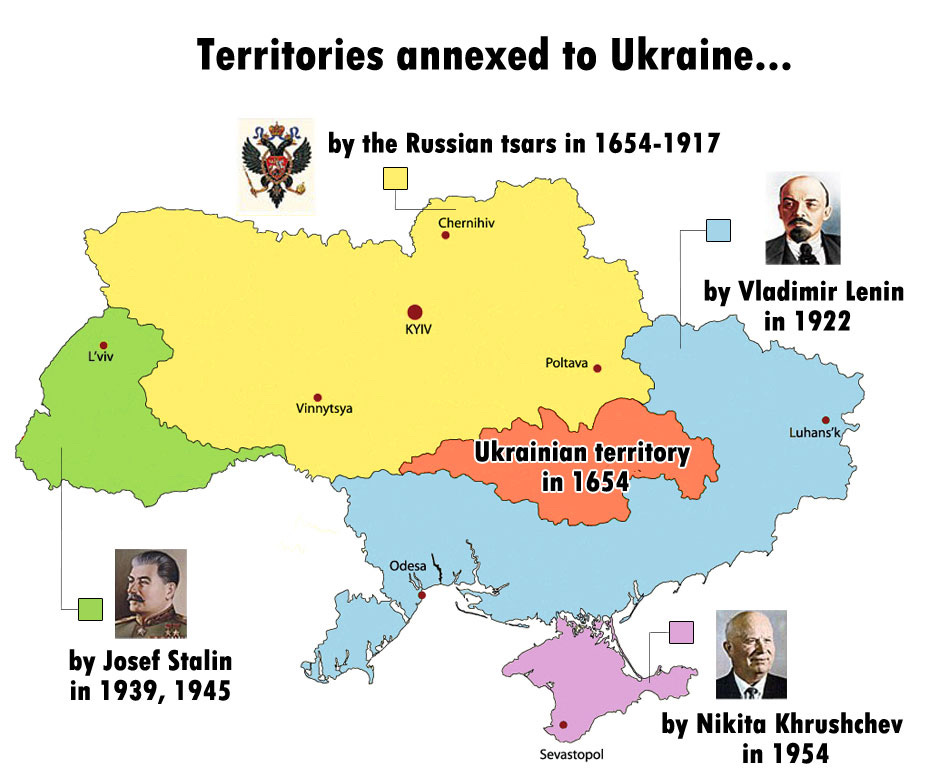
Look at tiny Ukraine, 1654, the orange mass in the middle, before Russia expanded it.

I can’t put it in words, but this somehow seems relevant to current travails. The heart of it, I suspect, is the question “just what is a nation-state?”

I’m sure smart people have pondered that a lot, though I don’t hear it spoken of very often. I have no illusions that I have anything to add.

Wordplay

Sexual creationism

The narrow progressive stance on gender ideology. (Pamela Paul, discussing John B. Judis and Ruy Teixeira’s Where Have All the Democrats Gone?)

Thermostatic voting

Used by a New York Times pundit to describe voters’ preference for moderate candidates.

Bafflegab

A good alternative to gobbledygook if you fear you’ve overused it.

Dirigiste

relating to a system in which a government has a lot of control over a country’s economy

Egregious

The etymology is the fun part here, via Merriam-Webster:

Some words originally used for animals that gather in flocks have been herded into use for people, too. The Latin word grex means “flock,” “herd,” or “group,” and is the root of several English words. Gregarious originally meant “tending to live in a flock, herd, or community rather than alone” but has become a synonym for “sociable.” Egregious literally meant “out of the herd” in Latin — something that stands apart. Its first meaning in English was consequently “outstanding” or “remarkable for good quality,” but over time that changed to become “very bad and easily noticed” or “flagrant.”

Interpellate/Interpolate

Stolpersteine

Literally stumbling-stones: brass plates, embedded in concrete, in the streets where victims of the Nazi Holocaust lived. 100,000 Stopersteines have now been laid.

Fluffers

Tech bros like Thiel, Musk and Andreesen are the fluffers in the global authoritarian circle jerk.

Maria, Silicon Valley’s worldview is not just an ideology; it’s a personality disorder (Crooked Timber) (hyperlink added)

Bon mots

Politicians and diapers must be changed often, and for the same reason.

Not Mark Twain

… a strangulated piety which was little more than a mask ….

Martin Shaw, The Problem With Peace

Weeds are flowers, too, once you get to know them.

A.A. Milne

Imagine a double-masked bureaucrat running a white-privilege workshop, forever.

Ross Douthat

You can make a throne of bayonets, but you can’t sit on it for long.

Boris Yeltsin

Paranoia is the opiate of those who fear they may be insignificant.

David Brooks

[T]o be human is to long for constancy, to crave the touchingly impossible assurance that what we have and cherish will be ours to hold forever, just as it is now. We build homes — fragile haikus of concrete and glass to be unwritten by the first earthquake or flood. We make vows — fragile promises to be upheld by selves we haven’t met in a future we can’t predict.

Maria Popova

Ill fares the land, to hast’ning ills a prey,
Where wealth accumulates and men decay.

Oliver Goldsmith, The Deserted Village (1770)


So: where did all my mockery of Trump go?

I suffer more from the humiliations inflicted by my country than from those inflicted on her.

Simone Weil, from a letter to Georges Bernanos.

You can read most of my more impromptu stuff here and here (both of them cathartic venting, especially political) and here (the only social medium I frequent, because people there are quirky, pleasant and real). All should work in your RSS aggregator, like Feedly or Reeder, should you want to make a habit of it.

Wanted: a robust culture of free speech

David French had a powerful New York Times column (shared link) detailing how much the constant threat of violence, principally from MAGA sources, is warping American politics. “If you wonder why so few people in red America seem to stand up directly against the MAGA movement, are you aware of the price they might pay if they did?”

I’m sufficiently fed up with almost all things MAGA that I’m disinclined to engage in any whataboutism in its defense. But this bit from French seemed a little too facile:

And no, threats of ideological violence do not come exclusively from the right. We saw too much destruction accompanying the George Floyd protests to believe that. We’ve seen left-wing attacks and threats against Republicans and conservatives. The surge in antisemitic incidents since Oct. 7 is a sobering reminder that hatred lives on the right and the left alike.

But the tsunami of MAGA threats is different. The intimidation is systemic and ubiquitous, an acknowledged tactic in the playbook of the Trump right that flows all the way down from the violent fantasies of Donald Trump himself. It is rare to encounter a public-facing Trump critic who hasn’t faced threats and intimidation.

There’s a lot of play in the joints of “an acknowledged tactic in the playbook of the Trump right” — I wish he had corroborated that —but even apart from that it seems too facile not because the Left is engaged in systemic and ubiquitous threats of death to officials and their families, but because the Left’s less violent version of cancel culture does have some pretty deep systemic effects of its own, starting with epistemology:

  • When comes to science—whether something like vaccines, or climate change (which I use as examples in my book)—there’s a fear of going against the grain. It’s the same with things like conversations around gender, diversity, and geopolitics. The problem is that as a society, we do not know if we are making the right decisions on these fronts, or are even presented with all the relevant information because there’s this silencing culture where the moderate voices are too often afraid to speak due to the heavy consequences for doing so, and those on either extreme of an issue have a monopoly on the discourse, because they are loud and aggressive.
  • There’s no need for overt state enforcement if people voluntarily conform to oppressive ideologies and behaviors, policing themselves—often defined by those in power, even if not directly.  And like we discussed earlier, power isn’t always about the state—it’s also those on the fringes who are willing to, essentially, bully others into submission. They don’t necessarily need to use force. We are social creatures, so social ostracism, condemnation, and shaming are all really powerful tools when it comes to suppressing dissenting views that might goes against a seemingly prevailing ideology.
  • What kind of person demands or feels entitled to an apology for something that wasn’t even done to them? By answering that question, you’ll begin to understand who you’re really dealing with. It’s not about accountability, redemption, self-reflection, or protecting society. It’s about power.

Katherine Brodsky, a liberal who has experienced the Left’s version a lot.

Yes, one could say that you resist the Left be growing some balls, whereas resisting the Right could put spouse and children at risk of death, but the Left version ain’t nothing.

Our first amendment has held fairly well as a legal matter, but we need a more robust culture of free speech.


So: where did all my mockery of Trump go?

You can read most of my more impromptu stuff here and here (both of them cathartic venting, especially political) and here (the only social medium I frequent, because people there are quirky, pleasant and real). All should work in your RSS aggregator, like Feedly or Reeder, should you want to make a habit of it.
A change in blog direction

The pundits all agree that the Republican Presidential Primary is over and that Donald Trump is the winner.

There’s no sign that Joe Biden will step down.

So we’re headed for a General Election between two geriatric cases (one of whom feels non-geriatric because of his manic narcissism).

I probably didn’t start railing against Trump when first he descended the Golden escalator if only because I did not take him seriously. Unfortunately, he soon became somebody who needed to be taken seriously and I have been contemning him loudly ever since at least since June 2016. It’s getting pretty old.

I never intended any implied endorsement of Hillary Clinton or Joe Biden. But then I never was a Democrat, and I don’t think I’ve ever written anything that would cause a reasonable person to think I was a Democrat. Let them sort out their own problems.

Rather, I was a lifelong Republican until age 56 when a Republican president I had voted for twice used his second inaugural address to commit the United States to a foreign policy that, if taken seriously, meant that the United States would be at perpetual war. “Eradicate tyranny from the world” is how he put it, as I recall.

Despite my having at that moment repudiated the Republican party, my atavistic political impulses still tilted Republican, and that’s why I’ve cared to warn about Trump.

Today’s Republican party is not the one I repudiated. I’m not entirely sure what it is, other than Donald Trump’s party. And neither are you, because it hasn’t adopted a platform since 2016. It’s still metamorphizing.

I think, however, that it is more anti-war than the old party was and by all accounts is a better representation of middle America than the old Republican party or the Democrat party. However, it has chosen as its avatar, a man who is utterly unfit to hold high office, and who wouldn’t care about a party platform even if there were one. And I’m not completely sold on the values of “middle America,” though it’s important to hear its voices. So whatever I might someday like about the GOP when it has finished its makeover, it’s still my former party, not my current party.

“But the Supreme Court!” doesn’t even work any more. Trump II will nominate cronies and certified jackasses, having discovered as Trump I that Leonard Leo‘s favorites take their oaths to the Constitution seriously and are not Trump lackeys.


Within the past few days, my logorrheic buddy, Rod Dreher and Friend of Bari Martin Gurri both have both detailed how far toward the insane Left the Biden administration has drifted (or sprinted). Duly noted, guys. Thanks. I probably was paying insufficient attention.

Both parties think, for reasons that make sense within their respective echo chambers, that the victory of the other spells the end of America as they’ve known it.

I have consistently registered my opposition to Donald Trump. (I withhold judgment on notional “Trumpism without Trump.”)

I now register my opposition to Joe Biden for some of the reasons Dreher and Gurri spotlight but mostly because he seems to have lost most of whatever he once had as a leader and, assuming the best about his intentions, to be captive of the crazies in his party for lack of the chops to fight back.

America is in bad Presidential shape for the third Presidential cycle. Trump’s problems don’t mean Biden’s okay. Biden’s problems don’t mean Trump’s okay. A fortiori, neither’s problems make the other a prince among men. I’m not taking any comfort in any Presidential politics, let alone putting any trust in princes, in sons of men in whom there is no salvation.

I plan to write in the candidates of the American Solidarity Party for the third Presidential election in a row. I would do so even if my state was “in play,” which it almost certainly will not be.


If any of this changes, I’ll let you know. Meanwhile, I intend to stop harping on it. As they say of sermons, “nobody gets saved after the first 20 minutes,” and I’ve been going on much longer than that.

I’m trying not even to read about the election, but political clickbait is something of a weakness. I only regret that this means I can’t share things like the image of Trump as a cocaine-crazed squirrel with a stick of dynamite.

All this will probably lessen this blog’s frequency, as politics is convenient filler for lazy writing. I hope it will free up headspace for better things, and that my quality, if not my quantity, will improve.

Conservatisms

I’m a David Brooks kind of conservative …

Every once in a while, David Brooks writes something that makes me want to say “I’m a David Brooks kind of conservative.” This was one of those times:

How do you stay mentally healthy and spiritually whole in brutalizing times? How do you prevent yourself from becoming embittered, hate-filled, calloused over, suspicious and desensitized?

Ancient wisdom has a formula to help us, which you might call skepticism of the head and audacity of the heart.

The ancient Greeks knew about violent times. They lived with frequent wars between city-states, with massacres and mass rape. In response, they adopted a tragic sensibility. This sensibility begins with the awareness that the crust of civilization is thin. Breakdowns into barbarism are the historic norm. Don’t fool yourself into believing that you’re living in some modern age, too enlightened for hatred to take over.

In these circumstances, everybody has a choice. You can try to avoid thinking about the dark realities of life and naïvely wish that bad things won’t happen. Or you can confront these realities and develop a tragic mentality to help you thrive among them. As Ralph Waldo Emerson would write centuries later, “Great men, great nations have not been boasters and buffoons, but perceivers of the terror of life, and have manned themselves to face it.” And that goes for great women, too.

This tragic sensibility prepares you for the rigors of life in concrete ways. First, it teaches a sense of humility …

Second, the tragic sensibility nurtures a prudent approach to life. It encourages people to focus on the downsides of their actions and work to head them off …

Third, this tragic mentality encourages caution. …

Fourth, the tragic mentality teaches people to be suspicious of their own rage. …

Fifth, tragedies thrust the harsh realities of individual suffering in our faces, and in them we find our common humanity. …

So far, I’ve been describing the cool, prudent and humble mentality we learn from the Athenians. Now I turn to a different mentality, a mentality that emerged among the great Abrahamic faiths, and in their sacred city, Jerusalem. This mentality celebrates an audacious act: the act of leading with love in harsh times.

… During a recent Zoom call, someone asked me: Isn’t it dangerous to be vulnerable toward others when there is so much bitterness, betrayal and pain all around? My answer to that good question is: Yes, it is dangerous. But it is also dangerous to be hardened and calloused over by hard times. It is also dangerous, as C.S. Lewis put it, to guard your heart so thoroughly that you make it “unbreakable, impenetrable, irredeemable.”

David Brooks, Love in Harsh Times and Other Coping Mechanisms.

… but I’m not deaf to Wendell Berry conservatism

I believe I have given a fair representation of the plight of rural America, a land of worsening problems that it did not cause and cannot solve, from which urban America derives its food, clothing, and shelter, plus “raw materials.” For these necessary things rural America receives prices set in urban America. For the manufactured goods returned to it, rural America pays prices set in urban America.

This rural America Mr. Burns treats as an enemy country, “rural and white,” inhabited by voters for Trump who are “animated most intensely by feelings of racial resentment or male self-pity,” and by “working-class voters who feel victimized by a distant and dysfunctional government, by wealthy elites, by nefarious foreign regimes, and all-powerful multinational corporations.” Mr. Burns is a political expert, who writes from a posture of authority, but his authority comes from no close acquaintance with rural places or with Trump voters or with people of the working class. He identifies only two reasons rural people might have had for voting for Trump, without asking, for instance, why they might have voted against Clinton or Biden. And he says that working-class voters “feel” victimized, apparently without considering that they may “feel” so because they know so. He might have added that many of them know also that they are disregarded or disdained by another set of elites who think them ignorant because they have not been to college. This is a prejudice, resting upon a cruel and extremely destructive falsehood of the same kind as white supremacy. To be fair, or at least more complete, Mr. Burns might have added to his collection of deplorables the rural voters who vote for Democrats only because the Democrats are not Republicans.

…

Because I have watched for half a century and more the decline of my own community and others like it everywhere in rural America, along with the increasing ecological and cultural damages of industrial agriculture, I have made a practice of reading newspaper and magazine articles by Democratic or leftward experts of politics and economics, hoping that I would see an acknowledgement, first of the economic importance of the natural world, and then of the importance of the land-use economies of agriculture, forestry, and mining, by which the goods of the natural world are made available for human use. I have not made a “survey,” but I have read enough to know that Alexander Burns’s article is conventional. Like his fellow experts, he appears to assume the inexhaustibility of the non-human world, and likewise the forever availability of the rural and working-class humans who do, well or poorly, the fundamental work of every economy. Like most of his fellow experts, he consents to and takes for granted the corporate destruction of the land and the human communities of rural America.

…

My impression is that the writers of the articles I have read have never ventured into rural America to ask in good faith what the problems are and what might be the remedies. And so I have made a sort of practice also of inviting writers and editors to come here where I live to allow me (and some younger people) to show them what we are up against. So far, nobody has showed up.

Wendell Berry

Trump officials against Trump

The fact of the matter is he is a consummate narcissist and he constantly engages in reckless conduct that puts his political followers at risk and the conservative and Republican agenda at risk. … He will always put his own interest and gratifying his own ego ahead of everything else, including the country’s interest. There’s no question about it. … He’s like a 9-year-old, a defiant 9-year-old kid, who’s always pushing the glass toward the edge of the table defying his parents to stop him from doing it.

William Barr, who together with a few other former high officials in Trump’s administration have ruled out voting for him in 2024:

  • Nikki Haley
  • Mike Pence
  • Mike Pompeo
  • John Bolton
  • William Barr
  • Mick Mulvaney
  • Betsy DeVos
  • Dan Coats
  • Rex Tillerson
  • Alex Azar
  • Elaine Chao
  • John Kelly
  • Mark Esper
  • James Mattis
  • H.R. McMaster
  • Richard Spencer
  • Mark Milley

The ubiquitous machine

The body is mine and the soul is mine’
says the machine. ‘I am at the dark source
where the good is indistinguishable
from evil. I fill my tanks up
and there is war. I empty them
and there is not peace. I am the sound,
not of the world breathing, but
of the catch rather in the world’s breath.’

Is there a contraceptive
for the machine, that we may enjoy
intercourse with it without being overrun
by vocabulary? We go up
into the temple of ourselves
and give thanks that we are not
as the machine is. But it waits
for us outside, knowing that when
we emerge it is into the noise
of its hand beating on the breast’s
iron as Pharisaically as ourselves.”

R.S. Thomas, Collected Later Poems 1988-2000

Sleazy but legal?

Remember this?

I had mixed, but mostly negative, feelings about it at the time. (The positive feelings boiled down to “anyone who doesn’t know you can’t vote by text message is someone I’d prefer not vote anyway.”)

But UCLA libertarian law professor Eugene Volokh opposes the criminal prosecution of the guy who perpetrated this hoax.

Poetry needs to vibrate the air

Reading in silence is the source of half the misconceptions that have caused the public to distrust poetry. Without the sound, the reader looks at the lines as he looks at prose, seeking a meaning. Prose exists to convey meaning, and no meaning such as prose conveys can be expressed as well in poetry. That is not poetry’s business.

Basil Bunting, “The Poet’s Point of View” via Christian Wiman, Zero at the Bone

The attention economy rewards shamelessness

In subsequent obscure journal articles, Mr. Goldhaber warned of the attention economy’s destabilizing effects, including how it has disproportionate benefits for the most shameless among us. “Our abilities to pay attention are limited. Not so our abilities to receive it,” he wrote in the journal First Monday. “The value of true modesty or humility is hard to sustain in an attention economy.”

Charlie Warzel, Michael Goldhaber, the Cassandra of the Internet Age – The New York Times

The perfect candidate for the attention economy

Former President Donald Trump in a post on Truth Social:

“A PRESIDENT OF THE UNITED STATES MUST HAVE FULL IMMUNITY, WITHOUT WHICH IT WOULD BE IMPOSSIBLE FOR HIM/HER TO PROPERLY FUNCTION. ANY MISTAKE, EVEN IF WELL INTENDED, WOULD BE MET WITH ALMOST CERTAIN INDICTMENT BY THE OPPOSING PARTY AT TERM END. EVEN EVENTS THAT ‘CROSS THE LINE’ MUST FALL UNDER TOTAL IMMUNITY, OR IT WILL BE YEARS OF TRAUMA TRYING TO DETERMINE GOOD FROM BAD. THERE MUST BE CERTAINTY. EXAMPLE: YOU CAN’T STOP POLICE FROM DOING THE JOB OF STRONG & EFFECTIVE CRIME PREVENTION BECAUSE YOU WANT TO GUARD AGAINST THE OCCASIONAL ‘ROGUE COP’ OR ‘BAD APPLE.’ SOMETIMES YOU JUST HAVE TO LIVE WITH ‘GREAT BUT SLIGHTLY IMPERFECT.’ ALL PRESIDENTS MUST HAVE COMPLETE & TOTAL PRESIDENTIAL IMMUNITY, OR THE AUTHORITY & DECISIVENESS OF A PRESIDENT OF THE UNITED STATES WILL BE STRIPPED & GONE FOREVER. HOPEFULLY THIS WILL BE AN EASY DECISION. GOD BLESS THE SUPREME COURT!”

TMD

“People do these elaborate takes about Trump’s authoritarian aspirations and then he just comes out and says the president should be allowed to do infinite crimes,” Matt Yglesias marveled.

Nick Catoggio

Your government scamming you

When carmakers test gasoline-powered vehicles for compliance with the Transportation Department’s fuel-efficiency rules, they must use real values measured in a laboratory. By contrast, under an Energy Department rule, carmakers can arbitrarily multiply the efficiency of electric cars by 6.67. This means that although a 2022 Tesla Model Y tests at the equivalent of about 65 miles per gallon in a laboratory (roughly the same as a hybrid), it is counted as having an absurdly high compliance value of 430 mpg. That number has no basis in reality or law.

For exaggerating electric-car efficiency, the government rewards carmakers with compliance credits they can trade for cash. Economists estimate these credits could be worth billions: a vast cross-subsidy invented by bureaucrats and paid for by every person who buys a new gasoline-powered car.

Until recently, this subsidy was a Washington secret. Carmakers and regulators liked it that way. Regulators could announce what sounded like stringent targets, and carmakers would nod along, knowing they could comply by making electric cars with arbitrarily boosted compliance values. Consumers would unknowingly foot the bill.

The secret is out. After environmental groups pointed out the illegality of this charade, the Energy Department proposed eliminating the 6.67 multiplier for electric cars, recognizing that the number “lacks legal support” and has “no basis.”

Carmakers have panicked and asked the Biden administration to delay any return to legal or engineering reality. That is understandable. Without the multiplier, the Transportation Department’s proposed rules are completely unattainable. But workable rules don’t require government-created cheat codes. Carmakers should confront that problem head on.

Michael Buschbacher and James Conde, The Electric-Vehicle Cheating Scandal – WSJ


You can read most of my more impromptu stuff here (cathartic venting) and here (the only social medium I frequent, because people there are quirky, pleasant and real). Both should work in your RSS aggregator, like Feedly or Reeder, should you want to make a habit of it.

Theophany 2024

Metapolitics

Zero-sum or positive-sum?

I start here because I really think the author had distilled a major temperamental difference between MAGA populists and wokesters on the one hand, traditional conservatives (and classical liberals generally) on the other. I plan to revisit this to see how well it stands up to repeated critical engagement.

Populism thrives on a zero-sum mind-set. The central story that populists tell is: They are out to destroy us. Populist leaders invariably inflame ethnic bigotry to mobilize their own supporters.

America’s populist in chief, Donald Trump, exemplifies this mentality. Trump grew up in a zero-sum world. In the world of New York real estate, there’s a fixed amount of land. Trump didn’t have to invent a new concept, just screw the other side. In 2017, the Vox writer Dylan Matthews and his colleagues read all of Trump’s books on business and politics, and concluded that zero-sum thinking is the core of his mind-set. “You hear lots of people say that a great deal is when both sides win,” Trump and his co-author wrote in “Think Big and Kick Ass.” “That is a bunch of crap. In a great deal you win — not the other side. You crush the opponent and come away with something better for yourself.”

MAGA is the zero-sum concept in political form. What’s good for immigrants is bad for the American-born. What’s good for Black people is bad for whites. Trade deals are exploitation. Our NATO allies are out to screw us. Every day for Trump is an Us/Them dominance game.

Zero-sum thinking is surging on the left as well. A generation of college students has been raised on the dogma that life is a contest between groups — oppressor versus oppressed, colonizers versus colonized.

This thinking is rising across the globe …

We all have complaints about the age of go-go globalization, but what’s followed is far worse — global economic competition being replaced by political and military confrontation. And the thugs are winning. Russia now has the momentum in Ukraine. China is growing increasingly aggressive in the waters around Taiwan. Trump is leading in many polls.

Many of us greet 2024 with a sense of foreboding. We need Joe Biden to be as big as this year demands. We need a leader who shows that he grasps the scope of global crisis and has a vision for how to return to a positive-sum world of growth, innovation and peace.

David Brooks

Grubbier politics

“Plagiarism” is just another weapon for the deplorables

→ Who came up with this plagiarism idea? The Associated Press set the tone for how this would be covered. Plagiarism being bad is a monstrous and deceitful new concept, developed in a lab by right-wing activists and unleashed on unsuspecting academics. 

As my favorite, Nate Silver, put it: “Pretty worried about this new chronoweapon that can force you to go back as many as 27 years in time and commit plagiarism.”

Nellie Bowles

Misogynoir?

If you are black and in the fourth lowest decile of SATs and GPAs among Harvard applicants, you have a higher chance of getting into Harvard (12.8 percent admitted) than an Asian-American in the very top decile (12.7 admitted). It’s rigged, which is why it was shut down by SCOTUS. When you look at these cold, hard stats — which Harvard, of course, did all it could to conceal — there is no debate. There’s a trade-off. But once you make identity a core qualification, you’re opening up a whole world of racist anti-racism.

…

The response to all this from the CRT crowd has been to insist — ever more strongly — that Gay is simply and only a victim of racism, or, in woke terminology, a victim of misogynoir. The fact that a white female university president at those same hearings lost her job before Gay did — and without any plagiarism questions — doesn’t count. The fact that a male, white university president also recently stepped down for academic misconduct, also doesn’t count. The fact that the president of Harvard violated rules that a Harvard undergraduate would be disciplined for doesn’t count. Nothing counts, in the end, except her race and sex and ideology. The defenses of her make this explicit. Which is why they have been salutary.

Andrew Sullivan

Trump ballot disqualification

Everything is on the table

Significantly, the Court has not limited the questions presented. That means the justices could potentially consider the full range of issues raised by the case, including whether the January 6 attack on the Capitol qualifies as an “insurrection,” whether Trump’s actions amount to “engaging” in insurrection, whether the president is an “officer of the United States” covered by Section 3, whether Section 3 is “self-executing,” whether it is a “political question,” and whether Trump got adequate due process in the state court.

…

I think many are underrating the likelihood that the justices will affirm the Colorado ruling. The latter is based on strong reasoning, including from an originalist point of view. And to the extent the justices may be motivated by reputational considerations, disqualifying Trump is the perfect opportunity for them to show once and for all that they are not adjuncts of the GOP and especially not the “MAGA Court.” In my view, much of the left-wing criticism of the Court is wrong or over overblown; but my opinion is not what’s decisive for the Court’s public and elite standing.

Ilya Somin

French’s flawed but evocative case against Trump ballot access

This is where we are, and have now been for years: The Trump movement commits threats, violence and lies. And then it tries to escape accountability for those acts through more threats, more violence and more lies. At the heart of the “but the consequences” argument against disqualification is a confession that if we hold Trump accountable for his fomenting violence on Jan. 6, he might foment additional violence now.

David French, The Case for Disqualifying Trump Is Strong.

The counterpart to “but the consequences” is “we’ll show them we can’t be intimidated.” Both reactive approaches can color our interpretation of the law.

It’s dangerous to read minds, but I think David is so fed up with “but the consequences” that he’s fallen into the opposite error.

I’m convinced by the history of the 14th Amendment’s drafting that the framers didn’t intend for the President to be covered. Given that history, the Supreme Court can easily and legitimately reverse the Colorado decision.

But there has been a tendency on the court to follow the “plain meaning” of legislative texts without worrying about what legislators intended. That’s how, for example, homosexuals and transgendered people gained coverage, under a broad reading of “on account of sex” in some of our 20th century civil rights laws, even though everyone was thinking “male and female” at the time.

If SCOTUS looks to legislative history, it will be abandoning its recent more textualist approach. I think there are enough conundrums presented by the textualist approach — above all, why would the 14th Amendment’s framers hide the presidential elephant in the “any office” mouse-hole, after enumerating Senators, Representatives and electors — that looking beyond the text, all the way back to legislative history, is well warranted.

Damon Linker spends more time eviscerating French’s uncharacteristically flawed argument just from a logic standpoint.

Other legalia

Unlawful discrimination

Some civil libertarians have attempted to finesse the issue by redefining civil liberties to include protection from the discriminatory behavior of private parties. Under this view, conflicts between freedom of expression and antidiscrimination laws could be construed as clashes between competing civil liberties. For purposes of this book, however, civil liberties retains its traditional definition, referring to constitutional rights protected by the First Amendment and related constitutional provisions.”

David Bernstein, You Can’t Say That!

Asylum

Western Europe and the U.S. are still largely governed by a 1951 Convention Relating to the Status of Refugees, which was expanded in 1967 to cover anyone living in what can be considered a “dangerous” place. That definition allows potentially hundreds of millions of people worldwide to qualify as refugees. The U.N, High Commission on Refugees estimates that there were 26 million likely candidates for resettlement at the end of 2019. All that is needed is to arrive in a hospitable country and claim asylum.

Ayaan Hirsi Ali, To Even Debate Immigration, We Must Use the Right Language. If she’s right, we may need to break the law.

A curmudgeon looks at our moon landing

… Hybris comes to
        an ugly finish, Irreverence
        is a greater oaf than Superstition.

Our apparatniks will continue making
    the usual squalid mess called History:
        all we can pray for is that artists,
        chefs and saints may still appear to blithe it.

From W.H. Auden, Moon Landing, via Douglas Murray

When men landed on the moon, I was too young and too techy to have developed full-blown case of faux Ludditism, but I don’t recall being swept up in elation at the accomplishment, either.

These days, I love the whole poem (a few obscure words or allusions aside).


… that Christ may dwell in your hearts through faith; that you, being rooted and grounded in love, may be able to comprehend with all the saints what is the width and length and depth and height — to know the love of Christ which passes knowledge; that you may be filled with all the fullness of God.

Ephesians 3:17-19 (NKJV)

You can read most of my more impromptu stuff here (cathartic venting) and here (the only social medium I frequent, because people there are quirky, pleasant and real). Both should work in your RSS aggregator, like Feedly or Reeder, should you want to make a habit of it.

Saturday, 12/23/23

Smelling the Roses

I’ll turn too soon to less edifying thoughts, but let’s start with two observations, the first of which I practice while I mostly aspire to the second.

A little humanity

When I fell in love with English on a college campus many years ago, it was precisely because studying John Milton and James Joyce and Octavia Butler was so intoxicatingly useless in market terms. It rejected the assumption that value and utility are synonyms. The humanities captivated me — and foiled the best-laid plans of mice and pre-med — because literature and philosophy seemed to begin from a quietly revolutionary premise: There is thinking that does not exist merely to become work, and knowledge that does not exist merely to become capital.

Tyler Austin Harper via Frank Bruni

The French difference

“The French seemed to take every meal in public, even breakfast, and whenever dining, showed not the slightest sign of hurry or impatience. It was as if they had nothing else to do but sit and chatter and savor what seemed to the Americans absurdly small portions. Or sip their wine ever so slowly. “The French dine to gratify, we to appease appetite,” observed John Sanderson. “We demolish dinner, they eat it.””

David McCullough, The Greater Journey

Segue

In the popular piety of the formerly-Christian West, Monday’s Feast is the equal of Easter, and it’s first runner-up to Pascha (Easter) in the Eastern Church.

So if you want don’t want it to be your “miserable fate to spend the holidays this year listening to people complain about ‘anti-democratic’ attempts to strike a presidential frontrunner from the ballot” and similar things, you might want to stop reading now.

Politics and law

Of Rudy’s $175 million judgment and bankruptcy

I genuinely am curious who Trump could even staff a cabinet with. Literally everyone who comes near him is either publicly humiliated or impoverished through lawsuits and then also. . . publicly humiliated.

Nellie Bowles.

Suffice that they would not be our best people.

Regarding Colorado

Insurrection

January 6 qualifies as an “insurrection” even under a fairly narrow definition of the term that is limited to the use of force to take over the powers of government. We don’t need to rely on much broader definitions advocated by some legal scholars.

…

As our detailed recitation of the evidence shows, President Trump did not merely incite the insurrection. Even when the siege on the Capitol was fully under way, he continued to support it by repeatedly demanding that Vice President Pence refuse to perform his constitutional duty and by calling Senators to persuade them to stop the counting of electoral votes. These actions constituted overt, voluntary, and direct participation in the insurrection.

…

As I pointed out in a recent Bulwark article about the case, this goes beyond encouraging violence (as Trump did before the attack) or failing to try to stop it. It amounts to using the attack as leverage to try to force Congress to keep him in power. Using a violent insurrection in this way surely qualifies as “engaging in it,” even if Trump’s other actions fell short of doing so. Even if this somehow still falls short of “engagement,” this and Trump’s other actions surely at least gave “aid and comfort to the enemies” of the United States.

Ilya Somin, quoting the Colorado Supreme Court’s ruling.

Don’t take the bait

You’ll find no shortage of arguments against the decision of the Colorado Supreme Court that Donald Trump is barred by Section 3 of the 14th Amendment from serving as President, and therefore will be barred from Colorado ballots.

I’ll not rehearse them here except to beg you: Don’t fall for the simplistic line that the decision is bad because it’s “anti-democratic.”

Section 3 of the 14th Amendment was intended to be anti-democratic. It assumes that voters might elect an insurrectionist and says, in effect, “We don’t care. Insurrectionists can’t serve. Period. Full stop.”

Oh, yes: One more thing. It may be politically embarrassing that all seven Colorado Justices were appointed by Democrat Governors, but courts shouldn’t let political appearances sway them.

  • Somebody filed a lawsuit.
  • A lower court decided it and one side appealed.
  • From what I hear, the opinions and dissents in 213 pages of Colorado show great effort to get things right, not to carry partisan water or reject the cup handed them.

I wonder how SCOTUS will reverse? I strongly suspect it will. But the rationale will matter.

Our miserable fate

It’s our miserable fate to spend the holidays this year listening to people complain about “anti-democratic” attempts to strike a presidential frontrunner from the ballot who were adamant about disqualifying Barack Obama in 2008 absent proof of his status as a natural-born citizen.

…

I am confident that this would have been a different conversation on January 6, 2021. On that day, right-wingers who now scoff at the left for using the word “insurrection” for political purposes were using the word “insurrection” themselves. An earnest effort in court at the time to disqualify Trump from any future candidacy would have been received enthusiastically on the left and probably not much worse than ambivalence on the right. He was done in politics anyway at that point, right? Who would care if some court made it official?

We didn’t have that conversation on January 6, though. Or during the rest of 2021. Or 2022. Only this year did it become a live issue, and by then it was too late.

Meritorious or not, challenging Trump on 14th Amendment grounds wasn’t tenable politically once he had reestablished himself as the frontrunner for the Republican nomination.

Nick Catoggio

On the other hand

I bristle at criticism of the Colorado Supreme Court for having the temerity actually to decide a case presented to it without fear or favor.

But Nellie Bowles levels a different criticism, aimed at the people who brought the suit:

The only way to protect democracy is to end democracy: The Colorado Supreme Court decided this week that Trump is disqualified from holding the presidency and so cannot appear on the Republican primary ballot in the state. Meanwhile, California’s lieutenant governor ordered the state Supreme Court to “explore every legal option” to remove Trump from the ballot. In doing so, she said that the rules for the presidency are simple: “The constitution is clear: You must be 40 years old and not an insurrectionist.” Yet even there she is wrong: you only have to be 35. [Tipsy: You also have to be a natural-born citizen, Nellie.]

Anyway, for a long time the standard liberal take has been that Democracy Is Under Threat from Republicans. And Trump certainly tried schemes in Georgia and whatnot, like, the man gave it a shot. But I would say that banning the opposition party’s leading candidate. . . is pretty much the biggest threat to democracy you can do. It’s a classic one, really. Timeless. Oldie but Goodie. The American left was so committed to protecting democracy that they had to ban voting. 

All I’ll say is that once you ban the opposition party’s top candidate, you can no longer, in fact, say you’re for democracy at all. You can say you like other things: power, control, the end of voting, choosing the president you want, rule by technocratic elites chosen by SAT score, all of which I personally agree with. But you can’t say you like democracy per se.

So Colorado, listen, I dream every day of being a dictator. I would seize the local golf course and turn it into a park on day one; day two, expand Austin breakfast taco territory to the whole country; day three, invade Canada. Day four, we ban zoos. My fellow fascists, we’re on the same page. Let’s just drop the democracy stuff and call it what it is.

I’ve become persuaded that somebody ideally should have brought this sort of lawsuit years ago, when Trump wasn’t the GOP POTUS favorite by a commanding margin. But then most of us thought he was politically dead after January 6, so why would anyone bother?

“Eugenicons”

If the eugenicons were without influence, they could safely be ignored. The problem is that the they have a large and apparently growing influence.

Michael Lind

I spent a lot of time wading through Lind’s exposé of conservatives with eugenic sympathies, waiting for him to reveal the smoking gun. He never did.

I’m far from infallible on what’s going down in the world. I’m interested in what I’m interested in and within recent memory began consciously trying to forsake the fool’s errand of understanding everything.

That said, I’m not convinced that “eugenicons” (Lind’s failed attempt at coining a major concept) “have a large and apparently growing influence.” This felt like an article wherein the author got so invested in a theory that he couldn’t face up to its failure at his own hands.

Rank hypocrisy watch

House Speaker Mike Johnson of Louisiana was once perfectly content to use the courts to overrule a democratic process, spearheading an effort in late 2020 to collect lawmakers’ signatures in support of a lawsuit in Texas challenging the results of the that year’s election—which, if successful, would have voided millions of votes in four other states. Tuesday, though, Johnson—who formally endorsed Trump’s reelection campaign last month—was impugning the decision in Colorado that, in his view, would short-circuit the democratic process. “Today’s ruling attempting to disqualify President Trump from the Colorado ballot is nothing but a thinly veiled partisan attack,” he said. “Regardless of political affiliation, every citizen registered to vote should not be denied the right to support our former president and the individual who is the leader in every poll of the Republican primary. We trust the U.S. Supreme Court will set aside this reckless decision and let the American people decide the next President of the United States.”

TMD

Blood

It’s true; they’re destroying the blood of our country …

Donald J. Trump

All the great civilizations of the past became decadent because the originally creative race died out, as a result of contamination of the blood.

Adolph Hitler

Assuming arguendo …

Let us assume for the sake of argument that there is an absolutely massive conspiracy of Democrats against Donald Trump.

Does that assumed fact make him fit for the Presidency? Are we going to elect a manifestly unfit candidate — one who either is ignorant of holocaust history or who consciously is mimicking Adolph Hitler — to punish the Democrats for some underhanded opposition to him?

I’m sorry that Americans are so well-conditioned that they won’t consider voting for third-party candidates, and that a vote against Trump effectively becomes a vote for Biden*, but I can’t vote for him and will probably vote for the American Solidarity Party slate.

(* A reminder that this common trope is sometimes false. We do not elect Presidents by national popular vote. I have several times now voted for third-party candidates when it was apparent from polling that, for instance, my state was going to deliver its electors to Donald Trump rather than Joe Biden, and my vote wasn’t going to change that.)

Culture

Real men, good men, violent men

Pearcey noted first that there is a sharp dissonance culturally between how we think of “real men” vs “good men.” The former are often moral abysses but they display a certain kind of chest-thumping bravado that many associate with masculinity. The latter is honorable, devoted, and principled, but often despised culturally for precisely those reasons, and this applies as much within many churches as it does the culture.

The other point she made: There is a sharp gap in behavior between self-identified evangelical men who don’t go to church (they are statistically the most likely group in most studies to engage in domestic abuse) and evangelical men who do attend church (statistically the least likely to be abusive). At a time when many in the young Christian right are making their peace with manosphere internet Nazis, those two facts fill me with dread. But we owe Pearcey a debt for helping to document not only these two points, but many others.

Jake Meador, * 23 Books for 2023*, recommending Nancy Pearcey’s * Toxic War on Masculinity*.

Dechurching

Meador also recommends The Great Dechurching by Michael Graham and Jim Davis.

There are many, many wrong ideas out there right now about the place of religion in American life: The dominant driver of dechurching is abusive churches. The most common intellectual shift in people who dechurch is toward progressivism. American churches are basically doing fine and the noise about dechurching is largely just a digital artifact, not something tied to life on the ground in local churches.

All of those things are wrong.

The reality is that the biggest drivers of dechurching right now are changes of life, above all moving to a new place. More people dechurch into a secular right wing ideology than progressivism. And the current dechurching wave is the single biggest shift in churchgoing practice in American history.

Graham and Davis will walk you through the data from the study they did with Ryan Burge and then offer application to help call people back to church. And that’s another misconception, by the way: Most people who have stopped attending church are actually willing to come back.

The persistence of religion

A common critical fallacy among liberals of most stripes is the affirmation that reasoned debate is the currency of politics. We want to believe that one simple Rachel Maddow or Jon Stewart video will convince people that Pizzagate isn’t real or that Hilary Clinton doesn’t drink the blood of infants. The problem is pretending that logic, evidence, or reason have anything to do with such beliefs. The situation is much more dire, what we’re up against far more insidious; don’t expect to use logic when you’re at a Black Mass. “Everything may be religion,” I said, “but not all religions are good.” Irrationality, superstition, the numinous, and the transcendent—for both good and bad—can never be definitively pruned from our garden. You may as well pretend that language could be abolished as imagine the taming of the religious impulse, even when the aromatic censers of the church have been replaced by some weirdo’s keyboard.

Ed Simon

Simon also referred to Chris Rufo as a “Svengali opportunist.” I liked that very much. I distrust Rufo and have distrusted him since I first encountered him waging dishonest war on critical race theory. (Honest war on CRT is fine, but Rufo once boasted something like:

We’re going to render this brand toxic. Essentially what we’re going to do is make you think, whenever you hear anything negative, you will think critical race theory.

(Paraphrased from here.)

What’s even better than emission reduction?

Following up on this item, it occurs to me that mass disenthrallment with the automobile and a return to walking and cycling would be far better that reducing emissions from tailpipes or building overweight EVs that require a lot of mining of rare earths.

Exasperation speaking

“It’s part of this extreme right-wing attack on elite institutions,” said Charles Fried, a professor at Harvard Law School and a former solicitor general in the Reagan administration. “The obvious point is to make it look as if there is this ‘woke’ double standard at elite institutions.”

“If it came from some other quarter, I might be granting it some credence,” he said of the accusations. “But not from these people.”

Harvard Finds More Instances of ‘Duplicative Language’ in Claudine Gay’s Work – The New York Times

I assume Prof. Fried understands that truth is true regardless of who bears it, so I can only attribute this logical lapse to exasperation at Svengali opportunist Christopher Rufo.

When did foul language become invisible?

I occasionally see glowing reviews of some streaming series or another and wonder “why am I not watching that?” Then I go to the appointed streaming service and recall “Oh, yeah. I watched the first episode. It was so full of foul language that I couldn’t bear it.”

This is not a way of claiming that my own vocabulary is free of expletives, scatology, and occasional profanity. I adopted some of that stuff in my late teens and early twenties to shock my elders into recognition of their folly. Fifty-plus years later, that proto-trolling has proven one of my own lifetime follies.

My point is that foul language is invisible to most critics. There is a prominent Evangelical pundit, generally sound, who I’m nevertheless unable fully to trust because of how he raved about Ted Lasso without noting that its landscape was blanketed with F-bombs.

Saints and Sinners

[O]ne of the first things they teach you is that in the act of reporting, you will inevitably have to depend on information acquired from dodgy people. Saints, being saintly, often don’t know what’s going on; you have to talk to the people who are great sinners.

Rod Dreher

To salvage what’s left of the right’s faith in elections and the judiciary, and frankly to prevent civil unrest encouraged by Trump, the justices will need to reach a certain outcome in this matter regardless of whether they sincerely believe the law supports it. The Colorado Supreme Court accordingly may have viewed its own ruling as an opportunity to rebuke Trump constitutionally in a way that the U.S. Supreme Court won’t be able to, even if it’s privately inclined to do so.

…

I am confident that this would have been a different conversation on January 6, 2021. On that day, right-wingers who now scoff at the left for using the word “insurrection” for political purposes were using the word “insurrection” themselves. An earnest effort in court at the time to disqualify Trump from any future candidacy would have been received enthusiastically on the left and probably not much worse than ambivalence on the right. He was done in politics anyway at that point, right? Who would care if some court made it official?

We didn’t have that conversation on January 6, though. Or during the rest of 2021. Or 2022. Only this year did it become a live issue, and by then it was too late.

… Why, then, did his opponents wait so long to pursue this legal avenue against him?

Ironically, I think the answer is that they gave Republican voters more credit than those voters deserve.

…

As I explained previously, those voters have argued at varying times that it’s improper to impeach and remove him from office over January 6 because the criminal courts would punish him; that it’s improper for the criminal courts to punish him because voters would punish him; and that it’s improper if voters punish him because in that case the election must have been “rigged.” That’s the accountability vacuum. Many critics of the new 14th Amendment challenge to Trump’s candidacy have added another facet to it, that it’s improper to use the Constitution itself to punish him because to do so would be “anti-democratic.”

Nick Catoggio

I don’t know if Nick’s a great sinner and I’m a saint, but I’d like to think that SCOTUS doesn’t think that way, because it would mean, in practical effect, that the 14th Amendment Section 3 becomes unenforceable precisely when it’s needed — on the rationale that an electorate poised to elect an insurrectionist is capable of civil unrest at a level that trumps the law.


So walk on air against your better judgement

(Seamus Heaney)

You can read most of my more impromptu stuff here (cathartic venting) and here (the only social medium I frequent, because people there are quirky, pleasant and real). Both should work in your RSS aggregator, like Feedly or Reeder, should you want to make a habit of it.

Saturday, 12/2/23

A comment about my less-frequent blogging.

I’ve resumed, for several months now, use of my (digital) Journal and Common Place Book to collect many of the items I find amusing or that confirm my biases. A relative few of them I also still blog, along with items I judge are of more general interest than what gets logged only privately. That’s why I’m posting less total volume of material.

As this blog’s free for the taking, I don’t apologize, but wanted to explain.

Politics

The people

Character is destiny

Trump will never himself be a tragic figure as he sits alone wondering why the “quality people” want nothing to do with him. A tragic figure is someone who meets a sorry end despite his virtues. Trump, by his own choosing, never had use for virtue. His pathetic end—in this life and certainly in the history books—is the direct result of his admitted vices. As I’ve said from the beginning of all this, character is destiny.

Jonah Goldberg, Something Short of Tragic

Chuck Schumer’s Sister Souljah moment

Senate Majority Leader Chuck Schumer, the country’s highest-ranking Jewish official, gave a roughly 40-minute speech on the Senate floor Wednesday condemning the antisemitism that has exploded across the United States following Hamas’ October 7 attack on Israel, calling it “a five-alarm fire that must be extinguished.” The address, aimed largely at those on the political left, called out progressives who celebrated Hamas’ brutal attack and repeatedly invoked the memory of the Holocaust. “Many Jewish Americans fear what the future may bring, based on the repeated lessons of history,” he said. Meanwhile, the presidents of Harvard University, the University of Pennsylvania, and the Massachusetts Institute of Technology were called to appear before the House Education and Workforce Committee on December 5 to give testimony regarding antisemitism at their respective institutions.

TMD

The parties

Tone-deaf lefties

Voters want to hear how problems can be solved—not told they’re doomed unless obviously impractical steps are taken. And it doesn’t help that the Left’s version of the steps that must be taken includes a raft of unrelated social programs that would be nice to have but don’t do anything about climate change (see, for instance, the Green New Deal proposed in Congress). Nor does it help that obviously necessary components of a clean energy program like nuclear power are ruled out because, well, people on the Left don’t like nuclear power.

Ruy Teixeira, The Five Deadly Sins of the Left

The dynamics of Left and Right

[W]e’re just really confused how people are not acknowledging that the democrats are just as in bed with corporate and pharmaceutical interests as republicans … I don’t know enough about psychology to say for sure why this has happened. Why when finally, finally, the Republicans are saying, “Woah, looks like the police are sometimes racist. We do need police reform!” the left had to then go, “Reform? Who said anything about reform? We need to defund the police!”… The truth is that neither party represents working class Americans. And these supposed “socialists” – what are they running on? Free college and banning fracking. It’s maddening.

Highly Qualified: What Does Liberalism Even Mean Anymore?.

This is from some Readwise highlights. I have no memory of who linked to the original enticingly enough to get me there. I swear I’m not a regular at The Dandy, which appears to be for upstate New York elitist pot-heads.

Epigraph or epitaph?

When the history of this era is written, “I just want Republicans to win; that’s all I care about” should be its epigraph.

Nick Cattogio, quoting equivocally Anti-Trump Chris Sununu.

How reticent Republicans will come around to Trump

One of the shining lessons of the past eight years is that however low your expectations might be for Republican voters, they’re not low enough. Most of those on the right who should know better but have stuck it out this far will get to “yes” on Trump 2.0, I suspect. Some might do so after determined efforts at self-persuasion, but most will back Trump without much strain.

There are various rationalizations to which they’ll turn to resolve the tension between their nagging fear that Trump is a poisonous threat to America’s civic heritage and their partisan duty to believe that government by the far right is preferable to government by the far left—and that every Democrat is supposedly a member, or a puppet, of the far left. Those rationalizations are a strange brew of magical thinking and hard-nosed “binary choice” partisan logic.

…

[A] Republican-controlled Congress would either tolerate or actively enable Trump’s power grabs in a second term, the same way that congressional Republicans tolerated or actively enabled his aggressive deficit spending during his first term. We are very late in the game for anyone to still pretend that the GOP cares about restraining the federal government whenever they’re in charge of it, but that’s the sort of silliness in which one must indulge to imagine reelecting Trump as some sort of civic good.

Nick Cattogio

Mis-judging what “real Americans” want

Follow me for what is going to long like a sudden left turn: Do you know why the Republicans’ bad reputation on racial questions is a problem for the GOP politically? It isn’t because it costs them among black voters—it is because it costs them among white voters, of whom there are a whole lot more, many of whom do not wish to associate themselves with a party that is known (not without reason) for harboring politicians and activists with ugly and atavistic racial attitudes. These same voters—many of whom would be more or less on board with traditional Republican economic policies—are put off by other characteristics of the GOP coalition: its anti-intellectualism, its rural orientation, etc. That isn’t to say that everybody in the Republican Party is a rube on a turnip truck—but if you see a bunch of rubes piled into a turnip truck, you can bet that the turnip truck is going to have a “Jesus Is My Savior Trump Is My President!” bumper sticker on it. It isn’t going to say “Biden-Harris 2024.”

The Democrats have wisely offered themselves up as the natural political home of those upwardly mobile urban-suburban professionals the Republican Party doesn’t want. The Martin Center’s main man George Leef can sneer at the elite universities three times a week in the pages of National Review, but there is a great many young Americans who very much would like to attend one of those universities, and a great many middle-aged Americans who would like their children to attend such a school and who care a great deal about who gets in and why. But, even among people for whom Harvard’s admissions standards are not an immediate and urgent issue, the question remains: Do you want to associate yourself with the Ivy League crowd and the upwardly mobile strivers, or with the sneerers and scoffers who (though college-educated themselves, of course!) want you to believe that there’s a bright future in bumpkinism?

…

Republicans have spent the past 15 years or so micturating from a great height upon the aspirations of people who might want (for themselves or for their children) an Ivy League education, a high-paying job in technology or finance, a nice home in Silicon Valley or New York City or another big metropolitan area—in cities and suburbs that may not comport exactly with their politics on the whole but which offer (to everyone who is not a political monomaniac) many other important benefits, from economic opportunity to cultural interests to superior health care facilities. “Real Americans,” Republicans insist, do not aspire to such things—all Real Americans want to be farmers in Muleshoe, Texas, and diesel mechanics in Toad Suck, Arkansas.

Kevin D. Williamson

(Williamson suggests that the Democrats, too, are following policies apt to alienate strivers, but the Republican transmogrification is easier to caricature.)

So glad he solved that

How about it doesn’t matter whether progressives are liberals? We must move beyond the old labels. We are separated by rationalists and irrationalists.

What was once liberal is simply (as it mostly always has been) common sense, common decency, and management of inevitable change for the benefit of the general welfare and liberty and justice for all. Basically, what any reasonable and broad view of society would see as doing the right thing.

Almost anyone’s reading of social and political history would agree that we live in a better, more decent and fair nation because of the right things that rationalists did: abolish slavery, rein in the robber barons, establish labor laws, and approve women’s suffrage, civil rights, voting rights, Social Security and Medicare. The right things to do, which the irrationalists opposed.

In this new century social attitudes have changed, geopolitical power has changed, technology has exploded, the climate has changed. But what hasn’t changed is the need and desire to do the right and decent thing. And there is only one side that continues that fight.

When we finally pull our heads above the surface of the water we’re swimming in, we might see that there is no longer a divide of right and left, red and blue, liberal and conservative; it’s one simply of right and wrong. Rationality vs. irrationality.

Mansplaining Texan’s letter to the New York Times

I read this as “Let’s do away with an imperfectly nuanced political spectrum in favor of this useless but self-flattering binary.”

Foreign follies

“Many sober voices warned that an expansion of NATO to Russia’s border would poke the Bear, leading to an inevitable war. As long ago as 1998, following the U.S. decision to expand NATO eastwards, George Kennan said the following to Thomas Friedman:

I think it is the beginning of a new cold war. I think the Russians will gradually react quite adversely and it will affect their policies. I think it is a tragic mistake. There was no reason for this whatsoever. No one was threatening anybody else. This expansion would make the founding fathers of this country turn over in their graves.

Patrick J. Deneen, Russia, America, and the Danger of Political Gnosticism

Culture

A brutalizing and stupid idea

The idea was that when faced with abundance one should consume abundantly – an idea that has survived to become the basis of our present economy. It is neither natural nor civilized, and even from a ‘practical’ point of view it is to the last degree brutalizing and stupid.

Wendell Berry, The World-Ending Fire

A Matter of Principle

Less than a decade ago, I had high regard for “conservative” Hillsdale College. Its hiring of Michael (“Flight 93 Election”) Anton, who is at it again, together with the populist, rabble-rousing tone of its mailings, have brought that high regard to an bitter end.

Nevertheless, I’m in Hillsdale’s corner on this pernicious lawsuit. Hillsdale accepts no federal aid, but left activists, acting in the name of two co-eds who allegedly were acquaintance-raped by two Hillsdale men, are trying to impose Title IX processes on Hillsdale or else strip it of tax exemption.

SCOTUS sowed bad seed when it let the IRS strip Bob Jones University of tax exemption because of its odious policies on race. This is going to be a battlefront in the Left/Right wars for some time to come (and I have little doubt that the Right will try a tit-for-tat attack on some leftish nonprofits).

EA

Defined in these broad terms, effective altruism is no more a meaningful philosophy than “do politics good” is a political platform or “be a good person” is a moral system. In the piece linked above Matthews says that “what’s distinctive about EA is that… its whole purpose is to shine light on important problems and solutions in the world that are being neglected.” But that isn’t distinctive at all! Every do-gooder I have ever known has thought of themselves as shining a light on problems that are neglected. So what?

…

This is why EA leads people to believe that hoarding money for interstellar colonization is more important than feeding the poor, why researching EA leads you to debates about how sentient termites are. In the past, I’ve pointed to the EA argument, which I assure you sincerely exists, that we should push all carnivorous species in the wild into extinction, in order to reduce the negative utility caused by the death of prey animals. (This would seem to require a belief that prey animals dying of disease and starvation is superior to dying from predation, but ah well.) … [T]hose examples are essential because they demonstrate the problem with hitching a moral program to a social and intellectual culture that will inevitably reward the more extreme expressions of that culture. It’s not nut-picking if your entire project amounts to a machine for attracting nuts.

Freddie deBoer, The Effective Altruism Shell Game

Fox Porn

From my point of view, the case against Fox News isn’t that it is dangerous or that Tucker Carlson’s work is likely to incite anybody to violence. (Maybe it will, but I doubt it. This country may generate a few school-shooters every year, but I don’t think it has the energy for a sustained intifada.) The case against Fox News is that it is tedious, repetitive, and lurid. Aesthetically and emotionally, it more often resembles pornography than it does, say, the commentary of Paul Harvey.

Kevin D. Williamson (paywall)

They voted their lying eyes

We disagreed—and still do—with Wilders’ calls for blanket bans on additional asylum seekers, with the notion of banning the Quran (let alone any book), and with his consistent failure to draw a distinction between Islam and Islamism. 

But we understand how and why his message resonated with the public.

While elites over the past two decades have told the public to ignore their lying eyes, Wilders continued to emphasize the hot-button subjects that resonated with the public: the struggling economy, the importance of borders, the risks of devolving too much power to Brussels, the threat of Islamism, and the challenge of mass migration. 

While elites told the public that opposing migration was xenophobic, ordinary people noticed structural changes in their country and felt they—the public—had not been adequately consulted.

Ayaan Hirsi Ali and Evelyn Markus, The Death of the Old Europe—and the Rise of the Right

The horseshoe theory of politics

[Marx and Engels] write,

The history of all hitherto existing society is the history of class struggles.

Freeman and slave, patrician and plebeian, lord and serf, guild-master and journeyman, in a word, oppressor and oppressed, stood in constant opposition to one another, carried on an uninterrupted, now hidden, now open fight, a fight that each time ended, either in a revolutionary reconstitution of society at large, or in the common ruin of the contending classes.

The key phrase: “in a word, oppressor and oppressed.” The essential point is not that there are different social classes, but that the differentiation is always (a) binary and (b) morally asymmetrical …

At the outset I said that these principles effectively constitute the modern Left. But they constitute the modern populist Right as well. Replace “bourgeoisie” with “coastal elites” and the “deep state”; replace “workers of the world, unite” with Trump’s “I am your retribution” and J. D. Vance’s “Our people hate the right people.” Different targets, same logic. It’s conceptual Marxism — a conceptual order that gets extracted from the political-economic specifics of the argument and then is redeployed.

(This is also, not incidentally, how Judenhass works: Jew and gentile are “oppressor and oppressed”; it is not possible for Jews to have virtues; genocide is baked into the system.) 

The single most significant political division in the Western world today is between those who deploy this logic and those who don’t; between, in other words, Manichaeans and Humanists. The only two parties that matter.

Alan Jacobs, Conceptual Marxism

The expiration of small-c conservatism

London has become its own country in a way, leaving the hinterlands further behind, its elites still gnashing their teeth about Boris and Brexit, while picking at their octopus starters. The prime minister is Hindu, the mayor of London is Muslim, and the first minister of Scotland is Muslim. The abandoned husks of churches contrast with the bustle of new mosques. This is a Britain unlike anything before.

And some of it clearly works: close your eyes and listen to young non-white Brits on the buses or trains, and all the accents and slang are instantly recognizable from my youth. The humor is still rich. Civility is fraying but still there. Crime is nowhere near American levels. The new Elizabeth underground line is marvelous. A city with the cultural cohesion of the Heathrow departure lounge somehow hangs together. The Brits are still a nation of high-functioning alcoholics and retain their strange, hysterical aversion to cannabis. It’s a miracle of multicultural harmony, but you can feel its internal tensions rising.

…

And the fear of the crazy right has gone. Milei and Wilders instantly moderated on some of their most outlandish positions, as soon as power was within reach. No, Milei won’t dollarize the Argentine economy, it turns out; and no, Wilders won’t ban mosques, as he tries to build a coalition government. Meloni has talked up immigration control, but in power, she hasn’t done much about it, and her support for Ukraine and the EU has been a big surprise. Poland’s hard-right party showed it could not stay in power forever this year, and in Spain, Vox lost ground. But in all this, a taboo has been broken — the same kind of taboo that the election of Donald Trump represented. The small-c conservatism of the Western electorate has expired.

Andrew Sullivan

Another new category for this blog

I once fancied that racism in the classic “dark people are inferior to light people” sense had largely vanished from the U.S. I conceded that racial stereotypes remained, but thought that even those fled in the face of a nicely-dressed darker person who spoke standard English — someone like, say, Thomas Sowell, Condoleeza Rice, or Barack Obama.

Birtherism and other bizarre attacks on said Obama persuaded me that I had been mistaken. People weren’t calling him [racial epithet omitted], but something dark and atavistic was afoot. Maybe I need to get out more.

I was less naïve about antisemitism, but it has so shamelessly reared its ugly head since October 7 that I’ve added it as a “category,” appearing today for the first time as such (earlier blogs no doubt had it as a “tag”).


The human voice: That we can sing seems basis for conjecture that, despite our stupidities and our sinfulness, we might be the reason the universe exists.

Alexander Riley

You can read most of my more impromptu stuff here (cathartic venting) and here (the only social medium I frequent, because people there are quirky, pleasant and real). Both should work in your RSS aggregator, like Feedly or Reeder, should you want to make a habit of it.

Monday, 8/7/23

Trump

Stopping Trump

[A]s has been the case since Mr Trump’s political rise began, the surest protection against his return to the White House would be for other Republican leaders to tell the truth, as [key GOP] state officials did after the 2020 election.

The Economist, Only politics, not the law, can stop Donald Trump

The more I think about it, the more I view Mitch McConnel’s wimping out on the second Trump impeachment as a terrible, terrible chapter in a distinguished political life. We could have avoided this narcissistic madman running for office again had the GOP any real balls.

Scienter and Trump’s deranged mind

In criminal law, “scienter” involves knowledge and intention. Premeditated murder is more serious than involuntary homicide, for instance.

Against that background, I think Peggy Noonan put her finger on something that could become important in the prosecution of last Tuesday’s indictment of Donald Trump”

It is argued that the indictment goes, uncomfortably, at Mr. Trump’s thinking: Did he believe what he said about the stolen election, or was he lying? This speaks to intent. His defenders argue that he believed it, and that even if he didn’t, he’d still be operating under First Amendment protections …

The question of what Mr. Trump believed strikes me as beside the point. Based on long observation, he doesn’t “believe”; he’s not by nature a believer. His longtime method of operation is to deploy concepts and approaches strategically to see what works. Put another way, he makes something up, sticks with it if it flies, drops it if it doesn’t, and goes on to “believe” something else.

Peggy Noonan

I’m not sure how that will play out in the hands of prosecutors, but it strikes me as astute and potentially an achilles heel for Trump.

A somewhat different take, or perhaps a different approach to the same basic take, is that of Michael Wolf, who has written three books about Trump:

… Mr. Trump’s unmediated fire hose of verbiage, an unstoppable sequence of passing digressions, gambits and whims, more attuned to the rhythms of his voice than to any obligation to logic or, often, to any actual point or meaning at all and hardly worth taking notice of.

…

I’ve had my share of exposure to his fantastic math over the years — so did almost everyone around him at Mar-a-Lago after the election — and I don’t know anyone who didn’t walk away from those conversations at least a little shaken by his absolute certainty that the election really was stolen from him.

…

The chaos he creates is his crime; there is, however, no statute against upsetting the dependable order. Breaking the rules — often seemingly to no further purpose than just to break the rules as if he were a supreme nihilist or simply an obstreperous child — is not much of a grand criminal enterprise, even though for many, it’s infuriating coming from someone charged with upholding the rules.

…

[T]he larger pattern, clear to anyone who has had firsthand experience with the former president, is that he will say almost anything that pops into his head at any given moment, often making a statement so confusing in its logic that to maintain one’s own mental balance, it’s necessary to dismiss its seriousness on the spot or to pretend you never heard it.

Politics

BoBos in Purgatory

The author of Bobos in Paradise takes a critical look at his own class:

[W]e’re the bad guys. We built an entire social order that sorts and excludes people on the basis of the quality that we possess most: academic achievement. It’s easy to understand why people in less-educated classes would conclude that they are under economic, political, cultural and moral assault—and why they’ve rallied around Trump as their best warrior against the educated class. He understood that it’s not the entrepreneurs who seem most threatening to workers; it’s the professional class. Trump understood that there was great demand for a leader who would stick his thumb in our eyes on a daily basis and reject the whole epistemic regime that we rode in on. If distrustful populism is your basic worldview, the Trump indictments seem like just another skirmish in the class war between the professionals and the workers, another assault by a bunch of coastal lawyers who want to take down the man who most aggressively stands up to them.

David Brooks

This is a recurring theme of Brooks:

Yet wokeness is not just a social philosophy, but an elite status marker, a strategy for personal advancement. You have to possess copious amounts of cultural capital to feel comfortable using words like intersectionality, heteronormativity, cisgender, problematize, triggering, and Latinx. By navigating a fluid progressive cultural frontier more skillfully than their hapless Boomer bosses and by calling out the privilege and moral failings of those above them, young, educated elites seek power within elite institutions. Wokeness becomes a way to intimidate Boomer administrators and wrest power from them.

How the Bobos Broke America (2021)

I can’t blame him for a bit of repetition or variations on a theme. Some things once seen can’t be unseen, and a sincere writer is apt to want others to really see them, too.

Of course, such sobriety can’t stand unchallenged, so at least one article I read opined that Brooks is wrong.

Late-stage democratic collapse

The 45-page indictment, in this respect, is simply sickening. But just as sickening has been the response from the right. National Review penned a disgraceful and error-ridden editorial, providing cover for behavior that no Constitutional conservative could ever defend. (At least they published an internal dissent from Noah Rothman.) The Wall Street Journal was mealy-mouthed. Right-Twitter was unhinged. Two desperate arguments were invoked: that the contrast with the prosecution of Hunter Biden by a Trump-appointed prosecutor proved a two-tier justice system (for all Hunter’s depravity and corruption, it does nothing of the kind); and that organizing an attempt to nullify a fair election was protected under the First Amendment (seriously?). Butters is even declaring that a jury is somehow invalid because of where it will be convened — another assault on the rule of law.

There is no rationality at work here; merely rationalization. But it is a rationalization powered by a tribalism so intense it now obliterates everything before it: truth, reality, civility, and every virtue, large and small, that keeps a liberal democracy intact. This is not a democratic debate or discussion anymore. It is not a fight within our existing system. It is the effective delegitimization of the entire system — because its procedures and norms cannot validate one deranged man’s sick psyche.

…

We are entering late-stage democratic collapse, where tribalism overwhelms reason, common trust evaporates, debate is gone, norms destroyed, and all that matters is the purity of the extremes, and who can win power by any means. The latest indictment of Trump — and more specifically, the reaction to it — is proof that the “extinction-level event” of liberal democracy is here. Future historians may look back and conclude, in fact, that it has already happened.

Andrew Sullivan

I wish I thought Sullivan was wrong. I’m too old and too married to emigrate, though, so I’ll just keep riding this out, remembering that the end of America as we’ve known it isn’t the end of the world.

I read a few Pollyannas, but find declinism more compelling.

American Postliberal says the silent part out loud

When the late-stage democratic collapse is over, there are new authoritarians waiting in the wings: McCarthyism 2.0 Through a new McCarthyism, we will enforce the standards our culture has so egregiously ignored.

When the US started the new cold war

I think it is the beginning of a new cold war. I think the Russians will gradually react quite adversely and it will affect their policies … I think it is a tragic mistake. There was no reason for this whatsoever … Of course there is going to be a bad reaction from Russia, and then (the NATO expanders) will say that we always told you that is how the Russians are — but this is just wrong. This has been my life, and it pains me to see it so screwed up in the end.

George Kennan on NATO expansion, 1998 (via Andrew Sullivan)

Promoting democracy versus Promoting Democracy®

I agree that Donald Trump is a “threat to democracy,” in the sense that one generally means. But you know, I live now in a Western democracy — Hungary — in which the people have voted in four consecutive elections for Viktor Orban and his party, much to the chagrin of Washington. So, the media and the Washington ruling class condemns Orban as an enemy of democracy because he keeps winning free and fair elections. In fact, the head of USAid came over in February to deliver $20 million to anti-government NGOs in the name of defending democracy (that is, to foment a Color Revolution). Whenever I hear people from the transatlantic ruling class talk about their commitment to democracy, in the same breath that they condemn Hungary and Poland for supposedly being its enemies, I have exactly the same confidence as I do when I hear these same people talking about how we need to go to war again to defend democracy: None.

Rod Dreher

Culture

History echoes

It is extremely difficult to maintain the freedom of the press, when that is used by different parties to advocate the assassination of each other’s leaders. It is extremely difficult not to throw people into prison without trial if disorder is so great that the law courts dare not convict the most guilty disturbers of the peace. And the King could not discuss his difficulties with his liberal subjects, because he was incapable of understanding intellectuals.

Rebecca West, Black Lamb and Grey Falcon, writing about early 20th-century in the Balkans.

Moral equivalence?

Okay, last crazy headline: Apparently ISIS is anti-gay the same way as America’s conservative Christians are. 

As Seth Mandel summarized it: “Iran hangs gays from construction cranes because America still has separate sports leagues for men and women.” I think a lot of the young newspaper writers who argue America is just as bad as Al-Qaeda and that our conservatives are literally ISIS should simply go visit Syria. Frolic in Egypt. Rock out in Yemen. When an American soldier saves you, I doubt you’ll be worrying about whether he’s a Southern Baptist.

(Nellie Bowles)

The fundamental flaw that wasn’t

Amazon’s Shiny Happy People: Duggar Family Secrets was a documentary waiting to happen ever since the Josh Duggar scandal broke eight years ago. In many ways, it is a documentary that needed to be made. It discusses real problems within the homeschooling movement that many homeschoolers would prefer to ignore. It tells the stories of women and men whose upbringing ranged from deeply flawed to abusive; and it helps to illustrate how one of the most religiously conservative elements in American society, the homeschooling community, might actually contribute to the rise of the Nones. For all this, however, the documentary suffers from a fundamental flaw: it fails to say anything about the millions of ordinary homeschoolers who are raising children in perfectly healthy (and sometimes quite secular) ways.

Sophia M. Feingold, Shiny, Happy Propaganda (italics added)

There is no “fundamental flaw” in failing to balance a story to the satisfaction of every possible critic with an obsession. It’s perfectly legitimate to tell a story about failure without telling a parallel story about success.

I did not view Shiny Happy People as a screed against home schooling, and I think you’d need to be pretty prickly and ideological to view it so. Sadly, many homeschoolers do seem to be prickly and ideological.

Christopher Rufo’s America

Graeme Wood reviews Christopher Rufo’s new book, a detour from Rufo’s usual route, America’s Cultural Revolution.

Winding up for his pitch, he describes my attitude toward Rufo (emphasis added):

Christopher F. Rufo is what is sometimes known as a shit-stirrer—a particular type of troublemaker whose game is to find something stinky, then waft its fumes toward the noses of those mostly likely to be outraged by it … Even those who find their behavior outrageous often find Rufo’s tactics distasteful as well.

Soon comes the key paragraph:

Your appreciation of this book will depend in part on whether you prefer Rufo the carnival barker, luring in members of the public to see the lefty freakshow he curates, or Rufo the intellectual historian. The first is more fun but the second is just as biased. His description of the careers of these intellectual figures is meant for readers who know nothing of their work, and do not care to learn about it from a sympathetic source. The narrative is meant to build them up only to villainize them—and this is not difficult. Like Rufo’s TikTok freaks, his woke progenitors often said and did things that need no additional commentary to make them into villains.

I’ll take a pass. It has been, I think, more than a decade now since I stopped reading stuff with the tacit goal of winding myself up.

Hippie collectives and corporations

Why did the Dutch publishing outfit need a receptionist? Because a company has to have three levels of command in order to be considered a “real” company. At the very least, there must be a boss, and editors, and those editors have to have some sort of underlings or assistants—at the very minimum, the one receptionist who is a kind of collective underling to all of them. Otherwise you wouldn’t be a corporation but just some kind of hippie collective.

David Graeber, Bullshit Jobs

Property

‘C‘est un bon pays; personne n’est riche là-bas mais tout le monde a des biens.‘

Via Rebecca West, Black Lamb and Grey Falcon. This could be the Distributist Vision Statement: This is a good land; nobody’s rich but everyone has property.

A great modern factory is a waste from the point of view of the need of property; for it is unable to provide either the workers, or the manager who is paid his salary by the board of directors, or the members of the board who never visit it, or the shareholders who are unaware of its existence, with the least satisfaction in connexion with this need.

Simone Weil, The Need for Roots (italics added)

Shorts

Dianne Feinstein, 90, Cedes Power of Attorney to Daughter—But Still Serves in Congress

New York Post:


DeSantis Vows to ‘Start Slitting Throats’ of Federal Workers on Day One of Presidency

Government Executive

Capital punishment is indifferent to redemption.

Elizabeth Breunig

We keep looking at the prosecutors as the problem rather than Donald Trump. He did these things.

Chris Christie

… the West has achieved a more fully realized atheism than the Soviet Union ever did.

Rod Dreher’s characterization of an Augusto Del Noce observation.

You may choose to look the other way but you can never say again that you did not know.

William Wilberforce

The role of the community is to torture the mystic to death.

Joseph Campbell (Source)


You can read most of my more impromptu stuff here (cathartic venting) and here (the only social medium I frequent, because people there are quirky, pleasant and real). Both should work in your RSS aggregator, like Feedly or Reeder, should you want to make a habit of it. I’m even playing around a bit here, but uncertain whether I’ll persist.

Saturday, 6/17/23

Culture

Dogmatic nonsense at WSJ

Voters have to make a choice. Choices are always binary. In the end the majority of voters who aren’t fans of either man will have to decide whose flaws are greater. The presidential ballot doesn’t allow for a nuanced moral calculus.

Gerard Baker in the Wall Street Journal

Baloney! If the major parties keep serving up sh*t sandwiches, we can always refuse to choose (not vote). And there’s the choice of voting for the American Solidarity Party candidate (my choice the past two presidential elections).

Home-invasion robbers

Its mistake is not in any of the hand-written niceties it revels in, which make life orderly, cozy—even lovely. Its mistake is that it treats Leftist ideologues like quirky out-of-town guests arriving for brunch. It assumes we all want the same things and are equally devoted to the perpetuation of bedrock American commitments: free speech, free exercise of faith, equal protection, rule of law.

But the Woke are not zany guests. They are home-invasion robbers.

Abigail Schrier, Want to Save America? Don’t Act Like a Conservative

ESG follies

Nellie Bowles on Friday had the customary array of nut-picked items, but this one is particularly choice:

Philip Morris gets higher ESG rating than Tesla: Before anyone gets too excited about America making a sensible turn on climate change, let’s check in on our eco-investing program. Environmental, Social, and Governance (ESG) scores are meant to be guides for ethical investing, and a company’s score is extremely influential for where big investors put their money. It’s also fully corrupt, and data firms award high scores only to companies that give money to the most bizarre causes. So for example: Tesla now has an overall score of 37 out of 100, compared to Philip Morris International, which has a score of 84. Never mind that cigarettes accelerate the deaths of 8 million a year. (Read Rupa Subramanya’s Free Press article about ESG.)

(Emphasis added)

USA

American Exceptionalism

America’s “exceptional” nature … doesn’t imply superiority. It doesn’t even suggest excellence. It implies difference.

Charles J. Chaput, Strangers in a Strange Land

To see ourselves as others see us

When the head of USAID, Samantha Power, comes to your country and spouts off about America’s role in facilitating “civil society” and “independent journalism,” you are not only right to be worried—you have a duty to stay vigilant.

Dominick Sansone, Resurrecting the Balance of Power: Lessons From the Statesmanship of Viktor Orbán

Sometimes it’s good to be a hegemon

In my seemingly endless quest for balanced news and commentary (even if it’s roll-your-own balance by reading across a broad spectrum), I’ve been frustrated again and again. When I started in the early ’90s, with a shortwave radio, almost everyone was playing our music (literally) and singing our tune (figuratively). Soon came the internet, and shortwave went the way of the Dodo Bird.

C.S. Lewis in his essay wrote that “Every age has its own outlook. It is specially good at seeing certain truths and specially liable to make certain mistakes. We all, therefore, need the books that will correct the characteristic mistakes of our own period. And that means the old books.” Every country, too, tends to see some things especially well, others poorly. I try to be aware of that when I read putative enemies, both Americans, arguing with each other; I don’t always spot the hidden premise they share, that the world may not share, but I see it often enough to vindicate Lewis.

But such is the world today that even regions and countries who think differently from us publish their thinking in English, thank goodness, as I’m not currently literate other than in English. That means I can read:

Maybe foreign thinkers writing in English can supplement old books for expanding my mind.

Trump and his woes

Speaking of the Trump indictment

Here’s Marco Rubio:

There is no limit to what these people will do to protect their power & destroy those who threaten it, even if it means ripping our country apart & shredding public faith in the institutions that hold our republic together.

Rubio was speaking of the Democrats, of course; I could muster up some respect for him if it were a tearful admission he had been protecting his power by shredding public faith in the institutions of criminal justice.

Marco Rubio wasn’t necessarily the worst, but there was particular irony here.

Sober Peggy Noonan

My fear is that Mar-a-Lago is a nest of spies. Membership in the private club isn’t fully or deeply vetted; anyone can join who has the money (Mr. Trump reportedly charges a $200,000 initiation fee).

A spy—not a good one, just your basic idiot spy—would know of the documents scattered throughout the property, and of many other things. All our international friends and foes would know.

Strange things happen in Mar-a-Lago. In 2019 a Chinese woman carrying four cellphones, a hard drive and a thumb drive infected with malware breezed past security and entered without authorization. She was arrested and jailed for eight months. Another Chinese woman was arrested soon after; a jury acquitted her of trespassing but convicted her of resisting arrest. In 2021 a “Ukrainian fake heiress and alleged charity scammer” gained access, according to the Guardian.

Who else has?

Mar-a-Lago isn’t secure. Those documents didn’t belong there. It is a danger to our country that they were. This story will do Mr. Trump no good with his supporters. It will hurt him—maybe not a lot but some, maybe not soon but in time. I mean the quiet Trump supporters, not big mouths and people making money on the game, but honest people.

Peggy Noonan

Tragedy looms

When individuals and communities confront a range of options, all of which are likely to lead to bad consequences, that’s a tragic situation. I think that’s where the country finds itself today—in the midst of an unfolding tragedy. The proper response to such a situation is sobriety and honesty about the dangers that lie ahead.

Damon Linker, Blocking Trump’s Path Back to Power, on how the Trump federal indictment is likely to play out.

The Also-Rans

The New York Times describes advisers to rival campaigns wrestling today with the surreal task of “trying to persuade Republican primary voters, who are inured to Mr. Trump’s years of controversies and deeply distrustful of the government, that being criminally charged for holding onto classified documents is a bad thing.”

Nick Cattogio. Note, too, that the criminal charges came from a grand jury, not straight from DOJ.

Two key ideas for next year

I implore my conservative readers to consider two ideas:

  1. Donald Trump is unfit for the Presidency of the United States.‌
  2. The Democrats (and substantial portions of the civil service) have treated Donald Trump very shabbily. For sake of argument only, I’ll include the federal criminal indictment in that.

Now here’s the point, which doesn’t seem subtle to me but seems to be widely overlooked: Idea 2 doesn’t negate Idea 1.

Can you see that?

Should we inflict Donald Trump upon ourselves and our children just to get back at those who’ve wronged him? Couldn’t we just throw him a giant pity party? (Sorry: I’m expecting an emergency phone call that evening.)

Nailing the Wall Street Journal

Josh Barro nails the Wall Street Journal. Its opinion pieces really have been as bad as he describes in This Is Solely Donald Trump’s Fault. Excerpt:

People like those who constitute WSJ editorial board, who admit Trump broke the law but still don’t think he should be charged for it, should have to spell out what kinds of crimes a leading politician should not be allowed to commit.

And just in case you’ve wondered what Artificial Intelligence would come up with when asked for “A bathroom with a crystal chandelier, and an orange man with blond hair in a business suit reading a document on the toilet, and boxes and boxes of files stacked up everywhere, Pixar,” Barro answers that, too.

Will Republicans nominate a first-grader?

Overwhelming self-entitlement is just at the core of who Trump and [Boris] Johnson are. It is their character. This is how Johnson’s school principal described him when the future PM was just 17: “[He] sometimes seems affronted when criticized for what amounts to a gross failure of responsibility … I think he honestly believes that it is churlish of us not to regard him as an exception, one who should be free of the network of obligation that binds everyone else.” It could read as a summary of parliament’s report 41 years later.

And as with Trump and his bizarre behavior with “his boxes,” it’s very hard to see some profound, malign motive here in pursuit of something important. It’s just mindless egotism, married with an infinite capacity for deceit. Here’s how George M. White, Trump’s classmate at their military academy, characterized him at 17:

“The most significant incident, which I got into big trouble for, was when we were taking a picture in May of 1964, and Donald Trump refused to draw his sword. I’m the first captain and I order present arms and there are five guys behind me and they draw. But he refuses. I hear behind me, ‘Trump, draw your sword.’ Donald refuses. The picture gets taken. … He was defying a direct order, showing his defiance,” White said. “He was ‘being Trump,’ showing that his ego was more powerful than anybody’s. He later showed that picture around to show how defiant he was because he didn’t draw the sword.”

Trump himself told one biographer that “when I look at myself in the first grade and I look at myself now, I’m basically the same. The temperament is not that different.”

Andrew Sullivan

Douthat on the Trump candidacy

How seriously should we take Donald Trump’s candidacy?

…

Ross Douthat As seriously as a spring tempest. As seriously as a summer forest fire. As seriously as the north wind shaking the barren trees on the last day of autumn. As seriously as the winter wind, blowing in the same bare place, with the nothing that is not there and the nothing that is.

…

What matters most about him as a presidential candidate?

…

Douthat That his second term was foretold in the Necronomicon, written in eldritch script on the Mountains of Madness and carved deep, deep into the white stones of the Plateau of Leng.

…

What do you find most inspiring — or unsettling — about his vision for America?

…

Douthat I believe that before the sixth seal is opened, the sun becomes black as sackcloth and the moon becomes of blood, he will deliver more winning than we have ever seen, and I look forward to it.

…

Imagine you’re a G.O.P. operative or campaign manager. What’s your elevator pitch for a Trump candidacy?

…

Douthat Some say the world will end in fire, some say in ice. From what I’ve tasted of desire, I hold with those who favor fire. But if it had to perish twice, I think I know enough of hate to say that for destruction ice is also great and would suffice. MAGA!

Keeping Trump out of the brain

I can’t quite feel ashamed of my perpetual naïveté toward Donald Trump. I don’t want to be the kind of person who can easily enter the head of an amoral narcissist.

I’d rather not let him infect my brain. I’d rather not let that guy alter my views of the world. If occasional naïveté is the price for mental independence from Trump, I’m willing to pay it.

David Brooks, I Won’t Let Donald Trump Invade My Brain

Judging by how rarely Brooks writes about “Florida man,” he must be succeeding in his pledge to himself. (Lucky guy!)


For all its piety and fervor, today’s United States needs to be recognized for what it really is: not a Christian country, but a nation of heretics.

Ross Douthat, Bad Religion

We are in the grip of a grim, despairing rebellion against reality that imagines itself to be the engine of moral progress.

R.R. Reno

The end of the world as we know it is not the end of the world.

You can read most of my more impromptu stuff here (cathartic venting) and here (the only social medium I frequent, because people there are quirky, pleasant and real). Both should work in your RSS aggregator, like Feedly or Reeder, should you want to make a habit of it.

Thursday, 3/30/23

Education

Alarming if true

Over a third of our college seniors couldn’t show any significant cognitive gain for their college years.

Michael Poliakoff, president of the American Council of Trustees and Alumni via William McGurn.

Saucing geese and ganders

[T]he wrongs wrought by [university DEI policies] are three: First, by folding socio-political goals into the process for tenure and promotion the policy conflates those ends with professional qualifications. This conflation infringes academic freedom. Further, were it to become acceptable for a university to commandeer its faculty toward socio-political ends, made part of the faculty’s professorial obligations, there would be no principled reason why those who fund the institution—the legislatures—should not impose those socio-political ends that they hold dear.

Prof. Matthew Finkin, Diversity! Mandating Adherence to a Secular Creed.

Note well that last sentence, particularly if you commend DEI and contemn Ron DeSantis’s dealings with New College Florida.

What happens on campus doesn’t stay on campus

For a long time we tolerated campus behavior much as we used to tolerate the behavior of toddlers. They’ll grow out of it, we thought, when they enter the real world. But the joke was on us. They graduated into the real world and started to impose their views on it. Weak-kneed managers, eager to protect their privileges and preserve a quiet life, couldn’t face the hostility they’d get from their employees and a media of the same ideological mindset always willing to air the grievances.

We see the implications—occasionally bursting into the open—as when the New York Times forced its opinion editor to resign for publishing an article the radicals didn’t like, or Google dropping a Pentagon contract because employees objected to helping the U.S. defend itself. Most of the time it advances without publicity, as steadily, day by day, the former campus totalitarians make their way in the “real world.”

It’s time employers started to resist, and began to educate their employees—the hard way if necessary—why free speech is so important.

Gerrard Baker, Employers Need to Put the Squeeze on Woke Intolerance.

Culture

AR-15s and Whole Foods

If the Red Ryder BB gun is an artifact of an America in which little boys dreamed of growing up to be cowboys, then the omnipresent AR-pattern rifle testifies to a world in which the great masculine ideals are SEALs and snipers. SOCOM stands for “Special Operations Command,” but you’ll see that acronym deployed at least as often in firearms-related marketing material as you will in actual military reports.

(Incidentally, I was going to link to a “SOCOM” example above, but I am at the moment working from the cafe of a Whole Foods Market, which apparently employs a digital nanny that blocks U.S. gun-manufacturer websites. The link to the Communist Party of China works just fine. It’s a funny old world.)

Kevin D. Williamson

When polling reveals nothing useful

I am not particularly worried about a new poll everyone keeps talking about that shows collapse of civic virtues.

It’s not just that a knowledgeable pollster counsels caution about this particular due to a change in the pollster’s methodology (internet polling verses phone interview). It’s that I’ve already noted, polling aside, collapse of much about America and I don’t find quantification of it worth my time.

Progress in the 21st century

In the 21st century, Progress means the unbounded forward march of commerce and technology. And any effort at all to set any limits on that forward march, by calling for limits on the free global movement of low-skilled labour, for example, makes you far-Right by definition. As for asserting a sexed limit to self-identification, this also amounts to standing athwart the march of commerce and technology, yelling “Stop!”.

Mary Harrington, What Posie Parker learnt from Brexit

An arresting phrase

… the difference between what [J.K.] Rowling says she believes and what her critics claim she does.

J.K. Rowling Addresses Her Critics

Is Rowling a notorious liar? Are her critics clairvoyant? Are they grievance-pickers?

ICYMI

Hence the old parable about a vacationing New York businessman who gets talking to a Mexican fisherman, who tells him that he works only a few hours per day and spends most of his time drinking wine in the sun and playing music with his friends. Appalled at the fisherman’s approach to time management, the businessman offers him an unsolicited piece of advice: if the fisherman worked harder, he explains, he could invest the profits in a bigger fleet of boats, pay others to do the fishing, make millions, then retire early. “And what would I do then?” the fisherman asks. “Ah, well, then,” the businessman replies, “you could spend your days drinking wine in the sun and playing music with your friends.”

Oliver Burkeman, Four Thousand Weeks

Politics

Radical reformers

the Ukraine episode showed how Trump and DeSantis, each lionized by their admirers as men of conviction, are opposites in a sense. Trump has extreme instincts but was deterred repeatedly from following them by his advisers while in office. DeSantis, by contrast, works his will routinely in governing Florida but retreated toward a mainstream position on Ukraine when his initial reaction proved too extreme for some of his fans.

Who is the candidate of disruption between the two? The radical who doesn’t know how to govern effectively or the effective governor whose radicalism is shallow?

Nick Cattogio

The “Christians” of Coeur d’Alene

On Wednesday, as the frenzied mob of Trump enthusiasts desecrated the US Capitol, I had to go into Coeur d’Alene to run a few errands. On the street I saw a group of men and women gathered together, glued to their phones in ecstatic glee. I went into a store, where two men approached me to check if I’d heard the wonderful news about the invasion of the Capitol. They announced that the people are taking power, and this is just the beginning of a new revolution.

“And when the revolution arrives in this town,” they told me, “we’ll be driving all the liberals and BLM people into the hills.”

…[W]hen these men announced that they hoped the storming of the Capitol would culminate in the violent expulsion of their political rivals from town, I replied, “In a free society, people have the right to be jerks if they want to.” I was shouted down by everyone in the store. “Not anymore!” they yelled. “Things are different now.”

Robin Mark Phillips, 1/11/21


For all its piety and fervor, today’s United States needs to be recognized for what it really is: not a Christian country, but a nation of heretics.

Ross Douthat, Bad Religion

You can read most of my more impromptu stuff here (cathartic venting) and here (the only social medium I frequent, because people there are quirky, pleasant and real). Both should work in your RSS aggregator, like Feedly or Reeder, should you want to make a habit of it.