Thursday, 1/22/26

Political Theory

The next two items, though illustrated by our present political circumstances, are intended to make points that will continue to be important in new circumstances.

Integrity matters

The health of the American experiment rests far more on the integrity of any given American president than we realized.

We trusted that presidents would impose accountability on the executive branch. We trusted that presidents wouldn’t abuse their pardon power — or, if they did, then Congress could impeach and convict any offenders. And so we manufactured doctrine after doctrine, year after year, that insulated the executive branch from legal accountability.

It’s hard to overstate how much this web of immunities — combined with the failure of Congress to step up and fulfill its powerful constitutional role — has made the United States vulnerable to authoritarian abuse.

In Federalist No. 51, James Madison wrote some of the most famous words of the American founding. “If men were angels, no government would be necessary,” Madison wrote. “If angels were to govern men, neither external nor internal controls on government would be necessary. In framing a government which is to be administered by men over men, the great difficulty lies in this: You must first enable the government to control the governed; and in the next place oblige it to control itself.”

David French (shared link)

The Prerogative State

The David French column continues. I broke it in two because I thought it was important, once again, to warn against ever again electing high officials of such low character.

But there’s a specific ramification I hadn’t identified:

[Y]ou can see the emerging dual state in action in Minneapolis right now. In much of the city, life is routine. People create new businesses, enter into contracts, file litigation and make deals as if life were completely normal and the rule of law exists, untainted by our deep political divide.

But if you interact with ICE, suddenly you risk coming up against the full force of the prerogative state. One of the most heartbreaking aspects of the ICE agent’s video of the fatal encounter between Renee Good and ICE is that it’s plain that Good thinks she’s still in the normative state. She has no idea of the peril she’s in.

She seems relaxed. She even seems to have told the agent that she’s not mad at him. In the normative state, your life almost never depends on immediate and unconditional compliance with police commands.

But she wasn’t in the normative state. She had crossed over the border to the prerogative state, and in that state you can be shot dead recklessly, irresponsibly and perhaps even illegally, and no one will pay the price. You might even be rewarded with more than $1 million in donations from friends and allies.

David French (shared link)

Competing, revealing, metaphors

In February … I spoke at a gathering of conservatives in London called the Alliance for Responsible Citizenship …

As the conference went on, I noticed a contest of metaphors. The true conservatives used metaphors of growth or spiritual recovery. Society is an organism that needs healing, or it is a social fabric that needs to be rewoven. A poet named Joshua Luke Smith said we needed to be the seeds of regrowth, to plant the trees for future generations. His incantation was beatitudinal: “Remember the poor. Remember the poor.”

But others relied on military metaphors. We are in the midst of civilizational war. “They”—the wokesters, the radical Muslims, the left—are destroying our culture. There were allusions to the final epochal battles in The Lord of the Rings. The implication was that Sauron is leading his Orc hordes to destroy us. We are the heroic remnant. We must crush or be crushed.

The warriors tend to think people like me are soft and naive. I tend to think they are catastrophizing narcissists. When I look at Trump acolytes, I see a swarm of Neville Chamberlains who think they’re Winston Churchill.

David Brooks, I Should Have Seen This Coming, April, 2025.

Occasionally, I achieve a complete mind-meld with Brooks. This was one of those times, at least for the first third of his article; after that, he notes some things that I hadn’t noticed until he pointed them out.

Sanctuary City primer

So-called “sanctuary cities” and “sanctuary states” choose not to assist the federal government in finding or deporting illegal aliens, and they have a constitutional right to make that choice.

What does noncooperation look like on the ground? A flash point involves immigration detainer orders, which call on state and local law enforcement agents to transfer into ICE custody illegal aliens who are about to be released from state custody.

The administration says that Minnesota is refusing to honor ICE detainers and has released hundreds of illegal aliens “onto the streets” instead of turning them over to ICE. Minnesota denies this accusation and insists that it’s honoring all immigration detainers.

Whichever side is correct, federal courts have held that ICE detainers issued to state agencies are “requests,” not “orders.” …

The federal government does have a mechanism for getting states and cities to voluntarily do what they can’t be forced to do. It’s called money. Congress could deny states or cities certain funds unless they abolish their sanctuary policies. There are limits to this strategy: Washington can’t shut off unrelated funds that states or cities need to keep functioning. But immigrant-related federal funding—for example, money devoted to sheltering new, legal immigrants—could presumably be denied to states and cities that maintain sanctuary policies.

On Tuesday, President Donald Trump declared that after February 1, “We are not making any payments to sanctuary cities or states having sanctuary cities.” But while Congress could condition state and local funding on cooperation with ICE, the president’s powers are more limited. Trump has tried this strategy before. Both in his first term and second, he issued executive orders calling for sanctuary states and cities to be denied federal monies. Except in narrow circumstances, courts have not been receptive, holding that without congressional approval, the president could not unilaterally deny states money that Congress had already appropriated for them.

Jed Rubenfeld

The name “Sanctuary City” has always struck me as a bit preening, but the principle that that cities and states are not (normally, though if there are exceptions, I can’t think of one) obliged to assist in enforcement of federal law or in advancement of federal priorities. A non-immigration example is marijuana legalization by the states, whereas marijuana remains illegal in national law. If and when the DEA comes to bust up a dispensary, local officials presumably won’t help, but the principle doesn’t allow them to interfere, either.

Of being a conservative radio talk-show host back in the day

So for years, when someone sent me something that was a conspiracy theory, or false, or just misleading or unfair, I would be able to push back and say “this is not true; there are not bodies stacked up in the Clinton warehouses; no this is not happening over here,” and people would say “thank you, Charlie for setting me straight” …

[I]n 2015 and 2016, what I found, very gradually but very forcefully, was that it became harder and harder to push back; it became harder and harder to give them any information that would change their mind.

And that’s when I realized that we had been too successful, that we had destroyed all the immune system to false information, to this kind of propaganda. And this was kind of an “Oh, shit!” moment for me.

Charlie Sykes, interviewed by Andrew Sullivan.

Morality, Law and Religion

The public should be absolutely concerned about whether a nominee for judicial office will be willing and able to set aside personal preferences. That’s not a challenge just for religious people. That’s a challenge for everyone.

Amy Coney Barrett (italics added)

Pet peeve: The idea that “separation of church and state” requires religious public officials and employees to set aside their religious beliefs when conducting public business. The tacit message in that is either that (1) morality and law are completely separate or (2) that religion is inherently irrational whereas other moral beliefs are not. In truth, there is no neutral, preference‑free judicial standpoint, and the available standpoints all are larded with moral intuitions that either can be accused of irrationality.

Yes, I have advocated in public meetings where I wished that others on “my side” would shut up if all they had to contribute was dubiously-applicable Bible proof-texts. But those kinds of folks never get nominated for any federal bench, and they’d be eaten alive if they were.

Consequences

The yield spread between three-month Treasury bills and 10-year bonds has widened by some 0.6 percentage points since early November. “The Fed may want lower interest rates, but the market ain’t buying it,” said Willian Adler, an Elliott Wave technical analyst.

He warns that the conditions are in place for a serious sell-off across risk assets. It could be similar to the bond rout that spooked Trump after the “liberation day” tariffs.

This rising spread may simply reflect fears of resurgent inflation as front-loaded stimulus from the “one big beautiful bill” juices the economy over the coming months, with the risk of full-blown overheating if Trump hands out $2,000 a head as a pre-electoral bribe.

But it may also be the first sign that America is starting to pay a price for the collapse of political credibility.

(Telegraph UK via John Ellis)

Unpopular opinions

I keep a private list of my truly unpopular opinions – opinions so far outside the Overton Window that I could lose friends if I voiced them.

I review and supplement the list occasionally, but never before have I decided that something doesn’t belong on the list any more (or maybe never belonged on it in the first place). This one probably never belonged on the list:

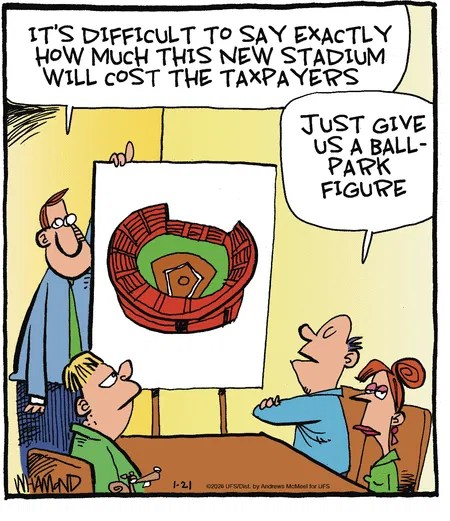
1. Subsidies for pro sports, including stadium construction, are damnable boondoggles. I would vote against every one of them until the franchise-owning billionaires ran me out of office.

While I’m at it, these too can come off the list:

2. Abolitions I supported that may well have hurt America:

  • The military draft Politicians who have anything to do with war policy should have skin in the game, even if it’s the skin of their descendants.
  • The Fairness Doctrine. We opened Pandora’s box before cable TV and the internet obliterated it. I don’t see a way back to sanity through reinstating the policy.

While I’m on a roll, here’s one that’s never been on the list:

3. The states should stop running primary elections. Neither major party is worth the powder to blow it up. Let them run their own elections or go back to “smoke-filled rooms” (which incidentally yielded better candidates than crackpot “base voters” have been yielding).

Logic mincing

Q: Which is better: a ham sandwich or complete happiness in life?
A: A ham sandwich, of course! Nothing is better than complete happiness in life and a ham sandwich is better than nothing.

  1. Something must be done!
  2. This is something.
  3. This must be done!

Shorts

  • No one is really working for peace unless he is working primarily for the restoration of wisdom. The assertion that “foul is useful and fair is not“ is the antithesis of wisdom. (E.F. Shumacher) Small Is Beautiful is a classic for good reason.
  • The national emergency is avoiding a national emergency. (Treasury Secretary Scott Bessent, citing the president’s authority to impose tariffs in an economic emergency, arguing that America’s supposed need to control Greenland is a national emergency.)
  • The health of the American experiment rests far more on the integrity of any given American president than we realized. (David French)
  • The pervasiveness of legal sports gambling can make an undefeated season and a 6-point victory in the national championship game feel like a loss if “the margin” was 7.5. (Moi)
  • At some point, we’ll reach the bottom of this dystopian populist abomination, but no one thinks we’re there yet, do they? (Nick Catoggio)
  • “The Trump Denmark letter is his Biden debate moment,” one Twitter user claimed.
  • Donald Trump is a peacock among the dull buzzards of American politics. (Martin Gurri, The Revolt of the Public and the Crisis of Authority in the New Millennium).
  • A clown with a flame thrower still has a flamethrower. (Charlie Sykes to Andrew Sullivan)
  • When you light a candle, you also cast a shadow. (Ursula K. Le Guin)
  • TikTok is still a danger. America no longer cares.
  • The souvenir is a fetish object that substitutes for the finite experience of the destination. (William T. Cavanaugh, The Uses of Idolatry)

Elsewhere in Tipsyworld


A devil is no less a devil if the lie he tells flatters you and stands to help you defeat your enemies and achieve power.

Rod Dreher

I don’t do any of the major social media, but I have two sub-domains of the domain you’re currently reading: (a) You can read most of my reflexive stuff, especially political here. (b) I also post some things on my favorite no-algorithm social medium.
Autogulpe Day

I’m fully aware that today is Epiphany in Western Christianity, Theophany in Orthodox Christianity. But it’s also the 5th anniversary of one of the darkest days in American history, the attempted autogulpe of 2021.

In some ways, I think 1-6-21 is worse than 9-11: we did this to ourselves, and to this day there are tens of millions of Americans who will insist that it was a great patriotic outpouring of love rather than an attempt to overturn a Presidential election that ousted the incumbent.

Baloney!, say I to keep this post as family fare.

With friends like this …

What I remember very well about that day was my own failure of imagination. I did not, to my knowledge, see Dempsey—he had positioned himself at the vanguard of the assault, and I had stayed near the White House to listen to Trump—but I did come across at least a dozen or more protesters dressed in similar tactical gear or wearing body armor, many of them carrying flex-cuffs. I particularly remember those plastic cuffs, but I understood them only as a performance of zealous commitment. Later we would learn that these men—some of whom were Proud Boys—believed that they would actually be arresting members of Congress in defense of the Constitution. I interviewed one of them. “It’s all in the Bible,” he said. “Everything is predicted. Donald Trump is in the Bible.” Grifters could not exist, of course, without a population primed to be grifted.

After the riot, Dempsey returned to California, where he was eventually arrested. In early 2024, he pleaded guilty to two felony counts of assaulting an officer with a dangerous weapon. He was sentenced to 20 years in prison.

Six months later, in the summer of 2024, Trump, who would come to describe the January 6 insurrection as a “day of love,” said that, if reelected, he would pardon rioters, but only “if they’re innocent.” Dempsey was not innocent, but on January 20, 2025, shortly after being inaugurated, Trump pardoned him and roughly 1,500 others charged with or convicted of offenses related to the Capitol insurrection ….

Jeffrey Goldberg, MAGA’s Foundational Lie. Subtitle: “The movement claims to stand with the police. Trump’s decision to pardon the cop-beaters of January 6 exposed his movement for what it is.”

And what have we gotten from the incorrigible electorate’s insistence on re-electing Trump four years after his defeat?

Defining “sedition” down

One indicator of a polity’s health is whether a citizen can be punished merely for telling the truth about the law. The signs for American democracy are not good.

This morning, Defense Secretary Pete Hegseth announced that he has begun the process to demote Mark Kelly, a retired Navy captain and NASA astronaut, and reduce his pension pay. The operative facts here, naturally, are not Kelly’s past service but his current rank and service: a Democrat serving in the U.S. Senate and a political adversary of President Donald Trump.

“Six weeks ago, Senator Mark Kelly—and five other members of Congress—released a reckless and seditious video that was clearly intended to undermine good order and military discipline,” Hegseth wrote on X this morning. He cited two articles of the Uniform Code of Military Justice; Kelly, unlike the other five, holds retired military status, which makes him subject to sanctions from the Defense Department.

What Hegseth did not cite was what Kelly and his colleagues actually said in the video, and for good reason. Doing so would expose the absurdity of the charge and the abuse of power involved in the attempt to demote him. “Our laws are clear: You can refuse illegal orders,” Kelly said. No one in the Trump administration has disputed that this is true. A more agile or even-keeled administration would have smoothly dismissed the video as irrelevant: This is true, but of course we would never issue an illegal order. (As Kelly and his lawyers have noted, Hegseth has cited the same law about disobeying illegal orders in the past.) Instead, Trump and his aides threw a fit, dubbing the Democrats the “Seditious Six.”

Members of the armed forces, and retirees like Kelly, are particularly susceptible to Hegseth’s abuse of power, because they can be punished by the Defense Department internally. But the chilling effect does not end with those who are serving or have served, or with the particular question of illegal orders. The administration has told the other five Democrats that it is investigating them as well. The core belief underlying all of this is as plain as it is dangerous: Criticizing Donald Trump and defending the rule of law is sedition.

David A. Graham, Hegseth’s Appalling Vengeance Campaign

Kelly responds tartly:

“My rank and retirement are things that I earned through my service and sacrifice for this country. I got shot at. I missed holidays and birthdays. I commanded a space shuttle mission while my wife,” former Representative Gabby Giffords, “recovered from a gunshot wound to the head—all while proudly wearing the American flag on my shoulder,” he said in a statement on X. “If Pete Hegseth, the most unqualified Secretary of Defense in our country’s history, thinks he can intimidate me with a censure or threats to demote me or prosecute me, he still doesn’t get it.”

Remember that Hegseth purports to be a devout Christian. He should bear in mind that “taking the name of the Lord in vain” has a deeper meaning than “don’t cuss.”


We are all gatekeepers now.

Peggy Noonan

Your enemies are not demonic, and they are not all-powerful and the right hasn’t always lost and the left hasn’t always won. But if you convince yourself of that, you give yourselves all sorts of permission to do a lot of stupid and terrible things under the rubric of “Do you know what time it is?”

Jonah Goldberg.

[A] critical mass of the American people … no longer want[s] to govern themselves, … are sick of this republic and no longer want to keep it if it means sharing power with those they despise.

Nick Catoggio

I don’t do any of the major social media, but I have two sub-domains of the domain you’re currently reading: (a) You can read most of my reflexive stuff, especially political here. (b) I also post some things on my favorite no-algorithm social medium.

Feast of St. Stephen …

… in the Christian East, that is. The West commemorated him yesterday.

A profitable political pairing

Two Right-coded voices, Glenn Loury and Ilya Somin, take up recent events, emblemized by Tucker Carlson’s softball interview of Nick Fuentes, and reach similar conclusions: a fundamental rift in the Right is between universalists and particularists/nationalists.

For figures such as Robert P. George, McCormick Professor of Jurisprudence at Princeton University and perhaps the single most influential moral philosopher within conservative intellectual circles, conservatism begins with the claims of natural law. Its founding premise is the inherent dignity of every human being—an anthropology that descends from classical philosophy, Christian theology, and the Enlightenment. For George, conservatism is first a moral project: It safeguards life, liberty, marriage, family, and religious freedom because these institutions reflect universal truths about the human person. George has spent his career articulating these principles in philosophy, public policy, and constitutional thought. His is an approach to conservatism that emphasizes the primacy of the permanent things, the universals that transcend time and place.

Opposing this universalist strand is the ascendant nationalist wing of the right—a coalition influenced by the populist energies that surged after 2016 and represented by Tucker Carlson, Kevin Roberts of the Heritage Foundation, and polemicists such as John Zmirak. This faction sees conservatism less as an expression of moral philosophy than as a defense of Western civilization: a concrete culture, a historical inheritance, with its own people, faith, memories, and vulnerabilities. This conservatism is particularist rather than universalist. It begins not with abstract principles but with cultural loyalties. Whereas George begins with human dignity, Carlson begins with civilizational survival. Whereas George sees imperatives and violations of the moral law, Carlson sees a beleaguered West beset by global elites, porous borders, and cultural disintegration.

Glenn C. Loury, Tucker and the Right

[T]he root of the problem is the Trump-era shift of most of the American right towards ethno-nationalism. For reasons outlined in detail in my recent UnPopulist essay on this topic, nationalist movements are inherently prone to anti-Semitism and other forms of racial and ethnic bigotry. It is not surprising that anti-Semitism among MAGA conservatives has risen alongside nativism and bigotry towards other minority groups, such as Indian-Americans.

As I explained in the UnPopulist article, the only sure way to avoid this problem is to reject ethnic nationalism and instead recommit to the universalist principles of the American Founding, which the Heritage Foundation once claimed to stand for, but has more recently betrayed ….

Ilya Somin, Lessons of the Heritage Foundation’s Implosion

As I skimmed Lourie’s article (which I’m pleased to see in First Things, which under R.R. Reno has been leaning increasingly toward particularist nationalism), I felt a flush of shame (or was it the shiver of a near-miss?) as I looked back on my admiration of “paleoconservative” thinkers and commentators — guys who now appear to be the ancestors of today’s ethno-nationalist types.

Even now, I sense the fortress America appeal of the nationalist appeal. But when I watch ICE trying to evict putative undesirables from the fortress before we pull up the drawbridge, and see antisemitism rising among the nationalists as well, I can’t help coming down on the side of human dignity: Fiat justitia ruat caelum.

Slouching Toward Something Worse

[Ben] Shapiro originally hired [Candace] Owens at The Daily Wire, thereby helping to launch her career into the stratosphere. The fact that he now feels the need to try and drive a stake through her heart “contains the entire story of the conservative movement within it,” in the words of Substacker John Ganz.

[Rod] Dreher longs for Vance to take a firm stand against Fuentes and his followers. But will he?

So far, there’s no sign of it. And yes, that includes in the recent UnHerd interview, where Vance told Fuentes (in the debased public rhetoric favored by populists) to “eat shit.” The vice president made clear that his rightward volley was provoked, not by any of Fuentes’ political views, but by him insulting Vance’s (South Asian) wife. “Anyone who attacks my wife,” Vance declared, will be attacked in turn, “whether their name is Jen Psaki or Nick Fuentes.”

That’s right: the sitting vice president of the United States made clear he was equally inclined to rise up in defensive anger against a former White House Press Secretary from the mainstream opposition party and a man who regularly proclaims his admiration for Adolf Hitler and loathing for Jews.

I’m afraid anyone placing their hopes in Vance serving in the role of gatekeeper or force for moderation is going to be sorely disappointed.

It’s not clear a right-populist political movement needs policy intellectuals at all. After all, intellectuals are elites who think they sometimes know better than the elected Leader of the People. That is unacceptable. What a right-populist political movement needs, instead, is propagandists to justify what the Leader already intends to do.

Damon Linker

In case you’ve forgotten, do not trust any high-generality assessment of JD Vance by Rod Dreher. Dreher “discovered” Vance’s book, Hillbilly Elegy, and his discovery elevated mediocre sales to stratospheric sales. He and Vance are now friends, Rod feels a personal investment in him, and Vance probably feels a debt of gratitude to Rod for launching his explosive political rise.

So Dreher is just not capable of objectivity about his friend, and that’s probably to his credit; dissecting friends is kinda reptilian — and certainly is a deviation from the conservative tendency on Jonathan Haidt’s Loyalty/betrayal moral foundations axis.

Too ad hoc to be fascist

Take the word fascism, properly applied to Franco’s Spain or Mussolini’s Italy, and to some extent beyond. The fasces were the bundles of rods carried by Roman lictors: symbols of punishment and magisterial authority, but in modern times also of a tightly unified society controlled from above, and organized in corporate form. The desire of totalitarians everywhere is to achieve harmonization, with all of society marching in military cadence under the guidance of an omnipresent government.

But the Trump administration is more interested in blowing up the state than in extending its power.

He is, to be sure, cruel and malicious, but unlike the others, has no real governing vision.

Trump himself is not Mussolini, or Hitler, or Orbán ….

Eliot A. Cohen, America Needs a Mirror, Not a Window

French Integrity

The headline read, “What It’s Like to Experience the 2016 Election as Both a Conservative and a Sex Abuse Survivor.”

Nancy French, Ghosted. As the book blurb has it, “when she was unwilling to endorse an unsuitable president, her allies turned on her and she found herself spiritually adrift, politically confused, and occupationally unemployable.”

Part of the reason for David French and Nancy French becoming personae non grata in much of the North American white Evangelical world was candor, like in the cited article Nancy wrote, and their various relatively unflinching looks at topics like sexual abuse at a very popular Evangelical summer camp for kids. I learned recently that they fairly quietly have moved out of their deep red part of Tennessee to the Chicago area (I was aware that Tennessee Evangelicalism exhibited pretty unrelenting and vocal antipaty to Frenches). That move won’t do much for Nancy’s work as a ghost-writer in Evangelical and Conservative circles, but they should at least be able to find a Church whose Christianity matches theirs (Reformed-tinged Evangelical) without the political tribalism. (That’s my read on it.)

(I have speculated that David might be on the road to Rome, too.)

The differences between their Evangelical/Reformed piety and my Orthodoxy manifests in my ill-ease with some of their takes on things (I will never again trust a David French endorsement of a movie or television series, for instance), but I’ll give them high marks for trying to act with integrity (which endears them to me despite reservations).

Quantum physics

Quantum entanglement blows my mind. How do they even find the entangled needles in the cosmic haystack to study entanglement?

That they manage to find and study them makes me sympathetic to the predictions that we’re going to figure out everything — predictions I nonetheless think are ultimately delusional.

Trying to deal with things like this has sent me back to Iain McGilchrist for a second round of mind-bending, this time via The Matter with Things.

I’m outvoted

A few days ago, I objected to the emerging cult of Charlie Kirk.

For what it’s worth, one of America’s top religious news experts, Terry Mattingly, thinks Kirk’s assassination was the top (American) religion story of the year, even higher than the selection of an American Pope (because, if I understood Mattingly, Kirk’s death liberates sinister tendencies on the political Right, like antisemitism and political violence, that Kirk was restraining).

The mixture of politics and religion in this theory makes my head hurt, and my eyes avert, but I suspect that Mattingly knows more about Kirk, and about the consequences of his assassination, than I do.

Jingoists and Patriots

The worst jingoes do not love England, but a theory of England. If we love England for being an empire, we may overrate the success with which we rule the Hindoos. But if we love it only for being a nation, we can face all events: for it would be a nation even if the Hindoos ruled us.

G. K. Chesterton, Orthodoxy

Shorts

Elsewhere in Tipsyworld


We are all gatekeepers now.

Peggy Noonan

Your enemies are not demonic, and they are not all-powerful and the right hasn’t always lost and the left hasn’t always won. But if you convince yourself of that, you give yourselves all sorts of permission to do a lot of stupid and terrible things under the rubric of “Do you know what time it is?”

Jonah Goldberg.

[A] critical mass of the American people … no longer want[s] to govern themselves, … are sick of this republic and no longer want to keep it if it means sharing power with those they despise.

Nick Catoggio

I don’t do any of the major social media, but I have two sub-domains of the domain you’re currently reading: (a) You can read most of my reflexive stuff, especially political here. (b) I also post some things on my favorite no-algorithm social medium.

Thursday, 12/18/25

Quietly grassing up the neighbor

Of the Bondi Beach terrorist shootings by Muslim men Sajid Akram and Naveed Akram (unconfirmed by police at this writing) and the heroic intervention of one Ahmed al-Ahmed:

Let it be said, and said with firmness and gratitude, that a Muslim fruit seller named Ahmed al-Ahmed rushed one of the gunmen and disarmed him, saving Jewish lives and taking a couple of bullets himself for his trouble. May God bless that brave man. Here is video of him courageously tackling the gunman. This brings to mind something I was told back in 2002 by a Jewish friend who worked in counterterrorism. Be careful not to accuse every Muslim, she said. Some of our best sources are Muslims within Muslim communities who hate what they’re seeing, but know that if they speak out publicly against it, they will be killed. So they come to us quietly.

Rod Dreher

I wish we could figure out what makes many Muslims exemplary citizens, others murderous fanatics. Though I reject Islam as a false religion, I don’t want to think it’s simply that the former don’t take it seriously.

I have a theory, but it’s at a high enough level of generality that it’s not much use, I fear: that Islam, like Evangelicalism, has no authority beyond a sacred text, so Imams/Preachers can twist the text as they wish, limited only by what their congregants will tolerate.

The Other Terrorists

“Right-wing attacks and plots account for the majority of all terrorist incidents in the United States since 1994, and the total number of right-wing attacks and plots has grown significantly during the past six years,” the Center for Strategic & International Studies concluded after examining terror plots in the United States from 1994 to May of this year. “Right-wing extremists perpetrated two-thirds of the attacks and plots in the United States in 2019 and over 90 percent between January 1 and May 8, 2020.”

Nicholas Kristof, The Lawbreakers Trump Loves (August 29, 2020)

AI moves fast, breaks things

A woman in a service industry, an immigrant to America from Eastern Europe who’s been here about 20 years, took me aside recently. Her eldest child, a senior in high school, is looking around at local colleges. She was worried about AI and asked for advice on what her son might study so that in four years he could get a job. We asked ChatGPT, which advised “embodied in-person work” such as heating and air conditioning technician, pool cleaner. She wasn’t happy with that. She’d worked herself to the bone to get her son higher in the world than she is. She wants him to own the pool.

Peggy Noonan, Trump may be losing his touch

Grievance Memoirs

Political memoirs tend to fall into recognizable categories.

There is the sanitized precampaign memoir, gauzy life stories mixed with vague policy projects and odes to American goodness. There is the postcampaign memoir, usually by the losers, assessing the strategy and sifting through the wreckage. There are memoirs by up and comers who dream of joining the arena and by aging politicos rewriting their careers once more before the obits start to land. There are memoirs by former staff members who realize that proximity to power gives them a good story and memoirs by journalists who chronicle power so closely that they imagine themselves its protagonists.

But a recent spate of books highlights the presence of a new category, one well suited to our time: the grievance memoir. In their books, Eric Trump (“Under Siege”), Karine Jean-Pierre (“Independent”) and Olivia Nuzzi (“American Canto”) are all outraged by affronts real and imagined, fixated on nefarious, often unspecified enemies, obsessed with “the narrative” over the facts and oblivious to their complicity in the conditions they decry.

The authors (a third child embracing on to his father’s legal and political grudges, a former White House press secretary groping for a new brand, a boutique political journalist enmeshed in a self-made scandal) are animated, above all, by a certainty that they’ve been wronged not just by people or institutions but also by broader forces. They are ancillary characters inflating themselves into victims, heroes, even symbols. It is the inevitable memoir style for a moment when everyone feels resentful, oppressed, overlooked — in a word, aggrieved.

Carlos Lozado (who’s famous among his New York Times colleagues as a voracious book-reader).

Add to Lozado’s list a longish article by Jacob Savage in Compact magazine, which Rod Dreher found “one of the most powerful essays I’ve read all year.” Its gist seems to be that straight, white, young men can’t catch a break any more – for reasons predating AI.

Ross Douthat thinks Savage has a point; that Douthat has an opinion suggests that Dreher isn’t just playing Chicken Little again.

I’m fortunate to be chronologically beyond gathering personal straight white male grievance anecdotes (and that my grandson is thrilled at, not resigned to, the prospect of a sort of Shop Class As Soulcraft career).

Are we the baddies?

Remizov and other conservative democrats complain that modern Western liberalism is in fact anti-democratic, as it tramples on national traditions and subordinates national authorities to international ones and to the impersonal forces of globalization.

Paul Robinson, Russian Conservatism. This book is pretty good at giving the gift to see ourselves as others see us.

When your only tool is anger, every little problem looks infuriating

Trump has never shined in moments that call for dignity and restraint … This is what makes Trump’s post about the Reiners not just despicable and cruel but also bad for the country. In moments of national mourning or trauma, a president can seek to bring people together … But not Trump. He finds the most divisive way to insert himself … His choices … take moments that could be unifying—surely Americans of all political views can agree on the greatness of When Harry Met Sally and The Princess Bride—and turn them into opportunities for anger.

Which is, in effect, Trump’s political project.

David Graham, Trump Blames Rob Reiner for His Own Murder

Shorts

  • I like ebooks because nobody can tell that I’m performative reading. (@restlesslens on micro.blog)
  • Be regular and orderly in your life, so that you may be violent and original in your work. (Gustave Flaubert)
  • Insofar is not the same as inasmuch, and I don’t know why the current style is to break the former into three words.
  • I remember mocking people for thinking the Covid vaccine was Bill Gates’ way of getting microchips into us. Hmmm.
  • This is the paradox of politics: Every time you solve a major problem, you’re removing a weapon from your political arsenal. (Peggy Noonan, Trump may be losing his touch)
  • If “TDS” is the tendency to become irrationally obsessed with Donald Trump and project that obsession onto everyone else, then somebody is indeed deranged, and it wasn’t Rob Reiner. (David Graham, Trump Blames Rob Reiner for His Own Murder.
  • A tool always implies at least one small story[:] There is a situation; something needs doing. (L.M. Sacasas)
  • Anyone claiming to know the future is just trying to own it. (L.M. Sacasas)
  • After this awful weekend, Trump has once again lowered the bar for what we can expect from the president. (The Free Press, Mr. President, Don’t Mock the Dead)
  • The odds are good, but the goods are odd. (Advice given to incoming women at Georgia Tech).

Elsewhere in Tipsyworld


We are all gatekeepers now.

Peggy Noonan

Your enemies are not demonic, and they are not all-powerful and the right hasn’t always lost and the left hasn’t always won. But if you convince yourself of that, you give yourselves all sorts of permission to do a lot of stupid and terrible things under the rubric of “Do you know what time it is?”

Jonah Goldberg.

[A] critical mass of the American people … no longer want[s] to govern themselves, … are sick of this republic and no longer want to keep it if it means sharing power with those they despise.

Nick Catoggio

I don’t do any of the major social media, but I have two sub-domains of the domain you’re currently reading: (a) You can read most of my reflexive stuff, especially political here. (b) I also post some things on my favorite no-algorithm social medium.

Special Political edition

I’ve mostly been relegating my political points to the “Elsewhere in Tipsyworld” section I’ve been putting in most posts. Today, in honor of the Indiana Senate doing the right thing (and the will of Hoosiers) against the wishes of the President, I bring them back for a cameo appearance.

Backlash

The Indiana Senate did us proud Thursday by rejecting a MAGA redistricting scheme to boost, they thought, the Republican majority from 7-2 to unanimity at 9 Republicans.

There’s much to hate about a norm-breaking mid-decade gerrymander, but the news and commentary coverage tends to omit (a) that norm-breaking is prima facie un-conservative; (b) that the gerrymander would have split up communities that share common concerns, such as splitting my county between two congressional districts and splitting Indianapolis into quarters; and (c) that in a “backlash year” (as 2026 looks likely to be) those 7 current “safe seats” for the GOP would be less safe because Republican voters would be spread thinner across the state.

Indeed, it was (is) my hope that if the legislature did (does) redistrict, heeding POTUS threats over Hoosier preferences, “Backlash 2026” would produce a loss of one or two Republicans in our delegation.

Pareto

  • Pareto improvement: Change benefiting at least one party without harming others.
  • Pareto punishment: Change harming at least one party without benefiting others.

The guy who had The Art of the Deal ghost-written for him knows only the second option.

(H/T Kevin D. Williamson)

I’ve long thought Trump doesn’t know anything about win-win solutions — that making the other guy lose is the only way he can feel he’s won. Williamson puts a more scholarly name on it.

A new personal best (or, likelier, worst)

11 months as president is long enough to get on everyone’s nerves—to disappoint your fans and infuriate your foes. But he’s in a fix, surrounded by mood shifts, challenges and bad signs.

His Capitol Hill base for once and famously began to kick away this summer, with loyalists breaking with him on the Jeffrey Epstein files and Georgia Rep. Marjorie Taylor Greene on other issues as well. She’s leaving Congress but not looking like someone who lost her battles with Mr. Trump. His problem: Once someone makes a successful jailbreak, all the other prisoners know a jailbreak is possible. This changes the conversation in the prison yard. Guards are eyed differently, the warden’s mystique is diminished.

Outside Washington Mr. Trump’s base is fighting with itself. America first is saying “I’m not MAGA.” Conspiracists all over: “Israel killed Charlie.” The assassination of Charlie Kirk looks increasingly like an epochal event. Did he understand how much he was holding together the Trumpian right? Without the force of his mediating presence they are cracking up.

I think the world of Peggy Noonan (shared link). She’s both articulate and wise. I’m forever reading her Friday WSJ column and feeling affirmed in what I’d been feeling but hadn’t slowed down to articulate.

But this!? Charlie Kirk was the glue holding America together!? Even just holding the Trumpian right together? It seems impossible.

But a lot of people can’t stop talking about Kirk.

And after this went to press, Indiana’s Senate (40 Republicans and 10 Democrats) rejected the redistricting Trump was demanding (and in support of which his hoodlum minions were terrorizing legislators) by a vote of 31-19.

It lost even before you count the ten Democrats!

(Oddly, Turning Point Action, one of Kirk’s affiliate organizations, was among those pronouncing primary doom on Republicans who rejected the new maps.)

This may set a new personal record for me not grokking what’s going on. And I can’t even say it’s an epiphany because my mind and my gut both reject the idea. I’m a guy with a fork in a soup world, I guess.

But then she turns back into articulate, wise Peggy:

Percolating below, unseen, is the price you pay in time for success. The president’s border triumph will likely weaken his and MAGA’s political position. He shut down illegal immigration on the southern border, which had been more or less open for decades. But it was anger at illegal immigration that kept his base cleaved to him and allied with each other. Remove the issue that made you, and you can no longer use it to gain votes or maintain unity.

This is the paradox of politics: Every time you solve a major problem, you’re removing a weapon from your political arsenal.

What happens when you lose your great issue? What happens when all that remains of that issue is its least popular aspect? Immigration remains in the news only because of brutal deportation practices. It isn’t “build the wall” anymore; it’s “Don’t arrest the poor guy working the line in a second job at the chicken-processing plant.” Americans don’t want that guy thrown out. The longer the deportations continue, the more unpopular and damaging to the administration they will become.

Shorts

  • The Indiana redistricting vote strikes me as a sort of political gag reflex. (Nick Catoggio)

Elsewhere in Tipsyworld

Promotion

I usually put these in my footers at the end of blogs, but they seem worth elevating today:

We are all gatekeepers now.

Peggy Noonan. Hoosiers let their State Senators know that they didn’t want a redistricting. They had many good reasons, whether or not they articulated them. They served as gatekeepers, Trump as a gate crasher.

Your enemies are not demonic, and they are not all-powerful and the right hasn’t always lost and the left hasn’t always won. But if you convince yourself of that, you give yourselves all sorts of permission to do a lot of stupid and terrible things under the rubric of “Do you know what time it is?”

Jonah Goldberg. “Demonic Democrats” was the vibe of the push for redistricting.


I don’t do any of the major social media, but I have two sub-domains of the domain you’re currently reading: (a) You can read most of my reflexive stuff, especially political here. (b) I also post some things on my favorite no-algorithm social medium.

November 1

MAGA nihilists

Sometime in 1985 I had lunch with Sam Francis in the cafeteria of The Washington Times, where we both worked. You may never have heard of Sam Francis, but MAGA people (at least the more intellectual ones) know him as one of the seminal thinkers of their movement.

The lunch was awkward because I found him dark and creepy (and he probably found me naïve). Back then I didn’t understand that his way of thinking would triumph in conservative circles and my way of thinking would be vanquished. I don’t think he won because he was a flat-out racist, though he was. (He was later fired for writing a column arguing that “neither ‘slavery’ nor ‘racism’ as an institution is a sin.”) I think he won because he was a revolutionary, while I was a conservative. I wanted to reform things; he wanted to burn it all down.

Sam Francis (who died in 2005) explicitly cited Gramsci as his role model as he waged his culture war struggles. Christopher Rufo does the same today. This is why Trump is going after the universities, public broadcasting and the Kennedy Center. Francis once wrote, “The main focus should be the reclamation of cultural power, the patient elaboration of an alternative culture within but against the regime — within the belly of the beast but indigestible by it.”

David Brooks, Hey, Lefties! Trump Has Stolen Your Game (Gift link)

I was reading Sam Francis at roughly the time Brooks had lunch with him and for some years thereafter. He was brilliant (which is little assurance of a sound mind). He also was purged by more respectable conservatives—my kind of conservatives—for his increasingly explicit antisemitism.

Joseph Sobran followed a similar trajectory. He, too, was brilliant, but less radical than Francis (and thus less consequential). He was a devout Catholic, and his antisemitism was never explicit, but William F. Buckley wouldn’t tolerate even a whiff of it.

I viscerally detested Christopher Rufo almost from my first notice of him, which involved his gloating over making the term “Critical Race Theory” toxic while leaving it vague enough that it could beslime anyone he cared to beslime. I doubt that Rufo will be as consequential as Francis or even Sobran in the long run, but we’re in an era of pas d’ennemis á Droite, and there’s no magisterial authority trying to purge him.

Sentient and respectable conservatives like me necessarily ask ourselves if MAGA was always the eventuality of our political preferences, if we were all embryonic Sam Fracises and Joe Sobrans all along.

I don’t think so, but I’m increasingly appreciating that some truths simply need not be uttered—because of how very, very foreseeably they can be abused. To deny them would be sin, to utter them, imprudent. I save them for my private journal now when I recognize that.

Pardon me?

On Tuesday morning, the Republican-led House Oversight Committee released a report on former President Joe Biden’s use of autopen signatures on the many pardons and commutations he handed out during his term, and particularly near its end. Many of these were scandalous enough taken on their own terms, but what made them particularly outrageous was the suspicion that the bulk of these acts were the work of Biden’s staff, not the senescent president himself. One might reasonably understand how Biden found the time to preemptively pardon his family members, breaking frequent promises never to do so, but it was harder to believe that he was setting aside personal time to commute the sentences of people like Maryland’s thrice-murdering “Black Widow” killer. The House report confirms what voters long suspected: Biden’s inner circle hid the extent of his mental decline from the American people and, after he dropped out of the race, used his autopen as part of their campaign to set a new record for presidential clemency.

The GOP argument that Biden abused his pardon power in an unacceptable way is undermined, however, by Trump’s nonchalant, even gleeful pardoning of absolute sleazeballs who have ties to his own family business. There aren’t a lot of large financial institutions that are willing to simultaneously do work with al-Qaeda, ISIS, Hamas, ransomware hackers, and kiddie-porn enthusiasts, but the crypto firm Binance did so. Back in November 2023, Binance founder Changpeng Zhao pleaded guilty to failing to maintain an effective anti-money-laundering program. In a court filing, U.S. Attorney Tessa Gorman said Zhao caused “significant harm to U.S national security” through his criminal acts and “violated U.S. law on an unprecedented scale.” But not only did Trump pardon him earlier this month, he claimed Zhao was in fact persecuted by the Biden administration. It gets worse. The Wall Street Journal reported in August: “The Trump family’s crypto venture has generated more wealth since the election—some $4.5 billion—than any other part of the president’s business empire.” Trump’s crypto fortune is of course facilitated by a partnership with “an under-the-radar trading platform quietly administered by Binance, the world’s largest crypto exchange.” It’s an egregious decision that is unlikely to generate more than a peep of objection from congressional Republicans.

National Review email.

Who damaged the nation more: Biden with his autopen pardons or Trump with his blanket pardon of the January 6 rioters and targeted pardons of lucrative cronies? (That’s a rhetorical question, of course.)

Indictment

Let us not belabor the obvious truth that what the Western world calls an “energy” crisis ineptly disguises what happens when you can no longer control markets, are chained to your colonies (instead of vice versa), are running out of slaves (and can’t trust those you think you still have), can’t, upon rigorously sober reflection, really send the Marines, or the Royal Navy, anywhere, or risk a global war, have no allies only business partners, or “satellites” and have broken every promise you ever made, anywhere, to anyone. I know what I am talking about: my grandfather never got the promised “forty acres, and a mule,” the Indians who survived that holocaust are either on reservations or dying in the streets, and not a single treaty between the United States and the Indian was ever honored. That is quite a record.

James Baldwin, Open Letter to the Born Again, p. 785.

My name is Ozymandias, King of Kings

The problem is that Trump, perhaps owing to his nouveau riche background and the carefully wrought deformity of his soul, has a taste for the trappings of aristocracy—a princely estate as imagined by a trust-fund dork from Queens. You can see it in his enthusiasm for ghastly imperial furnishings, in his love of monarchical pomp, and even in his sometimes evident desire to pass something of his political position along to the sons he obviously despises. … But what is most objectionably kingly about Trump is not his Caligula-by-way-of-Liberace bad taste but his personalist posture, e.g., treating the White House as though it were his personal property, to be knocked down and rebuilt at his whim, treating the Department of Justice as though it were his personal goon squad, treating judges as though they were his personal servants and factota, etc. Trump talks about “my generals” and unilaterally raised tariffs on Canadian goods because someone in Ontario hurt his personal feelings.

L’État, c’est moi—it is not only gilt moldings that Trump has taken from Louis XIV.

The king spoke, and said, “Is not this great Babylon, that I have built for the house of the kingdom by the might of my power, and for the honor of my majesty?”

While the word was in the king’s mouth, there fell a voice from heaven, saying, Oh, king Nebuchadnezzar, to thee it is spoken; The kingdom is departed from thee.

Nebuchadnezzar had to learn things the hard way. Julius Caesar, too. Why should Americans be any different?

Kevin D. Williamson

Pas d’ennemis à Droite, Heritage Foundation Edition

[A] video of Kevin Roberts, head of the Heritage Foundation, went viral. “There has been speculation that Heritage is distancing itself from Tucker Carlson over the past 24 hours,” Roberts tweeted, reacting to the uproar over Carlson’s notorious interview with head groyper Nick Fuentes. “I want to put that to rest right now.”

And that’s what he did. “We will always defend our friends against the slander of bad actors who serve someone else’s agenda,” he said in the clip, declining to explain why criticism of Carlson is “slander” and who that “someone else” whose agenda is being served might be. “That includes Tucker Carlson, who remains—and, as I have said before, always will be—a close friend of the Heritage Foundation. The venomous coalition attacking him are sowing division. Their attempt to cancel him will fail.”

Nick Catoggio

Stagnation

Today’s suburbs are different. Highways and zoning have broken the feedback loop between location and value. These developments are typically built to a fixed, finished state and then locked down through zoning codes that discourage or prohibit change. There’s no natural process of maturing or intensification. No organic evolution. Just a one-time buildout, followed by stagnation and decline.

America Should Sprawl? Not if We Want Strong Towns

Snippets

  • “Quantity is a quality of its own.” (Shyam Sankar, CTO of Palantir, on the United States advantage in WW II. German stuff was engineered better, but we made up for it with more stuff, much more stuff. Via Ross Douthat’s Interesting Times podcast (Gift link))
  • “[E]very good earnings report further entrenches Nvidia as a precariously placed, load-bearing piece of the global economy … What if AI’s promise for American business proves to be a mirage? What happens then?” (Matteo Wong, Charlie Warzel, Here’s How the AI Crash Happens)

I don’t do any of the major social media, but I have two sub-domains of the domain you’re currently reading: (a) You can read most of my reflexive stuff, especially political here. (b) I also post some things on my favorite no-algorithm social medium.

No Kings Saturday, 10/18/25

No kings!

Binding precedent

Protesters have protested at an ICE facility a few miles west of Chicago for the past 19 years—with somewhat more intensity recently following the announcement of Operation Midway Blitz. A month after the announcement, the president federalized the Illinois National Guard. District court: Enjoined. Seventh Circuit: Just so. Political opposition is not rebellion, and a protest doesn’t become a rebellion merely due to a few isolated incidents of violence. Without that, none of the statutory predicates for federalizing the National Guard have been met.

Institute for Justice, Short Circuits for 10/17/25 (bold added). This is now the law in the 7th U.S. Circuit – Indiana, Illinois and Wisconsin.

Look for the Administration to try to provoke a rebellion it can crush. Everyone who’s paying attention knows Trump wants to invoke the Insurrection Act (as he stuffs his pockets and those of his family).

Wanted: a viable counternarrative

Trump’s actions … are part of one project: creating a savage war of all against all and then using the presidency to profit and gain power from it. Trumpism can also be seen as a multipronged effort to amputate the higher elements of the human spirit—learning, compassion, science, the pursuit of justice—and supplant those virtues with greed, retribution, ego, appetite. Trumpism is an attempt to make the world a playground for the rich and ruthless, so it seeks to dissolve the sinews of moral and legal restraint that make civilization decent.

Trumpism, like populism, is more than a set of policies—it’s a culture. Trump offers people a sense of belonging, an identity, status, self-respect, and a comprehensive political ethic. Populists are not trying to pass this or that law; they are altering the climate of the age. And Democrats think they can fight that by offering some tax credits?

To beat a social movement, you must build a counter social movement. And to do that, you need a different narrative about where we are and where we should be heading, a different set of values dictating what is admirable and what is disgraceful. If we fail to build such a movement, authoritarian strongmen around the globe will dominate indefinitely.

David Brooks.

You can’t beat something with nothing. I can’t come up with a political counternarrative to Trumpism. The Democrats can’t come up with a political counternarrative, either. Brooks couldn’t come up with a strong political counternarrative.

I can only hope and pray that people will look for their compelling (counter-)narrative to the Gospel of Jesus Christ. (And that meantime there will be some legal counternarratives to prevent irretrievable damage, as in the preceding item.)

Music Reviews

There may be nothing better than old music reviews to let you know that it’s okay to like what you like, critics be damned.

I like Debussy’s La Mer, and I don’t care what the stupid early reviews said:

On today’s date in 1905, Claude Debussy’s orchestral suite La Mer or The Sea was performed for the first time in Paris. Today this music is regarded as an impressionistic masterpiece, but early audiences — especially those in America — found it rough sailing.

“We clung like a drowning man to a few fragments of the tonal wreck,” wrote a 1907 Boston critic, and suggested that instead of The Sea Debussy should have titled his piece Sea-Sickness.

“The Sea is persistently ugly,” wrote The New York Times that same year. “Debussy fails to give any impression of the sea … There is more of a barnyard cackle in it than anything else.”

And in 1909, this on La Mer from The Chicago Tribune: “It is safe to say that few understood what they heard and few heard anything they understood … There are no themes … There is nothing in the way of even a brief motif that can be grasped securely enough by the ear and brain to serve as a guiding line through the tonal maze. There is no end of queer and unusual effects, no end of harmonic complications and progressions that sound so hideously ugly.”

Ah, the perils of “modern music” in the early 20th century!

Giving the Devil his due, impressionism had to be a real mind-blower for critics attuned to, say, the sonata-allegro form.

Comprehensive tradition

We’re often not very aware of the “tradition” in which we live. A student in a classroom would readily agree that the words of a teacher or professor were a “traditioning” of sorts. But they will fail to notice that how the room is arranged, how the students sit, what the students wear (or don’t wear), how the professor is addressed, how students address one another, what questions are considered appropriate and what are not, and a whole world of unspoken, unwritten expectations are utterly required in the process. The modern world often imagines that “online” education is equivalent to classroom education since the goal is merely the transmission of information. But the transmission of information includes the process of acquiring the information and everything that surrounds it. Those receiving the “tradition” online will have perhaps similar information to those receiving it in a classroom – but they will not receive the same information.

Fr. Stephen Freeman, The Tradition of Being Human

Stages of life

Two questions:

  1. Do I want to read/watch/listen to this?
  2. Should I read/watch/listen to this?

When I was younger the second question often dominated my decision-making. Now that I am officially ancient that question has virtually disappeared and the first one is usually the only one I ask. That’s been the single most notable change in my personality in these my declining years.

Alan Jacobs

Alan is a decade or more younger than me, yet I only very recently seem to have arrived at this point, especially regarding political matters.

Note that he’s talking about a change in personality. This isn’t a life rule. There are things that younger people should read/watch/listen to, in order to become well-formed human beings.

Two ways

[R]evival begins with the people proclaiming, by word and deed, “I have sinned.”

MAGA Christianity has a different message. It looks at American culture and declares, “You have sinned.”

David French

Noteworthy

In the aftermath of Kirk’s murder, we witnessed young people at vigils rather than at “mostly peaceful” demonstrations.

R.R. Reno in First Things


We are all gatekeepers now.

Peggy Noonan

Your enemies are not demonic, and they are not all-powerful and the right hasn’t always lost and the left hasn’t always won. But if you convince yourself of that, you give yourselves all sorts of permission to do a lot of stupid and terrible things under the rubric of “Do you know what time it is?”

Jonah Goldberg.

[A] critical mass of the American people … no longer want[s] to govern themselves, … are sick of this republic and no longer want to keep it if it means sharing power with those they despise.

Nick Catoggio

I don’t do any of the major social media, but I have two sub-domains of the domain you’re currently reading: (a) You can read most of my reflexive stuff, especially political here. (b) I also post some things on my favorite no-algorithm social medium.

Never say Never

I never imagined that I would recommend listening to an accordion player. But the YouTube channel Sergei Teleshev Accordion is astonishing. I’ve never (that I can recall) seen accordions like that (they’re called button accordions, I guess) or heard them making serious, even thrilling, music, like this father and daughter do. (The daughter is 16, by the way.)

Trigger warning: The remainder of this post is (more or less) political

The Calvinball Presidency

I like arguments about ideas. The only way to have a good argument about ideas is if the person or people you’re arguing with have some degree of sincerity about what they are arguing for—or against. Being a political commentator in the Trump era is like being a sportscaster covering a game of Calvinball. The rules change all the time, so arguing about them is an exhausting waste of time.

Jonah Goldberg, The Boredom of Writing in the Trump Era – The Dispatch

Inspectors General

When hoodlums start disabling security cameras, you can bet they’ve got nothing good in mind.

The Trump administration on Wednesday withdrew funding for the Council of Inspectors General, a federal watchdog group, and the entity’s website was disabled. The group oversaw a network of 72 inspectors general. According to the Washington Post, the Trump administration had decided last week to pull the group’s funding.

The Morning Dispatch

Algorithms

[W]e are a nation divided by algorithms. If your algorithm knows you as conservative and interested in military matters, you got a lot of videos of young soldiers and sailors acting out the past few years, and of service branches tweeting out showy political sentiments. You felt understandable alarm. If your algorithm knows you as liberal and not interested in military affairs, you haven’t seen that content, and will have been surprised by Mr. Hegseth’s reference to “dudes in dresses.” We are all getting different versions of reality every time we look at a screen, and it’s hurting us.

Peggy Noonan, The Embarrassing Pete Hegseth.

As if on cue, some folks known to the algorithm as conservative and interested in military matters let it be known that they thought Hegseth’s show was just fine:

Much depends on the details and execution, but if implemented with both verve and prudence, Hegseth’s commonsense reforms will profit the American profession of arms.

As noted in my standard footer for blog posts, I am a participant on something called micro.blog: I follow people I’ve found interesting and some of them follow me. Yet I sensed it wasn’t like Facebook or Twitter/X. It was pleasant. It was sane.

I think Noonan has put her finger on why it is so: it has no algorithms.

In fact, I don’t think I frequent any websites that use algorithms to target my inferred vulnerabilities.

Grooming codes and Flag Codes

Speaking of The Embarrassing Pete Hegseth, Kevin D. Williamson has a few choice words:

I will believe that Hegseth is serious about this stuff when Hegseth starts acting like he is serious about it. As a few observers have pointed out, Hegseth’s Beverly Hills, 90210-style sideburns often extend to a length that would be prohibited under military grooming standards. But there is another area of dress convention that Hegseth violates in practically every public appearance, one that is in fact relevant to his current position: the Flag Code.

The Flag Code is written into federal law, though there is no penalty for violating it. It forbids wearing the flag as an article of clothing, a rule Hegseth routinely flouts with his dopey flag-lined suits. It specifically forbids using the flag as a handkerchief, which Hegseth does habitually, tucking it into his chest pocket as a decorative pocket square—and surely, surely not because doing so makes it look like he is wearing some kind of military decoration. Hegseth, Donald Trump, and the members of the movement they represent are habitual violators of the Flag Code, which is not merely an aesthetic concern. 

Part of the point of the Flag Code is the notion that the flag is not to be treated as though it were merely an item of personal property. It is not to be used for tawdry, tacky, or self-interested purposes such as advertising. Hegseth has obvious contempt for rules of this kind, and Trump has equally obvious contempt for any kind of rule that would put any kind of limitation on his self-aggrandizement and vanity. You can be sure that if Hegseth or Trump preferred to wear a beard, then beards would be mandatory in the military, possibly even for women.

The allure of delusional self-adoration can be powerful. When a junior high vice principal made me cut my hair (picture your obedient correspondent at 15 with a blond Robert Smith-circa-Kiss Me, Kiss Me, Kiss Me rats’ nest), I was much offended. I believed, in the sincerest possible way, that I was a unique, very special, possibly heroic 15-year-old, one destined for great things, and, above all, one whose autonomy and personal sense of self had to be respected at all times, damn the rules. It all seemed incontrovertible at the time. But I am not in junior high school anymore. Pete Hegseth somehow is. Princeton owes him a refund. 

Mau-mauing the NFL

I’d bet a modest amount that our Censor-in-Chief will figure out some threat to the NFL sufficient to motivate a change of the Superbowl Halftime Show from Bad Bunny to someone markedly more WASPish.

In any event, I’ll miss the game and the show. I’m expecting an emergency call then.


We are all gatekeepers now.

Peggy Noonan

Your enemies are not demonic, and they are not all-powerful and the right hasn’t always lost and the left hasn’t always won. But if you convince yourself of that, you give yourselves all sorts of permission to do a lot of stupid and terrible things under the rubric of “Do you know what time it is?”

Jonah Goldberg.

[A] critical mass of the American people … no longer want[s] to govern themselves, … are sick of this republic and no longer want to keep it if it means sharing power with those they despise.

Nick Catoggio

I don’t do any of the major social media, but I have two sub-domains of the domain you’re currently reading: (a) You can read most of my reflexive stuff, especially political here. (b) I also post some things on my favorite no-algorithm social medium.

Saturday, 9/27/25

Addled religio-politics

David Brooks isn’t a practitioner of zingers or even aphorisms. He is a penetrating thinker and writer on a lot of our public life in the US:

What happens when people operate without any coherent theory of how religion should relate to politics?

First, people treat electoral politics as if it were a form of spiritual warfare. A battlefield mentality prevails between the forces of Jesus and the forces of Satan. Fear replaces the traditional Christian virtue, hope: We’re under attack, and we have to destroy our enemies! That’s the easiest way to mobilize people.

Second, the process of moral formation is perverted. Instead of discipling people in the Christian virtues of faith, hope and charity, people get discipled in the political passions — enmity, conquest and the urge to dominate.

Third, people develop an addiction to rapture. You’ve probably heard the sort of Christian worship music that preceded and punctuated Sunday’s ceremony. Traditional hymns from centuries gone by covered a range of experiences, but modern worship music tends to hit the same emotional chord over and over again: rapture and praise. Its job is to drive your arms heavenward or to knock you to your knees. It can be a delicious and transforming experience.

The problem is that politics is prosaic. Deliberation and negotiation work best in a mood of moderation and equipoise. If you want to practice politics in the mood best suited for the altar call, you’re going to practice politics in a way that sends prudence out the window.

Fourth, a destructive kind of syncretism prevails. Syncretism is an ancient religious problem. It occurs when believers try to merge different kinds of faith. These days, it’s faith in Jesus and the faith in MAGA all cocktailed together. Syncretism politicizes and degrades faith and totalizes politics.

Fifth, it kicks up a lot of hypocrisy. It’s nice to hear Carlson say he practices a religion of love, harmony and peace, but is that actually the way he lives his life?

Finally, it causes people to underestimate the power of sin. The civil rights movement had a well-crafted theory of the relationship between religion and politics. The movement’s theology taught its members that they were themselves sinful and that they had to put restraints on their political action in order to guard against the sins of hatred, self-righteousness and the love of power. Without any such theory, MAGA imposes no restraints, and sin roams free.

The critics of Christian nationalism sometimes argue that it is a political movement using the language and symbols of religion in order to win elections. But the events of the past week have proved that this is a genuinely religious movement and Charlie Kirk was a genuinely religious man. The problem is that unrestrained faith and unrestrained partisanship are an incredibly combustible mixture. I am one of those who fear that the powerful emotions kicked up by the martyrdom of Kirk will lead many Republicans to conclude that their opponents are irredeemably evil and that anything that causes them suffering is permissible. It’s possible for faithful people to wander a long way from the cross.

David Brooks, We Need to Think Straight About God and Politics (gift link because I’ve quoted so much). I bolded the paragraph about syncretism because that’s my own strong conviction about American MAGA politics. See, for instance, the Jonah Goldberg quote in the footer.

Ya gotta love markets

Wall Street investors are buying up claims to potential tariff refunds, betting that the Supreme Court will strike down President Donald Trump’s signature economic policy and require the government to disgorge tens of billions of dollars that companies have paid this year in import taxes. A handful of hedge funds and specialized investment firms are offering importers around 20 cents for every dollar they paid in Trump’s “reciprocal” tariffs and roughly 5 cents per dollar for levies on Canadian, Mexican or Chinese goods stemming from the president’s ire over fentanyl trafficking, according to Salvatore Stile, founder of Alba Wheels Up International, a New York-based customs broker. The antidrug tariff claims are worth less because they are seen as more likely to survive legal challenges and thus less likely to produce refunds. The deals offer immediate cash for importers that have been absorbing most of the cost of Trump’s tariffs. Investors, meanwhile, hope to profit by collecting the rest of the refund if the Supreme Court invalidates Trump’s tariffs. (Source: washingtonpost.com)

John Ellis. Ingenious, but you’ve got to have gigabucks already even to get into this game.

Against the Machine

I’ve read just about everything Paul Kingsnorth has written since I learned of his conversion to Orthodoxy. So I questioned my need to buy his new book, Against the Machine, released Tuesday.

Upon reading a few favorable comments by a trusted friend, I did buy it — for reading on my reading machine (Kindle). Such ironies are not lost on Kingsnorth.

I’m 24% into it and I do recommend it

Farewell to a friend, with an apologia

I lost a valued early subscriber to this blog Wednesday. He had his fill of my “Trump Derangement,” and also thought I was negative toward Charlie Kirk. I know I lost him not because I pay attention to who reads the blog, but because he offered a comment asking that I unsubscribe him. (Neither of us knew how to do that, but I figured it out. I didn’t post his comment because it read more like a personal letter.)

About Charlie Kirk, my subscriber, a skilled wordsmith, nevertheless misread what I wrote, attributing my exceedingly mild criticism of Kirk to Kirk’s support of Trump. Let me say to all you what I said to him:

I regret leaving the impression of a more unfavorable view of Charlie Kirk than I feel. I’ve read a lot about him in the past two weeks because I knew so little about him before September 10. I came to see him as a young man who made fewer mistakes than I did at his age and was maturing before he was cut down. I barely thought about him supporting Trump.

And I’ll add, as justification for criticism that too many conservatives seemed amnesiac about the blemishes on Kirk’s record, eager to declare him a martyr-saint. Treating me as a member of a presumed tribe that must speak thus-and-so is a good way to get my back up.

I’ll add further add: I’m praying for the repose of Charlie’s soul as (and for as long as) I pray for most friends who have died (a few I pray for with no end anticipated). But I am decidedly not asking Charlie to intercede with God for my salvation because I don’t buy the insta-beatification.

If pouring cold water on excessive praise equals condemnation, then I’d plead guilty — but it doesn’t.

As for my Trump Derangement, I’ll quote Jonah Goldberg:

[T]he fact is that the GOP controls the White House and Congress and Trump controls his party in ways no president in living memory has. Moreover, he’s coloring outside the lines. He’s testing the system. He’s redefining conservatism in real time. He does everything he can to be the center of attention constantly. In short, he’s making news. He’s driving events. When people yell at me for writing too much about Trump, what many of them—not all—really mean is “Why do you have to criticize him so much?” Part of this response stems from the idea that conservative commentators are supposed to be partisan Republican commentators. But in ways that have never been truer in my lifetime, Republican and conservative are not synonymous terms.

It’s true, though: I don’t have to criticize him. But I do have to tell the truth as I see it. And I’m sorry to tell you this, but believing what I believe, telling the truth about Trump and criticizing him are pretty close to the same thing.

But nothing I write is likely to dissuade a Trump supporter, just as I have been unmoved by all the “but-look-at-his-policies” rationalizations over the past 8 years. The reader I lost probably isn’t the only one to find it all rather tedious. I should know that by now.

I even understand why people voted for Trump in preference to the Democrat candidates of the last three cycles (I voted for a third party each time in a state that was a polling lock for Trump).

What I don’t understand is those Christians who hold Trump up as a great President instead of “a terrible man, but a better choice than Clinton, Biden or Harris.” Especially when they tell me that I should believe that, too.

That’s my story and I’m sticking to it, while intending to waste fewer obsessive words about it — because I, unlike Jonah Goldberg, don’t charge a subscription that obliges me to endure The Boredom of Writing in the Trump Era.


We are all gatekeepers now.

Peggy Noonan

Your enemies are not demonic, and they are not all-powerful and the right hasn’t always lost and the left hasn’t always won. But if you convince yourself of that, you give yourselves all sorts of permission to do a lot of stupid and terrible things under the rubric of “Do you know what time it is?”

Jonah Goldberg.

[A] critical mass of the American people … no longer want[s] to govern themselves, … are sick of this republic and no longer want to keep it if it means sharing power with those they despise.

Nick Catoggio

I don’t do any of the major social media, but I have two sub-domains of the domain you’re currently reading: (a) You can read most of my reflexive stuff, especially political here. (b) I also post some things on my favorite social medium.

Saturday, 9/6/25

A question to keep you up tonight

The Uniform Code of Military Justice (UCMJ), particularly Article 92, mandates obedience to lawful orders but distinguishes that unlawful orders—those that require criminal acts or violate the Constitution, U.S. federal law, or international law—must not be followed. Military personnel are legally required to refuse unlawful orders, with the understanding that obeying illegal orders does not absolve one from responsibility under both U.S. military law and international law. This principle was firmly established by precedents such as the Nuremberg Trials, which rejected “just following orders” as a defense for war crimes. (Via Perplexity AI, but confirmed)

If you believe or suspect, as I do, that Donald Trump plans a series of provocations toward the end of declaring martial law and remaining in office, UCMJ Article 92 might come as at least a small comfort. “If they order troops to fire on peaceful civilian demonstrators, the troops should refuse, right?”

Well, “should” is doing a lot of work there. An incident last week gives great pause:

I ran across this dystopian sentence in the New York Times: “Pentagon officials were still working Wednesday on what legal authority they would tell the public was used to back up the extraordinary strike in international waters.”

The vice president was asked yesterday to specify the legal authority that entitled Trump to blow up a bunch of people in the Caribbean. The authority, he replied, is that there are “literal terrorists who are bringing deadly drugs into our country and the president of the United States ran on a promise of stopping this poison from coming into our country.”

He and I happened to attend the same law school, so from one alumnus to another: That’s not the correct answer, J.D. The president’s campaign pledges don’t magically acquire the force of law because a plurality of the electorate decided he’d be marginally preferable to his opponent.

[So w]here is that authorization? Since 2001, presidents from both parties have strained the logic of the post-9/11 AUMFs against al-Qaeda and Iraq by citing them to justify attacks on adjacent jihadist threats like ISIS. No one seriously believes they can be stretched so far as to encompass drug trafficking in the Caribbean, though. Absent any new approval from Congress, letting Trump mark people for death based on an assessment of “terrorism” by his own State Department amounts to granting him the power to kill anyone whom he deems a threat.

That’s how we ended up with Pentagon lawyers poring over law books on Wednesday, desperately trying to find some statute that might retroactively justify blowing up 11 Venezuelans.

The answer to the question posed to J.D. Vance is that there is no obvious legal authority for what the president did. There’s only what we might call post-legal authority, the idea that—as Trump himself once put it—“He who saves his Country does not violate any Law.” Which, I think, cuts to the heart of the difference between conservatives and postliberals.

To ask which legal authority gives Trump the power to kill Venezuelans on mere suspicion of drug trafficking is to engage in non sequitur. The president said he would save the country by preventing drugs from entering the U.S. and he’s going to do that. What does law have to do with anything?

On that note, here’s a question to keep you up tonight: If the Times is correct that the Pentagon couldn’t identify a legal justification for Trump’s order to kill a bunch of people, why did it obey his order?

To ask that question is to invite demagoguery about not taking crime seriously or knowing “what time it is,” blah blah, but I know exactly what time it is and it’s exactly the right question for the hour. Our new government fundamentally believes that law is an obstacle to American greatness—that law, normally just a nuisance, has itself become a major problem bedeviling the country—and it intends to solve this problem too. One way is to normalize shooting first and asking questions later. That’s the significance of what just happened to that Venezuelan ship.

Nick Cattogio (bold added)

Mind-boggling

I suspect you haven’t heard more about this because the ramifications boggle the mind:

3. China may have hacked data from every single American in one of the largest-ever cyberattacks, experts fear. Hackers backed by Beijing targeted more than 80 countries, stealing information on telecoms, transport and military infrastructure in a year-long campaign, investigators concluded in a report released last week. Since 2021, the group, known as Salt Typhoon, has accessed data that could enable the Chinese intelligence services to monitor global communication networks and track targets including politicians, spies and activists. Even the telephone conversations of Donald Trump and JD Vance were compromised, according to the FBI. Hackers sponsored by the Chinese government “are targeting networks globally, including, but not limited to, telecommunications, government, transportation, lodging, and military infrastructure networks”, the joint statement, from agencies including the National Security Agency, Cybersecurity and Infrastructure Security Agency (CISA) and FBI, said. (Source: telegraph.co.uk)

John Ellis News Items

Noted


[A] critical mass of the American people … no longer want[s] to govern themselves, … are sick of this republic and no longer want to keep it if it means sharing power with those they despise.

Nick Catoggio

I don’t do any of the major social media, but I have two sub-domains of the domain you’re currently reading: (a) You can read most of my reflexive stuff, especially political here. (b) I also post some things on my favorite social medium.