Sunday, 11/16/25

The temptation of simplicity

When an Orthodox Christian is asked questions about the faith, there is often a hesitation. The questions that come to mind (for me) are: “Where do I begin?” and “How much do I try and tell them?” For, in many ways, the amount of information includes about 2,000 years of history and an encyclopedia’s worth of teaching, practice and customs. Sometimes, in the middle of such a conversation, the other person’s eyes become dull and a rebuke comes: “I think the Bible is enough.” …

This drive towards simplicity is a common hallmark within almost all deviations from traditional Orthodoxy. No one, it seems, ever wants to make things more complicated than they already are within the tradition! But there’s the rub. The nature of Orthodox tradition is its commitment to the unchanging fullness of the faith. In that sense, the faith is everything. It is not a small set of religious rules and ideas set within the greater context of the world (that is the essence of modern, secularized religion). The faith is the whole world. Rightly spoken and understood, it must account for everything.

Fr. Stephen Freeman, The Abbreviated God

Is it really as easy as identifying with the sinner instead of with Christ?

Whenever a traditional Christian defends some point of traditional Christian morality, you’ll hear one of our lefty friends cry, “I thought Jesus ate with prostitutes and tax collectors!” Once again, the proper response is: Do you identify with Jesus in that parable?

This is where liberal Christianity becomes—ironically; hilariously—elitist. Sorry, folks, but God’s not saying you must condescend to eat with sinners. No: you are the sinner. He condescends to eat with you.

Michael Warren Davis, You’re Not Jesus (the link I had is now dead)

Not to get too meta about this, but when I first read it (I’ve published it before), I missed the gratuitous jabs at “lefty friends” and the suggestion that “traditional Christians” trigger their response by defending “traditional Christian morality.” I missed that all because (back to earth from the metasphere) the identification with Jesus instead of the sinner was, and often remains, my own default position.

That’s not entirely unwarranted, either. We’re taught to model our lives after Jesus (I Pet. 2:21), and we should, like Jesus, not disdain to eat with sinners.

Identify with Jesus, I say, but not so exclusively as to lose sight of our own need to repent.

Praying the Hours

Several years ago, I decided to marry technology (my smartphone) to piety.

You see, in monasteries—Orthodox monasteries at least—the Monks or Nuns pause their work seven (I believe) time per day to “pray the hours.” You’ll see the roots if you pay attention to Psalms where the Psalmist writes “seven times a day have I praised Thee because of thy righteous judgments” (ps. 118/119:164).

After retiring, I thought “why shouldn’t I at least gesture toward that practice, even if I won’t take ten or fifteen minutes to do the whole shebang multiple times per day. So I looked over the full 1st, 3rd, 6th and 9th Canonical Hours to get their drift and then distilled them down to four ejaculatory prayers:

Clock”Hour”Distilled Prayer
7 am1st HourGuide my footsteps in Thy paths, and so let no sin have dominion over me.
9 am3rd HourTake not Thy Holy Spirit from me.
12 pm6th HourThou who didst stretch forth Thy hands on the Cross at this hour, draw all men to Thyself.
3 pm9th HourThou who didst taste death in the flesh at this hour, mortify my sins in me.

(I’m a little fuzzy on the remaining monastic services, but I believe they’re Vespers, Compline, and Midnight Hour. Compline and Vespers are hard to distill, and I don’t anticipate getting up at midnight.)

Then I pasted those little prayers into daily reminders (Apple is my computer cosmos) that pop up on computer and phone at the appointed time. (They popped up on my watch, too, but I’ve retired that.)

It provides daily reminders of events in the life of Christ or the Church and keeps me more consciously coram deo.

Silly? I need all the help I can get. Your mileage may vary, but borrow freely if you care to.

Religious Left, Religious Right

Last Sunday’s Dispatch Faith column was awfully good – in the sense of making conceptual sense out of something I hadn’t analyzed myself. Titled How the Religious Left Ceded Political Power to the Religious Right (gift link), it does what it says on the label.

The religious right began building infrastructure in the 1950s, eventually emerging in the 1970s and ’80s with a set of powerful leaders and movements such as Jerry Falwell’s Moral Majority, Phyllis Schlafly’s Eagle Forum, and James Dobson’s Focus on the Family. Over time, robust networks, both formal and informal, developed to connect churches, media, think tanks, and political campaigns. 

In comparison, the religious left inherited the United States’ once powerful Protestant establishment. Protestant elites were almost always more liberal than the majority of people in the pews, but their voice carried real authority. Pastors, denominational leaders, and theologians from this group regularly appeared on the cover of Time magazine, while liberal Protestant publications like the Christian Century and Christianity and Crisis, along with denominational magazines like the Methodist Christian Advocate and The Lutheran collectively reached millions of households monthly.

But after the 1960s, the Protestant establishment’s power waned as fewer Americans attended mainline Protestant churches, and the infrastructure that sustained it began to collapse. With fewer people in the pews, budgets declined, clergy lost their social influence, seminary enrollments dropped, and denominational publishing houses sold fewer books. It is not that liberal clergy stopped engaging in political and social rhetoric. It’s just that there were fewer people to hear the message.

Many religious conservatives, particularly those in the Reformed tradition, inherited a Puritan theological legacy that emphasizes God’s sovereignty, power, and glory. This theology breeds comfort with wielding power: If God is sovereign over nations, Christians should seek positions of influence to advance divine purposes. Even the megachurch pastor wrapping theology in self-help packaging is teaching congregants that God cares about outcomes, and importantly, that the faithful should pursue the levers that produce them. The line from “God is in control” to “Christians should control institutions” is short and straight.

The religious left learned different lessons from its history and theology. Influenced by the Progressive Era Social Gospel movement and, later, by liberation theology, progressive Christians came to see power structures themselves as suspect …

Liberation theology, fused with critical theory’s analysis of oppression, taught progressive Christians that power corrupts and that prophetic witness from the margins was more virtuous than wielding influence from the center. But this theological framework emerged after the Protestant establishment had already begun to collapse.

I quote so freely (a) to think through the article myself and (b) because I’ve used a gift link to share the full thing with you. Recommended.

Entry barriers? Not so much.

It was easy to start a nondenominational church. There was no institutional leadership to report to. There was no accreditation or credentialing needed for those who wanted to serve in positions of leadership, including lead pastor. If you were a good speaker and knew a few good musicians, you could start a church.

Jon Ward, Testimony.

Tens of thousands did exactly that, and tens of millions followed.

I have no idea how many of America’s 44,319 nondenominational congregations (2020) are outright heretical, and I’m not sure anyone else reliably knows, either – partly because we have no consensus on what is sound doctrine and practice versus heretical doctrine and practice.

But in a preference poll (that I just made up and has no external existence), I trust a generic institution’s judgment on doctrine more that I trust some random religiopreneur’s judgment.

Random observation

Onlookers jeered when Christ hung on the Cross. But the Gospels do not record any punditry.

Robert Wyllie, commenting on the instapundit reaction to the Charlie Kirk assassination.


Religious ideas have the fate of melodies, which, once set afloat in the world, are taken up by all sorts of instruments, some woefully coarse, feeble, or out of tune, until people are in danger of crying out that the melody itself is detestable.

George Elliot, Janet’s Repentance, via Alan Jacobs

[N]one of the things that I care about most have ever proven susceptible to systematic exposition.

Alan Jacobs, Breaking Bread With the Dead

You can read most of my more impromptu stuff here and here (both of them cathartic venting, especially political) and here (the only social medium I frequent, because people there are quirky, pleasant and real and it has no-algorithms). All should work in your RSS aggregator, like Feedly or Reeder, should you want to make a habit of it.
Sunday, November 2

The final blow

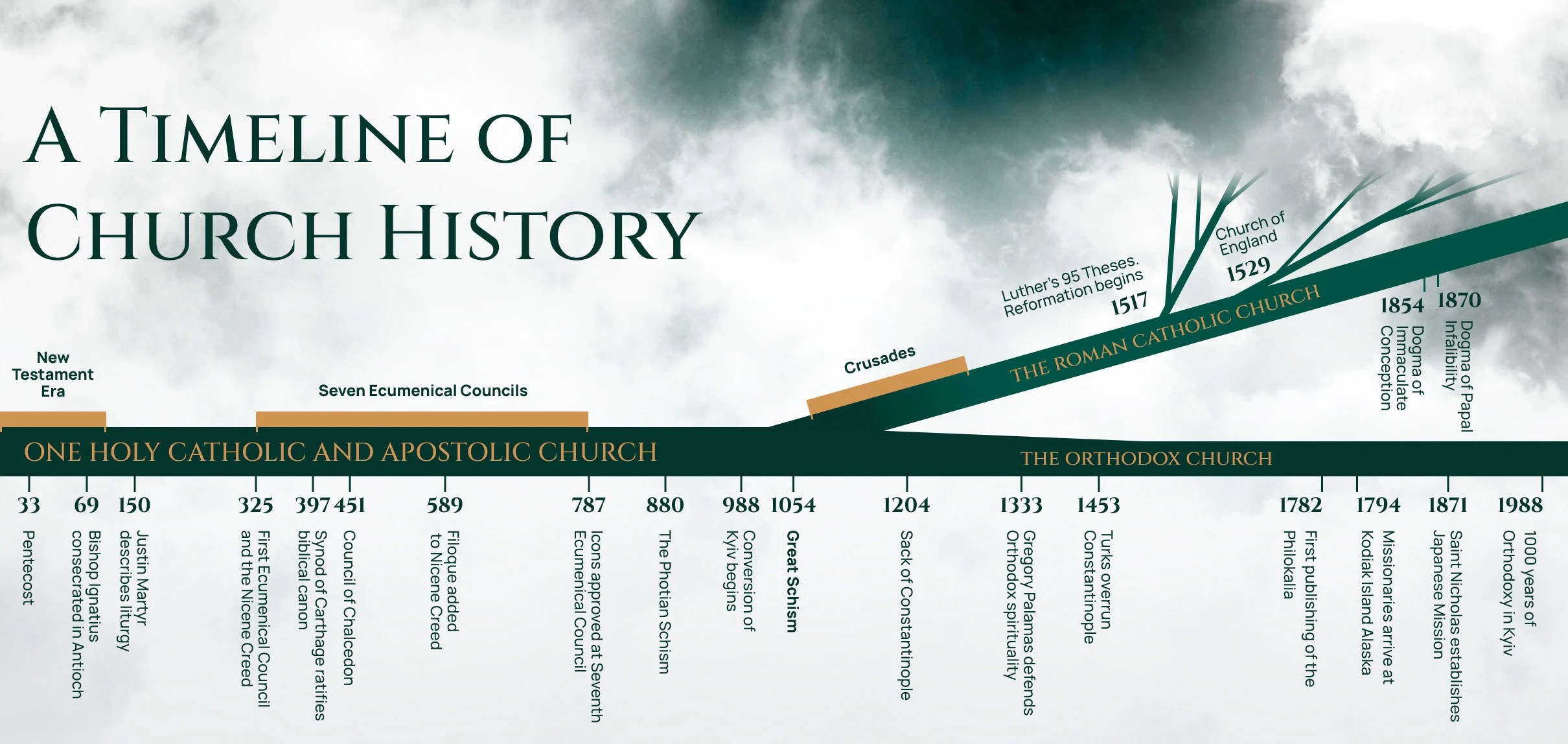
A campaign led by the kings of France and England to recapture it had failed. A second expedition, launched in 1202 in obedience to Innocent’s own summons, had been diverted to Constantinople. In 1204 it had stormed and sacked the city. A stronghold that for long centuries had withstood the envy of pagan warlords had fallen at last—to a Christian army. Its captors justified their storming of the city by charging that its inhabitants were rebels against the papacy: for the churches of Rome and Constantinople, ever since the age of Gregory VII, had been divided by an ever-widening schism. Innocent, however, appalled by the despoliation of Christendom’s bulwark, lamented the fall of Constantinople as a work of hell.

Tom Holland, Dominion.

The Great Schism between the papacy and Eastern Christian patriarchs is conventionally dated 1054, and not without reason. But those who dig deeper (or, like me, who read those who have dug deeper) tend to think that the 1054 schism was curable until this sacking of Constantinople by Crusaders.

A quintessential American heresy

[L]iving by no rule but the Bible turned out to be a defense against virtually the same list of enemies as living up to the standards of republicanism: “Many are republicans as to government, and are yet half republicans, being in matters of religion still bent to a Catechism, creed, covenant, or a superstitious priest. Venture to be as independent in things of religion as in those which respect the government in which you live.” Few Protestants expressed themselves as flamboyantly as [Elias] Smith in the early republic, but most followed where he led.

Mark A. Noll, America’s God.

I was reminded this week of a distinction that’s relevant here. I believe I learned it from the late Richard John Neuhaus, who I followed closely starting sometime in the 1980s. I won’t give a name (other than “quintessential American heresy”) to the view expressed so flamboyantly by Elias Smith, a view which I once effectively held, but I’m now in the camp of “ecclesial Christians”: those for whom faith in Christ and faith in His Church is one act of faith, not two.

I decidedly do not venture to be independent in things of religion, but very consciously submitted to the tradition of the Church particularly about Mary, the Mother of God-in-the-flesh, who was a stumbling-block to me as she has been to other Protestants (who in our generation call her “blessed” only sullenly, bound by scripture to do so).

The worst of the worst

Church management is a tricky and complicated business. I am glad that it is not my job. But I do know this much: The church is there for Gyp the Blood and Humpty Jackson, for Charlie Whitman and John Wilkes Booth and me. If there is no room for the worst of the worst in your church, then you do not have a church: You have a crappy book club.

Kevin D. Williamson (hyperlinks added).

Work and play

But there is the question. What, precisely, is “the business of life”? We can get onto an endless carousel if we try to decide which is the serious stuff of life, work or play. It is possible to take either view: either we toil away our eight hours so that we can get down to the real stuff—pleasure and love and recreation—or we enjoy periodic intervals of escape from the real stuff, the work.

Thomas Howard, Chance or the Dance? I would not have retired had I thought the real stuff was work; that’s just livelihood, not life.

What evangelism can obscure

With the clergy focused on the task of evangelism, their doctrines received so little scrutiny that laypeople took them for granted: the Bible was an infallible guide in every situation, and the church taught what was written in it. Coming into contact with people who read the Bible differently, southerners, unconscious of their own scrim of interpretation, concluded that those others were not Christians.

Frances Fitzgerald, The Evangelicals.

Fallen hero

Jérôme Lejeune was a hero of the National Right to Life Committee for his stance against aborting unborn children with Down syndrome.

He also was a thief—a stealer of glory that belonged to others.

It was apparently how the game was played back then. (Gift Link) That may not have changed much.

There’s probably a better moral to this little story than I can write: convention is no assurance of morality.

Upright life, sound doctrine

Over and over again he insisted that in electing an abbot upright life and soundness of doctrine were to be the prime considerations, not rank or family influence. ’I tell you in all sincerity,’ he said, ‘that as a choice of evils I would far rather have this whole place where I have built the monastery revert forever, should God so decide, to the wilderness it once was, rather than have my brother in the flesh, who has not entered upon the way of truth, succeed me as abbot. Take the greatest care, brothers, never to appoint a man as father over you because of his birth; and always appoint from among yourselves, never from outside the monastery.

Bede et al, Bede


Religious ideas have the fate of melodies, which, once set afloat in the world, are taken up by all sorts of instruments, some woefully coarse, feeble, or out of tune, until people are in danger of crying out that the melody itself is detestable.

George Elliot, Janet’s Repentance, via Alan Jacobs

[N]one of the things that I care about most have ever proven susceptible to systematic exposition.

Alan Jacobs, Breaking Bread With the Dead

You can read most of my more impromptu stuff here and here (both of them cathartic venting, especially political) and here (the only social medium I frequent, because people there are quirky, pleasant and real and it has no-algorithms). All should work in your RSS aggregator, like Feedly or Reeder, should you want to make a habit of it.
Friday, 10/24/25

Against the Machine?

I’ve paid closer attention (plus Substack subscription fees and book purchases) to Paul Kingsnorth since his conversion to Christianity and specifically to Orthodox Christianity. (No, he did not convert to “Romanian Orthodoxy,” though his regular parish is predominately Romanian. There is no substantial difference between Romanian, Serbian, Greek, Russian, Georgian, Syrian or other Orthodox ethnic identifiers.)

I’ve also paid closer attention (plus Substack subscription fees and a book purchase) to Martin Shaw since his reversion to Christianity, this time as Orthodox.

But I’ve been trying to keep in mind the scriptural cautions against putting novices on a pedestal Cf. I Timothy 3:6. Neither novice, Kingsnorth or Shaw, is a Christian authority – yet.

Mercifully, neither is claiming the prophet’s mantle, but careless readers can cloak them with it anyway.

I’m happy for Kingsnorth that his new polemic, Against the Machine, is selling well, and that he is getting blogged and podcasted by everyone and his brother. I’ve read the book, which was more than a stitching together of old internet posts. But if you read it, do also read some critiques, such as ‘Unnatural’ Doesn’t Mean ‘Wicked’, by non-Orthodox Christian Tara Isabella Burton.

Elites failing to reproduce

PhDs are falling: At Harvard, PhD programs are collapsing amid budget woes. The Faculty of Arts and Sciences just slashed the number of PhD student admissions slots by more than 75 percent in the Science division and 60 percent in the Arts & Humanities division for the next two years.

The PhD racket was always a weird one. These schools pushed their smartest, most annoyingly ambitious kids to get a PhD (there but for the grace of god go I). During that PhD, these guys do all the work of being a professor—teaching courses, grading papers. But they’re paid next to nothing. And then the clincher is that at the end, there are no jobs available. Maybe one English department job in Idaho for a group of 300 of them to battle to the death over. So I support this belt-tightening. We will have about 5,000 fewer antifa soldiers produced each year. They might even spend their 20s making money.

Nellie Bowles

Claiming a privileged position

Over the past decade a new, and very revealing, locution has drifted from our universities into the media mainstream: Speaking as an X . . . This is not an anodyne phrase. It tells the listener that I am speaking from a privileged position on this matter. (One never says, Speaking as a gay Asian, I feel incompetent to judge this matter.) It sets up a wall against questions, which by definition come from a non-X perspective. And it turns the encounter into a power relation: the winner of the argument will be whoever has invoked the morally superior identity and expressed the most outrage at being questioned.

Mark Lilla, The Once and Future Liberal.

Legal realism

A new analysis of insurance data finds that more than one in ten of the women who take the abortion pill experience sepsis, infection, hemorrhaging, or another “serious adverse event.”  The only reason regulators tolerate such a high level of danger to the mother is that the ability to kill her baby cheaply and conveniently trumps all considerations.

J Budziszewski (bold added).

High tide recedes

Wow, it really was a social contagion: As the great vibe shift sweeps our country, it turns out that the rise in transgender identities really was a fad—between 2022 and 2024, the number of trans-identifying young people has dropped in half. Last week, another study hinted at the same conclusion, but it was widely criticized due to its failure to distinguish between trans and nonbinary identities, which are obviously very different, you ignoramus. This week’s data from writer and psychology professor Jean Twenge proved that both identities are in free fall among the youth. …

This is good for a lot of reasons—but in particular, it’s good for trans people! Why? Because there have always been a small number of people who feel truly dysphoric in their sex. And the last thing you want is a horde of depressed teen girls latching on to your situation as a way to rage against their bodies, a stand-in for anorexia or cutting. I’ve never been more worried about my rights as a gay person than when all the angry youth started announcing they were gay or trans or queer because then I just knew backlash was coming. Anything funky they did, they called it gay. They wore a weird jacket and got creative with their haircuts and all of a sudden, they’re claiming my identity. I say, scram, kids! Get out of here! I’m putting up a border around Gay Territory and saying No more may enter. It’s me, it’s everyone in Provincetown, and it’s my dykes in the Midwest, and that’s it. We’re full up. Go see if the Mormons are taking applications.

Nellie Bowles

Politics

The next two items are the most pointedly political in this post – and that’s not very pointed. I just don’t have it in me to spit into the wind recently.

A new presumption of bad faith

I was reminded by a New York Times guest editorial on the dangers of the Insurrection Act that our laws almost all assume that the law enforcer will be sane and will act in good faith. As a consequence of electing an insane and vengeful President, we now “enjoy” the full American expression of Joseph Stalin’s “show me the man and I’ll show you the crime.” My reflex is to disbelieve every word Trump says and to suspect invidious discrimination in all his Orders.

It might behoove our legislators to consider, before passing a law, what injustices could be wrought by bad actors wielding the proposed law.

Bring back hypocrisy

The Wall Street Journal has somehow decided to position its Editorial Page just slightly “left” (whatever those terms mean any more) of the Falun Gong’s Epoch Times. Thursday, it was Barton Swaim’s both-sides demi-defense of Trump’s lawfare against his perceived enemies.

I counter with “Yes, but Trump truly is worse because he does it right out in the open, shamelessly.” If hypocrisy is the tribute vice pays to virtue, it joins smoking and drinking on the very short list of vices Trump doesn’t practice. Otherwise, his brazenness coarsens every thing he touches and everyone who cheers him. For a guy so enamored of gold leaf, he’s oddly opposite King Midas.

I never thought I would lament the loss of hypocrisy.

Conservatives in Academia

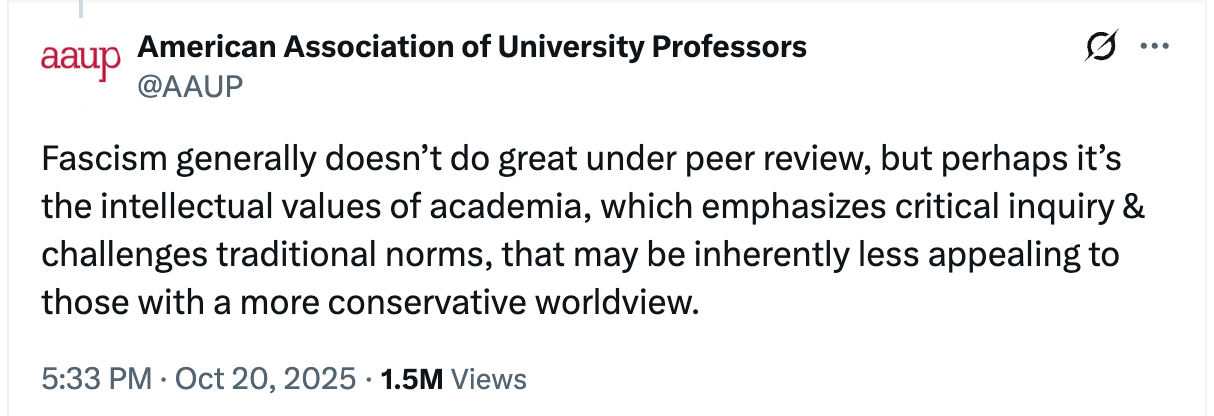
Writing in the magazine of the American Association of University Professors (AAUP), Lisa Sirangian, a Johns Hopkins literature professor, offers seven reasons why “viewpoint diversity” — that is, making room for conservatives on campus — is wrong. I’ll summarize it for you: “Because conservatives are wrong and don’t care about truth; ‘viewpoint diversity’ is a MAGA plot.”

The WaPo’s Megan McArdle isn’t having it. Excerpt:

In the wider world, asking whether academia really skews left makes you look like an idiot or, slightly more charitably, like someone so encased in a bubble that they don’t even know what they’re missing. As for insisting on your right to complete self-governance, free from “secondary, external aims,” as Siraganian puts it … well, if you expect someone else to pay you to pursue truth, at some point, you must accept some secondary, external aims.

Academics tend to recoil from such a crass and mercenary idea, and fair enough, but the world is a crass and mercenary place. We talk about pursuing truth for its own sake, but most academics are pursuing it in exchange for money they can use to satisfy their many less elevated needs. The people who provide that money want something in return. Many will not be content to know that somewhere the global stock of Truth is increasing. Especially if one of the Truths you insist on is that they are dim-witted bigots.

Anyway, this is how the AAUP responds to the conversation on X:

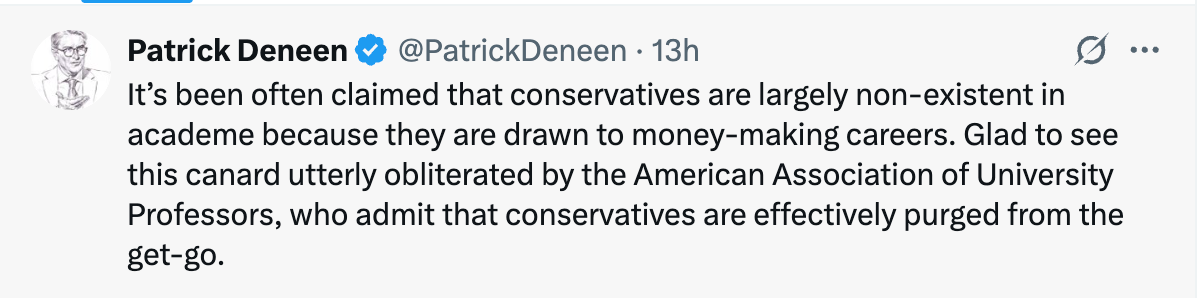
Well, there it is. Conservatives are FASCISTS! Patrick Deneen responds to that tweet:

The more I see institutional elites, in government and the private sector, the more I realize these people are like the pre-revolutionary Tsarist circles. They had no idea why so many people hated them, and what kind of precarious situation they were in.

Rod Dreher

Google

They always invest in businesses that put them in the ‘trade routes’—controlling the linkages, and never getting involved in the creation of tangible value.

Ted Gioia, Google Is Now the East India Company of the Internet

Today in History

Kagi News, a new and useful aggregator, offers “Today in History as one of its tabs, with events at the top, people at the bottom.

For some reason, I find that a lot of composers and poets I had place mentally in the late-19th century were actually in early-19th century. Edgar Allen Poe never even saw the late-19th. Who knew?

Snippets

  • … the Conservative Political Action Conference, a kind of movable rent-a-troll event … (Anne Appelbaum via Frank Bruni)
  • The old Saudi brand was ‘austere theocracy,’ but the new one is ‘fun, fun, fun, but still with beheading.’” (Helen Lewis via Frank Bruni)
  • We live the given life and not the planned. (Wendell Berry, Sabbath poems 1994 number 3)
  • I love her more than evolution requires. (Charles Murray’s wife, reflecting on their first child. Attributed to others as well. The insight doubtless matters more than the source.)
  • Mad Ireland hurt you into poetry. (W. H. Auden, in memory of W. B. Yeats)
  • Music is a conspiracy to commit beauty. (Linda Ronstadt)
  • States, particularly liberal democracies, are heavily dependent on wars for moral coherence. (Stanley Hauerwas, Resident Aliens). Looking at the last 62 years of American history seems to confirm this.

We are all gatekeepers now.

Peggy Noonan

Your enemies are not demonic, and they are not all-powerful and the right hasn’t always lost and the left hasn’t always won. But if you convince yourself of that, you give yourselves all sorts of permission to do a lot of stupid and terrible things under the rubric of “Do you know what time it is?”

Jonah Goldberg.

[A] critical mass of the American people … no longer want[s] to govern themselves, … are sick of this republic and no longer want to keep it if it means sharing power with those they despise.

Nick Catoggio

I don’t do any of the major social media, but I have two sub-domains of the domain you’re currently reading: (a) You can read most of my reflexive stuff, especially political here. (b) I also post some things on my favorite no-algorithm social medium.

Sunday, 10/19/25

The cultural formations of western Christianity

Christianity as we see it in eighteenth-century Britain or twenty-first-century America is not Christianity as it has always been, and the more fundamental changes may not be those that the received history of religion narrates. The cultural formations of western Christianity, growing as they do in good part from binary, Protestant-Catholic debates, can be thrown into stark relief, for instance, when studied in comparison to that much neglected third term in Christendom: the Eastern Orthodox churches from which Rome severed itself nearly half a millennium before the Reformation, charting a course for Western Christianity wed to rationalism and enamored of individual authority, whether papal or personal.

Lori Branch, Rituals of Spontaneity (italics added).

The italicized phrase warms my heart because almost every non-Orthodox writer in the West, including anti-Catholic polemicists, inverts it to Orthodox Churches severing themselves from Rome.

A well I keep returning to

It’s mind-bending in a good way to consider the possibility that Protestantism is effectively dead because the nondenominational megachurchy world is something, or some things, else:

Imagine a world without Protestantism.

I don’t mean a world without Christians who are neither Catholic nor Orthodox. I mean a world in which there are only two groups of Christians. The first group encompasses believers who belong to ancient fellowships led by bishops and ordained priests, who confess the Creed and their sins and celebrate the Eucharist in a traditional liturgy of word and sacrament. These believers hand on tradition, petition the saints, venerate icons, and baptize their babies. Call them “catholic.”

Call the other group “evangelicals.” They have no creed but the Bible. They have no bishops or priests; instead, they have ministers and elders, who are rarely ordained. They baptize not infants but adults, who can make a public declaration of faith. They reject the interposition of anyone or anything between the individual and Jesus, who is known immediately in the soul and clearly through the Scriptures.

Imagine a world in which every Christian is either catholic or evangelical, with nothing in between. It is a world without Protestantism—for the religion of the magisterial Reformers in the sixteenth century did not desire, commend, or practice either of these options. Theirs was a via media. They baptized babies, recited the Creed, ordained pastors to the service of word and sacrament, practiced baptism and communion as sacraments (not as symbols), and insisted on the validity of the early councils.

The world I invite you to imagine, then, is one in which this middle way—neither Roman nor Anabaptist, both traditional and reformed—has vanished. Is such a world possible? It is. In fact, we are living in it right now. Ours is a world without Protestantism.

Brad East, Goldilocks Protestantism, First Things.

Stumbled onto this …

As a 14-year-old I had embraced Jesus as my Savior but had confused the abundant Christian life with the great American dream: I was a Christian and would lose weight, get good grades, get voted captain of the hockey team, go to college, marry a wonderful man who made $250,000 a year, and we’d have 2.5 children. It was me-focused: What can God do for me? I almost thought I had done God a great big favor by accepting Jesus ….

Joni Eareckson Tada.

I recently got a digital subscription to Christianity Today, a magazine I’ve known all my life, in order to keep up a little with doings in the non-Orthodox Christian world. Eareckson Tada was a big deal in the Evangelical tradition decades ago and apparently has remained so, living a remarkably long life for a quadriplegic – perhaps because she has kept so busy with her talents.

Related: Frederika Matthewes-Green reported in one of her books the comment of a first-time visitor to an Orthodox Church: “Wow! That was soooo not about me!”

Duly Noted

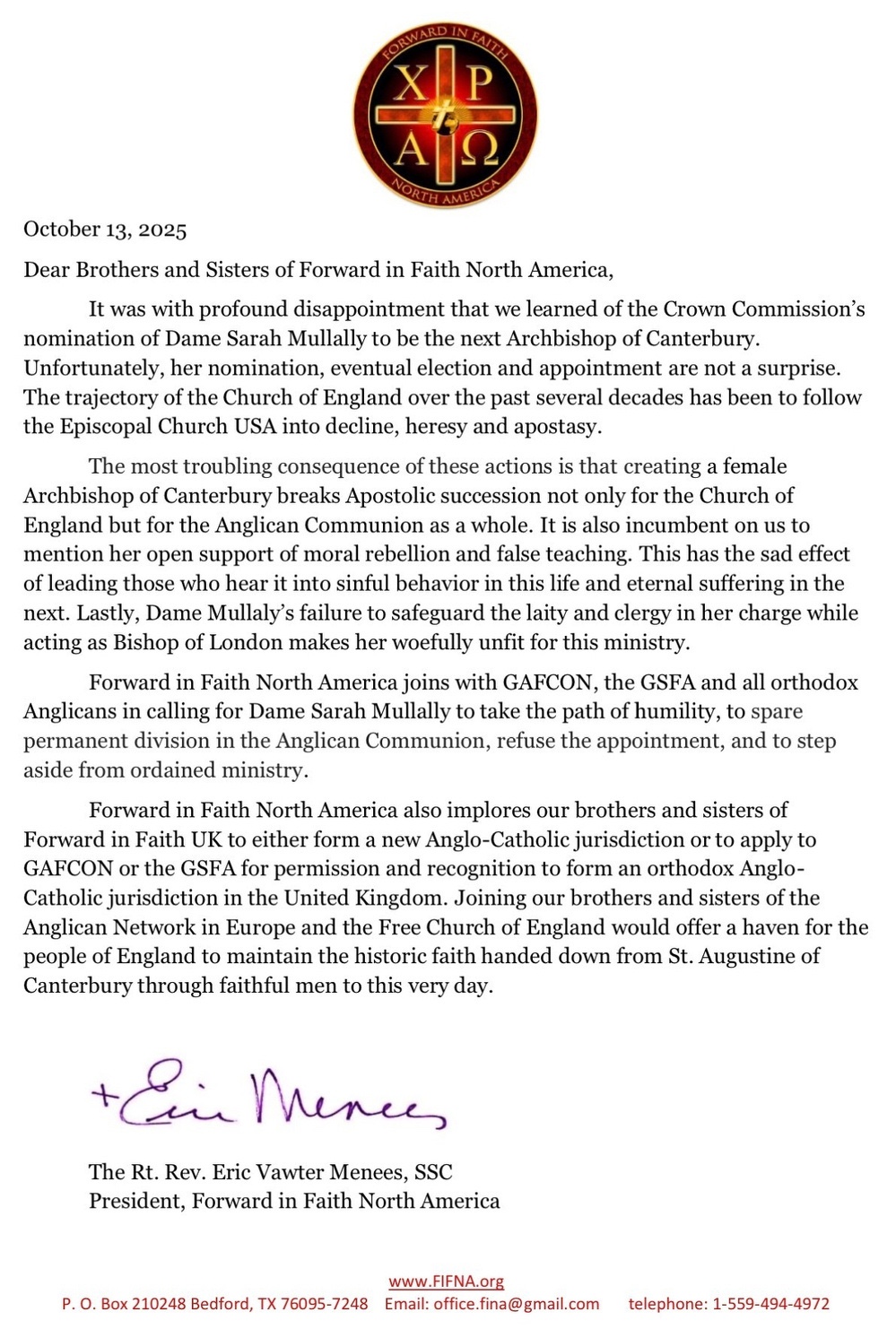
A line is being crossed in Canterbury. I share a communication published by a priest who received it:

Almost inevitably, these “Forward in Faith” and other GAFCON Anglicans will be painted in the popular press as schismatic for not going along with a radical provocation. I hope, but faintly, that the popular press will report their claim (encountered elsewhere) that they are the Anglican Church.

I make no facile prediction that “history will vindicate them,” but I’d rather be among them than the innovators when, at the end of history, Christ comes from heaven to judge the living and the dead.

Not every wound is PTSD

Therapists themselves are noting that if every time a soldier confesses his soul wound from combat we then label him with PTSD, that we will find ourselves recommending psychological therapies and prescribing psychiatric medications when what is needed is something like a religious ritual of purification and forgiveness.

Timothy Patitsas, The Ethics of Beauty.

Note to Peter Thiel

In the Lateran, at a council held in 1513, a formal prohibition had been issued against preaching the imminence of Antichrist.

Tom Holland, Dominion

Evangelicals and Calvinists

A lot of the evangelical world leaves the dirty work to the Calvinists.

Derek Rishmawi, Calvinist.

Caveat: Political Application is Patent

On Sundays, I rarely post things with pointed political applications. For that matter, I rarely post political items with explicit Christian underpinnings on Mondays through Saturdays. Today marks an exception where I judged that these fit Sunday better than weekdays because my target readers are specifically Christians.

Salt & Light

Christians who vote for Republicans are called to be salt and light within the Republican Party. That means being a voice calling the Republican Party to obey the rule of law. Yours should be the loudest voice condemning Trump’s pardon for January 6 rioters and pushing against his challenge to the checks and balances that are supposed to constrain the executive . You should speak up in favor of the poor and powerless and against the culture of cruelty, spite, and vengefulness Trump cultivates. It corrodes our public square and demeans our shared citizenship even as it poses more specific dangers to those targeted by Trump’s weaponization of federal law enforcement. If you do not speak up, you are both credulous and culpable, complicit with the party’s sins—including those yet to come.

Paul D. Miller, A Confessing Church for America’s Weimar Moment

MAGA Christianity

In last Sunday’s “Dispatch Faith” Column, Paul D. Miller asks Is MAGA Christianity True Christianity?, and essentially answers “no”: MAGA Christianity often mixes Christian symbols and Scripture with partisan rhetoric and calls to fight enemies, producing superficially Christian religion that departs on key theological and ethical points.

Commenting on The Charle Kirk Moment, Nijay Gupta resurrected a saying I’m pretty sure I last heard decades ago:

What you win them with is what you win them to.

Gupta’s role in this podcast was that of a more progressive Christian, relatively skeptical of the work of Charlie Kirk, and this comment had in view Kirk’s interweaving of conservative politics and evangelism.

I repeat from prior posts: I knew very, very little about Kirk until he was killed. From what I’ve learned since, I suspect he’d have insisted that conservative politics is such a concomitant of Christian faith that it is meet and right to interweave them from the podium/pulpit. (He said repeatedly that one cannot be a Christian and vote for Democrats.)

That is a message I’ve heard (though almost always tacitly) most of my life, and have resisted for almost as long. Despite my impression that most conservative Christians in North America lean right, and acknowledging that I, too, do so (though the meaning of “right” grows ever fuzzier), I nevertheless endorse the shared thrust of Miller and of Gupta.

And that’s why I consciously avoid political talk at Church coffee hour. All are welcome, regardless of politics, though some politics will prove to be baggage that must eventually be shed, as I’ve had to shed some of my own baggage.


Religious ideas have the fate of melodies, which, once set afloat in the world, are taken up by all sorts of instruments, some woefully coarse, feeble, or out of tune, until people are in danger of crying out that the melody itself is detestable.

George Elliot, Janet’s Repentance, via Alan Jacobs

[N]one of the things that I care about most have ever proven susceptible to systematic exposition.

Alan Jacobs, Breaking Bread With the Dead

You can read most of my more impromptu stuff here and here (both of them cathartic venting, especially political) and here (the only social medium I frequent, because people there are quirky, pleasant and real and it has no-algorithms). All should work in your RSS aggregator, like Feedly or Reeder, should you want to make a habit of it.
No Kings Saturday, 10/18/25

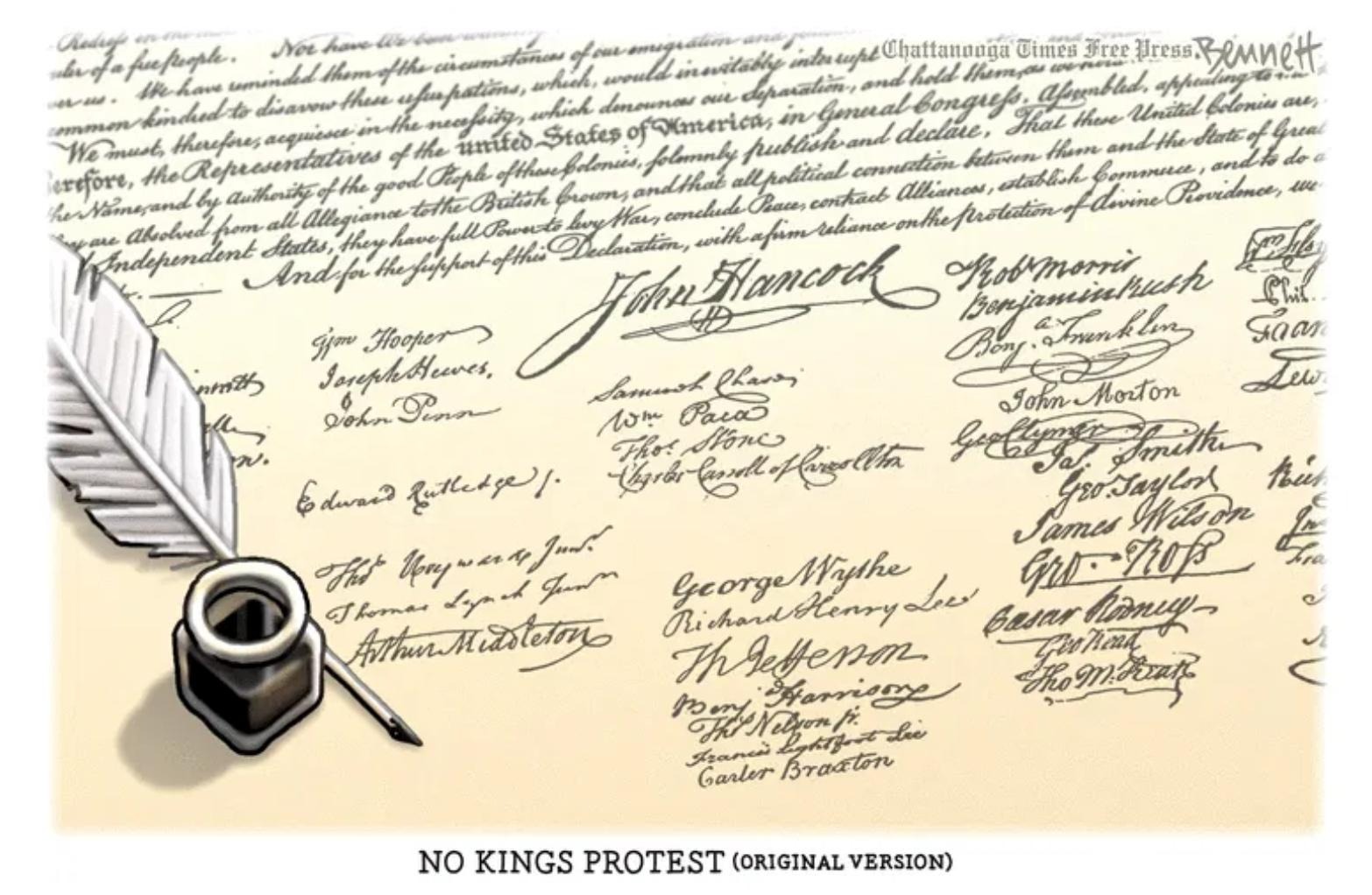
No kings!

Binding precedent

Protesters have protested at an ICE facility a few miles west of Chicago for the past 19 years—with somewhat more intensity recently following the announcement of Operation Midway Blitz. A month after the announcement, the president federalized the Illinois National Guard. District court: Enjoined. Seventh Circuit: Just so. Political opposition is not rebellion, and a protest doesn’t become a rebellion merely due to a few isolated incidents of violence. Without that, none of the statutory predicates for federalizing the National Guard have been met.

Institute for Justice, Short Circuits for 10/17/25 (bold added). This is now the law in the 7th U.S. Circuit – Indiana, Illinois and Wisconsin.

Look for the Administration to try to provoke a rebellion it can crush. Everyone who’s paying attention knows Trump wants to invoke the Insurrection Act (as he stuffs his pockets and those of his family).

Wanted: a viable counternarrative

Trump’s actions … are part of one project: creating a savage war of all against all and then using the presidency to profit and gain power from it. Trumpism can also be seen as a multipronged effort to amputate the higher elements of the human spirit—learning, compassion, science, the pursuit of justice—and supplant those virtues with greed, retribution, ego, appetite. Trumpism is an attempt to make the world a playground for the rich and ruthless, so it seeks to dissolve the sinews of moral and legal restraint that make civilization decent.

Trumpism, like populism, is more than a set of policies—it’s a culture. Trump offers people a sense of belonging, an identity, status, self-respect, and a comprehensive political ethic. Populists are not trying to pass this or that law; they are altering the climate of the age. And Democrats think they can fight that by offering some tax credits?

To beat a social movement, you must build a counter social movement. And to do that, you need a different narrative about where we are and where we should be heading, a different set of values dictating what is admirable and what is disgraceful. If we fail to build such a movement, authoritarian strongmen around the globe will dominate indefinitely.

David Brooks.

You can’t beat something with nothing. I can’t come up with a political counternarrative to Trumpism. The Democrats can’t come up with a political counternarrative, either. Brooks couldn’t come up with a strong political counternarrative.

I can only hope and pray that people will look for their compelling (counter-)narrative to the Gospel of Jesus Christ. (And that meantime there will be some legal counternarratives to prevent irretrievable damage, as in the preceding item.)

Music Reviews

There may be nothing better than old music reviews to let you know that it’s okay to like what you like, critics be damned.

I like Debussy’s La Mer, and I don’t care what the stupid early reviews said:

On today’s date in 1905, Claude Debussy’s orchestral suite La Mer or The Sea was performed for the first time in Paris. Today this music is regarded as an impressionistic masterpiece, but early audiences — especially those in America — found it rough sailing.

“We clung like a drowning man to a few fragments of the tonal wreck,” wrote a 1907 Boston critic, and suggested that instead of The Sea Debussy should have titled his piece Sea-Sickness.

“The Sea is persistently ugly,” wrote The New York Times that same year. “Debussy fails to give any impression of the sea … There is more of a barnyard cackle in it than anything else.”

And in 1909, this on La Mer from The Chicago Tribune: “It is safe to say that few understood what they heard and few heard anything they understood … There are no themes … There is nothing in the way of even a brief motif that can be grasped securely enough by the ear and brain to serve as a guiding line through the tonal maze. There is no end of queer and unusual effects, no end of harmonic complications and progressions that sound so hideously ugly.”

Ah, the perils of “modern music” in the early 20th century!

Giving the Devil his due, impressionism had to be a real mind-blower for critics attuned to, say, the sonata-allegro form.

Comprehensive tradition

We’re often not very aware of the “tradition” in which we live. A student in a classroom would readily agree that the words of a teacher or professor were a “traditioning” of sorts. But they will fail to notice that how the room is arranged, how the students sit, what the students wear (or don’t wear), how the professor is addressed, how students address one another, what questions are considered appropriate and what are not, and a whole world of unspoken, unwritten expectations are utterly required in the process. The modern world often imagines that “online” education is equivalent to classroom education since the goal is merely the transmission of information. But the transmission of information includes the process of acquiring the information and everything that surrounds it. Those receiving the “tradition” online will have perhaps similar information to those receiving it in a classroom – but they will not receive the same information.

Fr. Stephen Freeman, The Tradition of Being Human

Stages of life

Two questions:

  1. Do I want to read/watch/listen to this?
  2. Should I read/watch/listen to this?

When I was younger the second question often dominated my decision-making. Now that I am officially ancient that question has virtually disappeared and the first one is usually the only one I ask. That’s been the single most notable change in my personality in these my declining years.

Alan Jacobs

Alan is a decade or more younger than me, yet I only very recently seem to have arrived at this point, especially regarding political matters.

Note that he’s talking about a change in personality. This isn’t a life rule. There are things that younger people should read/watch/listen to, in order to become well-formed human beings.

Two ways

[R]evival begins with the people proclaiming, by word and deed, “I have sinned.”

MAGA Christianity has a different message. It looks at American culture and declares, “You have sinned.”

David French

Noteworthy

In the aftermath of Kirk’s murder, we witnessed young people at vigils rather than at “mostly peaceful” demonstrations.

R.R. Reno in First Things


We are all gatekeepers now.

Peggy Noonan

Your enemies are not demonic, and they are not all-powerful and the right hasn’t always lost and the left hasn’t always won. But if you convince yourself of that, you give yourselves all sorts of permission to do a lot of stupid and terrible things under the rubric of “Do you know what time it is?”

Jonah Goldberg.

[A] critical mass of the American people … no longer want[s] to govern themselves, … are sick of this republic and no longer want to keep it if it means sharing power with those they despise.

Nick Catoggio

I don’t do any of the major social media, but I have two sub-domains of the domain you’re currently reading: (a) You can read most of my reflexive stuff, especially political here. (b) I also post some things on my favorite no-algorithm social medium.

Sunday, 10/12/25

Total apostasy?

… Mormons claim that “total” apostasy overcame the church following apostolic times, and that the Mormon Church (founded in 1830) is the “restored church.” …

A bullet-point in an anti-Mormon tweet after the attack on a Michigan Mormon meeting place. (My source identified the tweeter as “fundamentalist.”) The bullet-points built to the conclusion that Mormons (Latter-Day Saints) are not Christian.

Fine. But the Evangelical and Evangelical-adjacent world in which I spent many decades believes something very much like that Mormon “total apostasy” story. They may think it started in the 4th century and ended in the 16th instead of the 19th, but a lot of them (including former-me) functionally think it ended in the 19th, with the revivals of the “Second Great Awakening,” when the distinctive style of Evangelicalism emerged. (BTW: Try to define “Evangelical.”)

Here, I submit, is a more accurate summary of Church history:

There’s no need of a restored church because Christ’s One Holy Catholic and Apostolic Church never went away.

And I stumbled onto it …

Speaking of which, I had occasion this week to reread an eight year-old blog constituting, my only published spiritual biography (it was reprinted elsewhere one time). There are a few things I’ve written over the years that stick in my mind as worthy efforts, not throw-away lines or curations, and that post is one of them.

Some things bear repeating, and so I shall:

Having settled in for a few decades, what have I found uniquely true about the Orthodox Church?

It’s hard to put into words. That’s why Orthodox evangelism tends to consist of “come and see.”

Harder still for me personally, I need to find words for feelings and tendencies that an intellectualoid has trouble trusting — things that may be true but approach ineffability. I have a Dostoyevsky “Beauty Will Save the World” sticker on my office window, but long habit and self-image keep pulling me back toward “Spock-like logic (think of that tidy, air-tight 5-Point Calvinism) will save the world.”

But here goes. Turn on your feeler.

I’ve found, again, the love of God. Over and over and over and over we hear liturgical exclamations “for You are a gracious God and love mankind.” There’s no contrary stream of wrath that I’ve noted. The steadfast love of the Lord endures forever.
I’ve found true worship of God, which was something I longed for and agitated for in my prior Evangelicalism and Calvinism, as best as I then understood worship. For instance, I wanted no “hymns” in worship that were addressed to encouraging one another rather than praising God. Yet somehow bathos kept cropping up, and emotionally manipulative gospel songs kept elbowing out too many hymns. I really had no idea what real worship looked like, but my longing was wholesome. I am very much a member of homo adorans.
I have found sobriety and balance. The Christian Reformed Church was on the right track when it aspired to “Catechism Preaching,” an effort to tie sermons to the prescribed portion of the Heidelburg Catechism appointed for that Sunday, rather than letting pastors riff on whatever they read in Saturday’s newspaper or National Review. But Catechism Preaching was a tradition honored more in the breach than in the observance. I have found the Orthodox liturgical cycles (very complex and overlapping) to produce sobriety and balance in homilies, but more, in the entire service (hymnody, Epistle and Gospel readings, etc.)
I have found a hard path which, if I faithfully walk it, will make me more Christlike — a nice Protestant way of referring to becoming a “partaker of the divine nature.”
I have found a Church that really is a hospital for sinners instead of a club for self-styled saints. Some patients have more embarrassing ailments than others, but we’re all chronic cases; sacramental confession helps to drive that home. Not one of us is a hopeless case: the lives of the Saints help drive that home. Some check out of the hospital against medical advice, but we don’t do involuntary discharges of anyone who knows (s)he’s sick and wants to get well.

Another’s conversion

She elaborates the point with more than a little self-deprecation: “I’d backed myself into a corner. There wasn’t anyone else in the world who talked about ‘the Platonic ideal of the Good as an active agent with a special care for humankind’ without shortening that whole cumbersome phrase to simply God.”

In short, although she resisted the conclusion (or was it a solution?) with all her strength, she finally welcomed its inevitability. “I had just enough love in me to be able to be warmly surprised to find out the rules I loved, loved me back.”

… If one can know what she thinks by reading the Catechism, what’s left to surprise?

Answer: not her background convictions, but how she applies them to concrete questions, especially questions about public policy and the modern household ….

Brad East, quoting Leah Libresco Sargeant’s conversion from atheism to Roman Catholicism. The occasion, of course, is that she has written a new book, The Dignity of Dependence: A Feminist Manifesto.

Orthodoxy and Roman Catholicism are not in communion with each other since, in the simplified version, the Great Schism of 1054 (see the timeline above). But a lot of people coming out of Protestant traditions have felt that those were the only two viable Christian alternatives, and I have never found it in me to criticize those who made the wrong-but-plausible choice, like Leah did.

Fallen

Of course, we speak of human beings as “fallen.” However, in Orthodox teaching, this does not refer to our nature itself. Rather, it refers to the fact that we have been made subject to death – we are mortal. It is “death at work in us” that we describe as “sin.” But the origin of sin is not found in our nature. Our nature is inherently good. Understanding this makes a huge difference when we think about human relationships and the character of our common life.

If you take the view (which is common in certain corners of Western Christianity) that human beings have a “sin nature” – that we are, in fact, essentially bad – then how we view one another and the character of our common life takes on a different caste. In an Orthodox understanding, a Bible verse such as, “Spare the rod and spoil the child,” can mean little more than “children need discipline in their lives to help them”. Whereas in a world in which human nature is held to be a “sin nature,” then “sparing the rod,” would be seen as letting evil run amok. It would hold that our nature not only needs to be restrained but requires a vigorous regime of reward and punishment. It has not been that long since the notion of “beating the evil out of a child” was common.

When we speak of our nature as “good,” we are not declaring that human beings are born as saints. Rather, we are saying that our nature (“what we are”) tends towards the good, desires the good. We desire beauty. We desire well-being. We desire truth. Even when we engage in evil actions, they are most often grounded in a misperception of the good. Dictators do not come to power by asking people to be evil – they come to power by distorting the image of the good.

Fr. Stephen Freeman, The Nature of Being Human


Religious ideas have the fate of melodies, which, once set afloat in the world, are taken up by all sorts of instruments, some woefully coarse, feeble, or out of tune, until people are in danger of crying out that the melody itself is detestable.

George Elliot, Janet’s Repentance, via Alan Jacobs

[N]one of the things that I care about most have ever proven susceptible to systematic exposition.

Alan Jacobs, Breaking Bread With the Dead

You can read most of my more impromptu stuff here and here (both of them cathartic venting, especially political) and here (the only social medium I frequent, because people there are quirky, pleasant and real and it has no-algorithms). All should work in your RSS aggregator, like Feedly or Reeder, should you want to make a habit of it.
Sunday 10/5/25

Fullness

Orthodoxy holds that the fullness of the Faith was revealed to the Church at Pentecost, once and for all. The Greek Fathers utilized their education in the service of the Church to explain doctrine, not to find new truths, since the fullness of the truth was received at Pentecost.

Dr. Eugenia Scarvelis Constantinou, Thinking Orthodox

Secularism

Secularism was not a neutral concept. The very word came trailing incense clouds of meaning that were irrevocably and venerably Christian.

Tom Holland, Dominion

Ring-lust

When people justify their voting choice by its outcome, I always think of The Lord of the Rings. Tolkien emphasizes repeatedly that we cannot make decisions based on the hoped-for result. We can only control the means. If we validate our choice of voting for someone that may not be a good person in the hopes that he or she will use his power to our advantage, we succumb to the fallacy of Boromir, who assumed he too would use the Ring of Power for good. Power cannot be controlled; it enslaves you. To act freely is to acknowledge your limits, to see the journey as a long road that includes dozens of future elections, and to fight against the temptation for power.

Jessica Hooten Wilson, What ‘The Lord of the Rings’ Can Teach Us About U.S. Politics, Christianity and Power.

In the US, we decided, twice, that if we gave Sauron the ring, he’d use it for good. How’s that workin’ out for ya?

Conversion and cosmology

There is no point in converting people to Christ if they do not convert their vision of the world and of life, since Christ then becomes merely a symbol for all that we love and want already – without Him. This kind of Christianity is more terrifying than agnosticism or hedonism.

Fr. Alexander Schmemann. Again:

A modern secularist quite often accepts the idea of God. What, however, he emphatically negates is precisely the sacramentality of man and world.

Fr. Alexander Schmemann (different source).

Climbing the elite ladder

Here’s one way to think about it. An evangelical who climbs the elite ladder is more or less required, by the nature of the case, to shed vital elements of her evangelical identity. But a Catholic is not. And a Catholic is not for the same reason that, once upon a time, a liberal Protestant was not.

Brad East, Conversions, Protestantism, and a New Mainline. I would add that an Orthodox Christian need not shed identity either.

East’s post is target-rich with suggestions about questions that fascinate me.

Politically homeless

According to the Public Religion Research Institute’s annual census last year, upward of 80 percent of Republicans described themselves as Christian …

Ryan Burge. It might surprise you that I’m unimpressed and un-encouraged by that. I don’t even know what “Christian” means in common parlance any more if 80% of Republicans think of themselves as Christians.

Ain’t. No. Way.

… But the Democratic coalition is a very different spiritual universe. It is made up of a big mix of faiths — Christians of various kinds, Jews, Muslims — as well as somewhere between 30 percent and 40 percent of nones, or people who describe their faith as atheist, agnostic or nothing in particular.

Ryan Burge again. These figures are a surprise, but they may be correlated to the Democrat party positions that keep me politically homeless instead of joining the Dems.

Chicago archbishop Blase Cardinal Cupich, who has stirred some controversy recently, said one true thing that made my heart leap when it was misattributed to the new Pope by a commentator: that Christians (Cupich said “Catholics”) are now politically homeless in the US.

I have recognized my political homelessness for twenty years now.

On reading the Bible

Most North American Christians assume that they have a right, if not an obligation, to read the Bible. I challenge that assumption. No task is more important than for the Church to take the Bible out of the hands of individual Christians in North America. Let us no longer give the Bible to all children when they enter the third grade or whenever their assumed rise to Christian maturity is marked, such as eighth-grade commencements. Let us rather tell them and their parents that they are possessed by habits far too corrupt for them to be encouraged to read the Bible on their own ….

Stanley Hauerwas. Hauerwas wrote the book this quote comes from 32 years ago. It seems to me that those corrupt habits haven’t been reformed.

Get ready

You may have heard these famous lines from Cardinal Francis George, the late archbishop of Chicago …:

I expect to die in bed. My successor will die in prison. And his successor will die a martyr in the public square. His successor will pick up the shards of a ruined society and slowly help rebuild civilization, as the church has done so often in human history.

Kevin D. Williamson, The Totalitarian Tendency and the Confessional, reflecting on a new Oregon law requiring that Catholic priests report certain sexual crimes that might be communicated to them in the confessional.

Starving the beast

In our last episode, I wrote “I don’t think I frequent any websites that use algorithms to target my inferred vulnerabilities.” It may be worth noting that I also have unsubscribed from some blogs and Substacks that I felt were grinding out agitprop aimed at people like me.

Go thou and do likewise.


Religious ideas have the fate of melodies, which, once set afloat in the world, are taken up by all sorts of instruments, some woefully coarse, feeble, or out of tune, until people are in danger of crying out that the melody itself is detestable.

George Elliot, Janet’s Repentance, via Alan Jacobs

[N]one of the things that I care about most have ever proven susceptible to systematic exposition.

Alan Jacobs, Breaking Bread With the Dead

You can read most of my more impromptu stuff here and here (both of them cathartic venting, especially political) and here (the only social medium I frequent, because people there are quirky, pleasant and real and it has no-algorithms). All should work in your RSS aggregator, like Feedly or Reeder, should you want to make a habit of it.

Leavetaking of the Elevation of the Cross

Thinking

What growing up fundamentalist helped me learn early on is how terribly wrong you can be while thinking very hard.

Phil Christman.

How do we become uncomplicated and unsophisticated? Can we simply unlearn all that we have learned?

No, we cannot, but what we can do is to separate ourselves from it in order to look at it with new eyes. For us Westerners to truly enter into the ancient Christian transmission and catch the essence of Christ’s teaching, it is necessary for us to crucify our rationalizing minds and arise above the level of thought and emo for a society founded on Descartes’ proposition “I think, therefore I am,” this of course means a kind of suicide; and it is to precisely such an ego-death that Christ calls us. Contemporary western Christianity trained us how to think and what to think; whereas Christ himself, as did Lao Tzu before Him, taught us how not to need to think.

Hieromonk Damascene, Christ the Eternal Tao.

Theology is offered to the glory of God, not ourselves. Since it is divine, it can never be based on human reasoning, ideas, speculation, or clever argumentation. Orthodox theology can never be disconnected from the spiritual life of the theologian or from the life of the Church. Authentic Orthodox theology is “liturgical, doxological and mystical.”

Dr. Eugenia Scarvelis Constantinou, Thinking Orthodox.

I did not unequivocally “grow up fundamentalist,” but I was at least adjacent. Then Calvinism, which I discovered in my late 20s, increased the “thinking very hard.” But I did not think my way out of all that and into Orthodox Christianity. It was more as if I worshipped and trusted my way across that chasm.

Mike-drop

Whenever a traditional Christian defends some point of traditional Christian morality, you’ll hear one of our lefty friends cry, “I thought Jesus ate with prostitutes and tax collectors!” Once again, the proper response is: Do you identify with Jesus in that parable?

This is where liberal Christianity becomes—ironically; hilariously—elitist. Sorry, folks, but God’s not saying you must condescend to eat with sinners. No: you are the sinner. He condescends to eat with you.

As for us recovering sinners (i.e., Christians) Saint Paul gives us a different rule: “But now I have written to you not to keep company with anyone named a brother, who is sexually immoral, or covetous, or an idolater, or a reviler, or a drunkard, or an extortioner—not even to eat with such a person” (1 Cor. 5:11). Why? Because, not being Jesus, you can’t trust yourself not to fall into their vice.

Michael Warren Davis, You’re Not Jesus


Religious ideas have the fate of melodies, which, once set afloat in the world, are taken up by all sorts of instruments, some woefully coarse, feeble, or out of tune, until people are in danger of crying out that the melody itself is detestable.

George Elliot, Janet’s Repentance, via Alan Jacobs

[N]one of the things that I care about most have ever proven susceptible to systematic exposition.

Alan Jacobs, Breaking Bread With the Dead

You can read most of my more impromptu stuff here and here (both of them cathartic venting, especially political) and here (the only social medium I frequent, because people there are quirky, pleasant and real). All should work in your RSS aggregator, like Feedly or Reeder, should you want to make a habit of it.

Sunday, 8/31/25

I enjoyed my Evangelical boarding school experience. I looked forward to the end of Summer Vacation and moving back into the dorm.

For that and a few other reasons, this has long been my favorite time of the year.

It began 62 years ago tomorrow, when my dad and I packed up the car and headed north. The day ended up being quite an adventure, involving fuel pump failures on both family vehicles. I’m not sure the story is worth retelling – except for the possibility that my dad was wondering “Is God trying to tell us this was a mistake?”

I don’t think it was, despite all the Evangelical problems I now can’t un-see. “Evangelical” is where my family was, and we couldn’t imagine wanting to be otherwise.

PSA

No, not prostate-specific antigen, nor public service announcement.

We’re talkin’ Penal Substitutionary Atonement. It is not the sine qua non that so many think it is.

Grace

I can think of few phrases in modern Christian speech that have been more abused through misuse and overuse than “we are saved by grace.” As a young Protestant, this was explained to me thus: “We are saved by God’s unmerited favor.” This has the unfortunate implication that, whatever salvation may be, it’s something that’s happening in the mind of God – His unmerited favor. It strikes me as somewhat empty.

Its emptiness belongs to that nefarious doctrine (as I would describe it) of the Penal Substitutionary Atonement (PSA), in which God’s justice demands our condemnation, while God’s mercy demands the blood of Jesus. All of which, it would seem, leaves us as bystanders in a cosmic court where the eternal disposition of our wretched souls is worked out.

In Orthodox understanding (which is the understanding of the early Church), grace is ever so much more. Indeed, grace is the Divine Energies, the very life of God. I have given this article the title, “Saved by the Stuff of Grace,” to draw attention to the ontological character of grace. Grace is not an aspect of a Divine psychology. Grace is the very life of God. We are saved by becoming partakers in the life of God: He becomes what we are that we might become what He is – i.e., that we might dwell in Him and He in us.

Fr. Stephen Freeman, Saved by the Stuff of Grace

Vladimir Lossky

The inadequacy of this theology was brilliantly deconstructed by Vladimir Lossky, whose analysis reveals why this opinion results in other problems that manifest themselves in Western Christian theology: Christian horizons are limited by the drama played between God, who is infinitely offended by sin, and man, who is unable to satisfy the impossible demands of vindictive justice. The drama finds its resolution in the death of Christ, the Son of God who has become man in order to substitute Himself for us and pay our debt to divine justice. What becomes of the dispensation of the Holy Spirit here? His part is reduced to that of an auxiliary, an assistant in redemption, causing us to receive Christ’s expiated merit. . . . The price of our redemption having been paid in the death of Christ, the resurrection and the ascension are only a glorious happy end of his work, a kind of apotheosis without direct relationship to our human destiny. This redemptionist theology, placing all the emphasis on the passion, seems to take no interest in the triumph of Christ over death. The very work of the Christ-Redeemer, to which this theology is confined, seems to be truncated, impoverished, reduced to a change of the divine attitude toward fallen men, unrelated to the nature of humanity.

Dr. Eugenia Scarvelis Constantinou, Thinking Orthodox

Taming the Church

There was a subtle repressiveness behind this seemingly innocuous pluralism. Niebuhr failed to describe the various historical or contemporary options for the church. He merely justified what was already there—a church that had ceased to ask the right questions as it went about congratulating itself for transforming the world, not noticing, that in fact the world had tamed the church.

Stanley Hauerwas, Resident Aliens

Work

No one should imagine that the work he does is an end in itself; it has the role of beautifying his nature, with the virtues of patience, of self-control, of love for his neighbor, of faith in God, and in turn of opening his eyes to the wise principles placed by God in all things.

Dumitru Staniloae, Orthodox Spirituality

A hundred fine names for the Sulks

Ye see it easily enough in a spoiled child that would sooner miss its play and its supper than say it was sorry and be friends. Ye call it the Sulks. But in adult life it has a hundred fine names—Achilles’ wrath and Coriolanus’ grandeur, Revenge and Injured Merit and Self-Respect and Tragic Greatness and Proper Pride.’

C.S. Lewis, The Great Divorce

The Creed

I have said elsewhere that I deliberately will never adopt any theological “ism” that isn’t clearly derived from the Creed. Far from being a cynically contrived statement or a politically motivated one, the Creed was formulated to be as dogmatically expansive as possible, without opening the doors to needless speculation on the one hand or to doctrinal reduction for the sake of accommodation on the other.

Addison Hodges Hart, “God concepts,” the “impersonal transcendent,” and “superstitious” babushkas

Bad Religion

Ross Douthat wrote a book a few years back titled “bad religion.” a book like that wouldn’t be much use unless there was some definition of his terminology:

bad religion: the slow-motion collapse of traditional Christianity and the rise of a variety of destructive pseudo-Christianities in its place.

[A] religious mistake has been to fret over the threat posed by explicitly anti-Christian forces, while ignoring or minimizing the influence that the apostles of pseudo-Christianity exercise over the American soul.

Question: how can you tell whether your church is pushing one of the varieties of destructive pseudo-Christianity? The answer is not “do they use the Bible as their source of authority?” The arch-heretics have always used the Bible, sometimes quite cunningly.

If you’re not Orthodox, I want this question to be a burr under your saddle, as it became under my saddle 34 or so years after I first headed off to Boarding School.


Religious ideas have the fate of melodies, which, once set afloat in the world, are taken up by all sorts of instruments, some woefully coarse, feeble, or out of tune, until people are in danger of crying out that the melody itself is detestable.

George Elliot, Janet’s Repentance, via Alan Jacobs

[N]one of the things that I care about most have ever proven susceptible to systematic exposition.

Alan Jacobs, Breaking Bread With the Dead

You can read most of my more impromptu stuff here and here (both of them cathartic venting, especially political) and here (the only social medium I frequent, because people there are quirky, pleasant and real). All should work in your RSS aggregator, like Feedly or Reeder, should you want to make a habit of it.

Sunday, 8/10/25

No nonsense

A veteran Orthodox Priest recalls some wedding planning:

Three occasions stand out in my memory.

In the first, the mother of the bride arrived for the wedding rehearsal fifty minutes late, carrying aloft one of those rather tedious middle-class books of wedding etiquette, exclaiming that she wanted the wedding to be just “like this.” It wasn’t.

On another occasion, I was telephoned by another bride’s mother, a woman I had never met. It was quite obvious that she regarded the church as a sort of wedding shop at which she simply ordered the things she wanted and skipped things that did not look attractive. She didn’t want crowns at her daughter’s wedding, though I cannot now remember why. We had crowns.

On a third occasion, a marriage consultant had been hired to look after the wedding. When we met in the church, she told me that she was going to put in a rose bower right over where the couple would stand, and that she wanted piped music from various show tunes to “set the mood.” She got neither wish.

One of the great blessings in the Orthodox Church is that we do not have to create occasions. The Orthodox wedding service is so powerful, so profound, that we do not have to dress it up, give it atmosphere, or otherwise make it other than it already is. This allows people to relax. They may have problems at the wedding reception—crowds and alcohol are always a bit risky, and banquet food is rarely worth the money—but the marriage service of the Orthodox Church is a glimpse of heaven without making any particular fuss or effort at all.

Fr. Meletios Webber, Bread & Water, Wine & Oil.

My wife and I were fortunate in the early 70s when my then-pastor, of New England Congregationalist stock, effectively decreed that we would follow the Book of Common prayer pretty closely. It wasn’t Orthodox, but it wasn’t kitsch, either.

Life in the monastery

All my bad habits, disinfected, it is true, of formal sin, had sneaked into the monastery with me and had received the religious vesture along with me: spiritual gluttony, spiritual sensuality, spiritual pride. . . .

Thomas Merton, The Seven-Story Mountain

The reprobate in heaven

I will venture to say more than this; – it is fearful, but it is right to say it; – that if we wished to imagine a punishment for an unholy, reprobate soul, we perhaps could not fancy a greater than to summon it to heaven. Heaven would be hell to an irreligious man… He would find no one like himself; he would see in every direction the marks of God’s holiness, and these would make him shudder. He would feel himself always in His presence. He could no longer turn his thoughts another way, as he does now, when conscience reproaches him. He would know that the Eternal Eye was ever upon him; and that Eye of holiness, which is joy and life to holy creatures, would seem to him an Eye of wrath and punishment. God cannot change His nature. Holy He must ever be. But while He is holy, no unholy soul can be happy in heaven.

John Henry Newman via Addison Hodges Hart.

It is common in Orthodox Christianity to suggest that the presence of God is light to the righteous, searing heat to the unrighteous. Neither that nor Newman’s sermon is systematic theology; both are analogies to address a question that people have about God’s justice, heaven and hell.

The opposite of war

The opposite of war is not peace, but liturgy – the cognitive, bodily, totalizing act that steadily increases communion, instead of cutting it. Liturgy is an act that purifies and knits the character together, whereas trauma unravels our character. In liturgy, I give my life for my brother and sister, I renounce retaliation, and I give my very body and blood for the life of the entire world.

Timothy Patitsas, The Ethics of Beauty

Not much of a stretch

If Christianity is the one, true religion, is it that much of a stretch to believe that there is one, true expression of Christianity?

Carlton, Clark, The Way, 1998 Edition

That one true expression builds on the one foundation with gold, silver and precious stones, not wood, hay and straw.

Well-being declining

Since the 1960s we have adopted values that are more secular, more individualistic and more oriented around self-expression than the values that prevail in the Eastern Orthodox European countries such as Serbia, the Confucian countries like South Korea and the mostly Catholic Latin countries like Mexico.

The countries that made this values shift are seeing their well-being decline, according to that Gallup thriving survey. The countries that resisted this shift are seeing their well-being improve. The master trend in recent Western culture has been to emancipate the individual from the group, and now we are paying the social and spiritual price.

David Brooks, Why More People in the World Are Feeling Hopeful (Except Us) (gift link).

The Culture Wars: cui bono?

While at Brookings, [Os Guinness] helped to draft a public document that could have had the domestic impact of a Universal Declaration of Human Rights if events had only unfolded differently. Aided by the likes of Richard John Neuhaus and George Weigel, Guinness led the drafting of the Williamsburg Charter for the bicentennial celebration of the First Amendment in 1988. The document called for a “reaffirmation and reappraisal of its vision and guiding principles.” Signed by a broad coalition of religious faiths and politicians across the aisle (including presidents, chief justices, and members of Congress), the charter spelled out the importance of the First Amendment’s twin guarantees of religious liberty: the No Establishment and the Free Exercise clauses. Both clauses work together to protect religious liberty, not limit it.

Enshrining these at the heart of the Constitution as America’s “first liberty” was necessary, as the document spells out, because

[our] form of government depends upon ultimate beliefs, for otherwise we have no right to the rights by which it thrives, yet rejects any official formulation of them… The result is neither a naked public square where all religion is excluded, nor a sacred public square with any religion established or semi-established. The result, rather, is a civil public square in which citizens of all religious faiths, or none, engage one another in the continuing democratic discourse. … The Framers’ intention is indisputably ignored when public policy debates can appeal to the theses of Adam Smith and Karl Marx, or Charles Darwin and Sigmund Freud but not to the Western religious tradition in general and the Hebrew and Christian Scriptures in particular.

The document was commemorated with a signing ceremony in the Hall of the House of Burgesses in Williamsburg, and many smaller events, including a conference that featured papers from intellectual luminaries like James Davison Hunter, Michael Sandel, Charles Taylor, and Peter Berger. Even still, it never made quite the impact it could have in reframing the conversation about the place of religion in society (a shame especially in light of recent controversies: e.g., Christian groups being kicked off campus, religious monuments being stripped from public locations, and the debated ‘failures’ of classical liberalism).

The Williamsburg Charter’s failure came down to the absence of a single signature: that of the sitting president, “whose backing was crucial to the practical rollout of the Charter.” At the end of the day, “strong opposition from the Religious Right blocked the participation of President Reagan.” “The culture wars are in the interests of Republicans so you will only get to the president over my dead body,” one of Reagan’s cabinet secretaries told Guinness. This destroyed any opportunity to articulate why Americans needed to bring their faith with them into the public square. While Guinness’ campaign has continued on in the work of John Inazu and that of others, the cultural capital it once had within arm’s reach is spent.

John Shelton, Os Guinness: The Christian Public Intellectual After Jacques Maritain (bold added).

Limits of redemptionist theology

The inadequacy of this theology was brilliantly deconstructed by Vladimir Lossky, whose analysis reveals why this opinion results in other problems that manifest themselves in Western Christian theology:

Christian horizons are limited by the drama played between God, who is infinitely offended by sin, and man, who is unable to satisfy the impossible demands of vindictive justice. The drama finds its resolution in the death of Christ, the Son of God who has become man in order to substitute Himself for us and pay our debt to divine justice. What becomes of the dispensation of the Holy Spirit here? His part is reduced to that of an auxiliary, an assistant in redemption, causing us to receive Christ’s expiated merit. . . . The price of our redemption having been paid in the death of Christ, the resurrection and the ascension are only a glorious happy end of his work, a kind of apotheosis without direct relationship to our human destiny. This redemptionist theology, placing all the emphasis on the passion, seems to take no interest in the triumph of Christ over death. The very work of the Christ-Redeemer, to which this theology is confined, seems to be truncated, impoverished, reduced to a change of the divine attitude toward fallen men, unrelated to the nature of humanity.

Dr. Eugenia Scarvelis Constantinou, Thinking Orthodox


Religious ideas have the fate of melodies, which, once set afloat in the world, are taken up by all sorts of instruments, some woefully coarse, feeble, or out of tune, until people are in danger of crying out that the melody itself is detestable.

George Elliot, Janet’s Repentance, via Alan Jacobs

[N]one of the things that I care about most have ever proven susceptible to systematic exposition.

Alan Jacobs, Breaking Bread With the Dead

You can read most of my more impromptu stuff here and here (both of them cathartic venting, especially political) and here (the only social medium I frequent, because people there are quirky, pleasant and real). All should work in your RSS aggregator, like Feedly or Reeder, should you want to make a habit of it.