I apologize for all the politics in this post. I’m torn between (a) ignoring it all for the sake of my soul and (b) not being a good German as our Nazis threaten.
“Nazi” is a figure of speech, but it feels as if Trump is pushing things to Hitlerian lengths, and I’m having trouble ignoring that. History doesn’t repeat, but it rhymes.
But first, one item that’s not political
Taking no risks, exercising no imagination
You can tell how stagnant things have become from the lookalike covers. I walk into a bookstore and every title I see is like this.
They must have fired the design team and replaced it with a lazy bot. You get big fonts, random shapes, and garish colors—again and again and again. Every cover looks like it was made with a circus clown’s makeup kit.
My wife is in a book club. If I didn’t know better, I’d think they read the same book every month. It’s those same goofy colors and shapes on every one.
Of course, you can’t judge a book by its cover. But if you read enough new releases, you get the same sense of familiarity from the stories. The publishers keep returning to proven formulas—which they keep flogging long after they’ve stopped working.
“They wanted the guy who was controlling our minds to be dead,” she said. “He had so much power over our generation.” When I asked who “they” were, she breezily suggested I do my own research. “We know who’s running the game,” she went on, glancing at her phone. I couldn’t tell how serious she was being. “You know, it’s a bigger picture. 9/11. MLK. JFK. Charlie Kirk.”
The first weird thing about that utterance is the insouciant phrasing that Charlie Kirk was controlling her mind, with “so much power” (with him gone, she sometimes turns to Nick Fuentes for mind-control). It’s kinda pathetic that the TPUSA President at a major university needs fixes of ideology.
But the most ominous thing is accusing an unidentified “they” (a “they” that has been around since at least the early 60s) of the murder. This kind of talk started while Charlie Kirk’s body was still drifting down toward room temperature. It is perhaps why Rod Dreher calls Kirk’s death the Radical Right’s Reichstag Fire.
These kids are very much a reverse mirror-image of lefist loonie like Antifa. They’re looking for meaning in politics. They’re so open to conspiracy theories that their brains have fallen out. They’re fools, whose only excuse (youth) is tempting to disregard since they think they’re so slick.
None of which is to deny that they may do a lot of damage.
Charlie Kirk was a time traveler?
Charlie Kirk was a time traveler? Even I draw the line at certain conspiracy theories. That’s why Candace Owens is so helpful, because she reminds me I’m actually not crazy—she is! Her latest is that Charlie Kirk was a time traveler. “Why did Charlie Kirk think he was a time traveler? He said, as I showed you in earlier messages, that he was a time traveler and he had to find me. . . . And again, not anything that I would have placed so much emphasis on back when he was saying it, but it came to fruition. The other parts. . . . I’m totally occupied by this. I tell you, I read these messages and I’m going,, what is this, what is reality, actually?” She alleges that there were “agents” who had Charlie Kirk “monitored. . . since he was young.” What is reality even, Candy? Actually, don’t answer that.
“The woman and her friend were highly disrespectful of law enforcement … Law enforcement should not be in a position where they have to put up with this stuff,” – President Trump asked if deadly force was necessary in the ICE killing of Renee Good.
“Seeing Vance’s comments about Minneapolis, I lived a similar moment 19 years ago in a Russian courtroom hearing a judge state that the police officer’s testimony had to be trusted over our video evidence because ‘he was wearing the uniform.’ Total immunity beats reality in a police state,” – Garry Kasparov.
“Heritage Americans: ‘You’re less American than I am because my ancestors built this country.’ Also Heritage Americans: ‘Don’t blame me for slavery or segregation. I’m not responsible for what my ancestors did,’” – Avik Roy.
“For years, I kicked against the image of the ‘ugly American.’ Nothing burned me more, when I was in Europe, as a student and after. I have written on this often. And now — there is nothing to say. There is only … bewilderment, anger, and shame,” – Jay Nordlinger on Trump’s thuggery over Greenland.
If you insist on working with the poor, if this is your vocation, then at least work among the poor who can tell you to go to hell. (Ivan Illich via The Convivial Society)
If liberals insist that only fascists will enforce borders, then voters will hire fascists to do the job liberals refuse to do. (David Frum)
If fascists insist on enforcing borders fascistically, grossed-out voters will soon want to fire them, too. (Nick Catoggio)
The least surprising news of the week was Trump threatening to invoke the Insurrection Act. Provoking unrest to justify martial law has been the subtext of ICE’s performative thuggery all along.
The Department of Labor posted the phrase “One Homeland. One People. One Heritage” with a cool video. Me, I prefer it in the original German: “Ein Volk, ein Reich, ein Führer.” (Nellie Bowles)
I don’t do any of the major social media, but I have two sub-domains of the domain you’re currently reading: (a) You can read most of my reflexive stuff, especially political here. (b) I also post some things on my favorite no-algorithm social medium.
The best thing about New Years Day 2026 is that it means 2025 is over. President Ozymandias really hit the ground running for his second term, having surrounded himself with evil, shrewd, and power-hungry operatives this time instead of Republican normies who muted his bellowing. It’s hard to imagine (knocks on wood) that the worst of the self-aggrandizing vandalism isn’t over now.
Wordplay
Aphorisms
A platitude is a placebo for the mind; an aphorism is a wake-up call. Aphorisms provoke debate; they don’t promote dogma. Though they’re short, aphorisms spur considered reflection, not Pavlovian partisanship. At a time when polarization is so amped up, aphorisms can serve as psychological circuit breakers, interrupting our comfortable assumptions and prodding us to open our minds, unclench our fists, and think for ourselves.
In The Washington Post, Dana Milbank responded to some Republicans’ suggestion that the D.C. Metro be renamed the “Trump Train”: “It’s a great idea. Qatar will donate the subway cars, which will be powered by coal. Passengers will pay for fares with cryptocurrency after first showing proof of citizenship. And the trains will reverse themselves regularly and without warning — never quite reaching their original destination.” (Mary Ellen Maher-Harkins, Orwigsburg, Pa.)
In The Atlantic, David A. Graham processed the addition of “Trump” to “Kennedy” in the moniker for Washington’s premier performing arts center: “He asks not what he can do for his country, but what his country can name for him.” (Darrell Ing, Honolulu)
In Esquire, Dave Holmes acknowledged that Senator Lindsey Graham was maybe joking that Trump should be the next pope — but maybe not: “You can’t be tongue-in-cheek when you are actively licking the boot. There is just not enough tongue for both jobs.” (Susan Fitzgerald, Las Cruces, N.M.)
In The Wall Street Journal, Jason Gay rued the effect of obsessive replays on the determination of what, in pro football, constitutes a catch. “It’s the affliction of overthinking: If it walks like a duck, and talks like a duck, wait, hold on, it must be a chandelier,” he wrote. “It’s further evidence humans can ruin the spirit of anything, if given the time and technology.” (Bill Sclafani, Rockport, Mass.)
\[I\]n The Washington Post, Ron Charles assessed “The Little Book of Bitcoin,” by the supremely self-confident pitchman Anthony Scaramucci: “In one passage, he touts the convenience of transporting $500 million in Bitcoin on a thumb drive, which is the best news I’ve heard since my yacht got a new helipad.” (Stephen S. Power, Maplewood, N.J., and Hannah Reich, Queens, among others)
Charles also observed that the scolds who ban books have taken issue with “Maurice Sendak’s ‘In the Night Kitchen,’ which has been proven in the state of Florida to turn straight white Christian boys into polygender Marxists who eat only quinoa.” (Jill Gaither, St. Louis, and John Jacoby, North Andover, Mass.)
In The Times, Kevin Roose worried that when it comes to regulations, the stately metabolism of institutions is no match for the velocity of A.I.: “It feels, at times, like watching policymakers on horseback, struggling to install seatbelts on a passing Lamborghini.” (Conrad Macina, Landing, N.J.)
In The Times, A.O. Scott sang a similar song: “Occam’s razor, the venerable philosophical principle that the truest explanation is likely to be the simplest, has been thrown away. We’re living in the age of Occam’s chain saw, when the preferred answer is the one that makes the loudest noise and generates the most debris.” (Charles Kelley, Merrimack, N.H., and Trisha Houser, Durham, N.C., among others)
I saved three of Bruni’s best as personal favorites:
Also in The Times, Matt Hongoltz-Hetling considered the importance of an annual communal feast to a Vermont town’s special fellowship: “Whether a vibrant community created the potluck or the potluck created a vibrant community is like asking which came first, the fried chicken or the deviled egg.” (Stacey Somppi, Cottonwood, Ariz., and Hillary Ellner, Durham, N.C., among others)
In The Times, James Hamblin parodied the typical message and script of a television drug ad: “You will frolic on the beach at sunset psoriasis-free, with a golden retriever, smiling into the distance. You also may experience sudden loss of cardiac function, seizures of the arms or intermittent explosive ear discharge. Talk to your doctor.” (Susan Casey, Palm City, Fla.)
In The Dispatch, Kevin D. Williamson gave thanks for academia, despite its flaws: “The American university system is the envy of the world, and we are burning it down because there’s a couple of nonbinary gender studies professors at Bryn Mawr who say crazy stuff from time to time and there is a brain-dead gaggle of Jew-hating weirdos at Columbia. Of course, there is room for reform. But you don’t have to love every feather on the goose when it is laying golden eggs.” (Dan Markovitz, Corte Madera, Calif.)
The first just feels perfect; “explosive ear discharge” in the second was the only thing in the list that made me laugh uncontrollably; Kevin Williamson captures perhaps the single most tragic thing about what “we” are doing, (purely by coincidence, of course, during the second reign of the orange barbarian).
Finally: “Some of you should walk a mile in my shoes, because then you would be a mile away from me. Keep the shoes.” (Encountered by my wife on Pinterest)
My 2025
Reading
As I always note in my footer, I blog and socialize at micro.blog in addition to here. One of my friendlies at MB, an uncommonly sane Evangelicalish pastor in Chicagoland (very keen on racial reconciliation is he), posted his 2025 reading list and inquired about what others read this year.
My response:
At 77, I feel the Grim Reaper breathing down my neck, and I already own more books than I’ll get read before he wins. Further, I’ve read many, many books in my life already, including multiple books on many perennial themes. And although I love poetry, I either had poor teachers or was too barbarian to learn how to read demanding examples.
So I don’t have much toleration for books that are cumulative of what I already understand, or are neither pleasurable nor (so far as I can tell after reading a bit) profitable, including ones that many good people were raving about.
To avoid performative listing, then (e.g., Geoffrey Hill poetry, which defeated me utterly), I’ve eliminated all the books I abandoned part way in. Finally, listing a volume of poetry doesn’t mean I’ve read it all yet.
Book
Author
Rings Trilogy
Tolkien
Albion’s Seed
David Hackett Fischer
The World After Liberalism
Matthew Rose
Coracle
Kenneth Steven
Table for Two
Amor Towles
Till We Have Faces
C.S. Lewis
Godric
Beuckner
Stalingrad
Anthony Beever
Small Is Beautiful
Schumacher
Rilke Poetry
Rilke
Apocrypha
Stephen De Young
The Greek East and the Latin West: A Study in the Christian Tradition
Philip Sherrard
A Time of Gifts
Patrick Leigh Fermor
The New Science of the Enchanted Universe
Marshall Sahlins
Bread & Water, Wine & Oil
Fr. Meletios Webber
Lost in the Cosmos
Walker Percy
Giovanni’s Room
James Baldwin
The Long Loneliness
Dorothy Day
The innocence of Father Brown
G.K. Chesterton
Against the Machine
Paul Kingsnorth
You Have Arrived at Your Destination
Amor Towles
The Air We Breathe: How We All Came to Believe in Freedom, Kindness, Progress, and Equality
Extra pills are piling up across America. Excessive refills by U.S. pharmacies cost Medicare and patients $3 billion between 2021 and 2023, according to a WSJ analysis of Medicare prescription data.
WSJ. Based on my own rigorous anecdata, this is 1000% true. Which means that although mail-order pharmacies may have started it, brick-and-mortar local pharmacies are in the game now, too.
I really would rather not manually refill every prescription, but my pharmacy seems incapable of waiting 90 days to refill a 90-day prescription, and when I get a text that a prescription is ready for pick-up, I go pick it up (with rare exceptions, like a post-op opioid painkiller I definitely did not need).
Sam Altman, OpenAI’s chief executive, said in a recent podcast he can see ways that seeking companionship from an AI chatbot could go wrong, but that the company plans to give adults leeway to decide for themselves.
Nothing in her political career before September inclined me to cut Marjorie Taylor Green any slack whatever, but something has happened since then.
Her political conversion story, if you can call it that (it’s not about changing from MAGA to progressive or any other political position), rings true.
It started at the Charlie Kirk Memorial service:
What stayed with Greene long afterward were the last two speakers who took the stage. First there was Kirk’s widow, Erika, who stood in white before the crowd filling the Arizona stadium, lifted her tear-filled eyes and said that she forgave her husband’s killer. And then there was President Trump. “He was a missionary with a noble spirit and a great, great purpose,” he said of Kirk. “He did not hate his opponents. He wanted the best for them. That’s where I disagreed with Charlie. I hate my opponent, and I don’t want the best for them.”
“That was absolutely the worst statement,” Greene wrote to me in a text message months after the memorial service. And the contrast between Erika Kirk and the president was clarifying, she added. “It just shows where his heart is. And that’s the difference, with her having a sincere Christian faith, and proves that he does not have any faith.”
I thought at the time that should have been a wake-up call for every “Christian” Trump supporter in America. I still do. It speaks ominous things about our religious and political culture that it seems to have awoken so few.
But Marjorie Taylor Green, of all people, recognized it! And it appears that she has genuinely repented of her role in stoking hatred and division!
Time will tell; she’s been taking the potent MAGA pill for a long time, and withdrawal may prove too hard. But it’s looking good so far.
I wish her what I wished for Jimmy Carter on January 20, 1981: a long and happy and private life — plus a sustained repentance.
Paganism with worship music
We seem to be entering a pagan century. It’s not only Trump. It’s the whole phalanx of authoritarians, all those greatness-obsessed macho men like Vladimir Putin and Xi Jinping. It’s the tech bros. It’s Christian nationalism, which is paganism with worship music. (If you ever doubt the seductive power of paganism, remember it has conquered many of the churches that were explicitly founded to reject it.)
“If you dislike the religious right, wait till you meet the post-religious right,” Ross Douthat warned presciently at the dawn of Trumpism in 2016. … What Douthat calls the “post-religious right” certainly is more obnoxious and morally degenerate than its Bush-era forebear was, but it’s not correct to call a movement that’s developed its own alternate morality “post-religious.” It’s not even correct to call it “post-Christian,”…
The modern right is boisterously Christian, but without Christ. It extols Christianity aggressively but has ditched most of the moral content …
…
The purest expression of Christianity without Christ came from Trump himself, not coincidentally. At Charlie Kirk’s memorial service, shortly after Kirk’s widow, Erika, moved viewers by publicly forgiving her husband’s killer, the president strode to the mic and said, “That’s where I disagreed with Charlie. I hate my opponents, and I don’t want the best for them. I’m sorry.” That’s the literal antithesis of Christian morality …
But there were no mass defections by Christians from the president’s camp after his heresy. Erika Kirk herself remains a loyal Trump ally in good standing. And why not? Hating one’s enemies is squarely in line with the three purposes of post-Christ right-wing Christianity. The first is establishing the right’s cultural hegemony over other American factions; the second is narrowing the parameters of the right-wing tribe to exclude undesirables; and the third is deemphasizing morality as a brake on ruthlessness toward one’s opponents.
Almost everything written about the “alternative right” has been wrong in one respect. The alt-right is not stupid; it is deep. Its ideas are not ridiculous; they are serious. To appreciate this fact, one needs to inquire beyond its presence on social media, where its obnoxious use of insult, obscenity, and racism has earned it a reputation for moral idiocy.
Matthew Rose, A World After Liberalism
At the outset of debate
If we are willing to grant, at the outset, that the people we’re debating agree about ends—that they want a healthy and prosperous society in which all people can flourish—then we can converse with them, we can see ourselves as genuine members of a community. And even if at the end of the day we have to conclude that we all do not want the same goods (which can, alas, happen), it is better that we learn it at the end of the day than decide it before sunrise.
Would we necessarily say that government, civic life, the media, or high finance work better now than in the mid-20th century? We can scorn the smug WASP blue bloods from Groton and Choate—and certainly their era’s retrograde views of race and gender—but their leadership helped produce the Progressive movement, the New Deal, victory in World War II, the Marshall Plan, NATO, and the postwar Pax Americana. After the meritocrats took over in the 1960s, we got quagmires in Vietnam and Afghanistan, needless carnage in Iraq, the 2008 financial crisis, the toxic rise of social media, and our current age of political dysfunction.
We are also offended by the contumely of allies as well as foes, who refuse to regard our prosperity as fruit and proof of our virtue but suggest that it may be the consequence of our vulgar Philistinism.
Reinhold Niehbur, The Irony of American History
Read the fine print
On the surface, it would seem that the assurances given in the Declaration of the Rights of the Peoples of Russia were clear and unequivocal. But lurking in the shadowy annals of communist polemics there was a catch. To paraphrase, but not distort, Lenin’s position, nations have the right to self-determination, but only the proletariat has the right to decide. And, as if that were not enough, only the Communist Party can speak for the proletariat.
Jack Matlock, Autopsy on an Empire
Raising the bar for Tinhorn Dictators
Ramsey’s intolerance for dissent has created what former employees call a cultlike environment, where leaders proclaim their love for staff and then fire people at a moment’s notice.
A new crop of moderate Democrats is trying to counter both President Trump and progressive influence in their own party. (WSJ) May their tribe increase.
And so we have before us one of the characteristic political necessities of our time: to take seriously what we cannot respect. (Wendell Berry, The Unsettling of America)
Conservative and mainstream media were drifting apart, not just ideologically but epistemically… (Jonathan Rauch, The Constitution of Knowledge) This epistemic drift (of the Right, I think, not the mainstream) tempts me to despair.
“The only thing we have to fear is fear itself,” … was a damned funny thing for Franklin Roosevelt to say in 1933, the year Adolf Hitler came to power. (Kevin D. Williamson)
The face of my fear is not a new Hitler but the Old Adam. It is the face in the mirror. (Kevin D. Williamson)
One category I used to apply to some of my posts became obsolete almost overnight around 1/20/2017: Zombie Reaganism. You never see that any more, and I miss it more than I thought I would.
I don’t do any of the major social media, but I have two sub-domains of the domain you’re currently reading: (a) You can read most of my reflexive stuff, especially political here. (b) I also post some things on my favorite no-algorithm social medium.
… in the Christian East, that is. The West commemorated him yesterday.
A profitable political pairing
Two Right-coded voices, Glenn Loury and Ilya Somin, take up recent events, emblemized by Tucker Carlson’s softball interview of Nick Fuentes, and reach similar conclusions: a fundamental rift in the Right is between universalists and particularists/nationalists.
For figures such as Robert P. George, McCormick Professor of Jurisprudence at Princeton University and perhaps the single most influential moral philosopher within conservative intellectual circles, conservatism begins with the claims of natural law. Its founding premise is the inherent dignity of every human being—an anthropology that descends from classical philosophy, Christian theology, and the Enlightenment. For George, conservatism is first a moral project: It safeguards life, liberty, marriage, family, and religious freedom because these institutions reflect universal truths about the human person. George has spent his career articulating these principles in philosophy, public policy, and constitutional thought. His is an approach to conservatism that emphasizes the primacy of the permanent things, the universals that transcend time and place.
Opposing this universalist strand is the ascendant nationalist wing of the right—a coalition influenced by the populist energies that surged after 2016 and represented by Tucker Carlson, Kevin Roberts of the Heritage Foundation, and polemicists such as John Zmirak. This faction sees conservatism less as an expression of moral philosophy than as a defense of Western civilization: a concrete culture, a historical inheritance, with its own people, faith, memories, and vulnerabilities. This conservatism is particularist rather than universalist. It begins not with abstract principles but with cultural loyalties. Whereas George begins with human dignity, Carlson begins with civilizational survival. Whereas George sees imperatives and violations of the moral law, Carlson sees a beleaguered West beset by global elites, porous borders, and cultural disintegration.
[T]he root of the problem is the Trump-era shift of most of the American right towards ethno-nationalism. For reasons outlined in detail in my recent UnPopulist essay on this topic, nationalist movements are inherently prone to anti-Semitism and other forms of racial and ethnic bigotry. It is not surprising that anti-Semitism among MAGA conservatives has risen alongside nativism and bigotry towards other minority groups, such as Indian-Americans.
As I explained in the UnPopulist article, the only sure way to avoid this problem is to reject ethnic nationalism and instead recommit to the universalist principles of the American Founding, which the Heritage Foundation once claimed to stand for, but has more recently betrayed ….
As I skimmed Lourie’s article (which I’m pleased to see in First Things, which under R.R. Reno has been leaning increasingly toward particularist nationalism), I felt a flush of shame (or was it the shiver of a near-miss?) as I looked back on my admiration of “paleoconservative” thinkers and commentators — guys who now appear to be the ancestors of today’s ethno-nationalist types.
Even now, I sense the fortress America appeal of the nationalist appeal. But when I watch ICE trying to evict putative undesirables from the fortress before we pull up the drawbridge, and see antisemitism rising among the nationalists as well, I can’t help coming down on the side of human dignity: Fiat justitia ruat caelum.
Slouching Toward Something Worse
[Ben] Shapiro originally hired [Candace] Owens at The Daily Wire, thereby helping to launch her career into the stratosphere. The fact that he now feels the need to try and drive a stake through her heart “contains the entire story of the conservative movement within it,” in the words of Substacker John Ganz.
…
[Rod] Dreher longs for Vance to take a firm stand against Fuentes and his followers. But will he?
So far, there’s no sign of it. And yes, that includes in the recent UnHerd interview, where Vance told Fuentes (in the debased public rhetoric favored by populists) to “eat shit.” The vice president made clear that his rightward volley was provoked, not by any of Fuentes’ political views, but by him insulting Vance’s (South Asian) wife. “Anyone who attacks my wife,” Vance declared, will be attacked in turn, “whether their name is Jen Psaki or Nick Fuentes.”
That’s right: the sitting vice president of the United States made clear he was equally inclined to rise up in defensive anger against a former White House Press Secretary from the mainstream opposition party and a man who regularly proclaims his admiration for Adolf Hitler and loathing for Jews.
I’m afraid anyone placing their hopes in Vance serving in the role of gatekeeper or force for moderation is going to be sorely disappointed.
…
It’s not clear a right-populist political movement needs policy intellectuals at all. After all, intellectuals are elites who think they sometimes know better than the elected Leader of the People. That is unacceptable. What a right-populist political movement needs, instead, is propagandists to justify what the Leader already intends to do.
In case you’ve forgotten, do not trust any high-generality assessment of JD Vance by Rod Dreher. Dreher “discovered” Vance’s book, Hillbilly Elegy, and his discovery elevated mediocre sales to stratospheric sales. He and Vance are now friends, Rod feels a personal investment in him, and Vance probably feels a debt of gratitude to Rod for launching his explosive political rise.
So Dreher is just not capable of objectivity about his friend, and that’s probably to his credit; dissecting friends is kinda reptilian — and certainly is a deviation from the conservative tendency on Jonathan Haidt’s Loyalty/betrayal moral foundations axis.
Too ad hoc to be fascist
Take the word fascism, properly applied to Franco’s Spain or Mussolini’s Italy, and to some extent beyond. The fasces were the bundles of rods carried by Roman lictors: symbols of punishment and magisterial authority, but in modern times also of a tightly unified society controlled from above, and organized in corporate form. The desire of totalitarians everywhere is to achieve harmonization, with all of society marching in military cadence under the guidance of an omnipresent government.
But the Trump administration is more interested in blowing up the state than in extending its power.
…
He is, to be sure, cruel and malicious, but unlike the others, has no real governing vision.
…
Trump himself is not Mussolini, or Hitler, or Orbán ….
Eliot A. Cohen, America Needs a Mirror, Not a Window
French Integrity
The headline read, “What It’s Like to Experience the 2016 Election as Both a Conservative and a Sex Abuse Survivor.”
Nancy French, Ghosted. As the book blurb has it, “when she was unwilling to endorse an unsuitable president, her allies turned on her and she found herself spiritually adrift, politically confused, and occupationally unemployable.”
Part of the reason for David French and Nancy French becoming personae non grata in much of the North American white Evangelical world was candor, like in the cited article Nancy wrote, and their various relatively unflinching looks at topics like sexual abuse at a very popular Evangelical summer camp for kids. I learned recently that they fairly quietly have moved out of their deep red part of Tennessee to the Chicago area (I was aware that Tennessee Evangelicalism exhibited pretty unrelenting and vocal antipaty to Frenches). That move won’t do much for Nancy’s work as a ghost-writer in Evangelical and Conservative circles, but they should at least be able to find a Church whose Christianity matches theirs (Reformed-tinged Evangelical) without the political tribalism. (That’s my read on it.)
The differences between their Evangelical/Reformed piety and my Orthodoxy manifests in my ill-ease with some of their takes on things (I will never again trust a David French endorsement of a movie or television series, for instance), but I’ll give them high marks for trying to act with integrity (which endears them to me despite reservations).
Quantum physics
Quantum entanglement blows my mind. How do they even find the entangled needles in the cosmic haystack to study entanglement?
That they manage to find and study them makes me sympathetic to the predictions that we’re going to figure out everything — predictions I nonetheless think are ultimately delusional.
Trying to deal with things like this has sent me back to Iain McGilchrist for a second round of mind-bending, this time via The Matter with Things.
The mixture of politics and religion in this theory makes my head hurt, and my eyes avert, but I suspect that Mattingly knows more about Kirk, and about the consequences of his assassination, than I do.
Jingoists and Patriots
The worst jingoes do not love England, but a theory of England. If we love England for being an empire, we may overrate the success with which we rule the Hindoos. But if we love it only for being a nation, we can face all events: for it would be a nation even if the Hindoos ruled us.
To prepare young Oklahomans for the demands of a high-tech future, the state’s board of education mandated instruction about “discrepancies” in the 2020 presidential election. (Via George Will)
Your enemies are not demonic, and they are not all-powerful and the right hasn’t always lost and the left hasn’t always won. But if you convince yourself of that, you give yourselves all sorts of permission to do a lot of stupid and terrible things under the rubric of “Do you know what time it is?”
[A] critical mass of the American people … no longer want[s] to govern themselves, … are sick of this republic and no longer want to keep it if it means sharing power with those they despise.
I don’t do any of the major social media, but I have two sub-domains of the domain you’re currently reading: (a) You can read most of my reflexive stuff, especially political here. (b) I also post some things on my favorite no-algorithm social medium.
The religious/secular distinction is not a neutral set of descriptive categories, and the idea that religion has a greater tendency than the secular to promote violence is not a commonsense observation about the world. Both are ideological constructs that privilege certain Western secularist arrangements.
William T. Cavanaugh, The Uses of Idoloatry
Don’t try to titrate poison
This French reactionary antisemitism came to a head in 1940, when the Nazis invaded, France surrendered, and Philippe Pétain became the dictator. Right-wing reactionaries, (including the vast majority of French bishops) were all too happy for the regime to enact laws that limited the civil rights of Jews. Many of those same bishops would later regret this when the cruelty of the anti-Jewish legislation became too blatant to ignore. In the end, around 70,000 Jews who had been under the jurisdiction of Vichy France would perish in concentration camps.
I sometimes worry that populist rabble-rousers, with the roused rabble SWATting and making death threats against recalcitrant authorities, were the inevitable result of the “conservative” politics I long favored.
I don’t think that’s true, but once stung, twice cautious: these days, when I see an opinion piece that seems to make sense, but with comment boxes full of cheering conspiracy theorists and antisemites, I reflexively drop (or at least loosen my grip on) the opinion.
If you’re looking for rigorous logic in that, you’ll not find it. It’s just one geezer’s heuristic.
Primarying faithful legislators
The first time I recall hearing of Charlie Kirk was in connection with “The Falkirk Center,” the name being a portmanteau of “Falwell” and “Kirk.” Yeah, that Falwell. The Junior one. The sleazy one driven out of Liberty University eventually.
So I had a bias against Kirk from the start. No, he didn’t deserve to be murdered. Nowhere near. But 3+ months is long enough. I’m not going to bite my tongue any longer about the him and his Turning-Point-this-and-Turning-Point-that constellation of Christianish MAGA adjuncts.
He wasn’t my cup of tea. His Christianity was substantially alien to any traditional Christianity. I object to him being lionized as a Christian martyr and to the erection of a sort of cult around him. The more I learn about Turning Point shamelesslessly subordinating its version of Christianity to the will of über-pagan narcissist Donald Trump, the more it nauseates me.
All that to introduce much less:
[A]s early as August 18, Charlie Kirk said in an X post: “We will support primary opponents for Republicans in the Indiana State Legislature who refuse to support the team and redraw the maps.” Months later, on the eve of the vote, Trump ratcheted up the warnings to Indiana Republicans, saying as part of a lengthy post on Truth Social: “Indiana Senate ‘Leader’ Rod Bray enjoys being the only person in the United States of America who is against Republicans picking up extra seats. … He’s either a bad guy, or a very stupid one!”
The way primary elections tend to turn out the most extreme members of the party base, it’s possible that primarying Indiana Legislators who voted for the will expressed by the people of Indiana, rather than for the imperious wills of Donald Trump and Turning Point Action, will succeed. But I think not. I think the spell is broken. I’m looking forward to three years of quacking.(Yeah, that’s got a bit of wishcasting in it.)
Turning Point just concluded its conference
I suppose if Turning Point USA wanted its conference to make a big splash, it accomplished its mission. But a movement led by a president who made regular appearances in the world of professional wrestling now has rallies that resemble WrestleMania with podcasters, complete with boasts and threats and chest-thumping.
When you book a bunch of clowns, don’t be surprised if you end up with a circus.
Wherein I register a rare disagreement with Kevin D. Williamson
A person who evacuates is emptying his bowels. A person removed from a place of danger is a person being evacuated. If you have 100,000 people evacuating all at once … well, maybe they won’t notice it too much in Seattle.
Those 100,000 were not ordered to evacuate; they were ordered to leave, to seek safety, to head for the hills, to make forhigher ground, etc.
I love Williamson, but he’s lost me on this one. From the Department of Usage Makes Proper, evacuate has become broader than he insists. Even I, a card-carrying curmudgeon, would not use “evacuate” as he does; I’d add “evacuates his bowel” if that’s what I meant.
I completely agree with Williamson on something else, though. After alluding to things like “messaging” in the upcoming election, he simplifies things:
I would like to suggest a relatively simple approach: Democrats should run on a platform of what it is they actually intend to do in office, and that platform should be what they believe to be the right thing. I would offer the same advice to Republicans if they had not made it so perfectly clear that they cannot and will not do any such thing, that their party and their movement is incapable of candor and good faith.
Thoughts at 3 am
That’s a metaphor. I rarely if ever fret about things at 3 am, and it I fret, it’s likelier to be about family or things closer to me than politics.
My current “political” concerns, though, seem to be antisemitism and the quest for certainty — even false certainty preferred to uncertainty.
According to the Manhattan Institute’s recent survey of registered Republicans and others who voted for Donald Trump last fall, no less than 25 percent of those under 50 admit—admit—to expressing antisemitic views. Among those over 50, just 4 percent do.
The Nazis gave antisemitism a bad name. The memory of that is fading.
[Bari] Weiss has an impossible dilemma [in running CBS]. She’s in charge of a first-world news organization that aims to hold government accountable (especially when it’s run by Republicans) but was appointed to the position to satisfy a third-world regime led by a demagogic boor who believes “news” should look like … this.
…
“The Failing New York Times, and their lies and purposeful misrepresentations, is a serious threat to the National Security of our Nation,” the president declared this morning. “Their Radical Left, Unhinged Behavior, writing FAKE Articles and Opinions in a never ending way, must be dealt with and stopped. THEY ARE A TRUE ENEMY OF THE PEOPLE!” He didn’t specify the supposed “national security” threat that prompted that, but earlier this month he accused the Times of “seditious, perhaps even treasonous” behavior for reporting on his obviously declining health.
That’s the kind of media Trump wants. Not one where Stephen Miller does more interviews but one where you go to prison if you acknowledge the plainly observable fact that the president sounds addled.
This particularly cursed holiday week kicked off in earnest last night when my father turned his iPad in my direction. On its screen was a terribly disturbing post on X containing two images. In the first, Jeffrey Epstein was hugging and kissing a little girl. In the second, that girl was bound and gagged on a bed.
Dad was rightly outraged and disgusted. He asked me if I’d seen the photos in my time going through the Epstein files. I immediately recognized the first image of Epstein and deduced that it had been Photoshopped from a widely distributed photo of Epstein hugging Ghislaine Maxwell. The second image seemed to be an AI rendering. (To add to the confusion, images reportedly do exist of Epstein cuddling children.) I let him know that the imagery was fake, and a distinctly non-yuletidy conversation ensued. Yes, Epstein was a heinous pedophile and convicted sex offender. Also, the internet is awash in fake, traumatizing slop that’s being used to score points in an ongoing information war. Happy holidays!
Every journalist who is not too stupid or too full of himself to notice what is going on knows that what he does is morally indefensible. He is a kind of confidence man, preying on people’s vanity, ignorance, or loneliness, gaining their trust and betraying them without remorse.
Janet Malcolm, The Journalist and the Murderer, Via Peggy Noonan
Shorts
In such an ugly time, the true protest is beauty. (Phil Ochs)
He is like a strange general who can’t quietly establish camp or dig new fortifications. He shoots his cannon for no reason, just for the sound. (Peggy Noonan describing you-know-who)
He just can’t do intimacy. He can’t do reassurance. His fireside manner has always been gasoline. (Andrew Sullivan)
Prediction markets may promise clarity, but what they really offer is another way to feel excitement in a world that feels rigged. (Charlie Warzel)
Having elevated her in large part for her willingness to say outrageous things about her opponents, people on the right are now surprised by her willingness to say outrageous things about them. (Michelle Goldberg about the rise of toxic influencer Candace Owens)
In The Times, Glenn Thrush and Alan Feuer … mused about Trump’s troubles prosecuting his perceived enemies: “Revenge, it turns out, is a dish best served with evidence.” (Via Frank Bruni)
In her newsletter, Stacey Patton recognized the humiliation of the Trump administration’s repeated failures to convince a grand jury of its case against Letitia James: “In federal court, a prosecutor not getting an indictment is like a chef burning cereal.” (Via Frank Bruni)
A fundamentalist can see every person who’s wrong as a kind of Patient Zero in a potential pandemic of paganism. (David French)
AI Sends School Into Lockdown After It Mistook a Student’s Clarinet for a Gun. (Futurism – H/T TMD)
We take the state’s monopoly of violence for granted, but when that monopoly is challenged, people turn to gangsters to keep the peace. Eli Lake, A History of Tough Jews (podcast episode)
Why these people are coming our way is that Heritage and some other voices and commentators have embraced big-government populism and have been willing to tolerate antisemitism. (Former Vice President Mike Pence on the (ahem!) evacuation of the Heritage Foundation, with refugees fleeing to a Pence-founded, more traditionally conservative, alternative.)
Your enemies are not demonic, and they are not all-powerful and the right hasn’t always lost and the left hasn’t always won. But if you convince yourself of that, you give yourselves all sorts of permission to do a lot of stupid and terrible things under the rubric of “Do you know what time it is?”
[A] critical mass of the American people … no longer want[s] to govern themselves, … are sick of this republic and no longer want to keep it if it means sharing power with those they despise.
I don’t do any of the major social media, but I have two sub-domains of the domain you’re currently reading: (a) You can read most of my reflexive stuff, especially political here. (b) I also post some things on my favorite no-algorithm social medium.
I’ve mostly been relegating my political points to the “Elsewhere in Tipsyworld” section I’ve been putting in most posts. Today, in honor of the Indiana Senate doing the right thing (and the will of Hoosiers) against the wishes of the President, I bring them back for a cameo appearance.
Backlash
The Indiana Senate did us proud Thursday by rejecting a MAGA redistricting scheme to boost, they thought, the Republican majority from 7-2 to unanimity at 9 Republicans.
There’s much to hate about a norm-breaking mid-decade gerrymander, but the news and commentary coverage tends to omit (a) that norm-breaking is prima facie un-conservative; (b) that the gerrymander would have split up communities that share common concerns, such as splitting my county between two congressional districts and splitting Indianapolis into quarters; and (c) that in a “backlash year” (as 2026 looks likely to be) those 7 current “safe seats” for the GOP would be less safe because Republican voters would be spread thinner across the state.
Indeed, it was (is) my hope that if the legislature did (does) redistrict, heeding POTUS threats over Hoosier preferences, “Backlash 2026” would produce a loss of one or two Republicans in our delegation.
Pareto
Pareto improvement: Change benefiting at least one party without harming others.
Pareto punishment: Change harming at least one party without benefiting others.
The guy who had The Art of the Deal ghost-written for him knows only the second option.
I’ve long thought Trump doesn’t know anything about win-win solutions — that making the other guy lose is the only way he can feel he’s won. Williamson puts a more scholarly name on it.
A new personal best (or, likelier, worst)
11 months as president is long enough to get on everyone’s nerves—to disappoint your fans and infuriate your foes. But he’s in a fix, surrounded by mood shifts, challenges and bad signs.
His Capitol Hill base for once and famously began to kick away this summer, with loyalists breaking with him on the Jeffrey Epstein files and Georgia Rep. Marjorie Taylor Greene on other issues as well. She’s leaving Congress but not looking like someone who lost her battles with Mr. Trump. His problem: Once someone makes a successful jailbreak, all the other prisoners know a jailbreak is possible. This changes the conversation in the prison yard. Guards are eyed differently, the warden’s mystique is diminished.
Outside Washington Mr. Trump’s base is fighting with itself. America first is saying “I’m not MAGA.” Conspiracists all over: “Israel killed Charlie.” The assassination of Charlie Kirk looks increasingly like an epochal event. Did he understand how much he was holding together the Trumpian right? Without the force of his mediating presence they are cracking up.
I think the world of Peggy Noonan (shared link). She’s both articulate and wise. I’m forever reading her Friday WSJ column and feeling affirmed in what I’d been feeling but hadn’t slowed down to articulate.
But this!? Charlie Kirk was the glue holding America together!? Even just holding the Trumpian right together? It seems impossible.
But a lot of people can’t stop talking about Kirk.
And after this went to press, Indiana’s Senate (40 Republicans and 10 Democrats) rejected the redistricting Trump was demanding (and in support of which his hoodlum minions were terrorizing legislators) by a vote of 31-19.
It lost even before you count the ten Democrats!
(Oddly, Turning Point Action, one of Kirk’s affiliate organizations, was among those pronouncing primary doom on Republicans who rejected the new maps.)
This may set a new personal record for me not grokking what’s going on. And I can’t even say it’s an epiphany because my mind and my gut both reject the idea. I’m a guy with a fork in a soup world, I guess.
But then she turns back into articulate, wise Peggy:
Percolating below, unseen, is the price you pay in time for success. The president’s border triumph will likely weaken his and MAGA’s political position. He shut down illegal immigration on the southern border, which had been more or less open for decades. But it was anger at illegal immigration that kept his base cleaved to him and allied with each other. Remove the issue that made you, and you can no longer use it to gain votes or maintain unity.
This is the paradox of politics: Every time you solve a major problem, you’re removing a weapon from your political arsenal.
What happens when you lose your great issue? What happens when all that remains of that issue is its least popular aspect? Immigration remains in the news only because of brutal deportation practices. It isn’t “build the wall” anymore; it’s “Don’t arrest the poor guy working the line in a second job at the chicken-processing plant.” Americans don’t want that guy thrown out. The longer the deportations continue, the more unpopular and damaging to the administration they will become.
Shorts
The Indiana redistricting vote strikes me as a sort of political gag reflex. (Nick Catoggio)
I usually put these in my footers at the end of blogs, but they seem worth elevating today:
We are all gatekeepers now.
Peggy Noonan. Hoosiers let their State Senators know that they didn’t want a redistricting. They had many good reasons, whether or not they articulated them. They served as gatekeepers, Trump as a gate crasher.
Your enemies are not demonic, and they are not all-powerful and the right hasn’t always lost and the left hasn’t always won. But if you convince yourself of that, you give yourselves all sorts of permission to do a lot of stupid and terrible things under the rubric of “Do you know what time it is?”
Jonah Goldberg. “Demonic Democrats” was the vibe of the push for redistricting.
I don’t do any of the major social media, but I have two sub-domains of the domain you’re currently reading: (a) You can read most of my reflexive stuff, especially political here. (b) I also post some things on my favorite no-algorithm social medium.
Post-liberalism usefully refers to two distinct but overlapping tendencies: First, the rejection of the liberal consensus of the post-Cold War era, usually described as “neoliberalism” (another highly contested term), in favor of a more right-wing or left-wing politics that still probably belongs inside the liberal tradition. Second, a more root-and-branch rejection of the entire liberal order — often reaching back for inspiration to liberalism’s religious and reactionary critics, sometimes repurposing Marxist thought, sometimes looking ahead to a future that’s post-liberal because it’s post-human as well.
It makes sense to group these different ideas together under the rubric of post-liberalism for two reasons. First, they have gained ground collectively as a response to liberalism’s perceived crisis and amid a shared experience of destabilizing technological and cultural change. Second, thinkers and writers often move back and forth between “soft” and “hard” forms of post-liberalism, making definitions slippery even in individual cases.
…
Political post-liberalism, however, does not begin with post-liberal ideas. It begins with the inchoate populist revolts of the Brexit referendum and Donald Trump’s victory in 2016, which precious few intellectuals anticipated, and it has taken various ad hoc and unstable forms since then.
For those of you who don’t live your lives online, I perhaps should set this stage. Marcionite heretic Tucker Carlson a few weeks ago conducted a “softball interview” with neo-Nazi Nick Fuentes. Then
the Heritage Foundation’s (of Project 2025 fame) president, Kevin Roberts, defended Carlson and took a swipe at Carlson’s “globalist” critics.
Sadly, the problem here goes beyond the bigotry of a few “influencers” or the flaws of specific leaders at Heritage and some other conservative institutions. Rather, as Kim Holmes put it, this is the predictable consequence of “replacing conservatism with nationalism.” A conservative movement that increasingly defines itself in ethno-nationalist terms as a protector of the supposed interests of America’s white Christian majority against immigrants and minority groups cannot readily avoid descending into anti-Semitism, as well.
Colorado has repeatedly been rebuked by the U.S. Supreme Court for its religious hostility …
Colorado officials have taken the position that Catholic preschools cannot ask families who want to enroll to support the Catholic Church’s teachings, including on issues related to sexuality and marriage. … But secular schools require similar alignment all the time: Many Montessori schools, for example, require parents who enroll to sign a statement agreeing to the school’s fundamental principles …
With the help of the Becket Fund for Religious Liberty, the archdiocese and its parish preschools have been fighting against this religious bigotry in court.
I’d give Becket a 90% chance of winning this. The key is that Colorado apparently has no problem with the cited practice of Montessori schools—a toleration that destroys it’s claim of neutrality when it forbids Catholic Preschools to do the same.
(The 10% chance of a loss comes from the possibility of courts reversing course.)
What the Epstein story is really about is unloved girls. It’s about the children in this country who aren’t taken care of, who are left to the mercy of the world. It’s about teenagers who come from a place where no one cared enough, was capable enough, was responsible and watched out for them. That’s how most of those girls wound up in a room with Jeffrey Epstein.
Here is what sexual abusers of children know: Nobody has this kid’s back. Mom’s distracted or does drugs, dad isn’t on the scene or doesn’t care. The kids are on their own. Predators can smell this, the undefended nature of their prey.
It’s what the Epstein indictment meant when it called the children “particularly vulnerable.”
It’s what Virginia Giuffre reports in her posthumously published memoir, “Nobody’s Girl.” She says she was sexually abused by her father starting at age 7, that she was later molested by a friend of her parents. She was a runaway at 14, lived on the streets and with foster families.
I think the Jeffrey Epstein obsession long ago ceased being good for anything and now has descended into something conspiratorial and a bit kinky. If I never see anything more about it, that would be good.
Somali thumb on the scale
Great news about autism: Looks like that spike in autism might just be Somali fraudsters gaming the system to siphon money to the al-Shabaab terrorist group back home.
At this point, I thought the author was insane, but then this:
Yes, today I bring you a City Journalarticle headlined: “The Largest Funder of Al-Shabaab Is the Minnesota Taxpayer.” A ton of Somali immigrants to Minnesota are gaming the autism diagnosis system and setting up fake treatment centers to get taxpayer cash. And a lot of it. From the article: “Autism claims to Medicaid in Minnesota have skyrocketed in recent years—from $3 million in 2018 to. . . $399 million in 2023.” Honestly, I’m not a taxpayer in Minnesota so this seems like a them problem. But I’m a worried mom, and I love hearing that autism rates are being inflated by scammers. We’re healthier than we thought. That’s great news.
[A] naked public square is a morally ignorant public square. American public debate was healthier and the conversation more profound when religious leaders like Reinhold Niebuhr, Abraham Joshua Heschel, Martin Luther King Jr. and Fulton Sheen brought their faith to bear on public questions. Today morality has been privatized and left up to the individual. The shared moral order is shredded, and many people, morally alone, have come to feel that their lives are meaningless.
…
My problem with the Kirk memorial service and all the conversation about his assassination generally is that many people seem to have no coherent idea about the proper relationship between faith and politics. In their minds, the two spheres seem all mixed together higgledy-piggledy.
One faith leader told my Times colleague Elizabeth Dias about a conversation she had had with Charlie Kirk, who told her, “I want to talk about spiritual things, and in order to do that, I have to enter the political arena.”
Why on earth would Kirk believe that?
As people eulogized Kirk, it was rarely clear if they were talking about the man who was trying to evangelize for Jesus or the one trying to elect Republicans. A spokesperson at Turning Point declared, “He confronted evil and proclaimed the truth and called us to repent and be saved.” Is that what Kirk was doing when arguing with college kids about tariffs?
…
What happens when people operate without any coherent theory of how religion should relate to politics?
First, people treat electoral politics as if it were a form of spiritual warfare …
Second, the process of moral formation is perverted …
Third, people develop an addiction to rapture …
The problem is that politics is prosaic. Deliberation and negotiation work best in a mood of moderation and equipoise. If you want to practice politics in the mood best suited for the altar call, you’re going to practice politics in a way that sends prudence out the window.
Fourth, a destructive kind of syncretism prevails. Syncretism is an ancient religious problem. It occurs when believers try to merge different kinds of faith. These days, it’s faith in Jesus and the faith in MAGA all cocktailed together. Syncretism politicizes and degrades faith and totalizes politics.
Fifth, it kicks up a lot of hypocrisy …
Finally, it causes people to underestimate the power of sin. The civil rights movement had a well-crafted theory of the relationship between religion and politics. The movement’s theology taught its members that they were themselves sinful and that they had to put restraints on their political action in order to guard against the sins of hatred, self-righteousness and the love of power. Without any such theory, MAGA imposes no restraints, and sin roams free.
“When you select for ‘fighters’ in your leadership, you’ll get leaders who treat politics as performance art.” Nick Catoggio
“Like ‘cancel culture’ not so long ago, post-liberalism has become a crucial signifier in our debates without anyone agreeing on what it actually describes.” Ross Douthat
“A solid gold toilet sold at Sotheby’s last night for $12.1 million—the winner narrowly outbidding the decorators at 1600 Pennsylvania Avenue.” The Morning Dispatch
“[A] decent respect to the opinions of mankind requires that they should declare the causes ….” (If you don’t know the source of this, you might not be able to pass the current citizenship test.) Is it just me, or does our nation no longer have any respect for the opinions of mankind?
“The revolution always winds up eating its own, as Robespierre and Trotsky found out. Trump was the guy who let the lunatics out of the conservative asylum, Greene foremost among them. And now, no surprise, she’s turned on him.” (Bret Stephens)
“[I]t is now quite possible that the Republican Party could lose control of the House in part because the Trump administration was too incompetent to rig the [Texas] districts properly.” David French
The Guardian: January 6 Rioter Who Was Pardoned by Trump Arrested for Child Sexual Abuse
(I don’t do any of the major social media, but I have two sub-domains of the domain you’re currently reading: (a) You can read most of my reflexive stuff, especially political here. (b) I also post some things on my favorite no-algorithm social medium.)
Much ink has been spilled on the softball interview of Groyper-in-Chief Nick Fuentes by what-the-hell-do-you-call-him-these-days Tucker Carlson.
This post is entirely about that from various perspectives. If you’ve had enough of that, wait for my next post, coming soon.
Grifter?
I find it impossible to defend [him] against the charge that what he did and said during the period under examination amounted to anti-Semitism, whatever it was that drove him to say and do it: most probably, an iconoclastic temperament.
William F. Buckley, said or written about Pat Buchanan.
Buckley was perhaps the foremost foe of antisemitism in conservative ranks from the 60s until his death.
There’s unfortunately a fresh need today for some policing of the ranks, but by whom, and how? Kevin D. Williamson sees the problem:
The times being what they are—and what they are is poisoned by social media, which has taken down all of the fences that once stood around mass imbecility—there is now another kind of antisemitism to take into account: digital, entrepreneurial antisemitism. There is a market for antisemitism, and there are careers to be had servicing that market. Nick Fuentes, who has recently been in the news, is an entrepreneurial antisemite. Tucker Carlson is another.
(Kevin Roberts of the Heritage Foundation is a fool and a coward who wants to bank the profits of that antisemitism without taking any moral responsibility for it. With apologies to my friends who will be hurt by this: It is impossible for any self-respecting person to be associated with his Heritage Foundation.)
“But isn’t that cancel culture?”, I seem to hear. Not according to a workable definition that I’m pretty sure comes from Williamson or his colleague Nick Catoggio. Paraphrasing, “Cancel culture” is an attempt to enforce a not-yet-existent consensus, to narrow the Overton Window; enforcing an existing consensus, like those against the Nazis and, yes, antisemitism, doesn’t qualify.
Goldberg got my attention. As I suggested, it’s uncertain that anyone on the Right today has the stature and the will to decree a cordon sanitaire against the likes of Fuentes. This is no substitute for reading her whole piece, but I thought it framed the problem well:
Kirk, who came of age in the pre-Trump conservative movement, was still sometimes willing to police boundaries. But in the wake of his killing, there’s surprisingly little sense on the right that that part of his legacy should be upheld. Rather, prominent voices insist that Kirk’s murder necessitates the final loosening of all remaining restraints. “I cannot ‘unite’ with the left because they want me dead,” the influential podcaster Matt Walsh posted after Kirk’s death. “But I will unite with anyone on the right.”
Adrian Vermeule, the Harvard law professor who has helped create the intellectual foundation for the post-liberal right, put it more elegantly this weekend, as the fight over Carlson, Fuentes and Roberts roiled conservatives. “History records many cases in which cities fell to siege because, even with the enemy at the very gates, factions within the city could not put aside their mutual struggle for domination,” he wrote on social media. Lest there be any doubt about which factions he was scolding, he made it clear in a subsequent post: “I’ll be resolutely ignoring the views of those who profess a certain ‘conservatism’ but who have never actually challenged the liberal consensus on anything that might endanger their careers.”
Vermeule is a cultivated man who, as Field writes, is part of a movement that “thinks it has a monopoly on things like ‘the true, the good and the beautiful.’” Yet however lofty his rhetoric, its moral logic leads inexorably to Groyperism, and the elevation of Fuentes, Kirk’s foe, into his successor.
(Italics added)
Elsewhere in the Times, Ross Douthat chimes in on how to gatekeep against antisemitism in a digital age, with the case of Fuentes front and center. That’s an important question, but it feels to me as if Ross is a little more than a helpful start. For now, I can only heartily endorse two partial solutions:
Whatever share of Capitol Hill interns or think tank employees are actually Fuentes sympathizers, the institutional right must not permit radicalized junior staffers to steamroll or puppeteer their nominal superiors.
Create a zone where normal criticism of Israeli strategy is possible but clearly distinguish those normal debates from paranoid and antisemitic criticism.
Heritage Foundation (and the “intellectual energy” on the Right)
As for Kevin Roberts, can you guess how eager he’s been to have a hard conversation about January 6? I bet you can.
His tenure at Heritage mirrors the wider right’s hostility to dissent. A few days ago, Jonah Goldberg reminded us that Roberts’ organization is unusual among think tanks in insisting on a “one voice” policy that requires staff to “always publicly advocate for a single, unified position.” That is, not coincidentally, also how Donald Trump runs the GOP, ruthlessly “canceling” any party official who challenges his policies by threatening to fire them or primary them out of their job. But message discipline in a political party, particularly a highly authoritarian one, is to be expected.
In a think tank, whose experts should be having all sorts of interesting disagreements over law and policy, it’s downright weird. It should welcome illuminating “hard conversations” among its employees, and usually think tanks do—except for the Heritage Foundation, whose highest purpose under Roberts appears to be supplying ideological cover for Republicans’ drift toward Peronism.
[I]t’s no longer the Buckleyites who supply the right’s intellectual energy, such as it is. It’s postliberals like Adrian Vermeule, Curtis Yarvin, and Patrick Deneen. Carl Schmitt, not Antonin Scalia, is in vogue among new right legal thinkers. That’s what I meant when I said that Roberts’ quote is preposterous for more than one reason: When he calls on the conservative movement to have hard conversations about its direction, he’s implying that a “conservative” movement still meaningfully exists and that it retains the power to cancel postliberals if it so chooses.
It doesn’t. Rather the opposite: As Mike Pence, Mitt Romney, Liz Cheney, Jeff Flake, and a gajillion other Reaganites might tell you, all of the canceling being done in the modern GOP is of conservatives by ascendant postliberals.
Your editorial “The New Right’s New Antisemites” (Nov. 3) gives the impression that the Heritage Foundation’s president, Kevin Roberts, is an apologist for anti-Jewish hate or, worse, a promoter of it. That couldn’t be further from the truth.
In the days after Hamas’s Oct. 7, 2023, attack on Israel, Heritage hosted one of the first public events to condemn the terrorism and the blatant antisemitism it unleashed. Shortly thereafter we created the National Task Force to Combat Antisemitism to help coordinate the efforts of like-minded organizations.
In October 2024, we launched Project Esther, an initiative to combat antisemitism in the U.S. through legal and legislative remedies. This effort has found allies across the political spectrum and raised awareness among the general public and the Trump administration of the immediate threat that left-wing antisemitism poses to America’s Jews and the U.S.
Months later I published my book, “The Battle for the Jewish State: How Israel and America Can Win,” a large portion of which is dedicated to this issue. Our three nonresident fellows live in Israel. The Davis Institute for National Security, which I lead, focuses on defeating antisemitism, as do our colleagues in the domestic-policy and legal departments.
Your editorial ignores this record, none of which would have been possible without the direct and enthusiastic support of Mr. Roberts. Many who have criticized him in recent days, moreover, have ignored his admission that his video supporting Tucker Carlson was a mistake that didn’t clearly articulate the institution’s rebuke of Holocaust deniers and antisemitism. Mr. Roberts has always given us the necessary resources to fulfil our mission and has participated in the work himself.
He isn’t antisemitic; nor does he tolerate anyone who is. Mr. Roberts is instead leading the conservative charge against this ancient bigotry: an insidious cancer that has degraded once-great societies and can’t be allowed to spread in America. All of us at Heritage look forward to continuing this fight under his direction.
The absence of anyone with the stature to read Fuentes and/or Carlson out of the “conservative movement” suggests that Catoggio is right: the intellectual energy on the Right is now (currently?) postliberal, and if anyone is cancelled, it’s the “conservative movement” itself. Adrian Vermeule, for instance, has contemned any “conservative” who isn’t sufficiently bloody-minded:
History records many cases in which cities fell to siege because, even with the enemy at the very gates, factions within the city could not put aside their mutual struggle for domination,” he wrote on social media. Lest there be any doubt about which factions he was scolding, he made it clear in a subsequent post: “I’ll be resolutely ignoring the views of those who profess a certain ‘conservatism’ but who have never actually challenged the liberal consensus on anything that might endanger their careers.
That is very grim. I remain with the true conservatives, though I’ve finally, I think, gotten a handle on the grievances that gave rise to Trump and MAGA. Grievances generally don’t build anything worthwhile.
Your enemies are not demonic, and they are not all-powerful and the right hasn’t always lost and the left hasn’t always won. But if you convince yourself of that, you give yourselves all sorts of permission to do a lot of stupid and terrible things under the rubric of “Do you know what time it is?”
[A] critical mass of the American people … no longer want[s] to govern themselves, … are sick of this republic and no longer want to keep it if it means sharing power with those they despise.
I don’t do any of the major social media, but I have two sub-domains of the domain you’re currently reading: (a) You can read most of my reflexive stuff, especially political here. (b) I also post some things on my favorite no-algorithm social medium.
Emily Ruddy was traveling the country with her new husband, Mike, when news reached them of Charlie Kirk’s shooting, then death:
Back in the car with Mike, approaching the Florida border, I’m looking at pictures of Charlie Kirk on my phone. He is staggeringly tall, taller than I ever realized, with a celebratory fist in the air. Reading his Wikipedia page, which has now been changed to past tense, I am reminded of a story I first read in middle school: Kurt Vonnegut’s “Harrison Bergeron.” The story is set in the late twenty-first century, in a dystopian America where the authorities have taken it upon themselves to ensure no person is better than another, be it in athleticism, intelligence, or beauty. The strong citizens get weighed down with bags of bird shot. The attentive citizens are intermittently bombarded with hideous sounds through tiny radios in their ears. The most beautiful faces are concealed by hideous masks.
But it’s the title character, Harrison Bergeron—exceptionally tall, handsome, brilliant and outspoken—who is shackled most heavily. At the end of the story he breaks through the shackles, and as punishment he is shot down on live TV: a warning to whoever tries to pull a similar stunt. Or at least, it would be a warning, if the viewers’ memories weren’t instantly blasted away by the ear radio’s next awful sound.
If you haven’t read Harrison Bergeron, a (very) short story, by all means do. It’s freely available, like, for instance, here.
After Christian faith dies
The biggest confusion among my own students used to be rudderless moral relativism. Although there is still a lot of that, it seems to be on the decline. Now the problem is the explicit embrace of evil. The suggestion that one must never do what is intrinsically evil for the sake of a good result is a hard sell. Many of students are strongly attracted to “consequentialism,” the view that whether an act is right or wrong is determined only by the result. To say that the ends do not justify the means puzzles them.
The decline of faith has also produced changes in character. Young people who were raised in Christian homes, but then abandoned Christianity, often used to retain vestiges of their moral upbringing, and accepted such ideas as courtesy, love of neighbor, and the sacredness of innocent human life. Today, having grown up in faithless homes, many seem to think that courtesy is for fools, that no one with whom they disagree is their neighbor, and that they should hate those they consider wrong instead of praying for their repentance and restoration. As for the sacredness of innocent human life – for them, that idea went out when they embraced abortion.
…
I don’t spend much time asking what is going to happen, but I do ask what God would like me to do in my own place. He sees the whole shape of things. I can’t, but like a faithful bone, I can try to turn nimbly in the joint where I’m placed.
Budziszewski’s description of the decline of faith, as early as the second generation (the first generation of lapsed Christians lives on the vapors of the empty tank), is a description of devolution toward the “nasty, short and brutish” of pre-Christian antiquity.
If you think I’m just making a casual partisan slur, take a look at either of thesetwo books, the first lengthy, the second shorter and more focused.
Wordplay
Frank Bruni’s back with recent favorite sentences. (Do not read this with beverages or food in your mouth.):
Also in The New Yorker, Jessica Winter read the infamous Jeffrey Epstein birthday book so that you and I don’t have to: “Sometimes it’s like you’ve discovered a rich man’s contract with the devil, and next to his signature, he’s drawn a little penis cartoon.” (Matthew Ferraro, East Providence, R.I.)
And Kelefa Sanneh, reporting from a recent Bad Bunny concert, described an ecstatic fan who “danced so vigorously with a decorative plant that he seemed to be trying to pollinate it.” (Bob Marino, Paris)
In The Los Angeles Times, Christopher Goffard tried to make sense of a former Los Angeles County sheriff’s rambling: “As he sat down to face questions from the feds, his sentences traveled winding paths through vague precincts to fog-filled destinations.” (Robin April Dubner, Oakland, Calif.)
In The Guardian, Bryan Armen Graham commiserated with the polite subgroup of American fans at an annual Europe-versus-United States golf tournament, who were too often “drowned out by the performative tough guys in flag suits and plastic chains who treat the Ryder Cup like a tailgate with better lawn care.” (John LeBaron, Acton, Mass.)
In The Dispatch, Nick Catoggio regarded the marks that President Trump and Defense Secretary Pete Hegseth made to military leaders last week as “a case of two men who radiate neurosis about their own toughness lecturing a roomful of actual tough guys about how to be tough. It had the feel of Pop Warner players scolding a group of N.F.L. linebackers about the importance of hustle.” (Glen T. Oxton, Mamaroneck, N.Y., and John Sabine, Dallas)
And John McWhorter analyzed the president’s loopy language: “Even Trump’s most positive-sounding coinages are acts of a certain kind of verbal aggression. I sometimes stop to marvel that the House passed something with the actual official title the One Big, Beautiful Bill Act. That goofy bark of a name is a boisterous clap back against opposing views, an attempt to drown out inconvenient facts with braggadocio. It is a linguistic snap of the locker room towel.” (Matt Masiero, Richmond, Mass., and Sue Hudson, Simi Valley, Calif., among many others)
Anarchism
[T]he essential practices of anarchism — negotiation and collaboration among equals — are ones utterly neglected and desperately needed in a society in which the one and only strategy seems to be Get Management To Take My Side.
Trump’s remarks on the night of Kirk’s murder redefined violent incitement to include harsh criticism of judges. (“My administration will find each and every one of those who contributed to this atrocity and to other political violence, including the organizations that fund it and support it, as well as those who go after our judges, law-enforcement officials, and everyone else who brings order to our country.”) Now [aide Stephen] Miller himself is going after judges.
To call this “hypocrisy” is to engage Miller’s reasoning at a level upon which it does not operate. The essence of post-liberalism is the rejection of the notion that some neutral standards of conduct apply to all parties. Miller, like Trump, appears to believe his side stands for what is right and good, and his opponents stand for what is evil. Any methods used by Trump are ipso facto justified, and any methods used against him illegitimate.
A couple of weeks ago, Miller claimed that a disturbed gunman shooting Charlie Kirk impelled the government to crack down on the left. Now he says a handful of activists protesting ICE impel the government to crack down on the left.
Violence is not the cause of Trump and Miller’s desire to use state power to crush their opposition. It is the pretext for which they transparently long.
You can and should worry about American leaders at any level viewing their opponents as the enemy within, whether it’s the president of the United States or a random [Democratic] candidate for state AG. But if you’re more vocal about the latter than the former, forgive me for thinking you’re more interested in contriving a “both sides” equivalency to minimize what the White House is up to than you are about addressing the problem of incitement.
…
Two things are remarkable about [continuing troop deployments in “blue cities”]. One, which almost goes without saying, is that it’s another case of the Trump administration aiming to normalize unprecedented authoritarian shows of force. But the other is underappreciated: It’s all being done in bad faith, as a provocation, and quite plainly. There’s barely a pretense anymore of a colorable emergency like a riot that might justify the president deploying troops. He’s doing it unbidden and enthusiastically, looking for excuses to intimidate Democrats by symbolically occupying their cities with troops yanked from duty [and civilian jobs] in other states.
…
Needless to say, this is why the Trump White House didn’t get the benefit of the doubt from Judge Immergut on the Portland deployment, or from Judge Waverly Crenshaw on whether Kilmar Abrego Garcia was vindictively prosecuted. It’s also why the case against James Comey will end up in the toilet sooner rather than later. Courts have traditionally given the president and the Justice Department wide discretion in commanding the military and choosing whom to prosecute, but that’s because presidents traditionally haven’t given courts good reason to think they’re acting in bad faith.
I look forward to the day when judges cease giving a “presumption of regularity,” of good faith, to the actions and legal arguments of this Administration. They have forfeited it because so much of what they do plainly is done in bad faith.
On keeping an impossible promise
Anyone with brown skin and the wrong kind of tattoo is therefore now at risk of being carted off to torture by the US government, with absolutely no safeguards that they have gotten the right people. Or do you think that an administration that confuses billions with millions, and puts classified intelligence on a Signal app, is incapable of making an error?
I will give Trump “credit” for trying to keep his deportation campaign promise. The problems is, it’s impossible even for competent, non-malicious government workers to keep it (it included luridly-high numbers) without wholesale errors and ubiquitous denials of due process (i.e., in context, the process by which we assure that a person truly is subject to deportation under the law).
Your tax dollars at work
Short Circuits is a punchy weekly summary of notable Federal Court of Appeals decision, like this summary of activities by an ICE goon:
ICE agent escorting passenger from Dallas to Miami takes upskirt pictures and videos of flight attendant. He’s convicted of interfering with her flight-crew duties, sentenced to two years’ probation. Agent: I didn’t know that she was aware of my “clandestine video voyeurism,” and that’s an element of the crime. Eleventh Circuit (unpublished): It is not.
Divine retribution in Dallas
The covert operations of the Kennedys haunted Lyndon Johnson all his life. He said over and over that Dallas was divine retribution for Diem. “We all got together and got a goddamn bunch of thugs and we went in and assassinated him,” he lamented. In his first year in office, coup after coup wracked Saigon, a shadowy insurgency started killing Americans in Vietnam, and his fear that the CIA was an instrument of political murder festered and grew.
There are certain unwritten rules in American life, and one of them is that before your face is featured on the nation’s currency you are first obliged to die. There is no constitutional provision that mandates this, nor any law written tightly enough to guarantee it. But, as a general matter, we have shied away from putting living figures on our notes and coins, on the grounds that it is monarchical behavior and that the United States is not a monarchy. Unsurprisingly, this salutary tradition is not of great interest to the Trump administration, which intends to put an image of Trump on both sides of a commemorative $1 coin that will be produced for the 250th anniversary of the Declaration of Independence. On one side, Trump will appear in profile. On the other, he will appear pumping his fist, with the words “Fight Fight Fight” lining the coin’s perimeter. Answering questions about the plan, Trump’s press secretary, Karoline Leavitt, said that she was unsure if Trump had seen it, but that she was “sure he’ll love it.” He will. But that’s not really the important point, is it?
Your enemies are not demonic, and they are not all-powerful and the right hasn’t always lost and the left hasn’t always won. But if you convince yourself of that, you give yourselves all sorts of permission to do a lot of stupid and terrible things under the rubric of “Do you know what time it is?”
[A] critical mass of the American people … no longer want[s] to govern themselves, … are sick of this republic and no longer want to keep it if it means sharing power with those they despise.
I don’t do any of the major social media, but I have two sub-domains of the domain you’re currently reading: (a) You can read most of my reflexive stuff, especially political here. (b) I also post some things on my favorite no-algorithm social medium.
David Brooks isn’t a practitioner of zingers or even aphorisms. He is a penetrating thinker and writer on a lot of our public life in the US:
What happens when people operate without any coherent theory of how religion should relate to politics?
First, people treat electoral politics as if it were a form of spiritual warfare. A battlefield mentality prevails between the forces of Jesus and the forces of Satan. Fear replaces the traditional Christian virtue, hope: We’re under attack, and we have to destroy our enemies! That’s the easiest way to mobilize people.
Second, the process of moral formation is perverted. Instead of discipling people in the Christian virtues of faith, hope and charity, people get discipled in the political passions — enmity, conquest and the urge to dominate.
Third, people develop an addiction to rapture. You’ve probably heard the sort of Christian worship music that preceded and punctuated Sunday’s ceremony. Traditional hymns from centuries gone by covered a range of experiences, but modern worship music tends to hit the same emotional chord over and over again: rapture and praise. Its job is to drive your arms heavenward or to knock you to your knees. It can be a delicious and transforming experience.
The problem is that politics is prosaic. Deliberation and negotiation work best in a mood of moderation and equipoise. If you want to practice politics in the mood best suited for the altar call, you’re going to practice politics in a way that sends prudence out the window.
Fourth, a destructive kind of syncretism prevails. Syncretism is an ancient religious problem. It occurs when believers try to merge different kinds of faith. These days, it’s faith in Jesus and the faith in MAGA all cocktailed together. Syncretism politicizes and degrades faith and totalizes politics.
Fifth, it kicks up a lot of hypocrisy. It’s nice to hear Carlson say he practices a religion of love, harmony and peace, but is that actually the way he lives his life?
Finally, it causes people to underestimate the power of sin. The civil rights movement had a well-crafted theory of the relationship between religion and politics. The movement’s theology taught its members that they were themselves sinful and that they had to put restraints on their political action in order to guard against the sins of hatred, self-righteousness and the love of power. Without any such theory, MAGA imposes no restraints, and sin roams free.
The critics of Christian nationalism sometimes argue that it is a political movement using the language and symbols of religion in order to win elections. But the events of the past week have proved that this is a genuinely religious movement and Charlie Kirk was a genuinely religious man. The problem is that unrestrained faith and unrestrained partisanship are an incredibly combustible mixture. I am one of those who fear that the powerful emotions kicked up by the martyrdom of Kirk will lead many Republicans to conclude that their opponents are irredeemably evil and that anything that causes them suffering is permissible. It’s possible for faithful people to wander a long way from the cross.
David Brooks, We Need to Think Straight About God and Politics (gift link because I’ve quoted so much). I bolded the paragraph about syncretism because that’s my own strong conviction about American MAGA politics. See, for instance, the Jonah Goldberg quote in the footer.
Ya gotta love markets
Wall Street investors are buying up claims to potential tariff refunds, betting that the Supreme Court will strike down President Donald Trump’s signature economic policy and require the government to disgorge tens of billions of dollars that companies have paid this year in import taxes. A handful of hedge funds and specialized investment firms are offering importers around 20 cents for every dollar they paid in Trump’s “reciprocal” tariffs and roughly 5 cents per dollar for levies on Canadian, Mexican or Chinese goods stemming from the president’s ire over fentanyl trafficking, according to Salvatore Stile, founder of Alba Wheels Up International, a New York-based customs broker. The antidrug tariff claims are worth less because they are seen as more likely to survive legal challenges and thus less likely to produce refunds. The deals offer immediate cash for importers that have been absorbing most of the cost of Trump’s tariffs. Investors, meanwhile, hope to profit by collecting the rest of the refund if the Supreme Court invalidates Trump’s tariffs. (Source: washingtonpost.com)
John Ellis. Ingenious, but you’ve got to have gigabucks already even to get into this game.
Against the Machine
I’ve read just about everything Paul Kingsnorth has written since I learned of his conversion to Orthodoxy. So I questioned my need to buy his new book, Against the Machine, released Tuesday.
Upon reading a few favorable comments by a trusted friend, I did buy it — for reading on my reading machine (Kindle). Such ironies are not lost on Kingsnorth.
I’m 24% into it and I do recommend it
Farewell to a friend, with an apologia
I lost a valued early subscriber to this blog Wednesday. He had his fill of my “Trump Derangement,” and also thought I was negative toward Charlie Kirk. I know I lost him not because I pay attention to who reads the blog, but because he offered a comment asking that I unsubscribe him. (Neither of us knew how to do that, but I figured it out. I didn’t post his comment because it read more like a personal letter.)
About Charlie Kirk, my subscriber, a skilled wordsmith, nevertheless misread what I wrote, attributing my exceedingly mild criticism of Kirk to Kirk’s support of Trump. Let me say to all you what I said to him:
I regret leaving the impression of a more unfavorable view of Charlie Kirk than I feel. I’ve read a lot about him in the past two weeks because I knew so little about him before September 10. I came to see him as a young man who made fewer mistakes than I did at his age and was maturing before he was cut down. I barely thought about him supporting Trump.
And I’ll add, as justification for criticism that too many conservatives seemed amnesiac about the blemishes on Kirk’s record, eager to declare him a martyr-saint. Treating me as a member of a presumed tribe that must speak thus-and-so is a good way to get my back up.
I’ll add further add: I’m praying for the repose of Charlie’s soul as (and for as long as) I pray for most friends who have died (a few I pray for with no end anticipated). But I am decidedly not asking Charlie to intercede with God for my salvation because I don’t buy the insta-beatification.
If pouring cold water on excessive praise equals condemnation, then I’d plead guilty — but it doesn’t.
[T]he fact is that the GOP controls the White House and Congress and Trump controls his party in ways no president in living memory has. Moreover, he’s coloring outside the lines. He’s testing the system. He’s redefining conservatism in real time. He does everything he can to be the center of attention constantly. In short, he’s making news. He’s driving events. When people yell at me for writing too much about Trump, what many of them—not all—really mean is “Why do you have to criticize him so much?” Part of this response stems from the idea that conservative commentators are supposed to be partisan Republican commentators. But in ways that have never been truer in my lifetime, Republican and conservative are not synonymous terms.
It’s true, though: I don’t have to criticize him. But I do have to tell the truth as I see it. And I’m sorry to tell you this, but believing what I believe, telling the truth about Trump and criticizing him are pretty close to the same thing.
But nothing I write is likely to dissuade a Trump supporter, just as I have been unmoved by all the “but-look-at-his-policies” rationalizations over the past 8 years. The reader I lost probably isn’t the only one to find it all rather tedious. I should know that by now.
I even understand why people voted for Trump in preference to the Democrat candidates of the last three cycles (I voted for a third party each time in a state that was a polling lock for Trump).
What I don’t understand is those Christians who hold Trump up as a great President instead of “a terrible man, but a better choice than Clinton, Biden or Harris.” Especially when they tell me that I should believe that, too.
That’s my story and I’m sticking to it, while intending to waste fewer obsessive words about it — because I, unlike Jonah Goldberg, don’t charge a subscription that obliges me to endure The Boredom of Writing in the Trump Era.
Your enemies are not demonic, and they are not all-powerful and the right hasn’t always lost and the left hasn’t always won. But if you convince yourself of that, you give yourselves all sorts of permission to do a lot of stupid and terrible things under the rubric of “Do you know what time it is?”
[A] critical mass of the American people … no longer want[s] to govern themselves, … are sick of this republic and no longer want to keep it if it means sharing power with those they despise.
I don’t do any of the major social media, but I have two sub-domains of the domain you’re currently reading: (a) You can read most of my reflexive stuff, especially political here. (b) I also post some things on my favorite social medium.
I don’t want to keep banging on about this, because two weeks ago all I consciously knew about Charlie Kirk was that he was affiliated with Jerry Falwell Jr. around the time Falwell made spiritual shipwreck. My impression of him is more favorable now (mama was right: you’re known by the company you keep).
I suspect that Charlie will stop occupying our mind-space relatively soon. Meanwhile, here are some observations I think trenchant.
False note
Some “Evangelicals” are reportedly are starting to style Charlie Kirk as a Christian martyr. Rachel Roth Aldhizer gives examples and cautions that they’re playing with fire.
I have a more fundamental objection: the hagiography should stop not because of dangerous eventualities, but because it’s false.
Not every Christian who is murdered is a Christian martyr, and a Christian martyr is not a murdered Christian who is liked by lot of people, even a lot a people who are good at wordcraft.
Rather, a martyr must be murdered because of his Christian faith. The “tell” in this “Christian martyr” tale is the pronoun “they.” “They killed Charlie because ….“
No, “they” did not, and so far as we know at this point, based on very sketchy information, “he” didn’t either. What little we know points toward the lone shooter perceiving Kirk’s politics as hate-filled.
Plus ça change …
In most secular colleges and universities the largest evangelical organization was Campus Crusade for Christ, founded in 1951 by Bill Bright, a conventionally right-wing Presbyterian, to evangelize students and instruct them in conservative religion and politics.
Frances Fitzgerald, The Evangelicals. Is Turning Point USA the new Campus Crusade?
Erika Kirk
Erika Kirk set a stellar moral example yesterday despite immense emotional and political temptation to be vindictive. All but uniquely for a MAGA Republican, her country is better today for her public influence.
Then the president spoke.
“He did not hate his opponents. He wanted the best for them,” Donald Trump said of Charlie Kirk, seemingly praising the dead. Then he veered off-script: “That’s where I disagreed with Charlie. I hate my opponents, and I don’t want the best for them. I’m sorry. I am sorry, Erika.”
He joked that maybe she could convince him that hating one’s enemies isn’t right, which turned her moving statement of Christian witness into a set-up for a punch line. The crowd laughed. When it was over, Mrs. Kirk embraced him.
I’ve heard of political “big tents,” but I’ve never heard of one big enough to accommodate two moral systems that aren’t just contradictory but irreconcilable. “Christ’s message, followed by its very antithesis,” philosophy professor Edward Feser wrote of the contrast between Kirk’s and Trump’s remarks. “It’s almost as if the audience is being put to a test.”
Almost, yeah.
It’s been many years since I read the gospels, but I do remember Matthew 6:24: “No one can serve two masters. He will either hate one and love the other, or be devoted to one and despise the other.” That’s the test. Many American Christians, possibly including Erika Kirk, seem to reject the premise.
The audience failed the test. They cheered Erika Kirk, but also cheered Trump, who logically they should have booed.
MAGA theology laid bare
Many people who saw or read about the rally were puzzled by what they perceived as a contradiction. How can you cheer love and hate at the same time? How can you worship Jesus and cheer such a base and gross description of other human beings, people who are created in the image of God?
My reaction was different. Finally, I thought, curious Americans who tuned in got to see MAGA theology more completely — and what they witnessed was the best and worst of MAGA Christianity.
…
The objection to Trump isn’t so much that he’s aggressive — Abraham Lincoln was aggressive against the Confederacy, just as Franklin D. Roosevelt was aggressive against the Axis powers — but that he’s malicious and unjust. And when Trump says that he hates his political enemies, it’s a confession that he’s governing through his basest desires.
Every generation of Americans must come to terms with the fundamental bargain of free speech: we agree that we won’t use the mechanism of the state to punish speech we don’t like and will talk back instead … Every generation has to accept the deal that they’re going to refrain from censorship to protect their own right to speak. Plenty of us still don’t accept that bargain, but if a critical mass of people don’t accept it, then it stops working. Free speech is Tinker Bell; if enough kids don’t clap, she dies. Or as Learned Hand put it more poetically: “liberty lies in the hearts of men and women; when it dies there, no constitution, no law, no court can even do much to help it.”
That was then, this is then plus a few months and an opening to act more fashy
Then there’s the Big Guy. In his inauguration speech this year: “I will also sign an executive order to immediately stop all government censorship and bring back free speech to America. Never again will the immense power of the state be weaponized to persecute political opponents.” Trump now: “The [networks] give me only bad publicity, press. I mean, they’re getting a license. I would think maybe their license should be taken away.” And this: “That leaves Jimmy and Seth, two total losers, on Fake News NBC. Their ratings are also horrible. Do it NBC!!!”
One of the lesser-noted disturbing developments (because of all the higher-profile more “urgent” news) is the takeover of a vast swath of our media by family of billionaire Trump supporter Larry Ellison.
As Thomas Edsall notes in the linked article, this sort of thing is one of the ways Hungary’s Viktor Orbán built an illiberal democracy. They still have elections; they still have free speech; but anti-Orbán speech faces hurdles because Hungarian media are controlled by Orbán supporters.
Donald Trump is a much nastier man than Viktor Orbán. His instincts, unchecked by Congress as they are, are likely to take us to a place that makes Hungary look like paradise.
Chew on this
[T]he most trenchant point about the Kimmel saga was made by civil-rights lawyer Matthew Segal. “In my opinion, when companies or institutions cave to Trump despite the law being on their side, they are not misunderstanding the law,” he wrote. “They are making educated guesses that the U.S. is heading in a direction where, in practice, the law won’t matter.”
…
Go to court, one might say. Okay—but court is expensive, takes a long time, and risks winning the battle but losing the war. That’s Segal’s point: Even if Disney had prevailed in a legal battle with the FCC, our vindictive president would have looked for other levers of federal power to pull to damage the company. Keeping Jimmy Kimmel on the air and then turning around to find that the FCC has canceled your multibillion-dollar merger out of spite is the definition of a pyrrhic victory.
Nick Catoggio. I can’t say that’s entirely wrong, but this may be a better explanation. As to Jimmy Kimmel in particular, this too is relevant:
If CBS and ABC, two networks that have lately bowed to the president, gave half a hoot, they would easily have prevailed on First Amendment grounds if they put up a fight.
That is, if they prized their network TV businesses sufficiently as businesses, as opportunities to display stewardship, or even as instruments of influence. But they don’t.
Their network news and late-night talk shows are money-losing artifacts of an industry model their parent companies have no intention of investing in or taking risks for.
A well/ill (choose one) founded fear of persecution
Hannah Kreager, a “trans woman,” fled Tucson for Calgary, Alberta, Canada, and promptly filed for asylum. Kreager had discerned which way the wind was blowing, and it was not propitious:
“If this had been just George Bush or some run-of-the-mill Republican president, I wouldn’t have left,” Kreager said. “I’d have stayed, written to my legislators, and protested because that’s what you do in a democracy. But this feels like an authoritarian regime.”
I don’t think Donald Trump feels any personal animus against transgender people, but he knows that quite a few in his base do feel such animus, and he panders to them periodically. Moreover, he is busily demolishing the rule of law in America, and one doesn’t know where he’ll turn next. I can’t say a fear of persecution is less than well-founded, although the Canadian government may, for diplomatic reasons, have trouble admitting that.
Trump lied, children died
The Trump administration has claimed that no one has died because of its cuts to humanitarian aid, and it is now trying to cancel an additional $4.9 billion in aid that Congress already approved. Yet what I find here in desperate villages in southwestern Uganda is that not only are aid cuts killing children every day, but that the death toll is accelerating.
Stockpiles of food and medicine are running out here. Village health workers who used to provide inexpensive preventive care have been laid off. Public health initiatives like deworming and vitamin A distribution have collapsed. Immunizations are being missed. Contraception is harder to get. Ordinary people are growing weaker, hungrier and more fragile. So as months pass, the crisis is not easing but growing increasingly lethal — and because children are particularly vulnerable, they are often the first to starve and the first to die.
It’s difficult to know how many children are dying worldwide as a result of the Trump aid cuts, but credibleestimates by experts suggest that the child death toll may be in the hundreds of thousands this year alone — and likely an even higher number next year. In short, President Trump’s cuts appear to be by far the most lethal policy step he has taken.
…
Let me introduce Trump to the mothers of children that his cost-cutting has killed.
Comparing the top-down “gatekeeper” suppression of the full Zapruder film of JFK’s assassination to the easy access to videos of Charlie Kirk’s assassination:
The gatekeepers are long gone and will never return, but we can’t live as a healthy society without them. We prove this every day.
So you have to be the gatekeeper for your family. You have to be the gatekeeper for yourself. You have to hit delete as the stain tries constantly to creep in, you have to look away and guide others to look away. The school has to be a gatekeeper (removing smartphones from class is a gatekeeping action).
Your enemies are not demonic, and they are not all-powerful and the right hasn’t always lost and the left hasn’t always won. But if you convince yourself of that, you give yourselves all sorts of permission to do a lot of stupid and terrible things under the rubric of “Do you know what time it is?”
[A] critical mass of the American people … no longer want[s] to govern themselves, … are sick of this republic and no longer want to keep it if it means sharing power with those they despise.
I don’t do any of the major social media, but I have two sub-domains of the domain you’re currently reading: (a) You can read most of my reflexive stuff, especially political here. (b) I also post some things on my favorite social medium.


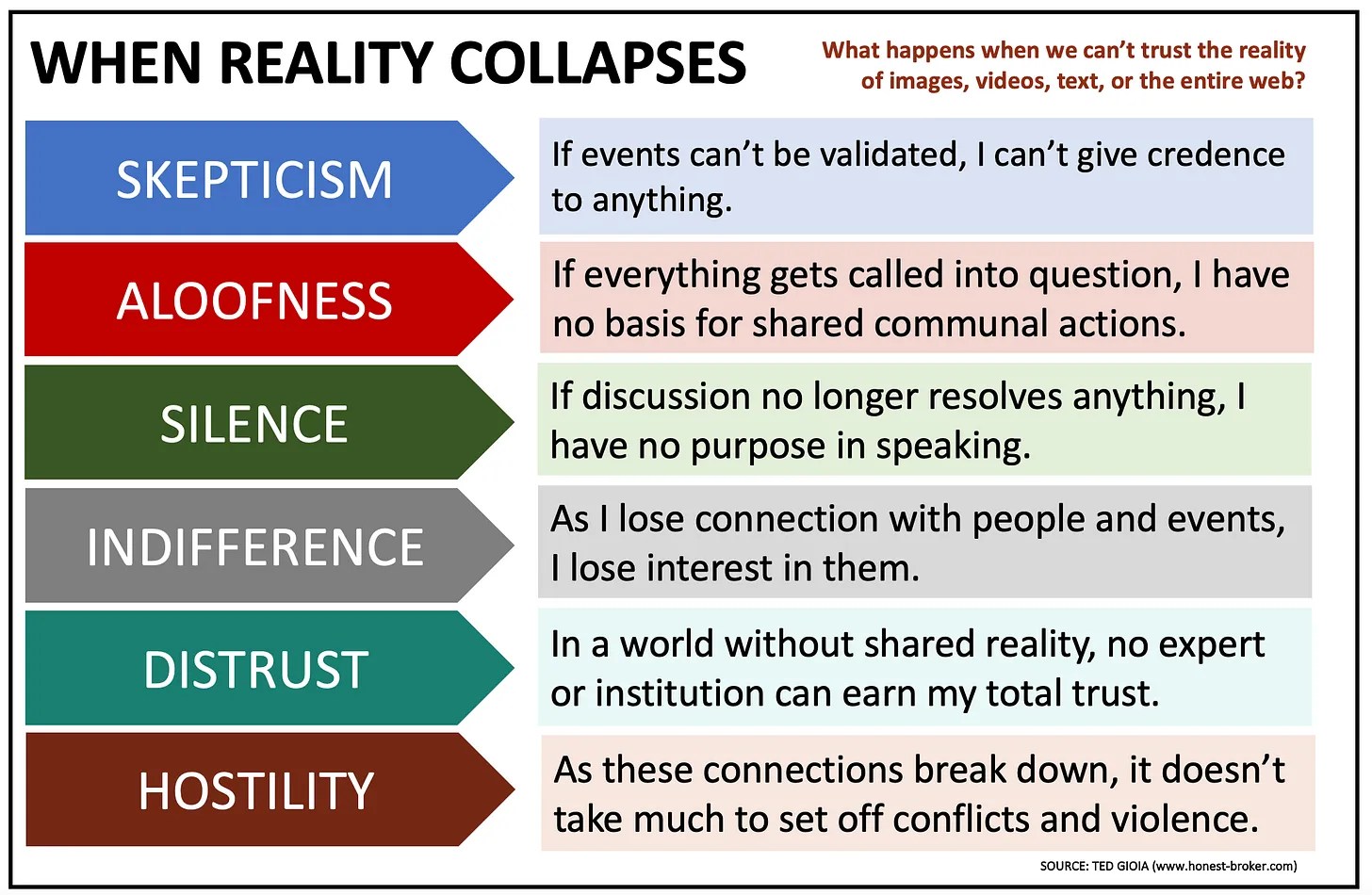

 Tipsy Teetotaler ن