
Total apostasy?
… Mormons claim that “total” apostasy overcame the church following apostolic times, and that the Mormon Church (founded in 1830) is the “restored church.” …
A bullet-point in an anti-Mormon tweet after the attack on a Michigan Mormon meeting place. (My source identified the tweeter as “fundamentalist.”) The bullet-points built to the conclusion that Mormons (Latter-Day Saints) are not Christian.
Fine. But the Evangelical and Evangelical-adjacent world in which I spent many decades believes something very much like that Mormon “total apostasy” story. They may think it started in the 4th century and ended in the 16th instead of the 19th, but a lot of them (including former-me) functionally think it ended in the 19th, with the revivals of the “Second Great Awakening,” when the distinctive style of Evangelicalism emerged. (BTW: Try to define “Evangelical.”)
Here, I submit, is a more accurate summary of Church history:
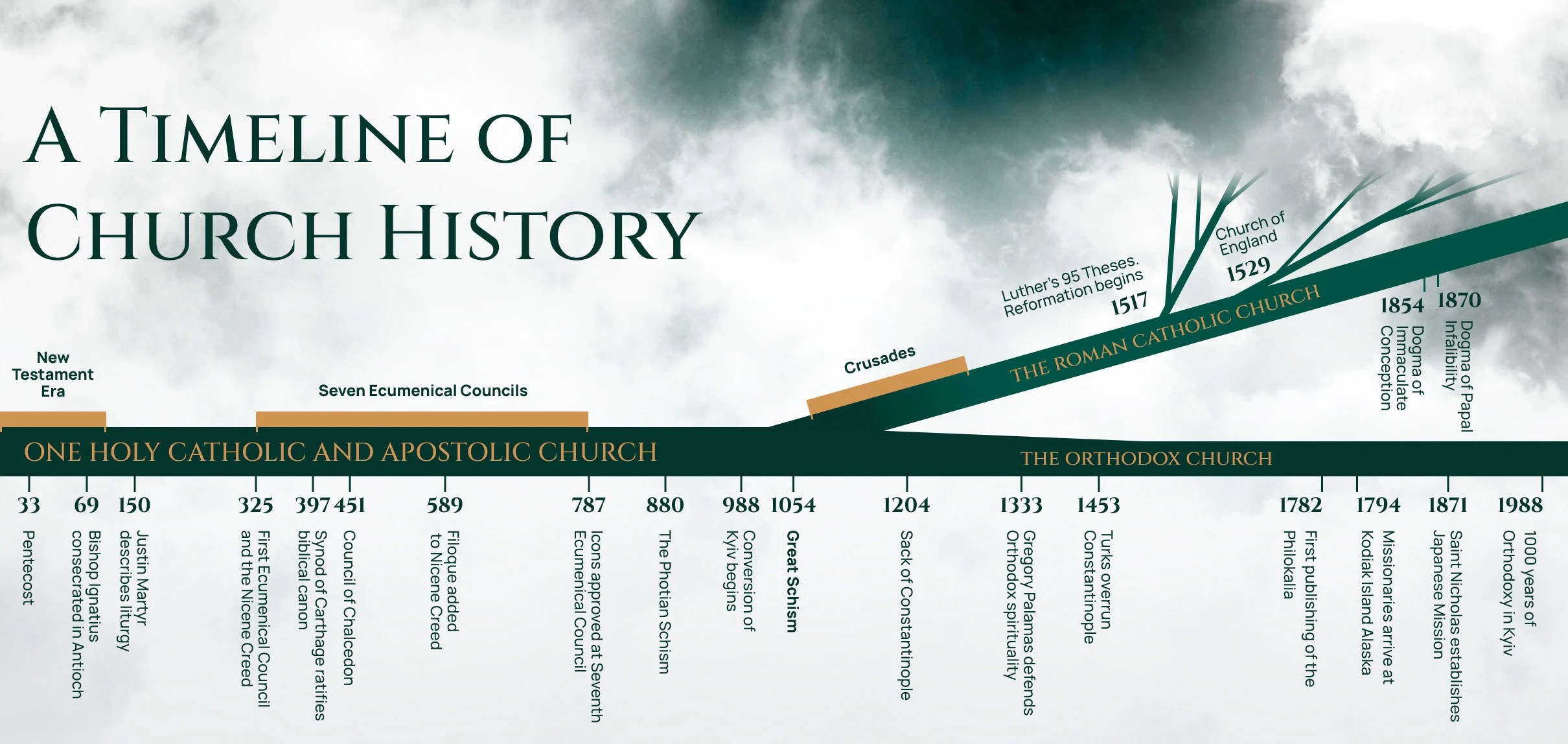
There’s no need of a restored church because Christ’s One Holy Catholic and Apostolic Church never went away.
And I stumbled onto it …
Speaking of which, I had occasion this week to reread an eight year-old blog constituting, my only published spiritual biography (it was reprinted elsewhere one time). There are a few things I’ve written over the years that stick in my mind as worthy efforts, not throw-away lines or curations, and that post is one of them.
Some things bear repeating, and so I shall:
Having settled in for a few decades, what have I found uniquely true about the Orthodox Church?
It’s hard to put into words. That’s why Orthodox evangelism tends to consist of “come and see.”
Harder still for me personally, I need to find words for feelings and tendencies that an intellectualoid has trouble trusting — things that may be true but approach ineffability. I have a Dostoyevsky “Beauty Will Save the World” sticker on my office window, but long habit and self-image keep pulling me back toward “Spock-like logic (think of that tidy, air-tight 5-Point Calvinism) will save the world.”
But here goes. Turn on your feeler.
I’ve found, again, the love of God. Over and over and over and over we hear liturgical exclamations “for You are a gracious God and love mankind.” There’s no contrary stream of wrath that I’ve noted. The steadfast love of the Lord endures forever.
I’ve found true worship of God, which was something I longed for and agitated for in my prior Evangelicalism and Calvinism, as best as I then understood worship. For instance, I wanted no “hymns” in worship that were addressed to encouraging one another rather than praising God. Yet somehow bathos kept cropping up, and emotionally manipulative gospel songs kept elbowing out too many hymns. I really had no idea what real worship looked like, but my longing was wholesome. I am very much a member of homo adorans.
I have found sobriety and balance. The Christian Reformed Church was on the right track when it aspired to “Catechism Preaching,” an effort to tie sermons to the prescribed portion of the Heidelburg Catechism appointed for that Sunday, rather than letting pastors riff on whatever they read in Saturday’s newspaper or National Review. But Catechism Preaching was a tradition honored more in the breach than in the observance. I have found the Orthodox liturgical cycles (very complex and overlapping) to produce sobriety and balance in homilies, but more, in the entire service (hymnody, Epistle and Gospel readings, etc.)
I have found a hard path which, if I faithfully walk it, will make me more Christlike — a nice Protestant way of referring to becoming a “partaker of the divine nature.”
I have found a Church that really is a hospital for sinners instead of a club for self-styled saints. Some patients have more embarrassing ailments than others, but we’re all chronic cases; sacramental confession helps to drive that home. Not one of us is a hopeless case: the lives of the Saints help drive that home. Some check out of the hospital against medical advice, but we don’t do involuntary discharges of anyone who knows (s)he’s sick and wants to get well.
Another’s conversion
She elaborates the point with more than a little self-deprecation: “I’d backed myself into a corner. There wasn’t anyone else in the world who talked about ‘the Platonic ideal of the Good as an active agent with a special care for humankind’ without shortening that whole cumbersome phrase to simply God.”
In short, although she resisted the conclusion (or was it a solution?) with all her strength, she finally welcomed its inevitability. “I had just enough love in me to be able to be warmly surprised to find out the rules I loved, loved me back.”
… If one can know what she thinks by reading the Catechism, what’s left to surprise?
Answer: not her background convictions, but how she applies them to concrete questions, especially questions about public policy and the modern household ….
Brad East, quoting Leah Libresco Sargeant’s conversion from atheism to Roman Catholicism. The occasion, of course, is that she has written a new book, The Dignity of Dependence: A Feminist Manifesto.
Orthodoxy and Roman Catholicism are not in communion with each other since, in the simplified version, the Great Schism of 1054 (see the timeline above). But a lot of people coming out of Protestant traditions have felt that those were the only two viable Christian alternatives, and I have never found it in me to criticize those who made the wrong-but-plausible choice, like Leah did.
Fallen
Of course, we speak of human beings as “fallen.” However, in Orthodox teaching, this does not refer to our nature itself. Rather, it refers to the fact that we have been made subject to death – we are mortal. It is “death at work in us” that we describe as “sin.” But the origin of sin is not found in our nature. Our nature is inherently good. Understanding this makes a huge difference when we think about human relationships and the character of our common life.
If you take the view (which is common in certain corners of Western Christianity) that human beings have a “sin nature” – that we are, in fact, essentially bad – then how we view one another and the character of our common life takes on a different caste. In an Orthodox understanding, a Bible verse such as, “Spare the rod and spoil the child,” can mean little more than “children need discipline in their lives to help them”. Whereas in a world in which human nature is held to be a “sin nature,” then “sparing the rod,” would be seen as letting evil run amok. It would hold that our nature not only needs to be restrained but requires a vigorous regime of reward and punishment. It has not been that long since the notion of “beating the evil out of a child” was common.
When we speak of our nature as “good,” we are not declaring that human beings are born as saints. Rather, we are saying that our nature (“what we are”) tends towards the good, desires the good. We desire beauty. We desire well-being. We desire truth. Even when we engage in evil actions, they are most often grounded in a misperception of the good. Dictators do not come to power by asking people to be evil – they come to power by distorting the image of the good.
Fr. Stephen Freeman, The Nature of Being Human
Religious ideas have the fate of melodies, which, once set afloat in the world, are taken up by all sorts of instruments, some woefully coarse, feeble, or out of tune, until people are in danger of crying out that the melody itself is detestable.
George Elliot, Janet’s Repentance, via Alan Jacobs
[N]one of the things that I care about most have ever proven susceptible to systematic exposition.
Alan Jacobs, Breaking Bread With the Dead
You can read most of my more impromptu stuff here and here (both of them cathartic venting, especially political) and here (the only social medium I frequent, because people there are quirky, pleasant and real and it has no-algorithms). All should work in your RSS aggregator, like Feedly or Reeder, should you want to make a habit of it.
 Tipsy Teetotaler ن