Potpourri, 11/15/18

1

I never really kissed dating goodbye as a teenager in the mid-2000s — to be honest, I was pretty late in kissing it hello. But like many who were brought up in contact with evangelical culture, I absorbed its tenets almost by osmosis even though I never even read the whole book. Falling in love means sharing a piece of your heart that you’ll never get back. Sex is a slippery slope, generally with disaster at the bottom. Hard decisions could be boiled down to one rule: Keep it chaste. Do things right, though, and you’ll get the reward you deserve. Follow the instructions: results guaranteed.

Christine Emba.

It’s the promise of a fairy tale ending that offends me. Evangelicals lack any tragic sense of life. (Just “pray away the gay,” for instance.)

Or maybe that absence of tragic sense is a besetting American sin. More Emba:

In essence, “I Kissed Dating Goodbye” and its (inevitable, if you think about it) fall represent a mind-set prominent in evangelical culture, but also in American society more broadly.

We insist that meritocracy works and combine it with a valorization of hard work (which itself stems from our country’s majority-Protestant roots). To maintain the story that success is accessible to all, we’ve developed a tendency to seek out and elevate simplistic formulas that we hope come with guarantees. Stay pure until marriage, and your marriage will flourish. Follow the “success sequence,” and you’ll never be poor. Go to the right school, and all career doors will open. Elect the right candidate, and America will be great once more.

But the dark side of all this is that when the formulas fail — as they so often do — it’s you who must have done something wrong. And then it’s up to you to fix it on your own. Bad marriage? You must have screwed around as a teen. Still in public housing? Should have gotten a better job. The if/then mind-set doesn’t take into account how much is actually out of our personal control, or the systemic forces — race, class, family history — that might hold someone back.

It is difficult to counter such an ingrained — and easy — habit of thought. But give him credit: In reevaluating “I Kissed Dating Goodbye,” Harris is modeling one way of doing so — he’s admitting to complexity and engaging directly with others, rather than sending down recommendations from above. Alas, even this admirable attempt won’t undo the harms that his formula caused in the first place.

But let the implosion of a cultural touchstone like “I Kissed Dating Goodbye” serve as a lesson, or at least a warning. The next time we’re tempted toward too-formulaic thinking, we’ll know to take it with a grain of salt. After all, life is rarely so pure.

2

Once upon a time, Protestant congregations had pulpits. This was a form of church furniture, a glorified lectern as it where, behind which pastors read the text for their sermon and preached it to boot. Today, contemporary design of church buildings makes little of fixed places for anyone participating in worship, except for the drummer who may be quarantined in a drum shield.

… as ministers of God’s word, pastors’ actions, including their feet, while communicating a message of such great moment should encourage the idea of permanence. That is one reason for having a pulpit with serious heft. It symbolizes that what goes on in this space is of great significance and enduring value (though some look so permanent that even the coming of the New Heavens and the New Earth will not unsettle them).

The permanence of the word preached is also a reason for ministers to stay in the pocket behind the pulpit and not move around. At best, happy feet is a distraction that calls more attention to the man than his message. At worst, they invite liturgical dance. So if the argument from permanence does not help, maybe the thought of overweight men and women in leotards will assist pastors (some on the rotund side themselves) keep both feet firmly planted behind their congregation’s ample pulpit.

D.G. Hart

3

[S]cientists are … making declarations ex cathedra — as a direct result of intellectual movements that began in humanities scholarship twenty-five years ago.

So for those of you who think that the humanities are marginal and irrelevant, put that in your mental pipe and contemplatively smoke it for a while.

Many years ago the great American poet Richard Wilbur wrote a poem called “Shame,” in which he imagined “a cramped little state with no foreign policy, / Save to be thought inoffensive.”

Sheep are the national product. The faint inscription
Over the city gates may perhaps be rendered,
“I’m afraid you won’t find much of interest here.”

The people of this nation could not be more overt in their humility, their irrelevance, their powerlessness. But …

Their complete negligence is reserved, however,
For the hoped-for invasion, at which time the happy people
(Sniggering, ruddily naked, and shamelessly drunk)
Will stun the foe by their overwhelming submission,
Corrupt the generals, infiltrate the staff,
Usurp the throne, proclaim themselves to be sun-gods,
And bring about the collapse of the whole empire.

Alan Jacobs, the imminent collapse of an empire

4

[W]hen you are told endlessly that there is no meaning to existence, then guess what? You actually start to think that way. And then everything loses its flavor. Everything starts to taste like rice cakes.

… [Y]ou cannot have it both ways. You cannot bleach divinity and Transcendence out of the cosmos and tell everyone that the whole affair is just an aimless and pointless accident, and then turn around and talk to us about the “moral necessity” of this or that urgent social cause.

Larry Chapp via Rod Dreher.

5

From before the election, but when I was otherwise occupied:

Trumpism … is the new normal. It is not going away. And there is no going back. The challenge for the center-right and center-left across the West is to accommodate this new normal in ways that do not empower authoritarianism, provoke constitutional unraveling, or incite civil unrest. And it seems to me that the lesson of the last two years is that the Republican Party is unable and unwilling to perform that function. It has turned itself into a cult behind a figure hostile to liberal democratic norms, responsible government, and any notion of moderation. It is less a political party than a mass movement sustained by shame-free, mendacious propaganda around a man whose articulated values place him more in the company of Putin and Duterte than Merkel and Macron.

The GOP cannot be talked out of their surrender to this strongman. With each rhetorical or policy atrocity, they have attached themselves more firmly to him. The dissenters are leaving; the new members of Congress will be even Trumpier than the old. They have abandoned any serious oversight role. Their singular achievement has been supplying judicial ranks who will not stand in the way of executive power. That was the real issue in the Kavanaugh nomination, as Newt Gingrich blurted out last week. A subpoena for the president from the special counsel would be fought, he promised, all the way to the Supreme Court, which is when we would see “whether or not the Kavanaugh fight was worth it.” This is a party bent on enabling authoritarianism, not restraining it.

That’s why I will vote Democrat next Tuesday. I have many issues with the Democrats, as regular readers well know. None of that matters compared with this emergency. I don’t care, in this instance, what their policies are. I am going to vote for them. I can’t stand most of their leaders and fear their radical fringe. I am going to vote for them anyway. Because it is the only responsible thing there is to do.

The Italian leftist, Antonio Gramsci, famously wrote, “The crisis consists precisely in the fact that the old is dying and the new cannot be born; in this interregnum a great variety of morbid symptoms appear.” We live in such a time, and we have in front of us one of those morbid symptoms: the current Republican Party. You know what to do.

Andrew Sullivan.

Or as William Blake put it:

what rough beast, its hour come round at last, Slouches towards Bethlehem to be born?

I’m not at all certain that “judicial ranks … will not stand in the way of executive power” or that such was the aim of confirming them, but Sullivan otherwise is right about the abasement of the GOP, and the House has indeed flipped to the Democrats.

I wrote last week that the midterms would finally tell us what this country now is. And with a remarkable turnout — a 50-year high for a non- presidential election, no less — we did indeed learn something solid and eye-opening. We learned that the American public as a whole has reacted to the first two years of an unfit, delusional, mendacious, malevolent, incompetent authoritarian as president … with relative equanimity. The net backlash is milder than it was against Clinton or Obama (and both of them went on to win reelection).

What I take from this is that Trump really does have a cultlike grip on a whole new population of voters, as well as the reliable Republican voters of the past. That’s not just 42 percent of the country (to use Trump’s approval rating); it’s a motivated 42 percent. And what Trump has successfully done, by corralling right-wing media, tweeting incessantly, dominating the discourse, tending so diligently to his base, and holding rally after rally, is keep that engagement going. Most presidents are interested in governing and sometimes take their eye off the ball politically. Trump is all politics and all salesmanship all the time. And it works. If he can demonstrate this in the midterms, imagine what his reelection campaign will be like.

I’ve been razzed a little for using the term “existential threat” to describe Trump two and a half years ago. But I used it in a specific context: He was and remains such a threat to liberal democracy. Not democracy as a whole. Strongmen can win election after election with big majorities without rigging the vote. A single political party can co-opt the judiciary, or capture the Senate, by democratic means, for illiberal ends. I mean by liberal democracy one in which pluralism is celebrated, power is widely distributed, justice is dispensed without regard to politics, the press is free and respected, minorities protected, and where an opposition has a chance to win real, governing power. The space for this in America has significantly shrunk these past two years and this election has only consolidated that new status quo.

Andrew Sullivan

I’ve detested the Republican party long enough now that my reflex to cringe at Democrat victories passes very quickly, replaced by a resigned feeling of “we are soooooo screwed!” — no matter which major party wins.

6

When you obsess about a problem, you have less energy and passion to pursue solutions. When you fret over every outrage, you elevate those outrages. Stories trend because consumers engage with them, clicking and sharing them, not because the news media dictates that they trend.

I think it would be a solid and beneficial step for us all to simply come to the realizations: Trump is going to Trump. He’s going to lie. He’s going to wink at the racists and Nazis. He’s going to demean women. He’s going to embarrass this country. It’s all going to happen.

Nevertheless, we can take this stand unequivocally: It is all unacceptable and we stand in opposition to it. It is not normal and must never be met as such.

But we must also focus on the future.

Charles Blow

* * * * *

Follow me on Micro.blog Follow me on Micro.blog, too, where I blog tweet-like shorter items and … well, it’s evolving. Or, if you prefer, those micro.blog items also appear now at microblog.intellectualoid.com.
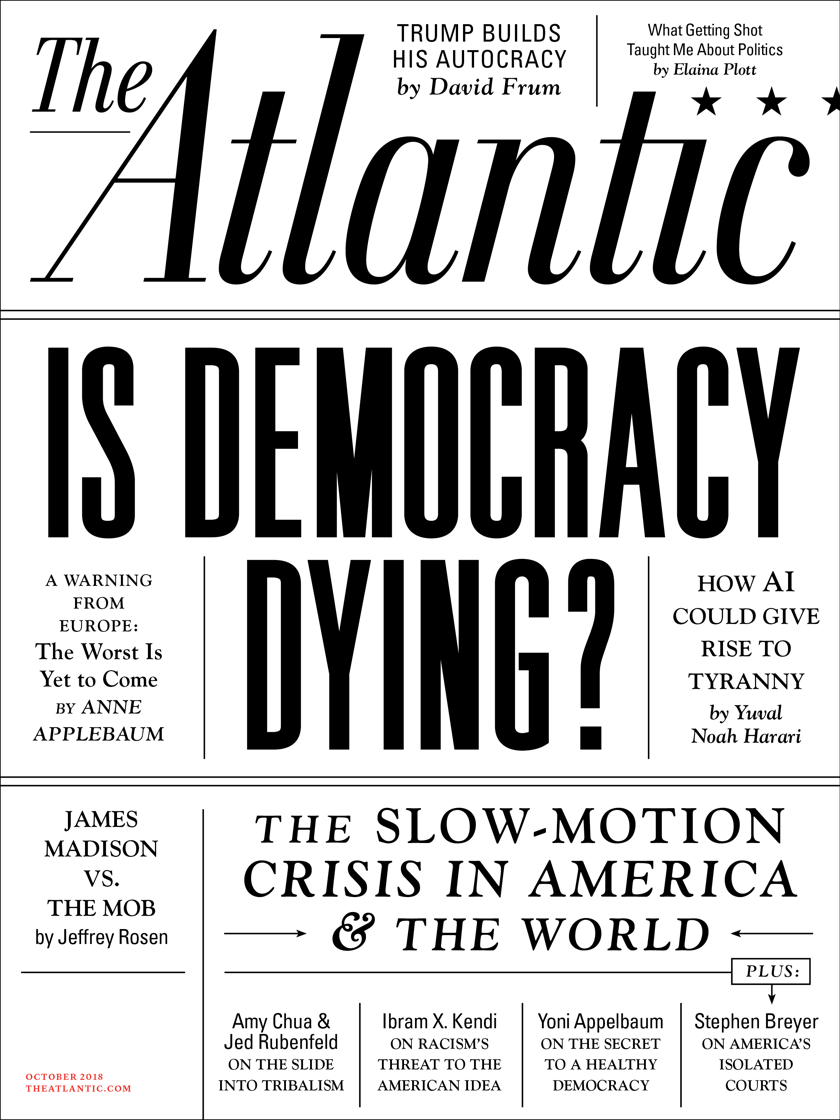
Is (Liberal) Democracy Dying?

The Atlantic for October is a theme issue:

840

I can’t provide URLs because it’s still subscriber-only, but you get get to your favorite bookstore and pick up a copy. All of the following are from that issue, as was Anne Applebaum, A Warning From Europe: The Worst Is Yet to Come, about which I blogged earlier.

1

It is much harder to struggle against irrelevance than against exploitation.

Yuval Noah Harari, Why Technology Favors Tyranny.

And a stunning microcosm:

On December 6, 2017, another crucial milestone was reached when Google’s AlphaZero program defeated the Stockfish 8 program. Stockfish 8 had won a world computer chess championship in 2016. It had access to centuries of accumulated human experience in chess, as well as decades of computer experience. By contrast, AlphaZero had not been taught any chess strategies by its human creators — not even standard openings. Rather, it used the latest machine-learning principles to teach itself chess by playing against itself. Nevertheless, out of 100 games that the novice AlphaZero played against Stockfish 8, AlphaZero won 28 and tied 72 — it didn’t lose once. Since AlphaZero had learned nothing from any human, many of its winning moves and strategies seemed unconventional to the human eye. They could be described as creative, if not downright genius.

Can you guess how long AlphaZero spent learning chess from scratch, preparing for the match against Stockfish 8, and developing its genius instincts? Four hours.

(Emphasis added)

2

Many progressives, particularly young ones, have turned against what were once sacrosanct American principles. Freedom of speech is an instrument of the dehumanization of women and minorities. Religious liberty is an engine of discrimination. Property rights are a shield for structural injustice and white supremacy. In a recent poll, two-thirds of college-age Democrats said that “a diverse and inclusive society” is more important than “protecting free speech rights.” Only 30 percent of Americans born in the 1980s believe that living in a democracy is “essential,” compared with 72 percent of Americans born in the 1930s.

… One of our students told us: “I don’t know any lefty people my age who aren’t seriously questioning whether the First Amendment is still on balance a good thing.”

Amy Chua and Jed Rubenfeld, The Threat of Tribalism.

But wait! There’s more! It’s not tribalist without at least two tribes!

In a 2017 survey by the Pew Research Center, less than half of Republicans said that the freedom of the press “to criticize politicians” was “very important” to maintaining a strong democracy in the United States. In other 2017 surveys, more than half of Trump supporters said the president “should be able to overturn decisions by judges that he disagrees with,” and more than half of Republicans said they would support postponing the 2020 presidential election if Trump proposed delaying it “until the country can make sure that only eligible American citizens can vote.”

I can’t pick which side is worse. Can you?

3

Jeffrey Rosen incited in me kindly feelings toward California:

Voters in several states are experimenting with alternative primary systems that might elect more moderate representatives. California and Washington State have adopted a “top two” system, in which candidates from both parties compete in a nonpartisan primary, and the two candidates who get the most votes run against each other in the general election — even if they’re from the same party. States, which Louis Brandeis called “laboratories of democracy,” are proving to be the most effective way to encourage deliberation at a time when Congress acts only along party lines.

Madison and the Mob.

4

This author was shot, randomly, with a 22:

Knee-jerk calls for gun control didn’t resonate with me. Yet a reverence toward guns no longer felt right either.

I found my ambivalence unsettling. Everyone else seemed so sure about how to feel about guns—people on campus, on the internet, back home. Unlike most of them, I had made intimate acquaintance with gun violence. I should have had some special insight. If what had happened to me wasn’t fodder for clarity, I feared nothing ever would be.

As we drove, he asked me to remind him what I was writing about. I said some- thing lazy, offhanded: “What it was like getting shot in a place that loves guns.”

“It’s not love,” he said. We pulled into the parking lot of his store, which sits high on a hill. You can see almost all of Tuscaloosa from there. “It’s about necessity.” He mentioned rattlesnakes and coyotes. For people in rural areas — that’s more than 40 percent of Alabamians — guns are still a day-to-day defense against such animals. Yes, there is ample love for guns in Alabama. But to forget that they’re tools is to miss an important point.

Elaina Plott, The Bullet in My Arm.

Perhaps, but they’re not the kind of tools Our People use now, are they dear?

5

A 2018 U.S. Magazine asking whether democracy is dying might be suspected of a hit on 45, but it really was not. He did get more than passing mention in David Frum’s contribution, though:

[A] Donald Trump with impulse control would not be Donald Trump …

When Trump refers to “my” generals or “my” intelligence agencies, he is teaching his supporters to rethink how the presidency should function. We are a long way from Ronald Reagan’s remark that he and his wife were but “the latest tenants in the People’s House.”

In 2016, Trump supporters openly brandished firearms near polling places. Since then, they’ve learned to rationalize clandestine election assistance from a hostile foreign government. The president pardoned former Sheriff Joe Arpaio, convicted of contempt of court for violating civil rights in Maricopa County, Arizona, and Dinesh D’Souza, convicted of violating election-finance laws—sending an unmistakable message of support for attacks on the legal order. Where President Trump has led, millions of people who regard themselves as loyal Americans, believers in the Constitution, have ominously followed.

Building an Autocracy.

6

To stop the rot afflicting American government, Americans are going to have to get back in the habit of democracy.

[In the 19th Century] From churches to mutual insurers to fraternities to volunteer fire companies, America’s civic institutions were run not by aristocratic elites who inherited their offices, nor by centrally appointed administrators, but by democratically elected representatives.

Civic participation was thus the norm, not the exception.

Democracy had become the shared civic religion of a people who otherwise had little in common.

But the United States is no longer a nation of joiners. As the political scientist Robert Putnam famously demonstrated in Bowling Alone, participation in civic groups and organizations of all kinds declined precipitously in the last decades of the 20th century.

Trump turned the long-standing veneration of civic procedure on its head. He proclaimed that America is “rigged”; that “the insiders wrote the rules of the game to keep themselves in power and in the money.” The norms and practices of democratic governance, he insisted, had allowed elites to entrench themselves.

Trump secured the Republican nomination by speaking directly to those voters who had the least experience with democratic institutions. In April 2016, when the Republican field had narrowed from 17 candidates to three, a PRRI/The Atlantic survey found Trump enjoying a narrow lead over second-place Ted Cruz among Republican-leaning voters, 37 to 31 percent. But among those who seldom or never participated in community activities such as sports teams, book clubs, parent-teacher associations, or neighborhood associations, Trump led 50 to 24 percent. In fact, such civically disengaged voters accounted for a majority of his support.

Yoni Applebaum, Americans Aren’t Practicing Democracy Any More.

7

And finally:

The cardinal fact always is the loss of contact with objective information. Public as well as private reason depends upon it. Not what somebody says, not what somebody wishes were true, but what is so beyond all our opining, constitutes the touchstone of our sanity. And a society which lives at second-hand will commit incredible follies and countenance inconceivable brutalities if that contact is intermittent and untrustworthy. Demagoguery is a parasite that flourishes where discrimination fails, and only those who are at grips with things themselves are impervious to it. For … the demagogue, whether of the Right or the Left, is, consciously or unconsciously an undetected liar.

Walter Lippman, November 1919 (before my father was born), quoted in a side-bar.

I’m venturing a guess that nobody born since 1970 will understand his use of “discrimination” unless they have a liberal arts college education.

* * * * *

Follow me on Micro.blog Follow me on Micro.blog, too, where I blog tweet-like shorter items and … well, it’s evolving. Or, if you prefer, those micro.blog items also appear now at microblog.intellectualoid.com.

Zombie Analysis

Zombie analysis of Supreme Court nominees is my topic today.

Iconic radio talk show host Rush Limbaugh has often said that liberals “always let us know who they fear” through their unhinged attacks. Among all the potential nominees mentioned a little over a week ago, Amy Coney Barrett immediately attracted the most flak from the left.

And so, of course, the preferred nominee of Doug Mainwaring at brain-dead website LifeSiteNews.com, is Amy Coney Barrett. Not because dispassionate conservative analysis commends her (a topic entirely ignored), but because she triggers the enemy:

  • NARAL
  • Planned Parenthood
  • Seasoned Democrat politicians
  • Dick Durbin
  • Chuck Shumer
  • New York Times
  • MSNBC
  • Ruth Marcus
  • Chris Cillizza
  • Slate.com
  • Washington Post
  • Ivy League law school hegemony

I am not making this up or exaggerating. Literally the first ten reasons given for supporting her are the identies of ten opponents. The last two are my interpretations of less straightforwardly identified bogeymen.

The article, by the way, bears the unironic title “12 reasons Amy Coney Barrett should be on the Supreme Court.”

I have nothing against Amy Coney Barrett except that this kind of trolling is the commonest artument for her. That’s not her fault. It’s just the times we live in.

And it’s contemptible. It doesn’t even do justice to the qualifications of Judge Barrett, who is reduced to a piece of red meat.

* * * * *

The waters are out and no human force can turn them back, but I do not see why as we go with the stream we need sing Hallelujah to the river god.

(Sir James Fitzjames Stephen)

Reality is that which, when you stop believing in it, doesn’t go away.

(Philip K. Dick)

Some succinct standing advice on recurring themes. Where I glean stuff.

Follow me on Micro.blog Follow me on Micro.blog, too, where I blog tweet-like shorter items and … well, it’s evolving.

Encore!

This morning, I read an outstanding Rod Dreher blog that used the passing phrase “conscientious objector in the culture war.”

More than eight years ago, I wrote a long blog with almost exactly that phrase as its title, bearing this preface:

This may be the most controversial and polemical thing I’ve posted. I’ll tell you in advance, and in conclusion, that I’m disinclined to be dogmatic about most of it. Your mileage may vary.

Well, Dreher prompted me to find it and re-read it, and I would no longer endorse that preface:

  1. I have written much more controversial and polemical things since then.
  2. While “dogmatic” may not be the right word, the blog — almost every word of it — now reflects well-settled convictions, tested by eight years and buttressed (especially point 3) by the election of Donald Trump.

Everything else, I’d still endorse, So I’m indulging myself by re-publishing myself — a rare step that I don’t intend to repeat often.

* * * * *

One of the minor irritants in my life is Franky Schaeffer. I’ll go long spells without thinking of him, and then I get a catalogue from his publishing company, or maybe he pops up in the news (having once again found limelight). And I seethe.

But lots of people love limelight. Why does he, of all people, irritate me? Probably because his life is so parallel to mine, through all the twists and turns.

  • Evangelical: Check.
  • Produced the movie Whatever Happened to the Human Race; watched the movie as a turning point.
  • Now Orthodox: Check.
  • Religious Right activist: Check.
  • No longer Religious Right activist: Check.
  • 60-something years old: Check.

But he’s too strident and angry. He’s sort of a Christian James Howard Kunstler (another approximate contemporary of mine) but without Kunstler’s ubiquitous F-Bombs. Kunstler acknowledges that his speeches are a form of theater (listen to Kunstlercast #103 here); I think that’s true of Schaeffer, too, though he’d probably deny it.

I sense, too, that my reasons for dropping out of the culture wars are different than Schaeffer’s. I sense that partly because he seemingly just changed sides, now inveighing against his former friends, writing screeds, kiss and tell books, dubious fiction (his Calvin Becker fiction trilogy was quite calculatedly ambiguous about the extent to which it was autobiographical), paranoid apologies for Barack Obama, and sucking up to media personages who call him things like “a former leader of the anti-choice movement.” (They just love to get some sound-bites from an angry ex-whatever.)

But I really dropped out because:

  1. The culture wars are unwinnable on the present terms.
  2. I suspect that the strident tactics make most things worse rather than better.
  3. I don’t really trust my former allies.
  4. I don’t really trust the candidates we’re supposed to vote for.
  5. I still don’t trust my former adversaries.
  6. If I’m a prominent culture warrior, it will spill over harmfully into other areas.
  7. Maybe I’m just a worn out old hippie pacifist.

1. The culture wars are unwinnable on the present terms. We may get a majority vote for the “right” side on this issue or that, but that will not end the war. There will be other battles. There will be guerilla warfare. There will be no peace, and there’s only a minimal chance for the “Right” to win. Not until the Right’s own culture changes.

Changing culture is the work I’m about now – feeling my way rather than barreling ahead. That’s much subtler work than culture war. I’m not sure how good I am at it. But I’m convinced, to take just one Culture War example, that we won’t stop abortion until we change the toxic combination of unchastity and avarice that gets women pregnant and then justifies aborting the innocent child to maintain prosperity (greater or lesser).

The Right is not with us on that. Fox Radio recently aired an ad, between Glen Beck and Bill O’Reilly, for an online service for married men seeking adulterous affairs. (I didn’t hear it, but read about it from someone who didn’t note the incongruity of this appearing on a putatively conservative news source.)

Whaddya think? I’m betting that the ad wasn’t there for the 13 liberals who were eavesdropping on Fox that day, but for the red-meat, red state regulars.

TownHall.com syndicated columnist pages every day have ads for “conservative” slogan t-shirts draped on attractive young lasses, selling conservative politics, like everything else, with sex. Today there’s a sexy avatar for some video game, too. It’s all a racket.

This could as well go under the caption “I don’t really trust my former allies.” But on present terms I think the idiocy of modern pseudo-conservatives belongs in this “unwinnable” category, if only because their position on the sexual side of the culture wars seems to be “anything goes, so long as it’s not gay.” That’s a losing position long-term as well as being a sign of untrustworthiness.

2. The Culture Wars are unwinnable on present terms partly because stridency and contempt beget stridency, contempt and alienation.

Whichever side of the Culture Wars you’re on, think about the fundraising letters you get. Are you edified by their tone? Do you appreciate the sober, educational emphasis? Do you find yourself walking away with something of substance to ruminate on?

If so, I’ve got bad news for you: you’re an idiot. (Shall I write that slower? You. Are. An. Idiot.)

The groups who used to send me fairly sober letters have gone strident. The groups that used to send me strident letters are now frothing at the mouth. And I’m sure the other side is doing the same. Shrill is the new green.

I don’t care who fired the first volley. That’s lost in the mists of history like the instigation of the Hatfields versus the McCoys. I’d like the shooting to stop. I’d like artificial divisions to end. I suspect there’s more common ground than either side presently will admit because of how things have been framed. Let’s tone it down a bit and then explore what the real divisions are. The more we insult the other side, the more we paint both sides into corners from which dialog, let alone truce, is impossible.

[Update: We now teeter on the brink of civil war. I had no idea it would get so bad so fast. I commend Better Angels]

3. The culture wars are unwinnable on the present terms, too, because there’s darned little difference between the two sides on some of the deep presuppositions.

They’re both, ironically, secular. One side is secular because they don’t believe in any divine rules. You know which side I’m talking about. (Hint)

The other side – my side – is mostly secular because they functionally believe that God’s only presence in the world is His rules. They “honor” Him by keeping his rules – sort of the way a rank amateur “paints” by number. That’s why I don’t really trust them. The tranformative significance of the Incarnation: God the Son, Who took on our flesh forever – qui sedes ad dexteram patrem (who sits at the right hand of the Father) in resurrected human flesh – is lost on them. God is up to something more than commandment monitoring and forgiving transgression of the commandments. The incarnation changes everything. [Update: The seeds in this paragraph have grown into my episodic forays into the realism/nominalism distinction and explicit scorn for sub-Christian anthropology.]

“Love God and do as you will” would strike them as modern relativism. They’re very anti-relativist. Except on Ecclesiology. Then they’re apt to utter Babbitry like “Isn’t it swell that there’s a church for every taste!

At the other end from the relativist “conservatives,” there’s a Protestant Church in my home town that produces a disproportionate share of Religious Right activists. Several of them have been elected to public office. But they’re theonomists, or more specifically Reconstructionists. If they had their way, there would be 18 Old Testament Capital Crimes in our law books – including sassing parents. They’d shut down my Church and desecrate its icons. They might, for all I know, execute me for one of those 18 capital offenses for the icons in my home prayer corner. [Update: One of their ideologues brought disgrace upon himself and his wife via their religious “covenant” without a marriage license. I must spare you details of the breakup.]

“And what more shall I say? For the time would fail me to tell of …” the folks I encountered who dreamed of kingdoms, feigned righteousness, broke promises, shot off their mouths, tried to set fires, escaped the edge of euphemisms …. (Cf. Hebrews 11:32-34) These are the folks with whom I’d be a “co-belligerent” (Francis Schaeffer’s coinage to distinguish temporary and unreliable political friends from reliable “allies”) were I to continue in the culture wars. And they outnumber many-fold any well-formed Christians of historical and liturgical bent.

We Orthodox have been here before. After the attempted union with the Roman Catholic Church at the Council of Florence (see also here), the Orthodox decided they’d risk rule by Sultan over rule by Pope.

That is not a throw-away line: I’m not so sure a secularist regime would be worse than what Christian Reconstructionists would bring upon me and my fellow Orthodox Christians that I’m willing to be bedfellows with Recontructionists.

4. In the current terms of the Culture War, the highest form of involvement, other than sending money in response to strident or frenzied letters, is to vote for Republicans. Any Republican.

In 2000 and 2004, it was Dubya. He was, we were told, a good Evangelical Christian. He cited Jesus as his favorite philosopher. He talked about America walking humbly in the foreign policy world.

Then 9-11 came, and he turned into a fierce Commander In Chief. And, oddly, Imam-In-Chief, as he assured us that “true Islam is a religion of peace.” (Well I’m glad he cleared that up!)

And then came, too, the second inaugural, when he declare as U.S. policy the eradication of tyranny from the world and the planting of democracy. If you don’t understand how delusional that is, read it again: eradicating tyranny from the world. As national policy.

Many Religious Right figures in 2008 backed Mitt Romney, Mormon and heir of a 50s moderate Republican, George Romney. Mitt was, deep down, one of us – despite his left-leaning administration as governor of Massachusetts – they assured us. Now they’re pushing Sarah Palin, about whom I’ll not say much except that I do not now support her and see no sign that she has the goods to gain my support later. (I don’t even think she’s all that “hot,” for whatever that’s worth.)

I’m not gonna play Charlie Brown the placekicker to the GOP’s Lucy Van Pelt any more.

[Update: Do I really need to belabor how right I was?]

5. I still believe pretty much what I believed before on what makes for good living and a just society. I’ve even kept a hand in the debates by writing letters to the editor on a few hot-button issues. Those letters are far less demonizing of the opposition than the sort of letters I used to write. But I check the online comboxes and see that the other side has no lack of equally-but-oppositely mad partisans of its own, leveling vitriolic attacks on me, no matter how reasoned my argument, just because I reach conclusions they don’t like.

But even at more elite levels than smalltown cyberpaper comboxes, I’m still convinced that the other side is untrustworthy. One occasionally will catch one of them committing candor, as has Chai Felblum of Georgetown law school. Imagine a constitutional case with this issue:

Whether the inferred right to marry a member of the same sex, which is inferred from the right to engage in homosexual sodomy, which is inferred from the right to privacy, which is inferred from penumbra of he 4th, 9th, 10th, 14th and other consitutional amendments, is of sufficient constitutional gravity to warrant compromise of the explicit constitutional command against laws prohibiting the free exercise of religion?

Chai Feldblum would answer “yes.” I’m not making up her response (though I did make up the highly tendentious – but brutally accurate – faux issue statement). I appreciate her candor.

But her candor tells me that there’s no home for me in the left where Frank Schaeffer has seemingly pitched his tent.

The Orthodox Wedding service includes, for just one example, “grant unto these Your servants …a peaceful life, length of days, chastity, love for one another in a bond of peace, offspring long‑lived, fair fame by reason of their children, and a crown of glory that does not fade away.” You can’t pray that with integrity over a same-sex coupling, whatever you might think of it otherwise.

So while the Chai Feldblums of the world might not smash my icons like the Reconstructionists, they’ll soon enough take away my Church’s tax exemption, or otherwise put on the squeeze, because they’ll consider us a hate group for continuing the two-millennia-long practice of connecting marriage to procreation.

6. If I’m a prominent culture warrior, it will spill over harmfully into other areas of life. I was reminded Sunday how diverse my parish is. We have Romanians and Russians who were born, or even came of age, under communism. We have Greeks who think that 2nd Amendment mania is barbaric (in at least one case with justification that I can’t gainsay – a family member gunned down in cold blood by someone who went postal). We have young people and middle-aged academics who lean left. We have demographically unknown visitors most Sundays. I have something to learn from some of them.

Just as I don’t want someone to ask me “why are you here since you’re not Greek?,” I don’t want people of Right-leaning disposition to come up to me at Church and make some dismissive remark, which they assume I’ll find hilarious or profound, about a Left-leaning idea that may be held by another parishioner within earshot. I don’t want there to be ethnic, racial, socio-economic or political barriers to people. Political trash talk about trifles at Church is apt to drive people away though we have a faith in common and should be together on Sunday.

7. Maybe I should try a bit more empathy. Maybe I’m not angry because, unlike Frank Schaeffer, I have a day job, with a comfortable living, and don’t have to raise a fuss to sell my newest book. Maybe a brain or personality disorder prompted Franky to call Barack Obama’s election “miraculous” and to prophesy epochal political healing on Obama’s watch.

Maybe Frank’s suburban Boston parish (I think he’s in Brookline, Michael Dukakis‘ hometown) has a leftist litmus test and he caved in. Or maybe he’s rebelling against his upbringing in neutral Switzerland as I declare myself a Swiss-like neutral in the Culture Wars.

Or maybe I’m not angry, by and large, because I’m a child of the 60s, a former Conscientious Objector to conventional war, and now old enough that I’m kind of tired of fighting of all sorts – worn out, if you will. Maybe we really need young, testosterone-crazed Christian guys (and gals crazed by whatever crazes women) who still are eager for a fight. I see my role as one to ask questions of any such young hotheads from the perspective six decades gives. Such as the ones implied by what I’ve just written.

[Note: The rest of this is dated or refers to a blog template I no longer use.] So who am I hangin’ out with these days if not with the Alliance Defense Fund and the acolytes of R.J. Rushdoony? Check the bloglinks to the right – Especially Front Porch Republic (“Place. Limits. Liberty.”), Distributist Review  (guardedly). Small Is Beautiful has taken on new meaning for me. (My benighted generation got a few things right before we sold out or got complacent – and appreciating E.F. Schumaker was one of them).

I can’t even rule out Father Stephen. Nothing he writes is “about politics,” but everything he writes is about sane, human and humane living, which surely connects up somehow.

Basically, I’m going back and rethinking all things political and cultural. I’m wisdom-hunting. I read Wendell Berry essays and poetry, Bill Kauffman books, Russell Kirk’s Conservative Mind, Matthew Crawford’s Shop Class as Soulcraft, Scott Cairns’ Poetry, W.H. Auden (“For the Time Being” is now on my list for every Advent).

My conversion to Orthodox Christianity started it in a way. I soon realized that the Church has not always prevailed, and has produced martyrs in every century. And that’s okay. Better we should lose honorably than win by selling our souls.

* * * * *

I heartily recommend the Dreher blog I opened with as a complement to this.

3 things, 12 rules, 1 prayer

[P]rophets are neither new nor controversial. To a first approximation, they only ever say three things:

First, good and evil are definitely real. You know they’re real. You can talk in philosophy class about how subtle and complicated they are, but this is bullshit and you know it. Good and evil are the realest and most obvious things you will ever see, and you recognize them on sight.

Second, you are kind of crap. You know what good is, but you don’t do it. You know what evil is, but you do it anyway. You avoid the straight and narrow path in favor of the easy and comfortable one. You make excuses for yourself and you blame your problems on other people. You can say otherwise, and maybe other people will believe you, but you and I both know you’re lying.

Third, it’s not too late to change. You say you’re too far gone, but that’s another lie you tell yourself. If you repented, you would be forgiven. If you take one step towards God, He will take twenty toward you. Though your sins be like scarlet, they shall be white as snow.

This is the General Prophetic Method. It’s easy, it’s old as dirt, and it works.

Scott Alexander at Slate Star Codex, reviewing Jordan Peterson’s Twelve Rules for Life.

For whatever reason, I’ve become pretty fierce about the obligations of lie-resisting and truth-telling. I’ll leave that sentence as a bit of a Rorschach test, but I’ll tell you that it includes resisting lies from sources Left and Right.

With that, and with Jordan Peterson particularly in mind, I added to my morning list of people to ask God’s blessing on “all truth-tellers, Christian or not, in this age enamored of lies” (that’s the reminder I wrote to myself).

Then an old friend — and by “old” I mean I met him in 1963 — who has remained fiercely Evangelical and activist, pricked my conscience with a video, shared on Facebook, pointing out that the United States was in a terrible spiritual state in the late 18th century — maybe worse than that of the late 20th century — but then,  voilà!, what should up and happen but the Second Great Awakening, with enormous and lasting change in its wake.

So I decided I should pray for something like a Third Great Awakening, and that’s how I wrote down a second reminder.

But it’s no secret that I’m an ecclesial and liturgical Christian. Among other things, that implies that if I’m going to pray for something every morning, I’d really like to do a bit better than “Father God, we just ask you Father to just Father bless all the truth-tellers Father and coudja just send us Father another Great Awakening Father if it’s not to much trouble — Father?”

So I was pleased Thursday night to notice, in the Prayer Book I was using, a succinct petition that, with minor adaptation, effectively rolls my truth-teller and Great Awakening prayers into one, leaving the executive details up to He Who Is At An Infinitely Higher Pay Grade:

O, Most Holy Trinity, who lovest mankind and willest not that any should perish, look, I beseech Thee, on all my countrymen that are led astray by the devil; that rejecting all errors, the hearts of those who err may be converted and return to the unity of Thy truth.

“Led astray.” “Error.” “Converted.” “Unity of Thy truth.” That seems to cover it.

Feel utterly free to make it your own, remembering that it could apply to you, too.

But if you try to type it, watch out for those dadburned modern auto-correct features. They don’t like the King’s English.

* * * * *

Reality is that which, when you stop believing in it, doesn’t go away.

(Philip K. Dick)

The waters are out and no human force can turn them back, but I do not see why as we go with the stream we need sing Hallelujah to the river god.

(Sir James Fitzjames Stephen)

Some succinct standing advice on recurring themes.

Where I glean stuff.

As others see us

Writing from Czechia, after an evening with the family of Vaclav Benda:

At one point, we were talking about the atmosphere of militant progressivism in the West, and how hard it is for Czechs to understand what’s happening in American universities. One of the Benda family friends, an academic, asked me if I had heard of Jordan B. Peterson. Yes, of course, I said.

“He is a miracle!” said this man.

Someone present explained that under communism, underground Christians looked with admiration to the West. But now they see so much decadence in the West, and don’t want it ….

(Rod Dreher)

UPDATE:

More:

I keep having a slightly unnerving experience here, both in Hungary and the Czech Republic. People cannot understand the insanity coming from America, the UK, and the EU on LGBT and gender theory. It is literally incomprehensible to them. Just this morning I was talking to a seminary professor of moral theology who said that his thesis on alternative sexualities was laughed at; his colleagues could not believe that anyone would take this stuff seriously. This professor is no advocate for alternative sexualities, but he had lived and taught in the West, and he knows they are going to have to be dealing with this stuff here sooner or later.

I keep telling the people I talk to about this that they should not simply laugh this stuff off as incomprehensible. Several agreed with me that 40 years of communism served as a vaccination against susceptibility to ideological extremism, and that this might be why even atheists (most Czechs are atheists) find the gender theory types to be crackpots. But then, if you had told a lot of Americans in 1998 what would be mainstream in our country on this front in 2018, they would have laughed like the Czechs and the Hungarians laughed. But now look.

(Another Dreher blog installment)

* * * * *

It is not bigotry to be certain we are right; but it is bigotry to be unable to imagine how we might possibly have gone wrong.

Bigotry is an incapacity to conceive seriously the alternative to a proposition.

A man … is only a bigot if he cannot understand that his dogma is a dogma, even if it is true.

(G.K. Chesterton) Be of good courage, you who are called “bigots” by those who are unable to conceive seriously the alternatives to their dogmas.

Some succinct standing advice on recurring themes.

Where I glean stuff.

Frank Meyer’s fusionism

I guess I really need to read Patrick Deneen’s Why Liberalism Failed. I know the general thesis from a recent article he wrote and from reviews and comments of others, but now I’m noticing that much of what I read could be viewed as haunted by the ghost of Deneen.

For instance, Michael Davis, The Fatally-Flawed Fusionism of Frank Meyer recounts how Meyer’s influential effort to end the cohabitation of libertarianism and traditionalism by marrying them led inadvertently to the ascent of toxic libertarianism. Davis never mentions Deneen, but his thesis is relevant to and inconsistent with Deneen’s.

Frank Meyer was a man looking desperately for faults in the philosophy to which he was most attracted: traditionalism. Finding none, he simply made up another philosophy: fusionism. But instead of coopting the energy and scientific rigor of libertarianism for the traditionalist cause, he simply empowered the former at the latter’s expense…

Why, you ask, did this come to pass? My best guess: libertarianism’s strict “government = bad, liberty = good” dichotomy was easier to market in magazine and stump speeches. And that’s understandable. Both libertarians and traditionalists were horrified by the sheer size and power of the Soviet state; libertarians simply don’t have to bother with “the simulacrum of virtuous acts” or “divine patterns of order.”

Davis also recaps as part of the story an early Meyer error and its correction:

In a 1962 column for National Review, he claimed that traditionalism’s cardinal sin—the fundamental error that necessitated its co-mingling with libertarianism—was that “the simulacrum of virtuous acts brought about by the coercion of superior power, is not virtue, the meaning of which resides in the free choice of good over evil.” In layman’s terms: virtuous acts must be those undertaken freely, not under state coercion.

L. Brent Bozell Jr., in his rejoinder, observed (correctly) that, because Meyer was making a theological claim—that is, about the relationship between free will and virtue—it has to be answered in theological terms. And every school of orthodox theology would accept that an act is virtuous regardless of whether it was made freely or not. “We can agree that the freer the choice—i.e., the more difficult it is—the greater the merit,” he writes; but, “by definition, the virtuous act is one that conforms with man’s nature, with the divine patterns of order.”

It certainly appears that Davis would contest Deneen’s premise that liberalism is fatally flawed, for he cites “an organic tradition of political liberty in the thought of Burke and Adams” (traditionalists) that did not require correction by injecting libertarianism.

He concludes with seven steps to “work backwards toward [the] restoration” of American conservatism which Meyer’s fusionism undermined.

Agree or disagree with him as you will. Davis’s piece strikes me as one of the best yet at The Imaginative Conservative, which is prolific but of spotty interest.

Again, if you’re wondering what this debate within conservatism is about, read A Catholic Showdown Worth Watching.

* * * * *

“While saints are engaged in introspection, burly sinners run the world.” (John Dewey) Be a saint anyway. (Tipsy)

Some succinct standing advice on recurring themes.

Where I glean stuff.