Last month, the U.S. cutter Hamilton returned to Florida with what the agency called “the largest quantity of drugs offloaded in Coast Guard history”: 61,740 pounds of cocaine and 14,400 pounds of marijuana (that’s the weight of about three city buses). The haul, gathered by multiple federal agencies during 19 seizure incidents in the Caribbean as well as the Pacific, had an estimated street value of $473 million. But there wasn’t any fentanyl on the boat.
(Nick Miroff)
Authoritarianism in the 21st century
We are living in an authoritarian state.
It didn’t feel that way this morning, when I took my dog for his usual walk in the park and dew from the grass glittered on my boots in the rising sunlight. It doesn’t feel that way when you’re ordering an iced mocha latte at Starbucks or watching the Patriots lose to the Steelers. The persistent normality of daily life is disorienting, even paralyzing. Yet it’s true.
We have in our heads specific images of authoritarianism that come from the 20th century: uniformed men goose-stepping in jackboots, masses of people chanting party slogans, streets lined with giant portraits of the leader, secret opposition meetings in basements, interrogations under naked light bulbs, executions by firing squad … I’d be surprised if this essay got me hauled off to prison in America. Authoritarianism in the 21st century looks different, because it is different. Political scientists have tried to find a new term for it: illiberal democracy, competitive authoritarianism, right-wing populism …
… To keep their jobs, civil servants have to prove not their competence but their personal loyalty to the leader. Independent government officers—prosecutors, inspectors general, federal commissioners, central bankers—are fired and their positions handed to flunkies. The legislature, in the hands of the ruling party, becomes a rubber stamp for the executive. Courts still hear cases, but judges are appointed for their political views, not their expertise … There are no meaningful checks on the leader’s power.
…
Today’s authoritarianism doesn’t move people to heroic feats on behalf of the Fatherland. The leader and his cronies, in and out of government, use their positions to hold on to power and enrich themselves. Corruption becomes so routine that it’s expected; the public grows desensitized, and violations of ethical norms that would have caused outrage in any other time go barely noticed. … At important political moments it mobilizes its core supporters with frenzies of hatred, but its overriding goal is to render most citizens passive. If the leader’s speech gets boring, you can even leave early (no one left Nuremberg early). Twenty-first-century authoritarianism keeps the public content with abundant calories and dazzling entertainment. Its dominant emotions aren’t euphoria and rage, but indifference and cynicism. Because most people still expect to have certain rights respected, blatant totalitarian mechanisms of repression are avoided. The most effective tools of control are distraction, confusion, and division.
…
“If everybody always lies to you, the consequence is not that you believe the lies, but rather that nobody believes anything any longer,” the political philosopher Hannah Arendt said near the end of her life. “And a people that no longer can believe anything cannot make up its mind. It is deprived not only of its capacity to act but also of its capacity to think and to judge. And with such a people you can then do what you please.”
These are the features of the modern authoritarian state. Every one of them exists today in this country …
… It sometimes seems as if the only check on Trump’s power is his own attention span.
Imagine if you were trying to write intelligently about the socioeconomic impact of the railroad in the middle of the 19th century, and half the people investing in trains were convinced that the next step after transcontinental railways would be a railway to the moon, a skeptical minority was sure that the investors in the Union Pacific would all go bankrupt, many analysts were convinced that trains were developing their own form of consciousness, reasonable-seeming observers pegged the likelihood of a train-driven apocalypse at 20 or 30 percent, and peculiar cults of engine worship were developing on the fringes of the industry.
What would you reasonably say about this world? The prime minister of Denmark already gave the only possible answer: Raise your alert levels, and prepare for various scenarios.
“I’m not proposing a political program,” he told me. “This isn’t some Christian civilizational vision. It’s much more personal.” You decide how and where to wage battle: at a community garden, on the Appalachian Trail, in a mosque.
He was struck by how commonplace legal cannabis had become. “It’s a really, really useful drug for the state to be legalizing,” he said. “Because it’s not like alcohol. It doesn’t get you violent. And maybe life is a bit less crappy. It’s the best antidote to revolution that you could possibly have.”
“When you’re sitting in your living room with your Punjabi wife reading a bunch of stuff about how you’re a white nationalist, it makes you want to punch people in the face,” he said. “Luckily, I’m a Christian, so I don’t do that.”
Paul Kingsnorth via Alexander Nazaryan in the New York Times
Your enemies are not demonic, and they are not all-powerful and the right hasn’t always lost and the left hasn’t always won. But if you convince yourself of that, you give yourselves all sorts of permission to do a lot of stupid and terrible things under the rubric of “Do you know what time it is?”
[A] critical mass of the American people … no longer want[s] to govern themselves, … are sick of this republic and no longer want to keep it if it means sharing power with those they despise.
I don’t do any of the major social media, but I have two sub-domains of the domain you’re currently reading: (a) You can read most of my reflexive stuff, especially political here. (b) I also post some things on my favorite social medium.
Last Monday afternoon, I was communing with my phone when I came across a Memorial Day essay that the Notre Dame political scientist Patrick Deneen wrote back in 2009. In that essay, Deneen argued that soldiers aren’t motivated to risk their lives in combat by their ideals. He wrote, “They die not for abstractions — ideas, ideals, natural right, the American way of life, rights, or even their fellow citizens — so much as they are willing to brave all for the men and women of their unit.”
This may seem like a strange thing to get angry about. After all, fighting for your buddies is a noble thing to do. But Deneen is the Lawrence Welk of postliberalism, the popularizer of the closest thing the Trump administration has to a guiding philosophy. He’s a central figure in the national conservatism movement, the place where a lot of Trump acolytes cut their teeth.
In fact, in his acceptance speech at the Republican National Convention, JD Vance used his precious time to make a point similar to Deneen’s. Vance said, “People will not fight for abstractions, but they will fight for their home.”
Elite snobbery has a tendency to set me off, and here are two guys with advanced degrees telling us that regular soldiers never fight partly out of some sense of moral purpose, some commitment to a larger cause — the men who froze at Valley Forge, the men who stormed the beaches at Normandy and Guadalcanal.
But that’s not what really made me angry. It was that these little statements point to the moral rot at the core of Trumpism, which every day disgraces our country, which we are proud of and love. Trumpism can be seen as a giant attempt to amputate the highest aspirations of the human spirit and to reduce us to our most primitive, atavistic tendencies.
The rest of the column was quite good, but the idea that a primitive, atavistic President would deploy his “throne-sniffing sycophants” (H/T Kevin D. Williamson, below) to reduce the nation to primitive atavism struck me as (a) too sophisticated conceptually, but perfect temperamentally, for Trump (a “stupid, lazy and angry” man — Kevin D. Williamson again); (b) exactly what his smart and unprincipled intimates would realize is necessary for their success; and (c) the kind of radical moral rot that Brooks sniffs out and exposes to us all.
And for his ability to distill evils to their essence, I am grateful.
Stupid, lazy and angry
We’ve been here before, of course. Donald Trump and his team have been three weeks away from announcing a groundbreaking new health care plan for … what, just about a decade now? Donald Trump’s confidence in addressing a complex subject has a linear relationship to his ignorance regarding that subject, and so we have got gems like this presidential declaration of ineptitude: “Nobody knew that health care could be so complicated.” It isn’t the case that nobody knew—lots of people knew. Some of those people had good ideas, some had terrible ideas, but they knew it was complicated. The guy who didn’t know? The one who spent most of his life as a Manhattan gadfly, a game-show host with side hustles in pro wrestling and porn. That guy didn’t know.
…
There are no conspiracies. There are no secrets. Everything is more or less what it seems. … [T]he obvious explanation for Trump’s eccentricity (or most anything else) is almost always the correct explanation. Which is why I have been writing for all these years that the key to understanding the Trump administration is that its central figure, Donald Trump, is stupid, lazy, and angry …
There are people around Trump, such as Marco Rubio and J.D. Vance, who are not stupid or lazy (though both are distinctly angry men) but are functionally indistinguishable from the stupid and the lazy because they are throne-sniffing sycophants who dread a return to the private sector more than almost anything else in this life.
…
It’s all right there to see: Trump, the supposed master negotiator, is as a matter of practical fact able to effectively negotiate exclusively in situations in which no substantial negotiation is required: with people he can fire, for example, or with utterly dependent parties. He calls this “negotiating from a position of strength” instead of “bossing around your cowering flunkies.”
It didn’t take long for the courts to figure this out
The Abrego Garcia ruling and the Alien Enemies Act litigation have left legal scholars warning of a constitutional crisis. But a more tangible effect, attorneys told me, has been the erosion of the “presumption of regularity”—the benefit of the doubt given to the government in court proceedings. It’s based on the idea that federal officers and attorneys are operating in good faith, and not trying to achieve political goals through acts of subterfuge.
As judges see the administration saying one thing in public and another in court, they have started to treat the government’s claims with more skepticism and, sometimes, with outright suspicion of criminal contempt. A recent Bloomberg analysis found that the Trump administration has been losing the majority of its immigration-related motions and claims, regardless of whether the judges overseeing their cases were appointed by Democrats or Republicans.
I’m not by any means certain that it will all be alright, i.e., that the courts can protect us from Trump’s lawlessness. But denying his administration the presumption of regularity is an important and needed step.
Note well that when a government lawyer tried to address the court honestly, the Attorney General fired and defamed him:
When a senior ICE official said in sworn testimony in March that Abrego Garcia had been deported to El Salvador because of an “administrative error,” the Justice Department attorney who initially represented the Trump administration, Erez Reuveni, relayed that characterization to the court. When asked why the administration hadn’t taken steps to correct the error and bring Abrego Garcia back, Reuveni said his client—the Trump administration—hadn’t provided him with answers.
The top Trump aide Stephen Miller soon began insisting publicly that Abrego Garcia’s deportation was not, in fact, an error—the opposite of what the government admitted in court. Vice President J. D. Vance claimed that Abrego Garcia is a “convicted MS-13 gang member with no legal right to be here,” even though he has no criminal convictions in the United States or El Salvador. Attorney General Pam Bondi cast the error as missing “an extra step in paperwork” and said that Abrego Garcia should not be returned.
Reuveni was fired. Bondi said he had failed to “zealously advocate” for the government. “Any attorney who fails to abide by this direction will face consequences,” she told reporters.
It’s a good time to be a retired attorney or, failing that, to practice outside a Department of Justice that requires you to lie (the normal term for Bondi’s “zealously advocate”) in court.
Marks of dystopia
Speaking of lying to court and losing in court:
I offer you the most dystopian thing I’ve read about the state of the federal government this year—so far:
Amid rising tensions between the Trump administration and the judiciary, some federal judges are beginning to discuss the idea of managing their own armed security force.
…
The Supreme Court has its own dedicated police force, but other federal judges are protected by the U.S. Marshals Service, which reports to Attorney General Pam Bondi. Security committee members worried that Trump could order the marshals to stand down in retaliation for a decision that didn’t go his way.
A country where judges need their own bodyguards because they no longer trust the president to guarantee their safety if they rule against him (and understandably so) is a country waaaaay too far down the slope of banana republicanism to chastise anyone else about failing to live up to Western “virtue ethics.”
…
[Trump named Ed Martin acting U.S. attorney in Washington] earlier this year despite the fact that he hadn’t worked a day in his life as a prosecutor. The president later nominated him to fill the position permanently, but that required Senate confirmation. And although Senate Republicans have set the bar for confirming Trump cronies on the floor, somehow Martin still failed to clear it. You need to be awfullysketchy—like, Matt Gaetz levels of sketchy—for John Thune’s conference to bork you.
…
From time to time I think back to what Sen. Susan Collins said when she was asked during Trump’s first impeachment trial whether she’d vote to convict him for demanding a quid pro quo of Ukraine. No, she answered, there’s no need. “I believe that the president has learned from this case,” she told CBS News. “The president has been impeached. That’s a pretty big lesson.”
He did learn a lesson. What he learned was that Senate Republicans would never hold him accountable for blatantly abusing his power.
[W]hy is the Justice Department not only settling the lawsuit that [Ashli] Babbitt’s relatives filed but also mulling an apology in the millions? Because Trump’s alternate reality demands it. Because that is how you turn truth entirely on its head.
You don’t simply challenge what really happened at the Capitol, which is that lawless hooligans in thrall to Trump’s delusions attempted a kind of coup. You chip-chip-chip away at it in so many ways over so much time and with such unflagging frequency that many people who thought they understood what they were seeing aren’t wholly sure anymore — or give up trying to make sense of it.
Trump recast a day of shame as a “day of love.” The rioters became “patriots” and Babbitt a martyr. As soon as Trump returned to the Oval Office, he pardoned nearly all of the roughly 1,600 people criminally charged in connection with the rioting. He even floated the idea of a compensation fund for them. Everybody gets a prize!
To live in fiction, commit to it. That’s the moral not merely of Trump and Jan. 6 but of Trump, period. Yesteryear’s hand-wringing about whether to label his individual falsehoods “lies” and those periodic tallies of his misstatements now seem quaint; they don’t do justice to the scope and audacity of what he’s up to. Nor does the occasional current chatter about “propaganda.” Trump is engaged in a multifront, multipronged attack on any and every version of events that impedes his goals and impugns his glory. It makes the spin control of presidents past look like child’s play.
Frank Bruni (shared link) This is so good I probably would have shared one of my ten monthly links even if it weren’t the end of the month.
He didn’t say that in so many words, but his meaning was clear:
FBI Director Kash Patel took a break from his busy schedule of hanging out in Las Vegas instead of actually running the FBI, to go on Fox News last night to rant a bit about James Comey. After Comey posted his beachside “8647” insta, Patel quickly took to social media — where all professional law enforcement vents about its investigation priorities — to pretend that “86,” a century old term for bouncing unruly customers or canceling food orders, actually amounted to an assassination threat directed at Donald Trump.
This was, to use the technical term, f ****** stupid. Though against all odds, it was not nearly as stupid as Patel’s next move. Per the Daily Beast:
“Do you know how many copycats we’ve had to investigate as a result of that beachside venture from a former director?” he asked Baier. “Do you know how many agents I’ve had to take offline from chasing down child sex predators, fentanyl traffickers, terrorists?”
Hopefully some career law enforcement professional within the FBI intervened to make sure the answer to both questions is close to zero.
First of all, since threats to the president are the jurisdiction of the Secret Service — something Patel publicly acknowledged at the time — why the hell is he pulling agents off ANYTHING to run down a soccer mom who took a picture of her bottomless mimosa brunch bill having tipped to make sure the total was 8647?
So our President’s ego is more important protecting us from child sex predators, fentanyl traffickers, and terrorists. Keep that in mind. It’s barely 19 months to Retribution Day 2026.
That’s assuming the Democrats can serve up something palatable. But they’re convened in luxury hotels to do some
soul-searching after November’s defeat. “Democratic donors and strategists,” Goldmacher writes, “have been gathering at luxury hotels to discuss how to win back working-class voters, commissioning new projects that can read like anthropological studies of people from faraway places.”
One of those proposals is a $20 million effort “to reverse the erosion of Democratic support among young men, especially online.” The goal is to “study the syntax, language and content that gains attention and virality in these spaces.”
This is a reprise of this era’s Democrat delusion: “We just aren’t communicating our message right.” Au contraire, mon frere: your message is your problem.
86 both major parties.
Woke Right
Richard Hanania is a longtime critic of DEI, but has a few bones to pick with Trump 2.0 fake demolition of it:
Unfortunately, it is now clear that, rather than sticking to the principles of colour blindness, merit and individual liberty that I believe in, the Trump administration seeks to implement its own version of thought control and federal-government overreach.
This can be seen most clearly in the letter of demands the administration sent to Harvard on April 11th and its announcement that it was cutting off research funds to the university. The letter stated that Harvard must cease all DEI and affirmative-action policies in hiring, promotions and admissions.
So far, so good …
… [T]here is a direct contradiction between the goal of viewpoint diversity and the principle of merit, which the administration is claiming to defend. We all have an interest in our top institutions selecting students and faculty based on intelligence, competence and their fit within a programme. Having ideological litmus tests for professors and scientists would do more damage to the principle of merit than race and sex preferences ever have, given how few individuals with advanced degrees identify as conservatives …
… Harvard may never be an institution where MAGA has a large constituency. Accepting that is necessary for being at peace with the idea of America as a pluralistic society.
“I voted for Donald Trump, and so did practically everyone here,” said Vanessa Cowart, a friend of Ms. Hui from church. “But no one voted to deport moms. We were all under the impression we were just getting rid of the gangs, the people who came here in droves.”
Elon Musk said he would step down as a “special government employee” with the Trump administration. The billionaire has led a radical effort to overhaul the American state through the Department of Government Efficiency. He has been critical of Mr Trump’s budget bill, which would add trillions to debt. He recently said he wanted to spend more time on his businesses—which have themselves suffered a backlash.
The Economist
Neither Trump nor Musk can keep his mouth shut. The Bromance is over. The divorce oughta be good — “good television” as Trump likes to say.
Your enemies are not demonic, and they are not all-powerful and the right hasn’t always lost and the left hasn’t always won. But if you convince yourself of that, you give yourselves all sorts of permission to do a lot of stupid and terrible things under the rubric of “Do you know what time it is?”
Regarding said “lot of stupid and terrible things,” my failure to call out anything about the current regime does not mean I approve. There’s just too much, and on some of the apparent illegalities I don’t want to abuse my rusty credentials without thinking it through.
I don’t do any of the major social media, but I have two sub-domains of the domain you’re currently reading: (a) You can read most of my reflexive stuff, especially political here. (b) I also post some things on my favorite social medium. I am now exploring Radiopaper.com as well.
I don’t know about your Inbox, but mine tends to fill up especially on Friday. So I’m posting this now rather than in the wee hours tomorrow.
Trump 2.0
I haven’t been able to eliminate sharp criticism of Trump from today’s post because there are too many issues and I’ve read too much that isn’t just “same old same old.” As has become my habit, I’ve posted most of my anti-Trump stuff here.
United States law allows for a quite expedited process to remove people from the country, to deport them. You don’t get a big trial. You don’t get a jury trial. You are moved rapidly because the theory of the case is: First, you don’t have a right to immigrate to the United States, so you have not been deprived of your rights. And secondly, once you’re removed from the United States, you remain a free person. You are sent back to the place you came from or some other place to which you have some connection, and then you’re free to go about your business. You’re not sent to a prison—not sent to a prison for life.
But as I talk about this, the thing that has most gripped my mind with worry and anxiety is not only the effect on the individuals themselves, some of whom may be genuinely innocent, but the effect on those who are sending human beings to a prison without a hearing.
You know, the United States government is now building an apparatus of lawyers, of officials of all kinds, who plan and think every day, How can we apprehend people on American soil and bundle them to a prison without giving them any show of a hearing? They’re building skills and competencies at non-due-process forms of arrest and incarceration that are going to be very hard to limit.
… I remember when I was a Canadian citizen in the United States on a student visa, we were warned if you got into a bar fight, you could theoretically lose your student visa. Now, in those days, that meant that you’d have to go back to Canada and go to school in Canada, which is not the end of the world. In today’s America, that could mean you could lose your student visa and be accused of terrorism, and a bag put over your head and be put into a car and sent to a prison in El Salvador for the rest of your life.
Now, maybe that doesn’t happen in every case. Maybe that doesn’t happen in many cases. But there are people in the employ of the United States government, paid by taxpayers to think about how can we daily broaden the category of people who can be arrested and detained and imprisoned without any showing to any authority at all, without any opportunity to make themselves heard, without any evaluation by an independent fact finder—by any of the things we call due process.
David Frum, introducing a terrific conversation about The Crisis of Due Process with Peter Keisler. (bold added)
Do we really believe in free speech?
Trump 2.0 has been deporting foreign students and others for constitutionally protected speech, using as its current go-to bad-faith excuse that the speech is antisemitic.
The late British-American journalist Christopher Hitchens is a more recent testament to the long tolerance of America toward foreign dissent. Before becoming a U.S. citizen in 2007, Hitchens spent decades as a legal resident—and as one of America’s most acerbic public intellectuals. He accused Ronald Reagan of being “a liar and trickster,” called Israel America’s “chosen surrogate” for “dirty work” and “terrorism,” lambasted Bill Clinton as “almost psychopathically deceitful,” and accused the George W. Bush administration of torture and illegal surveillance. If a student can be deported for writing a campus op-ed critical of Israel, any of Hitchens’ views could have been used to justify deporting him.
This isn’t how our system is supposed to work. When a president does the kinds of things Donald Trump is doing, his popularity should sink so low that Congress will feel empowered to stand up to him. Ideally, they would impeach and remove him from office for attempting to govern like an absolute monarch. Short of that, Congress and the courts would be working in tandem to impose and enforce constraints on the wayward executive until the next election strengthens their hand against him.
But none of this is happening—because our system has broken down. The parties are ideologically sorted, with almost no remaining overlap. And Trump has transformed the GOP into a cult of personality more loyal to him personally than to the Republican Party, the other institutions of American democracy, the law, or the Constitution.
In a situation like this, the only thing preventing the president from transforming himself into a tyrant is his own willingness to do it. The courts can tell him to stop. But will he? If he does, democracy survives, at least for the time being. If he doesn’t, democracy is over, at least until it can be reconstituted at some point in the future.
One should never hope to live through a moment of great political precarity like our own. But one tiny compensation is that such moments bring clarity about certain fundamental matters. How has the United States managed to survive for nearly 250 years without evolving into a dictatorship? The answer really may be this simple: By never electing a man willing to do what it takes to effectuate the change.
It’s not clear that the courts will suffice, but the courts — having already, and deservedly, come to treat the Administration as bad-faith, untrustworthy actors — will provide partial deterrence and may help sway public opinion by the cogency (and sometimes, the tartness) of their reasoning.
[I]f you want a really extraordinary example of that, you would look at the order that the Court issued at 1 a.m. on Saturday morning this last weekend, because even though they had held that everybody has to be given meaningful notice before they could be removed in this way, there was credible evidence that the administration was loading people onto buses without giving them anything like the notice that was required. And the ACLU went to the Supreme Court and said, you know, Please, as you listen to the rest of this case and get briefing, stop this from happening.
And if the administration were a normal administration and had compiled a record so far of being a normal administration, the Court would’ve said, Well, I can be confident they’re not going to do this while we are hearing your petition, so let’s give the government a chance to respond. Let’s see what they say, and then we’ll decide what to do. Because, of course, the government wouldn’t spirit these people away while we are actually in the process of deciding whether it can do so on this emergency application you filed. But they knew that the government had done exactly that with the first 200 or so people they had sent away.
The case was before a district judge, and they rushed to secretly get the people out before he could issue an order. And they didn’t quite succeed on that, which is why you have these issues of contempt floating around now. But at 1 a.m., the Court by a 7–2 vote said, Don’t remove anybody in the class represented by these lawyers until you hear otherwise from us.
And that shows that there is a cost to the administration of acting the way it’s acting towards the courts, because if you squander the reputation that governments of both parties have had for credibility and fair dealing and honest brokering with the Court, then they’re going to treat you different because they know they can’t quite trust you.
The barstool right, which is a genuinely new constituency made up of hedonistic anti-woke libertarians that has replaced the Christian conservatives
The neo-conservative foreign policy hawks, who are the weakest member of the coalition, but can still get what they want on certain issues, as seen with the attacks on the Houthis as well as the saber rattling regarding Greenland
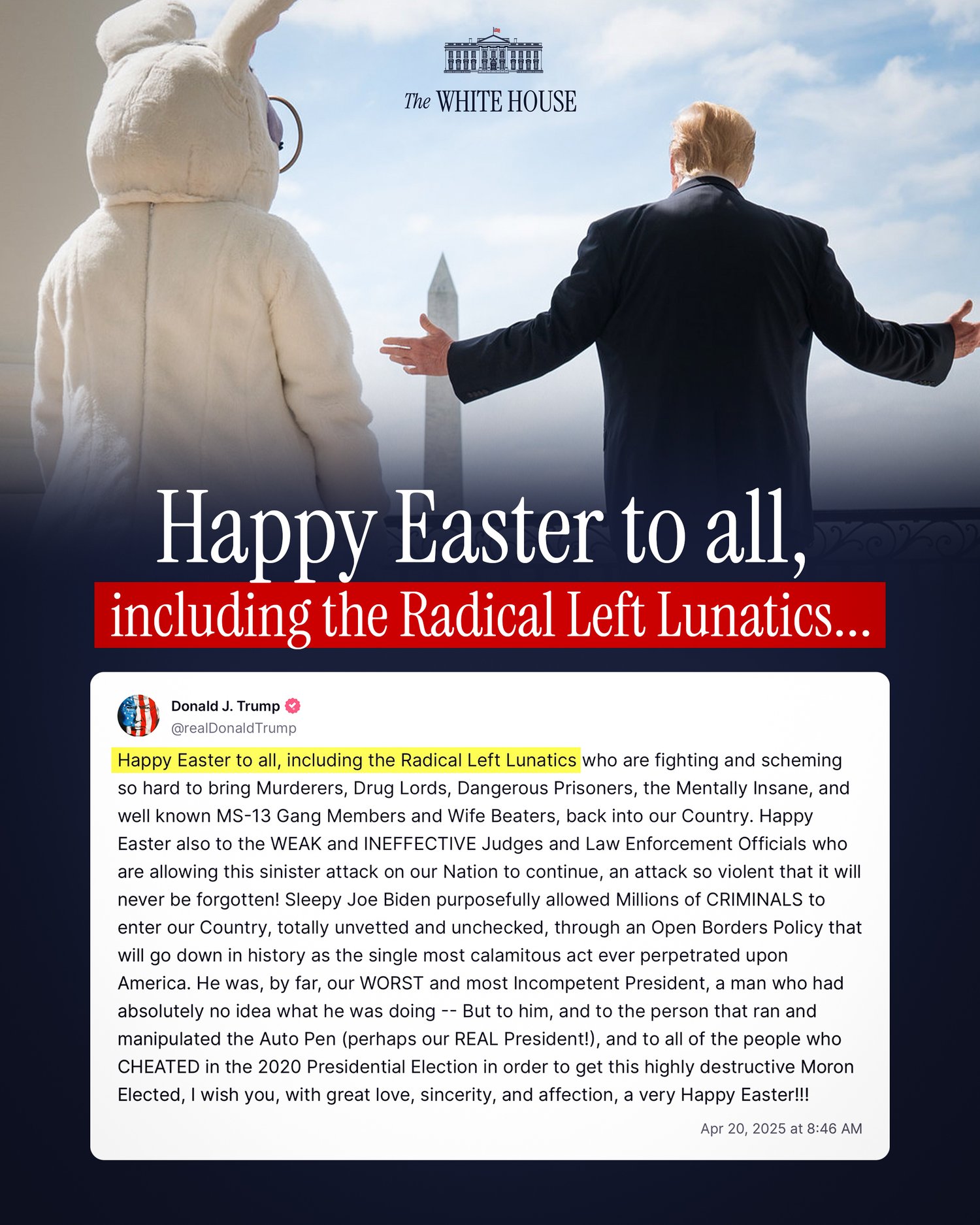
In other words, the Christian influence on actual Republican policy items and their political vision is going to be exceedingly negligible going forward. Sure, Vice President Vance will make an appearance at the March for Life. President Trump will show up to the National Prayer Breakfast. But even when he does acknowledge a Christian event, it often will come loaded with hatred and vile self-aggrandizement, as seen yesterday:
And ultimately when push comes to shove on the policy level, Christian concerns will always be backgrounded or eliminated relative to the priorities of the three above groups, as we have already seen on abortion, marriage, and PEPFAR.
I originally thought to post this on a Sunday, when my focus is narrower, but it didn’t fit there because I don’t value “religion” for its instrumental partisan-political value.
It was a very few years ago when I warned (as had others) “If you don’t like the Religious Right, just wait ‘till you see the irreligious Right.” Well you’ve been seeing them in power for three months now.
Beta-testing tyranny in the Sunshine State
Ron DeSantis walked so that Donald Trump could run. When the time came to formulate a policy response to the woke left, no one mattered more than the governor of Florida.
And through it all, DeSantis declared that Florida was the place where “woke goes to die.”
In his second term, Trump is a scaled-up version of DeSantis. Every element of the DeSantis model has been deployed against Trump’s ideological enemies …
…
At first I was optimistic about the anti-woke right. Their free speech argument resonated with me. I’d spent decades litigating free speech cases, after all, and I’d never really seen anything like a mass movement for free expression.
But my optimism quickly faded. In 2021, the anti-woke right embraced a series of state laws that were designed to ban critical race theory. Rather than meet critical race theorists in the marketplace of ideas, the right chose to try to suppress their expression.
By this time I was familiar with the right’s authoritarian turn — and getting very worried about it. In 2019, parts of the intellectual right were consumed with a fight over liberalism itself, with the new right arguing that liberal values — freedom of speech and free trade, for example — were hollowing out American culture, creating a nation of atomized individuals who were consumed with self-actualization (and consumption itself) at the expense of family and community.
Ironically, the left, now alarmed by the federal government’s intrusive reach [into, say, Harvard], bears direct responsibility for crafting the very legal weapons wielded against the universities it dominates. Almost four decades ago, progressive legislators demanded sweeping amendments to civil rights law, expanding federal oversight over higher education. The sequence of events reveals a cautionary tale of political hubris: progressive confidence that state power would reliably serve their ends overlooked the reality that governmental authority, once unleashed, recognizes no ideological master. Today’s circumstances starkly illustrate how expansive federal control over civil society, originally celebrated by progressives, returns to haunt its architects. The left’s outrage ought to focus not on this particular administration but on its own reckless empowerment of the state.
Yet for all its courage, Harvard’s response stopped short of making the argument that would best protect the values for which it was fighting. It defended the university’s independence without explaining why that independence deserves protection. It invoked values like “pluralism” and “inquiry,” but it did not fully explain why those values are essential to a liberal democratic society. The letter therefore missed an opportunity to articulate what a university is for — not just to students or donors, but to the country. And this matters, because Trump’s attack against this and other universities is not only about the balance of power between universities and the government. It is, at bottom, about the legitimacy of higher education as a public good.
The danger of being a professional exposer of the bogus is that, encountering it so often, one may come in time to cease to believe in the reality it counterfeits.
Your enemies are not demonic, and they are not all-powerful and the right hasn’t always lost and the left hasn’t always won. But if you convince yourself of that, you give yourselves all sorts of permission to do a lot of stupid and terrible things under the rubric of “Do you know what time it is?”
Regarding said “lot of stupid and terrible things,” my failure to call out anything about the current regime does not mean I approve. There’s just too much, and on some of the apparent illegalities I don’t want to abuse my credentials without thinking it through.
I don’t do any of the major social media, but I have two sub-domains of the domain you’re currently reading: (a) You can read most of my reflexive stuff, especially political here. (b) I also post some things on the only social medium I frequent, because people there are quirky, pleasant and real.
President Trump does not seem to notice or care that if you betray people, or jerk them around, they will revile you. Over the last few weeks, the Europeans have gone from shock to bewilderment to revulsion. This period was for them what 9/11 was for us — the stripping away of illusions, the exposure of an existential threat. The Europeans have realized that America, the nation they thought was their friend, is actually a rogue superpower.
In Canada and Mexico you now win popularity by treating America as your foe. Over the next few years, I predict, Trump will cut a deal with China, doing to Taiwan some version of what he has already done to Ukraine — betray the little guy to suck up to the big guy. Nations across Asia will come to the same conclusion the Europeans have already reached: America is a Judas.
This is not just a Trump problem; America’s whole reputation is shot. I don’t care if Abraham Lincoln himself walked into the White House in 2029, no foreign leader can responsibly trust a nation that is perpetually four years away from electing another authoritarian nihilist.
An anti-constitutional act is one that rejects the basic premises of constitutionalism. It rejects the premise that sovereignty lies with the people, that ours is a government of limited and enumerated powers and that the officers of that government are bound by law.
The new president has, in just the first two months of his second term, performed a number of illegal and unconstitutional acts. But the defining attribute of his administration thus far is its anti-constitutional orientation. Both of its most aggressive and far-reaching efforts — the impoundment of billions of dollars in congressionally authorized spending and the attempt to realize the president’s promise of mass deportation — rest on fundamentally anti-constitutional assertions of executive authority.
…
There is much to say about the administration’s decision to seemingly ignore a court order to halt or reroute deportation flights for these people and return them to United States. For now, let’s focus on the Justice Department’s initial defense of the president’s order, in which government lawyers argued the following: “Beyond the statute, the President’s inherent Article II authority is plainly violated by the district court’s order. As a function of his inherent Article II authority to protect the nation, the President may determine that [Tren de Aragua, a criminal gang] represents a significant risk to the United States … and that its members should be summarily removed from this country as part of that threat.”
In other words, according to the Justice Department, the president of the United States has an “inherent” power to summarily deport any accused member of Tren de Aragua (and presumably, any foreign national accused of membership in any gang) without so much as a hearing. What’s more, under this logic, the president can then direct his administration to send that person, without due process, to prison in a foreign country.
This is a claim of sovereign authority. This is a claim that the president has the power to declare a state of exception around a group of people and expel them from the nation — no questions asked. It is anti-constitutional — a negation of the right to be free, in Locke’s words, of “the inconstant, uncertain, unknown, arbitrary will of another man.”
There is nothing in this vision of presidential power that limits it to foreign nationals. Who is to say, under the logic of the Department of Justice, that the president could not do the same to a citizen?
If Congressional Republicans took their oaths of office seriously, they’d be impeaching Trump and removing him from office. He has already destroyed many of our most important international relationships (see David Brooks, above), and by “destroyed,” I mean that we face a long period of repair even if he were removed this afternoon.
Dems and Damon in the same headspace?
[M]y assumptions and style of analysis bring me back again and again to a feeling of fatalism rooted in the conviction that the time to stop Trump was in November 2016, in the immediate aftermath of the January 6 insurrection (via conviction in his second impeachment trial), or in November 2024. I don’t want to succumb to the feeling that it’s already too late to stop him. It’s just that I’m still trying to figure out how to break out of that cul-de-sac.
To collapse the structure of American justice and replace it with a proper banana republic, each pillar holding it up needs to be weakened.
The president spent most of his first two months in office focused on a single pillar: law enforcement. He purged officials at the Justice Department and FBI and replaced them with clownish toadies like Pam Bondi, Kash Patel, and Dan Bongino. That was a sensible way for an authoritarian to prioritize: Of the institutional players I’ve mentioned, corrupt cops and prosecutors can do the most damage. As long as the DOJ is willing to behave like a secret police force, Donald Trump doesn’t need to send Liz Cheney or Mark Milley to prison to make their lives miserable. Investigations are punishment enough.
His Castro-esque speech on Friday to Justice Department officials reflected his priorities. The president labeled political enemies like former special counsel Jack Smith “scum,” claimed that CNN and MSNBC are behaving “illegally” somehow, babbled about the supposedly rigged 2020 election, and insisted that the January 6 defendants he pardoned were “grossly mistreated.” The speech ended with the song “YMCA,” as you might hear at one of his political rallies.
Watching it felt like watching a dog mark his territory.
I may not have said this before: Trump’s shock and awe assault on norms, perceived enemies, constitutional limitations and the independence of “independent agencies” are so comprehensive, and so blur together in news coverage, that I couldn’t keep up, and couldn’t cogently predict which actions will ultimately be found unlawful, even if I tried.
And I’m trying not to try.
Oh, I still listen to legal podcasts, and they typically cover some of the cases brewing. If you get an opinion from me on a case, I’ll probably be regurgitating some of them, lightly post-processed.
I don’t feel responsible for Trump. He’s something I’m suffering along with everyone else — and my situation means I’m not personally suffering all that much except anxiety for my living descendants.
I don’t think Trump is the eventuality of true conservatism, though he may be the eventuality of the Moral Majority and other Religious Right activism starting in the 70s. I was never on board with them; I’m even less on board with them since becoming an Orthodox Christian; and I’m pleased to contemplate a knife fight between the New, Improved Religious Right (The New Apostolic Reformation! All you loved about the Moral Majority, but now with added Charismatic flakery!) and the Catholic Integralist “Common Good Constitutionalism.”
(Thoughts prompted by my deciding not to read a Wall Street Journal article on a Federal District court ruling against the demolition of USAID.)
Inflicting trauma
Russell Vought, a graduate of Wheaton College, now describes himself as a “Christian nationalist.” He also says:
“We want the bureaucrats to be traumatically affected,” he said. “When they wake up in the morning, we want them to not want to go to work because they are increasingly viewed as the villains. We want their funding to be shut down so that the EPA can’t do all of the rules against our energy industry because they have no bandwidth financially to do so.
“We want to put them in trauma.”
He may be a nationalist, but he puts his Christianity open to serious question by such hateful intentions. (Mark 8:36.) He’s rather unpopular at Wheaton, too, which is much to its credit.
Free speech lies
The president brags about ‘ending censorship’ while describing negative coverage about him as ‘illegal.’
I don’t do any of the major social media, but I have two sub-domains of the domain you’re currently reading: (a) You can read most of my reflexive stuff, especially political here. (b) I also post some things on the only social medium I frequent, because people there are quirky, pleasant and real.
Also, whenever I read this paragraph to people who don’t live in the South, they get hung up on the fact that we had furniture devoted to just guns, but in rural Texas pretty much everyone has a gun cabinet. Unless they’re gay. Then they have gun armoires.
Jenny Lawson, Let’s Pretend This Never Happened (a book that I haven’t read, but this quote came to my appreciative attention).
Pacifying the bathroom battlefield
I have a solution to this kind of nonsense: why do we need separate men’s a women’s bathrooms?
In parts of Europe or the Middle East (two areas where I’ve traveled; I can’t remember in which I saw this), toilet cubicles have walls that extend to the floor and close to the ceiling. The doors close against jambs, leaving no vertical cracks people can see through. Men and women queue up, using the same sinks for handwashing but using cubicles one at a time without sexual distinction.
Maybe that’s too grown-up for America, though.
Burke
Society is “a kind of inheritance we receive and are responsible for; we have obligations toward those who came before and to those who will come after, and those obligations take priority over our rights.”
To work at The Free Press, though, you have to completely exit the bubble. This is one of the things I’ve come to value most about it. My colleagues and our contributors have opinions across the political spectrum—and consequently, we publish articles across the political spectrum. I’ll admit I found it annoying during the presidential campaign that many of my colleagues kept hitting Kamala Harris over the head with a two-by-four. But I couldn’t deny the rationale—that the Democratic presidential candidate fundamentally had nothing to say. When Bari was asked why we focused more on Harris than Donald Trump, she replied that the legacy media was all over Trump, and somebody needed to hold Harris’s feet to the fire. I couldn’t disagree.
History should also note that some of the individuals and institutions that are supposed to protect our freedom of expression actively tried to suppress Shrier’s work.
Chase Strangio, the co-director of the ACLU’s LGBTQ & HIV Project, and a transgender man, pronounced a kind of epitaph for what the ACLU used to stand for when he tweeted about Irreversible Damage: “stopping the circulation of this book and these ideas is 100% a hill I will die on.”
This is the same Chase Strangio who, a few weeks ago, was forced to admit to the Supreme Court that the “dead daughter or live son?” question whereby the trans cult emotionally blackmails parents into consenting to medical transition for gender dysphoric daughters is a lie, that suicide is not a major problem in gender dysphoria even without transitioning.
Trump 47
Taming the press
Trump has figured out how to emasculate the media and make them tame lap-dogs. Freedom of press is enshrined in the 1st Amendment, but much of the press (e.g., Washington Post, Los Angeles Times) is owned by billionaires with multiple other business interests that don’t have clear constitutional protection:
The leverage point Trump has recognized is that most major media properties are tied to some larger fortune: Amazon, Disney, NantWorks (the technology conglomerate owned by Soon-Shiong), and so on. All those business interests benefit from government cooperation and can be harmed by unfavorable policy choices. Trump can threaten these owners because he mostly does not care about policy for its own sake, is able to bring Republicans along with almost any stance he adopts, and has no public-spirited image to maintain. To the contrary, he has cultivated a reputation for venality and corruption (his allies euphemistically call him “transactional”), which makes his strongman threats exceedingly credible.
A lot of very powerful people seem to have reached the same conclusion. The behavior of corporate America toward Trump this past week can be understood as a product of two beliefs. One: Under the new administration, the U.S. government will function like a protection racket. Threats will be the currency of politics. Either you pay for the president’s “protection” or you get squeezed.
Two: As this unfolds, most Americans won’t care a bit.
…
A news industry owned and operated by oligarchs is easy pickings for an unscrupulous authoritarian because those oligarchs have many points of financial vulnerability. Trump doesn’t need to hurdle ABC News’ First Amendment rights in order to win his suit when he can sidestep those rights by squeezing [ABC’s owner] Disney instead.
The answer may be to get a higher proportion of your news from sources like The Free Press (see Joe Nocera, above) or The Dispatch. (see Nick Catoggio, immediately above, though Nick only does commentary, not news).
Cover the children’s eyes and ears
Is Mr. Trump an irrevocable break with the past?
He isn’t the old-style president who allows you to say to the kids, “I’d like you to be like that man.” Jimmy Carter with his personal rectitude, Ronald Reagan and George H.W. Bush with their virtues—Mr. Trump is a break with that, and the way he spoke when he first announced in 2015 made it clear. When he spoke of Mexican immigrants as criminals and rapists, “and some, I assume, are good people,” which is a very Trumpian formulation, I thought, that’s not how presidents talk, you have to be measured, thoughtful, kindly.
I thought: That’s bad. But my sister and uncle thought it was good. They understood what he was saying and why he was saying it, they agreed with him, but they also knew he couldn’t walk it back. He couldn’t be elected and then say, “Oh, I changed my mind, on second thought we need more illegal immigration.” They felt the crudeness of his language meant that he was actually telling them the truth. It was a relief to them. “Forget eloquence, close the border!” They felt if the right policy requires a brute, get the brute.
We have lots and lots and lots of ordinary, routine, foreseeable medical expenses that we should be paying for as though they were a cup of coffee or a Honda Civic, and we would almost certainly have radically better and more affordable care in those areas if we did. If your complaint is that people can’t afford to do that, then you have a tricky question to answer: If Americans as individuals and families cannot afford to pay for routine health care, then how the hell are Americans as one big indiscriminate national lump supposed to afford paying for routine health care? If nobody can afford it, then how can everybody afford it? Even if you deduct private profit and corporate administrative costs and such from the equation (which is nonsense, but, arguendo), the math doesn’t get a lot better. If your answer is “My nurse practitioner is too greedy—she drives a Lexus!—and rich people don’t pay enough taxes!” then you are a very silly person who doesn’t deserve to be taken seriously.
I don’t do any of the major social media, but I have two sub-domains of the domain you’re currently reading: (a) You can read most of my reflexive stuff, especially political here. (b) I also post some things on the only social medium I frequent, because people there are quirky, pleasant and real.
You may be relieved to know there’s nothing today explicitly about the 2024 Election or any of the candidates in it, save for this one personal thing.
In a fit of righteous (I hope) indignation, I believe I recently wrote that if Indiana is in play come November 5, I would vote for Kamala Harris. Reminded of the centrality of permissive abortion to her campaign, and of the extremity of the national Democratic Party’s support for “transitioning” as its signature (and aggressive) response to adolescent gender dysphoria, I retract that ill-considered position. I could say more about why these two issues combined are deal-breakers, but I’d be borrowing heavily from J Budziszewski if I did (see also Concurring with Exemplary Clarity below).
Think about yard signs. The progressive ones read:
Black Lives Matter Women’s Rights = Human Rights No Human Is Illegal Science Is Real Love Is Love Diversity Makes Us Stronger Kindness Is Everything
What would ours say? There are “conservative” yard signs for sale. But they contain no moral vision, nothing to believe in, only an effort to “own the libs.”
Our cupboard is so bare that young men are filling auditoriums to hear Jordan Peterson tell them to clean their rooms.
In my weaker moments, I’ve been known to look for an “own the libs” yard sign in response to the mincing sentiments of the progressive sign quoted, but nothing I found (and I found very little) was anything I’d put up in my yard.
The Nicene Creed might fit on a sign, but it would illegible to passing drivers, and I would be taking God’s name in vain if I put it up in rainbow hues.
From Front Porch Republic’s Saturday recommendations
“Wendell Berry at 90.” Jonathon Van Maren reflects on why Wendell Berry means so much to so many of his readers: “Berry’s fiction is not only a record of rural life and the slow death of agricultural America, but also a record of the interior lives of Americans before we outsourced our thinking to digital devices and absorbed our worldviews from screens. His novels lack the frantic pace of so many of his contemporaries; reading them, I had to slow my own mind and detach from the mile-a-minute culture wars to match the pace of the men and women of Port William. Always, his stories left me feeling refreshed.”
“Why Christian Parents Should Resist School-Issued Screens.” Patrick Miller offers a set of arguments supported by research to help parents push back against the lure of progress. He draws from his own experience on a school board: “We were offered tens of thousands of dollars in grants to pay for one-to-one devices in our classrooms. Saying no felt like stealing something from students. It felt like resisting progress. But we said no anyway, because our pressing question wasn’t ‘How can we restructure our curriculum around new technology?’ but ‘What technologies are best suited to serve our educational mission?’ Technology wasn’t our master; it was the servant. And there wasn’t enough research to prove it was a good servant.”
“Life on Mars.” Grace Mackey pens a thoughtful review of Haidt’s book, The Anxious Generation: “As a member of Gen Z, this was not a light read. When you spend your teens owning a smartphone, you grow used to hearing your parents and teachers blame your problems on a phone— It gets tiresome. I understand the skepticism towards Haidt and the concern that he is a grumpy old man tired of watching the online world expand into something foreign to him. I had some of that skepticism. Regardless, I picked up his book because I was genuinely curious if he offered explanations of anxiety that I hadn’t heard before. This past year, I started therapy because I needed help managing my anxiety disorder. While reading, it didn’t take long for my skepticism to fade and alarm to set in. I was struck by how deeply I resonated with what Haidt described.”
“I was there” at the founding of Front Porch Republic, having followed several of the founding curmudgeons (e.g., Patrick Deneen, Jason Peters) before they coalesced. FPR has changed, but I still find it very much worth reading still — the Saturday curation of others’ articles especially.
Concurring with exemplary clarity
Earlier this year, the Supreme Court of Texas handed down a decision (Texas v. Loe) upholding that state’s law prohibiting medically irreversible and damaging transgender treatments for minors. The Court held that, in passing the statute, the Texas legislature employed its constitutionally legitimate power to promote the health and welfare of the state’s citizens. The law does not infringe upon the rights of parents to determine the medical care of their children or the rights of doctors to provide care.
Justice Jimmy Blacklock wrote a concurring opinion that laid out the issues at stake with exemplary clarity. He observed that the case turned on fundamental and mutually exclusive assumptions about what it means to be human.
Within the Traditional Vision, human males and females do not “identify” as men and women. We are men and women, irreducibly and inescapably, no matter how we feel. Proceeding from these moral and philosophical premises, the Traditional Vision naturally holds that medicinal or surgical interference with a child’s developing capacity for normal, healthy sexual reproduction is manifestly harmful to the child, an obvious injustice unworthy of the high label “medicine.”
Against this view, Blacklock ranges the alternative—“call it the Transgender Vision.” This view “holds that we all have a ‘sex assigned at birth,’” and thus assigned, it “may or may not correspond to our inwardly felt or outwardly expressed ‘gender identity.’” Under these assumptions, “the Transgender Vision holds that an adolescent child who feels out of place in a biologically normal body should in many cases take puberty-blocking drugs designed to retard or prevent the emergence of sexual characteristics out of line with the child’s gender identity.” It manifestly follows that parents and children have a right to this kind of treatment, just as they have a right to other medical procedures that promote well-being.
The Traditional and Transgender Visions “diverge at the most basic level.” The disagreement is metaphysical, as it were. Judges need to recognize that debates over medical procedures and disputes about empirical claims concerning the efficacy of transgender treatments “are merely the surface-level consequences of deep disagreement over the deepest questions about who we are.” The Traditional Vision sees the treatments as “self-evidently harmful to children,” whereas the Transgender Vision regards the same treatments as “necessary medical care.”
The constitutional question amounts to this: Does the Texas Legislature have the proper constitutional authority to legislate in accord with the Traditional Vision? Or does the Transgender Vision enjoy a special, privileged constitutional status, which the court must honor? Blacklock observes that it would be very strange for a judge to answer “no” and “yes.” How could anyone reasonably hold that the Traditional Vision, which has held sway from time immemorial, can’t serve as a rational basis for determining what accords with the health and welfare of citizens? And on what basis can a judge determine that the Transgender Vision enjoys privileged status, given the fact that it has never “obtained the consent of the People of Texas”?
A great deal of testimony in this case came from medical experts, who insisted that interventions to facilitate “transitioning” enjoy the approval of medical associations and other professional bodies. Blacklock notes that such testimony is irrelevant. “The Texas Constitution authorizes the Legislature to regulate ‘practitioners of medicine.’ It does not authorize practitioners of medicine to regulate the Legislature—no matter how many expert witnesses they bring to bear.” Quite right. Doctors and researchers are free to adopt metaphysical assumptions. But so are legislators. And when those assumptions conflict, those of elected legislators determine the law, not those of “experts.”
Blacklock gets to the nub of our debates about transgender ideology (and pinpoints the specious reasoning of the Supreme Court’s Bostock decision): Those urging transgender rights “claim that the Transgender Vision is an established matter of science, not a matter of belief.” But saying it does not make it so. “From the perspective of the Traditional Vision”—I would say, from the perspective of any clear-thinking person—“any such assertion is an inherent conflation of speculative philosophy and empirical science. Neither a philosophical proposition (‘gender identity is real’) nor a moral rule (‘gender identity should be affirmed’) can be proven with scientific method or the tools of medicine.”
Medical associations, academic journals, and universities have become captive to progressive ideologies, transgender ideology among them. They are certainly not trustworthy sources of moral wisdom. And they are increasingly untrustworthy sources of empirical truths. Kudos to Justice Blackwood for so clearly explaining why their distorted moral presumptions and perverted science should not be accorded transcendent legal authority.
Reno has steered First Things so far in a MAGA (and Roman Catholic) direction that I was resolved to drop it. Then came the October issue, with Oren Cass’ article, Constructing Conservatism, three erudite responses to it, and this item, which I had not seen elsewhere. I guess I’ll be in for another year, but it sure is a bleak landscape most months.
Effete aristocrats
The dirty secret of “content moderation” everywhere is that it’s a tiny sliver of the educated rich correcting everyone else. It’s telling people what fork to use, but you can get a degree in it.
…
In prerevolutionary France, even the most drunken, depraved, debauched libertine had to be prepared to back up an insolent act with a sword duel to the death. Our aristocrats pee themselves at the sight of mean tweets. They have no honor, no belief, no poetry, art, or humor, no patriotism, no loyalty, no dreams, and no accomplishments. They’re simultaneously illiterate and pretentious, which is very hard to pull off.
A: One plane flight a year cancels out a lot of “environmentalist” talk. B: I have been saying this for years. It’s even more true if CO2 emissions are all you care about; on those grounds alone you’re better off trading your Tesla for an F250 and canceling that trip to Europe. But airplanes are to one class what trucks are to another, and it’s the airplane class that runs things. Environmental policy, like everything else, is too often a matter of whose ox is being gored. C: The airplane class is definitely a thing–and boy how [do] they love to lecture the bumpkins.
I didn’t ask permission to identify the writers (none of which was me), but thought the “Airplane Class” was a useful construct.
I suffer more from the humiliations inflicted by my country than from those inflicted on her.
I don’t do any of the major social media, but I have two sub-domains of the domain you’re currently reading: (a) You can read most of my reflexive stuff, especially political here. (b) I also post some things on the only social medium I frequent, because people there are quirky, pleasant and real.
I’m on vacation, so I’m not going to take the time to sort these into topics.
Also, it’s a major Feast day in the Eastern Church. The Orthodox Church at my vacation destination appears to be postponing observance to tomorrow — an Orthodox oddity in my limited experience.
Selling hoi polloi a delusion
Those with a material interest in doing so have learned to speak autonomy talk, and to tap into the deep psychology of autonomy in ways that lead to its opposite.
Matthew Crawford, The World Beyond Your Head
Purposeful to a fault
Himmler quite aptly defined the SS member as the new type of man who under no circumstances will ever do “a thing for its own sake.”
Hannah Arendt, The Origins of Totalitarianism
Sit quietly with that one for a minute. Then consider Josef Pieper, Leisure, The Basis of Culture.
“Televangelists”
Fugitive Televangelist Wanted by F.B.I. Is Caught in the Philippines Weeks of tense standoff in the Philippines have ended in the capture of a pastor accused of leading an international ring of sex abuse and trafficking of young women and girls.
I don’t believe it would be fair to saddle any Christian tradition or denomination with this guy. From what the Times says about the idolatrous adulation he cultivated, he was plainly some kind of one-off cultist.
But I have no idea how many one-off cultists are abroad in the world, when this admonition currently being featured at the end of my Sunday blog posts:
Religious ideas have the fate of melodies, which, once set afloat in the world, are taken up by all sorts of instruments, some woefully coarse, feeble, or out of tune, until people are in danger of crying out that the melody itself is detestable.
George Elliot, Janet’s Repentance, via Alan Jacobs
Huge (if true)
Donald Trump runs no risk of going to prison in the middle of his campaign, thanks to Judge Juan Merchan’s decision Friday to postpone sentencing until Nov. 26. The delay gives his lawyers more time to prepare an appeal. Fortunately for Mr. Trump, his trial was overwhelmingly flawed, and a well-constructed appeal would ensure its ultimate reversal.
A central problem for the prosecution and Judge Merchan lies in Article VI of the U.S. Constitution, which makes federal law the “supreme law of the land.” That pre-empts state law when it conflicts with federal law, including by asserting jurisdiction over areas in which the federal government has exclusive authority.
Mr. Trump’s conviction violates this principle because it hinges on alleged violations of state election law governing campaign spending and contributions. The Federal Election Campaign Act pre-empts these laws as applied to federal campaigns. If it didn’t, there would be chaos. Partisan state and local prosecutors could interfere in federal elections by entangling candidates in litigation, devouring precious time and resources.
That hasn’t happened except in the Trump case, because the Justice Department has always guarded its exclusive jurisdiction even when states have pushed back, as has happened in recent decades over immigration enforcement.
The normal approach would have been for the Justice Department to inform District Attorney Alvin Bragg, who was contemplating charges against Mr. Trump, of the FECA pre-emption issue. If Mr. Bragg didn’t follow the department’s guidance, it would have intervened at the start of the case to have it dismissed. Instead the department allowed a state prosecutor to interfere with the electoral prospects of the chief political rival of President Biden, the attorney general’s boss.
In the summer of 2015, back when he was still talking to traitorous reporters like me, I spent extended stretches with Donald Trump. He was in the early phase of his first campaign for president, though he had quickly made himself the inescapable figure of that race—as he would in pretty much every Republican contest since. We would hop around his various clubs, buildings, holding rooms, limos, planes, golf carts, and mob scenes, Trump disgorging his usual bluster, slander, flattery, and obvious lies. The diatribes were exhausting and disjointed.
But I was struck by one theme that Trump kept pounding on over and over: that he was used to dealing with “brutal, vicious killers”—by which he meant his fellow ruthless operators in showbiz, real estate, casinos, and other big-boy industries. In contrast, he told me, politicians are saps and weaklings.
“I will roll over them,” he boasted, referring to the flaccid field of Republican challengers he was about to debate at the Ronald Reagan Presidential Library that September. They were “puppets,” “not strong people.” He welcomed their contempt, he told me, because that would make his turning them into supplicants all the more humiliating.
“They might speak badly about me now, but they won’t later,” Trump said. They like to say they are “public servants,” he added, his voice dripping with derision at the word servant. But they would eventually submit to him and fear him. They would “evolve,” as they say in politics. “It will be very easy; I can make them evolve,” Trump told me. “They will evolve.”
Like most people who’d been around politics for a while, I was dubious. And wrong. They evolved.
The eighteenth-century Humean slave of the passions is thus indistinguishable from the liberated, twentieth-century Sartrean individual living authentically.
Brad S. Gregory, The Unintended Reformation
All that matters is strength
Part of the reason Trump is less constrained on [the abortion] issue than his predecessors is that he’s transformed the Christian right just as he has the broader conservative movement, dethroning serious-seeming figures while promoting those once regarded as flamboyant cranks. In Republican politics, Steve Bannon and Alex Jones now have far more influence than erstwhile conservative stalwarts like Paul Ryan and Dick Cheney. Similarly, in the religious realm, the ex-president has elevated a class of faith healers, prosperity gospel preachers and roadshow revivalists over the kind of respectable evangelicals who clustered around George W. Bush. “Independent charismatic leaders, who 20 years ago would have been mocked by mainstream religious right leaders, are now frontline captains in the American culture wars,” writes the scholar Matthew D. Taylor in his fascinating new book, “The Violent Take It by Force: The Christian Movement That Is Threatening Our Democracy.”
The churches Taylor is writing about exist outside the structures and doctrines of denominations like the Southern Baptists. They’re led by flashy spiritual entrepreneurs who fashion themselves as modern apostles and prophets with supernatural spiritual gifts, and they represent one of the fastest-growing movements in American Christianity. Among many of these churches, Trump remains the anointed one, chosen by God to restore Christian rule to the United States. These Christians care a great deal about abortion, but they appear to care at least as much about Trump. Many of them see him as a modern-day version of the Persian emperor Cyrus, a heathen who, in the sixth century B.C.E., rescued God’s chosen people from Babylonian captivity. In this framework, Trump’s piety is irrelevant; all that matters is his strength.
I think Goldberg, no Christian, is right. And that means that it’s hard to say that MAGA and I share the Christian tradition; their religion seems from a darker source.
Ted Cruz is no dummie
Liz Cheney famously endorsed Kamala Harris over Donald Trump, and less famously endorsed Democratic U.S. Representative Colin Allred over Ted Cruz for Cruz’s Texas Senate seat.
So has she abandoned the GOP?
I can’t speak for Cheney, but I can tell you why I’m voting for Allred over Cruz—and it has nothing to do with policy or burning anything down.
Since January 6, the threshold question I ask when considering whether to vote for a Republican is how that candidate responded to Trump’s coup attempt. There’s a spectrum of behavior on that point, with Cheney and Kinzinger on one end, Trump himself on the other, and the mass of congressional Republicans somewhere in between.
At the two extremes of the spectrum, policy doesn’t matter to me. Policy debates are things you get to have when everyone agrees on the rules of the game. Rewarding those who defended democratic norms and punishing those who undermined them is more important.
I would vote for Cheney and every other Republican who voted to impeach or convict Trump following the insurrection in hopes that their victories would embolden others in the party to resist his power grabs in a second term. And I would vote against Trump and all of his co-conspirators for the opposite reason, in hopes that their defeats would convince others that civic crime, like trying to overturn an election on false pretenses, doesn’t pay.
Ted Cruz was Trump’s chief co-conspirator in the Senate after the 2020 election, initially agreeing to argue before the Supreme Court that the electoral votes of swing states won by Joe Biden should be thrown out. When the court declined to hear that case, Cruz switched to Plan B and ring-led a scheme on January 6 to stop Congress from certifying Biden’s victory by objecting to those swing-state electoral votes. Had he gotten his way, some sort of chaotic ad hoc election “commission” would have been thrown together before Inauguration Day to decide who the next president should be.
He did all of this knowing full well that Trump was and is a loon and that egging on Americans to doubt the fairness of their own elections will destabilize the country long-term. But he was willing to pay that price because he thought making himself useful to the coup would give him a leg up with Trump’s base when he runs for president again someday.
You don’t need to agree with Colin Allred on a single policy issue to grasp that a person like Ted Cruz cannot be trusted to defend the constitutional order. He was tested and failed grievously. If you believe that a second Trump presidency would create a “unique threat” to American government, as Liz Cheney and I do, it’s urgent that Trump’s most unethical enablers in Congress be replaced by people who won’t rubber-stamp anything he does.
Republicans in Texas had their chance to replace Cruz with a candidate like that in this year’s primary, just as Republicans nationally had their chance to replace Trump. They made their choice. Cheney and I have made ours.
It’s frankly amazing to me that so many conservatives have been left struggling to understand Cheney’s endorsement of Allred. To a certain sort of partisan, it seems, Trump is the only elected Republican who bears meaningful responsibility for the attempt to overturn the 2020 election. Ted Cruz, Mike Lee, the scores of House GOPers who voted to object on January 6—they’re all off the hook because, well, there are just too many of them to punish. Beating them at the polls would wipe out the party, and partisans won’t tolerate that. Even for just one election cycle, to teach their representatives a hard lesson about authoritarian bootlicking.
If you feel obliged to excuse Ted Cruz for his role in a coup plot because that’s what hating Democrats requires of you, you do you. But let’s please stop memory-holing his part in it by feigning confusion as to why Liz Cheney might want to drive him from politics. It’s pathetic.
Ted Cruz is no dummie. He’s whip-smart and cunning. He also is a contemptible human being with no core. His mentor, Princeton’s Robert P. George, must be deeply grieved.
Shanghaied
Few cities in Asia match Shanghai’s level of economic development. In the fanciest shopping streets in the city center you can go miles without leaving the realm of luxury stores, with a Hermes outlet abutting a Louis Vuitton outlet, which in turn abuts a Rolex outlet. At times, the city reminded me of an acquaintance’s semi-humorous observation that, in a hundred years, luxury brands may be all that remains of Europe’s once enormous influence on the world.
In Postwar, Tony Judt argues that in the 1960s, the restive mood of Europe’s young was in part fueled by the ugliness of the homes in which they had been raised and the new universities in which they were being educated. Comparisons between Europe sixty years ago and China today are certain to be wrong for any number of reasons, but my mind kept going back to Judt’s observation every time I drove past another island of identical, unadorned housing blocks.
Preferences about the next American president seem to be nearly as divided among Chinese intellectuals as they are among the American electorate. A senior scholar of international relations told me that Donald Trump would likely be more willing to cut deals with China but that he preferred Kamala Harris because of her greater predictability on the international stage. A senior economist told me that Kamala Harris might prove softer on tariffs but that she would prefer Donald Trump because of his greater predictability on economic policy. The only consistent refrain was the preference for perceived predictability: Chinese elites seem as discombobulated by the sense that it’s impossible to predict what Washington might do as they are by any specific action the next president might take.
The chief petty officers aboard the USS Manchester (LCS-14) were caught illicitly placing and using a Starlink satellite-internet antenna while the ship was under way. The conspiracy, involving all senior enlisted sailors attached to the littoral combat ship, came to light after months of use, when a civilian contractor came aboard and stumbled upon the bootleg setup. The ship’s command senior chief and ringleader of the operation was convicted at court-martial and reduced in rank from E-8 to E-7: an outrageously light penalty considering her repeated lies to her commanding officer, her background in Navy IT that ensures she was absolutely aware of her transgression, and the cover-up campaign that involved the intimidation and silencing of those below her. This betrayal of the ship’s whereabouts in service to movie-streaming, texting, and other forms of personal entertainment is especially egregious because of the role that chiefs have in preserving good order and discipline among the ranks while upholding Navy traditions. A bad chief is the ruin of a ship and its crew, and the legal equivalent of keelhauling the only correct recourse.
National Review’s The Week Friday email. See also the Navy Times.
Donald Trump after the debate
The Hill: Trump Floats Punishment For ABC After Debate
I mean, to be honest, they’re a news organization. They have to be licensed to do it. They ought to take away their license for the way they did that.
This response is fractally wrong. ABC doesn’t need a license to be a news organization (thank God and the First Amendment).
If they did have a license, it would be dictatorial to revoke it for displeasing the President or anyone else.
Trump once again exhibits his anti-democratic impulses, though once again it probably will deter no fans.
Lesser evils
“Sending migrants away, not allowing them to grow, not letting them have life is something wrong; it is cruelty,” Francis said in a news conference on the plane as he returned to Rome after his long trip to Southeast Asia and Oceania. “Sending a child away from the womb of the mother is murder because there is life. And we must speak clearly about these things.”
…
But when asked whether it would be morally admissible to vote for someone who favored the right to abortion, he responded: “One must vote. And one must choose the lesser evil. Which is the lesser evil? That lady or that gentleman? I don’t know. Each person must think and decide according to his or her own conscience.”
Donald Trump seemingly is Teflon-coated, but explicit Papal permission to vote for the (more) pro-abortion candidate could logically be a factor in this election.
Even WSJ is appalled
Ms. Loomer is usually described in the press as “far right,” but that’s unfair to the fever swamps. On Sunday she posted on X that if Ms. Harris wins the election, “the White House will smell like curry,” a gibe against Ms. Harris’s Indian heritage.
She added that Ms. Harris’s speeches “will be facilitated via a call center.” U.S. companies often farm out their information lines to Indian firms, get it? We wonder if JD Vance’s Indian-American wife thinks that’s funny.
In 2018 Ms. Loomer chained herself to Twitter’s New York headquarters after the platform banned her. She suggested that Casey DeSantis, the wife of Florida Gov. Ron DeSantis, might have lied about having breast cancer: “I’ve never seen the medical records.” This week she smeared Sen. Lindsey Graham after he criticized her association with Mr. Trump.
All of this would be ignorable, except that others close to Mr. Trump say he is listening to Ms. Loomer’s advice. People in the Trump campaign are trying to get her out of the former President’s entourage, to no avail. Even Rep. Marjorie Taylor Greene thinks Ms. Loomer is damaging the former President’s election chances.
As North Carolina Sen. Thom Tillis put it on Friday: “Laura Loomer is a crazy conspiracy theorist who regularly utters disgusting garbage intended to divide Republicans. A DNC plant couldn’t do a better job than she is doing to hurt President Trump’s chances of winning re-election. Enough.”
If anyone is looking for facts to support a vote for Trump despite loony Loomer (and everything else), these two graphs may be just the ticket. The Biden administration has not covered itself in glory on illegal immigration.
The yellow bar is illegal immigrants and those awaiting adjudication of asylum claims or other claims to remain.
Delta wants to know what I thought of my flight. Honda wants to know what I thought of my oil change. The company that inspects my HVAC system twice yearly wants to know what I thought of … the air filter replacements? The technician’s demeanor? I’m not sure because I’ve read only the subject lines of the emails, which keep coming, imploring me to reflect on the experience and charting some strange new territory where customer service and stalking overlap. It may be time for a restraining order. Or, minimally, a different kind of filter, the one that consigns certain senders’ electronic missives to the Spam or Trash folders.
I don’t do any of the major social media, but I have two sub-domains of the domain you’re currently reading: (a) You can read most of my reflexive stuff, especially political here. (b) I also post some things on the only social medium I frequent, because people there are quirky, pleasant and real.
One of the key moments in the creation of modernity occurs when production moves outside the household. So long as productive work occurs within the structure of households, it is easy and right to understand that work as part of the sustaining of the community of the household and of those wider forms of community which the household in turn sustains. As, and to the extent that, work moves outside the household and is put to the service of impersonal capital, the realm of work tends to become separated from everything but the service of biological survival and the reproduction of the labor force, on the one hand, and that of institutionalized acquisitiveness, on the other. Pleonexia, a vice in the Aristotelian scheme, is now the driving force of modern productive work.
Alasdair MacIntyre, After Virtue
Why essays?
Of all the literary genres, I am fondest of the essay, with its meandering course that (we hope) faithfully represents the meanderings of the human mind … certain images in advance and people will recur throughout this book, returning perhaps when you think we’re done with them. I write this way because none of the things that I care about most have ever proven susceptible to systematic exposition.
Alan Jacobs, Breaking Bread with the Dead (emphasis added)
Interrogating “Self-expression”
[A]lthough everything we do is self-expression, we normally describe an action as self-expression only to say “this is good.” Used that way, the term is powerful. For example, foul pictures and language weren’t formerly counted as free speech because they didn’t communicate ideas and arguments. Today, though, they are counted as free speech, just because we say they “express” the “self.” And of course, logically, they do. If I spout a stream of profanities, I may be expressing nothing more of myself than an urge to blow off steam. But I may also be divulging my desire for attention, my craving to sound tough, my enjoyment of filthiness, or even my inability to express a cogent argument.
But why should the term “self-expression” have such power to connect itself with our approval? Probably for at least two reasons. The first is that the idea of expressing ourselves validates our narcissism. The second is that it shields us from criticism.
Lending money where it’s needed is what the modern form of finance, for the most part, does not do. What modern finance does, for the most part, is gamble. It speculates on the movements of prices and makes bets on their direction. Here’s a way to think about it: you live in a community that is entirely self-sufficient but produces one cash crop a year, consisting of a hundred crates of mangoes. In advance of the harvest, because it’s helpful for you to get the money now and not later, you sell the future ownership of the mango crop to a broker, for a dollar a crate. The broker immediately sells the rights to the crop to a dealer who’s heard a rumour that thanks to bad weather mangoes are going to be scarce and therefore extra valuable, so he pays $1.10 a crate. A speculator on international commodity markets hears about the rumour and buys the future crop from him for $1.20. A specialist ‘momentum trader’, who picks up trends in markets and bets on their continuation (yes, they do exist), comes in and buys the mangoes for $1.30. A specialist contrarian trader (they exist too) picks up on the trend in prices, concludes that it’s unsustainable and short-sells the mangoes for $1.20. Other market participants pick up on the short-selling and bid the prices back down to $1.10 and then to $1. A further speculator hears that the weather this growing season is now predicted to be very favourable for mangoes, so the crop will be particularly abundant, and further shorts the price to 90 cents, at which point the original broker re-enters the market and buys back the mangoes, which causes their price to return to $1. At which point the mangoes are harvested and shipped off the island and sold on the retail market, where an actual customer buys the mangoes, say for $1.10 a crate.
Notice that the final transaction is the only one in which a real exchange takes place. You grew the mangoes and the customer bought them. Everything else was finance – speculation on the movement of prices. In between the time when they were your mangoes and the time when they became the customer’s mangoes, there were nine transactions. All of them amounted to a zero-sum activity. Some people made money and some lost it, and all of that cancelled out. No value was created in the process.
Definition: gobbling upTuckerCarlson other than for a detailed exposé. (Note that there are three hyperlinks in the preceding sentence.)
I don’t think Carlson has lost his mind, or at least no more so than anyone who’s been politically radicalized has. He’s been engaged in a coherent, if despicable, ideological project for years. As far back as 2017, he was airing segments in Fox News prime time on the gypsy infiltration of America. He surrounded himself at the network with white-nationalist chuds. He’s become a committed postliberal. It was inevitable that he’d start pulling his chin one day about the supposed moral complexity of World War II.
There’s nothing unusual about populists Nazi-pilling themselves with historical revisionism in search of their next contrarian high. What’s unusual about Tucker is that he’s maintained a degree of national popularity and even mainstream acceptance as he goes about trying to make the world unsafe for democracy.
How? He’s taking advantage of a leadership vacuum on the right.
…
Creeping fascism on the right has been a-creepin’ since at least 2016. If you’re shocked, shocked to find that there’s gambling going on in here in 2024, it can only be because you went out of your way for tribal reasons not to notice.
If there is a criticism I’ve gotten over the past several years it’s that I pay too much attention—and apply too much scrutiny—to the excesses of the illiberal left at the expense of the illiberal right. Wasn’t I ignoring the elephant and allowing myself to get distracted by the gnat?
My response to that is twofold.
The first is that there is no shortage of writers, reporters, and outlets focusing on the dangers of the far right. I saw the far left as conspicuously overlooked by people who otherwise take a great interest in political extremism. And I understand why they were averting their gaze: The social cost of noticing this subject is very high. Given that the job description of a journalist is to observe the world, uncover things in the public interest, and then tell the plain truth about it, choosing topics where others fall silent seems wise to me. It still does.
The second is that I have been concerned for years now that the illiberal ideology that has become increasingly mainstream on the political left—one that makes war on our common history, our common identity as Americans, and fundamentally, on the goodness of the American project—would inspire the mirror ideology on the right.
And that is exactly where we find ourselves, with an illiberal left that defaces Churchill statues—and an illiberal right that defaces Churchill’s legacy. With a left that insists 1619 was the year of the true founding of America—and a right that suggests the Greatest Generation was something closer to genociders. With a left that sympathizes with modern-day Nazis in the form of Hamas—and a right that sympathizes with the original ones.
[Adam] Kinzinger’s political stance—his willingness to criticize the most popular and feared figure in his party, when the overwhelming majority of his colleagues have either gone silent or defended the ex-president’s indefensible actions—can’t be understood apart from his military service.
“Because we ask [service members] to die for the country, we have to be willing to do the same thing. But”—here he turned incredulous—“we’re too scared to vote for impeachment, because we’re going to lose our job? Like, seriously?”
For most of Kinzinger’s colleagues, the answer is: Yes, seriously. When I asked Kinzinger how many Republican votes there would have been in favor of impeachment if it had been a secret ballot, he told me 150. Instead, there were only 10.
Tuesday, a bronze statue of Richard Lugar was unveiled in Indianapolis, with considerable ceremony including a speech by, appropriately, Condoleeza Rice.
I recall when I first was awed by Lugar. At our County’s Lincoln Day dinner (the closest I ever got to being a partisan activist) around 1982 or 1983, he was the featured speaker. He spoke for a very long time, without notes, mostly about his trip to the Phillipines, which had just ended. He shot straight, eschewing the B.S. about Ferdinand Marcos. One of the “conservative” talking points of the day was that Marcos’ only opponents were communists. “Don’t you believe it,” Lugar essentially said. “His only supporters are the oligarchs of the country. Small business, the Chamber of Commerce types, oppose him strongly.”
It all seemed to cohere. I couldn’t give such a speech even with notes. That he’d been a Rhodes Scholar showed.
Lugar was the kind of statesman who’d have voted to convict Trump on the Articles of Impeachment. If more Republicans had his balls, Trump would be behind us by now.
The Conservative Partnership Institute, a nerve center for incubating policies for a second Trump administration, co-sponsored a discussion in October 2022 about how to bring “peace in Ukraine” featuring Hungarian Minister of Foreign Affairs Peter Szijjarto.
Audience members included conservative policy and national security officials and GOP strategists, according to a person familiar with the meeting. Once seated, they were given pamphlets pushing unabashedly pro-Russia talking points.
“Russia has the will, strength, and patience to continue war,” warned the document, which was given to POLITICO by a participant. “U.S aid to Ukraine must be severely constricted and Ukrainian President Zelensky should be encouraged by U.S. leadership to seek armistice and concede Ukraine as a neutral country.”
“If the U.S. continues to enable war, it will result in the destruction of Ukraine and provoke further Russian aggression toward the West, with the potential for nuclear conflict,” it said.
You see what Politico is doing here? We are not supposed to evaluate these claims; we are supposed to reject them out of hand as “pro-Russian talking points.”
This is the same kind of manipulation the Blob used to manufacture consent of the American people to support the Iraq War. What, you think Arabs don’t deserve democracy? You want Iraq to create a mushroom cloud over an American city? You want the terrorists to win?!
The Orban government might be wrong in its analysis of the Ukraine war, but characterizing it as nothing more than “pro-Russian talking points” does a profound disservice to democratic publics in the US and Europe, who are financing NATO’s participation in this war. If Orban’s government is wrong, then explain how they’re wrong. Don’t talk to people like we’re morons.
Rod Dreher (who you can safely ignore because he just channels pro-Russian talking points).
The Best fall outcome, in the long-term, for the GOP
For the GOP, might the ingredient for long-term success be its defeat in the 2024 election? “The best possible outcome in November for the future of the Republican Party is for former President Donald Trump to lose and lose soundly,” Jonathan Martin wrote for Politico. “Trump will never concede defeat, no matter how thorough his loss. Yet the more decisively Vice President Kamala Harris wins the popular vote and electoral college the less political oxygen he’ll have to reprise his 2020 antics; and, importantly, the faster Republicans can begin building a post-Trump party,” Martin continued. “For most Republicans who’ve not converted to the Church of MAGA, this scenario is barely even provocative. In fact, asking around with Republicans last week, the most fervent private debate I came across in the party was how best to accelerate Trump’s exit to the 19th Hole. … Yes, moving past Trump in the aftermath of another defeat will hardly be easy. But it’s essential if Republicans want to become a viable national party once more.”
In 2019, well before the January 6 riot that ultimately led to President Trump’s Twitter ban, then–Senator Harris publicly and repeatedly called on Twitter to ban him. On October 1, 2019, in a letter to Dorsey, Senator Harris called Trump’s tweets “blatant threats,” and claimed that other users “have had their accounts suspended for less offensive behavior.” She tweeted at Twitter’s then-CEO Jack Dorsey, pleading with him “to do something about this.”
Apparently surprised by Harris’s casual use of her pulpit to call for Twitter to ban a sitting president, CNN’s Jake Tapper asked Harris in an interview: “How is that not a violation of free speech? The president has the same rights that you have, that I have. How would that not be a slippery slope to ban half the people on Twitter?”
Harris doubled down: “I’ve heard that argument, but here’s the thing, Jake. A corporation—which is what Twitter is—has obligations and in this case, they have terms of use policy. Their terms of use dictate who receives the privilege of speaking on that platform and who does not. And Donald Trump has clearly violated the terms of use, and there should be a consequence for that,” she said [emphasis mine]. “Not to mention the fact that he has used his platform, being the president of the United States, in a way that has been about inciting fear and potentially inciting harm against a witness to what might be a crime against our country and our democracy.”
In case Twitter had somehow failed to notice the directive, then–Senator Harris said: “And I am asking that Twitter does what it has done on previous occasions, which is revoke someone’s privilege because they have not lived up to the advantages of the privilege.”
Two weeks after the Tapper interview, at the Democratic primary debate on October 15, 2019, Harris repeated her call for Twitter to ban President Donald Trump from its platform. Harris claimed that the mass shooter at an El Paso Walmart had been “informed by how Donald Trump uses that platform.” She several times urged Elizabeth Warren, “Join me in saying his Twitter account should be shut down.” Even
Even Elizabeth Warren seemed appalled. She refused with a simple “No.” She is a law professor, after all.
After that debate, Harris told Tapper flatly: “The bottom line is you can’t say you have one rule for Facebook and another rule for Twitter. The same rule has to apply which is that there has to be a responsibility placed on social media sites to understand their power. They are directly speaking to millions of people without any level of oversight or regulation and that has to stop.” [empahsis mine]
Did you get that? It’s worth watching: Harris said social media sites should not be able to communicate information directly with the public without government oversight.
This item via Bari Weiss’s Free Press, as she does indeed cover what others don’t. (See above.)
Swing states
I don’t believe we have the luxury of writing in candidates’ names, particularly in swing states … As a conservative, as someone who believes in and cares about the Constitution, I have thought deeply about this and because of the danger that Donald Trump poses, not only am I not voting for Donald Trump, but I will be voting for Kamala Harris.
I have just one question: Is Wyoming really a swing state?
Trump’s off his game
I get the sense that the assassination attempt spooked him more than he’s willing to admit and also slowed him down. And yes, there are those niggling details about him being a nut, a narcissist, a boor, a bigot, a blowhard, a tornado of baloney — a man who, to borrow from an old joke, could commit suicide by leaping from his ego to his I.Q.
I don’t do any of the major social media, but I have two sub-domains of the domain you’re currently reading: (a) You can read most of my reflexive stuff, my primal screams, here. (b) I also post some things on the only social medium I frequent, because people there are quirky, pleasant and real.
Two years ago, Democratic outfits spent money in GOP primaries on ads designed to help crank populist candidates prevail over more formidable mainstream opponents. “Cynical” doesn’t begin to describe the mindset of liberals who routinely warn voters that MAGA Republicans are a threat to democracy and then quietly spend millions of dollars to help those same Republicans advance to the general election.
Recall that gender ideology was never sold to the American people. Parents were sold on “inclusivity.” Gender ideology itself was sold to their grade-school kids. This was another of the Left’s “bait-and-switch” maneuvers, and it succeeded so well, the gender ideologues had essentially a decade’s head start on American parents.
Metaphors matter. They can elucidate, but they can also elide and confuse. For a long time, the conservative metaphor for the Left’s tactics has been “slippery slope.” It’s a bad metaphor. It suggests that radical efforts to harm American families are all just the result of the gravitational pull of the earth, or the inevitability of logical progression. That isn’t the case. The tactics used against American families are far more clever. And they invariably involve a “Bait and Switch.” Sell the American people on a principle we can all agree on: “inclusivity,” “tolerance” and “anti-bullying.” Then, smuggle in an entirely different program under its name. That is how gender ideology ended up part of the mandatory “anti-bullying” curriculum, as opposed to the “sex education curriculum,” which is subject to parental opt out.
We keep looking for an issue, any issue, on which Kamala Harris differs with the Democratic left, but we keep coming up empty. That includes her party’s use of lawfare against political opponents, as an episode while she was California Attorney General reminds us.
Ms. Harris made headlines a decade ago by threatening to punish nonprofit groups that refused to turn over unredacted donor information. She demanded they hand to the state their federal IRS Form 990 Schedule B in the name of discovering “self dealing” or “improper loans.” The real purpose was to learn the names of conservative donors and chill future political giving—that is, political speech.
…
Free-market nonprofits challenged the Harris dragnet, suing the AG’s office in a case that went to the U.S. Supreme Court. In Americans for Prosperity Foundation v. Bonta in 2021, the High Court ruled 6-3 that the AG’s disclosure demand broke the law. The Court pointed out that a lower court had found not “a single, concrete instance in which pre-investigation collection of a Schedule B did anything to advance the Attorney General’s investigative, regulatory or enforcement efforts.”
The Court said California’s claim that it would protect donor information lacked credibility, since during the litigation plaintiffs discovered nearly 2,000 Schedule B forms “inadvertently posted to the Attorney General’s website.” It noted that the petitioners and donors faced “threats” and “retaliation.”
The Supreme Court said Ms. Harris’s policy posed a risk of chilling free-speech rights, and it cited its 1958 NAACP v. Alabama precedent, which protected First Amendment “associational” rights. Ms. Harris is citing her experience as state AG as a political asset, but the Bonta case is a warning to voters that she’s willing to use the law as a weapon against political opponents.
The outrageousness of Trump’s remarks at the National Association of Black Journalists’ annual convention on Wednesday afternoon reminded everyone that Trump will always choose the low road of bigotry and smarmy insinuation over any kind of debate about ideas or policy. This is a man who launched his political career by suggesting, without evidence, that the country’s first black president held the office illegitimately because he was born abroad and therefore not a true American.
Can Mr. Trump shift gears? He grew up, as I did, watching “The Ed Sullivan Show.” I’m sure it was on every Sunday night at 8 at the Trump house in Queens. On that show you saw every week the great Borscht Belt comics of 1950-70. Their timing—“Take my wife—please!”—is ingrained in him. What he does now is shtick, because he likes to entertain and is a performer. The boat’s sinking, the battery’s spitting, the shark’s coming! As Hannibal Lecter said, “I’d love to have you for dinner!”
This works so perfectly for those who support him. For everyone else it’s just more evidence of psychopathology. He has to freshen up his act. Can he?
It had never in the last nine years occurred to me that what Trump is doing is shtick. That’s just perfect!
If Trump continues his bizarre race-baiting instead of beating up the Border Czar on her failures and her past radical positions, he deserves to lose. (He deserves to lose categorically, but that’s another matter; I’m writing about political stupidity here.)
“But wait!”, you say. “Kamala has repudiated all her past radical positions!”
Yeah, right. And Barack Obama was against same-sex marriage, too. On that, too, Noonan is pitch-perfect:
On policy she is bold to the point of shameless. This week she essentially said: You know those policies I stood for that you don’t like? I changed my mind! Her campaign began blithely disavowing previous stands, with no explanation. From the New York Times’s Reid Epstein: “The Harris campaign announced on Friday that the vice president no longer wanted to ban fracking, a significant shift from where she stood four years ago.” Campaign officials said she also now supports “increased funding for border enforcement; no longer supported a single-payer health insurance program; and echoed Mr. Biden’s call for banning assault weapons but not a requirement to sell them to the federal government.” It’s remarkable, she’s getting away with it, and it’s no doubt just the beginning. It will make it harder for the Trump campaign with its devastating videos.
Will the left of her party let her tack toward moderation? Yes. She’s what they’ve got, and in any case people on the wings of both parties have a way of recognizing their own. Progressives aren’t protesting her new stands: That’s the dog that didn’t bark.
Critical factions of the new right at home and the far right in Europe have latched on to Tolkien’s work. By “new right” I mean the post-Reagan right, a movement that embraces state power as a means of fighting and winning the culture war.
I still can’t quite believe it. It’s just so utterly tone-deaf.
Tolkien, in fact, was concerned with the way that good can become evil. He understood that even the best of people are vulnerable to the temptations of evil, and that that temptation is perhaps most powerful when we believe we are engaged in a fight against darkness.
That’s the brilliance of the conceit of the One Ring, the ring of ultimate power, in Tolkien’s trilogy. Throughout the story the ring calls out to the heroes, speaking to their hearts, telling them that only by claiming power can they defeat power. In a very real way, the will to power is the true enemy in Tolkien’s work. The identity of the villain, whether it’s Morgoth and Sauron in “The Silmarillion” or Sauron and Saruman in “The Lord of the Rings,” is less relevant than grasping after power.
Anyone over the age of 14 or so (where’s Jean Piaget when I need him?) who reads LOTR and doesn’t get a glimmering of what the One Ring is about is not very ight-bray.
Thanks, I think, to David French for so heavily taxing my credulity.
Childless Cat Ladies
I’ll concede that it’s super-smelly to the tone-sniffing police dogs to quip, during a campaign for U.S. Senate (as I recall), about “childless cat ladies” being a problem. But J.D. Vance was at fault for being too colorful, not for being entirely wrong:
I have seen in the political discourse around J.D. and children a sense of resentment over the idea that having children gives one greater wisdom.
I’m sorry, but it does. Not in every case — it is possible to be a bad mother or bad father, and to learn nothing from the experience of parenthood (J.D.’s own troubled childhood testifies to this — but generally, yes, of course it does. This doesn’t make the childless morally less worthy, or the childbearing morally greater. But for most people, having kids gives you more wisdom about life — wisdom to which the young and childless ought to defer.
…
having a baby changed the way I thought about politics and a lot of things, and it did so for a predictable reason: when you have kids, you have a stake in the future in a way you could not have had as a childless person. I moved away from liberalism toward conservatism dramatically after 1989, when I graduated from college and moved off campus. Suddenly having to pay taxes, and having to deal with the reality of crime, made me start thinking hard about what the world would be like if most people held the liberal views I did. I saw — and I felt — that my liberal ideals were incommensurate with lived reality. So I changed.
In a similar way, some of my untested conservative views began to change after my son was born. Without realizing what was happening to me at first, I suddenly became aware of how thin some of my libertarian views were when I thought about the kind of world that libertarianism would create for my son to grow up in.
…
Being a parent doesn’t immunize you against stupidity, but it really is an apprenticeship for life beyond the confines of the home. Future historians, I suspect, will look back on our culture and civilization and see a people who had an insane disregard for the future. This is not a point I’m making against liberals. It’s almost as true of conservatives. We are not a civilization that makes proper provision for our descendants.
…
A people that ceases having children will cease to exist. It is not the case that everyone who can have children should have children, but a culture in which childbearing isn’t seen as the norm, and indeed a good and noble thing that all members of society should support, is a culture that is already dead and doesn’t know it.
Be it remembered that Dreher is thick with JD Vance, and indeed did an interview with him that launched Hillbilly Elegy, theretofore languishing, to the Best Seller list. But don’t you dare dismiss his argument on that basis.
Seduced and abandoned
The postliberal Right, heavily Christian, went almost overnight from Benedict Option to MAGA:
The outcome is that the postliberal right, which began in conversations around The Benedict Option about how to better catechize young people and create thick communities of Christian belief has, in just under 10 years, shifted into something primarily partisan and quite often linked to white nationalism.
The irony in all this is that just as the postliberal right has become maximally partisan in its outlook and sensibilities, it has been abandoned by the very party and leader it looked to for security. Last month’s Republican National Convention included the GOP abandoning its commitment to the cause for life, leaving behind what little remained of its support for natural marriage, and platforming Amber Rose, a social media star who routinely posts pornographic images on her social media handles and only a few months ago praised Satanist groups for helping women secure abortions. Five years after Ahmari sold many on the notion that the authoritarian leadership of Trump was necessary to advance the good life, the party of Trump now resembles a more sexually progressive version of the 1990s-era Democratic Party.
… The false human story told by many progressives and conservatives alike in the years since Reagan, a story built around individual identity creation and the limitless pursuit of wealth through “free” (but to what end?) markets, often at the cost of transcendent truth, had left many people and places adrift.
The signs are not hard to identify even now: soaring rates of reported loneliness, an increased openness to euthanasia, shattered trust within communities, a strong anti-natal turn among many young Americans which has correlated unsurprisingly with freefalling birth rates, and all of that with a rising generation coming that is racked by anxiety and depression. These realities were present in 2015 and still are a decade later. If anything, the GOP’s capitulation on life and marriage suggests it will become even more entrenched on the American right as the GOP comes to be ever more dominated by what Matthew Walther has called the barstool conservatives. Yet the devouring need for truth, for genuine life together, and for higher goods than a purely individualistic freedom remain.
Jake Meador, normally of Mere Orthodoxy but writing this time for The Dispatch
Institutional arsonist new media grifters
Given this inclination toward mistrust it is not surprising that media producers, often working in fairly desperate financial positions themselves, are finding ways to profit off that mistrust and sell it to others.
Viewed sympathetically, media projects working in this space are good and legitimate journalistic endeavors meant to shine a light on corruption or injustice and to aid those who wish to correct that problem. Corruption should be exposed, of course. But also presumptions of corruption should not be normalized or encouraged. In practice what these works can do is provide ordinary people with scripts that teach them how to interpret the behavior of institutional leaders: That pastor said something that made me uncomfortable (maybe it was the Holy Spirit convicting you?), therefore he must be abusive. That pastor quoted Tim Keller favorably, therefore he must be a shepherd for sale. In short, these projects of institutional arson encourage community members in habits and practices that corrode common life because they encourage them to assume the worst of their own leaders and ascribe motivations to them which may or may not even be true. The problem, at bottom, is simply this: Common life is not safe, nor does it necessarily tend toward each individual becoming exactly who they wish to be defined purely by themselves. To live in community is to be obstructed and offended and frustrated and then learning that oftentimes in those offenses and obstructions and frustrations that you were the one at fault. It is, in short, to be confronted by the truth that Eliot spoke of here:
You are not the same people who left that station … Fare forward, you who think that you are voyaging; You are not those who saw the harbour Receding, or those who will disembark. Here between the hither and the farther shore While time is withdrawn, consider the future And the past with an equal mind.
The common life we experienced through RUF and the church and the university and through many other places besides was a life that forced us to recognize that we needed to change, that we could not be the people who had once left that station, nor were we now the people who would one day disembark.
What is troubling about institutional arsonist media is that in its attempt to spotlight genuine abuses it often overreaches and consumes many good people and good places that unfortunately found themselves in the blast radius. And when those good institutions and good leaders are gone, how will the next generation have that experience that we did? Who will tell them the things we needed to hear? Who will walk with them as they learn and grow?
I cannot speak to the motives of the people who produce these works, of course. But I can see the ramifications by simply looking around and observing: Sometimes the sin of one institutional leader becomes a template that is then retroactively applied to anyone unfortunate enough to slightly resemble that failed leader. In other cases, the habits of suspicion and cynicism have caused us to leap to conclusions, ascribing the least charitable motives and not even pausing to consider if we might be wrong.
Healthy institutions, above all else, require trust. I am grateful that in my formative years that trust still held. I hope that by the time my kids are the age I was in those vital years that they will be as fortunate as I was. But that hope now hangs from rather slender threads.
Jake Meador again, back on his home turf (emphasis added).
I suffer more from the humiliations inflicted by my country than from those inflicted on her.
I don’t do any of the major social media, but I have two sub-domains of the domain you’re currently reading: (a) You can read most of my reflexive stuff, especially political here. (b) I also post some things on the only social medium I frequent, because people there are quirky, pleasant and real.
For a few days this last week I started to believe that Kamala Harris and the Democrats could come from behind and beat Donald Trump. But then I started to hear Democrats patting themselves on the back for coming up with a great new label for Trump Republicans. They are “weird.”
I cannot think of a sillier, more playground, more foolish and more counterproductive political taunt for Democrats to seize on than calling Trump and his supporters “weird.”
But weird seems to be the word of the week. As this newspaper reported, in a potential audition to be Harris’s running mate, Gov. Tim Walz of Minnesota said over the weekend of Trump and his vice-presidential pick, Senator JD Vance of Ohio: “The fascists depend on us going back, but we’re not afraid of weird people. We’re a little bit creeped out, but we’re not afraid.” Just to make sure he got the point across, Walz added: “The nation found out what we’ve all known in Minnesota: These guys are just weird.”
As The Times reported, Harris, speaking at a weekend campaign event at a theater in the Berkshires, “leaned into a new Democratic attack on the former president and his running mate, Senator JD Vance of Ohio, saying that some of the swipes the men had taken against her were ‘just plain weird.’” The Times added: “Pete Buttigieg, the secretary of transportation, said Mr. Trump was getting ‘older and stranger’ while Senator Chuck Schumer, the majority leader, called Mr. Vance ‘weird’ and ‘erratic.’”
It is now a truism that if Democrats have any hope of carrying key swing states and overcoming Trump’s advantages in the Electoral College, they have to break through to white, working-class, non-college-educated men and women, who, if they have one thing in common, feel denigrated and humiliated by Democratic, liberal, college-educated elites. They hate the people who hate Trump more than they care about any Trump policies. Therefore, the dumbest message Democrats could seize on right now is to further humiliate them as “weird.”
“It is not only a flight from substance,” noted Prof. Michael J. Sandel of Harvard, author of “The Tyranny of Merit: Can We Find the Common Good?” “It allows Trump to tell his supporters that establishment elites look down on them, marginalize them and view them as ‘outsiders’ — people who are ‘weird.’ It plays right into Trump’s appeal to his followers that he is taking the slings and arrows of elites for them. It is a distraction from the big argument that Democrats should be running on: How we can renew the dignity of work and the dignity of working men and women.”
I don’t know what is sufficient for Harris to win, but I sure know what is necessary: a message that is dignity-affirming for working-class Americans, not dignity-destroying. If this campaign is descending into name-calling, no one beats Trump in that arena.
I’m not sure that calling Trump and his running mate J.D. Vance “weird” when you’re the party of gender fluidity will connect with voters.
Oliver Wiseman at the Free Press (cartoon from a separate source)
(N.B. Be it remembered that everyone reading this is probably WEIRD)
Self-sabotage
Decades ago, the lesbian cultural critic Camille Paglia warned her fellow homosexuals against reckless attacks on religion. Homosexuality only flourishes under conditions of advanced culture, she said—and like it or not, the church is a pillar of culture. Therefore, said Paglia, when gays “attack the institutions of culture (including religion), they are sabotaging their own future.”
In 2016, Paglia spoke at an ideas festival in Britain, saying that the West’s obsession with androgyny and transgenderism is a sign that “civilization is starting to unravel. You find it again and again and again in history.”
“People who live in such times feel that they’re very sophisticated, they’re very cosmopolitan,” Paglia said. In truth, she goes on, they give evidence of a culture that no longer believes in itself. This, in turn, calls forth “people who are convinced of the power of heroic masculinity”—in other words, barbarians.
Nobody will resist contemporary “barbarians” to defend a civilizational order that places the sexually disordered at its symbolic pinnacle. Ordinary Frenchmen might fight for the Blessed Virgin Mary, or for Marianne, the symbol of the Republic, or at least for Brigitte Bardot. But for Barbara Butch? Please.
“Vague and subjective policies pervade the financial industry,” Jeremy Tedesco told the Federalist Society group. He is the general counsel at Alliance Defending Freedom, which has itself been labeled an “extremist group” by the Southern Poverty Law Center. (ADF once was the institutional home of famously intolerant extremist David French.) “They’ll never tell the customer the real reason they are being debanked. Companies hide behind vague standards, just like government would do if it were regulating speech.”
Tedesco sees the issue as being essentially one of collusion: heavily regulated industries doing the dirty work of government officials who cannot engage in censorship themselves but who can lean on banks and insurance companies and make their lives miserable if they choose.
How many civil servants could a future President Trump try to fire using a reimplemented Schedule F? Estimates run to somewhere around 50,000. Fukuyama is worth quoting at length on the implications:
It is hard to describe the damage that will be done to American government if these plans are carried out. While there is a good case to be made for great flexibility in the hiring and firing of federal officials, the wholesale replacement of thousands of public servants with political cronies would take the nation back to the spoils system of the 19th century. Republicans think that they will be undermining the deep state, but they will simply be politicizing functions that should be carried out in an impartial way, and will destroy the ethic of neutral public service that animates much of the government. When they lose power, as they necessarily will, the other party will simply get rid of their partisans and replace them with Democratic loyalists in a way that undermines any continuity in government. Who will want a career in public service under these conditions? Only political hacks, opportunists, and those who see openings for personal enrichment in the bureaucracy.
I figure whoever walks away with Pennsylvania wins the deal; so come first Tuesday in November, I plan on staying up no later than the calling of that state. Either way, it will be a new regime, sending rats like Sullivan and Blinken and Kirby scurrying off to think tanks to plot their return to power. Meanwhile, nothing much will change, despite the label at the top; for weapons of death and destruction have to be shipped, genocide has to be upheld, and money has to be printed, no matter the administration.
Biden’s three-pronged proposal to reform the Supreme Court isn’t serious.
He didn’t consult with Congress before announcing it, as he would have if he were serious.
He proposed no language for the constitutional amendments that would be required were he serious.
A constitutional amendment to the effect that Presidents have no (little?) immunity isn’t a matter of Supreme Court reform at all — and will prove deucedly difficult to write if someone tries.
Biden probably is past the point of being able to achieve seriousness; all he’s got left is petulance.
(BTW: Term limits and a binding ethics code are not crazy ideas, but the devil’s in the details on how to “bind” SCOTUS.)
I suffer more from the humiliations inflicted by my country than from those inflicted on her.
I don’t do any of the major social media, but I have two sub-domains of the domain you’re currently reading: (a) You can read most of my reflexive stuff, especially political here. (b) I also post some things on the only social medium I frequent, because people there are quirky, pleasant and real.