Pure politics, 6/5/25

The Courts

Petulant Trump disavows his signature success (1)

Mr. Trump lashed out at the Federalist Society, blaming it for bad advice on whom to appoint to judgeships. He singled out Leonard Leo, a former longtime leader of the Federalist Society who helped recommend his first-term nominees and who exemplifies the conservative legal movement.

“I was new to Washington, and it was suggested that I use the Federalist Society as a recommending source on judges,” the president wrote. “I did so, openly and freely, but then realized that they were under the thumb of a real ‘sleazebag’ named Leonard Leo, a bad person who, in his own way, probably hates America, and obviously has his own separate ambitions.”

Mr. Leo and Mr. Trump had a falling out in 2020, but the personal attack was a sharp escalation. In a statement, Mr. Leo said, “I’m very grateful for President Trump transforming the federal courts, and it was a privilege being involved.”

Still, Mr. Trump’s tirade strained an already uneasy relationship with traditional legal conservatives.

Many share the president’s goals of strengthening border security, curbing the administrative state and ending “diversity, equity and inclusion” programs, said John Yoo, a conservative law professor. But, he added, they dislike some of Mr. Trump’s methods, whether that is prolifically invoking emergency powers or insulting judges who rule against his administration.

And Professor Yoo, who wrote memos advancing sweeping theories of presidential power as a Bush administration lawyer, said Mr. Trump’s attacks on Mr. Leo were “outrageous.”

“Calling for the impeachment of judges, attacking Leonard Leo personally and basically calling him as traitor as far as I can tell — Trump is basically turning his back on one of his biggest achievements of his first term,” he added, referring to the reshaping of the federal judiciary.

Charlie Savage, Trump, Bashing the Federalist Society, Asserts Autonomy on Judge Picks

For what it’s worth, Trump’s pledge to appoint federal judges from a list compiled by Leonard Leo (not the Federalist Society, which doesn’t do endorsements) was pivotal to his 2016 Election victory, especially among abortion foes who understandably did not trust a twice-divorced narcissist playboy with gambling and porn connections. Charlie Savage hasn’t forgotten that, but I shouldn’t quote his whole article.

If the Senate has a couple of Republicans with integrity, hack appointees like Emil Bove will not be confirmed. C’mon, guys! Save him from himself!

Petulant Trump disavows his signature success (2)

There are many stories in literature about people making deals with the devil. Weirdly, in most of them the devil is a square dealer.

That is, he keeps up his end of the bargain. He offers the protagonist wealth or power in exchange for something ethereal, like their immortal soul, and when they agree he delivers. The Prince of Lies turns out not to be a swindler. Most of the drama happens after he makes good on his promise and comes to collect.

The moral of those stories isn’t that you’re a fool to trade with Beelzebub because you’ll be cheated. It’s that you’re a fool to sacrifice your noblest self for something as fleeting as worldly power.

Conservatives made a deal like that in 2016. Donald Trump offered to stock the federal judiciary with their favorite judges, beginning with the vacancy left by Antonin Scalia on the Supreme Court; in return they would set aside their moral, civic, and ideological objections to him and support him in virtually anything he wanted to do, even if it affronted their conservative beliefs. Or basic decency.

The bargain was struck—and he delivered. Three eminent conservative jurists were added to the Supreme Court. Hundreds more were confirmed to federal appellate and district courts. The great white whale of social conservatism, Roe v. Wade, was harpooned in 2022 after a 50-year chase. Many other landmark legal victories for the American right have accumulated since Trump took office in 2017.

Conservatives weren’t cheated. The devil made good.

Fast-forward to last night …

[Leonard] Leo spent many years as the Federalist Society’s sherpa on judicial nominees, advising Republican presidents on whom to appoint and helping to shepherd candidates through the confirmation process. With the exception of Mitch McConnell, no one has done more this century to build a federal bench of originalist judges. But Trump didn’t want originalists—he wanted flunkies—and so Leo’s influence, and the influence of the organization he serves, have gone up in smoke …

Conservatives got the judiciary they wanted in exchange for supporting a man who radiates contempt for the constitutional order. In doing so, they empowered a postliberal movement that despises judges who do their jobs conscientiously instead of dutifully midwifing a Trumpist autocracy. As the Republican Party proceeds further down the path to fascism that those conservatives enabled, eventually the federal judiciary will consist entirely of believers in the “living Constitution,” half authoritarian and half progressive. In the long run, as Reaganites age out and are replaced by younger Trumpists, conservative judges as we’ve known them will go mostly extinct.

That’s what conservatives got for their bargain. The devil has come to collect.

Nick Catoggio

Pardons

The concept of a pardon, of course, is extremely hard for Trump to understand. Traditionally, a pardon is due to someone who has completed (or nearly completed) their sentence, expressed remorse, and turned their life around — and thereby been the recipient of mercy. But remorse is a concept unknown to a pathological narcissist. Mercy is even stranger. After all, who wins and who loses in an act of mercy? It’s one of those acts defined by grace — another literally meaningless concept for Trump. For him, all human conduct is built on a zero-sum, winner-vs-loser foundation. So a pardon is always instrumental — a way to reward allies, win credits, and enlarge his power by announcing to the world that he alone is the ultimate rule of law, and can intervene at any point to ensure his version of justice is the dispositive one. A monarch, in other words.

But Trump is the real outlier (and Biden, in his defense, used Trump’s abuse as a justification for his own self-dealing). In recent times he’s out in front in numbers: more than 1,700 full pardons so far, and we have three-and-a-half years to go. Nixon’s 863, Carter’s 574, Clinton’s 396, W’s 189, and Obama’s 212 put it in perspective. But these previous presidents abused the power occasionally — it’s an absolute power after all — while largely respecting the contours of the rule of law.

Trump has dispensed with any pretense of that. He is an instinctual tyrant — see his immigration overreach and his unilateral tariff mania — and the pardon power was almost made for him. The weakness of any constitution is the virtue — or, more often, the lack of it — in its office-holders. And Trump has the civic virtue of Jeffrey Epstein. The pardon power was always going to be a loaded gun in his tiny, careless hands.

… [H]e is using the pardon power all the time, rather than waiting till the end of his term. It replaces the rule of law with monarchical discretion. That’s why he could not tolerate Jeff Sessions all those years ago. Because Sessions, for all his passionate partisanship, still understood the system he was operating in and still believed that the appearance of impartial justice was integral to liberal democracy’s survival. Sessions was an American.

A majority of the American electorate, mind you, endorsed this lawlessness last November. It’s hard to pity them, as they absorb or ignore all the corruption they voted for and are still content to tolerate. They love crypto-monarchy as long as their king is on the throne. They do not seem to understand that this version of monarchy is still an elected one, and that another king from the other tribe may wear the crown some day. They may miss the benefits of liberal democracy once they have succeeded in killing it.

Andrew Sullivan, Pardon The Death Of Liberal Democracy

TACO

I’m not an active investor. I tend to buy and hold Mutual Funds and ETFs. (That’s just me; you do you.) But it did not escape my notice, even before the term was coined, that what’s now dubbed “TACO trades” could be profitable.

Wall Street is all over the “TACO trade,” another instance of people realizing they shouldn’t take the president at face value. “TACO” is short for “Trump always chickens out.” Markets have tended to go down when Trump announces new tariffs, but investors have recognized that a lot of this is bluffing, so they’re buying the dip and then profiting off the inevitable rally.

A reporter asked Trump about the expression on Wednesday, and he was furious. “I chicken out? I’ve never heard that,” he said. “Don’t ever say what you said. That’s a nasty question. To me, that’s the nastiest question.” The reaction demonstrates that the traders are right, because—to mix zoological metaphors—a hit dog will holler. The White House keeps talking tough about levying new tariffs on friends and geopolitical rivals alike, but Trump has frequently gone on to lower the measures or delay them for weeks or months.

Foreign leaders had figured out that Trump was a pushover by May 2017, and a year later, I laid out in detail his pattern of nearly always folding. He’s a desirable negotiating foil, despite his unpredictable nature, because he doesn’t tend to know his material well, has a short attention span, and can be easily manipulated by flattery. The remarkable thing is that it’s taken this long for Wall Street to catch on.

David A. Graham, The TACO Presidency

Now that the cat’s out of the bag, the profitability will diminish and what’s left will mostly be the pleasure of annoying Velveeta Voldemort.

The most incompetent administration ever

A federal appeals panel ordered officials not to deport a 31-year-old to El Salvador. Minutes later, it happened anyway. The government blamed “administrative errors.”

Alan Feuer, NYT

Will Trump pay any price for this fishy string of “administrative errors”?

Among his voters, I doubt it. But with the courts, the toll is steep and rising. They just cannot believe anything Administration lawyers promise. And they shouldn’t.

DJT, the anti-conservative

[I]t’s hard to think of a more anti-conservative figure than President Donald Trump or a more anti-conservative movement than MAGA. Trump and his supporters evince a disdain for laws, procedures, and the Constitution. They want to empower the federal government in order to turn it into an instrument of brute force that can be used to reward allies and destroy opponents.

Trump and his administration have abolished agencies and imposed sweeping tariffs even when they don’t have the legal authority to do so. They are deporting people without due process. Top aides are floating the idea of suspending the writ of habeas corpus, one of the most important constitutional protections against unlawful detention. Judges, who are the target of threats from the president, fear for their safety. So do the very few Republicans who are willing to assert their independence from Trump.

In one of his first official acts, Trump granted clemency to more than 1,500 people charged in connection with the violent attack on the Capitol on January 6, 2021, including those convicted of seditious conspiracy. The president and his family are engaging in a level of corruption that was previously unfathomable. And he and his administration have shown no qualms about using the federal government to target private companies, law firms, and universities; suing news organizations for baseless reasons; and ordering criminal probes into former administration officials who criticized Trump.

The Trump administration is a thugocracy, and the Republican Party he controls supports him each step of the way. Almost every principle to which Republicans once professed fealty has been jettisoned. The party is now devoted to the abuse of power and to vengeance.

The significance of this shift can hardly be overstated. A party that formerly proclaimed allegiance to the Constitution and the rule of law, warned about the concentration and abuse of power, and championed virtue, restraint, and moral formation has been transmogrified. The Republican Party now stands for everything it once loathed.

Peter Wehner

Thugocracy update

And she has been frank about the dilemma faced by Republicans like her who are dismayed about the president’s policies and pronouncements but worried that speaking out about them could bring death threats or worse.

“We are all afraid,” she told constituents in April, adding: “I’m oftentimes very anxious myself about using my voice, because retaliation is real. And that’s not right.”

Catie Edmondson, Lisa Murkowski Isn’t Using ‘Nice Words’ About Life Under Trump

I do acknowledge threats against Trump’s life, too. Several isolated nuts have been arrested and charged. But it seems to me that a President and his supporters holding Congress hostage for fear of their lives is an order of magnitude worse.

No laughing matter

Next month will be the first anniversary of Tim Walz’s branding of Donald Trump, JD Vance and, by implication, some of their political associates as “weird,” and it’s obvious now that Walz spoke too soon, before Trump won in November and his administration turned weirdness into a credential and an operating principle, before weirdness started afflicting Trump allies who seemed a little less weird in the past, before episodes of Trump-adjacent weirdness proliferated.

… [T]his pageant of peculiarity isn’t a laughing matter. It reflects Trump’s confusion of nonconformity with boldness. It speaks to his love of performance, even if it’s the fruit of a loopy performer. It demonstrates his desire to rattle, no matter how infantile the rattling.

Frank Bruni

Same column, change of topic:

If I’m subjected to one more lamentation, one more rant, about how lost and pitiable and shameful the Democratic Party is, my head is going to explode. Not because the Democratic Party is in good shape — it isn’t. Not because it can make do with only minor adjustments — it can’t. It’s guilty of the arrogance and incompetence of which it’s accused. And the country’s future as a reasonably healthy and prosperous democracy depends on Democrats’ recognition and remedy of that.

But some of the extravagant lashing of the party carries the implicit suggestion that Republicans, by contrast, have their act together. Excuse me? If success at the polls is the only metric for that, then sure, yes, they’re in an enviable spot. But it’s a wretched (and, I have to believe, vulnerable) one. Republican lawmakers who rightly gaped in horror at the events of Jan. 6, 2021, later developed collective amnesia, putting power several light-years above principle. They then indulged or outright applauded Trump’s laughable cabinet picks and his adoration of Musk and his cockamamie tariffs and his abandonment of due process and his swag from Qatar and his sadistic humiliation of President Volodymyr Zelensky of Ukraine and so many other cruelties and outrages that this sentence could go on forever. I struggle to admire Republicans’ political chops. I’m too distracted by their moral rot.

For love of sentences

In Esquire, Dave Holmes marveled at Senator Lindsey Graham’s suggestion, in a social media post before the conclave, that cardinals consider the idea of Trump as the next pope: “I guess he had not yet closed the day’s humiliation ring on his Apple Watch.” Holmes added that while Graham was probably joking, “You can’t be tongue-in-cheek when you are actively licking the boot. There is just not enough tongue for both jobs.” (Susan Fitzgerald, Las Cruces, N.M.)

Frank Bruni (a prior week)

Dissing the Dems

I confess that my laser-focus on Trump can sound like excusing the Democrats’ problems. It really isn’t. I’m just madder at my former party than at the I party whose Presidential nominee I voted for only once, 53 years ago.

An Andrew Sullivan podcast this week with the authors of Original Sin reminded me of just how screwed we are in the other of our major-party choices, the Dems, and how Joe Biden fooled me with his “nice guy” schtick. Though I didn’t vote for him, I would have done so if my fair state hadn’t been a lock for Trump.

Hypocrisy

Hypocrisy is the tribute paid to virtue by vice.

I will give Trump 2.0 credit for not adding hypocrisy to its countless other sins.

On second thought, his attacks on Ivy League universities for suffering antisemites gladly may qualify.

The best jokes

It has been said that the best jokes are dangerous because they are in some way truthful.

On Wednesday, a dangerous joke was told in the Oval Office. The South African president turned to the American president and said: “I’m sorry I don’t have a plane to give you.”

NYT

FWIW

  • Trump lost 96% of federal court cases in May. Even GOP-appointed judges ruled against him 72% of the time,” – Jack Hopkins.
  • “The Washington Post has now confirmed that it was Trump who asked the Qataris to gift him the plane for free (rather than the Qataris offering it), and that Qatar is demanding a written memo from the White House to this effect before the deal is finalized,” – Tom Malinowski.

Andrew Sullivan, Pardon The Death Of Liberal Democracy

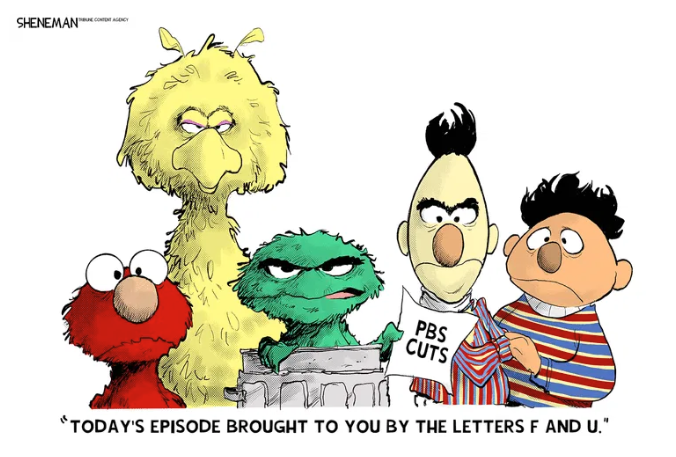
PBS

… and by the numbers 86 and 47.


Your enemies are not demonic, and they are not all-powerful and the right hasn’t always lost and the left hasn’t always won. But if you convince yourself of that, you give yourselves all sorts of permission to do a lot of stupid and terrible things under the rubric of “Do you know what time it is?”

Jonah Goldberg.

Trumpism can be seen as a giant attempt to amputate the highest aspirations of the human spirit and to reduce us to our most primitive, atavistic tendencies.

David Brooks)

I don’t do any of the major social media, but I have two sub-domains of the domain you’re currently reading: (a) You can read most of my reflexive stuff, especially political here. (b) I also post some things on my favorite social medium. I am now exploring Radiopaper.com as well.

Political 5/30/25

What it takes to tick off David Brooks

Last Monday afternoon, I was communing with my phone when I came across a Memorial Day essay that the Notre Dame political scientist Patrick Deneen wrote back in 2009. In that essay, Deneen argued that soldiers aren’t motivated to risk their lives in combat by their ideals. He wrote, “They die not for abstractions — ideas, ideals, natural right, the American way of life, rights, or even their fellow citizens — so much as they are willing to brave all for the men and women of their unit.”

This may seem like a strange thing to get angry about. After all, fighting for your buddies is a noble thing to do. But Deneen is the Lawrence Welk of postliberalism, the popularizer of the closest thing the Trump administration has to a guiding philosophy. He’s a central figure in the national conservatism movement, the place where a lot of Trump acolytes cut their teeth.

In fact, in his acceptance speech at the Republican National Convention, JD Vance used his precious time to make a point similar to Deneen’s. Vance said, “People will not fight for abstractions, but they will fight for their home.”

Elite snobbery has a tendency to set me off, and here are two guys with advanced degrees telling us that regular soldiers never fight partly out of some sense of moral purpose, some commitment to a larger cause — the men who froze at Valley Forge, the men who stormed the beaches at Normandy and Guadalcanal.

But that’s not what really made me angry. It was that these little statements point to the moral rot at the core of Trumpism, which every day disgraces our country, which we are proud of and love. Trumpism can be seen as a giant attempt to amputate the highest aspirations of the human spirit and to reduce us to our most primitive, atavistic tendencies.

Mild-mannered David Brooks, popping a vein (shared link, bold added).

The rest of the column was quite good, but the idea that a primitive, atavistic President would deploy his “throne-sniffing sycophants” (H/T Kevin D. Williamson, below) to reduce the nation to primitive atavism struck me as (a) too sophisticated conceptually, but perfect temperamentally, for Trump (a “stupid, lazy and angry” man — Kevin D. Williamson again); (b) exactly what his smart and unprincipled intimates would realize is necessary for their success; and (c) the kind of radical moral rot that Brooks sniffs out and exposes to us all.

And for his ability to distill evils to their essence, I am grateful.

Stupid, lazy and angry

We’ve been here before, of course. Donald Trump and his team have been three weeks away from announcing a groundbreaking new health care plan for … what, just about a decade now? Donald Trump’s confidence in addressing a complex subject has a linear relationship to his ignorance regarding that subject, and so we have got gems like this presidential declaration of ineptitude: “Nobody knew that health care could be so complicated.” It isn’t the case that nobody knew—lots of people knew. Some of those people had good ideas, some had terrible ideas, but they knew it was complicated. The guy who didn’t know? The one who spent most of his life as a Manhattan gadfly, a game-show host with side hustles in pro wrestling and porn. That guy didn’t know.

There are no conspiracies. There are no secrets. Everything is more or less what it seems. … [T]he obvious explanation for Trump’s eccentricity (or most anything else) is almost always the correct explanation. Which is why I have been writing for all these years that the key to understanding the Trump administration is that its central figure, Donald Trump, is stupid, lazy, and angry …

There are people around Trump, such as Marco Rubio and J.D. Vance, who are not stupid or lazy (though both are distinctly angry men) but are functionally indistinguishable from the stupid and the lazy because they are throne-sniffing sycophants who dread a return to the private sector more than almost anything else in this life.

It’s all right there to see: Trump, the supposed master negotiator, is as a matter of practical fact able to effectively negotiate exclusively in situations in which no substantial negotiation is required: with people he can fire, for example, or with utterly dependent parties. He calls this “negotiating from a position of strength” instead of “bossing around your cowering flunkies.”

Kevin D. Williamson

It didn’t take long for the courts to figure this out

The Abrego Garcia ruling and the Alien Enemies Act litigation have left legal scholars warning of a constitutional crisis. But a more tangible effect, attorneys told me, has been the erosion of the “presumption of regularity”—the benefit of the doubt given to the government in court proceedings. It’s based on the idea that federal officers and attorneys are operating in good faith, and not trying to achieve political goals through acts of subterfuge.

As judges see the administration saying one thing in public and another in court, they have started to treat the government’s claims with more skepticism and, sometimes, with outright suspicion of criminal contempt. A recent Bloomberg analysis found that the Trump administration has been losing the majority of its immigration-related motions and claims, regardless of whether the judges overseeing their cases were appointed by Democrats or Republicans.

Nick Miroff, In Trump Immigration Cases, It’s One Thing in Public, Another in Court

I’m not by any means certain that it will all be alright, i.e., that the courts can protect us from Trump’s lawlessness. But denying his administration the presumption of regularity is an important and needed step.

Note well that when a government lawyer tried to address the court honestly, the Attorney General fired and defamed him:

When a senior ICE official said in sworn testimony in March that Abrego Garcia had been deported to El Salvador because of an “administrative error,” the Justice Department attorney who initially represented the Trump administration, Erez Reuveni, relayed that characterization to the court. When asked why the administration hadn’t taken steps to correct the error and bring Abrego Garcia back, Reuveni said his client—the Trump administration—hadn’t provided him with answers.

The top Trump aide Stephen Miller soon began insisting publicly that Abrego Garcia’s deportation was not, in fact, an error—the opposite of what the government admitted in court. Vice President J. D. Vance claimed that Abrego Garcia is a “convicted MS-13 gang member with no legal right to be here,” even though he has no criminal convictions in the United States or El Salvador. Attorney General Pam Bondi cast the error as missing “an extra step in paperwork” and said that Abrego Garcia should not be returned.

Reuveni was fired. Bondi said he had failed to “zealously advocate” for the government. “Any attorney who fails to abide by this direction will face consequences,” she told reporters.

Nick Miroff

It’s a good time to be a retired attorney or, failing that, to practice outside a Department of Justice that requires you to lie (the normal term for Bondi’s “zealously advocate”) in court.

Marks of dystopia

Speaking of lying to court and losing in court:

I offer you the most dystopian thing I’ve read about the state of the federal government this year—so far:

Amid rising tensions between the Trump administration and the judiciary, some federal judges are beginning to discuss the idea of managing their own armed security force.

The Supreme Court has its own dedicated police force, but other federal judges are protected by the U.S. Marshals Service, which reports to Attorney General Pam Bondi. Security committee members worried that Trump could order the marshals to stand down in retaliation for a decision that didn’t go his way.

A country where judges need their own bodyguards because they no longer trust the president to guarantee their safety if they rule against him (and understandably so) is a country waaaaay too far down the slope of banana republicanism to chastise anyone else about failing to live up to Western “virtue ethics.”

[Trump named Ed Martin acting U.S. attorney in Washington] earlier this year despite the fact that he hadn’t worked a day in his life as a prosecutor. The president later nominated him to fill the position permanently, but that required Senate confirmation. And although Senate Republicans have set the bar for confirming Trump cronies on the floor, somehow Martin still failed to clear it. You need to be awfully sketchy—like, Matt Gaetz levels of sketchy—for John Thune’s conference to bork you.

From time to time I think back to what Sen. Susan Collins said when she was asked during Trump’s first impeachment trial whether she’d vote to convict him for demanding a quid pro quo of Ukraine. No, she answered, there’s no need. “I believe that the president has learned from this case,” she told CBS News. “The president has been impeached. That’s a pretty big lesson.”

He did learn a lesson. What he learned was that Senate Republicans would never hold him accountable for blatantly abusing his power.

Nick Catoggio

Whole-of-Government Gaslighting

[W]hy is the Justice Department not only settling the lawsuit that [Ashli] Babbitt’s relatives filed but also mulling an apology in the millions? Because Trump’s alternate reality demands it. Because that is how you turn truth entirely on its head.

You don’t simply challenge what really happened at the Capitol, which is that lawless hooligans in thrall to Trump’s delusions attempted a kind of coup. You chip-chip-chip away at it in so many ways over so much time and with such unflagging frequency that many people who thought they understood what they were seeing aren’t wholly sure anymore — or give up trying to make sense of it.

Trump recast a day of shame as a “day of love.” The rioters became “patriots” and Babbitt a martyr. As soon as Trump returned to the Oval Office, he pardoned nearly all of the roughly 1,600 people criminally charged in connection with the rioting. He even floated the idea of a compensation fund for them. Everybody gets a prize!

To live in fiction, commit to it. That’s the moral not merely of Trump and Jan. 6 but of Trump, period. Yesteryear’s hand-wringing about whether to label his individual falsehoods “lies” and those periodic tallies of his misstatements now seem quaint; they don’t do justice to the scope and audacity of what he’s up to. Nor does the occasional current chatter about “propaganda.” Trump is engaged in a multifront, multipronged attack on any and every version of events that impedes his goals and impugns his glory. It makes the spin control of presidents past look like child’s play.

Frank Bruni (shared link) This is so good I probably would have shared one of my ten monthly links even if it weren’t the end of the month.

86ing the important stuff

Kash Patel Says He’s Prioritizing Social Media Mocking Trump Over ‘Child Sex Predators, Fentanyl Traffickers, Terrorists’ – Above the Law

He didn’t say that in so many words, but his meaning was clear:

FBI Director Kash Patel took a break from his busy schedule of hanging out in Las Vegas instead of actually running the FBI, to go on Fox News last night to rant a bit about James Comey. After Comey posted his beachside “8647” insta, Patel quickly took to social media — where all professional law enforcement vents about its investigation priorities — to pretend that “86,” a century old term for bouncing unruly customers or canceling food orders, actually amounted to an assassination threat directed at Donald Trump.

This was, to use the technical term, f ****** stupid. Though against all odds, it was not nearly as stupid as Patel’s next move. Per the Daily Beast:

“Do you know how many copycats we’ve had to investigate as a result of that beachside venture from a former director?” he asked Baier. “Do you know how many agents I’ve had to take offline from chasing down child sex predators, fentanyl traffickers, terrorists?”

Hopefully some career law enforcement professional within the FBI intervened to make sure the answer to both questions is close to zero.

First of all, since threats to the president are the jurisdiction of the Secret Service — something Patel publicly acknowledged at the time — why the hell is he pulling agents off ANYTHING to run down a soccer mom who took a picture of her bottomless mimosa brunch bill having tipped to make sure the total was 8647?

So our President’s ego is more important protecting us from child sex predators, fentanyl traffickers, and terrorists. Keep that in mind. It’s barely 19 months to Retribution Day 2026.

That’s assuming the Democrats can serve up something palatable. But they’re convened in luxury hotels to do some

soul-searching after November’s defeat. “Democratic donors and strategists,” Goldmacher writes, “have been gathering at luxury hotels to discuss how to win back working-class voters, commissioning new projects that can read like anthropological studies of people from faraway places.”

One of those proposals is a $20 million effort “to reverse the erosion of Democratic support among young men, especially online.” The goal is to “study the syntax, language and content that gains attention and virality in these spaces.”

David French.

This is a reprise of this era’s Democrat delusion: “We just aren’t communicating our message right.” Au contraire, mon frere: your message is your problem.

86 both major parties.

Woke Right

Richard Hanania is a longtime critic of DEI, but has a few bones to pick with Trump 2.0 fake demolition of it:

Unfortunately, it is now clear that, rather than sticking to the principles of colour blindness, merit and individual liberty that I believe in, the Trump administration seeks to implement its own version of thought control and federal-government overreach.

This can be seen most clearly in the letter of demands the administration sent to Harvard on April 11th and its announcement that it was cutting off research funds to the university. The letter stated that Harvard must cease all DEI and affirmative-action policies in hiring, promotions and admissions.

So far, so good …

… [T]here is a direct contradiction between the goal of viewpoint diversity and the principle of merit, which the administration is claiming to defend. We all have an interest in our top institutions selecting students and faculty based on intelligence, competence and their fit within a programme. Having ideological litmus tests for professors and scientists would do more damage to the principle of merit than race and sex preferences ever have, given how few individuals with advanced degrees identify as conservatives …

… Harvard may never be an institution where MAGA has a large constituency. Accepting that is necessary for being at peace with the idea of America as a pluralistic society.

An influential voice from the right laments Trump’s attack on universities

When the rhetoric comes home to roost

“I voted for Donald Trump, and so did practically everyone here,” said Vanessa Cowart, a friend of Ms. Hui from church. “But no one voted to deport moms. We were all under the impression we were just getting rid of the gangs, the people who came here in droves.”

She paused. “This is Carol.”

A Missouri Town Was Solidly Behind Trump. Then Carol Was Detained. – The New York Times (shared link)

Prelude to a pissing contest

Elon Musk said he would step down as a “special government employee” with the Trump administration. The billionaire has led a radical effort to overhaul the American state through the Department of Government Efficiency. He has been critical of Mr Trump’s budget bill, which would add trillions to debt. He recently said he wanted to spend more time on his businesses—which have themselves suffered a backlash.

The Economist

Neither Trump nor Musk can keep his mouth shut. The Bromance is over. The divorce oughta be good — “good television” as Trump likes to say.


Your enemies are not demonic, and they are not all-powerful and the right hasn’t always lost and the left hasn’t always won. But if you convince yourself of that, you give yourselves all sorts of permission to do a lot of stupid and terrible things under the rubric of “Do you know what time it is?”

Jonah Goldberg.

Regarding said “lot of stupid and terrible things,” my failure to call out anything about the current regime does not mean I approve. There’s just too much, and on some of the apparent illegalities I don’t want to abuse my rusty credentials without thinking it through.

I don’t do any of the major social media, but I have two sub-domains of the domain you’re currently reading: (a) You can read most of my reflexive stuff, especially political here. (b) I also post some things on my favorite social medium. I am now exploring Radiopaper.com as well.

Political (5/27/25)

Shooting us in the foot

Defunding Science

I don’t think I elevate science unduly, and I even try to burst the bubbles of those who do. I think we’ve neglected the humanities in worshiping the almight STEM.

But Steven Pincker has a long and passionate defense of Harvard in the New York Times opinion section. Remembering that Trump’s attack is largely based on alleged antisemitism at Harvard, this in particular struck me as key:

Just as clear is what won’t work: the Trump administration’s punitive defunding of science at Harvard. Contrary to a widespread misunderstanding, a federal grant is not alms to the university, nor may the executive branch dangle it to force grantees to do whatever it wants. It is a fee for a service — namely, a research project that the government decides (after fierce competitive review) would benefit the country. The grant pays for the people and equipment needed to carry out that research, which would not be done otherwise.

Mr. Trump’s strangling of this support will harm Jews more than any president in my lifetime. Many practicing and aspiring scientists are Jewish, and his funding embargo has them watching in horror as they are laid off, their labs are shut down or their dreams of a career in science go up in smoke. This is immensely more harmful than walking past a “Globalize the Intifada” sign. Worse still is the effect on the far larger number of gentiles in science, who are being told that their labs and careers are being snuffed out to advance Jewish interests. Likewise for the current patients whose experimental treatments will be halted, and the future patients who may be deprived of cures. None of this is good for the Jews.

The concern for Jews is patently disingenuous, given Mr. Trump’s sympathy for Holocaust deniers and Hitler fans. The obvious motivation is to cripple civil society institutions that serve as loci of influence outside the executive branch. As JD Vance put it in the title of a 2021 speech: “The Universities Are the Enemy.”

Steven Pinker, Harvard Derangement Syndrome (shared link)

Leave them all alone

A German concept used to validate the society-saturating politics infecting Europe 90 years ago was Gleichschaltung. It denoted totalistic government: the “coordinating” or “harmonizing” of all important social institutions. A foreign word, but no longer a foreign practice.

As a candidate in 2023, Donald Trump vowed to “choke off the money” to schools assaulting “Western civilization itself.” As he defines this, and as he defines “assaulting” it. What could go wrong?

America’s research universities are sources of U.S. economic dynamism and vital to technology-dependent national security. It is folly (and unlawful) to punish entire institutions for the foolishness of a few departments. When English departments are “decolonized” — dead White men purged from the curriculum — the only victims are students deprived of Shakespeare. Ideological indoctrination is rarer in engineering departments, where knowing the right facts rather than having the right feelings matters, otherwise bridges crumble and skyscrapers tumble. Leave all departments alone, some because their silliness does not matter much, others because their excellence matters greatly. (Source: washingtonpost.com)

George Will via John Ellis

Keeping score

SCOTUS and the “Shadow Docket”

We have plenty of things to worry about in constitutional law today. But those worried about how the court will confront the unprecedented and sometimes unlawful actions of the Trump administration should save their outrage for other cases.

In the two cases here, the court held that the president was likely to prevail in his unitary executive claim, that the administration was unduly harmed by allowing the officials to keep their offices while the case was pending, and that this reasoning would not imperil the independence of the Federal Reserve. It did all of this in an emergency order, rather than waiting for the issues to arrive on the court’s regular docket.

The president’s ruinous tariffs, purported cancellation of birthright citizenship, renditions to foreign prisons and retaliations against his political opponents all raise far graver constitutional problems than the court’s ultimately unsurprising order in these cases. We should focus our concern there.

Will Baude in the New York Times.

I had Will’s father, Pat Baude, for several Constitutional Law classes, and he, too, was brilliant. I only wish he had lived long enough to bust his buttons at his son’s brilliance and esteem in the legal community.

The Big Picture: A Hostage Crisis

This newsletter concerns itself with the great patriotic project to turn America into a banana republic, but something gets lost by doing that episodically. Each day we study some crooked new tree that Donald Trump’s administration has planted; rarely do we step back and consider how large the forest has already become.

Here’s Andy Craig at The UnPopulist, stepping back:

Since Jan. 20, the United States has been in a state of rapid constitutional collapse. Congress’ power of the purse, its most fundamental prerogative, has been usurped; statutory laws have been suspended by claimed “emergency” powers; the requirement for Senate confirmation has been made irrelevant; a transparently political purge of both the civil service and the armed forces has been launched; the president has threatened aggressive military force against longtime allies; a decree was issued to strip constitutional citizenship rights; our treaty obligations have been blown up with a self-sabotaging trade war; mass pardons have been used to gleefully sanction political violence; courts have been defied to send innocent people to a Central American torture camp; the world’s richest man has deployed a gaggle of racist hackers to shut down government agencies on a whim; and, just as we were going to press, news broke that Harvard University has been barred from enrolling foreign students because of its refusal to hew to the president’s ideological demands.

What Craig is describing is essentially a hostage crisis.

An authoritarian state is a national hostage crisis … Most hostage crises aren’t orchestrated by coolly ingenious master-planners. They’re what happens when someone who’s ruthless, audacious, volatile, and cunning but not very bright makes a mess of his caper, like a bank robber whose hold-up takes longer than expected. He turns to leave and finds cop cars pulling up outside, causing him to panic and to start taking hostages instead.

There’s no “plan.” He just doesn’t know what else to do now that a wildly reckless, dangerous course of action like robbing a bank has suddenly gone sideways.

That was also the theme of yesterday’s newsletter, not coincidentally. The One Big Beautiful Bill that passed the House on Thursday is incomprehensible as a plan to strengthen America fiscally. It makes sense only as a desperate act in the midst of a dangerous caper gone bad: Having decided long ago that making Trump happy is more important than protecting the country, House Republicans acted accordingly when forced to choose.

Nick Catoggio

Amnesiac Nation

The background fact of this second Trump impeachment trial was how broadly popular it was. In January, a Monmouth survey found that 56 percent of Americans wanted Trump convicted. Quinnipiac reported that 59 percent regard him as responsible for inciting violence against the U.S. government. According to ABC/The Washington Post, 66 percent believe that Trump acted irresponsibly during the post-election period. According to polls, fewer than a quarter believed that Trump did “nothing wrong” on January 6.

Those are not the numbers on which to base a Grover Cleveland–style comeback tour—especially not when the majority of Americans also believe that Donald Trump did a bad job handling the COVID-19 pandemic and that President Joe Biden is doing a good job.

David Frum.

There came a time when “President Joe Biden” became a legal fiction, and that boosted Trump’s stock.

Abundance Agenda

Jonathan Chait writes about the civil war in the Democrat party over a proposed “abundance agenda” for the party.

Here are the pieces of that agenda, according to Chait:

[T]he canonical abundance agenda consists of three primary domains.

The first, and most familiar, is the need to expand the supply of housing by removing zoning rules and other legal barriers that prevent supply from meeting demand …

The second focus of abundance is to cut back the web of laws and regulations that turns any attempt to build public infrastructure into an expensive, agonizing nightmare …

The third domain, and the one that has received the least attention from commentators, is freeing up the government, especially the federal government, to be able to function. Policy wonks call this issue “state capacity.” The government itself is hamstrung by a thicket of rules that makes taking action difficult and makes tying up the government in lawsuits easy. The abundance agenda wants to deregulate the government itself, in order to enable it to do things.

The problem is that there’s a bloc of progressive special interests within the party (“the groups,” per the abundance agenda proponents), and the groups are large and unified (or at least in alliance):

The progressive movement seeks to maintain solidarity among its component groups, expecting each to endorse the positions taken by the others.

Much of the most vociferous opposition to the abundance agenda has zeroed in on its betrayal of this principle. The Roosevelt Institute’s Todd Tucker attacked Ezra Klein on X for his “survivor island approach to coalitions—first unions and Dems team up to vote enviros off the island, and then Dems turn on labor.” David Sirota, a left-wing journalist, complained, “Abundance Libs are insisting the big problem isn’t corporate power & oligarchs, it’s zoning laws & The Groups? Come on.” Austin Ahlman, a researcher at the Open Markets Institute, an anti-monopoly advocacy organization, mused, “You have to wonder whether the Abundance faction stuff would have landed better if the proponents had not laid the groundwork for it by first broadsiding every other organized constituency in the democratic tent.”

This angry response is not merely a knee-jerk reaction to criticism, but the logical outgrowth of a well-developed belief system. Since the Obama era, many of the component groups in the progressive coalition have drifted further left on their core demands. (Single-issue lobbies are naturally incentivized to grow more extreme over time—what organization is going to decide its pet cause is too unpopular or costly to merit a strident defense?)

At the same time, they have grown more purposeful about their belief that each group must stand behind all the positions outlined by the others. That is why civil-rights groups will demand student-debt relief, abortion-rights groups endorse abolishing the police, or trans-rights groups insist that Palestine should be liberated. Leah Hunt-Hendrix, an heir to the Hunt oil fortune who became a full-time progressive organizer, and who has raised and donated millions to causes such as the Sunrise Movement, the Debt Collective, and Black Lives Matter, articulated the principle of cross-endorsements in her book, Solidarity. She argues for “the necessity of working in coalition with progressive social movements,” and of resisting the opposition’s efforts “to weaponize a movement’s fault lines.”

Such progressives are not wrong to see the abundance agenda as a broader attack on their movement.

The Coming Democratic Civil War – The Atlantic

I have long believed that “the groups” impede Democrat success by alienating Democrats in the cultural mainstream. And as I’ve long said, whatever else Trump’s triumph means, it means major political realignment. The Democrat party’s travails over the abundance agenda, and controlling the toxic “groups,” could further advance that realignment, but I’m not sure it will benefit the Democrats all that much.

But then what do I know? I’m almost completely alienated from a country that can elect Velveeta Voldemort.


Your enemies are not demonic, and they are not all-powerful and the right hasn’t always lost and the left hasn’t always won. But if you convince yourself of that, you give yourselves all sorts of permission to do a lot of stupid and terrible things under the rubric of “Do you know what time it is?”

Jonah Goldberg.

Regarding said “lot of stupid and terrible things,” my failure to call out anything about the current regime does not mean I approve. There’s just too much, and on some of the apparent illegalities I don’t want to abuse my rusty credentials without thinking it through.

I don’t do any of the major social media, but I have two sub-domains of the domain you’re currently reading: (a) You can read most of my reflexive stuff, especially political here. (b) I also post some things on my favorite social medium. I am now exploring Radiopaper.com as well.

Bright Thursday

I don’t know about your Inbox, but mine tends to fill up especially on Friday. So I’m posting this now rather than in the wee hours tomorrow.

Trump 2.0

I haven’t been able to eliminate sharp criticism of Trump from today’s post because there are too many issues and I’ve read too much that isn’t just “same old same old.” As has become my habit, I’ve posted most of my anti-Trump stuff here.

National “Emergencies”

Source: Andrew Sullivan

The Meta-Concern about summary deportation

United States law allows for a quite expedited process to remove people from the country, to deport them. You don’t get a big trial. You don’t get a jury trial. You are moved rapidly because the theory of the case is: First, you don’t have a right to immigrate to the United States, so you have not been deprived of your rights. And secondly, once you’re removed from the United States, you remain a free person. You are sent back to the place you came from or some other place to which you have some connection, and then you’re free to go about your business. You’re not sent to a prison—not sent to a prison for life.

But as I talk about this, the thing that has most gripped my mind with worry and anxiety is not only the effect on the individuals themselves, some of whom may be genuinely innocent, but the effect on those who are sending human beings to a prison without a hearing.

You know, the United States government is now building an apparatus of lawyers, of officials of all kinds, who plan and think every day, How can we apprehend people on American soil and bundle them to a prison without giving them any show of a hearing? They’re building skills and competencies at non-due-process forms of arrest and incarceration that are going to be very hard to limit.

… I remember when I was a Canadian citizen in the United States on a student visa, we were warned if you got into a bar fight, you could theoretically lose your student visa. Now, in those days, that meant that you’d have to go back to Canada and go to school in Canada, which is not the end of the world. In today’s America, that could mean you could lose your student visa and be accused of terrorism, and a bag put over your head and be put into a car and sent to a prison in El Salvador for the rest of your life.

Now, maybe that doesn’t happen in every case. Maybe that doesn’t happen in many cases. But there are people in the employ of the United States government, paid by taxpayers to think about how can we daily broaden the category of people who can be arrested and detained and imprisoned without any showing to any authority at all, without any opportunity to make themselves heard, without any evaluation by an independent fact finder—by any of the things we call due process.

David Frum, introducing a terrific conversation about The Crisis of Due Process with Peter Keisler. (bold added)

Do we really believe in free speech?

Trump 2.0 has been deporting foreign students and others for constitutionally protected speech, using as its current go-to bad-faith excuse that the speech is antisemitic.

The late British-American journalist Christopher Hitchens is a more recent testament to the long tolerance of America toward foreign dissent. Before becoming a U.S. citizen in 2007, Hitchens spent decades as a legal resident—and as one of America’s most acerbic public intellectuals. He accused Ronald Reagan of being “a liar and trickster,” called Israel America’s “chosen surrogate” for “dirty work” and “terrorism,” lambasted Bill Clinton as “almost psychopathically deceitful,” and accused the George W. Bush administration of torture and illegal surveillance. If a student can be deported for writing a campus op-ed critical of Israel, any of Hitchens’ views could have been used to justify deporting him.

Jacob Mchangama, A New McCarthyism

Law and its limits

This isn’t how our system is supposed to work. When a president does the kinds of things Donald Trump is doing, his popularity should sink so low that Congress will feel empowered to stand up to him. Ideally, they would impeach and remove him from office for attempting to govern like an absolute monarch. Short of that, Congress and the courts would be working in tandem to impose and enforce constraints on the wayward executive until the next election strengthens their hand against him.

But none of this is happening—because our system has broken down. The parties are ideologically sorted, with almost no remaining overlap. And Trump has transformed the GOP into a cult of personality more loyal to him personally than to the Republican Party, the other institutions of American democracy, the law, or the Constitution.

In a situation like this, the only thing preventing the president from transforming himself into a tyrant is his own willingness to do it. The courts can tell him to stop. But will he? If he does, democracy survives, at least for the time being. If he doesn’t, democracy is over, at least until it can be reconstituted at some point in the future.

One should never hope to live through a moment of great political precarity like our own. But one tiny compensation is that such moments bring clarity about certain fundamental matters. How has the United States managed to survive for nearly 250 years without evolving into a dictatorship? The answer really may be this simple: By never electing a man willing to do what it takes to effectuate the change.

Until now.

Damon Linker

It’s not clear that the courts will suffice, but the courts — having already, and deservedly, come to treat the Administration as bad-faith, untrustworthy actors — will provide partial deterrence and may help sway public opinion by the cogency (and sometimes, the tartness) of their reasoning.

[I]f you want a really extraordinary example of that, you would look at the order that the Court issued at 1 a.m. on Saturday morning this last weekend, because even though they had held that everybody has to be given meaningful notice before they could be removed in this way, there was credible evidence that the administration was loading people onto buses without giving them anything like the notice that was required. And the ACLU went to the Supreme Court and said, you know, Please, as you listen to the rest of this case and get briefing, stop this from happening.

And if the administration were a normal administration and had compiled a record so far of being a normal administration, the Court would’ve said, Well, I can be confident they’re not going to do this while we are hearing your petition, so let’s give the government a chance to respond. Let’s see what they say, and then we’ll decide what to do. Because, of course, the government wouldn’t spirit these people away while we are actually in the process of deciding whether it can do so on this emergency application you filed. But they knew that the government had done exactly that with the first 200 or so people they had sent away.

The case was before a district judge, and they rushed to secretly get the people out before he could issue an order. And they didn’t quite succeed on that, which is why you have these issues of contempt floating around now. But at 1 a.m., the Court by a 7–2 vote said, Don’t remove anybody in the class represented by these lawyers until you hear otherwise from us.

And that shows that there is a cost to the administration of acting the way it’s acting towards the courts, because if you squander the reputation that governments of both parties have had for credibility and fair dealing and honest brokering with the Court, then they’re going to treat you different because they know they can’t quite trust you.

Peter Keisler with David Frum

Miscellany

The new Republican coalition

Thus we have arrived at a new Republican coalition that looks like this:

  • The tech right, which is essentially a weirder and more evil upgrade of the pro-business libertarians
  • The barstool right, which is a genuinely new constituency made up of hedonistic anti-woke libertarians that has replaced the Christian conservatives
  • The neo-conservative foreign policy hawks, who are the weakest member of the coalition, but can still get what they want on certain issues, as seen with the attacks on the Houthis as well as the saber rattling regarding Greenland

In other words, the Christian influence on actual Republican policy items and their political vision is going to be exceedingly negligible going forward. Sure, Vice President Vance will make an appearance at the March for Life. President Trump will show up to the National Prayer Breakfast. But even when he does acknowledge a Christian event, it often will come loaded with hatred and vile self-aggrandizement, as seen yesterday:

And ultimately when push comes to shove on the policy level, Christian concerns will always be backgrounded or eliminated relative to the priorities of the three above groups, as we have already seen on abortion, marriage, and PEPFAR.

Jake Meador

I originally thought to post this on a Sunday, when my focus is narrower, but it didn’t fit there because I don’t value “religion” for its instrumental partisan-political value.

It was a very few years ago when I warned (as had others) “If you don’t like the Religious Right, just wait ‘till you see the irreligious Right.” Well you’ve been seeing them in power for three months now.

Beta-testing tyranny in the Sunshine State

Ron DeSantis walked so that Donald Trump could run. When the time came to formulate a policy response to the woke left, no one mattered more than the governor of Florida.

He tried to ban critical race theory in education. He sharply limited discussion of gender and sexuality in public schools. He tried to limit the free speech of university professors. He retaliated against Disney when it had the audacity to exercise its freedom of speech to criticize the governor’s policies.

And through it all, DeSantis declared that Florida was the place where “woke goes to die.”

In his second term, Trump is a scaled-up version of DeSantis. Every element of the DeSantis model has been deployed against Trump’s ideological enemies …

At first I was optimistic about the anti-woke right. Their free speech argument resonated with me. I’d spent decades litigating free speech cases, after all, and I’d never really seen anything like a mass movement for free expression.

But my optimism quickly faded. In 2021, the anti-woke right embraced a series of state laws that were designed to ban critical race theory. Rather than meet critical race theorists in the marketplace of ideas, the right chose to try to suppress their expression.

A movement that had spent decades fighting speech codes on college campuses was now enacting speech codes of its own. States that once passed laws meant to protect free speech on campus were now passing laws suppressing the discussion of so-called divisive concepts about race.

By this time I was familiar with the right’s authoritarian turn — and getting very worried about it. In 2019, parts of the intellectual right were consumed with a fight over liberalism itself, with the new right arguing that liberal values — freedom of speech and free trade, for example — were hollowing out American culture, creating a nation of atomized individuals who were consumed with self-actualization (and consumption itself) at the expense of family and community.

David French, The Anti-Woke Right and the Free Speech Con

Context

Ironically, the left, now alarmed by the federal government’s intrusive reach [into, say, Harvard], bears direct responsibility for crafting the very legal weapons wielded against the universities it dominates. Almost four decades ago, progressive legislators demanded sweeping amendments to civil rights law, expanding federal oversight over higher education. The sequence of events reveals a cautionary tale of political hubris: progressive confidence that state power would reliably serve their ends overlooked the reality that governmental authority, once unleashed, recognizes no ideological master. Today’s circumstances starkly illustrate how expansive federal control over civil society, originally celebrated by progressives, returns to haunt its architects. The left’s outrage ought to focus not on this particular administration but on its own reckless empowerment of the state.

Yet for all its courage, Harvard’s response stopped short of making the argument that would best protect the values for which it was fighting. It defended the university’s independence without explaining why that independence deserves protection. It invoked values like “pluralism” and “inquiry,” but it did not fully explain why those values are essential to a liberal democratic society. The letter therefore missed an opportunity to articulate what a university is for — not just to students or donors, but to the country. And this matters, because Trump’s attack against this and other universities is not only about the balance of power between universities and the government. It is, at bottom, about the legitimacy of higher education as a public good.

Alan Jacobs, quoting, respectively, John O. McGinnis and Edward Frame

Dangers of debunking

The danger of being a professional exposer of the bogus is that, encountering it so often, one may come in time to cease to believe in the reality it counterfeits.

Alan Jacobs, The Year of Our Lord 1943


Your enemies are not demonic, and they are not all-powerful and the right hasn’t always lost and the left hasn’t always won. But if you convince yourself of that, you give yourselves all sorts of permission to do a lot of stupid and terrible things under the rubric of “Do you know what time it is?”

Jonah Goldberg.

Regarding said “lot of stupid and terrible things,” my failure to call out anything about the current regime does not mean I approve. There’s just too much, and on some of the apparent illegalities I don’t want to abuse my credentials without thinking it through.

I don’t do any of the major social media, but I have two sub-domains of the domain you’re currently reading: (a) You can read most of my reflexive stuff, especially political here. (b) I also post some things on the only social medium I frequent, because people there are quirky, pleasant and real.

Ides of March

Simile of the week

[I] n The New Yorker, Ruth Marcus, who recently resigned from The Washington Post, explained that she and other columnists were confused by the Post owner Jeff Bezos’ new edict that the Opinions section write only in favor of “personal liberties and free markets”: “Without further clarification, we were like dogs that had been fitted with shock collars but had no clue where the invisible fence was.” (Susan Casey, Palm City, Fla.)

Via Frank Bruni

Justice Barrett

After a federal judge blocked the Trump administration’s effort to stop $2 billion in foreign-aid spending, Justice Amy Coney Barrett joined with Chief Justice John Roberts and all three Democratic-appointed justices to leave that order in place. The decision provoked a fiery and warranted dissent from Justice Samuel Alito, as well as some bitter complaints about Barrett from the right-leaning commentariat. It is understandable that conservatives might be nervous about the Supreme Court. For good reason, the names “Stevens,” “Souter,” “Kennedy,” and “O’Connor” echo eerily in the originalist mind. But while she was wrong in this particular case, there is no evidence that Barrett is at risk of joining their ranks. She concurred in Dobbs, the case that overturned Roe; in Students for Fair Admissions, Inc., the case that barred affirmative action; and in Bruen, the case that expanded the protections of the Second Amendment. More important than those outcomes is how she did so. Unlike the judicial nomads of the past, Barrett has a transparent and well-considered approach to the law that explains her actions even when she disappoints. In the case that prompted the criticisms, she was likely motivated by her mistrust of the shadow docket and her dislike of big cases built atop disputed facts. To conclude from this that Barrett was “a mistake”—or, worse, “a DEI hire”—is absurd. Judges are not supposed to play for a team.

National Review email for 3/14/25

Meritocracy is the death of noblesse oblige

In some ways, we’ve just reestablished the old hierarchy rooted in wealth and social status—only the new elites possess greater hubris, because they believe that their status has been won by hard work and talent rather than by birth. The sense that they “deserve” their success for having earned it can make them feel more entitled to the fruits of it, and less called to the spirit of noblesse oblige.

David Brooks, How the Ivy League Broke America

Gold and Bitcoin

I’ve shunned Bitcoin as an investment because it’s useless other than for criming and speculation.

I’ve always shunned gold for similar reasons. Its industrial and jewelry uses are not the reason for it rising to more than $3,000 per troy ounce.

Regarding this Presidency

Trump censorship worse than cancel culture

I’ve been relegating most of my bile toward Trump and his goons to another blog, referenced in the footer below, but this is so patently un-American that it needs the widest exposure I can give it:

[T]his is not about protection from woke professors or ideologically captured deans. It’s protection from direct surveillance by the federal government. The Trump administration has launched a massive, all-of-government, AI-assisted program called “Catch and Revoke,” which will scan every social media comment and anything online they can use to flush out any noncitizen who might be seen as anti-Semitic or anti-Zionist or anti-Israel or indeed just getting on Marco Rubio’s wrong side.

Mahmoud Khalil, a green card holder, has not been accused of a crime. And that is the point. …

JD Vance — who lectured Europeans on free speech online, while his own administration was using AI to police the web for dissent! — said on Fox that a green card holder “doesn’t have an indefinite right to stay in America.”

Andrew Sullivan

In a Feb. 6 editorial, [Purdue] Exponent editors wrote: “And don’t get it twisted: When letters of visa revocation arrive in these students’ mailboxes and federal agents come to Purdue’s campus, no distinction will be made between ‘pro-jihadist’ and pro-Palestinian. Pro-ceasefire will continue to be conflated with ‘antisemitic.’ Anti-war can only now mean ‘pro-Hamas.’ Such twisting of language to be used as a weapon is contrary to the First Amendment, which gives the Exponent its right to exist just as much as it gives the right to students to protest as they see fit. It is the opinion of the Exponent that standing back while our website is potentially used to identify the state’s enemies would be directly against those principles.”

Based in Lafayette, Indiana

The statute cited by the Trump administration for expelling Khalil is very broad — and vague. I don’t think it will be struck down in its entirety, but surely permanent residents are entitled to know with some clarity what behaviors could get them kicked out of the country.

So I think the likeliest outcome is “unconstitutional as applied” to Khalil.

Living in fear

I spoke on Thursday to a university president who told me he was just advised to hire a bodyguard. He said he’d never seen so much fear in the world of higher education that many college presidents are “scared to death” about the Trump administration cutting their funding, Elon Musk unleashing Twitter mobs on them, ICE agents coming on campus, angry email flooding their inboxes, student protests over Gaza and Israel, and worries about being targeted for violence. I was a higher education reporter two decades ago, when universities were widely admired in America, and so I asked this president — what went wrong?

He said presidents and professors had taken too many things for granted — they thought they’d always be seen as a “public good” benefiting society, but came to be seen as elitist and condescending toward regular Americans. And Americans hate a lot of things, but they really hate elites condescending to them. Now we are seeing a big reckoning for higher education — ideological, cultural, financial — driven by Donald Trump and the right.

Patrick Healy, introducing a conversation with M. Gessen, Tressie McMillan Cottom and Bret Stephens.

Just sayin’

Narcissism has a very high correlation with conspicuous consumption in an effort to boost social status and self-esteem. Narcissists are focused on the symbolic, rather than functional, importance of commodities, and the symbolism of the products they purchase is often used to compensate for fragile egos and fluctuating self-esteem.

William T. Cavanaugh, The Uses of Idolatry

Re-assessing

As I have said any number of times, I have voted for the American Solidarity Party in each of the last three election cycles. But in the 2024 election, I was beginning to feel some sympathy for the people who thought Trump was less bad than Kamala Harris in the forced binary choice too many voters feel.

I no longer have any sympathy for that position, although I’m obviously working with the benefit of hindsight: Ready, Fire, Aim — over and over again ad infinitum. This is no way to run anything, quite apart from the autocracy.


I suffer more from the humiliations inflicted by my country than from those inflicted on her.

Simone Weil, from a letter to Georges Bernanos.

[N]one of the things that I care about most have ever proven susceptible to systematic exposition.

Alan Jacobs, Breaking Bread With the Dead

I don’t do any of the major social media, but I have two sub-domains of the domain you’re currently reading: (a) You can read most of my reflexive stuff, especially political here. (b) I also post some things on the only social medium I frequent, because people there are quirky, pleasant and real.

Wednesday, 3/12/25

Trump-related

As is my wavering intent, I have moved my more vitriolic criticisms of Trump 2.0 to another blog. What remains is relatively temperate.

As the twig is bent …

“Dennis Burnham, who lived next door, was a toddler when his mother briefly put him in a playpen in their garden. She returned a few minutes later to find the current U.S. president, then aged five or six, standing at his fence throwing rocks at the little boy. Another neighbor, Steven Nachtigall, now a 66-year-old doctor, said he never forgot Trump … once jumping off his bike and beating up another boy: ‘It was so unusual and terrifying at that age,’” – Trump Revealed.

“When I look at myself in the first grade and I look at myself now, I’m basically the same,” – Donald J Trump.

Andrew Sullivan

Tripping over a very low bar

It doesn’t take much to persuade me that some new development in this Administration is really bad. But it takes more than this:

Defense Secretary Pete Hegseth’s appointment today of his personal lawyer, Timothy Parlatore, as a Navy commander in the Judge Advocate General’s Corps reflects not just the norm-breaking approach that Hegseth is bringing to the job, but an odious philosophy of warfare. Like his new boss at the Pentagon, Parlatore has a pattern of providing support to soldiers accused of grave misconduct, even war crimes. He notably represented Eddie Gallagher, a Navy SEAL court-martialed on charges including the murder of a captured fighter (though he was found guilty only of one, lesser charge), along with a second SEAL accused of serious sexual offenses. Elevating a lawyer with this record does not bode well for the armed services Hegseth hopes to build.

Jason Dempsey at the Atlantic.

If we really believe that every criminal defendant deserves competent legal counsel, we must stop insinuating that lawyers who have represented criminals are complicit in their crime and therefore evil. But we’ve done so (albeit selectively, sorted by tribe) all my adult life, and it has always bugged me — even before I was a lawyer.

Dare I think this nasty habit reflects what we really believe:

  1. We should have kangaroo courts or even summary executions without trial — except for members of our respective tribes.
  2. Anyone who facilitates real courts and frustrates summary executions is a money-grubbing lowlife.

For my friends, anything; for my enemies, the law

For all of Trump’s talk about rooting out “anti-Christian bias” from the United States, one of his administration’s first executive actions violated the free speech and religious freedom rights of several Christian congregations. It turns out that Trump wants to protect only his Christian allies from government reprisals. Dissenting believers will face his wrath, and the wrath of the state.

David French, who has the receipts.

This is one of the reasons I don’t buy Aaron Renn’s positive world/neutral world/negative world chronology of Christianity’s status in the US. True and consistent Christianity has never been viewed positively, and the negativity has come from the right as well as the left, albeit for different reasons.

The Plight of the Never-Trump Pundit

I woke up excited to write about the day’s most important political news—before remembering that I said most of what I wanted to say on the subject a few weeks ago.

Never Trumpers who work in media will face that problem every day for the next four years. Good luck finding something new and interesting to say as the president vindicates your arguments against him again and again and again.

Nick Catoggio

The Trumposcene is a great time not to be a professional pundit. Yes, I opine, but I don’t have to do it on a schedule, whether or not I’m feelin’ it.

And I mostly borrow.

Not Trump-related

Resurrecting de Gaulle

[T]he American right should consciously support a stronger France. It should encourage a special relationship between the two republics, support French primacy on the continent, treat Paris rather than Brussels as the European capital and the French military as the keystone of Europe’s security.

In effect, we should revisit Charles de Gaulle’s bid to maintain more French independence within the Western alliance, which made him a thorn in the American side during the Cold War, and recognize that he was right. It was not actually in America’s long-term interests to make Europe our full dependent, because vassaldom encourages weakness, and weakness reduces the value of the alliance in a world that America can no longer simply bestride alone.

The French military is limited but still “indisputably the most capable in Western Europe,” as Michael Shurkin noted in a 2023 analysis for War on the Rocks, with a resilient capacity for expeditionary action. Its nuclear-energy strategy has granted it a degree of energy independence that contrasts sharply with the reckless folly of German “green” de-industralization. Its pro-natal policies have given it a sustained demographic advantage; it is aging, but its fertility isn’t collapsing in the style of Italy, Spain or now Poland.

Then, psychologically, France lacks the crippling sense of historical guilt that still pervades Germany, and the junior-partner complex that has made Britain an unsuccessful adjunct of recent American foreign policy mistakes. It embodies two distinct forms of universalism, Roman Catholic and republican, that have more historical appeal across Europe than the Anglo-American style of empire. And the rapid renovation of Notre-Dame de Paris joined to the recent “gentle revival” of Catholic practice amid secularized conditions suggest stronger possibilities for spiritual renewal as well.

This last point is crucial for American conservatives. The current European establishment, secular and socially liberal even in its “conservative” forms, often feels like a natural ally not of the United States in full but of American progressivism alone. So the American right should wish to see a more substantial European conservatism re-emerge — more ambitious than today’s populist factions, and capable, as the right-wing Frenchman Pascal-Emmanuel Gobry put it this week, of affirming Europe’s “Greco-Roman and Judeo-Christian” roots in contrast to Anglo-American progressivism.

Ross Douthat

ACB

After Justice Amy Coney Barrett voted against the Administration on one of the many Trump 2.0 “Emergency Docket” cases, she has been attacked I’m told, by the kinds of trolls who trot out canards like “DEI hire” in place of “treacherous bitch.” (I’m not referring to Prof. Josh Blackman, who criticizes the decision on more defensible grounds.)

Kevin D. Williamson is having none of it:

Supreme Court Justice Amy Coney Barrett, who joined with the chief justice to rule against Trump in the matter of his attempt to unilaterally freeze certain federal spending, is a great loyalist—but not the kind of loyalist Donald Trump’s ghastly little sycophants demand that she be. Justice Barrett is loyal to her oath of office, to the law, to the Constitution, to certain principles governing her view of the judge’s role in American life—all of which amounts to approximately squat in the Trumpist mind, which demands only—exclusively—that she be loyal to Trump, and that she practice that loyalty by giving him what he wants in court, the statute books—and the Constitution—be damned. 

The usual dopes demand that she give Trump what he wants because he is “the man who put her on the Supreme Court.” Mike Davis of the Article III Project (not the author of Late Victorian Holocausts; his organization works to recruit Trump-friendly judges) sneers that the justice is “weak and timid” and, because he is a right-wing public intellectual in 2025, that “she is a rattled law professor with her head up her ass.” Davis, a former clerk for Justice Neil Gorsuch, presumably is not as titanically stupid as he sounds, but there is a reason Justice Barrett is on the Supreme Court and he is a right-wing media gadfly who describes his job as “punching back at the left’s attacks.”

There is a word for men such as Davis et al.: subjects.

Kevin D. Williamson

Debasing education

Even though I am certainly angry at those students who choose to cheat, the fact is that I also care about them and feel a certain degree of compassion for them. I don’t want them to miss out on the opportunity to become educated, not even as the result of their own poor choices. It’s a bit of a Catch-22. How can we expect them to make good choices, about their studies or anything else, if they have not yet been given the tools to think critically? How can we expect them to grasp what education means when we, as educators, haven’t begun to undo the years of cognitive and spiritual damage inflicted by a society that treats schooling as a means to a high-paying job, maybe some social status, but nothing more? Or, worse, to see it as bearing no value at all, as if it were a kind of confidence trick, an elaborate sham?

Troy Jollimore via Alan Jacobs

Moral clarity

A devil is no less a devil if the lie he tells flatters you and stands to help you defeat your enemies and achieve power.

Rod Dreher, Something Demonic Is In The Air, 1/13/2021

I don’t think Rod’s vision is as clear now as it was then.


I suffer more from the humiliations inflicted by my country than from those inflicted on her.

Simone Weil, from a letter to Georges Bernanos.

[N]one of the things that I care about most have ever proven susceptible to systematic exposition.

Alan Jacobs, Breaking Bread With the Dead

I don’t do any of the major social media, but I have two sub-domains of the domain you’re currently reading: (a) You can read most of my reflexive stuff, especially political here. (b) I also post some things on the only social medium I frequent, because people there are quirky, pleasant and real.

Of adolescent “gender medicine”

A few years ago (confirmation hearings, I suspect):

[U.S. Surgeon General nominee Rachel] Levine refused to answer, choosing merely to say that “transgender medicine is a very complex and nuanced field with robust research and standards of care that have been developed.” Paul hit back that “the specific question was about minors,” and accused Levine of having “evaded the question.” Paul continued: Do you support the government intervening to override the parent’s consent to give a child puberty blockers, cross-sex hormones, and/or amputation surgery of breasts and genitalia? You have said that you’re willing to accelerate the protocols for street kids. I’m alarmed that poor kids with no parents, who are homeless and distraught, you would just go through this and allow that to happen to a minor.

Rand Paul Demands Answers on Puberty Blockers for Minors (February 2021)

That “robust research and standards of care” is essentially a incestuous echo chamber. In that echo chamber, “everybody knows” some things that aren’t true. But gradually, clarity intrudes, first in the Cass Report from Great Britain, most recently on Thursday just passed:

There were a couple of moments in the oral arguments in US vs. Skrmetti this week that were truly clarifying, I think. The first was about suicides among children and teens with gender dysphoria. They are — as the ACLU lawyer, Chase Strangio, finally conceded when questioned by Justice Alito — “thankfully and admittedly rare.”

That’s a big deal. It’s a big deal because the most common argument used by doctors and activists for child sex-changes for years is that if the kids do not transition, they will kill themselves. “Do you want a dead son or a live daughter?” is the question that has been repeatedly, routinely, posed to freaked-out parents with a dysphoric child. That’s why the Biden administration routinely refers to life-saving “gender-affirming care.” It’s transition or death. In every discussion I have ever had on this topic with someone who supports sex changes for kids, this has always been the first point raised.

We sometimes think of this trans controversy as a debate about civil rights and medicine. But it is useful at times to step back and truly grasp the radicalism of the ideology fueling the “LGBTQIA+” movement, to see what its vision of humanity is. We are socially constructed abstractions, not bodies. We have no core sex. The core goal of critical gender and queer theory — which is what is behind the child sex change craze — is to end the sex binary entirely as an organizing principle for our society. It is to remove nature from our understanding of what it means to be human. It is as extreme in its epistemological gnosticism as in its philosophical nihilism.

It is not about helping the few, and never has been. It’s about revolutionizing us all.

Andrew Sullivan

He’s not wrong. But M. Gessen seems more wrong than right:

Trans and gender-nonconforming people have existed as long as humans have used gender to organize themselves — think Joan of Arc; think Yentl; think many, many real and fictional people in-between — but in Western culture, it’s only in the last half-century that trans people have asserted ourselves as a group. It was only when we became more visible that the onslaught of new discriminatory laws began.

M. Gessen (f/k/a Masha Gessen) at the New York Times.

Two observations:

  1. “Trans and gender-nonconforming people” don’t belong together as a category. Lumping them together feeds the fad Andrew Sullivan calls “transing away the gay,” whereby gender-nonconforming adolescents are told “Maybe you’re a boy in a woman’s body” (or vice-versa), which isn’t a real thing.
  2. It’s nothing new for subterranean activity to be ignored by the law until it surfaces (“asserts itself”). Then, sometimes, the law decides it’s bad and disfavors it in various ways. There’s even a maxim for it: the law isn’t made until first it’s broken. An assertive movement based on the fantasy of women in men’s bodies and vice-versa is likely to be rejected fairly decisively.

Finally, Nellie Bowles may have the best response to the nonsense — mockery:

Chase Strangio is on the wrong side of the vibe shift: The Supreme Court this week heard arguments over whether to strike down Tennessee’s ban on medical gender transitions for minors (i.e., no puberty blockers, cross-sex hormones, or surgeries till 18). The ACLU sent their most famous lawyer and the face of the organization, Chase Strangio, to argue the case. Before things started, Chase laid out the stakes to CNN’s Jake Tapper: “These are young people who may have known since they were two years old exactly who they are, who suffered for six, seven years before they had any relief.” So: a two-year-old. When I say to my two-year-old that she’s a funny bunny, she says, “No, kitty cat.” Which to me indicates an extremely advanced and gifted conception of herself. Anyway. Surgery for her tail is next week. She has been consistent that she’s a “kitty cat” for months now. She wears kitty cat ears, a woeful stand-in for the real thing that I’m sure some excellent doctors can arrange.

Justice Ketanji Brown Jackson compared banning medical transitions for minors to bans on interracial marriage. I’m no legal scholar, but it honestly must be fun for your job to just come up with crazy analogies and throw them back at terrified lawyers. I’m just not sure I see the connection she’s making, but I also sometimes throw spaghetti at the wall when nothing’s working. It’s my “why not” business strategy. It’s the “you know what else was illegal once? Interracial marriage” approach.

Nellie Bowles

The reality as it comes to me is that many kids with gender dysphoria are working through a growing awareness of attraction to their own sex. We know how tumultuous modern adolescence is, and confusion about sexuality adds yet another layer of tumult.

Given time, and denied “affirmation” that the real them is trapped in the wrong body (though not denied love and “watchful waiting” medical and psychological care), they emerge as fairly well-adjusted homosexuals. Affirmed, too many of them only later realize that they and they enablers were too hasty, and they de-transition insofar as the changes wrought are reversible.

Maybe that’s just something I picked up in my echo chamber, but I haven’t heard anyone deny the part about “watchful waiting” leading to resolution without transition — or, rather, the only denial I’ve heard is the bogus “live daughter or dead son” trope.


I suffer more from the humiliations inflicted by my country than from those inflicted on her.

Simone Weil, from a letter to Georges Bernanos.

I don’t do any of the major social media, but I have two sub-domains of the domain you’re currently reading: (a) You can read most of my reflexive stuff, especially political here. (b) I also post some things on the only social medium I frequent, because people there are quirky, pleasant and real.

Potpourri

Not (especially) political

Wisdom from the third world

We had a lot of trouble with western mental health workers who came here immediately after the genocide and we had to ask some of them to leave. They came and their practice did not involve being outside in the sun where you begin to feel better, there was no music or drumming to get your blood flowing again, there was no sense that everyone had taken the day off so that the entire community could come together to try to lift you up and bring you back to joy, there was no acknowledgement of the depression as something invasive and external that could actually be cast out again. Instead they would take people one at a time into these dingy little rooms and have them sit around for an hour or so and talk about bad things that had happened to them. We had to ask them to leave.

A Rwandan talking to a western writer, Andrew Solomon, about his experience with western mental health and depression. I regret losing the URL, but offer the following in complement:

Serenity in leisure

There is a certain serenity in leisure. That serenity springs precisely from our inability to understand, from a recognition of the mysterious nature of the universe; it springs from the courage of deep confidence, so that we are content to let things take their course; and there is something about it which Konrad Weiss, the poet, called “confidence in the fragmentariness of life and history.”

Josef Pieper, Leisure the Basis of Culture, page 47.

What do you do for a living?

Visit a graveyard; you will search in vain for a tombstone inscribed with the words “steam-fitter,” “executive vice president,” “park ranger,” or “clerk.” In death, the essence of a soul’s being on earth is seen as marked by the love they felt for, and received from, their husbands, wives, and children, or sometimes also by what military unit they served with in time of war. These are all things which involve both intense emotional commitment, and the giving and taking of life. While alive, in contrast, the first question anyone was likely to have asked on meeting any of those people was, “What do you do for a living?”

David Graeber, Bullshit Jobs

… but liars can figure

I saw an item in the Wall Street Journal very recently:

Here’s a statistic to remember next year, as Congress debates extending President Trump’s 2017 tax cuts: The top 1% of income-tax filers provided 40.4% of the revenue in 2022, according to recently released IRS data. The top 10% of filers carried 72% of the tax burden. Self-styled progressives will never admit it, but U.S. income taxes are already highly progressive ….

Then I saw a Politico item lamenting how little income tax the super-wealth pay on their increase wealth.

So, is someone lying?

Yeah, pretty much. Increased wealth doesn’t imply taxable income. I’m confident that the increased wealth figures Politico cited were mostly unrealized capital gains, which we don’t tax for a number of very good (if not ironclad) reasons.

Infrastructure century

Because the highways were gold-plated with our national wealth, all other forms of public building were impoverished. This is the reason why every town hall built after 1950 is a concrete-block shed full of cheap paneling and plastic furniture, why public schools look like overgrown gas stations, why courthouses, firehouses, halls of records, libraries, museums, post offices, and other civic monuments are indistinguishable from bottling plants and cold-storage warehouses. The dogmas of Modernism only helped rationalize what the car economy demanded: bare bones buildings that served their basic functions without symbolically expressing any aspirations or civic virtues.

James Howard Kunstler, The Geography of Nowhere

How long will this hold?

Most Americans say media criticism helps hold politicians accountable | Pew Research Center

One of the things I worry about is unaccountable local officials now that the internet has killed smaller local media. The Lafayette Journal & Courier is a wraith, all but invisible were it not for stories fed from other Gannett papers. WLFI has been gutted with departures as its owner, Allen Media Group, bids billions for new acquisitions but doesn’t pay its bills. Only national politics is really covered any more, and that in only a selective way:

Trans teen health

In oral arguments at the Supreme Court Wednesday, ACLU lawyer and transgender ideologue Chase Strangio was forced to admit that gender realignment surgery for children does not prevent suicide—a core claim of many trans activists, notoriously communicated to parents by doctors as “do you want a live girl or a dead boy?” (Source: The Free Press)

What’s left of the trans argument against Tennessee law, in my view, boils down to “it’s sex discrimination to allow estrogen for girls, testosterone for boys, but not vice versa” — an argument that begs the question of whether the brute fact of sexual binary has any implications for law and medicine.

Wordplay

as man became disenchanted with regards to God and the cosmos, he became enchanted instead with himself and his own potential

Jake Meador

Just as clean air makes it possible to breathe, silence makes it possible to think.

Matthew Crawford

All that is not eternal is eternally out of date.

C.S. Lewis

[T]he forces that are destroying the things I cherish most in the world — faith, family, nation, tradition — all originate in the United States.

A Catholic expat friend of Rod Dreher

Two from Dreher’s latest book

Politics

Thankfulness

The Free Press has its people weigh in on what they’re thankful for at Thanksgiving. Martin Gurri responds:

This year, the petty little man in me is thankful that I won’t have to listen to Joe Biden’s double-dribbling sentences or Kamala Harris’s sitcom canned laughter ever again. The greedy analyst in me is thankful that Donald Trump is coming to burn Washington, D.C., to the ground, so Bari Weiss can keep telling people that I’m the only human on Earth who understands this dread pirate. The lonesome immigrant in me is thankful for my wife, and children, and grandchildren, my country and my street, my plans and my memories—because they make high politics feel like a trivial dream that I wake up from, when I step away from my laptop.

Pete Hegseth

I don’t trust Trump, and it seems to me as if he’s deliberately staffing up with sexual predators — as if that was proof of a decisive “get-things-done” manliness.

Moreover, I distrust pretty boys like Pete Heseth, Gavin Newsom, etc. (Yeah. Maybe there’s a little envy there.)

Nevertheless, I’m withholding my final judgment on Hegseth’s suitability for DoD because his accusers are hiding behind anonymity.

Pardon power

[T]he President is only accountable to the electorate so long as he or his party are up for election. Once the election is over, there’s no one for voters to punish. That’s why Biden waited until after the election to pardon Hunter; why Trump did the same for Steve Bannon and Roger Stone; why Obama did the same when commuting the sentences of Chelsea Manning and the terrorist Oscar López Rivera. And, most notoriously, that’s why Bill Clinton waited until his last full day in office to pardon the fugitive Marc Rich, who had fled to Switzerland to avoid prosecution and whose ex-wife donated $450,000 to the Clinton Library.

Stephen E. Sachs, How To Ban Lame-Duck Pardons

Feather pillows

It is true that in some matters, including a considerable swath of policy issues that he neither understands nor cares about, Trump can be like Lord Derby, who, “like the feather pillow, bears the marks of the last person who has sat on him”—which is no small thing given the assortment of asses we are talking about. But Trump makes a big impression of his own on the feather pillows he encounters.

Kevin D. Williamson


I suffer more from the humiliations inflicted by my country than from those inflicted on her.

Simone Weil, from a letter to Georges Bernanos.

I don’t do any of the major social media, but I have two sub-domains of the domain you’re currently reading: (a) You can read most of my reflexive stuff, especially political here. (b) I also post some things on the only social medium I frequent, because people there are quirky, pleasant and real.

Saturday 9/28/24

This is Purdue’s Homecoming weekend. They’re playing football — or pretending to. I’m looking forward to basketball season.

Miscellany

An odd job title, if you think about it

“Content Creator” is a title that inadvertently tells on itself. It’s a tacit admission that the nature of the “content“ is meaningless and it exists to fill space. Might as well call yourself “Stuff Maker” or “Thing Doer.”

Dominic Armato via Alan Jacobs

As wrong as possible

“Poverty just doesn’t happen,” Rep. [Barbara] Lee, a California Democrat, declared at the launch of the “Children’s Budget,” a kind of progressive wish list, last week. “It’s a policy choice.” Rep. Lee has run up against a kind of metaphysical limit there: She is as wrong as it is possible for a human being to be. 

As practically every serious thinker about the issue has understood for a few thousand years at least, poverty does just happen—it is, in fact, one of the few things that does just happen. Poverty is the natural state of the human animal. Do nothing, and you will have poverty. Thomas Hobbes knew it. Aristotle knew it 2,000 years before Hobbes. Hesiod knew it centuries before Aristotle. The authors of the Upanishads knew it centuries before Hesiod. “Throughout history, poverty is the normal condition of man,” the American sci-fi writer Robert Heinlein observed. Or, as Thomas Sowell spent a lifetime explaining to an apparently impenetrable public, poverty has no causes—the absence of poverty has causes. Rep. Lee’s error is not novel. Her mistake repeats—nearly verbatim—the error of Rep. Ayanna Pressley: “Poverty is not naturally occurring; it is a policy choice.”

Kevin D. Williamson

Nothing more freeing

Of The Bulwark’s Mona Charen:

In 2018, she appeared on a panel at the Conservative Political Action Conference. When asked about feminism, she attacked her own tribe, saying, “I’m disappointed in people on our side for being hypocrites on sexual harassers and abusers of women who are in our party, who are in the White House, who brag about their extramarital affairs, who brag about mistreating women. And because he happens to have an R after his name, we look the other way; we don’t complain.”

The crowd erupted in jeers and shouts of “Not true!” Charen had been a speechwriter for Nancy Reagan! This was CPAC, Republican prom! Security guards escorted her out for her own protection.

The incident didn’t seem to shake her. “There is nothing more freeing than telling the truth,” Charen later wrote in a New York Times op-ed.

Olga Khazan, Never Trump, Forever

Decades ago, Mona Charen was one of my favorite conservative columnists. I rarely read her these days because, in the anti-Trump cosmos, I’m on planet Dispatch and find planet Bulwark a bit weird tedious. Thus has the black hole of Donald Trump disrupted the cosmos.

What unites us

Americans are less divided politically than the media likes to pretend.

Yes, it’s a big, diverse electorate, but there are certain opinions we all share. Like this one: I can’t believe the party I hate isn’t getting clobbered in the polls.

From the Liz Cheney left to the Robert F. Kennedy Jr. right, ask any voter at random whether they’re surprised at how close this race is, and my guess is they’ll talk your ear off in exasperation.

Nick Catoggio

Banned Books Week

The Orwellian Evolution of Banned Books Week

Vice and Virtue

Neither fear nor courage saves us. Unnatural vices
Are fathered by our heroism. Virtues
Are forced upon us by our impudent crimes.
These tears are shaken from the wrath-bearing tree.

T.S. Eliot, Gerontion, via J. Bottum

The gay guy pundits agree

Harris’ Context

I can’t say what Vice President Kamala Harris’s favorite word is — the one time I met with her, I didn’t ask — but I’d put a big stack of chips on “context.” She said it not once, not twice, but three times in her signature May 2023 “coconut tree” riff, and I’ve heard it tumble from her lips on other occasions as well. It’s like some oratorical caftan, warming and comforting her.

That turns out to be apt. Her bid for the presidency is all about context.

Any realistic response to it hinges not on the policy details that she has or hasn’t provided, not on the fine points of her record over time, not on her interview with Stephanie Ruhle of MSNBC on Wednesday, not on her previous sit-down with CNN’s Dana Bash. It hinges on context. She cannot be sized up outside of or apart from the alternative, a man of such reprehensible character, limitless rage, disregard for truth, contempt for democracy, monumental selfishness and incoherent thinking that even discussing Harris’s virtues and vices feels ever so slightly beside the point. She’s not Donald Trump.

Frank Bruni

The words are different but the melody’s the same

In the culture war, we know exactly what she is: an equity leftist, a strong believer in race and sex discrimination today to make up for past race and sex discrimination yesterday, and a politician who favors redefining womanhood to include biological men, and conducting medical experiments on gay, autistic and trans children, based entirely on self-diagnosis. These are her values, they are the values of every Dem special interest group, and she assures us they have not changed. I believe her.

I have yet to hear her say a single interesting or memorable thing in her entire career. Have you?

If a serious Republican candidate were up against her — even Nikki Haley — this election would not be even faintly close.

But we do not have a serious Republican candidate.

We have the most shameless charlatan in American political history — and there are plenty of competitors. He is unfit in every respect to be president of the United States …

Trump does not merely break norms. He has broken the norm, the indispensable norm for the continuation of the republic, the norm first set by George Washington when he retired from office, the norm that changed the entire world for the better: accepting the results of an election … I do not think this is even within his personal control. He is so genuinely psychologically warped that he has never and will never agree to the most basic requirement of public office: that you quit when you lose; and that the system is more important than any individual in it.

He is not lying when he insists that he won in 2016 and 2020 by massive landslides in the popular vote. He believes it. He believes he will win by a landslide in November, and there is no empirical evidence that could convince him otherwise. If he loses the election, he will call it a massive fraud one more time, and foment violence to protest it. We know this more certainly than we know anything about Kamala Harris. He tried to leverage mob violence to disrupt our democracy once. If that was not disqualifying, nothing is …

So I will vote for Harris, despite my profound reservations about her. Because I have no profound reservations about him. I know who he is and what he is. I know what forces he is conjuring and the extremes to which he will gladly take his own personal crusade. To abstain, though temptingly pure, is a cop-out. I vote not for Harris as such, but for a conservatism that can emerge once the demon is exorcized.

And exorcize it we must. Now, while we still can.

Andrew Sullivan

Other thoughts on POTUS Election 2024

Uninteresting and unmemorable

We have to guard that spirit. Let it always inspire us. Let it always be the source of our optimism, which is that spirit that is uniquely American. Let that then inspire us by helping us to be inspired to solve the problems.

Kamala Harris. I hate to belittle her, because her context is him, and he is everything that Bruni and Sullivan said. If Indiana is in play, I’ll vote for the sane-but-empty suit who’ll leave office in 2028 if defeated, leaving our political system intact.

Suttons Bay, MI, last week

Donald Trump According to Those Who Know Him

My last NYT “gift article” for September, and one of the most important. Donald Trump According to Those Who Know Him

Even when he’s right, he’s wrong

Somebody apparently told Trump about, say, ProPublica attacking the Dobbs decision (substantially reversing Roe v. Wade). His over-the-top response, directionally right, was this:

When speaking to supporters from the swing state, where both Trump and Vice President Kamala Harris have doubled efforts to capture the election count in November, Trump lamented the criticism aimed at the Supreme Court‘s conservative supermajority and said it should be “illegal.”

“They were very brave, the Supreme Court. Very brave. And they take a lot of hits because of it,” said the former president. “It should be illegal, what happens. You know, you have these guys like playing the ref, like the great Bobby Knight. These people should be put in jail the way they talk about our judges and our justices, trying to … sway their vote, sway their decision”

Trump Says People Criticizing Supreme Court Justices Should Be Jailed

So he also is profoundly ignorant of our most fundamental rights, including the right to say stupid things about any branch of government we care to kvetch about.

Some Nationalist, this

Donald Trump is a funny kind of patriot. 

He loves America—except for the cities, the people who live in the cities, about half of the states, the universities, professional sports leagues, Hollywood, Silicon Valley, Wall Street, the legal system, immigrants, the culture. He thinks the Capitol Police are murderers and that the FBI is a gestapo, that the government is an illegitimate junta maintained through election fraud, that the January 6 rioters are political prisoners, that the nation is a ruin, that it is “failed.” And when it fell to him to explain to [a] debate audience why he should be president, he spent most of his time repeating the praise of Hungarian autocrat Viktor Orbán.

Trump’s enemies are all Americans, his friends are all foreign dictators, and his money lives in Dubai and Indonesia. Some nationalist. 

Trump lives in a very strange little bubble: His world is Palm Beach, a handful of golf courses and hotels, and Fox News. The smallness of his frame of reference is a problem for him ….

Kevin D. Williamson

Trump’s victims

Depending on how you count them, 19 or 26 or 67 women have accused Mr. Trump of sexual misconduct. Women who have said he “squeezed my butt,” “eyed me like a piece of meat,” “stuck his hand up my skirt,” “thrust his genitals,” “forced his tongue in my mouth,” was “rummaging around my vagina,” and so on.

Mr. Trump has denied any misconduct. He, in turn, has accused the women of being “political operatives,” plotting a “conspiracy against you, the American people,” looking for their “10 minutes of fame” and not being his “type.”

“It couldn’t have happened, it didn’t happen,” Mr. Trump sneered during a recent news conference, referring to Ms. Leeds, the one who accused him of assaulting her on an airplane. “And she would not have been the chosen one.”

Jessica Bennett, Trump’s Female Accusers Are Begging You Not to Forget Them

He can’t even deny his sexual assaults without:

  1. Sneering at how homely his accuser is and
  2. Tacitly admitting that he assaults women lucky enough to be “chosen.”

I suffer more from the humiliations inflicted by my country than from those inflicted on her.

Simone Weil, from a letter to Georges Bernanos.

I don’t do any of the major social media, but I have two sub-domains of the domain you’re currently reading: (a) You can read most of my reflexive stuff, especially political here. (b) I also post some things on the only social medium I frequent, because people there are quirky, pleasant and real.

Tuesday, 9/24/24

We’re home at last from a vacation overshadowed by car damage from road debris encountered on the way north to vacation. Every fix revealed yet another problem. Every new problem required a wait for Allstate to approve the added work. We finally just drove our rental car home yesterday and are currently planning how most easily to retrieve our car when they finally fix the final problem.

I have nothing more to say on that, lest I add myself to the luckiest victims in the world (see below).

Not very political

The huge history of a little bit of geography

The word Palestine always brought to my mind a vague suggestion of a country as large as the United States. I do not know why, but such was the case. I suppose it was because I could not conceive of a small country having so large a history. I think I was a little surprised to find that the grand Sultan of Turkey was a man of only ordinary size. I must try to reduce my ideas of Palestine to a more reasonable shape. One gets large impressions in boyhood, sometimes, which he has to fight against all his life.

Mark Twain, The Innocents Abroad

Epistemic idiocy

A man who murdered dozens of Muslims at two mosques in New Zealand was “steeped in the culture of the extreme-right internet,” … His manifesto explained that he had done research and developed his racist worldview on “the internet, of course. . . . You will not find the truth anywhere else.”6 The latter assertion involves, alas, a rather serious mistake about epistemic authority.

Brian Leiter, Free Speech on the Internet: The Crisis of Epistemic Authority.

This is a flawed but important article I personally will revisit on the subject of legitimate epistemic authority. We’re not as adrift and it sometimes seems — or as the New Zealander fancied himself.

ProPublica

Having apparently run out of Supreme Court justices to attempt to drive from public life, the left-wing nonprofit journalistic outfit ProPublica has directed its attention to sullying one of their most notable achievements: the Dobbs decision, which returned the power to regulate abortion to the people and to the states. Georgia now has a heartbeat law, which outlaws abortion once a fetus has a detectable heartbeat (with exceptions for rape, incest, and maternal health). A recent ProPublica article blamed the law for the deaths of two women who had taken chemical-abortion drugs (whose riskiness goes unremarked upon). The drugs killed the children but failed to expel all of their remains. One woman unsuccessfully sought treatment in a hospital, and the other feared it—both, supposedly, results of the law. But as our former colleague Isaac Schorr pointed out at Mediaite, the law does not forbid the surgical removal of an already dead child. No reasonable person who read the plain text of the law would think otherwise, which may be why ProPublica did not include the relevant portion. Even the argument that the doctors’ uncertainty about the law prevented treatment is unsubstantiated. The ProPublica article eventually admits that “it is not clear” why doctors waited to perform the necessary procedure. Laws against abortion haven’t caused any deaths, but ProPublica is doing its part to raise the death toll.

National Review email newsletter

The luckiest victims on earth

[E]ven as you push back against ideological bias and discrimination, remember that as a university student you are one of the luckiest — most privileged — people on the planet. So do not think of yourself as a victim. You can assert and defend your rights without building an identity around grievances, however justified those grievances may be.

Remember that the criticism of a belief (or a practice, faith or lifestyle) is not a personal attack, though the natural human tendency to wrap our emotions tightly around our convictions can make it feel as if it is.

Robert P. George, A Princeton Professor’s Advice to Young Conservatives

Two bits of advice from a mensch

  • I don’t pin dreams on the rack of endless above-ground interpretation, but I do give them space and attention.
  • In myth, when you are facing a monster, look at its reflection on your shield, not the abyss of its face. That will quickly burn you to cinders. What is your shield? Well it’s something that shows you the general shape of your adversary but not to the degree it paralyses you.

Martin Shaw, We Need The Ancient Good

Hitchens’s Razor

What can be asserted without evidence can be dismissed without evidence.

Christopher Hitchens. If you make a claim, it’s up to you to prove it, not to me to disprove it.

Via 17 useful concepts to survive the election

Political

Countercultural decency is exhausting

The yearslong elevation of figures like [North Carolina Gubernatorial Candidate] Mark Robinson and the many other outrageous MAGA personalities, along with the devolution of people in MAGA’s inner orbit — JD Vance, Elon Musk, Lindsey Graham and so very many others — has established beyond doubt that Trump has changed the Republican Party and Republican Christians far more than they have changed him.

In nine years, countless Republican primary voters have moved from voting for Trump in spite of his transgressions to rejecting anyone who doesn’t transgress. If you’re not transgressive, you’re suspicious. Decency is countercultural in the Republican Party. It’s seen as a rebuke of Trump.

I’ve compared the cultural power of a leader to setting the course of a river. Defying or contradicting the leader’s ethos is like swimming against the current — yes, you can do that for a time, but eventually you get exhausted and either have to swim to the bank and leave, or you’re swept downstream, just like everyone else.

David French

Well, he would say that, wouldn’t he?

In a similar vein, albeit from someone who hasn’t been Republican:

There is no place for dissenters in the contemporary Republican Party. That is going to remain true whether or not Donald Trump prevails in November. It’s long past time those who reject the right-populist takeover of the party to cut themselves loose and stop pretending they will have a meaningful say in building its future. They will not. It would be far better for them, and for the Democrats, if they joined the Donkey Party outright and began fortifying the Harris-Walz campaign’s move toward the ideological center-left.

In a strong post late last week, The Bulwark’s Jonathan Last took the occasion of the latest mind-boggling revelations about Mark Robinson, the Republican Party’s nominee for governor of North Carolina, to make the point that the GOP is a “failed state.” The image comes from a 2016 Slate column by his Bulwark colleague Will Saletan. As Last explains, functional institutions “have power centers and interests. In a healthy institution, these power centers can unite to achieve shared interests, even in difficult moments which require sacrifice.” Over the last two decades, for example, Democratic Party has given us the following examples:

In 2008 Hillary Clinton was supposed to be the Democratic presidential nominee. But various Democratic power centers coordinated to elevate Barack Obama, who they believed was a better candidate.

In 2016, a democratic socialist tried to win the Democratic presidential nomination. The party coordinated to prevent him from doing so.

In 2020, the same democratic socialist made another attempt. The party coalesced around Joe Biden and got him elected president.

In 2023, as Republicans went through four nominees to find a speaker of the House, Democrats voted, unanimously, time after time, for Hakeem Jeffries.

And in 2024, when the Democratic Party realized that Joe Biden was compromised as a candidate by his health, they convinced him to step aside.

I want to underscore this: The Democratic Party was able to convince a sitting president to abandon his reelection attempt four months before November.

That’s a portrait of a party as an effective, functional institution.

The Republican Party, by way of sharpest contrast, cannot even get a man to step aside in a crucial statewide race when he’s caught (among other things) describing himself as a “Black Nazi” on a porn-focused chat forum. The party is being held hostage—by the candidate, yes, but his power is itself a function of his popularity among Republican voters in the state. They want him as their nominee, and the voters get whatever they want in the contemporary GOP. Which means the institution is a hollow shell—or the domestic equivalent of a failed state.

Damon Linker

Sorry, Damon, but I’m not going to be in the vanguard of any GOP migration, partly because I’m not exactly in the GOP, partly because of a few deal-killer Democrat policies.

The Bennet Inversion

Our best hope is to hasten a change in culture that reverses this effect. Call it the Bennet Inversion, for Senator Michael Bennet, who campaigned for president promising to govern so boringly that voters would go weeks without thinking about him. He was so successful that no one remembers his campaign at all. Biden accomplished a miniature version of this, by executing a Fabian strategy and defeating Trump without ever facing him directly on the field of meme battle.

Graeme Wood, Trumpism Is Harder to Fight Than Terrorism


I suffer more from the humiliations inflicted by my country than from those inflicted on her.

Simone Weil, from a letter to Georges Bernanos.

I don’t do any of the major social media, but I have two sub-domains of the domain you’re currently reading: (a) You can read most of my reflexive stuff, especially political here. (b) I also post some things on the only social medium I frequent, because people there are quirky, pleasant and real.