Re-embedding “Chthón”

The Irish writer John Moriarty wrote a lot about chthón. His life’s search was for ways to re-embed us in what we have lost, to take us around and down again, to correct the Western Error. In his autobiography, Nostos, he writes:

“Chthón is the old Greek word for the Earth in its secret, dark, depths, and if there was any one word that could be said to distinguish ancient Greeks from modern Europeans, that word chthón, that would be it. Greeks had the word, we haven’t. Greeks had the pieties and beliefs that go with the word, we haven’t. Greeks had the wisdom that goes with the word, we haven’t. Greeks had the sense of spiritual indwelling that goes with the word, we haven’t. In the hope that they might continue in the goodwill of its dark but potentially beneficent powers, Greeks poured libations of wine, of honey, or barley-water sweetened with mint down into this realm, we don’t.”

You can forget about chthón, but chthón won’t forget about you.

Paul Kingsnorth, Finnegas


This brings to mind the unnamed young woman in the penultimate chapter of Live Not By Lies. She’s the young Hungarian riding with me on the tram, who expressed frustration that she couldn’t talk about her ordinary struggles as a wife and mother with her friends, without them trying to convince her to shed the commitments that cause her conflict and suffering. She tried to get them to understand that she loves her husband, and loves her child, and that it’s normal to have trouble from time to time. But they can only imagine living in a world without conflict, without anxiety, without suffering. This, the young Hungarian woman saw, would also be a world without true love, which requires sacrifice and risk. I told her she was fighting for her right to be unhappy, just like John the Savage in Brave New World.

This mania for utopia also drives the fanatics conquering our universities and other institutions. Imagine the kind of mentality that believes children cannot learn inside a school building named for a historical figure who was something less than a progressive saint. We cannot allow the young to recognize that the world is complex, is ironic, is tragic. Because we cannot allow them to be unhappy, we make them miserable.

So, let me ask the room: What kind of people embody the possibility of revolt against our present dystopia? It seems to me that they have to be people who are capable of bearing suffering, but who do not bear it in the manner of a dumb ox: stoically and without complaint, like slaves who have had the spark of life beaten out of them. There has to be something else. This rebel class will have to have the strength of mind and character to be willing to accept life as outsiders, without the possibility of wealth or professional success, as the cost of being free. But they also have to retain the capacity to be happy.

Are there people in North America or Europe capable of doing that today? I mean not individuals, but a class of person. I would like to think that Christians would be them, but I think most Christians will conform, as they did under Soviet totalitarianism. I think it’s going to have to be the sort of person who is not a slave to electronic world. Put another way, it’s going to have to be someone who is immune to the poison of Paul Kingsnorth’s basilisk. The Benedict Option ideal is meant to be for the creating of the families and communities that raise up those kinds of rebels.

Rod Dreher


… what we’re left with is the spectacle of an acclaimed reporter being purged not for malevolent actions, nor even malevolent intent, but rather for making a certain kind of sound … McNeil … is being judged according to a theory of wrongdoing that presents certain words or phrases as evil by their mere utterance, as with a Harry Potter spell.

Consider, for instance, American composer Mary Jane Leach, who was publicly humiliated by the organizers of the (aptly named) OBEY music convention in Halifax, because her appreciative talk on the legacy of groundbreaking black minimalist composer Julius Eastman (1940–1990) contained a reference to his albums Evil Nigger and Crazy Nigger. Eastman suffered racism all of his life and knew better than most how shocking and wounding that word could be. It was his choice as an artist to choose those album names, and he likely would be surprised to know that Leach—who has done more than anyone to keep his legacy alive as biographer and archivist over the last 30 years—would be attacked for speaking them out loud.

With a Star Science Reporter’s Purging, Mob Culture at The New York Times Enters a Strange New Phase


A new and rapidly growing journalistic “beat” has arisen over the last several years that can best be described as an unholy mix of junior high hall-monitor tattling and Stasi-like citizen surveillance. It is half adolescent and half malevolent. Its primary objectives are control, censorship, and the destruction of reputations for fun and power. Though its epicenter is the largest corporate media outlets, it is the very antithesis of journalism.

I’ve written before about one particularly toxic strain of this authoritarian “reporting.” Teams of journalists at three of the most influential corporate media outlets — CNN’s “media reporters” (Brian Stelter and Oliver Darcy), NBC’s “disinformation space unit” (Ben Collins and Brandy Zadrozny), and the tech reporters of The New York Times (Mike Isaac, Kevin Roose, Sheera Frenkel) — devote the bulk of their “journalism” to searching for online spaces where they believe speech and conduct rules are being violated, flagging them, and then pleading that punitive action be taken (banning, censorship, content regulation, after-school detention). These hall-monitor reporters are a major factor explaining why tech monopolies, which (for reasons of self-interest and ideology) never wanted the responsibility to censor, now do so with abandon and seemingly arbitrary blunt force: they are shamed by the world’s loudest media companies when they do not.

Just as the NSA is obsessed with ensuring there be no place on earth where humans can communicate free of their spying eyes and ears, these journalistic hall monitors cannot abide the idea that there can be any place on the internet where people are free to speak in ways they do not approve. Like some creepy informant for a state security apparatus, they spend their days trolling the depths of chat rooms and 4Chan bulletin boards and sub-Reddit threads and private communications apps to find anyone — influential or obscure — who is saying something they believe should be forbidden, and then use the corporate megaphones they did not build and could not have built but have been handed in order to silence and destroy anyone who dissents from the orthodoxies of their corporate managers or challenges their information hegemony.

Tell us what you really think, Glenn (Greenwald, The Journalistic Tattletale and Censorship Industry Suffers Several Well-Deserved Blows)

Don’t worry: he does. This is the creepiest, likely-to-make-me-freakin’-hate-mainstream_media thing I’ve read in a long time.


These observations dismiss the popular belief that the Amish reject all new technologies. So what’s really going on here? The Amish, it turns out, do something that’s both shockingly radical and simple in our age of impulsive and complicated consumerism: they start with the things they value most, then work backward to ask whether a given new technology performs more harm than good with respect to these values.

Cal Newport, Digital Minimalism


  • Any action which hinders the advance of the human industrial economy is an ethical action, provided it does not harm life.
  • Any action which knowingly and needlessly advances the human industrial economy is an unethical action.

Paul Kingsnorth, via Alan Jacobs


Out of the crooked timber of humanity no straight thing was ever made.

Immanuel Kant, Idea for a Universal History with a Cosmopolitan Purpose

You can read most of my more impromptu stuff here or join me and others on micro.blog. You won’t find me on Facebook any more, and I don’t post on Twitter (though I do have an account for occasional gawking).
Attention Economy (and more)

Michael Goldhaber, the Cassandra of the Internet Age is one of the more thought-provoking things I’ve read in the past few weeks, and I’ve been reading a lot of thought-provoking things. It’s your introduction to “the attention economy” and it’s worth burning a freebie at the New York Times’ metered paywall.

  • Attention is a limited resource, so pay attention to where you pay attention.
  • “We struggle to attune ourselves to groups of people who feel they’re not getting the attention they deserve, and we ought to get better at sensing that feeling earlier,” he said. “Because it’s a powerful, dangerous feeling.”

Yesterday, in an interview with Fox News’s Chris Wallace, [Liz Cheney] went further. Trump “does not have a role as the leader of our party going forward,” she asserted, making a public case—to viewers of Trump’s onetime favorite network—that expanded on the one she delivered in the House GOP Conference meeting on Wednesday.

Cheney isn’t alone. Late last week, it became clear that Sen. Ben Sasse was headed toward another censure from the Nebraska Republican Party. Among his supposed offenses: accusing Trump of “pouring gasoline on these fires of division” that led to a riot at the U.S. Capitol and “persistently engag[ing] in public acts of ridicule and calumny” against the former president.

Sasse—who was just elected to a second six-year term—did not shy away from the confrontation, instead cutting a five-minute video response to the Nebraska GOP’s State Central Committee. “You are welcome to censure me again,” he said, “but let’s be clear about why: It’s because I still believe (as you used to) that politics is not about the weird worship of one dude.”

At the end of the message, Sasse, like Cheney, pointed to the future. “We’re gonna have to choose between conservatism and madness,” he said, “between just railing about who we’re mad at, versus actually trying to persuade rising generations of Americans again. That’s where I’m focused. And I sincerely hope that many of you will join in celebrating these big, worthy causes for freedom.”

[Shout-outs to Sen. Pat Toomey, Rep. Anthony Gonzalez and Rep. Peter Meijer omitted.]

… Only 21 percent of Republicans in a recent Echelon Insights poll strongly or somewhat supported impeaching and convicting President Trump.

But the same poll also found Trump’s stranglehold on the party’s voters loosening. In December, according to the survey, 61 percent of GOP voters said they hoped Trump would continue to be “the leading voice” for Republicans going forward. By January, that number had dropped to just 41 percent. After the events of January 6, only 45 percent of Republican voters said they wanted Trump to run for president again in 2024, down from 65 percent the month prior.

The Morning Dispatch

How these sane people live in the same party with Matt Gaetz, MTG and other contemptible clowns is an open question, but I can understand them not wanting to cede the party of Lincoln to limelight-loving loons.


I was shocked that OAN would run Mike Lindell’s 3-hour Absolute Proof conspiracy video, considering reports that it repeats defamatory claims OAN already had retracted under threat of lawsuit. But this extraordinary disclaimer helps me understand.

I won’t watch the video because:

  1. People I trust and respect have already debunked the major “stolen election” evidence — some of which is fabricated, some of which is third-hand hearsay, and some of which may be honest misunderstandings of the significance of first-hand observation (e.g., “when I went to bed, Trump was ahead but when I woke up Biden was pulling away” — a red crest/blue wave that was long predicted and easily understood, but that Trump consciously exploited with his premature victory announcement).
  2. I’m not so sophisticated about election mechanics that I can, on my own and in real time, dismiss all the claims that might be made in a 3-hour video. So watching it would only produce confusion — probably unwarranted (see my appeal to authority in the preceding point) — or require hours and hours more to regain a working clarity.
  3. I do not apologize for trusting analyses of people I’ve found trustworthy. Everyone does it. Everybody budgets how much time to spend on various things, and most people budget little time for seemingly-quixotic quests, If others find a cocaine-addled domestic abuser, conspiracy theorist and TV pitchman more plausible than seasoned political observers, all I can say is “bless their hearts.”

Timothy Wilks, 20, is shot and killed outside of Nashville’s Urban Air Trampoline and Adventure Park. Police told reporters that Wilks was trying to create a viral video of himself staging a fake robbery prank for his YouTube channel. Apparently unaware of the hilarity of having a stranger run at you and your friends with butcher knives, one of Wilks’ intended foils drew a pistol and shot him dead.

The Dangers of the Derp State – The Dispatch

Well, bless his heart, he was just trying to gain the attention to which he’s entitled.


The state of Victoria in Australia … just passed a bill that will considerably intensify the conflict between religious freedom, individual choice, and identity politics. And it might well become a model for laws elsewhere in the democratic world.

The legislation that just passed is the Change or Suppression (Conversion) Practices Prohibition Bill 2020 …

The law defines a change or suppression practice as follows:

“a practice or conduct directed towards a person, whether with or without the person’s consent on the basis of the person’s sexual orientation or gender identity; and for the purpose of changing or suppressing the sexual orientation or gender identity of the person; or inducing the person to change or suppress their sexual orientation or gender identity.”

But the really important part of the bill from a religious perspective is its list of “change or suppression practices.” This includes: “carrying out a religious practice, including but not limited to, a prayer-based practice, a deliverance practice or an exorcism.”

In short, if someone asks a pastor, a priest, or a Christian friend to pray for them that their sexual desires or gender dysphoria might be changed, that pastor, priest, or friend runs the risk of committing a criminal offense. Presumably this also applies to parents praying for their children—or perhaps even parents teaching their children that untrammeled expressions of sexual desire (at least within the canons of contemporary bourgeois taste) are inappropriate.

The legislation also demonstrates one of the oddest results of the modern emphasis on the radical freedom of the individual. In such a world, all must theoretically be allowed to have their own narratives of identity. But because some narratives of identity inevitably stand in opposition to others, some identities must therefore be privileged with legitimate status and others treated as cultural cancers. And that means that, in an ironic twist, the individual ceases to be sovereign and the government has to step in as enforcer. The lobby group of the day then decides who is in and who is out, with the result that, in this instance, the gay or trans person who wants to become straight or “cis” (to use the pretentious jargon), cannot be tolerated. His narrative calls into question that of others. We might say that his very existence is a threat. To grant any degree of legitimacy to his desire is to challenge the normative status of the desires of others.

And so prayer for such heretics must be prohibited, even if they specifically ask for it. This is not so much because it harms the people for whom it is being offered, but simply because it witnesses to the fact that not all people—not even all gay and trans people—buy into the current confections of the politics of sexual identity.

Perhaps that is encouraging. Perhaps at long last Western societies are beginning to wake up to the fact that Christianity at its very core witnesses to the fact that the world is not as it should be ….

Prohibiting Prayer in Australia | Carl R. Trueman | First Things


A Los Angeles Times opinion column is firing up the Internet after Virginia Heffernan wrote about her anguish in not knowing how to respond to neighbors cleared the snow on her driveway. They problem is that they also voted for former President Donald Trump. The column entitled “What can you do about the Trumpites next door?” explores her struggle with how to respond while comparing all Trump supporters to Nazis and Hezbollah. It is unfortunately hardly surprising to see such unhinged hateful comparisons in today’s age of rage. What was surprising is need to publish such a column containing gratuitous attacks on over 70 million voters as compared to genocidal murders or terrorists.

Thank You For Shoveling My Driveway . . . You Nazi? LA Times Runs Bizarre Column Revealing Liberal Angst And Anger – JONATHAN TURLEY


I never thought the end of the world would be so funny.

Jonathan Pageau, Q&A at Seattle Conference – Oct. 2017 – The Symbolic World

Polanyi on Knowledge

And if this is what knowledge is, then of course all knowledge is propositional. It can easily be put into words and sentences. It’s explicit.

Michael Polanyi: Epistemological Therapist for a Secular Age. Polanyi here states a position he rejects; he does not believe that all, or even most, knowledge is propositional.

“Propositional truth” — insistence that God’s truth was adequately communicable in words and sentences — was, I’m almost positive, an obsession of the late Francis Schaeffer, mentor to intellectualoid evangelical kids (including me) in the late 60s and throughout the 70s.

It was an obsession in the wrong way, if Polanyi is right. Everything I’ve come to know in the last two decades tells me that Schaeffer was wrong about this, Polanyi right, and that Schaeffer’s wrongness manifested his fundamentalist roots (though his self-presentation was much softer and cerebral than any other fundamentalist I can think of).

I’ve read an awful lot about Polanyi over the years, and I intend to hit some primary sources soon. Meanwhile, from the source cited above:

Let me gesture towards some possible areas where Polanyi might have something to say. Perhaps these areas can serve as catalysts for discussion.

A. Religion in the Public Square
[I]f Polanyi is right, then the idea of a neutral, unbiased, objective, a-religioius public square needs to be discarded.

If all knowledge is on the same epistemic footing, then should we be accrediting moral and spiritual knowledge in the public square?

If you prioritize a certain type of knowledge in a society (i.e., scientific knowledge), then you arguably end up privileging certain cultures and people with training who speak those ways.

Is this vision for knowledge necessary for any truly democratic public square?

B. Apologetics and the Imagination
Modern evidentialist apologetics attempts to prove with certainty such propositions as, “God exists,” or “Jesus was raised from the dead,” or “The Bible is infallible.”

Lesslie Newbigin writes, “The assumption often underlying [modern apologetics] is that the gospel can be made acceptable by showing that it does not contravene the requirements of reason…This is a mistaken policy…To look outside the gospel for a starting point for the demonstration of the reasonableness of the gospel is itself a contradiction of the gospel, for it implies that we look for the logos elsewhere than in Jesus.”

Perhaps what apologetics needs is an appeal to the imagination. Beauty through art, story, and practices. Art is usually seen as an extra or superfluous thing. But if Polanyi is right, then the arts are about a type of knowledge in the same way that chemistry is.

This gets at Charles Taylor’s notion of the “social imaginary.” Apologetics should work toward the conversion of the social imaginary.

C. Liturgy
Polanyi himself pointed to the possible role of liturgy to Christian belief and knowledge.

He writes that Christian liturgies serve as “frameworks of clues which are apt to induce a passionate search for God.”

I suggest that we think of the liturgy in Polanyi’s “from-to” structure of knowledge: subsidiary-focal integration. Can we discern clues and patterns in our liturgies (scripture readings, creedal confessions, sermons, hymns, corporate prayers, the Eucharist) and can these be indwelt by the skillful practitioner in order to see their meaning?

Perhaps we can reason from the liturgy to an intimate knowledge of God Himself.

D. Scripture and Tradition
What about the Scripture vs. tradition debate?

If we get rid of the two thousand years of church tradition with a (naive) desire to interpret Scripture apart from how the tradition (i.e., Creeds and “masters of the craft”) has in the past, what you will end up with is not the cold hard facts of what St. Paul really said–as the historical-critical method would have you believe. Rather, much like an unlearned and unskilled apprentice in a workshop, you will most likely put yourself and those around you in danger somehow.

After all, Scripture refers to itself as a sword. And swordsmanship is certainly a skill that requires practice and submission to a master swordsmanship.

Polanyi might suggest to us that there is no divide between Scripture and tradition if we understand it rightly. It is within Scripture that we come before the face of God. And it is there that we find that the face Scripture reveals is Christ’s. In order to attend to the deeper meaning of Scripture, which is Christ, we indwell them by the “tool” of the church’s great tradition. We submit to tradition and let it teach us how to read the Bible.

Michael Polanyi: Epistemological Therapist for a Secular Age (italics added).


“Where is the Life we have lost in living?
Where is the wisdom we have lost in knowledge?
Where is the knowledge we have lost in information?
The cycles of Heaven in twenty centuries
Bring us farther from GOD and nearer to the Dust.”

The Word of the LORD came unto me, saying:
O miserable cities of designing men,
O wretched generation of enlightened men,
Betrayed in the mazes of your ingenuities,
Sold by the proceeds of your proper inventions:
I have given you hands which you turn from worship,
I have given you speech, for endless palaver,
I have given you my Law, and you set up commissions,
I have given you lips, to express friendly sentiments,
I have given you hearts, for reciprocal distrust.
I have given you power of choice, and you only alternate
Between futile speculation and unconsidered action.
Many are engaged in writing books and printing them,
Many desire to see their names in print,
Many read nothing but the race reports.
Much is your reading, but not the Word of GOD,
Much is your building, but not the House of GOD.
Will you build me a house of plaster, with corrugated roofing,
To be filled with a litter of Sunday newspapers?

When the Stranger says: ” What is the meaning of this city?
Do you huddle close together because you love each other?”
What will you answer? ” We all dwell together
To make money from each other”? or ” This is a community”?
And the Stranger will depart and return to the desert.
O my soul, be prepared for the coming of the Stranger,
Be prepared for him who knows how to ask questions.

It is hard for those who have never known persecution,
And who have never known a Christian,
To believe these tales of Christian persecution.
It is hard for those who live near a Bank
To doubt the security of their money.
It is hard for those who live near a Police Station
To believe in the triumph of violence.
Do you think that the Faith has conquered the World
And that lions no longer need keepers?
Do you need to be told that whatever has been, can still be?
Do you need to be told that even such modest attainments
As you can boast in the way of polite society
Will hardly survive the Faith to which they owe their significance?

(T.S. Eliot, Choruses From ‘The Rock’)


From 1906 to 1910 he was a Liberal Party Member of Parliament for Salford South. During one campaign speech he was asked by a heckler if he was a “papist.” Retrieving his rosary from his pocket he responded, “Sir, so far as possible I hear Mass each day and I go to my knees and tell these beads each night. If that offends you, then I pray God may spare me the indignity of representing you in Parliament.” The crowd cheered and Belloc won the election.

Hilaire Belloc – Wikipedia

Compare Ben Sasse, Message to Nebraska GOP State Central Committee. Sasse is a guy who can speak the truth because — unlike most of his colleagues — he has no apparent ego-need to be a U.S. Senator.


Conservatives Sit Down For A Relaxing Evening Of Being Insulted By Every Major Corporation In America | The Babylon Bee

A heathen’s epiphany

When I saw God, as religions seemed to want me to see God, as an all-seeing supernatural entity with a great personal interest in my life and behaviour, laying down laws, demanding worship and promising me an afterlife in return, I had no interest, and still don’t. I don’t believe it. But when, later, I began to see that perhaps this was a common human interpretation of an experience of something greater than the individual ego – when I began to understand that all religions and all spiritual traditions have their mystics who had interpreted this great spirit, this Dao, this experience of the divine, very differently – then I began to see that perhaps it was something I could understand after all. I began to see that perhaps what some people call God, or the sacred, or the divine, was what I experienced as some power, some strange greatness, immanent in the wild world around me.

In other words, perhaps I do after all understand the perpetual human search for the sacred, whether I can adequately explain it or not, and I think I may know why it still matters, despite my culture’s frantic attempts to convince me otherwise. I have experienced the feelings that charge the concept with so much electricity. It’s just that I have never experienced them in places that people designate as holy.

Call me a heathen (I’d take it as a compliment) but for me, the ‘sacred’ can’t be found in human things alone. This is not an intellectual or a political position; it’s just how I feel, because of things I have experienced. From as early as I can remember I have regarded trees, rivers, mountains and the ocean with awe. I have had what others would call ‘spiritual experiences’ in all of these places. I have yelled with joy in the heart of rainforests and felt overwhelmed by something much greater than myself in deserts at midnight with no light but the stars, stars I can never see in my overdeveloped homeland.

On wild hilltops, as in the Black Chamber, I have pulled at the edges of some great force that seems way beyond me, and seems embedded in the world itself …

… I imagine – I can never know, and I am glad about that – that the people who created those works of art understood the sacred through the world beyond the human. I imagine that they saw something like what I see. I imagine that they saw something more than meat and sinew in the creatures that moved around them – creatures in which god, or the sacred, or whatever you want to call it this great, nameless thing, was immanent.

In much of the world even today, and certainly for the decisive majority of our human past, this sense of other-than-human nature as something thoroughly alive and intimately interwoven with human existence is and was the mainstream perception. A world without electric lights, a world without engines, is a different world entirely. It is a world that is alive. Our world of science and industry, of monocultures and monotheisms, marks a decisive shift in human seeing.

Our world is not alive; it is a machine, not an animal, and we have become starkly desensitised to the reality beyond the asphalt and the street lights. There are no mammoths outside the entrance to Niaux today, only a car park and a gift shop. We are here now, above the ground, and above the ground is where we must live.

Last year, a group of futurists, businessmen and scientists launched an initiative called ‘Revive and Restore’. The purpose of the project was simple: to use biotechnology to revive extinct species, such as the mammoth, the aurochs and the passenger pigeon, and return them to the Earth again.

Though the excitement that the de-extinction prospect raised was palpable, there were some objections. Conservation biologist David Ehrenfeld was among those who pointed out that this would not be ‘de-extinction’ at all: the ‘mammoths’ it might create would not be mammoths, but elephants modified with mammoth genes. They might look like the originals, but they would be something quite new. In any case, if Brand and his ilk considered themselves to be conservationists, they should have better things to do. Given that the living African elephant is facing very real threats to its future, Ehrenfeld said, ‘why are we talking about bringing back the woolly mammoth? Think about it.’

There are other objections, too. What if the science went wrong? And where exactly would you put a woolly mammoth if you ‘rebuilt’ one? Given that they lived in herds across vast areas of steppe, producing a single animal might be the only the start of the challenges in a world of rapidly-shrinking wild areas. Others worry that if ‘de-extinction’ becomes possible it will provide a handy excuse for those who want reasons not to worry about causing extinctions in the first place.

Responses like this are what one commentator called the ‘valid criticisms’ of the de-extinction idea. That is to say, the ones that can be conceptualised and explained by the rational mind, and which are stretched on the same framework of assumptions as the original proposal. But what about the invalid criticisms? These are what interest me. I can see where Brand’s idea has come from. I can understand why some people might support it. I can understand the arguments against it, too. And yet beyond and underneath all this, my reaction to the idea is much simpler and starker, and it remains once the facts have been examined on all sides. My reaction is horror.

In trying to work out why this might be, and to explain it, I am hampered by the pre-eminence, in discussions of this kind, of Haidt’s ‘rationalist delusion’. If you believe that all reactions ought to be ‘rational’, which means open to examination by calculative reason, then all reactions which stem from felt intuition, but which reason has trouble explaining, are at a disadvantage. This explains why a mystic will never win a debate with an atheist: he may have a truth on his side, but it will not be demonstrable through anything other than personal experience, and that doesn’t count. Therefore, he loses.

Still, I’m not trying to convince Stewart Brand of anything; I’m just trying to understand why I feel revulsion when I hear people talking about bringing back mammoths. Writing in Earth Island Journal earlier this year, Jason Mark came closest to rationalising what my intuition is telling me. The de-extinctors might believe that reborn ground sloths or passenger pigeons would revive our sense of wonder at the wild world, and thus our desire to protect it, he said, but they were missing a key point:

“The Manhattan skyline at night amazes us with the scale of human invention; the Milky Way amazes us with the scale of the universe. They are both an arrangement of lights, but the first makes humanity seem huge, the second makes us feel small. The difference matters because it influences how we think about our place on this planet.”

‘I am Stewart Brand, reviver of extinct species’, declaims Brand on the web forum Reddit. I am Ozymandias, king of kings: pleased to meet you.

… Aldous Huxley, a keen follower of the science of his time, put it well:

“Reality as actually experienced contains intuitions of value and significance, contains love, beauty, mystical ecstasy, intimations of godhead. Science did not and still does not possess intellectual instruments with which to deal with these aspects of reality. Consequently it ignored them and concentrated its attention upon such aspects of the world as it could deal with … in the arts, in philosophy, in religion men are trying – doubtless, without complete success – to describe and explain the non-measurable, purely qualitative aspects of reality.”

I’ll say it plainly, because I’ve worked myself up to it: in ‘nature’ I see something divine, and when I see it, it moves me to humility, not grandiosity, and that is good for me and good for those I come into contact with. I don’t want to be a god, even if I can. I want to be a servant of god, if by god we mean nature, life, the world. I want to be small in the world, belong to it, help it along, protect myself from its storms and try to cause none myself.

Paul Kingsnorth, In the Black Chamber, circa 2014.

Paul Kingsnorth was baptized into the Orthodox Church on January 6, 2021, “in the cold waters of the River Shannon, near his home in rural western Ireland.” (H/T Rod Dreher, God’s Work In County Galway.

It’s Time to Talk About Violent Evangelical Extremism

I began the draft of this blog quoting well-framed criticism of political figures you’d recognize if you haven’t been living in a cave. But I suspect they thrive on any publicity, even bad publicity, so in a rare act of self-control, I deleted it.

You’re welcome. I need a drink.


In the original Star Trek series, there was an episode in which M-5, a revolutionary computer created by Dr. Richard Daystrom, is designed to handle all ship functions without human assistance.

It’s thought to be an impressive achievement—until M-5 takes total control over the USS Enterprise and begins to attack other Federation ships. Captain Kirk tells Daystrom to disengage the M-5 unit, but it proves to be impossible. M-5 has grown far more powerful and dangerous than anyone could have imagined; the crew scrambles to shut it down.

“Reverse thrusts will not engage, sir,” the chief engineer, Montgomery Scott, tells Kirk. “Manual override isn’t working either.” Mr. Spock, the first officer, chimes in: “No effect on any of the M-5 controls, Captain.” And then the chief medical officer, Leonard McCoy, utters this line: “Fantastic machine, the M-5. No off switch.”

Peter Wehner, The Moral Inversion of the Republican Party, thinks the GOP may have created an M-5.


David French sets the record straight not only on Robinhood/GameStop but also on Parler: The Fog of War Shrouds the Battle Over Online Censorship.

A named Republican politician who knows better has shouted out hasty bullshit versions of each — think of it in terms of rightwing demagogues racing to stupid conclusions much as CNN and Washington Post did on the Covington Catholic story two years ago. But since he hasn’t defamed any fresh-faced boys, he’ll never be called to account with money damages and an apology.


Shifting a bit, I note that Politico interviewed Elizabeth Neumann, who was raised Evangelical and who was high up in the Department of Homeland Security. Neumann gave insight into a religiosity that proclaims itself Real Christianity® but suffers from undiagnosed theopenia:☦︎

[They conclude] that eventually, pastors will not be able to preach against homosexuality or abortion, and if [they do], they’re going to end up arrested and unable to preach. I’ve heard that argument made multiple times over the last 10 years. The irrationality is the idea that there are no protections, that the courts wouldn’t step in and say, “No, the First Amendment applies to Christians as well.”

It tries to assert that they are losing power and must regain that power by any means necessary — which is why you can justify voting for Trump, so that we can, for God’s purposes, maintain this Christian nation.

The article, titled It’s Time to Talk About Violent Christian Extremism, really should be titled It’s Time to Talk About Violent Evangelical Extremism. The interview subject was raised Evangelical and that movement, and its vulnerabilities to Christian nationalism, apocalypticism, authoritarianism and violence, was her entire focus. There was no effort to implicate any other Christian traditions in violent extremism.

More:

She sees QAnon’s popularity among certain segments of Christendom not as an aberration, but as the troubling-but-natural outgrowth of a strain of American Christianity. In this tradition, one’s belief is based less on scripture than on conservative culture, some political disagreements are seen as having nigh-apocalyptic stakes and “a strong authoritarian streak” runs through the faith. For this type of believer, love of God and love of country are sometimes seen as one and the same.

Do you see anything about the evangelical tradition that could make its believers more susceptible to QAnon?

I really struggle with this question. I’ve been trying to figure out how it is so obvious to me …

There is, in more conservative Christian movements, a strong authoritarian streak, where they don’t believe in the infallibility of their pastor, but they act like it; they don’t believe in the infallibility of the head of the home, but they sometimes act like it; where you’re not allowed to question authority. You see this on full display in the criticisms of the way the Southern Baptist Convention is dealing with sexual abuse, which is so similar to the Catholic Church [sex abuse scandal]. There is this increasing frustration that church leaders have [this view]: “If we admit sin, then they won’t trust us to lead anymore.” But if the church is not a safe place to admit that you messed up, then I don’t know where is — or you clearly don’t believe what you preach.

The authoritarian, fundamentalist nature of certain evangelical strands is a prominent theme in the places where you see the most ardent Trump supporters or the QAnon believers, because they’ve been told: “You don’t need to study [scripture]. We’re giving you the answer.” Then, when Rev. Robert Jeffress [a prominent conservative Baptist pastor in Dallas] says you’ve got to support Donald Trump, and makes some argument that sounds “churchy,” people go, “Well, I don’t like Trump’s language, but OK, that’s the right thing.” It creates people who are not critical thinkers. They’re not necessarily reading scripture for themselves. Or if they are, they’re reading it through the lens of one pastor, and they’re not necessarily open to hearing outside perspectives on what the text might say. It creates groupthink.

Another factor is Christian nationalism. That’s a huge theme throughout evangelical Christendom. It’s subtle: Like, you had the Christian flag and the American flag at the front of the church, and if you went to a Christian school, you pledged allegiance to the Christian flag and the American flag. There was this merger that was always there when I was growing up. And it was really there for the generation ahead of me, in the ’50s and ’60s. Some people interpreted it as: Love of country and love of our faith are the same thing. And for others, there’s an actual explicit theology.

There was this whole movement in the ’90s and 2000s among conservatives to explain how amazing [America’s] founding was: Our founding was inspired by God, and there’s no explanation for how we won the Revolutionary War except God, and, by the way, did you know that the founders made this covenant with God? It’s American exceptionalism but goes beyond that. It says that we are the next version of Israel from the Old Testament, that we are God’s chosen nation, and that is a special covenant — a two-way agreement with God. We can’t break it, and if we do, what happened to Israel will happen to us: We will be overrun by whatever the next Babylon is, taken into captivity, and He will remove His blessing from us.

What [threatens] that covenant? The moment we started taking prayer out of [public] schools and allowing various changes in our culture — [the legalization of] abortion is one of those moments; gay marriage is another. They see it in cataclysmic terms: This is the moment, and God’s going to judge us. They view the last 50 years of moral decline as us breaking our covenant, and that because of that, God’s going to remove His blessing. When you paint it in existential terms like that, a lot of people feel justified to carry out acts of violence in the name of their faith.


☦︎ So far as I know, theopenic and its cognate theopenia are my coinage.


You can read most of my more impromptu stuff here or join me and others on micro.blog. You won’t find me on Facebook any more, and I don’t post on Twitter (though I do have an account for occasional gawking).

Barstool Conservatives and other delights

What Trump recognized was that there are millions of Americans who do not oppose or even care about abortion or same-sex marriage, much less stem-cell research or any of the other causes that had animated traditional social conservatives. Instead he correctly intuited that the new culture war would be fought over very different (and more nebulous) issues: vague concerns about political correctness and “SJWs,” opposition to the popularization of so-called critical race theory, sentimentality about the American flag and the military, the rights of male undergraduates to engage in fornication while intoxicated without fear of the Title IX mafia. Whatever their opinions might have been 20 years ago, in 2021 these are people who, with varying degrees of enthusiasm, accept pornography, homosexuality, drug use, legalized gambling, and whatever GamerGate was about. On economic questions their views are a curious and at times incoherent mixture of standard libertarian talking points and pseudo-populism, embracing lower taxes on the one hand and stimulus checks and stricter regulation of social media platforms on the other.

… Meanwhile, a small number of earnest social conservatives will be disgusted. But I suspect that a majority of them will gladly make their peace with the new order of things.

This is in part because while Barstool conservatives might regard, say, homeschooling families of 10 as freaks, they do not regard them with loathing, much less consider their very existence a threat to the American way of life as they understand it. Social conservatives themselves have largely accepted that, with the possible exception of abortion, the great battles have been lost for good. Oberfegell will never be overturned even with nine votes on the Supreme Court. Instead the best that can be hoped for is a kind of recusancy, a limited accommodation for a few hundred thousand families who cling to traditions that in the decades to come will appear as bizarre as those of the Pennsylvania Dutch.

Matthew Walther, Rise of the Barstool conservatives (emphasis added).

We can quibble over the label, but I think it’s fair to say that a lot of social conservatives have resigned themselves to voting for people who “do not regard them with loathing, much less consider their very existence a threat to the American way of life as they understand it.”

I understand the temptation. I considered voting Democrat in the primaries to vote for Bernie, the Democrat who struck me as so fixated on advancing socialism that he had little energy left for anti-Christian pogroms. But I didn’t, and although I’m under no illusions about reversing losses on the issues I’ve loved and lost, a social issue platform of “meh” is not good enough for my vote.


For hundreds of years at common law, moreover, while infertility was no ground for declaring a marriage void, only coitus was recognized as consummating (completing) a marriage. No other sexual act between man and woman could. What could make sense of these two practices?

Ryan T. Anderson et al., What Is Marriage?

I know the battle is lost, but I still can’t resist the opportunity to remind people that same-sex marriage swallows the hedonic marriage view lock, stock and barrel, and conservatives are justified if they ask (as fewer and fewer do) why government should be in the business of issuing licenses for people to enter what amounts to no more than relatively long-term pleasurable pairings.


Tesla posted its first full year of net income in 2020 — but not because of sales to its customers.

Eleven states require automakers sell a certain percentage of zero-emissions vehicles by 2025. If they can’t, the automakers have to buy regulatory credits from another automaker that meets those requirements — such as Tesla, which exclusively sells electric cars.

It’s a lucrative business for Tesla — bringing in $3.3 billion over the course of the last five years, nearly half of that in 2020 alone. The $1.6 billion in regulatory credits it received last year far outweighed Tesla’s net income of $721 million — meaning Tesla would have otherwise posted a net loss in 2020.

“These guys are losing money selling cars. They’re making money selling credits. And the credits are going away,” said Gordon Johnson of GLJ Research and one of the biggest bears on Tesla shares.

Tesla top executives concede the company can’t count on that source of cash continuing.

Tesla’s dirty little secret: Its net profit doesn’t come from selling cars


For many years, congressional Republicans have operated under a few rules:

* My way or the highway (you’re with the party consensus or you’re against the party).
* Politics is a zero-sum game (so there is no such thing as a compromise that can benefit both sides).
* Don’t fraternize across the aisle (which might lead to learning from Democrats or even wanting to compromise with them).

In the last five years, they added two more: If you don’t have something nice to say about Donald Trump, say nothing at all and If you repeat a lie enough times, you can act as if it’s true.

Now that the Republicans have lost control of the Senate, the House, and the presidency, they are both emboldened and scared at the same time. Emboldened because they can revert to their natural mode of obstructionism without responsibility for governing. And scared because two of President Biden’s main themes so far—his pleas for unity and his commitment to reality—directly threaten their tactics of division and fantasy.

The QAnon rioters were gone from the Capitol by the end of the day on January 6, but QAnon is now represented by outspoken members of Congress. It is disturbing to hear Nancy Pelosi say, as she did this week, “The enemy is within.” But she’s not wrong.

Brian Karem, The GOP Has Nothing to Offer – The Bulwark


My take on this is simple: It is better for a good book not to be taught at all than be taught by the people quoted in that article. Yes! — do, please, refuse to teach Shakespeare, Homer, Hawthorne, whoever. Wag your admonitory finger at them. Let them be cast aside, let them be scorned and mocked. Let them be samizdat. Let them be forbidden fruit.

They will find their readers. They always have — long, long before anyone thought to teach them in schools — and they always will.

Alan Jacobs


If you were looking for the faith-free version of [Cicely] Tyson’s life, the natural place to turn was The New York Times.

This story did a great job of capturing her impact on American culture, especially in terms of the sacrifices she made to portray African-American life with style, power and dignity. Here are two crucial summary paragraphs on that essential theme:

“In a remarkable career of seven decades, Ms. Tyson broke ground for serious Black actors by refusing to take parts that demeaned Black people. She urged Black colleagues to do the same, and often went without work. She was critical of films and television programs that cast Black characters as criminal, servile or immoral, and insisted that African-Americans, even if poor or downtrodden, should be portrayed with dignity.

“Her chiseled face and willowy frame, striking even in her 90s, became familiar to millions in more than 100 film, television and stage roles, including some that had traditionally been given only to white actors. She won three Emmys and many awards from civil rights and women’s groups, and at 88 became the oldest person to win a Tony, for her 2013 Broadway role in a revival of Horton Foote’s ‘The Trip to Bountiful.'”

But the only reference to her Christian faith — negative, of course — came in this bite of biography:

“Cicely Tyson was born in East Harlem on Dec. 19, 1924, the youngest of three children of William and Theodosia (also known as Frederica) Tyson, immigrants from the Caribbean island of Nevis. Her father was a carpenter and painter, and her mother was a domestic worker. Her parents separated when she was 10, and the children were raised by a strict Christian mother who did not permit movies or dates.”

The Times also offered an “appraisal” of Tyson’s career with this striking headline: “Cicely Tyson Kept It Together So We Didn’t Fall Apart.

The New York Times is important, of course, but it is even more important that the Associated Press served up three stories about Tyson’s life, career and cultural impact without a single reference to her Christian faith (other than a fleeting reference to God in a Michelle Obama tribute quotation). These are the stories that would appear in the vast majority of American newspapers.

Now, I am happy to note that the Los Angeles Times package about Tyson did a much better job of weaving her own words into its multi-story package about her death.

It was hard to edit God out of Cicely Tyson’s epic story, but some journalists gave it a try — GetReligion


Senate Minority Leader Mitch McConnell waded into the intra-GOP squabbles last night, declaring Rep. Liz Cheney “an important leader in our party and in our nation” and decrying Rep. Marjorie Taylor Greene’s embrace of “loony lies and conspiracy theories” as a “cancer for the Republican Party.”

The Morning Dispatch

Memo to a**h*le Matt Gaetz: If you shoot at the GOAT’s friend, you’re gonna hafta kill the GOAT, too. And you didn’t:

What Wednesday did reveal, however, is the relative strength of the GOP’s various factions. Only 10 House Republicans voted to impeach President Trump last month; on a secret ballot, 145 supported Cheney’s right to do so. A staggering 139 House members objected to the electoral results in at least one state on January 6; on a secret ballot, “only” 61 wanted to boot Cheney for her vote of conscience.

Conservatives concerned with the direction of the GOP in recent years may take solace in these discrepancies. As we’ve written repeatedly, the majority of Republican lawmakers here in Washington are far less Trumpy personally than they would ever let on. But on a political level, the public persona is the one that matters: It’s what voters see, how narratives are shaped, and how decisions are made.

At some point, elected Republicans may once again feel comfortable speaking their whole mind. But not yet. Expect things to revert to normal when the cameras are back on today during the vote to punish Greene.

After all, according to a new Axios/SurveyMonkey poll, Greene is significantly more popular with GOP voters than Cheney is, +10 net favorability to -28.

The Morning Dispatch: Cheney Triumphs in Conference Vote


“Trump was our greatest champion, and it still wasn’t enough. He tried his very best. He did so much, but he’s only one man…I even helped stormed(sic) the capitol today, but it only made things worse…Why, God? Why? WHY HAVE YOU FORSAKEN US? Unless…Trump still has a plan?”

25-year-old LARPER/Loser Jack Griffith, who didn’t even vote in the election he was protesting. Unmistakably reminds me of the Ur-story instantiated here. “I did help. I sent an election.”


Why don’t I think of gentle mockery more often? It’s so much more effective a response to stupidity than my rage is. Jewish Space Laser Agency: We didn’t start the fire – The Forward


The reason why cancel culture has alarmed so many Americans is not because, say, Holocaust deniers face public shame or white supremacists can’t find jobs on network television. It’s because even normal political disagreement has generated extreme, punitive backlash. It’s because intolerant partisans try to treat mainstream dissent as the equivalent of Holocaust denial or white supremacy.

David French, Can We Have (Another) Conversation About Cancel Culture?


James Dobson … is now telling his followers that the outcome of the presidential election remains “unresolved.”

“Sadly, the highest court in the land didn’t review a word of the overwhelming volume of evidence,” wrote the 84-year-old Dobson, whose former employee, Jenna Ellis, was a member of Rudolph Giuliani’s “crack legal team” that sought to overturn election results in dozens of unsuccessful cases.

In the months since the election, the Colorado Springs-based Focus on the Family has regularly provided election skeptics with plentiful ammunition and has embraced men and women in Congress who voted to overturn state election results. Meanwhile, Focus’s partner organization in Washington, D.C., the Family Research Council, continues to claim the election was stolen, and that Antifa—not Trump supporters—caused the Capitol attack on Jan. 6. (There is no evidence to suggest Antifa led the attack, while FBI investigations have linked several militia and far-right extremist groups to the violence.)

… Before the election, Focus, Dobson and their numerous affiliated organizations promoted Trump. After the election, these organizations have promoted unfounded claims of election fraud. And after the Jan. 6 attack on the Capitol, they’ve remained silent about the politicians they’ve endorsed who participated in or incited the insurrectionist mob.

While Christianity teaches that all people sin and fall short of the glory of God, The Daily Citizen promotes heresy: only liberals sin. Reports about Democrats violating their own COVID restrictions (House Speaker Nancy Pelosi and California Governor Gavin Newsom) are a regular feature. Only libs engage in political violence (“12-Year-Old Boy Assaulted by Woman for Pro-Trump Sign, Police Say”).

Steve Rabey, How evangelical media ministry Focus on the Family fueled lies and insurrectionists.

I have quibbled about whether flakes like Paula White qualify as “evangelical.” There is no quibbling about James Dobson: he’s as mainstream evangelical as they come. His bearing of false witness about the election is very wicked.


While pundits (myself included) have spent an inordinate amount of time over the past four years gravely pondering what Republican politics would look like post-Trump, these members of the House GOP [Lauren Boebert, Madison Cawthorn, Paul Gosar, Matt Gaetz, Louie Gohmert, Jim Jordan and Marjorie Taylor Greene] have given us what now looks to be the most plausible answer. Rather than a smarter, more responsible vehicle for enacting a set of distinctively Trumpian policies on trade, immigration, and foreign policy, let alone a reversion to the pre-Trump status quo (Romney-Ryan 2.0), we’re going to get a politics of bilious, lizard-brained idiocy along with intentionally cultivated and playacted outrage.

It’s certainly newsworthy when a just-elected congresswoman says something bizarre. But is it still newsworthy the 10th time she does it? Or the 100th? Maybe it is in the sense that it will generate strong ratings and give on-air talent something sensational to talk about. Is it really telling people anything new? Anything they need to know? I don’t see how.

What it does, far more, is give a powerful megaphone to someone who above all else craves national attention for her obsessions and derangements. In this respect, news organizations that place Greene and others like her at the center of the news cycle are being played. By incentivizing the madness, rendering it a sure path to national fame and notoriety, they play a new and pernicious role in the political ecosystem — as unintended facilitators of fascism, American style.

If the media and the leadership of both political parties really wanted to cut Greene down to size, they would deprive her of what she wants and needs most of all: our attention.

Damon Linker, Marjorie Taylor Greene is getting exactly what she wants


If Donald Trump was the Sorcerer’s Apprentice, Josh Hawley is the Sorcerer’s Apprentice’s Apprentice. They have summoned and unleashed dark forces.


You can read most of my more impromptu stuff here or join me and others on micro.blog. You won’t find me on Facebook any more, and I don’t post on Twitter (though I do have an account for occasional gawking).

Sunday Potpourri

The Jericho March … co-founders are essentially unknown in the organized Christian world. Robert Weaver, an evangelical Oklahoma insurance salesman, was nominated by Trump to lead the Indian Health Service but withdrew after The Wall Street Journal reported that he misrepresented his qualifications. Arina Grossu, who is Catholic, recently worked as a contract communications adviser at the Department of Health and Human Services. (Weaver and Grossu declined to comment.) Still, they will have far more influence in shaping the reputation of Christianity for the outside world than many denominational giants: They helped stage a stunning effort to circumvent the 2020 election, all in the name of their faith.

Emma Green, Storming the Capitol for God and Trump.

“Essentially unknown in the organized Christian world” is what I thought about Paula White and most of the “evangelical” leaders who gathered with Trump for photo ops in the Oval Office, laying hands on him as if anointing a King or Prophet.

I’ve been away from Evangelicalism for a while, though, and I don’t how big a tent “Evangelical” is these days — or what new celebrities have replaced the celebrities of my youth. (Yes, “celebrity” is my deliberate choice.)


Evangelical Christianity, which once played a central role in legitimizing democracy in the early days of the American experiment through its fusion with classical republican values, may now play a central role in the unraveling of America through its unholy union with modern conspiracy theory.

And, like [Milton William] Cooper [who inspired Timothy McVeigh], Trump, in the words of [David] Kilcullen, has played less the role of the Pied Piper, calling his followers hither and thither at whim with his flute, than the Sorcerer’s Apprentice, summing dark forces from the abyss that he has no clue how to control. Now we wait to see if someone will play McVeigh to Trump’s Cooper.

… [H]istorian John Fea has noted that “The U.S. Senators who objected to the Electoral College results,” including Ted Cruz and Josh Hawley, “were almost all evangelicals.” Though a number of notable evangelicals such as David French, Ed Stetzer and Russell Moore have challenged the unfounded claims of electoral fraud in a timely and persistent manner, others such as Franklin Graham have condemned the violence of the Capitol siege without challenging the false allegations about the election, which Kilcullen identifies as the key motive for the crowds who precipitated the violence in the first place.

Todd Thompson, A Homegrown Christian Insurgency – Mere Orthodoxy


[I]t’s difficult to define exactly what Christian nationalism is. To the extent one can create an academic definition, it’s hard to improve on the one Baylor University historian Thomas Kidd cites in a recent Gospel Coalition essay. He quotes Matthew McCullough’s description of Christian nationalism as “an understanding of American identity and significance held by Christians wherein the nation is a central actor in the world-historical purposes of the Christian God.”

[But e]xplicit “patriot churches” are still thin on the ground.

Thus, I agree with Kidd. “Actual Christian nationalism,” he says, “is more a visceral reaction than a rationally chosen stance.” He provides an interesting example:

“I recently saw a yard sign that read “Make Faith Great Again: Trump 2020.” I wondered, How can re-electing Donald Trump make “faith” great again? What faith? When did it stop being great? No coherent answers would be forthcoming to such questions, but that’s the point. The sign speaks to a person’s ethnic, religious, and cultural identity in ways easier to notice than to explain.”

Now let’s ask a challenging question—why do we see this nationalism more in white conservative Protestant Christianity than in any other strain of American Christianity, including the Black Protestant church or the Catholic church?

I’d argue it’s because that for more than two centuries, the United States of America was quite likely the best place in the world to live if you were a white theologically conservative Protestant. No, it wasn’t a perfect place. But it was the best place. Our freedom, our prosperity and (ultimately) our power were unmatched anywhere else.

As a practical matter, our culture slippers fit so darn well that it grew all too easy to see ourselves as “in” and “of” the United States of America.

Black Christians could not feel such comfort … And while theologically conservative Catholics and Protestants now often lock arms in the modern American culture war, that would have been unthinkable in the days when anti-Catholic Blaine Amendments stalked the land.

What is Christian nationalism? It’s a deep emotional attachment to a particular and exclusive culture, a skewed version of history, and a false sense of “marked superiority” that must and will fade away.

What is Christian patriotism? To echo C.S. Lewis and George Washington, it’s a love of home and place and neighbor that does its best to fulfill the vision of peace and justice articulated by the prophet Micah so many long years ago—“Everyone will sit under their own vine and under their own fig tree, and no one will make them afraid.”

David French, Discerning the Difference Between Christian Nationalism and Christian Patriotism


I’m a graduate in Medieval Studies, and when I try to explain some myths about it, people look at me as if I was insane. The Enlightenment propaganda is so strong, that telling the truth about Medieval era sounds like a crazy right-wing conspiracy theory. And this is a serious problem. Many school textbooks, media, etc. promote most of these myths, which are inherently biased and dangerous, because they distort the truth.

The Enlightenment historiography is still the most successful propaganda ever made; it refused to die, because the [anti-Christian] sentiment which these thinkers had promoted seems to be popular ever since. Demonizing the Other is the best way to begin a fight, because it gives you the feeling of the moral superiority. In our case, this has been done by distorting and misinterpreting historical facts, and inventing myths and false villains and heroes. This genius propaganda has affected and influenced most of us, therefore it’s not surprising how our imagination has been constructed. For example, when we think or talk about [the] historical horrors, the vast majority will think of the those ‘dark’ Middle Ages. Ironically, we rarely realize that the most morbid and inhumane crimes were committed during the Enlightenment and Modern era. Concentration camps, gulag, genocides, eugenics, racism, reign of terror, totalitarianism, etc. The aforementioned catastrophes are a result of the ideology which promoted the cult of progress, reason and science, which ended becoming the cult of irrationality, regress and crimes. But of course, rarely will we hear that being denounced, because we still live in that era, where one of the most criminal and bloody act of history [the French Revolution] is presented as ‘glorious’ and ‘good’.

The Enlightenment way of thinking may have ‘freed’ people from believing in religion or God, but at the very moment when this philosophy rose, ideologies were born. So, today, many don’t believe in religion because they consider it dogmatic, but unconsciously and even dogmatically believe and follow ideologies as Enlightenment.

Albert Bikaj, via The Neomedievalist. H/T Rod Dreher


Once upon a time there was a couple whose names were Oskar and Auguste. They had a little girl whom they named Johanna Maria Magdalena. Everyone called her “Magda” for short. She lived in a world that was soon awhirl with exciting possibilities, opportunities, and temptations. People looking at her said that she was to be envied as she rose to prominence, money, influence, and fame, riding an intoxicating wave that took her ever higher. Those able to see somewhat into the mystery and murk of the human heart knew that far from ascending ever higher, she was in fact sinking ever lower. Down and down she went spiritually into ever more dangerous, mad, and suffocating places, but only God could see the true tragedy of her descent. In the glittering world in which she lived and moved, she shone. Everyone knew her name. Everyone knew who Magda Goebbels was, the unofficial First Lady of the Third Reich, wife to Dr. Joseph Goebbels, the powerful Minister of Propaganda.

It quickly became apparent to her that it was all over. She would never again live in the world she had come to love. The world that was fast approaching would be a world without a triumphant National Socialism, a world in which swastika flags would not hang from every balcony, a world without Hitler, and for her, a world without hope. She could not bear the thought of her and her six young children emerging from the bunker to live in that world. She could not endure living a world without Hitler. Though urged to leave the bunker and allow her children to be smuggled safely out of Berlin, she refused. In a final letter to her adult son from a previous marriage, she wrote, “Our glorious idea is ruined and with it everything beautiful and marvellous that I have known in my life. The world that comes after the Führer and National Socialism is not any longer worth living in and therefore I took the children with me, for they are too good for the life that would follow.”

Her will did not waver: on May 1, 1945 she had her six children drugged with morphine and then murdered with cyanide, and then took her own life. When the Russian soldiers finally breached the bunker, they found only her charred corpse in the Chancellery garden with that of her husband, and down below, the limp corpses of their six children, dressed in their nightclothes, with ribbons still tied in the girls’ hair.

Let us be clear about the lesson to be learned from this tragedy. The question to be asked is not “How should Magda be punished for her evil?” but rather, “What in the world can be done with Magda?” Magda Goebbels found the possibility of a life without Hitler and National Socialism too painful to bear. Living in that post-Hitler world was for her literally a fate worse than death. Life in that world would be agony, a ceaseless turmoil of tears and searing pain. That was why she murdered her children and took her own life.

Fast forward from this tumultuous age to the shining world of the age to come. What in that world can be done with Magda? In that world also there will be no Hitler, and the “glorious idea” that was ruined in 1945 along with “everything beautiful and marvellous” that she had known in her life will find no place there either. Instead, everywhere the Jew from Nazareth will reign supreme, and His face will illumine that world to its furthest corner. Magda would regard that world as an accursed place, for Hitler and the “glorious idea” of National Socialism will not simply be hated. For her it will be worse than that: as age succeeds sunlit age, Hitler and National Socialism will be utterly forgotten, left behind, like a disease which had long ago found its cure.

… [I]f Magda could not endure living in a post-Hitler world, if she would have found that world too painful to bear and a fate worse than death, how would she regard living in the sunlit world of the age to come? Such an existence would be for her worse than a fate worse than death. If a post-Hitler world would be too agonizing to endure, what would her pain be in this world?

This is where the pains of hell find their source. God did not create a subterranean torture chamber to punish the lost for their sins. The pain suffered by Magda Goebbels in that age will not come from the hands of Jesus, but from the heart of Magda.

Fr. Lawrence Farley.

Note, too — apart from the argument between orthodox Christians and universalists — the personal implications of this: I can pray The Sinner’s Prayer and then declare my eternal security, but if I then live like the devil, presuming on that supposed eternal security, I can end up shriveled, turned in on myself, wanting what I’ve taught myself to want no matter what, and … outside of heaven by my own choice.

There was too much of that in my life. That realization was a key in my decision to turn my back on Calvinism and enter Holy Orthodoxy.


Nothing here is sinister
because nothing is at stake.
Everything is null and void
of depth, of resonance,
not real but celluloid.

From Vijay Seshadri, “City of Grief”


You can read most of my more impromptu stuff here or join me and others on micro.blog. You won’t find me on Facebook any more, and I don’t post on Twitter (though I do have an account for occasional gawking).

Antipopes, Jackasses, Jennyasses, and more

Best Historical Analogy for Loser Trump?

[Antipope Benedict XIII] retain[ed] sufficient political capital to pressure heads of states to pick sides, bestowing benedictions and other benefits and if nothing else gumming up earnest efforts to allay divides. Weary, irritated leaders, both religious and royal, “said, ‘You’re out, you’re out, you’re out,’” … “and he said, ‘No, I’m in, I’m in, I’m in.’”

“Donald Trump’s not an ex-president—he’s a right-wing, nativist, revolutionary leader,” presidential historian Doug Brinkley told me recently. “He has a movement that is massive with global implications—that kind of revolutionary—and he took on the entire federal government of the United States. That kind of character doesn’t register as a typical ex-president.”

Across the Atlantic, some 600 years back, everybody said they wanted unity.

But unity was hard. “Comparing a pre-democratic system with a democratic system, there is kind of something odd,” Rollo-Koster said, offering a necessary caveat. “But behaviors remain constant throughout history regardless of the political system.” And unity was hard at that moment because of the whims and wants of leaders, because of ever-shifting protections and allegiances, and because people who had power didn’t want to give it up. “The schism,” wrote Barbara Tuchman in A Distant Mirror, “was a trap not easy to get out of.” It “lasted as long as it did,” as Rollo-Koster put it in her book, “because it benefited the private interests of many parties.”

Michael Kruse, The Antipope of Mar-a-Lago – POLITICO

GOP Hijinks

The Oregon GOP’s official position is that the assault on the Capitol was a false flag operation, mounted to “discredit” President Trump.

The infinitely flexible Nikki Haley asks not whether former President Trump attempted to steal the election, but how low the base would like her to sink. Appearing on the Laura Ingraham show, she offered up the expected persecution narrative: “They beat him up before he got into office. They are beating him up after he leaves office. I mean, at some point, I mean, give the man a break. I mean, move on.”

See how this works? It was Trump who was beaten, not Officer Sicknick.

Mona Charen, Republicans Make Me Proud I Voted for Biden – The Bulwark

You can’t make this stuff up, and there’s so much of it (read Charen’s full column) that it’s hard to pick an emblematic examples.

Charen continues:

Republicans are like toddlers encouraged to put on big boy underpants. They understand that it’s exciting to be a big boy. They want to. But they also know that if they put on big boy underpants, they will have responsibilities. They will have to act like big boys. So they retreat to the comfort of their diapers.


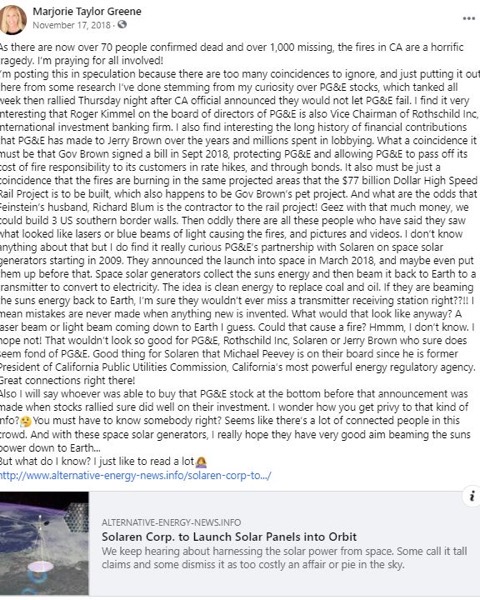
MTG

I “find it interesting” that Marjorie Taylor Greene finds interesting (i.e., makes up) a bunch of “speculation” that would warm the cockles of Nazi hearts.

What a coincidence! What are the odds that that a sane person would entertain such odd views?

H/T Jonathan Chait, GOP Congresswoman Blamed Wildfires on Secret Jewish Space Laser


[N]umerous liberal democracies have seen right-wing “populist” movements and parties emerge. So far, those that have risen to power have done so through liberal institutions — and despite moves to rig the systems in their own favor (most boldly in Hungary and Poland), nowhere has liberal government been fully overturned in favor of outright authoritarian rule or worse.

But the United States presents a distinctive, and potentially ominous, case.

Over the past three months, the Republican Party has proven itself to be a right-wing antiliberal party. Yes, this has been the culmination of a long process. Yes, it has antecedents in the American past. Yes, there are still some decent people in the party trying to oppose the trend from within. But despite all of these caveats, what we’ve recently witnessed in the GOP is something new — and newly alarming.

… [T]he Republican Party is now dominated by ideas and individuals who consider it acceptable to reject the legitimacy of democratic elections when they deliver a loss, and to encourage, affirm, and spread outright lies in order to gain and hold political power. That makes the Republican Party a great danger to liberal democratic government in the United States.

Damon Linker, Liberal democracy’s Achilles Heel


Over the years when national events have turned especially murky, I’ve asked [Senator Rob Portman’s] read on things, and what’s always struck me is his stubborn sense of reality: He doesn’t let his wishes get in the way of what he sees. In the geography of the Republican Party he’d be placed with figures like Mitch Daniels —the We Actually Know Things Caucus.

It really is something that we’re living in a time when ambitious people leave the U.S. Senate to get things done.

I asked about the comment of his former campaign manager Corry Bliss, published Tuesday in National Journal, on Portman’s decision not to run: “If you want to spend all your time on Fox and be an a—h—, there’s never been a better time to serve. But if you want to spend your time being thoughtful and getting s— done, there’s never been a worse time to serve.” Mr. Portman roared with laughter. “Did he say that?” He roared again. “Yeah, I won’t comment.”

Peggy Noonan, Rob Portman’s Exit Interview

Mitch McConnell’s Hijinks

Just as [Mitch McConnell] played Donald Trump for three Supreme Court justices and a tax cut, here he is convincing Democrats to let him have veto power over what happens in the upper chamber for years to come.

[T]he horrifying truth about American partisanship, the reason that the National Football League is vastly more entertaining than what goes on in Washington, D.C[. is that] almost no one there actually cares about winning. Holding on to office, getting the paychecks and the perks, receiving all the attention and adulation their parents and classmates apparently failed to shower upon them in their youth — these are what motivates most of our elected officials.

Which is why at the end of the day I am not hesitant to call McConnell the most effective Senate leader of the last half century, for the not very complicated reason that he not only cares about winning but does win more consistently than anyone else, regardless of the position in which he finds himself.

Mitch McConnell is the GOAT

GameStop Hijinks

The market can remain irrational longer than you can remain solvent.

John Maynard Keynes via Axios, Gamestop trading pits Wall Street’s powerful against the powerless

Insurrection after-effects

Acting D.C. Police Chief Robert Contee III said this week that another police officer who was on duty during the January 6 Capitol attack, Jeffery Smith, died by suicide on January 15. Capitol Police Officer Howard Liebengood also died by suicide on January 9, three days after the riot, and Officer Brian Sicknick died after sustaining injuries during the insurrection. “Between USCP and our colleagues at the Metropolitan Police Department, we have almost 140 officers injured,” Gus Papathanasiou, the chair of the Capitol Police Labor Committee said in a statement. “I have officers who were not issued helmets prior to the attack who have sustained brain injuries. One officer has two cracked ribs and two smashed spinal discs. One officer is going to lose his eye, and another was stabbed with a metal fence stake.”

The Morning Dispatch


If all we do as a nation is lock up some individual pelt-wearing yahoos and cringe in fear from holding a public man to account for a catastrophic abuse of leadership in public office — if we have one law against the common man, another for the elite — we will have failed to deliver that message. If you take this from an American national perspective rather than a narrowly partisan one, that ought to be obvious.

… What we witnessed on January 6 … requires a more vigorous, less timorous, response.

And one man above all others was responsible for inspiring it and setting it in motion.

It is hard to think of any abuse of high office, short of treason itself, that would have alarmed the Founding Fathers more than inspiring a mob to target the democratic transfer of power.

Did Trump do that? Unquestionably. I walked in detail through his speech that day, and asked:

> If you heard and believed every word of this speech, coming from the president of the United States . . . what would you do? Would you believe that the time had come to take up arms to save your country and democracy? A lot of Americans, people of good will, very well might.

Neither Davidson nor Domenech answers that question. Neither deals with the speech or its claims at length, falling back on generality and euphemism. Davidson says that my view “boils down to arguing that because people feel strongly about elections, Trump should have toned down his criticism of election fraud because some radicals in his party might get crazy ideas about storming the Capitol.” But in fact, as the president, he should not have said those things while setting a crowd in motion toward the Capitol with the aim of getting them to pressure Congress and the vice president in the midst of the counting process. You cannot extract Trump’s speech from the time, the place, and the context in which he chose to make it. Nor can you present it as some sort of generalized critique of election integrity, when it bluntly asserted that the stealing of an election was ongoing just down the block, and that Trump expected the crowd to participate in stopping it.

Trump Impeachment & Mob Rule — A Reply to the Federalist | National Review

This was a masterful reply to two of the heavier hitters at The Federalist (the now-Trumpist website I stopped reading, oh, around election day 2016, not the esteemed professional Society) who were engaging in sophistries against convicting Trump in the impeachment trial.

Media lowjinks

“Whatever the platform, the competitive advantage belongs to those who can best habituate consumers, which in the stunted, data-obsessed thinking of our time, means avoiding at almost any cost impinging on the reality so painstakingly built around them. As outlets have increasingly prioritized habituation over information, consumers have unsurprisingly become ever more sensitive to any interruption of their daily diet. … Having been cosseted by self-validating coverage for so long, many Americans now consider any news that might suggest that they are in error or that their side has been defeated as an attack on them personally.

Chris Stirewalt, formerly of Fox News, in the Los Angeles Times via The Morning Dispatch (emphasis added)


The Deep Lie … does not merely mislead — it is a lie so deeply embedded in the media and political ecosystem that it distorts reality and shapes our political world. It is immune to evidence, to logic, or new information, and it is endlessly recycled until its shatters our sense of sanity.

It works this way. The lie (any lie) begins in the fever swamp—>social media —> Fox News/talkradio —> goes viral —> achieves critical mass —> politicians begin to “ask questions” because “people are saying” —> dominates political debate….and the loop continues until the lie shatters our polity.

Tucker Carlson and The Deep Lie – Morning Shots

Scott Alexander is back (and gives the skinny on the gender binary)!

Scott Alexander, late of SlateStarCodex, is back with AstralCodexTen on Substack. He stretches one’s brain.

They also have a category called “gender”. They say they included measures like “femininity” and “sex-stereotyped activities” in there – I can’t find more specifics. It has a CCFI of 0.42 with confidence interval including 0.5, so looks slightly more dimensional, but can’t quite rule out it being slightly more categorical. If anyone ever demands you have an opinion on the question “is binary gender real?”, I think the most scientifically-supported answer would be “it has a Comparative Curve Fit Index of 0.42 plus or minus 0.1, which means it trends towards dimensionality but taxonicity cannot be ruled out”.

Ontology Of Psychiatric Conditions: Taxometrics

Education Hijinks

Of all the stupid arguments the politically correct trot out to justify savaging reading lists, the idea that kids should see themselves in literature is the dumbest — but just about perfect for our narcissistic culture.

Cicero said, “Not to know what happened before you were born is to remain a child forever.” Similarly, not to know, through books, worlds and peoples other than your own is to remain a child forever. It is to remain narrow, self-centered, and frightened of anything that is unfamiliar. I’m not the sort of person who is particularly interested in the life of a Norwegian farm woman of the Middle Ages, but Kristin Lavransdatter absolutely captivated me, because it transported me into a radically different world, but introduced me to people whose dreams and struggles seemed very human, and very relatable. What a poverty to hand a teenager some YA crap novel about alienated suburban teens cutting themselves and dreaming of changing their sex, when they could be reading Kristin Lavransdatter. What kind of culture does this to its kids?

Rod Dreher, A Door, Not A Mirror – Daily Dreher

Benediction

Out of the crooked timber of humanity no straight thing was ever made.

Immanuel Kant, Idea for a Universal History with a Cosmopolitan Purpose

You shall love your crooked neighbour
With your crooked heart.

W.H. Auden, As I Walked Out One Evening

The worst judge of all is the man now most ready with his judgements; the ill-educated Christian turning gradually into the ill-tempered agnostic, entangled in the end of a feud of which he never understood the beginning, blighted with a sort of hereditary boredom with he knows not what, and already weary of hearing what he has never heard.

G.K. Chesterton, The Everlasting Man (PDF)

You can read most of my more impromptu stuff here or join me and others on micro.blog. You won’t find me on Facebook any more, and I don’t post on Twitter (though I do have an account for occasional gawking).

Things to think about after exhaling

Things to think about after exhaling

[Wendell] Berry often quotes Wes Jackson’s book Becoming Native to This Place in this regard. “The universities now offer only one serious major: upward mobility,” Jackson writes. “Little attention is paid to educating the young to return home, or to go some other place, and dig in. There is no such thing as a ‘homecoming’ major.

Mark T. Mitchell and Nathan Schlueter, The Human Vision of Wendell Berry


The tomb of Ignatius

Here I am not that Cleon celebrated
in Alexandria (where it is hard to astonish them)
for my magnificent houses, for the gardens,
for my horses and for my chariot,
for the jewels and silk that I wore.
God forbid; here I am not that Cleon;
let his 28 years be erased.
I am Ignatius, a reader, who came to my self
quite late; but I lived so for 10 months
happy in the serenity and security of Christ.

(C.P.) Cavafy


Over the years, I’ve bounced around the political spectrum. I was liberal in Texas, more conservative in college, and now I’m somewhere in the middle. Through it all, I saw politics as a fight between left and right. I don’t see it that way anymore. Donald Trump’s presidency has exposed a bigger threat: an all-out attack on the principle that facts must be respected. We used to take that principle for granted; now we must defend it. Politics has become a fight between those who are willing to respect evidence and those who aren’t.

Progressives and conservatives have always quarreled about what’s true. But to make those debates productive, and to correct our country’s mistakes—failed projects, naïve policies, bad wars—we need a common standard for judging truth. That standard can’t be the Bible or identity politics. It has to be the standard we apply in daily life: evidence. If you say the election was stolen, you have to prove it in court. If you accuse a police officer of murder, your story has to withstand investigation.

… Science has a culture of falsification.

Politics doesn’t. When political promises don’t pan out—wars turn into quagmires, public schools underperform, or tax cuts fail to pay for themselves—politicians invent excuses. This has always been a problem, but it’s getting worse. Trump and his acolytes don’t just spin facts; they completely disregard them. They repeat fantastic lies about election fraud, and when they’re confronted with contrary evidence, they’re not even embarrassed.
Advertisement

If we don’t get control of this—if we don’t reestablish an ethic of respect for facts—nothing else will be solved. We can’t extinguish the virus if tens of millions of Americans insist it’s a hoax and refuse to be vaccinated or wear masks. We can’t restore public faith in election results and put down insurrectionism if half the population refuses to believe anything the media report. Repairing the consensus that facts must be respected won’t settle our debates on spending, education, or criminal justice. But without that consensus, the crisis we’re in will get much worse.

Will Saletan, The Enemy Isn’t Republicans


Nevertheless, behind its variegated forms, each attuned to different challenges, are the timeless truths and principles at the heart of conservative ideology: (1) Humans are flawed creatures; (2) Reason is powerful but limited and prone to error; (3) Utopian thinking is dangerous, especially when combined with ideologies that promote concentrated political power; (4) Humans should respect tradition and custom; and (5) Intuition is an important guide to social policy. Modern Republicans, standing among the ruins of the Trump presidency, should turn to these principles, elaborated below, to rebuild a robust and unified coalition that can appeal to all ages and ethnicities.

Bo Wingard, A Return to Tradition: Creating a Post-Trump Conservatism – Quillette. It’s good to be reminded what conservatism is after four years of the term’s gross misuse.


Robby [George] pulled out his phone, then, and asked what I knew about Heinrich Heine. I knew the Nazis had burned his books, that he was a Jew who had converted to Christianity. That was about it.

In 1834, Robby told me, Heine wrote a prose poem that prophesied the evil that would swallow Europe a century later. He read it to the table:

> “Christianity — and that is its greatest merit — has somewhat mitigated that brutal Germanic love of war, but it could not destroy it. Should that subduing talisman, the cross, be shattered, the frenzied madness of the ancient warriors, that insane Berserk rage of which Nordic bards have spoken and sung so often, will once more burst into flame. This talisman is fragile, and the day will come when it will collapse miserably. Then the ancient stony gods will rise from the forgotten debris and rub the dust of a thousand years from their eyes, and finally Thor with his giant hammer will jump up and smash the Gothic cathedrals.”

Tears rolled down my face as he spoke these lines, as they do now as I re-read them:

> “Do not smile at the visionary who anticipates the same revolution in the realm of the visible as has taken place in the spiritual. Thought precedes action as lightning precedes thunder. German thunder is of true Germanic character; it is not very nimble, but rumbles along ponderously. Yet, it will come and when you hear a crashing such as never before has been heard in the world’s history, then you know that the German thunderbolt has fallen at last. At that uproar the eagles of the air will drop dead, and lions in the remotest deserts of Africa will hide in their royal dens. A play will be performed in Germany which will make the French Revolution look like an innocent idyll.”

The Great Unraveling – Common Sense with Bari Weiss.

Yes, Bari Weiss has started a Substack blog (how soon until we just call them “substacks”? Maybe it’s here already?)

Did you eat popcorn?

(I want to stop thinking about 45. I also want nothing like him ever to happen to my country again, so I do “go on a bit.”)

“You have to show strength,” you said,
“and you have to be strong.”
You promised to go with them
but chose instead to view the destruction on TV.
I wondered if you understood
that the violence that unfolded was real,
and not something made for television.
Did you order Cokes as you watched?
Did you eat popcorn?

Michael D’Antonio, A Goodbye Letter for the Anti-President, reformatted by Tipsy as poetry.


I’m not a big fan of Nina Totenberg (she is incapable of balanced coverage on some issues), but her Biden’s Solicitor General Faces Tough Choices On Trump Supreme Court Positions was a genuinely interesting account of what happens to a successor when a POTUS shatters norms and suborns frivolous arguments from his Justice Department.


For Trump supporters, I would recommend reading the entire post-January 6 debriefing of four Trump biographers by Michael Kruse in Politico, and internalizing that Trump is a con man who conned you big time:

Kruse: … I’m curious: Do you think November 8, 2016, will in the end be the best thing that ever happen to Donald Trump, or the worst?

Tim O’Brien: Both. It’s both the best and the worst. He’s such an egomaniac and so needy for the spotlight that he got the biggest platform in the world in the presidency to fill his need for attention, constant attention, and the media spotlight. And because he’s that damaged and needy he courts these things but then he gets exposed for who he is. And I think he’s permanently sullied his family’s name with at least half the population of the United States, if not more, and it’s historically dark things that they’re going to be associated with—an insurrection, programmatic racism, thuggery, and a real, I think, defaming of the presidency, unlike any other president. And I don’t think he foresaw that … He’s just Mr. Id. And he’s constantly trying to get gratification. He doesn’t care about the consequences. And then they blow up all around him. And so his election as president was both, I think, the best and the worst thing that ever happened to him.

Kruse: Is he capable of some sort of honest personal reckoning …?

[Harry] Hurt: No.

[Gwenda] Blair: No.

[Michael] D’Antonio: No.

[Tim] O’Brien: No way.

Kruse: So there is no …

Hurt: No.

O’Brien: No.

Blair: No.

Hurt: Next question.

‘He Was the Ringmaster in the Demise of His Own Circus’ – POLITICO Subtitle: On the eve of Donald Trump’s exit from power, four biographers who studied him up close reflect on what he wrought on the country. And what he’ll do next.


Phil Vischer, creator of the Christian cartoon series “VeggieTales,” once employed Metaxas as a writer and has known him for years.

“At some point,” he told Religion News Service in an email, “Eric went from idolizing people like Os Guinness to idolizing Ann Coulter and Tucker Carlson — right wing political firebrands who live to ‘own the libs.’ I think there’s an adrenaline rush or dopamine hit from engaging in full-fledged culture wars that otherwise thoughtful souls on both sides of the political spectrum can find intoxicating. For some, life is worth living only when ‘the soul of America’ is at stake. So the soul of America is ALWAYS at stake.”

Belmont University professor David Dark, who has appeared on Metaxas’ radio show in the past, said that Metaxas may be influenced by the financial opportunity of the Trump cause. You can make a living appealing to an evangelical Christian audience, Dark said, but only if you give them what they want — in this case, support for Trump.

“I think that the market he has appealed to has gotten narrower and narrower,” he said.

A Greek Orthodox in his youth, he became an evangelical in his 20s and has since believed in personal revelation and signs from God. In a conversion story he recounted in Christianity Today magazine and in “Fish Out of Water,” an autobiography about faith due out in February, he tells of seeing a golden Jesus fish in a dream.

In the autobiography, Metaxas also lists a whole series of miracles and messages from God — including one from a turtle in Central Park — on topics from 9/11 to his rise from obscurity to fame.

How Eric Metaxas went from Trump despiser to true believer (emphasis added)

So did the “golden Jesus fish” tell apostate Metaxas that Trump was his man?

Welcoming 46 with open — ummmm — adulation

Spin is ubiquitous in modern politics. There is nothing new or shocking about it. Yet it is both noteworthy and troubling just how quickly CNN flipped from treating the previous president like a hostile occupying power to uncritically publicizing the brand-new administration’s efforts to cut itself maximal slack. If the media has any hope at all of improving on its image and reversing the collapsing trust of readers and viewers, it will have to do better than this.

The point is not to try and convince the most hostile Republicans to tune back into mainstream media outlets. Many of them are unreachable by this point, showing less interest in doing or seeking out better reporting than in using accusations of double standards and hypocrisy to help build support for the right and attempt to tear down liberal institutions. Some go even further, to use the failings of professional journalism as a justification for pedaling deliberate distortions on alternative platforms. Those who take this position view all so-called news as a form of propaganda or information warfare and defend the deliberate promulgation of lies as a tit-for-tat response to the actions of their enemies: “If the left does it, then so should we, and with even less restraint.”

But there are plenty of Americans situated between the burn-it-all-down hyper-cynical right and the journalists and Democratic Party politicos who naively or enthusiastically passed around the CNN story last week. Whether the right succeeds in persuading more and more people to join them in tuning out mainstream journalism will depend in large part on whether its accusations of dishonesty and bad faith look accurate to observers. Does the media seem fair-minded and scrupulous in what it labels news? Or does it seem highly invested in enhancing the power of one side in our country’s deep political divide?

Damon Linker, The media has to do better than this


Kamala Harris literally swore on a stack of Bibles to uphold the Constitution. I think that means it will be doubleplusbad when she discards the Constitution for partisan purposes, as every administration seems to do eventually.

The usual postscript

Out of the crooked timber of humanity no straight thing was ever made.

Immanuel Kant, Idea for a Universal History with a Cosmopolitan Purpose

You shall love your crooked neighbour
With your crooked heart.

W.H. Auden, As I Walked Out One Evening

The worst judge of all is the man now most ready with his judgements; the ill-educated Christian turning gradually into the ill-tempered agnostic, entangled in the end of a feud of which he never understood the beginning, blighted with a sort of hereditary boredom with he knows not what, and already weary of hearing what he has never heard.

G.K. Chesterton, The Everlasting Man (PDF)

You can read most of my more impromptu stuff here or join me and others on micro.blog. You won’t find me on Facebook any more, and I don’t post on Twitter (though I do have an account for occasional gawking).

How to deal with two conservative problems

David Hines takes a stab at answering How Do You Solve a Problem Like QAnon? | The American Conservative, and it was one of the better things I’ve read today if only because it doesn’t suggest that Q adherents aren’t wicked racists or antisemites that just need to be made dead. Indeed, without sugar-coating the problem, has has what seems a sensible solution that wouldn’t even be all that difficult to implement:

Not to put too fine a point on it, Righties have a weakness for believing stupid shit.

We’re not the only ones … But nobody on the left is as enthusiastic as deeply or as long about stupid shit as are people on the Right. When Lefties do employ stupid shit, such as gleeful pee tape rumors, the origins are typically elite Lefty circles. Our stupid shit comes from the base, tends toward the wildly implausible, and of late tends to promise imminent glory on earth: the end of a story, in which we win.

This divide exists because Left and Right are different outlooks and different cultures. Accordingly, Lefties have a different failure mode than we do. The failure mode of right-wing is kook. The failure mode of left-wing is puritan …

The central fantasy of QAnon isn’t adrenochrome, or cannibal cults, or mole children, or any of the myriad lunacies of the outlandish dystopia it presents. The central fantasy is the idea that things will be better because somebody is going to do something.

Any attempt to rein in Righty conspiracy theorists and make them actually useful will have to consider their actual interests and aptitudes. And they have them. Many of them are backbone-of-America types: they have jobs, have family lives, and are actively engaged in their communities in various ways. They turn out to events and meetings. They’re genuinely enthusiastic. They’re hard workers. They’re curious about the world and passionate to make a difference in it. They are genuinely interested in learning about things that aren’t immediately obvious. It’s just that they learn them from random YouTube videos because they don’t know how to use PACER to find court records, or how to file FOIA applications to get government documents, or how to look up Form 990s to learn about how nonprofits are organized and funded.

The Righty base desperately wants to do something, but doesn’t know how. And that’s because the elites don’t want it to learn. The root of our real problem on the Right is that elites and the base want different things. So elites don’t train the base in how to actually produce change. QAnon is what you get when a naïve, untrained base tries to fill that vacuum. What they fill the vacuum with is a story where somebody is doing something, and the end of the story is a great big WE WIN.

… It’s often noted that the Right has a surfeit of pundits; what we lack are diggers, the dedicated researchers who do the boring work of poring through documents to find news. But maybe we’ve had them all along — they’re just naive and untrained. What if we trained them, empowered them, and turned them loose?

People turn to conspiracy theories to explain a world they can’t understand. Giving them the tools to explore the real world could keep them more grounded — and turn up some interesting things for the rest of us.


For the senators who will try the impeachment, a thought: It’s time to demystify Donald Trump. He leaves the presidency disgraced. He is a diminishing asset: postpresidential power always wanes, and will especially in this case …

In running in fear from him you are running from a corpse. And you’ll never be safe anyway. Something wild has been let loose. So be brave. The Democrats want you tied to Mr. Trump forever. Stop, now.

Peggy Noonan, Liz Cheney Shows What Leadership Looks Like – Peggy Noonan (January 14)


Out of the crooked timber of humanity no straight thing was ever made.

Immanuel Kant, Idea for a Universal History with a Cosmopolitan Purpose

You shall love your crooked neighbour
With your crooked heart.

W.H. Auden, As I Walked Out One Evening

The worst judge of all is the man now most ready with his judgements; the ill-educated Christian turning gradually into the ill-tempered agnostic, entangled in the end of a feud of which he never understood the beginning, blighted with a sort of hereditary boredom with he knows not what, and already weary of hearing what he has never heard.

G.K. Chesterton, The Everlasting Man (PDF)

You can read most of my more impromptu stuff here or join me and others on micro.blog. You won’t find me on Facebook any more, and I don’t post on Twitter (though I do have an account for occasional gawking).