Sunday, 8/28/22

Memory eternal!

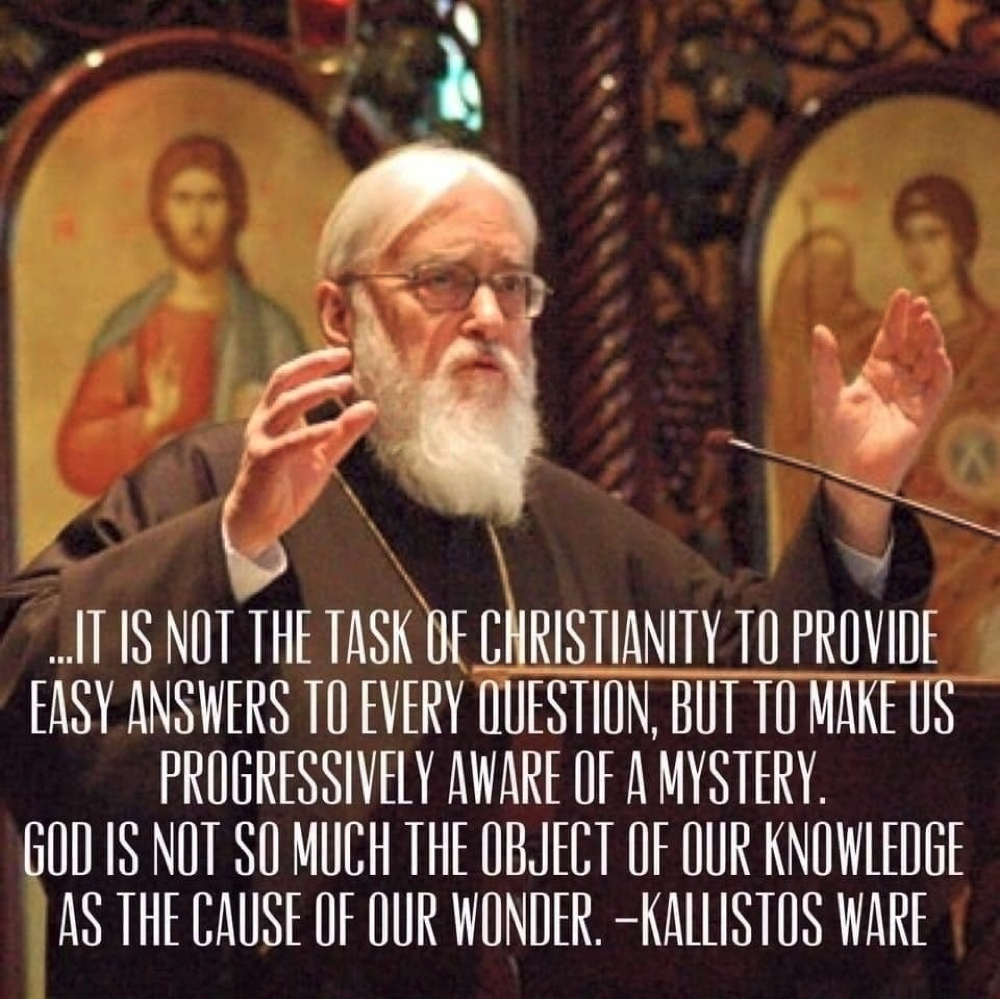
Metropolitan Kallistos Ware has reposed in the Lord

Metropolitan Kallistos Ware reposed in the Lord last Tuesday.

“Let me keep my distance, always, from those who think they have the answers.

Let me keep company always with those who say "Look!" and laugh in astonishment, and bow their heads.”

Mary Oliver, Evidence: Poems

Against David Frenchism

I may have finally reached a tipping point trying to process David French’s commentaries on religion and politics. Henceforth, I will either not bother at all or at least approach his columns and podcasts with an attitude of “tell me, in the first paragraph or two, why I should stick around and hear you out.”

I’ll still listen to him on law, but I don’t think he has anything I need to hear about the intersection of religion and politics.

That problem isn’t that he’s anti-Trump, goodness knows. The problem is that he’s reflexively parochial, and his “parish” is white Evangelicalism; that he says “Christians” when he means “white Evangelicals” drives me to distraction.

(Deep breath.)

I suppose this bugs me so much because French is writing and podcasting in secular, not Evangelical, spaces. He’s being read by people who may judge all of Christianity by his fixations on North American white Evangelical grotesqueries.

There is a Church that is rooted far deeper in history than the Second Great Awakening, utterly orthodox in its Christianity, and ambivalent-to-indifferent in its politics (the impressions of some American converts notwithstanding). If you’ve read me for long, you know where I think it’s found. All we ask of a polity is that we may lead a calm and peaceful lives in all godliness and sanctity.

But you’d never appreciate that by reading David French, who basically tells the Western world that “Christians be like Falwell Jr. and Orange Man.” That’s just not true, and eliding Christianity with Evangelicalism turns people off to the holy and life-giving potential of authentic, historic Christianity.

Up with Jake Meadorism

Here is one of the arguments some friends have made in defending the evangelical hard pivot toward Trump and right-wing politics more generally: The country is changing. No one will be friendly to all of our beliefs or values. However, if the progressives win, the likeliest outcome is some blending of dhimmitude and persecution. On the other hand, if the right wins, religious liberty will at least mostly be safe and we’ll be left alone. So it makes sense for orthodox Christians to migrate rightward.

The difficulty I see with this: Our churches do not exist within sealed spaces closed off from the world outside the congregation. Rather, our parishioners are being discipled all the time by the networks they participate in. So when we strengthen our ties to the political right and, in particular, when we tend to look past or gloss over the right’s sins for sakes of the political coalition (which is just a reality of life with any political coalition you try to participate in), we aren’t simply retreating into a stable space where right-wing governments protect our stable, faithful Christian communities. Rather, our communities are being shaped through the very act of partnering with specific groups, of speaking about some sins and not speaking about others. These things are, in themselves, formative.

To get his core insight, I had to quote most of his short post, but there is a bit of good stuff left, and with no paywall, either.

Jake Meador, Places of Refuge are Places of Discipleship. Meador, too, is Protestant, and as a Reformed Christian, he (as did I) appears to think himself Evangelical or Evangelical-adjacent. Unlike French, he doesn’t parochially collapse Christianity into Evangelicalism.

Why I Will Disregard any American Episcopalian Who Complains About Small States Getting As Many Senators as Big States

“Yes, a bishop’s episcopal charism does not depend on the number of worshipers in their see. But when almost all the micro-dioceses are in the west, and when western bishops are disproportionately present at Lambeth 2022, this is white privilege in action," he wrote. "Lambeth 2022 is taking place even though the bishops of half of African Anglicans have refused to come. Their dioceses constitute a third of the total Anglican Communion. Western bishops may say ‘it was their choice not to come.’ But this is not a good look."

Terry Mattingly, Some trends in global Anglican Communion are starting to look rather Black and White — GetReligion

Context:

  • Many western bishops lead "micro-dioceses" with under 1,000 active members or "mini-dioceses" with fewer than 5,000.
  • The Church of Nigeria claims 17 million members and 22 million active participants.
  • Uganda has 10 million members
  • Rwanda has 1 million members.

A Christian Culture (for the very first time)

By pretty much all measures, the Orthodox Christian countries of Eastern Europe take their faith more seriously than the Catholic countries further West or the Protestant countries which mainly lie around the continent’s fringes. I should really say ‘former Protestant countries’ because, as I have written here in the past, these countries – including mine, Britain – are now post-religious. Faith has been replaced by politics, ideology, activism or the material and technological idolatry which we call ‘progress.’

All of which means that I have until recently never seen a real Christian culture, of the kind my country used to be many centuries ago, and my adopted country, Ireland, used to be until more recently.

Paul Kingsnorth, Intermission: Monasteries of Romania #1

Godsplaining to the Archbishop

“If we say our God is an all-loving god, how do you explain that at any given time probably 400 million living on the planet at one time would be gay?” he asked. “Are the religions of the world, as does Catholicism, saying to those hundreds of millions of people, ‘You have to pass your whole life without any physical, genital expression of that love?’”

Archbishop Rembert G. Weakland, recently deceased, to the New York Times in 2009, roughly seven years after exposure of his hush money payment to a male lover (or rape victim).

It is suggestive that “the religions of the world” seem, to the disgraced Archbishop, to speak with one voice. How could that be if the idea of lifelong sexual abstinence is so stupid? Might it be that the spirit of our age is the anomaly, the deviation from the wisdom of the ages?

Did the Archbishop not confess that Mary, the “Mother of God,” remained ever a virgin? Or did he, like a highly multiparous protestant I corresponded with at some length, rule out Mary’s ever-virginity because that would be “perverted”?

Further, it is famously not just the Church that tells people “You have to” do something you’d rather not do, See, e.g., decalogue.

Still further, surely a substantial part of the work of the Church is dealing sacramentally and pastorally with people who fail to live up to divine expectations. See, e.g., confession.

Finally, the surmised number of gay people is irrelevant to the correct answer to the Archbishop’s tendentious question.

To get other glimpses of the odious decedent, see Rembert Weakland, Proud Vandal

Youth alienation then and now

[T]he thing that disturbs me the most right now is that the conversations often that I’m having with younger evangelicals. When someone says to me I’m thinking about walking away, it’s usually a very different conversation than I would have had 10 years ago. 10 years ago, it would have been with a younger person saying I just can’t believe the supernatural stuff that we believe anymore. Or I really think the moral ideas of the church are too strict and too judgmental, and I want to walk away.

Now it’s almost the reverse, almost directly the reverse. It’s people who are saying, I don’t think the church believes what it says it believes and what it’s taught me, or at least I fear that it doesn’t.

[W]e’re not looking for some Christian America in the past because in order to do that, we would have to redefine what we mean by Christian … [i]n all sorts of ways that I think are harmful.

Russell Moore

Repentance

Repentance is everything you do to get sin, those inborn passions, out of you. It’s reading, thinking, praying, weeding out disruptive influences in your life, sharing time with fellow Christians, following the guidance of the saints. Repentance is the renunciation of what harms us and the acquisition of what is beneficial to us, writes a holy counselor.

Dee Pennock, God’s Path to Sanity

Demoting free exercise

In essence, [Employment Division v.] Smith demoted the Free Exercise Clause of the First Amendment to a glorified nondiscrimination doctrine. Rather than granting Americans an affirmative right to practice their religion absent compelling governmental reasons to restrict that practice, the Free Exercise Clause becomes almost entirely defensive—impotent against government encroachment absent evidence of targeted attack or unequal treatment.

David French


[S]ubordinating truth to politics is a game which tyrants and bullies always win.

Jonathan Rauch, The Constitution of Knowledge

The Orthodox "phronema" [roughly, mind-set] cannot be programmitized or reduced into shibboleths.

Fr. Jonathan Tobias

You can read most of my more impromptu stuff here (cathartic venting) and here (the only social medium I frequent, because people there are quirky, pleasant and real). Both should work in your RSS aggregator, like Feedly or Reeder, should you want to make a habit of it.


Sunday, 8/21/22

Archeology: a fancy word for speculating about our ancestors

Another distinguished writer, again, in commenting on the cave-drawings attributed to the neolithic men of the reindeer period, said that none of their pictures appeared to have any religious purpose; and he seemed almost to infer that they had no religion. I can hardly imagine a thinner thread of argument than this which reconstructs the very inmost moods of the prehistoric mind from the fact that somebody who has scrawled a few sketches on a rock, from what motive we do not know, for what purpose we do not know, acting under what customs or conventions we do not know, may possibly have found it easier to draw reindeer than to draw religion.

G.K. Chesterton, The Everlasting Man

In the same vein, David MacCauley, Motel of the Mysteries

Worth repeating

Frederick Buechner has met Christians who remind him of American tourists in Europe: Not knowing the language of their listeners, they speak the language of Zion loudly and forcefully, hoping the natives will somehow comprehend. They seem cocky with faith, voluble with their theology, and content with a God who resembles a cosmic Good Buddy. Their certitude both fascinates and alarms him.

Phillip Yancey, Frederick Buechner, the Reverend of Oz

The Machine almost compels a bit of hypocrisy

To fail to reach lofty goals is not hypocritical, and even to publicly defend those goals while knowing you have failed to reach them is not hypocritical if you are open about your limits.

… If stepping outside the Machine were possible, then it would not be necessary.

Irony is politically important. It is important because anything less than an unreachable ideal will be caught by the Machine, eviscerated, repackaged, and sold back to you in a form that is exactly the same apart from the way that it drains everything good from your soul. No idea, no belief, no institution, and no practice is beyond the Machine’s grasp. Only the ideal, being formless, is safe. Of course, the ideal, being formless, is also beyond our grasp, so we cannot cling to it for safety. If we try, then we will cling instead to our idea of it; and if we do that, we will soon find out that our idea was the Machine’s all along. The only way to succeed is by committing so completely that failure is inevitable. And this is the other reason why we need irony. The completeness of our failures reveals to us the depths of our absurdity. This is a gift. Will-to-power needs us take ourselves seriously. It is the product of pride and it struggles when we genuinely laugh at ourselves.

FFatalism, Is asceticism ascetic?

Reassurance

I was a conscientious objector in the Vietnam era, who ended up serving his country by, so to speak, emptying bedpans in Peoria. In the ensuing decades, I’ve never become a hawk, but I’ve wondered whether I was right back then, whether I was trying to retain a purity that this fallen world doesn’t really allow.

Yesterday, I read this (including the full surrounding essay) from a Priest who, serving as chaplain “for the airmen who dropped the atomic bombs on Hiroshima and Nagasaki in August 1945, and gave them his blessing”:

Ethical hairsplitting over the morality of various types of instruments and structures of mass slaughter is not what the world needs from the church, although it is what the world has come to expect from the followers of Christ. What the world needs is a grouping of Christians that will stand up and pay up with Jesus Christ. What the world needs is Christians who, in language that the simplest soul could understand, will proclaim: the follower of Christ cannot participate in mass slaughter. He or she must love as Christ loved, live as Christ lived and, if necessary, die as Christ died, loving ones enemies.

For the 300 years immediately following Jesus’ resurrection, the church universally saw Christ and his teaching as nonviolent. Remember that the church taught this ethic in the face of at least three serious attempts by the state to liquidate her. It was subject to horrendous and ongoing torture and death. If ever there was an occasion for justified retaliation and defensive slaughter, whether in form of a just war or a just revolution, this was it. The economic and political elite of the Roman state and their military had turned the citizens of the state against Christians and were embarked on a murderous public policy of exterminating the Christian community.

Yet the church, in the face of the heinous crimes committed against her members, insisted without reservation that when Christ disarmed Peter he disarmed all Christians. Christians continued to believe that Christ was, to use the words of an ancient liturgy, their fortress, their refuge, and their strength, and that if Christ was all they needed for security and defense, then Christ was all they should have. Indeed, this was a new security ethic.

Father George Zabelka, Blessing the Bombs.

Father George is right about Christian history. The Orthodox Church required a time of repentance, including abstention from the Eucharist, for soldiers who had killed even in a “just war.”

I find reassurance for my youthful conscientious objection in that, thought I was inspired more by Menno Simons (“Spears and swords of iron we leave to those who, alas, consider human blood and swine’s blood of well-nigh equal value.“) than by the Fathers of the Church.


You can read most of my more impromptu stuff here (cathartic venting) and here (the only social medium I frequent, because people there are quirky, pleasant and real). Both should work in your RSS aggregator, like Feedly or Reeder, should you want to make a habit of it.

Wednesday, 7/20/22

You didn’t miss anything. I didn’t publish yesterday because I just didn’t have enough material. That’s likely to recur, as I’m gradually correcting my incorrigible habit of poring over news that seems especially shareable.

Polling

The survey also found that 32% of Latino Catholics said their religious faith dictates their views on abortion, compared to 73% of white evangelical Protestants.

A new survey found Latino Catholics overwhelmingly support abortion rights. Here’s why.

I would be a pollster’s nightmare, as I find so many polling questions unanswerable if not unintelligible.

Orthodox Christianity is opposed to abortion, but I was anti-abortion before I became Orthodox, and (heaven help me, for this may mean that I’m an American individualist) I would affirm that at no time in my life has my religious faith "dictated my views" on abortion.

I have difficulty getting into the mind of anyone who would listen to that polling question, note the import of "dictate," and then answer in the affirmative. Thus the question is a — what? litmus test? ink blot test? I certainly don’t see useful information coming from it.

I don’t consider myself a rebel against my Church. I don’t think it has ever said what an Orthodox political position on abortion should be, though in my parish we especially pray regularly for an end to abortion through changed hearts.

My religious faith does "dictate" some things — say, my rejection of monothelitism and monoenergism and suchlike — important Christological questions of import on which the Church’s position is longstanding and plausibly reasoned (e.g., those teachings effectively denied the full humanity of Christ by saying that He had no human will or energy). Countermanding what the Church says about such theological nuances is above my pay grade and, unlike David Bentley Hart, I’m not arrogant enough to "go there." (I was a Protestant for two-thirds of my life and don’t care to try it again.)

But abortion? Capital punishment? Euthanasia? Eugenics? I can’t help but form my own opinions on those, informed by the Church but not dictated to.

Notes from a roving raconteur

I beat myself up because I’m an old fundamentalist and self-mortification is our specialty. And I’ve been having too much fun lately, which confuses me, doing shows in red states to crowds that include a good many Republicans who voted for the landslide winner in 2020 but nonetheless were warm and receptive to me who voted for the thief. In blue states, audiences are listening to make sure you check the boxes of Inclusivity, Diversity, Equity, and Antiracism. These are people who don’t mind that many theaters refuse to do “Our Town” because the “Our” does not acknowledge that Grover’s Corners was stolen from indigenous people. I use the possessive pronoun in singing “My country, ’tis of thee,” which audiences in red states enjoy singing with me, and also our national anthem, ignoring the fact that Francis Scott Key did own slaves.

Back in the Sixties, when I was in my twenties, we sang “We Shall Overcome” and clearly we did not overcome, we only created new hairstyles. So we pass the torch to the young, some of whom feel the word “person” shows gender bias and want to change it to perself. To which I say, “Good luck with dat.”

Garrison Keillor, national treasure.

Vignettes

There’s no apparent common theme to this two vignettes, but I thought each of them was interesting in different ways:

  • A young Hungarian academic I dined with last evening told me how jarring it was to get his master’s degree at a western European university, and to be congratulated by fellow grad students on how lucky he was to have grown up in a country that had been blessed by Marxist government. His own family had had everything taken from them by the Communists, yet these privileged nitwits could only imagine that life had been glorious under Communism. This has something to do with the fact that he’s living back in Hungary now, though he could make a lot more money working in the West. He can’t bear to deal with such ignorant people.
  • [A correspondent was one of] a bunch of very conservative Catholics who wanted to live rurally, and went out and bought land in the same area. This reader said he has been mostly grateful for having had the chance to live there and raise his kids there, but he’s not sure he would do it again if he had the chance. The reason, he said, is that he was too optimistic about how life would be there. He says he had not counted on the fact that the kind of Catholics who would make such a radical choice — strong-willed Catholics like himself, as he conceded — would find it unusually hard to get along. The reader told me that there were frequent disputes within the community over purity — not strictly sexual purity, but over whether or not it was licit to do things like let your daughters wear pants, or keep them in skirts and dresses. He said it got to be exhausting, dealing with these communal neuroses.

Rod Dreher’s Diary, Sisi, Queen Of The Magyars

Indestructible lies

… There in Boston is a monument to the man who discovered anesthesia; many people are aware, in these latter days, that that man didn’t discover it at all, but stole the discovery from another man. Is this truth mighty, and will it prevail? Ah, no, my hearers, the monument is made of hardy material, but the lie it tells will outlast it a million years ….

Mark Twain via Alan Jacobs

When Wystan met Hannah

“I met Auden late in his life and mine—at an age when the easy, knowledgeable intimacy of friendships formed in one’s youth can no longer be attained, because not enough life is left, or expected to be left, to share with another. Thus, we were very good friends but not intimate friends.”

Hannah Arendt, explaining (it seems) her refusal of a marriage proposal by the poet and friend W. H. Auden (via L. M. Sacasas). I was unaware of that episode, which rather complicates my recollection that Auden eventually gave up trying to resist his homosexuality.

Sacasas continues on other topics:

The examples I have in mind of this receding of materiality arise, not surprisingly, from the most prosaic quarters of daily life. As a bookish person, for example, I think about how the distinct material shape of the book not only encodes a text but also becomes a reservoir of my personal history. I remember where I was when I read it. Or I recall who gave it to me or to whom I have lent it. In other words, the presence of the book on a shelf recalls its contents to mind at a glance and also intertwines an assortment of memories into the backdrop of my day-to-day life. At the very least, it becomes an always available potential portal into my past. I don’t mean to be romantic about any of this. In fact, I think this is all decidedly unromantic, having to do chiefly with the meaning and significance of the stuff that daily surrounds us.

The digitized book by contrast may have its own advantages, but by being the single undifferentiated interface for every book it loses its function as a mooring for the self. It’s not that the e-reader has no materiality of its own—of course it does. Perhaps the best way of conceptualizing this is to say that the device over-consolidates the materiality of reading in a way that smooths out the texture of our experience. Consider how this pattern of over-consolidation and subsequent smoothing of the texture of material culture recurs throughout digital society. The smartphone is a good example. An array of distinct physical objects—cash, maps, analog music players, cameras, calendars, etc.—become one thing. The texture of our experience is flattened out as a result.

He’s not wrong about this (insider joke to one of my readers). Yet, because of the Readwise service, I’m developing a preferential option for eBooks. That and my shelves having filled to overflowing with regular books several times.

It’s helpful to be reminded of what’s lost, though. I hope Warren Farha of the world’s greatest brick and mortar bookstore, Eighth Day Books in Wichita, will forgive my my opinion if he’s reading this.

Awkward

Barton and WallBuilders argue that Jefferson and the Founders, outside of some exceptions, meant for the “wall of protection” to operate in one direction. It also, the group and its founder suggested, applies mostly to the federal government, not the states.

Jack Jenkins, The activist behind opposition to the separation of church and state

Well! This is awkward! I have a bad impression of David Barton, who I’ve understood as a grifter, dining out on "America is a Christian Nation."

But Barton is almost completely correct in what I first quoted. What Thomas Jefferson called a "wall of separation" was meant to protect the churches (I’d prefer "religion," though both terms have shortcomings in this context) from the state; and it was, at the time the First Amendment was ratified, intended to apply only to the federal government ("Congress shall make no law …"). Heck, Massachusetts had an established Congregational Church for 30 more years after Jefferson’s letter to the Danbury Baptists, and that letter was well after the Bill of Rights!

Where Barton may be wrong is in in the report that he thinks that amendment "applies" rather than "applied" mostly to the Federal Government. The First Amendment has been incorporated in the post-Civil War Fourteenth Amendment and thereby made applicable to the states. Thus Saith the Courts.

Thus, it seems to me, Barton may be telling half-truths to embolden crypto-theocrats by whose concepts of Christianity I have no desire to be governed — unless the alternative is the Wokeworld religion. I would almost certainly pick the Bartonites in that contest.

Like I said: awkward.

Is the tide turning?

… there is something undeniably more powerful about reading critiques of contemporary sexual morality that arise not from traditional religious spaces, but from within secular feminism and and from elite media. That’s when you know the tide might be turning.

I bring this up because in every single argument and controversy under the sun, reality gets a vote. Culture wars are ultimately won or lost not by online arguments but through their real-world consequences, and the position that leads to greater human misery tends to lose.

To connect with the issues at the start of this piece, when speaking about the wave of intolerance that’s swept the academy, philanthropy, Hollywood, and much of mainstream media, I’ve told conservative friends that they have no idea how miserable it was making most of the people in those organizations. Something had to give, and the immiserated majority is going to be intimidated by the motivated minority for only so long.

When speaking of the reality of porn-influenced consent culture, there’s a similar dynamic in play. It’s immiserating people by the millions.

David French, in an encouraging column: we seem to have hit bottom and started back up in several ways. At least that’s what French thinks.

Imagine my arse

Comments such as these convince me that John Lennon captured a common liberal dream in his haunting song “Imagine.” Imagine if there were no countries, and no religion too. If we could just erase the borders and boundaries that divide us, then the world would “be as one.” It’s a vision of heaven for liberals, but conservatives believe it would quickly descend into hell. I think conservatives are on to something.

Jonathan Haidt, The Righteous Mind.

I absolutely hate that song, and I was glad to learn I’m not alone.


If people have always said it, it is probably true; it is the distilled wisdom of the ages. If people have not always said it, but everybody is saying it now, it is probably a lie; it is the concentrated madness of the moment.

Anthony Esolen, Out of the Ashes

You can read most of my more impromptu stuff here (cathartic venting) and here (the only social medium I frequent, because people there are quirky, pleasant and real). Both should work in your RSS aggregator, like Feedly or Reeder, should you want to make a habit of it.

Sunday, 7/17/22

Poetry and Myth

Christianity and Poetry

The Incarnation requires an ode, not an email.

Poet Dana Gioia, Christianity and Poetry commenting on the poetry of the Magnificat.

More:

  • For most believers, the truths of their faith have become platitudes taught in catechism or Sunday school. The mysteries of faith—those strange events such as the Incarnation, Transfiguration, and Resurrection—have lost their awe and wonder and become replaced by sensible morality and proper reverence. There is nothing wrong with morality or reverence, but pious propriety is a starvation diet for the soul. Modern versions of the Bible, which translate verse passages into prosaic language for the supposed sake of clarity, are mistranslations, since they change the effect of the text.
  • When Jesus preached, he told stories, spoke poems, and offered proverbs. The Beatitudes are a poem about the merciful Kingdom of God in contrast to the selfish world of mankind. Jesus was not much concerned with theology. He left that to posterity. He did not ask his listeners to think their way to salvation; he wanted them to taste and see the goodness of God. He told them stories in which they could see themselves. He spoke to people as creatures with both a body and soul. He addressed them in the fullness of their fallen humanity, driven by contradictory appetites, emotions, and imagination.
  • When the Second Vatican Council dropped these sequences from the Catholic missal, it demonstrated how remote the Church had become from its own traditions. The new Church wanted to reengage the broader world and get rid of the musty traditions of the past. Vatican II wanted to be practical, positive, and modern; its motto was aggiornamento, Italian for “bringing things up to date.” The poetic sequences, which had seemed so splendid to the old Church—rapturous artistic vehicles for the contemplation of divine mysteries—felt too pious, formal, and elaborate for modern worship.
  • William Wordsworth was a religious man who saw the poet’s role as prophetic, but his Christianity expressed itself most eloquently in pantheistic Deism. He grew more devout and conventional in middle age, to the detriment of his verse. His pious Ecclesiastical Sonnets (1822) marked the lowest point of his career. Read any page of it outdoors—the stupefied bees will stop buzzing and the birds fall senseless from the trees.
  • Minor poets with major minds, Chesterton and Belloc were smart, brash, and wickedly funny. Unintimidated by their intellectual foes, they swaggered when others would have taken cover. For the first time since the Elizabethan Age, there was an outspoken Catholic presence in English verse.

And then, in conclusion:

Christianity has survived into the twenty-first century, but it has not come through unscathed. It has kept its head and its heart—the clarity of its beliefs and its compassionate mission. The problem is that it has lost its senses, all five of them. Great is the harvest, and greater still the hunger it must feed, but its call into the world has become faint and abstract. Contemporary Christianity speaks mostly in ideas. Potent ideas, to be sure, but colorless and hackneyed in their expression …

A major challenge of Christianity today is to recover the language of the senses and to recapture faith’s natural relationship with beauty. There is much conversation nowadays about beauty among theologians and clergy. They seem to consider it a philosophical problem to be solved by analysis and apologetics. Those are the tools they have. Their relation to beauty is passive rather than creative. Even the clearest thinking can’t close the gap between how people experience their existence—a holistic mix of sensory data, emotions, memories, ideas, and imagination—and how the Church explains it—moral and spiritual concepts organized in a rational system. The theology isn’t wrong; it’s just not right for most occasions. It offers a laser when a lamp is what’s needed.

These things matter because we are incarnate beings. We see the shape and feel the texture of things. We instinctively know that the form of a thing is part of its meaning. We are drawn to beauty, not logic. Our experience of the divine is not primarily intellectual. We feel it with our bodies. We picture it in our imaginations. We hear it as a voice inside us. We are grateful for an explanation, but we crave inspiration, communion, rapture, epiphany.

It probably will come as no surprise to you that I do not think that Orthodoxy has "lost its senses."

But I am one man, formed in the West, which has lost its senses, so I face extra hurdles acquiring the mind of the Church.

(A "brilliant and substantive new essay" like this pops up just often enough that I still subscribe to First Things.)

Deep magic

I read more on Saturday of his first book, A Branch from the Lightning Tree, and it was so overwhelming that despite having had two giant cups of coffee, I had to come back to the room to sleep. There is deep magic in his words. I see now why Guite, an Anglican priest, told me that only Orthodox Christianity will be able to contain the immensity that is Martin Shaw’s imagination and sensibility.

Rod Dreher.

I’m experiencing Martin Shaw that way, too, though I’ve only caught snippets and haven’t yet read the book I bought.

C.S. Lewis, reacting to the claim that society was returning to paganism, said something to the effect of "Would that it were so! The pagan is an eminently convertible man." Paul Kingsnorth and Martin Shaw may be the first fruits that add "prophet" to Lewis’ encomiums.

What Athos has on offer

Why have western scholars virtually ignored this experiential form of mystical Christianity at a time when numerous Westerners have turned their gaze toward Hinduism and Buddhism? What does Mount Athos have to offer to the Western world today that is not available within the mainstream churches?

Kyriacos C. Markides, The Mountain of Silence

What myths mean

However nonrational myths were, they betrayed man’s urge to explain what he found in himself and in the world, as well as his belief that explanation was somehow possible.

David V. Hicks, Norms and Nobility

Analysis

Hypocrisy or Mimesis?

Remember that old saw "hypocrisy is the tribute vice pays to virtue"?

Gilbert Meilander, with help from C.S. Lewis throughout, reminds me that a charge of "hypocrisy" ought to be used very sparingly. Excerpt from the introduction:

Discussing his experience as a soldier in the Great War, he writes of a fellow soldier who was not only (like Lewis) a scholar from Oxford, but also—alarmingly to Lewis—“a man of conscience,” committed to adhering to taken-for-granted moral principles.

Embarrassed by the contrast with his own life, Lewis did his best to conceal the fact that he himself had not taken moral obligations so seriously. “If this is hypocrisy,” Lewis writes:

then I must conclude that hypocrisy can do a man good. To be ashamed of what you were about to say, to pretend that something which you had meant seriously was only a joke—this is an ignoble part. But it is better than not to be ashamed at all. And the distinction between pretending you are better than you are and beginning to be better in reality is finer than moral sleuthhounds conceive. . . . When a boor first enters the society of courteous people what can he do, for a while, except imitate the motions? How can he learn except by imitation?

Belonging, truthing

For human beings, the ability to belong is more [evolutionarily] adaptive than the ability to see what’s true.

Alan Jacobs citing Jonathan Haidt.

I’m thinking of an American-made religion with (1) what strikes me as an unusually implausible founding story, but (2) a very strong sense of community. That religion was still growing rapidly last time I looked at the stats (though that has been a while). Score one datapoint for Haidt and Jacobs.

Tonic

You’re churches, for God’s sake. Quit fighting for social justice. Quit saving the bloody planet. Attend to some souls. That’s what you are supposed to do. That’s your holy duty. Do it. Now. Before it’s too late. And the hour is nigh.

Jordan Peterson via Aaron Renn

Well, that’s bracing — unless your church was already doing that.


If people have always said it, it is probably true; it is the distilled wisdom of the ages. If people have not always said it, but everybody is saying it now, it is probably a lie; it is the concentrated madness of the moment.

Anthony Esolen, Out of the Ashes

You can read most of my more impromptu stuff here (cathartic venting) and here (the only social medium I frequent, because people there are quirky, pleasant and real). Both should work in your RSS aggregator, like Feedly or Reeder, should you want to make a habit of it.

Sunday bright spots

If with all your heart you truly seek me …

… ye shall ever truly find me. Thus saith our God. (Mendelsohn, Elijah, paraphrasing Jeremiah 29:13)

Martin Shaw, a notable in British Neo-Paganism, went out to to the woods for a 101-day vigil (!) of some pagan sort, roughly around the beginning of Covidtide. At the end, he had an attention-getting vision, and then began having the dreams — like Christ coming to him like a stag:

Shaw says he used to think Christianity was dull and domesticated. “I was wrong.”

His problem was that he thought the tame bourgeois Evangelicalism in which he was raised was the be-all and end-all of Christianity. He says, of that church, “What on earth would they have done with Blake?”

Shaw says that he believes he was in contact with the One who made the universe. It rendered him speechless. “I have been appropriately silent,” he tells Mark Vernon, adding that this is the first time he has revealed in public his conversion.

“You could not have argued me into Christianity,” Shaw says. It took this overwhelming experience of awe.

He goes on to say that Christianity is the fulfillment of all kinds of pagan myths.

“There was this deep interior announcement: ‘You knocked, and now I’m here. What should we do?”

On modern Christianity:

“We seem to have lost our saints, we’ve lost our monks, we’ve lost our connection to our bush soul, we’ve lost the angular, strange, weirdness of Christ.”

Shaw describes the call to Christ as “an invitation, not an imposition. … It’s chucking keys into cells to try to get you out into fresh air.”

He tells Mark Vernon that he’s been trying to figure out which church to embed himself in. He’s visited a Baptist church, an Anglican church, and a Catholic Church. “People will forgive almost anything except for becoming a Christian,” he says, alluding to the anti-Christian propaganda that’s everywhere. He found in all those churches “really kind, gracious, invested people.”

“But last Sunday, I walked into the Eastern Orthodox church, into the Divine Liturgy. I walked into a kind of Christian dream that was so deep. It had no beginning, and no end. It was absolutely unlike any form of Christianity I’ve yet come across.”

“It was as if every 15 minutes that passed, the door through the centuries was opening. I found in an almost unimaginably deep way a contact with … a sort of Christian dreaming.”

Shaw says he had never thought about Orthodoxy’s “aboriginal presence in Britain” before the great schism of 1054.

Vernon, a former Anglican priest, suggests that Orthodoxy, not having gone through the Reformation, could be more about drawing us into participation with the mysteries — doing something, rather than having something done to us.

Shaw responds by saying the last time he felt like he did after that liturgy was when he was in a sweat lodge with an American Indian twenty-five years ago. He was so dazed after the Divine Liturgy that he drove through a stop light, and almost caused a crash. Everybody was yelling at him. He rolled down his window and yelled, “I’ve just been to church! And I don’t know what’s going on!”

Shaw, who is best known says the truth about myth is that it’s not about the past at all, but about something always present. This resonated with me in light of what the Cambridge cultural anthropologist Paul Connerton said about the qualities traditional cultures that have successfully resisted modernity have in common. As I recall, they all 1) have a sacred story that tells them who they are; 2) celebrate the sacred story in an unvarying liturgy; 3) use their body in their liturgy; and 4) experience the liturgy as taking place in some sense outside of time.

Rod Dreher, writing about the conversion of Martin Shaw, "a big name in the neopagan/neopagan-ish world, who recently converted to Christianity." It appears that he isn’t going to be satisfied with anything less than the fulness of the faith that’s found in Christian Orthodoxy.

I would suggest that God saw Shaw’s heart and said "time to reclaim my own."

I also would suggest that Protestantism (perhaps Catholicism, too) may "have a sacred story that tells them who they are" and "use their body in their liturgy," but they vary their liturgies, which in no sense take place outside time.

Paul Kingsnorth and now Martin Shaw. God is up to something He hasn’t shared with me. He’s like that, you know. I have no other explanation for how Shaw could apprehend the timelessness of the Divine Liturgy on first exposure than that his paganism has kept his intuitive powers sharper than most of ours.

Elizabeth Oldfield perceives some commonalities in these and other "later in life" conversions:

[T]hey are slowly losing the youthful idealistic sense that they alone can locate the levers of change. They are butting up against the limits of their own intelligence and agency, and looking for something other than themselves to have faith in.

… Men who are arrogant or apathetic cause harm, and a path that requires humility, courage, vulnerability and service might just act as an antidote.

There was some of all that in my conversion, from deracinated to primal Christianity, at 48-49.

I’ve subscribed to Martin Shaw’s Substack, and it looks as if it could rise very near my favorites. He’s doing something I think is unique, valuable, and congruent with Orthodoxy (assuming that’s where he settles for a spiritual home).

A remarkable execution

I’ve never read last words like these:

First, thank you, my precious Father, for shepherding me for over 20 years and leading me to the edge of Paradise. I want to thank my beautiful wife who has loved me with everything she has. I want to thank my friends and legal team, and, most of all, Jesus Christ, through this unfair judicial process that led to my salvation. I pray the Lord will have mercy on all of us and that the Lord will have mercy on me. Lord Jesus Christ have mercy on me! Panagia Theotoke soson me! [All Holy Mother of God save me].

Last words of Monk Ephraim, formerly known as Frank Atwood, before his recent execution in Arizona for a murder which I doubt he committed:

on june 8, an american orthodox monk was executed for murder. how did this come to be? in 1987 frank atwood was convicted in arizona for the murder of a child. at the time of his arrest & trial, & ever since, he insisted on his innocence of the crime. (i have no way of knowing whether he was guilty or not, but that may also be true of those who tried & convicted him.) in prison, he read the mountain of silence: a search for orthodox spirituality by kyriakos markides. powerfully moved by it, he wrote to metropolitan athanasios of limassol in cyprus, who appears in the book. a correspondence began, which led to frank’s coming under the spiritual care of fr paisios at st anthony the great monastery in arizona. he was baptized & began to practice a life of prayer & asceticism. a few days before his execution, he was tonsured a monk & received the name ephraim, after fr ephraim, founder of st anthony’s monastery. his spiritual father paisios said that, regardless of his guilt or innocence, he had undergone a "complete transformation of life".

the case received great attention in greece, but as far as i know was ignored by american secular media outside of arizona. this account of his execution includes a powerful first-hand report from the arizona republic. you can see photos & video of his funeral at st anthony’s monastery here. metropolitan athanasios, who first received frank’s inquiries, has some remarks here.

frank.jpeg

as it happens, the assembly of canonical orthodox bishops of the united states of america has just published a "statement on the sacredness of human life & its untimely termination". it offers a whole-life teaching, rejecting abortion, euthanasia, & capital punishment.

o lord, remember us in thy kingdom.

From the rags of light monthly newsletter of my cyber-friend, John Brady, an Orthodox fellow of about my age (original formatting). You can subscribe here.

I formerly opposed the death penalty because our criminal justice system is more error prone than the powers and dominions want to admit. I’m aware, obviously, of the Innocence Project, but this is the first case I can recall where an innocent man was executed (rather than conclusively exonerated while on death row).

Now, with a push from my nation’s bishops, I’m opposed because it’s morally wrong even when they get the right guy.

From a reporter who witnessed the execution:

The Department of Corrections protocols ensure that few people see an execution, and there is little public awareness of this most serious and final act of justice. The death penalty is presented as a clean, sterile, administrative procedure carried out flawlessly and by the book. Now I know what they were trying to hide.

I have looked behind the curtain of capital punishment and seen it for what it truly is: a frail old man lifted from a wheelchair onto a handicap accessible lethal injection gurney; nervous hands and perspiring faces trying to find a vein; needles puncturing skin; liquid drugs flooding a man’s existence and drowning it out.

I have written extensively about Atwood’s case. I listened to the victim’s family talk about the pain and suffering the murder of Vicki Lynne, and subsequent court case, caused them — the generational trauma it left with their family and the community of Tucson. I talked with every attorney I know about the process and asked questions about what I was about to witness.

But I was not prepared to see the act of capital punishment carried out in front of me.

The state of Arizona conducts executions in all of our names. I thought I understood the weight of that process, but now I feel the reality of it. We killed a man today. I killed a man today. And I will live with that realization for the rest of my life.


If people have always said it, it is probably true; it is the distilled wisdom of the ages. If people have not always said it, but everybody is saying it now, it is probably a lie; it is the concentrated madness of the moment.

Anthony Esolen, Out of the Ashes

You can read most of my more impromptu stuff here (cathartic venting) and here (the only social medium I frequent, because people there are quirky, pleasant and real). Both should work in your RSS aggregator, like Feedly or Reeder, should you want to make a habit of it.

Mostly abortion-related

David French, Cassandra

I follow David French in podcasts and blogs because:

  • He’s a seasoned litigator aligned with me on abortion, free speech, and religious freedom; and
  • I have to put up with hearing him to hear the amazing Sarah Isgur.

But Sunday, I think his reflexive religious provincialism got the better of him in Roe Is Reversed, and the Right Isn’t Ready.

He starts off well enough:

I’ve been a pro-life advocate and activist for more than 30 years …

Through it all, I was guided by two burning convictions—that Roe represented a grave moral and constitutional wrong and that I belonged to a national Christian community that loved its fellow citizens, believed in a holistic ethic of life, and was ready, willing, and able to rise to the challenge of creating a truly pro-life culture.

I believe only one of those things today.

My feelings about Roe are unchanged. …

But then he paints a very bleak picture of the right generally and more specifically his corner of the religious right, which he reflexively equates with "the Church" (it’s one of his most annoying verbal tics, another is hyperbolicic use of "tremendous, tremendous"):

The two sides of the great American divide are now staring at each other and asking, “Now what?” The answer from pro-life America should be clear and resounding—the commitment to life carries with it a commitment to love, to care for the most vulnerable members of society, both mother and child.

But life and love are countercultural on too many parts of the right. In a time of hate and death, too many members of pro-life America are contributing to both phenomena. Is that too much to say? Is that too strong? I don’t think so.

In deep-red America, a wave of performative and punitive legislation is sweeping the land. …

… The vicissitudes of politics haven’t just linked the anti-abortion cause to various toxic forces on the right, they’ve transformed parts of the anti-abortion movement, making many of its members as toxic as their “libertine and hyperindividualist” allies.

In the meantime, the Republican branch of the American church is adopting the political culture of the secular right. With a few notable exceptions, it not only didn’t resist the hatred and fury of the MAGA movement, it was the MAGA movement.

(Emphasis added)

Now I suppose there are at least three possibilities here:

  1. He’s right about pro-life America, period, full stop.
  2. He’s right about Evangelicalism.
  3. He’s engaged in hyperbole to get Evangelicals to to better than settling for liberal tears.

I reject the first possibility. I’ve been pro-life a decade longer than French (mostly because I’m two decades older). I broke markedly, if not completely, with Evangelicism shortly before I became actively pro-life, and left Protestantism entirely a about a decade-and-a-half later.

I do not believe that lib-trolling and vindictiveness is any significant part of Orthodox Christianity, though Orthodoxy is anti-abortion (as the historic church always has been — i.e., before American Evangelicals got recruited to the cause by C. Everett Koop, Francis Schaeffer, and less principled actors).

I also don’t believe that it is a significant factor among observant Roman Catholics, "observant" being measured by adherence to Catholic Social Teaching as well as participation in their Church’s sacramental life. Indeed, Catholic Social Teaching (Christian Democracy) is the North Star of the American Solidarity Party, which party alone I support these days.

Bottom line: I believe French is wrong about the Church because his provincialism blinds him to the bigger picture. I certainly hope he’s wrong.

And French’s turn to anti-vaxx sentiment a red prolife America seems like totally gratuitous grievance-airing.

I suggest to David French that if he’s all that down on Calvinist-tinged Evangelicalism, he step out for a breath of incense-tinged air at one of the Anglophone Orthodox Churches in his area.

Come and see, David. Give it a month or two of Sundays.

Douthat on the risk of toxic response

Observant Catholic (see above) Ross Douthat puts French’s point less apocalyptically (I’m being very selective; read the whole column if you can):

While the pro-life movement has won the right to legislate against abortion, it has not yet proven that it can do so in a way that can command durable majority support … [T]he vicissitudes of politics and its own compromises have linked the anti-abortion cause to various toxic forces on the right — some libertine and hyperindividualist, others simply hostile to synthesis, conciliation and majoritarian politics.

… But among its own writers and activists, the movement has understood itself to also be carrying on the best of America’s tradition of social reform, including causes associated with liberalism and progressivism.

To win the long-term battle, to persuade the country’s vast disquieted middle, abortion opponents … need to show how abortion restrictions are compatible with … the health of the poorest women, the flourishing of their children, the dignity of motherhood even when it comes unexpectedly or amid great difficulty.

These issues … are essential to the holistic aspects of political and ideological debate. In any great controversy, people are swayed to one side or another not just by the rightness of a particular position, but by whether that position is embedded in a social vision that seems generally attractive, desirable, worth siding with and fighting for.

Here some of the pathologies of right-wing governance could pave a path to failure for the pro-life movement. You can imagine a future in which anti-abortion laws are permanently linked to a punitive and stingy politics, in which women in difficulties can face police scrutiny for a suspicious miscarriage but receive little in the way of prenatal guidance or postnatal support. In that world, serious abortion restrictions would be sustainable in the most conservative parts of the country, but probably nowhere else, and the long-term prospects for national abortion rights legislation would be bright.

In a part of French’s column, he quoted this Douthat column but said it didn’t go far enough. I think it does — because Douthat’s vision is more Catholic (and more catholic).

Making abortion unthinkable

Even in the Evangelical world, there are sane people wanting actually to make things better:

Roe was an unjust ruling. I have always believed it would be overturned, as other unjust decisions by the court were, although I thought it would take longer. I rejoice that it did not. But of course it will take longer for abortion to become unthinkable, which is the real goal of the pro-life movement.

Karen Swallow Prior

Prior continues:

Still, I was, like my fellow evangelicals, a Johnny-come-lately in a long line of people who have opposed abortion and infanticide and tried to defend vulnerable life.

Members of the early Christian church within the ancient Roman world rescued abandoned infants (often those who were female or otherwise deemed inferior) from certain death ….

I always appreciate it when Evangelicals admit, even if tacitly, that Evangelicalism is so unlike the earliest church that it cannot claim vicarious credit for what the earliest church did.

Orthodoxy (and even Catholicism) can.

Still more:

The judicial fiat of Roe v. Wade jump-started the culture wars that have poisoned our political process and brought us to a place of polarization and unbridgeable division. Indeed, this division has been capitalized on by far too many pundits and politicians, for whom a position on abortion does not appear to be a sincerely held belief, but merely an issue they can (and do) leverage for votes or monetize for financial gain. Such betrayal casts a shadow on the overturning of Roe, which has been for me and many others a long-awaited event.

Even so, making abortion unthinkable might start with the law, but it won’t end there. For it is not only the supply of abortion that matters but also the demand. I lament the impoverishment of a social imagination that cannot conceive of a world in which women can flourish without abortion.

Nat Henthoff

On this day, I remember with fondness the late Nat Hentoff, a Jewish atheist who nevertheless believed in the right to life of the unborn, and said so in a time and place where that cost him something. Here is a column Hentoff wrote after he hosted pro-life liberal Pennsylvania Democratic Gov. Bob Casey at Cooper Union in downtown Manhattan.

Rod Dreher.

Henthoff was a fierce member of the ACLU back when the ACLU was actually about civil liberties, and was one of the preeminent jazz critics of his age.

I wish he had lived to see last Friday.

He really didn’t need the Committee’s help …

This just seems to make Donald Trump look awful, just awful."

Neil Cavuto, Fox News, on the latest revelations from the January 6 Committee.

You’re surprised that Trump is awful, Neil?

Terrorist wishcasting

I note, with raised eyebrow, the terrorist plans underway to set about attacking Catholic churches and pregnancy resource centers. As someone put it in a dark joke-tweet, this is the state of the discourse in 2022: “You don’t care about pregnant women!” “Well no, we have numerous buildings and institutions expressly set up for that purpose actually, how can we help you?” “Oh really, where? Let’s go firebomb them!”

Bethel McGrew


If people have always said it, it is probably true; it is the distilled wisdom of the ages. If people have not always said it, but everybody is saying it now, it is probably a lie; it is the concentrated madness of the moment.

Anthony Esolen, Out of the Ashes

You can read most of my more impromptu stuff here (cathartic venting) and here (the only social medium I frequent, because people there are quirky, pleasant and real). Both should work in your RSS aggregator, like Feedly or Reeder, should you want to make a habit of it.

Bless their hearts

Neo-Manicheans

Ten years ago, let’s say fifteen to be safe, if you saw an essay titled “Consequences are Good, Actually,” you might naturally assume that it came from the political right. Conservatives, after all, believe in law and order, retributive justice, and the God of the Old Testament. But nowadays, it’s liberals who constantly call for consequences, liberals who sneer at the concept of forgiveness, liberals who stand for a Manichean worldview that permits no deviation from white-hat/black-hat morality …

We’ve spent the past two years with the left-of-center world debating, and largely endorsing, quite radical ideas about ending policing and prisons. This would seem to suggest a certain predisposition to forgiveness and equanimity in human affairs, a communal understanding that life is complicated, all of us are sinners, and there but for the grace of God go we. But as the various groans about the New York piece show, the urge to defund the police etc. is really much less about a particular ethic of caring and much more about simply nominating a communally-approved target for progressive anger. It happens that the abstract category “the cops” is a good thing for people to target, but the broader point is that most liberal criminal justice reform energy isn’t derived at all from a desire to be more compassionate and understanding but simply to have a new designated hate object ….

Freddie deBoer, Ah, Carceral Liberalism

Also from that piece:

Pie chart showing the number of people locked up on a given day in the United States by facility type and the underlying offense using the newest data available in March 2022.

1.9 million people incarcerated in a nation of (roughly) 340 million. This is an extremely high rate in comparison to other nations.

What the heck is wrong with us? Are we more lawless? More punitive? Both?

Mencken Memorializes Machen

I’d never seen this before — an excerpt from H.L. Mencken’s obituary for J. Gresham Machen:

There was a time, two or three centuries ago, when the overwhelming majority of educated men were believers, but that is apparently true no longer. Indeed, it is my impression that at least two-thirds of them are now frank skeptics. But it is one thing to reject religion altogether, and quite another thing to try to save it by pumping out of it all its essential substance, leaving it in the equivocal position of a sort of pseudo-science, comparable to graphology, “education,” or osteopathy.

That, it seems to me, is what the Modernists have done, no doubt with the best intentions in the world. They have tried to get rid of all the logical difficulties of religion, and yet preserve a generally pious cast of mind. It is a vain enterprise. What they have left, once they have achieved their imprudent scavenging, is hardly more than a row of hollow platitudes, as empty as [of] psychological force and effect as so many nursery rhymes. They may be good people and they may even be contented and happy, but they are no more religious than Dr. Einstein. Religion is something else again — in Henrik Ibsen’s phrase, something far more deep-down-diving and mudupbringing, Dr. Machen tried to impress that obvious fact upon his fellow adherents of the Geneva Mohammed. He failed — but he was undoubtedly right.

H/T Alan Jacobs

Uvalde

The only thing worse, for a community, than what Radley Balko has famously called the “warrior cop” is a bunch of people who are cosplaying warrior cops.

Alan Jacobs. The whole thing is brief and worth reading.

Wordplay

Providence-washing

My very own coinage for baffling, bad or wicked decisions being justified, post hoc, by some good thing coming from it. Example: "Why did prissy Mike Pence ever agree to run with Donald Trump?" Answer: "Maybe God had January 6 in mind."


Phrase of the era: Gish-Galloping

The term “Gish Gallop” was coined by Eugenie Scott of the National Center for Science Education. The phrase refers to a debate tactic that was a favorite of Duane Gish, a young-Earth creationist who was also a highly skilled debater.

The Gish Gallop is the tactic of snowing your opponent under a mountain of supposed “pieces of evidence” or “problem cases” and claiming that the opponent’s inability to respond to this pile of evidence shows that your side is right. This tactic counts as a fallacy because its effectiveness doesn’t depend on presenting arguments that are right or even well-supported. Quantity is offered as a substitute for quality.

(Pseudo-)Science Blog » Gish Gallop (fallacy of the day)

Used in contemporary news:

As the January 6 hearings restarted today after the long weekend, I was thinking about the weird, psychotic fear that has overtaken millions of Americans. I include in those millions people who are near and dear to me, friends I have known for years who now seem to speak a different language, a kind of Fox-infused, Gish Galloping, “what-about” patois that makes no sense even if you slow it down or add punctuation.

Tom Nichols, What Are Trump Supporters So Afraid Of?

High marks to Nichols for applying "Gish Galloping" to the Trumpian patois. I was getting weary of "flooding the zone with shit," which really should be in the Urban Dictionary as a synonym for Gish-Galloping.


Conundrum of the week

May a baptismal regnerationist who never had a "born again experience" represent that he or she is born again for purposes of an Evangelical School requirement that teachers be "Born Again Christians"? (See, e.g., Carson v. Malkin, Breyer, J, dissenting) After all, the very essence of baptismal regnerationism is the belief that a proper baptism is how one actually gets born again.

How about a baptismal regnerationist who (like me) did have a childhood "born again experience" but no longer believes that such experience actually regenerated him or her? (I do not consider my experience worthless, however.)

I’m inclined to say "no" in both cases because, bless their hearts, those schools just don’t really know how one gets regenerate, and they’re using "born again" as a term of Evangelical art.

Did I remember to say "Bless their hearts"?

Breaking Religious News

The Presbyterian Church in America is withdrawing from the National Association of Evangelicals. The essential reason appears to be NAE’s political involvements in general and one political position in particular.

Had I remained in Dallas, I would have become a PCA Presbyterian because our "Independent Presbyterian" church (dear to us even though "Independent Presbyterian" is an oxymoron) was in the process of affiliating when we left.


If people have always said it, it is probably true; it is the distilled wisdom of the ages. If people have not always said it, but everybody is saying it now, it is probably a lie; it is the concentrated madness of the moment.

Anthony Esolen, Out of the Ashes

You can read most of my more impromptu stuff here (cathartic venting) and here (the only social medium I frequent, because people there are quirky, pleasant and real). Both should work in your RSS aggregator, like Feedly or Reeder, should you want to make a habit of it.

Sunday Sundries

Incongruous

The North American Patristics Society has jumped onto the woke bandwagon. A recent notice calling for nominations for committee membership ran down the lead-lined grooves of the usual invocations offered up to today’s political deities:

The Nominating Committee supports the Society’s efforts to be a more inclusive, diverse and equitable organization. To that end, we encourage nominators to consider the diversity of the membership’s races, ethnicities, genders, religions, sexual orientations, gender identities, gender expressions, disabilities, economic status and other diverse backgrounds. We also seek diverse research expertise (regions, languages, methodologies, and disciplines that strengthen this Society’s work) in various governance bodies. And we seek nominations that will foster governance that better reflects the diversity of institutional settings, academic ranks, independent non-tenure-track scholars, and other historically underrepresented groups that comprise NAPS.

No doubt these measures will lead to a blossoming of scholarly excellence. Though one wonders about the organization’s name. Patristics? Doesn’t that sound frighteningly similar to patriarchy? Surely it’s got to go.

R.R. Reno. Yes, surely it must and will.

False transcendence

C. S. Lewis writing about the proper virtue of patriotism:

For a long time yet, or perhaps forever, nations will live in danger. Rulers must somehow nerve their subjects to defend them or at least to prepare for their defense. Where the sentiment of patriotism has been destroyed this can be done only by presenting every international conflict in a purely ethical light. If people will spend neither sweat nor blood for “their country” they must be made to feel that they are spending them for justice, or civilisation, or humanity. This is a step down, not up.

As Lewis goes on to say, it is humbug to pretend that the interests of one’s nation, however just, are simply those of Justice herself: “And nonsense draws evil after it. If our country’s cause is the cause of God, wars must be wars of annihilation. A false transcendence is given to things very much of this world.” When it comes to world affairs, it’s a very American habit to claim this kind of false transcendence.

R.R. Reno again

What it means to be Christian

Some decades ago, I made the acquaintance of a new lawyer in town. He had at least one very distinguished family predecessor in the law, and we would occasionally get together for God-talk.

I was still Protestant. He was Roman Catholic, but he had attended one of the few Evangelical law schools in the land. He joked that his fellow-students were incredulous: "What’s a Catholic doing in a Christian law school?" was their amusingly provincial question.

When I a few years later told him that I was becoming Orthodox, though, he exclaimed "It will be so good to have another Christian lawyer in town!"

His exclusion of his fellow-Catholic attorneys from "Christian" was surely similar to his Evangelical law school classmates did to him as a Catholic.

Having had more than 25 years to chew on it, though, I can’t take his seeming double-standard as sheer hypocrisy. The meaning of "Christian" is contextual and even then is pretty equivocal.

Witness:

I attended a visitation this week for an old friend. It was held in the kind of Protestant Church that has sent its denominational affiliation down the memory hole. It’s no longer "Baptist" in its name, but like virtually every independent and pseudo-independent Church, it’s baptist just the same. (Just ask them to baptize your infant if you don’t believe me.) The surfaces in the warehouse auditorium were mostly flat black. The pulpit was plexiglas. There were keyboards and drum sets and such. All standard issue megachurch wannabe.

But there was one big shock. There were scads of photos of the decedent from a young age, monuments to his athletic successes, pictures of family, family present to condole, many friends to do the condoling, but … no decedent. Not even in a closed-casket. And this was not one of those delayed-because-of-Covid "Celebrations of Life." He had died just days before.

They already had cremated him (which by itself makes me cringe, but I thought cremation (cringe!) was usually done after the viewing).

The word that leapt to mind was "gnostic": believing, explicitly or implicitly, that the body is evil (at best a vessel for the "real you") and that death frees the soul from it.

That really was a kind of gut-punch. That is extremely unlike traditional Christianity.

So "Christian" sort of needs to be elastic and contextual just for us all to get along in a society that is, however decadently, part of The Thing That Used to Be Western Christendom. And I do not doubt for a moment that decedent and his wife claim(ed) that title sincerely and fervently. But I’m having some trouble seeing how theirs is substantially the same faith as mine (the one I embraced 25 years ago). Symbols matter. Reductionism is sub-Christian (if we’re being rigorous rather than sociable). Cremation, too.

This whole society is much closer to my late friend’s view than to mine. I’m the oddball, relatively speaking.

I take comfort for my deceased friend that we’re not saved by holding perfect doctrine, though holding wrong doctrine ramifies dangerously. That’s why the Church held ecumenical councils to condemn some of the wrongest wrong doctrines and to lay some boundary-stones.

Hot & Bothered

[T]o anyone who honestly faces the human condition, it seems clear that mankind will worship something. So in the absence of the Transcendent it should be no surprise that, at least in this country, we have made our politics into a something of a secular religion, both among the camps of the Right and of the Left. And it is not a particularly contemplative faith, but rather one that gets us all hot and bothered. This broad brush approach addresses extremities, and I know there is a middle ground where this is not as applicable; but the leavening effects of these trends work back towards the middle.

Terry Cowan, who blogged too rarely for my taste but is making up for it on Substack.

Rejoice and be exceedingly glad

Blessed are ye, when men shall revile you, and persecute you, and shall say all manner of evil against you falsely, for my sake. Rejoice, and be exceeding glad: for great is your reward in heaven …. (Matthew 5:11-12a)

Orthodoxy has finally arrived in America: NPR has done a hatchet-job on it.

Yes, Matthew Heimbach is a real person who was, very briefly, a newbie Orthodox Christian before his Priest discovered his racist attitudes and excommunicated him, calling on him to repent. The rest of the NPR piece is insinuation and uncorroborated "findings" from progressives within Orthodoxy or adjacent to it.

There was a time when I’d have told you that you cannot by any means trust anything from the Southern Poverty Law Center, but its 2014 piece centered on Heimbach and his "Traditionalist Youth Network" is ironically better-balanced than the NPR piece. The money quote:

Despite their prominence in white nationalist circles, Heimbach and his compatriots remain marginal figures in the Orthodox community. Metropolitan Savas Zembillas, chairman of the Committee for Church and Society of the Assembly of Canonical Orthodox Bishops of North and Central America, says that they just don’t understand Orthodoxy. According to Savas, it’s not unusual to encounter “converts to Orthodoxy who came in carrying baggage from other jurisdictions, just barely Orthodox, still wet from their chrismations [the ceremony through which one becomes a member of the Orthodox Church]. But they came to Orthodoxy because they imagined it reinforced their deepest held convictions, which were on the spectrum that would lead to Nazism, although not yet there.”

Short of politicizing Orthodoxy by a kind of profiling — giving heightened scrutiny to the political and racial beliefs of all young white males seeking admission — I’m not sure what we (Orthodoxy) are supposed to do. And I’m glad I wasn’t excluded because of my particular "baggage" once I made clear my intention to trust the trustworthy Church.

What’s wrong with this picture?

American Christians have gained a tremendous amount of legal liberty in the last few decades, but they’ve lost quite a bit of power. They are not happy about the trade. (H/T David French, interviewed by Andrew Sullivan


You can read most of my more impromptu stuff here (cathartic venting) and here (the only social medium I frequent, because people there are quirky, pleasant and real). Both should work in your RSS aggregator, like Feedly or Reeder, should you want to make a habit of it.

Faith Issues, Roe (and more)

Faith matters

Theology vs. Academic Theology

Theologians, like all academics, have to keep coming up with original things to say. If you just kept repeating the words you received from your old professors, it would get you nowhere. What you need is fresh, even daring, new material. And that means theology will always be in flux.

A venerable Catholic theologian once told me, with great irritation, “Lay people don’t understand what theology is!” They think it’s set in stone, he said, but it’s always evolving and progressing. He seemed to think that theology was something lay people could never hope to keep up with. Their meddling was annoying. They should get out of the way, and wait for the professionals to tell them what the new thinking is.

Theology has a completely different basis in Orthodoxy. It doesn’t change, because it is the faith taught by the Apostles themselves; Orthodoxy is the unbroken continuation of the Church founded by Christ, and carried by the Apostles into the world. We do keep repeating the words we received from our teachers and elders in Christ. Orthodoxy doesn’t need updating, because it provides everything a person needs to be saturated with the presence of God (a process called “theosis”). It fits the needs of every human being like water and air do, no matter what culture or time.

Frederica Matthewes-Green in a letter to Rod Dreher.

Do take note of that first paragraph. Heresy is baked right into the cake of academic theology as presently structured. And that’s an insight that is baked pretty deeply into my bones now. Calling a theological writing “novel” is generally a powerful insult in Orthodoxy.

Not following which faith?

People often talk to me about their adult children who are not following the Lord. I think they want to introduce them to me, as if my brand of wacky Miss Frizzle theologian would inspire them to follow Jesus (reader, I am not that compelling). I have started to ask these folks, which faith do you think your children are longer following? Tell me about it. Was it perhaps one that promised that Jesus would be primarily a place where they got their psychological needs met? Did you raise them to believe that middle-class respectability and good religious feelings were the goal of following Christ? Did you teach them how to suffer?

To the Shire

Classical Liberalism or Postliberalism?

Over a busy weekend (my final choral concert of the Spring), I almost forgot to share two very civil and worthwhile (opening?) arguments on how conservative Christians should behave in 2022:

Apart from the response’s resonance with my lifelong habits of thought, I think the response convincingly shows that the opening volley’s premise that we’ve recently entered “negative world” (cultural hostility to Christianity, which the coiner of the term thinks follows a long stretch of American approbation of Christianity and a few decades of neutrality) is dubious if not mythical. The folks who are more openly hostile now were just subtler before. I fear I greeted the original “negative world” theory with a lot of confirmation bias.

And of course, this debate, nominally about Tim Keller’s approach to politics, is a microcosm of the much larger argument, widely contested among self-identified Christians, about classical liberalism (French) versus some manner of postliberalism (Wood). Don’t cabin this argument.

Update: Rod Dreher weighs in against French, failing badly if he was trying to cover himself in glory instead of just waving the tribal flag. I wonder if American Conservative would give him a sabbatical while he works through a few things? I wonder if it would really make things better if they did.

The impending “reversal of Roe

The salutary political consequences

Peggy Noonan goes a bit meta on the consequences if SCOTUS “reverses Roe“:

[Roe] left both parties less healthy. The Democrats locked into abortion as party orthodoxy, let dissenters know they were unwelcome, pushed ever more extreme measures to please their activists, and survived on huge campaign donations from the abortion industry itself. Republican politicians were often insincere on the issue, and when sincere almost never tried to explain their thinking and persuade anyone. They took for granted and secretly disrespected their pro-life groups, which consultants regularly shook down for campaign cash. They ticked off the “I’m pro-life” box in speeches, got applause and went on to talk about the deficit. They were forgiven a great deal because of their so-called stand, and this contributed, the past 25 years, to the party’s drift.

Abortion distorted both parties.

Advice now, especially for Republican men, if Roe indeed is struck down: Do not be your ignorant selves. Do not, as large dumb misogynists, start waxing on about how if a woman gets an illegal abortion she can be jailed. Don’t fail to embrace compromise because you can make money on keeping the abortion issue alive. I want to say “Just shut your mouths,” but my assignment is more rigorous. It is to have a heart. Use the moment to come forward as human beings who care about women and want to give families the help they need. Align with national legislation that helps single mothers to survive. Support women, including with child-care credits that come in cash and don’t immediately go to child care, to help mothers stay at home with babies. Shelters, classes in parenting skills and life skills. All these exist in various forms: make them better, broader, bigger.

This is an opportunity to change your party’s reputation.

Democrats too. You have been given a gift and don’t know it. You think, “Yes, we get a hot new issue for 2022!” But you always aggress more than you think. The gift is that if, as a national matter, the abortion issue is removed, you could be a normal party again. You have no idea, because you don’t respect outsiders, how many people would feel free to join your party with the poison cloud dispersed. You could be something like the party you were before Roe: liberal on spending and taxation, self-consciously the champion of working men and women, for peace and not war. As you were in 1970.

Or, absent the emotionally cohering issue of abortion, you can choose to further align with extremes within the culture, and remain abnormal.

But the end of Roe could be a historic gift for both parties, a chance to become their better selves.

How will the court “reverse Roe“?

Thursday’s Advisory Opinions podcast persuaded me, without saying it in so many words, that Alito’s first draft won’t be his last. He has a bit of a needle to thread (the needle is oxymoronically named “Substantive Due Process”) and the first draft doesn’t persuasively thread it.

The main article in Friday’s Morning Dispatch also covers the question of unenumerated rights that might theoretically be at risk if the opinion doesn’t get the reasoning right.

My own opinion (caveat: I’m retired and rusty on legal analysis, and my opinion has been clarified only recently by thinking harder than before about stare decisis) is that:

  • almost all the cases recognizing unenumerated rights over the last 60 years have been bogus, the right to marry across lines of “race” (Loving v. Virginia) being the only exception I can think of readily;
  • of the remaining bogus decisions (Griswold, Lawrence, Obergefell) I can think of none that require reversal under the considerations that come into play in stare decisis. That’s another way of saying that “wrongly decided” (or “bogus”) doesn’t necessarily imply “should be reversed”; it’s more complicated than that.

Concise

The latest theme on the political left is that the Supreme Court Justices who might overturn Roe v. Wade are at war with democracy. It’s a strange argument, since overturning Roe would merely return abortion policy to the states for political debate in elections and legislatures. That’s the definition of democracy.

Wall Street Journal Editorial Board. Most Editorial Board editorials aren’t worth reading, but that first paragraph was at least concise. The rest of the editorial? Meh.

American progressives, and some on the right, have convinced themselves that legal abortion will disappear the moment the Supreme Court reverses its Roe v. Wade precedent. Since the Court is contemplating this, readers might appreciate examples from democracies that have grappled with this difficult issue without nine Justices to tell them what to do.

We mean Europe, where abortion is legal in most countries, usually with limits that are more strict than America’s and generally as a result of democratic choice.

Wall Street Journal Editorial Board separately.

Worth your time

Overruling Roe Would Extinguish A Judicially Created Right, But Would Restore The People’s “Precious Right To Govern Themselves”

The other stuff

An artefact of sensible times

For those curious, the Fifth Circuit [U.S. Court of Appeals] is holding its conference in Nashville because, apparently, there are no facilities large enough in Mississippi to host this confab.

Update: I have since been reliably informed that judicial conferences are not held in Mississippi for another reason: all of the hotels large enough in the state are attached to casinos, and some rule prohibits holding judicial functions in places attached to casinos. As a result, several hotels in Mississippi are large enough, but due to the casinos, none are not suitable.

Josh Blackman

An interesting rule from the days when people were smart enough to know that casinos are disreputable. They still are — as is commercial gambling on sports.

But we’ve decided to monetize vice, often with the promise that the revenue will fund schools. Monetizing vice does indeed “school” children, but not in any good way.

Surviving big cultural disasters

Having an inner life is how we can survive if the world falls apart … It’s how people have endured and thrived living under authoritarian regimes … If a populist regime … is in the cards, it’s time to become bird-watchers and hikers and readers of classics and take care of our friends and children and ignore the ignorance and cruelty afar.

Garrison Keillor, with some historic particulars elided. Some of the elisions may leave the impression that Keillor is opposed to all populism, though I don’t know that. I’d like to think there could be a populism that isn’t ignorant and cruel, though I see few signs of one yet.

Facing the end of life

I realize that we are all circling around the Airport of Death, but it just seems to me that if you take that step [moving to a retirement community] it means that you are entering your landing pattern. I think that I will rather just live until I die.

Terry Cowan.

At 73, I think I’ve fairly realistically reckoned with my mortality at last.

But that can be dangerous; you mustn’t just sit and wait for the grim reaper when getting up and moving could keep him away a bit longer. Sloth is a sin even for oldsters. And even if moving hurts a bit.

Wordplay

  • the right place to be is surely in the woods, or in a monastery. Or in a monastery in the woods.

Paul Kingsnorth

  • All slang is metaphor, and all metaphor is poetry.

G. K. Chesterton


You can read most of my more impromptu stuff here (cathartic venting) and here (the only social medium I frequent, because people there are quirky, pleasant and real). Both should work in your RSS aggregator, like Feedly or Reeder, should you want to make a habit of it.

Roe, Twitter and more

Roe

After the Politico leak of a draft SCOTUS opinion "overturning Roe":

Where the public stands is tricky to divine. Polls consistently show that a majority of Americans would object to the court overturning Roe. But others show that most people want limits on abortions that Roe does not permit.

The Economist, Why abortion rights are under threat in America.

Neither the people nor most of the press understands Roe, which (by the way) was substantially overruled in and replaced by Planned Parenthood v. Casey 30 years ago. The Economist is to be commended for at least contextualizing the myth of popular support for "Roe."

I was for a time an anti-abortion activist and third-string litigator. I still remain an anti-abortion voter (though the multiplication of supposedly pro-life politicians who are fundamentally jackasses has disabused me of single-issue voting) and a supporter of a local pregnancy resource center that provides women alternatives to abortion.

But I don’t expect to read the leaked draft opinion. Que sera sera.

Neither do I intend to try to explain yet again that "overturning Roe" is not the same as banning abortion.

Where to go when you have nowhere left to go

British author Paul Kingsnorth describes his becoming an Orthodox Christian from, most recently, Wicca (from The Symbolic World episode 158, starting at about the 17-minute mark, paraphrased by me except for quotations):

He definitely was led to Christianity, because he didn’t want it. He didn’t like Christianity or Christians and he didn’t want to be a Christian. He was an eco-Pagan.

Many environmentalists recognize that matters of the spirit are fundamental to the problem of environmental degradation, so they go looking for a spiritual path — of which there are almost none left in the western world.

He tried Zen starting about ten years ago, and there was a lot to like, but it was missing something (which turned out to be God). He tried other mythical paths, including Wicca, but it’s an ersatz assembly of old pieces that doesn’t quite work. Father Seraphim Rose is popular with Orthodox converts, perhaps, because he, too, tried all kinds of different things.

A lot of that wandering around and trying exotic things is from a feeling that "we have nowhere to go," which in turn is a result of the Western Church being for so long tied up with power, tied up with the institutions that were crushing people and destroying the earth, and from the Genesis command to " Be fruitful, and multiply, and replenish the earth, and subdue it" being interpreted as a command for domination. It’s just not attractive, especially since the 60s re-ordered what we value.

But he began having dreams, and visions. Christians started popping out of the woodwork left and right, emailing and talking about his books for no apparent reason. Finally couldn’t ignore it. And the more he read about Christianity, especially Eastern Christianity, the more he thought:

This isn’t the story I thought it was. I thought Christianity was a bunch or moral lessons. I thought it was a bunch of things you were supposed to do so you went to heaven instead of hell, and you have to be good and do certain things, and I thought "Well why would I need a guy from two thousand years ago to tell me that?" And I don’t believe it anyway.

But the more I realized what was actually going on, the more I realized that this is a mystical path. It’s a path to God. It’s a path of stripping back and renunciation. And the more I found Orthodoxy — I had a couple of friends who turned out to be Orthodox Christians, which I hadn’t really known before — and then I started reading the Desert Fathers and the Philokalia and I thought "Wow! This is really powerful stuff! This beats anything that the Buddhists have got to offer." Or at least it’s actually very similar in some ways in terms of the depth of the mystery.

And I thought "Yeah, this Church thing (that I thought I knew about) is not what I thought it was. And here’s a powerful path."

And then of course you start reading the Gospels and you think … there is nothing that’s more radical, actually, than the teaching of Christ.

And then once you start separating it out from the many hideous things people have done with it over the centuries, you think "Well this is just as relevant as it ever was … This is radical humility, and if we had practiced this, we wouldn’t be in this situation."

I would not disagree with any of his description, though I never wandered around in Zen, Wicca or other exotic territory and cannot affirm from personal experience that people detest Western Christianity for the reasons he gives, though those reasons ring true to me.

Brooks nails it

David Brooks offers Seven Lessons Democrats Need to Learn — Fast:

  • It is possible to overstimulate the economy
  • Law and order is not just a racist dog whistle
  • Don’t politicize everything
  • Border security is not just a Republican talking point
  • “People of color” is not a thing
  • Deficits do matter
  • The New Deal happened once

Such a simple idea, so well-executed.

Wise excerpts

  • Your growth as a conscious being is measured by the number of uncomfortable conversations you are willing to have.
  • Half the skill of being educated is learning what you can ignore.
  • 90% of everything is crap. If you think you don’t like opera, romance novels, TikTok, country music, vegan food, NFTs, keep trying to see if you can find the 10% that is not crap.
  • You cant reason someone out of a notion that they didn’t reason themselves into.
  • Dont believe everything you think you believe.

Kevin Kelly, 103 Bits of Advice I wish I’d known.

(I doubt that any NFTs are not crap.)

Social media

Are you virtuous enough for Twitter?

Twitter is the only social media platform I use, and I’ve long characterized my use of it as a devil’s bargain. The platform has benefitted me in certain ways, but this has come at a cost. The benefits and costs are what you would expect. I’ve made good connections through the platform, my writing has garnered a bit more of an audience, and I’ve encountered the good work of others. On the other hand, I’ve given it too much of my time and energy, and I’m pretty sure my thinking and my writing have, on the whole, suffered as a consequence. Assuming I’m right in my self-assessment, that’s too high of a price, is it not? The problem, as I’ve suggested before, is that the machine requires too much virtue to operate, and, frankly, I’m not always up to the task.

During the fidget spinner craze a few years back, a thought came to mind: “Social media are the fidget spinners of the soul.” Maybe this is one of the so-called darlings I’d do best to kill, but, I don’t know, I still think it works. It’s another way of capturing the relationship between social media and sloth or acedia. The self is in disarray, agitated, unsettled, directionless, and the best it can do is fidget with the platforms to keep the unease at bay.

L.M. Sacasas (emphasis added). All-in-all, a stimulating set of brief reflections injected into what has been a stultifying feeding frenzy of coverage and hand-wringing.

A truly social medium

Alan Jacobs posts a brief introduction to micro.blog for the benefit of the millions (just kidding) of refugees fleeing thence from Twitter since Elon’s invasion.

He concludes with the centralmost distinction:

On micro.blog, you have absolutely no incentive to flex, shitpost, self-promote, or troll. You’re there to post interesting things and/or chat with people. Nothing else makes sense.

And that’s why it’s great.

So if you’re coming over from Twitter, please try to leave your Twitter habits and reflexes behind. They won’t help you at micro.blog. ### Hall of Shame nominee:

The Biden Administration’s Orwellian new Disinformation Governance Board (DGB), whose mission, sensible people fear, will creep beyond its initial modest mandate of “countering misinformation related to homeland security, focused specifically on irregular migration and Russia.”

Epistemic status

One of the lessons I still need to learn in life, in my 74th year, is that warranted absolute certainty is vanishingly rare. I am reminded of that in many ways, but one of the nicest is when Scott Alexander starts a blog post with "Epistemic status" of what follows, as here.

Shorts

You have to be educated into cant; it is a kind of stupidity that surpasses the capacity of unaided Nature to confer.

Anthony Esolen, Out of the Ashes

The Washington Post put more effort into exposing @libsoftiktok’s name and address than they did investigating Hunter Biden’s laptop.

Greg Price, via Andrew Sullivan

People believe Twitter is the real world. They therefore believe that Elon Musk is buying the world.

Abe Greenwald at Commentary via The Morning Dispatch

“Disinformation” just means anything that the Left doesn’t want you to say out loud.

James Howard Kunstler

Wordplay

"Parochial cosmopolitan."

A Cosmopolitan who cannot imagine any reason for more conservative opinions. Used in a sentence: "You may believe that the Hungarian law went too far, but only a parochial cosmopolitan can believe that the only reason people wouldn’t want their children propagandized to embrace transgressive sexual and gender roles is plain bigotry." (Rod Dreher, DeSantis, Magyar Of The Sunshine State?)


You can read most of my more impromptu stuff here (cathartic venting) and here (the only social medium I frequent, because people there are quirky, pleasant and real). Both should work in your RSS aggregator, like Feedly or Reeder, should you want to make a habit of it.