Sunday, 10/8/23

From cultural criticism to bearded religious men living in caves

Paul Kingsnorth, known for his decades of cultural criticism, is explicitly giving it up — for now at least:

When I started this Substack, a few hundred people read it. Today I have 44,000 readers. The great majority are free subscribers, it must be said, so I don’t know how much they’re paying attention. But most probably got on board to read the ‘cultural criticism’ of my Machine essays. Now they’re getting stories about bearded religious men living in caves.

While I sympathise with their trauma, this is actually less of a wrench than it might seem. My writing life – my published writing life, anyway – extends back three decades now. In that time I have published nine books, only three of which might be described in any way as ‘cultural criticism’ or ‘current affairs’ or the like. The rest were novels, books of poetry and a strange memoir which in retrospect is the story of my being dismembered by God in preparation for something I couldn’t see coming.

Well, that something he was being prepared for came, and it changed him:

The comedian Stewart Lee, in his book How I Escaped My Certain Fate, wrote of how his experimental comedy routines, which largely consist of two hours of complex, interconnected, audience-insulting idea-play, had rendered him unable to do shorter stand-up gigs, formulaic jokes, or the once-simple job of acting as an MC for a roster of other comics. Though he was often asked, he said, he would always say no. ‘I am no longer fit for purpose’ he wrote, only half-jokingly. I feel the same about that ‘cultural criticism’.

Of course, I’m publishing this on a Sunday because the something that came, the something he was being dismembered in preparation for, was Jesus Christ, and specifically in the Orthodox Christian Church. Orthodoxy probably is more congruent with his prior life than other flavors of Christian piety, but it’s not the same, and it’s not the same as the culture he’d been critiquing, either.

So I think his backing away from what had been bread-and-butter publishable writing has got to be scary, but I can readily see how it’s something he needs to do if only to make more time for the things he now needs to do. I wish him well, and remember him daily in my prayers.

A different kind of teacher

Jesus is a teacher who doesn’t just inform our intellect but forms our very loves. He isn’t content to simply deposit new ideas into your mind; he is after nothing less than your wants, your loves, your longings.

James K. A. Smith, You Are What You Love

Net gain?

We have tried to escape the sweat and sorrow promised in Genesis—only to find that, in order to do so, we must forswear love and excellence, health and joy.

Wendell Berry, The Unsettling of America

Evangelical clairvoyants

Shortly after his letter appeared, Cal Thomas and Ed Dobson, who had been Falwell’s chief lieutenants in the Moral Majority, published a book questioning not just the efficacy of political action but the righteousness of the enterprise. In Blinded by Might they argued that in the process of trying to win elections conservative Christians had been seduced by the lure of power. What had begun as an effort to restore Christian values to the nation had degenerated into an unbridled partisan struggle, creating an atmosphere in which it was assumed that Democrats could not be Christians and that Bill and Hillary Clinton were the Antichrist.

Frances FitzGerald, The Evangelicals

It’s worth remembering that a few Evangelicals recognized what was happening. I do tend to forget that.

Rolling their own

Nobody came in with substantial theological or pastoral training. They were all making things up on the fly. At the time, they thought this was a good thing, because it helped them think creatively and outside the box.

Jon Ward, Testimony


Here is a quick and generally reliable rule to follow. If people have always said it, it is probably true; it is the distilled wisdom of the ages. If people have not always said it, but everybody is saying it now, it is probably a lie; it is the concentrated madness of the moment.

Anthony M. Esolen, Out of the Ashes

You can read most of my more impromptu stuff here (cathartic venting) and here (the only social medium I frequent, because people there are quirky, pleasant and real). Both should work in your RSS aggregator, like Feedly or Reeder, should you want to make a habit of it.

Sunday, 9/17/23

Novices in the limelight

I found myself very recently worrying about Paul Kingsnorth and his sorta-kindred spirit Martin Shaw:

It is dubious to thrust Paul Kingsnorth and Martin Shaw onto the Orthodox “Christian stage.” Nothing they’re saying offends me, but I see an analogy to the qualifications of deacons in the New Testament, who are not to be novices lest they get puffed up. I saw countless Evangelical let-downs as celebrity converts crashed and burned.

Both of these men — moderately famous overall and certainly with devoted fans — have arrived at Orthodox Christianity from paganish backgrounds (I mean pagan as a descriptor, not as dismissive) within the past five years. Both lost fans who felt betrayed, and both risked (or incurred) a financial hit as a result. Both have added Christian followers, especially from Orthodoxy, as well as losing followers.

But there’s a great risk in newbie Christians being thrust forward for adulation. (“Let them be tested first.” I Timothy 3:10) Am I being an enabler by subscribing to their Substacks? Am I spurning a brother in Christ who needs to replace his former, more pagan, income sources if I don’t subscribe?

So it came as a relief to read this from Kingsnorth:

A new Christian with a platform who wants to write about his Christian journey is sailing on a sea which could sink him any time. I have prayed about this consistently, of course, and I’ve asked advice of everyone I know. Friends, family, teachers, my spiritual father, wise heads both Christian and not. I’ve even sought – and been given – answers from monks on Mount Athos. Should I really be writing about this? I have asked, over and over. I don’t know anything.

The answer has always been the same, and it has always been: yes, you should. Sometimes that has excited me, and at other times it has felt like a millstone around my neck. Of course, the ‘yes’ always comes with important caveats. If I start writing as if I were a teacher or a leader or some kind of wise or accomplished Public Christian, or somebody who knows much at all of any depth, I will fall on my face. Probably some people would enjoy that, and perhaps it would be a good lesson in humility, but still, I am going to try and avoid it.

It’s good that he recognizes the risk and is asking wiser heads. It’s good that they have given, and he apparently has heard, cautions on how he should write as a Christian novice.

So here’s some of how he’s struggling with his new task:

Here I am, surprisingly and yet not suprisingly, a Christian. It is on the one hand not surprising, because I have never been a materialist; I have always had some intuition of God or gods or spirits, usually experienced for me through the natural world, and I have always been searching for the truth of that, always scanning the horizon for the true harbour. Yet it is surprising too, because I never imagined that, in the words of Seraphim Rose, patron saint of Lost Western People, the truth was ‘a person, not an idea.’

I have noticed in the last few years a constant temptation to systematise Christianity; to bend it into a shape that fits a pre-existing pattern in people’s heads…

My version of this temptation is to view the deep mystery of creation and creator through the prism of my attitudes to the Machine, and then to bend the former to suit the latter, rather than the other way around. I think that I have been stuck for words all week because I was struggling with this tendency. I found, when I stood outside myself and looked in, that I was almost unconsciously seeking a grand theory big enough to accommodate Christ. The old habit of constructing some thesis or other was refusing to die. It was as if I couldn’t write about this journey at all without knowing the destination in advance. As if this ancient spiritual pathway were not an exploration or an unfolding, but a thesis or an argument.

‘Ideas create idols’, said St Gregory of Nyssa. ‘Only wonder leads to knowing.’ St Augustine agreed. ‘If you understand,’ he said, ‘it is not God you understand.’

Paul Kingsnorth, Inis Cealtra

Christian Zionism

Christian Zionism is the term used to describe the view that the Old Testament prophecies of the return of exiled Israel to the Promised Land find their fulfillment in the establishment of the State of Israel in 1948, and not in Christ and the Christian Church.  This theological view is comparatively recent, and is totally at odds with the views of the Church Fathers.  A more detailed critique of this theology can be found here.

Fr. Lawrence Farley. I quote this for its succinctness, first, and to retell (briefly, I hope) why I have a particular wariness of Christian Zionism.

My Evangelical boarding school of 60 years ago was less homogenous in thought than I imagined going into it, but I didn’t tease out that observation until much later. (This is because “Bible only Christianity” has always produced flaky opinions and eventual schisms.) One teacher was, by Fr. Lawrence’s definition, a Christian Zionist, but with an overlay on that.

  • The founding of Israel in 1948 started the end-times clock running.
  • The Great Tribulation, the rule of Antichrist, and the return of Christ would all be within 40 years of the founding of Israel.
  • A Biblical generation is 40 years.
  • Therefore we would not see 1988 before Christ’s return.
  • (And therefore, I would not live to age 40.)

I add the obligatory caveat that my parents did not inculcate stuff like this, and I don’t recall whether I mentioned it to them. By God’s grace, and perhaps partly by the parents’ sobriety about “Bible prophecy,” I never fully bought into this. I thought this lurid schema stretched the plain meaning of the Bible past the breaking point and I (tacitly) rejected approaching the Bible as if it were some kind of cypher, which if broken could satisfy our curiosity about the near future.

Still, it haunted me a little.

So far as I can tell, the false prophets who peddled that sort of crap (I’m looking at you, Hal Lindsey) never repented but presumably came up with just-so stories on how they were fundamentally right all along — just like all the Adventists and other 19th-century sects they deride.

Young, headstrong, and hurtful

There must have been moments during those formational years when someone said something like this: “We don’t really know what we are doing. We need to join a larger group or institution or denomination. We need oversight and accountability and guidance.” But that attitude did not prevail. If these young, headstrong men had more fully embraced all that history and tradition had to teach them, they might not have tried to reinvent the wheel. It would have spared many people some of the pain to come.

Jon Ward, Testimony.

Irreligious Right

[W]e are far more likely to see the coming of a right-wing, essentially pagan political order than we are the restoration of anything meaningfully Christian … The Left, by attacking Christianity directly and indirectly, has torn down the greatest barrier holding back political paganism of the Right. Christian parents now have to worry that their children will be seduced by cultural leftism (including the sanctification of LGBT and other forms of sexual paganism), or by post-Christian right-wing paganism, which entails white identity and other forms of militant racism. We have to watch out for syncretism of white identity with hardline conservative Christianity …

You can lose your Christian soul to the far right as easily as you can to the far left. The devil doesn’t care how you lose it; he just wants you to lose it.

Rod Dreher.

I quote Rod much less than I used to for reasons I haven’t entirely sorted out in my own head. I’m not going to try to sort them out here in public.

But on this, I’m confident that he’s right, including about the infiltration of the most “conservative”-looking versions of Christianity. Pastors looking for disciples of Christ must be on alert; pastors happy with disguised pagans in the pews may be in for a bonanza.

Of what one may not speak one must remain silent

The full doctrine of the Church was made available only to baptized Christians. It still is. Much of it is written and so accessible to all, but the most important aspects are passed on orally and symbolically because they can only be transmitted to someone who is ready to receive them. And by their very nature they cannot be written. By taking the first step, by being baptized into the Orthodox Church, I had not experienced any new convictions but had opened myself to an evolving mystery which the Church has preserved and which exists to communicate to its members. And, on Patmos, I had become normal.

Peter France, Patmos: A Place of Healing for the Soul

New eyes

How do we become uncomplicated and unsophisticated? Can we simply unlearn all that we have learned?

No, we cannot, but what we can do is to separate ourselves from it in order to look at it with new eyes. For us Westerners to truly enter into the ancient Christian transmission and catch the essence of Christ’s teaching, it is necessary for us to crucify our rationalizing minds and arise above the level of thought and emo for a society founded on Descartes’ proposition “I think, therefore I am,” this of course means a kind of suicide; and it is to precisely such an ego-death that Christ calls us. Contemporary western Christianity trained us how to think and what to think; whereas Christ himself, as did Lao Tzu before Him, taught us how not to need to think.

Hieromonk Damascene, Christ the Eternal Tao

Invisible realities

To be a devout Christian or a believing Jew or Muslim is to be a bit like a conspiracy theorist, in the sense that you believe there is an invisible reality that secular knowledge can’t recognize. But the great religions are also full of warnings against false prophets and fraudulent revelations. My own faith, Roman Catholicism, is both drenched in the supernatural and extremely scrupulous about the miracles and seers that it validates. And it allows its flock to be simply agnostic about a range of possibly supernatural claims.

Ross Douthat, quoted in a lengthy New Yorker profile by Isaac Chotiner

Stagnation or permanence?

”How has it come about,” C. S. Lewis once asked, “that we use the highly emotive word ‘stagnation,’ with all its malodorous and malarial overtones, for what other ages would have called ‘permanence’?” It is, Lewis suggests, because the dominance of the machine in our culture altered our imagination. It gave us a “new archetypal image.”

Ken Myers, All God’s Children and Blue Suede Shoes

Just askin’

Why is it unjust for a nation, convinced of the truth of Islam or Christianity or Judaism, to give preference to truth over falsehood in education, law, and cultural institutions? Don’t all regimes claim to give preference to truth over falsehood? Or, to bring the question down from the metaphysical stratosphere: Is it unjust for, say, Ireland to give discriminating support to Irish holidays, cultural traditions, or language? If that is ­unobjectionable, why can’t Ireland give preference to its traditional Catholic religion? Questions of truth aside, why should religion be treated differently than other national traditions?

Peter J. Leithart, Rethinking Religious Freedom. Leithart presumably used and Irish example because he is not Roman Catholic.

Evangelistic gimmickry is nothing new

”Original sin, [Charles Finney] declared, is not a “constitutional depravity” but rather a deep-seated “selfishness” that people could overcome if they made themselves “a new heart.” “Sin and holiness,” he declared, “are voluntary acts of mind.” He was just as clear about the role of the preacher in bringing people to salvation. “A revival,” he wrote in 1835, “is not a miracle, or dependent on a miracle, in any sense. It is a purely philosophical result of the right use of the constituted means.””

Frances FitzGerald, The Evangelicals

And now for something quite different …

I syng of a m[a]yden that is makeles.
kyng of alle kynges to here sone che ches.
he cam also stylle there his moder was
as dew in aprylle, that fallyt on the gras.
He cam also stylle to his moderes bowr
as dew in aprille, that fallyt on the flour.
He cam also stylle ther his moder lay
as dew in aprille, that fallyt on the spray.
Moder & mayden was never non but che–
wel may swych a lady godes moder be.

Eamon Duffy, The Stripping of the Altars


A fundamental reality of human existence is that vice often leaves virtue with few good options. Evil men can attach catastrophic risks to virtually any course of action, however admirable.

David French

You can read most of my more impromptu stuff here (cathartic venting) and here (the only social medium I frequent, because people there are quirky, pleasant and real). Both should work in your RSS aggregator, like Feedly or Reeder, should you want to make a habit of it.

Sunday, 9/3/23

Three ways

Buddy Jesus

“We have effectively communicated to young people that sincerely following Jesus is synonymous with being ‘fired up’ for Jesus, with being excited for Jesus, as if discipleship were synonymous with fostering an exuberant, perky, cheerful, hurray-for-Jesus disposition like what we might find in the glee club or at a pep rally,” Smith wrote. “For those young people who are either scared or suspicious of happy-clappy versions of youth group Christianity, ancient Christian disciplines and historic Christian worship can be received as a life-giving gift. When you have only seen forms of piety that value spontaneous expression and clichéd sincerity, to be given the cadences and rhythms of the Book of Common Prayer can be like receiving the gift of tongues.”

Jon Ward, Testimony, quoting James K.A. Smith, You Are What You Love

For some reason, this way of being Christian never appealed to me, though it was in many ways my millieu for a long time in my formative years. I never took the Book of Common Prayer (Episcopalian/Anglican) route, but took a twenty-some-year detour through a Calvinism that, God be thanked, wasn’t very friendly to the second option:

The Hate Option

I’d never heard of the book The Boniface Option, and with any luck I’ll never hear of it again. Its premise (mediated to me by the reviewer) seems to be that following Jesus is synonymous with being pissed off at all the bad people and ideas around us.

But Rod Dreher fears it will fall into the hands of angry, Christianish young men who’ll take it as gospel. He also knows, from his own life experience and continuing propensities, how dangerous it is:

The Boniface Option is a strange book. I’d say eighty percent of it already appeared in The Benedict Option (I’m certainly not accusing author Andrew Isker of plagiarism; I’m simply saying that the ideas are not new). But this book is just over half as long, and the ideas have been re-imagined here as pugnacious and resentful. If you had ever wondered how The Benedict Option would have been if its author were a late-millennial Calvinist Memelord Of Moscow, Idaho, well, now you have your answer.

[I]f you aren’t angry at what this world has become, you aren’t paying attention. Who can live on that, though? Who should want to live on it? I’ve noticed over the years, watching how disciples of Douglas Wilson operate rhetorically, that they typically lead with a quarrelsome overstatement, and take strong negative reaction to it as a sign that they’ve really hit the mark with their criticism. Sometime that’s true, I suppose, but more often than not, it’s because they have been nasty for the sake of being nasty, or petulant because they think that shows strength. I once knew a nice young man who had been trained by Wilson, who leaned into being verbally obnoxious in public discussions, because he genuinely believed this was how one advanced the Kingdom. He truly thought that this was manly. He ended up mostly making people feel sorry for him, if they didn’t outright dislike him for what they took to be his arrogance.

Another Protestant pastor, of an earlier generation, wrote:

There’s another reason why you should love your enemies, and that is because hate distorts the personality of the hater. We usually think of what hate does for the individual hated or the individuals hated or the groups hated. But it is even more tragic, it is even more ruinous and injurious to the individual who hates…. For the person who hates, the true becomes false and the false becomes true. That’s what hate does.

Those are the words of Martin Luther King, Jr., commenting on the command of Our Lord to love those who hate us, and to pray for those who persecute us.

As a conservative Catholic in 2002, I took the Boniface Option in tearing into the corrupt clerics, rotten institutions, and hideous complacency in the Catholic Church, as revealed by the abuse scandal. I hated half-measures, and scorned fellow Catholics who hemmed and hawed about how it wasn’t as bad as all that. And you know what? To this day, seventeen years after I burned out and lost my Catholic faith, I believe I was far more right than wrong. Many of those people really were cowards. Some of those who encouraged me from behind to keep flailing away with my axe against the crooks and the cretins in the Church, while taking no risks themselves to do the same, were also among the first to criticize me when, spiritually exhausted, my faith collapsed.

My error was thinking I was strong enough to take down a tree as formidable as the evil one that had grown within the garden of the Catholic Church. I believed then that the only brave option was taking on the idol with the axe that was my pen, and chopping like a berserker. I lacked prudence, but more to the point, I did not have the internal spiritual resources necessary to see me through the fight. You readers know my story about how Father Tom Doyle warned me early on that I would be going to places darker than I could imagine, and that I would need to be ready for it. He was right — and I wasn’t ready.

This is the risk that Isker and his followers face.

Rod Dreher.

This is the sort of Christianity that says “Yeah, yeah, yeah! ‘Turn the other cheek.’ Look at what that‘s got us!”

Bible Jesus Option

Bruce Cockburn was once an angry young man, but age may be softening him:

The just, the merciful, the cruel
The stumbling well-intentioned fool
The deft, the oaf, the witless pawn
The golden one life smiles upon
The squalling infant in mid-squall
The neighbors fighting down the hall
The list is long – as I recall
Our orders said to love them all

The cynic and the crooked priest
The woman wise, the sullen beast
The enemy outside the gate
The friend who leaves it all to fate
The drunk who tags the bathroom stall
The proud boy headed to his fall,
The list is long – as I recall
Our orders said to love them all

The pastor preaching shades of hate
The self-inflating head of state
The black and blue, the starved for bread
The dread, the red, the better dead
The sweet, the vile, the small, the tall
The one who rises to the call
The list is long – as I recall
Our orders said to love them all

The one who lets his demons win
The one we think we’re better than
A challenge great – as I recall
Our orders said to love them all

Orders, from Bruce Cockburn’s recent album O Sun O Moon

What secularism rejects

A modern secularist quite often accepts the idea of God. What, however, he emphatically negates is precisely the sacramentality of man and world.

Alexander Schmemann, For the Life of the World

Hypocrisy

Then, throughout the entirety of Matthew 23, Jesus launched into a series of “Woes” and denunciations. He explained to one and all and to the Scribes and Pharisees to their face exactly why they were unable to understand the Kingdom, why they couldn’t recognize the Truth of it even though that Truth was standing and speaking and miraculously working right in front of them, just like He did with the Roman procurator in John 18.37, although Pilate was probably much more amenable.

The problem was simply hypocrisy. In the New Testament, hypocrisy is not inconsistency. That is a modern misunderstanding of the term.

Hypocrisy, rather, is existential schizophrenia. There is an exterior claim of piety, religiosity, and a prideful (but false) confidence of knowing the Kingdom. But on the inside, it’s all lies. There is a complete failure to love. There is a putrid cesspool of avarice and lust, pride and anger. And there is a demonic willingness to engage in domination, power, and violence, an enthusiasm for putting people in bondage and daring, horribly, to dress up their wickedness in religious clothing.

Second Terrace: the last judgment and the problem of goathood

Taking stock

I was (am?) a culture warring evangelical. But, like so many, I’ve seen what that has gotten us. And I’ve seen what we’ve lost, too. So as much as I still very much identify as evangelical and want to recover whatever in it that is good, I also lament what we have gotten wrong.

Karen Swallow Prior

When progress isn’t really progress

That was then, …

Pope Leo III ordered his northern allies and erstwhile protectors to desist immediately from using the filioque in the Creed. The fact that they had been doing so for generations, he observed, was irrelevant insofar as it was a violation of universal church order. Then, to teach the Franks a lesson and make his continued allegiance to the Byzantine East clear, the very pope who had crowned Charlemagne in Saint Peter’s Basilica commissioned an elaborate pair of silver shields to be forged. He ordered engraved upon their faces—in Latin and in Greek—the Nicene Creed without the filioque. Leo then had these “shields of faith” mounted inside Saint Peter’s Basilica, the most prominent church in Rome, on the tomb of the Apostle Peter—the most prominent place in that church ….

John Strickland, The Age of Paradise.

I believe the silver shields are still there, but the Western Church continues to violate universal church order by reciting the creed with the filioque.

Anselm’s atonement

The broad acceptance of Anselm’s logic speaks to the extreme legalism and the radical departure from apostolic Tradition that had developed in the medieval West. It is ironic that Anselm’s conclusion was so readily accepted in the West. The Catholic Church affirms the development of doctrine and holds that medieval and scholastic theologians understood the faith and expressed its concepts in a manner superior to that of the Fathers. And yet Anselm’s theology is crude, faulty, shallow, simplistic, and manifestly inferior to the understanding of salvation among the Church Fathers. It can hardly be considered superior to or an improvement on their work.

Dr. Eugenia Scarvelis Constantinou, Thinking Orthodox. I’m pretty sure that she had Anselm of Canterbury’s Cur Deus Homo in mind.

Chastity

And what about chastity? It’s a basic truth of Christian discipleship. And it does not mean, “Sorry, no sex for you.” Rather, God asks us to live our sexuality virtuously according to our calling. For some this means celibacy, setting aside marriage for love of the larger family of the Church and a different form of fertility in service. For most people, though, in most times, it means sexual intimacy within marriage.

Charles J. Chaput, Strangers in a Strange Land (italics added)


A fundamental reality of human existence is that vice often leaves virtue with few good options. Evil men can attach catastrophic risks to virtually any course of action, however admirable.

David French

You can read most of my more impromptu stuff here (cathartic venting) and here (the only social medium I frequent, because people there are quirky, pleasant and real). Both should work in your RSS aggregator, like Feedly or Reeder, should you want to make a habit of it.

Sunday, 7/30/23

Sad if true

I am hard-pressed to think of one [evangelical] congregation that is not divided—or in an adrenal stance of tension about the imminence of division—over the turmoil of the political moment.

Russell Moore. If true, that points to some fundamental flaw in Evangelicalism, doesn’t it?

I commend to anyone who cares Frances FitzGerald’s The Evangelicals, which includes this pointer toward the fundamental flaw:

In their eagerness to save souls, the revivalists introduced vernacular preaching styles, de-emphasized religious instruction, and brought a populist, anti-intellectual strain into American Protestantism.

Though I left Evangelicalism more than half a lifetime ago, I can’t feel good about its humiliating behavior because America looks at Evangelicalism (decreasingly at Roman Catholicism, in my impression) and thinks “that’s what Christianity is, and ain’t nobody got time for ‘dat.”

That’s not what Christianity is, but nobody seems willing to listen.

The eventuality of anti-intellectualism

Speaking of anti-intellectualism:

If evangelicals do not take seriously the larger world of the intellect, we say, in effect, that we want our minds to be shaped by the conventions of our modern universities and the assumptions of Madison Avenue, instead of by God and the servants of God.

Mark A. Noll, The Scandal of the Evangelical Mind (quote is from first edition; link is to the 2022 second edition)

For what it’s worth …

Mainliners have “less deference toward and trust for clergy” and for church governance than evangelicals do. “Mainliners are typically not intimidated by clergy or distorted ideas about pastoral authority.” Their pastors are more like “hired help.” An evangelical pastor’s authority is exacerbated when he (almost always a he) is the founder or built up the ministry or has served a long span of years, or his governing board is laden with his pals. Such pastors “become nearly unassailable.”

Richard Ostling, Mainline Protestants and Sexual Abuse Scandals

He who has seen me …

[T]he disciples ask Jesus to show them the Father. Utilitarian. You’re the tool that can do this job. But Jesus says, “If you have seen me, you have seen the Father.” Jesus is not the “tool” but the Goal itself. Everyone who comes to Me sees the Father. It is only Christ who IS the image of the Father, no one sees the Father except in the person of Christ.

So then “no one comes to the Father except by Me” is not a threat, but a fact. What remains now is “what does it mean to know Christ, and how does one do that?”

Steve Robinson

Defending the West?

A lot of people who talk about “defending the West” these days are either trying to defend red in tooth and claw capitalism — the system which has done more to destroy culture and eternal values in the West than anything else — or they’re trying to defend free speech, individualism and the right to be rude on the internet. I would suggest that these things in themselves were the results of a settlement designed, in the process now known as “the Enlightenment” to replace the West’s original sacred story with a new, human-centred version.

Paul Kingsnorth, Is There Anything Left to Conserve

Sentimentality

Sentimentality is the subjecting of the church year to “Mother’s Day” and “Thanksgiving.” Sentimentality is the necessity of the church to side with the Sandinistas against the Contras. Sentimentality is “the family that prays together stays together.”

Stanley Hauerwas, Resident Aliens

Confessions and Creeds

Today we confess that we have not done enough to protect our planet. We confess that we have failed to insist that our government set standards based on precaution. We confess that we, as consumers, have allowed companies to release dangerous toxins that destroy fragile ecosystems and harm human beings, especially those among us who are most vulnerable. God of justice, help us understand the need and send a clear signal to our political leaders about making the crucial choice between the present path of “destructiveness”—or the morally responsible path of compassion and respect for life, acknowledging our dependence upon you and our interconnectedness with all creation. Not much danger of this being described as “poetic.” It is driven by a pure fixation on content, aims to be primarily didactic, and would be very difficult for a congregation to recite together precisely because it has no rhythm or cadence that makes it sing.

James K.A. Smith, dissecting a very unlovable confession in his book You Are What You Love

I would be inclined to argue that it’s also superficial — avoiding the root causes of the “sins” it so ploddingly and unconvincingly describes.

Compare the Sparkle Creed:

I believe in the nonbinary God, whose pronouns are plural. I believe in Jesus Christ, their child, who wore a fabulous tunic, and had two dads and saw everyone as a sibling child of God.
I believe in the rainbow spirit who shatters our image of one white light and refracts it into a rainbow of gorgeous diversity. I believe in the church of everyday saints, as numerous, creative and resilient as patches on the … quilt, whose feet are grounded in mud and whose eyes gaze at the stars in wonder. I believe in the calling to each of us that love is love is love, so beloved let us love.
I believe, glorious God, help my unbelief, Amen.

Here, at least, is a stab at something poetic, something that sings, but larded with fatuities and tropes that will not age well.

In a way — maybe several ways — I’m glad when heretics write faddish and foolish new creeds instead of mouthing historic creeds they no longer really believe.

Skipping Church

The No. 1 reason American churchgoers skip a worship service is bad weather.

The No. 2 reason is good weather.

(6 Reasons Bedside Baptist and Church of the Holy Comforter Are So Popular)


We are in the grip of a grim, despairing rebellion against reality that imagines itself to be the engine of moral progress.

R.R. Reno

The end of the world as we know it is not the end of the world.

You can read most of my more impromptu stuff here (cathartic venting) and here (the only social medium I frequent, because people there are quirky, pleasant and real). Both should work in your RSS aggregator, like Feedly or Reeder, should you want to make a habit of it. I’m even playing around a bit here, but uncertain whether I’ll persist.

Sunday, 7/23/23

Orthodoxy, adjacent, and approach

Local Parish Chrismates Four

Today, my Parish receives a family of four, who came, saw, stayed, sought instruction, and finally is ready — nay, eager — to leave the Roman Catholic communion. Though we’ve been receiving many new members, I feel a special affinity for this family because the husband is the son a Reformed pastor, and my penultimate tradition was Reformed as well.

I’m always particularly gratified when the decision to become Orthodox appears cautious and deliberate, as this family’s has been.

We don’t have to flim-flam people. My impression is that most Orthodox Priests are telling serious inquirers “Slow down. Take your time. Get to know us. Let’s see what happens.”

A Distinctive

The Orthodox Church does not offer exact definitions and explanations for theological mysteries. The Orthodox Church has always preferred apophatic theology, that is, expressing what God is not, since God is beyond description.

Eugenia Scarvelis Constantinou, Thinking Orthodox

Coming to Orthodoxy from a posture of know-it-all Calvinism, this was first unsettling, later liberating.

Learning how not to need to think

How do we become uncomplicated and unsophisticated? Can we simply unlearn all that we have learned?

No, we cannot, but what we can do is to separate ourselves from it in order to look at it with new eyes. For us Westerners to truly enter into the ancient Christian transmission and catch the essence of Christ’s teaching, it is necessary for us to crucify our rationalizing minds and arise above the level of thought and emotion. For a society founded on Descartes’ proposition “I think, therefore I am,” this of course means a kind of suicide; and it is to precisely such an ego-death that Christ calls us. Contemporary western Christianity trained us how to think and what to think; whereas Christ himself, as did Lao Tzu before Him, taught us how not to need to think.

Monk Damascene, Christ the Eternal Tao. If you think there’s something fishy about finding anticipations of Christianity in Lao Tsu, remember that this was a central theme of C.S. Lewis’s The Abolition of Man

Hell

How can I go out like this among a lot of people with real solid bodies? It’s far worse than going out with nothing on would have been on Earth. Have everyone staring through me.

C.S. Lewis, The Great Divorce. That was the reaction of one of Lewis’s day-trip visitors to heaven from hell.

No book by Lewis, including my favorites That Hideous Strength and The Abolition of Man, has affected me more profoundly than The Great Divorce. On second or third reading, roughly 27 years ago, a little light went on: what are you doing not to become the kind of self-absorbed person who’d get back on the bus instead of staying? And I found little to nothing in the Reformed tradition was receptive to such a question, because of the hated suggestion that what we do here and now might have something to do with our eternal happiness. That probably would have been dismissed as rank Pelagianism (though I was bound by my oath of office as an Elder not to discuss my doubts outside narrow channels, so I never found out).

Poet Dana Gioia glimpses a somewhat different alternative vision of hell that Lewis’s, but another in which God does not send people their against their wills:

V. Delegate, Delegate
 
“Watching the place unravel, Satan saw
An opportunity beyond the chaos.
What if he found a way to let the damned
Punish themselves? They liked to make bad choices.
Why not allow them to repeat their sins?
Let Hell become a game they never win,
A wheel that always hits on double zero.”

Our true telos

Each of us must become a saint to fulfill our human and Christian destiny.

C. S. Lewis anticipated this conciliar teaching when he noted that most of us, suddenly caught up to heaven, would probably feel a little uncomfortable. Why? Because we are not yet saints. And saints, Lewis suggested, are those who can live comfortably with God forever. How can the saints live that way? Because, in the Eastern Church Fathers’ striking image, they have been “deified.” So the entire point of the Christian “journey” is to cooperate with God’s grace so that we grow into the kind of people who will feel at home at the Wedding Feast of the Lamb: overflowing with gratitude for the invitation, and not feeling like party crashers.

George Weigel, Synodality and Sanctity.

I don’t remembers C.S. Lewis saying that in those words, but this is an extremely apt description of a conviction about my life (derived from my second or third reading of Lewis’ The Great Divorce) that lead me from Calvinistic Protestantism to the Orthodox Church — the permanent home of those Eastern Church Fathers.

Halfway conversions

There is no point in converting people to Christ if they do not convert their vision of the world and of life, since Christ then becomes merely a symbol for all that we love and want already – without Him. This kind of Christianity is more terrifying than agnosticism or hedonism.

Journals of Father Alexander Schmemann, 1973-83

Other

King Conscience?

Growing up evangelical, I was taught that your personal conscience is law …

True conscience is not a hyper-individual inner experience, but a knowing with others, a cleaving to the wisdom of God’s Word and the witness of the church.

Alan Noble, Living with Religious Scrupulosity or Moral OCD.

This article was painful to read. My immediate reaction, to the opening paragraph (which also opens my block-quote), was “I grew up Evangelical and was never taught such pernicious nonsense.” (I was taught a slightly less pernicious nonsense, and by teachers who were acting in good faith to all appearances.)

But the interesting point emerged much later: if “true conscience” is as Noble says, a “knowing with others” (and he is etymologically correct), then “personal conscience” is an oxymoron, and those who claim to follow such a thing are crypto-antinomians.

Martin Shaw on Job

Martin Shaw has been thinking about the book of Job, and especially its ending:

There’s not much in the warm and fuzzy feelings department. No more than I would have those feeling for a swooping hawk, or a grizzly on the path, or a bush suddenly erupting into flame. What I can feel is awe.

Reading Job has cleared this up. I can’t mainline Baby Jesu cosy cosy when I’ve got God walloping thunderbolts about and waxing poetically about how bad ass the leviathan is. Job strengthens my back in its final section, I’m out of the psychological and completely into the mythological, my wonder-eye is OPEN.

And – as I said last time – this is where I think modern Christianity often goes awry. We could cater less for our psychological needs and attend more to our mythological longings.

Speaking of Martin, here’s a description of him I came across recently:

Martin is like the Lost Inkling, the one who wandered into the forest of Devon as a child, and grew up in Tom Bombadil’s cottage.

(Rod Dreher, The Martin Shaw Interview, Part I). When I first read that last November, I had no idea how spot-on it was. Now I understand, after following Martin for a while, why Malcolm Guite (or someone) said Martin would become Orthodox “because he’s too wild for anything else” or words to that effect. (Not that we’re wild, but we have room for wild ones: I have an icon of a Georgian wild man — a “fool for Christ” — hanging in my prayer corner.)

I alone have seen the light

Zwingli’s work also repudiated the entire patristic and medieval theology of the sacrament: “I can conclude nothing else but that all the doctors have greatly erred [vil geirret habend] from the time of the apostles…. Therefore we want to see what baptism actually is, at many points indeed taking a different path against that which ancient, more recent, and contemporary authors have taken, not according to our own whim [nitt mit unserem tandt] but rather according to God’s word.” Just like his Anabaptist opponents, Zwingli was following God’s word.

Brad S. Gregory, The Unintended Reformation.

The multiplication of denominations, not to mention the countless non-denominational religious fiefdoms, was a major factor in my disenthrallment with sola scriptura Protestantism. (I provide the link because I discovered ~25 years ago that not all Protestants have even heard the historic term for what they claim to live by.)

Pick one: Modernity or Christendom

The West was Christian in the Middle Ages, but is so no longer; if anyone should reply that it may again become so, we will rejoinder that no one desires this more than we do, and may it come about sooner than all we see round about us would lead us to expect. But let no one delude himself on this point: if this should happen, the modern world will have lived its day.

René Guénon Guénon, ‌The Crisis of the Modern World

If Indiana Jones were real, wouldn’t he be a Christian by now?

By the end of “Raiders of the Lost Ark,” archaeologist Indiana Jones had learned enough to know that he should close his eyes when facing the wrath of God.

Apparently, that kind of power can melt Nazis – without changing the hero’s soul.

“Why won’t Indiana Jones convert? We aren’t insisting that he convert to our faith or to his father’s faith or really to any faith in particular,” noted Jack Bennett, in a Popcorn Cathedral video marking the “Indiana Jones and the Dial of Destiny” release.

“What we want to know is why he is always back to square one at the start of every adventure – a skeptic, or even a scoffer. I mean, think about it: He has seen the Ark of the Covenant opened and the destroying angels pour out God’s vengeance on his enemies. He has seen the sacred Hindu stones come to life. …He has seen the true cup of Christ heal his own father from a fatal gunshot wound – on screen, with no ambiguity.”

After all of the miracles he has seen in his life, why doesn’t Indiana Jones truly believe?

Modern worship

[A]ny attempt to “modernise” liturgy in terms of making it more acceptable to modern society (i.e. “pastoral respectability”) should be undertaken with extreme caution; the warning of Charles Davis is paramount here:

My thesis is that there is no modern form of worship, because worship itself is outdated in the modern world and Christian Faith a state of deviancy from contemporary culture.

Bryan D. Spinks, “Christian Worship or Cultural Incantations?”, Studia Liturgical, vol. 12 (1977), 1, 12-13 (quoting Charles Davis, “Ghetto or Desert: Liturgy in a Cultural Dilemma” in Worship and Secularization (1970), pp. 10-27, p. 12).

Thanks to @letters on micro.blog who appears to read such things voraciously.

Wordplay

Blink

neglect, fail to acknowledge

John McWhorter on Justice Ketanji Brown Jackson’s usage of blink: “This contention blinks both history and reality in ways too numerous to count.”

McWhorter’s whole column on this is enjoyable. (Paywall)

Exploitation

We are all to some extent the products of an exploitive society, and it would be foolish and self-defeating to pretend that we do not bear its stamp.

Wendell Berry, The Unsettling of America

“Times smaller”

But I can’t help wondering about how it feels on those dark Welsh evenings — in a house so big he could be comfortable if it was ten times smaller.

Ben Sixsmith (emphasis added)

Is there something wrong with me, some blind spot, that instinctively and invariably recoils from the locution “[X] times smaller”?

Something can be “ten times larger,” or “a tenth as big,” but I just cannot accept 1/X being “X times smaller.”

Immigration

Gratitude is of the essence of immigration.

Carl R. Trueman, Why I Became an American Citizen

Bombast

Bombastic does not mean “overly emotional” or “excited” or anything like that: It refers to language that is artificially refined or formal, made high-sounding in an attempt to sound smart, “high-sounding but with little meaning,” as the Oxford people put it.

Kevin D. Williamson.

Williamson said most people use bombastic incorrectly. When I
use it, which I don’t think is often, I’ve certainly been misusing it.

Toes

We don’t appreciate toes enough.

John Brady, commiserating with someone who injured a toe and is surprisingly debilitated thereby.

Bad Luck

You never know what worse luck your bad luck has saved you from.

Cormac McCarthy via the Economist

Barbie & Ken

Simply existing in America over the past few months meant having the bronzed images of Margot Robbie as Barbie and Ryan Gosling as Ken staring you down everywhere you turned, not unlike Mao Zedong’s portrait in Tiananmen Square.

Suzy Weiss, Don’t Hate the Barbie Girl, Hate the Barbie World

‘Mur’cans

This fellow said: “I am a free-born sovereign, sir, an American, sir, and I want everybody to know it!” He did not mention that he was a lineal descendant of Balaam’s ass, but everybody knew that without his telling it.

Mark Twain, The Innocents Abroad

Martin Shaw

Martin is like the Lost Inkling, the one who wandered into the forest of Devon as a child, and grew up in Tom Bombadil’s cottage.

(Rod Dreher, The Martin Shaw Interview, Part I).


We are in the grip of a grim, despairing rebellion against reality that imagines itself to be the engine of moral progress.

R.R. Reno

The end of the world as we know it is not the end of the world.

You can read most of my more impromptu stuff here (cathartic venting) and here (the only social medium I frequent, because people there are quirky, pleasant and real). Both should work in your RSS aggregator, like Feedly or Reeder, should you want to make a habit of it. I’m even playing around a bit here, but uncertain whether I’ll persist.

Sunday, 7/16/23

Imagine there’s no Rapture …

Orthodox Holy Tradition says clearly that the Second Coming, the General Resurrection, and the Last Judgment are three facets of one single, overwhelming event. There is no divide (which is the meaning of the heresy of chiliasm, which was rejected in the Second Ecumenical Council, and the reason why we say “and His Kingdom shall have no end” in the Creed). There is no Rapture. There is no Seven Year Tribulation. There is no single human individual who is the Antichrist or the Beast — the Antichrist is not a Jew, not a Muslim, not a Communist, nor is he the Pope or any one of the many theories that have been published over the centuries.

There is no literal thousand-year-long Millennium. There is no reappearance of Satan setting off the last Armageddon.

There will indeed come the Great Universal Transfiguration that overwhelms time and space and all Creation.

This is the Kingdom if its infinite, almost terrifying fullness and glory.

Fr. Jonathan Tobias, the last judgment and the problem of goathood

This I believe.

I will not say that the Orthodox Church is the only church that rejects all the rapture crap, because I don’t believe it is. But it’s also true that not every church that rejects all the rapture crap still believes in the Second Coming, the General Resurrection, and the Last Judgment. That kind of narrows things down a lot.

A periodic reminder

I’ve no doubt posted this quote before:

The shift from church power to state power is not the victory of peaceable reason over irrational religious violence. The more we tell ourselves it is, the more we are capable of ignoring the violence we do in the name of reason and freedom.

William T. Cavanaugh, The Myth of Religious Violence

Liturgy

In a culture that values spontaneity, liturgy grounds us in something enduring. In a culture that assumes truth is a product of the mind, liturgy helps us experience truth in mind, body, and spirit.

Book blurb for Mark Galli’s Beyond Smells and Bells: The Wonder and Power of Christian Liturgy

Modern worship

On a related note:

[A]ny attempt to “modernise” liturgy in terms of making it more acceptable to modern society (i.e. “pastoral respectability”) should be undertaken with extreme caution; the warning of Charles Davis is paramount here:

My thesis is that there is no modern form of worship, because worship itself is outdated in the modern world and Christian Faith a state of deviancy from contemporary culture.

Bryan D. Spinks, “Christian Worship or Cultural Incantations?”, Studia Liturgical, vol. 12 (1977), 1, 12-13 (quoting Charles Davis, “Ghetto or Desert: Liturgy in a Cultural Dilemma” in Worship and Secularization (1970), pp. 10-27, p. 12).

Thanks to @letters on micro.blog who appears to read such things voraciously.

The teleological void

My college students have worked hard getting impressive credentials since at least middle school and will continue to do so long after college. When I ask them where this is all going, they are befuddled. “This is just what you do,” they often answer. Anything else is impractical, unrealistic, and useless. They have been going their whole lives without asking or being asked “where to?” Asking such a question means stopping, thinking, and perhaps changing direction, all things that religion and humanities have us do. But our society has no interest in silence or pausing.

Terence Sweeney, Why Religion and the Humanities Are in Decline

The evangelical soul

This baffling essay proves that although Mere Orthodoxy is consistently good, it’s not unvaryingly good. The author lost me at the construct “the evangelical soul.”

(Mere Orthodoxy, by the way and once again, is not a Orthodox website; it is a Reformed-leaning Protestant website that considers itself orthodox and “leans young.” It’s usually pretty good; I don’t subscribe to anything for the sole purpose of dissing it.)

What if?

Our professor asked a hypothetical question: “If the bones of Jesus were discovered, and if there were some way to absolutely confirm that they were the bones of Jesus, would you still be a Christian?”
Every other member of the class confirmed that he or she would remain a Christian, making statements such as “I would not lose my faith,” or “Jesus was a great teacher and philosopher.”

I was dumbfounded and utterly dismayed. How was it possible that such intelligent, committed, and educated Catholics could give such responses? Did they not realize the fundamental importance of the Resurrection of Christ? If not, why not? My response was, “If the bones of Jesus were discovered, I would be outta here! I would no longer be a Christian!” I explained that the Resurrection is an absolute necessity to the Christian faith. The class listened politely, but no one seemed at all impressed or influenced by my answer.

Dr. Eugenia Scarvelis Constantinou, Thinking Orthodox


We are in the grip of a grim, despairing rebellion against reality that imagines itself to be the engine of moral progress.

R.R. Reno

The end of the world as we know it is not the end of the world.

You can read most of my more impromptu stuff here (cathartic venting) and here (the only social medium I frequent, because people there are quirky, pleasant and real). Both should work in your RSS aggregator, like Feedly or Reeder, should you want to make a habit of it. I’m even playing around a bit here, but uncertain whether I’ll persist.

Amazon Prime Day 1

Having dated other blogs according to the Christian calendar, it seems only fair to date one according to the Consumerist calendar. I’m debating whether next June I should date things Pride 1, Pride 2, etc.

Okay, the debate’s over: I’ll do that only if I can figure out how to make it clear that I’m being a sarcastic dissenter.

Public affairs

Toward a better understanding of MAGA America

I’ve been trying to understand Trumpworld since Trump started winning GOP primaries in 2016. Really I have. I don’t want to think that almost 50% of this country just raised a middle finger in November 2016 and said “Just watch us blow up your precious nation!”

It has been slow going, but I have made some progress. First was remembering that the alternative was HRC, and that most Americans can’t bear the thought of voting other than for a major party. Second, was appreciating the legitimacy of some of Trumpworld’s grievances, which appreciation began in the run-up to the 2016 election as I left the main highway in eastern Ohio and found Trump signs everywhere in the sorry little town where I re-fueled.

But why Donald Trump felt like the solution to those grievances has eluded me — at least until late last week.

I won’t even try to capture the essence of David French’s The Rage and Joy of MAGA America, published Thursday. It’s David French at his best, as he writes from his home county, just 15% Democrat.

If you want to go deeper into the mindset of what 7 years ago proved to be an electoral majority of your countrymen, I urge you to read it, carefully and sympathetically, bearing in mind the categorical contempt felt toward “flyover country” by our national elites. The link I’ve provided should get you to it even if you’re not a New York Times subscriber.

But Paul A. Djupe in We Should Probably Stop Thinking Religion is a Solution to MAGA specifically faults any implication that MAGA evangelicals would be less MAGA if they attended church more regularly.

Parenthetical

Nick Cattogio feels his own kind of “joy” less by understanding Trump sellouts — the public-figure Never Trumpers who folded for a bit of power — than by something more primal:

The dirty little secret about being an anti-Trump conservative is that it too is often joyous.

In this case the joy derives not from belonging but from not belonging. Many times I’ve heard Jonah Goldberg say on The Remnant how his position on Trump has cost him friendships on the right, and I always sympathize—but cannot empathize. My contempt for those who traded their commitment to classical liberalism to protect their status within a Trumpifying right is so boundless that I’ve never stopped feeling grateful to be rid of them. If ever I should return to their good graces somehow, they’ll discover that they haven’t returned to mine.

It’s an almost spiritual pleasure to find yourself surrounded by people without dignity and to know that you don’t belong. 

The other joy of opposing Trump from the right is the satisfaction one gets from speaking one’s mind when others fear speaking their own. The happiest character in literature must be the boy in The Emperor’s New Clothes who shouted the truth about the sovereign’s attire as the adults around him bit their tongues and kept up a silly pretense so as not to cause themselves trouble.

The emperor wasn’t wearing any clothes. Trump is a criminal reprobate who’s morally and intellectually unfit to wield any sort of power. These are simple truths, acknowledged privately by all but the most devout loyalists. But to say them aloud, in public, when others don’t dare is liberating in a way that’s difficult to describe. If you know, you know. Dispatch readers know.

Chris Christie, very much a latecomer to the practice, knows too.

About saying the truth out loud, see Orange Man Bad in my July 7 post. Want to wager whether Cattogio read that?

Now, though the writing is entertaining, I am conscience-bound to note that the “almost spiritual pleasure” of “find[ing] yourself surrounded by people without dignity and [knowing] that you don’t belong” has a name, Pharisaism, and a “spiritual” pedigree of the diabolical sort. I can only hope Cattagio is exercising artistic license.

Deep-state BlackOps

In The Bourne Supremacy all a journalist had to do is say “Blackbriar” into a cell phone and minutes later, vans full of hyper-efficient assassins scrambled to snatch him up. Jack Bauer could not only direct phone taps and hack security cameras with a few keystrokes on his Blackberry, he could weave through miles of LA traffic in a few minutes. When he calls various government agencies, including after hours, he always gets them on the phone and not some, “Our offices are currently closed. Press 1 for English” message.

That’s all fine for escapist fare. But if you think real life works remotely like that, your assumptions about a lot of politics are going to be really stupid and maybe dangerous.

Jonah Goldberg, who 13 years ago imprudently asked “Why isn’t Julian Assange dead?” — his point being that our BlackOps aren’t as omnipotent as the Left thought.

Now he’s asking a different question, and asking it of a different delusional demographic:

No, the reason I’m going down memory lane is I want to ask a similar question: Why hasn’t the deep state gotten rid of Donald Trump yet? … If the deep state were remotely as powerful, wicked, and skilled as many claim, why let Trump live?

It’s a fair question, with a lot more colorful detail than I’m quoting.

Which brings me to the second problem: A lot of idiots and unwell people don’t realize that a lot of the deep state stuff is a grift. Devin Nunes used to sell deep state collectibles. There are no end of books claiming to expose the deep state and the cabal running our country. Here’s the description of The Deep State Encyclopedia: Exposing the Cabal’s Playbook:

Our country is being attacked from within. The past several years showed us that the shadow government seeks to assert absolute control over the human cattle, but what if we could stop them? What if we could take away the cabal’s power by exposing their entire playbook?

If this was their playbook, it wouldn’t be on Amazon.

And the pseudonymous author, “Grace Reallygraceful,” would be dead, too.

Tribal identity, fluid identity

In Hungarian, the word for their country is “Magyarország” — Land of the Magyars. Russia, in the Hungarian language, is “Oroszország” — Land of the Russians. Unlike the USA, where identity is fluid and contractual, these nations are tribes with flags. In Hungary, for example, they were occupied for 150 years by the Ottoman Empire, which, as you know, was Islamic. These things matter to them — and who are we Americans to say it shouldn’t? … I feel at home here in Hungary, in most respects, as I would in any other country of Europe. But whatever my migration status, I will never allow myself to think of myself as European, because that’s just not how it works. We Americans tend to assume that our openness and fluidity of identity is a natural stance. In fact, we are far outliers on national experience around the world.

Rod Dreher, who has some other worthwhile comments on immigration as well. I am encouraged. Rod has been far too often unreadable for a long time now.

NATO

Oh, my! The Nato mindset leads to war pulls a lot of threads together, and it doesn’t make me like post-cold war NATO any better than I did before. That it is purely defensive and that Russia therefore had nothing to fear from its expansion is a tale told by liars and believed by amnesiacs.

Conservatives today

If conservatism is support of the status quo, then the Democrat Party is today’s conservative party. So argues David Graham.

Homefront

We’ve had a run of cool days, and particularly of cool mornings. I’ve enjoyed sitting in my east-facing sunroom with windows open, sun streaming in, and I have been surprised how quiet my neighborhood is in the morning.

Not today, though. The sound of heavy equipment engines has begun. They are swarming my neighborhood for the next few days (or weeks) with those mechanical monsters that eat up the top few inches of pavement to permit new pavement to be laid without raising the street too high. Then we’ll get some shiny new asphalt. It will, no doubt, look very spiffy.

I have said, and probably have written, before, that I have the good fortune of living in a place that can still afford to repair its infrastructure. But I question why they are repairing in my neighborhood, and I’m not questioning just because I don’t like the noise.

I’m questioning because our streets have no potholes, cracks, irregularities, or other compelling reasons for repair. What they do have is a lot of fading and some tar strips running like spider veins where small cracks have been repaired over the years.

I’ve driven in enough neighborhoods to know that ours are not the city’s worst streets. But we are a wealthy neighborhood, and I suppose that explains much more than I wish it did.

(If I were king of the world, they’d be narrowing the streets by half and repairing the sidewalks. It would still be about as unpleasant to walk as Tokyo, but it would be a step in the right direction.)

Legalia

Consequentialism in jurisprudence

One of the really knotty problems with our public debates is that we often are having two or three debates at the same time, and it is easy to get confused about which question is actually in dispute at any given moment. 

Take, for example, the recent debate about racial preferences in college admissions: The question before the Supreme Court was only a legal one—not that you’d know it from the campaign-style rhetoric of Ketanji Brown Jackson or Sonia Sotomayor!—to wit, whether the law permits what Harvard and the University of North Carolina were doing, or whether that amounted to unlawful racial discrimination. The majority of the Supreme Court rightly found that this racial discrimination was unlawful. A second question—an unrelated question from the point of view of a Supreme Court justice who is actually doing his or her job instead of trying to act as an unelected legislator—is whether racial-preference policies such as those that had been implemented at Harvard are good policies. A third question—never quite explicitly discussed—has to do with “legal consequentialism,” the notion (which has official legal standing in some countries, such as Brazil) that legal questions per se should be made subordinate to utilitarian calculation. As the Brazilian statute puts it, “a decision shall not be made based on abstract legal values without considering the practical consequences of the decision.”

Kevin D. Williamson

Qualified Immunity hits a wall — finally

Seventeen-year-old student is required to participate in police ride-along for a class, and the Hammond, Ind. officer she shadows spends the day groping her, making lewd remarks, and even taking her to a remote location where he offers her to another officer for sex. Officer: This mere “boorish flirtation” was just “making for an exciting ride along.” District court: Qualified immunity. Seventh Circuit: Reversed. “Sexual assault is an intentional act that never serves a legitimate governmental purpose.”

Short Circuit: A Roundup of Recent Federal Court Decisions.

It’s actually a bit surprising, not to mention heartening, that the 7th Circuit reversed this. “Qualified immunity” has become the monster that devoured 42 USC §1983 (the post-Civil War law that gives a remedy for deprivation of rights under color of law).

More:

It is obviously unreasonable for an off-duty, out-of-uniform police officer to lose his temper on the road, follow another motorist home, box him in his driveway, scream profanities, and point a gun at him when the other motorist is nonthreatening. So says the Tenth Circuit, reversing a grant of qualified immunity to a (now-former) Chaves County, N.M. sheriff’s deputy. Claims against the county, which hired him in spite of his history of volatile behavior, are on the table, too.

Purging an evil

A District of Columbia-based disciplinary panel has recommended Rudy Giuliani be disbarred for his “frivolous” efforts on behalf of then-President Donald Trump to overturn the results of the 2020 election.

The committee, an arm of the District of Columbia Bar, found in a report released on Friday that Giuliani had undermined trust in federal elections by directing Trump’s legal challenge to the presidential vote count in Pennsylvania and promoting unfounded theories of fraud in court.

“He claimed massive election fraud but had no evidence of it,” the committee wrote. “By prosecuting that destructive case Mr. Giuliani, a sworn officer of the Court, forfeited his right to practice law.”

Wall Street Journal

Culture

AI wins where people have been deskilled

My present thesis is something like this: The claim or fear that AI will displace human beings becomes plausible to the degree that we have already been complicit in a deep deskilling that has unfolded over the last few generations. Or, to put it another way, it is easier to imagine that we are replaceable when we have already outsourced many of our core human competencies.

L.M. Sacasas, Render Unto the Machine. This is an idea I keep running into. It was a thread through Matthew B. Crawford’s Why We Drive

Wordplay

1

trying to ride a bicycle in zero gravity

Sven R. Larson This seems to be a more refined version of “nailing jello to the wall” or even my father’s favorite, “goosing butterflies.” I assume the metaphor hitch-hikes on the further metaphor of “getting no traction” (in an argument, in this case).

2

As ever more laity, especially young people, seek out the ancient liturgy of the Church, the Eye of Sauron in Rome has turned towards these congregations …

Sebastian Morello, The Tragedy of the Sarum Rite (The European Conservative)

3

[T]he difference between being gay and being black is that if you’re black you don’t have to tell your mother.

Simon Fanshawe

4

[Great Britain’s National Health Service] looms so large in our politics as to wholly justify the sardonic description of Britain as “a health service with a country attached”.

Mary Harrington

5

Mountebank: A hawker of quack medicines who attracts customers with stories, jokes, or tricks; A flamboyant charlatan. (Wordnik)

I’m shocked that his was not already in my vocabulary. Maybe I couldn’t decide on pronunciation, since it was fairly obviously of foreign (Italian, apparently) origin.

6

Insufficient nihilism: David Graham’s characterization of the real reason for Marjorie Taylor Greene’s expulsion from the House Freedom Caucus. (That she had called fellow HFC member Lauren Boebert “a little bitch” was just a plausible excuse.)

7

“Tact” is insulting a man without his knowing it

John “Jackie” Fisher via the Economist

8

… he’s 22, and like many intelligent and loquacious 22-year-olds, quickly got out far over his skis.

Rod Dreher, on a recent conversation

9

Alethic commitment: Committing and belonging because of considered belief that a thing is true. (J Budziszewski)

I no longer believe that the essence, the sina qua non, of authentic Christian life is alethic commitment. I don’t even believe that it’s the proper goal of a Christian life.

Those possibilities seems too left-brain for me, and too culture-bound. Fr. Stephen DeYoung describes it as “checkbox religion.” “Jesus is God?” Check. “Bible miracles were miraculous?” Check. Etc

Experience or immersion might count for as much as considered belief.

By some combination of nature and nurture, I’m an alethic commitment kind of guy, but on entering Orthodoxy, I had a few stumbling blocks — boxes I couldn’t check yet. Because I’d seen enough of the Church to trust it, and to even assume that where I demurred I was wrong, I immersed.

10

All men profess honesty as long as they can. To believe all men honest would be folly. To believe none so is something worse.

John Quincy Adams via the Economist

11

Suddenly life became more like it used to be than it ever was before.

Garrison Keillor on the social effects of Covid.

12

My theory of economics is called Gratitudemy, as found in Psalm 23: “My cup runneth over.”

Garrison Keillor


We are in the grip of a grim, despairing rebellion against reality that imagines itself to be the engine of moral progress.

R.R. Reno

The end of the world as we know it is not the end of the world.

You can read most of my more impromptu stuff here (cathartic venting) and here (the only social medium I frequent, because people there are quirky, pleasant and real). Both should work in your RSS aggregator, like Feedly or Reeder, should you want to make a habit of it. I’m even playing around a bit here, but uncertain whether I’ll persist.

Sunday, 7/9/23

Churches I have regularly attended in my life

This may well seem too personal and of low interest, but my life has been lived in and around the church to a great extent. These nine churches are important, not incidental, to my life story. (Minor updates since first posted.)

1. Evangelical Covenant Church, Lafayette, IN, 1948-1967

My parents, after conscious adult decisions for Christ, got their own Christian formation at a fundamentalist Baptist Church in Bloomington, Indiana as my dad finished law school after World War II. But for some reason, they settled us, as dad began his law practice, in the much more moderate Evangelical Covenant Church, part of a denomination rooted in Swedish pietism, and with an evangelical rather than fundamentalist identity.

My parents remained members there until death. While this was our family church, I made my very young “decision for Christ,” which I still count, in a sense, as the beginning of my “Christian life.”

The denomination was relatively broad. If parents wanted a baby baptized, the church would baptize by sprinkling. If parents, like my own, believed in “believers baptism,” the church would go so far as to baptize in a creek if one wanted immersion. They were not dispenationalist prophecy fanatics, but they had a few of those as members. They used the Apostles Creed; I don’t believe I ever heard the Nicene Creed there.

I attended two years of “confirmation class” on Saturday mornings in 7th and 8th grade; I remember no substance from them, and I did not get baptized and join the church at confirmation class conclusion. That’s probably on me or on the very idea of catechizing middle-schoolers. Maybe the theory is that kids can’t handle paradoxes like the Trinity until that age.

So far as I know, no other males in my age cohort still attends any church faithfully, though somewhere between one and three females did (one loses track). The main thing I got at ECC, consciously, was a taste for coffee, black, beginning at about age 12.

The current building is the third in my memory. The first was a different, old, building on this land. The second, where I took those confirmation classes, is now one of two Reformed Presbyterian Churches in town. I have never been regular at the third building.

2. Wheaton Bible Church, Wheaton, IL 1963-1974 (but not continuous)

This is where I was baptized on a winter’s night at age 17. I began attending while in boarding school nearby. We were bussed into town Sunday morning and the busses would make stops at (unofficially?) approved churches. I fell in love with pipe organ here. I heard good preaching and had good enough Sunday School classes here. I had a girlfriend who went here. I eventually attended here with my wife, who is not that former girlfriend, and its pastor did our wedding service (at a more intimate Evangelical Covenant Church in town, which church was without a pastor and could use the fee, I assume).

Today, if forced to attend WBC in its current incarnation or the Lutheran Church that now occupies WBC’s old building, I’d probably choose the latter: the Bible Church has gone happy-clappy megachurch, though they retain a “traditional service” in one of their “worship spaces.”

This makes me sad. I liked WBC a lot.

3. Westminster Presbyterian Church, Peoria, IL 1970-73

This is the church I attended during my terminal undergrad years, and my wife and I walked half a block here as newlyweds as well (while she finished her undergrad degree). Again, the pipe organ, music, and erudite preaching were the draw, but a plus was our InterVarsity Christian Fellowship faculty sponsor’s membership there.

I saw some things there that in retrospect were just flat wrong, such as the junior pastor’s involvement in a “clergy network” for abortion referrals before Roe v. Wade. I wonder now how Christian was the erudite preaching that so pleased me.

Occasionally I attended a larger, more evangelical and obsessively anti-Catholic Presbyterian Church in Peoria. But the obsession was too much even for me, though I, too, was hostile to Rome.

4. Lakewood Presbyterian Church, Dallas, TX 1974

When we arrived in Dallas on an employment assignment, we went next door the first Sunday to a Missouri Synod Lutheran Church. I think it was the first time I’d seen a more-or-less historical Christian liturgy, and I was having none of it. “Too Catholic” for me, was my thought.

So the second Sunday we walked past it to this church, which at the time was, oxymoronically, an “Independent Presbyterian Church.” They were independent, I think, because the available Presbyterian denominations were too hot or too cold, too soft or too hard. We rather liked it.

During our stay in Dallas, I had need (more than I knew) for a little pastoral correction. Rev. John Pyles pulled button-holed me and did it. I thank him.

During our too-short time there, it was approaching the new Presbyterian Church in America (PCA) for affiliation. I was in favor.

5. Watonga Christian Church, Watonga, OK 1974-1976

I had a 15- or 16-month, eventful job assignment to the municipal hospital in this small Oklahoma town. We had a terrible time finding a Church that we considered minimally acceptable, so we defined acceptable downward.

I believe, but would not bet anything I couldn’t afford to lose, that this is where we settled. I believe it was part of the Disciples of Christ denomination.

I don’t think it’s the same building (but it appears to be in the right neighborhood, so it could be an expansion and remodel). There was nothing memorable about the music, but I believe that the preaching included an “altar call” every Sunday.

While we were in Watonga, our son was born (albeit at a hospital in Enid — long story).

6. First Baptist Church, Prescott, AZ 1976-79

After Watonga, I left my employer and became a small-business proprietor in the mountains of Arizona. For some reason, I thought it was important that we be members of a church, not mere faithful attenders. After a visit here, we chose this church because it was large, the preaching was pretty good, and the young adult Sunday School was outstanding (Harold Waters, if you’re still living, thank you!). My wife’s baptism was deemed inadequate (sprinkling, and before she made a personal commitment to Christ) so she had to be baptized again — one of several things I’d do over if I had the chance.

In fact, if I had it to over, we probably would have attended the uninvitingly-named Church of All Christian Faiths which, unbeknownst to me before we committed to the Baptist Church, was becoming a PCA Presbyterian Church under Pastor Charles Turner. He and I talked quite a bit.

First Baptist was affiliated with the Conservative Baptist Conference (or Convention, or something), with a seminary in Denver.

It was during my time in Prescott that my reading took me from Evangelical to Calvinist. It was also during that time that I encountered Col. R.B. Thieme, Jr. Sadly, he had many fans at First Baptist Church, and I followed along for a week of meetings in a gym at a local college.

Col. Thieme was the rare dispensationalist whose other heresies and peculiarities were even more serious than his eschatological errors. Samples: Did you know that God loves nothing more than “doctrine in the frontal lobe”? Did you know that the ovum is the only human structure untainted by Original Sin? I learned both of those things during my distressing week of auditing his faux-erudite talks. I don’t recall if I was a Calvinist before he came to town, but I was not taken in by any of that, and it rather lowered my esteem for his followers in our church.

After, I ended up teaching a breakoff younger-adult Sunday School class, which of course had to be on the book of Revelation initially because … reasons … unhealthy obsessions. (Fun fact: Revelation is part of the Orthodox canon, but has zero appointed readings in Orthodox services. Having seen Evangelicals act as if it’s the centralmost book of the Bible, I appreciate that very much.) I told the Church leaders that I could no longer in good conscience teach dispensational premillennialism, which didn’t bar my Church membership but I thought would disqualify me to teach. I was wrong. So I picked fights with young dispensationalist students for a while before selling my business and heading for law school, my hometown in sight longer-term.

7. Bloomington United Presbyterian Church, Bloomington, IN 1979-81

This was an intimate, warm, evangelical Church (the pastor was a Wheaton College graduate) where we easily settled during law school. I was too busy with studying law to have deep involvement, and even may have missed a Sunday or two here and there.

8. Lafayette Christian Reformed Church, Lafayette, IN 1982-1997

After law school, returned to my hometown but not to my childhood church. I wanted a Calvinist Church as a permanent home, but the non-instrumental Reformed Presbyerian approach to worship left me cold (remember: I was a pipe organ fan).

This is where we comfortably settled. I served both as deacon and elder, and on the Pastoral Search Committee — twice, I think. During the second search, and after about fifteen years here, I discovered Orthodox Christianity and was emotionally committed to it before the pastor we called had arrived.

The Christian Reformed Church requires elders to sign a “Form of Subscription,” which basically says “I believe what the CRC teaches and if I develop doubts, I’ll pursue them only through proper channels, not stirring things up openly.” (I think that’s a pretty good idea, by the way.) So when I left this Church, it was a surprise to everyone but my wife and the pastor. I no doubt appeared impetuous — a cross to bear in the “first world problems” sense.

My wife still attends here.

9. Saint Alexis Orthodox Church, Lafayette/Battle Ground, IN 1997-present

Our home website is badly outdated: we have many more icons on the walls of the altar area; Subdeacon Gregory has moved on to a job out of state. This has now been my “church home” for more than 25 years.

Having decided to make the most momentous religious change of my life, I realized I should look at Roman Catholicism, which by then I considered the only serious contender to Orthodoxy. I had occasionally seen and admired “little old ladies” kneeling in prayer in Catholic churches at random times during the week. But when I looked with fresh eyes, it did not draw me; I probably had already absorbed the Orthodox version of the Great Schism (including that the sack of Constantinople by Latin Crusaders was the last straw in a 150-year rift). I’ve never regretted my decision, though I was something of a fan of Benedict XVI and even of John Paul II.

Throughline

There were occasional compromises, because no better Church was available (see Watonga) or because a church offered some recompense (see Prescott), but two common threads, through the parts of this ecclesial meandering that I freely chose, was a quest to worship God worthily, particularly in hymnody, and to be in historic continuity with my spiritual forefathers. I don’t expect I’ll ever need to move again. A picture of me about my Sunday business is here.

Tao Teh Ching

It is also not surprising that so many are turning to the profound and enigmatic work of pre-Christian China, the Tao Teh Ching. In reading Lao Tzu, they sent the spirit similar to that of Jesus Christ. They see a poetic glimpse of Christ in Lao Tzu — a reflection that is faint but somehow still pure. And to them, this faint but pure image is better than the more vivid but tarnished image of Him that they encounter in much of what now passes for Christianity.

In the traditions of ancient China, the western spiritual seeker can learn the basics of spiritual life which the churches failed to teach him: how to be free of compulsive thinking and acquire stillness of thoughts, how to cut off desires and addictions, and how to conquer negative emotions.

Monk Damascene, Christ the Eternal Tao

Secular versions of fullness

I would venture to say that most of us have already adopted parts of these secular visions of fullness. To take the most personally convicting example, many of us who profess faith in Christ actually find most of our existential justification in romance or career success or intelligence or beauty or popularity, and we find our meaning in a secular telos of achievement.

Alan Noble, Disruptive Witness

Setting the bar low

If in a hundred years, Christians are identified as the people who don’t kill their children or kill their elders, we will have done well.

Stanley Hauerwas on MAiD, Canada’s euthanasia program, via the epigram here.

Taking Rites comparatively*Byzantine Rite, Latin Mass, and Novus Ordo Compared*
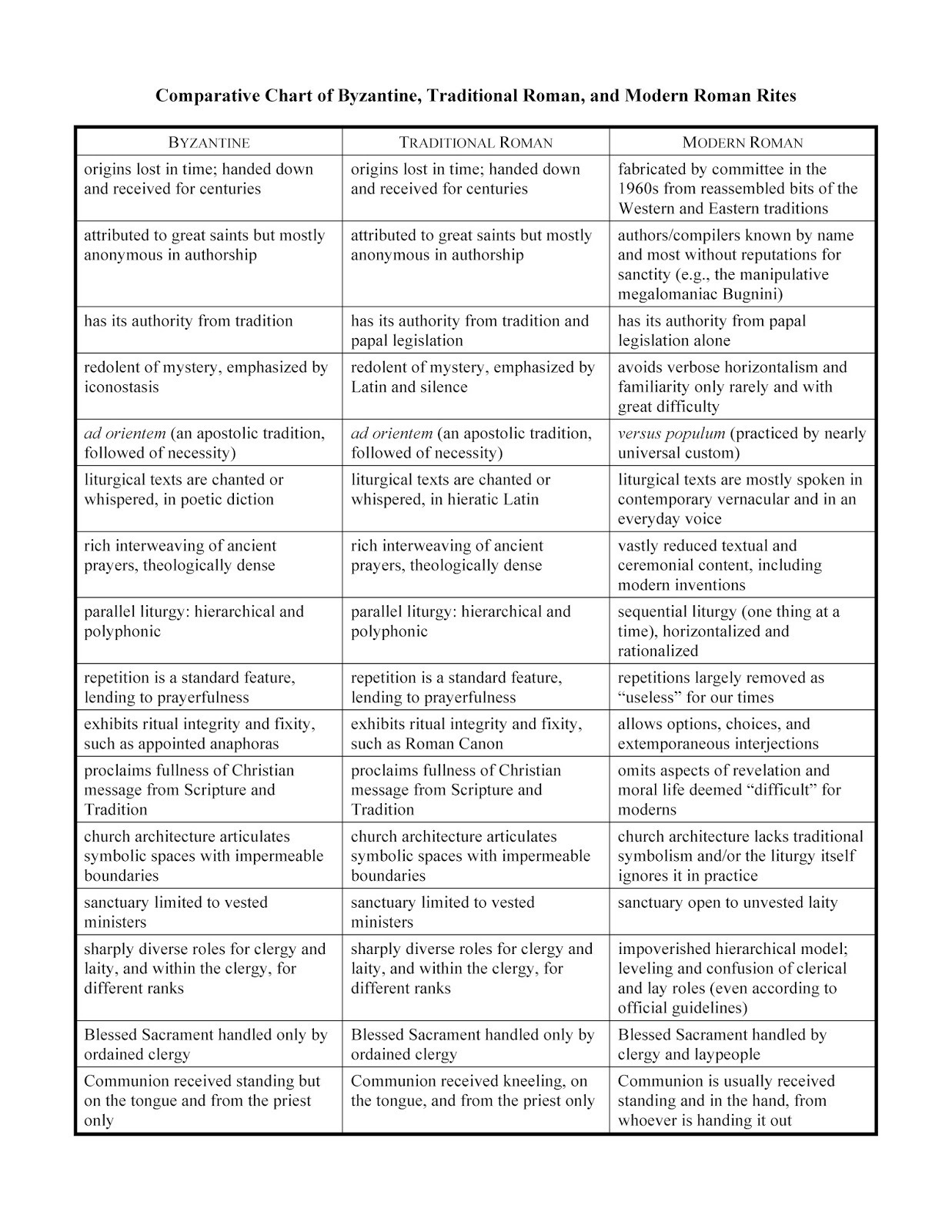
I can’t feel smug about this because I didn’t fashion the Byzantine Rite (used in Orthodox Churches) — and if I had fashioned it, much of the basis for smugness would vanish.

See New Liturgical Movement: The Byzantine Liturgy, the Traditional Latin Mass, and the Novus Ordo — Two Brothers and a Stranger as well.

My Orthodox friend John Brady has pointed out that even the Traditional Latin Mass had dropped the Epiclesis in favor of a supposed “consecration”, which this chart does not reflect.

A caution to culture warriors

No man can concentrate his attention upon evil, or even upon the idea of evil, and remain unaffected. To be more against the devil than for God is exceedingly dangerous. Every crusader is apt to go mad. He is haunted by the wickedness which he attributes to his enemies; it becomes in some sort a part of him.

Possession is more often secular than supernatural. Men are possessed by their thoughts of a hated person, a hated class, race or nation. At the present time the destinies of the world are in the hands of self-made demoniacs – of men who are possessed by, and who manifest, the evil they have chose to see in others. They do not believe in devils; but they have tried their hardest to be possessed – have tried and been triumphantly successful. And since they believe even less in God than in the devil, seems very unlikely that they will ever be able to cure themselves of their possession. Concentrating his attention upon the idea of a supernatural uncommon among secular demoniacs. But his idea of good was also supernatural and metaphysical, and in the end it saved him.

Aldous Huxley, The Devils of Loudun. (H/T Paul Kingnorth, who is ready to turn away from focusing on evil)

A writer I long greatly admired has seemingly fallen into the maw of focusing on evils. I will continue to pray for him, but I rarely can bear to read what he writes any more.

Religion is not a domesticated animal

Church and state would not be such a difficult subject if religion were, as the Court apparently thinks it to be, some purely personal avocation that can be indulged entirely in secret, like pornography, in the privacy of one’s room. For most believers it is not that, and has never been.

Antonin Scalia, quoted in Francis J. Beckwith, Taking Rites Seriously

Christian Nationalist cherry-pickers

Apparently, some self-styled Christian Nationalists have been taking refuge in a quote from St. Augustine:

[S]ince you cannot do good to all, you are to pay special regard to those who, by the accidents of time, or place, or circumstance, are brought into closer connection with you.

Our countrymen are closer than foreigners. Therefore, piss on everyone but our countrymen. Q.E.D.

Jake Meador schools these lame-brains, starting with, like y’know, the full Augustine quote.


We are in the grip of a grim, despairing rebellion against reality that imagines itself to be the engine of moral progress.

R.R. Reno

The end of the world as we know it is not the end of the world.

You can read most of my more impromptu stuff here (cathartic venting) and here (the only social medium I frequent, because people there are quirky, pleasant and real). Both should work in your RSS aggregator, like Feedly or Reeder, should you want to make a habit of it. I’m even playing around a bit here, but uncertain whether I’ll persist.

All Saints, 2023

A Fatal Difficulty

The perennial temptation

Old-style blasphemy involved desecrating God because it was God who was sacred. Today’s blasphemy involves suggesting that man is not all-powerful, that he cannot create himself in any way he chooses.

Carl R. Trueman’s summary of Blasphemy Then and Now, a posting at First Things. I’m starting to think this is one of the most important things to keep ever in mind about some cultural tsunamis.

Everybody knows there is something very wrong with us, but not everybody knows what it is. If you would know, then go back to the beginning.

There we find the primordial sin: acting out our desire to be God.

Kingsnorth spoke about transhumanists openly talking about creating God. Martine Rothblatt, born Martin, says proudly that transgenderism is an onramp to transhumanism. We are reliving the drama of the Garden of Eden all over again. Kingsnorth said we have lost touch with biological reality, with nature, and knowledge of our own telos — that is, for what we were created.

Rod Dreher, channeling Paul Kingsnorth.

Did dispensationalism die when I wasn’t looking?!

Maybe I’ve been beating a dead horse in my criticisms of dispensationalism. But I have some concern here:

When our grandkids find themselves alone in the house on a summer afternoon, few will find themselves gripped by a sudden fear that everyone except them has been taken in the rapture. By itself, that is a good thing. The eclipse of an unbiblical and thoroughly annoying doctrine is hardly something to mourn. Yet Hummel is perceptive enough not to allow the reader such a hasty judgment. The Rise and Fall of Dispensationalism obliquely but powerfully gestures toward a hole often found in the gospel that post-dispensationalist evangelicals believe today. “In the wake of dispensationalism’s collapse,” he writes in the epilogue, “the eschatological sight of the American church has blurred.” That means that our hope is less fervent, thinner, colder.

The emphasized part makes me crazy! It’s like an invitation to make up some new heresy to fill an eschatological “hole,” the old heresy having passed its sell-by date and been swept from the shelves (unnoticed by me).

If evangelicals need something to fill the eschatological-expectation hole, let me suggest (the first and maybe the last time I’ll commend syncretism) that they adopt Orthodox Bridegroom Matins for Monday, Tuesday and Wednesday of their Holy Week, which could use a bit of thickening up anyway.

Bridegroom Matins even has a catchy theme song:

Behold, the Bridegroom comes at midnight,
and blessed is the servant whom He shall find watching;
and again, unworthy is the servant whom He shall find heedless.
Beware, therefore, O my soul, do not be weighed down with sleep,
lest you be given up to death,
and lest you be shut out of the Kingdom!
But rouse yourself, crying: “Holy, holy, holy, are You, O our God!”
Through the Theotokos have mercy on us!

Voilà! Eschatological problem solved! And it’s better than some idiotic “prophecy conference” at maintaining memento mori and a sane expectation that “He shall come to judge the living and the dead.”

Shiny Happy People

Speaking of fundamentalists, for my many sins I did penance by watching Amazon Prime’s Shiny Happy People. I don’t give a rip about the hyper-fertile Duggars, but I had a brush with the series villain Bill Gothard in 1966-67 and wanted to catch up.

He was a weird little man then and appears to have gotten a bit weirder over the decades, right down to the absence of any grey hair and his ephebophilia.

His message was not a healthy Christian message. It’s not even biblical except in the formulaic sense of “proof-texts for nearly everything,” as if scripture-twisting weren’t a real thing.

I know a few people in the Protestant world who are devoted to IBLP, more fully known as Institute on Basic Life Principles — the organization that survives Gothard’s scandal and forced retirement — and I’m kind of worried about them now. Judging from a visit to the IBLP website’s “Statement of Faith,” Shiny Happy People is correct to classify IBLP as fundamentalist, though the line between fundamentalism and the evangelicalism of my youth is a fine one.

A few thoughts:

  • That I thought it necessary to check out IBLP for myself reflects how unpersuasive Shiny Happy People was at nailing down hard facts, preferring innuendo and the charges of critics, some of whom had no first-hand knowledge.
  • That IBLP feels it necessary to publish a roll-your-own statement of faith, eschewing the Nicene Creed and elevating its obsessions to creedal status, reflects how far removed it is from historic Christianity. (IBLP’s statement of faith is sorely lacking, too.)
  • That IBLP is “parachurch” means it can infiltrate most any Protestant denomination and makes it harder to unequivocally speak of it as a “cult” — though that label is tempting.

You could probably find better ways to spend three or four hours unless you have some compelling personal motivation (as did I) to watch this poorly-aimed shotgun blast toward unhealthily patriarchal fundamentalists.

Distress

The distress this insight speaks of was the beginning of my conscious Christian commitment, long ago (but not very far away):

To have offended God is more distressing than to be punished … If only we loved Christ as we should love Him, we would have known that to offend Him whom we love is more painful than hell.

St. John Chrysostom, Homily V on Romans 1, citing II Samuel 24:17.

Continuity

The primary aim of this book is to demonstrate the absolute continuity of ancient Israelite religion, the religion of the Second Temple, first-century Christianity, and the religious life preserved and practiced in the Orthodox Church …

Fr. Stephen DeYoung makes a bold claim. Something lured him out of a Reformed Protestant pulpit into Orthodoxy. It might merit investigation.


For all its piety and fervor, today’s United States needs to be recognized for what it really is: not a Christian country, but a nation of heretics.

Ross Douthat, Bad Religion

We are in the grip of a grim, despairing rebellion against reality that imagines itself to be the engine of moral progress.

R.R. Reno

The end of the world as we know it is not the end of the world.

You can read most of my more impromptu stuff here (cathartic venting) and here (the only social medium I frequent, because people there are quirky, pleasant and real). Both should work in your RSS aggregator, like Feedly or Reeder, should you want to make a habit of it.

New Year’s Day 2023

Happy New Year!

I rarely go back and read things I wrote earlier in the life of this blog, but I did so recently and was pleased with, for instance, 50th Anniversary. Indeed, I’m a bit ashamed at how much thought I put into that compared to my current tendency to curate other people’s memorable passages.

I suspect that I’ve resorted to curation because I long ago blogged my big ideas and I’m under no pressure (financial, for instance) to generated new content on some schedule or other.

I’m hoping to publish more of my own thoughts in 2023, but we’ll see how that goes.

Evangelicals and Evangelicalism

I have written many a critical word about Evangelicals and Evangelicalism. I’m going to step back from that a bit.

First, it’s exceedingly difficult to define who is an Evangelical or what is Evangelicalism. I’ve tended to go with the term when my sources used it. That’s a problem when some of the press may over-apply the term.

But there’s a bigger reason than that for backing off a bit: what I have been calling “Evangelical” or “Evangelicalism” is almost entirely non-denominational Protestantism. With a few possible exceptions, Evangelical denominations (there are a few), especially those denominations wherein local churches aren’t entirely at liberty to do their own thing (unlike the Souther Baptist Convention, where they are entirely free to go astray), tend not to be the perpetrators of the stuff I criticize.

These thoughts came to me as I thought about the Religion News Association’s #9-ranked religion story of 2022:

Non-denominational Christian churches soar in growth, according to the newly released 2020 U.S. Religion Census, a decennial survey conducted by the Association of Statisticians of American Religious Bodies. There are now more non-denominational churches than any denominations’ churches but Southern Baptists, and their 21 million adherents outnumber every group but Catholics.

I also think it’s time for me to re-re-read Tom Howard’s Evangelical is Not Enough. It’s not that I’m tempted to return to Evangelicalism; it’s that I tend to forget what Evangelicalism at its best can be (Howard’s childhood Evangelical home was idyllic), and that in a non-trivial sense, believing Evangelicals (as opposed to Trumpists who use Evangelical as a political identity), however misguided I think them, are fellow-Christians.

How capacious is “Christian”?

I was preparing something for publication a few days ago on the boundaries of the term “Christian.” Part of the question in mind was “can a sect hold such a skewed idea of Christ that I need not credit their claims to be “Christian” because they follow the “Christ” of their skewed ideas?”

More specifically, “Do Mormons hold such a skewed idea of Christ that I need not credit their claims to be “Christian”?

Then I stumbled onto something I’d written on the topic earlier that was better than what I was in the process of writing. My bottom line: if a sect rejects the Christology of the first three or four ecumenical councils, I won’t acknowledge them as Christians. And the Mormons, for all their clean living, are dead wrong about Christ.

For those who think “Christian” is the equivalent of “nice guy,” this doubtless seems unkind, but we already have “nice guy” to describe nice guys, and “Christian” is not a synonym.

Caesaropapism

The Royal Court, grouped round the Imperial Chapel and, seized with theological fervour, sought to ensure the triumph of a novel teaching concerning the procession of the Holy Spirit. Pressure from the Frankish empire caused this strange teaching to triumph in the West. After resisting for a while, the Popes were in the end obliged to alter the traditional, sacred text of the Creed. From then on, schism from the Eastern Patriarchates became inevitable. (Byzantium, on the other hand, never experienced such an extreme case of Caesaropapism.)

Vladimir Lossky, Seven Days on the Roads of France: June 1940

The “novel teaching concerning the procession of the Holy Spirit” was the filioque, the unilateral corruption of the Nicene Creed’s declaration that the Holy Spirit “proceeds from the Father” by changing it to “proceeds from the Father and the Son.”

Human reasoning

Metropolitan Hierotheos Vlachos also noted the difference in process and perspective between Latin scholasticism and the patristic approach. He concluded that the emphasis on human reasoning led to the collapse of Western Christian theology.

Dr. Eugenia Scarvelis Constantinou, Thinking Orthodox: Understanding and Acquiring the Orthodox Christian Mind

The more I understand the real-world limits of human reasoning, the truer this seems.

The Fall

There is a common mistaken notion about the fall (the sin of Adam and Eve). That mistake is to think that the fall somehow changed all of creation and human beings from a state of original innocence into an altered state of evil and corruption. This is not the teaching of the Scriptures or of the Tradition.

Occasionally you hear the term “fallen nature” which is another inaccurate term. “Nature,” in theological terms, is synonymous with “essence,” or “ousia.” It is the very “thing” that something is. What is understood, theologically, is that the fall has brought death into the world. What is different about human beings is not our nature, but our inability to actually fulfill our nature.The bondage that comes into our lives through death is what we term “sin.” But this is not our “nature” causing the problem.

Fr. Stephen Freeman, The Essential Goodness of All Things


[S]ubordinating truth to politics is a game which tyrants and bullies always win.

Jonathan Rauch, The Constitution of Knowledge

To believe that wealth is the only significant measure of the worth of an individual, a family, or a community is to reject the teaching of nearly every religion and wisdom tradition that ever was.

Mark Mitchell and Nathan Schlueter, The Humane Vision of Wendell Berry

The Orthodox “phronema” [roughly, mind-set] cannot be programmitized or reduced to shibboleths.

Fr. Jonathan Tobias

You can read most of my more impromptu stuff here (cathartic venting) and here (the only social medium I frequent, because people there are quirky, pleasant and real). Both should work in your RSS aggregator, like Feedly or Reeder, should you want to make a habit of it.