Hobbit Day 2022

I have it on reasonably good authority that today is Hobbit Day, and it turns out that Peter Jackson isn’t the only one to cash in on Hobbits.

Culture

How the Bobos Broke America — key excerpt

I tend to quote a lot of things without comment, but I’m going to say that the following strikes me as true, and so contrary to the recent history of the Democrat and Republican parties that it’s core to why I believe a major realignment is underway. Today’s Republican party is not the same Republican party I left in January 2005. For my taste, it’s worse, but that taste almost certainly is tainted by Orange Man. But I gradually came to see his appeal:

What causes psychic crisis are the whiffs of “smarter than” and “more enlightened than” and “more tolerant than” that the creative class gives off. People who feel that they have been rendered invisible will do anything to make themselves visible; people who feel humiliated will avenge their humiliation. Donald Trump didn’t win in 2016 because he had a fantastic health-care plan. He won because he made the white working class feel heard.

How the Bobos Broke America.

There’s no need to hold a pity party for me, but I’ve spent most of my life too Christian and too socially awkward to be comfortable with social elites, too elite to feel instinctively empathetic or entirely comfortable with the working class.

How unreality spreads

Wrong beliefs and wrong perceptions are contagious whether or not they are sincere, because dissidents tend to self-censor and act like believers. That is how entire societies, such as the Soviet Union, can be built on everyone’s publicly pretending to believe what many privately know to be false.

Jonathan Rauch, Echo Chambers and Confirmation Loops in The Constitution of Knowledge.

I think this has some contemporary relevance. I’ll say no more.

National Conservatism could be a boon for religious liberty lawyers

Here’s the national conservatism “Statement of Principles” on God and public religion, signed by dozens of leaders of the national conservatism movement:

No nation can long endure without humility and gratitude before God and fear of his judgment that are found in authentic religious tradition. For millennia, the Bible has been our surest guide, nourishing a fitting orientation toward God, to the political traditions of the nation, to public morals, to the defense of the weak, and to the recognition of things rightly regarded as sacred. The Bible should be read as the first among the sources of a shared Western civilization in schools and universities, and as the rightful inheritance of believers and non-believers alike. Where a Christian majority exists, public life should be rooted in Christianity and its moral vision, which should be honored by the state and other institutions both public and private. At the same time, Jews and other religious minorities are to be protected in the observance of their own traditions, in the free governance of their communal institutions, and in all matters pertaining to the rearing and education of their children. Adult individuals should be protected from religious or ideological coercion in their private lives and in their homes. (Emphasis added.)

This paragraph describes a form of religious supremacy that relegates dissenting religious believers to the “private” sphere, while granting Christianity a position of powerful public privilege.

But we shouldn’t fool ourselves into believing that the “moral vision” of the signatories broadly reflects the diversity of Christian belief and practice in the United States. After all, there are churches that host drag queen events, as well as churches that condemn drag queens. Both the Democratic and Republican parties are completely dependent on their Bible-believing, church-going base constituencies (white Evangelicals for Republicans and Black Protestants for Democrats).

Are national conservatives thus satisfied when either party wins, so long as a Christian (Joe Biden, for example) is at the helm?

Of course not. For the term “moral vision” to mean anything, it has to mean a particular version of professed Christian belief and practice.

David French

A polity that "relegates dissenting religious believers to the “private” sphere, while granting [a form of putative] Christianity a position of powerful public privilege" is inconsistent with current Supreme Court thinking, and I don’t think Trump’s nominees change that.

When did modernity begin?

For us, the real Middle Ages extend from the reign of Charlemagne to the opening of the fourteenth century, at which date a new decadence set in that has continued, through various phases and with gathering impetus, up to the present time. This date is the real starting-point of the modern crisis: it is the beginning of the disruption of Christendom, with which the Western civilization of the Middle Ages was essentially identified: at the same time, it marks the origin of the formation of ‘nations’ and the end of the feudal system, which was very closely linked with the existence of Christendom. The origin of the modern period must therefore be placed almost two centuries further back than is usual with historians…

René Guénon Guénon, The Crisis of the Modern World.

What Putin lacks

[T]he death of Queen Elizabeth II and the wave of antique pageantry help illuminate one of the Russian president’s important weaknesses. He has been hobbled in his fight because his regime lacks the mystical quality we call legitimacy.

Ross Douthat, Why Queen Elizabeth’s Strength Is Putin’s Weakness

This takes “self-deprecating” too far

We sat and watched the committal service, we who threw all this away in the 18th century, all the costumery, ribbonry, and titlery and iconic disciplines and endless dignity, in favor of the mess we know all too well …

[A]fter a couple hours of admiring tradition and ceremony and everyone knowing which foot to put where, it dawns on me that this elevation of bureaucracy to an art form is what America fortunately escaped and thus was better able to give the world the phenomenal techno advances of my lifetime, the laptop, cellphone, GPS, AI, drones, radical reductions in the cost of solar panels and wind energy, new vaccines. These things were not created by platoons of people marching in place but by brilliant gamblers and entrepreneurs, nerds of many stripes. (We also gave the world the blues and rock ’n’ roll, but that’s another story.)

An English major in college, I looked down on IT students because they all dressed alike and carried plastic pocket protectors for their ballpoint pens. I saw them as dullards. As it turns out they were at work on data technology that led to the internet, which changed my life and yours too. Meanwhile, the English department and other humanities march along beside the hearse and the horsemen.

I wanted to be eccentric and got my wish but the engineers in my family are more engaged with the real world.

Garrison Keillor.

Once again, I’ll opine.

I like technology entirely too well, but “the laptop, cellphone, GPS, AI, drones, radical reductions in the cost of solar panels and wind energy, new vaccines” do nothing to fill the void in the human soul, and I deny that they are the “real world” in a meaningful sense. Maybe monarchy doesn’t fill the soul-void, either; I don’t know (at least in part) because I’ve never lived in a monarchy. But I think monarchy says something true about reality that all the tech in the world misses.

So maybe we and Great Britain are still joined symbiotically at the hip; they provide the meaning, we provide the toys and the parties.

Correlation

This sort of thing is why I’ll probably renew Jesse Singal’s Substack:
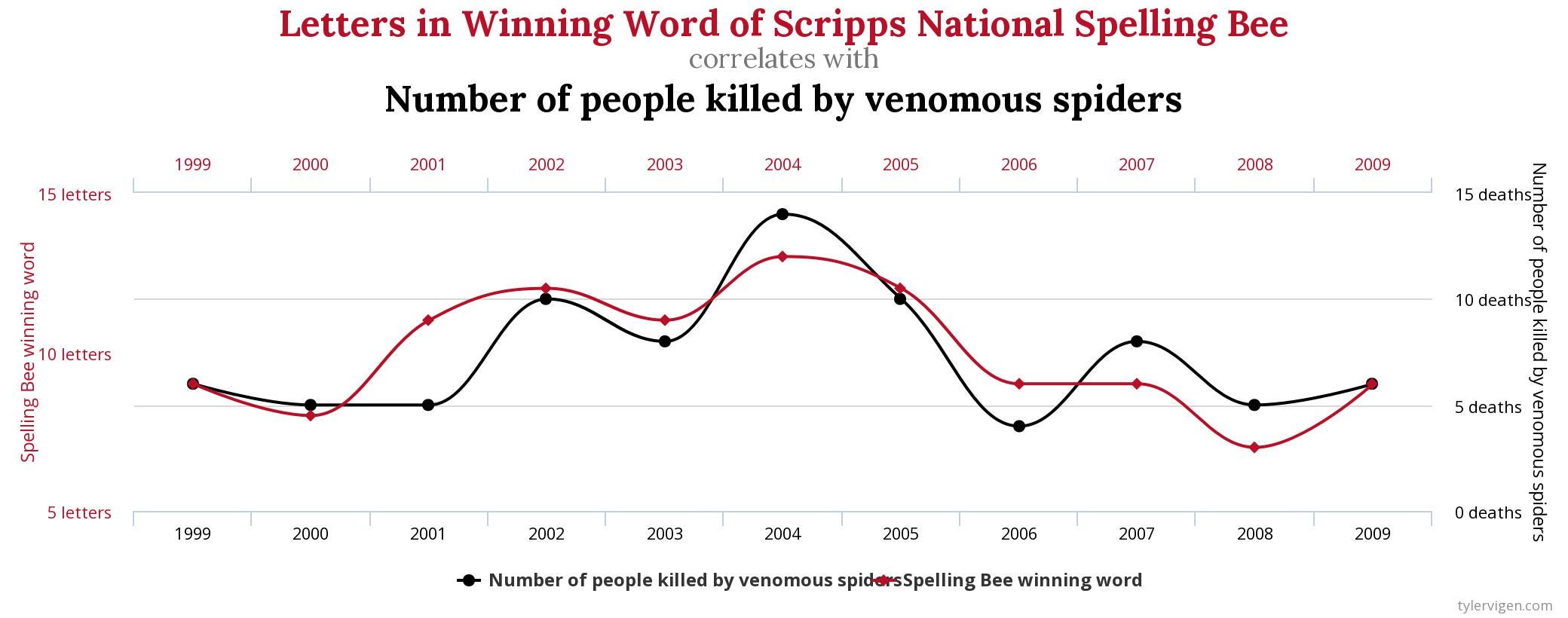
Missed it when it was fresh

[I]t is absolutely ridiculous that people should choose to go around looking like letter boxes.

Boris Johnson, mid-2018, on Burqas.

Shorts

Journalism

Two formerly solid journals seem to have picked their tribes, and now assiduously pitch to the worst tribal instincts.

The Decline of First Things

There are many occasions for exposing hypocrisy these days. In the aftermath of the FBI raid on Donald Trump’s Florida home, we can point to Hillary Clinton’s private server. Asked to denounce Trump’s refusal to accept the results of the 2020 election, we can cite Stacey Abrams, who never accepted her defeat in the 2018 gubernatorial race in Georgia.

R.R. Reno opening his big monthly Editorial in First Things.

That is Whataboutism at 190 proof. I have no idea what he thinks the FBI (or someone) ought to have done about Hillary’s server 6-7 years ago, and he certainly doesn’t tell us. He just insinuates that what they didn’t do was hypocritical because of what they later did. As for Stacy Abrams, so far as I know she has dropped “they done me wrong” from her stump speeches, unlike Orange Man (who is dining out on it), even if she has never formally conceded defeat.

That was just the opener. Considering how the column continued, I’m inclined to think that Reno had a bad case of writer’s block, and so resorted to tendentious bullshit.

I am thus reminded why I still (barely, and decreasingly) consider First Things essential reading but have ceased giving its publishing corporation anything beyond the cost of my subscription.

Conservative Radicals

It’s interesting to see a tribe close ranks.

Ron DeSantis’ sending two planefuls of refugees to Martha’s Vineyard is morally indefensible trolling.

So how does his tribe defend it? By focusing on “why the Left went so bat-guano crazy” over it, and implying that DeSantis had effectively taken a chapter from Saul Alinsky:

Ridicule is man’s most potent weapon. There is no defense. It is almost impossible to counterattack ridicule. Also it infuriates the opposition, who then react to your advantage.

Ridicule Is Man’s Most Potent Weapon

Apparently “ridicule” is now National Review’s term for instrumentalizing humans who are unpopular with the GOP.

With Kevin Williamson defecting to The Dispatch, I’m almost out of reasons (I can think of just two remaining) to glance at the National Review homepage any more.

Politics

Wrong kind of diversity

Liz Truss, Great Britain’s new Prime Minister, has completed her cabinet. There are no white men. None. But that’s not good enough for Britain’s Left:

“It’s a meritocratic advance for people who have done well in education, law and business,” Sunder Katwala, the director of British Future, a think tank that focuses on issues of immigration, integration and national identity, told CNN. “It’s not an advance on social class terms.”

This is an interesting criticism. “Meritocratic,” used here in a pejorative sense, means based on ability and achievement, earned through a combination of talent and hard work. Traditionally, merit served as the primary consideration in hiring, but some people today see the very systems that confer merit as rigged, especially against minorities. In an effort to rectify that imbalance and to diversify the work force, particularly for leadership positions, it has become common practice in hiring — in the business and nonprofit worlds, as in government — to make racial or ethnic diversity a more significant factor.

The trouble is that for many of the same people, ethnic and racial diversity count only when combined with a particular point of view …

The implication is that there’s only one way to authentically represent one’s race, ethnicity or sex — otherwise you’re a phony or a pawn.

Pamela Paul, When Diversity Isn’t the Right Kind of Diversity

War? Really?

“Even the people who are responsible for disseminating the laptop admit that, on a human level, what happened to Hunter is horrifying. ‘A lot of stuff I do, I don’t feel great about,’ says one of them, Steve Bannon. ‘But we’re in a war.’”

The Morning Dispatch, recommending a New York Magazine article on the Hunter Biden laptop saga.

Steve Bannon is a very intelligent but quite unprincipled. “War”? Baloney!

J.D. Vance ❤️ Donald J. Trump

Trump went off on a tangent about a New York Times story that said Vance’s campaign didn’t ask Trump to come here. “JD wants my support so bad. He’s kissing my ass.”

Andrew Tobias on Twitter

Is this why we’re to take Trump “seriously if not literally”? He certainly captured the essence of Vance’s metamorphosis.

A Moment of Pleasure

Seldom has a Democrat made me as happy as Letitia James made me on Wednesday.


[S]ubordinating truth to politics is a game which tyrants and bullies always win.

Jonathan Rauch, The Constitution of Knowledge

The Orthodox "phronema" [roughly, mind-set] cannot be programmitized or reduced into shibboleths.

Fr. Jonathan Tobias

You can read most of my more impromptu stuff here (cathartic venting) and here (the only social medium I frequent, because people there are quirky, pleasant and real). Both should work in your RSS aggregator, like Feedly or Reeder, should you want to make a habit of it.
Elevation of the Holy Cross (a/k/a 9/14/22)

Culture

Building on vice

As Augustine of Hippo noticed, what the Romans called virtue was really a vicious craving for glory, for the approval of others who think well of one. This vice helped prop up the Roman republic, because the political class could win glory by performing deeds of conspicuous benefit to the commonwealth. In this way, the vice of glory protected against other vices that were even worse. The problem was twofold.  First, this strategy worked only because some little bit of real virtue remained; otherwise, one might pursue glory by foul means rather than fair. Second, indulging the itch for glory gradually undermined that little bit of real virtue, so that one did use foul means, for example buying votes. At that point the entire motivational structure begins to collapse, as the political class comes to lust not after simple glory, but after wealth and power. The curtain fell on the republic.

… Our society has a version of the Roman strategy too, but in our case the vice that protects against still worse vices is the lust for wealth itself. As Adam Smith noticed, the sheer desire for acquisition, as though by an invisible hand, can motivate people to benefit others, not because they love them but because that is how they earn a profit. Just as in the Roman case, this strategy works only if there a little bit of virtue remains; otherwise, one might pursue wealth by fraud and by governmental favors rather instead of by making a better and cheaper product. Just as in the Roman case, indulging the itch for wealth eventually undermines that little bit of virtue; today our corporations compete by gaming the system of regulations and subsidies. And just as in the Roman case, at this point the whole motivational structure begins to collapse, and the elite classes begin to scratch far baser itches than simple desire for honest profit.

J Budziszewski, Why Do We Always Hit a Wall?

This has haunted me since I read it, in part because it haunted me maybe 55 years before I read it.

No, I wasn’t conscious that Roman “virtue” was built on vice, but I did know that our system was built on the desire for wealth, and that a system like that seemed unlikely to come to a good end.

The longer I live, the closer I come to internalizing a key truth: there are no “good ends.” That’s what it means to live in a “fallen world.” But another part of what a “fallen world” means is that we are drawn, (almost?) irresistibly, to shuffle the deck chairs as it all goes down.

See also Jack Leahy, Cloud-Hidden.

The demand to be political first

Stop me if you’ve heard this one before! A piece of pop culture has been announced, one with a diverse cast of characters and themes of female empowerment. Some conservative idiots lose their minds because they’re conservative idiots. Liberals respond by taking to the ramparts to defend the honor of the piece of pop culture against MAGA or whatever. Meanwhile, the actual artistic value of the pop culture in question is completely lost. Aesthetic concerns are buried beneath the demand to be political first. If you aren’t actively singing the praises of worthless shlock that’s vaguely associated with progressive politics, you’re one of them. My god, that She-Hulk show is f***ing dreadful, and its feminist politics are warmed-over Sheryl Sandberg tripe, but people are like “actually the CGI is supposed to look like dogshit, it’s artistic” because they think defending Disney’s latest blast of entertainment Soylent Green is the same as storming the Bastille. Conservatives freak about diversity, liberals defend art without any reference to artist, rinse and repeat. I could be talking about 2016’s Ghostbusters, or I could be talking about the upcoming Little Mermaid remake. Nothing ever changes, and it is all so, so tiresome.

Freddie deBoer, Why Are Identitarians Such Cheap Dates? (bowdlerization gently added). That opening paragraph was terrific, and the title of the posting makes it even better.

The special costs of being poor

Early in Nickel and Dimed, the great Barbara Ehrenreich offered up a blunt observation. “There are no secret economies that nourish the poor; on the contrary, there are a host of special costs,” she wrote. “If you can’t put up the two months’ rent you need to secure an apartment, you end up paying through the nose for a room by the week,” she explained. “If you have only a room, with a hot plate at best, you can’t save by cooking up huge lentil stews that can be frozen for the week ahead. You eat fast food or the hot dogs and Styrofoam cups of soup that can be microwaved in a convenience store.” For the poor this is no revelation, merely a description of daily life. For many others, though, it was something else, a glimpse into a world that could feel distant. Yet it was not so far away, as she understood: The poor were all around. They worked, they loved, they tried to make do. The poor carried America on their backs and debunked its self-mythologies. So, too, did Ehrenreich, who showed no patience for pretense. She always looked for the truth of a thing, and for decades, she shared her search with all of us.

Sarah Jones, Barbara Ehrenreich Knew There Was a Fight

The platonic ideal of an NYT opinion piece

Maya Jasanoff’s idea that “The new king now has an opportunity to make a real historical impact by scaling back royal pomp and updating Britain’s monarchy to be more like those of Scandinavia” — because Colonialism! — is (a) the platonic ideal of an NYT opinion piece and (b) a perfect illustration of Clement Atlee’s comment that “the intelligentsia … can be trusted to take the wrong view on any subject.” The pomp of the British monarchy is the point; the ceremony is the substance — for good reasons and bad. When the ceremony is discarded the monarchy will be too. And rightly so. 

Alan Jacobs

Sheer drudgery, with a dose of despair

Teaching has its own rewards, to be sure. But you’re a lot more likely to wax eloquent about the privilege of shaping the minds, hearts, and souls of our youth when you aren’t grading their papers.

Peter C. Meilaender, I Don’t Care If My Students Get Jobs

Not a promising review

[T]o their credit, the characters managed to exchange an endless series of ponderous aphorisms without giggling. So it was that we learned how ‘the wine is sweetest for those in whose bitter trials it has fermented’; how ‘the same wind that seeks to blow out a fire may also cause it to spread’; and, more pithily, how ‘there can be no trust between hammer and rock’.

Will you be able to get through the ponderous aphorisms without giggling? The Lord of the Rings: The Rings of Power reviewed | The Spectator

Political (after a fashion)

The difference between Russian and Ukrainian soldiers

The fundamental difference between Ukrainian soldiers, who are fighting for their country’s existence, and Russian soldiers, who are fighting for their salary, has finally begun to matter.

Anne Applebaum

Dance with the one what brung ya

In the post-Roe era, Ramesh Ponnuru argues, the pro-life movement should remember the approach that got them to to where they are today: incrementalism. “Passionate pro-lifers, in their impatience at what they recognize to be a grave injustice, are forgetting the need for patient persuasion of the public,” he writes for Bloomberg. “Some pro-lifers have made a point of claiming that abortion is never medically necessary. That’s because they don’t consider ending an ectopic pregnancy, for example, as a ‘direct abortion’—an intentional taking of human life. That’s needlessly confusing, and pro-lifers should simply say they’re for an exception in such cases. They should also broaden their agenda to include measures to aid parents of small children—such as the proposals of various Republican senators to expand the child tax credit and to finance paid leave. Promoting a culture of life includes fostering the economic conditions that help it thrive.”

The Morning Dispatch

Wordplay

Taking leave of senses

[I]f you have paid much attention to the conservative movement and conservative media, you’ve seen a few formerly sober-minded men take off the bow tie, put on the red cap, and bark at the moon.

Kevin F. Williamson, Steve Bannon Charges: Gravy Train Derailed

Truth Social

Truth Social: The media penal colony to which Twitter and Facebook sentenced Donald Trump.

Frank Bruni

Words failed them

The families and former FBI agent William Aldenberg say they have been confronted and harassed in person by [Alex] Jones’ followers because of the hoax conspiracy.

Associated Press story on a second civil trial against Jones arising from his claim that the Sandy Hook school shooting was a hoax. (Emphasis added)


[S]ubordinating truth to politics is a game which tyrants and bullies always win.

Jonathan Rauch, The Constitution of Knowledge

The Orthodox “phronema” [roughly, mind-set] cannot be programmitized or reduced into shibboleths.

Fr. Jonathan Tobias

You can read most of my more impromptu stuff here (cathartic venting) and here (the only social medium I frequent, because people there are quirky, pleasant and real). Both should work in your RSS aggregator, like Feedly or Reeder, should you want to make a habit of it.

Saturday, 9/10/22

Elizabeth Regina

There is not much use for me to try to explain my sense of loss at the death of Queen Elizabeth. Others have described reasons for such a sense better than I could.

I’ve been something of an Anglophile (is Britophile a word?) since discovering Lewis, and Tolkien, and the mystique of OxBridge. That was intensified when I arrived in London, for three weeks in the British Isles, in June 1968, after 3 weeks on the continent with languages I didn’t really speak (despite formal study of French and Spanish). It just felt like home to be among English-speakers again.

So these items probably won’t be my last on the topic.

Also: long live the King, two days my Junior, who nobody thought would wait 74 years for his coronation.

Sully plays my trump card, C.S. Lewis

You can make all sorts of solid arguments against a constitutional monarchy — but the point of monarchy is precisely that it is not the fruit of an argument. It is emphatically not an Enlightenment institution. It’s a primordial institution smuggled into a democratic system. It has nothing to do with merit and logic and everything to do with authority and mystery — two deeply human needs our modern world has trouble satisfying without danger.

The Crown satisfies those needs, which keeps other more malign alternatives at bay. No one has expressed this better than C.S. Lewis:

Where men are forbidden to honor a king, they honor millionaires, athletes, or film stars instead; even famous prostitutes or gangsters. For spiritual nature, like bodily nature, will be served; deny it food and it will gobble poison.

The Crown represents something from the ancient past, a logically indefensible but emotionally salient symbol of something called a nation, something that gives its members meaning and happiness. However shitty the economy, or awful the prime minister, or ugly the discourse, the monarch is able to represent the nation all the time. In a living, breathing, mortal person.

The importance of this in a deeply polarized and ideological world, where fellow citizens have come to despise their opponents as enemies, is hard to measure.

Andrew Sullivan, An Icon, Not An Idol. The whole eulogistic first part of his blog this week is worth reading if it’s not paywalled. I’d rank it as the best I’ve seen so far.

Yet another perspective on Elizabeth Regina’s longevity

Born in 1926—the year A.A. Milne’s “Winnie-the-Pooh” was published, and two years before the invention of sliced bread—Elizabeth ascended to the throne in 1952 at age 25. Winston Churchill was then Prime Minister, and Britain controlled over 70 territories around the globe from Tonga to Uganda, the Bahamas to Brunei. But as early as 1953, the Queen foresaw a changing world. “The Commonwealth bears no resemblance to the empires of the past,” she said. Her successor, King Charles III, will control only 14 realms plus the U.K. The Queen oversaw historic transformation, even as she was the embodiment of tradition.

Noah Blum

A proper old growth sovereign

I was just preparing for [an] interview … when I got the news. I’m not expecting you to be a monarchist or even interested in the English royals, but you will understand the tremors when a proper old growth sovereign dies. In an already hugely uncertain moment, England shakes yet again.

Martin Shaw

Culture

How bad was the pandemic?

The coronavirus pandemic killed so many people that U.S. life expectancy fell from roughly 79 in 2019 to 76 in 2021—the largest two-year decline in nearly a century.

America Is a Rich Death Trap – The Atlantic

Where is the grass really greener?

Whatever the shortcomings are of a liberal democracy, you have to live with the shortcomings and not use them as a reason to grab the steering wheel and just go somewhere else. Because there is nowhere else which is as good. Nowhere else which is as humane ….

Tom Stoppard via Andrew Sullivan.

These are the kinds of words I need to hear sometimes, but it’s generally enough that I would not trust any of the postliberal/illiberal figures I know to hold the reins of power. And when schismatics or heretics propose a “Christian America,” I throw up in my mouth a little.

But we still have a lot of people who’ve been given a very bad deal in this globalized world, and we need to heed their complaints even if they propose intolerable solutions.

When they call you “racist,” they may just mean they’re clearly better than you

Oberlin College’s character assassination of a local bakery is a perfect analogy for how the new upper middle class language of social justice is deployed as class warfare.

Leighton Woodhouse via Noah Blum.

I literally heard a progressive clergyperson, a mere hours ago, say that a scheduled November 5 program celebrating (now posthumously) Queen Elizabeth’s Platinum Jubilee would be offensive “to BIPOC people” because … empire, colonialism, whatever.

I got the message: she’s better than the rest of us for noting that.

Politics

Writing as politics

Nearly everyone today writes from a distinct partisan position. Some commentators write as allies of the Democratic Party, others as allies of the Republicans. Still others outflank the Democrats on the left or the Republicans on the right with an eye to dragging the parties further in those respective directions.

As a consequence, what we end up with is less writing about politics than writing as politics. Many pundits and columnists seem to be primarily concerned with advancing the prospects of one party, set of policies, or ideological agenda. Or put in properly contrary terms for our era of negative partisanship: They are primarily concerned with thwarting one party, set of policies, or ideological agenda.

Whichever way you put it, this makes these writers pro bono PR flacks for one or the other of the country’s primary political factions and its ancillary branches throughout the culture.

Damon Linker, who is not a PR flack.

Pat Buchanan as proto-Trump

Buchananism was never truly popular. Neither was Trumpism: With Trump, Republicans won power but not popularity — at least not a popularity they could translate into clear electoral majorities. The simple solution would be to return to Reaganism, to reconstruct that big, if still exclusionary, tent and win huge majorities. But recent efforts to recreate Reaganism and establish a more inclusive Republican Party, like George W. Bush’s appeals to compassionate conservatism and Mr. McCain’s insistence on immigration reform, met fierce opposition from the party’s base.

Nicole Hemmer, The Man Who Won the Republican Party Before Trump Did, an argument that the swing of the GOP to populism (which Hemmer considers as being to the right of Reaganism) can be traced to Patrick J. Buchanan. It’s pretty good, if occasionally off-key.

So much venom and no fangs

The Former, who has been trying for years to master the Churchillian scowl, is seriously humor-impaired. There are unemployed joke writers around but he never thought to hire one. He was a name-caller on a fourth-grade level (Lyin’ Ted, Crooked Hillary) or he slapped a LOSER sticker on someone’s back and let it go at that. So much venom and no fangs to make it work for him.

The Brits do insult so much better. So we should steal from them. “A shiver looking for a spine to run up” could be applied to Mitch McConnell just as well as to Edward Heath, the original target. “A sheep in sheep’s clothing” fits any number of people. “He eats used toilet tissue in the hope that he will someday get used to the taste” fits Kevin McCarthy perfectly. And “He is the only man I know who immatures as he ages” is the Former in twelve words. It’s a poke in the snoot that disarms even as it raises a welt.

Never been such times as these before, I swear | Garrison Keillor


[S]ubordinating truth to politics is a game which tyrants and bullies always win.

Jonathan Rauch, The Constitution of Knowledge

The Orthodox “phronema” [roughly, mind-set] cannot be programmitized or reduced into shibboleths.

Fr. Jonathan Tobias

You can read most of my more impromptu stuff here (cathartic venting) and here (the only social medium I frequent, because people there are quirky, pleasant and real). Both should work in your RSS aggregator, like Feedly or Reeder, should you want to make a habit of it.

Thursday, 9/8/22

Culture

Bravery

“Many people praised me for my bravery for having done this — to which I could only say: Millions of people do this kind of work every day for their entire lives — haven’t you noticed them?” she said in 2018 in an acceptance speech after receiving the Erasmus Prize, given to a person or institution that has made an exceptional contribution to the humanities, the social sciences or the arts.

From the New York Times obituary for Barbara Ehrenreich, author of Nickel and Dimed: On (Not) Getting By in America. Ehrenreich went “underground,” trying to live on various minimum wage jobs.

I’m sure I read some of her journalistic writing, and even looked forward to the byline as a harbinger of good writing, but I apparently missed how well-regarded she really was.

Conservative academia

Do ten conservative American academics even exist? (Try naming ten outside of Hillsdale College. I’ll go: Harvey Mansfield, Niall Ferguson, Ruth Wisse, Robby George. Struggling to come up with a fifth without Google.) Then again, we wouldn’t know because they are closeted.

Bari Weiss, Dissidents and Doublethinkers in our Democracy

Too stupid for ranked-choice voting?

It seems to me that Damon Linker is arguing “America is too paranoid and too stupid for ranked-choice voting.”

I agree, though, that it’s not likely to prove a panacea.

Todd Rokita does something right for a change

In a stunning development, Indiana Attorney General Todd Rokita has done something necessary and with minimal fanfare:

Nineteen state attorneys general wrote a letter last month to BlackRock CEO Laurence D. Fink. They warned that BlackRock’s environmental, social and governance investment policies appear to involve “rampant violations” of the sole interest rule, a well-established legal principle. The sole interest rule requires investment fiduciaries to act to maximize financial returns, not to promote social or political objectives. Last week Attorneys General Jeff Landry and Todd Rokita of Louisiana and Indiana, respectively, went further. Each issued a letter warning his state pension board that ESG investing is likely a violation of fiduciary duty.

ESG Can’t Square With Fiduciary Duty

I am inclined to think that these (presumably Republican) Attorneys General are “on the wrong side of history.” I think the sole interest rule will fall because it ignores corporate externalities.

Think of it this way: would an institutional investor before the Clean Water Act have been morally justified in avoiding companies that used streams and rivers as a dumping ground for toxic byproducts? But it would have been unlawful under the sole interest rule.

Now draw analogies.

But meanwhile, we don’t elect attorneys general to be on the right side of history. We elect them to enforce the laws as they are.

A question not worth researching

Cable news is for idiots, so I’m not going to subject myself to hours and hours of watching it to evaluate whether the average political positioning of a CNN guest has changed. But I think the circulation of the particular Francesca Chambers clip you cite as supposed evidence of a Trumpy shift at CNN is weaksauce — and boy have I been seeing a lot of apoplectic liberals share it on Twitter. (Jesus, people, will you get a hobby already?)

Chambers, who covers the White House for USA Today, has been a fixture on cable news for years, not just on CNN but also on MSNBC and Fox News. That she made an inane jump to “optics” when asked about Trump bringing the aunt of Timothy Hale-Cusanelli on stage at a Pennsylvania rally — Hale-Cusanelli is the January 6 riot convict who praised Hitler and posed with a Hitler mustache (in order to be “ironic”, he says, of course) — does not say anything about CNN changing. It just reflects that cable news political panel discussions have always consisted of replacement-level-or-lower armchair political strategizing and posturing — there are hours and hours and hours of time to fill, and they have been filled with this crap my entire adult life. (By the way, Sara Fay and I wrote back in January about how to book an actually good political conversation panel, based on our experience at Left, Right & Center.)

Josh Barro

Politics

Metapolitics

The Right denies the reality of events, clueless to its eventual Emperor Has No Clothes moment. The Left, however, seeks to deny the very nature of humanity itself. Both worship at the same altar, but their beliefs are predicated upon differing hermeneutical approaches within the Cult of Progress. The former believes the fantasy of a technological harnessing of apparently limitless resources to produce an ever-expanding material prosperity, all without consequential damage to the society at large. The Left believes in the fantasy of a technological harnessing of the apparently limitless ability to refashion mankind itself, regardless of the demolition of existing societal structures, and again, all without serious consequences. This latter one, while indeed the more extreme, worries me the least, as it is the more difficult case to make—indeed, often farcical in its extremities—and seems likely to eventually collapse in upon itself. The former, however, I consider the more dangerous at this moment in history, as they appear fully ready and prepared to project and maintain their Will to Power. At these times, you cannot go wrong by referencing Shakespeare, “a plague of both your houses.”

Terry Cowan, Grand Delusions, Past and Present

Political promises then and now

It is, of course, true that wars never do half the good which the leaders of the belligerents say they are going to do. Nothing ever does half the good—perhaps nothing ever does half the evil—which is expected of it. And that may be a sound argument for not pitching one’s propaganda too high. But it is no argument against war.

C.S. Lewis, “Why I Am Not a Pacifist” in The Weight of Glory

Our last Conservative President

When I hear politicians promising that we can have it all — particularly that our postwar “happy motoring” can continue forever, only electrified instead of gas-powered — I’m reminded that Jimmy Carter, who urged some voluntary austerity, was our last conservative President.

Election heuristics

Years ago my friend Bill, an Army officer and fellow grad student, hosted our department for a cookout. While everyone was happy to eat his food and drink his beer, most of our colleagues despised Bill’s beliefs. One of them—call her Jane—took Bill’s small children aside, taught them a left-wing chant, then led them, her eyes glittering with hateful glee, on a little protest march through the gathering. Ever since that day, I’ve found voting to be a snap. I simply identify the candidate most likely to embody Jane’s hopes for America, and I vote against that son of a bitch with everything I’ve got.

Tony Woodlief, The American Conservative 2020 Presidential Symposium

That’s a pretty lousy heuristic, but a pretty good story.

Amtrack Joe’s Big Warning

Spare us the pieties while you knee-cap us, please

How can an American president go wrong in identifying threats to democracy? Biden offered a master class.

[I]n describing their goals, he cast a net so wide it included everyone from those who cheered the attack on the Capitol and the efforts to overturn the 2020 election, to those who oppose abortion rights and gay marriage.

As categories go, this one is capacious.

It includes violent Oath Keepers and Proud Boys — as well as every faithful Catholic or evangelical Christian whose deeply held moral convictions bring them to oppose legalized abortion.

In other words, Biden claimed to distinguish MAGA Republicans from mainstream ones and then proceeded to conflate them. That may resonate with partisan Democrats who have never seen a conservative they didn’t consider a bigot or a fool. But it gives the lie to the idea that dismantling MAGA Republicanism is the prime objective of the president or his party.

Bret Stephens, ‌With Malice Toward Quite a Few

I did not listen to the speech, but when someone as sober as Bret Stephens says Biden lumps together January 6 insurrectionists and faithful Catholics who vote Republican based on the abortion issue, I’ve got to think that’s a fair characterization.

And “devout Catholic” Biden invites just contempt for doing that.

Stephens again:

Is that smart as hardball politics? Maybe. But Biden could have spared us the pieties about timeless American values. As far as I can tell, he has yet to say a word in public against the [Democrat] ad buys [to elect MAGA candidates in GOP primaries], much less tried to stop them. Instead, his speech makes a neat bookend to a strategy of promoting MAGA extremists so they can be denounced as MAGA extremists. Some liberals took a similar approach in 2016, all but rooting for Trump to win the nomination on the theory that he’d be Hillary Clinton’s weakest opponent. Look how that worked out.

Dark Brandon

Surely it’s damning that what so many people seem to remember isn’t Mr. Biden’s message but the nakedly political use of the uniformed Marines behind him (calling Gen. Mark Milley)—and the neon illumination that made the stately face of Independence Hall look like the entrance to a bordello in some red-light district.

Even more striking was the tone. Gone was genial Joe from Scranton, the man who persuaded Americans that he would give them a calm and drama-free presidency. In its place was Dark Brandon, a superhero saving America from imaginary armies of fascism.

William McGurn, Biden is Angry, But Not Serious

Is his church the enemy?

Biden’s speech conflated the refusal to accept election outcomes with opposition to abortion and same-sex marriage — implying that the positions of his own Catholic Church are part of a “MAGA Republican” threat to democracy itself — while touting a State of the Union-style list of policy achievements, a cascade of liberal self-praise.

Ross Douthat, Does Biden Really Believe We Are in a Crisis of Democracy?

Realignment

Today’s Right implicitly understands itself as the outside party, oppressed by the powerful and banging on the windows of the institutions. Today’s Left implicitly understands itself as the insider, enforcing norms and demanding conformity.

Yuval Levin via Jason Willick

How small this narcissist is!

Yesterday, in Wilkes-Barre, Pennsylvania, Trump addressed a rally supposedly in support of Republican candidates in the state: Mehmet Oz for the Senate; the January 6 apologist Doug Mastriano for governor … [T]his was what led local news: “Donald Trump Blasts Philadelphia, President Biden During Rally for Doug Mastriano, Dr. Oz in Wilkes-Barre.”

Yes, you read that right: Campaigning in Pennsylvania, the ex-president denounced the state’s largest city …

The rally format allowed time for only brief remarks by the two candidates actually on the ballot, Oz and Mastriano. Its message was otherwise all Trump, Trump, Trump. A Republican vote is a Trump vote. A Republican vote is a vote to endorse lies about the 2020 presidential election.

On and on it went, in a protracted display of narcissistic injury that was exactly the behavior that Biden’s Philadelphia speech had been designed to elicit.

David Frum, Biden Laid the Trap. Trump Walked Into It.


[S]ubordinating truth to politics is a game which tyrants and bullies always win.

Jonathan Rauch, The Constitution of Knowledge

The Orthodox "phronema" [roughly, mind-set] cannot be programmitized or reduced into shibboleths.

Fr. Jonathan Tobias

You can read most of my more impromptu stuff here (cathartic venting) and here (the only social medium I frequent, because people there are quirky, pleasant and real). Both should work in your RSS aggregator, like Feedly or Reeder, should you want to make a habit of it.

Saturday, 9/3/22

Culture

Tolerance or acceptance?

One of the often repeated but seldom considered ethical maxims of our shallow age is the idea that tolerance is a good start but that acceptance is what we really need …

The idea that tolerance is a good start but that acceptance is better is bullshit.

… Acceptance is not a virtue. It is a cowardice that refuses to even acknowledge the importance of morality.

Tolerance is better. It does not deny the existence of objective reality. It is quite happy admit that a person might be wrong about something important to them; but does not assume that just because another person is wrong, you should have the right or ability to correct them. It knows that assuming unlimited power to correct the errors of others leads only to atrocities. Tolerance is not some easy first step. Real tolerance, the type that consists of more than just repeating whatever beige pieties the clerical caste are churning out this week, requires discipline and a willingness to sacrifice part of your own power over the world.

Flat Caps and Fatalism, Through a glass

Royal, not “famous for being famous”

It occurs to me that my soft spot for the British Royal Family may be rooted it its refusal — for most members, almost always — to act like celebrities.

Thence also my contempt for Harry and Meghan.

Nothing to see here. Move along now.

[T]he discovery that the healthy body parts of even a tiny handful of children were being intentionally removed by world class medical institutions [should] be non-stop national news. But the forcefield of denial and magical thinking around trans issues makes it so the removal of healthy organs is actually life-saving surgery performed by doctors carrying the banner of the next civil-rights movement. The media, of course, plays along or pretends there’s nothing to report here. 

After the Children’s National Hospital story blew up last weekend, NPR was more interested in anti-trans threats against hospitals than in looking into what was actually going on. A since-deleted statement on CNH’s website indicating that gender affirming hysterectomy was available to patients “between the ages of 0-21” was charitably waved off by The Washington Post as “an error that has been corrected.” Yes, well, mistakes happen.

Meghan Daum

Homicide or Suicide?

I spent a little time with a very cynical friend and realized, debriefing myself afterward, that he’s probably no more pessimistic than I am about our future, but he thinks there are malefactors actors doing this to us, whereas I think we’re almost entirely doing it to ourselves.

The difference probably ramifies politically, but I don’t want to attribute political views to him that I have calculatedly not asked about.

Mitch Daniels on student loan forgiveness

A very interesting guy lives a few miles away, across the Wabash River. His name is Mitch Daniels and he runs an operation called “Purdue University.”

He has thoughts about student-loan debt forgiveness. Student-Loan Forgiveness and the National Debt

I put this last in this section because, alas, there’s a paywall.

Wordplay

Fun

I heard some time back that other languages have no equivalent of the English word “fun.” I’ve puzzled over that claim, and over the meaning of the English word.

Today, a clue:

Fun (n.)

“A cheat, trick” (c. 1700), from verb fun (1680s) “to cheat, hoax,”… probably a variant of Middle English fonnen “befool”: (c. 1400s)…funny money “counterfeit bills.”

– Online Etymology Dictionary

Via Mark Botts

I’m not sure I can even consider this a clue, but it popped up and might (I’m far from sure: tl;dr, as they say) help triangulate “fun”: Here’s How to Have Fun. Also, What Is Fun? – The New York Times

Certainty vs. Certitude

Too often when I get a whiff of something, I find that someone else has already gone there and posted something about it. Thus, Certainty vs. Certitude.

Business-dude lorem ipsum:

… filler language that is used to roleplay “thought leadership” among those who have nothing to say: the MBA version of a grade-school book report that starts with a Webster’s Dictionary definition. Advanced business-dude lorem ipsum will convey action (“We need to design value in stages”) but only in the least tangible way possible. It will employ industry terms of art (“We’re first to market or a fast follower”) that indicate the business dude has been in many meetings where similar ideas were hatched. Business-dude lorem ipsum will often hold one or two platitudes that sound like they might also be Zen koans (“That value is in the eye of the beholder”) but actually are so broad that they say nothing at all. In fact, in a previous draft of this newsletter, I had initially gone through the blog post almost line-by-line to point out shining examples of corporate gibberish in action, only to realize that the negative information quality of the writing actually bogged down and leeched clarity out of my own writing like an idea vacuum.

Charlie Wartzel, Business Dudes Need to Stop Talking Like This

Iatrogenic

Pertaining to disease or disorder caused by doctors. But it has popped up under my nose as metaphor at least twice this week:

Like so much of what government does, it’s iatrogenic, inflating college costs as schools continue to pocket the subsidies Uncle Sam showers on them.

Mitch Daniels, Student-Loan Forgiveness and the National Debt

Politics

A Slam-Dunk Case Against Trump2024

Trump told the Wendy Bell show that if re-elected he would issue full pardons and a government apology to rioters who stormed Capitol on Jan. 6: “I mean full pardons with an apology to many.”

Meredith McGraw via The Morning Dispatch

Thank God, the man just can’t help himself. That promise should be in heavy rotation in Democrat ads if Trump is the Republican nominee.

A crude statement of the populist essence

I’m using the term “populist” in a very specific way, drawing on part of the definition offered by author Jan-Werner Müller in his book What Is Populism? (which I had a hand in publishing during my time working at Penn Press). A populist is someone, according to Müller, who declares that only some of the people (namely, his supporters) are the people. Everyone else is either a traitor to the true people or in some other way not fully of the true people.

So, for example, at a campaign rally in May 2016, Trump declared that “the only important thing is the unification of the people—because the other people don’t mean anything.” That is a crude statement of the populist essence.

Damon Linker

(I generally keep mum on populism, as opposed to keeping mum on today’s odd Orange populist avatar, because the populists have legitimate grievances that neither party has convincingly addressed.)

More Linker, from the same post:

Liberals and progressives think history moves in a certain direction (toward justice understood as ever-greater equality) and that politics should contribute to this forward movement. Conservatives believe in slowing and managing change without necessarily presuming history moves with any underlying logic or direction. And reactionaries think things were better in the past, that there’s been a fall from that Golden Age, and that it’s possible to return to that prior state through an act of political will.

How polarization gets worse — and worse, and worse …

37 of the 50 states, where three-quarters of Americans live, are ruled by a single party. The number where one side controls both legislative chambers and the governor’s mansion has nearly doubled in the past 30 years. These one-party states are self-perpetuating, as the winners redraw electoral maps to their own advantage. And politicians with ultra-safe seats have perverse incentives. They do not worry about losing a general election, only a primary, in which avid partisans call the shots because they are more motivated to vote. The way to woo such partisans is to eschew compromise.

Hence the proliferation of extremism. Most Texans think their new abortion laws are too draconian, for example, even though most also think the old national rules were too lenient. If Texas were not a one-party state, its legislators might have found a compromise.

The Economist, American states are now Petri dishes of polarisation

Can democracy survive?

Democracy cannot survive when one side believes there are only two outcomes to an election: Either they win or they were cheated.

Joe Biden

My main quibble with this was the convenient assumption that there are only two political sides. That’s why it’s good to keep reading:

If Biden truly believes that, he should let his political team know. PACs, committees, and nonprofits aligned with the Democratic Party have spent tens of millions of dollars this election cycle propping up those “MAGA Republicans” in GOP primaries, boosting their name recognition in the hopes they’ll be easier to defeat in a general election. Several of the more “mainstream” Republicans Biden lauded—Rep. Peter Meijer in Michigan, Aurora, Illinois, Mayor Richard Irvin, former Maryland Commerce Secretary Kelly Schulz, and many more—have fallen victim to the scheme.

The Morning Dispatch: Biden vs. ‘MAGA Republicans’


[S]ubordinating truth to politics is a game which tyrants and bullies always win.

Jonathan Rauch, The Constitution of Knowledge

The Orthodox “phronema” [roughly, mind-set] cannot be programmitized or reduced into shibboleths.

Fr. Jonathan Tobias

You can read most of my more impromptu stuff here (cathartic venting) and here (the only social medium I frequent, because people there are quirky, pleasant and real). Both should work in your RSS aggregator, like Feedly or Reeder, should you want to make a habit of it.

Indiction 2022

Culture

A “culture of disrespect” and its primary vector

“We now have very good research comparing American kids who speak English at home to immigrant kids who don’t speak English at home,” he said. “American kids who speak English at home are much more likely to be anxious, depressed, disengaged, and experienced non-suicidal self-injury compared to kids who don’t speak English at home, using speaking English at home as a proxy for engagement with American culture.” When he advises immigrant families in the United States, he tells them not to speak English at home.

“Being American-born and raised to American parents is now a major risk factor for bad outcomes,” Dr. Sax said. “Being American-born and raised to American parents is a major risk factor for anxiety, depression, disengagement from school non-suicidal self-injury and many other bad outcomes, being children of immigrants and not speaking English at home now predicts good outcomes.”

America has become a “culture of disrespect” and English, a primary vector. Every cultural medium—your kid’s favorite webisodes on YouTube or Disney Plus—promotes to children the notion that parents are foolish and inept and that it’s admirable, cool, or smart for kids to dismiss, deride or countermand them.

I liked what Dr. Sax had to say, in part because he seems to wrestle with his own conclusions. He clearly dislikes telling Americans our culture is “toxic” for families; the very idea seems to pain him. The problem is, he believes it is true.

Abigail Shrier, ”I Don’t Want American Kids”, quoting Dr. Leonard Sax.

Why do we want a liberal education? …

… Because everyone in the modern university is living in its opposite, and it sucks.

Zero-tolerance as amulet

“Zero-tolerance” is a phrase that people use in a vain attempt to ward off evil. Whenever any institution makes an official statement declaring that they have a “zero-tolerance approach” to anything, everyone knows what it means: We have been infinitely tolerant to this kind of behavior in the past, and we just got caught, so we have to make a statement. It’s like calling yourself a “patriot” or an “anti-fascist” — it means precisely the opposite of what it says.

Alan Jacobs, let’s be clear

Is this coherent and meaningful?

The origins of this book lie in my curiosity about how and why a particular statement has come to be regarded as coherent and meaningful: “I am a woman trapped in a man’s body.”

Carl Trueman, The Rise and Triumph of the Modern Self

The Phantoms in our lives

Remember Phantom limb syndrome? Then there was Phantom Phone. Now, in a similar vein, I think I have Phantom haptic syndrome from my Apple Watch.

I really haven’t fully decided whether my Apple Watch makes my life any better, especially if you net out things like that.

Economia

The scourge of income equality

I fully expected, from the title, to find sheer sophistry here. I misunderestimated Phil Gramm:

In 2017, among working-age households, the bottom 20% earned only $6,941 on average, and only 36% were employed. But after transfer payments and taxes, those households had an average income of $48,806. The average working-age household in the second quintile earned $31,811 and 85% of them were employed. But after transfers and taxes, they had income of $50,492, a mere 3.5% more than the bottom quintile. The middle quintile earned $66,453 and 92% were employed. But after taxes and transfers, they kept only $61,350—just 26% more than the bottom quintile.

… Despite Democratic politicians’ efforts to provoke resentment against the rich, when was the last time you heard working people complain that some people in America are rich? The hostility of working people is increasingly focused on a system where those who don’t break a sweat are about as well off as they are.

This justifiable resentment is the economic source of today’s American populism ….

Phil Gramm and John Early, Income Equality, Not Inequality, Is the Problem

This makes me a bit more hostile to Universal Basic Income, too.

Will collapse necessarily end “the good life”?

There’s a YouTube wherein:

Peter Zeihan explains why he thinks everything is about to come crashing down. Amongst his predictions, delivered with an excitable zeal which belies their context, are the coming disintegration of the economies of Germany and China, global demographic collapse, a rise in famines and a collapse in global supply chains, and the ongoing disappearance of the workforce across all industries.

What’s interesting to me about this kind of presentation is often what is missing. In this case I heard nothing at all, for example, about the future of Africa and nothing of any seriousness about climate change or ecological degradation. More to the point, it’s very much an economist’s worldview, which means it is hemmed in by the usual limitations. It’s possible that what constitutes a good human life may amount to more than growth in material wealth, but you won’t come across that notion here. It’s a machinist’s analysis of the failures of the Machine.

Paul Kingsnorth

Politics

Ends and Means

If we are willing to grant, at the outset, that the people we’re debating agree about ends—that they want a healthy and prosperous society in which all people can flourish—then we can converse with them, we can see ourselves as genuine members of a community. And even if at the end of the day we have to conclude that we all do not want the same goods (which can, alas, happen), it is better that we learn it at the end of the day than decide it before sunrise.

Alan Jacobs, How to Think

What the politically-disengaged do know

He loves to be loved. He even loves to be hated. He cannot bear to be ignored. So in a sense, I’m playing into his hands.

So be it.

So be it.

I’ve been stunned at how many people I’ve encountered who fit this description. They’re establishing careers, starting families, buying first homes—building a life—and don’t really have the time or inclination to get engaged politically. They don’t know a ton about either party’s policy platform or legislative record. What they do know is Trump irritates them to no end. He reminds them of the lightweight underclassmen at a college kegger; his raucousness was entertaining at first, but the act has worn awfully thin. They just want to get rid of him and get on with the party.

Tim Alberta, 4 Funny Feelings about 2020

One terrible reason to support a candidate

Trump has benefited, as usual, from his being the center of attention, as well as from a defensive reflex among Republicans who may have misgivings to rally around him anyway, figuring that if he is so hated and abused by the other side they owe it to him — and themselves.

This may be an understandable sentiment, especially with memories still fresh of the abuses and hysteria that attended the Russia-gate probe. At the end of the day, though, that a potential presidential candidate was raided by the FBI is a terrible reason to support him.

Rich Lowry


[S]ubordinating truth to politics is a game which tyrants and bullies always win.

Jonathan Rauch, The Constitution of Knowledge

The Orthodox “phronema” [roughly, mind-set] cannot be programmitized or reduced into shibboleths.

Fr. Jonathan Tobias

You can read most of my more impromptu stuff here (cathartic venting) and here (the only social medium I frequent, because people there are quirky, pleasant and real). Both should work in your RSS aggregator, like Feedly or Reeder, should you want to make a habit of it.

Monday, 8/28/22

Student Loan Forgiveness

Student Loan Forgiveness 1

The bigger problem with student debt cancellation, however, is that it’s an ad-hoc, one-off move that does absolutely nothing to fix the deep pathologies in the way America financed undergraduate education. Matt Yglesias was exactly right to ask [on Twitter] what happens on the morning after the debt cancellation:

What is the plan for the day after universal debt cancellation when masters programs raise tuition and tell prospective students not to worry about it because the debt will be cancelled down the road?

But this perverse incentive, which economists call moral hazard, will only exacerbate an underlying problem. For decades, our strategy has been to limit the supply of available college seats while using subsidized loans to pump up the demand for those limited spots.

So we need to ask ourselves why we’re merely applying an expensive band-aid instead of addressing the deeper issue — and why we’re still so enamored of the idea of hurling big wads of cash at already-overpriced service industries.

Noah Smith, America is not fixing its college financing system (H/T The Morning Dispatch)

Student Loan Forgiveness 2

We were propagandized my entire high school simply to go to college, and we were promised if we did we would make more money and have a better life (“College graduates make 1 million dollars more than those who only graduate from high school!”). We received no guidance about which colleges to go to, how much money to take out, what to major in if we wanted return-on-investment, etc. Every guidance counselor told us this; every hallway had a poster proclaiming this; every teacher drilled it into us; from ages 13-18.

And we listened to them. And then we (as a generation) found out we’d have the equivalent of mortgages to pay off before we could get a real house and also that Boomers were not retiring so we couldn’t get jobs.

To put the question simply: In sussing out responsibility for the choice to take on debt, I don’t think “was someone holding a gun to your head when you took out the loan?” is the right question. I think something closer to “when you took out this loan—almost certainly while still a teenager or in your extremely early 20s—did anyone help you understand what you were doing and what the real ramifications of this choice would be?” In most cases, I think the answer is “not really.” Does it follow, therefore, that all the loan must be forgiven? Perhaps not. But at the very least we need to reckon with agency in a serious, thoughtful way and not in the simplistic terms being put forward by many commentators.

Jake Meador, Two Bad Reasons to Oppose Loan Debt Forgiveness and Two Better Ones

No comment

Harvard Law School professor Laurence Tribe made the economic realities inadvertently stark when he tweeted on the day of Biden’s [student loan forgiveness] announcement, “Good news for thousands of my former students. I’m grateful on their behalf, Mr. President.”

David French, Is There a Christian Case for Biden’s Debt Relief Plan?.

Yes, I relented on my intention to pay no more heed to French on the intersection of politics and religion. And, yes, the wisdom of that resolve was confirmed; IMHO, French shed no real religious light on his stated topic.

Rank politics

The Rarest Thing in Politics

Like my friend, I disagree with Liz Cheney’s political positions.

But there is something about her.

As much as I disagree with her, I trust her.

Why? Because she has demonstrated a quality that is so rare in American politics today — perhaps, also, in American life — that we cannot help but find that quality to be attractive.

Liz Cheney has integrity.

When I see Liz Cheney, I feel that I am in the presence of an American patriot. True, I disagree with her. But I know we would have a respectful conversation. Like I said, I trust her.

Liz Cheney makes me think of one of the later verses of “America the Beautiful” — the ones that we rarely sing, but which I think are among the finest lyrics to ever appear in a patriotic song.

O beautiful for heroes proved
In liberating strife,
Who more than self their country loved
And mercy more than life

The verse might have been referring to American heroes who proved themselves in military battle. They loved their country more than they loved their own lives. That is the meaning of sacrifice.

Liz Cheney exemplifies those words as well. When she led a principled fight against Donald Trump, she knew she was sacrificing her run for reelection. “Nevertheless, she persisted.”

Jeffrey Salkin, It’s Cheney-mania!

Whatever happened to the Emerging Democratic Majority?

We didn’t anticipate the extent to which cultural liberalism might segue into cultural radicalism and the extent to which that view, particularly as driven by younger cohorts, would wind up imprinting itself on the entire infrastructure in and around the Democratic Party—the advocacy groups, the foundations, academia of course, certainly the lower and middle levels of the Democratic Party infrastructure itself.

Ruy Teixara, interviewed by the Wall Street Journal, on why his Emerging Democratic Majority hasn’t emerged.

A Real Problem for Republicans

The main thing holding the GOP back from a complete takeover? The Daily Beast’s Matt Lewis is surely onto something when he notes that the Party of Lincoln, in its Trumpified version, has a fondness for nominating “idiots” to run for office.

Indeed, as Nellie [Bowles] noted only last week, there isn’t enough cocaine in the world to keep Mitch McConnell and voters everywhere from recognizing that “candidate quality” is a real problem for Republicans. They tend to nominate people with absolutely zero experience even running for office, much less holding it. The results aren’t just Dr. Oz alienating Pennsylvania voters by suggesting that John Fetterman brought about his own stroke, but Georgia’s favorite son, Herschel Walker, yammering on about too many trees while being unable to accurately count his own children. 

Hillbilly Elegy author J.D. Vance managed to win his primary in Ohio with just 32 percent of the vote but rarely goes a week without some sort of gaffe, such as suggesting that women should stay in violent marriages.

Nick Gillespie

Democrats nominate an occasional loose cannon, but I wouldn’t be all that keen on eliminating party primaries were I a Democrat: the Republican base keeps delivering candidates that a relatively easy to beat.

Russia 2016, USA 2022

A report published this week by Graphika and the Stanford Internet Observatory indicated that Twitter and Meta, for the first time, recently removed a set of fake accounts from their respective platforms for “using deceptive tactics to promote pro-Western narratives in the Middle East and Central Asia.” The influence campaign had reportedly been active for years, promoting the interests of the United States and its allies, spreading anti-extremism messaging, and opposing countries like Russia, China, and Iran. Neither tech platform directly attributed the activity to the U.S. government, but the U.S. and United Kingdom were listed as the “presumptive” countries of origin.

The Morning Dispatch.

Could you remind me again how evil Russia is for trying surreptitiously to influence things like our 2016 election?

Just because it’s a fun simile

We remember Bill Clinton’s sex scandals and not Hillary Clinton’s almost-certainly criminal cattle-futures shenanigans because most people know what sex is and understand that you’re not supposed to cheat on your spouse, but trying to explain futures trading to the typical voter is like trying to get a dachshund to bark in terza rima — they just aren’t equipped. But people naturally get hypocrisy, or at least a dumbed-down version of it.

Kevin D. Williamson, Hypocrisy for Dummies

Culture

Whence cancel culture?

I had to drive a couple of hours yesterday, and I heard on a podcast a sober but startling theory I really need to pass along.

Roughly one-third (I believe he said) of college graduates are supporting themselves through jobs that require no more than a high-school education because there are not enough jobs in “the managerial class” for which they’ve been groomed. We are college-educating more people than the market requires. So the competition for managerial class jobs is fierce.

Whence cancel culture. If you can pick off a superior with a grainy home movie of him in blackface decades ago, you might just move up the ladder — assuming you’re on the ladder. If you’re not on the ladder but want on, picking off a peer by exposing a tasteless Tweet just might eliminate her from consideration.

The dynamics of the New York Times staff as described by escapees seems to fit this theory “to a T.” Restless youngsters have knocked off a number of their bosses, older colleagues and peers.

So cancel culture is (just?) the war of all against all in modern garb.

Do the math

It’s not difficult to see what’s going on here: oil companies haven’t invested in new and better domestic refineries because they know that, even in this hour of essentially free money, their profit margins are shrinking and there aren’t 30 years of crude in the ground to pay off 30-year mortgages on new refineries. The oil companies are in a “sunset industry” and they know it.

James Howard Kunstler, Adapt or Die: Kunstler’s Guide to Living in the Long Emergency.

I like the epigram to this article, too:

It is broadly true that political writing is bad writing. Where it is not true, it will generally be found that a writer is some kind of rebel, expressing his private opinions and not a “party line.”

—George Orwell, “Politics and the English Language”

Maggots doing what comes naturally

A sprawling campus, part of the University …, covers their eastern reaches. The waters are channelled into generic, forgettable pools fringed with generic, forgettable buildings. It is, of course, the modern kind of forgettable architecture. Every chunk of grey and glass has its own unique variation on the shape of a shoebox. The innovations are of the type that everyone in the world has seen so much of that only those paid to do so can even pretend to care anymore.

In this, the University … is no better or worse than every other university. They have all spread their aggressively mediocre buildings across the cities and towns: shiny lumps of architectural conformity that advertise the shallowness, greed, and transience of the institutions to the whole world. We should be thankful for them. They physically represent the death of the modern university’s soul, and so make it obvious. Now a university is just a machine for uprooting humanity. It takes the young from home but gives then no adult responsibilities, drops them into a society of other uprooted youth, habituates them to the mentality of the virtual class, and leaves them drifting in debt and doubt.

At this point, some readers may hope I will criticise the ‘woke’. I will not. A worm digesting a living human being is a problem. A worm digesting a corpse is just the natural order of things. The universities are corpses and fashionable ideologies are maggots.

A terrible decision killed the universities. History, always Sphinx-like, showed them three good things, but only let them keep two. The one that they left on the table was the one that they should have treasured. Without it, their wyrd was written. The three gifts history offered were called ‘important’, ‘new’, and ‘true’.

FFatalism, Academic landscapes.

More: An earnest young postgraduate once told me that texts have no meaning. I said I didn’t know what he meant. He tried to explain it to me again. I’m not sure why. He must have thought that he was saying something.

Quintessentially Legal and Quite Mad

Arkansas banned healthcare professionals providing gender transition procedures to anyone under 18. A Federal District (trial) Court and Circuit (appellate) court have both now held that the law violates the Equal Protection Clause:

[U]nder the Act, medical procedures that are permitted for a minor of one sex are prohibited for a minor of another sex. A minor born as a male may be prescribed testosterone or have breast tissue surgically removed, for example, but a minor born as a female is not permitted to seek the same medical treatment. Because the minor’s sex at birth determines whether or not the minor can receive certain types of medical care under the law, Act 626 discriminates on the basis of sex.

H/T Religion Clause.

I have seen this kind of reasoning over and over as the courts impose on us, and on legislators who beg to differ, their view of “discrimination on the basis of sex.” For instance, if John can marry Suzy then Sally should be allowed to “marry” Suzy.

I’m not alone:

As the [Franciscan Alliance] argues in its brief, in 2016 the government interpreted ObamaCare’s nondiscrimination provisions “to require doctors and hospitals nationwide to perform and insure gender-transition procedures and abortions or else be liable for ‘sex’ discrimination.”

Specifically, the feds read the law to require that services be offered on an equal basis. “If a gynecologist performs a hysterectomy for a woman with uterine cancer,” the alliance’s brief says, “she must do the same for a woman who wants to remove a healthy uterus to live as a man.”

This cultural clash isn’t going away, and the country is in for more trouble if progressives can’t rediscover the principle of pluralism. The government’s appeal shows a bloody-mindedness that is difficult to fathom.

Transgender Patients vs. Religious Doctors – WSJ

However often I’ve seen it, I’ve never been able to get used to such reasoning as being sane. It strikes me as sophistry, though when we set out to outlaw sex discrimination, we implicitly set out to eradicate invidious sexual stereotypes. If we leave it to individual judges to determine what’s invidious, won’t decisions be all over the map? Isn’t a stupid, sophistical woodenness better than that?

Nah!

A Child’s Purpose

“Because children grow up, we think a child’s purpose is to grow up,” Herzen says. “But a child’s purpose is to be a child. Nature doesn’t disdain what only lives for a day. It pours the whole of itself into each moment … Life’s bounty is in its flow. Later is too late.”

Oliver Burkeman, Four Thousand Weeks


[S]ubordinating truth to politics is a game which tyrants and bullies always win.

Jonathan Rauch, The Constitution of Knowledge

The Orthodox “phronema” [roughly, mind-set] cannot be programmitized or reduced into shibboleths.

Fr. Jonathan Tobias

You can read most of my more impromptu stuff here (cathartic venting) and here (the only social medium I frequent, because people there are quirky, pleasant and real). Both should work in your RSS aggregator, like Feedly or Reeder, should you want to make a habit of it.

Sunday, 8/28/22

Memory eternal!

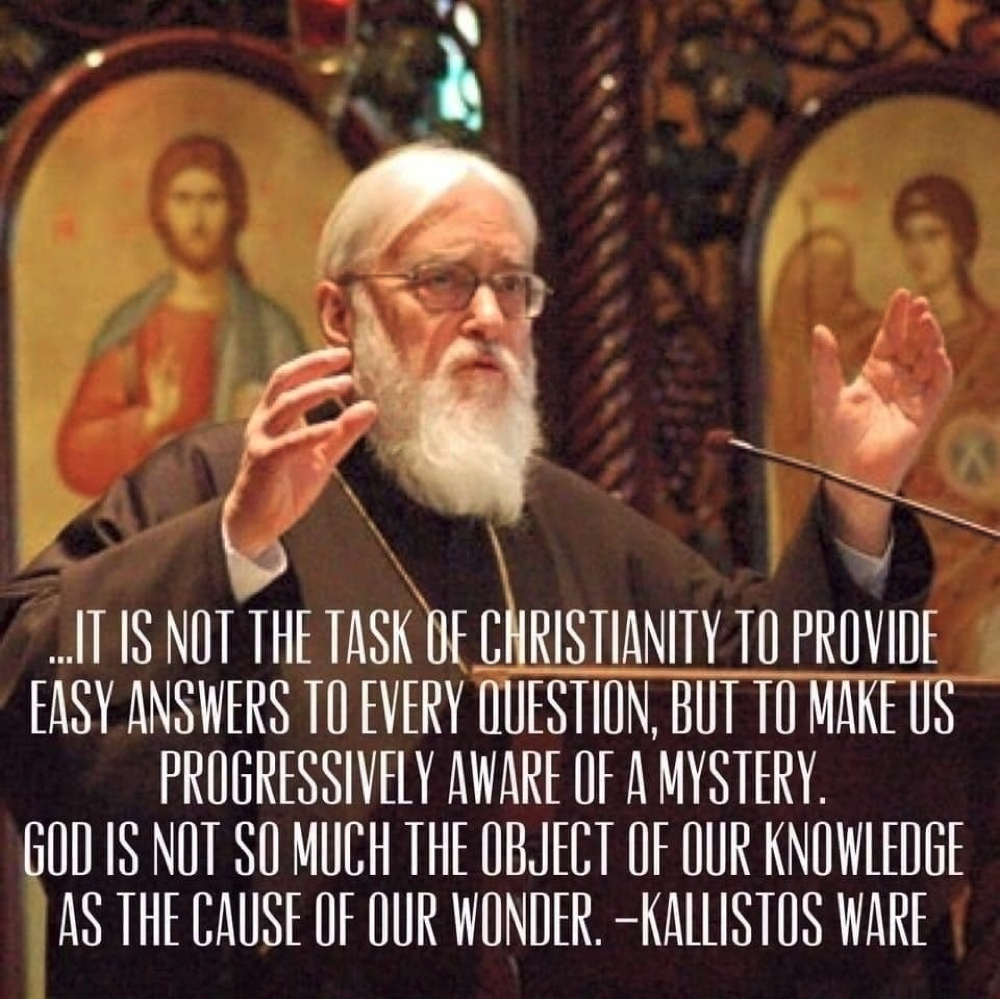
Metropolitan Kallistos Ware has reposed in the Lord

Metropolitan Kallistos Ware reposed in the Lord last Tuesday.

“Let me keep my distance, always, from those who think they have the answers.

Let me keep company always with those who say "Look!" and laugh in astonishment, and bow their heads.”

Mary Oliver, Evidence: Poems

Against David Frenchism

I may have finally reached a tipping point trying to process David French’s commentaries on religion and politics. Henceforth, I will either not bother at all or at least approach his columns and podcasts with an attitude of “tell me, in the first paragraph or two, why I should stick around and hear you out.”

I’ll still listen to him on law, but I don’t think he has anything I need to hear about the intersection of religion and politics.

That problem isn’t that he’s anti-Trump, goodness knows. The problem is that he’s reflexively parochial, and his “parish” is white Evangelicalism; that he says “Christians” when he means “white Evangelicals” drives me to distraction.

(Deep breath.)

I suppose this bugs me so much because French is writing and podcasting in secular, not Evangelical, spaces. He’s being read by people who may judge all of Christianity by his fixations on North American white Evangelical grotesqueries.

There is a Church that is rooted far deeper in history than the Second Great Awakening, utterly orthodox in its Christianity, and ambivalent-to-indifferent in its politics (the impressions of some American converts notwithstanding). If you’ve read me for long, you know where I think it’s found. All we ask of a polity is that we may lead a calm and peaceful lives in all godliness and sanctity.

But you’d never appreciate that by reading David French, who basically tells the Western world that “Christians be like Falwell Jr. and Orange Man.” That’s just not true, and eliding Christianity with Evangelicalism turns people off to the holy and life-giving potential of authentic, historic Christianity.

Up with Jake Meadorism

Here is one of the arguments some friends have made in defending the evangelical hard pivot toward Trump and right-wing politics more generally: The country is changing. No one will be friendly to all of our beliefs or values. However, if the progressives win, the likeliest outcome is some blending of dhimmitude and persecution. On the other hand, if the right wins, religious liberty will at least mostly be safe and we’ll be left alone. So it makes sense for orthodox Christians to migrate rightward.

The difficulty I see with this: Our churches do not exist within sealed spaces closed off from the world outside the congregation. Rather, our parishioners are being discipled all the time by the networks they participate in. So when we strengthen our ties to the political right and, in particular, when we tend to look past or gloss over the right’s sins for sakes of the political coalition (which is just a reality of life with any political coalition you try to participate in), we aren’t simply retreating into a stable space where right-wing governments protect our stable, faithful Christian communities. Rather, our communities are being shaped through the very act of partnering with specific groups, of speaking about some sins and not speaking about others. These things are, in themselves, formative.

To get his core insight, I had to quote most of his short post, but there is a bit of good stuff left, and with no paywall, either.

Jake Meador, Places of Refuge are Places of Discipleship. Meador, too, is Protestant, and as a Reformed Christian, he (as did I) appears to think himself Evangelical or Evangelical-adjacent. Unlike French, he doesn’t parochially collapse Christianity into Evangelicalism.

Why I Will Disregard any American Episcopalian Who Complains About Small States Getting As Many Senators as Big States

“Yes, a bishop’s episcopal charism does not depend on the number of worshipers in their see. But when almost all the micro-dioceses are in the west, and when western bishops are disproportionately present at Lambeth 2022, this is white privilege in action," he wrote. "Lambeth 2022 is taking place even though the bishops of half of African Anglicans have refused to come. Their dioceses constitute a third of the total Anglican Communion. Western bishops may say ‘it was their choice not to come.’ But this is not a good look."

Terry Mattingly, Some trends in global Anglican Communion are starting to look rather Black and White — GetReligion

Context:

  • Many western bishops lead "micro-dioceses" with under 1,000 active members or "mini-dioceses" with fewer than 5,000.
  • The Church of Nigeria claims 17 million members and 22 million active participants.
  • Uganda has 10 million members
  • Rwanda has 1 million members.

A Christian Culture (for the very first time)

By pretty much all measures, the Orthodox Christian countries of Eastern Europe take their faith more seriously than the Catholic countries further West or the Protestant countries which mainly lie around the continent’s fringes. I should really say ‘former Protestant countries’ because, as I have written here in the past, these countries – including mine, Britain – are now post-religious. Faith has been replaced by politics, ideology, activism or the material and technological idolatry which we call ‘progress.’

All of which means that I have until recently never seen a real Christian culture, of the kind my country used to be many centuries ago, and my adopted country, Ireland, used to be until more recently.

Paul Kingsnorth, Intermission: Monasteries of Romania #1

Godsplaining to the Archbishop

“If we say our God is an all-loving god, how do you explain that at any given time probably 400 million living on the planet at one time would be gay?” he asked. “Are the religions of the world, as does Catholicism, saying to those hundreds of millions of people, ‘You have to pass your whole life without any physical, genital expression of that love?’”

Archbishop Rembert G. Weakland, recently deceased, to the New York Times in 2009, roughly seven years after exposure of his hush money payment to a male lover (or rape victim).

It is suggestive that “the religions of the world” seem, to the disgraced Archbishop, to speak with one voice. How could that be if the idea of lifelong sexual abstinence is so stupid? Might it be that the spirit of our age is the anomaly, the deviation from the wisdom of the ages?

Did the Archbishop not confess that Mary, the “Mother of God,” remained ever a virgin? Or did he, like a highly multiparous protestant I corresponded with at some length, rule out Mary’s ever-virginity because that would be “perverted”?

Further, it is famously not just the Church that tells people “You have to” do something you’d rather not do, See, e.g., decalogue.

Still further, surely a substantial part of the work of the Church is dealing sacramentally and pastorally with people who fail to live up to divine expectations. See, e.g., confession.

Finally, the surmised number of gay people is irrelevant to the correct answer to the Archbishop’s tendentious question.

To get other glimpses of the odious decedent, see Rembert Weakland, Proud Vandal

Youth alienation then and now

[T]he thing that disturbs me the most right now is that the conversations often that I’m having with younger evangelicals. When someone says to me I’m thinking about walking away, it’s usually a very different conversation than I would have had 10 years ago. 10 years ago, it would have been with a younger person saying I just can’t believe the supernatural stuff that we believe anymore. Or I really think the moral ideas of the church are too strict and too judgmental, and I want to walk away.

Now it’s almost the reverse, almost directly the reverse. It’s people who are saying, I don’t think the church believes what it says it believes and what it’s taught me, or at least I fear that it doesn’t.

[W]e’re not looking for some Christian America in the past because in order to do that, we would have to redefine what we mean by Christian … [i]n all sorts of ways that I think are harmful.

Russell Moore

Repentance

Repentance is everything you do to get sin, those inborn passions, out of you. It’s reading, thinking, praying, weeding out disruptive influences in your life, sharing time with fellow Christians, following the guidance of the saints. Repentance is the renunciation of what harms us and the acquisition of what is beneficial to us, writes a holy counselor.

Dee Pennock, God’s Path to Sanity

Demoting free exercise

In essence, [Employment Division v.] Smith demoted the Free Exercise Clause of the First Amendment to a glorified nondiscrimination doctrine. Rather than granting Americans an affirmative right to practice their religion absent compelling governmental reasons to restrict that practice, the Free Exercise Clause becomes almost entirely defensive—impotent against government encroachment absent evidence of targeted attack or unequal treatment.

David French


[S]ubordinating truth to politics is a game which tyrants and bullies always win.

Jonathan Rauch, The Constitution of Knowledge

The Orthodox "phronema" [roughly, mind-set] cannot be programmitized or reduced into shibboleths.

Fr. Jonathan Tobias

You can read most of my more impromptu stuff here (cathartic venting) and here (the only social medium I frequent, because people there are quirky, pleasant and real). Both should work in your RSS aggregator, like Feedly or Reeder, should you want to make a habit of it.

Wednesday, 8/24/22

Are all the laws but one to go unexecuted, and the Government itself go to pieces …?

On January 6, 2021, from a parking garage under the Capitol Visitor Center, then–Vice President Mike Pence ordered the military to defend the Capitol against a violent insurrection. According to a taped deposition of General Mark Milley, the chairman of the Joint Chiefs of Staff, Pence “issued very explicit, very direct, unambiguous orders” to him and Secretary of Defense Christopher Miller: “Get the military down here. Get the Guard here. Put down this situation.”

In ordinary circumstances, Pence’s actions would be unconstitutional. Indeed, a vice president who usurped the president’s constitutional authority, and the Cabinet and military officers who followed his orders, could be committing an impeachable offense. …

Jefferson also insisted, the officer who exercises emergency power must justify his actions to “his fellow citizens generally.” For Jefferson, “the good officer” must throw “himself on the justice of his country and the rectitude of his motives.”

From his title (Mike Pence Owes the Country an Explanation) and the first paragraph, I easily figured out where George Thomas was headed and why: he wants Pence to say he perceived an emergency if only because Donald Trump was failing to put down the rump insurrection.

What I didn’t expect was that he would bring Jefferson and Lincoln into it and would persuade me of his case — and by inference to repent of my former judgment on Lincoln for his ultra vires acts.

Yup, the world is messy sometimes. This once was one of my favorite quotes, in part because it challenged my purity fetish:

Purity … is not the one thing needful; and it is better that a life should contract many a dirt-mark, than forfeit usefulness in its efforts to remain unspotted.

William James, Varieties of Religious Experience Lectures 14 and 15, via here.

Sorting out a jumble

[W]e have no ideal path forward. We’re damned if Attorney General Merrick Garland goes forward with a Trump prosecution and damned if Garland holds off. But the latter path should nonetheless be treated as a viable Plan B because it permits the Democrats to continue beating Trump in the political arena by the widest possible margin. That involves all kinds of risks as well, but it’s less risky than the legal option.

Damon Linker, summarizing the case against prosecution that he’s been trying to make.

More:

  • To use the full powers of federal law enforcement during a Democratic administration to indict, try, convict, and punish this man would drive large numbers of Republicans even further into Trump’s arms …
  • The goal should be his political defeat—turning him into a loser in the court of public opinion—not using an extra-political workaround to try and exile him from political competition. If you think making Hitler and Chamberlain analogies clarifies these issues, good for you. I think it’s pretty idiotic.
  • For the sake of argument, I’ve been happy to concede the point and assume Trump is guilty of … something. But is it true? [] After reading a highly illuminating exchange between widely respected legal scholar Jack Goldsmith and journalist Josh Marshall, I’m honestly not sure.
  • Could it be that all of the sound and fury I’ve seen online from the left about the imperative of punishing Trump’s self-evident criminality is based on nothing more than a feeling, a conviction, a moral certainty that he simply must be guilty of something? If so, that would be a further sign that loathing for the former president is a fundamentally political impulse, not a legal one.

Maybe I’ll take a position on “prosecute or nolle prosequi” when someone convincingly shows that Trump committed an actual crime, and that prosecution will be a slam-dunk. Considering the proportion of Trumpists in the land, I’m not sure you’ll ever impanel a jury without one or with one that will vote to convict.

Why colleges are failing

The present model of colleges and universities is failing, for in the first place they have forgotten or even turned against their original mission; in the second, they have picked up a whole lot of unrelated sidelines, none of which they do very well, such as universal job certification; and in the third, the public is beginning to catch on that they cost far too much, and that other institutions can usually do each of these sidelines better.  Barring root and branch reform – for which we must never give up hope — it’s entirely possible that in the not-so-distant future, serious humanities teaching will have to migrate to other settings than colleges and universities.

J Budziszewski

Detritus

In a nutshell

Democracy disconnected from liberalism will not protect diversity, because majorities will use their power to repress minorities.

Francis Fukuyama, Liberalism and Its Discontents

Be careful what you ask for …

History is a prankster. You order a Gray Champion, and cosmic room service sends up a casino developer and New York real estate mogul with a laughable hairdo…

James Howard Kunstler, Living in the Long Emergency

How low can we go?

Hillary Clinton versus Donald Trump seemed like some kind of nadir, but the Florida panhandle is showing that we can go even lower: Matt Gaetz versus Rebekah Jones

Institutions trumping instinct

But it is in fact individualism and not sociability that developed over the course of human history. That individualism seems today like a solid core of our economic and political behavior is only because we have developed institutions that override our more naturally communal instincts.

Francis Fukuyama, The Origins of Political Order

One thing leads to another …

I was good at menial jobs like parking cars but went into radio because it was Minnesota and vacuum tubes give off heat. It was public radio where all the announcers sound like Methodist ministers except not as friendly and there is no Jesus, and I distinguished myself by telling jokes and stem-winding stories about a small town. People liked it; go figure.

Garrison Keillor

American exceptionalism plus

It’s American exceptionalism but goes beyond that. It says that we are the next version of Israel from the Old Testament, that we are God’s chosen nation, and that is a special covenant — a two-way agreement with God. We can’t break it, and if we do, what happened to Israel will happen to us: We will be overrun by whatever the next Babylon is, taken into captivity, and He will remove His blessing from us.

Zack Stanton, It’s Time to Talk About Violent Christian Extremism – POLITICO

Maybe a bit harsh

I would rather have gonorrhea than a record of passionate and convinced #MAGA tweeting.

Graeme Wood, What to Do With Trumpists – The Atlantic.

Maybe a bit harsh, but then it’s dated 1/19/21, the day before Joe Biden officially became President despite Trump’s lawless efforts to retain the Presidency.


[S]ubordinating truth to politics is a game which tyrants and bullies always win.

Jonathan Rauch, The Constitution of Knowledge

You can read most of my more impromptu stuff here (cathartic venting) and here (the only social medium I frequent, because people there are quirky, pleasant and real). Both should work in your RSS aggregator, like Feedly or Reeder, should you want to make a habit of it.

Saturday, 8/20/22 (no politics)

Following up my last post, the non-political portion of the stuff I’d collected.

RIP

More on Beuchner

Again, with the caveat that I never read any Beuchner:

His first novel was a great success. After his second, he came to faith. He was attending a church service in New York where the pastor was talking about how Jesus is crowned amid confession, tears and great laughter. “At the phrase great laughter, for reasons that I have never satisfactorily understood, the great wall of China crumbled and Atlantis rose up out of the sea, and on Madison Avenue, at 73rd Street, tears leapt from my eyes as though I had been struck across the face.”

He spent the rest of his life as a border-stalker, too literary for many Christians and too Christian for the literary set. His faith was personal, unpretentious and accessible. “Faith is homesickness. Faith is a lump in the throat. Faith is less a position on than a movement toward.” It is sensing a presence, not buying an argument.

David Brooks, The Man Who Found His Inner Depths

“Too literary for many Christians” means “not sufficiently neat, tidy and pious.”

Norah Vincent

Another author I’ve heard of but not read. (You can learn a fair amount by reading New York Times obituaries.)

In her year and a half living as Ned, Ms. Vincent put him in a number of stereotypical, hypermasculine situations. He joined a blue-collar bowling league, though he was a terrible bowler. (His teammates were kind and cheered him on; they thought he was gay, Ms. Vincent learned later, because they thought he bowled like a girl.)

He spent weeks in a monastery with cloistered monks. He went to strip clubs and dated women, though he was rebuffed more often than not in singles bars. He worked in sales, hustling coupon books and other low-margin products door-to-door with fellow salesmen who, with their cartoon bravado, seemed drawn from the 1983 David Mamet play “Glengarry Glen Ross.”

Finally, at an Iron John retreat, a therapeutic masculinity workshop — think drum circles and hero archetypes — modeled on the work of the men’s movement author Robert Bly, Ned began to lose it. Being Ned had worn Ms. Vincent down; she felt alienated and disassociated, and after the retreat she checked herself into a hospital for depression.

She was suffering, she wrote, for the same reason that many of the men she met were suffering: Their assigned gender roles, she found, were suffocating them and alienating them from themselves.

“Manhood is a leaden mythology riding on the shoulders of every man,” she wrote, and they needed help: “If men are still really in power, then it benefits us all considerably to heal the dyspeptic at the wheel.”

Norah Vincent, Who Chronicled Passing as a Man, Is Dead at 53 – The New York Times. The book alluded to is Self-Made Man.

Science and sciencey

Big Bang?

Another one bites the dust.

Science is tentative, reformable. And so it’s too early conclusively to bid adieu to the Big Bang hypothesis. But stay tuned.

Total dudes, or at least dude-adjacent

I’m glad the hospital produced these videos. They ought to be open about what they’re doing to children. And I’m glad these doctors are talking about their diagnoses of toddlers who dare to play with the wrong color toys or teen girls who hate their bodies. It’s then extremely fair to simply disagree and say, hey this isn’t good. As a former toddler who played with trucks, I’m glad I’ve managed to keep my uterus as long as I have.

Nellie Bowles, Last Hurrah Before the Baby!.

Nellie played with trucks. She’s lesbian, not male, not trans. And she’s having a baby (from her womb, not from her “wife” or a surrogate). I firmly believe that some girls who play with trucks are straight.

The most infuriating part of the trans mania to me is that it takes the most simplistic stereotypes of gender-appropriate behavior and turns deviation from them as evidence of transgender identity. Far likelier that it’s non-conclusive evidence (i.e., a hint) of homosexuality.

The second most infuriating part is of pseudo-science like trans medicine (also from Nellie):

In the new gender belief system, female-ness and male-ness are feelings, removed from the physical body. So what is femaleness, then? It is a sense of weakness, receptivity, softness, and submission. Duh.

And so it makes sense that a powerful, dominant uterus-haver in, say, 15th-century France, could not possibly have identified as a woman, not if she (they?) knew what we know now. Shakespeare’s Globe Theatre is putting on a play about the life of Joan of Arc, and in it she is not a she at all. How could she be? Joan is strong and independent! So Joan is recast as a nonbinary hero and goes by they/them. From the Globe’s website announcing the show:  “Joan finds their power and their belief spreads like fire.” (Spreads like fire . . . you see Joan was burned at the stake, so they’re doing a metaphor with that.)

You know who else was nonbinary, according to the new academic experts? Elizabeth I! Yes, all through history powerful people who thought they were women were, in fact, total dudes or at least dude-adjacent. All of them, from Cleopatra to Sojourner Truth—they were never women. That was just us imposing the gender-binary on all these super awesome people of indeterminate identity.

The way to know that this is sexism is to imagine something similar being done to a historical man. Like: this historical man was really submissive and quiet, so our play now re-imagines him as a woman, which we think he was.

Legalia

Now that you’ve joined our sleeper cell …

here are some guidelines for staying below the enemy’s radar.

Creepy posts like this will certainly not do anything to attract emotionally healthy people who are reticent about integralism or other postliberal legal approaches.

1000 words

Unusually good KAL cartoon this week in the Economist:

Originalism

Originalism has become, as Richard Primus of the University of Michigan Law School says, a “surname of a family of approaches to constitutional law” that might not recognise one another around the dinner table.

America tussles over a newly fashionable constitutional theory (The Economist)

I’m growing increasingly convinced that originalism is the correct way to analyze constitutional questions, but Professor Primus isn’t totally wrong, either. Inter-originalism tussles will, I hope, resolve to a shared method.

How could there be multiple members of the “originalism” family that don’t recognize one another? Well, for instance, an originalism that reflexively looks only to first founding and averts its eyes from the post-Civil War amendments is missing the mark:

Elizabeth Wydra, president of the Constitutional Accountability Centre, a law firm and advocacy organisation, is not waiting for liberals to take hold of the court. She finds powerful originalist sources for progressive causes—especially in the Reconstruction Amendments. These provisions, which ended slavery and guaranteed equal rights for formerly enslaved people, “reflect broad conceptions of equality, inclusion and liberty”. For true originalists, Ms Wydra says, “the 14th Amendment should matter just as much to you as the Second Amendment.”

This doesn’t mean I’ll agree with Ms. Wydra’s conclusions on cases, but she’s right that the nation had a “second founding” 160 years ago, and that, too, affects “original meaning.”


“The Frenchman works until he can play. The American works until he can’t play; and then thanks the devil, his master, that he is donkey enough to die in harness ….” (G.K. Chesterton)

You can read most of my more impromptu stuff here (cathartic venting) and here (the only social medium I frequent, because people there are quirky, pleasant and real). Both should work in your RSS aggregator, like Feedly or Reeder, should you want to make a habit of it.