I don’t know about your Inbox, but mine tends to fill up especially on Friday. So I’m posting this now rather than in the wee hours tomorrow.
Trump 2.0
I haven’t been able to eliminate sharp criticism of Trump from today’s post because there are too many issues and I’ve read too much that isn’t just “same old same old.” As has become my habit, I’ve posted most of my anti-Trump stuff here.
United States law allows for a quite expedited process to remove people from the country, to deport them. You don’t get a big trial. You don’t get a jury trial. You are moved rapidly because the theory of the case is: First, you don’t have a right to immigrate to the United States, so you have not been deprived of your rights. And secondly, once you’re removed from the United States, you remain a free person. You are sent back to the place you came from or some other place to which you have some connection, and then you’re free to go about your business. You’re not sent to a prison—not sent to a prison for life.
But as I talk about this, the thing that has most gripped my mind with worry and anxiety is not only the effect on the individuals themselves, some of whom may be genuinely innocent, but the effect on those who are sending human beings to a prison without a hearing.
You know, the United States government is now building an apparatus of lawyers, of officials of all kinds, who plan and think every day, How can we apprehend people on American soil and bundle them to a prison without giving them any show of a hearing? They’re building skills and competencies at non-due-process forms of arrest and incarceration that are going to be very hard to limit.
… I remember when I was a Canadian citizen in the United States on a student visa, we were warned if you got into a bar fight, you could theoretically lose your student visa. Now, in those days, that meant that you’d have to go back to Canada and go to school in Canada, which is not the end of the world. In today’s America, that could mean you could lose your student visa and be accused of terrorism, and a bag put over your head and be put into a car and sent to a prison in El Salvador for the rest of your life.
Now, maybe that doesn’t happen in every case. Maybe that doesn’t happen in many cases. But there are people in the employ of the United States government, paid by taxpayers to think about how can we daily broaden the category of people who can be arrested and detained and imprisoned without any showing to any authority at all, without any opportunity to make themselves heard, without any evaluation by an independent fact finder—by any of the things we call due process.
David Frum, introducing a terrific conversation about The Crisis of Due Process with Peter Keisler. (bold added)
Do we really believe in free speech?
Trump 2.0 has been deporting foreign students and others for constitutionally protected speech, using as its current go-to bad-faith excuse that the speech is antisemitic.
The late British-American journalist Christopher Hitchens is a more recent testament to the long tolerance of America toward foreign dissent. Before becoming a U.S. citizen in 2007, Hitchens spent decades as a legal resident—and as one of America’s most acerbic public intellectuals. He accused Ronald Reagan of being “a liar and trickster,” called Israel America’s “chosen surrogate” for “dirty work” and “terrorism,” lambasted Bill Clinton as “almost psychopathically deceitful,” and accused the George W. Bush administration of torture and illegal surveillance. If a student can be deported for writing a campus op-ed critical of Israel, any of Hitchens’ views could have been used to justify deporting him.
This isn’t how our system is supposed to work. When a president does the kinds of things Donald Trump is doing, his popularity should sink so low that Congress will feel empowered to stand up to him. Ideally, they would impeach and remove him from office for attempting to govern like an absolute monarch. Short of that, Congress and the courts would be working in tandem to impose and enforce constraints on the wayward executive until the next election strengthens their hand against him.
But none of this is happening—because our system has broken down. The parties are ideologically sorted, with almost no remaining overlap. And Trump has transformed the GOP into a cult of personality more loyal to him personally than to the Republican Party, the other institutions of American democracy, the law, or the Constitution.
In a situation like this, the only thing preventing the president from transforming himself into a tyrant is his own willingness to do it. The courts can tell him to stop. But will he? If he does, democracy survives, at least for the time being. If he doesn’t, democracy is over, at least until it can be reconstituted at some point in the future.
One should never hope to live through a moment of great political precarity like our own. But one tiny compensation is that such moments bring clarity about certain fundamental matters. How has the United States managed to survive for nearly 250 years without evolving into a dictatorship? The answer really may be this simple: By never electing a man willing to do what it takes to effectuate the change.
It’s not clear that the courts will suffice, but the courts — having already, and deservedly, come to treat the Administration as bad-faith, untrustworthy actors — will provide partial deterrence and may help sway public opinion by the cogency (and sometimes, the tartness) of their reasoning.
[I]f you want a really extraordinary example of that, you would look at the order that the Court issued at 1 a.m. on Saturday morning this last weekend, because even though they had held that everybody has to be given meaningful notice before they could be removed in this way, there was credible evidence that the administration was loading people onto buses without giving them anything like the notice that was required. And the ACLU went to the Supreme Court and said, you know, Please, as you listen to the rest of this case and get briefing, stop this from happening.
And if the administration were a normal administration and had compiled a record so far of being a normal administration, the Court would’ve said, Well, I can be confident they’re not going to do this while we are hearing your petition, so let’s give the government a chance to respond. Let’s see what they say, and then we’ll decide what to do. Because, of course, the government wouldn’t spirit these people away while we are actually in the process of deciding whether it can do so on this emergency application you filed. But they knew that the government had done exactly that with the first 200 or so people they had sent away.
The case was before a district judge, and they rushed to secretly get the people out before he could issue an order. And they didn’t quite succeed on that, which is why you have these issues of contempt floating around now. But at 1 a.m., the Court by a 7–2 vote said, Don’t remove anybody in the class represented by these lawyers until you hear otherwise from us.
And that shows that there is a cost to the administration of acting the way it’s acting towards the courts, because if you squander the reputation that governments of both parties have had for credibility and fair dealing and honest brokering with the Court, then they’re going to treat you different because they know they can’t quite trust you.
The barstool right, which is a genuinely new constituency made up of hedonistic anti-woke libertarians that has replaced the Christian conservatives
The neo-conservative foreign policy hawks, who are the weakest member of the coalition, but can still get what they want on certain issues, as seen with the attacks on the Houthis as well as the saber rattling regarding Greenland
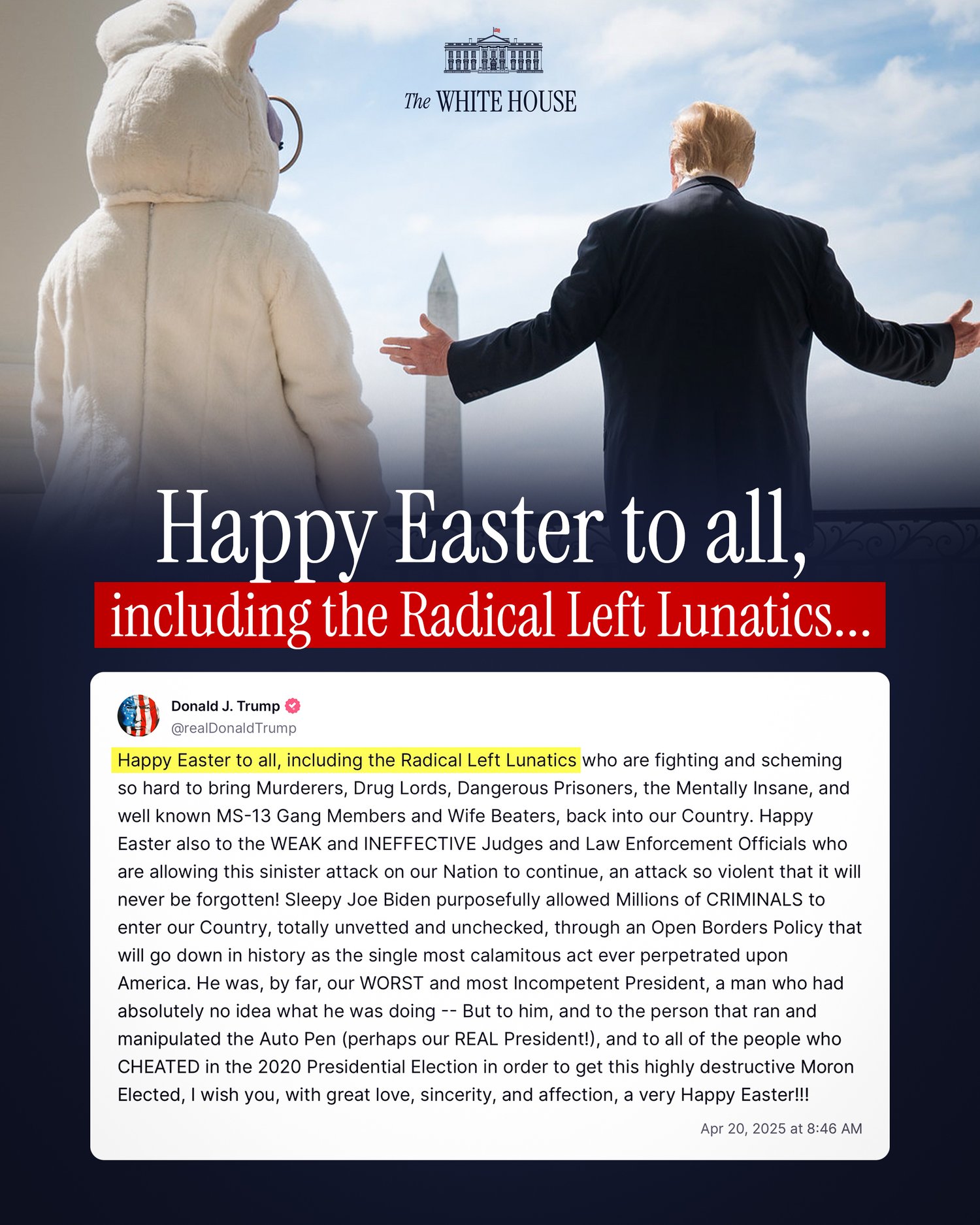
In other words, the Christian influence on actual Republican policy items and their political vision is going to be exceedingly negligible going forward. Sure, Vice President Vance will make an appearance at the March for Life. President Trump will show up to the National Prayer Breakfast. But even when he does acknowledge a Christian event, it often will come loaded with hatred and vile self-aggrandizement, as seen yesterday:
And ultimately when push comes to shove on the policy level, Christian concerns will always be backgrounded or eliminated relative to the priorities of the three above groups, as we have already seen on abortion, marriage, and PEPFAR.
I originally thought to post this on a Sunday, when my focus is narrower, but it didn’t fit there because I don’t value “religion” for its instrumental partisan-political value.
It was a very few years ago when I warned (as had others) “If you don’t like the Religious Right, just wait ‘till you see the irreligious Right.” Well you’ve been seeing them in power for three months now.
Beta-testing tyranny in the Sunshine State
Ron DeSantis walked so that Donald Trump could run. When the time came to formulate a policy response to the woke left, no one mattered more than the governor of Florida.
And through it all, DeSantis declared that Florida was the place where “woke goes to die.”
In his second term, Trump is a scaled-up version of DeSantis. Every element of the DeSantis model has been deployed against Trump’s ideological enemies …
…
At first I was optimistic about the anti-woke right. Their free speech argument resonated with me. I’d spent decades litigating free speech cases, after all, and I’d never really seen anything like a mass movement for free expression.
But my optimism quickly faded. In 2021, the anti-woke right embraced a series of state laws that were designed to ban critical race theory. Rather than meet critical race theorists in the marketplace of ideas, the right chose to try to suppress their expression.
By this time I was familiar with the right’s authoritarian turn — and getting very worried about it. In 2019, parts of the intellectual right were consumed with a fight over liberalism itself, with the new right arguing that liberal values — freedom of speech and free trade, for example — were hollowing out American culture, creating a nation of atomized individuals who were consumed with self-actualization (and consumption itself) at the expense of family and community.
Ironically, the left, now alarmed by the federal government’s intrusive reach [into, say, Harvard], bears direct responsibility for crafting the very legal weapons wielded against the universities it dominates. Almost four decades ago, progressive legislators demanded sweeping amendments to civil rights law, expanding federal oversight over higher education. The sequence of events reveals a cautionary tale of political hubris: progressive confidence that state power would reliably serve their ends overlooked the reality that governmental authority, once unleashed, recognizes no ideological master. Today’s circumstances starkly illustrate how expansive federal control over civil society, originally celebrated by progressives, returns to haunt its architects. The left’s outrage ought to focus not on this particular administration but on its own reckless empowerment of the state.
Yet for all its courage, Harvard’s response stopped short of making the argument that would best protect the values for which it was fighting. It defended the university’s independence without explaining why that independence deserves protection. It invoked values like “pluralism” and “inquiry,” but it did not fully explain why those values are essential to a liberal democratic society. The letter therefore missed an opportunity to articulate what a university is for — not just to students or donors, but to the country. And this matters, because Trump’s attack against this and other universities is not only about the balance of power between universities and the government. It is, at bottom, about the legitimacy of higher education as a public good.
The danger of being a professional exposer of the bogus is that, encountering it so often, one may come in time to cease to believe in the reality it counterfeits.
Your enemies are not demonic, and they are not all-powerful and the right hasn’t always lost and the left hasn’t always won. But if you convince yourself of that, you give yourselves all sorts of permission to do a lot of stupid and terrible things under the rubric of “Do you know what time it is?”
Regarding said “lot of stupid and terrible things,” my failure to call out anything about the current regime does not mean I approve. There’s just too much, and on some of the apparent illegalities I don’t want to abuse my credentials without thinking it through.
I don’t do any of the major social media, but I have two sub-domains of the domain you’re currently reading: (a) You can read most of my reflexive stuff, especially political here. (b) I also post some things on the only social medium I frequent, because people there are quirky, pleasant and real.
Purdue University recently was found liable for retaliation against a co-ed for her 2017 complaint that a fraternity member had sex with her without her consent because she was too intoxicated to give real consent. The two female administrators involved remain in their offices with Purdue’s backing (Purdue thinks the jury blew it), and, of course, protests ensued.
Here’s what Purdue had to say about it:
We appreciate our students and their passion on this truly important issue. But we believe, because of the evidence presented, that this is not the correct case to use in advocating for it. This was a very rare case of discipline for making false statements in a sexual assault report. The undisputed facts overwhelmingly established that Roe chose the sexual encounter she later labeled a sexual assault. …
The jury, which in part exonerated university administrators, ruled on the narrow issue of whether Purdue, having conducted a thorough investigation, appropriately disciplined Roe based on its finding of false charges.
Purdue’s position in these matters has long been clear: we will not tolerate sexual harassment in any form, including and especially sexual violence. But neither will we tolerate lying or making false accusations that can have lifelong consequences.
As for our two outstanding administrators, Dr. Katie Sermersheim and Alysa Rollock, we absolutely stand behind them, and any suggestion that they resign is out of the question.
“When you listen to campus tour guides walk by, what do you hear parents ask: ‘Is this campus safe? Can my daughter walk home at night?’” Grace Gochnauer, a Purdue junior, said. “If I was the tour guide, my answer would be no.”
Purdue isn’t Mayberry RFD, but it has no particular problem with stranger rape of co-eds walking home at night. You know what you don’t hear parents ask? “Can my daughter get willingly get blackout drunk at a party, have sex with her apparently enthusiastic consent, and then get a pound of flesh when she regrets it later?”
I once stayed in a girl’s dormitory when on campus for a summer recording session. When I turned out the lights at bedtime, I saw a glowing message on the wall, painted cunningly so it only showed up in the dark: “Drink ‘till he’s cute.” Read between those lines. A frat boy’s equivalent could be “Drink ‘till you’re irresistible.”
I wish Purdue hadn’t found it necessary to ignore the elephant in the room. Call me santimonious, but if campuses could stop binge-drinking, they’d stop maybe 95% of problematic sexual intercourse. Justice Brett Kavanaugh’s unrepentant history of binge-drinking, even when under legal age, was a big reason that I thought the first allegation against him might be true — and why I remain agnostic about it still.
David French never said that!
Jake Meador, one of the good guys, writes about Alternatives to Culture War, but credulously alludes to a slander leveled against David French by tribalist culture warriors.
The slander, widelyspread (and here and heread infinitum), is that French thinks Drag Queen Story Hours are a “blessing of liberty.” Here’s Meador:
It was easier to be anti-culture war when our country still knew what marriage was and what men and women are. But as the SOGI landscape has shifted, culture war has started to look like a viable strategy, especially if the alternative is talking about drag queen story hour as a “blessing of liberty.”
The slander is so prevalent that searching “David French drag queen blessing of liberty” returned, for me at least, six or eight of the lies before it gave one link to the truth. What David French called a blessing of liberty was the absence of viewpoint discrimination in public spaces:
My position was simple — I don’t like drag queen reading hours, but I also want to preserve for all Americans the First Amendment-protected right of viewpoint-neutral access to public facilities when those facilities are opened up for public use. I don’t want the government dispensing access on the basis of its preferred messages or its preferred speakers. Handle bad speech with better speech. Counter bad speakers in the marketplace of ideas, not through the heavy hand of government censorship.
… Our present regime that broadly protects viewpoint neutrality in access to public facilities is the hard-won result of decades of litigation from free speech and religious liberty advocates, and it represents both a public good in its own right and a practical blessing for millions of American Christians. As our government continues to grow — including by creating an immense number of public facilities — it is quite simply just that taxpayers are able to have equal access to the facilities they paid to create.
Anyone who won’t pause their Jihad long enough to notice the difference between “Drag Queen Story Hour is a blessing of liberty” and “viewpoint-neutral access to public facilities” is a blessing of liberty should stay home and shut up.
And if that’s culture war, so be it.
I’ve certainly flirted with the idea that liberalism has failed, and it’s therefore (almost by definition) time for some kind of post-liberalism. But I’ve yet to find any strange post-liberal devil I prefer to the liberal devils I already know. For that reason, I’m particularly keen to defend right-liberal David French from tendentious slanders by any and all far-right liars.
Conservatisms
If these populist, corporatist, nationalist, ultramontane, oh-so-European ideas succeed in replacing conservatism as we once knew it, they will be called conservatism. But as Friedrich Hayek argued, this conservatism will be “Old World conservatism,” because the conservative in America is necessarily a defender of the liberal tradition of the founding.
[T]he Heritage Foundation is, by any sane reckoning, an elite institution and it admits as much to donors. Second, this us-vs.-them framing implies that the “everyday people” of Italy have more in common with the “everyday people” of America, which is 31 flavors of nonsense for all sorts of reasons, not least that Italians aren’t Americans. Conservatives used to understand that the old Marxist idea that members of the working class were united against the ruling class regardless of nationality—“Workers of the world unite!”—was folly. But now, “Everyday people of the world unite!” is the rallying cry of a leading conservative think tank?
Now, I can’t put “conservative” in scare quotes the way I’d like to, because I think Heritage can still claim to be conservative. But let’s have no illusions: It’s not the same kind of conservative it used to be. Heritage used to champion American exceptionalism with gusto. As Heritage co-founder and longtime president Ed Feulner put it, “And while, in the heat of political battle, we naturally focus on the differences between liberals and conservatives, and their contrasting visions of our country’s future, it is important to remember that regardless of party or political philosophy, we are Americans, we love our country — and we are patriots.” In 2019, Heritage even founded the Feulner Institute for American Exceptionalism, which seems to have had as much impact as the Goldberg Institute for Healthy Living—neither organization even has a website.
[P]erhaps the most revealing aspect of the book, to be published next week, is that Trump gave Maggie [Haberman], a Times reporter since 2015, three interviews for it. This is the same Trump who vilified her on Twitter, called her names and cast her as the personification of “fake news.” Maggie just pressed on, asking the right questions, getting the right people to answer them and seemingly trusting on some level that Trump would never wholly cut her off. She can recognize a performance when she sees one. And she can hear in a narcissist’s self-regarding soliloquies the aching need to babble on.
… Maggie (a friend of mine) and the other journalists whom he publicly insulted but privately indulged were, to him, reserves of precious attention, their discerning gazes trained on him, their busy thoughts dedicated to the puzzle of him, their notepads and audio recordings and television cameras a conduit to ever greater fame. There was danger in letting them in, peril in having them around, but the alternative was worse. They might give prime real estate on the evening’s newscast to some other circus act. They might write books about a lesser clown.
[T]he classic critique from the Right about [news] bias and the new critique from the Left about false equivalency often strike me as frivolous. They can often make sense on some particular item — Ouch, gotta admit, that’s a pretty good point — but cumulatively seem to miss the important point.
That point, in my view, is that the power of journalism does not principally flow from word choice. (Don’t call it a “misstatement” when it’s really a “lie.”) It does not flow from tonal presentation. (More than a half-century ago Richard Nixon’s vice president, Spiro Agnew, said network commentators revealed their bias “by the expressions on their faces, the tone of their questions, the sarcasm of their responses.”) The point is that the power of journalism comes from the primacy of reporting — from telling their audiences things that people in power would prefer they not know.
By the mid-1990s, the doctrine was being used to sue an employer who printed a Bible verse on paychecks (which a court found to be religious harassment of non-Christians). A university forced a graduate student to remove a photo of his bikini-clad wife from his desk, because someone filed a harassment complaint. A library worker was forced to remove a New Yorker cartoon from his work area after coworkers said it harassed them. The town of Murfreesboro, Tennessee, removed a painting from a public exhibit in City Hall after a city employee filed a hostile-environment complaint about it. Those incidents and others like them should have been seen as flashing red lights, but weren’t.
[A]s we have already seen, normal science ultimately leads only to the recognition of anomalies and to crises. And these are terminated, not by deliberation and interpretation, but by a relatively sudden and unstructured event like the gestalt switch.
I highly recommend this Outliers, Revisited episode of Malcolm Gladwell’s Revisionist History podcast. I won’t ruin it for you except that it involves a 40-30-20-10 “rule” that holds true in way too many fields.
Election Prep
Now might be a good time to refresh your memory on whether your congressperson, on January 6, 2021, voted for the United States of America or voted for the “Oathkeepers” and other insurrectionists. My congressman, normally a cipher, voted with the insurrectionists.
Gathering flowers
Bloggers and writers
I’m a blogger. Bloggers have different talents than writers.
We value writers for their prose and their insight. We value bloggers for their speed, their efficiency at curating news, and their ability to formulate strong political opinions—“takes,” we might more aptly call them—about literally anything that might turn up on the Drudge Report or in the average news junkie’s Twitter timeline.
If there were no age-specific and obligatory learning institution, “childhood” would go out of production. The youth of rich nations would be liberated from its destructiveness, and poor nations would cease attempting to rival the childishness of the rich.
You can read most of my more impromptu stuff here (cathartic venting) and here (the only social medium I frequent, because people there are quirky, pleasant and real). Both should work in your RSS aggregator, like Feedly or Reeder, should you want to make a habit of it.
For all his faults, Archie [Bunker] loved his country and he loved his family, even when they called him out on his ignorance and bigotries. If Archie had been around 50 years later, he probably would have watched Fox News. He probably would have been a Trump voter. But I think that the sight of the American flag being used to attack Capitol Police would have sickened him. I hope that the resolve shown by Representatives Liz Cheney and Adam Kinzinger, and their commitment to exposing the truth, would have won his respect.
Republican presidential campaigns in 2024 are going to look a whole lot different than they did in 2016: They (think they) have no use for the mainstream press. “I just don’t even see what the point is anymore,’ an adviser to one likely GOP presidential aspirant told New York Magazine’s David Freedlander. “We know reporters always disagreed with the Republican Party, but it used to be you thought you could get a fair shake. Now every reporter, and every outlet, is just chasing resistance rage-clicks.” The result? “Sitting down with the mainstream press has come to be seen by Republican primary voters as consorting with the enemy, and approval by the enemy is the political kiss of death,” Freedlander writes. “Dave Carney, a longtime GOP strategist, said that, according to his team’s research, getting endorsed by a newspaper editorial board, even a local one, hurts Republicans in primaries rather than helps them. ‘No one gives a f— what the New York Times writes,’ he said. ‘In fact, it would be good if you criticize us so that we can say that even the liberal New York Times hates us.’”
These are the kinds of Republicans who benefit from false-flag Democrat support attacking them as too extreme, too cozy with Orange Man, in order to boost them in the primaries.
Un-Disappearing Act
Adjust your picture of press corruption. It’s not so much the lies they tell as the truths they withhold. Let Mr. Biden threaten to become an albatross to progressive and Democratic hopes in 2024, and the Hunter story will un-disappear in a hurry.
Speaking of Hunter’s laptop and grifting, it sickens me to think that the electoral margin of Joe Biden over Donald Trump could have been lost if American intelligence authorities hadn’t lyingly called Hunter Biden’s laptop “Russian disinformation.”
According to one survey, one out of six Biden voters said that had they known about Hunter’s laptop in time, they wouldn’t have voted for his father.
[T]he 45th president had numerous authoritarian tendencies and instincts. He believed in personal loyalty, not loyalty to the office he held or to the Constitution. He despised the free press and encouraged popular hatred toward journalists. He treated as a traitor any American who didn’t support him. And then, of course, there were his words and deeds after the 2020 election, which incited an insurrectionary assault on the national legislature in order to keep himself in power despite his failure to win the electoral contest. If that isn’t a tyrannical act, it’s hard to imagine what would be.
…
Both the frequency of Trump’s lies and exaggerations and the obviousness of their mendacity are what make them fasc-ish. There’s a reason why the term “gaslighting” came into regular usage during the Trump administration: Living in the United States through those years often felt like enduring a sadistic psychological experiment in which we were constantly challenged about whether we would believe our own eyes and minds or the would-be dictator in the Oval Office spouting transparent nonsense. The fascist playbook often involves using precisely this kind of epistemic confusion—a thoroughly polluted information space—as an occasion or opportunity to seize or secure power.
…
Then there was Trump’s enthusiasm for any extremist group that gave him support. This led him to express ambivalence about the neo-Nazis who marched through and provoked violence in Charlottesville, Virginia in August 2017. And to offer periodic kind words for far-right groups and figures, including the Proud Boys, Oath Keepers, and various heavily armed militias.
This is one of the best collections I can recall of the outward manifestations of Trump’s narcissism and worse.
Electoral Count Act Reform
Watch your Step!
“Somehow they’ve come out of the kitchen with something that actually looks as if it is correctly prepared in almost every respect,” said Walter Olsen, senior fellow at the Cato Institute’s Robert A. Levy Center for Constitutional Studies. “Now I’m just holding my breath that someone doesn’t trip and spill the tray.”
The bad news is that some Democrats want to turn this urgently-needed Bill into a Christmas Tree. The good news is that they seem to want it half-heartedly.
Stop Screwing Around
I want to begin with a question I’ve asked before. What if Mike Pence had said yes? What if the history of January 6 was very different, Pence had agreed with the John Eastman memos arguing that he enjoyed a tremendous amount of discretion in counting electoral college votes, and he either declared Trump the winner outright, throwing the election into the House of Representatives, or sent it back to the states for the state legislatures to decide which electors were valid?
America probably would have survived that moment, but the key word there is probably. Does Trump leave the White House? If the Supreme Court intervenes, does he care? Do we see a situation in which Chief Justice Roberts swears in Joe Biden while a MAGA judge swears in Trump for his “second term”? What do state governors do? Does federal law enforcement intervene? What about the military?
Mike Pence saved us from all this chaos, and he deserves our gratitude. But he never should have been put in that position, and we have an opportunity to fix the prime legal reason why he was. The primary blame, of course, rests with the depraved corruption of Donald Trump and his cadre of loyalists. The secondary blame, however, rests with the Electoral Count Act, an absolute mess of a statute.
In my opinion, reforming the Electoral Count Act has been Job #1 since January 6, 2021. It’s quite a bit more important than the January 6 Committee, which has been more potent than I foresaw but clearly has not dissuade all Trump supporters.
But I was reminded very recently that we should be looking for, and closing, other loopholes that could be exploited to “elect” someone the voters (yes, allowing for the Electoral College’s “electoral majorities” that differ from the raw national vote majority) rejected. And I don’t think the Democrats’ absurd allegations that, for instance, requiring Voter ID is “worse than Jim Crow” comes anywhere close to meeting the need.
What do you call this?
Voters in Tunisia affirmed a new constitution for their country that would roll back many of the reforms that once made it look like the Arab Spring’s sole survivor. Some 95% of voters opted for the new constitution, but less than one-third of eligible voters turned out. The opposition, which boycotted the poll, said the results were “not credible”. Kais Saied, the president, had pressed for the referendum to transform the young democracy into another strongman system.
It seems somehow facile or crypto-imperialist to suggest that a 95% vote for something is not democratic.
Other stuff
Martyrdom and Suicide
Drawing on G. K. Chesterton, we might say that martyrdom and suicide, however similar they might seem on the surface, are diametrically opposed to each other: martyrdom occurs in the recognition of a goodness that is greater than the self, a goodness that is at the source of all things, so that one gives up one’s self in the ecstasy of affirmation; suicide is the absolute negation of all things through the negation of the self: “A martyr is a man who cares so much for something outside him, that he forgets his own personal life. A suicide is a man who cares so little for anything outside him, that he wants to see the last of everything. One wants something to begin: the other wants everything to end.”
The CRT debate is just the latest squall in a tempest brewing and building for five years or so. And, yes, some of the liberal critiques of a Fox News hyped campaign are well taken. Is this a wedge issue for the GOP? Of course it is. Are they using the term “critical race theory” as a cynical, marketing boogeyman? Of course they are. Are some dog whistles involved? A few. Are crude bans on public servants’ speech dangerous? Absolutely. Do many of the alarmists know who Derrick Bell was? Of course not.
But does that mean there isn’t a real issue here? Of course it doesn’t.
It will be a long time, if ever, before I’ll trust Christopher Rufo precisely because of his cynical comment about “freezing the brand” of CRT and then loading it up with extraneous things conservatives don’t like.
Title IX Run Amok
The provisions of Title IX of the Education Amendments Act of 1972 which bar sex discrimination apply to “any education program or activity receiving federal financial assistance”. In Buettner-Hartsoe v. Baltimore Lutheran High School Association, (D MD, July 21, 2022), a Maryland federal district court held that a §501(c)(3) tax exemption for a religiously-affiliated high school constitutes federal financial assistance so that the school is subject to Title IX. The court added that also in its view, schools that discriminate on the basis of sex, just like those that discriminate on the basis of race, are not entitled to federal tax exemptions. The court’s opinion applies to cases brought by 5 women who are former students at the high school who allege sexual assault and verbal sexual harassment by male students at the school. JDSupra reports on the decision.
I don’t have deep expertise on this, but I don’t think the District Court decision will (or should) survive appellate review. If tax exemption is federal financial assistance, things are going to get pretty ugly pretty fast.
We need an apocalypse
In modern terms, “apocalypse” has come to mean “the cataclysmic end of everything”. But this is a long way from the ancient Greek understanding: to uncover, to disclose or lay bare. From this perspective, apocalypse isn’t the end of the world. Or at least, not just the end of the world. Rather, it’s the end of a worldview: discoveries that mean a previous way of looking at things is no longer tenable.
In our case, it’s no longer just cranks and prophets coming to the reluctant realisation that our current way of life can’t continue. This suspicion is percolating into the mainstream — along with a raft of increasingly unhinged responses ….
It’s not the money. It’s that her retirement in May has left me, for the first time in my adult life, unable readily to identify what day of the week it is.
Written May 12, 1944
So Many Blood-Lakes (written May 12, 1944)
We have now won two world-wars, neither of which concerned us, we were slipped in. We have levelled the powers Of Europe, that were the powers of the world, into rubble and dependence. We have won two wars and a third is coming.
This one–will not be so easy. We were at ease while the powers of the world were split into factions: we’ve changed that. We have enjoyed fine dreams; we have dreamed of unifying the world; we are unifying it–against us.
Two wars, and they breed a third. Now guard the beaches, watch the north, trust not the dawns. Probe every cloud. Build power. Fortress America may yet for a long time stand, between the east and the west, like Byzantium.
–As for me: laugh at me. I agree with you. It is a foolish business to see the future and screech at it. One should watch and not speak. And patriotism has run the world through so many blood-lakes: and we always fall in.
(Robinson Jeffers)
“The Frenchman works until he can play. The American works until he can’t play; and then thanks the devil, his master, that he is donkey enough to die in harness ….” (G.K. Chesterton)
You can read most of my more impromptu stuff here (cathartic venting) and here (the only social medium I frequent, because people there are quirky, pleasant and real). Both should work in your RSS aggregator, like Feedly or Reeder, should you want to make a habit of it.
Ms. Devi publicly defended Mr. Fryer. Since then, she says she’s struggled to find research collaborators and has lost nearly every female friend at Harvard: “Suddenly, I would find that my emails were going unanswered. People would avert their gaze from me walking down the hall. There was this culture of guilty until proven innocent and, if you’re defending him, guilt by association.”
Ms. Devi adds that every one of her remaining friends has advised her not to defend Mr. Fryer. One told her that “at a place like this, which is extremely progressive, it will only have a cost—it will have no benefit.” Ms. Devi says she knows of others who also wanted to defend Mr. Fryer but “don’t want to go against the social-media mob.”
An immigrant from India, Ms. Devi fears her outspokenness will limit her job prospects in the U.S. “It’s very, very high-risk to identify myself and defend an accused person,” Ms. Devi says. “Everyone protects the identity of the accuser. She gets to hide under the mask of anonymity, and we have to destroy our futures.”
This is the kind of toxic culture against which Betsy DeVos’s regulatory legal changes are powerless.
2
It’s nice to be Trump. His bragging is unencumbered by his past. His self-satisfaction crowds out any self-examination. What he needs isn’t a fact check. It’s a reality check, because his worst fictions aren’t statistical. They’re spiritual.
…
The State of the Union address was a herky-jerky testament to that. I say herky-jerky because it was six or eight or maybe 10 speeches in one, caroming without warning from a plea for unity to a tirade about the border; from some boast about American glory under Trump to some reverie about American glory before Trump (yes, it existed!); from a hurried legislative wish list to a final stretch of ersatz poetry that read like lines from a batch of defective or remaindered Hallmark cards. As much as Trump needed modesty, his paragraphs needed transitions.
…
“Don’t sit yet,” he told them when he feared that they would end their celebration too soon, before his next great pronouncement. “You’re going to like this.”
Even the newly, briefly, falsely sensitive version of Trump couldn’t lose his bossy streak — or stop hungering for, and predicting, the next round of applause.
I’m tempted to write “Democrats are reduced to pointless obstructionism,” but “obstructionism” implies the ability to obstruct. Senate Democrats lack that ability, having done away with the filibuster for lower-court judicial nominations when they were in control. Thus they are reduced even further, to “pointless mudslinging.”
Yet “pointless” doesn’t mean “harmless.” The Democratic senators’ juvenile tactics will not stop Rao’s confirmation, but they are lowering the already debased national discourse.
Rao is now 45 years old, solidly middle-aged. To reach middle age, one must first pass through an earlier stage of simultaneously knowing very little about the world while believing oneself to understand it completely. Youthful folly is particularly unfortunate in budding writers, who inevitably commit their stupidity to the page. If they write for publication — rather than privately composing the worst novel ever written in the English language, as I did at that age — their silliness will linger for posterity to sample.
… [F]rankly, Rao’s college writing wasn’t nearly as bad as it could have been. It wasn’t even as bad as I expected from early media coverage.
[F]rom the moment he announced his run for the presidency, I believed that Trump was intellectually, temperamentally, and psychologically unfit to be president. Indeed, I warned the GOP about Trump back in 2011, when I wrote an op-ed in The Wall Street Journal decrying his claim that Barack Obama was not born in America. From time to time, people emerge who are peddlers of paranoia and who violate unwritten codes that are vital to a self-governing society, I wrote, adding, “They delight in making our public discourse more childish and freakish, focusing attention on absurdities rather than substantive issues, and stirring up mistrust among citizens. When they do, those they claim to represent should speak out forcefully against them.”
…
Today I see the Republican Party through the clarifying prism of Donald Trump, who consistently appealed to the ugliest instincts and attitudes of the GOP base—in 2011, when he entered the political stage by promoting a racist conspiracy theory, and in 2016, when he won the GOP nomination. He’s done the same time and time again during his presidency—his attacks on the intelligence of black politicians, black journalists, and black athletes; his response to the deadly violence in Charlottesville, Virginia; and his closing argument during the midterm elections, when he retweeted a racist ad that even Fox News would not run.
Peter Wehner, on why he left the GOP and what he has gained thereby.
Apart from my having left the party earlier than Wehner, he captures my feelings very well.
In 1983, just before winning a third term as Louisiana’s governor, Edwin Edwards famously said that the only way he could lose the race was “if I’m caught in bed with either a dead girl or a live boy.”
Presumably, no one checked his yearbook.
Parker must have tenure, a large 401k, and a looming retirement, because it is now forbidden, on pain of professional death, to forgive youth and foolishness.
6
Had you heard about Liam Neeson making terrible, racist comments? Did your source bother quoting what he actually said, in context, or was your source someone like the preening Peacock Piers Morgan (“so full of shit his breath makes acid rain,” as Bruce Cockburn sang of someone else), who tells you what to think before he tells you what Neeson said?
If you can’t multiply examples of that during the past week, you weren’t paying attention.
7
Of late, I’ve found a term for my political temperament: “trimmer” (second listed meaning). So I am today declaring myself a centrist non-candidate for POTUS. The toxicity of Left and Right, sampled above, have become intolerable.
8
My Church is the best Church because it never interferes with a man’s politics or his religion.
Because I find his droning, vulgar cadences intolerable, I did not listen to even to that portion of the President’s State of the Union address that may have been continuing as I left a musical rehearsal.
But it sounds as if I may have missed something even worse than the usual vulgarity: I may have missed a scripted approximation of normalcy, which would make the return to vulgar reality even more agonizing.
I’m too old for roller coasters, even if they’re just emotional.
10
A Canadian cryptocurrency exchange says about $140 million worth of customers’ holdings are stuck in an electronic vault because the company’s founder, and sole employee, died without sharing the password.
But two independent researchers say publicly available transaction records associated with QuadrigaCX suggest the money may be gone, not trapped.
They say it appears Quadriga transferred customer funds to other cryptocurrency exchanges, although it isn’t clear what might have happened to the money from there.
In a reflection on the Nashville Statement written a few years ago, I wrote:
Like me, Justin grew up Southern Baptist. Sometimes, someone will ask me why I think Justin “changed his theology” to support gay marriage, while I stuck with conservative theology. However, the question actually rests on a misunderstanding. I did not “hold onto” the theology of marriage I learned in Southern Baptist Churches growing up. If I had, I would support same-sex marriage.
When I listen to Justin’s presentations, what I hear in his arguments for same-sex marriage is simply the logical outworking of the theology of marriage we both grew up with. Many of his arguments are modified versions of the arguments which I heard to rationalize divorce and contraception in the Southern Baptist congregation I grew up in.
And because of the obvious prejudice of so many conservative Christians toward gay people, it’s easy for him to dismiss conservative exegesis as Pharisaical legalism.
Ron Belgau. This “alternate universe” argument, where one says “If I believed X, I would eventually come to believe Y,” is one that I have made, if only when arguing with myself about what I would believe today had I remained in the Christian Reformed Church.
12
Oh, how we miss the trolley problem .
There’s a runaway trolley plunging toward a widow and five orphans, but if you pull the lever to divert it, you’ll hit Elon Musk. Which do you choose?
Follow me on Micro.blog, too, where I blog tweet-like shorter items. Frankly, it’s kind of becoming my main blog. If you prefer, those micro.blog items also appear now at microblog.intellectualoid.com. Both should work in your RSS aggregator, like Feedly.
A fine Saturday WSJ profile of Heather MacDonald, who was only halfway onto my radar previously. She has some very plausible explanations of phenomena that swim against both progressive and conservative streams on snowflakes, Title IX Due Process, patriarchy and more.
Emphasis added.
1
Heather Mac Donald may be best known for braving angry collegiate mobs, determined to prevent her from speaking last year in defense of law enforcement. But she finds herself oddly in agreement with her would-be suppressors: “To be honest,” she tells me, “I would not even invite me to a college campus.”
No, she doesn’t yearn for a safe space from her own triggering views. “My ideal of the university is a pure ivory tower,” she says. “I think that these are four precious years to encounter human creations that you’re otherwise—unless you’re very diligent and insightful—really never going to encounter again. There is time enough for things of the moment once you graduate.”
2
Her views are heterodox. She would seem a natural ally of Jonathan Haidt and Greg Lukianoff, authors of “The Coddling of the American Mind: How Good Intentions and Bad Ideas Are Setting Up a Generation for Failure.” They argue that college “snowflakes” are the products of overprotective childrearing, which creates oversensitive young adults.
Ms. Mac Donald doesn’t buy it. Minority students disproportionately come from single-parent homes, so “it’s not clear to me that those students are being helicopter-parented.” To the contrary, “they are not getting, arguably, as much parenting as they need.” If anyone is coddled, it’s upper-middle- class whites, but “I don’t know yet of a movement to create safe spaces for white males.”
The snowflake argument, Ms. Mac Donald says, “misses the ideological component of this.” The dominant victim narrative teaches students that “to be female, black, Hispanic, trans, gay on a college campus is to be the target of unrelenting bigotry.” Students increasingly believe that studying the Western canon puts “their health, mental safety, and security at risk” and can be “a source of—literally—life threat.”
3
She similarly thinks conservatives miss the point when they focus on the due-process infirmities of campus sexual- misconduct tribunals. She doesn’t believe there’s a campus “rape epidemic,” only a lot of messy, regrettable and mutually degrading hookups. “To say the solution to all of this is simply more lawyering up is ridiculous because this is really, fundamentally, about sexual norms.”
Society once assumed “no” was women’s default response to sexual propositions. “That put power in the hands of females,” …
Young women … are learning “to redefine their experience as a result of the patriarchy, whereas, in fact, it’s a result of sexual liberation.”
4
What about the idea of actively enforcing viewpoint diversity? “I’m reluctant to have affirmative action for conservatives, just because it always ends up stigmatizing its beneficiaries,” Ms. Mac Donald says. Still, she’s concerned that as campuses grow increasingly hostile to conservatives, some of the best candidates may decide, as she did, that there’s no space left for them.
5
What worries Ms. Mac Donald more than the mob is the destructive power of its animating ideas. If the university continues its decline, how will knowledge be passed on to the next generation, or new knowledge created? Ms. Mac Donald also warns of a rising white identity politics—“an absolutely logical next step in the metastasizing of identity politics.”
6
I turn now to Andrew Sullivan, as I often do on Friday or Saturday.
The Republican senators likely to be elected this fall will, if anything, be even more pro-Trump than their predecessors. Corker, Flake, McCain: all gone. The House GOP will have been transformed more thoroughly into Trump’s own personal party, as the primary campaigns revealed only too brutally. And if by some twist of fate, a constitutional battle between Congress and president breaks out over impeachment proceedings, Justice Kavanaugh will be there to make sure the president gets his way.
(Emphasis added)
That ipse dixit about Brett Kavanaugh defending Trump from impeachment is vile, far beneath Sully’s usual level and, I’d wager, wrong. Moreover, it undermines the judiciary and, thus, the rule of law as surely as Democrats do when they talk as if Kavanaugh is some kind of Manchurian Associate Justice.
And — set me straight if I’m missing something — I think it’s stupid. The House impeaches; the Senate tries the impeachment. An Associate Justice of the Supreme Court has nothing to do with this process which, as we’ve been reminded much of late, is political despite the allusion to “high crimes and misdemeanors.”
* * * * *
Follow me on Micro.blog, too, where I blog tweet-like shorter items and … well, it’s evolving. Or, if you prefer, those micro.blog items also appear now at microblog.intellectualoid.com.
Heather Mac Donald, in “The Diversity Delusion: How Race and Gender Pandering Corrupt the University and Undermine Our Culture,” notes that, “as of early 2018, 79 judges had issued rulings against schools’ rape trial procedures” adopted in conformity with the Obama administration’s dictates.
…
She says a 2006 University of Virginia survey found “that only 23 percent of the subjects whom the survey characterized as rape victims felt that they had been raped” …
Mac Donald notes that campus sexual-assault policies often assign “wildly asymmetrical responsibilities and liabilities.” In campuses’ alcohol-saturated hookup culture, men are assigned the Victorian role as guardians of frail females’ virtue: If he and she are drunk, she typically is absolved of agency and he is accountable for both of their behaviors. Yet, contradictorily, a core tenet of academic progressivism is that the differences between men and women are not innate, they are “socially constructed,” having nothing to do with biology. Never mind various cultures’ centuries of experience with laws and courtship rituals developed to tame the male libido.
George Will, defending Besty DeVos’s revision of Department of Education rules on handling of campus sexual assault complaints — which have been widely mischaracterized so egregiously that “bad faith” is almost the only explanation.
2
I asked the senator from Kentucky if his record on judicial appointments, including the decision to hold open the seat vacated after Scalia’s untimely death in February 2016 until after the presidential election was the most important part of his legacy as a senator. “I think it’s the most consequential series of things that I’ve done that have the longest impact on the country,” he answered. “In the legislative process,” he continued, “there’s not much you can do all by yourself. The one thing the majority leader can do that no one else can do is the schedule, what you will do or what you will not do. I think the decision not to fill the Scalia vacancy was the most consequential decision of my career. And I think the follow-up on that, to not only fill the Supreme Court vacancies, but put in place men and women [on the federal courts of appeals] who believe that the job is to interpret the law into as many places as we can, particularly at the circuit court level, for as long as we’re in the majority is the most important thing I will have been involved in in my career.”
I’m deeply ambivalent about the precedent of sitting on a SCOTUS nominee without hearings. It doesn’t pass a smell test even if it’s not unlawful.
But I’m grateful for the quality of Trump’s judicial nominees and that their judicial philosophies* are more congruent with my own than Merrick Garland’s presumably** is.
“Saved the Constitution” is hyperbole, but the stakes were high, and the tendency to see SCOTUS nominees as having “an agenda” is a sad symptom of the how the court is perceived, with some justification.
3
The truth is that “settled law” is just a euphemism that jurists and legal scholars use to refer to Supreme Court precedent that is indeed binding – but only until a majority of the justices decide that it should be overruled. In the 2003 e-mail, Kavanaugh was largely right to say that the Supreme Court “can always overrule its precedent.” And that’s a good thing. The Supreme Court needs to have the power to overturn flawed constitutional precedent, as this is usually the only way to correct wrong constitutional decisions, short of using the extraordinarily difficult amendment process.
…
Few people, particularly on the left, pine for the return of Bowers v. Hardwick, the 1986 case in which a narrow majority upheld the constitutionality of anti-sodomy laws. The Court eventually overruled Bowers in Lawrence v. Texas (2003), which has since become something of an iconic decision.
Ilya Somin (emphasis added). Somin doesn’t mention boring but binding precedent upholding anti-sodomy laws years before Bowers v. Hardwick:
The first challenge to a sodomy law to reach the U.S. Supreme court was Doe v. Commonwealth Attorney of Richmond in 1976. That case challenged Virginia’s sodomy law as a violation of the right to privacy. For technical reasons, the Supreme Court was required to consider the appeal of this decision upholding the law (in most circumstances, the Court only hears cases it selects). Although the Court accepted neither written nor oral arguments, its memorandum upholding the law is its first decision in a sodomy challenge.
ACLU, Getting Rid of Sodomy Laws. The one sentence summary affirmation was binding authority, and it meant in effect that there wasn’t enough merit to the case against sodomy laws to waste any time explaining why.
My own position long was that all jurisdictions should repeal sodomy laws, but I couldn’t find an acceptable constitutional rationale (a free-floating right of privacy just doesn’t cut it for me) for striking them down.
The Bad
4
Jay Sekulow, tried to argue to Robert Mueller that Trump could not be asked to give an interview because he is a compulsive liar. They literally explained to Mueller how they conducted a mock interview with Trump, and he was so unable to tell the truth that they considered him mentally disqualified from testifying:
Jay Sekulow went to Mueller’s office and re-enacted the mock interview. Their goal: to argue that Trump couldn’t possibly testify because he was incapable of telling the truth.
“He just made something up. That’s his nature,” Dowd said to Mueller.
It seems somehow unfair to let somebody remain on the job as president because he’s such a compulsive liar he can’t be allowed to testify under oath.
Publicity is bad when it attracts the dogged scrutiny of a special counsel along the lines of Robert S. Mueller III. The man isn’t perfect. But he is deeply experienced and impervious to distractions. Trump has loosed a rabid and foaming Rudolph W. Giuliani on Mueller, to no more effect than a Pekingese yipping at a Greyhound bus. With his patrician wealth, his Bronze Star and his sterling résumé, Mueller neither wants nor fears anything Trump can bring.
On the other hand, Mueller has obtained certain things that, I’d wager, lie at or near the root of Trump’s mania. No, not the sordid details of a porn-star payoff. Trump has been known to spill dirt on himself to the tabloids just to stroke his own ego. He could be the emoji for shamelessness.
I’m talking about Trump’s bank records , turned over last year by Deutsche Bank, which also coughed up $630 million in fines in 2017 to settle charges of participating in a $10 billion Russian money-laundering scheme. And I’m talking about the immunized testimony of Trump’s longtime chief financial officer Allen Weisselberg . If anyone knows the details of money (Russian or otherwise, licit or not) moving through Trump’s privately held businesses, it’s this guy. And I’m talking about Trump’s personal and corporate tax returns, the ones he has been so determined to keep private, which Mueller almost certainly possesses .
This is the forest, I’ll bet, from which the president’s increasingly nutty behavior is being shaken.
David Von Drehle. Von Drehle also speculates that Jared Kushiner wrote The Anonymous Op-Ed, as even Jared and Ivanka need an exit strategy.
6
In nations that have known the horror of dictatorship or foreign occupation, there are often long traditions of what Poland’s national poet once called “patriotic treason” …
In occupied countries, large public events can spontaneously take on political overtones, too …
I am listing all these distant foreign events because at the moment they have strange echoes in Washington. Sen. John McCain’s funeral felt like one of those spontaneous political events. As in a dictatorship, people spoke in code: President Trump’s name was not mentioned, yet everybody understood that praise for McCain, a symbol of the dying values of the old Republican Party, was also criticism of the authoritarian populist in the White House …
There can be only one explanation for this kind of behavior: White House officials, and many others in Washington, really do not feel they are living in a fully legal state ….
Leading members of Congress might resist invoking the 25th Amendment, which would of course be described by Trump’s supporters as a “Cabinet coup.” The mob — not the literal, physical street mob, but the online mob that has replaced it — would seek revenge. There may not be any presidential goons, but any senior official who signs his or her name to a call for impeachment or removal will certainly be subjected to waves of hatred on social media, starting with a denunciation from the president. Recriminations will follow on Fox News, along with a smear campaign, a doxing campaign, attacks on the target’s family and perhaps worse. It is possible we have underestimated the degree to which our political culture has already become more authoritarian.
In the wake of reports about his predecessor’s systematically harassing seminarians in a beach house, Cardinal Wuerl suggested that it was nothing that couldn’t be solved with more vacation time.
… Wuerl has announced a six-week “season of healing.” No penitence, no accountability. Just an announcement that in six weeks, he expects his image to be rehabbed, and everyone else will have to move on. You weren’t healed during my season of healing? That’s on you, bub. As for me, it’s time for another retreat with the lads.
* I say “philosophies” in the plural because Brett Kavanaugh says he is an “originalist” while others insist he’s a “textualist.”
** I say “presumably” because we never got the hearings that would have identified his reportedly moderate philosophy.
* * * * *
Follow me on Micro.blog, too, where I blog tweet-like shorter items and … well, it’s evolving. Or, if you prefer, those micro.blog items also appear now at microblog.intellectualoid.com.


 Tipsy Teetotaler ن